International Trade Class 12 Important Extra Questions Geography Chapter 9

Here we are providing Class 12 Geography Important Extra Questions and Answers Chapter 9 International Trade. Geography Class 12 Important Questions are the best resource for students which helps in class 12 board exams.

Class 12 Geography Chapter 9 Important Extra Questions International Trade

International Trade Important Extra Questions Very Short Answer Type

Question 1.
To which category of activities does trade belong ?
Answer:
Tertiary.

Question 2.
Name two types of trade.
Answer:
International and national.

Question 3.
What was the initial form of trade ?
Answer:
Barter system.

Question 4.
What does word ‘Salary’ mean ?
Answer:
It comes from the Latin word Solarium meaning payment by salt which was rare and expensive.

Question 5.
What was the length of Silk Route ?
Answer:
It was 6000 km long form Rome to China.

Question 6.
When was slave trade abolished in USA ?
Answer:
In 1808.

Question 7.
Name three products which are exported from tropical regions.
Answer:
Bananas, Rubber and Cocoa.

Question 8.
Name three aspects of international trade.
Answer:
Volume, sectoral composition and direction of trade.

Question 9.
What is positive balance of trade ? (C.B.S.E. 2013)
Answer:
If the value of exports is more than that of imports.

Question 10.
What is negative balance of trade ?
Answer:
If the value of imports is more than that of exports.

Question 11.
Expand MFN.
Answer:
Most Favoured Nation.

Question 12.
When was WTO formed ?
Answer:
On 1st January, 1995.

Question 13.
Expand WTO.
Answer:
World Trade Organisation.

Question 14.
What do you mean by GATT ?
Answer:
General Agreement on Trade and Tariffs.

Question 15.
Expand OPEC.
Answer:
Organisation of Petroleum Exporting Countries.

Question 16.
Mention any two problems of barter system. (Delhi 2019)
Answer:
(i) Double coincidence of wants.
(ii) Lack of information.

International Trade Important Extra Questions Short Answer Type

Question 1.
What do you mean by trade ?
Answer:
The term trade simply means the voluntary exchange of goods and services. Trade is one of the most important human (economic) activities. It refers to the movement of goods and services from areas of surplus to areas of deficit. In simple words, it is exchange of products or marketing between nations and regions. For both the parties, trade is mutually beneficial.

Question 2.
What is barter system ? (C.B.S.E. 2013)
Answer:
The initial form of trade in primitive societies was the barter system. In this, direct exchange of goods takes place. Two parties sell and purchase their products by exchanging these.

Question 3.
Where is barter system practised in India ?
Answer:
Every January, after the harvest season, Jon Beel Mela takes place in Jagirod, 35 km away from Guwahati. It is, the only fair in India where barter system is alive among tribes and communities.

Question 4.
Describe the different forms of art and craft developed in certain countries.
Answer:
(i) China produces the finest porcelains and brocades.
(ii) Iran is famous for carpets.
(iii) North Africa is famous for leather work.
(iv) Indonesian batik cloth is valuable.

Question 5.
Name the major items of merchandise which are traded over the world.
Answer:
The major items of merchandise traded over the world include the following :

  • machinary and equipment
  • fuel, minerals
  • office and telecom equipment
  • chemicals and automobiles
  • iron and steel
  • clothing and utensils.

Question 6.
What are Oil ports ? Give examples.
Answer:
Oil Ports. These ports deal in the processing and shipping of oil. Some of these are tanker ports and some are refinery ports. Maracaibo in Venezuela, Esskhira in Tunisia, Tripoli in Lebanon are tanker ports. Abadan on the Gulf of Persia is a refinery port.

Question 7.
What are Naval ports ? What [Mill are their functions ? Give two examples from India. (C.B.S.E. 2013)
Answer:
Naval Ports. These are the ports which have only strategic importance. These ports serve the warships and have repair workshops for them. Kochi and Karwar are the examples of such ports in India.

Question 8.
What are Entrepot ports ? Give one example.
Answer:
Entrepot Ports. These are collection centers where the goods are brought from different countries for export. Singapore is an entrepot for Asia. Rotterdam for Europe, and Copenhagen for the Baltic region.

Question 9.
Distinguish between International and National Trade.
Answer:
Trade may be classified into two levels : international and national. International trade is the exchange of goods and services among countries across national boundaries. Countries need to trade to obtain commodities they cannot produce themselves or they can purchase elsewhere at a lower cost. When trade occurs between different states of a country, it is called national trade.

Question 10.
What do you know about the Silk Route?
Answer:
The Silk Route is an early example of long distance trade connecting Rome to China— along 6000 km route, and the trade transported Chinese silk, Roman wool and precious metals and many other high value commodities from intermediate points in India, Persia and Central Asia.

Question 11.
Distinguish between Bilateral trade and Multi-lateral trade. (C.B.S.E. 2013-2014)
Answer:
(i) Bilateral trade. Bilateral trade is done by two countries with each other. They enter into an agreement to trade specified commodities against them. A country may import raw materials against export of manufactured goods.
(ii) Multi-lateral trade. Multilateral trade is conducted with many trading countries. The same country can trade with a number of countries. Some countries are granted the status of most favoured nation.

Question 12.
What is free trade ? What are its effects ? (C.B.S.E. 2013)
Or
Mention any two ill effects of free trade and economic globalization. (Delhi 2019)
Answer:
The act of opening up economies for trading is known as free trade or trade liberalisation. This is done by bringing down trade barriers like tariffs. It allows goods and services from anywhere to compete with domestic products.

Effects. It adversely affects the economies of developing countries. They impose unfavourable conditions. Free trade should not let rich countries enter the markets. They should allow the developed countries to keep their own markets protected from foreign products. Free trade does not make the lives of ordinary people more prosperous. It is actually widening the gap between the rich and the poor by making rich countries richer.

Question 13.
How will increasing international trade affect global environment ?
Answer:
Global trade affects many aspects of life :
(i) It can impact everything from the environment to health and well being of the people around the world.

(ii) As countries compete to trade more, production and the use of natural resources spiral up, resources get used up faster than they can be replenished.

(iii) The marine life is also depleting fast, forests are being cut down and river basins sold off to private drinking water companies.

(iv) Multinational Corporations trading in oil, gas mining, pharmaceuticals and agri-business keep expanding their operations at all costs creating more pollutions

(v) Their mode of work does not follow the norms of sustainable development. If organisations are geared only towards profit making, and environmental and health concerns are not addressed, then it could lead to serious implications in the future.

Question 14.
International trade is beneficial to [ both exporting and importing countries.Discuss.
Answer:
The exchange of surplus goods between different countries is called international trade. The countries with surplus production export the particular goods. These countries benefit by earning foreign exchange. Some densely populated countries have to import goods to meet the demand.

These countries depend on the import of raw materials for their economic and industrial development. The economy of Sri Lanka depends upon export of tea. The industrial development of Japan depends upon the import of raw materials.

Question 15.
‘International trade is known as the barometer of economic development of a country.’Why ?
Or
“In modern times international trade is the basis of the world economy.” Support the statment with examples. (C.B.S.E.Outside Delhi 2017)
Answer:
International trade is the index of economic development of a country. International trade has increased manifold during the last forty years. This increase has been due to developed technology and the rapid means of transportation.

Now-a-days, the developed countries are major trading countries. On the other hand, developing countries have a low level of trade. The industrialized countries import raw materials and- export manufactured goods to earn foreign exchange. It helps to raise the standard of living of people of these countries. Thus the per capita trade represents the economic development of a country. But in countries of large population, the per capita trade is low despite the fact that the total amount of trade is high.

Question 16.
Why are the ports called ‘gateway^ of international trade’ ?
Answer:
Port. A port is a place on the coast which provides facilities such as docking, loading and unloading and storage facilities of cargo. A port handles the import and export trade of a country. A port is connected with its hinterland by rail-road transport. These land routes are used to transport the goods to a port from where these goods are exported through ocean routes.

Similarly, imports are sent to the hinterland of a port. In fact, a port acts as a point of entry for the goods received from foreign countries and a point of exit for the goods produced in its hinterland. Therefore, a port is called a gateway of international trade. For example, Kolkata is a commercial gateway for its hinterland comprising states of West Bengal, Bihar, Assam.

Question 17.
Name the geographical conditions necessary for the development of an ideal port.
Answer:
A port handles the import-export trade of a country. It acts as a commercial gateway for its hinterland. The following conditions favour the development of an ideal port:

  • Presence of protected Harbour.
  • A deep water natural harbour is required.
  • Sufficient space is required for docking facilities.
  • The hinterland should be well connected with the port by rail-road routes.
  • A rich hinterland is required.
  • Favourable climate so that the port remains open throughout the year.
  • Fuel facilities should be available.

Question 18.
What is the role of ‘World Trade Organisations’ as an international organisation ? Why has the World Trade Organisation been criticised by some countries? Explain the role of World Trade Organisation. (C.B.S.E. 2014)
Answer:
Role of WTO :

  • It formulates the global rules of trade between countries.
  • It resolves disputes between its member nations.
  • It covers trade in services particularly banking and communication facilities.

Criticism :

  • Some countries criticise WTO due to effects of free trade.
  • It widens the gap between the rich and poor nations.
  • WTO focuses on the commercial interests.
  • It ignores the issues of environmental pollution, health, right of workers and child labour

Question 19.
Distinguish between Barter trade and Monetary trade.
Answer:

Barter TradeMonetary Trade
1. It is the earliest form of local trade.

2. Barter system means the exchange of goods without the use of money.

3. It is limited in nature and has the difficulty of rate of exchange of goods.

1. It is modern system of international trade.

2. Monetary  system means the exchange of goods where one item is exchanged for the other.

3. It is used for trade of a number of commodities from different countries.

Question 20.
Distinguish between National trade and International trade.
Answer:

National TradeInternational Trade
1. National trade means the wholesale trade on a large scale within the boundaries of a country’.

2. Tt is also known as internal trade.

3. National  trade depends upon the extent of a country.

1. International trade means exchange of goods, services, capital across the national boundaries.

2. It is also known as foreign trade.

3. Internationa trade depends upon the surplus production and purchasing power

Question 21.
Distinguish between favourable balance of trade and unfavourable balance of trade.
Or
What is meant by balance of trade?
Answer:

Favourable balanceUnfavourable balance
1. When there is an excess of exports, it is called a favourable balance of trade.

2. In 1976-77 in India, the imports were of value = 5073 crore rupees while exports were of value = 5142 crore rupees. Balance of trade was + 69 crore rupees.

3. It helps to strengthen the economy of a country.

1. When there is an excess of imports, it is called an unfavourable balance of trade.

2. In India, in 1982-83. imports were of value = 14047 crore rupees. exports were of value = 8637 crore rupees. Balance of trade was 5410 crore rupees.

3. It creates problems for the economy of a country.

International Trade Important Extra Questions Long Answer Type

Question 1.
Explain any five bases of international trade. (Sample Paper 2017-18)
Or
“The difference in national resources is the basis of international trade.” Analyse the statement. (Outside Delhi 2019)
Answer:
International trade means exchange of surplus goods among different nations. It depends upon some geographical and economic factors. These factors are known as the basis of international trade.

Basis of international trade

1. Difference in Natural Resources. The world’s Natural resources are unevenly distributed because of differences in their physical make up i.e. geology, relief soil and climate.

(a) Geological structure determines the mineral resource base and topographical differences ensure diversity of crops and animals raised. Lowlands have greater agricultural potential. Mountains attract tourists and promote tourism.

(b) Mineral resources are unevenly distributed the world over. The availability of mineral resources provides the basis for industrial development.

(c) Climate influences the type of flora and fauna that can survive in a given region. It also ensures diversity in the range of various products e.g. wool production can take place in cold regions, bananas, rubber and cocoa can grow in tropical regions.

2. Population factors. Size, distribution and diversity between people affect the type anf volume of goods traded.

(a) Cultural factors : Distinctive forms of art and craft develop in certain culture which are prized the world over e.g.: China produces the finest porcelains and brocades. Carpes of Iran are famous while North African leather work and Indonesian batik cloth are prizes handicrafts.

(b) Size of population: Densely populated countries have large volume of internal trade but little external trade because most of the agricultural and industrial production is consumed in the local markets. Standard of living of the population determines the demand for better quality imported products because with low standard of living only a few people can afford to buy imported costly goods.

3. Stage of economic development. At different stages of economic development of countries, the nature of items traded undergoes changes. In agricultural economics, agro products are exchanged for manufactured goods whereas industrialised nations export machinery and finished products and import foodgrains and other raw materials.

4. Extent of foreign Investment. Foreign investment can boost up trade in developing countries which lack in capital required for the development of mining, oil drilling, heavy engineering, lumbering and plantation agriculture. By developing such capital intensive industries in developing countries, the industrial nations ensure import of food stuffs and minerals and a market for finished products. This entire cycle steps up the volume of trade between nations.

5. Transport. In olden times lack of adequate and efficient means of transport restricted trade to local areas. Only high valued items e.g. gems to silk spices were traded over large distances. With expansions of rail, ocean and air transport, better means of refrigeration and preservation, the trade has experienced spatial expansion.

Question 2.
Classify ports on different basis. Describe each type giving examples.
Or
Mention any two features of ‘Commercial Ports’. (Delhi 2019)
Answer:
Types of Ports. Ports are the gateways of international trade. Generally, ports are classified according to the types of traffic which they handle.

Types of port according to cargo handled :

  • Industrial Ports. These ports specialise in bulk cargo-like grain, sugar, ore, oil, chemicals and similar materials.
  • Commercial Ports. These ports handle general cargo-packaged products and manufactured good. These ports also handle passenger traffic.
  • Comprehensive Ports. Such ports handle bulk and general cargo in large volumes. Most of the world’s great ports are classified as comprehensive ports.

Types of port on the basis of location :
(i) Inland Ports. These ports are located away from the sea coast. They are linked to the sea through a river or a canal. Such ports are accessible to flat bottom ships or barges. For example, Manchester is linked with a canal; Memphis is located on the river Mississippi; Rhine has several ports like Mannheim and Duisburg; and Kolkata is located on the river Hoogli, a branch of the river Ganga.

(ii) Out Ports. These are deep water ports built away from the actual ports. These serve the parent ports by receiving those ships which are unable to approach them due to their large size. Classic combination, for example, is Athens and its out port Piraeus in Greece.

Types of port on the basis of specialised functions :
(i) Oil Ports. These ports deal in the processing and shipping of oil. Some of these are tanker ports and some are refinery ports. Maracaibo in Venezuela, Esskhira in Tunisia, Tripoli in Lebanon are tanker ports. Abadan on the Gulf of Persia is a refinery port.

(ii) Ports of Call. These are the ports which orginally developed as calling points on main sea routes where ships used to anchor for refuelling, watering and taking food items. Later on, they developed into commercial ports. Aden, Honolulu and Singapore are good examples.

(iii) Packet Station. These are also known as ferry ports. These packet stations are exclusively concerned with the transportation of passengers and mail across water bodies covering short distances. These stations occur in pairs located in such a way that they face each other across the water body, e.g. Dover in England, and Calais in France across the English Channel.

(iv) Entrepot Ports. These are collection centres where the goods are brought from different countries for export. Singapore is an entrepot for Asia. Rotterdam for Europe, and Copenhagen for the Baltic region.

(v) Naval Ports. These are ports which have only strategic importance. These ports serve warships and have repair workshops for them. Kochi and Karwar are examples of such ports in India.

Question 3.
Describe the different regional trading blocks.
Or
Give information on the growing importance of the Regional Trade Blocks in International Trade with special reference to the European Union (EU) and the Oil Producing and Exporting Countries (OPEC). (Sample Paper 2018-19)
Answer:
Regional Trading Blocks. Most governments, have reduced tarrifs and quotas on import. Many countries have simple bilateral agreements with trading partners.

GATT. Since World War II, the primary vehicle for serving this purpose on the global level has been the General Agreement on Trade and Tarrifs (GATT). Through series of negotiations, it has systematically lowered tarrif rates worldwide. This has contributed to global economic boom in the post World War II period. Most countries of the world are now its members.

WTO. In 1995, the GATT metamorphosed into World Trade Organization (WTO), a permanent rather than adhoc organization in Geneva that also settles trade disputes. The WTO regulates trade in services too, but has yet to include important non-tarrif barriers, such as export restraints, inspection requirements, health and safety standards, and import licensing which inhibit imports.

Other Trading Blocs

1. European Union (E.U.) Originally it was founded in 1957 by six members—Italy, France, West Germany, Belgium, the Netherlands and Luxemburg. It was called the European Economic Community (EEC). Later it expanded to include most of Western Europe. The EEC changed into the European Union in 1995. It has harmonized several production and trade regulations.

A common currency, the euro; launched in early 1999, is effectively binding diverse countries into a single economy. With 400 million people, the EU is the largest single market in the world. Within Europe, the Mediterranean and East European states may be benefited more than their northern counterparts because labour moves north and capital flows south.

2. European Free Trade Association (EFTA). In 1960, seven countries i.e. United Kingdom, Austria, Denmark, Norway, Sweden, Portugal and Switzerland joined together to form EFTA with the objective of bringing cooperation in the field of trade. They abolished the tarrif between different members countries.

In December, 1972, United Kingdom and Denmark abandoned their membership and joined EEC while Iceland joined this Association and Finland accepted its co-membership. Now again there are seven members.

3. NAFTA. Compared to the EU, the North American Free Trade Agreement (NAFTA) is considerably more modest. NAFTA’s origin lay in the 1988 U.S.—Canada Free Trade Agreement, which gradually eliminated trade restrictions between the world’s two largest trading partners. In 1994, NAFTA was expanded to include Mexico. NAFTA has now been extended to include Latin American countries too. It has thus created a free trade zone extening from Alaska to Tirra del Fuego.

4. Organisation of Petroleum Export Countries (OPEC). The 13 member countries of OPEC are Algeria, Ecuador, Gabon, Indonesia, Iran, Kuwait, Libya, Nigeria, Qatar, Saudi Arabia, United Arab Emirates and Venezuela. This organisation was formed by the petroleum producing countries in 1960 to decide policies regarding petroleum crude oil prices.

5. ASEAN. The Association of South East Asian Nations was formed in 1967. Indonesia, Malaysia, Thailand, Philippines and Singapore, growing countries of this region, are its members. Tariff between ASEAN and the rest of the world is growing faster than within the region. ASEAN also helps its members by presenting a joint negotiating stance when dealing with Japan, EU and Australia and New Zealand. India has now become an associate member.

6. SAARC. The South Asian Countries (India, Pakistan, Bangladesh, Nepal, Bhutan, Sri Lanka, Maldives) have formed South Asian Association for Regional Cooperation. One of its objectives is to trade among the member nations. The progress on the trade front has been slow due to Indo-Pak relations.

7. CIS. This block is called Commonwealth of Independent States. Its headquarters are Minskat (Belarus). Twelve countries are its members namely Armenia, Azerbaiyan, Belarus, Georgia, Kazakhstan, Kyrgyzstan, Moldova, Russia, Turkmenistan, Ukraine and Uzbekistan. The items of trade are crude oil, natural gas, gold, cotton, fibre, aluminium. They cooperate on matters of economics, defence and foreign policy.

8. LAIA. It is called Latin American Integration Association. Its headquarters is in Montevideo (Uruguay). Argentina, Bolivia, Brazil, Columbia, Ecudor, Mexico, Paraguay, Peru, Uruguay and Venezuela are its members

International Trade Important Extra Questions HOTS

Question 1.
Analyse three important aspects of international trade. (CB.S.E. 2009)
Answer:
The nature of international trade has changed significantly in the modern times.

  • Due to industrial revolution, the important export trade of raw materials, minerals and foodgrains has increased.
  • Raw materials are imported from tropical region.
  • Manufactured goods and machinery is exported from countries of temperate latitudes.

Question 2.
‘Globalisation along with free trade can adversely affect the economies of the developing countries.’ Support the statement with examples. (C.B.S.E. 2009, 2011)
Or
Mention any two ill effects of free trade and economic globalisation. (Delhi 2019)
Answer:
Free trade. The act of opening up economies for trading is known as free trade. This is done by bringing down trade barriers like tarriffs. It allows goods and services from everywhere to complete with domestic products and services.

Globalisation, It means to adjust economy of country according to world economy. For this the import duty has been reduced or abolished.

Effects. Globalisation and free trade can adversely effect the economies of developing countries.

  • It does not give equal playing field by imposing conditions which are unfavourable.
  • Fast means of transport systems help the goods of developed countries to reach market faster than developing countries.
  • The developed countries can keep their own markets protected from foreign products of developing countries.
  • Dumped goods of cheaper prices can harm the domestic producers.

Peasants, Zamindars and the State Class 12 Important Extra Questions History Chapter 8

Here we are providing Class 12 History Important Extra Questions and Answers Chapter 8 Peasants, Zamindars and the State: Agrarian Society and the Mughal Empire. Class 12 History Important Questions are the best resource for students which helps in class 12 board exams.

Class 12 History Chapter 8 Important Extra Questions Peasants, Zamindars and the State: Agrarian Society and the Mughal Empire

Peasants, Zamindars and the State Important Extra Questions Very Short Answer Type

Question 1.
Who was Abul Fazl?
Answer:
Abul Fazl was the court historian of Akbar.

Question 2.
Who wrote Ain-i-Akbari?
Answer:
Abul Fazl wrote Ain-i-Akbari.

Question 3.
Which different names were used for peasants during the Mughal Empire?
Answer:
Raiyat, Kisan, Asami etc.

Question 4.
What are Rabi and Kharif crops?
Answer:
Autumn crops are Kharif crops and Spring crops are Rabi crops.

Question 5.
What was Jins-i-Kamil?
Answer:
Jins-i-Kamil means the perfect crops.

Question 6.
Who headed the Panchayat in the Mughal Empire?
Answer:
The Panchayat was headed by a headman or muqaddam or Mandal.

Question 7.
Give one important function of Panchayats during the Mughal Empire.
Answer:
To ensure that caste boundaries among the various communities living in the village were upheld.

Question 8
What was begar?
Answer:
Unpaid labour was done by the peasants.

Question 9.
Name few artisans lived in the villages.
Answer:
Potters, Blacksmiths, Carpenters, Barbers, Goldsmiths etc.

Question 10.
What work did women do in the fields during the Mughal Empire?
Answer:
Sowing, weeding, threshing and winnowing the harvest.

Question 11.
Who was called Jangli in the Mughal Empire?
Answer:
Forest dwellers were called Jangli in the Mughal Empire. ,

Question 12.
What Oshkosh was expected from the forest people?
Answer:
They were expected to supply elephants to the empire.

Question 13.
What was Pargana?
Answer:
Pargana was an administrative subdivision of a Mughal province.

Question 14.
On the basis of which relations, the rural society of 16th and 17th century was organised?
Answer:
Rural society of 16th and 17th century was made up of small peasants and rich landlords. Both of these were involved in agricultural production and had their right over the share of the produce. As a result, the relationship of cooperation, conflict and competition was created among them. These relationships were the base of organising rural society.

Question 15.
Discuss the four factors that helped in the continuous development of agriculture in India of the Mughal period.
Or
Mention the factors that accounted for the constant expansion of agriculture during the 16th and 17th centuries. (C.B.S.E. 2010 (D))
Answer:
These factors were :

  1. Excess of land
  2. Availability of workers
  3. Dynamism of farmers
  4. Development of artificial means of irrigation.

Question 16.
With which community the social existence of peasant was associated during the 16th and 17th centuries? Which were three other constituents of this community?
Answer:
Social existence of peasant, during the 16th and 17th centuries, was associated with the collective village community. Its three other constituents were—the cultivators, the’ Panchayat and the village headman.

Question 17.
Which people were included in the village Panchayat of the Mughal period? With which name was the head of Panchayat known?
Answer:
The village, Panchayat during the Mughal period was an assembly of elders of the village. They were generally important persons of village who had’ hereditary rights over their property.

Question 18.
What does Jins-i-Kamil mean? Why did the Mughal rule encourage it?
Answer:
Literally, Jins-i-Kamil means perfect crops. Such crops included cotton and sugarcane besides oil-seeds and lentils. The Mughal state encouraged -all the peasants to grow and cultivate only those crops which brought in more revenue.

Question 19.
Deserting village was considered as an aggressive method in case of no justice given by Panchayat. Why?
Answer:
In case of conflict between lower caste peasants and state officials or local zamindars, compromises were used. In cases where reconciliation failed, peasants took a more drastic form of resistance and that was deserting the village.

Question 20.
Which type of region was Jungle (forest) from the point of view of Mughal empire?
Answer:
For the Mughal state, the forest or Jungle was a subversive place, a place of refuge or shelter for trouble makers. Once Babur said that “Jungles were those defences behind which the people of the pargana became stubbornly rebellious and; paid no taxes.”

Question 21.
What were the four means by which the people belonging to weaker sections of society could attain the status of zamindars?
Answer:
These means were as follows :

  1. By settlements On new lands
  2. By transferring of the land ownership
  3. By the royal orders
  4. By purchasing the land

Question 22.
Name those four large territorial empires in Asia which had managed to consolidate power and resources during the 16th and 17th centuries.
Answer:

  1. The Mughal empire in India
  2. Ming empire in China
  3. Safavid empire of Iran
  4. Ottoman empire in Turkey.

Question 23.
Abul Fazl, the writer of Ain-i-Akbari, had a high degree of caution in writing his book. Give two arguments.
Answer:

  1. He revised the manuscript five times.
  2. He verified the oral testimonies and verified as well as cross-checked them from various facts and sources. He left no stone unturned to check the authenticity of the oral testimonies.

Question 24.
Discuss any two limitations of Ain-i- Akbari.
Answer:
These limitations are as follows :

  1. There were errors in total. They might be due to slips of arithmetic or transcription.
  2. There was no uniform collection of data from all the provinces.

Question 25.
Why were women considered an important resource in agrarian society? Mention two reasons. (C.B.S.E. 2009 (D))
Answer:

  1. Women worked shoulder to shoulder with men in the fields.
  2. Men tilled and ploughed the fields and on the other hand, women sowed, weeded, threshed and winnowed the harvest.

Question 26.
Mention two factors for enjoying social and economic privileges by the Zamindars in the Mughal India. (C.B.S.E. 2009 (D))
Answer:

  1. Caste was one of the factors that accounted for the elevated status of Zamindars.
  2. Zamindars performed certain services (Khidmat) for the State.
    Banjar Land: It was also a type of land which was uncultivated for five years and more.

Question 27.
Mention two main purposes of Ain-i- Akbari. (C.B.S.E. 2009 (O.D.))
Answer:

  1. The main purpose of Ain-i-Akbari was to record information about the people and society during the Mughal regime.
  2. Another purpose of Ain-i-Akbari was to give detailed accounts of the organisation of the court, administration and army.

Question 28.
Who headed the Panchayats during the seventeenth century? How was he chosen? (C.B.S.E. 2008 (O.D.))
Answer:
The panchayats during the seventeenth century were headed by a head man known as muquaddam or Mandal. Some sources suggest that the headman was chosen through the consensus of the village elders and that this choice had to be ratified by the zamindars.

Question 29.
Mention the major crop of Western India during the 17th century. How did it come to India? (C.B.S.E. 2010 (O.D.))
Answer:
Maize (Makka) was the major crop of Western India during the 17th century. During the 17th century, several new crops from different parts of the world reached the Indian sub-continent via Africa and Spain.

Question 30.
Why were the forest dwellers termed Jungli? Give any two reasons? (C.B.S.E. 2010 (O.D.))
Answer:

  1. This word was used for the people whose livelihood came from forest products. Forests were the means of their livelihood.
  2. These people moved from one place to another.

Question 31.
What does the third part of the Ain, ‘Mulk Abadi’ deal with? (C.B.S.E. 2010 (O.D.))
Answer:
Mulk Abadi gives detailed information about fiscal aspects and revenue rates of centre and states. Twelve provinces are also mentioned in it. It shows a very detailed and interesting picture of the agrarian society of north India.

Question 32.
How were the village artisans compensated by the villagers for their services? Write about anyone. (C.B.S.E. 2010 (D))
Answer: Village artisans were compensated by the villagers by giving them one part of their products or were given one piece of wasteland kept with them.

Question 33.
How did the Zamindars derive their power during the Mughal period? Mention any two ways. (C.B.S.E. 2010 (D))
Answer:

  1. Caste was one factor which accounted for the higher status of Zamindars. Another factor was that they performed certain services for the state.
  2. The Zamindars held extensive personal lands termed milkiyat meaning property.

Question 34.
Mention any two steps taken by the Mughals to create the revenue as an administrative apparatus. (C.B.S.E. 2013 (O.D.))
Answer:

  1. This apparatus included the office of the diwan who was responsible for supervising the fiscal system of the empire.
  2. Revenue officials and record keepers penetrated the agricultural domain and became a decisive agent in shaping agrarian relations.

Question 35.
Mention two factors that brought stability in the silver currency during the sixteenth and seventeenth centuries. (C.B.S.E.2013 (O.D.))
Answer:
An expanding trade of Asia with other regions brought in huge amounts of silver bullion into Asia to pay for goods procured from India. A large part of that bullion gravitated towards India. As a result, this period saw great stability in the silver currency.

Question 36.
Explain the sources of revenue of village Panchayats during the Mughal rule in India. (C.B.S.E. 2018)
Answer:
During the Mughal rule in India, the Panchayati derived its funds from contributions made by individuals to’ a common financial base, levying fines, agricultural taxes et

Peasants, Zamindars and the State Important Extra Questions Short Answer Type

Question 1.
Give a brief description of the agrarian life of India during the 16th-17th centuries. Which changes came with the entrance of outside agencies into the agrarian world?
Answer:
Around 85% of people of India, during 16-17th centuries, lived in villages. Both peasants and the rich zamindars were engaged in agricultural production and both were claimants of their share in the produce. That is why it created relationships of cooperation, conflict and competition among them. Rural society was made up of the sum of these agrarian relationships.

The entrance of Outside Agencies:

  • At the same time outside agencies entered the rural world. One of the most important was the Mughal Empire which derived most of its income from agricultural production. Revenue accessors, revenue collectors and record keepers wanted to keep complete control over rural society. They wanted to ensure that cultivation must take place so that they could get a share of the state from the produce.
  • As many crops were grown for sale, that is why urban trade, money and markets were linked with villages.

Question 2.
What were the two categories of peasants in the 17th century (the Mughal period)? Discuss.
Answer:
According to the Indo-Persian sources of the Mughal period, raiyat or Nazarian were the terms used to denote a peasant. Besides terms like Kisan or Asami were also used. The sources of the 17th century refer to two kinds of farmers. They were Khud-Kashta and Pahi-Kashta. The Khud-Kashta lived in the village where they cultivated their own lands themselves. On the other hand, the Pahi-Kashta were not the residents of the village. They belonged to some other village but cultivated lands in some other village. They performed their work on a contractual basis. There were two reasons for it which are given below :

  1. Out of Choice: The people accepted to be Pahi-Kashta when they found the terms of revenue favourable to them.
  2. Out of Compulsion: The people became Pahi-Kashta when a famine or economic distress compelled them to find any work anywhere so that they may survive.

Question 3.
How was land an indicator of the prosperity of any peasant? Give examples.
Or
Describe the condition of an average peasant of North India during the seventeenth century. (C.B.S.E. 2012 (O.D.))
Answer:
An average peasant of northern India had not more than a pair of oxen and two ploughs. Most of the peasants even possessed less than that. Those farmers in Gujarat were considered as prosperous who possessed 6 acres of land. On the other hand, the upper limit of land of an average peasant in Bengal was 5 acres. Peasant with 10 acres of land was considered rich. Agriculture was based on the concept of individual ownership. Land of peasants was also sold and bought like the land of other property owners.

Question 4.
Give a brief description of the technology used in agriculture during the Mughal period.
Or
Explain the technology used by the peasants for the cultivation during the Mughal period. (C.B.S.E. 2016 (D)) Or
Explain the method of irrigation and technology used during that period. (C.B.S.E. 2019 (D))
Answer:
There was a constant expansion of agriculture during the Mughal Period. It depended mainly on the monsoons. But artificial systems of irrigation were also devised. There are many instances to prove it such as follows :

  • The state undertook the digging of new canals (Nahar or Nala).
  • The state also undertook the repair of old canals like the Shah-Nahar in Punjab.
  • The farmers used those technologies which harnessed animal power.
  • There was the use of a wooden plough which was light. It had an iron tip or coulter.
  • There was also the use of a drill. It was pulled by a pair of giant oxen used to plant seeds.
  • A narrow iron blade with a small wooden handle was also used to hoe and weed.

Question 5.
While explaining seasonal cycles of agriculture during the 16th-17th centuries, clarify that different types of crops were grown.
Answer:
Seasonal Cycles: Agriculture was organised mainly during two seasonal cycles—first was Kharif (autumn) and second was Rabi (spring). Minimum two crops were grown at most of the places except most arid or inhospitable land. At some places, even three crops were grown where rainfall or other means of irrigation were easily available.

Different Types of Crops: There is a mention of word Jins-i-Kamil in historical sources available to us which means perfect crops. Mughal state also used to encourage farmers to grow those crops with which the state could earn more revenue. Cotton and sugarcane were such crops.

Cotton was mainly grown on large pieces of land spread over central India and the Deccan plateau. Bengal was known for its sugar made from sugarcane. Different types of oil seeds (like mustard) and lentils were also included in cash crops. This shows that subsistence and commercial production were closely related with an average peasant’s holding.

Question 6.
Into how many groups were the peasants divided in the Mughal period on account of caste or such other discriminations?
Answer:
During the Mughal period, the cultivators or the peasants were divided into many heterogeneous groups because of inequalities and distinctions based on caste. A majority of those who tilled the land worked as menials or agricultural labourers (majors). A few people belonging to particular castes were given only menial tasks. Thus, they were destined to be poor. Such people comprised a large section of the village population. They had the least resources and were relegated to poverty. They owed their deplorable condition to the caste hierarchy.

Similarly in the Muslim communities, a few people performed menial jobs such as scavenging. They lived outside the boundaries of the village. In other words, there was a direct co-relation between caste, poverty and social status among the lower sections of the society.

Question 7.
Describe any three strengths and two limitations of the Ain-i-Akbari as an important document in the study of the Mughal Period.
Answer:
The Strongest Aspects :

  1. Ain-i-Akbari depicts enchanting glimpses of the organisation and structure of the Mughal empire.
  2. It incorporates detailed information about the people of India and the Mughal empire.
  3. The statistical data about agriculture is quite significant.
  4. The information is invaluable to understand the history of the Mughals and the contribution of historians.

Weak Points or Limitations :

  • There are many errors in additions.
  • The data of all the provinces have not been accumulated uniformly.

Question 8.
How were the village Panchayats organised during the Mughal period? What was the position of head of the Panchayat?
Or
Explain the composition of the village Panchayat. (C.B.S.E. 2009 (D))
Or
How were the Panchayats formed during the sixteenth and seventeenth centuries? (C.B.S.E. 2011 (D))
Answer:
Organisation: Village Panchayat was the assembly of elders of the village. Generally, these elders were those important persons of village who had hereditary rights over their property. Panchayat was generally a heterogeneous body in mixed caste village. It was that oligarchy in which all the castes and communities of the village were given representation. The decision of the Panchayat was binding on all the members of the village.

Status of Headman: Headman of Panchayat was known as Muqaddam or Mandal. Some sources suggest that headman was elected by the mutual consent of village elders. This choice had to be approved by the zamindar. Headman could remain in his office until he enjoyed the confidence of village elders or else he could be dismissed by them. His main function was to supervise the preparation of village accounts and was assisted by Patwari of the village.

Question 9.
What was the common financial pool of Panchayat during 16th-17th centuries? What was its importance?
Or
How did village Panchayat use the funds available to it? (C.B.S.E. 2009 (D))
Answer:
Expenditure of Panchayat was run from that financial pool or treasury which was contributed by every individual. It was known as the common financial pool of Panchayat.
Importance:

  1. This pool was used for the cost of entertaining revenue officials who tired to visit the village from time to time.
  2. This pool was used to pay salary to muqaddam and chowkidar.
  3. This pool was also used to meet expenses for the community welfare activities like a flood or any other natural calamity.
  4. Often these funds were used for community works like construction of a bund or digging a canal which peasants were unable to afford on their own.

Question 10.
How did the Panchayat ensure that caste-system should not be violated?
Answer:
During the Mughal period, the village Panchayat was an assembly of elders. But in mixed- caste villages, it was usually a heterogeneous body where the decisions of the Panchayats were binding on all the members.

Each Panchayat had a headman who was known as Muqaddam or Mandal. He held his office till he enjoyed the confidence of the village elders. The main function of the Panchayat was to uphold and ensure that all the people lived within caste boundaries. In many parts of eastern India, all the marriages were held in the presence of the Mandal. In other words, the Panchayats played a significant role in the prevention of caste-based offences. It could even expel anyone from the community and impose fines.

Question 11.
What were caste or Jati-Panchayats and what were their functions?
Or
How did Jati-Panchayats yield considerable power in several societies during aMughal period? Clarify. (C.B.S.E. 2016 (D))
Answer:
Except for the village Panchayats, there were caste Panchayats in villages. These Panchayats were very powerful in society. Caste Panchayats in Rajasthan used to solve civil disputes among people of different castes :

  1. They resolved disputes related to claims of land.
  2. They ensured whether marriages are taking place according to caste restrictions or not.
  3. They also determined who had ritual precedence in village functions.

Actually, in most of the cases, except criminal cases, the State used to respect the decisions taken by Jati Panchayats.

Question 12.
How Panchayats (during Mughal period) used to solve complaints of weaker sections against superior or upper castes?
Answer:
Archival records of western India, especially Rajasthan and Maharashtra, include few petitions presented to Panchayat complaining about collecting taxes forcefully or the demand of begar, i.e., unpaid labour. These petitions were generally submitted by most weaker sections of rural communities.

These petitions were made collectively by a community or caste group against the morally illegitimate demands of elite groups. One of these demands was excessive- tax. They considered the right of minimum basic means of life as their traditional rights. They wanted that Gram Panchayat should listen to this and ensure that the state must give them justice.

In case of demand of excessive taxes, different classes were advised to do compromise. When reconciliation was not possible, peasants took more drastic forms of resistance like deserting the village. As uncultivated land was easily available and there was a competition over labour resources, it was an effective weapon in the hands of the cultivators.

Question 13.
How external forces were entering into forests during 16th-17th centuries? What was the importance of hunt expeditions in the Mughal political ideology?
Answer:
External forces used to enter the forest in a number of ways. For example, elephants were required by the State for its army. That is why elephants were included in the Oshkosh levied from the forest people. Hunting expeditions were a medium of providing justice by the State, for both poor and rich.

According to court historians, kings used to travel across the extensive territories of its empire. In this way, he was able to personally attend to the grievances of people of different regions. Court artists painted many pictures depicting hunting by the emperors. The painters used to insert a small scene anywhere in the picture which acted as a symbol of a harmonious reign.

Question 14.
How did the expansion of commercial agriculture affect the life of forest dwellers?
Or
Describe the life led by the forest dwellers during the Mughal era in the l6th -17th centuries. (C.B.S.E. 2014 (D))
Answer:
The forest dwellers earned their livelihood from hunting and shifting agriculture. But all these activities were seasonal. For example, the Bhils collected forest produce in the spring, fished in the summer, cultivated land in the monsoon and hunted during autumn and winter. They had to observe perpetual mobility.

However, the spread of commercial agriculture immensely affected the life of forest-dwellers. They exported forest products like honey, gum and wax. It encouraged an overseas export from India in the seventeenth century. They even captured and sold elephants. The Lohan is of Punjab were engaged in overland trade between India and Afghanistan.

The commercial agriculture also brought a considerable change in the social life of the forest- dwellers. Many tribal chiefs had become zamindars. A few of them even had become kings. It was the royal monopoly of the Ahom kings to capture wild animals.

Question 15.
Why were the chiefs of forest dwellers, during the Mughal period, required to build up an army? How did they get military services?
Answer:
Like the ‘big men’ of the village community, tribes also had their chieftains. Social factors led to changes in their lives. Some of the tribal chiefs had become Zamindars and some of them became kings. As a result, they were required to build up an army. So they recruited people of their lineage groups into their army.

They also demanded that their fraternity must provide military service. The tribal military of Sind region had 6 thousand cavalries and 7 thousand infantry. The Ahom kings, in Assam, had their own packs. Packs were those people who were given land if they render military service to the king. Ahom kings also declared their royal monopoly on capturing of wild elephants.

Question 16.
What were the sources of power and high social position of Zamindars in the Mughal India?
Answer:
The Zamindars were the proprietors of land in the Mughal India. They enjoyed many social and economic privileges because of their high status in rural society. They owed their superior position to two factors. First of all, they had an upper caste. Secondly, they performed certain services (Khidmat) for the state.

Ownership of Land: The Zamindars had abundant personal land as their property (Milkiyat). They cultivated their land for private use but they took the help of hired or servile labour in this regard. The Zamindars were also free to sell, bequeath or mortgage their land.

Collection of Land Revenue: The Zamindars were very powerful because they were entitled to collect revenue on behalf of the State. They were financially compensated for this service by the state.

Control over Military Resources: The Zamindars had great power because they exercised control over military resources. Most of the Zamindars had fortresses and also an armed contingent which comprised of cavalry, artillery and infantry.

Question 17.
What was the main feature of the relationship between Zamindars and peasants during a Mughal period? Which two arguments clarify this aspect?
Answer:
There is no denying the fact that the Zamindars were an exploitative class but their relationship with peasants was based on the elements of reciprocity, paternalism and patronage. Following arguments clarify this aspect :

1. The First one is that Bhakti saints openly criticised caste-based and other forms of oppression. But they hardly portray Zamindars as oppressors or exploiters of peasantry class. Generally, revenue officials became victims of their anger.

2. A number of agrarian uprisings took place in the 17th century and peasantry often supported the Zamindars in their struggle against the State.

Question 18.
How was the Feudal class organised during the reign of Akbar?
Answer:
Feudal class during Akbar’s reign belonged mainly to Turks, Uzbeks, Mongols, inhabitants of Persia, Arabia and Afghanistan. Very few Indian Muslims and Hindus were there in it. Around 70% higher officials of Akbar were foreigners. Most of them came over there in search of employment. Few officials were settled over here from one-two generations and they also established their relations with the royal family.

Akbar provided the facility of higher posts to Hindus as well. Even then very few Hindus were there in military and administration. Often powerful Rajputs were appointed on these posts. Only 21 Hindus were there in upper ruling class during Akbar’s reign out of which 17 were Rajputs. Indian Muslims had no important place in the ruling class because it was dependent upon personal traits and maturity of the person. There was hardly any consideration of caste, race or religion while giving the post to any official.

Question 19.
What was Zat ranking in Mansabdari System?
Answer:
Zat was a numerical value which determined the rank and salary in the Mughal Empire. Certain aspects were there in Zat ranking which is given below :

  • Nobles with a Zat of 5,000 were ranked higher than those of 1,000.
  • There were 29 mansabdars with a rank of 5,000 Zat in the reign of Akbar.
  • The number of mansabdars was increased to 79 by Aurangzeb’s reign.
  • More number of mansabdars meant more burden of expenditure on State exchequer.

Question 20.
Describe the results of India’s overseas trade under the Mughals. (C.B.S.E. 2008 (O.D.))
Answer:
During the Mughal period, there was a great expansion of land and overseas trade. In response to the many items that were exported from India, Asia had an inflow of a large quantity of silver. A large part of silver reached India which was a creditable thing for India because it had no natural reserve of silver. As a result, the main currency in India was made of silver between the 16th and 18th centuries. There was economic stability in the country as the currency of silver was available in abundance.

Question 21.
Assess the role played by women in the Mughal imperial household. (C.B.S.E. 2008)
Answer:
In the Mughal families, the king had wives, deputy wives, maid-servants and slaves.
1. Except wives, the Mughal families had many women, slaves. They also performed minor jobs besides jobs requiring tact, wisdom and intelligence. There were also slave Khwajasars. They were agents of women who had an interest in trade. They also served as servants and bodyguards both inside and outside the family.

2. After Noor Jahan, Mughal queens and princesses started having control on financial matters. Jahan Ara and Roshan Ara, the daughters of Shah Jahan, got a high salary just like high mansabdars. Besides Jahan Ara got revenue from the city of Surat. This port city was an important centre of trade.

3. As the women had control over important financial resources, the important women of the Mughal family got constructed buildings and gardens. Jahan Ara took part in the architectural projects in the new capital of Shah Jahan at Shahjahanabad (Delhi). It also had a double-story caravan Sarai which had a vast compound and a beautiful garden.

4. The design of Chandini Chowk, the main attraction of Shahjahanabad was prepared by Jahan Ara.

5. We get a glimpse of the family life of the Mughals from Humayunama which was written by Gulbadan. Gulbadan Begum was the daughter of Babur and the sister of Humayun. She could even write serials in Turkish and Arabic.

Question 22.
Explain the role of village artisans in the Sixteenth and Seventeenth Centuries. (C.B.S.E. 2008 (O.D.))
Answer:
A large number of sculptors lived in the villages in the 16th and 17th centuries. From the Marathi documents and the British surveys, it is clear that in many villages, the sculptors amounted to 25% of the total population of the village.

Sometimes it was difficult to distinguish between the sculptors and the farmers. It was so because there were many groups which performed both the functions. The farmers also did many other jobs like designing of cloth, pottery and repair and the making of agricultural instruments. Besides potters, iron-smiths, weavers and barbers also rendered their service to the village.

They got either a piece of land or a part of the crop for the service rendered by them. In the 18th century, the zamindars, the iron-smiths, the weavers and the gold-smiths of Bengal used to get a daily allowance for food in respect of their services. It was called the Jajmani System.

Question 23.
Why did Abul Fazl describe the land Revenue as ‘remuneration of sovereignty’? Explain. (C.B.S.E. 2009 (D))
Answer:
Abul Fazl described the land revenue as remuneration of sovereignty because only by giving land revenue to the government, they were actually provided security by the government. They were free to work in their fields according to their wish. They were even free from the fear of any external aggression or internal revolt because then it was the duty of the government to provide them with every type of security.

If any land-related problem would have come in front, then they were allowed to approach the concerned officials. This land revenue was the main source of State’s income with which army and security of the peasants could be maintained.

Question 24.
Describe three factors that accounted for the constant expansion of agriculture during the sixteenth and seventeenth centuries. (C.B.S.E. 2012 (O.D.))
Answer:
1. Abundance of land, availability of labourers and mobility of peasants were major causes of the continuous expansion of agriculture because* primary objective of agriculture was to feed the people.

2. Like modern days, the monsoon was considered as the backbone of India agriculture during the Mughal period. But the crops for which additional water was required, artificial means of irrigation were developed.

3. State’s help was also available for the development of means of irrigation. For example, State in north India undertook digging of new canals and also repaired a few old canals. Shah canal of Punjab during the reign of Shah Jahan is an example of such repair.

Peasants, Zamindars and the State Important Extra Questions Long Answer Type

Question 1.
Describe the Land Revenue System of the Mughal empire during the reign of Akbar.
Answer:
Akbar  was a great and able ruler. He laid special emphasis on the land revenue system. For this purpose, he followed the policy initiated by Sher Shah Suri. But this policy had certain defects in it. That is why Akbar began works from the start. Main features of his land revenue system are given below:

1. Following policy initiated by Sher Shah: In the beginning, Akbar followed the policy of land revenue initiated by Sher Shah. During the reign of Sher Shah, the average value was determined by measuring agricultural land. It was determined on the average production of produce. Later on, Akbar felt that it needed a lot of time to fix the market price. It was also a cause of worry for the peasants. Hence, Akbar again started the policy of yearly assumption.

2. Determination of Tax: Akbar followed the following policies for fixing land revenue :
(a) Zabti System: This policy was the creation of Raja Todar Mai. Under this system of revenue, the tax was fixed by measuring the land. This system was implemented in Gujarat, Lahore, Malwa, Allahabad, etc.
(b) Ten Years System: This system was a developed form of Zabti system. According to this, an average of the last ten years of production of crops and their value was taken out. One-third of that average produce was taken as revenue. This revenue could have been taken in the form of cash or produce.
(c) Batai or Galla Bakshi System: In this system, the whole of the total produce was divided in definite proportion among peasant and the State. Honest officials were required for the success of this system.
(d) Nasik or Kanqoot System: Record of agricultural tax was kept in this system.

3. Measurement of Land: During the reign of Akbar, the land was measured with a proper method. With this, state and the peasant came to know about how much peasants will have to pay and how much revenue will be collected for the state.

4. Keeping in mind the fertility of the soil: Fertility of the soil was always kept in mind while determining land revenue. That land was called as ‘Polaj’ which was cultivated every year and that land was called as Tarauti’ which was not cultivated every year. All in all, a tax was fixed on the basis of fertility and the produce.

5. Facilities to Peasants: Special facilities were also given to peasants in case of famine or drought. They were given certain facilities in paying taxes in case of natural calamity. They were also given loans for tools, implements and animals.

Actually, land revenue system of Akbar was prepared while keeping in mind the interests of the people.

Question 2.
While explaining the contribution of women in labour based agrarian society, clarify that what was their position in society? Also, give a proper example.
Or
Discuss the role of women in the agrarian society in Mughal India. (C.B.S.E. 2008 (D))
Or
Examine the status and role played by the women in the agrarian society during the Mughal period. (C.B.S.E. 2016 (O.D.))
Answer:
Men and women both performed certain specific roles in the production process. Women had to work shoulder to shoulder with men in the fields. Men used to till and plough the land whereas women sowed, weeded, threshed and winnowed the harvest. With the development of small rural units and individual agriculture of peasants, labour and resources of the entire household became the basis of production. Naturally, gendered segregation was not possible between home (for women) and the world (for men).

Artisanal works like sifting and kneading clay for pottery, spinning yarn and embroidery were some of the works which depended upon female labour. The more commercialised the product, the greater the demand on women’s labour to produce it. Actually peasant, artisan women not only worked in the fields but also went to houses of their employers and even to markets if required. Females were seen as an important source in agrarian society because they were child-bearers in a society which was dependent on labour.

Status of women in society: The position of the women in society was of mixed nature.
1. There was a high mortality rate among women. That is why married women were less in number. It helped in the emergence of social customs in artisan and peasant society which were different from the customs of elite groups. In many rural communities, the male had to pay bride price instead of dowry to the bride’s family. Remarriage was legally sanctioned for both divorced and widowed women.

2. According to popular traditions, the male was head of the family. In this way, females remained under the control of males and the family. If any female was coming under the scanner of misconduct then she was strictly punished by society.

3. Amongst the landed gentry, women had the right to inherit property. We have found certain examples from Punjab which show that women (including widows) actively participated in the rural land market as sellers of property inherited by them. They were free to sell or mortgage their land.

Question 3.
What aspects of the Mughal period are highlighted by Abul Fazl’s ‘Ain-i-Akbari’?
Answer:
‘Ain-i-Akbari’ was written by Abul Fazl in the year 1598 C.E. It was a part of the project of the writing of history under the orders of Akbar. That is why it is also known as Akbar-Nama. It is a compendium of imperial regulations and a gazette of the Mughal Empire.

This book gives detailed information about various facts of life during the Mughal period :

  1. It is a comprehensive analysis of the court, administration and army.
  2. It depicts the literary, cultural and religious traditions of the people.
  3. It gives a physical layout of the provinces of Akbar’s empire.
  4. It enumerates the sources of revenue.
  5. It tells us about various customs and practices of the Mughal period.
  6. It also gives a short biographical sketch of imperial officials such as mansabdars.

In fact, the real purpose of the book was to facilitate Emperor Akbar in the governance of its empire. It was not a reproduction of official papers but an authentic attempt to present quantitative data at one place. It was an extraordinary document of its times and provides a fascinating peep into the glimpses of the structure and organisation of the Mughal Empire.

Question 4.
Make a critical evaluation of the- significance and limitations of Ain-i-Akbari.
Or
Explain why Ain-i-Akbari remains an extraordinary document of its times even today. (C.B.S.E. 2008 (D))
Or
“In spite of the limitations, the Ain-i-Akbari remained an extraordinary document of its time.” Explain the statement. (C.B.S.E. 2016 (D))
Or
Examine the strengths and weaknesses of Ain-i-Akbari. (C.B.S.E. 2016 (O.D.))
Answer:
Penned by Abul Fazl, Ain-i-Akbari was written to facilitate Akbar in the governance of his empire. It was written in 1598 C.E. Abul Fazl was so cautious about this book that he revised it five times. He tried his best to leave no scope for any transcriptional error. It is an authentic mine of information about the Mughal Empire.

Abul Fazl did not believe oral testimonies. He verified and cross-checked them before their inclusion in the book. He wanted to make his book factual rather than informative. In the quantitative sections, he presented all the numerical data in words so as to minimise the chances of any subsequent trans¬criptional errors. In other words, the Ain is a record of information about the people and society during the Mughal regime.

In spite of the best efforts of Abul Fazl, the book is not without problems or limitations. There are many limitations which can be studied as follows:
1. There are many errors in total. It has been considered that these might be simple arithmetic errors of transcription by Abul Fazl’s assistants. Even then these errors were very simple which hardly reduces the authenticity of data at a wider level.

2. Another limitation of Ain is the skewed nature of the quantitative data. Uniform data was not collected from all provinces. Wide information was collected about the caste of zamindars from many provinces but these information are not available for Bengal and Orissa.

3. Fiscal data from the provinces is quite remarkable but equally important information like prices and wages from these areas are not as well documented.

Conclusion: Ain remained an extraordinary document of its times even after certain limitations. Abul Fazl achieved a major breakthrough in the tradition of medieval chroniclers who wrote mostly about wars, conquests, political machinations and dynastic turmoil. It was one of the greatest achievements of Abul Fazl.

Question 5.
How was agriculture organised around two major seasonal cycles’s during the 16th and 17th centuries? Was it only for subsistence or otherwise? Explain. (C.B.S.E. 2011 (O.D.))
Or
Explain how during 16th and 17th centuries agriculture was organised around two major seasonal cycles by giving examples of different crops. (C.B.S.E. 2008 (D))
Answer:
Seasonal cycles: During the 16th and 17th centuries, agriculture was organised mainly during two seasonal cycles-Kharif (autumn) and Rabi (spring). Minimum two crops were grown at most of the places except most arid or inhospitable land. Even three crops were also grown where rainfall or other means of irrigation were easily available.

Different types of Crops: There is a mention of word Jins-i-Kamil in historical sources available to us which means perfect crops. Mughal state also used to encourage farmers to grow those crops with which the State could earn more revenue. Cotton and sugarcane were such crops.

Cotton was mainly grown on large pieces of land spread over central India and the Deccan Plateau. Bengal was known for its sugar made from sugarcane. Different types of oilseeds (like mustard) and lentils were also included in cash crops. This shows that subsistence and commercial production were closely related with an average peasant’s holding.

Objectives: Major objective of agriculture during the 16th and 17th centuries was only for subsistence. That is why mainly rice, wheat and barley were grown. But this agriculture was not alone for subsistence. Till then, the nature of agriculture was changed a bit.

  • Agriculture was mainly organised for two seasons.
  • The commercial production and subsistence were closely related to an average present holding.

Peasants, Zamindars and the State Important Extra Questions HOTS

Question 1.
Who were the Khud-Kashta and Pahi- Kashta? Distinguish between the two.
Answer:
There were two kinds of peasants in the seventeenth century. They were Khud-Kashta and Pahi-Kashta.

Khud-Kashta: They lived in the village. They had their own land in the village. They themselves cultivated their lands.

Pahi-Kashta: They were non-resident cultivators. They lived in some other village and cultivated lands elsewhere. They did their work on a contractual basis. People became Pahi-Kashta out of two reasons which are given below:

  1. Out of Choice: The people accepted to be Pahi-Kashta when they found the terms of revenue favourable to them.
  2. Out of Compulsion: The people became Pahi-Kashta when a famine or economic distress compelled them to find any work to survive.

Question 2.
“A caste group or a community protesting against the demands of the elite class.” What were these demands?
Answer:
Members of a caste group or a community protested against demands of elite class which they considered illegitimate from a moral point of view. One of them was the demand for excessive tax which endangered the peasants’ subsistence especially in times of drought or other disasters.

Question 3.
Explain any two reasons for an exalted position of the zamindars in the Mughal society.
Answer:
The following reasons were responsible for the superior status of zamindars in rural society :

  1. They owed their elevated status to their caste.
  2. They were the landed proprietors who enjoyed certain social and economic privileges.
  3. They performed certain services (Khidmat) for the State.

Question 4.
What was milkiyat?
Answer:
Milkiyat was extensive personal lands held by the zamindars. It was used for cultivation for the private use of the zamindars. It was often cultivated with the help of servile or hired labour. They were free to sell, mortgage these lands at will.

Question 5.
What were ‘Jama’ and ‘Hasil’?
Answer:
The arrangements for the collection of land revenue consisted of two stages: first assessment and then actual collection. The Jama was the amount assessed whereas the Hasil was the amount received or collected.

Question 6.
How ‘Ain’ of Abul Fazl was different from the creations of early historians?
Answer:
Creations of early historians, before Abul Fazl, only mention about wars, conquests, political machinations and dynastic turmoil. They hardly give any information about people and products of the country. If any mention was there, it was from a political point of view.
Class 12 History Important Questions Chapter 8 Peasants, Zamindars and the State 1

Question 7.
What is meant by ‘Jangli’ in the context of Mughal period? How forest was seen by the state?
Answer:
Jangli: The word ‘Jangli’ is used by contemporary texts for forest dwellers but it does not mean that they were uncivilised. Actually, during those days, this word was used for the people whose livelihood came from forest products, hunting and shifting cultivation. These occupations were based on seasons. For example, Bhils used to collect forest products during summer, catch fish during summer, do cultivation during monsoon months and used to go for hunting during autumn and winter. Moving from one place to another was one of the important features of tribes living in forests.

Forests in the eyes of the States: As far as for the State, the forest was a subversive place where troublemakers used to take refuge or shelter. Once Babur said about jungles which provided a good defence “behind which the people of the pagan become stubbornly, rebellious and pay no taxes”.

Question 8.
Describe the functions and authority of the Village Panchayats during the Sixteenth and Seventeenth Centuries. (C.B.S.E. 2(112 (O.D.))
Answer:
A major function of Panchayat was to ensure that caste boundaries could be upheld by different communities residing in the village. All the marriages in eastern India took place in the presence of Mandal. The major function of village headman was to keep a watch on the conduct of the members of the village community mainly to prevent any offence against their caste. Panchayats had the right to levy fines and expel anyone from the community.

Question 9.
Describe the main sources of agriculture history of the 16th and 17th centuries.
Or
Explain the various sources to know about the rural society during the Mughal period. (C.B.S.E. 2010 (D))
Or
Explain how the chronicle Ain-i-Akbari is the major source to understand the agrarian history of 16th and .7th centuries. (C.B.S.E. 2019 (D))
Answer:
Peasants are the main actors of agrarian history. But peasants did not write about themselves which is why we hardly get information from them about activities of rural society. Our main sources of the agrarian history of 16th and 17th centuries are chronicles, historical texts and documents which were written under the supervision of the Mughal court.

Ain-i-Akbari: Ain-i-Akbari was one of the most important chronicles of its time. It was written by a court historian of Akbar, i.e., Abul Fazl. This chronicle describes very minutely about the arrangements made by the State to ensure cultivation, enable the collection of revenue by the agencies of state and regulate the relations between the State and the Zamindars.

The main objective of Ain or Ain-i-Akbari was to present a vision of Akbar’s empire where a strong ruling class was providing social harmony. According to the author of Ain, any revolt against the State or assertion of autonomous power was predestined to fail. In other words, whatever information we got from Ain about peasants was a point of view of top officials of Mughal court.

Other Sources:
1. Besides Ain, we can also use other sources, which were written at far off places from Mughal kingdom. These include those documents of 17th and 18th centuries found in Gujarat, Maharashtra and Rajasthan which provide detailed revenue records.
2. Except these, many documents of East India Company are also there which throw light on agrarian relations in eastern India. All these sources record instances of conflicts between the Zamindars, peasants and the State. These sources help us in understanding the peasants’ perception and their expectations of fairness from the State.

Question 10.
Discuss mutual relations between rural artisans and peasants during the 16th and 17th centuries. Also, discuss the importance of rural communities.
Answer:
One of the interesting aspects of the village was the elaborate relationship of exchange between different producers. Early surveys conducted in the village during the early years of British rule and Maratha documents conclude that artisans also lived in great number in villages. Sometimes, around 25% of total household in the villages belonged to artisans.

Sometimes it was very difficult to differentiate between peasants and artisans because they were groups who used to do both kinds of work. Cultivators and their family members were engaged in the production of many things. These included textile printing, dyeing, making and preparing agricultural implements, baking of pottery, etc. It was so because agricultural work was not for the whole of the year and that is why they used to do work of artisans during the free months.

Services and Supply of Service: Potters, carpenters, blacksmiths, barbers and even goldsmiths provided their services to village men. They were compensated by villagers by the number of means. They were either given a share of the produce or a piece of land in the village. This method of compensation was probably decided by the Panchayat. Such lands, in Maharashtra, became the Miras or Watan of the artisans were:

This system also prevailed in another variant in which artisans and individual peasant households entered into a mutually negotiated settlement of remuneration, most of the time goods for services. For example, blacksmiths, carpenters and even goldsmiths were remunerated by the Zamindars of Bengal, for their work by paying them a small daily allowance and diet money. This system was known as the Jajmani system.

Importance of Rural Community: Rural community was of great importance. Some British officials in 19th century saw the Indian villages as ‘a republic’ in which people used to divide their resources and labour with a collective fraternity. But there was no sign of social equality in villages. Individual ownership of land was there. Deep inequalities were there in society on the basis of caste and gender. Few powerful persons decided on matters of the village and exploited the weaker sections. They also had the authority to dispense justice.

More importantly, a cash nexus developed in villages due to trade between towns and villages. In the Mughal regions, revenue was assessed and collected in the form of cash. Artisans producing for the export market were also paid in cash as their wages. In the same way, producers of commercial products, like cotton, indigo, silk, etc., were also paid in cash.

Peasants, Zamindars and the State Important Extra Questions Source-Based

Read the following passages and answer the questions that follow :

Question 1.
Peasants on the Move

This was a feature of agrarian society which struck a keen observer like Babur, the first Mughal emperor, forcefully enough for him to write about it in the Baburnama, his memoirs :

In Hindustan hamlets and villages, towns indeed, are depopulated and set up in a moment! If the people of a large town, one inhabited for years even, flee from it, they do it in such a way that not a sign or trace of them remains in a day and a half. On the other hand, if they fix their eyes on a place to settle, they need not dig watercourses because their crops are all rain-grown, and as the population of Hindustan is unlimited it swarms in. They make a tank or a well; they need not build houses or set up walls …. Khas-grass abounds, wood is unlimited, huts are made, and straightaway there is a village or a town!
(i) what is Baburnama? Which feature of the Mughal period is expressed in this excerpt taken from the Baburnama?
Answer:
Baburnama is a biography of Babur. It is a
memoir about the times of Babur. It expresses a feature of an agrarian society which impressed most a keen observer like Babur.

(ii) What has been said about the Hindustani hamlets and villages in this excerpt?
Answer:
The hamlets and villages in India were depopulated as well as set up in a moment. The people, living in a village or town for years, ran away in such a way that no sign or trace of them is left behind. On the other hand, if they make up their mind to settle, they set up a village or a town in no time.

(iii) How do the people build a village as city in a moment?
Answer:
India has a lot of population. In other words, it was unlimited. So the people swarmed in all the villages and towns. They made a tank or a well in no time. They need not build a house or set up walls. They built huts with wood and khas-grass. So a village or a town came up in a moment.

Question 2.
Trade between the Hill Tribes and the Plains, c. 1595

This is how Abu’l Fazl describes the transactions between the hill tribes and the plains in the Suba of Awadh (part of present-day Uttar Pradesh):

From the northern mountains quantities of goods are carried on the backs of men, of stout ponies and of goats, such as gold, copper, lead, musk, tails of the Kutas cow (the yak), honey, chuk (an acid composed of orange juice and lemon boiled together), pomegranate seed, ginger, long pepper, the majority (a plant producing a red dye) -root, borax, zedoary ( a root resembling turmeric), wax, woollen stuff, woodenware, hawks, falcons, black falcons, merlins (a kind of bird), and other articles. In exchange, they carry back white and coloured cloths, amber, salt, asafoetida, ornaments, glass and earthenwares.
(i) About whom and by whom has this excerpt has been written?
Answer:
This excerpt has been written by Abu’l Fazl. It describes the transactions between the people living in the hills and plains of the Awadh Region which was a part of the present-day Uttar Pradesh.

(ii) Name any four things that were exchanged between the people of plains and hilly areas. How did their transactions take place?
Answer:
The hill-tribes supplied gold, copper, lead, musk, honey, pomegranate seed, ginger, long pepper, wax and tails of the yak. The people living in the plains sent amber, salt, asafoetida, ornaments, white and coloured cloths, glass and earthenwares to the hilly areas.

These things were sent on the backs of men, stout ponies and goats.

(iii) Who were Merlin and Kehruba?
Answer:
Merlin was a kind of hawk or falcon. It was a prey bird. But Aruba was a yellow-brown metal used to make ornaments.

Question 3.
“Moistening the Rose Garden of Fortune”

In this extract Abu’l Fazl gives a vivid account of how and from whom he collected his information :

…to Abu’l Fazl son of Mubarak….this sublime mandate was given. “Write with the pen of sincerity and account of the glorious events and of our domination-conquering victories… Assuredly, I spent much labour and research in collecting the records and narratives of His Majesty’s actions and I was a long time interrogating the servants of the State and the old members of the illustrious family. I examined both prudent, truth-speaking old men and active-minded, right-actioned young ones and reduced their statements to writing.

The Royal commands were issued to the provinces, that those who from old service remembered, with certainty or with adminicle of doubt, the events of the past, should copy out the notes and memoranda and transit them to the court. (Then) a second command shone forth from the holy Presence-chamber; to wit- that the materials which had been collected should be….recited in the royal hearing, and whatever might have to be written down afterwards, should be introduced into the noble volume as a supplement, and that such details as on account of the minuteness of the inquiries and the minutiae of affairs, (which) could not them be brought to an end, should be inserted afterwards at my leisure.

Being relieved by this royal order-the interpreter of the Divine ordinance-from the secret anxiety of my heart, I proceeded to reduce into writing the rough draughts (drafts) which were void of the grace of arrangement and style. I obtained the chronicle of events beginning at the Nineteenth Year of the Divine Era, When the Record Office was established by the enlightened intellect of His Majesty, and from its rich pages, I gathered the account of many events.

Great pains too, were taken to procure the originals or copies of most of the orders which had been issued to the provinces from the Accession up to the present day…I also took much trouble to incorporate many of the reports which ministers and high officials had submitted, about the affairs of the empire and the events of foreign countries. And my labour loving soul was satiated by the apparatus of inquiry and research. I also exerted myself energetically to collect the rough notes and memoranda of sagacious and well-informed men. By these means, I constructed a reservoir for irrigating and moistening the rose garden of fortune (the Akbarnama)”.
(i) From whose memoirs have this extract been taken? Who had authorised him to write the history of the Mughal period?
Answer:
This extract has been taken from the
memoirs of Abu’l Fazl. He was asked by emperor Akbar to write the history of the Mughal period.

(ii) How did the author get authentic information to write his memoirs. List any three methods.
Answer:
(a) He interrogated the servants of the state.
He also talked to old members of the illustrious family.
(b) He examined the statements of all-wise and trustful old men. Besides the talked to active-minded and right actioned young people.
(c) He also heard the views of old service-men.

(iii) Who does the author call the Rose Garden? What does he mean by moistening and irrigating it?
Answer:
The author referred to his Akbar Nama as
the Rose Garden. The moistening and irrigation of this garden mean to make the information interesting as well as authentic.

(iv) What did his early drafts lack?
Answer:
They lacked the grace of arrangement and style.

Question 4.
Irrigating Trees and Fields

This is an excerpt from the Baburnama that described the irrigation devices the emperor observed in northern India :
The greater part of Hindustan country is situated on level land. Many though its towns and cultivated lands are, it nowhere has running waters… For … water is not at all a necessity in cultivating crops and orchards. Autumn crops grow by the downpour of the rains themselves; and strange it is that spring crops grow even when no rains fall. (However) to young trees, water is made to flow by means of buckets or wheels…

In Lahore, Dipalpur (both in present-day Pakistan) and those other parts, people water by means of a wheel. They make two circles of rope long enough to suit the depths of the well, fix strips of wood between them, and on these fasten pitchers. The ropes with the wood and attached pitchers are put over the wheel-well. At one end of the wheel-axle a second wheel is fixed, and close to it another on an upright axle. The last wheel the bullock turns; its teeth catch in the teeth of the second (wheel), and thus the wheel with the pitchers is turned.

A through is set where the water empties from the pitchers and from this the water is conveyed everywhere. In Agra, Chandler, Bayana (all in present-day Uttar Pradesh) and those parts again, people water with a bucket … At the well-edge they set up a fork of wood, having a roller adjusted between the forks, tie a rope to a large bucket, put the rope over a roller and tie its other end to the bullock. One person must drive the bullock, another empty the bucket.
(i) From where has this excerpt been taken? Whom does it talk about?
Answer:
This excerpt has been taken from Baburnama. It tells us about the irrigation devices that Emperor Babur had seen in India.

(ii) Why was the irrigation not understood during the Mughal Period?
Answer:
During the Mughal Period, the importance of irrigation was not recognised. Water was not at all a necessity in the cultivation of crops and orchards. Autumn crops grew by the rains that fell. Similarly, the spring crops grew even when no rains fell. The young trees were watered through buckets or wheels.

(iii) Name two cities where people irrigated by means of a wheel?
Answer:
Lahore and Dipalpur.

(iv) Where was irrigation by buckets prevalent? Wiese help was sought in this task?
Answer:
Irrigation by buckets was popular in Agra, Chandler and Bayana. Some people even took the help of bullocks.

Question 5.
How Silver came to India?

This excerpt from Giovanni Careri’s account (based on Bernier’s account) gives an idea of the enormous amount of wealth that found its way into the Mughal Empire :

That the reader may form some idea of the Wealth of this (Mughal) Empire, he is to observe that all the Gold and Silver, which circulates throughout the World at last Centres here. It is well known that as much of it comes out of America, after running through several Kingdoms of Europe, goes partly into Turkey (Turkey), for several sorts of commodities; and part into Persia, by the way of Smyrna for Silk. Now the Turks not being able to abstain from Coffee, which comes from Hyman (Oman), and Arabia…. nor Persia, Arabia, and the Turks themselves to go without the commodities of India, send vast quantities of Mony (money) to Moka (Mocha) on the Red Sea, near Babel Mandel; to Bassora (Basra) at the bottom of the Persian Gulgh (Gulf) which is afterwards sent over in ships to Indostan (Hindustan).

Besides the Indian, Dutch, English, and Portuguese Ships, that every Year carry the Commodities of Indostan, to Pegu, Tanasserri (parts of Myanmar), Siam (Thailand), Ceylon (Sri Lanka) the Maldive Islands, Mozambique and other places, must of necessity convey much Gold and Silver thither, form those countries. All that the Dutch fetch from the mines in Japan, sooner or later, goes to Indostan; and the goods carry hence into Europe, whether to France, England or Portugal, are all purchased for ready Mony, which remains there.
(i) Who was Bernier?
Answer:
Bernier was a French traveller. He was a doctor, historian and political philosopher. He came to the Mughal Empire in search of opportunities.

(ii) How did the gold and silver which circulated throughout the world reached here during the Mughal Rule?
Answer:
During the Mughal Empire, the gold and silver which circulated throughout the world reached India from America and several countries of Europe. It also came from Turkey and Persia.

(iii) How were the gold and silver brought to India by Dutch, English and Portuguese ships?
Answer:
Many Dutch, English and Portuguese ships carried the Indian commodities to Pegu, Myanmar, Thailand, Sri Lanka, Mozambique and the Maldive Islands. When these ships returned, they brought abundant gold and silver from these countries.

Question 6.
Classification of Lands under Akbar

The following is a listing of criteria of classification excerpted from the Ain:

Emperor Akbar in his profound sagacity classified the lands and fixed a different revenue to be paid by each. The polar island which is annually cultivated for each crop in succession and is never allowed to lie fallow. Parati island left out of cultivation for a time that it may recover its strength. Chachar island that has lain fallow for three or four years. Banjar is land uncultivated for five years and more. Of the first two kinds of land, there are three classes, good, middling, and bad. They add together the produce of each sort, and the third of this represents the medium produce, one-third part of which is exacted as the Royal dues.
(i) Explain briefly the classification of lands by Akbar.
Answer:
Akbar divided the land in four classes :
(a) Polar. This land was annually cultivated. It grew crops in succession. It was never left unploughed and uncultivated.
(b) Parati. It sometimes left uncultivated so that it may recover its strength.
(c) Chachar. It is left uncultivated for three or four years.
(d) Banjar. Banjar is the land uncultivated for five years and more.

(ii) How the revenue was fixed for the first two types of lands?
Answer:
There were three classes of the first two types of land: good, middling and bad. They add together the produce of each sort, and the third of this represents the medium produce. One-third part of which is exacted as the Royal dues.

(iii) Suggest some other way as you feel better. (C.B.S.E. 2010 (D))
Answer:
Another way of revenue was the contract system. Land could be given to a contractor and the definite revenue could be taken from him. The contractor can either cultivate the land himself or could further collect revenue from others by giving them land on rent.

Question 7.
Cash or Kind

The Ain on land revenue collection:

Let him (the amil-guzar) not make it a practice of taking only in cash but also in kind. The latter is effected in several ways. First, kanker: in the Hindi language kan signifies grain, and kut, estimates If any doubt arises, the crops should be cut and estimated in three lots, the good, the middling and the inferior, and the hesitation removed. Often, too, the land taken by appraisement gives a sufficiently accurate return. Secondly, bata, also called Shaolin, the crops are reaped and stacked and divided by agreement in the presence of the parties.

But in this case, several intelligent inspectors are required; otherwise, the evil-minded and false are given to deception. Thirdly khet-bata, when they divide the fields after they are shown. Fourthly, lang-bata, after cutting the grain, they form it in heaps and divide it among themselves and each takes his share home and turns it to profit.
(i) Explain the term Kanker.
Answer:
Kanker is a Hindi word made up of two words ‘Kan’ and ‘Kut’. The meaning of Kan is grain and the meaning of Kut is an estimate. So, the meaning of Kankut is an estimate of grain.

(ii) Explain the system of bata or Shaolin system of land revenue collection.
Answer:
In bata or Shaolin system of land revenue collection, the whole of the total produce was divided in definite proportion among peasant and the state. Honest officials were required for the success of this system.

(iii) Explain the system of lang-bata.
Answer:
In lang-bata system, after cutting the grain, they form it in heaps and divide it among themselves, and each takes his share home and turns it to profit.

(iv) Which system of land revenue collection, do you think, is better and why? (C.B.S.E. 2010 (O.D.))
Answer:
The system of Kankut was better for peasants because this system yields best results, other system were defective to a certain extent.
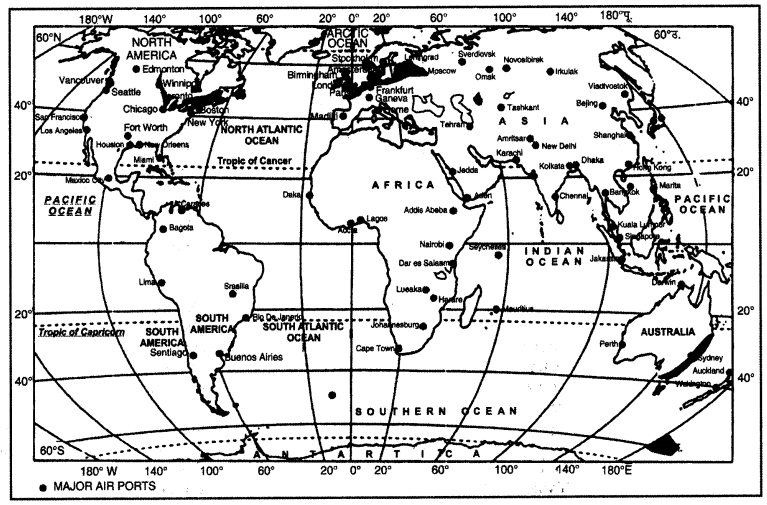
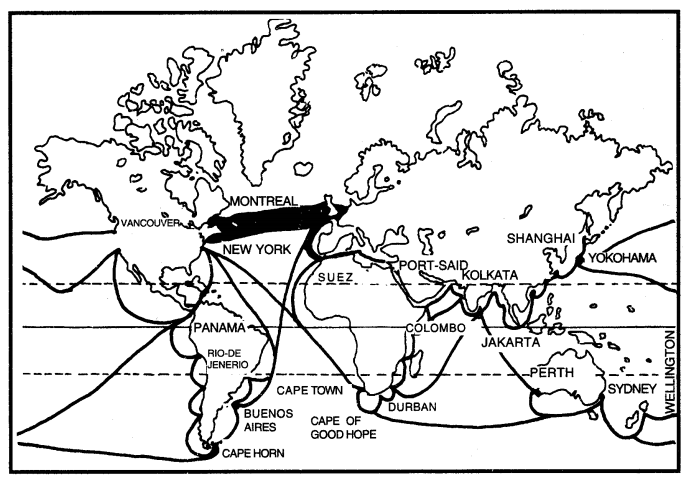
Transport and Communication Class 12 Important Extra Questions Geography Chapter 8

Here we are providing Class 12 Geography Important Extra Questions and Answers Chapter 8 Transport and Communication. Geography Class 12 Important Questions are the best resource for students which helps in class 12 board exams.

Class 12 Geography Chapter 8 Important Extra Questions Transport and Communication

Transport and Communication Important Extra Questions Very Short Answer Type

Question 1.
When and where was the first railway line opened ?
Answer:
First public railway line was opened in 1825 between Stockton and Darlington (England).

Question 2.
What is the length of total motorable roads in world ?
Answer:
15 million kms.

Question 3.
Which two towns are connected by Transcanadian highway ?
Answer:
Vancouver (British Columbia) and St. John (New foundland)

Question 4.
Why is West Asia the least developed in rail facilities ? Explain one reason.
Answer:
West Asia is the least developed in rail facilities because of sparsely populated and Vast deserts.

Question 5.
Which highway connects Darwin and Melbourne ? (C.B.S.E. 2018) !
Answer:
The Trans-Continental Stuart Highway.

Question 6.
Which towns are connected by a new highway constructed in China and Tibet ?
Answer:
Chengdu with Lhasa.

Question 7.
Which country has the largest rail network in Africa ?
Answer:
South Africa has largest rail network in Africa continent.

Question 8.
In which countries, commuter trains are popular ?
Answer:
In U.K, U.S.A., Japan and India, millions of passengers daily move to and for in the city by commuter trains.

Question 9.
Which country has the highest rail- density ?
Answer:
Belgium-1 km of railway for every 6.5 sq. km.

Question 10.
Which Tunnel connects London and Paris
Answer:
Channel Tunnel operated by Euro Tunnel group.

Question 11.
Name a trans-continental railway of South America through which pass does it run.
Answer:
Trans Andean Railway connecting Valparaiso (Chile) with Buenos Aires (Argentina). It runs across the Andes through the Uspallatta Pass (3900 m length).

Question 12.
What is Blue Train ?
Answer:
A train from Capetown to Pretoria in South Africa.

Question 13.
From which station runs Orient express to ? (C.B.S.E. 2011)
Answer:
From Paris to Istanbul.

Question 14.
Name the two terminal ports of Suez canal.
Answer:
Port Said (North) and Port Suez (South).

Question 15.
Which country of the world has the highest road density? (C.B.S.E. Outside Delhi 2017)
Answer:
Japan has the highest road density.

Question 16.
Name two terminal ports of Panama canal.
Answer:
Port Colone and Panama.

Question 17.
Name an inland waterway in North America and Germany. (C.B.S.E. 2011, 2014)
Answer:
St. Lawrence River-great lakes and Rhine waterway.

Question 18.
Name the busiest ocean route of the world. (C.B.S.E. 2014)
Answer:
North Altantic ocean route.

Question 19.
Which means of transport is highly suitable for transporting heavy and bulky goods, at a very low cost over long distances between continents ?
Answer:
Waterways.

Question 20.
What term is used for a railway line that runs across a continent and link its two ends ?
Answer:
Trans continental railway.

Question 21.
Name the famous petroleum pipeline which connects the oil wells of the Gulf of Mexico and the North Eastern States in U.S.A.
Ans.
Big Inch pipeline.

Question 22.
Name the terminal station of Australian Trans-continental railway.
Answer:
West—Perth
East—Sydney.

Question 23.
Explain the most important feature of the pipe line constructed from Noharkatiya oil field to Barauni ? (C.B.S.E. 2009)
Answer:
This was the first pipe fine constructed by I.O.L in 1956.

Question 24.
Which one of the following water ways has drastically reduced the oceanic distance between India and Europe. (C.B.S.E. 2009)
(i) Rhine Water way
(ii) The Cape of good hope as a route
(iii) Suez Canal
(iv) Panama Canal.
Answer:
(iii) Suez Canal.
Or
Which Inland waterway of the world is most heavily used. (C.B.S.E. Outside Delhi 2017)
Answer:
The Rine Inland waterway of the world in most heavily used.

Question 25.
Name the terminal stations of the longest railway in the world. (C.B.S.E. 2009,11)
Answer:
Trans-Siberian Railway is the longest railway in the world. It has terminal station of Vladivostock (in the east) and St. Petersburg (in the west).

Question 26.
Which highway connects North America and South America ? (C.B.S.E. 2013
Answer:
Pan American highway.

Question 27.
Define the term Road density. (C.B.S.E. 2014)
Answer:
Road density in the length of roads per 100 sq. km. of area.

Question 28.
“The Volga is one of the most  developed inland waterways in Russia” Justify.
Answer:
Volga is 3840 km long river in Russia and provide 11,200 km navigable able route. It joined Moscow and Ukraine through densely populated area.

Transport and Communication Important Extra Questions Short Answer Type

Question 1.
Define transport services. Name different methods and goods carried by these.
Answer:
Transport is a service for the carriage of person and goods from one place to another.
It uses humans, animals and vehicles. Such movements take place over land, water and air.
(i) Land transport includes roads and railways.
(ii) Water transport includes shipping and waterways.
(iii) Air transport includes high valued goods.
(iv) Pipelines carry petroleum, natural gas and liquids.

Question 2.
On what factors does the significance of mode of transport depend ?
Answer:
The significance of a mode of transport depends upon :
(i) Type of goods and services to be transported.
(ii) Costs of transport.
(iii) The mode which is available.

Question 3.
Distinguish between metalled and unmetalled roads as regards their utility.
Answer:
Two types of roads are constructed :
(i) Unmetalled roads
(ii) Metalled roads.
Unmetalled roads or surface roads are simple roads. These are not effective and serviceable for all seasons. In rainy season, these become unmotorable.
Metalled roads are laid with bricks and stones. These are solid roads. But during heavy rains and floods these, are damaged. High embankments are constructed to protect these.

Question 4.
What are border roads ? What [ are their functions ?
Answer:
Roads laid along international borders are called border roads. They play an important role in integrating people in remote areas with the major cities. These provide defence needs. These are used to transport goods to border villages and military camps.

Question 5.
State any two advantages of water transport.
Answer:
(i) It does not require route construction.
(ii) The oceans are linked with each other.
(iii) These are negotiable with ships of various sizes.
(iv) The energy cost of water transport is low.
(v) It is the cheapest means of transport.

Question 6.
Describe the Great lakes-St. Lawrence Seaway.
Answer:
The great lakes of North America, Superior, Huron Erie and Ontario are connected by Soo canal and Willand canal to form an Inland waterway. The Estuary of St; Lawrence River along with great lakes forms a commerical waterway.

Question 7.
Analyse the three factors that affect the development of Inland of waterways. Explain the significance of Rhine Inland Waterway. (Delhi 2019)
Answer:
The development of inland waterways depend upon the following factors :
(i) Width and depth of channel
(ii) Continuous flow of water
(iii) Use of technology for dredging.

Significance of Rhine Inland Waterway: The Rhine flows through Germany and the Netherlands. It is navigable for 700 km from Rotterdam, at its north in the Netherland to Basel in Switzerland. It flows through a rich coalfield and the whole basin has become a prosperous manufacturing area. This waterway is the world’s most heavily used.

Question 8.
Write an essay on the economic importance of Trans-Siberian Railway line. (C.B.S.E. 2013)
Answer:
Trans-Siberian Railway line connects the Ear East, the Ural region and the Siberian region with the European Russia. It has helped in the economic development of Siberia. Iron ore and machinery is sent to the Eastern region by this railway.

Foodgrains, wood and coal are sent towards the western part from the Siberian region. Many navigable rivers join this railway line from North and South. Many industrial and commercial towns of Siberia are located on this railway fine. This railway line has helped in the utilisation of resources of Siberia and consequently the density of population has increased in this region.

Question 9.
Name any two inland waterways of Europe. Explain any two factors that influence inland waterways. (C.B.S.E. 2009)
Answer:
The two important inland waterways of Europe are Rhine waterway and Danube waterway. The following factors affect the inland waterways.
(i) Navigability of waterway
(ii) Width and depth of waterway
(iii) Water flow
(iv) Transport technology.

Question 10.
Write six characteristics of Panama canal. (C.B.S.E. 2009, 2017)
Answer:
Panama Canal.
1. It is located in Panama. U.S.A. has control over this canal.
2. It allows two way traffic.
3. It has lock system to allow the ships.
4. Less taxes are charged from the ships passing through this canal.
5. It connects the Atlantic Ocean and the Pacific Ocean.
6. Coal is not available in large quantity on this route.
7. It is important for U.S.A., as the ships do not have to go around Cape Horn.

Question 11.
Name the trans-continental railway of North America constructed in 1886. Write any two characteristics of it. (C.B.S.E. 2009)
Answer:
Trans-canadian railway line was constructed in 1886.

  • It runs across Canada from West to East.
  • It connects Halifax and Victoria.

Question 12.
Write any six characteristics of the Suez canal. (C.B.S.E. 2009)
Answer:

  • Suez canal is the longest navigation canal in the world.
  • It was constructed in 1866 by French Engineer Ferdinand de Lesseps.
  • Suez canal joins Red Sea with Mediterranean Sea.
  • Suez canal has been called the lifeline of the British Empire.
  • It is well served with coal and oil.
  • This is a sea level canal passing through a level area.

Question 18.
Mention any six advantages of oceanic routes. (C.B.S.E. 2009)
Answer:
Advantages of Ocean Routes :

  • It is the cheapest means of transport.
  • It is a natural highway and involves no expenditure on its construction.
  • It is a global route as all the oceans are interlinked.
  • It saves a lot of coal and petroleum as fuel.
  • It carries heavy goods. Cost of transportation becomes low.
  • Ocean routes run in all directions with no maintenance costs.

Question 14.
Describe the pack animals used in different countries.
Answer:
Pack Animals. The following pack animals are used in different countries :
(i) Horses are used as a draught animal even in the Western countries
(ii) Dogs and reindeer are used in North America, North Europe and Siberia to draw sledges over the snow-covered ground.
(iii)Mules are preferred in the mountainous regions
(iv) Camels are used for caravans in deserts and arid regions
(v) In India, bullocks are used for pulling carts.

Question 15.
Describe the main railways of African continent. How do these connect mining areas ?
Answer:
Africa. This continent, despite being the second largest, has only 40,000 km of railways with South Africa alone accounting for 22,051km due to the concentration of gold, diamond and copper mining activities. The important routes of the continent are

  • the Benguela Railway through Angola to Katanga- Zambia Copper Belt
  • the Tanzania Railway from the Zambian Copper Belt to Dar-es-Salaam on the coast
  • the Railway through Botswana and Zimbabwe linking the landlocked states to the South African network, and
  • the Blue Train from Cape Town to Pretoria, Republic of South Africa.

Question 16.
Describe any three major problems of road transport in the world. (CBSE 2018)
Answer:
Major problems of Road transport are:
(i) Air pollution is caused by C02, hydrocarbons and nitrogen emission from the automobiles.
(ii) High rate of accidents are there to use unmetalled or low maintained roads.
Roads are difficult if use during the time of natural calamities and bad weather conditions.
(iii) Road network cannot cope with the demands of traffic as a result congestion occurs.
(iv) Road construction requires heavy investment in construction and regular maintenance.

Question 17.
Describe the Rhine Waterway. “The Rhine waterways is the world’s most heavily used inland waterway.” In the light of this statement, examine the significance of this waterway. (CBSE 2016)
Answer:
The Rhine Water way: The Rhine flows through Germany and the Netherlands. It is navigable for 700 km from Rotterdam, at its mouth in the Netherlands to Basel in Switzerland. Ocean-going vessels can reach up to Cologne. The Ruhr river joins the Rhine from the east. It flows through a rich coalfield and the whole basin has become a prosperous manufacturing area.

Dusseldorf is the Rhine port for this region. Huge tonnage moves along the stretch south of the Ruhr. This waterway is the world’s most heavily used. Each year more than 20,000 ocean-going ships and 2,00,000 inland vessels exchange their cargoes. It connects the industrial areas of Switzerland, Germany, France, Belgium and the Netherlands with the North Atlantic Sea Route.

Question 18.
Why Pipelines are used extensively to transport commodities such as mineral oil and natural gas ? (C.B.S.E. 2011, Delhi 2019)
“Pipelines have become the most convenient and efficient mode of ; transporting liquids and gases over ; long distances in India.” Support the statement with examples. (Delhi 2019)
Answer:
Pipelines are used extensively to transport liquids and gases such as water, mineral oil and natural gas. We are familiar with supply of water and mineral oil through pipes. Even cooking gas or LPG is supplied through pipelines in many parts of the world.

Pipelines can also be used to transport coal mixed with water. In USA, there is a dense network of pipelines for carrying petroleum from the regions of production to the regions of consumption. A famous pipeline of USA, known as the ‘Big Inch’ carries mineral oil from the wells of the Gulf of Mexico to the north-eastern part. About 17 per cent of all freight per tone-kilometre is carried through pipelines in U.S.A.

In Europe, West Asia, Russia and India, pipelines are being used to connect oil wells to refineries and to ports in internal markets. It is also popular for carrying natural gas. One of the longest pipelines, called COMECON, is 4800 km long. It connects oil wells of the Ural and the Volga region to the countries of East Europe.

Question 19.
Describe the importance of Railways.
Answer:
Railway is a major medium of land transport in modem times. Railways are important from economic, social and political point of view.

  • These help in the development of minerals of an area.
  • Railways carry raw materials to industrial areas and distribute manufactured goods to the market.
  • Railways accelerate trade.
  • Railways help to maintain national unity.
  • Railways provide useful help during any emergency.
  • In areas of low population, construction of railways help in the growth of population.
  • It is a convenient means for long distance travel.

Question 20.
‘Transport and communications are necessary infrastructure for the economic advancement of a country.’ Explain.
Answer:
Means of transportation are necessary for the exchange of goods to meet the basic needs of man. Transportation means the exchange of persons, goods and information from one place to another. Transport and communications constitute the infrastructure for the growth and development of agriculture, industry and trade of country. These determine the stage of development and culture of the people of a country.

Main features of transport:
(i) The production and exchange of agricultural products depends on means of transportation.

(ii) Developed means of transport are essential for assembling raw materials for different industries. The manufactured goods are sent to markets at a low cost of transportation.

(iii) An efficient system of transport is essential for the growth of trade of country.

(iv) The working population, both employed in the government and personal services, largely depends on the means of transportation. Life in the Metropolitan cities would come to a standstill if the lines of transport and communications were dislocated for a single day.

(v) Regional specialisation such as tea plantations in Assam and steel plants in Damodar valley are not possible without an efficient system of transport.

(vi) Telecommunication networks help in the diffusion of new ideas to far more people.

(vii) Development of the Trans-Siberian railway line has helped in the utilisation of mineral, forest and agricultural resources of Siberia and Central Asia.

(viii) The sparsely populated, forested, mountainous and arid regions lack developed means of transportation.
As a matter of fact, the developed mean of transport are an index of a country’s economic development. Transport and communications serve as ‘lifelines’ of a country’s development. These can be compared to arteries and veins of a nation.

Question 21.
Distinguish between a harbour I and a port.
Answer:
Tertiary and Quaternary Activities Extra Questions Long Answer TypeTertiary and Quaternary Activities Extra Questions HOTS

HarbourPort
1. A harbour is an area of sea presiding tie up for anchor.

2. It protects the ships front waves and storms.

3. River estuaries and Bays provide natural harbours surh as Mumbai.

4. A harbour provides sufficient room hinterland.

1. A port is a point on coast where ships can safe entrance to ships.

2. Ships load and unload commodities here.

3. Indented coasts provide natural ports.

4. A port is connected with a productive for an chorage of ships.

Question 22.
Distinguish between National highways and State highways.
Answer:

National highwaysState highways
1. These are the major roads of the whole country.

2. These connect the different capitals of within a state.

3. These are maintained by the Central Government.

4. Total length of national highways in India is 33,612 km.

5. These have commercial and strategic significance.

6. Sher Shah Suri large (G.T. Road) is a national highway.

1. These are the major roads within a state.

2. These connect the state capitals with the major towns and district headquarters within a state.

3. These are maintained by State Government.

4. The total length of state highways is 3.81,000 kms.

5. These have administrative significance.

6. Amritsar-Chandigarh is a state highway.

Question 23.
Write a comparative account of the Panama Canal and Suez Canal.
Answer:

Panama CanalSuez Canal
1. It is located in Egypt which has control over this canal.

2. It has one way traffic.

3. It is located on level aroii.

4. Heavy taxes are charged from the ships passing through this canal.

5. It connects Red Sea and the Mediterranean Sea.

6. Coal and petroleum are available on this route.

7. It is important for U.K. as the ships have not to go around Cape of Good Hope.

1. It is located in Panama. U.S.A. has control over this canal.

2. It allows two way traffic.

3. It has lock system to allow the ships.

4. less taxes are charged from the ships passing through this canal.

5. It connects Atlantic Ocean and Pacific Ocean.

6. Coal is not available in large quantity on this route.

7. It is important for U.S.A. as the ships have not to go around Cape Horn.

Transport and Communication Important Extra Questions Long Answer Type

Question 1.
Describe the world distribution of roads.
Answer:
The developed countries have a well developed system of metalled roads. These are also called Highways. The industrial countries depend upon roads for raw materials. The countries with developed economies have large and dense road network.

(i) North America: The U.S.A. and Canada in North America have largest road network in the world. The U.S.A. has the highest density of roads in the world and has the largest number of vehicles in the world. The highway density is 0.65 km per km2 and every place is within 20 km distance from a highway. Cities located on the Western and Eastern coasts of North America have been linked by highways.

The Pan American highway connects Alaska in the North with Southern Chile. It is 48,000 kilometres long and is the longest highway in the world. The Trans Canadian Highway links St. John City in New foundland and Vancouver in British Columbia. Alaskan Highway links Edmonton to Anchorage.

(ii) Asia : Land transport has been important in Asia since earliest times. Travellers have been following caravan routes. In China, Beijing is connected with Shanghai Guangzhou, Tsungtso. A highway runs from Chengdu to Lhasa.

(iii) India: In India, most of metalled roads are found in Southern India. Sher Shah Suri Marg or G.T. Road is historically important. It connects Amritsar, Delhi and Kolkata and is known as National Highway No. 1. and No. 2. Its total length is 2500 km. The longest highway in India is N. H. No. 7. which links Varanasi to Kanniyakumari and is 2369 km long. The Golden Quadrilateral or Super express way links New Delhi, Kolkata, Mumbai and Chennai.

(iv) Other Routes: Europe has a dense network of roads in Russia where Moscow is the focus. In Africa, Cairo to Capetown is an important highway. In Australia, Stuart Highway connects Eastern, Southern and Western Australia, (from Darwin to Melbourn).

Question 2.
Describe the location and importance of major railways of the world.
Answer:
Railways : Railways are the most important means of transport on land. The invention of Steam Engine in 1819 and the industrial revolution led to the development of Railways. Railways are very important from the economic, social and strategic point of view.

Importance :

  • Railways carry heavy raw materials to industrial areas.
  • Railways distribute large volume freight manufactured goods over long distances.
  • Railways are vital for national unity, and administration in time of war and peace.
  • Railways are the important life-lines of a nation. They bring people close to one another.
  • Railways are the cheapest and fastest carriers of passengers for long journeys. Underground railways in big cities carry huge number of people.

Major Railways of the World. The U.S.A. has the longest network of railways in the world.

1. Trans-Siberian Railway line : Trans-Siberian Railway line is the longest railway in the world. It is 11,000 km. long. It is mainly double-tracked. It runs from Vladivostok through Moscow to St. Petersburg. Many towns like Kubyshev, Omsk, Irkutsk, Chita are located on it.

It is the basis of industrial and economic development of Siberia. It has helped settlement in these empty lands. This railway connects wheat lands, coalfields, iron ore region and industrial areas of Siberia. It is highly important from the strategic point of view. Irkutsk is a fur centre on it.

2. Canadian Pacific Railway: Canada has a large east-west extent. It covers mostly snow covered mountains, forests, lakes and high mountains. Canada has two great railway systems. These run from Atlantic coast to Pacific coast connecting Quebec-Montreal industrial region with wheat belt of Prairies and coniferons forests.

The Canadian Pacific Railway and Canadian National Railway run from Vancouver and Seatle on the west coast to Montreal, Halifax and St. John on the Atlantic coast. These railways carry wheat, minerals, coal and iron ore.

3. Railways of the U.SA. : A dense network of railways is found in the eastern part of the U.SA. On the western side, railways are not developed due to hilly nature of the area. These railways join the main centres on the east coast and on the west coast. These are also called Trans-Continental Railway lines. The Union Pacific railway line runs from Chicago to San Francisco. Chicago is the largest rail junction in the world. Ores, grain, paper, chemicals and machinery are exported.

4. Cape-Cairo Railway: This railway line connects Cape Town in South Africa and Cairo (Egypt). This railway runs in a North-South direction. It has to face many obstacles like mountains, high plateaus, equatorial forests and political barriers. This railway has not been completed so far. It runs from Capetown through Kimberley, Lusaka to Bukama (Zaire).

After this, there is water transport (Victoria Lake) or road transport up to Khartoum (Sudan). This railway line continues beyond Khartoum up to Cairo. This railway has helped mining areas and agricultural areas of Africa. South Africa alone has 18000 km railways due to concentration of gold, diamond and copper mines.

5. Trans-Andean Railway: This trans continental railway line, 400 km. long, links Valpraiso (Chile) and Buenos Aires (Argentina). This railway line runs through the Andes mountains at a height of 3485 metres, through Uspallata Pass. It connects the wheat areas of Argentina, coffee areas of Brazil and mining areas of Chile. Pan American railway from Alaska to Chile is the longest railway line in the world.

6. Europe. Europe has one of the most dense rail networks in the world, (about 4,40,000 kms). Most of which is double tracked. Belgium has the highest density of 1 km for every 6.5 km2. London, Paris, Brussels, Milan, Berlin and Warsaw are main rail heads. Channel Tunnel (Euro Tunnel Group) connects London with Paris. Underground railways run in

London, Paris and Moscow Orient express railway runs from Paris to Istanbul. There is a proposal to build a Trans-Asiatic railway linking Istanbul to Bangkok via Iran, Pakistan, India, Bangladesh and Myanmar.

7. Australian Trans-continental Railway. It runs west-east across the Southern Australia from Perth to Sydney; passing through Kalgoorlie, Broken hill and Port Augusta. This is called National Railway line.

Question 3.
Write short notes on :
(i) Inland waterways
(ii) Air transport.
Answer:
(i) Inland waterways: Water transportation is of two types :
(a) Inland waterways
(b) Ocean routes.
Ocean routes are used for international trade; Inland waterways are used for internal trade of a country. Navigable rivers, canals and lakes are used as inland waterways. These provide cheap transport for heavy raw materials in industrial countries. Rivers and canals should be deep and flow throughout the year. They should have plenty of water. There should be no silting of beds. The river course should be free from waterfalls.

Inland waterways of the world :
(a) Europe :
A number of countries like France, Germany and Russia use rivers and canals as inland waterways. The Rhine (Germany), Seine, Rhone (France), Volga (Russia), Danube, Elbe and Weser are the important navigable rivers. The Rhine river is the life line of the trade of Germany. The Volga system links five seas. The Rhine-Rhone canal, Volga-Baltic canal, Manchester Liverpool canal are also used as inland waterways.

(b) North America : Great lakes, St. Lawrence sea waterways and the Mississippi river are the important waterways. They serve the industrial region of North America.

(c) Others : The Amazon is the main inland waterway in South America. It is navigable for 1600 kms. upstream. The Yangtze river in China, the Indus in Pakistan, the Ganga and Brahmaputra in India and Irrawaddy in Burma provide inland water transport. The Nile, the Zaire and the Niger rivers in Africa are not useful. These are interrupted by waterfalls.

(ii) Air transport: Since ancient times, men have wanted to fly. The first successful flight by aeroplane was made by the American Wright Brothers in 1903. Many developments during the 20th century have revolutionised air transport.Air transport is the quickest means of transport. It needs no expenditure on the construction of air routes. It can cross physical barriers like mountains, oceans and deserts. But it is a costly means of transport. It is useful for transporting passengers, mails, food supplies and commodities of high value.
Geography Class 12 Important Questions Chapter 8 Transport and Communication 1
Factors affecting air transport:

  • Air routes generally follow great circles to fly over the shortest distance.
  • Air transport needs clear weather. Low clouds, fog, dust storms and snow are big handicaps.
  • The construction of aerodromes needs level land.
  • Air transport requires huge capital.
  • The air transport needs adequate equipment and machinery.

World Air-Routes : Major air-routes of the world connect economically developed countries. The U.S.A., Russia and Western Europe have a dense network of air routes.

  • North Atlantic Air Route (between N. America and Europe).
  • South Atlantic Air Route (between S. America and Europe).
  • Air Routes between Europe and Russia.
  • Air Routes between Middle East and Europe.
  • Europe-Australia Air Route.
  • Europe-Asia (Far East) Air Route.

Nodal points. U.S.A. alone accounts for the 60% of this airways of the world. New York, London, Paris, Amestardam, Frankfurt, Rome, Moscow, Karachi, New Delhi, Mumbai, Bangkok, Singapore, Tokyo, San Francisco, Los Angeles and Chicago are nodal points where air routes coverage or radiate.

Question 4.
Describe the chief ocean routes of the world. Discuss their characteristics, trade and importance.
Answer:
Ocean routes are the most important and the cheapest means of transportation. It is the mainstay of international trade. When the ships regularly follow a well defined track, it is called a route.

Importance of Ocean Routes :

  • It is the cheapest means of transport.
  • It is a natural highway and involves no expenditure on its construction.
  • It is a global route as all the oceans are inter-linked.
  • It saves a lot of coal and petroleum as fuel.
  • It carries heavy goods. Cost of transportation becomes low.

Factors influencing the ocean routes. Ocean routes depend on the following factors:

  • Ocean routes follow great circles (the shortest distance between two points on the globe).
  • Ships pass through the points where cargo is available.
  • Ships avoid areas of icebergs, fog and storms.
  • Ships stop at ‘ports of call’ where fuel is available.
  • Ocean routes pass through densely populated and economically developed areas.

Major Ocean Routes of the World. The major ocean routes are located in mid-latitude countries.

1. North Atlantic Route. This route lies between 40° – 50° N latitudes and connects Europe and North America. It is the busiest route of the world. About 25% ships of the world follow this route.

About half the major ports of the world are located on this route. This route connects the two continents highly developed in manufacturing, transportation and trade. This is called Big-Trunk Route.

This route follows the Great Circle. This route is well served with Coal and Petroleum. On both sides of the route, there are many deep, protected harbours and modern shipyards. The route connects two regions of dense population with a high standard of living of the people. The route suffers from the handicaps of fog and icebergs near Newfoundland.

Ports and Trade. The important ports of the European side of the route are London, Liverpool, Glasgow, Oslo, Hamburg, Rotterdam and Lisbon. On the American side of the route, the major ports are Quebec, Montreal, Halifax, Boston, Philadelphia and New York. This route handles about one fourth of the world’s trade.

The East-bound traffic consists of wheat, cotton, wood-pulp, petroleum, dairy products and fruits. The West-bound traffic consists of medicines, olives, chalk, pyrites and manufactured goods.

2. The Suez Route. This route runs through the heart of the old world. It serves most of the world-land area and most of the world’s population. It is known as Grand Trunk Route as regards its length. It is a vital link between the Northern and Southern continents.

This route is well served with coal and petroleum. This route has resulted in the saving of distance of 8000 kms. between Asia and Europe. The Suez route has been called the Life-Line of the British Empire.

Ports and Trade. This route extends from Western Europe through Mediterranean Sea upto Suez Canal. After crossing the Suez Canal it runs through Red Sea and Indian Ocean. This route follows three directions:

  • Towards South-Africa.
  • Towards Australia and New Zealand.
  • To India and the Far-East.

Geography Class 12 Important Questions Chapter 8 Transport and Communication 2

This route is a short-cut to Afro-Asian market. On the western side, European Ports serve this route. On the Eastern side, the important ports are Aden, Karachi, Mumbai, Kolkata, Chennai, Colombo, Rangoon, Singapore, Hongkong, Shanghai, Yokohama, Melbourne and Wellington. The

East-bound traffic consists of manufactured goods, machinery, chemicals, medicines. The West- bound traffic consists of oil, dates from the Persian Gulf; jute, tea, sugar from India; tin and rubber from Malaysia ; sugar, tea, spices from Indonesia; silk and cotton textiles from China and Japan, dairy products from Australia.

3. The Panama Route. This route connects the Atlantic Ocean and Pacific Ocean. The Panama canal was opened in 1914. The Panama Canal is the Gateway to the Pacific. This route has increased the trade between the West coasts of America and Europe. It has eliminated the long voyage round the stormy Cape Horn. It has reduced the distance between East and West of North America by 10,000 kms.

Ports and Trade. The important ports on the western side are Auckland, Valparaiso, Los Angeles, San Francisco, Vancouver and Prince Rupert. On the eastern coast, the important ports are Kingston, Havana, Rio-de- Janeiro, Panama and New Orleans. There is a great exchange of minerals and raw materials between these regions. Iron-ore, nitrates, copper, cotton, coffee move along this route in exchange for manufactured goods.

4. Cape of Good-Hope Route. The route was discovered in 1498 by Vasco-de-Gama. It became an important route due to the closure of Suez canal. It connects Europe with South-Africa, Australia and New Zealand. This route follows a great circle to clear the shoulder of Africa. This route is cheaper than Suez route. Cape of Good-Hope? is a focus of many trade routes from Europe to

  • South Africa
  • Persian-Gulf
  • Far- East
  • Australia and New Zealand.

Ports and Trade. On the western side, it serves all the important ports of Europe. On the eastern side, Capetown, Durban, Dar-es-Salaam, Adelaide, Sydney and Jakarta are the important ports. The East-bound traffic consists of manufactured goods, machinery, automobiles and medicines. Large quantities of wheat, hides, rubber, sugar, copper, gold, wool and coffee are exported to Europe.

5. Trans-Pacific Routes. This route connects the western coas t of North America with Asia. This is an unimportant route. Few ships move across the vast ocean. It forms a Great circle route. Several routes meet at Honolulu. It is called the cross roads of the Pacific.

Ports and Trade. The important ports on the American side are Vancouver, Prince Rupert, San Francisco and Los Angeles. On the eastern side, Yokohama, Hong Kong, Manila, Sydney and Auckland are important ports. Wood-pulp, wheat, paper and machinery is exported towards Asian side. Sugar, jute, tea, silk, toys, rubber, teak are sent to North America.

6. The South Atlantic Route. This route connects West Indies and South America with Europe. It links the agricultural nations of Brazil and Argentina with the industrial regions of Europe and U.S.A. Cape San Roque (Brazil) leads this route into two branches, one to Europe and the other-to North America.

Ports and Trade. On the northern side, it serves the ports of Europe and North America. On the southern side, the important ports are Kingston, Bahia, Santos, Buenos Aires, Monte Video and Rio-de-Janeiro. Wheat, coffee, sugar and wool are sent to Europe in exchange of coal, machinery and manufactured goods.

Question  5.
Describe the geographical, economic and strategic importance of Suez Canal. (C.B.S.E. Outside 2017) (CBSE 2018-19)
Answer:
Suez canal
1. Location. The Suez Canal is the longest navigation canal in the world. It has been cut across the isthmus of Suez in Egypt.

2. History. The construction of Suez canal was begun by French Engineer, Ferdinand-de-Lesseps in 1859. It was opened on 17th November, 1869. It took ten years to complete this canal at a cost of Pound 180 lakh. The canal was nationalised on 26 July, 1956 by Col. Abdul Nasser to help-the construction of Aswan dam. Due to war, the canal remained closed till 1975 due to Arab-Israel conflict.

3. Seas and Ports. Suez canal joins the Red Sea with the Mediterranean. On the Mediterranean Sea, Port Said is the major Port while Port Suez stands on the Red Sea side. This canal is 162 kms. long, has a depth of 13 metres and a width of 60 to 80 metres. This is a sea-level canal passing through a level area. It has 3 salt lakes :

  • Little Bitter Lake
  • Great Bitter Lake
  • Timshah Lake.

Geography Class 12 Important Questions Chapter 8 Transport and Communication 3
It takes about 12 hours to cross this canal. The Suez Canal can handle about 10 ships a day. It is difficult for modern ships to pass through this canal.

4. Importance. This route runs through the densely populated areas. It is well served with coal and oil. Many deep, protected harbours are found on this route. It is located at the cross-roads of the three continents. It has been called the life-line of the British Empire. Ships avoid long route via Cape of Good-Hope. The distance between Europe and Asia has been shortened by about 8000 kms. This manmade navigation canal serves as gate-way to India Ocean.

5. Drawbacks. It is a narrow canal. It is not very deep. Modern ships and oil tankers cannot pass through it. It takes longer time to cross the canal due to oneway traffic. The canal taxes are very high. Therefore, it is a costly route. It needs regular dredging due to the sand falling into the canal.

The closure of Suez canal had adverse effect on the economy of many countries. It caused an increase in the prices of oil and raw materials. The canal had been re-opened on June 5, 1975. It has definitely helped India to increase her exports. Suez Canal is being deepened and widened at a great cost, but it will not be the same old romantic Suez Canal.

Question 6.
Describe the geographical, economic and political importance of Panama Canal. (Imp)
Answer:
Panama canal
1. Location. Panama Canal has been cut across Panama isthmus. The canal lies in Panama situated in Central America.

2. History. After the opening of Suez Canal, Ferdinand-de-Lesseps started the construction of Panama Canal in 1882. The project faced many handicaps and was abandoned. In 1914, U.S.A. completed the construction of Panama Canal. This canal is constructed, owned and controlled by U.S.A. The construction of Panama Canal was a great feat of engineering.

Geography Class 12 Important Questions Chapter 8 Transport and Communication 4

3. Ports and seas. The canal connects two great oceans—The Pacific and the Atlantic. It is also called the Gateway to the Pacific. The port of Colon is situated on the Atlantic while the port of Panama is situated on the Pacific. The canal is 81.6 km long, about 13 metres deep and the width varies from 90 to 305 metres. It takes ships about 8 hours to cross this canal.

The water level in the canal is 26 metres above sea level. So it is necessary to construct locks in the canal to raise and lower ships. The Panama Canal passes through:

(i) Two bays.
(ii) One artificial lake—Gatun lake
(iii) One natural lake
(iv) One cut through Culbera Ridge.
(v) Three lock systems

  • Gatun locks
  •  Pedro Miquel lock
  • Mira Flores lock.

4. Importance
(i) Panama Canal has changed the element of distance in geography of transportation. The Pacific Ocean and Atlantic Ocean are nearer to each other now by 1000 km.
(ii) It has eliminated the long voyage around the stormy Cape Horn.
(iii) It has reduced the distance between the eastern and western coasts of U.S.A.
(iv) Australia, New Zealand and South America are now nearer to Europe via Panama Canal.
(v) It is of great strategic importance to U.S.A. as she can keep only one navy.

5. Drawbacks:
(i) The system of locks is inconvenient, costly and delays the ships.
(ii) The vast Pacific Ocean has few ports and islands.
(iii) Large ships cannot pass through this canal.
(iv) The Panama Canal passes through thinly populated and under-developed countries.

Future. U.S.A is the biggest user of this canal. Almost 50 ships pass through this canal daily. The opening of this canal has helped the development of West India and Western coast of South America.

Question 7.
“The Suez and Panama canals are two vital man-made navigation canals which are gateway of commerce for both the Eastern and Western World!” In the lights of this statement explain the economic significance of these two canals. (C.B.S.E. 2010)
Answer:

Suez canal
1. Location. The Suez Canal is the longest navigation canal in the world. It has been cut across the isthmus of Suez in Egypt.

2. History. The construction of Suez canal was begun by French Engineer, Ferdinand-de-Lesseps in 1859. It was opened on 17th November, 1869. It took ten years to complete this canal at a cost of Pound 180 lakh. The canal was nationalised on 26 July, 1956 by Col. Abdul Nasser to help-the construction of Aswan dam. Due to war, the canal remained closed till 1975 due to Arab-Israel conflict.

3. Seas and Ports. Suez canal joins the Red Sea with the Mediterranean. On the Mediterranean Sea, Port Said is the major Port while Port Suez stands on the Red Sea side. This canal is 162 kms. long, has a depth of 13 metres and a width of 60 to 80 metres. This is a sea-level canal passing through a level area. It has 3 salt lakes :

  • Little Bitter Lake
  • Great Bitter Lake
  • Timshah Lake.

Geography Class 12 Important Questions Chapter 8 Transport and Communication 3
It takes about 12 hours to cross this canal. The Suez Canal can handle about 10 ships a day. It is difficult for modern ships to pass through this canal.

4. Importance. This route runs through the densely populated areas. It is well served with coal and oil. Many deep, protected harbours are found on this route. It is located at the cross-roads of the three continents. It has been called the life-line of the British Empire. Ships avoid long route via Cape of Good-Hope. The distance between Europe and Asia has been shortened by about 8000 kms. This manmade navigation canal serves as gate-way to India Ocean.

5. Drawbacks. It is a narrow canal. It is not very deep. Modern ships and oil tankers cannot pass through it. It takes longer time to cross the canal due to oneway traffic. The canal taxes are very high. Therefore, it is a costly route. It needs regular dredging due to the sand falling into the canal.

The closure of Suez canal had adverse effect on the economy of many countries. It caused an increase in the prices of oil and raw materials. The canal had been re-opened on June 5, 1975. It has definitely helped India to increase her exports. Suez Canal is being deepened and widened at a great cost, but it will not be the same old romantic Suez Canal.

Panama canal
1. Location. Panama Canal has been cut across Panama isthmus. The canal lies in Panama situated in Central America.

2. History. After the opening of Suez Canal, Ferdinand-de-Lesseps started the construction of Panama Canal in 1882. The project faced many handicaps and was abandoned. In 1914, U.S.A. completed the construction of Panama Canal. This canal is constructed, owned and controlled by U.S.A. The construction of Panama Canal was a great feat of engineering.

Geography Class 12 Important Questions Chapter 8 Transport and Communication 4

3. Ports and seas. The canal connects two great oceans—The Pacific and the Atlantic. It is also called the Gateway to the Pacific. The port of Colon is situated on the Atlantic while the port of Panama is situated on the Pacific. The canal is 81.6 km long, about 13 metres deep and the width varies from 90 to 305 metres. It takes ships about 8 hours to cross this canal.

The water level in the canal is 26 metres above sea level. So it is necessary to construct locks in the canal to raise and lower ships. The Panama Canal passes through:

(i) Two bays.
(ii) One artificial lake—Gatun lake
(iii) One natural lake
(iv) One cut through Culbera Ridge.
(v) Three lock systems

  • Gatun locks
  •  Pedro Miquel lock
  • Mira Flores lock.

4. Importance
(i) Panama Canal has changed the element of distance in geography of transportation. The Pacific Ocean and Atlantic Ocean are nearer to each other now by 1000 km.
(ii) It has eliminated the long voyage around the stormy Cape Horn.
(iii) It has reduced the distance between the eastern and western coasts of U.S.A.
(iv) Australia, New Zealand and South America are now nearer to Europe via Panama Canal.
(v) It is of great strategic importance to U.S.A. as she can keep only one navy.

5. Drawbacks:
(i) The system of locks is inconvenient, costly and delays the ships.
(ii) The vast Pacific Ocean has few ports and islands.
(iii) Large ships cannot pass through this canal.
(iv) The Panama Canal passes through thinly populated and under-developed countries.

Future. U.S.A is the biggest user of this canal. Almost 50 ships pass through this canal daily. The opening of this canal has helped the development of West India and Western coast of South America.

Transport and Communication Important Extra Questions HOTS

Question 1.
Why is river Rhine the world’s most heavily used waterway? Explain any three reasons. (C.B.S.E. 2013)
Answer:
The river Rhine flows through Germany and Netherlands. It is the most used inland waterway.

  • It flows through a rich coalfield (Ruhr) and the whole basin is a prosperous manufacturing area.
  • Huge tonnage vessels moved along the stretch, south of Ruhr each year more than 20,000 ocean going ships and 2,00,000 inland vessels exchange their cargo.
  • It connects the industrial areas of Switzerland, Germany, France, Belgium and the Netherlands with the North Atlantic sea route.

Question 2.
Study the map given below carefully and answer the questions that follow :
(i) Identify and name the canal shown in the map.
Answer:
Panama canal

(ii) Explain any two features of this canal.
Answer:

  • The canal connects two great oceans-the Pacific and the Atlantic. It is also called the gateway to the Pacific.
  • Panama canal has been cut across Panama Isthmus.
  • It has reduced the distance between eastern and western coasts of U.S.A.

Tertiary and Quaternary Activities Class 12 Important Extra Questions Geography Chapter 7

Here we are providing Class 12 Geography Important Extra Questions and Answers Chapter 7 Tertiary and Quaternary Activities. Geography Class 12 Important Questions are the best resource for students which helps in class 12 board exams.

Class 12 Geography Chapter 7 Important Extra Questions Tertiary and Quaternary Activities

Tertiary and Quaternary Activities Important Extra Questions Very Short Answer Type

Question 1.
Which two elements are included in tertiary activities ?
Answer:
Production and exchange.

Question 2.
What is trade ?
Answer:
Trade is essentially buying and selling of itmes produced elsewhere.

Question 3.
Name two types of trade.
Answer:
Retail trade and wholesale trade.

Question 4.
Name two types of trading centres.
Answer:
Rural and urban.

Question 5.
What are Quasi urban centres ?
Answer:
Rural marketing centres.

Question 6.
What are mandis ?
Answer:
Wholesale markets.

Question 7.
State four examples of retail trading service ?
Answer:
Street peddling, handcarts, mail-order and door to door.

Question 8.
Expand ICT.
Answer:
Information Communication Technologies.

Question 9.
What are Isochrone lines ?
Answer:
Isochrone lines are drawn on a map to join places equal in terms of the time taken to reach them.

Question 10.
Which is the fastest means of communication ?
Answer:
Mobile Technology and Satellites.

Question 11.
What are modes of Mass media ?
Answer:
Radio and Television.

Question 12.
Name three services involving mental labour.
Answer:
Teacher, lawyers and physicians.

Question 13.
Expand CBD.
Answer:
Central Business District.

Question 14.
Which industries are fostered by Tourism ?
Answer:
Infrastructure industries, Retail trading and Craft industries.

Question 15.
Name two tourist regions of the world.
Answer:
(i) Mediterranean coast
(ii) Goa coast.

Question 16.
What are entrepreneurs ?
Answer:
These are empowered workers which believe in self-actualisation and not wealth. They believe in value system, quality of life and creativity.

Question 17.
Analyse the development of service sector as an outcome of improvement in transport and communication.
(Sample Paper 2018-19)
Answer:
The service sector includes important services such as transportation and communication. Improvement in these services play an important role for integrated and facilitates economic development and growth.

Question 18.
Give two examples of high service.
Answer:
Finance and insurance.

Question 19.
Give one example of a global city.
Answer:
London.

Question 20.
What is the importance of secondary activities in the world ? (C.B.S.E. 2009)
Answer:
Secondary activities add value to natural resources by transforming raw materials to valuable products.

Question 21.
What was the initial form of trade in the primitive society ? (C.B.S.E. 2009)
Answer:
The initial form of trade in the primitive society was barter system. In this, direct exchange of goods take place without use of money.

Question 22.
Define the term ‘tertiary (C.B.S.E. 2013)
Answer:
Activities related to the service sector.

Question 23.
Give the meaning of retail.(C.B.S.E. 2013)
Answer:
Business activity concerned with the sale of goods directly to the consumer.

Question 24.
Write the meaning of Trading centres’. (Delhi 2019)
Answer:
From around the globe in the international trade trade centres brings together business.

Tertiary and Quaternary Activities Important Extra Questions Short Answer Type

Question 1.
What is trade ? What is its aim ? What are trading centres ? (C.B.S.E. 2011)
Answer:
Trade is essentially buying and selling of items produced elsewhere. It is of two types. Wholesale and Retail trade. The trade services are intended for profit. All this work takes place in towns and cities and are known as trading centres (Rural and Urban).

Question 2.
What are Periodic markets ?
Answer:
In rural areas, local periodic markets are organised. These may be weekly or bi-weekly. People from surrounding areas meet their demands from it. These markets move from one place to another. Thus shopkeepers serve a large area on all the days.

Question 3.
Describe the different types of stores. (C.B.S.E. 2017)
Answer:
(i) Consumer co-operatives. These provide large scale retailing.
(ii) Departmental stores. Heads of each department purchases and sells commodities.
(iii) Chain stores. These experiment sale of goods in one store and apply the results to other stores.

Question 4.
What is Transport Service ? Why is it necessary ?
Answer:
Transport is a service by which persons, manufactured goods and property are physically carried from one location to another. It is necessary to satisfy man’s basic need of mobility. It is necessary to have speedy and efficient transport system.

Question 5.
Describe any three characteristics is of chain stores in the world. (C.B.S.E. Outside 2017)
Answer:
The use of telecommunications finked to the development of electrical technology. It carries the messages with great speed. The time reduced is from weeks to minutes. Mobile telephones can send communications direct and instantaneusly at any time and from any where.

Question 6.
What are means of mass media ? Explain its different types.
Answer:
Radio and television also help to relay news, picture and telephone calls to vast audiences around the world and hence they are termed as mass media. Its functions:

  • They are vital for advertising and entertainment.
  • Newspapers are able to cover events in all corners of the world
  • Satellite communication relays information of the earth and from space
  • The internet has truly revolutionized the global communication system.

Question 7.
What is unorganised sector of services ? What do you know about Mumbai’s Dabbawala ?
Answer:
Unskilled workers migrate from rural to urban areas in search of employment. They are employed in domestic services as housekeepers, cooks, gardeners and are called unorganised sector. In India, Mumbai’s Dabbawala (Tiffin) service provides about 1,75,000 customers all over the city.

Question 8.
What is the basis of Quarternary services ? Which activities are involved in these ? (C.B.S.E. 2009)
Answer:
Knowledge based sector is called Quartemary services. It involves three processes.

  • collection
  • production
  • dissemination of information.

Question 9.
What are Quinary activities ? Give examples. (C.B.S.E. 2009)(Sample Paper 2018-19)
Answer:
Quinary activities focus on the creative, re-arrangement of new and existing ideas, data interpretation and use of evaluation of new technologies. That is one highest level of decision makers. These are referred as Gold Collar professions. They have special and highly paid skills of senior business executives research scientists and financial consultants.

Question 10.
How does the climate of a region attract tourists. Explain with examples from different regions of the world. (C.B.S.E. 2009)
Answer:
Influence of climate in tourism.

Examples :
(i) Most people expect to have warm, sunny weather for beach holidays. This is one of the main reasons for the importance of tourism in South Europe.

(ii) The Mediterranean climate offers almost consistently high temperatures, long hours of sunshine and low rainfall throughout the peak holidays seasons.

(iii) People taking winter holidays have specific climate requirements, either highest temperatures than home, or snow suitable for skiing Mediterranean region is called ‘Playground of Europe’.

Question 11.
Distinguish between rural marketing centres and urban marketing centres.
Answer:
Rural marketing centres. These centres cater to nearby settlements. These are Quasi-urban centres. Here personal and professional services are not well developed. These form local collecting and distributing centres. Most of these have Mandis and also retailing centres. These supply goods demanded by rural folk. Periodic markets are held here—(weekly or bi-weekly).

Urban Marketing centres. These provide urban services. These supply specialized goods and services. These sell manufactured goods. Markets for labour, housing, semi-finished goods are held. These provide services of education, teachers, lawyers, consultants, physicians, dentists and veterinary doctors.

Question 12.
What do you know about medical services for overseas patients ?
Answer:
Medical Services for Overeas Patients in India. About 55,000 patients from USA visited India in 2005 for treatment. This is still a small number compared with the millions of surgeries performed each year in the $2 trillion U.S. health-care system. India has emerged as the leading country of medical tourism in the world.

World class hospitals located in the Metropolitan cities and Vellore cater to the patients all over the world. Medical tourism brings abundant benefits to developing countries like India, Thailand, Singapore and Malaysia.

Question 13.
Describe the major components of services.
Answer:
The major components of services may broadly be grouped as the following :
(i) Business Services include advertising, legal services, public relations, and consulting.

(ii) Finance, insurance and real estate include savings and investment banking, insurance and real estate (commercial as well as residential).

(iii) Wholesale and retail trading links the producers with consumers. Personal services such as maintenance services, beautician and repair work are included in this.

(iv) Transport and communications include railways, roadways, shipping and airline services and post and telegraph services.

(v) Entertainment includes television, radio, film, publishing and lodging.

(vi) Government at different levels—local, state and national includes bureaucracies, police and army, and other public services.

(vii) Non-governmental agencies include those organisations which have been set-up by individuals or groups for charity or non profit social activities concerning education, healthcare, environment, rural development, etc.

Question 14.
Discuss the nature and growth of Quarternary services in the world.
Or
‘The Modern Economic development in the world is the result of the development of quarternary services, Justify the statement. (C.B.S.E. 2014) (C.B.S.E. 2011)’.(Sample Paper 2)
Or
Evaluate the importance of quarternary activities. (C.B.S.E. 2018)
Answer:
Economic activities have become much more specialized and complex. As a result quarternary activities have come into use now. Activities concerning knowledge, education, information, research and development (R & D) are recognized as quarternary activities or services.

Main Characteristics :

  • The term quaternary basically refers to the more intellectual occupations.
  • Their task is to think, research and develop ideas.
  • As such, this sector is especially concerned with research and development.
  • In the most economically and advanced nations, the quarternary activities involve a small but growing proportion of the population.
  • These people have the highest incomes and a higher degree of mobility in the process of career advancement.

Growth of Quarternary Activities :
In recent years, revolution in information technology has given rise to knowledge-based industries. There has been a remarkable growth in the science and technology based industrial complexes called Science and Technological parks.

Tertiary and Quaternary Activities Important Extra Questions Long Answer Type

Question 1.
Write the meaning of tourism. (Delhi 2019)
What is tourism? Explain the factors which attract the tourists in the world. I (Outside Delhi 2019)
Answer:
Tourism. Tourism is travel undertaken for purposes of recreation rather than business. Employment. It has become the world’s single largest tertiary activity in total registered jobs (250 million) and total revenue (40 per cent of the total GDP). Besides, many local persons, are employed to provide services like accommodation, meals, transport, entertainment and special shops to recreational travellers. Tourism fosters the growth of infrastructure industries, retail trading, and craft industries (souvenirs).

Seasonal and Year Round Tourism. In some regions, tourism is seasonal because the vacation period is dependent on favourable weather conditions, but many regions attract visitors all year round.

Tourist regions :

  • Mediterranean Coast. The warmer places around the Mediterranean Coast.
  • The West Coast (Goa and Kerala) of India are some of the people tourist destinations in the world.
  • Winter sports regions, found mainly in mountainous areas.
  • Various scenic landscapes and national parks, which are scattered.
  • Historic towns also attract tourists, because of the monuments and cultural facilities.

Factors affecting tourism
(i) Demand. Since the last century, the demand for holidays has increased rapidly. Improvements in the standard of living and increased leisure time, permit many more people to go on holidays.

(ii) Transport. The opening-up of tourist areas has been aided by improvement in transport facilities. Travel is easier by car, with better road systems. More significant in recent years has been the expansion in air transport. For example, air travel allows one to travel anywhere in the world in a few hours’ of flying¬time from their homes. The advent of package holidays has reduced the costs.

(iii) Climate. Most people expect to have warm, sunny weather for beach holidays. This is one of the main reasons for the importance of tourism in South Europe. The Mediterranean climate offers almost consistently high temperatures, long hours of sunshine and low rainfall throughout the peak holidays season.

People taking winter holidays have specific climate requirements, either higher temperatures than home, or snow suitable for skiing. Mediterranean region is called ‘Playground of Europe’.

(iv) Landscape. Many people like to spend their holidays in an attractive environment, which often means mountains, lakes, spectacular sea coasts and landscapes not completely altered by man.

(v) History and the arts of an area have potential attractiveness. People visit ancient or picturesque towns and archaeological sites, and enjoy exploring castles, palaces and churches.

(vi) Culture and economy entice tourists with a penchant for experiencing ethnic and local customs. Besides, if a region provides for the needs of tourists cheeply (low-cost), it is lively to become very popular. Home-stay has emerged as a profitable business tourism segment in heritage homes in Goa and Madikere (Coorg, Karnataka).

Question 2.
What is meant by Outsourcing ? What is the role of KPO’s and BPO’s ?
Answer:
Outsourcing. Outsourcing or contracting out is giving work to an outside agency to improve efficiency and reduce costs. When outsourcing involves transferring work to overseas locations, it is described by the term off shoring, although both off shoring are outsourcing are used together.

Activities involved in outsourcing.

  • information technology (IT)
  • human resources
  • customer support
  • call centre services
  • manufacturing
  • and engineering.

Data processing is an IT related service easily be carried out in Asian, East European and African countries. In these countries IT skilled staff with good English language skills are available at low wages than those in the developed countries.

Thus, a company in Hyderabad or Manila does work on a project based on GIS techniques for a country like USA or Japan. Overhead costs are also much lower making it profitable to get job-work carried out overseas, whether it is in India, China or even a less populous country like Botswana in Africa.

Call Centres. Outsourcing has resulted in the mushrooming of call centres in India, China, Eastern Europe, Israel, Philippines and Costa Rica. It creates new jobs in these countries, but it has also led to a crisis for job seekers in the countries which outsources jobs.

KPO’s and BPO’s. New trends in quarternary services include knowledge processing, outsourcing (KPOs) and ‘home shoring’, the latter as an alternative to outsourcing. The KPO industry is distinct from Business Process Outsourcing (BPO). It involves more high skilled workers. It is information driven knowledge outsourcing.

KPO enables companies to create additional business opportunities. Examples of KPOs include research & development (R&D) activities. e-learning, business research, intellectual property (IP) research. Other related sectors the legal profession and the banking sector.

Question 3.
The global cities act as the command and control centres of the world system. Elaborate.
Answer:
One of the most significant effects of the internationalization of financial markets has been the growth of global cities, notably London, New York and Tokyo. Though a number of other cities such as Pairs, Toronto, Los Angeles, Osaka, Hong Kong and Singapore, are also important in a global economy, the role of the trio – New York, London and Tokyo in the production and transformation of international and economic relations in the late twentieth century has been the most significant.

They act as the command and control centres of the world system by providing home of massive complexes of financial firms, business services and corporate headquarters of Transnational corporations (TNCs). They create opportunities for interaction through face-to-face contact, political connections and cultural activities.

Telecommunications have a variety of impacts upon cities and regions, both positive and negative. Electronic systems are of great use in everyday life, including credit cards, visa, passports, tax records, medical report, telephone and crime statistics. But inequalities in access to internet internationally, measured in terms of hosts per 100,000 people reflect the long standing division between the developed and developing countries.

The best connected nations are Scandinavia, Canada and Australia. Countries such as UK, Germany and Japan are next in rank. The USA, surprisingly is ranked relatively low, reflecting its sizeable poorly served population. Yet 90 per cent of all international traffic is either to or from the USA. The vast majority of the world’s people in Asia, Africa and South America have little or no Internet access.

Tertiary and Quaternary Activities Important Extra Questions HOTS

Question 1.
Technology loosens the shackles of environment or human beings. Justify. (Sample Paper 2018-19)
Answer:
With the passage of time, people began to understand their environment and the forces of nature. With social and cultural development, humans developed better and more efficient technology. They moved from a state of necessity to a state of freedom. They created possibilities with the resources they obtained from the nature.

Question 2.
Define outsourcing. Which types of activities are outsourced?
Answer:
Outsourcing is giving work to an outside agency to improve efficiency and reduce costs. When outsourcing involves transferring work to overseas locations it is described by the term off shoring.

Activities

  • Information technology
  • Human Resources
  • Customer support
  • Call centre services etc.

Question 3.
‘Tertiary activities include both production and exchange.’ Explain giving examples.
Answer:
Tertiary activities include both production and exchange.
(a) The term production involves the provision of services that are consumed. The output is indirectly measured in terms of wages and salaries.

(b) The term exchange involves trade, transport and communication. These overcome distance. Tertiary activities involves the commercial output of services. These are not directly involved in the processing of physical raw materials.

Example :

  • The work of a plumber.
  • The work of an electrician and technician.
  • The work of a laundrer, barber, shopkeeper.
  • The work of a driver, cashier
  • The work of a teacher, doctor, lawyer and a publisher.

Secondary Activities Class 12 Important Extra Questions Geography Chapter 6

Here we are providing Class 12 Geography Important Extra Questions and Answers Chapter 6 Secondary Activities. Geography Class 12 Important Questions are the best resource for students which helps in class 12 board exams.

Class 12 Geography Chapter 6 Important Extra Questions Secondary Activities

Secondary Activities Important Extra Questions Very Short Answer Type

Question 1.
Which is the smallest unit of manufacturing ?
Answer:
Cottage industry.

Question 2.
Where is the Silicon Valley located ?
Answer:
California (U.S.A.).

Question 3.
Give one example of Large Scale Industries.
Answer:
Iron and Steel.

Question 4.
Which industry is called the basic industry ?
Answer:
Iron and Steel.

Question 5.
Give one example of Agro based industries.
Answer:
Sugar Industry.

Question 6.
To which group, does Plastic Industry belong to ?
Answer:
Petro-chemical.

Question 7.
Name an industry of Public Sector.
Answer:
Bokaro Steel plant.

Question 8.
In which town of India, is diamondcutting done ?
Answer:
Surat.

Question 9.
Name the largest Iron and Steel region of U.SA.
Answer:
Great lake region.

Question 10.
Which is the advanced stage of mechanisation ?
Answer:
Automation.

Question 11.
Name major Agro-processing industries.
Answer:
Food processing, sugar, pickles, fruit juices.

Question 12.
Name two forest based industries.
Answer:
Paper and Lac.

Question 13.
What are smokestack industries ?
Answer:
Metallurgical industries.

Question 14.
Which is the more important industrial region of Germany ? (C.B.S.E. 2011)
Answer:
Ruhr.

Secondary Activities Important Extra Questions Short Answer Type

Question 1.
Which processes help secondary activities ?
Answer:
Secondary activities change the form and value of raw material by the following process :

  • manufacturing
  • processing
  • construction.

Question 2.
Make a list of the processes used in manufacturing.
Answer:

  • Modern power
  • Modern machinery
  • Specialised labour
  • Mass production
  • Production of standardised products.

Question 3.
Give two examples each of Basic and Consumer industries.
Answer:
Iron and steel, copper industries are basic industries, Tea and soap are consumer industries.

Question 4.
Why Iron and Steel industry is considered a basic industry ?
Answer:
Iron and steel provides base for all other industries, so it is called a basic industry. It is used to make everything from sewing needle to rail sheets, tubes, wires, machines etc.

Question 5.
Explain the main characteristic of professional workers (White collar). (Out side Delhi 2019)
Answer:
White collar workers does clerical workan in an office and draws monthly salaries at a fixed price. They perform managerial work for the organization.

Question 6.
What is a techno-pole ? (Outside Delhi 2019)
Answer:
echno-poles include Science Parks, Science Cities and other High-tech Industrial Complexes.

Question 7.
What is automation ?
Answer:
Where machines, use gadgets to do work, it is called automation. It is without human thinking. It is an advanced stage of mechanisation. These have computer control systems.

Question 8.
What factors have reduced the dependence of industry upon labour ?
Answer:

  • Increasing Mechanisation
  • Automation
  • Flexibility of Industrial processes.

Question 9.
‘Secondary activities add value to natural resources.’ Explain with two examples.
Answer:
Secondary activities add value to natural resources by transforming raw materials into more usable products. Most of the materials from the farm, forest, mine and the sea are transformed into valuable products. Secondary activities, therefore are concerned with manufacturing, processing and construction (infrastructure) industries.

Example:
(i) Cotton in the boll has little use but after it is transformed into yam, it becomes more useful and valuable
(ii) Iron ore, directly from the mines, is practically useless; but after being made into steel gets its value and can be used for making many valuable machines.

Question 10.
What are characteristics of modern manufacturing ? (Imp)
Answer:
Modern manufacturing is characterised by :

  • a complex machine technology
  • extreme specialisation and division of labour for producing more goods with less efforts,
  • vast capital
  • large organisations and
  • executive bureaucracy.

Question 11.
Describe some common products of household industries. (C.B.S.E. 2011)
Answer:
Some common everyday products produced in this sector of manufacturing include foodstuffs, fabrics, mats, containers, tools, furniture, shoes and figurines from wood lot and forest; shoes, thongs and other articles from leather ; porcelain, pottery and bricks from clays and stones ; jewellery and figurines from jade, ivory, pearls, bronze, gold and silver; and home remedies, paints, dyes, lacquer ware from saps, barks and seeds of plants.

Question 12.
Explain any five characteristics of large scale manufacturing in the world. (Delhi 2019)
Answer:

  • This manufacturing involves a huge market, different raw materials specialized workers advanced technology, etc. This type of manufacturing developed in the last 200 years.
  • A large proportion of employment in manufacturing industries.
  • Large scale industris use power driven heavy machines.
  • These industries form the basis of development in developed countries.
  • A large number of goods are produced for a bigger market.

Question 13.
What are the characteristics of traditional large scale Industrial regions ? (C.B.S.E. 2014)
Answer:
Traditional Large-Scale Industrial Regions
These are based on heavy industry, often located near coalfields and engaged in metal smelting, heavy engineering, chemical manufacture or textile production. These industries are now known as smokestack industries.

Traditional industrial regions can be recognized by :

  • High proportion of employment in manufacturing industry.
  • High-density housing, often of inferior type, and poor services.
  • Unattractive environment, for example, pollution, waste tips, and so on.
  • Problems of unemployment, emigration and derelict land areas caused by closure of factories because of a world-wide fall in demand.

Question 14.
What a techno pole ?
Answer:
Techno-poles. The locational impact of high-tech activities is already emerging in advanced industrialised countries. The most noticeable phenomena is the emergence of new technology-oriented complexes or techno-poles. A techno-pole is a planned development within a concentrated area, for technology innovative, industrial related production. Techno-poles include science or technology parks, science cities, and other high-tech industrial complexes.

Question 15.
Write a short note on cotton textile industries of the world,
Answer:
Textile Industries. These are labourintensive industries that require less-skilled, low-cost workers. The production steps include spinning of fibre, weaving of yam, and finishing of fabric. Manufacturing is concentrated in countries where the main raw material-cotton-is grown. China, India, Pakistan, USA and Uzbekistan grow and produce more than half of the world’s cotton and cotton textiles.

The UK, Northwest Europe and Japan are also leading manufacturers depending on imported fibre and yarn. Europe alone accounts for nearly half of the world cotton imports. The industry has now declined in many countries but the main centres still retain some of the finishing trades. The future of the industry is bright in Asian countries due to the rising standard of living and a booming global market.

Question 16.
Explain any five characteristics of hightech industry in the world. (Delhi 2019)
Answer:
(i) Professional workers make up a large share of the total workforce.
(ii) Neatly spaced, low and modern offices and factories, along with planned business parks for hightech start-ups are its characteristics.
(iii) Hightech industry is regionally. Concentrated, self sustained and highly specialised and known as technopolies.
(iv) For hightech start ups planned business parks have become part of regional and local developments.
(v) Hightech industries are the latest generation of manufacturing activities.

Question 17.
Describe any three characteristics of ‘Household industries.’(C.B.S.E.2014)
Answer:
Characteristics of household industries :

  • It is the smallest manufacturing unit. They use simple tools. The scale of operation is small.
  • The craft spersons or artisans produce everyday goods in their homes with the help of their family members.
  • These goods are locally marketed as finished goods.
    Examples : Common everyday products are foodstuffs, fabrics, mats, containers, tools, shoes, furniture, pottery, etc.

Question 18.
Explain any four features of small manufacturing. (C.B.S.E. 2014)
Answer:
Characteristics :

  • Small manufacturing uses local raw materials.
  • Semi-skilled labour is used.
  • The goods are sold in local markets.
  • It provides employment in large number.

Question 19.
(i) Distinguish between Private Sector and Public Sector.
Answer:

Private SectorPublic Sector
1.  The industries owned and managed by individuals are said to be under private sector.1. The industries owned collectively by a community or the government means public sector.
2. Many industries run by capitalists like Birla, Tata are under private sector.2. Schools, public buildings nationalised industries are under public sector. Bhilai Steel Plant is under public sector.
3. Private sector runs under strong compe­tition as in Japan and U.S.A.3. Public sector runs on socialistic pattern such as Russia and India.

(ii) Distinguish between Agro-Industries and Heavy Industries.
Or
Describe any three characterstics of agro based industries in the world. (C.B.S.E. Outside Delhi Set-II 2017)
Answer:

Agro-IndustriesHeavy Industries
1. Agro-industries are based on products of primary occupations such as agriculture.1. Heavy industries are based on manufactured goods involving use of machines.
2.    Agricultural products are processed to useful products such as tex­tiles from cotton, sugar from sugarcane.2. A number of complex products are manu­factured from semi finished goods as iron used in the making of machinery.
3.  These are labour­intensive industries.3. These are capital­intensive industries.
4. These cover small scale and medium scale industries.4. These cover large sea industries.

(iii) Differentiate between small scale manufacturing and large scale manufacturing. (C.B.S.E. 2018)
Answer:

large scale manufacturingSmall scale manufacturing
1. Large scale industries use power driven heavy machines.1. Small scale industries use small power driven machines.
2. Large amount of capital is invested.2. A small amount of capital is invested.
3. These industries form the basis of development in developed countries.3. These industries provide employment in developing countries.

Secondary Activities Important Extra Questions Long Answer Type

Question 1.
Classify industries on different bases.
Answer:
Classification of Industries
Industries can be classified in many ways like-size, nature of products, raw materials, ownership, inputs and outputs.

1. Classification by Size
The amount of capital invested, number of people employed and the volume of production determines the size of an industry. Accordingly, industries may be classified into the following groups:
(a) Cottage or household
(b) Small scale and
(c) Large scale industries.

(a) Cottage or household industries. These are smallest manufacturing units. The craftsmen or the artisans with the help of their partime labour i.e., family members manufacture goods within their homes. These use local raw material and simple tools. The skills of production are passed on from one generation to the other.

The scale of operation is small. The tools and equipments are ordinary. The goods produced are generally sold locally. Example : Thus potters, carpenters, weavers and blacksmiths produce goods in the household sector.

(b) Small scale industries. They use modem power driven machines and employ semi skilled labour as well. The raw materials are also obtained from outside, if not available locally. These industries are larger in size than cottage industries. Their products are sold through traders beyond local markets. They provide employment to a large number of people.

Example : In countries like India, Brazil, Indonesia and China, a large number of goods such as clothes, toys, furniture, edible oil and leather goods are produced by small scale industries.

(c) Large scale industries. These include mainly heavy and capital intensive industries. These use energy, heavy machineries, employ large number of workers and produce goods for a bigger market. Emphasis is laid on quality control and production specialisation. Such industries require a very large resource base and hence raw materials are obtained from various places. The production of goods is also on a large scale, which is sent to distant markets.

These industries, therefore, require good infrastructure facilities such as roads, railways and power supply.
Example : Iron and steel industry, petro-chemicals, textiles and automobiles fall under this category in U.K., U.S.A and Europe. These are located in Large scale industrial regions and High-technology regions.

2. On the basis of size of operation and the nature of products. There are two classes of industries,
(i) Heavy industries are of large scale. They deal in bulky products and are heavily dependent on the raw materials
and hence tend to be located near the source of raw material e.g. iron and steel industry,

(ii) Light industries are usually small-scale in operation. They deal in fighter and compact products. For them, accessibility is the most important factor. Example : The electronics is one example of this kind.

3. Classification by Outputs
(a) Basic industries. Industries whose products are used to produce other goods are called basic industries. Iron and steel industry is one of the basic industries because steel produced by this industry is used in many other industries as a raw material. Some basic industries produce machines which are used to produce other goods.

(b) Consumer Goods Industries. Industries which produce goods for direct consumption such as tea, bread, soap and television are known as non-basic or consumer goods industries.

4. Classification by Inputs. Depending upon the raw materials used for the industries, they may be classified as agro-based, forest-based, metallic industries and chemical industries.
(a) Agro-based Industries. These utilise agricultural products as raw materials. Cotton, tea, sugar and, food-processing, vegetable oil industries Eire its examples.

(b) Forest-based Industries. These utilise forest products as raw materials e.g. paper and furniture industry.

(c) Mineral-based Industries. These use minerals as raw materials, such as, iron, cement, copper, etc.

(d) Metallic Industries. Industries based on metals are known as metallic industries. These are further divided into ferrous and non-ferrous industries. Industries based on metals having iron content are called ferrous industries e.g. iron and steel industry. On the other hand, industries based on metals without iron content fall into the category of non-ferrous industries e.g. copper and aluminium.

(e) Chemical Industries. Industries based on chemicals are called chemical industries e.g. petro-chemical, plastics, synthetics, fibres and pharmaceuticals. Some of these industries use raw materials found naturally e.g. minerals such as mineral- oil, salts, sulphur and potash, and vegetable products such as pulp. Some chemical industries use the byproducts of other industries.

(f) Animal based industries such as leather, wool.

5. Classification by Ownership. On the basis of the ownership pattern and management practices, industries can be classified into Government or Public, Private and Joint Sectors.

(i) When the ownership and management of an industry is in the hands of the state, it is called a public sector industry. The state establishes and runs these units.

(ii) Industries owned and managed by an individual or a corporate body belong to the private sector.

(iii) When individuals invest their own capital to establish industries, they manage them as private enterprise. Sometimes individuals join together under partnership to establish industries. The share of partners both in the capital investment and profits is pre-deeided. Industries are also established by corporations. Such a body is formed by individuals or organisations to fulfill pre-determined objectives and goals. Capital for the industry is collected by selling shares.

Question 2.
Explain the locational factors of industries with the help of suitable examples. (C.B.S.E. 2013)
Answer:
Manufacturing. Manufacturing is a secondary process of transforming raw materials into finished products. The raw materials of agriculture, forests, minerals are changed into new products. For example, clay is changed into pottery; timber is changed into furniture. These manufactured goods are more useful and valuable than the raw materials. The location of manufacturing industries depends on a number of physical and socio-economic factors. These factors are called the basis of industries. No single factor decides the location of industries.

1. Nearness to raw materials. Large quantities of raw materials are needed for industries. Therefore, industries are located near the source of raw materials. The industries are located near mines, forests, farms and seas. It saves the cost of transportation. Sugar mills are located in the areas where sugarcane is produced.

Iron and steel industry uses bulky raw materials. Steel centres are developed where coal and iron are easily available. Industries producing perishable goods (meat, fish and dairy products) are located near the areas of production. Example: Jute mills in West Bengal and Cotton Textile mills in Maharashtra are located due to the availability of the raw materials.

2. Power resources. Coal, oil and water power are the main sources of power. Most of the industries are located around coal-fields. The industrial regions of Damodar Valley (India) and Ruhr Valley (Germany) depend upon coal.

Some industries use large amount of electricity. Such industries like chemical industries, aluminium industries and paper industry are located near hydro electric stations, Petro-chemical Industries use large quantities of petroleum. Example : Iron and steel centres in India are located near Jharia and Raniganj coal-fields. Chemical fertilizer plant is located at Nangal where cheap water power is available from Bhakra Project.

3. Means of transportation. Modern industries need cheap, developed arid quick means of transportation. Water-transport is the cheapest means of transport. Cheap means of transportation are required for the movement of workers, raw materials and machinery to the factories.

Manufactured goods should be sent to the market at low cost. Example : The great industrial regions of the world (Europe and the U.S.A.) lie at the ends of North Atlantic Ocean Route. Great Lakes provide cheap transport to the industrial region of the U.S.A.

4. Climate : Stimulating climate increases the efficiency of the labourers. Certain industries require special type of climate. Cotton Textile industry requires humid climate. Film industry needs good weather with clear blue sky. Areas with favourable climate become huge markets.

Examples : Mumbai is the leading centre of Cotton Textile due to wet coastal climate. Dry climate has led to the location of Aircraft Industry at Bengaluru (India) and California (U.S.A.).

5. Capital. Large amount of capital is invested in many industries. Many industries have been located in big cities like Delhi, Mumbai and Kolkata. Many banks and companies provide capital in these areas.

6. Skilled labour. Cheap and skilled labour is essential for the location of the industries. Areas of dense population provide cheap and large labour force. Engineering industries need skilled labour.

Example: Cotton Textile industry in Lancashire, Glass industries in Ferozabad, Sports goods industry in Jalandhar are located due to availability of the skilled labour. The Swiss are known for watch making, the British for specialised cotton textiles, the Japanese for electronic goods and Varanasi is known for silk embroidery.

7. Cheap land. Heavy industries need cheap level land. Steel industry at Jamshedpur is located in a broad river-valley.

8. Government policies. Most of the industries are located with government aid. Government policies may encourage or discourage the industries in an area. Government may offer cheap land, reduce taxes; help in providing machinery and transport.

9. Nearness to market. Industries are located near the market for the manufactured goods. Urban and industrial centres with dense population provide a large market. Market is based on demand and the purchasing power of the people. Countries of Asia don’t make a huge market because the people cannot afford to buy goods. Dairy industries are located near the ready markets of towns. Light Engineering industries are located near the big factories which require these goods. Aircraft and arm industry have a global market.

10. Early start. Momentum of an early start leads to the location of an industry such as Cotton Textile in Mumbai.

11. Defence. Some industries are located with a military motive such as Aircraft industry at Bengaluru.

Question 3.
Describe the location and development of iron and steel industry in different countries of the world.
Answer:
Iron and steel industry. Iron and steel industry is the basis of modern industrialisation. It is the foundation of modem machines, tools, transportation (rail, road, water, air). It is used in making superstructures, bridges, tanks, agricultural implements and many products of daily use. It has great strength, toughness, elasticity and low cost of production. The production and consumption of steel is the index of the economic development of country. Ours is truly an ‘age of steel’.

Factors for the location of Industry.

  • Raw materials. Iron and steel industry needs the bulky raw materials of manganese, limestone and scrap iron.
  • Coking coal. Coking coal or charcoal is required for smelting of iron ore.
  • Cheap land. Modem steel plants, furnaces require cheap level land.
  • Market. The products of iron and steel industry demand a big consuming market.
  • Capital. Iron and steel industry requires huge capital. Lack of capital is a main obstacle to this industry in developing countries.
  • Other Factors. Iron and steel industry needs cheap transport, skilled labour and modern techniques.

World Production

During the last 50 years, world production of steel has increased six times. This industry is widely distributed in many countries.

Main Countries:
1. Russia. Russia is the largest producer of iron and steel in the world.
Main areas
(i) Ukraine region. Southern Ukraine (near Black Sea) is the oldest and the leading iron and steel producing region. Stalino Rostov and Voroshilovsk, Krivoirog, Donetsk are the main centres of steel production.
(ii) Ural region: Magnitogorsk and Chelyabisk are chief steel centres.
(iii) Moscow region: Moscow, Tula and Gorky are the main centres.
(iv) Other areas: Stalinsk, Vladivostok, Tashkent, St. Petersberg, Tbilisi are other important centres of iron and steel industry.

2. U.S.A. The U.S.A. is the second largest producer of iron and steel in the world. Pittsberg-Youngstown is the leading centre of iron and steel industry.

The important steel centres :
(i) Pittsberg : Youngstown Region. (Rust Bowl of U.S.A.)
(ii) Great Lakes Region with:

(a) Duluth on Superior Lake.

(b) Chicago and Gary on Michigan Lake.
Geography Class 12 Important Questions Chapter 6 Secondary Activities 1
(c) Detroit, Erie, Cleveland and Buffalo on Lake Erie.
(iii) Birmingham: Alabama Region.
(iv) Mid-Atlantic region with steel plants at Sparrow point, Bethleham and Morrisville.
(v) The western states with centres as Puebelo, Tocoma, San Francisco, Los Angeles and Fontana.

3. Japan : Japan with 15% steel production is the third largest producer of iron and steel.

Main Centres:

  • Moji-Nagasaki region has Yawata Steel centre.
  • Kamaishi in Honshu island.
  • Mororan in Hokkaido island.
  • Kobe-Osaka region.
  • Tokyo-Yokohama region.

4. Germany: Iron and steel industry is centred in Westphalian Region in Ruhr Valley. The important steel producing centres are Essen, Bochum, Dortmund, Dusseldorf and Solingen. Germany has large reserves of coking coal, but iron ore is imported from Sweden. Rivers and canals provide cheap transport. Lecruresat and St. Ettienne are in France.

5. Great Britain : Great Britain has been the pioneer in steel industry. It was the largest producer of steel in the world till 1890. This region has advantage of an early start, local deposits of coal and iron ore, technical knowledge, cheap transport and huge demand. The main steel centres are :

  • South Wales—Cardiff.
  • N.E. Coast—New Castle, Middles Borough and Darlington.
  • Yorkshire—Sheffields (famous for cutlery goods).
  • Midland -Region-—Birmingham (known as Black country).
  • Scotland—Glasgow.
  • Lincolnshire—Fordingham.

6. China : China has made rapid progress in steel industry. China is the largest steel producer in Asia.

Main Centres

  • Manchuria—Anshan and Mukden.
  • Yangtz valley—Wuhan, Shanghai.
  • Shensi—Shansi Region—Beijing, Tientsin.
  • Canton, Tsingtao, Chinlingchen, Hupeh.

7. India: The first modem steel plant was established in 1907 at Sakchi (Jamshedpur) in Bihar, by Jamshedji Tata. India produces the cheapest steel in the world. India produces 320 lakh tons of steel and 100 lakh tons
of pig iron. With the establishment of new steel plants, it is expected to reach 500 lakh tons of steel.
Centres of production:

I. Damodar Valley. This region has TISCO (Tata Iron and Steel Company) steel plant at Jamshedpur and IISCO (Indian Iron and Steel Company) steel plant, at Kulti- Bumpur.

II. Visvesvaraya Iron and Steel Limited. This steel plant is located at Bhadravati (Karnataka). It produces alloy and special steel.

III. Steel Centres in Public Sector—Four steel plants have been developed in the public sector, under HSL (Hindustan Steel Limited) with the collaboration of some foreign countries.

  • Bhilai (Chhattisgarh)—With the help of Russia.
  • Rourkela (Odisha)—By German Firm Krupps — Demag.
  • Durgapur (W. Bengal)—With British aid.
  • Boka.ro (Jharkhand)—With Russian help.

IV. New Steel Plants. The government has decided to set up three new plants by Sail at:

  • Vishakhapatnam (Andhra Pradesh)
  • Salem (Tamil Nadu).
  • Vijaynagar (Near Hospet, Karnataka).

Question 4.
Write a short note on Silicon Valley.
Answer:
‘Silicon Valley’ technopolis :
The development of Silicon valley is attributed to the work of Frederick Terman, a professor and later, Vice-President of Stanford University at Palo Alto, in the northwestern part of Santa Clara country in California. In 1930s, Terman encouraged his students in electrical engineering to stay in the areas and establish their own companies.

One of the first companies was set up by William Hewlett and David Packard in a garage near the University campus. Now it is one of the world’s largest electronic firms. By the end of 1950s Terman had persuaded Stanford University to develop a special industrial park for such new high-tech firms. It created a hot house of innovation and generating a significant specialized work force and produce services.

It has sustained the continued agglomeration of high-tech electronics and has also attracted other high-tech industries. For example, nearly a third of all employment in biotechnology in the USA is located in California. Of this, over 90 percent is located in the San Francisco Bay area. Stanford University has been receiving increasing amount of donations from grateful companies, which runs into millions of dollars annually.

Secondary Activities Important Extra Questions HOTS

Question 1.
Which is the most important industrial complex of Europe and why ?
Answer:
Rhine valley is the most important industrial complex of Europe. This complex extends from Switzerland to West Germany. Ruhr coalfield is located in this complex. Rail, Road, Water, Transport (canals and rivers) are available here. Local labour is available. Local demand is great due to dense population. Water power is abundantly available.

Question 2.
Why are developing countries less industrialised ?
Answer:
Manufacturing industries require capital. Market is also essential for these industries. But in developing countries, there is shortage of capital. People have low purchasing power. So there is less demand. Therefore, there is rather absence of industries in developing countries.