Migration: Types, Causes and Consequences Class 12 Important Extra Questions Geography Chapter 2

Here we are providing Class 12 Geography Important Extra Questions and Answers Chapter 2 Migration: Types, Causes and Consequences. Geography Class 12 Important Questions are the best resource for students which helps in class 12 board exams.

Class 12 Geography Chapter 2 Important Extra Questions Migration: Types, Causes and Consequences

Migration: Types, Causes and Consequences Important Extra Questions Very Short Answer Type

Question 1.
From which countries, people have been migrating to India ?
Answer:
Central and Western Asia as well as South East Asia.

Question 2.
To which countries Indian traders migrate ?
Answer:
Malaysia and Singapore.

Question 3.
Why did skilled labourers migrated to Middle-East ?
Answer:
Due to increase in oil production.

Question 4.
Which information have been added in Census ?
Answer:
Place of Birth and Place of Residence.

Question 5.
How many migrants are in India on the basis of last residence ?
Answer:
31.5 crores.

Question 6.
Explain why female migration is higher from rural to rural areas in India. (Delhi 2019)
Answer:
This is because of marriage of female from one village to the another village. After marriage women is to live at another village away from her parents village. That is why female migration is higher from rural to rural areas in India.

Question 7.
From which, country maximum migration has taken place ?
Answer:
Bangladesh.

Question 8.
Which state has maximum migrants ?
Answer:
Maharashtra—23 lakh.

Question 9.
Which state has maximum emigrants ?
Answer:
Uttar Pradesh—26 lakh.

Question 10.
State two causes of migration.
Answer:
Push factor and Pull factors.

Question 11.
In which state of India is the number of immigrate the largest. (Outside Delhi 2019)
Answer:
Uttar Pradesh.

Migration: Types, Causes and Consequences Important Extra Questions Short Answer Type

Question 1.
Name the two main types of I migration. Name the four main streams of migration.
Answer:
The migration is of two types :
(а) Internal. Within the country.
(b) International. Out of the country.

The internal migration has four streams :
(i) Rural to rural
(ii) Rural to urban
(iii) Urban to urban
(iv) Urban to rural.

Question 2.
Differentiate between immigration and emigration. (Sample Paper 2018-19)
Answer:
Immigration-Migrants who move into a new place. Emigration-Migrants who move out of a place are Emigrants.

Question 3.
In Intra-state migration, from rural to urban areas males have the larger share. Why ? (C.B.S.E. 2017)
Or
Explain why male migration is higher than, females from rural to urban areas in India. (Delhi 2019)
Answer:
Men migrate from rural areas to urban areas in search of work and employment. The push factors compel men to migrate.

Question 4.
In Mumbai Agglomeration, the number of migrants is the highest. Why ?
Answer:
Mumbai Agglomeration is the largest town of India. The state is also large in size. Mumbai is the largest port and industrial town of India. So people migrate to this town in search of work and employment.

Question 5.
ExpIain the main reasons for the migration of. males and females separately in India. (C.B.S.E. 2014)
Answer:
Males migrate mainly for work and employment. Females migrate from their parental house due to their marriage. Males move for life security while women move for medical treatment, etc.

Question 6.
Distinguish between Pull factors and Push factors affecting migration.
Answer:
There are two main causes of migration:
(a) Push factors
(b) Pull factors.
(a) Push factors. These factors compel people to leave their place of residence. In India, people migrate from rural to urban areas mainly due to poverty, high population pressure on land, lack of basic infrastructural facilities like health care, education, etc. Besides these, natural disaster like flood, drought, earthquakes, Tsunami, wars and local conflicts also give extra push to migrate.

(b) Pull factors. There are pull factors which attract people from rural areas to cities. The most important pull factor for majority of the rural migrants to urban areas is the better opportunities, availability of regular work and relatively higher wages. Better opportunities for education, better health facilities and sources of entertainment, etc., are also quite important pull factors.

Question 7.
Write a note on immigration from neighbouring countries.
Answer:
India also experiences, immigration from and migration to neighbouring countries. Indian Census 2001 has recorded that more than 5 million persons have migrated to India from other countries. Out of these, 96 per cent came from the neighbouring countries : Bangladesh (3.0 million) followed by Pakistan (0.9 million) and Nepal (0.5 million). Included in this are 0.16 million refugees from Tibet, Sri Lanka, Bangladesh, Pakistan, Afghanistan, Iran and Myanmar. As far as emigration from India is concerned, it is estimated that there are around 20 million people of Indian Diaspora, spread across 110 countries.

Question 8.
Distinguish between Intra-State Migration and Inter-State Migration.

Intra State-MigrationInter-State Migration
 1. If the movement of population is within remains the same State, it is called Intra­State Migration.

2. For example, migration between Agra and Bareilly (Uttar Pradesh).

1. If the movement of the population occurs beyond the boundaries of the State, it is called Inter-State Migration.

2.  For   example, migration between Agra (Uttar Pradesh) and  Bharatpur (Rajasthan).

Migration: Types, Causes and Consequences Important Extra Questions Long Answer Type

Question 1.
Define a Migrant. On what factors does migration depend ? Explain the terms ‘Pull’ and ‘Push’ factors used in migration. (C.B.S.E. 2011)
Answer:
Migration. The movement of population from one place to another is called migration. A migrant person is one who at a given census was enumerated at a place other than his/her place of birth.

There are four streams of migration :

  • Rural to rural
  • Rural to urban
  • Urban to urban
  • Urban to rural.

Causes of Migration :
Migration occurs due to many factors :

  • Search for jobs.
  • To get better living conditions in towns.
  • Migration due to marriages of females.
  • Social insecurity.
  • Political disturbances.

Pull factors. When migration occurs due to the attraction of a city or town, it is called ‘Pull factor’. People migrate in search of better facilities for education, recreation, health, etc. to towns.

Push factors. When people do not find means of livelihood in the villages, they move towards towns. Rural resources of land were not able to sustain any longer. They are just ‘pushed out’ to big cities. This is called Push factor.

Question 2.
Describe the economic, demographic, social and environmental consequences of Migration.(C.B.S.E. 2014)
Or
Examine the economic and social consequences of migration in India.(C.B.S.E. 2016)
Or
How is migration a response to the uneven distribution of opportunities over a space? Explain the economic con-sequences of migration in India. (C.B.S.E. Outside Delhi 2017 Set-T)
Or
Explain the causes and consequences of Rural Urban migration in India. (Sample Paper 2018-19)
Answer:
Consequences of Migration. Migration is a response to the uneven distribution of opportunities over space. People tend to move from place of low opportunity and low safety to the place of higher opportunity and better safety. This, in turn, creates both benefits and problems for the areas, people migrate from and migrate to. Consequences can be observed in economic, social, cultural, political and demographic terms.

1. Economic Consequences. A major benefit for the source region is the remittance sent by migrants. Remittances from the international migrants are one of the major sources of foreign exchange. In 2002, India received US$ 11 billion as remittances from international migrants. Punjab, Kerala and Tamil Nadu receive very significant amount from their international migrants.

Use of Foreign Remittances.
(1) Remittances are mainly used for food, repayment of debts, treatment, marriages, children’s education, agricultural inputs, construction of houses etc.

(2) For thousands of the poor villages of Bihar, Uttar Pradesh, Orissa, Andhra Pradesh, Himachal Pradesh, etc. remittance works as life blood for their economy.

(3) Migration from rural areas of Eastern Uttar Pradesh, Bihar, Madhya Pradesh and Orissa to the rural areas of Punjab, Haryana, Western Uttar Pradesh accounted for the success of their green revolution strategy for agricultural development.

2. Demographic Consequences. Migration leads to the redistribution of the population within a country. Rural urban migration is one of the important factors contributing to the population growth of cities. Age and skill selective out migration from the rural area have adverse effect on the rural demographic structure.

However, high out migration from Uttaranchal, Rajasthan, Madhya Pradesh and Eastern Maharashtra have brought serious imbalances in age and sex composition in these states. Similar imbalances are also brought in the recipients states.

3. Social Consequences. Migrants act as agents of social change. The new ideas related to new technologies, family planning, girl’s education, etc. get diffused from urban to rural areas through them.
(1) Migration leads to intermixing of people from diverse cultures.

(2) It has positive contribution such as evolution of composite culture and breaking through the narrow considerations.

(3) It widens up the mental horizon of the people at large.

(4) But it also has serious negative consequences such as anonimity, which creates social vacuum and sense of dejection among individuals.

(5) Continued feeling of dejection may motivate people to fall in the trap of anti-social activities like crime and drug abuse.

4. Environmental Consequences.

  • Overcrowding of people due to rural-urban migration has put pressure on the existing social and physical infrastructure in the urban areas.
  • This ultimately leads to unplanned growth of urban settlement and formation of slums shanty colonies.
  • Apart from this, due to over-exploitation of natural resources, cities are facing the acute problem of depletion of ground water, air pollution, disposal of sewage and management of solid wastes.

5. Others.
(1) Migration (even excluding the marriage migration) affects the status of women directly or indirectly.

(2) In the rural areas, male selective out migration leaving their wives behind puts extra physical as well mental pressure on the women.

(3) Migration of ‘women’ either for education or employment enhances their autonomy and role in the economy but also increases their vulnerability.

(4) If remittances are the major benefits of migration from the point of view of the source region, the loss of human resources particularly highly skilled people is the most serious cost.

Migration: Types, Causes and Consequences Important Extra Questions HOTS

Question 1.
“The sex-ratio in Asian Urban areas remains male dominated, while in rural areas it remains female dominated.” Evaluate the statement. (Outside Delhi 2019)
Answer:
Men migrate from rural areas to urban areas in search of work and employment. The push factors compel men to migrate so the sex ratio in Asian Urban areas remains male dominated and rural areas remains female dominated because of marriage. After marriage the girl is to live at another area away from her parents house.

Question 2.
Explain any three push factors that have caused rural to urban migration in India. (C.B.S.E. 2013)
Answer:
Push factors compel people to leave their place of residence.

  • People migrate from rural areas to urban areas mainly due to poverty.
  • People migrate due to lack of basic infrastructural facilities like health care and education.
  • Natural disasters also force people to migrate.

Colonialism and the Countryside Class 12 Important Extra Questions History Chapter 10

Here we are providing Class 12 History Important Extra Questions and Answers Chapter 10 Colonialism and the Countryside: Exploring Official Archives. Class 12 History Important Questions are the best resource for students which helps in class 12 board exams.

Class 12 History Chapter 10 Important Extra Questions Colonialism and the Countryside: Exploring Official Archives

Colonialism and the Countryside Important Extra Questions Very Short Answer Type

Question 1.
When and who started the permanent settlement of land?
Answer:
It was started by Lojrji Cornwallis in 1793 A.D.

Question 2.
How much of the Zamindaries changed lands after the introduction of permanent
settlement of land?
Answer:
Around 75% of the total Zamindaries.

Question 3.
Why did Zamindars default on payments?
Answer:
Because of high revenue demand and accumulation of unpaid balance.

Question 4.
What was sunset law?
Answer:
If payment was not paid before the sunset of the fixed date, the land will be confiscated.

Question 5.
Who was the most powerful in North Bengal?
Answer:
The Jotedars were the most powerful in North Bengal.

Question 6.
When was the fifth report submitted to the British Parliament?
Answer:
In 1813 A.D.

Question 7.
Where did Francis Buchanan travel?
Answer:
Buchanan traveled through the Rajmahal hills.

Question 8.
What work did Paharias do?
Answer:
They were hunters, shifting cultivators, food gatherers, charcoal producers, silkworm rearers etc.

Question 9.
Why did the British encouraged clearing of forests?
Answer:
Because they wanted to bring more land under cultivation to get more taxes.

Question 10.
What was Damien-i-Koh?
Answer:
This was a land demarcated for Santhals in 1832.

Question 11.
Who was called Dikus?
Answer:
Moneylenders were called Dikus.

Question 12.
Who was David Ricardo?
Answer:
He was an Economist who gave certain ideas to the British government about land rent.

Question 13.
When was Cotton Supply Association founded?
Answer:
In 1857 A.D.

Question 14.
What was the objective of the Cotton Supply Association?
Answer:
To encourage cotton production in every part of the world.

Question 15.
Why were the estates of the Zamindars auctioned in the colonial Bengal?
Or
Why were many Zamindars .auctioned after the permanent settlement in Bengal? Give two reasons. (C.B.S.E. 2017 (D))
Answer:

  1. Sometimes the big Zamindars were unable to pay the revenue. The amount of unpaid revenue went on accumulating year after year.
  2. So the government often auctioned the estates of those Zamindars who failed to pay the due revenue

Question 16.
When was the Fifth Report submitted to the British Parliament? What was its objective?
Answer:
The Fifth Report was submitted to the British Parliament in 1813. It was about the administration and activities of the East India Company in India and proved helpful in regulating and controlling their rule.

Question 17.
What was the Sunset Law of revenue?
Answer:
According to Permanent Settlement of Land, it was necessary for the Zamindars to pay the revenue punctually. But according to Sunset Law, if any Zamindar was unable to pay the revenue by sunset of the specified date, then the Zamindari was bound to be auctioned by the government to recover the dues.

Question 18.
Why the Jotedars were more powerful in villages than that of the Zamindars? Give two reasons.
Answer:

  1. The Zamindars lived in urban areas and Jotedars were located in villages with poor villagers. They had direct control over a large section of villagers.
  2. Jordans were often amongst the purchasers in the case of auction of the Zamindaris.

Question 19.
Why ryots (peasants) remained loyal to the former zamindar instead of the new Zamindars? Give two reasons.
Answer:

  1. The ryots considered themselves bound to the former Zamindar through a sense of loyalty and saw the former Zamindar as a figure of authority.
  2. The sale of Zamindari disturbed their pride and their sense of identity.

Question 20.
Which two factors helped the Zamindars to consolidate their power at the beginning of the 19th century?
Answer:

  1. At the beginning of the 19th century, the depression in prices remained no more and the prices of agriculture produce became high.
  2. The government made rules of revenue payments flexible which helped the Zamindars to consolidate their power.

Question 21.
When Cotton Supply Association and the Manchester Cotton Company were founded in Britain? What was their objective?
Answer:
Cotton Supply Association in Britain, was founded in 1857 and Manchester Cotton Company was formed in 1859. Their objective was to encourage the production of cotton in every part of the world so that their Company could grow.

Question 22.
Tell any two drawbacks of the RyotWari system of revenue introduced in the Bombay Deccan in 1920.
Answer:

  1. At many places, the amount of revenue was very high. Therefore, many peasants deserted their villages and migrated to new regions.
  2. Many areas had poor soil and fluctuating rainfall. When the rains failed, the peasants had a bad crop due to which they found it impossible to pay the revenue.

Question 23.
India was seen as a country that could supply cotton to Lancashire if the American supply dried up. Why was it so?
Answer:
The land of India was suitable for the cultivation of cotton.

Question 24.
Examine the impact of the limitation law passed by the British in 1859? (CBSE 2018)
Answer:
This law was meant to check the accumulation of interest one time and three years validity of the bonds sighed between money lenders and reports. Consequently, the money lenders manipulated and forced the people to sign the deeds after 3 years.

Colonialism and the Countryside Important Extra Questions Short Answer Type

Question 1.
When was the Permanent Settlement introduced in Bengal? Who enforced it? What ideas worked behind its imposition?
Or
With what major objectives did he British colonial power introduce permanent settlement in Bengal during the 19th century? (C.B.S.E. 2013 (D))
Answer:
The British introduced a new system of revenue collection in Bengal. It was called the Permanent Settlement.

What was the system? It was introduced by Lord Charles Cornwallis in 1793. Under this system, the East India Company had fixed the revenue that each Zamindar had to pay. If any Zamindar failed to make the payment of the revenue in time, his estates were auctioned to recover the due revenue.

The ideas behind the system: By introducing the Permanent Settlement, the British officials wanted to resolve the problems that they faced. They were aware that the rural economy of Bengal was in crisis because of the following factors:

  • There was the recurrence of many famines.
  • There was a considerable decline in agricultural production.

The regular flow of Revenue: The need for Hour.
The British officials realised the need to enhance revenue resources. This could be done by encouraging investments in agriculture and trade. Therefore they permanently fixed the rates of revenue to ensure a regular flow of revenue.

Question 2.
Explain the Permanent Settlement of land.
Answer:
The Permanent Settlement was made between the rajas and taluqdars of Bengal. These taluqdars were classified as the Zamindars. They paid the revenue fixed in perpetuity. The main features of the Permanent Settlement were as follows:

  1. The Zamindars were not the owners of land in the village.
  2. The Zamindars were the collectors of revenue of the State.
  3. The Zamindars had many villages under them. Sometimes they had as many as 400 villages under their control.
  4. The villages coming under one Zamindar formed one revenue estate.
  5. The Zamindars collected rent from the villages under their control and paid this revenue to the officials of the East India Company.
  6. The Zamindars were responsible for the regular payment of revenue to the East India Company. If ever they failed to do so their estate was auctioned.

Question 3.
What steps were taken by the ‘East India Company to control and regulate the Zamindars and to restrict I their autonomy?
Or
Explain how the East India Company subdued the authority of the Zamindar in Bengal during the 18th century. (C.B.S.E 2015 (D))
Or
The East India Company had recognised the Zamindars important but wanted to control and regulate them. Explain the steps taken by them to subdue their authority in the 18th century. (CBSE 2016 (D))
Answer:
No doubt, the East India Company considered the Zamindars very important. Yet it wanted to control and regulate them. It wanted to restrict their autonomy and that they should submit to the control of the Company. So it took the following steps to tame them:

  1. The troops of Zamindars were disbanded.
  2. The customs duties were abolished.
  3. The courts (cutcheries) of the Zamindars were brought under the supervision of a Collector who was appointed by the East India Company.
  4. The power of Zamindars to provide local justice and local police was snatched.
  5. The emergence of the collectorate as, an alternative centre of authority restricted the jurisdiction of Zamindars. When a raja failed to pay the revenue, an official of the East India Company rushed to his Zamindari. He had clear instructions to take charge of the District and destroy all the influence and authority of the raja and his officers.

Question 4.
How did the Zamindars collect revenue from the ryots? Why was the collection of revenue a problem for them?
Answer:
For the purpose of revenue collection, a Zamindar had several villages under his control. He used to visit these villages with his ‘amlah’. However, it was a great problem to collect the revenue because of the following reasons:

  1. Sometimes the production of the crop was low.
  2. Sometimes the crops had to be sold at low prices. It made payment of dues difficult for the ryots.
  3. Sometimes the ryots deliberately delayed the payment. They created problems for the Zamindars.
  4. The Zamindars were unable to assert their power over ryots. No doubt they were empowered to prosecute the defaulters but it took a very long time in the judicial process. There were more than thirty thousand pending suits in Burdwan alone, all concerned with the arrears of rent payments

Question 5.
Why did the British introduce new systems of revenue in place of Permanent Settlement in areas outside Bengal?
Or
Explain David Ricardo’s ideas of rent of land. (C.B.S.E. 2009)
Or
Examine how Ricardo’s idea of land ownership was introduced in the Bombay Deccan. (C.B.S.E. 2013 (O.D.))
Answer:
When the British Government expanded its rule outside Bengal, it introduced new systems of revenue. It discarded the system of Permanent Settlement and did not introduce it in any area. It was because of the following reasons:

No Share in Enhanced Income: There was an increase in agricultural price after 1810 C.E. It increased the income of the Zamindars in Bengal. Since the revenue was already fixed under the Permanent Settlement, the colonial state was unable to claim any share from the enhanced income of the farmers. As the government wanted to expand its financial resources, it introduced temporary revenue settlements in the newly annexed territories in the nineteenth century.

Impact of the Ideas of David Ricardo: The British Government introduced some of the ideas of David Ricardo, a famous economist, in the state of Maharashtra. Ricardo believed that a land-owner should claim only the average rent that prevailed at a given time. Many peasants in Bengal had leased out their land and were living on the rental income and such income had to be taxed. Thus, the British introduced the Ryotwari System of revenue settlement in the Bombay Deccan. Herein, the revenue was settled directly with the ryot. The revenue paying capacity of the ryot was assessed. The ryot paid his fixed share.

New Systems

Thus, we see that the British Government introduced many new revenue policies such as:

  • Temporary Revenue Settlements
  • Ryotwari Settlement.

Question 6.
Give any five features of the life of the Paharis.
Or
Describe the lifestyle of the Paharis in the late 19th century.
Answer:
Paharis lived around the hills of Rajmahal. Following were the main features of their life:

  1. They lived in huts under the tamarind groves and rested under the shadow of mango trees.
  2. They considered the whole of the region as their personal land.
  3. They hunted in the forests and practised shifting cultivation.
  4. They often resisted the entry of outsiders into their region.
  5. Their chiefs used to maintain unity in their respective groups and used to settle their mutual disputes. Chiefs also led their people in case of battles with other tribes and outsides.

Question 7.
Which policy was adopted by British officials towards Paharias in the decade of 1770? What changes came in it in the decade of 1780 and what was its result?
Or
Critically examine the policies adopted by the Britishers to control Paharis. (C.B.S.E. 2014 (D))
Or
Examine the policies adopted by the British towards the Paharias during the early 18th century in Bengal. (C.B.S.E. 2015 (O.D.))
Answer:
In the decade of 1770, the British adopted the brutal policy of extermination towards Paharias and began hunting them down and killing them.

Change in the Policy: In the decade of 1780, Collector of Bhagalpur, Augustus Cleveland, adopted the policy of pacification. This policy proposed to give annual allowance to Paharia Chiefs and they were made responsible for controlling their men. They were also expected to maintain order in their localities and keep discipline among their own people.

Result: A number of Paharia chiefs refused to take the annual allowance. Those who accepted the allowance lost the authority within their community. They came to be seen as stipendiary chiefs being in the pay of the colonial government.

Question 8.
What was Damin-i-Koh? How it came into being?
Or
What was Damin-i-Koh? (C.B.S.E. 2016 (D)
Answer:
Damin-i-Koh was the land of Santhals situated in the Rajmahal hills. The British persuaded the Santhals to live in the foothills of Rajmahal by giving land to them. By 1832, a large part of the land was demarcated as Damin-i-Koh and was declared as the land of Santhals. They had to live in this region, practise plough agriculture and had to become settled agriculturalists. There was a stipulation in the certificate of land grants that the minimum of 1/10 of the total area had to be cleared and had to be cultivated within the first 10 years. The whole of this region was surveyed and mapped. This region was enclosed by boundary pillars. In this way, this region was separated from the world of settled agriculturists of plains and Paharias of the hills.

Question 9.
What was the impact of the end of the American Civil War on Indian cotton market and money-lending trade?
Or
Assess the impact of the American Civil War on the cotton imports of the British. (C.B.S.E. 2013 (D))
Answer:
As a boom in cotton market lasted for long, Indian cotton merchants began to visualise the capturing of the world market in raw cotton by permanently displacing the U.S.A. But this condition changed in 1865. American Civil War came to an end and it again began producing cotton. As a result, Indian export of cotton to British declined steadily. Under these circumstances, moneylenders and export merchants of Maharashtra were no longer keen on providing long-term loans. They observed that the demand for Indian cotton is decreasing and prices of cotton are also coming down. That is why they stopped their business and refused to give advances to peasants. Now they began concentrating on the recovery of loans. In this way, a source of taking loans, for peasants, came to an end.

Question 10.
Write a brief note on the Deccan Riots Commission and its report.
Or
Critically examine the Deccan Riots Commission’s Report. (C.B.S.E. 2008 (D), (2019 (O.D.))
Answer:
When the revolt spread in Deccan, the Bombay Government did not take it seriously. But the Indian Government was worried by the memories of 1857 Revolt and therefore, it pressurised the Bombay Government to set up a commission to find out causes of the revolt. The commission investigated in riot-affected districts took statements of ryots, moneylenders and eyewitnesses. It also collected statistical data on revenue rates, prices and interest rates of different regions and even collected reports of District Collectors. On the basis of, the collected information, the commission prepared a report and produced it to the British Parliament, in 1878. This report is known as the Deccan Riots. The report which provides the basic material to historigg|$ who wanted to study the peasant riots.

Question 11.
Which revenue system was introduced in the Bombay Deccan? What were its features?
Answer:
The British introduced a new revenue system in Bombay Deccan. It was known as the Ryotwari Settlement. It had the following features:

  1. The revenue was settled directly with the ryot.
  2. Taking into consideration all types of soil, the average income of the harvest was estimated.
  3. It was assessed how much revenue a ryot could pay.
  4. The share of State was fixed in proportion to the income of the ryot.
  5. After every thirty years, the lands were re-surveyed and the rates of revenue were increased accordingly.
  6. The demand for revenue was not permanent but temporary.

Question 12.
How was the Ryotwari Settlement different from Permanent Settlement? Why was it introduced?
Answer:
In the Permanent Settlement, the taluqdars were the owners of the land. They paid a fixed rent to the Company and distributed their land among the peasants. They earned the desired interest from them. In other words, the Permanent Settlement benefitted the rich Zamindars. They had to pay the revenue that was fixed in perpetuity. The state was unable to claim its share in the enhanced income of the farmers. On the contrary, under the Ryotwari system, the government got tax from those who cultivated lands with their own hands.

Under the Ryotwari system, all the middlemen were removed. This system was better tan the Permanent Settlement of revenue. It increased’ the rights of the farmers. It also increased the income of the State. In fact, the Ryotwari Settlement was introduced to alleviate the drawbacks of the Permanent Settlement.

Question 13.
What were the reasons for the peasants of India being under debt?
Answer:
Dining the British rule, most of the peasants remained under debt because of the following reasons:

  1. The farmers had to pay a fixed revenue to the State. Sometimes they did not have a good crop. So they had to seek a loan to pay their revenue.
  2. The farmers often took a loan on the occasions of marriage, birth or death in the family.
  3. They had to pay a high rate of interest to the moneylenders. The income of the peasants was very low. If ever a farmer took the loan, he could* not return it except its interest.
  4. The farmers were unable to save any of their produce. Whenever there was any famine or flood, they had to take a loan from the moneylender. So during the British rule, more than 80% peasants were under debt.

Question 14.
When did Buchanan reach the Rajmahal hills? What did he see in the village that he visited?
Answer:
Buchanan reached the Rajmahal Hills in the early nineteenth century. He found these hills as impenetrable. They posed a great risk and danger to the travellers like him. Buchanan also found the hilly people as hostile, apprehensive and not willing to talk to any traveller. In fact, all the Paharis looked at him with suspicion and distrust.

Visit a Village: At the end of 1810, Buchanan crossed Ganjuria Pahair and reached a village. It was an old village which had a few tracts of land which were cleared for cultivation. He was surprised to see what change could be brought by the application of human labour. He was impressed with the beauty and richness of the area. He found the rocky soil of the village uncommonly fine. He found the tobacco and mustard of this village as finest in the world. He was happy to see that the Santhals had extended their area of cultivation.

Question 15.
What explains the anger of the Deccan ryots against the moneylenders?
Answer:
The ryots were enraged and infuriated when the moneylenders refused to grant them loans. They may be under debt but they were sad to find all the moneylenders insensitive to their plight. They were anguished to see that the moneylenders had violated the customary norms of the country-side.

Moneylending was quite widespread even before the colonial rule. The moneylenders have always been very powerful in society. There were a few customary norms between the moneylenders and ryots. First of all, the moneylenders charged a fair and reasonable rate of interest.

The interest could not be more than the principal amount. The ryots were sad that these basic norms were broken by the moneylenders under the colonial rule. When investigations were made, the Deccan Riots Commission came to know that a moneylender had charged over Rs 2000/- as interest on a loan of Rs 100/- There were several instances like this. So it was natural for the ryots to be sad at the injustice done to them and the violation of the basic custom of moneylending.

The ryots found moneylenders as dubious and deceitful. They saw that many money-lenders manipulated laws and forged accounts.

Attempts to check the Moneylenders: The Colonial government passed a Limitation Law in 1852. It stated that the loan bonds signed between the moneylenders and ryots would be valid for only three years. It was done to check the accumulation of interest over time. But the moneylenders again flouted this law by signing a new bond every three years. In the new bond, they calculated the original loan and the accumulated interest. They added the amount and entered it as the principal amount in the new bond.

The Fraudulent means Adopted by the Moneylender. The moneylenders fleeced the ryots by adopting various unfair means such as:

  1. They refused to give receipts when the payment of loan was made.
  2. They entered fictitious figures in bonds.
  3. They bought the harvest of the peasants at very low prices.
  4.  They brought the property of the peasants under their control.
  5. They made the illiterate peasants sign and put thumb impressions on documents.
  6. They did not explain to the farmers what clauses they had inserted in the bonds.

Question 16.
Why did the British want to clear forests and expand settled cultivation? Enumerate any five reasons.
Answer:
Due to the following reasons, the British wanted to clear the forests and expand the settled cultivation of land:

  1. By adopting the settled cultivation of land, the colonial government wanted to enhance its revenue.
  2. It could grow cash crops for export.
  3. The British could establish an ordered and civilised society.
  4. They associated forests with wildness. They considered the forest people as savage, unruly and primitive. They found these people difficult to govern. So they exhorted the Santhals to clear the forests and encouraged settled agriculture.
  5. They wanted to tame, civilise and persuade the forest people to give up hunting and take up ploughing to cultivate the land.

Question 17. Why were the Paharlas, living in the Rajmahal hills, forced to withdraw deeper into the hills? How was their life affected? Explain. (C.B.S.E.2012(O.D.))
Answer:
Due to pacification campaigns of Britishers and continuation of these policies, the Paharis living in the Rajmahal hills were forced to withdraw deeper into the hills, insulating themselves from hostile forces and carrying on a war with outsiders. Buchanan travelled through the region in the winter of 1810-11. The Paharis at that time naturally viewed him with suspicion and distrust. Their moving into hills destroyed their way of life and means of survival. It also snatched away from their control over their forests and lands.

Question 18.
What was the other name of the Bombay Deccan revenue system of the 1820s? Mention any three features of it. (C.B.S.E. 2015 (O.D.))
Answer:
The revenue system introduced by the British Government in the Bombay Deccan was called as the Ryotwari Settlement. It had the following features:

  1. The revenue was directly settled with the peasant or the ryot.
  2. It estimated the average income from different types of soil.
  3. It also assessed the revenue-paying capacity of the ryot.
  4. It fixed a proportionate amount of the revenue as the share of the state.

Question 19.
Examine the circumstances that led to the passing of ‘Limitation Laws’ by the British in 1859. (C.B.S.E. 2017 (D.))
Answer:

  1. The Ryots came to see the moneylenders as devious and deceitful. They complained of money-lenders manipulating laws and forgoing accounts.
  2. Most of the times, the money-lenders had charged over? 2000 as interest on a loan of 100 Ryots complained of the injustice of such exactions and the violation of custom.
  3. One general norm was that the interest charged could not be more than the principal. But this norm was generally violated.

Consequently in 1859, the British passed a Limitation Law that stated that the loan bonds signed between moneylenders and ryots would have validity for only three years.

Colonialism and the Countryside Important Extra Questions Long Answer Type

Question 1.
How did the Santhals settle in the Rajmahal hills? Discuss the role of the British in this regard.
Answer:
The Santhals settled in the Rajmahal hills at around 1800 C.E. They displaced the hill-folk who lived in this region. They cleared many forests. They cultivated the land. Earlier the Santhals had come into Bengal around the 1780s. Then they settled in the Jangal Mahals. In fact, they were ideal settlers due to which their settlements expanded rapidly. They had forty villages in 1838. But about 1473 Santhal villages had come up by 1851. In other words, the Santhals were merely 3000 in 1838 but grew up to 82,000 by 1851.

The Role of the British: The British wanted to establish an orderly, refined and settled society. They did not like the Paharias as they were savage, primitive and unruly. They associated forests with wildness as found the hill-folk difficult to govern. By 1770, they adopted a brutal policy of extermination towards the Paharis. They hunted them down and killed them. As the British had failed to tame the Paharis and transform them into settled agriculturists, they turned to the Santhals.

The Land for Santhals: The British favoured the Santhals by allotting them land in the foothills of Rajmahal. To facilitate their settlement, the British demarcated a large area of land as Damin-i-Koh. They declared it as the land for the Santhals. They wanted all the Santhals to live within it. The Santhals had continuous mobility and were in a tireless search for the place to settle. The British did them a great favour by allotting them the Damien-i-Koh.

Question 2.
The travels and surveys of Buchanan were the basis of development and progress for the British East India Company. Justify this statement by giving suitable examples.
Answer:
Francis Buchanan came to India in 1794. He was a physician and served in the Bengal Medical Service till 1815. He also served as a surgeon to Lord Wellesley, the Governor-General of India for a few years.

But on the request of the Bengal Government, he undertook detailed surveys of the areas under the control of East India Company. He had become an employee of the East India Company.

1. Buchanan was always inspired by the love of the landscape. He had a keen desire to discover the unknown. So he went everywhere accompanied by draughtsmen, surveyors, palanquin bearers and coolies. The expenses of his travel were met by the East India Company. On his part, Buchanan provided the Company with all the requisite information. He accomplished his work to the satisfaction of the Company. However, many people considered him as an agent of the government.

2. Buchanan was a keen observer of things. Wherever he went, he saw stones and rocks. He also observed the different strata and layers of soil. He searched for minerals and invaluable stones. He also recorded the sites where iron-ore, mica, granite and saltpetre were available. He carefully noted the local practices of salt-making and iron-ore mining.

3. Buchanan was a man of vision and always thought how the land could be made more productive. He thought of the crops which could be cultivated in a particular soil. He was a perfectionist who cared for which trees to cut down and which ones to be grown. His priorities were always different from the local inhabitants. He always served the commercial concerns of the East India Company and stood for progress and development. He did not like forest dwellers who were primitive and savage. He wanted that forests should be turned into agricultural lands.

Question 3.What was the impact of the expansion in settled agriculture on the life of the Paharis? What was the policy of the British Government and the Santhals in this regard?
Answer:
The expansion in settled agriculture had an adverse effect on the life of the Paharis. It can be seen from the following points:

  1. The Paharis did not cut forests.
  2. They did not like to touch the plough.
  3. They remained savage, turbulent, unruly and primitive.
  4. They were intimately connected to the forest. They became hunters, shifting cultivators, food- gatherers, charcoal producers and silkworm rearers.
  5. They lived in huts near the tamarind trees. They rested under the shade of mango trees.
  6. They considered the forest as their land and regarded it essential for their identity and survival.

The British Policy: The Paharias had their base in the hills but they regularly raided the plains where the settled agriculturists lived. They asserted their “ower over the settled communities. They negotiated political terms with the outsiders and got a regular tribute from them. They also got money from the traders to protect them, to allow them to use passes controlled by them and to ensure that their goods were not plundered by anyone.

1. The Policy of Extermination: The British encouraged forest clearance and asked the Zamindars and Jotedars to turn uncultivated lands into rice fields. They favoured settled agriculture so that they may enlarge the sources of land revenue and produce crops for export. They wanted to set up an orderly and refined society but associated forests with wildness.

They found the forest people as savage, unruly, turbulent, primitive and difficult to govern. So to make the foreign people tamed and civilised, the British persuaded them to give up hunting and take up the plough to cultivate the land. But most of the hill-folk raided settled villages and took away the cattle and foodgrains of the settled people. The colonial officials found it very difficult to control and subdue the Paharis. Consequently, in the 1770s, the British adopted a brutal policy of extermination. They hunted down the Paharis and killed them.

2. The Policy of Pacification: By the 1780s, Augustus Cleveland, the Collector of Bhagalpur, proposed a policy of pacification towards the Paharis. Under this policy, the Paharia chiefs were given an annual allowance. The duty of the Paharia chiefs was to ensure proper conduct of their men.

Making payment of the annual allowance, the British wanted all the Paharia chiefs to discipline their hill-folk and to maintain order in all the localities. This policy proved harmful to the Paharis. Many Paharia chiefs did not accept the allowances and those who accepted this amount lost their creditability and authority within their community. They were considered as subordinate employees or stipendiary chiefs of the Colonial government.

3. Prejudice for White Men: To save themselves from the hostile British forces, the Paharis went deep into the mountains. But they continued their war against the outsiders. They felt that the white men were representing a power which destroyed their way of life and means of survival. They realised that the British weakened their control over their forests and lands.

The Policy of Santhals: The Santhals were ideal settlers and cleared the forests and cut down the timber. They ploughed land and grew rice and cotton. They took over many lower hills and compelled the Paharias to recede deeper into the Rajmahals hills. They symbolised the power of plough against the use of hoe by the Paharis.

No doubt the Paharias resisted when the Santhals settled on the peripheries of the Rajmahal hills. But ultimately they were forced to move deeper into the hills. They were confined to more barren and rocky upper hills. It had an adverse effect on their lives. They became poor in the long run and found the fertile soils inaccessible.

Question 4.
Critically examine main aspects of the policy of Permanent Settlement introduced by Lord Cornwallis. What was its impact on the condition of peasants?
Or
What changes Lord Cornwallis brought in the revenue policy of Bengal?
Answer:
Lord Charles Cornwallis was the commander of the British forces during the American War of Independence. Later on, he became the Governor-General of Bengal. In 1793, he introduced the policy of Permanent Settlement. Under this arrangement, the revenue to be paid by a Zamindar was already fixed in perpetuity. It was a kind of contract to pay the fixed revenue to the State. In fact, the Zamindars did not own the land and collected revenue from the taluqdars and paid it to the State.

Good Results.
The Permanent Settlement yielded the following good results:

  1. It permanently fixed the rates of revenue.
  2. It ensured a regular flow of income to the State.
  3. It enabled entrepreneurs to earn a profit.
  4.  It led to the emergence of a new class of yeomen farmers and rich landowners.
  5. It brought an improvement in agriculture. By encouraging investment in agriculture, it developed, not only agriculture but also trade and revenue resources.
  6. Several villages were put under the control of the Zamindars who collected rent from these villages and paid this revenue to the East India Company.
  7. It ensured a sense of security in the Zamindars.

Evil Effects.
This policy adversely affected the condition of farmers. It is evident from the following points:

1. Sometimes the ryots found it difficult to pay their dues to the Zamindars.
2. The revenue was invariable.
3. The Sunset Law was not appreciated by the Zamindars. Under it, if a Zamindar did not make payment by sunset of the specified date, his land was auctioned.
4. It limited the power of the Zamindars to collect rent from the ryots.
5. Rent collection was a perennial problem especially when the harvest was low.
In brief, the purpose of Charles Cornwallis in introducing Permanent Settlement was to improve the condition of farmers. But. this policy did not yield good results. A few rich Zamindars benefitted from it but most of the peasants suffered losses and went under debt. The government also suffered losses in revenue.

Question 5.
What were the reasons for tension between relations of moneylenders and ryots after the decline of Maharashtra’s cotton export?
Or
“The ryots came to see the moneylenders as devious and deceitful.” Justify the statement in the context of the ryotwari system in India in the late 18th century. (CBSE 2016 (D))
Answer:
With the decline of cotton export, money-lenders and export merchants of Maharashtra were no longer keen on providing long-term loans. Ryot community became very angry as they were denied loans by the moneylenders. They were not infuriated because they came under great debt, but because moneylenders were insensitive to their miserable condition. Moneylenders were also disobeying the traditional customs and rules of rural areas.

The deviousness of Moneylenders: The process of moneylending was definitely widespread even before the colonial rule. Moneylenders were generally very powerful individuals. A number of customary norms were there between the relations of moneylenders and ryots and these norms even regulated their relations. One of the general norms was that the interest charged must not be more than the principal amount. This norm was made to limit the exactions of moneylenders and to define the term ‘fair interest’. But this norm was generally violated by the moneylenders during colonial rule. In one of the case investigated by the Deccan Riots Commission, moneylender charged more than Rs 2000 of interest on the principal of Rs 100. Ryots gave a number of petitions or complaints about injustice of such exactions and the violation of this traditional custom.

Peasants came to see the moneylenders as deceitful as devious. They complained that moneylenders were manipulating the laws and were forging the accounts. The British passed a Limitation Law in 1859 which stated that the bond of loan signed between moneylender and ryots would be valid only for three years. The main objective of this law was to stop the accumulation of loan for a long time.

But moneylenders turned the law around in their own favour. They forced the ryots to sign a new bond after every three years. The new bond included the original loan and accumulated interest and a new set of interest was charged on some of them both. In the petitions submitted by ryots to Deccan Riots Commission described that law of this process worked and how different methods were used by moneylenders and these were:

  1. Ryots were not given any receipt in case of payment of loans.
  2. Moneylenders entered fictitious figures in the bonds.
  3. Moneylenders used to buy peasant harvest at low prices and finally took over their property.

Colonialism and the Countryside Important Extra Questions HOTS

Question 1.
Discuss the difficulties faced by the Zamindars in collecting revenue from the peasants (ryots). Give any two points.
Answer:
Sometimes it was very difficult for the ryots to pay their dues to the Zamindars. It can be seen from the following points:

  1. The farmers (ryots) failed to pay the revenue when their crops were damaged or when they got less price for their harvest.
  2. Sometimes the payments were deliberately delayed by the farmers. It led to the accumulation of unpaid balances.

Question 2.
What was the relation between ryots and under-ryots?
Answer:
Ryot is a term used to describe the peasants. It was spelt as Raiyat in the British records. They did not cultivate the land directly and leased it out to under-ryots.

Question 3.
Why did the British decide to clear the forests and to remove the Paharis? Give any two reasons.
Answer:

  1. The British wanted to extend the settled agriculture so that the sources of land revenue may be enlarged.
  2. They associated forests with the wilderness. They considered the forest people as savage, unruly and primitive. They found these people difficult to govern. Therefore, they cleared the forests to tame the forest people and make them orderly and civilised.

Question 4.
Why did the Zamindars default on the payment of revenues under the British government? Give two reasons.
Or
Explain two reasons for the failure of the permanent settlement of the land revenues introduced by the British in Bengal. (C.B.S.E. 2009 (D))
Or
Discuss the impact of Permanent Settlement on the Zamindars and their position.
Or
Why did the Zamindars fail to pay the revenue demand in the early decades after the permanent setlement? Explain any two reasons briefly.
Or
Explain any three reasons for the default of payments by the Zamindars. (C.B.S.E. 2013 (D))
Or
After introducing the permanent settlement in Bengal the Zamindars regularly failed to pay the land revenue demand. Examine the causes of it. (C.B.S.E. 2017 (O.D))
Answer:
The British introduced the system of Permanent Settlement in Bengal. They thought that the fixed revenue would imbibe a sense of security among the Zamindars. But contrary to this perception, the Zamindars regularly failed to pay the revenue. This resulted in the accumulation of unpaid balances.

Important Reasons: The Zamindars failed to make regular payments of revenue due to the following reasons:

1. The initial rate of revenue was very high. It was fixed for all time to come. The East India Company had thought that it would never be able to claim a share in the increased income from the land if at any stage, the prices rose and the cultivation expanded. The Company also argued that the burden on the Zamindars would slowly come down with the increase in agricultural production and the prices of agricultural products.

2. The amount of revenue was fixed during the period of economic depression. The ryots found it difficult to pay their dues to the Zamindars. As such the Zamindars were unable to pay the revenue to the East India Company.

3. The revenue was invariable. It had to be paid punctually even if the harvest was not good. There was the enforcement of Sun-Set law. If any Zamindar did not make the payment before the sun-set on a specific day, his estate was auctioned.

4. The Permanent Settlement had reduced the power of the Zamindars to collect rent from the ryot.

Question 5.
What was the policy of Paharias towards plains people and why?
Or
Why did the Paharias invade plains where settled agriculturists lived and how was peace purchased by the Zamindars? Explain. (C.B.S.E. 2009 (O.D.))
Or
Why did Paharias regularly raid the plains where settled agriculturist and Tracy lived? Explain. (C.B.S.E. 2012 (O.D.))
Answer:

  1. They often attacked the plains where settled agriculturists lived.
  2. These attacks were a way of asserting power over settled groups.
  3. Zaminddrs, lived in plains, regularly paid tribute to Paharia Chiefs to keep themselves safe and secure.
  4. Traders also gave a small amount of money to Paharias for getting permission for using the passes controlled by them. After getting the toll, these traders were protected by Paharia chiefs and were ensured that no one could plunder their goods.

Question 6.
Explain the impact of refusal of moneylenders to extend loans to Ryots around 1865, under the colonial rule in India. (C.B.S.E. 2011 (O.D.))
Answer:
As a boom in cotton market lasted for long, India cotton merchants began to visualise the capturing of the world market in raw cotton by permanently displacing the United States of America (U.S.A.). But this condition changed in 1865. American Civil War came to an end and America again began to produce cotton. As a result, Indian export of cotton to British steadily declined.

Under these circumstances, moneylenders and export merchants of Maharashtra were no longer keen on providing long-term loans. The refusal of moneylenders to extend loans enraged the ryots. What infuriated them was not that they had got deeper and deeper into debt, or that were utterly dependent on the moneylender for survival, but that moneylenders were not sensitive to their plight. The moneylenders were violating the customary norms of the countryside.

Question 7.
Who were the hill folk? Why were they so apprehensive of I Buchanans visit to Rajmahal hills in the 19th century? Explain. (C.B.S.E. 2012 (O.D.))
Answer:
The Paharis were known as the hill folk. The lived in the vicinity of the Rajmahal hills. They earned their livelihood from the forest produce and also practised shifting cultivation. Buchanan reached the Rajmahal Hills in the early 19th century. He found these hills as impenetrable.

They posed a great risk and danger to the travellers like him. Buchanan also found the hilly people as hostile, apprehensive and not willing to talk to any traveller. In fact, all the Paharis looked at him with suspicion and distrust. When he arrived at a village with his army of people, he was immediately perceived as an agent of the Sarkar, i.e., the British Govt.

Question 8.
What was the Fifth Report? What was its objective? On what grounds has it been criticised?
Or
Describe the fifth report produced by the select committee on English East India Company in 1813 in the British Parliament. (C.B.S.E. 2008 (D))
Or
Why did the Fifth Report become the basis of intense debate in England? Explain. (C.B.S.E. 2013)
Or
“The arguments and evidence offered by the Fifth-Report cannot be accepted uncritically.”
(C.B.S.E. 2015 (D))
Or
Examine the main aspects of the fifth report which was submitted to the British Parliament in 1813 (C.B.S.E. 2017 (O.D.))
Or
Critically examine ‘The Fifth Report of the late Eighteenth Century. (C.B.S.E. 2017 (D))
Answer:
The Fifth Report was submitted to the British Parliament in 1813. It was called the Fifth Report as it was the fifth in a series of reports about the working of the East India Company. The core issue of the Fifth Report was the administration and activities of the East India Company. This report had 1002 pages out of which 800 pages were in the form of appendices which included the petitions of Zamindars and ryots, reports of Collectors, statistical tables on revenue returns and the official notes on the revenue and judicial administration of Bengal and Madras.

Objectives of the Report: Many groups of people in Britain were not happy with the working of East India Company in India. They opposed the monopoly enjoyed by the East India Company over trade with India and China. Many of the British traders wanted a share in Company’s trade in India. They emphasised that the Indian market should be opened for British manufacturers. Many political groups even argued that the conquest of Bengal benefitted only the East India Company and not the British nation as a whole.

They highlighted the misrule and maladministration by East India Company. As a result, the British Parliament passed several Acts in the late 18th century to regulate and control the rule of East India Company in India. It even asked the Company to submit regular reports on its administrative activities in India. The Fifth Report was such a report. It was produced by a select committee. It was concerned with the nature of the Company’s rule in India. It contained invaluable evidence against the rule of East India Company in India. It brings out the pitiable condition in rural Bengal in the late 18th century.

Basis of Criticism: The Fifth Report has been carefully examined by the critics. They find the following limitations in it:

  1. It has many unconvincing arguments and evidence.
  2. Its purpose was only to criticise the maladministration of the East India Company.
  3. It exaggerated the collapse of traditional Zamindari power.
  4. It stated in hyperbolic words that the Zamindars were losing their land. The land of most of the farmers was auctioned.
  5. The Company did not collect revenue with punctuality.

Colonialism and the Countryside Important Extra Questions Source-Based

Read the following passages and answer the questions that follow:

Question 1.
A Ryot Petitions

This is an example of a petition from a ryot of the village of Mirajgaon, Taluka Karjat, to the Collector, Ahmednagar, Deccan Riots Commission:

The sowkars (chukars) have to late begin to oppress us. As we cannot earn enough to defray our household expense, we are actually forced to beg to them to provide us with money, clothes and grain, which we obtain from them not without great difficulty, nor without their compelling us to enter into hard conditions in the bond. Moreover, the necessary clothes and grain are not sold to us at cash rates. The prices asked from us are generally twenty-five or fifty per cent more than demand from customers making ready money payments The produce of our fields is also taken by the sowars who at the time of removing it assures us that it will be credited to our account, but they do not actually make any mention of it in the accounts. They also refuse to pass us any receipts for the produce so removed by them.
(i) What are the four grievances of the peasants?
Answer:
(i) The farmers had the following complaints:
(a) The moneylenders were torturing them. To run their homes whatever they got from the moneylenders, they had to write bonds specifying strict conditions.
(b) They had to pay 25% to 50% more price as compared to the price on cash payment.
(c) The production of their fields was also taken by the moneylenders and their money was not deposited in their account.
(d) The moneylenders got their crops without issuing any receipts.

(ii) State one norm that regulated the relationship between the moneylender and the ryot?
Answer:
The loan determined the relation between ryot and the moneylenders.

(iii) What was the ‘Limitation Law’? How was it manipulated by the moneylender?
Answer:
The Limitation Law was passed in 1859. According to it, the signed loan papers between ryot and the moneylenders were valid for only three years so that the interest may not accumulate. But moneylenders got a new loan paper from ryot after every three years. In it, the interest was included in the principal amount. Interest was again charged on this amount.

Question 2.
From the Fifth Report

Referring to the condition of zamindars and the auction of lands, the Fifth Report stated:

The revenue was not realised with punctuality, and lands to a considerable extent were periodically exposed to sale by auction. In the native year 1203, corresponding with 1796-97, the land advertised for sale comprehended a Jumma or assessment of sicca rupees 28,70,061 the extent of land actually sold bore a Jumma or assessment of 14,18,756, and the amount of purchase money sicca rupees 17,90,416. In 1204, corresponding with 1797-98, the land advertised was for sicca rupees 26,66,191, the quantity sold was for sicca rupees 22,74,076, and the purchase money sicca rupees 21,47,580. Among the defaulters were some of the oldest families of the country.

Such were the rajahs of Nuddea, Rajeshaye, Bishenpore (all districts of Bengal), … and others, the dismemberment of whose estates at the end of each succeeding year, threatened them with poverty and ruin, and in some instances presented difficulties to the revenue officers, in their efforts to preserve undiminished the amount of public assessment.
(i) What was the Fifth Report?
Answer:
The Fifth Report was presented in the British Parliament in 1813. It was called so because it was a fifth in the series of reports submitted about the working and administration of East India Company in India.

(ii) What did it say about the auction of land?
Answer:
It stated that the revenue was not collected in time. So the lands were auctioned from time to time.

(iii) According to the Report, what was the condition of the Zamindars?
Answer:
(a) The condition of zamindars was deteriorating. Their lands were being auctioned.
(b) They faced poverty and collapse of the zamindari system.
(c) They were sometimes unable to pay the revenue.

(iv) Give one point in criticism of this Report.
Answer:
(a) It criticised the maladministration of the East India Company.
(b) It exaggerated the collapse of traditional zamindari system.

Question 3.
Deeds of Hire

When debts mounted the peasant was unable to pay back the loan to the moneylender. He had no option but to give over all his possessions -land, carts, and animals – to the moneylender. But without animals, he could not continue to cultivate. So he took to land on rent and animals on hire. He now had to pay for the animals which had originally belonged to him. He had to sign a deed of hire stating very clearly that these animals and carts did not belong to him. In cases of conflict, these deeds could be enforced through the court.

The following is the text of a deed that a peasant signed in November 1873, from the records of the Deccan Riots Commission:

I have sold to you, on account of the debt due to you, my two carriages having iron axles, with their appurtenances and four bullocks … I have taken from you on hire under (this) deed the very same two carriages and four bullocks. I shall pay every month the hire thereof at Rupees four a month, and obtain a receipt in your own handwriting. In the absence of a receipt, I shall not contend that the hire had been paid.
(i) Why was the farmer compelled to sell everything?
Answer:
The peasant had taken a lot of debts. When the debts mounted, he failed to pay the loan. So he sold all his land, carts and animals to a moneylender.

(ii) Why had he to hire land and animals? What was the irony in this regard?
Answer:
The farmer was unable to cultivate without animals. So he took to land on rent and animals on hire. The irony lies in the fact that he paid for the animals which were actually his own. He had signed a deed that the animals and carts did not belong to him.

(iii) Who had signed the given document? From where has it been taken?
Answer:
It has been taken from the records of the Deccan Riots Commission. It was signed by a peasant in November 1873.

(iv) What kind of relationship between the moneylender and farmer does this document indicate?
Answer:
It is an indication of the exploitation of peasants by the moneylenders.

Question 4.
On Clearance and Settled Cultivation

Passing through one village in the lower Rajmahal hills, Buchanan wrote: The view of the country is exceedingly fine, the cultivation, especially the narrow valleys of rice winding in all directions, the cleared lands with scattered trees, and the rocky hills are in perfection; all that is wanted is some appearance of progress in the area and a vastly extended and improved cultivation, of which the country is highly susceptible. Plantations of Asan and Palas, for Tessar (Tassar silkworms) and Lac, should occupy the place of woods to as great an extent as the demand will admit; the remainder might be all cleared, and the greater part cultivated, while what is not fit for the purpose, might rear Palmira (palmyra) and Mowa (mahua).
(i) The view of which country has been described by Buchanan?
Answer:
Here, Buchanan has described the landscape of a village in the lower Rajmahal hills.

(ii) Give any four features of the view of the country described by him.
Answer:
(a) The view of the village is very fine.
(b) It had the narrow valleys of rice winding in all directions.
(c) It had the cleared lands with scattered trees.
(d) It had rocky hills which seemed distinctive because of perfection.
(e) It had improved cultivation. It also depicted the progress.

(iii) In the gardens of this region, which things except the wood could be grown? Where could the Plamira and Mahua trees be grown?
Answer:
In place of woods, the gardens of tassar silkworms and lac can be developed.

(iv) When Buchanan wrote about the view of a country, which feature did it have?
Answer:
When Buchanan wrote about a landscape, he did not merely describe what he saw and what the landscape was like. He also described how their landscape could be made more productive for the cultivation of crops.

Question 5.
The Jotedars of Dinajpur

Buchanan described the ways in which the Jotedars of Dinajpur in North Bengal resisted being disciplined by the zamindar and undermined his power:

Landlords do not like this class of men, but it is evident that they are absolutely necessary, unless the landlords themselves would advance money to their necessitous tenantry …

The Jotedars who cultivate large portions of lands are very refractory and know that the zamindars have no power over them. They pay only a few rupees on account of their revenue and then fall in balance almost every kist (instalment), they hold more lands than they are entitled to by their potash (deeds of contract). Should the zamindar’s officers, in consequence, summon them to the cutcherry, and detain them for one or two hours with a view to reprimand them, they immediately go and complain at the Fouzdarry Thanna (police station) for imprisonment and at the pontiff s (a judicial officer at the lower court) cutcherry for being dishonoured and whilst the causes continue unsettled, they instigate the petty ryots not to pay their revenue consequently
(i) Who were the Jotedars?
Answer:
The Jotedars were the rich peasants of the north Bengal. They lent money to the needy peasants. They controlled vast areas of land. Sometimes they controlled even several thousand acres of land.

(ii) Describe the ways in which the tears resisted the authority of the zamindars.
Answer:
(a) They resisted all the efforts of
zamindars to increase the JAMA of the village.
(b) They prevented zamindari officials from executing their duties.
(c) They deliberately delayed payments of revenue to the zamindars.

(iii) Why were they more powerful than the zamindars?
Answer:
The tears were more powerful and effective than the zamindars on account of the following:
(a) They held more lands than they were entitled to by the deeds of contract.
(b) As they lived in the villages, they exercised direct control over a large number of poor villagers.
(c) They controlled local trade and also lent money to the needy.
(d) They often purchased the estates of the zamindars when they were auctioned for non-payment of revenue.

(iv) By which names were they called?
Answer:
They were called by the names of holders, ganders or manuals.

Population: Distribution, Density, Growth and Composition Class 12 Important Extra Questions Geography Chapter 1

Here we are providing Class 12 Geography Important Extra Questions and Answers Chapter 1 Population: Distribution, Density, Growth and Composition. Geography Class 12 Important Questions are the best resource for students which helps in class 12 board exams.

Class 12 Geography Chapter 1 Important Extra Questions Population: Distribution, Density, Growth and Composition

Population: Distribution, Density, Growth and Composition Important Extra Questions Very Short Answer Type

Question 1.
What is the total population of India according to census 2011 ?
Answer:
121.02 crores (16.7% of total population of the world).

Question 2.
Where does India rank in the world as regards population and area ?
Answer:
Population—2nd place
Area—Seventh place.

Question 3.
When was the first complete census held in India ?
Answer:
In 1881.

Question 4.
What is the average density of population in India ?
Answer:
382 persons per sq. km.

Question 5.
Which state has the highest density of population in India ? Also mention density.(C.B.S.E. 2009)
Answer:
Bihar—1102 persons per sq. km.

Question 6.
What is the average annual rate of growth of population in India ?
Ans:
1.76 percent.

Question 7.
What is the average birth rate and death rate in India ?
Answer:
Birth rate 21 per thousand, death rate 7.9 per thousand.

Question 8.
Name the state of India with the highest literacy rate as per 2011 census. (C.B.S.E. 2016)
Answer:
Kerala.

Question 9.
What is the total number of villages in India ?
Answer:
6,40,867 (2011 data)

Question 10.
Which state has the highest population in India ?
Answer:
Uttar Pradesh—20 crores.

Question 11.
Which state has lowest population in India ? (C.B.S.E. Delhi 2017)
Or
Name the state of India having the least share of population according to the Census 2011. (C.B.S.E. Delhi 2017)
Answer:
Sikkim—6.07 lakhs.

Question 12.
State three clusters of high density of population.
Answer:
Northern plain, East-coastal plain and Deltas.

Question 13.
Name two types of population growth.
Answer:
(i) Negative growth rate. When the population decreases.
(ii) Positive growth rate. When the population increases.

Question 14.
Which state has the highest percentage of rural population ?
Answer:
Arunachal Pradesh (94.50%).

Question 15.
What do you mean by urbanisation ?
Answer:
The process of society, transformation from a rural to urban population is known as urbanisation.

Question 16.
Which is the most urbanised state of India ?
Answer:
Goa (49.77%).

Question 17.
What is the total number of males and females in India ?
Answer:
Males—62 crores
Females—59 crores.

Question 18.
What is the average sex ratio in India ?
Answer:
940 females per 1000 males.

Question 19.
Which state has the highest sex’ ratio in India ?
Answer:
Kerala—1084 females per 1000 males.

Question 20.
Which state has the lowest sex ratio in India ?
Answer:
Haryana-877.

Question 21.
What does the proportion of literate population of a country indicate? (Sample Paper 2018-19)
Answer:
It indicates socio-economic development.

Question 22.
Which language is spoken by most of people in India ?
Answer:
Hindi (33.73 crores).

Population: Distribution, Density, Growth and Composition Important Extra Questions Short Answer Type

Question 1.
India is a land of villages. Give two points to support it.
Answer:
(i) About 68.84 per cent of people live in villages.
(ii) There are 6.40 lakh villages in India.

Question 2.
In Delhi, in 2011, the total population was 1,67,53,235 and the total area was 1483 sq. kms. Calculate density of population.
Answer:
Density of population
\(=\frac{\text { Total Population }}{\text { Total area }}=\frac{1,67,53,235}{1483}\)
= 11297 persons per sq. km.

Question 3.
Compare the population and density of population of India and China.
Answer:
China has a total population of 134 crores while the total population of India is 121.02 crores. The density of population in China is 144 persons per sq. km. while India has a density of population of 382 persons per sq. km. Thus China has more population, while India has more density of population.

Question 4.
‘The distribution of population is highly uneven in India.’ Give three examples.
Answer:
India has an uneven distribution of population:
(i) Plains have more population than mountains, deserts and forested lands have less population.
(ii) Large states have greater population.
(iii) River basins and coastal plains have dense population.

Question 5.
State the areas of low density of population. Give reasons.
Answer:
Areas with density of below 200 persons per sq. km are sparsely populated. These are :

  • Major parts of Rajasthan
  • Madhya Pradesh
  • Chhattisgarh
  • Western Odisha
  • Eastern Karnataka
  • Central parts of Andhra Pradesh.

Thus this extensive tract of low density extend from the Aravallis in the west to Odisha in the east.

Reasons for low density :

  • Hilly and dissected topography.
  • Shallow and poor soils.
  • Low rainfall.
  • Forested land.
  • Desert area.
  • Availability of water is low.

Question 6.
What are pull factors ?
Answer:
When people, migrate in search of better economic opportunities, jobs, employment and better living conditions, These are called pull factors. Millions of people were attracted by the big cities like Mumbai, Kolkata and Delhi.

Question 7.
What are push factors ?
Answer:
The factors compelling people to leave the place of residence are called push factors. This is due to poverty, umemployment, high pressure of population and economic depression. Migration to big urban cities take place due to marriage, social insecurity, better social, cultural and health facilities.

Question 8.
What do you mean by population* composition ? State its main attributes.
Answer:
Population composition refers to the physical, socio-cultural and economic attributes of the population. These include age, sex, place of residence, language, religion, marital status, ethnicity, literacy, education and occupation.

Question 9.
The primitive communities societies lived in complete harmony with their natural environment and as such the humans were naturalised. Support the statement. (CBSE 2018)
Answer:
(i) The primitive society live in complete harmony with their natural environment.
(ii) It is realized that in all such cases nature is a powerful force worshipped, severed and conserved.
(iii) There is direct dependence of human beings on nature for resources which sustain them.

Question 10.
Which five states of India have more than half the urban population of India ? What is the position of Uttar Pradesh
Answer:
The five states—Maharashtra, Uttar Pradesh, Tamil Nadu, West Bengal and Andhra Pradesh have 51% of the total urban population of India. Uttar Pradesh has the highest urban population of India, but only 31% of the total population lives in urban towns. This is due to rural background.

Question 11.
State four reasons for declining sex ratio.
Answer:
(i) More males are born than females.
(ii) Females die at infancy and during the reproductive period.
(iii) General neglect of females is largely responsible for high female sex mortality at childhood.
(iv) Pre-birth sex determination leads to female foeticide.

Question 12.
Distinguish between rural population and urban population.
Or
Explain any three characteristics each of rural and urban composition of population in India. (Outside Delhi 2019)
Answer:

Urban PopulationRural Population
1.Manufacturing and trade are the main occupations of urban people.1. Agriculture is the main occupation of rural people.
2.The urban population is provided with all the basic facilities of life.2. The rural population is not provided with modern facilities.
3.The density of population is high in urban areas.3. The density of population is low in rural areas.

Question 13.
Explain three differences between a main worker and a marginal worker.
Answer:

Main WorkerMarginal Worker
1. An individual is a main worker if he is engaged in any economically gainful work for a period of 183 days in a year.

2.  The high percentage of main workers rep­resents a developed economy.

3. On an average, two persons are dependent on a main worker. Main workers are mostly found in urban areas.

1. An individual who works a lesser number of days (less than 183 days) in a year is called a marginal worker.

2. The high percentage of marginal workers represents a developing economy.

3. Marginal workers are mostly found in rural areas because the agricultural activities are seasonal.

Question 14.
Distinguish between Birth-rate and Growth-rate.
Answer:

Birth-rateGrowth-rate
1. The number of live births per thousand persons during a certain period of time is called the birth rate.

2. It is calculated for every 1000 persons for a year.

3. A high birth-rate shows an increasing population.

1. It is the difference between the birth rate and death rate per 1000 persons.

2. The growth-rate of population is expressed as percentage during a certain period of time.

3. When birth-rate is more than death-rate, it shows a positive growth rate.

Question 15.
Distinguish between Arithmetic density and Physiological density of population.
Answer:

Arithmetic densityPhysiological density
1. This is measured to express the number of people per unit area.

2. The arithmetic density of India
\(\frac{12102 \text { lakh persons }}{32.8 \text { lakh } \mathrm{km}^{2}}=382\)

3. It explains the variation in distribution of population.

1. It is measured to express the ratio of total population to cultivated area.

2. The physiological density of India
\(\frac{12102 \text { lakh persons }}{15.6 \text { lakh } \mathrm{km}^{2}}=780\)

3. It shows the number of persons dependent on cultivated land.

Question 16.
State the place of India in the world in terms of population size and density.
Or
Compare India’s population size with some big countries of the world.
Ans.
India has a total population of 1210 million persons (in 2011). India is one of the most populous countries of the world. India ranks second in world population next to China. India has 16.7% of the world population, but it has only 2.4% of the worlds land. India’s population is more than the total population of North America, South America and Australia put together. This shows that India has a large population

Question 17.
(a) Name the four most populous states of the country.
(b) Name four large states of India (As regards to area). Compare their population size and area.
Answer:
(a) The four most populous states of India are (according to 2011 Census):

S. No.StatePopulationRank
1.Uttar Pradesh19,95,81,4771st
2.Maharashtra11,23,72,9722nd
3.Bihar10,38,04.6373rd
4.West Bengal9,13,47,7364th

(b) Four large states of India (As regards area)

S. No.Name of StateArea  (kms)Rank in areaPopulationRank in Population
1.Rajasthan3,42,239First6,86,21,012Eighth
2.Madhya Pradesh3,08,245Second7,25,97,565Seventh
3.Maharashtra3.07.713Third11,23,72,972Second
4.Uttar Pradesh2,94,000Fourth19,95,81.477First

Comparisons
(1) These four large states together account for about 1/3 of the total population of India.
(2) More than l/4th of total population of India lives in Uttar Pradesh and Maharashtra.
(3) Uttar Pradesh has more people than the two largest states of India i.e., Rajasthan and Madhya Pradesh.
(4) Rajasthan, Madhya Pradesh and Maharashtra are sparsely populated but Uttar Pradesh is densely populated.

Question 18.
Explain the causes of concentration of dense population in the Sutlej-Ganga plains.
Answer:
Sutlej-Ganga plains is the most densely populated area in India. This includes the states of Punjab, Haryana, Delhi (NCR), Uttar Pradesh, Bihar and West Bengal. The density of population of these states is above national average density.

StateDensity of populationState              ’Density of population
Punjab550Uttar Pradesh828
Haryana573Khar1102
Delhi (NCR)11297West Bengal1029

This is the largest compact belt of high density of population. West Bengal has the highest density of population in India.

Reasons:
(1) Favourable climate
(2) Fertile river valleys and delta favouring agriculture.
(3) 2 to 3 crops of rice in a year.
(4) Irrigation facilities.
(5) Rural economy.
(6) Urban and Industrial development in Delhi and Kolkata.
(7) A network of developed means of transportation.

Question 19.
Highlight the significance of Socio-economic factors affecting the distribution of population.
Answer:
Socio-economic factors have helped to increase the economic development of an area.
(i) Technology has been the key to Development.
(ii) Technical know how has increased the supporting capacity of different areas.
(iii) Primary activities are being replaced by secondary and tertiary activities. These support a high density of population.
(iv) Industrialisation such as around Mumbai, Delhi and Kolkata have high density of population.
(v) Urbanisation has increased the concentration of people.
(vi) Areas having the strategy of Green revolution such as Punjab has high density of population.

Question 20.
State the four phases into which Indian demographic history is divided.
Answer:
The process of change in a society, population is called the demographic Transition. It consists of four stages in India:

  • Period of Stagnant growth rate—Before 1921 (High death and birth rates)
  • Period of Steady growth rate—1921 to 1951 (High birth rate low declining death rate)
  • Period of rapid growth rate —1951 tol981 (Death rate declining faster than birth rate)
  • Period of declining growth rate—(after 1981) (Low birth rate and low death rate)

Question 21
‘The huge size of population dependent on a narrow resource base creates many problems.’ Discuss.
Answer:
India has a huge population (1210 million). 16.7 percent of the world population lives in only 2.4 percent of the world land. This huge population has created many social, political and economic problems. Large size of population means heavy pressure on natural and man-made resources. Two major problems are poverty and environmental degradation. Ethnic diversity, rural character and uneven distribution are also showing the socio-economic development. Indian Agriculture cannot absorb the fast growing population.

Question 22.
State the four phases into which Indian demographic history is divided.
Answer:
The Indian demographic history can be divided into the following four phases :—
1. Before 1921 Period. During this period, the increase in population was sporadic, irregular and slow. After 1921, it has increased steadily. Hence the year 1921 is called the demographic divide in the population study of India.

2. During 1921-51 Period. The population increased steadily with the development in medical facilities which reduced deaths caused by epidemics like plague, cholera and malaria. Deaths due to famines declined and sanitation and medical facilities improved. Consequently, crude death rate declined, but crude birth rate remained high. It is called mortality induced growth.

3. During 1951-81 Period. Average growth rate was about 2.2 per cent per annum during this period. The living conditions of the people improved enormously. Death rates however declined faster than the birth rates. This situation resulted in high natural increase. Thus it was fertility-induced growth.

4. After 1981 Period. The rate of growth started declining gradually. During this period, birth rate declined rapidly, from 34 per thousand in 1981 to 26 per thousand in 1999. The difference between birth and death rates narrowed to 17. This declining trend is a positive indicator of the official efforts of birth control and people’s own inclination to opt for smaller families.

Question 23.
What is meant by the term ‘index of population concentration’ ? What are its implications ?
Answer:
Index of population concentration is the proportion of India’s population living in a state of Indian union. For example, the index of concentration for Uttar Pradesh is
\(\frac{1995 \text { Lakh }}{12102 \text { Lakh }}=\frac{1995}{12102} \times 100=16.48 \%\)
It means 16.48% population of India lives in Uttar Pradesh Thus, it is a ratio between the population of state and total population of the country.

Question 24.
The decadal and annual growth rates of population in India are both very high and steadily increasing overtime. Substantiate the statement. (CBSE 2018)
Answer:
Growth of population is the change in the number of people living in a particular area between two points. The decadal and annual growth rates of population in India are both very high and steady.

The Decades 1921-1951

  • It is a period of steady growth of population rate.
  • There was an overall improvement in health and sanitation.
  • It brought down the Mortality rate.
  • The crude death rate remainded high.

The decades 1951-1981

  • It is a period of population explosion in India.
  • There was a rapid fall in Mortality rate.
  • There was a high fertility rate of population.
  • There was improvement in living conditions.
  • Migration from neighbouring countries particularly Bangladesh, Nepal, Pakistan, etc. had contributed to high growth rate in India.

Question 25.
What factors are responsible for the high rate of population growth in India ?
Answer:
Between the years 1921-1950, India’s population was stable or had a meagre growth. There has been a rapid growth of population since 1951. The population increased from 361 million in 1951 to 439 million in 1961, 547 million in 1971 and 683 million in 1981 and 844 million in 1991, 1027 million in 2001 and 1210 million in 2011. The main causes for this rapid growth of population have been as under :
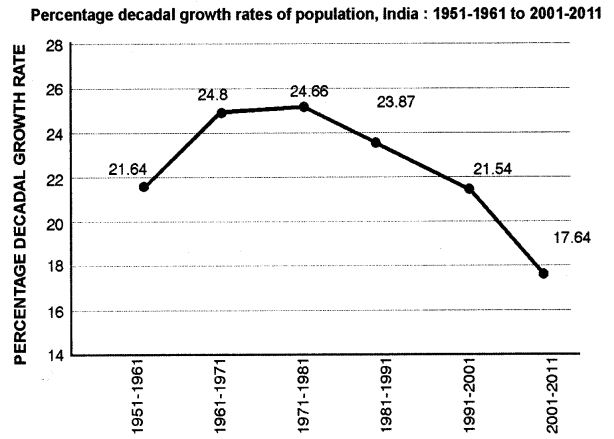
Geography Class 12 Important Questions Chapter 1 Population Distribution, Density, Growth and Composition Important Questions 1

(i) Fall in Death-rate. Due to improved medical facilities and control over floods and epidemics, there has been a considerable fall in death-rate. It has declined from 47 in year 1921 to 7 per thousand in 2001.
(ii) Increase in life expectancy. The expectation of life has increased from 23 years to 65 years in 2001.
(iii) Fall in infant mortality rate. The death rate among children below one year of age has dropped from 250 to 125 per thousand.

Question 26.
What are the basic components ‘ um of change in population or growth of population ?
Ans.
Population never remains stable. It changes with time. The change in population depends on these components:
(i) Birth-rate
(ii) Death-rate
(iii) Migration.
A high birth-rate results in an increase in population, while a high death-rate shows a declining population. The difference between birth-rate and death- rate is called natural growth. When birth-rate is more than death-rate, it is called positive natural growth. Population declines due to out-migration or emigration of people to foreign countries. Population increases due to in-migration or immigration of people from foreign countries.

Question 27.
Why are the years 1921 and 1951 most significant in the history of population growth in India ?
Answer:
The population of India is increasing at a rapid rate during this century. Between 1901 and 1981, it has increased almost three times. The population growth has been fluctuating during this period.

From the table given below, it is clear—
(i) Till year 1921, the population of India remained more or less stable. During the years 1901-1921 there was an increase in population by only 13 million (at the rate of 3% per decade). This was due to a large death toll because of great influenza (1911-21), First World War (1914), epidemics (1918) and droughts (1920). After 1921, the population began to rise at a slow but definite rate. Thus, the year 1921, is known as a great divide in our demographic history.

(ii) Till 1951, there has been a steady growth of population. After 1951, the population rose at a rapid rate. Thus, the first stage of population growth was over by the year 1951. Between 1951-81, a period of 30 years, our population has been doubled almost at a growth rate of 2.42 per annum.

Question 28.
What do you mean by Census of population ? After how many years, it is held in India ?
Answer:
Census of Population.
Population data are mostly collected through censuses in all countries of the world. In the case of India, the first census was held in 1872, although the first complete census was taken in 1881 only. Since then, censuses have been held regularly with a gap of 10 years. A census of population involves a complicated process of collecting, compiling and publishing complete demographic data pertaining to all persons living in the country at the time of the censuses. Many improvements have been made to make Indian census as one of the best in the world.

Question 29.
How is arithmetic density not a sensitive measure of density of population ? Which method suits agricultural areas ?
Answer:
A ratio of population is a better measure of variation in the distribution of population. One such measure is the density of population expressed as number of people per unit area, for example, a square kilometre or a hectare. However, it is a crude measure, and is referred to as arithmetic density. It is a crude method. It is not a sensitive measure of densities.

It is crude because the entire area of a country or a state is taken into consideration while calculating the density. In fact, the population lives only in the selected areas which are productive, rich in natural resources and accessible to the humans. The hilly and the rugged terrain, swampy, marshy and forested tracts as well as the areas covered by water bodies are just not suited for human habitation. These are called negative areas. These areas should not be considered for population.

Since arithmetic density is not a very sensitive index of population crowding, densities are sometimes calculated for the rural population or agricultural population. In calculating the density, cultivated area is considered. A ratio of population to cultivated area is described in France as physiological density. This measure of density gives us an idea as to how many people are dependent on each hectare of cultivated land. It is a highly meaningful index, particularly for countries whose economies are largely dependent on agriculture.

Question 30.
Which are the major demographic attributes of human population ?
Answer:
The major attributes of population are :
(a) Sex Ratio. A population is comprised by males and females ; who are of different age groups.

(b) Rural and urban population. They may be residing in villages, small and medium towns or large cities.

(c) Working and non-working population. A substantive proportion of population may consist of non-workers who are either too young to work or do not work because they are ill or too old to accept any work.

(d) Others. Age, place of residence, language, religion, marital status, ethnicity, education and occupation. These characteristics of population composition may be described as demographic attributes.

Question 31.
Which state of India is most rural in character ?
Or
In which part of the country is proportion of rural population higher than national average ?
Answer:
The 2011 Census shows that 72.3 percent population is rural. About 741 million people live in villages. Some states are mostly rural. In Himachal Pradesh, about 90 percent people live in villages. Arunachal Pradesh is most rural with 94.50 percent rural population. All the Northern and North-Eastern states have higher proportion of rural population than national average.

Question 31.
Name the Million Towns of India
Answer:
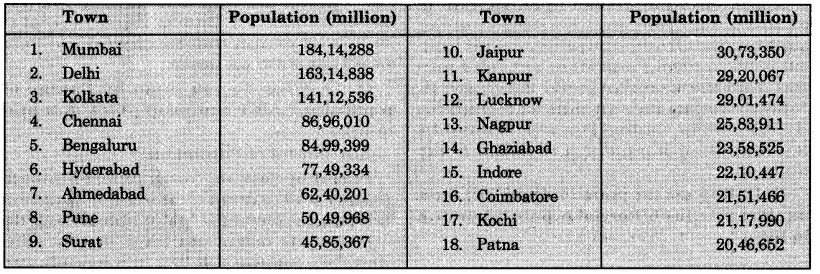
Geography Class 12 Important Questions Chapter 1 Population Distribution, Density, Growth and Composition Important Questions 2
Geography Class 12 Important Questions Chapter 1 Population Distribution, Density, Growth and Composition Important Questions 3

Question 32.
State the distributional pattern of sex ratio in the country.
Answer:
(i) Sex ratio is the number of females per thousand males.
(ii) Sex ratio of India in 2011 is 940 while it was 972 in 1991.
(iii) Sex ratio is high in rural areas.
(iv) Sex ratio is lower in Union Territories.
(v) Kerala has the highest sex ratio of 1084.
(vi) 17 States and 2 Union Territories have sex ratio higher than national average.
(vii) Sex Ratio declines from South to North and from East to West.

Question 33.
“The sex ratio has been generally declining ever since 1901.” Critically examine the statement and give reasons for the declining trend.
Answer:
The sex ratio of India according to 2011 census is 940 per thousand males. There is a general declining trend in sex ratio. The ratio in 1901 was 972. It was declined to 940 in 2011. This decline has been due to social evils in our society.

Reasons of declining sex ratio :

  • In our society, female child is neglected. Male population dominates in our society
  • There is high death-rate among females
  • Death-rate is particularly high among married women
  • Women labour migrates to some mining and industrial centres. It also results in declining sex ratio.

Question 34.
Describe the growth of urban population in India.
Answer:
With rapid increase in population, the urban population has also rapidly increased. During the last 100 years of demographic history, it has rapidly increased. The total population has increased four times but the urban population has increased eight times. During the first four decades of this century, the urban growth has been very slow. But during the last two decades it has increased rapidly. The urban population in 1901 was 257 lakhs, it has increased to 3330 lakhs in 2011.

Question 35.
Which states of India have a high sex ratio and which states of India have a low sex ratio ?
Answer:
The highest sex ratio (1084 females per 1000 males) is found in Kerala whereas the national average is 940 females per 1000 males.
Area of High Sex Ratio. The following states of India have a sex ratio higher than the national average.

Odisha (978), Andhra Pradesh (992), Tamil Nadu (995), Karnataka (968), Himachal Pradesh (974), Meghalaya (986), Goa (968), Kerala (1084), Puducherry (1038), Chhattisgarh (991), Manipur (987), Uttarakhand (963), Tripura (961), Jharkhand (947).

Areas of Low Sex Ratio. The following states of India have a sex ratio lower than national average.
Sikkim (889), Nagaland (931), Haryana (877), Punjab (893), Uttar Pradesh (898), Bihar (916), Arunachal (920),Assam (954), Madhya Pradesh (930), Maharashtra (925), Gujarat (918), West Bengal (947) and Rajasthan (926).

Question 36.
What do you understand by term sex ratio ?
Answer:
The sex composition of population is often expressed as a ratio which is known as the sex ratio. It is computed as number of females per thousand males. Thus, a sex ratio of 1000 implies complete parity between the two sexes. Ratios above 1000 indicates excess of females over males; those below 1000 indicate a deficit of females. The overall sex ratio of 933 for Indian population suggests a general deficit of females. Kerala state has a sex ratio of 1058 where females outnumber males.

Question 37.
Describe the salient features of occupational structure of population of India.
Answer:
The occupation of population is often classified into primary, secondary and tertiary activities. The 2001 census of India published its data dividing the workers into four main categories.

India-occupational structure (2001) %

OccupationsPersonsMalesFemales
1.Cultivators31.7131.3432.50
2.Agricultural Labourers26.6920.8239.43
3.Household Industries4.073.026.37
4.Other workers37.5844.7221.70

(1) More than half of the main workers are engaged in agricultural activities (31.71 + 26.69 = 58.40%)
(2) Workers engaged in Non-Agricultural activities are 41.65%.
(3) More females are engaged in Primary Sector.
(4) The number of workers in the tertiary sector are more in towns and cities.

Question 38.
Name the 18 major languages which have been specified in the 8th Schedule of the Indian Constitution.
Answer:
The following 18 major languages have been specified in the eighth schedule of the Indian Constitution:

  • Assamese
  • Bengali
  • Gujarati
  • Hindi
  • Kannada
  • Kashmiri
  • Malyalam
  • Marathi
  • Oriya
  • Punjabi
  • Sanskrit
  • Tamil
  • Telugu
  • Urdu
  • Sindhi
  • Nepali
  • Konkani
  • Manipuri.

Question 39.
Name the four language families to which Indian languages belong to.
Answer:
The languages spoken by the people of India have been divided into the following four language families:

  • Austric Family — (Nishada)
  • Dravidian Family — (Dravida)
  • Sino-Tibetan Family — (Kirata)
  • Indo-European Family — (Arya)

Question 40.
Which language family is predominant in India ?
Answer:
Most of the population of India speaks the languages of Aryan Family. About 73% of the total population of India speak Aryan Languages. Hindi is the main language of this family and is spoken by the majority of people in India.

Question 41.
Why do the people of India display high degree of diversity in their language and dialects ?
Or
“India is a land of linguistic diversity.” Support the statement. (Outside Delhi 2019)
Answer:
India is a vast country of severe contrasts. The languages and dialects show a great diversity. According to 1961 census, there are about 187 languages spoken in India. It is but natural when we look the huge size of population of India. The population of India has been derived from a number of racial groups.

The people in India has been in a long process during which different racial groups entered India. Each stock has its own spoken languages. This led to the development of different languages in different regions. Each region has tried to maintain its own language. Each linguistic group has tried to maintain its individual identity.

Language is a good indicator of ethnic diversity as well as unity. In 1961 Census, 1652 languages were enlisted on mother tongues in India. Hindi is the mother tongue of 337.27 million persons (40.42% of total).

Question 42.
‘The decades 1921-1951 are referred to as the period of steady l growth of population, whereas the decades of 1951-81 are referred to as the period of population explosion in India Explain giving reasons. (C.B.S.E. 2014)
Answer:
Growth the populations is the change in the number of people living in a particular area between two points. The decadal and annual growth rates of population in India are both very high.

The decades 1921 -1951

  • It is a period of steady growth of population rate.
  • There was an overall improvement in health and sanitation.
  • It brought down the Mortality rate.
  • The crude death rate remained high.

The Decades 1951 -1981

  • It is a period of population explosion in India.
  • There was a rapid fall in Mortality rate.
  • There was a high fertility rate of population.
  • There was improvement in living conditions,
  • Migration from neighbouring countries particularly Bangladesh, Nepal, Pakistan, etc., had contributed to high growth rate of India.
  • Economy rose and development acitivites.

Question 43.
“Apart from birth and death, migration is another way by which the population size changes.” Justify the statement. (Outside Delhi 2019)
Answer:
Migration is one of the major factors that affects the population change. Rural urban migration is important factor contributing to the population growth of cities. Population declines due to out-migration or immigration of people to foreign countries. Population increases due to in-migration or immigration of people from foreign countries.

Internal migration does not make any change but international migration makes the differences in the size of population. Marriage is a social factor which change the size of population if women married to foreigner population decreased and population of her husband country increased. Facilities of education, health, etc. inspire people to migrate. Due to employment facilities people migrate from their birth place.

Population: Distribution, Density, Growth and Composition Important Extra Questions Long Answer Type

Question 1.
Describe briefly the factors responsible for the variations in ; density of population in India. (C.B.S.E. 2011)
Or
An uneven distribution of population suggests a close relationship between socio-population and physical and economic factors”. Support the statement with suitable examples. (C.B.S.E. Delhi 2017)
Answer:
Density of population means the average number of people living in a sq. km. area. It is called arithmetic density. It is calculated as under :
Density ol population \(=\frac{\text { Total population }}{\text { Total area }}\)
Density of population of India in 2011
\(=\frac{1210 \text { crore persons }}{32.8 \text { lakh sq. } \mathrm{km} . \text { area }}=382\) persons per sq. km.
With this average density of 382 persons per sq. km, India is considered to be one of the densely populated countries of the world.

Distribution Of Population

The population in India is not evenly distributed among different states. Uttar Pradesh, Maharashtra, Bihar, West Bengal and Tamil Nadu are the most populous states of India while Himachal Pradesh, Jammu and Kashmir, Sikkim, Nagaland, Meghalaya and Tripura are sparsely populated states. The factors affecting the distribution of population can be grouped into three classes:

  • Physical factors
  • Socio-economic factors
  • Demographic factors

The following factors determine the density of population:

(i) Relief of the Land. Plain areas attract more population than mountains and plateaus. It is so because in plains, it is easy to conduct business, industry and farming. Against this, in the mountainous areas like Himachal Pradesh and Meghalaya the density is low. It is so because in hilly areas facilities like flat land, transport, irrigation, etc. are not available for the conduct of trade, industry and farming. A high density of population is found in the fertile plains of the Ganga and Sutlej.

(ii) Climate. The extremely cold climate of Ladakh and northern Himachal Pradesh, extremely hot climate of Thar Desert in Rajasthan and wet climate of Meghalaya discourage human settlement.

(iii) Rainfall. Areas with regular and moderate rainfall are densely populated. For instance, in West Bengal, density of population is 1029 per sq. km. due to the adequate rainfall which is beneficial for farming.

(iv) Irrigational Facilities. If the rainfall is scanty in an area but irrigational facilities are available, agriculture becomes possible which in turn supports large population. It is for this reason that we find high density in the coastal areas of Andhra Pradesh and Tamil Nadu where water is available for irrigation.

(v) Soil. Deep, fertile soils are suitable for agriculture. River valleys, deltas and lowlands are the most productive areas. River valleys are densely populated areas. There is sparse population in region of poor soils.

(vi) Minerals. The presence of mineral deposits supports a high population density. New towns have sprung up in Damodar valley due to presence of minerals. Coal, water power and petroleum help in the location of industries. These industrial areas support a large population.

(vii) Rivers and water supply. Rivers are the main source of water supply. Most of the towns are located along the banks of rivers. The ancient civilisation grew up in the river valleys. Deserts are sparsely populated due to shortage of water.

(viii) Agriculture. Productive areas can generally support dense population. In West Bengal, three crops a year are obtained in rice-cultivating areas. Therefore, West Bengal has high density of population in agricultural areas. Areas adopting modern high yielding crops have high density of population like Punjab.

(ix) Means of transportation. Means of transportation affect industries, agriculture and trade of region. Areas with developed and means of transportation attract population. Inaccessible areas like mountains are sparsely populated.

(x) Demographic factors. Fertility, mortality, migration and urbanisation also affect the distribution of population.

Question 2.
“The spatial distribution of population in India is highly uneven.” Discuss with the help of suitable examples. (C.B.S.E. 2017 Set-I)
Or
Describe the spatial patterns of density of population in India.
Answer:
The distribution of population in India is very unequal. According to 2001 census, the total population of India is 121.02 crores and the density of population is 324 persons per sq. kilometre. The density of population varies according to relief, climate and the agricultural productivity of the land. The density of population depends on the amount of rainfall. The areas of sufficient rainfall can support a large number of people.

Keeping in view, the national average density (382 persons per sq km), three types of population density areas are recognized: —
1. Densely populated areas: These areas have a density of more than 400 persons per sq kilometre. The high density areas make a girdle round the Deccan plateau. Right from Sutlej-Beas plain to Brahamputra valley, the density of population is very high. Three clusters of high density are found :
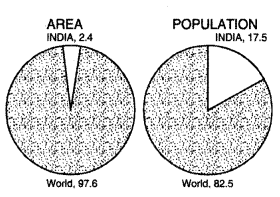
Geography Class 12 Important Questions Chapter 1 Population Distribution, Density, Growth and Composition Important Questions 4
(а) West Coastal Plain. Kerala has 859 persons per sq. kilometre density of population.
(b) The East Coastal Plain. Tamil Nadu has a density of 555 persons per sq. kilometre. Mahanadi, Godawari and Krishna deltas are clusters of high density.
(c) The Northern Plain. It includes West Bengal (1029), Bihar (1102), Uttar Pradesh (828), Punjab (550), Haryana (573).

Factors favouring high density :

  • Sufficient rainfall.
  • Fertile river valleys and deltas.
  • 2 to 3 crops of rice in a year.
  • Irrigation facilities.
  • Healthy climate.
  • Rich in mineral and power resources.
  • Rural economy.
  • Urban and Industrial development in Kolkata and Delhi.

2. Moderately populated areas. These include the areas with a density between 250 to 500 persons per sq. kilometre. These areas are surrounded by Eastern Ghats and Western Ghats. Maharashtra (365), Andhra Pradesh (308), Karnataka (319), Gujarat (308), Odisha (269), Goa (399), Assam (397) have a moderate density.
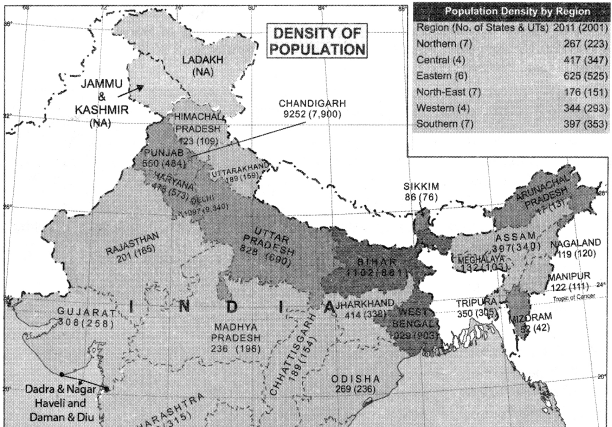
Geography Class 12 Important Questions Chapter 1 Population Distribution, Density, Growth and Composition Important Questions 5
Geography Class 12 Important Questions Chapter 1 Population Distribution, Density, Growth and Composition Important Questions 6

Factors for moderate density:

  • Agriculture is not developed due to thin and rocky soils, undulating topography.
  • Rainfall is uncertain.
  • Means of transporation are not developed.
  • Some areas have high density of population due to irrigation and Green Revolution, lava soils, mineral resources and Industrial development.

3. Sparsely populated areas. These areas have a density less than 250 persons per sq. kilometre. The mountainous, arid and forest areas are not attractive to human habitation. An extensive tract of low density extends from the Aravallis to Odisha.

(a) North Eastern India. This region includes Meghalaya (132), Manipur (122), Nagaland (119), Sikkim (86) and Arunachal Pradesh (17).

(b) Rajasthan Desert. Rajasthan has a density of 128 persons per sq. kilometre.

(c) Western Himalayas. It includes Jammu and Kashmir (124), Himachal Pradesh (123).

Factors for low density:

  • The hilly nature of the land.
  • Dense forests.
  • Low rainfall.
  • Poor economic development.
  • Absence of minerals.
  • Lack of irrigation and agriculture.
  • Cold climate.

Ranking of States and Union Territories by Population : 2011

Rank in 2011Indian States/Union TerritoriesPopulation 2011Percent to total population of INDIADensity of Population
121,21,01,93,422
3
100.00
4
382
5
INDIA1,21,01,93,422100.00382
1.Uttar Pradesh19,95,81,47716.49828
z.Maharashtra11,23,72,9/29.29365
3.Bihar10,38,04,6378.581,102
4.West Bengal9,13,47,7367.551,029
5.Andhra Pradesh4,93,86,7994 00308
6.Madhya Pradesh7,25,97,5656.00236
7.Tamil Nadu7,21,38,9585.96555
8.Rajasthan6,86,21,0125.67201
9.Karnataka6,11,30,7045.05319
10.Gujarat6,03,83,6284.99308
11.Odisha4,19,47,3583.47269
12.Kerala3,33,87,6772.76859
13.Jharkhand3,29,66,2382.72414
14.Assam3,11,69,2722.58397
15.Punjab2,77,04,2362.29550
16.Chhattisgarh2,55,40,1962.11189
17.Haryana2,53,53,0812.09573
18.NCT of Delhi*1,67,53,2351.3811,297
19.Jammu & Kashmir and Ladakh*1,25,48,9261.04124
20.Uttarakhand1,01,16,7520.84189
21.Himachal Pradesh68,56,5090.57123
22.Tripura36,71,0320.30350
23.Meghalaya29,64,0070.24132
24.Manipur27,21,7560.22122
25.Nagaland19,80,6020.16119
26.Goa14,57,7230.12394
27.Arunachal Pradesh13,82,6110.1117
28.Puducherry*12,44,4640.102,598
29.Mizoram10,91,0140.0952
30.Chandigarh*10,54,6860.099,252
31.Sikkim6,07,6880.0586
32.Andaman & Nicobar Islands*3,79,9440.0346
33.Dadra & Nagar Haveli and Daman & Diu*585,7640.05970
34.Lakshadweep*64,4290.012,013
35.Telangana *Union Territories3,52,86,7573.00307

# Note: The erstwhile state of Jammu & Kashmir reorganised into two Union Territories – Jammu & Kashmir and Ladakh. As per Dadra and Nagar Haveli and Daman and Diu (Merger of Union territories) Act, 2019, Dadra & Nagar Haveli and Daman & Diu have been merged.

Question 3.
Describe the geographical distribution of different language families in India.
Answer:
The people of India display a high degree of diversity in their languages. The languages spoken by the people can be classified into four language families.

1. Austric Family. The Austric languages are spoken by 6.2 million people in India. These include languages spoken by tribal people.

  • Munda language is spoken by tribal groups of Santhals, Mayurbhanj, Ranchi, Betul and Baudh Khondmahals (Jharkhand).
  • The Mon Khmer Khasi language is spoken in Khasi and Jaintia hills of Meghalaya.
  • Nicobari language is spoken in Nicobar Island.

2. Sino-Tibetan Family. These languages are spoken by tribal groups of Himalayan Region.

  • Tibeto-Himalayan group includes Tibetan, Balthi, Ladakhi, Lahauli and Bhutia : Lahauli, Kanauri and Lepcha. Ladakhi has the largest number of speakers.
  • North-Assam group includes Aka, Drafla, Abor, Miri and Mishmi Mishing mostly spoken in Arunachal Pradesh.
  • The Assam-Burmese group includes Bodo, Naga, Kochin and Kukichin.

3. Dravidian Family. These languages are spoken in Deccan plateau region. It includes Tamil (Tamil Nadu), Malayalam (Kerala), Kannada (Karnataka) and Telugu (Andhra Pradesh). There is less diversity in this group of languages. It also includes Kin, Parji, Khond, Tulu, Kurgi, etc.

4. Aryan Family. It has two main branches :
(i) Dardic
(ii) Aryan

The majority of people speak these languages. Hindi is the principal language spoken by the majority of people. Hindi is the main language in Northern plains. Urdu, Sindhi, Marathi, Konkani, Oriya, Bangla, Punjabi, Rajasthani, Marwari are other important languages in different regions. Hindi occupies the fourth place in the World. Urdu is very akin to Hindi and is widely spoken in this belt.

Question 4.
Discuss the religious composition of Indian population and its spatial distribution.
Answer:
Religious Composition : Important aspect of India’s population is the multiplicity of religious faiths. It is commonly known that the religion of the land is Hinduism. India witnessed successive penetration by other religions (Christianity, Judaism, Zorastrianism, Islam) and sections of Indian population embraced these faiths from time to time.

(1) The earliest to appear was Christianity. Historical records show that the Syrian Christians appeared on the west coast of India in the very first century of the Christian era.

(2) The Arab traders brought the message of Islam to the people of India living on the west coast much before the Muslim conquest of India.

(3) Buddhism which was once upon a time a major religion of the land is today confined to a few pockets only.
It is thus obvious that the religious composition of population has been changing with conversions from one faith to another, due to migration and partition of the country.

Different Religions. The religious groups of India include Hindus, Muslims, Christians, Sikhs, Buddhists and Jains, although other religious faiths such as Judaism and Zorastrianism are also represented. Several tribal communities adhere to animism and totemism. Hindus account for 82 per cent of the total population. They are distributed in all parts of India. However, in some districts they are less numerous than the Muslims, Christians, Sikhs or Buddhists.

The Muslims are the largest minority group and account for 12.12 per cent of the total population. The proportion of Christians is 2.34 per cent while Sikhs account for 1.93 per cent of the total population. Buddhists and Jains account for 0.76 and 0.39 per cent of the total population, respectively. It may be noted that while Hindus are found everywhere, other religious groups have their concentration in a few pockets only.

(1) Hindus : Hindus remain the most numerous groups everywhere.

(a) In many parts of the country such as a few districts of Orissa and Madhya Pradesh the proportion of Hindus population goes up to 95 per cent or even above. It is lowest (5 %) in Mizoram.

(b) In the sub-Himalayan districts of Uttar Pradesh and Himachal Pradesh the proportion of Hindu population is high above 95 per cent.

(c) The Hindu percentage remains well above 90 per cent in eastern Madhya Pradesh, eastern Gujarat, southern Karnataka, Tamil Nadu and coastal Andhra Pradesh.

(d) There are, however, certain districts on the west coast where the Hindu percentages fall below 70 per cent and even below 50 per cent. Hindus are in minority in Punjab, Jammu & Kashmir, Meghalaya, Nagaland and North East Tribal areas.

(2) Muslims : According to the 1991 Census, Muslim population numbered 101.5 million which accounted for 12.12 per cent of the country’s total population. The major areas of Muslims concentration are situated in the Kashmir Valley, parts of the upper Ganga plain (Uttar Pradesh) and a number of districts in West Bengal where the Muslim proportion ranges between 20 and 40 per cent. In Murshidabad (West Bengal), the Muslim proportion goes as high as 61.40 per cent. In the upper Ganga Valley, Muslims are fairly predominant in several districts.

(3) Christians : Of the 19.64 million Christians of India, about 29 per cent live in the state of Kerala alone. Other areas of Christian concentration are in Goa and Tamil Nadu.

About 30 per cent of population of Goa consists of Christians. Several Tribal districts of Odisha and Bihar have significant proportion of Christian population. Likewise, Meghalaya, Mizoram, Nagaland and Manipur have very high proportion of Christians. In Nagaland for example, their share in the total population is as high as 87.47 percent.

Mizoram with 85.73 per cent of its population consisting of Christians follows closely. Percentages remain very high in the districts of Meghalaya and some districts of Manipur (between 50 and 98 per cent). Several districts of Uttar Pradesh and Punjab have small Christian population.

(4) Sikhs : The 1991 Census returns show that there are 16.25 million Sikhs in the country. While there is no part in India where the Sikhs are not found, their major concentration is seen in the states of Punjab and neighbouring districts of Haryana. This is obvious because Sikhism arose from the soil of Punjab.

Minor pockets of Sikh concentration are found in the Tarai region of Uttar Pradesh, Ganganagar, Alwar and Bharatpur districts of Rajasthan. Sikhs account for 4.84 per cent of the total population of the Union Territory of Delhi. In the urban areas of other states, Sikhs live in small numbers.

(5) Buddhists, Jains and Parsis : India has about 6.38 million Buddhists, 3.55 million, Jains and about 72,000 Parsis. Of the total Buddhists of India, 79 per cent live in Maharashtra alone. These are Neo-Buddhists who embraced this religion after large scale conversion under the influence of the movement launched by Baba Saheb Ambedkar. The main pockets of traditional Buddhism, however, lie in Ladakh, Himachal Pradesh, Sikkim, Arunachal Pradesh and Tripura.

Of the total population of India, 28.80 per cent live in Maharashtra, 16.78 per cent in Rajasthan and 14.65 per cent in Gujarat. These three states account for 60.23 per cent of the Jain population of the country. An interesting feature of the distribution of Jains is that their majority live in the urban areas. The Parsis are the smallest religious group. They are most concentrated in Western parts of India in Maharashtra and Gujarat.

Question 5.
Discuss the trend of urbanisation in India with special reference to the post independence period.
Answer:
Urbanisation in India : According to census, the population is classified into two groups; rural and urban. People living in towns are included
in urban population. A town is an area which has a municipal committee, corporation etc. ; it has a population more than 5000 and 75% people are engaged in occupations other than agriculture.

India is primarily an agricultural country. Most of people live in villages. Villages have been the basis of Indian culture. India has a large urban population. According to census of 2011, the total urban population in India was 39 crores. It is almost equal to the urban population of U.S.A. (25,9 crore) India ranks the largest urbanised country in the world. But the degree of urbanisation in India is low as compared to other countries of the world.

CountryUrban population %
U.S.A.82.6
Brazil84.9
Egypt 43.7
Pakistan36.7
India31.7

Growth of urban population :

With the rapid increase in population, the urban population has also rapidly increased. During the last 110 years (1901-2011), the total population of India increased three times, but the urban population has increased eleven times during the same period.

Rural and Urban Population : 1901-2011

Census yearPopulation (million)Percentage of total population
RuralUrbanRuralUrban
19012132689.210.8
19112262689.710.3
19212232888.811.2
19312463388.012.0
19412754486.113.9
19512996282.717.3
19613607982.018.0
197143910980.119.9
198152415976.723.3
199162921874.325.7
200174128572.227.8
201183337768.831.7

The rate of growth of urbanisation has been slow during the period 1901.-61. But during the period of 20 years (1961-81) there has been a rapid growth of urbanisation in India. The urban population increased from 7.8 crores to 15.6.

The percentage of urban population increased from 17.9% to 23.3%. In 2001 the urban population has increased to 28.5 crores (27.8% of the total population). The growth of towns has helped rapid growth of urbanisation. Many industrial towns have been established. The Indian towns have been classified into 6 groups.

ClassPopulation
Class I Class IIMore than 1 Lakh 50000 – 99999
Class III20000 – 49999
Class IV10000-19999
Class V5000 – 9999
Class VILess than 5000

After independence, the number of big towns is increasing while the number of small towns is decreasing. In 1991, there were 299 class I towns out of 4689 towns. In 1981, there were 218 class I towns, but in 1901 there were only 24 class I towns. The number of million towns in India is 35.

These towns have a population of 10 crores which is about 1.3rd of total urban population of India. Kolkata, Mumbai, ‘Delhi, Chennai, Bangalore, Ahmedabad, Hyderabad, Pune, Kanpur, Nagpur, Jaipur, Lucknow are million towns in India.

Population: Distribution, Density, Growth and Composition Important Extra Questions HOTS

Question 1.
‘Dense population is found in states in Ganga and Sutlej plain.’ Explain.
Answer:
West Bengal (1029 persons per sq. km) and Bihar (1102 persons) are the two states with dense population in Northern plains, Uttar Pradesh (20 crores population) is the state with highest population of India with density of population of 828 persons per sq. km. Punjab has density of population of 550 persons per sq. km. while Haryana has a density of population of 573 persons per sq. km. All the states he in Ganga Sutlej Basin.

Question 2.
Identify the challenges of the adolescent population before the society. Enlist a few measures to overcome these problems. (Sample Paper 2018-19)
Answer:
The share of adolescents is about 20.9% of the population. The adolescent population though regarded as the youthful population, having high potential is quite vulnerable if not quided properly. The National youth policy looks into the overall development of our large youth population. It stresses on an all round improvement of the youth and adolescent enabling them to shoulder responsibility towards constructive development of the country.

  • It reinforces the qualities of patriotism and responsible citizenship.
  • Special emphasis was given in empowering women and girl child to bring parity in the male and the female status.
  • Efforts were made to look into health. Sports and recreation creativity and awareness about new innovations in the spheres of science and technologies.

Map Skills

Question 1.
Show the following on the outline map of India and label these.
Answer:
(1) Most populated state.
(2) Least populated state.
(3) State with highest density of population.
(4) State with lowest density of population.
(5) State with highest growth rate of population.
(6) State with lowest growth rate of population.
(7) State with highest percentage of rural population.
(8) Most urbanised state.
(9) State with highest sex ratio.
(10) State with lowest sex ratio.
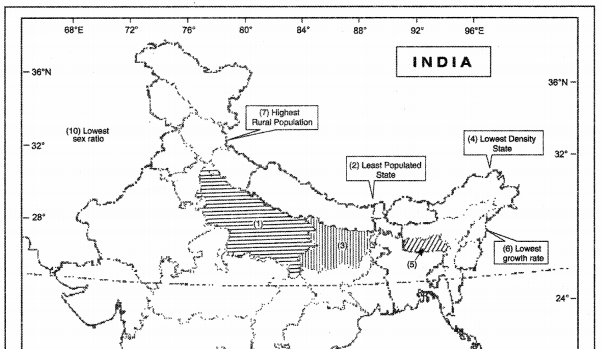
Geography Class 12 Important Questions Chapter 1 Population Distribution, Density, Growth and Composition Important Questions 7
Geography Class 12 Important Questions Chapter 1 Population Distribution, Density, Growth and Composition Important Questions 8


Kings and Chronicles Class 12 Important Extra Questions History Chapter 9

Here we are providing Class 12 History Important Extra Questions and Answers Chapter 9 Kings and Chronicles: The Mughal Courts. Class 12 History Important Questions are the best resource for students which helps in class 12 board exams.

Class 12 History Chapter 9 Important Extra Questions Kings and Chronicles: The Mughal Courts

Kings and Chronicles Important Extra Questions Very Short Answer Type

Question 1.
Who was the first ruler of the Mughal Empire?
Answer:
Babur was the first Mughal King.

Question 2.
How did Babur relate to Ghenghiz Khan?
Answer:
Babur was related to Ghenghiz Khan from his mother’s side.

Question 3.
Name few of the successors of Babur.
Answer:
Humayun, Akbar, Jehangir, Shahjehan, Aurangzeb etc.

Question 4.
Who gave a defeat to Humayun?
Answer:
Sher Shah Suri defeat Humayun.

Question 5.
Who is considered as the greatest Mughal Empire?
Answer:
Akbar is considered as the greatest Mughal Empire.

Question 6.
Who was the last powerful Mughal Emperor?
Answer:
Aurangzeb was the last powerful Mughal Emperor.

Question 7.
Name few of the Chronicles prepared during the Mughal Empire?
Answer:
Baburnama, Akbarnama, Shahjahannama, Alamgirnama etc.

Question 8.
In which language most of the Chronicles were written in the Mughal period?
Answer:
In Persian language.

Question 9.
What was the .centre of manuscript production during the Mughal empire?
Answer:
Kitabkhana was the centre of manuscript production during the Mughal Empire.

Question 10.
What was the Nastaliq?
Answer:
It was a style of calligraphy, a fluid style with long horizontal strokes.

Question 11.
What was Sheria?
Answer:
Sheria was an Islamic law.

Question 12.
In how many books, the Akbarnama is divided?
Answer:
Akbarnama is divided into three books and the third book is Akbarnama.

Question 13.
Who was Humayun? How was he forced to run away from India?
Answer:
Humayun was the son and successor of Babur. He expanded the frontiers of his empire. However, he was defeated by the Afghan leader Sher Shah Suri and was forced to run away from India.

Question 14.
What happened to Humayun when he ran away from India?
Answer:
Humayun had to take refuge in the court of the Safavid ruler of Iran when he was drove into exile. In 1555 C.E., he defeated the Surs but died an year later.

Question 15.
How did the Mughal dynasty came to an end in India?
Answer:
With the death of Aurangzeb in 1707 C.E., the power of the empire diminished. Many regional powers emerged in place of large Mughal empire. Yet symbolically, the prestige of Mughal rulers remained there. In 1857 C.E., the last scion of this dynasty, Bahadur Shah Zafar was overthrown by the British. In this way, the Mughal dynasty came to an end in India.

Question 16.
Who were the authors of the Mughal chronicles? On which four points did they concentrate?
Answer:
The authors of the Mughal chronicles were the court historiAnswer:All the chronicles emphasised the following points:

  1. Events associated with the ruler
  2. Family of the ruler
  3. The royal court
  4. Wars and administrative provisions

Question 17.
Who founded the Asiatic Society of Bengal and when? Tell any one work done by it.
Answer:
The Asiatic Society of Bengal was founded by Sir William Jones in 1784 C.E. This society published the edited versions of Akbarnama and Badshahnama in the nineteenth century.

Question 18.
Explain any two works done by Akbar to enhance the idea of Sulh-i-Kul.
Answer:

  1. Akbar gave positions and awards to Turanis, Afghans, Rajputs and Deccanis purely on the basis of their service and loyalty to the king.
  2. He abolished the tax on pilgrimage in 1563 C.E. and Jizya in 1564 C.E. as both were based on religious discrimination.

Question 19.
What was Jizya? Who abolished it? By whom was it again imposed?
Answer:
Jizya was a tax imposed on non-Muslim subjects. It was abolished by Akbar in 1564 C.E. and was again imposed by Aurangzeb.

Question 20.
Which was the favourite symbol to represent the idea of Justice of Mughal monarchy? What does it mean?
Answer:
The favourite symbol to represent the idea of justice of Mughal monarchy was the motif of the lion and the lamb (or cow) peacefully nestling next to each other. It was meant to signify that both the weak and the strong could exist in harmony.

Question 21.
How Mughal rulers kept control over court society?
Answer:
Social control in court was exercised by forms of address, courtesies and speech which were acceptable in court. Even a small mistake of etiquette was noticed and punished right on the spot.

Question 22.
Which were the highest forms of salutation to the ruler by the Mughal courtiers?
Answer:

  1. Sijda or complete prostration.
  2. Chahar Taslim.
  3. Zaminbos, i.e., kissing the ground.

Question 23.
Which Mughal emperor began the practice of Jharokha Darshan? What was his objective behind this?
Answer:
Jharokha Darshan was introduced by Akbar. According to this, emperor appeared on a small balcony, facing the east, giving a view to crowds of people standing below. Its objective was to broadening the acceptance of the imperial authority as part of popular faith.

Question 24.
What were Zat and Sawar ranks? What was the main difference between them?
Answer:
Zat and Sawar were the ranks or mansabs of Mughal officials based on numerical destinations. As Zat was an indicator of position in the imperial hierarchy and salary of the official but Sawar indicated towards the number of horsemen which he was required to maintain in his service.

Question 25.
Why Mughal emperor wanted to keep control over Kabul and Kandhar?
Answer:
All conquerers who wanted to conquer the Indian sub-continent had to cross Hindukush to have an access to north India. That is why there was a constant policy of Mughals and that was to ward off this potential danger by controlling strategic outposts, i.e., Kabul and Kandhar.

Question 26.
“Jesuits were greatly respected during Akbar’s time”. Give three reasons in favour of this statement.
Answer:

  1. At public assemblies, the Jesuits were given places in close proximity to Akbar’s throne.
  2. Jesuits accompanied Akbar on his campaigns and tutored his children. ‘
  3. Jesuits were often companions of the leisure hours of the Emperor.

Question 27.
What was the ‘philosophy of light’ created by Akbar and Abul Fazl? Why was this used?
Answer:
According to philosophy of light created by Akbar and Abul Fazl, a divinely inspired individual has top most sovereignty over his people and full control over his enemies. This philosophy was used to shape the image of the king and ideology of the state.

Kings and Chronicles Important Extra Questions Short Answer Type

Question 1.
Why did the Mughal rulers get their dynastic histories written?
Answer:
The Mughal rulers believed that they are appointed by the ‘God’ himself to rule over a large and heterogeneous populace. Although actual political circumstances circumscribed this grand vision but this vision remained important. One of the methods of transmitting this vision was writing of the dynastic histories. The Mughal rulers gave this work, of writing accounts of their achievements, to their court historiAnswer:These accounts recorded all the events of the emperor’s reign. Except this, these authors also collected a lot of information about other aspects of the sub-continent which helped the rulers to govern their domain.

Question 2.
What is Mughal chronicle? What is their importance for writing of Mughal history?
Or
Describe the characteristic features of the Mughal Chronicles. (C.B.S.E. 2011 (D))
Or
How do you think that the chronicles commissioned by the Mughal Emperors are an important source for studying Mughal history? (C.B.S.E. 2017 (O.D.))
Answer:
The genre of texts written by modern historians in English is called a chronicle. These chronicles present a continuous chronological record of events and are an indispensable source for any scholar who wanted to write about Mughal history. On one side, these chronicles give us information about institutions of Mughal empire and on the other side, they convey the meaning of those objectives which Mughal rulers wanted to impose on their domain. In this way these chronicles give us a glimpse that how imperial ideologies were created and disseminated.

Question 3.
How were images or pictures incorporated in the Mughal manuscripts? Discuss any two points of its importance.
Or
Assess the importance of the painted images in Mughal manuscripts. (C.B.S.E. 2008 (D))
Answer:
The painters played a significant role in the production of Mughal manuscripts. They included in the manuscripts many images that described an event in the visual form. The pictures accompanied what was described in words in the manuscript. They served as miniatures. Their importance can be understood from the following points:

  • These pictures enhanced the beauty of a book or manuscript.
  • They conveyed ideas which were difficult to be expressed in the written medium.
  • They had the magical power to make inanimate objects look as if they possessed life.

Question 4.
Write a brief comment on Badshahnama.
Or
Name the author of Badshahnama. Describe its content. (C.B.S.E. 2011 {O.D.))
Or
“lilughal transmitted their grand vision through the writing of dynastic histories.” Explain the statement with reference to Badshahnama. (C.B.S.E. 2019 (O.D.))
Answer:
Once Emperor Shah Jahan called Abdul Hamid Lahori and requested him to write a history of his reign as was done in Akbarnama. As a result, Badshahnama was written by Abdul Hamid Lahori, a pupil of Abul Fazl. It is the official history of the events which occurred during the reign of Emperor Shah Jahan. It was written in three volumes (daftars). Each volume covered a period of ten years. Later on Sadullah Khan, the Wazir of Shah Jahan, revised the first two. volumes of the Badshahnama. The Asiatic- Society was the first to publish edited versions of Badshahnama in the nineteenth century. A few excerpts of this book have so far been translated into English.

Question 5.
(i) Which changes came in social status of people associated with the composition of Mughal age manuscripts?Answer:
People involved in the actual production of the Mughal age manuscripts got recognition in the form of titles and awards given to them. Some of the calligraphers and painters got higher social status while other partners like paper makers or book binders remained as anonymous artisans.

(ii) What was the relation of calligraphy with manuscripts?
Answer:
Calligraphy, i.e., art of handwriting was considered as a skill with great importance. It was used and practised by using different styles. Nastaliq was the favourite style of Akbar. It is a fluid style with long horizontal stokes. A piece of trimmed reed with a tip 5-10 mm called qalam, dipped in carbon ink was used to write this style. Generally, a small split was kept in the nib of the qalam so that it could absorb the ink.

Question 6.
Which steps were taken during the colonial age to protect historical manuscripts?
Answer:
During the colonial period, the British administrators began to studv Indian history so as to get a better understanding ot people and their culture. In 1784, Sir William Jones founded the Asiatic Society of Bengal which took responsibility of editing, printing and translation of many Indian manuscripts.
Edited versions of Akbarnama and Badshahnama were first printed by the Asiatic Society in 19th century. In the early 20th century, Henry Beveridge translated Akbarnama in English. Only few excerpts of Badshahnama have been translated in English till today. •

Question 7.
The Mughal Emperors exercised a divine right over administration. How was this view presented?
Answer:
According to many court chronicles, the power of the Mughal kings came directly from God. There is the narration of a legend. The Mongol Queen named Alanqua was impregnated by a ray of sun¬shine when she was resting in her tent. Her child bore the Divine Light which passed on from generation to generation.

The Mughal king also got light that emanated from God. So he was the source of spiritual guidance for his subjects. He wore the halo which is often seen in the European paintings of Christ and the Virgin Mary. The halo of the Mughal Emperors symbolised the light of God. It left a deep imprint on the minds of those who saw the emperor with halo surrounding their heads.

Question 8.
What did the form of salutation in front of ruler in the Mughal court indicate? While describing briefly about different forms of salutations also tell that what was expected from diplomatic envoys in this regard?
Answer:
Form of salutation in front of ruler in the Mughal court indicated towards person’s status in the hierarchy. Deeper prostration represented higher status of the person.

  • Highest form of submission was sijda or complete prostration.
  • Under the reign of Shah Jahan, these forms were replaced by chahar taslim and zaminbos (kissing the ground).

The protocols related to diplomatic envoys in the Mughal court were equally explicit. It was expected from an ambassador presented in front of Mughal ruler that he must adopt any one method out of sanctioned forms of salutation. These included either by bowing deeply, kissing the ground or to follow the Persian custom of clasping one’s hand in front of the chest. The English ambassador of James-I, Thomas Roy simply bowed before emperor Jahangir and further shocked everyone by demanding a chair to sit.

Question 9.
Who was Gulbadan Begum? Make a brief evaluation of Humayunama written by her. ,
Or
Describe how the Humayunama of Gulbadan Begum gives us the glimpses of the Mughal Imperial household. (C.B.S.E. 2013 (O.D.))
Answer:
Gulbadan was the daughter of Babur, sister of Humayun and aunt of Akbar. She was a fluent writer in Turkish and Persian. When Abul Fazl was writing his Akbarnama about the history of the reign of Akbar, she was requested by Akbar to write her memories of earlier times under Babur and Humayun. Akbar felt that her memories could be useful for Abul Fazl.

Gulbadan Begum wrote an interesting book entitled ‘Humayunama!. It gives us a glimpse into the domestic world of the Mughals. It is not merely an enlogy of the Mughal emperors. On the contrary, it brings out the conflicts and tensions that existed among the princes and the kings. It also shows the important role played by elderly women who mediated to resolve some of the conflicts.

Question 10.
“Akbar tried to tie his empire in one thread.” How?
Or
“Akbar was a national ruler.” Prove it.
Answer:
Akbar was the first Muslim ruler who gave preference to national interests instead of developing any religion or sect. He conquered whole of north India and tied it in one thread. He implemented same legal and administrative system in all of his provinces. First time in medieval period, Hindu masses were given same religious freedom like Muslims.

He even removed the religious tax imposed on Hindus called Jizya. Akbar not only married a Rajput princesses but also permitted them to worship their deities according to Hindu traditions. Din-i-Ilahi was a symbol of religious tolerance of Akbar. He began this religion to establish unity among Hindus and Muslims. Just because of these measures, Akbar was succeeded in founding a national empire in the country.

Question 11.
What are the distinctive features of Mughal nobility? State any five features.
Or
“One important pillar of the Mughal I administration was the nobility.” Justify. (C.B.S.E. 2015 (D)))
Or
“The nobility was recruited consciously by the Mughal rulers from ethnic and religious groups.” Justify. (C.B.S.E. 2017 (D))
Or
Explain why the nobility was recruited from different races and religious groups by the Mughal rulers in India. (C.B.S.E. 2018)
Answer:
A corps of officers was one of the most important pillars of the Mughal state. The historians referred to all these officials collectively as the nobility. The main characteristics of these officers were as under:

  1. They were recruited from different castes and religious groups.
  2. A special care was taken to ensure that no group should grow so strong and wide as to be a threat to the State.
  3. The mansab or the status of each officer was determined.
  4. The officers participated in the military operations along with their soldiers. They used to perform administrative jobs.
  5. As the officers held a high position in the society, they were quite rich and powerful and enjoyed ample prestige in the society.

Question 12.
What is meant by Zat and Sawar ranks in Mansabdari system?
Answer:
Zat was numerical value which determined the rank and salary in Mughal Empire. Certain points were there in Zat ranking which are given below:

  1. Nobles with a Zat of 5,000 were ranked higher than those of 1,000.
  2. There were 29 mansabdars with a rank of 5,000 Zat in the reign of Akbar.
  3. The number of mansabdars had increased to 79 in Aurangzeb’s reign.
  4. More number of mansabdars meant more burden of expenditure on State exchequer.
    Sawar was a rank of officer which indicated the number of horsemen h: was required to maintain m service. •

Question 13.
Discuss the merits and demerits of Mansabdari system.
Answer:
Merits:
1. Jagirdari system came to an end with the advent of this custom. Now every mansabdar was dependent upon emperor for his salary. Except this, mansabdars were under complete control of the emperor. They could be called at any time with their cavalry and horsemen. It reduced the chances of revolts against the emperor.

2. The post of mansabdar was given according to the ability of the person. In case of inability of handling the post, mansabdar was generally relieved from his post. In this way, able and successful persons were appointed on higher posts.

3. Government’s expenses of giving jagirs was reduced to a great extent.

4. According to the Zabti system, whole of property of mansabdar was confiscated in case of his death. It increased the income of the government.

Demerits:
1. One of the major demerits of this system was that mansabdar always tried to cheat the government. They used to keep less number of horsemen than the prescribed number but used to take salary of all the horsemen. Government tried to remove this shortcoming but with little success.

(ii) Mansabdars were given very high salaries which was a sort of pressure on the Govt, treasury.

Question 14.
Give main features of religious policy of Akbar.
Answer:
Akbar had great interest in religion right from the beginning. Initially, he was an orthodox Muslim but gradually became liberal in his ideas. He abolished the tax on pilgrimage, i.e., Jizya. He built ibadatkhana at Fatehpur Sikri where people of different religions and sects discussed religious matters. From these discussions, he drew some conclusions and started a new religion called Din-i- Ilahi. Akbar compiled essence of all the religions in this religion. Any one was free to adopt this religion. Even Brahmin Birbal became one of its members.

Except this, Akbar established marital relations with many Rajput princesses. All of his Hindu wives were free to practice their customs according to Hinduism. Every one was free to adopt any religion. Employment was open to all the religious communities. People of all the religious groups were free to practice their customs. In this way, an atmosphere of religious tolerance came into being within the reign of this Muslim ruler.

Question 15.
Write the main effects of religious policy of Akbar.
Answer:
Following were the main effects of religious policy of Akbar:

1. Vast Mughal Empire: Akbar won the hearts of Rajputs only because of his Hindu policy. He was able to suppress his enemies with the cooperation of Rajputs. Many loyal Rajput chiefs won many battles for the kingdom. It led to the great expansion of Mughal empire.

2. Strong Mughal Empire: Before Akbar, Hindus were enemies of empire and were causing huge losses to the state. But liberal policy of Akbar brought Hindus to Mughal court. As a result, Mughal empire became very strong.

3. Encouragement to the sense of Nation Building: As a result of this policy of Akbar, lakhs of Hindus came in favour of Mughal empire and began working for the progress of the empire. That is why Akbar was able to succeed in his objective of nation building.

4. Progress in Art and Literature: As a result of this policy, art and literature made a huge progress. Mughal art was mixed into Hindu art and mixture of Sanskrit and Persian gave birth to a new type of literature and language.

Question 16.
‘Akbar was a Liberal ruler. Prove it.
Answer:
It would be clarified from the following points that Akbar was very liberal and tolerable in his ideas:

1. Establishing marital relations: Akbar established marital relations with the daughters of Rajput kings. In 1562 C.E., he was married to the daughter of Rajput king of Amer, Bharmal. Akbar appointed son and grandson of Bharmal into imperial service. In this way religious tolerance policy of Akbar began with his marriage.

2. Appointment of Hindus on higher posts: Akbar appointed many Hindus into imperial services. He never cared about the individual’s religion while appointing him on any post. Many Hindus like Raja Todar Mai, Man Singh, Birbal, etc., were appointed on higher posts.

3. Religious freedom: Akbar gave complete religious freedom to his subjects. He even introduced a royal farman that no one will be converted forcefully into other religion.

4. Din-i-Ilahi: Akbar collected all the good elements of all religions and sects and introduced a new religion in 1582 C.E. called Din-I-Ilahi.
From all these things it is clear that Akbar was actually a liberal ruler.

Question 17.
What do you know about Din-i-Ilahi? Discuss its major elements.
Answer:
Din-i-Ilahi was the result of progress of religious sentiments of Akbar. From the discussion of Ibadatkhana he concluded that all the religions are basically one and the same thing. He took motivation from this and founded a new religion, Din-i-Ilahi, in 1582 C.E. He included all the basic concepts and elements of all the religions and sects. Gods, Goddesses, Pirs, etc., had no place in this new religion.

According to this, God is one and Akbar is his top most devotee. Followers of this religion were not allowed to be non-vegetarian. Its followers greeted each other by saying ‘Allah-hu-Akbar’. They were always ready to sacrifice every thing for the emperor. Din-i-Ilahi did not become popular because Akbar hardly took any steps to popularise it among masses. As a result, this religion also came to an end with the death of Akbar.

Question 18.
Analyse how the Mughal emperor’s Court procedures reflected his status and power. (C.B.S.E. Sample Paper 2011)
Or
In what ways have the daily routine and special festivities associated with the Mughal court conveyed a sense of
power of the Mughal emperor? Explain. (C.B.S.E. 2013 (D))
Or
“The visible centre of Mughal power was the King’s court.” Justify the statements with suitable arguments. (C.B.S.E. 2019 (D))
Answer:

  1. The royal throne depicted the high status of the emperor.
  2. The canopy was the symbol of Mughal monarchy.
  3. Each courtier had a definite place to sit. It reflected his position in the Court. When the king was seated on his throne, no courtier could change his seat or go outside without the permission of the Emperor.
  4. There were special norms for reception, courtesy and speech to regulate the system and control of the Court.
  5. Good conduct and courtesy was expected from diplomatic envoys.
  6. The dazzling decoration on special occasions and the abundant expenses enhanced the power, authority and dignity of the king.

Question 19.
Give a brief description of central Administration of Mughals.
Answer:
Emperor himself was the head of central administration of Mughals. Some of the important ministers of central administration are given below:

1. Mir Bakhshi: Mir Bakhshi was the paymaster general. He used to stand in the open court on the right side of the emperor and present all candidates for appointment or promotion. His office used to prepare orders bearing his seal and signature and of the emperor as well.

2. Diwan-i-Ala and Sadr-us-Sadur: There were two other important ministers as well at the centre. Diwan-i-Ala was the finance minister and Sadr-us-Sadur was minister of grants or Maded-i- maash and incharge of appointing qazis or local judges. All these three ministers sometimes worked as an advisory body but generally were independent from each other.

Question 20.
Throw some light on Mughals’ relations with the Ottoman empire.
Or
Describe briefly the relationship between the Mughals and the Ottomans. (C.B.S.E. 2009 (O.D.))
Answer:
The main objective of Mughals’ relations with the Ottoman empire was to maintain a free movement for pilgrims and merchants in the territories under control of the Ottoman empire. This was true especially for the Hijaz i.e., that area of Ottoman Arabia where Mecca and Madina, important pilgrim centres were located. Mughal emperors generally combined commerce and religion.

They used to export valuable things to Aden and Mokha, both the ports of Red Sea. They even used to distribute the income from the sale of these goods in charity and keepers of shrines. But when Aurangzeb came to know about the misappropriation of funds sent to Arabia, he stressed on their distribution in India because he believed that, “it was as much a house of God as Mecca.”

Question 21.
How did the religious views of Akbar become mature? What change came in it?
Answer:
Akbar practised the idea of religious toleration. He exhibited the high respect to the members of the Jesuit Mission. In fact, Akbar had a deep quest for religious knowledge. He held inter-faith debates in the Ibadatkhana at Fatehpur Sikri. He met people belonging to all the religions such as the Hindus, the Muslims, the Jainas, the Parsis and the ChristiAnswer:He was quite mature in his religious views. He got knowledge about the doctrines of all religions and sects. He moved away from the orthodox Islamic ways of understanding. He believed in religious toleration. His views are a lesson to modern society which is torn with religious differences.

Akbar found a great change in his religious perception. He did not believe in orthodox Islamic philosophy. He focussed on divine worship and created a philosophy of light and sun. He used this philosophy to shape the image of the king and ideology of the Mughal state. He was sure that a divinely inspired ruler can have supreme sovereignty over his people and complete control over his enemies.

Question 22.
“Many consider Jalal-ud-din Akbar (1556-1605) as the greatest of all the Mughal emperors.” Support the statement with evidence. (C.B.S.E. 2010 (D))
Answer:
Many consider Jalal-ud-din Akbar as the greatest of all the Mughal emperors due to following reasons:

  1. Akbar not only expanded his empire but made it strong and prosperous as well.
  2. He spread frontiers of his empire till Hindukush mountains.
  3. He stopped the expansionist plans of Safavids of Iran and Uzbek’s of Turan (Central Asia).
  4. He then arranged Mughal administration in a proper way. Tolerance and liberalism were two main features of his administration.
  5. Judicial system adopted by him was an ideal
    one.

Question 23.
Describe briefly the expansion and consolidation of Mughal Empire under Jalaluddin Akbar (1356-1605). (C.B.S.E, 2011 (D))
Answer:
Jalal-ud-din Akbar was the son and successor of Humayun. He is considered as the greatest of all the Mughal emperors because he not only expanded but also consolidated his empire, making the largest, strongest and richest kingdom of his time. He extended frontier of his empire to Hindukush mountains. He also checked the expansionist plans of Uzbeks of Turan and the Safavids of Iran. Mughal administration under Akbar was quite strong. He showed great tolerance in the matters of religion and gave freedom to everyone to practice their respective religions.

Question 24.
Describe briefly how the emperor began his day in the balcony and at Diwan-i-aam. (C.B.S.E. 2011 (GD.))
Answer:
Jharokha darshan was introduced by Akbar. According to this, emperor used to begin his day at sunrise with few religious prayers. Then he used to appear on a small balcony i.e., the Jharokha facing the east direction. Below, a crowd of people waited for a view of the emperor. It was started with an objective to broadening the acceptance of the imperial authority or part of popular faith. After spending an hour at the Jharokha, the emperor walked to the public hall of audience (diwan-i-aam) to conduct the primary business of his government. State officials presented reports and made requests.

Question 25.
For members of the nobility under the Mughals, imperial service was a way of acquiring power, wealth and highest possible reputation.” Examine the statement. (C.B.S.E. 2012 (O.D.))
Answer:
For members of the nobility, imperial service was a way of acquiring power, wealth and the highest possible reputation. A person wishing to join the service petitioned through a noble, who presented a tajwiz or gift to the emperor. If the applicant was found suitable then a mansab was granted to him. Mir Bakhshi was the paymaster general. He used to stand in open court on the right side of the emperor and presented all candidates for appointment or promotion.

His office used to prepare orders bearing his seal and signature and of the emperor as well. There were two other important ministers as well at the centre. Diwan- i-Ala was the finance minister and Sadr-us-Sadux was minister of grants or Maded-i-maash and incharge of appointing qazia or local judges. All these three ministers sometimes worked as an advisory body but generally were independent from each other.

Kings and Chronicles Important Extra Questions Long Answer Type

Question 1.
Who were the Mughals? Give a brief description of political history of Mughals.
Answer:
The name Mughal was derived from Mongol. Though today this name is the symbol of grandeur of Mughal empire but Mughals themselves did not selected this name. They called themselves as Timurids because from paternal side they were the descendants of Turkish ruler Timur. First Mughal emperor Babur was related to Mongol ruler Ghenghiz Khan from his mother side. He used to speak Turkish and referred Mongols as barbaric hordes.

The word Mughal was used by the Europeans during 16th century for the Mughal dynasty.
Political History of the Mughals

1. Babur: The Mughal empire was made up of many regional kingdoms. It was the result of conquests
and friendly treaties. Babur was the founder of this empire who was driven away by the warring Uzbeks from his Central Asian homeland, Farghana. First of all, he established himself at Kabul and then moved towards the Indian sub-continent in search of territories and resources to meet the needs of the members of his clan.

2. Humayun: Humayun (1530-40, 1555-56) was the son and successor of Babur who expanded the frontiers of his empire. But he was defeated by Afghan leader Sher Shah Suri and was forced to run away from India. He took refuge in the court of Safavid ruler of Iran. With his help, Humayun defeated Suris in 1555 C.E. But a year later, he died by accidentally falling off the stairs of the liberary.

3. Jalal-ud-din Akbar: Jalal-ud-din Akbar (1556-1605) is considered as the greatest Mughal emperor. He not only expanded his empire but also consolidated it and made it as the strongest and richest empire of his time. He extended frontiers of his empire to the Hindukush mountains. He also checked the expansionist plans of Uzbeks of Turans (Central Asia) and the Safavids of Iran.

4. Successors of Akbar: After Akbar, Jahangir (1605-27), Shah Jahan (1628-58) and Aurangzeb (1658-1707) became rulers of the Mughal empire. All three were able successors who further expanded this empire although with a slow speed. They maintained and consolidated the different instruments of governance.

End of the Mughal Empire: Aurangzeb died in 1707 C.E. after which the central power of Mughal dynasty reduced. That is why instead of controlling such a large empire from capital cities like Delhi, Agra or Lahore, many regional forces emerged. But symbolically, the prestige of Mughal rulers remained intact. The last scion of this dynasty, Bahadur Shah Zafar-II was overthrown by the British in 1857 C.E.

Question 2.
Throw light on the role of painters and images in the Mughal manuscripts. Why and on what grounds, there was a tension?
Or
Describe briefly how the interpretations of the Sharia changed ‘.with time. (C.B.S.E. 2011 (D))
Answer:
The painters had a significant role in the production of the Mughal manuscripts. They described an event in the visual form. They gave a visual expression to many important events that happened during the reign of various Mughal rulers. In fact, their paintings accompanied what was described in words. They were miniatures on the pages of manuscripts. Significance of the Paintings: The paintings served the following purposes:

  • They enhanced the beauty of a book.
  • They communicated those ideas which were hard to be conveyed in the written medium.
  • They were like a magical art having the power to make inanimate things look life-like.

Tension Regarding Paintings: The paintings portrayed not only the emperors but also their courts and other people. So they were always a source of constant tension between the rulers and the representatives of the orthodox Muslims, i.e., the Ulema. These orthodox Muslims invoked the Islamic prohibition of the portrayal of human beings enshrined in the Quran and the Hadis which described an incident from the life of the Prophet Muhammad.

In Hadis, the Prophet Muhammad had forbidden the depiction of living beings as it would have interfered in the laws of nature and the divine power of creation. It was believed that the power of creation belonged exclusively to God. Akbar ignored and did not recognise the tension on the question of visual representations of living beings in the Mughal Court. According to Abul Fazl, Akbar had stated: “There are many that hate paintings, but such men I dislike. It appears to me that an artist has a unique way of recognising God.”

Changing Environment: With the passage of time, the interpretations of the Sharia also changed. Various social groups interpreted the Islamic tradition in the way it suited them politically. So all the Muslim rulers of Asia asked artists to paint their portraits and scenes of life in their kingdoms. For example, the Safavid kings of Iran patronised the finest artists. So many painters like Bizhad played a great role in spreading the cultural fame of the Safavid Court. Many artists came to India from Iran during the Mughal rule. Similarly the famous artists like Mir Sayyid Ali and Abdus Samad came to India along with Emperor Humayun. Many other artists came to India in search of opportunities to win patronage and prestige.

Question 3.
Write an essay on Akbarnama and its author Ahul Fazl.
Or
Discuss Akbarnama as an important .source of the Mughal history. Who wrote the Akbarnama? Describe its content in brief. (C.B.S.E. 2011 (O.D.))
Or
“Mughals transmitted their grand vision through the writing of dynastic histories.” Explain the statement with reference to the Akbarnama. (C.B.S.E. 2019 (O.D.))
Answer:
Akbarnama is an important illustrated Mughal official history written by Abul Fazl. It has a lot of paintings depicting battles, sieges, hunts, construction of buildings and scenes of courts. It has shaped and articulated the ideas associated with the reign of Akbar.

Abul Fazl began to write Akbarnama in 1589 C.E. He repeatedly revised his draft and made use of all the available sources such as:

  1. Actual records of events (waqai).
  2. Official documents.
  3. Oral testimonies of knowledgeable persons.

Akbarnama was divided into three volumes. The first two volumes were in the form of chronicles. The third volume is the Ain-i-Akbari. The first volume describes the first thirty years of Akbar’s life. The second volume describes the period from 31st year to 46th year of Akbar’s life. Thus, Akbarnama provides a detailed information about the reign of Akbar. It depicts various aspects of Akbar’s empire such as geographic, social, cultural and administrative. Ain- i-Akbari delineates the picture of Mughal society which comprised of the Hindus, the Jainas, the Buddhists and the Muslims. In other words, the Mughals had a composite culture.

Question 4.
Give main features of different capital cities of the Mughals.
Or
“The heart of the Mughal Empire was its capital city.” Explain with ‘.examples. (C.B.S.E. 2015 (D))
Answer:
Capital city was the heart of the Mughal empire. Mughal courts were assembled here. The Mughals changed their capitals frequently during 16th and 17th centuries. Although Babur captured Agra, capital city of Lodhis but still, within four years of his reign, royal court assembled at different places.

1. Agra and Fatehpur Sikri: Akbar constructed Agra fort in the decade of 1560’s. Red marble was used in its construction. In the decade of 1570’s, he decided to shift his capital to Fatehpur Sikri. Its reason was probably that Sikri was situated on the direct road to Ajmer where there was a tomb of Shaikh Muin-ud-din Chishti. This tomb had become an important pilgrimage centre. The Mughal rulers had very close relations with Sufis of Chishti silsila. Akbar constructed a white marble tomb for Shaikh Salim Chishti near Jumma mosque at Sikri. He also constructed Buland Darwaza. It’s objective was to remind visitors about the Mughal victory over Gujarat.

2. Lahore: In 1585, the capital was shifted to Lahore to increase control over north western frontiers. In this way, Akbar maintained a great check for 13 years on this frontiers.

Shah Jahan adopted sound fiscal policies and accumulated enough wealth for his passion of buildings. The work of construction of building in monarchical cultures was a tangible sign of dynastic power, wealth and prestige. It was also seen as an act of piety in the context of Muslim rulers.

3. Shahjahanabad: In 1648 C.E., Court, military and royal family were migrated to new capital Shahjahanabad from Agra. Shahjahanabad was a new addition to the old residential city of Delhi. The city of Delhi had Red Fort, Jama Masjid, a tree lined esplanade with bazaars, i.e., Chandni Chowk and large mansions of nobles. This new city of Shah Jahan was appropriate to a more formal vision of a grand monarchy.

Question 5.
“The keeping of exact and detailed records was one of the major ’ features of Mughal administration.” Explain the statement with example. (C.B.S.E. 2009, 2016 (O.D.))
Or
“The keeping of exact and detailed records was a major concern of the Mughal administration.” Suport the statement with facts. (C.B.S.E. 2012, 2015 (O.D.))
Answer:
Yes, it is true that the keeping of exact and detailed records was one of the major features of the Mughal administration.

1. Mir Bakshi used to check the group of Court writers (waqia nawis). These writers used to record all applications and documents presented in the court and all imperial orders.

2.Agents (wakil) of nobles and regional rulers used to record whole of the working of the court under the heading of ‘News from the Date Court’. These records also included the time and dates of meetings of court.

3. The akhbarat had all kinds of information like attendance at the court, distribution of offices and titles, diplomatic missions, received presents and enquiries made by the emperor about the health of any officer.

4. News reports and important documents travelled across the regions under Mughal empire by imp
erial post.

5. The emperor received reports from even distant provincial capitals within a few days. Whole of the empire was connected by surprisingly rapid information loop for public news.

Question 6.
What do you know about religious policy of Akbar and Din-i-Ilahi?
Or
Discuss main features of religious policy of Akbar.
Or
Discuss the changes which came in Akbar’s views about religion from accession to throne till the founding of Din-i-Ilahi.
Answer:
Akbar was one of the greatest emperors of his times. His religious policy was based on the concepts of liberalness and tolerance. Such a big change in his religious ideas came because of the following reasons:

1. Impact of Clan: Akbar’s father Humayun was not a fundamentalist. His mother Hamidabano Begum belonged to the Shia sect. Akbar was greatly influenced by her liberal and tolerable nature.

2. Impact of teacher and protector: For the first few years as a king, Akbar remained under the protection of Bairam Khan. Akbar was very much influenced by Bairam Khan and his teacher Abdul Latifs liberal ideas.

3. Contacts with Rajputs: Akbar established marital relations with Rajputs. His Hindu queens played a great role in changing his religious ideas.

4. Mutual conflicts among Maulavis: Akbar was fed up with mutual conflicts among Maulavis and Mullas. He went against them and began work in search of religious truth.

5. Impact of Sufi Saints: Sufi saints of that time propagated the liberal religious ideas. It also helped in changing his religious ideas.

6. Demand of Time: Akbar wanted to establish a large empire. That is why he wanted to have cooperation of both Hindus and Muslims.

7. Construction of Ibadatkhana: Akbar established one Ibadatkhana (place of worship) at Fatehpur Sikri where different religious leaders used to express their ideas. From their ideas, Akbar came to know that religious truth does not remain in one particular religion but is equally exists in all the religions.

Just because of all these reasons he began behaving in a liberal way. He removed Jizya and permitted every one to practice their religious customs.

Din-i-Ilahi: Din-i-Ilahi was the result of progress of religious sentiments of Akbar. He founded a new religion Din-i-Ilahi in 1582 A.D. He included all the basic concepts and elements of all the religions and sects. Gods-Goddesses, Pirs, etc., had no place in it. According to this, God is one and Akbar is his top most devotee. Followers of this religion were not allowed to be non-vegetariAnswer:Its followers used to greet each other by saying ‘Allah-hu-Akbar’. They were always ready to sacrifice every thing for the emperor. Din-i- Ilahi did not become popular because Akbar hardly took any step to popularise it among the masses.

Question 7.
Briefly describe the structure of central administration of Akbar or Mughals.
Or
Explain organisation of the administration and army during the rule of Akbar as given in ‘Ain.’ (C.B.S.E. 2012’ (O.D.))
Answer:
Akbar himself was an administrator of top quality. He tried to strengthen the central power. Administrative system started by him remained there during whole of Mughal period. In short, following are the main features of central administration of Akbar and Mughals:

1. Emperor: During the reign of Akbar, emperor himself was the central axis of administration. All the powers of administration were in his hands and there was no res-triction on his powers. Even then the emperor hardly acted as an autocratic ruler. Mullas and Maulavis had no impact on him. He considered himself as a representative of God.

2. Council of Ministers: There was an arrangement of council of ministers for giving help to emperor in administrative activities. Powers of the Ministers were not elaborated as in modem times. They worked according to the orders of the emperor. That is why they could have been called as secretaries of emperor. The post of Prime Minister was above all the other ministers. Emperor used to seek his advice on all the serious matters. Every minister was responsible to emperor himself. They could remain in their office until the emperor remained happy with them.

Important minister and their offices are given below:

  1. Waqil or Wazir: He acted as Prime Minister and used to give advice to emperor on all the important matters.
  2. Mir Bakhshi: His main work was to give salary to military and civilian officials.
  3. Sadr-us-Sudur: He Was the minister of grants and incharge of appointing local judges or qazis.
  4. Khan-i-Sama: He used to arrange necessary things for emperor and his royal family.
  5. Main Qazi: His main work was to give justice. He was the top most judge after the emperor.
  6.  Diwan: He used to keep accounts of the empire. His signatures were required to pay money to any one.
  7. Other Ministers: Except these ministers, there were different ministers for forests, postal department, department of artillery, etc.

Kings and Chronicles Important Extra Questions HOTS

Question 1.
From which word did the term ‘Mughal’ was derived? Was this word chosen by the Mughals themselves and why?
Answer:
The term ‘Mughal’ was derived from the word ‘Mongol’. Though this term was associated with the grandeur of the Mughal Empire yet it was not chosen for themselves by the Mughal rulers. From the paternal side, they referred to themselves as Timurids, that is, the descendants of the Turkish ruler Timur. However, from the mother’s side, Babur was related to Genghis Khan, a Mongol. However, Babur himself spoke Turkish and considered Mongols as barbaric hordes.

Question 2.
Why did the Mughals call themselves Timurids?
Answer:
The Mughals were related to Mongols from the maternal side. However, they did not like Mongols whom they considered barbaric hordes. On the other hand, they were related to the Turkish ruler Timur from the paternal side. So, they called themselves Timurids. Babur himself spoke Turkish.

Question 3.
Why did the Mughal artists start portraying emperors with halo from the seventeenth century onward?
Answer:
From the seventeenth century onwards, the Mughal artists began to portray emperors with a halo which they had seen in the European paintings of Christ and the Virgin Mary. This light was the symbol of the light of God. It showed that the Mughal kings derived their power directly from God.

Question 4.
How was the ideal of Sulh-i-Kul a unifying force in the Mughal Empire? How was this ideal enforced?
Or
How was the ideal of Sulh-i-Kul implemented through state policies? Explain. (C.B.S.E. 2011 (O.D.))
Or
“Abul Fazl has described the ideal of Sulh-i-Kul of Akbar as the corner¬. stone of his enlightened rule.” Justify. (C.B.S.E. 2015 (D))
Answer:
According to Mughal chronicles, the Mughal Empire comprised of different ethnic and religious communities like the Hindus, the Jainas, the Zoroastrians, and the Muslims. However, the emperor was above all religious and ethnic groups. He stood for peace, unity, and stability. He mediated among all the groups to ensure peace, unity, and justice.

Abul Fazl has stated that the ideal of Sulh-i-Kul stood for absolute peace between all the religious and ethnic groups. It was the cornerstone of enlightened rule. All religions enjoyed full freedom of expression. But no one was allowed to undermine the authority of the state. Besides, the people belonging to different religious and ethnic groups were not allowed to quarrel among themselves.

The nobles of the Mughal Empire implemented the ideal of Sulh-i-Kul. All the officers had the royal instructions to follow the ideal of Sulh-i-Kul in administration.

Question 5.
“Granting of titles to men of merit was an important aspect of Mughal polity.” Justify the statement with suitable evidence. (C.B.S.E. 2010 (O.D.))
Or
“The granting of titles to the men of merit was an important aspect of Mughal policy”. Explain. (C.B.S.E. 2017 (O.D.))
Or
“The granting of titles was an important aspect of Mughal policy”. Justify the Statement. (C.B.S.E. 2019 (O.D.))
Answer:
Giving titles to able persons was an important aspect of the Mughal polity. The promotion of any person in the court hierarchy was known only by the titles he held. One of the titles of Asaf Khan for one of the topmost minister was originated with Asaf, the legendary minister of the prophet king Sulaiman. Aurangzeb gave the title of Mirza Raja to his topmost nobles Jai Singh and Jaswant Singh. Titles could either be earned or were paid. Mir Khan offered? 1 Lakh to emperor Aurangzeb for the letter Alif means A, to be added to his name to change it to Amir Khan.

Question 6.
Identify the distinctive features of the imperial household of the Mughal Empire. (C.B.S.E. 2015 (O.D.))
Or
“The Mughal imperial household  held vivid dimensions of their domestic life.” Explain. (C.B.S.E. 2019 (O.D.))
Answer:

1. The term “harem” is frequently used to refer to the domestic world of the Mughals. The Mughal household consisted of the emperor’s wives and concubines, his near and distant relatives, and female servants and slaves.
2. Polygamy was practised widely in the Indian subcontinent, expecially among the ruling groups.
3. A distinction was maintained between wives who came from royal and aristocratic families (begams) and other wives (aghas) who were not so noble by birth.
4. The Begams were married after receiving huge amounts of cash and valuables as dower (mahr), naturally received a higher status and greater attention from their husbands than did aghas.
5. The concubines occupied the lowest position in the hierarchy of females intimately related to royalty. They all received monthly allowances in cash, supplemented with gifts according to their status.

Question 7.
Traditions of titles, gifts and peshkash were deeply associated with Mughal Court. Elucidate by giving examples.
Answer:
1. The Mughal emperors used to adopt grand titles at the time of coronation or after a victory over
any enemy when these titles were announced by ushers (naqib) then an atmosphere of awe was created in the evidence. Full title of the reigning emperor with royal protocol were carried on the Mughal coins.

2. Giving titles to able persons was an important aspect of the Mughal polity. Promotion of any person in court hierarchy was known only by titles he held. One of the title of Asaf Khan for one of the top most minister was originated with Asaf, the legendary minister of the prophet King Sulaiman. Aurangzeb gave title of Mirza Raja to his top most nobles Jai Singh and Jaswant Singh. Titles could either be earned or were paid. Mir Khan offered? 1 Lakh to emperor Aurangzeb for the letter Alif means A, to be added to his name to change it to Amir Khan.

3. Rewards included the robe of honour, i.e., Khilat. It was a garment once worn by the emperor. It was assumed that it was a symbol of his benediction. Sarapa was another gift (head to foot). This gift had three parts: a tunic, a turban and a sash. Emperor also used to gift jewelled ornaments.

4. Only in exceptional circumstances, the emperor used to give the lotus blossom set with jewels (padma murassa).

5. No courtier ever approached the emperor empty handed. He offered either small amount of money as nazr or a large amount as peshkash.

6. Gifts were regarded as symbols of respect and honour in diplomatic relations. Ambassadors used to do an important work of negotiating treaties between competing political powers. Thomas Roy was very much disappointed with the return of a ring which he presented to Asaf Khan. It was returned because it was worth only? 400.

Kings and Chronicles Important Extra Questions Source-Based

Read the following passages and answer the questions that follow: (C.B.S.E. 2016 (D))

Question 1.
The Accessible Emperor

In the account of his experiences, Monserrate, who was a member of the first Jesuit mission, says:

It is hard to exaggerate how accessible he (Akbar) makes himself to all who wish audience of him. For he creates an opportunity almost every day for any of the common people or of the nobles to see him and to converse with him; and he endeavours to show himself pleasant-spoken and affable rather than severe towards all who come to speak with him. It is very remarkable how great an effect this courtesy and affability has in attaching him to the minds of his subjects.
(i) Who were Jesuit? What was the role of Jesuit Mission in the 16th century India?
Answer:
The Jesuits were the religious preachers. They came from Europe to visit the Mughal court. In the 16th century India, the Jesuit Mission was a part of the process of trade and empire-building.

Question 2.
Nobles at Court

The Jesuit priest Father Antonio Monserrate, resident at the court of Akbar, noticed:
In order to prevent the great nobles becoming insolent through the unchallenged enjoyment of power, the King summons them to court and gives them imperious commands, as though they were his slaves. The obedience to these commands ill suits their exalted rank and dignity.
Questions
(i) Who was Father Antonio Monserrate?
Answer:
Father Antonio Monserrate was a Jesuit priest.
He ws a resident at the court of Akbar.

(ii) According to him, how did the king control his nobles? What was his aim?
Answer:
The nobles served as officers of the Mughal empire in the provinces. The king kept them under control by doing the following:
(a) He personally reviewed changes in rank, titles and official postings.
(b) He established spiritual relationship with selected nobles. He treated them as if they were his disciples (murid).
(c) He summoned them to his courts and gave them imperious commands. He treated them as if they were slaves. All the nobles obeyed the king though it did not suit their rank and status.

(iii) Give any three characteristics of the Mughal nobility.
Answer:
(a) The nobles participated in military campaigns with their armies.
(b) They served as officers of the empire in the provinces.
(c) They maintained horsemen.

Question 3.
Darbar-i-Akbari

Abu’l Fazl gives a vivid account of Akbar’s darbar:
Whenever His Majesty (Akbar) holds court (darbar) a large drum is beaten, the sounds of which are accompanied by Divine praise. In this manner, people of all classes receive notice. His Majesty’s sons and grand children, the grandees of the Court, and all other men who have admittance, attend to make the kornish, and remain standing in their proper places. Learned men of renown and skilful mechanics pay their respects; and the officers of justice present their reports. His Majesty, with his usual insights, gives orders, and settles everything in a satisfactory manner. During the whole time, skilful gladiators and wrestlers from all countries hold themselves in readiness and singers, male and female, are in waiting. Clever jugglers and funny tumblers also are anxious to exhibit their dexterity and agility.
(i) How were the people informed about the royal court?
Answer:
The people were informed about the sitting of the court (darbar) by beating a large drum and singing Divine praise.

(ii) Explain any four political activities of the Mughal court.
Answer:
(a) The sons and grandchildren of the king attended the court. Besides all those attended the court who were allowed admission.
(b) They bowed before the king and stood in their proper places.
(c) The officers of justice presented their reports.
(d) The king only gave orders and settled everything in a satisfactory manner.

(iii) What was the arrangement for the entertainment of the darbaris?
Answer:
The gladiators, the wrestlers, the singers, the jugglers and the tumblers entertained those who attended the court.

(iv) How was the status of a Darbari determined in the court?
Answer:
In the court, status of a darbari was determined by proximity of his seat to the king.

Question 4.
In Praise of Taswir

Abu’l Fazl held the art of painting in high esteem:
Drawing the likeness of anything is called a taser. His Majesty from his earliest youth has shown a great predilection for this art, and gives it every encouragement, as he looks upon it as a means both of study and amusement. A very large number of painters have been set to work. Each week, several supervisors and clerks of the imperial workshop submit before the emperor the work done by each artist, and His Majesty gives a reward and increases the monthly salaries of the artists according to the excellence displayed … Most excellence displayed… Most excellent painters are now to be found, and masterpieces, worthy of a Bihzad, may be placed at the side of the wonderful works of the European painters who have attained worldwide fame.

The minuteness in detail, the general finish, and the boldness of execution now observed in pictures are incomparable; even inanimate objects look as if they have life. More than a hundred painters have become famous masters of art. This is especially true of Hindu artists. Their pictures surpass our conception of things. Few, indeed, in the whole world are found equal to them.
(i) How has Abu’l Fazl described the art of painting? According to him, what is taser (picture)?
Answer:
According to Abu’l Fazl, painting is a magical art. It means drawing the likeness of anything.

(ii) How did Emperor Akbar encourage painting?
Answer:
Emperor Akbar encouraged painting as he looked upon it as a means of both study and amusement. He engaged many painters. He also personally checked their work. He gave a reward and an increase in monthly salary to the excellent painters.

(iii) Give any two features of pictures made by the Hindu painters?
Answer:
(a) The Hindu artists displayed minuteness, finish and boldness in their paintings.
(b) They made inanimate things look as if they had life in them.

Human Settlements Class 12 Important Extra Questions Geography Chapter 10

Here we are providing Class 12 Geography Important Extra Questions and Answers Chapter 10 Human Settlements. Geography Class 12 Important Questions are the best resource for students which helps in class 12 board exams.

Class 12 Geography Chapter 10 Important Extra Questions Human Settlements

Human Settlements Important Extra Questions Very Short Answer Type

Question 1.
Give three examples of settlements.
Answer:
A village, a town and a city.

Question 2.
Name two main types of settlements.
Answer:
Rural and Urban.

Question 3.
Upto which population, is a settlement called rural ?
Answer:
Upto 5000 persons.

Question 4.
What is the main occupation of people in rural settlements ?
Answer:
Agriculture.

Question 5.
Where is linear pattern of settlement found ?
Answer:
Along roads.

Question 6.
What should be the density of population in urban settlements ?
Answer:
400 persons per sq km.

Question 7.
Give an example of an administrative town.
Answer:
New Delhi.

Question 8.
How many million towns are there in the world ?
Answer:
438.

Question 9.
What is the average total population of a mega city ?
Answer:
100 lakh.

Question 10.
Which is the largest populated town of the world ?
Answer:
Tokyo.

Question 11.
Where is a sub-urban area ?
Answer:
An area around an urban town.

Question 12.
What are wet settlements ?
Answer:
Water based settlements around rivers, lakes, springs, etc.

Question 13.
Where are dry point settlements ?
Answer:
Settlements on river terraces and levees are called dry point settlements.

Question 14.
Where are linear pattern of villages found? (C.B.S.E. 2017)
Answer:
(i) along a road
(ii) along a railway line
(iii) along a river
(iv) along a canal
(v) along a levee.

Question 15.
Along which water bodies, circular pattern on of villages develop.
Or
Which form of rural settlement pattern develops along roads railway lines, rivers and canals in the world? (C.B.S.E. Delhi 2017)
Answer:
(i) Around Lakes
(ii) Around Tanks.

Question 16.
Where do T-shaped settlements develop ?
Answer:
At Tri-Junctions of roads (T).

Question 17.
Which town was the first urban settlement to reach a population of one million?
Answer:
London in 1810.

Question 18.
How much population of world lives in urban areas ?
Answer:
52.6 percent.

Question 19.
Where is the population of an urban area in India ?
Answer:
5000 persons.

Question 20.
Name any four places of religious pilgrimage.
Answer:
Jerusalem, Macca, Puri and Varanasi.

Question 21.
Where is Addis Ababa located ? When was it established ?
Answer:
Capital of Ethiopia. It was established in 1878.

Question 22.
Where is Canberra located ?
Answer:
Canberra is the capital of Australia established in 1912.

Human Settlements Important Extra Questions Short Answer Type

Question 1.
What is the basic difference between towns and villages ?
Answer:
On the basis of population size, a village is different from a town. But the basic difference between towns and villages is that in towns the main occupation of the people is related to secondary and tertiary sectors, while in villages, most of the people are engaged in primary occupations.

Question 2.
What are suburbs ? Why do people shift to suburbs ?
Answer:
Smaller towns around the congested towns are called suburbs. People move away from the congested area to cleaner areas outside the city in search of a better quality of living.

Question 3.
Describe the building materials used for dwellings in different areas.
Answer:
(i) In Loess areas of China, cave dwellings were important.
(ii) In Africa, Savanna mud bricks were used as building material.
(iii) In polar regions, Eskimos used ice blocks to construct Igloos.

Question 4.
What are canal colonies ? Give one example.
Answer:
Planned settlements constructed by government by providing shelter water and infrastructure are called canal colonies built along the banks of canals. In India Indira Gandhi Canal Command area has such colonies.

Question 5.
What factors influence the pattern of Rural settlements ?
Answer:

  • The way houses are sited in relation to each other.
  • The site of the villages.
  • The surrounding topography.
  • The terrain.
  • Shape and size of a village.

Question 6.
State the types of villages on the basis of shapes.
Or
Which are the two major types of settlements according to their shape found in the world? (C.B.S.E. Delhi 2017)
Answer:

  • Linear
  • Rectangular
  • Circular
  • Star-like
  • T-shaped
  • Double villages
  • Cross-shaped villages.

Question 7.
Name the different functions of towns.
Answer:
The earliest towns were centres of administration, trade, industry, defence and religious importance. Now towns perform multiple functions as recreational, residential, transport, mining, manufacturing and information technologies.

Question 8.
According to Census of India 1991, what is the definition of an urban settlement ?
Answer:
A town should satisfy the given ahead criteria :

  • It should have a municipal or corporation or cantonment board or a notified town area committee.
  • A minimum population of 5000 persons.
  • 75% people engaged in Non-agricultural activities.
  • A density of at least 400 persons per sq. km.

Question 9.
Distinguish between compact (Nucleated) settlements and dispersed settlements.
Or
Explain any three points of distinction between ‘Hamleted rural settlements’ and ‘Dispersed rural settlement of India. (C.B.S.E. Delhi 2017)
Answer:
Settlements may be classified by their shape, pattern types :

1. Compact Settlements (Nucleated settlements). In these settlements, houses are built in close vicinity to each other. Initially, it may begin as a small hamlet at the intersection of two footpaths or near a water body. As new households are added, the hamlet expands in size.

Such settlements are commonly seen in river valleys and fertile plains. The houses are closely spaced and streets are narrow. Socially, the people are closely knit and share common occupations.

2. Dispersed Settlements (Scattered settlements). In these, houses are spaced apart. These are generally, found over hills, plateaus and highlands. They consist of one or two dwelling units knitted together in a common bond by a cultural feature such as a church, a mosque or a temple.

In Africa, scattered settlements of this kind are common. In India such settlements are found in hilly terrain such as northern Karnataka, Himachal Pradesh, Sikkim and northern West Bengal. Isolated hamlets are found in mountainous regions of China.

Question 10.
What are ‘wet point’ settlements? State their three advantages.
Answer:
Generally rural settlements are located near water bodies, such as rivers, lake and springs. These are called wet points settlements. Despite some disadvantages, people settle around islands and swampy areas.

Advantages

  • They meet the need of water of the people.
  • Water for drinking, cooking and washing is obtained.
  • Rivers and lakes irrigated farms.
  • Fishing is practised in water bodies.
  •  Rivers and lakes can be used for water transportation.

Question 11.
What is the difference between cities of developed countries and developing countries ?
Answer:
Towns and cities of developed and developing countries reflect marked differences in planning and development. While most cities in developed countries are planned, most urban settlements of developing countries have grown haphazardly with irregular shapes. For example, Chandigarh and Canberra are planned cities, while smallest town in India have grown haphazardly from walled cities to large towns.

Question 12.
Study the given diagram carefully and answer the questions that follow: (Delhi 2019)
Geography Class 12 Important Questions Chapter 10 Human Settlements 1
(i) Identify and name the pattern of rural settlement shown in the diagram.
Answer:
Circular pattern.

(ii) Explain any two characteristics of this type of pattern of rural settlement.
Answer:
Circular pattern develop around lakes, tanks and sometimes the village is planned in such a way that the central part remains open and is used for keeping the animals to protect from wild animals.
Or
Study the given diagram carefully and answer the questions that follow. (Delhi 2019)
Geography Class 12 Important Questions Chapter 10 Human Settlements 2
(i) Identify and name the pattern of rural settlement shown in the diagram.
Answer:
Star like pattern.

(ii) Explain any two characteristics of this type of rural settlement.
Answer:
Where several roads converge, star shaped settlements develop by the houses built along the roads.

Question 13.
‘Rural settlements are a great challenge for planners.’ Discuss highlighting the problems of rural settlement.
Or
Explain the nature of rural settlements. Describe any four problems related to rural settlements of the world. (Sample Paper 2018-19)
Answer:
Rural settlements in the developing countries are large in number and poorly equipped with infrastructure. They represent a great challenge and opportunity for planners.

  • Supply of water to rural settlements in developing countries is not adequate
  • People in villages, particularly in mountainous and arid areas have to walk long distances to fetch drinking water.
  • Water borne diseases tend to be a common problem
  • Diseases like cholera and jaundice are common
  • The countries of South Asia face conditions of drought and flood very often
  • Crop cultivation sequences, in the absence of irrigation, also suffer.

Question 14.
What is a healthy city ?
Answer:
WHO suggests that among other things a healthy city must have :
(i) A clean and safe environment.
(ii) Meets the basic needs of all its inhabitants.
(iii) Involves the community in local government.
(iv) Provides easily accessible health services.

Question 15.
Distinguish between Administrative ’ towns and Cultural towns.
Answer:
1. Administrative Towns. Headquarters of the administrative departments of central government such as New Delhi, Canberra, Moscow, Beijing, Addis Ababa, Washington D.C., Paris and London are National Capitals. Jaipur, Bhopal, Patna and Bengaluru in India are examples of administrative headquarters of states.

2. Cultural Towns. Cultural towns are either religious, educational or recreational towns. Jerusalem, Mecca, Ayodhya, Hardwar, Madurai and Varanasi have religious importance, hence, they are called religious
towns. Some places are known for educational institutions e.g. Varanasi.

Question 16.
Distinguish between squatter settlements and slums.
Answer:
Squatter settlement is a residential area built on vacant land in an urban locality by the very poor. These suffer from pollution such as Jhuggi-jhopri in India. Slums are residential areas in which satisfactory family life is impossible. It has bad housing, and inadequate light, air and toilet facilities. Dharavi (Mumbai) in India is Asia’s largest slum.

Question 17.
Study the table given below and answer the questions that follow: (C.B.S.E. 2016) Continent-wise distribution of million cities

ContinentEarly 1950Mid 1970sMid 2000
Europe233058
Asia3269206
North and Cental America163679
South America81743
Africa3846
Australia226
World Total226

(10.1) Name the two continents which have shown the highest growth rate of million cities from 1950 to 2000.
Answer:
Asia, Africa.

(10.2) What could have been the reason for such a growth in million cities?
Answer:
Migration of population from rural areas to urban towns.

(10.3) Give the meaning of a million city.
Answer:
Million city means a town with a population of one million.

Human Settlements Important Extra Questions Long Answer Type

Question 1.
Describe the factors on which the location of rural settlements depend.
Or
Explain factors which affect the location of rural settlements in the world. (Sample Paper 2018-19)
Answer:
Rural settlements Sitting factors of rural settlements
(i) Water Supply. Usually settlements are located near rivers, lakes and springs w’here water can be easily obtained. Sometimes the need for water drives people to settle in otherwise disadvantaged sites such as islands surrounded by swamps or low lying river banks.

Most water based on “wet point’, settlements have many advantages such as drinking water, cooking, washing- rivers and lakes can be used to irrigate farm land-water contains fish which can be caught for diet and navigable rivers and lakes can be used for transportation.

(ii) Land. Farmers choose to settle near fertile lands suitable for agricultures. In Europe, villages grew up near rolling country avoiding swampy, low lying land while people in South East Asia chose to live near low lying river valleys and coastal plains suited for wet rice cultivation.

(iii) Up Land. Up land which is not prone to flooding was chosen to prevent damage to houses and loss of life. Thus in low lying river basins people chose to settle on terraces and levees which are “dry points”. In tropical countries people build their houses on stills near marshy lands to protect themselves from flood insects and animal pests.

(iv) Shelter. The availability of building materials: woods, stone near settlements is another advantage. Most early villages were built in forest clearings where wood was plentiful. In loess areas of China cave dwellings were important and African Savanna’s building materials were mud bricks and the Eskimos, in polar regions, use ice blocks to construct igloos.

(v) Defence. During the times of political instability, war, hostility of neighbouring groups villages were built on defensive hills and islands. In Nigeria, upstanding inselbergs formed good defensive sites. In India most of the forts are located on higher grounds or hills.

(vi) Planned Settlements. Sites that are not spontaneously chosen by villagers themselves planned settlements are constructed by governments by providing water, food and shelter in uninhabited areas.

Question 2.
What is Settlement Pattern ? Describe the different Rural Settlement y patterns on the basis of a number of criteria. (C.B.S.E. 2011, 2014)
Answer:
Rural Settlement Patterns. Patterns of Rural Settlements can be defined as the relationship between one house or building to another. The site of the village, the surrounding topography and terrain influence the shape and size of a village. Rural settlements may be broadly classified into :

(i) On the basis of setting. The main types are plain villages, plateau villages, coastal villages, forest villages and desert villages.

(ii) On the basis of functions. There may be farming villages, fishermen’s villages, Lumber-jack villages, Pastoral villages, etc.

(iii) On the basis of forms or shapes of the settlements. There may be a number of geometrical forms and shapes such as linear, rectangular, circular, star-like, T-shaped village, double village cross-shaped village.

(a) Linear patterns. In such settlements, houses are located along a road, railway line, river, canal edge of a valley or along a levee.

(b) Rectangular patterns. Such patterns of rural settlements are found in the plain areas or wide inter
montane valleys. The roads are rectangular and cut each other at right angles. (C.B.S.E. Delhi 2017)

(c) Circular pattern. Circular villages develop around lakes, tanks and sometimes the village is planned in such a way that the central part remains open and is used for keeping the animals to protect them from wild animals.

(d) Star-like pattern. Where several roads converge, star-shaped settlements develop by the houses built along the roads.

(e) T-shaped, Y-shaped, Cross-shaped or cruciform settlements. T-shaped settlements develop at tri-junctions of the roads (T) while Y-shaped settlements emerge at the places where two roads converge on the third one and houses are built along these roads. Cruciform settlements develop on the crossroads and houses extend in all the four directions.

(f) Double village. These settlements extend on both sides of a river, where there is a bridge or a ferry.

Question 3.
Give a functional classification MIJ of towns. (C.B.S.E. 2011)
Answer:
Functions and development of a town depends upon its size and site. Towns are classified according to their dominant function. Some towns are commercially important, while in other towns, administration, defence or culture are dominant.

1. Administrative Towns. Public Administration is the major function of such towns. These include capitals of countries and states. These towns have offices, govt, buildings, courts and head offices of many organisations. London, Delhi, Islamabad, Chandigarh are some examples.

2. Defensive Towns. These are towns noted for armies, air force, naval force for the defence of the country. Such towns have barracks and training facilities for armed forces. Jalandhar, Jodhpur and Jammu are some examples of such towns.

3. Cultural Towns. Towns based on the major function of education, religion, culture and art are classified as cultural towns such as :

(a) Educational centres. Most of the educational centres develop on the outskirts of the towns. Such towns have a complex of university, colleges, libraries, hostels, playgrounds and shopping centres. Shanti Niketan, Oxford, Aligarh are educational towns.

(b) Entertainment centres. These towns provide the facilities of entertainment or recreation like theatres, film-making, cultural functions. Hollywood, Stratford are such towns.

(c) Religious centres. Some towns develop as seats of religious leaders of different religions, such as Rome, Lhasa, Varanasi, Amritsar.

4. Collection Towns. In collection centres, raw materials are collected before sending these to factories.
(a) Mining towns. Such towns are based on minerals or fuels like gold, copper, iron, coal and oil, such as Raniganj, Kolar Kalgoorlie,

(b) Fishing ports. Such coastal towns have the facilities of landing, storing, packing and exporting the fish. Halifax, Cochi, Calicut are good examples.

(c) Lumbering towns. Lumbering towns are collecting centres for logs. They have saw mills, pulp plants and paper mills, such as Kathgodam, Nepanagar.

5. Production Centres. Production centres are based on manufacturing activity. These towns have warehouses, godowns, banks and transport networks. Steel centres such as Birmingham, Jamshed Pur are known as ‘Black country’ due to furnaces, but Tokyo, Manchester are neat and clean due to textiles.

6. Distribution Centres. Commercial towns distributing manufactured goods are known as Distribution Centres.
(a) Market towns. These towns consist of banks, stock exchanges, shops, stores and commercial organisations, such as Meerut, Hapur, Moga
.
(b) Port towns. Sea-ports are important for port facilities, docks, warehouses and functions of import, export and international trade such as Tokyo, Mumbai, London, etc.

(c) Financial towns. Such towns have facilities of trade, finance and consist of stock markets, auction rooms, banks, travel agencies. Frankfurt (Germany), Zurich (Switzerland) are good examples.

7. Resorts. Some resort towns develop due to facilities for tourists along sea coast, on the mountains or by the side of an attractive scenery and health giving waters. Srinagar, Shimla, Darjeeling are good examples of such tourist resorts.

Question 4.
Describe the different types of towns on the basis of size of population.
Answer:
Types of Urban Settlements. Depending on the size, services available and functions rendered, urban centres are designated as town, city, million city, conurbation, megalopolis.

(i) Town. The concept of ‘town’ can best be understood with reference to‘ village.’ Population size is not the only criterion. Functional contrasts between towns and villages may not always be clear-cut, but specific functions such as manufacturing, retail and wholesale trade and professional services exist in towns.

(ii) City. A city may be regarded as a leading town, which has outstripped its local or regional rivals. In the words of Lewis Mumford, “the city is in fact the physical form of the highest and most complex types of associative life. ” Cities are much larger than towns and have a greater number of economic functions. They tend to have transport terminal, major financial institutions and regional administrative offices.

(iii) Million City. When the population crosses the one million mark it is designated as a million city.

(iv) Conurbation. The term conurbation was coined by Patrick Geddes in 1915 and applied to a large area of urban development that resulted from the merging of originally separate towns or cities. Greater London, Manchester, Chicago and Tokyo are examples.

(v) Megalopolis. This Greek word meaning “great city”, was popularised by Jean Gottman (1957) and signifies ‘super-metropolitan’region extending, as union of conurbations. The urban landscape stretching from Boston in north to south of Washington in USA is the best known example of a megalopolis.

(vi) Million Cities. The number of million cities in the world has been increasing as never before. The earliest of these was probably in China. London reached that figure in 1800, followed by Paris in 1850, New York in 1860 and by 1950 there were around 80 such cities. The rate of increase in the number of mega cities has been three fold in every three decades around 160 in 1975 to around 438 in 2005.

The Continent-wise Distribution of Million Cities

ContinentEarly 1956Mid 1970Mid 2000
Europe233058
Asia (India)3269206 (43)
N. & C. America163679
South America81743
Africa3846
Australia22 –06
World Total84162438

(vii) Mega Cities. A mega city or megalopolis is a general term for cities together with their sub-urbs with a population in excess of 10 million people. New York was the first to attain the status of a mega city by 1950
with a total population of about 12.5 million. The number of mega cities is now 25. The number of mega cities has increased in developing countries during the last 50 years vis-a-vis the developed countries.

Mega Cities of the World (According to 2012 data)

S. No.Name of the CityCountryPopulation
1.TokyoJapan37,126,000
2.JakartaIndonesia26.063,000
3.SeoulSouth Korea22,547,000
4.Delhi NCRIndia22,242,000
5.ManilaPhilippines21.951,000
6.ShanghaiChina‘ 20,860,000
7.New YorkUSA20,464,000
8.Sao PauloBrazil20,186,000
9.Mexico CityMexico19,463.000
10.CairoEgypt17,816,000
11.BeijingChina17,311,000
12.Osaka – KyotoJapan17,011,000
13.MumbaiIndia16,910,000
14.GuangzhouChina16,827,000
15.MoscowRussia15,512,000
16.DhakaBangladesh15,414,000
17.Los AngelsUSA14,900,000
18.KolkataIndia14,374,000
19.KarachiPakistan14,198,000
20.Buenos AiresArgentina13,639,000
21.IstanbulTurkey13,576,000
22.Rio-de-JaneiroBrazil12,043.000
23.ShenzhenChina11,885,000
24.LagosNigeria11,547,000
25.ParisFrance10,755,000
26.NagoyaJapan10,027,000

Human Settlements Important Extra Questions HOTS

Question 1.
Describe the priorities which have been outlined by the United Nations development programme as part of its urban strategy. (Outside Delhi 2019)
Answer:
United Nations development programme as part of its urban strategy have been outlined following priorities.

  • For the urban population increasing shelter.
  • UNDP has outlined provisions of the basic urban services for example education facilities.
    Primary health care facilities, sanitation and clean water facilities.
  • For the basic services UNDP improve women’s access.
  • UNDP has outlined priorities for upgrading energy use and also for the alternative transportation.
  • To provide clean and safe environment and reduction of air pollution, etc.