Here we are providing Class 12 Political Science Important Extra Questions and Answers Chapter 6 International Organisations. Political Science Class 12 Important Questions are the best resource for students which helps in class 12 board exams.
Class 12 Political Science Chapter 6 Important Extra Questions International Organisations
International Organisations Important Extra Questions Very Short Answer Type
Question 1.
What is U.N.O.? (Imp.)
Answer:
United Nations Organisation is an international organization that was established after the Second World War on 24 October 1945. The United Nations represents the second measure effort in the twentieth century to achieve the goal of a better world through general international organizations of the States. U.N.O. is an associate of states and its primary objective is the maintenance of international organizations of the State. U.N.O. is an association of states and its primary objective is the maintenance of international peace and security.
Question 2.
Mention the names of six organs of the United Nations.
Or
Name any four main organs of the United Nations. (C.B.S.E. 2013)
Or
List any four Principle organs of the United Nation. (C.B.S.E. 2014)
Answer:
There are six organs of the U.N.
- General Assembly
- Security Council
- The Economic and Social Council
- International Court of Justice
- Trusteeship Council
- The Secretariat.
Question 3.
How many member countries have got Veto power in the U.N. Security Council and why? Imp. (C.B.S.E. 2011, Outside Delhi)
Or
Mention the names of any four permanent member states of the U.N. Security Council. (C.B.S.E. 2013)
Answer:
The Security Council consists of 15 members of which 5 members are permanent and 10 are non¬permanent. The 5 permanent members are
- The U.S.A.,
- Britain
- Russia
- France
- The people’s Republic of China.
These permanent members enjoy the right of veto in the Security Council. These big powers were given the Veto power because with their cooperation international peace can be maintained. Moreover, without Veto power, big powers will lose interest in the United Nations and United Nations will become an ineffective body.
Question 4.
In 2003, the United States along with about 40 countries launched its invasion of Iraq in the name of preventing the development of weapons of mass destruction. Since no evidence of it was unearthed, what could be another reason for this invasion? (C.B.S.E. 2010)
Answer:
The following could be other reasons for this invasion:
- To control the Iraqi oil field.
- To install a regime friendly to the U.S.A.
Question 5.
Mention any two functions of the World Bank. (C.B.S.E. 2014)
Answer:
The functions of the World Bank are given below:
- The World Bank works for human development, agriculture and rural development, environment protection, infrastructure, and good governance.
- It provides loans and grants to the member countries.
Question 6.
Highlight any two objectives of Amnesty International. (C.B.S.E. 2010)
Answer:
- the First objective of Amnesty International is to protect human rights all over the world.
- It promotes respect for all human rights in the Universal Declaration of Human Rights.
Question 7.
Write the full form of any four of the following U.N. bodies: (Imp.) (C.B.S.E. 2010)
(a) UNESCO
(b) OPCW
(c) UNRISD
(d) WMO
(e) UNHCR
Answer:
(a) United Nations Educational, Scientific and Cultural Organisation.
(b) Organisation for the Prohibition of Chemical Weapons.
(c) United Nations Research Institute for Social Development.
(d) World Meteorological Organisation.
(e) United Nations Office of the High Commissioner for Refugees.
Question 8.
Why do we need organizations like the U.N.? (C.B.S.E. 2011, Delhi)
Or
Why is there a need for international organizations like U.N.? (C.B.S.E. 2013)
Answer:
- International Organisations were helpful to stop wars and establish law and order in the world.
- International Organisations were helpful in solving the problems, which were not solved by a nation.
International Organisations Important Extra Questions Very Short Answer Type (2 Marks)
Question 1.
Who is the present Secretary-General of the United Nations? (C.B.S.E. 2014)
Answer:
Antonio Guterres from Portugal is the present Secretary-General of U.N.
Question 2.
Mention any two agencies of the United Nations. (C.B.S.E. 2014):
Answer:
- UNESCO
- ILO is the two agencies of the United Nations.
Question 3.
What is World Health Organisation (WHO)? (Imp.) (C.B.S.E. 2010)
Answer:
World Health Organisation was established in 1940. Its main aim is to improve the health standard of the people of the world.
It has three organs.
- World Health Council,
- Executive Board and
- Secretariat.
Question 4.
Write the full form of I.M.F. (C.B.S.E. 2010 Delhi)
Answer:
International Monetary Fund.
Question 5.
Highlight any one benefit of having an international organization. (C.B.S.E. 2019)
Answer:
An international organization can maintain peace and order in the world.
Question 6.
How many permanent members and how many non-permanent members are there in the U.N. Security Council? (C.B.S.E. 2013)
Answer:
There are 5 permanent and 10 non-permanent members in the U.N. security council.
Question 7.
Mention any one objective of the United Nations? (C.B.S.E. 2013)
Or
What are the main objectives of the United Nations? (C.B.S.E. 2014)
Answer:
To save succeeding generations from the scourge of war.
Question 8.
Correct the following statement and rewrite.
Eight temporary members of the U.N. Security Council are elected by the general assembly for a period of two years. (C.B.S.E. 2012 Delhi)
Answer:
Ten temporary members of the U.N. Security Council are elected by the general assembly for a period of two years.
Question 9.
Mention the main function of the World Trade Organisation. Imp. (C.B.S.E. 2013)
Answer:
The World Trade Organisation sets the rules for global trade.
Question 10.
Mention any one function of the World Bank. (C.B.S.E. 2013)
Answer:
World Bank provides loans and grants to the member countries.
Choose the correct answer:
Question 11.
India became a member of the U.N. in:
(a) 1945
(b) 1947
(c) 1950
(d) 1962.
Answer:
(a) 1945.
Question 12.
Who was the first woman President of the U.N. General Assembly?
(a) Sarojini Naidu
(b) Aruna Asaf Ali
(c) Vijay Lakshmi Pandit
(d) Raj Kumari Amrit Kaur.
Answer:
(c) Vijay Lakshmi Pandit.
Question 13.
Which one of the following is not a permanent member of the U.N. Security Council?
(a) Russia
(b) India
(c) China
(d) France.
Answer:
(b) India.
Question 14.
Who blocked the Second term for Boutros Ghali as Secretary-General?
(a) USA
(b) India
(c) France
(d) China.
Answer:
(a) the USA.
Question 15.
“The United Nations was not created to take humanity to the heaven, but to save it from the hell.” Who made this statement?
(a) Pt. Jawaharlal Nehru
(b) Kofi Annan
(c) Ban Ki-moon
(d) Dag Hammarskjold.
Answer:
(d) Dag Hammarskjold.
International Organisations Important Extra Questions Short Answer Type
Question 1.
What is Amnesty International? State its mains functions. Imp. (C.B.S.E. 2016, 2017)
Answer:
Amnesty International is a non-governmental organization that is working in the international field. It campaigns for the protection of human rights all over the world.
- the First objective of Amnesty International is to protect human rights all over the world.
- It promotes respect for all human rights in the Universal Declaration of Human Rights.
Question 2.
What is the full form of W.T.O.? When was it set up? How does it y function? Imp. (C.B.S.E. 2016, 2017)
Answer:
The emergence of W.T.O. (World Trade Organisation) is another feature of globalization. W.T.O. came into being on 1 Jan. 1995 at Marrakesh. W.T.O. is an indication of the globalization process. Martin Shaw observes that although “The W.T.O. remains dominated by the west and is partly a forum for resolving into western economic differences, it is not more or less universally accepted as the framework for regulating trade, as China’s admission in 1996 recognized.”
At present, it consists of 161 members. W.T.O. is trying to give a shape, order, and direction to the world trade by securing unanimous agreements after deliberating on trade issues as linked to competition, investment, etc.
Question 3.
Why do some countries question the issue of India’s inclusion as a permanent member of the U.N. Security Council? Explain. (C.B.S.E. 2016)
Or
Why do some countries question India’s inclusion as a permanent member of the U.N. Security Council? Explain. (C.B.S.E 2017)
Answer:
India’s inclusion as a permanent member of the U.N. Security Council is always questioned for the following reasons:
- Some nations are worried about India’s nuclear weapons capabilities.
- Some other nations are of the view that Indo- Pak relations will make India as ineffective as a permanent member.
- It is feared that some emerging powers such as Brazil, Germany, and Japan, etc. have to be accommodated if India is included.
- There are those who feel that Africa and South America must be represented in any expansion of the permanent membership.
Question 4.
“The U.N. is an imperfect body but without it, the world would be worse off.” Explain the statement. (C.B.S.E. 2019)
Answer:
There are reasons for the fact that ‘the U.N. is an imperfect body but without it, the world would be worse off’.
- The U.N. provides an arena in which it is possible to modify the attitude and policies of other countries. U.N. does provide a space within which arguments against specific U.S. attitudes and policies are heard.
- Without the U.N. the world would be worse off as there will be more threats of war and conflicts.
- It avoids international wars or chances of the third war of giving balancing through discussions and compromises.
- Terrorism too will get encouragement.
Question 5.
What is Human Rights watch? Describe its main contribution to the field of Human Rights. (C.B.S.E. 2016)
Answer:
- Human Rights Watch in a Non-Governmental organization working in research and Advocacy on Human rights.
- It drew the global media’s attention to Human Rights abuses.
- It helped in building international coalitions like the campaigns to ban landmines.
- It stops the use of child soldiers and establishes the international criminal court.
Question 6.
Highlight any four factors which justify India’s claim to a permanent seat in the U.N. security council. (C.B.S.E. 2018)
Answer:
- India is the second-most populous country in the world comprising almost one-fifth of the world population.
- India is the largest democratic country in the world.
- India has full faith in the U.N. and it has actively participated in all initiatives of the United Nations.
- India has played an important role in the peace-keeping efforts of the U.N.
Question 7.
Describe any four criteria that have been proposed in recent years for new permanent and non-permanent members of the Security Council. (C.B.S.E. 2008, 10, 13, 19)
Answer:
The following are the four criteria that have been proposed for new permanent and non-permanent members of the Security Council of the U.N:
- A major military power.
- A big economic power.
- A major contributor to the budget of U.N.
- A big nation in terms of the large population.
- A democratic country having great respect for democracy and human rights.
Question 8.
Why can the U.N. not serve as a balance against the U.S. dominance? Explain. (C.B.S.E. 2019)
Answer:
Following are the reasons for which the U.N. cannot serve as a balance against the U.S. dominance.
- Only U.S. is a big power in the absence of U.S.S.R. and U.S.A. power cannot be easily checked.
- Due to the disappearance of the Soviet Union, the U.S.A becomes the only superpower with its military and economic powers, ignore the U.N. and any other international organization.
- The U.S. has unmatched financial powers is the single largest contributor to the U.N.
- the U.S. has its “Veto’ power and can stop any moves that are against its interests. The U.S. can and does use this power to ‘split’ or reduce opposition to its policies.
Question 9.
What is veto power? Which member nations of the U.N. security council enjoy this special power and why? (C.B.S.E. 2017)
Answer:
The Security Council of the United Nations consists of 15 members, five of which are permanent. The permanent members are-U.S.A., England, France, Russia, and China. Ten members are non-permanent or temporary. These non-permanent members are elected by the General Assembly for a period of two years. The permanent members of the Security Council enjoy the power of Veto.
Veto power is a special power of permanent members by which they can affect the decisions of the Security Council. To take a decision on any important issue, nine votes including five permanent members of the Security Council are required. If any permanent member of the Security Council casts its votes against the resolution, the decision cannot be taken. This practice is called the ‘Veto Power’. The term ‘Veto’ is originated from a Latin word that means, ‘I say no Remember, the absence of any permanent member from proceeding does not mean that it can cast its Veto.
International Organisations Important Extra Questions Long Answer Type
Question 1.
Mention the six principal organs of the United Nations and describe the functions of any two of them. (C.B.S.E. 2017)
Answer:
There are six organs of the U.N.
- General Assembly
- Security Council
- The Economic and Social Council
- International Court of Justice
- Trusteeship Council
- The Secretariat.
Functions of General Assembly:
- The General Assembly may attract the attention of the security council towards a situation disturbing international peace and security.
- The Non-permanent members of the security council and all members of the Trusteeship Council and those of the Economic and Social Council are all elected by General Assembly.
Functions of Security Council: For this, see Textual Question N. 8.
Question 2.
Describe the composition of the U.N. Security Council. What is the: major difference in privileges given: to its permanent and non-permanent members. (C.B.S.E. 2016)
Answer:
Security Council is the most important and powerful organ of the United Nations. It is also regarded as the executive of the U.N. Security Council which is mainly responsible for the maintenance of international peace and security. It consists of 15 members, five of which are permanent members of the Security Council. The permanent members are – U.S.A. Britain, Republic of China, France, and Russia. Ten members are non-permanent. These non-permanent members are elected by the General Assembly for a period of two years. No state can be an elected member for two consecutive terms.
The major difference in Privileges given to the permanent and non-permanent members:
- Five members (USA, Russia, England, France, China) are permanent members, while 10 other non-permanent are elected by the General Assembly for a period of two years.
- The five permanent members enjoy Veto Power. But non-permanent members have not these privileges.
Question 3.
State any six post-Cold War changes that have necessitated reform to make the U.N. work better. Imp. (C.B.S.E. 2016) Or
Mention any six post-cold war changes that have necessitated reform to make the United Nations work better. (C.B.S.E. 2017)
Answer:
Following are the post-Cold-War changes the have necessitated reform to make the U.N. work better:
- The U.S. stands as the only superpower after the disappearance of the Soviet Union.
- The terrorist event of 9/11 compelled the U.N. to work better to maintain peace and order.
- Rising China as a big power was also a check on the U.S.
- U.N. is also involved and affected by world-wide problems like AIDS, terrorism, nuclear weapons, environmental globalization, civil-wars, etc.
- After the end of the Cold-War, many newly independent countries emerged.
- After the end of Cold-War new developing nation like India emerged as an economically developing nation and not fully economically begged upon U.N.
Question 4.
Describe any six criteria for the new members of the Security Council as suggested after 1997. (C.B.S.E. 2015)
Or
Describe the three new criteria that have been proposed for new permanent members of the U.N. Security Council. (C.B.S.E. 2017)
Or
Examine the six reforms proposed as criteria for new permanent and non-permanent members of the U.N. Security Council. (C.B.S.E. 2018)
Answer:
Security Council is the most important and powerful organ of the United Nations. It is also regarded as the executive of the U.N. Security Council which is mainly responsible for the maintenance of international peace and security.
It consists of 15 members, five of which are permanent members of the Security Council. The permanent members are the U.S.A., Britain, the Republic of China, France, and Russia. Ten members are non-permanent. These non-permanent members are elected by the General Assembly for a period of two years. No state can be an elected member for two consecutive terms.
- Economically Strong: For the permanent membership of the U.N. Security Council, member nations should be economically wealthy and prosperous.
- Militarily Strong: A nation that desires to be a permanent member should be militarily strong so that the nation can play a decisive role while solving international problems.
- The thirdly desirous nation should pay or contribute a maximum budget for the working of U.N.O.
- A big nation in terms of its population.
- A democratic country having great respect for democracy and human rights.
- A country has to make the council more representative of the world’s diversity in terms of geography, economic system, and culture.
Question 5.
Describe the two basic reforms of the U.N. on which almost everyone agrees that they are necessary after the Cold War. (C.RS.E. 2016) :
Answer:
The United Nations was established in 1945 and now needs reforms in its structure and working. Some scholars are of the opinion that reforming the United Nations means a restructuring of the Security Council. I fully agree with this view. In fact, if we are really interested in reforming the U.N. then we must reform the Security Council. The Security Council is one of the most important organs of the United Nations.
The Security Council is mainly responsible for maintaining international peace and security. The Security Council decides issues involving the deployment of armed forces. The Security Council may take such action by air, sea, or land force, as may be necessary to maintain or restore international peace and security.
The Security Council consists of 15 members, five of which are permanent members of the Security Council. The permanent members enjoy Veto power. If we want to reform the U.N. then reforms should be made in the Security Council because it is one of the most powerful organs of the U.N. The Security Council reflects the global power structure of 1945,
when many nations of the world were still under colonial rule.
Some countries and experts want the organisations to play a greater role in peace and security missions, while others want its role to be confined to development and humanitarian work.
Question 6.
Which three complaints related to the U.N. Security Council were reflected in the resolution passed by the U.N. General Assembly in 1992? Describe any three criteria that have been proposed for new Permanent Members of the Security Council. (C.B.S.E. 2016)
Or
Describe the three main complaints related to the U.N. Security Council which were reflected in the resolution passed by the U.N. General Assembly in 1992. (C.B.S.E. 2017)
Answer:
Following three complaints related to the U.N. Security Council were reflected in the resolution passed by the U.N. General Assembly in 1992.
- The U.N. Security Council no longer represented contemporary political realities.
- The decisions take by Security Council reflect only western values and interests.
- The U.N. Security Council lacks equitable representation. Criteria proposed for new Permanent Member of Security Council.
- A major military power.
- A big economic power.
- A major contribution to the budget of U.N.
Question 7.
What reforms are being suggested? What reforms have been suggested to make the U.N. Security Council more effective?
Or
‘India has supported the restructuring of the U.N. on several grounds.’ Justify the statement with three suitable arguments. (C.B.S.E. 2017)
Answer:
India always supported the restructuring of the U.N.O. especially the security council.
The Security Council is the most important and powerful organ of the U.N. It is the executive body of the U.N. and is responsible for the maintenance of world peace and order. Nowadays, demand for reforms in the Security Council is being made. Following are the reasons due to which reforms are demanded:
1. At its inception, the United Nations had 51 founder member countries mostly from Europe and North America. At present, it consists of 193 members. The last country to join the U.N. as a member in 2011 is South Sudan. With the inclusion of new Asian, African, and Middle East underdeveloped countries, there also have come new problems and aspirations. So, the need is felt to reform the Security Council.
2. It is said that five permanent members (U.K., U.S.A., France, Russia, and China) of the Security Council control the U.N. The Veto power given to the five permanent members is a big obstacle in handling so many issues. Any permanent member can reject any issue of the Security Council. These five permanent members may do anything and U.N. cannot take any action against them. The power of Veto makes these big live members autocratic and dictatorial.
3. The Security Council is a small body and does not represent the whole world. Hence, the demand is for reforms.
Suggestions for Reforms.
- The membership of the Security Council should be increased. More representation should be given to Afro-Asian and Latin American developing countries.
- Permanent membership of the Security Council should be increased. A resolution moved by India seeking equitable representation on and increase in the membership of the Security Council was adopted by the General Assembly in December 1992. India, Germany, Japan, Brazil, and Nigeria should be made permanent members of the Security Council.
- “Veto’ power should be scrapped or it should be restricted. The permanent members of the Security Council should relinquish their right of Veto with respect to matters relating to the peaceful settlement of disputes.
- The voting rules of the Security Council should be changed. All decisions should be taken by a concurrent vote of the majority of the permanent members and a majority of the non-permanent members.
- The Security Council should be a true representative of world opinion. It should represent the political realities of the present world.
Question 8.
Trace the evolution of the United Nations since its establishment in 1945. How does it function with the help of its various structures and agencies? (C.B.S.E. 2017)
Answer:
1. Just as the League of Nations was the child of the First World War, similarly United Nations Organisation is the child of the Second World War. The outbreak of World War-II sounded the death knell of the League of Nations. World War II was even more horrible and destructive than World War I. There grew a universal desire for peace. An attempt to establish a world organization was made in the right earnest. In 1941, the President of the U.S.A. emphasized the importance of a world organization that should fulfill the basic necessities of mankind:
- The right to freedom of speech and expression,
- Freedom to worship
- Abolition of poverty
- Freedom from fear. The same year President Roosevelt of the U.S.A. and Prime Minister Churchill of Britain, in connection with these four freedoms issued a Charter of Rights and called it the ‘Atlantic Charter’. In this Charter, the Right of independence of State is also accepted. This Charter of Rights was signed by the representative of 26 Nations on 1st January 1942. In 1943, the Foreign Ministers of the U.S.A., Britain, Russia, and China met at Moscow and Moscow Declaration was issued.
The Declaration said, ‘We recognize the necessity of establishing at the earliest practical date, a General International Organisation based on the principle sovereign equality of the peace-loving State and open to membership to all such States large and smaller for the maintenance of international peace and security”. After long debates and discussions which took place in various world conferences held from time to time between 1940 and 1945, ultimately the United Nations Conference was held at San-Francisco from April 26 to June 25, 1945. The Conference adopted the U.N. Charter which was signed by delegates of 51 nations. The U.N. actually started functioning on October 24, 1945.
There are six organs of the U.N.
- General Assembly
- Security Council
- The Economic and Social Council
- International Court of Justice
- Trusteeship Council
- The Secretariat.
Question 9.
Study the given map of the world and answer the following questions in your Answer- Book. (C.B.S.E. 2009)
(а) Identify and name the countries marked A, B, C, and D respectively.
(b) Write the names of the following U.N. Secretary Generals with the names of the countries they belonged to:
(i) Dag Hammarskjold
(ii) Kurt Waldheim
(iii) Boutros Boutros-Ghali
(iv) Kofi A. Annan
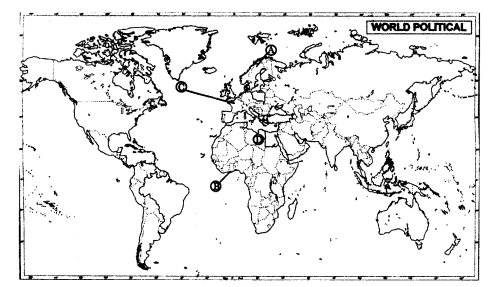
Answer:
| (A) | (B) |
| A . Sweden B – Ghana C – Austria D . Egypt | I – Sweden II – Austria III – Egypt IV. Ghana. |
International Organisations Important Extra Questions HOTS
Question 1.
Mention any two objectives of the United Nations.
Answer:
- To maintain international peace and security.
- To develop friendly relations among nations based on respect for the principle of equal rights and self-determination of people.
Question 2.
Write down the names of any four agencies of the United Nations.
Answer:
- World Health Organisation (W.H.O.)
- International Labour Organisation (I.L.O.)
- United Nations Educational Scientific, Culture Organisation (U.N.E.S.C.O)
- Food and Agricultural Organisation. (F.A.O.)
Question 3.
State any two functions of the Security Council.
Answer:
- The admission of new states to the organization and the expulsion therefrom can only be done on the recommendations of the Security Council.
- It makes recommendations to the General Assembly for the appointment of the General Secretary.
Question 4.
Why a demand for reforms in the Security Council is being made?
Answer:
United Nations Security Council is no longer reflective of contemporary reality and this poses the most important challenge to global peace and security as well as conflict prevention. India’s Ambassador to U.N. Hardeep Singh Puri said, “A composition rooted in 1945 detracts from its abilities to fully harness the capabilities of U.N. Member-States as of today.”
Question 5.
Mention any two basic principles of U.N.
Answer:
- The organization is based on the principles of sovereign equality of its members.
- All member states are supposed to fulfill the obligation imposed upon them by the Charter.