Here we are providing Class 12 Political Science Important Extra Questions and Answers Chapter 1 Challenges of Nation Building. Political Science Class 12 Important Questions are the best resource for students which helps in class 12 board exams.
Class 12 Political Science Chapter 1 Important Extra Questions Challenges of Nation Building
Challenges of Nation Building Important Extra Questions Very Short Answer Type
Question 1.
Assess the role of Maulana Abdul Kalam Azad towards maintaining communal harmony in India. (C.B.S.E. 2016)
Answer:
Maulana Abdul Kalam Azad got birth in 1888. He was a strong freedom fighter and Congress leader. He was a proponent of Hindu-Muslim unity. He opposed the partition of India. He was also a Member of the Constituent Assembly and remained Education Minister in the first Cabinet of free India.
Question 2.
“The leaders of the newly independent India did not see politics as a problem they saw it as a way of solving the problems.” How far do you agree with the statement? (C.B.S.E. 2016)
Answer:
Indian leaders saw politics as a way of solving the problems. There are different groups with different and conflicting aspirations. How do we resolve these differences? Democratic politics is an answer to this question. While competition and power are the two most visible things about politics, the purpose of political activity is and should be deciding and pursuing the public interest. This is the route our leader decided to take.
Question 3.
What is meant by the Two-Nation theory? (Imp.) (C.B.S.E. 2014)
Answer:
According to the ‘Two Nation Theory’ advocated by the Muslim League, India being a diversified country on the basis of culture, politics, religion, economy, and society into two communities. Hindus and Muslims. According to this theory, the demand for Pakistan, a separate country for Muslims was made.
Question 4.
Explain the role played by Sardar Patel in the Unification of j
princely states in India. Imp. (C.B.S.E. 2011, 2012 Outside Delhi):
Or
Mention the role of Sardar Vallabhbhai Patel towards India’s integration. (C.B.S.E. 2009):
Answer:
At the time of independence, there were 565 princely states. It was due to the leadership and statesmanship of Sardar Vallabh Bhai Patel that most of the princely states were integrated with the Indian Union without much difficulty.
Question 5.
“Free India was born in very difficult circumstances.” Justify the statement with any two suitable arguments. (C.B.S.E. 2019)
Answer:
There is no doubt that Free India was born in very difficult circumstances.
- Freedom came with the partition of the country.
- Due to the partition, India faced unprecedented violence, which caused trauma of displacement of people from both sides.
Question 6.
“The constitution framers of India ensured the development and well being of the entire society and not only of some sections.” Validate the statement with any two suitable arguments. (C.B.S.E. 2019)
Answer:
- The constitution framers of India ensured in the constitution that the development and well-being will be done for the whole society and not for any particular section.
- Special safety and protection will be granted to those who are socially or religiously or culturally in minority.
Question 7.
In spite of communal partition, India has not declared a ‘Hindu State’. How the leaders of the Indian National Congress defended the adoption of “secularism” in India? (C.B.S.E. Sample Paper 2018)
Answer:
- The leaders of the national movement cherished the ideal of a secular nation because they believed that India must treat people of all religions equally and that no religion should be considered superior to other religions.
- Even after the partition, 12% of the Muslim population remains in India.
Question 8.
Explain the role of the state Reorganization commission. (C.B.S.E. Sample Question P. 2017)
Answer:
After Independence, states were reorganized on a linguistic basis. On the basis of reports of the States Reorganisation Commission, the States Reorganisation Act was passed in 1956 which led to the creation of 14 States and six Union Territories.
Question 9.
Assess the commonly agreed upon two goals visualized by the Indians during the national movement which have been fulfilled after independence. (C.B.S.E. 2017)
Answer:
- There will be a democratic government in the country.
- The government will be run for the good of all.
Question 10.
“The partition of India appeared so Prove everyone in worst fears”. How far do you agree with this statement? (C.B.S.E. Sample Question P. 2017)
Answer:
The partition of India proved wrong bad for everyone because for most of them it paved the way for sorrow and problems. The partition initiated riots, loots, and killings. On both sides of the borders, there were continuous tensions with threats to lives and money materialistic things.
Question 11.
Identify any two consequences of the Partition of India in 1947. (C.B.S.E. 2014)
Or
Analyze the implication of partition on India. (C.B.S.E. Sample Paper 2018)
Answer:
The two consequences of the Partition of India in 1947 are as follows:
- The first consequence of the partition was the largest unplanned and tragic transfer that human history has known.
- Another consequence of the partition was the ‘Refugees Problem’.
Question 12.
Which four princely states of India initially resisted joining the Indian Union? (C.B.S.E. 2013) j
Answer:
- Junagarh
- Hyderabad
- Kashmir
- Manipur.
Question 13.
How the formation of linguistic states helped in strengthening the foundation of democracy and the process of national integration in India. (C.B.S.E. Sample paper 2018)
Answer:
- The path of politics and power was now open to people other than the small English speaking elite.
- It also gave some uniform basis to the drawing of state boundaries.
Question 14.
Analyze any two factors that led to the creation of Pakistan. (C.B.S.E. 2019)
Answer:
Following are two factors that led to the creation of Pakistan.
- ‘Two-Nations-Theory’ advocated by the ‘Muslim League’ was the important reason for the creation of Pakistan.
- The British policy of ‘Divide and rule’ and conflict between congress and the Muslim League is also responsible for this partition.
Question 15.
“The idea of Pakistan might have appeared simple, but its creation presented many severe difficulties.” Elucidate any two of them. (C.B.S.E. 2019)
Answer:
- There is no doubt that the idea of Pakistan might have appeared simple, but its creation presented many difficulties as it caused ruthless killings, sufferings of displacement division of properties, and violent separation of communities. ’
- Partition on a religious basis divided two countries as Hindu Nation and Muslim Nation and caused severe conflict between two nations.
Challenges of Nation Building Important Extra Questions Very Short Answer Type (2 Marks)
Question 1.
Name the leader who played a historic role in negotiating with the rulers of Princely States to join the Indian Union. (C.B.S.E. 2010)
Answer:
Sardar Vallabhbhai Patel played a historic role in negotiating with the rulers of Princely States to join the Indian Union.
Question 2.
Name the leader of the freedom movement of India, who was popularly known as ‘Frontier Gandhi’? (C.B.S.E. 2010)
Answer:
Khan Abdul Ghaffar Khan.
Question 3.
What was the most important recommendation of the States Reorganisation Commission? (Imp.)
(Sample Paper)
Or
Mention the main recommendation of the States Reorganisation Commission of 1953. (C.B.S.E. 2014)
Answer:
The most important recommendation of the State Reorganisation Commission was that boundaries of the different states should be based upon languages.
Question 4.
Justify the reorganization of states in India on a language basis by giving one suitable argument. (C.B.S.E. 2019)
Answer:
The various states of India reorganize on the basis of language so that, the country could be reflected without affecting the unity of the Nation.
Question 5.
When and by whom was the ‘Tryst with Destiny’ speech was delivered? (c.B.S.E. 2010)
Answer:
The ‘Tryst with Destiny’ speech was delivered by Pt. Jawaharlal Nehru on the midnight of 14-15 August 1947.
Question 6.
What was the biggest obstacle in nation-building at the time of India’s Independence? (C.B.S.E. 2011, Delhi)
Answer:
The biggest obstacle in nation-building at the time of India’s independence was to unite the nation, establish democracy, development, and refugee problems.
Question 7. What was the basis of the report of the State Reorganisation Commission? (C.B.S.E. 2012 Delhi)
AnsWER:
The State Reorganisation Commission accepted that the basis of the organization of new states should be linguistic.
Question 8.
What was the ‘Two Nation Theory’ advanced by the Muslim:
Answer:
According to Muslim League in India, there are two nations i.e., Hindu nation and Muslim nation.
Question 9.
When was the Constitution of India ready and signed by the members of the Constituent Assembly? When did it come into effect? (C.B.S.E. 2013)
Answer:
The Constitution of India was ready on 26 Nov. 1949 and was signed by the members of the Constituent Assembly on 24 January 1950. It came into effect on 26 January.
Choose the correct answer:
Question 10.
When India got Independence?
(a) 1947
(b) 1949
(c) 1952
(d) 1962.
Answer:
(a) 1947.
Question 11.
The main reason for India’s partition is:
(a) Adamant attitude of Jinnah
(b) Communal riots and disorder
(c) Failure of the Interim Government
(d) All of these.
Answer:
(d) All of these.
Question 12.
What were the consequences of the Partition of India in 1947?
(a) Transfer of Population
(b) Refugees Problem
(c) Problem of Minorities
(d) All of these.
Answer:
(d) All of these.
Challenges of Nation Building Important Extra Questions Short Answer Type
Question 1.
Explain the circumstances that led to the accession of Hyderabad to India. (C.B.S.E. 2017)
Answer:
Hyderabad was the largest princely state and it was surrounded by Indian territory. Its ruler was Muslim but the majority of the population was Hindu. Its ruler carried the title ‘Nizam’ and he was one of the world’s richest men. Nizam wanted an independent status for Hyderabad. Hyderabad had a substantial fighting force and the Nizam also expected British help through Pakistan.
But India was also determined to see its accession. Negotiations were started but Hyderabad held out against accession. The peasantry in the Telangana region, in particular, was the victim of Nizam’s oppressive rule and rose against him. Ultimately on the grounds of atrocities against Hyderabadi Hindus, the imprisonment of more than ten thousand Congressmen in the state, and the destructive activities of the fanatical Razarbars, the Govt, of India was forced to move in a ‘Police action’. After a few days of intermittent fighting, the Nizam surrendered. This led to Hyderabad’s accession to India. The popular ministry was established in Hyderabad after the first General election in 1952.
Question 2.
Describe briefly any four problems faced in the process of partition of India. Imp. (C.B.S.E. 2008)
Answer:
On 14-15 August 1947, not one but two nation-states i.e., India and Pakistan came into existence. But the partition of India was not simple; rather it was very complex. Following were the main problems faced in the process of partition of India:
- Firstly, There was no single belt of Muslim majority areas in British India. Muslims were mainly concentrated in two areas i.e. one in the West and the other in the East.
- Secondly, all Muslim majority areas were not interested in joining Pakistan. For example, Khan Abdul Gaffar Khan known as ‘Frontier Gandhi’ and undisputed leader of the North Western Frontier Province, was deadly against Two Nation Theory. But his voice was ignored and NWFP was merged with Pakistan.
- Thirdly, two Muslim majority provinces i.e., Punjab and Bengal, had very large areas where non- Muslim were in majority. Hence these two provinces were also bifurcated.
- Fourthly, there was a problem of minorities on both sides of the border.
Question 3.
Describe the outcome of the state Reorganisation Commission appointed in 1953. (C.B.S.E. 2009)
Answer:
After Independence, the reorganization of states was sought on a linguistic basis. Prime Minister Nehru announced the appointment of the State Reorganisation Commission in Lok Sabha on 2nd December 1953 for an impartial perusal of the issue. The Commission recommended the regrouping of states on the basis of language and culture as well. After pondering over the report of the State Reorganisation Commission, the Union Government presented the ‘States Reorganisation Bill’ in the Lok Sabha in 1956, which was passed after a few amendments. Indian Union included 14 States and 6 Union territories after the reorganization of states. Thereafter, infighting took place over Gujarati and Marathi languages resulting in the division of Bombay-Maharashtra and Gujarat, Nagaland state came into being in 1961.
Question 4.
Highlight any four consequences of the partition of India in 1947. (C.B.S.E. 2017)
Answer:
1. Refugee problems: The consequence of the partition was the ‘Refugee Problem’. The people who crossed the border found that they had no home.
2. Division of properties and financial assets: Partition also meant the division of properties, liabilities, and financial assets. The employees of the government and railways were also divided.
3. Problems of minorities: Even after large- scale migration of Muslims to Pakistan, about 12 percent of the total population of India were Muslims. The biggest problem before the Indian Government was how to deal with the Muslim and other religious minorities.
4. Disruption of trading networks: In spite of all the awareness about the economic fall out of the partition and all the precautionary measures proposed, the creation of India and Pakistan disrupted the existing trading network.
Challenges of Nation Building Important Extra Questions Long Answer Type
Question 1.
“The accommodation of regional demands and the formation of linguistic states were also seen as more democratic.” Justify the statement with any three suitable arguments. (C.B.S.E. 2016)
Answer:
The accommodation of regional demands and the formation of linguistic states were also seen as more democratic for this reason after independence the reorganization of states was sought on a linguistic basis. Prime Minister Nehru announced the appointment of the State Reorganisation Commission in Lok Sabha on 2nd December 1953 for the impartial perusal of the issue.
The Commission recommended the regrouping of states on the basis of language and culture as well. After pondering over the report of the state Reorganisation Commission, the Union Government presented the ‘States Reorganisation Bill’ in the Lok Sabha in 1956, which was passed after a few amendments. Indian Union included 14 States and 6 Union territories after the reorganization of states. Thereafter, infighting took place over Gujarat and Marathi languages resulting in the division of Bombay-Maharashtra and Gujarat. Nagaland state came into being in 1961.
The following arguments are favored for this statement:
- By accepting regional and linguistic claims of all-region, the threats of division and separation would be reduced.
- The linguistic reorganization also served as some uniform basis for the drawing of state boundaries. Instead of the disintegration of the country, it helped in strengthening the national unity.
- Linguistic states also accepted the principle of diversity. By embracing democracy means, India opted in favor of recognizing and accepting the existence of differences. Democracy was associated with a plurality of ideas and ways of life.
Question 2.
Analyses any six Consequences of the Partition of India in 1947. (C.B.S.E. 2016)
Or
Explain any six consequences of the Partition of India in 1947. Imp. (C.B.S.E. 2019)
Or
Assess any six consequences of the Partition of British India in 1947. (C.B.S.E. 2014)
Answer:
On 14-15 August 1947, not one but two nation-states came into existence—India, and Pakistan. This was due to the partition of British India into India and Pakistan. Following were the consequences of the partition of India:
1. Transfer of Population and Killings of People. The first consequence of partition was the largest unplanned and tragic transfer of population that human history has known. On both sides of the border, there were large-scale killings and atrocities. In the name of religion, people of one community killed the people of another community.
Minorities were forced to abandon their homes and move across borders. Even during their journey they were often attacked, killed, and looted. On both sides, thousands of women were raped, abducted, and killed.
The partition forced about 80 lakh people to migrate across the new border. More than five lakh people were killed due to partition.
2. Refugees Problem. Another consequence of the partition was the ‘Refugees Problem’. The people who crossed the border found that they had no home. For lakhs of people independence meant life in ‘refugee camps’. The Indian leadership and the Government of India had to face, this immediate and unexpected problem. The refugee problem was so serious that the Government took many years to solve it.
3. Division of Properties and Financial Assets. Partition also meant the division of properties, liabilities, and financial assets. The employees of the government and railways were also divided.
4. Problems of Minorities. Even after large- scale migration of Muslims to Pakistan, about 12 percent of the total population of India were Muslims. The biggest problem before the Indian Government was how to deal with Muslim minorities and other religious minorities.
5. Disruption of trading networks. In spite of all the awareness about the economic fall out of the partition and all the precautionary measures proposed, the creation of India and Pakistan disrupted the existing trading networks. The impact of partition, for instance, was disastrous for the jute industry.
6. Reorganisation of states. Due to the partition, Bengal was divided into East Bengal (now Bangladesh) and West Bengal. Similarly, Punjab was divided into the Punjab province of West Pakistan and the Indian state of Punjab.
Question 3.
What were the main considerations for bringing princely states with Indian Union? Who played the historic role in this task? (C.B.S.E. 2008)
Or
Describe the three considerations that guided the interim government’s approach towards the merger of Princely states into India. Who played the historic role in the finalization of this merger and how? (C.B.S.E. 2019)
Answer:
With the lapse of paramountcy on August 15, 1947, Indian princely states were left to decide their own fate. They could accede to either Dominion (India or Pakistan) or remain independent if they liked. In view of the fact, all but 10 of the 565 states lay in the territory that ultimately fell within its jurisdiction, India was faced with a formidable challenge. These states had been nursed by the British Government to serve as bulwarks against the political unrest spreading in the rest of India. They had become bastions of reaction. Their traditions of absolute rulership did not permit any movement for freedom even to raise its head. For nation-building and for the unity of the country, it was essential to bring these princely states into Indian Union.
The government’s views were guided by three points Firstly the people of the most Princely states wanted to merge with India. Secondly, the government approach was very flexible and Thirdly in the backdrop of Partition which brought into focus the contest over the demarcation of land, was not in favor of Indian national unity.
But, much to his credit as a statesman, Sardar Vallabhbhai Patel the directing genius of the Ministry of State, solved their problem within a year. Moreover, barring the exceptions of Kashmir and Hyderabad, there was no loss of life. Sardar Patel was determined to build a strong and united India. He, therefore, strained every nerve to weld the states together with the rest of India. He coaxed the rulers, cajoled them, and even threatened the reluctant with dire consequences. Lord Mountbatten also helped him in this difficult task.
First of all Sardar Patel appealed to the princes for co-operation, pleading with them to act as patriots and warning them that the alternative would not be in their interest. He assured the Princes of the generous privy purses and full ownership. Sardar Patel also guaranteed to their subjects the same rights, liberties, and privileges as those enjoyed by India’s citizens. The response was very good. Prince after prince signed the Instrument of Accession. By August 15, 1947, all except three states within its geographical limits had acceded to the Indian dominion. The exception was Junagarh, Hyderabad, and Kashmir.
Question 4.
Read the passage given below carefully and answer the following questions: (Imp.)(C.B.S.E. 2015)
The interim government took a firm stance against the possible division of India into smaller principalities of different sizes. The Muslim League opposed the Indian National Congress and took the view that the States should be free to adopt any course they liked. Sardar Patel, India’s Deputy Prime Minister and the Home Minister during the crucial period, immediately after Independence, played a historic role in negotiating with the rulers of Princely States in bringing most of them into the Indian Union.
(i) Which government has been referred to as the interim government?
Answer:
The government formed under the leadership of Pt. Jawaharlal Nehru in Sept. 1946, was known as the Interim Government.
(ii) Why did the Muslim League oppose the Indian National Congress?
Answer:
The Muslim League opposed the Indian National Congress because it took the view that the states should be free to adopt any course they liked.
(iii) What makes the role of Sardar Patel a historic one? Explain.
Answer:
Sardar Patel played a historical role in negotiating with the rulers of the Princely States in bringing most of them into the Indian Union, during the crucial period, immediately after Independence.
Question 5.
After the integration of the Princely states, what was the basis of drawing the internal boundaries of the Indian states? How was this task and reorganization of the states done? (C.B.S.E. 2019)
Or
What was the States Reorganisation Commission? When was it constituted? What was the most important recommendation of this Commission? (C.B.S.E. 2010 Outside Delhi)
Or
What forced the Union Government of India to appoint the States Reorganisation Commission in 1953? Mention its two main recommendations. Name any four new states formed after 1956. (C.B.S.E. 2014)
Answer:
Demand for States Reorganisation on Linguistic Basis. After independence, the reorganization of States was sought on a linguistic basis. Bengal was divided on the basis of language in 1905, before independence. The report of Sir Mont Ford in 1918 accepted the need for reorganization of states on a linguistic basis, but it was not an opportune time for the same. In 1931, the Indian Statutory Commission also supported this sort of reorganization of States. The report of Nehru Committee suggested, “Here it becomes most desirable for the provinces to be regrouped on linguistic basis. Language, as a rule, corresponds with a special variety of culture, traditions, and literature.”
Integration of States was the major problem after independence as the Indian states were given the right of independence. Sardar Patel regrouped these states with his untiring efforts. But soon the demand for the regrouping of states on a linguistic basis gained momentum. Congress founded a committee for the reorganization of states on the basis of its proceedings in Jaipur Conference. Pandit Nehru announced the appointment of this commission in Lok Sabha on 2nd December 1953 for an impartial perusal of the issue. This commission was headed by Fazal Ali and Sd. Pannikar and Hirday Math Kunjru were its members. The commission recommended the regrouping of States on the basis of language and culture as well.
Recommendations. Following were the main recommendations of the State Reorganisation Commission:
- Proper attention should be given to the cultural and communicative needs of other communities speaking different languages in a monolingual state.
- Linguistic minorities should be well protected.
- Attention should be paid to the development of other regional languages besides Hindi.
- English should be the medium of instruction in universities and higher training institutes.
- The idea of a separate nation should be outright rejected.
- The idea of ‘one language, one province’ should not be promoted. Reorganization of states on a mono-lingual basis would prove fatal to the national integration.
After pondering over the report of the State Reorganisation Commission, the Union Government presented the ‘States Reorganisation Bill’ in the Lok Sabha in 1956, which was passed after a few amendments. Indian Union included 14 states and 6 union territories after the reorganization of states. Thereafter, infighting took place over Gujarati and Marathi languages resulting in the division of Bombay – Maharashtra, and Gujarat. Nagaland state came into being in 1961. Sreeramulu fasted unto death over Telugu speaking area and Andhra Pradesh came into existence.
Master Tara Singh and Sant Fateh Singh went on fast demanding Panjabi Suba, ultimately Punjab was reorganized over linguistic basis and Haryana was founded. Chandigarh was declared a Union Territory and thereafter Das Commission was appointed to solve the problem of Chandigarh. According to Das Commission, Chandigarh should be handed over to Haryana but the Central Government rejected it. In 1970, Mrs. Gandhi proclaimed that Chandigarh would be merged in Punjab and Fazilka and Abohar areas and compensation of? 10 crores would go to Haryana to build its new capital. But this issue is still hanging on fire. On 25th January 1971, Himachal Pradesh has declared a full-fledged state.
Question 6.
In the given political outline map of India, five States are marked as A, B, C, D, and E . Identify them on the basis of the information given below and write their correct names in your answer-book with their respective serial numbers and the alphabets concerned: (Imp.)(C.B.S.E. 2015)
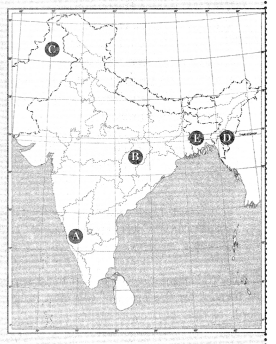
(i) The State which was carved out of Madhya Pradesh.
Answer:
(B) Chhatisgarh
(ii) The State which opposed its merger with India after independence.
Answer:
(D) Manipur
(iii) The first State of free India having a Communist government.
Answer:
(A) Kerala
(iv) The State adjoining Pakistan territory up to 1971.
Answer:
(E) Tripura
(v) The State which became agriculturally prosperous due to Green: Revolution,
Answer:
(C) Punjab.
Question 7.
Read the given passage carefully and answer the following questions: (C.B.S.E. 2015)
Above all, the linguistic states: underlined the acceptance of the l principle of diversity. When we say that India adopted democracy, it does not simply mean that India embraced a democratic constitution, nor does it merely mean that India adopted the format of elections. The choice was larger than that. It was a choice in favor of recognizing and accepting the existence of differences that could at times be oppositional. Democracy, in other words, was associated with a plurality of ideas and ways of life.
(i) What is meant by linguistic states’?
Answer:
Linguistic states refer to those states which are formed on the basis of the common language of the people of that particular state.
(ii) Why were linguistic states formed in India? Explain any two reasons.
Answer:
(a) Linguistic states have lesser chances of further division and separation
(b) Linguistic state is also a step for encouraging healthy democracy.
Above all, linguistic states underlined the acceptance of the principle of diversity.
(iii) How is democracy in India associated with a plurality of ideas and ways of life?
Answer:
India has multi-diversities in religion, faith, communities. We adopted democracy and a democratic constitution in favor of recognizing and accepting the existence of differences which could at times be oppositional. In other words, democracy was associated with a plurality of ideas, and ways of life.
Question 8.
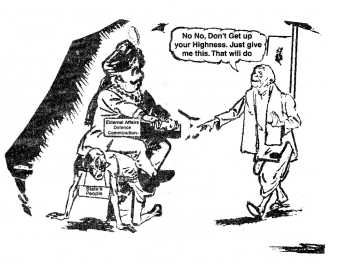
Study the following cartoon carefully and answer the questions that follow: (C.B.S.E. 2017)
(i) Identify and name the leader shown on the right in the cartoon.
Answer:
The leader shown on the right in the cartoon is India’s first home-minister- Sardar Vallabh Bhai Patel.
(ii) What type of relationship does the cartoon indicate between the people and the ruler?
Answer:
The cartoon indicates the relationship between the ruler and the people as master and slave.
(iii) In your opinion, how successful was the approach adopted by the leader on the right to solve the issue of Princely States?
Answer:
To solve the issue of the Princely States, the leader on the right of the cartoon-Sardar Vallabh Bhai Patel, successfully merged over 500 independent states in India.
Note: The following question is for visually impaired candidates only in lieu of the above question Answer the following questions:
(i) Name the Deputy Prime Minister in the First Council of Ministers under Jawaharlal Nehru.
Answer:
Sardar Vallabh Bhai Patel was deputy Prime Minister in the first council of ministers under Pt. Jawahar Lai Nehru.
(ii) Before signing the Instrument of Accession with the Indian Government, what assurance was given to the Maharaja of Manipur?
Answer:
Before signing the Instrument of accession with the Indian government the Maharaja of Manipur was assured for internal autonomy of the state.
(iii) Which section of the people in Hyderabad rose against the Nizam and why?
Answer:
Women section of the people in Hyderabad rose against Nizam for the rape and murder charges against him.
Question 9.
The three challenges faced by India, at the time of independence is yet to be resolved completely. Do you: agree with the statement? Give three: reasons in support of your Answer. (CJB.S.E. Sample Paper 2018)
Or
What were the major challenges of building democracy in India? (C.B.S.E. 2011, Outside Delhi)
Or
Explain any three challenges j faced by India at the time of her: independence. (C.B.S.E. 2014)
Answer:
On 14-15 August 1947 not one but two nation-states came into existence i.e., India and Pakistan. After independence, India faced three main challenges:
1. Firstly, the most important challenge was to shape a nation that was united yet accommodative of the diversity in our society. India consists of people having different languages, different religions, different cultures, and different customs. There was one big question-Would India survive as a unified country?
2. The Second challenge was to establish democracy. Under the new Constitution, Universal Adult Franchise was introduced in India. The Constitution guaranteed fundamental rights to the citizens. India adopted representation democracy based on ParliamenLary Government. However, the challenge was to develop democratic conventions in accordance with the Constitution.
3. The Third challenge was the development and welfare of the whole society and not of privileged sections of society. The Constitution emphasized on principle of equality and special protections are provided to Scheduled Castes and Scheduled Tribes. The real challenge was to remove poverty and unemployment. Economic development was another challenge.
Question 10.
Describe the events that led to the merger of Hyderabad and Manipur with the Union of India. (C.B.S.E. 2019)
Answer:
1. Hyderabad: Hyderabad was the largest princely state and it was surrounded by Indian territory. Its ruler was Muslim but the majority of the population was Hindu. Its ruler carried the title ‘Nizam’ and he was one of the world’s richest men. Nizam wanted an independent status for Hyderabad. Hyderabad had a substantial fighting force and the Nizam also expected British help through Pakistan.
But India was also determined to see its accession. Negotiations were started but Hyderabad held out against accession. The peasantry in the Telangana region, in particular, was the victim of Nizam’s oppressive rule and rose against him. Ultimately on the grounds of atrocities against Hyderabadi Hindus, the imprisonment of more than ten thousand Congressmen in the state, and the destructive activities of the fanatical Razarbars, the Govt, of India was forced to move in a ‘Police action’. After a few days of intermittent fighting, the Nizam surrendered. This led to Hyderabad’s accession to India. The popular ministry was established in Hyderabad after the first General election in 1952.
2. Manipur: A few days before independence, the Maharaja of Manipur, Bodhachandra Singh, signed the Instrument of Accession with the Government of India on the assurance that the internal autonomy of Manipur would be maintained. Under public pressure, elections were held in Manipur in June 1948 on the basis of Universal Adult Franchise. Hence constitutional monarchy was established in Manipur. On the question of the merger of Manipur with India, there were two different opinions. However, in September 1949 Maharaja signed the merger Instrument. But Maharaja did not consult the Legislative Assembly on the merger issue.
Challenges of Nation Building Important Extra Questions HOTS
Question 1.
Mahatma Gandhi said on 14th August 1947, “Tomorrow will be a day of rejoicing as well as mourning”. According to Mahatma Gandhi, why would 15th August 1947 (tomorrow) be a day of rejoicing as well as mourning?
Answer:
According to Mahatma Gandhi, 15th August 1947 will be a day of rejoicing because India will get complete independence. But at the same time, it will be a day of mourning due to the partition of India. Mahatma Gandhi was deadly against the partition of India.
Question 2.
Differentiate between modernization and westernization as developmental goals.
Answer:
After independence, modernization was the goal of the Government of India and not westernization. Modernization means the development of agriculture and industry on the basis of modern technology whereas westernization means to follow western education, culture, lifestyle, etc.
Question 3.
What was meant by Princely state? How many Princely states were there in India at the time of independence?
Answer:
Princely states were those which were ruled by Indian princes. At the time of independence of India, there were 565 princely states.
Question 4.
What is Nation?
Answer:
The word ‘Nation’ comes from the Latin word ‘Natus’ which means born. A nation, therefore, means a people having a common origin of coming from a common stock. According to Bryce, “A nation is a union of men having racial or ethnographic significance.”
According to Burgess, “A nation is a population of an ethnic unity, inhabiting a territory of a geographic unity.”
Question 5.
Write two negative traits in Nehruvian Policy.
Answer:
- A basic element of continuity with the British style of governance.
- The establishment of the governmental supremacy over the party.