Here we are providing Class 12 Political Science Important Extra Questions and Answers Chapter 2 Era of One Party Dominance. Political Science Class 12 Important Questions are the best resource for students which helps in class 12 board exams.
Class 12 Political Science Chapter 2 Important Extra Questions Era of One Party Dominance
Era of One Party Dominance Important Extra Questions Very Short Answer Type
Question 1.
When was the Election Commission of India set-up? Who was its first Chief Election Commissioner? (Imp.) (C.B.S.E. 2013)
Answer:
The Election Commission was set up in January 1950. Sukumar Sen was the first Chief Election Commissioner.
Question 2.
How did the dominance of The Congress Party in the first three general elections help in establishing a democratic set-up in India? (C.B.S.E:’2015)
Answer:
The dominance of the Congress was helpful in the first three general elections in establishing a democratic set-up in India. Many parties contested elections in conditions of free and fair elections and yet Congress managed to win the election after the election. This situation was helpful for democratic stability in India, and due to this, many other political institutions were established.
Question 3.
Explain the major difference of ideology between that of the Congress and the Jana Sangh. (C.B.S.E. 2014)
Answer:
Following are the major difference in ideology between that of the Congress and the Jana Sangh:
- Jana Sangh was opposed to the granting of concessions to religious and cultural minorities, but Congress supported this policy.
- Jana Sangh was against Article 370, but The Congress Party favored it.
Question 4.
Mention any two ideologies of Bharatiya Jan Sangh. (Sample Paper)
Or
Mention any two important feature j of Bharatiya Jana Sangh’s in ideology, (C.B.S.E. 2013)
Or
Highlight any two features of the j ideology of Bharatiya Jana Sangh. (C.B.S.E. 2014)
Answer:
- Jana Sangh emphasized the idea of one country, one culture, and. one nation.
- Jana Sangh has full faith in Indian culture and traditions. Jan Sangh was opposed to the granting of concessions to religious and cultural minorities.
Question 5.
Why did the Communist Party of India split in 1964? (C.B.S.E. 2011, Delhi)
Or
When and why was the Communist Party of India (CPI) divided into two factions? (C.B.S.E. 2012, Delhi)
Answer:
The Communist Party of India split in 1964 due to the ideological rift between the Soviet Union and China. The pro-Soviet faction remained as the CPI, while the opponents formed the CPI (M).
Question 6.
Match the facts given in Column ‘A’ with those column ‘B’ in a meaningful way: (C.B.S.E. 2018)
| Column ‘A’ | Column ‘B’ |
| (a) Architect of the Second Five Year Plan | (i) Balraj Madhok |
| (b) One of the leaders of Jana Sangh Kalam Azad | (ii) Maulana Ahul |
| (c) Leader of the Swatantra party | (iii) P.C. Mahalanobis |
| (d) Proponent of Hindu-Muslim Unity | (iv) Minoo Masani |
Answer:
| Column ‘A’ | Column ‘B’ |
| (a) Architect of the Second Five Year Plan | (iii) P.C. Mahalanobis |
| (b) One of the leaders of Jana Sangh Kalam Azad | (i) Balraj Madhok |
| (c) Leader of the Swatantra party | (iv) Minoo Masani |
| (d) Proponent of Hindu-Muslim Unity | (ii) Maulana Ahul |
Era of One Party Dominance Important Extra Questions Very Short Answer Type (2 Marks)
In which year first general election was held in India? (C.B.S.E. 2012 Outside Delhi)
Answer:
The first general election was held in 1952.
Question 2.
Which Political Party laid emphasis on the Idea of one country, one culture, and one nation?
Answer:
Jan Sangh.
Question 3.
During the first three general elections, the Congress won more seats than any other party. Which party stood at the second number during these:
Answer:
The Communist Party of India stood at the second number during these elections.
Question 4.
Who was the founder of the Bhartiya Jana Sangh? (C..B.S.E. 2014)
Answer:
Dr. Shyama Prasad Mukherjee was the founder of the Bhartiya Jana Sangh.
Question 5.
What inspired the formation of the Communist group in 1920e in different parts of India? (C.B.S.E. 2014)
Answer:
In the early 1920s, Communist groups emerged in different parts of India by being inspired by the Bolshevik Revolution in Russia.
Question 6.
In which year the Election Commission started using EVM?
Answer:
The Election Commission started using EVM towards the end of the 1990s.
Question 7.
Which political party of India had leaders like A.K. Gopalan, E.M.S. Namboodiripad and SA. Dance? (C.B.S.E. 2014)
Answer:
Communist Party of India had the leaders like A.K. Gopalan, E.M.S. Namboodiripad and S.A. Dange.
Question 8.
What has been the ideology of left parties in India? (C.B.S.E. 2017)
Answer:
The ideology of the left parties in India has been based on communism.
Question 9.Name the founder President of the Congress Socialist Party. What name was given to this party after 1948? (C.B.S.E. 2013)
Answer:
Acharya Narendra Deva was the founder President of the Congress Socialist Party. After 1948, this party was known as the Socialist Party.
Question 10.
What do you mean by defection? (C.B.S.E. 2012 Outside Delhi)
Answer:
Defection means an elected representative leaves the party on whose symbol he was elected and joins another party.
Choose the correct answer:
Question 11.
In which year first general election was held in India?
(a) 1947
(b) 1952
(c) 1955
(d) 1960.
Answer:
(b) 1952.
Question 12.
Who became the Prime Minister of India after the first general election?
(a) Pt. JL. Nehru
(b) Sardar Patel
(c) Smt. Indira Gandhi
(d)Mahatma Gandhi.
Answer:
(a) Pt. JL. Nehru.
Question 13.
In 1957, which party formed the government in Kerala?
(a) Jan Sangh
(b) C.P.I
(c) Congress
(d) Socialist Party.
Answer:
(b) C.P.I.
Question 14.
When was the Socialist Party formed in India?
(a) 1948
(b) 1952
(c) 1955
(d) 1960.
Answer:
(a) 1948.
Era of One Party Dominance Important Extra Questions Short Answer Type
Question 1.
Explain any four reasons for the dominance of the Congress Party in the first three general elections. (C.B.S.E. 2013)
Or
Explain any four reasons for the dominance of the Congress Party in the first three general elections in India. (C.B.S.E. 201S)(Imp.)
Answer:
Indian National Congress dominated in the first three general elections. Following factors were mainly responsible for the dominance of the Congress party:
- Indian National Congress is the oldest party in Asia. Congress party was established in 1885.
- Congress party played a very important role in the freedom struggle. In fact, the history of the National movement in the history of the Congress party. Many leaders and thousands of workers of the Congress party remained in jail for years.
- Congress party was led by Pt. Jawaharlal Nehru, Dr. Rajendra Prasad, Acharya J.B., Kripalani, Dr. Pattabhi Sitaramayya, etc.
- Congress party was the only party having proper organization at the root level. Its nation-wide organization enabled the Government to keep in close touch with the people and to function as an effective democracy.
Question 2.
What distinguished the dominance of the Congress Party in India from other examples of one-party dominance in otter countries? Explain. (C.B.S.E. 2016)
Or
What distinguished the dominance of the congress party of India from the one-party dominance in other countries? Explain. (C.B.S.E. 2017)
Answer:
In India, the Indian National Congress dominates Indian Politics up to 1967. Besides India, there were certain other countries where one party dominated. There are some countries like China, Cuba, North Korea, etc., where only one party is allowed under the constitution. A few years ago in Mexico one-party dominated like South Korea and Taiwan. In India multi-party system exists. Many political parties contested elections and elections are held free and fair. Congress party has managed to win election after elections. Congress’s dominance was on the support of the masses. However, in Mexico, there was no democratic system in a reality.
Question 3.
Whom did the two factions of the Communist Party support, after its split in 1964, and Why? (C.B.S.E. 2019)
Answer:
Communist Party of India was established in 1924. In the first general election in 1952 CPI won 16 seats, in 1957 it got 27 seats and in 1962 it won 29 seats. In 1957 CPI established a democratic government in Kerala for the first time in the world. In 1964, the Party went through a major split due to ideological rift between the Soviet Union and China-pro-Soviet faction remained as the CPI while the opponents formed the CPI(M). Supporting Marxian ideology.
Question 4.
Highlight the circumstances that compelled the socialists to form a separate socialist party in 1948. Mention any two grounds on which they criticized the Congress Party. (C.B.S.E. 2016)
Answer:
The Congress Socialist Party (CSP) was formed within the Congress in 1934. This was formed by a group of young leaders, who wanted to bring more radical find social changes to Congress. In 1948, Congress amended its constitution and ended the dual partnership. This compelled the socialists to form a separate socialist party in 1948. They believed in democratic-socialism which distinguished them both from the congress as well as from the communist. The Congress Socialist Party criticized the Congress for the following reasons
- Congress favored the landlords and capitalists.
- Congress ignores the rights of workers and peasants.
Question 5.
Explain any four problems faced by the Election Commission of India while holding the First General Election. (C.B.S.E. 2013)
Answer:
Following were the three main problems before the Election Commission of India for holding the First General Elections:
- The first problem was to conduct a free and fair election.
- There were more than 17 crore voters which was a record in itself in the whole world.
- For the first time, a general election was held in a poor and illiterate country which was a big test of democracy. Before that, elections were successfully conducted in prosperous and literate countries of Europe and North America.
Question 6.
Who founded the Swatantra Party in 1959? Describe any three policies and programs of this party. (C.B.S.E. 2013)
Or
Describe any four features of the ideology followed by the Swatantra Party founded in 1959. (C.B.S.E. 2019)
Answer:
Rajagopalachari founded the Swatantra Party in 1959.
- The Swatantra Party firmly believed that the government should not interfere in economic matters.
- The party was against centralized planning, nationalization, and the public sector.
- It was also against land ceilings in agriculture and opposed co-operative farming.
- It was also opposed to the progressive tax regime.
Question 7.
How did the methods of voting in free India go on changing from time to time till day? Explain the reasons also. (C.B.S.E. 2017)
Answer:
In the general elections of 2019 Electronic Voting Machine (EVM) was used to record voters’ preferences whereas in the first general* election, in each polling booth, a box for each candidate with the election symbol of that candidate was placed. Each voter was given a blank ballot paper which they had to drop into a box of the candidate they want to vote for.
But it was a very time consuming and expensive method. Booth capturing was another drawback of the ballot paper system therefore the government of India and the election commission of India decided to go with E.V.M. In the 2019 Loksabha election, V.V.PAT was also used with E.V.M.
Question 8.
Examine the dramatic changes that took place in the party system in India from 1969 to 1977. (C.B.S.E. 2017)
Answer:
- The Oldest Party: Congress party was divided in 1969.
- In Congress: Indira Gandhi became very popular, but her organization was weak.
- From 1969 to 1977 opposition parties organized themselves.
- In 1977 opposition party known as Janta Party formed the government for the first time in India.
Era of One Party Dominance Important Extra Questions Long Answer Type
Question 1.
Analyze the reasons for the dominance of the Congress Party in the first three general elections. (C.B.S.E. 2014)
Or
Identify the factors that contributed to the dominance of the Congress party during the early years of independence. (C.B.S.E. Sample Q.P. 2017)
Or
State the causes responsible for the rise of the Congress system in India. (C.B.S.E. Sample Paper 2018)
Or
Highlight any three major reasons for the dominance of the Congress Party in the first three general elections after Independence. (C.B.S.E. 2019)
Answer:
After Independence, the Congress Party dominated the political scene at the center as well as in states before 1967. The Congress secured 364, 371, 361, and 283 seats in the elections of 1952, 1957, 1962, and 1967 respectively. The dominance of Congress was due to many reasons:
1. The Congress Party was established in 1885 and it played a very important role in the national movement. In fact, the history of the national movement is almost the history of the Congress Party. Congress Party wholeheartedly fought for India’s independence and did not worry about sacrifices.
2. Congress provided able leadership to the Indian masses from 1885 to 1947. The Congress Party was led by such great personalities as Mahatma Gandhi, Pt. Jawaharlal Nehru, Sardar Vallabhbhai Patel, Mrs. Indira Gandhi.
3. The Congress Party was a well-organized party and no other political party had such a well-knit organization.
4. After Independence, The Congress Party not only tried to solve the problems of the masses but also faced the challenges before the nation.
Moreover, the Congress Party represents a mixture of almost all shades of opinion. It is, in fact, a ‘Grand Coalition’. It was rather a privileged party to harbor all sorts of political ideologies under the garb of freedom struggle.
Question 2.
Highlight the political ideology of the Communist Party of India. (C.B.S.E Sample Paper 2018)
Answer:
Following are the Political Programme of the Communist Party of India-
1. The C.P.I. attaches the utmost priority to safeguarding the integrity, security, and sovereignty of India.
2. The C.P.I. favors the preservation and strengthening of the secular democratic set up of the country in the struggle against all types of divisive forces.
3. The manifesto calls for 10 percent job reservation for the economically weaker sections of forwarding castes in addition to the implementation of the Mandal Commission report. The party is for the implementation of a 30 percent job reservation for women.
4. The party is for the speedy implementation of comprehensive measures for social justice.
5. The party has demanded a restructuring of Centre-State relations in the true spirit of federalism. The state should be given more powers as recommended by the Sarkaria Commission.
6. The Party called for the abrogation of Article 356 of the Constitution and enlarging the democratic and civil rights of the people.
7. The fate of the state government is to be decided on the floor of the house.
8. The Party has demanded real decentralization to be carried out by conferring more power and financial resources to elected bodies district, block, and Panchayat levels.
9. The party favors effective steps f0r the elimination of corruption. Lok Pal Bill which includes within its scope, legislators, and also the Prime Minister should be adopted. Transfers and postings which are a fertile source of corruption should be done by a committee of senior officials.
10. All legislators, MPs, MLAs, ministers, and high officials must disclose their assets and place them before parliament and assemblies.
11. It has demanded the repeal of all undemocratic statutes including ESMA and NSA and enlarging democratic and civil rights of the people.
12. The Party is committed to strengthening the parliamentary democratic system.
Question 3.
Describe the difficulties that the Elections Commission of India faced in holding the first general elections after Independence. (C.B.S.E. 2019)
Or
Described the various steps taken to hold the First General Elections in India. How far were these elections successful? (Imp. C.B.S.E. 2014)
Answer:
Indian Constitution came into effect on 26 January 1950. Under the Indian Constitution, democracy was established in India. The election commission of India was set up in January 1950. Sukumar Sen was the first Chief Election Commissioner of India. The country’s first general elections were held in 1952. The first general election of 1952 is considered as a landmark in the history of democracy in the whole world.
- The first general election was a landmark in the history of democracy because there were more than 17 crore voters, which was a record in itself in the whole world.
- The strength of the Lok Sabha was 489 and about 3,200 MLAs of all the Legislative Assemblies of India. These members were to be directly elected by the voters on the basis of single-member constituencies.
- More than 3 lakh officers and polling staff were trained to conduct the first general elections.
- The first general election was also the first big test of democracy in a poor and illiterate country. Before that, elections were conducted in prosperous and literate countries of Europe and North America.
- First general elections were conducted on the basis of the Universal Adult Franchise whereas in many countries of Europe women did not enjoy the right to vote. In India, all adult citizens were given the right to vote.
Thus, the first general elections of 1952 was a grand landmark in the history of democracy in the whole world. It was really a great achievement for India.
Question 4.
“Congress had remained a social and ideological coalition for a long period.” Justify the statement.
(C.B.S.E. 2013)
Or
For a long time, The Congress Party had been a social and ideological coalition”. Justify the statement. (C.B.S.E. 2014):
Answer:
Ideologically, the Congress took root and came to political power not as a party but as a movement for independence and reform. The Congress party was” established in 1885 by higher middle class from English speaking persons. But with both the Non-cooperation Movement and the Civil Disobedience Movement, the social base of the Congress party widened. All types of people with diverse interests became members of the Congress party. Peasants and landlords, industrialists and workers, urban elites and villagers, capitalists and poor, upper caste and lower castes persons, etc., all were within the Congress.
Congress party was in fact, an ideological coalition. Rajni Kothari has rightly pointed out that “The Congress represents all shades of opinion, all major interest groups in the society and indeed all other parties as well. The Congress represented India’s diversity in terms of classes and castes, religions and languages, and various interests. Maximum opposition political parties are the dissenting elites of the Congress party, who share two common social and intellectual backgrounds as of the Congressmen.”
Question 5.
Describe the changing methods of voting in India from 1952 to today. (C.B.S.E 2019)
Answer:
India is the largest democratic country in the world. Therefore regular election is going on by the election commission of India. For the passage of time, there is a change in the voting method of election.
In the general elections of 2019 Electronic Voting Machine (EVM) was used to record voters’ preference whereas in the first general election, in each polling booth, a box for each candidate with the election symbol of that candidate was placed. Each voter was given a blank ballot paper which they had to drop into a box of the candidate they want to vote for.
But it was a very time consuming and expensive method. Booth capturing was another drawback of the ballot paper system, therefore, the government of India and election commission of India decided to go with EVM as a pilot project in the general election held in 2004, in 2019 Loksabha election the entire election held with EVM and V.V.PAT (Voter Verifiable Paper Audit Trail).
Question 6.
Describe the role of opposition parties in the first phase of democratic politics in our country which was quite unique. (C.B.S.E 2019)
Answer:
The role of opposition parties in the first phase of democratic politics in our country was quite unique. Even then India had a large number of diverse and vibrant opposition parties than many other multi-party democracies.
After independence, the Congress party dominated Indian politics. In the first three elections, the Congress party secured more than two-third of seats in the Lok Sabha. Even then many opposition parties emerged in the Lok Sabha. Though there was no official and recognized opposition in the Lok Sabha, yet there were many small opposition parties who played an important role in maintaining the democratic character of the system.
The roots of almost all the non-Congress parties of today can be traced to one or the other of the opposition parties of the 1950s. Though opposition parties had a token representation in the Lok Sabha, yet opposition leaders were very effective due to their status and personality. The opposition parties criticized the policies of the Congress party and kept the ruling party under control. The opposition parties believe in healthy and positive criticism. Thus, opposition parties played a very important role in maintaining the democratic character of the system.
Question 7.
How did the dominance of The Congress party affect the democratic nature of Indian politics? Explain. (C.B.S.E. 2013)
Answer:
In India, the multi-party system exists. Several political parties participate in elections. But Indian National Congress dominated at the centre as well as the states till 1967. The prevalence of ‘one-party dominant system’ has adversely affected the democratic nature of Indian politics. In fact, the dominance of a single party is opposed to democracy as other political parties cannot flourish. Due to a lack of organized opposition, the Congress party never fulfilled the promises made to the people. Congress remained in power for a long period and hence no other party got a chance to rule.
Its administration has become virtually inefficient leading to widespread corruption. Pt. Jawaharlal Nehru himself accepted the fact that “The Congress has developed into a monolithic organization making it virtually impossible for the growth of a sound party system in the country”. According to R.A. Gopalaswami “The party system which has emerged in our country is not only incompatible with the particular democratic institutions we have adopted but constitutes a clear danger to the survival of democracy of India.”
Question 8.
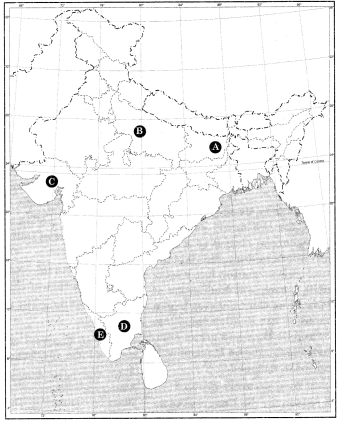
In the Outline political map of India given above, five States have been: marked as A, B, C, D and E. With the j help of the Information given below, I identify them and write their correct: names in your answer book along with j the serial number of the information j used and the related alphabet in the j map. (C.B.S.E. 2015) j
(i) The State to which C. Raja-: Gopala Chari, the first Indian Governor-General of India, belonged.
Answer:
D-Tamil Nadu
(ii) The State where the first non-Congress Government was formed by E.M.S. Namboodiripad.
Answer:
E-Kerala
(iii) The State to which Rafi Ahmed Kidwai, the Union Minister for Food and Agriculture (1952-54) belonged.
Answer:
B-Uttar Pradesh
(iv) The State which faced the most acute food crisis in 1965-1967.
Answer:
A-Bihar
(v) The State which led the country: to White Revolution through Dairy Cooperative Movement.
Answer:
C-Gujarat.
Question 9.
Read the passage given below carefully and answer the following questions: (C.B.S.E. 2018)
The congress evolved from its origins in 1885 as a pressure group for the newly educated professional and commercial classes to a mass movement in the twentieth century. This laid the basis for its eventual transformation into a mass political party and its subsequent domination of the political system, Thus the Congress began as a party dominated by the English speaking, upper caste, upper-middle-class, and urban elite. But with every Civil Disobedience Movement, it launched, its social base widened.
(а) What is meant by a pressure group?
Answer:
In the ordinary sense of the word, pressure groups consist of the groups of people with vested interests and they get support in favor of their interests and objectives by influencing the legislators. These groups are neither political parties nor political organizations rather they are unlike the political parties.
(b) Explain the reason for Congress to be transformed into a rainbow-like social coalition by the time of Independence.
Answer:
The congress party was established in 1885 by a higher middle class from English speaking persons. But with both the Non-cooperation Movement and the Civil Disobedience Movement, the social base of the Congress party widened. All types of people with diverse interests became members of the Congress party.
(c) What made the Congress into a mass political party in the twentieth century?
Answer:
The congress evolved from its origins in 1885 as a pressure group for the newly educated professionals and commercial classes to a mass movement in the 20th century. This laid the basis for its eventual transformation into a mass political party.
Question 10.
Read the following passage and answer the questions given below: (C.B.S.E. 2019)
India is not the only country to have experienced the dominance of one party. If we look around the world, we find many other examples of one-party dominance. But there is a crucial difference between these and the Indian experience. In the rest of the cases, the dominance of one party was ensured by compromising democracy. In some countries like China, Cuba, and Syria the constitution permits only a single party to rule the country.
(i) Which political party dominated the political scene of India after independence and how long?
Answer:
Congress party dominate the political scene of India after independence from 1952 to 1967.
(ii) How did the one-party dominance in India differ from that of China?
Answer:
One-party dominance in India was based on a democratic system, but in China, one-party dominance based on a communist (Dictatorship) system.
(iii) Highlight any two drawbacks of a single-party rule.
Answer:
Following are the two drawbacks of a single party rule:
- Against Democracy: The single-party system is against democratic principles because in this system the people do not enjoy the right to form associations.
- Election a Mere Show: In a single-party system, an election is a mere show. All the candidates belong to the same political party.
Era of One Party Dominance Important Extra Questions HOTS
Question 1.
When was the Congress party founded in India and by whom?
Answer:
Indian National Congress was established in 1885 at Bombay. Congress party was founded by Mr. A.O. Hume.
Question 2.
Give the names and symbols of any two National Parties in India.
Answer:
- Indian National Congress-Open Hand.
- B.J.P.-Lotus.
Question 3.
Mention any two characteristics of the party system in India.
Answer:
- In India, the multi-party system exists and these parties represent diverse interests.
- Though there have been a large number of political parties, there has been a dominance of the Congress party both at the center and the state level for a longer period.
Question 4.
What was the method of voting in the first general election?
Answer:
In the first general election at each polling booth, a Ballot box for each candidate with the election symbol of that candidate was placed. Each voter was given a blank ballot paper which they had to drop after stamping into the box of the candidate of their choice.
Question 5.
Did anyone vote from your family in the first or second general elections? Who did they vote for and why?
Answer:
My elder brother voted in the first two general elections. He voted for The Congress party because he had full faith in the leadership of Pt. Jawaharlal Nehru.