Open Economy Macroeconomics Class 12 Important Extra Questions Economics Chapter 6

Here we are providing Class 12 Economics Important Extra Questions and Answers Chapter 6 Open Economy Macroeconomics. Economics Class 12 Important Questions are the best resource for students which helps in class 12 board exams.

Class 12 Economics Chapter 6 Important Extra Questions Open Economy Macroeconomics

Open Economy Macroeconomics Important Extra Questions Very Short Answer Type

Question 1.
When will there be a surplus in balance of trade?
Answer:
The balance of trade is in surplus when the imports of goods are less than the exports.

Question 2.
Which two transactions determine balance of trade?
Answer:
Export and import of visible items determine the balance of trade.

Question 3.
When is there a deficit in the balance of trade?
Answer:
The balance of trade is in deficit when the imports of goods are more than the exports.

Question 4.
What does Balance of Payments account of a country record?
Answer:
The Balance of Payments (BoP) account of a country records the payments and receipts of a country with the rest of the world, during one year. ,

Question 5.
List two items of the capital account of Balance of Payment account
Answer:
Items of the capital account of Balance of Payment account are:
(i) Private foreign loan flow
(ii) Movement in banking capital

Question 6.
What is the difference between the values of exports of goods and imports of goods called?
Answer:
The difference between the values of exports of goods and imports of goods is called balance of trade.

Question 7.
What is balance of trade? (C.B.S.E 2014)
Answer:
Balance of trade refers to the relationship between the value of imports and exports of the goods of a country. It includes only visible items.

Question 8.
Define Balance of Payment. (C.B.S.E 2017)
Answer:
Balance of Payments (BoP) records the transactions in goods, services and assets of the residents of a country with the rest of the world. It also records the country’s demand for and supply of foreign exchange.

Question 9.
What do you mean by Balance of Payment on current account?
Answer:
The Balance of Payments on current account is the sum of balance of merchandise trade, services and net transfers received from rest of the world.

Question 10.
What do you mean by Balance of Payment on capital account?
Answer:
The Balance of Payments on capital account includes capital transactions relating to borrowing and lending of capital, sale and purchase of assets, interest payment, etc.

Question 11.
What is current account deficit in the Balance of Payments? (C.B.S.E. 2014)
Answer:
Current account is said to be in deficit when the export of goods and services and unilateral transfers falls’ short of the import of goods and services and unilateral transfers.

Question 12.
What is meant by “current account surplus”? (C.B.S.E Outside Delhi 2019)
Answer:
Current account surplus refers to excess of receipts from value of exports of visible items and invisible items; and unilateral transfers over payment for value of imports of visible items and invisible items; and unilateral transfer.

Question 13.
What is foreign exchange rate? (C.B.S.E 2011)
Answer:
Foreign exchange is the price of one unit of the foreign currency in terms of the domestic currency.

Question 14.
What is fixed exchange rate system? (C.B.S.E. Outside Delhi 2012) :
Answer:
Fixed exchange rate is the system in which the exchange rate is set and maintained by the government as official exchange rate. Flexible exchange rate is the system in which the exchange rate is determined by the demand and supply forces in the foreign exchange market.

Question 15.
Define foreign exchange market.
Answer:
Foreign exchange market is the market where the national currencies are traded for one another.

Question 16.
What is ‘hybrid’ system?
Answer:
Hybrid system is the combination of fixed and flexible exchange rates system.

Question 17.
How can increase in Foreign Direct Investment affect the price of foreign exchange ? (C.B.S.E 2013)
Answer:
Increase in Foreign Direct Investment increases the supply of foreign exchange and hence decreases the price of foreign exchange.

Question 18.
How can Reserve Bank of India help in bringing down the foreign exchange rate which is very high? (C.8.S.E Outside Delhi 2013)
Answer:
The Reserve Bank of India can sell foreign currency in exchange of domestic currency to bring down the foreign exchange rate.

Question 19.
What is devaluation? (C.B.S.E 2014)
Answer:
Devaluation of a currency means lowering of the value of the domestic currency by the monetary authority in terms of the currencies of the other countries.

Question 20.
What is managed floating exchange rate? (C.B.S.E. Outside Delhi 2014)
Answer:
Managed floating exchange rate is a system that allows adjustment in exchange rate according to a set of rules and regulations which are officially declared in the foreign exchange market.

Question 22.
Define floating exchange rate. (C.B.S.E Outside Delhi 2014)
Answer:
A floating exchange rate is the rate determined by the free play of market without any intervention by; the centra bank.

Question 23.
What is meant by depreciation of domestic currency? (C.B.S.E. Outside Delhi 2017)
Answer:
Currency depreciation implies that domestic currency has become less expensive in terms of foreign currency.

Open Economy Macroeconomics Important Extra Questions Short Answer Type

Question 1.
Distinguish between current account and capital account of Balance of Payments account. Mention ; any two transactions of capital account.
Answer:
The Balance of Payments on capital account includes capital transactions relating to borrowing and ; lending of capital, sale and purchase of assets, interest payment, etc.

The Balance of Payments on current account is the sum of balance of merchandise trade, services ; and net transfers received from rest of the world.

The two transactions of capital account are:

  • Direct investment
  • Private transactions

Question 2.
State any four items each of current account and capital account of the Balance of Payments account. (C.B.S.E Outside Delhi 2011), (C.B.S.E. 2011)
Answer:
Items of Current Account
(i) Export and Import of Goods: Current account shows exports and imports of visible items i.e., goods like machinery, wheat, steel, etc.

(ii) Export and Import of Services: Current account shows exports and imports of invisible items i.e., services like banking, tourism, insurance, etc.

(iii) Unilateral Transfers: These are those receipts which residents of a country receive or payments that the residents of a country make without getting anything in return. Receipts from abroad are entered as positive items and payments abroad are entered as negative items.

(iv) Private Transfers: These are gifts that domestic residents receive from or make to foreign residents.

Items of Capital Account

  • Private Transactions: These are transactions that affect the assets or liabilities of individuals, business, etc. and other non-government entities.
  • Official Transactions: These are the transactions that affect the assets and liabilities by the government and its agencies.
  • Direct Investment: Direct investment means the act of purchasing an asset and at the same time acquiring control of it.
  • Portfolio Investment: It is the acquisition of an asset that does not give the purchase control over the asset.

Question 3.
What is meant by visible and invisible items in the Balance of Payment account? Give two examples of invisible items.
Answer:
All types of physical goods exported and imported are called visible items in the Balance of Payment account. On the other hand, all those services whose export and import are not visible are known as invisible items in the Balance of Payment account.

Two examples of invisible items are:

  • Shipping
  • Insurance and banking

Question 4.
Name the board categores of transactions recorded in the ‘current account’ of the balance of payments account. (C.B.S.E 2015)
Answer:
The main components of the current account of the Balance of Payments accounts include:

  • Import and export of goods
  • Import and export of services
  • Unilateral transfers

The deficit in current account indicates that the current imports of goods and services and unilateral transfers to rest of the world are greater than the exports of goods and services and unilateral transfers from rest of the world.

Question 5.
Name the broad categories of transactions recorded in the‘capital account’ of the Balance of Payments Accounts. (C.B.S.E. 2015)
Answer:
The broad categories of transactions recorded in the ‘capital account’ of the Balance of Payments Accounts are:
(i) External assistance
(ii) Commercial borrowings
(iii) NR deposits
(iv) Foreign investment:

  • Foreign Direct Investment
  • Portfolio Investment

(v) Other flows

Question 6.
Define “Trade surplus”. How is it different from “Current account surplus”? (C.B.S.E 2019)
Answer:
Trade surplus refers to excess of value of export of visible items over value of import of visible items in the balance of payment account of a country. In other words it only includes trade of goods. Current account surplus refers to excess of receipts from value of exports of visible items and invisible items; and unilateral transfers over payment for value of imports of visible items and invisible items; and unilateral transfer. It is a relatively broader concept as compared to trade surplus.

Question 7.
Explain the meaning of deficit in Balance of Payment. (C.B.S.E. 2010,2014)
Or
Explain the concept of‘deficit’ in balance of payments. (C.B.S.E. 2018)
Answer:
When net balance of all the receipts and payment is negative, it is known as deficit in Balance of Payment (BoP). Deficit in BoP indicates that all receipts are less than all the payments. These receipts and payments include both visible and invisible items.

Question 8.
Distinguish between autonomous and accommodating transactions of Balance of Payment account (C.B.S.E 2010,12), (C.B.S.E Outside Delhi 2014,2017)
Answer:
Following are the points of difference between autonomous and accommodating transactions:

Autonomous TransactionsAccommodating Transactions
1. Autonomous items refer to the international economic transactions, which occur for achievement of economic motive such as profit maximisation.

2. Autonomous transactions are independent of the country’s Balance of Payments status.

3. Autonomous transactions are also known as ‘above the line items’.

Accommodating items refer to the transactions, which occur because of government financing.


Accommodating transactions are not independent of the country’s Balance of Payments status.

Accommodating transactions are also known as ‘below the line items’.

Question 9.
Which transactions determine the balance of trade? When is balance of trade in surplus? (C.B.S.E. Outside Delhi 2011)
Answer:
Export and import of visible items determine the balance of trade. The balance of trade in surplus when imports are less than exports.

Question 10.
Distinguish between Trade Deficit’ and ‘Current Account Deficit’. (C.B.S.E. Outside Delhi 2019)
Answer:
Trade deficit refers to excess of value of imports of visible items over value of exports of visible items in the balance of payment account of a country. In other words.it only includes trade of goods.

Current account deficit refers to excess of payment for value of imports of visible items and invisible items; and unilateral transfer over receipts from value of exports of visible items and invisible items; and unilateral transfers. It is a relatively broader concept as compared to trade deficit.

Question 11.
State whether the following statements are true or false. Give reasons for your answer: (C.B.S.E. 2011 Comp.)
(i) Difference between value of exports and imports of goods and services is called trade balance.
(ii) External assistance is not recorded in Balance of Payments account.
Answer:
(i) False. Balance of trade refers to the relationship between the value of imports and exports of the goods of a country. It does not include invisible items such as services.
(ii) False. External assistance is a component of Balance of Payments account.

Question 12.
Giving reasons, state whether the following statements are true or false:
(i) Excess of foreign exchange receipts over foreign exchange payments on account of accommodating transactions equals deficit in the Balance of Payments.
(ii) Export and import of machines are recorded in capital account of the Balance of Payments
account (C.B.S.E. 2011 Comp.)
Answer:
(i) False. Excess of foreign exchange receipts over foreign exchange payments on account of autonomous transactions equals deficit in the Balance of Payments.
(ii) False. Export and import of machines are not recorded in capital account as capita! account transactions do not involve movement of goods. Export and import of machines is a part of Current Account.

Question 13.
Giving reasons state whether the following statements are true or false.
(i) Current account of Balance of Payments account records only exports and imports of goods and services.
(ii) Foreign investments are recorded in the capital account of Balance of Payments.
(C.B.S.E. Outside Delhi 2011 Comp.)
Answer:
(i) False. Current account of Balance of Payments account also records unilateral transfers along with exports and imports of goods and services.
(ii) True. Foreign investments are recorded in the capital account of Balance of Payments as It involves change in ownership of assets.

Question 14.
Where will sale of machinery to abroad be recorded in the Balance of Payments Accounts? Give reasons.
(C.B.S.E 2015)
Answer:
Machinery is a visible item and its sale to abroad will be an export. This will result in inflow of foreign exchange in the country. Thus, sale of machinery to abroad will be recorded as a credit item under visible items in the current account.

Question 15.
Where is ‘borrowings from abroad’ recorded in the Balance of Payments Accounts? Give reasons.
(C.B.S.E Outside Delhi 2015)
Answer:
Borrowings from abroad would lead to an inflow of foreign exchange into the country. Thus, borrowings from abroad will be recorded as positive items in the capital account of Balance of Payments.

Question 16.
Giving reasons explain why charity to foreign countries is recorded in the Balance of Payments Accounts.
(C.B.S.E. Foreign 2015)
Answer:
Charity to foreign countries is unilateral transfers, which are a part of BoP’s current account. These transfers are one-sided and cause an outflow of foreign currency. Thus, charity to foreign countries will be recorded as negative item in the current account of Balance of Payments.

Question 17.
State four sources each of demand and supply of foreign exchange. (C.B.S.E 2010)
Answer:
Following are the four sources each of demand for and supply of the foreign exchange:

Sources of Demand for Foreign Exchange

  • Purchase of goods and services from other countries
  • Send gift abroad
  • Purchase of financial assets in a particular country
  • Speculative trading on the value of the foreign currencies

Sources of Supply of Foreign Exchange

  • Foreigners purchasing home country’s goods and services through exports
  • Foreign investment in home country through joint ventures
  • Foreign investment in heme country through the financial market operations
  • Foreign currencies flow into the economy through the currency dealers and speculators

Question 18.
How is foreign exchange rate determined? Use diagram. (C.B.S.E. Outside Delhi 2013)
Or
Discuss briefly the concept of flexible exchange rate system of foreign exchange rate determination. (C.B.S.E. Outside Delhi 2019)
Answer:
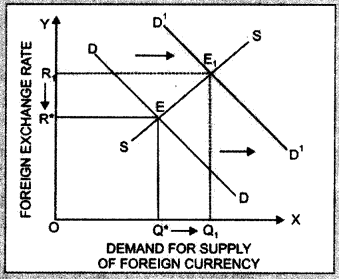
The exchange: rate in the foreign market is determined:by the intersection; of supply and demand, curves of the foreign exchange .The foreign exchange market, like any other normal market, comprises of a downward sloping demand curve and an upward sloping supply curve.
In the following diagram, the vertical shows
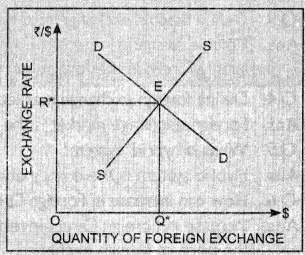
NCERT Solutions for Class 8 Social Science Geography Chapter 6 Human Resource 1

He  states in terms of the domestic currency, Cruf is,” amount of rupee for one US dollar, The horizontal axis measures the quantity demanded or supped. At point E, the intersection of demand and supply curves determines the equilibrium exchange rate in the foreign market (R*) and equilibrium quantity (Q*) of the foreign currency, that is, US dollar ($).

An increase in the demand for US dollars in India will cause the demand curve to shift to D’$ and the exchange rate rises to R’. Similarly, an increase in the supply of US dollars will cause the supply curve shift to S’$ and the exchange rate falls to RT In this: case, the domestic currency is more valuable.

Question 19.
Explain the impact of rise in exchange rate on national income. (C.8.S.E 2018)
Answer:
A rise in the foreign exchange rate implies that the price of foreign currency, in terms of domestic currency, has increased. Since domestic goods and services have become cheaper, the foreign country can now buy higher quantity from one unit of its currency.

This will result in increased demand for Indian exports. Moreover, depreciation of domestic currency will make the imports from foreign countries more expensive. Thus, there will be increase in exports and fall in imports, causing the net exports to rise. Consequently, the net aggregate demand for domestically produced goods will increase and so will the national income.

Question 20.
When exchange rate of foreign currency rises, its supply rises. How? Explain. (C.B.S.E 2011)
Answer:
The foreign exchange rate is the price of one currency in terms of another currency. A rise in the foreign exchange rate implies that the price of foreign currency, in terms of domestic currency, has increased. Since domestic goods and services have become cheaper, the foreign country can now buy higher quantity from one unit of its currency. This increases the supply of foreign currency in the domestic country.

For instance, suppose the foreign exchange rate between India and UK has increased. The price of one pound has increased from ₹ 60 to ₹ 70. It implies that UK citizens can buy ₹ 70 worth of goods by parting one pound compared to only ₹ 60 worth of goods prior to rise in exchange rate. Since Indian goods have become cheaper for UK, they will buy more of them. This increases the supply of UK pounds to India. Thus, a rise in foreign exchange rate causes a rise in its supply.

Question 21.
When exchange rate of foreign currency fells its demand rises. Explain how? (CBS.E. Outside Delhi 2011)
Answer:
The foreign exchange rate is the price of one currency in terms of another currency. A fall in the foreign exchange rate implies that the price of foreign currency, in terms of domestic currency, has l decreased. Since foreign goods and services have become cheaper, the domestic country can now buy higher quantity.

This increases the demand for foreign currency in the domestic country. : For instance, suppose the foreign exchange rate between India and UK has decreased. The price of one pound has fallen from ₹ 70 to ₹ 60. It implies that Indians have to pay only ₹ 60 to buy one pound worth: of goods compared to ₹ 70 prior to fell in exchange rate. Since goods in UK have become cheaper for; India, Indians will buy more of them. This increases the demand for UK pounds in India Thus, a fall in foreign exchange rate causes a rise in its demand :

Question 21.
Give two reasons for a rise in demand for a foreign currency when its price fells.
Answer:
Following are the two reasons for the rise in the demand for a foreign currency when its price falls:
(i) When the price of a foreign currency falls, the imports from that country become cheaper. As a result, imports increase, and hence, the demand for the foreign currency also rises.

(ii) When a foreign currency becomes cheaper in terms of domestic currency, people plan investment in foreign country. As a result, demand for that foreign currency rises.

Question 22.
State any two merits and demerits of flexible exchange rate system:
Answer:
Merits of Flexible Exchange Rate System
(i) Flexible exchange rate system automatically corrects the deficit or surplus in the Balance of Payments account.
(ii) The government is not required to hold any foreign exchange reserves.

Demerits of Flexible Exchange Rate System
(i) It encourages speculation in the foreign exchange market.
(ii) There can be wide fluctuations in exchange rate, which may cause instability in the foreign trade.

Question 23.
Explain two merits each of fixed foreign exchange rate.
Answer:
Merits of Fixed Exchange Rate System
(i) Fixed exchange rate system ensures stability in foreign exchange market.
(ii) It prevents speculative activities in foreign exchange market.

Question 24.
There is an inverse relation between foreign exchange rate and demand for foreign exchange.Why? Explain.
Answer:
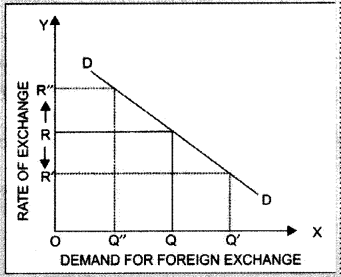
There is an inverse relationship between demand for foreign exchange and rate of exchange.
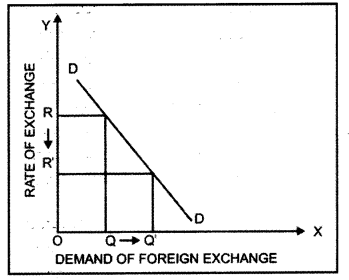
NCERT Solutions for Class 8 Social Science Geography Chapter 6 Human Resource 9
The curve showing demand for the foreign exchange (DD) slopes downward from left to right. This implies that higher the exchange rate, lower would be the demand for foreign exchange, and vice-versa. The diagram shows that when the exchange rate is OR then the demand for foreign exchange is OQ. However, when the exchange rate declines to OR’, then the demand for foreign exchange increases to OQ’.

Question 25.
Explain the meaning of managed flexible exchange rate.
Or
Discuss briefly the concept of managed floating system of foreign exchange rate determination. (C.B.S.E Outside Delhi 2019)
Answer:
Managed flexible foreign exchange rate is a system, which allows adjustments in exchange rate according to a set of rules and regulations officially declared in the foreign exchange market. There is no pre-defined range and time for the adjustment. Adjustment is allowed entirely on the merits of a care. It is for the managing authority to allow or reject the appeal for adjustment.

Question 26.
When price of a foreign currency rises, its demand falls. Explain why? (C.B.S.E Comp. 2011,2012)
Answer:
The foreign exchange rate is the price of one currency in terms of another currency. A rise in the foreign exchange rate implies that the price of foreign currency, in terms of domestic currency, has increased. Since foreign goods and services have become expensive, the domestic country can now buy less of them.

This decreases the demand for foreign currency in the domestic country. For instance, suppose the foreign exchange rate between India and UK has increased. The price of one pound has increased from ₹ 70 to ₹ 80. It implies that Indians have to pay ₹ 80 to buy one pound worth of goods compared to ₹ 70 prior to rise in exchange rate.

Since goods in UK have become expensive for India, Indians will buy less of them. This decreases the demand for UK pounds in India. Thus, a rise in foreign exchange rate causes a fall in its demand.

Question 27.
When price of a foreign currency falls, the supply of that foreign currency also falls. Explain why? (C.B.S.E Outside Delhi 2011)
Answer:
The foreign exchange rate is the price of one currency in terms of another currency. A fall in the foreign exchange rate implies that the price of foreign currency, in terms of domestic currency, has decreased. Since domestic goods and services have become expensive, the foreign country can now buy lesser quantity from one unit of its currency. This decreases the supply of foreign currency in the domestic country.

For instance, suppose the foreign exchange rate between India and UK has decreased. The price of one pound has decreased from ₹ 60 to ₹ 50. It implies that UK citizens can buy only ₹ 50 worth of goods by parting one pound compared to only ₹ 60 worth of goods prior to fall in exchange rate. Since Indian goods have become expensive for UK citizens, they will buy less of them. This decreases the supply of UK pounds to India. Thus, a fall in foreign exchange rate causes a fall in its supply.

Question 28.
Explain the effect of appreciation of domestic currency on imports. (C.B.S.E 2013)
Answer:
Appreciation of a currency means an increase in the value of the domestic currency in terms of the foreign currency. The price of the domestic currency, in terms of a foreign currency, increases and the foreign exchange rate decreases. For instance, suppose rupee has appreciated in terms of pound.

That is, the foreign exchange rate between India and UK has decreased. The price of one pound has decreased from ₹ 70 to ₹ 60. It implies that Indian citizens can buy one pound worth of goods by parting only ₹ 60 compared to ₹ 70 priorto fall in exchange rate. Since UK goods have become cheaper for Indians, they will buy more of them. Consequently, Indian imports from UK will increase.

Question 29.
Explain the effect of depreciation of domestic currency on exports. (C.B.S.E Outside Delhi 2013)
Answer:
Depreciation of a currency means a decrease in the value of the domestic currency in terms of the foreign currency. The price of the domestic currency, in terms of a foreign currency, decreases and the foreign exchange rate increases. For instance, suppose rupee has depreciated in terms of pound.

That is, the foreign exchange rate between India and UK has increased. The price of one pound has increased from ₹ 60 to ₹ 70. It implies that UK citizens can buy ₹ 70 worth of goods by parting one pound compared to only ₹ 60 worth of goods prior to rise in exchange rate. Since Indian goods have become cheaper for UK, they will buy more of them. Consequently, Indian exports to UK will increase.

Question 30.
“Indian Rupee (₹) plunged to all time low of ₹ 74.48 against the US Dollar ($)”.
In the light of the above report, discuss the impact of the situation on Indian Imports. (C.B.S.E 2019)
Answer:
Indian rupee plunged to all time low of rupees ₹ 74.4 8 against US Dollar. This is called as depreciation in the value of Indian rupee. It might lead to fall in imports as foreign goods will become more expensive for domestic consumers.

Question 31.
Recently Government of India has doubled the import duty on gold.What impact is it likely to have on foreign exchange rate and how? (C.B.S.E 2014)
Answer:
When the import duty on gold rises, the import of gold would become costlier. This would reduce
the demand for foreign currency. Since the supply of foreign currency remains the same, the foreign exchange rate would fall. This implies appreciation of rupees.
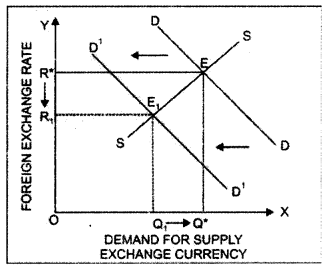
NCERT Solutions for Class 8 Social Science Geography Chapter 6 Human Resource 2
In the diagram, point E determines the equilibrium exchange rate in the foreign market (R*) and equilibrium quantity (Q*) of the foreign currency, where demand (DD) and supply (SS) curves intersect. A fall in the demand for foreign currency will cause the demand curve to shift-to the left from DD to D1D1, and the exchange rate falls to R1 New equilibrium is established at E1.

Question 32.
Distinguish between appreciation of home currency and depreciation of home currency. (C.B.S.E Outside Delhi 2019)
Answer:
Appreciation of home currency means increase in the value of the domestic currency in terms of the currencies of the other countries. On the other hand, depreciation of home currency means lowering of the value of the domestic currency in terms of the currencies of the other countries.

Question 33.
Explain the effect of appreciation of domestic currency on exports. (C.B.S.E Outside Delhi 2014)
Answer:
Appreciation of a currency means an increase in the value of the domestic currency in terms of the foreign currency. The price of the domestic currency, in terms of a foreign currency, increases and the foreign exchange rate decreases. For instance, suppose rupee has appreciated in terms of pound.

That is, the foreign exchange rate between India and UK has decreased. The price of one pound has decreased from ₹ 70 to ₹ 60. UK citizens can buy only 60 worth of goods by parting one pound compared to X 70 worth of goods prior to fall in exchange rate. Since Indian goods have become expensive for UK citizens, they will buy less of them. Consequently, Indian exports to UK will decrease.

Question 34.
How does giving incentives for exports influence foreign exchange rate? Explain. (C.B.S.E 2014)
Answer:
The incentives for exports boost exports of the country. An increase in exports causes the supply of foreign currency to increase in the domestic country while the demand remains unchanged. Consequently, the exchange rate falls and the domestic currency appreciates. in the diagram, point E determines the equilibrium exchange rate in the foreign market (R*) and equilibrium quantity (0*) of the foreign currency, where demand (DD) and supply (SS) curves intersect. A rise in the supply for foreign currency will cause the supply curve to shift to the right from SS to S1 S1 and the exchange rate falls to R1.
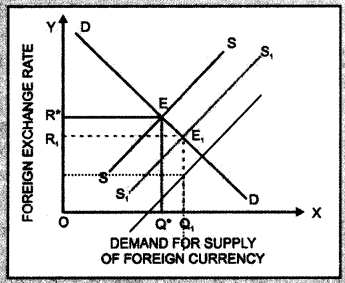
NCERT Solutions for Class 8 Social Science Geography Chapter 6 Human Resource 3

Question 35.
Vista to foreign countries for sight seeing etc by the people of India in the rise. What will be its impact on foreign exchange rate? How?
Answer:
Increase in the foreign visits of Indian residents would increase the demand for foreign currency increases. Since the supply of foreign currency remains the same, the foreign exchange rate would rise implying depreciation of rupee.
NCERT Solutions for Class 8 Social Science Geography Chapter 6 Human Resource 4
In the diagram, point E determines the equilibrium exchange rate in the foreign market (R*) and equilibrium quantity (Q*) of the foreign currency, where demand (DD) and supply (SS) curves intersect. A rise in the demand for foreign currency will cause the demand curve to shift to the right from DD to D1D1 and the exchange rate rises to R1.

Open Economy Macroeconomics Important Extra Questions Long Answer Type

Question 1.
Explain the causes of disequilibrium in the Balance of Payments.
Answer:
Following are the causes of disequilibrium in Balance of Payments:

1. Natural Causes
Natural calamities like famine, flood, etc. may cause disequilibrium in the Balance of Payments of an economy as these calamities result in reduction in production and exports and increase in imports.

2. Economic Causes
(i) Economic Development: In order to accelerate the pace of development, underdeveloped countries have to depend on foreign assistance. These countries import advanced machinery, capital goods and raw material, etc, which results in the excess of imports over exports. Flence, there arises the problem of disequilibrium in Balance of Payments.

(ii) Cyclical Fluctuations: Cyclical fluctuations like inflation and depression also cause the problem of disequilibrium of Balance of Payments. If there is depression in the world market then exports of a country are affected adversely. Similarly, if prices start rising within the economy, the rate of increase in imports exceeds that of exports, which results in disequilibrium.

(iii) Capital Outflow: If a country invests its capital in other countries in order to earn more dividend then it may result in unfavourable Balance of Payments of the country investing the capital and favourable Balance of Payments of the country where the capital is invested. Hence, the problem of disequilibrium arises.

3. Political Factors
Government expenditure in foreign countries, political instability, political relations with other countries partition or unification of a country etc. may cause disequilibnum in Balance of Payments of a country.

Question 2.
What do you mean by Balance of Payment? Explain the items constituting the Balance of Payments of country.
Answer:
Balance of Payments (BoP) records the transactions in goods, services and assets of the residents of a country with the rest of the world. It also records the country’s demand for and supply of foreign ex-change.

Items of Current Account

(i) Export and Import of Goods: Current account shows exports and imports of visible items i.e., goods like machinery, wheat, steel, etc.

(ii) Export and Import of Services: Current account shows exports and imports of invisible items i.e., services like banking, tourism, insurance, etc.

(iii) Unilateral Transfers: These are those receipts, which residents of a country receive or payments that the residents of a country make without getting anything in return. Receipts from abroad are entered as positive items and payments abroad are entered as negative items.

(iv) Private Transfers: These are gifts that domestic residents receive from or make to foreign residents.

Items of Capital Account

  • Private Transactions: These are transactions that affect the assets or liabilities of individuals, business, etc. and other non-government entities.
  • Official Transactions: These are the transactions that affect the assets and liabilities by the government and its agencies.
  • Direct Investment: Direct investment means the act of purchasing an asset and at the same time acquiring control of it.
  • Portfolio Investment: It is the acquisition of an asset that does not give the purchase control over the asset.

Question 3.
What is foreign exchange rate? Explain how it is determined.
Answer:
Foreign exchange rate is the price of one unit of the foreign currency in terms of the domestic currency.
Determination of Foreign Exchange Rate: Foreign Exchange Rate is determined in the exchange
market at the point of intersection of foreign exchange demand and supply curves.

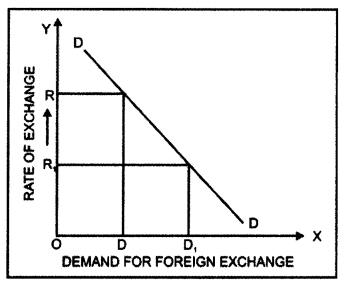
1. Demand Curve of Foreign Exchange: A country is dependent upon other countries for its requirements of imports and foreign capital. Demand for foreign exchange arises to make payments for these imports. There is an inverse relationship between the demand for foreign exchange and the rate of exchange. If the exchange rate increases, the demand for foreign exchange would fall and the vice-versa.
NCERT Solutions for Class 8 Social Science Geography Chapter 6 Human Resource 5

In the diagram, demand for foreign exchange is OD when exchange rate is OR. When the rate of exchange falls to OR, then demand for foreign exchange increases to OD,. Demand curve for foreign exchange (DD) curve slopes downwards from left to right.

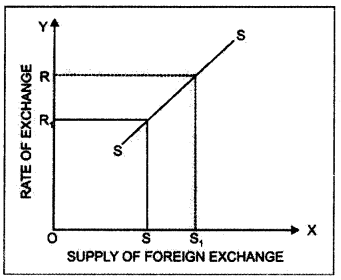
2. Supply Curve of Foreign Exchange: Supply of foreign exchange depends on a number of factors like the value of exports of a country, import of capital, extent of foreign investment, etc. There is direct relation between exchange rate and the supply of foreign exchange. An increase in the exchange rate results in an increase in the supply of foreign exchange and vice-versa.
NCERT Solutions for Class 8 Social Science Geography Chapter 6 Human Resource 6

In the diagram, the supply of foreign exchange is OS when exchange rate is equal to OR. If the exchange rate is increased to OR,, supply of capital also increases to OS,. SS is the positively sloped supply curve of foreign exchange.

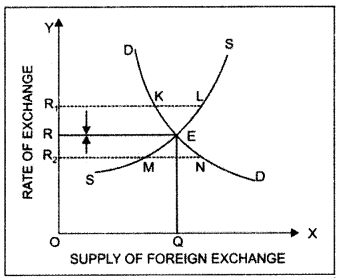
3. Equilibrium Foreign Exchange Rate: Equilibrium exchange rate is determined at a level where demand for foreign exchange is equal to supply of foreign exchange. The determination of equilibrium foreign exchange rate can be explained with the help of given diagram:
NCERT Solutions for Class 8 Social Science Geography Chapter 6 Human Resource 7
The demand for foreign exchange is equal to supply of foreign exchange at point E. the equilibrium foreign exchange rate is OR and equilibrium quantity of foreign exchange is OQ. MN represents excess demand for foreign exchange at OR,. Similarly, KL represents excess supply of foreign exchange at OR2.

Question 4.
Give arguments in favour and against the fixed and flexible
Answer:
Arguments in Favour of Fixed Exchange Rate

1. Encouragement to Foreign Trade: The system of fixed exchange rate provides suitable environment for foreign trade. The exporters and the importers have no fear of changes in the prices of goods and it helps to promote the foreign trade.

2. End to Speculations: There is no uncertainty in the foreign exchange market under the system of fixed exchange rate. It helps to bring an end to the activities of speculation as a result of uncertainty.

3. Internal Stability: Fixed exchange rate results in internal economic stability of a country. The fluctuations in the price level are reduced to the minimum on account of stability of exchange rate and the prices of imports and exports.

4. Useful for Small Countries: For the small countries like Denmark, Belgium, etc. this system of exchange rate has turned out to be very useful. For the countries dependent on foreign trade for their economic development, stability of exchange rate is essential. Flexibility in rate of exchange may adversely affect the process of economic development of these countries.

Arguments against Fixed Rate of Exchange

1. Monetary Dependence: If the exchange rate is fixed then the unfavourable Balance of Payments of a country has an adverse effect on the level of domestic output and income. Under such a situation, the government of a country will have to adopt such a monetary policy, which does not influence its exchange rate. Thus, the government is not free to formulate an independent monetary policy.

2. Cost-price Relationship: The fixed exchange rate is not determined in accordance with the value theory of price determination. Since economic policies of different countries are not alike, their cost-price relationships do not remain stable. Thus, fixed exchange rate does not enable us to analyse the changes in cost-price relations and their effect on exchange rate.

3. Increase in Demand for Foreign Exchange: The demand forforeign exchange in a country increases under the system of fixed exchange rate. Therefore, the government will have to accumulate the stock of foreign exchange and consequently, will have to bear the opportunity cost of foreign exchange.

4. Slow Rate of Growth: There is lack of co-ordination among the economic policies of different countries under the system of fixed exchange rate. As a result a country fails to achieve the desired rate of growth in the absence of co-ordination and co-operation of other countries.

Arguments in Favour of Flexible Exchange Rate
1. Solves the Problem of BoP Deficit: The flexible exchange rate helps to solve the problem of BoP deficit of a country. For example, if demand for foreign exchange exceeds its supply, the rate of exchange will increase to attain equilibrium. On the other hand, if supply of foreign exchange exceeds its demand, the rate of exchange will decrease to attain equilibrium.

2. Effective Monetary Policy: According to Prof. Friedman, monetary policy of a country can be effectively implemented if its exchange rate is flexible. If the objective of monetary policy is to increase the level of production then rate of interest will be reduced to provide incentive for investment. It will also result in an increase in the level of output and hence the exports.

3. Regulations of Import and Export: The level of production, income and employment keep on changing in an economy. These changes influence the demand for and supply of goods. Keeping in view the demand and supply of goods, the government of a country may introduce changes in its imports and exports, which are possible only under the system of flexible exchange rate.

Arguments against Flexible Exchange Rate

1. Effect on Economic Structure: The economic activities of international market have a direct impact on the structure of an economy if the exchange rate is flexible. The fluctuations in international market influence the price level, level of output and employment of an economy.

2. Uncertainty: Flexible exchange rate creates an environment of uncertainty in the international market, which in turn adversely affects the flow of capital among the countries. Moreover, it hinders the process of borrowing and lending of loans in the international market.

3. Internal Instability: The system of flexible exchange rate, sometimes, results in the problem of internal instability in a country if the assumptions of full employment, perfect competition and perfect mobility of factors of production are not fulfilled.

4. Unnecessary Capital Movements: Under the system of flexible exchange rate, capital movements among the countries may increase unnecessarily. Such capital movements may prove to be harmful for the structure of an economy.

Question 5.
Give the meaning of‘foreign exchange and foreign exchange rate’. Giving reason explain the relation between foreign exchange rate and demand for foreign exchange.
Answer:
Foreign Exchange: Foreign exchange is the conversion of one currency into another currency.

Foreign Exchange Rate: Foreign exchange rate is the price of one currency in terms of another currency.
Relation between Foreign Exchange Rate and Demand for Foreign Exchange There is an inverse relation between foreign exchange rate and demand for foreign exchange. The relationship can be explained with the help of a diagram.
NCERT Solutions for Class 8 Social Science Geography Chapter 6 Human Resource 8

In the diagram, X axis shows the quantity of foreign exchange demanded and Y axis shows the price of foreign exchange. The curve showing demand for the foreign exchange (DD) slopes downward from left to right. This implies that higher the exchange rate, lower would be the demand for foreign exchange, and vice-versa. The diagram shows that when the exchange rate is OR then the demand for foreign exchange is OQ.

When the exchange rate declines to OR’, foreign goods become cheaper than the domestic goods. Thus, the demand for foreign exchange increases to OQ’. On the contrary, when the exchange rate increases to OR’, foreign goods become expensive than the domestic goods. Thus, the demand for foreign exchange decreases to OQ’.

Question 6.
Why does the demand for foreign currency fall and supply rises when its price rises ? Explain. (C.B.S.E. 2017)
Answer:
When the price of the foreign currency increases, the value of domestic currency increases in terms of the foreign currency. In other words, we can say that the domestic currency depreciates.

Now in such a case, there are two implications.
(a) Since the domestic currency has depreciated the imports become expensive. The domestic traders will have to pay more to buy the same units of foreign good. This leads to a decline in the demand for the foreign currency.

(b) At the same time, with a depreciation in the domestic currency, the exports become cheaper. This will bring in more foreign currency hence, leading to an increase in the foreign exchange supply.

Open Economy Macroeconomics Important Extra Questions HOTS

Question 1.
The balance of trade shows a deficit of ₹ 5,000 crores and the value of imports are ₹ 9,000 crores. What is the value of exports?
Answer:
The balance of trade is the difference between the value of exports (X) and the value of imports (M).
That is, Balance of Trade – Value of Exports – Value of Imports
Given: Balance of Trade = (-) ₹ 5,000 crores
Value of Imports = ₹ 9,000 crores
Thus, 5000 = Value of Exports – 9000
Value of Exports = – 5000 + 9000 = 4000
The value of exports is ₹ 4,000 crores.

Question 2.
The balance of trade shows a deficit of ₹ 300 crores.The value of exports are ₹ 500 crores. What is the value of imports?
Answer:
The balance of trade is the difference between the value of exports (X) and the value of imports (M).
That is, Balance of Trade = Value of Exports – Value of Imports
Given: Balance of Trade = (-) ₹ 300 crores
Value of Exports = ₹ 500 crores
Thus,
– 300 = 500 – Value of Imports Value of Imports = 500 + 300 = 800
The value of imports is ? 800 crores.

Question 3.
Name three such items which are not included in the balance of trade.
Answer:
Items which are not included in the balance of trade are:

  • Exports and imports of services such as of shipping and banking, etc.
  • Interest and dividend payments between the countries.
  • Expenditure by the tourists.

Question 4.
Why is flexible rate of exchange called free rate of exchange?
Answer:
Flexible rate of exchange is called free rate of exchange as it is freely determined by the forces of supply and demand in the international money market.
Government Budget and the Economy Class 12 Important Extra Questions Economics Chapter 5

Here we are providing Class 12 Economics Important Extra Questions and Answers Chapter 5 Government Budget and the Economy. Economics Class 12 Important Questions are the best resource for students which helps in class 12 board exams.

Class 12 Economics Chapter 5 Important Extra Questions Government Budget and the Economy

Government Budget and the Economy Important Extra Questions Very Short Answer Type

Question 1.
Define government budget. (C.B.S.E 2013, 2014, 2017)
Answer:
The government budget is an annual statement of the estimated receipts and expenditure of the government over the fiscal year, which runs from April 1 to March 31.

Question 2.
State any one objective of government budget.
Answer:
One of the primary objectives of the government budget is to mobilise resources for the purpose of rapid development.

Question 3.
Define surplus budget.
Answer:
A surplus budget is the one where the estimated revenues of the government are greater than the estimated expenditures,

Question 4.
Define a balanced budget.
Answer:
A balanced budget is the one where the estimated revenue of the government equals the estimated expenditure.

Question 5.
Define a deficit budget.
Answer:
A deficit budget is the one where the estimated revenue of the government is less than the estimated expenditure.

Question 6.
What is revenue expenditure?
Answer:
Revenue expenditure refers to that expenditure by the government, which neither creates assets for the government nor reduces its liabilities. For example, old-age pension.

Question 7.
Define capital expenditure.
Answer:
Capital expenditure refers to that expenditure by the government, which either creates assets for the government or reduces its liabilities.

Question 8.
Define a tax. (C.B.S.E. 2012,2019)
Answer:
Tax is a compulsory payment made by an individual or an institution to the government without anything in exchange

Question 9.
State any two sources of non-tax revenue receipts. (C.B.S.E 2011 Comp.)
Answer:
The two sources of non-tax revenue receipts are:
(i) Income from investment made by the government
(ii) Fees and fines received by the government

Question 10.
Why is entertainment tax an indirect tax?
Answer:
The entertainment tax is an indirect tax because the seller of the service passes the burden of tax on to the buyer of the service.

Question 11.
Define fine.
Answer:
Fines are amounts levied for an infringement of a law.

Question 12.
Define fiscal discipline.
Answer:
Fiscal discipline means having control over expenditures, given the quantum of revenues.

Question 13.
Define Direct tax (C.B.S.E. Outside Delhi 2012, 2019)
Answer:
Direct taxes are those taxes levied immediately on the property and income of persons, and are paid [ by-the consumers to the state.

Question 14.
Give Area examples of direct taxes. (C.B.S.E.20I0)
Answer:
Following are the three examples of direct tax-
(i) Income Tax
(ii) Wealth Tax
(iii) Interest Tax

Question 15.
What do you mean by an indirect tax? (C.B.S.E. Outside Delhi 2019)
Answer:
Indirect tax is a tax collected by an intermediary (seller) from the person who bears the ultimate economic burden of the tax (buyer), Its burden can be shifted by the tax payer on someone else.

Question 16.
Define GST (C.B.S.E. 2013)
Answer:
GST’ is a value-added tax paid by the consumers and remitted to the government by the seller of various goods and service

Question 17.
Give two examples of fees.
Answer:
Following are the three examples of fees:
(i) College fees in government colleges
(ii) License fees

Question 18.
Define fee.
Answer:
Fee refers to a payment to defray the cost of each recurring service undertaken by the government but conferring a special advantage on the fee payer.

Question 19.
State any two items of revenue expenditure in a Government budget. (C.B.S.E. 2019)
Answer:
Defence expenditure and expenditure on social services.

Question 20.
Indicate two heads of government expenditure on capital account.
Answer:
Acquisition of land or buildings, acquisition of plant machinery or equipment.

Question 21.
Write two heads of government development expenditure.
Answer:
Expenditure on economic services like agriculture, industry, etc., expenditure on education or health.

Question 22.
Point out two heads of non-development government expenditure.
Answer:
Defence expenditure and payments on administrative services.

Question 23.
What is meant by revenue deficit? (C.B.S.E 2004,09, 10,2017), (C.B.S.E. Outside Delhi 2013)
Answer:
Revenue deficit in the government budget represents the excess of current revenue expenditure over the current revenue receipts.

Question 24.
Define primary deficit. (C.B.S.E. 2004,2009,2017,2019)
Answer:
Primary deficit is the difference between fiscal deficit and interest payments. It indicates how much of the government borrowing is going to meet expenses, other than interest payments.

Question 25.
What is meant by fiscal deficit? (C.B.S.E. 2004, 05, 09, 2017, 2019)
Answer:
The fiscal deficit is the difference between the total expenditure of the government and the revenue receipts plus the capital receipts, which are not in the nature of borrowing, but which finally accrue to the government.

Question 26.
How is primary deficit calculated? (C.B.S.E 2010), (C.B.S.E Outside Delhi 2011 Comp.)
Answer:
Primary deficit is calculated as:
Primary deficit = Fiscal deficit – Interest payment.

Government Budget and the Economy Important Extra Questions Short Answer Type

Question 1.
What is a government budget? Name two sources each of non-tax revenue receipts and capital receipts.
Answer:
The government, budget is an annual statement of the estimated receipts and expenditure of the government over the fiscal year, which runs from April I to March 31.

Non-tax revenue receipts are the receipts received by the government in the form of prices paid for government supplied goods and services. The sources of non-tax revenue receipts include payments for postage and railway services.

Capital receipts of the government are those receipts, which either cause reduction in the assets or create a liability for the government. Small savings and deposits in the public provident fund are the two sources of the capital receipts.

Question 2.
What are the objectives of a budget?
Answer:
The objectives of a budget are as follows:

  • Reallocation of Resources
  • Reducing Inequalities in Income and Wealth
  • Economic Stability
  • Management of Public Enterprises
  • Economic Growth
  • Reducing Regional Disparities

Question 3.
How can a government budget help in reducing inequalities of income? Explain. (C.B.S.E. 2010,2017)
Or
How can budgetary policy be used to reduce inequalities of income? (C.B.S.E. Outside Delhi 2011,2013,2018)
Answer:
An important objective of the government budget is to reduce the income inequalities. The government budget helps in achieving the objective of reducing inequalities of income through progressive taxation.

Under progressive taxation, burden of the tax falls more on the rich and less on the poor. The rate of tax increases as the income increases. Thus, progressive tax is equitable. Appropriate expenditure policy in the government budget also helps in reducing the inequalities of income.

Question 4.
Explain the allocation function of a government budget. (C.B.S.E. 2010, 11, 12, 18), (2013 Comp.)
Answer:
The government aims to reallocate resources in a way so that its economic (profit maximisation) and social objectives (public welfare) are fulfilled. The government can influence allocation of resources through implementation of appropriate fiscal policy.

Production of goods, which are injurious to health is discouraged through heavy taxation. On the other hand, production of goods which are beneficial for society is encouraged through subsidies.

Question 5.
Explain the ‘redistribution of income’ objective of government budget. (C.B.S.E Outside Delhi 2011)
Answer:
The government budget shows its comprehensive exercise on the taxation and subsidies. The government imposes higher taxes on the rich and spends the revenue on the welfare of the poor. This helps in reducing inequalities in the distribution of income. Equitable distribution of income and wealth is a sign of social justice, which is the principal objective of any welfare state in India.

Question 6.
Explain the ‘economic stability’ objective of a government budget. (C.B.S.E Outside Delhi 2011,12,17)
Answer:
Free play of the market forces are bound to generate trade cycles, also called business cycles. These refer to the phases of recession and depression, recovery and boom in the economy. The government of a country is always committed to save the economy from business cycles.

The government budget plays a significant role in preventing business fluctuations due to inflation or deflation and hence, maintains economic stability. Economic stability stimulates investment, consequently, increasing the rate of growth and development.

Question 7.
What are externalities? Give an example of a positive externality and its impact on welfare of the people. (C.B.S.E. Outside Delhi 2014)
Answer:
Externalities refer to the harms (or benefits) a firm or an individual causes to another for which they are not penalised (or paid for). Externalities may be positive or negative. For example, Increase in government’s expenditure on education of individuals can lead to broader society benefits in the form of greater economic productivity, lower unemployment rate, greater household mobility and higher rate of political participation.

Question 8.
Define externalities. Give an example of negative externality. What is its impact on welfare? (C.B.S.E .2014)
Answer:
Externalities refer to the harms (or benefits) a firm or an individual causes to another for which they are not penalised (or paid for). Externalities may be positive or negative. For example, increase in GDP may be at the cost of considerable pains and sacrifices in the form of environment pollution.

As a result, increase in GDP may mean less economic welfare. If increase in GDP has been brought about by making wokers work in bad working conditions, increase in GDP will not raise the level of economic welfare.

Question 9.
Distinguish between revenue receipts and capital receipts. Give an example of each.
Or
How are capital receipts different from revenue receipts. Discuss briefly. (C.B.S.E 2019)
Answer:
The differences between revenue receipts and capital receipts are stated below:

S.No.Revenue ReceiptsCapital Receipts
(a)Revenue receipts neither create any liability nor reduce any asset of the government.Capital receipts either create any liability or reduce any asset of the government.
(b)They are regular and recurring in nature.They are non-recurring in nature.
(c)There is no future application to determine the amount.In case of certain capital receipts, like browsing. there is future obligation to return the amount
(d)Example: income tax, GST, non-tax revenue like interest, fees, etc.Example: disinvestment, borrowings

Question 10.
Distinguish between direct tax and indirect tax? Give an example of each. (C.B.S.E 2017), (C.B.S.E Outside Delhi 2011, Comp. 2017)
Answer:
Direct tax is a tax levied on the property and the income of persons. These are paid directly to the state by the consumers. Its burden cannot be shifted by the tax payer on someone else.
For example: Income tax.

Indirect tax is a tax collected by an intermediary (seller) from the person who bears the ultimate economic burden of the tax (buyer). Its burden can be shifted by the tax payer omsomeone else.
For example: Excise duty.

Question 11.
State three sources each of revenue receipts and capital receipts in government budget. (C.B.S.E. Outside Delhi 2013)
Answer:
Revenue receipts are those money receipts, which neither lead to reduction in assets, nor create a liability for the government. Sources of revenue receipts are:

  • Tax revenue
  • Fines
  • License fee

Capital receipts, on the other hand, are those money receipts, which either create liability or cause a reduction in the assets of the governments. Sources of capital receipts are:

  • Recovery of loans
  • Public borrowings by the government
  • Deposits in the public provident fund

Question 12.
Is the following a revenue receipts or a capital receipts in the context of government budget and why?
(i) Tax receipts
(ii) Disinvestment (C.B.S.E. Outside Delhi 2014)
Answer:
(i) Tax receipts are revenue receipts because these neither result in the creation of physical/ financial assets nor cause any reduction in the liabilities of the government.

(ii) Disinvestment is the opposite of investment. Disinvestment occurs when the government sells off its shares of public sector enterprises to the private sector. It is a capital receipt because it leads to reduction in the assets of the government.

Question 13.
Classify the following statements as revenue receipts or capital receipts. Give valid reasons in support of your answer.
(a) Financial help from a multinational corporation for victims in a flood affected area.
(b) Sale of shares of a Public Sector Undertaking (PSU) to a private company,Y Ltd.
(c) Dividends paid to the Government by the State Bank of India.
(d) Borrowings from International Monetary Fund (IMF). (C.B.S.E. Outside Delhi 2019)
Answer:
(a) Financial help from a multinational corporation for victims in a flood affected area is a revenue receipt as it neither creates any asset not reduces any liability of the government.

(b) Sale of shares of a Public Sector Undertaking (PSU) to a private company, Y Ltd. is a capital receipt as it reduces the assets of the government.

(c) Dividends paid to the Government by the State Bank of India area is a revenue receipt as it neither creates any asset not reduces any liability of the government.

(d) Borrowings from International Monetary Fund (IMF) is a capital receipt as it increases the liabilities of the government.

Question 14.
How are tax receipts different from non-tax receipts? Discuss briefly. (C.B.S.E. 2019)
Answer:
Tax receipts are revenue receipts because these neither result in the creation of physical/ financial assets nor cause any reduction in the liabilities of the government.

Non-tax receipts are the receipts received by the government in the form of prices paid for government-supplied goods and services. The sources of non-tax revenue receipts include payments for postage and railway services.

Question 15.
What is the basis of classifying government expenditure into:
(i) revenue expenditure and capital expenditure?
(ii) plan expenditure and non-plan expenditure?
Answer:
Revenue Expenditure and Capital Expenditure
Revenue expenditure refers to the expenditure, which neither results in the creation of the assets nor causes any reduction in the liabilities of the government. Capital expenditure refers to the expenditure, which either leads to the creation of the assets or causes a reduction in the liabilities of the government.

Plan Expenditure and Non-plan Expenditure
Plan expenditure is the expenditure incurred by the government to meet its planned development and investment outlay. Non-plan expenditure is the expenditure incurred on activities, which are beyond the scope of planned development outlay

Question 16.
Is the following revenue expenditure or capital expenditure on the context of government budget? Give reason.
(i) Expenditure on collection of taxes
(ii) Expenditure on purchasing computer (C.B.S.E. 2014)
Answer:
(i) Expenditure on collection of taxes is revenue expenditure because it neither results in the creation of physical/ financial assets nor causes any reduction in the liabilities of the government.

(ii) Expenditure on purchasing computer is a capital expenditure because it results in the creation of physical asset of the government.

Question 17.
What is meant by revenue deficit? What are the implications of this deficit?
Answer:
The excess of the government’s revenue expenditure over the revenue receipts is called the revenue deficit. Given the same level of the fiscal deficit, a higher revenue deficit is worse than a lower one. High revenue deficit implies that the government should follow contractionary fiscal policy, that is, increase tax and/or reduce spending.

In a less developed countries, it is difficult to force people to pay higher taxes or to cut expenditure on development activities. Thus, the government usually finance its revenue deficit through borrowings. A revenue deficit implies a repayment burden in the future, not matched by any benefits via investment. It leads to rise in the prices and hampers the progress of the economy.

Question 18.
What is meant by revenue deficit? What are the implications of this deficit?
Answer:
The excess of the government’s revenue expenditure over the revenue receipts is called the revenue deficit. Given the same level of the fiscal deficit, a higher revenue deficit is worse than a lower one.

High revenue deficit implies that the government should follow contractionary fiscal policy, that is, increase tax and/or reduce spending. In a less developed countries, it is difficult to force people to pay higher taxes or to cut expenditure on development activities.

Thus, the government usually finance its revenue deficit through borrowings. A revenue deficit implies a repayment burden in the future, not matched by any benefits via investment. It leads to rise in the prices and hampers the progress of the economy.

Question 19.
What is meant by fiscal deficit? What are the implications of a large fiscal deficit? (C.B.S.E 2012)
Or
What is ‘fiscal deficit’? What are its implications? (C.B.S.E. Outside Delhi 2012)
Answer:
Fiscal deficit is the excess of total expenditure of the government over its total revenue and the capital receipts, excluding the borrowings and other liabilities of the government. Alternatively, fiscal deficit is an aggregate of the budgetary deficit plus government borrowings and the other liabilities. Fiscal Deficit = Total Expenditure – Total Receipts (excluding borrowings)
Or
Fiscal Deficit = Total Expenditure – (Total Revenue Receipts + Non-debt Capital Receipts)
Or
Fiscal Deficit = Budgetary Deficit + Borrowings and the other Liabilities Implications.

The important implications of fiscal deficit are:
(i) Large budgetary and fiscal deficit is an indication that the government has been spending beyond its means.

(ii) The mounting fiscal deficit implies that the increase in the tax revenue is not consistent with the revenue requirements of the government or that the tax collections are relatively sluggish. The implication may also follow that the tax system is relatively less elastic.

(iii) The increasing fiscal deficit implies that the government’s reliance over market and other borrowings has been rising. Moreover, it implies that the burden of debt seivice has been increasing.

Question 20.
Can there be a fiscal deficit in a government budget without a revenue deficit?
Answer:
Yes, there can be a fiscal deficit in the government budget without a revenue deficit.
Revenue deficit refers to a situation where revenue expenditure of the government exceeds its total revenue receipts. Fiscal deficit, on the other hand, refers to a situation where the total expenditure of the government exceeds sum total of its revenue receipts and non-debt capital receipts (total receipts excluding borrowings). Fiscal deficit is possible in a government budget even without revenue deficit ; in the situations when:

(i) the revenue budget is balanced and capital budget shows a deficit:
or
(ii) the deficit in the capital budget is greater than the surplus in the revenue budget

Question 21.
What are the implications of revenue deficit? State two measures of reduce this deficit. (C.B.S.E Outside Delhi 2011 Comp.)
Answer:
The excess of the government’s revenue expenditure over the revenue receipts is called the revenue deficit.
Given the same level of the fiscal deficit, a higher revenue deficit is worse than a lower one. High revenue deficit implies that the government should follow contractionary fiscal policy, that is, increase tax and/or reduce spending. In a less developed countries, it is difficult to force people to pay higher taxes or to cut expenditure on development activities.

Thus, the government usually finance its revenue deficit through borrowings. A revenue deficit implies a repayment burden in the future, not matched by any benefits via investment. It leads to rise in the prices and hampers the progress of the economy. Measures to reduce the revenue deficit are following:

  • Framing suitable policies
  • Proper utilisation of revenue receipts

Government Budget and the Economy Important Extra Questions Long Answer Type

Question 1.
What is a government budget? Discuss its objectives.
Answer:
The budget is a government’s annual statement of estimated receipts and payments over the fiscal year, which runs from April I to March 31.
The main objectives of government budget are:
(i) Reallocation of Resources: The government aims to reallocate resources in a way so that its economic (profit maximisation) and social objectives (public welfare) are fulfilled. The government can influence allocation of resources through implementation of appropriate fiscal policy.

(ii) Reducing Inequalities in Income and Wealth: Another important objective of the government is to reduce income inequalities through its policies. The government imposes higher taxes on the rich and spends the revenue on the welfare of the poor. This helps in reducing inequalities in the I distribution of income.

(iii) Economic Stability: The government budget plays a significant role in preventing business fluctuations due to inflation or deflation and hence, maintains economic stability.

(iv) Management of Public Enterprises: A large numbers of public sector industries have been established and managed for the welfare of the public. The government budget provides financial support to these enterprises.

(v) Economic Growth: The rate of saving and investment in an economy determine the rate of economic growth. The budgetary policy, therefore, aims to mobilise sufficient resources for investment in the public sector.

(vi) Reducing Regional Disparities: It is an important objective of the government budget to reduce regional disparities through taxation and expenditure policy. For this, government provides funds for the setting up of production units in economically backward regions.

Question 2.
Describe the importance of government budget.
Answer:
The importance of budget can be explained with the help of following points:
(i) Economic Stability: Government can achieve economic stability through budget. During inflation, government makes the surplus budget, whereas during depression, it makes deficit budget. Prices can be stabilised through budget.

(ii) Economic Control: Government controls the whole parliament and councils through budget. Revenue can be properly utilised through budget.

(iii) Economic and Social Development: Budget has a great importance in economic and social development Government encourages industries and agriculture by giving subsidies through its budget and encourages production. In the same way, government imposes high taxes through budget on rich class and redistributes the revenue collected by these taxes among the poorer sections of the society.

(iv) Administrative Efficiency: Government decides the limits of working areas of every official and employment through its budget.

(v) Instrument of Fiscal Policy: Budget is an important instrument of the fiscal policy of the country. Fiscal policy is the policy of fixing its revenue and expenditure in a way that economic fluctuations are minimised.

Question 3.
Explain the importance of public expenditure.
Answer:
Importance of public expenditure has been increased due to the following reasons: –
(i) Increase in the Activities of the State: In the modern age, the activities of the state have been increased many times. There has been an extensive and intensive increase in the activities of central, state and local governments.

Now a days, governments undertake various activities such as to run, encourage and regularise the economic activities, to maintain economic stability, to secure poor and backward classes and to increase the rate of economic development, etc. There is a great importance of public expenditure in the completion of these activities.

(ii) Economic Planning: Developing countries like India has adopted the path of economic planning for the removal of problems like poverty, unemployment and for the development of the country. As a result, the government has to incur expenditure on large scale. There is a great importance of public expenditure in economic planning.

(iii) Removing Unemployment, Poverty and Income Inequalities: Public expenditure has a great importance for the reduction of chronic problems like unemployment, poverty and income inequalities.

Question 4.
What is the meaning of revenue deficit? What problems does it create?
Answer:
The concept of revenue deficit is simple and straight. The revenue deficit is defined as the excess of revenue expenditure over revenue receipts. Mathematically
Revenue Deficit = Revenue Expenditure – Revenue Receipts
For example, according to the government of India, Budget for the year 2005-2006 states:
Total Revenue Receipts = ₹ 3,09,322 crores Total Revenue Expenditure = ₹ 3,85,493 crores

Revenue Deficit = ₹ 3,85,493 – 3,09,322 = ₹ 76,171 crores In other words, there should be revenue surplus, which should be used for building projects or building assets which yield return. In fact, revenue surplus represents government savings, which can be used for financing development.

Revenue deficit represents a critical situation in the economy. Revenue deficit indicates the amount of current expenditure which cannot be met by revenue receipts. It implies that government is spending beyond its means. The government should either increase its tax/non-tax receipts or should cut its expenditure.

In poor countries, in the initial stages of economic development, often the situation arises when the government has to incur large expenditure on administration and maintenance (particularly on defence, police and law and order) but it is difficult to compel the poor people to pay high taxes. In such situations, the government meets its revenue deficit either through borrowing or through disinvestment. Borrowing by the government, on the other hand, creates the problem of repayment of debt. Disinvestment reduces the asset of the government.

Question 5.
Explain the meaning of the following: (C.B.S.E. 2018)
(i) Revenue Deficit
(ii) Fiscal Deficit
(iii) Primary Deficit
Ans.
(i) Revenue Deficit: Revenue deficit is the excess of current revenue expenditure over the current
revenue receipts.

Revenue Deficit = Current Revenue Expenditure – Current Revenue Receipts Current revenue expenditure includes both plan and non-plan expenditure of the government to be met through revenue receipts. Current revenue receipts include the net tax and non-tax revenue receipts of the central government.

Until the middle of 1970’s, the central government in India enjoyed revenue surplus as the revenue receipts of the central government exceeded the revenue expenditure. The phenomenon of revenue deficit made its appearance during the latter 1970’s.

(ii) Fiscal Deficit: Fiscal deficit is the difference between total expenditure of the government and its total revenue receipts and capital receipts excluding the borrowings and other liabilities of the government. Alternatively, fiscal deficit is the aggregate of budgetary deficit plus borrowings and other liabilities.

Fiscal Deficit can be calculated as below:
Fiscal Deficit = Total Expenditure – Total Revenue Receipts – Capital Receipts excluding borrowings.

(iii) Primary Deficit: Primary deficit is the difference between fiscal deficit and interest payments. It is the aggregate of budgetary deficit plus borrowings and other liabilities minus interest payments.
It can be calculated as:
Primary Deficit = Fiscal Deficit – Interest Payments Alternatively primary deficit can be evaluated as:
Primary Deficit = Budgetary Deficit + Borrowings and Other Liabilities – Interest Payments. The primary deficit in the central government budget in India was of the magnitude of? 19,502 crore in 2000-01 . which has increased to ? 31,317 crore in 2001 -2002.

Government Budget and the Economy Important Extra Questions HOTS

Question 1.
Is borrowing by the government a revenue receipt?
Answer:
No, borrowing by the government is not a revenue receipt because it creates a liability for the government for repayment.

Question 2.
Find budget deficit from the following data:
Answer:

Items(₹ in Crore)
1. Revenue receipts40,000
2. Revenue expenditure30,000
3. Capital receipts30,000
4. Capital expenditure50,000

Budget Deficit = (Revenue Expenditure + Capital Expenditure) – (Revenue Receipts + Capital Receipts)
= (30,000 + 50,000) – (40,000 + 30,000)
= 80,000 – 70,000 = ₹ 10,000 crore

Question 3.
Is balanced budget an achievement for the government?
Answer:
Balanced budget is not always an achievement for the government. When the economy is in a state of depression, it is in fact suggested to increase government expenditure, even if it causes inflation in the economy.

Determination of Income and Employment Class 12 Important Extra Questions Economics Chapter 4

Here we are providing Class 12 Economics Important Extra Questions and Answers Chapter 4 Determination of Income and Employment. Economics Class 12 Important Questions are the best resource for students which helps in class 12 board exams.

Class 12 Economics Chapter 4 Important Extra Questions Determination of Income and Employment

Determination of Income and Employment Important Extra Questions Very Short Answer Type

Question 1.
Define Aggregate Demand. (C.B.S.E. 2010,2014)
Or
What is ‘Aggregate Demand’ in macroeconomics? (C.B.S.E Outside Delhi 2015)
Answer:
Aggregate Demand (AD) refers to the total expenditure on consumption and investment by different sectors of the economy.

Question 2.
How would you show Aggregate Demand in an equation?
Answer:
Aggregate Demand can be written in the form of the following equation:
AD = C + I + G + (X – M) where
C – Private Final Expenditure
I = Investment Expenditure
G = Government Expenditure
X – M = Net Exports (Exports – Imports)

Question 3.
Define Aggregate Supply.
Or
What is ‘Aggregate Supply’ in macroeconomics? (C.B.S.E 2015)
Answer:
Aggregate Supply (AS) refers to the planned aggregate production by the producers during a period of one year. It is equal to the income generated.

Question 4.
How would you show Aggregate Supply in an equation?
Answer:
Aggregate Supply can be written in the form of the following equation:
AS = Y = C + S
where; C – Consumption Expenditure
S = Savings

Question 5.
What are the two main constituents of AD?
Answer:
The two main constituents of AD are:
(i) Consumption
(ii) Investment

Question 6.
What are the two constituents of AS?
Answer:
The two main constituents of AD are:
(i) Consumption
(ii) Saving

Question 7.
Why does consumption curve not start from the origin? (C.B.S.E 2018)
Answer:
Consumption curve does not start from zero because people consume even at zero level of income.

Question 8.
Define MPC. (C.B.S.E 2014,2017)
Answer:
Marginal Propensity to Consume (MPC) is the ratio of change in consumption to the change in income; It is the slope of the consumption function.

Question 9.
What do you understand by APC?
Answer:
Average Propensity to Consume (APC) is the ratio of total consumption (C) to total income (Y).
\(M P C=\frac{\Delta C}{\Delta Y}\)

Question 10.
What do you understand byAPC?
Answer:
Average Propensity to Consume (APC) is the ratio of total consumption (C) to total income (Y).
\(\mathrm{APC}=\frac{\mathrm{C}}{\mathrm{Y}}\)

Question 11.
How is Average Propensity to Consume measured?
Answer:
Average propensity to consume (APC) is measured as below:
\(\mathrm{APC}=\frac{\text { Consumption }}{\text { Income }}=\frac{C}{Y}\)

Question 12.
Define APS.
Answer:
Average Propensity to Save (APS) is the ratio of total saving to total income
\(\mathrm{MPS}=\frac{\Delta \mathrm{S}}{\Delta Y}\)

Question 13.
What do you understand by MPS?
Answer:
Marginal Propensity to Save (MPS) is the ratio of change in saving to change in income.
\(\mathrm{MPS}=\frac{\Delta \mathrm{S}}{\Delta Y}\)

Question 14.
State the relationship between MPS and MPC.
Answer:
The sum of Marginal Propensity to Consume (MPC) and Marginal Propensity to Save (MPS) is always equal to one. That is,
MPC + MPS = 1

Question 15.
State the relationship between APC and APS.
Answer:
The sum of Average Propensity to Consume (APC) and Average Propensity to Save (APS) is always equal to one. That is, APC + APS = 1

Question 16.
What is consumption?
Answer:
Consumption refers to that part of income, which is spent by the households on the purchase of consumer goods and services.

Question 17.
What does a consumption function show?
Answer:
Consumption function shows the relationship between income and consumption.

Question 18.
Give the meaning of autonomous consumption.
Answer:
Autonomous consumption is the amount of consumption expenditure at zero level of income. It does not change with change in income.

Question 19.
Give the meaning of ex-ante savings. (C.B.S.E. 2010)
Answer:
Ex-ante savings refer to the level of savings, which is planned to be made by the households during a period of one year.

Question 20.
If planned savings are greater than planned investment what will be its effect on inventories?
Answer:
If planned savings are greater than planned investment, inventories will increase.

Question 21.
What are the two determinants of investment?
Answer:
The two determinants of investment are:
(i) Marginal Efficiency of Capital
(ii) Rate of interest

Question 22.
What is the main motive for investment in the private sector?
Answer:
Expected profitability is the main motive for investment in the private sector.

Question 23.
Define investment. (C.B.S.E. 2013 Comp.)
Answer:
Investment refers to purchase of new machines, new buildings and other capital goods that add to the existing stock of capital goods.

Question 24.
Give the meaning of ex-ante investment. (C.B.S.E 2010)
Answer:
Ex-ante investment refers to the investment, which is planned to be made by the firms during a period of one year.

Question 25.
If S exceeds I in an economy, what will be its effect on level of income?
Answer:
If S exceeds I in an economy then the level of income will decline.

Question 26.
If I exceeds S in an economy, what will be its effect on level of income?
Answer:
If I exceeds S in an economy then the level of income will increase.

Question 27.
Define Say’s law of markets.
Answer:
According to the Say’s law of markets, “Production is the source of demand.”

Question 28.
What is meant by full employment? (C.B.S.E Outside Delhi 2014)
Answer:
Full employment refers to a situation in which everyone who is willing to work at the existing wage rate gets work.

Question 29.
What is Keynes’s conception of full employment?
Answer:
According to Keynes, full employment exists when the Aggregate Supply function becomes perfectly inelastic in an economy.

Question 30.
How is full employment equilibrium determined?
Answer:
Full employment equilibrium is determined when Aggregate Demand function intersects the Aggregate Supply function on its perfectly inelastic part.

Question 31.
According to classical writers, what are the causes of involuntary unemployment?
Answer:
According to classical writers, involuntary unemployment appears in an economy due to wage rigidity, minimum wage laws and trade union activities.

Question 32.
What, according to Keynes, is the fundamental cause of involuntary unemployment?
Answer:
According to Keynes, the fundamental cause of involuntary unemployment in an economy is the deficient demand.

Question 33.
What is involuntary unemployment? (CBSE 2014,2017)
Answer:
The involuntary unemployment refers to a situation in which the workers are willing to work at the prevailing wage rates but the jobs are not available to them.

Question 34.
If MPC and MPS are equal, what is the value of the multiplier?
Answer:
The sum of MPC and MPS is always equal to I. That is,
MPC + MPS = I
When MPC = MPS, then the value of both of them will be:
\(M P C=M P S=\frac{1}{2}\)
The value of multiplier can be calculated as:
\(\begin{aligned}
K &=\frac{1}{M P S} \\
&=\frac{1}{\frac{1}{2}}=2
\end{aligned}\)
Thus, the value of the multiplier is 2.

Question 35.
What is investment multiplier?
Answer:
Investment multiplier (K) expresses the relationship between the final change in income and the initial change in investment. It is estimated as the ratio of change in income due to change in investment.

Question 36.
Whose value does \(\frac{1}{1-M P C}\) show?
Answer:
Investment Multiplier.
\(K=\frac{\Delta Y}{\Delta !}\)

Question 37.
Whose value does \(\frac{1}{\mathrm{MPS}}\) indicate?
Answer:
Investment multiplier.

Question 38.
What will be the value of multiplier, if MPS is 0.4?
Answer:
Investment multiplier \((K)=\frac{1}{M P S}\)
At MPS = 0.4,
\(K=\frac{1}{0.4}=\frac{10}{4}=2.5\)

Question 39.
What is the value of investment multiplier, if MPS = 0.8?
Answer:
Investment multiplier \((K)=\frac{1}{M P S}\)
At MPS = 0.8,
\(K=\frac{1}{0.8}=\frac{10}{8}=1.25\)

Question 40.
What will be the value of multiplier, if MPS = 0.5?
Answer:
Investment multiplier \((K)=\frac{1}{M P S}\)
At MPS = 0.5
\(K=\frac{1}{0.5}=\frac{10}{5}=2\)

Question 41.
What is value of multiplier, if MPC is 0.9?
Answer:
Investment Multiplier \((\mathrm{K})=\frac{1}{1-\mathrm{MPC}}\)
At MPC = 0.9,

Question 42.
What is the value of multiplier, if MPC is 3/4?
Answer:
Investment Multiplier \(K=\frac{1}{1-0.9}=\frac{1}{0.1}=10\)
\(\begin{aligned}
M P C &=\frac{3}{4}, K=\frac{1}{1-3 / 4} \\
&=\frac{1}{1 / 4}=4
\end{aligned}\)

Question 43.
What can be the minimum value of investment multiplier?
Answer:
The minimum value of investment multiplier can be one.

Question 44.
If investment multiplier is one, what will be the value of Marginal Propensity to Consume?
Answer:
When investment multiplier is one, then the value of Marginal Propensity of Consume will be zero.

Question 45.
What is deficient demand?
Answer:
Deficient demand refers to a situation in the economy in which Aggregate Demand is less than the Aggregate Supply (AD < AS) at the fell employment level.

Question 46.
What is ‘excess demand’ in macroeconomics? (C.B.S.E Outside Delhi 2014)
Answer:
Excess demand refers to a situation in the economy in which the Aggregate Demand is more than  the Aggregate Supply (AD > AS) at the fell employment level.

Question 47.
What is deflationary gap? (C.8.S.E Outside Delhi 2014)
Answer:
Deflationary gap refers to the excess of available supply of output over the anticipated expenditure at constant prices of base period.

Question 48.
Define inflationary gap.(C.B.S.E. Outside Delhi 2014)
Answer:
Inflationary gap refers to the excess of anticipated expenditure over the available supply of output at constant prices of base period.

Question 49.
How can the problems of excess and deficient demand be combated?
Answer:
The problems of excess and deficient demand may be combated through fiscal policy and monetary policy measures of the government.

Question 50.
What is meant by open market operations?
Answer:
Open market operation is the policy of the central monetary authority to sell and buy the government securities in the market.

Question 51.
What is bank rate or discount rate?
Answer:
Bank rate is the minimum rate at which the central bank discounts the first class bills of exchange and provides credit to the commercial banks.

Question 52.
What do you mean by margin requirement?
Answer:
Margin requirement of loan is the minimum security price charged by the commercial bank for granting

Question 53.
Suggest one monetary measure to correct excess demand.
Answer:
Bank rate can be increased to correct excess demand.

Question 54.
Give one fiscal measure to correct excess demand.
Answer:
Decrease government expenditure on subsidies and transfer payments.

Question 55.
Write one monetary measure to correct deficient demand.
Answer:
Buying government securities from commercial banks and general public.

Question 56.
Suggest one fiscal measure to correct deficient demand.
Answer:
Increase government expenditure on public welfare, defense, administration, etc.

Determination of Income and Employment Important Extra Questions Short Answer Type

Question 1.
What is meant by Aggregate Demand ? State its component.
Or
State and discuss the components of Aggregate Demand in a two sector economy. (C.B.S.E 2019)
Answer:
Aggregate Demand (AD) refers to the total expenditure on consumption and investment by different sectors of the economy.
Aggregate Demand comprises of the following components:
(i) Private Consumption Expenditure (C): Household expenditure on goods and services during an accounting year is called consumption expenditure. It depends upon the level of income of the households.

(ii) Investment Expenditure (I): Investment expenditure is the expenditure on goods by private investors, which add to their capital stock. These goods include producer’s durable, equipment, new construction and change in inventories.

(iii) Government Expenditure (G): Government expenditure, both consumption and investment, on public goods such as opening of schools, construction of roads, maintain law and order, provide justice, etc.

(iv) Net Exports (X – M): Net exports is the difference between total imports and total exports. Note: For a two-sector economy, state and discuss only C & I.

Question 2.
In an economy Aggregate Demand is greater than Aggregate Supply. Explain the changes that will take place in this economy. (C.B.S.E. 2011 Comp.)
Answer:
Excess demand refers to a situation in which Aggregate Demand in the economy is greater than the Aggregate Supply (AD > AS) at full employment level. The problem of excess demand can be corrected by contractionary fiscal or monetary policy. In the diagram, the initial Aggregate Demand curve is AD.

Economics Class 12 Important Questions Chapter 4 Determination of Income and Employment  1

Aggregate Supply (AS) is a vertical line at the full employment level of output (YF). With the initial government expenditure of G1; the Aggregate Demand is OY while Aggregate Supply is OYF. There is a situation of excess demand of EA. As government expenditure is decreased to G2, AD curve shifts down until equilibrium is attained (AD = AS) at full employment level of output.

Thus, the problem of excess demand or inflationary gap can be corrected by decreasing  public expenditure. As government expenditure is decreased to G2, AD curve shifts down until equilibrium is attained (AD = AS) at full employment level of output Thus, the problem of excess demand or inflationary gap can be corrected by decreasing public expenditure.

Question 3.
In an economy Aggregate Demand is less than Aggregate Supply. Explain the changes that will take place in this economy. (C.B.S.E Outside Delhi 2011 Comp.)
Answer:
Deficient demand refers to a situation in which Aggregate Demand in the economy is less than the Aggregate Supply (AD < AS) at full employment level. Deficient demand is also known as deflationary gap.

Economics Class 12 Important Questions Chapter 4 Determination of Income and Employment  2

In the diagram, the initial Aggregate Demand curve is AD. Aggregate Supply (AS) is a vertical line at the full employment level of output (YF). With the initial government expenditure of G1 the Aggregate Demand is OY while Aggregate Supply is OYp. There is a situation of deficient demand of AE. As government expenditure is increased to G2, AD curve shifts up until equilibrium

Question 4.
Discuss the working of the adjustment mechanism in the following situations:
(a) Aggregate demand is greater than Aggregate supply.
(b) Ex Ante Investments are lesser than Ex Ante Savings. (C.B.S.E 2019)
Answer:
(a) When Aggregate Demand is greater than Aggregate Supply, buyers are planning to buy more goods and services than what producers are planning to produce. It will lead to fall in planned inventory below the desired level. The producers, in turn, will produce more which will increase the aggregate supply till aggregate demand becomes equal to aggregate supply.

(b) Ex-ante investment are lesser than Ex-ante savings, meaning buyers are planning to buy lesser output as to what producer are planning to produce. It will lead to rise in planned inventory above the desired level. As a result, the producers will cut down production leading to a reduction of income till saving becomes equal to investment.

Question 5.
Distinguish between Average Propensity to Consume and Marginal Propensity to Consume. The value of which of these two can be greater than one and when?
Answer:
Average Propensity to Consume (APC) is the ratio of total consumption (C) to total income (Y).
\(\mathrm{APC}=\frac{C}{\mathrm{Y}}\)
Marginal Propensity to Consume (MPC) is the ratio of change in consumption to the change in income. It is the slope of the consumption function.
\(M P C=\frac{\Delta C}{\Delta Y}\)
The value of APC can be greater than one when current consumption exceeds current income.

Question 6.
Give the meaning of Marginal Propensity to Save and Average Propensity to Save. Can the value of Average Propensity to Save be negative? If yes, when?
Answer:
Marginal Propensity to Save (MPS) is the ratio of change in saving to change in income.
\(\mathrm{MPS}=\frac{\Delta \mathrm{S}}{\Delta Y}\)
Average Propensity to Save (APS) is the ratio of total saving to total income.
\(\mathrm{APS}=\frac{\mathrm{S}}{\mathrm{Y}}\)
APS can be negative in situations when saving is negative or when consumption is greater than income.

Question 7.
Distinguish between Average Propensity to Save and Marginal Propensity to Save.The value of which of these two can be negative and when?
Answer:
Average Propensity to Save (APS) is the ratio of total saving to total income.
\(\mathrm{APS}=\frac{\mathrm{S}}{\mathrm{Y}}\)
Marginal Propensity to Save (MPS) is the ratio of change in saving to change in income.
\(\mathrm{APS}=\frac{\mathrm{S}}{\mathrm{Y}}\)
The value of APS can be negative when saving is negative or when consumption is greater than income.

Question 8.
What is the relationship between Average Propensity to Consume and Average Propensity to Save? Can the value of average propensity to save be negative? If yes, when?
Answer:
Average Propensity to Consume (APC) is the ratio of total consumption (C) to total income (Y).
\(\mathrm{APC}=\frac{\mathrm{C}}{\mathrm{Y}}\)
Average Propensity to Save (APS) is the ratio of total saving to total income.
\(\mathrm{APS}=\frac{\mathrm{S}}{\mathrm{Y}}\)

Relationship between APC and APS
We know that, Y = C + S
Dividing both sides by Y, we get:
\(\frac{Y}{Y}=\frac{C}{Y}+\frac{S}{Y}\)

Substituting APC = \(\frac{C}{Y}\) and APS = \(\frac{S}{Y}\), we get:
APC + APS = 1
Thus, the sum of the APC and APS is always equal to one. This is because total income is either consumed or saved.
The value of APS can be negative when saving is negative or when consumption is greater than income.

Question 9.
Outline the steps taken in deriving saving curve from the consumption curve. Use diagram. (C.B.S.E. Outside Delhi 2017) (C.B.S.E. 2012, 14)
Answer:
Income is the sum of consumption and saving. The relationship among the three can be expressed as:
Y = C + S
Saving curve can be derived from the consumption curve. The derivation can be explained with the help of the given diagram. In the diagram, CC is the consumption curve and the 45° line represents income.

Economics Class 12 Important Questions Chapter 4 Determination of Income and Employment  3

OC is autonomous consumption, that is, the amount of consumption at zero level of income (C > Y). This is equal to the amount of saving (OS) at zero level of income. The saving is negative and the saving curve is below the horizontal axis.

Income and CC curves intersect at OY* level of income (point E) implying that consumption is equal to income at E. It is called the break-even point. At this point, saving is zero.

Beyond OY* level of income, consumption is less than income (C < Y). Thus, saving is positive and the saving curve is above the horizontal axis. SS is the saving curve derived from consumption curve.

Question 10.
Outline the steps taken in deriving consumption curve from the saving curve. Use diagram.
Answer:
Income is the sum of consumption and saving. The relationship among the three can be expressed as:
Y = C + S

Economics Class 12 Important Questions Chapter 4 Determination of Income and Employment  4
Consumption curve can be derived from the saving curve. The derivation can be explained with the help of the given diagram. In the given diagram, SS is the saving curve. OS represents negative saving and the saving curve is below the horizontal axis. When amount of saving is negative, consumption is greater than income (C > Y).

This is equal to the amount of consumption (OC) at zero level of income. The saving is zero at OY* level of income (point E) implying that consumption is equal to income at E. It is called the break-even point. At E, income and CC curves intersect each other.

Beyond OY* level of income, saving is positive and the saving curve is above the horizontal axis. When the amount of saving is positive, consumption is less than income (C < Y). Thus, CC is the consumption curve derived from saving curve.

Question 11.
Distinguish between consumption function equation and saving function equation. (C.B.S.E. 2012)
Answer:
Consumption Function Equation
The relationship between the consumption and the income is called the consumption function. The consumption function may be represented by the following equation:
C = a + bY; a > 0, 0 < b < I
C = Consumption Expenditure
Y = Level of income
a = Autonomous Consumption
b = Slope of consumption function \(\left(\mathrm{MPC}=\frac{\Delta \mathrm{C}}{\Delta \mathrm{Y}}\right)\)

Autonomous consumption is the amount of consumption expenditure at zero level of income. It is the intercept of the consumption expenditure and is assumed to be positive as people consume even at the zero level of income.

Marginal Propensity to Consume (MPC) orb is the slope of the consumption function. It measures the rate of change in consumption per unit change in income. The value of MPC is positive and lies between 0 and I. This means that the consumption increases with the income.

Saving Function Equation
The relationship between saving and income is called the saving function. The following identity expresses the relationship between saving (S) and income (Y).
Y ≡ C + S
On S = Y – C …(I)
The consumption function is represented as:
C = a + bY
Substituting (2) in (1); we get
S = Y – (a + bY)
S = Y – a – bY
S = – a + (1 – bY)
S = Saving
a = Amount of saving when level of income is zero
(1- b) = Slope of the saving function \(\left(\mathrm{MPS}=\frac{\Delta \mathrm{S}}{\Delta Y}\right)\)

Question 12.
Distinguish between propensity to consume and propensity to save, with the help of numerical  example. (C.B.S.E Outside Delhi 2012)
Answer:
Marginal Propensity to Consume (MPQ is the ratio of change in consumption to the change in income.
\(\mathrm{MPC}=\frac{\Delta C}{\Delta Y}\)
Marginal Propensity to Save (MPS) is the ratio of change in savings to the change in income.
\(M P S=\frac{\Delta S}{\Delta Y}\)
The sum of the propensity to consume and propensity to save is always equal to one.
MPC + MPS = 1
Or; MPC = 1 – MPS
Or; MPS = 1 – MPC

MPC and MPS are inversely related. Higher the propensity to consume lower will be the propensity to save and vice-versa. For example, suppose propensity to consume is 0.80. The propensity to save will be
MPS = 1 – 0.80
= 0.20
If propensity to consume falls to 0.40, then the propensity to save will be
MPS = 1 – 0.40
= 0.60

Question 13.
What are induced and autonomous investments?
Answer:
Induced Investment Induced investment is the investment, which is affected by the changes in income and production in the economy. At higher level of income, the demand for goods is high and hence, the rate of profit increases. Investment automatically increases while rate of profit increases.! Autonomous Investment Autonomous investment is the investment, which is not affected by the changes in income, rate of interest or rate of profits. In other words, autonomous investment is income inelastic. Autonomous investment is increased to provide education, health, etc. facilities to increasing population.

Question 14.
Describe briefly the determinants of investment.
Answer:
Following are the determinants of investment;
(i) Marginal Efficiency of Capital: Marginal efficiency of capital refers to the decline in cost of production by employing an additional unit of capital.
(ii) Rate of Interest: Rate of interest is an important determinant of investment. Rate of interest and investment demand are inversely related as the demand for investment decreases when rate of interest increases and vice-versa.

Question 15.
Draw and explain an investment demand curve.
Answer:
Rate of interest is an important determinant of investment. Rate of interest and investment demand are inversely related. The demand for investment decreases when the rate of interest is high. Similarly, the demand for investment increases when the rate of interest is low. This inverse relationship between the rate of interest and the level of investment is illustrated in the Investment Demand Curve shown below:
Economics Class 12 Important Questions Chapter 4 Determination of Income and Employment  5

Question 16.
Explain the determination of equilibrium level of income using the ‘saving-investment’ approach. Use diagram.
Answer:
The equilibrium is determined at the level of income where Aggregate Demand is equal to the Aggregate Supply. That is,
AD = AS ………….. (1)
AD = C + 1 ………….. (2)
AS = C + S ………….. (3)
By substituting (2) and (3) in (1), we get;
C + I = C + S
I = S
Thus, the equilibrium level of income and output is attained when planned saving (S) and planned! investment (I) are equal. The determination of equilibrium level of income using saving-investment approach can be explained with the help of a diagram.

Economics Class 12 Important Questions Chapter 4 Determination of Income and Employment  6

In the diagram, SS is the saving curve that shows planned saving at different levels of income. It is the investment curve that shows investment as given and constant.

Planned saving and investment are equal (S = I) at point E. Corresponding to this point, OY* is the equilibrium
level of income and output.

At OY! level of output, planned saving is less than planned investment (S < I). It implies that at this level of income, what businessmen plan to invest is more than what households plan to save. There is a situation of excess demand in the economy. Thus, producers will decrease inventory and output would expand until equilibrium is attained.

Similarly, at OY2 level of output, planned saving is greater than planned investment (S > I). It implies that at this level of income, what businessmen plan to invest is less than what households plan to save. There is a situation of deficient demand in the economy. Thus, producers will increase inventory and output would contract until equilibrium is attained.

Question 17.
Can an economy be in a state of underemployment equilibrium? Explain with the help of a diagram.
Answer:
Yes, an economy can be in a state of underemployment equilibrium. Equilibrium is attained when planned expenditure is equal to the planned output in the economy.

Economics Class 12 Important Questions Chapter 4 Determination of Income and Employment  7

If this equality is achieved at a level less than full employment level of output then the economy will be in a situation of underemployment equilibrium.
C + I curve shows Aggregate Demand (AD) at different levels of output. OY is the underemployment level of output and OYF is the full employment level of output. The – OY level of output is sufficient to meet current Aggregate Demand. Thus, at OY level of output the economy is in equilibrium but it is a situation of underemployment equilibrium.

Question 18.
Explain any one type of unemployment, which exists during full employment.
Answer:
Full employment refers to a situation in which everyone who is willing to work at. the existing wage rate gets work. Structural Unemployment may exist even during full employment. It is the position of unemployment, which originates for some time because of the change in structural system of an economy. Structural unemployment occurs when there is a lack of other factors of production, change in technique of production or lack of training of labourers.

Question 19.
Describe Say’s law of Market.
Answer:
French economist Jean-Baptiste Say has done himself immortal in 1803 by inventing this law in the book, “Treatise on Political Economy”. According to the Say’s law of market, “Production is the source of demand.” When an individual produces a good or service, he or she gets paid for that work. He is then able to use the return to demand other goods and services. There will never be over production in the economy and full employment remains in economy.

Question 20.
Define multiplier. What is the relation between marginal propensity to consume and multiplier? Calculate the marginal propensity to consume if the value of multiplier is 4. (C.B.S.E. 2018)
Answer:
Multiplier or Investment multiplier (K) expresses the relationship between the final change in income and the initial change in investment. It is estimated as the ratio of change in income due to change in
investment. A change in investment causes a ‘multiple’ change in the output.
\(\begin{array}{l}
K=\frac{\Delta l}{\Delta Y} \\
\Delta l=K \times \Delta Y
\end{array}90\)
There is a direct relationship between investment multiplier and Marginal Propensity to Consume (MPC). The extent of the effect of multiplier depends upon MPC. Higher the MPC, higher will be the value of multiplier. The relationship between investment multiplier and MPC can be expressed with the help of the following equation:
\(K=\frac{1}{1-M P C}\) …………….. (1)
Since the value of MPC lies between 0 and I (0 < MPC < I), the value of multiplier will always be greater than one.
Substituting K = 4 (i), we get:
\(\begin{array}{r}
4=\frac{1}{1-M P C} \\
\mid-M P C=\frac{1}{4}=0.25
\end{array}
MPC = 1-0.25 = 0.75\)
Thus, at K = 4, MPC = 0.75.

Question 21.
Explain the working of investment multiplier with the help of a table.
Answer:
Investment multiplier (K) expresses the relationship between the final change in income and the initial change in investment It is estimated as the ratio of change in income due to change in investment A. change in investment causes a ‘multiple’ change in the output.
\(\begin{array}{l}
\mathrm{K}=\frac{\Delta \mathrm{l}}{\Delta \mathrm{Y}} \\
\Delta \mathrm{I}=\mathrm{K} \times \Delta \mathrm{Y}
\end{array}\)
Assume that the MPC is 4/5. Further, suppose that there is an increase in investment worth ₹ 100, which results in the construction of a new building. This processes can be shown with the help of following table:

Time Period Increase in croresInitial in Investment ExpenditureChange in IncomeInduced Change in Consumption (MPC = 0.8)Saving (in crores)
1.1001008020
2.806416
36451.212.8
4.51.249.9610.24
5.49.9632.778.19
6.32.7726.226.55
..xxx
.....
.....
Total500400100

Here MPC = 0.8
Thus investment multiplier (k) = \(\frac{1}{\mathrm{MPS}}\)
Thus \(=\frac{1}{1-0.8}=\frac{1}{0.2}=5\)

Question 22.
State whether the following statements are true or false. Give reasons for your answer.
(i) When MPC is greater than MPS, the value of investment multiplier will be greater than 5
(ii) The value of MPS can never be negative. (C.B.S.E. 2010)
Answer:
(i) False. When MPC is greater than MPS, the value of investment multiplier will be greater than 2. Higher the value of MPC, higher will be the value of investment multiplier. For all the values of MPC > MPS, the value of investment multiplier will lie between 2 and infinity.

(ii) True. The value of MPS can never be negative. The relationship between MPC and MPS states that their sum is unity (MPC + MPS = 1). Moreover, the value of MPC lies between the range of 0 to 1, and so MPC can never be less than 0. Since MPC can never be less than 0, the value of MPS can also never be less than 0.

Question 23.
Giving reasons, state whether the following statements are true or false:
(i) When MPC is zero, the value of investment multiplier will also be zero.
(ii) Value of APS can never be less than zero. (C.B.S.E. 2010)
Answer:
(i) False. The relationship between investment multiplier and Marginal Propensity to Consume (MPC) is given as:
The ratio of MPC to MPS is 4 : 1 That is,
\(\frac{M P C}{M P S}=\frac{4}{1} \) ………………..(1)

Question 24.
State whether the following statements are true or false. Give reasons for your answer.
(i) When MPC is greater than MPS, the value of investment multiplier will be greater than 5
(ii) The value of MPS can never be negative. (C.B.S.E. 2010)
Answer:
(i) False. When MPC is greater than MPS, the value of investment multiplier will be greater than 2. Higher the value of MPC, higher will be the value of investment multiplier. For all the values of MPC > MPS, the value of investment multiplier will lie between 2 and infinity.

(ii) True. The value of MPS can never be negative. The relationship between MPC and MPS states that their sum is unity (MPC + MPS = I). Moreover, the value of MPC lies between the range of 0 to I, and so MPC can never be less than 0. Since MPC can never be less than 0, the value of MPS can also never be less than 0.

Question 25.
Giving reasons, state whether the following statements are true or false:
(i) When MPC is zero, the value of investment multiplier will also be zero.
(ii) Value of APS can never be less than zero. (C.B.S.E. 2010)
Answer:
(i) False. The relationship between investment multiplier and Marginal Propensity to Consume (MPC) is given as:
\(\begin{aligned}
K &=\frac{1}{1-M P C} \\
\text { At MPC=0, } & \\
K &=\frac{1}{1-0} \\
&=1
\end{aligned}\)
Thus, when MPC is zero the value of investment multiplier will be equal to one. The lowest value of multiplier is one.

(ii) False. The value of APS can be less than zero. APS can be negative in situations when saving is negative or when consumption is greater than income.

Question 26.
Giving reasons, state whether the following statements are true or false:
(i) If the ratio of Marginal Propensity to Consume and Marginal Propensity to Save is 4 :1 ,the value of investment multiplier will be 4.
(ii) Sum of APC and MPC is always equal to I.
Ans.
(i) False. It can be shown as below:
The ratio of MPC to MPS is 4 : 1 That is,
\(\frac{M P C}{M P S}=\frac{4}{1} \) ………………..(1)
The sum of MPC and MPS is always equal to one. That is,
MPC + MPS = 1
Substituting the (1) in (2); we get
4 MPS + MPS = 1
5 MPS = 1
MPS = \(\frac{1}{5}\)
MPS = 0.2
The relationship between investment multiplier and Marginal Propensity to Save (MPS) is given as:
\(\begin{aligned}
K &=\frac{1}{1-M P C} \\
&=\frac{1}{M P S} \\
K &=\frac{1}{0.2}=5
\end{aligned}\)

Thus, when the ratio Marginal Propensity to Consume and Marginal Propensity to Save is 4 :1, the value of investment multiplier will be equal to 5.

(ii) False. Average Propensity to Consume is the ratio of total consumption \(\left(A P C=\frac{C}{Y}\right)\), while Marginal Propensity to Consume is the ratio of change in consumption to the change in income \(\left(\mathrm{MPC}=\frac{\Delta \mathrm{C}}{\Delta \mathrm{Y}}\right)\). These two are entirely different concepts and cannot be added.

Question 27.
Show inflationary gap with the aid of a diagram. (C.B.S.E. 2005,2013 (Comp.), C.B.S.E Outside Delhi 2012)
Or
Explain the problem of excess demand.
Answer:
Inflationary gap refers to the excess of anticipated expenditure (Aggregate Demand) over the available supply of output (Aggregate Supply) at constant prices of base period. It measures the gap between AD and AS at full employment level of output. Since Aggregate Demand remains more than essential demand at full employment level, there is a significant increment in monetary income.

Thus, there is an over employment equilibrium. This, increases the Aggregate Demand but production cannot be increased as Aggregate Supply is perfectly inelastic. The problem of excess demand can be explained with the help of a diagram.
.Economics Class 12 Important Questions Chapter 4 Determination of Income and Employment  8
In the diagram, point E represents the state of over employment equilibrium in the economy. At E, the gap between Aggregate Demand and Aggregate Supply is AE1. That is, AE1 is the excess demand. The problem of excess demand can be corrected only by the interference of the government, say, by increasing taxes and reducing public expenditure.

Question 28.
Show with the help of a diagram — deflationary gap. (C.B.S.E 2005,2013 Comp. C.B.S.E Outside Delhi 2012)
Answer:
Deflationary gap refers to the excess of available supply of output (Aggregate Supply) over the anticipated expenditure (Aggregate Demand) at constant prices of base period. It measures the gap between AD and AS at full employment level of output. Since Aggregate Demand remains less than essential demand at full employment level, the problem of involuntary unemployment takes place. Thus, there is an under employment equilibrium.

Economics Class 12 Important Questions Chapter 4 Determination of Income and Employment  9

The problem of deficit demand can be explained with the help of a diagram. In the diagram, point E represents the state of under employment equilibrium in the economy. At E, AD = AS but QYF level of unemployment prevails in the economy. At full employment level of output (OYF), the gap between Aggregate Demand and Aggregate Supply is AEr That is, AE, is the deficit demand. The problem of deficit demand can be corrected only by the interference of the government, say, by decreasing taxes and increasing public expenditure.

Question 29.
Explain the effects of excess demand on output, employment and prices.
Answer:
Excess demand has following effects:
(i) Effect on Output: Due to excess demand in an economy, the resources are over utilised. Production is maximum and cannot be increased further.
(ii) Effect on Employment: The economy has already achieved full employment level and hence, there is no involuntary unemployment in the economy. The employment level will not change during the situation of excess demand.
(iii) Effects on Prices: Since excess demand generates pressure on existing flow of goods and services in the economy, the prices will rise.

Question 30.
Explain the effects of deficient demand on production, employment and prices.
Answer:
Deficient demand has following effects:
(i) Effect on Output: Deficient demand exists due to underemployment in an economy. Some re¬sources remain unemployed and hence, output level is low.
(ii) Effect on Employment: Deficient demand causes level of investment to fall. As a result, there is involuntary unemployment in the economy, which decreases the level of employment.
(iii) Effects on Prices: Due to deficient demand prices tend to fall.

Question 31.
State the impact of “Excess Demand” under the Keynesian theory on employment, in an economy. (C.B.S.E Outside Delhi 2019)
Answer:
Excess demand refers to a situation in the economy in which the Aggregate Demand is more than the Aggregate Supply (AD > AS) at the full employment level. Since the economy is already operating at full employment level, excess demand will only lead to a genaral) rise in price level. Employment will not increase.

Question 32.
Differentiate between deficient demand and excess demand.
Answer:
There are the following differences between deficient demand and excess demand:

S.No.Deficient DemandExcess Demand
1.Deficient demand takes place when AD < AS at full employment level of outputExcess demand takes place when AD > AS at full employment level of output.
2.Underemployment equilibrium causes invol­untary unemployment in economy.Over full employment equilibrium signifies overutilisation of resources.
3.Deficient demand creates deflationary gap.Excess demand creates inflationary gap.
4.Due to deficient demand, there is a depreciation in trade cycle.Excess demand causes a state of boom.
5.Production, income, employment and prices are low during deficient demand.Production and employment are stable during excess demand while prices increase.

Question 33.
Explain the meaning and implications of a deflationary gap. (C.B.S.E. Outside Delhi 2011 Comp.)
Answer:
Deflationary gap refers to the excess of available supply of output (Aggregate Supply) over the anticipated expenditure (Aggregate Demand) at constant prices of base period. It measures the gap between AD and AS at full employment level of output. Since Aggregate Demand remains less than essential demand at full employment level, the problem of involuntary unemployment takes place. Thus, there is an under employment equilibrium.

Following are the implications of deflationary gap:
(i) Deficient demand exists due to underemployment in an economy. Some resources remain unemployed and hence, output level is low.
(ii) Deficient demand causes level of investment to fall. As a result, there is involuntary unemployment in the economy, which decreases the level of employment.
(iii) Due to deficient demand prices tend to fall.

Question 34.
What is fiscal policy? How is it used to reduce excess demand in the economy?
or
Explain briefly three fiscal measures to reduce inflationary gap.
Answer:
Fiscal policy refers to the revenue and expenditure policy of the government to achieve balance in the development of the economy.
Following fiscal policy measures can be taken to reduce excess demand in the economy:

  • Decrease in Government Expenditure: The government should reduce its unnecessary expenditure in order to check excess demand. Transfer payments should be decreased.
  • Increase in Taxes: To correct excess demand, the government should levy new taxes and enhance the rate of existing taxes.
  • Surplus Budget Policy: It is necessary that government expenditure should be less than its income: in order to correct excess demand.

Question 35.
What is fiscal policy? What possible fiscal policy measures can be taken with respect to expenditure and income to correct:
(i) Excess Demand
(ii) Deficient Demand
Answer:
Fiscal policy refers to the revenue and expenditure policy of the government to achieve balance in the development of the economy.

(i) Fiscal Measures to Correct Excess Demand

  • Decrease government expenditure on public welfare, defence, administration, etc.
  • Decrease government expenditure on subsidies and transfer payments
  • Increase in tax rates
  • Restrict deficit financing

(ii) Fiscal Measures to Correct Deficient Demand

  • Increase government expenditure on public welfare, defence, administration, etc.
  • Increase government expenditure on subsidies and transfer payments
  • Reduce tax rates
  • Increase deficit financing

Question 36.
What is monetary policy? Briefly explain how it can be used to reduce excess demand in an economy.
Answer:
Monetary policy refers to the regulation policy of the government (central bank) to control money supply and interest rate in the economy. Following monetary policy measures can be taken to reduce excess demand in the economy:

(i) Increase in Legal Reserve or Cash Reserve Ratio: The central bank increases the CRR to correct the situation of excess demand or inflationary gap in the economy. High CRR reduces the supply of money in the economy, and thus, the Aggregate Demand will fall.

(ii) Increase in Bank Rate: The central bank increases the bank rate to correct the situation of excess demand in the economy. Higher bank rate reduces the lending capacity of the commercial banks as they get funds at a higher interest rate from the central bank Consequently, money supply contracts in the economy as the public borrows less at high rate of interest and Aggregate Demand falls.

(iii) Open Market Operations: The central bank buys government securities from commercial banks and general public in a bid to correct the situation of excess demand. This decreases the stock of high powered money in the economy. As a result, the purchasing power of the people fall, which decreases the Aggregate Demand in the economy.

(iv) Increase in Margin Requirement: An increase in margin requirement will correct the situation of excess demand in the economy. Higher margin requirement implies higher security price for a loan. Thus, people will borrow less loans from the banks and the Aggregate Demand will decrease.

Question 37.
How can deficient and excess demand be corrected by change in taxes?
Answer:
Change in taxes can be corrected by excess demand in the following ways:

(i) Decrease in Taxes: Decrease in taxes increases the income of public, which increases ‘their
purchasing power. As a result, demand for goods and services increases. This can correct deflationary gap or deficient demand. Taxes should be progressive i.e. higher rate of tax for rich people than poor people.

(ii) Increase in Taxes: Increase in taxes (direct and indirect) will decrease the purchasing power of consumers and producers. This will decrease the Aggregate Demand. Therefore, government should implement new taxes for solving the problems of excess demand or inflationary gap or government should increase the rate of taxes.

Question 38.
Explain the role of ‘reverse repo rate’ in removing excess demand.
Answer:
Reverse repo rate refers to the rate at which central bank borrows from the commercial banks. The central bank increases the reverse repo rate to correct the situation of excess demand. Higher reverse repo rate would induce commercial banks to lend more to the central bank and hence, would reduce the supply of money in the economy. As a consequence, Aggregate Demand would fall.

Determination of Income and Employment Important Extra Questions Long Answer Type

Question 1.
Explain the concepts of Aggregate Demand and Aggregate Supply with the help of diagram.
Answer:
Aggregate Demand: Aggregate Demand (AD) refers to the total expenditure on consumption and investment by different sectors of the economy.
Aggregate Demand can be written in the form of the following equation:
AD = C + I + G + (X – M) Y
where; C = Private Final Expenditure
I = Investment Expenditure
G = Government Expenditure
X – M = Net Exports (Exports – Imports)
Aggregate Demand and price level has inverse relation.
That is, at higher price level, Aggregate Demand will be oc less and at lower price level, Aggregate Demand will be high. It can be explained with the help of following diagram.

Economics Class 12 Important Questions Chapter 4 Determination of Income and Employment  10

In this diagram, on OX axis shows the quantity and OY axis shows the price level. AD is the downward sloping Aggregate Demand curve.

Aggregate Supply: Aggregate Supply (AS) refers to the planned aggregate production by the producers during a period of one year. It is equal to the income generated.
Economics Class 12 Important Questions Chapter 4 Determination of Income and Employment  11
Aggregate Supply can be written in the form of the cc following equation:
AS = Y = C + S
where; C = Consumption Expenditure
S = Savings

Following are the two types of concepts of Aggregate Supply:
(i) Classical Concept of Aggregate Supply: According to classical economists such as Adam Smith, Marshall and Pigou etc., there is no relation between Aggregate Supply and price level. They had considered Aggregate Supply curve as perfectly inelastic cun/e. According to the classical outlook, an economy always functions at the full employment level of output.

(ii) Keynesian Concept of Aggregate Supply: In Keynesian concept of Aggregate Supply, the AS curve (in response to price level) is perfectly elastic before employment level. It means that all producers are ready to produce any quantity of production on market prices.

The Aggregate Supply curve is perfectly elastic due to inflexibility of prices and wages and constant Marginal Productivity of Labour. However, Aggregate Supply curve is perfectly inelastic in response to price level after full employment level.

In this diagram, part PA is perfectly elastic. Here, Marginal Productivity of Labour is stable. Production is going on at constant cost. OQF level is the full employment level. Beyond this level, Aggregate Supply curve becomes perfectly inelastic in response to price level.

Question 2.
Explain ‘consumption function’ with the help of a schedule and diagram. (C.B.S.E 2008)
Answer:
The relationship between the consumption and the income is called the consumption function. The consumption function may be represented by the following equation:
C = a + bY; a > 0, 0 < b < I
C = Consumption Expenditure
Y = Level of income
a = Autonomous Consumption
b = Slope of consumption function \(\left(M P C=\frac{\Delta C}{\Delta Y}\right)\)

Autonomous consumption is the amount of consumption expenditure at zero level of income. It is the intercept of the consumption expenditure and is assumed to be positive as people consume even at the zero level of income. Marginal Propensity to Consume (MPC) orb is the slope of the consumption function. It measures the rate of change in consumption per unit change in income. The value of MPC is positive and lies between 0 and I. This means that the consumption increases with the income. Consider a consumption function given as:
C = 50 + 0.8Y ……………… (1)

The consumption function can be shown with the help of the following schedule and diagram:
Economics Class 12 Important Questions Chapter 4 Determination of Income and Employment  12
In the diagram, the horizontal axis represents income and vertical axis represents consumption expenditure. When income is zero, consumption is ₹ 50. This part of consumption is an autonomous consumption. As the level of income increases, the consumption also increases. The slope of the consumption curve or MPC or b is 0.8.

Question 3.
Explain ‘saving function’ with the help of a schedule and diagram.
Answer:
The relationship between saving and income is called the saving function. The following identity expresses the relationship between saving (S) and income (Y).
Y ≡ C + S
On S = Y – C … (1)
The consumption function is represented as:
C = a + bY … (2)
Substituting (2) in (1); we get
S = Y – (a + bY)
S = Y – a – bY S = -a + ( 1 – bY)
S = Saving
a = Amount of saving when level of income is zero.
(1 – b) = Slope of the saving function
Assume the consumption function is given as:
C= 100 + 0.8Y
Thus, the saving function becomes:

Note: The sum of Marginal Propensity to Consume and Marginal Propensity to Save is 1. That is,
MPC + MPS = 1
The saving function can be explained with the help of the following schedule and diagram
Economics Class 12 Important Questions Chapter 4 Determination of Income and Employment  13
The diagrammatic presentation of saving function is given below.
Economics Class 12 Important Questions Chapter 4 Determination of Income and Employment  14
In the diagram, the horizontal axis represents income and vertical axis represents consumption expenditure and saving. The straight line curves, C and S represent the consumption and saving function respectively. At ₹ 500, income is equal to consumption and savings are zero.

Question 4.
Explain the concept of underemployment equilibrium with the help of a diagram. Show on the same diagram the additional investment expenditure required to reach full employment equilibrium.
Answer:
Underemployment equilibrium is a state of equilibrium where not all resources are fully employed, that is, some resources are underemployed. The idea of underemployment equilibrium is explained in the Keynesian approach. The Keynesian approach was developed against the background of the great depression of 1930s.

Economics Class 12 Important Questions Chapter 4 Determination of Income and Employment  15

When there is deficient demand, actual Aggregate Demand is less than the full employment level of output. It is the situation of underemployment equilibrium. The concept of underemployment equilibrium can be explained with the help of following diagram:

In this diagram, AD is the Aggregate Demand curve and AS is the Aggregate Supply curve. OP* is the equilibrium price level, OQ* is the equilibrium level of output and OQF is the full employment level of output

Equilibrium is attained at the point of intersection of the Aggregate Demand curve and Aggregate Supply curve. It is an underemployment equilibrium because the equilibrium level of output is less than full employment level of output (OQ* < OQF).

In order to overcome the problem of underemployment equilibrium, the additional investment expenditure is required. Aggregate Demand curve will shift from AD to AD, by an amount of additional investment expenditure (∆l). The new point of intersection is E1, which is the full employment level of output. Thus, the Keynesian remedy to underemployment equilibrium places emphasis on increasing the level of Aggregate Demand by increasing investment expenditure.

Question 5.
Explain determination of national income using AD and AS approach. Use diagram to explain the changes that take place when AD is greater than AS.    (CBSE 2014)
Answer:
The equilibrium is determined at the level of income where Aggregate Demand or planned expenditure is equal to the level of output in the economy. That is,
Y = AD
We know that,  AD = C + I
Thus,  Y = C + I
The determination of the equilibrium level of income can be represented with the help of Consumption + Investment (C + I) curve in the following diagram.

Economics Class 12 Important Questions Chapter 4 Determination of Income and Employment  16

In the diagram, CC is the consumption function showing the desired level of consumption corresponding to each level of income. The desired investment curve, which is at fixed level l0, is added to the consumption function.

Thus, the level of total desired spending or Aggregate Demand is represented by C +10 curve. At each level of income, the C + l0 curve lies above the CC curve by an amount equal to lQ. The 45° line will enable us to identify the equilibrium level of income.

The economy is in equilibrium at the level of income where the C + l0 curve intersects the 45° line. Thus, the economy is in equilibrium at point E. Here, the level of desired spending on consumption and investment is exactly equal to the level of total output. The equilibrium level of output or income corresponding to point E is OY*.

When the Aggregate Demand in the economy exceeds the Aggregate Supply, there is a situation of excess demand in the economy. Thus, producers will decrease inventory and output would expand until equilibrium is attained.

Question 6.
Explain the equilibrium level of income with the help of saving and investment curves. If savings exceed planned investment, what changes will bring about the equality between them?
Or
Explain determination of national income using saving and investment approach. Use diagram explain the changes that take place when saving is greater than investment.
Answer:
The equilibrium is determined at the level of income where Aggregate Demand is equal to the Aggregate Supply. That is,
AD =  AS  … (1)
We know that,  AD = C +1   …(2)
AS =    C + S  … (3)
By substituting (2) and (3) in (1), we get;
C + I =    C + S
On  I =   S

Thus, the equilibrium level of income and output is attained when planned saving (S) and planned investment (I) are equal. The determination of equilibrium level of income using saving investment approach can be explained with the help of a diagram.

In the diagram, SS is the saving curve that shows planned saving at different levels of income. II is the investment curve that shows investment as given and constant. Planned saving and investment are equal (S = I) at point E. Corresponding to this point, OY* is the equilibrium level of income and output.

Economics Class 12 Important Questions Chapter 4 Determination of Income and Employment  17

At OY, level of output, planned saving is saving is greater than planned investment (S > I). There is a situation of deficient demand in the economy. Thus, producers will increase inventory and output would contract until equilibrium is attained.

Question 7.
Explain the meaning of underemployment equilibrium. Explain two measures by which full employment equilibrium can be reached. (C.B.S.E Outside Delhi 2013)
Answer:
Equilibrium is attained when planned expenditure is equal to the planned output in the economy. If this equality is achieved at a level less than full employment level of output then the economy will be in a situation of underemployment equilibrium.
The two policy measures that the government can take are:

(i) Increase in Public Expenditure: Government can correct the situation of underemployment by increasing public expenditure on goods and services such as transportation, dams, electricity industry development expenditure, education, health etc. This increases the purchasing power of the public, which in turn, increases the demand for goods and corrects deficient demand. Moreover, increase in public expenditure also helps in eradicating poverty.

(ii) Open Market Operations: Open market operation is the policy of the central monetary authority to sell and buy the government securities in the market. The central bank purchases government securities from commercial banks and general public in a bid to correct thi# situation of deficient demand. This increases the stock of high powered money in the economy. As a result, the purchasing .power of the people increases, which increases the Aggregate Demand in the economy.

Question 8.
Define investment. Explain national income equilibrium through saving and investment function. Also explain the changes that take place in an economy when the economy is not in equilibrium. (C.B.S.E Outside Delhi 2014)
Answer:
Investment means addition to the stock of capital goods in the nature of structures, equipment or inventory. The equilibrium is determined at the level of income where Aggregate Demand is equal to the Aggregate Supply. That is,
AD = AS ……………. (1)
We know that, AD = C + 1 …(2)
AS = C + S …(3)
By substituting (2) and (3) in (1), we get;
C + I = C + S
On I = S
Thus, the equilibrium level of income and output is attained when planned saving (S) and planned investment (I) are equal. The determination of equilibrium level of income using saving-investment approach can be explained with the help of a schedule.
Economics Class 12 Important Questions Chapter 4 Determination of Income and Employment  18

Question 9.
Explain the relationship between multiplier and MPC.
Answer:
Investment multiplier (K) is the relationship between the final change in income and the initial change in investment. It is estimated as the ratio of change in investment income due to change investment. Marginal Propensity to Consume (MPC) is the ratio of change in consumption to the change in income. There is a direct relationship between investment multiplier and MPC.
We know that,
Economics Class 12 Important Questions Chapter 4 Determination of Income and Employment  19
Economics Class 12 Important Questions Chapter 4 Determination of Income and Employment  20
One man’s expenditure is another man’s income. Whenever there is an increment in investment ex¬penditure, some individuals’ income is increased by the amount of investment with which they buy goods and services. They spend a part of their increased income on consumption and keep some income for saving. The individuals’ MPC determines the amount they spend or save. If MPC is greater than MPS, individuals will spend more on consumption; and if MPC is less than MPS, the individuals’ expenditure on consumption will be less.The extent of the effect of multiplier depends upon the Marginal Propensity to consume. Higher the MPC, higher will be the value of multiplier.
Economics Class 12 Important Questions Chapter 4 Determination of Income and Employment  21
At lower MPC, multiplier is 2 and at higher MPC, multiplier is 4.

Question 10.
Assuming that increase in investment is ₹ 1,000 crore and MPC is 0.9. Explain the working of multiplier. (C.B.S.E. 2017)
Answer:
There is a direct relationship between investment multiplier and Marginal Propensity to Consume (MPC). The extent of the effect of multiplier depends upon MPC. Higher the MPC, higher will be the value of multiplier. The relationship between investment multiplier and MPC can be expressed with the help of the following equation:
\(K=\frac{1}{1-M P C}\)
Since the value of MPC lies between 0 and I (0 < MPC < I), the value of multiplier will always be greater than one.
Given that the MPC is 0.9. Further, there is an increase in investment worth ₹ 1,000 crores. Since the MPC is 0.9 the new consumption of goods will be 900 (0.9 * 1,000). The producers of those consumption goods will, thus, have an increase of ₹ 900 in their incomes.

Since their MPC is also 0.9, they will, in turn, spend ₹ 810 (0.9 * ₹ 900). This will cause an increase in the income of other people by ₹ 810. This process will go on. An endless chain of the secondary consumption spending is set in motion by the primary investment of ₹ 1,000 crores.

The total increase in consumption and investment spending, and therefore, the total increase in income can be calculated as:
Economics Class 12 Important Questions Chapter 4 Determination of Income and Employment  22
To determine the total increase in output of the final goods and services, we add up the infinite geometric series as:

Economics Class 12 Important Questions Chapter 4 Determination of Income and Employment  23
Thus, an increase in investment worth ₹ 1,000 crores, increases the income by ₹ 10,000 crores. That is, a change in investment has caused 10 times increase in income (output). Thus, the value of investment multiplier is 10.

Question 11.
Explain monetary measures for correcting inflationary and deflationary gap.
Answer:
Following are the monetary measures for correcting inflationary and deflationary gap:

Open Market Operation: Open .mirfeet perish: is- the policy of the central monetary authority to sell and buy; The government securities in.the market. RBI purchases or sells government securities to the general public in a bid to correct deficient or excess demand in the economy.

Bank Rate Policy: Bank rate is the minimum rate at which the central bank discounts the first class bills of exchange and provides credit to the commercial banks. Higher bank rate reduces the lending capacity of the commercial banks as they get funds at a higher interest rate from RBI.

Consequently, credit contracts in the economy as public borrows less at high rate of interest. It reduces excess demand. Similarly, lower bank rate increases the lending capacity of the commercial banks as they get funds at a lower interest rate from RBI. Consequently, credit expands in the economy as public borrows more at low rate of interest. It solves the problem of deficient demand.

Varying Reserve Requirements: Cash Reserve Ratio (CRR) is the minimum fraction of the total deposits with the commercial banks, which they are required to keep with the central bank Statutory Liquidity Ratio (SLR), on the other hand, is the minimum fraction of the total deposits with the commercial bank, which they are required to maintain in the form of specified liquid assets. A high (low) value of CRR or SLR helps increase (decrease) the value of reserve deposit ratio, thus diminishing (increasing) the value of the money multiplier and money supply in the economy.

Rationing of the Credit: Rationing of the credit implies controlling the quantity in the form of loan. Here, amount of loan is determined for speculative purpose. Hence, total demand can be increased by rationing of credit. It will increase the purchasing power of people and hence, deficient demand will be corrected. Rationing of credit should be increased by central bank for correcting the excess demand or inflationary gap.                                                                                                ,

Question 12.
Explain the role of the following in correcting the inflationary gap in an economy.
(i) Legal reserves
(ii) Bank rate (B.S.E Outside Delhi 2011)
Answer:
The problem of excess demand or inflationary gap can be corrected by adopting following monetary measures:

(i) Legal Reserve or Cash Reserve Ratio: Legal reserves or Cash Reserve Ratio (CRR) is the minimum fraction of the total deposits with the commercial banks, which they are required to keep with the central bank, The central bank increases the CRR to correct the situation of excess demand or inflationary gap in the economy. High CRR reduces the supply of money in the economy, and thus, the Aggregate Demand will fall.

(ii) Bank Rate: Bank rate is the minimum rate at which the central bank discounts the first class bills of exchange and provides credit to the commercial banks. The central bank increases the bank rate to correct the situation of excess demand in the economy. Higher bank rate reduces the lending capacity of the commercial banks as they get funds at a higher interest rate from the central bank. Consequently, money supply contracts in the economy as the public borrows less at high rate of interest and Aggregate Demand falls.

Question 13.
Explain the role of the following in correcting the deflationary gap in an economy:
(i) Open market operations
(ii) Margin requirements (C.B.S.E. Outside Delhi 2011)
Answer:
The problem of deficient demand or deflationary gap can be corrected by adopting following monetary measures:

(i) Open Market Operations: Open market operation is the policy of the central monetary authority to sell and buy the government securities in the market. The central bank purchases government securities from commercial banks and general public in a bid to correct the situation of deficient demand. This increases the stock of high powered money in the economy. As a result, the purchasing power of the people increases, which increases the Aggregate Demand in the economy.

(ii) Margin Requirement: Margin requirement of loan is the minimum security price charged by the commercial bank for granting loans. A decrease in margin requirement will correct the situation of deficient demand in the economy. Lower margin requirement implies lower security price for a loan. Thus, people will borrow more loans from the banks and the Aggregate Demand will increase.

Question 14.
Explain the concept of inflationary gap. Explain the role of Repo Rate in reducing this gap.
Answer:
Inflationary gap refers to the excess of anticipated expenditure over the available supply of output at constant prices of base period. It is also known as excess demand. It measures the gap between AD and AS at full employment level of output.

Since Aggregate Demand remains more than essential demand at full employment level, there is a significant increment in monetary income. Thus, there is an over employment equilibrium. This increases the Aggregate Demand but production cannot be increased as Aggregate Supply is perfectly inelastic. The problem of excess demand can be explained with the help of a diagram
Economics Class 12 Important Questions Chapter 4 Determination of Income and Employment  25

In the diagram, point E represents the state of over employment equilibrium in the economy. At E, the gap between Aggregate Demand and Aggregate Supply is AEr That is, AE, is the excess demand. The problem of excess demand can be corrected only by the interference of the government (increasing taxes and reducing public expenditure).

Repo rate refers to the rate at which central bank lends short term funds to commercial banks as the lender of last resort. The central bank increases the repo rate to correct the situation of excess demand.

Higher repo rate increases the cost of borrowings by the commercial banks, which thereby reduces their lending capacity. Consequently, money supply contracts in the economy as the public borrows less at high rate of interest and hence, Aggregate Demand falls.

Question 15.
Explain the concept of inflationary gap. Explain the role of ‘Open Market Operations’ in reducing this gap. (C.B.S.E. 2015)
Answer:
Deflationary gap refers to the excess of available supply of output (Aggregate Supply) over the anticipated expenditure (Aggregate Demand) at constant prices of base period. It measures the gap between AD and AS at full employment level of output. Since Aggregate Demand remains less than essential demand at full employment level, the problem of involuntary unemployment takes place. Thus, there is an under employment equilibrium.

Economics Class 12 Important Questions Chapter 4 Determination of Income and Employment  26

The problem of deficit demand can be explained with the help of a diagram. In the diagram, point E represents the state of under employment equilibrium in the economy. At E, AD = AS but QY, level of unemployment prevails in the economy. At full employment level of output (OYF), the gap between Aggregate Demand and Aggregate Supply is AEr That is, AE, is the deficit demand or deflationary gap. The problem of deficit demand can be corrected only by the interference of the government using measures such as decreasing taxes or increasing public expenditure.

Open market operation is the policy of the central monetary authority to sell and buy the government securities in the market. The central bank purchases government securities from commercial banks and general public in a bid to correct the situation of deficient demand. This increases the stock of high powered money in the economy. As a result, the purchasing power of the people increases, which increases the Aggregate Demand in the economy.

How can deficient and excess demand be corrected through changes in public expenditure? Deficient and excess demand can be corrected by changing public expenditure.

(i) Increase in Public Expenditure: Government can correct the situation of deficient demand by increasing public expenditure on goods and services such as transportation, dams, electricity industry development expenditure, education, health etc. This increases the purchasing power of the public which, in turn, increases the demand for goods and corrects deficient demand.

Moreover, increase in public expenditure also helps in eradicating poverty. According to Lord Kenyes, increase in the public expenditure is the best measure for correcting deficient demand. The effect of increase in public expenditure can be explained with the help of a diagram. In the diagram, horizontal axis shows the output and vertical axis shows the Aggregate Demand. The initial Aggregate Demand curve (AD,) is an upward sloping line comprising of private

consumption (C), investment expenditure (I) and government expenditure (G,). Aggregate Supply (AS) is a vertical line at the full employment level of output (YF). With the initial government expenditure of G,; the Aggregate Demand is OY while Aggregate Supply is OYF There is a situation of deficient demand as AD < AS. As government expenditure is increased to G2, AD curve shifts up to AD, until equilibrium is attained (AD = AS) at fuil employment level of output Thus, the problem of deficient demand or deflationary gap can be corrected by increasing public expenditure.

Economics Class 12 Important Questions Chapter 4 Determination of Income and Employment  27

Decrease in Public Expenditure: Government can correct the situation of excess demand by decreasing public expenditure on goods and services such as transportation, dams, electricity industry development expenditure, education, health etc. This decreases the purchasing power of the public which, in turn, decreases the demand for goods and corrects excess demand. The effect of decrease in public expenditure can be explained with the help of a diagram.

Economics Class 12 Important Questions Chapter 4 Determination of Income and Employment  28

With the initial government expenditure of G,; the Aggregate Demand is OY while Aggregate Supply is OYF. There is a situation of excess demand as AD > AS. As government expenditure is decreased to G2, AD curve shifts down to AD, until equilibrium is attained (AD = AS) at full employment level of output. Thus, the problem of excess demand or inflationary gap can be corrected by decreasing public expenditure.

Question 16.
Explain the meaning of underemployment equilibrium. Explain two measures by which full employment equilibrium can be reached. (C.B.S.E Outside Delhi 2013)
Answer:
Equilibrium is attained when planned expenditure is equal to the planned output in the economy. If this equality is achieved at a level less than full employment level of output then the economy will be in a situation of under employment equilibrium.
The two policy measures that the government can take are:

(i) Increase in Public Expenditure: Government can correct the situation of underemployment by increasing public expenditure on goods and services such as transportation, dams, electricity industry development expenditure, education, health etc. This increases the purchasing power of the public which, in turn, increases the demand for goods and corrects deficient demand. Moreover, increase in public expenditure also helps in eradicating poverty.

(ii) Open Market Operations: Open market operation is the policy of the central monetary authority to sell and buy government securities in the market. The central bank purchases government securities from commercial banks and general public in a bid to correct the situation of deficient demand. This increases the stock of high powered money in the economy. As a result, the purchasing power of the people increases, which increases the Aggregate Demand in the economy.

Question 17.
What is meant by inflationary gap? State three measures to reduce this gap. (C.B.S.E 2018)
Answer:
Inflationary gap refers to the excess of anticipated expenditure over the available supply of output at constant prices of base period. It is also known as excess demand.

Following are the three measures that can be used to correct the problem of inflationary gap:

(i) Increasing Bank Rate: Bank rate is the minimum rate at which the central bank discounts the first class bills of exchange and provides credit to the commercial banks. The central bank increases the bank rate to correct the situation of inflationary gap or excess demand in the economy.

Higher bank rate reduces the lending capacity of the commercial banks as they get funds at a higher interest rate from the central bank. Consequently, money supply contracts in the economy as the public borrows less at high rate of interest and Aggregate Demand falls.

(ii) Selling Government securities: Open market operation is the policy of the central monetary authority to sell and buy the government securities in the market. The central bank sells government securities to commercial banks and general public in a bid to correct the situation of inflationary gap or excess demand. This decreases the stock of high powered money in the economy. As a result, the purchasing power of the people declines, which decreases the Aggregate Demand in the economy.

(iii) Decrease in Public Expenditure: Government can correct the situation of excess demand by decreasing public expenditure on goods and services such as transportation, dams, electricity industry development expenditure, education, health etc. This decreases the purchasing power of the public which, in turn, decreases the demand for goods and corrects excess demand.

Determination of Income and Employment Important Extra Questions HOTS

Question 1.
Calculate C when \(\bar{C}\)= 200, MPC = 0.5 and income (Y) = 1,000
Answer:
The consumption function is given as:
C = \(\bar{C}\)+ cY ……………. (1)
where; c = MPC
Substituting appropriate values in (1) , we get:
C = 200 + (0.5 x 1,000) = 200 + 500 = 700
Thus, the total consumption expenditure is 700.

Question 2.
How do we find that  \(K=\frac{3}{1-M P C} ?\)
Answer:
Economics Class 12 Important Questions Chapter 4 Determination of Income and Employment  29
Economics Class 12 Important Questions Chapter 4 Determination of Income and Employment  30

Question 3.
Given consumption function C = 100 + 0.75Y (where C = consumption expenditure and y = National Income and investment expenditure ₹ 1000. Calculate:
(i) Equilibrium level of National Income
(ii) Consumption expenditure at equilibrium level of National Income
Answer:
(i) The consumption function and investment are given as
C = 100 + 0.75Y                                                             …(1)
I = 1,000                                                                     …(2)
Equilibrium level of National Income is determined as:
Y = C + 1 … (3)
Substituting appropriate values in (3); we get
Y= 100 + 0.75Y + 1000 Y – 0.75Y
= 1,100 0.25 Y = 1,100
= 4,400
Thus, the equilibrium level of National Income is ₹ 4,400.

(ii) Substituting Y = 4400 in (1); we get
C= 100 + 0.75(4,400)
= 100 + 3,300 = 3,400
Thus, the consumption expenditure at equilibrium level of National Income is ₹ 3,400.

Rise of Popular Movements Class 12 Important Extra Questions Political Science Chapter 7

Here we are providing Class 12 Political Science Important Extra Questions and Answers Chapter 7 Rise of Popular Movements. Political Science Class 12 Important Questions are the best resource for students which helps in class 12 board exams.

Class 12 Political Science Chapter 7 Important Extra Questions Rise of Popular Movements

Rise of Popular Movements Important Extra Questions Very Short Answer Type

Question 1.
What was the main demand of the Chipko Movement? (C.BS.E 2014)
Answer:
Chipko Movement is a non-violent movement of protecting the trees. The term ‘Chipko’ means ‘hugging the trees’. This movement began in two or three villages of Uttarakhand in 1972. Villagers demanded that the contracts to exploit forest should not be given to outsiders. The local communities should keep a check on the natural resources. Thus, they protested against the logging contractor.

Question 2.
Highlight any two main demands of the anti-arrack movement. (C.B.S.E. 2014)
Answer:
Following are the main demands of the anti arrack movement:

  1. Women demanded a ban on the sale of alcohol (arrack) in their neighborhood.
  2. To prevent violence against women.

Question 3.
Mention any two demands of the Bharatiya Kisan Union. (C.BS.E. 2013, 2014) :
Answer:

  1. The Bharatiya Kisan Union demanded higher government floor prices for sugarcane and wheat.
  2. The B.KU. demanded waiving of repayment due on loans to farmers and provision of government pension for farmers.

Question 4.
List any two recommendations of the Mandai Commission. (Sample Paper)
Or
Highlight any two recommendations of the Mandai Commission. (C.B.S.E. 2011)
Answer:

  1. Twenty-seven percent of the posts in public services should be reserved for OBCs.
  2. Welfare programs specially meant for OBCs should be financed by the Government of India in the same manner and to the same extent as already done in the case of SCA and STa.

Question 5.
Who was the chairman of the Mandai Commission? State any one recommendation made by him/her.
Answer:
Mr. B.P. Mandai was the Chairman of the Mandai Commission. The Commission recommended that 27% of the posts in public services should be reserved for OBCs. They do make 52% of the total population yet the reservation quota for them cannot exceed this limit.

Question 6.
How does party-based movement differ from the non-party movement?
Answer:
The party-based movement differs from the nonparty movement in the following ways.

  • Party-based movement is affected by politics, but the non-party movement is separate from politics.
  • In comparison to party-based movement, non-party movement is more useful for democracy.

Question 7.
What was the role of Mazdoor Kisan Shakti Sanghathan (MKSS) in the enactment of the Right of Information Act? (C.B.S.E. 2012 Delhi)
Answer:
In 1990. the Mazdoor Kisan Shakti Sanghathan (MKSS) in Rajasthan took the initiative in demanding records of famine relief work and accounts of laborers. The demand was first made by the people of Bhim Tehsil. The villagers asserted their right to information. In 1994 and 1996, the MKSS organized Jan Sunwais or Public hearings, where the administration was asked to explain its stand in public.

Question 8.
Mention any two issues of A concern related to development project such as the Sardar Sarovar Project. (C.B.S.E. 2013)
Answer:

  1. Rehabilitation of project-affected villagers.
  2. The social cost included forced resettlement of the project-affected people, a serious loss of their means of livelihood and culture, and depletion of ecological resources.

Question 9.
Highlight the importance of popular movements. (C.B.S.E. 2013)
Answer:

  1. Popular movements ensure effective representation of diverse groups and their demands. This reduces the possibility of deep social conflict and dissatisfaction of their group from democracy.
  2. Popular movements suggest new forms of active participation and thus broaden the idea of participation in Indian democracy.

Question 10.
Which sections of Indian Society are most affected by the Chipko movement? (C.B.S.E. Sample Q.P. 2017)
Answer:
The most affected Indian Society by the Chipko movement is concerning villagers like a male, farmer, and especially women.

Question 11.
Match the following in ‘Column A’ with those in ‘Column B’ in a meaningful way. (C.B.S.E. 2019)

Column ‘A’Column ‘B’
(I)           Chipko Movement(a) Maharashtra
(II)          Narmada Bachao Aandolan(b) Uttarakhand
(III)         Dalit Panthers Movement(c) Andhra Pradesh
(IV)        Anti-Arrack Movement(d) Gujarat

Answer:

Column ‘A’Column ‘B’
(I)           Chipko Movement(b) Uttarakhand
(II)          Narmada Bachao Aandolan(d) Gujarat
(III)         Dalit Panthers Movement(a) Maharashtra
(IV)        Anti-Arrack Movement(c) Andhra Pradesh

Rise of Popular Movements Important Extra Questions Very Short Answer Type (2 Marks)

Question 1.
Which one of the two is more essential-construction of mega-dams or an environmental movement that opposes it and why? (C.B.S.E. 2016)
Answer:
The more essential is the construction of mega-dams because they help in solving the problem of water and electricity of that area. People get employment also thus, construction of mega-dams is very helpful for the development.

Question 2.
Highlight the most novel aspect of the Chipko Movement. (Imp.) (C.B.S.E. 2016)
Answer:
Women’s active participation in the Chipko Movement was a very novel aspect of the movement.

Question 3.
How did the farmers associated with Bharatiya Kisan Union differ from most other farmers in India? (C.B.S.E 2016)
Answer:
Farmers associated with Bharatiya Kisan Union grew cash crops for the market.

Question 4.
What was the Anti-Arrack Movement? (Sample Paper C.B.S.E. 2010, 2012)
Answer:
Anti-Arrack Movement was started in Andhra Pradesh and demanded prohibition on the sale of arrack (alcohol).

Question 5.
What was Chipko Movement? (C.B.S.E. 2008, 2012)
Answer:
The Chipko Movement (1974-77), hugging trees to prevent them from being felled, linked the issue of environmental degradation to women’s increasing toil for fuel and fodder.

Question 6.
What was the main objective of the Dalit Panthers? (C.B.S.E. 2011 Delhi)
Answer:
The Panthers’ aim was to unite the Dalit and to bring them into their fold.

Question 7.
Name the popular movement which demanded that no forest exploiting contract be given to any outsider. (C.B.S.E. 2013)
Answer:
Chipko Movement.

Question 8.
Shetkari Sanghatahna and Raitha Sangha belonged to which two respective states?
Answer:
Shetkari Sanghatahna belonged to Maharashtra and Raitha Sangha belonged to Karnataka.

Question 9.
Why the ongoing environmental movements are opposing the construction of mega-dams? (C.B.S.E. Sample Paper 2018)
Answer:
Construction of mega-dams results in the displacement of a large number of people living around that area.

Question 10.
Which popular movement led to the empowerment of women? (C.B.S.E. 2018)
Answer:
Chipko movement led to the empowerment of women.

Question 11.
Explain the main recommendation of the Mandal Commission. (C.B.S.E. 2019)
Answer:
The main recommendation of the Mandal Commission is 27% of the posts in Public services should be reserved for O.B.Cs.

Choose the correct answer:

Question 12.
In which year All India Kisan Sabha was established?
(a) 1930
(b) 1936
(c) 1940
(d) 1950.
Answer:
(b) 1936.

Question 13.
Who led the Narmada Bachao Andolan’
(a) Medha Patkar
(b) Rajni Sharma
(c) Shabana Azmi
(d) Meira Kumar.
Answer:
(a) Medha Patkar.

Question 14.
Where Anti-Arrack Movement was started?
(a) Haryana
(b) Andhra Pradesh
(c) Punjab
(d) Tamil Nadu.
Answer:
(b) Andhra Pradesh.

Rise of Popular Movements Important Extra Questions Short Answer Type

Describe any four demands made by the Bharatiya Kian Union after 1980? (C.B.S.E 2015)
Answer:

  1. It demanded removing inter-state restrictions on the movement of foodgrains.
  2. Electricity rates should be reduced.
  3. The government floor price of sugarcane and wheat should be raised.
  4. The repayment of the loans to the farmers should be waived. The government should provide pensions to farmers.

Question 2.
Describe any two issues which made the Anti-Arrack movement a women’s movement. (CJ3.S.E. 2015)
Answer:
1. Anti-Arrack Movement in Andhra Pradesh was definitely a movement of women. In the Nellore district of Andhra Pradesh, women came together in a spontaneous local initiative to protest against arrack (Local alcohol) and forced the closure of wine shops. The news spread very fast and women of about 5000 villages got inspired and met together in meetings, passed resolutions for the complete prohibition, and sent these resolutions to the District Collector and higher authorities. Due to women’s protests, the arrack auctions in the Nellore district were postponed 17 times. In 1992, women took out a big procession in Hyderabad to protest against the sale of ‘arrack’.

2. Women also raised the issue of domestic violence: the Anti-arrack movement became a part of the women’s movement.

Question 3.
Explain the role of Environ¬mental movements to meet the challenge of environmental degradation. (C.B.S.E. 2016)
Answer:
Following are the role of Environmental movements to meet the challenge of environmental degradation-
1. Chipko Movement: Chipko Movement literally means ‘Hug the Trees’ Movement. This movement began in two or three villages of Uttarakhand in 1972. There was a dispute between the local villagers and a logging contractor who had been allowed to fell trees in a forest close to the village. The villagers protested against the logging contractor and the government. Chipko Movement is seen not only as a movement to save the environment but also as a feminist movement.

2. Narmada Bachao Andolan: Narmada Bachao Aandolan is a movement to save the Narmada river. It was around 1988-89 that issues crystallized under the banner of the NBA. Initially, the movement demanded proper and just rehabilitation of all those who were directly or indirectly affected by the project.

Question 4.
Where and when was the organization ‘Dalit Panthers’ formed? Describe any three of its activities. (Imp.) (C.B.S.E. 2013)
Or
Describe any four activities of the Dalit Panthers to promote their interests. (C.B.S.E. 2018)
Answer:
Dalit Panthers was an organization of educated Dalit youths. Babu Rao Bagul, E.P. Soukamble gave direction to Dalit policies through their poems, literature, and biographers. Dalit Panthers openly challenged casteism and Brahmanism.

Dalit Panthers raised the following issues for the welfare of Dalits:

  1. The Panther’s aim was to unite the Dalits and to bring them into their fold.
  2. According to the manifesto of Dalit Panthers, Dalit word includes Scheduled Castes and Tribes, new Buddhists, economically backward workers, women, landless as well as poor peasants, and all those persons who were being exploited.
  3. According to Dalit Panther’s manifesto, the main problems of Dalits are lack of food, water, shelter, jobs, land, and their unequal social status and atrocities on them.
  4. According to Dalit Panthers, their problem could be solved by acquiring economic and political power.

Question 5.
Mention four weaknesses of Mass Movements. (C.B.S.E. 2013)
Answer:

  1. National Interest is Ignored. Generally, the aims of all Mass movements are to fulfill the local and regional needs. No importance is given to the national interest.
  2. Sometimes Turns Violent. Many times in the past mass movements have turned violent to achieve their objectives. Thus, it is often believed that mass movements may become violent.
  3. Narrow Outlook. The Mass Movements have a very narrow outlook because generally, these movements revolve around only one issue.
  4. Creates Problems in Law and Order. To get their demands fulfilled all types of methods are used by the mass movements. Many times illegal and unconstitutional methods create law and order problems.

Question 6.
Assess any two positive aspects of the Chipko Movement. (Imp.) (C.B.S.E. 2015)
Answer:

  1. Chipko movement to hug trees was one of the first grassroots environmental movements, which
    attracted national and international attention. The villagers did not allow the outsiders to exploit the forest recklessly. Natural resources would be rather well-maintained and effectively controlled by the local communities.
  2. Chipko movement was not only a movement to save the environment but it is also seen as a ‘feminist movement’. This movement created a platform to discuss social and economic issues such as alcoholism. It also discussed the issues of landless forest workers and asked for guarantees of the minimum wage.

Question 7.
State any two main demands of the Narmada Bachao Aandolan. (Imp.) (C.B.S.E. 2015)
Answer:

  1. In the beginning, the movement demanded proper rehabilitation of all those who were directly or indirectly affected by the Narmada Project.
  2. The NBA also emphasized that people of the area must have a say in decision-making. They should also have effective control over natural resources like water, forests, etc.

Rise of Popular Movements Important Extra Questions Long Answer Type

Question 1.
What are Popular Movements? Describe any four benefits of popular movements. (C.B.S.E. 2013)
Or
Describe any six advantages of popular movements. (C.B.S.E. 2015)
Answer:
When any movement is actively supported by a large section of the society, it is called a popular movement. It can be party-based or non-party based.

Benefits of Popular Movements
1. Helpful to Understand Democratic Politics. The history of popular movements helps us to understand better the nature of democratic politics. Popular movements come up to rectify some problems in the functioning of party politics and should be seen as an integral part of our democratic politics.

2. Effective Representation to Different Groups. Popular movements represent new social groups whose economic and social grievances were not redressed in the realm of electoral politics. Popular movements ensured effective representation of different groups and associations.

3. Mass Movements railed Legitimate demands of the People. Generally, popular movements have raised legitimate demands of the people and have involved greater participation of the masses. Mainly workers, farmers, and poor people participate in these popular movements.

4. Govt, is compelled to accept Genuine Demands. Many times even the most genuine demands of the people are not accepted by the government. Then it is through popular movements that the government is compelled to accept the demands of disadvantaged social groups.

5. Popular movement includes a various dimensions of public welfare.

6. Popular movement spread awareness among peoples.

Question 2.
Write an essay on the Women’s Movement in India.
Answer:
No doubt the condition of the women even today, is not good, but a psychological change has been witnessed in the women. The personality cult of women is on the rise and they have become active for the protection of their interests. The women’s movement has played a very important role in the emancipation of the dignity and status of women.

Women’s Movement in the 19th century. The Women’s movement in India had its origin in the nineteenth century. Mahila Mandals were organized for the first time by the Arya Samaj and the Brahmo Samaj. The Ramakrishna Mission and Theosophical Society which were established at the end of the 19th century worked for the welfare of women. These societies especially emphasized women’s education. In the 19th century, the Women’s movement was dominated by men. The main issues of Women’s movements were purdah, child marriage, enforced widowhood, etc. Sati was banned in 1829.

Women’s Movement in the 20th century. In 1924, the All India Women’s Conference (AIWC) was established. This organization demanded-education for women, economic equality, the right to inheritance, divorce, pension of widows, etc. AIWC also raised a voice for the right to vote for women. In 1931, AIWC put demands for creches, nursery schools, ante-natal and post-natal care, and maternity homes in factories where women worked in considerable numbers. Due to Mahatma Gandhi, women also started participating in the Gandhian Movement.

After independence, the Indian Constitution was formulated on the concept of equality – legal, social, and economic. Hindu Code Bill was passed for the welfare of Hindu Women. But there is a great need for a Common Civil Code. In local bodies, 30% of seats are reserved for women.

According to a UNICEF Report (1988), a hundred million women work on the margins of life in India’s vast unorganized sector to tackle the twin problems of poverty and discrimination. In the unorganized sector, the implementation of minimum wages has not been done.

Autonomous Women’s Movement. In the 70s many autonomous Women’s movements such as Chipko Movement (1974-77). Self-Employed Women’s Association (SEWA) was established in 1972 in Gujarat. The Working Women’s Forum (WWF) was established in Chennai by Jay Arunachalam in 1978. By the 1990s, the WWF began to function in four states – Tamil Nadu, Andhra Pradesh, Karnataka, and Uttar Pradesh.

At present, various women organizations in India are working for the protection of the interests of women. The main organizations among them are -All India Women Conference, National Council of Women in India, Bharatiya Gram Mahila Sangh, National Federation of Indian Women, etc.

Question 3.
What is meant by Chipko Movement? When did it start and j where? What is the significance of this j e movement in the conservation of the environment? (Imp.)(C.B.S.E. 2011, Delhi)
Answer:
Chipko Movement shows that tribals are mostly dependent upon forest products for their primary needs and survival. But the forest policies and management are blind to the needs of the common people. Chipko Movement began in two or three villages of Uttarakhand when the forest department refused permission to the villages to fall ash trees for making agricultural tools. The forest department allotted the same piece of land to some sports contractor for commercial use. Thus, the villagers protested against this decision of the government.

Chipko Movement (1947-77), hugging trees to prevent them from being cut down, linked the issue of environmental degradation of women’s increasing toil for fuel and fodder. This movement was started under the leadership of Chandi Prasad Bhatt and Sunderlal Bahuguna.

Major Issues Related to Chipko Movement.

Major demands or major issues of the Chipko Movement are as follows:

  1. Natural resources such as land, water, forests, etc., should be under the control of local communities.
  2. Forest contracts should be given to the local people and not to the outsiders.
  3. Minimum wages of the workers working in forests should be fixed.
  4. Low-cost material should be provided to small- scale industries.
  5. Women asked the government to enforce prohibition.

Significance of Chipko Movement.

  1. This movement to ‘hug trees’ was one of the first grassroots environmental movements, which attracted national and international attention.
  2. Chipko Movement was not only a movement to save the environment but it is also seen as a ‘feminist movement’ not only because of the active participation of women but also because deforestation was seen as affecting women’s lives in the hills in their search for fuel and fodder.
  3. Chipko Movement was not only a movement to save the environment but it had a larger social base. Women protested against the drinking habit of men.
  4. The government issued a ban on the felling of trees in the Himalayan region for fifteen years.
  5. Chipko movement created awareness among the women of the hilly region as women became aware of their rights.

Question 4.
What was the main recommendation of the Mandal Commission? How was it implemented? (C.B.S.E. 2008)
Or
What are the recommendations of the Mandal Commission? What was the aftermath of the Mandal Commission?
Answer:
The Mandal Commission was set up by the Janata government on Jan. 1, 1979. The Mandal Commission was headed by B.P. Mandal, former Chief Minister of Bihar. The Mandal Commission was to determine the criteria for defining the socially and educationally backward classes. It was to recommend necessary measures for the advancement of the backward classes. The Mandal Commission identified 3,743 other backward classes. The recommendations of the Mandal Commission are as follows :

  1. Twenty-seven percent of the posts in public services should be reserved for OBCs. They do make 52 percent of the total population yet the reservation quota for them cannot exceed this limit.
  2. Welfare programs specially meant for other backward classes should be financed by the Government of India in the same manner and to the same extent already done in the case of Scheduled Castes and Scheduled Tribes.
  3. Radical land reforms should be brought about by states to free small landholders from their heavy dependence on rich peasants for their subsistence.
  4. Other Backward Classes should be encouraged and helped to set up small-scale industries.
  5. Special educational schemes, with emphasis on vocational training, should be started for OBCs. They should also be given special coaching in technical and professional institutions to enable them to compete with students from the open quota.

Implementation of the Mandal Report. The Commission submitted its report to the government in December 1980. It was presented to both the Houses of the Parliament on April 30, 1982. Ever since then there has been a continuous and persistent demand for an outright acceptance of its recommendations without any further scrutiny. National Front had promised in its poll manifesto to implement the Mandal Commission Report. But the ruling party leaders had aired conflicting views about it. However, Prime Minister Mr. V.P. Singh announced all of a sudden the acceptance of the Mandal Report on August 7, 1990, in the Parliament without taking into confidence even his own Cabinet colleagues for reasons of political expediency.

But this move of Mr. V.P. Singh had alienated his senior-most colleagues, provoked the Bharatiya Janata Party and C.P.M. to denounce publicly this rash decision. The student community that had been seriously hit by the implementation of the Report had launched a massive movement throughout the country and initially brought the government to a collapsing point. The anti-reservationists stir had reached a new peak of frenzied violence especially in New Delhi, Chandigarh, Kurukshetra, Jammu, Jaipur, and many other cities of north India.

In November 1992 the Supreme Court held the order of V.P. Singh’s government to be valid and enforceable subject to the exclusion of the ‘Creamy Layer’ or the more advanced section of the beneficiary backward classes within four months. The Supreme Court also held that the maximum size of all reservations together must not exceed 50 percent.

Question 5.
Describe the journey of the movement for Right to Information which, ultimately culminated into an Act. i.e. RTI Act. 2005. (C.B.S.E. 2016)
Answer:
In 1990, the Mazdoor Kisan Shakti Sanghathan (MKSS) in Rajasthan took the initiative in demanding records of famine relief work and accounts of laborers. The demand was first made by the people of Bhim Tehsil. The villagers asserted their right to information. In 1994 and 1996, the MKSS organized Jan Sunwais or Public hearings, where the administration was asked to explain its stand in public.

In 1996 this organization formed the national council for People’s Right to Information in Delhi to raise the Right to Information to the status of the national campaign. The Consumer Education and Research Centre, shouric committee, and press council proposed a draft for the Right to Information Law. Finally, the Right to Information Act came into effect in 2005. This law makes the country more democratic and public-oriented.

Question 6.
What was Narmada Bachao Andolan? What was its criticism against it? (Imp.)(C.B.S.E. 2008 Outside Delhi Set-I)
Or
What was Narmada Bachao Andolan? What were its main issues? What democratic strategy did it use to put forward its demands? (C.B.S.E. 2012 Outside Delhi) :
Answer:
The Narmada Valley project was conceived in 1946, but final planning and work on it started only after the Narmada Water Disputes Tribunal passed its order in 1978. In the early eighties, an ambitious development project was launched in the Narmada Valley of Central India. If completed, the Narmada Project will rank as the largest irrigation project planned and implemented in the world. The Narmada Project consisted of 30 big dams, 135 medium-sized dams, and 3000 minor dams. Out of the thirty major dams, the most controversial ones are the Sardar Sarovar Project (SSP) in Gujarat and the Narmada (Indira) Sagar Project in Madhya Pradesh.

Narmada Project has given rise to a powerful social movement. The movement against the Sardar Sarovar Project started in 1985. In 1986, Narmada Dharangrast Samiti (NDS) began to investigate the problem under the leadership of Medha Parker. They found that environmental impact has not been studied, the number of people to be displaced was not known, an estimate of land to get irrigation water had been exaggerated, etc.

Thus, in 1989, organizations like NDS, Maharashtra Ghati Navnirman Samiti, Narmada Asargrasta Sangharsha Samiti, and few others emerged to form Narmada Bachao Andolan (NBA). Since the formation of the NBA, there have been many protests, demonstrations, Jal Samadhi, and sit-ins. One of the important events in the history of the NBA has been the filing of a petition against the dam by the NBA in 1994. In May 1997, the Supreme Court halted the construction of the dam, but in its 2000 judgment, it gave a green signal for it. Narmada Bachao Andolan has also become the center of national and international concerns.

In the beginning, the movement demanded proper rehabilitation of all those who were directly or indirectly affected by the Narmada Project. The NBA also emphasized that people of the area must have a say in decision-making. They should also have effective control over natural resources like water, forests, etc. In 2003, the government formulated National Rehabilitation Policy and this is a major achievement of the NBA.

Criticism of NBA. NBA has been criticized by many on the ground that its demand to stop the construction of dams is against the process of development. For the development of the area, the construction of the Narmada Project is very essential.

Question 7.
Study the passage given below and answer the questions that follow: (C.B.S.E. 2014)

Sardar Sarovar Project is a multi-purpose mega-scale dam. It required the relocation of around two and a half lakh people from the villages. Issues of relocation and proper rehabilitation of the project-affected people were first raised by the local activist groups. It was around 1988-89 that the issues crystallized under the banner of the NBA — a loose collective effort of local voluntary organizations.
(i) Why is the Sardar Sarovar Project mentioned as a multipurpose mega-scale dam?
Answer:
Sardar Sarovar Project is mentioned as a multipurpose mega-scale dam as it would benefit huge areas of Gujarat and three other states in terms of availability of drinking water, irrigation, generation of electricity, and increase in agricultural production.

(ii) Why was it opposed by the villagers?
Answer:
The villagers opposed the dam because due to the building of a dam, 245 villages from these were expected to get submerged.

(iii) What was the main demand of the local activist groups?
Answer:
The main demand of the local activist groups were relocation and proper rehabilitation of the project affected peoples.

Question 8.
Suppose you are an important leader of the Farmers agitation, The government authorities ask you to present any three demands on j behalf of the farmers. On a priority j basis, which three demands will you make? Support your demands with appropriate arguments. (C.B.S.E. 2015)
Answer:
As a leader of farmers’ agitation, one can put the following demands on behalf of the farmers:
1. The government should solve the problem of land acquisition. Without the approval and consent of the farmers, government or builders, etc., should have no right to acquire the land of farmers. Even if the farmers give their consent to acquiring their land, they should also be given proper compensation for that particular land.

2. Another important demand and problem are sugarcane crops. Sufficient delay and wastage of time and energy are suffered by the farmers in bringing their sugarcane crops to sugar mills. Poor farmer wastes their days and nights together just in sitting on the trucks of sugarcane. Even the mill owners do not pay the price of their crops in time and properly. The government should intervene from the side of farmers for proper-payment of crops and avoid unnecessary delay.

3. In spite of sufficient stocks and good qualities of urea, poor farmers do not get this facility in time. So as a leader of the Kisan Union, the government should be pressurized the supply urea and other fertilizers in time.

4. Government should make efforts to provide pension to the farmers so that they can lead the rest of the life in comfort.

5. In case some farmers face too many hardships when their crops fail due to recurrent floods or irregular monsoon. These farmers are unable to repay loans as they are caught in the debt trap. The vicious circle of poverty makes their condition so miserable that in an agony of being unable to repay loans are forced to commit suicide in order to relieve themselves. In such conditions, their families too suffer the same hardships. Thus in such cases, governments should exempt such farmers from paying loans.

6. The electricity should be supplied to the farmers at reasonable rates. There should also be easy inter-state movements for farmers’ goods without any restrictions.

Question 9.
Describe how the Anti Arrack campaigns contributed a great deal in increasing overall social awareness about women’s questions. (C.B.S.E. sample Q.P. 2017)
Answer:
Anti-Arrack Movement in Andhra Pradesh was definitely a movement of women. In the Nellore district of Andhra Pradesh, women came together in a spontaneous local initiative to protest against arrack (Local alcohol) and forced the closure of wine shops. The news spread very fast and women of about 5000 villages got inspired and met together in meetings, passed resolutions for the complete prohibition, and sent these resolutions to the District Collector and higher authorities. Due to women’s protests, the arrack auctions in the Nellore district were postponed 17 times. In 1992, women took out a big procession in Hyderabad to protest against the sale of ‘arrack’.

  1. Women also raised the issue of domestic violence.
  2. As a result, the movement made a demand for equal representation to women in politics.
  3. Women also raised the demand for reservation in the state legislature and Lok Sabha.
  4. In Anti Arrack movement, the issue of gender equality was also raised.

Question 10.
Study the following passage carefully and answer the questions that follow: (C.B.S.E. 2017)
Answer:
Critics of popular movements often argue that collective actions like strikes, sit-ins, and rallies disrupt the functioning of the government, delay decision-making, and destabilize the routines of democracy. Such an argument invites deeper questions: why do these movements resort to such assertive forms of action? We have seen that popular movements have raised legitimate demands of the people and have involved large scale participation of citizens. It should be noted that the groups mobilized by this movement are poor, socially and economically disadvantaged sections of the society from marginal social groups.
(i) Popular movements resort to which two types of assertive actions?
Answer:
Popular movements resort to two types of assertive actions:
(a) strikes (b) sit-ins and rallies.

(ii) How far do you agree with the arguments given by the critics?
Answer:
We agree with the critics to some extent that sometimes these movements resort to such assertive forms of action, that they become violent in nature and cause the destruction of public property.

(iii) Why are groups involved in popular movements mostly from marginal social groups?
Answer:
The popular movements involve mostly marginal social-groups, because the people of these groups are poor, socially and economically deprived of their rights, and disadvantaged sections of society.

Question 11.
In the given political outline map of the World, five countries have been shown as (A), (B),(C),(D), and (E). With the help of the information given below, identify these countries and write their correct names along with the serial number of the information used and the related alphabet as per the following format in your answer-book: (C.B.S.E. 2017)

Political Science Class 12 Important Questions Chapter 7 Rise of Popular Movements im-1

(i) The country where Montreal Protocol was signed in 1987.
(ii) This country is of the view that the major responsibility of curbing gas emissions rests with the developed countries.
(iii) This country is known for its forest movements.
(iv) The first anti-dam movement aimed to save the Franklin River and its surrounding forests was launched in this country.
(v) The largest producer of mineral oil in the world.

S. No. of the information usedAlphabet concernedName of the country
(a) The country where Montreal protocol was signed in 1987.CCanada
(b) This country of view that the major responsibility of curbing gas emissions rests with the developed countries.EIndia
(c) This country is known for its forest movement.DMexico
(d) The first anti-dam movement aimed to save the Franklin River and its surrounding forests were launched in this country.BAustralia
(e) The largest producer of mineral oil in the world.ASaudi Arab

Note: The following questions are for the Visually Impaired Candidates only, in lieu of the above questions
(i) Mention any two environmental concerns that have a long history.
Answer:
(a) Cultivable area is barely expanding any more, and a substantial portion of existing agricultural land is losing fertility.
(b) The loss of biodiversity continues due to the destruction of habitat in areas that are rich in species.

(ii) Explain the significance of the Earth Summit’ held in 1992.
Answer:
The growing focus on environmental issues within the areas of global politics was firmly consolidated at the U.N. conference on the environment held in Rio de Kaneria, in June 1992.

(iii) Highlight any two features of the Kyoto Protocol.
Answer:
(a) The Kyoto Protocol is an international agreement setting targets for industrialized countries to cut their greenhouse gas emissions.
(b) The protocol was agreed to in 1997 in Kyoto, Japan on the principles set by the United Nations Framework Convention on Climate Change.

Question 12.
Read the passage given below carefully and answer the following questions: (C.B.S.E. 2019)

The movement began in two or three villages of Uttarakhand when the forest department refused permission to the villagers to fell ash trees for making agricultural tools. However, the forest department allotted the same patch of land to a sports manufacturer for commercial use. This enraged the villagers and they protested against the move of the government. The struggle soon spread across many parts of the Uttarakhand region. Larger issues of ecological and economic exploitation of the region were raised.
(i) Identify the popular movement which is being referred to in the given passage. What was the novel aspect of this movement?
Answer:
The popular movement which is being referred to in the given passage is the ‘Chipko movement’. Women’s active participation in this, the movement was the novel aspect of this movement.

(ii) Which issues of ecological and economic exploitation were raised in this movement?
Answer:
Chipko movement raises larger issues of ecological and economic exploitation. For example, local citizens should have effective control over natural resources. They also demanded that government should provide low-cost materials to small industries. People also demanded the economic issues of landless forest workers and guarantees of minimum wages. People wanted a government that ensures development without degrading the ecological balance.

(iii) Highlight the achievements of this movement.
Answer:
Government-issued a ban on the felling of trees for 15 years. Chipko movement became a symbol of many such popular movements.

Rise of Popular Movements Important Extra Questions HOTS

Question 1.
What is Chipko Movement?
Answer:
Chipko Movement literally means ‘Hug the Trees’ Movement. This movement began in two or three villages of Uttarakhand in 1972. There was a dispute between the local villagers and a logging contractor who had been allowed to fell trees in a forest close to the village. The villagers protested against the logging contractor and the government. Chipko Movement is seen not only as a movement to save the environment but also as a feminist movement.

Question 2.
What is Narmada Bachao Aandolan?
Answer:
Narmada Bachao Aandolan is a movement to save the Narmada river. It was around 1988-89 that issues crystallized under the banner of the NBA. Initially, the movement demanded proper and just rehabilitation of all those who were directly or indirectly affected by the project.

Question 3.
What is Sardar Sarovar Project?
Answer:
Sardar Sarovar Project is a multipurpose mega-scale dam. This project was launched in the Narmada valley of Central India in early 1980. The project consisted of 30 big dams, 135 medium-sized dams and around 300 small dams to be constructed on the Narmada. Sardar Sarovar Project is in Gujarat.

Question 4.
What do you understand by Anti-Arrack Movement?
Answer:
Anti-Arrack Movement was started by women in the Southern district of Andhra Pradesh. Women demanded a ban on the sale of alcohol (arrack) in their neighborhood. The women of village Gundhur in Kalihari Mandal of Chittoor district assembled and resolved to put an end to the sale of liquor in their village. Rural women led the anti-arrack movement. Moreover, the anti-arrack movement also became part of the women’s movement.

Question 5.
Mention four features of Social Mass Movements.
Answer:

  1. Political Nature. Generally, Social Movements are not political because their objective is not to acquire political power. Their primary objective is to create awareness among the people about their interests and to put pressure on the government to achieve their goals.
  2. Violent and Non-violent. Social Movements can turn violent as well be non-violent. For example, Chipko Movement was non-violent whereas the Naxalbari movement was violent.
  3. Mode of Social Movement. Sometimes Social Movements become the mode of social change.
  4. Social mass movements spread awareness among people.

The Crisis of Democratic Order Class 12 Important Extra Questions Political Science Chapter 6

Here we are providing Class 12 Political Science Important Extra Questions and Answers Chapter 6 The Crisis of Democratic Order. Political Science Class 12 Important Questions are the best resource for students which helps in class 12 board exams.

Class 12 Political Science Chapter 6 Important Extra Questions The Crisis of Democratic Order

The Crisis of Democratic Order Important Extra Questions Very Short Answer Type

Question 1.
Evaluate the impact of the national emergency declared in June 1975. (C..BS.E. 2019)
Answer:

  1. Faith in the opposition had increased. Now, they believed that they are also capable of forming the government.
  2. Origin of many organizations that generate awareness of Freedom and Rights.

Question 2.
Highlight any two constitutional issues between the parliament and the judiciary during the 1970s.? (C.B.S.E. 2019)
Answer:
Following are the two constitutional issues between the parliament and the judiciary during the 1970s:

  1. Can the parliament abridge fundamental rights?
  2. Cant the parliament curtail the right to property by making an amendment.

Question 3.
Match the following: (C.B.S.E. 2016) Imp.

(A)(B)
(a) A politically controversial appointment(i) Charu Majumdar
(b) Led the Railway strike in 1974(ii) Jayaprakash Narayan
(c) Declined to join Nehru’s Cabinet(iii) George Fernandes
(d) Died in police custody(iv) Justice A.N. Ray

Answer:

                                               (A)                                                                                             (B)
(a) A politically controversial appointment(iv) Justice A.N. Ray
(b) Led the Railway strike in 1974(iii) George Fernandes
(c) Declined to join Nehru’s Cabinet(ii) Jayaprakash Narayan
(d) Died in police custody(i) Charu Majumdar

Question 4.
Match the following in Column ‘A’ with those in Column ‘B’ in a meaningful way: (C.B.S.E. 2016) Imp.

Column ‘A’Column ‘B’
(i) Head of the Commission of Equiry(a) Choudhary Charan Singh
(ii) Deputy Prime Minister of India from 1967 -1969(b) Jagiwan Ram
(iii) Deputy Prime Minister of India from 1977 – 79(c) J.C. Shah
(iv) Union Minister of India from 1952 – 1977(d) Morarji Desai

Answer:

Column ‘A’Column ‘B’
(i) Head of the Commission of Equiry(c) J.C. Shah
(ii) Deputy Prime Minister of India from 1967 -1969(d) Morarji Desai
(iii) Deputy Prime Minister of India from 1977 – 79(a) Choudhary Charan Singh
(iv) Union Minister of India from 1952 – 1977(b) Jagiwan Ram

Question 5.
List any two problems faced by the Government of India after 1971-72. (Delhi C.B.S.E. 2010)
Answer:
1. Economic Crisis. War took place between India and Pakistan in Dec. 1971 and Pakistan was defeated in the war. But this war had put a heavy strain on India’s economy. More than eight million people crossed over the East Pakistan border into India. Oil prices increased in the international market and this led to an all-round increase in the prices of other commodities.

2. Railway Strike. In April 1974 there was a strike of railway employees which affected the Indian Economy.

Question 6.
Why were the Lok Sabha elections, 1977 fought by the opposition on the slogan? ‘Save Democracy’. (C.B.S.E. 2019)
Answer:
Lok Sabha elections, 1977 fought by the opposition on the slogan ‘Save Democracy’ because from 1975 to 1977 ruling government instead of democracy imposed emergency, which caused multi atrocities in every sphere.

Question 7.
Why did the Janata Party make the 1977 Lok Sabha Elections into a referendum on Emergency? (C.B.S.E. 2019)
Answer:
The Janta Party made the 1977 Lok Sabha elections into a referendum on the emergency because of the non-democratic character of the rule and various excesses that took place during the emergency period. Due to the arrest of thousands of persons and the censorship of the press. Public opinion was against the government.

The Crisis of Democratic Order Important Extra Questions Very Short Answer Type (2 Marks)

Question 1.
What was the main demand of the railwaymen during the strike? (CB.S.E. 2012 Delhi)
Answer:
Bonus and improved conditions of service was the main demand of the railwaymen during the strike.

Question 2.
Why was the Congress party defeated during the elections of 1977? (Imp.) (C.B.S.E 2014)
Or
Analyze any one reason for the defeat of the Congress Party in 1977. (C.B.S.E. 2018)
Answer:
The Congress Party was defeated in 1977 due to the imposition of emergency and practicing of unconstitutional activities by its leaders.

Question 3.
Mention the main reason for the defeat of The Congress Party in the elections of 1977. (C.B.S.E. 2014)
Answer:
The main reason for the defeat of the Congress Party in the elections of 1977 was an internal emergency declared by the government

Question 4.
How far do you agree that the proclamation of emergency weakened the federal distribution of power in India? (Imp.) (C.B.S.E. 2015)
Answer:
During an emergency, the federal distribution of power remained practically suspended and all power was concentrated with the Union Government.

Question 5.
Who led the railway strike of 1974? What was its main demand? (C.B.S.E. 2013)
Answer:
George Fernandes led the railway strike in 1974. Bonus and improved condition of service were
the main demands of the railway employees.

Question 6.
Name any two opposition parties which were part of an electoral alliance in 1977, known as ‘Grand Alliance’. (C.B.S.E. 2013)
Answer:

  1. Bharatiya Jan Sangh
  2. Swatantra Party.

Question 7.
Name the political party which came to power at the center in 1977. (Imp.) (C.B.S.E. 2014)
Answer:
Janata Party.

Question 8.
Why did mid-term elections take place in 1980? (C.B.S.E. 2014) :
Answer:
Mid-term elections took place in 1980 because of the failure of the Janata Party Government.

Question 9.
Why did the magazines like ‘Seminar’ and ‘Mainstream’ choose to close down after the declaration of emergency in 1975? (C.B.S.E. 2012 Delhi)
Answer:
Seminar and Mainstream chose to close down because these magazines did not accept the censorship imposed on print media.

Question 10.
Indira Gandhi’s imposition of the National Emergency in 1975 cannot be justified. Give one argument. (C.RS.E. Sample Paper 2018)
Answer:
Indira Gandhi?s imposition of the National Emergency in 1975 cannot be justified because Law and order situation in the country was mostly normal.

Choose the correct answer:

Question 11.
In which year internal emergency was declared by Smt. Indira Gandhi?
(a) 1965
(b) 1971
(c) 1975
(d) 1980.
Answer:
(c) 1975.

Question 12.
In which state Nay Nirman Movement was started?
(a) Gujarat
(b) Punjab
(c) Bihar
(d) Haryana.
Answer:
(a) Gujarat.
(d) Haryana.

Question 13.
Match the following (C.B.S.E. Sample Q.P. 2017)

(a) J.P. Narayan(i) first prime minister belonged to non-congress
(b) Morarji Desai(ii) Call for ‘Total Revolution’
(c) Ch. Charan Singh(iii) Remained Prime Minister for four months only
(d) Jagjiwan Ram(iv) Leader of ‘Congress for Democracy’

Answer:

(a) J.P. Narayan(ii) Call for ‘Total Revolution’
(b) Morarji Desai(i) first prime minister belonged to non-congress
(c) Ch. Charan Singh(iii) Remained Prime Minister for four months only
(d) Jagjiwan Ram(iv) Leader of ‘Congress for Democracy’

In June 1977, Prime Minister Morarji Desai recommended the imposition of the emergency to Gyani Zail Singh.Question 14.
Correct the following sentence and rewrite it. (Sample Paper 2019-20)

Answer:
In June 1975, Prime Minister Smt. Indira Gandhi recommends the imposition of the emergency to Fakhruddin Mi Ahmad.

The Crisis of Democratic Order Important Extra Questions Short Answer Type

Question 1.
How did the Janta Party make the 1977 elections into a referendum on the emergency imposed in 1975? Explain. (C.B.S.E. 20IS)
Answer:
Prime Minister Mrs Indira Gandhi declared Internal Emergency on 25th June 1975. After the declaration of emergency fundamental rights mentioned in Article 19 was suspended throughout the country and thousand leaders and workers of opposition parties were put in jails. Restrictions were imposed on freedom of the press. The Janata Party made this election into a referendum on the emergency in the backdrop of arrests of thousands of persons and the censorship of the press, the public opinion was against the Congress.

Question 2.
Examine the conditions responsible for the growth of the Naxalite movement in India. Suggest ways and means crash it. (C.B.S.E. 2016)
Answer:
The Naxalite movement has been the most important peasant movement in the post-independence movement. A peasant uprising took place in 1967 in the Naxalbari police station area of Darjeeling hills district in West Bengal. This movement was started under the local leadership of the Marxist Party.

Naxalite does not believe in democracy. They believe in violence and guerrilla war in order to achieve their aims.

Naxalites used force to snatch land from the big landlord and distributed to the poor and landless workers. West Bengal government used strong measures to crush the movement. In 1972, Charu, Majumdar died in police custody which created a vacuum in the movement as there was no competent leader to replace him.

Question 3.
What reasons, do you think, were responsible for the declaration of V y emergency in 1975? Examine any two
reasons. (C.B.S.E. 2013)
Answer:
1. Allahabad High Court Judgement invalidating Indira Gandhi’s 1971 Election. On 12 June 1975, Justice Jagmohan Lai Sinha of the Allahabad High Court passed a judgement declaring Indira Gandhi’s election to the Lok Sabha, invalid and made her ineligible to occupy her seat for the next six years. On June 24, the Supreme Court’s vocational Judge Justice Krishna Iyer granted a stay that allowed Mrs Indira Gandhi to function as the Prime Minister on the condition that she should not draw a salary and speak or vote in Parliament until the case was decided. In fact, this was the most important reason which led to the declaration of emergency in India.

2. Demonstration in Delhi’s Ramlila ground by all opposition parties. The opposition parties led by Jayaprakash Narayan demanded the resignation of Mrs Indira Gandhi. On 25 June 1975, the opposition parties organised a massive demonstration in Delhi’s Ramlila Ground. Jayaprakash Narayan declared a nationwide Satyagraha for the resignation of Indira Gandhi and asked the army, the police and government employees not to obey her orders.

All these factors were responsible for declaring Internal Emergency on the night of 25 June 1975.

Question 4.
Explain the reasons for the students’ movement of 1974 in Bihar and the Role Played by a Sai Prakash Narayan in this movement. (C.B.S.E. 2014)
Answer:
In 1974, students of Bihar came together to protest against price rising, unemployment, food shortage, corruption, etc. When the movement was in progress students invited socialist leader Jayaprakash Narayan to lead the students’ movement. Jayaprakash Narayan accepted the offer of leading the movement on the condition that movement will remain totally non-violent and it will not be limited to Bihar. Soon the movement spread to other states of India.

Jayaprakash Narayan demanded the resignation of the Congress Government in Bihar. He gave the slogan of a total revolution in economic, social, and political spheres in order to establish true democracy. This movement started influencing national politics. Railway employees’ Union gave a call for a nation-wide strike. In 1975, Jayaprakash Narayan led a people’s march to the Parliament.

In March, Jayaprakash Narayan was supported by non-Congress opposition parties like the Jan Sangh, Congress (O), Socialist Party, Bharatiya Lok Dal, etc. These parties projected Jayaprakash Narayan as an alternative leader to Mrs Indira Gandhi. In fact, the Bihar movement was seen as anti-Congress Movement and it was a direct challenge to Mrs. Indira Gandhi. However, Mrs Indira Gandhi was of the opinion that this movement was motivated due to personal opposition to her.

Question 5.
Explain any six consequences of emergency declared on 25th June 1975. (Imp.) (C.B.S.E. 2012 Delhi)
Or
Evaluate the consequences of the declaration of emergency in 1975. (C.B.S.E. 2014)
Answer:
The following were the consequences of imposing an internal emergency in June 1975 :

  1. Fundamental Rights were suspended.
  2. Censorship was imposed on Freedom of the Press and Mass Media.
  3. Preventive detention laws were enacted.
  4. Political leaders of opposition parties and active workers were put behind bars.
  5. Federation was changed into a unitary form of government.
  6. Strikes were banned.

Question 6.
Explain any two lessons learnt from the emergency imposed in 1975. (C.B.S.E. 2014)
Answer:
Following two lessons were learnt from the emergency :
1. Bureaucracy and Judiciary should be independent. Bureaucracy should be independent and impartial. It should not be committed to the ideology and principles of the ruling party. Rather bureaucracy should be committed to the Constitution. Judiciary should not be subordinated to the executive. Judiciary should be independent and it should protect the rights and liberties of the citizens.

2. The government should run the administration according to the provisions of the constitution. Judiciary is the guardian of the constitution.

Question 7.
Examine the legacy of emergency of 1975 in India. (C.B.S.E. 2014)
Answer:
Following are the legacy of emergency of 1975 :

  1. Faith in the opposition had increased. Now, they believed that they are also capable of forming the government.
  2. Origin of many organizations that generate awareness for Freedom and Rights.
  3. Democracy became more pronounced in this period.
  4. The Congress Party had identified itself with a particular ideology. Claiming to be the only socialist and pro-poor party.

Question 8.
Analyse any four factors responsible for the downfall of the Janata Government in 1979. (C.B.S.E. 2017)
Answer:
Following are the factors responsible for the downfall of the Janata Government in 1979.

  1. Janta-Party lacked direction, leadership, and a common program.
  2. The janta-Party government could not bring about a fundamental change in policies from those pursued by Congress.
  3. In the Janata-Party government, different political parties lacked co-operation among themselves.
  4. All important leaders of different political parties were egoistic and over-ambitious for power.

Question 9.
Why is the emergency and the period around it known as the period of a constitutional crisis? Explain. (C.B.S.E. 2013)
Answer:
The period fo Emergency and the time around it is known as the period of constitutional crisis due to the following reasons :

  1. Strike of railway employees in 1974, Bihar movement led by students, Navnirman Movement of Gujarat, the defeat of Congress party in Gujarat, etc., were responsible for a constitutional crisis.
  2. Immediately after the imposition of emergency, the leaders of all opposition parties including J.P. Narayan were thrown behind bars. Thousands workers and leaders of opposition parties were put in jail under MIS A.
  3. During an emergency, various black acts were imposed by the Indira government. The people suspected of anything against the government were arrested and thrown behind bars without any trial under MISA. The life, liberty, respect and property of a person were not considered safe.
  4. Sanjay Gandhi, the Prime Minister’s younger son, did not hold any official position, yet he controlled the administration and allegedly interfered in the functioning of the government.

The Crisis of Democratic Order Important Extra Questions Long Answer Type

Question 1.
Analyze the circumstances responsible for the declaration of a state of emergency in India on 25th June. 1975. (C.B.S.E. 2016)
Or
Describe any three major reasons that led to the declarations of Emergency in 1975. (C.B.S.E. 2018)
Or
describe any three events that led to the imposition of emergency in 1975.
Answer:
Besides powers in normal times, the President of India has emergency powers as well. According to Article 352, if the President is satisfied that a grave emergency exists whereby the security of India or any part of India is threatened by war, external aggression, or armed rebellion, he may proclaim a state of emergency. Ever since the operation of the constitution, a national emergency has been declared three times. The third-time internal emergency was declared on the night of 25 June 1975, and this emergency was removed on 21st March 1977.

The emergency was justified by Prime Minister Indira Gandhi when she gave a speech in the Lok Sabha on July 22, 1975, and said, “The action is totally within our Constitutional framework and it was undertaken in order not to destroy the Constitution but to preserve the Constitution, to preserve and safeguard our democracy.”

A national emergency was declared due to the following reasons or circumstances :
1. Economic Crisis. War took place between India and Pakistan in Dec. 1971 and Pakistan was defeated in the war. But this war had put a heavy strain on India’s economy. More than eight million people crossed over the East Pakistan border into India. Oil prices increased in the international market and this led to an all-round increase in the prices of other commodities. In 1974, prices increased about 30 percent. The failure of monsoons in 1972-73 led to the downfall in agricultural production. Poverty and unemployment were very high. Hardships of masses increased and there was a general atmosphere of dissatisfaction among the masses.

2. Railway Employees’ strike, Student unrest in Gujarat, etc. In April 1974 there was a high strike of Railway employees which affected the Indian Economy.

3. Gujarat movement. In January 1974, students in Gujarat started an agitation against a 20% hike in hostel food in the I.D. College of Engineering, but very soon it became a big movement known as the Nav Nirman Movement. The movement was supported by all the opposition parties and demanded the resignation of the Chief Minister of Gujarat. President’s rule was imposed in Gujarat and ultimately Assembly elections were held in June 1975. The Congress was defeated in this election.

4. Bihar movement was started by students against the misrule, unemployment, rising prices, corruption, etc. Later on, this movement was led by great socialist leader Jayaprakash Narayan. The movement of Jayaprakash Narayan is also known as ‘Total Revolution’. Jayaprakash Narayan in a letter to the people of Bihar, 1975 said, “This movement (Total Revolution) aims at bringing about a revolutionary change in all aspects of the life of both society and individual.

The objective of this movement is not merely to change the government, but also to change the society and the individual. That is why I have called it a total revolution. In order to achieve this we shall have to carry on a struggle for a long time, and at the same time carry on constructive and creative activities. Thus, the double process of struggle and construction is a necessity in order to achieve total revolution.” Jayaprakash Narayan also discussed the economic and social problems of backward classes and Tribal people.

4. Allahabad High Court Judgement invalidating Smt. Indira Gandhi’s 1971 Election.

On 12 June 1975, Justice Jagmohan Lai Sinha of the Allahabad High Court passed a judgment declaring Indira Gandhi’s election to the Lok Sabha, invalid and made her ineligible to occupy her seat for six years. On June 24, the Supreme Court vocational Judge Justice Krishna Iyer granted a stay that allowed Mrs. Indira Gandhi to function as the Prime Minister on the condition that she should not draw a salary and speak or vote in Parliament until the case was decided. In fact, this was the most important reason which led to the declaration of Emergency in India.

5. Demonstration in Delhi’s Ramlila Ground by All Opposition Parties. The opposition parties led by Jayaprakash Narayan demanded the resignation of Mrs. Indira Gandhi. On 25 June 1975, the opposition parties organized a massive demonstration at Delhi’s Ramlila Ground. Jayaprakash Narayan declared a nationwide Satyagraha for her resignation and asked the army, the police, and government employees not to obey “illegal and immoral orders” of the government.

All these factors were responsible for declaring an Internal Emergency on the night of 25 June 1975. The Prime Minister Mrs. Indira Gandhi recommended the imposition of Emergency to President Fakhruddin Ah Ahmed. The President issued the proclamation immediately. Prime Minister Mrs. Indira Gandhi informed the Cabinet at a special meeting at 6 a.m. on 26 June 1975.

Question 2.
Analyze any three lessons that were learned from the Emergency declared in India on 25th June 1975. (Imp.) (Sample Paper)
Or
Analyze any three lessons learned from the emergency of 1975.(C.JB.S.E. 20IS)
Or
Explain any three lessons from the Emergency imposed in 1975. (C.B.S.E. 2013)
Answer:
On the advice of Prime Minister Mrs. Indira Gandhi, the President declared an Internal emergency on 25th June 1975. Thousands of workers and leaders of opposition parties were put in jails under MISA. Many restrictions were put on freedom of the press.

Legislative Assemblies of Gujarat and Tamil Nadu were dissolved. During an emergency, Sanjay Gandhi, the son of Mrs. Indira Gandhi, became very powerful. Mrs. Indira Gandhi announced the Lok Sabha elections in January 1977 and released the imprisoned political leaders.

Following three lessons were learned from the emergency :
1. Bureaucracy and Judiciary should be independent. Bureaucracy should be independent and impartial. It should not be committed to the ideology and principles of the ruling party. Rather bureaucracy should be committed to the Constitution. Judiciary should not be subordinated to the executive. Judiciary should be independent and should protect the right and liberties of the citizens.

2. The government should run the administration according to the provisions of the Constitution. The Constitution is supreme and its supremacy should be protected by the Judiciary.

3. Freedom of the press should not be crushed. Freedom of the press is very essential for the successful working of democracy. Political consciousness is created among the people by the press.

Question 3.
What is the ‘Naxalite Movement’? Evaluate its role in Indian politics. Imp. (C.B.S.E. 2009)
Answer:
The Naxalite movement has been the most important peasant movement in the post-independence movement. A peasant uprising took place in 1967 in the Naxalbari police station area of Darjeeling hills district in West Bengal. This movement was started under the local leadership of the Marxist Party. However, this movement has its roots in the Telbagha Movement. As Partha N. Mukerjee points out some slogans which were used initially by the Naxalites had the historical continuity of Telbagha like :

  1. We want the abolition of the Zamindari System.
  2. Land to the tiller.
  3. Tenant eviction will not be tolerated.
  4. 25 percent interest for borrowed paddy.
  5. Go on cultivating without surrendering.
  6. Defeat the Congress.

In a very short period, this movement spread to major parts of West Bengal and Andhra Pradesh and certain areas of Madhya Pradesh and Bihar. In 1969, the Naxalite group broke off from the CPI (M), and a new party Communist Party (Marxist-Leninist) was formed under the leadership of Charu Majumdar.

Naxalites do not believe in democracy. They believe in violence and guerrilla war in order to achieve their aims.

Naxalites used force to snatch land from the big landlord and distributed to the poor and landless workers. West Bengal government used strong measures to crush the movement. In 1972, Charu Majumdar died in police custody which created a vacuum in the movement as there was no competent leader to replace him.

Question 4.
Analyze the conflict between the Judiciary and Parliament of India in 1973. (C.B.S.E. 2008 Compartment Delhi) j
Or
Examine the developments that gave rise to the conflict between the Union Government and the Judiciary in India. (C.B.S.E. 2017)
Answer:
Since 1950, the Supreme Court decided hundred of cases involving various laws passed by parliament and state legislatures from time to time. It exercised its power of Judicial review in a number of cases. The question of the amenability of Fundamental Rights came before the Supreme Court of India in the case of Sankari Prasad Vs. Union of India (1951). The unanimous view of the judges was that Fundamental rights are not absolute in character but are subject to Parliament’s power to amend the Constitution under Article 368.

But in 1967 in Golak Nath’s case, the Supreme Court decided that the parliament has no power to amend the provisions of the Fundamental Rights. Hence the controversy over supremacy between the Parliament and the Judiciary started. On 10 February 1970, Supreme Court declared the Banking Companies Act, 1969 invalid and unconstitutional. To neutralize the effects of the Supreme Court’s Judgement, in 1971, 24th and 25th Amendment Acts were passed and these Amendment Acts restored to parliament the powers to amend fundamental rights.

The 24th, 25th, and 29th Constitution Amendment Acts were challenged in the Supreme Court by Swami Kesavananda Bharti, Kerala religious head, and others on a variety of grounds. The case was heard by the full bench of the Supreme Court consisting of 13 Judges. The Supreme Court delivered the judgment on 24 April 1973 and reversed the Golak Nath case ruling by upholding Parliament’s right to amend the Constitution including the Fundamental Rights but not the basic structure or framework’ of the Constitution.

On May 9, 1980, the Supreme Court in Minivera Mills case struck down Section 55 of the 42nd Amendment Act, 1976 which gave unlimited powers to the Parliament. The court held that Section 55 of the Act which reinserted sub-section (4) and (5) in Article 368 was beyond the amending power of the Parliament and was void since it removed all limitations on the power of the Parliament to amend the Constitution and conferred power upon it to amend the constitution in such a manner as to destroy its basic or essential features or its basic structure.

The court also struck down Section 4 of the Constitution 42nd Amendment Act amending Article 31-C giving primacy to Directive Principles of State Policy over fundamental rights. The court held that whatever the Parliament does, it cannot destroy the country’s basic structure. Consequently, any law that tended to radically alter time basic structure must be declared null and void.

By declaring certain sections of the 42nd Amendment as ultra vires of the Constitution, the Court has made it clear that the Supreme Court is the final arbiter and interpreter of the Constitution.

Question 5.
Explain the circumstances that led to the mid-term elections in 1980. (C.B.S.E. 2015)
Answer:
Following were the circumstances that led to the mid-term election in 1980.

  1. The opposition to the Emergency could keep the Janata Party together for a very short period.
  2. It is also observed that Janata Party lacked direction, leadership, and a common program.
  3. Janata Party government was unable to bring fundamental changes in the policies from those pursued by the Congress government.
  4. Ultimately, the Janata Party split and the government led by Morarji Desai lost its majority in less than 18 months.
  5. After 1977, Congress Party led by Indira Gandhi worked hard and tried to identify itself with a different ideology claiming to be the only pro-poor party. In 1980, a fresh Lok Sabha election took place and Congress got the victory.

Question 6.
‘Emergency is one of the most controversial episodes in Indian politics’. Analyze three reasons and three consequences of it. (C.B.S.E. Sample Q.P. 2017)
Answer:
On the following ground emergency considered to be one of the most controversial episodes in Indian Politics:

  1. Excess during Emergency. Basic liberties of the people were suppressed. No individual or party could utter a word against the imposition of emergency or the excess committed by the government.
  2. The imposition of Black Acts like MISA. During the emergency, various black acts were passed by the Indira government. The people suspected of anything against the government were arrested and thrown behind the bars without any trial under the MISA. The life, liberty, respect, and property of no person were considered safe.
  3. Constitutional Amendments. Indira gov¬ernment lowered the position of the Judiciary through the 42nd amendment. In fact, Judiciary was subordinated to the executive. The scope of Judicial review was limited to a great extent.

Consequences of emergency

The following were the consequences of imposing an internal emergency in June 1975:

  • Fundamental Rights were suspended.
  • Censorship was imposed on Freedom of the Press and Mass Media.
  • Preventive detention laws were enacted.

Question 7.
Highlight the acts of dissent and resistance to the emergency imposed in 1975. In your opinion, how did their acts affect public opinion? (C.B.S.E. 2017)
Answer:
Following were the acts of dissent and resistance to the emergency imposed in 1975:

  1. Fundamental rights given under article 19 were automatically suspended throughout the country during the emergency protest and strikes and public agitations were disallowed and the government made extensive use of preventive detection.
  2. The government suspended the freedom of the press. Newspapers were asked to get prior approval for all materials to be published. Press censorship was enforced. Magazines like the seminar and the mainstream were closed down rather than submitting to censorship, many journalists were arrested for writing against emergency. People opposed it by keeping blank columns in the papers.
  3. People, who were not imprisoned but effected due to emergency, were trying to oppose the government for establishing justice.
  4. Many underground newsletters and leaflets were published bypass censorship.
  5. Kannada writer Shivarama Karanth awarded with Padam Bhushan and Hindi writer Fanishwar Nath Renu awarded with Padam Shri returned their awards in protest against the suspension of democracy. Though such open acts of defiance and resistance were rare.
  6. Sanjay Gandhi particularly in Haryana restored compulsory sterilization and people disliked this action of the government.

All these acts of emergency by the government were responsible for creating an opinion against the government and the Congress party lost in dominance and got defeat in 1977’s election.

Question 8.
Read the passage given below carefully and answer the following questions :(C.B.S.E. 2018)

The Janata Party made the 1977 elections into a referendum on the Emergency. Its election campaign was focused on the non-democratic character of the Congress rule and on the various excesses that took place during this period. In the backdrop of arrests of thousands of persons and the censorship of the Press, public opinion was against Congress.
(a) What is meant by ‘referendum’?
Answer:
The method of referendum gives the final authority to the people to accept or reject the law passed by the legislature. If the legislature passes a law that is not in accordance with the wishes of the people can stop the execution of such a law. The system prevailing in Switzerland is that the opinion of the people is sought before the execution of laws.

(b) “Acts like arrests of thousands of persons and the censorship of the Press during the Emergency period were non-democratic.” Do you agree with the statement? Justify your answer with one suitable argument or/against each act.
Answer:
Acts like arrests of thousands of persons and the censorship of the press during the Emergency period were Non-democratic because freedom of speech and expression and the right to move freely throughout the country was controlled by the government during an emergency.

(c) In spite of winning the 1977 elections with a thumping majority, why could the Janata party remain in power only for a short period? Explain.
Answer:
In spite of winning the 1977 election with a thumping majority, Janata Party remain in power only for a short period because a power struggle was going in the government.

Question 9.
Read the passage given below carefully and answer the following questions: (C.B.S.E. 2019)

An emergency is one of the most controversial episodes in Indian politics. One reason is that there are differing viewpoints about the need to declare an emergency. Another reason is that using the powers given by the Constitution, the government practically suspended the democratic functioning. As the investigations by the Shah Commission after the Emergency found out, there were many ‘excesses’ committed during the Emergency. Finally, there are varying assessments of what the lessons of Emergency are for the practice of democracy in India.
(i) How far do you agree with the fact that during the Emergency, the government practically suspended the democratic functioning also? Give any one example to support your answer.
Answer:
During an emergency, the government practically suspended democratic functioning also. For example, during emergency strike and agitation were banned. The government suspended the freedom of the Press.

(ii) Highlight any two lessons of Emergency which may be helpful for the practice of democracy in India.
Answer:
(a) Emergency made every people more aware of the value of civil liberties.
(b) After emergency many civil liberties organizations came up.

Question 10.
Read the passage given below carefully and answer the following questions: (C.B.S.E. 2019)

In the light of these events, the response of the government was to declare a state of Emergency. On 25th June 1975, the government declared that there was a threat of internal disturbances and therefore, it invoked Article 352 of the Constitution. Under the provision of this Article, the government could declare a state of Emergency on grounds of external threat or a threat of internal disturbances. The government decided that a grave crisis had arisen which made the proclamation of a state of Emergency necessary. Technically speaking, this was within the powers of the government, for our Constitution provides for some special powers to the government once an Emergency is declared.
(i) Analyse the grave crisis that compelled the government to impose a state of emergency in the country.
Answer:
Answer:
Besides powers in normal times, the President of India has emergency powers as well. According to Article 352, if the President is satisfied that a grave emergency exists whereby the security of India or any part of India is threatened by war, external aggression, or armed rebellion, he may proclaim a state of emergency. Ever since the operation of the constitution, a national emergency has been declared three times. The third-time internal emergency was declared on the night of 25 June 1975, and this emergency was removed on 21st March 1977.

The emergency was justified by Prime Minister Indira Gandhi when she gave a speech in the Lok Sabha on July 22, 1975, and said, “The action is totally within our Constitutional framework and it was undertaken in order not to destroy the Constitution but to preserve the Constitution, to preserve and safeguard our democracy.”

(ii) Identify the two special constitutional powers which the government gets once the Emergency is proclaimed.
Answer:
(a) Once the emergency is proclaimed, the federal structure remains suspended and all powers are concentrated in the hand of the central government.
(b) One emergency is proclaimed government can curtail or restrict fundamental rights.

The Crisis of Democratic Order Important Extra Questions HOTS

Question 1.
What is meant by Emergency? Mention any one effect of the declaration of emergency due to internal disturbance.
Answer:
Emergency means when the security of India or any part of India is threatened by war, external aggression, or armed rebellion. The internal emergency was declared on 25th June 1975. The most significant effect of internal emergency is that the federal form of government is converted into a unitary form of government. The authority of the center is increased till the emergency lasts.

Question 2.
How did the Emergency (1975-1977) affect the fundamental rights of the Indian citizen? Give an example.
Answer:
During an emergency, fundamental rights given under Art. 19 (six freedoms) are automatically suspended throughout the country. The suspension of Art. 19 continues until the proclamation of emergency ends. The President by the order can also suspend the right to move the courts to enforce any other fundamental rights. But according to 44th Amendment, the enforcement of the rights of life and personal liberty under Article 21 cannot be suspended.

Question 3.
What do you know about the Kesavananda Bharti case?
Answer:
The 24th and 25th Amendments were challenged by Keshvananda Bharti and others. In this case, the Supreme Court reversed its earlier Judgement of Golak Nath’s case and gave the parliament the power to amend the Fundamental Rights. The Supreme Court held that the Parliament had the power to amend all provisions of the Constitutions, including those relating to fundamental rights but had no power to change the basic structure of the Constitution. Thus, the Supreme Court imposed a new restriction on Parliament’s Constitutional amending power i.e., the basic structure of the Constitution.

Question 4.
What do you understand by Civil Liberties’ Organisation?
Answer:
Civil liberties organizations were the end result of the emergency. The People’s Union for Civil Liberty and People’s Union for Democratic Rights are two such organizations that were formed in the Post-emergency phase.