Introducing Indian Society Class 12 Important Extra Questions Sociology Chapter 1

Here we are providing Class 12 Sociology Important Extra Questions and Answers Chapter 1 Introducing Indian Society. Sociology Class 12 Important Questions are the best resource for students which helps in class 12 board exams.

Class 12 Sociology Chapter 1 Important Extra Questions Introducing Indian Society

Introducing Indian Society Important Extra Questions Very Short Answer Type

Question 1.
What is meant by Colonialism? (C.B.S.E. 2012)
Answer:
The policy or practice of colonization started during the Industrial Revolution when the western countries extended control over the Asian and African countries to fetch cheaper raw materials for their industries. They tried to acquire full or partial control over their resources by exploiting them economically and politically.

Question 2.
Which countries established their colonies in Asia and Africa?
Answer:
Colonialism took place between the 18th and 20th centuries. The major colonial powers that established their colonies in Asia and Africa were European Countries, including England, France, Portugal, Spain, Germany, Italy, Belgium, etc. Later on, Russia, U.S.A., and Japan also joined the race.

Question 3.
How did nationalism emerge in India?
Answer:
The British established their rule in India and they started giving western education to Indians. It led to the emergence of nationalism in India in the latter part of the 19th century.

Question 4.
What is meant by communalism?
Answer:
Communalism is an ideology that tries to propagate religious views of one religion among the masses. It is the animosity of one religious group towards another.

Question 5.
What is meant by the term Ethnic group?
Answer:
An ethnic group is that group of any country or race whose cultural ideals are the same. People of one ethnic group believe that all of them belong to the common ancestors and their physical traits are also the same. Members of a group are identified with each other through many other traits like linguistic, cultural, religious, etc.

Question 6.
What is meant by Community?
Answer:
In simple words, when some people live jointly for a particular purpose then it is called community. It cannot be established with conscious efforts. It also does not take birth but develops automatically. When people live in an area and do social processes then automatically a community develops.

Question 7.
What is meant by Social class?
Answer:
Social class is a group of people who have a specific social status at a particular time. That is why they have some special power, rights, and duties. The ability of an individual is important in the class system. The bases of the class are different from each other and many classes exist in Indian Society.

Question 8.
What changed Indian society?
Answer:
The British, for the first time, unified the whole of the country and brought in the forces of modernization and capitalist economic change. It changed Indian society. The colonial rule led to the emergence of nationalism in India.

Introducing Indian Society Important Extra Questions Short Answer Type

Question 1.
What is meant by Class System?
Answer:
It is a social system in which the status of an individual is determined by the family in which he/she is born. The members of a class have some responsibilities, rights and powers. Class consciousness is the necessity of class. The person in class considers others as superior or inferior to him. People in this system keep close relations with members of their own class. They keep limited relations with members of other classes. The class system is an open system in which a person can change his class with his ability.

Question 2.
How many types of classes can we see in urban areas?
Answer:

  1. Upper Class:-It is that class which is rich and most powerful. Political leaders, industrialists, IAS officers come in this category. They have more wealth and authority because of official power.
  2. Middle Class:-Doctors, Engineers, Teachers, White collar people and small businessmen come in this category. The upper class uses this class to retain its domination over the lower class.
  3. Lower Class:-Those people come in this class who sell their labour to earn their livelihood. For example, labourers. They have no means of production and they work for the other two classes.

Question 3.
Which types of classes exist in villages?
Answer:
Three types of classes exist in villages:
1. Landlord or Moneylender class:-The upper class which exists in villages belongs to landlords and moneylenders. Landlords have great wealth and land with which they can buy every type of pleasure. A moneylender is a person who gives loan on interest. They both control the social system and politics of the village. It is small but is very powerful.

2. Farmer Class:-Second class of villages is farmer class. Members of this class have small holdings of land. Their standard of living is of medium level.

3. Labour Class:-It is that class which has no land at all in its hand. They have only their labour to sell. They either work on the fields of the landlord or on farmer’s land. They are more in number but their income and standard of living are very low.

Question 4.
What is Class Struggle?
Answer:
The concept of class struggle was given by Karl Marx. According to him, two classes exist in society related to the system of production. One is the owner of means of production and other is the one who produces things. Labour class sells its labour to earn money. First-class is rich and the second class is poor. According to Marx, first-class exploits the other class and becomes richer but labourer class becomes poorer. A time comes when labourer is even alienated with his tools. Then, the struggle starts between capitalist and labour class. This struggle increases with the passage of time and after some time capitalists will be thrown out of power. It is known as the class struggle.

Question 5.
Why did the process of emergence of nationalism in colonies is related with the Anti-colonial movement?
Answer:
The process of emergence of nationalism in colonies is- definitely related with the Anti-colonial movement. People came to identify their unity during their struggle against colonial rulers. All of them were equally exploited and suppressed by colonial rulers. This common experience of suppression tied them in a chain of unity. They came to know that foreign rulers could be thrown out of the country only with the unified strength. This sense of unified strength helped in the emergence of nationalism.

Introducing Indian Society Important Extra Questions Easy Answer Type

Question 1.
Explain the main features of the Urban Society.
Answer:
1. Large population. A most important feature of urban society is the large number of people living there and more density of population. Meaning of density of population is how many people are living in one square kilometre. Cities can be divided into different classes oh the basis of more or less population like small cities, medium cities and metropolitan cities. The population of the metropolitan cities like Delhi, Mumbai, Kolkata, etc. is more than one crore but the population of about 13 states of India is less than one crore.

2. Less living space. Another important feature of urban society is the lack of a place of living. It is so because of the large population in cities. It is a very serious problem in most of the urban societies. Many poor people are living on roadsides or under the trees or in slums. Middle-class families are living in small houses in cities where there is no place to play for children and no separate room for children to sleep and study.

3. Different Occupations. Cities are developed on the basis of different occupations. Many industries, occupations and institutions can be found in cities because of which different people are engaged in different types of occupations. Doctors, Managers, Engineers, specialised labourers, non-specialised labourers etc. thousands of occupations are found in urban areas.

4. Division in Economic Classes. Not much importance is given to caste, region and occupation of the person in urban areas. But the population in cities is divided into economic classes on an economic basis. Population, in cities, is not divided only in two classes of capitalists and labourers but many other small classes and sub-classes exist in cities on the basis of their economic status. The difference between higher and lower classes can also be seen in cities.

5. Competition. Everyone in cities gets enough chances to progress in every sector. We can find literate and able persons in large number. That is why competition is there in cities to get admission in educational institutions, to get jobs and to get promotions in the job. Competition has increased to a great extent due to industrialisation.

Question 2.
Describe in detail the main features of rural society.
Answer:
1. Agriculture, the main occupation. The main occupation of rural society is either agriculture or any of the related work. Because they are closely related to nature, that is why their views towards life are very much different. Yet, many other people, like carpenter, blacksmith, etc. are there in villages but they also make tools related to agriculture.

2. Simple Life. Life in rural society is very simple. People here do a lot of hard work to fulfil their needs and they do not know about the luxuries of fife. People also like to engage their children in agricultural works because most of them cannot afford education. They are always ready to help each other.

3. Scarcity of population and homogeneity. Population in villages is quite less as compared to urban areas. People live in small groups and away from each other and these groups are known as villages. There are very fewer occupations in rural areas except for agriculture because of which people like to go to cities to earn money and that’s why the population in villages is very less. People have close relations with each other and their views are also common.

4. Importance of neighbourhood. The neighbourhood is of great importance in rural society. The main occupation of the people is agriculture and they get enough time at hand. They get time to meet, talk and co-operate with one another. People have very close relations with their neighbours. Neighbours generally are of the same caste because of which their status is also same. People, generally, like to give respect to their neighbour. Neighbours are the first person to ask for help. That is why the neighbourhood is of great importance in rural society.

5. Male-dominated Society. Generally, villages have patriarchal families where the head of the family is the eldest male member of the house. All the males of the house take care of the earnings of the family while the females do all the household chores. Joint families are common in villages and the major occupation of every family is agriculture or any other related activity. They all live interdependently.

6. Common culture. People in villages share a common background. Their culture, rituals, traditions, customs etc. are also common. That is why they five with each other in a peaceful atmosphere. They are united with common bonds.

Question 3.
What is the Class? Give its definitions.
Answer:
The base of social stratification is class. Status of a person in a class depends upon his role. Position of all the persons is not the same in all societies. Some type of inequality is always there in society and because of this inequality, classes come into being. Majorly because of westernisation, industrialisation, educational system, modernisation, etc. classes came into being in India. Stratification in western societies is also based upon the class system.

MEANING AND DEFINITIONS OF CLASS

Every society is divided into classes and every class is having different status in society. On the basis of class, a person’s status is high or low. In this way when different persons achieve special social status in society, then it is known as the class system. Every class is economically different from the other. Different sociologists have given different views about the class system which are given below:
1. According to Maclver, “A social class is a portion of community marked off from the rest by social status.”

2. According to Morris Ginsberg, “A class is a group of individuals who, through common descent, the similarity of occupation, wealth and education, have come to have a similar mode of life, a similar stock of ideas, feelings, attitudes and forms of behaviour and who on any or all of these grounds, meet the another on equal terms and regard themselves, although with varying degrees of explicitness as belonging to one group.”

3. According to Gisbert, “A social class is a category or the group of persons having a definite status in a society which permanently determines their relationships to other groups.”

4. According to Ogburn and Nimkoff, “The fundamental attribute of social class is thus its local position of relative superiority or inferiority to other social classes.”

On the basis of given definitions, we can say that social class is a class of many persons who have one specific status in a specific time. That is why they have some special power, rights and duties. The ability of an individual is important in the class system. That is the reason why every person wants to achieve a higher status in society with hard work. Every society is divided into many classes. Status of a person is not definite in the class system. That is why there is an open stratification. A person determines his class status. It is not based on birth.

Question 4.
What are the different characteristics of the class system?
Answer:
1. Feeling of Superiority and Inferiority: Relations of inferior and superior exist in the class system. For example, people of the higher class think themselves as different and superior to the lower class. Rich people fall in a higher class and poor people comes under lower class.

2. Social Mobility: Class system is not definite for any person. It keeps on changing. Man can achieve higher status with hard work and can go to a lower status by wrong deeds. Every person wants to uplift his prestige in society. So in this way social mobility is there in the class system. For example, if a person, who is working as a clerk in an office, do a lot of hard work and passes the I.A.S. exam then his status and position will be completely changed. It means that the class system has social mobility in which a person can move from one place to another with his hard work and ability.

3. Openness: Openness exists in a class system because in this every person is free to do anything. He is free to adopt any occupation. Anyone can become a member of any class on the basis of his ability. A person from the lower class can go to a higher class with his hard work. In this, there is no value of birth of the person. Status of a person depends upon his ability. A boy from a rich family can become rich only if he has the property. If this property goes away then he would become poor. This class system gives the opportunity to everyone to move upward. In this way, openness exists in the class system.

4. Limited Social Relations: Social relations of a person are the limited in-class system. Persons of every class establish relations with the people of their own class. Every class wants to establish contacts with persons of their own class. They socialize among themselves.

5. Development of Sub-classes: We can divide the class system into three parts from an economic point of view and these are:

  1. Upper Class
  2. Middle Class
  3. Lower Class.

These classes are again divided into sub-classes. For example, we can see the difference between rich people. Someone is a billionaire and somebody else is a millionaire. In the same way, we can see sub-classes in the middle class and lower class.

6. Different Bases: Classes are made on different bases. According to Karl Marx, the main base of the class system is economic. According to him, there are two classes in society. One is the capitalist class and another is the labour class. According to Ogburn and Nimkoff, Maclver and Gilberg social base is important for the class. Ginsberg and Lapierre have accepted cultural base as the main base of the class system.

In this way, we can say that there is not a single base of the class system but there are many bases of the class system.

Question 5.
What is meant by Colonialism? How did nationalism emerge during the colonial rule?
Answer:
The process of colonialism started during the Industrial Revolution when an excess of wealth and things produced were available with the western countries. The process of winning over the Asian and African countries by the western countries and establishing their rule in those countries is known as colonialism. The age of colonialism started in the 18th century and went over to the middle of the 20th century. Major imperialist countries were England, France, Portugal, Spain, Germany, Italy etc. Later on, countries like Russia, America and Japan also joined the race.

Reasons for the advent of Nationalism in India: Following were the reasons for the emergence of nationalism in India:-
1. Political Unification of the Country-The first and most important factor was British imperialism. The British imperialism brought all the Indian states together and united them into one. This gave political unity to India with one set of administration and law. The anti-imperialist feelings of the people throughout the country created a common national outlook.

2. Economic Exploitation of the People-The East India Company and even under the Crown, the foreign government followed a policy of economic exploitation in India. Indian wealth was drained to England that led to economic exploitation. The result was unemployment, poverty and famines all around. The peasants were under the new land tenure system. Such a horrible state of affairs created economic discontentment and prompted the people to oppose the British.

3. Western Education and Thought-The British conquest brought the Indians to very close contact with the Europeans. In the 19th century, national movements were going on in European countries. It had its impact upon the Indians too. The Indians got a Western education and studied Western literature. The Western ideas of equality, liberty and brotherhood had their influence in India too. It enabled the Indians to study the evil effects of imperialism and exploitation by an imperialist power. This went a long way to awaken the people of India.

4. Press-Press is a powerful medium for the growth of consciousness and for mass awakening. Both the Indian and the English press did a lot to infuse nationalism among the people. Newspapers like Kesari, Bombay Samachar, Hindu and Amrita Bazar Patrika played an appreciable part in this direction.

5. Contribution of Literature-The Indians came in contact with the Western literature. They studied the writings of great Western thinkers and revolutionaries like Burke, Mill, Milton, Rousseau, Montesquieu, Voltaire, etc. Many poets and writers in India too tried their best to infuse national feelings and awakening among the people. ‘Anand Math’ written by Bankim Chandra Chatterjee brought a new awakening among the people.
Indian Economy 1950-1990 Class 12 Important Extra Questions Economics Chapter 2

Here we are providing Class 12 Economics Important Extra Questions and Answers Chapter 2 Indian Economy 1950-1990. Economics Class 12 Important Questions are the best resource for students which helps in class 12 board exams.

Class 12 Economics Chapter 2 Important Extra Questions Indian Economy 1950-1990

Indian Economy 1950-1990 Important Extra Questions Very Short Answer Type

Question 1.
List the different types of economic systems.
Answer:
The three main types of economic systems are:
(i) Capitalist economy
(ii) Socialist economy
(iii) Mixed economy

Question 2.
What is capitalism?
Answer:
Capitalism refers to the economic system in which resources are owned privately and the main d objective behind economic activities is profit-making.

Question 3.
What is mixed economy?
Answer:
Mixed economy is an economic system in which production, distribution and consumption decisions are left to the free play of the market forces. However, a large part of economic activities are regulated by the government to maximise the social welfare along with individual welfare or self-interest.

Question 4.
Define socialism.
Answer:
Socialism is that economic system in which resources are owned by the government and the main objective behind economic activities is.social welfare.

Question 5.
What type of economic system does India have?
Answer:
India has mixed type of economic system.

Question 6.
Name the plan formulating organisation in India.
Answer:
Planning Commission is the India’s plan formulating organisation.

Question 7.
When was the Planning Commission constituted?
Answer:
Planning Commission was constituted in 1950.

Question 8.
Who is the Chairman of Planning Commission?
Answer:
The Prime Minister of India is the Chairman of Planning Commission.

Question 9.
Which institution has replaced the Planning Commission?
Answer:
NITI Aayog, established in 2015, has replaced the Planning Commission,

Question 10.
Define economic planning.
Answer:
Economic planning is the process through which economic decisions are made by the government for economic growth and development.

Question 11.
Who is regarded as the architect of Indian Planning?
Answer:
Prof. P.C. Mahalanobis is regarded as the architect of Indian Planning.

Question 12.
Who established the Indian Statistical Institute?
Answer:
Prof. P.C. Mahalanobis established the Indian Statistical Institute.

Question 13.
What is the duration of Twelth Five Year Plan?
Answer:
The duration of Twelth Five Year Plan is from I st April, 2012 to 31 st March, 2017.

Question 14.
What do you mean by agriculture?
Answer:
Agriculture includes growing crops, fruits, vegetables, flowers and rearing of livestock.

Question 15.
What is the contribution of agriculture sector to the country’s GDP in the year 2016-17?
Answer:
Agriculture sector contributes 17.3 per cent to the GDP.

Question 16.
What percentage of population was engaged in Agriculture in 1990?
Answer:
48.9 percent of population was engaged in Agriculture in 1990.

Question 17.
Write any two features of agriculture.
Answer:
(i) Main source of employment
(ii) Supplier of raw materials to industrial sector

Question 18.
Write two problems associated with agriculture.
Answer:
(i) Problem of marketing
(ii) Insufficient irrigation facilities

Question 19.
Define land reforms.
Answer:
Land reforms are the measures to bring about changes in the ownership of land holdings to encourage equity.

Question 20.
What is meant by land ceiling?
Answer:
Land ceiling means fixing the maximum size of the land, which could be owned by an individual.

Question 21.
Define green revolution.
Answer:
Green revolution refers to the large increase in production of foodgrains resulting from the use of HYV seeds, especially in wheat and rice.

Question 22.
What is an industrial policy?
Answer:
An industrial policy is related to the functions, principles and laws, which determine the state of industrial development by controlling the industrial units.

Question 23.
What do you mean by Small Scale Industries?
Answer:
Small Scale Industry (SSI) is defined on the basis of maximum investment allowed on the assets of a unit. This investment limit changes over a period of time.

Question 24.
How many industries were reserved for public sector under Industrial Policy Resolution, 1956?
Answer:
Under Industrial Policy Resolution, 1956, 17 industries were reserved for public sector.

Question 25.
When was New Industrial Policy applied?
Answer:
New Industrial Policy was applied in 1991.

Question 26.
What is industrial licensing?
Answer:
Industrial licensing is a written permission of the government to a particular firm for the production of particular product.

Question 27.
When was licensing started in India?
Answer:
In India, licensing was started in 1952.

Question 28.
What is foreign trade?
Answer:
Foreign Trade involves inter-country flow of goods, services and financial resources.

Question 29.
What is import substitution?
Answer:
Import substitution is the policy which aims to replace or substitute imported goods by domestically produced goods.

Question 30.
Define tariffs.
Answer:
Tariffs are a tax on imported goods, which discourage the use of imported goods and make them more expensive.

Question 31.
What are quotas?
Answer:
Quotas specify the maximum quantity of goods, which can be imported.

Question 32.
List any three major imports of India.
Answer:
Major imports of India include:
(i) Petroleum
(ii) Engineering goods
(iii) Chemical fertilisers

Question 33.
List any five major exports of India.
Answer:
Major exports of India include:
(i) Tea
(ii) Coffee
(iii) Jute
(iv) Cotton yarn
(v) Readymade garments

Question 34.
What is the share of India in world exports?
Answer:
The share of India in world exports is 0.8 percent.

Indian Economy 1950-1990 Important Extra Questions Short Answer Type

Question 1.
Define capitalistic economy. Why was Pt. Jawaharlal Nehru not in the favour of capitalism?
Answer:
In capitalistic economy, resources are owned privately and the main objective behind economic activities is profit-making. Problems of the economy are solved through free price mechanism, independent of government intervention. Under this type of economy, goods are produced and distributed among the people not on the basis of what they need but on the basis of what the people can afford or are willing to purchase.

The poor people are usually ignored under such a system as they do not have the purchasing power to back their demand. As a result, such goods are not produced. According to Pt. Jawaharlal Nehru, a vast majority of people would not get the chance to improve their quality of life under capitalism and hence, he was not in the favour of such a system.

Question 2.
Define socialism.Why did our leaders not follow the path of socialism at the time of independence?
Answer:
Socialism is that economic system in which resources are owned by the government and the main objective behind economic activities is social welfare. In this economy, the government decides what goods are to be produced in accordance with the needs of the country and distribution is based on what the people need. With the collapse of the Soviet System in the last decade of the 20th century, our leaders preferred not to follow*the clear path of socialism.

Question 3.
Explain the concept of mixed economy.
Answer:
Mixed economy is an economic system in which production, distribution and consumption decisions are left to the free play of the market forces. However, a large part of economic activities are regulated by the government to maximise the social welfare along with individual welfare or self-interest. It is a combination of capitalism and socialism.

The government and the market together answer the three basic questions of, what to produce, how to produce and for whom to produce in the mixed economy. In this type of economy, private sector or market will provide those goods and services, which it can produce well and the government sector will provide those goods and senices, which are essential for the welfare of the society as a whole.

Question 4.
Discuss the outcomes of India’s Five Year Plans over the years.
Answer:
The first seven Five-Year Plans, covering the period 1951 – 1990, attempted to attain the four main goals, i.e. growth, equity, modernisation and self-sufficiency. Of these four main goals, these plans have succeeded mainly in achieving self-sufficiency. However, healthy growth rates, modernisation and equity have not been fully achieved.

Growth rates are still not sufficient to meet the development criteria for the country. Modern facilities and technology are available only to a limited section of the society. Despite various efforts, plans have failed to reduce the gap between the rich and the poor. The main reason for failure in achieving the planned targets is the rapidly increasing population and the existence of corruption in the whole system of the country.

Question 5.
What is economic planning?
Answer:
Economic planning is the process through which economic decisions are made by the government for economic growth and development. In India, the duration of plans is five years. This form of plans was adopted from the former Soviet Union. In economic planning, a central authority defines a set of targets to be achieved related to growth and development of the nation, keeping in view.

I the resources available to the country, within a specified period of time. According to Planning Commission, “Economic Planning means utilisation of country’s resources I into different activities in accordance with national priorities.”

Question 6.
Explain any two features of Indian agriculture.
Answer:
Features of Indian agriculture are:
(i) Disguised Unemployment: Disguised unemployment is a situation in which more than required workers are absorbed. For example, in two hectare of land 3 workers can cultivate efficiently but there are 6 workers engaged on that land. These 3 extra workers are called disguisedly unemployed. If these 3 workers are removed from the work, the production will not be affected.

(ii) Seasonal Occupation: Indian agriculture is a seasonal occupation. In other words, its productivity is dependent upon season. Indian farmers find work for only six months period in a year and for remaining six months, they remain unemployed.

Question 7.
What were the objectives of land reforms in India?
Answer:
The following were the objectives of land reforms

  • To achieve egalitarian social structure by restructuring agrarian relations
  • To eliminate the exploitation in .land relations
  • To provide the ownership of land to the tiller
  • To improve the socio-economic-conditions of the rural poor by widening their land base
  • To increase agricultural productivity and production
  • To facilitate land-based development of the rural poor
  • To promote the agriculture sector

Question 8.
Discuss the phases of‘Green Revolution’ in India.
Answer:
The phases of the ‘Green Revolution’ in India are discussed below:
(i) The First Phase: In the first phase of green revolution, i.e. from mid I960’s to I970’s, the use of High Yielding Variety (HYV) seeds was restricted to the more prosperous states like Punjab, Andhra Pradesh and Tamil Nadu. Thus, the use of HYV seeds primarily benefitted wheat-growing regions.

(ii) The Second Phase: The period of the second phase of green revolution was from mid I970’s to 1980’s. In this phase, the HYV technology spread to a larger number of states and also benefitted more variety of crops. The spread of green revolution enabled India to self-reliant in foodgrains.

Question 9.
Why are subsidies necessary?
Answer:
Subsidies are necessary due to the following reasons:
(i) Adoption of the New HYV Technology: It is generally agreed that subsidies were necessary to provide incentive for adoption of the new HYV technology by farmers, in general and small farmers, in particular.

(ii) Coverage of Risk: Subsidies were necessary to cover the risk associated with weather conditions. Also, any new technology will be looked upon as a risky technology by farmers. Therefore, subsidies are needed to encourage farmers.

Question 10.
Give the division of the economy into public and private sector industries.
Answer:
On the eve of independence, the activities of the public sector were restricted to a limited field. After independence, however, the area of activities of the public sector expanded at a very rapid speed. Two industrial resolutions were issued during 1948 and 1956 to assure private sector that its activities will not be unduly curbed.

  • Category I: Industries exclusively owned by the state
  • Category II: Industries jointly owned and controlled by private sector and the state
  • Category III: Industries in the private sector

Thus, the commanding heights of the economy were controlled by the public sector and the policies of the private sector were to compliment the public sector policies. Private sector was kept under government control through the system of licenses.

Question 11.
List the problems faced by small scale industries in India.
Answer:
The problems faced by small scale industries in India are:
(i) Lack of raw material and power
(ii) Limited financial assistance
(iii) Old method of production and hence, low productivity
(iv) High production cost
(v) Lack of organisational ability
(vi) Heavy taxation
(vii) Less educated entrepreneurs

Question 12.
Give some suggestions to solve the problems of small scale industries.
Answer:
The problems of small scale industries can be solved by adopting the following measures:

  • Small scale industries should be shielded from the power of large firms.
  • Criterion for the reservation of the products in these industries should be based on the ability of these units to manufacture the goods.
  • These industries should be given concession such as lower excise duty, bank loans at lower interest rates, etc.
  • Raw material and power should be provided at concessional rates to these industries.
  • SSIs should be encouraged to use new techniques to improve quality of the products and reduce cost of production.
  • Education and training should be provided to the entrepreneurs.

Question 13.
Explain briefly the concept of industrial licensing.
Answer:
As per the Industrial Act of 1951, the Government of India has adopted the licensing policy to control the industries. Licensing is a written permission obtained by the enterprise from the government to produce a particular product. Other things- included in the licensing are:
(i) Name of the produced goods
(ii) Limit of production
(iii) Place of the establishment of industry
(iv) Expansion of enterprise

Question 14.
What are the objectives of licensing?
Answer:
Main objectives of licensing in India have been:
(i) Development and control of industrial investment and production as per the planning objectives
(ii) Centralisation of industry
(iii) Expansion of Small Scale Industry
(iv) Balanced regional development

Question 15.
What is the meaning of import and export?
Answer:
Import is that process in which a country purchases goods and services from the other country. For example, purchase of goods by India from America will be called as an import of India.

On the other hand, export is that process in which a country sells goods and services to other countries. For example, India sells goods to America will be called as an export of India.

Question 16.
Give a brief account of India’s direction of trade.
Answer:
The direction of trade means the countries with which India exchanges its goods and services. After independence, significant changes took place in the direction of India’s foreign trade. The share of British Empire (U.K. and her colonies), which was as high as nearly half of our total foreign trade before Second World War, has declined significantly. Share of England alone was about one-third in our exports and imports but it is now much smaller. Since 1950, America has almost maintained its share in our exports.

Even now America is the most important customer of Indian goods. Russia’s share increased extraordinarily in the beginning. In 1950-51 this country had no trade relation with India, but in 1990-91 its share in Indian exports increased to 16.1 percent. After the split of the Soviet Union its share sharply came down. India has mainly trade relations with European Union, North America, Australia, New Zealand, Japan and OPEC countries like Saudi Arabia, Iraq, Iran, etc.

Question 17.
Differentiate between tariff and quota.
Answer:
Tariffs are the tax paid on imported items. They curb the use of imported goods by making them too expensive. Quota, on the other hand, is the specific quantity of commodities that can be imported from other countries.

Question 18.
Discuss the need for import substitution.
Answer:
India adopted ‘inward-looking trade strategy’ or Import Substitution’ during the first seven Five Year Plan Period (1951 -90). The main objective of the policy was to restore positive balance of payments by replacing or substituting imports with domestic production.

This also enabled the government to safeguard the interest of domestic industries from foreign competition and equip them well until they learn to compete with the global giants. Moreover, government imposed tariffs and quotas in order to control imports.

Indian Economy 1950-1990 Important Extra Questions Long Answer Type

Question 1.
Define economic system. What are characteristics of different types of economic systems?
Answer:
An economic system comprises of production, distribution and consumption of goods and services.
Characteristics of a Capitalist Economy
(i) Profit is the main motive of carrying out various economic activities.
(ii) Factors of production are privately owned.
(iii) Consumers are free to choose whatever they can afford.
(iv) Prices of goods and services are determined by market forces of demand and supply with minimum intervention by the government.

Characteristics of a Socialist Economy
(i) The government is the only owner of the resources and is solely engaged in the production and distribution of goods and services.
(ii) The prices of goods and services are determined by the government.
(iii) Welfare of the society is the main objective of carrying out various economic activities.
(iv) The government employs people and pays their salaries.

Characteristics of a Mixed Economy
(i) A mixed economy is a combination of capitalism and socialism.
(ii) The involvement of government in production and distribution activities is aimed at the welfare of the public.
(iii) The involvement of private firms in production and distribution activities is aimed profit maximisation.
(iv) The prices of goods and services produced by individuals are decided by the market forces while the prices of goods and services produced by the government are decided by the government.

Question 2.
Discuss the problems related to agriculture in India.
Answer:
India is a developing country. Agriculture plays a vital role in its development. Most of the population is engaged in agriculture and allied activities. But the agricultural sector is not fully developed. There are many problems which are responsible for the backwardness of Indian agriculture. These problems are as follows:

(i) Lack of Proper Marketing Channels: Marketing system of agricultural products is not good in India. As a result of it, farmers could not get sound prices of their crops. Farmers sell their products in villages at lower prices as a result of it they remain poor. Markets are far from the villages and transportation facilities are not up to the mark

(ii) Lack of Credit Facilities: Credit problem is one of the main problems of Indian farmers. They find it easy to borrow from local money lenders at exorbitant rate of interest as taking loan from banks and co-operative societies involve long and complicated procedures. This tendency of loan taking makes them fall in debt traps.

(iii) Rural Indebtedness: Indebtedness is also the main problem of Indian agriculture. Indian farmer always remains in debt. They have to take loans for cultivation and even for the sale of their products. In the words of M.L. Darling, “Indian peasant born in debt, lives in debt and dies in debt.”

(iv) Illiteracy: Large number of Indian farmers is illiterate. Hence, they are unable to use the mechanised system of agriculture. As a result, their productivity remains low.

(v) Disguised Unemployment: Disguised unemployment exists on a large scale in agriculture. The productivity of disguisedly unemployed people remains zero. Farmers cannot gain surplus from their fields due to disguised unemployment

(vi) Lack of Irrigation Facilities: Of the total cultivated area in the country, a little less than 40 per cent is irrigated even today. In the remaining areas, farming is largely dependent on rainfall.

Question 3.
Suggest some measures to remove the problems of agriculture in India.
Answer:
The following measures can be adopted to improve the state of Indian agriculture and farm productivity:
(i) New Techniques of Production: New agricultural technology with emphasis on High Yielding Varieties and improved inputs must be adopted on a much wider scale.

However, we do not have to adopt capital intensive techniques of the west, rather our own research institutions and experts should invent suitable techniques keeping in view the differences in topography, climate, soil and other socio-economic conditions of different regions.

(ii) Land Reforms: Land reforms providing a land system conducive for agricultural development should not only be enacted but also be faithfully implemented. The official land tenure system must aim at ‘land to the tiller’ as self-cultivation can induce maximum improvement in farming.

(iii) Creation of Economic Holdings: Most states have already passed acts relating to consolidation of holdings in order to create economic holdings through removing the problem caused by sub-division and fragmentation of holdings. However, the progress has not been satisfactory in many states.

Even in states like Punjab, where the entire task of consolidation was completed years ago, new sub-division and fragmentation have taken place. Therefore, fresh measures like change in law of inheritance are required to overcome the difficulties caused by sub-division and fragmentation.

(iv) Crop Insurance: Crop insurance is needed to provide protection against natural calamities like floods, drought, locusts, thunderstorms, etc. Some states are already taking steps in this direction. For example, Haryana Government is thinking of setting up a fund for this purpose.

(v) Cooperative Farming and Other Agricultural Cooperatives: Small and marginal farmers can adopt scientific large scale commercial farming only through cooperative farming.

This will also solve the problem of uneconomic size of farms and act as a very powerful measure to combat the problem of sub-division and fragmentation of holdings. Cooperative societies can also enable the farmers to purchase modern inputs at cheap rate and store, process and market their produce advantageously.

(vi) Extension of Irrigation Facilities: Expansion of irrigation facilities can contribute significantly towards improving the agriculture. Along with starting more major and medium irrigation projects to explicit our vast irrigation and hyde! power potential, minor irrigation facilities should also be expanded on a much larger scale.

(vii) Agricultural Inputs: Provision of improved inputs like certified seeds, fertilisers and pesticides, etc. in adequate quantities and at fair prices is also essential for increasing farm productivity.

(viii) Improved Implements: Large scale mechanisation of Indian agriculture is neither possible nor desirable under existing conditions but use of improved implements and machines like improved ploughs, drills, chaff cutters, threshers, small tractors and pumping sets can certainly increase the efficiency of agricultural operations.

Question 4.
Explain the policies which were adopted to promote equity in the agricultural sector,
Answer:
The following policies can be adopted to promote equity in agricultural sector:
(i) Abolition of Intermediaries: Intermediary tenures like Zamindarsjagirdars, etc., which prevailed over 40 per cent of the country were abolished and the ownership of land was given to the i actual tillers or tenants. This ownership of land gives incentives to invest in making improvements to the tillers.

(ii) Tenancy Reforms: It envisages provision of security to tillers or tenants and conferring ownership rights on them. Under tenancy reforms, following three types of measures were adopted:

Regulation of Rent: Before independence, the rent charged by zemindars from the tenants was exorbitant. Legislations were enacted after independence to regulate the limits of rents and reduce the burden on tenants.

Security of Tenure: Security of tenure to tenants had been given in all states through tenancy reforms. For the security of tenure, legislations have been passed in most of the states.

Ownership Rights for Tenants: Ownership rights for tenants have been conferred in areas of Andhra Pradesh, Bihar, West Bengal, Punjab, Haryana and Tamil Nadu.

(iii) Land Ceiling: It was another policy to promote equity in the agricultural sector. The purpose of land ceiling is to reduce the concentration of land ownership in a few hands. Land ceiling laws were first enacted in the 1950s and the 1960s. It was further revised in 1972.

(iv) Updating and Maintenance of Land Records: For the promotion of equity in the agricultural sector, a drive was taken up in 1985-86 for updating land records. Potto passbooks with legal status are to be issued to land owners and tenants. Thus, without updating and maintenance of land records, land reforms cannot be properly implemented.

(v) Consolidation of Holdings: This measure is designed to solve the problem of fragmentation of holdings. The method adopted is to grant one consolidated holding to the farmer equal to the total of the land in different scattered plots under his possession.

(vi) Cooperating Farming: Cooperating farming has been advocated to solve the problems of subdivision of holdings. Under this system, farmers having very small holdings joined their hand and pooled their lands for the purpose of cultivation, in this way, they can reap profits of large scale farming.

Question 5.
Discuss the impact of Green Revolution.
Answer:
Following is the impact of Green Revolution.
(i) Increase in Production: After introduction of Green Revolution, the production of many crops has increased many folds. Among foodgrains, crops of wheat and rice draw maximum benefit from Green Revolution.

(ii) Control over Imports: After independence, India was dependant on other countries for its food grains requirements. However, India has gained self-sufficiency over the years, especially after the advent of Green Revolution.

(iii) Overflowing Buffer Stocks: The surplus production of foodgrains enabled government to buy and build buffer stock that could be used in times of shortage.

(iv) Increased Employment: Green Revolution created diverse job opportunities as multiple cropping increased the need for hired workers.

(v) Link between Agriculture and Industry: The linkage between agriculture and industry has strengthened with increased demand for inputs produced and supplied by industries.

Question 6.
Why is it important to promote small scale industries? Explain.
Answer:
It is important to promote small scale industries due to the following reasons:
(i) Greater Employment Opportunities: Small scale industries are more labour intensive. With less earmarked investment of capital, more persons can be employed in these industries.

(ii) Equity in the Distribution of Income: Due to small scale of production, there remains equity in the distribution of income. There is no concentration of capital in a few hands but it is distributed among all the people engaged in production. The profit of these industries is shared by many people.

(iii) Decentralisation: Small scale industries are situated in villages and towns. They reduce the regional imbalances. As a result, benefits of these industries go to the masses.

(iv) Less Pressure on Agriculture: Small scale industries have great importance in India. Most of its population is engaged in agricultural activities. Every year about 30 lakhs of people increase as dependents on agriculture in India. Therefore, it is necessary to reduce the increasing pressure on agricultural land. It can be achieved only by establishing more small scale industries.

(v) Less Capital Requirements: Small scale industries need less capital as compared to large scale industries. In country like India where capital is scarce, small scale industries can be established with less amount of capital.

(vi) Immediate Increase in Production: The gestation period of small scale industry is short. As a result, production starts immediately after the establishment of these industries, In India, 40 per cent of the industrial production is produced in small scale industries.

(vii) Production of Artistic Goods: More manual work is done in these industries. As a result, production of artistic goods is only possible in small scale industries.

(viii) Importance in Exports: Small scale industries have great importance in India’s exports. In 1990’s, the contribution of these industries in total exports was 35 per cent.

(ix) Industrial Peace: Industrial peace is the feature of these industries because there is less possibilities of labour exploitation.

Question 7.
Explain the features of industrial licensing policy.
Answer:
Following are the features of industrial licensing policy:
(i) Compulsory Licensing: Since 1951, obtaining license is compulsory for those industries which had fixed capital up to ₹ 10 lakhs. But this fixed capital limit increased to ₹ I crore in 1970. This limit further increased to ₹ 3 crore in 1978, to ₹ 5 crore in 1983, ₹ 15 crore in 1985 and ? 25 crore in 1990. According to New Industrial Policy of 1991, licensing is compulsory only for those 14 industries whose production is related to defence, environment and dangerous chemicals. Number of these 14 industries further decreased to 2 in 2011— 12.

(ii) Expansion of Scale of Production: According to Industrial Licensing Policy of 1970, licensing was compulsory for the expansion of industries under MRTP Act. Since 1991, licensing is not compulsory for the expansion of production capacity.

(iii) Industries for Public Sector: From 1956 to 1991, 17 industries were reserved for the public sector. These 17 industries could be established in public sector. For the establishment of these industries in private sector, one had to take license from the government. Now, this number has been decreased to 2 since 2011 -12.

After 1970, policy of licensing has been continuously simplified and liberalised. As a result entrepreneurs are permitted to expand or establish industries according to their will and they have favourable effects on industrialisation.

Question 8.
Discuss the significance of foreign trade.
Answer:
The significance of foreign trade can be examined with the help of following points:
(i) Optimum Use ofWorld’s Scarce Resources: It is compatible with the application of the principle of maximum advantage for every country.

Every country is enabled to sell its products in those markets, where it gets best prices for them and to purchase raw materials and other goods in the cheapest markets. Thus, in the foreign trade process, a country enjoys full freedom both as the seller of its exports and the purchaser of its imports.

(ii) Import of Required Goods: Foreign trade enables the underdeveloped countries to import capital goods and essential raw materials, which are required for their economic development.

(iii) Earn Foreign Exchange: Foreign trade also enables the countries to procure foreign exchange.

(iv) Control Prices: Import and export often reduce the violent fluctuations of prices of those commodities, which are scarce or available in surplus.

(v) Increase in Country’s Consumption Capacities: Foreign trade enlarges a country’s consumption capacities, provides access to scarce resources and exposure to the worldwide market for products, which is needed for growth.

(vi) An Engine of Economic Growth: Foreign trade is treated as engine of economic growth as it plays an important role in the economic development of the country.

Through foreign trade, a country not only earns foreign exchange to purchase materials needed for development but also leads to fuller utilisation of natural resources, increase in employment opportunities, development of means of transportation and communication; expansion of tertiary services like banking, finance and insurance; and increase government income in the form of various taxes. Thus, foreign trade, is an engine of economic growth.

Question 9.
Discuss the changes in India’s value and volume of trade over the period.
Answer:
Value of trade means the money value of the imported and exported goods. On the other hand, the volume of trade means the physical quantity of the imports and exports. It is not possible to arrive at any total of the goods and services because different goods have different units of measurement.Thus, the total of goods and services is expressed in money term. Value of foreign trade of India can be understood from the following table:

Value of India’s Foreign Trade (₹ Crore)

   YearImportsExportsBalance of Trade
1950-51581606+ 25
1960-611,121642-479
1970-711,6341,535-99
1980-8112,5496,711– 5,838
1990-9120,08332,553– 7,516

Source: Economic Survey 2013-14

From 1950-51 to 1960-61 imports grew rapidly mainly due to heavy imports of machinery, raw material and other items demanded by economic growth. Major changes in volume or value of foreign trade are clear from the above table.

Both imports and exports have increased in volume tremendously after independence. Increase in exports has been smaller than the increase in imports, which led to a persistent deficit in the balance of trade.

Imports increased due to increased needs, limited domestic production, oil crisis, fast growing population, natural calamities and liberalisations, etc.

Inspite of considerable increase in foreign trade in India, our share in world trade has declined. In 1950-51, our share in total imports of the world was 18 percent and in world export was 2 percent. Recently, India’s share in world imports has come down to 0.79 percent and that of exports has come down to 1.7 percent, which shows that the growth of foreign trade in India is much slower than the growth in the rest of the world.

Question 10.
What the main features of foreign trade in India? Explain
Answer:
The main features of foreign trade in India are as follows:
(i) Share in National Income: The share of foreign trade in national income of India is increasing. This share was only 12 percent in 1950-51 which presently increased to about 17 percent in 1990-91.

(ii) Dependence on a Few Ports: India’s foreign trade is dependent mainly upon Mumbai, and Chennai ports. As a result, the pressure of trade has been increased on these ports, Government of India is developing some other ports for trade.

(iii) Changing Composition of Exports: After independence, the composition of India’s exports; has been changed. In the beginning of planning era, India was the main exporter of agricultural products like, tea. cotton, jute, cashew, oil and leather, etc. However, at present, India is exporting manufactured goods like readymade garments, machinery, tea, electrical goods, etc.

(iv) Changing Composition of Imports: After independence, the composition of India’s imports has als6. been changed. At the time of independence, India was the main importer of cloth, medicines, vehicles, iron and steel, electrical goods, etc. But now India is importing petroleum, machinery, fertilisers, raw materials, steel, oil, etc.

(v) Balance of Trade: At the time of independence, India’s trade was almost favourable. But after independence, India’s foreign trade became unfavourable. Imports have been increasing much faster than our exports.

Indian Economy 1950-1990 Important Extra Questions HOTS

Question 1.
Mention two ways of increasing the flow of goods and services.
Answer:
The two ways in which flow of goods and services can be increased are:
(i) Increase the production capacity, which gives rise to the stock of productivity of resources.
(ii) Adopt innovative technology, which enhances the productivity of output per unit of input.

Question 2.
‘Full employment does not mean a situation of zero unemployment.’ Justify
Answer:
In every economy, unemployment always prevails in some form or the other due to the structural changes. One cannot say that full employment is a situation of unemployment. Due to some structural changes like change in technology, the employees who are unaware of the technology remain unemployed while those who upgrade themselves and adapt to the new technology get employment.

Question 3.
Give the reason for poor performance of the agricultural sector in the Soviet Union.
Answer:
Farmers in the former Soviet Union did not own any land. They neither enjoyed the profits nor suffered the losses. Since farmers lack ownership, there are no incentives for them to be efficient. This is the reason for the poor performance of the agricultural sector in the Soviet Union despite the availability of vast areas of highly fertile land.

Recent Developments in Indian Politics Class 12 Important Extra Questions Political Science Chapter 9

Here we are providing Class 12 Political Science Important Extra Questions and Answers Chapter 9 Recent Developments in Indian Politics. Political Science Class 12 Important Questions are the best resource for students which helps in class 12 board exams.

Class 12 Political Science Chapter 9 Important Extra Questions Recent Developments in Indian Politics

Recent Developments in Indian Politics Important Extra Questions Very Short Answer Type

Question 1.
How many seats were secured by R.J.P. and the Congress in the elections of 2019?
Answer:
B.J.P. secured 303 seats in the Lok Sabha elections of 2019, while Indian National Congress secured 52 seats.

Question 2.
Highlight any two effects of the elections in 1989 on the politics of India. (Imp.) (C.B.S.E. 2014)
Answer:
The two effects of the elections in 1989 on the politics of India were as follows:

  1. Firstly, the defeat of the Congress Party.
  2. The role of Regional parties increased in the elections.

Question 3.
Are Regional Parties necessary? Give any two arguments in support of your answer. (C.B.S.E. 1996)
Answer:
Regional Parties are necessary for India due to the following reasons:

  1. India is a Continental polity with a wide range of socio-cultural and ethnic diversities. Under conditions of democratic culture, these diversifies are bound to indeed aspire for political economy.
  2. The emergence of regional economic imbalance in India is also responsible for the emergence of regional parties.

Question 4.
Political equations in the coalition government are unstable. How was this concept reflected in the formation of the National Front Government in 1989 and the United Front Government in 1996? (C.B.S.E. 2012 Outside Delhi)
Answer:
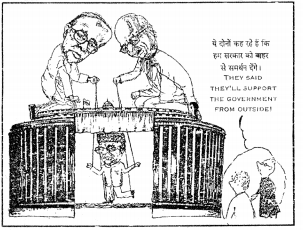
In November 1989, five parties; National Front comprising Janata Dal, Congress (S), and three regional parties, he., Telugu Desarn, DMK, and AGP formed the government headed by V.P. Singh with the outside support extended by the BJP and the left parties. In November 1990, V.P. Singh’s government reduced into minority and V.P. Singh resigned. In 1996, Janta Dal formed a United Front. With the consent of Congress and CPI (M), the Chief Minister of Karnataka, H.D. Deve Gowda was asked to lead the coalition as Prime Minister. His term was from June 1, 1996, to April 21, 1997. In 1997, the Congress Party withdrew the support.

Question 5.
What does a coalition government mean? Mention any one example of such a government. (Imp.) (C.B.S.E. 2013)
Answer:
A coalition government is formed when many small political parties or groups in a house agree to join hands on a common platform by sinking their broad differences and form a majority in the house.

For example, the UPA government formed in 2004 was a coalition government.

Recent Developments in Indian Politics Important Extra Questions Very Short Answer Type (2 Marks)

Question 1.
Name the two alliance fronts that formed the government at the center in 1989 and 1996 respectively. (Imp.) (C.B.S.E. 2014)
Answer:

  1. National Front
  2. United Front.

Question 2.
In 2019 who formed the government?
Answer:
B.J.P. formed a Coalition government known as NDA.

Question 3.
Which political party emerged as the single largest party in the 1996 Parliamentary elections?
Answer:
The Bharatiya Janata Party.

Question 4.
From 1989 until the elections of 2004 which party has been gaining strength in Lok Sabha. (C.B.S.E. 200S)
Answer:
From 1989 until the election of 2004 Bharatiya Janata Party has been gaining strength in Lok Sabha.

Question 5.
Name any two political parties, which were the components of the Third Front for the Lok Sabha elections in 2009.
Answer:

  1. C.P.I.
  2. C. P. M
  3. Bahujan Samaj Party
  4. Telugu Desam Party.

Question 6.
Who is the present Prime Minister of India? (Imp.)
Answer:
Sh. Narendra Modi.

Question 7.
From which year did the era • of coalition government at the center begin in India? (C.B.S.E. 2013)
Answer:
The era of the coalition government, at the center, began in India in 1989.

Question 8.
In which year did the Congress Party win 415 seats in the Lok Sabha? Who became the Prime Minister? (C.B.S.E. 2012 Delhi)
Answer:
The Congress Party won 415 seats in 1984 and Sh. Rajeev Gandhi became the Prime Minister.

Question 9.
Explain the concept of a ‘coalition Government’. (C.B.S.E. 2018)
Answer:
A coalition government is formed when many small political parties or groups in a house agree to join hands on a common platform by sinking their broad differences and form a majority in the house.

Question 10.
Identify anyone similarity between the united front Government of 1996 and the National Front Government of 1989. (C.B.S.E. 2019)
Answer:
Both the Government of 1989 and 1996 included Janta Dal and Several other regional Parties. Choose the correct answer:

Question 11.
In which year was Janata Dal formed?
(a) 1975
(b) 1982
(c) 1985
(d) 1988.
Answer:
(d) 1988.

Question 12.
Who headed the coalition government of 1989?
(a) Chandra Shekhar
(b) V.P. Singh
(c) I.K. Gujral
(d) Rajiv Gandhi.
Answer:
(b) V.P. Singh.

Recent Developments in Indian Politics Important Extra Questions Short Answer Type

Question 1.
Write a short note on NDA.
Answer:
On 15th May 1999 in an effort to project Unity and Cohesion, BJP and its allies including the DMK and the Indian Lok Dal floated a National Democratic Alliance with a common manifesto for contesting Lok Sabha elections under the leadership of Mr. Atal Behari Vajpayee. National Democratic Alliance promised to give a stable, honest, transparent, and efficient government, capable of accomplished all-round development. In the 13th Lok Sabha elections, NDA secured 297 seats.

The NDA elected Mr. Atal Behari Vajpayee its leader and the government was formed under its leadership. In the 14th Lok Sabha elections, NDA secured 186 seats. In the 15th Lok Sabha elections, NDA secured 159 seats. NDA secured 334 seats in the 16th Lok Sabha election held in 2014 and formed the government under the leadership of Sh. Narendra Modi. NDA again formed the Government under the leadership of Sh. Narendra Modi in 2019.

Question 2.
Write a short note on United Progressive Alliance Government. (Imp.)
Answer:
In the general elections of 2004, the ruling BJP was stunned by the scale of defeat and Congress was astounded by the edge they got over the rivals. The country’s first-ever Congress-led Coalition called the United Progressive Alliance government was formed under the leadership of Dr. Manmohan Singh. The United Progressive Alliance and its supporting left parties unveiled the Common Minimum Programme, laying down six principles for governance for the government.

“The UPA makes a solemn pledge to the people of our country to provide a government that is corporation free, transparent and accountable at all times to provide an administration that is responsible and responsive at all times,” said the Prime Minister while releasing the document. However, the Prime Minister admitted the differences with the U.P.A, especially with the R.JD over women’s reservation.

Question 3.
Describe briefly any four main developments, witnessed by the country from 1989 to 1992. (C.B.S.E. 2008)
Or
Describe any four major developments in Indian Politics since 1989. (Imp.) (C.B.S.E. 2015)
Answer:
1. National Front. In Nov. 1989, the elections to the 9th Lok Sabha were held and no political party secured a clear majority. The five-party National Front, comprising Janata Dal, Congress (S), and three regional parties i.e., Telugu Desam, DMK, and AGP, formed the government headed by V.P. Singh with the outside support extended by the BJP and the left parties.

2. Congress (I) Government. Elections to the 10th Lok Sabha were held in May- June 1991 and the Hung Lok Sabha emerged for the second time in succession. No single party secured a clear majority in the Lok Sabha. Congress (I) formed the government under the leadership of P.V. Narsimha Rao.

3. Ram Mandir Issue. In June-July 1990 the BJP and Vishwa Hindu Parishad decided to construct Ram Mandir. In the meantime L.K. Advani started Rath Yatra from Somnath (Gujarat) to Ayodhya (U.P.). In Bihar, the Advani Yatra was stopped and he was arrested. BJP delegation led by Atal Behari Vajpayee met the President on 23rd October 1990 and presented a letter withdrawing support to the V.P. Singh government.

4. Mandal Commission Report. Prime Minister V.P. Singh announced, all of a sudden, the acceptance of the Mandal Report on August 7, 1990, in the Parliament. But this move of V.P. Singh alienated him from his senior-most colleagues. The student community launched a massive movement throughout the country against the implementation of the Mandal report.

Question 4.
Explain any four reasons for the emergence of the Coalition era in the Indian Democratic System. (C.B.S.E. Sample Paper)
Or
When and why did a long phase of Coalition politics begin in India? (C.B.S.E. 2012 Delhi)
Answer:
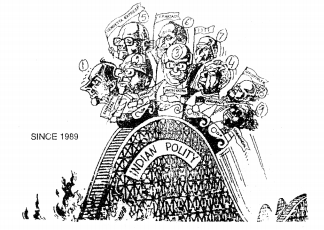
In India, the coalition era started in 1989 and became one of the most important features of the Indian political system.
The following reasons led to the emergence of the Coalition era in the Indian Democratic System:

  1. The coalition era came in the Indian democratic system with the split and failure of Congress in winning a majority.
  2. To build up a strong front against Congress, several political parties met that led to the formation of a coalition government.
  3. The greed for power and position led to the emergence of the coalition era.
  4. Disputes between Centre and State also caused the emergence of the coalition era in Indian democracy.

Question 5.
Write a short note on Hung Parliament.
Answer:
Hung Parliament is that parliament when no party gets a clear majority in the Lok Sabha. Since 1989 India is facing the problem of the Hung Parliament. In 1989, elections to the 9th Lok Sabha were held but no political party secured an absolute majority. Hence, no single political party was in a position to form the government. In the 10th, 11th, 12th, 13th, and 14th Lok Sabha elections no single political party secured a clear majority and thus coalition government was formed. After the 10th, 11th, and 12th Lok Sabha elections, the government was weak and unstable.

But after the 13the Lok Sabha election coalition government (NDA government) was led by Sh. Atal Behari Vajpayee and it completed full five years. After the 14th Lok Sabha election, a coalition government was formed under the leadership of Dr. Manmohan Singh. After the 15th Lok Sabha elections, again coalition government was formed under the leadership of Dr. Manmohan Singh. According to Prof. Rajni Kothari, “The emergence of Hung parliament and legislature over the past decade is a manifestation of people’s disenchantment with the political parties and parliamentary democracy”.

Question 6.
In what way do the coalition governments prove to be more democratic than the one-party governments? (Imp.) (C.B.S.E. 2015)
Answer:

  1. Coalition government represents all shades of public opinion. Different communities get proper representation in the government.
  2. Coalition government protects the rights and liberties of the minorities.
  3. In a coalition government, various parties, accommodate each other.
  4. The coalition government, restrict the dictatorship of one-party rule.

Question 7.
Explain the impact of coalition | government on Indian Politics. (C.B.S.E. 2011 Delhi)
Answer:
The following are the impact of the coalition government on Indian politics.

  1. The coalition government brought political instability in India.
  2. Coalition ministries were very much large in size because they had to accommodate the interests of all the different partners.
  3. Coalition government created tension between center and states.
  4. It was during the coalition era that the relation between the coalition ministry and the respective governors became strained.

Question 8.
Mention, any four Prime Minister of India and name their respective coalitions that led the union Government from 1989 to 1999. (C.B.S.E. 2018)
Answer:

S.No Name of Prime Minister    Name of Coalitions
1. Sh. V.P. SinghNational Front
2. Sh. H.D. DevegowdaUnited Front
3. Sh. Inder Kumar GujralUnited Front
4. Sh. Atal Bihari VajpayeeNational Democratic Alliance

Recent Developments in Indian Politics Important Extra Questions Long Answer Type

Question 1.
Assess any three benefits of the coalition government in India since 1989. (C.B.S.E. 2019)
Answer:
Following are the benefits of the coalitions government in India since 1989.
1. Representation of all shades of opinion. An important benefit of the coalition government is that in the government all shades of opinion get representation. There exist various political parties that represent different shades of opinion and each party gets somewhat represented in the government. The members of each political party support their view-point in the government. This way the government becomes such an institution that represents every type of view-point.

2. Nation is not divided into two halves. In a coalition government, the political parties do not bitterly criticize one another because after the resignation of the cabinet no single party is confident of forming the government. Therefore Nation is not divided into two halves.

3. Partner itself put check on the government: Another benefit of the coalition government in India since 1989, that partner of the coalition government, itself put a check on the autocratic activities of the government.

Question 2.
Analyze five developments that made a long-lasting impact on Indian Politics during the 1980s. (C.B.S.E. Sample Q.P. 2017)
Or
Analyze any three developments towards the end of the 1980s that were to make a long-lasting impact on the politics of India. (C.B.S.E. 2019)
Answer:
Following are the developments that made a long-lasting impact on Indian Politics during the 1980s:
1. The first major development was the defeat of the Congress Party their defeat marked the end of the ‘Congress System’.

2. Prime Minister V.P. Singh announced, all of a sudden, the acceptance of the Mandal Report on August 7, 1990, in the Parliament. But this move of V.P. Singh alienated him from his senior-most colleagues. The student community launched a massive movement throughout the country against the implementation of the Mandal report.

3. The Third Major development was the announcement of the New Economic Policy. With adopting the New Economic Policy, India Joined the Globalization and Liberalization Process.

4. In June-July 1990 the BJP and Vishwa Hindu Parishad decided to construct Ram Mandir. In the meantime L.K. Advani started Rath Yatra from Somnath (Gujarat) to Ayodhya (U.P.). In Bihar, the Advani Yatra was stopped and he was arrested. BJP delegation led by Atal Behari Vajpayee met the President on 23rd October 1990 and presented a letter withdrawing support to the V.P. Singh government.

5. The fifth major development was the assassination of Rajiv Gandhi in May 1991, Which led to a change in leadership of the Congress Party.

Question 3.
Describe any three major developments that left a long-lasting impact on the politics of India after the death of Rajiv Gandhi. (C.B.S.E. 2017)
Answer:
1. Weakened the Congress: After the death of Rajiv Gandhi, Congress was not able to get leadership from the Nehru family and it gave decline to the Congress. Thus, began an era of a multi-party system. No single party secured a clear cut majority, this development initiated an era of coalition governments at the center, in which regional political parties play a crucial role in informing the ruling alliance.

2. Introducing New Economic Policies: In 1991 New Economic Policy was introduced by Dr. Manmohan Singh with this New Policy era of the liberal and the open market was started in India.

3. Ayodhya dispute: In 1992 Ayodhya issue is another important development that left a long-lasting impact on the politics of India.

Question 4.
In the midst of severe competition and many conflicts, a consensus appears to have emerged among most political parties of India.” In the light of these statements, analyze any three elements of growing consensus. (Sample Paper Outside Delhi)
Or
Highlight any three issues on which a broad agreement has emerged among most of the political parties in India. (C.B.S.E. 2013)
Or
Describe any three points of consensus that emerged among most political parties in India in spite of severe competition and conflicts. (Imp.) (C.B.S.E. 2015)
Or
Describe any three elements of growing consensus among most of the political parties of India after 1989. (C.B.S.E. 2017)
Answer:
India is a Sovereign, Socialist, Secular, Democratic Republic country. In India, parliamentary democracy is established. For the successful working of parliamentary democracy, political parties are inevitable. In India, multiple party system exists. Election Commission recognized 7 national parties and 53 state-level parties.

Each party wants to capture power. Thus, there is competition and conflicts among the political parties. Conflicts are there because each political party has its own ideology, policies, and programs. However, in the midst of severe competition and many conflicts, a consensus has emerged among political parties on the following:

1. Full Faith in Constitutional System: All the political parties have full faith in the Constitutional system of India. For the registration of political parties, it is essential that the party should have true faith and allegiance to the Constitution of India.

2. Faith in Democracy and Secularism: All political parties have full faith in democratic values. Political parties are interested in capturing political power but through democratic methods. Mrs. Indira Gandhi imposed an emergency on 25th June 1975, but ultimately she held the election in a free and fair manner. Congress party was defeated in the election because they were responsible for emergency restrictions on the rights and liberties of the people.

3. Policy of Non-alignment: There is a consensus on the policy of non-alignment. Non-alignment is the basic principle of India’s foreign policy. Not only Congress but non-Congress governments at the center also followed the policy of non-alignment.

Question 5.
“Communalism is a bane for democracy in India.” How can we curb it? (C.B.S.E. 2005 Set I, II, III Delhi)
Or
‘Communalism is a curse’. How can it be curbed? Give any five suggestions. (C.B.S.E. 2005 C)
Answer:
Communalism is a bane for democracy in India. Communalism is the bane for democracy in India because of the following reasons:

  1. Several political parties in India have been formed on the basis of religion.
  2. Communal feelings play a vital role in elections. Almost all political parties field their candidates on the basis of caste and community.
  3. Voters are also influenced by religion while casting their votes. Generally, the Muslim or Sikh voters vote in favor of candidates belonging to their religions.
  4. Not only religion-based political parties are active in Indian politics but also religious-oriented pressure groups are doing their own role in communalizing the social and political atmosphere of our country.
  5. The communal riots have become an integral part of Indian politics, which are against democratic norms.

Methods to Curb Communalism. The following steps are suggested to curb communalism in India:
1. Right Type of Education. Communalism is a mental malady and hence needs a mental remedy. Through well-designed textbooks, articles, pamphlets, and other means, the educational system should be used for checking communalism.

2. Right use of Media. T.V., Radio, and Media should avoid the coverage of news and views likely to promote communal hatred. Radio, T.V., mass-media should spread the message of secularism, religious toleration, and fraternity.

3. Efficient And Strong. State machinery should be efficient, strong, and impartial enough to put down communalism. The government should not yield to communal pressures.

4. Political parties should be decriminalized. Election Commission should not give recognition to communal parties.

5. Religion should be separated from politics. To curb communalism, the central government has prohibited the use of religious places for political means.

6. Government should take steps to protect the rights of minorities. This will give minorities a sense of security; resultantly they will not encourage communalism.

7. Government should punish the communalist agents and for this special courts should be established.

8. Government should treat all religions equally and respect them. This will help in curbing communalism differences.

9. People of different religions should also respect other religions. They should practice religious toleration.

10. social and religious organizations should not have discriminatory feelings against any religion or religious act.

Question 6.
Write a note on the 16th Lok Sabha election held in 2014.
Answer:
In India the 16th Lok Sabha Elections April- May 2014 were conducted in 9 stages. The main features of this election are as follows:

  1. Enhancement in the Election Expenditure- The Central Government enhanced the Election expenditure limit in Feb 2014. Now a candidate for contesting the Lok Sabha seat can spend a maximum of 70 Lacs Rupees whereas in legislative Assembly election a candidate can spend a maximum of 28 Lacs Rupees on his/her election.
  2. Highest Percentage of Polling/Voting-In 16th Lok Sabha election highest 66.38% vote-polling was recorded.
  3. Nota Button used-in 16th Lok Sabha election 60 Lacs voters used the Nota (None of the above) button.
  4. Number of Voters-During the 16th Lok Sabha election, the number of total voters was 81 crore 40 Lacs. By which nearly 55 crores voters cast their votes.
  5. The number of Political Parties-During the 16th Lok Sabha election the number of Political Parties was 1687 in which 6 National Parties were included.
  6. Women candidates were elected-In the 16th Lok-Sabha elections maximum of 61 women were elected.

The results of these elections are given below:

 Name of PartySeats                    
1. Bhartiya Janata Party282
2. Bhartiya Communist Party01
3. Bhartiya Communist Party MARXIAN09
4. Indian National Congress44
5. Nationalist Congress Party06
6. Aam Admi Party04
7. All India Anna Dravida Munnetra Kazhagam-ANDMK37
8. All India N.R. Congress01
9. All India Trinamool Congress34
10. All India United Democratic Front03
11. Biju Janata Dal20
12. Indian Nationalist Lok Dal02
13. Indian Union Muslim League02
14. P.D.P.03
15. Janata Dal (S)02
16. Janata Dal (U)02
17. Jharkhand Mukti Morcha02
18. Kerala Congress (M)01
19. Lok Jan Shakti Party06
20. Naga Peoples Front01
21. Naga Peoples Party01
22. Pattali Makkal Katchi01
23. National Janata Dal04
24. Revolutionary Socialist Party01
25. Samajwadi Party05
26. Shiromani Akali Dal04
27. Shiv Sena18
28. Sikkim Democratic Front01
29. Telangana Rashtra Samithi11
30. Telugu Desam Party16
31. I-Mujlis-Ittehadul Muslimeen01
32. Apna Dal02
33. Rashtriya Lok Samata Party03
34. Sevabhamani Paksha01
35. YSR Congress Party09
36. Independents03

7. Sh Narendra Modi Emerged as Prime Minister. In the 16th Lok Sabha Elections, Bhartiya Janta Party won 282 seats and whereas NDA Coalition got 334 Seats. And the leader of BJP and NDA Sh. Narendra Modi was administered the oath of Prime Ministership on 26 May 2014.

8. Formation of Council of Ministers. On 26, May 2014 Prime Minister Narendra Modi formed his Council of Ministers in which 23 Cabinet Ministers, 10 Independent Charge Ministers, and 12 State Ministers were included.

Question 7.
Write a note on the 17th Lok Sabha election held in 2019.
Answer:
In India, the 17th Lok Sabha Elections were conducted in April-May 2019, in 7 stages. The main features of this election are as follows:

  1. Highest Percentage of Polling/Voting-In 17th Lok Sabha election highest 67.11% vote-polling was recorded.
  2. Number of Voters- During the 17th Lok Sabha election, the number of total voters was 90 crore.
  3. Women candidates were elected in the 17th Lok-Sabha elections 78 women were elected in these elections.
  4. Total 10 Lakh polling booths were made by the election commission.
  5. V.V.P.A.T was used along with E.V.M. all over India.

The results of these elections are given below:

PartyWon
Aam Aadmi Party1
AJSU Party1
All India Anna Dravida Munnetra Kazhagam1
All India Majlls-E-Ittehadul Muslimeen2
All India Trinamool Congress22
All India United Democratic Front1
Bahujan Samaj Party10
Bharatiya Janta Party303
Biju Janta Dal12
Communist Party of India2
Communist Party of India (Marxist)3
Dravida Munnetra Kazhagam23
Indian National Congress52
Indian Union Muslim League3
Jammu & Kashmir National Conference3
Janta Dal (Secular)1
Janta Dal (United)16
Jharkhand Mukti Morcha1
Kerala Congress (M)1
Lok Jan Shakti Party6
Mizo Nation Front1
Naga Peoples Front1
National People’s Party1
Nationalist Congress Party5
National Democratic Progressive party1
Revolutionary Socialist Party1
Samajwadi Party5
Shiromani Akali Dal2
Shivsena18
Sikkim Krantikari Morcha1
Telangana Rashtra Samithi9
Telugu Desam3
Yuvajana Sramika Rythu Congress Party22
Other8
Total542

6. Sh. Narendra Modi Emerged as Prime Minister. In the 17th Lok Sabha Elections, Bharatiya Janata Party won 303 seats and whereas NDA Coalition got 355 Seats. Therefore the leader of BJP and NDA Sh. Narendra Modi was administered the oath of Prime Ministership on 30 May 2019.

7. Formation of Council of Ministers. On 30, May 2019 Prime Minister Sh. Narendra Modi formed his Council of Ministers in which 53 Ministers, 24 Cabinet Ministers, 9 Independent Charge Ministers, and 24 State Ministers were included

Question 8.
In the 2014 elections, people have j voted for a stable government at the center. Do you think that the era of the coalition has ended? Support your j answer with suitable arguments. (C.B.S.E. 20IS)
Answer:
During April-May 2014, B.J.P. won with 282 seats in the Lok Sabha elections and under the magnetic personality of Sh. Narendra Modi people have voted for a stable government at the center. Though after 1984, for the first time, the rule of the complete majority is established, one cannot conclude that an era of the coalition government has ended. However, in this election B.J.P received support from other NDA coalition parties thus accounting for 336 seats in the 2014 elections.

Firstly, Regional political parties are having their full importance, and these parties fully influence and play their role in the National Politics of the country.

Secondly, though BJP got a complete majority in the center, yet there is a coalition government in the center also and allies are Shiromani Akali Dal and Shiv Sena and Telugu Desam, etc.

In many states, the coalition government has been formed where the parties have failed to win a clear majority.

Question 9.
Political Science Class 12 Important Questions Chapter 9 Recent Developments in Indian Politics im-1
Study the above cartoon carefully and answer the following questions:
(i) Who was head of the Government formed by the National Front in 1989?
Answer:
Sh V.P. Singh was head of the government formed by the National Front in 1989.

(ii) Why was the government formed by him called a puppet government?
Answer:
The government formed by Sh. V.P. Singh called a puppet government because the government was supported by
other parties, especially by Left and B.J.P.

(iii) Identify the puppeteers pulling the strings and the political parties they belong to. (C.B.S.E. 2016)
Answer:

Name of the LeaderPolitical Parties
(a) Sh. Jyoti BasuC. P.M.
(b) Sh. Lai Krishna AdvaniB.J.P.

Question 10. Study the cartoon given below and answer the following questions:
Political Science Class 12 Important Questions Chapter 9 Recent Developments in Indian Politics im-2
(i) Identify any four national leaders from the above cartoon and mention the serial number of each.
Answer:

  1. Sh. Rajiv Gandhi
  2. Sh. V.P. Singh;
  3. Sh. Lai Krishan Advani
  4. Ch. Devi Lai.

(ii) Which was the most con¬troversial issue of the period related to leader No. 2 as Prime Minister of India?
Answer:
The most controversial issue of the period related to leader No. 2 (Sh. V.P. Singh) was to implement the recommendation of the Mandal Commission.

(iii) What was the position of the party led by leader No. 1 in the Lok Sabha elections of 1989? (C.B.S.E. 2016)
Answer:
Leader No. 1’s (Sh. Rajiv Gandhi) party, (Congress Party) won 197 seats.

Recent Developments in Indian Politics Important Extra Questions HOTS

Question 1.
What do you know about NDA?
Answer:
NDA stands for National Democratic Alliance. It was formed by Bharatiya Janata Party and its and its allies in May 1999. It was formed under the leadership of Atal Behari Vajpayee. In the 13th Lok Sabha elections, NDA secured 297 seats. The NDA elected Mr. Atal Behari Vajpayee its leader and the government was formed under his leadership.

Question 2.
What do you know about United Front (U.F.)?
Answer:
United Front was formed in 1996 by Janata Dal and its allies. Samajwadi Party, D.M.K., Assam Gana Parishad, Tamil Manila Congress, Communist Party of India, and Telugu Desam Party were the main members of U.F. United Front formed India’s government between 1996 and 1998. H.D. Deve Gowda was the Prime Minister of the United Front government from June 1, 1996, to April 21, 1997.

Question 3.
How far is it correct to say that the coalition government in India has helped in arriving at some consensus?
Answer:
After 1989, the coalition government has become a regular feature of the Indian political system. After the Lok Sabha election of 2009, the coalition government under the leadership of Dr. Manmohan Singh was formed. It is correct to some extent that the coalition government in India has helped in arriving at some consensus.

Question 4.
Are Regional Parties necessary? Give any two arguments in support of your answer.
Answer:
Regional Parties are necessary for India due to the following reasons:

  1. India is a Continental polity with a wide range of socio-cultural and ethnic diversities. Under conditions of democratic culture, these diversities are bound to indeed aspire for political economy.
  2. The emergence of regional economic imbalance in India is also responsible for the emergence of regional parties.

Indian Economy on the Eve of Independence Class 12 Important Extra Questions Economics Chapter 1

Here we are providing Class 12 Economics Important Extra Questions and Answers Chapter 1 Indian Economy on the Eve of Independence. Economics Class 12 Important Questions are the best resource for students which helps in class 12 board exams.

Class 12 Economics Chapter 1 Important Extra Questions Indian Economy on the Eve of Independence

Indian Economy on the Eve of Independence Important Extra Questions Very Short Answer Type

Question 1.
Name the popular fields of Indian handicrafts industry.
Answer:
The popular fields of Indian handicrafts industry were cotton and silk textiles, metal and precious stone works, etc,

Question 2.
Where was the muslin type of cotton textile found in India?
Answer:
The muslin type of cotton textile had its origin in Bengal, particularly, places in and around Dhaka (known as Dacca before partition), now the capital city of Bangladesh.

Question 3.
What was the state of country’s real output during the first half of the twentieth century?
Answer:
The country’s growth of aggregate real output was less than two percent during the first half of the twentieth century.

Question 4.
What was the major occupation in India on the eve of independence?
Answer:
Agriculture was the major occupation in India on the eve of independence.

Question 5.
Name any two commercial crops.
Answer:
Cotton, jute and sugarcane are commercial crops.

Question 6.
What do you mean by stagnant agriculture?
Answer:
Stagnant agriculture implies incrementally low agricultural product.

Question 7.
Define subsistence agriculture.
Answer:
Subsistence agriculture refers to growing food for self-consumption and not for sale in the market.

Question 8.
Name the industries which were in operation in our economy at the time of independence.
Answer:
Handicrafts industries, metal and precious stone works, cotton and jute textile mills, iron and steel industries were in operation in our economy at the time of Independence.

Question 9.
When and where was the first iron and steel company established?
Answer:
The first iron and steel company was established in 1907 at Jamshedpur.

Question 10.
What was the impact of decline of the indigenous handicraft industries?
Answer:
The impact of the decline of the indigenous handicraft industries was massive unemployment and shortage of locally made goods in India.

Question 11.
Define capital goods.
Answer:
Capital goods are those goods which are producer’s fixed assets and are used in the production of other goods and services.

Question 12.
Define foreign trade.
Answer:
Foreign trade is exchange of capital goods and services across international borders or territories.

Question 13.
What do you mean by exports?
Answer:
The term exports mean shipping the goods and services out of the port of a country.

Question 14.
What is import?
Answer:
An import is a good brought into a jurisdiction, especially across a national border, from an external source.

Question 15.
Name two items each of export and import during British rule.
Answer:
The items of export were:

  • Raw silk
  • Cotton
  • Sugar
  • Indigo

The items of import were:

  • Silk
  • Woollen Clothes
  • Light machinery

Question 16.
Name the countries with which India used to trade during British Rule.
Answer:
More than 50 percent of India’s trade was confined to Britain. Other countries with which India used to trade were China, Ceylon (Sri Lanka) and Persia (Iran).

Question 17.
Define occupational structure.
Answer:
Occupational structure is the distribution of the population according to the occupations in different sectors of the economy.

Question 18.
What is meant by primary sector?
Answer:
The primary sector includes all the activities that are directly associated with the use of natural resources.

Question 19.
What is meant by secondary sector?
Answer:
The secondary sector includes all the activities which are related to transformation of natural products into other forms by the process of manufacturing.

Question 20.
Define tertiary sector.
Answer:
The tertiary sector includes the activities related to supplying services to consumers and businesses.

Question 21.
Write the percentage of population engaged in different sectors of the economy on the eve of independence?
Answer:
Primary Sector – 72.7 percent
Secondary Sector – 10.1 percent
Tertiary Sector – 17.2 percent

Indian Economy on the Eve of Independence Important Extra Questions Short Answer Type

Question 1.
Discuss the economic features of Indian economy prior to the advent of the British rule?
Answer:
India was a prosperous, wealthy and independent economy prior to the advent of the British rule. Agriculture was the main source of livelihood for the most people. However, the country’s economy was also characterised by various kinds of manufacturing activities. India was mainly known for its handicraft industries in the fields of cotton and silk textiles, metal and precious stone works, etc. These products enjoyed a worldwide market due to their fine quality and the high standards of craftsmanship.

Question 2.
What was the aim of the policies pursued by the British during colonial rule?
Answer:
The aims of the policies pursued by the British during colonial rule were:
(i) To exploit India for raw material to expand British modem industrial base
(ii) To protect and promote the economic interests of their home country

Question 3.
Write a short note on commercialisation of agriculture during British rule?
Answer:
Generally, commercialisation of agriculture implies production of crops for sale in the market rather than for self-consumption. However, during British rule, it acquired a different meaning. Commercialisation of agriculture took place only in a few productive areas and it basically became commercialisation of crops.

The British used to offer higher prices to farmers for producing cash crops rather than for food crops. British government used these cash crops as raw materials for industries in Britain. In other words, British government exploited Indian agriculture to serve the base of their modern industries.

Question 4.
Where was the zamindari system implemented by British in India? Discuss its features.
Answer:
The zamindari system was implemented in the then Bengal Presidency, comprising parts of India’s present-day eastern states.
Following were the features of zamindari system implemented by British in India:
(i) The zamindars were the permanent owners of the land.
(ii) The profit accruing out of the agriculture sector went to the zamindars instead of the cultivators.
(iii) The main interest of the zamindars was only to collect rent and they did nothing to improve the condition of agriculture or cultivators.

Question 5.
Discuss the condition of Indian agricultural sector on the eve of independence.
Answer:
The condition of Indian agricultural sector on the eve of independence is discussed below:
(i) Low Level of Productivity: Level of productivity was so low that agriculture could easily be characterised as backward on the eve of independence. Low productivity implied low level of output, despite large area under cultivation.

(ii) High Degree of vulnerability: Agriculture showed a high degree of vulnerability. Due to lack of technology and irrigation facilities, it was extremely dependent on rainfall.

(iii) Uneconomic and Fragmented Landholdings: Indian farmlands were fragmented and scattered in pieces. As a result, most landholdings were uneconomic and hence, yielded low surplus.

Question 6.
Discuss the state of industrial sector on the eve of independence.
Answer:
The state of industrial sector on the eve of independence is discussed below:
(i) Decay of Handicraft Industry: The traditional handicraft industry in India was an important industry of pre-British period. British misrule in India led to the decline of Indian handcrafts.

(ii) Lack of Basic and Heavy Industries: During the British rule, priority was seldom given to the basic and heavy industries. At the time of independence, Tata Iron and Steel Company (TISCO) was the only basic industry in India.

Question 7.
Describe the role of public sector during British Rule.
Answer:
During the British Rule, the role and operation of the public sector remained very limited. It was only confined to areas that provided large market for British products. Railways, power generation, communications, ports and some other departmental undertakings were the main areas under operation of public sector.

Question 8.
State the factors responsible for the downfall of indigenous handicraft industries during British Rule.
Answer:
The factors responsible for the downfall of indigenous handicraft industries during British Rule:

  • Discriminatory tariff policy of the state
  • Disappearance of princely courts
  • Competition from machine-made products
  • New patterns of demand
  • Introduction of railways in India

Question 9.
Discuss the state of Indian foreign trade on the eve of Independence.
Answer:
The state of Indian foreign trade on the eve of independence is discussed below:
(i) Owing to colonial exploitation of the Indian economy, India became net exporter of raw materials and primary products. On the other hand, it became net importer of finished goods produced by the British industry.

(ii) Dunng the British regime, India’s exports exceeded its imports, implying export surplus. However, the surplus came at huge cost to the India’s economy as there was shortage of essential commodities in the domestic market

Question 10.
India experienced export surplus during colonial rule, then why was there drain of wealth from India during the same period.
Answer:
Throughout the colonial period, India’s foreign trade experienced the generation of a large export surplus. However, the surplus came at huge cost to the India’s economy. There was shortage of essential commodities such as food grains, clothes, kerosene, etc. in the domestic market.

The export surplus did not result in any flow of gold or silver into India. Rather, this was used to make payments for the expenses incurred by an office set up by the colonial government in Britain, expenses on war, and the import of invisible items. All these led to the drain of Indian wealth during the colonial period.

Question 11.
Explain the role of the Suez Canal in intensifying British control over India’s foreign trade.
Answer:
Suez Canal is an artificial waterway running from north to south across the Isthmus of Suez in north-eastern Egypt. It connects Port Said on the Mediterranean Sea with the Gulf of Suez. The canal provides a direct trade route for ships that operate between European or American ports and ports located in South Asia, East Africa and Oceania by eliminating the need to sail around Africa.

It is one of the most important waterways in the world from strategic and economic point of view. Opened in 1869, the Suez Canal reduced the cost of transportation and made access to the Indian market easier.

Question 12.
What happens in the first stage of demographic transition?
Answer:
The first stage of demographic transition is associated with pre-modern times and is characterised by a balance between birth rates and death rates. During this stage, both birth and death rates are very high, which result in very slow population growth. This stage is also known as the ‘High Stationary Stage’ of population growth.

Question 13.
Why are death rates so high in the first stage of demographic transition?
Answer:
The death rates are high in the first stage of demographic transition due to lack of knowledge of disease prevention and cure. Occasional food shortage is also a reason for the high death rates in this stage.

Question 14.
State in brief, the demographic profile of India under British rule.
Answer:
The demographic profile of India under British rule was as below:

  • The overall literacy rate was less than 16 percent.
  • Female literacy rate was as low as 7 percent.
  • Mortality rate was high.
  • Infant Mortality Rate was 218 per 1000.
  • Life expectancy was only 44 years.
  • Extensive poverty prevailed.

Question 15.
“The real motive behind infrastructural development in India was not to provide basic amenities to the people but to subserve various colonial interests. Do you agree? Give reasons.
Answer:
Basic infrastructure such as railways, ports, water transport, posts and telegraphs developed under the British rule. However, the intention was not to provide amenities to Indian population but to satisfy colonial interests. The infrastructural development during British rule and the motives behind them are mentioned below: –

(i) Roads were built primarily to serve the purposes of mobilising the army within India and drawing out raw materials from the countryside to the nearest railway station or the port for export.

(ii) Railways were introduced in India in 1850 to assist British industries in widening the market for their finished goods.

(iii) The aim of developing postal and telegraph was to enhance the efficiency of British administration.

Question 16.
How can you say that there were growing regional variations in the occupational structure of India during British rule?
Answer:
Growing regional variations in the occupational structure of India during British rule are evident from the facts given below:
(i) Parts of the Madras Presidency, Bombay and Bengal witnessed a decline in the share of workforce dependent on agricultural sector and increase in the share of workforce in the manufacturing and the services sectors.

(ii) On the other hand, in states such as Orissa, Rajasthan and Punjab, there had been an increase in the share of workforce dependent on agriculture during the same period.

Question 17.
Describe the positive impact of the British rule on Indian economy.
Answer:
The positive impacts of the British policies in India are discussed below:
(i) Introduction of railways enabled people to undertake long distance travels and hence, break geographical and cultural barriers.
(ii) Commercialisation of agriculture widened the scope of primary sector activities.
(iii) Postal and telegraphs services introduced by the British serve the public of the country even today.

Question 18.
Briefly state the position of agriculture, industry and foreign trade on the eve of independence.
Answer:
The position of different sectors on the eve of independence is stated below:
(i) Agriculture: Agricultural sector was burdened with surplus labour and there was low productivity.
(ii) Industry: There was lack of modern industries, capacity building and public investment.
(iii) Foreign Trade: India became the net supplier of raw materials and consumer of finished industrial products from Britain.

Indian Economy on the Eve of Independence Important Extra Questions Long Answer Type

Question 1.
State the features of Indian economy at the time of independence.
Answer:
Following were the main features of Indian economy at the time of independence:

(i) Inconsistent Commercialisation of Agriculture: Commercialisation of agriculture took place only in a few productive areas. This resulted in unequal level of productivity across India. While some states became rich, others remain poor due to factors such as low level of technology, lack of irrigation facilities and the use of negligible amount of fertilisers.

(ii) Stagnant and Backward Economy: Indian economy at the time of independence was stagnant and backward. The pace of development was extremely low. The growth rate of per capita income was only 0.5 percent per year.

(iii) Little Growth of the Consumer Goods Industries: At the time of independence, source of consumer goods industries like jute, textile, sugar,-match box, etc. were established in India. which were aided by British capital. The profit of these industries went to Britain. As a result, these industries remained backward at that time.

(iv) Less Development of Infrastructure: At the time of independence, the growth of economic as well as social infrastructure was very low. These services were in their infant stages.

(v) Downfall of Cottage and Small Scale Industries: Prior to the British rule, India was well known for its handicraft industries in the field of cotton, silk textiles, metal and precious stone works, etc., which enjoyed a worldwide market. But the policy of British colonial rule led to their downfall. ; At the time of independence, these industries were almost ruined.

(vi) Lack of Basic Industries: At the time of independence, there was a lack of basic industries. Tata Iron and Steel Company was the only importance basic industry.

(vii) Limited Foreign Trade: India’s foreign trade was very limited. The British policies reduced India to the exporter of raw materials and importer of finished goods.

(viii) Other Challenges: At the time of independence, Indian economy was facing many challenges like poverty, malnutrition, poor health facilities and rapidly increasing population.

Question 2.
How did the British exploit Indian agriculture sector?
Answer:
Indian economy, under the British colonial rule, remained fundamentally agrarian. 85 per cent of the Indian population was engaged directly or indirectly on agriculture. However, despite of being the occupation of such a large population, this sector continued to experience stagnation and unusual deterioration.

Although agricultural sector was the main source of national income and employment, it remained backward and deficient. It was burdened with defective institutions like ‘Zamindari’ and Jagirdari’.

The British government had paid little attention to land reforms or to increasing agricultural productivity. India, once an important exporter of foodgrains, started suffering from ever worsening food shortage. Agricultural productivity was low because there was low level of technology, lack of irrigational facilities and negligible use of fertilisers. Cash crops of the farmers were to be ultimately used by the British industries at home. Furthermore, country’s partition at the time of independence gave a set-back to India’s agricultural production.

A sizeable portion of the undivided country’s highly irrigated and fertile land went to Pakistan, which impacted India’s agricultural production adversely. India’s jute goods industry suffered heavily due to lack of raw material. Thus, the Indian agricultural sector was stagnated at the time of independence.

Question 3.
What was the condition of industrial sector on the eve of independence?
Answer:
The scenario of industrial sector under the British colonial rule was under-developed. British policies transformed the Indian economy into a mere supplier of raw materials and consumer of the finished f industrial products from Britain. There was a lack of heavy, basic and capital goods industries and  country was almost totally dependent upon foreign nations for supply of machines, engines, spare parts, etc. Manufacturing capacity was also very limited.

Modern industry began to take root in India during the second half of the 19th century. The first iron and steel company. TISCO (Tata Iron and Steel Company) was established in Jamshedpur, This plant began production in 1912. Industries like sugar, cement and paper also came up after the Second World War.

However, there was an absence of capital goods industries at the time of Independence. As a result, contribution of industrial sector to the national GDP remained very low.

Question 4.
Explain the factors responsible for the downfall of indigenous handicraft industries during British rule.
Answer:
The following were the factors responsible for the downfall of indigenous handicraft industries during British rule:

(i) Discriminatory Tariff Policy: The British rule in India primarily aimed at development of industries in Britain. The British adopted a discriminatory tariff policy in which, export of raw material from India and import of industrial products from Britain into India was tariff-free.

However, a heavy duty was placed on the export of handicraft products. While the British products exploited the markets, the handicraft products lost their domestic as well as foreign market.

(ii) Hand-made versus Machine-made Products: Machine-made products from Britain were low cost products. These products gave a stiff competition to the handicraft products in India. Competition forced the craftsmen to shut-down their industries.

(iii) New Demand Patterns: With the advent of British culture, a new class emerged in India, which was keen to adopt the western lifestyle. This changed the demand pattern against the Indian products and in favour of the British products. As a result, the handicraft industry suffered decay.

(iv) Introduction of Basic Infrastructure in India: The British Government introduced railways and other basic infrastructure in India to satisfy their colonial interests. Transportation facilitated movement of the British products across various parts of the country.

Consequently, the market size for the low cost British products expanded while it shrunk for the relatively high cost Indian products. This added to the process of decay of the Indian handicrafts.

Question 5.
Write a short note on the volume and composition of Indian trade during British rule.
Answer:
India has always been an important trading nation. However, the restrictive policies of commodity production, trade and tariff pursued by the colonial government had a negative impact on the structure, composition and volume of India’s foreign trade.

Consequently, India became an exporter of primary products such as raw silk, cotton, wool, indigo, jute, etc. and an importer of finished consumer goods like cotton, silk and woollen clothes and capital goods like light machinery produced in the industries based in Britain.

Britain maintained a monopoly control over India’s exports and imports. More than 50 percent of India’s trade was confined to Britain. Other countries with which India used to trade were China, Ceylon (Sri Lanka) and Persia (Iran). The opening of the Suez Canal further intensified British control over India’s foreign trade.

Question 6.
Give a brief account of state of various social development indicators on the eve of Independence.
Answer:
The state of various social development indicators was also not quite encouraging:
(i) The overall literacy level was less than 16 percent. Out of this, the female literacy level was as low as 7 percent.

(ii) Public health facilities were either unavailable to large,section of population or, when available, were highly inadequate. As a result, water and air-borne diseases were widespread and took a huge toll on life.

(iii) The overall mortality rate was inevitably very high. The infant mortality rate, particularly, was quite alarming at about 218 per thousand.

(iv) Life expectancy was also very low, that is, only 44 years.

(v) Extensive poverty prevailed in India during the colonial period. It contributed to the worsening demographic profile of India’s population.

Question 7.
Describe the occupation structure of India on the eve of independence.
Answer:
Occupational structure of India on the eve of independence is shown in the table below:

OccupationShare in percent (1951)
1. Primary Sector
(i) Agriculture
(ii) Agricultural Labour
(iii) Forestry, Fisheries, Animal husbandry and Plantation
(iv) Mining
72.7
50
19.7
2.4
0.6
2. Secondary Sector
(i) Small and Large Scale industries
(ii) Building Construction
10.1
9
101
3. Tertiary Sector
(i) Trade and Commerce
(ii) Transport, Storage and Communication
(iii) Other Services
17.2
5.2
1.4
10.6
Total (1+2 + 3)100

Note: The table shows data relating to 1951 since reliable statistics are not available for the year 1947. It can be concluded from the table that on the eve of independence, agriculture was the main occupation.

This sector accounted for the largest share of work force, which usually remained at a height of 73 percent while the manufacturing (secondary) and service (tertiary) sectors accounted for only 10 and 17 percent respectively. This implies the low growth of industries. There was unbalanced growth of the economy.

Question 8.
Explain the methods of colonial exploitation of the Indian economy.
Answer:
The British colonial rule exploited the Indian economy in the following ways:
(i) Industrial Revolution took place in England in the eighteenth century. India was treated as a supplier of raw materials to the British industry. The British exploited the Indian economy to the maximum extent for cheap raw materials to support British industries.

(ii) Indian economy was a market for the finished British products. British government developed railways in India only to meet this purpose.

(iii) British imposed exploitative land revenue policy. The stagnation in the agricultural sector was caused mainly because of these policies. Under this policy, the profit accruing out of the agriculture surplus went to zamindars instead of the cultivators.

(iv) The British colonial rule inflicted upon the Indian economy a very high cost of administration. It also made heavy remittances to Britain in the form of savings and surpluses from their business ventures in India.

(v) Before the British rule, Indian handicrafts enjoyed a worldwide reputation of being quality products. British colonial rule destroyed the demand for Indian handicrafts by imposing discriminatory tariff policy.

(vi) British colonial rule deliberately neglected the development of economic infrastructure such as transportation, power, communication and social infrastructure such as education, health and

Indian Economy on the Eve of Independence Important Extra Questions HOTS

Question 1.
Assess the occupational distribution of the working population of India on the eve of independence.
Answer:
On the eve of independence, most of the working population was engaged in agricultural sector. Indian economy was in a state of extreme backwardness.

Question 2.
What was the sole purpose of the British colonial rule in India?
Answer:
The sole purpose of the British rule in India was to make India as the supplier of raw material supplier for Great Britain’s own rapidly expanding modern industrial base.

Question 3.
Were there any positive impact of the British rule?
Answer:
Besides many negative impacts of British Rule, the positive points related to British rule were:

  • Development of transportation facilities
  • Provision of post and telegrams
  • Strong and efficient administrative system
  • Introduction of western scientific education

Question 4.
Why is 1921 called as the ‘Year of Great divide’?
Answer:
1921 is called as the ‘Year of Great Divide’ because after 1921, the population of India showed a consistent rise. Before 1921, the population of India kept on fluctuating. In the year 1901, the population showed a decline of 0.04 crores.

Regional Aspirations Class 12 Important Extra Questions Political Science Chapter 8

Here we are providing Class 12 Political Science Important Extra Questions and Answers Chapter 8 Regional Aspirations. Political Science Class 12 Important Questions are the best resource for students which helps in class 12 board exams.

Class 12 Political Science Chapter 8 Important Extra Questions Regional Aspirations

Regional Aspirations Important Extra Questions Very Short Answer Type

Question 1.
What will happen if the regions are not given their due share in decision-making at the national level? (C.B.S.E. 2017)
Answer:
The best way to respond to regional aspiration is through democratic negotiations. Suppression of the movement gives the wrong color. The government of India tries to negotiate with regional problems and this produces a reconciliation the example of Mizoram proves that political settlement can resolve the problem of separation effectively. Regions must have a share in deciding the destiny of the nation as they together form the nation. If the regions are not given their share at the national level, the feeling of alignment and injustice destroys the mutual harmony.

Question 2.
How far did the Rajiv Gandhi-Longowal Accord succeed in bringing normalcy to Punjab? (C.B.S.E. 2017)
Answer:
In July 1985, Prime Minister Rajiv Gandhi reached an agreement with Sant Harchand Singh Longowal known as the Rajiv Gandhi-Longowal Accord, to bring normalcy in Punjab. However, peace did not come easily. The cycle of violence continued for a decade. Militancy and counter-insurgency violence led to excesses by the police and violation of human rights. It ultimately compelled the central government to impose President’s rule in the state. During the election of 1992, only 24% of the elector turned out to vote. Militancy was eventually eradicated by the security forces. After post militancy era in 1997, Akali Dal along with BJP scored a major victory and politics has gradually moved back along secular lines

Question 3.
While the rest of the country was reorganized on linguistic lines in the 1950s, why had Punjab wait till 1966? (C B.S.E. 2016)
Answer:
Punjab had to wait till 1966, because the leaders of Punjab were not in favor of division, as the division would have divided the resources of Punjab. This was not justified for the development of Punjab.

Question 4.
In your opinion, was the Anandpur Sahib’s resolution a plea for strengthening federalism or a plea for a separate Sikh nation. (C.B.S.E. 2017)
Answer:
Anandpur Sahib resolution was a plea for strengthening federalism and not a plea for a separate Sikh nation.

Question 5.
Assess the role of democratic negotiations in responding to regional aspirations. (C.B.S.E. 2017)
Answer:
Democratic negotiations are very much helpful in solving the regional aspirations, for example, terrorism in Punjab, problems of north-east of India, Mizoram problem, etc all regional problems can only be solved through democratic and peaceful ways only.

Question 6.
How was the reorganization of North-East India completed and by when? (Imp.) (C.B.S.E. 2016)
Answer:
The reorganization of the North-East was completed by 1972. Instead of one tribal state, several states got carved out of Assam. Central Government had to create Meghalaya, Mizoram, and Arunachal Pradesh out of Assam, Tripura, and Manipur were upgraded into a state too.

Question 7.
“Jammu and Kashmir comprise of some social and political regions.” Support the statement with any two examples from any two regions. (C.B.S.E. 2019)
Answer:

  1. Kashmir: Kashmir valley is the heart of the Kashmir region. The majority of the people are Muslims and Kashmiri speaking. Hindus are in minority.
  2. Jammu: Jammu region is a mixture of foothills and plains. It is having people of Hindu, Muslims and Sikh community and they speak various languages.

Question 8.
Analyze the thesis propounded by E.V. Ramaswami Naicker popularly known as Periyar. (C.B.S.E. 2019)
Answer:
E.V. Ramaswami Naicker is known as a strong supporter of atheism. He was famous for his anticaste struggle. He propounded the thesis that worth Indians and Brahmins are Aryan. He opposed Hindi and the domination of north India.

Question 9.
What was ‘operation Blue Star’? Why did it hurt the sentiments of the Sikh Community? (C.B.S.E. 2016)
Or
Why was operation blue star launched? (C.B.S.E. Sample Q.P. 2017)
Answer:
On 5th June 1984, a military operation took place in the Golden Temple of Amritsar, the most important and pious place of the Sikh Community. This operation the Golden Temple, is known as the ‘Blue Star Operation’ Due to the sanctity of the Golden Temple, the operation ‘Blue Star’ hurt the sentiments of the Sikh Community.

Question 10.
How was the Naxalite movement splintered into various political parties and organizations of India? (C.B.S.E. Sample Q.P. 2017)
Answer:
The Maoist movement started in the year 1967 in Bengal. In 1969 the Maoists got separated from CPI (M) and under the leadership of Charu Majumdar they formed the party C.P.I. (Marxist-Leninist). Later this movement formed C.P.I. (M.L. Liberation)

Question 11.
What does the special status given to Jammu and Kashmir under Article 370 mean? (C.B.S.E. 2014)
Answer:

  1. Article 370 provides a separate constitution for the state of Jammu and Kashmir. But no other state of India has a separate constitution.
  2. Under Article 370, the Residuary Powers belong to Jammu and Kashmir state, whereas for another state it belongs to the Union Parliament.

But on 5-6 August, 2019 Article 370 abrogated from the Indian constitution.

Question 12.
With which objectives DMK made its entry into Indian Politics? (C.B.S.E. Sample Q.P. 2017)
Answer:

  1. the First objective was the restoration of the original name of Kallakudi railway station which had been renamed Dalmiapuram.
  2. the Secondary objective was for giving Tamil cultural history greater importance in the school curriculum.

Regional Aspirations Important Extra Questions Very Short Answer Type (2 Marks)

Question 1.
Why were the seven small states created in North-East India? (Imp.) (C.B.S.E. 2015)
Answer:
The Partition of India in 1947 had reduced the North-East to a land-locked region and affected its economy. Cut-off from the rest of India, the region suffered neglect in developmental terms. These states also underwent major demographic changes due to the influx of migrants from neighboring states and countries. Therefore, for boosting the economy seven small states were created in the North-East.

Question 2.
When was the first democratic election to Sikkim Assembly held and which party swept the elections? (Imp.) (C.B.S.E. 2013)
Answer:
The first democratic election to Sikkim Assembly was held in 1974 and the Sikkim Congress party won the elections.

Q.3.
Justify that, “Regionalism is not as dangerous as Communalism.” (C.B.S.E. 2015)
Answer:
Regionalism only denotes a feeling of love for a particular region, while communalism encourages communal riots.

Question 4.
Why do some people feel that Article 370 should be revoked? (Imp.) (C.B.S.E. 2015)
Answer:
Some people feel that Article 370 should be revoked because Article 370 does not allow full integration of the Jammu and Kashmir State with India.

Therefore, on 5-6 August 2019, Article 370 was abrogated from the Indian constitution.

Question 5.
The States of which region of India are referred to a ‘Seven Sisters’? (C.B.SE. 2013)
Answer:
The states of the North-East (Assam, Arunachal Pradesh, Meghalaya, Manipur, Nagaland, Mizoram, and Tripura) region of India are referred to as the ‘Seven Sisters’.

Question 6.
Mention any one point of; agreement included in the Rajiv • Gandhi Logowal Accord. (C.B.S.E. 2013)
Answer:
To resolve the border dispute between Punjab and Haryana, a commission would be established.

Question 7.
Which organization of Assam led the movement against foreign: national in 1979? (C.B.S.E. 2013)
Or
Which student group led the anti-foreigner movement in Assam? (C.B.S.E. 2014)
Answer:
All Assam Students Union.

Question 8.
How far is the demand for reservation beyond SCs, STs, and OBCs, justified? (C.B.S.E. 2017)
Answer:
The demand for reservation beyond SCs, STs, and OBCs should be based on economic conditions. Because poor people of every class of the society need help.

Question 9.
Why is violence between two communities considered a threat to democracy? (C.B.S.E. 2017)
Answer:
It is true that violence between two communities is considered a threat to democracy. India’s democratic politics is based on the premise that all religious communities enjoy the freedom that they may join any party. It is also accepted that there will not be community-based political parties. Even then the democratic atmosphere of the country faced many challenges during the anti-Sikh riots of 1984, violence in Gujrat in 2002, demolition of Babri Masjid in 1992, etc. Thus communal riots are against democratic norms.

Choose the correct answer:

Question 10.
In which year agreement took place between Sheikh Abdullah and Prime Minister Indira Gandhi?
(a) 1970
(b) 1974
(c) 1976
(d) 1980.
Answer:
(b) 1974.

Question 11.
When Anandpur Sahib Resolution was passed?
(a) 1962
(b) 1965
(c) 1967
(d) 1973.
Answer:
(d) 1973.

Question 12.
Who was the leader of the Naga National Council?
(a) V.P. Singh
(b) Lai Denga
(c) Karunanidhi
(d) Angame Zapu Phizo.
Answer:
(d) Angami Zapu Phizo.

Question 13.
Correct and rewrite the statement. Ravi, Beas river dispute was resolved between Himachal Pradesh, Punjab, and Uttarakhand. (Sample Paper 2019-20)
Answer:
Ravi, the Bears river dispute was resolved between Punjab, Haryana, and Rajasthan.

Regional Aspirations Important Extra Questions Short Answer Type

Question 1.
Why did the movement for Secession in the Mizo Hills area gain popular support? How was the Problem solved? (C.B.S.E. 20IS)
Or
Why and how did the Mizo Movement for secession gain Popular Support? (Imp.) (CM.S.E. 2016)
Answer:
The inhabitants of Mizo Hills in Assam demanded Secession from the Indian Union and established Mizo National Front to get their demand conceded. The Mizos organized armed agitation and commenced guerilla warfare. The MNF was banned during Chinese aggression. The government, keeping their aspirations in view decided to make the Mizo Hills area a Union Territory, which was inaugurated by Prime Minister Smt. Indira Gandhi on 21st January 1972. It was named Mizoram. However, Mizos headed by Laldenga were not satisfied with this arrangement. Ultimately in 1986, a peace agreement was signed between Prime Minister Rajiv Gandhi and Laldenga. Under this agreement, Mizoram was granted full-fledged statehood. Laldenga was made the Chief Minister of Mizoram.

Question 2.
What are the factors that fuel the fire of separatism in India?
Answer:
Following are the reasons that cause separatism in India:

  1. Geographical and Cultural Causes. After independence, the states were reorganized on the basis of old boundaries and so the people living in one state could not develop the feeling of oneness. Generally, language and culture lead to regional sentiments.
  2. Historical Causes. History has contributed to the origin of regionalism doubly i.e., positively and negatively which leads to separatism. Origin of Shiv Sena is a proof of positive contribution and Dravida Munnetra Kazgham a negative one.
  3. Language. Norman D. Palmer believes that much of the political concerns the question of regionalism and language. He opines that the problem of regionalism is candidly connected with language. India is a multi-lingual country and people speaking various languages initiated intense movements for separate states. Indian Government, by organizing states on a linguistic basis, has created a never-ending problem.
  4. Caste. Caste, too, has contributed significantly to the origin of regionalism. Domination of a single caste at a place leads to a violent form of regionalism.

Question 3.
Explain the rise of political violence in the North-Eastern parts of India. (C.B.S.E. 2009)
Answer:
After independence, three issues dominate the politics of the North East, demands for autonomy, movements for secessions, and opposition to outsiders. Mizo National Front (MNF) was formed under the leadership of Laldenga. In 1966, the MNF started an armed campaign for independence. There was political violence for two decades. The MNF fought a guerilla war. In 1986, an agreement was signed between Prime Minister Rajiv Gandhi and Laldenga. Under this agreement, Mizoram was given full statehood. In Nagaland, Naga National Council Launched an armed struggle for sovereignty of Nagas. In Assam, there was a big movement against outsiders. This Movement involved many tragic and violent incidents leading to the loss of property and human lives.

Question 4.
What lessons can we draw from the feeling of alienation in some parts of India? (C.B.S.E. 2009)
Answer:
After independence in some parts of India, there was a feeling of alienation among the people. We can draw the following lesson from the feelings of alienation:

  • There is a great need to remove disparities among the different regions of the nation.
  • Special attention should be given to the development of backward areas.

Regional Aspirations Important Extra Questions Long Answer Type

Question 1.
Mention important changes after repeating Article 370. (C.B.S.E. 2015):
Answer:
Important changes after repeating Article 370 on 5-6 August 2019 by the Indian Government were following:

  1. Jammu and Kashmir will have no separate flag or constitution. Tenure of the assembly will be for 5 years and not 6. Indian Penal Code will replace Ranbir Penal Code.
  2. People from other states, who were barred from purchasing land and properties will now be eligible to do so. Immovable property can be transferred to a non-state subject Non-permanent residents can permanently settle in-state.
  3. Outsiders can now be employed in state government and companies and will also be eligible for scholarship in state run institutions.
  4. RTI Act will be applicable in J&K, there can now be a quota for minorities.
  5. The schemes that were earlier on paper will be implemented on the ground.
  6. Children will get the right to education.
  7. The girl child in J&K was deprived of marrying outside the state, but now they are equal rights like the rest of India.
  8. Dalits and minorities will be given the same benefits from the laws meant to protect them.
  9. People will get all benefits from the reservation laws passed by the central government.
  10. Proper protection for the rights of Dalit tribal- people, scheduled tribes and forest tribal people, and scheduled castes.
  11. Dual citizenship present in Jammu & Kashmir.
  12. Ladakh separated from Jammu and Kashmir. Now both Jammu and Kashmir and Ladakh were Union Territory.
  13. India now has 28 states and 9 Union Territories.

Question 2.
Describe any three obstacles that delayed the merger of Jammu and Kashmir with India. (C.B.S.E. 2015)
Answer:
Jammu and Kashmir mainly comprise three social, political, and geographical regions Ladakh, Kashmir, and Jammu. The Ladakh area is mountainous with a little population of Buddhists and Muslims. Kashmir valley is very beautiful in which Muslims are in majority and Kashmiri Hindus are in minority. Jammu region is a mix of foot-hills plains inhabited by Hindu-Muslims-Sikhs and others. Following are the obstacles that delayed the merger of Jammu and Kashmir with India.
1. British government before independence declared that it is the free will of Princely states to merge with Pakistan or India or remain as Independent states. The people of Jammu Kashmir did not want to merge with India and tried to have an independent state.

2. Sheikh Abdullah, the popular leader of the National Conference, though wanted to get rid of Maharaja Hari Singh ruler of Kashmir, but was against joining Pakistan. National Conference was getting help from Congress and leaders like Pt. Jawaharlal Nehru.

In Oct. 1947 Pakistan sent some tribal forces to capture Kashmir and then Hari Singh-Maharaja was forced for help from India. India gave military help and as a result, one part of Kashmir came under Pakistan known as ‘Azad Kashmir’.

3. There is another dispute about the State of Kashmir within the Indian Union. Kashmir was given a special status by Article 370 in our constitution as compared to other states of India. The state has its own constitution which is different from the democracy practiced in the rest of India.

On 5-6 August 2019, Article 370 was abrogated from the Indian constitution, Ladhakh separated from J&K. Both J&K and Ladakh become Union territories. Therefore now in India, there are 28 states and 9 Union Territories.

Question 3.
Describe the role of E.V. Ramaswami ‘Periyar’ in the Dravid Movement and the formation of Dravid Kazhagam (D.K). Why did the DK gets split and enter into politics as DMK? (C.B.S.E. 2015)
Answer:
The Dravidian movement was one of the first regional movements in Indian politics. The Dravidian movement was led under the leadership of Tamil social reformer E.V. Ramaswami ‘Periyar’. The organization opposed the dominance of Brahmins. It used democratic means like debates and an electoral platform to achieve its ends. Through these means, the party on the movement acquire political power in the state and also became influential at the national level also earlier the movement spoke in terms of the whole of South India, but due to lack of support from other states, the movement limited to Tamil Nadu only.

The Dravidian movement ultimately got split and was transferred to Dravida Munnetra Kazhagam (DMK). The DMK made its entry into politics with three agitations.

Firstly, it demanded the restoration of the original name Kallakudi railway station instead of Dalmiapuram.

Secondly, agitation was for giving more importance to Tamil culture in school curricula.

Thirdly, agitation was against the craft education scheme of the state government. The DMK alleged that craft education was linked to Brahmanical social outlook. It also agitated against Hindu as the country’s official language Anti-Hindi agitation got successful in 1965 and it added to DMK’s popularity.

Question 4.
Describe the process of Goa’s liberation and becoming a State of the Indian Union. {Imp.) {C.B.S.E. 2015)
Or
Describe the story of Goa’s liberation from the Portuguese to its becoming a state of the Indian Union. (C.B.S.E. 2016)
Answer:
India got Independence in 1947 from British rule, yet Portugal refused to withdraw colonial rule from Goa, Daman, and Diu. The Portuguese during their long rule carried out forced religious conversions. After independence Indian government tried, peacefully, to persuade the Portuguese government to withdraw its possession from Goa, etc., but of no use. Socialists Satyagrah from Maharashtra strengthened the popular movement within Goa. In December 1961, the Indian government sent armies to liberate these territories. After two days of struggle Goa, Diu and Daman became Union territory.

Maharashtrawadi Gomantak Party (MGP) tried to merge Goa with Maharashtra but Goans were keen to retain a separate identity and culture. In January 1967, the Central Government held a special ‘opinion poll’, and the majority of Goan people voted in favor of remaining outside of Maharashtra. Finally, in 1987, Goa became a state of the Indian Union.

Question 5.
Describe any two secessionist movements of North-East India. (C.B.S.E. 2013)
Answer:
1. Mizo-Movements: The inhabitants of Mizo Hills in Assam demanded secession from the Indian Union and established Mizo National Front (MNF) to get their demands conceded. The Mizos organized armed agitation and commenced guerilla warfare. The MNF was banned during Chinese aggression. The government, keeping their aspirations in view, decided to make the Mizo Hills area a Union Territory, which was inaugurated by Prime Minister Smt. Indira Gandhi on 21st January 1972. It was named Mizoram. However, Mizos headed by Laldenga were not satisfied with this arrangement. Ultimately in 1986, a peace agreement was signed between Prime Minister Rajiv Gandhi and Laldenga. Under this agreement, Mizoram was granted full-fledged statehood. Laldenga was made the Chief Minister of Mizoram.

2. Naga Movement: Nagas led by Angami Zapu Phizo demanded secession from the Indian Union. A section of the Nagas declared Independence from Indian Union in 1951. The Naga National Council (NNC) started an armed struggle for sovereignty. After a long violent period, the Nagas signed an agreement with the Government of India. The problem of Nagas still awaits a final resolution, because the agreement was not acceptable to other rebel groups.

Question 6.
Which three lessons do we learn from regional aspirations and their: accommodation as an integral part of: democratic politics? Describe. (C. B. S JE. 2016)
Answer:
The period since 1980 accentuated regional aspirations ranging from demands of statehood, economic development to autonomy and separation keep coming up. We learn from the following lessons.
1. Regional aspirations are very much a part of democratic politics. Expression of regional issues is very much a normal phenomenon. India has large and diverse democracy and she should deal with regional aspirations on a regular basis.

2. Secondly, the best way to respond to regional aspirations is through democratic negotiations. Suppression of the movement gives the wrong color. The government of India reached negotiated settlement with regional movements and this produced a reconciliation. The example of Mizoram proves that political settlement can resolve the problem of separatism effectively.

3. Thirdly, the regions together form the nation. So regions must have a share in deciding the destiny of a nation. Groups and parties from the region must be given a share in power at the state level. If the regions are not given share at the national level, the feeling of alignment and injustice destroys the mutual harmony.

Question 7.
Describe the advantages of the democratic approach to the question of diversity in uniting a large country like India. (C.B.S.K 20IS)
Answer:
India is a vast country and people belonging to various religions and castes live here. Many religions in the country are developed while others are underdeveloped. The standard of living of the people of U.P., Bihar, Assam, Himachal Pradesh, and Nagaland is very low. The regional feeling and regional imbalances encourage the feeling of separatism in India.

Social tension and violence is the biggest hurdle in the way of a successful democracy. It always exists in one part of the country or the other because of economic inequality and regional feelings.

In India, people have the right to express their regional aspirations. Besides this, in democratic politics, there is a full opportunity for different political parties to represent the regional aspirations of native people. Regional aspiration is a very strong aspect of democratic politics and due weight and importance are given to it.

Question 8.
Briefly describe the story of Sikkim from the time of India’s MMJ independence to its merger with India. (C.B.S.E. 2015)
Answer:
By 1947, Sikkim became a protectorate state of India’ means it was neither a part of India, but nor a fully sovereign country also. Sikkim’s monarch Chogyal was just an internal administrator, whereas defense and foreign relations were looked after by the Indian government. The majority of Sikkim’s population was Nepali and they were against the rulers. Anti- Chogyal leaders got help from India and in 1974 in the Sikkim assembly election, Sikkim Congress voted for greater integration with India. The Indian Parliament accepted the popular approval of the Sikkim Assembly and Sikkim became the 22nd State of the Indian Union. Though Chogyal did not accept this merger yet it enjoyed popular support.

Question 9.
Describe the three major issues in the North-Eastern states of India. (C.B.S.E. Sample Q.P. 2017)
Answer:
Following are the three major issues in the North-Eastern states in India.
1. Demand for Autonomy. The first major issue of North-Easter states is the Demand for Autonomy. Demand for Autonomy arose when the non-Assamese felt that the Assam government was imposing the Assamese language on them.

2. Secessionist movement:
1. Mizo-Movements: The inhabitants of Mizo Hills in Assam demanded secession from the Indian Union and established Mizo National Front (MNF) to get their demands conceded. The Mizos organized armed agitation and commenced guerilla warfare. The MNF was banned during Chinese aggression. The government, keeping their aspirations in view, decided to make the Mizo Hills area a Union Territory, which was inaugurated by Prime Minister Smt. Indira Gandhi on 21st January 1972. It was named Mizoram. However, Mizos headed by Laldenga were not satisfied with this arrangement. Ultimately in 1986, a peace agreement was signed between Prime Minister Rajiv Gandhi and Laldenga. Under this agreement, Mizoram was granted full-fledged statehood. Laldenga was made the Chief Minister of Mizoram.

2. Naga Movement: Nagas led by Angami Zapu Phizo, demanded secession from the Indian Union. A section of the Nagas declared Independence from Indian Union in 1951. The Naga National Council (NNC) started an armed struggle for sovereignty. After a long violent period, the Nagas signed an agreement with the Government of India. The problem of Nagas still awaits a final resolution, because the agreement was not acceptable to other rebel groups.

3. Movements against outsides: The large-scale migration into the North-East gave rise to a unique problem. i.e., the local people pitted against outsiders migrants. In many states of North-East, local people started political and social movements against the outsiders because the latter not only influenced their culture but also exploited the natural resources for their benefit.

Question 10.
While trying to forge and retain unity in diversity in India, there are many difficult issues that are yet to be tackled. Describe any three such areas of tension. (C.B.S.E. 2016)
Answer:
1. Jammu and Kashmir and 370. Kashmir issue is a major issue of tension. The accession of Jammu and Kashmir to India was brought into being on 26th Oct. 1949. Article 370 was included in the Indian constitution in order to satisfy the political aspirations of the people of Jammu and Kashmir. Article 370 gives special status to Jammu and Kashmir. The state of Jammu and Kashmir has its own Constitution, separate flag, and separate law or citizenship. Article 370 is very important for the people of Jammu and Kashmir.

Article 370 is included in the Indian Constitution in order to satisfy the political aspirations of the people of Jammu and Kashmir. Article 370 gives special status to Jammu and Kashmir. Sardar Patel declared in the Indian Constituent Assembly, “In view of the special problem with which the Jammu and Kashmir government is faced we have made special provisions for the continuance of the state with the Union on the existing basis. The state of Jammu and Kashmir has its own Constitution, separate flag, and separate law of citizenship. Moreover, the control of the Union Government over the state of Jammu and Kashmir is not as effective as it is in other states. Changes in Article 370 can be made by the Parliament but with the consent of the government of Jammu and Kashmir.

On 5-6 August 2019, Article 370 was abrogated from Indian Constitution, Ladakh separate from J&K. Both J&K and Ladakh become Union Territories. Therefore now in India, there are 28 states and 9 Union Territories.

2. Problem of North-East: After independence three issues dominate the politics of North-East, demands for autonomy, movements for secessions, and opposition to outsiders. Mizo National Front (MNF) was formed under the leadership of Laldenga. In 1966 the MNF started an armed campaign for independence. There was political violence for two decades. The MNF fought a guerilla war. In 1986 agreement was signed between Prime Minister Rajiv Gandhi and Laldenga. Under this agreement, Mizoram was given full statehood. In Nagaland, Naga National Council Launched an armed struggle for sovereignty of Nagas. In Assam, there was a big Movement against outsiders. This Movement involved many tragic and violent incidents leading to the loss of property and human lives.

3. Movement for a separate state. Another tension in India is a various movement going on for separate states.

Question 11.
Read the passage and answer the questions that follow. (C.B.S.E. Sample Paper 2018)

Article 370 gives greater autonomy to Jammu and Kashmir as compared to other states of India. The state has its own constitution. All provisions of the Indian constitution are not applicable to the state. Laws passed by the Parliament apply to J & K only if the state agrees. This special status has provoked two opposite reactions. There is a section of people outside J&K that believe that the special status of the state conferred by article 370 does not allow full integration of the state with India. This section feels that Article 370 should therefore be revoked and J&K should be like any other state in India.
(a) The people of Kashmir have strongly resisted the question of repeal of article 370 from the Indian Constitution. Analyze any three reasons for the same.

1. Scrapping of Article-370 would be a breach of faith not only with the leaders of Jammu and Kashmir; particularly leaders of the National Conference, but also with the Constituent Assembly of the state and the people of Jammu and Kashmir.

2. Article-370 can be scrapped only by the method of amendment in the Indian Constitution which is not so easy because National Parties like the Indian National Congress, CPI, and CPM favor the retention of Article-370. Thus, the scrapping of Article-370 is unrealistic.

3. The best way to delete Article 370 is to persuade and convince the people of Jammu and Kashmir. So that the demand for scrapping Article 370 comes from the people of Jam mu and Kashmir.

(b) Suggest any two steps that can be taken to improve the situation in Kashmir.
Answer:

  1. The government should generate more employment in the state.
  2. Pakistan is supported terrorism should be stopped in state.

Question 12.
In the given political outline map of India, five states have been marked as A, B, C, D, and E. Identify these States on the basis of the information given below and write their correct name in your answer-book along with the respective serial number of the information used and the concerned alphabet as per the following format: (C.B.S.E. 2018)
(i) The State where the Jallianwala Bagh massacre took place.
(ii) The State where a Dairy Cooperative Movement under the name ‘Amur was launched.
(iii) The State was benefited from the ‘Green Revolution’.
(iv) The State which was created in 2000.
(v) The State which faced a near-famine situation during the 1960s.

Political Science Class 12 Important Questions Chapter 8 Regional Aspirations im-1
Answer:

Sr. No. of the information used Concerned Alphabet      Name of the State
(i)DPunjab
(ii)EGujarat
(iii)AUttar Pradesh
(iv)BChhatisgarh
(v)CBihar

Note: The following questions are for the Visually Impaired candidates only, in lieu of the above question
1. In which State did the Jallianwala Bagh massacre take place?
Answer:
‘Jallianwalla Bagh massacre take place in Punjab.

2. In which State was the ‘AmuF Milk Dairy Cooperative Movement started?
Answer:
‘Amul’ Milk Dairy cooperative movement started in Gujarat.

3. Name the State which was created in the year 2000.
Answer:
Chhatisgarh

4. Name the State in the East of India which came into existence due to bifurcation at the time of partition in 1947.
Answer:
West Bengal

5. Which two States were the most benefitted by the Green Revolution?
Answer:
Uttar Pradesh and Haryana

Question 13.
Read the passage given below carefully and answer the questions that follow: (C.B.S.E. 2017)

Movements are not only about collective assertions or only about rallies and protests. They involve a gradual process of coming together of people with similar problems, similar demands, and similar expectations. But then movements are also about making people aware of their rights and the expectations that they can have from democratic institutions. Social movements in India have been involved in these educative tasks for a long time and have thus contributed to the expansion of democracy rather than causing disruptions.
(i) Mention anyone’s right granted to the people of India as a result of any movement.
Answer:
One right the ‘right to information’ is granted to the people of India as a result of movement.

(ii) How far do you agree that social movements have contributed to the expansion of democracy rather than causing disruption?
Answer:
The studies of popular movements are very helpful in understanding the nature of democratic
politics. Non-party movements are neither sporadic in nature nor are these a problem. These movements have proved very helpful in solving some problems of party-politics and thus these movements should be seen as an integral part of our democratic life.

Generally, in these movements poor workers, farmers, and economically and socially backward sections of the society participate. These people have no voice in the routine working of democracy. Hence, their grievances and voices have some say through these movements.

(iii) What is the relationship between the movements and the democratic institutions?
Answer:
The democratic institutions and the movements have a deep relationship. The movements are also about making people aware of their rights and the expectations that they have from democratic institutions. Social movements, thus, contributed to the expansion of democracy rather than causing disruption.

Question 14.
Describe the external and internal disputes responsible for making the politics of Jammu and Kashmir continuously controversial. (C.B.S.E. 2017)
Or
Analyze any three main causes of unrest in Jammu and Kashmir? (C.B.S.E. 2019)
Answer:
The politics of Jammu and Kashmir always remained controversial and conflict-ridden both for external and internal reasons. The problem of Jammu – Kashmir poses inter-linked national security. Pakistan claims Jammu and Kashmir based on its majority Muslim population, whereas China claims the Shaksam valley and Aksai Chin, externally, the Kashmir conflict is a territorial conflict primarily between India and Pakistan, having started just after the partition of India in 1947, China has at times played a minor role. India and Pakistan have fought three wars over Kashmir including the Indo-Pakistan wars of 1947 and 1965 as well as the Kargil war of 1999.

Internally, there is a dispute about the status of Kashmir within the Indian Union. Kashmir was given a special status by article 370, which gives greater autonomy to Jammu Kashmir compared to other states of India. According to this article, the state has its own constitution, all provisions of the Indian Constitution are not applicable to the state and even the laws passed by the parliament, apply to Jammu and Kashmir, only if the state agrees.

This special status has provoked two reactions. One section outside of Jammu-Kashmir feels that Article 370 should be revoked. Whereas a section of Kashmiris demand that special federal status guaranteed by Article 370, has not been given in practice, thirdly, the people of the state demand for a ‘free and fair’ plebiscite to allow the Kashmiri people to decide their future.

On 5-6 August 2019, Article 370 was abrogated from Indian Constitution, Ladhakh separated from J&K. Both J&K and Ladakh become Union Territories. Therefore now in India, there are 28 states and 9 Union Territories.

Question 15.
In the given political outline map of India, five states have been marked as (§), ©, ® and (E). Identify these states on the basis of the information given below and write their correct names in your answer book along with their respective serial number of the information used and the concerned alphabets as per the following format. (C.B.S.E. Sample Paper 2018)

Political Science Class 12 Important Questions Chapter 8 Regional Aspirations im-2
(i) A state where the Chipko movement was carried out.
(ii) A state that was carved out of Assam in 1972.
(iii) A northeastern state that is suffering from the separatist movement
(iv) The latest state of Indian Union.
(v) A state where an organization of Dalit panthers was formed.
Answer:

Corresponding numbers              AnswerCorresponding Alphabets
(i)UttarakhandB
(ii)MeghalayaE
(iii)NagalandC
(iv)TelanganaD
(v)MaharashtraA

Note: The following questions are for the Visually impaired children in lieu of the above question
(i) State which was the protectorate of India but became 22nd state of Indian Union.
Answer:
Sikkim

(ii) In which year Goa became a state of the Indian Union.
Answer:
1987

(iii) State where the Chipko Movement began.
Answer:
Uttarakhand

(iv) State where the operation Blue Star was launched.
Answer:
Punjab

(v) A state associated with the formation of DK, DMK, and AIADMK
Answer:
Tamil Nadu

Question 16.
“Jammu and Kashmir are one of the living examples of Plural society and politics.”Justify the statement with any three suitable arguments (C.B.S.E. 2018)
Answer:
No doubt, Jammu and Kashmir are living examples of a plural society. Jammu and Kashmir has three social and political regions

  1. Jammu
  2. Kashmir
  3. Ladakh.

Kashmir: Kashmir valley is the heart of the Kashmir region. The majority of the people are Muslims and Kashmiri speaking. Hindus are in minority.

Jammu: Jammu region is a mixture of foot-hills and plans. It is having people of Hindu Muslims and Sikh community and they speak various languages.

Ladakh: It is a mountainous region having very little population equally divided between Buddhists and Muslims.

On 5-6 August 2019, Article 370 was abrogated from Indian Constitution, Ladhakh separated from J&K. Both J&K and Ladakh become Union Territories. Therefore now in India, there are 28 states and 9 Union Territories.

Question 17.
In the given political outline map of India, five states have been marked as A, B, C, D, and E. Identify these states on the basis of the information given below and write their correct names in your answer book along with their respective serial number of the information used and the concerned alphabets as per the following format. (C.B.S.E. Sample Q.P. 2017)

Political Science Class 12 Important Questions Chapter 8 Regional Aspirations im-3
(i) State which was the protectorate of India but become 22nd state of the Indian union
(ii) State which is related with article 370 of Indian constitution
(iii) State where the Chipko Movement began
(iv) State where The Operation Blue Star was launched (u) State which is highly affected the Naxalites
Answer:

S. No. of the in formation usedAlphabet ConcernedName of the State
(i) State which was the Protectorate of India but became 22nd state of Indian UnionESikkim
(ii) State which is related with article 370 of Indian ConstitutionAJammu and Kashmir
(iii) State were the Chipko movement beganCUttarakhand
(iv) State where the operation and Blue Star was launchedDPunjab
(v) State which is highly affected the NaxalitesBBengal

Question 18.
Highlight any three provisions of Article 370 which provide special status to the state of Jammu and Kashmir. Also, examine the two opposite reactions provoked by this status among the people. (C.B.S.E. 2019)
Answer:
Following are the three provisions of Article 370:

  1. Jammu and Kashmir are given a special status by Article 370.
  2. Jammu and Kashmir have their own constitution.
  3. All provisions of the Indian constitution are not applicable to the state.

Following two opposite reactions provoked by this status:

  1. Article 370 does not allow full integration of the state with India.
  2. This class feels that Article 370 should be revoked.

On 5-6 August 2019, Article 370 was abrogated from the Indian Constitution Ladhakh separated from J&K. Both J&K and Ladakh become Union Territories. Therefore now in India, there are 28 states and 9 Union Territories.

Question 19.
In the given political outline map of India, (on page 16), five States have been marked as A, B, C, D, and E. Identify these states on the basis of the information given below and write their correct names in your answer-book along with the respective serial number of the information used and the concerned alphabet as per the following format. (C.B.S.E. 2019)

Political Science Class 12 Important Questions Chapter 8 Regional Aspirations im-4
(i) The State where the Congress Party was not in power from 1957-59.
(ii) The State where Bharatiya Kisan Union was a prominent organization of farmers.
(iii) The State where the Naxalite movement started.
(iv) The youngest State of India.
(v) The State where the Dalit Panthers were active.
Answer:

Sr. No. of the information used Concerned AlphabetName of the State
(i)DKerala
(ii)AUttar Pradesh
(ii)EWest Bengal
(iv)BTelangana
(v)CMaharashtra

Note: The following questions are for the Visually Impaired Candidates only, in lieu of Question No 19.
1. Name the State where the congress party was no in power from 1957-59.
Answer:
Kerala

2. Bharatiya Kisan Union was a prominent organization of farmers in which State?
Answer:
Uttar Pradesh

3. In which the State of India did the Naxalite Movement start?
Answer:
West Bengal

4. Which is the youngest State of India?
Answer:
Telangana

5. In which the State of India was the Dalit Panthers active.
Answer:
Maharashtra.

Question 20.
In the political outline map of India given above, five states have been marked as @), (§), ©, (§) and ®. Identify these states on the basis of the information given below and write their correct names in your answer-book along with the respective serial number of the information used and the concerned alphabet in the map as per the following format. (C.B.S.E. 2019)

Political Science Class 12 Important Questions Chapter 8 Regional Aspirations im-5
(i) The state where a violent incident took place at Godhara in 2002.
(ii) The state which was earlier known as Madras.
(iii) The state which has the maximum number of seats in India in its Legislative Assembly.
(iv) The state to which Laldenga belonged.
(v) The state which integrated with India in 1975 as the 22nd State of India.
Answer:

Sr. No. of the information used Concerned Alphabet in the MapName of the State
(i)CGujarat
(ii)ETamilnadu
(iii)DUttar Pradesh
(iv)AMizoram
(v)BSikkim

Note: The following questions are for the Visually Impaired Candidates only in lieu of the above question
1. Name the State where a violent incident took place in 2002 at Godhara.
Answer:
Gujarat

2. Which state was earlier known as Madras?
Answer:
Tamilnadu

3. Which state integrated with India in 1975 as the 22nd state?
Answer:
Sikkim

4. To which state did Laldenga belong?
Answer:
Mizoram

5. Name the state which has the maximum number of seats in India in its Legislative Assembly.
Answer:
Uttar Pradesh.

Regional Aspirations Important Extra Questions HOTS

Question 1.
What do you understand by ‘Regionalism’?
Answer:
Regionalism means the feeling and attachment of the people to a smaller part of a region of the country where they reside. According to Dr. D.C. Gupta, “Regionalism meant love of a particular region in preference to the country.”

Question 2.
How Regionalism has affected Indian politics?
Answer:

  1. Regionalism has enormously affected Indian politics and is confronting the country as a cardinal complicated problem. Regionalism has been quite dominant in the Indian system since 1950.
  2. The political parties strengthen their stand by sticking to regionalism.

Question 3.
Write two causes of the origin of regionalism.
Answer:

  1. Language. Norman D. Palmer opines that problems of regionalism are connected with language. India is a multi-lingual country and people speaking various languages initiated intense movements for separate states.
  2. Religious Causes. Religion, at times, heightens regionalism. The Akalis’ demand for Punjabi Suba was largely the result of religious influence.

Question 4.
How the problem of regionalism can be solved?
Answer:
The solution to the problem of regionalism does not lie in the formation of small states, but it depends upon the economic development of backward areas, elimination of corruption, and working for the welfare of people. The problem of regionalism should be solved by giving a patient hearing to the problems of people whose regions are economically backward.

Question 5.
What do you know about E.V. Ramaswami Naicker?
Answer:
E.V. Ramaswami Naicker is also known as Periyar was a strong supporter of atheism. He was against the caste system and led the anti-caste struggle. He was a great supporter of the independent entity of Dravid.
He led the anti-Brahmin movement and was a founder of Dravid Kazhagam. He opposed the use of Hindi as a compulsory language.

Question 6.
What was the problem of Goa?
Answer:
Goa was a colony of the Portuguese and the Portuguese suppressed the people of Goa during
their rule. The people of Goa were denied civil rights. There was a strong popular movement within Goa for freedom. In December 1961 the Government of India sent the army which liberated these territories. Goa, Diu and Daman became Union Territory.