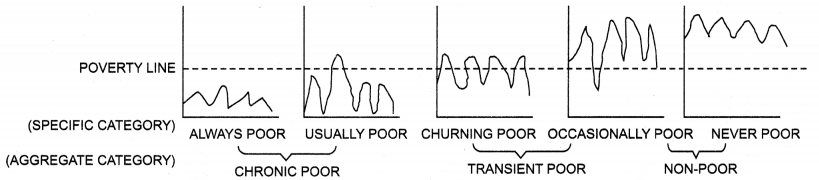
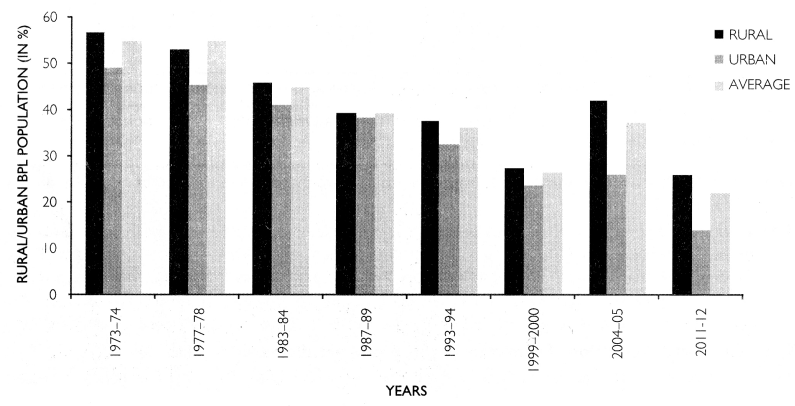
Rural Development Class 12 Important Extra Questions Economics Chapter 6

Here we are providing Class 12 Economics Important Extra Questions and Answers Chapter 6 Rural Development. Economics Class 12 Important Questions are the best resource for students which helps in class 12 board exams.

Class 12 Economics Chapter 6 Important Extra Questions Rural Development

Rural Development Important Extra Questions Very Short Answer Type

Question 1.
Define rural development.
Answer:
Rural development refers to the action plan for the economic and social upliftment of rural areas.

Question 2.
Name the key initiatives required for infrastructural development in rural areas.
Answer:
Key initiatives required for rural development include:

  • Expansion of rural credit
  • Development of irrigation facilities
  • Construction of roads
  • Organised agricultural marketing
  • Information dissemination

Question 3.
What has happened to the agriculture output during 2007-12?
Answer:
During 2007-12, agricultural output has grown at 3.2 percent.

Question 4.
Define credit.
Answer:
Credit is the amount of money available to be borrowed by an individual, which must be paid back to the lender at some point in the future.

Question 5.
What is the function of micro-credit programme?
Answer:
Micro-credit programme provides small loans to the needy for self-employment projects that generate income.

Question 6.
Classify rural credit.
Answer:
Rural credit can be classified into:
(i) Institutional Sources – commercial banks, regional rural bank, cooperatives, land development
(ii) Non-institutional Sources – moneylenders, traders, employers, relatives and friends

Question 7.
Why are moneylenders a popular source of rural credit?
Answer:
The moneylenders are a popular source of rural credit due to easy availability of credit.

Question 8.
When was NABARD set up?
Answer:
NABARD was set up in 1982.

Question 9.
What is agricultural marketing?
Answer:
Agricultural marketing is a process that involves the assembling, storage, processing, transportation, packaging, grading and distribution of different agricultural commodities across the country.

Question 10.
Name a few defects of agricultural marketing.
Answer:
Defects of agricultural marketing include:
(i) Sale at only village level
(ii) Inadequate transport facilities
(iii) Malpractices
(iv) Inadequate credit facilities

Question 11.
What is cooperative marketing?
Answer:
Cooperative marketing is a system through which a group of farmers join together to undertake some or all the processes involved in bringing goods to the consumer instead of individual sale.

Question 12.
What is agricultural diversification?
Answer:
Agricultural diversification refers to change in cropping pattern and/ or a shift of workforce from agriculture to other allied activities and non-agriculture sector.

Question 13.
Name the category that accounts for the largest share in livestock in India.
Answer:
Poultry accounts for the largest share in livestock in India with 58 per cent (in 2012).

Question 14.
What is operation flood?
Answer:
Operation flood is a system in which all the farmers pool their milk produced as per quality-based grading and process and market the same to urban centres through cooperatives.

Question 15.
What is the position of India in the production of fruit and vegetables?
Answer:
India is the second-largest producer of fruits and vegetables in the world.

Question 16.
What is the state of women in employment in fishery sector?
Answer:
Women are not involved in active fishing. However, they form about 60 per cent of the workforce in export marketing and 40 percent in internal marketing.

Question 17.
List some highly remunerative employment options for women in rural areas.
Answer:
Highly remunerative employment options for women in rural areas include:
(i) Flower harvesting
(ii) Nursery maintenance
(iii) Propagation of fruits and flowers
(iv) Food processing
(v) Hybrid seed production and tissue culture

Question 18.
What is sustainable development?
Answer:
Sustainable development is the process of development which fulfils the needs of the present generation without reducing the ability of the future generation to fulfil their own needs.

Question 19.
Define organic farming.
Answer:
Organic farming includes the entire system of farming that restores, maintains and enhances the ecological balance.

Question 20.
Why is the demand for organically grown food rising?
Answer:
The demand for organically grown food is rising in order to enhance food safety throughout the world.

Question 21.
List the major concerns related to promotion of organic farming.
Answer:
The major concerns related to promotion of organic farming are:
(i) Inadequate infrastructure
(ii) Problem of marketing the products

Rural Development Important Extra Questions Short Answer Type

Question 1.
Why is rural development important?
Answer:
The real progress of a country does not mean simply the growth and expansion of industrial urban centres. It is mainly the development of the villages, the rural sector. Development of rural sector is important because:
(i) agriculture is the major source of livelihood in the rural sector of India;
(ii) more than two-third of India’s population depends on agriculture; and
(iii) bulks of raw materials for industries come from agriculture and rural sector.
However, the level of agricultural productivity is so low that one-third of rural India still lives in abject poverty. Thus, it is important to develop rural India if our nation has to realise real economic and social progress.

Question 2.
What efforts has the government made for rural development?
Answer:
The government has made the following efforts for rural development:
(i) Prepared a road map for agricultural diversification with focus on horticulture, floriculture, animal husbandry and fisheries

(ii) Started Vishesh Krishi Upaj Yojana on I st April, 2004 as a special agricultural produce scheme with the objective of promoting exports of fruits, vegetables, flowers, minor forest produce, dairy and poultry ’

(iii) Focused on micro irrigation, finance, insurance and rural credit

(iv) Strengthened agricultural marketing infrastructure

Question 3.
Discuss the changes that have taken place in Indian agriculture and rural sector since initiation of reforms.
Answer:
After the initiation of reforms, the growth rate of agriculture sector decelerated to about 3 percent per annum during the 1991 -2012. Decline in public investment has been the major reason for this. The share of agriculture sector’s contribution to GDP has been declining while the population dependent on this sector has not shown any significant change.

There has been inadequate infrastructure, lack of alternate employment opportunities in the industry or service sector and increasing casualisation of employment, which further impedes rural development. During 2007-12, agriculture output has grown only at 3.2 percent.

Question 4.
What are the essentials of rural development?
Answer:
The essentials of rural development have been shown with the help of a diagram.
Economics Class 12 Important Questions Chapter 6 Rural Development 1

Question 5.
What are the limitations of non-institutional sources of credit?
Answer:
The following are the limitations of non-institutional sources of credit are:
(i) Moneylenders and traders exploit small farmers by charging very high rate of interest on loans.
(ii) They manipulate poor farmers’ credit accounts and keep them in debt trap.
(iii) They compel the farmers to sell their produce to him at low prices.
(iv) They do not issue any receipt after the payment is made by the farmer.
(v) They get the word cone by members of farmers family without any wages

Question 6.
What are significant features of moneylenders as a source of rural credit?
Answer:
The significant features of moneylenders as a source of rural credit are:
(i) Moneylender provides credit both for productive and unproductive purposes.
(ii) The money lending method is very simple. He provides loans for short-term, medium-term as well as long-term requirements of the farmer, without any legal formalities.
(iii) Moneylender provides loans with or without security.
(iv) If the farmer pays the interest on a regular basis, the moneylender does not compel the farmer to pay back the principal amount.

Question 7.
Discuss in brief the defects of agricultural credit.
Answer:
In India, the main defects in the agricultural credit system are as given under:
(i) Agriculturist needs to pay a very high rate of interest.
(ii) Moneylenders and traders are still the prominent source of agricultural finance.
(iii) There is a lack of coordination among the various agencies of rural credit.
(iv) Despite many institutions, adequate agricultural credit is not available. The institutional finance is only 50 percent of the total requirements of the farmer.
(v) The commercial banks hesitate to provide credit to agriculturist. Banks demand collateral as the risk involved is greater.
(vi) There is no systematic arrangement in New Agricultural Finance Corporations for agricultural credit.

Question 8.
Write a short note on the role and performance of SHGs as a source of credit. ;
Answer:
The formal credit delivery mechanism has not only proven inadequate but has also not been fully integrated into the overall rural social and community development. A vast proportion of poor rural households tend to remain out of the credit network as some kind of collateral is required to take loan from banks.

Self-Help Groups (SHGs) have emerged to fill the gap in the formal credit system. A typical SHG consists of 15-20 members. These members usually belong to one neighbourhood, who meet and save regularly. Saving per member depends on the ability of the people to save.

The SHG can extend these savings as small loans or micro credit to the needy members from the group I itself. Although the group charges interest on these loans, it is still less than what the moneylenders charge. Total SHG savings with banks increased from ₹ 23.9 billions as on 31st March, 2006 to around ₹ 70 billion as on 31 st March, 2011.

Question 9.
What should the rural banking sector do to improve the situation of rural credit in India?
Answer:
In order to improve the situation of rural credit in India, the rural banking sector should change their approach from being merely lenders to building up relationship banking with the borrowers. Developing the habit of savings and efficient utilisation of financial resources must be encouraged among the farmers.

Question 10.
What was the need for state intervention to regulate the activities of the private traders?
State intervention is required to regulate the activities of the private traders
Answer:
(i) to ensure adherence to standardised and open marketing procedures
(ii) to avoid collusion between brokers and traders that may cause disadvantage to the farmers
(iii) to ensure use of standardised weights and measures
(iv) to promote fair marketing fees; and
(v) to keep a check regarding unauthorised deductions from the purchase price payable to the framers.

Question 11.
Explain the policy instruments introduced by the government to safeguard the interests of farmers.
Answer:
Government has developed certain policy instruments to safeguard the interests of farmers. These instruments are:
(i) Fixation of Minimum Support Price (MSP): MSP is announced before the sowing season and assures agricultural producers against any sharp fall in farm prices. It provides long-term guarantee to the farmer.

(ii) Buffer Stock: The Food Corporation of India purchases wheat and rice from the farmers in states where there is surplus production and maintain it as buffer stock. Buffer stock is maintained by the government to stabilise prices. It helps in making the foodgrains available in the deficit areas and hence, resolves the problem of food shortage during adverse weather conditions or during the periods of calamity.

(iii) Public Distribution System (PDS): The PDS operates through fair price shops, also known as ration shops. The government offers essential commodities like wheat, rice, sugar, kerosene, edible oils, coal, cloth, etc. at a price below the market price to poor section of the society.

Question 12.
Write a short note on cooperative marketing societies.
Answer:
The cooperative marketing societies has been started in India in 1954 to assure reasonable prices to the farmers for their produce. The aim was to eliminate all the existing intermediaries from the market. It is a method of linking credit, farming and processing in order to help the farmers to get maximum advantage.

Cooperative marketing is responsible for collecting the produce from the members and disposing it off in the mandi (market) at a favourable time. The cooperative marketing societies, therefore, remove the defects of the present marketing system. The government sets up a cooperative credit society, commonly known as the Primary Agricultural Cooperative Societies (PACS), which can be initiated with 10 or more persons of the village. PACSs also provide loans to the farmers for productive purposes.

Question 13.
Discuss the objectives of cooperative marketing societies.
Answer:
The objectives of cooperative marketing societies are:
(i) To sell the products of its members at fair prices and distribute the sale proportionately among the members
(ii) To provide loans to members in need
(iii) To provide marketing information to the members
(iv) To provide seeds, fertilisers, pesticides and other inputs to the members
(v) To stabilise the prices of agricultural products

Question 14.
What is the need for agricultural diversification?
Answer:
Agricultural diversification is essential due to the following reasons:
(i) There is a greater risk associated with exclusive dependence on farming for livelihood.
(ii) Diversification provides productive sustainable livelihood options to rural people, thereby realising higher level of incomes for them.

Question 15.
Show the distribution of poultry and livestock in India with the help of a diagram.
Answer:
Poultry accounts for the largest share with 58 per cent. Cattle and buffalo account for 24 per cent of India’s total livestock. India had about 300 million cattle, including 108 million buffaloes, in 2012. Other animals which include camels, asses, horses, ponies and mules are in the lowest rung. The diagram below shows the distribution of poultry and livestock in India in 2012.
Economics Class 12 Important Questions Chapter 6 Rural Development 2
Question 16.
What are the benefits of horticulture?
Answer:
The benefits of horticulture are given below:
(i) Horticultural crops play a vital role in providing food and nutrition.
(ii) India has emerged as a world leader in producing a variety of fruits like mangoes, bananas, coconuts, cashew nuts and a number of spices.
(iii) India is the second largest producer of fruits and vegetables in the world.
(iv) Economic condition of many farmers engaged in horticulture has improved.
(v) Horticulture has become a means of improving livelihood for many unprivileged classes.
(vi) It provides highly remunerative employment options for women in rural areas.

Question 17.
Why should organic farming be adopted?
Answer:
Modern farming methods make excessive use of chemical fertilisers and pesticides, which led to loss of soil fertility; soil, water and air pollution, and high chemical contents in foodgrains. Therefore, there is an urgent need to conserve the environment and eco-system and hence, promote sustainable development.

Organic farming is an eco-friendly and inexpensive farming technology,which can be easily purchased by small and marginal farmers. It restores, maintains and enhances the ecological balance. Moreover, organically grown food is considered more nutritious and healthier than chemically grown food.

Rural Development Important Extra Questions Long Answer Type

Question 1.
Discuss the key issues of action plan for rural development in India.
Answer:
The following are the key issues of action plan for rural development in India:
(i) Land Reforms: Land reforms are the measures to bring about changes in the ownership of land holdings to encourage equity. Land reforms providing a land system conducive for agricultural development should not only be enacted but also be faithfully implemented. The official land tenure system must aim at land to the tiller as self-cultivation can induce maximum improvement in farming.

(ii) Poverty Alleviation: Action plan for rural development includes high priority to poverty alleviation in the rural areas. For the overall development of each locality and in the rural areas special schemes like MNREGA should be launched.

(iii) Human Capital Formation: Human capital formation is still a major task in rural areas of the Indian economy. India has a huge pool of manpower resources but the available manpower lacks basic skill and training. Therefore, in order to make the -available resources strong and efficient, the action plan for rural development should consider the challenging issues like literacy, healthcare, education, on the job training, etc.

(iv) Development of Infrastructure: Development of infrastructure includes the following:

  • Provision of credit facilities to the farmers in the rural areas
  • Permanent water supply throughout the year in the areas receiving less or low rainfall
  • Availability of agricultural research facilities to enhance the crop yield and productivity
  • Development of efficient means of transport, communication and power resources.

Question 2.
Explain the various non-institutional sources of rural credit in India.
Answer:
The various non-institutional sources of rural credit in India are:
(i) Moneylenders: Moneylenders typically offer small personal loans to farmers at high rates of interest. They charge high interest rates due to the level of risk involved. They lend to people with limited access to banking activities.

(ii) Traders and Commission Agents: Traders and commission agents are also non-institutional source of agricultural finance. They advance loans to agriculturists for productive purposes against their crops without any legal agreement. They force them to sell their produce at low prices and charge heavy commission for themselves.

(iii) Landlords: Small and marginal farmers mostly depend on landlords for credit in order to satisfy their day-to-day requirements; However, with the abolition of zamindari system, this source has lost its importance to a large extent.

(iv) Relatives: Sometime the farmers have to borrow from their relatives and friends to meet their financial crisis. This type of loan does not carry interest.

Question 3.
What are the sources of institutional credit in India? Explain.
Answer:
The sources of institutional credit in India include the following:
(i) Government: The government provides loans to the farmer for his short-term as well as long
term needs. Normally, these loans are given at the time of natural calamities such as droughts, floods, etc. Long-term loans are given for making permanent improvements and a very low rate of interest is charged for the same.

(ii) Cooperative Credit: The cooperative credit societies meet the requirements of only short-term credit. However, to bring about permanent improvement on land and to introduce modern technology, long-term heavy investment is required. Land development banks are supposed to advance long-term loans for this purpose.

(iii) Commercial Banks: After the nationalisation of 14 big banks in 1969, the commercial banks have also started taking keen interest in farm financing. A number of schemes have been introduced to help the farmers so that they may introduce the modern,technology in agriculture. Most families covered by these banks are big landlords, who could give adequate security to the bank in the form of land mortgage.

(iv) Regional Rural Banks: A new rural credit agency has’ been set up to provide loan to the agriculturists. RRBs have been opened by the joint efforts of the central and state governments and commercial banks. These banks have been set up-in the rural areas where enough credit has not been available but there are substantial potentialities of agricultural development.

(v) National Bank for Agriculture and Rural Development: NABARD was set up on 12th July, 1982 as an apex body to look after the credit needs of the rural sector. It has got an authority to oversee the functioning of the cooperative sector through its agricultural credit department. It provides long-term loans by way of refinance of land development banks, cooperative banks, commercial banks and regional rural banks.

(vi) Kisan Credit Card (KCC) Scheme: This scheme was introduced in 1998-99 and it has made rapid progress, with the banking system issuing more than 556 lakh cards by November, 2005. This scheme has helped in augmenting the flow of short-term crop loans for seasonal agricultural operations to farmers. Besides the existing facilities, the KCC scheme has been enlarged to include long-term loans for agriculture and allied activities along with a component to meet the consumption needs.

Question 4.
Suggest some measures for the improvement of rural credit.
Answer:
The following measures should be adopted for the improvement of rural credit:
(i) Coordination: The different agencies of agricultural credit must be coordinated to facilitate efficient disbursal and utilisation of financial resources.

(ii) Deposit Insurance Scheme: The cooperative banks should start the Deposit Insurance Scheme to attract the maximum deposits from the public.

(iii) Cooperative Marketing Societies: The credit and cooperative marketing societies should be integrated. It will ensure the paying back of loans as the farmers sell their produce to cooperative markets.

(iv) Increase in Capital Resources: It is necessary to increase capital resources of the cooperative credit societies to meet the need of the farmers.

(v) Easy Availability of Loans: The loan process should be made simpler. The main reason for popularity of the moneylender is simple methods of lending the amount. The formalities should be minimised.

(vi) Efficient Management: The credit agencies should be efficiently managed. The managers should have complete knowledge about agriculture and they should be sympathetic towards

(vii) Promotion of Savings: To promote savings, the farmers should be given incentives. The government should use its mechanism to encourage farmers to save more and avoid unnecessary spending.

Question 5.
Explain the significance of agricultural marketing in rural development.
Answer:
An efficient marketing system is of great significance for the development of agricultural economy like that of India. Proper marketing of agricultural products is undoubtedly favourable to the farmers because it ensures fair price for their produce. The fair price encourages them to produce for the market. The needs of urban sector are better satisfied and the process of industrialisation gets a boost.

As a result, the income of the farmers rises, increasing their demand for industrial output. Thus, improvement in farm marketing helps the process of development. Naturally, an important problem of Indian agriculture concerns the marketing of its produce. In order to increase the income of the farmers and to promote economic growth of India, it is necessary that the problem of agricultural marketing be solved.

It is a fact that economic prosperity depends upon a sound system of marketing. In India, it becomes important because some states produce much more than their requirements and have to supply to other deficit parts of the country.

Question 6.
Discuss the conditions required for efficient agriculture marketing in India.
Answer:
Following are the conditions necessary for efficient marketing in India:
(i) Storage Facilities: Efficient marketing needs adequate storage facilities so that they should be able to wait for times when they could get better prices of their produce. Moreover, they do not have to dispose off their surplus produce immediately after harvesting.

(ii) Freedom from Moneylenders: In India, there is large number of moneylenders who compel farmers for distress sale. Thus, credit facilities should be extended to save them from the clutches of moneylenders.

(iii) Transportation Facilities: Farmers should have cheap and adequate transport facilities so that they may be able to take their surplus to the regulated markets instead of selling it away at the village level.

(iv) Reduced Intermediaries: The number of intermediaries should be minimised so that the profits of middlemen may be reduced. This in turn will increase the returns to the farmers.

(v) Adequate Information: Farmers should have adequate and clear information regarding the market conditions as well as about the prevailing prices otherwise they may be cheated. There should be organised and regulated markets where they can directly sell their produce.

Question 3.
Discuss the importance of cooperative marketing in India.
Answer:
The following are the advantages of cooperative marketing in India:
(i) End of Middle Man: The agricultural cooperative marketing has ended the presence of middle man in the process of sale and purchase of products. With the help of cooperative marketing, S agriculturists get fair price of their products.

(ii) Increased Bargaining Power of the Producers: With the help of cooperative marketing, farmers are less prone to exploitation and malpractices. Instead of marketing their produce individually, they market it together through one agency. This increases their bargaining’strength as merchants and intermediaries.

(iii) Direct Dealing with Final Buyers: The cooperatives can altogether skip the intermediaries and enter into direct dealing with the final buyers, which eliminates exploiters and ensure fair prices to both the producers and the consumers.

(iv) Standardisation and Gradation of Agricultural Produce: This task could be done more easily by a cooperative agency than by an individual farmer. Thus, each member can take advantages of standardisation and gradation of produce.

(v) Control Over the Supply of Produce: Prices of the produce fall down during cropping season
due to excess supply in the market. The cooperative marketing societies provide storage facilities. As a result, there remains a control over the supply of produce. The farmers can wait for better prices.

(vi) Credit Facilities: The cooperative marketing societies provide credit facilities to the farmers to save them from the necessity of selling their produce immediately after harvesting. This ensures better returns to the farmers.

(vii) Provide Training of Commercial Methods: The cooperative societies also provide training to the farmers for cooperative efforts and commercial methods in the marketing, which develops the cooperative tendencies in the rural areas.

(viii) Advertisement and Publicity: Through advertisements and publicity services, cooperative marketing increases the sale of farmer’s produce, which enlarges the size of the market.

Question 4.
Explain the advantages and limitations of organic farming.
Answer:
Advantages of Organic Farming
(i) Inexpensive Process: Organic agriculture substitutes costlier agricultural inputs with locally produced organic inputs, which are cheaper and hence, generate more return on investment.

(ii) Generates Higher Income: It generates higher income by means of international exports as the demand for organically grown products is rising.

(iii) Healthier Food: Organically grown food has more nutritional value than chemically grown food. It, therefore, provides us with healthier and tastier foods.

(iv) Creates Employment: Since organic farming organic farming requires is a labour-intensive process, it will solve the problem of unemployment.

(v) Eco-friendly: Organic goods are pesticide-free and produced in an environmentally sustainable way.

Limitations of Organic Farming

  • Yields from organic farming are less compared to the yield from modern agriculture farming, at least in the initial years.
  • Organic produce may also have more blemishes and a shorter shelf life than sprayed produce.
  • Infrastructural facilities are inadequate to encourage small farmers to adapt organic farming
  • There is a limited choice to produce off-season crops in organic farming.

Rural Development important Extra Questions HOTS

Question 1.
Explain the working of an SHG formed in Tamil Nadu.
Answer:
TANWA is a Tamil Nadu Women in Agriculture project,- which was initiated in Tamil Nadu to train women in the latest agricultural techniques. It induces women to actively participate in raising agricultural productivity and family income.

At a farm, women’s group in Thiruchhirapalli run by Anthoniammal, trained women successfully make and sell the vermicompost and earn money from this venture. With the accumulated savings, they promote small-scale household activities such as mushroom cultivation, soap manufacture, doll making or other income generating activities.


Human Capital Formation In India Class 12 Important Extra Questions Economics Chapter 5

Here we are providing Class 12 Economics Important Extra Questions and Answers Chapter 5 Human Capital Formation In India. Economics Class 12 Important Questions are the best resource for students which helps in class 12 board exams.

Class 12 Economics Chapter 5 Important Extra Questions Human Capital Formation In India

Human Capital Formation In India Important Extra Questions Very Short Answer Type

Question 1.
Define human capital.
Answer:
Human capital is the stock of knowledge and skills that make the workers productive,

Question 2.
List the sources of human capital.
Answer:
The sources of human capital are:
(i) Education
(ii) Health
(iii) On-the-job training
(iv) Labour market information
(v) Migration

Question 3.
Why do individuals invest in education?
Answer:
Individuals invest in education to increase their future income.

Question 4.
What is the main reason for rural-urban migration?
Answer:
Unemployment is the main reason for rural-urban migration.

Question 5.
Define physical capital.
Answer:
Physical capital refers to the manufactured assets used in the process of production such as machinery, equipment, buildings, vehicles, etc.

Question 6.
Define economic growth.
Answer:
Economic growth refers to the increase in real national income of a country.

Question 7.
List the indicators of educational achievement in a country.
Answer:
The indicators of educational achievement in a country are:
(i) Adult literacy rate
(ii) Primary completion rate
(iii) Youth literacy rate
(iv) Net attendance ratio
(v) Teacher-pupil ratio

Question 8.
What are the indicators used to measure the health status of a country?
Answer:
The indicators used to measure the health status of a country are:
(i) Life expectancy rate
(ii) Mortality rate

Question 9.
What percentage was set as the goal for expenditure on education?
Answer:
It was set at 6 percent of the GDP.

Question 10.
What is the present literacy rate of India?
Answer:
The literacy rate of India (201 1-12) is 74 percent.

Question 11.
Name die institutions that regulate the education sector in India.
Answer:
NCERT, AICTE and UGC regulate the education sector in India.

Question 12.
Which institutions regulate health sector in India?
Answer:
ICMR and Health departments regulate the health sector in India.

Question 13.
What was the rate of unemployment among rural youth female with education up to secondary level and above, as per NSSO data in the year 2011-12?
Answer:
30 percent

Question 14.
What was the rate of unemployment among youth with education up to primary level, as per NSSO data in the year 201 1-12?
Answer:
3 to 6 percent

Question 15.
Why is the level of unemployment is the highest among educated youth?
Answer:
The level of unemployment is the highest among educated youth as the standard of higher education institutions is very low.

Human Capital Formation In India Important Extra Questions Short Answer Type

Question 1.
List the benefits of education.
Answer:
Following are the benefits of education:
(i) It gives a better social status and pride.
(ii) It enables wise decision-making.
(iii) It enhances social outlook and develops understanding to accept the changes taking place in society.
(iv) It stimulates innovations and facilitates adaptation of new technologies.

Question 2.
Discuss the need for human capital.
Answer:
The population of the nation takes charge of all economic activities such as production, distribution and consumption. Human capital, therefore, may be recognized as one of the production factors, which can generate additional values. An economy needs sufficient human capital in the form of educated, trained and competent people to function and accomplish its goals. As we move deeper into a knowledge-based economy that depends on information, knowledge and high-level skills, human capital becomes increasingly important.

Question 3.
What are the different forms of health expenditure?
Answer:
The different forms of health expenditure include expenditure on:

  • Preventive medicine – medical practices which are designed to avoid or avert diseases
  • Curative medicine – health care practices that are used to treat patients with the intent of curing them, not just reducing their pain
  • Social medicine – medical practices concerned with the role of social factors in the occurrence, prevention and treatment of disease
  • Provision of clean drinking water
  • Good sanitation

Question 4.
Discuss the need for expenditure on information as a source of human capital.
Answer:
People need to incur expenditure in order to acquire information related to equity markets, labour markets, education, health and other related markets. For instance, expenditure is incurred while collecting information related to education such form fees, transportation cost, consultancy fee, etc. Information plays an important role in making decisions regarding investments in human capital.

Moreover, expense is incurred for efficient utilisation of the acquired stock of human capital. The i money spent on obtaining information related to any kind of markets is a source of human capital formation.

Question 5.
What are the advantages of human capital formation?
Answer:
The following are the advantages of human capital formation:

  • It increases efficiency and income generating capacity of labour
  • It improves technical knowledge.
  • It enlarges the size of business.
  • It increases the level of production.
  • It changes social outlooks.
  • It decreases cost of production.

Question 6.
“Higher income leads to high level of human capital.” Comment
Answer:
Higher income leads to development of high level of human capital and vice versa. In other words, high level of human capital leads to growth of income. It is believed that even a large population, which is trained and educated, can become an asset in accelerating economic growth and ensuring social change in desired directions.

However, it is difficult to establish a relation of cause and effect from the growth of human capital to economic growth as the rate of growth human capital in developing countries has been faster than the rate of growth of per capita real income.

Question 7.
Discuss India’s potential as a knowledge economy.
Answer:
India has the potential to become a leading knowledge-based economy. With its youth population and growing information and communication technology (ICT) industry, India can become a major global knowledge-based economy. However, there is a need for measures such as:

  • Supportive laws
  • Improved infrastructure
  • Removal of barriers to trade and investment
  • Up-skilling of labour force
  • Higher spending in research and development
  • Innovative financing for small businesses and enterprises

A shift to knowledge-based growth would help developing country like India avoid the middle-income trap and also address the issue of rising income inequalities.

Question 8.
Give an account of government’s expenditure on education.
Answer:
During 1952-2014, education expenditure as percentage of total government expenditure increased from 7.92 to 15.7. As percentage of GDP, expenditure on education increased from 0.64% to 4.1 3% over the same period. However, the increase in education expenditure has not been uniform. The share of elementary education is the highest in the total education expenditure while that of higher/ tertiary education is the least.

Question 9.
What initiatives have been taken by the government to provide equal access of education to all?
Answer:
The following initiatives have been taken by the government to provide equal access of education . The Government of India enacted the ‘Right to Education Act’ in 2009 to make free education a fundamental right of all children in the age group of 6-14 years.

Government of India has started levying a 2 per cent ‘education cess’ on all Union taxes. The revenue earned from education cess is spent on elementary education.The government sanctions a large outlay for the promotion of higher education and new loan ; schemes for students to pursue higher education.

Question 10.
State the problems of human capital formation in India.
Answer:
The problems of human capital formation are:
(i) High cost of human capital formation
(ii) Low levels of adult and agricultural education
(iii) Less priority to secondary education
(iv) Limited stock of human capital formation

Question 11.
Why is it important to promote education for women in India?
Answer:
It is important to promote education for women in India due to the following reasons:
(i) It helps in improving women’s economic independence and their social status.
(ii) Women education has a favourable impact on fertility rate and women and child health care.
(iii) Educated woman can provide better guidance to her children.

Human Capital Formation In India Important Extra Questions Long Answer Type

Question 1.
Differentiate between human capital and physical capital.
Answer:
Following are the points of difference between human capital and physical capital:

Physical CapitalHuman Capital
1. Physical capital formation is an economic and technical process.Human capital formation is partly a social process and partly a conscious decision of the possessor of the human capital.
2. Physical capital is separable from its owner.Human capital is inseparable from its owner.
3. The owner of a physical capital need not be present at the place where it is being used.The owner of human capital needs to be present at the place of use.
4. Physical capital is tangible and can be easily sold in the market.Human capital is intangible. It is built in the body and mind of the owner.
5. Physical capital is completely mobile between countries except in case of some artificial trade restrictions.Human capital is not perfectly mobile between countries as movement is restricted by nationality and culture.
6. Continuous use of machines leads to wear and tear and depreciation. Moreover, change of technology makes a machine obsolete.Depreciation also takes place in case of human capital in the form of ageing. However, it can be reduced through continuous investment in health and education.
7. Benefits of physical capital flow only to those who pay the price for the product and services produced by it. That is, physical capital creates only private benefit.Human capital creates external benefit. That is, it benefits not only the owner but also the society in general.

Question 2.
Explain the various sources of human capital.
Answer:
Following are the sources of human capital:
(i) Education: Investment in education is considered as one of the source of human capital. Without education, human beings have only brutal manpower, in the form of physical labour. Investment in education gives human beings additional skills to do the same job.

It converts human beings into human capital, which enhances the labour productivity. This investment in education will ultimately increase the income of human beings in future.

(ii) Health: Health is another significant source of human capital. The health of a person affects human capital. A sick person, without access to medical facilities, is compelled to abstain from work and there is a loss of productivity. Expenditure on health directly increases the supply of healthy labour force and hence, a source of human capital formation. The various forms of health expenditure are:

  • Preventive medicine such as vaccination
  • Curative medicine such as interventions during illness
  • Social medicine such as spread of health literacy
  • Provision of clean drinking water
  • Good sanitation

(iii) On-the-job Training: Firms incur expenditure on providing on-the-job training to their workers. Training imparts technical skills and know-how among the workers while working at the actual work site. On-the-job training helps in enhancing the productivity of the workers and facilitates better utilisation of raw materials. It enables workers to absorb values and standards of an organisation. The workers may be trained by either of the following two methods:

  • Training within the firm under the supervision of a skilled worker
  • Off-campus training

(iv) Migration: People migrate in search of jobs that fetch them higher salaries than what they may get in their native places. For instance, engineers and doctors migrate to other countries for higher salaries that they may get in such countries.

Migration involves transportation cost, higher cost of living in the migrated place and psychic cost of living in an unknown socio-culture set¬up. However, the increased earnings at the new place outweigh the cost of migration. Hence, expenditure on migration is also a source of human capital formation.

(v) Labour Market Information: People need to incur expenditure in order to acquire information related to equity markets, labour markets, education, health and other related markets. For instance, expenditure is incurred while collecting information related to education such form fees, transportation cost, consultancy fee, etc.

Information plays an important role in making decisions regarding investments in human capital. Moreover, expense is incurred for efficient utilisation of the acquired stock of human capital. The money spent on obtaining information related to any kind of markets is a source of human capital formation.

Question 3.
Explain the role of human capital formation in economic development.
Answer:
The role of human capital formation in economic development is discussed below:

(i) Increase in the Efficiency of Labour: Investment in human capital through education, health, training, etc. increases the efficiency of labour. This, in turn, helps in achieving the path of economic development.

(ii) Enlarged Size of Business: The size of business can be enlarged by efficient entrepreneurs and innovators. An entrepreneur becomes efficient by investment in human capital and this efficiency ultimately leads to economic development.

(iii) Increase in Production: Increase in the total output produced by a country leads to economic development. Human capital formation produces able and efficient persons who use their knowledge, skills and efficiency to increase the production.

(iv) Change in Social Outlook: Spread of education and health facilities enhances social outlook and develops understanding to accept the changes taking place in society. These positive changes also contribute significantly towards economic development.

(v) Reduced Production Cost: Reduction in the production cost is essential for the economic development. Human capital formation helps to decrease the production cost.

Question 4.
Briefly describe the two reports that point out the fact that further human capital formation in India will move its economy to a higher growth trajectory.
Answer:
Two independent reports on the Indian economy have identified that India would grow faster due to its strength in human capital formation.
(i) According to a report – ‘Global Growth Centres’- published by Deutsche Bank, India will emerge as one among four major growth centres in the worid by the year 2020.

The report supports the view that increase in human capital is crucial to achieving increases in GDP and hence, it states that between 2005 and 2020 we expect a 40 per cent rise in the average years of education in India.

(ii) World Bank’s report, ‘India and the Knowledge Economy Leveraging Strengths and Opportunities’, states that India should make a transition to the knowledge economy.

According to the report, Indian economy has all the key ingredients required for making this transition such as, a critical mass of skilled workers, a well-functioning democracy and a diversified science and technology infrastructure. Moreover, it is expected that the per capita income of India will increase from approximately US $ 1000 in 2002 to US $ 3000 in 2020 if it uses its knowledge as much as Ireland does.

Question 12.
What are the objectives and functions of NCERT, UGC, AICTE and ICMR.
Answer:
The objectives and functions of different organisations are as below:
(i) National Council of Educational Research and Training (NCERT): NCERT is an autonomous organization set up in 1961 by the Government of India to assist and advise the Central and State Governments on policies and programmes for qualitative improvement in school education.

(ii) University Grants Commission (UGC): The UGC, set up in 1953, has the unique distinction of ‘ being the only grant-giving agency in the country, which has been vested with two responsibilities:
providing funds and coordinating, determining and maintaining standards in institutions of higher education.

(iii) All India Council for Technical Education (AICTE): AICTE was set-up in November 1945 as a national level apex advisory body to conduct survey on the facilities on technical education and to promote development in the country in a coordinated and integrated manner.

(iv) Indian Council of Medical Research (ICMR): The Indian Research Fund Association (IRFA), re-designated as ICMR in 1949 in New Delhi, is the apex body in India for the formulation, coordination and promotion of biomedical research. It is one of the oldest medical research bodies in the world.

Question 13.
Suggest measures to reduce problems of human capital formation.
Answer:
The following are the measures should be adopted to reduce the problems of human capital formation in India:
(i) More Emphasis on Technical Education: Technical education makes a person income earner soon. On thd other hand, college or university education is increasingthe number of unemployed; Therefore, more emphasis should be given on technical education to reduce the problem of human capital formation.

(ii) Need for Government-run Programmes in Education and Health Sector: For the removal of different problems of human capital formation, there is a need for the different formsi of.government intervention in the education and health sector. In this regard, government has started many programmes in education sector such as Sarva Shiksha Abhiyart (SSA), MidMeal Scheme, Kasturba Gandhi Balika Vidyalaya (KGBV), Prarambhik Shiksha Kosh (PSK), etc. The main objective of these programmes is to make universal access to all. In the health sector government has also started many disease control programmes.

(iii) Regulation of Fees Structure in Education and Health Care Institutions: it is very essential for the government to regulate the fees structure in education and health cane institutions, because the fee structures are very low in these institutions and the expenditure is very high, wtoebms regarded as unproductive for the country.

As a result, government sector is making great losses, Government’s income is falling short of its expenditure. For the development purpose onto remove the problems of human capital, it is very essential to regulate the fees structure in these sectors. The fees structure of private sector in education and health care institutions is manifofel more than the government sector. Therefore, it is necessary to regulate the fees structure in the government’s education and health institutions.

(iv) Change in Educational System: For the success of human capital formation, basic changes and improvements in educational system are essential. Technical and secondary education shouldai be compulsory and higher education should be provided to the able persons.

(v) Compulsory Secondary Education: For the success of human capital formation, secondary education should be compulsory to all, which will definitely help in increasing the productivity and efficiency

(vi) Proper Motivation. For the success of human capital formation programmes, proper motivation, is required. This will help the people to adopt modern techniques of production To conclude, for the development of any country, human capital formation is very important.Government of India is also investing a lot in the field of education and health for human.capitisformation.

Human Capital Formation In India Important Extra Questions HOTS

Question 1.
‘School dropouts are giving way to child labour.’ Discuss how this is a loss of human capital.
Answer:
Poverty forces many children into work. Child labour includes work that deprives children of their childhood and is harmful to their mental and physical development School dropouts prevent children from getting equipped with literacy skills and give way to child labour. These children generally work at dhabas, houses and construction sites. Being illiterate further propels the poverty cycle and hence, the process of human capital formation remains incomplete.

The Demographic Structure of the Indian Society Class 12 Important Extra Questions Sociology Chapter 2

Here we are providing Class 12 Sociology Important Extra Questions and Answers Chapter 2 The Demographic Structure of the Indian Society. Sociology Class 12 Important Questions are the best resource for students which helps in class 12 board exams.

Class 12 Sociology Chapter 2 Important Extra Questions The Demographic Structure of the Indian Society

The Demographic Structure of the Indian Society Important Extra Questions Very Short Answer Type

Question 1.
What is the population structure?
Answer:
By population structure we mean the distribution of the population of the country in different parts, the density of population, birth and death rate, immigration, emigration, education, sex ratio, etc. In population structure, different aspects of population and features of the population are studied.

Question 2.
What is Population Density?
Answer:
The ratio of a number of persons living per unit area or unit volume in a particular region or country is known as population density. It can be known only by the population living per square km of an area.

Question 3.
What is Economic Density?
Answer:
Economic density measures the economic resources of that area or country. It is the ratio of production capacity of all the resources and the number of people living in that particular area.

Question 4.
What is meant by excessive population?
Answer:
When the population of any country exceeds the highest production limit of that country then the population of that country is known as the excessive population.

Question 5.
What is life expectancy?
Answer:
Life expectancy is the other name of average age. The life expectancy of most of the people of living life is known as average age. It can be known on the basis of average.

Question 6.
What is meant by the growth rate of the population?
Answer:
The meaning of the growth rate of population is the increased rate of the population of any area of a country. It includes the difference in death rate and birth rate and the population coming in that area from another area.

Question 7.
What is meant by a population explosion?
Answer:
When the population of any country increases unexpectedly then it is known as the population explosion. When the population increases to a great extent then its results could become destructive. India is also facing this type of problem.

Question 8.
What is Family Planning?
Answer:
The meaning of family planning is to keep the family small in size. The size of the family should remain in control so that the income of the family should be more than expenditure. Giving birth to children according to one’s wish is called family planning.

Question 9.
What is the biological theory of increasing-decreasing population?
Answer:
According to supporters of the biological theory of increasing-decreasing population, fertility rate decreases with the increase in density of population because the power of producing children decreases with conceiving. It reduces the birth rate.

Question 10.
Give two methods of population control given by Malthus.
Answer:

  1. the First method of population control given by Malthus was preventive checks like postponing marriage or practising sexual abstinence or celibacy.
  2. the Second method was positive checks to population growth in the form of famines and diseases. Lots of people die due to these and thus, the population remains in control.

Question 11.
What do you know about the population theory of Malthus?
Answer:
According to Malthus, agricultural production grows in arithmetic progression (like 2, 4, 8, 10) but population rises in geometric progression (like 2, 4, 8, 16, 32, etc.) It means that a rise in population moves according to an increase in income or living standard.

Question 12.
What do you know about the Demographic Transition theory of population?
Answer:
This theory is based upon the experiences of all societies. It says that as birth rate increases and the death rate decreases, the population increases very quickly. It can be seen in modern societies where the death rate is being controlled but the birth rate is not being controlled as the death rate. It leads to a great increase in population. It is known as the demographic transition theory of population.

Question 13.
How can the birth rate be reduced?
Answer:

  1. If everyone will become literate then they will come to know about the merits of less population and demerits of more population. So they will try to keep the population in control.
  2. If the minimum age of marriage could be fixed then they will become mature and will come to know about the merits of less population.

Question 14.
Give the main features of the National Population Policy.
Answer:

  1. To bring down the death rate to 9 per thousand.
  2. To bring down the birth rate to 21 per thousand.
  3. To reduce the infant mortality rate to less than 60 per thousand.
  4. To bring down the population growth rate to 1.2% per year.

Question 15.
Give the literal meaning of Demography.
Answer:
Demography is the systematic study of the population. Demography is an English word which is made up of two Greek words ‘demos’ and ‘graphy which means the description of people.

Question 16.
When was the first and the last census survey carried out in India?
Answer:
The first census survey in India was carried out in 1872 and then it was carried out in 1881. Then, after every ten years, it is carried out. The last census survey in India was carried out in the year of 2011.

Question 17.
What is a Dependent population?
Answer:
That part of the population that depends upon others for their lives, for food, clothes and to live is known as a dependent population. In India, people of the age group of 0-14 years and 60+ years come in this category.

Question 18.
What are Urbanism and Urbanization?
Answer:
When people of villages go to urban areas and adopt the values, habits, ideals, etc. of cities then it is known as urbanism. Urbanization is a system of values in which relations of the people are full of individualism, formalism, etc.

Question 19.
Give some features of cities.
Answer:

  1. Division of labour exists in cities.
  2. Formal relations exist in cities.
  3. More industries are there in cities.
  4. Less dependence on agriculture.

Question 20.
What is Town?
Answer:
The area which is larger than a village but is smaller than the city is known as a town. Generally, that geographical area is known as a town which has a population of more than 5,000, the density of population is 400 persons per sq and more than 75% people are engaged in agricultural works.

Question 21.
What is the modern village?
Answer:
The village where the ideology of the people is affected by science, where scientific methods are used, where the sense of fraternity remains no more, where love, co-operation, values have very less importance and where agriculture is being done for the market is a modern village.

Question 22.
What is Jajmani System? (C.B.S.E. 2011)
Answer:
That system is known as the Jajmani system in which many lower or small castes used to give their services to higher castes and in lieu of which they used to get grains. One who used to take service was known as Jajmani and one who used to give service was known as Kamin.

Question 23.
What is a Joint Family?
Answer:
A family in which members of more than two generations live together is called a Joint Family. They live in the same house and income or expenditure are earned and spent jointly.

Question 24.
What is meant by homogeneity in rural life?
Answer:
When people of the same culture live in the village, their eating habits, ways of living, wearing, etc. are the same then this is known as homogeneity in rural life. People share a common culture in a village.

Question 25.
Give three differences between village and city.
Answer:

  1. The population is less in villages and more in cities.
  2. Few medical and educational services are available in villages but they are more in cities.
  3. Most of the rural people are engaged in agricultural works but most of the urban people are engaged in non-agricultural works.

Question 26.
Why are rural people moving towards urban areas?
Answer:

  1. Educational and health services of good quality are not available in villages.
  2. Rural people are attracted to urban pomp and show.
  3. More opportunities for employment are available in urban areas.

Question 27.
Tell us something about the literacy rate in India.
Answer:
The literacy rate of India in 2011 was 74% out of which 82.1% were males and 65.5% were females. This can be seen in the given table.

YearTotal PopulationMalesFemales
195118.327.28.9
196128.340.415.4
197134.546.022.0
198143.656.429.8
199152.264.139.3
200165.475.954.2
20117482.165.5

Question 28.
What are the major religions of India?
Answer:
Seven main religions exist in India:

(i)            Hinduism79.5%
(ii)           Islam13.2%
(iii)          Christianity2.4%
(iv)         Sikhism2.1%
(v)          Buddhism0.8%
(vi)         Jains0.5%
(vii)        Parsis and other tribal religions0.5%

The Demographic Structure of the Indian Society Important Extra Questions Short Answer Type

Question 1.
Give the main features of the Indian population.
Answer:
According to census survey 2011, following were the main features of the Indian population:

  1. Life expectancy in India was around 33 years in 1951 but in 2011 it has been increased to 66 years.
  2. Literacy rate in India in 1991 was 52% but in 2011 it has been increased to 74% out of which 82% are males and 65% are females.
  3. Sex ratio in 1951 was 1000: 946 but in 2011 it was 1000:940.
  4. The population density in India in 1951 was 117 persons per square km, but in 2011, it became 382 persons per sq. k.m.
  5. Urban population is increasing rapidly. Around 17% of people used to have in urban areas in 1951 as compared to 85% in villages. But this ratio has been changed to 32% and 68% respectively, in 2011.

Question 2.
Why is it necessary to reduce the birth rate in India?
Answer:

  1. More birth rate can lead to the danger of population explosion.
  2. More birth rate can lead to a reduction in per capita income and national income.
  3. More birth rate can lead to the problem of the food supply.
  4. It will increase the problems of poverty and unemployment.
  5. It will lead to the need for more investment.

Question 3.
What are the reasons for a higher birth rate in India?
Answer:

  1. People believe that more children will provide more hands in future.
  2. Literacy rate in India is very low.
  3. Improvement in health care facilities.
  4. Lack of awareness regarding birth control measures.
  5. Problems of child marriage or marriage at an early age.

Question 4.
Give the main features of the National Population Policy 2000.
Answer:

  1. To reduce the infant mortality rate to 30 per 1000.
  2. To reduce the maternal mortality rate to 100 per lakh.
  3. To encourage the late marriage of girls.
  4. Complete registration of birth, death and marriage.
  5. To take steps to give compulsory and free education to the children till the age of 14 years.
  6. To stop the spread of aids.
  7. To encourage family planning programme.

Question 5.
How is population explosion responsible for our lower standard of living?
Answer:
It is right that the population explosion is responsible for our lower standard of living. The population has been increased but per capita income has not been increased rather it has been reduced. If the population increases but national income does not increase, then, the growth rate will come down. Lower per capita income will lead to less consumption which results in a lower standard of living. It also leads to a bad impact on the health and working efficiency of the person.

Question 6.
Why is population control necessary?
Answer:
Population control is necessary because-

  1. It leads to an increase in per capita income.
  2. It increases the savings and growth of capital formation.
  3. It leads to a higher standard of living.
  4. We can find the solution to many problems like poverty, unemployment, etc.
  5. It reduces the prices of commodities and the problem of food also get solved with this.
  6. It can lead to more expenditure on public welfare.

Question 7.
How increasing population could be controlled? Give two ways.
Answer:

  1. Agricultural production of the country should be increased and industries should be developed so that the per capita income and national income could be increased. It will lead to a higher standard of living and low birth rate.
  2. Education is necessary for a higher standard of living so that people should remain conscious about the merits of less number of children: It will result in a reduction of population growth.

Question 8.
How population affects economic development?
Answer:
If the population will be more then it will have an adverse impact on economic development because if consumption will be more then production and the resources of the country will be depleted very quickly. It will reduce the national income and country will become poor. If the population will be less, then it will have a very good impact on economic development because production will be more than consumption. Resources of the country will remain intact for a longer period of time. Per capita income and national income of the country will increase as well. The living standard will remain high. In this way, less or more population have a great impact on the economic development of the country.

Question 9.
What are the demerits of more population?
Answer:

  1. It will lead to an increase in problems like poverty, unemployment, etc.
  2. The living standard of the people remains lower.
  3. The health of the people deteriorates with this.
  4. The problem of food affects the whole country.
  5. Economic development, national income and per capita income reduce with this.

Question 10.
What are the merits of less population?
Answer:

  1. The living standard of the people remains high.
  2. Health condition of the people remains good.
  3. Everyone gets employment.
  4. Employment leads to a reduction in poverty.
  5. Needs of everyone are fulfilled with this.

Question 11.
What is Family Planning?
Answer:
Family planning means to keep the small size of the family so that the income of the family should remain higher than expenditure. If income will be higher than expenditure then it will lead to a higher standard of living.

Question 12.
What is Migration? How many types of migration are there?
Answer:
Migration is an English which is to move towards other places by leaving one’s basic place of living. So, when a person leaves his place of birth and starts living at another place, then it is known as migration. He can come back to his basic place of living. It is of four types. First one is daily migration in which people go to other places for work, education or occupation in the morning and come back to their native place in the evening. The second one is seasonal migration in which people move towards another place in a specific season and come back to their native place at the end of the season.

For example, migration of labour at the time of harvesting of agricultural produce. The third one is occasional migration in which a person has to migrate if any specific circumstance arises due to any disease or any other reasons. Fourth and last one is permanent migration in which a person leaves his native village, city or country and migrates towards other city or country.

Question 13.
What was the population of India in 1951 and 2001?
Answer:
In 1951, the Indian population was 36.11 crore out of which 29.9 crore people lived in rural areas and 6.2 crore people lived in urban areas. In 2001, the Indian population was 102.70 crore out of which 74.2 crores were in rural areas and 28.5 crore people were in urban areas.

Question 14.
Which 22 languages are given in the Constitution of India?
Answer:

  1. Manipuri
  2. Nepali
  3. Sindhi
  4. Sanskrit
  5. Bangla
  6. Telugu
  7. Gujarati
  8. Kannada
  9. Odiya
  10. Assamese
  11. Urdu
  12. Kashmiri
  13. Tamil
  14. Punjabi
  15. Marathi
  16. Malayalam
  17. Hindi
  18. Konkani
  19. Dogri
  20. Santhali
  21. Maithili
  22. Bodo.

Question 15.
To which religion do people of India belong?
Answer:
People in India belong to different religions. 79.5% people are Hindus, 13.2% are Muslims, 2.4% are Christians, 2.1% are Sikhs, 0.81% are Buddhists, 0.5% are Jains and 0.5% belong to Parsi and other tribal religions.

Question 16.
Which two checks of population control are given by Malthus?
Answer:
1. Positive Checks: Those checks which are implemented by nature are called positive checks. That’s why the death rate increases. For example, war, epidemic, earthquake, famine, tsunami, flood, etc. These natural checks are very painful but they reduce the population to a great extent. These checks are not permanent.

2. Preventive Checks: These types of checks are the efforts made by humans. These are divided into two parts-morality and prevention through artificial means, sin moral checks, a person uses his mental level to control the population. In artificial means, Malthus tells about those means which are related by humans to control the population. According to Malthus, moral checks are good but artificial checks are against religion.

Question 17.
Tell something about Sex Ratio in IndiJi.
Answer:
Sex ratio is a cause of concern in India which) is reducing day by day. People want to have a male child and that is why they kill girl child even before birth. Thus, the number of females is decreasing. Only two states in India are there where females are more in number than males. Everything will be clear by the given data.

YearSex Ratio (in all age groups)
1951946
1961941
1971930
1981934
1991927
2001933
2011940

Question 18.
Why the programme of Family Planning was not very successful in India?
Answer:

  1. People who have religious faith believe in their fate. That is why they hardly care about family planning.
  2. People lack the proper means of family control. Whatever means are available with them, they are not properly used as well. That is the reason why this programme hardly became a success.
  3. Literacy level in India is quite low due to which they are unable to understand the merits of a small family. They are hardly aware of the fact that more number of children will affect the income of the family.
  4. Family planning programme is being run by the government and it always lacks financial resources. The given amount was always not enough for the whole of the country.

Question 19.
Show and explain the distribution of sex ratio in India on the outline political map of India.
Answer:
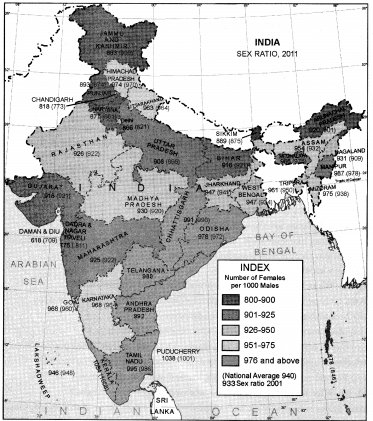
Sociology Class 12 Important Questions Chapter 2 The Demographic Structure of the Indian Society im-1
Source: Census 2011

This map tells us that many states like Kerala, A.P. and others have sex ratio more than 1000: 950 but some states like Punjab and Haryana have around 1000: 880 of sex ratio. The map also shows that great inequality exists in our India regarding sex ratio.

Question 20.
According to Ogburn and Nimkoff, how villages were developed?
Answer:
Ogburn and Nimkoff have divided the development of villages in three parts:
1. According to them, humans lived in jungles in the first stage. They were hunting animals or were collecting things to eat. They used to move to that place where food was available. Development of villages was not possible at this stage.

2. In the second stage, humans started to rear animals instead of killing them. Animals need fodder to eat. That is why people started to settle at those places where it was available. They used to leave the place when fodders depleted. That is the reasons why villages were also not developed at that stage.

3. In the third stage, a man came to know about the growing of plants. When they came to know about the growth of plants then they started to live in one place. Since food was available, they started to live a settled life. In this way, the villages came in front of us.

Question 21.
How can you say that village is a social unit?
Answer:
It is right that a village is a social unit. If we study Indian villages carefully then we would come to know that village is the main base of Indian culture. More than 70% of Indian population lives in villages and they are engaged in agricultural work, yet a number of changes are coming in villages but still, it is active in the form of a unit. Rural society is the main base of the Indian social structure. People of villages live in harmony with each other and celebrate their festivals with each other. They have primary and personal relations. In this way, we can say that village is a social unit.

Question 22.
Why is Urbanization increasing?
Answer:

  1. The country is becoming more industrialized.
  2. More facilities are there in urban areas.
  3. Services like education, medical facilities, etc. are easily available in cities.
  4. Employment is easily available in cities.
  5. More security is there in cities.

Question 23.
What are the changes coming in the rural community?
Answer:

  1. Now more and more people from villages are running towards cities.
  2. Now villagers are getting more education.
  3. Modern means of agriculture are being used these days.
  4. The caste system has lost its importance and the class system is taking its place.
  5. Now the social status of a person is determined by his individual traits.
  6. Formal relations are increasing instead of informal relations.

Question 24.
Why are the village Panchayats necessary for villages?
Answer:
India is basically an agricultural country where more than 70% population is engaged in agricultural works. Powers are decentralized by the Indian government so that villages could be developed and the administration of villages should run smoothly. Every¬one the orders of Panchs in villages. These days Panchayats even have the right to collect tax and to maintain peace in villages. That is why the village Panchayat is necessary.

Question 25.
Explain regional variations of low child sex ratio in India. (C.B.S.E. 2015)
Answer:
Regional variations of low sex ratio in India:

  1. Lowest child sex ratios are found in the most prosperous regions of India.
  2. Punjab, Haryana, Chandigarh, etc. are among the richest states in India in terms of per capita income, they also are the states with the lowest child sex ratio.
  3. The problem of selective abortions is not due to poverty, dowry or lack of resources but is due to wish to have a male child.
  4. Economically prosperous families decide to have fewer children. They may choose the sex of their child.

Question 26.
In what way formal demography is different from social demography? (C.B.S.E. 2015)
Answer:
Formal demography. In formal demography, many aspects are included such as quantitative field, analysis, measurement, statistics, mathematical counting and enumeration.

Social demography.

  • Focus on social, economic and political aspects.
  • Enquires into causes and consequences of population structures and changes.
  • Social processes and structures regulate demographic processes.
  • Trace the social resources for population trends.

Question 27.
The family programme suffered during the period of National emergency. Give reasons.
Answer:
Reasons for the setback of the Family planning programme during Emergency-

  1. Introduction of a coercive programme of mass sterilization.
  2. the Vast number of mostly poor and powerless people were forcibly sterilized.
  3. Sterilisation refers to medical procedures like vasectomy for men and tubectomy for women which prevent conception and childbirth.
  4. There was massive pressure on lower-level government officials (school teachers or office workers) to bring people for sterilization in the camps; that was organized specially for this purpose.
  5. Widespread popular opposition to the programme.

Question 28.
“Literacy as a prerequisite to education is an instrument of empowerment.” Discuss.
Answer:
Literacy as an instrument of empowerment. More literate the population the greater the consciousness of career options as well as participation in the knowledge economy-

  1. It can lead to health awareness and fuller participation in the cultural and economic well-being of the community.
  2. Literacy varies considerably across gender.
  3. It is still very low in social groups.
  4. Inequalities in literacy tend to reproduce inequality across generations.
  5. Regional variations are still very wide.

The Demographic Structure of the Indian Society Important Extra Questions Easy Answer Type

Question 1.
What is Social Demography? Give its definitions.
Answer:
Demography is an English word which is taken from the Greek language. First of all, this word was used by Gulliard, a French Scholar, in 1885. It is the science which studies and analyse the characteristics of the population. In other words, the study of the human population is known as demography.

Different scholars gave different definitions of demography from their own point of views. That is why it is very difficult to reach a common definition of it. But still, some of these definitions are given ahead:
1. According to Julliard, “Demography is the mathematical knowledge which studies the same features, material, social, intellectual and moral conditions of the population and in its broadest sense it is a natural and social history of the human race.”

2. According to Donald Bogg, “Demography is a mathematical and numerical study of the size of the human population, organization, local distribution and changes which occur in it due to birth and death rate, marriage, migration and fine processes of social mobility.”

3. According to Benjamin, “Demography is the related study of increase, development and mobility of the human population in the form of a universe.”

4. According to Hwipal, “Demography is the numerical study of human life.”

So on the basis of given definitions, we can say that demography is related to human science which deals with the distribution of the population. Qualitative and quantitative aspects of the population are studied in demography. Many elements could be included in it like the size of the human population, the structure of the population, its local distribution, birth rate, death rate, marriage, immigration, emigration, unemployment, mobility, etc. All these things are part of a demographic study. For example, the size of the population will increase with the increase in birth rate and size of the population will reduce with the increase in the death rate. In this way, all those things could be included in demography which affects distribution and density of population.

Question 2.
Explain briefly about the scope of social demography.
Answer:
Scope of Demography. Two points of views are there regarding the scope of social demography i.e. wider point of view and narrow point of view. Vans, Murrey and Spengler are the main exponents of a wider point of view and Burkley, Thompson and Lewis, Howzer and Dunkin are the main exponents of a narrow point of view. Certain differences are there between both points of views. In the first viewpoint, scholars study humans, their families and groups. The second point of view studies systems made by humans, their culture and social system. Usually, the deductive method is used in demography but now researchers have started using the inductive method. Demography can be divided into two parts.

  • Formal demographic processes in which the processes of birth, death, marriage, divorces are included.
  • Informal demographic processes in which age group, sex ratio, size and composition of the population are included.

Economic and social problems related to population are included in informal demography. These days informal demography has been changed into social demography because now demography is developing gradually into a particular subject. Size, distribution, the composition of the population, socio and economic factors are also included in its scope. Demography also studies socio-economic causes of change.

Bases of social demography are social processes and these bases regulate the social structures. In social processes, social and cultural exchange, values, customs, beliefs, education, familial structure, mobility, class, caste, marriage, occupations, kinships etc. are included. Sociologists who study social demography, he directly or indirectly also studies about the given concepts.

Question 3.
Which subjects are included in the subject matter of social demography?
Answer:

  1. Distribution of Population. Distribution of the population in cities and villages, business and geographical distribution are included in it.
  2. Size of Population. What is the size of the population, which factors affect the population, birth rate, emigration, immigration, growth rate etc. are included in it?
  3. Structure of Population. Many subjects related to population are included in it like age and structure, sex ratio, education, level of health.
  4. Changes in Population. Factors that are responsible for bringing change in the size and structure of the population are included.
  5. Features of Population. The features of the population and their comparative study are included in it.

From the point of view of the facility of study, the following subjects are also included in it.

  1. Biological: In this, birth rate, death rate, growth rate, causes of birth and death rate, sex ratio, age-structure, etc. are included.
  2. Social: Marital status, a form of religion, familial structure, education, caste system etc. are included in it.
  3. Geographical: Geographical distribution of population and their causes are included in it.
  4. Economic: In this, the status of employment and unemployment, living standard, income-level, quality of eatable things and their distribution, mobility of the population, the formation of the division of labour, the ability of population are included in it.

The subject of demography has got more importance since 1954 because its scope is increasing day by day.

Question 4.
Tell us something about the changing demographic position of India.
Answer:
To understand the changing demographic position of India, it is necessary to understand the following factors:
1. Birth and Death Rate. It is necessary to know about birth and death rate if we want to know something about the population of any country. This difference in birth and death rate tells us about an increase or decrease in population.

The birth rate has been reduced after independence but the death rate has also been reduced to a great extent due to better health services. Until 1951, the death rate was more because of which growth of population was very less. But during 1951-1991, the birth rate started reducing very slowly as compared to the death rate. The death rate has come in control. The death rate was 11.4 in 1991 which came down up to 9.0 in 2001 but the birth rate was 27 at the same time. That is why population growth was also higher. The birth rate in 2011 was 20.97% and the death rate was 7.48%.

2. Life Expectancy. Life expectancy is the possibility of a life of persons, in general conditions, who were born in a particular time period. According to the Human Development Report, life expectancy age was 77.7 years in 1997 in developed countries, 64.4 years in developing countries and it was 51.7 years in under-developed countries. Average life expectancy in India in the year 2011 was 66.8 years.

Life expectancy in India during 1911-21 was only 20 years which was increased up to 32 years in 1951. After independence, medical services were improved because of which it was increased to a great extent. It was 62.5 years in 2001.

3. Sex Ratio. Meaning of sex ratio is how many females are there behind 1000 males. In 2001, 49.6 crore females were there for 53.1 crore males. From this, it is clear that females were less than males. During 1901-2000, the general sex ratio has been reduced. Yet, the number of females increased in 1991, 2001 and even in 2011. Kerala is the only state in India where this ratio is in favour of females. Kerala has 1084 females for 1000 males. This ratio is 1000:1031 in Puducherry. In 2011, Haryana’s sex ratio was 877 and Chandigarh’s sex ratio was 818 which is the lowest.

4. Literacy. Literacy is not only a necessary element of demographic structure but it is also a symbol of human development of a country. Literacy rate in India at the beginning of this century was very low and it increased very slowly till 1947. Literacy rate in 1901 was 5.35% out of which 9.83% males and 0.60% females. In 1951, this rate was 27.16% for males and 8.86% for females and the overall rate was 18.33%. During the time period of 1951-2001, this literacy rate was increased from 18.33% to 65.38%. According to the Census Survey of 2001, 75.85% males and 54.16% of females were educated and in 2011, this rate was changed to 82.1% and 65.5% respectively. This difference is decreasing day by day. According to the Census of 2001 and 2011, Kerala and Lakshadweep have the highest rate of literacy.

5. Population Density. Population Density shows the ratio of land and population. Meaning of population density is the number of persons living in one square km. According to the Census of 2011, it was 382 persons per square km. In 2001, it was 324 and in 1991, it was 267. Some states of the country have a higher density of population and some have lower density. West Bengal, in 2011, was the highest among all the states in 1028 and Arunachal Pradesh was the lowest of all at 17. Delhi’s density of population was 11320 and it was 46 in Andaman and Nicobar.

6. Rural and urban population. Knowledge of rural and urban population is necessary to understand the demographic structure of the country. The population of urban areas has increased rapidly during 1901-2011.

Only 10.8% of people were living in cities in 1901. In 1951, 82.7% of people were living in villages and 17.3% in cities. It became 72.2% and 27.5% in 2001 and in 2011, it was 68.84% and 31.16% respectively. From this data, it is clear that people are migrating towards urban areas. In 2001, Goa was the first state where the most numbers of people (49.77%) were living in cities. In Himachal Pradesh, only 9.79% of people were living in urban areas.

7. Age structure. The age structure of the country shows an interesting picture of the population. According to the Census Survey of 1991, 36% population was of children up to the age of 14 years. 57% of people were of the age group of 15-59 years and 7% of people were of the age of 60 years and above. From different censuses, it is clear that age group up to 14 years is decreasing continuously and a population of 60 years and above is increasing. It is because of the increasing age of life expectancy.

8. Religion. Followers of many religions live all over India. In 1961, Hindus were 83.5% but they were reduced to 79.5% in 2011. Hindus are decreasing but Muslims were 10.7% in 1961 and became 13.2% in 2011. So during the time period of 1961-1991, Hindus decreased up to 1% but Muslims increased up to 1%. Christians and Jains also
reduced during this time period but Sikh and Buddhist population has been increasing at the same time.

So, we can see that Indian demography is constantly changing.

Question 5.
Give the main features of National Population Policy-1976 and National Population Policy-2000.
Answer:
India’s population has increased rapidly after 1947 because of the improvement of health services and a reduced rate of death. Yet birth rate was also reduced but not at the same pace as the death rate. That is why the National Population Policy was made which is given below.

National Population Policy 1976. On 25 June 1975, the then Prime Minister declared an emergency in the country that remained till 1977. During an emergency, the National Population Policy was announced.

  1. Minimum age of marriage for girls was increased from 15 years to 18 years and it was also increased for boys from 18 years to 21 years.
  2. The government especially tried to raise the literacy rate of women.
  3. Compensation for sterilization of male and females for family planning was increased.

The government started the process of sterilization with great pace and took advantage of emergency in the country. Hundreds of thousands of people were sterilized even against their wish. Around 8.2 million people were sterilized during this time period which is a record in itself.

National Population Policy 2000:- Government consulted different voluntary organisations, scholars, government machinery and those people who were interested in demography and made National Population Policy 2000 whose main aims are given below:-

  1. To bring down infant mortality rate up to 30 per thousand.
  2. To bring down the death of pregnant women up to 100 per lakh.
  3. To encourage the late marriage of girls.
  4. To register all the births, deaths, marriages and pregnancies.
  5. To give information, services and consultancy of types of delivery to all the people.
  6. To know new ways of prevention of pregnancy and to give this information to the people.
  7. To take steps for free and compulsory education for the children up to the age of 14 years.
  8. To stop spreading of AIDS.
  9. To maintain a balance between family planning and people-centred programmes.

So the main aim of both the policies was to bring down population growth. It has been said that around 25 crore children were stopped to take birth between 1976-2000.

Question 6.
Give the main features of population policy of India.
Answer:
India’s population has crossed the mark of 121 crores. It comes next to China. It has been said that if the Indian population will increase with this rate then it will cross China by the year 2020. Indian Government is very much worried about this aspect.

That is why it has made many population policies from time to time. Main features of all these policies are given below:
1. Reduction of Birth Rate. The death rate, from 1947 till today, has been reduced to a great extent. To stop the growth of population, it is necessary that the birth rate should also be reduced. So many direct and indirect methods are used while keeping in mind this thing. Indirect methods are reducing poverty, the spread of education among females and increasing literacy rate and direct method is family planning. Determination of age of marriage can also lead to the reduction of birth rate.

2. Wider scope. Scope of the subject of population policy is very wide. It includes methods of population control and other programmes like the health of mothers and infants, etc. This programme is developing within the programme of family planning.

3. Voluntary policy. The population policy adopted by the Indian government is a voluntary policy whose main aim is to control the population with the help of masses. People are told about the advantages of the small family under this programme and they are motivated to reduce the birth rate.

4. Different methods. The main aim of these policies is to reduce the birth rate and different methods are used in it. People are being informed about population control in family planning centres so that no problem should come to them while using these methods.

5. Propaganda. Family planning programme was started at a large scale. People are given related things either free of cost or at very less price. With this, this programme is propagated through Doordarshan, T.V., Radio, magazines, newspapers, books, etc. Doctors and nurses are being given special training so that they can inform the people about these programmes.

6. Organisation and Research. Money related to family planning programme is being given by the central government but this programme is implemented by state governments. People are being told about methods to reduce the birth rate and research related to this programme is still going on.

Question 7.
Explain briefly about the achievements of Indian Population Policy.
Answer:
Some of the achievements of Indian population policy are given below:-
1. Decline in Birth Rate. Population after independence has increased rapidly due to the decline in the death rate. The government also tried to reduce the birth rate with the death rate. That is why population policy was prepared. Birth rate, in 1951, was 40 per thousand but it reduced to 19.8 per thousand in 2011. In this way, the decline in birth rate is the main achievement of this programme.

2. Decline in Death Rate. Very fewer health services were available before independence because of foreign rule. After independence, our own government tried to maintain health services because of which death rate was reduced. The death rate, in 1951, was 27.4 per thousand but it came down to 7.8 per thousand in 2011. This rate is less as compared to all the other developing countries.

3. Life Expectancy. Life expectancy was very less before Independence due to non-availability of health services. But after Independence health services were increased and efforts were made to control the population. That is why life expectancy was doubled.

Life expectancy was 32 years in 1951, but it rose sharply and came to 66 years in 2011. One thing should be kept in mind that life expectancy is more among females as compared to males.

4. Sterilization. Sterilization is one of the good, popular and non-dangerous methods of population control. It is just like a small operation with which power of fertility of the person comes to an end. This number was 7153 in 1953 which became 18 lakh in 1967¬68, 80 lakh in 1976-77 and reached up to 6 crores in 1999-2000.

5. Decline in Infant Mortality Rate. The infant mortality rate has been reduced to half from 1947 to today. This rate was 146 in 1956 and it came down to 70 in 2001.

Thus, we can say that the Indian government has started many programmes to control the population and has got some success in it. Yet the birth rate is higher as compared to the death rate but still, the government is trying to reduce the birth rate.

Question 8.
What were the shortcomings of the population policy of India? Also, give some suggestions for better results.
Answer:
1. High Birth Rate. Indian Government has spent billions of rupees in the last 50 years on the programmes of family planning. Even this amount increases in every budget but the birth rate has been reduced only to 19.8 per 1000 from 41 per 1000 in a square km. This rate is 10 per 1000 in developed countries like the U.S.A., Japan, etc.

2. Low Life Expectancy. Life expectancy was 32 years in 1951 in India which was increased to 66 years in 2011 due to health services. This is 68 years in some countries, 78 years in developed countries and 64 in developing countries, which is higher than in India. So, even after the increase in life expectancy, this is less as compared to other countries.

3. High Infant Mortality Rate. The infant mortality rate is very high in India. This rate is 98 in India for the age of below 5 years but the 138 other countries have less infant mortality rate than India. Even some countries have infant mortality rate less than 10.

4. It remained a Government Programme. Family welfare and family planning programmes are completely financed by the central government but they are implemented by state governments. But even after such a long time, these programmes are unable to associate themselves with general masses. As a result of this, people take it as a governmental programme and hardly associate with it.

5. More concentration on expenditure. One of the drawbacks of population policy of India is that the government officials concentrate only on the expenditure of finance which is available for these programmes. They hardly care about the fact on which section this money is being spent and whether this expenditure is necessary or not.

Except this, illiteracy of the people, poverty, hesitation towards these programmes also became one of the reasons for drawbacks of these programmes.

Suggestions For Better Results

The following suggestions could be given to achieve better results in this programme:

  1. Youngsters should be motivated for late marriage so that they could be mature enough and should be able to understand the drawbacks of more children.
  2. Females should participate in economic activities, except household work, so that
    they could become economically independent and should take their own decisions regarding the size of the family.
  3. To achieve 100% literacy rate so that people should be able to understand governmental programmes.
  4. This programme should be implemented on those groups or castes which have higher birth rate so that their birth rate could be reduced.
  5. Complete registration of marriages, birth and death rate so that government should get complete data.
  6. Methods of family planning could be propagated through means of communication so that people could be able to understand them.

Question 9.
Describe Malthus’s theory of population growth and the theory of demographic transition.
Answer:
(A) Malthus’ theory of population growth-One of the most famous theories of demography is related to the English political economist, Thomas Robert Malthus. He was of the view that the human population tends to grow at a much faster rate than the rate at which the human subsistence can grow. Therefore, humanity is condemned to live in poverty forever because the growth of agricultural production will always be overtaken by population growth.

Because population growth is always more than the growth in production of subsistence resources, the only way to increase prosperity is by controlling the growth of population. But humans have very limited methods to voluntarily reduce the growth of population. Malthus was of the view that positive checks to population growth are in the form of famines and diseases. These were inevitable because they were nature’s way of dealing with the imbalance between food supply and increasing population.

According to Malthus, there are two checks of population control:-
1. Positive Checks-Those checks which are implemented by nature are called positive checks. That is why the death rate increases. For example, war, epidemic, earthquake, famine, tsunami, flood etc. These natural checks are very painful but they reduce the population to a great extent. These checks are not permanent.

2. Preventive Checks-These types of checks are the efforts made by humans. There are divided into two parts-morality and prevention through artificial means. In moral checks person uses his mental level to control the population. According to Mathus, moral checks are good but artificial checks are against religion.

(B) Theory of demographic transition-One of the significant theories in demography is the theory of demographic transition. This theory says that population growth is directly related to the overall levels of economic development and generally every society follows a typical pattern of development related to population growth. Three basic phases of population growth are there. The first phase is that of low population growth in an underdeveloped and technologically backward society. Growth rate here is low because the death rate and birth rate both are very high. That is why the difference between both or net growth rate is low.

The third phase is also one of low growth in a developed society where both the birth rate and death rate have been reduced to a great extent and there is very less difference between the two. But there is second or the transitional stage between the two, which is a movement from a backward to an advanced stage. This stage has a feature of very high rates of growth of population.

The transitional phase is related to population explosion because the death rate is brought down very quickly through better nutrition, public health and advanced methods of disease control. But birth rate does not reduce to such an extent and that is the reason why growth rate goes very high. Many countries are struggling to reduce the birth rate in keeping with the falling death rate.

Question 10.
What is the Rural Society? Explain its definitions.
Or
What is meant by Rural Community? What are its definitions?
Answer:
India is a rural country in which most of the population lives in villages. The rural area is that area where technique is scarcely used, importance is given to primary relations, which is small in size and where most of the population depends upon agriculture. Rural culture is very much different from urban culture. Yet the rural and urban cultures are not the same but they both are very much inter-related. It is very much different from urban society due to many factors yet it is a part of the whole society. Many of its factors like economic, geographical, social etc. differentiate it from urban society. Many scholars have tried to define it and its description is given below:-

Definitions
1. According to A.R. Desai, “The village is the unit of rural society. It is the theatre wherein the quantum of rural life unfolds itself and functions.”

2. According to R.N. Mukherji, “A village is that community which is characterized by relative homogeneity, informality, prominence of primary groups, the lesser density of population and agriculture as the main occupation.”

3. According to Peake, “The village community consists of a group of the related or unrelated persons larger than a single or unrelated person larger than a single-family, occupying a large house or a number of dwellings placed close together, sometimes irregularly, sometimes in a street and cultivating, originally in common, a number of arable fields, dividing the available meadowland between them and pasturing their cattle upon the surrounding wasteland, over which the community claims rights as far as the boundaries of adjacent communities.”

Thus, we can say that the rural community is that community which lives at a definite place, is small in size, which have very close primary relations. People know each other with great proximity and their main occupation is either agriculture or other related work.

Question 11.
Explain the different characteristics of Rural Society.
Answer:
1. Agriculture main occupation: The main occupation of rural society is either agriculture or any of the related work because they are very closely related to nature. Because of their close relationship to nature, their views towards life are very much different. Yet, many other occupations, like carpenter, blacksmith, etc. are there in villages but they also make tools related to agriculture.

2. Simple Life. Life of rural people is very simple: People in ancient rural societies used to do a lot of hard work to fulfil their needs and they were very much away from leisures of life due to this hard work. People engaged their children in agricultural works because they were unaware of the merits of education. They have any mental conflicts and problems. They are always ready to help each other in their problems.

3. Scarcity of population and homogeneity: The population of villages is very less as compared to the urban areas. People live in small groups in villages. There are very fewer occupations in rural areas except for agriculture because of which people like to go to cities to earn money and that is the reason why the population in villages is very less. People have close relations with each other and their views are also the same due to the same occupation.

4. Importance of neighbourhood: The neighbourhood is of great importance in rural society. The main occupation of the people is agriculture in which they get enough time at hand. People meet, talk and co-operate with each other. People have very close relations with their neighbours. Neighbours generally are of the same caste because of which their status is also same. People generally respect their neighbours.

5. Control of family: A person is in complete control of the family in rural societies. Generally, patriarchal families are there in the villages and every type of decision of the family is taken by the head of the family. Division of labour in villages is being done on the basis of sex. Males either do farming or move out of the house to earn money and females take care of the house. The joint family system is there in villages and person adopts the traditional occupation of the family. Every member of the family works with others and that is why they have community feeling among them. Family is known as the primary group.

6. Common culture: People of a village are not the outsiders who come to live in the village but are the original inhabitants of that village and that’s why their culture is common. Their culture, rituals, traditions, customs etc. are also common. That’s why they live with each other in a peaceful atmosphere. They have unity among themselves.

Question 12.
What are the changes coming in Rural Society? Explain them.
Or
What are transformations that took place in the rural society in post-Independent India? (C.B.S.E. 2011)
Answer:
1. Decreasing rural-urban differences: There were a number of differences in rural and urban societies during earlier times. But these differences between both societies are decreasing day by day. It is not so because rural people imitate the styles of urban people but it is so because the relations of rural and urban people are increasing due to the open market economy. They are selling their produce in the cities and are adopting new occupations. Their relations with outsiders are increasing and their way of living, eating, wearing, thinking, etc. are changing according to the urban people. Rural people are getting every type of urban facility due to developed means of transport. The lifestyle of urban areas is improving due to the mobility of occupation and rural-urban differences are decreasing.

2. Decreasing difference in the area: The most important change which came in rural society is that the difference between the village and the city is decreasing. Cities are moving towards villages and villages are coming closer to cities. Means of transport, roads, the spread of education and means of communication have brought villages closer to the urban areas. Now rural people are also moving very quickly towards cities. They work in cities and commute daily.

3. Changes in the structure of agriculture and the marketing of agriculture. With the advent of science and technology and with the opening up of agricultural institutions, the structure of agriculture has been completely changed. With the advent of new machines like tractors, thrashers, etc., increased facilities of irrigation, development of irrigation through rivers and drips, the advent of new seeds and with the development of markets, agriculture has reached the market level from subsistence level. Now, agriculture is not being done to fulfil the needs but is being done to earn the profit. Now, the exchange of things with money has taken place of exchange of things. Agricultural produce is 4 times a year. Production has been increased to a great extent. Now, India exports food grains instead of importing them.

4. Decreasing impact of religion: Religion had a great influence on the mindset of rural people in ancient times. Every activity of agriculture was according to religion and it is not seen today. In earlier times, many trees, animals, etc. were considered as sacred but now this influence has been reduced. Religious beliefs, customs of rural people have been completely changed.

5. Change in the rural social structure: Marx was of the view that social change comes with the change in economic structure. With the commercialisation and mechanisation of agriculture, not only people have become economically better but changes are also coming in old relations. Joint families are disintegrating, changes are coming in the division of labour, social values are deteriorating, mental tension is increasing, changes are coming in the status of women, etc. There are many aspects in which we can see many changes. Time of rituals at the time of birth, marriage, death, etc. is decreasing, Jajmani system no more prevails, the effect of social kinship is decreasing, the importance of the primary group is also decreasing.

6. Increasing impact of science: The land was considered as sacred in rural areas. Agriculture was done while keeping in mind the time of sowing. But now old beliefs are no more. Farmer is not a scientist but is using the new scientific methods and no more believes in age-old customs. Earlier, people were afraid of using chemical manures to their land but now they are using more and more fertilizers and machines so that the production could be increased.

Question 13.
What is meant by the Urban Community? What are its definitions? Explain them.
Answer:
Urban areas and people living in urban areas are rapidly increasing. More than 5,000 cities and towns are there in our country. Life of the people of urban areas has been greatly affected due to this increasing population. People of the middle class and higher class have been able to fulfil their needs but it has become very difficult for people of lower classes to fulfil their needs.

In simple words, the city is a formally spread community which is determined on the basis of living standard of the people living in any specific area and on the basis of urban characteristics. Word ‘city* is an English word that has the Latin language ‘civitas’ that means citizenship. In the same way, the English word ‘urban’ which has come out of a Latin word ‘urbs’ which also means city. To understand the exact meaning of the city, it is necessary for us to look at the definitions of this word given by different scholars. These are given below:

Definitions on the basis of population. According to the Census Bureau of America, the city is that place with a population of 25,000 or more. In the same way, Egypt has the limit of 11,000 and France has the limit of 2,000 for any place to be called a city. In India, a community of population more than 5,000 is known as an Urban area where the density of population is 400 or more and where 75% or more than 75% of people are engaged in non-agricultural occupations.

Definitions on the basis of occupations. The area is considered an Urban area where the main occupation of the people is not agriculture.

  1. According to Willcox, “The cities included all districts in which the density of population per square mile is more than 1,000 and where there is practically no agriculture.”
  2. According to Bergal, “City is an institution whose most of the citizens are engaged in other industries except agriculture.”
  3. According to Anand Kumar, “Urban community is a complex community of secondary relation with more population, based primarily on occupational and environmental differences.”
  4. According to Lewis Mumford, “City is that centre where more and more power of community and concentration of culture is there.”
  5. According to Louis Wirth, “In the city, people with many social differences are living in an area with more concentration of population.”

So on the basis of these definitions, we can say that the urban communities are those which are large in size, where secondary relations are of great importance, where a number of occupations are there and where the features like division of labour, specialisation and social mobility exist.

Question 14.
Explain briefly the various characteristics of urban society.
Answer:
1. Large population: A most important feature of urban society is the large number of people living and more density of population. Meaning of density of population is how many people are living per square kilometre. Cities can be divided into different classes on the basis of more or less population like small cities, medium cities and metropolitan cities. The population of the metropolitan cities like Delhi, Mumbai, Kolkata, etc. is more than one crore but the population of 13 states of India is less than one crore. Industrial houses, educational institutions, business centres and commerce centres are more in cities because of which the density of population is more in cities. Because of more population, many problems arise in cities like poverty, unemployment, crime, starvation, slums, etc.

2. Fewer places of living. Another important feature of cities is the lack of a place of living. It is so because of the more population of cities. It is a very serious problem in large cities. Many poor people are living on roadsides or under the trees or in slums. Middle-class families are living in small houses in cities where there is no place to play for children and where there is no separate room for them to sleep and study.

3. Secondary and formal relations. The most important feature of urban society is a large number of population. People do not have direct or face to face relations due to this large number of population. People in cities have formal relations with each other. A person establishes relations with other persons whenever any need arises.

4. Different occupations. Cities are developed on the basis of different occupations. Many industries, occupations and institutions exist in cities because of which different people are engaged in different types of occupations. Doctors, managers, engineers, specialised labourers, non-specialised labourers, and thousands of occupations exist in urban areas. More population is necessary for the needs of these different occupations.

5. Division in economic classes. Not much importance is given to the caste, religion and occupation of the person in urban areas. But the population in cities is divided into economic classes on an economic basis. Population, in cities, is not divided only in two classes of capitalists and labourers but many other small classes and sub-classes exist in cities on the basis of their economic status. The difference between higher and lower classes also exists.

6. Competition. Every person, in cities, gets enough chances to progress in every sector. We can find literate and able persons, in cities, in large number. That’s why too much competition is there in cities whether it is to get admission in educational institutions, to get a job and to get promotion in the job. Competition has been increased to a great extent.

Question 15.
What are the differences between rural and urban societies? Write in detail.
Answer:
1. Difference between family: Families in rural societies have complete control over the members because of which families are of great importance in villages. Very close relations are there among the members of a rural family. The joint family system exists in rural societies because their main occupation is agriculture and this occupation needs a number of people. All the members of the family have to obey the orders of the head of the family. Families in villages are patriarchal and the life of the person depends upon the thinking and decisions of the whole family.

But urban societies stand in contrast, where the family has very less control on its members: Generally, nuclear families exist in cities and very few joint families are there. Status of women in the urban family is very high as compared to rural areas but formal relations are there among the members of the family. Family, in cities, does not fulfil all the needs of the person but his needs are being fulfilled by many other means Females are working in offices and children are brought up in creches. Functions of urban families are very much opposed to that of rural families.

2. Difference between neighbourhood: Importance of neighbour in urban societies is very less. People in cities belong to different places, religions, castes etc. and hardly know anything about each other. Life of people is very much busy, that’s why they don’t have time to keep any type of relations with their neighbours.

Neighbourhood in rural society is considered as a primary group. Neighbourhood in villages gets enough importance because of the fact that people need each other’s cooperation in their daily fife. People of the village belong to the same caste, religion and economic class because of which they are very much close to each other.

3. Difference in occupation. Many types of occupations exist in urban society. Occupation is not generally forced on a person but is chosen according to the individual’s ability. Division of labour and specialization are in great demand in urban society.

The main occupation of the people of the village is generally agriculture and many other related works. Very limited occupations are there in villages during the last century. Generally, people used to adopt the occupation of agriculture or any other related work.

4. Difference in the density of population. The density of population in urban areas is too much because people come from far off places and start to live here. In metropolitan cities like Mumbai, Kolkata, etc., many people are living only in one room. People are coming out of their villages in search of a job and go to the city.

But the population in villages is very less because of which density of population is also very low. The main occupation of the people is agriculture because of which enough land is required for them.

5. Difference in the status of women. Status of females, in cities, is just like males. Girls are given higher education so that they are able to become economically self-dependent. Female is not restricted only to the four walls of the house but she also has a social status. She is very much independent to take her own decisions. Even males are working under females in some places. Important decisions of the family are being taken with the advice of female. Even family asks for her decision regarding marriage. In this way, her status is higher in urban areas.

But the status of women in rural society is very low. She doesn’t have any type of freedom. She is restricted only to the four walls of the house. Very less education is generally given to her. Her work is restricted only to take care of the children and the family.

Question 16.
Read the passage and answer the following questions:-

Hospital deliveries on the rise, maternal deaths dip New Delhi: Institutional deliveries, where children are delivered at health centres or hospitals have picked up in India over the last five odd years, around 60 lakh infants were born in safe confines of health care centres in 2010-11 as compared to 2005-06.

Experts say one main reason for this spurt is the Janani Suraksha Yojana (JSY), which was launched in April 2005 to reduce India’s shamefully high maternal and infant mortality rates. The JSY promoted institutional delivery among would-be mothers by providing cash assistance.

Emboldened, the Ministry has launched the Janani Shishu Suraksha Karyakaram (JSSK) this year. The initiative entitles all would-be mothers free delivery, free drugs and free diagnostics.

Source: The Times of India, New Delhi, October 18, 2011

(i) What are the entitlements given under the JSSK?
Answer:
The entitlements which are given under the Janani Shishu Suraksha Karyakaram (JSSK) are all the would-be mothers would be given free delivery system, free drugs and free diagnostics.

(ii) What were the possible reasons behind an improvement in low maternal and infant mortality rates during 2005-2011? What were the outcomes? (C.B.S.E. 2012)
Answer:
(a) The major reason behind an improvement in low maternal and infant mortality rates during 2005-2011 is institutional deliveries where children are delivered at health centres or hospitals which were picked up during the last five to six years in India.
(b) The programme of Janani Suraksha Yojana (JSY) which was launched in April 2005 to reduce India’s shameful high maternal and infant mortality rates.
(c) In the year of 2011, Central Govt, launched a new programme called Janani Shishu Suraksha Karyakaram (JSSK). The initiative entitles all the mothers would be given free delivery system, the mother’s free drugs and free diagnostics.
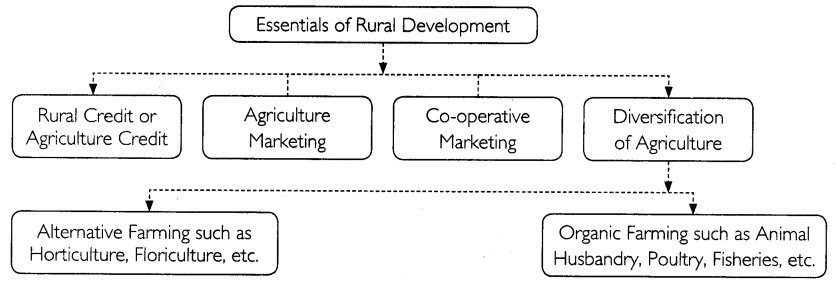
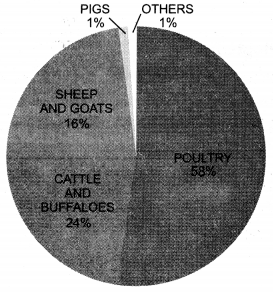
Poverty Class 12 Important Extra Questions Economics Chapter 4

Here we are providing Class 12 Economics Important Extra Questions and Answers Chapter 4 Poverty. Economics Class 12 Important Questions are the best resource for students which helps in class 12 board exams.

Class 12 Economics Chapter 4 Important Extra Questions Poverty

Poverty Important Extra Questions Very Short Answer Type

Question 1.
What do you mean by poverty?
Answer:
Poverty is the inability to secure the minimum consumption requirements for life, health and efficiency.

Question 2.
What proportion of the world’s poor live in India?
Answer:
One-fifth of the world’s poor live in India.

Question 3.
How many children under the age of five die annually in India according to UNICEF?
Answer:
About 2.3 million children under the age of five die India per annum according to UNICEF.

Question 4.
Name the two key features of poorest households.
Answer:
The two key features of poorest households are hunger and starvation.

Question 5.
What are the factors responsible alarming malnutrition among the poor?
Answer:
Ill health, disability and serious illness are the factors responsible for alarmingly high malnutrition among the poor.

Question 6.
Define poverty line.
Answer:
Poverty line estimates the minimum level of income that is considered appropriate to secure basic necessities of life.

Question 7.
What was the percentage of population below poverty line in 2011-12 in India?
Answer:
22 percent of India’s population lived below poverty line in 2011 -12.

Question 8.
Name the two types of poverty.
Answer:
The two types are absolute poverty and relative poverty.

Question 9.
Define absolute poverty.
Answer:
Absolute poverty determines the minimum physical quantities of requirement for a subsistence level, with the help of poverty line.

Question 10.
What is relative poverty?
Answer:
Relative poverty refers to lack of resources in relation to different classes regions and countries.

Question 11.
State the minimum calorie requirement (per day) of a person in rural area and a person in urban area
Answer:
The minimum calorie intake (per day) for a rural person is estimated at 2,400 calories while that for a person in urban area is 2,100 for a person.

Question 12.
How is the extent of poverty worked out in India?
Answer:
The extent of poverty in India is worked out with the help of “Head Count Ratio”.

Question 13.
Define Head Count Ratio.
Answer:
Head Count Ratio is the proportion of persons living below the poverty line.

Question 14.
Name some factors, other than income and expenditure, which are associated with poverty.
Answer:
Some factors, other than income and expenditure, which are associated with poverty, include accessibility to basic education, health care, drinking water and sanitation

Question 15.
Name the state in India which had the highest poverty in 2011-2012.
Answer:
In 2011 -2012, Chhattisgarh had the highest poverty in India.

Question 16.
List any two causes of poverty in India.
Answer:
Causes of poverty in India are:
(i) Lack of quality education
(ii) No or limited access to health care
(iii) Unequal distribution of income and wealth

Question 17.
Why are casual labourers among the most vulnerable group in society?
Answer:
Casual labourers are among the most vulnerable in society as they suffer lack of job security, assets, skills, opportunities and have no surplus to sustain them.

Question 18.
Give two examples of self-employment programmes initiated by the government to alleviate poverty.
Answer:
Two self-employment programmes initiated by the government include are Rural Employment Generation Programme (REGP) and Prime Minister’s Rozgar Yojana (PMRY).

Question 19.
Name the three major programmes that aim at improving the food and nutritional status of the poor.
Answer:
Three major programmes that aim at improving the food and nutritional status of the poor are:
(i) Public Distribution System
(ii) Integrated Child Development Scheme
(iii) Mid-day Meal

Poverty Important Extra Questions Short Answer Type

Question 1.
Who are the poor?
Answer:
We can see poor residing in our localities both in rural and urban areas. Some of the most vulnerable groups are urban casual labourers, rural agricultural labourers, scheduled castes and scheduled tribes. These people possess very few assets and live in very miserable conditions. They live in kutcha houses made of baked mud and root grass.

They neither have any land to cultivate nor can they afford even two meals a day. Hence, they are malnourished and physically weak. Moreover, they are deprived of decent economic opportunities, which could raise their standard of living and lifestyle. They are illiterate, jobless as well as voiceless and powerless. Better-off people often exploit them.

Question 2.
What are the problems faced by the poor?
Answer:
Following are the problems faced by the poor:

  • They suffer from chronic indebtedness borrow from money lenders who charge high rates of interest, which leads them into poverty.
  • They are not able to negotiate with employers for legal wages and are exploited.
  • They do not have access to electricity and safe drinking water.
  • The primary cooking fuel is firewood and cow dung cake.
  • There exists extreme gender inequality in the participation of employment, education and decision-making within the family.
  • Women in poor households receive less care on their way to motherhood and hence, their children are less likely to survive or be born healthy.

Question 3.
List the initiatives undertaken in post-independent lndia to work out a mechanism to identify the number of poor.
Answer:
The initiatives undertaken in post-independent India to work out a mechanism to identify the number of poor are:
(i) A Study Group was formed by the Planning Commission in 1962.
(ii) Task Force on Projections of Minimum Needs and Effective Consumption Demand was formed in 1979.
(iii) ‘Expert Groups’ were also constituted for the same purpose in the years 1989 and 2005.

Question 4.
Differentiate between absolute and relative poverty.
Answer:
The table below shows the points of difference between absolute and relative poverty:

Absolute PovertyRelative Poverty
1. It takes into account the minimum physical quantities of national requirement for a subsistence level.It takes into account relative levels of income of the population.
2. Poverty is measured in monetary terms.Poverty is measured with respect to various classes, regions and countries.
3. It shows only the number of poor in the country determined on the basis of defined poverty line.It shows the extent of inequality and proportion of people living below the poverty line.

Question 5.
Why is the calorie requirements in rural areas are considered to be higher than urban areas?
Answer:
The consumption levels in the rural and urban areas are quite different. The calorie intake differs depending upon the age group, eating habits, type of work, climate and consumption level.

The accepted average calorie requirement in India is 2400 calories per person per day in rural areas and 2100 calories per person per day in urban areas. The calorie requirements in rural areas are considered to be higher than urban areas because people living in rural areas engage themselves in more physical work.

Question 6.
Explain how poverty is categorised, with the help of a diagram.
Answer:
Poverty can be categorised as:
(i) Chronic Poor: This group includes those people who are always poor and those who are usually poor but who may sometimes have relatively more money.

Economics Class 12 Important Questions Chapter 4 Poverty 1

(ii) Transient Poor: It covers churning poor and occasionally poor people. Churning poor are those people who move in and out of poverty regularly. Occasionally poor are those people who are rich most of the time but may sometimes suffer bad luck are said to be occasionally poor.

(iii) Non-poor: Non-poor are those who are never poor.

Question 7.
Write a short note on the changes in the trends of poverty ratio and the number of poor during 1973-2012.
Answer:
During 1973 -74 and 2011 -12, the poverty ratio has declined continuously for Doth urban and rural areas. There has also been a decline in the absolute number of poor. However, the ratio is declining much slower than the absolute number of poor in the country. While the gap between the absolute number of poor in rural and urban areas got reduced, the gap between rural and urban poverty ratio has remained the same until 1999-2000. The gap between ratios has in fact widened in 2004- 10.

Question 8.
Give a brief description of inter-state disparity in terms of poverty in India.
Answer:
The proportion of poor people is not the same in every state. The state level poverty has witnessed a significant decline compared to the levels of early seventies. However, the rate of success of reducing poverty varies from state to state. According to recent estimates, many states and union territories have poverty ratio less than the national average. On the other hand, poverty is still a serious issue in Odisha, Bihar, Madhya, Pradesh and Uttar Pradesh.

Question 9.
What impact did the British rule had on the Indian economy?
Answer:
The British rule had a substantial negative impact on the Indian economy and standard of living of the people.

  • There was a sharp increase rural tax, which made merchants and moneylenders exploit the borrowers.
  • India began to export food grains under the British, which lead to death of 26 million people in famines between 1875 and 1900.
  • The British rule impoverished millions of people in India.

Question 10.
What makes farmers commit suicide?
Answer:
Landless farmers are poor and they do not have sufficient money to buy modern equipment for producing crops. In order to adopt developed techniques of production in agriculture, they take loans from moneylenders, who charge them very high rate of interest.

However, if the crop fails due to drought or other natural calamities, it causes distress among the farmers. They commit suicide due to their inability to repay the loans that they have taken for cultivation.

Question 11.
Discuss the objective of growth-oriented approach of poverty alleviation.
Answer:
The growth-oriented approach is based on the idea that the effects of economic growth, rapid increase in national income and per capita income would automatically spread to all sections of society which will improve the condition of poor sections of the country. Major focus on ‘trickle down’ process was laid down in the 1950s and early 1960s by the planning process.

It was believed that rapid industrial development and agricultural transformation through ‘green revolution’ in selected regions of the country would benefit the underdeveloped regions of the country and more backward sections of the society as well.

Question 12.
Write a short note on MNREGA.
Answer:
Mahatma Gandhi National Rural Employment Guarantee Act (MNREGA) is an important step towards the realisation of the right to work. Under MNREGA, all those who are able to, and are in need of work at minimum wages, are guaranteed 100 days of employment in a year by the government

If the government fails in its duty to provide employment, it will give unemployment allowances to the people. Moreover, the programme is expected to enhance people’s livelihoods on a sustained basis, by developing the economic and social infrastructure in rural areas. In 2012-13, 4.4 crore households have been provided employment under MNREGA.

Question 13.
Which approach has been adopted to improve the standard of living of the poor?
Answer:
The government adopted an approach to address poverty by providing minimum basic amenities to the people. The objective was to improve the people’s standard of living through public expenditure on social consumption needs such as provision of food grains at subsidised rates, education, health, water supply and sanitation.

This approach also included programmes which are expected to create employment opportunities and bring about improvements in health and education.

Question 14.
“Without the active participation of the poor, successful implementation of any programme is not possible.” Elaborate.
Answer:
The poor can contribute significantly towards the eradication of poverty and hence, growth by their active involvement in the growth process. This is possible through a process of social mobilisation of poor people, encouraging them to participate and get them empowered. These steps will also help create employment opportunities thereby increasing the levels of income, development of skill, health and literacy.

Poverty Important Extra Questions Long Answer Type

Question 1.
Discuss per capita expenditure method of determining poverty line? What are its limitations?
Answer:
Per capita expenditure method determines poverty by the monetary value of the minimum calorie intake. The minimum calorie intake was estimated at 2,400 calories for a rural person and 2,100 for a person in the urban area.
On the basis of this, the poverty line was defined worth ₹ 816 as consumption per person a month for rural areas and ₹ 1,000 for urban areas for the year 201 1-12. Limitations of Per Capita Expenditure Method of Determining Poverty Line

(i) It groups all the poor together, without differentiating between the very poor and the other types of poor.

(ii) It takes into account only expenditure on food and a few select items. With this mechanism, it becomes difficult to identify who among the poor need the most help.

(iii) Various factors such as accessibility to basic education, health care, drinking water and sanitation are ignored while developing poverty line.

(iv) Social factors such as illiteracy, ill health, lack of access to resources, discrimination or lack of civil and political freedoms trigger and perpetuate poverty. These are also not taken into consideration while determining poverty line.

Question 2.
Critically examine the trends in rural urban poverty on the basis of the table and diagram given below

1973-741977-7819831987-881993-941999-20002004-052011-12
Rural (%)56.453.145.739.137.327.141.825.7
Urban (%)49.045.240.838.232.423.625.713.7
Average (%)54.951,344.538.936.026.137.221.9

Economics Class 12 Important Questions Chapter 4 Poverty 2

Answer:
The table shows that in 1972-73, 55% of total population was below poverty line out of which the percentages of rural and urban poverty were 56% and 49% respectively. In 1999-2000, percentage of poverty of the total population was 26.1 % out of which 27.1 % of rural population and 23.6% of urban population were below poverty line.

While in 2011 -12, the percentage of poverty was 21.9% out of which 25.7% of the rural population and 13.7% of the urban population were below poverty line. According to the diagram, there has been a continuous decline in poverty ratio both in rural and urban areas after 1990s. It can be seen that the gap between absolute number of poor in rural and urban areas did not narrow down until the early 1990s.

Question 3.
What are the causes of poverty in India?
Answer:
The main causes of poverty in India are the following:
Underdeveloped Nature of the Economy: Indian economy is an underdeveloped economy. Its per capita income is low. Thus, its underdeveloped nature is closely associated with poverty, Rapid Growth of Population; Rapid growth of population in already overpopulated countries I like India is one of the main causes of poverty. With the increase in population, the national income increases, however, the per capita income remains more or less the same.

Unstable and Casual Nature of Employment’ The poor people lack basic literacy and skills. : As a result, they have very limited economic opportunities and face unstable employment.

A large number of rural poor migrate to urban areas in search of employment and livelihood. The industries in cities, however, are not able to absorb all these people. The urban poor are either I unemployed or intermittently employed as casual labourers.

(iv) Predominance of Agriculture: Agriculture is the principal means of livelihood and land is the primary assets of rural people. Productivity of land is an important determinant of material well being. But the productivity of land in India is very low and thus, people remain struck in poverty.

(v) Failure of Land Reforms: Since independence, the government attempted to take lands from those who are having large amounts of land and allot to those who do not have any land but work on lands as wage labourers. This policy of land reforms was successful only to a limited extent.

This has left the large section of agricultural workers, scheduled castes and scheduled tribes as wage labourers. As a result, this group of population remained unable to possess assets or skill and remained struck in poverty.

(vi) indebtedness of the Farmers: Due to the adoption of developed techniques of production in agriculture, farmers had taken loans. In recent times, many farmers committed suicide due to their inability to pay back the loans. This indebtedness makes the people unable to raise their income and thus, remain struck in poverty.

(vii) Increase in Prices: The continuous and steep price rise adds to the miseries of poor. Although, it benefits a few people in the society (businessmen), the persons in lower income group find it difficult to meet even their minimum needs.

(viii) Unequal Distribution of Income and Wealth: Unequal distribution of income and wealth has also led to persistence of poverty in India. This has generated two distinct groups of ‘have and have not’ in society. One group comprises those who possess the means of production and earn their income while the other group consists of those who rely on their labour power for subsistence. The gap between these groups has widened over the years thereby worsening the position of the poor.

Question 4.
Suggest measures to remove poverty in India.
Answer:
The problem of poverty is a big danger to the unity of India. Although the government has adopted many programmes, covering different aspects together, following measures can also be undertaken to remove poverty:

(i) Population Control: Growing population is a major cause of poverty in India. Hence, it is necessary to control it. Family planning programme should be implemented effectively.

(ii) Creation of More Employment Opportunities: Though it has been stated in our Constitution that the government would provide employment opportunities to all, but unemployment is still a big problem in India. It is also responsible for poverty. Hence, it is essential to promote employment through intensive skill development technology.

(iii) Increase in Production: Industrial and agricultural production should be increased to remove poverty. Present capacity should be utilised fully and new techniques should be adopted. Proper coordination should be there between large scale and small scale industries. Superior seeds, manures, fertilisers and modern methods of production should be adopted for agricultural development. Necessary irrigation facilities should be made.

(iv) Check on Price Rise: Price rise is also responsible for poverty in India. It decidedly goes against the interests of the poor. Thus, price rise must be checked through proper fiscal and monetary policies and other measures.

(v) More Emphasis on Small, Rural and Cottage Industries: Small scale and cottage industries have not developed fully in India, The government should adopt effective methods to expand small and cottage industries, which will increase the self-employment opportunities for the poor.

(vi) Stepping-up Capital Formation: Low rate of capital formation is a major hindrance in the way of fast economic development. Capital formation rate, therefore, must be increased. As it basically depends on the saving rate, every possible effort should be made to increase savings and their mobilisation.

(vii) Equal Distribution of Income and Wealth: One cause of inequitable distribution of income and wealth is that economic and employment opportunities are not equal for all. This inequality should be reduced. The poor should be given priority in employment opportunities. Tax system should be developed in such a way that income and wealth does not get concentrated in a few hands.

(viii) Effective Implementation of Programmes Designed to Attack Poverty: Undoubtedly, the government has implemented many programmes to attack poverty. It is unfortunate that these programmes have not been proved helpful to the poor because of ineffective implementation. Many social and political factors are responsible for it. Therefore, effective implementation of these programmes is necessary if poverty is to be reduced.

Question 5.
Explain the self-employment and wage generation approach of the government for poverty alleviation.
Answer:
Government’s approach of self-employment and wage generation was initiated from Third Five Year Plan (1961 -66) and has been enlarged successfully since then. The following programmes have been initiated by the government from time to time under this approach:

(i) Food for work Programme (FWP): FWP was launched in the 1970s for the upliftment of the poor. Under this programme, foodgrains are distributed against the wage work.

(ii) Prime Minister’s RozgarYojana (PMRY): This programme has been implemented by the Khadi and Village Industries Commission, which aims at creating self-employment opportunities in rural areas and small towns. One can get financial assistance with bank loans to set up small enterprises under this programme.

Under PMRY, the educated unemployed from low-income families in both rural and urban areas can get financial help to set up any type of industry which generates employment.

(iii) Swarna Jayanti Shahari RozgarYojana (SJSRY): It aims at creating employment opportunities, both self-employment and wage employment in urban areas. Individuals were given financial assistance under self-employment programmes.

(iv) Swarnajayanthi Gram SwarozgarYojana: Sawarnajayanthi Gram Swarozgar Yojana was launched in April 1999 and is the only self-employment programme currently being implemented. It aims at promoting micro enterprises and to bring the assisted poor families (Swarozgaris) above the poverty line by organising them into Self-Help Groups through the process of social mobilisation, training and capacity building and provision of income generating assets through a mix of Bank Credit and Government subsidy.

(v) Sampoorna Grameen RozgarYojana (SGRY): SGRY was launched in September 2001. The schemes of Jawahar Gram Samridhi Yojana and Employment Assurance Scheme have been fully integrated with SGRY.

The objective of the scheme is to provide additional wage employment along with food security, creation of durable community, social and economic assets and infrastructure development in the rural areas. The scheme envisages generation of 100 man days of employment in a year.

(vi) National Food for Work Programme (NFWP): National Food for Work Programme was launched on November 14, 2004 in 150 most backward districts of the India. It is implemented as a 100 per cent centrally sponsored scheme and the foodgrains are provided to States free of cost. The objective of the programme was to intensify the generation of supplementary wage employment.

Question 6.
Discuss the various programmes introduced under the government’s minimum basic needs providing approach for poverty alleviation.
Answer:
Programmes under minimum basic needs providing approach are expected to supplement the consumption of the poor, improve health and education and create employment opportunities. Government has adopted the following programmes under this approach:

(i) Pradhan Mantri Gram SadakYojana (PMGSY): This programme aims at building all-weather roads by 2007 in all villages having population of 500 persons.

(ii) Pradhan Mantri GramodayaYojana (PMGY): PMGY was launched in 2000-01 in all the states and union territories in order to achieve the objective of sustainable human development at the village level. The PMGY envisages allocation of Additional Central Assistance to the States and Union Territories for selected basic minimum services in order to focus on certain priority areas of the government.

Initially, PMGY had five components viz. primary health, primary education, rural shelter, rural drinking water and nutrition. Rural electrification has been added as an additional component from 2001 -02.

(iii) Valmiki Ambedkar AwasYojana (Vambay): This programme was launched in December 2001 to facilitate the construction and up-gradation of dwelling units for the slum dwellers. It also aims to provide a healthy and enabling urban environment through community toilets under ‘Nirmal Bharat Abhiyan’ a component of the scheme.

(iv) National Social Assistance Programme (Nsap): The government initiated National Social Assistance Programme under which, homeless elderly people are given pension to sustain themselves. The programme also covers poor and destitute women.

Poverty Important Extra Questions HOTS

Question 1.
Discuss the impact of globalisation on small land owning farmers.
Answer:
Globalisation related shocks and lack of perceived income earning opportunities are descending many small land owning farmers into poverty. If the households are able to sell assets, or borrow, or generate income from alternative employment opportunities, the impact of globalisation shocks may
be transient However, if the household does not have any assets to sell or have no access to credit, the shocks may push households below the poverty line. The distressed households.usually find suicides as a solution to such crisis.

Question 2.
In India a majority of population is lying below poverty line due to inequality of income and wealth. What can government do to solve this problem?
Answer:
The government can solve the problem of inequality of income and wealth through progressive taxation. Under progressive taxation, burden of the tax falls more on the rich and less on the poor. The rate of tax increases as the income increases. Thus, progressive tax is equitable.

Liberalisation, Privatisation and Globalisation: An Appraisal Class 12 Important Extra Questions Economics Chapter 3

Here we are providing Class 12 Economics Important Extra Questions and Answers Chapter 3 Liberalisation, Privatisation and Globalisation: An Appraisal. Economics Class 12 Important Questions are the best resource for students which helps in class 12 board exams.

Class 12 Economics Chapter 3 Important Extra Questions Liberalisation, Privatisation and Globalisation: An Appraisal

Liberalisation, Privatisation and Globalisation: An Appraisal Important Extra Questions Very Short Answer Type

Question 1.
When were economic reforms introduced in India?
Answer:
Economic reforms were introduced in India in 1991. Economic reforms refer to all those measures that aim at rendering the economy more efficient, competitive and developed.

Question 2.
List any two reasons which led to economic reforms in India.
Answer:
The reasons which led to economic reforms in India include:
(i) Unfavourable Balance of Payment
(ii) Inflation
(iii) Falling foreign exchange reserves

Question 3.
What are the three broad components of New Economic Policy, 1991?
Answer:
The three broad components of New Economic Policy are:
(i) Liberalisation
(ii) Privatisation
(iii) Globalisation

Question 4.
Define liberalisation.
Answer:
Liberalisation means liberating the trade and industry of an economy from unnecessary restrictions and making the industries more competitive.

Question 5.
State any two reforms introduced under liberalisation.
Answer:
The reforms introduced under liberalisation include:
(i) Deregulation of industrial sector
(ii) Trade and investment policy reforms
(iii) Tax reforms

Question 6.
What is fiscal policy?
Answer:
It refers to the revenue and expenditure policy of the government to achieve balanced development in the economy.

Question 7.
Define direct tax. Give two examples.
Answer:
Direct taxes are those taxes levied immediately on the property and income of persons, and are paid directly by the consumers to the state. For example, income tax, property tax.

Question 8.
Define indirect tax. Give two examples.
Answer:
Indirect tax is a tax collected by an intermediary (seller) from the person who bears tne ultimate economic burden of the tax (buyer). For example, excise duty, sales tax.

Question 9.
What was the consequence of devaluation of rupee?
Answer:
Devaluation of rupee led to huge inflow of foreign exchange in India.

Question 10.
List the aims of trade policy reforms.
Answer:
The aims of trade policy reforms were:
(i) Removal of quantitative restrictions
(ii) Reduction in tariff rates
(iii) Removal of import licensing

Question 11.
For what categories of products was industrial licensing not abolished?
Answer:
Industrial licensing was not abolished for product categories such as alcohol, cigarettes, hazardous chemicals, industrial explosives, electronics, aerospace and drugs and pharmaceuticals.

Question 12.
Define privatisation.
Answer:
Privatisation means the induction of private management and control in the public sector enterprises.

Question 13.
What is disinvestment?
Answer:
Disinvestment involves selling a part of the Public Sector Undertaking’s equity to the public to promote privatisation.

Question 14.
State the purpose for undertaking disinvestment.
Answer:
Disinvestment was undertaken:
(i) to maintain fiscal discipline; and
(ii) to facilitate modernisation.

Question 15.
Define globalisation.
Answer:
Globalisation means unification or integration of the domestic economy with the world economy.

Question 16.
What is outsourcing?
Answer:
It is the practice of hiring external sources, mostly from other countries, for regular services.

Question 17.
List a few services which are being outsourced by companies in developed countries to India.
Answer:
A few services which are being outsourced by companies in developed countries to India are:
(i) Record keeping
(ii) Accountancy
(iii) Banking services
(iv) Music recording
(v) Film editing
(vi) Clinical advice

Question 18.
How are WTO and GATT related?
Answer:
GATT was established in 1948. WTO was founded in 1995 as the successor organisation to GATT.

Question 19.
Where is the headquarters of WTO?
Answer:
The headquarters of WTO is in Geneva.

Question 20.
What has been the impact of economic reforms on GDP?
Answer:
The overall GDP growth has increased as a result of economic reforms.

Question 21.
List the areas which were ignored during the reform period.
Answer:
The sectors which were ignored during the reform period are:.
(i) Agriculture
(ii) Industry
(iii) Employment
(iv) Infrastructure
(v) Fiscal management

Question 22.
Name the sector that benefited the most with the introduction of economic reforms in India.
Answer:
Service (tertiary) sector benefitted the most with the introduction of economic reforms in India

Question 23.
Define GST.
Answer:
GST (Goods and Services Tax) is an indirect tax for the whole nation, which will make India one unified common market.

Question 24.
Why is GST implemented?
Answer:
(i) GST will create a simpler tax system.
(ii) It increases overall transparency and compliance.

Question 25.
When was GST implemented in India?
Answer:
1st July 2017

Question 26.
Who is the head of the GST Council?
Answer:
Finance Minister

Question 27.
Which constitutional amendment is done to pass the GST bill?
Answer:
101 st

Question 28.
What type of goods are not covered under the GST bill?
Answer:
(i) Cooking gas
(ii) Liquor
(iii) Petrol

Question 29.
List the main categories of GST.
Answer:
(i) CGST
(ii) SGST
(iii) I GST

Question 30.
What is demonetisation?
Answer:
Demonetisation is the act of stripping a currency unit of its status as legal tender.

Question 31.
When did demonetisation take place in India?
Answer:
8th November, 2016

Question 32.
What was main motive behind demonetisation?
Answer:
To curb black money, terror funding and to stop the use of fake currency available in the market

Question 33.
When did demonetisation take place in India for the first time in history?
Answer:
In 1946

Question 34.
Which currency notes were affected due to demonetisation in November 2016?
Answer:
₹ 500 & ₹ 1,000 notes
(Liberalisation, Privatisation and Globalisation: An Appraisal)

Question 35.
Which currency notes were newly implemented after demonetisation in November 2016?
Answer:
X 200 & X 2,000 notes

Question 36.
What was the last date of tendering old currency?
Answer:
30th December, 2016

Question 37.
State one positive effect of demonetisation in India?
Answer:
Over fake currency

Liberalisation, Privatisation and Globalisation: An Appraisal Important Extra Questions Short Answer Type

Question 1.
Explain the occurrence of events which led to introduction of economic reforms in India.
Answer:
The inefficient management of the Indian economy led to huge amount of borrowings from national and international financial institutions. As a result, India met with an economic crisis in 1991 due to its failure to repay its borrowings from abroad. Crisis led to rise in prices of essential goods. In order to overcome the crisis, India approached IMF and World Bank for loan. The IMF and World Bank announced New Economic Policy as a condition to support Indian economy. Thus, India needed to introduce economic reforms:

  • To maintain sufficient foreign exchange reserves
  • To keep inflation under control
  • To improve economic efficiency
  • To remove rigidities in various areas
  • To increase international competitiveness

Question 2.
Discuss the nature of government’s revenue and expenditure prior to economic reforms in India.
Answer:
The government was not able to generate sufficient revenue from taxation. Lack of revenue was accompanied by problems such as unemployment, poverty and population explosion. The income from PSUs was also not very high to meet the growing expenditure. On the other hand, the government was spending a large share of its insufficient income on areas which did not provide immediate returns.

Moreover, the foreign exchange borrowed from other countries and international financial institutions was spent on meeting consumption needs. The government neither made an attempt to reduce such reckless spending nor did it pay sufficient attention to increase its exports to meet growing imports’ expenditure.

Question 3.
Write a short note on New Economic Policy, India.
Answer:
The IMF and World Bank announced New Economic Policy as a condition to support Indian economy to overcome crisis. The NEP consisted of wide range of economic reforms. The core policies were intended to create a more competitive environment in the economy and remove the barriers to entry and growth of firms.

This set of policies can broadly be classified into two groups:

(i) Stabilisation Measures: These are short-term measures aimed to correct the weaknesses developed in the balance of payments and to bring inflation under control.

(ii) Structural Reform Measures: These are long-term measures initiated to improve economic efficiency and increase its international competitiveness by eliminating the rigidities in various segments of the Indian economy.

Question 4.
Explain the significance of liberalisation as an element of new economic reforms.
Answer:
Liberalisation means liberating the trade and industry of an economy from unnecessary restrictions and making the industries more competitive. It implies making the economy free from direct or physical controls imposed by the government. Partial liberalisation was started in India’s economy in the decade of eighties.

However, the New Economic Policy initiated in 1991 is more comprehensive and focused on reducing the controls by introducing liberal changes in both the external as well as domestic economy. Liberalisation process is based on the assumption that market forces could guide the economy in a more effective way than the government control.

Question 5.
State the salient features of trade policy reforms.
Answer:
The features of trade policy reforms are:

  • There was moderation/reduction in import duty to enhance competitiveness in the domestic market.
  • Import quotas had been completely abolished.
  • Policy of import licensing had almost been scrapped.
  • Export duty had been withdrawn to enhance competitiveness of Indian goods in the international market.

Question 6.
How were the Indian industries regulated prior to reforms?
Ans.
The Indian industries were regulated in the following ways prior to reforms:
(i) Obtaining industrial license from government officials was mandatcy for every entrepreneur to start a firm, close a firm or to decide the quantity of goods that could be produced.
(ii) Private sector was not allowed in many industrial categories.
(iii) Production o.f some goods was reserved for only in small scale industries.
(iv) Government controlled prices determination and distribution of selected industrial products.

Question 7.
Discuss the need for privatisation.What are the ways in which PSUs can be privatised?
Answer:
Privatisation means the induction of private management and control in the public sector enterprises. With a view to improve the performance of the public sector enterprises, the wave of privatisation has spread all over the world. Need for privatisation was felt mainly because of the inefficiency of the public sector enterprises. Thus, the private sector was given a larger space to operate in the areas reserved exclusively for the public sector.

Privatisation can be done by two ways:
(i) By withdrawal governmental control from the management and ownership of public sector companies; and
(ii) By outright sale of public sector companies.

Question 8.
How can the government improve efficiency of PSUs? Explain giving examples.
Answer:
The government has made attempts to improve the efficiency of PSUs by giving them autonomy in taking managerial decisions. For example, to improve efficiency, promote professionalism and enable them to compete more effectively in the liberalised global environment, the government chose nine PSUs and declared them as Navaratnas.

The first set of navaratna companies is as under.

  • BPCL
  • HPCL
  • IOCL (Indian Oil Corporation Ltd.)
  • ONGC
  • SAIL
  • IPCL
  • BHEL
  • NTPC
  • BSNL

Question 9.
Explain the significance of globalisation in the light of today’s modern world.
Answer:
Integration and unification of domestic economy with the world economy is known as globalisation. Globalisation is the outcome of liberalisation and privatisation. Due to the globalisation process, the unrestricted flow of goods and services, technology, capital and expertise was enabled among different countries of the world.

It helps in fostering healthy foreign competition among nations. As a result of globalisation process, the government of India has decided to increase the share of foreign investment up to 51% in Indian companies and provided automatic sanction to collaborations and foreign investors for this much of investment.

State the objective of WTO.
The WTO has the following objectives:

  • To develop the multilateral trading system encompassing the GATT, the results of the Uruguay Round and all the agreements concluded under the GATT
  • To raise standard of living, real income, employment through expansion of trade
  • To promote optimum utilisation of the world’s resources
  • To secure the share of developing countries in the growth of international trade
  • To eliminate discriminatory treatment in international trade
  • To ensure linkage among different trade policies, environmental policies and sustainable development

Question 10.
How important is the role of outsourcing in globalisation process?
Answer:
Outsourcing is the practice of hiring external sources, mostly from other countries, for regular senvices such as legal advice, advertisements, security, computer services, etc. With the adoption of globalisation, outsourcing has been intensified by the growth of fast modes of communication.

Many companies of developed nations are outsourcing a variety of services such as voice-based business processes, which are known as BPO or call centres, banking services, film editing, clinical advice, teaching, record keeping, accountancy, music recording, book transcription, etc. to India. Most of the multinational corporations and even small companies are outsourcing their services to India at a cheaper cost with reasonable degree of skill and accuracy.

Question 11.
Why do global countries prefer to outsource resources and services?
Answer:
At present, many global countries prefer to outsource resources and services because:
(i) Outsourcing increases efficiency.
(ii) It releases capital expenditure, which can be used for other productive activities.
(iii) It enables countries to focus on their primary activities.

Question 12.
Discuss the role of India as WTO member.
Answer:
Being a founder member of WTO, India has been in the forefront offraming fair global rules, regulations and safeguards and advocating the interests of the developing world. India has kept its commitments towards liberalisation of trade by removing quantitative restrictions on imports and reducing tariff rates.

Question 13.
Evaluate the process of disinvestment in PSUs undertaken during reforms.
Answer:
During reforms, PSUs had been undervalued and sold to the private sector. This resulted in a huge loss to the government. The government used the proceeds from disinvestment to offset the budget deficits rather than using it for the development of PSUs and country’s social infrastructure.

Question 14.
Discuss the impact of economic reforms on fiscal management.
Answer:
The following points explain the impact of economic reforms on fiscal management:
(i) Tax revenue did not increase.
(ii) Tariff revenue and custom duties were reduced.
(iii) Tax invectives were offered to foreign investors, which reduced the scope for raising tax revenues.

Question 15.
What is Goods and Services Tax (GST)?
Answer:
GST is a destination based tax on consumption of goods and services. It is proposed to be levied at all stages right from manufacture upto final consumption with credit of taxes paid at previous stages available as set-off. In a nutshell, only value addition will be taxed and burden of tax is to be borne by the final consumer. GST is one indirect tax for the whole nation, which will make India one unified common market.

Question 16.
What type of GST is prepared to be implemented?
Answer:
A dual GST system has been prepared with center and state simultaneously levying it on a common tax base. The GST to be levied by the center on intra-state supply of goods and/or services would be called the Central GST (CGST) and that to be levied by the states would be called the State GST (SGST). Similarly, Integrated GST (IGST) will be levied and administered by center on every inter-state supply of goods and services.

Question 17.
Why is dual GST required?
Answer:
India is a federal country where both the center and the states have been assigned the powers to levy and collect taxes through appropriate legislation. Both the levels of government have distinct responsibilities to perform according to the division of powers prescribed in the Constitution for which they need to raise resources. A dual GST will, therefore, be in keeping with the constitutional requirement of fiscal federation.

Question 18.
What is IGST?
Answer:
Under the GST regime, an Integrated GST (IGST) would be levied and collected by the center on inter-state supply of goods and services. Under article 269A of the Constitution, the GST on supplies in the course of inter-state trade or commerce shall be levied and collected by the government of India and such tax shall be apportioned between the union and the states in the manner as may be provided by the Parliament by law on the recommendations of the Goods and Services Tax Council.

Question 19.
What are the components of GST?
Answer:
There are three taxes applicable under this system – CGST, SGST and IGST.
(i) CGST: It is collected by the central government on an intra-state sale. For example: transactions happening within Maharashtra

(ii) SGST: It is collected by the state governments on an intra-state sale. For example: transactions happening within Maharashtra

(iii) IGST: It is collected by the central government on an inter-state sale. For example: transactions happening between Maharashtra and Tamil Nadu

Question 20.
How is GST calculated?
Answer:
With the unified system of taxation, it is now possible for taxpayers to know the tax levied at different points for various goods and services under the GST regime. For the calculation of GST, the taxpayer should know the GST rate applicable to various categories. The different slabs for are 5%, 12%, 18% and 28%.GST calculation can be explained by simple illustration:
If a good or service is sold at ₹ 1,000 and the GST rate applicable is 18%, then the net price calculated will be:
= 1,000 + \(\left(1,000 \times \frac{18}{100}\right)\)
= 1,000 + 180 = ₹ 1, 180

Question 21.
What do you understand by the term demonetisation?
Answer:
Demonetisation is the act of stripping a currency unit of its status as legal tender. In other words, to withdraw (money or the like) from use. It occurs whenever there is a change of national currency. The current form or forms of money is pulled from circulation and retired often to be replaced with new notes or coins.

Sometimes a country completely replaces the old currency with new currency. India demonetized its ₹ 500 and ₹ 1,000 rupee notes on November 8, 2016. This action affected 86% of all cash in circulation.

Liberalisation, Privatisation and Globalisation: An Appraisal Important Extra Questions Long Answer Type

Question 1.
What was the need for economic reforms in India? Explain.
Answer:
At the time of independence, building a large public sector was almost unavoidable. The capabilities of India’s private sector could not be visualised at that time to make very large investments in the areas like infrastructure. However, by late 1980s the situation had completely changed. By that time, India had developed a strong private sector. Therefore, the argument of a large public sector was no longer valid. Need for economic reforms or New Economic Policy was observed mainly due to following reasons:

(i) Increase in Fiscal Deficit: By 1991, government expenditures began to exceed its revenue by such large margins, which became unsustainable. Fiscal deficit was increasing year after year due to increase in its non-developmental expenditure. Fiscal deficit was 5.4 percent of GDP in 1981 -82, which increased to 8.4 percent of GDP in 1990-91.

Interest payments on public debt were amounted to I0 percent of total government expenditure in 1980-81 which increased to 36.4 percent in 1991. Thus, government was fast heading for debt trap. India had lost the faith of international institutions like World Bank and IMF. Hence, it was necessary to begin new economic reforms in the country.

(ii) Adverse Balance of Payments: Balance of payments is an account of all the payments and receipts of one country with other countries. Imports grew at a very high rate unable to match growth in exports. Thus, India faced adverse balance of payment. The country needed foreign exchange to pay for the import of goods and services. The deficit in the balance of payment on current was ₹ 2,214 crore in 1980-81 which rose to ₹ 17,367 crore in 1990-91. Therefore, it was necessary to adopt New Economic Policy to correct the deficit in the Balance of Payment.

(iii) Gulf Crisis: Prices of petroleum increased in 1990-91 due to Iraq War. This Gulf crisis further worsened the balance of payment position of India.

(iv) Rise in Prices: During 1990-91, the level of inflation in the country reached to double digit. As a result, foreign investors had lost their confidence in Indian economy and national capital resources were flying out of the country. Cost of production had taken an upward jump due to high rate of inflation.

(v) Poor Performance of the Public Sector Undertaking: After 1980, most of the public sector undertakings had suffered huge losses. As a result, PSUs have become a liability to the nation. It became inevitable for the government to adopt New Economic Policy.

(vi) Fall in Foreign Exchange Reserves: During 1990-91, foreign exchange reserves declined to a level that was not adequate for imports worth more than two weeks; exports declined and industrial output of the country was crippled.

India had to approach the World Bank and IMF to provide huge loans of $7 billion to bail India out of the crisis. The IMF and World Bank announced New Economic Policy as a condition to support Indian economy to overcome crisis.

Question 2.
Explain the measures taken in various sectors for liberalisation of the economy.
Answer:
The following measures had been taken for liberalisation of Indian economy under New Economic Policy:
I. Industrial Sector Reforms
(i) The number of industries reserved for the public sector was reduced from 17 to 4 and in the areas reserved for public sector; private sector’s participation was to be allowed.

(ii) Monopolies and Restrictive Trade Practices (MRTP) Act was liberalised. According to the provision of MRTP Act, all those firms having assets worth more than 100 crore were used to be declared as MRTP firms and were subjected to many restrictions. Now, the concept of MRTP has been abolished. These firms are now free to expand themselves.

(iii) Under the policy of liberalisation, industries are now free for expansion and production. Producers are now free to produce anything on the basis of demand in the market. Licensing was abolished and as a result, firms are free to expand their production capacity.

(iv) Investment limit of the small scale industries has been raised to ₹ one crore to enable them for modernisation.

(v) Automatic approval was granted for Foreign Direct Investment up to 51 percent in a wide range of industries.

(vi) Under liberalisation, Indian industries were allowed to buy machinery and raw material from abroad. Government has also allowed the industries to import technology for their modernisation from abroad.

II. Financial Sector Reforms

  • (i) RBI’s role had been changed from controller to facilitator in India to allow the financial sector to take decisions on various matters without consulting the RBI.
  • (ii) The limit for foreign investment in banks was raised to around 50 percent.
  • (iii) Foreign Institutional Investors such as merchant bankers, mutual funds and pension funds are now allowed to invest in Indian financial markets.

III. Foreign Exchange Reforms

  • The rupee was devalued against foreign currencies to attract huge inflow of foreign exchange.
  • The government adopted free market mechanism for the determination of rupee value in the foreign exchange market.

IV. Trade Policy Reforms

  • There was moderation/reduction in import duty to enhance competitiveness in the domestic market.
  • Import quotas had been completely abolished.
  • Policy of import licensing had almost been scrapped.
  • Export duty had been withdrawn to enhance competitiveness of Indian goods in the international market.

Question 3.
What were the measures taken under economic reforms to promote privatisation? Explain.
Answer:
The following measures were taken to promote privatisation under New Economic Policy:
(i) Contraction of Public Sector: Earlier for the economic development of India, great importance was given to public sector. However, most of the objectives of economic development have remained unfulfilled.

As a result, policy of contraction of public sector was adopted under economic reforms. Number of industries reserved exclusively for public sector was reduced from 17 to 8 and further to 2, viz. atomic energy and railways transport. All other industries form the part of private sector.

(ii) Disinvestments: In the liberalisation process, the part of the equity of inefficient public sector undertakings was sold to the private sector (public). This is also known as disinvestments. The purpose of disinvestments was mainly to improve financial position and facilitate modernisation.

It was thought that disinvestments could provide strong impetus to the inflow of Foreign Direct Investment. It should be remembered that all of our PSUs are not inefficient. Our Nine PSUs, which are known as ‘Navaratnas’ of Indian Economy are still playing a leading role in the world market.

Question 4.
Discuss the various strategies which laid the foundation stone for the process of globalisation in India.
Answer:
The various strategies which laid the foundation stone for the process of globalisation in India are discussed below:

(i) Foreign Exchange Reforms: In 1991, rupee had to be devalued against foreign currencies in order to correct the widening deficit in the balance of trade. That was the first and most important reform in the external sector which was made in the foreign exchange market. At present, the value of rupee is determined by market on the basis of demand and supply of exports and imports and by FDI or Fils.

(ii) Trade and Investment Policy Reforms: Since 1991, the door for foreign investment and technology transfer are opened. Foreign Exchange Regulation Act (FERA), which intended to control the inflow and outflow of foreign exchange, was replaced by a more liberal Foreign Exchange Management Act (FEMA).

Quantitative restrictions on imports of agricultural products and manufactured consumer goods were also fully removed from April, 2001. Since 1991, tariff rules are reduced and the licensing procedures for imports are removed.

(iii) Reduction in Tariff: In order to encourage competitiveness, tariff barriers have been withdrawn on most goods traded between India and rest of the world.

Question 5.
What are the merits and demerits globalisation?
Answer:
Merits of Globalisation
(i) Globalisation provides exposure to international economies and helps availing advanced technology and inputs from across the globe. This improves quantity as well as quality of production.

(ii) It helps in improving efficiency of allocation of resources due to more competitive environment.

(iii) It encourages healthy competition among nations, which helps in improving the quality of goods and services at a competitive price.

(iv) India’s share in the world trade has increased from 0.5 per cent in 1990-91 to 1.1 percent in 2005.

Demerits of Globalisation
(i) Many industries (especially small units) may not be able to compete at par with big MNCs. As a result, they might be forced to merge with global enterprises or face a closure.

(ii) Large scale establishment of MNCs in the developing countries like India might result in monopolies.

(iii) Globalisation may lead to income inequalities within the country as it will benefit only those who possess latest skills and technology.

Question 6.
Discuss the benefits of WTO to India.
Answer:
The following are the important benefits emerging from the WTO agreement:
(i) Due to reductions in tariff and non-tariff barriers, there will be development oftrading environment leading to dynamism.

(ii) Countries like India will be helped in their liberal economic policies due to increase in market access opportunities under the WTO.

(iii) It is estimated that world income from trade liberalisation could increase from $ II0 billion to $5 10 billion annually.

(iv) The WTO will strengthen the trade relations among member countries. It will lead to a new trade order.

(v) India will gain in the long run due to low duties on raw-material, components and capital goods.

(vi) The TRIPs are not going to harm India and other developing countries because of providing safeguards.

(vii) India, being a founder member country, has already started to assert itself in the meeting of the WTO council.

(viii) The WTO agreement will emphasise linkages between trade policies, environmental policies and sustainable development.

Question 7.
Discuss the positive impacts of New Economic Policy.
Answer:
The positive impacts of New Economic Policy are discussed below:
(i) Increase in the Rate of Economic Growth: The annual growth rate of GDP in 1991 -92 was slightly more than I percent, which rose to 7.6 percent in 2004-05. With the adoption of New Economic Policy, there has been increase in the rate of economic growth.

The rate of growth of per capita income in 1991-92 was 1.5 percent, which rose to 6.1 percent in 2004-05. However, in comparison to the growth rate of many other Asian or world countries, India’s performance has been rather dismal.

(ii) Increase in the Competitiveness of Industrial Sector: Indian industrial sector stood nowhere in the international world. After adoption of New Economic Policy, efforts were taken to stimulate the industrial activity so that it becomes competitive and profitable.

(iii) Control on Prices: With the adoption of New Economic Policy, annual rate of inflation has been reduced from 17 percent in 1991 to below 5 percent in 2005-06.

(iv) Fall in the Fiscal Deficit: Fiscal deficit as a percentage of GDP has fallen from 8.5 percent in 1990-91 to 4.3 percent in 2005 – 06.

(v) Reduction in Poverty and Inequality: Poverty and inequalities in the distribution of wealth: have not been reduced in India during the planning era. However, after the New Economic Policy regime, people are getting more opportunities of self-employment, which are expected to reduce these problems. Population below: poverty line was 36 percent in 1993-94, which reduced to 26.1 percent in 1999-2000. Twelfth plan projection is to reduce poverty below 10 percent.

(vi) Increase in the Efficiency: New Economic Policy is adding to the efficiency of the Indian economy in many ways viz., scientific management, improvement in technology, closure of inefficient units, freedom from controls and restrictions, competition and co-operation, etc.

(vii) Decline in Deficit of Balance of Payment: Current account deficit of balance of payment has been declined from 3.2 percent of GDP in 1990-91 to 1.8 percent in 2005-06. Thus, New Economic Policy has raised the global confidence in the Indian economy.

(viii) Increase in Investment: After adoption of New Economic Policy, the international copfidence on the economy has been restored. Foreign investors are now showing active interest : in investment in many sectors.

Question 8.
Explain the advantages of GST in India.
Answer:
Following are the advantages of GST in India:
(i) Mitigation of Cascading Effect: Under the GST administration, the final tax would be paid by the consumer for the goods and services purchased. However, there would be an unified tax credit structure in place to ensure that there is no slumping of taxes.

(ii) Evolution of Multiple Layers of Taxation: One of the advantages of GST is that it integrated different tax levied such as central excise, service tax, luxury tax, special additional duty of customs, etc. into one consolidated tax.

(iii) Enhanced Productivity of Logistics: The restriction on inter-state movement of goods has reduced earlier. Logistic companies had to maintain multiple warehouses across the country to avoid state entry tax on inter-state movements.

(iv) Reduction of Litigation: GST aids in reducing litigation as it establishes clarity towards the jurisdiction of taxation between the central and state governments

Question 9.
Explain the disadvantages of GST.
Answer:
Following are the disadvantages of GST:
(i) Negative Impact on Estate Market: Some economists say that GST in India would negatively impact the real estate market. It would add up 8% cost of new homes.

(ii) No Reduction in the Number of Tax Layers: Some experts say that CGST and SGST are nothing but new names for central excise/service tax, VAT and CST.

(iii) Expensive: Some retail products currently have only 4% tax on them. After GST, garments and clothes could become more expensive.

(iv) Bad Effects upon Industrial Sector: The aviation industry would be affected. Service taxes on airfares currently range from 6 to 9%. With GST, this rate will surpass 15% and effectively double the tax rate.

Question 10.
State the impacts of GST in India.
Answer:
The GST is one of the biggest tax reforms in India especially in the indirect tax structure after the independence of India. It was first implemented on 1st July 2017. Since then SMEs have sought clarity concerning the changed GST which the new four-tiered tax structure will bring into the taxation system.

Through the GSTN educational series, the government attempted to offer clarity on GST and the tremendous impact it will have on the Indian business owners as a whole. GST has far reaching implications for the concept of “One Nation – One Tax” legislation on SMEs is in India. The government has introduced the revised rates of indirect taxes for every good and service and specified all details along with the modifications for transactions.

Question 11.
What principles were adopted for subsuming all taxes under GST?
Answer:
The various central and local levies were examined to identify their possibility of being subsumed under GST. While identifying, the following principles were kept in mind:
(i) Taxes or levies to be subsumed should be primarily in the nature of indirect taxes, either on the supply of goods or on the supply of services.

(ii) Taxes or levies to be subsumed should be part of the transaction chain which commences with import or manufacture or production of goods or services.

(iii) This action should result in free flow of tax credit in intra and inter-state levies. The taxes, levies and fees that are not specifically related to supply of goods and services should not be subsumed under GST.

(iv) Revenue fairness for both the union and the states individually would need to be attempted.

Question 12.
What are the advantages of demonetisation in India?
Answer:
(i) Trace Black Money: A major achievement of demonetisation has been that it has helped the government in tracking black money. The government claimed that large sums of black money were kept hidden by tax evaders and demonetisation has helped it uncover the huge amount of accounted cash.

According to estimates made by RBI, during the demonetisation drive people had deposited more than rupees three lakh crores worth of black money in the bank accounts.

(ii) Increase in Tax Revenue: Another expected benefit was that due to people disclosing their income by depositing money in their bank accounts, government will get a good amount of tax revenue which can be used by providing good infrastructure, hospitals, national institutes, roads and many facilities for poor and needy sections of society.

(iii) Cashless Economy: Another major objective of the government achieved through demonetisation was to push the Indian economy towards becoming cashless. The government succeeded in encouraging people to use digital means for making transactions.

(iv) Increase the Number of Taxpayers: Economy has witnessed close to 20% decline in currency in circulation, number of taxpayers has considerably increased and a large number of shell companies have been identified.

Question 13.
What are the disadvantages of demonetisation in India?
Answer:
(i) Inadequate Supply of New Notes: The biggest disadvantage of demonetisation has been the chaos and frenzy it created among common people initially. Everyone was rushing to get rid of demonetised notes while inadequate supply of new notes affected the day to day budgets of citizens,

(ii) Destruction of Old Currency: Another disadvantage is that destruction of old currency units and printing of new currency units involve costs, which has to be borne by the government; and if the costs are higher than benefits, there is no use of demonetisation.

(iii) Failure to Recover Enough Black Money: Another problem is that this move was targeted towards black money but many who had not kept cash as their black money and used that money in other asset classes like real estate, gold and so on were not affected by demonetisation.

Liberalisation, Privatisation and Globalisation: An Appraisal Important Extra Questions HOTS

Question 1.
Is disinvestment really good for India?
Answer:
In the liberalisation process, the part of the equity of inefficient public sector undertakings was sold to the private sector (public). This is known as disinvestments. The purpose of disinvestments was mainly to improve financial position and facilitate modernisation. It was thought that disinvestments could provide strong impetus to the inflow of Foreign Direct Investment. Therefore, disinvestment has been a crucial step against inefficiency of PSUs.

Question 2.
India has reduced import restrictions several times in the 2000s, still it is evaluated as more restrictive than similar developing economies by the WTO in 2008. What can be the reason for this?
Answer:
Despite reducing import restrictions several times in the 2000s, India was evaluated as more restrictive than similar developing economies by the WTO. The possible reason can be electricity shortage and inadequate transportation infrastructure, which act as significant constraints on trade.