Accounting for Partnership: Basic Concepts Class 12 Important Questions Accountancy Chapter 2

Here we are providing Class 12 Accountancy Important Extra Questions and Answers Chapter 2 Accounting for Partnership: Basic Concepts. Accountancy Class 12 Important Questions and Answers are the best resource for students which helps in class 12 board exams.

Class 12 Accountancy Chapter 2 Important Extra Questions Accounting for Partnership: Basic Concepts

Accounting for Partnership: Basic Concepts Important Extra Questions Very Short Answer Type

Question 1.
Chhavi and Neha were partners in a firm sharing profits and losses equally. Chhavi withdrew a fixed amount at the beginning of each quarter. Interest on drawings is charged @ 6% p.a. At the end of the year, interest ‘ on Chhavi’s drawings amounted to ₹ 900. Pass necessary journal entry for charging interest on drawings.
Answer:

Class 12 Accountancy Important Extra Questions Chapter 2 Accounting for Partnership Basic Concepts 1

Question 2.
Dev withdrew ₹ 10,000 on 15th day of every month. Interest on drawings was to be charged @ 12% per
annum. Calculate interest on Dev’s drawings. (CBSE Outside Delhi 2019)
Answer:
Interest On Drawings = 1,20,000 x 12/100 x 6 x 12 = 7,200

Question 3.
Amit, a partner in a partnership firm withdrew ₹ 7,000 in the beginning of each quarter. For how many months would interest on drawings be charged₹ (CBSE SP 2019-20)
Answer:
7 1/2 months.

Question 4.
Raj and Seema started a partnership firm on 1st July, 2018. They agreed that Seema was entitled to a commission of 10% of the net profit after charging Raj’s salary of ₹ 2,500 per quarter and Seema’s commission. The net profit before charging Raj’s salary and Seema’s commission for the year ended 31st March, 2019 was ₹ 2,27,500. Calculate Seema’s commission. (CBSE Compt. 2019)
Answer:
Net profit before salary and commission = ₹ 2,27,500
Net Raj’s salary ₹ 2,500 x 3 = ₹ 7,500
Net profit after Raj’s salary but before Seema’s commission = ₹ 2,20,000
Seema’s commission = 10/110 of ₹ 2,20,000
= ₹ 20,000

Question 5.
A and B are partners in a firm sharing profits and losses in the ratio of 7 : 3. Their fixed capitals were : A ₹ 9,00,000 and B ₹ 4,00,000. The partnership deed provided the following: (CBSE Compt. 2019)
(i) Interest on capital @ 10% p.a.
(ii) A’s salary ₹ 50,000 per year and B’s salary ₹ 3,000 per month.
Profit for the year ended 31st March 2019 ₹ 2,78,000 was distributed without providing for interest on capital and partner’s salary.
Showing your working clearly, pass the necessary adjustment entry for the above omissions.
Answer:
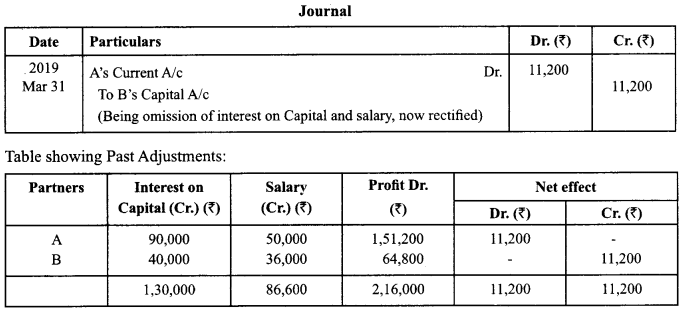
Class 12 Accountancy Important Extra Questions Chapter 2 Accounting for Partnership Basic Concepts 2

Question 6.
Partners of ABC Corporation have agreed that D, a minor, should be admitted as a partner in the firm. What will be liability of D?
Answer:
Limited.

Question 7.
X, Y and Z are partners in a firm. The firm had adopted fixed capital method. Mention the account in which the interest on capital will be recorded:
Answer:
Capital Account.

Question 8.
A partnership deed provides for the payment of interest on capital but there was a loss instead of profits during the year 2010-11. Will the interest on capital be allowed?
Answer:
No.

Question 9.
Where is interest on a partner’s loan debited to Profit and Loss Account or Profit and Loss Appropriation Account?
Answer:
Profit and loss Account.

Question 10.
Is interest on a partner’s loan is payable even in case of loss to the firm?
Answer:
Yes.

Question 11.
Net profit of a firm is ₹ 30,000, partners’ salary is ₹ 12,000 and interest on capital is ₹ 20,000. Mention the amount of partners’ salary and interest on capital which should be debited to Profit and Loss Appropriation Account if both items are treated as appropriation.
Answer:
Partners’ salary ₹ 11,250, Interest on capital ₹ 18,750.
Note: In the ratio of salary and interest on capital i.e. 12,000 : 20,000 = 3:5.

Question 12.
Ram and Shyam are partners sharing profits/losses equally. Ram withdrew ₹ 1,000 p.m. regularly on the first day of every month during the year 2013-14 for personal expenses. If interest on drawings is charged @ 5% p.a. Calculate interest on the drawings of Ram.
Answer:
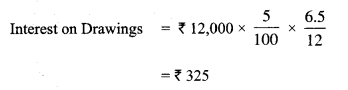
Class 12 Accountancy Important Extra Questions Chapter 2 Accounting for Partnership Basic Concepts 46

Question 13.
Verma and Kaul are partners in a firm. The partnership agreement provides that interest on drawings should be charged @ 6% p.a. Verma withdraws X 2,000 per month starting from April 01, 2013 to March 31, 2014. Kaul withdraw ₹ 3,000 per quarter, starting from April 01, 2013. Calculate interest on partner’s drawings.
Answer:
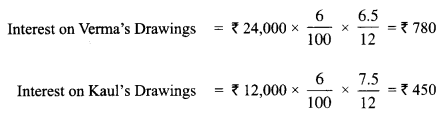
Class 12 Accountancy Important Extra Questions Chapter 2 Accounting for Partnership Basic Concepts 3

Question 14.
Himanshu withdraws ₹ 2,500 at the end of each month. The partnership deed provides for charging the interest on drawings @ 12% p.a. Calculate interest on Himanshu’s drawings for the year ending 31st December, 2013.
Answer:

Class 12 Accountancy Important Extra Questions Chapter 2 Accounting for Partnership Basic Concepts 47

Question 15.
Bharam is a partner in a firm. He withdraws ₹ 3,000 at the starting of each month for 12 months. The books . of the firm closes on March 31 every year. Calculate interest on drawings if the rate of interest is 10% p.a.
Answer:
Bharam withdraws ₹ 3,000 at the starting of each month.

Class 12 Accountancy Important Extra Questions Chapter 2 Accounting for Partnership Basic Concepts 48

Question 16.
Amit and Bhola are partners in a firm. They share profits in the ratio of 3 : 2. As per their partnership agreement, interest on drawings is to be charged @ 10% p.a. Their drawings during 2013 were ₹ 24,000 and ₹ 16,000, respectively. Calculate interest on drawings based on the assumption that the amounts were withdrawn evenly, throughout the year.
Answer:
Amit’s Drawings = ₹ 24,000
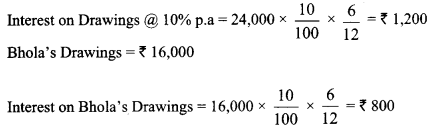
Class 12 Accountancy Important Extra Questions Chapter 2 Accounting for Partnership Basic Concepts 4
Note: In the absence of date of drawings, it is assumed drawings have been made in the middle of each month/period.

Question 17.
A, B and C were partners in a firm sharing profits in the ratio of 3 : 2 : 1. B was guaranteed a profit of X 2,00,000. During the year the firm earned a profit of ₹ 84,000. Calculate the net amount of Profit/Loss transferred to the capital accounts of A and C. (CBSE Sample Paper 2017-18)
Answer:
Net Amount of Loss transferred to:

  • A’s Capital Account: ₹ 87,000
  • C’s Capital Account: ₹ 29,000

Accounting for Partnership: Basic Concepts Important Extra Questions Short Answer Type

Question 1.
A and B were partners in a firm sharing profits in the ratio of 5 : 3. Their fixed capitals on 31st March, 2017 were: A ₹ 60,000 and B ₹ 80,000. They agreed to allow interest on capital @ 12% p.a. The profit of the firm for the year ended 31st March, 2018 before allowing interest on capitals was ₹ 12,600.
Pass necessary journal entries for the above transactions in the books of A and B. Also show your working notes clearly.
Answer:
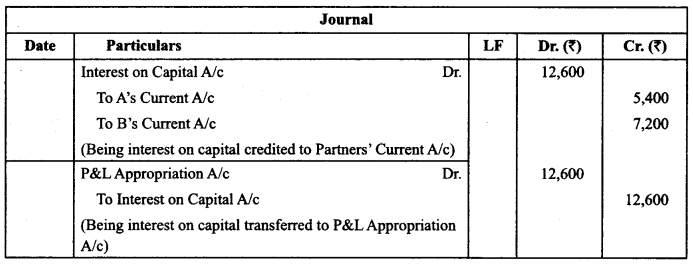
Class 12 Accountancy Important Extra Questions Chapter 2 Accounting for Partnership Basic Concepts 5
Working Notes:
Interest on Capital:
A= 12% of 60,000 = 7,200
B = 12% of 80,000 = 9,600
Total interest = 16,800
Since profits are insufficient interest on capital will be distributed in the ratio of 7,200:9,600 i.e. 3:4
A = 3/7 of 12,600 = 5,400
B = 4/7 of 12,600 = 7,200

Question 2.
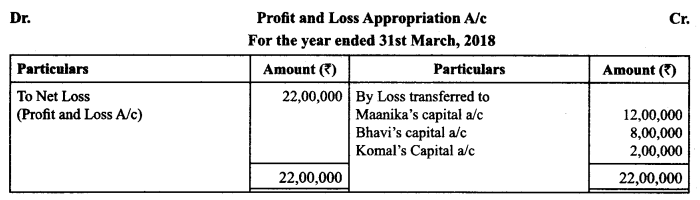
Maanika, Bhavi and Komal are partners sharing profits in the ratio of 6:4:1. Komal is guaranteed a minimum profit of ₹ 2,00,000. The firm incurred a loss of ₹22,00,000 for the year ended 31st March, 2018. Pass necessary journal entry regarding deficiency borne by Maanika and Bhavi and prepare Profit and Loss Appropriation Account. (CBSE SP 2019-20)
Answer:
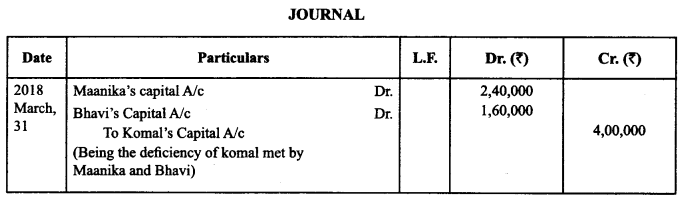
Class 12 Accountancy Important Extra Questions Chapter 2 Accounting for Partnership Basic Concepts 6
Class 12 Accountancy Important Extra Questions Chapter 2 Accounting for Partnership Basic Concepts 7
Working Note:
Loss of the firm = 22,00,000
Komal’s share of loss = 22,00,000 x 1/11 = 2,00,000
Guaranteed minimum profit = 2,00,000

Question 3.
A, B and C were partner in a firm. On 1st April, 2018, their capitals stood at ₹ 4,00,000, ₹ 3,00,000 and ₹2,00,000 respectively. As per the provisions of the partnership deed.
(i) A was entitled to a salary of ₹ 5,000 per month.
(ii) Partner were entitled to interest on capital @ 10% p.a.
The net profit for the year ended 31st March 2019, ₹ 3,00,000 was divided among the partners without providing for the above items.
Showing your working clearly, pass an adjustment entry to rectify the above error.
Answer:
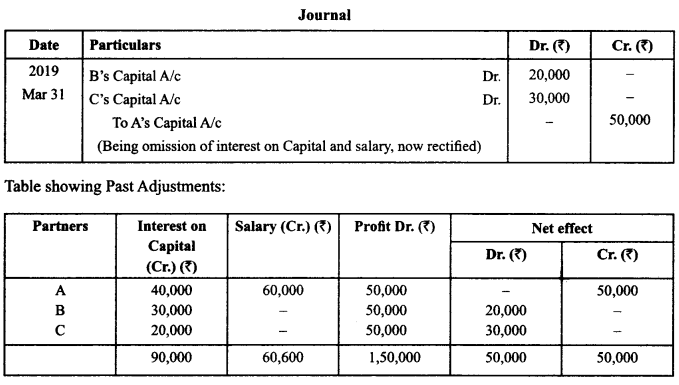
Class 12 Accountancy Important Extra Questions Chapter 2 Accounting for Partnership Basic Concepts 8

Question 4.
Rani and Suman are in partnership with capitals of ₹ 80,000 and ₹ 60,000, respectively. During the year 2013 – 2014, Rani withdrew ₹ 10,000 and Suman withdrew ₹ 15,000 from their capital profits before charging interest on capital was ₹ 50,000. Ravi and Suman shared profits in the ratio of 3: 2. Calculate the amounts of interest on their capitals @ 12% p.a. for the year ended March 31,2014.
Answer:
Interest on capital is always calculated on opening balance of capital.
Rate of interest = 12% p.a.
Rani’s opening capital = ₹ 80,000
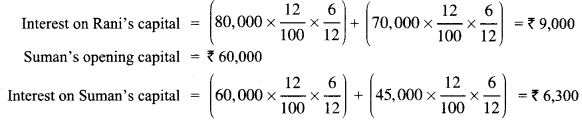
Class 12 Accountancy Important Extra Questions Chapter 2 Accounting for Partnership Basic Concepts 9
Note:
Date of capital withdrawn is not given in the question, it has been assumed that the same have been done in the mid of the accounting year.

Question 5.
Krishna, Sandeep and Karim are partners sharing profits in the ratio of 3 : 2 : 1. Their fixed capitals are: Krishan ₹ 1,20,000, Sandeep ₹ 90,000 and Karim ₹ 60,000. For the year 2013-14, interest was credited to them @ 6% p.a. instead of 5% p.a. Record adjustment entry.
Answer:
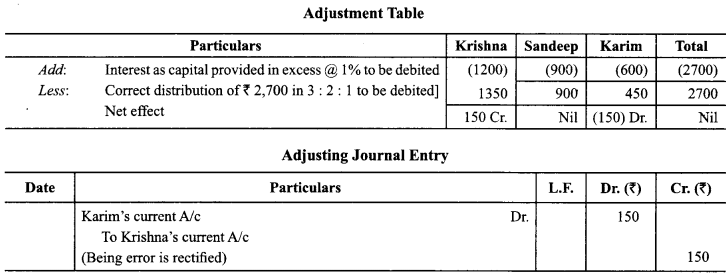
Class 12 Accountancy Important Extra Questions Chapter 2 Accounting for Partnership Basic Concepts 10

Question 6.
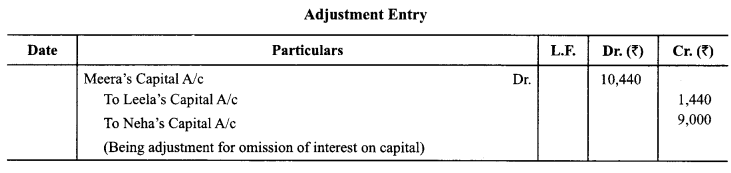
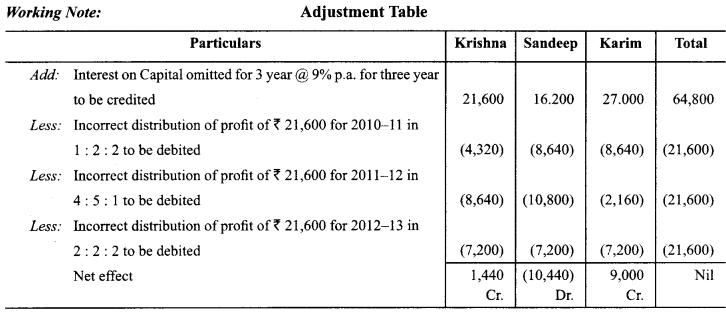
Leela, Meera and Neha are partners and have omitted interest on capital @ 9% p.a. for three years ended March 31, 2013. Their fixed capitals on which interest was to be allowed throughout were: Leela ₹ 80,000, Meera ₹ 60,000 and Neha ₹ 1,00,000. Their profit sharing ratio during the last three years were:
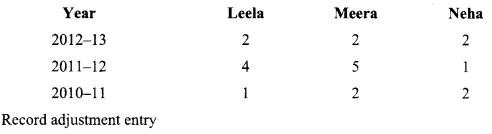
Class 12 Accountancy Important Extra Questions Chapter 2 Accounting for Partnership Basic Concepts 11
Answer:
Class 12 Accountancy Important Extra Questions Chapter 2 Accounting for Partnership Basic Concepts 12
Class 12 Accountancy Important Extra Questions Chapter 2 Accounting for Partnership Basic Concepts 13

Question 7.
Anubha and Kajal are partners of a firm sharing profits and losses in the ratio of 2 : 1. Their capital were ₹ 90,000 and ₹ 60,000. The divisible profit during the year were ₹ 45,000. According to partnership deed, both partners are allowed salary @ ₹ 700 per month to Anubha and ₹ 500 per month to Kajal. Interest allowed on capital @ 5% p.a. The drawings at the end of the period were ₹ 8,500 for Anubha and ₹ 6,500 for Kajal. Interest is to be charged @ 5% p.a. on drawings. Prepare partners capital accounts, assuming that the . capital accounts are fluctuating.
Answer:
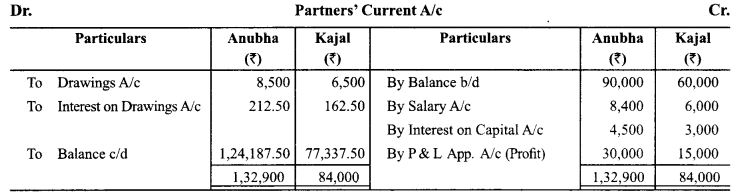
Class 12 Accountancy Important Extra Questions Chapter 2 Accounting for Partnership Basic Concepts 14
Note:
(1) It has been assumed that profit given is divisible profit.
(2) It has been assumed drawings have been made in the middle of the year. Normally, in the absence of date, drawings are assumed to have been made in the middle of the year.

Question 8.
Harshad and Dhiman are in partnership since April 01, 2013. No Partnership agreement was made. They contributed ₹ 4,00,000 and 1,00.000 respectively as capital. In addition, Harshad advanced an amount of ₹ 1,00,000 to the firm, on October 01, 2013. Due to long illness, Harshad could not participate in business activities from August 1, to September 30. 2013. The profits for the year ended March 31, 2014 amounted to ₹ 1,80,000.
Dispute has arisen between Harshad and Dhiman.
Harshad Claims:

  1. He should be given interest @ 10% per annum on capital and loan
  2. Profit should be distributed in proportion of capital

Dhiman Claims:

  1. Profits should be distributed equally
  2. He should be allowed ₹ 2,000 p.m. as remuneration for the period he managed the business, in the absence of Harshad
  3. Interest on capital and loan should be allowed @ 6% p.a.

You are required to settle the dispute between Harshad and Dhiman. Also prepare P&L Appropriation Account.
Answer:
Harshad’s Claims

(i) Harshad’s claim that he should be given interest @ 10% p.a. on capital is not justified. According to the provisions of Partnership Act, 1932, he is not entitled to receive interest on loan @ 10% but only entitled to receive @ 6% p.a.

(ii) His second claim that profits should be distributed in proportion of capital does not fall within the provisions of Partnership Act, 1932. Act provides for equal distribution of profits among partners.

Dhiman’s Claims

(i) His claim to distribute the profits equally is right as per the provisions of Partnership Act, 1932.

(ii) His claim for remuneration for managing the business is not justified because Partnership Act, 1932 does not allow any such remuneration.

(iii) His claim that interest on capital should be allowed @ 6% p.a. is wrong but his claim to provide interest on loan @ 6% p.a. is a right claim as per the provisions of Partnership Act., 1932.
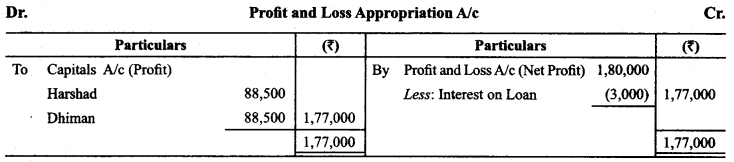
Class 12 Accountancy Important Extra Questions Chapter 2 Accounting for Partnership Basic Concepts 15
Note: Since interest on loan is charged against the profit, it can be shown on the debit side of profit and loss account or as a deduction from the pro fit on the credit side of Profit and Loss Appropriation Account.

Question 9.
Aakriti and Bindu entered into partnership for making garment on April 01, 2013 without any partnership agreement. They introduced capitals of₹ 5,00,000 and ₹ 3,00,000 respectively on October 01,2013. Aakriti Advanced. ₹ 20,000 by way of loan to the firm without any agreement as to interest. Profit and Loss account for the year ended March 2014 showed profit of ₹ 43,000. Partners could not agree upon the question of interest and the basis of division of profit. You are required to divide the profits between them giving reason for your solution.
Answer:
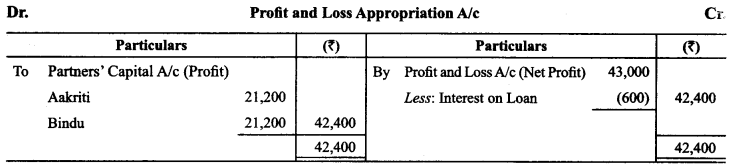
Class 12 Accountancy Important Extra Questions Chapter 2 Accounting for Partnership Basic Concepts 16
Reason:
(1) In the absence of any partnership deed, the provisions of Partnership Act, 1932 is applied. According to the provisions, no interest on capital, no salary, no commission will be allowed to the partners They will also share the profits equally. The interest on loan also will be provided at 6% p.a.

(2) Since interest on loan is charged against the profit, it can be shown on the debit side of profit and loss account or as a deduction from the profit on the credit side of Profit and Loss Appropriation Account.

Question 10.
Rahul, Rohit and Karan started partnership business on April 1, 2013 with capitals of ₹ 20,00,000, ₹ 18,00,000 and ₹ 16,00,000, respectively. The profit for the year ended March 2014 amounted to 7 1,35,000 and the partner’s drawings had been Rahul 7 50,000, Rohit 7 50,000 and Karan 7 40,000. The profits are distributed among partner’s in the ratio of 3 : 2 : 1. Calculate the interest on capital @ 5% p.a.
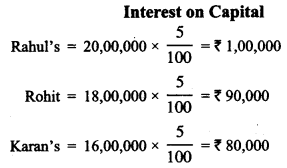
Class 12 Accountancy Important Extra Questions Chapter 2 Accounting for Partnership Basic Concepts 17
Note:
As interest on capital is calculated on the opening capitals, rest of the information apart from opening capitals is irrelavant.

Question 11.
Following is the extract of the Balance Sheet of Neelkant and Mahadev as on March 31,2013:
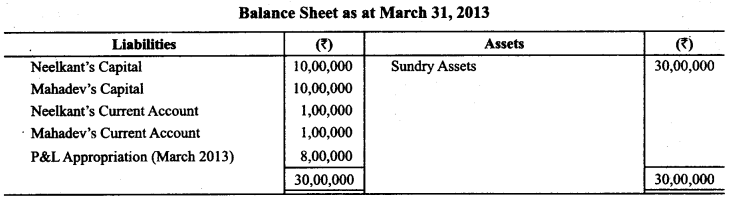
Class 12 Accountancy Important Extra Questions Chapter 2 Accounting for Partnership Basic Concepts 18
During the year Mahadev’s drawings were 7 30,000. Profits dining 2013 is 7 10,00,000. Calculate interest on capital @ 5% p.a. for the year ending March 31,2013.
Answer:
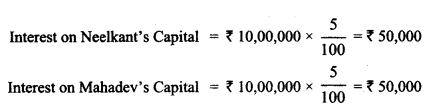
Class 12 Accountancy Important Extra Questions Chapter 2 Accounting for Partnership Basic Concepts 50
Note:
Since the capitals are fixed, profit and drawings must have been transferred to Current Accounts. Therefore, capitals must be fixed in beginning as well as at the end.

Question 12.
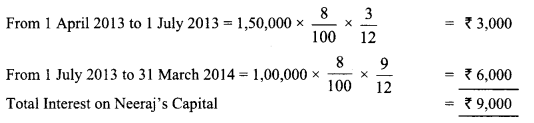
Raj and Neeraj are partners in a firm. Their capitals as on April 01, 2013 were 72,50,000 and 71,50,000, respectively. They share profits equally. On July 01, 2013, they decided that their capitals should be 71,00,000 each. The necessary adjustment in the capitals were made by introducing or withdrawing cash by the partners Interest on capital is allowed @ 8% p.a. Compute interest on capital for both the partners for the year ending on March 31,2014.
Answer:
Interest on Ram’s Capital @ 8% p.a.
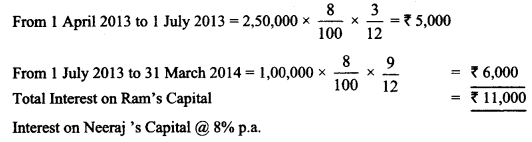
Class 12 Accountancy Important Extra Questions Chapter 2 Accounting for Partnership Basic Concepts 19
Class 12 Accountancy Important Extra Questions Chapter 2 Accounting for Partnership Basic Concepts 20

Question 13.
On March 31, 2013, after the close of books of accounts, the capital accounts of Ram, Shyam and Mohan showed a balance of₹ 24,000 ₹ 18,000 and ₹ 12,000, respectively. It was later discovered that interest on capital @ 5% had been omitted. The profit for the year ended March 31,2013, amounted to ₹ 36,000 and the partner’s drawings had been Ram, ₹ 3,600; Shyam, ₹ 4,500 and Mohan, ₹ 2,700. The profit sharing ratio of Ram, Shyam and Mohan was 3:2:1. Calculate interest on capitals.
Answer:
Note. Interest on Capital is always calculated on Opening Capital.
Opening Capital = Closing Capital + Drawings – Share of Profit
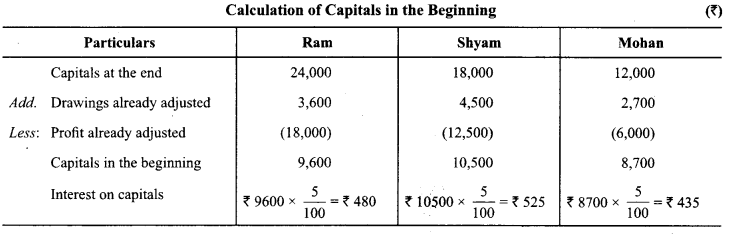
Class 12 Accountancy Important Extra Questions Chapter 2 Accounting for Partnership Basic Concepts 21

Question 14.
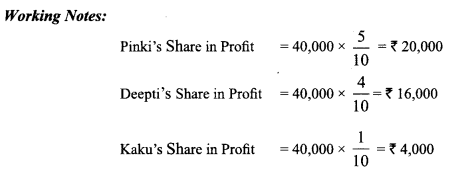
Pinki, Deepti and Kaku are partner’s sharing profits in the ratio of 5 : 4 : 1. Kaku is given a guarantee that his share of profits in any given year would not be less than ₹ 5,000. Deficiency, if any, would be borne by Pinki and Deepti equally. Profits for the year amounted to ₹ 40,000. Record necessary journal entries in the books of the firm showing the distribution of profit.
Answer:
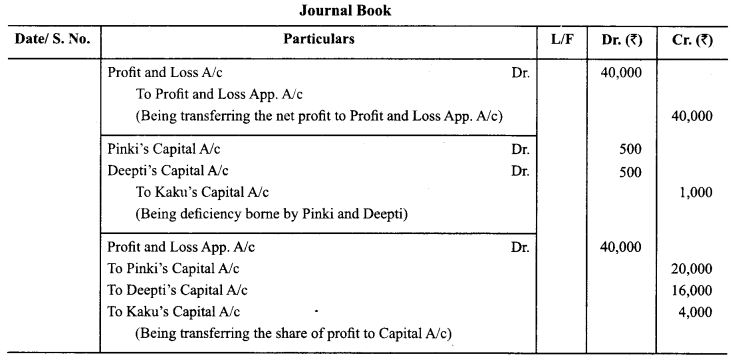
Class 12 Accountancy Important Extra Questions Chapter 2 Accounting for Partnership Basic Concepts 22
Class 12 Accountancy Important Extra Questions Chapter 2 Accounting for Partnership Basic Concepts 23
There is deficiency in Kaku’s Share of₹ 1,000 (5,000 – 4,000). It will be borne by Pinki and Deepti equally.

Question 15.
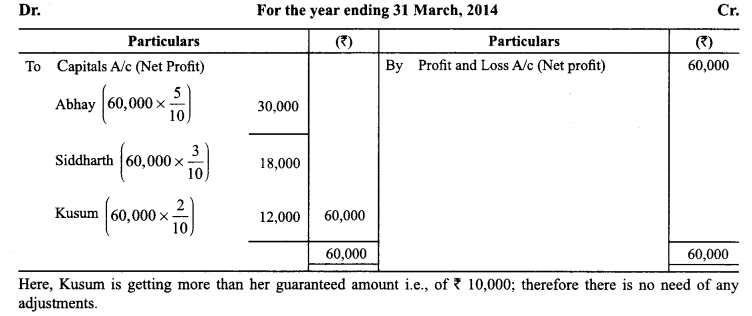
Abhay, Siddharth and Kusum are partners in a firm, sharing profits in the ratio of 5 : 3 : 2. Kusum is guaranteed a minimum amount of₹ 10,000 as per share in the profits. Any deficiency arising on that account shall be met by Siddharth. Profits for the years ending March 31, 2013 and 2014 are ₹ 40,000 and 60,000 respectively. Prepare Profit and Loss Appropriation Account.
Answer:
Profit and Loss Appropriation A/c
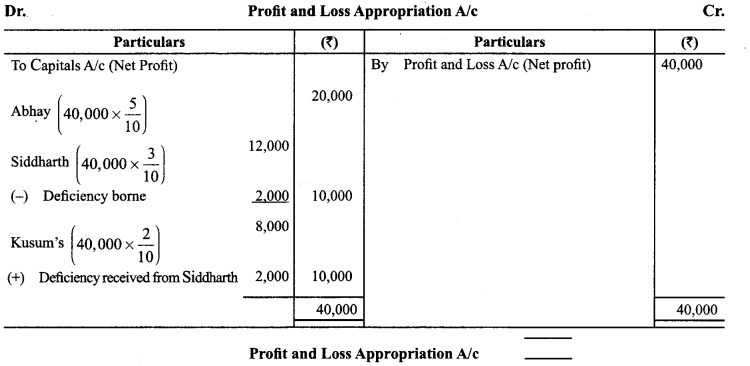
Class 12 Accountancy Important Extra Questions Chapter 2 Accounting for Partnership Basic Concepts 24
Class 12 Accountancy Important Extra Questions Chapter 2 Accounting for Partnership Basic Concepts 25

Question 16.
Radha, Mary and Fatima are partners sharing profits in the ratio of 5 :4 : 1 Fatima is given a guarantee that her share of profit, in any year will not be less than ₹ 5,000. The profits for the year ending March 31,2013 amounts to ₹ 35,000. Shortfall if any, in the profits guaranteed to Fatima is to be borne by Radha and Mary in the ratio of 3 : 2. Record necessary journal entry to show distribution of profit among partner.
Answer:
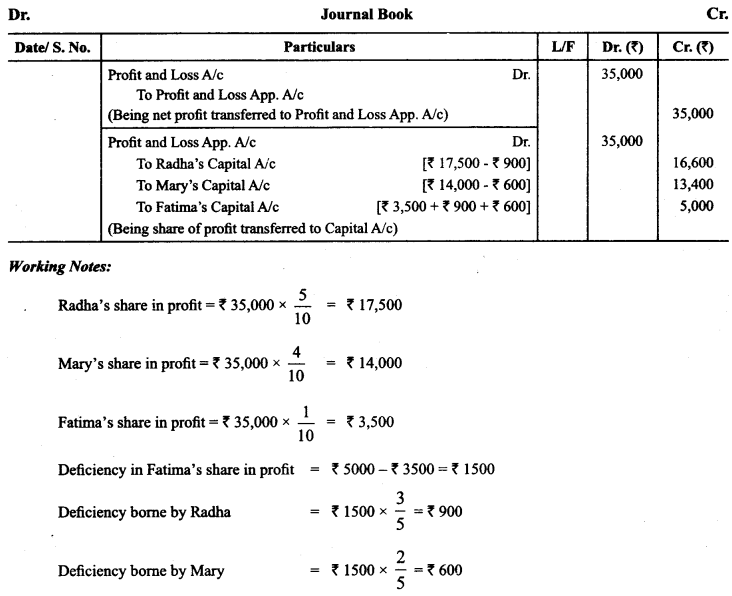
Class 12 Accountancy Important Extra Questions Chapter 2 Accounting for Partnership Basic Concepts 26

Question 17.
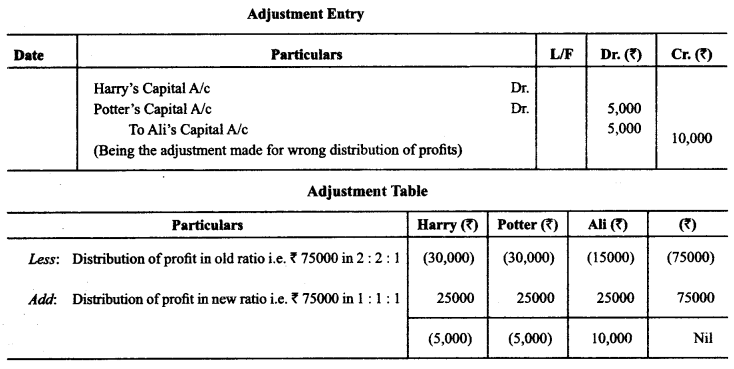
The firm of Harry, Potter and Ali who have been sharing profits in the ratio of 2 :2 :1, have existed for some years Ali wants that he should get equal share in the profits with Harry and Potter and he further wishes that the change in the profit sharing ratio should come into effect retrospectively for the last three years Harry and Potter have agreement on this account.
The profits for the last three years were:
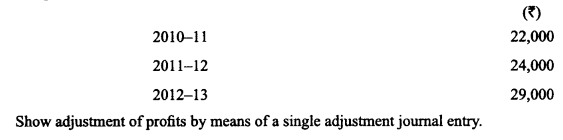
Class 12 Accountancy Important Extra Questions Chapter 2 Accounting for Partnership Basic Concepts 27
Answer:
Class 12 Accountancy Important Extra Questions Chapter 2 Accounting for Partnership Basic Concepts 28

Question 18.
On 1.4.2013 Jay and Vijay, entered into partnership for supplying laboratory equipments to government . schools situated in remote and backward areas. They contributed capitals of ₹ 80,000 and ₹ 50,000 respectively and agreed to share the profits in the ratio of 3 : 2 The partnership deed provided that interest on capital shall be allowed at 9% per annum. During the year the firm earned a profit of ₹ 7,800. Showing your calculations clearly, prepare ‘Profit and Loss Appropriation Account’ of Jay and Vijay for the year ened 31-3-2014. (CBSE Delhi 2015)
Answer:
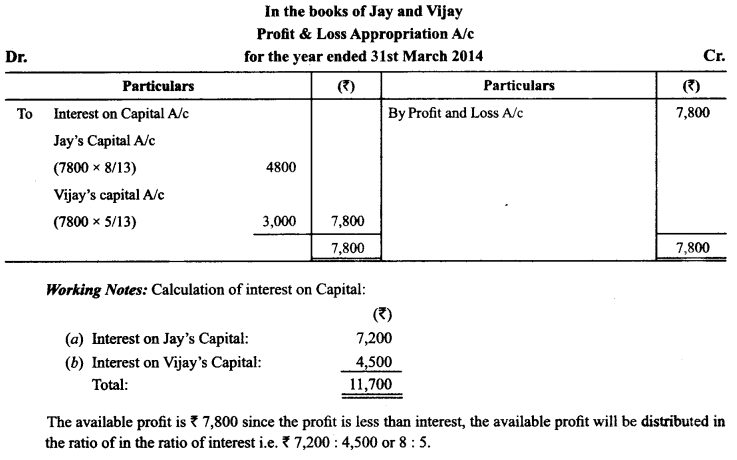
Class 12 Accountancy Important Extra Questions Chapter 2 Accounting for Partnership Basic Concepts 29

Question 19.
Ram, Mohan and Sohan are partners with capitals of ₹ 5,00,000, ₹ 2,50,000 and 2,00,000 respectively. After providing interest on capital @ 10% p.a. the profits are divisible as follows:
Ram 1/2, Mohan 1/3 and Sohan 1/6. But Ram and Mohan have guaranteed that Sohan’s share in the profit shall not be less than ₹ 25,000, in any year. The net profit for the year ended March 31, 2013 is ₹ 2,00,000, before charging interest on capital.
You are required to show distribution of profit.
Answer:
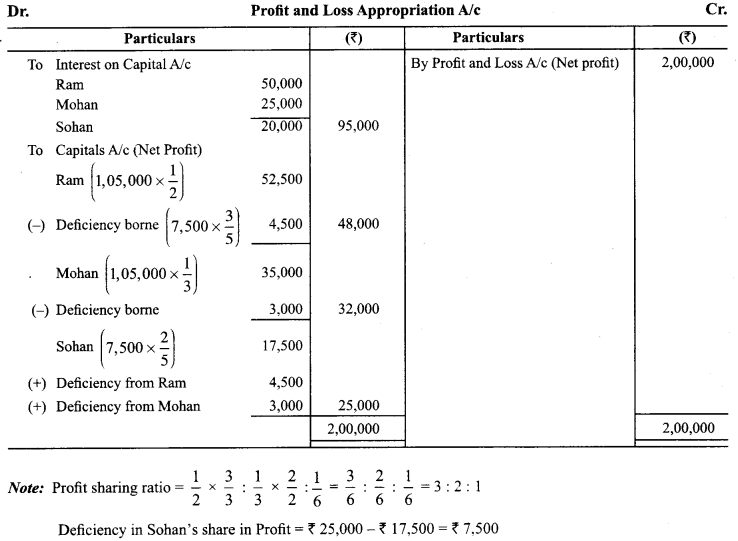
Class 12 Accountancy Important Extra Questions Chapter 2 Accounting for Partnership Basic Concepts 30

Question 20.
Kanika and Gautam are partners doing a dry cleaning business in Lucknow, sharing profits in the ratio 2 : 1 with capitals ₹ 5,00,000 and ₹4,00,000 respectively, Kanika withdrew the following amounts during the year to pay the hostel expenses of her son.
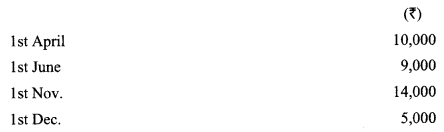
Class 12 Accountancy Important Extra Questions Chapter 2 Accounting for Partnership Basic Concepts 31
Gautam withdrew ₹ 15,000 on the first day of April, July, October and January to pay rent for the accommodation of his family. He also paid ₹ 20,000 per month as rent for the office of partnership which was in a nearby shopping complex. Calculate interest on Drawings @ 6% p.a. (CBSE Sample Paper 2015)
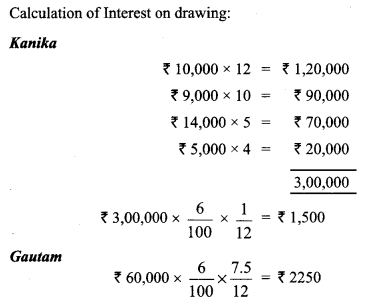
Class 12 Accountancy Important Extra Questions Chapter 2 Accounting for Partnership Basic Concepts 32

Question 21.
Ankur and Bobby were into the business of providing software solutions in India. They were sharing profits and losses in the ratio 3 : 2. They admitted Rohit for a 1/5 share in the firm. Rohit, an alumni of IIT, Chennai would help them to expand their business to various South African countries where he had been working earlier. Rohit is guaranteed a minimum profit of₹ 2,00,000 for the year. Any deficiency in Rohit’s share is to . be borne by Ankur and Bobby in the ratio 4:1. Losses for the year ₹ 10,00,000. Pass the necessary journal entries. (CBSE Sample Paper 2015)
Answer:
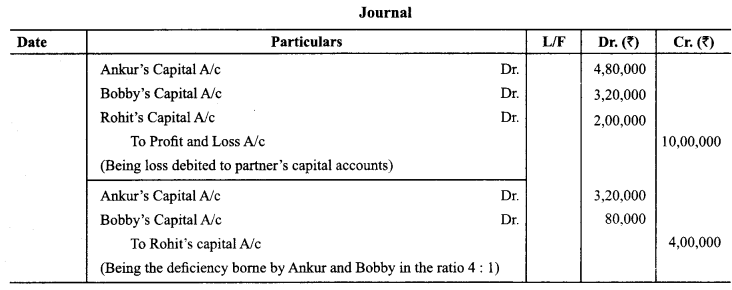
Class 12 Accountancy Important Extra Questions Chapter 2 Accounting for Partnership Basic Concepts 33

Question 22.
Rehman, Suleman and Hanuman were partners in a firm sharing profits in the ratio of 3 : 2 : 1 respectively. Their fixed capitals were as follows: Rehman ₹ 3,00,000, Suleman ₹ 2,00,000 and Hanuman ₹ 1,00,000. The partnership deed provided for the following for the division of profit:
(i) 10% of trading profit will be transferred to Reserve Account.
(ii) Hanuman was guaranteed a profit of ₹ 50,000. Any loss because of guarantee to Hanuman will be shared by Rehman and Suleman equally.
The trading profit of the firm for the year ended 31. 12. 2012 was ₹ 2,00,000.
Prepare the Profit and Loss Appropriation Account of Rehman, Suleman and Hanuman for the year ended 31. 12. 2012. (CBSE 2013 Compartment OD)
Answer:
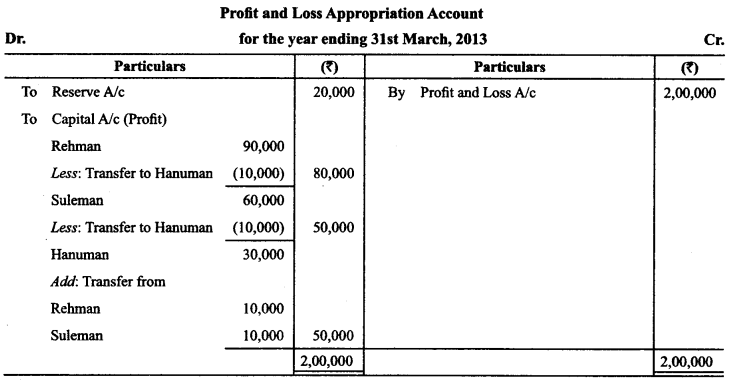
Class 12 Accountancy Important Extra Questions Chapter 2 Accounting for Partnership Basic Concepts 34

Question 23.
The net profit of X, Y and Z for the year ended March 31,2014 was ₹ 60,000 and the same was distributed among them in their agreed ratio of 3 : 1 : 1. It was subsequently discovered that the under mentioned transactions were not recorded in the books:

  1. Interest on capital @ 5% p.a.
  2. Interest on drawings amounting to X ₹ 700, Y ₹ 500 and Z ₹ 300.
  3. Partner’s salary: X ₹ 1,000 p.a., Y ₹ 1,500 p.a.

The capital accounts of partners were fixed as: X ₹ 1,00,000, Y ₹ 80,000 and Z ₹ 60,000. Record the adjustment entry.
Answer:
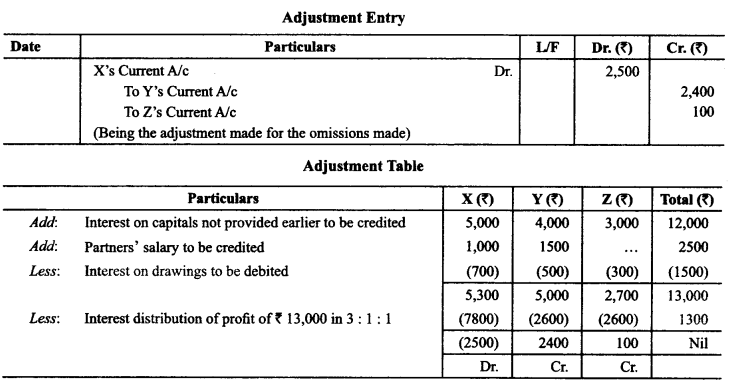
Class 12 Accountancy Important Extra Questions Chapter 2 Accounting for Partnership Basic Concepts 35

Question 24.
Mannu and Shristhi are partners in a firm sharing profit in the ratio of 3 :2. Following is the balance sheet of firm as on March 31,2013.
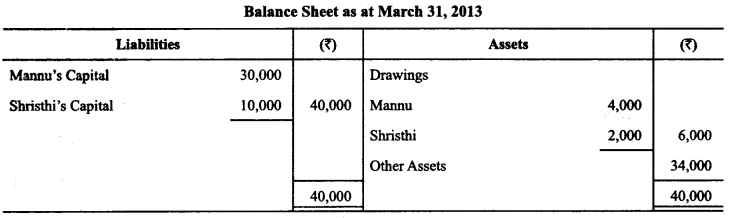
Class 12 Accountancy Important Extra Questions Chapter 2 Accounting for Partnership Basic Concepts 36
Profit for the year ended March 31, 2013 was ₹ 5,000 which was divided in the agreed ratio, but interest @ 5% p.a. on capital and @ 6% p.a. on drawings was inadvertently ignored. Adjust interest on drawings on an average basis for 6 months. Give the adjustment entry.
Answer:
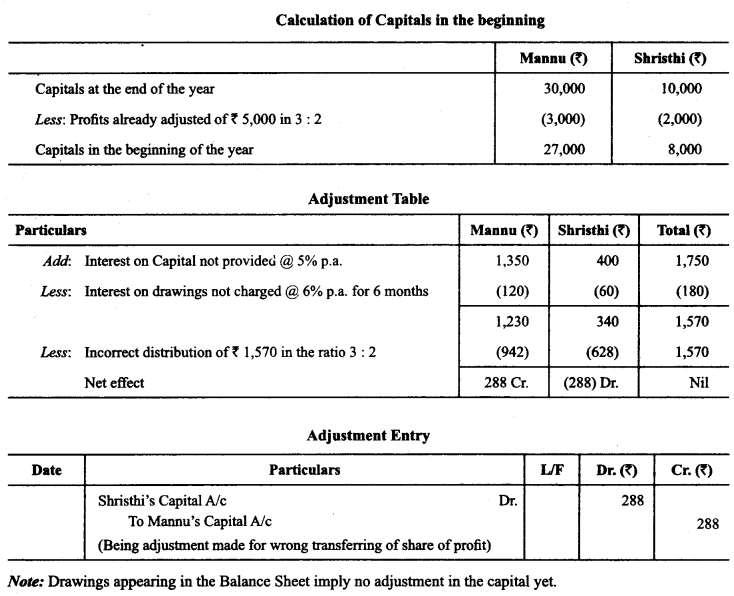
Class 12 Accountancy Important Extra Questions Chapter 2 Accounting for Partnership Basic Concepts 37

Question 25.
L, M and N are partners in a firm sharing profits & losses in the ratio of 2 : 3 : 5.
On April 1, 2016 their fixed capitals were ₹ 2,00,000, ₹ 3,00,000 and ₹ 4,00,000 respectively. Their partnership deed provided for the following:

  1. Interest on capital @ 9% per annum.
  2. Interest on Drawings @ 12% per annum.
  3. Interest on partners’ loan @ 12% per annum.

On July 1, 2016, L brought ₹ 1,00,000 as additional capital and N withdrew ₹ 1,00,000 from his capital. During the year L, M and N withdrew ₹ 12,000, ₹ 18,000 and ₹ 24,000 respectively for their personal use. On January 1, 2017 the firm obtained a Loan of ₹ 1,50,000 from M. The Net profit of the firm for the year ended March 31, 2017 after charging interest on M’s Loan was ₹ 85,000.
Prepare Profit & Loss Appropriation Account and Partners Capital Account. (CBSE Sample Paper 2017-18)
Answer:
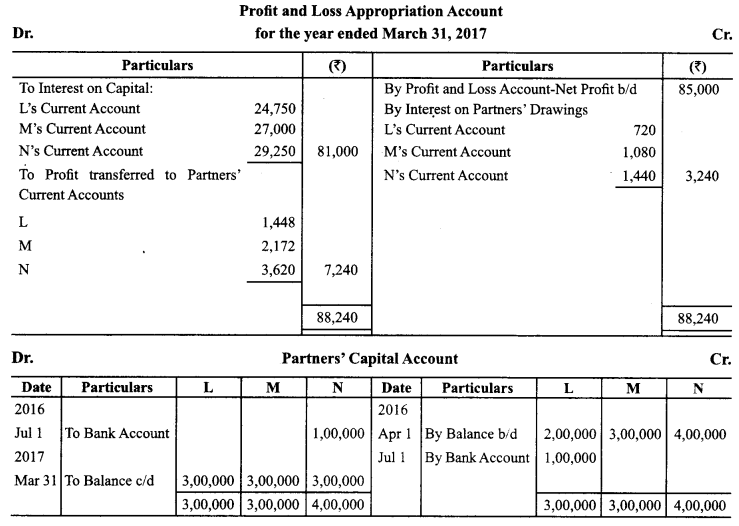
Class 12 Accountancy Important Extra Questions Chapter 2 Accounting for Partnership Basic Concepts 38

Question 26.
The partners of a firm, Alia, Bhanu and Chand distributed the profits for the year ended 31st March, 2017, ₹ 80,000 in the ratio of 3:3:2 without providing for the following adjustments:

  • Alia and Chand were entitled to a salary of₹ 1,500 each p.a.
  • Bhanu was entitled for a commission of ₹ 4,000
  • Bhanu and Chand had guaranteed a minimum profit of ₹ 35,000 p.a. to Alia any deficiency to borne equally by Bhanu and Chand.

Pass the necessary Journal entry for the above adjustments in the books of the firm.
Show workings clearly. (CBSE Sample Paper 2018-19)
Answer:
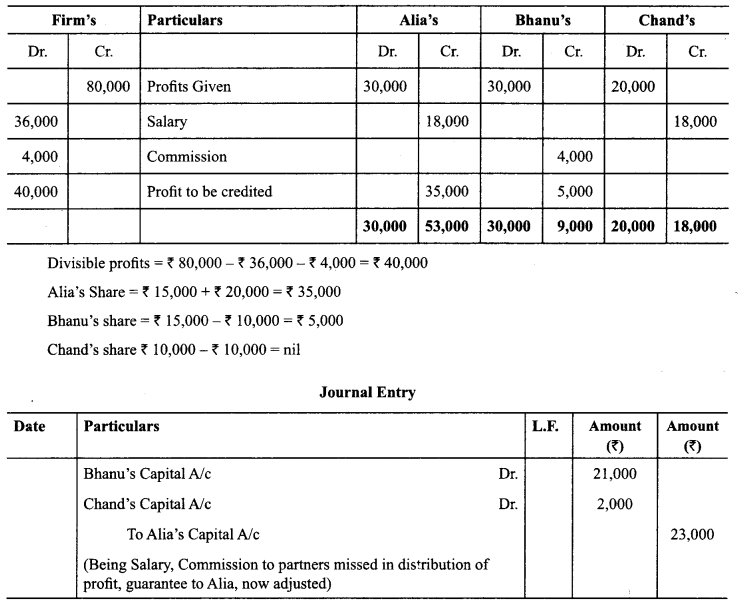
Class 12 Accountancy Important Extra Questions Chapter 2 Accounting for Partnership Basic Concepts 49

Question 27.
Piya and Bina are partners in a firm sharing profits and losses in the ratio of 3 : 2. Following was the Balance Sheet of the firm as on 31-3-2016.
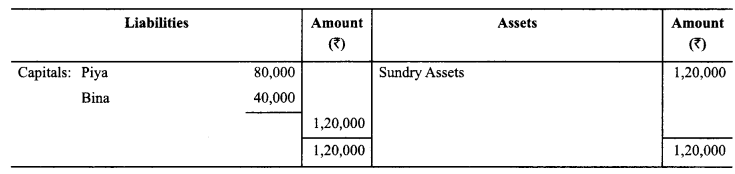
Class 12 Accountancy Important Extra Questions Chapter 2 Accounting for Partnership Basic Concepts 40
The profits ₹ 30,000 for the year ended 31-3-2016 were divided between the partners without allowing interest on capital @ 12% p.a. and salary to Piya @ ₹ 1,000 per month. During the year Piya withdrew ₹8,000 and Bina withdrew ₹4,000.
Showing your working notes clearly, pass the necessary rectifying entry. (Compt. Delhi 2017)
Answer:
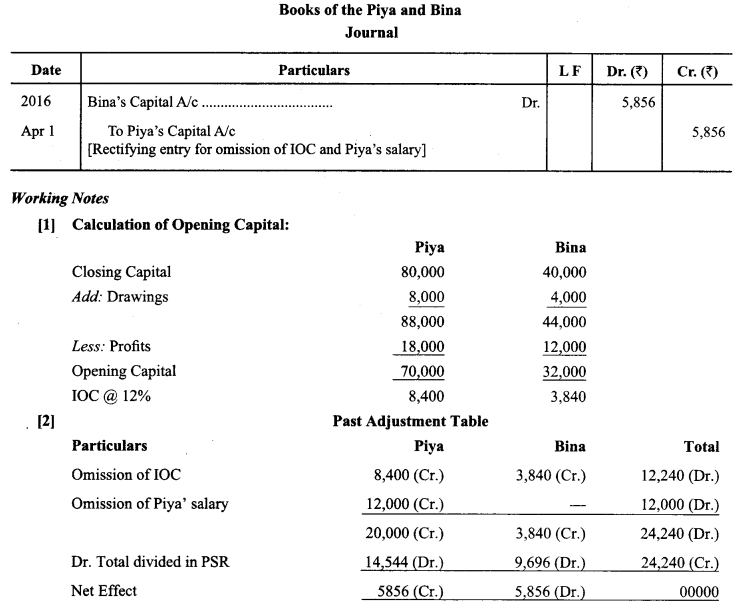
Class 12 Accountancy Important Extra Questions Chapter 2 Accounting for Partnership Basic Concepts 41

Accounting for Partnership: Basic Concepts Important Extra Questions Long Answer Type

Question 1.
Moli, Bhola and Raj were partners in a firm sharing profit and losses in the ratio of 3 : 3 : 4. Their partnership deed provides for the following:

  • Interest on Capital @ 5% p.a.
  • Interest on Drawing @ 12% p.a.
  • Interest on Partner’s Loan @ 6% p.a.
  • Moli was allowed an annual salary of ₹4,000.

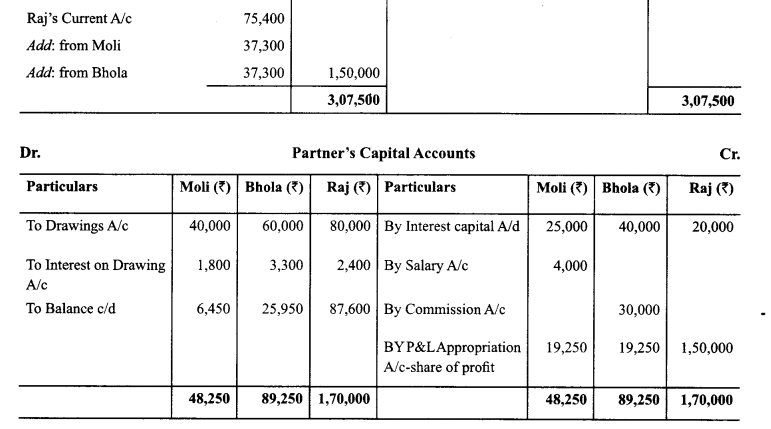
Bhola was allowed a commission of 10% of net profit as shown by Profit and Loss Account and Raj was guaranteed a profit ₹ 1,50,000 after making all the adjustments as provided in the partnership agreement. Their fixed capital were Moli ₹5,00,000, Bhola ₹8,00,000 and Raj ₹4,00,000. On 1st April 2016 Bhola extended a loan of ₹ 1,00,000 to the firm. The net profit for the year en ded 31st March 2017 before interest on Bhola’s Loan was ₹3,06,000. Prepare Profit and Loss Appropriation Account of Moli, Bhola and Raj for the year ended 31 st March 2017 and their Current Account assuming that Bhola withdrew ₹ 5,000 at the end of each month. Moli withdrew ₹ 10,000 at the end of each quarter and Raj withdrew ₹40,000 at the end of each half year.
(CBSE 2018-19)
Answer:
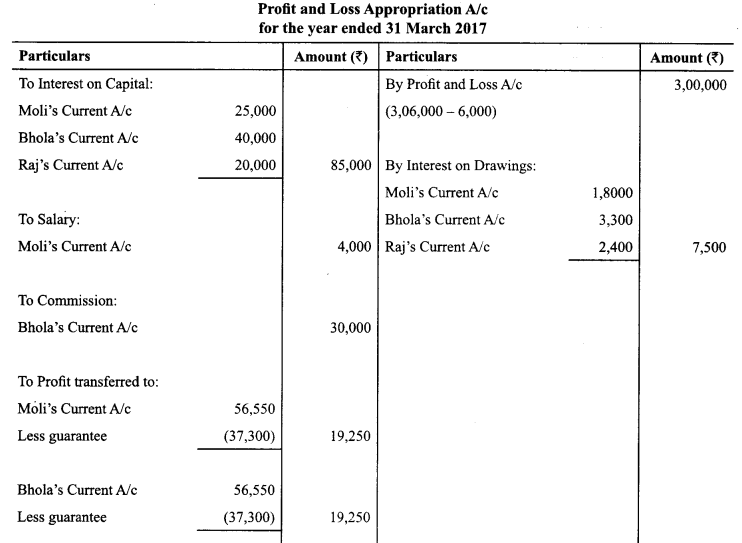
Class 12 Accountancy Important Extra Questions Chapter 2 Accounting for Partnership Basic Concepts 42
Class 12 Accountancy Important Extra Questions Chapter 2 Accounting for Partnership Basic Concepts 43

Question 2.
Naveen, Seerat andHina were partners in a firm manufatcturing blankets. They were sharing profits in the ratio of 5:3:2. Their capitals on 1st April, 2012 were ₹ 2,00,000; ₹ 3,00,000 and ₹ 6,00,000 respectively. After the floods in Uttaranchal, all partners decided to help the flood victims personally.
For this Naveen withdrew ₹ 10,000 from the firm on 1st September, 2012. Seerat, instead of withdrawing cash from the firm, took blankets amounting to ₹ 12,000 on 1st October, 2012 from the firm and distributed to the flood victims. On the other hand, Hina withdrew ₹ 2,00,000 from her capital on 1st January, 2013 and set up a centre to provide medical facilities in the flood affected area.
The partnership deed provides for charging interest on drawings @ 6% p.a. After the Final Accounts were prepared, it was discovered that interest on drawings had not been charged. Give the necessary adjusting journal entry and show the working notes clearly. (Delhi Compartment 2014, Modified)
Answer:
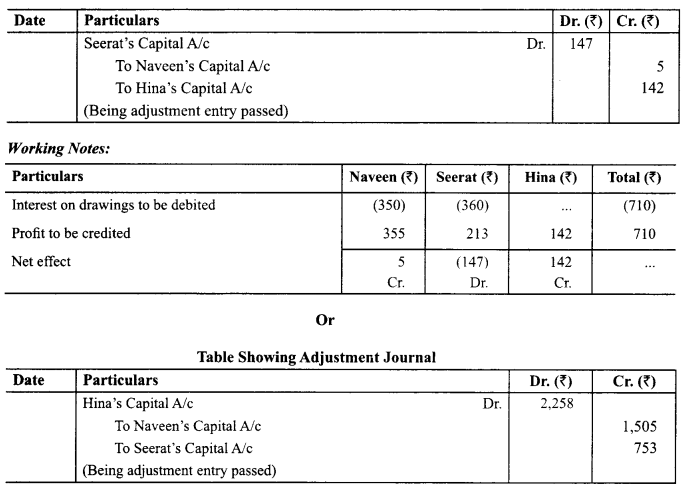
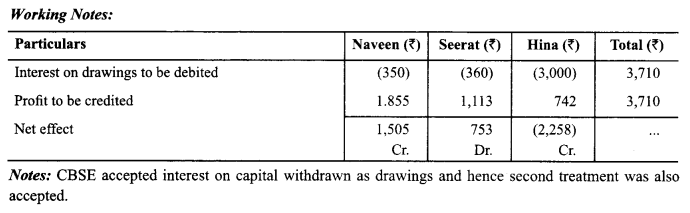
Class 12 Accountancy Important Extra Questions Chapter 2 Accounting for Partnership Basic Concepts 44
Class 12 Accountancy Important Extra Questions Chapter 2 Accounting for Partnership Basic Concepts 45

Accounting for Not for Profit Organisation Class 12 Important Questions Accountancy Chapter 1

Here we are providing Class 12 Accountancy Important Extra Questions and Answers Chapter 1 Accounting for Not for Profit Organisation. Accountancy Class 12 Important Questions and Answers are the best resource for students which helps in class 12 board exams.

Class 12 Accountancy Chapter 1 Important Extra Questions Accounting for Not for Profit Organisation

Accounting for Not for Profit Organisation Important Extra Questions Very Short Answer Type

Question 1.
How are specific donations treated while preparing final accounts of a ‘Not-For-Profit Organisation’ (CBSE Delhi 2019)
Answer:
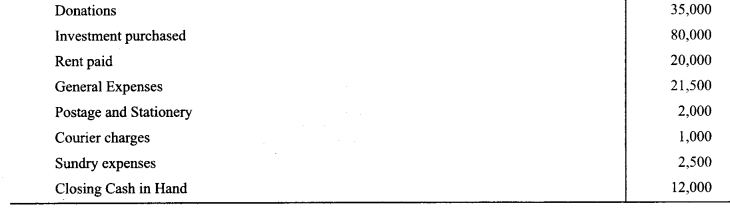
Specific donation is treated as capital receipt & it is shown on liabilities side of Balance Sheet.

Question 2.
State the basis of accounting of preparing ‘Income and Expenditure Account’ of a ‘Not-For-Profit Organisation. (CBSE Delhi 2019)
Answer:
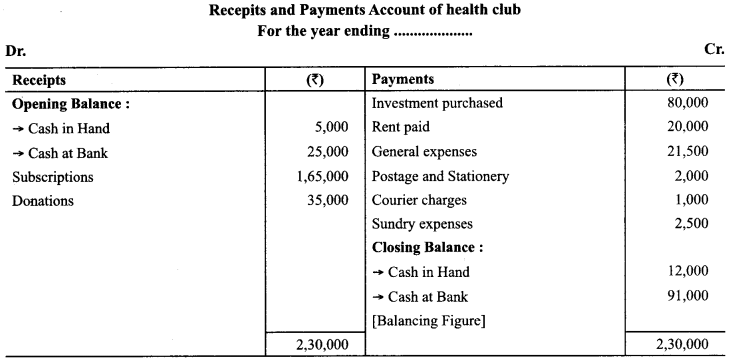
Accrual basis.

Question 3.
Differentiate between ‘Receipts and Payments Account’ and ‘Income and Expenditure Account’ on the basis of ‘Period’. (CBSE Outside Delhi 2019)
Answer:
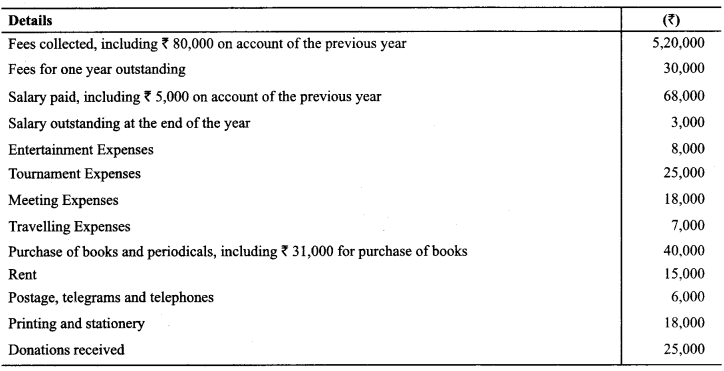
Class 12 Accountancy Important Extra Questions Chapter 1 Accounting for Not for Profit Organisation 1

Question 4.
What is meant by ‘Life membership fees’ ₹ (Outside Delhi 2019)
Answer:
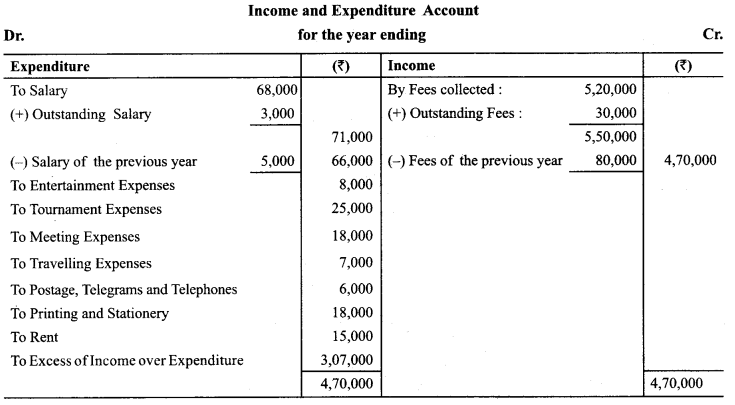
Membership fee paid in lump stun to become a life member of a not-for-profit organisation.

Question 5.
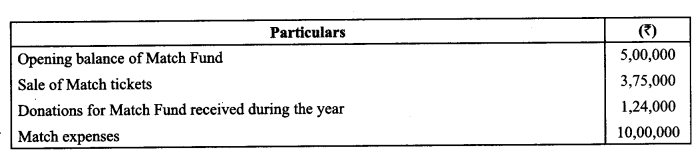
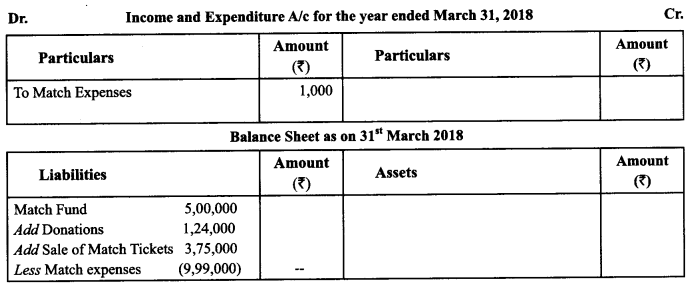
How are the following items presented in financial statements of a Not-for-Profit organisation: (CBSE Delhi 2019)
(a) Tournament Fund 80,000
(b) Tournament expenses 14,000
Answer:
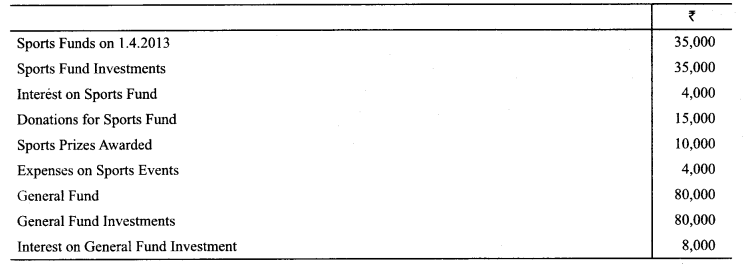
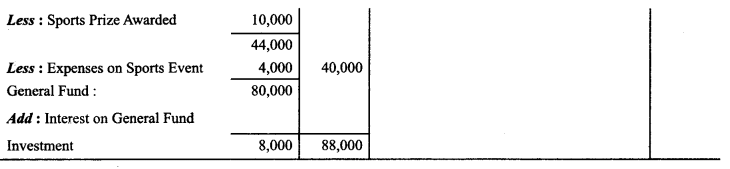
Class 12 Accountancy Important Extra Questions Chapter 1 Accounting for Not for Profit Organisation 2

Question 6.
How are general donations treated while preparing financial statements of a not-for-profit organisation (CBSE Compt. 2019)
Answer:
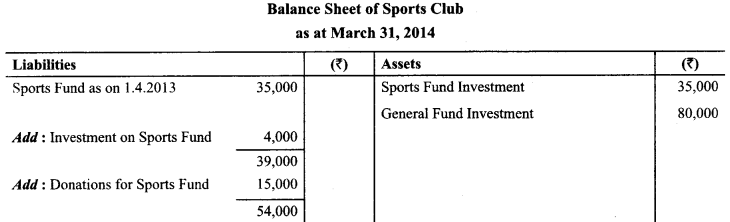
General donations are treated as revenue receipts.
or
How are general donations treated while preparing financial statements of a not-for-profit organisation (CBSE Compt. 2019)
Answer:
Life membership fee is the membership fee paid by some members as a lump sum amount instead of a periodic subscription.

Question 7.
State the basis of accounting on which ‘Receipt and Payment Account’ is prepared in case of Not-for Profit Organisation. (CBSE Sample Paper 2018-19)
Answer:
Cash basis of accounting.

Question 8.
Where will you show the ‘Subscription received in advance’ during the current year in the Balance Sheet of a Not-For-Profit Organisation₹ (CBSE Sample Paper 2018-19)
Answer:

Liability side of current year’s balance sheet.

Question 9.
A not-for-profit organisation sold its old furniture. State whether it will be treated as revenue receipt or capital receipt.
Answer:
Revenue.

Question 10.
Mention a fund who are specific in nature.
Answer:
Sports fund.

Question 11.
Income and Expenditure Account of a not-for-profit organisation has shown credit balance of ₹ 1,20,000 during 2012-13. When will you show it
Answer:
It will be added in the capital fund on the liability side.

Question 12.
Do not for profit organisation maintain proper system of accounts
Answer:
No.

Question 13.
Name any one account prepared by not for profit organisations.
Answer:
Receipts and Payment Account, Income and Expenditure Account and Balance Sheet.

Question 14.
Give one example of not for profit organisations.
Answer:
Charitable dispensaries, schools, educational institutions, trusts, societies etc.

Question 15.
State one source of not for profit organisations.
Answer:
Subscriptions, donations, legacies, government grant etc.

Question 16.
State the receipts relating to non-recurring in nature.
Answer:
Capital receipts.

Question 17.
State the payments relating to non-recurring in nature.
Answer:
The payments can be classified into capital payment and revenue payment.

Question 18.
Give an example of revenue receipt.
Answer:
Subscription.

Question 19.
Give an example of capital receipt.
Answer:
Government grant.

Question 20.
Give an example of capital payments.
Answer:
Purchase of assets.

Question 21.
What name is used for the cash book in case of not for profit organisations?
Answer:
Receipts and Payments Account.

Question 22.
Which side the revenue receipts are transferred in the income and enpenditure account?
Answer:
Credit side.

Question 23.
When the capital receipts are shown?
Answer:
Liabilities side.

Question 24.
Where the capital payments are shown?
Answer:
Assets side.

Question 25.
In which account the funds are transferred in case of not for profit organisation?
Answer:
Capital Fund.

Question 26.
What is the major source of income for not for profit organisations?
Answer:
Subscription.

Question 27.
What name is used for profit in case of not for profit organisations?
Answer:
Surplus.

Question 28.
What name is used for loss in case of not for profit organisations?
Answer:
Deficit.

Question 29.
Is the surplus or deficit in case of not for profit organisations distributed among members?
Answer:
No.

Question 30.
What type of rec eipts are recorded in the income and expenditure account?
Answer:
Revenue Receipts.

Question 31.
What type of payments are recorded in the income and expenditure account?
Answer:
Revenue Payments.

Question 32.
Which system of accountancy is followed to prepare receipts and payments account?
Answer:
Cash system of accounting.

Question 33.
Which system of account is followed to prepare income and expenditure account.
Answer:
Accrual system of accounting.

Accounting for Not for Profit Organisation Important Extra Questions Short Answer Type

Question 1.
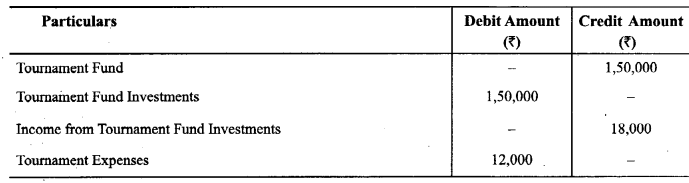
How the following items for the year ended 31st March, 2018 will be presented in the financial statements of Aisko Club: (CBSE Delhi 2019)
Class 12 Accountancy Important Extra Questions Chapter 1 Accounting for Not for Profit Organisation 3
Additional information:
Interest Accrued on Tournament Fund Investments ₹ 6,000
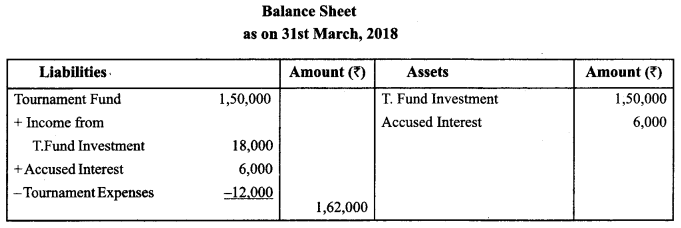
Answer:
Class 12 Accountancy Important Extra Questions Chapter 1 Accounting for Not for Profit Organisation 4

Question 2.
Present the following information for the year ended 31st March, 2018 in the financial statements of a not-for-profit organisation. (CBSE Delhi 2019)
Class 12 Accountancy Important Extra Questions Chapter 1 Accounting for Not for Profit Organisation 5
Answer:
Income and Expenditure A/c for the year ended 31st March, 2018
Class 12 Accountancy Important Extra Questions Chapter 1 Accounting for Not for Profit Organisation 6
Class 12 Accountancy Important Extra Questions Chapter 1 Accounting for Not for Profit Organisation 7

Question 3.
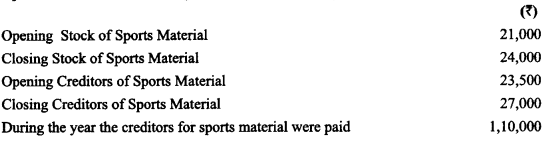
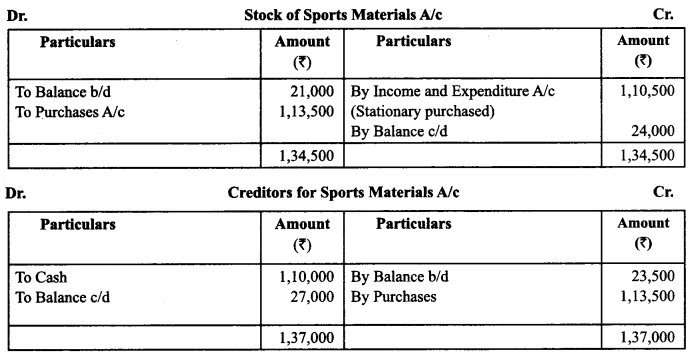
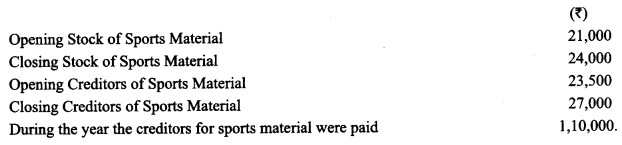
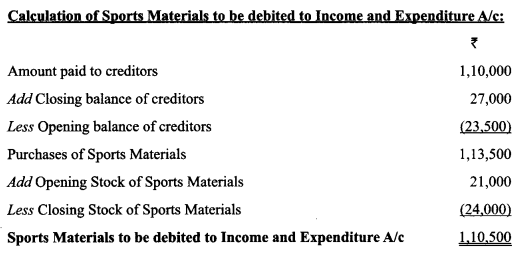
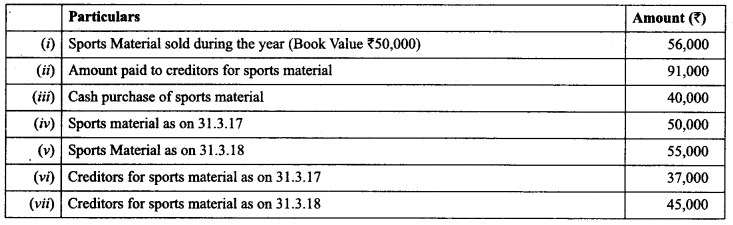
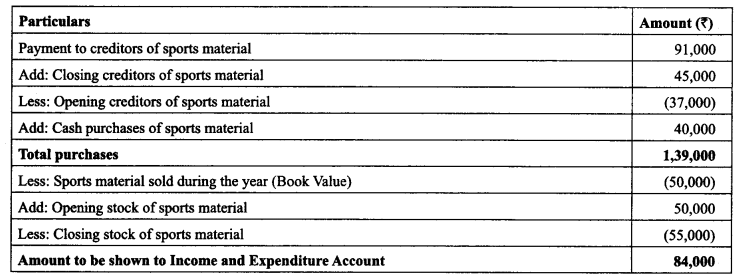
From the following information calculate the amount of ‘Sports Material’ to be debited to Income and Expenditure Account of Young Football Club for the year ended 31st March, 2018. {CBSE Delhi 2019)
Class 12 Accountancy Important Extra Questions Chapter 1 Accounting for Not for Profit Organisation 45
Answer:
Class 12 Accountancy Important Extra Questions Chapter 1 Accounting for Not for Profit Organisation 8

Question 4.
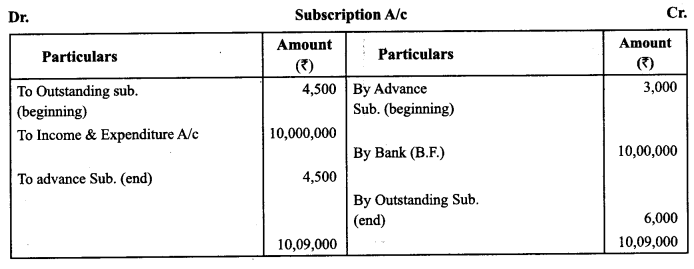
From the following information, calculate the amount of subscriptions received by Happy Sports Club during the year ended 31st March, 2018.
Class 12 Accountancy Important Extra Questions Chapter 1 Accounting for Not for Profit Organisation 9
The Club has 2000 members each paying an annual subscription of ₹ 500.
Answer:
Class 12 Accountancy Important Extra Questions Chapter 1 Accounting for Not for Profit Organisation 10

Question 5.
Present the following information for the year ended 31st March, 2018 in the financial statements of a not-for-profit organisation.
Class 12 Accountancy Important Extra Questions Chapter 1 Accounting for Not for Profit Organisation 11
Answer:
Income and Expenditure A/c for the year ended March 31,2018
Class 12 Accountancy Important Extra Questions Chapter 1 Accounting for Not for Profit Organisation 12

Question 6.
From the following information calculate the amount of ‘Sports Material’ to be debited to Income and Expenditure Account of Young Football Club for the year ended 31st March, 2018. (CBSE Outside Delhi 2019)
Class 12 Accountancy Important Extra Questions Chapter 1 Accounting for Not for Profit Organisation 13
Answer:
Class 12 Accountancy Important Extra Questions Chapter 1 Accounting for Not for Profit Organisation 15

Question 7.
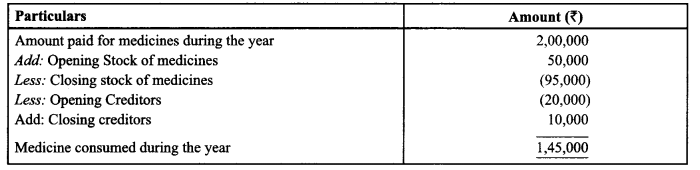
Calculate the amount of medicines consumed during the year ended 31 st March, 2019
Class 12 Accountancy Important Extra Questions Chapter 1 Accounting for Not for Profit Organisation 16
Answer:
Class 12 Accountancy Important Extra Questions Chapter 1 Accounting for Not for Profit Organisation 17

Question 8.
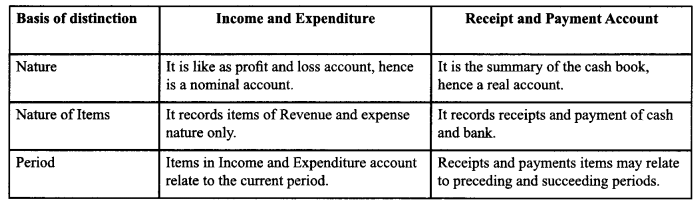
Distinguish between Income and Expenditure Account and Receipt and payment Account on basis of:
(i) Nature
(ii) Nature of items
(iii) Period
Answer:
Class 12 Accountancy Important Extra Questions Chapter 1 Accounting for Not for Profit Organisation 18

Question 9.
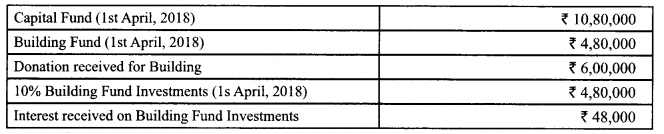
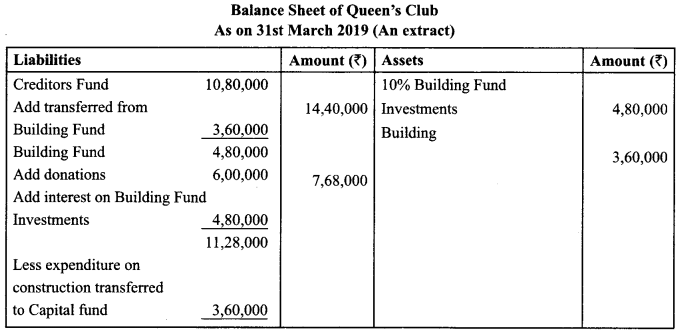
Present the following items in dic Balance Sheet of Queens Club as at 31st March. 2019: (CBSE Comp. 2019-20)
Class 12 Accountancy Important Extra Questions Chapter 1 Accounting for Not for Profit Organisation 19
Expenditure on construction of building ₹ 3,60,000. The construction work is in progress and has not yet been completed.
Answer:
Class 12 Accountancy Important Extra Questions Chapter 1 Accounting for Not for Profit Organisation 20

Question 10.
Following is the Receipts and Payments Account of Bharti Club for the year ended 31 st March, 2019.
Receipts and Payments Account of Bharti Club for the year ended 31st March, 2019 (CBSE Comp. 2019-20)
Class 12 Accountancy Important Extra Questions Chapter 1 Accounting for Not for Profit Organisation 21
Answer:
Class 12 Accountancy Important Extra Questions Chapter 1 Accounting for Not for Profit Organisation 22
Class 12 Accountancy Important Extra Questions Chapter 1 Accounting for Not for Profit Organisation 23

Question 11.
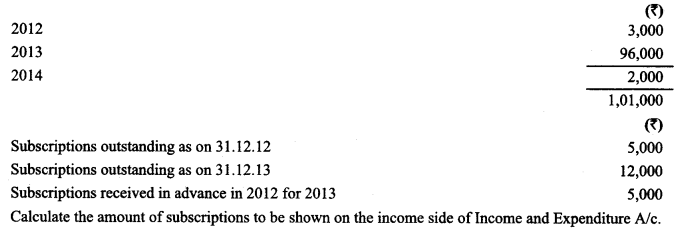
Subscriptions received by the health club during the year 2013 were as under:
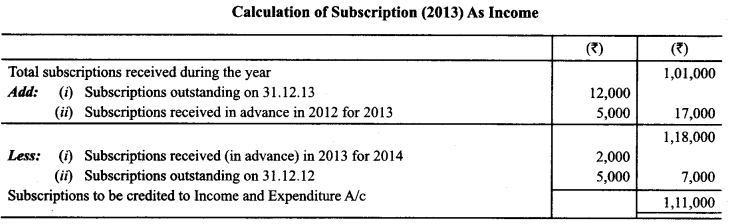
Class 12 Accountancy Important Extra Questions Chapter 1 Accounting for Not for Profit Organisation 24
Answer:
Class 12 Accountancy Important Extra Questions Chapter 1 Accounting for Not for Profit Organisation 25

Question 12.
Calculation of amount of sports material to be transferred to Income and Expenditure Account of Raman Bhalla Sports Club, Ludhiana for the year ended on 31 st March, 2018
Class 12 Accountancy Important Extra Questions Chapter 1 Accounting for Not for Profit Organisation 26
Answer:
Calculañon of amount of sports material to bc transferred to Income and Expenditure Account of Raman Bhalla Sports Club. Ludhiana for the year ended on 31st March, 2018
Class 12 Accountancy Important Extra Questions Chapter 1 Accounting for Not for Profit Organisation 27

Question 13.
From the following particulars taken from the cash book of a health club, prepare a Receipts and Payments Account.
Class 12 Accountancy Important Extra Questions Chapter 1 Accounting for Not for Profit Organisation 28
Class 12 Accountancy Important Extra Questions Chapter 1 Accounting for Not for Profit Organisation 29
Answer:
Class 12 Accountancy Important Extra Questions Chapter 1 Accounting for Not for Profit Organisation 30

Question 14.
From the following particulars, prepare Income and Expenditure Account:
Class 12 Accountancy Important Extra Questions Chapter 1 Accounting for Not for Profit Organisation 31
Answer:
Class 12 Accountancy Important Extra Questions Chapter 1 Accounting for Not for Profit Organisation 32

Question 15.
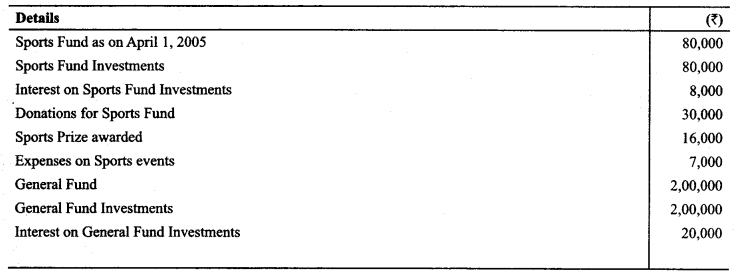
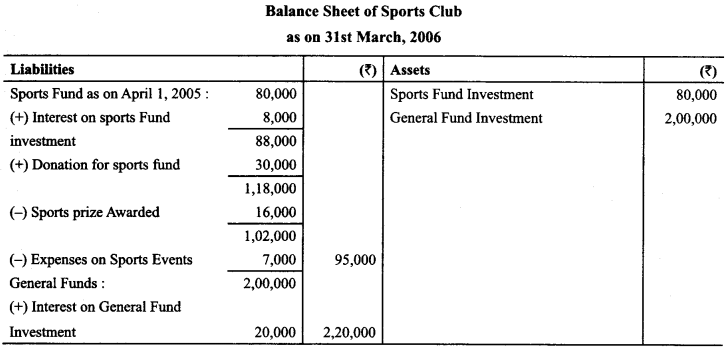
Following is the information given in respect of certain items of a sports club. Show these items in the Income and Expenditure Account and the Balance Sheet of the club:
Class 12 Accountancy Important Extra Questions Chapter 1 Accounting for Not for Profit Organisation 33
Answer:
Class 12 Accountancy Important Extra Questions Chapter 1 Accounting for Not for Profit Organisation 34
Class 12 Accountancy Important Extra Questions Chapter 1 Accounting for Not for Profit Organisation 35

Question 16.
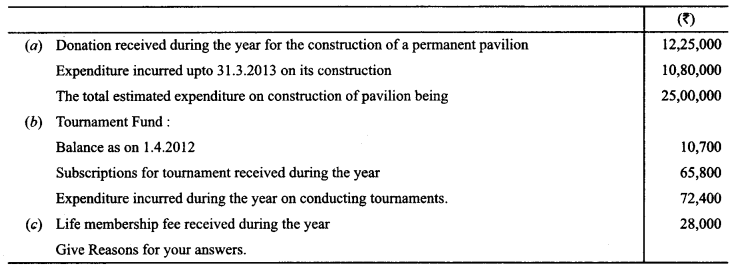
How will you deal with the following items while preparing for the Bombay Women Cricket Club, its Income and Expenditure Account for the year ending 313.2013 and its Balance Sheet as on 31.3.2013
Class 12 Accountancy Important Extra Questions Chapter 1 Accounting for Not for Profit Organisation 36
Answer:
(a) Donation received of ₹ 12,25,000 for the construction of a permanent pavilion is a type of specific donation. Therefore, it is to be capitalised and shown on the liability side of Balance Sheet. Expenditure incurred on the construction of pavilion upto 3 13.2013 is ₹ 10,80,000 will be deducted from the donation received during the year. But the estimated expenditure on construction of pavilion will not be shown in Income and Expenditure Account and Balance Sheet of the club. It is also to be noted that when the construction work will be completed, any balance leftover will be transferred to the “Capital Fund.”
Class 12 Accountancy Important Extra Questions Chapter 1 Accounting for Not for Profit Organisation 37
(b) Tournament Fund is a type of Special Fund. Therefore, it will be shown on the liability side of the Balance Sheet. Any receipt for tournament i.e., subscription for tournament will be added to the fund and any expenditure on tournament i.e., expenditure incurred on conducting tournaments will be deducted from that specific fund.
Class 12 Accountancy Important Extra Questions Chapter 1 Accounting for Not for Profit Organisation 38
Class 12 Accountancy Important Extra Questions Chapter 1 Accounting for Not for Profit Organisation 39
(c) Life membership fees is to be capialised unless it is stated otherwise in the Question. Therefore, life membership fees will be shown on liability side of the Balance Sheet at the end of the year on 31st March, 2013.
Class 12 Accountancy Important Extra Questions Chapter 1 Accounting for Not for Profit Organisation 40

Question 17.
Following is the information in respect of certain items of a Sports Club. You are required to show them in the Balance Sheet.
Class 12 Accountancy Important Extra Questions Chapter 1 Accounting for Not for Profit Organisation 41
Answer:
Class 12 Accountancy Important Extra Questions Chapter 1 Accounting for Not for Profit Organisation 42

Question 18.
How will you deal with the following items while preparing the income and expenditure account of a club for the year ending 31st December 2017 ?
Class 12 Accountancy Important Extra Questions Chapter 1 Accounting for Not for Profit Organisation 43
Answer:
Class 12 Accountancy Important Extra Questions Chapter 1 Accounting for Not for Profit Organisation 44

Accounting for Not for Profit Organisation Important Extra Questions Long Answer Type

Question 1.
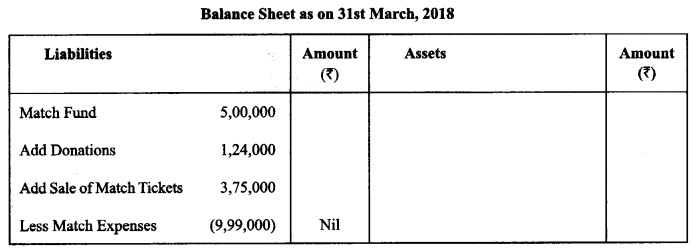
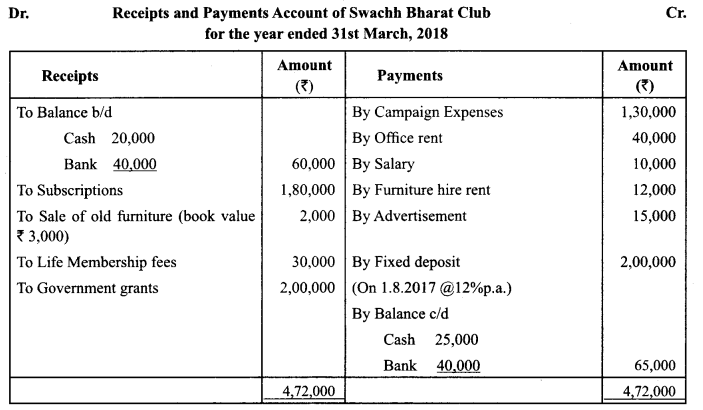
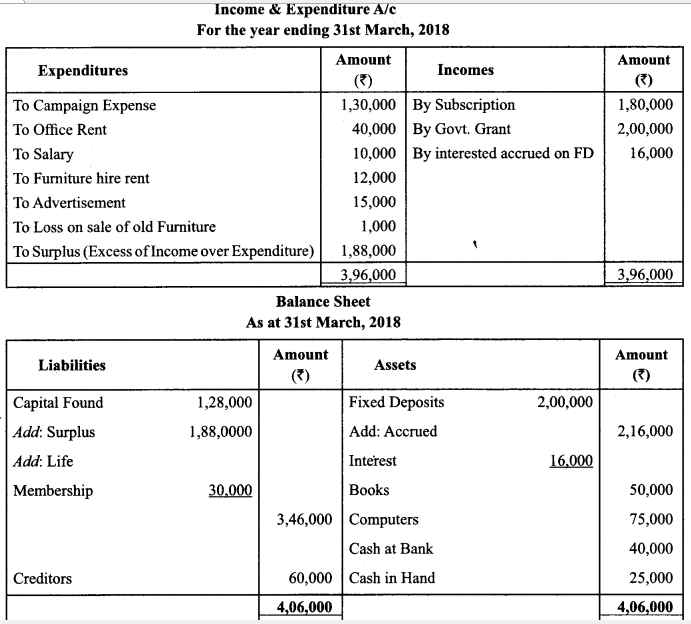
From the following Receipts and Payments Account and additional information of Swachh Bharat Club, New Delhi for the year ended 31st March, 2018, prepare Income and Expenditure Account and Balance Sheet.
Class 12 Accountancy Important Extra Questions Chapter 1 Accounting for Not for Profit Organisation 46
Additional Information:
Assets on 1.4.2017 were : Books 50.000; Computers 75.000. Liabilities and Capital fund on 1.4.2017 were : Creditors 60.000; Capital fund 1.28.000.
Answer:
Class 12 Accountancy Important Extra Questions Chapter 1 Accounting for Not for Profit Organisation 47

Question 2.
From the following Receipts and Payments Accounts of Rolaxe Club, for the year ended 31st March, 2019. Prepare Income and Expenditure Account for the year ended 31st March, 2019.
Class 12 Accountancy Important Extra Questions Chapter 1 Accounting for Not for Profit Organisation 48
AddiLional Information :-
(i) Depreciate furniture by 15% p.a.
(ii) There were 416 Life Members on 31.3.2018 the subscription payable by each member, to be a life time member is ₹ 125
(iii)
Class 12 Accountancy Important Extra Questions Chapter 1 Accounting for Not for Profit Organisation 49
Answer:
Class 12 Accountancy Important Extra Questions Chapter 1 Accounting for Not for Profit Organisation 50

Question 3.
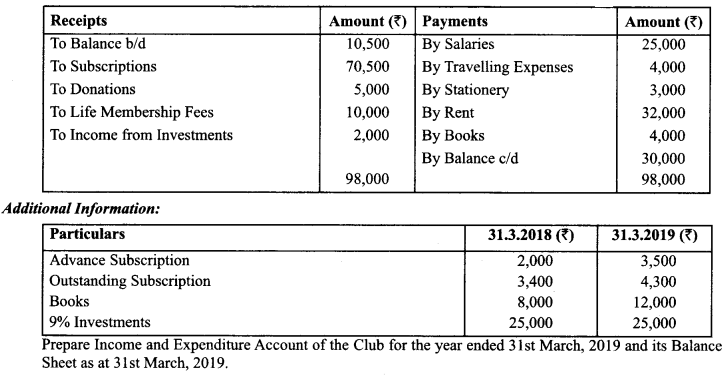
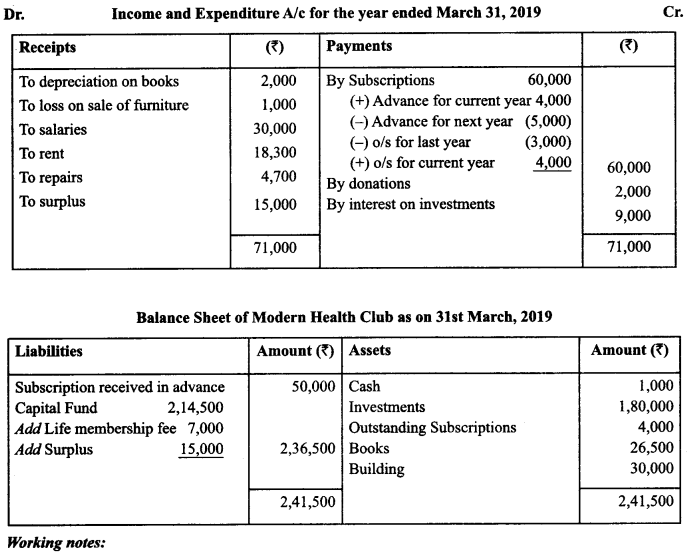
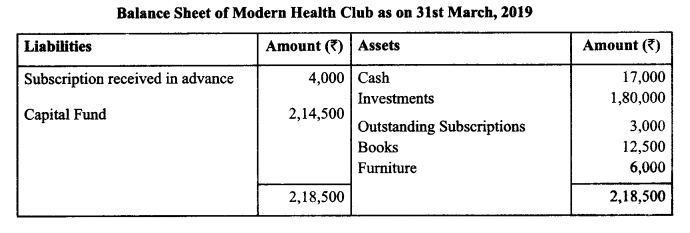
From the following Receipts and Payments Account and additional information of Modem Health Club, prepare Income and Expenditure Account for the year ended 31st March, 2019 and the Balance Sheet as at 31st March, 2019.
Class 12 Accountancy Important Extra Questions Chapter 1 Accounting for Not for Profit Organisation 51
Class 12 Accountancy Important Extra Questions Chapter 1 Accounting for Not for Profit Organisation 52
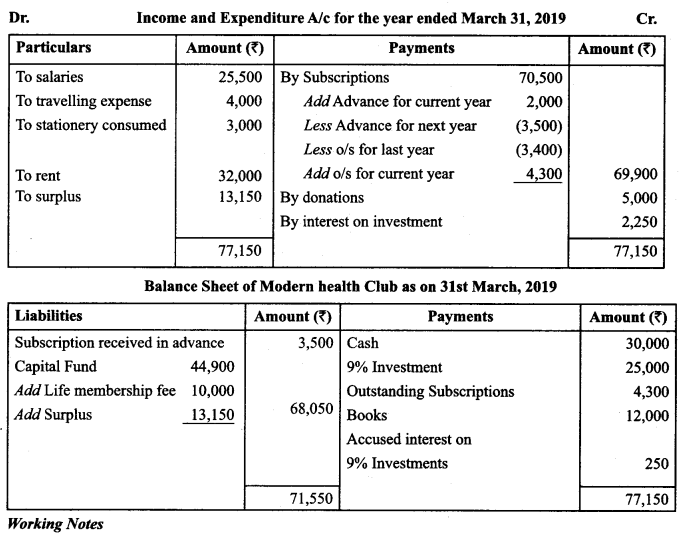
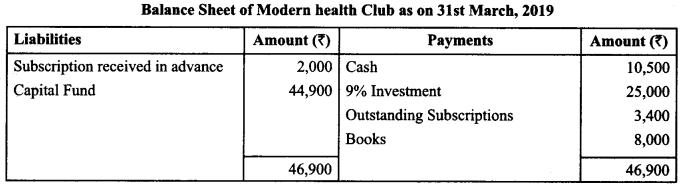
Answer:
Class 12 Accountancy Important Extra Questions Chapter 1 Accounting for Not for Profit Organisation 53
Class 12 Accountancy Important Extra Questions Chapter 1 Accounting for Not for Profit Organisation 54

Question 4.
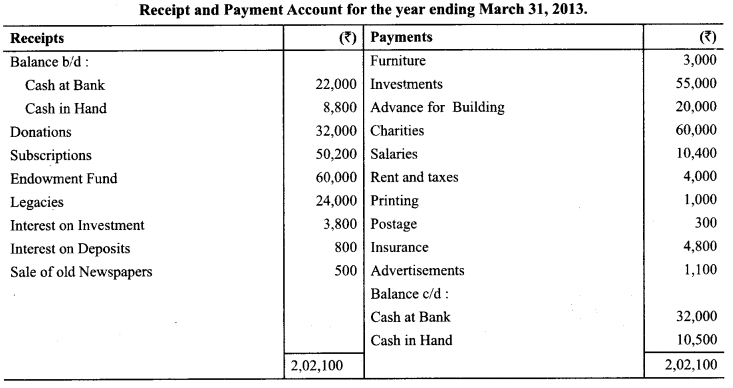
The Receipt and Payment Account of Harimohan Charitable Institution is given:
Class 12 Accountancy Important Extra Questions Chapter 1 Accounting for Not for Profit Organisation 55
Prepare the Income and Expenditure Account for the year ended on March 31,2013 after considering thc following:
(i) It was decided to treat fifty pcrccnl of the amount received on account of Legacies and Donations as income,
(ii) Liabilities to be provided for are :
Rent ₹ 800; Salaries ₹ 1200 Advertisement ₹ 200
(iii) ₹2,000 due for interest on investment was not actually received.
Answer:
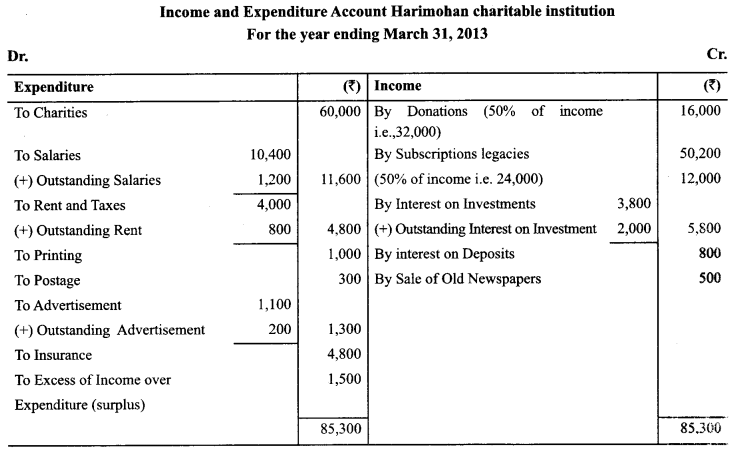
Income and Expenditure Account Harimohan charitable institution For the year ending March 31,2013
Class 12 Accountancy Important Extra Questions Chapter 1 Accounting for Not for Profit Organisation 56

Question 5.
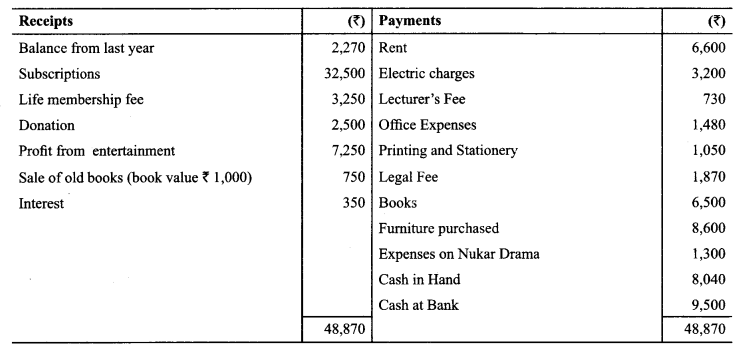
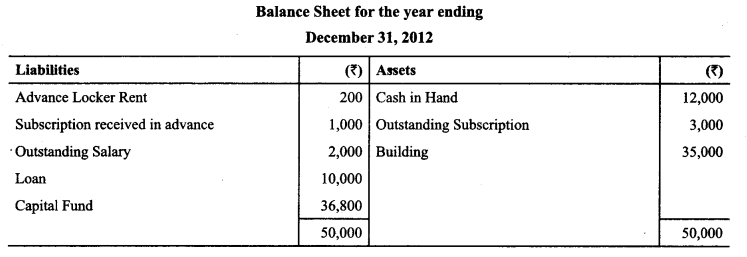
The following is the account of cash transactions of the Nan Kalayan Samittee for the year ended December 31. 2013:
Class 12 Accountancy Important Extra Questions Chapter 1 Accounting for Not for Profit Organisation 57
You are required to prepare an Income and Expenditure Account after the following adjustments :
(i) Subscription still to be received are ₹ 750, but subscription include ₹ 500 for the year 2013.
(ii) In the beginning of the year the Sangh owned Building ₹ 20,000 and furniture ₹ 3,000 and Books ₹ 2,000.
(iii) Provide depreciation on Furniture @ 5% (including purchase), books @ 10% and building @ 5%.
Answer:
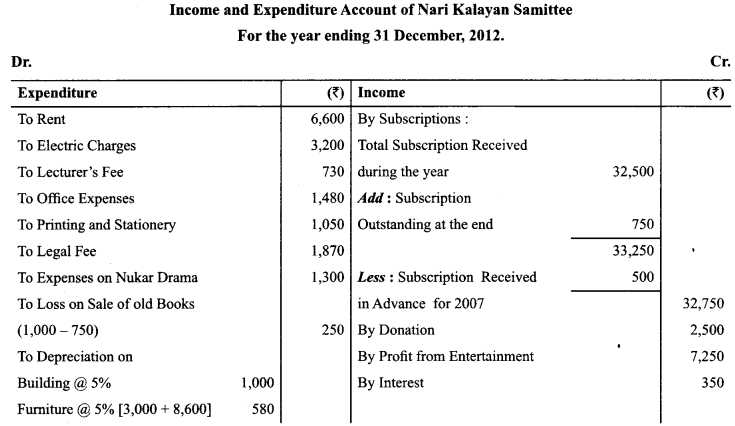
Income and Expenditure Account of Nari Kalayan Samittee
For the year ending 31 December, 2012.
Class 12 Accountancy Important Extra Questions Chapter 1 Accounting for Not for Profit Organisation 58
Class 12 Accountancy Important Extra Questions Chapter 1 Accounting for Not for Profit Organisation 59

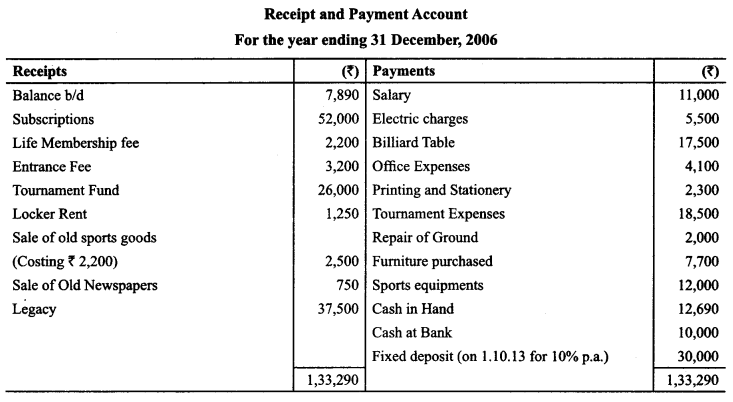
Question 6.
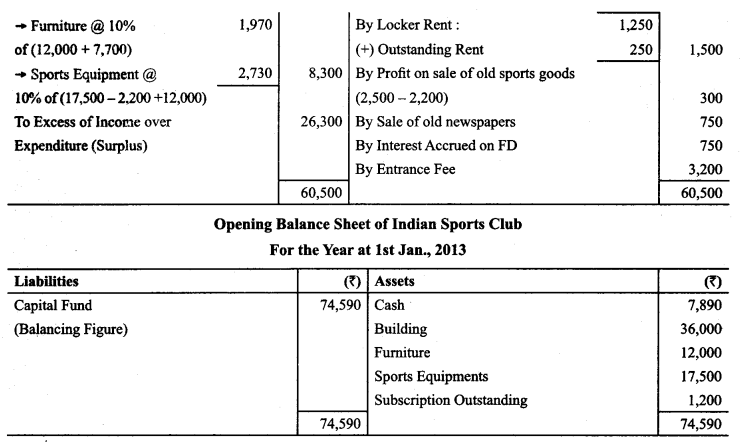
Following is the receipt and payment account of Indian sports club, prepared income and expenditure account, balance sheet as on December 31,2006.
Class 12 Accountancy Important Extra Questions Chapter 1 Accounting for Not for Profit Organisation 60
Other informations:
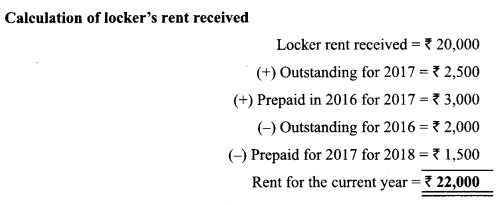
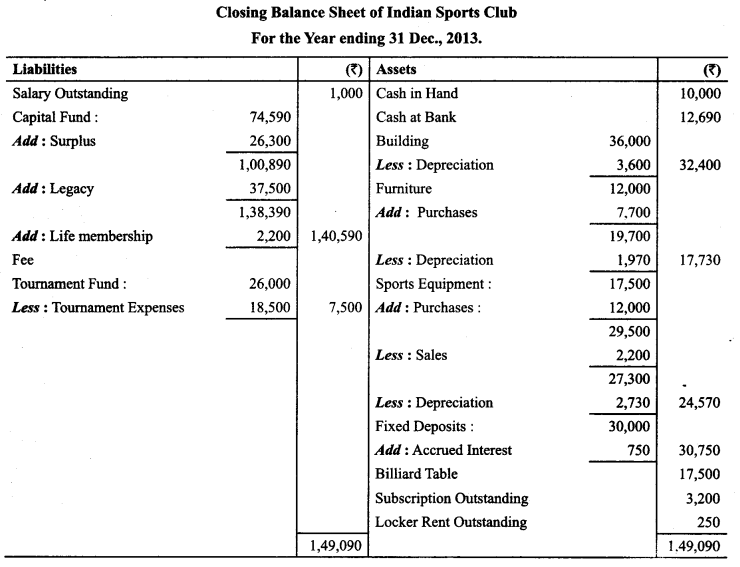
Subscription outstanding was on 31 December 2013, ₹ 1,200 and ₹ 3,200 on 31 December 2013; Locker Rent outstanding on 31 December, 2013 ₹ 250. Salary outstanding on 31 December, 2013 ₹ 1,000.
On January 1, 2013, club has building ₹ 36,000, Furniture ₹ 12,000. Sports Equipments ₹ 17,500. Depreciation charged on these items @ 10% (including purchase).
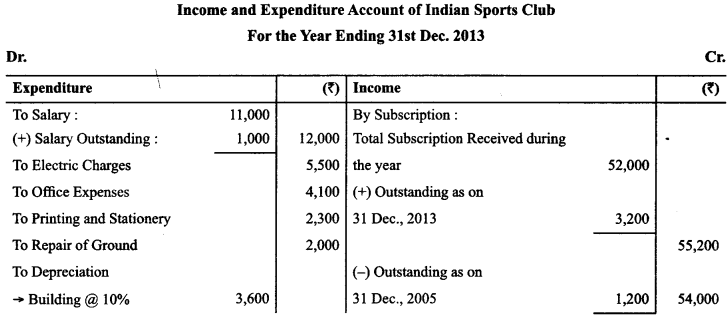
Answer:
Class 12 Accountancy Important Extra Questions Chapter 1 Accounting for Not for Profit Organisation 61
Class 12 Accountancy Important Extra Questions Chapter 1 Accounting for Not for Profit Organisation 62
Class 12 Accountancy Important Extra Questions Chapter 1 Accounting for Not for Profit Organisation 63

Question 7.
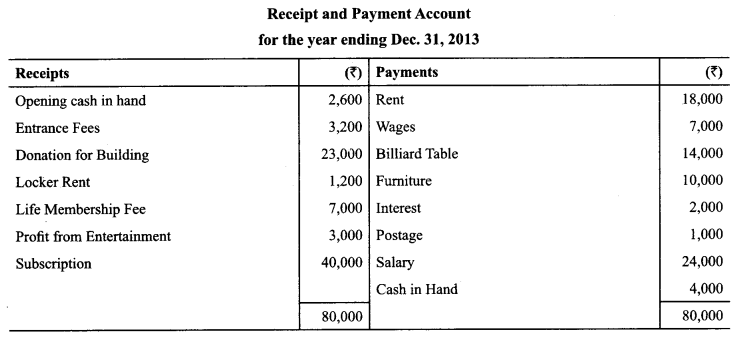
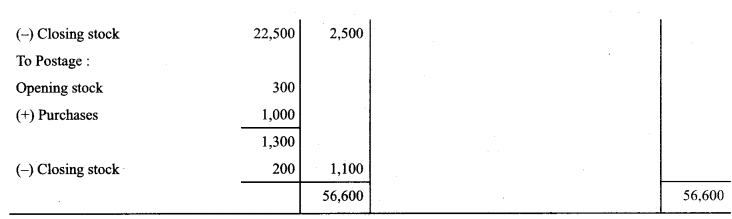
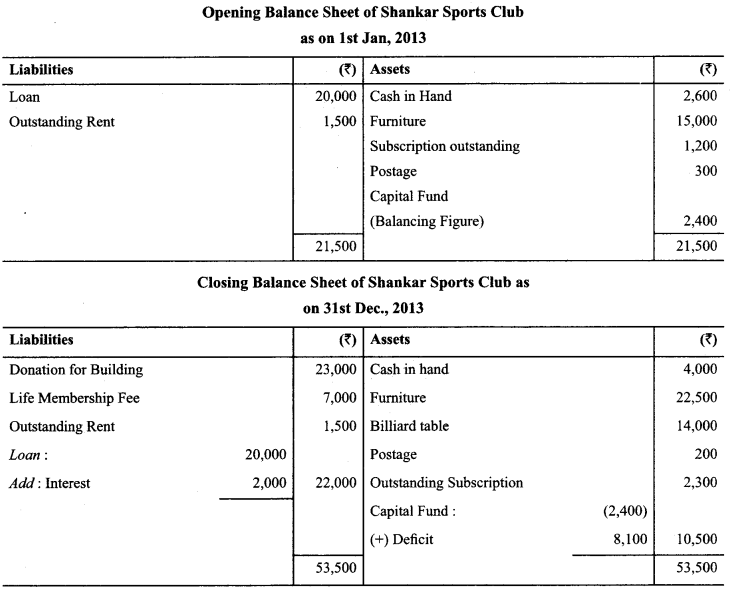
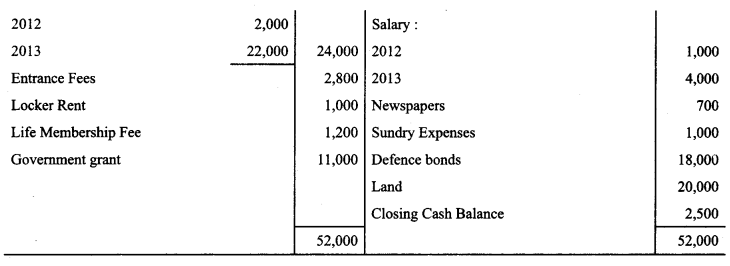
Receipt and Payment Account of Shankar Sports Club is given below, for the year ended December 31, 2013:
Class 12 Accountancy Important Extra Questions Chapter 1 Accounting for Not for Profit Organisation 64
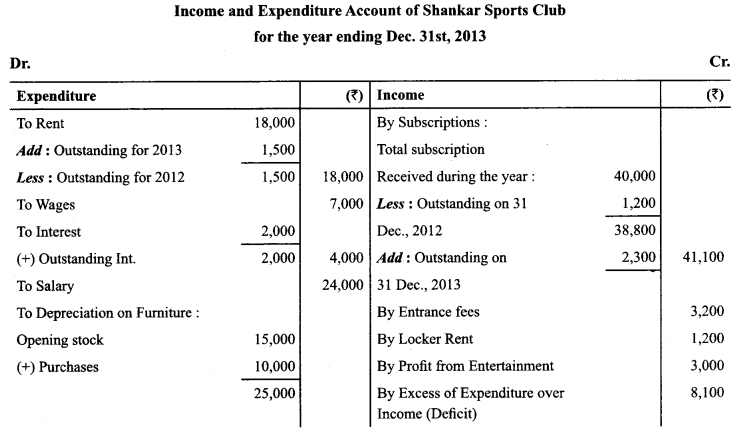
Prepare the Income and Expenditure Account and Balance Sheet with the help of the following informations :
Subscription outstanding on 31. Dec., 2012 is ₹ 1,200 and ₹ 2,300 on 31.12.2013, opening stock of postage stamps is ₹ 300 and closing stock is ₹ 200, Rent ₹ 1,500 related to 2012 and ₹ 1,500 is still unpaid.
On January 1, 2006 the club owned furnitures ₹ 15,000, Furniture valued at ₹ 22,500 on 31.12.2013. The club took a loan of ₹ 20,000 @ 10% p.a. in 2012.
Answer:
Class 12 Accountancy Important Extra Questions Chapter 1 Accounting for Not for Profit Organisation 65
Class 12 Accountancy Important Extra Questions Chapter 1 Accounting for Not for Profit Organisation 80

Class 12 Accountancy Important Extra Questions Chapter 1 Accounting for Not for Profit Organisation 67

Question 8.
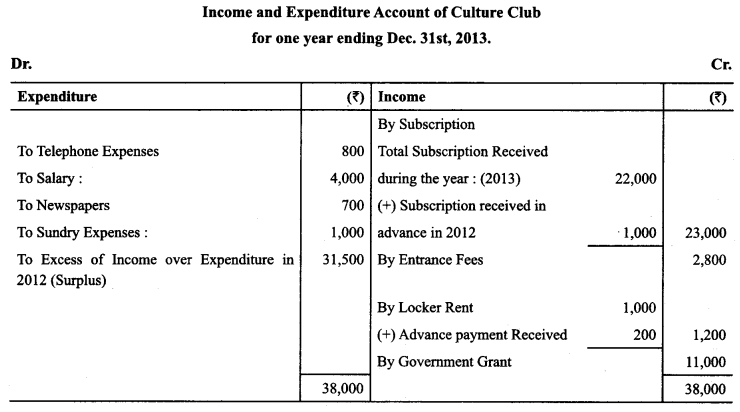
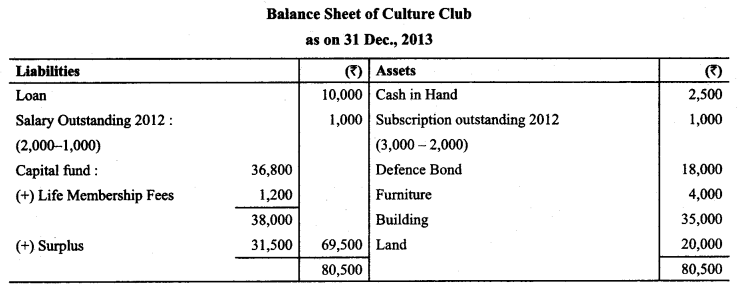
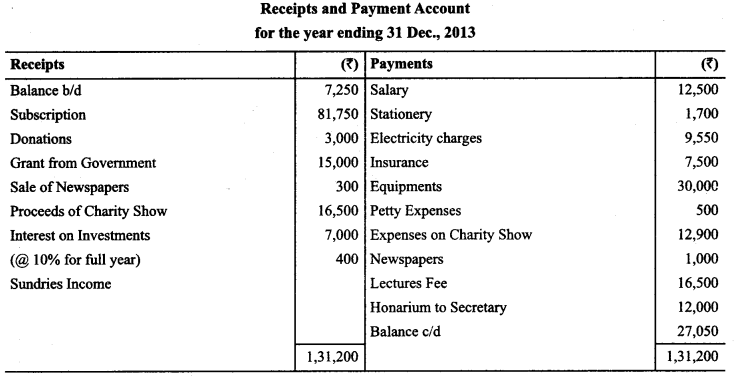
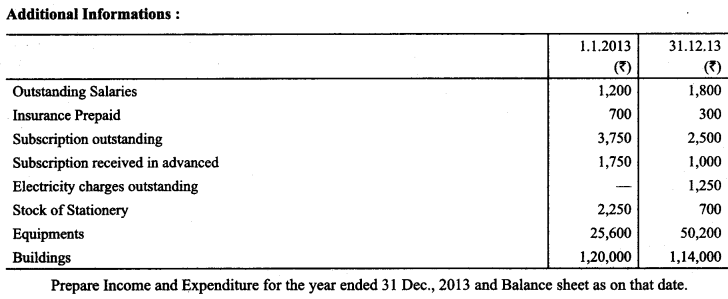
Prepare Income and Expenditure Account and Balance Sheet for the year ended December 31,2013 from the following Receipt and Payment Account and Balance Sheet of Culture Club.
Class 12 Accountancy Important Extra Questions Chapter 1 Accounting for Not for Profit Organisation 68
Class 12 Accountancy Important Extra Questions Chapter 1 Accounting for Not for Profit Organisation 69
Class 12 Accountancy Important Extra Questions Chapter 1 Accounting for Not for Profit Organisation 70
Answer:
Class 12 Accountancy Important Extra Questions Chapter 1 Accounting for Not for Profit Organisation 71
Class 12 Accountancy Important Extra Questions Chapter 1 Accounting for Not for Profit Organisation 72

Question 9.
Following is the Receipt and Payment Account of Women’s Welfare Club for the year ended 31 Dec., 2013:
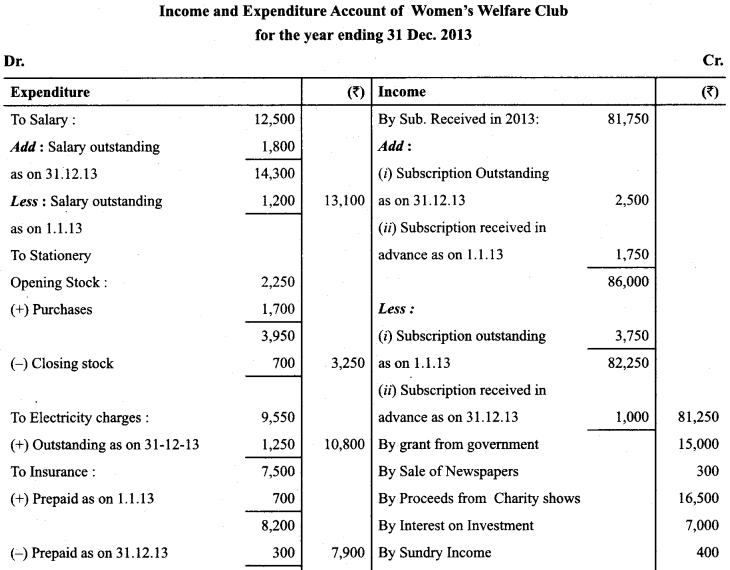
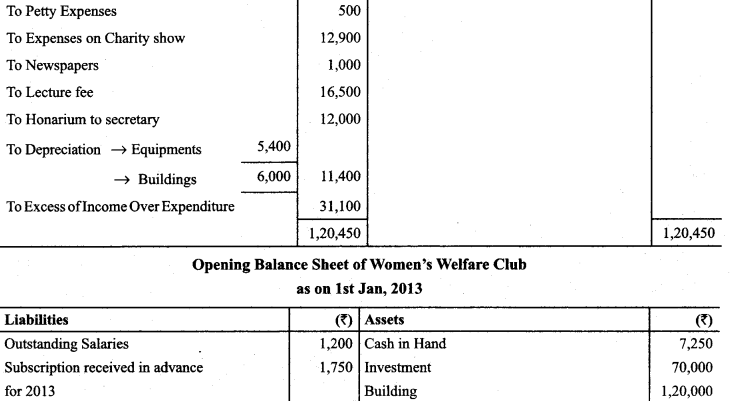
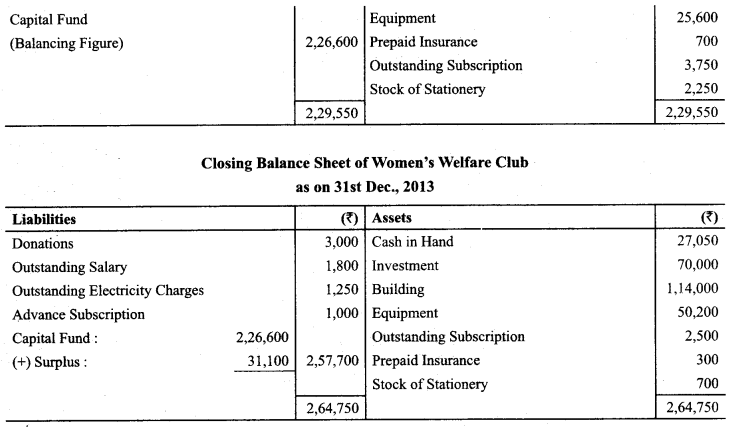
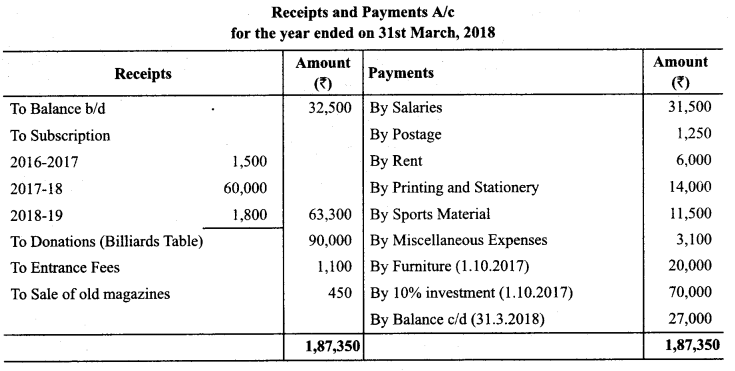
Class 12 Accountancy Important Extra Questions Chapter 1 Accounting for Not for Profit Organisation 73
Class 12 Accountancy Important Extra Questions Chapter 1 Accounting for Not for Profit Organisation 74
Answer:
Class 12 Accountancy Important Extra Questions Chapter 1 Accounting for Not for Profit Organisation 75
Class 12 Accountancy Important Extra Questions Chapter 1 Accounting for Not for Profit Organisation 76
Class 12 Accountancy Important Extra Questions Chapter 1 Accounting for Not for Profit Organisation 77

Question 10.
Prepare Income and Expenditure Account from the following particulars of Youth Club, for the year ended on 31st March, 2018:
Class 12 Accountancy Important Extra Questions Chapter 1 Accounting for Not for Profit Organisation 78
Additional Information:
(i) Subscription outstanding as at March 31st 2018 ₹ 16,200
(ii) ₹ 1200 is still in arrears for the year 2016-17 for subscription
(iii) Value of sports material at the beginning and at the end of the year was ₹ 3,000 and ₹ 4,500 respectively.
(iv) Depreciation to be provided @ 10% p.a. on furniture.
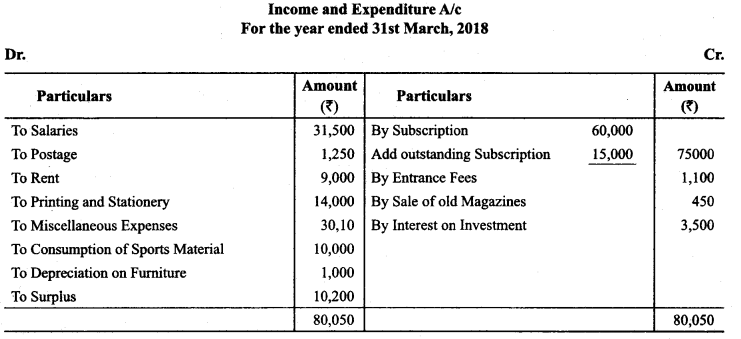
Answer:
Class 12 Accountancy Important Extra Questions Chapter 1 Accounting for Not for Profit Organisation 79
Working Notes:
(i) Consumption of Sports Material Opening stock of sports material + Purchases of sports material during the year – Closing stock of sports material
= ₹ 3,000 + ₹ 11,500 – ₹ 4,500 = ₹ 10,000
(ii) Depreciation of Furniture = ₹ 20,000 x (6/12) x (10/100) = ₹ 1,000
(iii) Interest on Investment = ₹ 70,000 x (10/100) x (6/12) = ₹ 3,500

Class 12 Hindi Important Questions Vitan Chapter 4 डायरी के पन्ने

Here we are providing Class 12 Hindi Important Extra Questions and Answers Vitan Chapter 4 डायरी के पन्ने. Important Questions for Class 12 Hindi are the best resource for students which helps in class 12 board exams.

डायरी के पन्ने Class 12 Important Extra Questions Hindi Vitan Chapter 4

प्रश्न 1.
ऐन को किस कारण लगा था कि उसकी दुनिया पूरी तरह से उलट-पुलट गई थी ?
उत्तर
ऐन के घर बुधवार 8 जुलाई, 1942 को संदेश आया था कि उसकी सोलह वर्षीय बहन मार्गोट को ए०एस०एस० से बुलावा आया था। इस बुलावे का अर्थ उसे यातना शिविर से बुलाया जाना था जिसमें उसे जर्मन सैनिकों की दया पर छोड़ देना था। ऐन के माता-पिता को यह बिल्कुल भी स्वीकार नहीं था इसलिए उन्होंने तुरंत भूमिगत हो जाने का निश्चय कर लिया था। इससे ऐन को लगा था उसकी दुनिया पूरी तरह से उलट-पुलट हो गई थी।

प्रश्न 2.
अज्ञातवास की बात सुनकर ऐन के मन में छिपने की कौन-सी जगह आई थी ?
उत्तर
वे कहाँ छिपेंगे-किसी के घर में? शहर में ? किसी परछत्ती पर? यहाँ? कहाँ? वह यह किसी से पूछ नहीं सकती थी पर ये प्रश्न उसके मन में उठ रहे थे।

प्रश्न 3.
ऐन ने अपने थैले में क्या-क्या भरा था? क्यों?
उत्तर
ऐन ने अपने थैले में डायरी, कलर, रूमाल, स्कूली किताबें, कंघी और पुरानी चिट्ठियाँ भरी थीं। वह कपड़ों की तुलना में स्मृतियों को अधिक महत्व देना चाहती थी।

प्रश्न 4.
अज्ञातवास पर जाते समय परिवार के चारों लोगों ने क्या पहना था ? क्यों ?
उत्तर
अज्ञातवास पर जाते समय उन चारों ने इतने अधिक कपड़े पहने थे मानो वे अपनी रात फ्रिज में गुजारने जा रहे हों। वे अपने साथ अधिक-से-अधिक कपड़े ले जाना चाहते थे। सबने दो बनियानें, तीन पैंटें, एक ड्रेस, उसके ऊपर एक स्कर्ट, एक जैकेट, एक बरसाती, दो जोड़ी स्टाकिंग्स, भारी जूते, एक केस, एक स्कार्फ और इनके अतिरिक्त और भी बहुत कुछ पहना था।

प्रश्न 5.
ऐन ने अपनी बिल्ली को कहाँ और किसकी देख-रेख में छोड़ दिया था ?
उत्तर
उन्होंने अपनी बिल्ली को पड़ोसियों के यहाँ छोड़ दिया था। वे ही अब उसकी देखभाल करने वाले थे। वे रसोई में बिल्ली के लिए सेर भर मीट भी छोड़ गए थे।

प्रश्न 6.
लोग चाहकर भीगने वाले ऐन के परिवार की सहायता क्यों नहीं कर सकते थे ?
उत्तर
9 जुलाई, 1942 की बरसात-भरी सुबह वह ढेर सारा सामान कंधों पर लादे हुए डरे-सहमे भाग रहे थे। सुबह काम पर जाते लोग उन्हें बेचारगी-भरी नजरों से देख रहे थे पर उनके सीने पर चमकते पीले रंग के सितारे को देखकर उनकी सहायता भी नहीं कर सकते थे क्योंकि हिटलर के शासन में यहूदियों को अपनी पहचान के लिए पीला सितारा पहनना आवश्यक था।

प्रश्न 7.
परिवार ने कहाँ छिपने का निर्णय किया था ?
उत्तर
पूरे परिवार ने पापा के ऑफिस की इमारत को ही चुना था क्योंकि वहाँ काम करने वाले लोगों की संख्या बहुत ही कम थी। वहाँ मिस्टर कुगलट, मिस्टर क्लीमेन, मिएप और बेय वोस्कुइल नामक चार लोग ही थे, जिन्हें इनके वहाँ छिपने के विषय में बताया गया था।

प्रश्न 8.
अंधेरे में छिपे हुए वे लोग अपना समय कैसे बिताते थे ?
उत्तर
लगभग चार बजे ही अंधेरा हो जाता था और वे पढ़ नहीं पाते थे इसलिए ऊल-जुलूल हरकतों में ही अपना समय बिताया करते थे। वे अंधेरे में व्यायाम करते, पहेलियाँ बुझाते, अंग्रेज़ी या फ्रैंच बोलते और किताबों की समीक्षा किया करते थे। इसके अतिरिक्त अंधेरे में दूरबीन लगा कर पड़ोसियों को रोशनी वाले कमरों में झाँक लिया करते थे।

प्रश्न 9.
अज्ञातवास के दौरान टर्की से संबंधित कौन-सी उत्साहवर्धक अफ़वाह सुनी गई थी ?
उत्तर
अज्ञातवास के दौरान टर्की के एक केंद्रीय मंत्री ने कहा था कि टर्की जल्दी ही तटस्थता छोड़ देगा और इंग्लैंड के पक्ष में हो जाएगा, जिससे ऐन के परिवार वालों का उत्साह बढ़ गया था।

प्रश्न 10.
हज़ार गिल्डर के नोट अवैध घोषित करने का लोगों पर क्या प्रभाव पड़ा ?
उत्तर
हजार गिल्डर के नोट अवैध घोषित होते ही ब्लैक मार्केट का धंधा करने वालों को बहुत बड़ा झटका लगा। इससे बड़ा झटका उन लोगों को लगा जो भूमिगत हो गए थे या जिनके पास धन का हिसाब-किताब देने की क्षमता नहीं थी। नोट बदलवाने की स्थिति में सबूत देना पड़ता था कि यह उनके पास कहाँ से आया था।

प्रश्न 11.
गिएज एंड कंपनी ने हज़ार गिल्डर के अपने नोटों के संकट से किस प्रकार छुटकारा पा लिया था?
उत्तर
गिएज एंड कंपनी के पास हज़ार गिल्डर के कुछ नोट थे जिनका हिसाब-किताब उनके पास नहीं था। उन्होंने इन नोटों से आगामी वर्षों के लिए अनुमानित कर की अदायगी करके इनसे छुटकारा पा लिया था।

प्रश्न 12.
हिटलर अपने सैनिकों से मुख्य रूप से क्या पूछा करता था और उसके सैनिक किस प्रकार उत्तर दिया करते थे ?
उत्तर
हिटलर अपने घायल सैनिकों से प्रायः पूछा करता था कि युद्ध में वे कहाँ घायल हुए थे और उन्हें कहाँ चोट लगी थी। सैनिक उत्साहपूर्वक अपने जख्मों को दिखाकर वह घटना सुनाते थे, जिस के कारण वे जख्मी हुए थे। वे सब हिटलर से हाथ मिलाने के लिए उत्साहित दिखाई देते थे।

प्रश्न 13.
अज्ञातवास के समय ऐन की रुचियाँ क्या थीं ?
उत्तर
ऐन को पत्रिकाओं से फ़िल्मी कलाकारों के चित्र इकट्ठे करने की रुचि थी। वह फ़िल्मों के बारे में ज्ञान इकट्ठा करती थी; उनकी समीक्षा करती थी; प्रति सप्ताह प्रकाशित होने वाली सिनेमा एंड थियेटर पत्रिका ध्यान से पढ़ती थी। वह फ़िल्मी अभिनेत्रियों की तरह अपने बाल सँवारा करती थी और उन्हें अपना स्टाइल बनाया करती थी। कुछ ही देर बाद फिर से वह अपने घुघराले बालों वाले स्टाइल में ही आ .. जाया करती थी।

प्रश्न 14.
अज्ञातवास काटते समय प्राय: कैसी बातें हुआ करती थीं और वे ऐन को कैसी लगा करती थीं ?
उत्तर
ऐन को अज्ञातवास काटते समय रोज़ एक-सी बातें नाली के सड़े पानी की तरह लगती थीं। खाने के वक्त मम्मी या मिसेज़ वान दान हजारों बार पहले सुना चुकी अपने बचपन की कहानियाँ सुनाया करती थीं। डसेल खूबसूरत रेस के घोड़ों, चालौट के महँगे वॉर्डरोव, लीक करती नावों, चार बरस की उम्र में तैर सकने वाले बच्चे, दर्द करती मांसपेशियों और डरे हुए मरीजों की बातें हुआ करती थीं। किसी भी लतीफ़े को सुनाने वाला बस स्वयं ही हँसता था क्योंकि कुछ भी तो नया सुनने-सुनाने को शेष नहीं बचा था।

प्रश्न 15.
हॉलैंड के प्रतिरोधी दल लोगों की किस प्रकार सहायता किया करते थे ?
उत्तर
फ्री नीदरलैंड्स दल के लोग जर्मन लोगों के अत्याचारों से राहत पाने के लिए पीड़ितों के लिए नकली पहचान-पत्र बनाते थे; उन्हें आर्थिक सहायता दिया करते थे और कार्य कर सकने वाले युवा ईसाइयों के लिए काम ढूँढ़ने में सहायता करते थे। वे पुरुषों के साथ राजनीति और काम-धंधे की बातें करते थे, तो औरतों के साथ भोजन और कष्ट के समय की बातें करते थे। सदा सहायक और खुशदिल दिखाई देने वाले वे लोग बच्चों से अखबारों और किताबों की बातें करते थे। वे हर अवसर पर फूल और उपहार दिया करते थे और कष्ट में पड़े अज्ञातवास काटने वालों की सहायता कर उनका दिल जीत लेते थे।

प्रश्न 16.
कैबिनट मंत्री मिस्टर बोल्के स्टीन ने क्या घोषित किया था जिससे ऐन को खुशी मिली थी ?
उत्तर
कैबिनट मंत्री मिस्टर बोल्के स्टीन ने लंदन से उस प्रसारण में कहा था कि जब युद्ध समाप्त हो जाएगा तब युद्ध का वर्णन करने वाली डायरियों और पत्रों का संग्रह किया जाएगा। ऐन खुश हो गई थी कि वह गुप्त एनेक्सी के बारे में सब छपवाएगी।

प्रश्न 17. ऐन ने एक ही दिन में हुए हवाई हमलों के विषय में क्या बताया था ?
उत्तर
ऐन ने बताया कि पिछले ही रविवार 350 ब्रिटिश वायुयानों ने इज्मुईडेन पर 550 टन गोला-बारूद बरसा कर तबाही मचाई थी जिससे सभी घर ऐसे काँप उठे थे जैसे हवा में घास की पत्तियाँ काँप उठती हैं।

प्रश्न 18.
युद्ध-काल में लोगों को किन-किन कष्टों से गुजरना पड़ रहा था ?
उत्तर
(i) खाद्य पदार्थों तथा अन्य सामग्रियों के लिए लोगों को लाइनों में खड़ा होना पड़ता था।
(ii) चोरियों की संख्या अत्यधिक बढ़ गई थी। पीठ मोड़ते ही कारें, मोटर-साइकिलें आदि चुरा लिए जाते थे।
(iii) आठ-दस वर्ष के छोटे-छोटे बच्चे भी चोरी करने में निपुण हो गए थे।
(iv) गली-नुक्कड़ पर लगी बिजली से चलने वाली घड़ियों और सार्वजनिक टेलीफ़ोनों तक का पुर्जा-पुर्जा चुरा लिया ।
(v) लोग फटे-हाल हो गए थे।
(vi) पुलिस अधिकारी किसी पर भी आरोप लगा कर जेल भेज देते थे।
(vii) खाद्य-सामग्री घटिया मिलती थी और बहुत महँगी भी हो गई थी।

प्रश्न 19.
चर्चिल को जन्मजात बहादुर क्यों कहा गया है ?
उत्तर
चर्चिल अपने साथियों स्मट्स, आइजनहावर और आर्नोल्ड के साथ उन फ्रांसीसी गाँवों में गए थे जिन पर पहले ब्रिटिश सैनिकों ने कब्जा कर लिया था और फिर मुक्त कर दिया था। चर्चिल एक टॉरपीडो नाव पर थे जिससे तटों पर गोलाबारी की जाती थी। उन्हें डर नाम की चिड़िया का पता तक नहीं था इसीलिए उन्हें जन्मजात बहादुर कहा गया है।

प्रश्न 20.
ऐन ने कितने समय बाद रात का आमने-सामने साक्षात्कार किया था? उसे तब कैसा अनुभव हुआ था?
उत्तर
ऐन ने डेढ़ वर्ष बाद खुली खिड़की के माध्यम से रात के समय की प्रकृति का आमने-सामने साक्षात्कार किया था। गहरी साँवली . बरसात की रात थी और तेज हवाएँ चल रही थीं। बादलों के बीच लुका-छिपी हो रही थी जिसने ऐन को मंत्रमुग्ध कर दिया था।

प्रकृति से साक्षात्कार की उसकी इच्छा बढ़ गई थी। वह पुलिस, चोर-उचक्कों और मोटे-काले चूहों से डरे बिना ही नीचे चली – गई थी। वह रसोई और प्राइवेट ऑफ़िस की खिड़की से प्रकृति के नजारे देखती रही थी। प्रकृति प्राणियों का अनूठा उपहार है और वह ग़रीब-अमीर के बीच अंतर नहीं करती।

प्रश्न 21.
पुरुष-स्त्री अधिकारों के विषय में ऐन के क्या विचार हैं ?
उत्तर
संभवतः शारीरिक बल, धन कमाने और परिवार चलाने के कारण पुरुष शुरू से ही औरतों पर शासन करने लगे थे, जो ऐन के अनुसार ठीक नहीं था। आधुनिक महिलाएं पूरी तरह स्वतंत्र होने का हक पाना चाहती हैं। महिलाओं का पूरा सम्मान किया ही जाना चाहिए। उन्हें भी सैनिक बनने का दर्जा मिलना चाहिए। औरतें ही मानव जाति की निरंतरता को बनाए रखने के लिए संघर्ष करती हैं; कष्ट झेलती हैं, मेहनत करके खाती हैं, तो वे सम्मान की भी अधिकारिणी हैं।

प्रश्न 22.
पीटर के स्वभाव की दो विशेषताओं का उल्लेख कीजिए जो ऐन को याद नहीं है।
उत्तर
पीटर नास्तिक था। उसे चर्च के प्रति घृणा थी। वह ऐन से अपने हृदय से जुड़ी बातें नहीं करता था। वह ऐसा कोई अवसर ऐन को नहीं देता था जिससे वह उसके हृदय में छिपे भावों को समझ सकती।

प्रश्न 23.
ऐन किस कारण से महिलाओं को सम्मानीय मानती थी? (C.B.S.E. 2012, Set-1)
उत्तर
ऐन का मानना था कि वह संतान को जन्म देती है, प्रसव पीड़ा झेलती है, जो प्रशंसनीय है। कोई सैनिक भी युद्ध में इतनी पीड़ा नहीं झेलता जितनी किसी भी महिला को प्रसव के समय झेलनी पड़ती है।

निबंधात्मक प्रश्नोत्तर

प्रश्न 1.
ऐन फ्रैंकले मिस्टर डसेल का चरित्र-चित्रण किस प्रकार किया है ?
उत्तर
मिस्टर डसेल ऐन के पिता के साथ काम करते थे। विश्वयुद्ध के समय जब ऐन के परिवार को अज्ञातवास के रूप में दो वर्ष बिताने पड़े थे तो मिस्टर डसेल भी उनके साथ पिता के कार्यालय और गोदाम में रहे थे। ऐन और मिस्टर डसेल दोनों एक लंबे और सँकरे कमरे में रूममेट थे। ऐन डसेल के चरित्र के बारे में बताती है कि वैसे तो मिस्टर डसेल बच्चों के साथ खुश रहते हैं तथा उन्हें खूब प्यार करते हैं, परंतु अनुशासन के मामले में वे एक बाबा आदम की सोच रखते थे।

वे लंबे-लंबे उबाऊ भाषण दिया करते जिन्हें सुनकर नींद ही आ सकती थी। चूंकि ऐन और मिस्टर डसेल एक कमरे को शेयर करतेथ इसलिए मिस्टर के लंबे-लंबे उबाऊ भाषण उसे अधिक सुनने पड़ते थे। चूँकि ऐन उनके भाषणों को ध्यान से नहीं सुनती थे इसलिए वे उसे अक्सर डाँट-फटकारा करते थे। ऐन मिस्टर डसेल के बारे में कहती है कि वे एक अच्छे खासे चुगलखोर थे। वे जान-बूझकर ऐन की झूठी सच्ची बातें मम्मी को किया करते थे और माँ भी ऐन को ही एक लंबा उपदेश दिया करती थी। इस प्रकार इस अज्ञातवास में मिस्टर डसेल का चरित्र भी ऐन के लिए एक सिरदर्द था।

प्रश्न 2.
ऐन की डायरी में लिखित द्वितीय विश्वयुद्ध के समय चोरी की घटनाओं का वर्णन कीजिए।
उत्तर
ऐन ‘किट्टी’ को संबोधित करते समय बताती है कि लोगों को सब्जी खरीदने के लिए भी सारा दिन खड़ा होना पड़ता है। डॉक्टर अपने मरीजों को ठीक से नहीं देख पाते क्योंकि गर्दन घुमाते ही उनकी कारें अथवा मोटर साइकिलें चोरी हो जाती हैं। चोरी की घटनाएँ इतनी अधिक बढ़ गई हैं कि डच लोगों ने अंगुलियों में अंगूठी पहनना ही छोड़ दिया है। आभूषण पहनने की प्रथा अब वहाँ खत्म हो रही है। छोटे-छोटे आठ-दस वर्ष के बच्चे भी अब चोरी करने लगे हैं।

वे घरों, दुकानों की खिड़कियाँ तोड़कर अंदर घुस जाते हैं और जो कुछ भी उनके हाथ लगता है सब कुछ चुरा ले जाते हैं। लोग अगर पाँच मिनट के लिए अपना घर छोड़ दें तो सारा घर साफ हो जाता है। गली-नुक्कड़ों पर लगी बिजली से चलने वाली घड़ियाँ चोर उतार ले जाते हैं तथा सार्वजनिक टेलीफोन के पुर्जे गायब हो जाना आम बात हो गई है। चोरी गए टाइपराइटरों, ईरानी कालीनों, बिजली से चलने वाली घड़ियाँ, कपड़ों आदि के लौटाने के लिए इनाम के विज्ञापन अखबारों में अब आए दिन छपने लगे। इस प्रकार इस द्वितीय विश्वयुद्ध से जूझते आम लोगों को चोरी की घटनाओं ने बुरी तरह प्रभावित किया था।

प्रश्न 3.
‘ऐन फ्रैंक की डायरी’ के आधार पर ‘ऐन’ के चरित्र की विशेषताओं का वर्णन कीजिए।
उत्तर
ऐन फ्रैंक डायरी की केंद्र-बिंदु है। दवितीय विश्वयुद्ध के समय बिताए अज्ञातवास की मानसिक एवं शारीरिक पीड़ाओं का वर्णन ऐन अपनी डायरी में दर्ज करती है। इसी आधार पर उसके चरित्र की विशेषताएँ निम्नलिखित हैं

(i) भावुक- ऐन एक भावुक बालिका है। वह अपने माता-पिता के प्रति बहुत प्यार करती है। छोटी-छोटी बातें भी वह दिल से लगा लेती है। मिस्टर डसेल जब उसकी शिकायत मम्मी को करते हैं तो बहुत भावुक हो जाती है। वह इस बात से परेशान है कि प्रत्येक सदस्य उसको तुनकमिजाज और अक्खड़ समझता है। जब उसका मूड खराब हो जाता है तो रात को सोने से पहले अपनी खामियां, जो माँ को बढ़ा-चढ़ा कर बतायी गई थी, के बारे में सोचकर कभी हँसती है कभी रोना शुरू कर देती है।

(ii) अभिनेत्री-ऐन को फ़िल्मी पत्रिका पढ़ने का अत्यंत शौक है। वह हर शनिवार की फ़िल्मी पत्रिका से नायक और नायिकाओं के चित्र काट कर संकलित करती थी। वह आने वाली फ़िल्मी नायक और नायिकाओं के नाम तथा समीक्षाएँ फरटेि से बोलती थी। वह अपने बाल फिल्मी नायिकाओं की तरह सँवारती थी। जब वह केश सज्जा को नए स्टाइल में बनाकर बाहर निकलती तो कोई-न-कोई उसे ज़रूर टोक देता था कि वह फलाँ फ़िल्म स्टार की नकल कर रही है। यह सुनते-सुनते जब वह बोर हो जाती तो वह सीधे गुसलखाने में जाती और उसके बाल पहले की तरह उलझकर धुंघराले बना लेती थी।

(iii) परिश्रम ऐन एक परिश्रमी बालिका है। जब उसे पता चलता है कि अब अज्ञातवास के लिए घर छोड़ना पड़ेगा तो वह अपने थैले सामान से भर लेती है। इन भारी थैलों को अपने कंधों पर उठाकर अपने पिता के कार्यालय तक ले जाती है। जब मार्गोट और माँ थककर सो चुकी थी। तब ऐन अपने पिता के लगातार गोदाम के कमरों की सफाई करती है। चारों तरफ बिखरे सामान को व्यवस्थित करती है। वह बिना इसकी परवाह किए कि उसने पूरे दिन एक बार भी खाना नहीं खाया है, फिर भी लगातार सारे सामान को ठीक से सजाती है।

(iv) प्रकृति प्रेमी-ऐन प्रकृति से अत्यधिक प्रेम करती है। प्रकृति को निहारना उसे अच्छा लगता है। चूंकि रात को रोशनी बंद कर दी जाती है तो वह अपने कमरे की खिड़कियों से पर्दे हटाकर चाँदनी रात में घंटों चाँद-सितारों को देखती है। आसमान, चाँद, बादल, तारों आदि की ओर देखना उसे शांति और आशा से भर देता है। प्रकृति उसे विनम्रता प्रदान करती

(v) नारी के अधिकारों के प्रति सचेत-ऐन एक जागरूक किशोरी है। वह नारी के अधिकारों की पक्षधर है। वह चाहती .. है कि नारी को भी पुरुषों के बराबर सम्मान और अधिकार मिले। उसे भी वीर सैनिकों की भांति अलंकृत किया जाए। प्रल वह पुरुषों की भाँति अपने अधिकारों के प्रति सचेत बने। उसे यह आशा है कि वह अगली सदी में नारी इतनी ताकतवर
बन जाएँगी कि लोग उसका सम्मान करने लगेंगे।

(vi) अतृप्त प्रेमिका-ऐन पीटर को प्रेम करती है। वह ‘किट्टी’ को लिखी एक चिट्ठी में व्यक्त भी करती है, “मैं अगर पीटर के कमरे में एक-दो दिन न जा पाऊँ तो मेरी बुरी हालत हो जाती है। मैं उसके लिए तड़पने लगती हूँ। पीटर एक अच्छा और भला लड़का है लेकिन उसने मुझे कई तरह से निराश किया है।” पीटर और ऐन दोनों बैठकर भविष्य, वर्तमान और अतीत की बातें करते हैं लेकिन ऐन एक असल चीज़ की कमी महसूस करती है और वह उसका पीटर के रति प्रेम है, परंतु पीटर उसे प्यार करते हुए भी उसके सामने प्यार को व्यक्त नहीं करता है। यह बात उसे निराश कर चटा


Class 12 Hindi Important Questions Vitan Chapter 3 अतीत में दबे पाँव 

Here we are providing Class 12 Hindi Important Extra Questions and Answers Vitan Chapter 3 अतीत में दबे पाँव . Important Questions for Class 12 Hindi are the best resource for students which helps in class 12 board exams.

अतीत में दबे पाँव Class 12 Important Extra Questions Hindi Vitan Chapter 3

प्रश्न 1.
हड़प्या शहर के साक्ष्यों की पूर्ण रूप से प्राप्ति क्यों नहीं हो पाई है ?
उत्तर
हड़प्पा शहर के अधिकांश साक्ष्य रेल लाइन बिछाने के दौरान पूरी तरह से नष्ट हो गए थे। वे आधुनिक काल के विकास की भेंट चढ़ गए हैं।

प्रश्न 2.
मोहनजोदड़ो शहर की व्यापकता के विषय में लिखिए। (C.B.S.E. Delhi 2013, Set-II, III)
उत्तर
मोहनजोदड़ो शहर अपने समय में बहुत ही बड़ा रहा होगा। लगभग पाँच सौ वर्ष पहले यह आज के ‘महासागर’ से भी बड़ा रहा होगा। यह शहर दो सौ हेक्टर क्षेत्र में फैला हुआ था और इसकी जनसंख्या लगभग पचासी हजार थी। यह घाटी भी सभ्यता का केंद्र रही होगी।

प्रश्न 3.
मोहनजोदड़ो कहाँ बसा हुआ था ? इस शहर के नाम का अर्थ क्या है और इसे अब किस नाम से पुकारते हैं ?
अथवा
मोहनजोदड़ो का शाब्दिक अर्थ क्या है? यह कहाँ स्थित है? (A.I. C.B.S.E. 2014, Set-I, II, III)
उत्तर
मोहनजोदड़ो पाकिस्तान के सिंध प्रांत में स्थित पुरातत्विक स्थान पर बसा हुआ था जहाँ कभी सिंधु घाटी सभ्यता थी। ‘मुअनजो-दड़ो’ का शाब्दिक अर्थ है-मुदों का टीला। वर्तमान में इसे मोहजोदड़ो नाम से पुकारा जाता है।

प्रश्न 4.
मोहनजोदड़ो कहाँ बसा हुआ था ? इसे विशेष प्रकार से क्यों बसाया गया था ? यह क्यों प्रसिद्ध है? (C.B.S.E. 2011. A.I. C.B.S.E. 2011 Set-1, 2012. Set-1)
उत्तर
मोहनजोदड़ो सिंधु घाटी सभ्यता के समय छोटे-मोटे टीलों पर बसा हुआ था। ये टीले प्राकृतिक नहीं थे। ईंटों से धरती की सतह को ऊँचा उठाकर इसे बसाया गया था। इसे टीलों पर इसलिए बनाया गया था कि बाढ़ आदि के कारण सिंधु नदी के जल से इसे बचाया जा सके। यह अपनी ऐतिहासिकता और सांस्कृतिक प्रतीक होने के कारण प्रसिद्ध है।

प्रश्न 5.
वर्तमान में सिंधु घाटी सभ्यता को किस रूप में देखा और महसूस किया जा सकता है ?
उत्तर
वर्तमान में सिंधु घाटी सभ्यता को इसकी सूनी पड़ी गलियों-सड़कों पर घूमकर देखा जा सकता है। इसकी टूटी-फूटी दीवारों, खंडहरों, घरों, दहलीजों, सीढ़ियों, पायदानों आदि को देखा और महसूस किया जा सकता है। इसके माध्यम से इतिहास के पार झाँका जा सकता है।

प्रश्न 6.
मोहनजोदड़ो के अवशेष कितने पुराने हैं ? इन्होंने भारत को प्राचीन सभ्यताओं की किस श्रेणी में ला खडा किया है ?
उत्तर
मोहनजोदड़ो के अवशेष ईसा पूर्व के हैं। इसके सबसे बड़े चबूतरे पर बने बौद्ध स्तूप में छब्बीस सदी पहले की ईंटें लगी हुई हैं जिसमें भिक्षुओं के भी कमरे है। इस खोज ने भारत को मिस्र और मेसोपोटामिया (इराक) की प्राचीन सभ्यताओं के समकक्ष खड़ा कर दिया है।

प्रश्न 7.
इस आदिम शहर की सभ्यता-संस्कृति की अधिकांश वस्तुएँ अब कहाँ हैं ?
उत्तर
इस आदिम शहर की सभ्यता-संस्कृति से संबंधित वस्तुएँ अब कराची, लाहौर, दिल्ली और लंदन के संग्रहालयों में सुरक्षित हैं।

प्रश्न 8.
सिंध क्षेत्र में सरदियों में वातावरण कैसा होता है?
उत्तर
सिंधु घाटी की सभ्यता का क्षेत्र सिंध राजस्थान से कुछ मिलता-जुलता है। सर्दियों में भी दोपहर के समय धूप चौंधियानी वाली होती है। वह राजस्थान की धूप की तरह पारदर्शी नहीं है जिस कारण सारा वातावरण और दिशाएँ फीके-से रंग में रंगी हुई प्रतीत होती हैं। रेत के टीले नहीं हैं और खेतों में हरियाली है। खुला आसमान, सूना परिवेश, धूल, बबूल और अधिक गर्मी और सर्दी यहाँ के वातावरण की विशिष्टताएँ हैं।

प्रश्न 9.
मोहनजोदड़ो में कौन-सा निर्माण अभी भी अपने मूल स्वरूप के बहुत नजदीक दिखाई देता है? अन्य संरचनाओं की स्थिति कैसी है?
उत्तर
मोहनजोदड़ो में ‘अनुष्ठानिक महाकुंड’ ही अभी तक अपने मूल स्वरूप के बहुत निकट दिखाई देता है जो अद्वितीय वस्तु कला का नमूना है। अन्य इमारतें और संरचनाएँ इतनी उजड़ी हुई हैं कि कल्पना से ही उनके उपयोग का अंदाजा लगाया जा सकता है।

प्रश्न 10.
मोहनजोदड़ो की सड़कों की क्या विशेषता है ?
उत्तर
मोहनजोदड़ो की लगभग सभी सड़कें सीधी या फिर आड़ी। आज के वास्तुकारक इसे ‘ग्रिड प्लान’ कहते हैं।

प्रश्न 11.
विश्व के कौन-से नगर ‘ग्रिड प्लान’ के अनुसार बने हुए हैं ?
उत्तर
विश्व के प्रसिद्ध नगर ब्रासीलिया, चंडीगढ़ और इस्लामाबाद ‘ग्रिड’ शैली के शहर हैं जो आधुनिक नगर नियोजन के प्रतिमान ठहराए जाते हैं।

प्रश्न 12.
महाकुंड की विशेषताएँ लिखिए। (C.B.S.E. Outside Delhi 2013, Set-I)
उत्तर
स्तूप की दाईं तरफ एक लंबी गली के आगे महाकुंड है। गली को दैव मार्ग (डिविनिटि स्ट्रीट) नाम दिया गया है। माना जाता है कि उस सभ्यता में सामूहिक स्नान किसी अनुष्ठान का हिस्सा होता था। कुंड चालीस फुट लंबा और पच्चीस फुट चौड़ा और सात फुट गहरा है। इसमें उत्तर और दक्षिण की ओर से सीढ़ियाँ उतरती हैं। इसके तीन तरफ़ साधुओं के लिए कमरे बने हैं। उत्तर दिशा में दो पंक्तियों में आठ स्नानघर हैं और इसमें से किसी का भी दरवाजा दूसरे दरवाजे के सामने नहीं खुलता।

इस कुंड में पक्की ईंटों का जमाव है जिससे पानी रिस न सके और बाहर का गंदा पानी भीतर न जा सके। कुंड के तल और दीवारों पर ईंटों के बीच चूने और चिरोड़ी के गारे का प्रयोग किया गया है। पीछे की दीवारों के साथ दूसरी दीवार खड़ी की गई है जिसमें सफ़ेद डामर का प्रयोग है। कुंड के जल के लिए दोहरे घेरेवाला एक कुआँ है। कुंड से पानी को बाहर निकालने के लिए पक्की ईंटों से बनी हुई नालियाँ हैं जो ढकी हुई हैं।

प्रश्न 13.
‘कोठार’ क्या थे? इनका निर्माण क्यों किया गया था ?
उत्तर
‘कोठार’ अनाज इकट्ठा करने के लिए भंडार थे जिनमें शायद ‘कर’ के रूप में प्राप्त किया गया अनाज रखा जाता था। यहाँ नौ-नौ चौकियों की तीन कतारें हैं। उत्तरी दिशा में एक गली बनी हुई है जहाँ ढुलाई के लिए शायद बैलगाड़ियाँ लाई जाती होंगी।

प्रश्न 14.
कृषि के लिए इस क्षेत्र का उपयोग कैसे होता था ?
अथवा
सिंधु घाटी सभ्यता में किन-किन कृषि उपजों उत्पादन के प्रमाण प्राप्त होते हैं? ‘अतीत में दवे गंव के 50-5 पर लिखिए।
(C.B.S.E. 2014, Set-IT)
उत्तर
प्रसिद्ध इतिहासकार इरफान हबीब का मानना है कि यहाँ के लोग रबी की फसल लेते थे। कपास, गेहूँ, जौ, सरसों और चने की रोटी के प्रमाण मिले हैं। विद्वानों का मानना है कि यहाँ ज्वार, बाजरा और रागी भी पैदा की जाती थी। खजूर, खरबूजे और अंगूर भी उगाए जाते थे। झाड़ियों से बेर इकट्ठे किए जाते थे। कपास की खेती भी होती थी। कपास को छोड़कर अन्य सभी फ़सलों के तो बीज भी यहाँ से प्राप्त हुए हैं।

प्रश्न 15.
‘कॉलेज ऑफ़ प्रीस्ट्स’ किसे कहा गया है ? इसका निर्माण क्यों किया गया होगा ?
उत्तर
महाकुंड के उत्तर-पूर्व में एक बहुत बड़ी इमारत के अवशेष हैं जिसके तीन तरफ़ बरामदे और बीचोंबीच खुला स्थान है। इसमें बीस खंभों वाला एक बड़ा हॉल है। दक्षिण की तरफ़ एक ओर टूटी-फूटी इमारत है। माना जाता है कि बरामदों के साथ अनेक छोटे-छोटे कमरे होंगे। पुरातत्व शास्त्री मानते हैं कि धार्मिक अनुष्ठानों में ज्ञानशालाएँ साथ-साथ सटाकर बनाई जाती थीं इसलिए इसे ‘कॉलेज ऑफ़ प्रीस्ट्स’ कहते हैं। यह भी अनुमान लगाया जाता है कि यह राज्य सचिवालय सभा-भवन या कोई सामुदायिक केंद्र रहा होगा।

प्रश्न 16.
मोहनजोदड़ो की भवन-निर्माण कला की कौन-सी विशेषता चंडीगढ़ के संरचनाकार काबूजिए ने आपकी वास्तुकला में सम्मिलित की थी ?
उत्तर
मोहनजोदड़ो में सड़क के दोनों ओर घर हैं पर सड़क की ओर सब घरों की पीठ दिखाई देती है। कोई भी घर मुख्य सड़क की ओर नहीं खुलता। उस सबके दरवाजे अंदर गलियों की ओर हैं। चंडीगढ़ के संरचनाकार काबूजिए ने भी 50 वर्ष पहले यही किया था। वहाँ किसी भी घर में प्रवेश करने के लिए मुख्य सड़क से पहले सेक्टर के भीतर जाना पड़ता है। फिर गली में और फिर घर में जा सकते हैं। शायद का«जिए की वास्तुकला में भी कोई प्रेरणा चेतन-अवचेतन में इसी प्रकार सफ़र करके पहुँची हो।

प्रश्न 17.
मोहनजोदड़ो में जल निकासी की व्यवस्था किस प्रकार की गई थी?
उत्तर
मोहनजोदड़ो में सभी नालियाँ ढकी हुई थीं जो सड़क के दोनों तरफ़ समांतर बनी हुई थीं। हर घर में एक स्नानघर था। घरों के भीतर से गंदा पानी नालियों से बाहर हौदी तक आता था और फिर नालियों के जाल में मिल जाता था। कहीं-कहीं नालियाँ बिना ढकी हुई थीं।

प्रश्न 18.
मोहनजोदड़ो को ‘जल संस्कृति’ का नाम क्यों दिया जाता है ?
उत्तर
मोहनजोदड़ो में जल का प्रबंधन बहुत अच्छे और सुविचारित ढंग से किया गया था। इतिहासकारों के अनुसार सिंधु घाटी सभ्यता पहली ऐसी ज्ञात संस्कृति है जिन्होंने कुएँ खोदकर भू-जल तक पहुँचने की क्षमता प्राप्त की थी। केवल मोहनजोदड़ो में ही लगभग सात सौ कुएँ थे। नदी, कुएँ, कुंड, स्नानागार और बेजोड़ जल-निकासी के कारण ही मोहनजोदड़ो को ‘जल संस्कृति’ का नाम दिया जाता है।

प्रश्न 19.
मोहनजोदड़ो में ‘मुखिया’ के घर की क्या विशेषता है ?
उत्तर
मोहनजोदड़ो में अधिकतर घर तीस-गुणा-तीस फुट के हैं और कुछ घर इसमें दुगुने-तिगुने भी हैं पर सबकी न्यूनाधिक वास्तु शैली एक-सी है। पर जिसे ‘मुखिया’ का घर कहते हैं उसमें करीब बीस कमरे और दो आँगन हैं।

प्रश्न 20.
‘नर्तकी’ का प्रसिद्ध शिल्प कहाँ से प्राप्त हुआ था ? अब यह कहाँ पर है ?
उत्तर
हेरल्ड ग्रीव्ज ने मुख्य सड़क के दक्षिण की ओर खुदाई करवाई थी। एक छोटे घर से ‘नर्तकी’ शिल्प प्राप्त हुआ था जिसके विषय में पुरातत्वविद मार्टिमर वीलर ने कहा था कि ‘संसार में इसके जोड़ की दूसरी चीज़ शायद ही होगी। अब यह मूर्ति दिल्ली के राष्ट्रीय संग्रहालय में सुरक्षित है।

प्रश्न 21.
मोहनजोदड़ो में सब कुछ का आधार कैसा है ?
उत्तर
मोहनजोदड़ो में कुओं को छोड़कर सब कुछ वर्गाकार या आयताकार है। नगर की योजना, बस्तियाँ, घर, कुंड, छोटी-बड़ी इमारतें, ठप्पेदार मुहरें, चौपड़ का खेल, गोटियाँ, तौलने के बट आदि सब चौकोर या आयताकार ही हैं।

प्रश्न 22.
मोहनजोदडो में पर्याप्त वर्षा और जंगलों का अनुमान किन आधारों पर लगाया जाता है?
उत्तर
1. घरों में खिड़कियाँ या दरवाजों पर छज्जों के चिह्न न होने से उन दिनों शायद बहुत तेज़ धूप नहीं पड़ती होगी क्योंकि कड़ी धूप से बचने के लिए छाया के लिए छज्जे बनाने का प्रचलन अब भी है।
2. जानी-मानी मुहरों पर शेर, हाथी, गेंडा आदि के चित्र होने के कारण, जो मरुभूमि पर नहीं पाए जाते।
3. किसी भी नहर के प्रमाण न मिलने से।

प्रश्न 23.
लेखक को मोहनजोदड़ो के सूनेपन को देखकर जैसलमेर के कुलधरा की याद क्यों आ गई थी ?
उत्तर
जैसलमेर के मुहाने पर पीले पत्थरोंवाला गाँव कुलधरा खूबसूरत है पर वहाँ सब लोग नहीं रहते। सभी गाँववासी डेढ़ सौ वर्ष पहले तत्कालीन राजा से हुई तकरार के कारण अपने स्वाभिमान की रक्षा के लिए रातोंरात गाँव छोड़कर चले गए थे। वे अपना सारा सामान तो ले गए थे पर उनके खंडहर हो चुके घर अभी भी ज्यों-के-त्यों खड़े हैं। लेखक को मोहनजोदड़ो के खंडहर देखकर वही दृश्य याद आ गया था।

प्रश्न 24.
मोहनजोदड़ो की सभ्यता के भग्नावशेषों में किसी भी हथियार का न मिलना क्या सिद्ध करता है?
उत्तर
मोहनजोदड़ो की सभ्यता के भग्न अवशेषों में से 50,000 से अधिक वस्तुएँ प्राप्त हो चुकी हैं। पर उनसे हथियार एक भी प्राप्त नहीं हुआ। साथ ही राजसत्ता या स्वामित्व प्रदर्शित करनेवालों को अवशेष प्राप्त हुए हैं। इससे ऐसा प्रतीत होता है कि सिंधु घाटी सभ्यता का समाज अति अनुशासित और मजबूत था जिसे राजसत्ता की आवश्यकता ही नहीं थी। सबका समाज न तो धर्म द्वारा शासित था और न ही राजनीति के द्वारा चालित वह अपने ही बल पर अनुशासित था।

प्रश्न 25.
मोहनजोदड़ो की सभ्यता कैसी रही होगी? पाठ के आधार पर अनुमान से लिखिए। (C.B.S.E. 2011, 2014 Set-1)
उत्तर
मोहनजोदड़ो की सभ्यता भव्यता और उच्चता की पुजारी नहीं थी। वह निम्न या मध्यवर्गीय थी जिसकी भव्यता उनके भीतरी अनुशासन में छिपी हुई थी। वे लोग सभ्य, धर्म-प्रेमी, कला-प्रेमी और सुसंस्कृत थे पर उनकी सभ्यता ‘लो प्रोफाइल’ थी।

प्रश्न 26.
मोहनजोदड़ो की सभ्यता से हमारा युग आज भी कुछ-कुछ जुड़ा हुआ था। कैसे?
उत्तर
मोहनजोदड़ो से जुड़ी सिंधु घाटी सभ्यता के समय ठोस पहियोंवाली बैलगाड़ियाँ चला करती थीं, जिनके अवशेष प्राप्त हुए हैं। ऐसी ही बैलगाड़ियाँ कुछ वर्ष पहले तक गाँवों में चला करती थीं। लेखक का मानना है कि उनके गाँव में दुल्हन पहली बार ससुराल में ऐसी बैलगाड़ियों में ही आया करती थीं।

निबंधात्मक प्रश्नोत्तर

प्रश्न
1. मोहनजोदड़ो की नगर-योजना का वर्णन कीजिए।
अथवा
“सिंधु सभ्यता एक नगर-संस्कृति थी” वर्णन करें।
अथवा
मोहनजोदड़ो का अनूठा नगर नियोजन आधुनिक नगर नियोजन के प्रतिमान नगरों से बेहतर क्यों है? स्पष्ट कीजिए। (C.B.S.E. Outside Delhi 2013, Set-III)
उत्तर
सिंधु घाटी की खुदाई से मिले अवशेषों से यह तथ्य स्पष्ट हो जाता है कि सिंधु सभ्यता एक नगर संस्कृति थी। जिस योजना के अनुसार मोहनजोदड़ो नगर बसा हुआ था यह योजना अपने आप में एक अनूठी योजना थी। यहाँ की सभी सड़कें सीधी हैं या फिर आड़ी। इस नगर में प्रशासनिक इमारतें, सभा भवन, ज्ञानशाला और कोठार हैं। सड़क के दोनों ओर घर हैं। लेकिन सड़क की ओर किसी भी घर का दरवाजा नहीं खुलता। सभी घर सड़क की ओर पीठ करके बनाए गए हैं।

यही शैली आधुनिक काल में चंडीगढ़ शहर को बसाने में इस्तेमाल की गई है। आपको किसी के घर जाने के लिए मुख्य सड़क से पहले सेक्टर के भीतर दाखिल होना पड़ता है; फिर गली में और फिर घर में प्रवेश किया जा सकता है। घर छोटे भी और बड़े भी हैं। लेकिन सभी घर कतार में खड़े हैं। अधिकतर घरों का आकार तीस गुणा तीस फुट का है। कुछ घर इससे बड़े भी हो सकते हैं। ये सभी घर नियोजित एवं व्यवस्थित थे।

नगर में एक बड़ा घर भी है शायद यह घर ‘मुखिया’ का घर रहा होगा। इस घर में दो आँगन और लगभग बीस कमरे रहे होंगे। इस नगर में उपासना केंद्र भी है और ‘रंगरेज़ का कारखाना’ भी। दो मंजिला घरों की संख्या भी काफ़ी है। यह भी अनुमान लगाया जा सकता है कि भूमि तल के मकानों में मजदूर आदि रहते थे और प्रथम तल पर मकान मालिक रहा करते थे। कुछ बड़े घरों में छोटे कमरे भी हैं।

इसका अर्थ यह हो सकता है कि शहर की जनसंख्या काफ़ी रही होगी। बड़े घरों के आँगन में चौड़ी सीढ़ियाँ हैं। कुछ घर दो मंजिला तो दिखते हैं परंतु उनपर सीढ़ियों के निशान नहीं हैं शायद ऊपर चढ़ने के लिए लकड़ी की सीढ़ियों का प्रयोग किया जाता होगा जो कालांतर में नष्ट हो गई होंगी।’ छोटे घरों की बस्ती में छोटी या संकरी सीढ़ियाँ हैं। उनके पायदान जरा ऊँचे हैं। ऐसा शायद जगह की कमी के कारण किया गया होगा। इस प्रकार सिंधु सभ्यता एस एक नगर संस्कृति पर आधारित सभ्यता थी। किती

प्रश्न 2.
मोहनजोदड़ो के अजायबघर में खुदाई के समय मिली कौन-कौन सी चीजें रखी हैं?
उत्तर
लेखक ओम थानवी जब मोहनजोदड़ो की यात्रा पर गए तो उनके गाइड ने एक छोटा अजायबघर भी दिखाया था। लेखक के अनुसार-“यह अजायबघर छोटा है जैसे किसी कस्बाई स्कूल की इमारत हो, सामान भी ज्यादा नहीं है।” इस अजायबघर में रखी चीजों की संख्या पचास हजार से अधिक रही होगी। मोहनजोदड़ो की खुदाई से मिली अहम चीजें अब कराची, दिल्ली और लंदन के अजायबघरों में रखी हुई हैं। इस अजायबघर में जो चीजें रखी गई हैं वे सिंधु सभ्यता के साक्षात दर्शन करवा देती हैं।

काला पड़ गया गेहूँ, ताँबे और काँसे के बरतन, मुहरें, वाद्य, चाक पर बने विशाल मृद-भांड, उनपर काले-भूरे चित्र, दो तीये के आइने, कंघी, मिटी के बरतन, दो पाटन की चक्की, मिट्टी की बैलगाड़ी और दूसरे खिलौने। रंग-बिरंगे पत्थरों के मनकोंवाले हार, चौपड़ की गोटियाँ, कंगन और सोने के कंगन। सोने के कंगन अब शायद चोरी हो गए हैं। इस प्रकार सभ्य समाज का जो साजो-सामान होता है वह सब सिंधु घाटी की सभ्यता में देखने को मिलता है। इस प्रकार सिंधु सभ्यता दुनिया की प्राचीनतम सभ्यताओं में सबसे अनूठी एवं संस्कृति प्रधान सभ्यता है।

प्रश्न 3.
दुनिया के सबसे पुराने शहरों में दो भारतीय नगरों के नामों का उल्लेख कर उनकी प्रमुख विशिष्टताएं लिखिए।
अथवा
मोहनजोदड़ो कहाँ है? वह क्यों प्रसिद्ध है?
अथवा
मोहनजोदड़ो क्यों प्रसिद्ध है? दो कारण लिखिए। (C.B.S.E. 2012,A.I.C.B.S.E. 2012, Set-1)
उत्तर
‘मोहनजोदड़ो’ और ‘हड़प्पा’ भारत के वे प्राचीन शहर हैं जो दुनिया के सबसे पुराने शहरों में प्रमुख स्थान रखते है। ये दोनों सिंधु घाटी के परिपक्व दौर के शहर है। मोहनजोदड़ो तान युग के शहरों में सबसे बड़ा है। इसकी खुदाई से बड़ी संख्या में इमारतें, सड़कें, धातु-पत्थर की मूर्तियाँ, मुहरें, खिलौने, चाक पर बने चित्रित भांडे, साजो-सामान आदि मिलते हैं।

प्रश्न 4.
‘अतीत में दबे पाँव’ पाठ के आधार पर स्पष्ट करें कि ध्वस्त खंडहर अपने समय की सभ्यता और संस्कृति के जीवंत दस्तावेज होते हैं। (IC.B.S.E. 2012)
अथवा
सिंधु घाटी के लोगों में कला या सुरुचि का महत्व ज्यादा था-टिप्पणी कीजिए। (A.I. C.R.S.E. 2014, Set-I, II, III)
उत्तर
सिंधु घाटी की खदाई में मिले स्तूप, गह, स्नानागार, टूटे-फूटे घर, चौडी और कम चौडी सडकें. गलियाँ. बैलगाडियाँ, सिलाई-कदाई की सूया, छोटी-छोटी नावे किसी भी सभ्यता एवं संस्कृति का इतिहास कही जा सकती हैं। इन टूटे-फूटे घरों के खंडहर उस सभ्यता की ऐतिहासिक कहानी बयान करते हैं। मिट्टी के बरतन, मूर्तियाँ, औजार आदि चीरों उस सभ्यता की ऐतिहासिक पृष्ठभूमि को नापने का हो सकते हैं परंतु मोहनजोदड़ो के ये टूटे-फूटे घर अभी इतिहास नहीं बने हैं।

इन घरों में अभी धड़कती जिंदगियों का अहसास होता है। संस्कृति और सभ्यता से जुड़ा सामान भले ही अजायबघर में रख दिया हो परंतु शहर अभी वहाँ है जहाँ कभी था। अभी भी आप इस शहर की किसी दीवार के साथ पीठ टिकाकर सुस्ता सकते हैं। वे घर अब चाहे खंडहर बन गए हों परंतु जब आप इन घरों की देहरी पर कदम रखते हैं तो आप थोड़े सहम जाते हैं क्योंकि यह भी किसी का घर रहा होगा। जब प्रवेश करते है तो डर लगना स्वाभाविक है।

आप किसी रसोई की खिड़की के साथ खड़े होकर उसमें पकते पकवान की गंध ले सकते है। अभी सड़कों के बीच से गुजरती बैलगाड़ियों की रुन-झुन की आवाज़ सुन सकते हैं। ये सभी घर टूटकर खंडहर बन गए है परंतु इनके बीच से गुजरती साँय-सॉय करती हवा आपको कुछ कह जाती है। अब ये सब घर एक बड़ा घर बन गए हैं। सब एक-दूसरे में खुलते हैं। लेखक का मानना है कि “लेकिन घर एक नक्शा ही नहीं होता। हर घर का एक चेहरा और संस्कार होता है। भले ही यह पाँच हजार साल पुराना घर क्यों न हो।”

इस प्रकार लेखक इन टूटे-फटे खंडहरों से गजरते हए इन घरों में किसी मानवीय संवेदनाओं का संस्पर्श करते हैं। इस प्रकार कहा जा सकता है कि टूटे-फूटे खंडहर, सभ्यता और संस्कृति के इतिहास होने के साथ-साथ जीवंत दस्तावेज भी होते हैं।

प्रश्न 5.
‘अतीत में दबे पाँव’ पाठ के आधार पर सिंधु घाटी सभ्यता की विशेषताओं का उल्लेख कीजिए। (A.I.C.B.S.E.2016, Set-11,Outside Delhi, 2017)
उत्तर
“अतीत में दबे पाँव’ साहित्यकार ओम थानवी की विरचित एक यात्रा वृतांत है। इसमें लेखक ने सिंधु घाटी सभ्यता की निम्नांकित विशेषताओं का उल्लेख किया है
(1) अनुशासन प्रिय- सिंधु घाटी की सभ्यता एक अनुशासन प्रिय सभ्यता है। इसके महानगरों मोहनजोदड़ो एवं हड़प्पा के अवशेषों को देखकर प्रतीत होता है कि इस सभ्यता के लोग अनुशासनबद्ध होकर जीवनयापन करते थे।
(2) समाज पोषित- सिंधु घाटी की सभ्यता राजपोषित या धर्मपोषित न होकर समाजपोषित सभ्यता थी। यहाँ के निवासी सामाजिक रूप से परस्पर अवरुद्ध थे।
(3) मानवता पर आधारित- सिंधु घाटी की सभ्यता मानवता पर आधारित थी। यहाँ के अर अनुमान लगाया जा सकता है। यहाँ की सामाजिक, आर्थिक, धार्मिक एवं सांस्कृतिक परिस्थितियाँ मानवता पर आधारित थीं।
(4) कृषि पर आधारित सिंधु घाटी की सभ्यता का मुख्य व्यवसाय कृषि एवं पशुपालन था। इसमें पशुओं के साथ सहज जीवन जिया जाता था। यहाँ की खुदाई से मिली बैलगाड़ी तथा कृषि यंत्र इसके प्रमाण हैं।
(5) जल संस्कृति-सिंधु घाटी की सभ्यता को जल संस्कृति की सभ्यता माना जाता था क्योंकि इसकी जल व्यवस्था अति उत्तम एवं श्रेष्ठ थी। मोहनजोदड़ो में ही लगभग 700 कुएँ थे। इस सभ्यता में जल-निवासी का बेजोड़ नमूना था।

Class 12 Hindi Important Questions Vitan Chapter 2 जूझ

Here we are providing Class 12 Hindi Important Extra Questions and Answers Vitan Chapter 2 जूझ. Important Questions for Class 12 Hindi are the best resource for students which helps in class 12 board exams.

जूझ Class 12 Important Extra Questions Hindi Vitan Chapter 2

प्रश्न 1.
‘जूझ’ पाठ का मुख्य भाव स्पष्ट कीजिए।
उत्तर
जूझ का शाब्दिक अर्थ है-संघर्ष। इस पाठ में लेखक ने एक बच्चे की पाठशाला जाने की दृढ़ इच्छाशक्ति तथा इच्छापूर्ति के लिए किए जानेवाले संघर्ष का चित्रण किया है। वह अपने संघर्ष को सफल बनाना चाहता है। वह अपनी स्कूल जाने की इच्छा को सफल बनाता है और एक सफल कवि बनता है। यहाँ कथा-नायक के जीवन के संघर्षों का मार्मिक चित्रांकन दर्शनीय है। इस उपन्यास का कथा-नायक कोमलावस्था से निरंतर संघर्ष करता रहता है।

प्रश्न 2.
कथा-नायक की माँ ने दत्ता जी राव को अपने बेटे की पढ़ाई छुड़वाने का क्या कारण बताया ?
उत्तर
कथा-नायक की माँ ने दत्ता जी राव को बताया कि दाऊ सारा दिन रखमाबाई के पास गुजार देता है। खेती के काम में हाथ नहीं लगाता। वह सारे गाँव में आजादी से घूमता रहता है। इस कारण आनंद को खेतों में काम करना पड़ता है। इसलिए माँ को अपने बेटे की पढ़ाई छुड़वानी पड़ी।

प्रश्न 3.
दादा ने कथा-नायक से क्या वचन लिया ?
उत्तर
दादा ने कथा-नायक से यह वचन ले लिया कि उसे दिन निकलते ही खेत पर हाजिर होना चाहिए। उसे ग्यारह बजे पाठशाला का समय होने तक खेत में पानी लगाना चाहिए। खेत से ही सीधे पाठशाला जाना होगा। छुट्टी होते ही घर में थैला रखकर सीधे खेत पर आकर घंटा भर ढोर चराना। सभी खेतों में ज्यादा काम होने पर पाठशाला में गैर-हाजिर होना।

प्रश्न 4.
कथा-नायक की कक्षा का मॉनीटर कौन था और क्यों ? ।
उत्तर
कथा-नायत की कक्षा का मॉनीटर बसंत पाटिल नामक छात्र था। वह बहुत होशियार और मेहनती था। उसका स्वभाव बहुत शांत था। वह सदा तैयारी में लगा रहता था इसलिए वह मॉनीटर था।

प्रश्न 5.
पाठशाला में मास्टर कथा-नायक को किस नाम से पुकारते थे? उसका विश्वास कैसे बढ़ने लगा?
उत्तर
पाठशाला में मास्टर कथा-नायक को आनंदा कहकर पुकारते थे। आनंदा कभी-कभी अपने मॉनीटर के साथ बच्चों के सवाल जाँचने लगा तो उन दोनों की दोस्ती हो गई। वे दोनों कक्षा में अनेक काम करने लगे। मास्टर उससे अच्छा व्यवहार करने लगे। मास्टरों के अपनेपन के व्यवहार तथा मॉनीटर बसंत पाटिल की दोस्ती के कारण कथानायक का पाठशाला में विश्वास बढ़ने लगा।

प्रश्न 6.
लेखक को मराठी कौन पढ़ाते थे और कैसे?
उत्तर :
लेखक को श्री सौंदलगेकर नामक मास्टर मराठी पढ़ाते थे। वे पढ़ाते समय स्वयं रम जाते थे। विशेषकर वे कविता को बहुत ही अच्छे ढंग से पढ़ाते थे। वे सुर, लय, छंद के साथ आनंदमय ढंग से पढ़ाया करते थे। पहले वे एकाध कविता गाकर सुनाते थे। फिर बैठे-बैठे अभिनय के साथ कविता का भाव ग्रहण करवाते थे। उसी भाव की किसी अन्य कवि की कविता भी सुनाते। बीच में यशवंत, वोरकर, ताँबे, गिरीश, केशव कुमार आदि कवियों से अपनी मुलाकात के संस्मरण भी सुनाते थे। कभी-कभी स्वरचित कविता भी सुना देते थे।

प्रश्न 7.
लेखक सुबह-शाम खेतों पर पानी लगाते या ढोर चराते समय क्या करते थे?
उत्तर :
लेखक सुबह-शाम खेतों पर पानी लगाते समय मास्टर के ही हाव-भाव, लय, ताल, छंद, आरोह-अवरोह के अनुसार गाते रहते थे। वे अपने मास्टर के अनुसार ही अभिनय करते थे।

प्रश्न 8.
लेखक का अकेलापन कैसे गायब हो गया? (HR. 2010, Set-B)
उत्तर
लेखक अपने अकेलेपन में कविताओं को लय, ताल, छंद, यति-गति के साथ गाया करता। वह बहुत ऊँची आवाज़ में गाकर अभिनय करने लगा था। वह कविता गाते-गाते शुई-मुई करके नाचने लगता था। उन्होंने अनेक कविताओं को स्वयं की चाल में गाना शुरू कर दिया। इस प्रकार लेखक का अकेलापन गायब हो गया।

प्रश्न 9.
मास्टर के अनुसार कविता रचने के क्या नियम होने चाहिए?
उत्तर मास्टर के अनुसार कविता रचने के निम्नलिखित नियम होने चाहिए
(i) स्पष्ट शुद्ध लेखन होना चाहिए।
(ii) कवि की भाषा शुद्ध होनी चाहिए।
(iii) अलंकार-छंद आदि का प्रयोग शुद्ध होना चाहिए।
(iv) कठिन भाषा का प्रयोग नहीं करना चाहिए।

प्रश्न 10.
यह खेती हमें गड्ढे में ढकेल रही है-बालक आनंद यादव के इस कथन के पक्ष या विपक्ष में दो तर्क दीजिए।
उत्तर
बालक आनंद यादव का कथन सत्य था क्योंकि
(i) खेती से प्राप्त कमाई घर के खर्च के लिए पर्याप्त नहीं होती।
(ii) ऋण के बोझ के कारणों से किसानों को आत्महत्या के लिए विवश होना पड़ता है।

निबंधात्मक प्रश्नोत्तर

प्रश्न 1.
कथा-नाषक (आनंद) के पिता उसे स्कूल क्यों नहीं भेजना चाहते ? समीक्षा करें।
अथवा
पिता बेटे की पढ़ाई-लिखाई के पक्ष में क्यों नहीं था? (C.R.S.E. 2014, Set-III, A.I. C.B.S.E. 2014)
उत्तर
कथानायक एक किसान के बेटे हैं जो पढ़-लिखकर कोई नौकरी करना चाहते हैं। कथानायक का मानना है कि नौकरी प्राप्त कर वे अपने जीवन को सफल बना सकते हैं अथवा कोई व्यापार कर अपने जीवन में खुशहाली ला सकते हा कथानायक के पिता दीवाली के एक महीना बाद ही ईख पेरने का कोल्हू चलाना चाहते हैं।

पिता जी का मानना है कि अगर कोल्लू जल्दी शुरू हो गया तो ईख की अच्छी-खासी रकम मिल जाएगी। उनकी समझ थी कि अगर सबने अपने कोल्हू चला दिए तो बाजार में गुड़ की बहुतायत हो जाएगी और भाव नीचे गिर जाएंगे क्योंकि बाजार में बदिया गुड़ आ जाएगा और हमारे गुड की कीमत घट जाएगी।

इसके विपरीत कथा-नायक की सोच थी कि ईख पकने के बाद ही गह अधिक निकलेगा क्योंकि देर तक खड़ी ईख में रस की मात्रा बढ़ जाती है। इस प्रकार गुड़ भी अधिक निकलेगा और मेरी पढ़ाई भी हो जाएगी, परंतु कथा-नायक के पिता अपनी सोच के अनुसार काम करना चाहते हैं इसलिए वे कथा-नायक को स्कूल जान से मना कर देते हैं।

प्रश्न 2.
कथा-नायक के फिर से स्कूल जाने में दत्ता जी राव की भूमिका का वर्णन करें।
उत्तर
कथा-नायक के दादा (पिता जी) उसे खेती के काम में लगाना चहाते हैं। पढ़ाई को समय खराब करने जैसा मानते हैं इसलिए कथा-नायक (आनंद) को पांचवी कक्षा से हटा देते हैं परंतु अभी भी कथानायक में पढ़ने की उत्कुंठा बनी हुई है। वे अपनी माँ को यह समझाते हैं कि दत्ता जी राव ही मेरी पढ़ाई फिर से शुरू करवा सकते हैं। इसलिए माँ-बेटा दोनों दत्ता जी राव के पास जाकर पूरी बात बताते है। दत्ता जी राव कथा नायक को बुलाकर खूब डाँटते हैं। वे उसे कहते हैं “फिर तू क्या करता है?” जब दत्ता जी राव ने कथा-नायक के पिता से बहस करना शुरू किया तो सारी बात सामने आ गई।

उन्होंने दादा से कहा कि मैं देख रहा हूँ कि तुम आजकल खेती में बिलकुल ध्यान नहीं दे रहे हो। तुमने उन माँ बेटे को आजकल बैल की तरह खेतों में जोत रखा है और स्वयं सारा दिन गांव में घूमते रहते हो। दत्ता जी राव यह भी कहते हैं कि अगर बच्चे की फीस नहीं दे सकता तो मैं इसकी फीस के पैसे भर दिया करुंगा। इसलिए कल से इसको स्कूल भेजो। इस प्रकार कथानायक की पढ़ाई एक बार फिर शुरू हो जाती है।