Issue and Redemption of Debentures Class 12 Important Questions Accountancy Chapter 7

Here we are providing Class 12 Accountancy Important Extra Questions and Answers Chapter 7 Issue and Redemption of Debentures. Accountancy Class 12 Important Questions and Answers are the best resource for students which helps in class 12 board exams.

Class 12 Accountancy Chapter 7 Important Extra Questions Issue and Redemption of Debentures

Issue and Redemption of Debentures Important Extra Questions Very Short Answer Type

Question 1.
What is meant by ‘Issue of Debentures as Collateral Security’ ? (CBSE Outside Delhi 2019)
Answer:
Debenture issued as secondary security/additional security over and above the primary security is known as Issue of Debentures as Collateral Security.

Question 2.
State the provision of the Companies Act, 2013 for the creation of Debenture Redemption Reserve. (CBSE Outside Delhi 2019)
Answer:
Where a company has issued Debentures, it shall create a DRR equivalent to at least 25% of the nominal value of debentures outstanding for the redemption of such debentures.

Question 3.
Profit arisen on account of buying an existing business at profit is transferred to which account?
Answer:
Capital Reserve.

Question 4.
Name the debentures which continue till the continuity of the company.
Answer:
Irredeemable.

Question 5.
Name the debenture which may be converted into equity shares at specified time.
Answer:
Convertible debentures.

Question 6.
Name the debentures which have charge on the company’s assets.
Answer:
Secured debentures (also known as mortgaged debentures).

Question 7.
When a debenture is issued at a price less than its face value or nominal value, what does such difference represent?
Answer:
Discount.

Question 8.
When debentures are redeemed more than the face value of debenture, What does the difference between face value of debenture and redeemed value of debenture is called?
Answer:
Premium on redemption of debentures.

Question 9.
Name the head under which ‘discount on issue of debentures’ appears in the Balance Sheet of a company.
Answer:
Head ‘Current Assets’ and sub-head ‘Other Current Assets’.

Question 10.
What does the repayment or discharge of liability on account of debentures is called?
Answer:
Redemption of debentures.

Question 11.
Under which head is the ‘Debenture Redemption Reserve’ shown in the Balance Sheet?
Answer:
‘Reserve & Surplus’.

Question 12.
When the company issues debentures to the lenders as an additional/secondary security, in addition to other assets already pledged/ some primary security. What does such issue of debentures is called? (CBSE 2018)
Answer:
Issue of dedentures as collateral security.

Question 13.
It is a written instrument acknowledging a debt under the common seal of the company, name the term.
Answer:
Debenture.

Question 14.
State an exception to the creation of Debenture Redemption Reserve as per Companies (Share Capital and Debentures) Rules 18(7). (CBSE Sample Paper 2014 Modified)
Answer:
Banking Companies

Question 15.
Mention the type of debentures whose ownership passes on mere delivery of debenture certificates.
Answer:
Bearer debentures.

Question 16.
Can ‘Securities Premium’ be used as working capital?
Answer:
No.

Question 17.
A company purchased net assets of another company worth ₹ 20,00,000 and issued debentures worth ₹ 19,00,000. What type of profit has the buying company made?
Answer:
Capital Profit.

Question 18.
Vikas Infrastructure Ltd. has issued 50,000, 10% debentures of ₹ 100 each at par redeemable after the end of 7th year. Mention the amount by which the company should create Debenture Redemption Reserve as per Companies (Share Capital and Debentures) Rules 2014 before starting redemption of debenture. Answer with giving reason.
Answer:
₹ 12,50,000.

Question 19.
Axis Ltd. has issued 8,000, 10% debentures of₹ 100 at a premium of ₹ 5 per debenture redeemable at the end of 5 years. The company has created Debenture Redemption Reserve with ₹ 4,00,000. After 5 years, the company redeemed all the debentures ₹ Where should the company transfer the amount of Debenture Redemption Reserve?
Answer:
General Reserve.

Issue and Redemption of Debentures Important Extra Questions Short Answer Type

Question 1.
Garvit Ltd. invited applications for issuing 3,000, 11% Debentures of₹ 100 each at a discount of 6%. The full amount was payable on application. Applications were received for 3,600 debentures. Applications for 600 debentures were rejected and the application money was refunded. Debentures were allotted to the remaining applicants.
Pass the necessary journal entries for the above transactions in the books of Garvit Ltd. (CBSE Delhi 2019)
Answer:
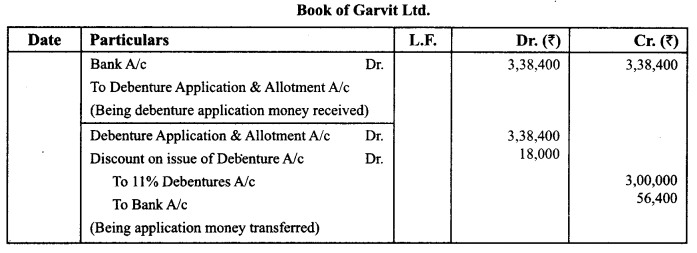
Class 12 Accountancy Important Questions Chapter 7 Issue and Redemption of Debentures 1

Question 2.
On 1st April 2015, P Ltd. Issued 6,000 12% Debentures of ₹ 100 each at par redeemable at a premium of 7%. The Debentures were to be redeemed at the end of third year. Prepare Loss on issue of 12% Debentures Account. (CBSE Delhi 2019)
Answer:
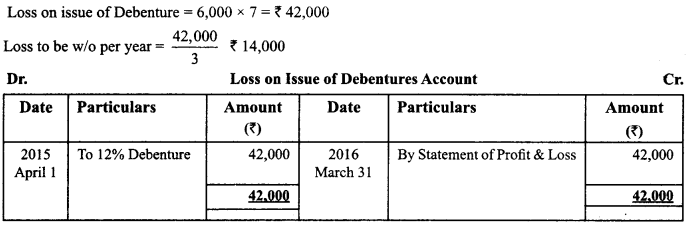
Class 12 Accountancy Important Questions Chapter 7 Issue and Redemption of Debentures 2

Question 3.
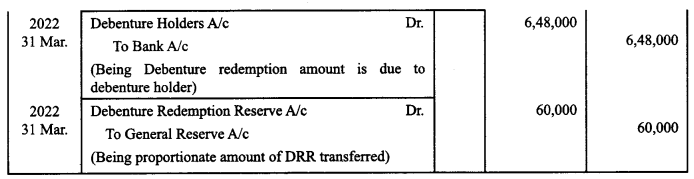
Unilink Ltd. (An unlisted company) had outstanding ₹ 12,00,000, 9% debentures on 1st April, 2020 redeemable at a premium of 8% in two equal annual instalments starting from 31st March, 2022. The company had a balance of₹ 1,20,000 in Debenture Redemption-Reserve on 31st March, 2020. Pass the necessary journal entries for redemption of debentures in the books of Unilink Ltd. for the year ended 31st March, 2022. . (CBSE Delhi 2019, Modified)
Answer:
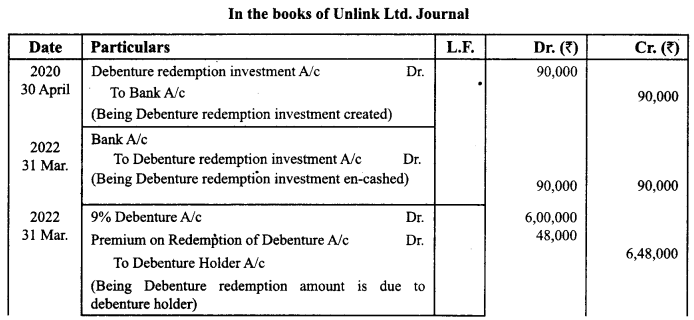
Class 12 Accountancy Important Questions Chapter 7 Issue and Redemption of Debentures 3
Class 12 Accountancy Important Questions Chapter 7 Issue and Redemption of Debentures 4
Note: This question has been updated as per Companies (Share Capital and Debentures) Amendment Rules, 2019.

Question 4.
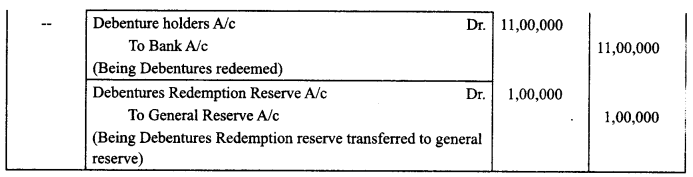
Krishna Ltd. (An unlisted company) had outstanding 20,000,9% debentures of₹ 100 each on 1st April, 2014. These debentures were redeemable at a premium of 10% in two equal instalments starting from 31 st March, 2021. The company had a balance of ₹2,00,000 in Debenture Redemption Reserve on 31 st March, 2020.
Pass necessary journal entries for redemption of debentures in the books of Krishna Ltd. for the year ended 31st March, 2018. (CBSE Delhi 2019, Modified)
Answer:
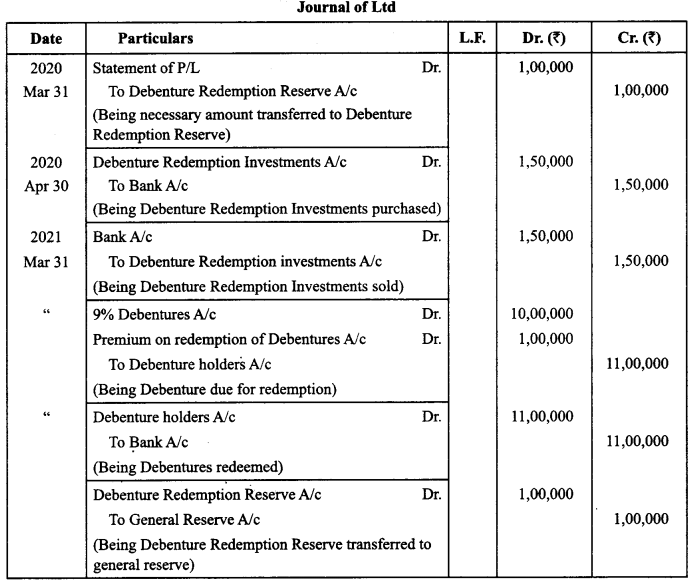
Class 12 Accountancy Important Questions Chapter 7 Issue and Redemption of Debentures 5
Note: This question has been updated as per Companies (Share Capital and Debentures) Amendment Rules, 2019.

Question 5.
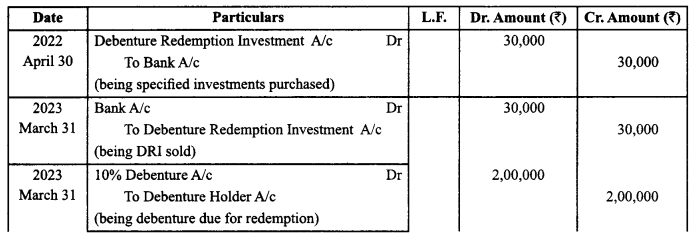
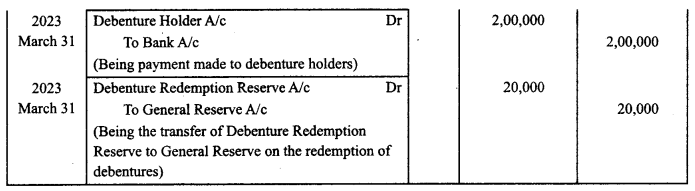
On 1st April, 2013 Anushka Ltd. (An unlisted companies) issued ₹70,00,000, 9% debentures of ₹ 100 each at par, redeemable at a premium of 5% on 31 st march, 2021. The company created the necessary, minimum amount of debenture redemption reserve and purchased debenture redemption reserve investments. The debentures were redeemed on 31 st March, 20121. Pass necessary journal entries for the redemption of debentures, in the books of the company.
(CBSE Delhi 2019, Modified)
Answer:
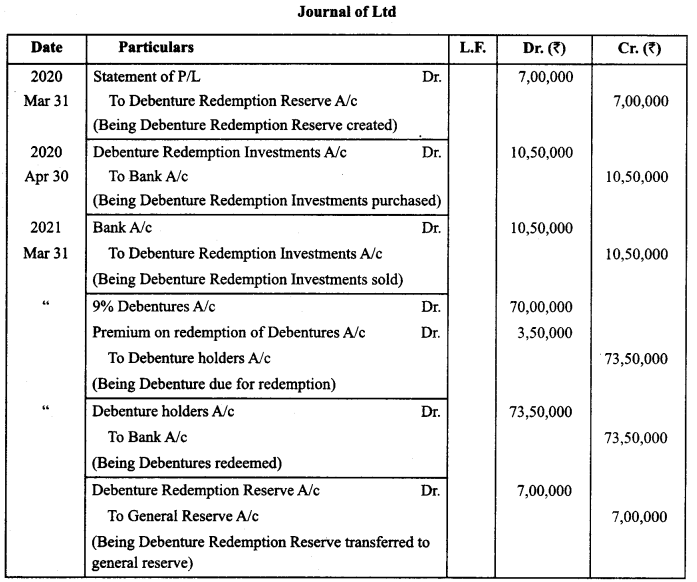
Class 12 Accountancy Important Questions Chapter 7 Issue and Redemption of Debentures 6
Note: This question has been updated as per companies (Share capital and debentures) Amendment Rules, 2019.

Question 6.
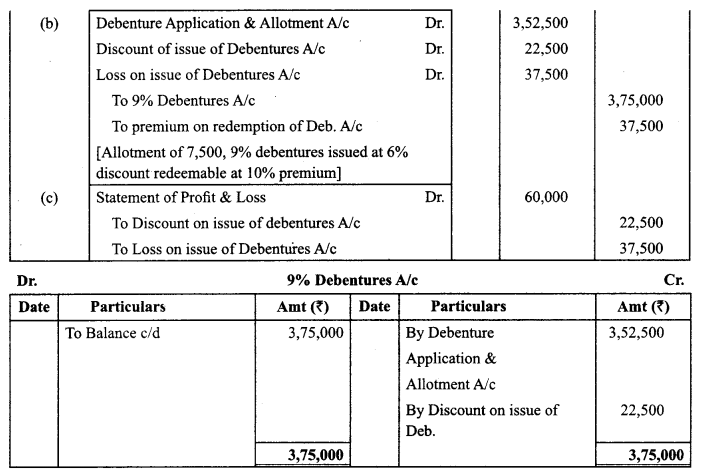
Pass necessary journal entries and prepare 9% Debentures Account for the issue of 7,500,9% Debentures of ₹ 50 each at a discount of 6%, redeemable at a premium of 10%. (CBSE Delhi 2019, Modified)
Answer:
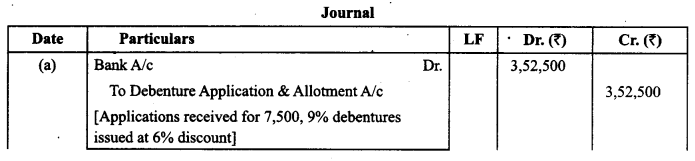
Class 12 Accountancy Important Questions Chapter 7 Issue and Redemption of Debentures 7
Class 12 Accountancy Important Questions Chapter 7 Issue and Redemption of Debentures 8

Question 7.
Krishna Ltd. had (an unlisted company) outstanding 20,000, 9% debentures of₹ 100 each on 1st April, 2014.. These debentures were redeemable at a premium of 10% in two equal instalments starting from 31st March, 2021.
The company had a balance of₹ 1,80,000 in Debenture Redemption Reserve on 31st March, 2020.
Pass necessary journal entries for redemption of debentures in the books of Krishna Ltd. for the year ended 31 st March, 2021. (CBSE Outside Delhi 2019, Modified)
Answer:
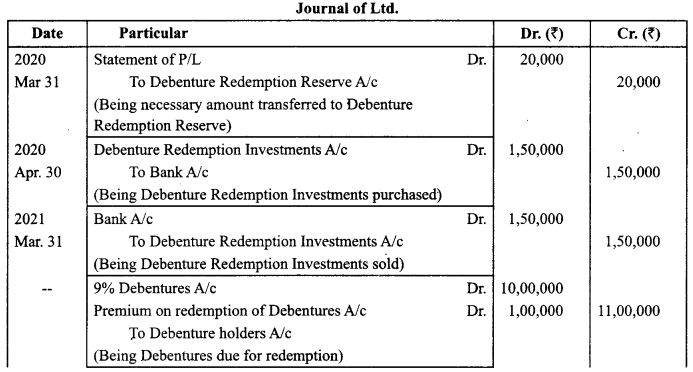
Class 12 Accountancy Important Questions Chapter 7 Issue and Redemption of Debentures 9
Class 12 Accountancy Important Questions Chapter 7 Issue and Redemption of Debentures 10
Note: This question has been updated as per companies (Share capital and debentures) Amendment Rules, 2019.

Question 8.
On 1 st April, 2013 Anushka Ltd. (unlisted company) issued ₹70,00,000, 9% debentures of ₹ 100 each at par, redeemable at a premium of 5% on 31 st march, 2021. The company created the necessary, minimum amount of debenture redemption reserve and purchased debenture redemption reserve investments. The debentures were redeemed on 31st March, 2021.
Pass necessary journal entries for the redemption of debentures, in the books of the company.
Answer:
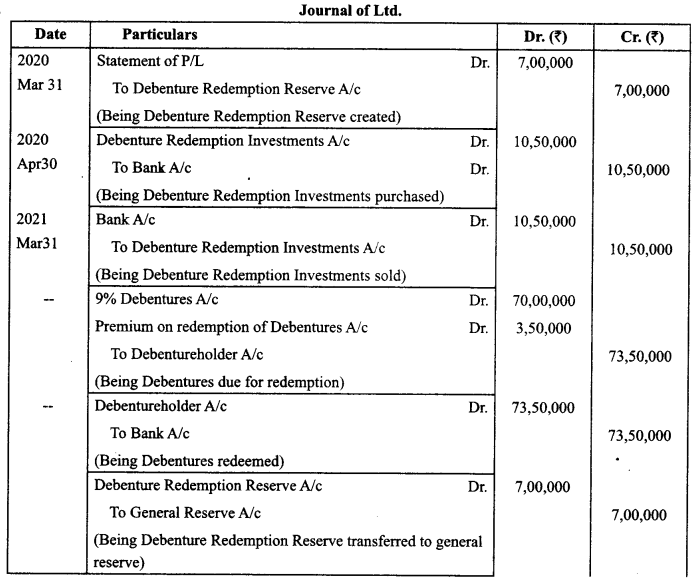
Class 12 Accountancy Important Questions Chapter 7 Issue and Redemption of Debentures 11
Note: This question has been updated as per companies (Share capital and debentures) Amendment Rules, 2019.

Question 9.
Complete the following Journal Entries
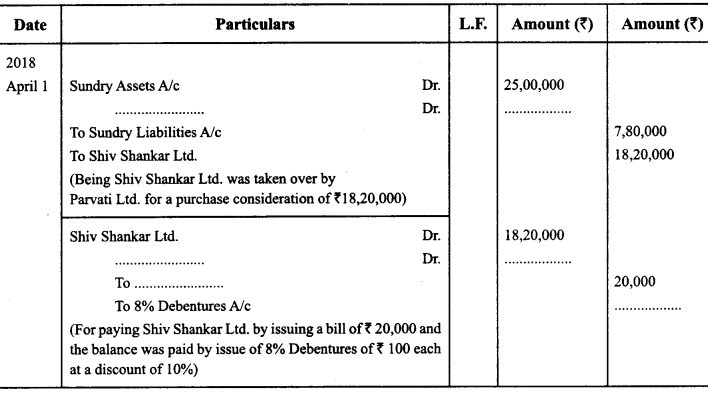
Class 12 Accountancy Important Questions Chapter 7 Issue and Redemption of Debentures 12
Answer:
Class 12 Accountancy Important Questions Chapter 7 Issue and Redemption of Debentures 13

Question 10.
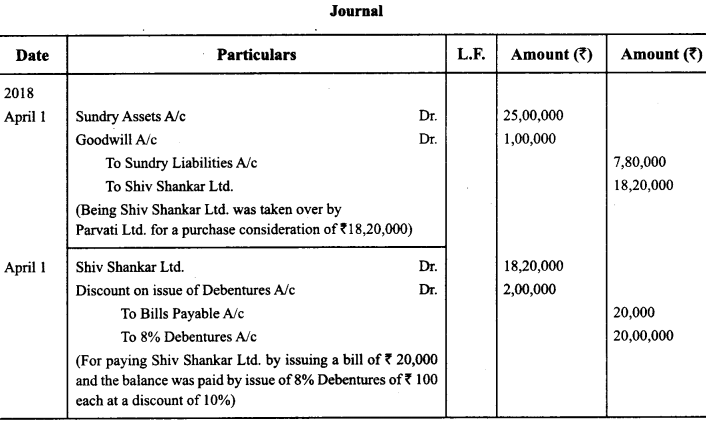
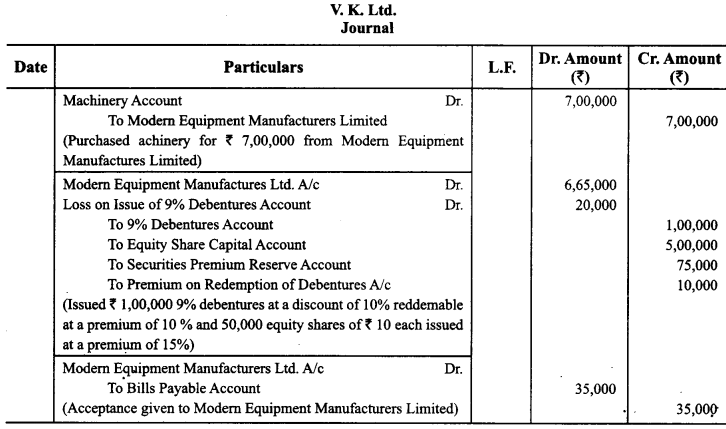
V K Limited purchased machinery from Modem Equipment Manufacturers Limited. The company paid the vendors by issue of some equity shares and debentures and the balance through an acceptance in then- favour payable after three months. The accountant of the company, while Journalising the above mentioned transactions, left some items blank. You are required to fill in the blanks.
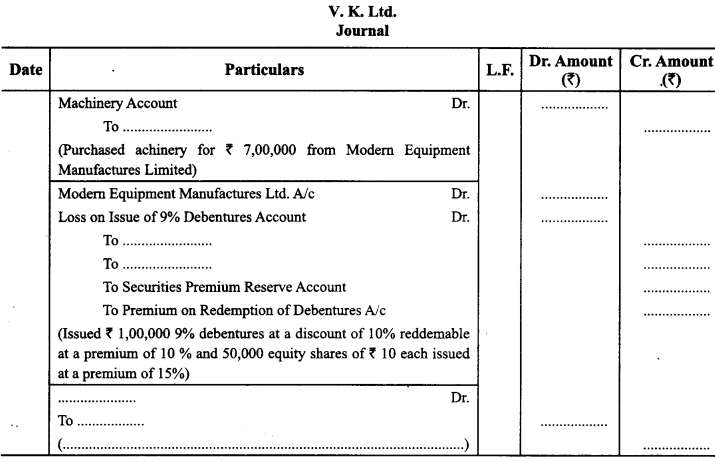
Class 12 Accountancy Important Questions Chapter 7 Issue and Redemption of Debentures 14
Answer:
Class 12 Accountancy Important Questions Chapter 7 Issue and Redemption of Debentures 15

Question 11.
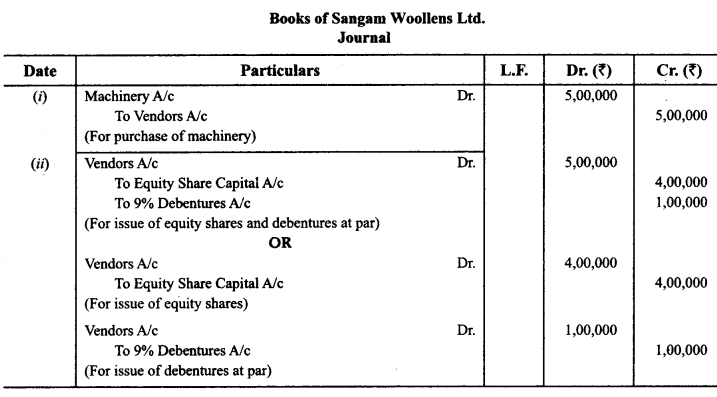
‘sangam Wooilens Ltd’, Ludhiana, are the and exporters of garments. The company decided to distribute free of cost oUes. garments to 10 villages of lahual and spiti district of Himachal Pradesh. The company also decided to employ 50 young persons from these villages in its newly established factory. The company issued 40,000 equity shares of’ 10 each and 1,000 9% debentures of’ 100 each to the vendors for the purchase of machinery of’ 5,00,000.
Pass necessary Journal Entries. (Dehli 2015, Modified)
Answer:
Class 12 Accountancy Important Questions Chapter 7 Issue and Redemption of Debentures 16

Question 12.
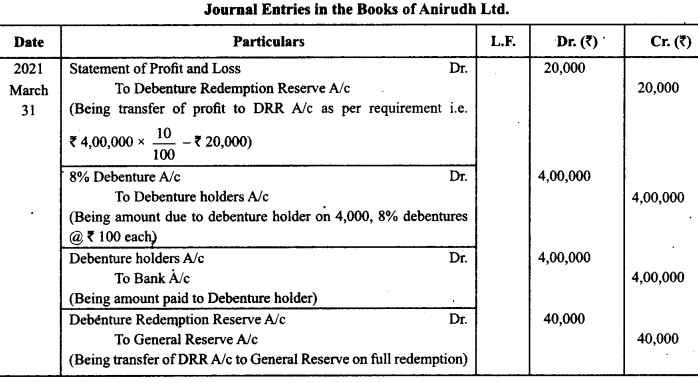
Anirudh Limited (Listed company) has 4,000, 8% debentures of₹ 100 each due for redemption on March 31, 2022. The company has a DRR of ₹ 20,000 on that date. Assuming that no interest is due. Record the necessary journal entries at the time of redemption of debentures.
Answer:
Class 12 Accountancy Important Questions Chapter 7 Issue and Redemption of Debentures 17
Note: This question has been updated as per companies (Share capital and debentures) Amendment Rules, 2019.

Question 13.
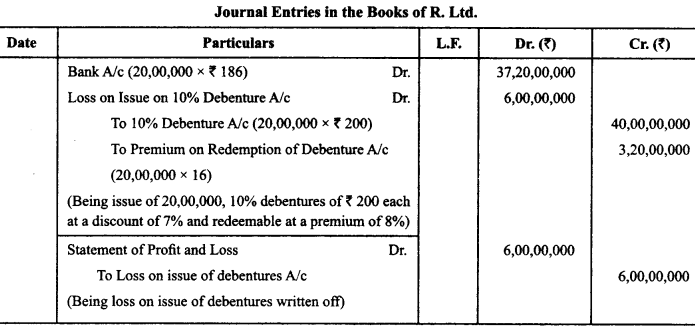
R. Ltd. offered 20,00,000,10% Debenture of₹ 200 each at a discount of redeemable at premium of 8% after 9 years. Record necessary entries in the book of R. Ltd.
Answer:
Class 12 Accountancy Important Questions Chapter 7 Issue and Redemption of Debentures 18

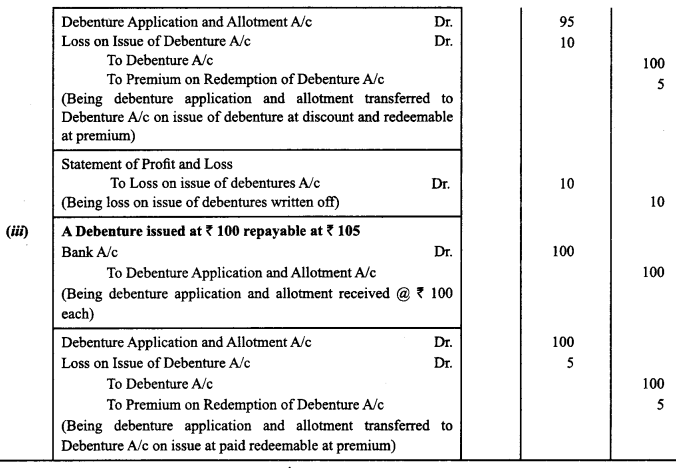
Question 14.
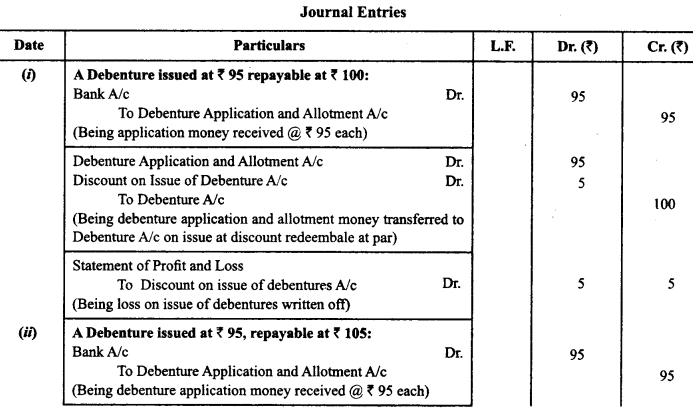
Journalise the following:
(i) A debenture issued at ₹ 95, repayable at ₹ 100;
(ii) A debenture issued at ₹ 95, repayable at ₹ 105; and
(iii) A debenture issued at ₹ 100 repayable at ₹ 105;
The face value of debenture in each of the above cases is ₹ 100.
Answer:
Class 12 Accountancy Important Questions Chapter 7 Issue and Redemption of Debentures 19
Class 12 Accountancy Important Questions Chapter 7 Issue and Redemption of Debentures 20

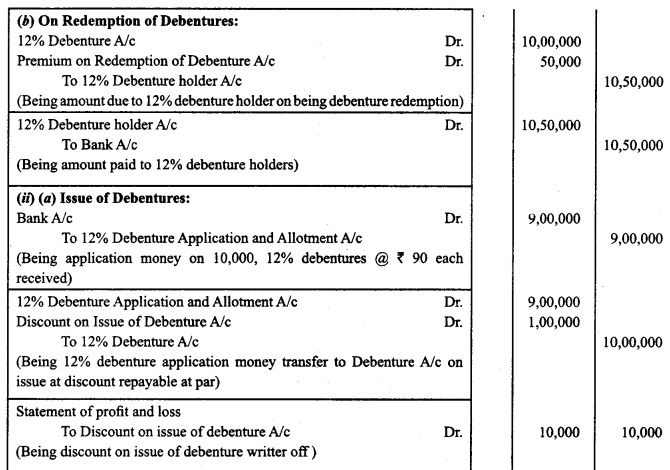
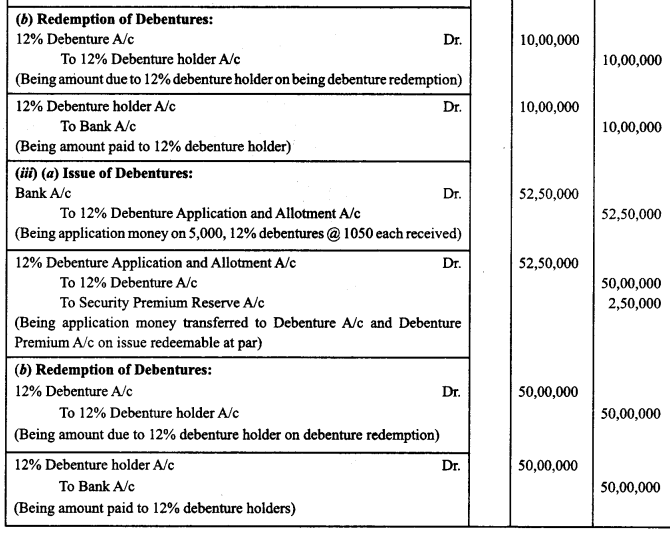
Question 15.
A Company issues the following debentures:
(i) 10,000,12% debentures of₹ 100 each at par but redeemable at premium of 5% after 5 years;
(ii) 10,000,12% debentures of₹ 100 each at a discount of 10% but redeemable at par after 5 years;
(iii) 5,000,12% debentures of₹ 1,000 each at a premium of 5% but redeemable at par after 5 years;
Answer:
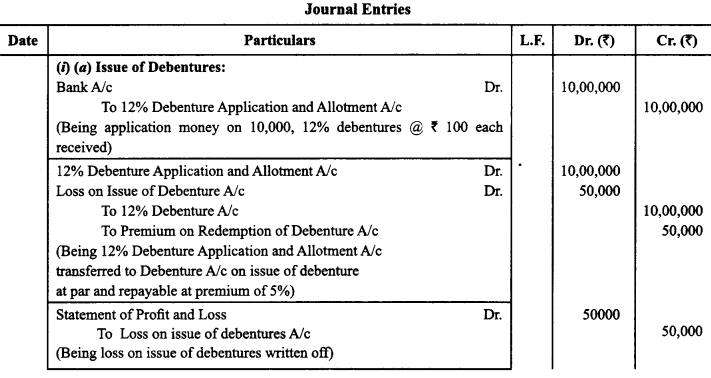
Class 12 Accountancy Important Questions Chapter 7 Issue and Redemption of Debentures 21
Class 12 Accountancy Important Questions Chapter 7 Issue and Redemption of Debentures 22
Class 12 Accountancy Important Questions Chapter 7 Issue and Redemption of Debentures 23

Question 16.
X Ltd. invited applications for issuing 1000,9% debentures of₹ 100 each at a discount of 6%. Applications for 1,200 debentures were received. Pro-rata allotment was made to all the applicants. Pass necessary Journal Entries for the issue of debentures assuming that the whole amount was payable with applications. [Delhi 2017]
Answer:
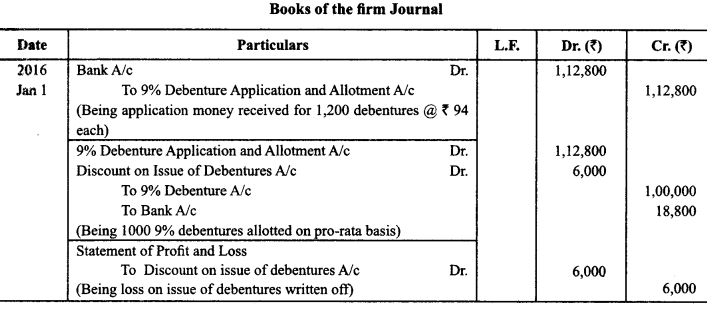
Class 12 Accountancy Important Questions Chapter 7 Issue and Redemption of Debentures 24

Question 17.
Z Ltd. purchased machinery from K Ltd. Z Ltd paid K Ltd as follows:
(i) By issuing 5,000 equity shares of ₹ 10 each at a premium of 30%.
(ii) By issuing 1000, 8% Debentures of₹ 100 each at a discount of 10%.
(iii) Balance by giving a promissory note of ₹ 48,000 payable after two months.
Pass necessary journal entries for the purchase of machinery and payment to K Ltd. in the books of Z Ltd. [Delhi 2017]
Answer:
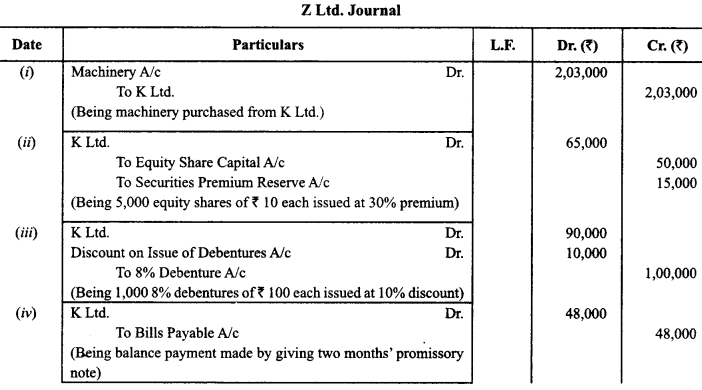
Class 12 Accountancy Important Questions Chapter 7 Issue and Redemption of Debentures 25
Class 12 Accountancy Important Questions Chapter 7 Issue and Redemption of Debentures 26

Question 18.
K K Limited obtained a loan of₹ 10,00,000 from State Bank of India @ 9 % interest. The company issued ₹ 15,00,000, 9 % debentures of₹ 100/- each, in favour of State Bank of India as collateral security. Pass necessary Journal entries for the above transactions:
(i) When company decided not to record the issue of 9 % Debentures as collateral security.
(ii) When company decided to record the issue of 9 % Debentures as collateral security. (CBSE Sample Paper 2018-19, 2017-18)
Answer:
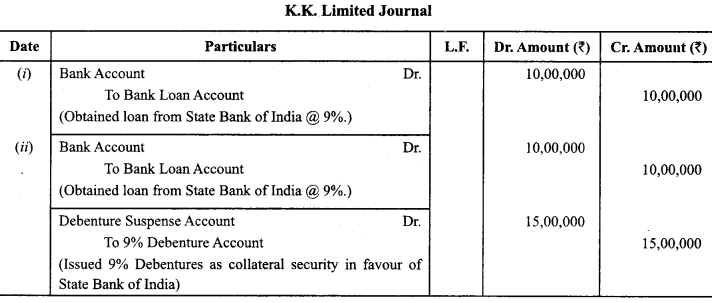
Class 12 Accountancy Important Questions Chapter 7 Issue and Redemption of Debentures 27

Question 19.
Explain with an imaginary example how issue of debenture as collateral security is shown in the balance sheet of a company when it is recorded in the books of accounts. (CBSE Sample Paper 2016, 2017)
Answer:
Alfa Ltd. obtained Loan of 1,00,000 from Indian Bank and issued 1200, 10% Debentures of 100 each as Collateral security.
Treatment: An extract of Balance sheet of Alfa Ltd.
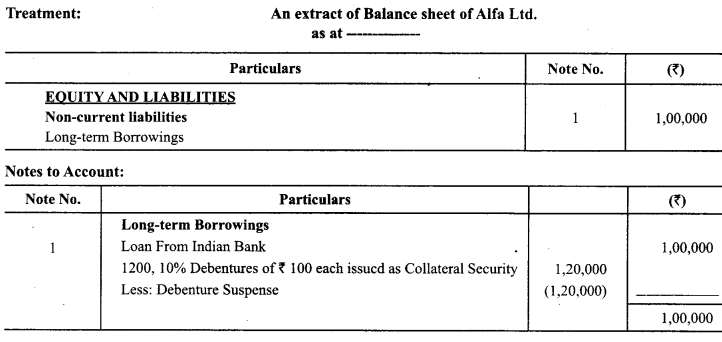
Class 12 Accountancy Important Questions Chapter 7 Issue and Redemption of Debentures 28

Question 20.
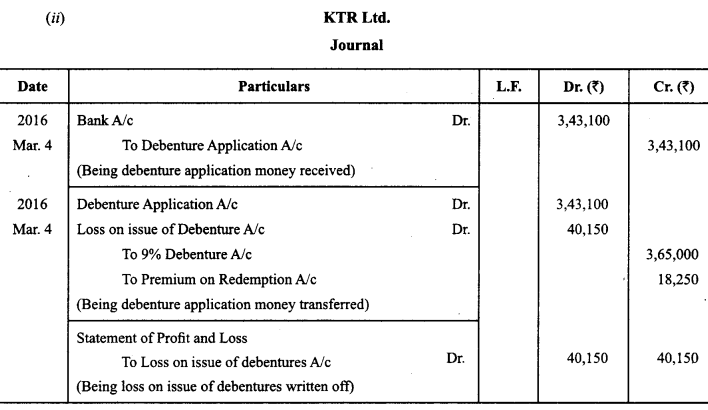
KTR Ltd., issued 365, 9% Debenture of 7’1,000 each on 4.3.2016. Pass necessary journal entries for the issue of debenture in the following situations : (CBSE Outside Delhi 2016)
(i) When debentures were issued at per redeemable at a premium of 10%.
(ii) When debentures were issued at 6% discount redemable at 5% premium.
Answer:
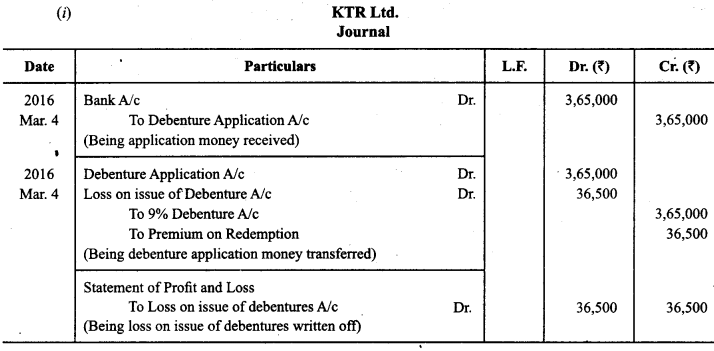
Class 12 Accountancy Important Questions Chapter 7 Issue and Redemption of Debentures 29
Class 12 Accountancy Important Questions Chapter 7 Issue and Redemption of Debentures 30

Question 21.
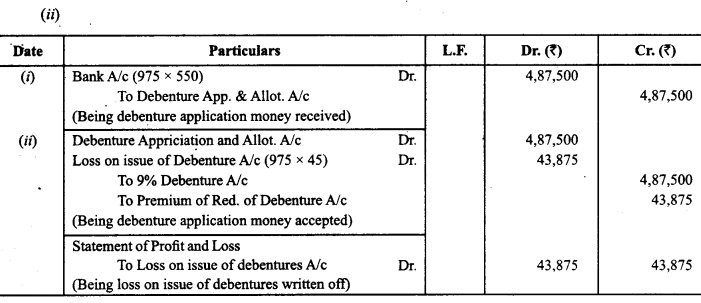
VKR Ltd. issued 975; 9% Debentures of 7 500 each on 4.3.2016. Pass necessary journal entries for the issue of debentures under the following situations:
(i) When debentures were issued at a premium of 10% redeemable at a premium of 6%.
(ii) When debentures were issued at a par redeemable at 9% premium. (CBSE Outside Delhi 2016)
Answer:
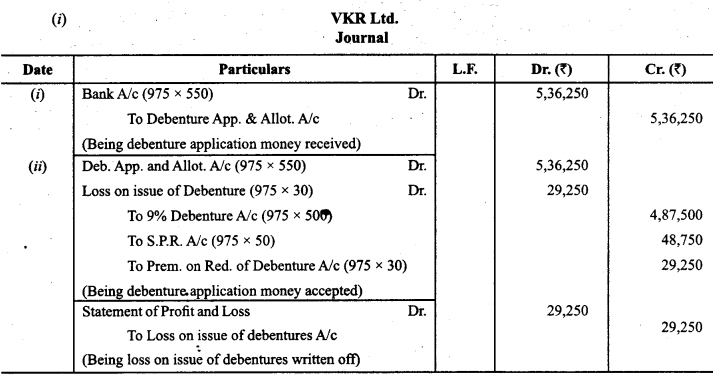
Class 12 Accountancy Important Questions Chapter 7 Issue and Redemption of Debentures 31
Class 12 Accountancy Important Questions Chapter 7 Issue and Redemption of Debentures 32

Question 22.
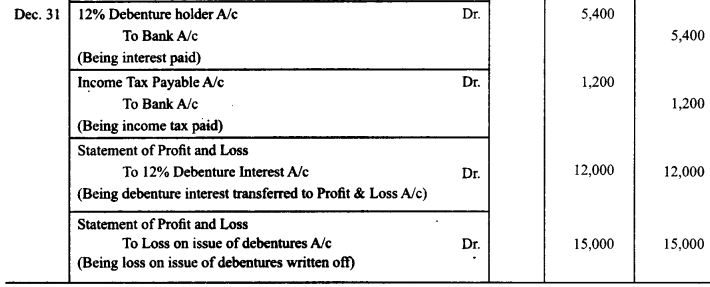
BG. Ltd. issued 2,000, 12% debentures of (100 each on 1st April 2012. The issue was fully subscribed. According to the terms of issue, interest on the debentures is payable half-yearly on 30s1 September and 31st March and the tax deducted at source is 10%. Pass necessary journal entries related to the debenture interest for the half-yearly ending 3151 March, 2013 and transfer of interest on debentures of the year to the Statement of Profit & Loss. . (CBSE Delhi 2014, Set I, II)
Answer:
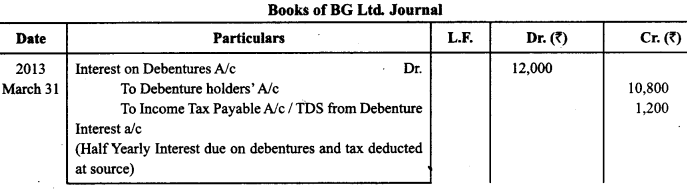
Class 12 Accountancy Important Questions Chapter 7 Issue and Redemption of Debentures 33
Class 12 Accountancy Important Questions Chapter 7 Issue and Redemption of Debentures 34
Question 23.
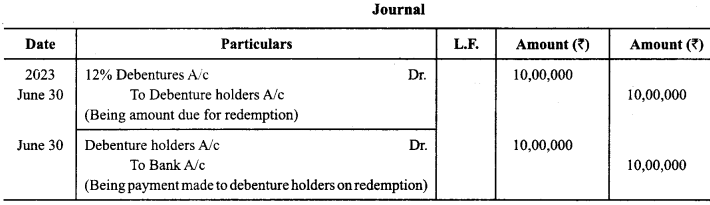
Jan Dhan Bank, an All India Financial Institution, had 10,000,12% debentures of₹ 100 each, outstanding as at 31st March, 2022. These debentures were due for redemption on 30th June, 2023. Pass necessary Journal Entries for redemption of debentures. Also, state the amount of Debenture Redemption Reserve to be created for the purpose of redemption. (CBSE Sample Paper 2018-19, Modified)
Answer:
Class 12 Accountancy Important Questions Chapter 7 Issue and Redemption of Debentures 35
Note:
According to Section 71(4) of the Companies Act, 2013 and Companies (Share Capital & Debentures) Amendment Rules, 2019, an All India Financial Institution is not required to create Debenture Redemption Reserve.

Question 24.
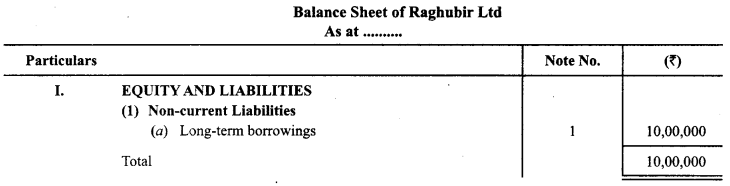
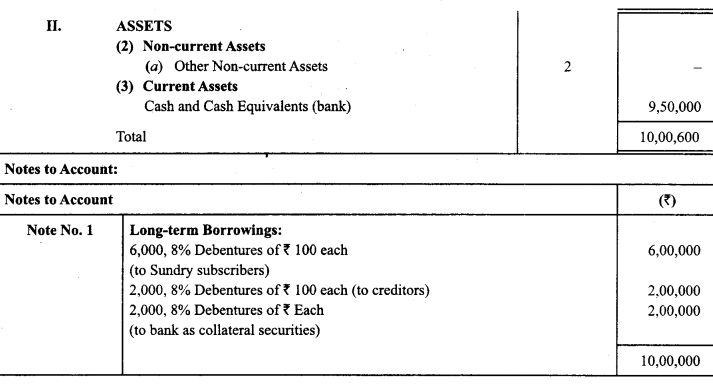
Raghuveer Limited created 10,00,000, 8% debentures stock which was issued as follows to:
1. Sundry subscribers for cash at 90%
2. Creditors for ₹ 2,00,000 capital expenditure in satisfaction of his claim
3. Bankers as collateral securities for a bank loan
worth ₹ 20,00,000 for which principal security is business premises worth
The issue (1) and (2) are redeemable at the end of 10 years at par. State how the debenture stock be dealt with while preparing the balance sheet of a company.
Answer:
Class 12 Accountancy Important Questions Chapter 7 Issue and Redemption of Debentures 36
Class 12 Accountancy Important Questions Chapter 7 Issue and Redemption of Debentures 37

Question 25.
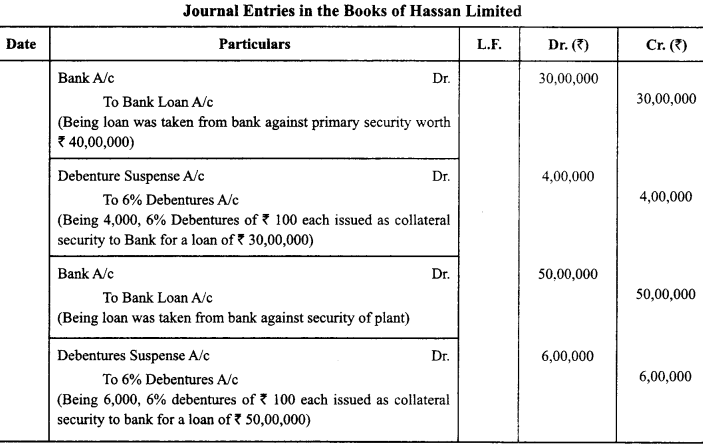
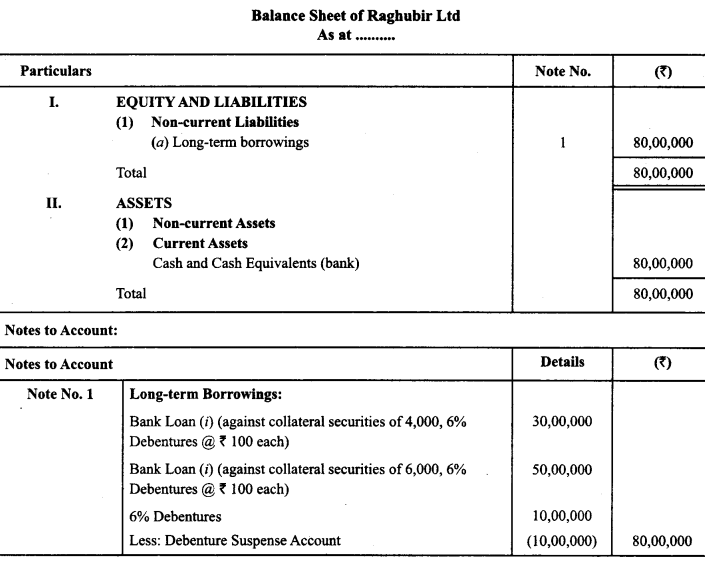
Hassan Limited took a loan of ₹ 30,00,000 from a bank against primary security worth ₹ 40,00,000 and . issued 4,000, 6% debentures of₹ 100 each as a collateral security. The company again after one year took a loan of ₹ 50,00,000 from bank against plant as primary security and deposited 6,000, 6% debentures of₹ 100 each as collateral security. Record necessary journal entries and prepare balance sheet of the company.
Class 12 Accountancy Important Questions Chapter 7 Issue and Redemption of Debentures 38
Answer:
Class 12 Accountancy Important Questions Chapter 7 Issue and Redemption of Debentures 39

Question 26.
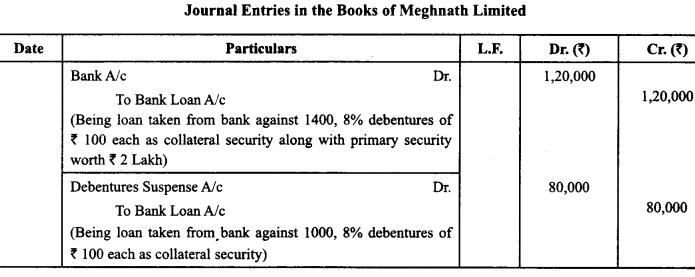
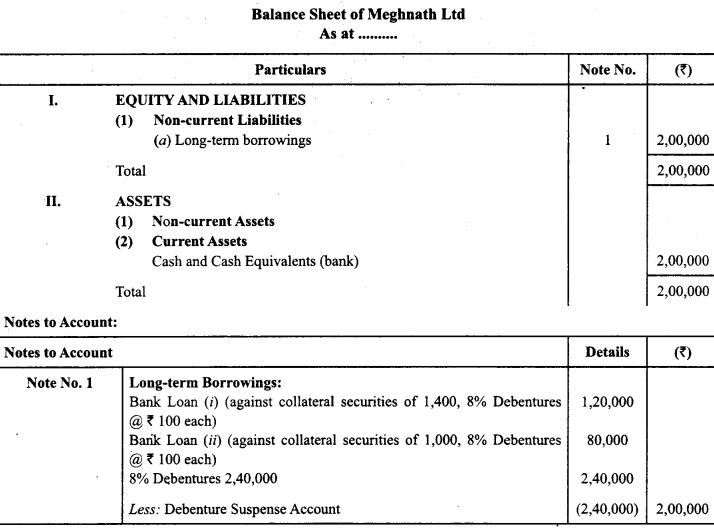
Meghnath Limited took a loan of ₹ 1,20,000 from a bank and deposited 1,400, 8% debentures of ₹ 100 each as collateral security along with primary security worth ₹ 2 Lakhs. Company again took a loan of ₹ 80,000 after two months from a bank and deposited 1,000, 8% debentures of ₹ 100 each as collateral security. Record necessary journal entries and prepare a balance sheet of a company.
Answer:
Class 12 Accountancy Important Questions Chapter 7 Issue and Redemption of Debentures 40
Class 12 Accountancy Important Questions Chapter 7 Issue and Redemption of Debentures 41

Question 27.
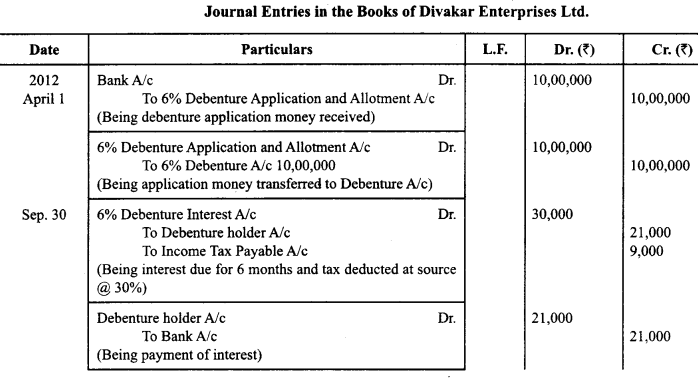
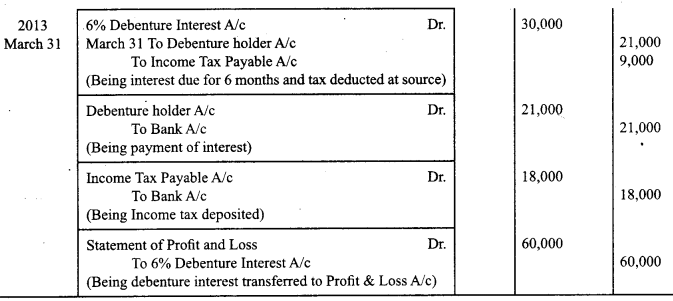
Diwakar Enterprises Ltd. issued 10,00,000, 6% debentures on April 1, 2008. Interest is paid on September 30, 2012 and March 31, 2013.
Record necessary journal entries assuming that income tax is deducted @ 30% of the amount of interest.
Answer:
Class 12 Accountancy Important Questions Chapter 7 Issue and Redemption of Debentures 42
Class 12 Accountancy Important Questions Chapter 7 Issue and Redemption of Debentures 43

Question 28.
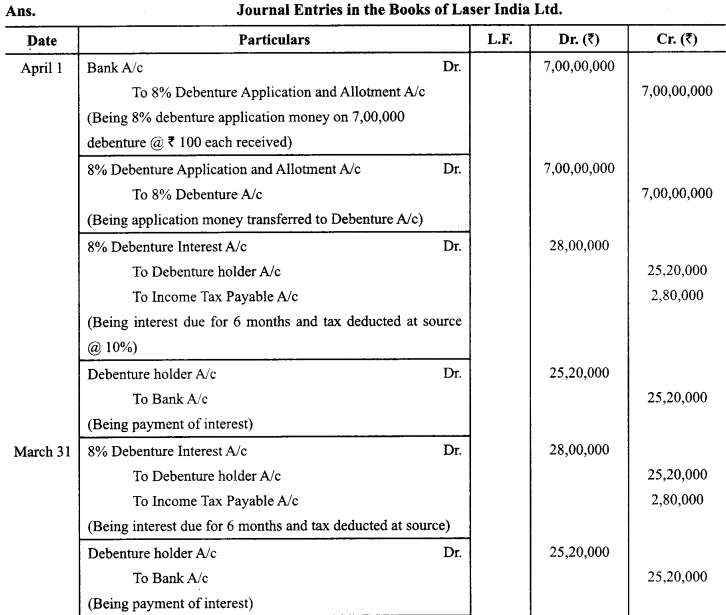
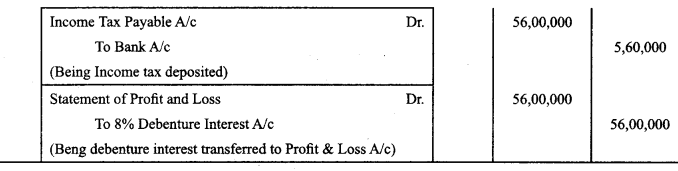
Laser India Ltd. issued 7,00,000, 8%. debentures of₹ 100 each at par. Company deducts income tax from the interest of these debentures at source. Interest is to be paid on these debentures half yearly on September 30 and March 31, every year. Amount of income tax deducted half yearly is ₹ 2,80,000.
Answer:
Class 12 Accountancy Important Questions Chapter 7 Issue and Redemption of Debentures 44
Class 12 Accountancy Important Questions Chapter 7 Issue and Redemption of Debentures 45

Question 29.
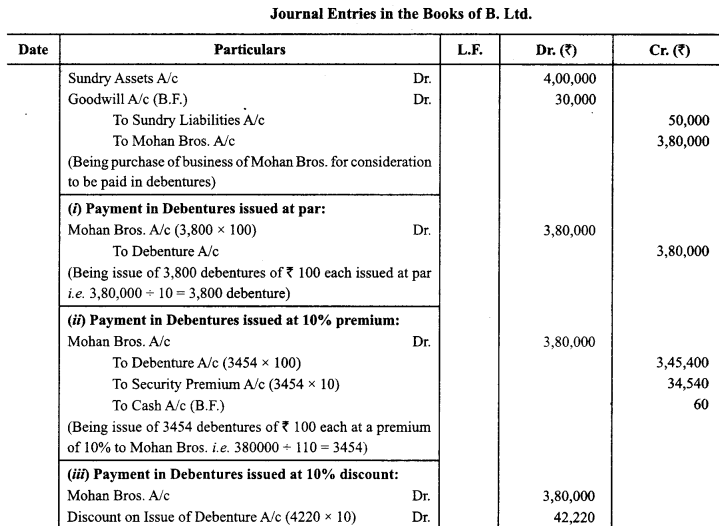
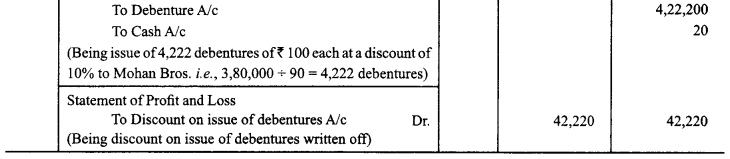
B. Ltd. purchased assets of the book value of ₹ 4,00,000 and took over the liability of ₹ 50,000 from Mohan Bros. It was agreed that the purchase consideration settled at ₹ 3,80,000 be paid by issuing debentures of₹ 100 each.
What journal entries will be made in the following three cases, if debentures are issued: (a) at par; (b) at a discount of 10%, (c) at a premium of 10%₹ It was agreed that a fraction of debentures be paid in cash.
Answer:
Class 12 Accountancy Important Questions Chapter 7 Issue and Redemption of Debentures 46
Class 12 Accountancy Important Questions Chapter 7 Issue and Redemption of Debentures 47

Question 30.
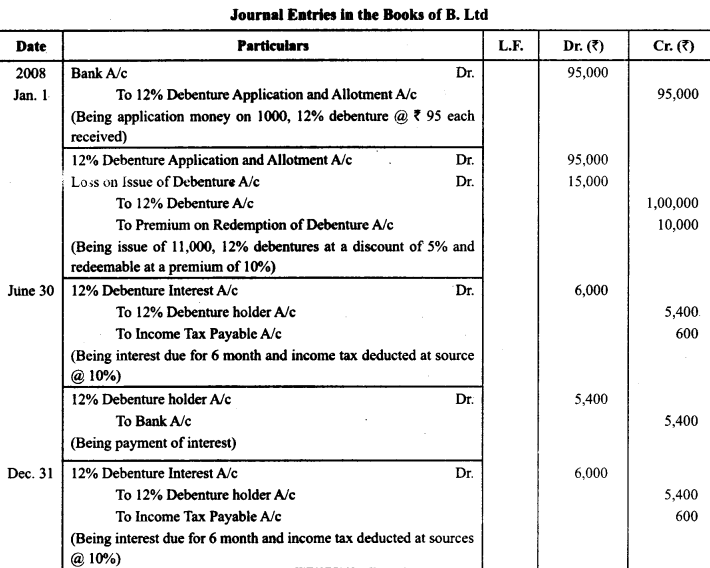
B. Ltd. issued 1,000,12% debentures of₹ 100 each on January 01,2008 at a discount of 5% redeemable at a premium of 10%.
Give journal entries relating to the issue of debentures and debentures interest for the period ending December 31,2008 assuming that interest is paid half yearly on June 30 and December 31 and tax deducted at sources is 10%. B. Ltd. follows calendar year as its accounting year.
Answer:
Class 12 Accountancy Important Questions Chapter 7 Issue and Redemption of Debentures 48
Class 12 Accountancy Important Questions Chapter 7 Issue and Redemption of Debentures 49

Issue and Redemption of Debentures Important Extra Questions Long Answer Type

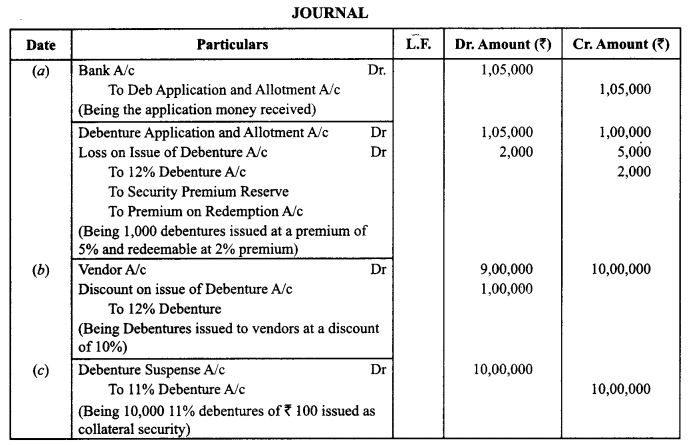
Question 1.
Journalise the following transactions
(a) Mehar Ltd. issued ₹ 1,00,000, 12% Debentures of ₹ 100 each at a premium of 5% redeemable at a premium of 2%
(b) 12% Debentures • were issued at a discount of 10% to a vendor of machinery for payment of ₹ 9,00,000
(c) Issue of 10,000 11% debentures of₹ 100 each as collateral in favour of State Bank of India. Company
opted to pass necessary entry for issue of debentures. (CBSE Sample Paper 2019-20)
Answer:
Class 12 Accountancy Important Questions Chapter 7 Issue and Redemption of Debentures 50

Question 2.
Faith and Belief Ltd has total redeemable debentures of₹ 5,00,000. It decides to redeem these debentures in two instalments of₹ 3,00,000 and ₹ 2,00,000 on December 31st 2021 and March 31st 2023 respectively. Assuming that the Company has sufficient funds in Debenture Redemption Reserve Account, pass necessary journal entries for the year ending March 31st 2020. (CBSE Sample Paper 2019-20, Modified)
Answer:
Class 12 Accountancy Important Questions Chapter 7 Issue and Redemption of Debentures 51
Class 12 Accountancy Important Questions Chapter 7 Issue and Redemption of Debentures 52
Note:
This question has been updated as per companies (Share capital and debentures) Amendment Rules, 2019.

Question 3.
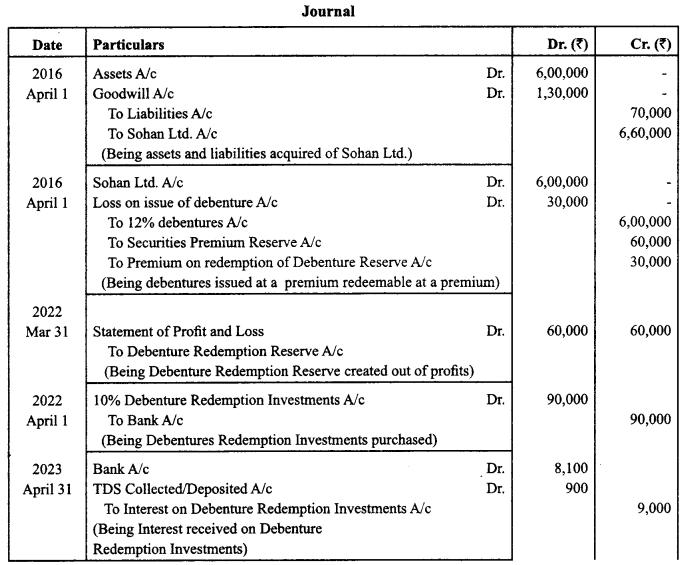
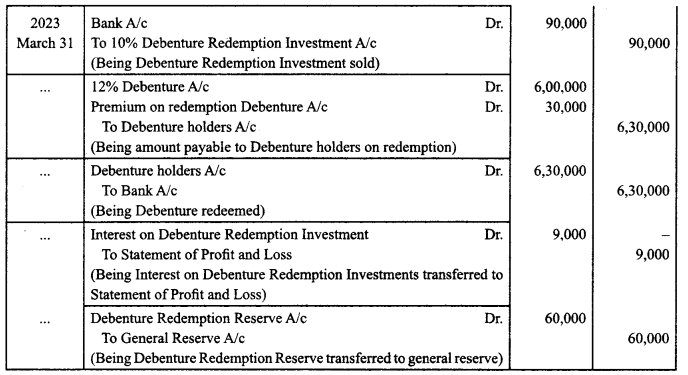
On 1st April, 2016, Ganesh Limited (An Unlisted Company) acquired assets of₹ 6,00,000 and took over liabilities of₹ 70,000 of Sohan Ltd. at an agreed value of₹ 6,60,000 Ganesh Ltd. issued 12% Debentures of ₹ 100 each at a premium of 10% in Ml satisfaction of purchase consideration. The debentures were redeemable after three years at a premium of 5%. The company decided to transfer the minimum required amount to Debenture Redemption Reserve of 31st March, 2022. It also made the required investment in Government securities earning interest @ 10% p.a. on IstApril, 2022. Tax was deducted on interest earned @ 10%.
Ignoring entries relating to writing off loss on issue of debentures and interest paid on debentures, pass the necessary journal entries to record the issue and redemption of debentures. (CBSE Compt. 2019, Modified)
Answer:
Class 12 Accountancy Important Questions Chapter 7 Issue and Redemption of Debentures 53
Class 12 Accountancy Important Questions Chapter 7 Issue and Redemption of Debentures 54

Question 4.
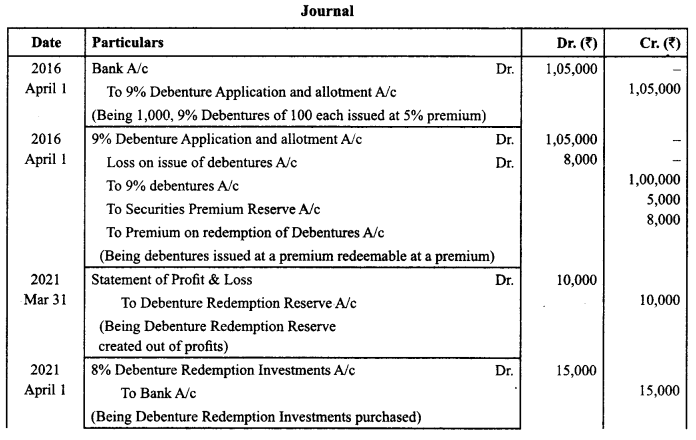
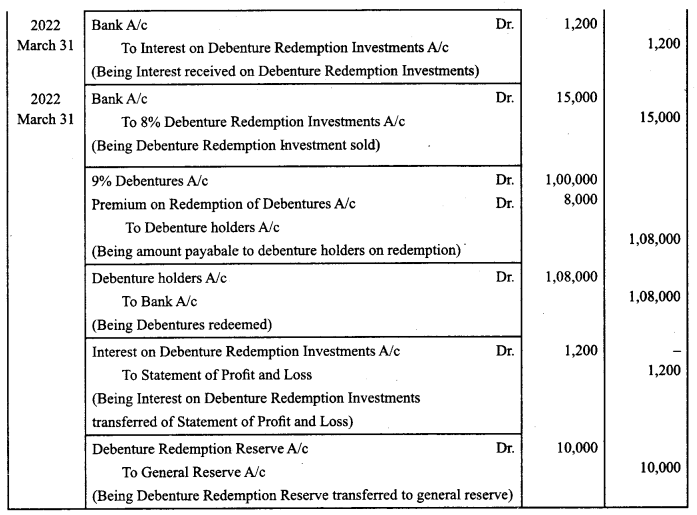
On 1st April, 2016 X Ltd. (An unlisted company) issued 1000; 9% debentures of₹ 100 each at a premium of ₹ 5 per debenture and redeemable on 31 st March, 2022 at a premium of ₹ 8 per debenture. The company created the minimum amount of debenture redemption reserve as per the amended provisions of the Companies Act, 2013 on 31 st March, 2021 and made investments in 8% p.a. fixed deposits in State Bank of India on 1 st April, 2021.
Excluding the entries for writing off loss on issue of debentures and interest on debentures, pass necessary journal entries for the above transactions in the books of X Ltd. (CBSE Compt. 2019, Modified)
Answer:
Class 12 Accountancy Important Questions Chapter 7 Issue and Redemption of Debentures 55
Class 12 Accountancy Important Questions Chapter 7 Issue and Redemption of Debentures 56
————-

Question 5.
Nena Limited issued 50,000, 10% debentures of₹ 100 each on the basis of the following conditions:
(a) Debentures issued at par and redeemable at par.
(b) Debentures issued at discount @ 5% & redeemable at par.
(c) Debentures issued at a premium @ 10% & redeemable at par.
(d) Debentures issued at par & redeemable at premium @ 10%.
(e) Debentures issued at discount of 5% and redeemable at a premium of 10%.
(f) Debentures issued at premium of 6% and redeemable at a premium of 4%.
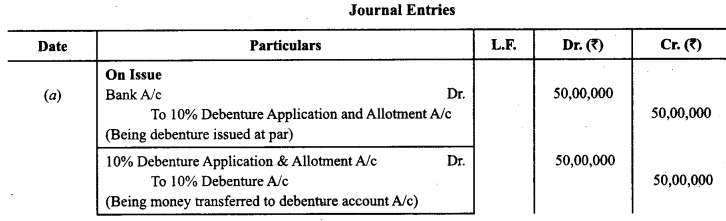
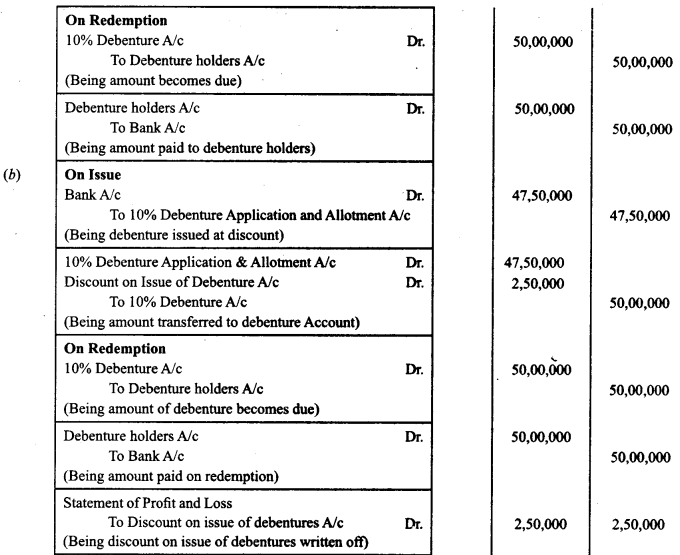
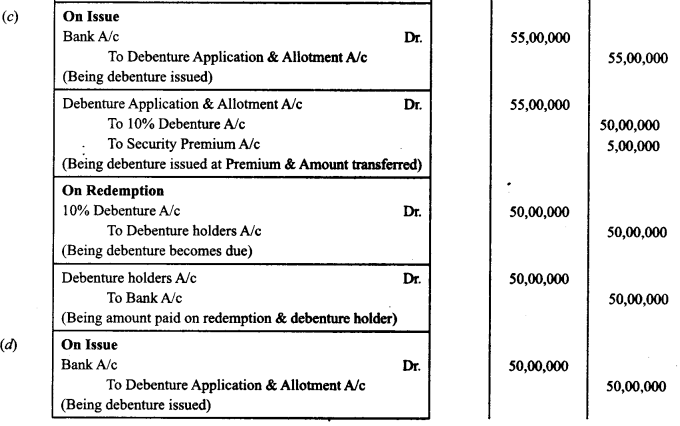
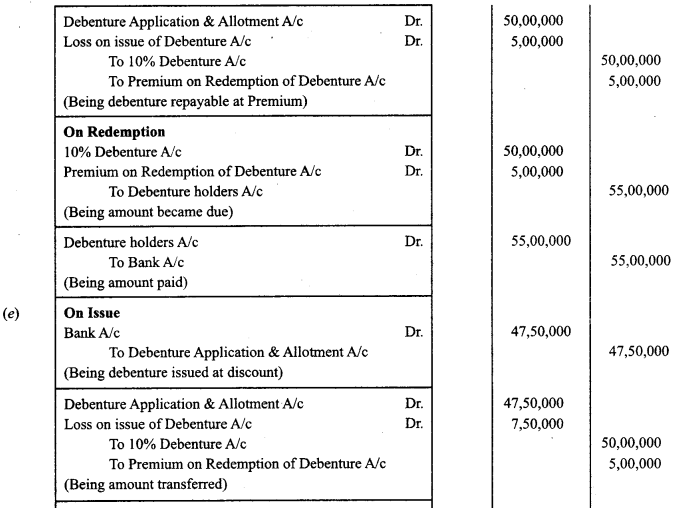
Record necessary journal entries in the above mentioned cases at the time of issue and redemption of debentures.
Answer:
Class 12 Accountancy Important Questions Chapter 7 Issue and Redemption of Debentures 57
Class 12 Accountancy Important Questions Chapter 7 Issue and Redemption of Debentures 58
Class 12 Accountancy Important Questions Chapter 7 Issue and Redemption of Debentures 59
Class 12 Accountancy Important Questions Chapter 7 Issue and Redemption of Debentures 60
Class 12 Accountancy Important Questions Chapter 7 Issue and Redemption of Debentures 61
Class 12 Accountancy Important Questions Chapter 7 Issue and Redemption of Debentures 62

Question 6.
Z. Limited (An unlisted company) issued, 2,000, 14% debentures of₹ 100 each on January 01, 2020 at a discount of 10%, redeemable at a premium of 10% in equal annual Drawings in 4 years out of profits. Give journal entries both at the time of issue and redemption of debentures.
(Ignore the treatment of loss on issue of debentures and interest.)
Answer:
Class 12 Accountancy Important Questions Chapter 7 Issue and Redemption of Debentures 63
Class 12 Accountancy Important Questions Chapter 7 Issue and Redemption of Debentures 64
Class 12 Accountancy Important Questions Chapter 7 Issue and Redemption of Debentures 65
Class 12 Accountancy Important Questions Chapter 7 Issue and Redemption of Debentures 66

Question 7.
On 1-4-2015 K.K. Ltd. issued 500, 9% Debentures of ₹ 500 each at a discount of 4%, redeemable at a premium of 5% after three years.
Pass necessary Journal Entries for the issue of debentures and debenture interest for the year ended 31 -3-2016 assuming that interest is payable on 30th September and 31 st March and the rate of tax deducted at source is 10%. The company closes its books on 31st March every year. [Delhi 2017]
Answer:
Class 12 Accountancy Important Questions Chapter 7 Issue and Redemption of Debentures 67
Class 12 Accountancy Important Questions Chapter 7 Issue and Redemption of Debentures 68

Question 8.
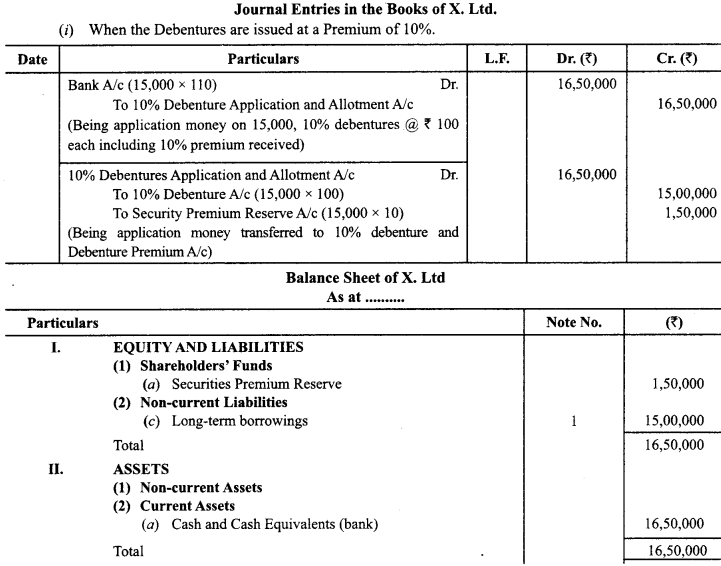
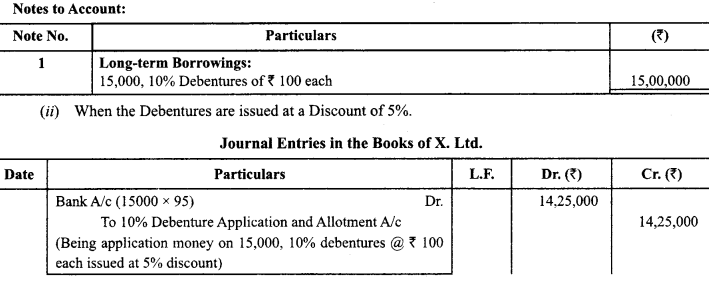
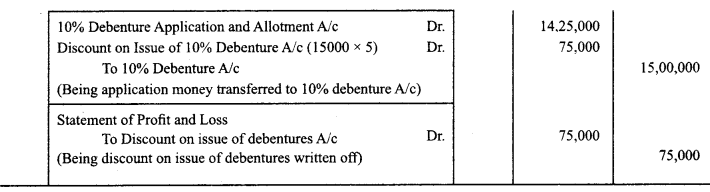
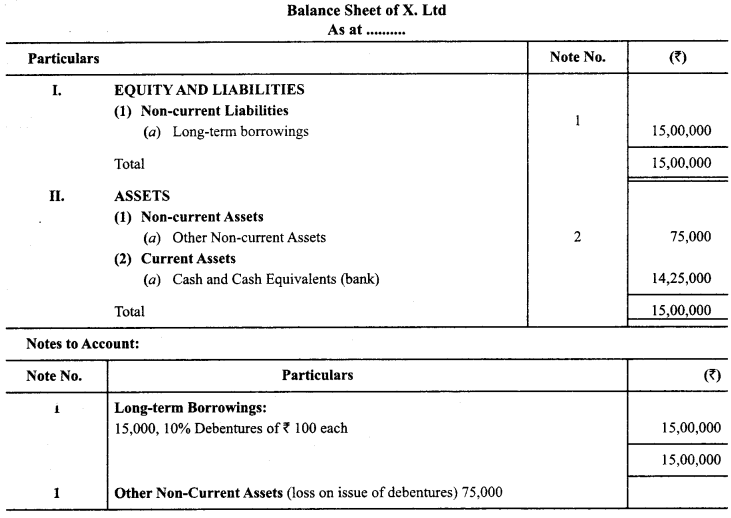
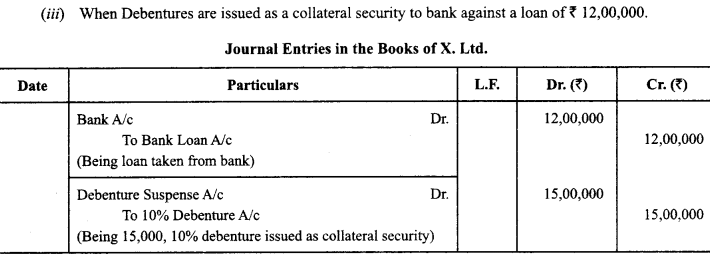
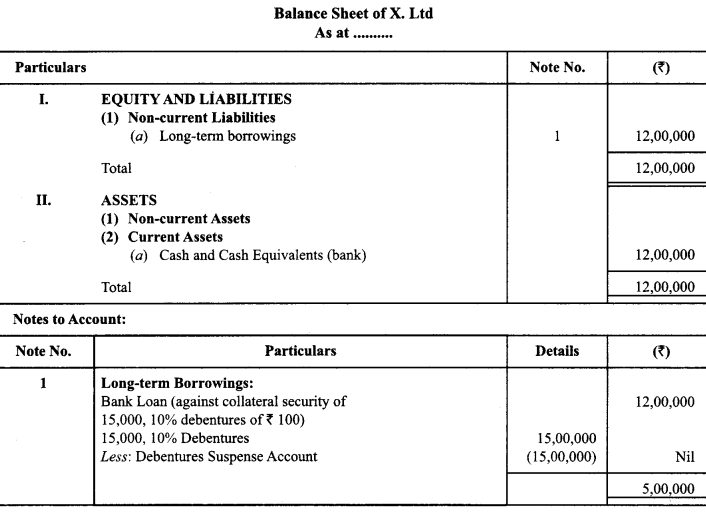
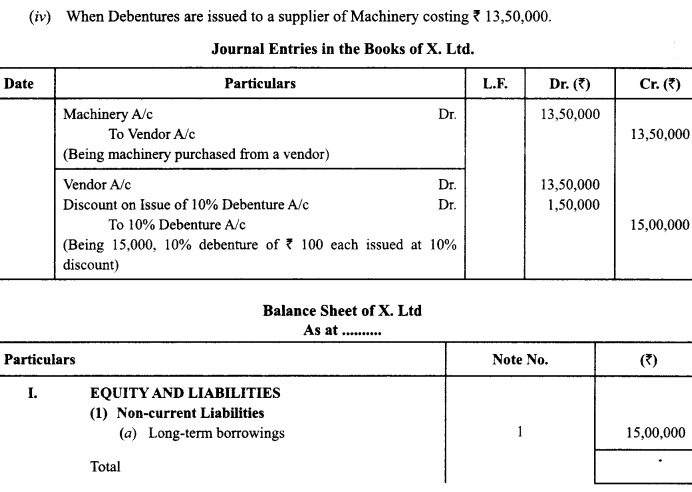
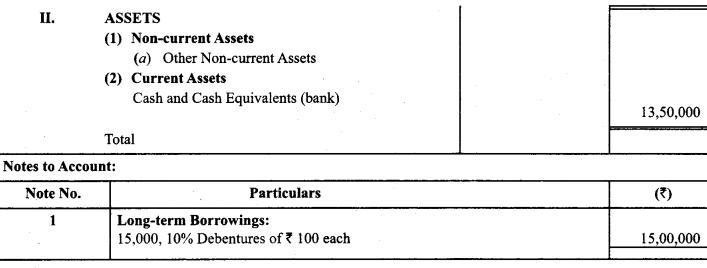
X. Ltd. issued 15,000, 10% debentures of₹ 100 each. Give journal entries and the Balance Sheet in each of the following cases:
(i) The debentures are issued at a premium of 10%.
(ii) The debentures are issued at a discount of 5%.
(iii) The debentures are issued as a collateral security to bank against a loan ₹ 12,00,000.
(iv) The debentures are issued to a supplier of machinery costing ₹ 13,50,000.
Answer:
Class 12 Accountancy Important Questions Chapter 7 Issue and Redemption of Debentures 69
Class 12 Accountancy Important Questions Chapter 7 Issue and Redemption of Debentures 70
Class 12 Accountancy Important Questions Chapter 7 Issue and Redemption of Debentures 71
Class 12 Accountancy Important Questions Chapter 7 Issue and Redemption of Debentures 72
Class 12 Accountancy Important Questions Chapter 7 Issue and Redemption of Debentures 73
Class 12 Accountancy Important Questions Chapter 7 Issue and Redemption of Debentures 74
Class 12 Accountancy Important Questions Chapter 7 Issue and Redemption of Debentures 75
Class 12 Accountancy Important Questions Chapter 7 Issue and Redemption of Debentures 76

Question 9.
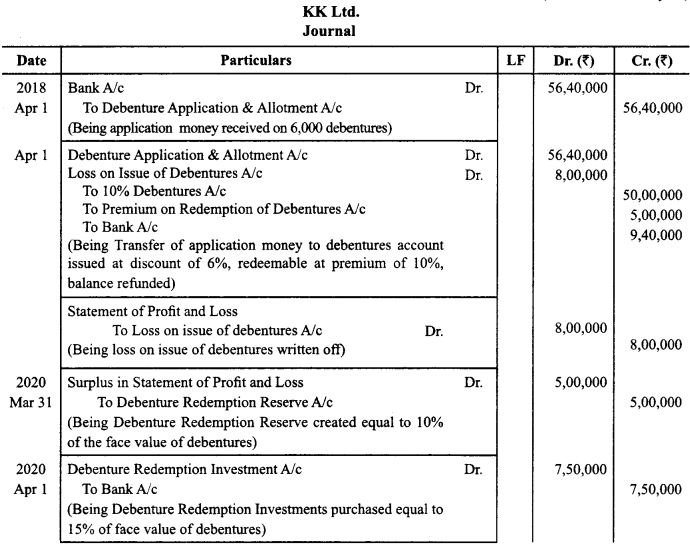
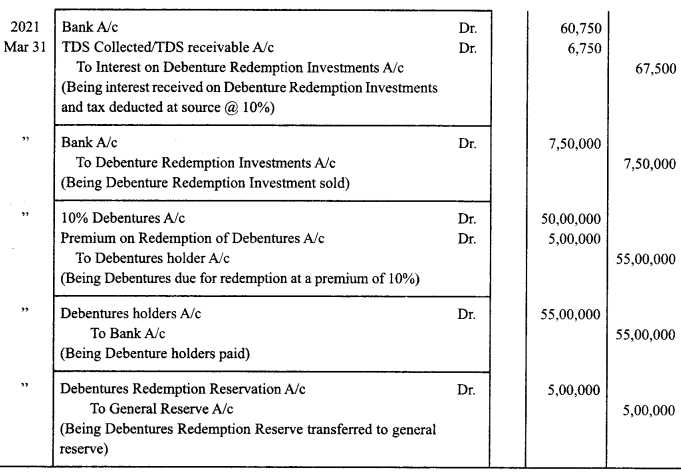
On 1st April, 2018, KK Ltd. (An unlisted company) invited applications for issuing 5,000 10% debentures of₹ 1,000 each at a discount of 6%. These debentures were payable at the end of 3rd year at a premium of 10%. Applications for 6,000 debentures were received and the debentures were allotted on pro-rata basis to all the applicants. Excess money received with applications was refunded. The directors decided to transfer the minimum amount to Debenture Redemption Reserve on 31.3.2020. On 1.4.2020, the company invested the necessary amount in 9% bank fixed deposit as per the amended provisions of the Companies Act, 2013. Tax was deducted at source by bank on interest @ 10% p.a. Pass the necessary journal entries for issue and redemption of debentures. Ignore entries relating to writing off loss on issue of debentures and interest paid on debentures. (CBSE 2018, Modified)
Answer:
Class 12 Accountancy Important Questions Chapter 7 Issue and Redemption of Debentures 77
Class 12 Accountancy Important Questions Chapter 7 Issue and Redemption of Debentures 78

Question 10.
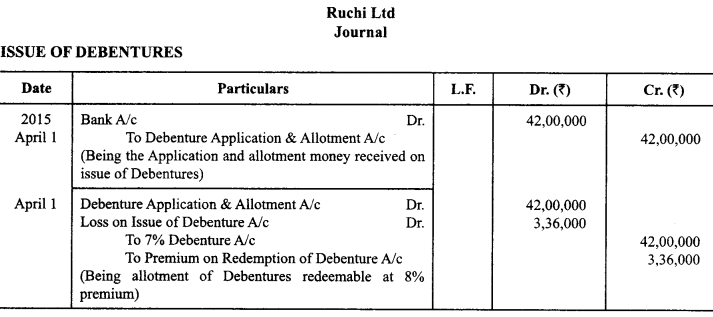
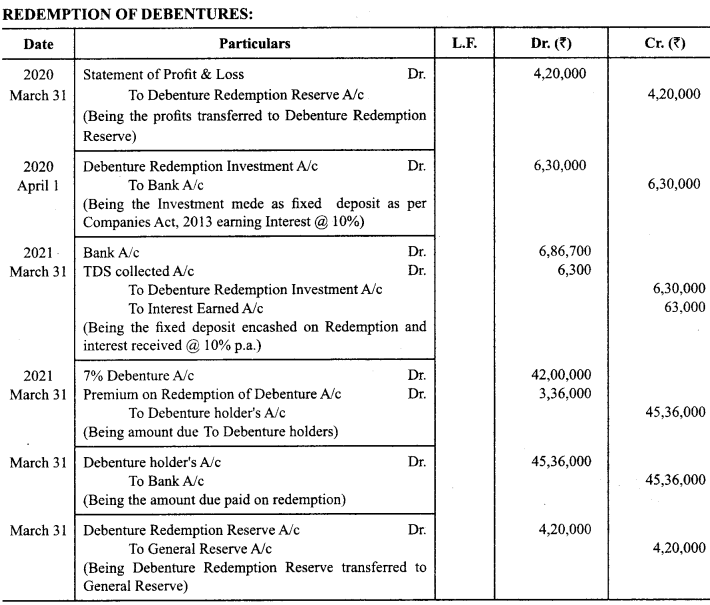
Ruchi Ltd (An unlisted company) issued 42,000,7% Debentures of 100 each on 1st April, 2015, redeemable at a premium of 8% on 31st March 2021. The Company decided to create required Debenture Redemption Reserve on 31st March 2020. The company invested the funds as required by law in a fixed deposit with State Bank of India on 1st April, 2021 earning interest @ 10% per annum. Tax was deducted at source by the bank on interest @ 10% per annum. Pass necessary Journal Entries regarding issue and redemption of debentures.
(CBSE Sample Paper 2016, 2017, Modified)
Answer:
Class 12 Accountancy Important Questions Chapter 7 Issue and Redemption of Debentures 79
Class 12 Accountancy Important Questions Chapter 7 Issue and Redemption of Debentures 80

Question 11.
(Lump-sum Method): Alibaba Ltd. (An unlisted company) issued 20,000, 9% debentures of ₹ 50 each on April 1, 2022 redeemable at par on March 31, 2022. All the debentures were subscribed and allotted. Investment of the required amount in securities is subject to deduction of 10% tax at source. Pass journal entries for issue and redemption of debentures assuming required investments were made in 6% specified securities.
Answer:
Class 12 Accountancy Important Questions Chapter 7 Issue and Redemption of Debentures 81
Class 12 Accountancy Important Questions Chapter 7 Issue and Redemption of Debentures 82

Question 12.
(Lump-sum Method): On April 1, 2020, Nelson and Tubro Ltd. (An unlisted company) issued 10,000, 10% debentures of₹ 100 each redeemable at 5% premium on March 31, 2022. Debentures were fully subscribed and allotted. Pass necessary journal entries for issue and redemption of debentures assuming necessary amount was invested in 7 % specified securities.
Answer:
Class 12 Accountancy Important Questions Chapter 7 Issue and Redemption of Debentures 83
Class 12 Accountancy Important Questions Chapter 7 Issue and Redemption of Debentures 84
Note: This question has been updated as per companies (Share capital and debentures) Amendment Rules, 2019.

Question 13.
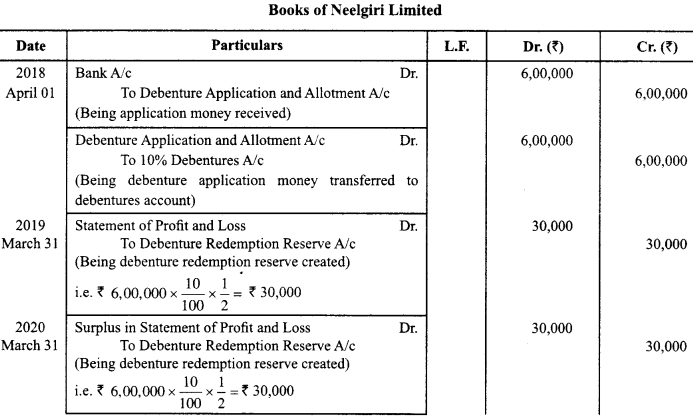
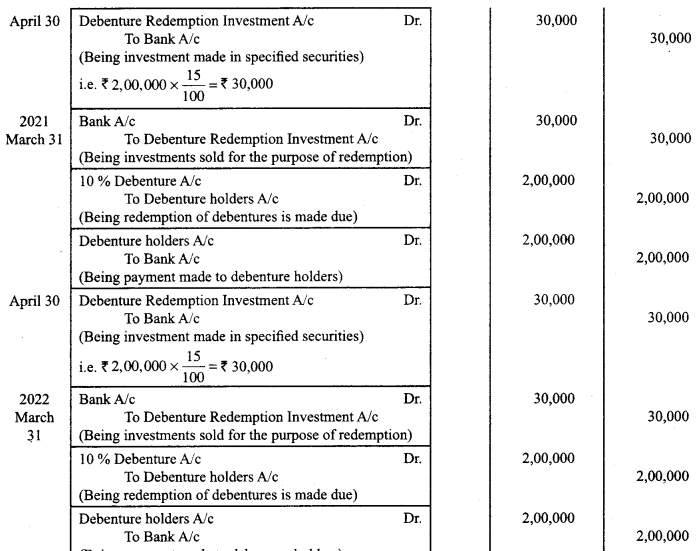
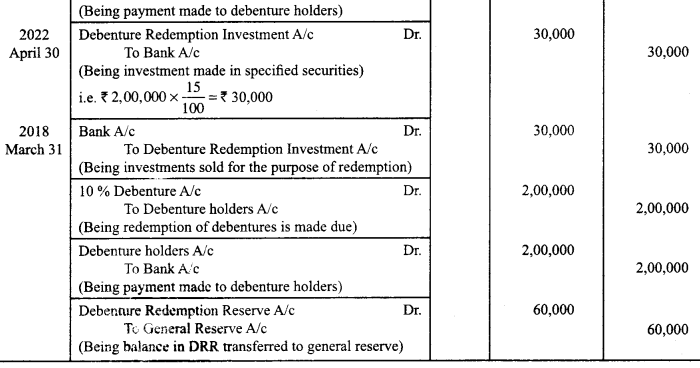
(Instalments or Draw a Lot Method): Neelgiri Limited issued 6,000, 10% debentures of ₹ 100 each on April 01, 2018 redeemable in 3 three equal instalments commeucing with March 31, 2021. The board of directors decided to transfer the required amount to Debenture Redemption Reserve in 2 equal instalments. Company also complied with Companies (Share Capital and Debentures) Amendment Rules, 2019.
Answer:
Class 12 Accountancy Important Questions Chapter 7 Issue and Redemption of Debentures 85
Class 12 Accountancy Important Questions Chapter 7 Issue and Redemption of Debentures 86
Class 12 Accountancy Important Questions Chapter 7 Issue and Redemption of Debentures 87

Accounting for Share Capital Class 12 Important Questions Accountancy Chapter 6

Here we are providing Class 12 Accountancy Important Extra Questions and Answers Chapter 6 Accounting for Share Capital. Accountancy Class 12 Important Questions and Answers are the best resource for students which helps in class 12 board exams.

Class 12 Accountancy Chapter 6 Important Extra Questions Accounting for Share Capital

Accounting for Share Capital Important Extra Questions Very Short Answer Type

Question 1.
What is meant by over subscription of shares? (CBSE Compt. 2019)
Answer:
Oversubscription of shares means that the company receives applications for more than the number of shares offered to the public for subscription.

Question 2.
What is meant by ‘par value’ of a share? (CBSE Compt. 2019)
Answer:
Par value is the nominal value or the face value of the share.

Question 3.
Is Reserve Capital a part of Unsubscribed Capital or Uncalled Capital? (CBSE Delhi 2018)
Answer:
Yes.

Question 4.
A company issued 25,000 equity shares of ₹ 10 each but received applications for.30,000 shares. Name the case of subscription.
Answer:
Over subscription

Question 5.
Neelam Limited has the following balances appearing in the balance sheet:
Class 12 Accountancy Important Questions Chapter 6 Accounting for Share Capital 1
The company decided to redeem its 9% debentures at a premium of 10%. You are required to state how much securities premium amount can be used for redemption of debentures.
Answer:
₹ 12,00,000.

Question 6.
On 1.1.2016 the first call of ₹ 3 per share became due on 1,00,000 equity shares issued by Kamini Ltd. Karan a holder of 500 shares did not pay the first call money. Arjun a shareholder holding 1000 shares paid the second and final call of ₹ 5 per share along with the first call.
Pass the necessary journal entry for the amount received by opening ‘Calls-in-arrears’ and ‘Calls-in- advance’ account in the books of the company. (CBSE Outside Delhi 2016)
Answer:
Class 12 Accountancy Important Questions Chapter 6 Accounting for Share Capital 2

Question 7.
Where will you show call in arrears in the balance sheet?
Answer:
As deduction from the subscribed but not fully paid share capital.

Question 8.
Where will you show call in advance in the balance sheet?
Answer:
It is shown under other current liabilities.

Question 9.
At what rate of interest, interest on call in arrears, is charged? .
Answer:
10%p.a.

Question 10.
At what rate interest on calls-in-advance is paid by the company according to Table F of Companies Act, 2013? ’ (CBSE Delhi Compt.2014)
Answer:
As per Table F, company is required to pay interest on the amount of calls in advance @ 12% p.a.

Question 11.
How would you deal in a situation where the value of purchase considerations is more than the value of net assets while acquiring a business? .
Answer:
It would refer to loss.

Question 12.
How will you deal in a situation where the value of net assets is more than the value of purchase consideration while acquiring a business?
Answer:
It would refer to gain .

Question 13.
Which account will you debit while issuing the shares to the promoters of a company against their services?
Answer:
Goodwill Account or Incorporation Expenses Account.

Question 14.
When can shares held by a shareholder be forfeited?. (CBSE Delhi 2017)
Answer:
On the non-payment of call money due.

Question 15.
A Ltd forfeited a share of 100 issued at a premium of 20% for non-payment of first call of 30 per share and’ final call of 10 per share. State the minimum price at which this share can be reissued. (CBSE Sample Paper 2016)
Answer:
₹ 40 per share!

Question 16.
Give the meaning of forfeiture of share.
Answer:
Cancellation of shares.

Question 17.
At the time of forfeiture of shares, what amount is credited to share forfeiture account?
Answer:
The amount already received.

Question 18.
Where will you show the share forfeited account in the balance sheet of a company?
Answer:
As an addition in the subscribed capital.

Question 19.
What amount of share capital is debited when the shares are forfeited?
Answer:
Called up money.

Question 20.
What amount of share capital is credited when the forfeited shares are reissued?
Answer:
Paid up capital of shares at the time of reissue.

Question 21.
Y Ltd. forfeited 100 equity shares of ₹ 10 each for the non-payment of first call of ₹ 2 per share. The final call of ₹ 2 per share was yet to be made.
Calculate the maximum amount of discount at which these shares can be re-issued. (CBSE Delhi 2017)
Answer:
₹ 6 per share or ₹ 600.

Question 22.
If a question is silent on the question of excess money received with application, how would you treat it?
Answer:
In the absence of any information, excess money over the amount due on allotment shall be refunded.

Accounting for Share Capital Important Extra Questions Short Answer Type

Question 1.
What is meant by ‘over-subscription’ of shares ? With the help of an example, briefly explain the alternatives available for allotment of shares in case of over-subscription. (CBSE Outside Delhi 2019)
Answer:
When the no. of shares applied is more than the no. of shares offered by the co., it is said to be case of over-subscription.
For Example: A company invited applications for 1,00,000 shares and received applications for 4,00,000 shares. Three alternatives are available for allotment of shares:

  • To allot 1,00,000 shares in full to selected applicants and the remaining 3,00,000 applications were rejected outright.
  • To make pro-rata allotment to all applicants.
  • Totally reject applications for 2,00,000 shares, accept full applications for 80,000 shares and make pro-rata allotment for 20,000 shares to remaining 1,20,000 applicants.

Question 2.
What is meant by ‘Forfeiture of shares’ ₹ When does ‘gain on forfeited shares’ arise and when is it transferred to capital reserve ? (CBSE Outside Delhi 2019)
Answer:
Cancellation of shares for the non payment of called up amount is termed as Forfeiture of shares.
Gain on Forfeited shares arises on reissue.
It is transferred immediately on the reissue of forfeited shares.

Question 3.
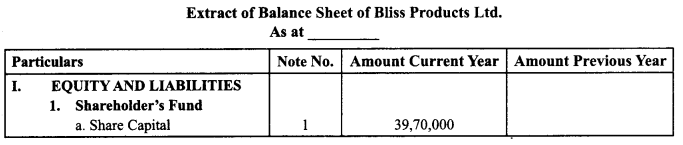
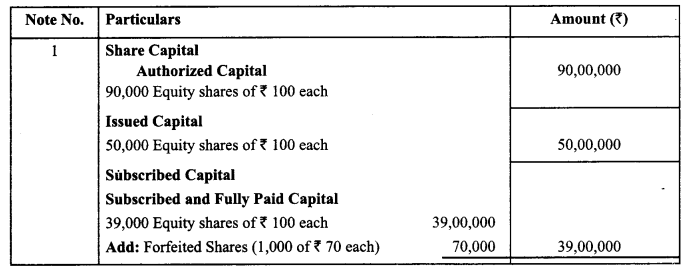
Bliss Products Ltd. registered with capital of ₹ 90,00,000 divided into 90,000 equity shares of₹ 100 each. The company issued prospectus inviting applications for 50,000 equity shares of ₹ 100 each payable as ₹ 20 on application, ₹ 30 on allotment, ₹ 20 on first call and balance on second call.
Applications were received for ₹ 40,000 shares. Raman to whom 1600 shares were allotted failed to pay final call money and these shares were forfeited. Of the forfeited shares, 600 shares were reissued to Sukhman, credited as fully paid for ₹ 90 per share.
Present the Share Capital as per Schedule III of Companies Act, 2013. (CBSE Sample Paper 2019-20)
Answer:
Class 12 Accountancy Important Questions Chapter 6 Accounting for Share Capital 3
Class 12 Accountancy Important Questions Chapter 6 Accounting for Share Capital 4

Question 4.
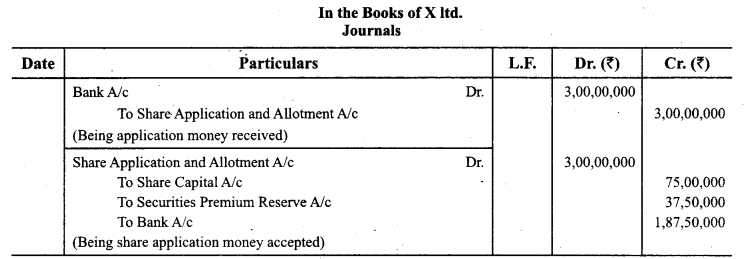
To provide employment to the youth and to develop the Naxal affected backward areas of Chattisgarh. X Ltd. decided to set-up a power plant. For raising funds the company decided to issue 7,50,000 equity shares of ₹ 10 each at a premium of 50%. The whole amount was payable on application. Application for 20,00,000 shares were received. Applications for 50,000 shares were rejected and shares were allotted to the remaining application on pro-rata basis.
Pass necessary journal entries for the above transactions in the books of the company.
(CBSE Outside Delhi 2016, Modified)
Answer:
Class 12 Accountancy Important Questions Chapter 6 Accounting for Share Capital 5

Question 5.
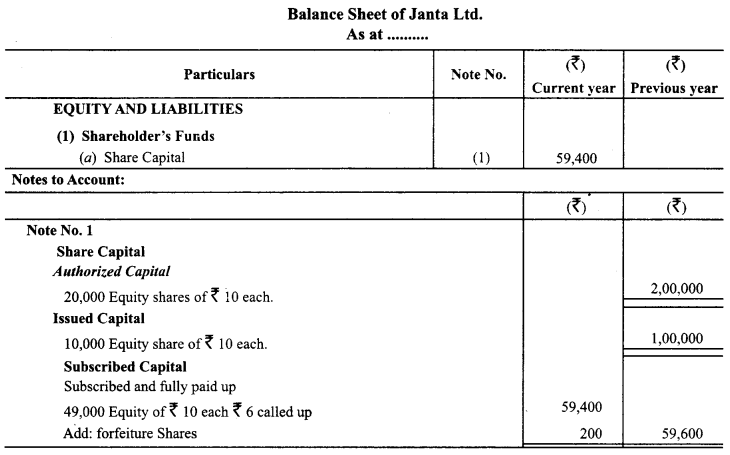
Janta Ltd. had an authorized capital of ₹ 2,00,000 divided into equity shares of ₹ 10 each. The company offered for subscription of ₹ 10,000 shares. The issue was fully subscribed. The amount payable on application was ₹ 2 per share. ₹ 4 per share were payable each on allotment and first and final call. A share holder holding 100 shares failed to pay the allotment money. His shares were forfeited. The company did not make the final call. How the ‘share capital’ will be presented in the company’s balance-sheet?
Also prepare Notes to Accounts for the same. (CBSE Sample paper 2014 Modified)
Answer:
Class 12 Accountancy Important Questions Chapter 6 Accounting for Share Capital 6

Question 6.
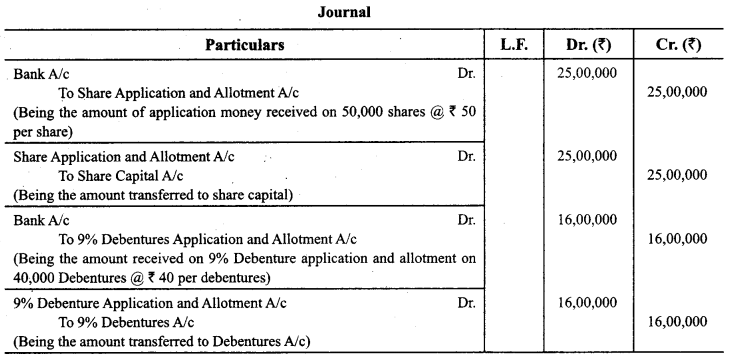
Drumbeats Ltd. had a prosperous shoe business. They were manufacturing shoes in India and exporting to Italy. Being a socially aware organization, they wanted to pay back to the society. They decided to not on supply free shoes to 50 orphanages in various parts of the country but also give employment to children from those orphanages who were above 18 years of age. In order to meet the fund requirements, they decided to raise 50,000 equity shares of ₹ 50 each and 40,000. 9% debentures of ₹ 40 each. Pass the necessary journe entries for issue to shares and debentures. (CBSE Sample Paper 2015, Modified)
Answer:
Class 12 Accountancy Important Questions Chapter 6 Accounting for Share Capital 7

Question 7.
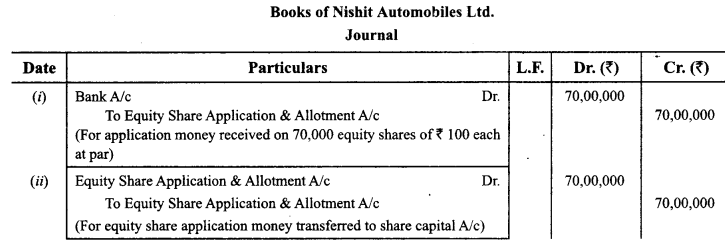
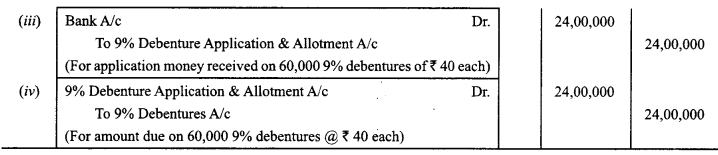
Nishit Automobiles Co. is an manufacture of low cost cars in India. It has a strong sales and distribution network spread across the country. It follows high standards in environmental safety in various processes of car manufacturing. It runs a school to provide quality education to the children of employees of the company and an ‘Adult Education Centre’ to help adults learn reading and writing and to acquire basis literacy. The company is doing well and anticipates a higher demand for its products in the future. For the same, it decides to set up a new manufacturing unit in a backward area of Orissa creating livelihood for people, especially those from disadvantaged sections of society in rural India. In order to raise fund requirements they decided to issue 70,000 equity shares of ₹ 100 each at par and 60,000. 9% Debentures of ₹ 40 each. Pass necessary Journal Entries for the issue of shares and 9% debentures in the books of the company and also identify.
Answer:
Class 12 Accountancy Important Questions Chapter 6 Accounting for Share Capital 8
Class 12 Accountancy Important Questions Chapter 6 Accounting for Share Capital 9

Question 8.
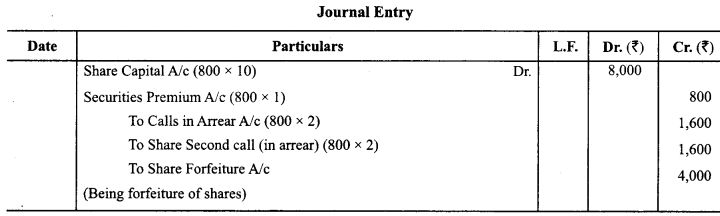
A Company forfeited 800 equity shares of ₹ 10 each issued at a discount of 10% for non-payment of two calls of ₹ 2 each. Calculate the amount forfeited by the company-and pass the journal entry for forfeiture of the shares.
Answer:
Class 12 Accountancy Important Questions Chapter 6 Accounting for Share Capital 10

Question 9.
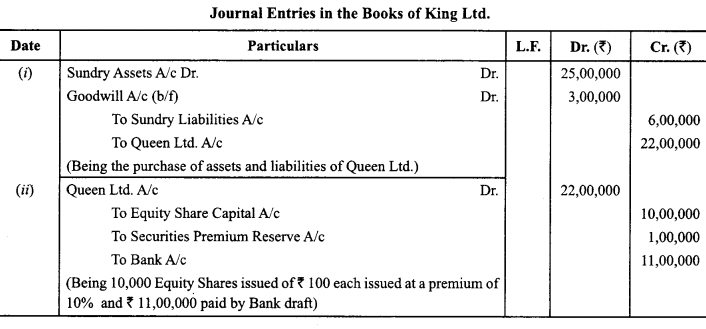
King Ltd took over Assets of 25,00,000 and liabilities of 6,00,000 of Queen Ltd. King Ltd paid the purchase consideration by issuing 10,000 equity shares of 100 each at a premium of 10% and 11,00,000 by Bank Draft.
Calculate Purchase consideration and pass necessary Journal entries in the books of King Ltd. (CBSE Sample Paper 2016, 2017)
Answer:
Calculation of Purchase Consideration:
Nominal Value of Shares issued = 10000 x ₹ 100 = ₹ 10,00,000
Securities Premium Reserve = ₹ 1,00,000
Bank draft = ₹ 11,00,000
Purchase consideration = ₹ 22,00,000
Class 12 Accountancy Important Questions Chapter 6 Accounting for Share Capital 11

Question 10.
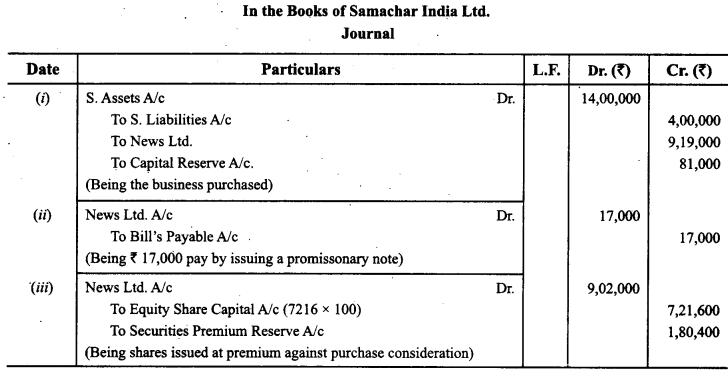
Samachar India Ltd. took over the assets of ₹ 14,00,000 and liabilities of ₹ 4,00,000 from News Ltd. for a purchase consideration of ₹ 9,19,000. Samachar India Ltd. issued a promissory note of ₹ 17,000 payable after 60 days in favour of News Ltd. and the balance amount was paid by issue of equity shares of ₹ 100 each at a premium of ₹ 25 per share.
Pas necessary Journal entries for the above transactions in the book of Samachar India Ltd. (CBSE Outside Delhi 2016)
Class 12 Accountancy Important Questions Chapter 6 Accounting for Share Capital 12

Question 11.
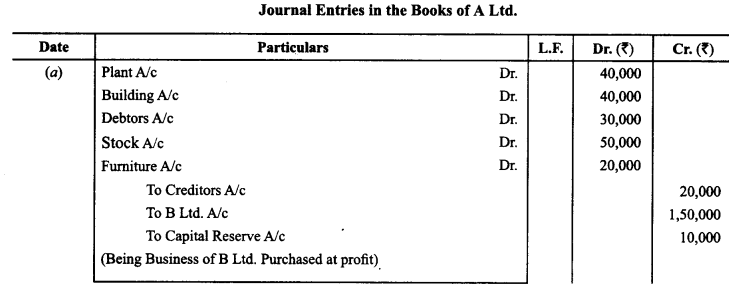
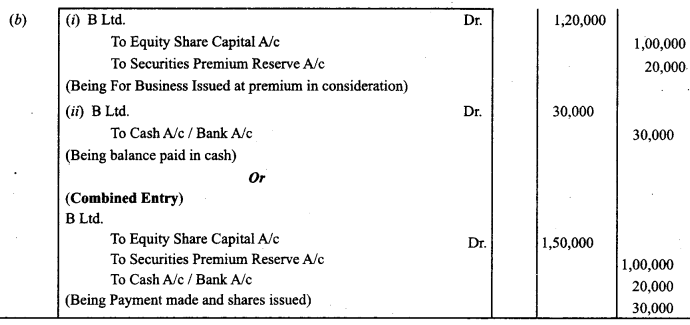
A Ltd. purchased a running business from B Ltd. for a sum of ₹ 1,50,000 payable by issue of 10,000 equity shares of ₹ 10 each at a premium of ₹ 2 per share and balance in cash. The assets and liabilities taken over were:
Plant – ₹ 40,000;
Building – ₹ 40,000;
Debtors – ₹ 30,000;
Stock – ₹ 50,000;
Furniture – ₹ 20,000;
Creditors – ₹ 20,000
You are required to pass necessary journal entries for the above transactions in the book of A Ltd.
(CBSE Delhi Compartment 2014)
Answer:
Class 12 Accountancy Important Questions Chapter 6 Accounting for Share Capital 13
Class 12 Accountancy Important Questions Chapter 6 Accounting for Share Capital 14

Question 12.
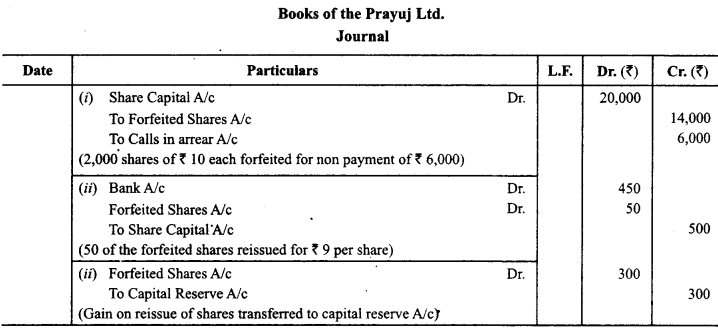
Prayuj Ltd. forfeited 2,000 shares of ₹ 10 each, fully called up, on which they had received only ₹ 14,000.50 of the forfeited shares were reissued for ₹ 9 per share fully paid up.
Pass necessary journal entries for forfeiture and re-issue of shares. Also prepare share forfeited account.
(Compt. Delhi 2017)
Class 12 Accountancy Important Questions Chapter 6 Accounting for Share Capital 15

Question 13.
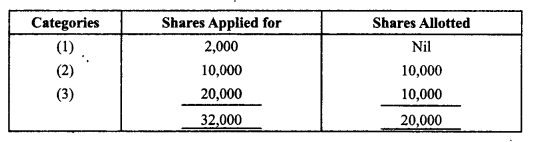
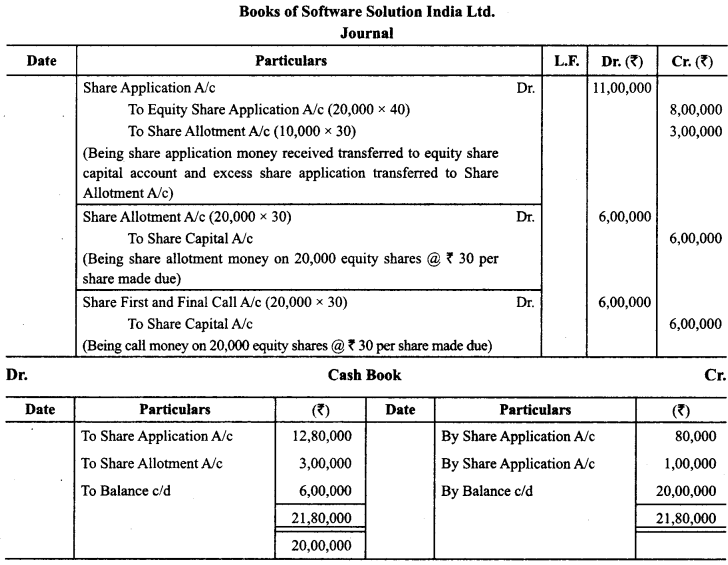
Software Solution India Ltd. inviting application for 20,000 equity share of ₹ 100 each, payable ₹ 40 on application. ₹ 30 on allotment and ₹ 30 on call. The company received applications for 32,000 shares. Applications for 2,000 shares were rejected and money returned to applicants. Applications for 10,000 shares were accepted in full and applicants for 20,000 share allotted half of the number of shares applied and excess application money adjusted into allotment. All money received due on allotment & call. Prepare journal and cash book.
Answer:
Class 12 Accountancy Important Questions Chapter 6 Accounting for Share Capital 16
Class 12 Accountancy Important Questions Chapter 6 Accounting for Share Capital 17

Accounting for Share Capital Important Extra Questions Long Answer Type

Question 1.
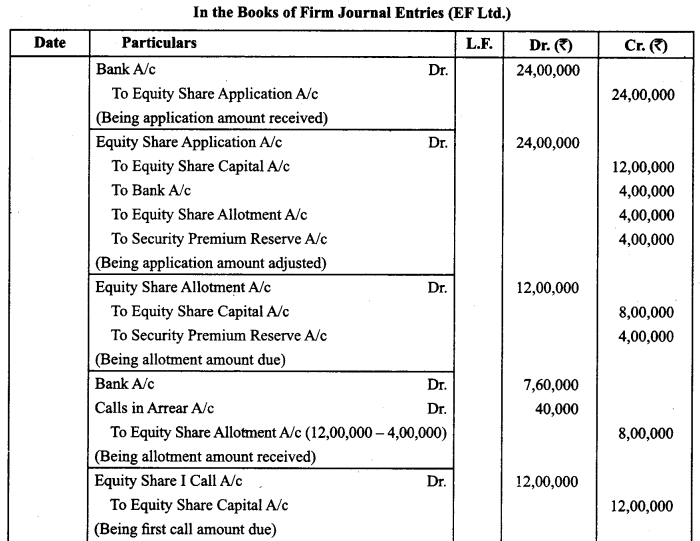
EF Ltd. invited applications for issuing 80,000 equity shares of ₹50 each at a premium of 20%. The amount was payable as follows:
On Application : ₹ 20 per share (including premium ₹ 5)
On Allotment : ₹ 15 per share (including premium ₹ 5)
On First Call : ₹ 15 per share
On Second and Final call : Balance amount
Applications for 1,20,000 shares were received. Applications for 20,000 shares were rejected and pro-rata allotment was made to the remaining applicants.
Seema, holding 4,000 shares failed to pay the allotment money. Afterwards the first call was made. Seema paid allotment money along with the first call. Sahaj who had applied for 2,500 shares failed to pay the first call money. Sahaj’s shares were forfeited and subsequently reissued to Geeta for ₹ 60 per share, ₹ 50 per share paid up. Final call was not made.
Pass necessary journal entries for the above transactions in the books of EF Ltd. by opening calls-in-arrears account. (CBSE Delhi 2019)
Answer:
Class 12 Accountancy Important Questions Chapter 6 Accounting for Share Capital 18
Class 12 Accountancy Important Questions Chapter 6 Accounting for Share Capital 19

Question 2.
S Ltd. invited applications for issuing 1,00,000 equity shares of ₹ 10 each. The shares were issued at a premium of ₹ 5 per share. The amount was payable as follows :
On Application and Allotment – ₹ 8 per share (including premium ₹ 3)
On the First and Final call – Balance including premium
Applications for 1,50,000 shares were received. Applications for 10,000 shares were rejected and pro-rata allotment was made to the remaining applicants on the following basis :
(I) Applicants for 80,000 shares were allotted 60,000 shares, and
(II) Applicants for 60,000 shares were allotted 40,000 shares.
Excess amount received on application and allotment was to be adjusted against sums due on call. X, who belonged to the first category and was allotted 300 shares, failed to pay the first and final call money. Y, who belonged to the second category and was allotted 200 shares, also failed to pay the first and final call money. Their shares were forfeited. The forfeited shares were reissued @ ₹ 12 per share as fully paid-up.
Pass necessary cash book and journal entries for the above transactions in the books of the company. (CBSE Outside Delhi 2019)
Answer:
Class 12 Accountancy Important Questions Chapter 6 Accounting for Share Capital 20Class 12 Accountancy Important Questions Chapter 6 Accounting for Share Capital 21
Class 12 Accountancy Important Questions Chapter 6 Accounting for Share Capital 22

Question 3.
Saregama Ltd invited applications for issuing 80,000 equity shares of ₹ 100 each at a premium of ₹ 10. The amount was payable as follows On Application – ₹ 30
On allotment – ₹ 30 (including a premium of ₹ 10)
On 1st call – ₹ 30
On Final Call Balance
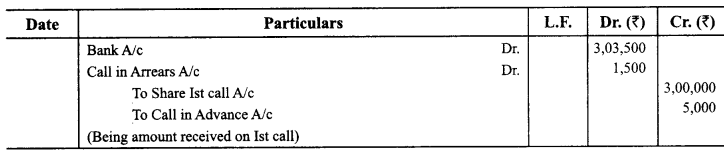
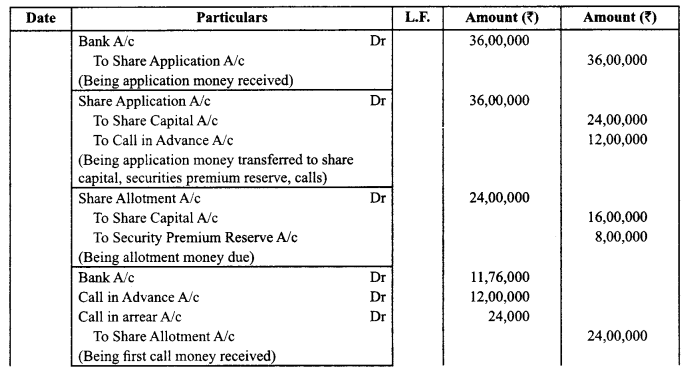
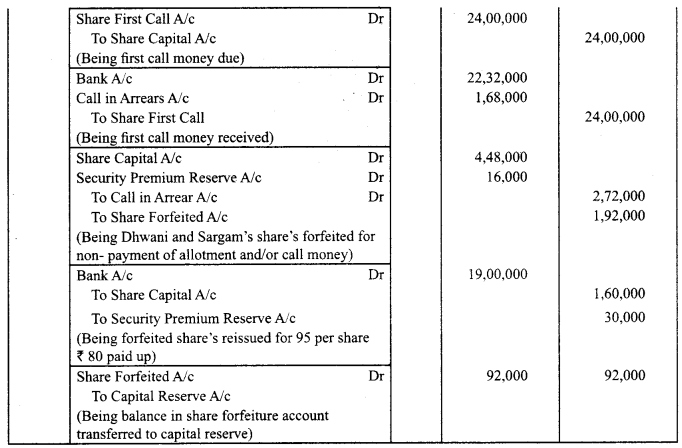
Applications of 1,20,000 shares were received. Allotment was made on pro rata basis to all applicants. Excess money received on application was adjusted on sums due on allotment. Dhwani, who was allotted 1,600 shares, failed to pay allotment money and Sargam who applied of 6,000 shares did not pay 1st call money. These shares were forfeited immediately after 1st call. 2,000 of these shares (including all shares of Dhwani were issued to Tarang for ₹ 95 per share as 80 paid up. Pass necessary journal entries in books of Saregama Ltd. by opening call in arrear, call in advance account, if final call has not been made. (CBSE Sample Paper 2019-20)
Answer:
Class 12 Accountancy Important Questions Chapter 6 Accounting for Share Capital 23
Class 12 Accountancy Important Questions Chapter 6 Accounting for Share Capital 24

Question 4.
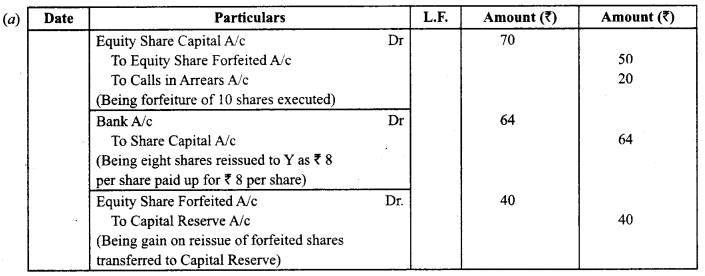
(a) X Ltd. forfeited 10 shares of ₹ 10 each, ₹ 7 called up on which the shareholder had paid application and allotment money of ₹ 5 per share. Out of these, 8 shares were re-issued to Y for ₹ 8 per share at ₹ 8 per paid up per share. Record the journal entries for forfeiture and reissue of shares by opening call in arrear, call in advance account.

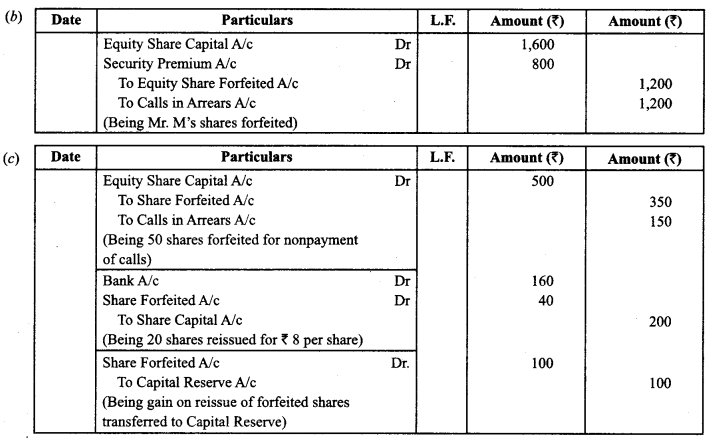
(b) L ltd forfeited Mr M’s shares who has applied for 600 shares and was allotted 400 shares failed to pay allotment money of ₹ 4 per share including premium of ₹ 2 on which he had paid application money of ₹ 2 only. Pass necessary journal entries for forfeiture of shares by opening call in arrear, call in advance account.

(c) Crown Ltd forfeited 50 shares of ₹ 10 each, for non-payment of final call money of ₹ 3 per share. Out of these 20 shares were reissued to Taj at ₹ 8 per share. Record the journal entries for forfeiture and reissue of shares assuming that the company maintains call in arrear, call in advance account. (CBSE Sample Paper 2019-20)
Answer:
Class 12 Accountancy Important Questions Chapter 6 Accounting for Share Capital 25
Class 12 Accountancy Important Questions Chapter 6 Accounting for Share Capital 26

Question 5.
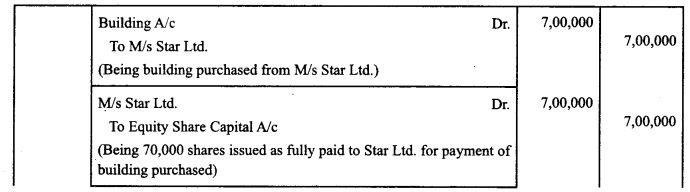
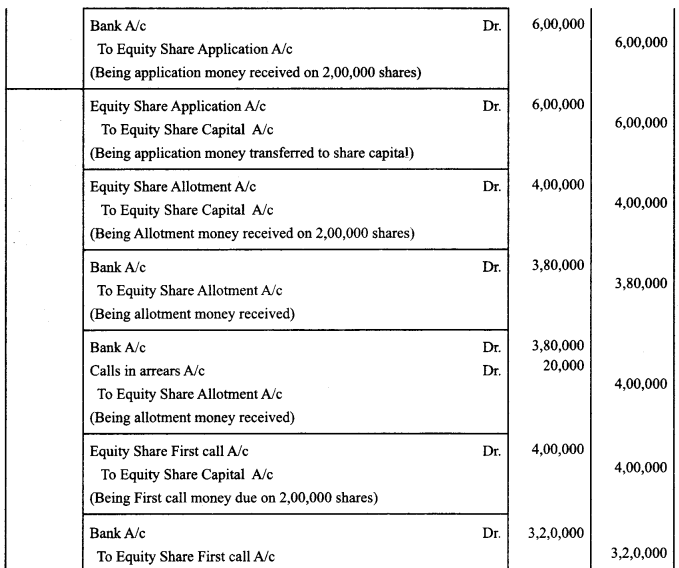
Venus Ltd’ was registered with an authorised capital of ₹ 40,00,000 divided into 4,00,000 equity shares of 10 each. 70,000 of these shares were issued as fully paid to ‘M/s. Star Ltd.’ for building purchased from them. 2,00,000 shares were issued to the public and the amounts were payable as follows:
On Application – ₹ 3 per share
On Allotment – ₹ 2 per share
On First Call – ₹ 2 per share
On Second and Final Call – ₹ 3 per share
The amounts received on these shares were as follows:
On 1,00,000 shares – Full amount called
On 60,000 shares – ₹ 1 per share
On 30,000 shares – ₹ 5 per share
On 10,000 shares – ₹ 3 per share
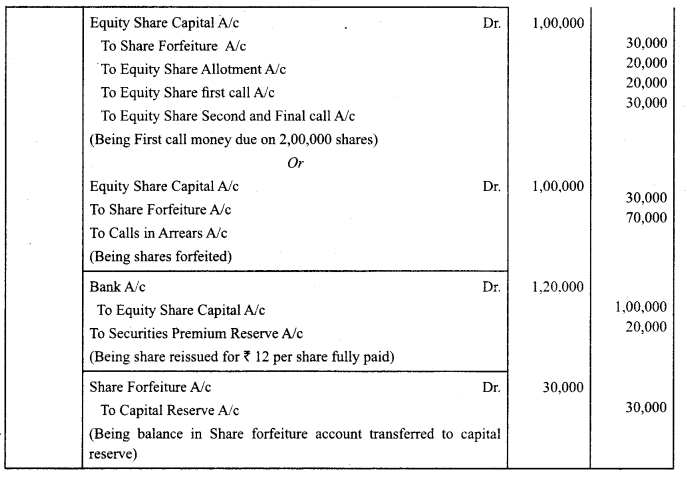
The directions forfeited 10,000 shares on which only ₹ 3 per share were received. These shares were reissued at ₹ 12 per share fully paid. Pass necessary journal entries for the above transactions in the books of ‘Venus Ltd’. (CBSE Compt. 2019)
Answer:
Class 12 Accountancy Important Questions Chapter 6 Accounting for Share Capital 27
Class 12 Accountancy Important Questions Chapter 6 Accounting for Share Capital 28
Class 12 Accountancy Important Questions Chapter 6 Accounting for Share Capital 29
Class 12 Accountancy Important Questions Chapter 6 Accounting for Share Capital 30

Question 6.
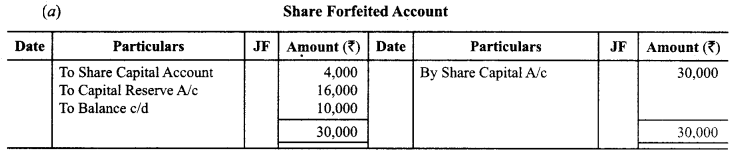
(a) AX Limited forfeited 6,000 shares of ₹ 10 each for non-payment of First call of ₹ 2 per share. The Final call of ₹ 3 per share was yet to be made. The Final call was made after Forfeited of these shares.. Of the forfeited shares, 4,000 shares were reissued at ₹ 9 per share as fully paid up. Assuming that the company maintains ‘Calls in Advance Account’ and ‘Calls in Arrears Account’, prepare “Share Forfeited Account” in the books of AX Limited.

(b) BG Limited issued 2,00,000 equity shares of₹ 20 each at a premium of ₹ 5 per share. The shares were allotted in the proportion of 5 : 4 of shares applied and allotted to all the applicants. Deepak, who had applied for 900 shares, failed to pay Allotment money of ₹ 7 per share (including premium) and on his failure to pay ‘First & Final Call’ of ₹ 2 per share, his shares were forfeited. 400 of the forfeited shares were reissued at ₹ 15 per share as fully paid up. Showing your working clearly, pass necessary Journal entries for the Forfeited and reissue of Deepak’s shares in the books of BG Limited. The company maintains‘Calls in Arrears’Account’.

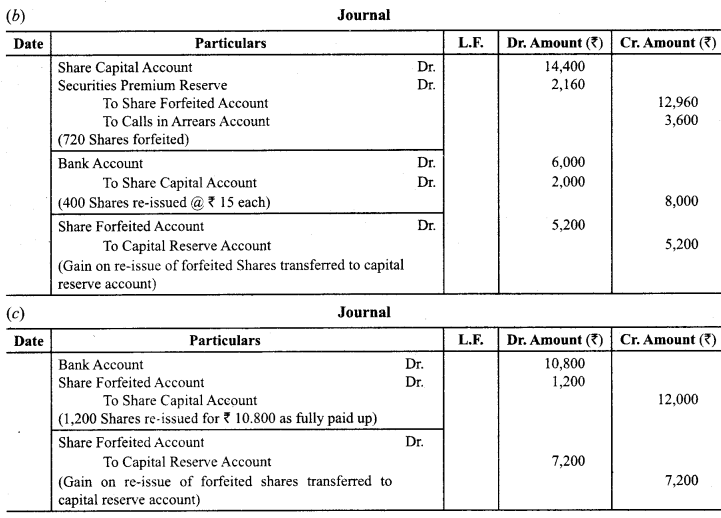
(c) ML Limited forfeited 1,200 shares of₹ 10 each allotted to Ravi for Non-payment of‘Second & Final Call’ of ₹ 5 per share (including premium of ₹ 2 per share). The forfeited shares were reissued for ₹ 10,800 as fully paid up. Pass necessary Journal entries for reissue of shares in the books of ML Limited. (CBSE Sample Paper 2017-18)
Answer:
Class 12 Accountancy Important Questions Chapter 6 Accounting for Share Capital 31
Class 12 Accountancy Important Questions Chapter 6 Accounting for Share Capital 32

Question 7.
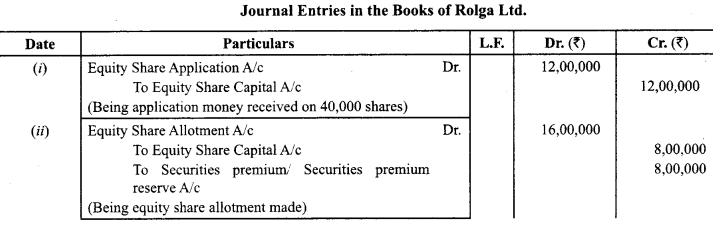
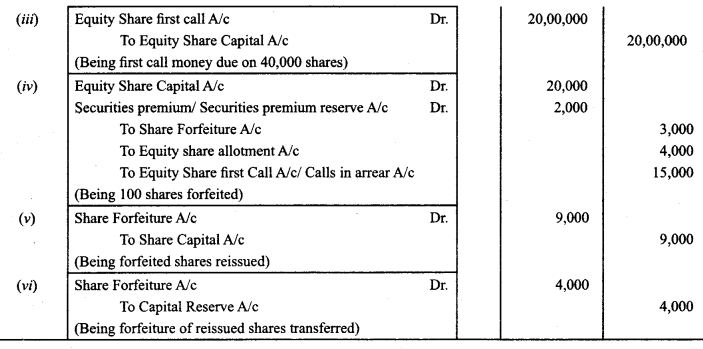
Rolga Ltd. is having an authorized capital of ₹ 50,00,000 divided into equity shares of ₹ 100 each. The company offered 42,000 shares to the public. The amount payable was as follows:
On Application – ₹ 30 per share
On Allotment –  ₹ 40 per share (including premium)
On First and Final Call  – ₹ 50 per share
Application were received for 40,000 shares.
All sums were duly received except the following:
Lai, a holder of 100 shares did not pay allotment and call money.
Pal, a holder of 200 shares did not pay call money.
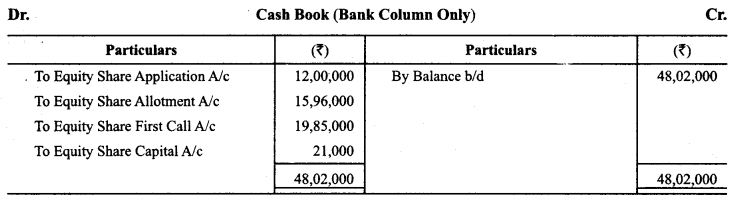
The company forfeited the shares of Lai and Pal. Subsequently the forfeited shares were reissued for ₹ 70 per share as fully paid-up. Show the entries for the above transactions in the cash book and journal of the company. (CBSE Delhi Compartment 2015)
Answer:
Class 12 Accountancy Important Questions Chapter 6 Accounting for Share Capital 33
Class 12 Accountancy Important Questions Chapter 6 Accounting for Share Capital 34
Class 12 Accountancy Important Questions Chapter 6 Accounting for Share Capital 35

Question 8.
X Ltd. invited application for issuing ₹ 50,000 equity shares of ₹ 10 each. The amount was payable as follows: On Application ₹ 2 per share on Allotment ₹ 2 per share on First Call ₹ 3 per share on Second Call Balance Amount.
Applications for 70,000 shares were received. Applications for 10,000 shares were rejected and the application money was refunded. Shares were allotted to the remaining applicants on pro-rata basis and the excess money received on applications was transferred towards the sum due on allotment and calls (If any). Gopal who applied for 600 shares paid his entire share money with applications. Ghosh, who had applied for 6,000 shares failed to pay the allotment money and his shares were immediately forfeited. These forfeited shares were re-issued to Sultan for ₹ 20,000 ₹ 4 per share paid up. The first call money and the second call money was called and duly received. Pass the journal entry for the above transactions in the books of accounts of X Ltd. Open Calls in Arrear and Calls in Advance wherever necessary. (CBSE 2018)
Answer:
Class 12 Accountancy Important Questions Chapter 6 Accounting for Share Capital 36
Class 12 Accountancy Important Questions Chapter 6 Accounting for Share Capital 37
Class 12 Accountancy Important Questions Chapter 6 Accounting for Share Capital 38

Question 9.
Khyati Ltd. issued a prospectus inviting applications for 80,000 equity shares of ₹ 10 each payable as follows:
₹2 on application
₹ 3 on allotment
₹ 2 on first call
₹ 3 on final call
Applications were received for 1,20,000 equity shares. It was decided to adjust the excess amount received on account of over subscription till allotment only. Hence allotment was made as under:
(i) To applicants for 20,000 shares – in full
(ii) To applicants for 40,000 shares – 10,000 shares
(iii) To applicants for 60,000 shares – 50,000 shares
Allotment was made and all shareholders except Tammana, who had applied for 2,400 shares out of the group (iii), could not pay allotment money. Her shares were forfeited immediately, after allotment. Another shareholder Chaya, who was allotted 500 shares out of group (ii), failed to pay first call. 50% of Tamanna’s shares were reissued to Satnaam as ₹ 7 paid up for payment of ₹ 9 per share.
Pass necessary journal entries in the books of Khyati Ltd. for the above transactions by opening calls in arrears and calls in advance account wherever necessary. (CBSE Sample Paper 2018-19)
Answer:
Class 12 Accountancy Important Questions Chapter 6 Accounting for Share Capital 39
Class 12 Accountancy Important Questions Chapter 6 Accounting for Share Capital 40

Dissolution of a Partnership Firm Class 12 Important Questions Accountancy Chapter 5

Here we are providing Class 12 Accountancy Important Extra Questions and Answers Chapter 5 Dissolution of a Partnership Firm. Accountancy Class 12 Important Questions and Answers are the best resource for students which helps in class 12 board exams.

Class 12 Accountancy Chapter 5 Important Extra Questions Dissolution of a Partnership Firm

Dissolution of a Partnership Firm Important Extra Questions Very Short Answer Type

Question 1.
Differentiate between Dissolution of Partnership and Dissolution of a Partnership Firm on the basis of ‘Court’s Intervention’. (CBSE Delhi 2019)
Answer:
Class 12 Accountancy Important Questions Chapter 5 Dissolution of a Partnership Firm 1

Question 2.
State any two situations when a partnership firm can be compulsorily dissolved. (CBSE Delhi 2019)
Answer:
A firm is compulsorily dissolved in the following cases: (Any two)

  1. When all the partners or all but one partner become insolvent.
  2. When the business of the firm becomes illegal.

Question 3.
Distinguish between ‘Reconstitution of Partnership’ and ‘Dissolution of Partnership Firm’ on the basis of ‘Closure of books’.
Answer:
Class 12 Accountancy Important Questions Chapter 5 Dissolution of a Partnership Firm 2

Question 4.
State the basis of calculating the amount of profit payable to the legal representative of a deceased partner in the year of death. (CBSE Outside Delhi 2019)
Answer:
Profit may be estimated

  • On the basis of last year’s the profit/Average profits of last given no. of years
  • On the basis of Turnover/Sales.

Question 5.
State any two grounds on the basis of which the court may order for the dissolution of the partnership firm. (CBSE Outside Delhi 2019)
Answer:
At the suit of a partner, the court may order a partnership firm to be dissolved on any of the following grounds:

  • when a partner becomes insane;
  • when a partner becomes permanently incapable of performing his duties as a partner.

Question 6.
State any two situations when a partnership firm can be compulsorily dissolved. (CBSE Outside Delhi 2019)
Answer:
A firm is compulsorily dissolved in the following-cases:

  • When all the partners or all but one partner become insolvent.
  • When the business of the firm becomes illegal.

Question 7.
State any two contingencies that may result into dissolution of a partnership firm.(CBSE Outside Delhi 2019)
Answer:
Contingencies that may result into dissolution of a partnership firm: .

  • If the firm is constituted for a fixed term, on the expiry of that term
  • If constituted to carry out one or more ventures, on the completion of the venture.

Question 8.
State the order of payment of the following, in case of dissolution of the partnership firm.
(i) to each partner proportionately what is due to him/her from the firm for advances as distinguished from capital (i.e. partner’ loan);
(ii) to each partner proportionately what is due to him on account of capital; and
(iii) for the debts of the firm to the third parties; (CBSE Sample Paper 2019-20)
Answer:
(iii) for the debts of the firm to the third parties;
(i) to each partner proportionately what is due to him/her from the firm for advances as distinguished from capital (i.e. partner’ loan);
(ii) to each partner proportionately what is due to him on account of capital

Question 9.
A and B are partners in a firm sharing profits in the ratio of 3 : 2 Mrs. B has given a loan of ₹ 40,000 to the firm and A has also given a loan of ₹ 80,000 to the firm. The firm was dissolved and its assets realised ₹ 60,000.
State the order of payment of Mrs. B’s loan and A’s loan assuming that there was no other third party liability – of the firm.
Answer:
Order of payment:
First, the third party loan i.e. Mrs. B’s loan will be paid.
The Partner’s loan i.e. A’s loan will be paid.

Question 10.
A B and C are partners in a firm. On April 1, 2013, A and B were declared insolvent by a court. Will the partnership firm be treated as dissolved?
Answer:
Yes.

Question 11.
Mohan and Kanwar are partners in a firm. Their firm was dissolved on 1.1.2013. Mohan was assigned the work of dissolution. For this work, Mohan was paid ₹ 500. Mohan paid dissolution expenses of₹ 400 from his own pocket. Will any Journal Entry be passed for ₹ 400 paid by Mohan?
Answer:
No.

Question 12.
A firm has investment fluctuation fund of ₹ 10,000. It does not have investments on its Balance Sheet at the time of its dissolution. In which account(s), amount of investments fluctuation fund be transferred?
Answer:
In Partners’ Capital Accounts.

Question 13.
Why is cash balance not transferred to Realisation Account on the dissolution of a partnership firm?
Answer:
Cash is a liquid asset.

Question 14.
A firm was dissolved on April 1, 2013. The assets side of its Balance Sheet has furniture of ₹ 2,500 whereas on the liabilities side, creditors appeared for ₹ 4,000.-Half of the creditors took half of the furniture at 10% discount and the remaining creditors were paid at 10% premium. What journal entries are required?
Answer:
No journal entry will be passed for the first half of the creditors but for the remaining creditors, entry will be:
Class 12 Accountancy Important Questions Chapter 5 Dissolution of a Partnership Firm 3

Question 15.
Should intangible assets be treated in the manner of treatment of tangible assets at the time of dissolution of a partnership firm?
Answer:
Yes.

Question 16.
In case of dissolution of a firm which liabilities are to be paid first?(CBSE 2011 Compartment Delhi)
Answer:
Debts of third parties.

Question 17.
In case of dissolution of a firm, which item on the liabilities side is to be paid last? (CBSE 2011 Compartment Delhi)
Answer:
Partners’ capital.

Question 18.
A firm has furniture of₹ 6,000 which was taken over by a creditor of₹ 5,000 in full settlement of his claim. Mention whether any journal entry will be passed for this. If yes, pass the journal entry.
Answer:
No, journal entry will be passed.

Question 19.
Creditors of ₹ 50,000 took over stock at agreed value of₹ 45,000 and balance Was paid to him. Pass the journal entry for this transaction.
Answer:
The Journal entry will be:
Class 12 Accountancy Important Questions Chapter 5 Dissolution of a Partnership Firm 4

Question 20.
Drawers of bills payable ₹ 25,000 took over furniture at agreed value of₹ 29,000 and paid the excess value. Pass journal entry for this transaction.
Answer:
The Journal entry will be:
Class 12 Accountancy Important Questions Chapter 5 Dissolution of a Partnership Firm 5

Question 21.
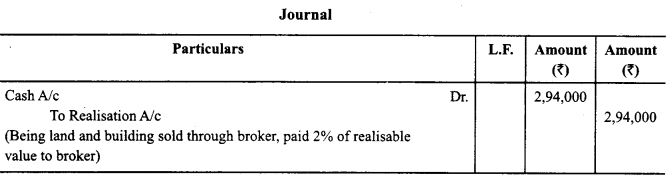
Land and Building (book value) ₹ 1,60,000 sold for ₹ 3,00,000 through a broker who charged 2% commission on the deal. Journalise the transaction, at the time of dissolution of the firm. (CBSE Sample Paper 2018-19)
Answer:
Class 12 Accountancy Important Questions Chapter 5 Dissolution of a Partnership Firm 6

Question 22.
State any one occasion for the dissolution of the firm on court’s orders when a partner becomes. (Compt. Delhi 2017)
Answer:
Partner becomes permanently incapable of performing his duties as a partner.

Question 23.
Name the asset that is not transferred to the debit side of Realisation account, but brings certain amount of cash against its disposal at the time of dissolution of the firm. (CBSE Delhi 2014)
Answer:
Unrecorded assets

Question 24.
Ram and Shyam formed partnership at will. Ram gave a notice on January 1, 2013 to dissolve the firm. Can partnership firm be dissolved even without consent of Shyam? Give reason.
Answer:
Yes.

Dissolution of a Partnership Firm Important Extra Questions Short Answer Type

Question 1.
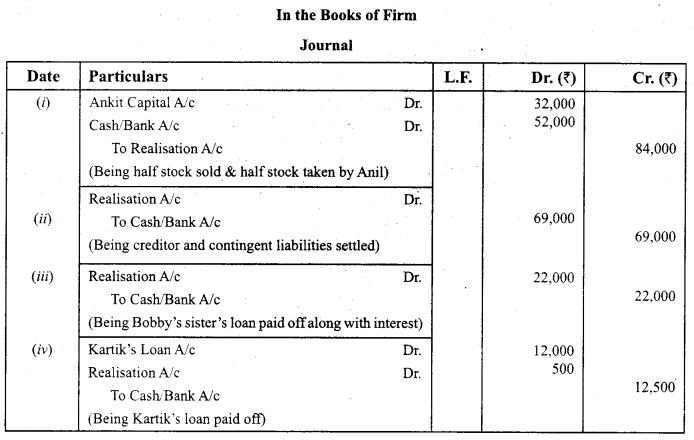
Ankit, Bobby and Kartik were partners in a firm sharing profits in the ratio 4:3:3. The firm was dissolved on 31-3-2018. Pass the necessary Journal entries for the following transactions after various assets (other than cash and bank) and third party liabilities had been transferred to Realisation Account:
(i) The firm had stock of ₹ 80,000. Ankit took over 50% of the stock at a discount of 20% while the remaining stock was sold off at a profit of 30% on cost.
(ii) A liability under a suit for damages included in creditors was settled at ₹ 32,000 as against only ₹ 13,000 provided in the books. Total creditors of the firm were ₹ 50,000.
(iii) Bobby’s sister’s loan of ₹ 20,000 was paid off along with interest of ₹ 2,000.
(iv) Kartik’s Loan of₹ 12,000 was settled at ₹ 12,500. (CBSE Delhi 2019)
Answer:
Class 12 Accountancy Important Questions Chapter 5 Dissolution of a Partnership Firm 7

Question 2.
State any two contingencies that may result into dissolution of a partnership firm. (CBSE Delhi 2019)
Answer:
Contingencies that may result into dissolution of a partnership firm: (Any two)

  • If the firm is constituted for a fixed term, on the expiry of that term.
  • If constituted to carry out one or more ventures, on the completion of the venture.

Question 3.
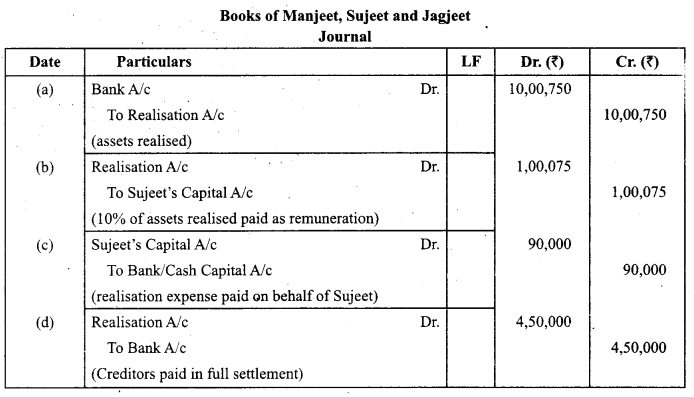
The firm of Manjeet, Sujeet and Jagjeet was dissolved on 31st March, 2018. It was agreed that Sujeet will take care of the dissolution related activities and will get 10% of the value of assets realised. Sujeet agreed to bear the realisation expenses. Assets realised ₹ 10,00,750 and realisation expenses were ₹90,000, which were paid from the firm’s cash. ₹4,50,000 were paid to the creditors in full settlement of their claim.
Pass necessary journal entries for the above transactions in the books of the firm.
(CBSE Outside Delhi 2019)
Answer:
Class 12 Accountancy Important Questions Chapter 5 Dissolution of a Partnership Firm 8

Question 4.
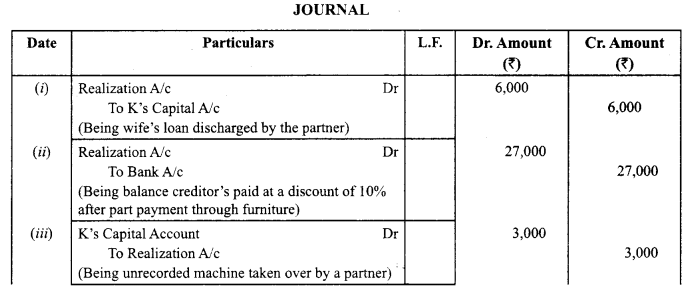
The firm of R, K and S was dissolved on 31.3.2019. Pass necessary journal entries for the following after various assets (other than cash and Bank) and the third party liabilities had been transferred to realisation account.
(i) K agreed to pay off his wife’s loan of ₹ 6,000.
(if) Total Creditors of the firm were ₹ 40,000. Creditors worth ₹ 10,000 were given a piece of furniture costing ₹8,000 in full and final settlement. Remaining creditors allowed a discount of 10%.
(iii) A machine that was not recorded in the books was taken over by K at ₹ 3,000 whereas its expected value was ₹ 5,000.
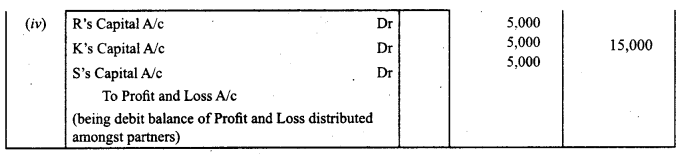
(iv) The firm had a debit balance of ₹ 15,000 in the profit and loss A/c on the date of dissolution.
(‘CBSE Sample Paper 2019-20)
Answer:
Class 12 Accountancy Important Questions Chapter 5 Dissolution of a Partnership Firm 9
Class 12 Accountancy Important Questions Chapter 5 Dissolution of a Partnership Firm 10

Question 5.
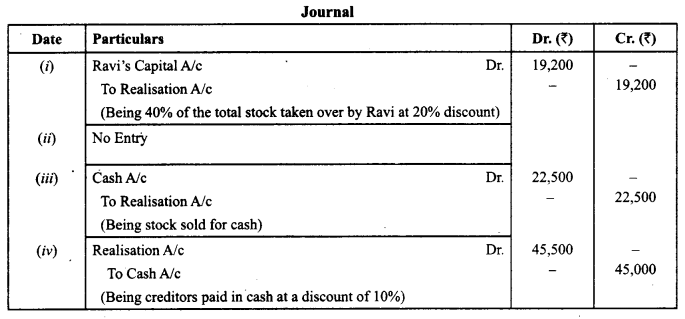
Ravi and Mukesh were partners in a firm sharing profits and losses equally. On 31st March, 2019 their firm was dissolved. On the date of dissolution their Balance Sheet showed stock of ₹ 60,000 and creditors of ₹ 70,000. After transferring stock and creditors to realisation account the following transaction took place:
(i) Ravi took over 40% of total stock at 20% discount.
(ii) 30% of total stock was taken over by creditors of₹ 20,000 in full settlement.
(iii) Remaining stock was sold for cash at a profit of 25%.
(iv) Remaining creditors were paid in cash at a discount of 10%.
Pass necessary journal entries for the above transactions in the book of the firm. (CBSE Compt. 2019)
Answer:
Class 12 Accountancy Important Questions Chapter 5 Dissolution of a Partnership Firm 11

Question 6.
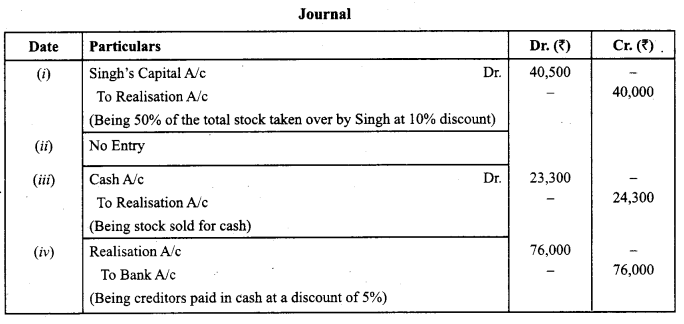
Singh and Jain were partners in a firm sharing profits and losses in the ratio of 3 : 7. On 31st March, 2019 their firm was dissolved. On the date of dissolution the Balance Sheet showed stock of ₹ 90,000 and creditors of₹ 1,00,000. After transferring the assets (other than cash in hand and cash at bank) and third party liabilities to realisation account the following transactions took place:
(i) Singh took over 50% of the total stock at 10% discount.
(if) 20% of the total stock was taken over by creditors of₹ 20,000 in full settlement.
(iii) Remaining stock was sold for cash at 10% loss.
(iv) Remaining creditors were paid by cheque at a discount of 5%.
Pass necessary journal entries for the above transactions in the books of the firm. (CBSE Compt. 2019)
Answer:
Class 12 Accountancy Important Questions Chapter 5 Dissolution of a Partnership Firm 12

Question 7.
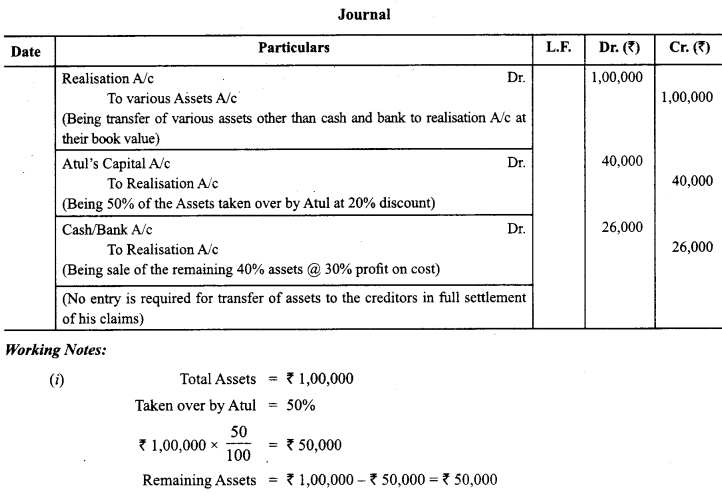
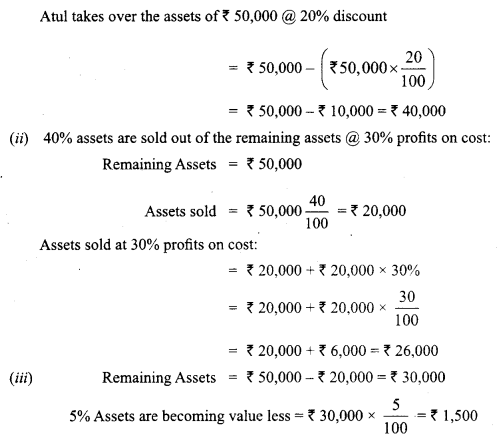
The book value of assets (other than cash and bank) transferred to Realisation Account is ₹ 1,00,000. 50% of the assets are taken over by a partner Atul, at a discount of 20%. 40% of the remaining assets are sold at a profit of 30% on cost; 5% of the balance being obsolete, realised nothing and remaining assets are handed over to a creditor, in full settlement of his claim. You are required to record the journal entries for realisation of assets.
Answer:
Class 12 Accountancy Important Questions Chapter 5 Dissolution of a Partnership Firm 13
Class 12 Accountancy Important Questions Chapter 5 Dissolution of a Partnership Firm 14

Question 8.
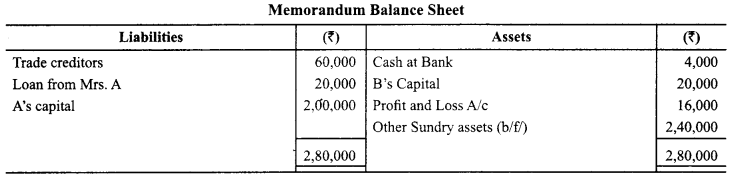
A and B who were sharing profits and losses in the ratio of 3:1 respectively decide to dissolved the firm on March 31, 2014 at which date some of the balances were as follows:
A’s capital ₹ 2,00,000, B’s capital ₹ 20,000 (debit balance). Profit and Loss A/c ₹ 16,000 (debit balance! Trade Creditors ₹ 60,000, Loan from Mrs. A ₹ 20,000, Cash at Bank ₹ 4,000.
Assets (other than cash at bank) realised ₹ 1,10,000 and all creditors were paid off less 5% discount. Realisation expenses amounted to ₹ 1,000. Prepare Memorandum Balance sheet.
Answer:
Class 12 Accountancy Important Questions Chapter 5 Dissolution of a Partnership Firm 15

Question 9.
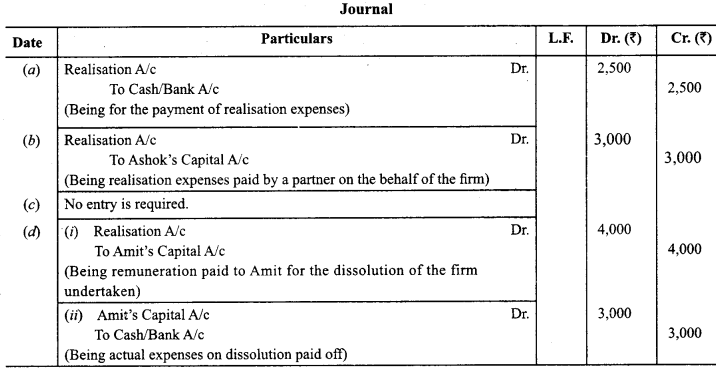
Journalise the following transactions regarding realisation expenses:
(a) Realisation expenses amounted to ₹ 2,500.
(b) Realisation expenses amounting to ₹ 3,000 were paid by Ashok, one of the partners.
(c) Realisation expenses ₹ 2,300 borne by Tarun, personally.
(d) Amit, a partner was appointed to realise the assets, at a cost of ₹ 4,000. The actual amount of realisation amounted to ₹ 3,000.
Answer:
Class 12 Accountancy Important Questions Chapter 5 Dissolution of a Partnership Firm 16

Question 10.
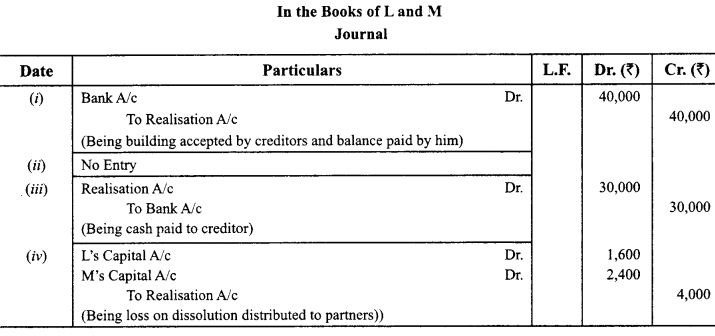
L and M were partners in a firm sharing profits in the ratio of 2 : 3. On 28.2.2016 the firm was dissolved. After transferring assets (other than cash) and outsider’s liabilities to realisation account you are given the following information:
(i) A creditor of ₹ 1,40,000 accepted building valued at ₹ 1,80,000 and paid to the firm ₹ 40,000.
(ii) A second creditor for ₹ 30,000 accepted machinery valued at ₹ 28,000 in full settlement of his claim.
(iii) A third creditor amounting to ₹ 70,000 accepted ₹ 30,000 in cash and investments of the book value of ₹ 45,000 in full settlement of his claim.
(iv) Loss on dissolution was ₹ 4,000.
Pass necessary journal entries for the above transactions in the books of firm assuming that all payments were made by cheque. (CBSE Outside Delhi 2016)
Answer:
Class 12 Accountancy Important Questions Chapter 5 Dissolution of a Partnership Firm 17

Dissolution of a Partnership Firm Important Extra Questions Long Answer Type

Question 1.
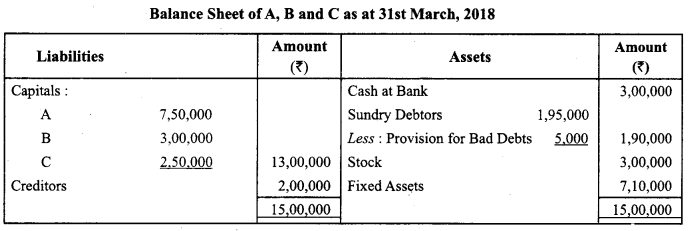
A, B and C were partners sharing profits and losses in the ratio of 2 : 2 : 1. Their Balance Sheet as at 31st March, 2018 was as follows :
Class 12 Accountancy Important Questions Chapter 5 Dissolution of a Partnership Firm 18
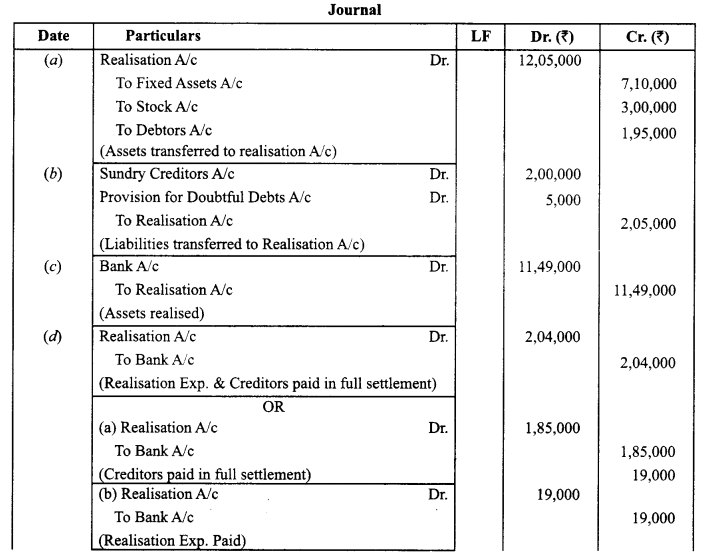
On the above date they dissolved the firm and following amounts were realised :
Fixed Assets ₹ 6,75,000; Stock ₹ 3,39,000; Debtors ₹ 1,35,000; Creditors were paid ₹ 1,85,000 in full settlement of their claim. Expenses on Realisation amounted to ₹ 19,000.
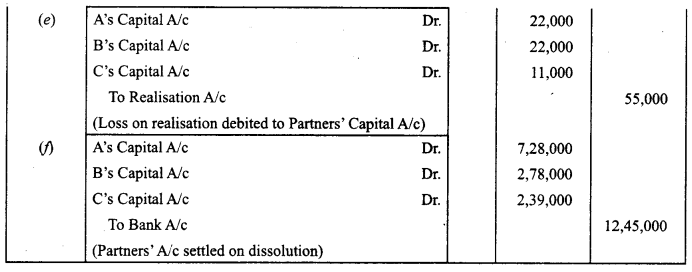
Pass the necessary journal entries on the dissolution of the firm.
Answer:
Class 12 Accountancy Important Questions Chapter 5 Dissolution of a Partnership Firm 19
Class 12 Accountancy Important Questions Chapter 5 Dissolution of a Partnership Firm 20

Question 2.
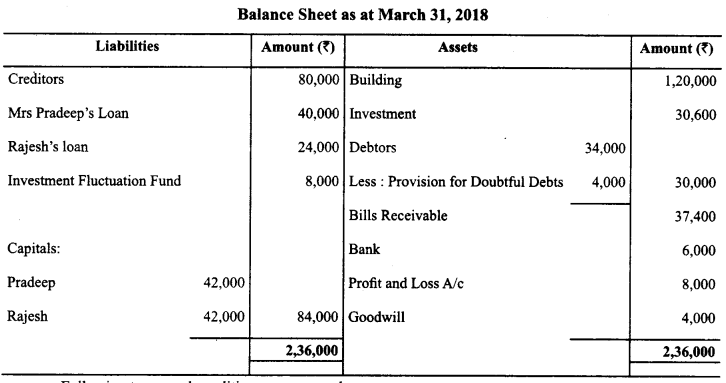
Pradeep and Rajesh were partners in a firm sharing profits and losses in the ratio of 3:2. They decided to dissolve their partnership firm on 31st March, 2018. Pradeep was deputed to realize the assets and to pay off the liabilities. He was paid ₹ 1,000 as commission for his services. The financial position of the firm on 31st March, 2018 was as follows:
Class 12 Accountancy Important Questions Chapter 5 Dissolution of a Partnership Firm 21
Following terms and conditions were agreed upon:
(i) Pradeep agreed to pay off his wife’s loan.
(ii) Half of the debtor’s realized ₹ 12,000 and remaining debtors were used to pay off 25% of the creditors.
(iii) Investment sold to Rajesh for ₹ 27,000
(iv) Building realized ₹ 1,52,000
(v) Remaining creditors were to be paid after two months, they were paid immediately at 10% p.a. discount
(vi) Bill receivables were settled at a loss of ₹ 1,400
(vii) Realization expenses amounted to ₹ 2,500
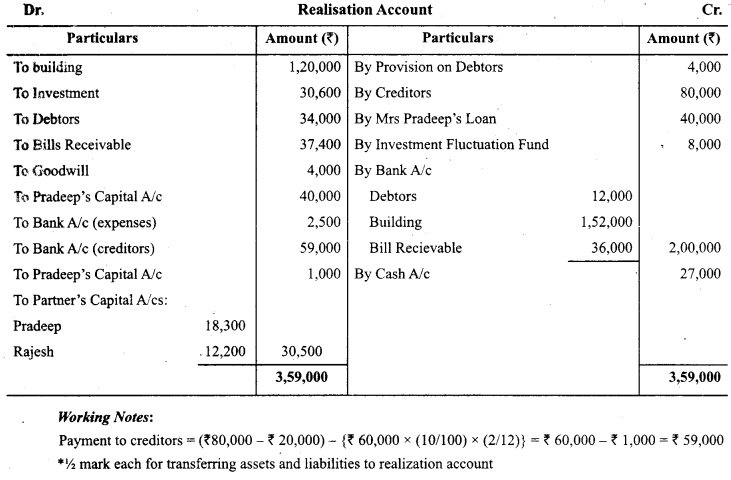
Prepare Realization Account. (CBSE Sample Paper 2018-19)
Answer:
Class 12 Accountancy Important Questions Chapter 5 Dissolution of a Partnership Firm 22

Question 3.
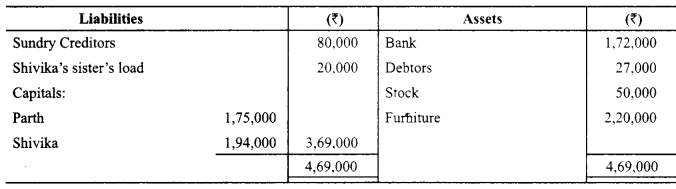
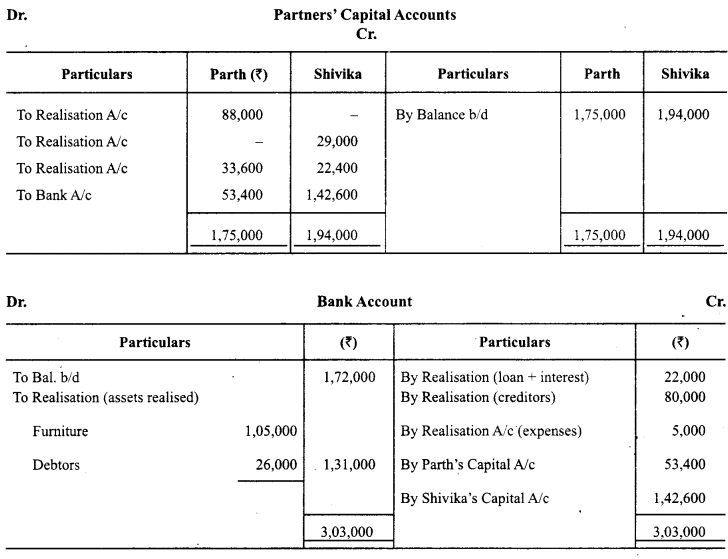
Parth and Shivika were partners in a firm sharing profits in the ratio of 3 : 2. The Balance Sheet of the firm on 31st March, 2014 was as follows:
Class 12 Accountancy Important Questions Chapter 5 Dissolution of a Partnership Firm 23
On the above date the firm was dissolved. The assets were realized and the liabilities were paid off as follows:
(a) 50 % of the furniture was taken over by Parth at 20% less than book value. The remaining furniture was sold for ₹ 1,05,000.
(b) Debtors realised ₹ 26,000.
(c) Stock was taken over by Shivika for 29,000.
(d) Shivika’s sister’s loan was paid off along with an interest of ₹ 2,000.
(e) Expenses on realisation amounted to ₹ 5,000.
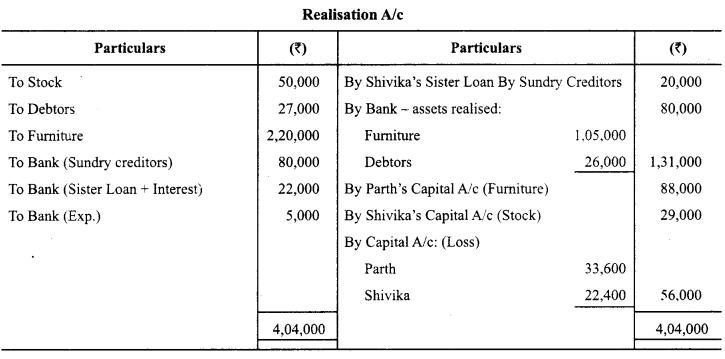
Prepare Realisation Acount, Partners’ Capital Accounts and Bank Account. (Compartment Delhi 2015)
Answer:
Class 12 Accountancy Important Questions Chapter 5 Dissolution of a Partnership Firm 24
Class 12 Accountancy Important Questions Chapter 5 Dissolution of a Partnership Firm 25

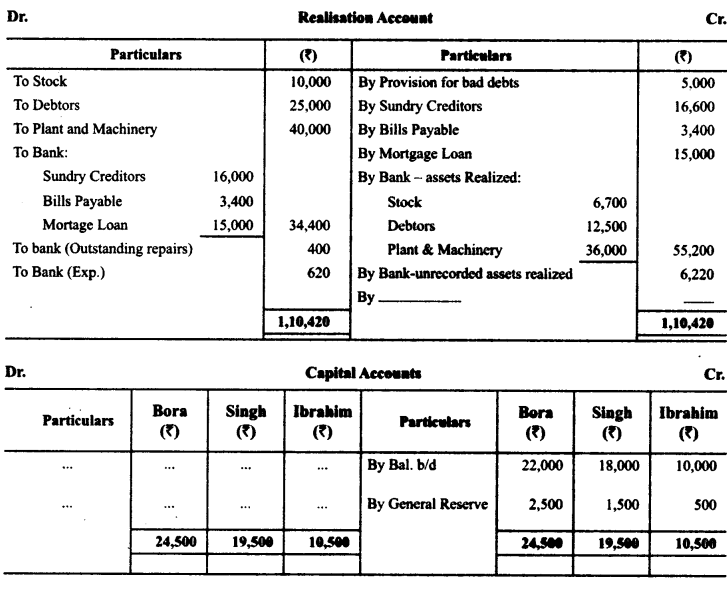
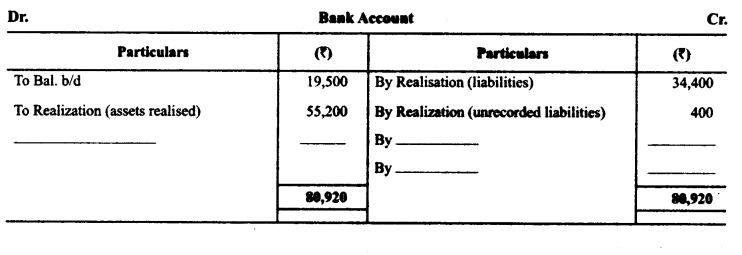
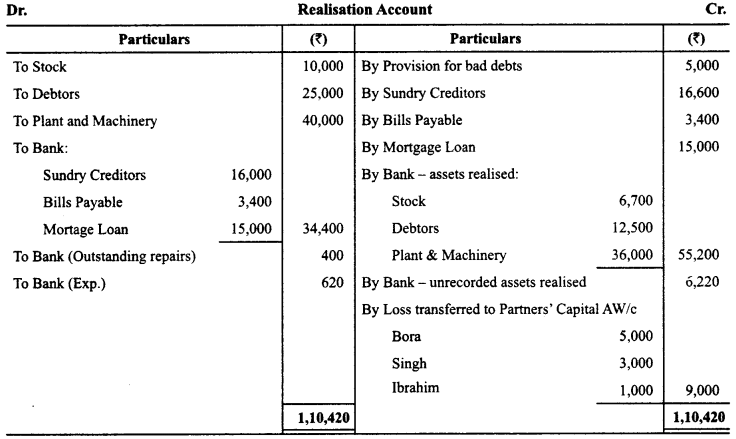
Question 4.
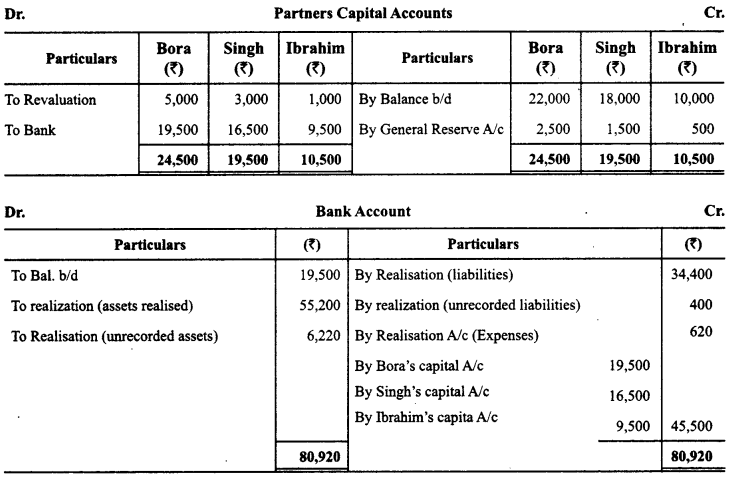
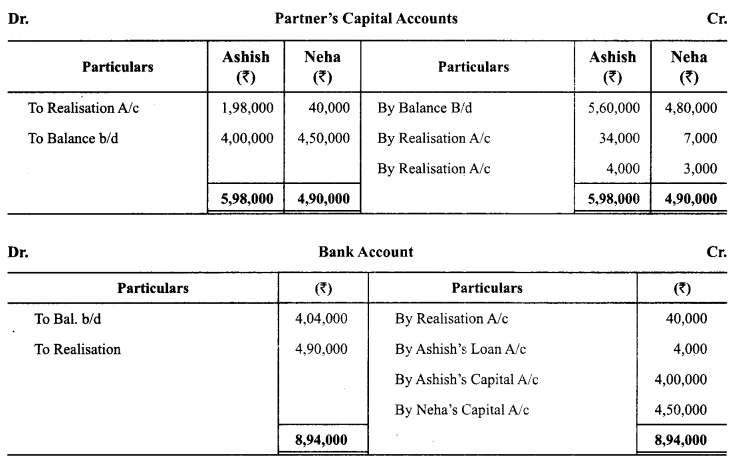
Bora, Singh and Ibrahim were partners in a firm sharing profits in the ratio of 5 :3 :1. On 2-3-2015 their firm was dissolved. The assets were realized and the liabilities were paid off. Given below are the Realisation Account, Partners’ Capital Accounts and Bank Account of the firm. The accountant of the firm left a few amounts unposted in these accounts. You are required to complete these accounts by posting the correct amounts.
Class 12 Accountancy Important Questions Chapter 5 Dissolution of a Partnership Firm 26
Class 12 Accountancy Important Questions Chapter 5 Dissolution of a Partnership Firm 27
Answer:
Class 12 Accountancy Important Questions Chapter 5 Dissolution of a Partnership Firm 28
Class 12 Accountancy Important Questions Chapter 5 Dissolution of a Partnership Firm 29

Question 5.
Ashish and Neha were partners in a firm sharing profits and losses in the ratio 4:3. They decided to dissolve the firm on 1st May 2014. From the information given below, complete Realisation A/c, Partner’s Capital Accounts and Bank A/c:
Class 12 Accountancy Important Questions Chapter 5 Dissolution of a Partnership Firm 30
Class 12 Accountancy Important Questions Chapter 5 Dissolution of a Partnership Firm 31
Answer:
Class 12 Accountancy Important Questions Chapter 5 Dissolution of a Partnership Firm 32
Class 12 Accountancy Important Questions Chapter 5 Dissolution of a Partnership Firm 33

Question 6.
Give journal entries for the following transactions:
1. To record the realisation of various assets and liabilities.
2. A firm has a stock of₹ 1,60,000. Aziz, a partner took over 50% of the stock at a discount of 20%.
3. Remaining stock was sold at a profit of 30% on cost.
4. Land and Building (book value ₹ 1,60,000) sold for ₹ 3,00,000 through a broker who charged 2%, commission on the deal.
5. Plant and Machinery (book value ₹ 60,000) was handed over to a creditor at an agreed valuation of 10% less than the book value.
6. Investment whose face value was ₹ 4,000 was realised at 50%.
Answer:
Class 12 Accountancy Important Questions Chapter 5 Dissolution of a Partnership Firm 34
Class 12 Accountancy Important Questions Chapter 5 Dissolution of a Partnership Firm 35

Question 7.
Record necessary journal entries to record the following unrecorded assets and liabilities in the books of Paras and Priya:
1. There was an old furniture in the firm which had been written-off completely in the books. This was sold for ₹ 3,000.
2. Ashish, an old customer whose account for ₹ 1,000 was written-off as bad in the previous year, paid 60% of die amount
3. Paras agreed to takeover the firm’s goodwill (not recorded in the books of the firm), at a valuation of ₹ 30,000.
4. There was an old typewriter which had been written off completely from the books. It was estimated to realize ₹ 400. It was taken away by Priya at an estimated price less 25%.
5. There were 100 shares of ₹ 10 each in Star Limited acquired at a cost of ₹ 2,000 which had been written-off completely from die books. These shares are valued @ ₹ 6 each and divided among the partners in their profit sharing ratio.
Answer:
Class 12 Accountancy Important Questions Chapter 5 Dissolution of a Partnership Firm 36

Question 8.
What journal entries would be recorded for the following transactions on die dissolution of a firm after various assets (other than cash) and the third party liabilities have been transferred to Realisation account₹
1. Arti took over die stock worth ₹ 80,000 at ₹ 68,000.
2. There was unrecorded bike of₹ 40,000 which was taken over By Mr. Karim.
3. The firm paid ₹ 40,000 as compensation to employees.
4. Sundry creditors amounting to ₹ 36,000 were settled at a discount of 15%.
5. Loss on realisation ₹ 42,000 was to be distributed between Arti and Karim in the ratio of 3:4.
Answer:
Class 12 Accountancy Important Questions Chapter 5 Dissolution of a Partnership Firm 37

Question 9.
E, F and G were partners in a firm sharing profits in the ratio of 2 : 2 : 1. On March 31,2017, their firm was dissolved. On the date of dissolution, the Balance Sheet of the firm was as follows:
Class 12 Accountancy Important Questions Chapter 5 Dissolution of a Partnership Firm 38
F was appointed to undertake the process of dissolution for which he was allowed a remuneration of ₹ 5,000. F agreed to bear the dissolution expenses. Assets realized as follows:
(i) The Land & Building was sold for ₹ 1,08,900.
(ii) Furniture was sold at 25% of book value.
(iii) Machinery was sold as scrap for ₹ 9,000.
(iv) All the Debtors were realized at full value.
Creditors were payable on an average of 3 months from the date of dissolution. On discharging the Creditors on the date of dissolution, they allowed a discount of 5%.
Pass necessary Journal entries for dissolution in the books of the firm. (CBSE Sample Paper 2017-18)
Answer:
Class 12 Accountancy Important Questions Chapter 5 Dissolution of a Partnership Firm 39
Class 12 Accountancy Important Questions Chapter 5 Dissolution of a Partnership Firm 40

Question 10.
Give the necessary journal entries for the following transactions on dissolution of the firm of Aman and Rajat on 31 st March, 2016, after the transfer of various assets (other than cash) and the third party liabilities to Realisation Account. They shared profits and losses in the ratio of 2 : 1.
(а) There was a bill of exchange of ₹ 10,000 under discount. The bill was received from Derek who became insolvent.
(b) Bills payable of ₹ 30,000 falling due on 30th April, 2016 were discharged at ₹ 29,550.
(c) Creditors of ₹ 30,000 took over stock of ₹ 10,000 at 10% discount and the balance was paid to them in cash.
(d) There was an old typewriter which had been written off completely. It was estimated to realize ₹ 600. It was taken away by Rajat at 25% less than the estimated price.
(e) Aman agreed to take over the responsibility of completing dissolution at an agreed remuneration of ₹ 1,000 and to bear all realization expenses. Actual realisation expenses ₹ 800 were paid by the firm.
(f) Loss on realization was ₹ 54,000.
Answer:
Class 12 Accountancy Important Questions Chapter 5 Dissolution of a Partnership Firm 41

Reconstitution of Partnership Firm: Retirement/Death of a Partner Class 12 Important Questions Accountancy Chapter 4

Here we are providing Class 12 Accountancy Important Extra Questions and Answers Chapter 4 Reconstitution of Partnership Firm: Retirement/Death of a Partner. Accountancy Class 12 Important Questions and Answers are the best resource for students which helps in class 12 board exams.

Class 12 Accountancy Chapter 4 Important Extra Questions Reconstitution of Partnership Firm: Retirement/Death of a Partner

Reconstitution of Partnership Firm: Retirement/Death of a Partner Important Extra Questions Very Short Answer Type

Question 1.
What is meant by ‘Gaining Ratio’ on retirement of a partner?
Or
P, Q and R were partners in a firm. On 31st March, 2018 R retired. The amount payable to R ₹ 2,17,000 was transferred to his loan account. R agreed to receive interest on this amount as per the provisions of Partnership Act, 1932. State the rate at which interest will be paid to R. (CBSE Delhi 2019)
Answer:
The ratio in which retiring Partner’s Share is distributed between remaining Partner is called gaining ratio.
Or
Rate of interest will be 6% p.a.

Question 2.
Aman, Bimal and Deepak are partners sharing profits in the ratio of 2 : 3 : 5. The goodwill of the firm has been valued at ₹ 37,500. Aman retired. Bimal and Deepak decided to share profits equally in future. Calculate gain/sacrifice of Bimal and Deepak on Aman’s retirement and also pass necessary journal entry for the treatment of goodwill. (CBSE Outside Delhi 2019)
Answer:
Old Ratio = 2:3:5
New Ratio =1:1 (on Aman’s Retirement)
Bimal’s Gain = 1/2 – 3/10 = 2/10
Deepak’s Gain = 1/2 – 5/10 = nil
Firm’s Goodwill = 37,500 .
A man’s share = 2/10 x 37,500 = 7,500
Class 12 Accountancy Important Questions Chapter 4 Reconstitution of Partnership Firm Retirement Death of a Partner 1

Question 3.
Riyansh, Garv and Kavleen were partners in a firm sharing profit and loss in the ratio of 8 : 7 : 5. On 2nd November 2018, Kavleen died. Kalveen’s share of profits till the date of her death was calculated at ₹ 9,375. Pass the necessary journal entry. (CBSE Sample Paper 2019-20)
Answer:
Class 12 Accountancy Important Questions Chapter 4 Reconstitution of Partnership Firm Retirement Death of a Partner 2

Question 4.
At the time of retirement how is the new profit sharing ratio among the remaining partners calculated₹ (CBSE Compt. 2019)
Answer:
The new share of each of the remaining partner is calculated as his/her own share in the firm plus the share acquired from the retiring partner.

Question 5.
In which ratio do the remaining partners acquire the share of profit of the retiring partner? (CBSE Compt. 2017)
Answer:
Gaining ratio.

Question 6.
At the time of retirement of a partner, state the condition when there is no need to compute gaining ratio. (CBSE 2013 Compartment OD)
Answer:
When the remaining partners share profits in old ratio.

Question 7.
On the retirement of a partner, how is the profit sharing ratio of the remaining partners decided?
Answer:
On the basis of old profit sharing ratio.

Question 8.
Why is gaining ratio of the remaining partners calculated at the time of retirement/death of a partner?
Answer:
Gaining ratio of the remaining partners is calculated to determine amount of goodwill payable by them to retired/deceased partner.

Question 9.
State the ratio in which share of goodwill of the retiring partner is debited to Capital Accounts of the remaining partners.
Answer:
In their gaining ratio.

Question 10.
Abha and Beena were partners sharing profits and losses in the ratio of 3 : 2 on April 1st 2013, they decided to admit Chanda for l/5th share in the profits. They had a reserve of ₹ 25,000 which they wanted to show in their new balance sheet. Chanda agreed and the necessary adjustments were made in the books. On October 1st 2013, Abha met with an accident and died. Beena and Chanda decided to admit Abha’s daughter Fiza in their partnership, who agreed to bring ₹ 2,00,000 as capital. Calculate Abha’s share in the reserve on the date of her death. (CBSE Sample Paper 2015)
Answer:
₹ 12,000

Question 11.
X, Y and Z were partners sharing profits and losses in the ratio of 3:2:2. Z retired and the amount due to him was ₹ 85,000. He was paid ₹ 5,000 immediately. The balance was payable in three equal annual instalments carrying interest @ 6% p.a. Pass necessary journal entry for recording the same on the date of Z’s retirement.
(Compt. Delhi 2017)
Answer:
Class 12 Accountancy Important Questions Chapter 4 Reconstitution of Partnership Firm Retirement Death of a Partner 3

Question 12.
Ram, Mohan and Sohan were partners in a firm sharing profits in the ratio of 4 : 3 : 1. Mohan retired. His share was taken over equally by Ram and Sohan. In which ratio will the profit and loss on revaluation of assets and liabilities on the retirement of Mohan be transferred to capital accounts of the partners?
(CBSE 2010 Compartment Delhi)
Answer:
In old profit sharing ratio.

Reconstitution of Partnership Firm: Retirement/Death of a Partner Important Extra Questions Short Answer Type

Question 1.
Danish, Ana and Pranjal are partners in a firm sharing profits and losses in the ratio of 5:3:2. Their books are closed on March 31 st every year.
Danish died on September 30th , 2019, The executors of Danish are entitled to: (CBSE Sample Paper 2019-20)
(i) His share of Capital i.e. ₹ 5,00,000 along-with his share of goodwill. The total goodwill of the firm was valued at ₹ 60,000.
(ii) His share of profit up to his date of death on the basis of sales till date of death. Sales for the year ended March 31, 2019 was ₹ 2,00,000 and profit for the same year was 10% on sales. Sales shows a growth trend of 20% and percentage of profit earning is reduced by 1%.
(iii) Amount payable to Danish was transferred to his executors.
Pass necessary Journal Entries and show the workings clearly.
Answer:
Class 12 Accountancy Important Questions Chapter 4 Reconstitution of Partnership Firm Retirement Death of a Partner 4

Question 2.
A, B and C were partners in a firm sharing profits and losses in the ratio of 3 : 2 : 1. C dies on 30th June, 2016. After all the necessary adjustments, his capital account showed a credit balance of ₹ 70.600. C’s executor was paid ₹ 10,600 on 1st July, 2016 and the balance in three equal yearly instalments starting from 30th June, 2017 with interest @ 10% p.a. on the unpaid amount. The firm closes its books on 31st March every year.
Prepare C’s Executor’s Account till the amount is finally paid. (CBSE Compt. 2019)
Answer:
Class 12 Accountancy Important Questions Chapter 4 Reconstitution of Partnership Firm Retirement Death of a Partner 5
Class 12 Accountancy Important Questions Chapter 4 Reconstitution of Partnership Firm Retirement Death of a Partner 6

Question 3.
X, Y and Z were partners in a firm sharing profits in the ratio of 3 : 3 : 4. Z died on 31st March, 2016. The amount payable to Z’s executor K was ₹ 1,09,000. ₹ 19,000 were paid to K immediately and the balance was paid in three equal yearly instalments starting from 31st March, 2017 with interest @ 13% p.a. The firm ‘ closes its books on 31st March every year.
Prepare K’s account till he is finally paid.
Answer:
Class 12 Accountancy Important Questions Chapter 4 Reconstitution of Partnership Firm Retirement Death of a Partner 7

Question 4.
Apama, Manisha and Sonia are partners sharing profits in the ratio of 3 : 2 : 1. Manisha retires and goodwill of the firm is valued at ₹ 1,80,000. Apama and Sonia decided to share future in the ratio of 3:2. Pass necessary journal entries.
Answer:
(i) Old profit sharing ratio of Apama, Manisha and Sonia = 3 : 2 : 1
New Profit sharing ratio of Aparna and sonia = 3 : 2
Class 12 Accountancy Important Questions Chapter 4 Reconstitution of Partnership Firm Retirement Death of a Partner 8

Question 5.
Sangeeta, Saroj and Shanti are partners sharing profits in the ratio of 2 : 3 : 5. Goodwill is appearing in the books at a value of ₹ 60,000. Sangeeta retires and goodwill is valued at ₹ 90,000. Saroj and Shanti decided to share future profits equally. Record necessary journal entries.
Answer:
Class 12 Accountancy Important Questions Chapter 4 Reconstitution of Partnership Firm Retirement Death of a Partner 9
Class 12 Accountancy Important Questions Chapter 4 Reconstitution of Partnership Firm Retirement Death of a Partner 10

Question 6.
Naresh, Raj Kumar and Bishwajeet are equal partners. Raj Kumar decides to retire. On the date of his retirement, the Balance Sheet of the firm showed the following : General Reserves ₹ 36,000 and Profit and Loss Account (Dr.) ₹ 15,000.
Pass the necessary journal entries to the above effect.
Answer:
Class 12 Accountancy Important Questions Chapter 4 Reconstitution of Partnership Firm Retirement Death of a Partner 11

Question 7.
Amar, Ram, Mohan and Sohan were partners in a firm sharing profits in the ratio of 2 : 2 : 2 : 1. On 31st January, 2017 Sohan retired. On Sohan’s retirement the goodwill of the firm was valued at ₹ 70,000. The new profit sharing ratio between Amar, Ram and Mohan Was agreed as 5 : 1 : 1.
Showing your working notes clearly, pass necessary Journal Entry for the treatment of goodwill in the books of the firm on Sohan’s retirement. [CBSE Delhi 2017]
Answer:
Class 12 Accountancy Important Questions Chapter 4 Reconstitution of Partnership Firm Retirement Death of a Partner 12

Question 8.
A, B and C were partners sharing profits in the ratio of 6:4:5. Their capitals were A₹ 1,00,000, B ₹ 80,000 and C ₹ 60,000. On 1 st April 2009, B retired from the firm and the new profit sharing ratio between A and C was decided as 11 : 4. On B’s retirement the goodwill of the firm was valued at ₹ 1,80,000. Showing your calculations clearly, pass necessary journal entry for the treatment of goodwill on B’s retirement.
Answer:
Class 12 Accountancy Important Questions Chapter 4 Reconstitution of Partnership Firm Retirement Death of a Partner 13

Question 9.
Ram, Shyam and Mohan are partners sharing profits in the ratio of 5 : 3 : 2. Shyam retired, and goodwill is valued at ₹ 1,20,000. Ram and Mohan decided to share future profits in the ratio of 2 : 3. Pass necessary journal entries for treatment of goodwill, if goodwill appears in the books at ₹ 40,000.
Answer:
Class 12 Accountancy Important Questions Chapter 4 Reconstitution of Partnership Firm Retirement Death of a Partner 14

Question 10.
A firm of A, B and C has Workmen Compensation Fund of₹ 30,000. On retirement of a partner, how ₹ 20,000 will be treated in the following cases:
(a) There is no claim against Workmen Compensation fund.
(b) There is a claim of₹ 12,000 against Workmen Compensation Fund.
Journalise.
Answer:
Journal Entries
Class 12 Accountancy Important Questions Chapter 4 Reconstitution of Partnership Firm Retirement Death of a Partner 15
Class 12 Accountancy Important Questions Chapter 4 Reconstitution of Partnership Firm Retirement Death of a Partner 16

Question 11.
A, B and C are partners sharing profits in the ratio of 3 : 2 : l.A dies on 31st July 2011. The profits of the firm for the year ending 31st March 2011 were 42000. Calculate A’s Share for the period from 1st April to 31st July 2011 on the basis of last year’s profits. Pass necessary journal entry also.
Answer:
A’s profit = Preceding year’s profit x Proportionate Period x Share of A
Class 12 Accountancy Important Questions Chapter 4 Reconstitution of Partnership Firm Retirement Death of a Partner 17

Question 12.
If in the example-1 given above, the sales for the last year are ₹ 2,10,000 and for the current year upto 31st July are say ₹ 90,000, what would be the Profits from 1st April to 31st July 2011.
Answer:
Class 12 Accountancy Important Questions Chapter 4 Reconstitution of Partnership Firm Retirement Death of a Partner 18

Question 13.
On December 31, 2014, the Balance Sheet of Pinki. Qureshi and Rakesh showed as under:
Class 12 Accountancy Important Questions Chapter 4 Reconstitution of Partnership Firm Retirement Death of a Partner 19
The partnership deed provides that the profit be shared in the ratio of 2 : 1 : 1 and that in the event of death of a partner, his executors be entitled to be paid out:
(a) The capital of his credit at the date of last Balance Sheet.
(b) His proportion of reserves at the date of last Balance Sheet.
(c) His proportion of profits to the date of death based on the average profits of the last three completed years, plus 10%.
(d) By way of goodwill, his proportion of the total profits for the three preceding years. The net profit for the last three years were:
Class 12 Accountancy Important Questions Chapter 4 Reconstitution of Partnership Firm Retirement Death of a Partner 20
Rakesh died on April 1, 2015. He had withdrawn 5,000 to the date of his death. The investment were sold at par and R’s Executors were paid off. Prepare Rakesh’s Capital Account that of his executors.
Answer:
Class 12 Accountancy Important Questions Chapter 4 Reconstitution of Partnership Firm Retirement Death of a Partner 21
Class 12 Accountancy Important Questions Chapter 4 Reconstitution of Partnership Firm Retirement Death of a Partner 22
Note: Cash required to make payment is not enough even after selling the investment. Therefore, the payment has been made through bank.

Question 14.
Vikas, Vishal and Vaibhav were partners in a firm sharing profits in the ratio of 2 : 2 : 1 ..The firm closes its books on 31 st March every year. On 31.12.2015 Vaibhav died. On that date his Capital account showed a credit balance of ₹ 3,80,000 and Goodwill of the firm was valued at ₹ 1,20,000. There was a debit balance of ₹ 50,000 in the profit and loss account. Vaibhav’s share of profit in the year of his death was to be calculated on the basis of the average profit of last five year. The average profit of last five years was ₹ 75,000.
Pass necessary journal entries in the book of the firm on Vaibhav’s Death. (CBSE Outside Delhi 2016)
Answer:
Class 12 Accountancy Important Questions Chapter 4 Reconstitution of Partnership Firm Retirement Death of a Partner 23

Question 15.
A, B, C and D were partners sharing profits in the ratio of 1 : 2 : 3 : 4. D retired and his share was acquired by A and B equally. Goodwill was valued at 3 year’s purchase of average profits of last 4 years, which were 40,000. General Reserve showed a balance of 1,30,000 and D’s Capital in the Balance Sheet was 3,00,000 at the time of D’s retirement. You are required to record necessary Journal entries in the books of the firm and prepare D’s capital account on his retirement.
Answer:
Class 12 Accountancy Important Questions Chapter 4 Reconstitution of Partnership Firm Retirement Death of a Partner 24

Question 16.
P, Q and R were partners sharing profits in the ratio of 2 :2 :1. The firm closes its books on March 31 every year. On June 30,2017, R died. The following information is provided on R’s death:
(i) Balance in his capital account in the beginning of the year was ₹ 6,50,000.
(ii) He withdrew ₹ 60,000 on May 15,2017 for his personal use.
On the date of death of a partner the partnership deed provided for the following:
(a) Interest on capital @ 10 % per annum.
(b) Interest on drawings @ 12 % per annum.
(c) His share in the profit of the firm till the date of death, to be calculated on the basis of the rate of Net Profit on Sales of the previous year, which was 25 %. The Sales of the firm till June 30, 2017 were ₹ 6,00,000.
Prepare R’s Capital Account on his death to be presented to his executors. (CBSE Sample Paper 2017-18)
Answer:
Class 12 Accountancy Important Questions Chapter 4 Reconstitution of Partnership Firm Retirement Death of a Partner 25

Reconstitution of Partnership Firm: Retirement/Death of a Partner Important Extra Questions Long Short Answer Type

Question 1.
Akul, Bakul and Chan dan were partners in a firm sharing profits in the ratio of2:2: 1. On 31 st March, 2018 their Balance Sheet was as follows:
Class 12 Accountancy Important Questions Chapter 4 Reconstitution of Partnership Firm Retirement Death of a Partner 26
Bakul retired on the above date and it was agreed that:
(i) Plant and Machinery was undervalued by 10%.
(ii) Provision for doubtful debts was to be increased to 15% on debtors.
(iii) Furniture was to be decreased to ₹87,000.
(iv) Goodwill of the firm was valued at ₹3,00,000 and Bakul’s share was to be adjusted through the capital accounts of Akul and Chandan.
(v) Capital of the new firm was to be in the new profit sharing ratio of the continuing partners. Prepare Revaluation account, Partners’ Capital accounts and the Balance Sheet of the reconstituted firm. (CBSE Delhi 2019)
Answer:
Class 12 Accountancy Important Questions Chapter 4 Reconstitution of Partnership Firm Retirement Death of a Partner 27
Class 12 Accountancy Important Questions Chapter 4 Reconstitution of Partnership Firm Retirement Death of a Partner 28

Question 2.
G, E and F were partners in a firm sharing profits in the ratio of 7 : 2 : 1. The Balance Sheet of the firm as at 31 st March, 2018, was as follows :
Class 12 Accountancy Important Questions Chapter 4 Reconstitution of Partnership Firm Retirement Death of a Partner 29
E.retired on the above date. On E’s retirement the following was agreed upon :
(i) Land and Building were revalued at ₹ 1,88,000, Machinery at ₹ 76,000 and Stock at ₹ 10,000 and goodwill of the firm was valued at X 90,000.
(ii) A provision of 2-5% was to be created on debtors for doubtful debts.
(iii) The net amount payable to E was transferred to his loan account to be paid later on.
(iv) Total capital of the new firm was fixed at ₹ 2,40,000 which will be adjusted according to their new profit sharing ratio by opening current accounts.
Prepare Revaluation Account, Partners’ Capital Accounts and the Balance Sheet of reconstituted firm.
(CBSE Outside Delhi 2019)
Answer:
Class 12 Accountancy Important Questions Chapter 4 Reconstitution of Partnership Firm Retirement Death of a Partner 30
Class 12 Accountancy Important Questions Chapter 4 Reconstitution of Partnership Firm Retirement Death of a Partner 31
Class 12 Accountancy Important Questions Chapter 4 Reconstitution of Partnership Firm Retirement Death of a Partner 32

Question 3.
X,Y and Z were in partnership sharing profits in proportion to their capitals. Their Balance Sheet as on 31 st March, 2018 was as follows:
Class 12 Accountancy Important Questions Chapter 4 Reconstitution of Partnership Firm Retirement Death of a Partner 33
On the above date, Y retired owing to ill health. The following adjustments were agreed upon for calculation of amount due to Y.
(a) Provision for Doubtful Debts to be increased to 10% of Debtors.
(b) Goodwill of the firm be valued at ₹ 36,000 and be adjusted into the Capital Accounts of X and Z, who will share profits in future in the ratio of 3:1.
(c) Included in the value of Sundry Creditors was ₹ 2,500 for an outstanding legal claim, which will not arise.
(d) X and Z also decided that the total capital of the new firm will be ₹ 1,20,000 in their profit sharing ratio. Actual cash to be brought in or to be paid off as the case may be.
(e) Y to be paid ₹ 9,000 immediately and balance to be transferred to his Loan Account. Prepare Revaluation Account, Partner’s Capital Accounts and Balance Sheet of the new firm after Y’s retirement. (CBSE Sample Paper 2019-20)
Answer:
Class 12 Accountancy Important Questions Chapter 4 Reconstitution of Partnership Firm Retirement Death of a Partner 34
Class 12 Accountancy Important Questions Chapter 4 Reconstitution of Partnership Firm Retirement Death of a Partner 35

Question 4.
Lisa, Monika and Nisha were partners in a firm sharing profit and losses in the ratio of 2 : 2 : 1. On 31st March, 2019, their Balance Sheet was as follows :
Class 12 Accountancy Important Questions Chapter 4 Reconstitution of Partnership Firm Retirement Death of a Partner 36
On 31st March, 2019 Monika retired from the firm and the remaining partners decided to carry on the business. It was agreed that:
(i) Land and building be appreciated by ₹ 2,40,00 and machinery be depreciated by 10%.
(ii) 50% of the stock was taken over by the retiring partner at book value.
(iii) Provision for doubtful debts was to be made of 5% on debtors.
(iv) Goodwill of the firm be valued at ₹ 3,00,000 and Monika’s share of goodwill be adjusted in the accounts of Lisa and Nisha.
(v) The total capital of the new firm be fixed at ₹ 27,00,000 which will be in the proportion of the new profit sharing ratio of Lisa and Nisha. For this purpose, current accounts of the partners were to be opened.
Prepare Revaluation Account, Partners’ Capital Accounts and the Balance sheet of the reconstituted firm on Monika’s retirement. (CBSE Compt. 2019)
Answer:
Class 12 Accountancy Important Questions Chapter 4 Reconstitution of Partnership Firm Retirement Death of a Partner 37
Class 12 Accountancy Important Questions Chapter 4 Reconstitution of Partnership Firm Retirement Death of a Partner 38

Question 5.
A, B & C were partners in a firm sharing profits & losses in proportion to their fixed capitals. Their Balance Sheet as at March 31, 2017 was as follows
Class 12 Accountancy Important Questions Chapter 4 Reconstitution of Partnership Firm Retirement Death of a Partner 39
Class 12 Accountancy Important Questions Chapter 4 Reconstitution of Partnership Firm Retirement Death of a Partner 40
On the date of above Balance Sheet, C retired from the firm on the following terms:
(i) Goodwill of the firm will be valued at two years purchase of the Average Profits of last three years. The Profits for the year ended March 31, 2015 & March 31, 2016 were ₹ 4,00,000 & ₹ 3,00,000 respectively.
(ii) Provision for Bad Debts will be maintained at 5% of the Debtors.
(iii) Land & Building will be appreciated by ₹ 90,000 and Plant & Machinery Will be reduced to ₹ 1,80,000.
(iv) A agreed to repay his Loan.
(v) The loan repaid by A was to be utilized to pay C. The balance of the amount payable to C was transferred to his Loan Account bearing interest @ 12% per annum.
Prepare Revaluation Account, Partners’ Capital Accounts, Partners’ Current Accounts and the Balance Sheet of the reconstituted firm. (CBSE Sample Paper 2017-18)
Answer:
Class 12 Accountancy Important Questions Chapter 4 Reconstitution of Partnership Firm Retirement Death of a Partner 41
Class 12 Accountancy Important Questions Chapter 4 Reconstitution of Partnership Firm Retirement Death of a Partner 42

Question 6.
M, N and G were partners in a firm sharing profits and losses in the ratio of 5:3:2. On 31-3-2016 their Balance Sheet was as under:
Class 12 Accountancy Important Questions Chapter 4 Reconstitution of Partnership Firm Retirement Death of a Partner 43
M retired on the above date and it was agreed that:
(i) Debtors of ₹ 2,000 will be written off as bad debts and a provision of 5% on debtors for bad and doubtful debts will be maintained.
(ri) Patents will be completely written off and stock, machinery and building will be depreciated by 5%.
(iii) An unrecorded creditor of ₹ 10,000 will be taken into account.
(iv) N and G will share the future profits in the ratio of 2 : 3.
(v) Goodwill of the firm on M’s retirement was valued at ₹ 3,00,000.
Pass necessary Journal Entries for the above transactions in the books of the firm on M’s retirement. [CBSE Delhi 2017]
Answer:
Class 12 Accountancy Important Questions Chapter 4 Reconstitution of Partnership Firm Retirement Death of a Partner 44
Class 12 Accountancy Important Questions Chapter 4 Reconstitution of Partnership Firm Retirement Death of a Partner 45

Question 7.
Following is the Balance Sheet of Punita, Rashi and Seema who are sharing profits in the ratio 2:1:2 as on 31st March 2013.
Class 12 Accountancy Important Questions Chapter 4 Reconstitution of Partnership Firm Retirement Death of a Partner 46
Punita died on 30th September 2013. She had withdrawn 44,000 from her capital on July 1, 2013. According to the partnership agreement, she was entitled to interest on capital @8% p.a. Her share of profit till the date of death was to be calculated on the basis of the average profits of the last three years. Goodwill was to be calculated on the basis of three times the average profits of the last four years. The profits for the years ended 2009-10, 2010-11 and 2011-12 were ₹ 30,000, ₹ 70,000 and₹ 80,000 respectively.
Prepare Punita’s account to be rendered to her executors.
Class 12 Accountancy Important Questions Chapter 4 Reconstitution of Partnership Firm Retirement Death of a Partner 47

Question 8.
Dinesh, Alvin and Pramod are partners in a firm sharing profits and losses in the ratio of 5:3:2.Their Balance Sheet as at March 31,2018 was as follows:
Class 12 Accountancy Important Questions Chapter 4 Reconstitution of Partnership Firm Retirement Death of a Partner 48
Dinesh died on July 1,2018, The executors of Dinesh are entitled to:
(i) His share of goodwill. The total goodwill of the firm valued at ₹ 50,000.
(ii) His share of profit up to his date of death on the basis of actual sales till date of death. Sales for the year ended March 31, 2018 was ₹ 12, 00,000 and profit for the same year was ₹ 2,00,000. Sales shows a growth trend of 20% and percentage of profit earning remains the same.
(iii) Investments were sold at par. Half of the amount due to Dinesh was paid to his executors and for the balance, they accepted a Bills Payable.
Prepare Dinesh’s Capital account to be rendered to his executors.
Answer:
Class 12 Accountancy Important Questions Chapter 4 Reconstitution of Partnership Firm Retirement Death of a Partner 49

Question 9.
The Balance Sheet of A, B and C who were sharing the profits in proportion to their capitals stood as on March 31,2014,
Class 12 Accountancy Important Questions Chapter 4 Reconstitution of Partnership Firm Retirement Death of a Partner 50
B retired on the date of Balance Sheet and the following adjustments were to be made:
(a) Stock was depreciated by 10%.
(b) Factory building was appreciated by 12%.
(c) Provision for doubtful debts to be created up to 5%.
(d) Provision for legal charges to be made at X 265.
(e) The goodwill of the firm to be fixed at X 10,000.
(f) The Capital of the new firm to be fixed at X 30,000. The continuing partners decided to keep their capitals in the new profit sharing ratio of 3 : 2.
Work out ‘he final balances in capital accounts of the firm, and the amounts to be brought in and/or withdrawn by A and C to make their capitals proportionate to their new profit sharing ratio.
Answer:
Class 12 Accountancy Important Questions Chapter 4 Reconstitution of Partnership Firm Retirement Death of a Partner 51
Class 12 Accountancy Important Questions Chapter 4 Reconstitution of Partnership Firm Retirement Death of a Partner 52
Class 12 Accountancy Important Questions Chapter 4 Reconstitution of Partnership Firm Retirement Death of a Partner 53
Class 12 Accountancy Important Questions Chapter 4 Reconstitution of Partnership Firm Retirement Death of a Partner 54

Question 10.
Narang, Suri and Bajaj are partners in a firm sharing profits and losses in proportion of 1/2, 1/6 and 1/3 respectively. The Balance Sheet on April 1, 2014 was as follows:
Class 12 Accountancy Important Questions Chapter 4 Reconstitution of Partnership Firm Retirement Death of a Partner 55
Class 12 Accountancy Important Questions Chapter 4 Reconstitution of Partnership Firm Retirement Death of a Partner 56
Bajaj retires from the business and the partners agree to the following:
(a) Freehold premises and stock are to be appreciated by 20% and 15% respectively.
(b) Machinery and furniture are to be depreciated by 10% and 7% respectively.
(c) Bad Debts reserve is to be increased to ₹ 1,500.
(d) Goodwill is valued at ₹ 21,000 on Bajaj’s retirement.
(e) The continuing partners have decided to adjust their capitals in their new profit sharing ratio after retirement of Bajaj Surplus/deficit, if any, in their capital accounts will be adjusted through current accounts.
Prepare necessary ledger accounts and draw the Balance Sheet of the reconstituted firm.
Answer:
Class 12 Accountancy Important Questions Chapter 4 Reconstitution of Partnership Firm Retirement Death of a Partner 57
Class 12 Accountancy Important Questions Chapter 4 Reconstitution of Partnership Firm Retirement Death of a Partner 58
Class 12 Accountancy Important Questions Chapter 4 Reconstitution of Partnership Firm Retirement Death of a Partner 59

Question 11.
X, Y and Z were partners in a firm sharing profits in the ratio of 5 : 3 : 2. On 31.3.2015 their Balance Sheet was as follows:
Class 12 Accountancy Important Questions Chapter 4 Reconstitution of Partnership Firm Retirement Death of a Partner 60
Class 12 Accountancy Important Questions Chapter 4 Reconstitution of Partnership Firm Retirement Death of a Partner 61
On the above date Y retired and X and Z agreed to continue the business on the following terms :
(i) Goodwill of the firm was valued at ₹ 51,000.
(ii) There was a claim of ₹ 4,000 for workmen’s compensation.
(iii) Provision for bad debts was to be reduced by ₹ 1,000.
(iv) Y will be paid ₹ 8,200 in cash and the balance will be transferred in his loan account which will be paid in four equal yearly instalments together with interest @ 10% p.a.
(v) The new profit sharing ratio between X and Z will be 3 : 2 and their capitals will be in their new profit sharing ratio. The capital adjustments will be done by opening current accounts.
Prepare Revaluation Account, Partner’s Capital Accounts and the Balance Sheet of the reconstituted Firm. (CBSE Outside Delhi 2016)
Answer:
Class 12 Accountancy Important Questions Chapter 4 Reconstitution of Partnership Firm Retirement Death of a Partner 62
Class 12 Accountancy Important Questions Chapter 4 Reconstitution of Partnership Firm Retirement Death of a Partner 63
Class 12 Accountancy Important Questions Chapter 4 Reconstitution of Partnership Firm Retirement Death of a Partner 64
Class 12 Accountancy Important Questions Chapter 4 Reconstitution of Partnership Firm Retirement Death of a Partner 65

Question 12.
Pranav, Karan and Rahim were partners in a firm sharing profits and losses in the ratio of 2 : 2 : 1. On 31 st March, 2017 their Balance Sheet was as follows :
Class 12 Accountancy Important Questions Chapter 4 Reconstitution of Partnership Firm Retirement Death of a Partner 66
Karan died on 12.6.2017. According to the partnership deed, the legal representatives of the deceased partner were entitled to the following :
(i) Balance in his Capital Account.
(ii) Interest on Capital @ 12% p.a.
(iii) Share of goodwill. Goodwill of the firm on Karan’s death was valued at ₹ 60,000.
Share in the profits of the firm till the date of his death, calculated on the basis of last year’s profit. The profit of the firm for the year ended 31.3.2017 was ₹ 5,00,000. Prepare Karan’s Capital Account to be presented to his representatives. (CBSE 2018-19)
Answer:
Class 12 Accountancy Important Questions Chapter 4 Reconstitution of Partnership Firm Retirement Death of a Partner 67

Reconstitution of Partnership Firm: Admission of a Partner Class 12 Important Questions Accountancy Chapter 3

Here we are providing Class 12 Accountancy Important Extra Questions and Answers Chapter 3 Reconstitution of Partnership Firm: Admission of a Partner. Accountancy Class 12 Important Questions and Answers are the best resource for students which helps in class 12 board exams.

Class 12 Accountancy Chapter 3 Important Extra Questions Reconstitution of Partnership Firm: Admission of a Partner

Reconstitution of Partnership Firm: Admission of a Partner Important Extra Questions Very Short Answer Type

Question 1.
What is meant by Issued Capital ? (CBSE Delhi 2019)
Answer:
Issued capital means such capital as the company issues from time to time for subscription-section 2(50) of the companies Act 2013.

Question 2.
What is meant by ‘ Employees Stock Option Plan? (CBSE Delhi 2019)
Answer:
FSOP means an option granted by the company to its employees & employee directors to subscribe the share at a price that lower than the market price i.e., fair value. It is an option granted by the company but it is not an obligation on the employee to subscribe it.

Question 3.
A and B were partners in a firm sharing profits in the ratio of 3 : 2. C and D were admitted as new partners.
A sacrificed ith of his share in favour of C and B sacrificed 50% of his share in favour of D. Calculate the 4 new profit sharing ratio of A, B, C and D.(CBSE Outside Delhi 2019)
Answer:
Old ratio = 3:2
A’s Sacrifice (in favour of C) = 1/4 x 3/5 = 3/20
B’s Sacrifice (in favour of D) = 1/2 x 2/5 = 2/10
A’s New Share = 3/5 – 3/20 = 9/20
B’s New Share = 2/5 – 2/10 = 2/10

Question 4.
Ankit, Unnati and Aryan are partners sharing profits in the ratio of 5:3:2. They decided to share future profits in the ratio of 2:3:5 with effect from 1st April, 2018. They had the following balance in their balance sheet, passing necessary Journal Entry:
Class 12 Accountancy Important Questions Chapter 3 Reconstitution of Partnership Firm Admission of a Partner 1
Answer:
Class 12 Accountancy Important Questions Chapter 3 Reconstitution of Partnership Firm Admission of a Partner 2

Question 5.
A and B are partners in a firm. They admit C as a partner with l/5th share in the profits of the firm. C brings ₹ 4,00,000 as his share of capital. Calculate the value of C’s share of Goodwill on the basis of his capital, given that the combined capital of A and B after all adjustments is ₹ 10,00,000. (CBSE Sample Paper 2019-20)
Answer:
Class 12 Accountancy Important Questions Chapter 3 Reconstitution of Partnership Firm Admission of a Partner 3

Question 6.
A and B are partners in a firm sharing profits and losses in the ratio of 3:2.On 1st April, 2019 they decided to admit C their new ratio is decided to be equal. Pass the necessary journal entry to distribute Investment Fluctuation Reserve of ₹ 60,000 at the time of C’s admission, when Investment appear in the books at ₹ 2,10,000 and its market value is ₹1,90,000.
Answer:
Class 12 Accountancy Important Questions Chapter 3 Reconstitution of Partnership Firm Admission of a Partner 4

Question 7.
A and B are in partnership sharing profits and losses in the ratio of 3:2. They admit C into partnership with 1/5th share which he acquires equally from A and B. Accountant has calculated new profit sharing ratio as 5:3:2. Is accountant correct:
Answer:
Class 12 Accountancy Important Questions Chapter 3 Reconstitution of Partnership Firm Admission of a Partner 5
New Profit Sharing ratio of A: B: C ¡s 5:3: 2
Yes, new profit sharing ratio is 5:3:2

Question 8.
A, B and C were partners sharing profits in the ratio of 5 : 4 : 3. They decided to change their profit sharing ratio to 2:2:1 w.e.f. 1st April, 2019. On that date, there was a balance of ₹ 3,00,000 in General Reserve and a debit balance of ₹ 4,80,000 in the Profit and Loss Account.
Pass necessary journal entries for the above on account of change in the profit sharing ratio.
Answer:
Class 12 Accountancy Important Questions Chapter 3 Reconstitution of Partnership Firm Admission of a Partner 6

Question 9.
At the time of admission of a partner, who decides the share of profit of the new partner out of the firm’s profit? (CBSE Compartment 2019)
Answer:
It is decided mutually among the old partners and the new partner.

Question 10.
Hari and Krishan were partners sharing profits and losses in the ratio of 2 : 1. They admitted Shyam as a partner for 1/5th share in the profit. For this purpose the Goodwill of the firm was to be value on the basis of three years’s purchase of last five years average profits. The profits for the last five years were:
Class 12 Accountancy Important Questions Chapter 3 Reconstitution of Partnership Firm Admission of a Partner 7
Calculate Goodwill of the firm after adjusting the following:
The profit of 2014-15 was calculated after charging ₹ 10,000 for abnormal loss of goods by fire.
Answer:
Class 12 Accountancy Important Questions Chapter 3 Reconstitution of Partnership Firm Admission of a Partner 8

Question 11.
Amit and Beena were partners in a firm sharing profits and losses in the ratio of 3 : 1. Chaman was admitted as a new partner for 1/6th share in the profits. Chaman acquired 2/5th of his share from Amit. How much share did Chaman acquired from Beena? (CBSE 2018-19)
Answer:
Chaman acquired 1/6 – (1/6 x 2/5) = 3/30 from Beena.

Question 12.
Ritesh and Hitesh are childhood friends. Ritesh is a consultant whereas Hitesh is an architect. They contributed equal amount and purchased a building for ₹2 crore. After 10 years they sold it for ₹3 crore and shared the profit equally. Are they doing the business in partnership.
Answer:
No.

Question 13.
Pawan and Jayshree are partners. Bindu is admitted for l/4th share. State the ratio in which Pawan and Jayshree will sacrifice their share in favour of Bindu? (CBSE Sample Paper 2014)
Answer:
Old ratio i.e. 1 : 1

Question 14.
X and Y are partners. Y wants to admit his son K into business. Can K become the partner of the firm?
Answer:
Yes, if X agrees to it otherwise not.

Question 15.
Name any one factor responsible which affect the value of goodwill.
Answer:
Location of a business.

Question 16.
Vishal & Co. is involved in developing computer software which is a high value added product and Tiny & Co. is involved in manufacturing sugar which is a low value item. If capital employed of both the firms is same, value of goodwill of which firm will be higher?
Answer:
Vishal & Co.

Question 17.
State a reason for the preparation of ‘Revaluation Account’ at time of admission of a partner.
Answer:
To record the effect of revaluation of assets and liabilities.

Question 18.
In which ratio is the profit or loss due to revaluation of assets and liabilities transferred to capital accounts?
Answer:
Old Ratio of existing partners.

Question 19.
Change in Profit Sharing Ratio amounts to dissolution of partnership or partnership firm?
Answer:
Dissolution of partnership.

Question 20.
State one occasion on which a firm can be reconstituted. (CBSE 2012, Delhi)
Answer:
Change of profit sharing ratio among the existing partners.

Question 21.
What is the formula of calculating sacrificing ratio? (CBSE 2011, Outside Delhi)
Answer:
Sacrificing Ratio = Old Ratio-New Ratio.

Question 22.
By which name the profit sharing ratio in which all partners, including the new partner, will share fixture profits?
Answer:
New profit sharing ratio.

Question 23.
If the new partner acquires his share in profits from all the old partners in their old profit sharing ratio, by which ratio will the old partners sacrifice their profit sharing ratio?
Answer:
Old profit sharing ratio.

Question 24.
Name the accounting standard, issued by the Institute of Chartered Accountants of India, which deals with treatment good will.
Answer:
AS 26.

Question 25.
When the new partner brings amount of premium for goodwill, by which ratio is this amount credited to old partners’ Capital Accounts?
Answer:
Sacrificing ratio.

Question 26.
What is the formula for calculating inferred goodwill?
Answer:
Net worth of business on the basis of new partner’s capital minus net worth of business in new firm.

Reconstitution of Partnership Firm: Admission of a Partner Important Extra Questions Short Answer Type

Question 1.
Atul and Neera were partners in a firm sharing profits in the ratio of 3 : 2. They admitted Mitali as a new partner. Goodwill of the firm was valued at ₹ 2,00,000. Mitali brings her share of goodwill premium of ₹ 20,000 in cash, which is entirely credited to Atul’s Capital Accoum. Calculate the new profit sharing ratio.
Answer:
Class 12 Accountancy Important Questions Chapter 3 Reconstitution of Partnership Firm Admission of a Partner 9

Question 2.
The capital of the firm of Anuj and Benu is ₹ 10,00,000 and the market rate of interest is 15%. Annual salary to the partners is ₹ 60,000 each. The profit for the last three years were ₹ 3,00,000,13,60,000 and ₹ 4,20,000. Goodwill of the firm is to be valued on the basis of two years purchase of last three years average super profits. Calculate the goodwill of the firm.
Answer:
Class 12 Accountancy Important Questions Chapter 3 Reconstitution of Partnership Firm Admission of a Partner 10

Question 3.
Radhika, Bani and Chitra were partners in a firm sharing profits and losses in the ratio of 2:3 :1. With effect from 1 st April, 2018 they decided to share future profits and losses in the ratio of 3 : 2 : 1. On that date their Balance Sheet showed a debit balance of ₹ 24,000 in Profit and Loss Account and a balance of ₹ 1,44,000 in General Reserve. It was also agreed that:
(a) The goodwill of the firm be valued at ₹ 1,80,000.
(b) The Land (having book value of ₹ 3,00,000) will be valued at ₹ 4,80,000.
Pass the necessary journal entries for the above changes.
Answer:
Class 12 Accountancy Important Questions Chapter 3 Reconstitution of Partnership Firm Admission of a Partner 11
Class 12 Accountancy Important Questions Chapter 3 Reconstitution of Partnership Firm Admission of a Partner 12

Question 4.
A firm earned average profit of ₹3,00,000 during the last few years. The normal rate of return of the industry is 15%. The assets of the business were ₹ 17,00,000 and its liabilities were ₹2,00,000. Calculate the goodwill of the firm by capitalisation of average profits. (CBSE Delhi 2019)
Answer:
Actual profits = ₹3,00,000
Net Tangible Assets = Assets – Liabilities
= ₹ 17,00,000 -₹ 2, oo, ooo
= ₹ 15,00,000
Capitalised value of the firm = (Average Profits x 100)/Normal rate of return
= (₹3,00,000 x 100)/15
= ₹20,00,000
Goodwill = Capitalised value of the firm – Net Tangible Assets
= ₹20,00,000-₹15,00,000
= ₹5,00,000

Question 5.
P, Q and R were partners in a firm sharing profits in the ratio of 1 : 1 : 2. On 31st March, 2018, their balance sheet showed a credit balance of ₹9,000 in the profit and loss account and a Workmen Compensation Fund of ₹64,000. From 1st April, 2018 they decided to share profits in the ratio of 2:2: 1. For this purpose it was agreed that:
(a) Goodwill of the firm was valued at ₹4,00,000.
(b) A claim on account of workmen compensation of ₹30,000 was admitted.
Pass necessary journal entries on reconstitution of the firm. (CBSE Delhi 2019)
Answer:
Class 12 Accountancy Important Questions Chapter 3 Reconstitution of Partnership Firm Admission of a Partner 20
Class 12 Accountancy Important Questions Chapter 3 Reconstitution of Partnership Firm Admission of a Partner 21

Question 6.
L, M and N were partners in a firm sharing profits and losses in the ratio of 5 : 3 : 2. On 1st April, 2018 they admitted S as a new partner in the firm for 1/5th share in the profits. On. S’ admission the goodwill of the firm was valued at 3 years purchase of last five years average profits. The profits during the last five years were:
Class 12 Accountancy Important Questions Chapter 3 Reconstitution of Partnership Firm Admission of a Partner 22
Calculate the value of the goodwill of the firm. Pass necessary journal entry for the treatment of goodwill on S’s admission.
Answer:
Average profits = ₹ 1 ,80,000
Goodwill = Average profits x Number of years purchase
= 1,80,000 x 3
= ₹ 5,40,000
S’s share of Goodwill = 5,40,000/5
= 1,08,000
Class 12 Accountancy Important Questions Chapter 3 Reconstitution of Partnership Firm Admission of a Partner 23

Question 7.
A man, Bobby and Chandani were partners in a firm sharing profits and losses in the ratio of 5 : 4 : 1. From 1st April, 2018 they decided to share profits equally. The revaluation of assets and re-assessment of liabilities resulted in a loss of ₹5,000. The goodwill of the firm on its reconstitution was valued at ₹ 1,20,000. The firm had a balance of ₹ 20,000 in General Reserve. (CBSE Delhi 2019)
Answer:
Showing your workings clearly pass necessary journal entries on the reconstition of the firm.
Class 12 Accountancy Important Questions Chapter 3 Reconstitution of Partnership Firm Admission of a Partner 24

Question 8.
A firm earned average profit of₹ 3,00,000 during the last few years. The normal rate of return of the industry is 15%. The assets of the business were ₹ 17,00,000 and its liabilities were ₹ 2,00,000. Calculate the goodwill of the firm by capitalisation of average profits. (CBSE Outside Delhi 2019)
Answer:
Actual profits = ₹3,00,000
Net Tangible Assets = Assets – Liabilities
= ₹ 17,00,000 – ₹2,00,000
= ₹ 15,00,000
Capitalised value of the firm = (Average Profits x 100)/ Normal rate of return
= (₹3,00,000 x 100)/15
= ₹20,00,000
Goodwill = Capitalised value of the firm – Net Tangible Assets = ₹20,00,000 – ₹ 15,00,000
= ₹5,00,000

Question 9.
L, M andN were partners in a firm sharing profits and losses in the ratio of 5 : 3 : 2. On 1st April, 2018 they admitted S as a new partner in the firm for 1/5th share in the profits. On. S’ admission the goodwill of the firm was valued at 3 years purchase of last five years average profits. The profits during the last five years were :
Class 12 Accountancy Important Questions Chapter 3 Reconstitution of Partnership Firm Admission of a Partner 25
Calculate the value of the goodwill of the firm. Pass necessary journal entry for the treatment of goodwill on S’s admission. (CBSE Outside Delhi 2019)
Answer:
Average profits = ₹ 1,80,000
Goodwill = Average profits x Number of years purchase
= 1,80,000 x 3
= ₹ 5,40, 000
S’s share of Goodwill = 5,40,000/5 = ₹ 1,08,000
Class 12 Accountancy Important Questions Chapter 3 Reconstitution of Partnership Firm Admission of a Partner 26

Question 10.
A man, Bobby and Chandani were partners in a firm sharing profits and losses in the ratio of 5 : 4 : 1. From 1 st April, 2018 they decided to share profits equally. The revaluation of assets and re-assessment of liabilities resulted in a loss of ₹5,000. The goodwill of the firm on its reconstitution was valued at ₹1,20,000. The firm had a balance of ₹20,000 in General Reserve.
Showing your workings clearly pass necessary journal entries on the reconstitution of the firm. (CBSE Outside Delhi 2019)
Answer:
Class 12 Accountancy Important Questions Chapter 3 Reconstitution of Partnership Firm Admission of a Partner 27
Class 12 Accountancy Important Questions Chapter 3 Reconstitution of Partnership Firm Admission of a Partner 28

Question 11.
A, B and C were partners in a firm sharing profits in the ratio of 3 : 2 : 1. D was admitted into the firm with 1/4th share in profit, which he got 3/16th from A and 1/16th from B. The total capital of the firm as agreed upon was ₹ 1,20,000 and D brought in cash equivalent to 1/4th of this amount as his capital. The capital of other partners also had to be adjusted in the ratio of their respective share in profits by bringing in or paying cash. The capitals of A, B and C after all adjustments related to revaluation of assets and reassessment of liabilities were ₹ 40,000; ₹ 35,000 and ₹ 30,000 respectively.
Calculate the new capitals of A, B and C and record the necessary journal entries for the above transactions.
Answer:
Class 12 Accountancy Important Questions Chapter 3 Reconstitution of Partnership Firm Admission of a Partner 29
Class 12 Accountancy Important Questions Chapter 3 Reconstitution of Partnership Firm Admission of a Partner 30
Class 12 Accountancy Important Questions Chapter 3 Reconstitution of Partnership Firm Admission of a Partner 31

Question 12.
P, Q and R were partners in a firm sharing profits and losses equally. S was admitted as a new partner for 1/4th share in the profits. The total capital of the new firm as agreed between P, Q, R and S was ₹ 2,00,000 and S brought in cash equivalent to 1/4th of this amount as his capital. The capitals of P, Q and R were also to be adjusted in their profit sharing ratio by bringing in or paying off cash as the case may be. The capitals of P, Q and R after doing adjustments related to revolution of assets and reassessment of liabilities were ₹ 40,000; ₹ 50,000 and ₹ 60,000 respectively.
Calculate the new capital of P, Q and R pass necessary journal entries for the above transactions in the books of the firm.
Answer:
Class 12 Accountancy Important Questions Chapter 3 Reconstitution of Partnership Firm Admission of a Partner 32

Question 13.
Anita, Geeta, Sunita and Lata were partners in a firm. They admitted Kavita as a new partner for 1/5th share in the profits. Kavita acquired her share equally from Anita, Geeta, Sunita and Lata. The total capital of the new firm was agreed at ₹ 4,00,000. Kavita brought cash equal to 1/5th of the total capital as her capital and the capital of Anita, Geeta, Sunita and Lata were to be adjusted according to the new profit sharing ratio. For this necessary cash was to be brought by or paid to Anita, Geeta, Sunita and Lata as the case may be. After doing necessary adjustments related to revaluation of assets and reassessment of liabilities the balances in the capital accounts of Anita, Geeta, Sunita and Lata were Anita ₹ 80,000; Geeta ₹ 85,000; Sunita ₹ 75,000 and Lata ₹ 80,000.
Calculate the new capitals of Anita, Geeta, Sunita and Lata and pass necessary journal entries for the above transactions in the books of the firm.
Answer:
Class 12 Accountancy Important Questions Chapter 3 Reconstitution of Partnership Firm Admission of a Partner 33

Question 14.
A business earned average profits of ₹ 6,00,000 during the last few years. The normal rate of profits in the similar type of business is 10%. The total value of assets and liabilities of the business were ₹ 22,00,000 and ₹ 5,60,000 respectively. Calculate the value of goodwill of the firm by super profit method if the good will is
valued at 2 1/2 years’ purchase of super profits. (CBSE Outside Delhi 2014)
Answer:
Class 12 Accountancy Important Questions Chapter 3 Reconstitution of Partnership Firm Admission of a Partner 34

Question 15.
Geeta, Sunita and Anita were partners in a firm sharing profits in the ratio of 5 : 3 : 2. On 1.1.2015 they admitted Yogita as a new partner for 1/10 th share in the profits. On Yogita’s admission, the Profit and Loss Account of the firm was showing a debit balance of ₹ 20,000 which was credited by the accountant of the firm to the capital accounts of Geeta, Sunita and Anita in their profit sharing ratio. Did the accountant give correct treatment₹ Give reason in support of your answer. (CBSE Outside Delhi 2015)
Answer:
No, the accountant didn’t give correct treatment as capital account of the partners are to be debited.

Question 16.
On 1-4-2010 Sahil and Charu entered into partnership for sharing profits in the ratio of 4 : 3. They admitted Tanu as a new partner on 1-4-2012 for 1/5 th share which she acquired equally from Sahil and Charu. Sahil,
Charu and Tanu earned profits at a higher rate than normal rate of return for the year ended 31-3-2013. Therefore, they decided to expand their business. To meet the requirements of additional capital they admitted Puneet as a new partner on 1-4-2013 for 1/7 th share in profits which he acquired from Sahil and Charu in 7 : 3 ratio.
Calculate:
(i) New profit sharing ratio of Sahil, Cham and Tanu for the year 2012-13.
(ii) New profit sharing ratio of Sahil, Cham, Tanu and Puneet on Puneet’s admission. (CBSE Delhi 2015)
Answer:
Class 12 Accountancy Important Questions Chapter 3 Reconstitution of Partnership Firm Admission of a Partner 35
Class 12 Accountancy Important Questions Chapter 3 Reconstitution of Partnership Firm Admission of a Partner 36
Class 12 Accountancy Important Questions Chapter 3 Reconstitution of Partnership Firm Admission of a Partner 37

Question 17.
A and B were partners in a firm. They admitted C as anewpartnerfor20% share in theprofits. Afterall adjustments regarding general reserve, goodwill, gain or loss on revaluation, the balances in capital accounts of A and B were ₹ 3,85,000 and ₹ 4,15,000 respectively. C brought proportionate capital so as to give him 20% share in the profits. Calculate the amount of capital to be brought by C. (CBSE Sample paper 2016)
Answer:
Class 12 Accountancy Important Questions Chapter 3 Reconstitution of Partnership Firm Admission of a Partner 38

Question 18.
Tvisha and Divya were partners in a firm carrying on a tiffin service in Hyderabad. Divya noticed that a lot of food is left at the end of the day. To avoid wastage, she suggested that the same may be distributed among the needy. Tvisha wanted it to be mixed with the food to be served the next day.
Tvisha then gave a proposal that if her share in the profit is increased, she will not mind free distribution of left over food. Divya happily agreed. So, they decided to change their profit sharing ratio to 3 : 2 with immediate effect. On the date of change in the profit-sharing ratio, the goodwill of the firm was valued at ₹ 50,000. Pass the necessary adjustment entry for the treatment of goodwill. (Compt. Delhi 2017)
Answer:
Class 12 Accountancy Important Questions Chapter 3 Reconstitution of Partnership Firm Admission of a Partner 39

Question 19.
A, B and C are the partners sharing profits and losses in the ratio of 5:3:2. C retired and his capital balance after adjustments regarding Reserves, Accumulated profits/losses and gain/loss on revaluation was 2,50,000. C was paid 3,00,000 in full settlement. Afterwards D was admitted for 1/4xshare. Calculate the amount of goodwill premium brought by D. (CBSE Sample Paper 2016-17)
Answer:
Goodwill share of C = 3,00,000 – 2,50,000 = 50,000 Firm’s Goodwill = 50,000 x 10/2 = 2,50,000 D’s share in Goodwill = 2,50,000 x 1/4 = 62,500

Question 20.
A firm’s profits for the last three years are ₹ 5,00,000, ₹ 4,00,000 and ₹ 6,00,000. Calculate value of firm’s goodwill on the basis of four years purchase of the average profits for the last three years.
Answer:
Class 12 Accountancy Important Questions Chapter 3 Reconstitution of Partnership Firm Admission of a Partner 40

Question 21.
A firm’s profits for the last five years were ₹ 20,000, ₹ 30,000, ₹ 40,000, ₹ 50,000 and ₹ 60,000. Calculate the value of firm’s goodwill on the basis of three years’ purchase of weighted average profits after using weight of 1,2,3,4 and 5 respectively
Answer:
Class 12 Accountancy Important Questions Chapter 3 Reconstitution of Partnership Firm Admission of a Partner 41

Question 22.
Based on the data given in the above question, calculate goodwill by capitalisation of super profits method. Will the amount of goodwill be different if it is computed by capitalisation of average profits₹ Confirm your answer by numerical verification.
Answer:
Class 12 Accountancy Important Questions Chapter 3 Reconstitution of Partnership Firm Admission of a Partner 42

Question 23.
Giri and Shanta are partners in a firm sharing profits equally. They admit Ram into partnership who, in addition to capital, brings ₹ 20,000 as goodwill for 1/5 th share of profits in the firm. What shall be journal entries if
(a) no goodwill appears in the books of the firm.
(b) goodwill appears in the books of the firm at ₹ 40,000₹
Answer:
(a) No goodwill appears In the hooks of the tirm.
Class 12 Accountancy Important Questions Chapter 3 Reconstitution of Partnership Firm Admission of a Partner 43
(b) Goodwill appears in the books of the firm at 40,000.
Class 12 Accountancy Important Questions Chapter 3 Reconstitution of Partnership Firm Admission of a Partner 44

Question 24.
Ashoo and Rahul are partners sharing profits in the ratio of 5 : 3. Gaurav was admitted for 1/5 share and was asked to contribute proportionate capital and ₹ 4,000 for premium (goodwill). The capitals of Ashoo and Rahul, after all adjustments relating to revaluation, goodwill etc., worked out to be ₹ 45,000 and ₹ 35,000 respectively.
Calculate new profit sharing ratio, capital to be brought in by Gaurav and record necessary journal entries for the same.
Answer:
Class 12 Accountancy Important Questions Chapter 3 Reconstitution of Partnership Firm Admission of a Partner 45

Question 25.
X and Y are partners sharing profits in the ratio of 5 : 3. They admitted Z for 1/10 share which he acquired equally for X and Y. Calculate new profit sharing ratio.
Answer:
Class 12 Accountancy Important Questions Chapter 3 Reconstitution of Partnership Firm Admission of a Partner 46

Question 26.
P and Q are partners sharing profits in 2 :1 ratio. They admitted R into partnership giving him 1/5 share which he acquired from P and Q in the ratio of 1 : 2. Calculate new profit sharing ratio.
Answer:
Old ratio of old partners of P and Q = 2 : 1
R acquire 1/5 from old partners (P and Q) in the ratio 1 : 2
Class 12 Accountancy Important Questions Chapter 3 Reconstitution of Partnership Firm Admission of a Partner 47

Question 27.
Compute the value of goodwill on the basis of four years’ purchase of the average profits based on the last five years. The profits for the last five years were as follows:
Class 12 Accountancy Important Questions Chapter 3 Reconstitution of Partnership Firm Admission of a Partner 108
Answer:
Class 12 Accountancy Important Questions Chapter 3 Reconstitution of Partnership Firm Admission of a Partner 109

Question 28.
Rajan and Rajani are partners in a firm. Their capitals were Rajan ₹ 3,00,000; Rajani ₹ 2,00,000. During the year 2014 the firm earned a profit of₹ 1,50,000. Calculate the value of goodwill of the firm assuming that the normal rate of return is 20%.
Answer:
Class 12 Accountancy Important Questions Chapter 3 Reconstitution of Partnership Firm Admission of a Partner 49
Class 12 Accountancy Important Questions Chapter 3 Reconstitution of Partnership Firm Admission of a Partner 50

Question 29.
Amar and Samar were partners in a firm sharing profits and losses in 3 : 1 ratio. They admitted Kanwar for 1/4 share of profits. Kanwar could not bring his share of goodwill/premium in cash. The goodwill of the firm was valued at ₹ 80,000 on Kanwar’s admission. Record necessary journal entries for goodwill on Kanwar’s admission.
Answer:
Class 12 Accountancy Important Questions Chapter 3 Reconstitution of Partnership Firm Admission of a Partner 51

Question 30.
Amar and Akbar are equal partners in a firm. They admitted Anthony as a new partner and the new profit sharing ratio is 4 : 3 : 2. Anthony could not bring his share of goodwill ₹ 45,000 in cash. It is decided to do adjustment for goodwill without opening goodwill account. Pass the necessary journal entry for the treatment of goodwill.
Answer:
Old ratio of old partners: Amar and Akbar =1:1
New ratio of all partners: Amar, Akbar and Anthony = 4:3:2
Class 12 Accountancy Important Questions Chapter 3 Reconstitution of Partnership Firm Admission of a Partner 52
Class 12 Accountancy Important Questions Chapter 3 Reconstitution of Partnership Firm Admission of a Partner 53

Question 31.(a)
Rckha, Sunita and Teena are partners in a firm sharing profits in the ratio of 3 : 2 : 1. Samiksha joins the firm. Rekha surrenders l/4th of her share; Sunita surrenders 1/3rd of her share and Teena 1/5th of her share in favour of Samiksha. Find the new Profit sharing ratio.
Answer:
Class 12 Accountancy Important Questions Chapter 3 Reconstitution of Partnership Firm Admission of a Partner 54

Question 31. (b)
Kabir and Fand are partners sharing profits and losses in the ratio of 7 : 3. Kabir surrenders 2/10th from his share and Farid surrenders 1/10th from his share in favour of Jyoti, a new partner. Calculate new profit sharing ratio and sacrificing ratio. (CBSE Sample Paper 2015)
Answer:
Class 12 Accountancy Important Questions Chapter 3 Reconstitution of Partnership Firm Admission of a Partner 55

Question 32.
New Profit Sharing ratio = 5:2:3 .Sacrificing ratio = 2:1 .On April 1, 2018, a firm had assets of₹ 1,00,000 excluding stock of ₹ 20,000. The current liabilities were ₹ 10,000 and the balance constituted Partners’ Capital Accounts. If the normal rate of return is 8%, the Goodwill of the firm is valued at ₹ 60,000 at four years purchase of super profit, find the actual profits of the firm.
Answer:
Total Assets ₹ 1,20,000
Capital Employed Total Assets — Current Liabilities
= 1,20,000 – 10,000 =₹ 1,10,000
Normal Profits 8% of 1,10,000 ₹ 8,800
Goodwill = Super Profits x No. of Years Purchase
Super Profits = Actual Average Profits — Normal Profits
Given Goodwill = ₹ 60,000
60,000 4 (Average Actual Profits – Normal Profits)
15000 = Average Actual Profits — 8,800
Average Actual Profits = 15,000 + 8,800 = ₹ 23,800

Question 33.
X, Y and Z are partners in a firm sharing profits and losses in 2 : 2 : 1 ratio. On April 1, 2013, they admitted A as a partner for 1/5th share in profits. On that date, the firm has general reserve of ₹ 35,000, Workmen Compensation Fund of ₹ 20,000, Investments Fluctuation Fund of ₹ 15,000 and accumulated losses of ₹ 10,000. The partners decided to transfer reserves and accumulated losses in their Current Accounts. Pass necessary adjustment entry.
Answer:
Class 12 Accountancy Important Questions Chapter 3 Reconstitution of Partnership Firm Admission of a Partner 57

Question 34.
John, Brown and Smith are partners in a firm sharing profit and losses in 3 : 2 : 1 ratio. On April 1, 2013, they changed their profit sharing ratio as 4 : 3 : 2. On that date, the firm has general reserve of ₹ 50,000 and accumulated profits of ₹ 40,000. The partners decided to show reserves and accumulated profits in the existing manner. Pass necessary adjustment entry and show your working.
Answer:
Class 12 Accountancy Important Questions Chapter 3 Reconstitution of Partnership Firm Admission of a Partner 58

Question 35.
Benu and Sunil are partners sharing profits and losses in the ratio of 3 :2. On April 1,2013, Ina was admitted for 1/4 share who paid ₹ 2,00,000 as capital and ₹ 1,00,000 for premium in cash. At the time of admission, general reserve amounting to ₹ 1,20,000 and profit and loss account amounting to ₹ 60,000 appeared on the asset side of the balance sheet.Record necessary journal entries to record the above transactions.
Answer:
Class 12 Accountancy Important Questions Chapter 3 Reconstitution of Partnership Firm Admission of a Partner 59

Question 36.
A and B are partners sharing profits and losses in the ratio of 3 : 1. On 1st Jan. 2014 they admitted C as a new partner for 1/4 share in the profits of the firm. C brings ₹ 20,000 as for his 1/4 share in the profits of the firm. The capitals of A and B after all adjustments in respect of goodwill, revaluation of assets and liabilities, etc. has been worked out at ₹ 50,000 for A and ₹ 12,000 for B. It is agreed that partner’s capitals will be according to new profit sharing ratio. Calculate the new capitals of A and B and pass the necessary journal entries assuming that A and B brought in or withdrew the necessary cash as the case may be for making their capitals in proportion to their profits sharing ratio.
Answer:
Class 12 Accountancy Important Questions Chapter 3 Reconstitution of Partnership Firm Admission of a Partner 60
Class 12 Accountancy Important Questions Chapter 3 Reconstitution of Partnership Firm Admission of a Partner 61
Class 12 Accountancy Important Questions Chapter 3 Reconstitution of Partnership Firm Admission of a Partner 62

Question 37.
Bhavya and Sakshi are partners in a firm, sharing profits and losses in the ratio of 3 : 2. On 31 st March, 2018 their Balance Sheet was as under:
Class 12 Accountancy Important Questions Chapter 3 Reconstitution of Partnership Firm Admission of a Partner 63
Class 12 Accountancy Important Questions Chapter 3 Reconstitution of Partnership Firm Admission of a Partner 64
The partners have decided to change their profit sharing ratio to 1: 1 with immediate effect. For the purpose,
they decided that:

  • Investments to be valued at 20.000
  • Goodwill of the firm valued at 24,000
  • General Reserve not to be distributed between the partners.

You are required to pass necessary journal entries in the books of the firm. Show workings.
(CBSE Sample Paper 2018-19)
Answer:
Class 12 Accountancy Important Questions Chapter 3 Reconstitution of Partnership Firm Admission of a Partner 65

Question 38.
A and B are partners in a firm having 2 : 1 profit sharing ratio. OnApril 1, 2013, they agreed to share profits and losses equally. On this date, they decided to revalue assets as follows:
Class 12 Accountancy Important Questions Chapter 3 Reconstitution of Partnership Firm Admission of a Partner 66
Partners also decided to record net effect of the revaluation of assets and reassessment of liabilities without affecting their book value by passing a single adjustment entry. Pass the adjustment entry.
Answer:
Class 12 Accountancy Important Questions Chapter 3 Reconstitution of Partnership Firm Admission of a Partner 67

Reconstitution of Partnership Firm: Admission of a Partner Important Extra Questions Long Answer Type

Question 1.
Sanjana and Alok were partners in a firm sharing profits and losses in the ratio 3 : 2. On 31st March, 2018 their Balance Sheet was as follows:
Class 12 Accountancy Important Questions Chapter 3 Reconstitution of Partnership Firm Admission of a Partner 68
On 1st April, 2018, they admitted Nidhi as a new partner for l/4th share in the profits on the following terms:
(a) Goodwill of the firm was valued at ₹4,00,000 and Nidhi brought the necessary amount in cash for her share of goodwill premium, half of which was withdrawn by the old partners.
(b) Stock was to be increased by 20% and furniture was to be reduced to 90%.
(c) Investments were to be valued at ₹3,00,000. Alok took over investments at this value.
Nidhi brought ₹3,00,000 as her capital and the capitals of Sanjana and Alok were adjusted in the new profit sharing ratio.
Prepare Revaluation Account, Partners Capital Accounts and the Balance Sheet of the reconstituted firm on Nidhi’s admission. (CBSE Delhi 2019)
Class 12 Accountancy Important Questions Chapter 3 Reconstitution of Partnership Firm Admission of a Partner 69
Class 12 Accountancy Important Questions Chapter 3 Reconstitution of Partnership Firm Admission of a Partner 70

Question 2.
A and B were partners sharing profits and losses in the ratio of 3 : 2. Their Balance Sheet as at 31st March, 2018, was as follows :
Class 12 Accountancy Important Questions Chapter 3 Reconstitution of Partnership Firm Admission of a Partner 71
C was admitted as a new partner and brought ₹ 64,000 as capital and ₹ 15,000 for his share of goodwill premium. The new profit sharing ratio was 5:3:2.
On C’s admission the following was agreed upon :
(i) Stock was to be depreciated by 5%.
(ii) Provision for doubtful debts was to be made at ₹ 2,000.
(iii) Furniture was to be depreciated by 10%.
(iv) Building was valued at ₹ 1,60,000.
(v) Capitals of A and B were to be adjusted on the basis of C’s capital by bringing or paying of cash as the case may be.
Prepare Revaluation Account, Partners’ Capital Accounts and the Balance Sheet of reconstituted firm. (CBSE Outside Delhi 2019)
Answer:
Class 12 Accountancy Important Questions Chapter 3 Reconstitution of Partnership Firm Admission of a Partner 72
Class 12 Accountancy Important Questions Chapter 3 Reconstitution of Partnership Firm Admission of a Partner 73
Class 12 Accountancy Important Questions Chapter 3 Reconstitution of Partnership Firm Admission of a Partner 74

Question 3.
Gautam and Yashica are partners in a firm, sharing profits and losses in 3:1 respectively. The balance sheet of the firm as on 31st March 2018 was as follows:
Class 12 Accountancy Important Questions Chapter 3 Reconstitution of Partnership Firm Admission of a Partner 75
Asma is admitted as a partner for 3/8th share in the profits with a capital of ₹2,10,000 and ₹50,000 for her share of goodwill. It was decided that:

  • New profit sharing ratio will be 3:2:3
  • Machinery will depreciated by 10% and Furniture by ₹5,000.
  • Stock was re-valued at ₹ 2,10,000.
  • Provision for doubtful debts is to be created at 10% of debtors.
  • The capitals of all the partners were to be in the new profit sharing ratio on basis of capital of new partner any adjustment to be done through current accounts.

Prepare Revaluation Account, Partners Capital Account and the Balance Sheet of the new firm. (CBSE Sample Paper 2019-20)
Answer:
Class 12 Accountancy Important Questions Chapter 3 Reconstitution of Partnership Firm Admission of a Partner 76
Class 12 Accountancy Important Questions Chapter 3 Reconstitution of Partnership Firm Admission of a Partner 77

Question 4.
On 31st March, 2019 the Balance Sheet of Madan and Mohan who share profits and losses in the ratio of 3 : 2 was as follows:
Class 12 Accountancy Important Questions Chapter 3 Reconstitution of Partnership Firm Admission of a Partner 78
They decided to admit Gopal on 1st April, 2019 for l/5th share which Gopal acquired wholly from Mohan on the following terms:

  • Gopal shall bring ₹ 10,000 as his share of premium for Goodwill.
  • A debtor whose dues of₹ 3,000 were written off as bad debt paid ₹ 2,000 in full settlement.
  • A claim of₹ 5,000 on account of workmen’s compensation was to be provided for.
  • Patents were undervalued by ₹ 2,000. Stock in the books was valued 10% more than its market value.
  • Gopal was to bring in capital equal to 20% of the combined capitals of Madan and Mohan after all adjustments.

Prepare Revaluation Account, Capital Accounts ®f the Partners and the Balance Sheet of the new firm. (CBSE Compt. 2019)
Answer:
Class 12 Accountancy Important Questions Chapter 3 Reconstitution of Partnership Firm Admission of a Partner 79
Class 12 Accountancy Important Questions Chapter 3 Reconstitution of Partnership Firm Admission of a Partner 80

Question 5.
Karan and Varan were partners in a firm sharing profits and losses in the ratio of 1:2. Their fixed capitals were ₹ 2,00,000 and ₹ 3,00,000 respectively. On 1st April, 2016 Kishore was admitted as a new partner for 14th share in the profits. Kishore brought ₹ 2,00,000 for his capital which was to be kept fixed like the capitals of Karan and Varan. Kishore acquired his share of profit from Varan.
Calculate goodwill of the firm on Kishore’s admission and the new profit sharing ratio of Karan, Varan and Kishore. Also, pass necessary Journal Entry for the treatment of Goodwill on Kishore’s admission considering that Kishore did not bring his share of goodwill premium in Cash. [CBSE Delhi 2017]
Answer:
(a) Calculation of Hidden Goodwill:
Kishore’s share = 1/4 Kishore’s Capital = ₹2,00,000
(a) Total capital of the new firm = ₹2,00,000 x 4 = ₹8,00,000
(b) Existing total capital of Karan, Varan and Kishore = ₹2,00,000 + ₹ 3,00,000 + ₹ 2,00,000 = ₹ 7,00,000
(c) Goodwill of the firm = ₹8,00,000 – ₹7,00,000 = ₹ 1,00,000 Thus, Kishore’s share of goodwill = 1/4 x ₹ 1,00,000 = ₹25,000

(b) Calculation of New Profit Sharing ratio:
Karan’s new share = 1/3 i.e. 4/12, Varun’s new share = 2/3 – 1/4 = 5/12 Kishore’s share = 1/4 x 3/3 = 2/12 New Ratio = 4:5:3

(c)
Class 12 Accountancy Important Questions Chapter 3 Reconstitution of Partnership Firm Admission of a Partner 81

Question 6.
Chander and Damini were partners in a firm sharing profits and losses equally. On 31st March, 2017 their Balance Sheet was as follows:
Class 12 Accountancy Important Questions Chapter 3 Reconstitution of Partnership Firm Admission of a Partner 82
On 1.4.2017, they admitted Elina as a new partner for l/3rd share in the profits on the following conditions :

(i) Elina will bring ₹3,00,000 as her capital and ₹ 50,000 as her share of goodwill premium, half of which will be withdrawn by Chander and Damini.
(ii) Debtors to the extent of ₹5,000 were unrecorded.
(iii) Furniture will be reduced by 10% and 5% provision for bad and doubtful debts will be created on bills receivables and debtors.
(iv) Value of land and building will be appreciated by 20%.
(v) There being a claim against the firm for damages, a liability to the extent of ₹8,000 will be created for the same. Prepare Revaluation Account and Partners’ Capital Accounts. (CBSE 2018-19)
Answer:
Class 12 Accountancy Important Questions Chapter 3 Reconstitution of Partnership Firm Admission of a Partner 83
Class 12 Accountancy Important Questions Chapter 3 Reconstitution of Partnership Firm Admission of a Partner 84

Question 7.
P & K were partners in a firm. On March 31, 2017 their Balance Sheet was as follows: Balance Sheet as at March 31, 2017.
Class 12 Accountancy Important Questions Chapter 3 Reconstitution of Partnership Firm Admission of a Partner 85
On April 1,2017, they decided to admit C as a new partner for 1/4th share in profits on the following terms:

(i) C’s Loan will be converted into his capital.
(ii) C will bring his share of goodwill premium by cheque. Goodwill of the firm will be calculated on the basis of Average Profits of previous three years. Profits for the year ended March 31, 2015 and March 31, 2016 were ₹ 55,000 and ₹ 1,00,000 respectively.
(iii) 10% depreciation will be charged on Plant & Machinery and Land & Building will be appreciated by 5%.
(iv) Capitals of P & K will be adjusted on the basis C’s capital. Adjustments be done through bank and in case required overdraft facility be availed.
Pass necessary Journal entries on C’s admission. (CBSE Sample Paper 2017-18)
Answer:
Class 12 Accountancy Important Questions Chapter 3 Reconstitution of Partnership Firm Admission of a Partner 86
Class 12 Accountancy Important Questions Chapter 3 Reconstitution of Partnership Firm Admission of a Partner 87

Question 8.
Ashish and Dutta were partners in a firm sharing profits in 3 : 2 ratio. On Jan. 01,2014 they admitted Vimal for 1/5 share in the profits. The Balance Sheet of Ashish and Dutta as on Dec. 31, 2013 was as follows:
Class 12 Accountancy Important Questions Chapter 3 Reconstitution of Partnership Firm Admission of a Partner 88
Class 12 Accountancy Important Questions Chapter 3 Reconstitution of Partnership Firm Admission of a Partner 89
It was agreed that:
(i) The value of Land and Building be increased by ₹ 15,000.
(ii) The value of plant be increased by ₹ 10,000.
(iii) Goodwill of the firm be valued at ₹ 20,000.
(iv) Vimal to bring in capital to the extent of l/5th of the total capital of the new firm. Record the necessary journal entries and prepare Balance Sheet after Vimal’s admission.
Answer:
Class 12 Accountancy Important Questions Chapter 3 Reconstitution of Partnership Firm Admission of a Partner 90
Class 12 Accountancy Important Questions Chapter 3 Reconstitution of Partnership Firm Admission of a Partner 91
Class 12 Accountancy Important Questions Chapter 3 Reconstitution of Partnership Firm Admission of a Partner 92
Class 12 Accountancy Important Questions Chapter 3 Reconstitution of Partnership Firm Admission of a Partner 93

Question 9.
Divya, Yasmin and Fatima are partners in a firm, sharing profits and losses in 11 : 7 : 2 respectively. The balance sheet of the firm as on 31st March 2018 was as follows:
Class 12 Accountancy Important Questions Chapter 3 Reconstitution of Partnership Firm Admission of a Partner 94
On 1.4.2018, Aditya is admitted as a partner for one-fifth share in the profits with a capital of ₹4,50,000 and necessary amount for his share of goodwill on the following terms:
(i) Furniture of ₹2,40,000 were to be taken over Divya, Yasmin and Fatima equally.
(ii) A creditor of ₹ 7,000 not recorded in books to be taken into account.
(iii) Goodwill of the firm is to be valued at 2.5 years purchase of average profits of last two years. The profit of the last three years were:
2015-16 ₹6,00,000; 2016-17 ₹2,00,000; 2017-18 ₹6,00,000
(iv) At time of Aditya’s admission Yasmin also brought in 50,000 as fresh capital
(v) Plant and Machinery is re-valued to ₹ 2,00,000 and expenses outstanding were brought down to ₹ 9,000. Prepare Revaluation Account, Partners Capital Account and the balance sheet of the reconstituted firm. (CBSE Sample Paper 2018-19)
Answer:
Class 12 Accountancy Important Questions Chapter 3 Reconstitution of Partnership Firm Admission of a Partner 95
Class 12 Accountancy Important Questions Chapter 3 Reconstitution of Partnership Firm Admission of a Partner 96
Class 12 Accountancy Important Questions Chapter 3 Reconstitution of Partnership Firm Admission of a Partner 97
Class 12 Accountancy Important Questions Chapter 3 Reconstitution of Partnership Firm Admission of a Partner 98

Question 10.
P and Q were partners in a firm sharing profits in 3 : 2 ratio. R was admitted as a new partner for 1/4x share in the profits on April 1, 2015. The Balance Sheet of the firm on March 31, 2015 was as follows:
Class 12 Accountancy Important Questions Chapter 3 Reconstitution of Partnership Firm Admission of a Partner 99
The terms of agreement on R’s admission were as follows:
(a) R brought in cash 60,000 for his capital and 30,000 for his share of goodwill.
(b) Building was valued at 1,00,000 and Machinery at 36,000.
(c) The capital accounts of P and Q were to be adjusted in the new profit-sharing ratio. Necessary cash was to be brought in or paid off to them as the case may be.
Prepare Revaluation Account, Partner’s Capital Account and the Balance Sheet of P, Q and R. (CBSE Sample Paper 2016)
Answer:
Class 12 Accountancy Important Questions Chapter 3 Reconstitution of Partnership Firm Admission of a Partner 100
Class 12 Accountancy Important Questions Chapter 3 Reconstitution of Partnership Firm Admission of a Partner 101

Question 11.
Mohan and Mahesh were partners in a firm sharing profits in the ratio of 3 : 2. On 1st April, 2012 they admitted Nusrat as a partner in the firm. The Balance Sheet of Mohan and Mahesh on that date was as under:
Class 12 Accountancy Important Questions Chapter 3 Reconstitution of Partnership Firm Admission of a Partner 102
It was agreed that:
(i) The value of Building and Stock be appreciated to ₹ 3,80,000 and ₹ 1.60,000 respectively.
(ii) The liabilities of workmen’s compensation fund was determined at ₹ 2,30,000.
(iii) Nusrat brought in her share of goodwill ₹ 1,00,000 in cash.
(iv) Nusrat was to bring further cash as would make her capital equal to 20% of the combined capital of Mohan and Mahesh after above revaluation and adjustments are carried out.
(v) The future profit sharing ratio will be Mohan 2/5th. Mahesh 2 ‘5th. Nusrat 1/5th.
Prepare Revaluation Account, Partner’s Capital Accounts and Balance Sheet of the new firm. Also show clearly the calculation of Capital brought by Nusrat. (CBSE Delhi 2014, Set I, II)
Answer:
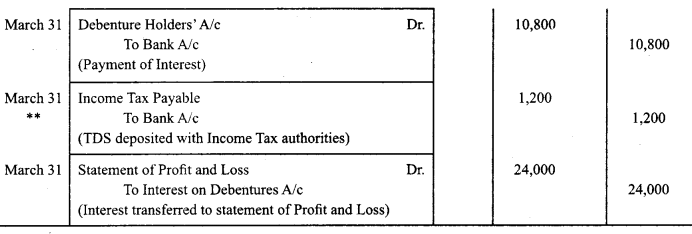
Class 12 Accountancy Important Questions Chapter 3 Reconstitution of Partnership Firm Admission of a Partner 103
Class 12 Accountancy Important Questions Chapter 3 Reconstitution of Partnership Firm Admission of a Partner 104
Working Notes: Capital Adjustment
Nusrat’s Capital (Mohan’s capital + Mahesh’s capital) 20/100
= ( ₹ 3,92,000 + ₹ 2,08,000) x ₹ 20/100
= ₹ 6,00,000 x 20/100 = ₹ 1,20.000

Question 12.
S, T, U and V were partners in a firm sharing profits in the ratio of 4: 3 : 2 : 1. On 1.04.2016 their Balance Sheet was as follows:
Class 12 Accountancy Important Questions Chapter 3 Reconstitution of Partnership Firm Admission of a Partner 105
From the above date partners decided to share the future profits in 3 : 1 : 2 : 4 ratio. For this purpose the goodwill of the firm was valued at ₹ 90,000. The partners also agreed for the following:
(i) The claim for workmen compensation has been estimated at ₹ 70,000.
(ii) To adjust the capitals of the partners according to new profit sharing ratio by opening partners current accounts.
Prepare Revaluation Account, Partners’ Capital Accounts and the Balance Sheet of the reconstituted firm. [Delhi 2017]
(CBSE Sample Paper 2017-18)
Answer:
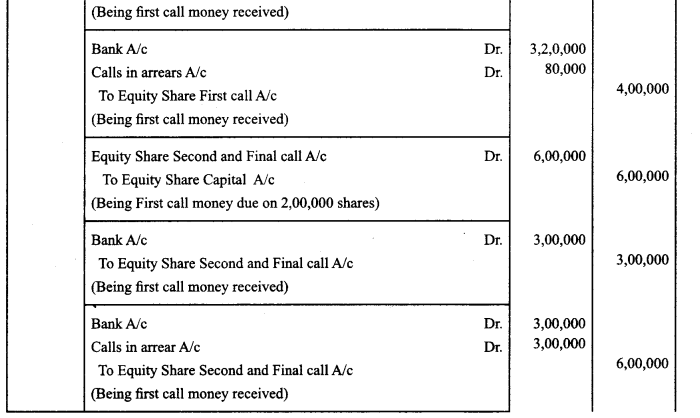
Class 12 Accountancy Important Questions Chapter 3 Reconstitution of Partnership Firm Admission of a Partner 106
Class 12 Accountancy Important Questions Chapter 3 Reconstitution of Partnership Firm Admission of a Partner 107