Planning Class 12 Important Extra Questions Business Studies Chapter 4

Here we are providing Class 12 Business Studies Important Extra Questions and Answers Chapter 4 Planning. Business Studies Class 12 Important Questions are the best resource for students which helps in class 12 board exams.

Class 12 Business Studies Chapter 4 Important Extra Questions Planning

Planning Important Extra Questions Short Answer Type

Question 1.
Why is planning regarded as a pervasive function of management? (1992,1999,2002)
Answer:
Planning is needed for all activities at all levels although the nature and extent of planning vary with the delegated authority, or position a person is holding in the organizational hierarchy and with the broad guidelines outlined by his superiors. Thus planning is a pervasive function of Management.

Question 2.
What are the key elements in the concept-of Planning? (2001)
Answer:
The key elements in. the concept of planning is –

  1. Establishing clear, precise, and realistic objectives.
  2. Determining and evaluating the various available alternatives of doing the task.
  3. Selecting the most suitable alternative.

Question 3.
“Planning restricts creativity” Explain. (2000,2002)
Answer:
Planning involves deciding in advance what is to be done, how it is to be done and when it is to be done, and by whom. Thus all organizational activities are pre-conceived and pre-determined at the stage of planning itself and there is very little or no scope for deviating from the plans due to factors like capital investments, government policies, and so on. This blind conformity with predetermined guidelines discourages individual initiative and freedom.

Question 4.
“Planning is a basic function of management” Explain. (2001)
Answer:
Among various functions of management, planning occupies the foremost position. It precedes the execution of all other managerial functions because it provides the frame of reference for future decisions, reduces the overall impact of changes, and allows managers to organize, staff direct, and control the activities necessary.

Question 5.
Distinguish between goals and objectives.
Answer:

GoalsObjectives
1. Goals are the overall or collective ends of the organization.1. Objectives are specific and particular ends of the organization.
2. Goals are not expressed in numerical terms.2. Objectives are always expressçd in numerical terms.
3. Goals are generally made for the long term.3. Objectives are mostly made for the short term and these must be achieved within a specific time limit.
4. Example – Increase in sales or becoming the leader in the market.4. Increase in sales by 10% in 6 months’ time or increase in market share by 20% in 1 year.

Question 6.
“Planning is not a guarantee of success of a business.” Comment.
Answer:
It is right to say that planning is not a guarantee of the success of a business because the planning function is based on certain assumptions regarding the future and no one care to give a guarantee that assumptions regarding the future are a hundred percent accurate. The planning function suffers from certain limitations which may be lack of accuracy, cost problem, delay in action, etc.

Planning Important Extra Questions Long Answer Type

Question 1.
Explain the nature and characteristics of planning.
Or
“No enterprise can achieve its objective without systematic planning”. Do you agree with the statement?(1990, 1992, 1993, 1995, 1996, 1997, 1999, 2004) (2003)
Answer:
Characteristics of Planning:
1. Goal Oriented: Goals or objectives are the end results towards which activity is directed. The first stage of planning is the conscious and explicit statement of the ultimate objectives.

2. Primacy of Planning: Among various functions of management planning occupies the foremost position. Planning precedes the execution of all other managerial functions because it provides a frame of reference for future decisions. Allows managers to organize staff directly and control the activities necessary to achieve the organizational goals.

3. Pervasiveness of Planning: Planning is needed for all activities at all levels although the nature and extent of planning vary with the delegated authority or position a person is holding in the organizational hierarchy and with the board guidelines provided by his superiors.

4. Intellectual Process: Planning involves logical thinking and decision making. It implies determining what is to be done; how and when it is to be done and by whom. All these decisions require ability, experience, and foresightedness on the part of the management.

5. Continuous function: Planning is a continuous activity. As a matter of fact, the planning process continues so long as an enterprise is in existence.

6. Flexibility: Effective plans have an element of flexibility! Management can’t afford to follow rigid plans in the era of fast changes in the technology market, government policy, etc.

As we all know, the resources of an organization are limited. Planning aims at providing the blueprints to optimum utilization of given resources to achieve the desired goals. Thus it can be concluded that no enterprise can achieve its objectives without systematic planning.

Question 2.
Why is planning necessary for effective management? Give reasons. (1993,1994,1996,1997,2004)
Answer:
Planning is important for better management of business planning determines objective, decides the course of action, removes uncertainty results in economics in operation, and makes control possible its importance is analyzed as below.
1. Takes care of future uncertainties: Future is full of uncertainties planning takes care of all future uncertainties and minimizes business risks since it makes effective use of forecasting techniques.

2. Focuses attention on objectives: All planning is directed towards achieving the objectives of an enterprise. Planning makes these objectives more concrete and tangible by determining the program’s policies, procedures that provide guidelines to the employees to achieve these objectives.

3. Facilitates decision making: Decision making is the core of planning. It is the process of developing and selecting a course of action from among the various alternatives available. Planning provides a framework for decision-making by specifying the organizational objectives and planning premises.

4. Facilitates Control: Controlling is the process that measures current performance against desired standards to ensure that the objectives are attained according to plans. Control is always exercised in the light of planning which provides performance standards in quantitative terms.

5. Promotes efficiency: Proper planning ensures better utilization of organizational resources. Planning involves the selection of the best or most profitable course of action. This reduces the idle time for workers, machines, and so on.

6. Helps in Co-ordination: Planning is necessary for the organization as a whole. Derivative plans are prepared for each department within the limits of the master plan. Thus planning leads to the coordination of activities of all the departments in order to achieve the basic objective of the organization.

Financial Statements of a Company Class 12 Important Questions Accountancy Chapter 8

Here we are providing Class 12 Accountancy Important Extra Questions and Answers Chapter 8 Financial Statements of a Company. Accountancy Class 12 Important Questions and Answers are the best resource for students which helps in class 12 board exams.

Class 12 Accountancy Chapter 8 Important Extra Questions Financial Statements of a Company

Financial Statements of a Company Important Extra Questions Very Short Answer Type

Question 1.
State the importance of financial analysis for labour unions. (CBSE SP 2019-20)
Answer:
Labor unions analyse the financial statements to assess whether an enterprise can increase their pay.

Question 2.
If operating is not given, what is the time for the operating cycle assumed?
Answer:
12 months.

Question 3.
If the operating cycle is given for 12 months and the payment cycle for trade payables is 15 months, how will you classify the liability?
Answer:
Non-current Liability.

Question 4.
Name any one line item that can be shown under the major heading ‘Equity and Liabilities’ in a company’s Balance Sheet.
Answer:
Shareholders’Funds

Question 5.
Name any one item that can be disclosed under ‘Short Term Provisions’.
Answer:
Provision for Doubtful debts.

Question 6.
How would you treat preliminary expenses?
Answer:
Preliminary expenses are written off in the year in which they are incurred.

Question 7.
Give one example of unamortised expenses.
Answer:
Discount on issue of shares / debentures.

Question 8.
State any one component of shareholders’ funds.
Answer:
Reserves & Surplus.

Question 9.
How would you treat share forfeiture account?
Answer:
Added in the subscribed.

Question 10.
Mention one component of Reserves and Surplus.
Answer:
Securities Premium Reserves.

Question 11.
Pratiksha Cartons Limited has given guarantee of ₹ 75,00,000 to a bank for raising loans from the bank by its subsidiary’ company. Where will this be shown in books of the company?
Answer:
This will be mentioned in Notes to Accounts.

Financial Statements of a Company Important Extra Questions Short Answer Type

Question 1.
Explain briefly any four objectives of ‘Analysis of Financial Statements’.
Answer:
Four objective of ‘Analysis of Financial statements are as follows:

  • To assess the current profitability and operational efficiency of the firm as a whole as well its different departments so as to judge the financial health of firm.
  • To ascertain the financial position of firm.
  • To identify the reasons for change in the profitability and financial position of the firm.
  • To Judge the ability of the firm to repay its debt and assessing the short-term as well as the long-term liquidity position fo the firm.

Question 2.
State under which major headings and sub-headings will the following items be presented in the Balance
Sheet of a company as per Schedule-Ill, Part-I of the Companies Act, 2013. (CBSE Delhi 2019)
(i) Prepaid Insurance
(ii) Investment in Debentures
(iii) Calls-in-arrears
(iv) Unpaid dividend
(v) Capital Reserve
(vi) Loose Tools
(vii) Capital work-in-progress
(viii) Patents being developed by the company.
Answer:

ItemsMajor headsSub-heads
1. Prepaid insuranceCurrent AssetsOther curretn Assets
2. Investment in debentureNon-current AssetsNon-current investment
3. Calls in ArrearsShareholders FundSubscribed capital (less from subscribe but not fully paid)
4. Unpaid dividendCurrent liabilitiesOther current liabilities
5. Capital ReserveShareholder FundReserve and Surplus
6. Loose toolsCurrent AssetsInventories
7. Capital work in progressNon-current AssetsFixed Assets (Capital work in progress)
8. Patent being developed by the companyNon-current AssetsFixed Assets (intangible asset under development

Question 3.
Under which major heads and sub-heads will the following items be placed in the Balance Sheet of the company as per Schedule III, Part I of the Companies Act, 2013 ? (CBSE Outside Delhi2019)
(i) Cheques and Bank Drafts in Hand
(ii) Loose tools
(iii) Securities Premium Reserve
(iv) Long-Term Investments with maturity period less than six months
(v) Work-in-Progress
(vi) Mining Rights
(vii) Publishing titles
(viii) Debtors
Answer:

ItemsHeadsSub-heads
Cheques and Bank Drafts in HandCurrent AssetsCash & Cash Equivalents
Loose ToolsCurrent AssetsInventories
Securities Premium ReserveShareholders’ FundsReserves & Surplus
Long term Investments with maturity period less than six monthsCurrent AssetsCurrent Investments
Work-in-ProgressCurrent AssetsInventories
Mining RightNon Current AssetsFixed Assets-Intrangible
Publishing TitlesNon Current AssetsFixed Assets-Intangible
DebtorsCurrent AssetsTrade Receivables

Question 4.
From the following details calculate Interest Coverage Ratio:
Net profit after tax – ₹ 7,00,000
6 % debentures of – ₹ 20,00,000
Tax Rate 30%
Answer:
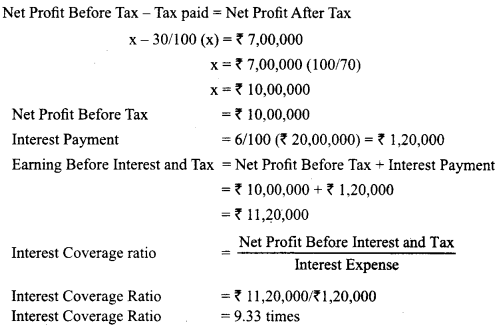
Class 12 Accountancy Important Questions Chapter 8 Financial Statements of a Company 3

Question 5.
Under which major heads and sub-heads will the following items be placed in the Balance Sheet of the company as per Schedule III, Part I of the Companies Act, 2013? (CBSE SP2019-20)
(i) Debentures with maturity period in current financial year
(ii) Securities Premium Reserve
(iii) Provident Fund
Answer:

S. No.ItemMajor HeadSub Head
(i)Debentures with maturity period in current financial yearCurrent LiabilitiesOther Current Liabilities
(ii)Securities Premium ReserveShareholder’s FundReserves and Surplus
(iii)Provident FundNon-Current LiabilitiesLong Term Provision

Question 6.
Under which sub-headings will the following items be placed in the Balance Sheet of a company as per Schedule-Ill, Part-I of the Companies Act, 2013? (CBSE Compt.2019)
(i) Prepaid Expenses
(ii) Loose Tools
(iii) Loans Repayable on Demand
(iv) Provision for Employee Benefit
(v) Negative Balance in the Statement of Profit and Loss
(vi) Bank Overdraft
(vii) Bills Receivables
(viii) Trade Marks
Answer:

ItemsSub-Head
(i)Prepaid ExpensesOther Current Assets
(ii)Loose ToolsInventories
(iii)Loans repayable on demandShort Term borrowings
(iv)Provision for employees benefitLong term provisions
(v)Negative balance in Statement of Profit and LossReserves and Surplus
(vi)Bank OverdraftShort Term borrowings
(vii)Bills ReceivableTrade Receivables
(viii)Trade MarksFixed assets Intangible

Question 7.
(a) Classify the following items under Major Head and Sub-Head (if any) in the Balance Sheet of a company as per Schedule III of the Companies Act, 2013.
(i) Capital Work in progress; and
(ii) Provision for warranties.
(b) State any two objectives of ‘Analysis of Financial Statements’. (Compt. Delhi 2017)
Answer:
(i) Classification of items

S.No.ItemsHeadingsSub-headings
(i)Capital work in progressNon-current assetsFixed assets
(ii)Provision for warrantiesNon-current liabilitiesLong term provisions

(ii) Objectives of analysis of financial statements

Question 8.
(i) One of the objectives of analysis of financial statement is to ascertain the relative importance of the different components of the financial position of the firm’. State two other objective of this analysis.
(ii) List any four items of ‘reserve’ that are shown under the headings ‘Reserves and Surplus’ in the Balance Sheet of a company as per scheduel III of the Companies Act 2013.
(CBSE Outside Delhi 2016)
Answer:
(i) Objectives of Analysis of Financial Statement:

  • Assessing the earning capacity or profitability of the firm as a whole as well as its different departments so as to judge the financial health of the firm.
  • Judging the ability of the firm to repay its debts and assessing the short term as well as long term liquidity position of the firm.

(ii) Reserve and Surplus

  • Capital Reserve
  • Securities Premium Reserve.
  • Revaluation Reserve.
  • Capital Redemption Reserve.

Question 9.
(i) One of the objectives of ‘financial Statement Analysis, is to identify the reasons for change in the financial position of the enterprise. State two more objectives of this analysis.
(ii) Name any two items that are shown under the head ‘Other Current Liabilities’ and any two items that are shown under the head ‘Other Current Assets’ in the Balance Sheet of a company as per Schedule III of the Companies Act, 2013. (CBSE Outside Delhi 2016)
Answer:
(i) Objectives

  • To evaluate the business in Terms of profit in present and future.
  • To evaluate the efficiency of various parts or departments of the business.

(ii) Other Current Liability

  • Unpaid dividend
  • Current maturity of long term debts.

Other Current Assets.

  • Discount in issue of debentures (to be written off within 12 months).
  • Accrued incomes.

Question 10.
List the major heads under which the ‘Equity and Liabilities’ are presented in the balance sheet of a company as per Schedule III Part I of the Companies Act, 2013. (CBSE Guidance Notes July 2013)
Answer:
The major heads under which ‘Equity and Liabilities’ are presented:

  • Share holders Fund
  • Share Application Money Pending allotment
  • Non-Current liabilities
  • Current Liabilities

Question 11.
List the major heads under which the ‘Assets’ are presented in the balance sheet of a company as per Schedule III Part I of the Companies Act, 2013. (CBSE Guidance Notes July 2013)
Answer:
The major heads under which the ‘Assets’ are presented:
(a) Non-current Assets
(b) Current Assets

Question 12.
Name the sub-heads under the head
(a) shareholders Funds’ and
(b) Non-Current Liabilities as per Schedule III Part I of the balance sheet. (CBSE Guidance Notes July 2013)
Answer:
(a) The sub-heads under‘Shareholders Funds’are

  • Share Capital
  • Reserves and surplus
  • Money received against share warrants

(b) The sub-heads under ‘Non-current liabilities’ are

  • Long-term Borrowings
  • Deferred Tax Liabilities (Net)
  • Other Long-term Liabilities
  • Long-term Provisions

Question 13.
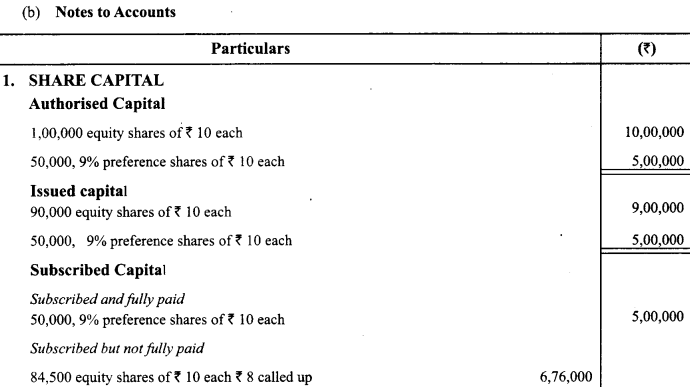
X Ltd. has an authorized capital of₹ 15,00,000 divided into 1,00,000 equity shares of ₹ 10 each and 50,000, 9% preference shares of ₹ 10 each. The company invited applications for all the preference shares but only 90,000 equity shares. All the preference shares were subscribed, called and paid while subscriptions were received for only 85,000 equity shares.
During the first year ₹ 8 per share were called.
Ram holding 1,000 shares and Shyam holding 2,000 shares did not pay first call of ₹ 2.
Shyam’s shares were forfeited after the first call and later on 1,500 of the forfeited shares were reissued at ₹ 6 per shares ₹ 8 called up.
(a) Show share capital in the Balance Sheet as per revised Schedule VI as at 31st March 2013.
(b) Prepare relevant ‘Notes to Accounts’ (CBSE Guidance Notes July 2013)
Answer:
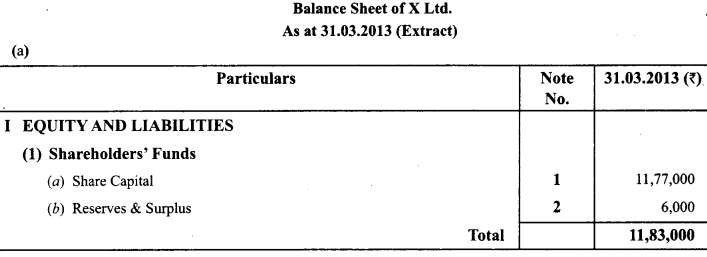
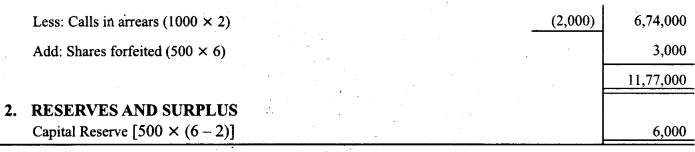
Class 12 Accountancy Important Questions Chapter 8 Financial Statements of a Company 6
Class 12 Accountancy Important Questions Chapter 8 Financial Statements of a Company 7
Class 12 Accountancy Important Questions Chapter 8 Financial Statements of a Company 8

Question 14.
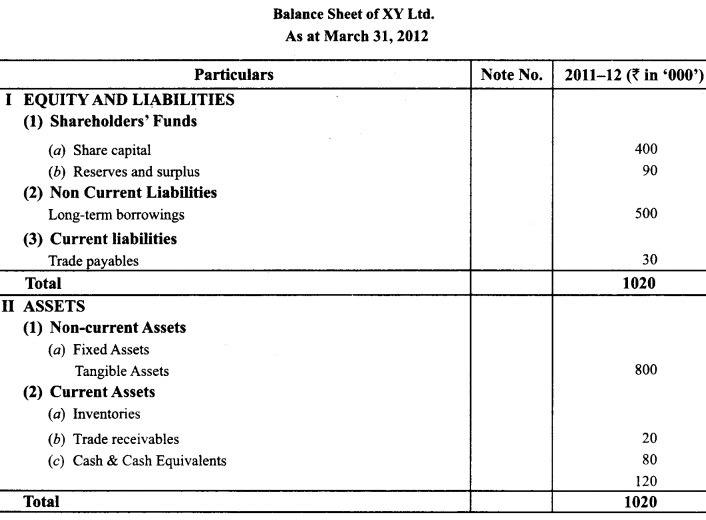
From the following information extracted from the books of XY Ltd., prepare a Balance sheet of the company as at March 31, 2012 as per Schedule III of the Companies Act, 2013.

ParticularsAmount in ‘000’ (₹)
Long-Term Borrowings500
Trade Payable300
Share Capital400
Reserve and surplus90
Fixed assets (angible)800
Inventories20
Trade receivables80
Cash and cash equivalents120

Answer:
Class 12 Accountancy Important Questions Chapter 8 Financial Statements of a Company 9

Question 15.
JW Ltd was a company manufacturing geysers. As a part of its long term goal for expansions, the company decided to identify the opportunity in rural area. Initial plan was rolled out for Bhiwani village in Haryana. Since, the village did not have regular supply of electricity, the company decided to manufacture solar geysers. The core team consisting of the Regional Managers, Accountant and the Marketing Manager was taken from the Head office and the remaining employee were selected from the village and neighbourhood area. At the time of preparation of financial statement the accountant of the company fell sick and the company deputed a junior accountant temporarily from the village for two months. The Balance Sheet prepared by the junior accountant showed the following items against the Major heads and sub-head mentioned which were not as per Schedule III of the Companies Act 2013. Items Major Head

  • Loose Tools Trade Receivable
  • Cheque in Hand Current Investment
  • Term Loan from Bank Other long Term Liabilities
  • Computer Software Tangible Fixed Assets

Present the above items under the correct major head and sub-head as per the Schedule III of Companies Act 2013. (CBSE Delhi 2018)
Answer:

ItemHeadsSub-heads
Loose ToolsCurrent assetsInventories
Cheques in handCurrent assetsCash and Cash Equivalent
Term loan from BankNon-Current LiabilitiesLong Term Borrowings
Computer SoftwareNon-Current assetsFixed Assets-Intangible Assets

Question 16.
M K Limited is a computer hardware manufacturing company. While preparing its accounting records it takes into consideration the various accounting principles and maintains transparency. At the end of the accounting year, the company follows the ‘Companies Act, 2013 and Rules there under’ for the preparation of its Financial Statements. It also prepares its Income Statement and Balance Sheet as per the format provided in Schedule III to the Act. Its Financial Statements depict its true & fair financial position. For the financial year ending March 31,2017, the accountant of the company is not certain about the presentation of the following items under relevant Major Heads & Sub Heads, if any, in its Balance Sheet:

  • Securities Premium Reserve
  • Calls in Advance
  • Stores & Spares

Advice the accountant of the company under which Major Heads and Sub Heads, if any, he should present the above items in the Balance Sheet of the company, (CBSE Sample Paper 2017-18, Modified)
Answer:

S. No.ItemsMajor HeadSub Head
(i)Securities Premium ReserveShareholders’ FundsReserves & Surplus
(ii)Calls in AdvanceCurrent LiabilitiesOther Current Liabilities
(iii)Stores & SparesCurrent AssetsInventory

Question 17.
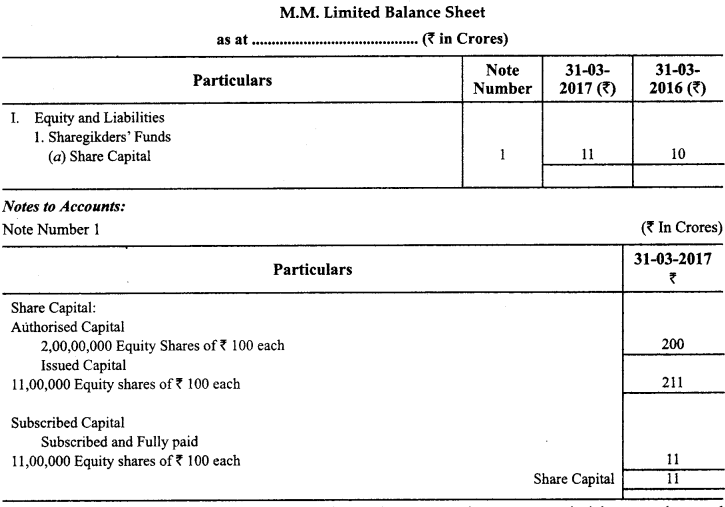
M.M. Limited is registered with an Authorised capital of ₹ 200 Crores divided into equity shares of ₹ 100 each. On 1st April 2016 the Subscribed and Called up capital of the company is ₹ 10,00,00,000. The company decided to help the unemployed youth of the naxal affected areas of Andhra Pradesh, Chhattisgarh and Odisha by opening 100 ‘Skill Development Centres’. The company also decided to provide free medical services to the villagers of these states by starting mobile dispensaries. To meet the capital expenditure of these activities the company further issued 1,00,000 equity shares during financial year 2016-17. These shares were fully subscribed and paid.
Present the share capital of the company in its Balance Sheet. (CBSE Sample Paper 2017-18 Modified)
Answer:
Class 12 Accountancy Important Questions Chapter 8 Financial Statements of a Company 12

Question 18.
Financial statements are prepared following the consistent accounting concepts, principles, procedures and also the legal environment in which the business organizations operate. These statements are the sources of information on the basis of which conclusions are drawn about the profitability and financial position of a company so that their users can easily understand and use them in their economic decisions in a meaningful way.
State under which major headings and sub-headings the following items will be presented in the balance sheet of a company as per Schedule III of the Companies Act 2013.

  • General Reserves,
  • Short term loans and advances,
  • Capital work in progress and
  • Design.

Answer:

HeadsSub-head
General ReservesShareholders’ FundsReserves and Surplus
Short term loans and advancesCurrent assets
Capital work in progressNon current assetsFixed assets
DesignNon current assetsFixed assets/intangible assets

Question 19.
Mudra Ltd. is in the process of preparing its Balance Sheet as per Schedule III, Part I of the Companies Act, 2013 and provides its true and fair view of the financial position.
(a) Under which head and sub-head will the company show ‘Stores and Spares’ in its Balance Sheet₹
(b) What is the accounting treatment of ‘Stores and Spares’ when the Company will calculate its Inventory Turnover Ratio?
(c) The management of Mudra Ltd. want to analyse its Financial Statements. State any two objectives of such analysis. (CBSE Sample Paper 2016, 2017, Modified)
Answer:
(a) Head: Current Assets Sub head; Inventories
(b) While calculating Inventory Turnover Ratio it is not included in Inventories
(c) Objectives – Assessing the ability of the enterprise to meet its short term and long term commitments, Assessing the earning capacity of the enterprise

Question 20.
(a) Under which major headings and sub-headings the following items will be shown in the Balance Sheet of a company as per Schedule VI, Part I of the Companies Act, 2013.
(i) Bank Overdraft
(ii) Cheques in Hand
(Hi) Loose Tools
(iv) Long term provisions
(b) State any two limitations of Financial Statement Analysis.
Answer:

S. No.ItemsHeadingsSub Headings
1.Bank overdraftCurrent liabilitiesShort term borrowings
2.Cheques in handCurrent assetsCash and cash equivalents
3.Loose ToolsCurrent assetsInventories
4.Long Term ProvisionsNon current liabilities

Historical Analysis: Financial statements are based on fast figures. So, we cannot predict about the future accurately.
Ignores price level changes: Financial statements are prepared at the end of year. When these are analysed, values of figures tend to change.

Question 21.
Under which major heads and subheads of the Balance Sheet of a company, will the following items be shown:
(i) Loose Tools
(ii) Retirement Benefits Payable to employees
(iii) Patents
(iv) Interest on Calls in Advance (CBSE Sample Paper 2018-19)
Answer:

S. No.ItemsMajor Head of Balance SheetSubHead of Balance Sheet
(i)Loose ToolsCurrent AssetsInventories
(ii)Retirement Benefits Payable to employeesNon-Current LiabilitiesLong Term Provisions
(iii)PatentsNon-Current AssetsFixed Asset (Intangible)
(iv)Interest on Calls in AdvanceCurrent LiabilitiesOther current Liabilities

Question 22.
(a) Name the sub-heads under the head ‘Current Liabilities’ in the Equity and Liabilities part of the Balance Sheet as per Schedule III of the Companies Act 2013.
(b) State any two objectives of Financial Statements Analysis. (CBSE Sample Paper 2015)
Answer:
(a) Current Liabilities:

  • Short Term Borrowings
  • Trade Payables
  • Other Current Liabilities
  • Short Term Provisions

(b) Objectives of financial statement analysis

  • Helps in assessing financial earning capacity of a company
  • Helps in assessing managerial efficiency

Question 23.
Name the sub-heads under the head ‘Non-Current Assets’ in the Balance Sheet under Schedule III of the Indian Companies Act, 2013. (CBSE Guidance Notes July 2013)
Answer:
The sub-heads under ‘Non-current assets’ are

  • Fixed Assets
  • Non-Current Investments
  • Deferred Tax Assets (Net)
  • Long-term loans and advances
  • Other Non-current Assets

Question 24.
Under which major headings and sub-headings the following items will be shown in the Balance Sheet of a company as per Schedule III, Part I of the Companies Act, 2013.
(i) Bank Overdraft
(ii) Cheque in hand
(iii) Loose tools
(iv) Long term provisions
Answer:

ItemsHeadingsSub-headings
Bank OverdraftCurrent liabilitiesShort term borrowings
Cheques in handCurrent assetsCash and cash equivalents
Loose ToolsCurrent assetsInventories
Long Term ProvisionsNon-Current liabilities

Question 25.
Under which heads the following items will be placed in the Balance Sheet of a company as per Schedule III Part I of the Companies Act, 2013.
(a) Cash in hand
(b) Mining rights
(c) Short term deposits
(d) Debenture redemption reserve
(e) Income received in advance
(f) Balance in statement of profit and loss
(g) Office equipment
(h) Work in progress (CBSE Delhi 2015)
Answer:

ItemsMajor Heads
Cash in handCurrent Assets
Mining rightsNon Current Assets
Short term depositsCurrent Assets
Debenture redemption reserveShareholders’ Funds
Income received in advanceCurrent Liabilities
Balance in the statement of profit and lossShareholders’ Funds
Office equipmentNon Current Assets
Work in progressCurrent Assets

Question 26.
Under which headings the following items will be presented in the Balance Sheet of a company as per Schedule III Part I of the Companies Act, 2013₹ [Any four]
(a) Loans provided repayable on demand
(b) Goodwill
(c) Copyrights
(d) Loose tools
(e) Cheques
(f) General reserve
(g) Stock of finished goods and
(h) 9% Debenture repayable after three years
Answer:

ItemsMajor Heads
Loans provided repayable on demandCurrent Liabilities
GoodwillNon Current Assets
CopyrightsNon Current Assets
Loose toolsCurrent Assets
ChequesCurrent Assets
General reserveShareholders’ Funds
Stock of finished goodsCurrent Assets
9% Debenture repayable after three yearsNon current Liabilities

Question 27.
Under which head the following items will appear in case of financial company₹
(i) Interest Received
(ii) Dividend Received
(iii) Profit and sale of securities
(iv) Loss an sale of plot
(y) Wages paid
(vi) Depreciation on building
Answer:

ItemsHeadings
Interest ReceivedRevenue from operations
Dividend ReceivedRevenue from operations
Profit and sale of securitiesRevenue from operations
Loss an sale of plotOther Income
Wages paidEmployee Benefit Expenses
Depreciation on buildingDepreciation and Administration Expenses

Question 28.
Under which head the following items will appears in case of non-financial company₹
(i) Sales
(ii) Sale of scrap
(iii) Interest received
(iv) Profit and sale of Investments
(v) Bonus
(vi) Interest paid on loans
(vii) Administration Expenses
(viii) Excess Provision written bank
(ix) Raw Material
(x) Leave encashment
Answer:

ItemsHeadings
SalesRevenue from operations
Sale of scrapRevenue from operations
Interest receivedOther Incomes
Profit on sale of InvestmentsOther Incomes
BonusEmployee benefit Expenses
Interest paid on loans.Finance Cost
Administration ExpensesOther Expenses
Exam Provision written bankOther Incomes
Raw MaterialCost of Material
Leave encashmentEmployee benefit Expenses

Question 29.
How would you show ‘Employee Benefit Expenses with the help of Notes to Accounts in the Statement of Profit & Loss₹
(i) Salaries & wages ₹ 5,20,000
(ii) Dividend received ₹ 5000,
(iii) Leave encasement ₹ 400,000
(iv) Salaries to manages ₹ 10,00,000
(v) Depreciation on fixed assets ₹ 200,000
(vi) Contribution to provident fund ₹ 5000.
Answer:
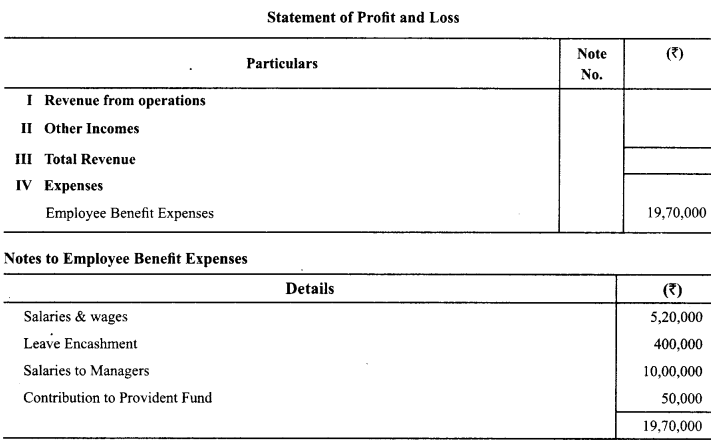
Class 12 Accountancy Important Questions Chapter 8 Financial Statements of a Company 15

Question 30.
Which of the following items will form the part of Notes to Accounts on Finance Costs₹
(i) Interest paid an overdraft
(ii) Interest paid on debentures
(iii) bank charges
(iv) Discount an issue of debentures
(v) Premium payable an redemption of debentures
(vi) Discount allowed to debtors
(vii) Bad-debts
(viii) Bonus
(ix) Interest Received on fined deposits
(x) Legal processing fee
Answer:
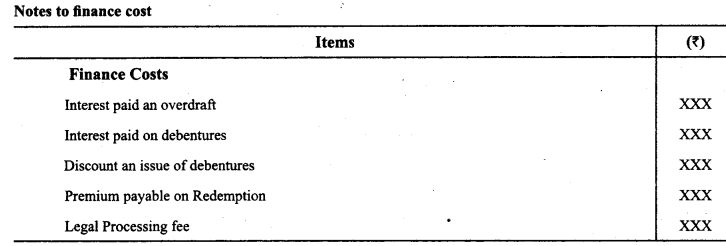
Class 12 Accountancy Important Questions Chapter 8 Financial Statements of a Company 16
Please note that bank charges are not related to raising finance. So, bank charges, discount allowed to debtors, Bad-debts are the part of finance cost. Interest received is the part of other incomes & bonus is the part of employee benefits expenses.
Business Environment Class 12 Important Extra Questions Business Studies Chapter 3

Here we are providing Class 12 Business Studies Important Extra Questions and Answers Chapter 3 Business Environment. Business Studies Class 12 Important Questions are the best resource for students which helps in class 12 board exams.

Class 12 Business Studies Chapter 3 Important Extra Questions Business Environment

Business Environment Important Extra Questions Short Answer Type

Question 1.
Give your views on ‘Economic Environment in India.
Answer:
The economic environment in India consists of various macro-level factors related to the means of production and distribution of wealth which have an impact on business. These are

  1. Stage of economic development of the country.
  2. The economic structure in the form of a mixed economy.
  3. Economic policies of Government including industrial monetary and fiscal policy.
  4. Economic planning including five-year plans etc.
  5. Infrastructural factors such as financial institutions.

Question 2.
State briefly the influence of the technological environment on business and industries.
Answer:
Positive effects:

  1. The efficiency of business increases tremendously to face global competition.
  2. The firm is able to produce better quality products at a cheaper price.

Negative effects:

  1. Continuous up-gradation as per the changing environment has become a necessity to remain competitive in the market.
  2. Small and medium enterprises find it difficult to invest in the new technologies due to limited funds available.

Question 3.
Do you agree with the statement that “Environment offers opportunities as well as threats”? Discuss.
Answer:
Yes, the statement that the business environment offers opportunities, as well as threats, holds true. Threats to the domestic industry can be in the form of increased or cutthroat competition, no availability of a trained workforce.

Shortage of raw materials, a shift in consumer demand to other products, etc. For example, Chinese toy manufacturers have taken over the world toy market. Now they almost have taken monopoly in this sector.

The opportunities can be experienced in the form of easy accessibility to new technology, opening, up of new investment avenues increased orders, world quality products due to competition, etc. For example, there is increased demand for environment-friendly products.

Question 4.
Explain the Environment analysis and its Diagnosis with SWOT analysis.
Answer:
Environment Analysis is the study of various factors of l environment affecting the business, like economic factors, political factors, technological factors, global factors, etc. Environment analysis helps to anticipate opportunities and to plan to take appropriate actions to avail these opportunities. By careful analysis of the environment, the business comes to know the opportunities provided and threats posed by the environment.

However, in general, the manager takes the help of SWOT analysis to analyze the environment. SWOT analysis has have been discussed below:

Swot analysis: Swot Analysis is an analysis of the strengths and weaknesses of the organization and the opportunities and threats in the: environment. SWOT-analysis helps in the formulation of business policy.

Two parts of SWOT analysis are

1. Strengths and Weaknesses: Strengths and weaknesses are related to internal factors such as finance, technology, production facilities, personnel capabilities, etc. of the business organization. The ability of a business organization to exploit the available environmental opportunities depends upon the strength of these internal factors. An organization should concentrate on such business for which it is most competent in case if it does not possess the necessary strength to exploit the opportunities.

2. Opportunities and Threats: Opportunities and threats are related to the external environment. Good opportunities are provided to the business by changes in the external environment. Similarly, the same is responsible for posing threats to the business. Lower rate of interest, development of new market new innovations, etc. are some forms of opportunities. Threats may in the form of increased competition decreasing demand, obsolete technology, etc.

Business Environment Important Extra Questions Long Answer Type

Question 1.
What is Environmental Scanning? Explain the SWOT technique of Environmental scanning.
Answer:
Environmental Scanning: The first and foremost step in corporate planning is environmental scanning. Every organization functions within a specific environment and the various elements of the environment have a significant influence – on its functioning.

SWOT stands for
S – Strengths,
W – Weakness,
O – Opportunities, and
T – Threats.

Strength: Strength is an inherent capacity that an organization can use to gain a strategic advantage over its competitors. For example, superior research and development facilities enable a firm to develop new products and there by gain a competitive advantage:

Some of the examples of a company’s strength are:

  1. Management
  2. Marketing
  3. Finance
  4. Production
  5. Personal

Weakness: Weakness is an inherent limitation or constraint which creates a strategic disadvantage. For example, over-dependence on a single product is potentially very risky.

Some of the examples of the weakness of a company are:

  1. Management
  2. Marketing
  3. Finance
  4. Production
  5. Personnel

Opportunity: Opportunity is a favorable condition in the environment. It enables an enterprise to consolidate its position. For exam growth of the demand is an opportunity for the company to grab.

Threat: Threat is an unfavorable condition in the environment. It creates a risk to the business. For example, growing competition is a threat to the business.

Thus we can see that SWOT Analysis helps an enterprise in matching its strengths and weakness with the opportunities and threats operating in the environment.

Question 2.
Explain in detail the External Environment and affecting factors.
Answer:
External Environment: External Environment consists of all the forces, institutions, and events that are relevant to an organization’s operations but which are absolutely beyond the control of the enterprise. It includes all the outside factors that provide opportunities and pose threats to the organization. The main components of the external environment are:

  • Micro Environment includes competitors, suppliers, consumers, the public at large, and marketing intermediaries.
  • Macro Environment includes economic environment, socio-cultural environment, political environment, legal environment, and technological environment.
  • Micro Environment Micro environment includes all those factors which are closely related to the business. These factors have a different effect on various types of enterprises. Every enterprise has its unique dealing with all these factors. The various factors included in the microenvironment are

1. Competitors Every business enterprise and its policies are affected by the competitors to a great extent. The policies of the competitors can affect the pricing of the product, quality, and quantity of the product, the advertising pattern and budget, etc.

2. Suppliers Business enterprise is very much affected by its relationship with its suppliers. It is in the hands of the suppliers to make the uninterrupted supply of raw materials at a reasonable price.

3. Consumers: The satisfaction of the consumers is one of the main aims of a business enterprise. Different types of consumers are of different importance to the enterprise. The business enterprise must be able to provide goods according to the tastes and preferences of different types of consumers.

4. Public at Large The attitude and behavior of different constituents of the public at large like the local public, trade unions, press, etc. affect the business enterprises.

5. Marketing Intermediaries The marketing intermediaries like agents, whole-sellers, retailers, etc. also affect the business enterprises to a great extent. They act as a link between the manufacturer and the ultimate consumer and can be an important factor in the business.

Principles of Management Class 12 Important Extra Questions Business Studies Chapter 2

Here we are providing Class 12 Business Studies Important Extra Questions and Answers Chapter 2 Principles of Management. Business Studies Class 12 Important Questions are the best resource for students which helps in class 12 board exams.

Class 12 Business Studies Chapter 2 Important Extra Questions Principles of Management

Principles of Management Important Extra Questions Short Answer Type

Question 1.
Explain the term Principles of Management?
Answer:
Principles of Management:
A Principle is a fundamental statement of truth that provides a guideline to thought and action. It is a universal truth that establishes a cause and effect relationship between two or more variables. These fundamental truths are applicable in specific circumstances and are capable of predicting the result of any Managerial action. Principles are both ‘descriptive’ and Prescriptive’ in nature.

A principle is descriptive if it simply describes the relationship between the variables. It is prescriptive if it indicates what should be done in a given situation. The principle of management lays down guidelines for improving management practice. These principles are the result of the long experience of managers in different fields of organized effort. Most of these principles are applicable in all kinds of managerial situations, be it a government organization, a business enterprise, a religious foundation, or an educational institution.

Question 2.
Why the principles of Management needed?
Answer:
According to Terry, “Principles of management are to a manager as a table of the strength of materials is to a civil engineer,” The utility of principles lies in the foundation they provide for its efficient conduct, by making out the basic features that must characterize the practice of management, irrespective of where it is occurring. By means of the principle of Management, a manager can avoid the fundamental mistakes in his job and foretell the results of his action with confidence.

Question 3.
Explain in brief the major criticisms of scientific management.
Answer:
Demerits or Criticisms of Scientific Management:- Although there are many advantages of Taylor’s scientific management yet it has also been severely criticized. Following are the main points of criticism.

Criticisms by Employers:

  1. Costly/Expensive System: In this scientific management system, much cost is required. More capital has to be invested to implement scientific management. It is a very expensive system.
  2. Time-Consuming: This system is very time-consuming. It takes too much time to implement scientific management.
  3. The fault of Specialisation: The excess specialization creates faults. The problem of certification also arises. It is not suitable for small industrial units.
  4. Lack of Freedom: With the appointment of specialists, the producers cannot take decisions freely as most of the responsibilities fall on specialists. So, they feel hesitant in adopting the scientific technique.
  5. Unsuitable for Small Scale Business: As the technique of scientific management is much expensive, only large scale enterprises can implement it. It is impossible for small-scale businesses to adopt these techniques.

Criticisms by Employees:

  1. Fear of Unemployment
  2. Indifference of Work
  3. Exploitation
  4. End of Initiative
  5. Criticism by Labour Unions
  6. Bad effect on health
  7. Excessive work land

Question 4.
What is the differential piece wage system advocated by F.W. Taylor and also gives an illustration?
Answer:
Differential piece wage system Taylor was a strong advocate of the piece wage system. He wanted to differentiate between efficient and inefficient workers. The standard time and other parameters should be determined on the basis of the work-study discussed above. The workers can then be classified a$ efficient or inefficient on the basis of these standards. He wanted to reward efficient workers.

So he introduced the different rates of wage payment for those who performed above standard and for those who performed below standard. For example, it is determined that standard output per worker per day is unit, and those who made standard or more than standard or more than standard will get Rs 60 per unit and those below will get Rs 30 per unit. Now an efficient worker making 10 units will get 10×60 = Rs 600/- per day whereas a worker who makes 6 units will get 6 × 30 = Rs 180 per day.

According to Taylor, the difference of Rs 420 should be enough for the inefficient worker to be motivated to perform better. It is important to have a re-look at the techniques of scientific management as comprising a unified whole of Taylorian prescription of efficiency. Therefore, the sum and substance of Taylorism lie not in the disjointed description of principles and techniques of scientific management, but in the change in the mindest, which he referred to as mental revolution.

Principles of Management Important Extra Questions Long Answer Type

Question 1.
Name the main principles of Management propounded by Henri Fayol and explain any two?
Answer:
Development of Management Principles: It was Henri Fayol a French mining engineer and chief executive who for the first time stated a set of 14 principles of management. Fayol wrote these principles on the basis of his practical experience as a manager. According to him, these principles can be applied in all types, functions, levels, and sizes of organizations. This had earned him the title universalist’. For a long time, Fayol’s list was accepted as ‘Complete and Comprehensive. A description of these principles follows.

  1. Division of Work
  2. Authority and Responsibility
  3. Discipline
  4. Unity of command
  5. Unity of direction
  6. Subordination of individual interests to the general interests
  7. Remuneration
  8. Centralization
  9. Scalar chain hierarchy
  10. Order
  11. Equity
  12. Stability of personnel
  13. Initiative
  14. Esprit de corps

1. Division of Work – This is the principle of specialization which applies to all kinds of work. The more people specialize, the more efficiently they can perform their work. Specialization increases output by making employees more efficient.

2. Authority and Responsibility – Authority is the right to give orders and the power to exact obedience. Managers need authority to get things done. According to Fayol, responsibility is a corollary and a natural consequence of authority. Responsibilities an obligation to perform the tasks in a satisfactory manner.

Question 2.
Give reasons for or against the Universality of the principle of Management?
Answer:
University of Management principles Universality of management suggests that the manager uses the same managerial skills and principles in each managerial position held in various organizations. Accordingly, an industrial manager could manage a philanthropic organization, a retired army general could manage a university, a civil servant could manage an industrial organization, and so on.

Universality implies transferability of Managerial skills across industries, countries, countries. It means that management is generic in content and applicable to all types of organizations. Lawrence A. Appley declared that ‘He who can manage, can manage anything.’ Let us examine the factors that have contributed to the universal application of management in every level of organization and at every level of organizations.

Arguments for Universality:
1. Managers perform the same functions irrespective of their level in the organization, industry, or country. The functions performed by the company president and the office supervisors .are the same Regardless of the label-all managers plan, organize, lead and control. The difference lies in such things as the breadth of the objectives, the magnitude of the decision taken, the organization’s relationships affected, and so on.

2. Classical writers like Fayol, Urwick, and others believed that there are certain principles in management that are universally applicable.

3. The fundamentals governing the management of a business, a Church, or a university are the same, the differences lie in the techniques employed and practices followed. All managers accountable for the performance of other people, they plan, make decisions, organize work, motivate people and implements control, and so forth. In order to achieve the results the techniques employed might differ depending on situational factors like culture, tradition, attitudes, etc.

4. The very fact that managers regularly move from public to private sector organizations bears ample testimony to the fact that management concepts are universal across organizational types.

Arguments against the Universality This is –
1. The universal thesis implies complete substitutability of managerial skills which is rarely found in actual practice. It seems improbable that the captain of a hockey team would excel equally as the president of the charitable agency or as the vice-chancellor of a university. It is true that the manager’s job becomes almost universal in content at the upper levels of organizations. At a lower level of organization, however, transferability of managerial skills may not be possible.

2. Universality thesis presupposes the existence of predictability regarding the outcomes of management actions. A manager working in firm A must be able to predict the likely consequences of his actions in firm B where he is likely to join. And he may have to face serious problems in case the underlying philosophies of these organizations were to differ.

Nature and Significance of Management Class 12 Important Extra Questions Business Studies Chapter 1

Here we are providing Class 12 Business Studies Important Extra Questions and Answers Chapter 1 Nature and Significance of Management. Business Studies Class 12 Important Questions are the best resource for students which helps in class 12 board exams.

Class 12 Business Studies Chapter 1 Important Extra Questions Nature and Significance of Management

Nature and Significance of Management Important Extra Questions Short Answer Type

Question 1.
Distinguish between coordination and cooperation.
Answer:

Co-ordinationCooperation
1. It is an orderly arrangement of a group effort to provide for unity of action.1. It is a voluntary desire to help each other
2. Co-ordination includes cooperation, hence it is a wider term.2. Co-operation is a narrow term as it is a part of co-ordination.
3. It is a deliberate effort made by the management to balance interrelated activities.3. It is the voluntary effort made by a group of people depending on their mental needs or liking
4. It is a technique.4. It is an attitude.

Question 2.
Write the characteristics of management and explain any two.
Answer:
Characteristics The key features of management are –

  1. Goal-oriented process,
  2. all-pervasive,
  3. multidimensional,
  4. Continuous process,
  5. group activity
  6. dynamic function,
  7. tangible force.

1. Management is a goal-oriented process:  An organization has a set of basic goals which are the basic reason for its existence. These should be simple and clearly stated.

2. Management is all-pervasive: The activities involved in managing an enterprise are common to all organizations whether economic, social, or political Thus it is all-pervasive.

Question 3.
“Lack of proper management results in wastage of time money and efforts.” Do you agree with this statement? Give reasons in support of your answer. (2003)
Answer:
Yes, the above-mentioned statement holds true as the reasons are as follows.

  1. Means to accomplishing goals:  Management is important because it helps in achieving group goals, increases efficiency, and creates a dynamic organization.
  2. Unified direction: Management motivates and directs the workforce by unifying goals with the group goals.
  3. Establishes sound industrial relations: The success of any organization depends upon its workforce. It is the only factor of production which is movable in nature. Effective management tries to build a feeling of team and loyalty towards the organization.
  4. It looks after for future uncertainties: An effective management prepares the organization for future contingencies and paved the way for its survival and growth. In the ‘ absence of this foresightedness, an organization may be forced to wind up its operations resulting in wastage of time, efforts, and resources.

Question 4.
State two objectives of management. (1993, 1996, 1998)
Answer:
The main two objectives of management are –

  1. Maximization of profits at minimum cost.
  2. Optimum utilization of the given resources by the organization.

Question 5.
What is meant by Administration? (1992, 1999)
Answer:
Administration means a determination of overall policies, the setting of major objectives, the identification of general-purpose, the laying out of broad programs, etc. It is determinative in nature.

Question 6.
Name any two activities undertaken at the top-level management. (1995, 2001, 2004)
Answer:
The two main functions or activities of top-level management are.

  1. It does long-term planning and formulating suitable policies, organizing (determination of organization structure), and controlling.
  2. It maintains cordial relations with all outside parties like the shareholders, the government, etc.

Question 7.
State two functions of lower-level management. (1992-1994)
Answer:
The main functions are as follows –

  1. It translates the intermediate plan of middle-level management into day to day operating plan.
  2. It gives directions to operating employees by assigning jobs, evaluating and correcting their performance and sends information and progress reports to higher management.

Nature and Significance of Management Important Extra Questions Long Answer Type

Question 1.
Do you think proper Management is an important part of an organization?
or
Explain the importance of management.
Answer:
Yes, management is a universal activity that is integral to any organization. We now examine some of the reasons that have made management so important.

1. Management helps in achieving group goals: Management is required not for itself but for achieving the goals of the organization, the task of a manager is to give a common direction to all.

2. Management increases efficiency:  The aim of a manager is to reduce costs and increase productivity ” through better planning, organizing directing, staffing, and controlling the activities of the organization.

3. Management creates a dynamic organization: All organizations have to function in an environment that is constantly changing.

4. Management helps in achieving personal objectives: A manager motivates and leads his team in such a manner that individual members are able to achieve personal goals while contributing to the overall organizational objective.

5. Management helps in the development of society: An organization has multiple objectives to serve the purpose of the different groups that constitute it. In the process of fulfilling all these management helps in the development of the organization and through that it helps in the development of society. It helps to provide good ‘ quality products and services, creates employment opportunities, and leads the path towards growth and development.

Question 2.
Explain the level of management and their main functions.
Answer:
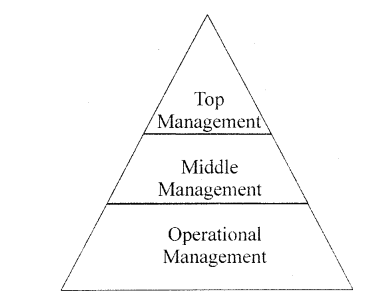
Level of Management.
Class 12 Business Studies Important Questions Chapter 1 Nature and Significance of Management 1

Generally speaking, there are three levels in the hierarchy of an organization.

1. Top Management:
They consist of the senior-most executives of the organization by whatever name they are called. They are usually referred to as the chairman, the chief executive officer, chief operating officer, president, and vice-president. Top management is a team consisting of managers from different functional levels. Their basic task is to integrate diverse elements and coordinate the activities of different departments according to the overall objectives of the organization. They are responsible for the welfare and survival of the organization. Their job is complex and stressful.

2. Middle Management:
It is the link between top and lower-level management. They are subordinate to top managers and superior to the first-line managers. They are usually known as division heads, operation managers, or plant superintendent. They are responsible for implementing and controlling plans developed by top management. At the same time, they are responsible for all the activities of first-line management. Their main task is to carry out the plans formulated by the top management and at the same time, they are responsible for all the activities of first-line managers.

3. Operational Management:
Foreman and supervisors comprise the lower level in the organization. Supervisors directly oversee the efforts of the workforce. Their authority and responsibility are limited according to the plans drawn by the top management. They play a very important role in the organization since they interact with the actual workforce and pass on instructions of the middle management to the Workers. Through the quality of their efforts of output is maintained. Wastage of materials is minimized and safety standards are maintained.