Consumer Protection Class 12 Important Extra Questions Business Studies Chapter 12

Here we are providing Class 12 Business Studies Important Extra Questions and Answers Chapter 12 Consumer Protection. Business Studies Class 12 Important Questions are the best resource for students which helps in class 12 board exams.

Class 12 Business Studies Chapter 12 Important Extra Questions Consumer Protection

Consumer Protection Important Extra Questions Short Answer Type

Question 1.
What is the provision regarding enforcement of the orders of District Forum, State Commission, or National Commission?
Answer:
Following are the provision regarding enforcement of orders of redressal agencies
1. Every order of (Redressal Forum, the Agency Commission, or National Commission) shall be a bind if no appeal has been preferred against such order under the provision of this Act.

2. No redressal agency shall admit a complaint unless it is filed within 2 years from the date on which the cause of action has arisen (sec. 24 A (1)).

3. A complaint may be entertained for the period specified above If the complaint satisfies that he had sufficient cause for not filing the complaint within such period [Sec. 24 A (2)].

It is worth mentioning that such delay can be condoned only when the reasons are recorded.

4. Every order made by such agency will be executed in the same way as the court, to which it is sent, shall execute as if it were decree or order sent to it for execution. (Sec. 25).

5. If the redressal agency fails to get its order executed, then it will send the order to the court in whose jurisdiction the dispute falls for its execution. Then the said court shall execute the order as if it were a decree or order sent to it for execution.

Jurisdiction is decided as under:

  • If the order is against a company, the jurisdiction will be divided on the basis of the place of the registered office of the company.
  • If the order is against any person, the jurisdiction will be decided according to the place where the person concerned voluntary resides or carries on business, or personally works for gain (Sec. 25)

6. When a complaint is put up before these agencies it is found to be frivolous or vexatious, it shall, for a reason to be recorded in writing, dismiss the complaint.

It can also be made an order that the complaint shall pay to the opposite party such cost, not exceeding ten thousand rupees, as may be specified in the order.

Question 2.
What are the Penal Provision under Consumer Protection Act?
Answer:
According to Sec. 27, where a trader or a person against whom a complaint is made, or the complainant, fails to comply with any order made by the District Forum, the State Commission, or National Commission, as the case may be, such traders or person or complainant shall be punishable

  • with imprisonment for not less than one month but which may extend to 3 yrs; or
  • with fine which shall be not less than Rs. 2000 but which may extend to Rs. 10,000; or
  • with both.

In case, the redressal agency is satisfied with the circumstances of the case, it can reduce the minimum limits of both imprisonment or fine, mentioned above.

Consumer Protection Important Extra Questions Long Answer Type

Question 1.
What are various prescribed authorities under the consumer protection Act, 1986? Describe their composition, object, and procedure for the meeting.
Answer:
Authorities under the Act as follows:
1. The Central Consumer Protecting Council (Sec. 4 (1)): This section provides provision for the establishment of the Central Consumer Protection Council (now Central Council) by the Central Government. The Central Government may issue a notification in this regard and may specify the date of establishment of such council in the notification.

Composition (Sec. 4(2)): The Central Council shall consist of the following members

  1. The Minister-in-Charge of consumer affairs in Central Government, who shall be its chairman, and
  2. Such member of other official or non-official members as may be prescribed.
  3. The Minister of State of Consumer Affairs in Central Government as Vice-Chairman of Council;
  4. The Minister of Food and Civil Supplies or Minister-in-Charge of Consumer Affairs in State;
  5. 5 members from Lok Sabha and 3 members from Rajya Sabha.
  6. The Secretary of National Commission for Scheduled Castes and Scheduled Tribes;
  7. Up to 20 representatives of the Central Government Department and autonomous organization concerned with consumer interest;
  8. At least 35 representatives of the Consumer Organisation concerned with consumer interest.
  9. not less than 10 representatives of women.
  10. Up to 20 representatives of farmers, trade, and industries.
  11. The Secretary in Department of Civil Supplies shall be the Member Secretary of Central Council.

The object of Central Council (Sec. 6)The Central Council shall work with the objective to promote and protect the rights of consumers.

Terms of CouncilTerm of Council shall be 3 years. A member may resign by submitting his written resignation to the chairman, the vacancies shall be filled from the same category by the Central govt, and such person shall hold office so long as the original member would have been entitled to hold office. The Central govt may constitute a standing working group from amongst the member of the council to monitor the implementation of the recommendation of the council.

Procedure for Meeting of Central Council (Sec. 5) The council shall meet as and when necessary, but at least one meeting of the council shall be held every year. The meeting shall be held at such place and at such time as the chairman may think fit.

2. The State Consumer Protection Council (Sec 7(1))This section authorizes the State Government to establish a Consumer Protection council by issuing a notification in this regard and with effect from such date as it may specify in the notification.

Composition Sec 7 (2): The State Council shall consist of the following members

  1. The Minister-in-Charge of Consumer Affairs in State Government as its chairman.
  2. Such member of other official or non-official members, representing various interest, as may be prescribed by State Government; and
  3. Up to 10 other official or non-official member nominated Objects of Council (Sec. 8) The objective of every state council shall be to promote and protect the rights of consumers as laid down in clauses (i) to (v) of section 6 within the state.

The procedure of Meeting (Sec 7 (4)): The State Council shall meet as and when necessary, but at least 2 meetings should be held every year. It shall meet at such time and place as the Chairman may think fit and observe such procedure which is prescribed by State Government for the transaction of its business.

3. The District Consumer Protection Council (Sec 8 A): This section was inserted in 2002 in Act by making amendment in it. ACU to the Section, the State Govt, shall establish District Consumer Protection Council for every district with effect from such date as is specified in the notification.

Composition: The District Council shall consist of the following members:

  • the Collector or Deputy Commissioner as its chairman; and
  • such member of other official or non-official members representing such interest as may be prescribed by State Government.

The object of Council (Sec. 8B): The District Council shall work with the objective of promoting and protecting the rights as specified in clauses (i) to (vi) of sec. 6 with the jurisdiction of the district.

Procedure for MeetingThe District Council shall meet as and when necessary, but at least 2 meetings should be held every yr. It shall meet at such time and place as the Chairman may think fit and observe such procedure which is prescribed by State Govt, for the transaction of its business.

Question 2.
Define the following terms
Answer:
(a) Consumer: Acc. to Consumer Protection Act, 1986, ‘Consumer’ means a person who:
1. Buys any goods for the consideration which has been paid or promised or partly paid and partly promised, or under any system of deferred payment and includes any user of such goods other than the person who buys goods for consideration paid or promised or under any system of deferred payment, when such use is made with the approval of such person, but does not include a person who obtains such goods for resale or for any commercial purpose or, (Sec 2(l) d 0).

2. Hires of avails of any services for a consideration which has been paid or promised or partly paid or promised, or under any system of deferred payment and includes any beneficiary of such services other than the person who hires or avails of services for consideration paid or promised, or under any system of deferred payment, when such services are availed of with the approval of the first-mentioned person.

Explanation Please note that the consumer also includes the user of goods or beneficiary of services when such goods or services are used or availed with the permission of the main buyer.

Also, the consumer does not include a person who uses the goods or services for the purpose of resale or any other commercial purpose.

But note that, ‘commercial purpose’ doesn’t include used by him exclusively for the purpose of earning his livelihood, by means of self-employment.

(b) Complaint ‘Complaint’ means any allegation in writing made by a complainant that:

  1. an unfair trade practice or a restrictive trade practice has been adopted by any trader;
  2. the goods, brought by him or agreed to be brought by him, suffer from one or more defects;
  3. the services, hired or availed of or agreed to be hired or availed of by him, suffer from a deficiency in any respect;
  4. A trader has charged for the goods, mentioned in the complaint, a price in excess of the price fixed by or under any law for time being in forces or displayed on the goods or any package containing such goods.
  5. Goods, which will be hazardous to life and safety when used, are being offered for sale to the public in contravention of permission of any law for time; being in forces requiring traders to display information in regards to contents, manner, and effect of the use of such goods (sec 2 (1) (c)).

(c) ComplainantAny person or institute mentioned below who files a complaint is called the complainant

  1. A consumer or
  2. Any voluntary consumer association registered under the Indian Companies Act, 1956 or any Voluntary Consumer Association registered under other Act in force in the country.
  3. The Central or State govt., who or which makes a complaint.
  4. In the case of numerous consumers having the same interest, one or more than one consumer.
  5. In case of death of a consumer, his legal heir or representative, who or which makes a complaint (Sec 2(1) (b)).

(d) ManufacturerIt means the person who:

  1. makes or manufacture any goods or parts thereof,
  2. does not makes or manufacture any goods but assemble parts thereof made or manufactured by others and claims the end-product to the goods manufactured by himself, or
  3. puts or causes to be put his own mark on any goods to be made or manufactured by, any other manufacturer and claims such goods to be made or manufactured by himself (sec 2(i)).

Explanation Where a manufacturer dispatches any goods or part thereof no any branch office maintained by him, such branch shall not be deemed* to be manufactured even though the parts so dispatched to it as assembled at such office and are sold or distributed from such branch office.

Question 3.
What is the need and importance of the consumer protection Act in India?
Answer:
Need and Importance of Consumer Protection Act can be explained as follows:
1. Unfair and Deceptive Trade Practices: In case of unfair and deceptive trade practices, such as selling of defective or sub-standard goods, ignoring safety standards, charging exorbitant prices, misrepresenting the efficiency or usefulness of goods, etc. Consumer Protection Act makes producers/traders more accountable to consumers. It also becomes inevitable for consumers to unite at a common platform to deal with issues concerning consumer protection.

2. Lengthy Legal Process: The violation of various Acts by traders/producers means an ordinary consumer has no other remedy but to initiate action by way of a civil suit which involves a lengthy legal process proving to be too expensive and time-consuming. In fact, very often the time, cost, and mental tension involved in the legal process is disproportionate to compensation claimed and actually granted to individual consumers. Therefore, it becomes necessary to involve laws directed at protecting the consumers providing for remedies that are simpler, more accessible, quicker, and less expensive.

3. Impact of other countries: the USA, European Union, Australia, etc. have taken effective and strict measures to protect the interest of consumers. Following these countries, India has also felt the necessity of consumer’s protection.

4. Welfare State India is a welfare state: One of the Directive Principles enshrined in the Indian Constitution is that state shall direct its policy towards securing that operation of economic system does not result in the concentration of wealth and means of production to determinantal to common man-keeping in view the consumer interest, Govt, passed Monopolies and Restrictive Trade, Practices Act, 1969. Later on, in 1984, provisions relating to unfair trade practices were also incorporated in Act. wide powers have been granted to the HRTP commission under the Act to control and prohibit monopolistic, restrictive, and unfair trade practices.

5. Economic DevelopmentDuring 55 years of planning in India, there is a spectacular change in the standards of living. The structural and institutional changes in the economy consequent upon Economic Reforms 1991 clearly indicate that there has been modernization and globalization of the economy wants of the consumers have increased manifold. Hence, the need for safeguarding consumer’s interests has also grown and has become more important.

6. Means of transport and communication: The rapid growth of means of transport and communication has brought the world consumers together. There is a strong ‘demonstration effect’ through Mass media of TV/ cable network that has made the consumers aware that they can no longer be exploited by the business community and kept isolated from other countries as far as their right to safety and health are concerned.

7. Role of Judicial System: Consumer Protection Act, 1986 has vested vast powers to t Supreme Court for the protection of consumer rights, their safety, and health. As a breakthrough, the remedies for consumer protection are now simpler, more accessible, quicker, and less; expensive.

8. LokAdalats: The concept of Lok Adalat in India is catching up fast. They have become part of a speedy, effective, and economical redressal system. Interesting to note, lakhs of cases relating to motor accidents, complaints diagrams Ltd. Delhi Electric Supply Undertaking have been settled involving crores of rupees. The concept of Lok Adalats has now been extended to other areas.

9. Concept of Public Interest Litigation (PIL): For consumer protection, a large number of petitions by way of PIL have been filed before High Courts and Supreme Court. The concept of PIL is catching fast. Under PIL, it is not only the aggrieved person, but any person can move to court in the interest of the weak or a group who or which may not be in a position to seek legal remedy on his own. ” Secondly, a complaint sent to Supreme Court even on postcard may be treated as a writ petition. PIL is virtually consumer interest litigation which has helped a lot in the cause of consumer protection.

10. Consumer Awareness: The spread of education especially higher education has made people aware of their rights as consumers. The relief granted to consumers and important judicial decisions regarding consumer protection or relief is often covered by, newspaper. Rising income has increased the purchasing power of people to spend more. The rise in prices of products has created in consumer an attitude to expect better quality or. at least to expect the product to be worth their money. Consumers expect better services for their durables. Legislation leading to consumer protection has created an awareness among consumers about their rights and remedies available to them.

11. Consumer organizations: There are more than 500 consumer organizations in India. These consumer organizations are performing a number of functions such as bringing out vouchers, journals, monographs, collecting data of different talks, seminars, workshops, and conferences for the purpose of focusing on the problems of consumers and finding solutions thereof.

Question 4.
Explain the problems of consumers under the Consumer Protection Act.
Answer:
Due to illiteracy, poverty, lack of information, etc. consumers has to face many problems every day. They tolerate silently all these because their outlook being traditional, They remain ignorant of their rights. Following are the problems under the Consumers Protection Act
1. Unfair Trade Practices Trade communities are engaged in various activities to increase their sale and change their economic use or to provide some services. They may devise any unfair method viz. false and misleading advertisement, free gifts, lucky draws. They falsely represent that the services are of particular quality or grade. Following are the unfair trade practice.

(a) False and misleading Advertisement: Trade community spends a lot of money on the advertisement of their goods and services but most of these are false and misleading. These are exaggerated and based on unprovable claims. They make advertisement of products of poor quality’s special standard product.

(b) Free gifts and Prizes: The offering of gifts, prizes, or other items with the intention of the net providing there as offered or creating an impression that something is being given or offered free of charge when it is fully or partly covered by the amount charged in the transaction as a whole is treated as unfair trade practice.

2. Spiralling price: The prices of the product are unduly hiked by the {froducers. The rising prices are the result of anti-social activities viz hoarding, black marketing, and creating of artificial scarcity of the product. It leads to consumer exploitation and victimization.

3. Adulteration It is a big consumer problem. Sometimes, it is very hazardous to health. The traders resort to many sources to earn high profits. Mixing animal fat with ghee, harmful seeds with grains and pulses, mustard oil with mineral oil are some of the adulterations.

4. Poor quality products Sale of poor quality products and sub-standard products is also a part of consumer exploitation. The manufacturer makes the declaration that the product is ‘Agmark’ is not sufficient. There is no matter missing to verify that the goods sold to consumers conform with a specification of safety. It results in a large number of the death by using sub-standard products and unsafe domestic products like a pressure-cooker, kerosene stoves, etc.

5. Deceptive packing Many times traders resort to practicing to deceive consumers. They put the smaller quantity of products in a packet or change the spelling of reputed product slightly like Tata Teas, the name ‘Tata Tea’ etc.

6. Underweight supplies Underweighfgoods by the trader to the consumer, For example, each LPG cylinder must contain 14.2 kgs. of gas but many times under-weight cylinders are supplied to customers.

7. Deficiency in Services Deficiency in Services is also a form of customer problem for instance

  • Under delay in courier service
  • wrong billing by electricity and telephone departments
  • under delay in setting insurance accident claims.

8. Negligence in services It is another cause of consumer exploitation, For instance, wrong operations by a surgeon. Many of these incidents are published in newspapers very often.

9. Monpoloistic trade practices Monopolistic is that market condition in which there is a single seller of a certain product in the market so he is in the position to exploit the consumer by charging high prices and low quality of product etc.

Question 5.
What is the redressal machinery for consumer disputes given in Consumer Protection Act, 1986? %
Answer:
The Act provides for three-tier Quasi-Judicial redressal machinery at District, State, and National Levels for redressal of consumer disputes and grievances. The District Forum has jurisdiction to entertain complaints where the value of goods and services complained against is less than Rs. 20 lakhs; the States Commission for claims between Rs. 20 Lakhs and Rs.100 Lakhs; and the National Commission for claims exceeding Rs. 100 Lakhs.
Class 12 Business Studies Important Questions Chapter 12 Consumer Protection 1

1. District Commission: Section 9 (a) of the Act provides for the establishment of a District Forum by the State Government for each district of the state by notification. The State Government may establish more than one District Forum if it deems fit to do so.

  • Composition (sec. 10(1)): (a) The Collector of the District will be its president.
  • Two or more members including at least one woman member, are the persons of ability, integrity, and standing.
  • They are appointed by the State Government on the recommendations of the selection committee, on the terms and conditions, salary, or honorarium, and allowances whatsoever.

The selection committee shall consist of the following, namely:

  1. The President of the State Commission – Chairman
  2. Secretary, Law Department of the State – Member
  3. Secretary-in-Charge of the department dealing with consumer affairs in the State member.

Every member of the District Forum will hold office for 5 years or till the completion of 65 years of age, whichever is earlier and shall be eligible for re-appointment. The members should have adequate knowledge and experience to solve the problems relating to economic, law, commerce, accountancy, industry, public affairs, and administration.

Jurisdiction (Sec. 11 ): District forum has:
(a) Pecuniary Limits Under the pecuniary limits of the district, the forum can entertain complaints up to the dispute of Rs. 20 Lakhs only.

(b) Territorial Limits Under the territorial limits, a complaint shall be constituted in the District forum within the territorial jurisdiction wherein the opposite party resides or carries business or has a branch office or any course of action arises wholly or in part.

The manner in which complaint shall be made (Sec 12): A complaint in relation to any goods sold or delivered or agreed, to be sold or delivered or any service provided or agreed to be provided may be filed with a district forum by

  1. The consumer to whom such goods are sold or delivered or, agreed to be delivered or such service provided or agreed to be provided;
  2. Any recognized consumer association whether the consumer to whom the goods sold or delivered.
  3. One or more consumers, where there are numerous consumers having the same interest, with the permission of the District Forum, on behalf of, or for the benefit of, all consumers so interested; or
  4. The Central or the State Government.

The procedure of Admission of Complaint (Sec 13):
(a) The district forum on receipt of a complaint shall refer a copy of the complaint within 21 days from the date of its admission to the opposite party mentioned in the complaint asking him to give his version within a period of 30 days which can be extended further for 15 days. If the opposite party denies the charges leveled against him, then the District Forum shall settle the consumer dispute in the mariner specified in clause (c) to (9) of .the Section 13.

(b) If the complaint received by it under section 12 relates to goods in respect of which the procedure specified in clauses (c) to (g) sub-section 1 of section 13 cannot be followed, or if the complaint relates to any services, then the district forum shall 1 proceed to settle the dispute on the basis of evidence brought to its notice by the complainant and the opposite party or on the evidence of complainant only if the opposite party omits or fails to take any action.

(c) No proceedings complying with the procedure laid down in sub-sections (1) and (2) shall be called in questions, in any court, on the ground that the principles of natural justice have not been complied with.

Power (sec 13):
(a) for the purpose of this section, the District Forum shall have the same powers as are vested in a Civil Court under the Code of Civil Procedure, 1908.

(b) Every proceeding before the District Forum shall be deemed to be a judicial proceeding within the meaning of sections 193 and 228 of the Indian Code (45 to 1860), and the District Forum shall be deemed to be a Civil Court for the purpose of section 195, and chapter XXVI of the Code of Criminal Procedure, 1973, (2, 1974).

Finding of the District Forums (Sec. 14 (1)): If, after the preceding, conducted under section 13, the District Forum is satisfied that the allegations about services are true or the loss is suffered by the complainant due to goods supplied to him, the forum shall issue an order to the opposite party directing him to do one or more of the following things, namely
(a) To remove the defects in goods;
(b) To replace the goods with new goods.
(c) To return the price to the complainant;
(d) To pay such amount as may be awarded by it as compensation;
(e) To remove the defects or deficiencies in the services;
(f) To discontinue the unfair trade or restrictive trade practice;
(g) Not to offer hazardous goods for sale;
(h) To withdraw the hazardous goods from being offered Or sale;
(i) To cease manufacture of hazardous goods and to desist from services.
(j) To pay such sum (minimum 5% of the value of goods sold) as may be determined by it, if it is of the opinion that loss or injury/ has been suffered by a large number of consumers who are not identifiable conveniently.
(k) To issue corrective advertisement to neutralize the effect of misleading advertisement at the cost of the opposite party;
(l) To Pay for adequate costs to parties,

Appeal (Sec. 15): The aggrieved party may appeal against the orders of District Forum to the State Commission within 30 days of the passing of the order. The State Commission has the power to entertain an appeal after the expiry of 30 days if it is satisfied that there was sufficient cause for delay. But for making an appeal to State Commission, the aggrieved party has to deposit 50% of that amount of Rs. 25,000, whichever is less, in a prescribed manner.

2. State Commission: The Act provides for the establishment of the State Consumer disputes Redressal Commission by the State Government in the State by notification:

Composition (Sec 16):
(a) A person who is or has been or has the qualification of a High Court Judge is appointed by the State Government in consultation with the Chief Justice of the High Court of the State, as its President [ (Sec. 16(a)).

(b) There will be two and other two members*including at least a woman member who are the persons of ability, integrity, and standing. Members should not be less than 35 years of age have a bachelor’s degree from a recognized university and should have at least 10 years of experience in dealing with problems relating to economics, law, commerce, accountancy, industry, public affairs as administration.

Every appointment under sub-section (1) of section 16 shall be made by the State Govt, on the recommendation of a selection committee consisting of the following members, namely:

  1. President of the State Commission – Chairman
  2. Secretary of the Law Department of the State – Member
  3. Secretary-in-Charge of the Department dealing with Consumer Affairs in the State – Member.

Every member of the State Commission shall hold office for a term of 5 years or up to the age of 67 years, whichever is earlier. He may be reappointed for 5 years if he fulfills other conditions (Sec. 16(3)).

Jurisdiction (Sec. 17): This section of the Act provides the jurisdiction of the commission as follows:
(a) The State Commission can entertain complaints where the value of goods or services and the compensation exceeds Rs. 20 lakhs but does not exceed Rs. 1 crore (Amended in 2002);

(b) The State Commission also has the jurisdiction to ‘entertain appeals’ against the orders of any District Forum within the state;

(c) The State Commission also has the power to call the record and pass appropriate orders.

Accordingly to Amendment, 2002, if the opposite party or parties (if these are more than one) actually and voluntarily resides or carries on business or has a branch office or personally works for gain at the t time of instituting the complaint, comes under the jurisdiction of State – Commission. If the opposite party or parties do not reside or carry on business or have a branch office or personally work for gain, but acquiesce in such institution, also comes under the jurisdiction of the commission.

Procedure Applicable for State Commission (Sec. 18): The Provisions of Sections 12, 13, and 14 and the rules made thereunder for the disposal of complaints by the Districts Forum shall, with such modification as may be necessary, be applicable to the disposal of disputes by the State Commission.

Vacancy in the office of the President (Sec. 18 A): This section has been omitted from the Act as per the amendment of 2002.

Appeals (Sec. 19): Any aggrieved person by an order made by the State Commission in the exercise of its power conferred by sub-clause
1. of clause (a) of Section 17 may prefer an appeal against such order to the National Commission within a period of 30 days from the date of the passing of the order in such form and manner as may be prescribed.

The National Commission may entertain an appeal after the expiry of the said period if it is satisfied that there was sufficient cause for not filing it within that period. As per Amendment Act, 2002 the National Commission shall not entertain the ‘Appeal’ unless the appellant has deposited in the prescribed manner 50% of the amount of Rs. 25,000 whichever is less.

Sec 19A(inserted in Amended Act, 2002) provides that an appeal filed before the State Commission or National Commission shall be f heard as expeditiously as possible and an endeavor shall be made to finally dispose of the appeal within a period of 90 days from the date of its admission.

3. National Commission (Sec. 20): Clause (c) of Sec. 9 provides for the establishment of the National Consumer Dispute Redressal Commission by the Central Government by giving notification in the Official Gazette.

Composition (Sec. 20):
(a) National Commission shall consist of a person who is or has been the judge of the Supreme Court, to be appointed by the Central Government (in consultation with the Chief Justice of India) who shall be its president.

(b) Not less than four iid, not more than such number of members as may be prescribed, one of whom shall be a woman, who shall have the following qualifications, namely;

  • be not less than 35 years of age;
  • possess a bachelor’s degree from a recognized university; and
  • be persons of ability, integrity, and standing and have adequate knowledge and experience of at least 10 years in dealing with problems relating to Economics, Law, Commerce, Accountancy, Industry, Public affairs, or Administration.

Every appointment under this clause shall be made by the Central Government on the recommendation of a selection committee consisting of the following namely;
(a) a person who is a Judge of the Supreme Court, to be nominated by the Chief Justice of India- Chairman
(b) The Secretary of the Department of legal affairs in the Government of India – Member.
(c) Secretary of the Department dealing with consumer affairs in the Government of India – Member.

Every member of the National Commission shall hold office for a term of 5 years or up to the age, of 70 years, whichever is earlier. A member shall be eligible for reappointment for another term of 5 years if he satisfies the qualifications and other conditions for the appointment mentioned above.

Jurisdiction Sec 21 provides that the National Commission shall have jurisdiction
(a) To entertain complaints about the value exceeding Rs. 1 crore (as per Amended Act 2002);
(b) To entertain appeals against the orders of any State Commission;
(c) To call for the records and pass appropriate orders.

It is important to know that each hierarchy in the Act, is empowered to entertain a complaint by the consumer for the value of the goods or services and compensation. The word ‘compensation’ in the legal sense means suffering, insult, injury, or loss.
(a) Powers and Procedure Applicable to the National Commission (Sec. 22): Sec. 22 (I) provides that the provisions of sections 12, 13, and 14 and the rules made for district forum shall be available to the National Commission for the settlement of disputes.

(b) Review of orders Passed (Sec. 22 (2)): It provides that without prejudice to the provisions of sub-section (1), prove the National Commission shall have the power to review any order made by it when there is an error apparent on the face of the record.

(c) Power to set aside Orders (Sec. 22 (A)): It provides that where an order is passed by the National Commission ex-party against the opposite party, the aggrieved party may apply to the commission to set aside the said order in the interest of justice.

(d) Transfer of Cases (Sec. 22 B): The National Commission has the power of transferring the pending case from the District Forum of one state to a district forum of another state or before one state Commission to another state commission.

(e) Circuit Benches (Sec. 22C): The National Commission shall ordinarily function at New Delhi and perform its functions at such other place as the Central Government in consultation with the National Commission may notify in the Official Gazette from time to time.

(f) Vacancy in the office of the President (Sec. 22D): If the office of a resident of a District Forum, State Commission, or National Commission is vacant or the person occupying such post is absent or is unable to perform the duties, then the senior-most member will preside over the national commission.

Appeal (Sec. 23): This section provides that any person who is aggrieved by an order of the National Commission may appeal to the Supreme Court within a period of 30 days from the date of order. The Supreme Court may entertain an appeal after the expiry of the said period if it is satisfied that there was sufficient cause for delay, No appeal will be entertained by the Supreme Court unless that person has deposited 50% of that amount of Rs. 50000 whichever is less.

District Forum, the state commission, or the National Commission shall entertain the complaint if it is made within 2 years from the date on which the cause of. action arises. The District Forum, the State Commission, or the National Commission may entertain such complaints. if they are satisfied with the cause of the delay.

Marketing Class 12 Important Extra Questions Business Studies Chapter 11

Here we are providing Class 12 Business Studies Important Extra Questions and Answers Chapter 11 Marketing. Business Studies Class 12 Important Questions are the best resource for students which helps in class 12 board exams.

Class 12 Business Studies Chapter 11 Important Extra Questions Marketing

Marketing Important Extra Questions Short Answer Type

Question 1.
What are Marketing and selling? Also, differentiate between the two.
Answer:
Many people confuse ‘Selling’ for marketing They consider these two terms as one and same. Marketing refers to a large set of activities of which selling is just one part. For example, a marketer of television, before marketing the sale does a lot of other activities such as planning the types and model of television to be produced, the price at which it would be sold, and selecting the distribution outlets at which the same would be available, etc. In short, marketing involves a whole range of activities relating to planning, pricing promotion, and distribution of the products that satisfy customers’ needs.

The function of selling, on the other hand, is restricted to the promotion of goods and services through salesmanship, advertising, publicity, and short-term incentives so that title of the product is transferred from seller to buyer or in other word product is converted into cash.

The Major differences between Selling and Marketing are listed below
1. Part of the Process Vs Wider term: Selling is only a part of the process of Marketing and is concerned with promotion and transferring possession and ownership of goods from the seller to the buyer Marketing is a much wider term consisting of a number ofactiviti.es such as identification of the customer. Need, developing the products to satisfy these needs fixing prices, and persuading the potential buyers to buy the same thus selling is merely a part of marketing.

2. Transfer of title Vs Satisfying Customer Need: The main focus of selling is on affecting the transfer of title and possession of goods from sellers to consumers or achieving maximum satisfaction of the customer’s needs and wants.

3. Profit, Through Maximising Sales Vs Customer Satisfaction: All selling activities are directed as Maximising sales and thereby the profit of the firm. In another word, the emphasis is on profit maximization through the maximization of sales. Marketing on the other hand is concerned with customer satisfaction and thereby increasing profit in the long run. Marketing organization thus attaches the highest importance to customer satisfaction as a route to profit maximization.

4. Start and End of the Activities Selling activities start after the product has been developed while marketing activities start much before the product is produced and continue even after the product has been sold.

5. Difference in the Emphasis: In selling the emphasis is on bending the customer according to the product while in marketing the attempt is to develop the product and other strategies as per customer needs.

6. Difference in the Strategies: Selling involves efforts like promotion and persuasion while marketing uses integrated marketing efforts involving strategies in respect of product promotion, pricing, and physical distribution.

Question 2.
Mention in brief the role of Marketing in the Context of the Indian economy?
Answer:
AM profit or pursue some improvement of quality of life or promotion of cause say UNICEF working for the Welfare of children or Help age working for the cause of senior citizens whether it is a profit organization or non-profit organization Marketing plays an important role in achieving its objectives. Marketing plays an important role from its help the individual consumers in raising their standard of living by making available the product and services that satisfy their need and want.lt also plays a significant role in the economic development of a nation. The role of marketing in different situations may be described in brief as follows.

The modern concept of marketing plays a significant role in achieving the objectives of a firm, ft emphasizes that customer satisfaction is the key to the survival and growth of an organization in the contemporary competitive marketing environment. By adopting a marketing organization, an organization-whether profit-making or non-profit making can achieve its goals in the most effective manner, it helps in focusing the activities of an organization or the need and wants of the customers. For example, what products or services will be marketed by a firm will depend upon what do its customers need. Thus an analysis of the need of the customers shall be undertaken in order to decide what to produce and sell.

The product will then be designed according to the need of the potential buyers and be made available through the outlets are convenient to customers and are priced at a level which the target customers can afford. In other words marketing as a business philosophy help in serving the customers by satisfying their needs. It is a well-known fact that a satisfied customer is the most valuable asset of a firm. Thus marketing plays a crucial role in the survival and growth of a firm.

O Role in Economy: Marketing plays a significant role in the development of an economy, it acts as a catalyst in the economic development of a country, and helps in raising the standards of living of people.

The development of a nation can be judged by the level of standard of living of its people. Another important criterion, which is related to the first one is the per capita income of an average citizen of a country. On this basis, an underdeveloped country may be stated to be which is characterized by factors like poverty, Scarcity of goods and services predominance of agriculture, etc.

Marketing can play a significant role in the economic development of a nation. It can inspire people to undertake new activities and to set up enterprises for producing goods that are needed by customers. Marketing can help in overcoming obstacles posed by high prices due to imbalances in the level of production and consumption It can also ensure smooth flow of goods through efficient physical distribution arrangements.

In other words, marketing can help in finding out the right type of products and services that a firm should manufacture the places where it should make such products available for sale. The price at which the product should be sold and the channels that should be used for moving the products to the ultimate place of consumption or use. This linkage between the business and consumption centers accelerates the economic activity leading to higher incomes more consumption and increased saving and investment.

Question 3.
Explain the important characteristics of a good brand name?
Answer:
Characteristics of Good Brand Name: Choosing the right brand name is not an easy decision what makes this decision important is the fact that once a brand name is chosen and the product is launched in the market. Changing the brand name is very difficult. So getting it right the first time is very essential following are some of the considerations which should be kept in mind while choosing a brand name.

  1. The brand name should be short easy to Pronounce, spell, recognized, and remember e.g. ponds, VIP, Rin, Vim Etc.
  2. A brand should suggest the product’s benefits and qualities. It should be appropriate to the product’s functions, e.g. Rasika, Genteel, Promise, My fair Lady, and Boost.
  3. A brand name should be distinctive e.g. Liril, sprit, Safari, Zodiac;
  4. The brand name should be adaptable to packaging or Labelling requirements to different advertising media and to different languages.
  5. The brand name should be sufficiently versatile to accommodate new products, which are added to the product line e.g. Maggie, Colgate;
  6. It should be capable of being registered and protected legally; and
  7. The chosen name should have to stay power ie; it should not get out of data.

Question 4.
Explain the term sales promotion and mention, in brief, the merits and limitations of sales promotion.
Answer:
Sales Promotion refers to short-term incentives which are designed to encourage the buyers to make immediate purchase of a product or service these include all promotion effort other than advertising, personal selling, and publicity, used by a company to boost its sale sales promotion activities include offering a cash discount, sales contests, tress gift offers and free sample distribution, sales promotion include only those activities that are u$ed to provide short term. incentives to boost the sales of a firm.

Merits of Sales promotion:

  1. Attention ValueSales promotion activities attract the attention of the people because of the use of incentives.
  2. Useful in New Product Launch Sales Promotion tools can be very effective at the time of introduction of a new product in the market. It includes people to break away from their regular buying behavior and try the new product.
  3. Synergy in total promotional efforts Sales Promotion activities is designed to Supplement the personal selling and advertising efforts used by a firm and add to the overall effectiveness of the promotion efforts of a firm.

Limitation of Sales promotion:

  1. Reflects CrisisIt a firm frequently rely on Sales promotion, it may give the impression that it is unable to manage its sales or that there are no takers of its product.
  2. Spills Product Image Use of Promotion tools may affect the image of a product. The buyers may start feeling that the product is not of good quality or is not appropriately priced.

Question 5.
Differentiate between the old and new concept of Marketing?
Answer:
The difference between the new and old Marketing. The concept may be made clear as to under
1. Orientation: – The old concept is production-oriented because it emphasizes production on the other hand new concept insists on the consumer’s need for satisfaction and therefore it is consumer-oriented.

2. Scope of Marketing Production and sales were the main
activities included scope. The scope of Marketing under the new concept has been widened to include the pre-production and after-sales problems.

3. Targets: In the old Marketing concept the main target of the firm was to earn profit through more and more production and higher sales volume whereas in the modern concept of Marketing the target of the firm is to earn more profit through customer satisfaction.

4. Market Research: There is no scope of Market research in the old concept of the market whereas, in a new concept of Marketing, market research is a must to know the needs, wants and behavior of the consumers so as to produce goods and services accordingly.

5. Inter-departmental Integration: Under the old concept of Marketing different departments of the firm independent and has no Integration with the Marketing department. They were mainly concerned with the production and not with the sales. A new concept of Marketing has now changed the view. Now activities of each department are directed by the Marketing department and the various department are better integrated with the Marketing department.

6. Consumer Welfare The new concept is fully dedicated to consumer welfare. The main responsibility of Marketing is to raise the standard of living of the society through consumer welfare and consumer satisfaction. There was no place for consumer welfare under the old concept of Marketing.

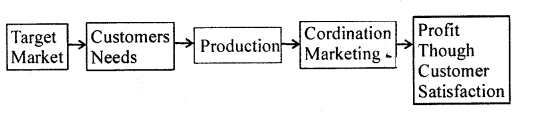
From the above-mentioned point, it is clear that: The old concept of Marketing is referred to as a system where more and more emphasis was laid on the production of commodities. It was based on the idea that consumers would buy what the seller produces. The modern concept on the other hand concentrates on the satisfaction of the need of customers and the need there. The seller produces what the buyer need and thus new concept emphasizes customers and their need satisfaction. The main point of difference between these two concepts has been explained in the following lines.

Old Concept of Marketing:

Class 12 Business Studies Important Questions Chapter 11 Marketing 1

New Concept of Marketing:
Class 12 Business Studies Important Questions Chapter 11 Marketing 2

Before embarking on the production work, the new concept of Marketing starts by finding out the requirement of customers. The businessman has to earn profit by selling and satisfying the customer with the product’s quality.

The Modern Concept of Marketing In India: On the question of the application of the Modem concept of Marketing in India, various scholars are of the view that it does not apply to India. They put forward undermentioned logics in support of their answer

  1. Production if India is not according to the taste and needs of the consumers.
  2. The marketing program does not include after-sales service.
  3. The Concept that “We must have profit irrespective of the fact that consumer feels satisfied or not is adopted in India.

However, consumers are of the opinion that the modem concept of Marketing applies in India due to the following reasons:

  1. Many producers produce products after identifying the need of consumers.
  2. After-sale services are provided such as a guarantee on products.
  3. There are many manufacturers who are not solely concerned with a profit motive.
  4. Advertisement and other sales-promotion activities are undertaken by producers, so as to enhance the standard of living of consumers.

Judging and Comparing the two thoughts on Marketing in India, it can be deduced that Modern Marketing Concept applies in India in a partial way. Modern Marketing concepts will play a crucial role in India with the expansion of education, urbanization of the population, increase in per-capital income, and improvement of the standard of living.

Question 6.
Explain in brief the objectives and importance of Physical Distribution Management?
Answer:
The Scope elf Physical Distribution System and its Components

The Marketing process is not complete simply by creating a super product and by creating a customer at the right time and place is an equally important function in Marketing. In the process of Marketing, this vital function is called Physical distribution. Physical distribution means the process of delivering the product to the user or Consumer Promptly safety and its time.

The following are the components of the Physical distribution system:

  1. Distribution Planning and accounting
  2. Inbound Transport
  3. Receiving
  4. Inventory Management
  5. In-plant Warehousing
  6. Order processing
  7. Packaging/repackaging where applicable
  8. Dispatch of goods
  9. Outbound transport
  10. Field warehousing
  11. Customer service
  12. Communication.

Physical distribution components or activities can be used as elements of Marketing strategy. Recognization of Physical distribution service can bring about better customer service. Increase in sales cost reduction and higher profit Margin.

In this full scope for a manufacturer, Physical distribution would involve not only the movement of finished goods from the end of the production line to the final customer but also the flow of raw materials from the supplier to the factory. Similarly, dealers and traders will manage the flow of goods into their shelves as well as from their shelves to the customer’s home or stores.

Importance of Physical Distribution Management – It is a physical distribution that provides place-utility and time-utility to products. In other words, it is the physical distribution that makes the product available at the right place and at the right time thereby Maximising the company’s chance to sell the product and strengthen its competitive position. If any product mode in any place could be consumed in its entirety at the very place of production and at the very time of production, there would no need for Physical distribution for that product.

But such products are very rare. In practice, almost every product gets consumed at places and times that, are different from those of their manufacture. They have to be carried t to places of consumption, they have to be stored and they have to be distributed.

The activity of Physical distribution is necessary for modern Marketing due to the following reasons
1. Control on Distribution CostUnder an efficient system of Physical distribution, a detailed analysis of transportation and storage cost is made in view of controlling or minimizing the distribution cost. It aims at reducing the sale price to the consumer for this purpose stress is laid on improvement in packaging control over channels of distribution simplification of the distribution system and technical improvement:

2. Increase in Sales Volume Marketing Management has realized that there is a definite connection between merchandising programs and physical distribution services (Particularly delivery service and order processing service). Customer often gives more importance to physical distribution than to price and promotion service. Physical distribution is considered by customers second in importance 1 to produce quality a reason for purchasing from a certain firm. Better J Physical distribution service gives higher overall customer satisfaction.

In other words, customers’ buying behavior hinges on the offer of adequate Physical distribution service.

3. Coordination of Demand and SupplyPhysical distribution facilitates the coordination between management got the benefits of a lower and higher level of customer service and thereby could reduce their operating expenses by 10 to 15 percent Many other competing firms were also compelled to adopt Scientific Management of physical distribution service. Thus many companies have now started giving more attention to the management of physical distribution operations in an integrated manner.

4. Product PlanningIncreasing competition in Marketing has necessitated the proper attention to be paid on product planning, production advertisement, and sales promotion, etc. but only this is not enough for an enterprise to get success in its marketing efforts. It also becomes necessary that the goods and services produced by the enterprise must be made available to the consumers at the right time and right place for this reason. Marketing executives of today have come to realize the importance of physical distribution.

5. Important in Marketing Physical distribution system is now recognized as an integral part of Marketing. Hence the marketing concept must apply to the management of physical distribution revolving around customer need can add the utility or want-satisfying power, viz, the availability of product at the right place and time, and at the lowest possible cost.

6. Need for customer satisfaction Physical distribution is not only a cost, it should be regarded as one of the tools in competitive Marketing. A Marketer can attract additional customers and maintain existing customers by offering better and dependable service or lower prices with fair service through improvement in the physical distribution package. The marketer has to evolve an appropriate physical distribution process that will fulfill the objective of adequate customer satisfaction.

7. Stabilisation of Prices The Marketing function of warehousing inventory, control, transport, protective packaging physical handling order processing, etc. is now managed as an integrated whole. An effective physical distribution package gives the customers the service they expect and at the same time, it assures profitable sales. Control oversupply position may help to stabilize the prices in the market. It at any time demand exceeds the supply available in the Market additional supplies can be released from the warehouses on the contrary if the supply position improves the production may be kept in storage in order to arrest the fall in prices.

8. Management Science The development of Management science or operations research has made possible the integration of Physical distribution functions. Physical distribution problems have a large number of variables that are readily measurable. Operations research techniques can be easily applied to secure the solution to the physical distribution problem.

Question 7.
What is market segmentation?. Mention in brief the criteria for market segmentation.
Answer:
Definitions of Market Segmentation:

Following are the definitions of market segmentation:
1. According to, Philip Kotler “Market segmentation is the subdividing of a market into homogeneous subsets of customers, where any subset may be a distinct marketing mix.”

2. According to William J. Stanton “Marketing segmentation consists of taking the total heterogeneous market for a product and dividing it into several sub-markets or segments, each of which tends to be homogeneous in all significant aspects.”

3. According to Rustan S. Davar” Market may be classified in several ways depending on the customer characteristics. Customers may be grouped on the basis of how they use a product or service. This grouping of customers can also be broken up in terms of age, sex, income level, education, or geographical in terms of sales territories. This grouping of buyers or segmenting the market is described as Market segmentation.”

4. According to Cundiff and Still: “Market segments are a grouping of consumers according to such characteristics as income, age, degree of urbanization, race or ethnic classification, geographic location or education.

5. According to Alan A. Robert”Market segmentation is the strategy of dividing markets in order to conquer them.”

6. According to Amerian Marketing Association “Market segmentation refers to dividing the heterogeneous markets into smaller customer divisions having certain homogeneous characteristics that can be satisfied by the firm.”

Basis or Criteria For Market Segmentation: Market segmentation being the key input in a firm’s marketing planning process the important issue is how to identify these market segments. Unfortunately, there is no one best way of segmenting the markets. That is why marketing managers are expected to examine a variety of segmentation criteria so as to identify those that will be most effective in defining their markets. The most prevalent basis for segmentation of the market in several countries broadly industrialized, have the prime objective of buying the product/item.

On the basis of this objective, the product market can be divided into two segments. These are

  1. Ultimate Consumer
  2. Industrial Consumer

The reason behind the division of the product market lies in the differentiation of consumers’ nature quantum of purchase, the factors influencing purchase, and the marketing efforts made by the seller.

The above division of market segmentation is used by Cundiff and Still. They have mentioned the following criteria for market segmentation:

Bases for Consumer ProductBases for Industrial Product
1. Income of the Consumer.1. Kinds business
2. Age of the Consumer2. Usual purchasing procedure
3. Sex of the Consumer3. Size of user
4. Degree of urbanization of the consumer4. Geographical market segmentation.
5. Geographical market segmentation
6. Education attainment of the consumer
7. Religion of the consumer.

Philip Kotter h1s mentioned the following criteria for market segmentation:

  1. Geographic Segment
  2. Demographic Segment
  3. Psychographic Segment
  4. Benefit Segment
  5. Marketing Segment
  6. On the basis of Volume
  7. Basis of Brand Loyalty

1. Geographic Segment: The first most popular criterion for segmenting the market may be the geographical segmentation of the whole operational area. The markets are divided on the basis of geographical factors such as area, climate, and the density of population. According to area states may be taken the basis for segmentation. Each state may be recognized as a separate market. The area may further be segmented in rural, town, and urban areas or where the market is international, the division may be a national or international market.

On the basis of climate, markets may be on hill and plain areas. For example, the North-Western cities of India may be important market segments for a manufacturer of woolen textile. Such type of segmentation is best where the customers are stretched over a vast area and the production is done on large scale. the producer may design his marketing strategies taking the characteristics of the individual markets into consideration.

2. Demographic Segment: On this basis, a seller does the segmentation by taking into consideration the age, income, sex, occupation, education, religion, size of family, nationality and the social class, etc, and thus, makes the separate groups. Demographic variables have been popularly made the basis for market segmentation for a long. It is, therefore, necessary to give them a wide description as under

1. Income: Income is a very important factor affecting the nature, attitudes, preferences, and behavior of consumers. Therefore, a market can be segmented on the basis of the income of consumers. Consumers can be divided into three parts on the basis of income

  1. High-income group,
  2. Middle-income group;
  3. Low-income group.

The consumers of the high-income group stress the design, fashion, quality, and the feeling of social prestige. The consumers of the middle-income group stress the durability and utility of products, while the consumers of the low-income group stress the price and quality. Different models of television sets are examples of this type of segmentation.

2. AgeAge is one of the most important factors for segmenting the market. The producer should know for what age group his product would be most suited so that he can plan his pricing polity, advertisement policy, marketing policy, and strategy accordingly. For example, some breakfast products are aimed to suit the tastes of children while others are attractive to consumers within a broader range of ages. Similarly, the cloth market or garment market may be segmented on the basis of age as children, young, adults, and old.

3. Sex Markets may also be divided on the basis of sex, i.e., ladies and gents. Some products are exclusively produced for women while others are for men. For example, lipstick is meant for women and on the other hand, shaving cream is only for men. Because the attitudes, needs, mental and physical attributes, and motivational factors are different in men and women, advertisement strategy may differ for both types of products.

Personality, sense of family security, and social prestige are some of the factors which are given top priority in an advertisement for a product meant exclusively for men. On the other hand, beauty and purchasing ability are some factors for advertising a product meant for women.

4. Educational level The consumers can be divided on the basis of educational levels such as educated, semi-educated, and uneducated, and the marketing activities and strategies are worked out accordingly. For example, a book market may be segmented on the basis of primary, high school, degree, and professional course books.

5. Business or profession It is also an important factor on which market of a product can be divided. Businessmen, employed persons, and professionals are examples of such classification. Employed persons may further be sub-grouped as clerks, officers, teachers, and executives. Similarly, professionals may be sub-grouped as doctors, advocates, chartered accountants, etc.

6. Caste or religion India is a country having a number of varieties of communication, castes, sub-castes, and religions. The feelings, attitudes, and lifestyles of the consumers of different castes and religions are different. Therefore, a market can be segmented on the basis of caste or religion.

3. Psychographic Segment: The characteristics of psychographic buyers are also the basis for market segmentation. These characteristics are added to the personality of the buyers. Customers’ behavior regarding several products is found to be different. The reason for this difference is related to the customer’s personality. For example, some buyer wants to buy new products while some among them prefer second hand or cheap products. The lifestyle of people too influences the buying trends.

4. Benefit Segment: When consumers buy a particular product they have their expectations. Such expectations differ from product to product and from consumer to consumer. These benefits can be durability, economy, efficiency, prestige, etc. For example, a shampoo market may have 4 benefits-cleanliness, economy, protection (protein, enriched, and anti-dandruff), and cosmetic (long silky hair) benefits.

Each segment favors a certain brand. The company can study these features and decide to which segment they want to comply with and should know the characteristics of that segment and the major existing competitive brands. The company can also search for new benefits and launch a brand that delivers them. Benefits segmentation usually implies that a company should focus on satisfying one benefit group.

5. Marketing Segment: Elements of marketing can also be made a basis for market segmentation. They are of different kinds for example,

  • buyers with price consciousness,
  • buyers influenced by the quality and variety of the product.

A seller will have made different efforts of marketing for each type of market segment.

6. Volume: Market segmentation can be made on the basis of the quantum of the product proposed for buying, for example, customers buying bulk quantity, medium quantity, and Lesser quantity. Flour purchased by a customer for domestic needs and for hotel use may be from different segments.

7. Brand Loyalty can also be made a basis for the market segmentation. The sellers first try to introduce the characteristics of loyal buyers and then endeavor to make them the buyer. However, segmentation of the market is not always possible on the basis of mere brand loyalty.

Question 8.
Explain the various objectives of packaging?
Answer:
Objectives of Packaging:
1. Attraction: As far as possible, the package must possess attraction value, as attraction is the main objective of packaging, so that it may attract customers towards the products concerned.

2. Protection: The second objective of packaging is to provide safety to the product. In other words, the package must protect the contents of the product until it is consumed. The package keeps the product fresh and clean. It protects from adverse effects of weather, temperature, dampness, insects, contamination, breakage, evaporation, leakage, etc. It preserves the flavor and color of the product. It also prevents theft and pilferage.

3. Convenience: The consumers, as well as the middlemen, want packages that are easy to carry, use and dispose of. A good package facilitates easy transportation; storage, display, and usage. Pouch packing is very popular nowadays due to convenience.

4. Economy The next important objective of packaging is economy. Here economy means economic use of the product. The consumer can take out the only quantity to be used at a time and thus, wastage can be avoided.

5. Sales Promotion The objective of packaging is to promote the sale of the product. Whatever is written on the packing acts as an advertisement and sales promotion.

6. Other objectives of packaging are as under,

  1. It improves the image of the product and thus increases the profit.
  2. It maintains the utility of the package even after the product packed is consumed.
  3. Owing to data of manufacturing and the expiry printed on the packing, the freshness or expiry of products can be identified.

Question 9.
Differentiate between Branding and Trade Marks.
Answer:
Difference between Brand and Trade Mark: Difference between brand and trademark can be made on the basis of the following points
1. Registration: Registration of a brand is not essential while registration for a trademark is essential. A brand is called a trademark only when it is registered.

2. Scope: The scope of a brand is limited while the scope of a trademark is very wide. Any business firm can use different brands for its different products while it uses only one trademark for all of them.

3. Legal protection: Brand can be copied by other competing concerns. No legal actions can be taken against them but if trademark denotes the manufacturer who got it registered. So trademark can be used with every brand. ‘

4. Nature: All brands are not trading marks but all trademarks are the brands. Thus, the word brand is more comprehensive than the trademark.

5. Use: Brand can be used by all that but the trademark can be used by the business firm that got it registered in the name of the firm.

In simple words, the main difference between brand and trademark is that brand is not registered, whereas trademark is always registered under Trade and Merchandise Mark Act, 1958.

Question 10.
Explain the term skimming the cream pricing strategy and low penetration pricing strategy and the reasons for adopting the two?
Answer:
Skimming the cream Pricing Strategy: It is also known as the “High Initial Price Strategy”. Under this strategy, the price of a new product is determined very high. Such prices continue to be high till the competitors begin to enter the market. As soon as competitors enter the market, the pioneer producer reduces the price of his product. This strategy is based on a plea that substantial expenses are incurred on research, advertising, and sales promotion activities and the competitors are also absent in the initial price is determined for a product.

By this strategy, the investment made for the development of the product may be quickly realized. The pricing strategy is useful in the case of innovating and specialty products. The manufacturers of computers, mobile phones, calculators, electronic watches, and electronic appliances used this strategy very successfully for pricing their products.

The main reasons for adopting the Skimming the cream strategy are as follows:

  1. To recover the heavy amount of expenditure incurred by the firm on the research, development production, advertising, and sales promotion of the new product.
  2. To get the highest possible return on capital invested till the competitors enter the market.
  3. To get the advantage of a monopoly situation in the market.
  4. To attract the consumers of the high-income group.
  5. To try the market for the product at a high rate, because it is easy to reduce it than to raise it.
  6. When the initial cost of production is very high.
  7. Suitable for pricing luxury products, because it creates social status.
  8. A high introductory price will produce greater rupee sales and profits than a low introductory price.

Low Penetration Pricing Strategy: Under this strategy, the price of a new product is determined low to speed up its sales and therefore widening the market base. Low price is used as a major tool for rapid penetration into the market to hold a position. This pricing strategy is adopted where there seem to be no distinctive classes of customers with different price, elasticity, and when advantages of mass production drastically reduce the costs, and when the product is not an innovative product but a simple product.

This strategy aims at capturing the market at the very outset. And if there is already a competing product, it aims at capturing the major share of the market. The best example ever seen of this strategy is the pricing of NIRMA washing powder. This strategy also discourages competitors from entering the market. Another feature of this strategy is that when the new product gains popularity or when its market is expanded, the price of the product is increased.

The main reasons for adopting a low penetration strategy are as follows

  1. Less cost of research, development, and production.
  2. To avoid the competition or to face the competition successfully.
  3. To avoid government interference
  4. To get the economics of large scale production by increasing the sales.
  5. To attract the customers of low-income groups, which are large in number.
  6. The demand for new products is highly elastic even in the introductory stage.
  7. To expand the market.
  8. To obtain large profit.

Comparison of Skimming the cream and low penetration Pricing strategies: Skimming the cream means high initial price and low penetration means low initial price. Now the question arises, which of the two strategies should be followed for price determination of a new product. To compare the two strategies or to answer this question we should consider a number of things.

For example, if excess expenses are made on new product development, advertising, and sales promotion, and there are no prospects for competition in near future, demand for the product is less elastic and the product is related to the consumer of the high-income group, then the marketer should follow, high initial price strategy. Contrary to it, if no many expenses are incurred on new product development, advertising, and sales promotion and there are high prospects for competition in near future, demand for a product is more elastic and the product is related to the consumers of the low-income group than the marketer should follow low initial price strategy.

For revolutionary new products that have large potential markets, penetration pricing is usually the most appropriate strategy. This is because the existence of a large potential market is almost certain to attract many larger competitors soon after the introduction of a new product. Penetration pricing helps to discourage prospective competitors contrary to it, if marketer expects that competitors will need considerable time and will meet great difficulties in coming up with their own version of the product, then, of course, price skimming is an appropriate strategy. Hence, the selection of the strategy depends upon the needs of the circumstances.

Question 11.
Give the objectives of Physical Distribution of consumers and Industrial Products?
Answer:
Objectives of Physical Distribution: Like any other marketing mix component, physical distribution has two broad objectives to attain.

  1. Maximization of customer satisfaction
  2. Minimization of costs

Physical distribution is concerned with getting the right product to the right place, at right time at the lowest cost. In other words, efficiency and satisfactory services are key goals of physical distribution. The Physical distribution function has the following objectives.
1. To provide better customer services: Customer services are the services provided to the consumers from the time of order placed by them till the products are delivered to them, it also includes after-sale services. In physical distribution customer service consists of providing the right product at the right time and at the right place. However, a high level of customer satisfaction can be attained through a distribution system.

2. To reduce cost: Cost reduction is an important objective of physical distribution. By intelligently managing the physical distribution system and determining the optimum number and locations of warehouses, transportation schedules and modes, material handling, increasing stock turnover, correcting inefficient procedures in order processing and moving offices, plants, retail outlets to low-cost locations, economics can be brought in various costs. By reducing the cost, the profit margin can be improved. This advantage can be shifted to the consumer by lowering the prices.

3. To increase sales: Another objective of physical distribution is to make available the products which have regular demand and also have contingency plans for quick order processing of items so that the product is not out of supply even in the stock or offseason. Moreover, firms can attract additional customers by offering better service or by charging lower prices, this will increase the sales volume of the firm.

4. To create utilities: The physical distribution function by warehousing and transportation creates time and place utility. Warehousing system is known for creating time utility by holding the products from the time of their production till their consumption. Whereas, transportation creates place utility making products more useful by bringing them to the places where they are needed. The main objective is the maximization of customer satisfaction and profits to the firm.

5. To establish a differential advantage over rivals: A firm can establish an advantage over its rivals by performing customer services more effectively, such as arranging rapid and reliable delivery, avoiding errors in order processing, and delivering undamaged products and satisfactory services.

6. To develop a communication system: To develop a communication system which permits the traveling salesmen to transmit orders on a regular basis, so that customer’s inquiries on the order status can be responded to within the shortest possible time and order may also be executed within time.

7. To attain price stability: By physical distribution, the objective of price stabilization can be achieved. With the help of transport and warehousing facilities, an adjustment can be made between the demand and supply of products, and thus, the price fluctuations can be prevented.

8. To increase reputation: With the help of efficient physical distribution management, a firm is able to increase its reputation among buyers and competitors. Buyers like those firms who are able to fulfill their orders as per specification and within the time limit with the help of physical distribution ‘no stock’ situation can be avoided and quality of goods produced can be improved. Better services are always welcomed by the customers.

Question 12.
Explain in brief the importance of promotion mix in marketing?
Answer:
Importance of Promotion in Marketing: Promotion plays an important role in stimulating demand and sales of the product. Its importance may be gathered from the following facts
1. In depression, the importance of promotional activities is greater because, at such a time, the main problem is that of sales of goods and services.

2. The activity of promotion has become important because of the widening of the market. With the physical distance between producers and consumers and also the increase in the number of prospective buyers, the promotion has gained importance. The producer is now to inform all prospective consumers to capture a major share of the market.

3. There are a number of channels of distribution. The producer should not only inform the consumers but he should also inform about the product to the middlemen because they have to present the goods to the middlemen next in the hierarchy and to the consumers. The middlemen should be well versed in the characteristics of the goods.

4. In modern times, there is cut-throat competition in every field. New and new products and producers are entering the market and every producer wants to sell his products first. In order to meet the competition, the producer is to make the customers/prospective customers of his products and their outstanding features along with a comparative view of the competitor’s products. This helps the consumers to select the right type of product.

5. Promotion expenses are the highest of all the marketing expenses. They should be properly and strictly controlled and should be paid due attention.

Question 13.
Explain the term personal selling and its important functions?
Answer:

  1. “Personal selling consists of contacting prospective buyer of the product personally.” – Richard Buskirk
  2. “Personal selling is an oral presentation in conversation with one or more prospective purchases for the purpose of making sales.” – American Marketing Association
  3. “Personal selling consists of individual, personal communication, in contrast to mass relatively impersonal communication of advertising, sales promotion and other promotional tools.” – William J. Stanton
  4. “Personal selling is basically a method of communication. It involves not only individual but social behavior each of the person, also in face contrast-salesman and prospect influences the other.” -Cundiff and Still

From the above definitions, we can conclude that personal selling is the art of convincing prospects to buy the given product and services. It is the ability to handle the people to demand the product. It is the science and art of understanding human desires and pointing the ways to their fulfillment. It is the ability to convert human needs into wants. The purpose of personal selling is not to ensure the present sales alone, but to win a regular customer.

Functions of Personal selling is an oral presentation in a face to face conversation with one or more prospective customers for the purpose of making sales. The main functions of personal selling are as follows: ‘
1. Making Sales The first and the foremost function of personal selling is to make sales both to old and new customers.

2. Keep Sales records Another important function of personal selling is to keep the complete record of the sale. This record is sent to the manufacturer.

3. Achieving Sales targets Another function of personal selling is to achieve the Sales targets by increasing the Sales Volumes.

4. Collection of Statistics The Salesman collects the data pertaining to the product, from the market on regular basis and sends it to the manufacturer.

5. Advertising new product The salesman sells in the market, the new products with his skills and expertise and create demand for the new product.

6. Demonstration of products Under personal selling the seller physically demonstrates the product, explains its working and features to the customer, and tries to persuade him to buy the product. The customer buys the product after being satisfied with the demonstration.

7. Increase in goodwill The Salesman provides several services apart from selling under personal selling. These services increase the popularity of the company and the Salesman both.

8. Executive function The experienced Salesman provides training to the new Salesman and assist the management in selling the problems relating to marketing.

9. Customer services The functions of personal selling also include, rendering customer services, such as: to introduce the products, explain the right use of the product, convince the customers about the quality of the product, remove doubts of the customers, etc.

10. Other services Under personal selling the Salesman not only perform the selling activities but other services like market research, complaints redressal, repairs, etc. are also performed by the Salesman.

11. Winning customer’s confidence Modem personal selling aims at educating the customer and providing a solution to his problems. The salesman also provides after-sale services. This helps in winning the confidence of the customers.

12. Persuasion of customers The customer is not to be pressurized but influenced favorably by the Salesman. A Salesman must have the ability to .convince the people to buy the product.

Question 14.
Give the importance of Sales promotion as a tool of enhancement in Sales?
Answer:
Importance of Sales Promotion: In recent years, the importance of Sales promotion has increased to a greater extent. The amount spent on Sales promotion now equals the amount spent on advertising. The Sales promotion increase is due to the changes in the marketing environment. The importance of sales promotion increase is due to the thinking of new ideas for creating a favorable condition of selling promoting sales and future expansion of sales. It is a part of marketing strategy. It is essential for the survival of a manufacturer.

More and more promotional activities are required to induce the consumers to purchase more and more products and thus they produce the demand.

In today’s competitive world, promotional activities play an important role which can be judged from the following facts:
1. Effective Sales support: Basically sales promotion policies supplement the. efforts of personal and impersonal sales-manship (advertising). It is found that good sales promotion materials make the salesman’s effort more productive. Activities reduce his time spent in prospecting and reduce the turndowns.

2. Faster product acceptance: Most of the sales promotion devices (such as contests, premium coupons, etc.) can be used faster than the other promotion methods such as advertisement.

3. Distance between producers and consumers: Due to prevalent market conditions mass selling is quite impossible without promotional activities. The distance between producers and consumers has so widened in present days that to get them acquainted with the product, promotional activities are necessary.

4. Selling in imperfect markets: Every market is an imperfect market. In imperfect market conditions, the product cannot be sold easily only on the basis of price differentiation. It is a promotional activity that provides information about the differences, characteristics, and multitudes of the products of various competitors in the market. The customer is attracted to purchase the goods on the basis of such information. Thus, promotional activities are necessary for selling products successfully.

5. Intense competition: The intense competition has necessitated the sales promotional activities. When one manufacturer increases its promotion spending and adopts an aggressive strategy in creating a brand image, others are also forced to follow the suit. This leads virtually to a ‘promotion-war’. It actually leads to a price reduction of standard goods.

6. Increased trade pressures: The growth of large-scale retailers such as supermarkets, chain stores, etc. have brought greater pressure on manufacturers for support and allowance. So, in order to aid the retailer and also to ensure their share of shelf space, many manufacturers have taken to sales promotion activities.

7. Increased standard of living and employment opportunities large scale production is the theme of the day. Sales promotion is always the result of large scale production. But this could be achieved only with appropriate methods of large scale selling. Large scale selling is possible only with the help of promotional activities.

In this way, promotional activities increase the standard of living by providing better goods at a lower rate (due to large scale production and selling). As the promotional activities cannot be performed without the help of an effective sales force and specialists in the field, employment opportunities are open for a large number of people.

8. Traffic-building: Traffic-building implies encouraging more inflows of new buyers and repurchasers. Traffic-building objective is attained by offering incentives to the buyers like special sales, retailer coupons, and premiums, weekly special, etc.

Marketing Important Extra Questions Long Answer Type

Question 1.
What is Packaging? Explain the importance and functions of packaging?
Answer:
Packaging: One of the most important developments affecting the business world in recent years has been in the area of packaging. Many products, which we thought could never lend themselves to packing because of their nature, have been successfully packed e.g. pulses, ghee, milk, salt, cold drinks, etc. Packaging refers to the act of designing and producing the container or wrapper of a product, packaging plays a very important role in the marketing success or failure of many products, particularly the consumer non-durable products.

In fact, if one makes an analysis of the reasons for the success of some of the successful products in the recent past, it can be noted the packaging has played its due role. For example, it was one of the important factors is the success of products like Maggie Noodles, Uncle Chips, or Crax Wafers.

Importance of Packaging: Packaging has acquired great significance in the marketing of goods and services, because for the following reasons
1. Rising standards of Health and Sanitation: Because of the increasing standards of living in the country, more and more people have started purchasing packed goods as the chances of adulteration as such goods are minimized.

2. Self-Service Outlets: The self-service retail outlets are becoming very popular, particularly in major cities and towns. Because of this, some of the traditional roles assigned to personal selling in respect be promotion have gone to packaging.

3. Innovational Opportunity: Some of the recent development in the area of packaging have completely changed the marketing scene in the country. For example, milk can now be stored for 4-5 days without refrigeration in the recently developed packing materials. Similarly, in the area of pharmaceuticals, soft drinks, etc, lots of new innovations have come in respect of packaging. As a result, the scope for the marketing of such products has increased.

4. Product Differentiation: Packaging is one of the very important means of creating product differentiation. The color, size, materials, etc. of the package makes a real difference in the perception of customers about the quality of the product. For example, by looking at the package of a product say paint or hair oil one can make some guess about the quality of the product contained in it.

Functions of Packaging:
As stated above, packaging performs a no. of functions in the marketing of goods. Some of the important functions are as follows
1. Product Identification: Packaging greatly helps in the identification of the products. For example, Colgate in red color, or Ponds Cream jar can be easily identified by its package.

2. Product Protection: Packaging protects the contents of a product from spoilage, breakage, leakage, pilferage, damage, climatic effect, etc. This kind of protection is required during storing, distribution, and transportation of the product.

3. Facilitating the use of the Product: The size and shape of the package should be such that it should be convenient to open, handle and use for the consumers. Cosmetics, medicines, and tubes of toothpaste are good examples of this.

4. Product Promotion: Packaging is also used for promotion purposes. A startling color scheme, photograph, or typeface may be used to attract the attention of the people at the point of purchase. Sometimes it may work even better than advertising. In self-service stores, this role of packaging becomes all the more important.

Question 2.
What is the pricing of a product? Explain the important factors affecting the pricing of a product?
Answer:
Pricing: When a product is bought, some money is paid for it. This money represents the sum of values that consumers exchange for the benefit of having or using the product and is referred to as the price of the product. Similarly, money paid for the services such as fare for the transport service, premium for an insurance policy, and fee to a doctor for his medical advice represent the price of these services. Price may therefore be defined as the amount of money paid by a buyer (or received by a seller) in consideration of the purchase of a product or a service.

Factors affecting Price Determination: There is a number of factors that affect the fixation of the price of a product. Some of the important factors in this regard are discussed below:
1. Product Cost: One of the most important factors affecting the price of a product or service is cost. This includes the cost of producing, distributing, and selling the product. The cost sets the minimum level or the floor price at which the product may be sold. Generally, all marketing firms strive to cover all their costs, at least in the long run. In addition, they aim at earning a margin of profit over and above the costs.

In certain, circumstances, for example, at the time of introducing a new product or while, entering a new market, the product may be sold at a price, which does not cover all the costs. But in the long run, a firm cannot survive unless at least all its costs are covered.

There, are broadly three types of costs: viz fixed costs, variable costs, and semi-variable costs. Fixed costs are those costs, which do not vary with the level of activity of a firm says the volume of production. or sale. For example, the rent of a building or the salary of a sales manager remains the same whether 1000 units or 10 units are produced in a week.

Those costs which vary in direct proportion with the level of activity are called variable costs, for example, the cost of raw materials, labor, and power is directly related to the quantity of I goods produced. Let us say if the cost of wood for manufacturing one chair comes to Rs. 100/- the cost of wood, for 10 chairs would be Rs 1000/- obviously, there will be no cost of wood if no chair is produced.

Semi variable costs are those costs that vary with the level of activity but not in direct proportion with it change in the volume of sale.

Total costs are the sum total of the fixed variable and semi-variable costs for the specific level of activity say the volume of sales or quantity produced.

2. The Utility and Demand: While the product costs set the lower limits of the price, the utility provided by the product and the intensity of demand of the buyers sets the upper limit of price, which a buyer would be prepared to pay. In fact, the price must reflect the interest of both the parties to the transaction the buyers and the seller. The buyers may be ready to pay up to the point where the utility from the product is at least equal to the sacrifice made in terms of the price paid. The seller would, however, try to at least cover the costs. According to the law of demand, consumers usually purchase more units at a low price than at a high price.

The price of a product is affected by the elasticity of demand of the product. The demand is said to be elastic if a relatively small change in price results in large changes in the quantity demanded. Here numerically the price elasticity is greater than one. In the case of inelastic demand, the total revenue increases when the price is increased and goes down when the price is reduced. If the demand for a product is inelastic, the firm is in a better position to-fix higher prices.

3. Extend of Competition in the market: Between the lower limit and the upper limit where would the price settle down. This is affected by nature and the degree of competition. The price will tend to reach the upper limit in case there is a lesser degree of competition while under conditions of free competitors the price will tend to be set at the lowest level.

Competitor’s prices and their anticipated reactions must be considered before fixing the price of a product. Not only the price but the quality and the features of the competitive products must be examined carefully, before fixing the price.

4. Government and Legal Regulations: In order to protect the interest of the public against unfair practices in the field of price-fixing, the government can intervene and regulate the price of commodities. The government can declare a product as an essential product and regulate its prices. For example, the cost of a drug manufactured by a company having a monopoly in the production of the same was Rs. 20/- per strip of ten and the buyer is prepared to pay any amount for it say Rs. 200/-.

In the absence of any competitor, the seller may be tempted to export the maximum amt. of Rs. 200/- for the drug and intervene to regulate the price. Usually, in such a case, the govt does not allow the first to charge such a high price and intervene to regulate the price of the drug. This can be done by the govt, by declaring the drug as an essential commodity and regulating its prices.

5. Pricing objectives: Pricing objectives are another imp. factor affecting the fixation of the price of a product or a service. Generally, the objective is stated to be to maximize the profits. But there is a difference in maximizing profits in the short run and in the long run. If the firm decides to maximize profits in the short run, it would tend to charge maximum price and its products. But if it is to maximize its total profit in the long run, it would opt for a lower per-unit price so that it can capture a larger share of the market and earn greater profits through increased sales.

Apart from profit maximization, the pricing objectives of a firm may include:
(a) Obtaining market share leadership: If a firm objective is to obtain a larger share of the market, it will keep the price of its products at lower levels so that a greater no. of people are attracted to purchase the products.

(b) Surviving in a competitive market: If a firm is facing difficulties in surviving in the market? because of intense competition or the introduction of a more efficient substitute by a competitor, it may resort to discounting its products or running a promotion campaign to liquidate its shock, and

(c) Attaining product quantity leadership: In this case, normally higher prices are charged to cover high quality and high cost of Research and Development.

Thus, the price of firm products and services is affected by the pricing objective of the firm.

6. Marketing Method Used: The price fixation process is also affected by other elements of marketing such as distribution system quality of salesman employed, quality and amount of advertising, sales promotion efforts the type of packaging product differentiation, credit facility, and customer service provided. For example, if a company provides free home delivery, it has some flexibility in fixing prices. Similarly, the uniqueness of any of the elements mentioned above gives the company competitive freedom in fixing the prices of its products.

Question 3.
Mention the important features or characteristics of personal selling?
Answer:
Characteristics of Personal selling: Following are some imp. characteristics of personal selling

  1. Personal selling is a method of sales communication.
  2. Personal selling includes commercial and social behavior.
  3. Personal selling includes both selling functions and non-selling functions.
  4. It involves the persuasion of customers.
  5. It involves winning buyers’ confidence.
  6. It aims at providing information and services to buyers.
  7. It is a two-way process and benefits both buyers and sellers.
  8. It helps in solving the problems of the buyers and satisfying their needs.
  9. Personal selling is an educative process. It tells consumers the way in which they can satisfy their needs.
  10. Personal selling is more flexible and adaptable. Because of face communication, the salesman adjusts himself and his sales talks according to the need, desires, and behavior of the consumers.

Role of Personal Selling: Personal selling plays a very important role in the marketing of goods and services. The importance of personal selling to businessman, customers, and society may be described as below:

Importance to Businessmen: Personal selling is a powerful tool for creating demand for a firm’s products and increasing their sales. The importance of personal selling to a business organization may be described as follows
1. Effective Promotional tool: Personal selling is a very effective promotional tool that helps in influencing the prospects about the merits of a product and thereby increasing its sales.

2. Flexible tool: Personal selling is more flexible than other tools of promotion such as advertising and sales promotion. It helps business persons in adopting their offer in varying purchase situations.

3. Minimise wastage of efforts: Compared with other tools of promotion, the possibility of wastage. of efforts in personal, selling is minimum. This helps the business, persons in bringing economy in their efforts.

4. Consumer attention: There is an opportunity to detect the loss of consumer attention and interest in a personal selling situation. This helps a business person, in successfully completing the? sale.

5. Lasting relationship: Personal selling helps to develop a lasting relationship between the salespersons it the customers, which is very important for achieving the objectives of a business.

6. Personal rapport: The development of personal rapport with customers increases the ‘ competitive strength of a business organization.

7. Role in the introduction stage: Personal selling plays a very important role in the introduction stage ( of a new product as it helps in persuading customers about the merits of the product.

8. Link with customers: Salespeople play their different roles, namely persuasive role, service role, and informative role, and thereby link a business firm to its customer’s importance to Customers

This role of personal selling becomes more imp. for the illiterates and rural customers who do not have many other means of getting product information.

The customers are benefited from personal selling in the following ways

  1. Help in identifying needs: Personal selling helps the customers in identifying their needs and wants and in knowing how these can best be satisfied.
  2. Latest market information: Customers get the latest market information regarding price changes product availability and shortage and new product introduction which helps them in taking the purchase decisions in a better way.
  3. Expert advice: Customers get expert advice and guidance in purchasing various goods and services which help them in making a better purchase.
  4. induces Customers: Personal selling induces customers to purchase new products that satisfy their needs in a better way and thereby helps to improve their standards of living.

Importance of society: Personal selling plays a very productive role in the economic progress of a society. The more specific benefits of personal selling to society are as follows
1. Converts latent demand: Personal selling converts latent demand into effective demand. It is through this cycle that the economic activity in the society is fostered, leading to more jobs, more incomes, and more products and services. That is how economic growth is influenced by personal selling.

2. Employment opportunities: Personal selling offers greater income and employment opportunities to unemployed youth.

3. Career opportunities: Personal selling provides an attractive career with greater opportunities for advancement and job satisfaction as well as security, respect, variety, interest, and independence to young men and women.

4. Mobility of Salespeople: There is a greater degree of mobility in salespeople, which promote travels and tourism in the country.

5. Product standardization: Personal selling increases product standardization and uniformity in consumption patterns in a diverse society.

Question 4.
“Money spent on advertising is an investment not waste.” Explain the statement by giving the merits/advantages of advertising?
Answer:
Money spent on advertising is an investment
or
Imp. and Advantages of Advertising

It is an era of advertising. No business or industrial enterprise can survive without advertising in the modern business world, because in every business and industrial activity there is cut-throat competition.

To face and win this competition successfully, it becomes imperative for every enterprise that it advertises what it has and what it wants to sell to the consumers. Advertising is useful not only for the business and industrial enterprise but for the whole community as a whole.

Advertising broader the knowledge of the consumers. With the aid of advertising, consumers find and buy necessary products without much waste of time. This speeds up the sales of commodities, increases the efficiency of labor in distribution, and diminishes the cost of selling. It is an accepted fact that without the market stimulus of heavy advertising, consumers might have waited another sixty years for the product evaluation that took place in less than ten years-it took after all over sixty years from the Invention of the Safety razors before the first acceptable stainless steel blades appeared in the market. These words are more than enough to justify the potentialities of advertising in’ the field of the modem marketing system.

Importance and Advantages of Advertisement:

Advantages        to ProducersAdvantages to MiddlemanAdvantages to ConsumersAdvantages to Society
1. Increase in Sale1. Helpful in Selling1. Increase Knowledge1. Rapid economic development
2. Lower Costs2. Helpful in searching middleman2. Easy purchase2. Increase in standard-of-living.
3. Reduction in production selling expenses3. Helpful in                facing                competition3. Information regarding avail of goals.3.Increase in employment
4. Reduced distribution expenses4. Earning sources4. Cheap quality goods4. Increase in knowledge
5. Increase in demand5. Increase in goodwill5. Increase in standard of living5. Quality product
6. Creation of goodwill6. Development of civilization
7. Steady demand7. Helpful in foreign trade
8. Prepare the ground for the new product8. Helpful in the development of the newspaper
9. To receive efficient workers9. Reduction in costs
10. To increase profit10. Others

Advantages to Producers:
1. Increase in Sales: By creating the demand for new products, increasing the demand
for existing products, and maintaining the demand for products in all seasons and at all times, advertising helps in increasing the sales of an enterprise.

2. Lower cost: Production cost and marketing cost both can be reduced by manufacturing the product on large scale .because the demand rises through advertising and supply can only be given by manufacturing them on a large scale.

3. Reduction in Production and selling expenses: Selling cost per unit is reduced due to increased sale volume, consequently production cost and overheads are also reduced due to mass production and sale.

4. Reduction in Distribution expenses: Due to large scale selling distribution cost is also reduced.

5. Increase in Demand: Advertising helps in increasing the demand for existing products because it reminds the consumers of a product again and again.

6. Creation of Goodwill: Advertising helps in the creation of goodwill. It increases the sales and increases in sales mean the increase in no. of customers which is apparently the result of the increase in goodwill of the concern.

7. Steady Demand: Advertising helps in stabilizing the demand for a product in all the seasons and all the time. It is only because of advertising that people like to consume eggs, tea, coffee, etc in summer also.

8. Preparation of the ground for New Products: Whenever a producer produces, a new product advertising helps him in creating demand for his product because it is the advertising through which a producer explains the merits of his products to the consumers. It is also the advertisement through which a producer proves the superiority of his products in comparison to the similar products of competitors.

9. To employ efficient workers: As the demand for products is increased through advertising, the employer working with the firm is motivated. This helps in the recruitments of efficient workers.

10. Increase in Profits: Increase in sales results in increased profits also, and thus the enterprise achieves the object of maximizing profits.

Advantages to Middleman:

  1. Helpful in selling: Easy sale of the products is possible since consumers are aware of the product and its quality through advertisements.
  2. Helpful in searching middleman: Able middleman can be appointed through the advertisements.
  3. Helpful in facing competition: Advertising helps the middleman in facing competition successfully. It introduces the products into the market and creates the demand for the products.
  4. Earning sources: Advertising stabilizes demand. Customers are thereby available throughout the year which ensures permanent income to the middleman.
  5. Increase in goodwill: The reputation created is shared by middlemen also because they need not spend anything on the advertising of already a well-advertised product.

The advantage to consumers:

  1. Increase in knowledges: Advertising helps the customers to know about the existence of various products and their prices. They can choose from the various brands to satisfy their wants. Thus, they cannot be exploited by the sellers. Advertising educates people about new products and diverse – uses.
  2. Easy purchase: Advertising makes it very convenient for the consumers to make their purchases because they take the decision well in advance about the commodity to purchase.
  3. Cheap and quality goods: The goods advertised are cheap and of standard quality. Advertising induces the manufacture to improves quality because otherwise, the customers will switch to competitor’s products.
  4. Increase in standard of living: Advertising stimulates the consumption of varied and new products. More the consumption more will be the standard of living of the consumers. Advertising induces the manufactures he improves the quality of their products through research and development. This ensures a supply of products of better quality to the consumers.

Advantages to Society and Nation:
1. Rapid Economic development: Due to advertising sales of products increase in the market, it helps in increasing the scale of production. Large scale production brings industrial progress and prosperity. Advertising also encourages art and design in the country. Due to advertising employment opportunities, research and development also help in the rapid economic development of a country.

2. Increase in standard of living: Advertising promotes the standard of living of the people by increasing the variety and quality in consumption as a result of sustained research and development activities by the manufactures.

3. Increase in employment opportunities: Advertising provides employment to persons engaged in writing, designing, and issuing advertisements. Increased employment brings additional income to the people, which stimulates more demand. Employment is further generated to meet the increased demand.

4. Increase in knowledge: Advertising is very educative. It provides complete information about, the products of their uses to the society. In the words of the late President Roosevelt of the U.S.A. “Advertising brings to the greatest no. of people-actual knowledge consuming useful things.” It is essentially a form of education and the progress of civilization depends on education.

5. Good quality products: Confidence of the public towards the product gets stability through advertisement. This is the reason, the manufacturer is not inclined to end such confidence of the public and enters only goods quality of products or the market. It increases productivity.

6. Development of Civilisation: In the Age of globalization advertising plays a vital role in foreign trade. Exports and imports are possible only due to advertising.

7. Helpful in the development of newspaper: Advertising provides an imp. source of revenue to the publishers of newspapers and magazines. It enables them to increase the circulation of their publication by selling them at lower rates. People are also benefitted because they get publications at cheaper rates.

8. Reduced cost: As already stated cost of production is reduced due to large-scale production. Society also benefits from sour rates of products.

From the above discussion, it is clear that there are a number of advantages of advertising. It is beneficial to all the concerned – Producers, middlemen, customers, and consumers. In this time of throat competition, it is not enough to produce quality products at low costs, it is also necessary that it should be made known to the customer for whose it is produced.

Question 5.
Explain in detail the various pricing policies of a product?
Answer:
Pricing Policies Policies are guidelines for achieving the objectives. Therefore, different policies are framed and adopted for achieving the different objectives. Thus price policy is framed and adopted ‘policies provide the framework and consistency needed by the company to make reasonable, practicable, and effective pricing decisions. It helps the company to attain its pricing objectives.

Any good pricing policy must be aimed at offering a reasonable price to the consumer, ensuring a fair return on investment, and provide, price stability. While adopting the price policy trade traditions, customer preferences, their buying motives, purchase frequency, level of competition, nature of the product, amount of discount and allowances to be given, etc. must be considered.-There are a number of pricing Policies, a brief explanation of them is as follows:

A. On the basis of Cost and Demand. There are two price policies

  1. Cost-oriented pricing policy: This policy assures that no product is sold at a loss since the I price covers the full, coat incurred. Pricing under this policy is based on simple arithmetic i.e.; adding a fixed percentage to the Unit Cost.
  2. Demand-oriented pricing policy: Under the policy of a product is based upon its demand in the market. For instance, a high price is charged when and where the demand is high and a low price is charged when and where the demand is low. This policy is more suited to small business units and mostly in the case of non-standardized products.

B. On the basis of Price-Level.There are three price policies:
Meeting Competition Policy: If the price is the main basis of competition, then companies adopt this policy and adjust their prices 1 according to that of competitions. If the competitors change their price, the company will do the same. Such a policy is adopted in the case of highly competitive goods. One important feature of the policy is that it may not have any relationship to its cost and demand of the

Under the Market policy: It is a policy in which a company keeps its prices less than those prevailing in the market. Under the market, the policy is adopted when a company wants to enter the market on wants to expand it. Sometimes, a company has low costs because TtSsProducts is of lower quality and therefore, the price of products is usually kept low than those of competitors. At other times, lower prices may be substituted for promotional efforts used by its competitors.

Above the Market policy: Under this policy, the company ‘ eeps? its prices more than those prevailing in the market. This policy is adopted by companies who either enjoy a good reputation in the market or offer a unique product.
The customers get attracted to the company because of its high prestige. Such a company spends highly on advertising. Sometimes, manufacturers keep more than above price to give some more margin to profit to a middleman in return for their aggressive marketing efforts.

C. On the basis of Flexibility.
There are two pricing policies
1. One price Policy: Under this policy, one price is charged from all types of customers irrespective of volume or conditions of purchase. Price is fixed in this policy. It is a fair trade practice. Such a policy helps in clearly estimating the sales and profits. This policy helps in bargaining as such saves time and selling expenses. These companies, who follow this policy lays emphasis on the product’s quality and customs service.

2. Flexible pricing policy: Under this policy, different buyers are charged different prices for the same product. The difference in price depends upon the bargaining power of buyer and seller, place on delivery market conditions, and many other such factors. It is generally adopted in the case of sub-standard products. This policy makes the seller free to adjust the price according to the prevailing market circumstances. In certain cases, the product may be prepared on the basis of specification or design given by the buyer. In such a case, the price has to be negotiated and then fixed.

D. On the basis of Geographical Conditions.
There are six pricing policies
1. Uniform delivery pricing policy is also known as’F.O.R.’ (Free on the rail) or ‘Destination price’ or ‘Postage stamp’ pricing policy. Under this same price is charged from all the buyers irrespective of their location. In other words, the buyers do not bear directly the freight and other charges because the price includes such charges. They actually add in full or average of total freight charges for all the nation to the price quoted. Such a pricing system is used where transport costs are a major change on the seller’s total cost structure as a case of medicines.

2. Production point pricing policy It is that type of pricing policy in which the firm quotes ‘Ex-factory’ or Free on rail’ price. It does not bear the transportation cost, in the case of ex-factory price, the buyer bears all the transportation costs both freight and cartage from the factory point, whereas in the case of F.O.R. price, the firm bears the freight charges up to the railway station as the transport agency.

After that, the buyer has to meet, freight and cartage. It is also called as ‘Free on, Board’ (F.O.B) pricing policy. In simple words, under this policy, the price of the product includes only the price of the product. All the expenses of transportation from the price of the product. All the expenses of transportation from the place of the seller to the place of buyers are paid by the buyer himself.

3. Zonal delivery pricing policy Under this policy, the company divides the country into different zones and quotes uniform prices for each zone. The prices are uniform within a zone. But these prices differ from zone to zone, because of differences in transportation costs, local taxes, etc. The company adds average transportation cost to the basic price to arrive at the zonal price. Such a price benefits the buyer living at a distant place within a zone.

4. Basepoint pricing policy: It implies partial absorption of the transport cost by the company. One or more geographical locations are selected as base points from which the transport costs are, calculated. The buyers pay the er-factory price plus freight calculated from. the nearest base point. This price policy is normally the collective decision of all the firms.

5. Freight absorption pricing policy: To penetrate distant marked a seller may be willing to absorb part of the freight cost. Thus, under the freight absorption policy, the price of a product includes its actual price and a part of transportation cost. Therefore, the total expenses to be incurred on transportation of goods are divided into \ two parts – a part of these expenses is paid by the seller and the remaining part is paid by the buyer. A freight absorption strategy is adopted to offset the competitive disadvantages of F.O.B. or er-factory pricing.

6. Home delivery pricing policy This policy is gaining popularity in cities. Under this policy, dealers quote the price of a product and delivered the goods at the door-step of the customer. Dealers of television, fridge, air-condition, washing machines, steel furniture, and Haryana merchants usually adopt a home delivery pricing policy.

E. On the basis of Speciality:
On the basis of the specialty of the product, market conditions, trade -conditions, different sellers use the following pricing policies:
1. Skimming pricing policy: It involves setting a very high, price for a new product initially and to reduced the price gradually as competitors enter the market. The initial high price serves to skim the cream of the market. This is a policy of recovering the product^ generally adopted in the case of an innovative product.

2. Penetration pricing policy: This policy aims at capturing the market as soon as possible, therefore, the prices are kept at a low level. It helps in the initial stage or till the product is accepted by the majority of the population.

3. Price lining policy: Under this policy, various products are v priced according to their quality standards. The products may be classified as good, better and best – Different prices are charged for different qualities. The price lining has attraction both for the consumers and the retailers. The consumer’s buying decisions are simplified since the no. of prices from which he must make a selection is limited. The retailers also find this policy attractive because it helps them to plan their buying decisions.

4. Full-line pricing policy: When a manufacturer produces a product in different sizes or models and is unable to calculate the fixed expenses incurred on each type of product separately, he priced his product according to sizes or their demand.

5. Unit pricing policy: Under this policy price of the package and price per unit are mentioned on the package. For example, a toothpaste of 100 grams bears the price of a 100 grams package and also the price of 1 gm. This policy facilitates the consumers to make their buying decision and there is no scope of any bargaining.

6. Bait pricing policy to kinds of products are manufactured under this policy i.e. low price products. The marketer attracts the consumer by showing low price products. Thus, low prices act as bait for attracting customers.

7. Psychological Pricing policy: Under this policy prices are forced in such a manner that they have some psychological effect on buyers. Certain consumers have a feeling that high period products are indicated of high quality. As such, they demand high priced products. For example, diamonds, electronic products, cosmetics, etc. The pricing of products according to their quality standards as superior, fine, or economical also puts psychological pressure on consumers.

8. Old Pricing policy: It is another form of psychological pricing policy. Under this policy price is ending in an odd no. or a price just under a round number i.e. setting the price at an off amount such as Rs. 199.95 instead of Rs. 200 or Rs.5.990 instead of 6,000. The rationale for this policy is that consumers perceive off prices as a better buy. Even extensive products appear less expensive when the period in this way. This policy gives the feeling that the company is true to the last paisa, and results in an increase in sales.

9. Customary pricing: The policy is one that is based on the customs prevailing in the market. The prices are fixed to suit local conditions. Such products are typically standard ones. The price of sweets, soft drinks, bread, and other eatables are based on customary pricing policy.

10. Prestige pricing policy: Generally, the prestige pricing policy is adopted in the case of luxury products where the salesman is successful in creating a prestige of his product in the consumer’s mind. In this case, prices so fixed are generally higher than the prevailing market price. Sometimes, to show that our product is a quality product, market fix higher price for his product in comparison to competitors. Because customers judge the quality of a product by its price. If the price is high, they assume that quality is good. This policy is only useful when actually the quality of the product is genuine and high.

11. Captive pricing policy: In a captive pricing policy, the basic product is priced low, often below cost, but the high markup on supplies required to operate the basic product compensates for that low price. The loss on the basic product is recovered in profits from the sale of the required supplies. This policy is adopted by the newspaper. A newspaper costs, more to produce and distribute than the price charged from the subscribers, but increased circulation encouraged by the low price leads to more advertising revenue and greater overall profit.

12. Loss leader pricing policy Under this policy, few popular products are temporarily offered at low prices with a
view to attracting customers. Such products are termed as loss leaders.

13. Leader pricing policy The business firm who wants to present itself pioneer in the industry take the initiative in fixing the price and other firms follow it. This is generally adopted in oligopolistic market conditions where there are few sellers and these products are identical.

14. Monopoly pricing policy: Monopoly pricing policy is adopted when one company has single-handed control over the entire supply, there are a large number of buyers blit only one seller. The product is unique with no close substitutes. The competition is totally is absent and the seller has a free hand in fixing the price. Monopoly prices are generally considered as high prices.

15. Discriminating pricing policy: Under this policy, the marketer sells the same product at different prices to different buyers. This discrimination may be on basis of the use of product type of customer, the difference in a geographical area, etc.

16. Dual pricing policy Under dual pricing policy, a producer is required to sell a part of his production, under compulsion, to the govt, or its authorized agency at a substantially low price.

17. Administrated pricing policy Prices fixed by the govt, of goods sold through fair price shops are administered prices. This policy favors the welfare of low-income group people.

18. Sealed bid pricing policy Big firms or the govt, calls for competitive bids when they want to purchase certain products or specialized terms. The lowest bidder gets the work.

19. Break-even pricing policy The level of output of which the total revenue will be equal to the total cost is known as the break-even point. Sales over this point will yield profit. The sale must be above the break-even point quantity.

20. Promotion pricing policy This policy is based on its sales promotion method. For instance, take the case of ‘Grand Reduction Sale’ which is intended to revive the memory of the customs who might have stopped buying the products they used to buy in past. In this case, the seller tries to get rid of old and outdated stock.

Question 6.
Explain the various methods of determining the price of a product?
Answer:
Methods of Determining Prices There are many methods for the determination of the price of products. For the convenience of study, these methods can be divided into two parts:

  1. Methods of determining the price on the basis of cost.
  2. Methods of determining the price on the basis of market conditions.

1. Methods of determining the price on the basis of cost: The cost of production of a product is the most important variable and most, an important determinant of its price. There may be many types of costs such as Fixed cost, the variable cost, total cost, avg. cost, and marginal cost, etc.

An analytical study of these costs must be made for t determining the price of a product. Methods of determining the price on the basis of cost are as under
1. Cost-plus pricing method This is the simplest and easiest method of price determination. Under this system of pricing the average, I total cost of each unit of production is calculated, and to it is added the desired margin of profit, and selling is done at this ultimate price.

Cost-plus, pricing involves making a cost estimate and adding a margin to cover making expenses and profit. For example, a manufacturer may set the price for a new product by estimating the producer’s per unit total costs and then adding a certain percentage to provide a gross margin (i.e. expenses of net profit).,

Thus, under this method, the price per unit of product is calculated by adding desired profit to the total cost per unit. Under this policy, the price per unit can be calculated as under:

Class 12 Business Studies Important Questions Chapter 11 Marketing 3

The amount of desired profit varies from enterprise to enterprise, product to product, and time to time. Some business enterprises determine a certain percentage of profit and calculate the price per unit of their product by adding this much percentage of profit to the cost of production, such as

Price per unit = Total Cost + 10% Profit.

This method assumes that no product is sold at a loss. This method is used when there is no competition in the market or when the cost of production of a product of all the manufacturers is almost equal. This method is used by retail traders also. This method of pricing is based on simple arithmetic of adding a fixed percentage of profit to the unit cost. Thus, the retail price of a product can be the cost of the manufacturer plus the margin of profit of the wholesaler plus s the margin of profit to the retailer. Therefore, this method is also known as “The sum of margin method”.

2. Marginal or Incremental Cost pricing Method Linder this method, price is so set that it covers only the marginal costs and not the total costs. When a new product is introduced, such a method is usually adopted. By this method, labor may be kept employed even during slack seasons. However, this method cannot be followed for long as the fixed cost has also to be taken into consideration. If certain products are period on this basis and others on a cost-plus basis, then some customers would be required to pay higher, prices while others would get the product at the cost of the last unit.

3. Break-Even Analysis: Break-even points is the volume of sales at which the total sales revenue of the product is equal to its total cost. In other words, it can also be said that the break-even point is the volume of sales at which there is no profit and no loss. Therefore, this method is also known as the’ profit No loss Pricing Method’.
Under this method, break-even price (B.E.P.) can be calculated as under
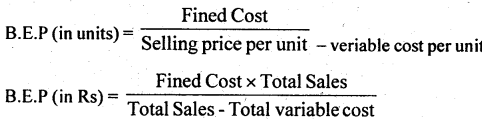
Class 12 Business Studies Important Questions Chapter 11 Marketing 4

4. Rate of Return of Target pricing method: Under this method, first of all, an arbitrary desired rate of profit on the capital employed/invested is determined by the enterprise. The total desired profit is then calculated on the basis of this rate of return. The total desired profit is then added to the total cost of production and thus, the price per unit of the product is determined. In short, this method is good only when there is no competition in the market. The rate of investment is decided arbitrarily.

2. Methods of determining the price on the basis of market conditions: The price of a product must be determined keeping in view the conditions prevailing in the market. If market conditions are not duly considered before determining the price of products, the marketing objectives of the enterprise can’t be achieved.

Following are the methods of price determination based on market conditions:
1. Pricing to meet Competitions: Under this method, the price of a product is determined on the basis of the price of a competitor’s products. This method is used when the firm is new in the market. ; This method is used when there is tough competition in the market.

The method is based on assumption that a new product will create: demand only when its price is competitive. In such a case, the film follows the market trader.

2. Price below Competitive level: Under this method, the pricing firm determines the price of its. products below the competitive level i.e. below the price of the same products of the competitors. This policy pays where customers are price conscious and the method is used by new firms entering the market.

3. Pricing above Competitive level: Under his policy, the seller may set higher than avg. prices for his product to convey an impression that his products are above avg. equality. The buyer may pay this price in the belief that it is of higher quality.

Manufacturers sometimes keep more than average price to give some margin of profit to a middleman in return for the latter’s aggressive sales promotion. For a consumer product to compete successfully at a price above the market, it must either be so strongly differentiated that consumers believe it is superior to a competitive brand, or middleman must enthusiastically and heavily promote.

4. Purchasing power pricing method: Some commercial undertakings determine the product price by keeping in mind the purchasing power of their consumers. This method is generally used for the determination of the price for fashionable products.

Question 7.
Explain the various methods/Tools of Sales Promotion?
Answer:
Types, Methods/Tools of Sales Promotion: For a marketer resorting to sales promotion, a variety of tools and techniques are available. Sales promotion letters, catalogs, point of purchase displays, customer service programs, demonstrations, free samples discounts, contests, sweepstakes, premiums, and coupons are the Commonly employed methods of sales promotion.

Sales promotion can be divided into the following kinds:

  1. Consumer/Customer Promotion Methods.
  2. Dealer Sales Promotion
  3. SalesForce.

1. Consumer/Customer Promotion Methods: Consumer promotion methods of sales promotion are the methods that directly encourage consumers to buy the product in more and more quantity. These methods may be as follows

1. Distribution of free samples: Under this method, the producer distributes free samples of the product to the consumer. They are also given to introduce a new product and expand the market. It increases the sales volume when the product is a new one to the customers. It is an effective device in which the product is purchased often, i.e. soaps, detergents, tea or coffee, etc. It is a method of demand creation, sampling gives a chance to the consumers to compare the products with other substitutes. Samples are given to doctors by medical representatives.

The samples may be delivered door to door, sent by mail, picked up in a store, attached to another product, etc. It is the most effective way to introduce a new product.

However, sampling is not always a good marketing strategy. It is not justified in the case of
(a) Well established product.
(b) a product that is not the superior in-store way to competing products or whose points of superiority would not easily be recognized by the consumers.
(c) a product with a slow turnover.
(d) a product with a narrow margin of profit.
(e) a highly fragile, perishable, or bulky product.

2. Coupons: A coupon certificate that reduces the price. When a buyer gives a coupon to the dealer, he gets the products at a lower price. Coupons are accepted as cash by retailers coupons normally perform two specific functions for the manufacturer. Firstly, they enthuse the consumers to exploit the bargain. Secondly, they serve as an inducement to the channel for stocking the items. The manufacturer thus succeeds in attracting consumers as well as in promoting the channel to stock the merchandise by introducing coupons. They are useful for introducing a new product as well as for strengthening the sale of an existing product.

According to John F. Luick and Zieglar, “A coupon is a certificate that when presented for redemption at a retail store, entitles the bearer to a stated saving in the purchase of a specific product.”

3. Price Reduction or price off promotion: It stimulates sales during a slump season. It gives a temporary, discount to the consumers, i.e. goods are offered at a rate less than the labeled rate. Fans are sold at a reduced rate in the rainy season.

For example, Hawkins pressure cookers have come up with several sales promotion schemes during the last few years. In one of these schemes, Hawkins announced.

Upto Rs. 150/- off on a new Hawkins in exchange for any old pressure cooker.

4. Contests: These may be conducted to attract new customers or to introduce a new product by asking the prospects to state in a few words why they prefer a particular product. For entering into the contest, the prospect is first required to purchase a product and submit the evidence (e.g. a label or package or card wanted to the product) with an entry form for a contest. Through such contests, even the persons who are not inclined to purchase otherwise, also get interested in using the product.

According to John. F. Lick and W.L. Zieglar, “A contest is sales promotion device in which the participants compete for a prize or prizes on the basis of their skill in fulfilling a certain requirement, usually analytical or creative.”

Sponsor companies on the T.V. are adopting the quiz and contest route as a profitable means of establishing brand equality over a period of time. lit programs like Philips Top ten, four with, Close-up brand equity has been used as a format. These programs have gained considerable popularity and they will be remembered for along time. T.V. has gained a substantial audience in India.

5. Demonstration: It is the introduction to educate the consumers in the manner of using the product. It is a promotional tool that attracts the attention of consumers. When products are complex and of a technical nature, the demonstration is necessary, e.g. computers field machinery, electrical pumping set, etc. The demonstration is done in front of consumers for mixy, wet grinder in retail shops, etc.

6. Premium It is a temporary price reduction wealth increases the instinct of the buyers. Products are offered free or at a reduced cost as an inducement for purchasing. It is offered to consumers for consumer goods like soap, brush, paste, washing powder, glucose, etc. For instance, when the customer buys two soaps, a soapbox is given free along with the soaps. The soapbox is a premium, It certain cases, the price is reduced. The reduced amount is a premium.

According to George Wuistopto is “A Premium is an item of Merchandise that is offered at cost or at relatively low cost as a bonus to purchases of a particular product.”

According to Alfred Gross, “A premium is an article of merchandise or another thing of value offered as an inducement to purchase a product or service.”

7. Money Refund Offers: If the purchaser is not satisfied with the product, a part or all of the purchaser’s money will be refunded. It is stated on the package. It will create new users and will strengthen brand loyalty. Some times, the money will be refunded, if 10 top covers or 10 empty bottles or 10 packages are sent a book to the manufacturers.

8. Trade fairs and Exhibitions: India is a country in which various fairs and exhibitions are organized at different levels in different parts. Some producers take part in these fairs and exhibitions and display their products.

9. Special Prizes: Under this method, every purchase of the product is given a prize coupon during a certain period. All the coupons distributed during this period are put into a box and a lottery is drawn therefrom. The winners are given some attractive prizes. There, this scheme also compels the consumers to purchase and use the product.

10. Bonus Stamps: Such bonus stamps are issued to the consumers by the retailers or manufacturer in proportion to their purchases. The consumer goes on collecting stamps until he has sufficient quantity to obtain the desired merchandise in exchange for the stamps.

11. Buy-Back Allowance: Allowance is given following a previous trade deal. That is, a trader deal offers a certain amount of money for a new purchase based on the purchased quantity. It prevents a decline in the post-trade deal. Buyer’s Motivation is increased because of their co-operation on the first trade deal, for example when Cinthol and Mav soaps are purchased, the salesman gives one mug and two coupons free.

12. After-Sale Service Under this method, the producer gives a guarantee to the consumers to maintain the product for a certain specified period.

2. Dealer Sales Promotion: Dealer promotion methods include all the methods which are adopted with a view to encouraging the dealers and distributors to purchase and resell the product in more and more quantity. Dealer promotion methods include the following methods

1. ContestThis is an indirect way of hosting the sales. This is in the form of the window display, store display, etc. The prize is awarded for outstanding achievements.

2. Buying Allowance Discount The buying allowance or discount is offered to the dealer to induce him to buy the manufacturer’s product.

3. Premium Premium is a product usually offered free at less than its price to encourage consumers to buy other products.

4. Incentive By using this method, producers announce some incentives to their salesman so that they may take maximum interest in the sale of the product.

5. Loan Facility The producer allows credit to their dealers, based on the quantity purchased by them. This enables them to purchase bulk quantities.

6. Advertising Allowance The allowance is offered to the dealer to display the manufacturer’s product.

7. GiftRalli Fan Co. arranges for a free holiday.

8. Point of purchase The point of purchase display is the silent salesman that calls the attention to the product in the hope of buying action.

9. Dealers listed promotion This method induces dealers to stock the products and consumers are encouraged to buy the products from the listed dealers.

10. Training Through this method, producers train their selling force.
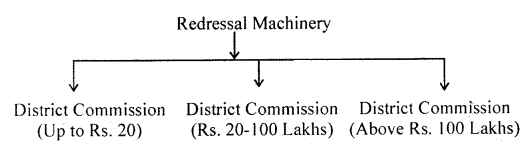
Financial Markets Class 12 Important Extra Questions Business Studies Chapter 10

Here we are providing Class 12 Business Studies Important Extra Questions and Answers Chapter 10 Financial Markets. Business Studies Class 12 Important Questions are the best resource for students which helps in class 12 board exams.

Class 12 Business Studies Chapter 10 Important Extra Questions Financial Markets

Financial Markets Important Extra Questions Short Answer Type

Question 1.
Explain the concept of the Financial Market?
Answer:
Concept of Financial Market: A business is a part of an economic system that consists of two main sectors – households that save funds and business firms which invest these funds. A financial Market helps to link the savers and the investors by mobilizing funds between them. In doing so it performs what is known as allocative functions. It allocates or directs funds available for investment into their most productive investment opportunity. When the allocative function is performed well, two consequences follow

  • The rate of return offered to households would be higher.
  • Scare resources are allocated to those firms which have the highest productivity for the economy;

There are two major alternative mechanisms through which allocation of funds can be done: via banks or via financial markets. Households can deposit their surplus funds with banks, who in turn could lend these funds to business firms. Alternately, households can buy the shares and debentures offered by a business using financial markets. The Process by which allocation of funds is done is called intermediation. Banks and Financial Markets are competing intermediaries in the financial system, and give households a choice of where they want to place their savings.

A financial market is a market for the creation and exchange of financial assets. Financial markets exist wherever a financial transaction occurs. Financial transactions could be in a fourth of creation of financial assets such as the initial issue of share and debenture by a firm or the purchase and sale of existing financial assets like equity share debenture and bonds.
Class 12 Business Studies Important Questions Chapter 10 Financial Markets 1

Question 2.
Explain the term, Capital Market?
Answer:
Capital Market: The term Capital Market refers to facilities and institutional arrangements through which long-term funds, both debt and equity are raised and invested. It consists of a series of channels through which savings of the community are made available for industrial and commercial enterprises and for the public in general. It directs these saving into their most productive use leading to the growth and development of the economy. The capital market consists of development banks, commercial banks, and stock exchanges.

An ideal Capital Market is one where finance is available at a reasonable cost. The process of economic development is facilitated by the existence of a well functioning capital market. In, the fact the development of the financial system is seen as a necessary condition for economic growth. It is essential that financial institutions are sufficiently developed and that market operations are free, fair, competitive, and transparent. The capital market should also be efficient in respect of the information that it delivers, minimize transaction costs and allocate capital to most productivity.

The Capital Market can be divided into two parts:

  1. Primary Market
  2. Secondary Market.

Question 3.
Mention, in brief, the classification of the financial market?
Answer:
Classification of financial market

Financial Market
Class 12 Business Studies Important Questions Chapter 10 Financial Markets 2

Financial Markets are classified on the basis of the maturity of financial instruments traded ‘in them. Instruments with a maturity of less than one year are traded in the money market. Instruments with longer maturity are traded in the capital market.

Question 4.
Give the meaning of various terms used in the stock market in India?
Answer:
Various terms used in the stock market: The following terms in magazines or newspapers when you read about the stock market.

Bourses: Bourses is another word for the Stock Market.

Bulls and Bears: The term does not refer to animals but to the market sentiment of the investors. A bullish phase refers to a period of optimism and a bearish phase to a period of pessimism on the bourses.

Badla: This refers to a carry forward system of settlement, particularly at the BSE. It is a facility that allows the postponement of the delivery or payment of a transaction from one settlement period to another.

ODD lot Trending Trading in multiples of 100 stocks or less.

Penny Stocks These are securities that have no value on the stock exchange but whose trading contributes to speculation.

Question 5.
Explain the meaning of the stock-market Index?
Answer:
Stock Market Index: A stock market index is a barometer of market behavior. It measures overall sentiment through a set of stocks that are representative of the market. It reflects the market direction and indicates day-to-day fluctuations in stock prices. An ideal index must represent a change in the prices of securities and reflect price movements of typical share for better market representation. In the Indian markets, the BSE SENSEX and NSE NIFTY are important indices. Some important global stock market indices are:

  • Dow Jones Industrial Average is among the oldest quoted stock market index in the US.
  • NASDAQ composite index is the market capitalization weights of prices for a stock listed in the NASDAQ Stock Market.
  • S and P 500 index is made up of the 500 biggest publicly traded companies in the US. The S and P 500 is often treated as a proxy for the US stock market.
  • FISE 100 consists of the largest 100 companies by full market value listed on the London Stock Exchange. The FISE 100 is the benchmark index of the European market.

Question 6.
Explain the term Listing of securities and mention its advantage.
Answer:
Listing of Securities: A security is said to be ‘listed’ when its name is added to the list of securities in which trading on a particular exchange is permitted. The principal objectives of listing are

  1. to provide ready marketability and free negotiability to stocks and shares;
  2. to ensure proper supervision and control of dealings therein; and
  3. to protect the interests of shareholders and of the general investing public.

Advantages of Listing:
The advantage of listing may be viewed from two angles

  1. from the point of view of the management of companies; and
  2. from the point of view of the shareholders.

The advantages derived by the management as a result of listing are many. A part of the distinct advertising value, listing enables the management to broaden and diversify shareholding. It is the general, consensus of opinion that a company with broad-based share ownership is better suited for growth and stability than a company with shares concentrated in few hands. Ensuring thus a broadening of share ownership, listing not only brings a company’s shares to the attention of hundreds and thousands of new investors but also encourages institutional investors to be interested in them. It helps the company to gain national importance and widespread recognition.

There is a difference between a listed and non-listed security (particularly from the point of view of the psychological motivation of the investors in applying for subscription to shares) in as much as Section 73 of the Companies Act required that every company intending to offer shares or debentures to the public for subscription through the issue of a prospectus, must seek enlistment with one or more stock exchanges. If such listing is not granted or applied for then the company must return all money to the applicants.

This, in other words, implies that prospective listing prompts the investors to apply for the shares and failure to secure listing entitles the investors to claim a refund of the money. In fact, the listing has tremendous value to a company in regard to the raising of additional capital for expansion or other purposes.

Section 81 of the Companies Act provides that any further issue of the share unless waived by them in a general meeting, must in the first instance be offered to the existing shareholders, the company concerned will be in great difficulty, and will also have to incur great expense in selling them. But in the case of a listed company, there is neither this difficulty nor the additional expenses, for this right can be disposed of by the shareholders through the Stock Exchange.

Further, when a listed company makes such an offer of further shares to the shareholders, the shareholders in their turn get a better estimation of the value of the shares from the price at which the shares of the company are quoted on the stock exchange. Lasting, thus affords a great advantage to the management in ensuring a saving in the cost of raising new capital. This additional business or assets or mergers with the companies because listing enables it to offer its securities in exchange for those of a closely held or of an unlisted company.

The shareholders or investors derive manifold benefits if the shares held or owned by them are listed on the Stock Exchange. The main benefits are
1. It affords liquidity to their holding.

2. It affords them to obtain the best prices for the securities if they want to sell-off.

3. It helps them to avoid the botheration of canvassing from door to door to sell the securities and more telephonic or verbal orders to a stockbroker will help them to buy or sell listed security.

4. Transactions of the Stock Exchange are done by auction bids, so there is no hide or seek about the price at which the investor buys or sells the share.

5. The Stock Exchange quotation helps the investors to keep themselves abreast of the price changes of the securities owned or held by them.

6. The investors get maximum protection in regard to their holding, because the Stock Exchange rules and regulations have been formulated with the end in view.

7. Listing is also advantageous in the matter of income-tax, wealth-tax, estate, duty, and other taxes payable by shareholders in their capacity as assessees. However, from the foregoing discussion, it should not be concluded that the Stock Exchange vouches for the listed securities. In fact, Price determination and value judgments involve constant scrutiny and assessment of each company from business, financial, accounting, legal and technical points of view, and there are primarily the functions of the buyers and sellers in the market.

The Stock Exchange can not and does not stand sponsor for the listed securities or guarantee their investment value, but it does ensure continuing sponsorship and assistance in the establishment arid development of sound and progressively higher standards of corporate practice and procedure. For these reasons, listing carries the hallmark of prestige and confers on the listed company, its securities, and its shareholder a privileged position.

8. Listing gives an added collateral value to the securities held by investors, for the bank in making loans and advances prefer security quoted on the Stock Exchange.

Question 7.
Explain the role of the new issue market in the investment business.
Answer:
Role of the New Issue Market: The analysis of the role of the new issue market in financing
companies can be undertaken by the study of the statistics of the annual volume of the new issues. The data may be broken down in various ways, for example, according to the type of security issued, the kind of organization making the issue, the method of flotation of the issue, and so on.

The Reserve Bank of the organization making the issue, the method, for instance, has been following this method in its regular studies of capital issues in the private corporate sector. However, this approach is partial, and to that extent, an inadequate method of appraisal in that ‘ it does not explain the full significance of the role of the New Issue Market.
1. Its first shortcoming is that the technique to aggregate the amount of all prospectus and right issues, to arrive at the new issues made in a particular year does not reveal die true picture as the entire sum is not necessarily raised by the issuing companies from the investing public in the same year because they are collected through various calls which may be spread over five years. This, of course, is a minor point.

2. The method presents absolute figures, unrelated to the use to which these funds are put.

3. The method leads to the treatment of the New Issue Market in isolation from the rest of the capital market and consequently to a distorted view as to its real functions.

4. Further, it does not disclose as to what kind and size of firms are obtaining funds, nor at what cost they are doing so, and, therefore, gives no clue as to efficiency to explore such questions, obviously, a different approach in necessary.

Another approach that tries to remedy the weaknesses of the first, is the source-and-use-of-funds approach of analysis of company balance sheets. In this connection, two possibilities suggest themselves.
(a) A possible method is to make a direct comparison between new issues and industrial fixed capital formation, but this suffers from a serious limitation to the extent it is based on the simple assumption that long-term source of funds ought roughly to match long-term investment, for it is not virtually impossible for the analysts to relate the sums raised on the market to the uses that are made of those funds by the organization making those, issues, but it is also misleading to link specific sources of funds to a specific use.

True, investment intangible fixed assets in the most important long-term use of funds but is certainly not only important use to which funds are put when a group of companies is expanding output. The expenditure on fixed assets is, therefore not a good yardstick to measure the importance of capital issues. It is particularly misleading when studying different industries in which the relative importance of investment in stock and in fixed assets varies considerably.

What is needed is a much wider and more comprehensive approach in order to get the different sources and uses of funds into perspective. However, since it is not always possible to have the correct data forthcoming, we have to make use of that which is available.

Question 8.
Mention the Organizational Structure and Membership of Secondary Market.
Answer:
Organizational Structure of the Secondary Market: The stock exchanges are the exclusive centers for the trading of securities. At present, there are 23 operative stock exchanges in India. Most of the Stock Exchanges in the country are incorporated as ‘Association of Persons’ of Section 25 companies under the Companies Act. These are organized as ‘mutuals’ and are considered beneficial in terms of tax benefits and matters of compliance. The s trading members, who provide broking services also own, control, and manage the stock exchanges.

They elect their representatives to regulate the functioning of the exchange, including their own activities. Until recently the area of operation/ jurisdiction of exchange was specified at the time of its recognition, which in effect precluded competition among the exchanges. These are called regional exchanges.

In order to provide an opportunity to investors f to invest/trade in the securities of local companies, it is mandatory t for the companies, wishing to list their securities to list on the regional stock exchange nearest to their registered office. If they so wish, they can seek listing on other exchanges as well. The monopoly of the ’ exchanges within their allocated area, regional aspirations of the r people and mandatory listing on the regional stock exchange resulted ‘ in a multiplicity of exchanges. As a result, we have 24 exchanges (The Capital Stock Exchange, the list of the latest, is yet to commence trading) in the country recognized.

Over a period of time to enable investors across the length and – breadth of the country to access the market.

The three newly set up exchanges-over the couples exchange of r India (OTCEI), National Stock Exchange of India (NSE), and Inter-connected Stock Exchange of India (1CSE) were permitted since their inception to have nation-wide trading. Listing on these exchanges was considered adequate compliance with the requirement of listing on the regional exchange. SEBI recently allowed all exchanges to set up trading terminals anywhere in the country. Many of them have already expanded trading operations to different parts of the country.

Membership: The trading platform of a stock exchange is accessible only to brokers. The broker enters into trades in exchanges either on his own account or on behalf of clients. The clients may place their orders with them directly or through a sub-broker indirectly. A broker is admitted to membership of an exchange in terms of the provisions of the security contracts (Regulation) Act, 1956 (SCRA), the Securities and Exchange Board of India (SEBI) Act 1992, the rules, circulars, notifications, guidelines, etc. prescribed thereunder and the bye-laws, rules, and regulations of the concerned exchange.

No stockbroker or sub-broker is allowed to buy, sell or deal in securities unless he or she holds a certificate of registration granted by SEBI, A broker/sub-broker complies with the code of conduct prescribed by SEBI. The stock exchanges are free to stipulate stricter requirements for its membership are in excess of the minimum norms laid down by SEBI. The standards for admission of members laid down by NSE stress factors, such as corporate structure, capital adequacy, track record, education, experience, etc., and reflect a conscious endeavor to ensure quality broking services.

Financial Markets Important Extra Questions Long Answer Type

Question 1.
What is Stock Market? Mention its nature and functions.
Answer:
Stock Markets in India: Stock exchanges are intricately interwoven in the fabric of a nation’s economic life. Without a stock exchange the saving of the community – the sinews of economic progress and productive efficiency – would remain under-utilized. The tasks of mobilization and allocation of savings could be attempted in the old days as a much less specialized institution than the Stock Exchange.

But as business and industry expanded and the economy assured a more complex nature, the need t for “permanent finance”, arose. Entrepreneurs needed money for the long term whereas investors demanded liquidity – the facility to convert their investments into cash at any given time. The answer was a ready market for investments and this was how the Stock Exchange came to being.

Stock Exchange means any body of individuals, whether incorporated 1 or not, constituted for the purpose of regulating or controlling the 5 business of buying, selling, or dealing in securities. These securities include

  1. Shares, Scrips, Stock, bonds, debentures stock or other marketable securities of a like nature in or of any incorporated company or other body corporate;
  2. government securities; and
  3. rights or interest in Securities.

Nature and function of Stock Exchange: There is an extraordinary amount of ignorance and of prejudice born out of ignorance with regard to the nature and functions of the stock, exchange. As economic development proceeds, the scope for acquisition and ownership of capital by private individuals also groups.

Along with it, the opportunity for the Stock Exchange to render the service of stimulating private savings and channeling such savings into? productive investment exists on a vastly great scale. These are services which the stock exchange alone can render efficiently, it is no exaggeration to say that in a modern industrialist society, which t recognizes the rights of private ownership of capital, stock exchanges are not simply a convenience, they are essential, In fact, they are the markets which exist to facilitate purchase and sale of securities of companies and the securities or bonds issued by the govt, in the course of its borrowing operation.

As our country moves towards liberalization, this tendency is certain to be strengthened. The task % facing the stock exchanges is to devise the means to reach down to the masses, to draw the savings as the man in the street into productive investment, to create conditions in which many millions of little ‘ investors in cities, towns, and villages will find it possible to make use of the facilities, which have so far been limited to the privileged few. This calls for far-reaching changes, institutional as well as operational.

The Stock Exchanges in India, thus, have an important role to play in the building of a real shareholder’s democracy. The aim of the Stock Exchange authorities is to make it as nearly perfect in the social and ethical sense as it is in the economic. To protect the interests of the investing public, the authorities of the stock exchanges have been increasingly subjecting not only its members to a high degree of discipline but also those who use its facilities – joint-stock companies and other bodies in whose stocks and shares it deals.

There are stringent regulations to ensure that directors of joint Stock companies keep their shareholders fully informed of the affairs of the companies before their shares are listed are more rigorous and wholesome than the statutory provisions such as those contained in the Companies Act.

Apart from providing a market that mobilizes and distributes that nation’s savings, the Stock Exchange ensures that the flow of savings is utilized for the best purpose from the community’s point of view. ‘Free’ markets are not simply a matter of many buyers and sellers. If the prices at which stocks and shares change hands are to be ‘fair’ prices, many important conditions must be satisfied. It is the whole vast company of investors, competing with one another as buyers and sellers, this decides what the level of security prices shall be.

But the public is prone to sudden savings of hope and fear. If left entirely to itself, it could produce needlessly violent and-often quite irrational fluctuations. The professional dealers of the stock of these movements. These are valuable activities. So as to ensure that the investors reap the full benefiting them, they need to be regulated by a recognized code of conduct. Fair prices and free markets require, above all things, clean dealings both by professionals and by the investors – and dealings based upon up-to-date and reliable information, easily accessible to all.

Thus a free and active market in stock and shares has become a pre-requisite for the mobilization and distribution of the nation’s savings on the scale needed to support modem business. The Stock Exchange by a process of prolonged trial and error, which is by no means complete, has been continually streamlining its structure to meet these wide and ever-growing responsibilities to the public. The activities of the Stock Exchange to the public.

The activities of the Stock Exchange are governed by a recognized code of conduct apart from statutory regulations. Investors, both actual and potential, are provided, through the daily stock exchange price quotations, with an up-to-the-minute approval of the present worth of their holdings, in the light of all the influences that affect the position and prospectus of the companies in question. But the Stock Market does not determine the health of the company, it merely reflects it. It is a thermometer, not a fever.

The prices are sometimes distorted by excessive speculation but, by and large, they provide a continuous assessment of the current value of assets, not available to those who invest in houses or land or other assets, not traded on the Stock Exchange. In fact, whether our demand for a stock is motivated by income or profits, so long as it is related to a corporation, the prices of the securities markets will play ‘ a realistic part in determining the corporation’s ability to raise funds.

For those enterprises that must finance externally, the receptivity of the market to their offerings establishes both the volume and cost of capital raised. For those companies that finance the bulk of their requirements through reinvested earnings, the willingness of Stockholders to defer dividends in the expectation of a higher return through capital gains establishes both the volume and cost of the capital raised. If a company’s outlook is very promising and buyers bid up the security’s market value new financing becomes easier whether through? external or internal sources – the earnings prices ratio is reduced, and the cost of capital becomes correspondingly low.

However, the capacity, of a business to raise fresh capital for the approved purposes by selling shares to the public, and the cost of capital to the borrower, do not depend simply or even mainly upon the intrinsic merits of the business. They depend upon the public’s estimate of the investment merits of its share in comparison with those of other comparable securities. But these relative investment merits are measured very largely by the prices at which the new securities are offered and the comparable existing securities quoted in the market.

More precisely, they are determined by the relative’s yields, actual or prospective, that can be obtained in interest or dividends on the capital sum that these market prices represent. The cost of a company or raising new capital is not the price at which the new shares are sold to investors, but the effective rate of interest field that has to be offered in order to secure it. Other things being equal, investors will readily accept a lower interest yield for a progressive and promising company than they will demand from a slow-moving and inefficient one.

The tremendous important and socially useful service that the stock exchange renders to the industries is with regard to the shifting of the burden of financing from the mgt. to those of the investor. It will be realized more so from the fact that there is always a conflict of motives between the industries and the investors. Industries require long-term finance, with the end in view of looking it up in land, buildings, plants, etc. Investors, on the other hand, have liquidity preference, that is to say, they want to get back the money or and when they would need it.

In other words, while the industries require permanent finance, the investors can tend it only for a while because the money that they led to the industries comes from their savings which are made for future spending over contingencies. It is not merely the individual investors alone who suffer from the ‘liquidity’ preference complex institutional investors to have the same motive.

It is generally thought that a Stock Exchange serves only those who have money to invest and securities to sell. But a stock benefits the whole community in a variety of ways. By enabling producers to raise capital, it indirectly gives employment to millions of people and helps consumers to get the goods needed by them.

Again, all those who save, put their money either in banks or in life insurance, invest in buying shares and securities, are also help by stock exchanges, because the institutions with which they place their savings avail, themselves of the services of the exchange to invest the money collected by them.

It is efficient from the foregoing analysis that the ready liquidity and constant evaluation of assets, together with a range of available investments act as a powerful inducement to save and invest and draw the savings of the community into the channels which are expected to be most productive. It would be difficult to find a more effective method of doing this.

In addition, the overall trend of prices and volume of business on the stock exchange serve as an economic barometer which faithfully registers the changing events and opinion about the investment outlook. Even allowing for the aberrations of speculation, % this mirror of the investment scene is one that neither economists nor businessmen nor the govt, charged with the formulation of economic policy, can afford to ignore.

Question 2.
Explain the various risks attached to investment?
Answer:
There are many risks attached to the investment, which are as follows:
1. Business and Financial Risk: Business risk and financial risk are actually two separate types of risks, but since they are interrelated it would be wise to discuss them f together. Business risks, which is sometimes called operating risk, is ‘ the risk associated with the normal day-to-day operations of the firm.

Financial risk is created by the use of fixed cost securities. Looking at the two categories in sources and uses, Context, business risk represent the chance of loss and the variability of return created by a firm’s uses of funds. Financial risk is the chance of loss and the variability of the owner’s return created by a firm’s sources of funds.

To clarify this imp. distinction between business and financial risk, let us examine the income statement contained in the exhibit. Earnings before interest and taxes can be viewed as the operating profit of the firm, the profit of the firm before deducting financing charges and taxes.

Business risk is concerned with earnings before interest and taxes and financial risk is concerned with earnings available to equity holders. The two components of business risk signify the chance that the firm will fail because of the inability of the assets of the firm to generate a sufficient level of earnings before interest and the variability of such earnings.

The two components of financial risk reflect the chance that the firm will fail because of the inability, to meet interest and principal payments on debt, and the variability of earnings available to equity holders caused by fixed financing charge. Putting it in another way, this second component of financial risks is the extent to which earnings available to equity holders will vary at a greater rate than earnings before interest and taxes. In case the firm does not employ debt, there will be no financial risk.

An imp. aspect of financial risk is the interrelationship between financial risk and business risk. In effect, business risk is basic to the firm, but the firm’s risk can be affected by the amount of debt financing used by the firm. Whatever be the amount of business risk associated with the firm the firm’s risk will be increased by the use of debt financing.

As a result, it follows that the amount of debt financing used by, the firm should be determined by the amount of business without fear of default, or a market impact on the earnings available to the equity shareholders. Conversely, if the firm faces a lot of business risk, then the use of a lot of debt financing may jeopardize the firm’s future operations.

2. Purchasing power Risk: Whenever investors desire to preserve their economic position over time, they utilize investment outlets whose values vary with the price level. They select investments whose market values change with consumer prices which compensates them for the cost of living increase. If they do not, they will find that their total wealth has been diminished. Inflation is an economic crippler that destroys the economic power of investors over, goods and services.

In essence, investors have to be concerned with the command that their invested money has over goods and services on a continuing basis. In fact, we have been living with increasing consumer prices for many years.

3. Market Risks: This hazard arises from the fact that market prices and collateral values of securities and real property may vary substantially, even when their earning power does not change. The causes of these price uncertainties are varied. At times many markets are simply thin-that is, buyers and sellers, appear only intermittently. More commonly, investment prices vary because investors vacillate in their preference for different forms of investment, or simply because they sometimes have money to invest and sometimes do not have it. But once the equity has developed a particular price pattern, it does not change this pattern quickly. The causes of changes in market price are usually beyond the control of the corporation.

An unexpected war or the end of one, an election year, political activity, illness or death of a President, speculative activity in the market, the outflow of bullion – all are tremendous psychological factors in the market. The irrationality in the securities markets may cause by the general tenor of the market any called market risks.

The market risk in equity shares is much greater than it is in bonds. Equity share value and prices are related in some fashion to earning. Current and prospective dividends, which are made possible by earnings, theoretically, should be capitalized at a rate that will provide yields to compensate for the basic risks, on the other hand, bond prices are closely related to changes in interest rates on new debt. Equity prices are affected primarily by financial risk considerations which, in turn, affect earnings and dividends.

However, equity prices may be strongly influenced by mass psychology, by abrupt changes in financial sentiment, and by waves as optimism or presses. Whenever emotions run high, speculators and gamblers crave action. They cannot refrain from entering the market arena as their greed for profits becomes their overpowering motivation. They do not hesitate to analyze the market .environment. They do not base their judgment on an accurate evaluation of the underlying factors. Instead, do not base their judgments on an accurate evaluation of the semblance of value. Greed pushes-price up and fear drives them down.

In short, the crux of the market risk is the likelihood of incurring. Capital losses from price changes engendered by speculative psychology.

4. Interest Rate Risk: A major source of risk to the holders of high-quality bonds changes in interest rates, commonly referred to as interest rate risk. These high-quali|y bonds are not subjected to either substantial-business risk or financial risk. Consequently, they are referred to as high-quality bonds. But since they are high-quality bonds, their prices are determined mainly, by the prevailing level of interest rate in the market. As a result, if interest rates fall, the prices of these bonds will rise, and vice-versa.

Interest rate risk affects all investors in high-quality bonds regardless of whether the investors hold short-term or long term bonds. Changes in interest rate have the greatest impact on the market position of long-term bonds, Since the longer the period before the bond matures, the greater the effect of the change in interest rates. On the other hand, changes in interest rates will not have much of an impact on-the-market price of short-term bonds, but the interest income on a short-term bonds portfolio may fluctuate markedly from period to period, as interest rate changes. Consequently, changes in interest rates affect investors in long-term as well as short-term bonds.

5. Social or Regulatory Risk: The Social or regulatory risk arises where an otherwise profitable investment is impaired as a result of adverse legislation, harsh regulation climate, or in extreme instances nationalization by a socialistic govt. The profits of industrial companies may be reduced by price controls, and rent controls may largely destroy the value of the rental property, hold for income, or as a price-level hedge. The social risk is real political and thus unpredictable, but under a system of representative govt, based on increasing govt, intervention in business affairs, no industry can expect to remain exempt from it.

6. Other Risk: Other types of risk, particularly those associated with an investment in foreign securities, are the monetary value risk and the political environment risk. The investor who buys foreign govt, bonds, or securities of foreign corporations often in an attempt to gain a slightly.

Financial Management Class 12 Important Extra Questions Business Studies Chapter 9

Here we are providing Class 12 Business Studies Important Extra Questions and Answers Chapter 9 Financial Management. Business Studies Class 12 Important Questions are the best resource for students which helps in class 12 board exams.

Class 12 Business Studies Chapter 9 Important Extra Questions Financial Management

Financial Management Important Extra Questions Short Answer Type

Question 1.
What are the various factors affecting Financial Planning?
Answer:
A financial plan should be prepared very carefully because it has a long-term impact on the working of an enterprise. A financial plan is affected by a number of factors. All these factors should be’ taken into consideration while preparing a financial plan.

1. Nature of Business: The nature of business plays a decisive role in formulating a financial plan. A manufacturing business requires more amount of long-term funds than a trading business. In addition to it, the factors such as stability and regularity of income, future prospects of growth, seasonal fluctuations, assets structure, etc. affect the financial requirements as well as sources of finance.

2. Degree of Risk: The risk involved in the business also plays an important role while planning the sources of finance. A firm whose sales and earnings are subject to wide fluctuations runs the risk of not being able to meet the required payments in respect of interest and repayment of loans. Clearly, such firms should use more amount of their own funds and rely less on debt. On the other hand, the enterprises with stable sales and earnings can employ more amount of debts and hence can take the advantage of trading on equity.

3. Standing of the concern: Credit standing of concern among investors affects financial planning to a great extent. The credit standing of concern is determined by a number of factors such as the age of the firm, its past performance, size, market area, the reputation of management, etc.

4. Plans for future Growth: The plans for growth and expansion of the firm in near future are considered while formulating a financial plan. The financial plan should be developed in such a way as to facilitate required funds without much difficultly.

5. Alternative Sources of Finance: Since finance can be procured from a number of sources, the pros and cons of all the sources should be properly considered while choosing the proper sources of finance. The sources should be able to provide adequate funds to meet the requirements of the business.

6. Attitude of Management: The attitude of management towards risk and control of the business affects financial planning to a great extent. If the management is of risk-taking nature, it would employ more amount of borrowed funds. On the contrary, if it is of conservative nature it will employ more amount of equity capital. From the control point of view, if the management desires to keep full control of the enterprise, it will not issue fresh equity shares so that the new shareholders may not control the enterprises.

7. Government Policies and Control: The financial plan of a company is affected by the rules and regulations framed by the Government stock exchanges and financial institutions from time to time. The terms of issue of shares and debentures, interest rates, dividend payments, etc. are governed by the rules framed by the government periodically. Permission of the Securities and Stock Exchange Board of India (SEBI) is also required for the issue of shares and debentures.

8. Changes in Technology, Consumer Tastes, and Competitive Factors: Rapid innovations are taking place in every field nowadays. A financial plan is adequately affected by changes in technology, consumer preferences, degree of competition, and general economic conditions.

Question 2.
Explain in brief the various steps in financial planning.
Answer:
Following steps should be taken for preparing a financial plan:
1. Determination of Financial Objectives: For the purpose of preparing an effective financial plan first of all the financial objectives of a firm should be clearly determined. The financial objectives should be divided into short-term objectives as well as long-term objectives. The short-term objectives may include maintaining the liquidity of funds, maintaining the market standing of the firm and proper maintenance of sales, etc.

On the other hand, the long-term objectives may include the achievement of maximum efficiency of factors of production at minimum cost and the maximization of shareholder’s wealth. The objectives should be clearly defined so that they can be used as guidelines for determining the 1 policies and procedures.

2. Formulation of Financial Policies: The second step in financial planning is the formulation of financial policies. Financial policies act as guidelines for the f procurement, allocation, and effective utilization of funds of the organization. Financial policies are framed by the top management with the advice of the financial manager. The policies may be regarding capitalization, capital structure, trading on equity, fixed assets management, working capital management, dividend distribution, etc.

3. Formulation of Procedures: The policies laid down must be clarified in the form of detailed procedures. Each subordinate must know what he is required to do. Procedures are essential to ensure the consistency of actions. In financial procedures, financial executives decide about the control system, establish the standards of performance and compare the actual performance with the standards to ascertain the deviations and their causes. Thereafter, necessary steps are taken to control the deviations.

4. Provision of Flexibility: The objectives, policies, and procedures laid down as above constitute the financial plan of a business. Financial planning is a continuous process and hence there should be proper flexibility in the financial objectives, policies, and procedures so that these may be revised or thoroughly overhauled according to the changing circumstances.

Question 3.
Explain the major characteristics or Principles of a sound financial plan.
Answer:
An ideal financial plan must be based on the principles or qualities mentioned below:
1. Simplicity: Financial plan should be so simple that it may be easily understood by everyone. It should have a simple capital structure capable of being managed easily. The type of securities issued should be kept at a minimum because various types of securities will create unnecessary suspicion in the minds of investors.

2. Foresight: The financial plan should be prepared to keep in view the future needs of the business. It should take into consideration the future demand of the company’s products, the future scale of operations, technological innovations, and various other changes. A financial plan should be able to meet the future requirements of fixed as well as working capital.

3. Optimum use of Funds: An ideal financial plan should always aim at the best possible and intensive use of all available resources of finance. The business should neither be starved of funds nor it should have a surplus or idle funds. Unnecessary idle funds are as bad as inadequate funds. A proper balance should also be kept between the short-term and long-term funds of the business.

4. Flexibility: A financial plan should be sufficiently flexible. It should be possible for a company to change its financial plan with minimum cost and delay if warranted by changed circumstances. The company should be able to substitute one form of financing for another to economize the use of funds. The financial plan should allow a scope for adjustments as and when a new situation arises like recession, boom, etc. A rigid financial plan can easily become a burden rather than a 1 technique of financial management.

5. Liquidity: Liquidity is the ability of the enterprise to pay off its day-to-day expenses and other short-term liabilities on time. The financial plan should provide sufficient liquidity of funds as it will ensure the creditworthiness and goodwill of the enterprise. Adequate liquidity in the \ financial plan increases its flexibility also.

6. Economical: Financial plan must be prepared in such a way that the cost of capital is minimum. The average cost of capital will be minimum when a fair 1 balance is maintained between debt funds and owned capital. Also, the financial plan should involve minimum expenses on the issue of capital such as underwriting Commission, brokerage, etc.

7. Contingencies: A financial plan should keep-in view the requirement of funds for contingencies. Contingencies mean the requirement of funds for unseen: events.

8. Adequate system of Control: A financial plan should establish and maintain a proper system of financial control.

9. Suitable to the Organisation structure: A financial plan should be in accordance with the size and organizational structure of the firm.

Question 4.
Define the nature and types of working capital.
Answer:
Along with the fixed capital, almost every business requires working capital though the extent of working capital requirement differs in different businesses. Working capital is needed for running the day-to-day business activities. When a business is started, working capital is needed for purchasing raw materials. The raw’ material is then converted into finished goods by incurring some additional costs on it.

Now goods are sold. Sales do not convert into cash instantly because there is invariably some credit sales. Thus, there exists a time, lag between sales of goods and receipt of cash. During this period, expenses are to be incurred for continuing the* business operations.

For this purpose working capital is needed, Therefore, sufficient working capital is needed which shall be involved from the purchase of raw materials to the realization of cash.

The time period which is required to convert raw materials into finished goods and then into cash is known as the operation cycle or cash cycle. The need for working capital can also be explained with the help of the operating cycle.

The operating cycle of a manufacturing concern involves five phases:

  1. Conversion of cash into raw material
  2. Conversion of raw material into work-in-progress
  3. Conversion of work-in-progress into finished goods
  4. Conversion of finished goods into debtors by credit sales
  5. Conversion of debtors into cash by realizing cash from them.

Thus the operating cycle starts from cash, finishes at cash, and then again restarts from cash. The need for working capital depends upon the period of the operation cycle. Greater the period, more will be the need for working capital. The period of operation cycle in a manufacturing concern is greater than a period of operating cycle in a trading concern because in trading units cash is directly converted into finished goods.
Class 12 Business Studies Important Questions Chapter 9 Financial Management 1
Diagram: Operating Cycle (Nature of Working Capital)

Because of the time involved in an operating cycle, there is a need, for working capital in the form of current assets. Firms have to keep I adequate stock of raw materials to avoid the risk of non-availability of raw materials. Similarly, the concern must have adequate stock of finished goods to meet the demand in the market on a continuous basis and to avoid being out of stock. Concern also has to sell finished goods on credit due to competition which necessitates the money tied up in debtors. Y and bills receivables. In addition to all these, concerns have to necessarily keep cash to pay the manufacturing expenses, etc., and to meet the contingencies.

Permanent and Temporary Working Capital Working Capital in a business is needed because of the operating cycle.

But the need for working capital does not .come to an end after the cycle is completed. Since the operating cycle is a continuous process, there remains a need for a continuous supply of working capital. However, the amount of working capital required is not constant. throughout the year, but keeps fluctuating.

On the basis of this concept, working capital is classified into two types:
(a) Permanent Working Capital: The need for working capital or current assets fluctuates from time to time. However, to carry on day-to-day operations of the business without any obstacles, a certain minimum level of raw- materials, work-in-progress, finished goods and cash must be maintained on a continuous basis. The amount needed to maintain current assets on this minimum level is called permanent or regular working capital. The amount involved as permanent working capital has to be met from long-term sources of finance, e.g., capital, debentures, long-terms loans, etc.

(b) Temporary or Variable Working Capital: Any amount over and above the permanent level of working capital is called temporary, fluctuating, or variable working capital. Due to seasonal changes, the level of business activities higher than normal during some months of the year, and therefore, additional working capital will be required along with the permanent working capital. It is so because during peak season, demand rises and more stock is to be maintained to meet the demand.

Similarly, the amount of debtors increases due to excessive sales. Additional working capital thus needed is known as temporary working capital because once the season is over, the additional demand will be no more.’The need for temporary working capital should be met from short-term sources of finance, e.g. short-terms loans, etc. So that it can be refunded when it is not required.

Both types of working capital are necessary to run the business smoothly. The distinction between permanent and temporary working capital is illustrated in the following diagram:
Class 12 Business Studies Important Questions Chapter 9 Financial Management 2
Diagram: Showing Permanent and Temporary Working Capital.

The above diagram shows that permanent working capital remains the same throughout the year, while temporary working capital is fluctuating in accordance with seasonal demand.

However, in case of an expanding concern, the need for permanent working capital may not be constant and it would be increasing.

Therefore, the permanent working capital line also may not be horizontal and it will go on rising as illustrated in the following diagram:
Class 12 Business Studies Important Questions Chapter 9 Financial Management 3
Diagram: Showing Permanent and Temporary Working Capital in a Growing Concern

Question 5.
Define the term ‘Cost of Capital’. Also, explain the Significance of the cost of capital.
Answer:
The cost of capital of a firm is the minimum rate of return expected by its investors. The capital used by a firm may be in the form of equity shares, preference shares, debts, and retained earnings. The cost of capital is the weighted average cost of these sources of finance used by the firm. The concept of cost of capital occupies a very important role in financial management because investment decisions are based on it. If a firm is not able to achieve its cost of capital the market value of its shares will fall.

Definition:
Cost of capital for a firm may be defined as the cost of obtaining the funds, i.e., the average rate of return that the investors in a firm expect, for investing funds in the firm.

It is also referred to as cut-off rate,-target rate, hurdle rate, the minimum required rate of return, etc.

Some of the important definitions of cost of capital are stated below:

  • “The cost of capital is the minimum required rate of earnings or the cut-off rate of capital expenditures.” – Ezra Salomon
  • “The cost of capital is the minimum rate of return which a firm requires as a condition for undertaking as an investment.” – Milton H. Spencer
  • “Cost of Capital represents a cut-off rate for the allocation of capital to investments of projects. It is the rate of return on a project that will leave unchanged the market price of its securities.” – James C. Van. Horne
  • “The Cost of Capital is the rate of return a company must earn on an investment to maintain the value of the company.” – M. J. Fordon
  • “A firm’s so-called cost of capital – commonly expressed as an annual percentage figure – is simply that rate of return which its assets must produce in order to justify raising the funds to acquire them.” – W. G. Lawpllen

Thus, on the basis of the above definitions, we can say that cost of capital is the minimum rate of return that a firm, must and, is expected to earn on its investments so as to maintain the market value of its shares.

Significance of the Cost of Capital: The concept of cost of capital is very important in making all the financial decisions of the firm. No financial decision is possible without the use of the cost of capital. Some important uses of cost of ’ capital are:
1. Helpful in Designing the Capital Structure: The concept of cost of capital plays a vital role in designing the capital structure of a company. The capital structure of a company consists of different sources of capital such as equity capital, retained earnings. Preference capital and debt capital. These sources differ from each other in terms of their respective costs. As such a company will have k to design such a capital structure that minimizes the cost of capital. Hence, the calculation of the cost of capital of different sources of capital is very essential to design an optimum capital structure.

2. Helpful in taking Capital Budgeting Decisions Capital budgeting is the process of decision making regarding the investment of funds in long-term projects of the company. The concept of cost of capital is very useful in making capital budgeting decisions $ because the cost of capital is the minimum required rate of return on an investment project. Also, a Finn must not invest in those projects which generate a return less than the cost of capital incurred for its financing.

Net Present Value (NPV) and Internal Rate of Return (IRR) are two important methods used in capital budgeting. Both of these methods are dependent upon the use of the cost of capital. In the NPV method, a project is accepted if its NPV is positive. The project’s NPV is calculated by discounting its cash flows at the cost of capital rate. Under the IRR method, the cost of capital is used as a minimum required rate of return. Hence, the cost of capital serves as a decision criterion for taking capital budgeting decisions.

3. Helpful in Evaluation of Financial Efficiency of Top Management: The concept of cost of capital can be used to evaluate the financial efficiency of top management. Such an evaluation will involve a comparison of the projected overall cost of capital with the actual cost of capital incurred by the management. Lower the actual cost of capital better is the financial performance of the management of the firm.

4. Helpful in Comparative Analysis of Various Sources of Finance: Cost of capital to be raised from various sources goes on changing from time to time. Calculation of cost of capital is helpful in the analysis of the usefulness of various sources of finance. A particular source of finance may be encouraged or discouraged on the basis of its changed cost.

5. Helpful in taking other Financial Decisions: The cost of a capital concept is also useful in making other financial decisions such as dividend policy, rights issue, working capital decisions, and capitalization of profits.

Question 6.
Explain the various factors affecting working capital requirements.
Answer:
Factors affecting working capital requirements:
1. Nature of Business: The basic nature of business influences the amount of working capital required. A trading organization usually needs a lower amount of working capital compared to a manufacturing organization. This is sales can be effected immediately upon the receipt of materials, sometimes even before that. In a manufacturing business, however, raw material needs to, be converted into furnished goods before any sales become possible. Other factors remaining the same, trading business requires less working capital. Similarly, service industries that usually don’t have to maintain inventory require less working capital.

2. Scale of operations: For an organization that operates on a higher scale of operations, the quantum of inventory, debtors that are required is generally high. Such organizations, therefore require a large amount of working capital as compared to the organizations which operate on a lower scale.

3. Business Cycle: Different phases of business cycles affect the requirement of working capita! by a firm. In case of a boom, the sales, as well as production, are likely to be higher, and therefore higher amount of working capital is required. As against this, the requirement for working capital will be lower during the period of depression as the sales as well as production will below.

4. Seasonal factor: Most businesses have some seasonality in their operations. In peak season, because of a higher level of activity, a higher amount of working capital is required. As against this, the level of activity, as well as the requirement for working capital, will be lower during the lean season.

5. Production Cycle: The production cycle is the time span between the receipt of raw materials and their conversion into finished goods. Some businesses have a longer production cycle while some have a shorter one. Duration and the length of the production cycle affect the number of funds required for raw materials and expenses. Consequently working capital requirement is higher in firms with longer processing cycles and lower in firms with shorter processing cycles.

6. Credit Allowed: Different firms allow different credit terms to their customers. These depend upon the level of competition that a firm faces as well as the creditworthiness of its clientele.

A liberal credit policy results in a higher amount of debtors, increasing the requirement of working capital.

7. Credit Availed: Just as a firm allows credit to its customers it also may get credit from its suppliers. To the extent, it avails the credit on its purchases, the working capital requirement is reduced.

8. Operating Efficiency: Firms manage their operations with varying degrees of efficiency. For example, a firm managing its raw materials efficiently may be able to manage with a smaller balance. This is reflected in a higher inventory turnover ratio. Similarly, a better debtors turnover ratio may be achieved reducing the amount tied up in receivable. Better sales effort may reduce the average time for which finished goods inventory is held. Such efficiencies may reduce the level of raw materials, finished goods, and debtors resulting in the lower requirement of working capital.

9. Availability of raw material: If the raw materials and other required materials are available freely and continuously, lower stock levels may suffice. If however, raw materials do not have a record of uninterrupted availability, higher stock levels may be required. In addition, the time lag between the placement of the order and actual receipt of the materials (also called lead time) is also relevant. The higher the lead time, the higher the quantity of material to be stored and the higher is the amount of working capital requirement.

10. Growth Prospects: If the growth potential of concern is perceived to be higher, it will require a higher amount of working capital so that it is able to meet higher production and sales target whenever required.

11. Level of Competition: A higher level of competitiveness may necessitate higher stocks of finished goods to meet urgent orders from customers. This increases the working capital requirement. Competition may also force the firm to extend liberal credit terms.

12. Inflation: With rising prices, higher amounts are required even to maintain a constant volume of production and sales. The working capital requirement of a business thus becomes higher with a higher rate of inflation. It must, however, be noted that an inflation rate of 5%, does not mean that every component of working capital will change by the same percentage. The actual requirement shall depend upon the rates of price change of different components (e.g. raw materials,’ labor cost, finished goods.) as well as their proportion in the total requirement.

Financial Management Important Extra Questions Long Answer Type

Question 1.
Explain the various determinants of the financial needs of a business?
Answer:
Determination of Financial Needs of a Business
or
Assessing Funds Requirements
Answer:
Estimating or determining the financial requirements of the business is one of the main objectives of financial planning. Before raising funds, it is essential that the requirement of funds be correctly estimated. In the absence of correct estimates, the firm may suffer either from inadequate or surplus funds. If the funds are short of its requirements, the firm will not be able to meet its day-to-day expenses and pay the short-term and long-term liabilities on time.

On the other hand, if the funds are in excess of the requirements of the business, they will remain idle and will reduce the profitability of the business. Hence, the estimates should be made in a way that all financial requirements are properly satisfied.

Funds requirements of a business can broadly be classified into two main categories. They are:

  1. Fixed Capital Requirements, and
  2. Working Capital Requirements.

Assessment of Fixed Capital Requirements: Fixed capital is the capital that is meant for fulfilling the permanent or long-term needs of the business. In the words of Shubin, “Fixed capital is the funds required for the acquisition of those assets that are to be used over and over for a long period.”

Fixed capital is required for acquiring fixed assets. Fixed assets may include the following:

  1. Tangible assets such as land, buildings, plant and machinery, furniture, etc.
  2. Intangible assets such as goodwill, patents, copyrights, etc.

A certain amount of fixed capital is also required for meeting certain expenditures not leading to the creation of an asset like research expenses, promotional expenditure incurred for the establishment of business, share issue expenses, underwriting commission, etc. The requirement of funds for these expenditures is long-term and hence the funds required in respect thereof are also included under fixed capital.

Every business needs a fair amount of fixed capital to be invested in fixed assets so as to create production or business facilities. For a new business, the fixed capital is needed in the beginning because fixed assets are needed at the time of promoting or establishing the business. For an existing business fixed capital is required for the development and expansion of the business. Hence, it is essential to have an adequate amount of fixed capital in the business.
The assessment of fixed capital requirements for a new business can be made by preparing a list of fixed assets needed by the business.

The list is prepared by the promoters by studying similar units and by taking advice from technical experts. The estimation of cost of land can be made from property dealers, estimation regarding the cost of building can be made with the help of building contractors and the cost of machinery can be ascertained from the suppliers of the machinery. Similarly, the amount to be paid for goodwill, patents, trade-marks, etc. can also be estimated.

Factors Affecting the Estimation of Fixed Capital/Fixed Assets Requirements: Factors that affect the estimation of Fixed Capital or Fixed assets requirements can be studied under two heads
(a) Internal Factors and
(b) External Factors.

(a) Internal Factors:
1. Nature of Business: Certain types of businesses require heavy investment in fixed assets, while others do not. Usually, the manufacturing concerns require more fixed assets than trading concerns. Similarly, public utility undertakings like railway, electricity, water supply, etc. require huge funds to be invested in fixed assets.

2. Size of Business: Larger the size of a concern, the greater will be the requirement of fixed capital. Also, in larger concerns, most of the activities are performed with the help of automatic machines. As such, they require a huge investment in fixed assets.

3. Types of Products: A concern that manufactures simple consumer products such as soap, oil, etc. will need a lesser amount of fixed capital in comparison to a concern that manufactures complicated products such as motorcycles, cars, etc.

4. Activities Undertaken by the Enterprise: A concern that is engaged in the manufacturing of all parts of a product by itself will require a greater amount of fixed capital as compared to a concern that gets most of the parts manufactured from outside and merely assembles them. Similarly, if a concern itself manufactures and markets its products, it will require more amount of fixed capital as compared to a concern that is engaged only in the manufacturing or only in marketing activities.

5. Mode of Acquisition of Fixed Assets: If some of the fixed assets are available on the lease or on hire, a lesser amount of fixed capital will be required. On the contrary, if all the fixed assets are to be purchased on immediate cash payment, a larger amount of fixed capital will be needed.

6. Acquisition of Old Assets: In certain industries, old plant and machinery may be available at sufficiently reduced prices and which can be used ‘satisfactorily. It would reduce the requirement of fixed capital to a great capital to a great extent. But the old plant and machinery should be used in the industries where the technological changes are moderate or slow.

7. Availability of Fixed Assets of Concessional Rate: In some areas, the Government provides land and other equipment at concessional rates to promote balanced industrial growth. In such a case, the requirement of fixed capital is reduced.

(b) External Factors:
1. General Economic Outlook: If the economy is recovering from depression and the level of business activity is expected to rise, the requirement for fixed assets will also rise and hence the need for fixed capital will also rise.

2. Technological Changes: If rapid technological innovations are taking place in an industry, the need for fixed capital will be larger because the old and out-dated machinery will have to be replaced by new ones.

3. Degree of Competition: The degree of Competition also affects the Fixed Capital-requirements. If there is a lot of competition in some industries, the need for fixed capital will be more because if some firms go on adopting the new technology, the others have to follow them.

4. Shift in Consumer Preferences: If the consumer preferences go on changing in some industries, the need for fixed capital will be more because the firm will have to produce new varieties accordingly, which require more investment in fixed assets.

Assessment of Working Capital Requirements: After the assessment of fixed Capital, funds required for working capital are assessed. The term ‘Working Capital’ is used in two ways.

In one sense it denotes the ‘total current assets’ whereas in another sense it is regarded as the excess of current assets over current liabilities. Current assets include cash, receivables (i.e., debtors and bills receivables), stock, etc. The amount required to be invested in current assets differs from one business to another. The amount depends on various factors such as nature and size of the business, duration of the production cycle, rapidity of turnover, credit policy, the quantity of stock, seasonal fluctuations, rate of growth, etc.

Working capital may be fixed or fluctuating. Fixed working capital refers to the minimum amount which would always be invested in raw materials, work-in-progress, finished goods, receivables, and cash balance. This amount is absolutely essential throughout the year on a continuous basis to maintain a desirable level of business activity. The amount required for fixed working capital mainly depends on the duration of the production cycle.

The cycle starts from the purchase of raw material; then the raw material is converted into finished goods by incurring labor and other costs. On sale, these finished goods are converted into debtors and lastly, the firm will again have cash when the debtors pay. The length of the production cycle (i.e., the length of time between the purchase of raw material and receiving cash from debtors) will determine the quantum or requirements of fixed working capital. The longer the cycle, the higher will be the requirements of fixed working capital.

The requirement of working capital over and above the fixed working capital is known as fluctuating working capital. It keeps on fluctuating from time to time according to the change in the level of business activities. For instance, during peak season, due to intensive sales, more funds are blocked in stocks and debtors and thus more amount will be required for fluctuating working capital.

The total amount of working capital can be estimated by estimating the needs of working capital for the following:

  1. For maintaining adequate stock
  2. For receivables.
  3. For paying day-to-day expenses
  4. For contingencies

1. For maintaining adequate stock: Every industrial undertaking is required to maintain a minimum stock of raw materials, work in progress, and finished goods. The requirement of the stock is determined by various factors like volume of production, the length of the production cycle, and the period for which the finished goods have to remain in a warehouse before they are sold.

2. For receivables: Finished goods may be sold for cash or on credit. Credit sales take the form of receivables (i.e., debtors and bills receivables). The amount is tied up in receivables until cash is realized from them. The amount tied up in receivables depends upon a number of factors such as quantum of credit sales, credit period allowed, the efficiency of the debt collection system, etc. For example, if a firm changes its credit period from 30 days to 60 days, the amount tied up in debtors will go up, and consequently, the need for working capital will also increase by a similar amount.

3. For paying day-to-day expenses: A firm has to carry some minimum cash balance to make payment for wages, salaries, and other expenses throughout the year. A proper cash balance is also maintained to avail of the cash discounts facilities offered by proper cash balance is also maintained to avail of the cash discounts facilities offered by the suppliers.

4. For contingencies: A minimum cash balance is also maintained for meeting unseen contingencies so that the business successfully sails through the period of crisis.

Thus, the overall financial needs of a business can be determined, by assessing the needs for fixed capital and working capital separately and then by adding the two.

Question 2.
Define the term ‘Over-Capitalisation’ and ‘Under Capitalisation’ and their causes?
Answer:
Over Capitalisation: Quiet often, the term ‘Over-Capitalisation’ is misunderstood to mean the excess of capital. But in actual practice, over-capitalized concerns have been found short of funds.

In fact, over-capitalization refers to that state of affairs where a company earns less than what should have earned at a fair rate of return on the capital invested in it. In other words, if a company is continuously unable to earn a fair rate of return on its capital, it is termed an over-capitalized company.

In the words of Bonneville Dewey, ” When a business is unable to earn a fair rate of return on its outstanding securities, it is over¬capitalised.”

According to Gerstenberg, “A corporation is over-capitalized when its earnings are not large enough to yield a fair return on the number of stocks and bonds that have been issued or when the amount of securities outstanding exceeds the current value of assets.”

The same view has been expressed by Harold Gilbert in these words, “When a company has consistently been unable to earn the prevailing rate of return o.n its outstanding securities (considering the earning of similar companies in the same industry and the degree of risk involved) it is said to be over-capitalized.”

It is clear from the above definitions that the situation of over¬capitalisation arises due to a fall in the earning capacity of the business. On account of this, the earnings will not be sufficient to give a reasonable return on capital employed in it. For example, a company is earning a profit of Rs. 8,00,000 on a total capital investment of Rs. 80,0, 000. In case the normal, rate of return prevailing in the market is 10%, this company will be said to be fairly capitalized. However, if it earns only Rs. 2,20,000 while the normal rate is 10%, the company will be said to be over-capitalized because it will be able to give a return of only 6% on the total capital employed.

In order to ascertain whether a company is earning a fair return or not, the rate of return earned by the company should be compared with similar firms in that industry. If the company’s rate of return is t .substantially less than the average rate earned by other firms, will indicate that the company is unable to earn a fair return on the capital 1 employed in it. It may also be noteworthy that a company will be said to be over-capitalized only when it is continuously unable to earn fair income over a long period of time. If its earning is reduced temporarily, owing to the occurrence of abnormal events like strikes, lockouts, etc. the company will not be called over-capitalized.

Causes of Over-Capitalisation:
Following are some of the important causes of over-capitalization:-
1. Over-Issue of Capital: If a company raises more capital than it can profitably use, there will be a large number of idle funds will the company. Because of idle funds, the earning capacity of the company will be reduced. This leads – to the situation of over-capitalization because the company will have to pay dividends on idle capital too. Hence, the rate of dividend will fall which in turn leads to a fall in the market price of its shares.

2. Promotion of the Company with Inflated Assets: A company will fall prey to over-capitalization if it is promoted with assets purchased at excessive prices, the reason is that such prices of the assets do not fear any relation to their earning capacity. Such a situation arises particularly when a partnership firm or private company is converted into a public company and in that process, their assets may be transferred to the public company at price higher than their real values. Sometimes, the promoters also transfer their property to the new company at inflated prices.

3. Promotion or Expansion of the Company during Boom Period: If a company is formed or expanded during the boom period, it; may becomes a victim of over-capitalization. The reason is that the price paid for assets will be quite high. When the boom disappears the real value of such assets will decline to a great extent whereas they will be shown in the books at their original values. Such a company is over-capitalized because its earning will fall due to depression but the assets and capital will be shown in the books in previous figures.

4. High Promotion Expenses: A certain degree of over-capitalization may be caused due to the. fact that the promoters have incurred heavy expenses on the promotion. of the company, a huge amount may have been spent on issue and underwriting of shares and the promoters may have taken a fabulous. remuneration for the services rendered by them. A major part of the earnings of the company will be utilized to write off these expenses and consequently, the company will not be able to pay fair dividends on its shares.

5. Over-estimation of Earnings at the Time of promotion: In case of a new concern,-the amount of capitalization is determined on the basis of estimates of future earnings. However, if it is found that the actual earning is less than the estimated earning, it will lead to a situation of over-capitalization. For example, if a company’s annual earnings were estimated at Rs, 50,000 and its current rate of return (or N capitalization rate) is 10% its, capitalization will be fixed at Rs. 5,00,000. Subsequently, it was found that the company actually earned (Rs. 40,000. On this basis, the company’s capitalization should have been: fixed at Rs. 4,00,000. Thus, the company will be over-capitalized by 4 Rs. 1,00,000.

6. Under-estimation of Rate of Return at the Time of Promotion: A concern may have correctly estimated the number of its earnings, but it may have under-estimated its rate of return (i.e., capitalization, rate). For example, a company’s annual earnings were estimated at ‘ Rs. 50,000 and the rate of return were fixed at 10%. By applying this rate the company’s capitalization was worked out at Rs. 5,00,000. Subsequently, it was found that the actual rate of return was 12.5%, and hence the amount of capitalization should have been fixed at Rs. i.e., Rs. 50,000 × 100. 12.5 Obviously, there is over-capitalization to the extent of Rs.1,00,000.

7. Shortage of Capital: Sometimes, the shortage of capital may also lead to over-capitalization. It may happen when the promoters underestimate the requirements of capital and raise less capital in relation to the needs of the business. In such a case the company will be forced to borrow a large sum of money at an unreasonably high rate of interest. A major part of the earnings will be absorbed by the amount of interest, leaving little for the shareholders. This will bring down the value of shares leading to over-capitalization.

8. Inadequate Depreciation: If a company does not make sufficient provisions for depreciation and replacement of assets, it will find after some time that the earning capacity of the assets is diminished leading to a fall in its earnings. This is yet another case of over-capitalization.

Under-capitalization: The term ‘under-capitalization’ does not mean a shortage or inadequacy of capital. The term is just reverse to over-capitalization. In the words of Greenberg:

“A corporation may be under-capitalized when the rate of profits, it is making on total Capital, is exceptionally high in relation to the return enjoyed by similarly situated companies in the same industry, or when it has too little capital with which to conduct its business.”

In simple words, under-capitalization is a state of affairs when the capital or resources of the company are being utilized more efficiently. As a result, the company succeeds in continuously earning an abnormally high rate of return on the capital employed in it. Such a company declares a high rate of dividend in comparison to the prevailing rate and the market value of its shares exceeds their book value. Thus under-capitalization refers to the sound financial position and good management of the company.

Causes of Under-Capitalisation:
The following are the important causes of under-capitalization:
1. Under-Estimation of Capital Requirements: At the time of promotion, the promoters may under-estimate the capital requirements of the company. This results in a situation of under-capitalization at later stages when more capital is required.

2. Under-Estimation of Earnings: Sometimes at the time of promotion, the future earnings of the company are under-estimated and the company is capitalized accordingly. If afterward it is found that the actual earnings are far in excess of the estimates, the company may find itself in a situation of under-capitalization.

3. Over-Estimation of Rate of Return at the Time of Promotion: Sometimes a concern estimates its income correctly but it over-estimates its rate of return (i.e„ capitalization rate). For example if a company’s earnings were estimated at Rs. 60,000 and the rate of earnings were fixed at 15%. By applying this rate the capitalization was fixed at‘Rs. 4,00,000 (i.e., Rs. 60,000 × \(\frac{100}{15}\)). Subsequently, it was ascertained that the actual rate was 10% and hence the amount of capitalization should have been Rs, 6,00,000 (i.e., Rs. 60,000 × \(\frac{100}{10}\)). Thus, the company is under-capitalized by Rs. 2,00,000.

4. Promotion of Company During Deflation: Companies that are floated under recessionary conditions often experience under-capitalization after the recession is over. This is because of two reasons. Firstly, during recession assets are purchased at a price that is must lower in comparison to their earning capacity. Secondly, companies established during a recession are capitalized at a low figure anticipating low earnings but when the recession is over earnings increase and the company becomes under-capitalized.

5. Conservative Dividend Policy: Certain companies follow a policy of declaring low dividends and plowing back a major part of their earnings. They build up large funds for replacement, renovation, and expansion. The result of such a policy is reflected in high earnings which is a situation of under-capitalization.

6. High Level of Efficiency: In a company where the management is very efficient, the company may operate on a high efficiency even with a meager amount of capital. Over a period, earning the position of the company will improve and it will become under-capitalized.

Controlling Class 12 Important Extra Questions Business Studies Chapter 8

Here we are providing Class 12 Business Studies Important Extra Questions and Answers Chapter 8 Controlling. Business Studies Class 12 Important Questions are the best resource for students which helps in class 12 board exams.

Class 12 Business Studies Chapter 8 Important Extra Questions Controlling

Controlling Important Extra Questions Short Answer Type

Question 1.
Mention the important features of the control function of management.
Answer:
Characteristics of Control: The Control function of management has the following features:
1. Controlling is a continuous Process: It involves continuous measurement and review of actual performance and results in corrective action based on this review. It may lead to changes in planning, staffing, organizing, etc.

2. Controlling is looking Back: Control leads to the appraisal of past activities. Thus, it is looking back. The shortcomings in the performance of various individuals and departments are revealed by the control process. This is known as feedback information. It will help in knowing the reasons for poor performance. Corrective action can be initiated on the basis of feedback information.

3. Control is forward-looking: Control is said to be forward-looking. It is related to the future as the past cannot be controlled. It is usually preventive as the preserve of the control system leads to minimizing wastages, losses, and deviations from standards. It should be noted that control does not curtail the rights of individuals. It simply keeps a check on the Performance of individuals.

4. Control is Action-Oriented: Control implies taking corrective measures, whenever required. Action is the essence of control. The purpose of control is achieved only when corrective action is taken on the basis of feedback information. If the control does not lead to any action, then a manager can’t ensure actual performance as per standards. A good system of control facilities timely action so that there is minimum wastage of resources, time, and energy.

5. Control is a Pervasive function: It is a basic function of every manger irrespective of his level of authority. It is a follow-up action to the other function of management. Every manager is responsible for controlling the activities of those working under him and taking necessary action whenever necessary.

Question 2.
Explain the term Management by Exception.
Answer:
Management by exception: Effective control can be achieved if critical or key points are identified and close attention is directed to adjustment at these points. This is known as ‘control by exception’. According to this principle, only significant deviations from the standards require management’s attention as they constitute exceptions. An attempt to go through all deviations tends to increase the workload of the Manager and decrease attention on important problems.

For instance, if postal expenses mqt&ase by twenty percent, the deviation is too insignificant to require managerial attention. On the other hand, if labor costs rise by twenty percent, they should receive immediate managerial attention.

The Principle of Management by exception implies that minor deviations from the standards may be ignored or given less attention. This would conserve managerial time, effort, and energy which could be utilized on important matters. But whenever deviations from standards are higher than the accepted level, management must take corrective measures to deal with the situation.

Question 3.
Explain in brief the term Responsibility Accounting.
Answer:
Responsibility Accounting is a system of control where responsibility is assigned for the control of costs. The persons are made responsible for the control of costs. Proper authority is given to the persons so that they are able to keep up their performance. In case the performance is not according to the predetermined standards then the persons who are assigned this duty will be personally responsible for it.

In responsibility accounting, the emphasis is on men rather than on systems e.g. if Mr. A, the manager of a department, prepares the cost budget of his department then he will be made responsible for keeping the budget under control. A will be supplied with full information of cost incurred by this department. In case the cost incurred is more than the budgeted costs, then A will try to find out reasons and take necessary corrective measures. A will be personally responsible for the performance of his department.

Question 4.
Explain in brief the term Zero base budgeting.
Answer:
Zero Based Budgeting Whenever a budget is prepared, past records and experience are taken into consideration. The new budget is prepared on the basis of budgets of the previous period. This method is known as ‘Based Budgeting’. On the contrary, the concept of zero-base budgeting considers the future not a mere projection of the past. As the environment is changing fast, the need to forecast systematically future events arise. For the growth and survival of any business organization, these changes need to be adopted.

Zero-base budgeting is the latest technique and it is meant for a particular period of time. It doesn’t prepare an altogether new budget. Normally, the previous year’s performance is taken as a base for the current year’s budget in budgeting techniques. But in zero-base budgeting, every year is taken as a new year, and the previous year is not taken as a base.

Zero is taken as a base and all budget proposals are considered in the light of present conditions. In zero-based budgeting, the amount to be spent on various activities will depend upon justification given by the manager.

Hence, zero-based budgeting provides flexibility and freedom in allocating the resources and the chances of repletion of weaknesses of the previous year are reduced.

Question 5.
Explain the Modern technique of control by the management information system (MIS) a computer-based technique.
Answer:
Management information system: A management information system (MIS) is a computer-based information system that provides information and support for effective managerial decision-making. A decision-maker requires up to date, accurate and timely information. MIS provides the required information to the managers by systematically Processing massive data generated in an organization. Thus, MIS is an important communication tool for managers.

MIS also serves as an important control technique. It provides data and information to the managers at the right time so that appropriate corrective action may be taken in case of deviations from standards.

MIS offers the following advantages to Managers:

  1. It facilitates the collection, management, and dissemination of information at different levels of Management and across different departments of the Organisation.
  2. It supports planning, decision making, and controlling at all levels.
  3. It improves the quality of information with which a manager works.
  4. It ensures cost-effectiveness in managing information.
  5. It reduces information overload on the managers as only relevant information is provided to them.

Question 6.
Distinguish between Planning and Control.
Answer:
A comparison of Planning and Control:

PlanningControl
1. Planning emphasizes more on non-personal, abstract long-range problems.1. Control emphasizes more and long-range problems.
2. Planning is based on estimates2. Control is based on estimates.
3. Planning is done by top-level executives.3. Control is done by top-level executives.
4. Under Planning, the evaluation of results is very difficult.4. Under Control, the evaluation of results is very difficult.
5. Determination of results takes a very long time.5. Determination of results takes a very long time.

Question 7.
What are the advantages of Management audit?
Answer:
The main advantages of Management audit are as follows.

  1. It helps to locate present and potential deficiencies in the performance of management functions.
  2. It helps to Improve the Control system to an Organisation by continuously monitoring the performance of Management.
  3. It Improves Coordination in the functioning of various departments so that they work together effectively towards the achievement of organizational objectives.
  4. It ensures updating of existing managerial .policies and strategies in the light of environmental changes.

Conducting a management audit may sometimes pose a problem as there are no standard techniques of management audit. Also, management audit is not compulsory under any law. Enlightened managers, however, understand its usefulness in improving the overall performance of the organization.

Controlling Important Extra Questions Long Answer Type

Question 1.
Explain the essential features of a sound control system. (Imp. Q)
Answer:
Essential features of a sound control system:
A good control system has the following essential features:
1. Clear out objectives: Before Planning a control system, it is essential to know clearly the objectives it will tend to achieve. The standards of performance should be based on these objectives. Thus, the control system should be directed towards the detection of early deviations from the standards to permit effective corrective action. If the standards are arbitrary or subjective in nature, they will not be able to measure deviations properly. Thus, the purpose of control will be lost.

2. Suitability: Control techniques should be appropriately designed to suit the nature of the activities being controlled. This means that different types of activities need different types of control techniques. The control technique should be tailored to reflect the performance of all types of operations, say, production or sales.

It is also essential that the overall control system should be appropriate for the organization. A control system that is good for a small organization may be inadequate for a big organization.

3. Simplicity: A good system of control should be simple and easy to understand. The employees must know what is expected of them and how their performance will be evaluated. If the employees don’t understand the standards of performance properly, the actual performance might turn out to be very poor.

4. Economy: The system of control must be worth its costs. It must justify the expenses involved. A control system is justifiable if the savings anticipated from it exceed the costs of its working. Small enterprises cannot afford elaborate control systems which are very costly. As far as possible, unnecessary paperwork and reports should be avoided.

5. Flexibility: A good control system must keep pace with the continuously changing environment. It must be responsive to changing conditions. It should be adaptable to new developments such as the introduction of new methods, materials, and changes in the requirements of the customers. If there is a change in any plan, the control system should be capable of absorbing such change.

6. Forward-looking: The system of control should be forward-looking in the sense that it should detect and report deviations promptly. Timeless is the essence of control. Ideally, deviations should be anticipated and preventive action should be taken. More realistically information on deviations should be monitored and feedback to the system immediately so that corrections are effected with minimum cost and inconvenience.

7. Suggesting Corrective Action: Merely pointing out deviations is not sufficient in a good control system. It must lead to taking corrective action to achieve the desired objectives. It may result in taking suitable action against the employees, giving them training, ensuring effective supervision, improving communication, revising standards, etc.

8. Concentration on exceptions: This is also known as ‘Control significant deviations from standards require management’s attention as they constitute exceptions. An attempt.to go through all deviation tends to increase unnecessary efforts and to decrease attention on important problems.

9. Strategic Point Control: Small deviations in certain cases may have greater significance than larger ones in other cases, for example, deviation of ten percent in budgeted labor cost may be more troublesome to a manager than a deviation of twenty-five percent in budgeted postal charges. The Principle of strategic point control states that effective control can be achieved if critical, key, or strategic points can be identified and close attention directed to adjustment at those points. In fact, strategic point control is an extension of control by exception.

Question 2.
Explain the relationship of the controlling the function of management with other functions of management.
Answer:
Relationship of control with other Function of Management: We know that control is the last function of management because its need arises only after performing the functioning of planning, organizing, and directing. But being the last function does not lower down its importance as compared to other functions. Control is very must linked to other functions of management. In fact, the success of all other functions depends upon effective control,

The relation of Control with other managerial functions is explained below:
1. Relationship of Control with Planning: There is a close relationship between the Control and Planning functions of Management. Planning is the basis of Control, The control process involves determining the standards, comparison of the deviations, and taking corrective action to remove such deviations. In this process, planning provides such standards against which the progress of the actual performance is compared.

Thus where there is no plan there can be no basis for control. HG Hick has rightly said that “Planning is clearly a prerequisite for controlling. It is utterly foolish to think that controlling could be accomplished without planning there is no predetermined understanding of the desired performance.

On the other hand, plans will also prove mere imaginations in the absence of control. Because in such a case there will be no one to check whether or not everything is being done according to plans. Also in the absence of control, there will be no corrective action to direct the actual progress towards the accomplishment of plans.

Thus planning is meaningless without control, and control is aimless without planning.

2. Relationship of control with the organization: Control can be meaningful only when the person responsible for deviations is identified and is held responsible. This is possible only because of the organization because it is only in an organization that the authority and responsibility of each one are defined. In the absence of organization, neither the person responsible for committing the mistakes will be identified nor any action can be taken against him. Hence, the same mistakes will be repeated time and again. As such, effective organization is essential for effective control.

Similarly, Organisation is also dependent upon control because organizing is to assign work to individuals and give them authority and fix responsibility in case of mistakes. Since fixing of responsibility’ is possible only through Control, therefore effective control is essential for effective organization.

3. Relationship of control with Direction: Direction removes the difficulties in the way of various functions even before they are reviewed in order to control their progress. Direction makes the employee more capable and enthusiastic towards their work and provides them with adequate guidance training and supervision. Thus direction and control are interlinked with each other.

4. Relationship of control with other functions of Management: Control has deep relations with other functions of management as well. Communication helps in comparison of actual results with the standards by providing timely information of actual results with the standards by providing timely information of actual progress. Decision-making helps in determining the way to remove the deviations and the type of corrective actions to be undertaken.

Motivation helps in encouraging people to work towards the achievement of organizational objectives. Under control performance of each person is evaluated and efficient persons are motivated by providing them financial and non-financial incentives whereas inefficient employees are provided training to remove their deficiencies. Thus, it is clear that all the functions of management are inter-linked.

The relationship of various managerial functions is depicted through the following diagram:
Class 12 Business Studies Important Questions Chapter 8 Controlling 1

From the above diagram, it is clear that the relationship between control and other managerial function is so deep that it is impossible to think of them separately. Every function affects the control and gets affected by it.