RD Sharma Class 8 Solutions Chapter 22 Mensuration III Ex 22.2

RD Sharma Class 8 Solutions Chapter 22 Mensuration III (Surface Area and Volume of a Right Circular Cylinder) Ex 22.2

These Solutions are part of RD Sharma Class 8 Solutions. Here we have given RD Sharma Class 8 Solutions Chapter 22 Mensuration III Ex 22.2

Other Exercises

Question 1.
Find the volume of a cuboid whose
(i) r = 3.5 cm, h = 40 cm
(ii) r = 2.8 m, h = 15 m
Solution:
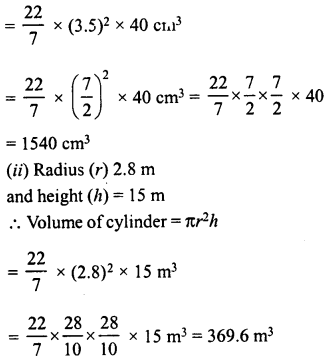
(i) Radius (r) = 3.5 cm
Height (h) = 40 cm
Volume of cylinder = πr2h
RD Sharma Class 8 Solutions Chapter 22 Mensuration III Ex 22.2 1

Question 2.
Find the volume of a cylinder, if the diameter (d) of its base and its altitude (h) are:
(i) d= 21 cm, h = 10 cm
(ii) d = 7 m, h = 24 m.
Solution:
(i) Diameter (d) = 21 cm
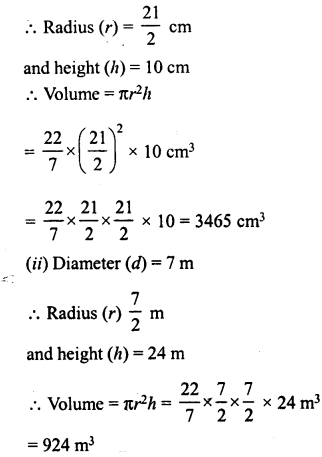
RD Sharma Class 8 Solutions Chapter 22 Mensuration III Ex 22.2 2

Question 3.
The area of the base of a right circular cylinder is 616 cm3 and its height is 25 cm. Find the volume of the cylinder.
Solution:
Base area of cylinder = 616 cm2
Height (h) = 25 cm.
∴ Volume = Area of base x height
= 616 x 25 cm3 = 15400 cm3

Question 4.
The circumference of the base of a cylinder is 88 cm and its height is 15 cm. Find the volume of the cylinder.
Solution:
Circumference of the base of cylinder = 88 cm
Let r be the radius
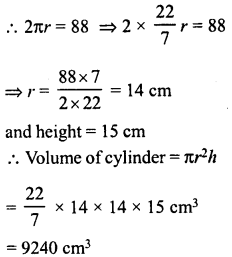
RD Sharma Class 8 Solutions Chapter 22 Mensuration III Ex 22.2 3

Question 5.
A hollow cylindrical pipe is 21 dm long. Its outer and inner diameters are 10 cm and 6 cm respectively. Find the volume of the copper used in making the pipe.
Solution:
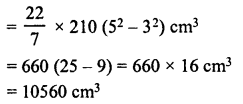
Length (Height) of hollow cylindrical pipe = 21 dm = 210 cm
Inner diameter = 6 cm
Outer diameter = 10 cm
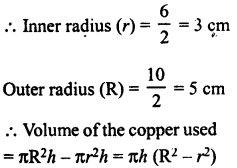
RD Sharma Class 8 Solutions Chapter 22 Mensuration III Ex 22.2 4
RD Sharma Class 8 Solutions Chapter 22 Mensuration III Ex 22.2 5

Question 6.
Find the (i) curved surface area (ii) total surface area and (iii) volume of a right circular cylinder whose height is 15 cm and the radius of the base is 7 cm
Solution:
Radius of the cylider (r) = 7 cm
and height (h) = 15 cm
(i) Curved surface area = 2πrh
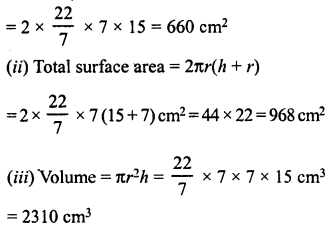
RD Sharma Class 8 Solutions Chapter 22 Mensuration III Ex 22.2 6

Question 7.
The diameter of the base of a right circular cylinder is 42 cm and its height is 10 cm. Find the volume of the cylinder.
Solution:
Diameter of the base of cylinder = 42 cm
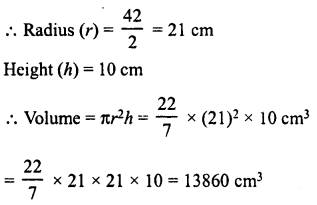
RD Sharma Class 8 Solutions Chapter 22 Mensuration III Ex 22.2 7

Question 8.
Find the volume of a cylinder, the diameter of whose base is 7 cm and height being 60 cm. Also, find the capacity of the cylinder in litres.
Solution:
Diameter of cylinder = 7 cm
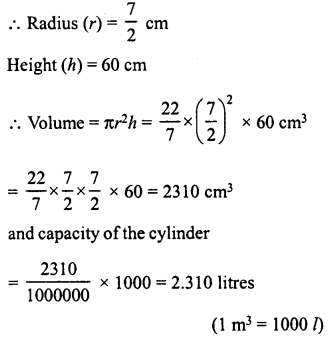
RD Sharma Class 8 Solutions Chapter 22 Mensuration III Ex 22.2 8

Question 9.
A rectangular strip 25 cm x 7 cm is rotated about the longer side. Find the volume of the solid, thus generated.
Solution:
Size of rectangular strip = 25 cm x 7 cm
By rotating, about the longer side, we find a right circular cylinder,
then the radius of cylinder (r) = 7 cm
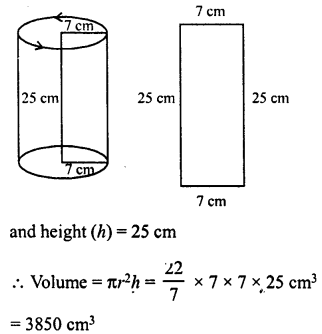
RD Sharma Class 8 Solutions Chapter 22 Mensuration III Ex 22.2 9

Question 10.
A rectangular sheet of paper 44 cm x 20 cm, is rolled along its length to form a cylinder. Find the volume of the cylinder so formed.
Solution:
Size of sheet of paper = 44 cm x 20 cm
By rolling along length, a cylinder is formed in which circumference of its base = 20 cm
and height (h) = 44 cm
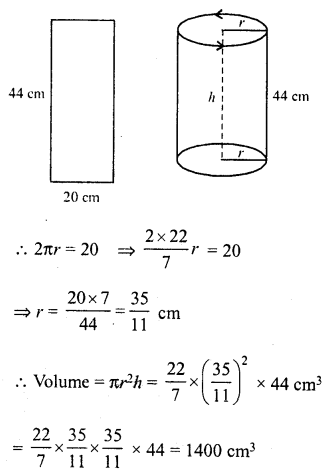
RD Sharma Class 8 Solutions Chapter 22 Mensuration III Ex 22.2 10

Question 11.
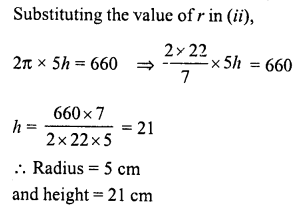
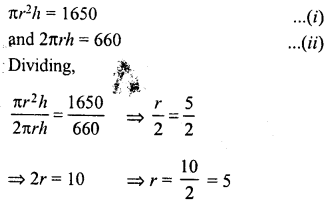
The volume and the curved surface area of a cylinder are 1650 cm3 and 660 cm2 respectively. Find the radius and height of the cylinder.
Solution:
Volume of cylinder = 1650 cm3
and curved surface area = 660 cm2
Let r be the radius and h be the height of the cylinder, then
RD Sharma Class 8 Solutions Chapter 22 Mensuration III Ex 22.2 11
RD Sharma Class 8 Solutions Chapter 22 Mensuration III Ex 22.2 12

Question 12.
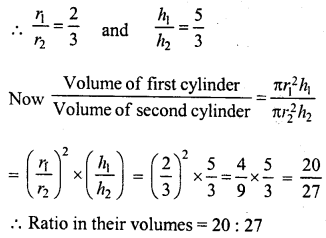
The radii of two cylinders are in the ratio 2 :3 and their heights are in the ratio 5 : 3. Calculate the ratio of their volumes.
Solution:
Ratio in radii = 2:3
and in heights = 5:3
Let r1,h1 and r2, h2 are the radii and heights of two cylinders respectively.
RD Sharma Class 8 Solutions Chapter 22 Mensuration III Ex 22.2 13

Question 13.
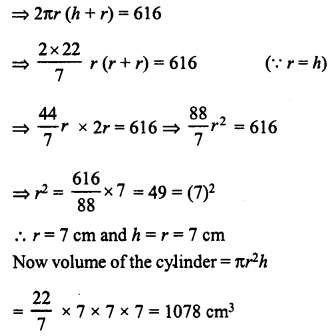
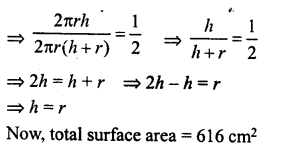
The ratio between the curved surface area and the total surface area of a right circular cylinder is 1 : 2. Find the volume of the cylinder, if its total surface area is 616 cm2.
Solution:
Ratio in curved surface are and total surface area =1 : 2
Let r be the radius and h be the height.
Then 2πrh : 2πr (h + r)= 1 : 2
RD Sharma Class 8 Solutions Chapter 22 Mensuration III Ex 22.2 14
RD Sharma Class 8 Solutions Chapter 22 Mensuration III Ex 22.2 15

Question 14.
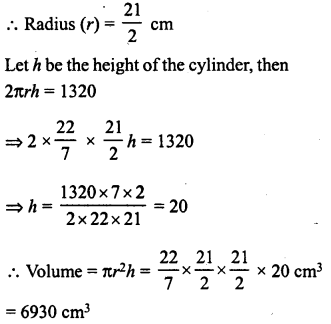
The curved surface area of a cylinder is 1320 cm2 and its base has diameter 21 cm. Find the volume of the cylinder.
Solution:
Curved surface area of a cylinder = 1320 cm2
Diameter of base = 21 cm
RD Sharma Class 8 Solutions Chapter 22 Mensuration III Ex 22.2 16

Question 15.
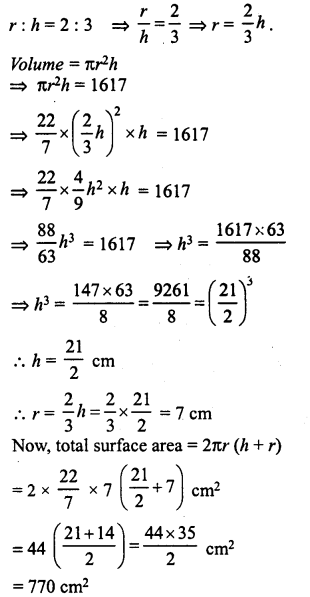
The ratio between the radius of the base and the height of a cylinder is 2 : 3. Find the total surface area of the cylinder, if its volume is 1617 cm3.
Solution:
Ratio between radius and height of a cylinder = 2:3
Volume = 1617 cm3
Let r be the radius and A be the height of the cylinder, then
RD Sharma Class 8 Solutions Chapter 22 Mensuration III Ex 22.2 17

Question 16.
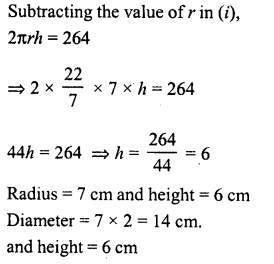
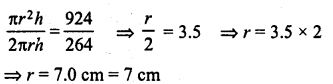
The curved surface area of a cylindrical pillar is 264 m2 and its volume is 924 m3. Find the diameter and the height of the pillar.
Solution:
Let r be the radius and A be the height of the cylinder, then
2πrh = 264 …(i)
and πr2h= 924 …(ii)
Dividing (ii) by (i),
RD Sharma Class 8 Solutions Chapter 22 Mensuration III Ex 22.2 18
RD Sharma Class 8 Solutions Chapter 22 Mensuration III Ex 22.2 19

Question 17.
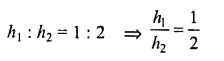
Two circular cylinders of equal volumes have their heights in the ratio 1 : 2. Find the ratio of their radii.
Solution:
Volumes of two cylinders are equal.
Let r1, r2 are the radii and h1, h2 are their heights, then
RD Sharma Class 8 Solutions Chapter 22 Mensuration III Ex 22.2 20
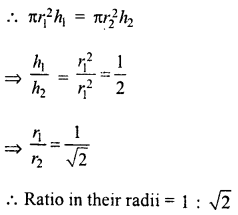
Now, volume of first cylinder = πr12h1
and Volume of second cylinder = πr22h2
Their volumes are equal
RD Sharma Class 8 Solutions Chapter 22 Mensuration III Ex 22.2 21

Question 18.
The height of a right circular cylinder is 10.5 m. Three times the sum of the areas of its two circular faces is twice the area of the curved surface. Find the volume of the cylinder.
Solution:
Height of cylinder (A) = 10.5 m.
Let r be the radius, then
Sum of areas of two circular faces = 2π2
and curved surface area = 2πrh
According to the condition,
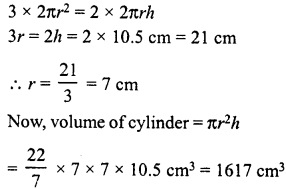
RD Sharma Class 8 Solutions Chapter 22 Mensuration III Ex 22.2 22

Question 19.
How many cubic metres of earth must be dug-out to sink a well 21 m deep and 6 m diameter ?
Solution:
Diameter of well = 6 m
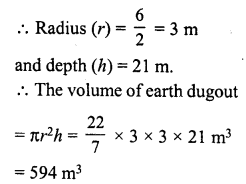
RD Sharma Class 8 Solutions Chapter 22 Mensuration III Ex 22.2 23

Question 20.
The trunk of a tree is cylindrical and its circumference is 176 cm. If the length of the trunk is 3 m, find the volume of the timber that can be obtained from the trunk.
Solution:
Circumference of cylindrical trunk = 176 cm
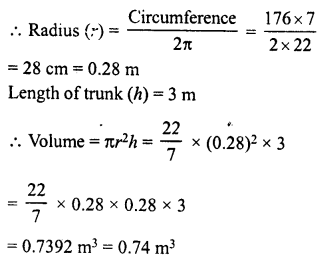
RD Sharma Class 8 Solutions Chapter 22 Mensuration III Ex 22.2 24

Question 21.
A well is dug 20 m deep and it has a diameter of 7 m. The earth which is so dug out is spread out on a rectangular plot 22 m long and 14 m broad, what is the height of the platform so formed ?
Solution:
Diameter of the well = 7 m
∴ Radius (r) = \(\frac { 7 }{ 2 }\) m
Depth (h) = 20 m
= Volume of earth dug out = πr2h
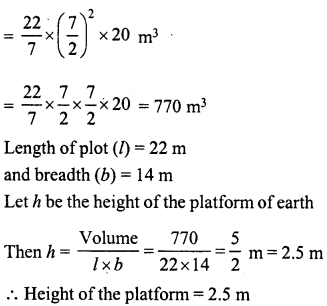
RD Sharma Class 8 Solutions Chapter 22 Mensuration III Ex 22.2 25

Question 22.
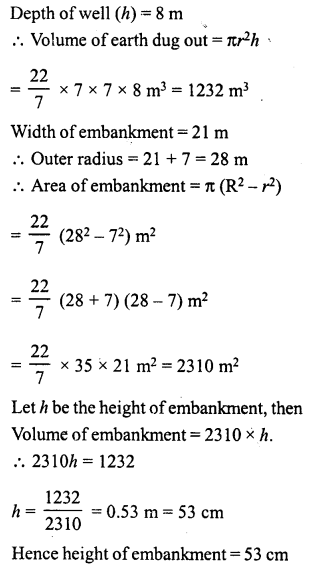
A well with 14 m diameter is dug 8 m deep. The earth taken out of it has been evenly spread all around it to a width of 21 m to form an embankment. Find the height of the embankment.
Solution:
Diameter of the well = 14 m
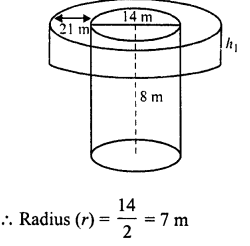
RD Sharma Class 8 Solutions Chapter 22 Mensuration III Ex 22.2 26
RD Sharma Class 8 Solutions Chapter 22 Mensuration III Ex 22.2 27

Question 23.
A cylindrical container with diameter of base 56 cm contains sufficient water to submerge a rectangular solid of iron with dimensions 32 cm x 22 cm x 14 cm. Find the rise in the level of the water when the solid is completely submerged.
Solution:
Diameter of the base of a cylindrical container = 56 cm
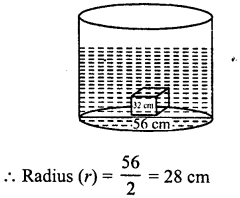
RD Sharma Class 8 Solutions Chapter 22 Mensuration III Ex 22.2 28
Dimensions of the rectangular solid = 32 cm x 22 cm x 14 cm
∴ Volume of solid = 32 x 22 x 14 cm3 = 9856 cm3
∴Volume of water rose up = 9856 cm3
Let h be the height of water, then πr2h = 9856
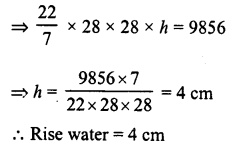
RD Sharma Class 8 Solutions Chapter 22 Mensuration III Ex 22.2 29

Question 24.
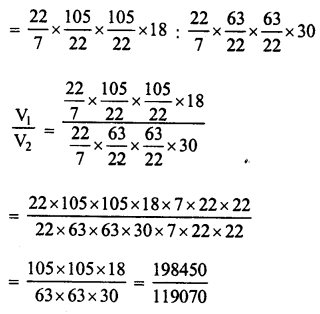
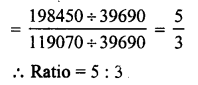
A rectangular sheet of paper 30 cm x 18 cm can be transformed into the curved surface of a right circular cylinder in two ways Le., either by rolling the paper along its length or by rolling it along its breadth. Find the ratio of the volumes of the two cylinders thus formed.
Solution:
Size of paper = 30 cm and 18 cm.
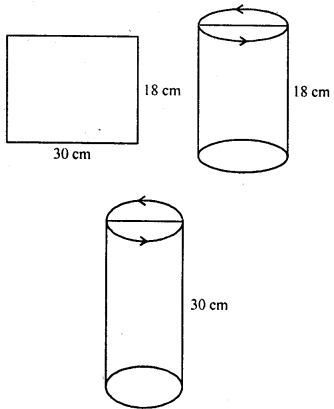
RD Sharma Class 8 Solutions Chapter 22 Mensuration III Ex 22.2 30
(i) By rolling length wise,
The circumference of base = 30 cm
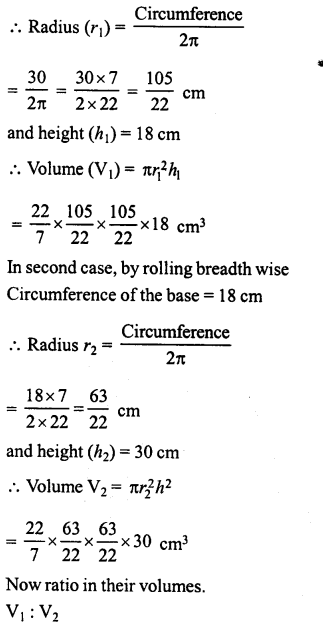
RD Sharma Class 8 Solutions Chapter 22 Mensuration III Ex 22.2 31
RD Sharma Class 8 Solutions Chapter 22 Mensuration III Ex 22.2 32
RD Sharma Class 8 Solutions Chapter 22 Mensuration III Ex 22.2 33

Question 25.
The rain which falls on a roof 18 m long and 16.5 m wide is allowed to be stored in a cylindrical tank 8 m in diameter. If it rains 10 cm on a day, what is the rise of water level in the tank due to it.
Solution:
Length of roof (l) = 18 m
Breadth (b) = 16.5 m
Height of water on the roof = 10 cm
∴ Volume of water collected
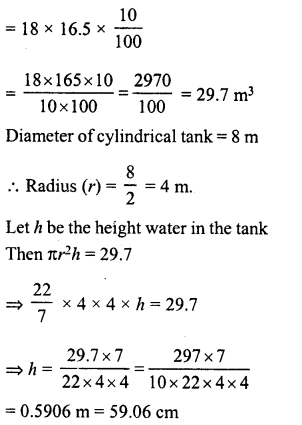
RD Sharma Class 8 Solutions Chapter 22 Mensuration III Ex 22.2 34

Question 26.
A Piece of ductile metal is in the form of a cylinder of diameter 1 cm and length 5 cm. It is drawnout into a wire of diameter 1 mm. What will be the length of the wire so formed ?
Solution:
Diameter of ductile metal = 1 cm
and length (h) = 5 cm
and radius (r) = \(\frac { 1 }{ 2 }\) cm
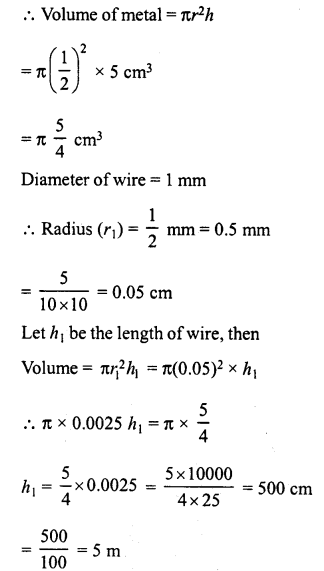
RD Sharma Class 8 Solutions Chapter 22 Mensuration III Ex 22.2 35

Question 27.
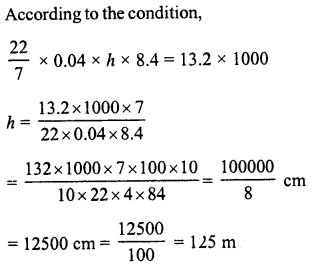
Find the length of 13.2 kg of copper wire of diameter 4 mm when 1 cubic cm of copper weighs 8.4 gm.
Solution:
Weight of wire = 13.2 kg
Diameter of wire = 4 mm
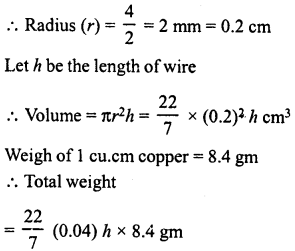
RD Sharma Class 8 Solutions Chapter 22 Mensuration III Ex 22.2 36
RD Sharma Class 8 Solutions Chapter 22 Mensuration III Ex 22.2 37

Question 28.
2.2 cubic dm of brass is to be drawn into a cylindrical wire 0.25 cm in diameter. Find the length of the wire.
Solution:
Volume of brass = 2.2 cu.dm
= 2.2 x 10 x 10 x 10 = 2200 cm2
Diameter of wire = 0.25 cm
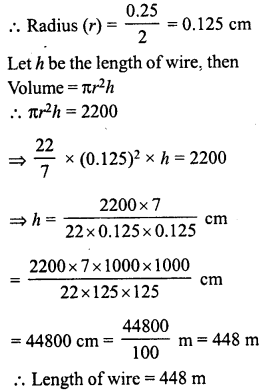
RD Sharma Class 8 Solutions Chapter 22 Mensuration III Ex 22.2 38

Question 29.
The difference between inside and outside surfaces of a cylindrical tube 14 cm long is 88 sq. cm. If the volume of the tube is 176 cubic cm, find the inner and outer radii of the tube.
Solution:
Let r and R be the radii of inner and outer surfaces of a cylindrical tube,
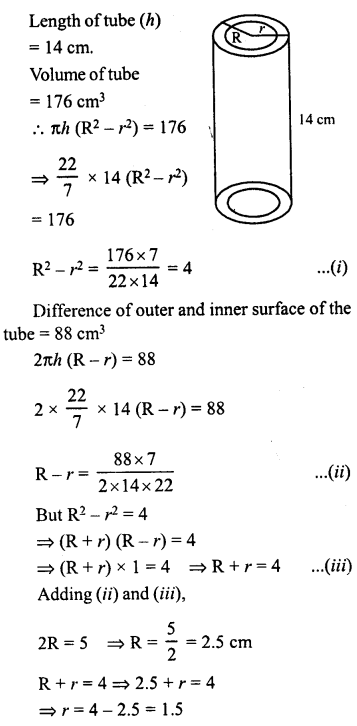
RD Sharma Class 8 Solutions Chapter 22 Mensuration III Ex 22.2 39
RD Sharma Class 8 Solutions Chapter 22 Mensuration III Ex 22.2 40

Question 30.
Water flows out through a circular pipe whose internal diameter is 2 cm, at the rate of 6 metres per second into a cylindrical tank, the radius of whose base is 60 cm. Find the rise in the level of water in 30 minutes.
Solution:
Diameter of pipe = 2 cm
∴ Radius (r) = \(\frac { 2 }{ 2 }\) = 1 cm = 0.01 m
Length of flow of water in 1 second = 6 m Length of flow in 30 minutes = 6 x 30 x 60 m = 10800 m
∴ Volume of water = πr2h
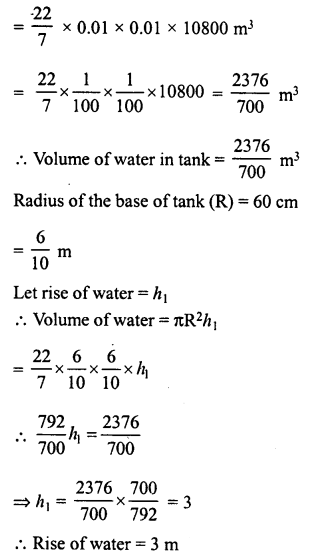
RD Sharma Class 8 Solutions Chapter 22 Mensuration III Ex 22.2 41

Question 31.
A cylindrical tube, open at both ends, is to made of metal. The internal diameter of the tube is 10.4 cm and its length is 25 cm. The thickness of the metal tube is 8 mm everywhere. Calculate the volume of the metal.
Solution:
Length of metal tube (h) = 25 cm
Internal diameter = 10.4 cm
∴ Internal radius (r) = \(\frac { 10.4 }{ 2 }\) = 5.2 cm
Thickness of metal = 8 mm = 0.8 cm
∴ Outer radius = 5.2 + 0.8 = 6 cm
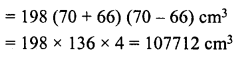
Now volume of the metal
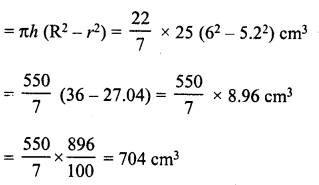
RD Sharma Class 8 Solutions Chapter 22 Mensuration III Ex 22.2 42

Question 32.
From a tap of inner radius 0.75 cm, water flows at the rate of 7 m per second. Find the volume in litres of water delivered by the pipe in one hour.
Solution:
Inner radius of pipe (r) = 0.75 cm
Rate of water flow = 7 m per second
∴ Length of water flow in 1 hour (h)
= 7 x 3600 m = 25200 m
∴ Volume of water in 1 hour
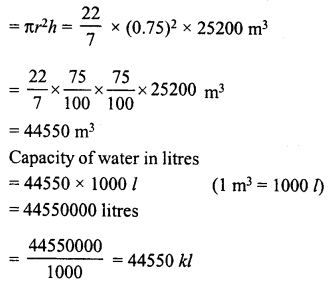
RD Sharma Class 8 Solutions Chapter 22 Mensuration III Ex 22.2 43

Question 33.
A cylindrical water tank of diameter 1. 4 m and height 2.1 m is being fed by a pipe of diameter 3.5 cm through which water flows at the rate of 2 metre per second. In how much time the tank will be filled ?
Solution:
Diameter of cylindrical tank = 1.4 m
∴ Radius (r) = \(\frac { 1.4 }{ 2 }\) = 0.7 m
Height (h) = 2.1m.
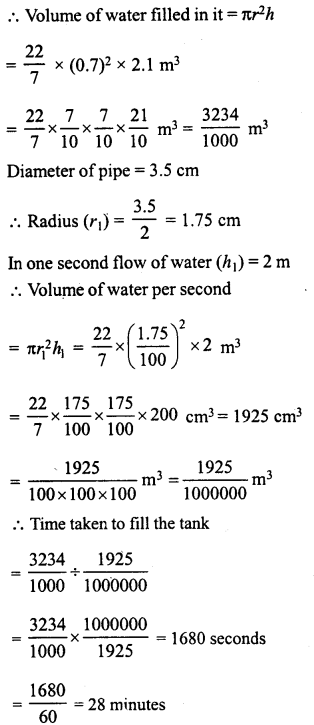
RD Sharma Class 8 Solutions Chapter 22 Mensuration III Ex 22.2 44

Question 34.
A rectangular sheet of paper 30 cm x 18 cm can be transformed into the curved surface of a right circular cylinder in two ways Le. either by rolling the paper along its length or by rolling it along its breadth. Find the ratio of the volumes of the two cylinder thus formed.
Solution:
In first case,
By rolling the paper along its length,
the circumference of the base = 30 cm
and height (h) = 18 cm
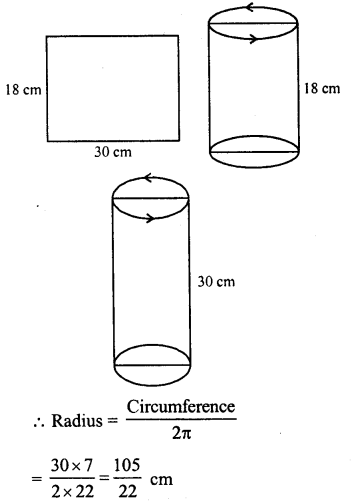
RD Sharma Class 8 Solutions Chapter 22 Mensuration III Ex 22.2 45
Note: See Q.No. 24 this exercise

Question 35.
How many litres of water flow out of a pipe having an area of cross-section of 5 cm2 in one minute, if the speed of water in the pipe is 30 cm/sec ?
Solution:
Speed of water = 30 cm/sec
∴ Water flow in 1 minute = 30 cm x 60 = 1800 cm
Area of cross-section = 5 cm2
∴ Volume of water = 1800 x 5 = 9000 cm3
Capacity of water in litres = 9000 x l ml

RD Sharma Class 8 Solutions Chapter 22 Mensuration III Ex 22.2 46

Question 36.
A solid cylinder has a total surface area of 231 cm2. Its curved surface area is \(\frac { 2 }{ 3 }\) of the total surface area. Find the volume of the cylinder.
Solution:
Total surface area of a solid cylinder = 231 cm2
Curved surface area = \(\frac { 2 }{ 3 }\) of 231 cm2 = 2 x 77 = 154 cm2
and area of two circular faces = 231-154 = 77 cm2
Let r be the radius, then
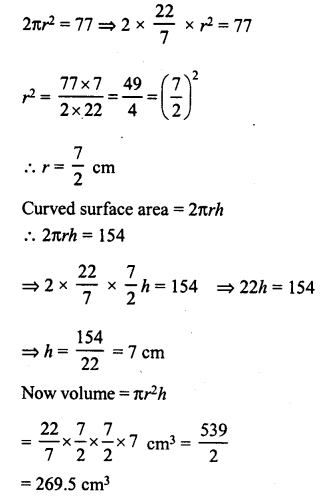
RD Sharma Class 8 Solutions Chapter 22 Mensuration III Ex 22.2 47

Question 37.
Find the cost of sinking a tubewell 280 m deep, having diameter 3 m at the rate of Rs 3.60 per cubic metre. Find also the cost of cementing its inner curved surface at Rs 2.50 per square metre.
Solution:
Diameter of well = 3 m
∴ Radius (r) = \(\frac { 3 }{ 2 }\) m
and depth (h) = 280 m
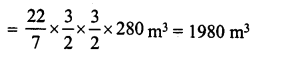
(i) Volume of earth dug out = πr2h
RD Sharma Class 8 Solutions Chapter 22 Mensuration III Ex 22.2 48
Rate of sinking the well = Rs 3.60 per m3
∴ Total cost of sinking = Rs 1980 x 3.60 = Rs 7,128
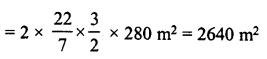
(ii) Inner curved surface area = 2πrh
RD Sharma Class 8 Solutions Chapter 22 Mensuration III Ex 22.2 49
Rate of cementing = Rs 2.50 per m2
∴ Total cost of cementing = Rs 2.50 x 2640
= Rs 6,600

Question 38.
Find the length of 13.2 kg of copper wire of diameter 4 mm, when 1 cubic cm of copper weighs 8.4 gm.
Solution:
Note : See Q.No. 27 of this exercise

Question 39.
2.2 cubic dm of brass is to be drawn into a cylindrical wire 0.25 cm in diameter. Find the length of the wire.
Solution:
Note: See Q.No. 28 of this exercise.

Question 40.
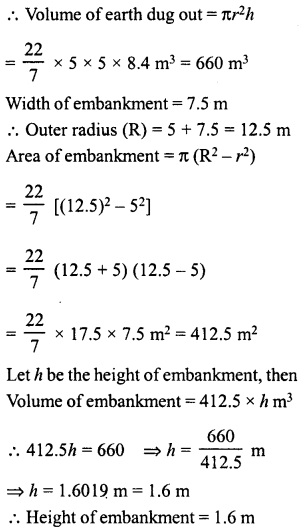
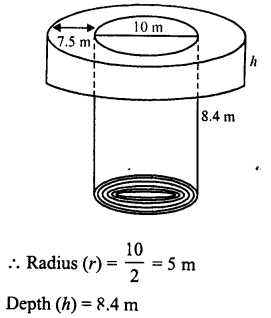
A well with 10 m inside diameter is dug 8.4 m deep. Earth taken out of it is spread all around it to a width of 7.5 m to form an embankment. Find the height of the embankment.
Solution:
Diameter of the well = 10 m
RD Sharma Class 8 Solutions Chapter 22 Mensuration III Ex 22.2 50
RD Sharma Class 8 Solutions Chapter 22 Mensuration III Ex 22.2 51

Question 41.
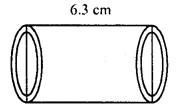
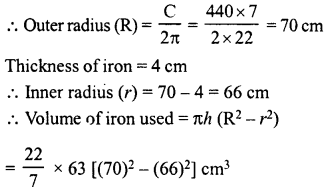
A hollow garden roller, 63 cm wide with a girth of 440 cm, is made of 4 cm thick iron. Find the volume of the iron.
Solution:
Width of roller (h) = 63 cm.
RD Sharma Class 8 Solutions Chapter 22 Mensuration III Ex 22.2 52
Outer circumference of roller = 440 cm
RD Sharma Class 8 Solutions Chapter 22 Mensuration III Ex 22.2 53
RD Sharma Class 8 Solutions Chapter 22 Mensuration III Ex 22.2 54

Question 42.
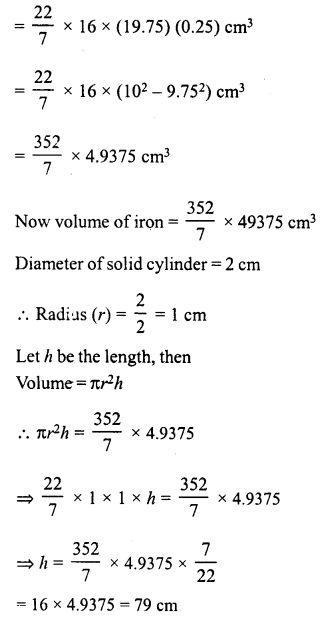
What length of a solid cylinder 2 cm in diameter must be taken to recast into a hollow cylinder of length 16 cm, external diameter 20 cm and thickness 2.5 mm ?
Solution:
Length of hollow cylinder (h) = 16 cm
External diameter = 20 cm
∴ External radius (R) = \(\frac { 20 }{ 2 }\) = 10 cm
Thickness of iron = 2.5 mm
∴ Internal radius (r) = 10 – 0.25 = 9.75 cm
∴ Volume of iron = πh (R2 – r2)
RD Sharma Class 8 Solutions Chapter 22 Mensuration III Ex 22.2 55

Question 43.
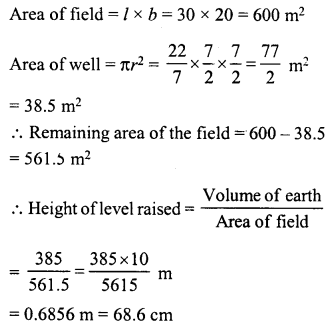
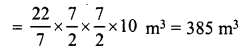
In the middle of rectangular field measuring 30 m x 20 m, a well of 7 m diameter and 10 m depth is dug. The earth so removed is evenly spread over the remaining part of the field. Find the height through which the level of the field is raised.
Solution:
Diameter of well = 7 m
∴ Radius (r) = \(\frac { 7 }{ 2 }\) m
Depth (h) = 10 m.
∴ Volume of earth dug out = πr2h
RD Sharma Class 8 Solutions Chapter 22 Mensuration III Ex 22.2 56
RD Sharma Class 8 Solutions Chapter 22 Mensuration III Ex 22.2 57

Hope given RD Sharma Class 8 Solutions Chapter 22 Mensuration III Ex 22.2 are helpful to complete your math homework.

If you have any doubts, please comment below. Learn Insta try to provide online math tutoring for you.
HOTS Questions for Class 10 Science Chapter 6 Life Processes

HOTS Questions for Class 10 Science Chapter 6 Life Processes

These Solutions are part of HOTS Questions for Class 10 Science. Here we have given HOTS Questions for Class 10 Science Chapter 6 Life Processes

Question 1.
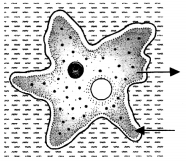
What does the diagram depict ?
HOTS Questions for Class 10 Science Chapter 6 Life Processes image - 1
Answer:
Gaseous exchange in Amoeba.

More Resources

Question 2.
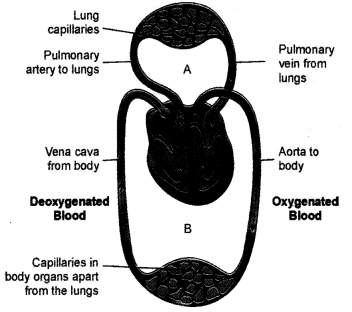
What does diagram depict ? What are A and B ?
HOTS Questions for Class 10 Science Chapter 6 Life Processes image - 2
Answer:
Double Circulation :
(A) Pulmonary Circulation
(B) Systemic Circulation.

Question 3.
How are viruses living when they do not show movements ?
Answer:
Viruses do not show movements outside the host cells. They show movements at the molecular level inside the living cells.

Question 4.
What is
(a) Primary reaction of photosynthesis
(b) Calvin cycle
(c) Krebs cycle
(d) EMP
(e) Oxidative phosphorylation ?
Answer:
(a) Primary Reaction of Photosynthesis: It is the conversion of light energy into chemical energy by chlorophyll a molecules.
(b) Calvin Cycle: It is a cycle of reactions that occur during reduction of CO2 to carbohydrate with the help of ATP and NADPH2 produced during light reaction.
(c) Krebs Cycle: It is a cycle of reactions that occur inside the mitochondria wherein an activated acetyl group is completely oxidised to form CO2, NADH2 and FADH2.
(d) EMP: Embden-Meyerhoff-Parnas pathway, also called glycolysis, is the first step of respiratory breakdown of glucose that occurs in the cytoplasm forming two molecules each of pyruvate, ATP and NADH2.
(e) Oxidative Phosphorylation: It is the process of ATP formation from ADP and inorganic phosphate with the help of energy liberated during oxidation of reduced coenzymes (NADH2, FADH2).

Question 5.
A girdled tree dies if the girdle is wide and is not filled up. Comment.
Answer:
Girdling removes bark containing phloem from the trunk region. Food manufactured by foliage does not reach the roots which requires the same as they are always growing. In the absence of food supply, roots starve and stop absorbing water. The foliage wilts and the plant dies.

Question 6.
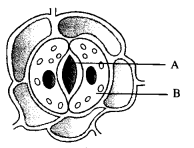
Study the diagram. Name the parts “A” and “B”. State one function of each. (CBSE A.I. 2008)
HOTS Questions for Class 10 Science Chapter 6 Life Processes image - 3
Answer:
A—Stomatal pore or stoma Function: Pathway for exchange of gases or photosymthesis and respiration and loss of water vapours in transpiration.
B—Guard cell Function: Two guard cells present in each stoma, create pore when they are turgid and close the same when they are flaccid.

Question 7.
In the experiment “Light is essential for photosynthesis” why does the uncovered part of the leaf turn blue-black after putting iodine solution. (CBSE Foreign 2010)
Answer:
The uncovered part of the leaf exposed to sunlight performs photosynthesis and accumulates starch. Iodine reacts.with starch to give blue-black colouration.

Question 8.
Give one reason why multicellular organisms require special organs for exchange of gases between their body and their environment. (CBSE A.I. 2010)
Answer:
Multicellular organisms require special organs for exchange of gases as most of their cells are internal and are not in direct contact with environment.

Question 9.
Name the green dot like structures in some cells observed by a student when a leaf peel was viewed under a microscope. What is the green colour due to ? (CBSE Delhi 2010)
Answer:
Chloroplasts with green colour due to chlorophyll.

Question 10.
Explain the process of breakdown of glucose in a cell

  1. In the presence of oxygen
  2. In the absence of oxygen. (CBSE foreign 2010)

Answer:
Glucose is first broken down to pyruvic acid during glycolysis. Glycolysis occurs in cell cytoplasm. It produces energy.

  1. Presence of Oxygen: It is aerobic respiration where pyruvic acid is completely oxidised to carbon dioxide and water inside mitochondria releasing a lot of energy.
  2. Absence of Oxygen: Pyruvic acid is metabolised anaerobically in the cell cytoplasm forming either
    1. Ethyl alcohol (ethanol) and carbon dioxide or
    2. lactic acid: Very little energy is released.

Question 11.
Explain the process of digestion of food in mouth, stomach and small intestine in human body. (CBSE Delhi 2010)
Answer:
Mouth: Food is moistened, crushed and acted upon by salivary amylase which converts some starch into maltose and dextrins.
Stomach: Food is acidified, churned and mixed with enzyme pepsin. Pepsin acts in acidic medium over proteins to form soluble components, peptones and proteoses. Small quantities of semi-liquified food called chyme is passed on the duodenum.
Small Intestine: Acidity is neutralised and the food is made alkaline. Food is acted upon by pancreatic juice and succus entericus. Pancreatic juice has trypsin, amylase and lipase enzymes to digest proteins, carbohydrates and fats respectively. Succus entericus has enzymes for breakdown of peptides and disaccharides into amino acids and monosaccharides respectively.

Hope given HOTS Questions for Class 10 Science Chapter 6 Life Processes are helpful to complete your science homework.

If you have any doubts, please comment below. Learn Insta try to provide online science tutoring for you.

RS Aggarwal Class 6 Solutions Chapter 3 Whole Numbers Ex 3E

RS Aggarwal Class 6 Solutions Chapter 3 Whole Numbers Ex 3E

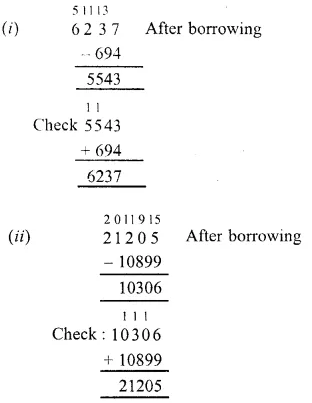
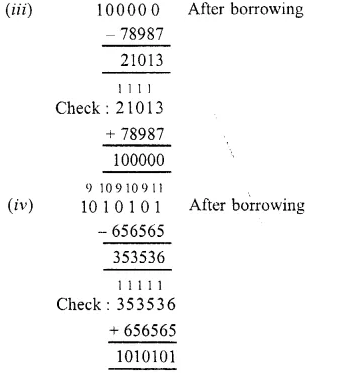
These Solutions are part of RS Aggarwal Solutions Class 6. Here we have given RS Aggarwal Solutions Class 6 Chapter 3 Whole Numbers Ex 3E.

Other Exercises

Question 1.
Solution:
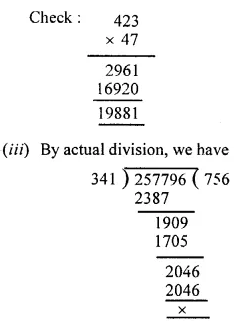
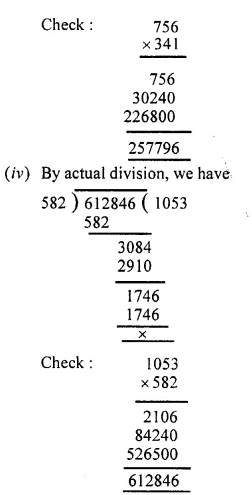
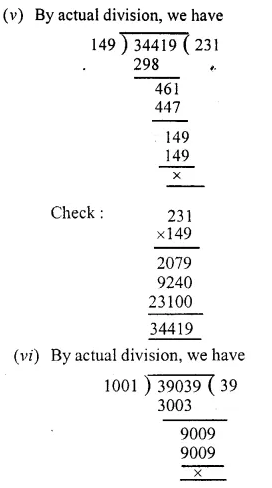
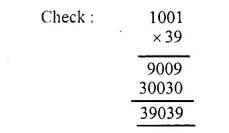
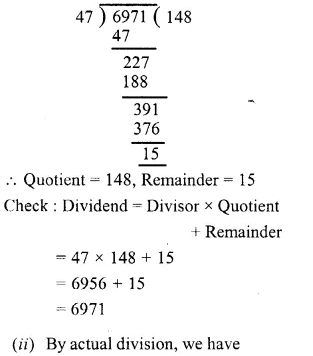
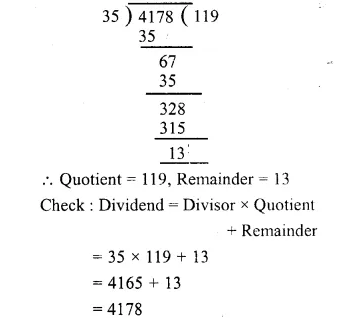
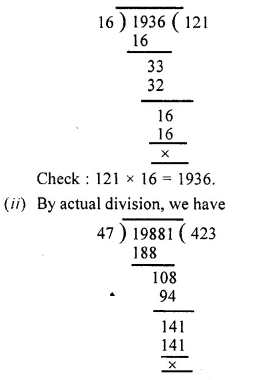
(i) By actual division, we have
RS Aggarwal Class 6 Solutions Chapter 3 Whole Numbers Ex 3E 1.1
RS Aggarwal Class 6 Solutions Chapter 3 Whole Numbers Ex 3E 1.2
RS Aggarwal Class 6 Solutions Chapter 3 Whole Numbers Ex 3E 1.3
RS Aggarwal Class 6 Solutions Chapter 3 Whole Numbers Ex 3E 1.4
RS Aggarwal Class 6 Solutions Chapter 3 Whole Numbers Ex 3E 1.5

Question 2.
Solution:
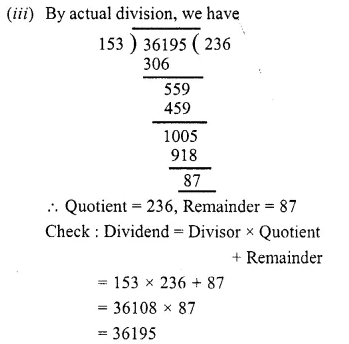
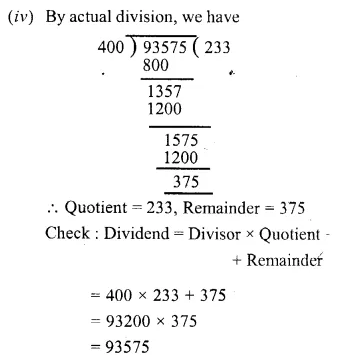
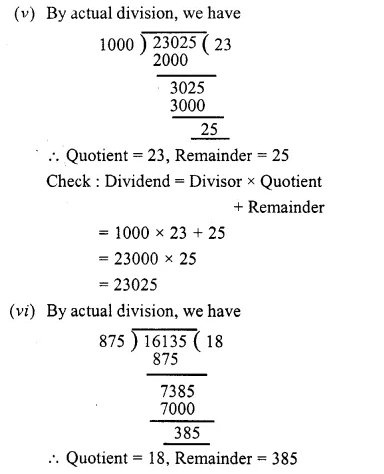
(i) By actual division, we have
RS Aggarwal Class 6 Solutions Chapter 3 Whole Numbers Ex 3E 2.1
RS Aggarwal Class 6 Solutions Chapter 3 Whole Numbers Ex 3E 2.2
RS Aggarwal Class 6 Solutions Chapter 3 Whole Numbers Ex 3E 2.3
RS Aggarwal Class 6 Solutions Chapter 3 Whole Numbers Ex 3E 2.4
RS Aggarwal Class 6 Solutions Chapter 3 Whole Numbers Ex 3E 2.5
RS Aggarwal Class 6 Solutions Chapter 3 Whole Numbers Ex 3E 2.6

Question 3.
Solution:
(i) We know that any number (non-zero) divided by 1 gives the number itself
65007 ÷ 1 = 65007
(ii) We know that 0 divided by any natural number gives 0
0 ÷ 879 = 0
(iii) 981 + 5720 ÷ 10 = 981 + (5720 ÷ 10)
= 981 + 572
= 1553
(iv) 1507 – 625 ÷ 25 = 1507 – (625 ÷ 25)
= 1507 – 25
= 1482
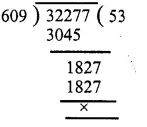
(v) 32277 ÷ (648 – 39)
= 32277 ÷ 609
RS Aggarwal Class 6 Solutions Chapter 3 Whole Numbers Ex 3E 3.1
32277 ÷ (648 – 39) = 53
(vi) 1573 ÷ 1573 – 1573 ÷ 1573
= (1573 ÷ 1573) – (1573 ÷ 1573)
= 1 – 1
= 0

Question 4.
Solution:
We have n ÷ n = n
let n = 1, 1 ÷ 1 = 1
1 = 1
which is true
∴ Hence 1 is the required whole number.

Question 5.
Solution:
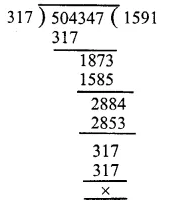
Product of two numbers = 504347
One number = 317
Other number = 504347 ÷ 317
RS Aggarwal Class 6 Solutions Chapter 3 Whole Numbers Ex 3E 5.1
∴ Other number = 1591

Question 6.
Solution:
Here Dividend = 59761, Quotient = 189
∴ Remainder = 37
We know that Dividend = Divisor x Quotient + Remainder
59761 = Divisor x 189 + 37
59761 – 37 = Divisor x 189
59724 = Divisor x 189
Divisor x 189 = 59724
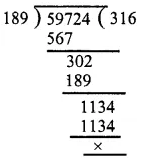
∴ Divisor = 59724 ÷ 189
RS Aggarwal Class 6 Solutions Chapter 3 Whole Numbers Ex 3E 6.1
∴ Divisor = 59724 ÷ 189 = 316

Question 7.
Solution:
Here dividend = 55390,
Divisor = 299 and Remainder = 75
By division algorithm, we have
Dividend = Quotient x Divisor + Remainder
55390 = Quotient x 299 + 75
55390 – 75 = Quotient x 299
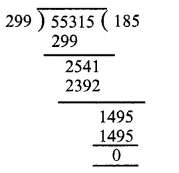
55315 = Quotient x 299
Quotient x 299 = 55315
Quotient = 55315 ÷ 299
RS Aggarwal Class 6 Solutions Chapter 3 Whole Numbers Ex 3E 7.1
∴ Required quotient = 185

Question 8.
Solution:
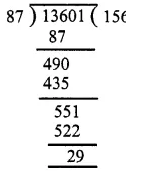
On dividing 13601 by 87, we have
RS Aggarwal Class 6 Solutions Chapter 3 Whole Numbers Ex 3E 8.1
It is clear that if we subtract 29 from 13601, the resulting number will be exactly divisible by 87.
∴ The required least number = 29.

Question 9.
Solution:
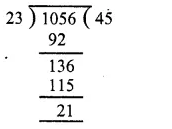
Here dividend = 1056, Divisor = 23
By actual division, we have
RS Aggarwal Class 6 Solutions Chapter 3 Whole Numbers Ex 3E 9.1
It is clear that if we add 2 to 21, it will become 23 which is divisible by 23.
∴ Required least number = 2.

Question 10.
Solution:
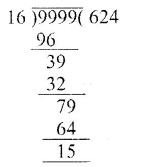
Greatest 4-digit number = 9999
RS Aggarwal Class 6 Solutions Chapter 3 Whole Numbers Ex 3E 10.1
On, dividing by 16, we get remainder as 15
∴ The required largest 4-digit number = 9999 – 15
= 9984

Question 11.
Solution:
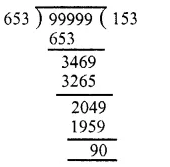
Largest number of 5-digits = 99999
On dividing 99999 by 653, we have
RS Aggarwal Class 6 Solutions Chapter 3 Whole Numbers Ex 3E 11.1
∴ Quotient = 153, Remainder = 90
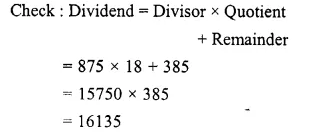
Check : By division algorithm Dividend = Divisor x Quotient + Remainder
= 653 x 153 + 90
= 99909 + 90
= 99999

Question 12.
Solution:
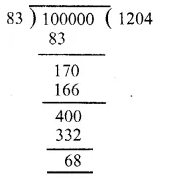
The least 6-digit number = 100000
On dividing 100000 by 83, we have
RS Aggarwal Class 6 Solutions Chapter 3 Whole Numbers Ex 3E 12.1
It is clear that if we add 15 to 68, it will become 83 which is divisible by 83.
∴ Required least 6-digit number = 100000 + 15
= 100015

Question 13.
Solution:
Cost of 1 dozen bananas = Rs. 29
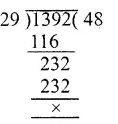
Bananas can be purchase in Rs. 1392
RS Aggarwal Class 6 Solutions Chapter 3 Whole Numbers Ex 3E 13.1
1392 ÷ 29
= 48 dozens

Question 14.
Solution:
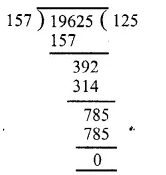
Total number of trees = 19625
Total number of rows = 157
Number of trees in each row = 19625 ÷ 157
RS Aggarwal Class 6 Solutions Chapter 3 Whole Numbers Ex 3E 14.1
∴ Number of trees in each row = 125

Question 15.
Solution:
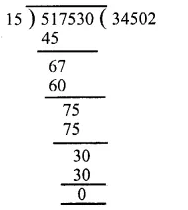
Total population of the town = 517530
Since there is one educated person out of 15
Total number of educated persons in the town = 517530 ÷ 15
RS Aggarwal Class 6 Solutions Chapter 3 Whole Numbers Ex 3E 15.1
∴ Total number of educated persons in the town = 34502.

Question 16.
Solution:
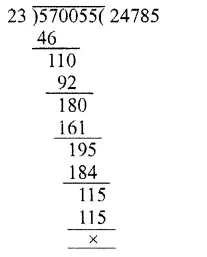
Cost of 23 colour TV sets = Rs. 570055
Cost of 1 colour TV set
RS Aggarwal Class 6 Solutions Chapter 3 Whole Numbers Ex 3E 16.1
∴ Cost of 1 color TV set
= Rs. 570055 ÷ 23
= Rs. 24785

Hope given RS Aggarwal Solutions Class 6 Chapter 3 Whole Numbers Ex 3E are helpful to complete your math homework.

If you have any doubts, please comment below. Learn Insta try to provide online math tutoring for you.
RS Aggarwal Class 6 Solutions Chapter 3 Whole Numbers Ex 3D

RS Aggarwal Class 6 Solutions Chapter 3 Whole Numbers Ex 3D

These Solutions are part of RS Aggarwal Solutions Class 6. Here we have given RS Aggarwal Solutions Class 6 Chapter 3 Whole Numbers Ex 3D.

Other Exercises

Question 1.
Solution:
(i) 246 x 1 = 246
(By multiplicative property of 1)
(ii) 1369 x 0 = 0
(By multiplicative property of 0)
(iii) 593 x 188 = 188 x 593
(By commutative law of multiplication)
(iv) 286 x 753 = 753 x 286
(By commutative law of multiplication)
(v) 38 x (91 x 37) = 91 x (38 x 37)
(By associative law of multiplication)
(vi) 13 x 100 x 1000 = 1300000
(vii) 59 x 66 + 59 x 34 = 59 x (66 + 34)
(By distributive law of multiplication)
(vii) 68 x 95 = 68 x 100 – 68 x 5

Question 2.
Solution:
(i) Commutative law of multiplication
(ii) Closure property
(iii) Associative law of multiplication
(iv) Multiplicative property of 1
(v) Multiplicative property of 0
(vi) Distributive law of multiplication over addition in whole numbers
(vii) Distributive law of multiplication over subtraction in whole numbers

Question 3.
Solution:
Using the law of distribution over addition and subtraction
(i) 647 x 13 + 647 x 7
= 647 x (13 + 7)
= 647 x 20
= 12940
(ii) 8759 x 94 + 8759 x 6
= 8759 x (94 + 6)
= 8759 x 100
= 875900
(iii) 7459 x 999 + 7459
= 7459 x 999 + 7459 x 1
= 7459 x (999 + 1)
= 7459 x 1000
= 7459000
(iv) 9870 x 561 – 9870 x 461
= 9870 x (561 – 461)
= 9870 x 100
= 987000
(v) 569 x 17 + 569 x 13 + 569 x 70
= 569 x (17 + 13 + 70)
= 569 x 100
= 56900
(vi) 16825 x 16825 – 16825 x 6825
= 16825 x (16825 – 6825)
= 16825 x 10000
= 168250000

Question 4.
Solution:
(i) 2 x 1658 x 50 = 1658 x (2 x 50) (Associative law of multiplication)
= 1658 x 100
= 165800
(ii) 4 x 927 x 25 = 927 x (4 x 25) (Associative law of multiplication)
= 927 x 100
= 92700
(iii) 625 x 20 x 8 x 50
(By associative law of multiplication)
(625 x 8) x (20 x 50)
= 5000 x 1000
= 5000000
(iv) 574 x (625 x 16)
= 574 x 10000
= 5740000
(v) 250 x 60 x 50 x 8
= (250 x 8) x (60 x 50)
(By associative law)
= 2000 x 3000
= 6000000
(vi) 8 x 125 x 40 x 25
= (8 x 125) x (40 x 25)
= 1000 x 1000
= 1000000

Question 5.
Solution:
Using distributive law of multiplication over addition or subtraction,
(i) 740 x 105
= 740 x (100 + 5)
= 740 x 100 + 740 x 5
= 74000 + 3700
= 77700
(ii) 245 x 1008
= 245 x (1000 + 8)
= 245 x 1000 + 245 x 8
= 245000 + 1960
= 246960
(iii) 947 x 96
= 947 x (100 – 4)
= 947 x 100 – 947 x 4
= 94700 – 3788
= 90912
(iv) 996 x 367
= 367 x (1000 – 4)
= 367 x 1000 – 367 x 4
= 367000 – 1468
= 365532
(v) 472 x 1097
= 472 x (1100 – 3)
= 472 x 1100 – 472 x 3
= 519200 – 1416
= 517784
(vi) 580 x 64
= 580 x (60 + 4)
= 580 x 60 + 580 x 4
= 34800 + 2320
= 37120
(vii) 439 x 997
= 437 x (1000 – 3)
= 439 x 1000 – 439 x 3
= 439000 – 1317
= 437683
(viii) 1553 x 198
= 1553 x (200 – 2)
= 1553 x 200 – 1553 x 2
= 310600 – 3106
= 307494

Question 6.
Solution:
(i) 3576 x 9 = 3576 x (10 – 1)
= 3576 x 10 – 3576 x 1
= 35760 – 3576
= 32184
(ii) 847 x 99 = 84 x (100 – 1)
= 847 x 100 – 847 x 1
= 84700 – 847
= 83853
(iii) 2437 x 999 = 2437 x (1000 – 1)
= 2437 x 1000 – 2437 x 1
= 2437000 – 2437
= 2434563

Question 7.
Solution:
RS Aggarwal Class 6 Solutions Chapter 3 Whole Numbers Ex 3D 7.1

Question 8.
Solution:
Largest 3-digit number = 999
Largest 5-digit number = 99999
Required product = 99999 x 999
= 99999 x (1000 – 1)
= 99999 x 1000-99999 x 1
= 99999000 – 99999
= 9,98,99,001

Question 9.
Solution:
Speed of car = 75 km per hour
In 1 hour, distance covered by a car = 75 km
.’. In 98 hours, distance will be covered = 75 x 98
= 75 x (100 – 2)
= 75 x 100 – 75 x 2
= 7500 – 150
= 7350 km

Question 10.
Solution:
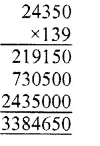
Cost of 1 set of VCR = Rs. 24350
Cost of 139 sets of VCR = Rs. 24350 x 139
= Rs. 3384650
RS Aggarwal Class 6 Solutions Chapter 3 Whole Numbers Ex 3D 10.1

Question 11.
Solution:
Cost of 1 house = Rs. 450000
Cost of 197 houses = Rs. 450000 x 197
= Rs. 450000 x (200 – 3)
= Rs. (450000 x 200 – 450000 x 3)
= Rs. (90000000 – 1350000)
= Rs. 88650000

Question 12.
Solution:
Cost of each chair = Rs. 1065
Cost of 50 chairs = Rs. 1065 x 50
= Rs. 53250
Cost of each blackboard = Rs. 1645
Cost of 30 blackboards = Rs. 1645 x 30
= Rs. 49350
Total cost of 50 chairs and 30 blackboards = Rs. 53250 + 49350
= Rs. 102600

Question 13.
Solution:
Number of students in 1 section = 45
Number of students in 6 sections = 45 x 6 = 270
Monthly charges of 1 student = Rs. 1650
Total monthly incomes from the class VI = Rs. 270 x 1650
= Rs. (300 – 30) x 1650
= Rs. (1650 x 300 – 1650 x 30)
= Rs. (495000 – 49500)
= Rs. 445500

Question 14.
Solution:
Since the product of two whole numbers is zero
.’. From multiplicative property of zero, we conclude that one of the whole numbers is zero.

Question 15.
Solution:
(i) Sum of two odd numbers is an even number.
(ii) Product of two odd numbers is an odd number.
(iii) a x a = a => a = 1 as 1 x 1 = 1

Hope given RS Aggarwal Solutions Class 6 Chapter 3 Whole Numbers Ex 3D are helpful to complete your math homework.

If you have any doubts, please comment below. Learn Insta try to provide online math tutoring for you.
RS Aggarwal Class 6 Solutions Chapter 3 Whole Numbers Ex 3C

RS Aggarwal Class 6 Solutions Chapter 3 Whole Numbers Ex 3C

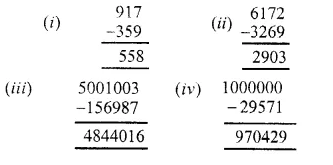
These Solutions are part of RS Aggarwal Solutions Class 6. Here we have given RS Aggarwal Solutions Class 6 Chapter 3 Whole Numbers Ex 3C.

Other Exercises

Question 1.
Solution:
RS Aggarwal Class 6 Solutions Chapter 3 Whole Numbers Ex 3C 1.1
RS Aggarwal Class 6 Solutions Chapter 3 Whole Numbers Ex 3C 1.2

Question 2.
Solution:
RS Aggarwal Class 6 Solutions Chapter 3 Whole Numbers Ex 3C 2.1

Question 3.
Solution:
(i) 463 – 9
= 464 – 1 – 9
= 464 – 10
= 454
(ii) 5632 – 99
= 5632 – 100 + 1
= 5633 – 100
= 5533
(iii) 8640 – 999
= 8640 – 1000 + 1
= 8641 – 1000
= 7641
(iv) 13006 – 9999
= 13006 – 10000 + 1
= 13007 – 10000
= 12007

Question 4.
Solution:
Smallest number of 7-digits = 1000000
Largest number of 4-digits = 9999
Required difference = (1000000 – 9999)
= 990001

Question 5.
Solution:
Deposit in the beginning = Rs. 136000
Next day withdrew = Rs. 73129
Amount left in the bank account = Rs. 136000 – 73129
= Rs. 62871

Question 6.
Solution:
Amount withdrawn from the bank = Rs. 1,00,000
Cost of TV set = Rs. 38750
Cost of refrigerator = Rs. 23890
Cost of jewellery = Rs. 35560
Total amount spent on her purchase = Rs. (38750 + 23890 + 35560)
= Rs. 98200
Amount left with her – Rs. 1,00,000 – Rs. 98200
= Rs. 1800

Question 7.
Solution:
Population of a town = 110500
Increase in 1 year = 3608
Persons left or died = 8973
The population at the end of year = 110500 + 3608 – 8973
= 114108 – 8973
= 105135

Question 8.
Solution:
(i) We have n + 4 = 9
n = 9 – 4 = 5
n = 5
(ii) n + 35 = 101
Subtracting 35 from both sides
n + 35 – 35 = 101 – 35
=> n = 66
n = 66
(iii) n – 18 = 39
Adding 18 to both sides
n – 18 + 18 = 39 + 18
=> n = 57
n = 57
(iv) n – 20568 = 21403 Adding 20568 to both sides
n – 20568 + 20568 = 21403 + 20568
n = 41971

Hope given RS Aggarwal Solutions Class 6 Chapter 3 Whole Numbers Ex 3C are helpful to complete your math homework.

If you have any doubts, please comment below. Learn Insta try to provide online math tutoring for you.