CA Foundation Business Economics Study Material – Perfect Competition

CA Foundation Business Economics Study Material Chapter 4 Price Determination in Different Markets – Perfect Competition

PERFECT COMPETITION

Introduction:

Perfect competition is a market structure where there are large number of firms (seller) which produce and sell homogeneous product. Individual firm produces only a small portion of the total market supply.

Therefore, a single firm cannot affect the price.
– Price is fixed by industry.
– Firm is only a price taker.
– So the price of the commodity is uniform.

Features of perfect competition

Following are the main features of perfect competition:

  1. Large number of buyers and sellers:
    • The number of buyers and sellers is so large that none of them can influence the price in the market individually.
    • Price of the commodity is determined by the forces of market demand and market supply.
  2. Homogeneous Product:
    • The product produced by all the firms in the industry are homogeneous.
      – They are identical in every respect like colour, size, etc.
      – Products are perfect substitutes of each other.
  3. Free entry and exit of the firms from the markets:
    • New firms are free to enter the industry any time.
    • Old firms or loss incurring firms can leave industry any time.
    • The condition of free entry and exit applies only to the long run equilibrium of the industry.
  4. Perfect knowledge of the market:
    • Under perfect competition, all firms (sellers) and buyers have perfect knowledge about the market.
    • Both have perfect information about prices at which commodities can be sold and bought.
  5. Perfect mobility:
    • The factors of production can move freely from one occupation to another and from one place to another.
  6. No transport cost:
    • Transport cost is ignored as all the firms have equal access to the market.
  7. No selling cost:
    • Under perfect competition commodities traded are homogeneous and have uniform price.
    • Therefore, firm need not make any expenditure on publicity and advertisement.

Equilibrium of the Industry:

  • Industry is a group of firms producing identical commodities.
  • Under perfect competition, price of a commodity is determined by the interaction between market demand and market supply of the whole industry.
  • The equilibrium price is determined at a point where demand for and supply of the whole industry are equal to each other.
  • No individual firm can influence the price.
  • Firm has to accept the price determined by the industry.
  • Therefore, the firm is said to be price taker and industry, the price maker.

Equilibrium of the industry is illustrated as follows:

CA Foundation Business Economics Study Material - Perfect Competition

The above table and fig. shows that at a price of ₹ 6 per unit, the quantity demanded equals quantity supplied.
The industry is at equilibrium at point ‘E’, where the equilibrium price is ₹ 6 and equilibrium | quantity is 60 units.

Equilibrium of a firm:

  • We have already seen that under the perfect competition, the price of the commodity is determined by the forces of market demand and market supply le. price is determined by industry.
  • Individual firm has to accept the price determined by the industry. Hence, firm is a PRICE TAKER.

CA Foundation Business Economics Study Material - Perfect Competition 1

  • In the table – the equilibrium price for the industry has been fixed at ₹ 6 per unit through the inter-action of market demand and supply.
  • Table – shows that the firm has no choice but to accept and sell their commodity at a price that has been determined by the industry ie. ₹ 6 per unit.
  • The firm cannot charge higher price than the market price of ₹ 6 per unit because of fear of loosing customers to rival firms.
  • There is no incentive for the firm to lower the price also.
  • Firm will try to sell as much as it can at the price of ₹ 6 per unit.
  • Table – shows that firm’s AR = MR = Price.

CA Foundation Business Economics Study Material - Perfect Competition 2

  • Fig. shows that being a price taker firm, it has to sell at a given price i.e. ₹ 6 per unit.
  • Therefore, firm’s demand curve is a horizontal straight line parallel to X-axis i.e. a perfectly elastic demand curve.
  • We know that price of a commodity is also the AR for the firm.
  • Therefore, demand curve also shows the AR for different quantities sold by the firm.
  • As every additional unit is sold at a given price i.e. ₹ 6 per unit, the MR = AR and the two curves coincides.
  • Thus, in a perfectly competitive market a firm’s AR = MR = Price = Demand Curve

Conditions for equilibrium of a firm:

  • In perfect competition, the firms are price takers and output adjusters.
  • This is because the price of the commodity is determined by the forces of market demand and market supply ie. by whole industry and individual firm has to accept it.
  • Therefore firm has to simply choose that level of output which yields maximum profit at the prevailing prices.
  • The firm is at equilibrium when it maximises its profit.
  • The output which helps the firm to maximise its profit is called equilibrium output.
  • There are two conditions for the equilibrium of a firm. They are —
    1. Marginal Revenue should be equal to the marginal cost i.e. MR = MC. (First order condition)
    2. Firm’s marginal cost curve should cut its marginal revenue curve from below i.e. marginal cost curve should have positive slope at the point of equilibrium. (Second order condition)
  • If MR > MC, there is incentive to produce more and add to profits.
  • If MR < MC, the firm will have to decrease the output as cost of production of additional units is high.
  • When MR = MC, it is equilibrium output which maximises the profits.

CA Foundation Business Economics Study Material - Perfect Competition 3

  • Fig. shows that OP is the price determined the industry and firm has to accept it.
  • At prevailing price OP the firm faces horizontal demand curve or average revenue curve.
  • Since the firm sells every additional unit at the same price, marginal revenue curve coincides with average revenue curve.
  • In the fig. at point ‘A’, MR = MC but second condition is not fulfilled.
  • Therefore, OQ1 is not equilibrium output. Firm should expand output beyond OQ1 because
    – it will result in the fall of marginal cost, and
    – add to firm’s profits.
  • In the fig. at point ‘B’ not only
    MR = MC
    but MC curve cuts the MR curve from below Le. it has positive slope.
  • Therefore, OQ2 is the equilibrium level of output and point ‘B’ represents equilibrium of firm.

Supply curve of the firm in a competitive market

In a perfectly competitive industry, the MC curve of the firm is also its supply curve. This can be explained with the help of following figure.

CA Foundation Business Economics Study Material - Perfect Competition 4

  • The fig. shows that at the market price OP1 the firm faces demand curve D,.
  • At OP1 price the firm supplies OQ1 quantity because here MC=MR.
  • If the price rises to OP2 the firm faces demand curve D2.
  • At OP2 price the firm supplies OQ2 quantity.
  • Similarly at OP3 and OP4 price corresponding supplies are OQ3 and OQ4 respectively.
  • Thus, the firm’s marginal cost curve indicates the quantities of output which it will supply at different prices.
  • It can be observed that the competitive firm’s short run supply curve is identical only with that portion of MC curve, which lies above the AVC.
  • Hence, price ≥ AVC.

Short Run Equilibrium of a Competitive Firm. (Price – Output Equilibrium)

A competitive firm in the short run attains equilibrium at a level of output which satisfies the following two conditions:

  1. MC = MR, and
  2. MC curve cuts the MR curve from below.

When a competitive firm, is in short run equilibrium, it may find itself in any of the following situations —

  1. it break evens i.e. earn NORMAL PROFITS where Average Revenue = Average Cost i.e. AR = AC.
  2. it earns profit i.e. earn SUPER NORMAL PROFITS where Average Revenue > Average Cost i.e. AR > AC.
  3. it suffer LOSSES where Average Revenue < Average Cost i.e. AR < AC.

Normal Profits (AR = AC):
A firm would earn normal profits if at the equilibrium output AR=AC.
CA Foundation Business Economics Study Material - Perfect Competition 5

Super Normal Profits (AR > AC):
A firm would earn super normal profits if at the equilibrium output AR > AC.
CA Foundation Business Economics Study Material - Perfect Competition 6

Losses (AR < AC):
A firm suffer losses, if at the equilibrium level of output, its AR < AC.
CA Foundation Business Economics Study Material - Perfect Competition 7
CA Foundation Business Economics Study Material - Perfect Competition 8

  • When the firm incur losses, a question arises whether it should continue to produce or should it shut down ?
  • The answer to this lies in the cost structure of the firm.
  • Total cost of a firm = Total Fixed Costs + Total Variable Costs
  • Fixed costs once incurred cannot be recovered even if the firm shuts down.
  • Therefore, whether to shut down or not depends on variable costs alone.
  • If AR (Price) > AVC or AR = AVC, the firm can continue to produce even though it suffer losses at the equilibrium level of output.
  • If AR (Price) < AVC, the firm should shut down.

Long run Equilibrium of a Competitive Firm

  • In a perfectly competitive market there is no restriction on the entry or exit of firms.
  • Therefore, if existing firms are earning super normal profits in the short run, they will attract new firms to enter the industry.
  • As a result of this, the supply of the commodity increases. This brings down the price per unit.
  • On the other hand, the demand for factors of productions rises which pushes up their prices and so the cost of production rises.
  • Thus, the price line or AR curve will go down and cost curves will go up.
  • As a result of this, price line or AR curve becomes tangent to long run average cost curve. This wipes out super normal profit.
  • Hence, in long run firms earn only normal profits.

CA Foundation Business Economics Study Material - Perfect Competition 9

  • Fig. Shows that long run LMR = LMC = LAC = LAR = Price
  • The firm is at equilibrium at point E1
  • E1 is the minimum point of LAC curve. Thus firm produces equilibrium output OQ1 at the minimum or optimum cost.
  • In the long run under competitive market —
    – Firms earn just normal profits, and
    – competitive firms are of optimum size because they produce at optimum cost Le. at the lowest point of long run average cost curve.
 

Value Based Questions in Science for Class 10 Chapter 7 Control and Coordination

Value Based Questions in Science for Class 10 Chapter 7 Control and Coordination

These Solutions are part of Value Based Questions in Science for Class 10. Here we have given Value Based Questions in Science for Class 10 Chapter 7 Control and Coordination

Question 1.
How do tendrils reach the support when they do not have any sensory structures.
Answer:
Tendrils do not have any sensory structures but still they are able to find their support just as we grope in the dark for finding the switch-board. Tendrils perform circumnutation from their apical regions. In this the terminal parts of tendrils move in all directions. Wherever they come in contact with a support, they stop performing cicumnutation. Instead, the contacted region shows little growth while the other side grows rapidly so that the tendril coils over the support.

More Resources

Question 2.
Name the nervous system which controls the functioning of internal organs. How does this system work ?
Answer:
Autonomous or visceral nervous system. The system does not consult the will of the individual. It works on its own inputs. Autonomous nervous system consists of only motor nerve fibres that innervate all organs and glands of the body. Depending upon the input, autonomous nervous system stimulates, slows down or stops the activity of an organ. For its working, autonomous or visceral nervous system has two components, sympathetic and parasympathetic. Sympathetic nervous system originates from thoracico-lumbar region, forms two ganglionic chains which send out long nerve fibres to various organs. The sympathetic nerve fibres activate the organs by release of nor-adrenaline. Parasympathetic nervous system is called cranio-sacral as it originates from some cranial and sacral nerves. It has long preganglionic fibres and ganglia attached to organs that are innervated. Its post ganglionic fibres secrete acetylcholine into organs for moderating or reducing their activity.

Question 3.
Which system is working when you start sweating during exercise ? What is its function ?
Answer:
Reflex activity of the nervous system. Actually 90% of nervous activity is performed through reflexes. It is automatic, involuntary and spontaneous response to a stimulus without consulting the will of the individual. Exercise increases body temperature. This can be harmful. Reflex action stimulates the sweat glands for releasing their secretion. Part of the sweat evaporates and cools, down the body.

Question 4.
You can become moody by simply switching on night bulb daily. How can this happen ?
Answer:
Night bulb reduces the secretion of melatonin hormone. Melatonin controls our day-night or circadian rhythm, healthy digestive and immune system, sexual cycle and moods. A reduced secretion causes insomnia and mood changes besides affecting health of our digestive and immune system.

Hope given Value Based Questions in Science for Class 10 Chapter 7 Control and Coordination are helpful to complete your science homework.

If you have any doubts, please comment below. Learn Insta try to provide online science tutoring for you.

HOTS Questions for Class 10 Science Chapter 7 Control and Coordination

HOTS Questions for Class 10 Science Chapter 7 Control and Coordination

These Solutions are part of HOTS Questions for Class 10 Science. Here we have given HOTS Questions for Class 10 Science Chapter 7 Control and Coordination

Question 1.
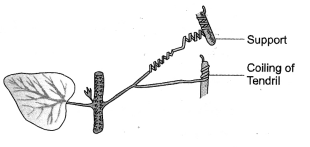
What type of plant movement is seen in the diagram of coiling of tendril ?
HOTS Questions for Class 10 Science Chapter 7 Control and Coordination image - 1

                                                                  Or

How do auxins promote the growth of a tendril around a support? Describe in brief. (CCE 2012)
Answer:
Thigmotropism or curvature movement that occurs in response to contact. Less auxin is present in the region of contact. The free side having more auxin shows more growth. This causes the tendril to coil over the support.

More Resources

Question 2.
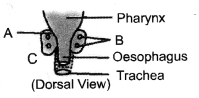
Identify and label the parts shown as A and B in the accompanying figure.
HOTS Questions for Class 10 Science Chapter 7 Control and Coordination image - 2
Answer:
Dorsal view of thyroid an parathyroid.
A – Thyroid,
B- Parathyroid.

Question 3.
What are the hormones involved in providing milk to the suckling infant ?
Answer:
1. Prolactin (Maternity Hormone). Production of milk.
2. Oxytocin Ejection of milk.

Question 4.
How does pancreas control glucose level of blood ?
Answer:
Pancreas produces two hormones

  1. Insulin from P-cells of islet of Langerhans and
  2. Glucagon from a- cells of islets of langerhans.

Insulin is produced when glucose level of blood rises. Insulin helps the cells to withdraw glucose from blood. It also converts glucose into glycogen in liver and muscles.

Question 5.
Glucagon is secreted when glucose level of blood falls. It mobilises reserve food like glycogen into glucose. What is pregnancy hormone ? Why is it known so ?
Answer:
Progesterone is called pregnancy hormone. It helps in maintaining pregnancy by non-formation of new ova, promoting thickening and secretory activity of uterine wall and attachment of embryo to the uterine wall.

Question 6.
What is dormin ?
Answer:
Dormin is the other name of plant hormone abscisic acid. The hormne induces dormancy in buds and seeds. So it has been called dormin.

Question 7.
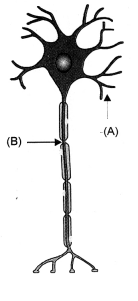
(a)

  1. Name the parts labelled A and B in the neuron drawn above.
  2. Which part acquires the information in the neuron ?
    HOTS Questions for Class 10 Science Chapter 7 Control and Coordination image - 3
  3. Through which part does the information travel ?
  4. In what form does this information travel ?
  5. Where is the impulse converted into a chemical signal for onward transmission ?

(b) Name the hormone secreted by thyroid. What is the function ?
(c) Why is the use of iodised salt advisable ?
(CBSE A.I. 2008 Compt.)
Answer:
(a)

  1. A-Dendrite, B-Axon
  2. Dandrite.
  3. Dandrite to cell body or cyton to axon.
  4. Electrical impulse
  5. In the region of synapse.

Impulse stimulates the release of chemical neurotransmitter from the surface of presynaptic knob or bouton of axon terminal. Neurotransmitter (e.g. acetylcholine) comes in contact with chemoreceptor sites of post-synaptic membrane of the next neuron and generates a fresh impulse.

(b) Thyroxine:
Function of Thyroxine. It controls

  1. Basal metabolic rate
  2. Metabalism of carbohydrates, fats and proteins
  3. Consumption of energy in physical activity and body temperature
  4. Development and differentiation.

(c) Iodised Salt: Salt is iodised to provide iodine to thyroid for synthesis of thyroxine which is iodine containing hormone.

Question 8.
(a) What are plant hormones ? Give one example each of a plant hormone that

  1. promotes growth
  2. inhibits growth.
  3. promotes cell division
  4. promotes the growth of a tendril around a support. (CCE 2011)

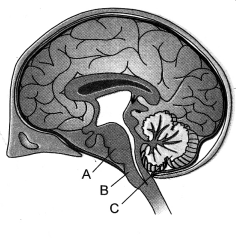
(b) Name the parts labelled A, B and C in the diagram given below. Write one function of each part. (CBSE A.I. 2008 Comptt. Delhi 2008 Comptt.)
HOTS Questions for Class 10 Science Chapter 7 Control and Coordination image - 4
Answer:
(a) Plant Hormones:
Phytohormones are chemical substances other than nutrients produced naturally in plants which regulate growth, development, differentiation and a number of physiological processes, e.g., auxin, gibberellins, abscisic acid, cytokinins.

  1. Hormone That Promotes Growth. Auxin/Gibberellin.
  2. Hormone That Inhibits Growth. Abscisic acid or ABA
  3. Hormone That Promotes Cell Division. Cytokinin.
  4. Hormone That Promotes Growth of a Tendril Around a Support. Auxin.

(b) A-Pons Function: Relay centre, pneumotaxic area of respiratory centre.
B-Medulla Function: Reflex centre, cardiac centre, respiratory centre.
C-Cerebellum Function: Maintains equilibrium and coordinates muscular activities

Hope given HOTS Questions for Class 10 Science Chapter 7 Control and Coordination are helpful to complete your science homework.

If you have any doubts, please comment below. Learn Insta try to provide online science tutoring for you.

RS Aggarwal Class 6 Solutions Chapter 5 Fractions Ex 5F

RS Aggarwal Class 6 Solutions Chapter 5 Fractions Ex 5F

These Solutions are part of RS Aggarwal Solutions Class 6. Here we have given RS Aggarwal Solutions Class 6 Chapter 5 Fractions Ex 5F.

Other Exercises

Find the difference:

Question 1.
Solution:
\(\frac { 5 }{ 8 } -\frac { 1 }{ 8 } \)
= \(\\ \frac { 5-1 }{ 8 } \)
= \(\frac { 4 }{ 8 } \)
= \(\frac { 4\div 4 }{ 8\div 4 } \)
= \(\frac { 1 }{ 2 } \)

Question 2.
Solution:
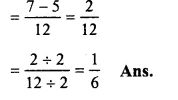
\(\frac { 7 }{ 12 } -\frac { 5 }{ 12 } \)
RS Aggarwal Class 6 Solutions Chapter 5 Fractions Ex 5F 2.1

Question 3.
Solution:
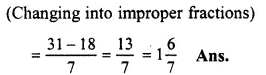
\(4\frac { 3 }{ 7 } -2\frac { 4 }{ 7 } \)
= \(\frac { 31 }{ 7 } -\frac { 18 }{ 7 } \)
RS Aggarwal Class 6 Solutions Chapter 5 Fractions Ex 5F 3.1

Question 4.
Solution:
\(\frac { 5 }{ 6 } -\frac { 4 }{ 9 } \)
RS Aggarwal Class 6 Solutions Chapter 5 Fractions Ex 5F 4.1

Question 5.
Solution:
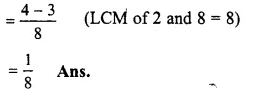
\(\frac { 1 }{ 2 } -\frac { 3 }{ 8 } \)
RS Aggarwal Class 6 Solutions Chapter 5 Fractions Ex 5F 5.1

Question 6.
Solution:
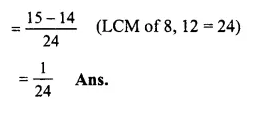
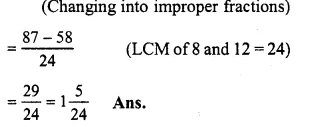
\(\frac { 5 }{ 8 } -\frac { 7 }{ 12 } \)
RS Aggarwal Class 6 Solutions Chapter 5 Fractions Ex 5F 6.1

Question 7.
Solution:
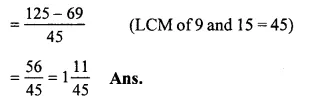
\(2\frac { 7 }{ 9 } -1\frac { 8 }{ 15 } \)
= \(\frac { 25 }{ 9 } -\frac { 23 }{ 15 } \)
(changing into improper fractions)
RS Aggarwal Class 6 Solutions Chapter 5 Fractions Ex 5F 7.1

Question 8.
Solution:
\(3\frac { 5 }{ 8 } -2\frac { 5 }{ 12 } \)
= \(\frac { 29 }{ 8 } -\frac { 29 }{ 12 } \)
RS Aggarwal Class 6 Solutions Chapter 5 Fractions Ex 5F 8.1

Question 9.
Solution:
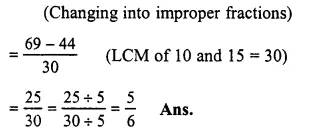
\(2\frac { 3 }{ 10 } -1\frac { 7 }{ 15 } \)
= \(\frac { 23 }{ 10 } -\frac { 22 }{ 15 } \)
RS Aggarwal Class 6 Solutions Chapter 5 Fractions Ex 5F 9.1

Question 10.
Solution:
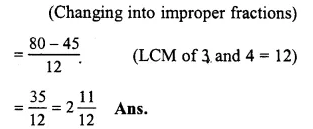
\(6\frac { 2 }{ 3 } -3\frac { 3 }{ 4 } \)
= \(\frac { 20 }{ 3 } -\frac { 15 }{ 4 } \)
RS Aggarwal Class 6 Solutions Chapter 5 Fractions Ex 5F 10.1

Question 11.
Solution:
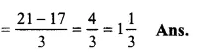
\(7-5\frac { 2 }{ 3 } \)
= \(\frac { 7 }{ 1 } -\frac { 17 }{ 3 } \)
(changing into improper fractions)
RS Aggarwal Class 6 Solutions Chapter 5 Fractions Ex 5F 11.1

Question 12.
Solution:
\(10-6\frac { 3 }{ 8 } \)
= \(\frac { 10 }{ 1 } -\frac { 51 }{ 8 } \)
(changing into improper fractions)
RS Aggarwal Class 6 Solutions Chapter 5 Fractions Ex 5F 12.1

Simpilify

Question 13.
Solution:
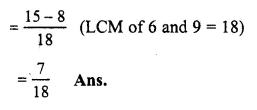
\(\frac { 5 }{ 6 } -\frac { 4 }{ 9 } +\frac { 2 }{ 3 } \)
RS Aggarwal Class 6 Solutions Chapter 5 Fractions Ex 5F 13.1

Question 14.
Solution:
\(\frac { 5 }{ 8 } +\frac { 3 }{ 4 } -\frac { 7 }{ 12 } \)
RS Aggarwal Class 6 Solutions Chapter 5 Fractions Ex 5F 14.1

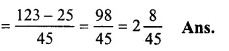
Question 15.
Solution:
\(2+\frac { 11 }{ 15 } -\frac { 5 }{ 9 } \)
= \(\frac { 90+33-25 }{ 45 } \)
(LCM of 15 and 9 = 45)
RS Aggarwal Class 6 Solutions Chapter 5 Fractions Ex 5F 15.1

Question 16.
Solution:
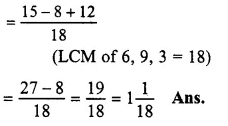
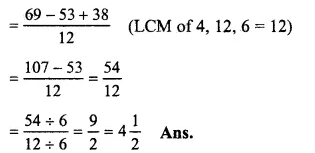
\(5\frac { 3 }{ 4 } -4\frac { 5 }{ 12 } +3\frac { 1 }{ 6 } \)
= \(\frac { 23 }{ 4 } -\frac { 53 }{ 12 } +\frac { 19 }{ 6 } \)
(changing into improper fractions)
RS Aggarwal Class 6 Solutions Chapter 5 Fractions Ex 5F 16.1

Question 17.
Solution:
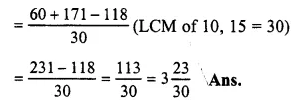
\(2+5\frac { 7 }{ 10 } -3\frac { 14 }{ 15 } \)
= \(\frac { 2 }{ 1 } +\frac { 57 }{ 10 } -\frac { 59 }{ 15 } \)
(changing into improper fractions)
RS Aggarwal Class 6 Solutions Chapter 5 Fractions Ex 5F 17.1

Question 18.
Solution:
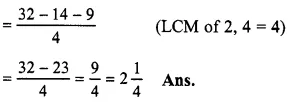
\(8-3\frac { 1 }{ 2 } -2\frac { 1 }{ 4 } \)
= \(\frac { 8 }{ 1 } -\frac { 7 }{ 2 } -\frac { 9 }{ 4 } \)
(changing into improper fractions)
RS Aggarwal Class 6 Solutions Chapter 5 Fractions Ex 5F 18.1

Question 19.
Solution:
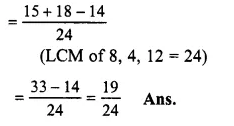
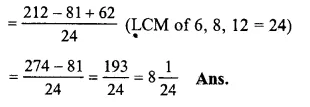
\(8\frac { 5 }{ 6 } -3\frac { 3 }{ 8 } +2\frac { 7 }{ 12 } \)
= \(\frac { 53 }{ 6 } -\frac { 27 }{ 8 } +\frac { 31 }{ 12 } \)
(changing into improper fractions)
RS Aggarwal Class 6 Solutions Chapter 5 Fractions Ex 5F 19.1

Question 20.
Solution:
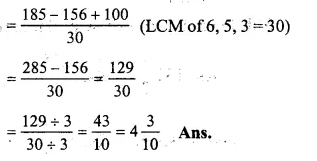
\(6\frac { 1 }{ 6 } -5\frac { 1 }{ 5 } +3\frac { 1 }{ 3 } \)
= \(\frac { 37 }{ 6 } -\frac { 26 }{ 5 } +\frac { 10 }{ 3 } \)
(changing into improper fractions)
RS Aggarwal Class 6 Solutions Chapter 5 Fractions Ex 5F 20.1

Question 21.
Solution:
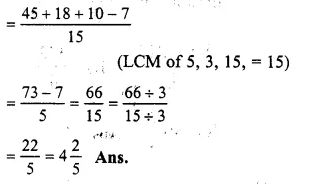
\(3+1\frac { 1 }{ 5 } +\frac { 2 }{ 3 } -\frac { 7 }{ 15 } \)
= \(\frac { 3 }{ 1 } +\frac { 6 }{ 5 } +\frac { 2 }{ 3 } -\frac { 7 }{ 15 } \)
RS Aggarwal Class 6 Solutions Chapter 5 Fractions Ex 5F 21.1

Question 22.
Solution:
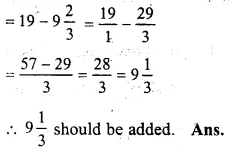
By subtracting \(9 \frac { 2 }{ 3 } \) from 19, we get the required number
RS Aggarwal Class 6 Solutions Chapter 5 Fractions Ex 5F 22.1

Question 23.
Solution:
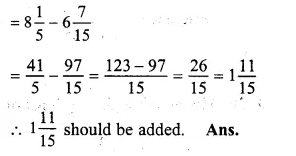
By subtracting \(6 \frac { 7 }{ 15 } \) from \(8 \frac { 1 }{ 5 } \) we get the required number
RS Aggarwal Class 6 Solutions Chapter 5 Fractions Ex 5F 23.1

Question 24.
Solution:
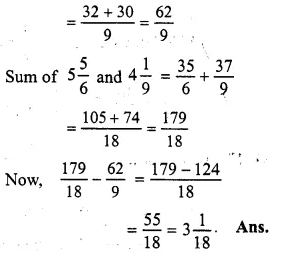
Sum of \(3 \frac { 5 }{ 9 } \) and \(3 \frac { 1 }{ 3 } \)
= \(\frac { 32 }{ 9 } +\frac { 10 }{ 3 } \)
RS Aggarwal Class 6 Solutions Chapter 5 Fractions Ex 5F 24.1

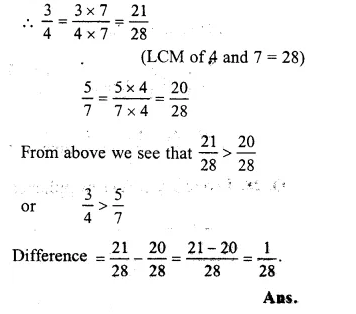
Question 25.
Solution:
\(\\ \frac { 3 }{ 4 } \), \(\\ \frac { 5 }{ 7 } \)
RS Aggarwal Class 6 Solutions Chapter 5 Fractions Ex 5F 25.1

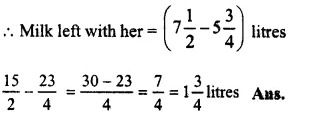
Question 26.
Solution:
Milk bought by Mrs. Soni = \(7 \frac { 1 }{ 2 } \) litres
and milk consumed by here = \(5 \frac { 3 }{ 4 } \) litres
RS Aggarwal Class 6 Solutions Chapter 5 Fractions Ex 5F 26.1

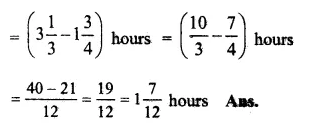
Question 27.
Solution:
Total time of film show = \(3 \frac { 1 }{ 3 } \) hours
Total spent on advertisement = \(1 \frac { 3 }{ 4 } \) hours
Duration of the film
RS Aggarwal Class 6 Solutions Chapter 5 Fractions Ex 5F 27.1

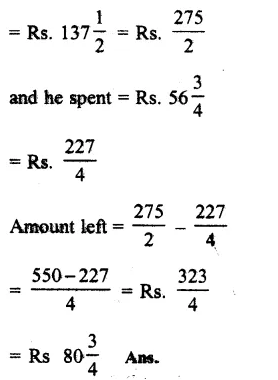
Question 28.
Solution:
On a day, rickshaw pullar earned
RS Aggarwal Class 6 Solutions Chapter 5 Fractions Ex 5F 28.1

Question 29.
Solution:
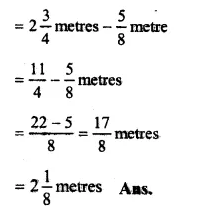
Total length of wire =\(2 \frac { 3 }{ 4 } \)-metres
Length of one piece = \(\\ \frac { 5 }{ 8 } \) metre
Length of the other piece
RS Aggarwal Class 6 Solutions Chapter 5 Fractions Ex 5F 29.1

Hope given RS Aggarwal Solutions Class 6 Chapter 5 Fractions Ex 5F are helpful to complete your math homework.

If you have any doubts, please comment below. Learn Insta try to provide online math tutoring for you.

CA Foundation Business Economics Study Material – Determination of Prices

CA Foundation Business Economics Study Material Chapter 4 Price Determination in Different Markets – Determination of Prices

Determination of Equilibrium Price

  • We know that law of demand reveals, if other conditions remain unchanged, more quantity of a commodity is demanded in the market at a lower price and less quantity is demanded at a higher price. Therefore, demand curve slopes downward.
  • Similarly, the law of supply reveals, if other conditions remain unchanged, more quantity of a commodity is supplied in the market at a higher price and less quantity is supplied at a lower price. Therefore, supply curve slopes upward.
  • Demand and supply are the two main factors that determine the price of a commodity in the market. In other words, the price of a commodity is determined by the inter-action of the forces of demand and supply.
  • The price that will come to prevail in the market is one at which quantity demanded equals 1 quantity supplied.
  • This price at which quantity demand equals quantity supplied is called equilibrium price.
  • The quantity demanded and supplied at equilibrium price is called equilibrium quantity.

The process of price determination is illustrated with the help of following imaginary schedule and diagram.

CA Foundation Business Economics Study Material - Determination of Prices

The above table shows that at a price of ₹ 3 per unit, the quantity demanded equals quantity supplied of the commodity. At ₹ 3 two forces of demand and supply are balanced. Thus, ₹ 3 is the equilibrium price and equilibrium quantity at ₹ 3 is 300 units.

CA Foundation Business Economics Study Material - Determination of Prices 1

  • The equilibrium between demand and supply can also be explained graphically as in Fig.
  • In Fig. the market is at equilibrium at point ‘E’, where the demand curve and supply curve intersect each other. Here quantity demanded and supplied, are equal to each other.
  • At point ‘E’, the equilibrium price is ₹ 3 per unit and equilibrium quantity is 300 units.
  • If the price rises to ₹ 4 per unit, the supply rises to 400 units but demand falls to 200 units. Thus, there is excess supply of 200 units in the market.
  • In order to sell off excess supply of 200 units the sellers will compete among themselves and in doing so the price will fall.
    As a result the quantity demand will rise and quantity supplied will fall and becoming equal to each other at the equilibrium price ₹ 3.
  • Similarly, if the price falls to ₹ 2 per unit, the demand rises to 400 units but supply falls to 200 units. Thus, there is excess demand of 200 units in the market.
  • As the price is less there is competition among the buyers to buy more and more. This competition among buyers increases with the entry of new buyers.
  • More demand and less supply and competition among buyers will push up the price.
  • As a result, quantity demanded will fall and quantity supplied will rise and become equal to each other at the equilibrium price of ₹ 3.

Effects of Shifts in Demand and Supply on Equilibrium Price

While determining the equilibrium price, it was assumed that demand and supply conditions were constant. In reality however, the condition of demand and supply change continuously.
Thus, changes in income, taste and preferences, changes in the availability and prices of related goods, etc. brings changes in demand conditions and cause demand curve to shift either to right or left.
In the same way, changes in the technology, changes price of labour, raw materials, etc., changes in the number of firms, etc. brings changes in supply conditions and cause supply curve to shift either to right or left.

(a) Change (shift) in Demand and Supply remaining constant.

CA Foundation Business Economics Study Material - Determination of Prices 2

  • In Fig.- DD and SS are the original demand and supply curves respectively intersecting each other at point E.
  • At point E, the equilibrium price is OP and the demand and supply (ie. equilibrium quantity) are equal at OQ.
  • When the demand increases, the demand curve shifts upwards from DD to D1D1 supply remaining the same.
    As a result, the equilibrium price rises from OP to OP1 and the equilibrium quantity increases from OQ to OQ1 as shown at point E1.
  • When the demand decreases, the demand curve shifts downwards from DD to D2D2, Supply remaining the same.
  • As a result, the equilibrium price falls from OP to OP2 and the equilibrium quantity decreases from OQ to OQ2 as shown at point E2.

(b) Change (shift) in Supply and Demand remaining constant.

CA Foundation Business Economics Study Material - Determination of Prices 3

  • In Fig. – DD and SS are the original demand and supply curves respectively inter-sections each other at point E.
  • At point E, the equilibrium price is OP and the demand and supply (i.e. Equilibrium quantity) are equal at OQ.
  • When the supply increases, the supply curve shifts to the right from SS to S1S1 demand remaining the same.
  • As a result, the equilibrium price falls from OP to OP1 and the equilibrium quantity increases from OQ to OQ1 as shown at point E1.
  • When the supply decreases, the supply curve shifts to the left from SS to S2S2, demand remaining the same.
  • As a result, the equilibrium price rises from OP to OP2 and the equilibrium quantity decreases from OQ to OQ2 as shown at point E2.

Effects of Simultaneous Shifts in Demand and Supply on Equilibrium Price

Sometimes demand and supply conditions may change at the same time changing the equilibrium price and quantity. The changes in both demand and supply simultaneously can be discussed with the help of following diagrams:

CA Foundation Business Economics Study Material - Determination of Prices 4

  • In Fig. – DD and SS are the original demand and supply respectively intersecting each other at point E at which the equilibrium price is OP and the equilibrium quantity is OQ.
  • Fig. (a) shows that the increase in demand is equal to increase in supply. The new curves D1D1 and S1S1 intersect at E1. Therefore, the new equilibrium price is equal to old equilibrium price OP. But equilibrium quantity increases.
  • Fig. (b) shows that the increase in demand is more than increase in supply. The new curves D1D1 and S1Sintersect each other at point E, which shows that new equilibrium price OP1 is higher than old equilibrium price OP. But equilibrium quantity increases.
  • Fig. (c) shows that the increase in supply is more than increase in demand. The new curves D1D1 and S1Sintersect each other at point E1 which shows that new equilibrium price OP1 is lower than old equilibrium price OP. But equilibrium quantity increases.