RS Aggarwal Class 6 Solutions Chapter 21 Concept of Perimeter and Area Ex 21C

RS Aggarwal Class 6 Solutions Chapter 21 Concept of Perimeter and Area Ex 21C

These Solutions are part of RS Aggarwal Solutions Class 6. Here we have given RS Aggarwal Solutions Class 6 Chapter 21 Concept of Perimeter and Area Ex 21C

Other Exercises

Question 1.
Solution:
1. In the given figure, there are 12 complete squares, so its area is 12 cm².
2. In the given figure, there are 18 complete squares, so its area is 18 cm².
3. In the given figure, there are 14.5 complete squares, so its area is 14.5 cm² .
4. In the given figure, there are 6 complete squares and four half parts of a square, the area of the figure is 8 cm².
5. The given figure contains 9 complete squares and 6 half parts of a square. So the area of the figure is
\(\left( 9+\frac { 6 }{ 2 } \right) \) = 9 + 3 = 12 cm².
6. The given figure contains 16 complete squares. So, its area is 16 cm².
7. The given figure contains 4 complete squares, 8 more than half parts and 4 less than half parts of a square. Neglecting the less than half parts and considering the more than half parts as complete squares, the approximate area of the figure is 12 cm².
8. The given figure contains 7 complete squares and 5 more than half parts and some less than half parts of a square. Neglecting the less than half parts and considering more than half parts as complete square, the area of the figure is 12 cm² approximately.
9. The given figure contains 14 complete squares and four half parts of a square. So, the area of the figure is
\(\left( 14+\frac { 4 }{ 2 } \right) \) cm² = (14 + 2) cm² = 16 cm².

Hope given RS Aggarwal Solutions Class 6 Chapter 21 Concept of Perimeter and Area Ex 21C are helpful to complete your math homework.

If you have any doubts, please comment below. Learn Insta try to provide online math tutoring for you.

RS Aggarwal Class 6 Solutions Chapter 21 Concept of Perimeter and Area Ex 21B

RS Aggarwal Class 6 Solutions Chapter 21 Concept of Perimeter and Area Ex 21B

These Solutions are part of RS Aggarwal Solutions Class 6. Here we have given RS Aggarwal Solutions Class 6 Chapter 21 Concept of Perimeter and Area Ex 21B

Other Exercises

Question 1.
Solution:
(i) Radius of the circle (r) = 28 cm
Circumference = 2 πr
= 2 x \(\\ \frac { 22 }{ 7 } \) x 28 cm
= 176 cm Ans.
RS Aggarwal Class 6 Solutions Chapter 21 Concept of Perimeter and Area Ex 21B Q1.1

Question 2.
Solution:
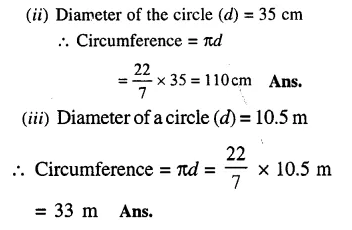
(i) Diameter of the circle (d) = 14 cm
Circumference = πd
= \(\\ \frac { 22 }{ 7 } \) x 14
= 44 cm
RS Aggarwal Class 6 Solutions Chapter 21 Concept of Perimeter and Area Ex 21B Q2.1

Question 3.
Solution:
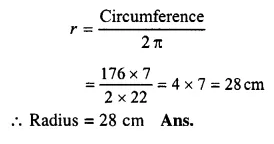
Circumference of the circle = 176 cm
Let r be the radius, then
RS Aggarwal Class 6 Solutions Chapter 21 Concept of Perimeter and Area Ex 21B Q3.1

Question 4.
Solution:
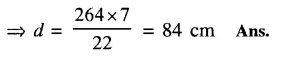
Circumference of a wheel = 264 cm
Let d be its diameter, then
πd = 264
=> \(\\ \frac { 22 }{ 7 } d\)
= 264
RS Aggarwal Class 6 Solutions Chapter 21 Concept of Perimeter and Area Ex 21B Q4.1

Question 5.
Solution:
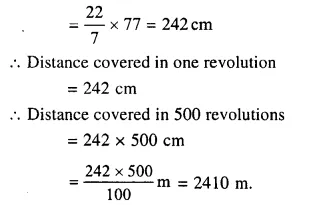
Diameter of the wheel (d) = 77 cm
Circumference = πd
RS Aggarwal Class 6 Solutions Chapter 21 Concept of Perimeter and Area Ex 21B Q5.1

Question 6.
Solution:
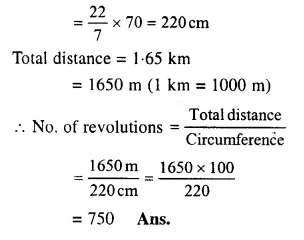
Diameter of the wheel = 70 cm
circumference = πd
RS Aggarwal Class 6 Solutions Chapter 21 Concept of Perimeter and Area Ex 21B Q6.1

Hope given RS Aggarwal Solutions Class 6 Chapter 21 Concept of Perimeter and Area Ex 21B are helpful to complete your math homework.

If you have any doubts, please comment below. Learn Insta try to provide online math tutoring for you.

RS Aggarwal Class 6 Solutions Chapter 21 Concept of Perimeter and Area Ex 21A

RS Aggarwal Class 6 Solutions Chapter 21 Concept of Perimeter and Area Ex 21A

These Solutions are part of RS Aggarwal Solutions Class 6. Here we have given RS Aggarwal Solutions Class 6 Chapter 21 Concept of Perimeter and Area Ex 21A

Other Exercises

Question 1.
Solution:
(i) Length (l) = 16.8 cm
Breadth (b) = 6.2 cm
Perimeter = 2 (l + b)
= 2 (16.8 + 6.2) cm
= 2 x 23
= 46 cm
RS Aggarwal Class 6 Solutions Chapter 21 Concept of Perimeter and Area Ex 21A Q1.1
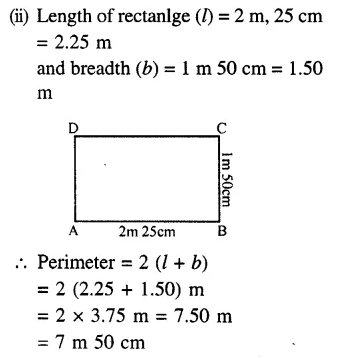
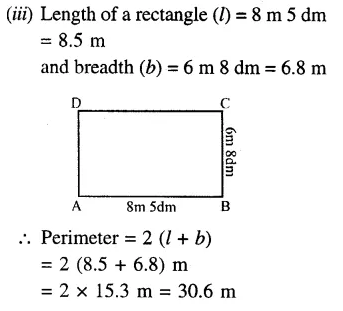
RS Aggarwal Class 6 Solutions Chapter 21 Concept of Perimeter and Area Ex 21A Q1.2
= 30m 6 dm

Question 2.
Solution:
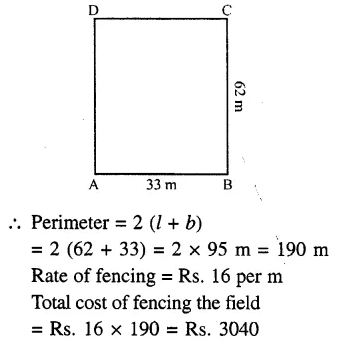
Length of rectangular field (l) = 62 m
and breadth (b) = 33 m
RS Aggarwal Class 6 Solutions Chapter 21 Concept of Perimeter and Area Ex 21A Q2.1

Question 3.
Solution:
Perimeter of field = 128 m
Length + Breadth = \(\\ \frac { 128 }{ 2 } \) = 64 m
Ratio in length and breadth = 5:3
Let length (l) = 5x
Then breadth = 3x
5x + 3x = 64
=> 5x = 64
=> x = \(\\ \frac { 64 }{ 8 } \) = 8
Length of the field = 5x = 5 x 8 = 40m
and breadth = 3x = 3 x 8 = 24m

Question 4.
Solution:
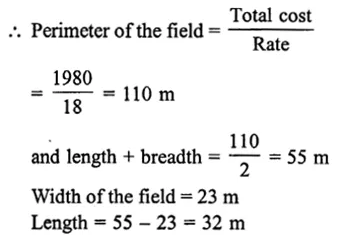
Cost of fencing a rectangular field
= Rs. 18 per m
Total cost = Rs. 1980
RS Aggarwal Class 6 Solutions Chapter 21 Concept of Perimeter and Area Ex 21A Q4.1

Question 5.
Solution:
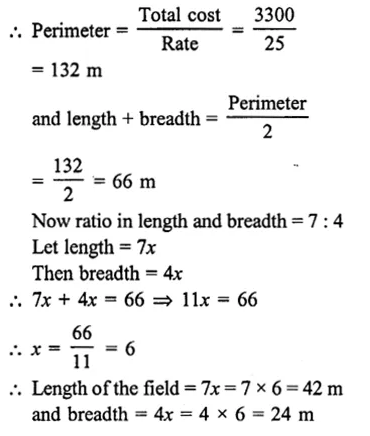
Total cost of fencing a rectangular field
= Rs 3300
Rate of fencing = Rs 25 per m
RS Aggarwal Class 6 Solutions Chapter 21 Concept of Perimeter and Area Ex 21A Q5.1

Question 6.
Solution:
(i) Side of square = 3.8 cm
Perimeter = 4 x side
= 4 x 3.8 cm
= 15.2 cm
(ii) Side of a square = 4.6 m
Perimeter = 4 x side
= 4 x 4.6 m
= 18.4 m
(iii) Side of a square = 2 m 5 dm
= 2.5 m
Perimeter = 4 x side
= 4 x 2.5 m
= 10 m

Question 7.
Solution:
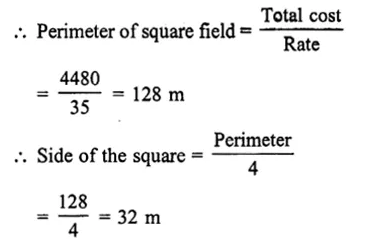
Total cost of fencing a square field = Rs. 4480
Rate of fencing = Rs. 35 per m
RS Aggarwal Class 6 Solutions Chapter 21 Concept of Perimeter and Area Ex 21A Q7.1

Question 8.
Solution:
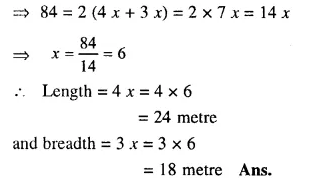
Side of a square field (a) = 21 m
Perimeter = 4a = 4 x 21 = 84m
Perimeter of rectangular field = 84 m
Ratio in length and breadth = 4 : 3
Let length (l) = 4x
and breadth (b) = 3x
Perimeter = 2 (l + b)
RS Aggarwal Class 6 Solutions Chapter 21 Concept of Perimeter and Area Ex 21A Q8.1

Question 9.
Solution:
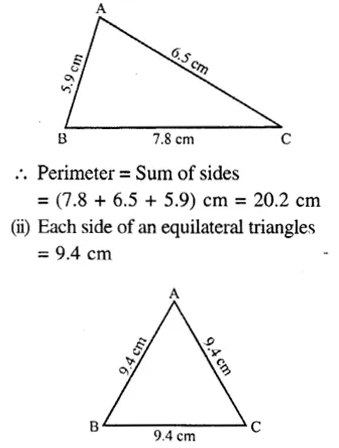
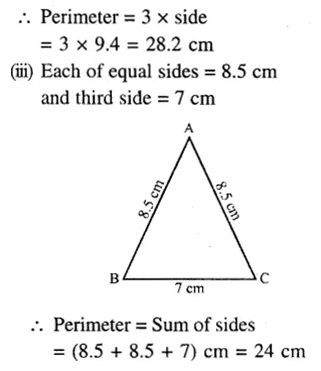
(i) Sides of a triangle are 7.8 cm, 6.5 cm and 5.9 cm
RS Aggarwal Class 6 Solutions Chapter 21 Concept of Perimeter and Area Ex 21A Q9.1
RS Aggarwal Class 6 Solutions Chapter 21 Concept of Perimeter and Area Ex 21A Q9.2

Question 10.
Solution:
(i) Each side of a regular pentagon
= 8 cm
Perimeter = 5 x Side
= 5 x 8
= 40 cm
(ii) Each side of an octagon = 4.5 cm
Perimeter = 8 x Side
= 8 x 4.5
= 36 cm
(iii) Each side of a regular decagon = 3.6 cm
Perimeter = 10 x Side
= 10 x 3.6
= 36 cm

Question 11.
Solution:
We know that perimeter of a closed figure or a polygon = Sum of its sides
(i) In the figure, sides of a quadrilateral are 45 cm, 35 cm, 27 cm, 35 cm
Its perimeter = Sum of its sides
= (45 + 35 + 27 + 35) cm
= 142 cm
(ii) Sides of a quadrilateral (rhombus) are 18 cm, 18 cm, 18 cm, 18 cm
i.e., each side = 18 cm Perimeter
= 4 x Side
= 4 x 18
= 72 cm
(iii) Sides of the polygon given are 16 cm, 4 cm, 12 cm, 12 cm, 4 cm, 16 cm and 8 cm
Its perimeter = Sum of its sides
= (16 + 4 + 12 + 12 + 4 + 16 + 8) cm
= 72 cm


Hope given RS Aggarwal Solutions Class 6 Chapter 21 Concept of Perimeter and Area Ex 21A are helpful to complete your math homework.

If you have any doubts, please comment below. Learn Insta try to provide online math tutoring for you.

Selina Concise Mathematics Class 10 ICSE Solutions Chapter 16 Loci (Locus and Its Constructions) Ex 16A

Selina Concise Mathematics Class 10 ICSE Solutions Chapter 16 Loci (Locus and Its Constructions) Ex 16A

These Solutions are part of Selina Concise Mathematics Class 10 ICSE Solutions. Here we have given Selina Concise Mathematics Class 10 ICSE Solutions Chapter 16 Loci (Locus and Its Constructions) Ex 16A

Other Exercises

Question 1.
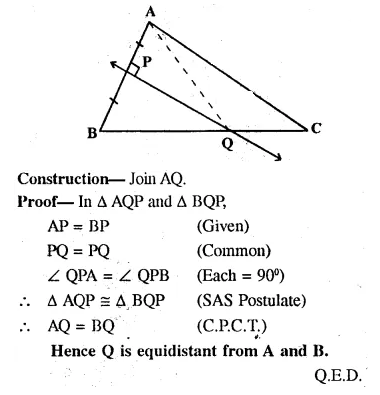
Given— PQ is perpendicular bisector of side AB of the triangle ABC
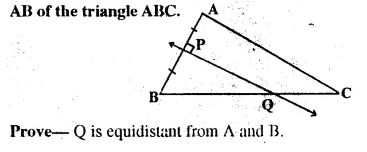
Selina Concise Mathematics Class 10 ICSE Solutions Chapter 16 Loci (Locus and Its Constructions) Ex 16A Q1.1
Solution:
Selina Concise Mathematics Class 10 ICSE Solutions Chapter 16 Loci (Locus and Its Constructions) Ex 16A Q1.2

Question 2.
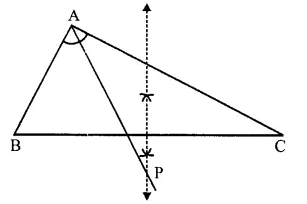
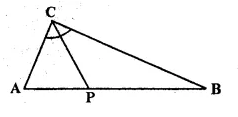
Given— CP is bisector of angle C of A ABC.
Selina Concise Mathematics Class 10 ICSE Solutions Chapter 16 Loci (Locus and Its Constructions) Ex 16A Q2.1
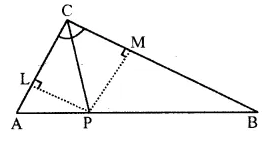
Prove: p is equidistant from AC and BC
Solution:
Selina Concise Mathematics Class 10 ICSE Solutions Chapter 16 Loci (Locus and Its Constructions) Ex 16A Q2.2
Selina Concise Mathematics Class 10 ICSE Solutions Chapter 16 Loci (Locus and Its Constructions) Ex 16A Q2.3

Question 3.
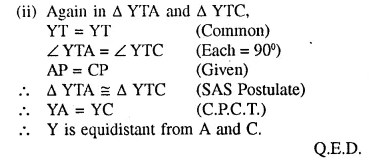
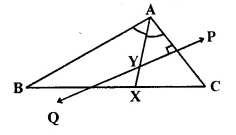
Given— AX bisects angle BAG and PQ is perpendicular bisector of AC which meets AX at point Y.
Selina Concise Mathematics Class 10 ICSE Solutions Chapter 16 Loci (Locus and Its Constructions) Ex 16A Q3.1
Prove:
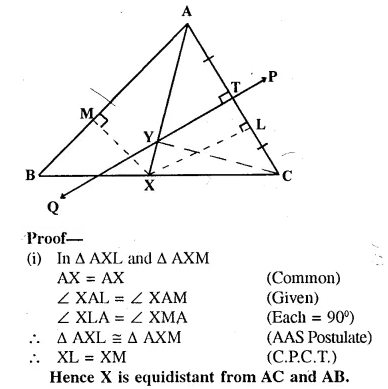
(i) X is equidistant from AB and AC.
(ii) Y is equidistant from A and C.
Solution:
Construction: From X, draw XL ⊥ AC and XM ⊥ AB and join YC.
Selina Concise Mathematics Class 10 ICSE Solutions Chapter 16 Loci (Locus and Its Constructions) Ex 16A Q3.2
Selina Concise Mathematics Class 10 ICSE Solutions Chapter 16 Loci (Locus and Its Constructions) Ex 16A Q3.3

Question 4.
Construct a triangle ABC, in which AB = 4.2 cm, BC = 6.3 cm and AC = 5 cm. Draw perpendicular bisector of BC which meets AC at point D. Prove that D is equidistant from B and C.
Solution:
Given: In Δ ABC, AB, = 4.2 cm, BC = 6.3 cm and AC = 5cm
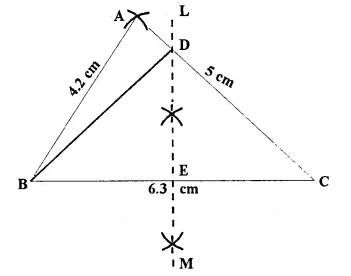
Selina Concise Mathematics Class 10 ICSE Solutions Chapter 16 Loci (Locus and Its Constructions) Ex 16A Q4.1
Steps of Construction:
(i) Draw a line segment BC = 6.3 cm.
(ii) With centre B-and radius 4.2 cirr draw mi are.
(iii) With centre C mid radius 5 cm, draw another arc which intersect the first arc at A.
(iv) Join AB mid AC.
A ABC is the required triangle.
(v) Again with centre B mid C mid radius greater
than \(\frac { -1 }{ 2 }\) BC, draw arcs which intersects each other at L mid M.
(vi) Join LM intersecting AC at D mid BC at E.
(vii) Join DB.
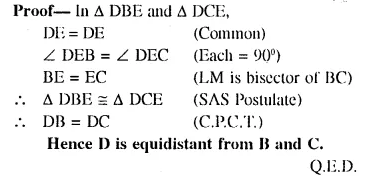
Selina Concise Mathematics Class 10 ICSE Solutions Chapter 16 Loci (Locus and Its Constructions) Ex 16A Q4.2

Question 5.
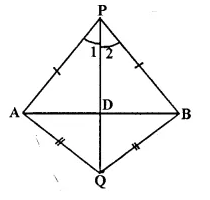
In each of the given figures: PA = PH and QA = QB.
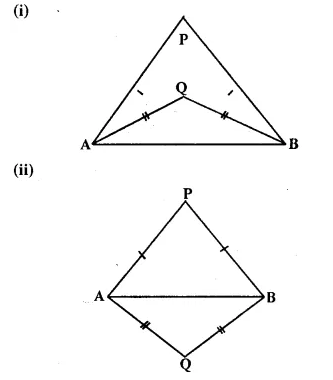
Selina Concise Mathematics Class 10 ICSE Solutions Chapter 16 Loci (Locus and Its Constructions) Ex 16A Q5.1
Prove, in each case, that PQ (produce, if required) is perpendicular bisector of AB. Hence, state the locus of points equidistant from two given fixed points.
Solution:
(i) Construction: Join PQ which meets AB in D.
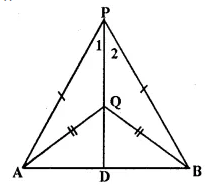
Selina Concise Mathematics Class 10 ICSE Solutions Chapter 16 Loci (Locus and Its Constructions) Ex 16A Q5.2
Proof:
P is equidistant from A mid B
∴ P lies on die perpendicular bisector of AB similarly Q is equidistant from A mid B.
∴ Q lies on perpendicular bisector of AB P mid Q both lies on the perpendicular bisector of AB.
∴ PQ is Hie perpendicular bisector of AB
Selina Concise Mathematics Class 10 ICSE Solutions Chapter 16 Loci (Locus and Its Constructions) Ex 16A Q5.3
Hence locus of die points which are equidistant from two fixed points, is a perpendicular, bisector of die line joining die fixed points.         Q.E.D.

Question 6.
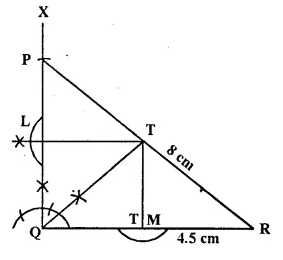
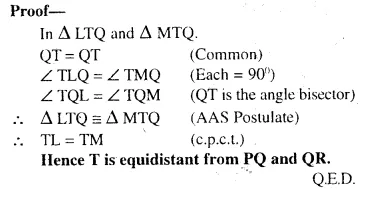
Construct a right angled triangle PQR, in which ∠Q = 90°, hypotenuse PR = 8 cm and QR = 4.5 cm. Draw bisector of angle PQR and let it meets PR at point T. Prove that T is equidistant from PQ and QR.
Solution:
Selina Concise Mathematics Class 10 ICSE Solutions Chapter 16 Loci (Locus and Its Constructions) Ex 16A Q6.1
Steps of Construction
(i) Draw a line segment QR = 4.5 cm.
(ii) At Q, draw a ray QX making an angle of 90°.
(iii) With centre P mid radius 8 cm, draw mi arc which intersects QX at P.
(iv) Join RP.
A-PQR is the required triangle.
(v) Draw the bisector of ∠PQR which meets PR in T.
(vi) From T, draw perpendicular PL and PM respec- lively on PQ and QR.
Selina Concise Mathematics Class 10 ICSE Solutions Chapter 16 Loci (Locus and Its Constructions) Ex 16A Q6.2

Question 7.
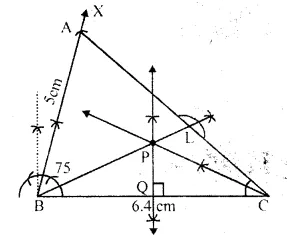
Construct a triangle ABC in which angle ABC = 75°. AB = 5 cm and BC = 6.4 cm.
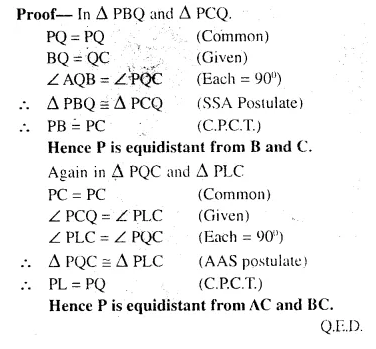
Draw perpendicular bisector of side BC and also the bisector of angle ACB. If these bisectors intersect each other at point P ; prove that P is equidistant from B and C ; and also from AC and BC.
Solution:
Selina Concise Mathematics Class 10 ICSE Solutions Chapter 16 Loci (Locus and Its Constructions) Ex 16A Q7.1
Steps of Construction:
(i) Draw a line segment BC = 6.4 cm.
(ii) At B, draw a ray BX making an angle of 75° with BC and cut off BA = 5 cm.
(iii) Join AC.
Δ ABC is the required triangle.
(iv) Draw the perpendicular bisector of BC.
(v) Draw the angle bisector of ∠ACB which intersects the perpendicular bisector of ,BC at P
(vi) Join PB and draw PL ⊥ AC.
Selina Concise Mathematics Class 10 ICSE Solutions Chapter 16 Loci (Locus and Its Constructions) Ex 16A Q7.2

Question 8.
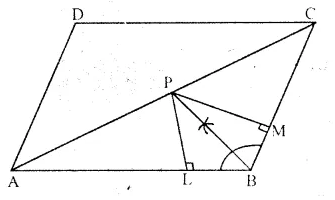
In parallelogram ABCD, side AB is greater than side BC and P is a point in AC such that PB bisects angle B.
Prove that P is equidistant from AB and BC.
Selina Concise Mathematics Class 10 ICSE Solutions Chapter 16 Loci (Locus and Its Constructions) Ex 16A Q8.1
Solution:
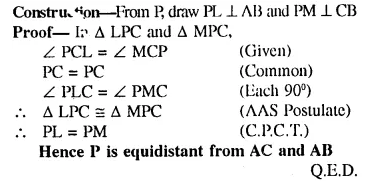
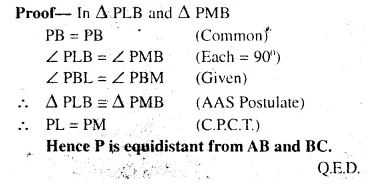
Given:  In || gm ABCD. AB > BC and bisector of ∠B meets diagonal AC at P.
To Prove:  P is equidistant from AB and BC.
Construction: From P, draw PL ⊥ AB and PM ⊥ BC.
Selina Concise Mathematics Class 10 ICSE Solutions Chapter 16 Loci (Locus and Its Constructions) Ex 16A Q8.2

Question 9.
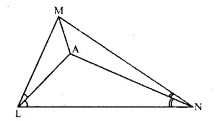
In triangle LMN, bisectors of interior angles at L and N intersect each other at point A.
Prove that:
(i) point A is equidistant from all the three sides of the triangle.
(ii) AM bisects angle LMN.
Solution:
Selina Concise Mathematics Class 10 ICSE Solutions Chapter 16 Loci (Locus and Its Constructions) Ex 16A Q9.1
Given: In A LMN, angle bisectors of ∠L and ∠N
meet at A, AM is joined.
To Prove:
(i) A is equidistant from all the sides of A LMN.
(ii) AM is the bisector of ∠M.
Proof: ∴ A lies on the bisector of ∠N
∴ A is equidistant from MN and LN Again
∴ A lies on the bisector of ∠L A is equidistant from LN and LM Hence
∴ A is equidistant from all sides of the triangle LMN.
∴ A lies on the bisector of ∠M                               Q.E.D.

Question 10.
Use ruler and compasses only for this question:
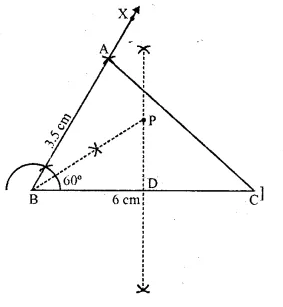
(i) construct ΔABC, where AB = 3.5 cm, BC = 6 cm and ∠ABC = 60°.
(ii) Construct the locus of points inside the triangle which are equidistant from BA and BC.
(iii) Construct the locus of points inside the triangle which are equidistant from B and C.
(iv) Mark the point P which is equidistant from AB, BC and also equidistant from B and C. Measure and record the length of PB. (2010)
Solution:
Steps of construction:
1. Draw a line BC = 6 cm and an angle CBX = 60°. Cut off AB = 3.5 cm. Join AC, ΔABC is the required triangle.
2. Draw ⊥ bisector of BC and bisector of ∠B.
3. Bisector of ∠B meets bisector of BC at P
∴ BP is the required length, where PB = 3.5 cm
4. P is the point which is equidistant from BA and BC, also equidistant fromB and C
Selina Concise Mathematics Class 10 ICSE Solutions Chapter 16 Loci (Locus and Its Constructions) Ex 16A Q10.1

Question 11.
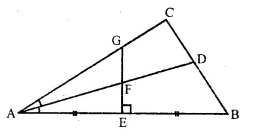
The given figure shows a triangle ABC in which AD bisects angle BAC. EG is perpendicular bisector of side AB which intersects AD at point E Prove that:
Selina Concise Mathematics Class 10 ICSE Solutions Chapter 16 Loci (Locus and Its Constructions) Ex 16A Q11.1
(i) F is equidistant from A and B.
(ii) F is equidistant from AB and AC.
Solution:
Given : In the figure,
In ΔABC, AD is the bisector of ∠BAC Which meets BC at D EG is the perpendicular bisector of AB which intersects AD at F
To prove :
(i) F is equidistant from A and B.
(ii) F is equidistant from AB and AC.
Proof:
(i) ∴ F lies on the perpendicular bisector of AB F is equidistant from A and B
(ii) Again,
∴ F lies onthe bisector of ∠BAC
∴ F is equidistant from AB and AC.
(10 cm theorem)
Hence proved.

Question 12.
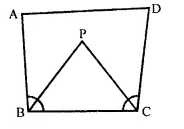
The bisectors of ∠B and ∠C of a quadrilateral ABCD intersect each other at point P. Show that P is equidistant from the opposite sides AB and CD.
Solution:
In quadrilateral ABCD, the bisectors of ∠B and ∠C meet each other at P.
Selina Concise Mathematics Class 10 ICSE Solutions Chapter 16 Loci (Locus and Its Constructions) Ex 16A Q12.1
To prove : D is equidistant from the sides AB and CD.
Proof:
∴ P lies on the bisector of ∠B P is equidistant from AB and BC ….(i)
Similarly, P lies on the bisector of ∠C P is equidistant from BC and CD ….(ii)
From (i) and (ii),
∴ P is equidistant from AB and CD
Hence proved.

Question 13.
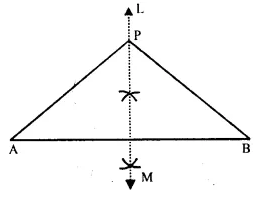
Draw a line AB = 6 cm. Draw the locus of all the points which are equidistant from A and B.
Solution:
Steps of Construction:
(i) Draw a line segment AB = 6 cm
(ii) Draw perpendicular bisector LM of AB. LM is the required locus.
(iii) Take any point on LM say P.
(iv) Join PA and PB
∵ P lies on the right bisector of line AB
Selina Concise Mathematics Class 10 ICSE Solutions Chapter 16 Loci (Locus and Its Constructions) Ex 16A Q13.1
∴ P is equidistant from A and B.
∴ PA = PB
∴ Perpendicular bisector of AB is the locus of all points which are equidistant from A and B.

Question 14.
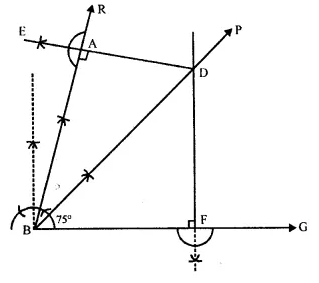
Draw an angle ABC = 75°. Draw the locus of all the points equidistant from AB and BC.
Solution:
Selina Concise Mathematics Class 10 ICSE Solutions Chapter 16 Loci (Locus and Its Constructions) Ex 16A Q14.1
Steps of Construction:
(I) Draw a ray BC.
(ii) Construct a ray RA making an angle of 750 with BC.
(iii) ∴ ∠ABC = 75°
(iv) Draw the angle bisector BP of ∠ABC. BP is the required locus.
(v) Take any point D on BP.
(vi) From D, draw DE ⊥ AB and DF ⊥ BC.
∵ D lies on the angle bisector ∠ABC.
∴ D is equidistant from AB and BC.
∴ DE = DF
Similarly any point on BP, is equidistant from AB and BC.
∴BP is the locus of all points which are equidistant from AB and BC.

Question 15.
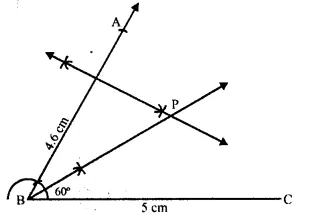
Draw an angle ABC = 60°, having AB = 4.6 cm and BC = 5 cm. Find a point P equidistant from AB and BC ; and also equidistant from A and B
Solution:
Selina Concise Mathematics Class 10 ICSE Solutions Chapter 16 Loci (Locus and Its Constructions) Ex 16A Q15.1
Steps of Construction:
(i) Draw a line segment BC = 5 cm.
(ii) At B, draw a ray BX making an angle of 60° and cut off BA = 4.6 cm.
(iii) Draw the angle bisector of ∠ABC.
(iv) Draw the perpendicular bisector of AB which intersects the angle bisector at P.
P is the required point which is equidistant from AB and BC as well as from points A and B.

Question 16.
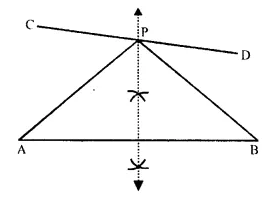
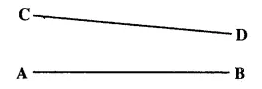
In the figure given below, find a point P on CD equidistant from points A and B.
Selina Concise Mathematics Class 10 ICSE Solutions Chapter 16 Loci (Locus and Its Constructions) Ex 16A Q16.1
Solution:
Selina Concise Mathematics Class 10 ICSE Solutions Chapter 16 Loci (Locus and Its Constructions) Ex 16A Q16.2
Steps of Construction:
(i) In the figure AB and CD are two line segments.
(ii) Draw the perpendicular bisector of AB which intersects CD in P.
P is the required point which is equidistant from A and B
∵ P lies on the perpendicular bisector of AB.
∴ PA = PB.

Question 17.
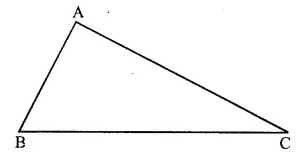
In the given triangle ABC, find a point P equidistant from AB and AC; and also equidistant from B and C.
Selina Concise Mathematics Class 10 ICSE Solutions Chapter 16 Loci (Locus and Its Constructions) Ex 16A Q17.1
Solution:
Selina Concise Mathematics Class 10 ICSE Solutions Chapter 16 Loci (Locus and Its Constructions) Ex 16A Q17.2
Steps of Construction:
(i) In the given triangle, draw the angle bisector of ∠BAC.
(ii) Draw the perpendicular bisector of BC which intersects the angle bisector of ∠A at P.
P is the required point which is equidistant from AB and AC as well as from B and C.
∵ P lies on the angle bisector of ∠BAC.
∴ It is equidistant from AB and AC. Again
∵ P lies on the perpendicular bisector of BC.
∴ P is equidistant from B and C.

Question 18.
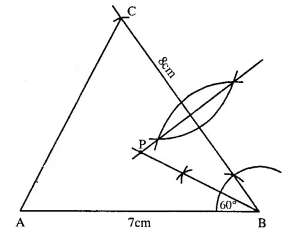
Construct a triangle ABC, with AB = 7 cm, BC = 8 cm and ∠ABC = 60°. Locate by construction the point P such that :
(i) P is equidistant from B and C.
(ii) P is equidistant from AB and BC.
(iii) Measure and record the length of PB.
(2000)
Solution:
Steps of Construction :
1. Draw a line segment AB = 7 cm.
2. Draw angle ∠ABC = 60° with the help of compass.
3. Cut off BC = 8 cm.
4. Join A and C.
5. The triangle ABC so formed is required triangle.
(i) Draw perpendicular bisector of line BC. The point situated on this line will be equidistant from B and C.
(ii) Draw angular bisector of ∠ABC. Any
point situated on this angular bisector is equidistant from lines AB and BC.
Selina Concise Mathematics Class 10 ICSE Solutions Chapter 16 Loci (Locus and Its Constructions) Ex 16A Q18.1
The point which fulfills the condition required in (i) and (ii) is the intersection point of bisector of line BC and angular bisector of ∠ABC.
(iii) Length of PB is 4.5 cm.

Question 19.
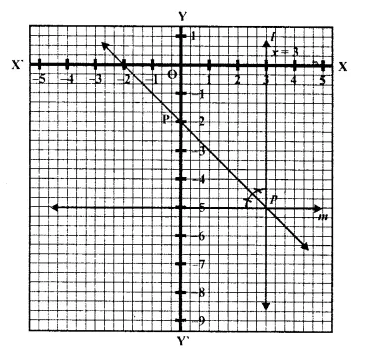
On a graph paper, draw the lines x = 3 and y = -5. Now, on the same graph paper, draw the locus of the point which is equidistant from the given lines.
Solution:
On the graph paper, draw axis XOX’ and YOY’ Draw a line l, x = 3 which is parallel to y-axis and another line m, y = -5, which is parallel to x-axis
Selina Concise Mathematics Class 10 ICSE Solutions Chapter 16 Loci (Locus and Its Constructions) Ex 16A Q19.1
These two lines intersect eachother at P.
Now draw the angle bisector p of ∠P
∵ p is the bisector of ∠P
∴ Any point on P, is equidistant from l and m
∴ This line p is equidistant from l and m.

Question 20.
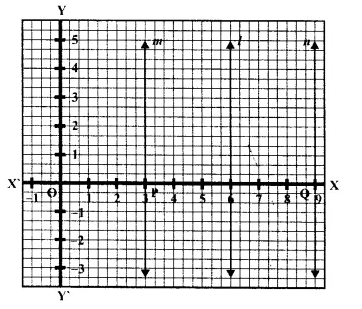
On a graph paper, draw the line x = 6. Now, on the same graph paper, draw the locus of the point which moves in such a way that its distance from the given line is always equal to 3 units.
Solution:
Selina Concise Mathematics Class 10 ICSE Solutions Chapter 16 Loci (Locus and Its Constructions) Ex 16A Q20.1
On the graph, draw axis XOX’ and YOY’
Draw a line l, x = 6
Which is parallel to -axis
Take point P and Q which are at a distance of 3units from the line l
Draw line rn and n from P and Q parallel to P respectively
The line m and n are the required locus of the points P and Q
Which arc always 3 units from the line l.
Hence proved.

Hope given Selina Concise Mathematics Class 10 ICSE Solutions Chapter 16 Loci (Locus and Its Constructions) Ex 16B  are helpful to complete your math homework.

If you have any doubts, please comment below. Learn Insta try to provide online math tutoring for you.

NCERT Exemplar Solutions for Class 10 Science Chapter 15 Our Environment

NCERT Exemplar Solutions for Class 10 Science Chapter 15 Our Environment

These Solutions are part of NCERT Exemplar Solutions for Class 10 Science. Here we have given NCERT Exemplar Solutions for Class 10 Science Chapter 15 Our Environment

NCERT Exemplar Solutions for Class 10 Science Chapter 15 Short Answer Questions

Question 1.
Why is improper disposal of wastes a curse to environment ?
Answer:
An improper disposal of wastes means addition of pollutants into environment —air, water, soil. They will harm living beings, human assets and human beings. For example, passage of sewage into water body will cause eutrophication, stink, development of sludge, killing of animals and source of water borne pathogens.

More Resources

Question 2.
Write the common food chain of a pond ecosystem.
Answer:
NCERT Exemplar Solutions for Class 10 Science Chapter 15 Our Environment image - 1
Question 3.
What are the advantages of cloth bags over plastic bags during shopping ?
Answer:
Advantages of Cloth Bags

  1. Cloth bags are stronger and more durable as compared to plastic bags.
  2. They are washable.
  3. They are reused time and again.
  4. Cloth bags do not pollute environment.
  5. They are made of biodegradable material which can also be recycled.

Question 4.
Why are crop fields known as artificial ecosystems ?
Answer:
Crop fields are known as artificial ecosystems because they are raised, maintained, nourished and reaped by human beings.

Question 5.
Differentiate between biodegradable and non-biodegradable substances. Give examples.
Answer:

Biodegradable Wastes

Non-biodegradable Wastes

1. Origin. They are biological in origin.They are commonly man-made.
2. Degradability. The wastes are degraded by microorganisms.They are not degraded by microorganisms.
3. Accumulation. They do not accumulate in nature.They pile up and accumulate in nature.
4. Biomagnification. The biodegradable wastes do not show biomagnification.The soluble non-degradable wastes enter food chains and undergo biomagnification.
5. Resource. The wastes can be converted into resource.Some wastes can be recycled.
Examples. Garbage, livestock wastes, sewage.Examples. Plastic, polythene, glass, nickel, cadmium, several pesticides.

Question 6.
Suggest one word for each of the following statements/definitions.
(a) The physical and biological world where we live in.
(b) Each level of food chain where transfer of energy takes place.
(c) The physical factors like temperature, rainfall, wind and soil of an ecosystem.
(d) Organisms which depend on the producers either directly or indirectly for food.
Answer:
(a) Biosphere (also environment)
(b) Trophic level.
(c) Abiotic factors.
(d) Consumers (also heterotrophs)

Question 7.
Explain the role of decomposers in the environment. (CCE 2011)
Answer:
Decomposers are saprophytes which feed on organic remains by a process of external digestion and absorption of solubilised materials, e.g., many bacteria, fungi. In the process they perform the following functions :

  1. Cleansing the earth of organic remains and continuously creating space for newer generations of organisms.
  2. Release of minerals from organic remains. The phenomenon is called mineralisation. The released minerals become available to plants for utilization in synthesis of new organic matter. Decomposers, therefore, take part in biogeochemical recycling.

Question 8.
Select the mismatched pair in the following and correct it.
(a) Biomagnification: Accumulation of chemicals at the successive trophic levels of a food chain.
(b) Ecosystem: Biotic component of environment.
(c) Aquarium: A man-made ecosystem.
(d) Parasites: Organisms which obtain food from other living organisms.
Answer:
(b) Ecosystem: It is an ecological system consisting of a distinct biotic community and the physical environment (consisting of a number of abiotic factors) both interacting and exchanging materials between them.

Question 9.
We do not clean ponds or lakes but an aquarium needs to be cleaned. Why ?
Answer:
An aquarium is an artificial system which is also incomplete due to absence of producers, food chains and decomposers. There is no recycling and self cleaning. However, a pond or a lake is a self sustained, natural and complete ecosystem where there is perfect recycling of nutrients.

NCERT Exemplar Solutions for Class 10 Science Chapter 15 Long Answer Questions

Question 10.
Indicate the flow of energy in an ecosystem. Why is it undirectional ? Justify. (CCE 2014)
Answer:
An ecosystem does not have its own source of energy. It receives the same from sun. Green plants or producers trap the solar energy and change it into chemical form during synthesis of food. Herbivores obtain energy from the food they take. A lot of energy dissipates during transfer and utilization of food energy by herbivores (10% law). From herbivores the food energy passes to primary carnivores. However, only about 10% of herbivore energy is passed into body mass of primary carnivores.
The rest is dissipated. From primary carnivores the energy passes into secondary carnivores (10%), etc. It is ultimately lost as heat.
NCERT Exemplar Solutions for Class 10 Science Chapter 15 Our Environment image - 2
Since energy available decreases at every tophic level, very little of it is available at higher trophic levels. There is dissipation of energy at every step of its transfer and transformation. Hence it cannot flow in the reverse direction i.e., energy flow is unidirectional from sun to plants, plants to animals, animals to animals, organic remains to decomposers and dissipation as heat.

Question 11.
What are decomposers ? What will be the consequences of their absence in an ecosystem ?
Answer:
Definition: Decomposers or microconsumers are saprophytes which obtain their nourishment from organic remains by secreting digestive enzymes over the latter and absorbing the solubilised substances.
Absence of Decomposers:

  1. Organic remains will pile up leaving no space for new living beings,
  2. Biogeochemical cycling will stop so that raw materials will not be available to plants for manufacture of more food,
  3. In the absence of food, all living beings will die of starvation.

Question 12.
Suggest any four activities in daily life which are ecofriendly.
Answer:

  1. Use of cloth bags instead of polythene or plastic bags.
  2. Separation of biodegradable and non-biodegradable in green and blue coloured bins.
  3. Use of compact fluorescent lamps instead of incandescent lamps.
  4. Harvesting of rain water and preventing wastage of resources.

Question 13.
Give two differences between food chain and food web.
Answer:

Food Chain

Food Web

1. Units. It consists of a single unit of food relations.It is a complex formed by several units of food relations.
2. Sequence. It is a straight sequence of organisms.It is a network of many linkages among the connected food chains.
3. Populations. It has a maximum of 4-6 populations of different species.A food web consists of numerous populations of different species.
4. Food. Only one type of organism is used as food by a particular type of organism.An organism can use two to several types of organisms as food.
5. Disturbance. A disturbance in food chain is difficult to overcome.A disturbance is overcome after some time.
6. Endangered Species. It does not help in restoring population of endangered species. Rather it may decline further.A food web helps in increasing population of endangered species.

Question 14.
Name the wastes which are generated in your house daily. What measures would you take for their disposal ?
Answer:
Wastes :

  1. Vegetable and fruit peels and rind, stale food, food leftovers, used tea leaves.
  2. Milk pouches, polythene bags, empty cartons.
  3. Waste paper (newspaper, bags, envelopes), packing paper, empty bottles, torn cloth pieces, etc.
  4. Dust and other sweepings.

Disposal :

  1. Separation into biodegradable and non-biodegradable, recyclable and non-recyclable wastes.
  2. Recyclable wastes (waste paper, cloth, polythene or plastic bags, cartons, bottles, cans, etc.) can be given to rag pickers for recycling.
  3. Preparation of compost or vetmicompost from kitchen wastes for home garden (kitchen garden).
  4. In the absence of kitchen garden, the household garbage and other wastes can be given to waste collectors for disposal.

Question 15.
Suggest suitable mechanisms for waste management in fertilizer industries.
Answer:
Fertilizer industries produce mainly two types of wastes (a) Gaseous (b) Effluents. Additionally they may release heat and fuel waste if coal is being used as a source of energy.

  1. Gaseous Wastes: They are passed through wet scrubbers to dissolve the pollutant gases.
  2. Effluents: The effluents of the industry are tested for chemicals present in them. The same can be retrieved and made available to the market. Hot effluents are cooled. Acidic or alkaline nature can be corrected. Heavy metals and toxins can be separated. Only treated and harmless effluents are allowed to be discharged into surrounding environment.

Question 16.
What are the by products of fertilizer industries ? How do they affect the environment.
Answer:
The most common by product of fertilizer industries are axides of nitrogen and sulphur. They pass into atmosphere and spread to all nearby places. The gases have a corrosive effect on several items besides being harmful to living beings. They also give rise to acid rain. Acid rain is highly destructive to forests, crops and aquatic biota.

Question 17.
Explain some harmful effects of agricultural practices on the environment.
Answer:

  1. Soil: Fertilizer added to soil not only changes the chemistry of the soil but also kills many useful microbes.
  2. Ground Water: A part of fertilizer always leaches down into soil and reaches ground water. It raises the salt content of ground water.
  3. Eutrophication: Run-off from fields sprayed with fertilizer reaches water bodies. It results in their eutrophication.
  4. Pesticides: Pesticides sprayed over crops reach water bodies killing the biota. Persistent pesticides undergo biomagnification and prove highly harmful to higher organisms.
  5. Ground Water: Continued use of ground water in agriculture has resulted in lowering of water table at most of the places.
  6. Irrigation: It causes water-logging and salination of soils.
  7. Genetic Erosion: Use of only selected high yielding varieties has resulted in genetic erosion of the crop plants.
  8. Damage to Nature: Natural ecosystems and habitats have been damaged during clearing land for agriculture.

Hope given NCERT Exemplar Solutions for Class 10 Science Chapter 15 Our Environment are helpful to complete your science homework.

If you have any doubts, please comment below. Learn Insta try to provide online science tutoring for you.