HOTS Questions for Class 10 Science Chapter 16 Management of Natural Resources

HOTS Questions for Class 10 Science Chapter 16 Management of Natural Resources

These Solutions are part of HOTS Questions for Class 10 Science. Here we have given HOTS Questions for Class 10 Science Chapter 16 Management of Natural Resources

Question 1.
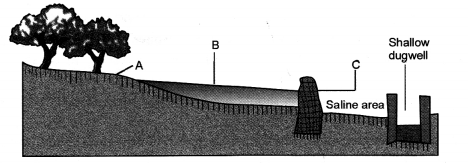
What does the figure depict ? Identify A, B and C.
Answer:
Caption: Khadin system of water harvesting.
A – Catchment area
B – Khadin (cropped area)
C – Khadin bund
HOTS Questions for Class 10 Science Chapter 16 Management of Natural Resources image - 1

More Resources

Question 2.
Why is forest called biodiversity hotspot ?
Answer:
A biodiversity hotspot is an area having a large number of endemic species which are being threatened with extinction. Because of long exploitation of forest resources and pressure from industrialists, the natural biota is being replaced by commercially required trees.

Question 3.
What is Kattas ?
Answer:
It is a water storage system of Karnataka that involves raising an embankment over a draining line.

Question 4.
What is production plantation ?
Answer:
It is growing of commercially important plants over separate piece of land, generally a wasteland.

Question 5.
With the help of an example show that reuse strategy is better than recycling. (CBSE A.I. 2010, CCE 2011)
Answer:
Reuse is better than recycling as

  1. There is no need to send the used article to recycling unit,
  2. There is no consumption of energy as required for recycling.
  3. There is no need to remarket the produce. Instead of throwing away the used one and obtaining a new one after its recycling, a container or bottle can be reused several times, of course, each time after cleaning the same. This will save a lot of money and energy.

Hope given HOTS Questions for Class 10 Science Chapter 16 Management of Natural Resources are helpful to complete your science homework.

If you have any doubts, please comment below. Learn Insta try to provide online science tutoring for you.

RS Aggarwal Class 6 Solutions Chapter 22 Data Handling Ex 22

RS Aggarwal Class 6 Solutions Chapter 22 Data Handling Ex 22

These Solutions are part of RS Aggarwal Solutions Class 6. Here we have given RS Aggarwal Solutions Class 6 Chapter 22 Data Handling Ex 22

Question 1.
Solution:
(i) Data. The word data means information in the form of numerical figures.
(ii) Raw data. Data obtained in the original form is called raw data.
(iii) Array. Arranging the numerical figures (data) in an order i.e. ascending or descending order is called an array.
(iv) Tabulation of data. Arranging the given data in a systematic form in the form of a table is called tabulation of the data.
(v) Observations. Each numerical figure in a data is called an observation.
(vi) Frequency of an observation. The number of times a particular observation occurs is called its frequency.
(vii) Statistics. Statistics is a science which deals with the collection, presentation, analysis and interpretation of numerical data.

Question 2.
Solution:
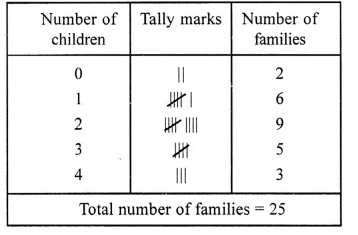
Arranging the given data in ascending order, we get :
0, 0, 1, 1, 1, 1, 1, 1,2, 2, 2, 2,2, 2,2, 2, 2, 3, 3, 3, 3, 3, 4, 4, 4
RS Aggarwal Class 6 Solutions Chapter 22 Data Handling Ex 22 Q2.1

Question 3.
Solution:
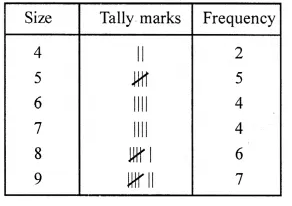
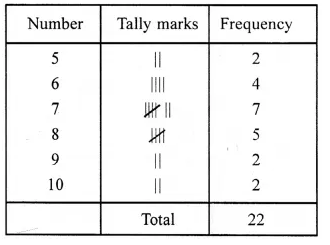
Below is given the frequency distribution table of the given data :
RS Aggarwal Class 6 Solutions Chapter 22 Data Handling Ex 22 Q3.1

Question 4.
Solution:
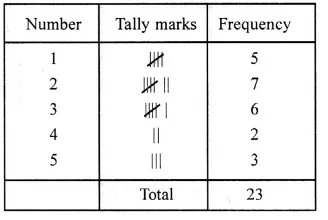
Below is given the frequency distribution table of the given data :
RS Aggarwal Class 6 Solutions Chapter 22 Data Handling Ex 22 Q4.1

Question 5.
Solution:
Below is given the frequency distribution table of the given data
RS Aggarwal Class 6 Solutions Chapter 22 Data Handling Ex 22 Q5.1

Question 6.
Solution:
(i) numerical figures
(ii) original
(iii) array
(iv) frequency
(v) tabulation


Hope given RS Aggarwal Solutions Class 6 Chapter 22 Data Handling Ex 22 are helpful to complete your math homework.

If you have any doubts, please comment below. Learn Insta try to provide online math tutoring for you.

RS Aggarwal Class 6 Solutions Chapter 21 Concept of Perimeter and Area Ex 21E

RS Aggarwal Class 6 Solutions Chapter 21 Concept of Perimeter and Area Ex 21E

These Solutions are part of RS Aggarwal Solutions Class 6. Here we have given RS Aggarwal Solutions Class 6 Chapter 21 Concept of Perimeter and Area Ex 21E

Other Exercises

Objective questions
Mark against the correct answer in each of the following :

Question 1.
Solution:
Ratio in the sides of a rectangle = 7 : 5
and perimeter = 96 cm
RS Aggarwal Class 6 Solutions Chapter 21 Concept of Perimeter and Area Ex 21E 1

Question 2.
Solution:
Area of a rectangle = 650 cm²
and breadth (b) = 13 cm
RS Aggarwal Class 6 Solutions Chapter 21 Concept of Perimeter and Area Ex 21E 2

Question 3.
Solution:
Length of a rectangular field (l) = 34 m
and breadth (b) = 18 m
Circumference = 2 (l + b)
= 2 (34 + 18)m
= 2 x 52
= 104 m
Rate of fencing = Rs. 22.50 per m
Total cost = Rs. 22.50 x 104
= Rs. 2340 (b)

Question 4.
Solution:
Total cost of fencing = Rs. 2400
Rate = Rs. 30 per m
Perimeter of the rectangular field
RS Aggarwal Class 6 Solutions Chapter 21 Concept of Perimeter and Area Ex 21E 4

Question 5.
Solution:
Area of rectangular carpet =120 cm²
Perimeter = 46 m
Now 2 (l + b)
= 46 m
RS Aggarwal Class 6 Solutions Chapter 21 Concept of Perimeter and Area Ex 21E 5

Question 6.
Solution:
Let width of a rectangle = x
Then length = 3x
and diagonal = 6√10 cm
RS Aggarwal Class 6 Solutions Chapter 21 Concept of Perimeter and Area Ex 21E 6

Question 7.
Solution:
Ratio in length and perimeter of a rectangle = 1 : 3
Let length = x,
then perimeter = 3x
RS Aggarwal Class 6 Solutions Chapter 21 Concept of Perimeter and Area Ex 21E 7

Question 8.
Solution:
Length of diagonal of a square = 20 cm
RS Aggarwal Class 6 Solutions Chapter 21 Concept of Perimeter and Area Ex 21E 8

Question 9.
Solution:
Total cost of fencing around a square field = Rs. 2000
and rate = Rs. 25 per metre
RS Aggarwal Class 6 Solutions Chapter 21 Concept of Perimeter and Area Ex 21E 9

Question 10.
Solution:
Circumference = πd
= \(\\ \frac { 22 }{ 7 } \) x 7
= 22 cm (b)

Question 11.
Solution:
(a) Diameter = \(\frac { circumference }{ \pi } \)
= \(\\ \frac { 88\times 7 }{ 22 } \)
= 28 cm

Question 12.
Solution:
Circumference = πd
= \(\\ \frac { 22 }{ 7 } \) x 70
= 220 cm
RS Aggarwal Class 6 Solutions Chapter 21 Concept of Perimeter and Area Ex 21E 12

Question 13.
Solution:
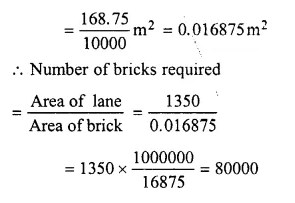
Length of the lane = 150 m
Breadth of the lane = 9 m
Area of the lane = (150 x 9) m²
= 1350 m²
Area of the brick = 22.5 cm x 7.5 cm
= 168.75 cm²
RS Aggarwal Class 6 Solutions Chapter 21 Concept of Perimeter and Area Ex 21E 13

Question 14.
Solution:
Length of a rectangular room (l) = 5 m 40 cm = 5.4 m
and breadth (b) = 4 m 50 cm
= 4.5 m
Area = l x b = 5.4 x 4.5 m²
= 24.3 m² (b)

Question 15.
Solution:
Length of a sheet (l) = 72 cm
and breadth (b) = 48 cm
Area = l x b = 72 x 48 cm²
Area of paper for one envelope = 18 x 12 cm²
No. of envelopes = \(\\ \frac { 72\times 48 }{ 18\times 12 } \) =16 (d)


Hope given RS Aggarwal Solutions Class 6 Chapter 21 Concept of Perimeter and Area Ex 21E are helpful to complete your math homework.

If you have any doubts, please comment below. Learn Insta try to provide online math tutoring for you.

RS Aggarwal Class 6 Solutions Chapter 21 Concept of Perimeter and Area Ex 21D

RS Aggarwal Class 6 Solutions Chapter 21 Concept of Perimeter and Area Ex 21D

These Solutions are part of RS Aggarwal Solutions Class 6. Here we have given RS Aggarwal Solutions Class 6 Chapter 21 Concept of Perimeter and Area Ex 21D

Other Exercises

Question 1.
Solution:
(i) Length (l) = 46 cm
Breadth (b) = 25 cm
Area of rectangle = l x b
= 46 x 25 sq. cm
= 1150 sq.cm.
(ii) Length (l) = 9 m
Breadth (b) = 6 m
Area = l x b = 9 x 6
= 54 sq. metre Ans.
(iii) Length (l) = 14.5 m
Breadth (b) = 6.8 m
Area = l x b
= 14.5 x 6.8 sq. m
= 98.6 sq. m Ans.
(iv) Length (l) = 2m 5cm
= 2x 100 cm + 5 cm
= 200 cm + 5 cm
= 205 cm
Breadth = 60 cm
Area = l x b
= 205 cm x 60 cm
= 12300 cm²
(v) Length (l) = 3.5 km
Breadth (b) = 2 km
Area = l x b
= 3.5 x 2
= 7 sq. km. Ans.

Question 2.
Solution:
Side of a square plot = 14 m
Area = (Side)²
= (14)²
= 196 m²

Question 3.
Solution:
Length of top of table (l) = 2 m, 25 cm = 2.25 m
Breadth (l) = 1 m 20 cm = 1.20 m
Area of the top of the table = l x b
= (2.25 x 1.20) sq. m
= 2.7 sq. m. Ans.

Question 4.
Solution:
Length of carpet (l) = 30 m 75 cm
= 30.75 m
Breadth (b) = 80 cm = 0.80 m
Area of the carpet = l x b
= (30.75 x 0.80) sq. m
= 24.6 sq. m
Cost of one square metre = Rs. 20
Total cost = 24.6 x 150
= Rs. 3690. Ans

Question 5.
Solution:
Length of the sheet of paper 3 m 24 cm
= 300 cm + 24 cm
= 324 cm
Breadth of the sheet of the paper 1 m 72 cm
= 100 cm + 72 cm
= 172 cm
Area of the sheet of paper = (324 x 172) cm²
Also, area of the piece of paper required for an envelope = (18 x 12) cm².
Number of envelopes that can be made
= \(\\ \frac { 324\times 172 }{ 18\times 12 } \)
= 258

Question 6.
Solution:
Length of room (l) = 12.5 m
Breadth (b) = 8 m
Area = l x b
= (12.5 x 8) sq. m
= 100 sq. m
Side of square carpet (a) = 8 m
Area of carpet = a² = (8 x 8) sq. m.
= 64 square metre
Area left without carpet = 100 sq. m – 64 sq. m
= 36 sq. m Ans.

Question 7.
Solution:
Length of the lane = 150 m
Breadth of the lane = 9 m
Area of the lane = (150 x 9) m²
= 1350 m²
Area of the brick = 22.5 cm x 7.5 cm
= 168.75 cm²
RS Aggarwal Class 6 Solutions Chapter 21 Concept of Perimeter and Area Ex 21D Q7.1

Question 8.
Solution:
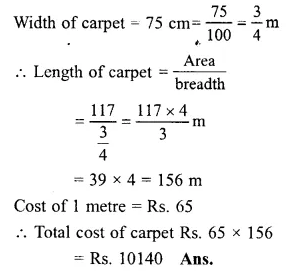
Length of room (l) = 13 m
Breadth (b) = 9 m
Area of floor or carpet = l x b
= 13 x 9
= 117 sq. m
RS Aggarwal Class 6 Solutions Chapter 21 Concept of Perimeter and Area Ex 21D Q8.1

Question 9.
Solution:
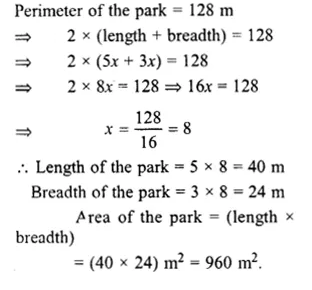
Let the length of the rectangular park = 5x metres
and the breadth of the rectangular park = 3x metres
RS Aggarwal Class 6 Solutions Chapter 21 Concept of Perimeter and Area Ex 21D Q9.1

Question 10.
Solution:
Side of the square plot = 64 m
Perimeter of the square plot = 4 x Side
= 4 x 64
= 256 m
Perimeter of the rectangular plot = Perimeter of the square plot = 256 m
Length of the rectangular plot = 70 m
Perimeter = 2 x (Length + Breadth)
256 = 2 (70 + b)
256 = 140 + 2b
=> 2b = 256 – 140
=> 2b = 116
b = \(\\ \frac { 116 }{ 2 } \) = 58 cm
Area of the rectangular plot = (length x breadth)]
= (70 x 58) m²
= 4060 m²
Area of the square plot = Side x Side
= (64 x 64) m²
= 4096 m².
Square plot has the greater area than that of the rectangular plot by
(4096 – 4060)
= 36 m².

Question 11.
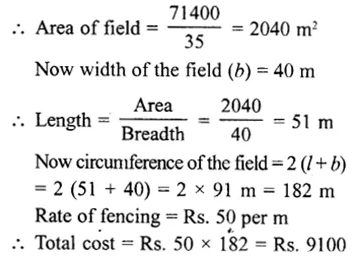
Solution:
Total cost of cultivating the rectangular field = Rs. 71400
Rate of cultivating = Rs. 35 per sq. m
RS Aggarwal Class 6 Solutions Chapter 21 Concept of Perimeter and Area Ex 21D Q11.1

Question 12.
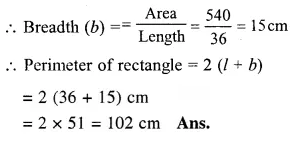
Solution:
Area of rectangle = 540 sq. cm
Length (l) = 36 cm
RS Aggarwal Class 6 Solutions Chapter 21 Concept of Perimeter and Area Ex 21D Q12.1

Question 13.
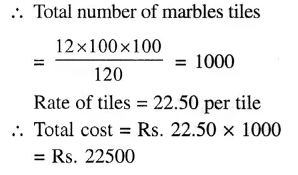
Solution:
Measure of a marble tile = 12cm x 10cm
Area of wall = 4 m x 3 m
= 12 m²
Area of one marble tile
= 12 x 10
= 120 cm²
RS Aggarwal Class 6 Solutions Chapter 21 Concept of Perimeter and Area Ex 21D Q13.1

Question 14.
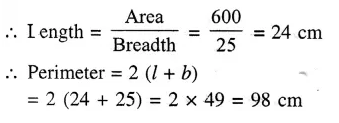
Solution:
Area of a rectangle = 600 cm²
Breadth = 25 cm
RS Aggarwal Class 6 Solutions Chapter 21 Concept of Perimeter and Area Ex 21D Q14.1

Question 15.
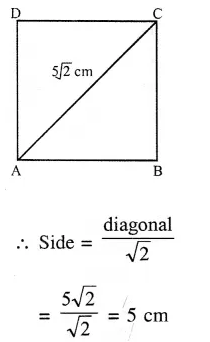
Solution:
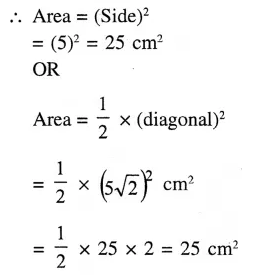
diagonal of square = 5 √2
RS Aggarwal Class 6 Solutions Chapter 21 Concept of Perimeter and Area Ex 21D Q15.1
RS Aggarwal Class 6 Solutions Chapter 21 Concept of Perimeter and Area Ex 21D Q15.2

Question 16.
Solution:
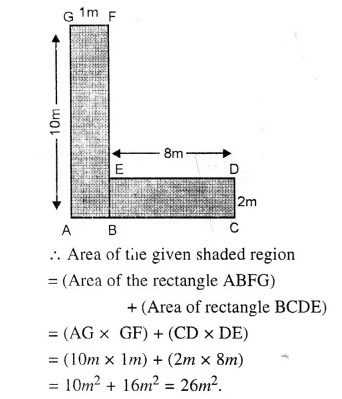
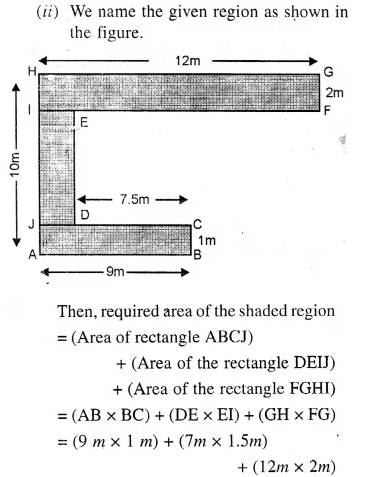
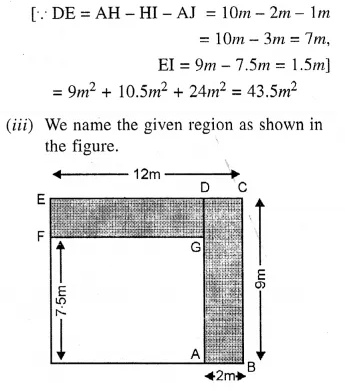
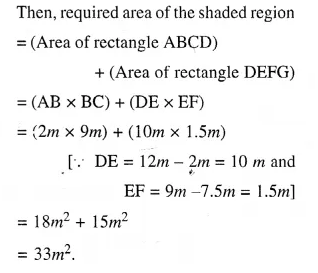
(i) We name the given region as shown in the figure
RS Aggarwal Class 6 Solutions Chapter 21 Concept of Perimeter and Area Ex 21D Q16.1
RS Aggarwal Class 6 Solutions Chapter 21 Concept of Perimeter and Area Ex 21D Q16.2
RS Aggarwal Class 6 Solutions Chapter 21 Concept of Perimeter and Area Ex 21D Q16.3
RS Aggarwal Class 6 Solutions Chapter 21 Concept of Perimeter and Area Ex 21D Q16.4

Question 17.
Solution:
Measures are in cm
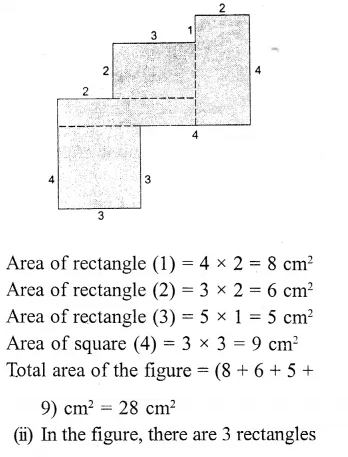
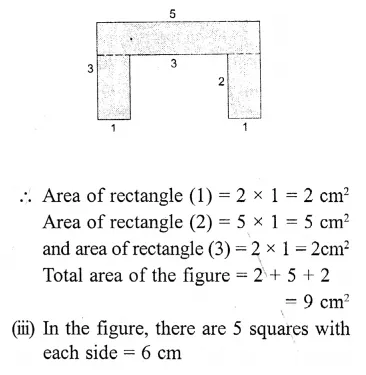
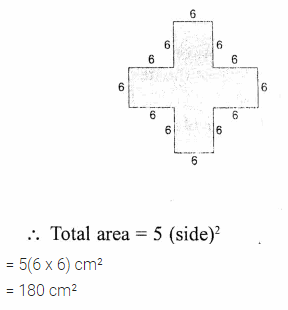
(i) In the figure, there are three rectangles and one square
RS Aggarwal Class 6 Solutions Chapter 21 Concept of Perimeter and Area Ex 21D Q17.1
RS Aggarwal Class 6 Solutions Chapter 21 Concept of Perimeter and Area Ex 21D Q17.2
RS Aggarwal Class 6 Solutions Chapter 21 Concept of Perimeter and Area Ex 21D Q17.3
= 5(6 x 6) cm²
= 180 cm²


Hope given RS Aggarwal Solutions Class 6 Chapter 21 Concept of Perimeter and Area Ex 21D are helpful to complete your math homework.

If you have any doubts, please comment below. Learn Insta try to provide online math tutoring for you.

Selina Concise Mathematics Class 10 ICSE Solutions Chapter 25 Probability Ex 25B

Selina Concise Mathematics Class 10 ICSE Solutions Chapter 25 Probability Ex 25B

These Solutions are part of Selina Concise Mathematics Class 10 ICSE Solutions. Here we have given Chapter 25 Probability Ex 25B.

Other Exercises

Question 1.
Nine cards (identical in all respects) are numbered 2 to 10. A card is selected from them at random. Find the probability that the card selected will be :
(i) an even number.
(ii) a multiple of 3 ,
(iii) an even number and a multiple of 3.
(iv) an even number or a multiple of 3.
Solution:
No. of cards = 9
Having numbers marked on it = 2 to 10
∴ Number of possible outcomes = 9
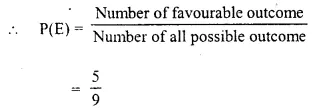
(i) An even number i.e. 2, 4, 6, 8, 10 = 5
∴ Number of even numbers = 5
Selina Concise Mathematics Class 10 ICSE Solutions Chapter 25 Probability Ex 25B Q1.1
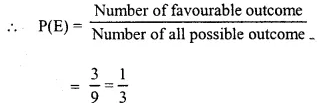
(ii) A multiple of 3 are 3, 6, 9
Number of multiple of 3 = 3
Selina Concise Mathematics Class 10 ICSE Solutions Chapter 25 Probability Ex 25B Q1.2
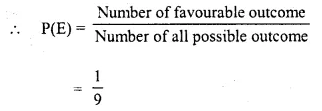
(iii) An even number and a multiple of 3 are 6
which is one in number
Selina Concise Mathematics Class 10 ICSE Solutions Chapter 25 Probability Ex 25B Q1.3
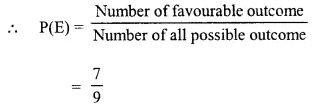
(iv) An even number or a multiple of 3 are 2, 3, 4, 6, 8, 9, 10
which are 7 in numbers
Selina Concise Mathematics Class 10 ICSE Solutions Chapter 25 Probability Ex 25B Q1.4

Question 2.
Hundred identical cards are numbered from 1 to 100. The cards are well shuffled and then a card is drawn. Find the probability that the number on the card drawn is :
(i) a multiple of 5.
(ii) a multiple of 6.
(iii) between 40 and 60.
(iv) greater than 85.
(v) less than 48.
Solution:
Number of cards = 100
Marked with numbers from 1 to 100
∴ Number of possible outcome = 100
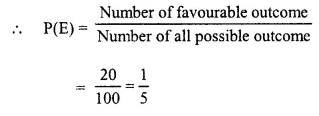
(i) A multiple of 5 are 5, 10, 15 95, 100
which are 20 in numbers.
∴ Number of favourable outcome = 20
Selina Concise Mathematics Class 10 ICSE Solutions Chapter 25 Probability Ex 25B Q2.1
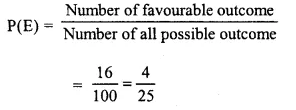
(ii) A multiple of 6 are 6, 12, 18, 24, 90, 96
which are 16 in numbers.
∴ Number of favourable outcome =16
Selina Concise Mathematics Class 10 ICSE Solutions Chapter 25 Probability Ex 25B Q2.2
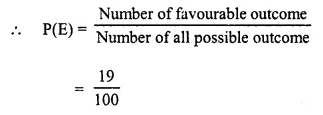
(iii) Between 40 and 60 are 41, 42, ……. , 58, 59,
which are 19
Selina Concise Mathematics Class 10 ICSE Solutions Chapter 25 Probability Ex 25B Q2.3
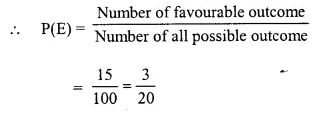
(iv) Greater than 85 are 86 to 100 which are 15 in numbers.
Selina Concise Mathematics Class 10 ICSE Solutions Chapter 25 Probability Ex 25B Q2.4
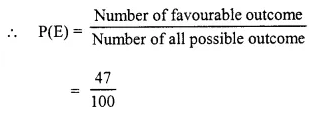
(v) Less than 48 are 1 to 47 which are 47 in numbers
Selina Concise Mathematics Class 10 ICSE Solutions Chapter 25 Probability Ex 25B Q2.5

Question 3.
From 25 identical cards, numbered, 1, 2, 3, 4, 5 ,…………, 24, 25 ; one card is drawn at random.
Find the probability that the number on the card drawn is a multiple of :
(i) 3
(ii) 5
(iii) 3 and 5
(iv) 3 or 5

Solution:
Number of identical cards = 25
Numbers marked on their are 1 to 25 i.e.
1, 2, 3, 4, 5, …. 21, 22, 23, 24, 25
∴ Number of possible outcome = 25
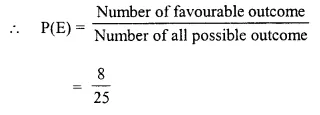
(i) Multiple of 3 are 3, 6, 9, 12, 15, 18, 21, 24
Which are 8 in numbers.
Selina Concise Mathematics Class 10 ICSE Solutions Chapter 25 Probability Ex 25B Q3.1
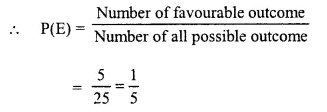
(ii) Multiple of 5 are 5, 10, 15, 20, 25
which are 5 in numbers
Selina Concise Mathematics Class 10 ICSE Solutions Chapter 25 Probability Ex 25B Q3.2
(iii) Multiple of 3 and 5 are = 15
which is 1 in number
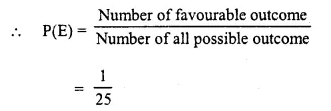
Selina Concise Mathematics Class 10 ICSE Solutions Chapter 25 Probability Ex 25B Q3.3
(iv) Multiple of 3 or 5 are 3, 5, 6, 9, 10, 12, 15, 18, 20, 21, 24, 25
which are 12 in numbers
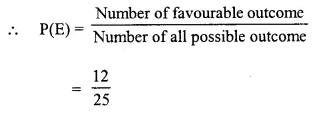
Selina Concise Mathematics Class 10 ICSE Solutions Chapter 25 Probability Ex 25B Q3.4

Question 4.
A die is thrown once. Find the probability of getting a number :
(i) less than 3.
(ii) greater than or equal to 4.
(iii) less than 8
(iv) greater than 6.
Solution:
A die has 6 numbers i.e., 1, 2, 3, 4, 5, 6
∴ Number of possible outcome = 6
(i) Less than 3 are 1, 2 which are 2 in numbers
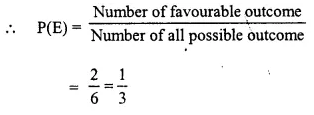
Selina Concise Mathematics Class 10 ICSE Solutions Chapter 25 Probability Ex 25B Q4.1
(ii) Greater than or equal to 4 are 4, 5, 6
which are 3 in number.
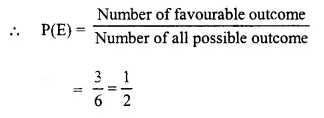
Selina Concise Mathematics Class 10 ICSE Solutions Chapter 25 Probability Ex 25B Q4.2
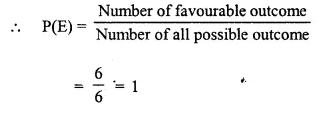
(iii) Less than 8 are 1, 2, 3, 4, 5, 6
which are 6 in numbers
Selina Concise Mathematics Class 10 ICSE Solutions Chapter 25 Probability Ex 25B Q4.3
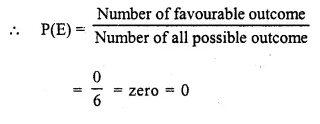
(iv) Greater than 6 is nothing on the die
Selina Concise Mathematics Class 10 ICSE Solutions Chapter 25 Probability Ex 25B Q4.4

Question 5.
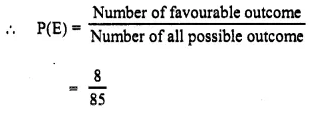
A book contains 85 pages. A page is chosen at random. What is the probability that the sum of the digits on the page is 8 ?
Solution:
Number of pages of the book = 85
which are from 1 to 85
Number of possible outcome = 85
∴ Number of pages whose sum of its page is 8 are : 17, 26, 35, 44, 53, 62, 71, 80 and 8
Selina Concise Mathematics Class 10 ICSE Solutions Chapter 25 Probability Ex 25B Q5.1

Question 6.
A pair of dice is thrown. Find the probability of getting a sum of 10 or more if 5 appears on the first die.
Solution:
Numbers marked on each die = 6
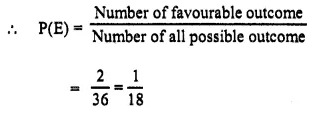
∴ Total number of cases = 6 x 6 = 36
∵ Favourable come are (5, 5), (5, 6) as 5 appears on the first, which are 2 in number
Selina Concise Mathematics Class 10 ICSE Solutions Chapter 25 Probability Ex 25B Q6.1

Question 7.
If two coins are tossed once, what is the probability of getting :
(i) 2 heads
(ii) at least one head
(iii) both heads or both tails.
Solution:
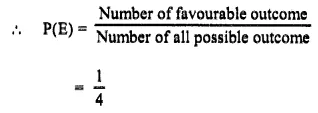
∵ A coins has two faces Head and Jail or H, T
∴ Two coins are tossed
∴ Number of coins = 2 x 2 = 4
which are HH, HT, TH, TT
(i) When both are Head, then
∴ Number of outcome = 1
Selina Concise Mathematics Class 10 ICSE Solutions Chapter 25 Probability Ex 25B Q7.1
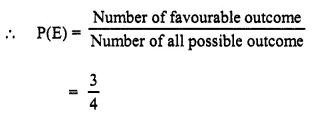
(ii) At least one head, then
Number of outcomes = 3
Selina Concise Mathematics Class 10 ICSE Solutions Chapter 25 Probability Ex 25B Q7.2
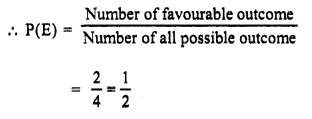
(iii) When both head or both tails, then 1
Number of outcomes = 2
Selina Concise Mathematics Class 10 ICSE Solutions Chapter 25 Probability Ex 25B Q7.3

Question 8.
Two dice are rolled together. Find the probability of getting :
(i) a total of at least 10.
(ii) a multiple of 2 on one die and an odd number on the other die.
Solution:
∵ A die has 6 faces which are 1, 2, 3, 4, 5,6
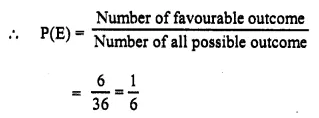
∴ On rolling two dice at a time, number of comes = 6 x 6 = 36
∴ Number of possible outcome = 36
(i) a total of atleast 10, the favourable can be (4,6), (5, 5), (5, 6), (6, 4), (6, 5), (6, 6) which are 6 in number
Selina Concise Mathematics Class 10 ICSE Solutions Chapter 25 Probability Ex 25B Q8.1
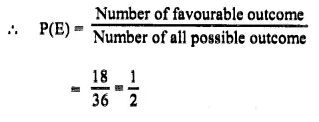
(ii) A multiple of 2 on one die and an odd number on the other
∴ Outcome can be (2, 1), (2, 3), (g, 5), (4, 1), (4,3) , (4, 5), (6, 1), (6, 3), (6, 5), (1, 2), (3, 2), (5, 2), (1, 4), (3, 4), (5, 4), (1, 6), (3, 6), 5, 6) which are 18 in numbers.
Number of favourable outcome
Selina Concise Mathematics Class 10 ICSE Solutions Chapter 25 Probability Ex 25B Q8.2

Question 9.
A card is drawn from a well-shuffled pack of 52 cards. Find the probability that the card drawn is :
(i) a spade.
(ii) a red card.
(iii) a face card.
(iv) 5 of heart or diamond.
(v) Jack or queen.
(vi) ace and king.
(vii) a red and a king.
(viii) a red or a king.
Solution:
A pack of playing card has 52 cards
∴ Number of possible outcome = 52
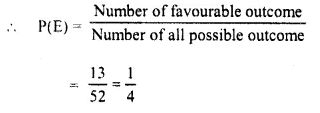
(i) A spade
∵ there are 13 cards of spade
∴ Number of favourable outcome = 13
Selina Concise Mathematics Class 10 ICSE Solutions Chapter 25 Probability Ex 25B Q9.1
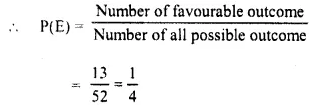
(ii) A red card.
∵ There are 13 + 13 = 26 red card
Selina Concise Mathematics Class 10 ICSE Solutions Chapter 25 Probability Ex 25B Q9.2
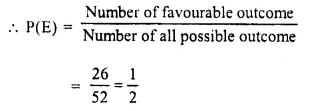
(iii) A face card.
∵ There are 3 x 4 = 12 faces which are red.
Selina Concise Mathematics Class 10 ICSE Solutions Chapter 25 Probability Ex 25B Q9.3
(iv) 5 of heart or diamond.
∴ Number of cards =1 + 1=2
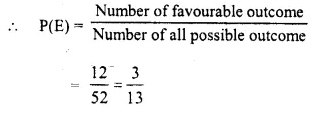
Selina Concise Mathematics Class 10 ICSE Solutions Chapter 25 Probability Ex 25B Q9.4
(v) Jack or queen
There are 4 + 4 = 8 such cards
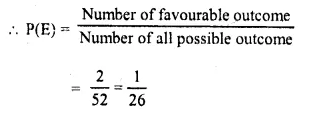
Selina Concise Mathematics Class 10 ICSE Solutions Chapter 25 Probability Ex 25B Q9.5
(vi) ace and king.
There is no such card which is ace and king both
∴ P(E) = 0.
(vii) a red and a king
There are 2 such cards which are red kings
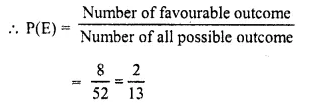
Selina Concise Mathematics Class 10 ICSE Solutions Chapter 25 Probability Ex 25B Q9.6
(viii) a red or a king
There are 26 cards which are red in which 2 kings are red and 2 more kings which are black = 26 + 2 = 28
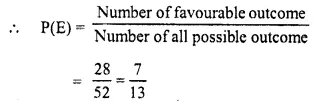
Selina Concise Mathematics Class 10 ICSE Solutions Chapter 25 Probability Ex 25B Q9.7

Question 10.
A bag contains 16 coloured balls. Six are green, 7 are red and 3 are white. A ball is chosen, without looking into the bag. Find the probability that the ball chosen is :
(i) red
(ii) not red
(iii) white
(iv) not white
(v) green or red
(vi) white or green
(vii) green or red or white.
Solution:
Number of balls in a bag = 16
Green balls = 6
White balls = 3
Red balls = 7
∴ Total possible outcome =16
(i) Red balls = 7
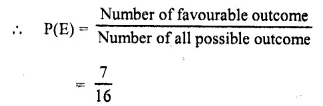
Selina Concise Mathematics Class 10 ICSE Solutions Chapter 25 Probability Ex 25B Q10.1
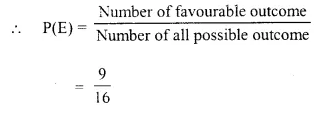
(ii) Not red balls = 16-7 = 9
Selina Concise Mathematics Class 10 ICSE Solutions Chapter 25 Probability Ex 25B Q10.2
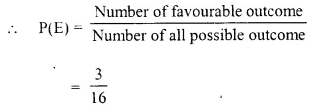
(iii) White balls = 3
Selina Concise Mathematics Class 10 ICSE Solutions Chapter 25 Probability Ex 25B Q10.3
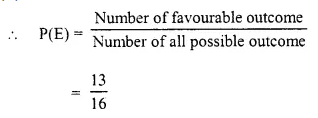
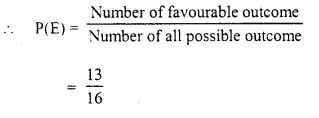
(iv) Not white balls = 16 – 3= 13
Selina Concise Mathematics Class 10 ICSE Solutions Chapter 25 Probability Ex 25B Q10.4
(v) Green or red balls = 6 + 7 = 13
Selina Concise Mathematics Class 10 ICSE Solutions Chapter 25 Probability Ex 25B Q10.5
(vi) White or green balls = 3 + 6 = 9
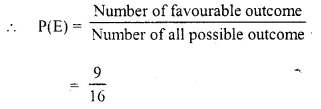
Selina Concise Mathematics Class 10 ICSE Solutions Chapter 25 Probability Ex 25B Q10.6
(vii) Green or red or white balls =16
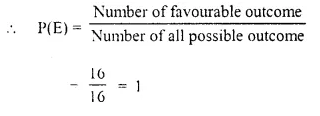
Selina Concise Mathematics Class 10 ICSE Solutions Chapter 25 Probability Ex 25B Q10.7

Question 11.
A ball is drawn at random from a box .ontammg 12 white. 16 red and 20 green balls. Determine the probability that the ball drawn is:
(i) white
(ii) red
(iii) not green
(iv) red or white.
Solution:
Number of balls in a box
White = 12
Red = 16
Green = 20
Total balls = 12 + 16 +20 = 48
∴ Total possible outcome = 48
(i) White balls = 12
∴ Number of favourable outcome =12
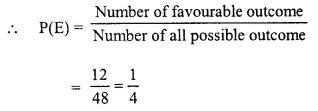
Selina Concise Mathematics Class 10 ICSE Solutions Chapter 25 Probability Ex 25B Q11.1
(ii) Red balls = 16
∴ Number of favourable outcome =16
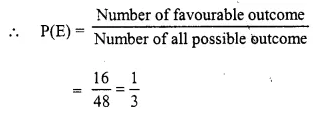
Selina Concise Mathematics Class 10 ICSE Solutions Chapter 25 Probability Ex 25B Q11.2
(iii) Not green
Number of balls =12 + 16 = 28
∴ Number of favourable outcome = 28
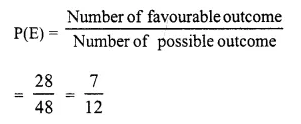
Selina Concise Mathematics Class 10 ICSE Solutions Chapter 25 Probability Ex 25B Q11.3
(iv) Red or white balls =12 + 16 = 28
∴ Number of favourable outcome = 28
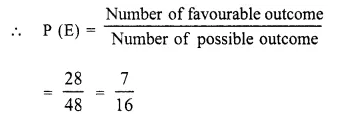
Selina Concise Mathematics Class 10 ICSE Solutions Chapter 25 Probability Ex 25B Q11.4

Question 12.
A card is drawn from a pack of 52 cards. Find the probability that the card drawn is :
(i) a red card
(ii) a black card
(iii) a spade
(iv) an ace
(v) a black ace
(vi) ace of diamonds
(vii) not a club
(viii) a queen or a jack
Solution:
Number of cards in playing card deck = 52
∴ Number of possible outcome = 52
(i) A red card
There are 13 + 13 = 26 red cards in the deck
∴ Number of favourable outcome = 26
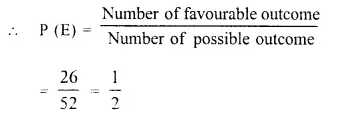
Selina Concise Mathematics Class 10 ICSE Solutions Chapter 25 Probability Ex 25B Q12.1
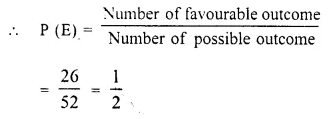
(ii) A black card
There are 13 + 13 = 26 black cards
∴ Number of favourable outcome = 26
Selina Concise Mathematics Class 10 ICSE Solutions Chapter 25 Probability Ex 25B Q12.2
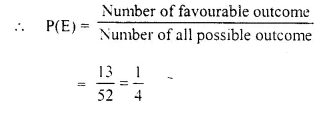
(iii) A spade
There are 13 spade cards in the deck
∴ Number of favourable outcome = 13
Selina Concise Mathematics Class 10 ICSE Solutions Chapter 25 Probability Ex 25B Q12.3
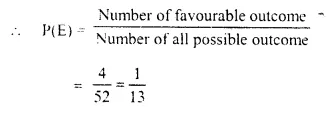
(iv) An Ace
There use 4 aces in the deck
Number of favourable outcome = 4
Selina Concise Mathematics Class 10 ICSE Solutions Chapter 25 Probability Ex 25B Q12.4
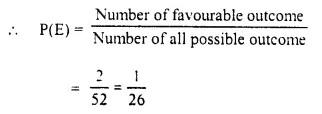
(v) A black ace
There are two black aces in a deck
∴ Number of favourable outcome = 2
Number of cards in playing card deck = 52
Selina Concise Mathematics Class 10 ICSE Solutions Chapter 25 Probability Ex 25B Q12.5
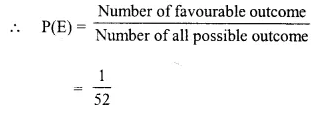
(vi) Ace of diamonds
∴ There are only one ace of diamonds
∴ Number of favourable of outcome = 1
Selina Concise Mathematics Class 10 ICSE Solutions Chapter 25 Probability Ex 25B Q12.6
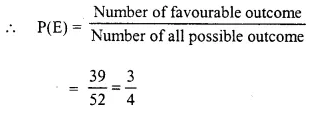
(vii) Not a club
There are 13 x 3 = 39 cards which are not a club
∴ Number of favourable outcome = 39
Selina Concise Mathematics Class 10 ICSE Solutions Chapter 25 Probability Ex 25B Q12.7
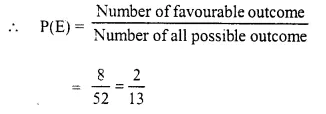
(viii) A queen or a Jack
There are 4 queen cards and 4 Jack cards
∴ Number of favourable outcome = 4 + 4 = 8
Selina Concise Mathematics Class 10 ICSE Solutions Chapter 25 Probability Ex 25B Q12.8

Question 13.
Thirty identical cards are marked with numbers 1 to 30. If one card is drawn at random, find the probability that it is :
(i) a multiple of 4 or 6.
(ii) a multiple of 3 and 5
(iii) a multiple of 3 or 5
Solution:
There are 30 cards which are marks with numbers 1 to 30 and one card is drawn
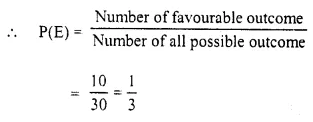
(i) A multiple of 4 or 6.
∴ There are multiple of 4 or 6 = 4,6, 8, 12, 16, 18, 20, 24, 28, 30 which are 10
∴ Number of favourable outcome = 10
Selina Concise Mathematics Class 10 ICSE Solutions Chapter 25 Probability Ex 25B Q13.1
(ii) A multiple of 3 and 5 are 15, 30 which are 2
∴ Number of favourable outcome = 2
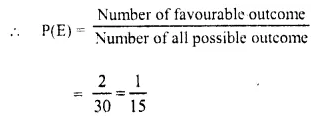
Selina Concise Mathematics Class 10 ICSE Solutions Chapter 25 Probability Ex 25B Q13.2
(iii) A multiple of 3 or 5
which are 3, 5, 6, 9, 10, 12, 15, 18, 20, 21, 24, 25, 27, 30 which are 14
∴ Number of favourable outcome = 14
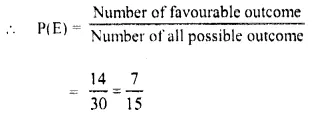
Selina Concise Mathematics Class 10 ICSE Solutions Chapter 25 Probability Ex 25B Q13.3

Question 14.
In a single throw of two dice, find the probability of :
(i) a doublet
(ii) a number less than 3 on each dice.
(iii) an odd number as a sum.
(iv) a total of at most 10.
(v) an odd number on one dice and a number less than or equal to 4 on the other dice.
Solution:
Number of dice thrown = 2
Each die has 1 to 6 numbers on its faces Number of possible outcomes = 6 X 6 = 36
(i) A doublet : These can be (1, 1), (2, 2),(3, 3), (4, 4), (5, 5) and (6, 6) which are 6
∴ Number of favourable outcome = 6
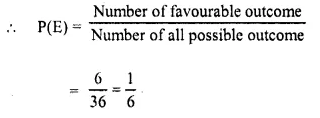
Selina Concise Mathematics Class 10 ICSE Solutions Chapter 25 Probability Ex 25B Q14.1
(ii) A number less than 3 on each die which can be (1, 1), (1, 2), (2, 1), (2, 2) which are 4 in numbers
∴ Number of favourable outcome = 4
Selina Concise Mathematics Class 10 ICSE Solutions Chapter 25 Probability Ex 25B Q14.2
(iii) An odd number as a sum which can be (1, 1), (1,3), (1,5), (2, 1), (2,3), (2,5), (3, 1), (3,3), (3,5), (4, 1), (4,3), (4, 5), (5,1),(5,3), (5,5), (6, 1), (6, 3), (6, 5) which are 18 in numbers.
∴ Number of favourable outcome = 18
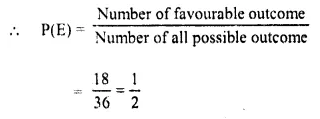
Selina Concise Mathematics Class 10 ICSE Solutions Chapter 25 Probability Ex 25B Q14.3
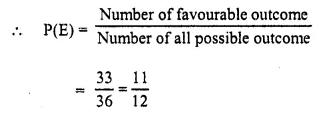
(iv) Total of at most 10
Which can be = 36 – 3 (which can be (5, 6), (6, 6), (6, 5) = 33
∴ Number of favourable outcome = 33
Selina Concise Mathematics Class 10 ICSE Solutions Chapter 25 Probability Ex 25B Q14.4
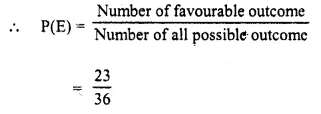
(v) An odd number on one die and a number less than or equal to 4 on the other die
(1, 1), (1,2), (1,3), (1,4), (3,1), (3,2), (3, 3), (3,4) , (5, 1), (5, 2), (5, 3), (5, 4), (2, 1), (3, 1), (4, 1),(1, 3), (2, 3), (2, 5), (3, 1), (3, 5), (4, 1), (4, 3), (4,5) which are 23 in numbers
∴ Number of favourable outcome = 23
Selina Concise Mathematics Class 10 ICSE Solutions Chapter 25 Probability Ex 25B Q14.5

Hope given Selina Concise Mathematics Class 10 ICSE Solutions Chapter 25 Probability Ex 25B  are helpful to complete your math homework.

If you have any doubts, please comment below. Learn Insta try to provide online math tutoring for you.