HOTS Questions for Class 10 Science Chapter 12 Electricity

HOTS Questions for Class 10 Science Chapter 12 Electricity

These Solutions are part of HOTS Questions for Class 10 Science. Here we have given HOTS Questions for Class 10 Science Chapter 12 Electricity

Question 1.
Following table gives the resistivity of three samples in (Ωm)

HOTS Questions for Class 10 Science Chapter 12 Electricity image - 1
Which of them is a good conductor ? And which of them is an insulator ? Explain why ? (CBSE 2012)
Answer:
A material having low resistivity is a good conductor. Since, resistivity of sample A is the least among all other materials, so sample A is a good conductor. A material having high value of resistivity is an insulator. Therefore, sample C is an insulator.

More Resources

Question 2.
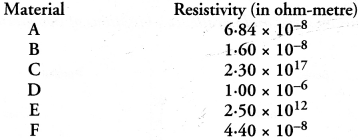
The electrical resistivity of few materials is given below in ohm-meter. Which of these materials can be used for making element of a heating device ?
HOTS Questions for Class 10 Science Chapter 12 Electricity image - 2
(CBSE Sample Paper, CBSE 2012, Similar CBSE 2014)
Answer:
For making element of a heating device, we use alloy instead of pure metals.The resistivity of material D lies in the range of resistivities of alloys. Therefore, material D can be used for making element of a heating device.

Question 3.
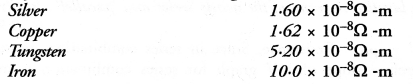
Electrical resistivities of some substances at 20°C are given below :
HOTS Questions for Class 10 Science Chapter 12 Electricity image - 3
HOTS Questions for Class 10 Science Chapter 12 Electricity image - 4
Answer the following questions in relation to them :

  1. Among silver and copper, which one is a better conductor ? Why ?
  2. Which material would you advise to be used in electrical heating devices ? Why ? (CBSE 2012)

Answer:

  1. A material whose electrical resistivity is low is a good conductor of electricity. Since the electrical resistivity of silver is less than that of the copper, so silver is a better conductor than the copper.
  2. For making the elements of heating devices, alloy is used instead of a pure metal. This is because the resistivity of an alloy is more than that of a metal and alloy does not burn (or oxidise) even at higher temperature. Out of the given substances, nichrome is an alloy, so nichrome is used in electrical heating devices.

Question 4.
The following table gives the resistivity of three samples :

HOTS Questions for Class 10 Science Chapter 12 Electricity image - 5
Which of them is suitable for heating elements of electrical appliances and why ? (CBSE, 2010, 2012)
Answer:
For making the heating elements of electrical appliances, alloy is used instead of a pure metal. This is because alloy does not burn even at higher temperature. The resistivity of sample C is of the order of an alloy, so sample C is suitable for heating elements of electrical appliances.

Question 5.
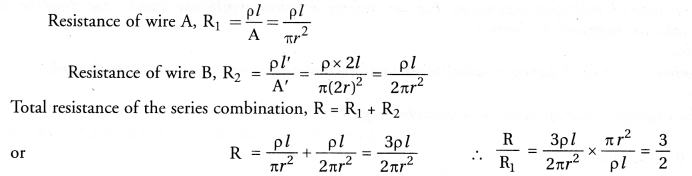
Two metallic wires A and B are connected in series. Wire A has length l and radius r, while wire B has length 2l and radius 2r. Find the ratio of the total resistance of series combination and the resistance of wire A, if both the wires are of same material
Answer:
HOTS Questions for Class 10 Science Chapter 12 Electricity image - 6

Question 6.
Two metallic wires A and B of same material are connected in parallel. Wire A has length l and radius r and wire B has length 2l and radius 2r. Compute the ratio of the total resistance of parallel combination and the resistance of wire A.
(CBSE Sample Paper)
Answer:
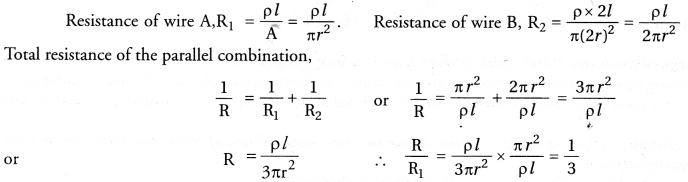
HOTS Questions for Class 10 Science Chapter 12 Electricity image - 7

Question 7.
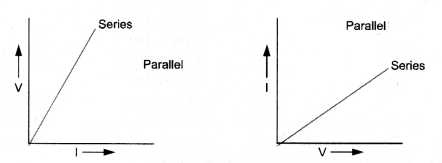
Two students perform the experiments on series and parallel combinations of two given resistors Rand R2 and plot the following V-I graphs.
HOTS Questions for Class 10 Science Chapter 12 Electricity image - 8
Which of the graphs is (are) correctly labelled in terms of the words ‘series’ and ‘parallel’. Justify your answer.
(CBSE Sample Paper, 2012)
Answer:
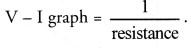
In first graph, slope of I-V graph = Resistance.
Since in series combination, resistance is more than the resistance in parallel combination, therefore slope of I-V graph for series combination is more than the slope of resistance.
HOTS Questions for Class 10 Science Chapter 12 Electricity image - 9
Hence, graph is correctly labelled. In second graph, slope of resistance

Question 8.
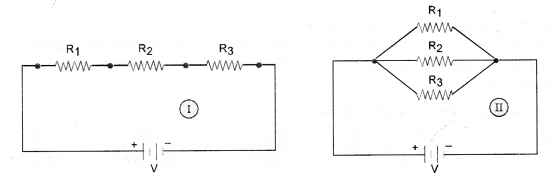
Two electric circuits I and II are shown in figure.
HOTS Questions for Class 10 Science Chapter 12 Electricity image - 10
(i) Which of the two circuits has more resistance ?
(ii) Through which circuit, more current passes ?
(iii) In which circuit, the potential difference across each resistor is equal.
Answer:
(i) Equivalent resistance of series combination of resistors is more than the equivalent resistance of the parallel combination of resistors. So, the resistance of circuit I is more than the resistance of circuit II.

HOTS Questions for Class 10 Science Chapter 12 Electricity image - 11
So current in circuit II is more than the current in circuit I.
(iii) Potential difference across each resistor is equal in circuit II.

Question 9.
An electrician puts a fuse of rating 5 A in that part of domestic electrical circuit in which an electrical heater of rating 1.5 kW, 220 V is operating. What is likely to happen in this case and why ? What change, if any needs to be made ?
(CBSE Sample Paper)
Answer:
The fuse will melt and the circuit breaks if electric current more than the rating of fuse (i.e., 5 A) flows in the circuit. Electric current flowing in the circuit,

HOTS Questions for Class 10 Science Chapter 12 Electricity image - 12
Since, current flowing in the circuit (6.82 A) is more than the rating of fuse (5 A), therefore, the fuse will melt and the electrical heater does not work. To operate the heater, fuse of rating 10 A is to be put in the circuit.

Question 10.
The electric power consumed by a device may be calculated by using either of the two expressions: P = I2R or P = V2/R . The first expression indicates that the power is directly proportional to R,whereas the second expression indicates inverse proportionality. How can the seemingly different dependence of P on R in these expressions be explained ?
(CBSE Sample Paper)
Answer:
P = I2R is used when current flowing in every component of the circuit is constant. This is the case of series combination of the devices in the circuit.
P = V2/R is used when potential difference (V) across every component of the circuit is constant. This expression is used in case of parallel combination in the circuit. In series combination, R is greater than the value of R in parallel combination.

Question 11.
Three V-I graphs are drawn individually for two resistors and their series combination. Out of A, B, C which one represents the graph for series combination of the other two. Give reason for y or ansiver. (CBSE 2011)
Answer:
Slope of V-I graph = resistance of a resistor.
When two resistors are connected in series,Volts the resistance of this combination (R = R1 + R2) is more than the resistance of both the resistors.
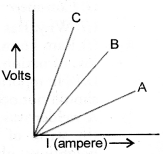
HOTS Questions for Class 10 Science Chapter 12 Electricity image - 13
Since, slope of C is greater than the slopes of A and B. Therefore, C represents the graph for series combination of the other two.

Question 12.
V-I graphs for the two wires A and B are shown in the figure. If we connect both the wires one by one to the same battery, which of the two will produce more heat per unit time ? Give justification for your answer (CBSE 2014, 2015)
Answer:
Heat produced per unit time = V2/R
Now slope of V-I graph = R (resistance of wire).
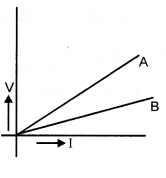
HOTS Questions for Class 10 Science Chapter 12 Electricity image - 14
Since slope of V-I graph for wire A is greater than the slope of V-I graph for wire B, therefore, resistance of wire A is greater than the resistance of wire B. Hence, more heat will be produced per unit time in wire B than in wire A.

Question 13.
The resistivities of some substances are given below :

HOTS Questions for Class 10 Science Chapter 12 Electricity image - 15
Answer the following questions in relation to them giving justification for each :
(i) Which material is best for making connecting cords ?
(ii) Which material do you suggest to be used in heater elements ?
(iii) You have two wires of same length and same thickness. One is made of material A and another of material D. If the resistance of wire made of A is 2 Ω, what is the resistance of the other wire ?
Answer:
(i) Material A is best for making connecting cords as its resistivity is the lowest one.
(ii) For heater elements, material of high resistivity is used. Therefore, the material E is to be used in heater elements.

HOTS Questions for Class 10 Science Chapter 12 Electricity image - 16

Hope given HOTS Questions for Class 10 Science Chapter 12 Electricity are helpful to complete your science homework.

If you have any doubts, please comment below. Learn Insta try to provide online science tutoring for you.


Selina Concise Mathematics Class 10 ICSE Solutions Chapter 24 Measures of Central Tendency Ex 24D

Selina Concise Mathematics Class 10 ICSE Solutions Chapter 24 Measures of Central Tendency (Mean, Median, Quartiles and Mode) Ex 24D

These Solutions are part of Selina Concise Mathematics Class 10 ICSE Solutions. Here we have given Chapter 24 Measures of Central Tendency (Mean, Median, Quartiles and Mode) Ex 24D.

Other Exercises

Question 1.
Find the mode of the following data:
(i) 7,9,8,7,7,6,8,10,7 and 6
(ii) 9,11,8,11,16,9,11,5,3,11,17 and 8
Solution:
(i) Mode = 7
because it occurs 4 times
(ii) Mode =11
because it occurs 4 times

Question 2.
The following table shows the frequency distribution of heights of 50 boys:
Selina Concise Mathematics Class 10 ICSE Solutions Chapter 24 Measures of Central Tendency Ex 24D Q2.1
Find the mode of heights.
Solution:
Mode is 122 because it occurs maximum times i.e its., frequency is 18.

Question 3.
Find the mode of following data, using a histogram:
Selina Concise Mathematics Class 10 ICSE Solutions Chapter 24 Measures of Central Tendency Ex 24D Q3.1
Solution:
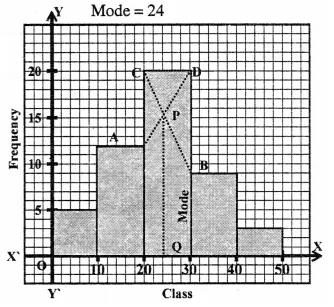
Mode class = 20 – 30
Mode = 24
Selina Concise Mathematics Class 10 ICSE Solutions Chapter 24 Measures of Central Tendency Ex 24D Q3.2
We see in the histogram that line AD and CB intersect at P. Draw perpendicular Q to the horizontal x-axis. Which is the value of the mode = 24

Question 4.
The following table shows the expenditure of 60 boys on books. Find the mode of their expenditure:
Selina Concise Mathematics Class 10 ICSE Solutions Chapter 24 Measures of Central Tendency Ex 24D Q4.1
Solution:
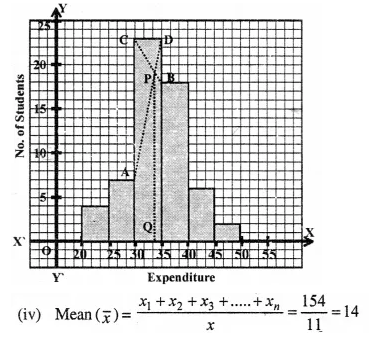
Model class is = 30 – 35
and Mode = 34
Selina Concise Mathematics Class 10 ICSE Solutions Chapter 24 Measures of Central Tendency Ex 24D Q4.2
We see in the histogram that line AD and CB intersect at P. Draw perpendicular Q to the horizontal axis. Which is the value of the mode.

Question 5.
Find the median and mode for the set of numbers 2,2,3,5,5,5,6,8 and 9.
Solution:
Median = \(\frac { 9 +1 }{ 2 }\) = 5th term which is 5
Mode = 5, because it occurs in maximum times.

Question 6.
A boy scored following marks in various class tests during a term, each test being marked out of 20.
15,17,16,7,10,12,14,16,19,12,16.
(i) What are his modal marks ?
(ii) What are his median marks ?
(iii) What are his total marks ?
(iv) What are his mean marks ?
Solution:
Arranging the given data in ascending order : 7, 10,12, 12,14, 15,16,16, 16, 17,19.
(i) Mode = 16 as it occurs in maximum times.
(ii) Median= \(\frac { 11 +1 }{ 2 }\) = 6th term which is 15
(iii) Total marks = 7 + 10+ 12+ 12+ 14+ 15+ 16 + 16+ 16+ 17+ 19= 154
Selina Concise Mathematics Class 10 ICSE Solutions Chapter 24 Measures of Central Tendency Ex 24D Q6.1

Question 7.
Find the mean, median and mode of the following marks obtained by 16 students in a class test marked out of 10 marks.
0,0,2,2,3,3,3,4,5,5,5,5,6, 6,7,8
Solution:
Selina Concise Mathematics Class 10 ICSE Solutions Chapter 24 Measures of Central Tendency Ex 24D Q7.1
(ii) Median = Mean of 8th and 9th term
= \(\frac { 4 +5 }{ 2 }\) = \(\frac { 9 }{ 2 }\) = 4.5
(iii) Mode = 5 as it occurs in maximum times.

Question 8.
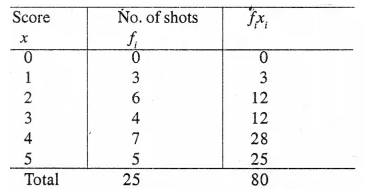
At a shooting competition the score of a com-petitor were as given below :
Selina Concise Mathematics Class 10 ICSE Solutions Chapter 24 Measures of Central Tendency Ex 24D Q8.1
(i) What was his modal score ?
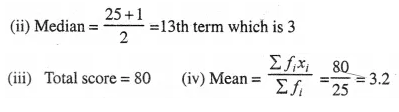
(ii) What was his median score ?
(iii) What was his total score ?
(iv) What was his mean score ?
Solution:
Selina Concise Mathematics Class 10 ICSE Solutions Chapter 24 Measures of Central Tendency Ex 24D Q8.2
(i) Modal score =4 as its frequency is 7, the maximum.
Selina Concise Mathematics Class 10 ICSE Solutions Chapter 24 Measures of Central Tendency Ex 24D Q8.3

Hope given Selina Concise Mathematics Class 10 ICSE Solutions Chapter 24 Measures of Central Tendency Ex 24D helpful to complete your math homework.

If you have any doubts, please comment below. Learn Insta try to provide online math tutoring for you.
Selina Concise Mathematics Class 10 ICSE Solutions Chapter 10 Arithmetic Progression Ex 10D

Selina Concise Mathematics Class 10 ICSE Solutions Chapter 10 Arithmetic Progression Ex 10D

These Solutions are part of Selina Concise Mathematics Class 10 ICSE Solutions. Here we have given Selina Concise Mathematics Class 10 ICSE Solutions Chapter 10 Arithmetic Progression Ex 10D

Other Exercises

Question 1.
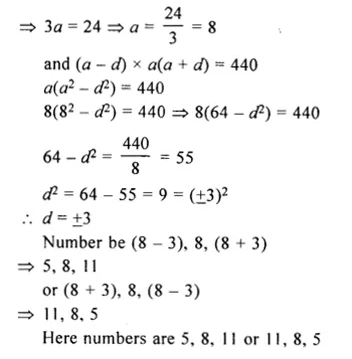
Find three numbers in A.P. whose sum is 24 and whose product is 440.
Solution:
Let three numbers be a – d, a, a + d
a – d + a + a + d = 24
Selina Concise Mathematics Class 10 ICSE Solutions Chapter 10 Arithmetic Progression Ex 10D Q1.1

Question 2.
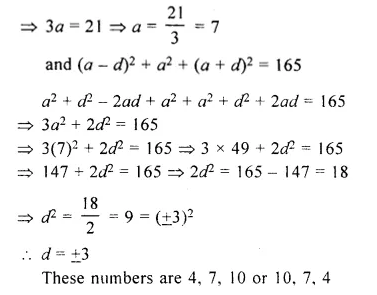
The sum of three consecutive terms of an A.P. is 21 and the slim of their squares is 165. Find these terms.
Solution:
Let three consecutive numbers in A.P. are
a – d, a, a + d
a – d + a + a + d = 21
Selina Concise Mathematics Class 10 ICSE Solutions Chapter 10 Arithmetic Progression Ex 10D Q2.1

Question 3.
The angles of a quadrilateral are in A.P. with common difference 20°. Find its angles.
Solution:
Let the angles of a quadrilateral are
a, a + d, a + 2d, a + 3d
d= 20°
a + a + d + a + 2d + a + 3d = 360°
(Sum of angles of a quadrilateral)
=> 4a + 6d = 360°
=> 4a + 6 x 20° = 360°
=> 4a + 120° = 360°
=> 4a = 360 – 120° = 240°
a = \(\\ \frac { 240 }{ 4 } \) = 60°
Angles are 60°, 80°, 100°, 120°

Question 4.
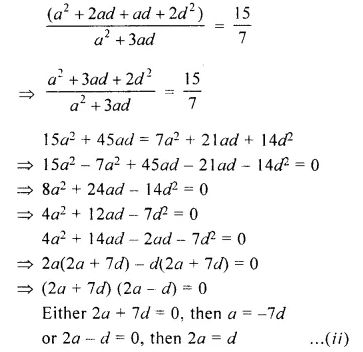
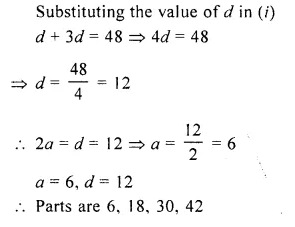
Divide 96 into four parts which are in A.P. and the ratio between product of their means to product of their extremes is 15 : 7.
Solution:
Number = 96
Let its four parts be a, a + d, a + 2d, a + 3d
a + a + d + a + 2d + a + 3d = 96
=> 4a + 6d = 96
=> 2a + 3d = 48 …(i)
Product of means : Product of extremes = 15 : 7
Selina Concise Mathematics Class 10 ICSE Solutions Chapter 10 Arithmetic Progression Ex 10D Q4.1
Selina Concise Mathematics Class 10 ICSE Solutions Chapter 10 Arithmetic Progression Ex 10D Q4.2

Question 5.
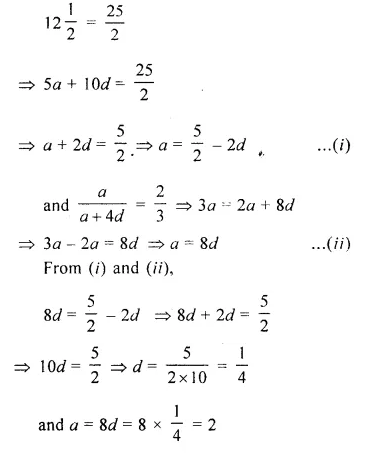
Find five numbers in A.P. whose sum is \(12 \frac { 1 }{ 2 } \) and the ratio of the first to the last terms is 2 : 3.
Solution:
Let 5 numbers in A.P. be
a, a + d, a + 2d, a + 2d, a + 4d
a + a + d + a + 2d + a + 3d + a + 4d =
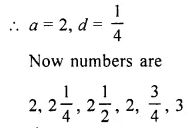
Selina Concise Mathematics Class 10 ICSE Solutions Chapter 10 Arithmetic Progression Ex 10D Q5.1
Selina Concise Mathematics Class 10 ICSE Solutions Chapter 10 Arithmetic Progression Ex 10D Q5.2

Question 6.
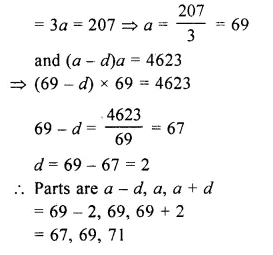
Split 207 into three parts such that these parts are in A.P. and the product of the two smaller parts is 4623.
Solution:
Number = 207
Let part be a – d, a, a + d
a – d + a + a + d = 207
Selina Concise Mathematics Class 10 ICSE Solutions Chapter 10 Arithmetic Progression Ex 10D Q6.1

Question 7.
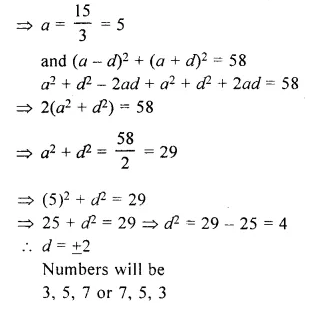
The sum of three numbers in A.P. is 15 the sum of the squares of the extreme is 58. Find the numbers
Solution:
Let three numbers in A.P. be a – d, a, a + d
a – d + a + a + d = 15
=> 3a = 15
Selina Concise Mathematics Class 10 ICSE Solutions Chapter 10 Arithmetic Progression Ex 10D Q7.1

Question 8.
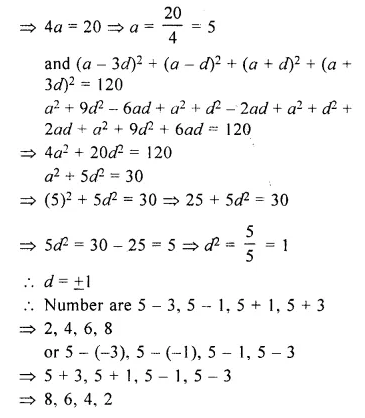
Find four numbers in A.P. whose sum is 20 and the sum of whose squares is 120.
Solution:
Let four numbers in A.P. be
a – 3d, a – d, a + d, a + 3d
a – 3d + a – d + a + d + a + 3d = 20
Selina Concise Mathematics Class 10 ICSE Solutions Chapter 10 Arithmetic Progression Ex 10D Q8.1

Question 9.
Insert one arithmetic mean between 3 and 13.
Solution:
Let A be the arithmetic mean between 3 and 13
\(\left( A=\frac { a+b }{ 2 } \right) \)
A = \(\\ \frac { 3+13 }{ 2 } \)
= \(\\ \frac { 16 }{ 2 } \)
= 8

Question 10.
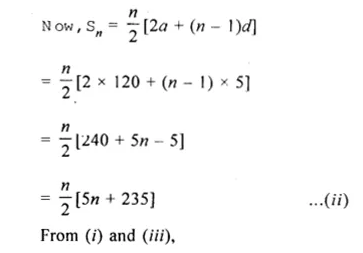
The angles of a polygon are in A.P. with common difference 5°. If the smallest angle is 120°, find the number of sides of the polygon.
Solution:
Angles of a polygon are in A.P.
and common difference (d) = 5°
Smallest angle (a) = 120°
Let n be the number of sides of the polygon then sum of angles = (2n – 4) x 90°
a = 120° and d = 5°
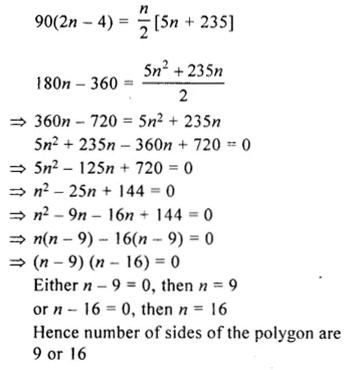
Selina Concise Mathematics Class 10 ICSE Solutions Chapter 10 Arithmetic Progression Ex 10D Q10.1
Selina Concise Mathematics Class 10 ICSE Solutions Chapter 10 Arithmetic Progression Ex 10D Q10.2

Question 11.
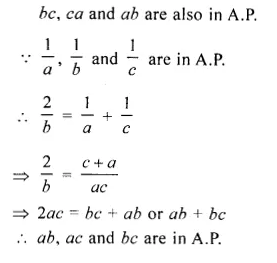
\(\\ \frac { 1 }{ a } \), \(\\ \frac { 1 }{ b } \) and \(\\ \frac { 1 }{ c } \) are in A.P
S.T : bc, ca and ab are also in A.P
Solution:
\(\\ \frac { 1 }{ a } \), \(\\ \frac { 1 }{ b } \) and \(\\ \frac { 1 }{ c } \) are in A.P
We have to show that
Selina Concise Mathematics Class 10 ICSE Solutions Chapter 10 Arithmetic Progression Ex 10D Q11.1

Hope given Selina Concise Mathematics Class 10 ICSE Solutions Chapter 10 Arithmetic Progression Ex 10D are helpful to complete your math homework.

If you have any doubts, please comment below. Learn Insta try to provide online math tutoring for you.
Selina Concise Mathematics Class 10 ICSE Solutions Chapter 24 Measures of Central Tendency Ex 24C

Selina Concise Mathematics Class 10 ICSE Solutions Chapter 24 Measures of Central Tendency (Mean, Median, Quartiles and Mode) Ex 24C

These Solutions are part of Selina Concise Mathematics Class 10 ICSE Solutions. Here we have given Chapter 24 Measures of Central Tendency (Mean, Median, Quartiles and Mode) Ex 24C.

Other Exercises

Question 1.
A student got the following marks in 9 questions of a question paper : 3, 5, 7, 3, 8, 0, 1, 4 and 6.
Find the median of these marks.
Solution:
Arranging the given data in descending order, we get:
8, 7, 6, 5,4,3, 3, 1,0
The middle term is 4 which is 5th terms
∴ Median = 4

Question 2.
The weights (in kg) of 10 students of a class are given below :
21, 28.5, 20.5, 24, 25.5, 22, 27.5, 28, 21, 24 Find the median of their weights.
Solution:
Arranging the given data in descending order.
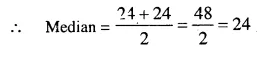
We get 23.5, 28, 27.5, 25.5, 24, 24, 22, 21, 21, 20.5
the middle terms are 24 and 24, 5th and 6th terms.
Selina Concise Mathematics Class 10 ICSE Solutions Chapter 24 Measures of Central Tendency Ex 24C Q2.1

Question 3.
The marks obtained by 19 students of a class are given below :
27, 36, 22, 31, 25, 26, 33, 24, 37, 32, 29, 28, 36, 35, 27, 26, 32, 35, 28. Find :
(i) Media
(ii) Lower quartile
(iii) Upper quartile
(iv) Inter – quartle range
Solution:
(i) Arranging in order say ascending, we get
22, 24, 25, 26, 26, 27, 27, 28, 28, 29, 31, 32, 32, 33, 35, 35,36, 36, 37
Middle term is 10th term i.e. 29
∴ Median = 29
Selina Concise Mathematics Class 10 ICSE Solutions Chapter 24 Measures of Central Tendency Ex 24C Q3.1

Question 4.
From the following data, find :
(i) Median
(ii) Upper quartile
(iii) Inter-quartile range
25,10, 40, 88, 45, 60, 77, 36,18, 95, 56, 65, 7, 0, 38 and 83.
Solution:
(i) Arrange in ascending order, we get
0,7, 10, 18, 25, 36, 38, 40, 45, 56, 60, 65 ,77, 83, 88, 95
Selina Concise Mathematics Class 10 ICSE Solutions Chapter 24 Measures of Central Tendency Ex 24C Q4.1

Question 5.
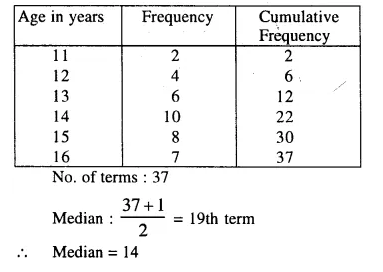
The ages of 37 students in a class are given in the following table :
Selina Concise Mathematics Class 10 ICSE Solutions Chapter 24 Measures of Central Tendency Ex 24C Q5.1
Find the median.
Solution:
Selina Concise Mathematics Class 10 ICSE Solutions Chapter 24 Measures of Central Tendency Ex 24C Q5.2

Question 6.
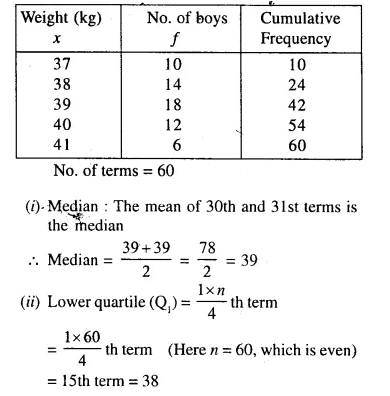
The weight of 60 boys are given in the following distribution table :
Selina Concise Mathematics Class 10 ICSE Solutions Chapter 24 Measures of Central Tendency Ex 24C Q6.1
Find : (i) Median
(ii) Lower quartile
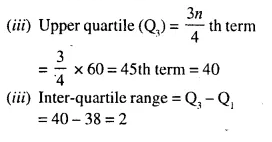
(iii) Upper quartile
(iv) Inter-quartile range
Solution:
Selina Concise Mathematics Class 10 ICSE Solutions Chapter 24 Measures of Central Tendency Ex 24C Q6.2
Selina Concise Mathematics Class 10 ICSE Solutions Chapter 24 Measures of Central Tendency Ex 24C Q6.3

Question 7.
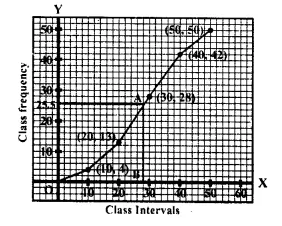
Estimate the median for the given data by drawing ogive :
Selina Concise Mathematics Class 10 ICSE Solutions Chapter 24 Measures of Central Tendency Ex 24C Q7.1
Solution:
Selina Concise Mathematics Class 10 ICSE Solutions Chapter 24 Measures of Central Tendency Ex 24C Q7.2
Through mark of 25.5 on the y-axis, draw a line parallel to x-axis which meets the curve at A. From A, draw a perpendicular to x-axis, which meets x-axis at B.
∴ The value of B is the median which is 28.
Selina Concise Mathematics Class 10 ICSE Solutions Chapter 24 Measures of Central Tendency Ex 24C Q7.3

Question 8.
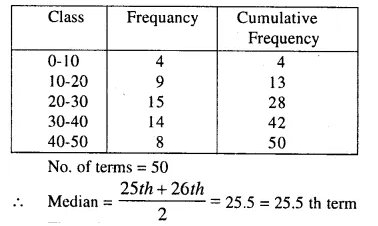
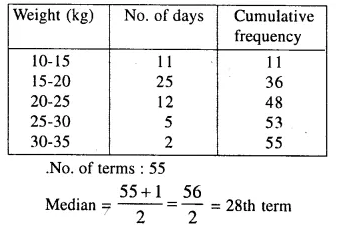
By drawing an ogive; estimate the median for the following frequency distribution :
Selina Concise Mathematics Class 10 ICSE Solutions Chapter 24 Measures of Central Tendency Ex 24C Q8.1
Solution:
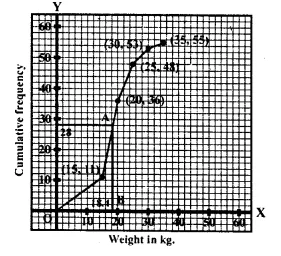
Selina Concise Mathematics Class 10 ICSE Solutions Chapter 24 Measures of Central Tendency Ex 24C Q8.2
Through mark of 28th on the y- axis, draw a line parallel to x-axis which meets the curve at A. From A, draw a perpendicular line segment to x- axis. Which meets it at B.
Selina Concise Mathematics Class 10 ICSE Solutions Chapter 24 Measures of Central Tendency Ex 24C Q8.3
∴ The value of B is the median which is 18.4

Question 9.
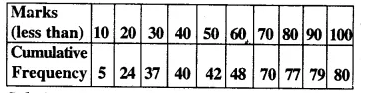
From the following cumulative frequency table, draw ogive and then use it to find :
(i) Median,
(ii) Lower quartile,
(iii) Upper quartile.
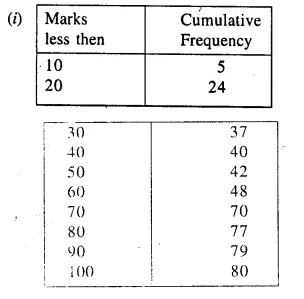
Selina Concise Mathematics Class 10 ICSE Solutions Chapter 24 Measures of Central Tendency Ex 24C Q9.1
Solution:
Selina Concise Mathematics Class 10 ICSE Solutions Chapter 24 Measures of Central Tendency Ex 24C Q9.2
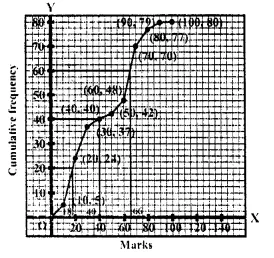
No. of terms = 80
Median = 40th term Through mark of 40 draw a line parallel to x-axis which meets the curve at A. From A, draw a perpendicular to x-axis which meets it at B
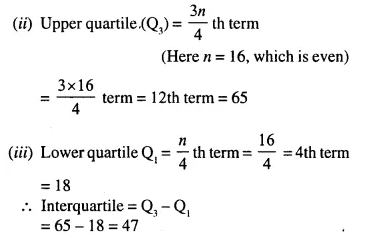
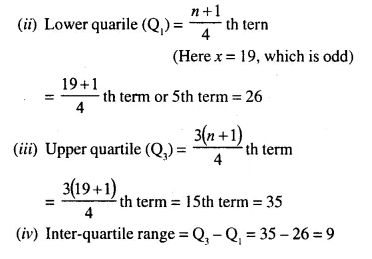
(ii) Lower quartile (Q1) = \(\frac { n }{ 4 }\) th term
= \(\frac { 80 }{ 4 }\) th term (Here n = 80 which is even)
= 20th term =18
(iii) Upper quartile (Q1) = \(\frac { 3 }{ 4 }\) nth term =\(\frac { 3 x80 }{ 4 }\) = 60th term = 66 .
Selina Concise Mathematics Class 10 ICSE Solutions Chapter 24 Measures of Central Tendency Ex 24C Q9.3
∴ Value of B is the median which is 40.

Question 10.
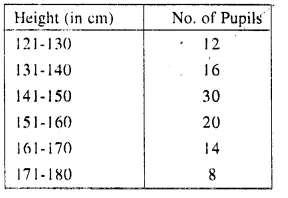
In a school 100 pupils have heights as tabulated below:
Selina Concise Mathematics Class 10 ICSE Solutions Chapter 24 Measures of Central Tendency Ex 24C Q10.1
Find the median height by drawing an ogive.
Solution:
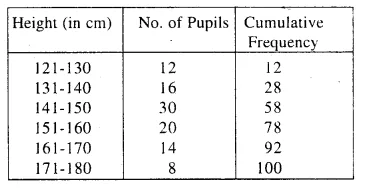
Selina Concise Mathematics Class 10 ICSE Solutions Chapter 24 Measures of Central Tendency Ex 24C Q10.2
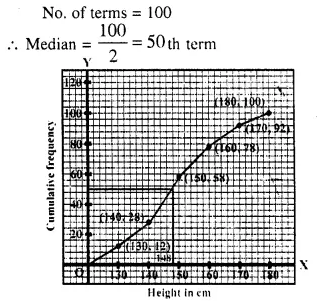
Selina Concise Mathematics Class 10 ICSE Solutions Chapter 24 Measures of Central Tendency Ex 24C Q10.3
Through mark 50, draw a line parallel to x- axis which meets the curve at A. From A, draw per-pendicular to x-axis which meets x-axis at B is the median which is 148 cm.

P.Q.
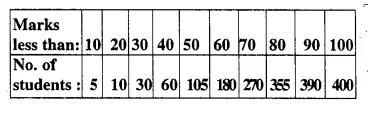
Attempt this question on a graph paper. The table shows the distribution of marks gained by a group of 400 students in an examination :
Selina Concise Mathematics Class 10 ICSE Solutions Chapter 24 Measures of Central Tendency Ex 24C Qp1.1

Using a scale of 2 cm to represent 10 marks and 2 cm to represent 50 students, plot these points and draw a smooth curve through the points
Estimate from the graph :
(i) Median marks
(ii) quartile marks. [1997]
Solution:
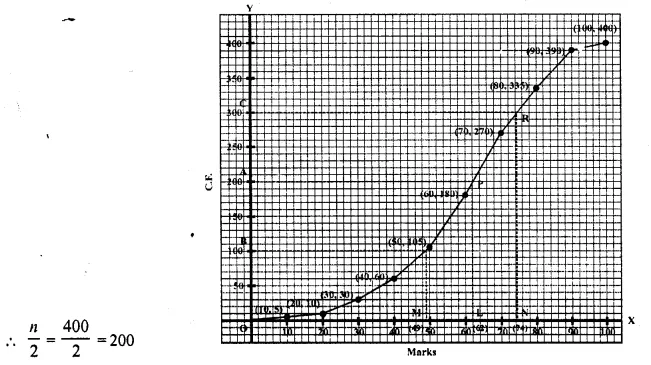
Plot the points (10, 5), (20, 10), (30, 30), (40, 60), (50,105), (60,180), (70,270), (80, 355), (90, 390), (100, 400) on the graph and join them with free hand to get an ogive (curve) as shown:
(i) Total students = 400
Selina Concise Mathematics Class 10 ICSE Solutions Chapter 24 Measures of Central Tendency Ex 24C Qp1.2
From 200 on y-axis draw a line parallel to x-axis meeting the curve at P. From P, draw PL perpendicular on x-axis then L is the median which is 62.
(ii) Lower quartile (Q1) = \(\frac { 1 }{ 4 }\) x n = \(\frac { 1 }{ 4 }\) x 400 =100
From 100 ony-axis, draw a line parallel to x-axis meeting the curve at Q, from Q, draw QM ⊥ x-axis.
M is the required lower quartile (Q1) which is 49 3 3
Upper quartile (Q3) = \(\frac { 3 }{ 4 }\) n = \(\frac { 3 }{ 4 }\) x 400 = 300
From 300 on y-axis, draw a line parallel to x-axis meeting the curve at R. From R draw RN perpendicular to x-axis N is the required upper quartile (Q3) which is = 74

P.Q.
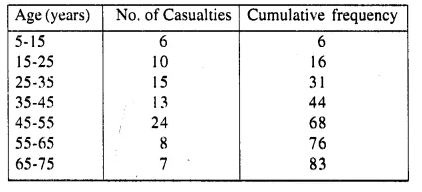
Attempt this question on graph paper.
Selina Concise Mathematics Class 10 ICSE Solutions Chapter 24 Measures of Central Tendency Ex 24C Qp2.1
(i) Construct the ‘less than’ cumulative frequency curve for the above data, using 2 cm = 10 years on one axis and 2cm = 10 casualities on the other, (ii) From your graph determine :
(a) Median
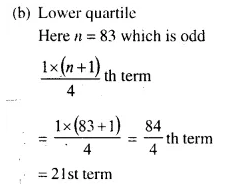
(b) Lower quartile. (1995)
Solution:
Selina Concise Mathematics Class 10 ICSE Solutions Chapter 24 Measures of Central Tendency Ex 24C Qp2.2
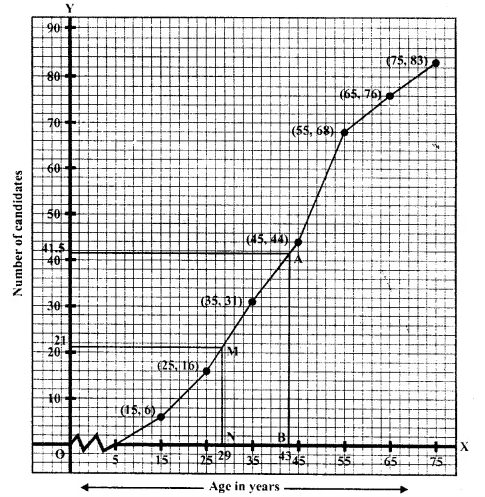
No. of terms = 83
∴ Median \(\frac { 83 }{ 2 }\) =41.5 th term .
Through marks 41.5,draw a line segment par allel to x-axis which meets the curve at A. From A, draw a line segment perpendicular to x-axis meeting it at B.
Selina Concise Mathematics Class 10 ICSE Solutions Chapter 24 Measures of Central Tendency Ex 24C Qp2.3
Selina Concise Mathematics Class 10 ICSE Solutions Chapter 24 Measures of Central Tendency Ex 24C Qp2.4
Through 21 on the y-axis draw a line parallel to x-axis meeting the curve at M
From M, draw a perpendicular on x-axis which meets it at N.
∴N is the lower quartile which is 29 (approx)

Hope given Selina Concise Mathematics Class 10 ICSE Solutions Chapter 24 Measures of Central Tendency Ex 24C are helpful to complete your math homework.

If you have any doubts, please comment below. Learn Insta try to provide online math tutoring for you.
 

Selina Concise Mathematics Class 10 ICSE Solutions Chapter 10 Arithmetic Progression Ex 10C

Selina Concise Mathematics Class 10 ICSE Solutions Chapter 10 Arithmetic Progression Ex 10C

These Solutions are part of Selina Concise Mathematics Class 10 ICSE Solutions. Here we have given Selina Concise Mathematics Class 10 ICSE Solutions Chapter 10 Arithmetic Progression Ex 10C
Other Exercises

Question 1.
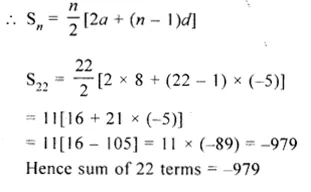
Find the sum of the first 22 terms of the A.P. : 8, 3, – 2,…..
Solution:
A.P. = 8, 3, – 2,…..
Here, a = 8, d = 3 – 8 = – 5, n = 22
Selina Concise Mathematics Class 10 ICSE Solutions Chapter 10 Arithmetic Progression Ex 10C Q1.1

Question 2.
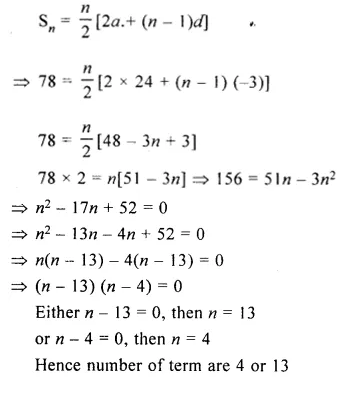
How many terms of the A.P. : 24, 21, 18, must be taken so that their sum is 78 ?
Solution:
Let n term of the given A.P. be taken
and A.P. = 24, 21, 18……
Let n be the number of terms.
Here, a = 24, d = 21 – 24 = – 3, Sn = 78
Selina Concise Mathematics Class 10 ICSE Solutions Chapter 10 Arithmetic Progression Ex 10C Q2.1

Question 3.
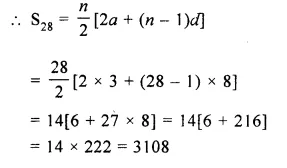
Find the sum of 28 terms of an A.P. whose nth term is 8n – 5.
Solution:
nth term (Tn) = 8n – 5
T1 = 8 – 5 = 3
T2 = 8 x 2 – 5 = 16 – 5 = 11
T3 = 8 x 3 – 5 = 24 – 5 = 19
A.P. is 3, 11, 19,
Here, a = 3,d = 11 – 3 = 8 and n = 28
Selina Concise Mathematics Class 10 ICSE Solutions Chapter 10 Arithmetic Progression Ex 10C Q3.1

Question 4.
Find the sum of :
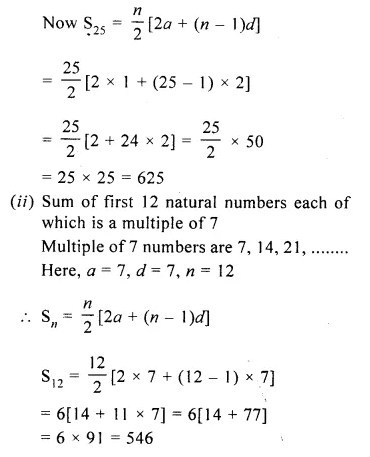
(i) all odd natural numbers less than 50.
(ii) first 12 natural numbers each of which is a multiple of 7.
Solution:
(i) Sum of all odd natural numbers less then 50
1 + 3 + 5 + 7 +…….+ 49
Here a = 1, d = 3 – 1 = 2
Let n be the number of term, then
49 = a + (n – 1)d
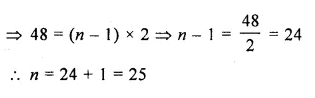
=> 49 = 1 + (n – 1) x 2
=> 49 – 1 = (n – 1) x 2
Selina Concise Mathematics Class 10 ICSE Solutions Chapter 10 Arithmetic Progression Ex 10C Q4.1
Selina Concise Mathematics Class 10 ICSE Solutions Chapter 10 Arithmetic Progression Ex 10C Q4.2

Question 5.
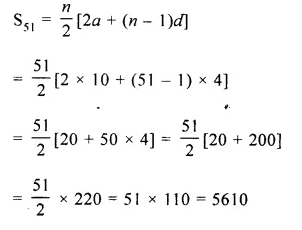
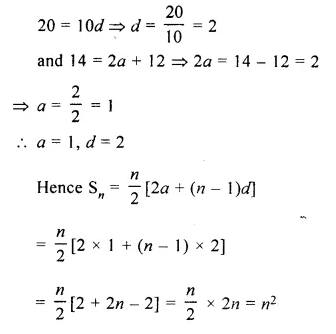
Find the sum of first 51 terms of an A.P. whose 2nd and 3rd terms are 14 and 18 respectively.
Solution:
Sum of first 51 terms of an A.P. in which T2 = 14 and T3 = 18
d = T3 – T2 = 18 – 14 = 4
and T2 = a + d
=> 14 = a + 4
=> a = 14 – 4 = 10
A.P. = 10, 14, 18, 22,….
Selina Concise Mathematics Class 10 ICSE Solutions Chapter 10 Arithmetic Progression Ex 10C Q5.1

Question 6.
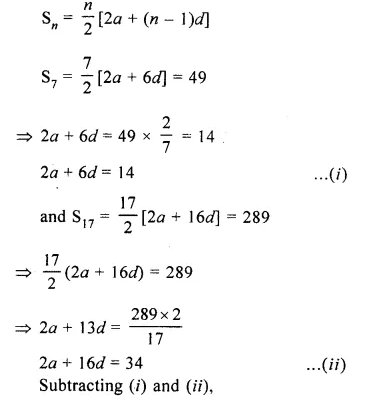
The sum of first 7 terms of an A.P. is 49 and that of first 17 terms of it is 289. Find the sum of first tt terms.
Solution:
S7 = 49,
S17 = 289
Selina Concise Mathematics Class 10 ICSE Solutions Chapter 10 Arithmetic Progression Ex 10C Q6.1
Selina Concise Mathematics Class 10 ICSE Solutions Chapter 10 Arithmetic Progression Ex 10C Q6.2

Question 7.
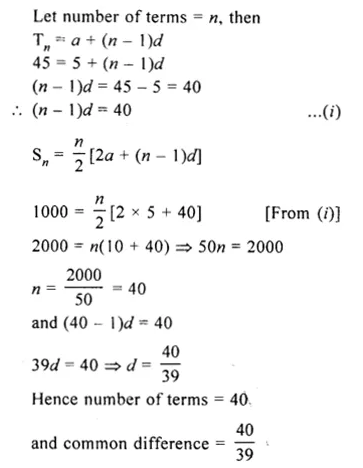
The first term of an A.P. is 5, the last term is 45 and the sum of its terms is 1000. Find the number of terms and the common difference of the A.P.
Solution:
First term of an AP (a) = 5
Last term = 45
and Sn = 1000
Selina Concise Mathematics Class 10 ICSE Solutions Chapter 10 Arithmetic Progression Ex 10C Q7.1

Question 8.
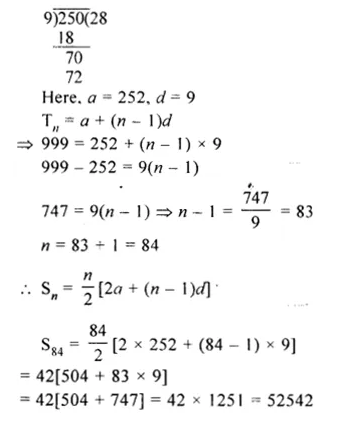
Find the sum of all natural numbers between 250 and 1000 which are divisible by 9.
Solution:
All natural numbers between 250 and 1000 which are divisible by 9 are
252, 261, 270……999
Selina Concise Mathematics Class 10 ICSE Solutions Chapter 10 Arithmetic Progression Ex 10C Q8.1

Question 9.
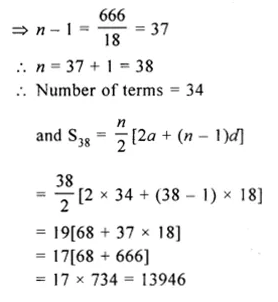
The first and the last terms of an A.P. are 34 and 700 respectively. If the common difference is 18, how many terms are there and what is their sum?
Solution:
In an A.P.
T1 = a = 34, l = 700, d = 18
Let n be the number of terms, then
Tn = a + (n – 1 )d
=> 700 = 34 + (n – 1) x 18
=> 700 – 34 = 18(n – 1)
=> 180 – 0 = 666
Selina Concise Mathematics Class 10 ICSE Solutions Chapter 10 Arithmetic Progression Ex 10C Q9.1

Question 10.
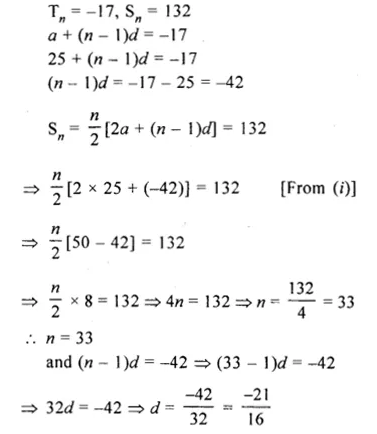
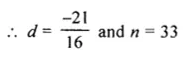
In an A.P. the first term is 25, nth term is – 17 and the sum of n terms is 132. Find n and the common difference.
Solution:
In an A.P.
First term (a) = 25
nth term = – 17
and Sn = 132
Let d be the common difference
Selina Concise Mathematics Class 10 ICSE Solutions Chapter 10 Arithmetic Progression Ex 10C Q10.1
Selina Concise Mathematics Class 10 ICSE Solutions Chapter 10 Arithmetic Progression Ex 10C Q10.2

Question 11.
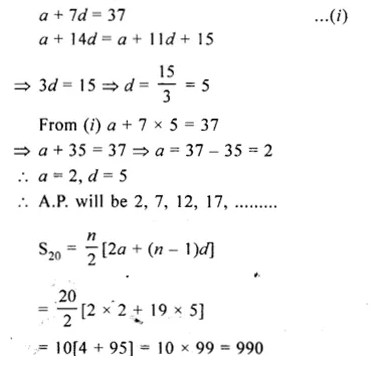
If the 8th term of an A.P. is 37 and the 15th term is 15 more than the 12th term, find the A.P. Also, find the sum of first 20 terms of this A.P.
Solution:
In an A.P.
8th term = 37
15th term = 12th term + 15
Let a be the first term and d be the common difference, then
Selina Concise Mathematics Class 10 ICSE Solutions Chapter 10 Arithmetic Progression Ex 10C Q11.1

Question 12.
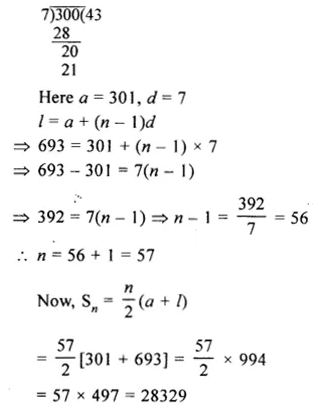
Find the sum of all multiples of 7 lying between 300 and 700.
Solution:
Multiples of 7 lying between 300 and 700 are 301, 308, 315, 322,…., 693
Selina Concise Mathematics Class 10 ICSE Solutions Chapter 10 Arithmetic Progression Ex 10C Q12.1

Question 13.
The sum of n natural numbers is 5n² + 4n. Find its 8th term.
Solution:
Sum of n natural number = 5n² + 4n
Sn = 5n² + 4n
S1(a) = 5 x (1)² + 4 x 1
= 5 + 4 = 9
S2 = 5(2)² + 4 x 2 = 20 + 8 = 28
S2 – S1 = T2 = 28 – 9 = 19
=> a + d = 19 => 9 + d = 19
d = 19 – 9 = 10
a = 9, d = 10
T8 = a + (n – 1 )d = 9 + (8 – 1) x 10
= 9 + 7 x 10 = 9 + 70 = 79

Question 14.
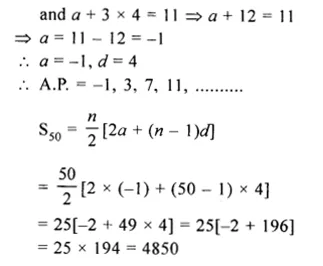
The fourth term of an A.P. is 11 and the eighth term exceeds twice the fourth term by 5. Find the A.P. and the sum of first 50 terms.
Solution:
In an A.P.
T= 11
T8 = 2T4 + 5
Now, a + 3d = 11
a + 7d = 2 x 11 + 5 = 22 + 5 = 27
Subtracting, 4d = 16
=> d = \(\\ \frac { 16 }{ 4 } \) = 4
Selina Concise Mathematics Class 10 ICSE Solutions Chapter 10 Arithmetic Progression Ex 10C Q14.1

Hope given Selina Concise Mathematics Class 10 ICSE Solutions Chapter 10 Arithmetic Progression Ex 10C are helpful to complete your math homework.

If you have any doubts, please comment below. Learn Insta try to provide online math tutoring for you.