NCERT Exemplar Solutions for Class 10 Science Chapter 13 Magnetic Effects of Electric Current

NCERT Exemplar Solutions for Class 10 Science Chapter 13 Magnetic Effects of Electric Current

These Solutions are part of NCERT Exemplar Solutions for Class 10 Science. Here we have given NCERT Exemplar Solutions for Class 10 Science Chapter 13 Magnetic Effects of Electric Current

Question 1.
Choose the incorrect statement from the following regarding magnetic lines of field.
(a) The direction of magnetic field at a point is taken to be the direction in which the north pole of a magnetic compass needle points.
(b) Magnetic field lines are closed curves.
(c) If magnetic field lines are parallel and equidistant, they rep-resent zero field strength.
(d) Relative strength of magnetic field is shown by the degree of closeness of the field lines.
Answer:
(c).
Explanation : Magnetic field lines which are parallel and equidistant represent uniform magnetic field.

More Resources

Question 2.
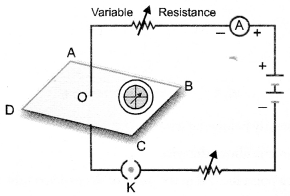
If the key in the arrangement shown in figure is taken out (the circuit is made open) and magnetic field lines are drawn over the horizontal plane ABCD, the lines are
(a) concentric circles
(b) elliptical in shape
(c) straight lines parallel to each other
(d) concentric circles near the point O but of elliptical shapes as we go away from it
Answer:
(c).
NCERT Exemplar Solutions for Class 10 Science Chapter 13 Magnetic Effects of Electric Current image - 1
Explanation : When no current flows through the wire, mag¬netic field lines over the plane ABCD will represent magnetic field of the earth. These field lines are straight lines parallel to each other.

Question 3.
A circular loop placed in a plane perpendicular to the plane of paper carries a current when the key is ON. The current is seen from points A and B (in the plane of the paper and on the axis of the coil) is anticlockwise and clockwise respectively. The magnetic field lines point from B to A. The N-pole of the resultant magnet is on the face close to
(a) A
(b) B
(c) A if current is small, and B if current is large.
(d) B if the current is small, and A if current is large.
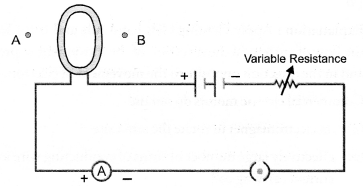
NCERT Exemplar Solutions for Class 10 Science Chapter 13 Magnetic Effects of Electric Current image - 2
Answer:
(a).
Explanation : If current seems to flow in anticlockwise direction in a coil, then that face of the coil acts as N-pole.

Question 4.
In a long straight solenoid, N-and S-poles are created at the two ends of the solenoid. Which of the following statements is incor¬rect ?
(a) The field lines inside the solenoid are in the form of straight lines indicating that magnetic field is same at ail points inside the solenoid.
(b) The pattern of the magnetic field associated with the solenoid is different from the pattern of the magnetic field around a bar magnet.
(c) N-and S-poles exchange positions when the direction of the current through the solenoid is reversed.
(d) Magnetic field produced inside the solenoid can be used to magnetise a bar of magnetic material like soft iron, when placed inside the solenoid.
Answer:
(b).
Explanation : The pattern of magnetic field produced by a cur¬rent carrying solenoid resembles with the pattern of magnetic field of a bar magnet.

Question 5.
A uniform magnetic field exists in the plane of paper pointing from left to right as shown in figure. In the field, an electron and a proton move as shown. The electron and proton experience
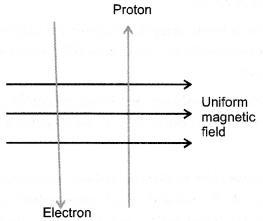
NCERT Exemplar Solutions for Class 10 Science Chapter 13 Magnetic Effects of Electric Current image - 3
(a) forces, both pointing into the plane of paper
(b) forces, both pointing out of the plane of paper
(c) forces, pointing into the plane of paper and out of the plane of paper respectively.
(d) forces, pointing opposite and along the direction of the uniform magnetic field respectively.
Answer:
(a).
Explanation : Apply Fleming’s left hand rule and considering the flow of current in the direction of the movement of proton and in the direction opposite to the movement of electron.

Question 6.
Commercial electric motors do not use
(a) an electromagnet to rotate the armature
(b) effectively large number of turns of conducting wire in the current carrying coil
(c) a permanet magnet to rotate the armature id a soft iron on which the coil is wound.
Answer:
(c).
Explanation : In commercial motor, armature rotates in the mag-netic field produced by an electromagnet. The strength of such magnetic field can be increased to the desired value. However, a permanent magnet provides a fixed and weak magnetic field.

Question 7.
Figure shows the arrangment of two coils wound on a non-conducting cylindrical rod. The plugh of the key is then in¬serted and later removed.
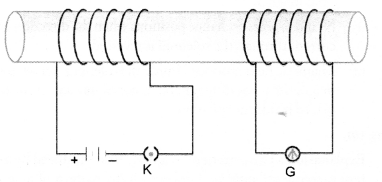
NCERT Exemplar Solutions for Class 10 Science Chapter 13 Magnetic Effects of Electric Current image - 4
(a) Deflection in the galvanometer remains zero throughout
(b) There is momentary deflection in the galvanometer that dies out shortly and deflections in both the cases are in the same direction
(c) There is momentary deflection in the galvanometer that dies out shortly and there is no effect when the key is re¬moved
(d) There are momentary deflections in both the cases that die out shortly but the deflections are in apposite directions.
Answer:
(a).
Explanation : Due to electromagnetic induction, induced cur¬rent flows in the coil with which galvanometer is connected, when the key is inserted (i.e. current grows in the primary coil) and when the key is removed (i.e. current decays in the primary coil).

Question 8.
Choose the incorrect statement
(a) Fleming’s right hand rule is a simple rule to know the direction of induced current.
(b) The right-hand thumb rule is used to find the direction of magnetic fields due to current carrying conductors.
(c) The difference between the direct and alternating currents is that the direct current always flows in one direction, whereas the alternating current reverses its direction periodically.
(d) In India, the AC changes direction after every 1/60 seconds
Answer:
(d).
Explanation : Frequency of AC in India = 50 Hz
∴ AC completes 1 cycle in 1/50 seconds.
In one cycle, AC changes direction two times. Hence, time after which AC changes direction
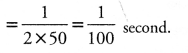
NCERT Exemplar Solutions for Class 10 Science Chapter 13 Magnetic Effects of Electric Current image - 5

Question 9.
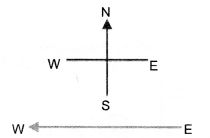
A constant current flows in a horizontal wire in the plane of the paper from east to west as shown in figure. The direction of magnetic field at a point will be north to south.
NCERT Exemplar Solutions for Class 10 Science Chapter 13 Magnetic Effects of Electric Current image - 6
(a) directly below the wire
(b) directly above the wire
(c) at a point located in the plane of the paper, on the north side of the wire
(d) at a point located in the plane of the paper, on the south side of the wire.
Answer:
(d).
Explanation : Applying right hand thumb rule to know the direction of the magnetic field.

Question 10.
The strength of magnetic field inside a long current carrying straight solenoid is
(a) more at the ends than at the centre
(b) minimum in the middle
(c) same at all points
(d) found to increase from one end to the other.
Answer:
(c).
Explanation : Magnetic field inside a long current carrying straight solenoid is uniform.

Question 11.
To convert AC generator to DC generator
(a) slip rings and brushes must be used ‘
(b) split ring type commutator must be used
(c) rectangular wire loop is to be used
(d) stronger magnetic field is to be used.
Answer:
(b).

Question 12.
The most important safety device method used for protecting electrical appliances from short circuiting or overloading is
(a) earthing
(b) use of stabilizers
(c) use of electric meter
(d) use of fuse.
Answer:
(d).
Explanation : Fuse melts and the circuit breaks as soon as the current in the circuit exceeds safe limit.

Question 13.
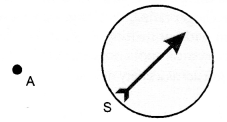
A magnetic compass needle is placed in a plane of paper near point A as shown in figure.
In which plane should a straight current carrying conductor be placed so that it passes through A and there is no change in the deflection of the compass ? Under what condition is the deflection maximum and why?
NCERT Exemplar Solutions for Class 10 Science Chapter 13 Magnetic Effects of Electric Current image - 7
Answer:
The straight current carrying conductor should be placed in the plane of the paper. The deflection of the compass is maxi¬mum when the conductor passes through A and perpendicular to the plane of the paper. The magnetic field due to current carrying conductor is maximum in the plane of the paper.

Question 14.
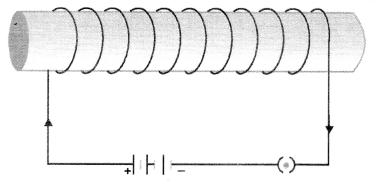
Under what conditions permanent electromagnet is obtained if a current carrying solenoid is used ? Support your answer with the help of a labelled circuit diagram.
Answer:
Permanent electromagnet is obtained if

  1. direct current flows through the solenoid and
  2. steel rod (a magnetic substance) is placed inside the solenoid.

In other words, a steel rod can be made a permanent electro-magnet if it is placed inside a solenoid carrying direct current as shown in figure.
NCERT Exemplar Solutions for Class 10 Science Chapter 13 Magnetic Effects of Electric Current image - 8

Question 15.
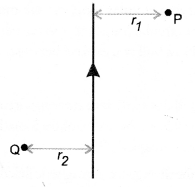
AB is a current carrying conductor in the plane of the paper as shown in figure. What are the directions of magnetic fields produced by it at points P and Q ? Given, r1 > r2, where will the strength of the magnetic field be larger ?
(CBSE 2010, 2012)
NCERT Exemplar Solutions for Class 10 Science Chapter 13 Magnetic Effects of Electric Current image - 9
Answer:
According to Right hand thumb rule, the direction of the mag¬netic field is into the plane of the paper at P and the direction of the magnetic field is out of the plane of the paper at Q.
The strength of the magnetic field due to a current carrying conductor decreases with increase in distance (i.e. B ∝ 1/r ).
Therefore, strength of the magnetic field will be larger at point Q than at point P.

Question 16.
A magnetic compass shows a deflection when placed near a current carrying wire. How will the deflection of the compass get affected if the current in the wire is increased ? Support your answer with a reason. (CBSE 2012)
Answer:
A magnetic compass is a tiny magnet. It gets deflected when placed in a magnetic field. When the current in the wire increases, then the magnetic field produced by the wire also increases ( B ∝ I). Hence, deflection of the compass increases.

Question 17.
It is established that an electric current through a metallic conductor produces a magnetic field around it. Is there a similar magnetic field produced around a thin beam of moving

  1. alpha particles,
  2. neutrons ? Justify your answer.
    (CBSE 2012)

Answer:

  1. A thin beam of moving alpha particles constitute an electric current. Thus, beam of moving alpha particles behaves as a current carrying conductor. Hence, magnetic field is produced around the thin beam of moving alpha particles.
  2. Neutrons are neutral particles i.e. they do not have any charge. Therefore, moving neutrons do not constitute an electric cur-rent. Hence, no magnetic field is produced around the thin beam of moving neutrons.

Question 18.
What does the direction of thumb indicate in the right-hand thumb rule. In what way this rule is different from Fleming’s left-hand rule ? (CBSE 2010,2012)
Answer:
In the right hand rule, the direction of thumb indicates the direction of flow of current in the straight conductor.
Right-hand thumb rule is used to determine the direction of the magnetic field produced by a current carrying straight conductor. However, Flemings left hand rule is used to determine the direction of the force experienced by a current carrying conductor placed in a uniform magnetic field.

Question 19.
Meena draws magnetic field lines of field close to the axis of a current carrying circular loop. As she moves away from the centre of the circular loop, she observes that the lines keep on diverging. How will you explain her observation ? (CBSE 2010)
Answer:
Magnetic field due to current carrying circular loop decreases as we move away from the centre of the loop. Diverging field lines represent weak magnetic field.

Question 20.
What does the divergence of magnetic field lines near the ends of a current carrying straight solenoid indicate ?
Answer:
Divergence of magnetic field lines means the magnetic field lines are far apart. Such field lines indicate weak magnetic field. There¬fore, divergence of magnetic field lines near the ends of the current carrying solenoid indicates that the magnetic field near the ends of the current carrying solenoid is weak and non-uniform.

Question 21.
Name four appliances wherein an electric motor, a rotating device that converts electrical energy to mechanical energy is used as an important component. In what respect motors are different from generators ?
Answer:
Appliances wherein an electric motor is used are

  1. electric fan,
  2. electric mixer,
  3. washing machine and
  4. a toy car.

Motor converts electrical energy into mechanical energy. How-ever, generator converts mechanical energy into electrical energy.

Question 22.
What is the role of two conducting stationary brushes in a simple electric motor ?
Answer:
These brushes act as the contacts between the commutator and the terminals of the battery.

Question 23.
What is the difference between direct current and an alternating current ? How many times does AC used in India change direction in one second ?
Answer:
Difference between Direct current and an Alternating current:

Direct current

Alternating current

1. The magnitude of direct current is constant and flows in one direction only.

2. Direct current cannot be used for large scale supply of electricity for household purpose.

3. The frequency of direct current is zero.

1. The magnitude of AC changes with time and direction of alternating current reverses periodically.

2. Alternating current is used to run electrical appliances like electric bulb, electric heater, electric iron, refrigerator etc.

3. Frequency of alternating current in India is 50 Hz.

Since frequency is 50 Hz, so a.c. completes 50 cycles in 1 second. Therefore, it reverses its direction 100 times in one second.

Question 24.
What is the role of fuse, used in series with any electrical appli-ances ? Why should a fuse with defined rating not be replaced by one with a larger rating ?
Answer:
Electric fuse is a safety device. It protects the electrical appliance due to short circuiting and overloading in the electric circuit.
Fuse with defined rating means the maximum current that can flow’ through the fuse wire without melting it. As and when current exceeds this maximum value, the fuse melts and the circuit is switched off. If fuse with defined rating is replaced by one with a larger rating, then large current will flow through the circuit without melting the fuse. This large current may burn the electrical appliance connected in the circuit and the fuse will not act as a safety device.

Hope given NCERT Exemplar Solutions for Class 10 Science Chapter 13 Magnetic Effects of Electric Current are helpful to complete your science homework.

If you have any doubts, please comment below. Learn Insta try to provide online science tutoring for you.
Value Based Questions in Science for Class 10 Chapter 13 Magnetic Effects of Electric Current

Value Based Questions in Science for Class 10 Chapter 13 Magnetic Effects of Electric Current

These Solutions are part of Value Based Questions in Science for Class 10. Here we have given Value Based Questions in Science for Class 10 Chapter 13 Magnetic Effects of Electric Current

Question 1.
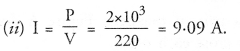
A fuse wire is a safety device to protect the electric circuit. Ashok used a fuse rated as 5 A in a circuit in which an electric heater of 2 kW was connected with the main supply of 220 V. The heater was not operating as the fuse wire melted on switching. Ashok was puzzled and he discussed the problem with his friend Ram. Ram suggeted him to use a fuse rated 10 A in the circuit. The problem of Ashok was solved as the heater was now working.
(i) What values are shown by Ram ?
(ii) How much current was flowing in the circuit with the fuse rated 10 A ?
Answer:
(i) Helpful, high degree of awareness.
Value Based Questions in Science for Class 10 Chapter 13 Magnetic Effects of Electric Current image - 1

More Resources

Question 2.
Overloading in an electric circuit causes fire. Common people are unware of this fact. Akshil, an intelligent student told people of his locality about overloading. He told them to take various precautions to avoid overloading. What values are shown by Akshil ?
He is helpful and has high degree of awareness. Interested in educating people.

Question 3.
Students of a school ‘X’ went to a forest for a picnic. They went deep into the forest and started playing on a flat field in the forest. A stranger came there and asked for help. He had forgotten the direction of his village situated in south direction outside the forest. All the students except Sobit said that they had no idea about south direction. They asked stranger to find the south direction himself. However, Sobit asked him to wait for a moment. Sobit had a magnetic compass. He placed the magnetic compass on the ground and told the stranger about south direction.

  1. How the magnetic compass determines the direction from the given place ?
  2. What values are shown by Sobit ?
  3. Is the behaviour of other students desirable ?

Answer:

  1. When a magnetic compass is placed at a place, it always points towards north-south direction.
  2. Sobit is helpful, caring and has a high degree of awareness.
  3. The behaviour of other students is undesirable. They did not bother about the problem of the stranger.

Question 4.
Aayan was going to his home from his school. On his way, he heard that people in a house were crying and weeping. He went to the house to know the reason. He found that a boy is lying on a floor and people around him were crying and weeping. He came to know that boy suffered a severe shock, when he was working with electric iron. He asked people to stop crying and help him to take the boy to the nearby dispensary for Medical aid. The boy was rushed to the dispensary. Medical aid was given to him and his life was saved.
Answer the following questions based on above information.

  1. Why the boy suffered severe shock ?
  2. Comment on the values shown by Aayan.

Answer:

  1. The boy might have touched the metallic casing of electric iron through which current was passing. Hence boy suffered a severe shock.
  2. Aayan is helpful. He feels concerned about the welfare of others. He is quick in his actions and has high degree of general awareness.

Question 5.
What would you suggest to the people of your area regarding the safety measures in using electricity ?
Answer:

  1. Use of electric fuses of proper rating,
  2. Electricity wires should not be touched bare footed.
  3. Electricity should be switched off during lightning and thunder,
  4. Electric circuits should be properly earthed,
  5. Avoid overloading i.e. electric appliances of high power rating should not be connected in a single socket or circuit.

Hope given Value Based Questions in Science for Class 10 Chapter 13 Magnetic Effects of Electric Current are helpful to complete your science homework.

If you have any doubts, please comment below. Learn Insta try to provide online science tutoring for you.
HOTS Questions for Class 10 Science Chapter 13 Magnetic Effects of Electric Current

HOTS Questions for Class 10 Science Chapter 13 Magnetic Effects of Electric Current

These Solutions are part of HOTS Questions for Class 10 Science. Here we have given HOTS Questions for Class 10 Science Chapter 13 Magnetic Effects of Electric Current

Question 1.
One end of a bar magnet is brought near the south pole of a magnetic compass needle. It was noticed that the needle of the magnetic compass deflected away from the end of the bar magnet. Name the pole of the bar magnet at its end pointing towards the south pole of the magnetic compass. Justify your answer.
Answer:
The pole of the bar magnet at the end pointing towards the south pole of the magnetic compass is south pole. This is because, like magnetic poles repel each other.

More Resources

Question 2.
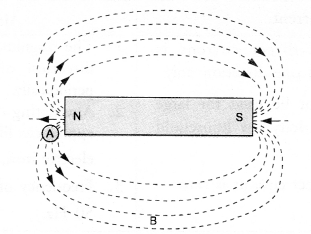
Magnetic field lines around a bar magnet are shown in figure. A student makes a statement that magnetic field at point A is stronger than at point B. State, whether the statement is correct or incorrect. Explain.
(CBSE 2012)
HOTS Questions for Class 10 Science Chapter 13 Magnetic Effects of Electric Current image - 1
Answer:
Statement is correct. This is because field lines are crowded in a region of strong magnetic field and field lines diverge in a region of weak magnetic field.

Question 3.
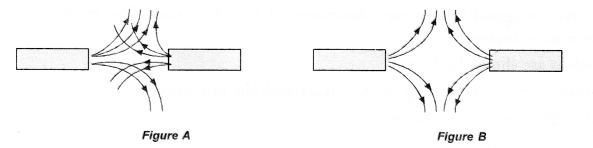
Magnetic lines of force of two pairs of magnets are shown in figure A and B. Out of these two figures, which one represents the correct pattern of field lines. Name the poles of magnets facing each other. (CBSE 2012)
HOTS Questions for Class 10 Science Chapter 13 Magnetic Effects of Electric Current image - 2
Answer:
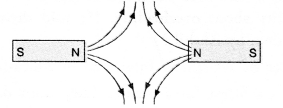
Figure B represents the correct pattern of magnetic field lines of a pair of magnets. Figure A does not represent the correct pattern of field lines because magnetic field lines never cross each other.
HOTS Questions for Class 10 Science Chapter 13 Magnetic Effects of Electric Current image - 3
Poles of magnets facing each other are north poles as the magnetic field lines emerge from a magnet at N-pole.

Question 4.
A student performs an experiment to study the magnetic effect of current around a current carrying straight conductor. He reports that

  1. the direction of deflection of the north pole of a compass needle kept at a given point near the conductor remains unaffected even when the terminals of the battery sending current in the wire are interchanged.
  2. for a given battery, the degree of deflection of a N-pole decreases when the compass is kept at a point farther away from the conductor. Which of the above observations of the student is incorrect and why ?
    (CBSE Sample Paper Question)

Answer:

  1. The first statement is incorrect because the direction of the magnetic field around the conductor is reversed when the direction of the current flowing in the conductor changes. Hence, the direction of deflection of N-pole of the compass needle cannot remain unaffected when the terminals of the battery sending current in the wire or conductor are interchanged.
  2. The second statement is correct because the magnetic field decreases with the increase in the distance from the conductor.

Question 5.
A current carrying conductor is placed perpendicular to the magnetic field of horse-shoe magnet. The
conductor is displaced upward. What will happen to the displacement of the conductor if

  1. current in the conductor is increased,
  2. a horse-shoe magnet is replaced by another stronger horse-shoe magnet and
  3. the length of the conductor is increased. (Similar Text Book Question)

Answer:

  1. The force acting on a current carrying conductor placed perpendicular to a magnetic field increases with the increase in the current flowing through a conductor. Thus, the displacement of the conductor will increase if the current in the conductor is increased.
  2. When a horse-shoe magnet is replaced by a stronger magnet, then magnetic field increases. Since, force acting a conductor increases with the increase in the magnetic field, therefore, the displacement of the conductor will increase.
  3. Since, the force acting on the conductor increases with the increases in the length of the conductor, therefore, the displacement of the conductor will increase.

Hope given HOTS Questions for Class 10 Science Chapter 13 Magnetic Effects of Electric Current are helpful to complete your science homework.

If you have any doubts, please comment below. Learn Insta try to provide online science tutoring for you.
Selina Concise Mathematics Class 10 ICSE Solutions Chapter 22 Heights and Distances Ex 22B

Selina Concise Mathematics Class 10 ICSE Solutions Chapter 22 Heights and Distances Ex 22B

These Solutions are part of Selina Concise Mathematics Class 10 ICSE Solutions. Here we have given Selina Concise Mathematics Class 10 ICSE Solutions Chapter 22 Heights and Distances Ex 22B

Other Exercises

Question 1.
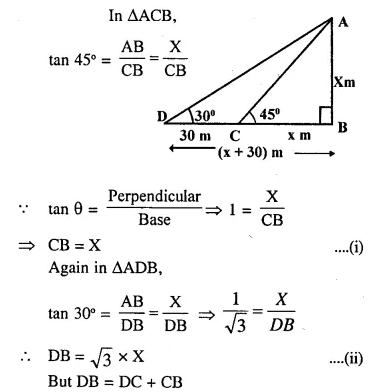
In the figure given below, it is given that AB is perpendicular to BD and is of length X metres. DC = 30 m. ∠ADB = 30° and ∠ACB = 45°. Without using tables, find X.
Solution:
Selina Concise Mathematics Class 10 ICSE Solutions Chapter 22 Heights and Distances Ex 22B Q1.1
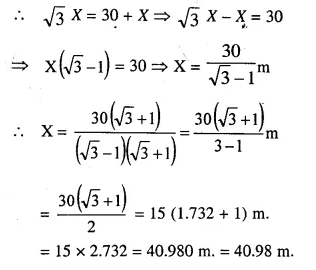
Selina Concise Mathematics Class 10 ICSE Solutions Chapter 22 Heights and Distances Ex 22B Q1.2

Question 2.
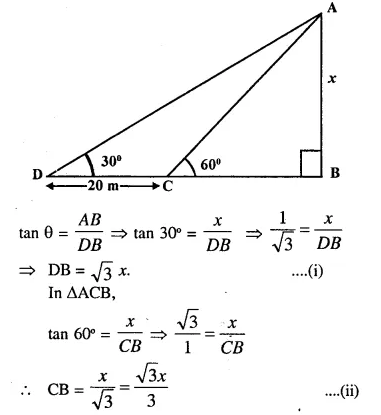
Find the height of a tree when it is found that on walking away from it 20m, in a horizontal line through its base, the elevation of its top Changes from 60° to 30°.
Solution:
Let AB be the tree and its height be x DC = 20 m.
Now in right ∆ADB
Selina Concise Mathematics Class 10 ICSE Solutions Chapter 22 Heights and Distances Ex 22B Q2.1
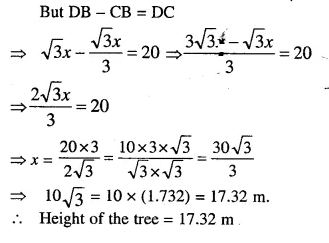
Selina Concise Mathematics Class 10 ICSE Solutions Chapter 22 Heights and Distances Ex 22B Q2.2

Question 3.
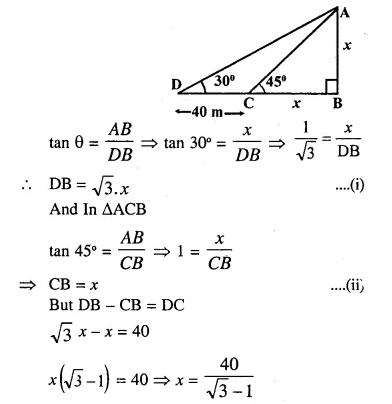
Find the height of a building, when it is found that on walking towards it 40 m in a horizontal line through its base the angular elevation of its top changes from 30° to 45°.
Solution:
Let AB be the building and its
height be x and DC =40m
Now in right ∆ADB
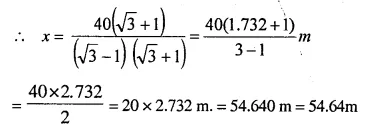
Selina Concise Mathematics Class 10 ICSE Solutions Chapter 22 Heights and Distances Ex 22B Q3.1
Selina Concise Mathematics Class 10 ICSE Solutions Chapter 22 Heights and Distances Ex 22B Q3.2

Question 4.
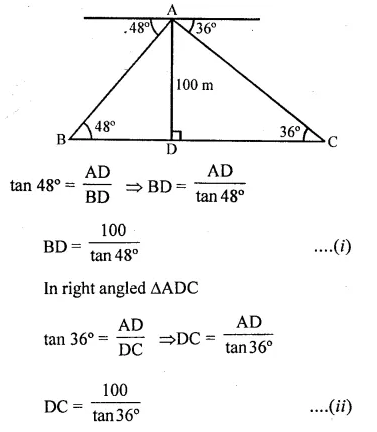
From the top of a light house 100 m high, the angles of depression of two ships are observed as 48° and 36° respectively. Find the distance between the two ships (in the nearest metre) if :
(i) the ships are on the same side of the light house,
(ii) the ships are on the opposite sides of the light house.
Solution:
AD = 100 m
In right angled ∆ABD
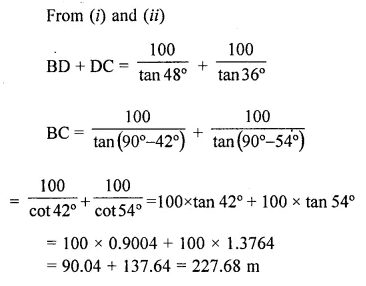
Selina Concise Mathematics Class 10 ICSE Solutions Chapter 22 Heights and Distances Ex 22B Q4.1
Selina Concise Mathematics Class 10 ICSE Solutions Chapter 22 Heights and Distances Ex 22B Q4.2

Question 5.
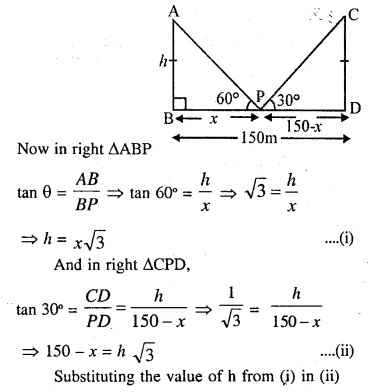
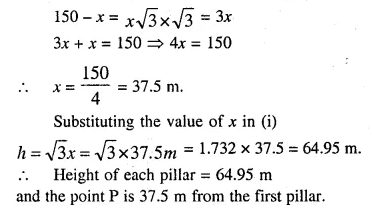
Two pillars of equal heights stand 011 either side of a roadway, which is 150m wide. At a point in the roadway between the pillars the elevations of the tops of the pillars are 60° and 30”; find the height of the pillars and the position of the point.
Solution:
Let AB and CD be the two pillars which stand on either side of a road BD, then BD = 150m
Let AB = CD = h
Let P be the point on the road such that the angles of elevation from P to the top of the pillars are 60° and 30° respectively.
Let BP = x then PD = 150 – x
Selina Concise Mathematics Class 10 ICSE Solutions Chapter 22 Heights and Distances Ex 22B Q5.1
Selina Concise Mathematics Class 10 ICSE Solutions Chapter 22 Heights and Distances Ex 22B Q5.2

Question 6.
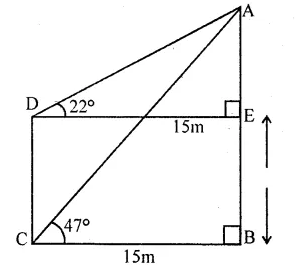
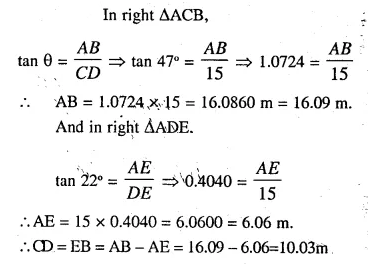
From the figure given below, calculate the length of CD.
Selina Concise Mathematics Class 10 ICSE Solutions Chapter 22 Heights and Distances Ex 22B Q6.1
Solution:
Selina Concise Mathematics Class 10 ICSE Solutions Chapter 22 Heights and Distances Ex 22B Q6.2

Question 7.
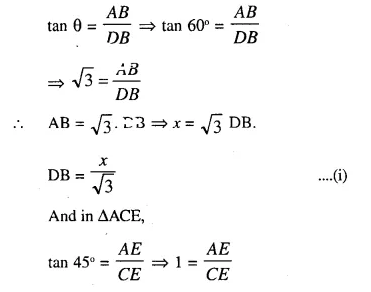
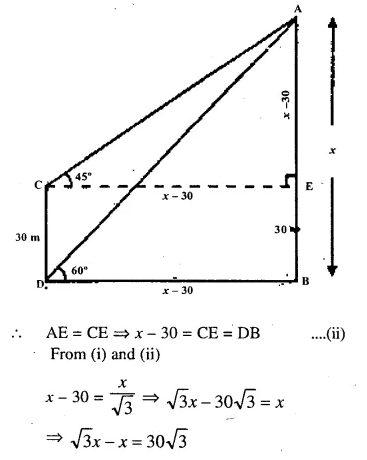
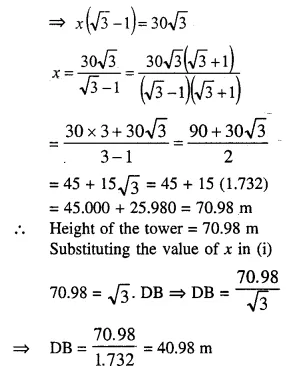
The angle of elevation of the top of a tower is observed to be 60°. At a point 30 m vertically above the first point of observation, the elevation is found to be 45°. Find :
(i) the height of the tower,
(ii) its horizontal distance from the points of observation.
Solution:
Let height of tower = x i.e. AB = x
In the right ∆ADB,
Selina Concise Mathematics Class 10 ICSE Solutions Chapter 22 Heights and Distances Ex 22B Q7.1
Selina Concise Mathematics Class 10 ICSE Solutions Chapter 22 Heights and Distances Ex 22B Q7.2
Selina Concise Mathematics Class 10 ICSE Solutions Chapter 22 Heights and Distances Ex 22B Q7.3

Question 8.
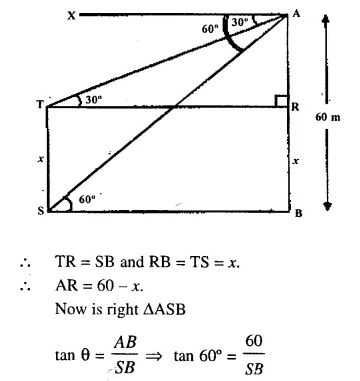
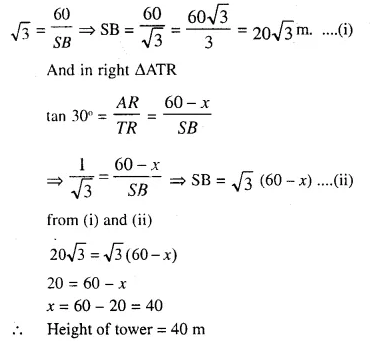
From the top of a cliff. 60 metre high, the angles of depression of the top and bottom of a tower are observed to be 30° and 60°. Find the height of the tower.
Solution:
Height of the cliff AB = 60m
Let the height of tower = x
Draw TR \(\parallel\) SB. meeting AB in R
Selina Concise Mathematics Class 10 ICSE Solutions Chapter 22 Heights and Distances Ex 22B Q8.1
Selina Concise Mathematics Class 10 ICSE Solutions Chapter 22 Heights and Distances Ex 22B Q8.2

Question 9.
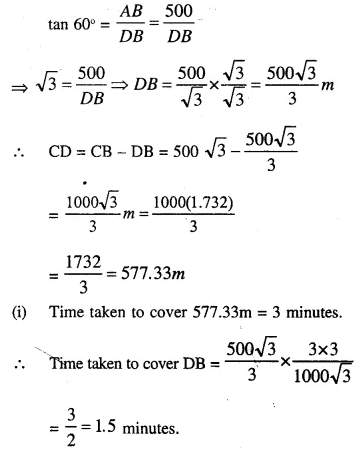
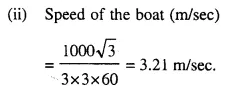
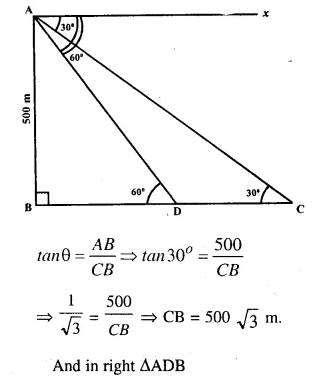
A man on a cliff observes a boat, at an angle of depression 30°, which is sailing towards the shore to the point immediately beneath him. Three minutes later the angle of depression of the boat is found to be 60°. Assuming that the boat sails at a uniform speed, determine :
(i) how much more time it will take to reach the shore.
(ii) the speed of the boat in metre per second, if the height of the cliff is 500 m.
Solution:
Height of cliff = 500 m.
In right ∆ACD,
Selina Concise Mathematics Class 10 ICSE Solutions Chapter 22 Heights and Distances Ex 22B Q9.1
Selina Concise Mathematics Class 10 ICSE Solutions Chapter 22 Heights and Distances Ex 22B Q9.2
Selina Concise Mathematics Class 10 ICSE Solutions Chapter 22 Heights and Distances Ex 22B Q9.3

Question 10.
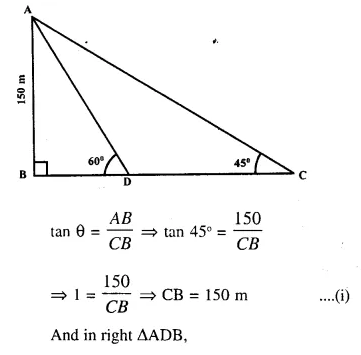
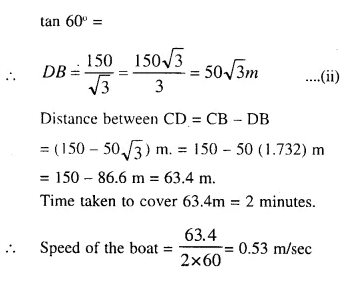
A man in a boat rowing away from a light house 150m high, takes 2 minutes to change the angle of elevation of the top of the lighthouse from 60° to 45°. Find the speed of the boat.
Solution:
Height of the lighthouse AB = 150m
Now is right ∆ACB,
Selina Concise Mathematics Class 10 ICSE Solutions Chapter 22 Heights and Distances Ex 22B Q10.1
Selina Concise Mathematics Class 10 ICSE Solutions Chapter 22 Heights and Distances Ex 22B Q10.2

Question 11.
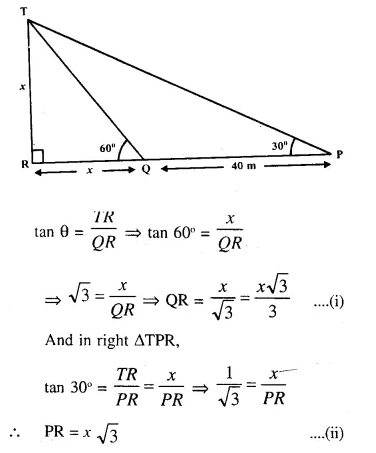
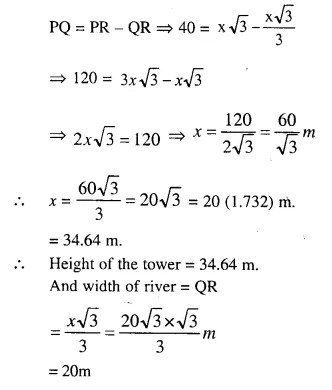
A person standing on the bank of a river observes that the angle of elevation of the top of a tree standing on the opposite bank is 60°. When he moves 40 m away from the bank, he finds the angle of elevation to be 30°. Find :
(i) the height of the tree, correct to 2 decimal places,
(ii) the width of the river.
Solution:
TR is the height of tree and RQ is the width of the river.
Let TR = x
Now in right ∆TQR
Selina Concise Mathematics Class 10 ICSE Solutions Chapter 22 Heights and Distances Ex 22B Q11.1
Selina Concise Mathematics Class 10 ICSE Solutions Chapter 22 Heights and Distances Ex 22B Q11.2

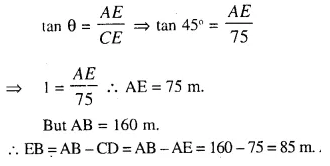
Question 12.
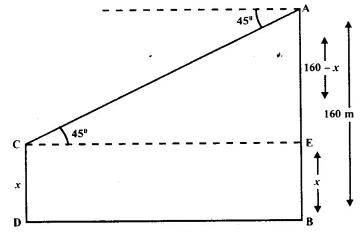
The horizontal distance between two towers is 75 m and the angular depression of the top of the first tower as seen from the top of the second, which is 160m high, is 45°. Find the height of the first tower.
Solution:
Selina Concise Mathematics Class 10 ICSE Solutions Chapter 22 Heights and Distances Ex 22B Q12.1
Let the height of first tower CD = x
and height of second tower AB = 160 m
Distance between them DB = 75 m.
In right ∆ACE,
Selina Concise Mathematics Class 10 ICSE Solutions Chapter 22 Heights and Distances Ex 22B Q12.2

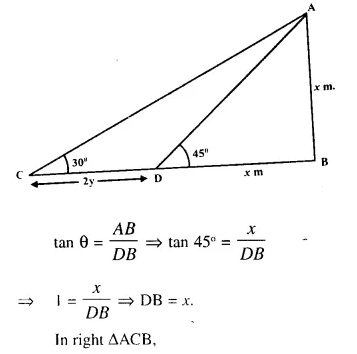
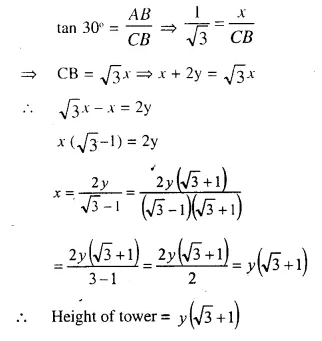
Question 13.
The length of the shadow of a tower standing on level plane is found to be 2y metres longer when the sun’s altitude is 30″ than when it was
45°. Prove that the height of the tower is y (\(\sqrt { 3 }\) +1) metres.
Solution:
Let AB be the tower and AB = x
Distance CD = 2y
In right ∆ADB,
Selina Concise Mathematics Class 10 ICSE Solutions Chapter 22 Heights and Distances Ex 22B Q13.1
Selina Concise Mathematics Class 10 ICSE Solutions Chapter 22 Heights and Distances Ex 22B Q13.2

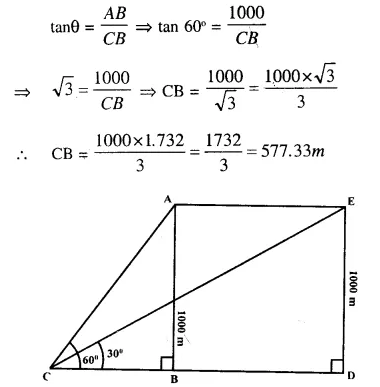
Question 14.
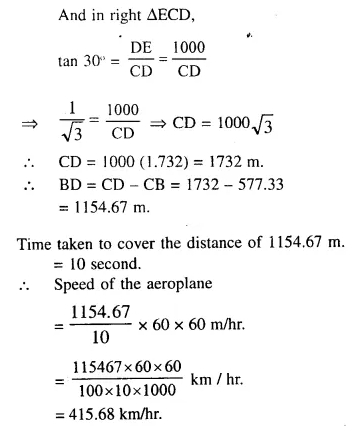
An aeroplane flying horizontally 1 km above the ground and going away from the observer is observed at an elevation of 60°. After 10 seconds, its elevation is observed to be 30°, find the uniform speed of the aeroplane in km per hour.
Solution:
Height of aeroplane = 1 km = 1000 m.
In right ∆ACB,
Selina Concise Mathematics Class 10 ICSE Solutions Chapter 22 Heights and Distances Ex 22B Q14.1
Selina Concise Mathematics Class 10 ICSE Solutions Chapter 22 Heights and Distances Ex 22B Q14.2

Question 15.
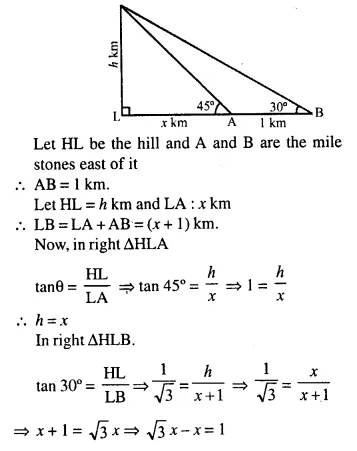
From the top of a hill, the angles of depression of two consecutive kilometre stones, due east, are found to be 30° and 45° respectively. Find the distance of the two stones from the foot of the hill. (2007)
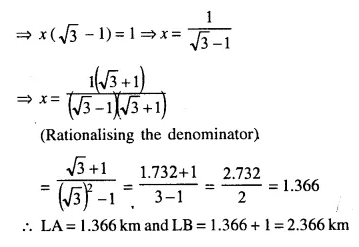
Solution:
Selina Concise Mathematics Class 10 ICSE Solutions Chapter 22 Heights and Distances Ex 22B Q15.1
Selina Concise Mathematics Class 10 ICSE Solutions Chapter 22 Heights and Distances Ex 22B Q15.2

Hope given Selina Concise Mathematics Class 10 ICSE Solutions Chapter 22 Heights and Distances Ex 22B are helpful to complete your math homework.

If you have any doubts, please comment below. Learn Insta try to provide online math tutoring for you.
Selina Concise Mathematics Class 10 ICSE Solutions Chapter 22 Heights and Distances Ex 22A

Selina Concise Mathematics Class 10 ICSE Solutions Chapter 22 Heights and Distances Ex 22A

These Solutions are part of Selina Concise Mathematics Class 10 ICSE Solutions. Here we have given Selina Concise Mathematics Class 10 ICSE Solutions Chapter 22 Heights and Distances Ex 22A
Other Exercises

Question 1.
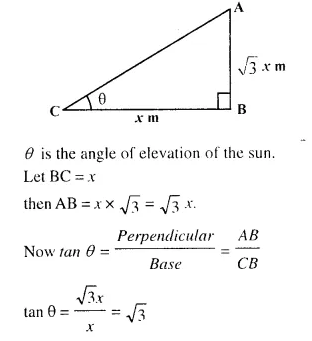
The height of a tree is \(\sqrt { 3 }\) times the length of its shadow. Find the angle of elevation of the sun.
Solution:
Let AB be the tree and BC be its shadow.
Selina Concise Mathematics Class 10 ICSE Solutions Chapter 22 Heights and Distances Ex 22A Q1.1
∴ θ = 60°
∵ Angle of elevation of the sun = 60°

Question 2.
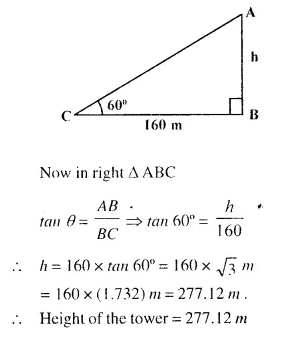
The angle of elevation of the top of a tower, from a point on the ground and at a distance of 160 m from its foot, is found to be 60°. Find the height of the tower.
Solution:
Let AB be the tower and C is the point which is 160 m away from the foot of the tower,
i.e. CB = 160 m
Let height of the tower be x
Selina Concise Mathematics Class 10 ICSE Solutions Chapter 22 Heights and Distances Ex 22A Q2.1

Question 3.
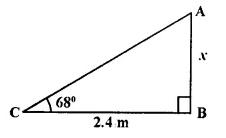
A ladder is placed along a wall such that its upper end is resting against a vertical wall. The foot of the ladder is 2.4 m from the wall and the ladder is making an angle of 68“ with the ground. Find the height, upto which the ladder reaches.
Solution:
Let AB be the wall and
Selina Concise Mathematics Class 10 ICSE Solutions Chapter 22 Heights and Distances Ex 22A Q3.1
AC be the ladder, which is placed against the wall. If foot is 2.4 m away from the wall i.e. CB = 2.4m1.
Let AB =x m.
In right ∆ ABC,
tan θ = \(\frac { AB }{ BC }\) ⇒ tan 68° = \(\frac { X }{ 2.4 }\)
∴ x = 2.4 x tan 68° = 2.4 x 2.4751
= 5.94 m

Question 4.
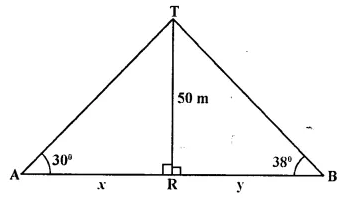
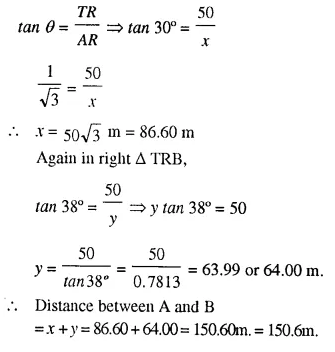
Two persons are standing on the opposite sides of a tower. They observe the angles of elevation of the top of the tower to be 30° and 38° respectively. Find the distance between them, if the height of the tower is 50 m.
Solution:
Selina Concise Mathematics Class 10 ICSE Solutions Chapter 22 Heights and Distances Ex 22A Q4.1
Two persons A and B are standing on the opposite side of the tower TR and height of tower TR = 50 m and angles of elevation with A and B are 30° and 38° respectively. Let AR = x and RB = y
Now in right ∆TAR,
Selina Concise Mathematics Class 10 ICSE Solutions Chapter 22 Heights and Distances Ex 22A Q4.2

Question 5.
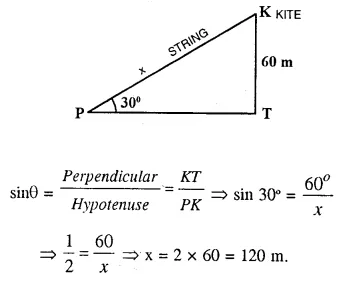
A kite is attached to a string. Find the length of the string, when the height of the kite is 60 m. and the string makes an angle 30° with the ground.
Solution:
Let KT be the height of kite and PK is the string which makes an angle of 30° with the ground.
∴ KT = 60 m
Let KP = xm.
Now in right ∆PKT,
Selina Concise Mathematics Class 10 ICSE Solutions Chapter 22 Heights and Distances Ex 22A Q5.1

Question 6.
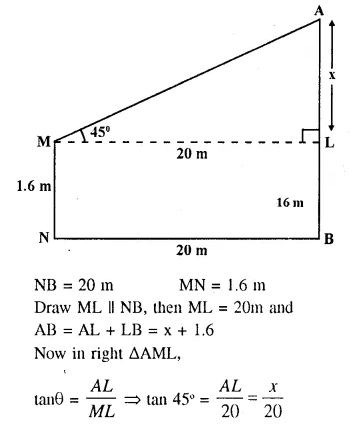
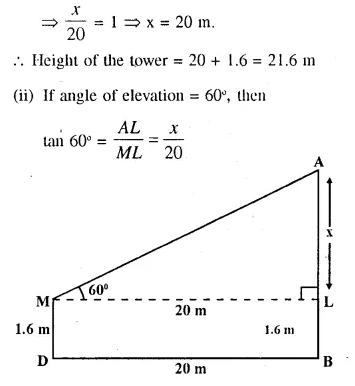
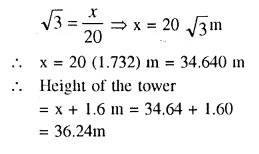
A boy 1.6m tall, is 20 m away from a tower and observes the angle of elevation of the top of the tower to be (i) 45° (ii) 60°. Find the height of the tower in each case.
Solution:
(i) Let AB be the tower and MN be the boy who is 20m away from the foot of the tower.
Let AB = x and angle of elevation = 45°
Selina Concise Mathematics Class 10 ICSE Solutions Chapter 22 Heights and Distances Ex 22A Q6.1
Selina Concise Mathematics Class 10 ICSE Solutions Chapter 22 Heights and Distances Ex 22A Q6.2
Selina Concise Mathematics Class 10 ICSE Solutions Chapter 22 Heights and Distances Ex 22A Q6.3

Question 7.
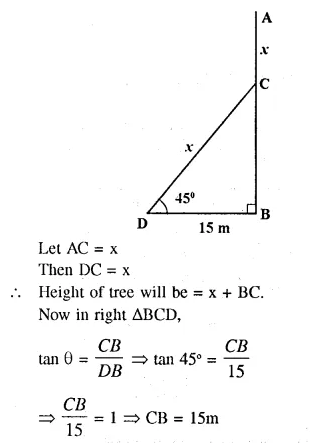
The upper part of a tree, broken over by the wind, makes an angle of 45° with the ground; and the distance from the root to the point where the top of the tree touches the ground, is 15m. What was the height of the tree before it was broken ?
Solution:
Let AB be the tree which was broken at the point C which makes an angle of elevation of 45°, with the ground at a distance of 15m.
BD = 15m
AC = CD
Selina Concise Mathematics Class 10 ICSE Solutions Chapter 22 Heights and Distances Ex 22A Q7.1
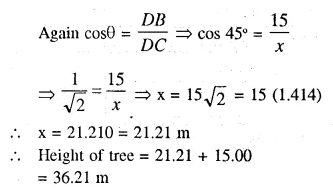
Selina Concise Mathematics Class 10 ICSE Solutions Chapter 22 Heights and Distances Ex 22A Q7.2

Question 8.
The angle of elevation of the top of an unfinished tower at a point distance 80 m from its base is 30°. How much higher must the tower be raised so that its angle of elevation at the same point may be 60° ?
Solution:
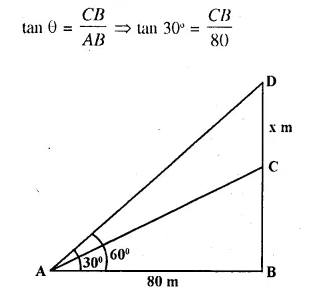
Distance of a point from the tower = 80 m
Angle of elevation = 30°
In second case the elevation of lower = 60°
In first case,
Selina Concise Mathematics Class 10 ICSE Solutions Chapter 22 Heights and Distances Ex 22A Q8.1
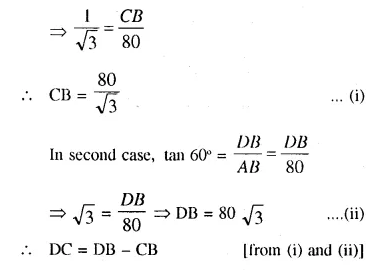
Selina Concise Mathematics Class 10 ICSE Solutions Chapter 22 Heights and Distances Ex 22A Q8.2
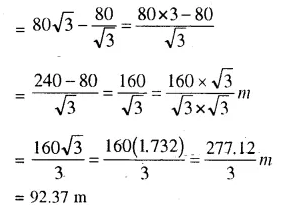
Selina Concise Mathematics Class 10 ICSE Solutions Chapter 22 Heights and Distances Ex 22A Q8.3

Question 9.
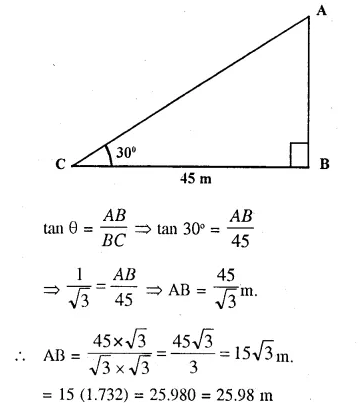
At a particular time, when the sun’s altitude is 30°, the length of the shadow of’C vertical tower is 45 m. Calculate :
(i) height of the tower.
(ii) the length of the shadow of the same tower, when the sun’s altitude is (a) 45° (b) 60°.
Solution:
Shadow of the tower = 45 m and angle of elevation = 30°
Let AB be the lower and BC is its shadow.
∴ CB = 45 m.
Now in right ∆ABC,
Selina Concise Mathematics Class 10 ICSE Solutions Chapter 22 Heights and Distances Ex 22A Q9.1
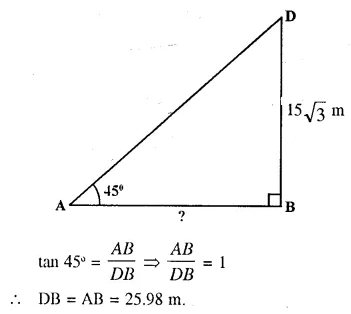
(ii) In second case,
(a) Angle of elevation = 45°
and height of tower = 25.98 m or 15\(\sqrt { 3 }\) m
Selina Concise Mathematics Class 10 ICSE Solutions Chapter 22 Heights and Distances Ex 22A Q9.2
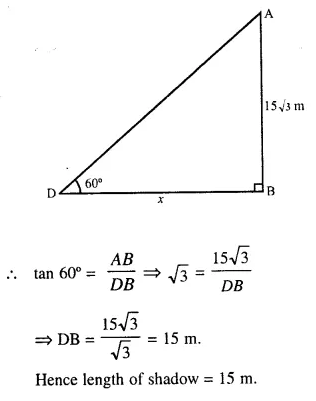
(b) Angle of elevation = 60°
and height of tower = 25.98 m or 15\(\sqrt { 3 }\) m.
Let shadow of the tower DB = xm
Selina Concise Mathematics Class 10 ICSE Solutions Chapter 22 Heights and Distances Ex 22A Q9.3

Question 10.
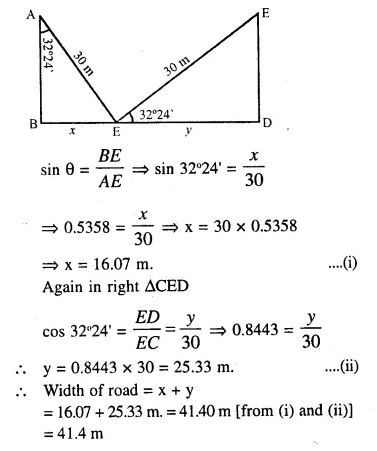
Two vertical poles are on either side of a road. A 30 m long ladder is placed between the two poles. When the ladder rests against one pole, it makes angle 32°24′ with the pole and when it is turned to rest against another pole, it makes angle 32°24′ with the road. Calculate the width of the road.
Solution:
Two poles AB and CD which are at the either end of a road BD. A ladder 30 m long subtends an angle of 32° 24′ with the first pole AB and 32°24′ with the road when it is turned to rest against the second pole CD.
Now in right ∆ABE.
Selina Concise Mathematics Class 10 ICSE Solutions Chapter 22 Heights and Distances Ex 22A Q10.1

Question 11.
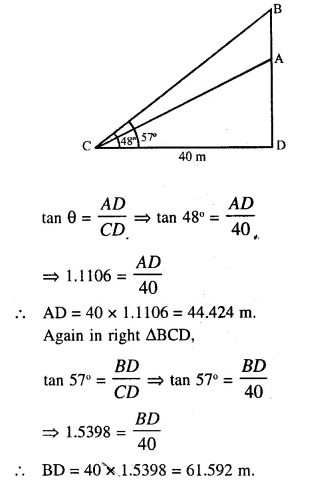
Two climbers are at points A and Bona vertical cliff face. To an observer C, 40 m from the foot of the cliff on the level ground, A is at an elevation of 48° and B of 57°. What is the distance between the climbers ?
Solution:
A and B are two climbers on the cliff and ob-server is at C, 40 m from the foot of the cliff while the angles of elevations of each climber is 48° and 57° respectively.
In right ∆ACD,
Selina Concise Mathematics Class 10 ICSE Solutions Chapter 22 Heights and Distances Ex 22A Q11.1
Selina Concise Mathematics Class 10 ICSE Solutions Chapter 22 Heights and Distances Ex 22A Q11.2

Question 12.
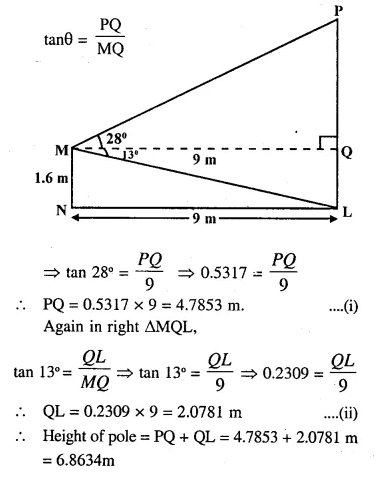
A man stands 9m away from a flag-pole. He observes that angle of elevation of the top of the pole is 28° and the angle of depression of the bottom of the pole is 13°. Calculate the height of the pole.
Solution:
Let PL is the pole and MN is the man The angle of elevation of the top of the pole = 28°
arid the angle of depression of the bottom of the pole =13°
Man is 9 m away from the pole,
i.e. MQ = 9 m
Now in right ∆PMQ,
Selina Concise Mathematics Class 10 ICSE Solutions Chapter 22 Heights and Distances Ex 22A Q12.1

Question 13.
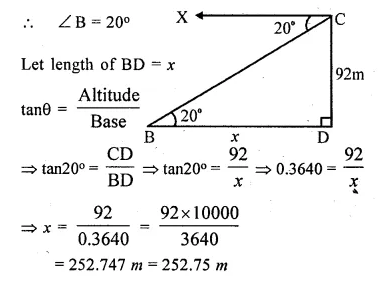
From the top of a cliff 92 m high, the angle of depression of a buoy is 20°. Calculate to the nearest metre the distance of the buoy from the foot of the cliff.
Solution:
Let CD be the cliff and CD = 92m, B is the buoy,
then from C ,
the angle of depression is 20°
Selina Concise Mathematics Class 10 ICSE Solutions Chapter 22 Heights and Distances Ex 22A Q13.1

Hope given Selina Concise Mathematics Class 10 ICSE Solutions Chapter 22 Heights and Distances Ex 22A are helpful to complete your math homework.

If you have any doubts, please comment below. Learn Insta try to provide online math tutoring for you.