NCERT Solutions for Class 10 Hindi Sparsh Chapter 1

NCERT Solutions for Class 10 Hindi Sparsh Chapter 1 साखी

These Solutions are part of NCERT Solutions for Class 10 Hindi. Here we have given NCERT Solutions for Class 10 Hindi Sparsh Chapter 1 साखी.

पाठ्य पुस्तक प्रश्न

(क) निम्नलिखित प्रश्नों के उत्तर दीजिए-

प्रश्न 1.
मीठी वाणी बोलने से औरों को सुख और अपने तन को शीतलता कैसे प्राप्त होती है?
उत्तर:
मीठी वाणी बोलते समय व्यक्ति के मन में अहंकार नहीं होता है। इसमें प्रेम और अपनत्व की भावना का समावेश हो जाता है। इससे बोलने वाले की विनम्रता सहज ही झलकने लगती है। बोलने वाले द्वारा अहंकार का त्याग करने से अपने मन को शीतलता मिलती है। इसी प्रकार अपनत्व और प्रेम भरे वचन सुनने वाले सुख पहुँचाते हैं।

प्रश्न 2.
दीपक दिखाई देने पर अँधियारा कैसे मिट जाता है? साखी के संदर्भ में स्पष्ट कीजिए।
उत्तर:
कवि के अनुसार जिस प्रकार दीपक के जलने पर अंधकार अपने-आप दूर हो जाता है, उसी प्रकार ज्ञानरूपी दीपक के हृदय में जलने पर अज्ञानरूपी अंधकार समाप्त हो जाता है। यहाँ दीपक ज्ञान के प्रकाश का प्रतीक है और अँधियारा अज्ञान का प्रतीक है। ज्ञान का प्रकाश होने पर मन में स्थित काम, क्रोध, मोह, लोभ और अहंकार आदि दुर्गुण समाप्त हो जाते हैं। अज्ञान की अवस्था में मनुष्य अपने ही हृदय में विराजमान ईश्वर को पहचान पाने में असमर्थ होता है। वह अपने-आप में ही डूबा रहता है। ज्ञान का प्रकाश होने पर वह परमात्मा साक्षात्कार में सफल हो जाता है। उसे अपने सब ओर ईश्वरीय सत्ता का आभास होता है। मनुष्य ईश्वर-प्राप्ति के मार्ग पर चल पड़ता है।

प्रश्न 3.
ईश्वर कण-कण में व्याप्त है, पर हम उसे क्यों नहीं देख पाते?
उत्तर:
मनुष्य ने यह धारणा और विश्वास बना लिया है कि प्रभु तीर्थ स्थलों और धार्मिक स्थलों पर ही रहते हैं। इसके अलावा मनुष्य अपने अज्ञान और अहंकार के कारण प्रभु को नहीं देख पाता है। यही कारण है कि ईश्वर कण-कण में व्याप्त है पर हम उसे नहीं देख पाते हैं।

प्रश्न 4.
संसार में सुखी व्यक्ति कौन है और दुखी कौन? यहाँ ‘सोना’ और ‘जागना’ किसके प्रतीक हैं? इसका प्रयोग यहाँ क्यों किया गया है? स्पष्ट कीजिए।
उत्तर:
कबीरदास के अनुसार जो व्यक्ति केवल सांसारिक सुखों में डूबा रहता है और जिसके जीवन का उद्देश्य केवल खाना, पीना और सोना है, वही व्यक्ति सुखी है। इसके विपरीत जो व्यक्ति संसार की नश्वरता को देखकर रोता रहता है; वह दुखी है। ऐसे लोगों को संसार में फैली अज्ञानता को देखकर तरस आता है। ईश्वर-भक्ति से विमुख लोगों की दुर्दशा देखकर वे सो नहीं पाते। यहाँ ‘सोना’ शब्द ‘अज्ञान’ का तथा ‘जागना’ शब्द ‘ज्ञान’ का प्रतीक है। जो लोग संसारी सुखों में खोए हैं वे सोए हुए हैं। वे संसार की नश्वरता और क्षणभंगुरता को समझ नहीं पा रहे हैं। वे सांसारिक सुखों को सच्चा सुख मानकर उनके पीछे भाग रहे हैं। अज्ञानता के कारण ही वे अपना हीरे-सा अनमोल जीवन व्यर्थ गवाँ रहे हैं। दूसरी और ज्ञानी व्यक्ति जानता है कि संसार नश्वर है फिर भी मनुष्य इसमें डूबा हुआ है। यह देखकर वह दुखी हो जाता है। वह चाहता है कि मनुष्य भौतिक सुखों को त्यागकर ईश्वर प्राप्ति की ओर अग्रसर हो।

प्रश्न 5.
अपने स्वभाव को निर्मल रखने के लिए कबीर ने क्या उपाय सुझाया है?
उत्तर
अपने स्वभाव को निर्मल बनाने के लिए कवि ने यह उपाय सुझाया है कि निंदक या आलोचक को सदा अपने पास रखना चाहिए। उसकी आलोचनाओं से परेशान होकर व्यक्ति अपना स्वभाव बदल लेता है और दुर्गुण सद्गुण में बदल लेता है। ऐसा करने में व्यक्ति को कुछ खर्च भी नहीं होता है।

प्रश्न 6.
“ऐकै अषिर पीव का, पढ़े सु पंड़ित होइ’-इस पंक्ति दुवारा कवि क्या कहना चाहता है?
उत्तर:
कवि इस पंक्ति के द्वारा शास्त्रीय ज्ञान की अपेक्षा भक्ति व प्रेम की श्रेष्ठता को प्रतिपादित करना चाहते हैं। उनके अनुसार जो व्यक्ति अपने आराध्य के लिए प्रेम का एक अक्षर भी पढ़ ले अर्थात् जिसके हृदय में प्रेम तथा भक्ति भाव उत्पन्न हो जाए तो वह अपने आत्मरूप से परिचित हो जाता है। वही व्यक्ति ज्ञानी है जो ईश्वर प्रेम की महिमा को जान लेता है, उसके निर्विकार रूप के रहस्य को समझ जाता है। इस पंक्ति के माध्यम से सचेत करते हुए कवि कहता है कि केवल बड़े-बड़े ग्रंथ पढ़ लेने से ईश्वरीय ज्ञान की प्राप्ति नहीं होती। इसके लिए मन को सांसारिक मोह-माया से हटाकर ईश्वर भक्ति में लगाना पड़ता है।

प्रश्न 7.
कबीर की उद्धृत साखियों की भाषा की विशेषता स्पष्ट कीजिए।
उत्तर:
कबीर अनपढ़ थे ‘परंतु अनुभवी एवं ज्ञानी बहुत थे। वे भाषा के प्रयोग में नियमों के पालन या अवहेलना करने की परवाह किए बिना’ बिना लाग-लपेट अपनी बात कह जाते हैं। उनकी भाषा में एक ओर अवधी के शब्द मिलते हैं तो दूसरी ओर पहाड़ी और राजस्थानी के शब्द भी भरपूर मात्रा में मिलते हैं। इसके अलावा उनकी भाषा में आम बोलचाल के शब्दों का भी प्रयोग है।

(ख) निम्नलिखित का भाव स्पष्ट कीजिए-

प्रश्न 1.
विरह भुवंगम तन बसै, मंत्र न लागै कोइ ।
उत्तर:
‘बिरह भुवंगम तन बसै, मंत्र ने लागै कोइ’ का भाव यह है कि जिस व्यक्ति में राम (प्रभु) से दूर रहने पर उन्हें पाने की तड़प जाग उठती है उस व्यक्ति की दशा विष पीड़ित से भी खराब हो जाती है। इस व्यथा को शब्दों के माध्यम से प्रकट नहीं किया जा सकता है। साँप के विष को तो मंत्र द्वारा भी उतारा जा सकता है, परंतु राम की विरह व्यथा शांत करने का कोई उपाय नहीं है। ऐसी दशा में राम की वियोग व्यथा झेल रहा व्यक्ति के पास मरने के सिवा दूसरा रास्ता नहीं होता है। यदि वह जीता भी है तो उसकी दशा पागलों जैसी होती है क्योंकि वह न सांसारिक विषयों में मन लगा पाता है और न राम से मिल पाता है।

प्रश्न 2.
कस्तूरी कुंडलि बसै, मृग ढूँढ़े बन माँहि ।
उत्तर:
‘कस्तूरी कुंडलि बसै, मृग ढूँढे बन माँहि’ का भाव यह है कि मनुष्य की स्थिति मृग के समान होती है। जिस प्रकार कस्तूरी मृग की नाभि में होती है, परंतु उसकी महक के आकर्षण में खोया मृग यह नहीं जान पाता है कि आखिर वह सुगंधित पदार्थ (कस्तूरी) है कहाँ? वह दर-दर, जंगल-जंगल इसे खोजता फिरता है पर निराशा ही उसके हाथ लगती है। वह आजीवन इस कस्तूरी को खोजता-खोजता इस दुनिया से चला जाता है। कुछ ऐसा ही मनुष्य के साथ है जो ईश्वर को अपने भीतर न खोजकर जगह-जगह खोजता फिरता है।

प्रश्न 3.
जब मैं था तब हरि नहीं, अब हरि हैं मैं नाँहि।
उत्तर:
‘जब मैं था तब हरि नहीं, अब हरि हैं मैं नाँहि’ पंक्ति का भाव यह है कि ईश्वर की प्राप्ति और अहंकार दोनों एक साथ उसी तरह नहीं रह सकते हैं जैसे एक म्यान में दो तलवारें नहीं रह सकती हैं। कबीर का कहना है कि जब तक उनके मन में अहंकार अर्थात् मैं का दंभ था, तब तक ईश्वर के न दर्शन हो सके और न प्रभु को मन में बसा सका, परंतु जब से मन में ईश्वर का वास हुआ है तब से अहंकार के लिए कोई जगह ही नहीं बची। प्रभु के मन में वास होने से मन में बसा अंधकार, अज्ञान और भ्रम रूपी अंधकार नष्ट हो गया।

प्रश्न 4.
पोथी पढ़ि-पढ़ि जग मुवा, पंडित भया न कोइ।
उत्तर:
कबीर ईश्वर प्राप्ति पर बल देते हुए कहते हैं कि ईश्वर को पाने के लिए संसार के लोग पोथियाँ (मोटी-मोटी भारी भरकम धार्मिक ग्रंथ) पढ़ते रहे। आजीवन ऐसा करते रहने पर भी उन्हें वह ज्ञान न मिल सका जिससे वे पंडित या विद्वान बन सकें। पीव अर्थात् निराकार ब्रह्म का एक ही अक्षर जिसने पढ़ लिया वही पंडित बन गया अर्थात् ब्रह्म के बारे में जाने बिना ज्ञानी कहलाने की बात निरर्थक है।

भाषा अध्ययन

प्रश्न 1.
पाठ में आए निम्नलिखित शब्दों के प्रचलित रूप उदाहरण के अनुसार लिखिए
उदाहरण : जिवै-जीना

  1. औरन,
  2. माँहि,
  3. देख्या,
  4. भुवंगम,
  5. नेड़ा,
  6. आँगणि,
  7. साबण,
  8. मुवा,
  9. पीव,
  10. जालौं,
  11. तास ।

उत्तर:
उपरोक्त शब्दों के प्रचलित रूप –

  1. औरन-औरों को,
  2. माँहि-मध्य (में),
  3. देख्या-देखा,
  4. भुवंगम-भुजंग,
  5. नेड़ा-निकट,
  6. आँगणि-आँगन,
  7. साबण-साबुन,
  8. मुवा-मरा,
  9. पीव-प्रिय,
  10. जालौं–जलाऊँ,
  11. तास-उसका।

योग्यता विस्तार

प्रश्न 1.
‘साधु में निंदा सहन करने से विनयशीलता आती है तथा व्यक्ति को मीठी व कल्याणकारी वाणी बोलनी चाहिए’-इन विषयों पर कक्षा में परिचर्चा आयोजित कीजिए।
उत्तर:
छात्र स्वयं करें।

प्रश्न 2.
कस्तूरी के विषय में जानकारी प्राप्त कीजिए।
उत्तर:
कस्तूरी एक सुगंधित पदार्थ होता है। वह हिरन की नाभि में पाया जाता है। अज्ञानता वश हिरन उसे पहचान नहीं पाता।

परियोजना कार्य

प्रश्न 1.
मीठी वाणी/बोली संबंधी व ईश्वर प्रेम संबंधी दोहों का संकलन कर चार्ट पर लिखकर भित्ति पत्रिका पर लगाइए।
उत्तर:
छात्र स्वयं करें ।

प्रश्न 2.
कबीर की साखियों को याद कीजिए और कक्षा में अंत्याक्षरी में उनका प्रयोग कीजिए।
उत्तर:
छात्र स्वयं करें।

Hope given NCERT Solutions for Class 10 Hindi Sparsh Chapter 1 are helpful to complete your homework.

If you have any doubts, please comment below. Learn Insta try to provide online tutoring for you.
 

ML Aggarwal Class 10 Solutions for ICSE Maths Chapter 12 Equation of a Straight Line Ex 12.1

ML Aggarwal Class 10 Solutions for ICSE Maths Chapter 12 Equation of a Straight Line Ex 12.1

These Solutions are part of ML Aggarwal Class 10 Solutions for ICSE Maths. Here we have given ML Aggarwal Class 10 Solutions for ICSE Maths Chapter 12 Equation of a Straight Line Ex 12.1

More Exercises

Question 1.
Find the slope of a line whose inclination is
(i) 45°
(ii) 30°
Solution:
(i) tan 45° = 1
(ii) tan 30° = \(\frac { 1 }{ \sqrt { 3 } } \)

Question 2.
Find the inclination of a line whose gradient is
(i) 1
(ii) √3
(iii) \(\frac { 1 }{ \sqrt { 3 } } \)
Solution:
(i) tan θ = 1 ⇒ θ = 45°
(ii) tan θ = √3 ⇒ θ = 60°
(iii) tan θ = \(\frac { 1 }{ \sqrt { 3 } } \) ⇒ θ = 30°

Question 3.
Find the equation of a straight line parallel 1 to x-axis which is at a distance
(i) 2 units above it
(ii) 3 units below it.
Solution:
(i) A line which is parallel to x-axis is y = a
⇒ y = 2
⇒ y – 2 = 0
(ii) A line which is parallel to x-axis is y = a
⇒ y = -3
⇒ y + 3 = 0

Question 4.
Find the equation of a straight line parallel to y-axis which is at a distance of:
(i) 3 units to the right
(ii) 2 units to the left.
Solution:
(i) The equation of line parallel to y-axis is at a distance of 3 units to the right is x = 3 ⇒ x – 3 = 0
(ii) The equation of line parallel to y-axis at a distance of 2 units to the left is x = -2 ⇒ x + 2 = 0

Question 5.
Find the equation of a straight line parallel to y-axis and passing through the point ( – 3, 5).
Solution:
The equation of the line parallel to y-axis passing through ( – 3, 5) to x = -3
⇒ x + 3 = 0

Question 6.
Find the equation of the a line whose
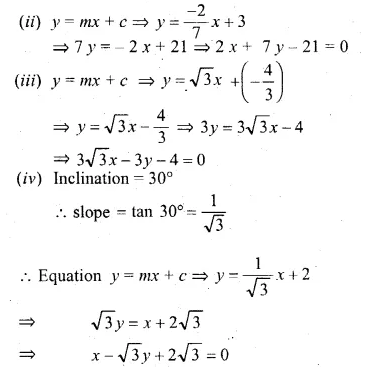
(i) slope = 3, y-intercept = – 5
(ii) slope = \(– \frac { 2 }{ 7 } \), y-intercept = 3
(iii) gradient = √3, y-intercept = \(– \frac { 4 }{ 3 } \)
(iv) inclination = 30°,y-intercept = 2
Solution:
Equation of a line whose slope and y-intercept is given is
y = mx + c
where m is the slope and c is the y-intercept
(i) y = mx + c
⇒ y = 3x + (-5)
⇒ y = 3x – 5
ML Aggarwal Class 10 Solutions for ICSE Maths Chapter 12 Equation of a Straight Line Ex 12.1 Q6.1

Question 7.
Find the slope and y-intercept of the following lines:
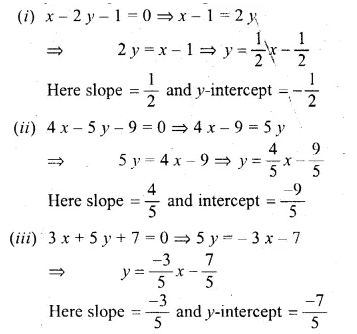
(i) x – 2y – 1 = 0
(ii) 4x – 5y – 9 = – 0
(iii) 3x +5y + 7 = 0
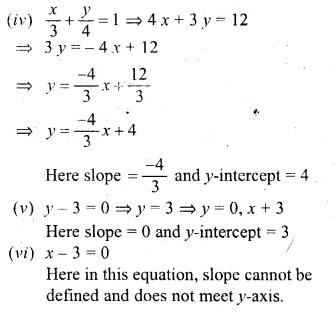
(iv) \(\frac { x }{ 3 } +\frac { y }{ 4 } =1\)
(v) y – 3 = 0
(vi) x – 3 = 0
Solution:
We know that in the equation
y = mx + c, m is the slope and c is the y-intercept.
Now using this, we find,
ML Aggarwal Class 10 Solutions for ICSE Maths Chapter 12 Equation of a Straight Line Ex 12.1 Q7.1
ML Aggarwal Class 10 Solutions for ICSE Maths Chapter 12 Equation of a Straight Line Ex 12.1 Q7.2

Question 8.
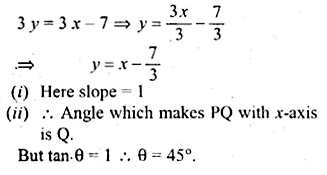
The equation of the line PQ is 3y – 3x + 7 = 0
(i) Write down the slope of the line PQ.
(ii) Calculate the angle that the line PQ makes with the positive direction of x-axis.
Solution:
Equation of line PQ is 3y – 3x + 7 = 0
Writing in form of y = mx + c
ML Aggarwal Class 10 Solutions for ICSE Maths Chapter 12 Equation of a Straight Line Ex 12.1 Q8.1

Question 9.
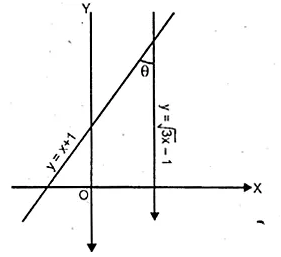
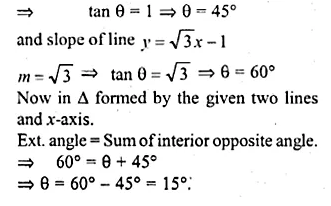
The given figure represents the line y = x + 1 and y = √3x – 1. Write down the angles which the lines make with the positive direction of the x-axis. Hence determine θ.
ML Aggarwal Class 10 Solutions for ICSE Maths Chapter 12 Equation of a Straight Line Ex 12.1 Q9.1
Solution:
Slope of the line y = x + 1 after comparing
it with y = mx + c, m = 1
ML Aggarwal Class 10 Solutions for ICSE Maths Chapter 12 Equation of a Straight Line Ex 12.1 Q9.2

Question 10.
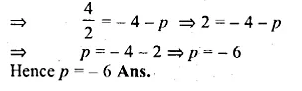
Find the value of p, given that the line \(\frac { y }{ 2 } =x-p\) passes through the point ( – 4, 4) (1992).
Solution:
Equation of line is \(\frac { y }{ 2 } =x-p\)
It passes through the points (-4, 4)
It will satisfy the equation
ML Aggarwal Class 10 Solutions for ICSE Maths Chapter 12 Equation of a Straight Line Ex 12.1 Q10.1

Question 11.
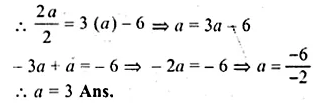
Given that (a, 2a) lies on the line \(\frac { y }{ 2 } =3x-6\) find the value of a.
Solution:
∵ Point (a, 2a) lies on the line
\(\frac { y }{ 2 } =3x-6\)
∴this point will satisfy the equation
ML Aggarwal Class 10 Solutions for ICSE Maths Chapter 12 Equation of a Straight Line Ex 12.1 Q11.1

Question 12.
The graph of the equation y = mx + c passes through the points (1, 4) and ( – 2, – 5). Determine the values of m and c.
Solution:
Equation of the line is y = mx + c
∴ it passes through the points (1, 4)
∴ 4 = m x 1 + c
⇒ 4 = m + c
⇒ m + c = 4 … (i)
Again it passes through the point (-2, -5)
∴ 5 = m (-2) + c
⇒ 5 = -2 m + c
⇒ 2m – c = 5 …(ii)
Adding (i) and (ii)
3m = 9
⇒ m = 3
Substituting the value of m in (i)
3 + c = 4
⇒ c = 4 – 3 = 1
Hence m = 3, c = 1

Question 13.
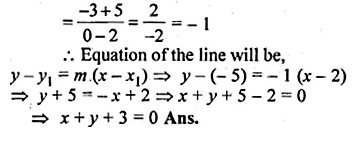
Find the equation of the line passing through the point (2, – 5) and making an intercept of – 3 on the y-axis.
Solution:
∴ The line intersects y-axis making an intercept of -3
∴ the co-ordinates of point of intersection will be (0, -3)
Now the slope of line (m) = \(\frac { { y }_{ 2 }-{ y }_{ 1 } }{ { x }_{ 2 }-{ x }_{ 1 } } \)
ML Aggarwal Class 10 Solutions for ICSE Maths Chapter 12 Equation of a Straight Line Ex 12.1 Q13.1

Question 14.
Find the equation of a straight line passing through ( – 1, 2) and whose slope is \(\\ \frac { 2 }{ 5 } \).
Solution:
Equation of the line will be
\(y-{ y }_{ 1 }=m(x-{ x }_{ 1 }) \)
\(y-2=\frac { 2 }{ 5 } (x+1)\)
⇒ 5y – 10 = 2x + 2
⇒ 2x – 5y + 2 + 10 = 0
⇒ 2x – 5y + 12 = 0

Question 15.
Find the equation of a straight line whose inclination is 60° and which passes through the point (0, – 3).
Solution:
The equation of line whose slope is wand passes through a given point is
\(y-{ y }_{ 1 }=m(x-{ x }_{ 1 }) \)
Here m = tan 60° = √3 and point is (0, -3)
∴ y + 3 = √3 (x – 0)
⇒ y + 3 = √3x
⇒ √3x – y – 3 = 0

Question 16.
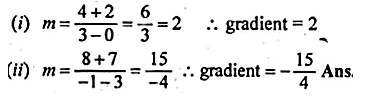
Find the gradient of a line passing through the following pairs of points.
(i) (0, – 2), (3, 4)
(ii) (3, – 7), ( – 1, 8)
Solution:
m = \(\frac { { y }_{ 2 }-{ y }_{ 1 } }{ { x }_{ 2 }-{ x }_{ 1 } } \)
Given
(i) (0, -2), (3, 4)
(ii) (3, -7), (-1, 8)
ML Aggarwal Class 10 Solutions for ICSE Maths Chapter 12 Equation of a Straight Line Ex 12.1 Q16.1

Question 17.
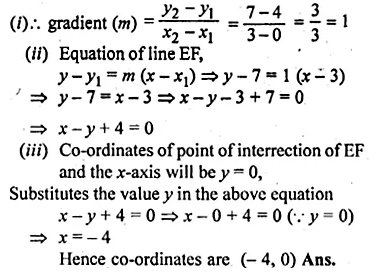
The coordinates of two points E and F are (0, 4) and (3, 7) respectively. Find :
(i) The gradient of EF
(ii) The equation of EF
(iii) The coordinates of the point where the line EF intersects the x-axis.
Solution:
Co-ordinates of points E (0, 4) and F (3, 7) are given, then
(i) The gradient of EF
ML Aggarwal Class 10 Solutions for ICSE Maths Chapter 12 Equation of a Straight Line Ex 12.1 Q17.1

Question 18.
Find the intercepts made by the line 2x – 3y + 12 = 0 on the co-ordinate axis.
Solution:
Putting y = 0, we will get the intercept made on x-axis,
2x – 3y + 12 = 0
⇒ 2x – 3 × 0 + 12 = 0
⇒ 2x – 0 + 2 = 0
⇒ 2x = -12
⇒ x = -6
and putting x = 0, we get the intercepts made on y-axis,
2x – 3y + 12 = 0
⇒ 2 × 0 – 3y + 12 = 0
⇒ -3y = -12
⇒ \(y= \frac { -12 }{ -3 } \) = 4

Question 19.
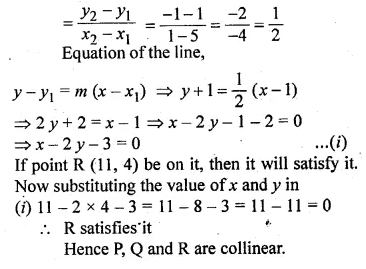
Find the equation of the line passing through the points P (5, 1) and Q (1, – 1). Hence, show that the points P, Q and R (11, 4) are collinear.
Solution:
The two given points are P (5, 1), Q(1, -1).
∴ Slope of the line (m)
ML Aggarwal Class 10 Solutions for ICSE Maths Chapter 12 Equation of a Straight Line Ex 12.1 Q19.1

Question 20.
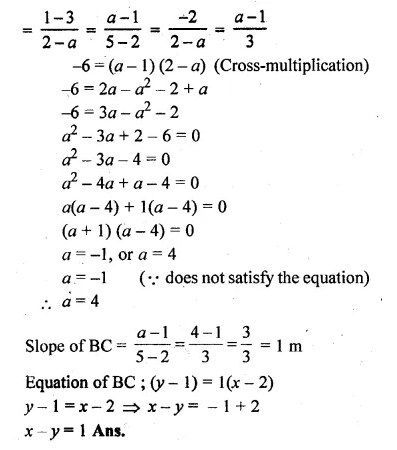
Find the value of ‘a’ for which the following points A (a, 3), B (2,1) and C (5, a) are collinear. Hence find the equation of the line.
Solution:
Given That
A(a, 3), B (2, 1) and C (5, a) are collinear.
Slope of AB = Slope of BC
ML Aggarwal Class 10 Solutions for ICSE Maths Chapter 12 Equation of a Straight Line Ex 12.1 Q20.1

Question 21.
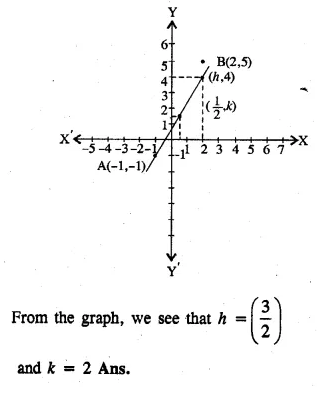
Use a graph paper for this question. The graph of a linear equation in x and y, passes through A ( – 1, – 1) and B (2, 5). From your graph, find the values of h and k, if the line passes through (h, 4) and (½, k). (2005)
Solution:
Points (h, 4) and (½, k) lie on the line passing
through A(-1, -1) and B(2, 5)
ML Aggarwal Class 10 Solutions for ICSE Maths Chapter 12 Equation of a Straight Line Ex 12.1 Q21.1

Question 22.
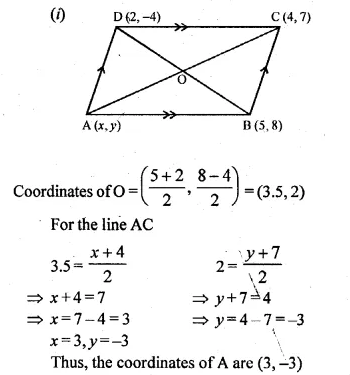
ABCD is a parallelogram where A (x, y), B (5, 8), C (4, 7) and D (2, – 4). Find
(i) the coordinates of A
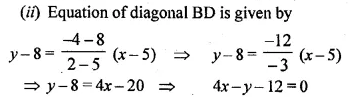
(ii) the equation of the diagonal BD.
Solution:
Given that
ABCD is a parallelogram where A (x, y), B (5, 8), C (4, 7) and D (2, -4)
ML Aggarwal Class 10 Solutions for ICSE Maths Chapter 12 Equation of a Straight Line Ex 12.1 Q22.1
ML Aggarwal Class 10 Solutions for ICSE Maths Chapter 12 Equation of a Straight Line Ex 12.1 Q22.2

Question 23.
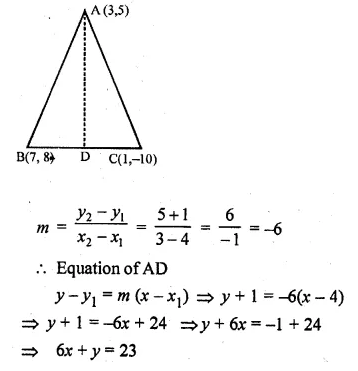
In ∆ABC, A (3, 5), B (7, 8) and C (1, – 10). Find the equation of the median through A.
Solution:
AD is median
⇒ D is mid point of BC
∴ D is \(\left( \frac { 7+1 }{ 2 } ,\frac { 8-10 }{ 2 } \right) \)
i.e (4, -1)
slope of AD
ML Aggarwal Class 10 Solutions for ICSE Maths Chapter 12 Equation of a Straight Line Ex 12.1 Q23.1

Question 24.
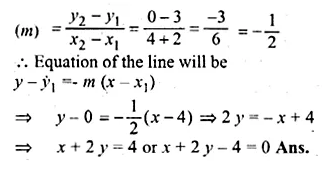
Find the equation of a line passing through the point ( – 2, 3) and having x-intercept 4 units. (2002)
Solution:
x-intercept = 4
∴ Co-ordinates of the point will be (4, 0)
Now slope of the line passing through the points (-2, 3) and (4, 0)
ML Aggarwal Class 10 Solutions for ICSE Maths Chapter 12 Equation of a Straight Line Ex 12.1 Q24.1

Question 25.
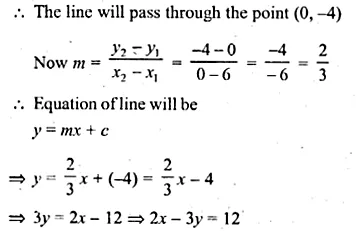
Find the equation of the line whose x-intercept is 6 and y-intercept is – 4.
Solution:
x-intercept = 6
∴ The line will pass through the point (6, 0)
y -intercept = -4 ⇒ c = -4
ML Aggarwal Class 10 Solutions for ICSE Maths Chapter 12 Equation of a Straight Line Ex 12.1 Q25.1

Question 26.
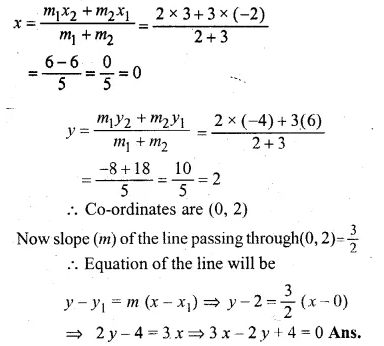
Write down the equation of the line whose gradient is \(\\ \frac { 1 }{ 2 } \) and which passes through P where P divides the line segment joining A ( – 2, 6) and B (3, – 4) in the ratio 2 : 3. (2001)
Solution:
P divides the line segment joining the points
A (-2, 6) and (3, -4) in the ratio 2 : 3
∴ Co-ordinates of P will be
ML Aggarwal Class 10 Solutions for ICSE Maths Chapter 12 Equation of a Straight Line Ex 12.1 Q26.1

Question 27.
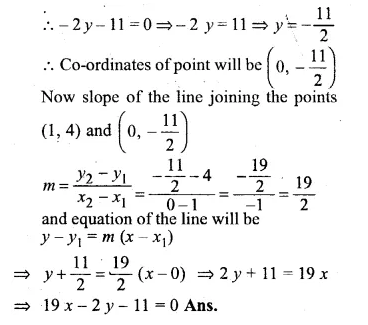
Find the equation of the line passing through the point (1, 4) and intersecting the line x – 2y – 11 = 0 on the y-axis.
Solution:
line x – 2y – 11 = 0 passes through y-axis
x = 0,
Now substituting the value of x in the equation x – 2y – 11 = 0
ML Aggarwal Class 10 Solutions for ICSE Maths Chapter 12 Equation of a Straight Line Ex 12.1 Q27.1

Question 28.
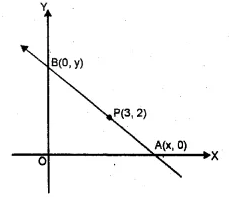
Find the equation of the straight line containing the point (3, 2) and making positive equal intercepts on axes.
Solution:
ML Aggarwal Class 10 Solutions for ICSE Maths Chapter 12 Equation of a Straight Line Ex 12.1 Q28.1
Let the line containing the point P (3, 2)
passes through x-axis at A (x, 0) and y-axis at B (0, y)
OA = OB given
∴ x = y
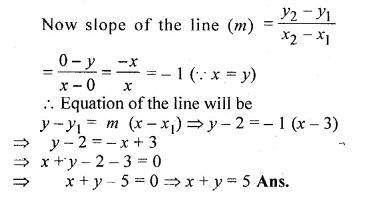
ML Aggarwal Class 10 Solutions for ICSE Maths Chapter 12 Equation of a Straight Line Ex 12.1 Q28.2

Question 29.
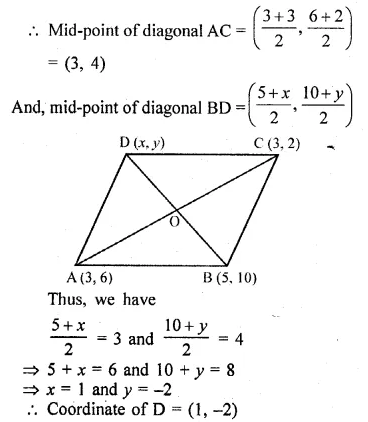
Three vertices of a parallelogram ABCD taken in order are A (3, 6), B (5, 10) and C (3, 2) find:
(i) the coordinates of the fourth vertex D.
(ii) length of diagonal BD.
(iii) equation of side AB of the parallelogram ABCD. (2015)
Solution:
Three vertices of a parallelogram ABCD taken in order are
A (3, 6), B (5, 10) and C (3, 2)
(i) We need to find the co-ordinates of D
We know that the diagonals of a parallelogram bisect each other
Let (x, y) be the co-ordinates of D
ML Aggarwal Class 10 Solutions for ICSE Maths Chapter 12 Equation of a Straight Line Ex 12.1 Q29.1
ML Aggarwal Class 10 Solutions for ICSE Maths Chapter 12 Equation of a Straight Line Ex 12.1 Q29.2

Question 30.
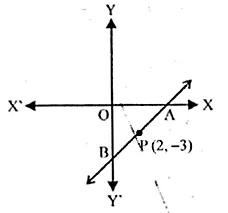
A and B arc two points on the x-axis and y-axis respectively. P (2, – 3) is the mid point of AB. Find the
ML Aggarwal Class 10 Solutions for ICSE Maths Chapter 12 Equation of a Straight Line Ex 12.1 Q30.1
(i) the co-ordinates of A and B.
(ii) the slope of the line AB.
(iii) the equation of the line AB. (2010)
Solution:
Points A and B are on x-axis and y-axis respectively
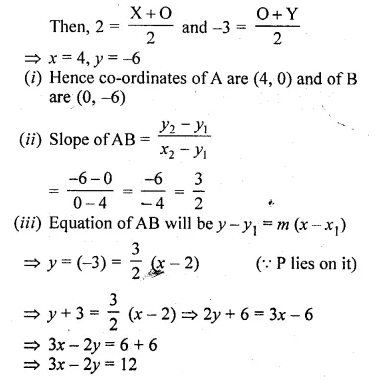
Let co-ordinates of A be (X, O) and of B be (O, Y)
P (2, -3) is the midpoint of AB
ML Aggarwal Class 10 Solutions for ICSE Maths Chapter 12 Equation of a Straight Line Ex 12.1 Q30.2

Question 31.
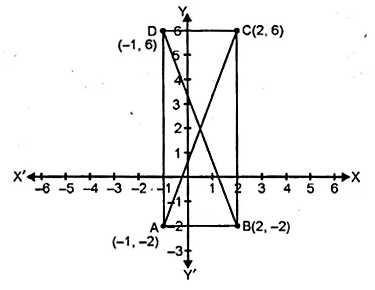
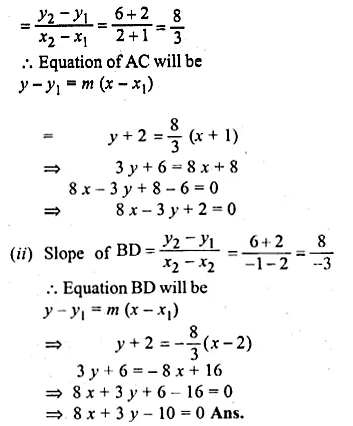
Find the equations of the diagonals of a rectangle whose sides are x = – 1, x = 2 , y = – 2 and y = 6.
ML Aggarwal Class 10 Solutions for ICSE Maths Chapter 12 Equation of a Straight Line Ex 12.1 Q31.1
Solution:
The equations of sides of a rectangle whose equations are
x1 = -1, x2 = 2, y1 = -2, y2 = 6.
These lines form a rectangle when they intersect at A, B, C, D respectively
Co-ordinates of A, B, C and D will be
(-1, -2), (2, -2), (2, 6) and (-1, 6) respectively.
AC and BD are its diagonals
(i) Slope of the diagonal AC
ML Aggarwal Class 10 Solutions for ICSE Maths Chapter 12 Equation of a Straight Line Ex 12.1 Q31.2

Question 32.
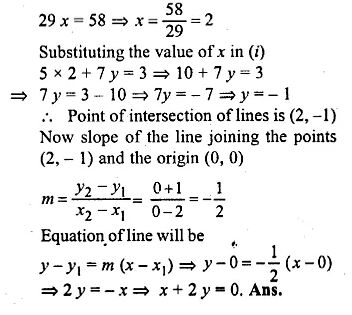
Find the equation of a straight line passing through the origin and through the point of intersection of the lines 5x + 1y – 3 and 2x – 3y = 7
Solution:
5x + 7y = 3 …(i)
2x – 3 y = 7 …(ii)
Multiply (i) by 3 and (ii) by 7,
15x + 21y = 9
14x – 21y = 49
Adding we get,
ML Aggarwal Class 10 Solutions for ICSE Maths Chapter 12 Equation of a Straight Line Ex 12.1 Q32.1

Question 33.
Point A (3, – 2) on reflection in the x-axis is mapped as A’ and point B on reflection in the y-axis is mapped onto B’ ( – 4, 3).
(i) Write down the co-ordinates of A’ and B.
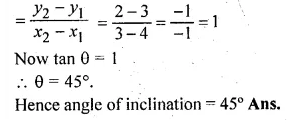
(ii) Find the slope of the line A’B, hence find its inclination.
Solution:
A’ is the image of A (3, -2) on reflection in the x-axis.
∴ Co-ordinates of A’ will be (3, 2)
Again B’ (- 4, 3) in the image of A’, when reflected in the y-axis
∴ Co-ordinates of B will be (4, 3)
(ii) Slope of the line joining, the points A’ (3, 2) and B (4, 3)
ML Aggarwal Class 10 Solutions for ICSE Maths Chapter 12 Equation of a Straight Line Ex 12.1 Q33.1

Hope given ML Aggarwal Class 10 Solutions for ICSE Maths Chapter 12 Equation of a Straight Line Ex 12.1 are helpful to complete your math homework.

If you have any doubts, please comment below. Learn Insta try to provide online math tutoring for you.
ML Aggarwal Class 10 Solutions for ICSE Maths Chapter 11 Section Formula Chapter Test

ML Aggarwal Class 10 Solutions for ICSE Maths Chapter 11 Section Formula Chapter Test

These Solutions are part of ML Aggarwal Class 10 Solutions for ICSE Maths. Here we have given ML Aggarwal Class 10 Solutions for ICSE Maths Chapter 11 Section Formula Chapter Test

More Exercises

Question 1.
The base BC of an equilateral triangle ABC lies on y-axis. The coordinates of the point C are (0, – 3). If origin is the mid-point of the base BC, find the coordinates of the points A and B
Solution:
Base BC of an equilateral ∆ABC lies on y-axis
co-ordinates of point C are (0, – 3),
origin (0, 0) is the mid-point of BC.
ML Aggarwal Class 10 Solutions for ICSE Maths Chapter 11 Section Formula Chapter Test Q1.1
ML Aggarwal Class 10 Solutions for ICSE Maths Chapter 11 Section Formula Chapter Test Q1.2

Question 2.
A and B have co-ordinates (4, 3) and (0, 1), Find
(i) the image A’ of A under reflection in the y – axis.
(ii) the image of B’ of B under reflection in the lineAA’.
(iii) the length of A’B’.
Solution:
ML Aggarwal Class 10 Solutions for ICSE Maths Chapter 11 Section Formula Chapter Test Q2.1
(i) Co-ordinates of A’, the image of A (4, 3)
reflected in y-axis will be ( – 4, 3).
(ii) Co-ordinates of B’ the image of B (0, 1)
reflected in the line AA’ will be (0, 5).
(iii) Length A’B’
ML Aggarwal Class 10 Solutions for ICSE Maths Chapter 11 Section Formula Chapter Test Q2.2

Question 3.
Find the co-ordinates of the point that divides the line segment joining the points P (5, – 2) and Q (9, 6) internally in the ratio of 3 : 1.
Solution:
Let R be the point whose co-ordinates are (x, y)
which divides PQ in the ratio of 3:1.
ML Aggarwal Class 10 Solutions for ICSE Maths Chapter 11 Section Formula Chapter Test Q3.1

Question 4.
Find the coordinates of the point P which is three-fourth of the way from A (3, 1) to B ( – 2, 5).
Solution:
Co-ordinates of A (3, 1) and B ( – 2, 5)
P lies on AB such that
ML Aggarwal Class 10 Solutions for ICSE Maths Chapter 11 Section Formula Chapter Test Q4.1

Question 5.
P and Q are the points on the line segment joining the points A (3, – 1) and B ( – 6, 5) such that AP = PQ = QB. Find the co-ordinates of P and Q.
Solution:
Given
AP = PQ = QB
ML Aggarwal Class 10 Solutions for ICSE Maths Chapter 11 Section Formula Chapter Test Q5.1
ML Aggarwal Class 10 Solutions for ICSE Maths Chapter 11 Section Formula Chapter Test Q5.2

Question 6.
The centre of a circle is (α + 2, α – 5). Find the value of a given that the circle passes through the points (2, – 2) and (8, – 2).
Solution:
Let A (2, -2), B (8, -2) and centre of the circle be
O (α + 2, α – 5)
ML Aggarwal Class 10 Solutions for ICSE Maths Chapter 11 Section Formula Chapter Test Q6.1
ML Aggarwal Class 10 Solutions for ICSE Maths Chapter 11 Section Formula Chapter Test Q6.2

Question 7.
The mid-point of the line joining A (2, p) and B (q, 4) is (3, 5). Calculate the numerical values of p and q.
Solution:
Given
(3, 5) is the mid-point of A (2, p) and B (q, 4)
ML Aggarwal Class 10 Solutions for ICSE Maths Chapter 11 Section Formula Chapter Test Q7.1

Question 8.
The ends of a diameter of a circle have the co-ordinates (3, 0) and ( – 5, 6). PQ is another diameter where Q has the coordinates ( – 1, – 2). Find the co-ordinates of P and the radius of the circle.
Solution:
Let AB be the diameter where co-ordinates of
A are (3, 0) and of B are (-5, 6).
Co-ordinates of its origin O will be
ML Aggarwal Class 10 Solutions for ICSE Maths Chapter 11 Section Formula Chapter Test Q8.1
ML Aggarwal Class 10 Solutions for ICSE Maths Chapter 11 Section Formula Chapter Test Q8.2

Question 9.
In what ratio does the point ( – 4, 6) divide the line segment joining the points A( – 6, 10) and B (3, – 8) ?
Solution:
Let the point (-4, 6) divides the line segment joining the points
A (-6, 10) and B (3, -8), in the ratio m : n
ML Aggarwal Class 10 Solutions for ICSE Maths Chapter 11 Section Formula Chapter Test Q9.1

Question 10.
Find the ratio in which the point P ( – 3, p) divides the line segment joining the points ( – 5, – 4) and ( – 2, 3). Hence find the value of p.
Solution:
Let P (-3, p) divides AB in the ratio of m1 : m2 coordinates of
A (-5, -4) and B (-2, 3)
ML Aggarwal Class 10 Solutions for ICSE Maths Chapter 11 Section Formula Chapter Test Q10.1
ML Aggarwal Class 10 Solutions for ICSE Maths Chapter 11 Section Formula Chapter Test Q10.2

Question 11.
In what ratio is the line joining the points (4, 2) and (3, – 5) divided by the x-axis? Also find the co-ordinates of the point of division.
Solution:
Let the point P which is on the x-axis, divides the line segment
joining the points A (4, 2) and B (3, -5) in the ratio of m1 : m2.
and let co-ordinates of P be (x, 0)
ML Aggarwal Class 10 Solutions for ICSE Maths Chapter 11 Section Formula Chapter Test Q11.1

Question 12.
If the abscissa of a point P is 2, find the ratio in which it divides the line segment joining the points ( – 4 – 3) and (6, 3). Hence, find the co-ordinates of P.
Solution:
Let co-ordinates of A be (-4, 3) and of B (6, 3) and of P be (2, y)
Let the ratio in which the P divides AB be m1 : m2
ML Aggarwal Class 10 Solutions for ICSE Maths Chapter 11 Section Formula Chapter Test Q12.1

Question 13.
Determine the ratio in which the line 2x + y – 4 = 0 divide the line segment joining the points A (2, – 2) and B (3, 7). Also find the co-ordinates of the point of division.
Solution:
Points are given A (2, -2), B (3, 7)
and let the line 2x + y – 4 = 0 divides AB in the ratio m1 : m2
at P and let co-ordinates of
ML Aggarwal Class 10 Solutions for ICSE Maths Chapter 11 Section Formula Chapter Test Q13.1

Question 14.
The point A(2, – 3) is reflected in the v-axis onto the point A’. Then the point A’ is reflected in the line x = 4 onto the:point A”.
(i) Write the coordinates of A’ and A”.
(ii) Find the ratio in which the line segment AA” is divided by the x-axis. Also find the coordinates of the point of division.
Solution:
A’ is the reflection of A(2, -3) in the x-axis
(i) ∴ Co-ordinates of A’ will be (2, 3)
Draw a line x = 4 which is parallel to y-axis
A” is the reflection of A’ (2, 3)
∴Co-ordinates OA” will be (6, 3)
(ii) Join AA” which intersects x-axis at P whose
co-ordinate are (4, 0)
Let P divide AA” in the ratio in m1 : m2
ML Aggarwal Class 10 Solutions for ICSE Maths Chapter 11 Section Formula Chapter Test Q14.1
Hence P(4, 0) divides AA” in the ratio 1 : 1

Question 15.
ABCD is a parallelogram. If the coordinates of A, B and D are (10, – 6), (2, – 6) and (4, – 2) respectively, find the co-ordinates of C.
Solution:
Let the co-ordinates of C be (x, y) and other three vertices
of the given parallelogram are A (10, – 6), B, (2, – 6) and D (4, – 2)
∴ ABCD is a parallelogram
Its diagonals bisect each other.
Let AC and BD intersect each other at O.
∴O is mid-points of BD
∴ Co-ordinates of O will be
ML Aggarwal Class 10 Solutions for ICSE Maths Chapter 11 Section Formula Chapter Test Q15.1

Question 16.
ABCD is a parallelogram whose vertices A and B have co-ordinates (2, – 3) and ( – 1, – 1) respectively. If the diagonals of the parallelogram meet at the point M(1, – 4), find the co-ordinates of C and D. Hence, find the perimeter of the parallelogram. find the perimeter of the parallelogram.
Solution:
ABCD is a || gm , m which co-ordinates of A are (2, -3) and B (-1, -1)
Its diagonals AC and BD bisect each other at M (1, -4)
∴ M is the midpoint of AC and BD
Let co-ordinates of C be (x1, y1) and of D be (x2, y2)
when M is the midpoint of AC then
ML Aggarwal Class 10 Solutions for ICSE Maths Chapter 11 Section Formula Chapter Test Q16.1
ML Aggarwal Class 10 Solutions for ICSE Maths Chapter 11 Section Formula Chapter Test Q16.2

Question 17.
In the adjoining figure, P (3, 1) is the point on the line segment AB such that AP : PB = 2 : 3. Find the co-ordinates of A and B.
ML Aggarwal Class 10 Solutions for ICSE Maths Chapter 11 Section Formula Chapter Test Q17.1
Solution:
A lies on x-axis and
B lies on y-axis
Let co-ordinates of A be (x, 0) and B be (0, y)
and P (3, 1) divides it in the ratio of 2 : 3.
ML Aggarwal Class 10 Solutions for ICSE Maths Chapter 11 Section Formula Chapter Test Q17.2

Question 18.
Given, O, (0, 0), P(1, 2), S( – 3, 0) P divides OQ in the ratio of 2 : 3 and OPRS is a parallelogram.
Find : (i) the co-ordinates of Q.
(ii)the co-ordinates of R.
(iii) the ratio in which RQ is divided by y-axis.
ML Aggarwal Class 10 Solutions for ICSE Maths Chapter 11 Section Formula Chapter Test Q18.1
Solution:
(i) Let co-ordinates of Q be (x’, y’) and of R (x”, y”)
Point P (1, 2) divides OQ in the ratio of 2 : 3
ML Aggarwal Class 10 Solutions for ICSE Maths Chapter 11 Section Formula Chapter Test Q18.2
ML Aggarwal Class 10 Solutions for ICSE Maths Chapter 11 Section Formula Chapter Test Q18.3

Question 19.
If A (5, – 1), B ( – 3, – 2) and C ( – 1, 8) are the vertices of a triangle ABC, find the length of the median through A and the co-ordinates of the centroid of triangle ABC.
Solution:
A (5, -1), B (-3, -2) and C (-1, 8) are the vertices of ∆ABC
D, E and F are the midpoints of sides BC, CA and AB respectively
and G is the centroid of the ∆ABC
ML Aggarwal Class 10 Solutions for ICSE Maths Chapter 11 Section Formula Chapter Test Q19.1
ML Aggarwal Class 10 Solutions for ICSE Maths Chapter 11 Section Formula Chapter Test Q19.2

Hope given ML Aggarwal Class 10 Solutions for ICSE Maths Chapter 11 Section Formula Chapter Test are helpful to complete your math homework.

If you have any doubts, please comment below. Learn Insta try to provide online math tutoring for you.
ML Aggarwal Class 10 Solutions for ICSE Maths Chapter 11 Section Formula MCQS

ML Aggarwal Class 10 Solutions for ICSE Maths Chapter 11 Section Formula MCQS

These Solutions are part of ML Aggarwal Class 10 Solutions for ICSE Maths. Here we have given ML Aggarwal Class 10 Solutions for ICSE Maths Chapter 11 Section Formula MCQS

More Exercises

Choose the correct answer from the given four options (1 to 12) :

Question 1.
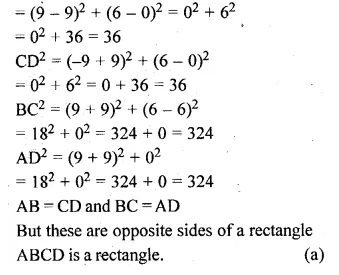
The points A (9, 0), B (9, 6), C ( – 9, 6) and D ( – 9, 0) are the vertices of a
(a) rectangle
(b) square
(c) rhombus
(d) trapezium
Solution:
A (9, 0), B (9, 6), C (-9, 6), D (-9, 0)
AB² = (x2 – x1)² + (y2 – y1
ML Aggarwal Class 10 Solutions for ICSE Maths Chapter 11 Section Formula MCQS Q1.1

Question 2.
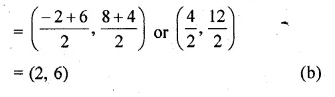
The mid-point of the line segment joining the points A ( – 2, 8) and B ( – 6, – 4) is
(a) ( – 4, – 6)
(b) (2, 6)
(c) ( – 4, 2)
(d) (4, 2)
Solution:
Mid-point of the line segment joining the points A (-2, 8), B (-6, -4)
ML Aggarwal Class 10 Solutions for ICSE Maths Chapter 11 Section Formula MCQS Q2.1

Question 3.
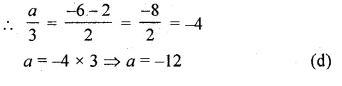
If \(P\left( \frac { a }{ 3 } ,4 \right) \) segment joining the points Q ( – 6, 5) and R ( – 2, 3), then the value of a is
(a) – 4
(b) – 6
(c) 12
(d) – 12
Solution:
\(P\left( \frac { a }{ 3 } ,4 \right) \) is mid-point of the line segment
joining the points Q (-6, 5) and R (-2, 3)
ML Aggarwal Class 10 Solutions for ICSE Maths Chapter 11 Section Formula MCQS Q3.1

Question 4.
If the end points of a diameter of a circle are A ( – 2, 3) and B (4, – 5), then the coordinates of its centre are
(a) (2, – 2)
(b) (1, – 1)
(c) ( – 1, 1)
(d) ( – 2, 2)
Solution:
End points of a diameter of a circle are (-2, 3) and B (4,-5)
then co-ordinates of the centre of the circle
= \(\left( \frac { -2+4 }{ 2 } ,\frac { 3-5 }{ 2 } \right) or\left( \frac { 2 }{ 2 } ,\frac { -2 }{ 2 } \right) \)
= (1, -1) (b)

Question 5.
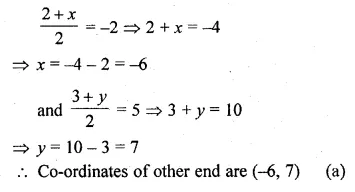
If one end of a diameter of a circle is (2, 3) and the centre is ( – 2, 5), then the other end is
(a) ( – 6, 7)
(b) (6, – 7)
(c) (0, 8)
(d) (0, 4)
Solution:
One end of a diameter of a circle is (2, 3) and centre is (-2, 5)
Let (x, y) be the other end of the diameter
ML Aggarwal Class 10 Solutions for ICSE Maths Chapter 11 Section Formula MCQS Q5.1

Question 6.
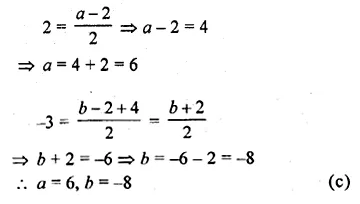
If the mid-point of the line segment joining the points P (a, b – 2) and Q ( – 2, 4) is R (2, – 3), then the values of a and b are
(a) a = 4, b = – 5
(b) a = 6, b = 8
(c) a = 6, b = – 8
(d) a = – 6, b = 8
Solution:
the mid-point of the line segment joining the
points P (a, b – 2) and Q (-2, 4) is R (2, -3)
ML Aggarwal Class 10 Solutions for ICSE Maths Chapter 11 Section Formula MCQS Q6.1

Question 7.
The point which lies on the perpendicular bisector of the line segment joining the points A ( – 2, – 5) and B (2, 5) is
(a) (0, 0)
(b) (0, 2)
(c) (2, 0)
(d) ( – 2, 0)
Solution:
the line segment joining the points A (-2, -5) and B (2, -5), has mid-point
= \(\left( \frac { -2+2 }{ 2 } ,\frac { -5+5 }{ 2 } \right) \) = (0, 0)
(0, 0) lies on the perpendicular bisector of AB. (a)

Question 8.
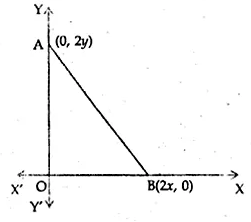
The coordinates of the point which is equidistant from the three vertices of ∆AOB (shown in the given figure) are
(a) (x, y)
(b) (y, x)
(c) \(\left( \frac { x }{ 2 } ,\frac { y }{ 2 } \right) \)
(d) \(\left( \frac { y }{ 2 } ,\frac { x }{ 2 } \right) \)
ML Aggarwal Class 10 Solutions for ICSE Maths Chapter 11 Section Formula MCQS Q8.1
Solution:
In the given figure, vertices of a ∆OAB are (0, 0), (0, 2y) and (2x, 0)
The point which is equidistant from O, A and B is the mid-point of AB.
∴ Coordinates are \(\left( \frac { 0+2x }{ 2 } ,\frac { 2y+0 }{ 2 } \right) \) or (x, y) (a)

Question 9.
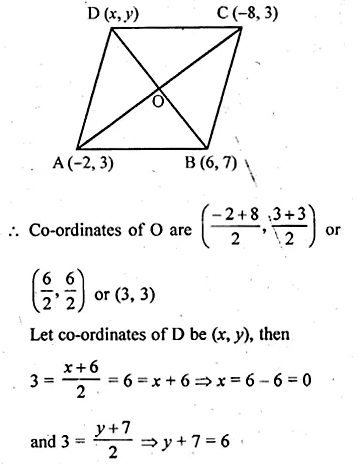
The fourth vertex D of a parallelogram ABCD whose three vertices are A ( – 2, 3), B (6, 7) and C (8, 3) is
(a) (0, 1)
(b) (0, – 1)
(c) ( – 1, 0)
(d) (1, 0)
Solution:
ABCD is a ||gm whose vertices A (-2, 3), B (6, 7) and C (8, 3).
The fourth vertex D will be the point on which diagonals AC and BD
bisect each other at O.
ML Aggarwal Class 10 Solutions for ICSE Maths Chapter 11 Section Formula MCQS Q9.1
ML Aggarwal Class 10 Solutions for ICSE Maths Chapter 11 Section Formula MCQS Q9.2

Question 10.
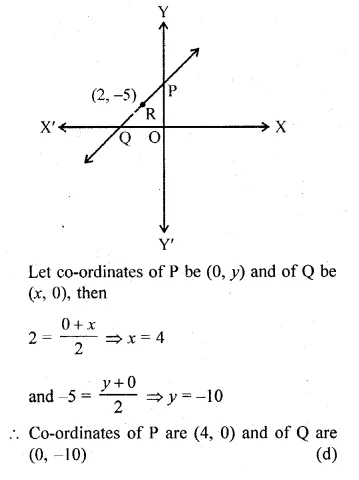
A line intersects the y-axis and x-axis at the points P and Q respectively. If (2, – 5) is the mid-point of PQ, then the coordinates of P and Q are, respectively
(a) (0, – 5) and (2, 0)
(b) (0, 10) and ( – 4, 0)
(c) (0, 4) and ( – 10, 0)
(d) (0, – 10) and (4, 0)
Solution:
A line intersects y-axis at P and x-axis a Q.
R (2, -5) is the mid-point
ML Aggarwal Class 10 Solutions for ICSE Maths Chapter 11 Section Formula MCQS Q10.1

Question 11.
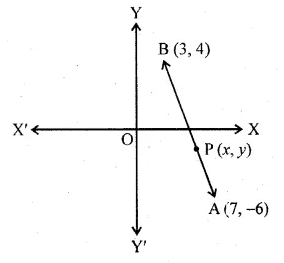
The points which divides the line segment joining the points (7, – 6) and (3, 4) in the ratio 1 : 2 internally lies in the
(a) Ist quadrant
(b) IInd quadrant
(c) IIIrd quadrant
(d) IVth quadrant
Solution:
A point divides line segment joining the points
A (7, -6) and B (3, 4) in the ratio 1 : 2 internally.
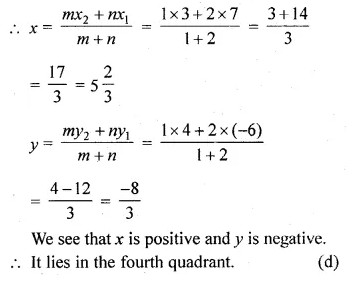
ML Aggarwal Class 10 Solutions for ICSE Maths Chapter 11 Section Formula MCQS Q11.1
Let (x, y) divides it in the ratio 1 : 2
ML Aggarwal Class 10 Solutions for ICSE Maths Chapter 11 Section Formula MCQS Q11.2

Question 12.
The centroid of the triangle whose vertices are (3, – 7), ( – 8, 6) and (5, 10) is
(a) (0, 9)
(b) (0, 3)
(c) (1, 3)
(d) (3, 3)
Solution:
Centroid of the triangle whose Vertices are (3, -7), (-8, 6) and (5, 10) is
\(\left( \frac { 3-8+5 }{ 3 } ,\frac { -7+6+10 }{ 3 } \right) or\left( 0,\frac { 9 }{ 3 } \right) \)
or (0, 3) (b)

Hope given ML Aggarwal Class 10 Solutions for ICSE Maths Chapter 11 Section Formula MCQS are helpful to complete your math homework.

If you have any doubts, please comment below. Learn Insta try to provide online math tutoring for you.
ML Aggarwal Class 10 Solutions for ICSE Maths Chapter 10 Reflection Chapter Test

ML Aggarwal Class 10 Solutions for ICSE Maths Chapter 10 Reflection Chapter Test

These Solutions are part of ML Aggarwal Class 10 Solutions for ICSE Maths. Here we have given ML Aggarwal Class 10 Solutions for ICSE Maths Chapter 10 Reflection Chapter Test.

More Exercises

Question 1.
The point P (4, – 7) on reflection in x-axis is mapped onto P’. Then P’ on reflection in the y-axis is mapped onto P”. Find the co-ordinates of P’ and P”. Write down a single transformation that maps P onto P”.
Solution:
P’ is the image of P (4, -7) reflected in x-axis
∴ Co-ordinates of P’ are (4, 7)
Again P” is the image of P’ reflected in y-axis
∴ Co-ordinates of P” are (-4, 7)
∴ Single transformation that maps P and P” is in the origin.

Question 2.
The point P (a, b) is first reflected in the origin and then reflected in the y-axis to P’. If P’ has co-ordinates (3, – 4), evaluate a, b
Solution:
The co-ordinates of image of P(a, b) reflected in origin are (-a, -b).
Again the co-ordinates of P’, image of the above point (-a, -b)
reflected in the y-axis are (a, -b).
But co-ordinates of P’ are (3, -4)
∴a = 3 and -b = -4
b = 4 Hence a = 3, b = 4.

Question 3.
A point P (a, b) becomes ( – 2, c) after reflection in the x-axis, and P becomes (d, 5) after reflection in the origin. Find the values of a, b, c and d.
Solution:
If the image of P (a, b) after reflected in the x-axis be (a, -b) but it Is given (-2, c).
a = -2, c = -b
If P is reflected in the origin, then its co-ordinates will be (-a, -b), but it is given (d, 5)
∴ -b = 5 ⇒ b = -5
d = -a = -(-2) = 2, c = -b = -(-5) = 5
Hence a = -2, b = -5, c = 5, d = 2

Question 4.
A (4, – 1), B (0, 7) and C ( – 2, 5) are the vertices of a triangle. ∆ ABC is reflected in the y-axis and then reflected in the origin. Find the co-ordinates of the final images of the vertices.
Solution:
A (4, -1), B (0, 7) and C (-2, 5) are the vertices of ∆ABC.
After reflecting in y-axis, the co-ordinates of points will be
A’ (-4, -1), B’ (0, 7), C’ (2, 5). Again reflecting in origin,
the co-ordinates of the images of the vertices will be
A” (4, 1), B” (0, -7), C” (-2, -5)

Question 5.
The points A (4, – 11), B (5, 3), C (2, 15), and D (1, 1) are the vertices of a parallelogram. If the parallelogram is reflected in the y-axis and then in the origin, find the co-ordinates of the final images. Check whether it remains a parallelogram. Write down a single transformation that brings the above change.
Solution:
The points A (4, -11), B (5, 3), C (2, 15) and D (1, 1) are the vertices of a parallelogram.
After reflecting in/-axis, the images of these points will be
A’ ( -4, 11), B’ (-5, 3), C (-2, 15) and D’ (-1, 1).
Again reflecting these points in origin, the image of these points will be
A” (4, -11), B” (5, -3), C” (2, -15), D” (0, -1)
Yes, the reflection of a single transformation is in the x-axis.

Question 6.
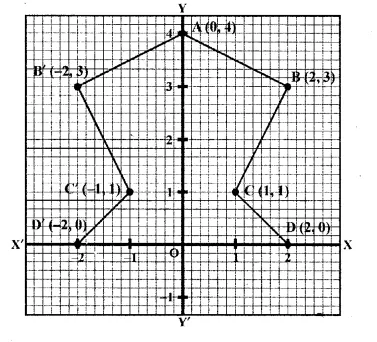
Use a graph paper for this question (take 2 cm = 1 unit on both x and y axes).
(i) Plot the following points:
A (0, 4), B (2, 3), C (1, 1) and D (2, 0).
(ii) Reflect points B, C, D on 7-axis and write down their coordinates. Name the images as B’, C’, D’ respectively.
(iii) Join points A, B, C, D, D’, C’, B’ and A in order, so as to form a closed figure. Write down the equation of line of symmetry of the figure formed. (2017)
Solution:
(i) On graph A (0, 4), B (2, 3), C (1, 1) and D (2, 0)
(ii) B’ = (-2, 3), C’ = (-1, 1), D’ = (-2, 0)
ML Aggarwal Class 10 Solutions for ICSE Maths Chapter 10 Reflection Chapter Test Q6.1
The equation of the line of symmetry is x = 0

Question 7.
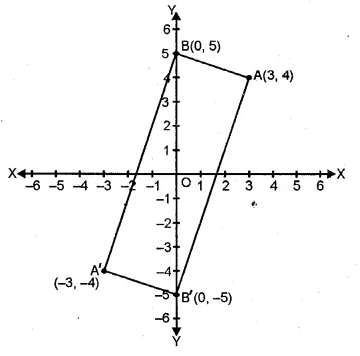
The triangle OAB is reflected in the origin O to triangle OA’B’. A’ and B’ have coordinates ( – 3, – 4) and (0, – 5) respectively.
(i) Find the co-ordinates of A and B.
(ii) Draw a diagram to represent the given information.
(iii) What kind of figure is the quadrilateral ABA’B’?
(iv) Find the coordinates of A”, the reflection of A in the origin followed by reflection in the y-axis.
(v) Find the co-ordinates of B”, the reflection of B in the x-axis followed by reflection in the origin.
Solution:
∆ OAB is reflected in the origin O to ∆ OA’B’,
Co-ordinates of A’ = (-3, -4), B’ (0, -5).
.’. Co-ordinates of A will be (3, 4) and of B will be (0, 5).
(ii) The diagram representing the given information has been drawn here.
(iii) The figure in the diagram is a rectangle.
(iv) The co-ordinates of B’, the reflection of B is the x-axis is (0, -5)
and co-ordinates of B”, the reflection in origin of the point (0, -5) will be (0, 5).
(v) The co-ordinates of the points, the reflection of A in the origin are (-3, -4)
and coordinates of A”, the reflected in y-axis of the point (-3, – 4) are (3, -4)
ML Aggarwal Class 10 Solutions for ICSE Maths Chapter 10 Reflection Chapter Test Q7.1

Hope given ML Aggarwal Class 10 Solutions for ICSE Maths Chapter 10 Reflection Chapter Test are helpful to complete your math homework.

If you have any doubts, please comment below. Learn Insta try to provide online math tutoring for you.