CA Foundation Business Economics Study Material – Law of Returns to Scale

CA Foundation Business Economics Study Material Chapter 3 Theory of Production and Cost – Law of Returns to Scale

Law of Returns to Scale

  • The Law of Returns to Scale examines the production function i.e. the input – output relation in long run where increase in output can be achieved by varying the units of ALL FACTORS IN THE SAME PROPORTION.
  • Thus, in long run all factors become variable.
  • It means that in long run the scale of production and the size of the firm can be increased.

The law of returns to scale analyse the effects of scale on the level of output as-

  1. Increasing Returns to Scale:
    • When the output increases by a greater proportion than the proportion increases in all the factor inputs, it is increasing returns to scale.
    • E.g. When all inputs are increased by 10% and output rises by 30%.
    • The reasons of increasing returns to scale are – internal and external economies of scale; indivisibility of fixed factors; improved organisation; division of labour and specialisation; better supervision and control; adequate supply of productive factors, etc.
  2. Constant Returns to Scale:
    • When the output increases exactly in the same proportion as that of increase in all factor inputs, it is constant returns to scale.
    • E.g. – When all inputs are increased by 10% and output also rises by 10%.
    • The reason of constant returns to scale is that beyond a certain point, internal and external economies are NEUTRALISED by growing internal and external diseconomies.
  3. Diminishing Returns to Scale:
    • When the output increases by a lesser proportion than the proportion increase in all the factor inputs, it is diminishing returns to scale.
    • E.g. When all inputs are increased by 20% but output rises by 10%.
    • The reason of diminishing returns to scale is increased internal and external diseconomies of production.
    • Internal diseconomies like difficulties in management, lack of supervision and control, delay in decision-making etc.
    • External diseconomies like insufficient transport system, high freights, high prices of raw materials, power cuts, etc.

The law of returns to scale can also be illustrated with the help of the following schedule and diagram.
CA Foundation Business Economics Study Material Law of Returns to Scale 1
CA Foundation Business Economics Study Material Law of Returns to Scale 2

Returns to Factor and Returns to Scale

Returns to FactorReturns to Scale
1. Meaning
  • Returns to factor refers to the various production sizes where one factor is variable and other factor of production are fixed.
  • In other words, it examines production function when the output is increased by varying the quantity of one input.
  • It examines the effect of CHANGE IN THE PROPORTIONS between inputs on output.
  • Returns to scale refers to the various production sizes where increase in output can be achieved by varying the units of ALL FACTORS in the SAME PROPORTIONS.
  • It show the effects on output when all factor inputs are varied in the same proportion simultaneously.
2. Nature of Inputs
  • Quantities of some inputs are fixed while the quantities of other inputs vary.
  • In other words, there are FIXED and VARIABLE factors of production.
  • Quantities of all inputs can be varied.
  • In other words, all factors of production are VARIABLE.
3. Time Element
  • Returns to factor is called a SHORT RUN production function.
  • Returns to scale is called a LONG RUN production function.
4. Application
  • It does not apply where the factors must be used in fixed proportion to produce a commodity.
  • It does apply where the factors must be used in fixed proportions to produce a commodity.
5. Stages of Law
  • The law has three stages namely –
    (a)    Increasing Returns to factor,
    (b)   Diminishing Returns to Factor, &
    (c)   Negative Returns to factor ‘
  • Of the three stages, diminishing returns pre-dominate.
  • The law has three stages namely –
    (a)    Increasing Returns to Scale,
    (b)   Constant Returns to Scale,
    (c)   Diminishing Returns to Scale.
  • All the three stages of return appear.
6. Causes of Operation
  • Increasing returns to factor is due to indivisibility of fixed factors and division of labour and specialisation.
  • Diminishing returns is due to non- optimal factor proportion and imperfect substitutability of factors.
  • Negative returns fall in the efficiency of fixed and variable factors.
  • Increasing returns to scale is due to increased internal and external economies.
  • Constant returns to scale is due to the fact that internal and external economies are neutralised by growing internal and external diseconomies.
  • Diminishing returns is due to internal and external diseconomies of scale.
7. Scale of Production
  • The scale of output is unchanged and the production plant or the size and efficiency of the firm remain constant.
  • This is because, only one factor is variable and all other factors are fixed.
  • The scale of output can be increased and so the size of the firm too can be expanded.
  • This is because all factors are variable and hence can be increased in the same proportion simultaneously.

CA Foundation Business Economics Study Material – Law of Variable Proportions

CA Foundation Business Economics Study Material Chapter 3 Theory of Production and Cost – Law of Variable Proportions

Law of Variable Proportions

  • The Law of Variable Proportions examines the production function i.e. the input-output relation in short run where one factor is variable and other factors of production are fixed.
  • In other words, it examines production function when the output is increased by varying the quantity of one input.
  • Thus, the law examines the effect of change in the proportions between fixed and variable factor inputs on output in three stages viz. Increasing returns, diminishing returns and negative returns.

Statement of the Law :-
“As the proportion of one factor in a combination of factors is increased, after a point first the marginal and then the average product of that factor will diminish”. (F. Benhan)

The law operates under some assumptions which are as follows:-

  1. There is only one factor which is variable. All other factors remain constant.
  2. All units of variable factor are homogeneous
  3. It is possible to change the proportions in which the various factors are combined.
  4. The state of technology is given and is constant.

The three stages of the law can be explained with the help of the following schedule and diagram.

CA Foundation Business Economics Study Material - Law of Variable Proportions

Stage I: The Law of Increasing Returns to Factor –

  • During this stage, total product (TP) increases at an increasing rate upto the point of inflexion ‘I’ and thereafter it increases at diminishing rate.
  • This is because marginal product (MP) of the variable factor increases upto point ‘M’ on MP curve and then start falling.
  • Rising MP also pulls up average product (AP), which goes on rising, in the first stage.
  • Rising AP indicates increase in the efficiency of variable factor i.e. labour.
  • Stage I ends where AP is maximum and is equal to MP as shown by point ‘C’ in the diagram.

The law of increasing returns operates because of the following two reasons:

1. Indivisibility of fixed factors

  • Due to indivisibility, the quantity of fixed factors is more than the quantity of variable factors.
  • So when the quantity of variable factors is increased to work with fixed factors, output increases speedily due to full and effective utilisation of fixed factors.
  • In other words, efficiency of fixed factors increases.

2. Efficiency of Variable Factor Increases
Due to increase in the quantity of variable factor, it becomes possible to introduce DIVISION OF LABOUR leading to SPECIALISATION. This results in more output per worker.

Stage II: The Law of Diminishing Returns to Factor –

  • In second stage, TP continues to increase at diminishing rate. It reaches the maximum at point ‘D’ in the diagram, where the second stage ends.
  • In this stage, both AP and MP of variable factor are falling- though remains positive. That is why this stage is called as the stage of diminishing returns.
  • At the end of this stage MP becomes, zero as shown by point ‘B’ in the diagram and corresponding to highest point ‘D’ on TP curve.

The law of diminishing returns operate due to the following two reasons:

1. Indivisibility of fixed factors

  • Once the optimum proportion between indivisible fixed factors and variable factors is reached (as in Stage I) with any further increase in the quantity of Variable factor, the fixed factors become inadequate and are overutilised.
  • The fine balance between fixed and variable factor gets disturbed. This causes AP and MP to diminish.

2. Imperfect Substitutability of factors

  • Variable factors are not perfect substitute of fixed factors.
  • The elasticity of substitution between factors is not infinite.

Stage III: The Law of Negative Returns to Factor –

  • In third stage, TP falls and so, TP curve slopes downward. MP becomes negative and the MP curve goes below the X-axis. AP continues to fall.
  • As the MP of variable factor becomes negative, this stage is called the stage of negative returns.
  • In this stage the efficiency of fixed and variable factors fall and factor ratio becomes highly sub-optimal.

The law of negative returns operate due to the following reasons:

  1. The quantity of the variable factor becomes too excessive compared to fixed factors. They get in each other’s way and so TP falls and MP becomes negative.
  2. Too large number of variable factors also reduce the efficiency of fixed factors.

Conclusion -Where to operate?

  1. A rational firm will not produce either in Stage I or in Stage III.
  2. In stage I, the marginal product of fixed factor is negative as its quantity is more than variable factor.
  3. In stage III, the marginal product of variable factor is negative as its quantity is too large than fixed factor.
  4. Therefore, firm would seek to produce in Stage II where both AP and MP of Variable factor are falling.
  5. At which point to produce in this stage will depend on the prices of factor inputs.

RS Aggarwal Class 6 Solutions Chapter 8 Algebraic Expressions Ex 8B

RS Aggarwal Class 6 Solutions Chapter 8 Algebraic Expressions Ex 8B

These Solutions are part of RS Aggarwal Solutions Class 6. Here we have given RS Aggarwal Solutions Class 6 Chapter 8 Algebraic Expressions Ex 8B.

Other Exercises

Question 1.
Solution:
(i) Substituting a = 2 and b = 3 in the , given expression, we get :
a + b = 2 + 3 = 5
(ii) Substituting a = 2 and b = 3 in the given expression, we get :
a2 + ab = (2)2 + 2 x 3
= 4 + 6 = 10
(iii) Substituting a = 2 and b = 3 in the given expression, we get :
ab – a2 = 2 x 3 – (2)2
= 6 – 4 = 2
(iv) Substituting a = 2 and b = 3 in the given expression, we get :
2a – 3b = 2 x 2 – 3 x 3
= 4 – 9 = – 5
(v) Substituting a = 2 and b = 3 in the given expression, we get :
5a2 – 2ab = 5 x (2)2 – 2 x 2 x 3
= 5 x 4 – 4 x 3
= 20 – 12 = 8
(vi) Substituting a = 2 and b = 3 in the given expression, we get :
a3 – b3 = (2)3 – (3)3 = 2 x 2 x 2 – 3 x 3 x 3
= 8 – 27 = – 19

Question 2.
Solution:
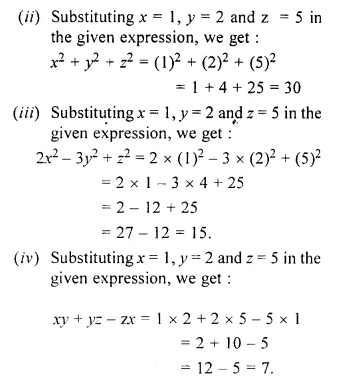
(i) Substituting x = 1, y = 2 and z = 5 in the given expression, we get :
3x – 2y + 4z = 3 x 1 – 2 x 2 + 4 x 5
= 3 – 4 + 20 = 23 – 4 = 19
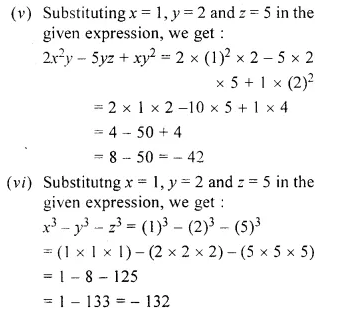
RS Aggarwal Class 6 Solutions Chapter 8 Algebraic Expressions Ex 8B Q2.1
RS Aggarwal Class 6 Solutions Chapter 8 Algebraic Expressions Ex 8B Q2.2

Question 3.
Solution:
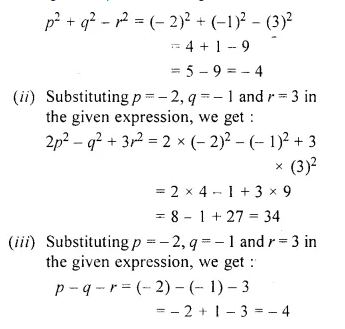
(i) Substituting p = – 2, q = – 1 and r = 3
in the given expression, we get :
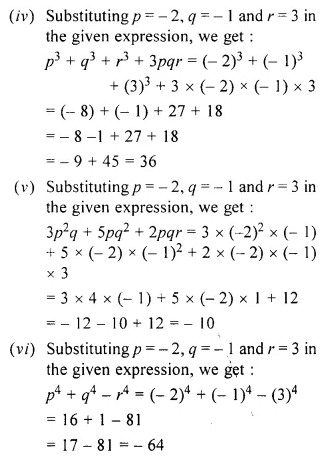
RS Aggarwal Class 6 Solutions Chapter 8 Algebraic Expressions Ex 8B Q3.1
RS Aggarwal Class 6 Solutions Chapter 8 Algebraic Expressions Ex 8B Q3.2

Question 4.
Solution:
(i) The coefficient of x in 13x is 13
(ii) The coefficient of y in – 5y is – 5
(iii) The coefficient of a in 6ab is 6b
(iv) The coefficient of z in – 7xz is – 7x
(v) The coefficient of p in – 2pqr is – 2qr
(vi) The coefficient of y2 in 8xy2z is 8xz
(vii) The coefficient of x3 in x3 is 1
(viii) The coefficient of x2 in – x2 is -1

Question 5.
Solution:
(i) The numerical coefficient of ab is 1
(ii) The numerical coefficient of – 6bc is – 6
(iii) The numerical coefficient of 7xyz is 7
(iv) The numerical coefficient of – 2x3y2z is – 2.

Question 6.
Solution:
(i) The constant term is 8
(ii) The constant term is – 9
(iii) The constant term is \(\\ \frac { 3 }{ 5 } \)
(iv) The constant term is \(– \frac { 8 }{ 3 } \)

Question 7.
Solution:
(i) The given expression contains only one term, so it is monimial.
(ii) The given expression contains only two terms, so it is binomial.
(iii) The given expression contains only one term, so it is monomial.
(iv) The given expression contains three terms, so it is trinomial.
(v) The given expression contains three terms, so it is trinomial.
(vi) The given expression contains only one term, so it is monomial.
(vii) The given expression contains four terms, so it is none of monomial, binomial and trinomial.
(viii) The given expression contains only one term so it is monomial.
(ix) The given expression contains two terms, so it is binomial.

Question 8.
Solution:
(i) The terms of the given expression 4x5 – 6y4 + 7x2y – 9 are :
4x5, – 6y4, 7x2y, – 9
(ii) The terms of the given expression 9x3 – 5z4 + 7x3y – xyz are :
9x3, – 5z4, 7x3y, – xyz.

Question 9.
Solution:
(i) We have : a2, b2, – 2a2, c2, 4a
Here like terms are a2, – 2a2
(ii) We have : 3x, 4xy, – yz, \(\\ \frac { 1 }{ 2 } \) zy
Here like terms are – yz, \(\\ \frac { 1 }{ 2 } \) zy
(iii) We have : – 2xy2, x2y, 5y2x, x2z
Here like terms are – 2xy2, 5y2x
(iv) We have :
abc, ab2c, acb2, c2ab, b2ac, a2bc, cab2
Here like terms are ab2c, acb2, b2ac, cab2.

Hope given RS Aggarwal Solutions Class 6 Chapter 8 Algebraic Expressions Ex 8B are helpful to complete your math homework.

If you have any doubts, please comment below. Learn Insta try to provide online math tutoring for you.

RS Aggarwal Class 6 Solutions Chapter 8 Algebraic Expressions Ex 8A

RS Aggarwal Class 6 Solutions Chapter 8 Algebraic Expressions Ex 8A

These Solutions are part of RS Aggarwal Solutions Class 6. Here we have given RS Aggarwal Solutions Class 6 Chapter 8 Algebraic Expressions Ex 8A.

Other Exercises

Question 1.
Solution:
(i) x + 12
(ii) y – 7
(iii) a – b
(iv) (x + y) + xy
(v) \(\\ \frac { 1 }{ 3 } \)x (a + b)
(vi) 7y + 5x
(vii) \(x+ \frac { y }{ 5 } \)
(viii) 4 – x
(ix) \(\\ \frac { x }{ y } -2\)
(x) x2
(xi) 2x + y
(xii) y2 + 3x 
(xiii) x – 2y
(xiv) y3 – x3
(xv) \(\\ \frac { x }{ 8 } \times y\)

Question 2.
Solution:
Marks scored in English = 80
Marks scored in Hindi = x
∴ Total score in the two subjects = 80 + x

Question 3.
Solution:
We can write :
(i) b × b × b ×….15 times = 615
(ii) y × y × y ×…..20 times = y20
(iii) 14 × a × a × a × a × b × b × b= 14a4 b3
(iv) 6 × x × x × y × y = 6x2y2
(v) 3 × z × z × z × y × y × x= 3z3y2x

Question 4.
Solution:
We can write :
(i) x2y4 = x × x × y × y × y × y
(ii) 6y5 = 6 × y × y × y × y × y
(iii) 9xy2z = 9 × x × y × y × z
(iv) 10a3b3c3 = 10 × a × a × a × b × b × b × c × c × c


Hope given RS Aggarwal Solutions Class 6 Chapter 8 Algebraic Expressions Ex 8A are helpful to complete your math homework.

If you have any doubts, please comment below. Learn Insta try to provide online math tutoring for you.

RD Sharma Class 8 Solutions Chapter 6 Algebraic Expressions and Identities Ex 6.5

RD Sharma Class 8 Solutions Chapter 6 Algebraic Expressions and Identities Ex 6.5

These Solutions are part of RD Sharma Class 8 Solutions. Here we have given RD Sharma Class 8 Solutions Chapter 6 Algebraic Expressions and Identities Ex 6.5

Other Exercises

Multiply:

Question 1.
(5x + 3) by (7x + 2)
Solution:
(5x + 3) x (7x + 2)
= 5x (7x + 2) + 3 (7x + 2)
= 35x2 + 10x + 21x + 6
= 35x2 + 31x + 6

Question 2.
(2x + 8) by (x – 3)
Solution:
(2x + 8) x (x – 3)
= 2x (x – 3) + 8 (x – 3)
= 2x2 – 6x + 8x – 24
= 2x2 + 2x – 24

Question 3.
(7x +y) by (x + 5y)
Solution:
(7x + y) x (x + 5y)
= 7x (x + 5y) + y (x + 5y)
= 7x2 + 35xy + xy + 5y2
=7x2 + 36xy + 5y2

Question 4.
(a – 1) by (0.1a2 + 3)
Solution:
(a – 1) x (0.1a2 + 3)
= a (0.1a2 + 3) – 1 (0.1a2+ 3)
= 0.1a3 + 3a-0.1a2-3
= 0.1a3 – 0.1a2 + 3a-3

Question 5.
(3x2 +y2) by (2x2 + 3y2)
Solution:
(3x2+y2) x (2x2 + 3y2)
= 3x2 (2x2 + 3y2) + y2(2x2 + 3y2)
= 6x2 +2 + 9x2y2 + 2x2y2 + 3y2 + 2
= 6x4 + 11 x2y2 + 3y4

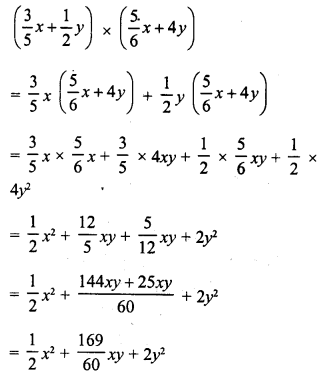
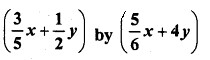
Question 6.
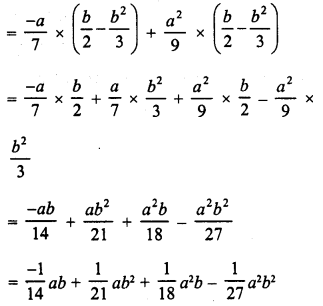
RD Sharma Class 8 Solutions Chapter 6 Algebraic Expressions and Identities Ex 6.5 1
Solution:
RD Sharma Class 8 Solutions Chapter 6 Algebraic Expressions and Identities Ex 6.5 2

Question 7.
(x6-y6) by (x2+y2)
Solution:
(x6 – y6) x (x2 + y2)
= x6 (x2 + y2) – y6 (x2 + y2)
= x6 x x2 + x6y2 – x2y6 -y6 x y2
= x6 + 2 + x6y2 – x2y6 – y6 +2
= x  + x6y2 – x2y6 – y8

Question 8.
(x2 + y2) by (3a+2b)
Solution:
(x2 + y2) x (3a + 2b)
= x2 (3a + 2b) + y2 (3a + 2b)
= 3x2a + 2x2b + 3y2a + 2y2b
3ax2 + 3av2 + 2bx2 + 2by2

Question 9.
[-3d + (-7ƒ)] by (5d +ƒ)
Solution:
[-3d + (-7ƒ)] x (5d +ƒ)
= -3d x (5d +ƒ) + (-7ƒ) x (5d +ƒ)
= -15d2-3dƒ- 35dƒ- 7ƒ2
= -15d2 – 38dƒ- 7ƒ2

Question 10.
(0.8a – 0.5b) by (1.5a -3b)
Solution:
(0.8a – 0.5b) x (1.5a-3b)
= 0.8a x (1.5a – 36) – 0.56 (1.5a -3b)
= 1.2a2 – 2.4ab – 0.75ab + 1.5b2
= 1.2a2-3.15ab+ 1.5b2

Question 11.
(2x2 y2 – 5xy2) by (x2 -y2)
Solution:
(2x2 y2 – 5xy2) x (x2 -y2)
= 2x2y2 (x2 – y2) – 5x_y2 (x2 – y2)
= 2x2y2 x x2 – 2x2y2 xy2– 5xy2 x x2 + 5x2 xy2
= 2x2 + 2 y2– 2x2 x y2 + 2– 5x1+2 y2+5xy2 + 2
= 2x4y2– 2x2y4 – 5x3y2+ 5xy4

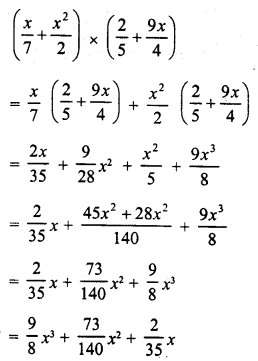
Question 12.
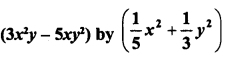
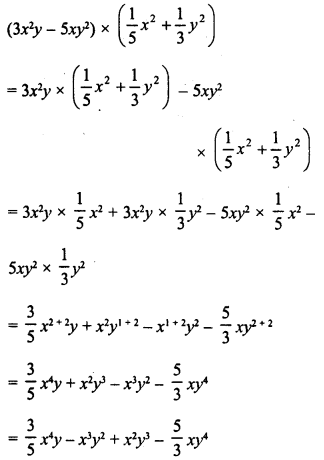
RD Sharma Class 8 Solutions Chapter 6 Algebraic Expressions and Identities Ex 6.5-q12
Solution:
RD Sharma Class 8 Solutions Chapter 6 Algebraic Expressions and Identities Ex 6.5 3

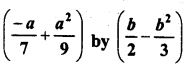
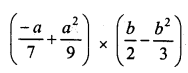
Question 13.
RD Sharma Class 8 Solutions Chapter 6 Algebraic Expressions and Identities Ex 6.5 4
Solution:
RD Sharma Class 8 Solutions Chapter 6 Algebraic Expressions and Identities Ex 6.5 5
RD Sharma Class 8 Solutions Chapter 6 Algebraic Expressions and Identities Ex 6.5 6

Question 14.
RD Sharma Class 8 Solutions Chapter 6 Algebraic Expressions and Identities Ex 6.5 7
Solution:
RD Sharma Class 8 Solutions Chapter 6 Algebraic Expressions and Identities Ex 6.5 8

Question 15.
(2x2-1) by (4x3 + 5x2)
Solution:
(2x2-1)x(4x3 + 5x2)
= 2x2 x (4x3 + 5x2) – 1 (4x3 + 5x2)
= 2x2 x 4x3 + 2x2 x 5x2 – 4x3 – 5x2
= 8x2 + 3 + 10x2 + 2-4x3-5x2
= 8x5 + 10x4 – 4x3 – 5x2

Question 16.
(2xy + 3y2) (3y2 – 2)
Solution:
(2xy + 3y2) (3y2 – 2)
= 2xy x (3y2-2) + 3y2 x (3y2-2)
= 2xy x Zy2+ 2xy x (-2) + Zy2 x Zy2 – Zy2 x 2
= 6xy1 + 2– 4xy + 9y2 + 2– 6y2
= 6xy3 – 4xy + 9y4– 6y2
Find the following products and verify the result for x = -1, y = -2 :

Question 17.
(3x-5y)(x+y)
Solution:
(3x-5y)(x+y)
= 3x x (x + y) – 5y x (x + y)
= 3x x x + 3x x y-5y x x-5y x y
= 3x2 + 3xy – 5xy – 5y2
= 3x2 – 2xy – 5y2
Verfification:
x = -1,y = -2
L.H.S. = (3x-5y)(x+y)
= [3 (-1) -5 (-2)] [-1 – 2]
= (-3 + 10) (-3) = 7 x (-3) = -21
R.H.S. = 3x2 – 2xy – 5y2
= 3 (-1)2 – 2 (-1) (-2) -5 (-2)2
=3×1-4-5×4=3-4-20
= 3-24 = -21
∴ L.H.S. = R.H.S.

Question 18.
(x2y-1) (3-2x2y)
Solution:
(x2y-1) (3-2x2y)
= x2y (3 – 2x2y) -1(3-2x2y)
= x2y x 3 – x2y x 2x2y – 1 x 3 + 1 x 2x2y
= 3x2y-2x2 + 2x y1 +1-3 + 2x2y
= 3x2y – 2x4y2– 3 + 2x2y
= 3x2y + 2x2y – 2x4y2 – 3
= 5x2y – 2x4y2 – 3
Verification : (x = -1, y = -2)
L.H.S. = (x2y – 1) (3 – 2x2y)
= [(-1)2 x (-2) -1] [3 – 2 x (-1)2 x (-2)]
= [1 x (-2) -1) [3 – 2 x 1 x (-2)]
= (-2 – 1) (3 + 4) = -3 x 7 = -21
R.H.S. = 5x2y – 2x4y2 – 3
= 5 (-1)2 (-2) -2 (-1)4 (-2)2 -3
5 x 1 (-2) – 2 (1 x 4) -3
= -10-8-3 = -21
∴ L.H.S. = R.H.S

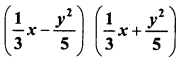
Question 19.
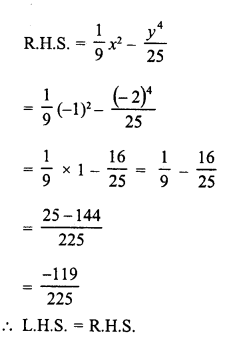
RD Sharma Class 8 Solutions Chapter 6 Algebraic Expressions and Identities Ex 6.5 9
Solution:
RD Sharma Class 8 Solutions Chapter 6 Algebraic Expressions and Identities Ex 6.5 10

Simplify :

Question 20.
x2 (x + 2y) (x – 3y)
Solution:
x2 (x + 2y) (x – 3y)
= x2 [x (x – 3y) + 2y (x – 3y)]
= x2 [x2 – 3xy + 2xy – 6y2]
= x2 [x2 – xy – 6y2)
= x2 x x2 – x2 x xy – x26y2
= x4 – x3y – 6x2y2

Question 21.
(x2 – 2y2) (x + 4y)
Solution:
(x2 – 2y2) (x + 4y) x2y2
= [x2 (x + 4y) -2y2 (x + 4y)] x2y2
= (x3 + 4x2y – 2xy2 – 8y3) x2y2
= x2y2 x x3 + x2y2 x 4x2y – 2x2y2 x xy2 – 8x2y2 x y3
= x2 +3 y2 + 4x2 + 2 y2 +1 – 2x2 +1 y2+ 2 – 8x2y2+3
= xy + 44xy3 – 2x3y4 – 8x2y5

Question 22.
a2b2 (a + 2b) (3a + b)
Solution:
a2b2 (a + 2b) (3a + b)
= a2b2 [a (3a + b).+ 2b (3a + b)]
= a2b2 [3a2 + ab + 6ab + 2b2]
= a2b2 [3a2 + lab + 2b2]
= a2b2 x 3a2 + a2b2 x 7ab + a2b2 x 2b2
= 3a2 + 2b2 + 7a2+1 b2+1+ 2a2b2 + 2
= 3a4b2 + 7a3b3 + 2a2b4

Question 23.
x2 (x-y) y2 (x + 2y)
Solution:
x2 (x -y) y2 (x + 2y)
= [x2 x x – x2 x y] [y2 x x + y2 x 2y]
= (x3 – x2y) (xy2 + 2y3)
= x3 (xy2 + 2y3) – x2y (xy2 + 2y3)
= x3 x xy2 + x3 x 2y3 – x2y x xy2 – x2y x 2y3
= x3 +1 y2 + 2x3y3 – x2 +1 y1+ 2 – 2x2y1 + 3
= x4y2 + 2x3y3 – x3y3 – 2x2y4
= x4y2 + x3y3 – 2x2y4

Question 24.
(x3 – 2x2 + 5x-7) (2x-3)
Solution:
(x3 – 2x2 + 5x – 7) (2x – 3)
= (2x – 3) (x3 – 2x2 + 5x – 7)
= 2x (x3 – 2x2 + 5x – 7) -3 (x3 – 2x2 + 5x – 7)
= 2x x x3 – 2x x 2x2 + 2x x 5x – 2x x 7 -3 x x3 – 3 x (-2x2) – 3 x 5x – 3 x (-7)
= 2x4-4x3 + 10x2– 14x-3x3 + 6x2– 15x + 21
= 2x4 – 4x3 – 3x3 + 10x2 + 6x2– 14x- 15x + 21
= 2x4-7x3 + 16x2-29x+ 21

Question 25.
(5x + 3) (x – 1) (3x – 2)
Solution:
(5x + 3) (x – 1) (3x – 2)
= (5x + 3) [x (3x – 2) -1 (3x – 2)]
= (5x + 3) [3x2 – 2x – 3x + 2]
= (5x + 3) [3x2 – 5x + 2]
= 5x (3x2 – 5x + 2) + 3 (3x2 – 5x + 2)
= (5x x 3x2 – 5x x Sx + 5x x 2)+ [3 x 3x2 + 3 x (-5x) + 3×2]
= 15x3 – 25x2 + 10x + 9x2 – 15x + 6
= 15x3 – 25x2 + 9x2 + 10x – 15x + 6
= 15x3 – 16x2 – 5x + 6

Question 26.
(5-x) (6-5x) (2-x)
Solution:
(5-x) (6-5x) (2-x)
= [5 (6 – 5x) -x (6 – 5x)] (2 – x)
= [30 – 2$x – 6x + 5x2] (2 – x)
= (30 – 3 1x + 5x2) (2-x)
= 2 (30 – 31x + 5x2) – x (30 – 31x + 5x2)
= 60 – 62x + 10x2 – 30x + 3 1x2 – 5x3
= 60 – 62x – 30x + 10x2 + 3 1x2 – 5x3
= 60 – 92x + 41x2 – 5x3

Question 27.
(2x2 + 3x – 5) (3x2 – 5x + 4)
Solution:
(2x2 + 3x – 5) (3x2 – 5x + 4)
= 2x2 (3x2 – 5x + 4) + 3x (3x2 – 5x + 4) -5 (3x2 – 5x + 4)
= 2x2 x 3x2 – 2x2 x 5x + 2x2 x 4 + 3x x 3x2 – 3x x 5x + 3x x 4 – 5 x 3x2 – 5 (-5x) -5×4
= 6x4 – 10x3 + 8x2 + 9x3 – 15x2 + 12x – 15x2 + 25x-20
= 6x4 – 10x3 + 9x3 + 8x2 – 15x2 – 15x2 + 12x + 25x – 20
= 6x4 – x3 – 22x2 + 37x – 20

Question 28.
(3x – 2) (2x – 3) + (5x – 3) (x + 1)
Solution:
(3x – 2) (2x – 3) + (5x – 3) (x + 1)
= 3x (2x – 3) -2 (2x – 3) + 5x (x + 1) – 3 (x + 1)
= 6x2 – 9x – 4x + 6 + 5x2 + 5x – 3x – 3
= 6x2 + 5x2 – 9x – 4x + 5x – 3x + 6 – 3
= 11x2– 11x + 3

Question 29.
(5x – 3) (x + 2) – (2x + 5) (4x – 3)
Solution:
(5x – 3) (x + 2) – (2x + 5) (4x – 3)
= [5x (x + 2) -3 (x + 2)] – [2x (4x – 3) + 5 (4x – 3)]
= [5x2 + 1 0x – 3x – 6] – [8x2 – 6x + 20x -15]
= (5x2 + 7x – 6) – (8x2 + 14x – 15)
= 5x2 + lx – 6 – 8x2 – 14x + 15
= 5x2 – 8x2 + 7x – 14x – 6 + 15
= -3x2 – 7x + 9

Question 30.
(3x + 2y) (4x + 3y) – (2x – y) (7x – 3y)
Solution:
(3x + 2y) (4x + 3y) – (2x – y) (7x – 3y)
= [3x (4x + 3y) + 2y (4x + 3y)]-[2x (7x-3y)-y(7x-3y)]
= (12x2 + 9xy + 8xy + 6y2) – (14x2 – 6xy – 7xy + 3y2)
= (12x2 + 17xy + 6y2) – (14x2 – 13xy + 3y2)
= 12x2 + 17xy + 6y2 – 14x2 + 13xy – 3y2
= 12x2 – 14x2 + 17xy + 13xy + 6y2 – 3y2
= -2x2 + 30xy + 3y2
= -2x2 + 3y2 + 30xy

Question 31.
(x2-3x + 2) (5x- 2) – (3x2 + 4x-5) (2x- 1)
Solution:
(x2-3x + 2) (5x- 2) – (3x2 + 4x-5) (2x- 1)
= [5x (x2 – 3x + 2) -2 (x2 – 3x + 2)] – [2x (3x2 + 4x – 5) -1 (3x2 + 4x – 5)]
= [5x3 – 15x2 + 10x – 2x2 + 6x – 4] – [6x3 + 8x2 – 10x – 3x2 – 4x + 5]
= [5x3 – 15x2 – 2x2 + 10xc + 6x – 4] – [6x3 + 8x2 – 3x2 – 10x – 4x + 5]
= (5x3 – 17x2 + 16x-4) – (6x3 + 5x2 – 14x + 5)
= 5x3 – 17x2 + 16x – 4 – 6x3 – 5x2 + 14x – 5
= 5x3 – 6x3 – 17x2 – 5x2 + 16x + 14x – 4 – 5
= -x3 – 22x2 + 30x – 9

Question 32.
x3 – 2x2 + 3x – 4) (x – 1) – (2x – 3) (x2 – x + 1)
Solution:
(x3 – 2x2 + 3x – 4) (x – 1) – (2x – 3) (x2 – x + 1)
= [x (x3 – 2x2 + 3x – 4) – 1 (x3 – 2x2 + 3x – 4)] – [2x (x2 – x + 1) – 3 (x2 – x + 1)]
= [x4 – 2x3 + 3x2 – 4x – x3 + 2x2 – 3x + 4] [2x3 – 2x2 + 2x – 3x2 + 3x – 3]
= (x4 – 2x3 – x3 + 3x2 + 2x2 – 4x – 3x + 4) (2x3 – 2x2 – 3x2 + 2x + 3x – 3)
= (x4 – 3x3 + 5x2 – 7x + 4) – (2x3 – 5x2 + 5x – 3)
= x4 – 3x3 + 5x2 – 7x + 4 – 2x3 + 5x2 – 5x + 3
= x4 – 3x3 – 2x3 + 5x2 + 5x2 – 7x – 5x + 4 + 3
= x4 – 5x3 + 10x2 – 12x + 7

Hope given RD Sharma Class 8 Solutions Chapter 6 Algebraic Expressions and Identities Ex 6.5 are helpful to complete your math homework.

If you have any doubts, please comment below. Learn Insta try to provide online math tutoring for you.