RS Aggarwal Class 6 Solutions Chapter 10 Ratio, Proportion and Unitary Method Ex 10D

RS Aggarwal Class 6 Solutions Chapter 10 Ratio, Proportion and Unitary Method Ex 10D

These Solutions are part of RS Aggarwal Solutions Class 6. Here we have given RS Aggarwal Solutions Class 6 Chapter 10 Ratio, Proportion and Unitary Method Ex 10D.

Other Exercises

OBJECTIVE QUESTIONS
Mark against the correct answer in each of the following :

Question 1
Solution:
(d) \(\\ \frac { 92 }{ 115 } \)
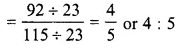
RS Aggarwal Class 6 Solutions Chapter 10 Ratio, Proportion and Unitary Method Ex 10D Q1.1

Question 2.
Solution:
(a) \(\\ \frac { 57 }{ x } \)
= \(\\ \frac { 51 }{ 85 } \)
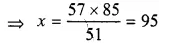
RS Aggarwal Class 6 Solutions Chapter 10 Ratio, Proportion and Unitary Method Ex 10D Q2.1

Question 3.
Solution:
(a) \(\\ \frac { 25 }{ 35 } \)
= \(\\ \frac { 45 }{ x } \)
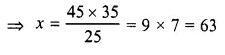
RS Aggarwal Class 6 Solutions Chapter 10 Ratio, Proportion and Unitary Method Ex 10D Q3.1

Question 4.
Solution:
(c) \(\\ \frac { 4 }{ 5 } \)
= \(\\ \frac { x }{ 35 } \)
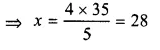
RS Aggarwal Class 6 Solutions Chapter 10 Ratio, Proportion and Unitary Method Ex 10D Q4.1

Question 5.
Solution:
(b) \(\\ \frac { a }{ b } \)
= \(\\ \frac { c }{ d } \)
=>ad = bc

Question 6.
Solution:
(b) a : b :: b : c
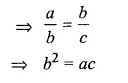
RS Aggarwal Class 6 Solutions Chapter 10 Ratio, Proportion and Unitary Method Ex 10D Q6.1

Question 7.
Solution:
(b) \(\\ \frac { 5 }{ 8 } \) < \(\\ \frac { 3 }{ 4 } \) => 4 x 5 < 3 x 8 => 20 < 24

Question 8.
Solution:
Total amount = Rs 760
Ratio A : B = 8 : 11
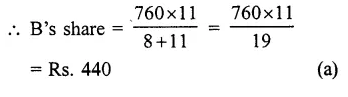
RS Aggarwal Class 6 Solutions Chapter 10 Ratio, Proportion and Unitary Method Ex 10D Q8.1

Question 9.
Solution:
(d) largest = \(\\ \frac { 252\times 7 }{ 5+7 } \)
= \(\\ \frac { 252\times 7 }{ 12 } \)
= 21 x 7
= 147

Question 10.
Solution:
(b) largest = \(\\ \frac { 90\times 5 }{ 1+3+5 } \)
= \(\\ \frac { 90\times 5 }{ 9 } \)
= 50 cm

Question 11.
Solution:
(c) total strength of school
largest = \(\\ \frac { 840 }{ 5 } \) x (12 + 5)
= \(\\ \frac { 840\times 17 }{ 5 } \)
= 168 x 17
= 2856

Question 12.
Solution:
(b) Cost of 12 pens = Rs 138
Cost of 1 pen = Rs \(\\ \frac { 138\times 14 }{ 12 } \)
and cost of 14 pens = Rs 161

Question 13.
Solution:
(b) \(\\ \frac { 24\times 15 }{ 8 } \)
= 45 days

Question 14.
Solution:
(a) \(\\ \frac { 26\times 40 }{ 20 } \)
= 52 men

Question 15.
Solution:
(b) In 6 L of petrol, a car covers = 111 km
In 1 L, it will cover = \(\\ \frac { 111 }{ 6 } \) km
and in 10 L it will cover = \(\\ \frac { 111\times 10 }{ 6 } \) km
= 185 km

Question 16.
Solution:
(a) \(\\ \frac { 28\times 550 }{ 700 } \)
= 22 days

Question 17.
Solution:
Ratio in the angles of triangle
= 3 : 1 : 2
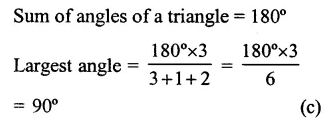
RS Aggarwal Class 6 Solutions Chapter 10 Ratio, Proportion and Unitary Method Ex 10D Q17.1

Question 18.
Solution:
(b) Ratio in length and breadth of a rectangle = 5 : 4
Width = 36 m
Length = \(\\ \frac { 5 }{ 4 } \) x 36 m
= 45m

Question 19.
Solution:
Bus covers in 3 hrs = 195 km
It will cover in 1 hr = \(\\ \frac { 195 }{ 3 } \) = 65 km
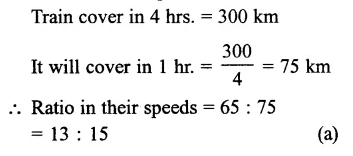
RS Aggarwal Class 6 Solutions Chapter 10 Ratio, Proportion and Unitary Method Ex 10D Q19.1

Question 20.
Solution:
1 dozen = 12 bars
Cost of 5 bars of soap = Rs.82.50
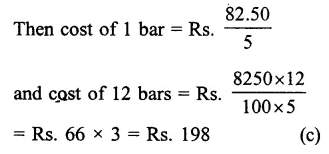
RS Aggarwal Class 6 Solutions Chapter 10 Ratio, Proportion and Unitary Method Ex 10D Q20.1

Question 21.
Solution:
Total pencils in 30 packets of 8 pencils
= 30 x 8= 240
and total pencils of 25 packets of 12
pencils = 25 x 12 = 300
Now cost of 240 pencils = Rs. 600
Then cost of 1 percent = Rs. \(\\ \frac { 600 }{ 24 } \)
and cost of 300 pencils = Rs. \(\\ \frac { 600\times 300 }{ 240 } \)
= Rs 750 (b)

Question 22.
Solution:
Journey of 75 km costs = Rs 215
Cost of 1 km = Rs \(\\ \frac { 215 }{ 75 } \)
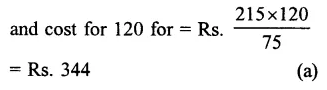
RS Aggarwal Class 6 Solutions Chapter 10 Ratio, Proportion and Unitary Method Ex 10D Q22.1

Question 23.
Solution:
1st term = 12
2nd term = 21
fourth term = 14
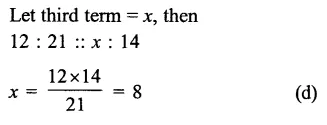
RS Aggarwal Class 6 Solutions Chapter 10 Ratio, Proportion and Unitary Method Ex 10D Q23.1

Question 24.
Solution:
10 boys dig a patch in = 12 hrs
1 boy will dig it in = 12 x 10 hours
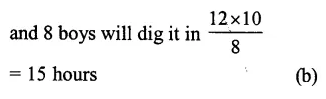
RS Aggarwal Class 6 Solutions Chapter 10 Ratio, Proportion and Unitary Method Ex 10D Q24.1

Hope given RS Aggarwal Solutions Class 6 Chapter 10 Ratio, Proportion and Unitary Method Ex 10D are helpful to complete your math homework.

If you have any doubts, please comment below. Learn Insta try to provide online math tutoring for you.
RD Sharma Class 8 Solutions Chapter 7 Factorizations Ex 7.9

RD Sharma Class 8 Solutions Chapter 7 Factorizations Ex 7.9

These Solutions are part of RD Sharma Class 8 Solutions. Here we have given RD Sharma Class 8 Solutions Chapter 7 Factorizations Ex 7.9

Other Exercises

Factorize each of the following quadratic polynomials by using the method of completing the square.
Question 1.
p2 + 6p + 8
Solution:
p2 + 6p + 8
= p2 + 2 x p x 3 + 32 – 32 + 8   (completing the square)
= (p2 + 6p + 32) – 1
= (p + 3)2 – 12
= (P + 3)2 – (1)2       { ∵ a2 + b2  = (a+b) (a-b)}
= (p +3+1) (p + 3 -1)
= (p+4) (p+ 2)

Question 2.
q2 – 10q + 21
Solution:
q2 – 10q + 21
= (q)2 – 2 x q x 5 + (5)2 – (5)2 + 21   (completing the square)
= (q)2 – 2 x q x 5 + (5)2 -25+21
= (q)2-2 x q x 5 + (5)2 – 25 +21
= (q)2-2 x q x 5 + (5)2 – 4
= (q – 5)2 – (2)     {∵ a2 – b2 = (a + b) (a – b)}
= (q- 5 + 2) (q-5-2)
=(q- 3) (q-7)

Question 3.
4y2 + 12y + 5
Solution:
4y+12y + 5
= (2y)2 + 2 x 2y x 3 + (3)2 – (3)2 + 5    (completing the square)
= (2y + 3)2 – 9 + 5
= (2y + 3)2 – 4
= (2y + 3)2-(2)2   {∵ a2 – b2 = (a + b) (a – b)}
= (2y + 3 + 2) (2y + 3 – 2)
= (2y + 5) (2y+ 1)

Question 4.
p2 + 6p- 16
Solution:
p2 + 6p – 16
= (p)2 + 2 x  p x 3 + (3)2 – (3)2 – 16    (completing the square)
= (p)2 + 2 x p x 3 + (3)2 – 9 – 16
= (p + 3)2 – 25
= (p + 3)2 – (5)2     {∵ a2 -b2 = {a + b) (a – b)}
= (p + 3 + 5)(p + 3-5)
= (p + 8) (p – 2)

Question 5.
x2 + 12x + 20
Solution:
x2 + 12x + 20
= (x)2 + 2 x x x 6 + (6)2 – (6)2 + 20   (completing the square)
= (x)2 + 2 x x x6 + (6)2 -36 + 20
= (x + 6)2 -16
= (x + 6)2 – (4)2   {∵ a2 – b2 = (a + b) (a – b)}
= (x + 6 + 4) (x + 6 – 4)
= (x + 10) (x + 2)

Question 6.
a2 – 14a – 51
Solution:
a2 – 14a-51
= (a)2 – 2 x x 7 + (7)2 – (7)2 – 51       (completing the square)
= (a)2 – 2 x a x 7 + (7)2 – 49 – 51
= (a – 7)2 – 100
= (a – 7)2 – (10)2    {∵  a2 – b2 = (a + b) (a – b)}
= (a – 7 + 10) (a – 7 – 10)
= (a + 3) (a – 17)

Question 7.
a2 + 2a – 3
Solution:
a2 + 2a – 3
= (a)2 + 2 x a x 1 + (1)2 – (1)2 – 3   (completing the square)
= (a)2 + 2 x a x 1 + (1)2 – 1 – 3
= (a + 1)2 – 4
= (a + 1)2 – (2){∵ a2 – b2 = (a + b) (a – b)}
= (a + 1 + 2) (a + 1 – 2)
= (a + 3) (a – 1)

Question 8.
4x2 – 12x + 5
Solution:
4x2 – 12x + 5
= (2x)2 – 2 x 2x x 3 + (3)2 – (3)2 + 5  (completing the square)
= (2x)2 – 2 x 2x x 3 + (3)2 -9 + 5
= (2x – 3)2 – 4
= (2x – 3)2 – (2)2      
{∵ a2b2 = (a + b) (a – b)}
=
(2x – 3 + 2) (2x – 3 – 2)
= (2x – 1) (2x – 5)

Question 9.
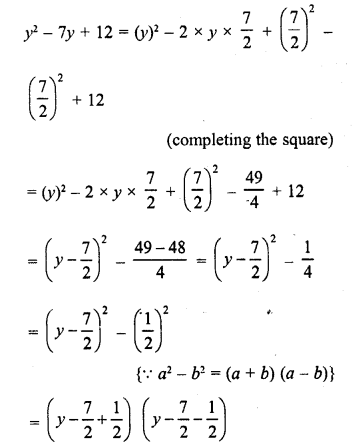
y2 – 7y + 12
Solution:
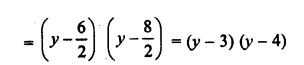
RD Sharma Class 8 Solutions Chapter 7 Factorizations Ex 7.9 1
RD Sharma Class 8 Solutions Chapter 7 Factorizations Ex 7.9 2

Question 10.
z2-4z-12
Solution:
z2 – 4z – 12
= (z)2 – 2 z x 2 + (2)2 – (2)2 – 12  (completing the square)
= (z)2 – 2 x z x 2 + (2)2 – 4 – 12
= (z-2)2-16
= (z-2)2-(4)2   {∵ a2 – b2 = (a + b) (a – b)}
= (z – 2 + 4) (z – 2 – 4)
= (z + 2)(z-6)

Hope given RD Sharma Class 8 Solutions Chapter 7 Factorizations Ex 7.9 are helpful to complete your math homework.

If you have any doubts, please comment below. Learn Insta try to provide online math tutoring for you.
Value Based Questions in Science for Class 10 Chapter 9 Heredity and Evolution

Value Based Questions in Science for Class 10 Chapter 9 Heredity and Evolution

These Solutions are part of Value Based Questions in Science for Class 10. Here we have given Value Based Questions in Science for Class 10 Chapter 9 Heredity and Evolution

Question 1.
Theory of natural selection stresses upon struggle for existence and survival of the fittest. How is this applicable to us ?
Answer:
Struggle is natural to our existence. A toddler will struggle to get up and walk. Every body struggled to get admission in a good school. There is struggle to get selected in the school team for various sports and extracurricular activities. Every student works hard to score well in the examination. People struggle to get job after finishing the studies. There is struggle to remain fit, and so on. In the struggle for any aspect of life only the fittest are able to win and obtain what they are aspiring whether in sports team or merit in studies or a job after studies.

More Resources

Question 2.
Everybody cannot be topper or a good sportsperson. But everybody has some good quality where he or she can excel whether it is painting, gardening, singing, playing instruments, dancing, a good salesman, a good entertainer or event management. What is social impact of emigration and acclimitisation ?
Answer:
A person emigrates to another state or country in order to get better opportunities, better perks and better living. Initially the person calls his home more frequently and also visits his place as often as possible. However, slowly he mixes up in the society where he works and lives. As acclimitisation increases, his calls and visits to his home become less frequent, His childern who are brought up in a different environment are unable to adjust themselves in the family and his old circle of relations. This disinterest in visiting fathers old home and family adds to inability of the person to go home as frequendy. In the new area the children grow up in a different set up. Their attitude and perceptions are often at variance with that of the parents. Clashes may occur. Ultimately the emigrant feels quite unsatisfied, dejected but helpless.

Question 3.
Recessive traits do not express their effect in the presence of dominant traits. How is this fact useful in overcoming hereditary diseases in the families ?
Answer:
Most hereditary diseases are caused by recessive traits in the homozygous state. Homozygosity increases if marriages are performed within relatives of upto 4-6 generations. In heterozygous state the recessive traits remain suppressed due to presence of dominant traits. Therefore, for overcoming hereditary diseases, it is important that individuals should remain heterozygous. This is possible only through out crossing or marriages between unrelated individuals or not having common ancestors on either side for 4-6 generations.

Question 4.
Raghu often taunts his wife for having only daughters and no son. As a student of biology how will you convince Raghu that his wife has no role in giving birth to girls only ?
Answer:
By telling Raghu that sex of the child is determined at the time of conception. Women are homogametic, i.e., they produce only one type of ova (22 + X). Males are heterogametic. They produce two types of sperms, androsperms (22 + Y) and gynosperms (22 + X). The two types of sperms are formed in equal proportion. It is chance factor that gynosperm fuses with the ovum (22 + X and 22 + X) resulting in the female child. The same chance is possible for the second and even the third time. In any case, for the sex of the child, only the father is responsible.

Hope given Value Based Questions in Science for Class 10 Chapter 9 Heredity and Evolution are helpful to complete your science homework.

If you have any doubts, please comment below. Learn Insta try to provide online science tutoring for you.

HOTS Questions for Class 10 Science Chapter 9 Heredity and Evolution

HOTS Questions for Class 10 Science Chapter 9 Heredity and Evolution

These Solutions are part of HOTS Questions for Class 10 Science. Here we have given HOTS Questions for Class 10 Science Chapter 9 Heredity and Evolution

Question 1.
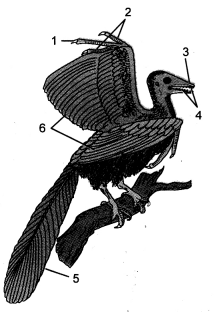
Observe the diagram carefully. What does it depict ? Identify the parts shown by lines.
HOTS Questions for Class 10 Science Chapter 9 Heredity and Evolution image - 1
Answer:
Reconstruction of fossil bird Archaeopteryx.

  1. Claw
  2. Free fingers
  3. Beak
  4. Teeth
  5. Tail
  6. Feathers

More Resources

Question 2.
Name the organism in which feathers appeared for the first time.
Answer:
Members of Dromaesaur family which were small dinosaurs.

Question 3.
Which one is the edible part in Kale, Kohlrabi, Broccoli, Brussel’s Sprout, Cabbage and Cauliflower ?
Answer:
Kale — Leaves,
Kohlrabi — Swollen stem,
Broccoli — Immature green flowers,
Brussel’s Sprout — Axillary buds,
Cabbage — Terminal bud,
Cauliflower — Immature inflorescence of sterile flowers.

Question 4.
Give an example where temperature determines the sex of the new bom.
Answer:

  1. Chrysema picta (a turtle). Temperature above 33°C produces females and below 28°C males.
  2. Agama agama (a lizard). High temperature produces males.

Question 5.
Name a recessive trait which is quite common in human beings.
Answer:
Blood group O (I°I°).

Question 6.
Why is variation beneficial for the species but not necessarily for the individual ? (CBSE Foreign 2010)
Answer:
Preadaptation is a variation which under normal conditions is of no advantage to the individual bearing it. However, it becomes highly useful in survival under changed environment, e.g, heat wave in temperate environment, insecticide or antibiotic resistance.

Hope given HOTS Questions for Class 10 Science Chapter 9 Heredity and Evolution are helpful to complete your science homework.

If you have any doubts, please comment below. Learn Insta try to provide online science tutoring for you.

RS Aggarwal Class 6 Solutions Chapter 10 Ratio, Proportion and Unitary Method Ex 10C

RS Aggarwal Class 6 Solutions Chapter 10 Ratio, Proportion and Unitary Method Ex 10C

These Solutions are part of RS Aggarwal Solutions Class 6. Here we have given RS Aggarwal Solutions Class 6 Chapter 10 Ratio, Proportion and Unitary Method Ex 10C.

Other Exercises

Question 1.
Solution:
Cost of 14 m of cloth = Rs. 1890
Cost of 1 m = Rs. \(\\ \frac { 1890 }{ 14 } \)
and cost of 6 m = Rs. \(\\ \frac { 1890\times 6 }{ 14 } \)
= Rs. 135 x 6
= Rs. 810

Question 2.
Solution:
Cost of 1 dozen or 12 soaps = Rs. 285.60
Cost of 1 soap = Rs. \(\\ \frac { 285.60 }{ 12 } \)
Cost of 15 soaps = Rs. \(\\ \frac { 285.60\times 15 }{ 12 } \)
= Rs. 357.00

Question 3.
Solution:
Cost of 9 kg of rice = Rs. 327.60
Cost of 1 kg = Rs. \(\\ \frac { 327.60 }{ 9 } \)
and cost of 50 kg = Rs. \(\\ \frac { 327.60\times 50 }{ 9 } \)
= Rs. 36.40 x 50
= Rs. 1820

Question 4.
Solution:
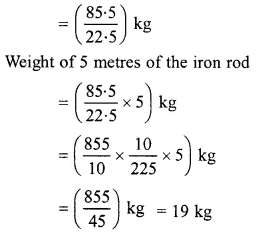
Weight of 22.5 metres of the iron rod: = 85.5 kg
Weight of 1 metre of the iron rod
RS Aggarwal Class 6 Solutions Chapter 10 Ratio, Proportion and Unitary Method Ex 10C Q4.1

Question 5.
Solution:
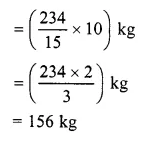
Quantity of oil in 15 tins = 234 kg
Quantity of oil in 1 tin = \(\\ \frac { 234 }{ 15 } \) kg
Quantity of oil in 10 tins
RS Aggarwal Class 6 Solutions Chapter 10 Ratio, Proportion and Unitary Method Ex 10C Q5.1

Question 6.
Solution:
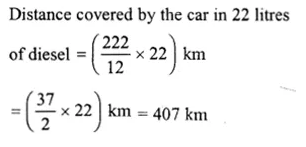
Distance covered by the car in 12 litres of diesel = 222 kms
Distance covered by the car in 1 litre of diesel = \(\\ \frac { 222 }{ 12 } \) km
RS Aggarwal Class 6 Solutions Chapter 10 Ratio, Proportion and Unitary Method Ex 10C Q6.1

Question 7.
Solution:
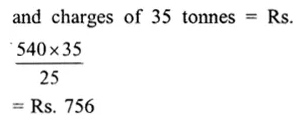
Charges of 25 tonnes of weight = Rs. 540
charges of 1 ton = Rs.\(\\ \frac { 540 }{ 25 } \)
RS Aggarwal Class 6 Solutions Chapter 10 Ratio, Proportion and Unitary Method Ex 10C Q7.1

Question 8.
Solution:
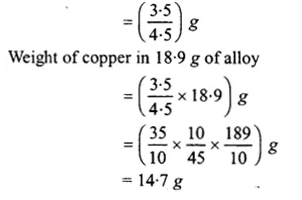
Weight of copper in 4.5 g of alloy = 3.5g
Weight of copper in 1 g of alloy
RS Aggarwal Class 6 Solutions Chapter 10 Ratio, Proportion and Unitary Method Ex 10C Q8.1

Question 9.
Solution:
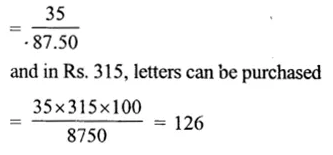
In Rs. 87.50, the inland letter are purchased = 35
In Re. 1, letters can be purchased
= \(\\ \frac { 35 }{ 87.50 } \)
and in Rs. 315, letters can be purchased
RS Aggarwal Class 6 Solutions Chapter 10 Ratio, Proportion and Unitary Method Ex 10C Q9.1

Question 10.
Solution:
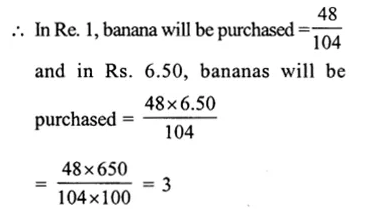
4 dozen = 4 x 12 = 48 bananas
In Rs. 104, banana are purchased = 48
RS Aggarwal Class 6 Solutions Chapter 10 Ratio, Proportion and Unitary Method Ex 10C Q10.1

Question 11.
Solution:
In Rs. 22770, chairs are purchased =18
In Re. 1, chairs will be purchased
= \(\\ \frac { 18 }{ 22770 } \)
and in Rs. 10120, chairs will be
purchased = \(\\ \frac { 18\times 10120 }{ 22770 } \)
= 8

Question 12.
Solution:
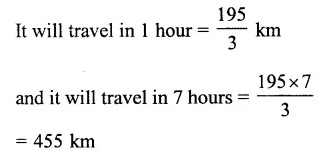
(i) A car travels 195 km distance in = 3 hours
It will travel 1 km distance in = \(\\ \frac { 3 }{ 195 } \) hr.
and it will travel 520 km distance in
= \(\\ \frac { 3\times 520 }{ 195 } \)
= 8 hr
(ii) A car travels in 3hr = 195 km
RS Aggarwal Class 6 Solutions Chapter 10 Ratio, Proportion and Unitary Method Ex 10C Q12.1

Question 13.
Solution:
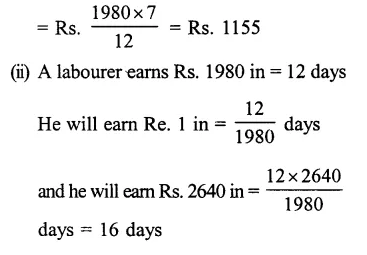
(i) A laborer earn in 12 days = Rs. 1980
He will earn in 1 day = Rs. \(\\ \frac { 1980 }{ 12 } \)
and he will earn in 7 days
RS Aggarwal Class 6 Solutions Chapter 10 Ratio, Proportion and Unitary Method Ex 10C Q413.1

Question 14.
Solution:
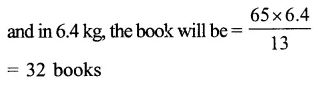
(i) Weight of 65 books = 13 kg
Then weight of 1 book = \(\\ \frac { 13 }{ 65 } \) kg
RS Aggarwal Class 6 Solutions Chapter 10 Ratio, Proportion and Unitary Method Ex 10C Q14.1

Question 15.
Solution:
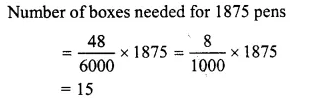
Number of boxes needed for 6000 pens = 48
Number of boxes needed for 1 pen 48 = \(\\ \frac { 48 }{ 6000 } \)
RS Aggarwal Class 6 Solutions Chapter 10 Ratio, Proportion and Unitary Method Ex 10C Q15.1

Question 16.
Solution:
Clearly, less workers will build the wall in more days.
And, more workers will build the wall in less days.
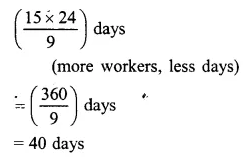
24 workers can build the wall in 15 days
1 worker can build the wall in (15 x 24) days
(less worker, more days)
9 workers will build the wall in
RS Aggarwal Class 6 Solutions Chapter 10 Ratio, Proportion and Unitary Method Ex 10C Q16.1

Question 17.
Solution:
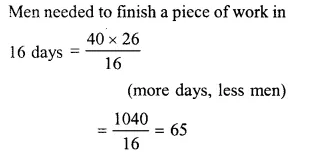
Men needed to finish a piece of work in 26 days = 40
Men needed to finish a piece of work in 1 day = 40 x 26 (less days, more men)
RS Aggarwal Class 6 Solutions Chapter 10 Ratio, Proportion and Unitary Method Ex 10C Q17.1

Question 18.
Solution:
Clearly, less men will take more days to consume the food.
And, more men will take less days to consume the food.
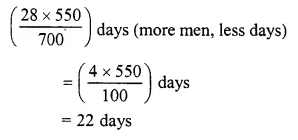
550 men have provisions for 28 days
1 men has provisions for (28 x 550) days [less men, more days]
700 men will have provisions for
RS Aggarwal Class 6 Solutions Chapter 10 Ratio, Proportion and Unitary Method Ex 10C Q18.1

Question 19.
Solution:
Clearly, less persons will consume the rice in more days.
And more persons will consume the rice in less days.
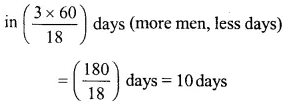
60 persons consume the bag of rice in 3 days.
1 person will consume the bag of rice in
(3 x 60) days (less persons, more days)
18 persons will consume the bag of rice
RS Aggarwal Class 6 Solutions Chapter 10 Ratio, Proportion and Unitary Method Ex 10C Q19.1

Hope given RS Aggarwal Solutions Class 6 Chapter 10 Ratio, Proportion and Unitary Method Ex 10C are helpful to complete your math homework.

If you have any doubts, please comment below. Learn Insta try to provide online math tutoring for you.