ML Aggarwal Class 7 Solutions for ICSE Maths Chapter 1 Integers Ex 1.2

Are you looking for the best ICSE Understanding Mathematics ML Aggarwal Class 7 Solutions? Then, grab them from our page and ace up your preparation for ICSE Class 7 Exams.

ML Aggarwal Class 7 Solutions for ICSE Maths Chapter 1 Integers Ex 1.2

Question 1.
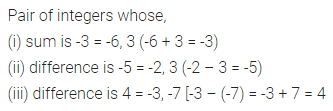
Write a pair of integers whose:
(i) sum is -3
(ii) difference is -5
(iii) difference is 4
Solution:
ML Aggarwal Class 7 Solutions for ICSE Maths Chapter 1 Integers Ex 1.2 1

Question 2.
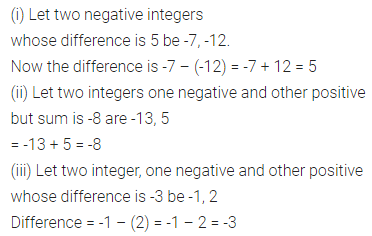
(i) Write a pair of negative integers whose difference is 5.
(ii) Write a negative integer and a positive integer whose sum is -8.
(iii) Write a negative integer and a positive integer whose difference is -3.
Solution:
ML Aggarwal Class 7 Solutions for ICSE Maths Chapter 1 Integers Ex 1.2 2

Question 3.
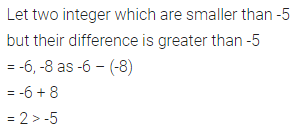
Write two integers which are smaller than -5 but their difference is greater than -5.
Solution:
ML Aggarwal Class 7 Solutions for ICSE Maths Chapter 1 Integers Ex 1.2 3

Question 4.
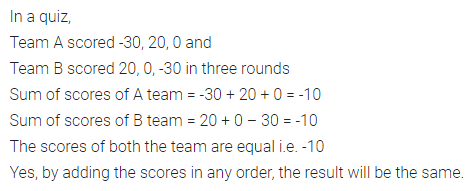
In a quiz, team A scored -30, 20, 0 and team B scored 20, 0, -30 in three successive rounds. Which team scored more? Can we
say that we can add integers in any order?
Solution:
ML Aggarwal Class 7 Solutions for ICSE Maths Chapter 1 Integers Ex 1.2 4

Question 5.
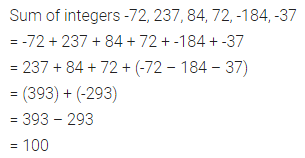
Find the sum of integers -72, 237, 84, 72, -184, -37.
Solution:
ML Aggarwal Class 7 Solutions for ICSE Maths Chapter 1 Integers Ex 1.2 5

ML Aggarwal Class 7 Solutions for ICSE Maths Chapter 1 Integers Ex 1.1

Are you looking for the best ICSE Understanding Mathematics ML Aggarwal Class 7 Solutions? Then, grab them from our page and ace up your preparation for ICSE Class 7 Exams.

ML Aggarwal Class 7 Solutions for ICSE Maths Chapter 1 Integers Ex 1.1

Question 1.
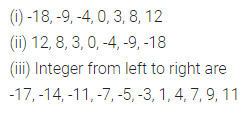
Some integers are marked on the following number line:
ML Aggarwal Class 7 Solutions for ICSE Maths Chapter 1 Integers Ex 1.1 1
(i) Write these integers in ascending order.
(ii) Write these integers in descending order.
(iii) Few dots have been marked on the above number line. Write an appropriate integer at each dot.
Solution:
ML Aggarwal Class 7 Solutions for ICSE Maths Chapter 1 Integers Ex 1.1 2

Question 2.
A number line representing integers is given below:
ML Aggarwal Class 7 Solutions for ICSE Maths Chapter 1 Integers Ex 1.1 3
The integers -3 and -2 are marked by points E and F respectively. Which integers are marked by points B, D, H, J, M and O?
Solution:
ML Aggarwal Class 7 Solutions for ICSE Maths Chapter 1 Integers Ex 1.1 4

Question 3.
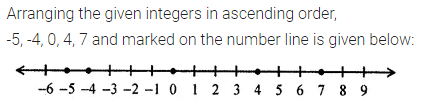
Arrange 7, -5, 4, 0 and -4 in ascending order and mark them on a number line to check your answer.
Solution:
ML Aggarwal Class 7 Solutions for ICSE Maths Chapter 1 Integers Ex 1.1 5

Question 4.
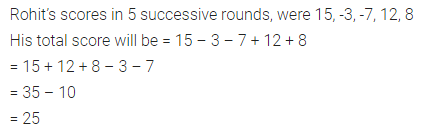
In a quiz, positive marks are given for correct answers and negative marks are given for incorrect answers. If Rohit’s scores in five successive rounds were 15, -3, -7, 12 and 8, what was his total at the end?
Solution:
ML Aggarwal Class 7 Solutions for ICSE Maths Chapter 1 Integers Ex 1.1 6

Question 5.
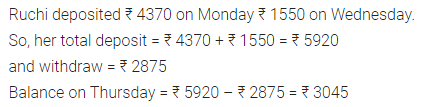
Ruchi deposited ₹ 4370 in her account on Monday and then withdrew ₹ 2875 on Tuesday. Next day she deposited ₹ 1550. What was her balance on Thursday?
Solution:
ML Aggarwal Class 7 Solutions for ICSE Maths Chapter 1 Integers Ex 1.1 7

Question 6.
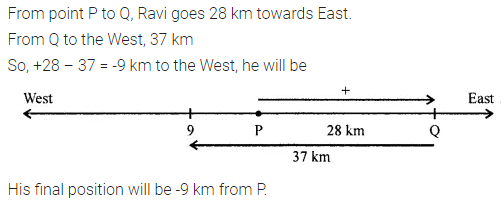
Ravi goes 28 km towards east from a point P to the point Q. From Q, he moves 37 km towards the west along the same road. If the distance towards east is represented by a positive integer then, how will you represent the distance travelled towards the west? By which integer will you represent his final position from P?
ML Aggarwal Class 7 Solutions for ICSE Maths Chapter 1 Integers Ex 1.1 8
Solution:
ML Aggarwal Class 7 Solutions for ICSE Maths Chapter 1 Integers Ex 1.1 9

Question 7.
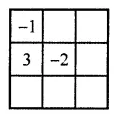
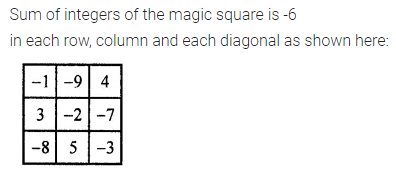
Fill in the blank spaces by integers of the given magic square so that the sum of the integers in each row, each column and each diagonal is -6.
ML Aggarwal Class 7 Solutions for ICSE Maths Chapter 1 Integers Ex 1.1 10
Solution:
ML Aggarwal Class 7 Solutions for ICSE Maths Chapter 1 Integers Ex 1.1 11

Question 8.
Evaluate the following:
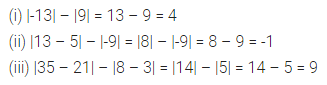
(i) |-13| – |9|
(ii) |13 – 5| – |-9|
(iii) |35 – 21| – |8 – 3|
Solution:
ML Aggarwal Class 7 Solutions for ICSE Maths Chapter 1 Integers Ex 1.1 12

Question 9.
Arrange the following integers in ascending order:
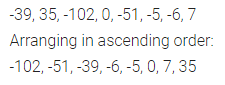
-39, 35, -102, 0, -51, -5, -6, 7
Solution:
ML Aggarwal Class 7 Solutions for ICSE Maths Chapter 1 Integers Ex 1.1 13

Question 10.
Arrange the following integers in descending order:
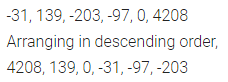
-31, 139, -203, -97, 0, 4208
Solution:
ML Aggarwal Class 7 Solutions for ICSE Maths Chapter 1 Integers Ex 1.1 14

Question 11.
State whether each of the following statement is true or false:
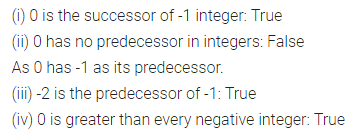
(i) 0 is the successor of -1 in integers
(ii) 0 has no predecessor in integers
(iii) -2 is the predecessor of -1
(iv) 0 is greater than every negative integer.
Solution:
ML Aggarwal Class 7 Solutions for ICSE Maths Chapter 1 Integers Ex 1.1 15

Question 12.
Use the sign >, < or = in the box to make the following statements true:
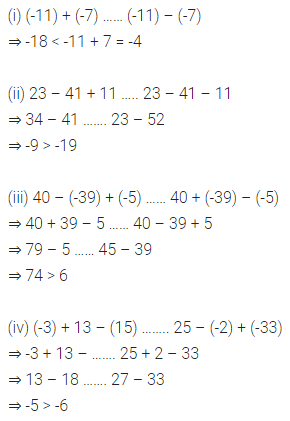
(i) (-11) + (-7) ……….. (-11) – (-7)
(ii) 23 – 41 + 11 ……… 23 – 41 – 11
(iii) 40 – (-39) + (-5) …….. 40 + (-39) – (-5)
(iv) (-3) + 13 – (15) ……. 25 – (-2) + (-33)
Solution:
ML Aggarwal Class 7 Solutions for ICSE Maths Chapter 1 Integers Ex 1.1 16

A Slumber did my Spirit Seal Extra Questions and Answers Class 9 English Beehive

Here we are providing A Slumber did my Spirit Seal Extra Questions and Answers Class 9 English Beehive, Extra Questions for Class 9 English was designed by subject expert teachers.

A Slumber did my Spirit Seal Extra Questions and Answers Class 9 English Beehive

A Slumber did my Spirit Seal Extra Questions and Answers Short Answer Type

Question 1.
What does the poet mean by ‘spirit’ and in what state was it?
Answer:
In the poem the word ‘spirit’ refers to the mind of the poet. He was in a slumber. That is, a deep sleep or a state of unawareness as if unconscious to the realities of life. It is as if he was drugged or under some spell.

Question 2.
What caused the slumber of the poet?
Answer:
The poet was passionately in love with the girl. Her death shocked and saddened him. He felt bitter grief. His deep emotion overwhelmed his mind. Such was the intensity of his sorrow that it overpowered his consciousness.

Question 3.
What changes did the slumber bring in the poet’s feelings?
Answer:
The poet was shocked and saddened by his beloved’s death. But the slumber brought peace to his mind. He realised that his beloved had become part of Nature and would always remain around him.

Question 4.
Who does not feel any human fears? Why?
Answer:
The poet does not feel any fears and his soul feels at peace, as though asleep and existing in a deep calm where he has nothing to fear. His love for Lucy was so strong that he did not want her to grow old and suffer the problems of old age as human beings do. She would not now be marked by the passing of time or the ravages of nature as other mortals are. For him, she has attained the status of a supernatural being.

Question 5.
Explain the line: “The touch of earthly years”. Who would not feel the touch of earthly years?
Answer:
The expression “The touch of earthly years,” refers to the ravages of old age faced by human beings – the depletion of energy, diseases, senility and death which a person has to suffer as one grows old during life on this earth. The poet’s beloved Lucy will not face the problems of old age as she is no more alive.

Question 6.
How does the poet come out of his ‘slumber’?
Answer:
The poet comes out of ‘slumber’ as the realisation dawns of him that with her death Lucy is no longer a human being and as vulnerable to death as others. She has become an immortal being and he sees her as a supernatural goddess. This brings him out of his unconsciousness or ‘slumber’.

Question 7.
How does the poet react to his loved one’s death?
Answer:
At first the poet is shocked by the death of his beloved and he feels bitter grief. But after some realisation, he feels a great peace. He is content that the passing of time will no longer affect her. She has become part of Nature and is free from human travails.

Question 8.
The poet does not refer to the death of Lucy. How does he reveal that she is no more?
Answer:
The poet does not refer to Lucy as being dead directly. However, he makes it obvious that she is no longer alive by stating that she has become completely still, motionless, inactive and inert. Moreover, she has lost her senses of hearing and seeing.

Question 9.
How does the poet imagine “her” to be after death?
Answer:
The poet imagines her to be at peace after death. She is in a deep sleep, no longer affected by worldly affairs or by the passage of time. She is now part of nature. ‘No motion has she now, no force She neither hears nor sees,’

Question 10.
What does the poet mean by “earth’s diurnal course”? How has “she” become a part of earth’s diurnal course?
Answer:
The phrase “earth’s diurnal course” refers to the daily rotation of the earth on its axis that causes day and night. According to the poet Lucy has become an inseparable part of the earth after her death. As she has mingled with the earth, she naturally participates in its daily course just like the stones, the rocks, and the trees.

Question 11.
What is the relation of Lucy with rocks, stones, and trees?
Answer:
Lucy, after her death, has part of Nature as she has mingled with the soil. As such she is a part of the other things on the earth like rocks, stones or trees. She has now become a part of Nature.

Question 12.
What is the central theme of the poem?
Answer:
The poem deals with the loss of a loved one through death and the sorrow that follows. The death of Lucy left the poet in great pain. However, Wordsworth conveys the idea that death may separate our loved ones from us but they always remain around us in the form of nature. Wordsworth immortalizes Lucy by stating that she lives on in Nature after her physical death. Therefore, the death of a loved one should not leave us grief-stricken.

A Slumber did my Spirit Seal Extra Questions and Answers Long Answer Type

Question 1.
Give a brief summary of the poem ‘A Slumber Did My Spirit Seal’ in your own words.
Answer:
In the poem A Slumber Did My Spirit Seal the poet says that grief over the death of his beloved has left him numb and that human fears no longer affect him. But he realises the reality of life after her death and through this realisation he has now attained peace. He is content as the passing of time will no longer affect her. She is in her grave, covered with soil and has thus become the part of Nature and of the earth. She is rolling with the earth as it turns from day to night and vice versa.

Question 2.
How did Lucy’s death affect the poet? What does it reveal about his attitude towards her?
Answer:
The poet remarks that he had become unaware of the realities of life when he was under the spell of Lucy’s love. He felt as if he was under some spell and this seemed to have clouded his sense of reasoning. He felt Lucy was not subject to the consequences of time and the aging process. He did not realise she would one day be conquered by death. For him, she had attained the status of a supernatural being – a goddess or a deity beyond worldly suffering.

Such was the poet’s intensity of love for the girl that he was blind to the hard fact of life that everybody who is born has to ultimately die. Death, however, leaves her unable to perform any physical activity. As he comes to terms of her death, the poet feels that in her death his beloved Lucy has become a part of Nature. She is now under the surface of the earth and revolving along with it on its path. He tells us that like other stones, rocks and trees she also revolves with the earth now.

Question 3.
How does the poet reveal that Lucy is dead without using the words ‘death’ or ‘dead’? What according to him, has happened to Lucy after her death?
Answer:
Though the poet does not use the words ‘death’ or ‘dead’ for Lucy, yet he is able to convey very clearly that Lucy is no longer alive. He writes that Lucy has lost all force and strength; she has become absolutely inert and motionless. Her body has lost all activity. The young girl is also deprived of her senses like that of hearing or seeing. He says that her body has integrated itself with the earth. She has become as inseparable from the earth as stones, rocks, or trees. Like them, she rolls with the earth as it rotates on its axis. The idea that she still exists as a part of the earth soothes the mind of the poet who does not shed tears or cry over her death.

A Slumber did my Spirit Seal Extra Questions and Answers Reference to Context

Read the extracts given below and answer the questions that follow.

Question 1.
A slumber did my spirit seal
I had no human fears.
She seemed a thing that could not feel
The touch of earthly years.

(a) What was the poet’s state of mind when Lucy was alive?
Answer:
When Lucy was alive the poet was in a state of spiritual peace as he did not even think about her aging or dying.

(b) What was the ‘human fear’ he did not have?
Answer:
It blinded him to the reality that eventually all things that are born perish or die one day.

(c) Why did he not have this fear?
Answer:
The poet could not imagine that she was a human being and subject to suffering and death.

(d) How does the poet imagine her to be, after death?
Answer:
The poet imagines her to now be a part of nature.

Question 2.
A slumber did my spirit seal-
I had no human fears.
She seemed a thing that could not feel
The touch of earthly years.

(a) Who does ‘she’ refer to?
Answer:
The poet does not disclose in the poem the identity of the girl. But because the poem is one of the Lucy Poems, she refers to Lucy, the girl Wordsworth loved.

(b) What could she not feel?
Answer:
She could not feel the touch of earthly years.

(c) Explain “the touch of earthly years”.
Answer:
By “the touch of earthly years”, the poet means the ravages of time or the process of aging.

(d) Why does the poet say that his loved one is rolling round in the way of the earth?
Answer:
The poet says that his beloved is a part of Nature she is also moving round with the earth.

Question 3.
No motion has she now, no force –
She neither hears nor sees,
Rolled round in earth’s diurnal course
With rocks and stones and trees.

(a) What happened to the poet’s beloved?
Answer:
The poet’s beloved was dead.

(b) Where is she now?
Answer:
After her death she has become one with Nature.

(c) How does she become an inseparable part of nature?
Answer:
She has become an integral part of nature as she is buried and has become one with the earth.

(d) Explain: she is in “earth’s diurnal course with rocks and stones and trees”?
Answer:
She is now a participant in the daily routine of the earth and rolls with it along with the rocks and trees and other things of Nature.

Question 4.
No motion has she now, no force –
She neither hears nor sees,
Rolled round in earth’s diurnal course
With rocks and stones and trees.

(a) What does the word ‘slumber’ refer to?
Answer:
The word ‘slumber’ refers to a deep sleep. Here it refers to death.

(b) How will time not affect the poet’s beloved?
Answer:
The poet’s beloved is dead and therefore has become immortal.

(c) ‘No motion has she now, no force.’ Why is ‘she’ motionless?
Answer:
‘She’ is the poet’s beloved who is no longer alive. Therefore she is motionless.

(d) What is the central theme of the poem?
Answer:
The poet wants to convey the idea that though death separates our loved ones from us but they always remain around us in the form of nature.

The Snake Trying Extra Questions and Answers Class 9 English Beehive

Here we are providing The Snake Trying Extra Questions and Answers Class 9 English Beehive, Extra Questions for Class 9 English was designed by subject expert teachers.

The Snake Trying Extra Questions and Answers Class 9 English Beehive

The Snake Trying Extra Questions and Answers Short Answer Type

Question 1.
What is the snake trying to escape from?
Answer:
The snake is trying to escape from a being hit by a stick, or even worse, being killed. It is being chased by someone with a stick. The person is afraid of the snake and perceives it as a potential threat.

Question 2.
Is the snake harmful?
Answer:
No, it is not a harmful snake as it is not poisonous. The poet says the snake is a green one. Green snakes are generally garden snakes and are considered harmless as they are not venomous.

Question 3.
Why did the person with a stick attack the snake?
Answer:
The person attacked the snake when he saw it lying on the sand. He was driven by his own fear of snakes and their being venomous that led him to attack the snake to either kill it or drive it away.

Question 4.
What do you learn about the person attacking the snake?
Answer:
The person attacking the snake is governed by his fear of snakes. He wishes to kill or hurt the snake and rushes in to attack the snake, without pausing to consider that the snake is a green garden snake which is not venomous. Moreover, the snake is lying on the sand and is not about to attack anyone. The man is also pitiless as he goes to hurt or kill the snake.

Question 5.
What does the poet wish for the snake?
Answer:
The poet sees the snake as a beautiful creation of Nature. Moreover, it is a green garden snake and not a harmful one. He wishes that it should not be assaulted with the stick. It should be allowed to go under the water into the reeds to hide without being hurt.

Question 6.
Where was the snake before someone saw it and chased it away? Where does the snake disappear?
Answer:
The snake was lying unobserved on the sand till someone saw it and, fearing it, rushed to attack it with a stick. The pursuer chased it away. The snake disappeared in the ripples of the water among the green reeds.

Question 7.
What does the poet mean when he says ‘O Let him go’?
Answer:
The poet tells the man chasing the snake with a stick to let the snake go. The poet wishes that the snake should not be hurt and should be allowed to make its escape and reach its destination safely.

Question 8.
‘He is harmless even to children.’ What does the poet think about the snake?
Answer:
The poet is of the opinion that the snake which is being chased is a green snake of the garden variety and is not venomous. It is not harmful, not even to children who are more vulnerable. He feels the snake should not be hurt and should be allowed to reach its place safely.

Question 9.
What impression do you form of the poet in this poem?
Answer:
The poet loves Nature and all its creations. He finds the snake and its graceful movements beautiful. He is compassionate and does not want the snake harmed. He tries to stop the person with the stick from attacking the snake and is happy to see the snake glide away into the reeds.

Question 10.
What is the central idea of the poem “The Snake Trying”?
Answer:
The poet says that all snakes are not venomous or harmful. Nor do they attack without provocation. Even if a snake is poisonous, it will do us no harm if it doesn’t see any danger from us. It is wrong to attack or kill a snake as soon as we see it. But sadly, human beings always try to kill a snake as soon as they see it. All creatures have a right to their life. Like the snake in this poem all try to save themselves in case of danger.

Question 11.
How does the snake look when it tries to escape?
Answer:
The snake was lying on the sand when someone saw it and chased it with a stick. The snake glided away through the water and disappeared among the reeds. It looked beautiful and graceful and its body curved and glided across the water.

Question 12.
Where did the snake finally go? How did the poet view its escape?
Answer:
The snake glided away through the water into the reeds and finally disappeared among the ripples in the green reeds. The poet heaved a sigh of relief when the snake reached there safely

Question 13.
What is the message of the poem ‘The Snake Trying’?
Answer:
The poet conveys the message that we should not attack or kill animals, even animals that may be venomous like snakes. He points out that not all snakes are poisonous; in fact, some of them are quite harmless. Human beings are cruel and attack snakes without provocation, based on their own fears. Even if a snake is poisonous, it will not harm anyone until it perceives some danger because a snake only bites in self¬protection.

Question 14.
Is the snake in the poem ‘The Snake Trying’ a victim or a threat?
Answer:
The snake in the poem ‘The Snake Trying’ is a victim and not a threat. It is a harmless snake, who is lying on the sand till he is chased by a human being with a stick. Yet, despite being attacked, the snake makes good its escape, rather than retaliate.

The Snake Trying Extra Questions and Answers Long Answer Type

Question 1.
Why does the man want to kill the snake? How does the snake protect itself?
Answer:
Seeing the snake lying on the sand, the man sees it as a potential threat and reacts to it in that manner. He takes a stick and rushes to attack the snake. He tries to kill it, or at least hurt it. The snake, which is a garden snake, and not dangerous even to children, makes good its escape. He does not react even to provocation.

He only tries to escape before the man can reach it and kill it. The movement of the snake is very graceful and elegant. The snake does not stick to one straight path but wends its way in and out of the path. At last, the snake floats over the water and hides itself among the green reeds.

The Snake Trying Extra Questions and Answers Reference to Context

Read the extracts given below and answer the questions that follow.

Question 1.
The snake trying
to escape the pursuing stick,
with sudden curvings of thin
long body.

(a) Where is the snake?
Answer:
The snake is lying on the sandy bank of a pond or stream.

(b) What is the snake trying to escape from?
Answer:
The snake is trying to escape from being hit with a stick.

(c) How does the snake move?
Answer:
The snake glides gracefully with curving movements.

(d) Is it a harmful snake?
Answer:
No, the snake is not harmful.

Question 2.
How beautiful
and graceful are his shapes!
He glides through the water away
from the stroke.

(a) Whose shapes are beautiful?
Answer:
The snake’s shapes as it moves away.

(b) How is it trying to escape?
Answer:
It is trying to escape with sudden curving of its long thin body.

(c) Who is the assailant?
Answer:
Man is the assailant as he attacks the snake with a stick.

(d) Why does the poet want the pursuer to let the snake go?
Answer:
The poet wants the pursuer to let the snake go as it is harmless.

Question 3.
O let him go
over the water
into the reeds to hide
without hurt.

(a) Who is the speaker? Who is he speaking to?
Answer:
The poet is speaking to the man speaking to the man pursuing the snake.

(b) Who is ‘him’?
Answer:
‘Him’ refers to the snake.

(c) Why is the speaker telling the listener to let him go?
Answer:
The speaker is telling the listener to let the snake go because it is harmless.

(d) Where does the snake go and why?
Answer:
The snake goes through the water to save itself from the man pursuing it with a stick.

Question 4.
O let him go
over the water
into the reeds to hide
without hurt. Small and green
he is harmless even to children.

(a) What is the snake trying to escape from?
Answer:
The snake trying to escape from the man about to attack it with a stick.

(b) Is it a harmful snake?
Answer:
The snake is harmless even for children.

(c) What does the snake look like?
Answer:
It is small and green in colour and looks very graceful.

(d) What does the poet wish for the snake?
Answer:
The poet wished the snake to be saved.

Question 5.
Along the sand
he lay until observed
and chased away, and now
he vanishes in the ripples
among the green slim reeds.

(a) Where was the snake before someone saw it and chased it away?
Answer:
The snake was lying on the sand till someone saw it and again chased it away.

(b) Where does the snake disappear?
Answer:
The snake disappears in the ripples of water among the green reeds.

(c) What impression do you form of the poet?
Answer:
The poet is compassionate and loves nature.

(d) What impression do you form of the pursuer?
Answer:
He is pitiless and governed by his fears.

On Killing a Tree Extra Questions and Answers Class 9 English Beehive

Here we are providing On Killing a Tree Extra Questions and Answers Class 9 English Beehive, Extra Questions for Class 9 English was designed by subject expert teachers.

On Killing a Tree Extra Questions and Answers Class 9 English Beehive

On Killing a Tree Extra Questions and Answers Short Answer Type

Question 1.
How does a tree become strong?
Answer:
A tree feeds on the earth’s crust, consuming nutrients from the earth. The tree also absorbs years of sunlight, air and water. This makes it strong.

Question 2.
“So hack and chop/ But this alone won’t do it.” What won’t this do? Why won’t it do it?
Answer:
Hacking and chopping is not enough to kill a tree. The tree endures the pain but continues to live on as it heals over time. The bark which has been chopped will heal itself. Green twigs and small branches will soon emerge from the bleeding bark and in time the tree will regrow to its original size.

Question 3.
What is the meaning of “bleeding bark”? What makes it bleed?
Answer:
Bleeding bark suggests the wound on the tree that is caused by hacking or chopping the tree. When the branches of a tree are chopped off, the tree bleeds as the sap can be seen to flow. It expresses the pain of a tree.

Question 4.
What are miniature boughs? What happens if they are left unchecked?
Answer:
Miniature boughs are new branches which sprout where the tree was hacked or chopped. If they are left unchecked, they expand and become a huge tree. The chopped tree grows back to its former size.

Question 5.
How does the tree heal itself?
Answer:
The tree is equipped with a power to heal itself. When a tree is hacked or chopped, leaves sprout from the wounded bark. From close to the ground curled green twigs rise. Miniature boughs expand again to their former size. The tree, in time, grows back to its former size.
Question 6.
How does the poet describe the growth of the tree in the first stanza of the poem?
Answer:
The poet says that the tree grows slowly getting its nutrients from the earth. Then it absorbs sunlight, water and air for many years. The bark of the tree looks ugly because it is rough and has crooked lines on it. It is very ironical that soft and green leaves come out of the leprous hide. Gradually, it grows into a big tree.

Question 7.
Why does it take so much time to kill a tree?
Answer:
It is not easy to kill a tree simply by hacking or chopping it. The tree has deep roots which give birth to tiny twigs and branches which help the tree attain its old stature. For a tree to be killed, the root has to be uprooted, and it has to be scorched and choked in sun and air. This process takes much time and it requires a lot of effort.

Question 8.
How does the tree grow to its full size? List the words suggestive of its life and activity.
Answer:
The tree grows to its full size by consuming nutrients from the earth, feeding upon its crust absorbing years of light, air and water. Consuming, rising, feeding and absorbing are the words suggestive of its life and activity.

Question 9.
The poet uses several images of death and violence in the poem. Can you list them?
Answer:
The images of death are “hack, chop, scorching, choking, browning, hardening, twisting and withering”. The words that show violence are “roped, tied, pulled out and snapped out entirely from the earth’s crust”

Question 10.
Why does the poet use the word ‘kill’ rather than ‘cut’?
Answer:
The poet makes a distinction between cutting a tree and killing it. Cutting a tree, or hacking and chopping, does not destroy the tree completely, and the tree regrows by sending out new shoots and miniature boughs. The poet then gives step-by-step instructions on the total annihilation of a tree. Once the roots of the tree are pulled out, and are exposed to sun and air, the killing of the tree is complete. The tree will have no second life.

Question 11.
How does the poet personify the tree?
Answer:
The poet describes the tree as if it was a human being. Like man, the tree has grown slowly consuming the earth, eating and drinking from it, absorbing and soaking in innumerable years of air, sunlight and water. The bleeding bark is compared to the discoloured skin of a man suffering from leprosy. It too feels pain and pleasure alike the human beings. So he uses the expression ‘killing the tree’ rather than ‘destroying’ or cutting’ it.

Question 12.
The bark of the tree is described the ‘leprous hide’. Bring out the irony in the fact that the leprous hide sprouts leaves?
Answer:
The poet describes the broken, discoloured bark of a tree that has been hacked and which resembles a leper’s skin. Leaves grow from the leprous hide or the bark of the tree. This is ironic because leprosy usually eats away the body. It does not promote growth. But, here, the leprous hide has been depicted as a source of growth.

Question 13.
Explain the meaning of “anchoring earth” and “earth cave”?
Answer:
“Anchoring earth” refers to the earth under which the roots of a tree are held firmly, thereby providing strength and nourishment to it. “Earth cave” refers to the hollow space in the earth where the roots were which have now been pulled out. The poet calls it so, as the roots, which are the most sensitive part of the tree, stay hidden securely under the earth.

Question 14.
How can the tree be killed?
Answer:
The tree is killed when its roots are uprooted and they get scorched and choked in sunlight and air. This process leads to the browning, hardening, twisting and thereby, withering of the roots. This kills the tree

Question 15.
How will the “bleeding bark” heal?
Answer:
In the poem ‘On Killing a Tree’ Give Patel says that if a tree is hacked repeatedly, this alone will not be able to kill a tree. The bleeding bark will heal as ‘curled green twigs’ and miniature boughs of the tree will grow from the bark. These branches and boughs will expand and the tree will regrow to its full size again.”

Question 16.
How does the poet describe the killing of a tree?
Answer:
A tree cannot be killed by jabbing at it with a knife nor hacking at it with an axe. To kill a tree, the root of the tree should be pulled out of the earth. It should, then, be roped, tied and snapped out. So it should be pulled out entirely from the earth cover. It should be exposed to sunlight. This, according to the poet, is the complete process of uprooting a tree.

Question 17.
Where does the strength of the tree lie? Why is it referred to as ‘the source’? Why is the source most sensitive one?
Answer:
The strength of the tree lies in its root. The root is the source of the tree’s life. It is the most sensitive because it has been hidden for years inside the earth and once the root is exposed to sun and air, it shrivels and withers and the tree dies.

Question 18.
How do the roots look like when they are pulled out?
Answer:
The real strength of the tree lies in its roots, which are held underground by the anchoring earth. When the roots are pulled out, they are white and wet.

Question 19.
Why does the poet describe the killing of a tree in such graphic detail?
Answer:
Give Patel treats the tree as a living organism. He feels that the tree should not be denied the right to live. He, therefore, describes the killing of a tree in such graphic detail as to evoke sympathy to trees. According to him, to hurt a tree is akin to hurting a human being.

Question 20.
Bring out the sarcasm in the poem On Killing a Tree.
Answer:
“On Killing a Tree” is a sarcastic poem about man’s indiscriminate destruction of trees. The tree is presented as an enemy to man. The poem begins ironically, describing the crime committed by the tree. For years, it has consumed the earth’s crust. Like a thief, it has absorbed sunlight, air and water. It has grown up like a giant. So the tree must be killed. But it is not an easy task. A simple jab of knife will not do it. From close to the ground it will rise up again. To kill it, the tree should be tied with a rope and pulled out from the anchoring earth, exposing its bleeding white root. Once the root withers and chokes, the tree will die.

Question 21.
Justify the title of the poem ‘On Killing a Tree’.
Answer:
In On Killing a Tree Gieve Patel makes a sarcastic comment on man’s systematic destruction of the environment. He gives man step-by-step instructions on how to kill a tree so that it doesn’t grow again. In the first two stanzas the poet talks about Nature’s through the images of a feeding tree and a healing tree. In the following two stanzas he talks of the execution of a tree. Thus, the poem, from its beginning to the end, describes in detail the process and consequences of killing a tree. So the title is appropriate and drives the poet’s point home in a superb way.

On Killing a Tree Extra Questions and Answers Long Answer Type

Question 1.
What is the theme of the poem On Killing a Tree?
Answer:
The main theme of the poem is deforestation. The poet emphasises that killing trees is not a simple task. Merely cutting the branches or the stem of a tree will not serve the purpose. The tree clings on to life with great tenacity, as it fights all odds and grows back again. He highlights the cruelty with which humans try and destroy trees by describing in detail the painstaking process required to destroy or kill a tree, using images of violence, as if it were a cold -blooded murder.

The roots of the tree will have to be pulled out and dried in the sun so that the tree ultimately dies. Thus, the poet seems to be revere Mother Nature and suggest that it will take a lot of effort and planning to destroy an organism rooted in nature than a simple “jab of knife.”

Question 2.
How can a tree be killed?
Answer:
In the poem ‘On Killing a Tree’, Gieve Patel says that it is not an easy task to kill a tree. It can’t be done by a simple jab of knife. A tree grows slowly by consuming the earth’s nutrients. It absorbs sunlight, air and water for years. So, it cannot be killed by hacking and chopping. It causes pain but the tree does not die. Its bleeding bark heals itself. From close to the ground, its trunk produces twigs and small branches.

It they are left unchecked, they will expand to the former size. If a tree is to be killed, the roots of the tree must be pulled out from the earth-cave. After uprooting it is scorched and choked in sun and air. Then, it goes through a process of browning, hardening, twisting and withering. Ultimately, the tree is killed.

Question 3.
Justify the title of the poem ‘On Killing a Tree’.
Answer:
The title, ‘On Killing a Tree’ is ironical, and is apt and justified. The tree has been personified by the poet Gieve Patel. He laments the deforestation that is taking place. The poet says that the act of killing a tree is a ceremonial task. The tree grows up consuming nutrients from the soil and absorbing sun, air and water and becomes stronger.

A simple jab with a knife, or hacking and chopping cannot kill a tree, because the tree will regenerate. To kill a tree, the roots have to be pulled out of the anchoring earth, exposed to the sunlight and air for scorching and choking. The act of killing a tree becomes complete when the tree becomes completely withered and dies.

Question 4.
How can a tree be killed in ‘On Killing a Tree’. Or, How does the poet describe the methods of killing a tree in the poem ‘On Killing a Tree’?
Answer:
In the poem ‘On Killing a Tree’, the poet Give Patel describes how a tree is tortured by man for its complete annihilation. Killing a tree is a difficult task because a tree grows slowly by consuming the earth and absorbing sunlight and air. It cannot be killed by a simple jab of knife, or even by hacking and chopping. The bleeding bark of the tree will heal itself, sending out shoots and branches that will help it regrow to its former size.

The tree’s roots are firmly fixed in the anchoring earth and, in order to kill a tree, it must be uprooted. It is to be roped, tied and pulled out from the earth-cave. After uprooting, the root is to be exposed to sunlight , and air for scorching and choking. Then, it goes through a process of browning, hardening, twisting and withering. Then only is the tree killed completely.

Question 5.
Give a brief summary of the poem.
Answer:
The poet speaks about the killing of a tree. He says that a lot of work has to be done in order to kill a tree and it cannot be killed by merely attacking it with an axe. The tree has fed upon the earth and grown from its crust by absorbing water from the soil for many years. It has also taken years of sunlight and oxygen to grow. Hacking and chopping is not enough for killing it as the bark heals itself. The part of the trunk which is close to the ground may give rise to new twigs, and the discoloured bark of the tree gives rise to new leaves.

Soon the tree grows to its former size. The poet says that to kill a tree one must attack its roots by pulling it out of the earth where it has been hiding safely all these years. When the root is pulled out of the earth, it is white and wet as it is very sensitive. The root, which is the strength of the tree, is then left exposed to the air and the sun where it starts drying and discolouring. It goes through stages of browning, hardening, twisting and withering before it finally dies.

On Killing a Tree Extra Questions and Answers Reference to Context

Read the extracts given below and answer the questions that follow.

Question 1.
It takes much time to kill a tree,
Not a simple jab of the knife
Will do it. It has grown
Slowly consuming the earth,
Rising out of it, feeding
Upon its crust, absorbing
Years of sunlight, air, water,
And out of its leprous hide
Sprouting leaves.

(a) Why does it take so much time to kill a tree?
Answer:
It takes much time to kill because killing a tree is not a simple or easy task.

(b) What does it consume?
Answer:
The tree consumes nutrients from the soil.

(c) What does a tree absorb?
Answer:
It absorbs sunlight, air and water

(d) Explain “leprous hide”.
Answer:
Leprous hide means the disfigured and irregular bark of the tree which seems as if it is diseased or suffering from leprosy.

Question 2.
It takes much time to kill a tree,
Not a simple jab of the knife
Will do it. It has grown
Slowly consuming the earth,
Rising out of it, feeding
Upon its crust, absorbing
Years of sunlight, air, water,
And out of its leprous hide ‘
Sprouting leaves.

(a) What kind of task is it to kill a tree?
Answer:
It is very difficult task to kill a tree and it takes much time

(b) Why can a “simple jab of the knife” not kill a tree?
Answer:
The tree is too strong to be killed by a simple jab of the knife as it is firmly held by the earth for so many years and its roots are safe.

(c) How is the task of cutting a tree represented in the poem?
Answer:
The task of cutting a tree is represented as a killing or murder of a tree.

(d) What happens if the branches of a tree are cut off?
Answer:
The branches that are cut off are replaced by new boughs, which will grow into their former size.
Question 3.
So hack and chop
But this alone won’t do it.
Not so much pain will do it.
The bleeding bark will heal
And from close to the ground
Will rise curled green twigs,
Miniature boughs
Which if unchecked will expand again
To former size.

(a) Why does the poet say ‘killing’ a tree rather than cutting it?
Answer:
The tree has been personified and hence the word ‘killing’ instead of ‘cutting’ has been used.

(b) “But this alone won’t do it..- What does ‘this’ refer to here? What does ‘it’ refer to?
Answer:
The word ‘this’ refers to hacking and chopping of the tree. ‘It’ refers to the killing of a tree

(c) What does the phrase ‘bleeding bark’ mean?
Answer:
“Bleeding bark” refers to the area on the tree trunk where it has been hit with the axe, It bleeds because the wood cutter has wounded the tree by cutting and chopping it. The area is oozing sap.

(d) What are processes suggested to do it?
Answer:
The root of the tree has to be roped, tied and pulled out entirely from the earth-cave till the root of the tree is exposed. It will then shrivel, choke and die.

Question 4.
So hack and chop
But this alone won’t do it.
Not so much pain will do it.
The bleeding bark will heal
And from close to the ground
Will rise curled green twigs,
Miniature boughs
Which if unchecked will expand again
To former size.

(a) Explain “hack and chop”?
Answer:
Hack or chop means to cut off something, usually with a sharp instrument or weapon.

(b) What do you mean by ‘not so much pain will do it’?
Answer:
It means that hacking and chopping of the tree will cause it pain but will not kill it.

(c) Where will the curling green twigs rise from?
Answer:
After hacking and chopping the curling green twigs will rise from the remaining part of tree that is close to the ground.

(d) What finally kills the tree?
Answer:
Uprooting the tree and exposing its roots to heat and scorching and choking them kills the tree.

Question 5.
No,
The root is to be pulled out – 
Out of the anchoring earth;
It is to be roped, tied,
And pulled out-snapped out
Or pulled out entirely,
Out from the earth-cave,
And the strength of the tree exposed
The source, white and wet,
The most sensitive, hidden
For years inside the earth.

(a) What does the poet mean by the word “No”?
Answer:
The poet says “No” in the beginning of the third stanza suggesting that a simple jab of knife will not kill a tree. It will grow again.

(b) Why should the root be pulled out?
Answer:
Pulling out its root is the only way of killing a tree.

(c) What is the meaning of “anchoring earth”?
Answer:
Anchoring earth’ implies that the trees are held secure with the help of the roots in the earth. So long as the roots are firmly held by the earth, the tree is safe and cannot be killed by a simple jab of a knife.

(d) What is the condition of the root of the tree?
Answer:
The root of the tree looks wet and white.

Question 6.
No,
The root is to be pulled out –
Out of the anchoring earth;
It is to be roped, tied,
And pulled out-snapped out
Or pulled out entirely,
Out from the earth-cave,
And the strength of the tree exposed
The source, white and wet,
The most sensitive, hidden
For years inside the earth.

(a) Where does the strength of the tree lie?
Answer:
The real strength of a tree lies in its roots.

(b) How does the earth protect the tree?
Answer:
The earth protects the tree by giving it nourishment and allowing its root to spread under the earth.

(c) What role do the sun and air play in killing a tree?
Answer:
The sun and the air play a vital role in killing a tree by scorching and choking the root.

(d) Explain the meaning of “earth cave”?
Answer:
‘Earth-cave’ suggests the space created in the earth by uprooting a tree. When the roots are pulled out of the earth, the large hollow where the roots were hidden, is exposed.

Question 7.
Then the matter
Of scorching and choking
In sun and air,
Browning, hardening,
Twisting, withering,
And then it is done.

(a) How do the roots look like when they are pulled out?
Answer:
When the roots are pulled out, they are white and wet.

(b) What happens to the tree after it is pulled out?
Answer:
The root gets scorched and choked after it is pulled out. It becomes brown, hardens and withers.

(c) What happens to the tree after withering?
Answer:
It is killed after withering.

(d) “And then it is done” – What is done?
Answer:
The act of killing a tree completely is accomplished; the tree is killed.

Question 8.
Then the matter
Of scorching and choking
In sun and air,
Browning, hardening,
Twisting, withering,
And then it is done.

(a) “Then the matter..” What does ‘Then’ refer to?
Answer:
‘Then’ here refers to what happens to the root after it is exposed,

(b) What role do the sun and air play in killing a tree?
Answer:
The sun and the air play a vital role in killing a tree by scorching and choking the root after it is pulled out.

(c) “The strength of the tree exposed.” Explain.
Answer:
The root, which is the strength of a tree, must be pulled out of its cave, in order to kill the tree.

(d) What will happen if the miniature boughs are left unchecked?
Answer:
If the miniature boughs are left unchecked, they will expand to their former size.