Mijbil the Otter Extra Questions and Answers Class 10 English First Flight

Here we are providing Mijbil the Otter Extra Questions and Answers Class 10 English First Flight, Extra Questions for Class 10 English was designed by subject expert teachers.

Mijbil the Otter Extra Questions and Answers Class 10 English First Flight

Mijbil the Otter Extra Questions and Answers Very Short Answer Type

Question 1.
Where did Gavin Maxwell live?
Answer:
Gavin Maxwell lived in Camusfeama.

Question 2.
What did the author decide to experiment?
Answer:
The author decided to have an otter as a pet instead of a dog.

Question 3.
Why was his place a suitable place for that experiment?
Answer:
The author’s place was a suitable place for that experiment because otters love to see flowing water and feed on fish.

Question 4.
What did the author’s friend advise him?
Answer:
The author’s friend advised him to get an otter from the Tigris marshes.

Question 5.
Why did the author go to Basra?
Answer:
The author went to Basra to the Consulate—General to collect and answer his mail from Europe.

Question 6.
Why did the author cable to England?
Answer:
The author cabled to England to get information about the status of his mail.

Question 7.
Why did the author wait for three days?
Answer:
The author waited to telephone for three days as there were problems with it.

Question 8.
When did the author receive his mail?
Answer:
Five days later, the author received his mail.

Question 9.
What did the author find in his bedroom?
Answer:
The author found two Arabs in his bedroom.

Question 10.
What did the author see in the bathroom?
Answer:
The author found Mijbil upon the bath tub.

Question 11.
Where did Mijbil go?
Answer:
Mijbil went inside the bathroom to have fun with water.

Question 12.
What did the otter want to do?
Answer:
Mijbil, the otter was trying to turn the tap so that water could come out of it.

Question 13.
How did Mijbil spend his time?
Answer:
Mijbil spent his time in playing with rubber ball.

Question 14.
Who was in the box.
Answer:
Mij, the otter was in the box.

Question 15.
What did the author find in the box?
Answer:
The author found complete silence in the box.

Question 16.
What was the condition of Mijbil in the box?
Answer:
Mijbil’s condition was miserable.

Question 17.
How did Mijbil spend his time in London?
Answer:
Mijbil spent his time playing with a selection of toys—ping-pong balls, rubber fruit and terrapin shell.

Question 18.
What did Mijbil invent?
Answer:
Mijbil invented a new game with the ping-pong ball.

Question 19.
How did he play with his new game?
Answer:
Mijbil placed the ball on the light end and tried to grab it from the other end.

Question 20.
What did the labourer want to know?
Answer:
The labourer wanted to know the species of Mijbil.

Mijbil the Otter Extra Questions and Answers Short Answer Type

Question 1.
What special characteristic of Mijbil did Maxwell learn after he took it to the bathroom?
Answer:
When Maxwell took Mijbil to the bathroom, he learnt that he went wild with joy in water, plunging and rolling in it and splashed water.

Question 2.
Why did the writer stay in Basra?
Answer:
The writer and his friend were going to Basra to the Consulate—General to collect and answer their mails. They found that the mail of his friend was available but the author had to stay in Basra for five days.

Question 3.
What did the otter look like?
Answer:
The otter looked like a very small dragon. Its appearance was very pretty. It was coated with pointed scales of mud on its back. It spread mud all round.

Question 4.
How did Maxwell get the otter?
Answer:
Maxwell wanted to keep an otter as a pet instead of dog. He expressed his wish before his friend who managed to get an otter and sent it to Maxwell through two Arabs. Thus Maxwell got his tamed otter.

Question 5.
Why was the otter called Maxwell’s otter?
Answer:
The otter was not a common wild creature. It belonged to an unknown race of otters that was later christened by zoologists as Lutrogale perspicillata Maxwelli; As it came into light as Maxwell’s pet, it was named as Maxwell’s otter.

Question 6.
Why did Maxwell call the airhostess “the very queen of her kind”?
Answer:
Maxwell was worried about Mijbil’s welfare. Mijbil was exhausted and wounded. His condition was very miserable in the box. Maxwell wanted Mijbil to be free. The airhostess allowed him to have Mijbil on his knee. Out of gratitude for her sympathy and kindness, the author said so.

Question 7.
What happened when Maxwell decided to transport Mijbil to England by air?
Answer:
When Maxwell decided to transport Mijbil to England, Mijbil was kept into a box. He tore off the box and wounded himself. Then Mijbil disappeared down the aircraft, terrorizing the other passengers. After that, he settled on Maxwell’s knee and gave no further inconvenience to others.

Question 8.
Write a short paragraph from the text to show that Mijbil was an intelligent animal.
Answer:
One day Mijbil escaped from Maxwell’s room and went to the bathroom. When the writer reached there he found that the otter had turned the tap in less than a minute and he had managed to get full flow of water for a bath.

Question 9.
What game did Mijbil invent?
Answer:
Mijbil discovered that if he placed the ball on the high end of the damaged suitcase, it would run down the length of the suitcase. He would dash around to the other end to ambush its arrival, hide from it,. crouching, to spring up and take it by surprise, grab it and trot off with it to the high end once more.

Question 10.
What guesses did the Londoners make about what Mijbil was?
Answer:
The writer was not surprised to know that the Londoners could not recognize an otter. They thought he was a baby seal, a squirrel, a walrus, a hippo, a beaver, a bear cub, a leopard.

Question 11.
What ‘experiment’ did Maxwell think Camusfearna would be suitable for?
Answer:
Maxwell was staying in a cottage in Camusfearna. There was a lot of water around the cottage. He thought to have an otter as a pet instead of a dog. An otter likes flowing water. So the author thought that Camusfearna would be suitable spot for that experiment.

Question 12.
Why does he go to Basra? How long does he wait there, and why?
Answer:
He goes the Basra to the Consulate—General to collect and answer his mail from Europe. His mail did not arrive in time. He cabled to England, and when, three days later, nothing had happened, he tried to telephone. The call had to be booked twenty-four hours in advance. On the first day the line was out of order; on the second day, exchange was closed for a religious holiday. On the third day there was another breakdown. His mail arrived five days later. He had to wait for five days.

Question 13.
How does he get the otter? Does he like it? Pick out the words that tell you this?
Answer:
Maxwell expressed his desire to have an otter as a pet to his friend. His friend kept it in mind and sent an otter through two

Question 14.
Why was the otter named ‘Maxwell’s otter’?
Answer:
This race of animals was unknown to the scientists in the beginning. After its discovery it was christened by zoologists Lutrogale perspicillata maxwelli or Maxwell’s otter.

Question 15.
Tick the right answer. In the beginning, the otter was

  • aloof and indifferent
  • friendly
  • hostile

Answer:
In the beginning the otter was aloof and indifferent.

Question 16.
What happened when Maxwell took Mijbil to the bathroom? What did it do two days after that?
Answer:
When Maxwell took Mijbil to the bathroom he went wild with joy in the water, plunging and rolling in it, shooting pp and down the length of the bathtub underwater, and making enough slosh and splash for a hippo. Two days after, Mijbil escaped from the bedroom and entered the bathroom. He struggled with the chromium tap till it had a full flow.

Question 17.
How was Mij to be transported to England?
Answer:
The British airline to London did not permit to fly animals. The author had to book a flight to Paris on another airline. The airline insisted that Mij should be packed into a box not more than eighteen inches square. The author acted accordingly and transported Mij to England.

Question1 8.
What did Mij do to the box?
Answer:
The author put Mij into the box an hour before he started for the airport so that Mij would become accustomed to it and left for a meal. When he came back he found complete silence in the box. He saw blood stains around the airholes. Mij had tom the lining of the box to shreds. He got himself hurt.

Question 19.
Why did Maxwell put the otter back in the box? How do you think he felt when he did this?
Answer:
Maxwell put the otter back in the box because he was already late for the airport. It was just ten minutes time for the flight, and the airport was five miles distant. He felt bad in doing so. He did not want to keep the’miserable otter in the box but there was no other option due to time constraint.

Question 20.
Why does Maxwell say the airhostess was “the very queen of her kind”?
Answer:
The author told the airhostess about the incident that took place half an hour before at home and took her into his confidence. The airhostess was a considerate lady. She cooperated with the author and suggested him to keep his pet on his knee. This made the author call her “ the very queen of her kind”.

Question 21.
What happened when the box was opened?
Answer:
The airhostess suggested the author that he could keep the pet on his knee. The author opened the box. Mij was out of the box in a flash. He disappeared at high speed down the aircraft. There was chaos all around in the plane.

Question 22.
What game had Mij invented?
Answer:
Mij had invented a game of his own with a ping-pong ball. During the journey, the suitcase of the author was damaged. It got a slope on one end. Mij discovered that if he placed the ball on the high end it would run down the length of the suitcase.

Question 23.
What are ‘compulsive habits’? What does Maxwell say are the compulsive habits of
(i) school children
(ii) Mij ?
Answer:
Compulsive habits are those acts which result from an irresistible urge. School children on their way to and from school must place their feet squarely on the centre of each paving block; must touch every seventh upright of the iron railings, or pass to the outside of every second lamp post. Mij had also developed certain compulsive habits. There was a single-storied primary school opposite to the author’s home. There was a two feet high wall also. On his way to the home, Mij would tug the author to that wall, jump on to it, and gallop the full length of its thirty yards.

Question 24.
What groups of animals do otters belong to?
Answer:
Otters belong to a comparatively small group of animals called ‘Mustellines’. The zoologists call it Lutrogale perspicillata maxwelli.

Question 25.
What guesses did the Londoners make about what Mij was?
Answer:
The average Londoner did not recognise an otter. They made a lot of guesses about what Mij was. For some it was a baby seal, a walrus, a hippo, a beaver and for others a bear cub, a leopard or a brontosaur etc. For them Mij was anything but an otter.

Mijbil the Otter Extra Questions and Answers Long Answer Type

Question 1.
“The airhostess was the very queen of her kind” Do you agree? Comment.
Answer:
The airhostess was the very queen of her kind. I fully agree with the author’s statement. The chief duty of an airhostess is to make the passengers feel comfortable during the journey. The airhostess on Maxwell’s plane does all she can do for him. That is why Maxwell calls her the very queen of her kind.

She calmly listens to the author, allows him to keep the animal on his knees and tries to catch it when it escapes. In doing so she does not loose her patience. The author also tries to catch the animal and in doing so, he lands himself on a passenger. His face is covered with curry. Once again the airhostess comes to Maxwell’s help. Thus we see that the airhostess was really a nice lady/kind lady.

Question 2.
What do you know about Mijbil’s journey to London?
Answer:
The author had to come back to London from Basra. The British Airlines does not allow to fly animals so he had to book his ticket in another airline. The airline authorities insisted the author to pack Mijbil in a box. The author had a box and put Mijbil in it an hour before he started for the airport so that Mijbil . would become accustomed to it and left for a hurried meal. When he came back he found Mijbil wounded in the box. He had ten minutes left to catch the flight, so he kept it back to the box.

In the flight, the author told the airhostess about the miserable condition of Mijbil and took her into confidence. She was a considerate lady and suggested that he could keep Mijbil on his knee. The author opened the box. Mijbil was out of the box in a flash and disappeared down the aircraft. The author dived to catch Mijbil and he missed; but he found his mouth covered with curry. The airhostess helped in the search. The author came back to his seat and found Mijbil near his knee.

Question 3.
If you were in place of the airhostess and some incidents might have happened with you in the flight, how would you describe your experience?
Answer:
If I were in place of the airhostess and the same incidents might have happened with me in the flight, my experience might be the same as of the airhostess. But I would like to say something in this matter. As an airhostess, I would never permit to open the box of the otter (animal). I would be punctual for my duties. I know that kindness has a unique importance in our life. But duty is above all. I would think about the bad impacts of a free otter in the plane. It might be a great risk for all the passengers. In that condition, my reaction might be different. When the author would ask me to let him open the box, I would make him understand about the risk. In the name of rules and regulations basic values are ignored but people like the airhostess in “Mijbil the Otter” as a ray of hope.

Question 4.
What things does Mij do which tell you that he is an intelligent, friendly and fun-loving animal who needs love?
Answer:
Mij was an intelligent, friendly and fun-loving animal. When the author received it, for the first twenty- four hours it remained aloof and indifferent but later on he took interest in his surroundings. He became friendly to the author. He enjoyed his bath. One day he disappeared from the bedroom and entered the bathroom where he tried to open the tap.

His intelligence is further revealed when he invented a game of his own of ping- pong ball. Mij discovered that if the ball was placed on the high end of the suitcase, it would rather run down the length of the suitcase. He enjoyed playing with ball and marbles. Mij had developed certain compulsive habits like school children. He used to gallop at full speed on the thirty yards wall of a primary school.

Question 5.
What are some of the things we come to know about otters from this text?
Answer:
Some of the things we come to know about otters from this text are as under:
(i) they are intelligent, friendly and fun-loving creatures.
(ii) they love to see water flowing.
(iii) they don’t,like static water.
(iv) they love galloping and jumping.
(v) they like to be in water.

Question 6.
Why is Mij’s species now known to the world as Maxwell’s otter?
Answer:
Maxwell brought an otter back from Iraq and raised it in Scotland. He took the otter, called Mijbil, to the London zoological society, where it was decided that this was a previously unknown sub-species of smooth coated otter, and it was named after him. Since then Mij’s species is known as Maxwell’s otter.

Mijbil the Otter Extra Questions and Answers Reference to Context Questions

Read the following passages and answer the questions that follow:

Question 1.
Early in the new year of 1956 I travelled to Southern Iraq. By then it had crossed my mind that I should like to keep an otter instead of a dog, and that Camusfeama, ringed by water a stone’s throw from its door, would be an eminently suitable spot for this experiment. (Page 104)
(i) When did the author travel to Southern Iraq?
(ii) What did the author desire to keep instead of a dog?
(iii) Pick out the words from the passage that mean same as ‘thought, came to mind’.
(iv) What did the writer decide to experiment?
Answer:
(i) In the new year of 1956 the author had travelled to southern Iraq.
(ii) The author desired to keep an otter instead of a dog.
(iii) ‘crossed my mind’.
(iv) The writer decided to have an other as a pet instead of a dog.

Question 2.
When I casually mentioned this to a friend, he as casually replied that I had better get one in the Tigris marshes, for there they were as common as mosquitoes, and were often tamed by the Arabs. We were going to Basra to the Consulate – General to collect and answer out mail from Europe. At the Consulate-General we found that my friend’s mail had arrived but that mine had not.
(i) Who is T in this passage?
(ii) What did the author mention to a friend?
(iii) What did his friend advise him?
(iv) Pick out the word from the passage that means same as “Post”.
Answer:
(i) T here in the passage is used for Gavin Maxwell.
(ii) The author mentioned that he wanted to keep an otter as a pet.
(iii) His friend advised him to get an otter from Tigris marshes.
(iv) ‘Mail’.

Question 3.
I cabled to England, and when, three days later, nothing had happened, I tried to telephone. The call had to be booked twenty-four hours in advance. On the first day the line was out of order; on the second the exchange was closed for a religious holiday. On the third day there was another breakdown. My friend left, and I arranged to meet him in a week’s time. Five days later, my mail arrived.
(i) What did the author cable to England?
(ii) What happened after three days?
(iii) When did the author receive the mail?
(iv) Pick out the word from the passage that means same as ‘sent a message by telegram’.
Answer:
(i) The author cabled to England to get information about, his mail.
(ii) The author did not receive any mail after three days.
(iii) Five days later the author received the mail.
(iv) cabled.

Question 4.
The creature that emerged from this sack on to the spacious tiled floor of the Consulate bedroom resembled most of all a very small, medievally conceived, dragon. From the head to the tip of the tail he was coated with symmetrical pointed scales of mud armour, between whose tips was visible a soft velvet fur like that of a chocolate-brown mole. He shook himself, and I half expected a cloud of dust, but in fact it was not for another month that I managed to remove the last of the mud and see the otter, as it were, in his true colours.
(i) Write the name of creature which came out from the sack?
(ii) What was there on its tips?
(iii) How did the creature/otter look?
(iv) Pick out the word from the passage that means same as—‘clean’.
Answer:
(i) The creature was an otter which came out of the saSk.
(ii) There was a small chocolate brown mole.
(iii) The creature looked like a small medievally conceived dragon.
(iv) ‘remove’.

Question 5.
Mijbil, as I called the otter, was, in fact, of a race previously unknown to science, and was at length christened by zoologists Luthrogale perspicillata maxwelli, or Maxwell’s otter. For the first twenty-four hours Mijbil was neither hostile nor friendly; he was simply aloof and indifferent, choosing to sleep on the floor as far from my bed as possible. The second night Mijbil came on to my bed in the small hours and remained asleep in the crook of my knees until the servant brought tea in the morning, and during the day he began to lose his apathy and take a keen, much too keen, interest in his surroundings.
(i) How did the zoologists name Mijbil?
(ii) How did Mijbil behave in the beginning hours?
(iii) Where did Mijbil sleep on the second night?
(iv) Pick out the word from the passage that means the same as— ‘enemy’.
Answer:
(i) Zoologists name Mijbil as Lutrogale perspicillata maxwelli.
(ii) Mijbil behaved in a manner which was neither friendly nor hostile in the beginning hours.
(iii) Mijbil slept on the second night on the author’s bed in the crook of his knees.
(iv) ‘hostile’.

Question 6.
Two days later, Mijbil escaped from my bedroom as I entered it, and I turned to see his tail disappearing round the bend of the corridor that led to the bathroom. By the time I got there he was up on the end of the bathtub and fumbling at the chromium taps with his paws. I watched, amazed; in less than a minute he had turned the tap far enough to produce a trickle of water, and after a moment or two achieved the full flow.
(i) What did Mijbil do two days later?
(ii) Where did Mijbil go?
(iii) What was Mijbil doing.
(iv) Pick out the word from the passage that means the same as—‘trying to do something in a clumsy manner’.
Answer:
(i) Mijbil escaped from the author’s bedroom two days later.
(ii) Mijbil went inside the author’s bathroom to have fun with water.
(iii) Mijbil was fumbling at the chromium taps with his paws.
‘(iv) fumbling’.

Question 7.
Very soon Mij would follow me without a lead and come to me when I called his name. He spent most of his time in play. He spent hours shuffling a rubber ball round the room like a four-footed soccer player using all four feet to dribble the ball, and he could also throw it, with a powerful flick of the neck, to a surprising height and distance. But the real play of an otter is when he lies on his back and juggles with small objects between his paws. Marbles were Mij’s favourite toys for this pastime: he would lie on his back rolling two or more of them up and down his wide, flat belly without ever dropping one to the floor.
(i) Identify ‘Mij’ and T.
(ii) How did Mij spend his time?
(iii) How did Mij look like while playing?
(iv) Pick out the word from the passage that means the same as—“moving with dragging”.
Answer:
(i) ‘Mij’ was the author’s pet and T refers to Gavin Maxwell.
(ii) Mij spent most of his time in play.
(iii) Mij looked like a four footed soccer player while playing.
(iv) ‘shuffling’.

Question 8.
The days passed peacefully at Basra, but I dreaded the prospect of transporting Mij to England, and to Camusfeama. The British airline to London would not fly animals, so I booked a flight to Paris on another airline, and from there to London. The airline insisted that Mij should be packed into a box not more than eighteen inches square, to be carried on the floor at my feet. I had a box made, and an hour before we started, I put Mij into the box so that he would become accustomed to it, and left for a hurried meal. (Page 107)
(i) What did the author dread?
(ii) Name the airline mentioned in the passage.
(iii) How did the writer go to London?
(iv) Pick out the word from the passage that means same as -‘terribly afraid of.
Answer:
(i) The author dreaded the prospect of transporting Mijbil to England.
(ii) It was the British Airline.
(iii) The writer went to London via Paris on another airline.
(iv) ‘Dreaded’.

Question 9.
When I returned, there was an appalling spectacle. There was complete silence from the box, but from its airholes and chinks around the lid, blood had trickled and dried. I whipped off the lock and tore open the lid, and Mij, exhausted and blood spattered, whimpered and caught at my leg. He had tom the lining of the box to shreds; when I removed the last of it so that there were no cutting edges left, it was just ten minutes until the time of the flight, and the airport was five miles distant. I put the miserable Mij back into the box, holding down the lid with my hand.
(i) Who was in the box?
(ii) What did the author find in the box?
(iii) Why did the author put him back in the box?
(iv) Pick out the word from the passage that means the same as—‘shocking’
Answer:
(i) Mijbil, the otter, was in the box.
(ii) The author found complete silence in the box.
(iii) The author put him back in the box because his condition was miserable and there were only ten minutes left for his flight.
(iv) ‘appalling’.

Question 10.
I sat in the back of the car with the box beside me as the driver tore thought the street of Basra like a ricochetting bullet. The aircraft was waiting to take off; I was rushed through to it by infuriated officials. Luckily, the seat booked for me was at the extreme front. I covered the floor around my feet with newspapers, rang for the air hostess, and gave her a parcel of fish (for Mij) to keep in a cool place. I took her into my confidence about the events of the last half hour. I have retained the most profound admiration for that air hostess; she was the very queen of her kind. She suggested that I might prefer to have my pet on my knee, and I could have kissed her hand in the depth of my gratitude. But, not knowing otters, I was quite unprepared for what followed.
(i) Who is ‘I’ and with what did he sit in the car?
(ii) What did the air hostess suggest to the author?
(iii) What was the author completely unprepared for?
(iv) Pick out the word from the passage that means the same as—“very angry’
Answer:
(i) I, means the author Maxwell, sat in his car with a box which contained Mijbil.
(ii) She suggested the author that he could have his pet on his knee, if he so preferred.
(iii) The author was completely unprepared for Mijbil terrifying the co-passengers and disappearing.
(iv) ‘infuriated’.

Question 11.
Mij was out of the box in a flash. He disappeared at high speed down the aircraft. There were squawks and shrieks, and a woman stood up on her seat screaming out, “A rat! A rat!” I caught sight of Mij’s tail disappearing beneath the legs of a portly white-turbaned Indian. Diving for it, I missed, but found my face covered in curry. “Perhaps,” said the air hostess with the most charming smile, “it would be better if you resumed your seat, and I will find the animal and bring it to you.”
(i) Where was Mij? Where did it disappear?
(ii) Why did the woman scream?
(iii) What did the air hostess say?
(iv) Pick out the word from the passage that means the same as—‘invisible’.
Answer:
(i) Mij was out of the box. He disappeared down the aircraft.
(ii) The woman screamed that a rat had entered in the aircraft.
(iii) The air hostess requested me to resume my seat so that she would find the animal.
(iv) ‘disappeared’.

Question 12.
Mij and I remained in London for nearly a month. He would play for hours with a selection of toys, ping- pong balls, marbles, rubber fruit, and a terrapin shell that I had brought back from his native marshes. With the ping-pong ball he invented a game of his own which could keep him engrossed for up to half an hour at a time. A suitcase that I had taken to Iraq had become damaged on the journey home, so that the lid, when closed, remained at a slope from one end to the other. Mij discovered that if he placed the ball on the high end it would run down the length of the suitcase. He would dash around to the other end to ambush its arrival, hide from it, crouching to spring up and take it by surprise, grab it and trot off with it to the high end once more.
(i) How did Mij spend his time in London?
(ii) What did Mij invent?
(iii) From where was terrapin shell obtained?
(iv) Pick out the word from the passage that means the same as—“completely interested in”.
Answer:
(i) Mij spent his time in playing with a selection of toys – ping-pong balls, marbles, rubber fruit, etc.
(ii) Mij invented a new game with the Ping-pong ball.
(iii) It was brought back from the native place of the otter.
(iv) engrossed.

Question 13.
But the question for which I awarded the highest score came from a labourer digging a hole in the street. I was still far from him when he laid down his tool, put his hands on his hips, and began to stare. As I drew nearer I saw his expression of surprise and affront, as though he would have me know that he was not one upon whom to play jokes. I came abreast off him; he spat, glared, and then growled out, “Here, Mister—what is that supposed to be?”
(i) Why did thp author face questions from the labourer?
(ii) Who asked the question in the passage?
(iii) Why did he have an expression of surprise and affront?
(iv) Pick out the word from the passage that means the same as—grumble.
Answer:
(i) The author faced question from the labourer because the people of London were unknown to otter.
(ii) The labourer asked the questions in this passage.
(iii) The labourer had never seen that animal (otter). He looked at it with an expression of surprise.
(iv) ‘growled’.
ML Aggarwal Class 7 Solutions for ICSE Maths Chapter 7 Percentage and Its Applications Ex 7.2

ML Aggarwal Class 7 Solutions Chapter 7 Percentage and Its Applications Ex 7.2 for ICSE Understanding Mathematics acts as the best resource during your learning and helps you score well in your exams.

ML Aggarwal Class 7 Solutions for ICSE Maths Chapter 7 Percentage and Its Applications Ex 7.2

Question 1.
Find:
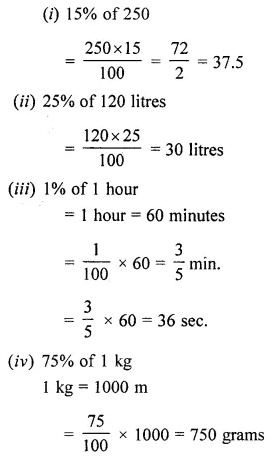
(i) 15% of 250
(ii) 25% of 120 litres
(iii) 1% of 1 hour
(iv) 75% of 1 kg
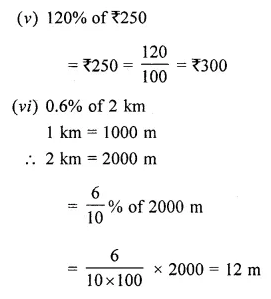
(v) 120% of ₹ 250
(vi) 0.6% of 2 km
Solution:
ML Aggarwal Class 7 Solutions for ICSE Maths Chapter 7 Percentage and Its Applications Ex 7.2 1
ML Aggarwal Class 7 Solutions for ICSE Maths Chapter 7 Percentage and Its Applications Ex 7.2 2

Question 2.
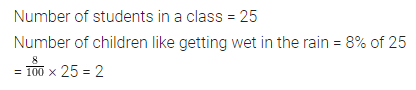
8% of children of a class of 25 like getting wet in the rain. How many children like getting wet in the rain?
Solution:
ML Aggarwal Class 7 Solutions for ICSE Maths Chapter 7 Percentage and Its Applications Ex 7.2 3

Question 3.
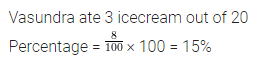
Vasundhara ate 3 ice cream cups out of 20 kept in the fridge. What per cent did she eat?
Solution:
ML Aggarwal Class 7 Solutions for ICSE Maths Chapter 7 Percentage and Its Applications Ex 7.2 4

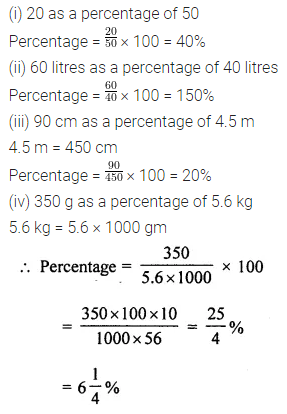
Question 4.
Express:
(i) 20 as a percentage of 50
(ii) 60 litres as a percentage of 40 litres
(iii) 90 cm as a percentage of 4.5 m
(iv) 350 g as a percentage of 5.6 kg
Solution:
ML Aggarwal Class 7 Solutions for ICSE Maths Chapter 7 Percentage and Its Applications Ex 7.2 5

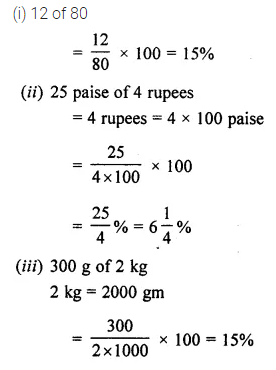
Question 5.
What per cent is:
(i) 12 of 80
(ii) 25 paise of 4 rupees
(iii) 300 g of 2 kg
Solution:
ML Aggarwal Class 7 Solutions for ICSE Maths Chapter 7 Percentage and Its Applications Ex 7.2 6

Question 6.
A school team won 6 games this year against 4 games won last year. What is the per cent increase?
Solution:
ML Aggarwal Class 7 Solutions for ICSE Maths Chapter 7 Percentage and Its Applications Ex 7.2 7

Question 7.
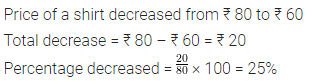
The price of a shirt decreased from ₹ 80 to ₹ 60, find the percentage of decrease in the price of the shirt.
Solution:
ML Aggarwal Class 7 Solutions for ICSE Maths Chapter 7 Percentage and Its Applications Ex 7.2 8

Question 8.
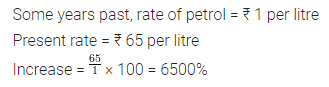
My mother says, in her childhood petrol was ₹ 1 per litre. It is ₹ 65 per litre today. By what percentage has the prices of petrol gone up?
Solution:
ML Aggarwal Class 7 Solutions for ICSE Maths Chapter 7 Percentage and Its Applications Ex 7.2 9

Question 9.
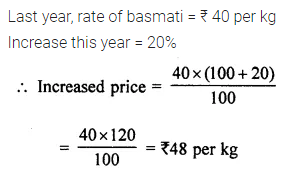
Rate of basmati rice last year was ₹ 40 a kg. This year they are costly by 20%. What is the price this year?
Solution:
ML Aggarwal Class 7 Solutions for ICSE Maths Chapter 7 Percentage and Its Applications Ex 7.2 10

Question 10.
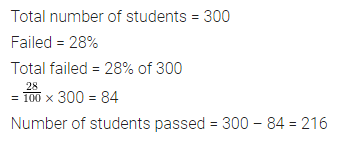
300 students took an exam. 28% failed. Calculate the number of students who passed the exam.
Solution:
ML Aggarwal Class 7 Solutions for ICSE Maths Chapter 7 Percentage and Its Applications Ex 7.2 11

Question 11.
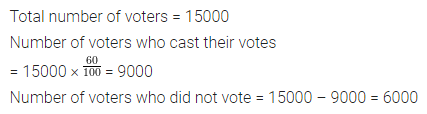
Out of 15000 voters in a constituency, 60% voted. Find the number of voters who did not vote.
Solution:
ML Aggarwal Class 7 Solutions for ICSE Maths Chapter 7 Percentage and Its Applications Ex 7.2 12

Question 12.
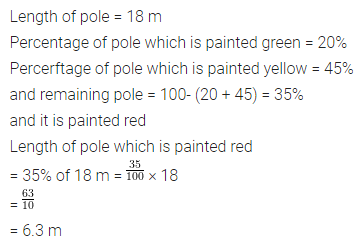
20% of the length of a flagpole is painted green, 45% is painted yellow and the remaining red. If the length of the pole is 18 m, what length of it is painted red?
Solution:
ML Aggarwal Class 7 Solutions for ICSE Maths Chapter 7 Percentage and Its Applications Ex 7.2 13

Question 13.
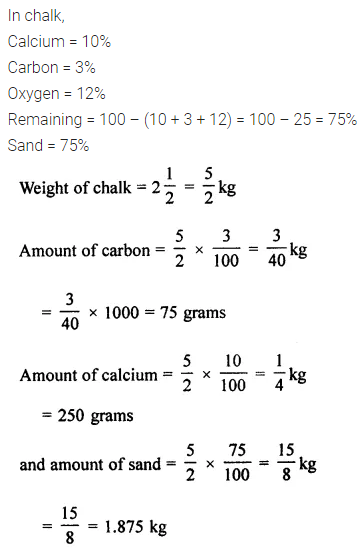
Chalk contains 10% calcium, 3% carbon, 12% oxygen and the remaining sand. Find the amount of carbon and calcium (in grams) in 2\(\frac { 1 }{ 2 }\) kg of chalk. Also, find the amount of sand (in kg).
Solution:
ML Aggarwal Class 7 Solutions for ICSE Maths Chapter 7 Percentage and Its Applications Ex 7.2 14

Question 14.
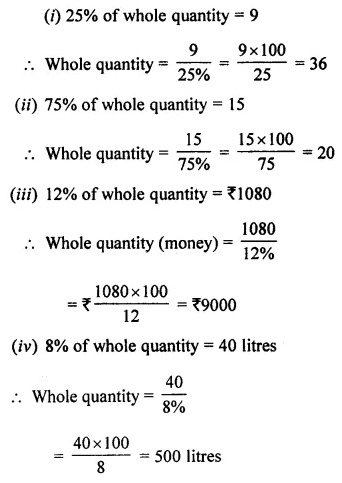
Find the whole quantity if:
(i) 25% of it is 9
(ii) 75% of it is 15
(iii) 12% of it is ₹ 1080
(iv) 8% of it is 40 litres
Solution:
ML Aggarwal Class 7 Solutions for ICSE Maths Chapter 7 Percentage and Its Applications Ex 7.2 15

Question 15.
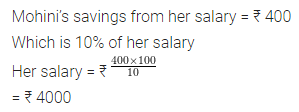
Mohini saves ₹ 400 from her salary. If this is 10% of her salary, then what is her salary?
Solution:
ML Aggarwal Class 7 Solutions for ICSE Maths Chapter 7 Percentage and Its Applications Ex 7.2 16

Question 16.
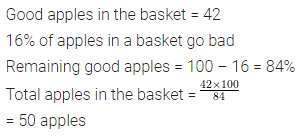
16% of the apples in a basket go bad. If there are 42 good apples in the basket, find the total number of apples in the basket.
Solution:
ML Aggarwal Class 7 Solutions for ICSE Maths Chapter 7 Percentage and Its Applications Ex 7.2 17

Question 17.
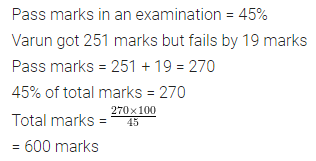
In an examination, a student has to secure 45% marks to pass the exam. If Varun got 251 marks and failed by 19 marks, what are the maximum marks?
Solution:
ML Aggarwal Class 7 Solutions for ICSE Maths Chapter 7 Percentage and Its Applications Ex 7.2 18

Question 18.
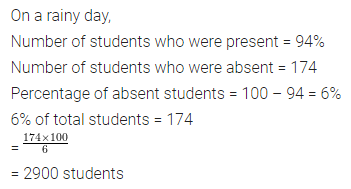
On a rainy day, 94% of the students were students absent on that day was 174, find the total strength of the school.
Solution:
ML Aggarwal Class 7 Solutions for ICSE Maths Chapter 7 Percentage and Its Applications Ex 7.2 19

Question 19.
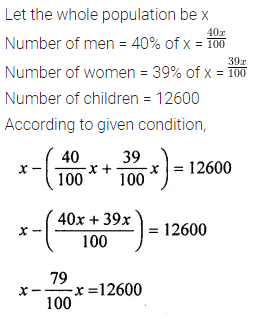
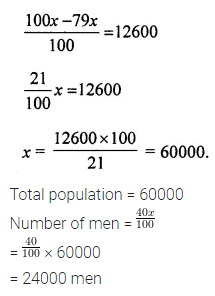
40% of the population of a town are men and 39% are women. If the number of children is 12600, find the number of men.
Solutions:
ML Aggarwal Class 7 Solutions for ICSE Maths Chapter 7 Percentage and Its Applications Ex 7.2 20
ML Aggarwal Class 7 Solutions for ICSE Maths Chapter 7 Percentage and Its Applications Ex 7.2 21

Question 20.
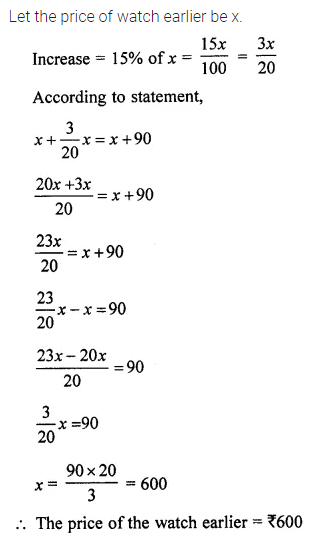
If the price of a watch is increased by 15%, the increase in the price is ₹ 90. What was the price of watching earlier?
Solution:
ML Aggarwal Class 7 Solutions for ICSE Maths Chapter 7 Percentage and Its Applications Ex 7.2 22

Question 21.
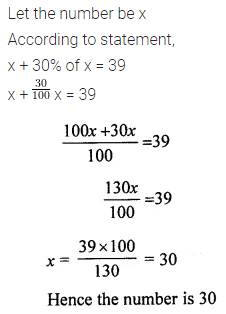
(i) Find the number which when increased by 30% becomes 39.
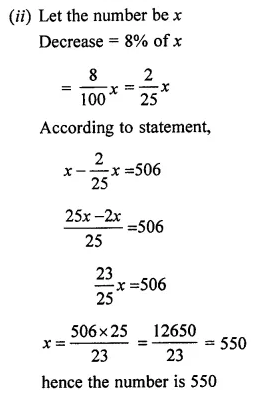
(ii) Find the number which when decreased by 8% becomes 506.
Solution:
ML Aggarwal Class 7 Solutions for ICSE Maths Chapter 7 Percentage and Its Applications Ex 7.2 23
ML Aggarwal Class 7 Solutions for ICSE Maths Chapter 7 Percentage and Its Applications Ex 7.2 24

Question 22.
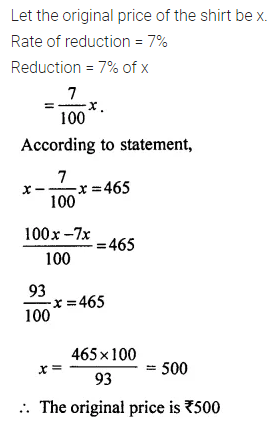
The price of a shirt is reduced by 7% to ₹ 465. What is its original price?
Solution:
ML Aggarwal Class 7 Solutions for ICSE Maths Chapter 7 Percentage and Its Applications Ex 7.2 25

ML Aggarwal Class 7 Solutions for ICSE Maths Chapter 7 Percentage and Its Applications Ex 7.1

ML Aggarwal Class 7 Solutions Chapter 7 Percentage and Its Applications Ex 7.1 for ICSE Understanding Mathematics acts as the best resource during your learning and helps you score well in your exams.

ML Aggarwal Class 7 Solutions for ICSE Maths Chapter 7 Percentage and Its Applications Ex 7.1

Question 1.
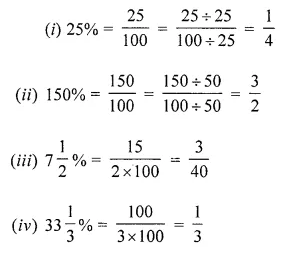
Convert the following percents into fractions in simplest form:
(i) 25%
(ii) 150%
(iii) 7\(\frac { 1 }{ 2 }\) %
(iv) 33\(\frac { 1 }{ 3 }\) %
Solution:
ML Aggarwal Class 7 Solutions for ICSE Maths Chapter 7 Percentage and Its Applications Ex 7.1 1

Question 2.
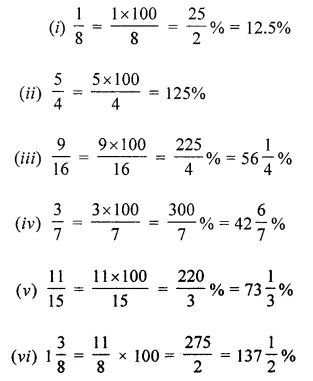
Convert the following fractions into percents:
(i) \(\frac { 1 }{ 8 }\)
(ii) \(\frac { 5 }{ 4 }\)
(iii) \(\frac { 9 }{ 16 }\)
(iv) \(\frac { 3 }{ 7 }\)
(v) \(\frac { 11 }{ 15 }\)
(vi) 1\(\frac { 3 }{ 8 }\)
Solution:
ML Aggarwal Class 7 Solutions for ICSE Maths Chapter 7 Percentage and Its Applications Ex 7.1 2

Question 3.
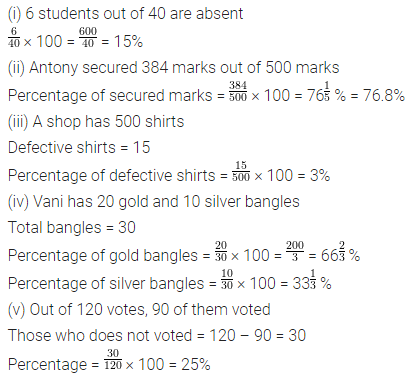
(i) 6 students out of 40 students in a class are absent. What percentage of students are absent ?
(ii) Antony secured 384 marks out of 500 marks. Find the percentage of marks secured by Antony.
(iii) A shop has 500 shirts, out of which 15 are defective. What percentage of shirts are defective?
(iv) Vani has a collection of bangles. She has 20 gold bangles and 10 silver bangles. What is the percentage of each type of bangles?
(v) There are 120 voters and 90 of them voted. What percent did not vote?
Solution:
ML Aggarwal Class 7 Solutions for ICSE Maths Chapter 7 Percentage and Its Applications Ex 7.1 3

Question 4.
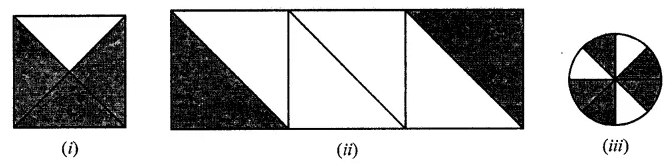
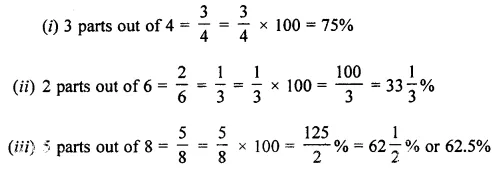
Estimate the part of the figure which is shaded and hence find the percentage of the part which is shaded.
ML Aggarwal Class 7 Solutions for ICSE Maths Chapter 7 Percentage and Its Applications Ex 7.1 4
Solution:
ML Aggarwal Class 7 Solutions for ICSE Maths Chapter 7 Percentage and Its Applications Ex 7.1 5

Question 5.
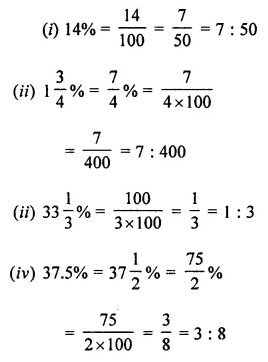
Convert the following percentage into ratios in sirup rest form:
(i) 14 %
(ii) 1\(\frac { 3 }{ 4 }\) %
(iii) 33\(\frac { 1 }{ 3 }\) %
(iv) 37.5 %
Solution:
ML Aggarwal Class 7 Solutions for ICSE Maths Chapter 7 Percentage and Its Applications Ex 7.1 6

Question 6.
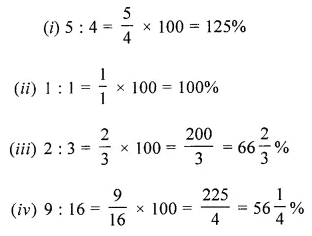
Express the following ratios as percentages:
(i) 5 : 4
(ii) 1 : 1
(iii) 2 : 3
(iv) 9 : 16
Solution:
ML Aggarwal Class 7 Solutions for ICSE Maths Chapter 7 Percentage and Its Applications Ex 7.1 7

Question 7.
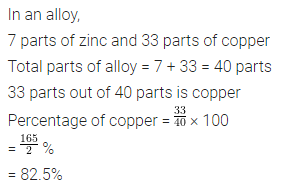
An alloy consists of 7 parts of zinc and 33 parts of copper. Find the percentage of copper in the alloy ?
Solution:
ML Aggarwal Class 7 Solutions for ICSE Maths Chapter 7 Percentage and Its Applications Ex 7.1 8

Question 8.
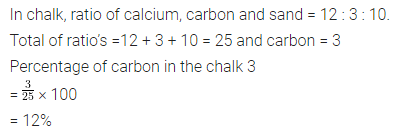
Chalk contains calcium, carbon and sand in the ratio 12 : 3 : 10. Find the percentage of carbon in the chalk 12%.
Solution:
ML Aggarwal Class 7 Solutions for ICSE Maths Chapter 7 Percentage and Its Applications Ex 7.1 9

Question 9.
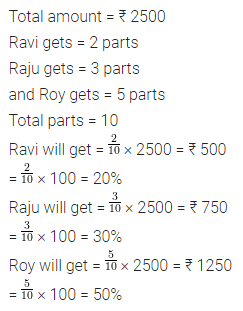
If ₹ 2500 is to be divided among Ravi, Raju and Roy, so that Ravi gets two parts, Raju three parts and Roy five parts. How much money will each get? What will it be in percentages?
Solution:
ML Aggarwal Class 7 Solutions for ICSE Maths Chapter 7 Percentage and Its Applications Ex 7.1 10

Question 10.
Convert the following percentages to decimals:
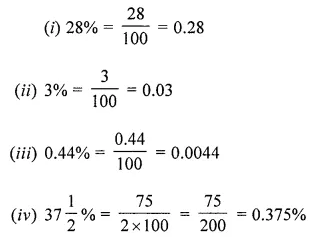
(i) 28%
(ii) 3%
(iii) 0. 44%
(iv) 37\(\frac { 1 }{ 2 }\) %
Solution:
ML Aggarwal Class 7 Solutions for ICSE Maths Chapter 7 Percentage and Its Applications Ex 7.1 11

Question 11.
Convert the following decimals to percents:
(i) 0.65
(ii) 0.9
(iii) 2.1
(iv) 0.02
Solution:
ML Aggarwal Class 7 Solutions for ICSE Maths Chapter 7 Percentage and Its Applications Ex 7.1 12

Question 12.
(i) If 42% of the students in a class are girls, then what percent of the students in the class are boys?
(ii) We have a basket full of apples, oranges, and mangoes if 50% are apples, 30% are oranges, then what percent are mangoes?
Solution:
ML Aggarwal Class 7 Solutions for ICSE Maths Chapter 7 Percentage and Its Applications Ex 7.1 13

ML Aggarwal Class 7 Solutions for ICSE Maths Chapter 6 Ratio and Proportion Check Your Progress

ML Aggarwal Class 7 Solutions Chapter 6 Ratio and Proportion Check Your Progress for ICSE Understanding Mathematics acts as the best resource during your learning and helps you score well in your exams.

ML Aggarwal Class 7 Solutions for ICSE Maths Chapter 6 Ratio and Proportion Check Your Progress

Question 1.
A rectangular park is 120 m long and 75 m wide. Find the ratio of:
(i) breadth to its length
(ii) length to its perimeter
Solution:
ML Aggarwal Class 7 Solutions for ICSE Maths Chapter 6 Ratio and Proportion Check Your Progress 1

Question 2.
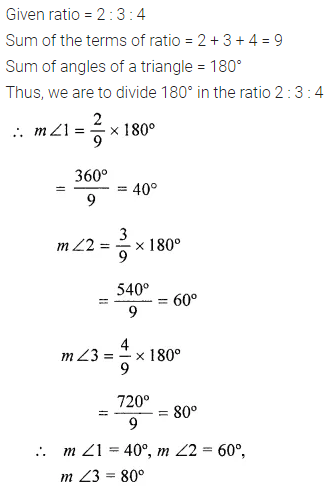
Divide the angles of a triangle in the ratio 2 : 3 : 4.
Solution:
ML Aggarwal Class 7 Solutions for ICSE Maths Chapter 6 Ratio and Proportion Check Your Progress 2

Question 3.
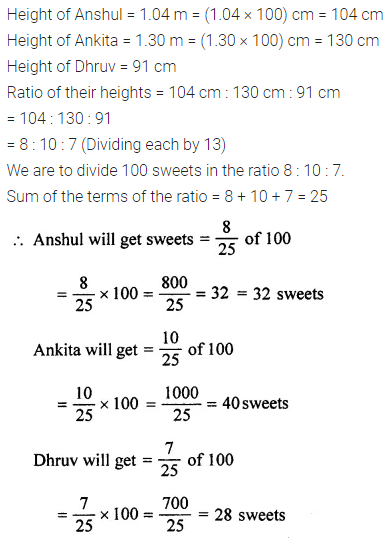
Heights of Anshul, Ankita and Dhruv are 1.04 m, 1.30 m and 91 cm respectively. Divide 100 sweets among them in the ratio of their heights.
Solution:
ML Aggarwal Class 7 Solutions for ICSE Maths Chapter 6 Ratio and Proportion Check Your Progress 3

Question 4.
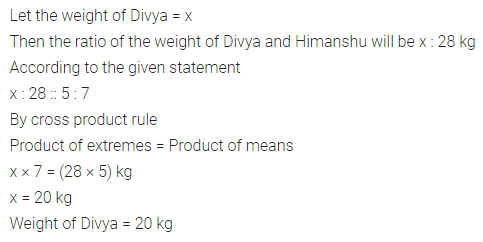
The weights of Divya and Himanshu are in the ratio 5 : 7. If Himanshu weighs 28 kg, find the weight of Divya.
Solution:
ML Aggarwal Class 7 Solutions for ICSE Maths Chapter 6 Ratio and Proportion Check Your Progress 4

Question 5.
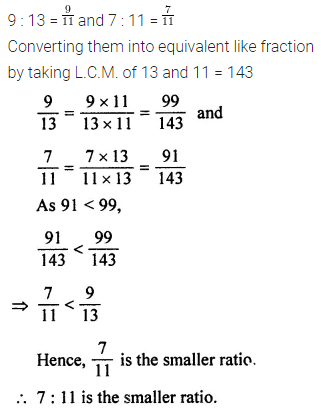
Which ratio is smaller- 9 : 13 or 7 : 11 ?
Solution:
ML Aggarwal Class 7 Solutions for ICSE Maths Chapter 6 Ratio and Proportion Check Your Progress 5

Question 6.
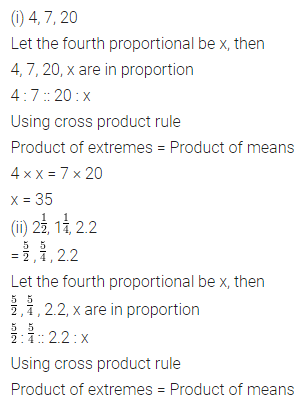
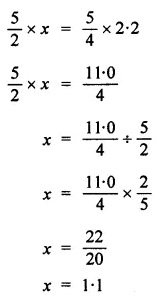
Find the fourth proportional to
(i) 4, 7, 20
(ii) 2\(\frac { 1 }{ 2 }\), 1\(\frac { 1 }{ 4 }\), 2.2
Solution:
ML Aggarwal Class 7 Solutions for ICSE Maths Chapter 6 Ratio and Proportion Check Your Progress 6
ML Aggarwal Class 7 Solutions for ICSE Maths Chapter 6 Ratio and Proportion Check Your Progress 7

Question 7.
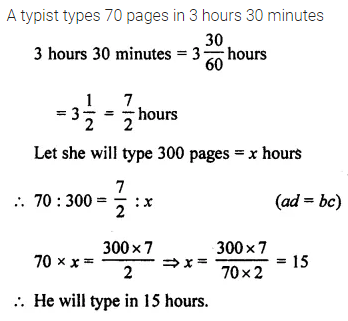
A typist types 70 pages in 3 hours 30 minutes. How long will she take to type 300 pages?
Solution:
ML Aggarwal Class 7 Solutions for ICSE Maths Chapter 6 Ratio and Proportion Check Your Progress 8

Question 8.
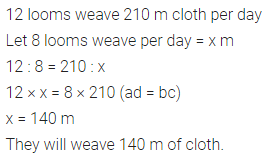
12 looms weave 210 m cloth per day. How many metres of cloth will 8 looms weave per day?
Solution:
ML Aggarwal Class 7 Solutions for ICSE Maths Chapter 6 Ratio and Proportion Check Your Progress 9

Question 9.
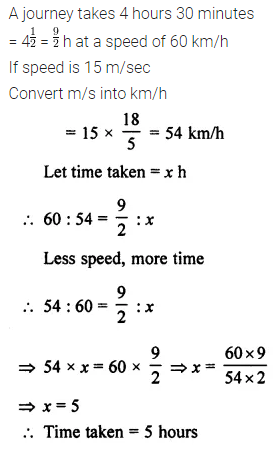
A journey takes 4 hours 30 minutes at a speed of 60 km/h. How long will the same journey take at a speed of 15 m/sec?
Solution:
ML Aggarwal Class 7 Solutions for ICSE Maths Chapter 6 Ratio and Proportion Check Your Progress 10

Glimpses of India Extra Questions and Answers Class 10 English First Flight

Here we are providing Glimpses of India Extra Questions and Answers Class 10 English First Flight, Extra Questions for Class 10 English was designed by subject expert teachers.

Glimpses of India Extra Questions and Answers Class 10 English First Flight

Glimpses of India Extra Questions and Answers Very Short Answer Type

Question 1.
What are the elders in Goa nostalgic about?
Answer:
The elders in Goa are nostalgic about the Portuguese and their loaves of bread.

Question 2.
How do they remember it?
Answer:
They remember about it fondly.

Question 3.
What equipments do the Goan people still own there?
Answer:
They still have amongst them the mixtures, the moulders and time-tested furnaces and those who bake the loaves.

Question 4.
What are those bakers known in Goa?
Answer:
Those bakers are known as ‘pader’ in Goa.

Question 5.
What does the thud and jingle of the traditional baker’s bamboo indicate?
Answer:
It indicates the announcement of the arrival of the baker in the morning.

Question 6.
What announces the arrival of the baker in Goa?
Answer:
The thud and jingle of the specially made bamboo staff announces the arrival of the traditional baker.

Question 7.
How would the baker greet the lady of the house?
Answer:
The baker would greet the lady of the house with ‘good morning’.

Question 8.
What did the children long to get from the baker?
Answer:
The children longed for to get bread-bangles from the baker.

Question 9.
What kind of fragrance does the author still recall?
Answer:
The author still recalls the typical fragrance of the baker’s loaves.

Question 10.
What kind of dress the lKabaV was?
Answer:
A single piece long frock reaching down to the knees.

Question 11.
When did the baker collect his bills?
Answer:
The baker collected his bills at the end of the month.

Question 12.
How were the monthly accounts of the baker recorded?
Answer:
The monthly accounts recorded on some wall in pencil.

Glimpses of India Extra Questions and Answers Short Answer Type

Question 1.
Why is the baker essential for the Goan people?
Answer:
Most of the celebrations and festivals need supply of bread so the baker’s furnace is essential for the Goan people.

Question 2.
Why did the baker and his family always look happy and prosperous?
Answer:
The baker used to collect his bills at the end of the month. Baking was indeed a profitable business in
the old days. The baker and his family never starved. Their plump physique was an open testimony that they were happy and prosperous.

Question 3.
Why would the children run to meet and greet the baker?
Answer:
The jingling thud of the baker’s bamboo would wake up the children from their sleep. They would run to meet and greet him to get bread bangles or sometimes sweet bread of special make.

Question 4.
What indicates the presence of the ‘patters’ still in Goa?
Answer:
The presence of the ‘paders’ in Goa even today is indicated by the fact that still there are mixers, the moulders and those who bake the loaves. Moreover, those age-old time-tested furnaces still exist.

Question 5.
What would the baker do after his musical entry?
Answer:
The baker would greet the lady of the house with ‘good morning’ and then place his basket on the bamboo after his musical entry.

Question 6.
How did the pader treat the kids who surrounded him?
Answer:
The pader treated the kids who surrounded him, very kindly he would push them aside with a mild rebuke.

Question 7.
Was baking a profitable profession?
Answer:
Yes, baking was really a profitable profession as the bread was an important part of the food of the Goan people. The bakers earned well and kept servants. Their families looked happy and prosperous. They never starved.

Question 8.
What are the elders in Goa nostalgic about?
Answer:
The elders in Goa are much fond of loaves of bread. Those were the Portuguese days and the people liked the breads of different types very much.

Question 9.
Is bread-making still popular in Goa? How do you know?
Answer:
Bread-making is still popular in Goa. We can see the mixers, the moulders and those who bake the loaves. Most of their festivals and other occasions will become meaningless without the loaves of the bread. The ladies of the house prepare sandwiches on the occasion of their daughter’s engagement.

Question 10.
What is the baker called?
Answer:
The baker is called ‘Pader’ in Goa. They wear special dresses.

Question 11.
When would the baker come everyday? Why did the children run to meet him?
Answer:
The baker would come at least twice a day. The morning was his selling round and he returned after selling them. Children ran to meet and greet him because they needed bread bangles from him. They also got sweet bread of special make.

Question 12.
Match the following. What is a must
(i) as marriage gifts? – cakes and bolinhas
(ii) for a party or a feast? – sweet bread called ‘bol’
(iii) for a daughter’s engagement? – bread
(iv) for Christmas? – sandwiches
Answer:
(i) As marriage gifts – sweet bread called ‘bol’
(ii) For a party or a feast – bread
(iii) For a daughter’s engagement – sandwiches
(iv) For Christmas – cake and bolinhas

Question 13.
What did the bakers wear?
(i) in the Portuguese days?
(ii) when the author was young?
Answer:
(i) The bakers wore a particular dress called ‘Kabai’. It was a single-piece long frock reaching down to the knees.
(ii) The bakers wore a shirt and trousers which were shorter than full length ones and longer than half pants.

Question 14.
Who invites the comment—‘he is dressed like a pader’? Why?
Answer:
The dress of Pader’ invites comments because it reaches just below the knees. It looks odd, funny and makes one’s figure like a joker.

Question 15.
Where were the monthly accounts of the baker recorded?
Answer:
The monthly accounts of the baker were recorded on a wall. It was written in pencil.

Question 16.
What does a ‘jackfruit’—like appearance’ mean?
Answer:
Any person with a ‘jackfruit—like appearance’ is easily compared to a baker.

Glimpses of India Extra Questions and Answers Long Answer Type

Question 1.
Describe the pen-portrait of a traditional Goan village baker.
Answer:
There is a deep impact of Portuguese culture on Goan life. The baker is also a part of this culture. They are known as paders in Goa. When author was a child, one could see the traditional baker in the village. He used to be friend of children. He visited the house twice a day. Children arose with the sound of thud and jingle of the bamboo in the morning. They would run to greet him. Children were fond of sweet bread and the bread bangles. The ladies of the house bought the bread. Bakers were professional and it was a family business. It was a profitable business and most of the bakers were plump. They had their peculiar traditional dress called Kabai.

Question 2.
“Not enough can be said to show now important a baker can be for a village”. How were the services of the baker required on various occasions?
OR
Why was the baker’s furnace essential in a traditional Goan village?
Answer:
A baker is very important and essential for a Goan village. He does not merely represent a profession but a highly admired Portuguese tradition. His breads are essential on each and every occasion. Marriage gifts are meaningless without the sweet bread known as the bol. Cakes and bolinhas are a must for Christmas as well as other festival. He enjoys respect and love of the people. The children consider him their friend, companion and guide. Thus, the presence of the baker’s furnace in the village is absolutely necessary.

Question 3.
Rodrigues describe his childhood and the bakers of Goa. What does he remember so fondly about these bakers?
OR
What, according to the author, do the elders of Goa think fondly about the past?
Answer:
Rodrigues describes his childhood and old Portuguese days and their famous loaves of bread. The bakers are known pader in Goa. The writer remembers a baker fondly. The baker would come at least twice a day for selling his bread. The jingling thud of his bamboo would wake the children and they would run to meet and greet him. The children longed for his visit for those bread-bangles or sometimes for sweet bread of special make. The baker would greet the lady of the house with ‘good morning’. Then he would place his basket on the vertical bamboo. He collected the bill at the end of the month.

Question 4.
Baking was considered an important and a profitable profession in a traditional Goan village. Explain.
OR
Bread and cakes were essential of Goan life in older days. Describe the memories that the author recollects about good old Portuguese days and their loaves of bread.
Answer:
In olden days, Goa was very much influenced by the Portuguese. Baking was considered an essential and profitable profession in a traditional Goan village. The Portuguese were famous for preparing the loaves of bread. Baking was the traditional family work. The villages were much fond of the sweet bread known as ‘bol’. The marriage gifts were meaningless without it. So the bakers furnaces were the most essential and ‘cakes and bolinhas’ formed an important item there. At various occasions like Christmas and other festivals the bakers would collect the bill at the end of month. Baking was a profitable profession in olden days.

Question 5.
Bread and cakes were an integral part of Goan life, in olden days. Based on your reading of the “A Baker from Goa”, describe the Goan cidture.
Answer:
Goa in west India, called golden Goa by the Portuguese, has an important Portuguese colony in Asia. The Portuguese were driven by their desire to spread their faith to the local population. Thus the culture of Goa is deeply influenced by Portuguese culture. Modem day Goa, a state of India, is a quaint blend of tradition, religion and modernity. Hindu temples are as much a part of Goa as are Christian monuments. The culture of Goa today is a synthesis of Portuguese and Indian cultures. It is one of the most attractive cultures in India. A Goan is said to be born with music in his blood and music literally accompanies him from the cradle to the grave. Musical traditions run in generations.

Question 6.
“The custom of baking bread is closely associated with Goan culture”. Explain/Discuss, with reference to the chapter ‘A baker from Goa’.
Answer:
Bread forms an essential part of the Goan culture. There is no party or festival without bread. Marriage gifts are meaningless without the sweet bread known as the bol. Any party or a feast loses its charm without bread. A baker is very important for a village. The lady of the house must prepare sandwiches on the occasion of her daughter’s engagement. Cakes and bolinhas are a must for Christmas as well as other festivals. Thus, the presence of the baker’s furnace in the village is absolutely essential. Loaves of bread are very popular in Goa and is a staple food even in remote villages. The bread has health benefits. There are still a few small bakeries left in some of the smaller towns.

Question 7.
Instead of enjoying their childhood the children today are keen to enter adulthood. After reading about all the joys that the author Lucio Rodrigues had in his childhood, do you think such a keenness on the part of children is desirable?
Answer:
Rodrigues describes his childhood. Those were good old Portuguese days, the Portuguese and their famous loaves of bread. The loaves were baked in the furnaces and one can see them even today. The baker visited the house twice a day. In the morning thud and jingle of the bamboo would awake people and children would run to greet him. It was their traditional family work. Those bakers are known as paders.in Goa. They have their peculiar dress. The maid servants purchased the loaves. The bakers also sold breads bangles, sweet bread of special make, cakes and bolinhas. He collected the bill at the end of the month.

Glimpses of India Extra Questions and Answers Reference to Context

Read the following passages and answer the questions that follow:

Question 1.
Our elders are often heard reminiscing nostalgically about those good old Portuguese days, the Portuguese and their famous loaves of bread. Those eaters of loaves might have vanished but the makers are still there. We still have amongst us the mixers, the moulders and those who bake the loaves. Those age-old, time-tested furnaces still exist. The fire in the furnaces has not yet been extinguished. The thud and – jingle of the traditional baker’s bamboo, heralding his arrival in the morning, can still be heard in some places. May be the father is not alive but the son still carries on the family profession. These bakers are, even today, known as pader in Goa.
(i) What are the elders nostalgic about?
(ii) How do they remember it?
(iii) How is a traditional baker recognised?
(iv) Pick out the word from the passage which means opposite to ‘Seldom”.
Answer:
(i) The elders are nostalgic about the Portuguese and their loaves of bread.
(ii) They remember about it fondly.
(iii) A traditional baker is recognised with the thud and jingle of his bamboo.
(iv) often.

Question 2.
During our childhood in Goa, the baker used to be our friend, companion and guide. He used to come at least twice a day. Once, when he set out in the morning on his selling round, and then again, when he returned after emptying his huge basket. The jingling thud of his bamboo woke us up from sleep and we ran to meet and greet him. Why was it so? Was it for the love of the loaf? Not at all. The loaves were bought by some Paskine or Bastine, the maid-servant of the house! What we longed for were those bread-bangles which we chose carefully. Sometimes it was sweet bread of special make.
(i) How do the children look upon the baker?
(ii) How did the children come to know about his arrival?
(iii) When did the baker come the second time?
(iv) Pick out word from the passage that means the same as—Desired.
Answer:
(i) The children look upon the bakers as friend, companion and guide.
(ii) The jingling thud of his bamboo woke up the children from their sleep. They at once ran towards him.
(iii) The baker came the second time after emptying his huge basket.
(iv) ‘longed for’

Question 3
The baker made his musical entry on the scene with the ‘jhang, jhang’ sound of his specially made bamboo staff. One hand supported the basket on his head and the other banged the bamboo on the ground. He would greet the lady of the house with “Go«4 Morning” and then place his basket on the vertical bamboo. We kids would be pushed aside with a mild rebuke and the loaves would be delivered to the servant. But we would not give up. We would climb a bench or the parapet and peep into the basket, somehow. I can still recall the typical fragrance of those loaves. Loaves for the elders and the bangles for the children. Then we did not even care to brush our teeth or wash our mouths properly.
(i) How did the baker make his entry?
(ii) How did he sell his loaves?
(iii) What were the types of loaves he had?
(iv) Pick out the word from the passage that means the same as—Stare into.
Answer:
(i) The baker made his musical entry on the scene with the ‘jhang, jhang’ sound of his specially made bamboo stick.
(ii) He sold his loaves. He would greet the ladies with good morning and then place his basket on the vertical bamboo.
(iii) He had loaves for elders and the bangles for the children.
(iv) peep into.

Question 4.
Marriage gifts are meaningless without the sweet bread known as the bol, just as a party or a feast loses its charm without bread. Not enough can be said to show how important a baker can be for a village. The lady of the house must prepare sandwiches on the occasion of her daughter’s engagement. Cakes and bolinhas are a must for Christmas as well as other festivals. Thus, the presence of the baker’s furnace in the village is absolutely essential.
(i) When are all the marriage gifts meaningless in Goa?
(ii) What was important at the daughter’s engagement?
(iii) What was in use for Christmas and other occasions?
(iv) Pick out the word from the passage that means the same as—‘Attraction’.
Answer:
(i) Marriage gifts are meaningless without the sweet bread in Goa. Preparation
(ii) of sandwiches is important at the daughter’s engagement. Cakes and bolinhas
(iii) were used for Christmas and other occasions.
(iv) charm.

Question 5.
The baker or bread-seller of those days had a peculiar dress known as the Kabai. It was a single piece long frock reaching down to the knees. In our childhood we saw bakers wearing a shirt and trousers which were shorter than full-length ones and longer than half pants. Even today, anyone who wears a half pant which reaches just below the knees invites the comment that he is dressed like a paderl
(i) What is the ‘Kabai’?
(ii) Describe the traditional dress of baker?
(iii) What did the narrator see in his childhood?
(iv) Pick out the word from the passage which means the same as—‘strange’.
Answer:
(i) ‘Kabai’ is the traditional dress of baker.
(ii) It is a single piece long frock reaching down to the knees.
(iii) The narrator saw in his childhood that the bakers wore a shirt and trousers which were shorter than full length ones and longer than half pants.
(iv) peculiar

Question 6.
The baker usually collected his bills at the end of the month. Monthly accounts used to be recorded on some wall in pencil. Baking was indeed a profitable profession in the old days. The baker and his family never starved. He, his family and his servants always looked happy and prosperous. Their plump physique was an open testimony to this. Even today any person with a jackfruit-like physical appearance is easily compared to a baker.
(i) When did the baker usually collect his bills?
(ii) How were the monthly accounts maintained?
(iii) Who is generally compared to a baker?
(iv) Pick out the word from the passage which means the same as—rich.
Answer:
(i) The bakers usually collected his bills at the end of the month.
(ii) The monthly accounts used to be recorded on some wall in pencil.
(iii) Any person with a jack fruit like physical appearance is easily compared to a baker.
(iv) prosperous.

Coorg

Glimpses of India Extra Questions and Answers Very Short Answer Type

Question 1.
Where is Coorg located?
Answer:
Coorg is situated between Mysore and the coastal town of Mangalore.

Question 2.
Which is the smallest district of Karnataka?
Answer:
Coorg is the smallest district of Karnataka.

Question 3.
Why is Coorg compared to heaven?
Answer:
Coorg is compared to heaven because of its natural beauty.

Question 4.
How much rain does the area receive during the monsoons?
Answer:
The area receives a heavy rainfall during monsoons.

Question 5.
Why do visitors keep away from the Coorg during the monsoon?
Answer:
Due to the heavy rainfall the visitors keep away from the Coorg during monsoon.

Question 6.
What is the nature of the people of Coorg?
Answer:
The nature of the people of Coorg is independent.

Question 7.
What is the possible descent of Coorg people?
Answer:
The people of Coorg are possibly of Greek or Arabic descent.

Question 8.
What are the people of Coorg known as?
Answer:
The people of Coorg are known as Kodavus.

Question 9.
What is the Kuppia?
Answer:
Kuppia is the long, black coat with an embroidered waist-belt worn by the Arabs and the Kurds.

Question 10.
What tradition do the Coorgi homes have?
Answer:
Coorgi homes have a tradition of hospitality.

Question 11.
Who was General Cariappa?
Answer:
General Cariappa, the first Chief of Indian Army was a Coorgi.

Question 12.
What is the source of water for the river Kavery?
Answer:
The source of water for the river Kaveri is the hills and forests of Coorg.

Question 13.
Where is Indian largest Tibetan colony?
Answer:
Bylakuppe in Coorg.

Glimpses of India Extra Questions and Answers Short Answer Type

Question 1.
Where is Coorg situated?
Answer:
Coorg is situated between Mysore and the coastal town of Mangalore in Karnataka state.

Question 2.
What is Coorg famous for?
Answer:
Coorg is famous for water sports, rock climbing, mountain biking and trekking.

Question 3.
Which story shows that Coorgis are of Greek descent?
Answer:
A story narrates that a part of Alexander’s Army moved south along the coast and settled at Coorg when their return became impractical. These people married the locals and became inhabitants of this place.

Question 4.
When can one visit Coorg?
Answer:
Coorg can be visited between September and March. It is the season of happiness during these months. One can enjoy different water sports like rafting, canoeing, rappelling rock climbing, etc.

Question 5.
How can one reach Coorg?
Answer:
One can reach Coorg either by road, air or rail. There are two routes from Bangalore. The route via Mysore is frequented one. The other route is Neelamangal, Kurigal and Chanrayanapatna.

Question 6.
What shows that Coorgis might be of Arabic descent?
Answer:
Kodavus wear the long, black coat with an embroidered waist belt, which is known as ‘Kuppia’. This coat resembles the Kuffia worn by the Arabs and the Kurds.

Question 7.
What are the various adventure sports available in Coorg?
Answer:
The various adventures sports available in Coorg to the tourists who visit Coorg are river rafting, canoeing, rappelling or going down a cliff by slidding down a rope, rock climbing, mountain biking and trekking.

Question 8.
Why is the climb to the Brahmagiri hills an important part of a visit to Coorg?
Answer:
The climb to the Brahmgiri hills offers the panoramic view of the entire misty landscape of Coorg. Besides, it leads to Nisargadhama and then, to Bylakuppe; the hidden surprises for the visitors. Thus, it is important to climb the Brahmagiri hills while visiting Coorg.

Question 9.
Write two characteristics of people of Coorg?
Answer:
The people of Coorg are fiercely independent and brave. Coorgi houses have a tradition of hospitality. The Coorg regiment is the most decorated one in the Indian Army. They feel proud sharing the courageous works of their sons and fathers.

Glimpses of India Extra Questions and Answers Long Answer Type

Question 1.
Write a brief description of Coorg with special reference to its beauty, people main crops, tourist seasons and speciality for army?
Answer:
Coorg is a small district of Karnataka state of India. This is a land of rolling hills inhabited by a proud race of martial men, beautiful women and wild creatures. It is famous for its coffee estates, evergreen rainforests and spices. Its thirty per cent area is covered with the evergreen rainforests. The people of Coorg are independent and brave. The Coorgi homes have a tradition of hospitality. The Coorgi regiment is one of the most decorated one in the Indian Army. The first Chief of the Indian Army, General Cariappa was a Coorgi. This place offers a variety of natural sciences which are liked by the tourists. The mountains offer various adventure games like river rafting, canoeing, rappelling, rock climbing and mountain biking. The best season to visit this place is from September to March.

Question 2.
What is the story prevalent about the Kodavus people’s descent?
OR
What is said about the descent of people of Coorg?
OR
What is the story behind Coorgi people’s descent that makes them so brave? *
Answer:
The people of Coorg are independent and brave. They are possibly of Greek or Arabic descent. There are two stories about their descent. According to one story, these people are the descendants of Greek. It is believed that a part of Alexander’s army moved south along the coast. When they found it difficult to return they settled there. They married among the locals and started their family life. According to another story, these people originated from Arabic people. This theory is supported by their dress which is known as kuppia. It resembles the kuffia worn by the Arabs and the Kurds.

Question 3.
The people of Coorg have a tradition of courage and bravery. How has it been recognised in modern India?
OR
“The people of Coorg are famous for their tradition of hospitality and valour in the army. Explain with reference to ‘Glimpses of India’.
Answer:
It is quite true that the people of Coorg are famous for their traditions of hospitality, love, respect and fellow-feeling. People visiting Coorg always feel at home there and enjoy the panoramic view of the whole landscape of Coorg. The visitors get pleasure in riding over the elephants and the fresh smell of coffee plantation. The residents are always eager to tell the tales of vigour, bravery and courage only. related to their sons and fathers. These people show utmost courage and exemplary bravery during the war period. It is a matter of great concern for all of us that Coorg Regiment is famous for its bravery. It is one of the most decorated in the Indian army. General Cariappa was a Coorgi. It is very rewarding for all of us. Even the government has allowed the Coorgi people to carry firearms with them. They can move in any part of the country without a licence.

Question 4.
Where is Coorg located? When should-one visit? Write an account of the life of the people of Coorg.
Answer:
Coorg is situated in the midway between Mysore and coastal town of Mangalore. It is the smallest district of Karnataka. It is a piece of heaven fallen from the kingdom of God. This is a land of rolling hills. There is the smell of coffee in the air. It has evergreen rainforests, spices and coffee plantations. The martial men and beautiful women of Coorg are of Greek or Arabic descent.

As per a story, a part of Alexander’s army moved south and settled here as return became difficult. The rites are different from that of Hindu mainstream. All of them wear a waist-belt called Kuppia. It resembles the Kuffia worn by the Arabs and Kurds. These Coorgs have many tales of bravery. They are very hospitable. Coorg soldiers are brave. They can carry firearms without any license. The Coorg Regiment is one of the most decorated regiments in the Indian Army.

Question 5.
Based on your reading of the chapter, write a paragraph describing ‘The people of Coorg’.
Answer:
It is said that Coorgis (Kodavus as they are locally known) are the ones easier to love than to like. One of the most hospitable people in India, the doors of their hQmes are always open to guests. Cosmopolitan in their outlook, they make friends easily. They are exceptionally brave. Coorg can be called a land of generals- Field Marshall Cariappa, the first general of free India and General Thimayya being the most well known of the lot. Almost every household has at least one person serving in the armed forces. The birth of male children as well as their death ceremonies are still celebrated with a gun salute.

Question 6.
The Coorgis are thousands of miles away from their origin, Greek or Arab. Yet they carry on their unique values, customs and practices. Does this make them appreciable to you?
OR
The people of Coorg are famous for their tradition of hospitality and valour in the Indian Army. Describe this statement with reference to the chapter what you have read.
Answer:
Coorg is situated midway between Mysore and the coastal town of Mangalore. It is the smallest district of the state of Karnataka. It is a piece of heaven fallen from the kingdom of God. We can find hills lull of greenary here. It has evergreen rainforests, spices and coffee plantations. It rains heavily here during the rainy season. There is the smell of coffee in the air. The people of Coorg are martial men. These people are of Greek or Arabic descent. According to a legend, a part of Alexander’s army stopped and settled here. They married amongst the locals.

Their culture is seen in the martial traditions, marriage and religious rites, they are different from the Hindu mainstream. These people wear a long black coat with an embroidered waist-belt. This is known as Kuppia and it resembles Kuffia that is worn by the Arabs and the Kurds. They love traditions of hospitality and this quality makes them unique.

Thinking about the Text

Question 1.
Where is Coorg?
Answer:
Coorg is situated in the midway between Mysore and the coastal town of Mangalore. It is the paradise on this earth. It must have been drifted from the kingdom of God.

Question 2.
What is the story about the Kodavu people’s descent?
Answer:
There are many stories about the Kodavu people’s descent. One of the stories tells that a part of Alexander’s army while moving south along the coast could not return. They settled there and got into marital relations with the local people. One can note the difference between their traditions and the other Hindu traditions. Thus these are from Greek or Arabic descent. The theory of Arab origin supports that the Kodagus wear long black coat with an embroidered waist belt known as Kuppia, it resembles the Kuffia worn by the Arabs and the Kurds.

Question 3.
What are some of the things you now know about:
(i) the people of Coorg?
(ii) the main crop of Coorg?
(iii) the sports it offers to tourists?
(iv) the animals you are likely to see in Coorg?
(v) its distance from Bangalore, and how to get there?
Answer:
(i) They are hospitable and friendly. They will tell the tales of bravery of their sons and fathers.
(ii) Coffee plantation is the main crop of Coorg.
(iii) These are river-rafting, canoeing rappelling, rock-climbing, mountain biking and the walking trails.
(iv) These are elephants, langurs and macaques.
(v) From Bangalore, it is around 250-260 km. By road there are two routes. The route via Mysore is often frequented one. The other route is via Neelamangal, Kunigal, Chanrayan^patna.

Question 4.
Here are six sentences with some words in italics. Find phrases from the text that have the same meaning. (Look in the paragraphs indicated).
(i) During monsoons it rains so heavily that tourists do not visit Coorg. (para 2)
(ii) Some people say that Alexander’s army moved south along the coast and settled there, (para 3)
(iii) The Coorg people are always ready to tell stories of their sons’ and fathers’ valour, (para 4)
(iv) Even people who normally lead an easy and slow life get smitten by the high-energy adventure
sports of Coorg.
(v) The theory of the Arab origin is supported by the long coat with embroidered waist-belt they wear,
(vi) Macaques, Malabar squirrels, observe you carefully from the tree canopy.
Answer:
(i) Keep away
(ii) A part of
(iii) Willing to
(iv) The most laidback individuals become converts to the life
(v) Draws support
(vi) Keep a watchful eye

Glimpses of India Extra Questions and Answers Reference to Context

Read the following passages and answer the questions that follow:

Question 1.
Midway between Mysore and the coastal town of Mangalore (now Mangaluru) sits a piece of heaven that must have drifted from the kingdom of god. This land of rolling hills is inhabited by a proud race of martial men, beautiful women and wild creatures.
(i) Where is Coorg located?
(ii) Why is Coorg compared to heaven?
(iii) What does the author mean by ‘drifted from the kingdom of god’?
(iv) Pick out the word from the passage that means the same as—‘separated’.
Answer:
(i) Coorg is situated between Mysore and the coastal town of Mangalore in Karnataka.
(ii) Coorg is compared to heaven because of its natural beauty.
(iii) The author means that Coorg had got separated from heaven, the kingdom of god.
(iv) drifted.

Question 2.
Coorg, or Kodagu, the smallest district of Karnataka, is home to evergreen rainforests, spices and coffee plantations. Evergreen rainforests cover thirty percent of this district. During the monsoons, it pours enough to keep many visitors away. The season of joy commences from September and continues till March. The weather is perfect, with some showers thrown in for good measure. The air breathes of invigorating coffee. Coffee estates and colonial bungalows stand tucked under trees canopies in prime comers. (Page 90)
(i) What is Coorg famous for?
(ii) Why do the visitors keep away from Coorg during the monsoons?
(iii) Which season is the best season for the tourists?
(iv) Pick out word from the passage that means the same as—‘Starts/begins’.
Answer:
(i) Coorg is famous for evergreen rainforests, spices and coffee plantations.
(ii) Due to the heavy rainfall the visitors keep away from Coorg during the monsoons.
(iii) September to March is the best season for tourists to visit Coorg.
(iv) ‘commences’

Question 3.
The fiercely independent people of Coorg are possibly of Greek or Arabic descent. As one story goes, a part of Alexander’s army moved south along the coast and settled here when return became impractical. These people married amongst the locals and their culture is apparent in the marital traditions, marriage and religious rites, which are distinct from the Hindu mainstream.
(i) What is the nature of the people of Coorg?
(ii) Whose descendents are the people of Coorg?
(iii) In which ways are culture of locals distinct from Hindu mainstream?
(iv) Pick out word from the passage that means the same as—“Origin”.
Answer:
(i) The people of Coorg are very independent.
(ii) People of Coorg are possible descendents of Greek or Arabic.
(iii) They and their culture are different in martial traditions and religious rites.
(iv) ‘Descent’.

Question 4.
Coorgi homes have a tradition of hospitality, and they are more than willing to recount numerous tales of valour related to their sons and fathers. The Coorg Regiment is one of the most decorated in the Indian Army, and the first Chief of the Indian Army, General Cariappa, was a Coorgi. Even now, Kodavus are the only people in India permitted to carry firearms without a licence. (Page 91)
(i) What are the Coorgi homes known for?
(ii) Which fact’ in the passages states that Coorgis are traditionally brave people?
(iii) Who was General Cariappa?
(iv) Pick out word from the passage that means the same as—‘bravery.
Ans.
(i) The Co.orgi homes are known for their hospitality and bravery.
(ii) They have numerous tales of valour related to their sons and fathers.
(iii) General Cariappa, the first Chief of the Indian Army was a Coorgi.
(iv) Valour’.

Question 5.
The river, Kaveri, obtains its water from the hills and forests of Coorg. Mahaseer—a large freshwater fish—abound in these waters. Kingfishers dive for their catch, while squirrels and langurs drop partially eaten fruit for the mischief of enjoying the splash and the ripple effect in the clear water. Elephants enjoy being bathed and scrubbed in the river by their mahouts.
(i) Where does the river Kaveri obtain the water from?
(ii) What is in abundance in the river?
(iii) How do the elephants enjoy?
(iv) Pick out the word from the passage that means*the same as—‘rubbed’.
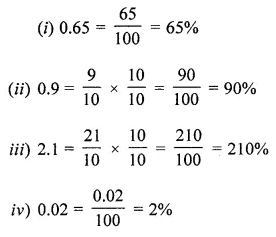
Answer:
(i) The river Kaveri obtains the water from the hills and forests of Coorg.
(ii) Mahaseer, a large freshwater fish is in abundance in the river.
(iii) The elephants enjoy bathing and scrubbing in the river by their mahouts.
(iv) ‘scrubbed’.
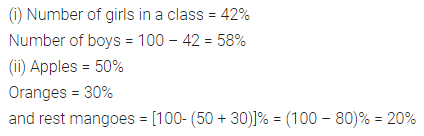
Question 6.
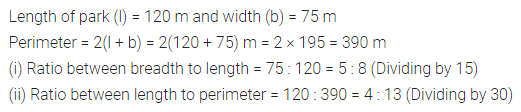
The most laidback individuals become converts to the life of high-energy adventure with river rafting, canoeing, rappelling, rock climbing and mountain biking. Numerous walking trails in this region are a favourite with trekkers. Birds, bees and butterflies are there to give you company. Macaques, Malabar squirrels, langurs and slender loris keep a watchful eye from the tree canopy. I do, however, prefer to step aside for wild elephants.
(i) What adventure sports are available in Coorg?
(ii) How do the trekkers enjoy here?
(iii) Who accompanies the tourists?
(iv) Pick out the word form the passage that means the same as—relaxed.
Answer:
(i) Adventure sports available in Coorg are river rafting, canoeing, repelling, rock climbing, and mountain biking.
(ii) There are numerous walking trails which are favourite with trekkers.
(iii) Birds, bees and butterflies are there to accompany the tourists.
(iv) ‘laidback’.

Question 7.
The climb to the Brahmagiri hills brings you into a panoramic view of the entire misty landscape of Coorg. A walk across the rope bridge leads to the sixty-four-acre island of Nisargadhama. Running into Buddhist monks from India’s largest Tibetan settlement, at nearby Bylakuppe, is a bonus. The monks, in red, ochre and yellow robes, are amongst the many surprises that wait to be discovered by visitors searching for the heart and soul of India, right here in Coorg.
(i) What does a climb on Brahmagiri hills present?
(ii) What are others attractive places near Coorg?
(iii) Where is Indian’s largest Tibetan colony?
(iv) Pick out the word from the passage that means the same as—Buddhist priest.
Answer:
(i) A climb to Brahmagiri hills presents a panoramic view of the entire misty landscape of Coorg.
(ii) Nisargadhama and Bylakuppe are the other attraction places near Coorg.
(iii) India’s largest Tibetan colony is nearby Bylakuppe in Coorg.
(iv) ‘Monk’.

Tea from Assam

Glimpses of India Extra Questions and Answers Very Short Answer Type

Question 1.
What did Pranjol order for?
Answer:
Pranjol ordered for two cups of tea.

Question 2.
Where were both the boys going to?
Answer:
Both the boys were going to Assam.

Question 3.
What did Rajvir tell Pranjol?
Answer:
Rajvir told Pranjol that over eighty crore cups of tea are drunk everyday.

Question 4.
Where were the two boys?
Answer:
The two boys were in the train.

Question 5.
What was Pranjol doing?
Answer:
Pranjol was reading a detective book.

Question 6.
What was surprising for Rajvir?
Answer:
Rajvir had never seen such a greenery before.

Question 7.
What two crops did Rajvir see?
Answer:
Rajvir saw paddy fields and tea-bushes.

Question 8.
What was magnificent?
Answer:
The view of tea gardens was magnificent.

Question 9.
Who were the doll-like figures?
Answer:
The doll like figures were the women.

Question 10.
What is Rajvir telling Pranjol?
Answer:
Rajvir is telling Pranjol legends about the origin of tea.

Question 11.
Where was tea first drunk?
Answer:
The tea was first drunk in China.

Question 12.
When did tea come to Europe?
Answer:
In the sixteenth century.

Question 13.
How was tea used at that time?
Answer:
The tea was used as medicine rather than a beverage.

Question 14.
What did the ancient Buddhist ascetic do?
Answer:
An ancient Buddhist ascetic cut off his eyelids as he felt sleepy during meditations.

Question 15.
Which is the important junction of Assam?
Answer:
Mariani junction.

Question 16.
Where are the tea leaves collected?
Answer:
Tea leaves are collected in bamboo baskets by the women.

Question 17.
Which words are Chinese?
Answer:
‘Chai’ and ‘Chini’ are from Chinese.

Glimpses of India Extra Questions and Answers Short Answer Type

Question 1.
Which Chinese story did Rajvir tell about the discovery of tea?
Answer:
There was a Chinese story about tea. It was said that there was a Chinese emperor. He always drank boiled water. Once while boiling the water, some leaves of the burning twigs fell into the pot. The boiled water gave a delicious flavour. They were tea-leaves.

Question 2.
Narrate the story of a Buddhists monk behind the discovery of tea?
Answer:
There was a Buddhist monk story about tea. A Buddhist ascetic was busy in his meditation for God. By chance he fell asleep and his meditation broke. He did not like it. In a state of anger, he cut his eyelids and threw them on the earth. There appeared tea plants out of these eyelids. Then these leaves were put in the hot water. When people drank the hot water, it banished their sleep. In the beginning it was drunk as a medicine rather than a beverage.

Question 3.
Where was Rajvir going? Why?
Answer:
Rajvir was going to Pranjol’s house in Assam. Pranjol has invited him to spend the summer vacations with him at his house. Moreover, Rajvir was interested to know about the tea gardens in Assam. So he was going to Assam.

Question 4.
What excited Rajvir? Why did Pranjol not share his excitement?
Answer:
Rajvir had never seen the tea garden before. So the sight of tea garden excited him. But Pranjol has been born and brought up in the tea plantations. He had seen them many times. So he did not share Rajvir’s excitement.

Question 5.
What are the various legends regarding the origin of tea?
Answer:
There was a Chinese story about tea. It was said that there was a Chinese emperor. He always drank boiled water. Once while boiling the water, some leaves of the burning twigs fell into the pot. The boiled water gave a delicious flavour. They were tea-leaves.

There was a Buddhist monk story about tea. A Buddhist ascetic was busy in his meditation for God. By chance he fell asleep and his meditation broke. He did not like it. In a state of anger, he cut his eyelids and threw them on the earth. There appeared tea plants out of these eyelids. Then these leaves were put in the hot water. When people drank the hot water, it banished their sleep. In the beginning it was drunk as a medicine rather than a beverage.

Glimpses of India Extra Questions and Answers Long Answer Type

Question 1.
What are the legends of the discovery of tea?
OR
What are the various legends regarding the origin of tea?
Answer:
There are two legends about the discovery of tea. According to one story, it was the Chinese emperor who discovered it accidentally. He always boiled water before drinking it. One day a few leaves of plants fell into the boiling water which gave it a delicious taste. It is said that they were tea leaves. The emperor started their use in boiling water. Another Indian legend says that an ancient Buddhist ascetic cut off his eyelids because he felt sleepy during meditation. Ten tea plants grew out of the eyelids. The leaves of these plants when put in hot water and drunk banished sleep. Thus, tea came into existence.

Question 2.
Based on your reading of the chapter “Tea From Assam”, write a paragraph on the topic “Importance of Tea in India”.
OR
You know that everybody drinks tea everyday in India. It banishes our sleep and makes us feel fresh. Describe the ‘importance of tea in India’.
Answer:
Today all people drink tea every day in India. But the quantity of tea differs from person to person. Life in an Indian house starts with a refreshing cup of tea. India has now surpassed China in tea production. India is one of the largest tea producers in the world. 70 per cent of its tea is consumed within India. Assam and Darjeeling produced world renowned tea. Tea became widely popular in India during 1950s Tea industry is the second largest employer in the country. It is grown in many states in India. Tea plants need shade to grow besides humid climate. It is a labour oriented industry. Tea has a number of medical and therapeutic properties.

Glimpses of India Extra Questions and Answers Reference to Context

Read the following passages and answer the questions that follow:

Question 1.
“CHAI-GARAM… garam chai,” a vendor called out in a high-pitched voice.
He came up to their window and asked, “Chai, sa’ab?”
“Give us two cups,” Pranjol said.
They sipped the steaming hot liquid. Almost everyone in their compartment was drinking tea too.
“Do you know that over eighty crore cups of tea are drunk every day throughout the world?” Rajvir said.
(i) Who was speaking in a high pitched voice and what?
(ii) What did Pranjol ask the tea vendor?
(iii) What did Rajvir tell Pranjol?
(iv) Pick out the word from the passage that means the same as “drank”.
Answer:
(i) A vendor was speaking in a high pitched voice for Chai-garam.
(ii) Pranjol asked the tea-vendor to give two cups of tea.
(iii) Rajvir told Pranjol that over eighty crore cups of tea are drunk every day throughout the world.
(iv) “sipped”.

Question 2.
“Whew!” exclaimed Pranjol. “Tea really is very popular.” The train pulled out of the station. Pranjol buried his nose in his detective book again. Rajvir too was an ardent fan of detective stories, but at the moment he was keener on looking at the beautiful scenery. It was green, green everywhere. Rajvir had never seen so much greenery before. Then the soft green paddy fields gave way to tea bushes.
(i) What was exclaimed by Pranjol?
(ii) What was Pranjol doing in the train?
(iii) What was surprising for Rajvir?
(iv) Pick out word from the passage that means the same as ‘firm’.
Answer:
(i) Pranjol exclaimed “Tea is really very popular”.
(ii) Pranjol was reading detective stories from a novel.
(iii) Rajvir was surprised to see the beautiful scenery.
(iv) ‘ardent’.

Question 3.
It was a magnificent view. Against the backdrop of densely wooded hills a sea of tea bushes stretched as far as the eye could see. Dwarfing the tiny tea plants were tall sturdy shade-trees and amidst the orderly rows of bushes busily moved doll-like figures. In the distance was an ugly building with smoke billowing out of tall chimneys. .“Hey, a tea garden!” Rajvir cried excitedly. Pranjol, who had been born and brought up on a plantation, didn’t share Rajvir’s excitement.
(i) Which view had been referred to above?
(ii) What had been compared with the tea plantation?
(iii) Why was Rajvir excited?
(iv) Pick out word from the passage that means the same as – ‘beautiful’.
Answer:
(i) The view of tea plantation was magnificent.
(ii) The tea garden had been compared with a vast sea.
(iii) Rajvir was excited after seeing the tea garden.
(iv) ‘magnificent’.

Question 4.
“Oh, this is tea country now, “he said. “Assam has the largest concentration of plantations in the world. You will see enough gardens to last you a lifetime!”
“I have been reading as much as I could about tea,” Rajvir said. “No one really knows who discovered tea but there are many legends.”
“What legends?”
“Well, there’s the one about the Chinese emperor who always boiled water before drinking it. One day a few leaves of the twigs burning under the pot fell into the water giving it a delicious flavour. It is said they were tea leaves.”
“Tell me another!” scoffed Pranjol,
“We have an Indian legend too. Bodhidharma, an ancient Buddhist ascetic, cut off his eyelids because he felt sleepy during meditations. Ten tea plants grew out of the eyelids. The leaves of these plants when put in hot water and drunk banished sleep.
(i) What did Rajvir say?
(ii) What was he telling him?
(iii) What was done by the Buddhist ascetic?
(iv) Pick out word from the passage that means the same as—‘tasty’.
Answer:
(i) Rajvir said that Assam had the largest concentration of plantations in the world.
(ii) He was telling him the legends about the origin of tea. There are many legends about the origin of tea.
(iii) The Buddhist monk cut off his eyelids and threw them away.
(iv) ‘delicious’.

Question 5.
“Tea was first drunk in China,” Rajvir added, “as far back as 2700 B.C! In fact words such as tea, ‘cha? and ‘chin? are from Chinese. Tea came to Europe only in the sixteenth century and was drunk more as medicine than as beverage.”
The train clattered into Mariani junction. The boys collected their luggage and pushed their way to the crowded platform.
Pranjol’s parents were waiting for them.
Soon they were driving towards Dhekiabari, the tea-garden managed by Pranjol’s father.
(i) Where was tea first drunk?
(ii) Which words are from Chinese?
(iii) When did tea come to Europe?
(iv) Pick out the word from the passage that means the same as—‘a period of hundred years’.
Answer:
(i) Tea was first drunk in China.
(ii) ‘Cha? and Chini words are from Chinese.
(iii) In the Sixteenth century, tea came to Europe.
(iv) ‘century’.

Question 6.
An hour later the car veered sharply off the mail*road. They crossed a cattle-bridge and entered Dhekiabari Tea Estate. On both sides of the gravel-road were acre upon acre of tea bushes, all neatly pruned to the same height. Groups of tea-pluckers, with bamboo baskets on their backs, wearing plastic aprons, were plucking the newly sprouted leaves. Pranjol’s father slowed down to allow a tractor, pulling a trailer-load of tea leaves, to pass.
“This is the second-flush or sprouting period, isn’t it, Mr Barua?” Rajvir asked. “It lasts from May to July and yields the best tea.”
(i) What was worn by the women?
(ii) What were they doing?
(iii) When is the best yield for tea?
(iv) Pick out the word from the passage that means the same as—‘clothes’.
Answer:
(i) The women wore plastic aprons.
(ii) They were plucking the newly sprouted leaves.
(iii) The best yield lasts from May to July.
(iv) ‘aprons’.