The Proposal Extra Questions and Answers Class 10 English First Flight

Here we are providing The Proposal Extra Questions and Answers Class 10 English First Flight, Extra Questions for Class 10 English was designed by subject expert teachers.

The Proposal Extra Questions and Answers Class 10 English First Flight

The Proposal Extra Questions and Answers Very Short Answer Type

Question 1.
Why did Lomov visit Chubukov?
Answer:
Lomov visited Chubukov’s house to propose to Natalaya.

Question 2.
What does Chubukov suspect?
Answer:
Chubukov suspects that Lomov has come to borrow money from him.

Question 3.
What does Lomov think about Natalaya?
Answer:
He thinks that Natalaya is an excellent housekeeper, not bad looking, and well-educated.

Question 4.
How old was Lomov?
Answer:
Lomov was already thirty-five years old.

Question 5.
Where was the Oxen Meadows situated?
Answer:
Oxen Meadows were wedged in between Chubukov’s Birchwoods and the Burnt Marsh.

Question 6.
What does Natalaya guess on seeing Lomov?
Answer:
She thinks that he is perhaps going to a ball for dancing.

Question 7.
Why is Lomov not able to answer properly?
Answer:
Lomov is nervous and confused as he is going to propose to Natalya, so he is not able to answer properly.

Question 8.
What does Natalaya say about Oxen Meadows?
Answer:
Natalaya says that Oxen Meadows belong to her.

Question 9.
What does Lomov say on his part?
Answer:
Lomov says that Natalaya can see from the documents.

Question 10.
Who is a land grabber?
Answer:
A land grabber is a person who grabs the land of others.

Question 11.
What threatening was given by Lomov?
Answer:
Lomov told him to go to the court for a decision.

Question 12.
What is the last threatening to Lomov?
Answer:
Chubukov warned Lomov never to set foot in his house again.

Question 13.
What was felt by Lomov?
Answer:
Lomov felt heart-palpitation.

Question 14.
How does Chubukov behave in the end?
Answer:
Chubukov gives Lomov’s hand into Natalaya’s hands and advises them for a kiss.

Question 15.
Write down the final advice of Chubukov?
Answer:
Chubukov advised Natalaya and Lomov to start their family bliss.

The Proposal Extra Questions and Answers Short Answer Type

Question 1.
What is the play “The Proposal”?
Answer:
The play “The Proposal’ is about Lomov’s visit to his neighbor’s Chubukov house. Lomov is wearing a formal dress. He has come with the intention of making a marriage proposal to Chubukov’s daughter, Natalaya.

Question 2.
What does Lomov think when he is alone?
Answer:
Lomov thinks that Natalaya is an excellent housekeeper, not bad looking, well educated. It is impossible for him not to marry. In the first place, he is already thirty-five. He ought to lead a quiet and regular life. He suffers from palpitations. He is excitable and always getting upset. There are some other problems too which trouble him.

Question 3.
Why does Lomov wish to propose to Natalaya?
Answer:
Lomov wishes to propose to Natalaya because he feels she is an excellent housekeeper, not bad looking, and is also well-educated. Moreover he feels that he is already thirty-five, which is a critical age and he ought to lead a regular and settled life.

Question 4.
Justify, in brief, the title of the play “The Proposal”.
Answer:
The title of the play “The Proposal” is apt. Lomov comes to Chubukov’s house to propose to his daughter. He talks to Chubukov about his intention and the old man is very happy to have Lomov as the husband of this ageing daughter. When Natalaya comes and there begins an argument. It reminds us of a married couple.

Question 5.
Who is Lomov? Why does he visit Chubukov?
Answer:
Lomov was a young wealthy landowner and an unmarried man of thirty-five. He was anxious to get married as he had already reached a critical age. So he decided to propose Natalaya, a girl of twenty-five years old. He visited Chubukov to ask for his daughter Natalaya’s hand in marriage.

Question 6.
How does Natalaya react when she comes to know that Lomov had come to propose for her hand?
Answer:
When she knows that Lomov came to propose to her, she starts weeping. She calls her father to bring him back at once. He has gone out after the quarrel. She also accuses Chubukov that he drove Lomov out. She becomes hysterical.

Question 7.
What makes Chubukov misunderstand the purpose of Lomov’s visit?
Answer:
Chubukov misunderstands that Lomov has come to borrow money. He does not reveal his purpose of coming directly instead he says that he has come to trouble him with a request for help.

The Proposal Extra Questions and Answers Long Answer Type

Question 1.
Neighbours must have a cordial relationship that Lomov and Natalaya do not have. Describe/ Justify/ Explain the first fight between them.
Answer:
Neighbours must have a cordial relationship but in the case of Lomov and Natalaya, it was different. Lomov and Natalaya were rich people. They were wealthy people and had a competition between them on the subject of wealth. Both were neighbours. Lomov, at a critical age of thirty-five, thought that he had to marry and found Natalaya not bad looking, an excellent housekeeper. So he decided to propose to her.

Lomov, in a well-dressed manner, wearing coat and gloves, one evening went to Chubukov’s house. Chubukov was Natalaya’s father. When he came there and said that he wanted a help, the help which could only be done by him. Chubukov, for first time suspected that he had come for asking money. But after a long struggling and shivering, Lomov uncovers his need. He had come to propose to Natalaya. Chubukov was mistaken and he was filled with extreme joy and called Natalaya. Lomov asked then, whether Natalaya would agree for it or not. Then, Chubukov said that, she would be ready to accept it because she was a lovesick cat.

When Natalaya arrived, she actually did not know that Lomov had come to propose to her. They started talking and when they were talking about land, Lomov stated “Our Oxen Meadows”. Then Natalaya said, “Our Oxen Meadows”, it is not your Oxen Meadows’, it is their. Lomov did not agree. But Natalaya initiated a heated argument. By arguing with each other, they did not solve any problem. They got trapped in a long argument just because of their lack of tolerance towards each other and their desire to keep their pride. Neighbours must have a cordial relationship which Lomov and Natalaya do not have.

Question 2.
Anton Chekov has used humour and exaggeration in the play to comment on courtship in his times. Illustrate with examples from the lesson, “The Proposal”. Also mention the values, you think, any healthy relationship requires.
OR
The principle ‘forgive and forget’ helps a lot is maintaining cordial relations with our neighbours. Do you think Chubukov conveys this message in the play “The Proposal’.
Answer:
Lomov and Natalaya meet for a serious purpose , i.e., to talk about marriage that decides the progress of one’s life as a member of the conventionally established society. But the purpose of their meeting gets lost on two consecutive occasions because Lomov’s faith in the values of his society disrupts his approach to the topic of marriage. He learns that the girl and her father like him, but, instead of proposing to marry her and discussing how their marriage should be organised, he goes on to talk about properties, relations, family histories, and pets, draws them into an unnecessary argument, and antagonises both of them.

Finally, Chubukov marries Lomov and Natasha by force before another problem crops up. Thus the play ends in a comic note, just because the couple gets together with their father to celebrate their marriage while the dispute over the pets is still continuing. For any healthy relationship there should be mutual understanding and respect. Quarreling over trivial issues like dog cannot guarantee longevity of a relationship.

Question 3.
Is Natalaya really a lovesick cat as called by her father? If it is so, why does she quarrel with Lomov?
Answer:
Natalaya was a young unmarried girl of twenty five years. She lived in the neighbourhood of Lomov, a young unmarried man. She was an excellent housekeeper and was not bad looking. She wanted love in her life. Her father called her a lovesick cat. Lomov said that she was well educated, but she did not seem to be so.

She was very quarrelsome and abusive by nature. She began a bitter quarrel with Lomov over a piece of land that had little value. She said that those meadows were not much worth to her but she could not stand unfairness. But when she learnt that Lomov had come to propose to her, she forgot all fairness and unfairness.

She began to wail over the lost chance. She forced her father to call him back. But in no time, she started quarrelling with him again. It was on their dogs. Both claimed their respective dogs to be of a superior breed.

Question 4.
What type of person is Natalaya? Give two examples to show her quarrelsome nature.
Answer:
Natalaya is also rather hypocritical, and she is obstinate and argumentative. When Natalaya first
enters the room, she greets Lomov with warmth and is very gracious as she permits him to smoke and compliments him upon his appearance. However, when Lomov speaks of “my meadows,” she abruptly interrupts and contradicts him. An argument then ensures over who own what land.

Even when Lomov offers them to her as a gift, she continues to insist upon her ownership of them in the first place, reigniting the argument until Lomov leaves. When her father finally reveals to Natalaya that Lomov has actually come to propose marriage; she is infuriated, blaming her father for causing the neighbour to depart.

Question 5.
The principle ‘Forgive and Forget’ helps a lot in maintaining cordial relations with our neighbours. Do you think the author proves this message in the play “The Proposal”?
Answer:
Life is a journey which is often compared to the roller coaster ride. It means life is full of ifs and buts and ups and down. But the path of life can be smoothened by virtues of our actions, attitudes and behaviour. And the principle of forgive and forget comes from these virtues. Letting go of anger and bitterness can work wonders both for our attitude and for our health.

Anger may spoil anything like poison. One cannot afford to remain wallowing in the marsh of anger’or sad feelings. Life has to move on and if one wants to get ahead one has to imbibe “forgive and forget”. Only sensitive and great people can follow this gospel.

In the present play “The Proposal” we find that Lomov visits the house of Chubukov with a proposal to marry his daughter Natalaya. Chubukov’s joy knows no bound to hear this. But in course of their common talk, they pick up nonsensical issue and stand fighting and abusing each other.

Even Natalaya also jumps into the ring of verbal quarrel. When things become normal after the sudden departure of Lomov, Natalaya comes to know about the proposal, She asks her father to call Lomov back. When he comes back this time he and Natalaya starts abusing each other and have heated oral fight over dogs. But in the end, they compromise, they forget their issue and forgive each other. The proposal changes into marriage. Hence we see that the principle helped them unite.

Question 6.
What does Chubukov at first suspect that Lomov had come for? Is he sincere when he later
says, “And I’ve always loved you, my angel, as if you were my own son”? Find reasons for your answer from the play.
Answer:
Chubukov has often helped Lomov with money whenever he requested for it. So he thinks and suspects that Lomov will ask for money. But this time the case is different. He requests a proposal to get Natalaya’s hand for marriage. Since long, Chubukov wanted match for his daughter. Finding fact in his favour, Chubukov changes and uses sweet words and becomes ready for the match.

Question 7.
Chubukov says of Natalaya, “… as if she won’t consent! She’s in love; egad, she’s like a lovesick cat…” Would you agree? Find reasons for your answer.
Answer:
In reality Natalaya has got the fittest age for the marriage. She wants a life partner. On the other hand, Chubukov also desires that his daughter should be married. Lomov is the most suitable match in every respect. In order to say something outwardly, Chubukov happens to pour out these words. It is an acceptable fact that Natalaya loves Lomov from the core of her heart.

Question 8.
(i) Find all the words and expressions in the play that the characters use to speak about
each other, and the accusations and insults they hurl at each other. (For example, Lomov in the end calls Chubukov an intriguer; but earlier, Chubukov has himself called Lomov a “malicious, doublefaced intriguer. Again, Lomov begins by describing Natalaya as “an excellent housekeeper, not bad looking, well-educated.)
(ii) Then think of five adjectives or adjectival expressions of your own to describe each character in the play.
(iii) Can you now imagine what these characters will quarrel about next?
Answer:
(i) There are so many words and expressions that the characters use, to accuse and insult each other.
Some can be given as under. Chubukov calls Lomov: pettifogger, lunatic, drunkard, guzzling gambler, backbiters, villain, scarecrow, blind hen, stuffed-sausage, wizen-faced frump, turnip ghost. Lomov calls Chubukov and his family members: hump-backed, grabber.

(ii) Adjectival expression: Some of the adjectives can be thought as under: proud, industrious, treasure, darling, love, decent, well-educated, sensible and lovable, etc.

(iii) Natalaya, the daughter of Chubukov has got hand of Lomov. Both embrace and kiss each other. Chubukov blesses them to start a family. But like a lie, a Quarrel can be done on any issue.

The Proposal Extra Questions and Answers Reference to Context

Read the following passages and answer the questions that follow:

Question 1.
Chubukov: We just get along somehow, my angel, thanks to your prayers, and so on. Sit down, please do… Now you know, you shouldn’t forget all about your neighbours, my darling. Me dear fellow, why are you so formal in your get-up! Evening dress, gloves, and so on. Can you be going anywhere, my treasure?
(i) Who is the speaker?
(ii) Who do ‘my darling’ and ‘my Angel’ refer to?
(iii) Do you think Chubukov means all the nice words he speaks?
(iv) What is antonym of‘formal’?
Answer:
(i) Chubukov is the speaker of these lines.
(ii) ‘My darling’ and ‘ my angel’ refer to Lomov.
(iii) Not at all, he is a bit hypocritical and shows excess hospitality to Lomov.
(iv) ‘informal’.

Question 2.
Lomov: Well, you see, it’s like this. (Takes his arm) I’ve come to you, honoured Stepan Stepanovitch, to trouble you with a request. Not once or twice have I already had the privilege of applying to you for help, and you have always, so to speak… I must ask your pardon, I am getting excited. I shall drink some water, honoured Stepan Stepanovitch.
(i) Who is the speaker?
(ii) What was he hoping for?
(iii) Why is he so excited?
(iv) Pick out the word from the passage that means the same as ‘opportunity’.
Answer:
(i) Lomov is the speaker of these lines.
(ii) He was hoping for marriage proposal for Natalaya.
(iii) He is excited because he had to propose to his daughter, Natalaya.
(iv) ‘privilege’.

Question 3.
Chubukov: [Interrupting] Me dear fellow… I’m so glad, and so on… Yes, indeed, and all that sort of thing. [Embraces and kisses Lomov] I’ve been hoping for it for a long time. It’s been my continual desire. [Sheds a tear] And I’ve always loved you, my angel, as if you were my own son. May god give you both—His help and His love and so on, and so much hope… What am I behaving in this idiotic way for? I’m off my balance with joy, absolutely off my balance! Oh, with all my soul… I’ll go and call Natasha, and all that.
(i) Who is the speaker?
(ii) What was he hoping for?
(iii) Why is he excited?
(iv) What does the speaker wish for the listener?
Answer:
(i) Chubukov is the speaker of these lines.
(ii) Chubukov was hoping for the marriage proposal for his daughter from Lomov.
(iii) Chubukov is excited because Lomov had come with marriage proposal for his daughter.
(iv) Chubukov wishes for Lomov that God may give him His help and His love.

Question 4.
Lomov: It’s cold… I’m trembling all over, just as if I’d got an examination before me. The great thing is, I must have my mind made up. If I give myself time to think, to hesitate, to talk a lot, to look for an ideal, or for real love, then I’ll never get married. Brr… It’s cold! Natalaya Stepanovna is an excellent housekeeper, not bad-looking, well-educated. What more do I want? But I’m getting a noise in my ears from excitement.
(i) Who is the speaker?
(ii) Who is feeling cold her?
(iii) Why did he feel cold?
(iv) Pick out the word from passage that means the same as ‘to decide’.
Answer:
(i) Lomov is the speaker of these lines.
(ii) Lomov is feeling cold here.
(iii) He feels cold as he has come to propose Natalaya. He is not sure how she would react.
(iv) ‘Mind made up’ means to decide.

Question 5.
Natalya: Then smoke. Here are the matches. The weather is splendid now, but yesterday it was so wet that the workmen didn’t do anything all day. How much hay have you stacked? Just think, I felt greedy and had a whole field cut, and now I’m not at all pleased about it because I’m afraid my hay may rot. I ought to have waited a bit. But what’s this? Why, you’re in evening dress! Well, I never! Are you going to a ball or what? Though I must say you look better… Tell me, why are you got up like that?
(i) Who is speaking these words and to whom?
(ii) Why is she not pleased?
(iii) What does she offer him?
(iv) Pick out the word from the passage that means the same as ‘managed in a pile’.
Answer:
(i) Natalaya is speaking these words to Lomov.
(ii) Natalaya is not pleased because she thinks her hay might rot. She had a whole field cut and hay stacked but unfortunately it had rained the previous day.
(iii) She offers him a cigarette to smoke.
(iv) ‘stacked’.

Question 6.
Lomov: I shall try to be brief. You must know, honoured Natalaya Stepanovna, that I have long, since my childhood, in fact had the privilege of knowing your family. My late aunt and her husband, from whom, as you know, I inherited my land, always had the greatest respect for your father and your late mother. The Lomovs and the Chubukovs have always had the most friendly, and I might almost say the most affectionate, regard for each other. And, as you know, my land is a near neighbour of yours. You will remember that my Oxen Meadows touch your birchwoods.
(i) Who is the speaker?
(ii) Who is being addressed?
(iii) What type of relations they had in the past?
(iv) What is common between the Lomovs and Chubukovs?
Answer:
(i) Lomov is the speaker of these lines.
(ii) Lomov is being addressed to Natalaya.
(iii) They had good relations in the past. Both the families had respect and affection for each other.
(iv) Lomov’s Oxen Meadows touch Chubukov’s birchwoods.

Question 7.
Lomov: …Oxep Meadows, it’s true, were once the subject of dispute, but now everybody knows that they are mine. There’s nothing to argue about. You see my aunt’s grandmother gave the free use of these Meadows in perpetuity to the peasants of your father’s grandfather, in return for which they were to make bricks for her. The peasants belonging to your father’s grandfather had the free use of the Meadows for forty years, and had got into the habit of regarding them as their own, when it happened that.
(i) Who is the speaker of these lines?
(ii) What are they arguing about?
(iii) Who gave the Meadows and to whom?
(iv) What were they supposed to do?
Answer:
(i) Lomov is the speaker of these lines.
(ii) They are arguing about the ownership of the Oxen Meadows.
(iii) The Oxen Meadows were given by Lomov’s aunt’s grandmother to the peasants belonging to Chubukov’s father.
(iv) They were supposed to make bricks for her aunty.

Question 8.
Natalya: No you’re simply joking, or making fun of me. What a surprise! We’ve had the land for nearly three hundred years, and then we’re suddenly told that it isn’t ours! Ivan Vassilevitch, I can hardly believe my own ears. These Meadows aren’t worth much to me. They only come to five dessiatins, and are worth perhaps 300 roubles, but I can’t stand unfairness. Say what you will, I can’t stand unfairness.(Page 148)
(i) Who is the speaker? Who is being addressed?
(ii) How much are the Meadows worth.
(iii) What does she find ‘unfair’?
(iv) Pick out the word from the passage that means opposite to ‘gradually’.
Answer:
(i) Natalaya is the speaker. She is speaking to Lomov.
(ii) The Meadows are worth 300 roubles.
(iii) Natalaya finds Lomov claim that Oxen Meadows are his as unfair.
(iv) ‘suddenly’.

Question 9.
Natalya: Ours! You can go on proving it for two days on end, you can go and put on fifteen caress jackets, but I tell you they’re ours, ours, ours! I don’t want anything of yours and I don’t want to give anything of mine. So there!
(i) Who is speaking these words and to whom?
(ii) What are they arguing over?
(iii) Pick out the word from the passage that means the same as “confirm”.
(iv) What does the speaker offer to prove two days on end?
Answer:
(i) Natalaya is speaking these words for Lomov.
(ii) They are arguing over the ownership of Oxen Meadows.
(iii) ‘prove’(PROVE)
(iv) The Natalya offer to prove for two days on end to ownership of oxen meadows.

Question 10.
Natalya: I can make you a present of them myself, because they’re mine! Your behaviour, Ivan Vassilevitch, is strange, to say the least! Up to this we have always thought of you as a good neighbour, a friend; last year we lent you our threshing-machine, although on that account we had to put off our own threshing till November, but you behave to us as if we were gypsies. Giving me my own land, indeed! No, really, that’s not at all neighbourly! In my opinion, it’s even impudent, if you want to know.
(i) Who is the speaker?
(ii) Who is being addressed?
(iii) What does the speaker offer?
(iv) What does the speaker remind the listener?
Answer:
(i) Natalaya is the speaker.
(ii) Natalaya is addressing Lomov.
(iii) She offers that she can give Lomov her Oxen Meadows as a gift.
(iv) She reminds Lomov that they were good friends and her family gave him their threshing machine last year.

Question 11.
Lomov: But, please, Stepan Stepanovitch, how can they be yours? Do be a reasonable man! My aunt’s grandmother gave the Meadows for the temporary and free use of your grandfather’s peasants. The peasants used the land for forty years and got accustomed to it as if it was their own, when it happened that…
(i) Who is the speaker?
(ii) Who is being addressed?
(iii) What do ‘They’ stand for?
(iv) Pick out the word from the passage that means the same as “familiar”.
Answer:
(i) Lomov is the speaker of these lines.
(ii) Lomov is addressing Chubukov.
(iii) ‘They’ refer to the ‘Meadows’. Each one is trying to prove that the Meadows belong to them.
(iv) ‘accustomed’.

Question 12.
Natalya: There’s some demon of contradiction in you today, Ivan Vassilevitch. First you pretend that the Meadows are yours; now, that Guess is better than Squeezer. I don’t like people who don’t say what they mean, because you know perfectly well that Squeezer is a hundred times better than your silly Guess. Why do you want to say he isn’t?
(i) What does Natalaya blame Lomov for?
(ii) What do Natalaya and Lomov first argue about?
(iii) Who are Guess and Squeezer?
(iv) Pick out the word from the passage that means the same as “opposition”.
Answer:
(i) Natalaya blames Lomov for opposing whatever she says.
(ii) Natalaya and Lomov first argue about the ownership of Oxen Meadows.
(iii) Guess and Squeezer are the names of their dogs.
(iv) ‘contradiction’.

Question 13.
Chubukov: It’s not true! My dear fellow, I’m very liable to lose my temper, and so, just because of that, let’s stop arguing. You started because everybody is always jealous of everybody else’s dogs. Yes, we’re all like that! You too, sir, aren’t blameless! You no sooner begin with this, that and the other, and all that… I remember everything!
(i) Who is the speaker of these lines?
(ii) Who give this advice to whom?
(iii) Who is not blameless? Why?
(iv) Pick out the synonym of innocent or guiltless’ from the passage.
Answer:
(i) Chubukov is the speaker of these lines.
(ii) Chubukov gives this advice to Lomov.
(iii) According the Chubukov, Lomov is not blameless because he had tried to prove that Guess, his dog is superior to Squeezer.
(iv) blameless.
ML Aggarwal Class 7 Solutions for ICSE Maths Chapter 7 Percentage and Its Applications Ex 7.4

ML Aggarwal Class 7 Solutions Chapter 7 Percentage and Its Applications Ex 7.4 for ICSE Understanding Mathematics acts as the best resource during your learning and helps you score well in your exams.

ML Aggarwal Class 7 Solutions for ICSE Maths Chapter 7 Percentage and Its applications Ex 7.4

Question 1.
Find the simple interest on:
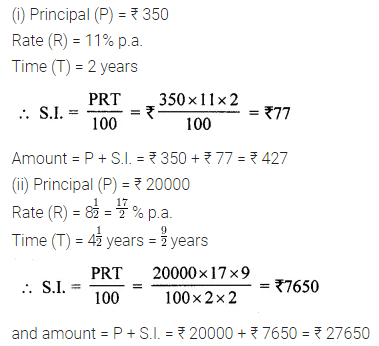
(i) ₹ 350 for 2 years at 11% per annum
(ii) ₹ 20000 for 4\(\frac { 1 }{ 2 }\) years at 8\(\frac { 1 }{ 2 }\) % per annum
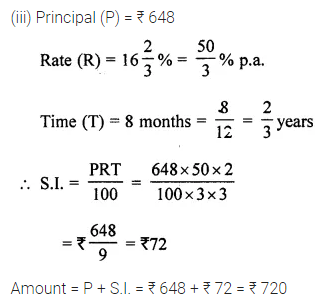
(iii) ₹ 648 for 8 months at 16\(\frac { 2 }{ 3 }\) % per annum. Also, find the amount in each case.
Solution:
ML Aggarwal Class 7 Solutions for ICSE Maths Chapter 7 Percentage and Its Applications Ex 7.4 1
ML Aggarwal Class 7 Solutions for ICSE Maths Chapter 7 Percentage and Its Applications Ex 7.4 2

Question 2.
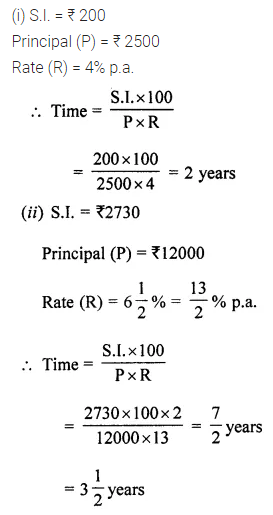
Find the time when:
(i) simple interest on ₹ 2500 at 4% per annum is ₹ 200
(ii) simple interest on ₹ 12000 at 6\(\frac { 1 }{ 2 }\) % per annum is ₹ 2730
Solution:
ML Aggarwal Class 7 Solutions for ICSE Maths Chapter 7 Percentage and Its Applications Ex 7.4 3

Question 3.
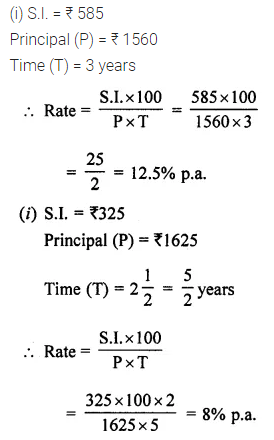
Find the rate of interest when:
(i) simple interest on ₹ 1560 in 3 years is ₹ 585
(ii) simple interest on ₹ 1625 in 2\(\frac { 1 }{ 2 }\) years is ₹ 325.
Solution:
ML Aggarwal Class 7 Solutions for ICSE Maths Chapter 7 Percentage and Its Applications Ex 7.4 4

Question 4.
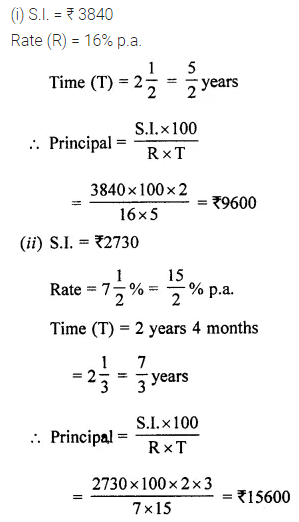
Find the principal when:
(i) simple interest at 16% per annum for 2\(\frac { 1 }{ 2 }\) years is ₹ 3840
(ii) simple interest at 7\(\frac { 1 }{ 2 }\) % per annum for 2 years 4 months is ₹ 2730.
Solution:
ML Aggarwal Class 7 Solutions for ICSE Maths Chapter 7 Percentage and Its Applications Ex 7.4 5

Question 5.
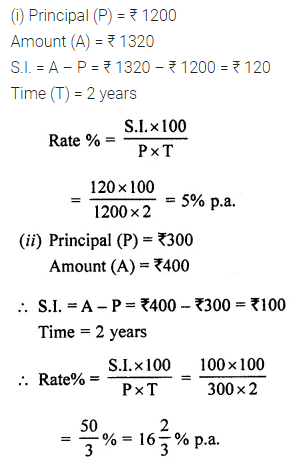
Find the rate of interest when:
(i) ₹ 1200 amounts to ₹ 1320 in 2 years
(ii) ₹ 300 amounts to ₹ 400 in 2 years.
Solution:
ML Aggarwal Class 7 Solutions for ICSE Maths Chapter 7 Percentage and Its Applications Ex 7.4 6

Question 6.
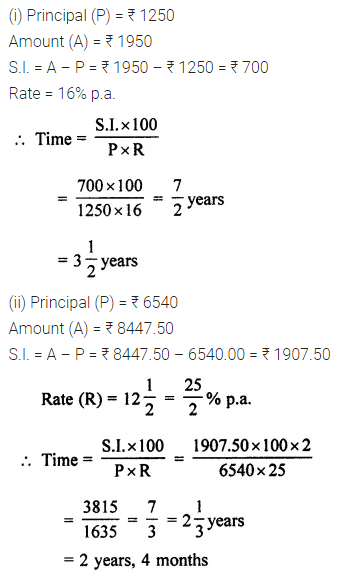
Find the time when:
(i) ₹ 1250 amounts to ₹ 1950 at 16% per annum
(ii) ₹ 6540 amounts to ₹ 8447.50 at 12\(\frac { 1 }{ 2 }\) per annum.
Solution:
ML Aggarwal Class 7 Solutions for ICSE Maths Chapter 7 Percentage and Its Applications Ex 7.4 7

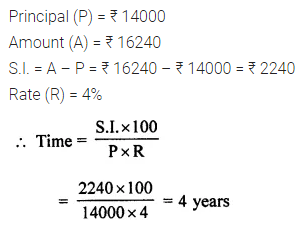
Question 7.
₹ 14000 is invested at 4% per annum simple interest. How long will it take for the amount to reach ₹ 16240?
Solution:
ML Aggarwal Class 7 Solutions for ICSE Maths Chapter 7 Percentage and Its Applications Ex 7.4 8

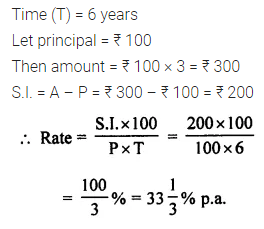
Question 8.
An amount of money invested trebled in 6 years. Find the rate of interest earned.
Solution:
ML Aggarwal Class 7 Solutions for ICSE Maths Chapter 7 Percentage and Its Applications Ex 7.4 9

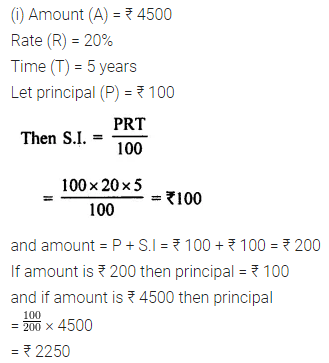
Question 9.
Find the principal when:
(i) final amount is ₹ 4500 at 20% per annum for 5 years
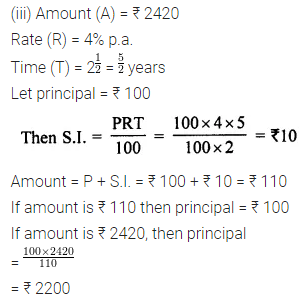
(ii) final amount is ₹ 2420 at 4% per annum for 2\(\frac { 1 }{ 2 }\) years.
Solution:
ML Aggarwal Class 7 Solutions for ICSE Maths Chapter 7 Percentage and Its Applications Ex 7.4 10
ML Aggarwal Class 7 Solutions for ICSE Maths Chapter 7 Percentage and Its Applications Ex 7.4 11

The Sermon at Benares Extra Questions and Answers Class 10 English First Flight

Here we are providing The Sermon at Benares Extra Questions and Answers Class 10 English First Flight, Extra Questions for Class 10 English was designed by subject expert teachers.

The Sermon at Benares Extra Questions and Answers Class 10 English First Flight

The Sermon at Benares Extra Questions and Answers Very Short Answer Type

Question 1.
What was the original name of the Buddha?
Answer:
The original name of the Buddha was Siddhartha Gautama.

Question 2.
What did Siddhartha study in school?
Answer:
Siddhartha was sent away to school to study the sacred Hindu scriptures.

Question 3.
What did Siddhartha see at the age of twenty-five?
Answer:
At the age of twenty-five, he saw a sickman, an aged man, a funeral procession and a monk begging.

Question 4.
Where did Siddhartha get enlightened?
Answer:
Siddhartha got enlightened under a peepal tree after seven days.

Question 5.
Why was the tree renamed as‘Bodhi Tree’?
Answer:
The Buddha got wisdom under the tree. So it was renamed ‘Bodhi tree’.

Question 6.
What was the problem of Gotami?
Answer:
Gotami’s son had died. She wanted him to live again.

Question 7.
What did she see in the city?
Answer:
She watched the light of the city.

Question 8.
What did she learn from the flickering of lights?
Answer:
She learnt that the fate of men is just like the city lights that flickered and extinguished again and again.

Question 9.
Who is being addressed by the Buddha?
Answer:
The people of Benares were being addressed by the Buddha.

Question 10.
What did he say about life of mortals?
Answer:
Buddha said that all mortals have to die.

Question 11.
What is inevitable?
Answer:
Death is inevitable.

Question 12.
What have the life and death of the man been compared to?
Answer:
The life and death are being seen and compared with the ripe fruits which have to fall.

The Sermon at Benares Extra Questions and Answers Short Answer Type

Question 1.
How did Gautama came to be known as the Buddha?
Answer:
Siddhartha Gautama wandered for seven years and finally sat down under a Peepal tree till he got enlightenment. After seven days of enlightenment, he renamed the ‘Bodhi Tree’ and began to teach and to share his new understanding and came to be known as the Buddha.

Question 2.
Why did prince Siddhartha leave the palace and became a beggar?
Answer:
While out hunting prince Siddhartha chanced upon a sick man, an aged man and then a funeral procession and he also saw a monk begging. He realised that world is full of sorrow so he left the palace in the search of enlightenment.

Question 3.
How did Buddha get enlightenment?
Answer:
Siddhartha Gautama wandered for seven years and finally sat down under a Peepal tree till he got enlightenment. After seven days of enlightenment, he renamed the ‘Bodhi Tree’ and began to teach and to share his new understanding and came to be known as the Buddha.

Question 4.
Why did the Buddha choose Benares to preach his first sermon?
Answer:
The Buddha preached his first sermon at the city of Benares. This city is regarded as the most holy of the dipping places of the River Ganga. That sermon has been preserved. It reflects the Buddha’s wisdom about one kind of suffering which cannot be understood.

Question 5.
What did Kisa Gotami say to Buddha? What reply did he give to her?
Answer:
Kisa Gotami went to the Buddha and asked him to give her the medicine to make her son alive. The Buddha asked her to bring him a handful of mustard seed. It should be brought from a house where no one had died.

Question 6.
Why was Kisa Gotami sad? What did she do in her grief?
Answer:
Kisa Gotami’s only son died and she was full of grief. She carried the dead son to all her neighbours. She asked them for medicine so that her son can be alive again. The people remarked that she had lost her senses.

Question 7.
What did Kisa Gotami do after the Buddha had asked her for a handful of mustard seed?
Answer:
Kisa Gotami went from house to house to get a handful of mustard seed. People gave her the mustard
seed. But when she asked if anyone had died in their family, they regretfully told her that the livings were few, but the deads were many. Kisa Gotami found no house where someone had not died.

Question 8.
What did the Buddha want to explain to Kisa Gotami?
Answer:
The Buddha wanted to explain to Kisa Gotami that man cannot get peace of mind by grieving. On the contrary, his pain will be greater and his body will suffer. He will make himself sick and pale. A man who overcomes all sorrows will be free from sorrow and will be blessed.

Question 9.
Why did Kisa Gotami go from house to house?
Answer:
Kisa Gotami was a lady who lived in Benares. Her only son had died and she could not’bear it. She went from house to house to cure his dead son. Someone told him about the Buddha and she reached him to cure his dead son.

Question 10.
What was the basic idea of the Buddha’s preaching?
Answer:
The basic idea of the Buddha’s preaching was that death is the ultimate truth of life. It is that every living being has to die one day. No one can escape from death. Grief cannot console anyone. We must accept this universal truth.

The Sermon at Benares Extra Questions and Answers Long Answer Type

Question 1.
What is the nature of the life of the human beings according to the Buddha?
Answer:
The life of mortals in this world is troubled and brief. It is combined with pain. Nobody can avoid dying. After reaching old age, there is death. Such is the nature of human beings. Just as ripe fruits are in danger of falling; so mortals are in danger of death. As all earthen vessels after a certain period of time break, so is the life of mortals. All have to die. Only he can get peace of mind who does not lament, complain and grieve. He who has overcome sorrow will be free from sorrow, and be blessed.

Question 2.
How did Gautam Buddha get enlightenment? Explain with reference to the story.
Answer:
Siddhartha Gautama was a prince who was protected from the sufferings of the world. At the age of twenty-five, he came across a sick man, an aged man, a funeral procession and a monk begging for alms. These sights moved him so much that he went out into the world to seek enlightenment concerning the sorrows he had witnessed. Siddhartha wandered for seven years and finally sat down under a Peepal tree.

He vowed to stay there until enlightenment came. Being enlightened after seven days, he renamed the tree the Bodhi Tree, the Tree of Wisdom. Thereafter he began to teach and share his new understanding. At that point he became to be known as the Buddha. He preached his first sermon at the holy city of Benares.

Question 3.
Why and how did Siddhartha Gautama become the Buddha?
Answer:
Gautama Buddha was born as a prince named Siddhartha Gautama in northern India. At the age of twelve, he was sent away for learning the Hindu sacred scriptures. Four years later he returned home to marry a princess. They had a son and lived for ten years as befitted royalty. Upto the age of twenty-five, the prince was shielded from the sufferings of the world.

Then while going out for hunting, he came across by chance a sick man, an aged man, a funeral procession, and finally a monk begging for alms. These sights moved the prince so much that he went out into the world to seek a state of high spiritual knowledge concerning the sorrows of human beings. He wandered for seven years and finally sat down under a peepal tree. He got enlightenment after seven days. After that he came to be known as the Buddha.

Question 4.
How did Buddha make Kisa Gotami understand about the reality of death?
OR
What lesson on death and suffering did the Buddha teach Gotami in the chapter. The Sermon at Benaras’.
Answer:
Kisa Gotami’s only son had died. In her grief she carried the dead child to all her neighbours, asking them for medicine. Then a man suggested her to go to Sakyamuni, the Buddha. Kisa Gotami requested Gautama Buddha to give her the medicine that would cure her son.

The Buddha replied that he wanted a handful of mustard-seed which must be taken from a house where no one had lost a child, husband, parent or friend. Kisa Gotami went from house to house. People pitied her but she could not find any house where near and dear one had not died. She thought how selfish she had been in her grief. She realised that death is common to all human beings.

Question 5.
“The World is afflicted with death and decay, therefore the wise do not grieve, knowing the. terms of the world”. Explain with reference to the story “The Sermon at Benares”.
Answer:
According to Gautama Buddha, the world is affected by sufferings, disease or pain, death and decay. Therefore, the wise persons do not mourn, knowing the terms of the world. Nobody can get peace of mind from weeping or mourning. Rather his pain will be greater and his body will suffer. He will make himself sick and pale, yet the dead cannot be saved from his expression of sorrow. He who seeks peace should “draw out the arrow” of lamentation, complaint and grief. In this manner, she who has become composed will obtain peace of mind. He who has overcome all sorrow will become free from sorrow, and be blessed.

Question 6.
In ‘The Sermon at Benares’, the Buddha preached that death is inevitable and we need to overcome the suffering and pain that follows. Discuss.
Answer:
It is very painful to lose someone or something we love. When we lose someone it is a great emotional suffering. The more we grieve over death, the more painful it will be for us. Death is always unwelcome. We must realize that we are all mortals and death is common to all. We may lament and cry but we cannot bring dead back to life. All the riches of the world cannot bring life back. We must realize that death is common to all rich or poor. Those who have overcome sorrow will become free from sorrow and are blessed.

The Sermon at Benares Extra Questions and Answers Reference to Context

Read the following passages and answer the questions that follow:

Question 1.
Gautama Buddha (563 B.C – 483 B.C.) began life as a prince named Siddhartha Gautama, in northern India. At twelve, he was sent away for schooling in the Hindu sacred scriptures and four years later he returned home to marry a princess. They had a son and lived for ten years as befitted royalty. At about the age of twenty-five, the Prince, heretofore shielded from the sufferings of the world, while out hunting chanced upon a sick him, then an aged man, then a funeral procession, and finally a monk begging for alms. These sights so moved him that he at once went out into the world to seek enlightenment concerning the sorrows he had witnessed.
(i) How did Gautam Buddha begin his life?
(ii) For how long did he live as a prince?
(iii) How did it change his life?
(iv) Pick out the word from the passage that means same as—‘a person who belongs to the family of a king or queen’.
Answer:
(i) Gautam Buddha began his life as a prince, named Siddhartha Gautama.
(ii) He lived as a prince for about twenty five years.
(iii) He was moved deeply by the sorrow he had witnessed. He at once became a beggar and went out into the world to seek enlightenment.
(iv) ‘royal’.

Question 2.
He wandered for seven years and finally sat down under a peepal tree, where he vowed to stay until enlightenment came. Enlightened after seven days, he renamed the tree the Bodhi Tree (Tree of Wisdom) and began to teach and to share his new understandings. At that point he became known as the Buddha (the Awakened or the Enlightened). The Buddha preached his first sermon at the city of Benares, most holy of the dipping places on the River Ganges; that sermon has been preserved and is given here. It reflects the Buddha’s wisdom about one inscrutable kind of suffering.
(i) Why did he wander?
(ii) Where did he get enlightened?
(iii) Why was the tree renamed as “Bodhi Tree’?
(iv) Pick out the word from the passage that means the same as—“religious talk”.
Answer:
(i) He wandered for seven years in search of knowledge.
(ii) He got enlightened after seven days under a fig peepal.
(iii) The tree was renamed ‘Bodhi Tree’. ‘Bodhi tree’ stands for the tree of wisdom. The Buddha got wisdom under that tree.
(iv) ‘sermon’.

Question 3.
Kisa Gotami had an only son, and he died. In her grief she carried the dead child to all her neighbours, asking them for medicine, and the people said, “She has lost her senses. The boy is dead.”At length, Kisa Gotami met a man who replied to her request, “I cannot give thee medicine for thy child, but I know a physician who can.”And the girl said, “Pray tell me, sir; who is it?” And the man replied, “Go to Sakyamuni, the Buddha.” Kisa Gotami repaired to the Buddha and cried, “Lord and Master, give me the medicine that will cure my boy.” The Buddha answered, “I want a handful of mustard-seed.” And when the girl in her joy promised to procure it, the Buddha added. “The mustard-seed must be taken from a house where no one has lost a child, husband, parent or friend.”
(i) What had happened to Kisa Gotami?
(ii) What did the people remark?
(iii) What did Buddha ask the girl for?
(iv) Pick out the word from the passage that means the same as—‘went to’.
Answer:
(i) Kisa Gotami was grieved at the death of her only son.
(ii) The people remarked that she had lost her senses.
(iii) The Buddha asked the girl to procure mustard seed from a house where no one had died before.
(iv) ‘repaired’.

Question 4.
Poor Kisa Gotami now went from house to house, and the people pitied her and said, “Here is mustard- seed; take it!” But when she asked, “Did a son or daughter, a father or mother, die in your family?” they answered her, “Alas! the living are few, but the dead are many. Do not remind us of our deepest grief.” And there was no hopse but some beloved one had died in it.
(i) Why did Kisa Gotami go from house to house?
(ii) What response did she get?
(iii) Pick out the word from the passage that means same as—“pain”.
(iv) Was Kisa Gotami awe to bring mustard-seed from any house?
Answer:
(i) Kisa Gotami went from house to house to get the mustard seeds.
(ii) She got the negative response about the mustard seeds. She couldn’t find a house where no one had died.
(iii) ‘grief.
(iv) No, she could not bring mustard-seed.

Question 5.
Kisa Gotami became weary and hopeless, and sat down at the wayside watching the lights of the city, as they flickered up and were extinguished again. At last the darkness of the night reigned everywhere. And she considered the fate of men, that their lives flicker up and are extinguished again. And she thought to herself, “How selfish am I in my grief! Death is common to all; yet in this valley of desolation there is a path that leads him to immortality who has surrendered all selfishness.”
(i) Why was Kisa Gotami hopeless?
(ii) Why did she sit down at the wayside?
(iii) What did she see in the city?
(iv) Pick out the word from the passage that means the same as—an area which is filled with deep sorrow’.
Answer:
(i) Kisa Gotami was hopeless because the Buddha asked her to bring mustard-seed from a house where nobody had died before.
(ii) She sat down at the wayside because she had become weary and hopeless.
(iii) She watched the light of the city. The lights flickered up and extinguished again and again.
(iv) “valley of desolation’.

Question 6.
The Buddha said, “The life of mortals in this world is troubled and brief and combined with pain. For there is not any means by which those that have been born can avoid dying; after reaching old age there is death; of such a nature are living beings. As ripe fruits are early in danger of falling, so morals when born are always in danger of death. As all earthen vessels made by the potter end in being broken, so is the life of mortals. Both young and adult, both those who are fools and those who are wise, all fall into the power of death; all are subject to death. (Pages 134-135)
(i) What did the Buddha say about the life of mortals?
(ii) What cannot be avoided by those that have been born?
(iii) What is inevitable?
(iv) Find the word from the passage that means the same as—‘those bound to die’.
Answer:
(i) The Buddha said that the life of mortals in this world is short, full of troubles and combined with pain.
(ii) Death cannot be avoided by those who have been born.
(iii) Death is inevitable.
(iv) ‘mortals’.

Question 7.
“Of those who, overcome by death, depart from life, a father cannot save his son, nor kinsmen their relations. Mark! while relatives are looking on and lamenting deeply, one by one mortals are carried off, like an ox that is led to the slaughter. So the world is afflicted with death and decay, therefore the wise do not grieve, knowing the terms of the world.
(i) Why did the Buddha give this sermon to Kisa Gotami?
(ii) What is the fate of mortals in the world?
(iii) Why do the wise men not grieve?
(iv) Pick out the word from the passage that means the same as—‘the killing of animals for their meat’.
Answer:
(i) The Buddha gave this sermon to Kisa Gotami to console her because her son had died.
(ii) Mortals are carried off like an ox that is led to the slaughter.
(iii) Due to knowing the terms of the world, the wise men do not grieve.
(iv) ‘slaughter’.

Question 8.
“Not from weeping not from grieving will anyone obtain peace of mind; on the contrary, his pain will be the greater and his body will suffer. He will make himself sick and pale, yet the dead are not saved by his lamentation. He who seeks peace should draw out the arrow of lamentation, and complaint, and grief. He who has drawn out the arrow and has become composed will obtain peace of mind; he who has overcome all sorrow will become free from sorrow, and be blessed.”
(i) Who is the speaker in the above passage?
(ii) How does ‘weeping1 affect a person?
(iii) What should one do to obtain peace?
(iv) Pick out the word from the passage that means same as—‘expression of sorrow’.
Answer:
(i) The Buddha is the speaker in the above passage.
(ii) Weeping and grieving cause pain and suffering. A person who weeps does not obtain peace.
(iii) One should never lament, complain and indulge in grief to obtain peace of mind.
(iv) lamentation.

ML Aggarwal Class 7 Solutions for ICSE Maths Chapter 7 Percentage and Its Applications Ex 7.3

ML Aggarwal Class 7 Solutions Chapter 7 Percentage and Its Applications Ex 7.3 for ICSE Understanding Mathematics acts as the best resource during your learning and helps you score well in your exams.

ML Aggarwal Class 7 Solutions for ICSE Maths Chapter 7 Percentage and Its Applications Ex 7.3

Questions 1.
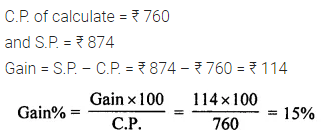
Rohan bought a calculator for ₹ 760 and sold it for ₹ 874. Find his profit and profit percentage.
Solution:
ML Aggarwal Class 7 Solutions for ICSE Maths Chapter 7 Percentage and Its Applications Ex 7.3 1

Question 2.
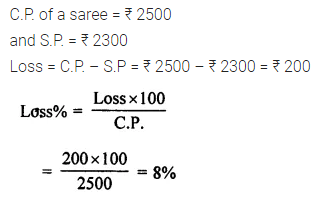
Kirti bought a saree for ₹ 2500 and sold it for ₹ 2300. Find her loss and loss percent.
Solution:
ML Aggarwal Class 7 Solutions for ICSE Maths Chapter 7 Percentage and Its Applications Ex 7.3 2

Question 3.
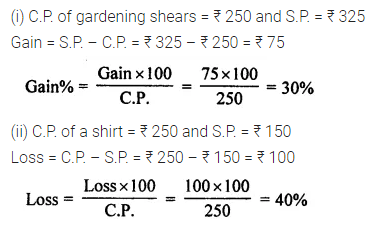
Tell what is profit or loss in the following transactions. Also find profit percent or loss percent in each case:
(i) Gardening shears bought for ₹ 250 and sold for ₹ 325.
(ii) A shirt bought for ₹ 250 and sold at ₹ 150.
Solution:
ML Aggarwal Class 7 Solutions for ICSE Maths Chapter 7 Percentage and Its Applications Ex 7.3 3

Question 4.
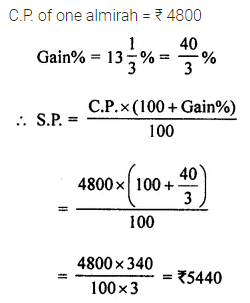
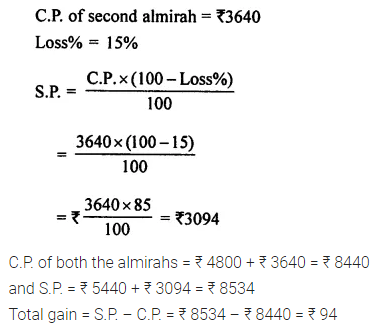
Rajinder bought one almirah for ₹ 4800 and the other for ₹ 3640. He sold the first almirah at a gain of 13\(\frac { 1 }{ 3 }\) % and the other at a loss of 15%. How much did he gain or lose in the whole deal?
Solution:
ML Aggarwal Class 7 Solutions for ICSE Maths Chapter 7 Percentage and Its Applications Ex 7.3 4
ML Aggarwal Class 7 Solutions for ICSE Maths Chapter 7 Percentage and Its Applications Ex 7.3 5

Question 5.
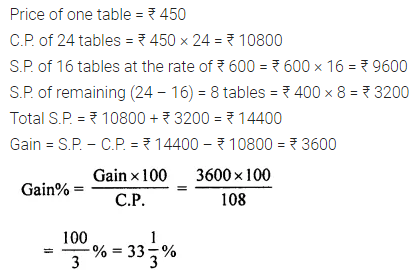
In a furniture shop, 24 tables were bought at the rate of ₹ 450 per table. The shopkeeper sold 16 of them at the rate of ₹ 600 per table and the remaining at the rate of ₹ 400 per table. Find his gain or loss percent.
Solution:
ML Aggarwal Class 7 Solutions for ICSE Maths Chapter 7 Percentage and Its Applications Ex 7.3 6

Question 6.
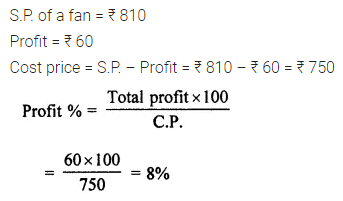
By selling a fan for ₹ 810, a dealer makes a profit of ₹ 60. What is the cost price of the fan? What is his profit percent?
Solution:
ML Aggarwal Class 7 Solutions for ICSE Maths Chapter 7 Percentage and Its Applications Ex 7.3 7

Question 7.
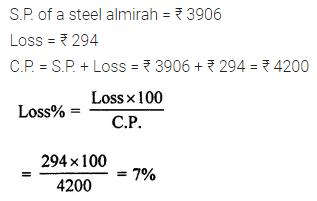
By selling a steel almirah for ₹ 3906, a manufacturer suffers a loss of ₹ 294. Find the cost price of the almirah and his loss percentage.
Solution:
ML Aggarwal Class 7 Solutions for ICSE Maths Chapter 7 Percentage and Its Applications Ex 7.3 8

Question 8.
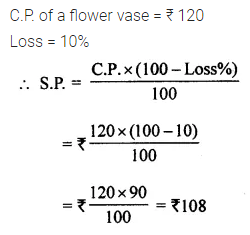
The cost price of a flower vase is ₹ 120. If the shopkeeper sells it at a loss of 10%, find the price at which it was sold.
Solution:
ML Aggarwal Class 7 Solutions for ICSE Maths Chapter 7 Percentage and Its Applications Ex 7.3 9

Question 9.
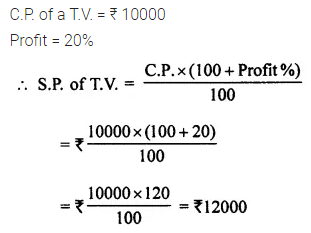
I buy a T.V. for ₹ 10000 and sell it at a profit of 20%. How much money do I get for it?
Solution:
ML Aggarwal Class 7 Solutions for ICSE Maths Chapter 7 Percentage and Its Applications Ex 7.3 10

Question 10.
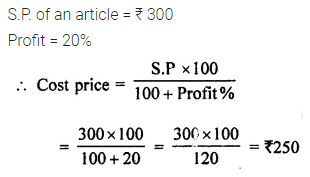
A shopkeeper sells an article at ₹ 300, thus earning a profit of 20%. Find the cost price of the article.
Solution:
ML Aggarwal Class 7 Solutions for ICSE Maths Chapter 7 Percentage and Its Applications Ex 7.3 11

Question 11.
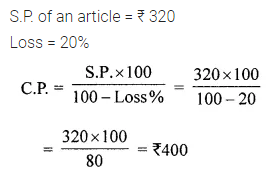
A shopkeeper sells i n article at ₹ 320, thus suffering a loss of 20%. Find the cost price of the article.
Solution:
ML Aggarwal Class 7 Solutions for ICSE Maths Chapter 7 Percentage and Its Applications Ex 7.3 12

Question 12.
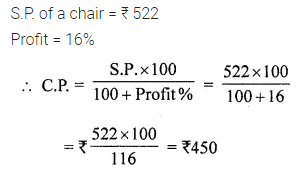
By selling a chair for ₹ 522, a shopkeeper makes a profit of 16%. What is its cost price?
Solution:
ML Aggarwal Class 7 Solutions for ICSE Maths Chapter 7 Percentage and Its Applications Ex 7.3 13

Question 13.
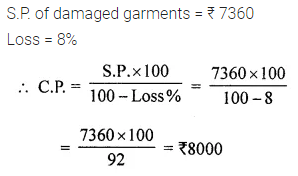
A trader sold some damaged garments for ₹ 7360 at a loss of 8%. Find the cost price of the garments.
Solution:
ML Aggarwal Class 7 Solutions for ICSE Maths Chapter 7 Percentage and Its Applications Ex 7.3 14

Question 14.
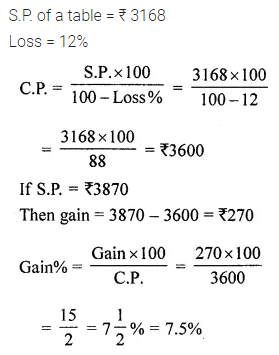
By selling a table for ₹ 3168, Rashid loses 12%. Find its cost price. What percent would he gain or lose by selling the table for ₹ 3870?
Solution:
ML Aggarwal Class 7 Solutions for ICSE Maths Chapter 7 Percentage and Its Applications Ex 7.3 15

Question 15.
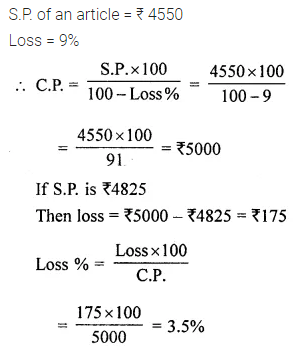
By selling an article for ₹ 4550, Tony incurs a loss of 9%. What percent would he gain or lose by selling it for ₹ 4825?
Solution:
ML Aggarwal Class 7 Solutions for ICSE Maths Chapter 7 Percentage and Its Applications Ex 7.3 16

Madam Rides the Bus Extra Questions and Answers Class 10 English First Flight

Here we are providing Madam Rides the Bus Extra Questions and Answers Class 10 English First Flight, Extra Questions for Class 10 English was designed by subject expert teachers.

Madam Rides the Bus Extra Questions and Answers Class 10 English First Flight

Madam Rides the Bus Extra Questions and Answers Very Short Answer Type

Question 1.
Who was Valli?
Answer:
Valli was an eight year old girl.

Question 2.
What was her full name?
Answer:
Her full name was Valliammai.

Question 3.
What was her favourite pastime?
Answer:
Her favourite pastime was to watch the happening in the street outside standing in the front doorway of her house.

Question 4.
What did she use to watch from her door?
Answer:
She used to watch the happenings in the street outside.

Question 5.
Why did she spend her time all alone?
Answer:
She spent her time all alone because she had no playmates of her own age.

Question 6.
What was her overwhelming desire?
Answer:
Here overwhelming desire was to ride the bus.

Question 7.
Where was the bus going?
Answer:
The bus was going to the city.

Question 8.
What did the conductor say to Valli?
Answer:
The conductor asked Valli to hurry up and come quickly.

Question 9.
What did Valli reply to the conductor?
Answer:
Valli replied that she was the only passenger who had to go on.

Question 10.
Where was Valli going?
Answer:
Valli was going to the city.

Question 11.
Why did Valli stand up on her seat?
Answer:
She stood up on her seat because she found her view cut off by a canvas blind.

Question 12.
What did Valli see outside the window?
Answer:
She saw a canal, palm tree, grassland and mountains outside the window.

Question 13.
How was Valli feeling?
Answer:
Valli was feeling happy and enjoying her ride.

Question 14.
What did the elderly woman try to do?
Answer:
The elderly women tried to befriend Valli.

Question 15.
What did the woman ask her?
Answer:
The woman asked Valli if she was all alone.

Question 16.
Why did Valli become sad?
Answer:
Valli became sad because the cow was dead.

Question 17.
What did Valli find when she came back home?
Answer:
When Valli came back and entered her home, she found her mother awake and talking to one of her aunts.

Madam Rides the Bus Extra Questions and Answers Short Answer Type

Question 1.
What kind of a person was Valli?
Answer:
Valli was a curious, keen observer who had strong will power and determination. She was bold, brave and self-respective! She had immense self confidence and wanted to do everything on her own. she was innocent, highly sensitive, intelligent and was a very careful planner.

Question 2.
What was Valli’s favourite pastime?
Answer:
Valli’s favourite pastime was to stand in the front doorway of her house and watch the happenings of the street. ,

Question 3.
Why did Valli want to ride on the bus?
Answer:
Valli used to watch the bus on its hourly rounds through her street everyday. The sight of the bus filled with new passengers every time gave her unending joy. She was curious and wished to ride it once. So, she wanted to ride on the bus to enjoy it.

Question 4.
How did Valli plan for her first journey?
Answer:
Valli made careful and painstaking plans for her first journey. She saved every penny, cut down on her expenses and resisted all the temptations to save sixty paise for the fare. She gathered the information from the passengers and neighbours. She calculated the time required and chose afternoon, as her mother would take a nap during that time. All this shows that she was a meticulous planner.

Question 5.
What did Valli do after she got into the bus?
Answer:
She got into the bus and she looked at everything very thoroughly. When she looked outside she found her view cut off by the canvas blind that covered the lower part of her window. So she stood upon the seat and peered over the blind.

Question 6.
What did Valli see out of the window on her first journey?
Answer:
Valli saw the nature’s grandeur out of the bus window. She saw the. green bank of a canal with the palm trees and mountains in the background and the blue sky. On the other side, she saw a deep ditch and green fields. She saw other vehicles, a young cow running in front of the bus. She later saw it dead.

Question 7.
What did the Valli find when she entered her house after the ride from the bus?
Answer:
Valli entered her house after the ride from the bus. Her mother was awake and talking to one of her aunts. She was from the South Street and was a real chatterbox. She would never close her mouth once she started talking.

Question 8.
How did Valli arrange for her bus fare?
Answer:
Valli arranged for her bus fare meticulously. For her first journey outside the village, Valli needed sixty paise to the two way fare of the bus. She needed some knowledge and ample time. She saved the money herself, collected the information from the passengers and utilized the time of her mother’s nap for it.

Question 9.
What did Valli’s mother say about the things happening without her knowledge?
Answer:
Valli’s mother said that so many things happen amidst us and in the world outside. We cannot know everything. When we know about something we often cannot understand it completely.

Question 10.
What was Valli’s favourite pastime?
Answer:
Valli was a Tamil girl. She had no playmates. It was her favourite pastime to stand in the doorway of her house. Thus she was able to watch all that was going on there. In a way she had attained too many unusual experiences.

Question 11.
What was a source of unending joy for Valli? What was her strongest desire?
Answer:
Valli was deeply attracted towards the bus. She had the strongest desire to ride in it. It travelled between Her village and the nearest town at an interval of an hour. The sight of the bus and passengers had been the source of unending joy for her.

Question 12.
What did Valli find out about the bus journey? How did she find out these details?
Answer:
Valli used to look at the faces of the daily travellers of the bus. Very often she listened to the conversations held between her neighbours and the passengers. Sometimes she also asked questions from them.

Question 13.
What do you think Valli was planning to do?
Answer:
Valli was a clever girl. She was planning to travel in the bus. She was calculating the time needed for the trip. The trip of the town took forty five minutes. It came to her mind to take the afternoon bus of . one o’clock. She would return by two forty five.

Question 14.
Why does the conductor call Valli ‘madam’?
Answer:
The conductor was a jolly sort of fellow. He was much fond of joking. He had judged the temperament of this small child. It was only to please her, he called her Valli ‘madam’.

Question 15.
Why does Valli stand up on the seat? What does she see now?
Answer:
Valli stands up on her seat. She has a keen desire to see everything with her own eyes. So she starts to look outside. She sees that the bus is going along the bank of a canal. The road is very narrow. Beyond it were the palm trees, mountains and fields etc.

Question 16.
What does Valli tell the elderly man when he calls her a child?
Answer:
Valli was a very smart girl. She had a superiority complex in her mind. She did not want herself to be called a child. On hearing herself as a child, she answered that there was no child. She had paid thirty paise like everyone else.

Question 17.
Why didn’t Valli want to make friends with the elderly woman?
Answer:
Valli was a girl of superior nature. She greatly disliked the elderly woman for her big holes in the ears. ‘ The earrings was very ugly. She was chewing the betel-nut. Its juice could fall at any moment. She was putting irrelevant questions to Valli.

Question 18.
How did Valli save up money for her first journey? Was it easy for her?
Answer:
Valli was a very wise girl. She saved her every penny to have a ride in the bus. She resisted every temptation to buy balloons, toys, peppermints and so on. She even controlled herself to have a ride on the merry-go-round at the village fair. It was rather troublesome for her.

Question 19.
What did Valli see on her way that made her laugh?
Answer:
By chance there came a young cow right in front of the running bus. The driver slowed it down. He sounded the horn very loudly time and again. But the more he honked, the more the cow was frightened and galloped faster. This made Valli laugh.

Question 20.
Why didn’t she get off the bus at the bus station?
Answer:
When the bus terminated at the bus station, Valli did not get off. The conductor asked her to get off. She replied that she would turn back by the same bus. She even refused to see the sights and the cold drink. She was afraid to move alone.

Question 21.
Why didn’t Valli want to go to the stall and have a drink? What does this tell you about her?
Answer:
Valli did not want to go to the stall and have a drink because she was afraid. She was alone. She had money only for the ticket. This tells that Valli was a very wise girl. She could control her feelings.

Madam Rides the Bus Extra Questions and Answers Long Answer Type

Question 1.
“On and on went her thoughts as she calculated and recalculated, planned and replanned”. In which manner did Valli calculate, plan and prepare herself for the ride on the bus?
Answer:
Valli had made careful, painstaking and elaborate plans for her visit to the city. She had saved every  coin she could. She overcame the temptation to buy peppermints, toys, balloons and the lijce. Finally she had saved a total of sixty paise. She suppressed her strong desire to ride on the merry-go-round at the village fair. Her next problem was how to slip out of the house without her mother’s knowledge. But she managed this without much difficulty as everyday after lunch her mother would take a nap from about , one to four or so. She would visit the city during this period.

Question 2.
‘Never mind ‘she said, “I can get on by myself.” “You do not have to help me”, said Valli to the conductor. She shows extraordinary courage in making the bus journey all alone. Taking inspiration from Valli’s character, write how ability and courage to take risk are essential to fulfill one’s dreams.
Answer:
It is absolutely true that ability and courage to take risk are essential to fulfill one’s dream. Valli was an eight year old girl. She never made a journey to outside. She even never rode a bus. Her parents did not allow her to go outside her house. But she mustered up the courage and rode on a bus to make a bus journey. She enjoyed the journey and understand the reality about the outside world. She was a young girl but she made the journey without any difficulty because she had courage to take risk.

In other words, we can say that the thing or task that seems to be very hard is actually not so tough. We can do it if we have the ability and courage to take risk. If we do not dare to take risk, we lose opportunities to get better.

Question 3.
Whenever we want to achieve something, difficulties always come in our way. What did Valli have to do to go and ride in a bus?
OR
Once we decide to achieve something, so many difficulties come in our ways with focused attention we can make that achievement. How did valli succeed in fulfilling her desire of riding a bus?
Answer:
It is true that whenever we want something, difficulties do come in our way. But one must be ambitious in life. Achieving goals require perseverance. Valli wanted to ride the bus, however, she did not have the money to do so. The challenge in front of her was to arrange for the required amount of money. Valli had carefully saved whatever stray coins came her way, resisting every temptation to buy peppermints, toys, balloons and the like. Finally she had collected thirty paise. Moreover, she watched the bus, its routine and schedule very carefully. She also listened to people’s conversation about their journey. But due to her efforts, finally she accomplished her desire.

Question 4.
Compare Valli’s journey to the city with her journey back home. Why was there a change in her mood?
OR
“Valli’s journey to the city is also her introduction into the mystery of life and death. Elaborate.
OR
Why did Valli not enjoy her bus ride back home?
Answer:
Valli’s journey to the city is also her introduction into the mystery of life and death. While on her way to the city Valli saw a cow running very fast in the middle of the road, right in front of the bus. Valli enjoyed the scene. She kept on laughing initially and her eyes were filled with tears. She saw life in the form of a small cow. This is what life gives us—happiness, enjoyment. Valli enjoyed the scene.

On her way back home she saw a dead cow lying on the road. It was hit by some speeding vehicle. She recognised it. It was the same cow that filled her life with fun and joy only a few minutes before. She was overcome with the feelings of sadness. She realised how death can change the things.

“What had been a lovable, beautiful creature just a little while ago had now suddenly lost its charm and its life and looked so horrible, so frightening.” The memory of the dead cow haunted Valli and she did not enjoy her remaining journey

Question 5.
What was Valli’s deepest desire? Find the words and phrases in the story that tell you this.
Answer:
It was the deepest desire of Valli to enjoy a bus ride. There ran a bus between her village and the nearest town. She was able to fulfil her desire. The following words and phrases tell us about this.
The fascinating things, the sight of the bus, a source of un-ending joy. A tiny wish crept into her head overwhelming desire, listening carefully discreet questions and stop the bus, etc.

Question 6.
How did Valli plan her bus ride? What did she find out about the bus and how did she save the fare?
Answer:
Valli was a Tamil girl of eight years. She had no playmates. It was her favourite pastime to stand on the front doorway of her house. She watched what was happening in the street outside. She had the keenest desire to have a bus ride. She listened to the conversation between her neighbours and people who were regular bus commuters. She even questioned them. She had got ample knowledge about the bus, bus fare and duration of time. There ran a bus between her village and the nearest town. The town was six miles from her village.

The fare was thirty paise for one way. So she had to collect sixty-paise for the both side journey. This she had heard from a well-dressed person. The trip to the town took forty five minutes. She would board at one O’clock afternoon bus and reach the town at one forty-five . She would be back by about two forty-five. She resisted all her temptations of buying balloons, toys and saved money. She collected all the stray coins that came her way. At the village fair, she avoided the swing and the merry-go-round. Thus she collected her requisite money.

Question 7.
Why does the conductor refer to Valli as ‘madam’?
Answer:
The conductor is a man of worldly wise nature. He has evaluated that the girl has innocence and ignorance in her behaviour. In order to enjoy and have fun and not to make her unhappy, he calls Valli as ‘Madam’ though she is simply a girl of eight years.

Question 8.
Find the lines in the text which tell you that Valli was enjoying her ride on the bus.
Answer:
The following lines in the text tell us that Valli was enjoying her ride on the bus.

  • While the bus was moving on a narrow road along the bank of a canal, she saw distant mountains, fields, sky and so on. She went on seeing as far as her eyes could see. She uttered, “Oh, it was all so wonderful.
  • The bus rolled on cutting across a bare landscape and was about to gobble up another vehicle. The bus left everything safely. Valli suddenly clapped her hands with glee.
  • There came a cow, it ran faster at the horn and came right before the bus. This scene made her laugh until there were tears in her eyes. The conductor said, ‘Hey, lady, haven’t you laughed enough? Better save some for tomorrow’.
  • The bus passed the shopping street. There were displays of clothes and other merchandise! Such big crowds! Struck dumb with wonder, Valli gaped at everything.

Question 9.
Why does Valli refuse to look out of the window on her way back?
Answer:
While on her way back, Valli saw a young cow lying dead by the roadside. It looked horrible and frightening. There was a fixed stare in her lifeless eyes with blood all over. Its memory haunted her very much. She lost all her enthusiasm and excitement. She no longer wanted to look out of the window.

Question 10.
What does Valli mean when she says, “I was just agreeing with what you said about things happening without our knowledge?”
Answer:
Valli entered her house after her bus journey. She found her mother conversing with one of her aunts. She overhears their discussion on the things happening in their midst as well as in the world outside. They could not know about everything. Even some of them could not be understood by them. At this juncture, Valli too opined like a wise person and told that many things were happening without their knowledge.

Question 11.
The author describes the things that Valli sees from an eight years old’s point of view. Can you find evidence from the text for this statement?
Answer:
The author has rightly described many things from an eight years old Valli’s point of view.
Some of the sentences can be mentioned as under:

  • On listening to one of her friends describing the sights, Valli would shout “Proud! Proud!
  • From the regular bus commuters, she would ask a few discreet questions here and there.
  • And here’s my money.
  • I can get on by myself. You don‘t have to help me.
  • There’s nobody here who’s a child.
  • Ugh! Who could be sociable with such a person.
  • “No, no one will be looking for me,”she said.

Madam Rides the Bus Extra Questions and Answers Reference to Context

Read the following passages and answer the questions that follow:

Question 1.
There was a girl named Valliammai who was called Valli for short. She was eight years old and very curious about things. Her favourite pastime was standing in the front doorway of her house, watching what was happening in the street outside. There were no playmates of her own age on her street, and this was about all she had to do.
But for Valli, standing at the front door was every bit as enjoyable as any of the elaborate games other children played. Watching the street gave her many new unusual experiences. (Page 117)
(i) What was the short name of the girl?
(ii) What was Valli’s favourite pastime?
(iii) Why did she spend her time all alone?
(iv) Pick out the word from the passage that means same as ‘uncommon’.
Answer:
(i) Valli was the short name of the girl.
(ii) Valli’s favourite pastime was standing in front doorway of her house.
(iii) She spent her time all alone because she had no playmates of her own age in her street.
(iv) ‘unusual’.

Question 2.
The most fascinating thing of all was the bus that travelled between her village and the nearest town. It passed through her street each hour, once going to the town and once coming back. The sight of the bus, filled each time with a new set of passengers, was a source of unending joy for Valli. Day after day she watched the bus, and gradually a tiny wish crept into her head and grew there: she wanted to ride on that bus, even if just once. This wish became stronger and stronger, until it was an overwhelming desire. Valli would stare wistfully at the people who got on or off the bus when it stopped at the street comer. Their faces would kindle in her longings, dreams, and hopes. If one of her friends happened to ride the bus and tried to describe the sights of the town to her, Valli would be too jealous to listen and would shout, in English: “Proud! Proud!”
(i) What did Valli watch daily?
(ii) What was her overwhelming desire?
(iii) Was Valli’s wish to ride the bus stronger or weaker?
(iv) Pick out the word from the passage that means same as—longingly.
Answer:
(i) Valli watched the bus that travelled between her village and the nearest town.
(ii) Valli’s overwhelming desire was to ride the bus.
(iii) Valli’s wish to ride the bus was too strong.
(iv) ‘wistfully’.

Question 3.
Over many days and months Valli listened carefully to conversations between her neighbours and people who regularly used the bus, and she also asked a few discreet questions here and there. This way she picked up various small details about the bus journey. The town was six miles from her village. The fare was thirty paise one way—“which is almost nothing at all,” “she heard one well-dressed man say, but to Valli, who scarcely saw that much money from onfc month to the next, it seemed a fortune. The trip to the town took forty-five minutes. On reaching town, if she stayed in her seat and paid another thirty paise, she could return home on the same bus. This meant that she could take the one-o’ clock afternoon bus, reach the town at one forty-five, and be back home by about two forty-five… On and on went her thoughts as she calculated and recalculated, planned and replanned.
(i) How did Valli know details about this bus journey?
(ii) What was the distance of the town from Valli’s village?
(iii) How did she pay for her journey?
(iv) Pick out the words from the passage that means same as—‘careful questions’.
Answer:
(i) Valli knew details about the bus journey from the conversations between her neighbours and commuters.
(ii) The distance of the town from Valli’s village was six miles.
(iii) She paid thirty paise for her bus journey.
(iv) ‘discreet questions’.

Question 4.
Well, one fine spring day the afternoon bus was just on the point of leaving the village and turning into the main highway when a small voice was heard shouting: “Stop the bus! Stop the bus!” And a tiny hand was raised commandingly.The bus slowed down to a crawl, and the conductor, sticking his head out the door, said “Hurry then! Tell whoever it is to come quickly.”
“It’s me,” shouted Valli. “I’m the one who has to get on.”
(i) Where was the bus going?
(ii) Who stopped the bus?
(iii) What did the conductor say to Valli?
(iv) Pick out the word from the passage that means same as “small”.
Answer:
(i) The bus was leaving the village and going to the city.
(ii) Valli stopped the bus.
(iii) The conductor asked Valli to hurry up and come quickly.
(iv) tiny.

Question 5.
It was the slack time of day, and there were only six or seven passengers on the bus. They were all looking at Valli and laughing with the conductor. Valli was overcome with shyness. Avoiding everyone’s eyes, she walked quickly to an empty seat and sat down, “May we start now, madam?” The conductor asked, smiling. Then he blew his whistle twice, and the bus moved forward with a roar. It was a new bus, its outside painted a gleaming white with some green stripes along the sides. Inside, the overhead bars shone like silver. Directly in front of Valli, above the windshield, there was a beautiful clock. The seats were soft and luxurious. (Pages 119-120)
(i) What were the six or seven passengers doing?
(ii) Why did she avoid everyone’s eyes?
(iii) How was the outside of the bus painted?
(iv) Pick out the word from the passage that means the same as—A time when there is no much work.
Answer:
(i) The six or seven passengers were looking at Valli and laughing with the conductor.
(ii) Valli avoided everyone’s eyes because she was feeling shy.
(iii) The outside of the bus was printed white with some green stripes along the sides.
(iv) ‘Slack Time’.

Question 6.
Valli devoured everything with her eyes. But when she started to look outside, she found her view cut off by a canvas blind that covered the lower part of her window. So she stood up on the seat and peered over the blind.The bus was now going along the bank of a canal. The road was very narrow. On one side there was the canal and, beyond it, palm trees, grassland, distant mountains, and the blue, blue sky. On the other side was a deep ditch and then acres and acres of green fields—green, green, green, as far as the eye could see. (Page 120)
(i) Why did Valli stand up on her seat?
(ii) Where was she going to?
(iii) How was Valli feeling?
(iv) Pick out the word from the passage that means the same as ‘looked through’.
Answer:
(i) Valli stood up on her seat because she wanted to look outside.
(ii) She was going to the city.
(iii) Valli was feeling happy and enjoying her ride.
(iv) ‘peered’.

Question 7.
Suddenly she was startled by a voice. “Listen child,” said the voice, “you shouldn’t stand like that. Sit down.”
Sitting down, she looked to see who had spoken. It was an elderly man who had honestly been concerned for her, but she was annoyed by his attention.
“There’s nobody here who’s a child,” she said haughtily. “I’ve paid my thirty paise like everyone else.” The conductor chimed in. “Oh, sir, but this is a very grown-up madam. Do you think a mere girl could pay her own fare and travel to the city all alone?” (Pages 120-121)
(i) What did somebody say to Valli?
(ii) What did the elderly man advise the child?
(iii) What did the conductor chime in about Valli?
(iv) Pick out the word from the passage that means the same as ‘proudly’.
Answer:
(i) Somebody said to Valli that she should not stand like that and asked her to sit down.
(ii) The elderly man advised the child to sit down.
(iii) The conductor chimed in about the girl calling her as a grown-up woman.
(iv) ‘haughtily.

Question 8.
An elderly woman came and sat beside her. “Are you all alone, dear?” She asked Valli as the bus started again. Valli found the woman absolutely repulsive—such big holes she had in her ear lobes, and such ugly earrings in them! And she could smell the betel nut the woman was chewing and see the betel juice that was threatening to spill over her lips at any moment. Ugh!—who could be sociable with such a person?
(i) What did the elderly woman try do?
(ii) Why did Valli find the woman repulsive?
(iii) What did the woman ask her? .
(iv) Pick out the word from the passage that means same as—‘causing dislike’.
Answer:
(i) The elderly woman tried to befriend Valli.
(ii) Valli found the woman absolutely repulsive as she had big holes in her ear lobes and ugly earrings in them. She was also chewing betel nut.
(iii) The woman asked Valli if she was all alone.
(iv) ‘repulsive’.

Question 9.
Her first journey—what careful, painstaking, elaborate plans she had to make for it! She had thriftily saved whatever stray coins came her way, resisting every temptation to buy peppermints, toys, balloons, and the like, and finally she had saved a total of sixty paise. How difficult it had been, particularly that ’ day at the village fair, but she had resolutely stifled a strong desire to ride the merry -go-round, even though she had the money.
After she had enough money saved, her next problem was how to slip out of the house without her mother’s knowledge. (Page 122)
(i) What did Valli had to do for her first journey?
(ii) What temptations did she have to resist?
(iii) What kind of desire did she have to curb at the village fare?
(iv) Pick out the word from the passage that means the same as—‘spend money carefully’.
Answer:
(i) Valli had to make careful, painstaking and elaborate plans for her first journey.
(ii) Valli had to resist the temptation to buy peppermints, toys, balloons, etc.
(iii) Valli had to curb a strong desire to ride the merry-go-round at the village fare.
(iv) ‘thriftily’.