ML Aggarwal Class 7 Solutions for ICSE Maths Chapter 14 Symmetry Ex 14.2

ML Aggarwal Class 7 Solutions Chapter 14 Symmetry Ex 14.2 for ICSE Understanding Mathematics acts as the best resource during your learning and helps you score well in your exams.

ML Aggarwal Class 7 Solutions for ICSE Maths Chapter 14 Symmetry Ex 14.2

Question 1.
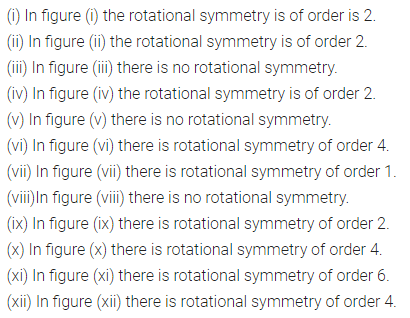
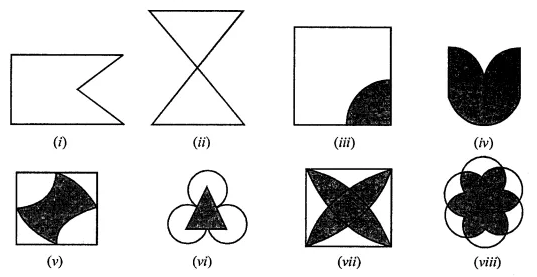
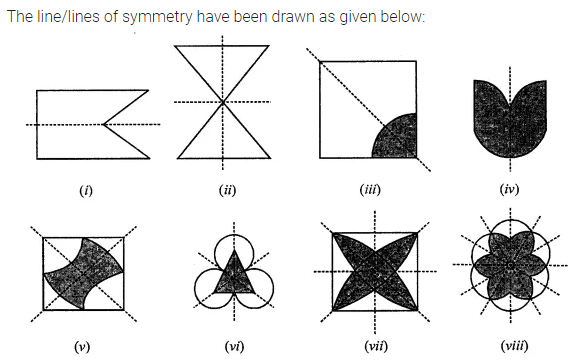
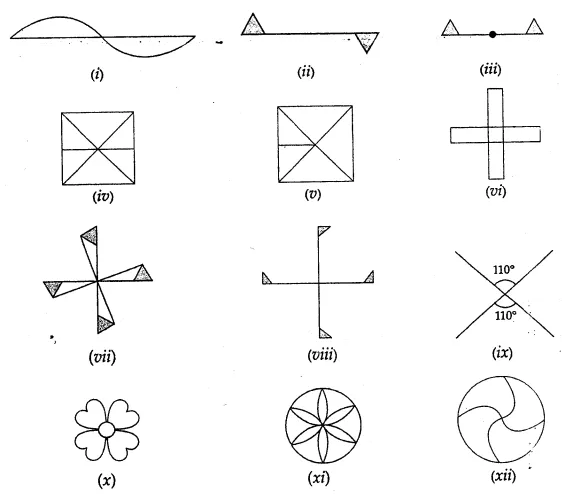
Which of the following figures have rotational symmetry? In the case of rotational symmetry, find the order of rotational symmetry.
ML Aggarwal Class 7 Solutions for ICSE Maths Chapter 14 Symmetry Ex 14.2 1
Solution:
ML Aggarwal Class 7 Solutions for ICSE Maths Chapter 14 Symmetry Ex 14.2 2

Question 2.
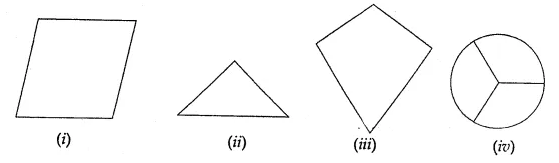
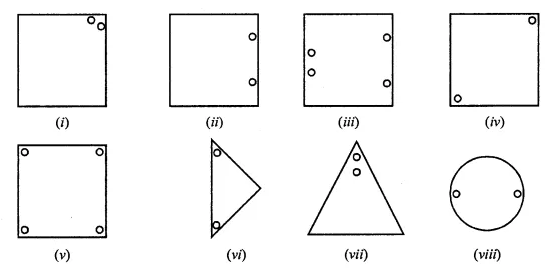
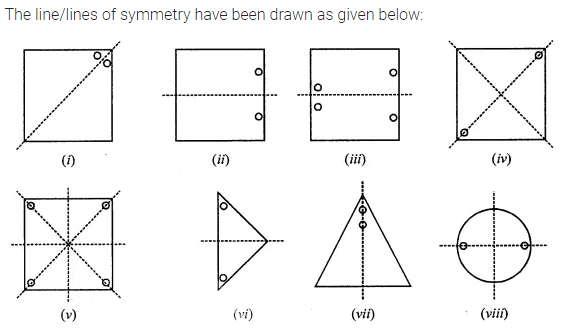
Which of the following figures have rotational symmetry of order greater than 1?
ML Aggarwal Class 7 Solutions for ICSE Maths Chapter 14 Symmetry Ex 14.2 3
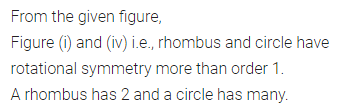
Solution:
ML Aggarwal Class 7 Solutions for ICSE Maths Chapter 14 Symmetry Ex 14.2 4

Question 3.
Name any two figures that have both lines of symmetry and rotational symmetry.
Solution:
ML Aggarwal Class 7 Solutions for ICSE Maths Chapter 14 Symmetry Ex 14.2 5

Question 4.
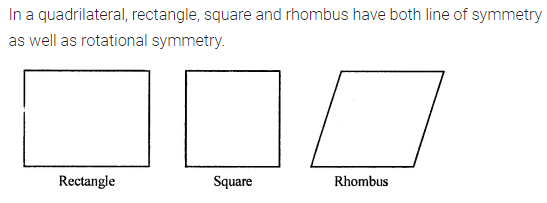
Name the quadrilaterals which have both line and rotational symmetry of order more than 1.
Solution:
ML Aggarwal Class 7 Solutions for ICSE Maths Chapter 14 Symmetry Ex 14.2 6

Question 5.
Draw a rough sketch of:
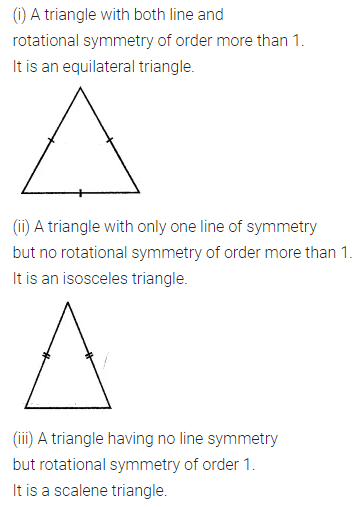
(i) a triangle with both line and rotational symmetries of order more than 1.
(ii) a triangle with only one line of symmetry and no rotational symmetry of order more than 1.
(iii) a triangle with no line symmetry but rotational symmetry of order 1.
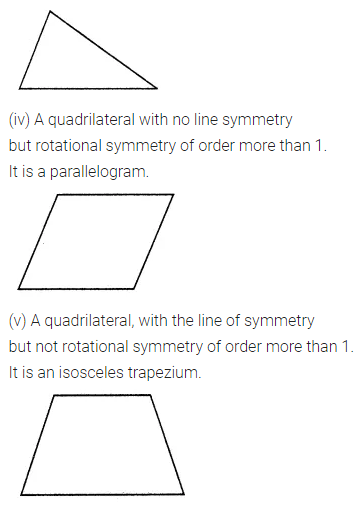
(iv) a quadrilateral with no line symmetry but rotational symmetry of order more than 1.
(v) a quadrilateral with line symmetry but not rotational symmetry of order more than 1.
Solution:
ML Aggarwal Class 7 Solutions for ICSE Maths Chapter 14 Symmetry Ex 14.2 7
ML Aggarwal Class 7 Solutions for ICSE Maths Chapter 14 Symmetry Ex 14.2 8

Question 6.
If a figure has two or more than two lines of symmetry, can it have rotational symmetry of order more than one?
Solution:
ML Aggarwal Class 7 Solutions for ICSE Maths Chapter 14 Symmetry Ex 14.2 9

Question 7.
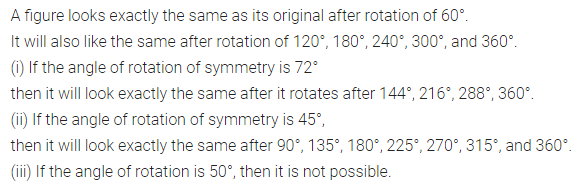
A figure looks exactly the same as its original figure after rotation of 60°. At what other angles will this figure appear the same?
What can you say if the angle of rotation is
(i) 72°
(ii) 45°
(iii) 50°?
Solution:
ML Aggarwal Class 7 Solutions for ICSE Maths Chapter 14 Symmetry Ex 14.2 10

Question 8.
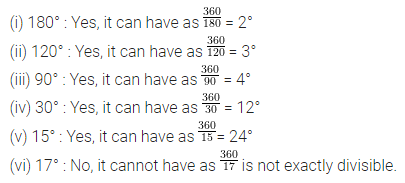
Can a figure possessing rotational symmetry have an angle of rotation of measure
(i) 180°
(ii) 120°
(iii) 90°
(iv) 30°
(v) 15°
(vi) 17°?
Solution:
ML Aggarwal Class 7 Solutions for ICSE Maths Chapter 14 Symmetry Ex 14.2 11

The Hack Driver Extra Questions and Answers Class 10 English Footprints Without Feet

Here we are providing The Hack Driver Extra Questions and Answers Class 10 English Footprints Without Feet, Extra Questions for Class 10 English was designed by subject expert teachers.

The Hack Driver Extra Questions and Answers Class 10 English Footprints Without Feet

The Hack Driver Extra Questions and Answers Short Answer Type

Question 1.
What job did the narrator get after graduation? Did he like his work?
Answer:
After doing his graduation, the narrator got the job of a junior assistant clerk in a law firm. No, he did not like his work. He had to serve a summons on the wanted people. He had to visit many dirty places. He never liked his work.

Question 2.
Why was he happy to go to New Mullion? Why did he go there?
Answer:
The narrator did not like the dirty and dark sides of the city life. He thought that he would find some pleasant sights in New Mullion. So, he was happy to go there.He went there to serve summons on Oliver Lutkins.

Question 3.
Why did the lawyer find the sight at the station’ “agreeable”?
Answer:
The narrator was disappointed to see the dirty roads and rows of wooden shops. But there was a man
who made the dull scene of the station agreeable by adding his cheerfulness.
He was the delivery man at the station.

Question 4.
How did the hack driver sketch the character of Lutkins?
Answer:
In fact, the hack driver was Lutkins himself. He sketched Lutkins as a very clever man who was good
at deceiving people. He never repaid the money he had taken from others.
He had a passion for Poker.

Question 5.
The narrator and the hack driver drove around together to find Lutkins.
(i) Which were the places they visited?
(ii) Why couldn’t they find Lutkins?
Answer:
(i) The hack driver took the narrator to almost all the places where Lutkins could be found. They visited Fritz’s shop, GustafFs shop, Gray’s stop, the pool room and Lutkins mother’s farmhouse.
(ii) They could not find Lutkins because the Hack driver was Lutkins himself.

Question  6.
What did the hack driver tell the narrator about Lutkins’ mother?
Answer:
The hack driver told the narrator that Lutkins’ mother was a real terror. She was nine feet tall, four feet thick and as quick as a cat.

Question 7.
How did Lutkins’ mother receive the narrator?
Answer:
Lutkins’ mother was not ready to tell them anything about Lutkins’. She tried to avoid their enquiry. When she ceune to know about the purposes of the narrator, she got furious. She went to the kitchen and came out with an iron rod. She marched towards them with a threat. They had to retreat from there.

Question 8.
What does the narrator describe as “pretty disrespectful treatment”?
Answer:
The narrator describes the treatment given to them by Lutkins’ mother as a pretty disrespected treatment. She insulted them. She marched towards them with a hot iron rod. She laughed at them when they retreated with a fear from there.

Question 9.
With what impression did the lawyer come back to the city?
Answer:
The lawyer returned to the city with a good impression. He liked the people of the village. He found them simple, wise and soft-spoken. He thought of practising law there. He was excited. He had found a treasure and a new way of life in New Mullion.

Question 10.
How did the people at the law firm receive him?
Answer:
The narrator could not find Lutkins. He could not serve the Summons on him so everyone at the firm was angry with him. They scolded and disgraced him,. His chief considered him as a useless fool. He was asked to go back to serve the summons on Lutkins.

Question 11.
Why was he sent back to New Mullion? Who went with him?
Answer:
The lawyer was sent back to New Mullion to serve summons on Lutkins. He had failed in his mission earlier. This time another man who had worked with Lutkins was also sent with him.

Question 12.
Who was the hack driver? What really hurt the feelings of the narrator in the end?
Answer:
The hack driver was Lutkins himself. He had driven the lawyer previous day. The narrator was really hurt when Lutkins and his mother were laughing at him as if he were a bright boy of seven.

Question 13.
How did the lawyer find the streets and shops of New Mullion?
Answer:
The lawyer found the streets of New Mullion muddy. With rows of wooden shops, either painted in sour brown or not painted at all. He was disappointed because he expected to see a sweet and simple country village.

Question 14.
Did the lawyer and the hack driver find Lutkins at Gustaffs barber shop? What did Gustaff say about Lutkins?
Answer:
No, they did not find Lutkins at Gustaffs barber shop. Gustaff told the hack driver that he had neither seen Lutkins nor he cared to see him. He asked him that if he finds Lutkins, he might collect the thirty , five dollars which Lutkins owes to him.

Question 15.
“Let’s go to a restaurant and I’ll buy your lunch,” the lawyer told the hack driver. Did they go to a restaurant to have lunch?
Answer:
The hack driver told the young lawyer that all the four restaurants in the town were bad. He suggested that only for half a dollar his wife would pack up the lunch for them and they would eat at Wade’s Hill. So they did not go to a restaurant.

Question 16.
Did Lutkin’s mother allow the lawyer to search her house to find Lutkins?
Answer:
The hack driver told Lutkins’ mother that the lawyer represented the court in the city and he had a legal right to search the home. She treated them quite disrespectfully but allowed to search the house. But they could not find Lutkin’s there.

Question 17.
“Really, I considered returning to New Mullion to practise law.” Why did the young lawyer think so?
Answer:
While returning, the young lawyer was too busy thinking about Bill Magnuson. He was so fascinated with Bill being “so deep and richly human” and others so soft-spoken, simple and wise that he thought of returning to New Mullion to practice law.

Question 18.
How did the lawyer feel after knowing that the hack driver was Oliver Lutkins himself?
Answer:
The law firm sent the lawyer again to New Mullion to serve the summons to Lutkins. The lawyer was
shocked and his feelings were hurt when the man told him that Bill or the hack driver was Lutkins himself.

Question 19.
“He was so open and friendly that I glowed with the warmth of his affection”. How did the young lawyer form this opinion about the hack driver?
Answer:
The young lawyer felt that the co-operating attitude and kindness shown to him was real, though the hack driver had to earn something out of it also. The lawyer bargained with the hack driver and had settled for two dollars an hour, but his wide smile made him think that he was one old friend.

Question 20.
Why is the lawyer sent to New Mullion? What does he first think about the place?
Answer:
The lawyer is sent to New Mullion to serve summons on a person named Oliver Lutkins, who was needed as a witness in a law case. He had expected the place to be a sweet and simple country village.

Question 21.
Who befriends him? Where does he take him?
Answer:
The lawyer was befriended by a delivery man who introduced himself as Bill. He told him that he knew Lutkins and would help the lawyer in finding him. He took him to all the possible places where Lutkins was’seen or was known to hang out. He took the lawyer to Fritz’s shop, where Lutkins was a frequent visitor to play poker; to GustafFs barber shop and then to Gray’s barber shop; to the poolroom and several other places before finally taking him to Oliver’s mother’s farm. However, so much of roaming around did not yield any result as they failed to find Oliver Lutkins.

Question 22.
What does he say about Lutkins?
Answer:
Bill told the lawyer that Lutkins was a clever fellow hard enough to catch. He was always up to something or the other. He owed money to many people, including Bill, and had never even paid anybody a cent. He also said that Oliver played a lot of pokers and was good at deceiving people.

Question 23.
What more does Bill say about Lutkins and his family?
Answer:
Bill told the lawyer that he knew Lutkin’s mother. He said that she was a terror. He narrated an incident when he took a trunk to her once and she almost took his skin off because he did not treat it like a box of eggs. He also said that she was very tall and fat. She was very quick and could talk a lot. He said that Oliver must have heard that somebody was chasing him and consequently, would have gone into hiding at his mother’s place.

Question 24.
Does the narrator serve the summons that day?
Answer:
No, the narrator does not serve the summon that day.

Question 25.
Who is Lutkins?
Answer:
The hack driver, who called himself Bill, is Oliver Lutkins.

The Hack Driver Extra Questions and Answers Long Answer Type

Question 1.
A person may appear humble but in actually he may not be so. Appearances can be deceptive. Explain with reference to the story ‘The Hack Driver’.
Answer:
Appearances are not always true. At times a person on first meeting appears to be friendly, co-operative,  understanding but as the time unfolds a different story is revealed. When the lawyer comes to the city for first time he is very happy to meet the hack driver. In fact the hack driver himself is Oliver Lutkins.

The hack driver seemed to be a simple country man ready to help. The hack driver showed affectionate behaviour. He left a favourable impression on the narrator’s mind. But very soon lawyer was able to realize that hack driver himself was Oliver Lutkins. It te so foolish to find that a wise person like a lawyer is befooled by a simple country man.

Question 2.
Intelligence or cleverness cannot be identified only on the basis of our work or profession but it comes from our inside. Explain it with reference to the chapter, ‘The Hack Driver’.
Answer:
Yes, it is quite right that intelligence and cleverness come automatically from our inside because it is our birth quality, it cannot be created, that’s why our intelligence or cleverness cannot be identified only on the basis of our work or profession. Many times in our daily life, we can find such examples. For example, a policeman is always considered brave and fighter because he has to face many difficulties daily and if he is not like that, he cannot defeat criminals, dacoits, burglars and cheaters. But sometimes we find some policemen opposite to it.

Some policemen nm away from the place where the people need them very much. Such policemen never think about their duty. They think only to save their lives. Such examples can easily be found in many different fields like medical, political. Some doctors don’t fulfill expectation of the common people, they think only for their families. So it is clear that our work or profession cannot disclose our internal quality like intelligence or cleverness. As we find in this story, the lawyer is not so clever or intelligent but the hackman is very cunning.

Question 3.
The hack driver appears to be humble, co-operative and friendly but as a matter of fact he is not. Explain in context of the story ‘The Hack Driver’ that appearances can be deceptive’.
Answer:
Appearances are not always true. At times a person on first meeting appears to be friendly, co-operative,  understanding but as the time unfolds a different story is revealed. When the lawyer comes to the city for first time he is very happy to meet the hack driver. In fact the hack driver himself is Oliver Lutkins.

The hack driver seemed to be a simple country man ready to help. The hack driver showed affectionate behaviour. He left a favourable impression on the narrator’s mind. But very soon lawyer was able to realize that hack driver himself was Oliver Lutkins. It te so foolish to find that a wise person like a lawyer is befooled by a simple country man.

Question 4.
The lawyer feels delighted in going to a country and enjoying going around it whole day. How does it portray the plight of town life? What values of the lawyer are reflected here?
Answer:
The lawyer is not happy the way he is treated by his law firm. He has no reputation there. He is taken to the task of serving the summons only. He is simple but hardworking. He believes that he can do better in his own village. Besides, he does not like the city life where people are selfish and boorish. On the other hand he finds the country life peaceful, close to the nature and the people there ready to extend a helping hand.

Question 5.
Give a brief character sketch of Oliver Lutkins.
Answer:
Oliver Lutkins was a jolly natured and fun loving person. He had a pleasant appearance. He impressed the lawyer at the railway station by his friendliness and simplicity. But he was not so simple and honest as he appeared to be. He knew about the lawyer’s ignorance and his purpose. He decided to be fool him. He introduced himself as Bill. He had a lot of fun out of his ignorance.

But Oliver had no other intention to befool the narrator besides having simple fun and enjoyment. He had a good understanding with the town folks who helped him in his plan. He loved poker. Lutkins never harmed anybody. He was very kind and well mannered too. He was a talented actor who made fun of an intelligent lawyer. He was very clever and sinart to plan at the moment and include everyone in his plan right before the narrator’s eyes.

Question 6.
Which were the places the narrator and the hack driver visited to search for Lutkins? How did they miss him narrowly everywhere?
Answer:
The narrator was a young lawyer and”was sent to New Mullion to serve a summon on Lutkins. The narrator did not recognise him. He met Bill, the hack driver at the station, who promised him to help in finding Lutkins. The hack driver first of all took him to Fritz. They learnt from him that he had gone to Gustaff s barber shop to have a shave. Reaching there, they learnt that Oliver had left for Gray’s barber shop. They missed him just by five minutes. The hack drove him to the poolroom. They missed him there too. After lunch the hack driver took the narrator to the farm of Lutkin’s mother. Lutkins could not be found there too. Thus, they missed him narrowly everywhere.

Question 7.
“Life is a serious matter; there is no place in it for humour or wit”. Discuss with reference to the story ‘The Hack Driver’.
Answer:
Life is certainly a serious matter. But it is wrong to say that there is no place for humour or wit in it. Life would be a great burden, if it had no humour or wit. There are so many tensions in life. We need a change from the monotony and dullness of the seriousness of life. Laughter is the best sauce of life. Wit and humour are its tools. However, we should be careful. We should not hurt the feelings of others by our sharp and biting wit. Let us laugh with others and not at them. Only then we can bid adieu to tension.

Question 8.
In life, people who easily trust others are sometimes made to look foolish. One should not be too trusting. Describe how Oliver Lutkins made a fool of the young lawyer.
Answer:
Appearances are not always true. At times a person on first meeting appears to be friendly, co-operative,  understanding but as the time unfolds a different story is revealed. When the lawyer comes to the city for first time he is very happy to meet the hack driver. In fact the hack driver himself is Oliver Lutkins.

The hack driver seemed to be a simple country man ready to help. The hack driver showed affectionate behaviour. He left a favourable impression on the narrator’s mind. But very soon lawyer was able to realize that hack driver himself was Oliver Lutkins. It te so foolish to find that a wise person like a lawyer is befooled by a simple country man.

Question 9.
When the lawyer reached New Mullion, did ‘Bill’ know that he was looking for Lutkins? When do you think Bill came up with his plan of fooling the lawyer?
Answer:
Lutkins act of taking the lawyer for a ride clearly indicates that he is a very cunning person. The way he tried to deal with the lawyer shows how quick he is in making plans to fool people. His idea not to disclose his true identity to unknown persons SIKJW how clever he is and it seems to be his regular practice to dupe people, especially the newcomers. As soon as the lawyer told Bill his purpose to visit to that place, Bill instantly knew how he would fool the lawyer.

Question 10.
Lutkins openly takes the lawyer all over the village. How is it that no one lets out the secret?
(Hint: Notice that the hack driver asks the lawyer to keep out of sight behind him when they go into Fritz’s.) Can you find other such subtle ways in which Lutkins manipulates the tour?
Answer:
Lutkins never allows the lawyer to the place where the imaginary Lutkins is supposed to be present at a given time. He asks him to keep out to sight, weaving vague stories about Lutkin’s vagabond nature. Bill also tries to scare away the lawyer, cooking up different stories about Lutkin’s mother. He did all this just to save himself from being summoned in the case.

Question 11.
Why do you think Lutkins’ neighbours were anxious to meet the lawyer?
Answer:
Lutkin’s neighbours were not anxious to meet a person who could be easily duped. They just wanted to enjoy the lawyer’s predicament.

Question 12.
After his first day’s experience with the hack driver the lawyer thinks of returning to New Mullion to practise law. Do you think he would have reconsidered this idea after his second visit?
Answer:
After his first day’s experience with the hack driver, the lawyer got a lesson for life that not to befriend anybody so easily. However, he realized during his second visit that he had been literally taken for a ride by the hack driver (who himself was Lutkins) and people of that town were just trying to enjoy the situation he was in. After becoming the laughing stock of the town, it is most likely that the lawyer would have reconsidered his initial idea of practising law in the village.

Question 13.
Do you think the lawyer was gullible? How could he have avoided being taken for a ride?
Answer:
The lawyer seems to be a simpleton and inexperienced person. He has yet to come to terms with the way the people in this world function. Being a lawyer, he could have easily avoided being duped by a stranger. Before visiting that village, he could have gathered important information regarding Lutkins. He could have taken a photograph of Lutkins along with him, most importantly, he should not have discussed his purpose of his visit with a total stranger, as it was a matter that involved law and security.

Question 14.
Do we come across persons like Lutkins only in fiction or do we encounter them in real life as well? You can give examples from fiction, or narrate an incident that you have read in the newspaper or an incident from real life.
Answer:
Yes, we do come across persons like Lutkins in fiction as well as in real life. Literature is full of instances where appearance is different from reality. In real life also we find that what appears may be quite contrary to what it turns out to be. That is why, it is said that all that glitters is not gold. A person who appears to be very gentle, may, later on, turns out to be a rogue. We read in newspapers many instances of so-called false holy men deceiving the people and turning out later as frauds.

Once I was taken for a ride. One night I got a telephonic message that my brother would be coming by morning flight. The person who was calling told me personally. He told me that my brother would be waiting for us at the airport. As my father was not feeling well, he asked me to go there to receive my brother. After reaching the airport, I looked for my brother, but he was nowhere to be found. I contacted the enquiry counter and was told that the flight was in. After two hours, I got a call on my mobile. It was my friend who laughed and said that they were successful in making me the first April fool!

Question 15.
Who is a ‘con man’, or a confidence trickster?
Answer:
A con man is a person who cheats others using confidence tricks. A con man poses as a sophisticated gentleman and takes his victim in full confidence. And then he cheats him in such a way that he comes to know about it only after he has been cheated.

ML Aggarwal Class 7 Solutions for ICSE Maths Chapter 14 Symmetry Ex 14.1

ML Aggarwal Class 7 Solutions Chapter 14 Symmetry Ex 14.1 for ICSE Understanding Mathematics acts as the best resource during your learning and helps you score well in your exams.

ML Aggarwal Class 7 Solutions for ICSE Maths Chapter 14 Symmetry Ex 14.1

Question 1.
Draw all lines of symmetry, if any, in each of the following figures:
ML Aggarwal Class 7 Solutions for ICSE Maths Chapter 14 Symmetry Ex 14.1 1
Solution:
ML Aggarwal Class 7 Solutions for ICSE Maths Chapter 14 Symmetry Ex 14.1 2

Question 2.
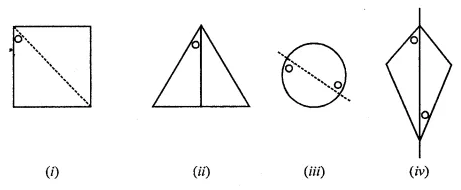
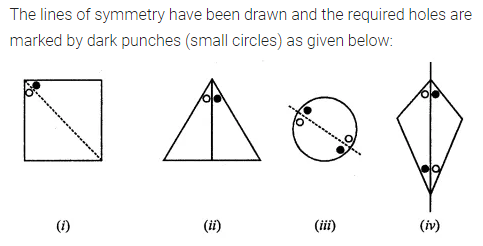
Copy the figures with a punched hole(s) and draw all the axes of symmetry in each of the following:
ML Aggarwal Class 7 Solutions for ICSE Maths Chapter 14 Symmetry Ex 14.1 3
Solution:
ML Aggarwal Class 7 Solutions for ICSE Maths Chapter 14 Symmetry Ex 14.1 4

Question 3.
In the following figure, mark the missing hole(s) in order to make them symmetrical about the dotted line:
ML Aggarwal Class 7 Solutions for ICSE Maths Chapter 14 Symmetry Ex 14.1 5
Solution:
ML Aggarwal Class 7 Solutions for ICSE Maths Chapter 14 Symmetry Ex 14.1 6

Question 4.
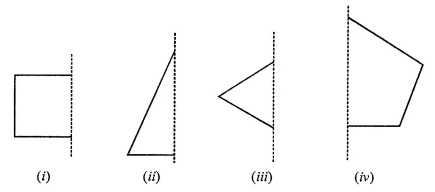
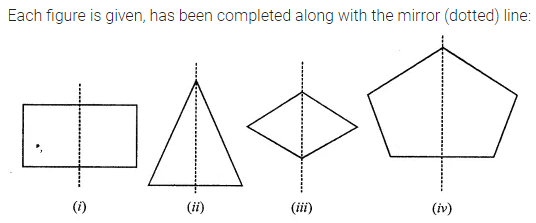
In the following figures, the mirror line (line of symmetry) is given as dotted line. Complete each figure by performing reflection in the mirror (dotted) line and name the figure you complete:
ML Aggarwal Class 7 Solutions for ICSE Maths Chapter 14 Symmetry Ex 14.1 7
Solution:
ML Aggarwal Class 7 Solutions for ICSE Maths Chapter 14 Symmetry Ex 14.1 8

Question 5.
Copy the adjoining figure.
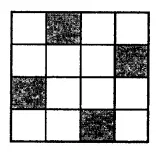
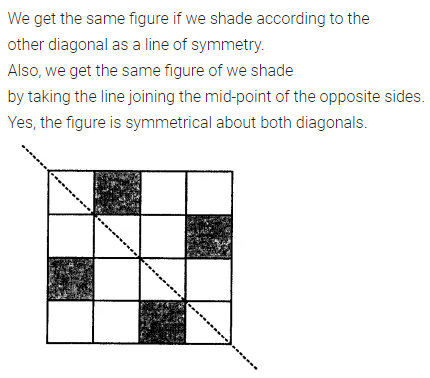
Take any one diagonal as a line of symmetry and shade a few more squares to make the figure symmetric about a diagonal. Is there more than one way to do that? Will the figure be symmetric about both the diagonals?
ML Aggarwal Class 7 Solutions for ICSE Maths Chapter 14 Symmetry Ex 14.1 9
Solution:
ML Aggarwal Class 7 Solutions for ICSE Maths Chapter 14 Symmetry Ex 14.1 10

Question 6.
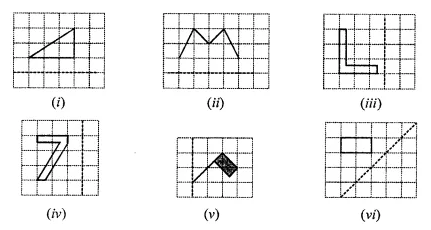
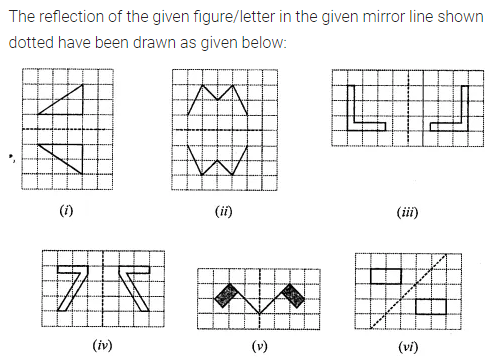
Draw the reflection of the following figures/letter in the given mirror line shown dotted:
ML Aggarwal Class 7 Solutions for ICSE Maths Chapter 14 Symmetry Ex 14.1 11
Solution:
ML Aggarwal Class 7 Solutions for ICSE Maths Chapter 14 Symmetry Ex 14.1 12

Question 7.
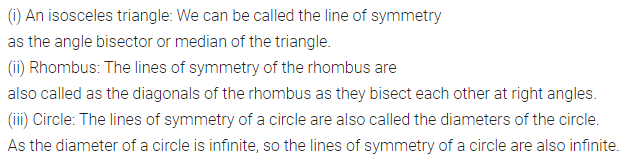
What other names can you give to the line of symmetry of
(i) an isosceles triangle
(ii) rhombus
(iii) circle?
Solution:
ML Aggarwal Class 7 Solutions for ICSE Maths Chapter 14 Symmetry Ex 14.1 13

The Necklace Extra Questions and Answers Class 10 English Footprints Without Feet

Here we are providing The Necklace Extra Questions and Answers Class 10 English Footprints Without Feet, Extra Questions for Class 10 English was designed by subject expert teachers.

The Necklace Extra Questions and Answers Class 10 English Footprints Without Feet

The Necklace Extra Questions and Answers Short Answer Type

Question 1.
How did the Loisels react when they realised that the necklace had been lost?
Answer:
Matilda Loisel became very sad when they realised that the necklace had been lost. They were sure that the loss of necklace would make their life hell because Mr Loisel was only a petty clerk and it was very difficult for him to replace necklace of diamond.

Question 2.
Why did Matilda not like to visit her rich friend?
Answer:
Matilda had inferiority complex. Whenever she visitedier rich friend she felt dejected and disappointed because of her poverty. She used to compare her lodgings to that of her friend’s. She did not have attractive dress and jewellery to adorn herself with. That is why, she did not like to visit her rich friend.

Question 3.
Why is Matilda unhappy with her life?
Answer:
Matilda is unhappy with her life because she ceaselessly, felt herself born for all delicacies and luxuries. The shabby walls, the worn chairs in her house tortured and angered her.

Question 4.
Her husband is kind and loving. Do you agree? Give examples to support your answers.
Answer:
He wants her to be happy. He spends a huge savings that he had saved for years to buy a gun for his hobby for buying a pretty dress for his wife so that she could attend a big party and enjoy it. When the costly necklace is lost, he spends all his savings and even borrow to repay it. He works day and night but never creates any ruckus with his wife.

Question 5.
What had Matilda’s husband saved the money for? Why did he then part with his savings?
Answer:
Matilda’s husband had saved a good amount of money to buy a gun for him. But when his wife refused to attend the party without a new dress, he had to give up buying the gun. He used the saved four hundred francs to buy her costume.

Question 6.
What was the cause of Matilda’s ruin? How could she have avoided it?
Answer:
Matilda’s aspiration and unrealistic dreams were the cause of her ruin. She paid due importance to materialistic things. She could have easily avoided if she had remained within her means. She was not a practical lady and had not understood her husband’s feelings.

Question 7.
What did Mme. Forestier tell Matilda about the reality of her Necklace?
Answer:
After having lost the borrowed necklace, Matilda replaced it with a diamond necklace bought for thirty-six thousand francs. But Mme Forestier told her that her necklace was false costing about 500 francs.

Question 8.
What changes came into the life of Loisels after the necklace was lost?
Answer:
They had to shift to a cheaper room and dismiss the servant. She did all the household works and shopping by herself. She fetched water, washed the floor, utensils and dirty clothes by herself. Matilda’s husband worked in the evening and late at night to pay back the debt.

Question 9.
Why was Mme Forestier shocked to hear Matilda’s story?
Answer:
One Sunday, while walking, Matilda happened to see Mme Forestier. Matilda called her, but she could not recognise Matilda because she looked much older than her age. Mme Forestier was shocked to know that Matilda had suffered so much worrying about losing her necklace of real diamonds, whereas it was false.

Question 10.
Do you think Matilda’s over-ambitious nature was the cause of her miseries?
Answer:
Yes, I do think that Matilda’s overambitious nature led to her avoidable miseries. Just to show herself a rich lady, she borrowed a necklace from her rich friend. Her miseries started when the necklace was lost by her.

Question 11.
What kind of a person is Mme Loisel—why is she always unhappy?
Answer:
Mme. Loisel is a woman who lives in the world of dreams. She gives much value to her dreams and hence overlooks the realities of life. That is why she is always unhappy as dreams are a virtual reality and can’t be true.

Question 12.
What kind of a person is her husband?
Answer:
Her husband is a very simple and kind-hearted person. He is an ordinary man, who just like others, is caring and wants his wife to be happy.

Question 13.
What fresh problem now disturbs Mme Loisel?
Answer:
After buying a pretty dress, Mme Loisel was bothered by yet another problem. She had no jewels to adorn herself with. She said she would feel inferior and have a poverty-stricken look. Her husband -” suggested that she should wear some natural flowers. However, she refused and said that there was nothing more humiliating than to have a shabby air in the midst of rich women.

Question 14.
How is the problem solved?
Answer:
Mme Loisel’s husband solved this problem. He told his wife to request her friend, Mme Forestier, to lend her some jewels. When she went to Mme Forestier, the latter brought a jewel case for Mme Loisel so that she could choose whichever jewels she liked.

Question 15.
What do M. and Mme Loisel do next?
Answer:
When M. and Mme Loisel realized that the necklace was missing, they tried finding out where she could have possibly lost it. They concluded that it might have been dropped in the cab they were travelling in. But they did not remember its number. So, in an attempt to find the necklace, Loisel went over the track where they had walked.

When he found nothing, he went to the police and to the cab officers. He even put an advertisement in the newspapers, offering a reward. Meanwhile, he asked Matilda to write a letter to Mme Forestier, explaining that she had broken the clasp of the necklace and would get it repaired and return it soon. This gave them time to find the necklace. However, they eventually decided to replace the necklace with a new one.

Question 16.
How do they replace the Necklace?
Answer:
They decided to replace the necklace. They bought a new one for thirty-six thousand francs. Mr Loisel had eighteen thousand francs which his father left him. He borrowed the rest on a very high rate of interest.

Question 17.
What, was the cause of Matilda’s ruin? How could she have avoided it?
Answer:
The cause of Matilda’s ruin was her dissatisfaction with whatever life offered her. She was always unhappy. She felt that she was born for all the delicacies and luxuries of life. She disliked being in her current circumstances. She could have avoided this ruin by bringing content with whatever she had.

The Necklace Extra Questions and Answers Long Answer Type

Question 1.
A little confession would have changed the life of Matilda. Should we confess our mistakes courageously? Do you agree about above statement.
Answer:
Yes, a small mistake makes our life miserable and dark. People who are open-minded and speak the truth stay much happier. A little mistake made by Matilda changed her life completely. If Matilda had confessed that she had lost Madam Forestier’s necklace, her life would have been different. Confession could have brought peace of mind. Matilda would have at once come to know that necklace is not a real but it is an imitation. Hard work which Matilda put into repay the borrowed necklace could have been saved. We all get a very important message that we should not delay in admitting our mistake.

Question 2.
On inability to accept our circumstances may lead to an unhappy life. Explain with reference to the story “The Necklace”.
Answer:
We fail to recognise the situation in which we are placed but rather keep on grumbling. We become frustrated and want our life to be different. We should accept the life as it comes to us and should not keep on cribbing about unhappy circumstances. As we read the story The Necklace’ we find that Matilda is not at all happy with her husband. She had wished her life to be luxurious. It is this frustration of hers which puts her in a fix and spoils rest of her life. She does not work for solution but rather complicates the situation for her.

Question 3.
‘Love is blind’ is a phrase that was justified by Monsieur Loisel in the lesson ‘The Necklace’. Substantiate the answer from the story you have read in about 100 – 120 words.
Answer:
Monsieur Loisel’s acceptance and contentment differ considerably from Matilda’s emotional outbursts and constant dissatisfaction, and though he never fully understands his wife, he does his best to please her. When Monsieur Loisel tries to appease Matilda, he does it so blindly, wanting only to make her happy. When she declares that she cannot attend the party because she has nothing to wear, he gives her money to purchase a dress. When she complains that she has no proper jewellery, he urges her to visit Madame Forestier to borrow some.

Monsieur Loisel’s eagerness and willingness to please Matilda becomes his downfall when she loses the necklace. He is the one who devises a plan for purchasing a replacement necklace and orchestrates the loans and mortgages that help them pay for it. Although the decision costs him ten years of hard work, he does not complain or imagine an alternate fate. It is as if his desires do not even exist or, at the very least, his desires are meaningless if they stand in the way of Matilda’s.

Question 4.
‘The Necklace’ reveals that vanity is an evil. It may bring joy for short period but ultimately it leads to ruin. If you are placed in a situation similar to that of Matilda, what would you have done? Express your views.
Answer:
No doubt, Matilda was proud and self-loving. She was very beautiful and charming and she was proud of her beauty. Because of her beauty, she thought that she was born in a family of clerks through the error of destiny. She felt that she was born for all delicacies and luxuries. She also felt that she was made for expensive frocks, jewels and other such things.

Therefore, we can conclude that Matilda was very vain and proud because of her beauty. When we read the story, we find out that she suffered because of her vanity. If I were placed in a situation similar to that of Matilda, I would have valued the love of my husband. I would have not insisted on buying an expensive dress to wear to the party. There would be no question of borrowing an expensive necklace from my friend. I would have saved me and my husband from all hardships which the Loisels went through.

Question 5.
What changes came in the lifestyle of Matilda after she had lost the necklace?
Answer:
To return the borrowed money Mr and Mrs Loisel suffered for ten long years. First, they sent away the maid servant. Then they changed their lodging and rented some rooms. Now Matilda learnt heavy cares of household life, she had to do the difficult chores of her kitchen. She had to wash dishes, greasy pots and stew pans. She had to use her rosy nails to wash the greasy pots and the bottoms of the stew pans.

She had to wash dirty clothes and to hang them on the line to dry. Then each morning she had to take down the refuse to the street. She also had to bring up the water for daily use. She had to stop at each landing to catch her breath. She did not have much money so she haggled with the shopkeepers to get reduction in prices.

Once she was very beautiful and used to wear beautiful dresses. Now she seemed old. Now she looked like a common household woman. She had badly dressed hair and dirty dresses. Her hands were red and she spoke in a loud tone. She washed the floors with large pailg of water.

Question 6.
“At the end of the ten years, they had restored all”. What had Matilda and her husband restored and at what cost?
Answer:
Matilda lost the necklace borrowed from her wealthy friend Mme Forestier. They desperately tried to find out the necklace but in vain. Finally they decided to replace the necklace with a new one. M. Loisel spent his entire savings and even borrowed a loan to buy the? necklace.

To repay the debt, they cut down their expenses. They sent away the maid and reported some rooms in an attic. They cut down their expenses. M. Loisel worked evenings, putting the books of some merchants in order, and nights he often did copying at five sous a page. This life lasted for ten years. At the end of ten years, they had restored all.

Question 7.
Matilda would not have suffered much if she had confessed the loss of necklace. Do you think our mistakes become more serious if we try to cover them?
Answer:
Yes, a small mistake makes our life miserable and dark. People who are open-minded and speak the truth stay much happier. A little mistake made by Matilda changed her life completely. If Matilda had confessed that she had lost Madam Forestier’s necklace, her life would have been different.

Confession could have brought peace of mind. Matilda would have at once come to know that necklace is not a real but it is an imitation. Hard work which Matilda put into repay the borrowed necklace could have been saved. We all get a very important message that we should not delay in admitting our mistake.

Question 8.
Our inability to accept our limitations may lead to an unhappy life. Analyze with reference to the story ‘The Necklace’.
Answer:
We fail to recognise the situation in which we are placed but rather keep on grumbling. We become frustrated and want our life to be different. We should accept the life as it comes to us and should not keep on cribbing about unhappy circumstances. As we read the story The Necklace’ we find that Matilda is not at all happy with her husband. She had wished her life to be luxurious. It is this frustration of hers which puts her in a fix and spoils rest of her life. She does not work for solution but rather complicates the situation for her.

Question 9.
The course of the Loisels’ life changed due to the necklace. Comment.
Answer:
The course of the Loisel’s life changed due to the necklace. After replacing the lost necklace with a new one, they had to repay all the money that they had borrowed to buy the new necklace. They sent away the maid and changed their lodgings. They rented some rooms in an attic. Matilda learnt the odd work of the kitchen. She washed the dishes, soiled linen, their clothes and dishcloths.

She even took down the refuse to the street each morning and brought up the water, stopping at each landing to catch her breath. She went to the grocer’s, the butcher’s, and the fruitier’s, with a basket on her arm, shopping, haggling to save her money. Loisel worked in the evenings, putting the books of some merchants in order. At night, he did copy work at five sous a page. This lasted for ten years, and at the end of the said period, they were finally able to repay their lenders.

Question 10.
What would have happened to Matilda if she had confessed to her friend that she had lost her necklace?
Answer:
If Matilda would have confessed to her friend she had lost her necklace, she might have been in lesser trouble than what she had to face after having replaced the necklace. Her friend would have definitely been angry with her. Most likely, she would also have asked Matilda to replace it and given her the details from where she had bought the necklace and how much it had cost her. Matilda would have thus known that the jewels in the necklace were actually not real diamonds. It would have cost her a far lesser amount to replace it. Matilda would thus have saved herself and her husband of all the trouble they went through and life would have been much better and easier for them.

Question 11.
If you were caught in a situation like this, how would you have dealt with it?
Answer:
If I were caught in such a situation, I would have faced it boldly. I would have gone to Mrs Forestier and made a confession. Confessing one’s mistake needs courage and I would have generated that much courage to confess my mistake. It would have saved me from the sufferings that Matilda bore for such a long time. On my confessions, Forestier would have told me the reality of the necklace. Even if it were genuine diamond necklace, she being my friend and rich, would have forgiven me.

Question 12.
The characters in this story speak in English. Do you think this is their language? What clues are there in the story about the language its characters must be speaking in?
Answer:
The characters in this story speak in English. No, I think this is not their language. The names of the main characters are M and Mme Loisel, not Mr and Mrs Loisel. The currency used it Franc. It all suggests that their language is French.

Question 13.
Honesty is the best policy.
Answer:
It is true that honesty is the best policy. One should be honest in one’s work and deeds. Matilda tried to be honest by giving the necklace back to its owner. But her honesty would have proven to be the best policy, if she had admitted that she had lost the necklace. It would have saved her from ruining her life.

Question 14.
We should be content with what life gives us.
Answer:
Yes, we should be content with what life gives us. It is never ending desire which forces us to follow wrong path. Sometimes a person becomes dishonest to get more in life. The desire to have more makes a person unhappy. Matilda was a victim of such situation. Had she been content with what she had, she would not have ruined her life.

The Making of a Scientist Extra Questions and Answers Class 10 English Footprints Without Feet

Here we are providing The Making of a Scientist Extra Questions and Answers Class 10 English Footprints Without Feet, Extra Questions for Class 10 English was designed by subject expert teachers.

The Making of a Scientist Extra Questions and Answers Class 10 English Footprints Without Feet

The Making of a Scientist Extra Questions and Answers Short Answer Type

Question 1.
Why did viceroy butterflies copy monarchs?
Answer:
Viceroy butterflies copied monarchs because monarchs do not taste good to birds. Viceroy butterflies on the other hand taste good to birds. So, the more they look similar to monarchs, the less likely they are to become a bird’s prey. Thus they protect themselves.

Question 2.
Why did Richard Ebright give up tagging butterflies?
Answer:
Richard Ebright lost interest in tagging butterflies as it was tedious and there was not much feedback. He could recapture only two butterflies in all the time he did it and they were not more than seventy five miles away from where he lived.

Question 3.
What are the ingredients in the making of a scientist?
Answer:
The author gave examples from Richard Ebright’s life to show the ingredients to make a scientist. Start with a first rate mind, add curiosity, and mix in the will to win for the right reasons.

Question 4.
What was the common belief about the twelve tiny gold spots on a monarch pupa? What is the actual purpose of these tiny gold spots?
Answer:
These twelve tiny gold spots were believed to be ornamental only. The actual purpose of these tiny gold spots is to produce a hormone necessary for the butterfly’s full development.

Question 5.
“But there was one thing I could do-collect things”. What collection did Ebright make? When did he start making collection?
Answer:
Ebright began collecting butterflies, rocks, fossils and coins. He began as early as when he was in kindergarten. He collected with same determination that had marked all his activities.

Question 6.
What other interests besides science did Richard Ebright pursue?
Answer:
Richard Ebright was a champion debater and public speaker. He was a good canoeist and all-around outdoor person. He was also an expert photographer, particularly of natural and scientific exhibits.

Question 7.
How did Richard Ebright’s mother help him to become a scientist?
Answer:
Ebright’s mother was his only companion. She used to encourage the child to learn whatever he wanted to learn. She took him on trips, brought him telescopes, microscopes, cameras, mounting materials and other such equipments.

Question 8.
Which book did Ebright mother get for him? How did it change his life?
Answer:
Ebright’s mother got a children’s book called The Travel of Monarch X’ for him. The book invited readers to help study butterfly migrations and actively participate in tagging butterflies to help in the research being conducted by Dr Frederick A. Urquhart. Ebright then went on to raise an entire flock of butterflies in the basement of his home. In this way the book managed to keep his enthusiasm in the study of butterflies alive for several years and opened the world of science to the young collector who never lost his scientific curiosity. ,

Question 9.
Why did Richard Ebright raise a flock of butterflies?
Answer:
At the end of the book, “The travels of Monarch X’, readers were invited to help study butterfly migrations. They were asked to tag butterflies for research by Dr Frederick A. Urquhart. The butterfly collecting season around reading lasts six weeks in late summery. If Ebright went to chase them one by one, he could not catch very many. So he decided to raise a flock of butterflies.

Question 10.
Mention any two Ebright contributions to the world of science.
Answer:
Ebright made valuable contributions to the world of science. He discovered an unknown insect hormone and also determined how the cell could read the blueprint of its DNA.

Question 11.
What lesson did Ebright learn when he did not win anything at the science fair?
Answer:
When Ebright did not win anything at the science fair, he learnt a lesson that he needed to do real experiments, not simply make a neat display. His entry was slides of frog tissues which he showed under a microscope.

Question 12.
What lesson does Ebright learn when he does not win anything at a science fair?
Answer:
Ebright realizes that were display of his collection does not mean science. To win at a science fair he will have to do real experiments and prove his worth.

Question 13.
What experiments and projects does he then undertake?
Answer:
He then undertakes the projects and experiments to find out what actually causes the viral disease that kills nearly all Monarch caterpillars. He then works on a project to test the theory that viceroy butterflies copy monarchs to survive.

Question 14.
What are the qualities that go into the making of a scientist?
Answer:
The author mentions three qualities that go into the making of a scientist—a first-rate mind, curiosity, and the will to win for the right reasons. Richard Ebright was a very intelligent student. He was also a champion debater, a public speaker, a good canoeist and an expert photographer. He always tried to put that extra effort in his work. He was competitive, but for the right reasons. From the very beginning, he had a driving curiosity along with a bright mind; and it was this curiosity that ultimately led him to his theory about cell life.

The Making of a Scientist Extra Questions and Answers Long Answer Type

Question 1.
Although Richard does not win anything at the science fair but it was a stepping stone for his success. With reference to the story ‘The Making of a Scientist’ of the above statement, give your comments whether competitions are for winning sake or to give your best at work.
Answer:
It is true, no one can deny the fact that every person wants to be a winner. Each has basic wish to reach ‘ at the top. For that many competitions are organised at various levels. But still we must accept that all cannot be winners. Participation is more important than winning. The participant should work hard to reach their level best. Failures should not make us disheartened and best way to overcome failure is to learn through our mistakes. We cannot deny that experimentation and learning are stepping stones to our success. So we should try to give our best.

Question 2.
Besides curiosity a number of other values are required to become a successful scientist. Explain with reference to the chapter, ‘The Making of a Scientist’.
Answer:
From very young age Richard Ebright was competitive and put in extra effort with curiosity for the right reason to win. But his mother was always very dedicated and made his spirits rise high. He did not lose heart even after losing when he was in seventh grade. To him people around were very encouraging.

His mother’s encouragement was really an eye-opener. She took him on trips, bought him telescopes, microscopes, cameras, mounting materials and other equipment. Thus constant support of each other opened a new world. This helps us to conclude that hard work, parental guidance and keen observation are the qualities which help one to excel.

Question 3.
Ebright’s mother played a pivotal role in enabling him to become a successful scientist. This is true for most of our lives. Our parents help us a lot in our education. Their guidance is very important in what we become in later life. Based on your reading of the story how did Ebright’s mother help him in becoming a scientist?
Answer:
Parents play a pivotal role in determining not just our behaviour but also our future in most cases. They are the ones who teach us wrong from right. For most of us, parents are our role models. Ebright’s mother supported her son in becoming a scientist. She gave him an intensive training. She took him on trips, bought him telescopes, microscopes, cameras, mounting materials and other equipments.

She used to keep her son busy. If she found him sitting idle, she would find work for him-not physical work, but learning things. His mother was very supportive. She wrote to Dr Urquhart also so that her son could be busy in research activity. She helped her son a lot. She inspired him to explore new things and instilled a sense of discovery into her child.

Question 4.
To participate in the competition is more necessary than to win a prize. Explain this statement in the light of Ebright’s participation at the country science fair.
Answer:
We know very well to win is a human nature. Everyone wants to get a winning place everywhere. Our life is full of different competitions at different levels. In these, competitions everyone of us wants to become a winner. But it is always not possible. When we enter any competition, we feel a great zeal. We try our best to get the top position there. But if we don’t get or achieve our goal, we feel disappointed.

Great thinkers have said that participation is more important than winning. The same is proved in Ebright success. Richards Ebright participated in the country science fair, but he lost. There he showed slides of frog tissues. He realised that he should have done some real experiments to be a winner. If he did not participate in that competition, the result might have been different.

Question 5.
How can one become a scientist, an economist, a historian…? Does it simply involve reading t many books on the subject? Does it involve observing, thinking and doing experiments?
Answer:
Reading books is just one aspect of learning. This is an exercise in information gathering. It is how your brain processes the information that affects the degree of learning. The first and the foremost criteria to become a genius in one’s chosen field is to have great curiosity and unending hunger to discover more, Next criteria is a sense of closely observing the things, which further helps you to correlate your findings with what you see or experience in the real world. Experiments are must to test your findings against possible variables and in real life situations. And last but not the least, it is an urge, a strong desire to work really hard on your area of interest.

Question 6.
You must have read about cells and DNA in your science books. Discuss Richard Ebright’s work in light of what you have studied. If you get an opportunity to work like Richard Ebright on projects and experiments, which field would you like to work on and why?
Answer:
Ebright’s work is directly related to Biology. Discovery of a cell’s structure has helped the scientific community ! to understand how the organisms function and grow. This has also helped other scientists to discover how disease causing organisms attack us and grow inside our; body. DNA fingerprints help police to pinpoint to the real culprit. This could not have been possible until DNA was discovered. Monarch I butterflies present an amazing example of a tiny creature migrating thousands of miles from North America to the rainforests of Amazon. Some day we can be in a position to develop as a sturdy and reliable navigation system as that of the Monarch butterflies.

Question 7.
Children everywhere wonder about the world around them. The questions they ask are the beginning of scientific inquiry. Given below are some questions that children in India have
asked professor Yash Pal and Dr Rahul Pal as reported in their book, Discovered Questions?
(i) What is DNA fingerprinting? What are its uses?
(ii) How do honeybees identify their own honeycombs?
(iii) What does rainfall in drops?
Can you answer these questions? You will find professor Yash Pal’s and Dr Rahul Pal’s answers
(as given in Discovered Questions) on Page 75.
Answer:
Classroom activities and self attempt. You may try to find answers to these questions. However Prof. Yash Pal’s answers are given below.

(i) DNA exists as strands of bases that carry genetic information specific to each living thing. The sequence of bases of DNA in each of our cells is the same, but differs from that of any differences make the DNA break at different places when certain protein called enzymes are added to it, resulting in smaller DNA fragments of different sizes. These fragments migrate at different rates in an electric field, resulting in a unique pattern: This pattern is referred to as a DNA fingerprint.

Our DNA is inherited from our parents. Some parts come from the father and some from the mother. DNA fingerprinting can help identify percentage, since a son or a daughter would always exhibit a pattern identifiable as coming from both parents. DNA fingerprinting analysis is very useful in forensic science: from a single hair or tiny spot of blood. It is possible to prove the innocence or guilt of a murder suspect.

Similarly, it is also possible to identify human remains after violent accidents have caused disfigurement. It has been suggested that in the not-so-distant future, a DNA fingerprinting profile of the individual will have to accompany applications for an ID card, a bank account and a driving license. Human right groups say this type of “genetic profiling” constitutes an invasion of privacy. As with a lot of new technology, DNA fingerprinting also has a potential for abuse.

(ii) Honeybees are very sophisticated at position, location and navigation. It is known that they use the sun as a guide. They also appear to have a good memory. They convey the information of finding of food to the hive through an amazingly clever dance language. The dance indicates the direction and distance of the food source with respect to the direction of the sun in the sky! If it is dark inside the hive and a light bulb is switched on the dance is modified to include the light bulb as a new reference direction! Since bees have pictorial memory of some sort, a direction-finding mechanism and a way of reckoning distance, they are probably better equipped for getting back home than any of us!

(iii) Rain is the result of condensation of vapour when the air is cooled below the dew point. All the vapour in a cloud cannot condense at the same time and turn into a large pool of water. Pockets of air move up independently and slowly cool till condensation begins and water droplets form. It is believed that most raindrops start out as tiny ice crystals so tiny that they float down, slowly accretion of more moisture on the way; at lower altitudes, the crystals melt into water droplets. In colder climates, the crystals reach the ground as snowflakes.

Question 8.
You also must have wondered about certain things around you. Share these questions with your class, and try and answer them.
Answer:
Classroom activities and self-attempt
Yes, I also must have wondered about certain things around me. These questions are:

  • How does a fruit ripe?
  • How do trees give us oxygen etc?
  • How does the sky colour change as soon as the sunsets.
    (to answer these question, you may discuss with your science teacher).