ML Aggarwal Class 7 Solutions for ICSE Maths Chapter 15 Visualising Solid Shapes Ex 15.1

ML Aggarwal Class 7 Solutions Chapter 15 Visualising Solid Shapes Ex 15.1 for ICSE Understanding Mathematics acts as the best resource during your learning and helps you score well in your exams.

ML Aggarwal Class 7 Solutions for ICSE Maths Chapter 15 Visualising Solid Shapes Ex 15.1

Question 1.
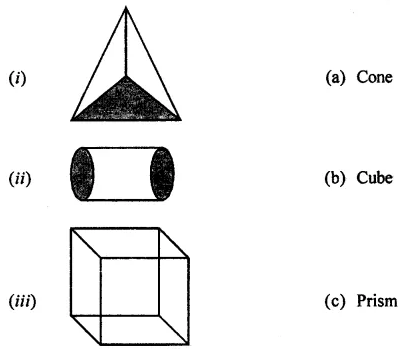
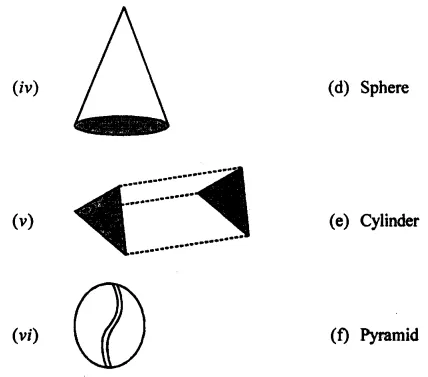
Match the following shapes with their names:
ML Aggarwal Class 7 Solutions for ICSE Maths Chapter 15 Visualising Solid Shapes Ex 15.1 1
ML Aggarwal Class 7 Solutions for ICSE Maths Chapter 15 Visualising Solid Shapes Ex 15.1 2
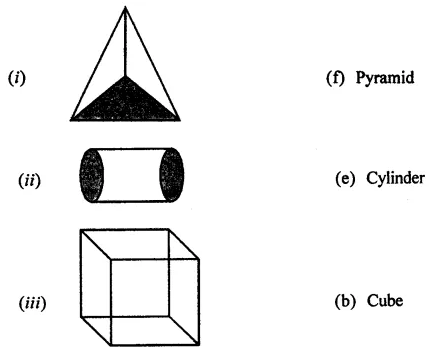
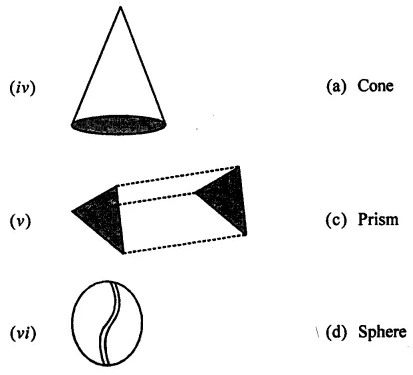
Solution:
ML Aggarwal Class 7 Solutions for ICSE Maths Chapter 15 Visualising Solid Shapes Ex 15.1 3
ML Aggarwal Class 7 Solutions for ICSE Maths Chapter 15 Visualising Solid Shapes Ex 15.1 4

Question 2.
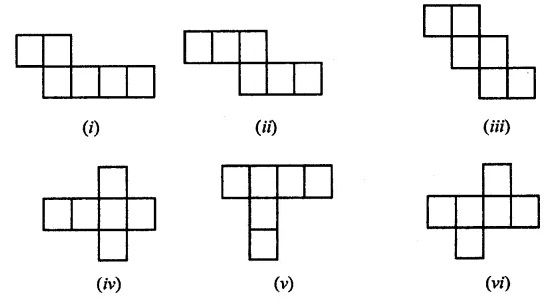
Identify the nets which can be folded to form a cube (cut out copies of the nets and try it):
ML Aggarwal Class 7 Solutions for ICSE Maths Chapter 15 Visualising Solid Shapes Ex 15.1 5
Solution:
ML Aggarwal Class 7 Solutions for ICSE Maths Chapter 15 Visualising Solid Shapes Ex 15.1 6

Question 3.
Dice are cubes with dots on each face. Opposite faces of a die always have a total of sevend dots on them.
ML Aggarwal Class 7 Solutions for ICSE Maths Chapter 15 Visualising Solid Shapes Ex 15.1 7
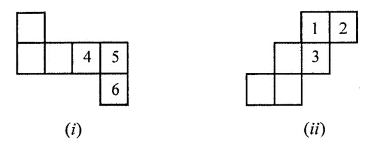
Here are two nets to make dice (cubes); the numbers inserted in each square indicate the number of dots in that box.
ML Aggarwal Class 7 Solutions for ICSE Maths Chapter 15 Visualising Solid Shapes Ex 15.1 8
Insert suitable numbers in the blanks, remembering that the number on the opposite faces should total to 7.
Solution:
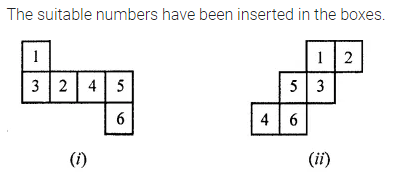
ML Aggarwal Class 7 Solutions for ICSE Maths Chapter 15 Visualising Solid Shapes Ex 15.1 9

Question 4.
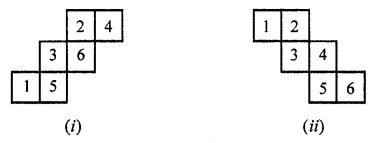
Can any of the following be a net for a die? If no, explain your answer:
ML Aggarwal Class 7 Solutions for ICSE Maths Chapter 15 Visualising Solid Shapes Ex 15.1 10
Solution:
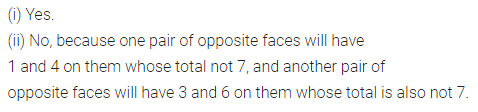
ML Aggarwal Class 7 Solutions for ICSE Maths Chapter 15 Visualising Solid Shapes Ex 15.1 11

Question 5.
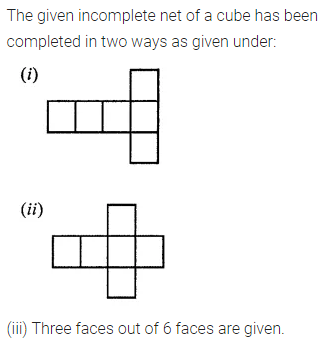
Here is an incomplete net for making a cube. Complete it in at least two different ways. Remember that a cube has six faces. How many are there in the net here? (You may use a squared paper for easy manipulation.)
ML Aggarwal Class 7 Solutions for ICSE Maths Chapter 15 Visualising Solid Shapes Ex 15.1 12
Solution:
ML Aggarwal Class 7 Solutions for ICSE Maths Chapter 15 Visualising Solid Shapes Ex 15.1 13

ML Aggarwal Class 7 Solutions for ICSE Maths Chapter 14 Symmetry Check Your Progress

ML Aggarwal Class 7 Solutions Chapter 14 Symmetry Check Your Progress for ICSE Understanding Mathematics acts as the best resource during your learning and helps you score well in your exams.

ML Aggarwal Class 7 Solutions for ICSE Maths Chapter 14 Symmetry Check Your Progress

Question 1.
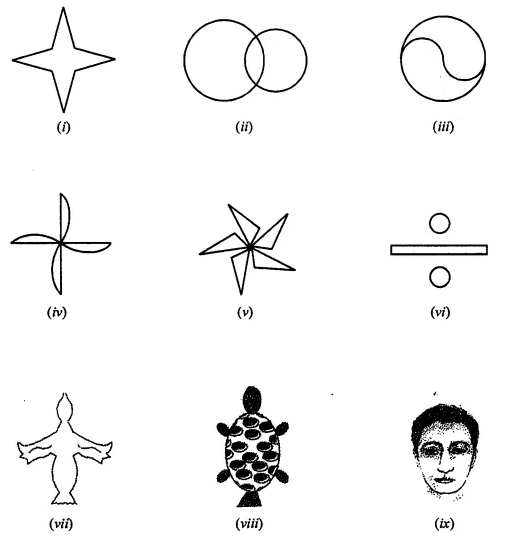
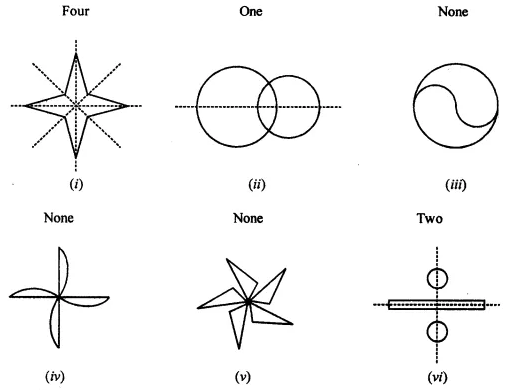
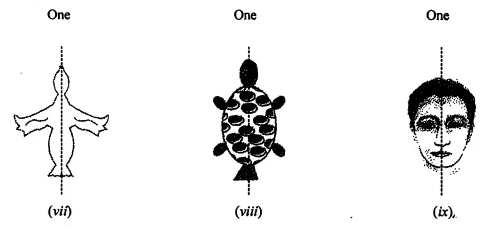
Draw the line (or lines) of symmetry, if any of the following shapes and count their number.
ML Aggarwal Class 7 Solutions for ICSE Maths Chapter 14 Symmetry Check Your Progress 1
Solution:
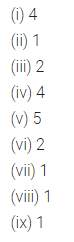
ML Aggarwal Class 7 Solutions for ICSE Maths Chapter 14 Symmetry Check Your Progress 2
ML Aggarwal Class 7 Solutions for ICSE Maths Chapter 14 Symmetry Check Your Progress 3

Question 2.
For each of the given shape in Question 1, find the order of the rotational symmetry (If any).
Solution:
ML Aggarwal Class 7 Solutions for ICSE Maths Chapter 14 Symmetry Check Your Progress 4

Question 3.
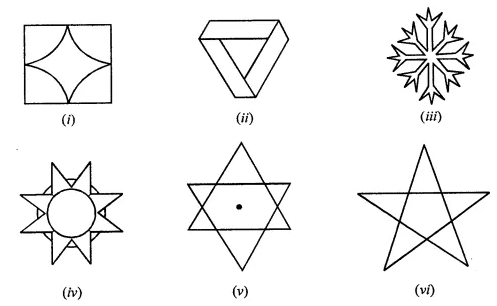
Give the order of rotational symmetry of each of the following figures:
ML Aggarwal Class 7 Solutions for ICSE Maths Chapter 14 Symmetry Check Your Progress 5
Solution:
ML Aggarwal Class 7 Solutions for ICSE Maths Chapter 14 Symmetry Check Your Progress 6

ML Aggarwal Class 7 Solutions for ICSE Maths Chapter 14 Symmetry Objective Type Questions

ML Aggarwal Class 7 Solutions Chapter 14 Symmetry Objective Type Questions for ICSE Understanding Mathematics acts as the best resource during your learning and helps you score well in your exams.

ML Aggarwal Class 7 Solutions for ICSE Maths Chapter 14 Symmetry Objective Type Questions

Mental Maths

Question 1.
Fill in the blanks:
(i) The hands of a clock rotate only in ………. direction.
(ii) While opening the cap of a bottle, the direction of rotation is ……….
(iii) The number of lines of symmetry of an isosceles right-angled triangle is …………
(iv) A figure has ……….. symmetry if it is its own image under a reflection.
(v) The centre of rotation of an equilateral triangle is the point of intersection of its ………..
(vi) The centre of rotation of a rhombus is the point ……….
(vii) A regular polygon of n-sides has ……….. the number of lines of symmetry.
(viii) The angle of rotational symmetry in an equilateral triangle is ……….
(ix) The angle of rotational symmetry in a regular pentagon is ……..
(x) If after a rotation of 45° about a fixed point the figure looks exactly the same, then the order of rotational symmetry is ……….
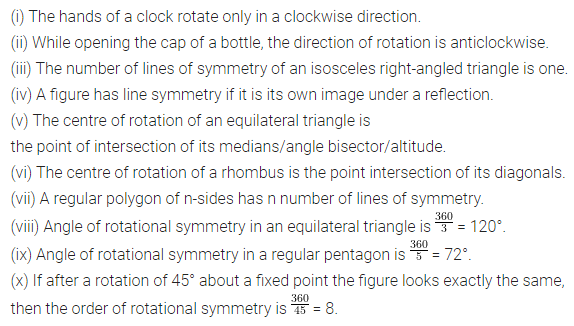
Solution:
ML Aggarwal Class 7 Solutions for ICSE Maths Chapter 14 Symmetry Objective Type Questions 1

Question 2.
State whether the following statements are true (T) or false (F):
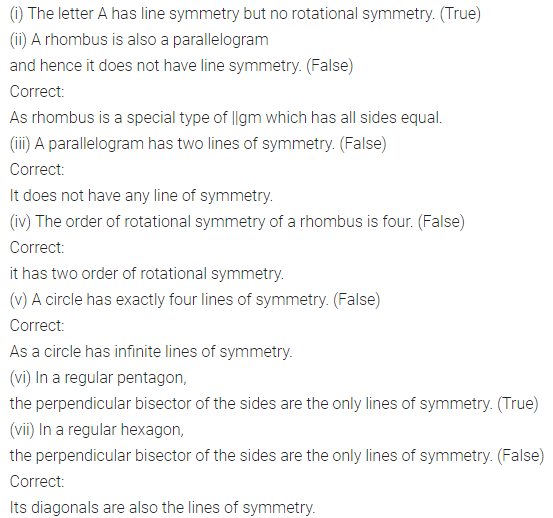
(i) The letter A has line symmetry but no rotational symmetry.
(ii) A rhombus is also a parallelogram and hence it does not have line symmetry.
(iii) A parallelogram has two lines of symmetry.
(iv) The order of rotational symmetry of a rhombus is four.
(v) A circle has exactly four lines of symmetry.
(vi) In a regular pentagon, the perpendicular bisector of the sides are the only lines of symmetry.
(vii) In a regular hexagon, the perpendicular bisector of the sides are the only lines of symmetry.
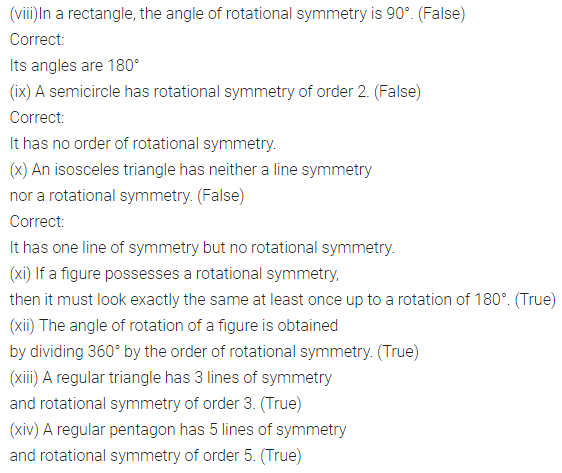
(viii) In a rectangle, the angle of rotational symmetry is 90°.
(ix) A semicircle has rotational symmetry of order 2.
(x) An isosceles triangle has neither a line symmetry nor a rotational symmetry.
(xi) If a figure possesses a rotational symmetry, then it must look exactly the same atleast once up to a rotation of 180°.
(xii) The angle of rotation of a figure is obtained by dividing 360° by the order of rotational symmetry.
(xiii) A regular triangle has 3 lines of symmetry and rotational symmetry of order 3.
(xiv) A regular pentagon has 5 lines of symmetry and rotational symmetry of order 5.
Solution:
ML Aggarwal Class 7 Solutions for ICSE Maths Chapter 14 Symmetry Objective Type Questions 2
ML Aggarwal Class 7 Solutions for ICSE Maths Chapter 14 Symmetry Objective Type Questions 3

Multiple Choice Questions

Choose the correct answer from the given four options (3 to 14):
Question 3.
A quadrilateral having four lines of symmetry is a
(a) parallelogram
(b) rectangle
(c) rhombus
(d) square
Solution:
ML Aggarwal Class 7 Solutions for ICSE Maths Chapter 14 Symmetry Objective Type Questions 4

Question 4.
The letter Z has
(a) one horizontal line of symmetry
(b) one vertical line of symmetry
(c) two lines of symmetry
(d) no line of symmetry
Solution:
ML Aggarwal Class 7 Solutions for ICSE Maths Chapter 14 Symmetry Objective Type Questions 5

Question 5.
A figure that does not have any rotational symmetry is
(a) circle
(b) parallelogram
(c) kite
(d) regular pentagon
Solution:
ML Aggarwal Class 7 Solutions for ICSE Maths Chapter 14 Symmetry Objective Type Questions 6

Question 6.
The number of lines of symmetry in the given figure is
(a) 1
(b) 3
(c) 6
(d) infinitely many
ML Aggarwal Class 7 Solutions for ICSE Maths Chapter 14 Symmetry Objective Type Questions 7
Solution:
ML Aggarwal Class 7 Solutions for ICSE Maths Chapter 14 Symmetry Objective Type Questions 8

Question 7.
Rotating a figure by 60° anticlockwise is equivalent to a clockwise rotation of
(a) 60°
(b) 120°
(c) 240°
(d) 300°
Solution:
ML Aggarwal Class 7 Solutions for ICSE Maths Chapter 14 Symmetry Objective Type Questions 9

Question 8.
A figure having 1 line of symmetry and whose order of rotational symmetry is also 1 is
(a) rhombus
(b) parallelogram
(c) kite
(d) scalene triangle
Solution:
ML Aggarwal Class 7 Solutions for ICSE Maths Chapter 14 Symmetry Objective Type Questions 10

Question 9.
The order of rotational symmetry of a line segment is
(a) 1
(b) 2
(c) 3
(d) 4
Solution:
ML Aggarwal Class 7 Solutions for ICSE Maths Chapter 14 Symmetry Objective Type Questions 11

Question 10.
The order of the rotational symmetry in the given figure is
(a) 1
(b) 2
(c) 4
(d) infinitely many
ML Aggarwal Class 7 Solutions for ICSE Maths Chapter 14 Symmetry Objective Type Questions 12
Solution:
ML Aggarwal Class 7 Solutions for ICSE Maths Chapter 14 Symmetry Objective Type Questions 13

Question 11.
A possible angle of rotation of a figure having rotational symmetry of order greater than 1 is
(a) 36°
(b) 144°
(c) 150°
(d) 360°
Solution:
ML Aggarwal Class 7 Solutions for ICSE Maths Chapter 14 Symmetry Objective Type Questions 14

Question 12.
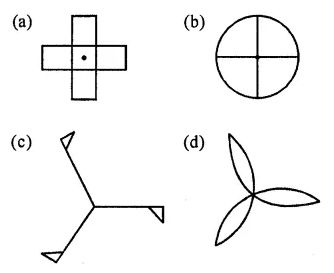
The figure which does not have both reflection and rotational symmetry is
ML Aggarwal Class 7 Solutions for ICSE Maths Chapter 14 Symmetry Objective Type Questions 15
Solution:
ML Aggarwal Class 7 Solutions for ICSE Maths Chapter 14 Symmetry Objective Type Questions 16

Question 13.
In the word ’MATHS’ which of the following pairs of letters have rotational symmetry?
(a) M and T
(b) A and S
(c) T and S
(d) H and S
Solution:
ML Aggarwal Class 7 Solutions for ICSE Maths Chapter 14 Symmetry Objective Type Questions 17

Question 14.
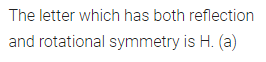
The letter which has both reflection and rotational symmetry is
(a) H
(b) M
(c) S
(d) Y
Solution:
ML Aggarwal Class 7 Solutions for ICSE Maths Chapter 14 Symmetry Objective Type Questions 18

The Book that Saved the Earth Extra Questions and Answers Class 10 English Footprints Without Feet

Here we are providing The Book that Saved the Earth Extra Questions and Answers Class 10 English Footprints Without Feet, Extra Questions for Class 10 English was designed by subject expert teachers.

The Book that Saved the Earth Extra Questions and Answers Class 10 English Footprints Without Feet

The Book that Saved the Earth Extra Questions and Answers Short Answer Type

Question 1.
What was Oop’s opinion about the ‘sandwiches’ he had eaten?
Answer:
Oop was forced to eat ‘sandwiches’ and he made terrible faces while chewing. He said that it was not delicious; rather as dry as Martian dust. He remarked that he could not understand how the Earthlings could get those ‘sandwiches’ down without water.

Question 2.
What was Noodle’s version to describe the so-called ‘sandwich’?
Answer:
Noodle hesitantly told Think-Tank that he had ‘insignificant’ information about those ‘sandwiches’. He informed him that he had seen surveyor films of those sandwiches. He had noticed that the Earthlings did not eat them. They used them as some sort of communication devices.

Question 3.
Why was the twentieth century called the ‘Era of the Book?
Answer:
The twentieth century was often called the Era of the book as there were books about everything. Books taught people how, when, where, and why of everything. They illustrated, educated, punctuated, and even decorated.

Question 4.
How Does Think-Tank compare the Martians with the people on Earth? What does he call the Earth mockingly?
Answer:
Think-Tank considers earth ‘ a ridiculous little planet’ ariel intends to put it under his generous rulership. He feels the earth is actually an unimportant place where ugly earthlings, with their tiny heads, reside. He believes the Martians to be a superior race. He mockingly calls the earth ‘Primitive ball of mud’.

Question 5.
What saved the Earth? How?
Answer:
One dusty old book of nursery rhymes saved the earth from a Martian invasion. The Martian could not decipher the meaning of nursery rhymes. Their misinterpretation made the situation comical. They began to believe that the Earthlings had advance technology and were planning to invade the Mars. They called off their mission and even left the Mars isolated to escape to a far-off planet.

Question 6.
What guesses are made by Think-Tank about the books found on Earth?
Answer:
Think Tank first of all announced that the books found on the Earth were sandwiches and to confirm it he forced Oop to eat them. Later on Noodle shared his observation and he declared that he was about to say the same thing. Now he announced that those books were a sort of communication devices.

Question 7.
Noodle avoids offending Think-Tank but at the same time he corrects his mistakes. How does he manage to do that?
Answer:
Noodle avoids offending Think-Tank very meticulously. He never disagrees with his opinion but he does not miss any opportunity to put forward his suggestions no matter even if he does it hesitantly. He always shows admiration to Think-Tank’s intelligence. He never puts himself into the conflicting ideas from his boss.

Question 8.
How did the book change Think-Tank’s opinion about the Earthlings?
Answer:
Think-Tank used to believe that the Martian was a superior race to the Earthlings. But after cracking the so-called code of an old nursery rhyme book, he changed his view about the Earthlings. He now thought that the Earthlings has reached a high level of civilization and planning to invade the Mars. It made him call off his mission.

Question 9.
What does Think-Tank infer on listening to the nursery rhyme, ‘Hey diddle diddle ….’?
Answer:
On listening to the nursery rhyme, ‘Hey diddle diddle…’, Think – Tank inferred that the Earthlings had reached a high level of civilization. It was alarming that they had taught their domesticated animals musical cultures and space technique. He announced that even their dogs had a sense of humour.’ He believed that the Earthlings could launch an interplanetary attack of millions of cows any time soon.

Question 10.
What does Noodle tell Think-Tank about the books?
Answer:
Noodle hesitantly informs Think-Tank that the books were a sort of communication device. He told that he had seen surveyor films of those ‘sandwiches’. He had noticed that the Earthlings did not eat them. They used them as sort of communication device.

Question 11.
How did the relations between the Earthlings and the Martians improve in the twenty-fifth century?
Answer:
Think-Tank attempted an invasion on the earth but got so frightened that he had to leave the Mars. He was replaced by Noodle. Noddle was an intelligent and wonderful person. The Earthlings resumed contact with the Martian. They became friendly and taught the Martians how to read. The Earthlings established a model library in their capital city of Marsopolis.

Question 12.
What did Think-Tank ask Omega to do with the book?
Answer:
Think-Tank thought that it was a sandwich. He said that there were two slices of what was called bread with some sort of filling. He asked Omega to eat the book.

Question 13.
Who is Think – Tank? How did Noodle address him?
Answer:
Think-Tank is the ruler of Mars. Noodle addressed him, “O Great and Mighty Think-Tank, Ruler of Mars and her two moons, most powerful and intelligent creature in the whole universe.

Question 14.
What was the book about? How did Think-Tank interpret the rhymes?
Answer:
They were reading the rhymes book named Mother Goose. When captain Omega and her team were reading and enjoying the rhymes, Think-Tank interpreted them in a different way. He concluded that he was being attacked. He at once asked his people to come back. He decided to evacuate the entire planet of Mars.

Question 15.
What did Think-Tank intend to do?
Answer:
Think-Tank intended to invade the earth. He wanted to control the earth and put it under his rulership.

Question 16.
What did Noodle suggest about the book?
Answer:
Noodle suggested that the book was not a sandwich, it was some device used for communication. Later on, he suggested that the team should eat vitamins to increase their intelligence so that they could read them.

Question 17.
Where did Captain Omega reach with her team?
Answer:
Captain Omega landed on the earth with her team. They found themselves in the Centerville Public Library amidst thousands of books. They thought they were in some sort of storage bam.

Question 18.
Why was the twentieth century called the ‘Era of the Book’?
Answer:
The twentieth century was often called the ‘Era of the book’. In those days, there were books about everything, from anteaters to Zulus. Books taught people how to, when to, where to, and why to. They illustrated, educated, punctuated, and even decorated.

Question 19.
Who tried to invade the earth in the twenty-first century?
Answer:
The Martians tried to invade the earth in the twenty-first century.

Question 20.
What guesses are made by Think-Tank about the books found on earth?
Answer:
Think-Tank’s guess about the books found on earth is that they are some devices meant for communication.

The Book that Saved the Earth Extra Questions and Answers Long Answer Type

Question 1.
Half knowledge is dangerous. It never helps to achieve success. Discuss how incomplete knowledge can lead to disaster in reference to the lesson “The Book That Saved the Earth’.
Answer:
It is a fact that incomplete knowledge can lead to disaster. Suppose we sit to work on a satellite and able to command only half of the instructions. In that case things would fail and cause disaster. Half knowledge is dangerous and never helps to achieve success. If we are able to apply knowledge fully to any kind of task, we can have self contentment.
We read in the lesson “The Book That Saved the Earth” that the Martians had to suffer. They had the mission to invade the earth but due to incomplete knowledge they misinterpreted the nursery rhyme book.

Question 2.
Rushing to conclusion without going into details may lead to chaos and failure. Elaborate this with reference to the Martian invasion in the chapter ‘ The Book That Saved the Earth’.
Answer:
The Martians were very proud of themselves. Great and mighty Think-Thank regarded as the ruler of Mars was always caught in self praise. He had a quick mind and wishes to attack the earth in a great hurry. Martians misinterpreted the signals received from earthlings book of nursery rhymes and fled away. If they had planned the things decisively things would have been different. In any kind of situation rash decisions would never give results. It is only through knowledge, perseverence.

Question 3.
It is morally incorrect to invade another country/ planet for one’s own benefit. The Martians did not understand the value of peaceful coexistence. How did the book of nursery rhyme save the Earth from the Martian invasion?
Answer:
Great and Mighty Think-Tank believed that the Martians were a superior race so they must invade and put the earth under his generous rulership. He scornfully called the Earth ‘primitive ball of mud’. The Martians did not understand the value of peaceful coexistence and sent a mission to invade the earth. The crew landed in a library and could not make out what the books actually were. It was believed – that the books were a sort of communications device.

Think-Tank asked the member to decipher the code of the ‘sandwiches’. The nursery rhymes were totally misinterpreted and it was believed that the Earthlings had developed an advance civilization and were planning to invade the Mars. The mission was called off and the Martians escaped to a remote place to save their lives. Thus the books saved the earth.

Question 4.
How do the three nursery rhymes frighten Think-Tank in the play, ‘The Book That Saved the Earth’?
Answer:
The rhyme ‘Mistress Mary, quite contrary makes Think-Tank believe that the Earthlings have discovered how to combine agriculture and mining. He thinks that they can grow explosives. The rhyme ‘Hey diddle diddle’, makes him conclude that the Earthlings have reached a high level of civilization: even their animals have musical culture and know space techniques.

He fears that at that very moment, the Earthlings might be launching an interplanetary attack of millions of cows. Oop reads the rhyme. ‘Humpty Dumpty’ and shows him a picture of Humpty Dumpty. Think-Tank concludes that it is his picture and the Earthlings are planning to invade Mars.

Question 5.
How did one old book of nursery rhymes save the world from a Martian invasion?
OR
Who tried to invade the earth in the twenty first century and what saved it?
Answer:
The Martians sent a mission to invade the earth. The crew landed in a library and could not make out what the books actually were. It was believed that the books were a sort of communication device. Think-Tank asked the members to decipher the code of the ‘sandwiches’. The nursery rhymes were totally misinterpreted and it was believed that the Earthlings had developed an advance civilization and mission was called off and the Martians escaped to a remote place to save their lives. Thus the books saved the Earth.

Question 6.
What is Think-Tank’s opinion about the Earth?
Answer:
Think-Tank called the Earth a ridiculous little planet and showed his wish to put it under his generous rulership. The planet Earth was insignificant to him. He believed that the Martians were the most handsome race. He referred to the people of the Earth as Earthlings and mocked their tiny heads.

He showed his desire to invade ‘primitive ball of mud’ called Earth before lunch. But after misinterpreting the book of nursery rhymes he began to believe that the earthlings had developed a more advanced civilization and were even planning to invade the Mars.

Question 7.
Noodle avoids offending Think-Tank but at the same time he corrects his mistakes. How does he manage to do that?
Answer:
Noodle avoids offending Think-Tank, but at the same time, he very cleverly tries to correct his mistakes also. Whenever Noodle had to say something contrary to what Think-Tank said, he would present his thoughts by referring to them as being of no particular importance. In this way he would correct Think- Tank’s errors without making him feel that he was being corrected. Noodle appears to be quite an expert in handling these kind of people.

Question 8.
If you were in Noodle’s place, how would you handle Think-Tank’s mistakes?
Answer:
If I were in Noodle’s place, I would have handled Think-Tank’s mistakes the same way as Noodle does, politely and courteously.

Question 9.
Do you think books are being replaced by the electronic media? Can we do away with books altogether?
Answer:
In a way, yes, we can say that books are being replaced by the electronic media. Most of the children no longer read story books and prefer to watch television and Rufe internet. Although textbooks are still there but they may soon be replaced by electronic vesion. Books have their own utility value because one can read a book at his own pace and a book does not need to be powered by electricity. But as the technology is advancing and newer versions of it are being discovered every day, a time may come when books will become a thing of the past.

Question 10.
Why are books referred to as a man’s best companion? Which is your favorite book and why? Write a paragraph about that book.
Answer:
Books are known to be as man’s best companion. They can make us mentally strong, improve our vocabulary and enhance the horizon of our knowledge. Books can be our guide and best friend. I love to read books, especially the ones that have children as their main characters and the story highlights their psychology and how innocent the children could be.

One such book in Malgudi Days written by a very renowned author R K Narayan. I love this book because the story revolves around the children. The way child’s psychology has been depicted in this book is what gives me pleasure while reading this book.

Question 11.
In what ways does Think-Tank misinterpret innocent nursery rhymes as threats to the Martians? Can you think of any incidents where you misinterpreted a word or an action? How did you resolve the misunderstanding?
Answer:
Think-Tank misinterprets innocent rhymes. He just takes that verbal meaning of the rhymes. He does not bother to go into the depth. It always happens. If we do not try to understand the context in which the words have been used, we shall commit mistakes as Think-Tank has done. I misinterpreted once a word ‘helping’. I took its simple meaning that is to do something in the favour of a person. I resolved this misunderstanding with the help of a dictionary. I found that its meaning is a part of food also.

Question 12.
The aliens in this play speak English. Do you think this is their language? What could be the language of the aliens?
Answer:
I don’t think English is their language. Had English been their language, they would have easily understood the book. Their language could be something else. They must be using language which is completely different from any language of this planet earth.

Bholi Extra Questions and Answers Class 10 English Footprints Without Feet

Here we are providing Bholi Extra Questions and Answers Class 10 English Footprints Without Feet, Extra Questions for Class 10 English was designed by subject expert teachers.

Bholi Extra Questions and Answers Class 10 English Footprints Without Feet

Bholi Extra Questions and Answers Short Answer Type

Question 1.
Why was Sulekha nicknamed Bholi?
Answer:
Sulekha was nicknamed Bholi because she was a simpleton. She was mentally slow and anybody could befool her.

Question 2.
Why did Sulekha start stammering?
Answer:
Sulekha was a baby when she fell down from a cot. Her brain was damaged. She could not speak till the age of five years. She was mentally slow and lacked confidence. That is why she started stammering.

Question 3.
Why was Ramlal worried about Bholi and not about his other children?
Answer:
All other children of Ramlal were healthy and good looking. Bholi was the only girl who was neither intelligent nor good looking. She was a simpleton, she stammered also. Ramlal was extremely worried about her future.

Question 4.
Why did the Tehsildar come to Ramlal’s village? What did he ask Ramlal to do?
Answer:
The Tehsildar came to Ramlal’s village to inaugurate the primary school. He asked Ramlal to set an example for others by sending his daughters to school.

Question 5.
What was Ramlal’s wife reaction?
Answer:
His wife was an orthodox village woman. She was against the idea of sending her daughters to school. She thought that education would affect their marriage prospects adversely.

Question 6.
Why did she agree to send Bholi to school?
Answer:
She thought that education would ruin the marriage prospects of their daughters but Bholi was a simpleton. There was no possibility of her marriage. So she agreed to send Bholi to school.

Question 7.
Why was Bholi reluctant to go to school with her father?
Answer:
Bholi did not know what a school was like. She had never heard about it. When her father held her hand and told her that they were going to school, she got frightened fearing to be dragged out of the house. So she was reluctant to go to school with her father.

Question 8.
What made her feel that she is going to a better place than her home?
Answer:
Bholi never got attention before that day. She was bathed and given a clean dress. Oil was rubbed into her dry and matted hair. This made her feel that she was going to a better place than her home.

Question 9.
Did Bholi enjoy her first day in school? What made her happy on this very day?
Answer:
It was a mixed day for Bholi. She was happy to see the girls of her age. She was fascinated with the colourful pictures on the wall of the classrooms. But when the teacher asked her name she could not answer properly and other girls laughed at her. She cried. But her teacher’s soft words made her happy on this very day.

Question 10.
Which incident touched her heart?
Answer:
All the girls were laughing at her. The teacher called her by name in her soft and soothing voice. This touched her heart because she had never been called in that loving way.

Question 11.
“Her heart was throbbing with a new hope and a new life”.
(i) What was the new hope and new life?
(ii) What did she relate the pictures in the school wall to?
Answer:
(i) The new hope was that she would become learned like others. People would listen to her. She would be able to speak without stammering. Now she would not be treated as inferior to others.

(ii) She related the pictures of the school wall with the real things around her. The goat was black like the goat of their neighbour. The cow was just like their Lakshmi. The horse was brown just like the Tehsildar’s horse.

Question 12.
How does she become a masterpiece?
Answer:
The teacher transformed a simpleton girl into a well-behaved and confident girl. Bholi was a foolish and stammering girl. The teacher put in all her hard work in transforming her into a mentally strong and well-educated girl. It was really a masterpiece of the teacher.

Question 13.
Why did Bholi look at Bishamber with cold contempt?
Answer:
Bholi looked at Bishamber with cold contempt because he had demanded 5000 to get married to her. Bholi saw how her father got humiliated; she realised that Bishamber was greedy and exploiting her father due to her look.

Question 14.
Why did Bishamber’s marriage with Bholi not take place?
Answer:
Bishamber’s marriage with Bholi did not take place because Bholi refused to marry a greedy man. She also realised that Bishamber was trying to exploit her father due to her looks.

Question 15.
Why did Bholi’s parents accept Bishamber’s proposal? Give three reasons.
Answer:
Bholi’s parents were always worried about her marriage as she was not beautiful and intelligent. Bishamber was wealthy and did not demand any dowry also. So they accepted the proposal after a little discussion.

Question 16.
Why did Bholi talk very little as a child?
Answer:
Bholi could not speak till she was five, and when at last she learnt to speak, she stammered. The other children would make fun of her and even mimicked her. So she used to talk very little.

Question 17.
How did Bholi react when her father caught her by the hand to take her to school? Why?
Answer:
When Ramlal caught Bholi by the hand to take her to school, she was frightened. She did not know what a school was like. She thought her father was turning her out of the house. She shouted in terror and pulled her hand away from her father’s grip.

Question 18.
What kind of a mother, do you think, Ramlal’s.wife was?
Answer:
Ramlal’s wife’was an uncaring and callous mother. She never showed the affection to Bholi that she deserved as her child. She felt that the girl with pox-marks and lack of sense was a burden. That’s why she sent her to school so that the teachers took the trouble to handle the girl. Even when it was the matter of her marriage, the mother showed no sympathy and consented to get her married to an old and lame man.

Question 19.
Give example from the text to show that Bholi was a neglected child.
Answer:
Due to her physical appearance Bholi was neglected by her parents. New dresses were made for her sisters; the old dresses of her sisters were passed on to her. No one ever cared to mind or wash her clothes. She was sent to school as her mother believed her to be a burden.

Question 20.
Why is Bholi’s father worried about her?
Answer:
Bholi’s father is worried about her as she has neither good looks nor intelligence. He did not know how he would find a suitable groom for her.

Question 21.
For what unusual reasons is Bholi sent to school?
Answer:
Bholi is sent to school because there is little chance of her getting married because of her ugly face and lack of sense. Also her father has to send her to school as the village headman has commanded him to do so.

Question 22.
Does Bholi enjoy her first day at school?
Answer:
Yes, Bholi enjoys her first day at school as she was glad to find so many girls almost of her own age present there. She hoped that one of these girls might become her friend.

Question 23.
Does she find her teacher different from the people at home?
Answer:
Yes, she finds her teacher different from the people at home as the teacher was affectionate, polite and this touched her heart.

Question 24.
Why do Bholi’s parents accept Bishamber’s marriage proposal?
Answer:
Bholi’s parents accept Bishamber’s marriage proposal because if they don’t accept it, she would not be married for the rest of her life.

Question 25.
Why does the marriage not take place?
Answer:
The marriage does not take place because the groom demanded dowry.

Question 26.
Bholi had many apprehensions about going to school. What made her feel that she was going to a better place than her home?
Answer:
Bholi had many apprehensions about going to school. She remembered how their old cow, Lakshmi, had been turned out of the house and sold. When she got a clean dress, was bathed and her hair was properly done with oil, only then she felt that she was going to a better place than her home.

Question 27.
How did Bholi’s teacher play an important role in changing the course of her life?
Answer:
Bholi’s teacher played an important role in changing the course of her life. She was polite and friendly which touched her heart. She encouraged her every time and was affectionate towards her. The teacher transformed her into a confident person who could read, write and speak clearly. This gave her the required confidence. Moreover, teacher’s appreciation and encouragement helped her overcome her own morale.

Question 28.
Do you think the characters in the story were speaking to each other in English? If not, in which language were they speaking?  (You can get clues from the names of the persons and the non-English words used in the story.)
Answer:
No the characters in the story do not speak English. Their original language in Hindi. They use words like Pitaji, Izzat, Tehsildar, etc.

Bholi Extra Questions and Answers Long Answer Type

Question 1.
“Put the fear out of your heart and you will be able to speak like anyone else.” These words of encouragement from the teacher highlight that change of social attitude and encouragement can help a child like Bholi to become confident and face the world bravely. With reference . to the story ‘Bholi’ write how the social attitude towards Bholi made her an introvert. What should be done to help such children to face the world bravely?
Answer:
Bholi was neglected by her parents on account of her looks and lack of intelligence. She used to stammer so the other children made fun of her and mimicked her. As a result she talked very little. It was a daunting task for the teacher to encourage Bholi. The teacher talked to her affectionately and friendly. She assured her if she put the fear out of her heart and she would be able to speak like anyone else.

Through the efforts of years Bholi became a transferred personality. She refused to marry a greedy man who was trying to exploit her father due to her looks. Such children should be constantly encouraged by the parents, teachers and even by the other relations. They must be taught to fight back their handicaps rather to accept it as facts.

Question 2.
What social attitudes are presented in the story, ‘Bholi’? How does Bholi’s teacher help her overcome these barriers?
OR
God created this world but teachers create human beings. How does Bholi’s teacher succeed in changing the course of her life?
Answer:
Bholi was neglected by her parents on account of her looks and lack of intelligence. She was sent to school as her mother thought her to be a burden and let the teachers at school worry about her. Ironically, the teachers transformed her life completely. God created this world but teachers create human beings.

Bholi did not know what exactly a school was and what happened there, in the class when her teacher asked her name, she stammered and began to cry. She kept her head down throughout the class. The teacher was very encouraging and friendly to her and this made her gain confidence to speak.

She started seeing a ray of hope for a new life. After years of gaining education and with the help of her teacher, Bholi turned into a confident girl. She no longer stammered and could speak properly. She even had the courage to refuse marrying the lame old man because he was greedy and asked money from her father to marry her.

Question 3.
“Don’t you worry, Pitajil In your old age I will serve you and mother”. Through this statement the narrator wants to highlight the moral values Bholi imbibed with. Based on the reading of the lesson, what made Bholi aware of her rights and how did she use them?
Answer:
Bholi became an introvert child who lacked confidence. She was neglected and even made fun of due to her appearance and lack of intelligence. Years of education made her bold and confident. She got an aim in her life. When she refused to marry greedy Bishamber, her father became worried. She assured her father not to worry and promised that she would take care of him and her mother in their old age.

She told that she would teach in the school where she learnt so much. During her education Bholi’s teacher made her aware of her rights as well as duties. She faced the challenge of rejecting greedy Bishamber with determination and confidence. Thus she protected her self-respect and integrity.

Question 4.
Education is always a great asset in the life of a woman. How did Bholi, an educated girl free the challenge posed by Bishamber’s greed?
OR
School education turned Bholi from a dumb cow into a bold girl. How did she save her father from a huge expense and become his support in his old age?
Answer:
Ironically, Bholi was sent to school as her mother believed she was a burden and let the teachers at the school worry for her. The teacher showed affection and encouraged her to shed her fear. She was assured by her teacher that she would speak like others one day.

Years of hard work transformed Bholi into a bold and confident young woman. Bishamber refused to marry Bholi due to her appearance and demanded five thousand rupees. Bholi saw how her father was humiliated for no reason. She refused to marry a greedy, mean and contemptible coward. She assured her father that she would serve him and her mother in their old age. She had a mission in her life; she would spread the light of education in her village.

Question 5.
Write a character sketch of Sulekha.
OR
On the basis of your understanding of the story, sketch the character of Bholi.
OR
Write a character sketch of Bholi.
“Bholi’s whole personality underwent a complete transformation towards the end of the story”. Explain.
Answer:
Bholi’s real name was Sulekha but she was called Bholi, the simpleton as she was a backward child. She started speaking only when she turned five but she stammered when she spoke and as a result she was always mimicked or made fun of by the other children. Therefore, Bholi talked very little.

Bholi did not know what exactly a school was and what happened there, in the class when her teacher asked her name, she stammered and began to cry. She kept her head down throughout the class. The teacher was very encouraging and friendly to her and this made her gain confidence to speak. She started seeing a ray of hope for a new life.

After years of gaining education and with the help of her teacher, Bholi turned into a confident girl. She no longer stammered and could speak properly. She even had the courage to refuse marrying the lame old man because he was greedy and asked money from her father to marry her. On seeing her father worried about her marriage, she said that he need not worry as she would teach in the same school where she learnt so much and would take care of him and her mother in their old age.

Question 6.
“Dowry is a negation of the girl’s dignity”. Explain this statement in the light of the story of ‘Bholi’.
Answer:
Initially Bishamber did not demand dowry to get married to Bholi. He was a widower, having children and of the age of Ramlal. But during the marriage ceremony he happened to see the face of Bholi. He bargains if he was given five thousand rupees he will marry the girl. Bholi’s father Ramlal placed his turban at his feet but he refused.

A girl is considered a liability in her own natal home due to prevalence of the custom of dowry practice. Some parents are unwilling to give higher education to their daughter as they have to search for ‘ highly educated boy for marriages and a better educated boy will demand more dowry which creates unnecessary problefn, for parents.

Besides, the boy who receives huge amount of dowry may think of himself as more dignified as having a higher status, greater prestige and more respectful than the girl. Subsequently the girl develops inferiority complex. Fortunately, Bholi refuses to marry greedy Bishamber and decides to serve her parents instead in their old age. ‘

Question 7.
How did the teacher encourage Bholi on her first day in school?
OR
On the basis of your understanding of the story, describe the role played by the teacher in the life of Bholi.
OR
What values did the teacher display in transforming Bholi into a confident girl?
Answer:
Bholi was neglected by her parents on account of her looks and lack of intelligence. She was sent to school as her mother thought her to be a burden and let the teacher at school worry about her. The teacher in the school asked her to tell her name. She stammered -and began to cry.

The teacher showed her affection and encouraged her in a friendly manner to put aside her fear. Bholi somehow told her name. The teacher assured her that she would be able £o speak like everyone else one day. Bholi was surprised. The teacher asked her to come to school regularly. Love and encouragement shown by the teacher brought out drastic changes in Bholi’s personality. Within a few years she became so confident that she refused to marry a greedy man.

Question 8.
‘Love and encouragement make the impossible possible. Explain this statement on the basis of the story ‘Bholi’.
Answer:
Bholi was sent to school as her mother thought her to be a burden. She was neglected by her parents as she was not beautiful and lacked intelligence. The teacher in the school asked her to tell her name. She stammered and began to cry. The teacher showed her affection and encouraged her in a friendly manner to put aside her fear.

Bholi somehow told her name. Bholi was surprised. The teacher asked her to come to school regularly. Love and encouragement shown by the teacher brought out drastic changes in Bholi’s personality. Within a few years she became so confident that she refused to marry a greedy man.

Question 9.
No one is always foolish. Time and circumstances give us intelligence and change out. personality. Explain with reference to ‘Bholi’.
Answer:
Yes, it is quite right that no one is always foolish. Time decides everything. Our maturity and knowledge depend on our experience. Experience is always based on circumstances. Time and experiences teach us different things and make life perfect.

With out experience or practical knowledge all bookish knowledge is in vain. It is never used. There are many such examples in our real life that prove this statement correct. Here I would like to share my own experience about a very simple doctor.

He started his practice very slow in a poor area. Many famous doctors made fun of him. Time passed and gradually he became famous in the neighbouring areas. His treatment was not so costly. Once a very serious accident occurred near his hospital and the people brought the injured person to a costly hospital.

But his condition was very serious and the doctor refused to admit him. Then that doctor took the case and tried his best to save him. At last he succeeded. All were surprised to see and listen to it.

Question 10.
Why did Bholi at first agree to an unequal match? Why did she later reject the marriage? What does this tell us about her?
Answer:
This is a normal practice in India that girls seldom oppose their parent’s choice for a groom. The upbringing of daughters does a kind of mental conditioning which doesn’t give them enough courage to rebel against their parent’s wish. Bholi more or less followed the tradition of being an ideal Indian girl ,and agreed to an unequal match because her mother felt she was lucky to get a well-to-do groom who owned a big shop, had a house of his own and had several thousands in the bank. Moreover, he was not asking for any dowry.

Bholi also heard her mother saying that he did not know about her pox-marks and her lack of sense. If the proposal was not accepted, she might remain unmarried all her life. Later on when the groom bared his greed to everyone, it repulsed Bholi and she opposed the marriage. Unlike her sisters, Bholi is educated and has a mind of her own. She is as independent as any other modern girl of a big city.

On seeing her father pleading and getting humiliated, she decided not to marry him. This tells us that she loves and respects her parents, has self respect and knows what is right or wrong and is able to take a wise decision.

Question 11.
Bholi’s real name is Sulekha. We are told this right at the beginning. But only in the last but one paragraph of the story is Bholi called Sulekha again. Why do you think she is called Sulekha at that point in the story?
Answer:
The word Bholi means a simpleton. Throughout the story she had been a simpleton, hardly expressing her opinion in any matter. The word Sulekha means the person with beautiful sense of letters. In this story this word has a larger meaning. It depicts being a literate, intelligent and mature individual. After her education Bholi has really changed to Sulekha and her assertion during marriage is her announcement to the world that she is no more a Bholi but Sulekha.

Question 12.
Bholi’s teacher helped her overcome social harries by encouraging and motivating her. How do you think you can contribute towards changing the social attitudes illustrated in this story?
Answer:
Bholi’s teacher helped her overcome social barriers by motivating and encouraging her. The same act can be performed by the young generation too. If, we the new generation, identify the social evils, like corruption, dowry, child marriage, unemployment, poverty, gender discrimination and decide to fight against them; it will revolutionise the system. Thus, we can remove all the above-mentioned evils from the society.

Question 13.
Should girls be aware of their rights, and assert them? Should girls and boys have the same rights, duties and privileges? What are some of the ways in which society treats them differently? When we speak of ‘human rights’, do we differentiate between girls’ and boys’ rights?
Answer:
Yes, girls should be aware of their rights and assert them. The girls and boys should have the same rights. There should not be any gender discrimination. But, even today girls are deprived of education, nourishment in food in comparison to boys. No doubt that in rural India there is still a gender bias but the new generation is aware of it. There should be no differentiation in terms of humans rights between girls’ rights and boys’ rights.