ML Aggarwal Class 6 Solutions for ICSE Maths Chapter 15 Data Handling Check Your Progress

ML Aggarwal Class 6 Solutions Chapter 15 Data Handling Check Your Progress for ICSE Understanding Mathematics acts as the best resource during your learning and helps you score well in your exams.

ML Aggarwal Class 6 Solutions for ICSE Maths Chapter 15 Data Handling Check Your Progress

Question 1.
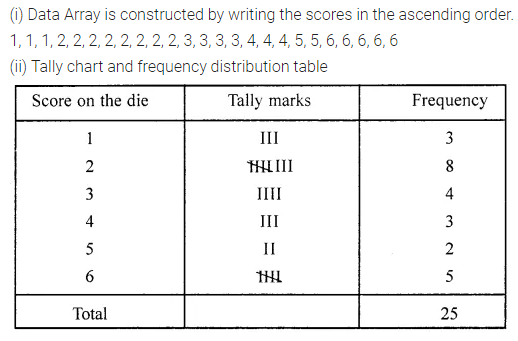
A die is thrown 25 times and the scores were as given below :
2, 1, 4, 6, 2, 3, 1, 5, 6, 3, 4, 5, 2, 1, 6, 6, 6, 3, 2, 2, 2, 4, 3, 2, 2
(i) Construct a data array.
(ii) Construct a tally chart and frequency distribution table.
Solution:
ML Aggarwal Class 6 Solutions for ICSE Maths Chapter 15 Data Handling Check Your Progress 1

Question 2.
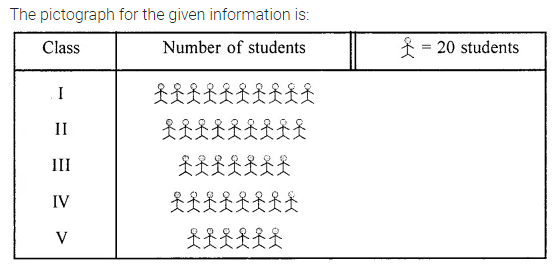
In primary school, the number of students in different classes is as follows:
ML Aggarwal Class 6 Solutions for ICSE Maths Chapter 15 Data Handling Check Your Progress 2
Represent this data by a pictograph, using ML Aggarwal Class 6 Solutions for ICSE Maths Chapter 15 Data Handling Check Your Progress 2.1 ≃ 20 students.
Solution:
ML Aggarwal Class 6 Solutions for ICSE Maths Chapter 15 Data Handling Check Your Progress 3

Question 3.
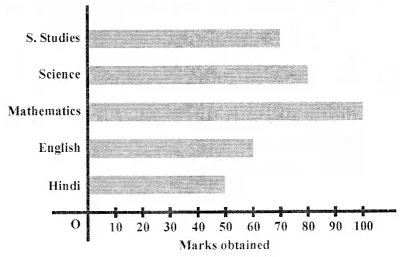
Observe the following bar graph, showing the marks scored by Gurmeet in the annual examination in different subjects: Answer the following questions:
ML Aggarwal Class 6 Solutions for ICSE Maths Chapter 15 Data Handling Check Your Progress 4
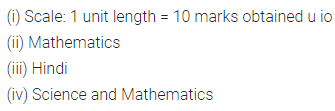
(i) What is the scale of this bar graph?
(ii) In which subject Gurmeet obtained maximum marks?
(iii) In which subject she obtained minimum marks?
(iv) Name the subject(s) in which she got 80 or more marks.
Solution:
ML Aggarwal Class 6 Solutions for ICSE Maths Chapter 15 Data Handling Check Your Progress 5

Question 4.
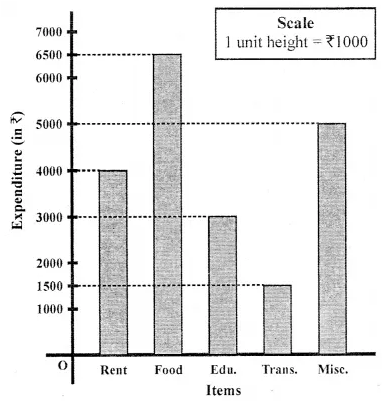
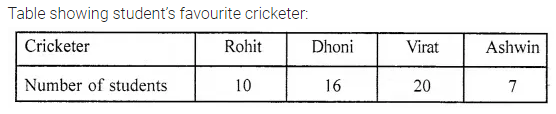
The following table shows the monthly expenditure of a family on various items:
ML Aggarwal Class 6 Solutions for ICSE Maths Chapter 15 Data Handling Check Your Progress 6
Represent the data by a bar graph.
Solution:
ML Aggarwal Class 6 Solutions for ICSE Maths Chapter 15 Data Handling Check Your Progress 7

Question 5.
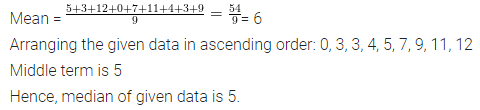
Find the mean and the median of the following data:
5, 3, 12, 0, 7, 11, 4, 3, 9
Solution:
ML Aggarwal Class 6 Solutions for ICSE Maths Chapter 15 Data Handling Check Your Progress 8

ML Aggarwal Class 6 Solutions for ICSE Maths Chapter 15 Data Handling Objective Type Questions

ML Aggarwal Class 6 Solutions Chapter 15 Data Handling Objective Type Questions for ICSE Understanding Mathematics acts as the best resource during your learning and helps you score well in your exams.

ML Aggarwal Class 6 Solutions for ICSE Maths Chapter 15 Data Handling Objective Type Questions

Mental Maths
Question 1.
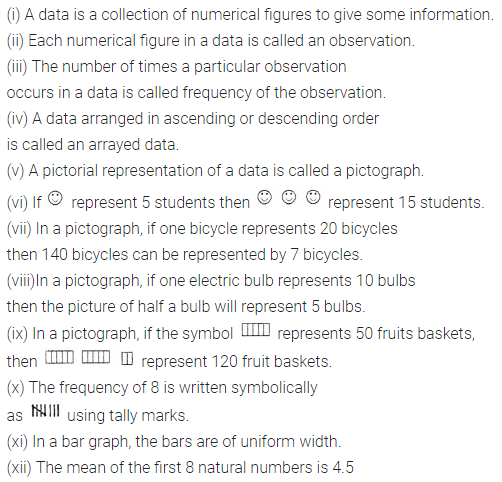
Fill in the blanks:
(i) A ……. is a collection of numerical figures to give some information.
(ii) Each numerical figure in data is called an ………..
(iii) The number of times a particular observation occurs in a data is called … of the observation.
(iv) A data arranged in ascending or descending order is called an ………… data.
(v) A pictorial representation of a data is called a …………
(vi) If ML Aggarwal Class 6 Solutions for ICSE Maths Chapter 15 Data Handling Objective Type Questions 1 represent 5 students then ML Aggarwal Class 6 Solutions for ICSE Maths Chapter 15 Data Handling Objective Type Questions 2 represent ………… students.
(vii) In a pictograph, if one bicycle represents 20 bicycles then 140 bicycles can be represented by ………… bicycles.
(viii)In a pictograph, if one electric bulb represents 10 bulbs then the picture of half a bulb will represent ………… bulbs.
(ix) In a pictograph, if the symbol ML Aggarwal Class 6 Solutions for ICSE Maths Chapter 15 Data Handling Objective Type Questions 3 represents 50 fruits baskets, then ML Aggarwal Class 6 Solutions for ICSE Maths Chapter 15 Data Handling Objective Type Questions 4 ML Aggarwal Class 6 Solutions for ICSE Maths Chapter 15 Data Handling Objective Type Questions 5 represent ………… fruit baskets.
(x) The frequency of 8 is written symbolically as ………… using tally marks.
(xi) In a bar graph, the bars are of uniform …………
(xii) The mean of the first 8 natural numbers is …………
Solution:
ML Aggarwal Class 6 Solutions for ICSE Maths Chapter 15 Data Handling Objective Type Questions 6

Question 2.
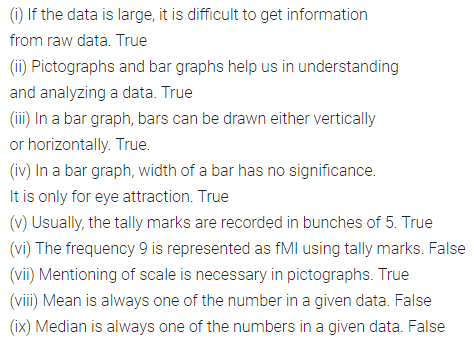
State whether the following statements are true (T) or false (F):
(i) If the data is large, it is difficult to get information from raw data.
(ii) Pictographs and bar graphs help us in understanding and analyzing a data.
(iii) In a bar graph, bars can be drawn either vertically or horizontally.
(iv) In a bar graph, width of a bar has no significance. It is only for eye attraction.
(v) Usually, the tally marks are recorded in bunches of 5.
(vi) The frequency 9 is represented as filtlll using tally marks.
(vii) Mentioning of scale is necessary in pictographs.
(viii) Mean is always one of the number in a given data.
(ix) Median is always one of the numbers in a given data.
Solution:
ML Aggarwal Class 6 Solutions for ICSE Maths Chapter 15 Data Handling Objective Type Questions 7

Multiple Choice Questions
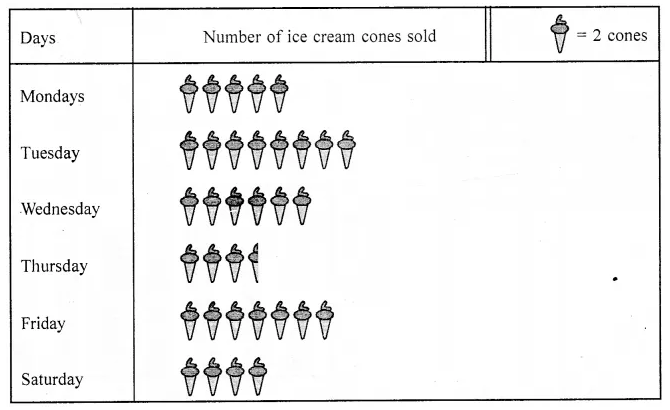
Observe the following pictograph which shows the number of ice cream cones sold by school canteen during a week. Chose the correct answer from the given options for questions 3 to 7:
ML Aggarwal Class 6 Solutions for ICSE Maths Chapter 15 Data Handling Objective Type Questions 8

Question 3.
The minimum number of ice cream cones were sold on:
(a) Monday
(b) Saturday
(c) Tuesday
(d) Thursday
Solution:
Thursday (d)

Question 4.
The maximum number of ice cream cones were sold on:
(a) Tuesday
(b) Friday
(c) Wednesday
(d) Thursday
Solution:
Tuesday (a)

Question 5.
Ratio of the number of ice cream cones sold on Saturday to the number of ice cream cones sold on Wednesday is.
(a) 3 : 2
(b) 2 : 3
(c) 4 : 5
(d) 4 : 7
Solution:
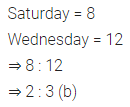
ML Aggarwal Class 6 Solutions for ICSE Maths Chapter 15 Data Handling Objective Type Questions 9

Question 6.
Total number of ice cream cones sold during the whole week was:
(a) 33
(b) 67
(c) 65
(d) 57
Solution:
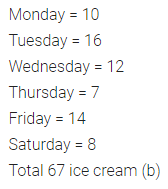
ML Aggarwal Class 6 Solutions for ICSE Maths Chapter 15 Data Handling Objective Type Questions 10

Question 7.
If the cost of one ice cream cone is ₹20, then the sale value on Thursday was:
(a) ₹70
(b) ₹100
(c) ₹140
(d) ₹1340
Solution:

ML Aggarwal Class 6 Solutions for ICSE Maths Chapter 15 Data Handling Objective Type Questions 11

Observe the adjoining bar graph, showing the number of one-day international matches played by cricket teams of different countries. Choose the correct answer from the given four options for questions 8 to 11:
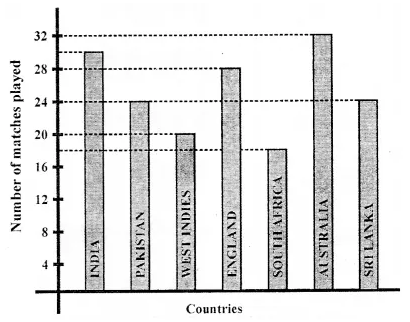
ML Aggarwal Class 6 Solutions for ICSE Maths Chapter 15 Data Handling Objective Type Questions 12

Question 8.
Which country played a maximum number of matches?
(a) India
(b) England
(c) Pakistan
(d) Australia
Solution:
Australia (d)

Question 9.
How many matches did South Africa play?
(a) 16
(b) 18
(c) 20
(d) 24
Solution:
18 (b)

Question 10.
How many more matches were played by India than Pakistan?
(a) 6
(b) 12
(c) 24
(d) 30
Solution:
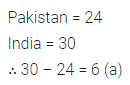
ML Aggarwal Class 6 Solutions for ICSE Maths Chapter 15 Data Handling Objective Type Questions 13

Question 11.
Ratio of the number of matches played by India to the number of matches played by Sri Lanka is
(a) 4 : 5
(b) 5 : 4
(c) 4 : 3
(d) 7 : 6
Solution:
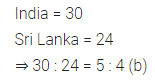
ML Aggarwal Class 6 Solutions for ICSE Maths Chapter 15 Data Handling Objective Type Questions 14

Choose the correct answer from the given four options for questions 12 and 13:
Question 12.
The mean of the first 6 odd natural numbers is
(a) 5
(b) 5.5
(c) 6
(d) 6.5
Solution:
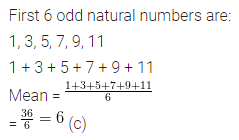
ML Aggarwal Class 6 Solutions for ICSE Maths Chapter 15 Data Handling Objective Type Questions 15

Question 13.
The median of the numbers 4, 4, 7, 5, 7, 6, 1, 3, 11 is
(a) 7
(b) 6
(c) 5
(d) 4
Solution:
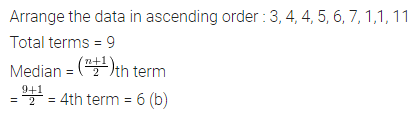
ML Aggarwal Class 6 Solutions for ICSE Maths Chapter 15 Data Handling Objective Type Questions 16

ML Aggarwal Class 6 Solutions for ICSE Maths

ML Aggarwal Class 6 Solutions for ICSE Maths Chapter 15 Data Handling Objective Type Questions

Mental Maths
Question 1.
Fill in the blanks:
(i) A ……. is a collection of numerical figures to give some information.
(ii) Each numerical figure in data is called an ………..
(iii) The number of times a particular observation occurs in a data is called … of the observation.
(iv) A data arranged in ascending or descending order is called an ………… data.
(v) A pictorial representation of a data is called a …………
(vi) If Learning Mathematics Class 6 Chapter 15 Data Handling Objective Type Questions represent 5 students then ML Aggarwal Understanding Mathematics Class 6 Chapter 15 Data Handling Objective Type Questions represent ………… students.
(vii) In a pictograph, if one bicycle represents 20 bicycles then 140 bicycles can be represented by ………… bicycles.
(viii)In a pictograph, if one electric bulb represents 10 bulbs then the picture of half a bulb will represent ………… bulbs.
(ix) In a pictograph, if the symbol ICSE Understanding Mathematics Class 6 ML Aggarwal Solutions Chapter 15 Data Handling Objective Type Questions represents 50 fruits baskets, then ML Aggarwal Maths Book Class 6 Chapter 15 Data Handling Objective Type Questions Maths ML Aggarwal Class 6 Chapter 15 Data Handling Objective Type Questions represent ………… fruit baskets.
(x) The frequency of 8 is written symbolically as ………… using tally marks.
(xi) In a bar graph, the bars are of uniform …………
(xii) The mean of the first 8 natural numbers is …………
Solution:
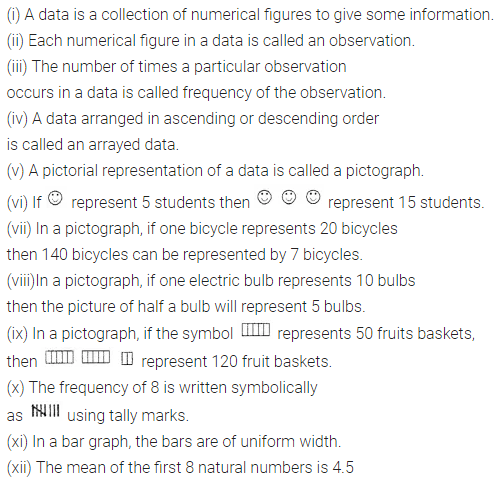
ML Aggarwal Class 6 Solutions for ICSE Maths Chapter 15 Data Handling Objective Type Questions 17

Question 2.
State whether the following statements are true (T) or false (F):
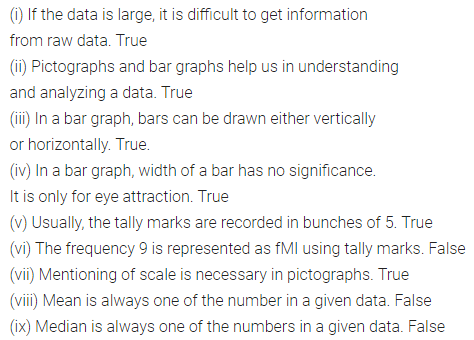
(i) If the data is large, it is difficult to get information from raw data.
(ii) Pictographs and bar graphs help us in understanding and analyzing a data.
(iii) In a bar graph, bars can be drawn either vertically or horizontally.
(iv) In a bar graph, width of a bar has no significance. It is only for eye attraction.
(v) Usually, the tally marks are recorded in bunches of 5.
(vi) The frequency 9 is represented as filtlll using tally marks.
(vii) Mentioning of scale is necessary in pictographs.
(viii) Mean is always one of the number in a given data.
(ix) Median is always one of the numbers in a given data.
Solution:
ML Aggarwal Class 6 Solutions for ICSE Maths Chapter 15 Data Handling Objective Type Questions 18

Multiple Choice Questions
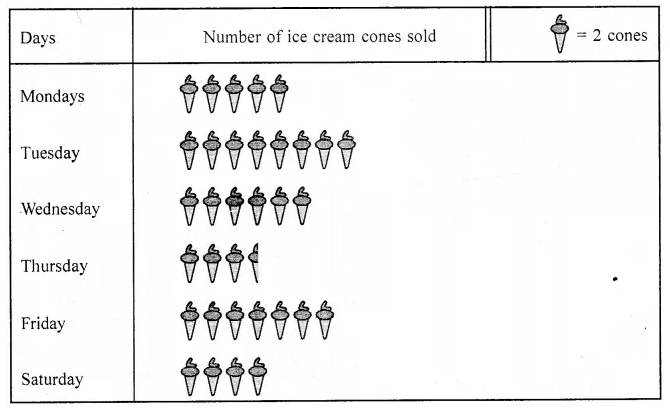
Observe the following pictograph which shows the number of ice cream cones sold by school canteen during a week. Chose the correct answer from the given options for questions 3 to 7:
ML Aggarwal Class 6 Solutions for ICSE Maths Chapter 15 Data Handling Objective Type Questions 19

Question 3.
The minimum number of ice cream cones were sold on:
(a) Monday
(b) Saturday
(c) Tuesday
(d) Thursday
Solution:
Thursday (d)

Question 4.
The maximum number of ice cream cones were sold on:
(a) Tuesday
(b) Friday
(c) Wednesday
(d) Thursday
Solution:
Tuesday (a)

Question 5.
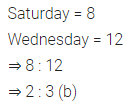
Ratio of the number of ice cream cones sold on Saturday to the number of ice cream cones sold on Wednesday is.
(a) 3 : 2
(b) 2 : 3
(c) 4 : 5
(d) 4 : 7
Solution:
ML Aggarwal Class 6 Solutions for ICSE Maths Chapter 15 Data Handling Objective Type Questions 20

Question 6.
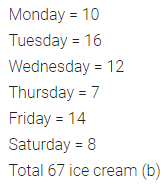
Total number of ice cream cones sold during the whole week was:
(a) 33
(b) 67
(c) 65
(d) 57
Solution:
ML Aggarwal Class 6 Solutions for ICSE Maths Chapter 15 Data Handling Objective Type Questions 21

Question 7.
If the cost of one ice cream cone is ₹20, then the sale value on Thursday was:
(a) ₹70
(b) ₹100
(c) ₹140
(d) ₹1340
Solution:

ML Aggarwal Class 6 Solutions for ICSE Maths Chapter 15 Data Handling Objective Type Questions 22

Observe the adjoining bar graph, showing the number of one-day international matches played by cricket teams of different countries. Choose the correct answer from the given four options for questions 8 to 11:
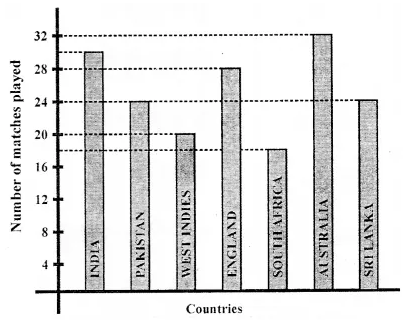
ML Aggarwal Class 6 Solutions for ICSE Maths Chapter 15 Data Handling Objective Type Questions 23

Question 8.
Which country played a maximum number of matches?
(a) India
(b) England
(c) Pakistan
(d) Australia
Solution:
Australia (d)

Question 9.
How many matches did South Africa play?
(a) 16
(b) 18
(c) 20
(d) 24
Solution:
18 (b)

Question 10.
How many more matches were played by India than Pakistan?
(a) 6
(b) 12
(c) 24
(d) 30
Solution:
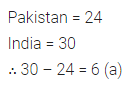
ML Aggarwal Class 6 Solutions for ICSE Maths Chapter 15 Data Handling Objective Type Questions 24

Question 11.
Ratio of the number of matches played by India to the number of matches played by Sri Lanka is
(a) 4 : 5
(b) 5 : 4
(c) 4 : 3
(d) 7 : 6
Solution:
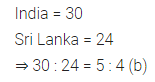
ML Aggarwal Class 6 Solutions for ICSE Maths Chapter 15 Data Handling Objective Type Questions 25

Choose the correct answer from the given four options for questions 12 and 13:
Question 12.
The mean of the first 6 odd natural numbers is
(a) 5
(b) 5.5
(c) 6
(d) 6.5
Solution:
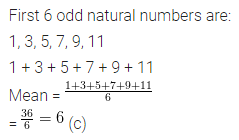
ML Aggarwal Class 6 Solutions for ICSE Maths Chapter 15 Data Handling Objective Type Questions 26

Question 13.
The median of the numbers 4, 4, 7, 5, 7, 6, 1, 3, 11 is
(a) 7
(b) 6
(c) 5
(d) 4
Solution:
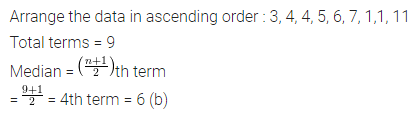
ML Aggarwal Class 6 Solutions for ICSE Maths Chapter 15 Data Handling Objective Type Questions 27

ML Aggarwal Class 6 Solutions for ICSE Maths Chapter 15 Data Handling Ex 15.5

ML Aggarwal Class 6 Solutions Chapter 15 Data Handling Ex 15.5 for ICSE Understanding Mathematics acts as the best resource during your learning and helps you score well in your exams.

ML Aggarwal Class 6 Solutions for ICSE Maths Chapter 15 Data Handling Ex 15.5

Question 1.
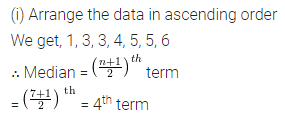
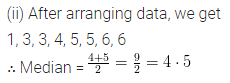
Find the median of the following data:
(i) 3, 1, 5, 6, 3, 4, 5
(ii) 3, 1, 5, 6, 3, 4, 5, 6
Solution:
ML Aggarwal Class 6 Solutions for ICSE Maths Chapter 15 Data Handling Ex 15.5 1
ML Aggarwal Class 6 Solutions for ICSE Maths Chapter 15 Data Handling Ex 15.5 2

Question 2.
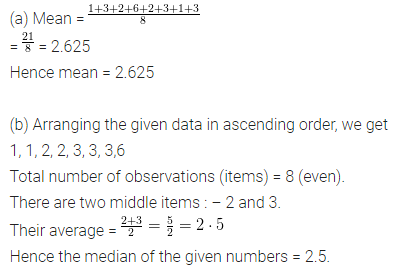
Calculate the mean, the median and the mode of the numbers :
1, 3, 2, 6, 2, 3, 1, 3
Solution:
ML Aggarwal Class 6 Solutions for ICSE Maths Chapter 15 Data Handling Ex 15.5 3
ML Aggarwal Class 6 Solutions for ICSE Maths Chapter 15 Data Handling Ex 15.5 4

Question 3.
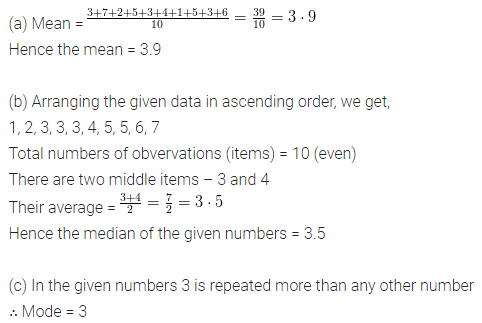
Calculate the mean, the median and the mode of the following numbers :
3, 7, 2, 5, 3, 4, 1, 5, 3, 6
Solution:
ML Aggarwal Class 6 Solutions for ICSE Maths Chapter 15 Data Handling Ex 15.5 5

ML Aggarwal Class 6 Solutions for ICSE Maths Chapter 15 Data Handling Ex 15.4

ML Aggarwal Class 6 Solutions Chapter 15 Data Handling Ex 15.4 for ICSE Understanding Mathematics acts as the best resource during your learning and helps you score well in your exams.

ML Aggarwal Class 6 Solutions for ICSE Maths Chapter 15 Data Handling Ex 15.4

Question 1.
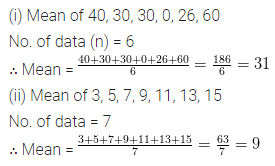
Find the mean of the following data:
(i) 40, 30, 30, 0, 26, 60
(ii) 3, 5, 7, 9, 11, 13, 15
Solution:
ML Aggarwal Class 6 Solutions for ICSE Maths Chapter 15 Data Handling Ex 15.4 1

Question 2.
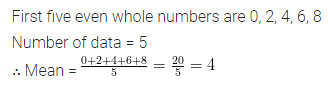
Find the mean of the first five even whole numbers.
Solution:
ML Aggarwal Class 6 Solutions for ICSE Maths Chapter 15 Data Handling Ex 15.4 2

Question 3.
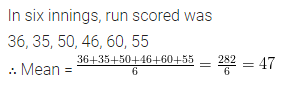
A batsman scored the following number of runs in six innings:
36, 35, 50, 46, 60, 55
Calculate the mean runs scored by him in an inning.
Solution:
ML Aggarwal Class 6 Solutions for ICSE Maths Chapter 15 Data Handling Ex 15.4 3

Question 4.
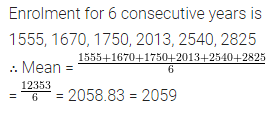
The enrolment in a school for six consecutive years was as follows :
1555, 1670, 1750, 2013, 2540, 2825
Find the mean enrolment of the school for this period.
Solution:
ML Aggarwal Class 6 Solutions for ICSE Maths Chapter 15 Data Handling Ex 15.4 4

Question 5.
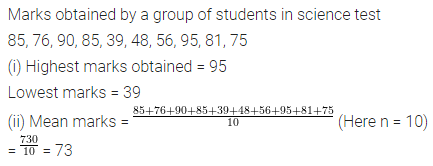
The marks (out of 100) obtained by a group of students in a science test are :
85, 76, 90, 85, 39, 48, 56, 95, 81, 75
Find the:
(i) highest and lowest marks obtained by the students.
(ii) mean marks obtained by the students.
Solution:
ML Aggarwal Class 6 Solutions for ICSE Maths Chapter 15 Data Handling Ex 15.4 5

ML Aggarwal Class 6 Solutions for ICSE Maths Chapter 15 Data Handling Ex 15.3

ML Aggarwal Class 6 Solutions Chapter 15 Data Handling Ex 15.3 for ICSE Understanding Mathematics acts as the best resource during your learning and helps you score well in your exams.

ML Aggarwal Class 6 Solutions for ICSE Maths Chapter 15 Data Handling Ex 15.3

Question 1.
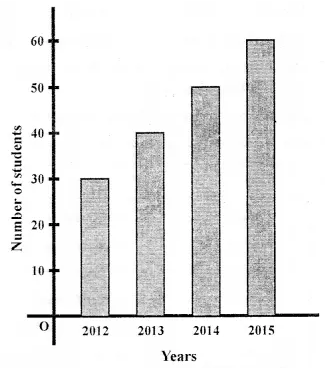
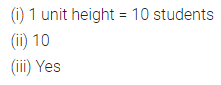
Observe the adjoining bar graph showing the number of students in a particular class of a school.
ML Aggarwal Class 6 Solutions for ICSE Maths Chapter 15 Data Handling Ex 15.3 1
Answer the following questions:
(i) What is the scale of this graph?
(ii) How many new students are added every year?
(iii) Is the number of students in the year 2015 is twice than that of in the year 2012?
Solution:
ML Aggarwal Class 6 Solutions for ICSE Maths Chapter 15 Data Handling Ex 15.3 2

Question 2.
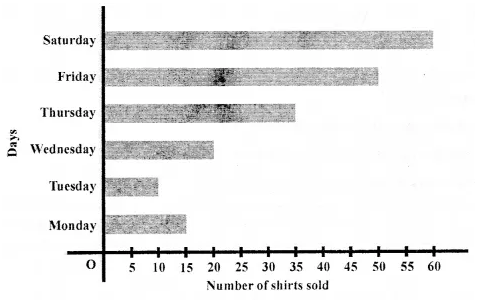
Observe the bar graph given below which is showing the sale of shirts in a readymade garment shop from Monday to Saturday.
ML Aggarwal Class 6 Solutions for ICSE Maths Chapter 15 Data Handling Ex 15.3 3
Answer the following questions:
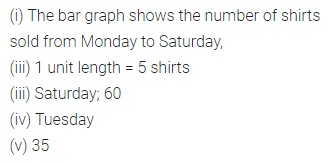
(i) What information does the above bar graph give?
(ii) What is the scale chosen on the horizontal line representing a number of shirts?
(iii) On which day were the maximum number of shirts sold? How many shirts were sold on that day?
(iv) n which day was the minimum number of shirts sold?
(v) How many shirts were sold on Thursday?
Solution:
ML Aggarwal Class 6 Solutions for ICSE Maths Chapter 15 Data Handling Ex 15.3 4

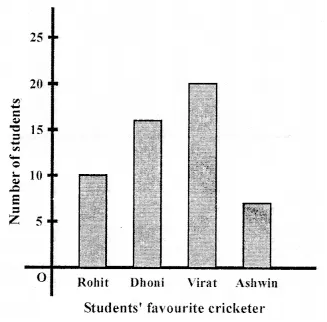
Question 3.
Make a table corresponding to the following graph:
ML Aggarwal Class 6 Solutions for ICSE Maths Chapter 15 Data Handling Ex 15.3 5
Solution:
ML Aggarwal Class 6 Solutions for ICSE Maths Chapter 15 Data Handling Ex 15.3 6

Question 4.
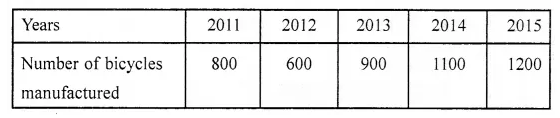
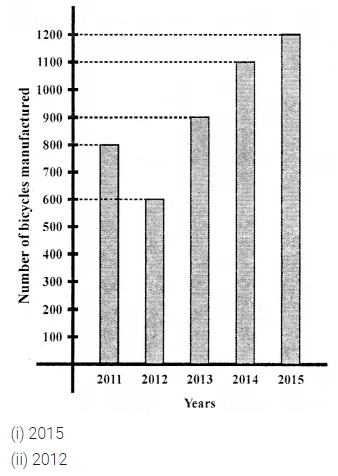
The following table shows the number of bicycles manufactured in a factory during the years 2011 to 2015. Illustrate this data by using a bar graph. Choose a scale of your choice.
ML Aggarwal Class 6 Solutions for ICSE Maths Chapter 15 Data Handling Ex 15.3 7
(i) In which year was the maximum number of bicycles manufactured?
(iii) In which year was the minimum number of bicycles manufactured?
Solution:
ML Aggarwal Class 6 Solutions for ICSE Maths Chapter 15 Data Handling Ex 15.3 8

Question 5.
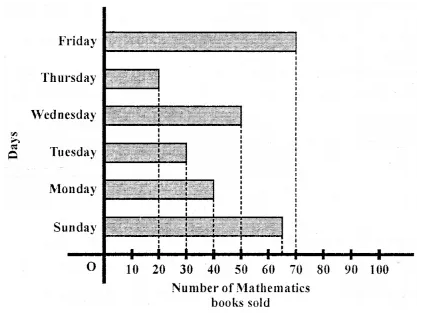
The number of Mathematics books sold by a shopkeeper on six consecutive days is given below:
ML Aggarwal Class 6 Solutions for ICSE Maths Chapter 15 Data Handling Ex 15.3 9
Draw a horizontal bar graph to represent the above information choosing the scale of your choice.
Solution:
ML Aggarwal Class 6 Solutions for ICSE Maths Chapter 15 Data Handling Ex 15.3 10

Question 6.
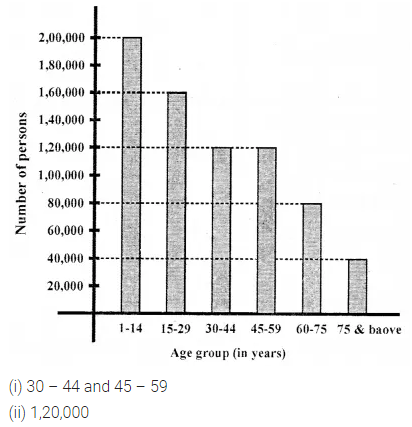
The number of persons in various age (in years) groups in a town is given in the following table:
ML Aggarwal Class 6 Solutions for ICSE Maths Chapter 15 Data Handling Ex 15.3 11
Draw a bar graph to represent the above information and answer the following questions (take 1 unit height = 20,000 people):
(i) Which age groups have the same population?
(ii) All persons in the age group of 60 and above are called senior citizens. How many senior citizens are there in the town?
Solution:
ML Aggarwal Class 6 Solutions for ICSE Maths Chapter 15 Data Handling Ex 15.3 12