ML Aggarwal Class 6 Solutions for ICSE Maths Model Question Paper 2

ML Aggarwal Class 6 Solutions for ICSE Maths Model Question Paper 2 acts as the best resource during your learning and helps you score well in your exams.

ML Aggarwal Class 6 Solutions for ICSE Maths Model Question Paper 2

Choose the correct answer from the given four options (1-2):
Question 1.
Every composite number has at least
(a) 1 factor
(b) 2 factors
(c) 3 factors
(d) 4 factors
Solution:
ML Aggarwal Class 6 Solutions for ICSE Maths Model Question Paper 2 1

Question 2.
Which of the following collections form a set?
(a) Collection of 5 odd prime numbers
(b) Collection of 3 most intelligent students of your class
(c) Collection of 4 vowels in the English alphabet
(d) Collection of months of a year having less than 31 days.
Solution:
ML Aggarwal Class 6 Solutions for ICSE Maths Model Question Paper 2 2

Question 3.
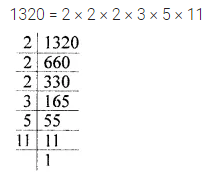
Find the prime factorisation of 1320.
Solution:
ML Aggarwal Class 6 Solutions for ICSE Maths Model Question Paper 2 3

Question 4.
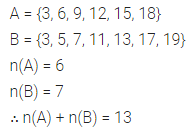
If A = {x : x is a positive multiple of 3 less than 20} and B = {x : x is an odd prime number less than 20}, then find n(A) + n(B).
Solution:
ML Aggarwal Class 6 Solutions for ICSE Maths Model Question Paper 2 4

Question 5.
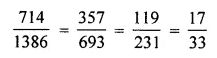
Reduce the fraction \(\frac{714}{1386}\) in its simplest form.
Solution:
ML Aggarwal Class 6 Solutions for ICSE Maths Model Question Paper 2 5

Question 6.
Simplify the following:
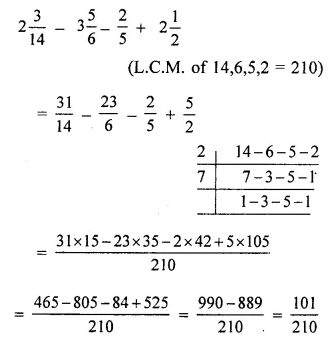
\(2 \frac{3}{14}-3 \frac{5}{6}-\frac{2}{5}+2 \frac{1}{2}\)
Solution:
ML Aggarwal Class 6 Solutions for ICSE Maths Model Question Paper 2 6

Question 7.
A number is divisible by 5 and 8 both. By what other numbers with that number be always divisible?
Solution:
ML Aggarwal Class 6 Solutions for ICSE Maths Model Question Paper 2 7

Question 8.
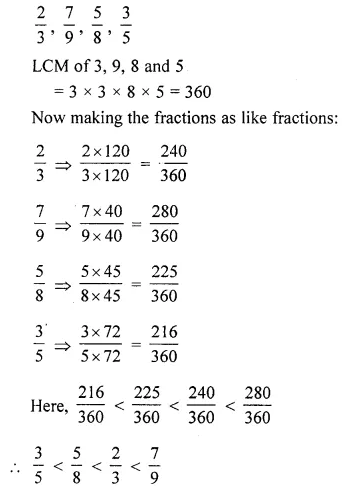
Arrange the fractions \(\frac{2}{3}, \frac{7}{9}, \frac{5}{8}, \frac{3}{5}\) in ascending order.
Solution:
ML Aggarwal Class 6 Solutions for ICSE Maths Model Question Paper 2 8

Question 9.
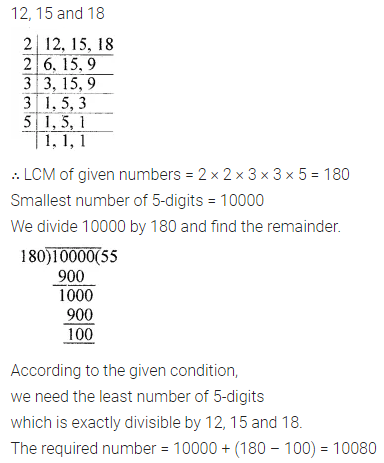
Find the smallest number of 5-digits which is divisible by 12, 15 and 18.
Solution:
ML Aggarwal Class 6 Solutions for ICSE Maths Model Question Paper 2 9

Question 10.
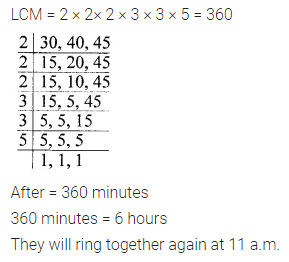
Three bells are ringing continuously at intervals of 30, 40 and 45 minutes respectively. At what time will they ring together if they ring simultaneously at 5 A.M.?
Solution:
ML Aggarwal Class 6 Solutions for ICSE Maths Model Question Paper 2 10

The Banyan Tree Extra Questions and Answers Class 6 English Honeysuckle

Here we are providing The Banyan Tree Extra Questions and Answers Class 6 English Honeysuckle, Extra Questions for Class 6 English was designed by subject expert teachers.

The Banyan Tree Extra Questions and Answers Class 6 English Honeysuckle

The Banyan Tree Extra Questions and Answers Short Answer Type

Question 1.
Why did the speaker claim that the old banyan tree was his?
Answer:
The old banyan tree became the narrator’s own property because his grandfather was too old to climb it.

Question 2.
What did the speaker do on his crude platform?
Answer:
The author used to read story books and watch the world below from his crude platform.

Question 3.
What change did the fig season bring in?
Answer:
The banyan tree became the noisiest place in the garden during the fig season.

Question 4.
What exciting scene did the author narrate?
Answer:
The author enjoyed the fight between a mongoose and a cobra, a battle of two champions.

Question 5.
Who won the fight between the mongoose and the snake?
Answer:
The mongoose first bit the snake twice on the back. When the cobra was tired, the mongoose caught it by the snout. He finally dragged the dead snake into the bushes.

Question 6.
Who were the other two spectators? What did they do? (Did they watch, or did they join in the fight)?
Answer:
The other two spectators were a myna and a jungle crow. They settled on a cactus to watch the outcome joined in the fight off and on.

The Banyan Tree Extra Questions and Answers Long Answer Type

Question 1.
What do you learn from the fight of swift mongoose and venomous snake?
Answer:
One can easily learn that the one with energy and swiftness in action can succeed in life. The snake was a great threat to one as it is filled with deadly venom. The patience and strategic fight plan along with understanding of weakness and strength of the opponent make one a winner. One more thing to be understood here is that various opportunist viable to make use of opportunities.

Question 2.
How does sense of belongingness develop faith?
Answer:
The author describes that the house belongs to his grandfather yet the tree belongs to him. He found a comfort place in the branches and made it a resting place to read various books of his interest. He got a over view of every activity that took place around him. His faith helped him in befriending a squirrel. The child brought food for squirrel. So with time faith was developed and the squirrel could delve into his pockets.

Question 3.
What is the significance of the banyan tree in the story of Ruskin Bond’s?
Answer:
The whole story revolves around the tree. The tree was a second home to the author and gave a panoramic view of the world around it. The banyan tree served as a platform for the writer to sit and watch the thrilling fight between a cobra and a wild mongoose. The tree was almost the speaker’s property. The fight started under that tree in sunshine. The other spectators, a myna and a crow also arrived to feed on the dead cobra. But they sat on a cactus plant not the tree.

Question 4.
(i) What happened to the crow in the end?
(ii) What did the myna do finally?
Answer:
(i) In the end the crow flung nearly twenty feet across the garden by a blow from the cobra’s snout. It fluttered about for a while, then lay still.
(ii) Myna finally dropped cautiously to the ground, hopped about, the peered into the bushes from a safe distance and then with a shrill cry of congratulations flew away.

The Banyan Tree Extra Questions and Answers Reference to Context

Question 1.
My first friend was a small grey squirrel. Arching his back and sniffing into the air, he seemed at first to resent my invasion of his privacy. But when he found that I did not arm myself with catapult or air gun, he became friendly, and when I started bringing him pieces of cake and biscuit he grew quite bold and was soon taking morsels from hand. Before long, he was delving into my pockets and helping himself to whatever he could find. He was a very young squirrel, and his friends and relatives probably thought him foolish and headstrong for trusting a human.

(i) Who is the first friend of the writer?
(ii) How did the squirrel become friendly with the child?
(iii) What did the writer bring for the squirrel?
(iv) What could be the opinion of squirrel’s family and friends about human being?
(v) Write antonym of ‘Probably’.
Answer:
(i) A small grey squirrel is the first friend of the writer.
(ii) The squirrel did not see the child with any catapult or gun. So it become friendly with the child.
(iii) The writer brought pieces of cake and biscuits for the squirrel.
(iv) The opinion of squirrel’s family and friends could be that human beings are not trustworthy.
(v) Sure.

Question 2.
Halfway up the tree I had built a crude platform where I would spend the afternoons when it was not too
hot. I could read there ropping myself up against the tree with a cushion from the living room. Treasure Island, Huckleberry Finn and The Story of Dr Dolittle were some of the books that made up my banyan tree library. When I did not feel like reading, I could look down through the leaves at the world below. And on one particular afternoon I had a grandstand view of that classic of the Indian wilds, a fight between a mongoose, and a cobra.

(i) What did the child build on the tree?
(ii) What did the child do on the platform?
(iii) What did the child see one day?
(iv) From where did the narrator arranged a cushion?
(v) Find ‘present participle’ of‘prop’ from the above passage.
Answer:
(i) The child built a crude platform on the tree.
(ii) The child read books on the platform.
(iii) The child saw a grandstand view of wild fights between a mongoose and a cobra.
(iv) The narrator arranged a cushion from his living room.
(v) Propping.

Question 3.
The warm breezes of approaching summer had sent everyone, including the gardener, into the house. I was feeling drowsy myself, wondering if I should go to the pond and have a swim with Ramu and the buffaloes, when I saw a huge black cobra gliding out of a clump of cactus. At the same time a mongoose emerged from the bushes and went straight for the cobra.

(i) What does the ‘warm breezes’ suggest?
(ii) What was he thinking of doing?
(iii) From where did the snake emerge?
(iv) Who went straight to attack cobra?
(v) Find a word from the passage, which means ‘a small group’?
Answer:
(i) The “Warm breezes’ suggest about the approaching summer.
(ii) He was thinking of going for swimming.
(iii) The snake emerged from the clump of cactus.
(iv) A Mongoose went straight to attack cobra.
(v) Clump.

Question 4.
At the same moment that the cobra struck, the crow and the myna hurled themselves at him, only to collide heavily in mid-air. Shrieking insults at each other they returned to the cactus plant. A few drops of blood glistened on the cobra’s back. The cobra struck and missed. Again in the mongoose sprang aside, jumped in and bit. Again the birds dived at the snake, bumped into each other instead, and returned shrieking to the safety of the cactus.

(i) Where did the crow and myna collide each other?
(ii) Where did they myna and the crow land?
(iii) Whose attack was more fierce?
(iv) On whom were the eyes of the birds were focused?
(v) Choose the past participle of strike.
Answer:
(i) The crow and the myna collided with each other in mid-air.
(ii) They landed onto the cactus plant.
(iii) Mongoose attack was more fierce.
(iv) The eyes of the bird were focused on snake.
(v) Struck.

Desert Animals Extra Questions and Answers Class 6 English Honeysuckle

Here we are providing Desert Animals Extra Questions and Answers Class 6 English Honeysuckle, Extra Questions for Class 6 English was designed by subject expert teachers.

Desert Animals Extra Questions and Answers Class 6 English Honeysuckle

Desert Animals Extra Questions and Answers Short Answer Type

Question 1.
Why are deserts so thinly populated?
Answer:
Life in desert areas is difficult. Deserts have very little water and vegetation. There is greenery only around the water springs or oasis. So people don’t prefer to live there.

Question 2.
What is the information imparted about snakes in the lesson?
Answer:
There are more than 2300 different kinds of snakes in the world. Some are upto 11 metres long. Not all are poisonous. Most snakes lay eggs, but many of them give birth to their young.

Question 3.
Describe the food and habitat of Rattlesnakes?
Answer:
Rattlesnakes are very common in American continent. They feed on mice and rats etc.

Question 4.
What information did you get about Mongoose in the lesson?
Answer:
Mongooses are very amusing animals to watch. They are a common sight in Africa. They eat beetles and other small creature. They themselves are eaten up by hawks, eagles and large snakes. They are famous for killing snakes.

Question 5.
How do camels manage to survive in desert?
Answer:
Camels live mainly in desert. They can drink upto 30 gallons of water in just ten minutes. They get all the moisture they need from desert plants. Some camels have only one hump, other have two. Hump is full of fat which is used as food.

Question 6.
What information do you gather about snakes?
Answer:
There are more than 2300 different kinds of snakes around the world. Some are harmless, other are very poisonous. Some lay eggs, while others give birth to the young – one. The rattles lives in the dingy and rocky deserts of America. Large pythons can go without eating for a year or more. Mongooses are famous for their skill in killing snakes. A camel can drink upto 30 gallons of water in just ten minutes. It eats plants. Its humps store fat – food.

Desert Animals Extra Questions and Answers Long Answer Type

Question 1.
How do you thin for child can be sensitive enough by reading about the desert animals?
Answer:
A child is curious by nature. He wants to learn about everything that happens around him. He loves to explore nature. But by providing the details of various other living organism, they develop the mutual respect and understanding. They can became gentle in their behaviour. They won’t harm other organism. So by introducing the lesson on animals and their struggle of existence, one can become sensitive and behave in a proper way.

Desert Animals Extra Questions and Answers Reference to Context

Question 1.
But even the desert animals cannot survive without water, or for long periods in the scorching sun, so they have had to find different ways of coping with the harsh conditions. For example, gerbils spend the hottest part of the day in cool underground burrows. And strange insects called darkling beetles are experts at catching drops of moisture on their legs, then lifting them into the air until the drops trickle down into their mouths. Not all deserts are endless seas of rolling sand dimes. Some are rocky or pebbly and dotted with small bushes while others are sprinkled with colourful flowers during the spring.

(i) What do gerbils do to survive?
(ii) Do you think desert animals can survive without water?
(iii) Name the insect that is expert in catching drops of moisture on their legs?
(iv) What are various types of deserts?
(v) What are ‘sand dunes’?
Answer:
(i) Gerbils spend the hottest part of the day in cool underground burrows.
(ii) No, rather they learnt to cope up with harsh conditions.
(iii) The insect that are expert in catching drops of moisture on their legs are ‘darkling beetles’.
(iv) The desert may be enormous sand dunes, rocky or pebbly surface.
(v) ‘Sand dimes’ are heaps of sand formed by the wind in the desert.

Question 2.
But the rattlesnake, or ‘rattler’ as it is sometimes called, prefers to avoid people if it possibly can. It holds its tail upright and rattles the end whenever it is disturbed, in the hope that the intruder will go away. However, if its warnings are ignored—and it feels threatened—it will coil ready to bite. But the rattler itself cannot hear the noise its own tail makes. Like most snakes, it “hears’ things through vibrations in the ground. If a person walks nearby the snake can feel the movement. But if the same person were to shout, it would not hear a thing. Rattlesnakes are very common and widespread animals, living right across the American continent from Canada to Argentina.

(i) Name the snake discussed in the above passage.
(ii) What does it do if its warnings are ignored?
(iii) In what respect does the rattle snake is similar to other snakes?
(iv) Where do rattlesnakes are commonly found?
(v) Find the suitable word for ‘universal’ from the passage.
Answer:
(i) Rattlesnake or rattle is the name of the snake discussed in the above passage.
(ii) If its warnings are ignored it coils and get ready to bite.
(iii) Rattlesnakes can hear things through vibration only as other snakes do.
(iv) Rattlesnakes are commonly found from Canada to Argentina.
(v) Widespread.

Question 3.
They like to hunt together, keeping in touch whenever they go out of sight behind rocks or bushes by twittering and calling. Always on the lookout for danger — hawks, eagles and large snakes they warn one another with a special alarm call if they spot anything suspicious.

(i) Who are ‘They’ in the passage?
(ii) How do they hunt?
(iii) How do they ‘keep in touch’ whenever they go out of sight?
(iv) Which predators are dangerous to them?
(v) Give the meaning of ‘twitter’.
Answer:
(i) ‘They’ are Mongooses in the passage.
(ii) They hunt together in groups.
(iii) They communicate with each other by twittering and calling.
(iv) Hawks, eagles and large snakes are dangerous to them.
(v) The meaning of twitter is giving a call in repeated sound.

Question 4.
There are two different kinds of camel. One, known as the Dromedary, has only a single hump; the other is called a Bactrian camel and has two humps. The humps help the animal to survive in the desert, by acting as storage containers. But they don’t store water as many people wrongly believe they are full of fat. This fat nourishes the camels when food is scarce. If they have nothing to eat for several days, their humps shrink as the fat is used up. There are many other ways in which camels are adapted to. desert life. Their mouths are so tough that even the sharp thorn cannot pierce through.

(i) What do you call a camel with single hump?
(ii) How do the humps help camel to survive in desert?
(iii) What is stored in humps?
(iv) Why do humps shrink?
(v) Change the verb ‘Adapt’ into a noun.
Answer:
(i) A camel with a single hump is called dromedary.
(ii) The humps help camel to survive in the desert by acting as storage containers.
(iii) Fat is stored in humps.
(iv) If the camels do not have anything to eat for several days, their humps shrink as the fat is used up.
(v) Adaptation.

A Game of Chance Extra Questions and Answers Class 6 English Honeysuckle

Here we are providing A Game of Chance Extra Questions and Answers Class 6 English Honeysuckle, Extra Questions for Class 6 English was designed by subject expert teachers.

A Game of Chance Extra Questions and Answers Class 6 English Honeysuckle

A Game of Chance Extra Questions and Answers Short Answer Type

Question 1.
What was Rasheed’s fault at the fair?
Answer:
Rasheed’s fault was that he did not pay heed to the advice of his uncle. He told him not to buy anything nor to go too far away in his absence.

Question 2.
How did Rasheed lose all his money at the Lucky shop?
Answer:
Rasheed was tempted to try his luck and wanted win some big prize. He took several chances but won no expensive item. Thus he lost all his money.

Question 3.
Was it Rasheed’s fault or he was tricked?
Answer:
Rasheed was neither unlucky nor foolish. He was an innocent boy while the shopkeeper was a cheat.

Question 4.
How did uncle explain the tricks of the shopkeeper?
Answer:
Uncle told Rasheed that the ‘Lucky Shop’ man had made fool of him. The old man and the boy who won costly things were in fact the shopkeeper’s friends. It was all a trick to tempt the customers.

Question 5.
What lesson did the narrator learn from his experience at the fair?
Answer:
The narrator Rasheed went to the fair on the occasion of Eid. He was tempted to try his luck at a shop. He was too innocent. The shopkeeper was cheat. He lost all his little money in that game of chance. He learnt the lesson that he can be easily be fooled and robbed of his money by with shopkeepers.

Question 6.
What trick did the shopkeeper play to allure his customers to play the losing game?
Answer:
The shopkeeper was rewarding the persons who staked their money with costly prizes. The game was played with six numbered discs. The winner claimed the article with the winning number. The tricky shopkeeper gave handsome prizes to his own friends. Rasheed too was tempted to try his luck. But he lost the last penny in that game of chance.

Question 7.
Why do you think Rasheed’s uncle asked him not to buy anything in his absence?
Answer:
Rasheed’s uncle knew that many tradesmen and shopkeepers who made a fool of the gullible persons. Therefore, he asked Rasheed not to buy anything in his absence.

Question 8.
Why was the shop called ‘Lucky Shop’?
Answer:
The shop was called ‘Lucky Shop’ so as to attract the people to try their luck and win prizes.

Question 9.
An old man won a clock and sold it back to the shopkeeper. How much money did he make?
Answer:
The old man made 15 rupees by selling the clock back to the shopkeeper.

Question 10.
How many prizes did the boy win? What were they?
Answer:
The boy won four prizes. They were a comb, a fountain pen, a wrist watch and a table lamp.

Question 11.
Why was Rasheed upset?
Answer:
Rasheed was upset because he did not win any prize. All his money was lost at the ‘Lucky Shop’.

Question 12.
In what way did the shopkeeper make a fool of Rasheed?
Answer:
The shopkeeper played tricks to tempt to try his lucky by making him believe that it was luck that got the old man and the boy. theft- prizes but in reality they were friends of the shopkeeper. Therefore, Rasheed tried his luck again and again but only got some cheap things which he sold back to the shopkeeper and lost all his money.

A Game of Chance Extra Questions and Answers Long Answer Type

Question 1.
‘The game chance’ disheartened Rasheed: What role the elders should play in regaining the faith of a child’ like Rasheed, who had a bad experience?
Answer:
Rasheed tried his luck in ‘the Lucky Shop’ but he failed to win any reward. That was disheartening and demoralizing for the sensitive mind of the child. He felt that everyone around was making fun of him. Elders like Rasheed’s Uncle, without making fun of him, taught him not to embarrass himself. He asked him not to discuss about this act of various stupidity. To divert his attention from this episode, he bought him gifts. So that he won’t feel guilty. The lesson he learnt for life time was not to trust anybody blindly. His confidence was rebuilt by the faith his uncle reposed in him.

Question 2.
‘The owner of the shop played a mind game’. What impact would it have on a child’s mind?
Answer:
Children easily believe in what they see. When Rasheed was convinced that others are winning, he went ahead to try his luck as well. Initially he was optimistic to get reward by trying his luck. But later he felt discouraged. Nobody in the gathering came to comfort and console him. He was properly guided only by his uncle. He supported him unconditionally. The child would have personality disorders like lack of confidence. He might consider him unlucky as well. He was shattered by the whole incident. So, the society should own the responsibility of making confident citizens. If they observe anything wrong, they should raise the voice then and there.

A Game of Chance Extra Questions and Answers Reference to Context

Question 1.
Every year on the occasion of Eid, there was a fair in our village. Eid was celebrated only one day but the fair lasted many days. Tradesmen from far and wide came there with all kinds of goods to sell. You could buy anything from a small pin to a big buffalo. Uncle took me to the fair. Bhaiya, who worked for us at home, came with us. There was a big crowd at the fair. Uncle was leading us through the crowd when he met a few of his friends. They wanted him to spend some time with them.

(i) What was organised on the occasion of Eid?
(ii) What happen in the fair?
(iii) Who took Rasheed to the fair?
(iv) Whom did Uncle meet in the fair?
(v) Write the past participle of‘lead’.
Answer:
(i) A fair was organised on Eid.
(ii) Shops were set up by tradesmen for sale of goods.
(iii) Uncle took Rasheed to the fair.
(iv) Uncle met with his friends in the fair.
(v) led.

Question 2.
Uncle warned me neither to buy anything nor to go too far out while he was away. I promised that I . would wait for him. Bhaiya and I went from shop to shop. There were many things I would have liked to buy, but I waited for Uncle to return. Then we came to what was called the Lucky Shop. The shopkeeper was neither young nor old. He was a middle-aged man. He seemed neither too smart nor too lazy. Questions

(i) Who gave the warning?
(ii) What was the warning?
(iii) Why Rasheed couldn’t buy anything?
(iv) What was the name of the shop?
(v) Give antonym of lazy.
Answer:
(i) Uncle gave the warning.
(ii) Uncle warned him neither to buy anything nor to go too far out while he was away.
(iii) Rasheed couldn’t buy anything because he waited for his uncle to come.
(iv) ‘The lucky shop’ was the name of the shop.
(v) Active.

Question 3.
I wanted to try my luck too. I looked at Bhaiya. He encouraged me. I paid 50 paise and took six discs. My luck was not too good. I got two pencils. The shopkeeper bought them from me for 25 paise. I tried again. This time I got a bottle of ink, also of little value. The shopkeeper bought that too for 25 paise. I took a chance for the third time. Still luck was not with me.

(i) Who is T in above passage?
(ii) Who encouraged him to try his luck?
(iii) What did he win in the first chance?
(iv) What price did the shopkeeper pay for bottle of ink?
(v) What made Rasheed think that luck was not with him?
Answer:
(i) I is the boy Rasheed, named in the passage.
(ii) Rasheed’s bhaiya encouraged him to try his luck.
(iii) Rasheed .won two pencils only.
(iv) The shopkeeper paid 25 paise for the bottle of ink.
(v) Rasheed could manage to win things of little value only.

Question 4.
People were looking at me. Some were laughing at my bad luck, but none showed any sympathy. Bhaiya and! went to the place where Uncle had left us and waited for him to return. Presently he came. He looked at me and said, “Rasheed, you look upset. What is the matter?”

(i) Who were looking at him?
(ii) Why were they laughing?
(iii) Where did Rasheed and his Bhaiya return to?
(iv) What was the reason of his being upset?
(v) Change the noun into adjective for the word ‘sympathy’.
Answer:
(i) People were looking at him.
(ii) They were laughing at his bad luck.
(iii) Rasheed and his Bhaiya returned to the place where his uncle left him.
(iv) He was upset as he was befooled by the shopkeeper.
(v) Sympathic.


ML Aggarwal Class 6 Solutions for ICSE Maths Model Question Paper 1

ML Aggarwal Class 6 Solutions for ICSE Maths Model Question Paper 1 acts as the best resource during your learning and helps you score well in your exams.

ML Aggarwal Class 6 Solutions for ICSE Maths Model Question Paper 1

Choose the correct answer from the given four options (1-2):
Question 1.
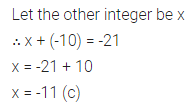
If the sum of two integers is -21 and one of them is -10 then the other is
(a) -32
(b) 32
(c) -11
(d) 11
Solution:
ML Aggarwal Class 6 Solutions for ICSE Maths Model Question Paper 1 1

Question 2.
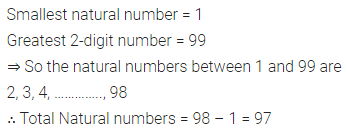
The number of natural numbers between the smallest natural number and the greatest 2-digit number is
(a) 90
(b) 97
(c) 98
(d) 99
Solution:
ML Aggarwal Class 6 Solutions for ICSE Maths Model Question Paper 1 2

Question 3.
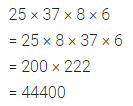
Find the value of 25 × 37 × 8 × 6 by suitable arrangement.
Solution:
ML Aggarwal Class 6 Solutions for ICSE Maths Model Question Paper 1 3

Question 4.
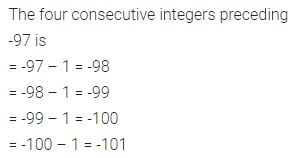
Write four consecutive integers preceding -97.
Solution:
ML Aggarwal Class 6 Solutions for ICSE Maths Model Question Paper 1 4

Question 5.
Write the greatest and the smallest 4-digit numbers using four different digits with the condition that 5 occurs at ten’s place.
Solution:
ML Aggarwal Class 6 Solutions for ICSE Maths Model Question Paper 1 5

Question 6.
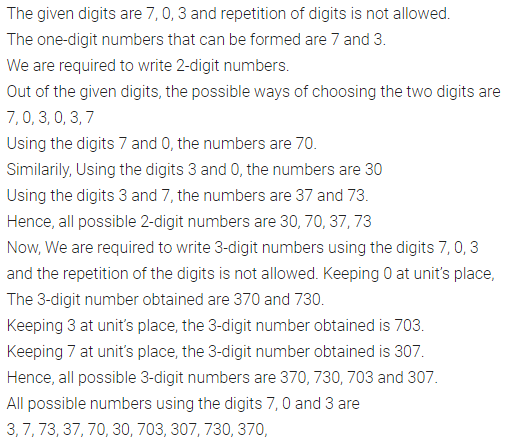
Write all possible natural numbers formed by the digits 7, 0 and 3. Repetition of digits is not allowed.
Solution:
ML Aggarwal Class 6 Solutions for ICSE Maths Model Question Paper 1 6

Question 7.
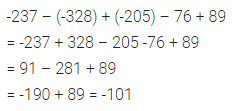
Find the value of: -237 – (-328) + (-205) – 76 + 89.
Solution:
ML Aggarwal Class 6 Solutions for ICSE Maths Model Question Paper 1 7

Question 8.
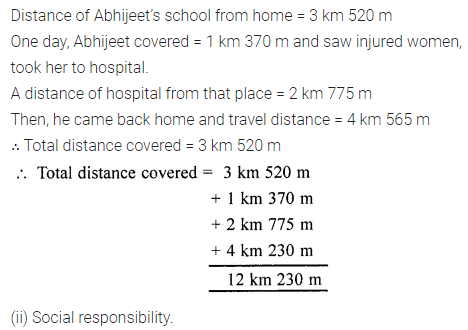
Abhijeet’s school is 3 km 520 m away from his home. One day while returning from his school, just after covering 1 km 370 m distance, he saw a woman who was bleeding, he took her to the nearest hospital which was 2 km 775 m away from that place and got her admitted. He came back to his home which was 4 km 565 m from the hospital.
(i) Find the distance covered by Abhijeet on that day.
(ii) What value of life is depicted by Abhijeet?
Solution:
ML Aggarwal Class 6 Solutions for ICSE Maths Model Question Paper 1 8

Question 9.
Arrange the following integers in descending order:
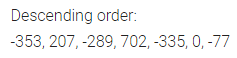
-353, 207, -289, 702, -335, 0, -77.
Solution:
ML Aggarwal Class 6 Solutions for ICSE Maths Model Question Paper 1 9

Question 10.
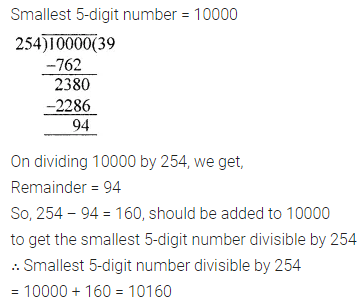
Find the smallest five-digit number which is exactly divisible by 254.
Solution:
ML Aggarwal Class 6 Solutions for ICSE Maths Model Question Paper 1 10