Structure of the Atom Class 9 Important Questions Science Chapter 4

Chapter 4 Structure of the Atom Class 9 Science Important Questions with Answers PDF will help you in scoring more marks in your exams.

Structure of the Atom Class 9 Important Questions Science and Answers Chapter 4

Question 1.
J. Chadwick discovered a sub-atomic particle which has no charge but has mass nearly equal to that of a proton. Name the particle and give its location in an atom. (CBSE 2011)
Answer:
The information suggests that the particle discovered by Chadwick is neutron. It is denoted by the symbol 10n. It is located in the nucleus of an atom along with proton.

More Resources

Question 2.
If ‘K’ and ‘L’ shells of an atom are completely filled, then what would be

  1. the total number of electrons in an atom and
  2. its valency ? (CBSE 2011)

Answer:
According to Bohr Bury scheme, ‘K’ and ’L’ shells of an atom can have maximum of 2 and 8 electrons respectively. If these are completely filled, this means that :

  1. Total number of electrons in the atom = 2 + 8 = 10
  2. Valency of the atom = zero.

Question 3.
For chlorine, Z = 17, A = 35. Give the number of protons, electrons and neutrons in

  1. chlorine atom
  2. chloride ion. (CBSE 2011)

Answer:

  1. In chlorine atom (Cl)
    Number of protons (Z) = 17
    Number of neutrons = A- Z = 35-17= 18
  2. In chloride ion (CF)
    Number of protons (Z = 17)
    Number of electrons = (Z+1)=17+1 = 18
    Number of neutrons = A – Z = 35 – 17 = 18

Question 4.
List three observations of the experiment performed by Rutherford for his model of an atom.
Answer:
From the scattering experiment, Rutherford made the following observations :

  1. Most of the alpha particles were able to pass through the gold foil undeflected.
  2. Some of these particles were deflected by small angles.
  3. A very few (one out of approximately 12000) alpha particles suffered major deflections and even came back in the same direction.

Question 5.
An atom of an element has two electrons in outermost M-shell. State its
(a) Electronic configuration
(b) Number of protons
(c) Atomic number
(d) Nature whether metal or non-metal
(e) Valency
(f) Name (CBSE 2011)
Answer:
(a) Since the atom has two electrons in outermost M-shell, this means that K and F shells are already filled. Therefore, electronic configuration is 2(K) 8(F) 2(M)
(b) Number of protons = Number of electrons = 12
(c) Atomic number = Number of protons =12
(d) The elements with two valence electrons is a metal
(e) Valency of the element = Number of outermost electrons = 2
(f) The element is magnesium (Mg)
Hydrogen has three isotopes which are written as :

Question 6.
Explain why :
(a) These isotopes have identical chemical properties.
(b) These isotopes are electrically neutral
(c) These isotopes differ in their masses. (CBSE 2011, 2016)
Answer:
(a) The isotopes have identical chemical properties because all of them have one electron in the only shell (K-shell)
(b) The isotopes are electrically neutral because each one has one proton and one electron.
(c) The isotopes differ in their masses because they differ in their mass numbers (1,2 and 3 respectively).

Question 7.
In the following table, the mass number and the atomic number of certain elements are given :

Structure of the Atom Class 9 Important Questions Science Chapter 4 image - 1
(a) Select the pair of isobars from the above table.
(b) What would be the valency of the element C listed in the above table ?
(c) Which two sub-atomic particles are equal in number in a neutral atom ? (CBSE 2011)
Answer:
(a) Elements D and E are pair of isobars since they have same mass no. = 40
(b) The electronic configuration of the element C with Z = 7 is 2, 5.
It has five valence electrons. Its valency can be either 5 or 3 (8 – 5) = 3.
(c) In a neutral atom, the number of electrons in the extra-nuclear portion is equal to the number of protons in the nucleus.

Question 8.
(a) Why are the chemical properties of the isotopes same ?
(b) Draw Bohr model for helium atom.
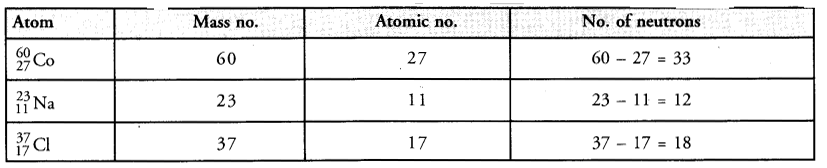
(c) What are the number of protons, neutrons and electrons in 5927Co and 10847Ag ? (CBSE 2011)
Answer:
(a) Isotopes have the same atomic number as well as the same electronic configuration. Therefore, their chemical properties are the same.
(b)
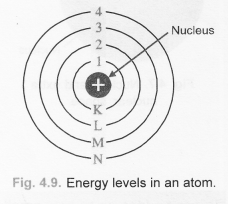
Structure of the Atom Class 9 Important Questions Science Chapter 4 image - 2
(c)
Structure of the Atom Class 9 Important Questions Science Chapter 4 image - 3

Question 9.
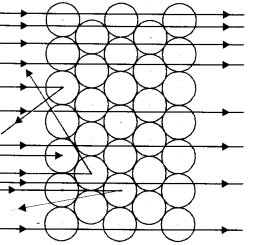
(a) Which popular experiment is shown in the figure ?
Structure of the Atom Class 9 Important Questions Science Chapter 4 image - 4
(b) List three observations of this experiment.
(c) State conclusions drawn from each observation of this experiment.
(d) State the model of atom suggested on the basis of the above experiment. (CBSE 2011)
Answer:
(a) Rutherford  Model
(b)  Rutherford made the following observations :

  1. Most of the alpha particles were able to pass through the gold foil undeflected.
  2. Some of these particles were deflected by small angles.
  3. A very few (one out of approximately 12000) alpha particles suffered major deflections and even came back in the same direction.

(c) Conclusions

  1. As most of the alpha particles passed through undeflected, this means that they did not come across any obstruction in their path. Thus, most of the space in an atom is expected to be empty.
  2. As a few alpha particles suffered minor deflections and a very few major deflections, this means that these must have met with some obstructions in their path.
  3. This obstruction must be :
    1. Very small : Only a few particles were obstructed by it.
    2. Massive : Each alpha particle has 4u mass and is quite heavy. It could easily pass through a light obstruction by pushing it aside.

(d) The main features are listed as follows :

  1. An atom consists of two parts. These are nucleus and extra nuclear portion.
  2. Nucleus is present in the centre of the atom and is surrounded by extra nuclear portion.
  3. The radius of the nucleus of an atom is nearly 10-15m while that of the atom is about 10-10m. Thus, nucleus is very small in comparison to the atom.
  4. The mass of the atom is mainly of the nucleus. All the protons and neutrons (discovered later on by Chadwick) are present in the nucleus.
  5. The positive charge on the nucleus is because of protons present (each proton has one unit positive charge).
  6. All the electrons are present in the extra-nuclear space around the nucleus.
  7. The total positive charge of the nucleus due to the presence of protons is the same as that of the electrons present in the extra nuclear space. Therefore, the atom as a whole is electrically neutral.
  8. Electrons present in the extra nuclear portion are not stationary. These are revolving around the nucleus at high speed following a circular path.
  9. The revolving electrons do not come close to the nucleus or drawn towards the nucleus because their force of attraction towards the nucleus is balanced by the centrifugal force which is of the same magnitude. It is directed away from the nucleus

Question 10.
There are two elements 2613A and 2614B. Find the number of sub-atomic particles in each of these. What is the relation between these atoms ?
Answer:

Structure of the Atom Class 9 Important Questions Science Chapter 4 image - 5
Since the two elements have same mass number hut different atomic numbers, these are related to each other as isobars.

Question 11.
(a) In the gold foil experiment, what observations led Rutherford to conclude that
(i) Most of the space inside the atom is hollow.
(ii) The central portion of the atom is positively charged.
(iii) Volume occupied by the nucleus is very small as compared to the total volume of the atom.
(iv) Almost the entire mass of the atom concentrated at its centre.
(b) If bromine atom is available in the form of two isotopes 7935Br (49.7%) and 8135Br (50.3%), calculate the average atomic mass of bromine atom. (CBSE 2014, 2016)
Answer:
(a) (i) Most of the α-particles passed through the foil undeflected.
(ii) Some α-particles (positively charged) were deflected and a few came back in the same direction. This means that there is very small, positively charged and massive portion present in the centre of the atom. This is known as nucleus.
(iii) The number of α-particles which were deflected back was very small.
(iv) Since the mass of the atom is mainly due to positively charged protons (neutrons were not known at that time), this means that the entire mass of the atom is concentrated in the centre of the atom called nucleus.
(b) % of Br isotope with mass number 79 = 49.7 % of Br isotope with mass number 81 = 50.3

Structure of the Atom Class 9 Important Questions Science Chapter 4 image - 6
Question 12.
State the postulates stated by Neils Bohr in order to overcome the objection as raised against Rutherford’s model of atom.
Answer:
The main postulates of the theory are listed :

  1. In the extra nuclear portion of an atom, the electrons revolve in well defined circular paths known as orbits.
  2. These circular orbits are also known as energy levels or energy shells.
  3. These have been designated as K, L, M, N, O, … (or as 1, 2, 3, 4, 5, …) based on the energy present.
  4. The order of the energy of these energy shells is :
    K<L<M<N<0 <…. or 1< 2< 3 < 4<5 <….
  5. While revolving in an orbit, the electron is not in a position to either lose or gain energy. In other words, its energy remains stationary. Therefore, these energy states for the electrons are also known as stationary states.

Question 13.
Which of the following are isotopes and which are isobars ?
Argon, Protium, Calcium, Deuterium. Explain why the isotopes have similar chemical properties but they differ in physical properties ? (CBSE 2012)
Answer:
The symbol notations for elements are represented as follows :
11H and 21H are isotopes while 4018Ar and 4020Ca are isobars. Since the isotopes of an element have same atomic number, they have same electronic configuration and also similar chemical properties. They have different physical properties since their mass numbers are different.

Question 14.
Explain Bohr and Bury rules for distribution of electrons into different shells.
Answer:

  1. The maximum number of electrons which can be present in a particular energy shell of an atom is given by 2n2. Here ‘n is the number of the energy shells or energy levels.
  2. The outermost energy shell in an atom cannot have more than eight electrons even if it has a capacity to take up more electrons according to first rule.
  3. It is not necessary for a given shell to complete itself before another shell starts forming. As a rule, the new shell is formed as soon as the outermost shell, acquires eight electrons.

Question 15.
The atomic number and mass number of an element are 16 and 32 respectively. Find the number of protons, electrons and neutrons in it. State its valency. Is this element a metal or a non – metal. Justify your, answer.
(CBSE 2012, 2014, 2016)
Answer:
No. of protons = Atomic number =16
No. of electrons = Atomic number =16
No. of neutrons = Mass number – Atomic number = 32-16 = 16
Electronic configuration of the element = 2, 8, 6
Valency of the element = (8 – 6) = 2
The element is a non – metal since it tends to gain electrons and not lose electrons.

Question 16.
The K and L shells of an atom are completely filled. Find the number of electrons present in it. State the name of the element. . (CBSE 2012, 2013)
Answer:
Number of electrons present : K(2), L(8) = 10. The element is neon (Ne).

Question 17.
You are given an element X. Find out
(a) Number of protons, electrons and neutrons in ‘X’.
(b) Valency of ‘X’ ,
(c) Write the chemical formula of the compound formed when ‘X’ reacts with
(i) hydrogen,
(ii) carbon.
(CBSE 2012)
Answer:
(a) Number of protons = 8
Number of electrons = 8 Number of neutrons = 16 – 8 = 8
Electronic configuration = 2, 6
(b) Valency of ‘X’ =8-6 = 2
(c) The element ‘X’ is ‘O’. The formula of the compounds with hydrogen (H) and oxygen (O) are :
(i) H2O (ii) CO2.

Question 18.
Define the terms (a) isotope, (b) isobar giving one example in each case. Name the element whose isotope is used in
(i) nuclear reactor,
(ii) treatment of cancer. (CBSE 2012)
Answer:
(a) Most of the elements exist in nature. An investigation of some of these have revealed that the atoms of a particular element may have different mass numbers. However, their atomic numbers are the same. These are called isotopes. Thus, isotopes may be defined as : the different atoms of the same element having same atomic number but different mass numbers.
(b)  Isobars may be defined as : the atoms belonging to the different elements with same mass numbers but different atomic numbers.
(i) U-235 isotope is used in nuclear reactor as a fuel.
(ii) Co-60 isotope is used in the treatment of cancer.

Question 19.
(a) What are canal rays ? Who discovered them ? What is the charge and mass of canal rays ?
(b) How are canal rays different from electrons in terms of charge and mass ? (CBSE 2012)
Answer:
(a) Canal rays are the rays which originate in the discharge tube experiment and move away from the anode. These are called canal rays since they seem to be flowing like a stream of water in a canal.
(b) Canal rays are basically anode rays which consist of protons. For the charge and mass of protons. For the comparison of canal rays and electrons in terms of charge and mass.

Question 20.
A certain particle X has 17 protons, 17 electrons and 18 neutrons
(i) What is the mass number of X ?
(ii) What is atomic number of X ?
(iii) What is valency of X ?
(iv) Identify the element.
Answer:
(i) Mass no. of X = No. of p + No. of n = 17 + 18 = 35
(ii) Atomic no. of X = No. of p = 17
(iii) Electronic configuration of X = 2, 8, 7
Valency of X = (8 – 7) = 1
(iv) Name of element X = Chlorine (Cl).

Question 21.
Who discovered protons ?
Answer:
Protons were discovered by Goldstein.

Question 22.
(a) The element helium has 2 electrons in its valence shell but its valency is not 2. Explain.
(b) Choose the isotopes from the following nuclei :
(i) 8p + 8n
(it) 8p + 9n
(iii) 18p + 22n
(iv) 20p + 20n (CBSE 2013)
Answer:
(a) The element helium (He) is a noble gas element (Z = 2). It has only one shell (K shell) which can have maximum of two electrons only. It therefore, does not take part in chemical combination and its valency is zero.
(b) Elements (i) and (ii) represent pair of isotopes since they have 8 protons (Atomic no. = 8)

Question 23.
What are valence shell and valence electrons ? (CBSE 2013)
Answer:
Valence shell is the outermost shell in an atom. The electrons present in it are called valence electrons.

Question 24.
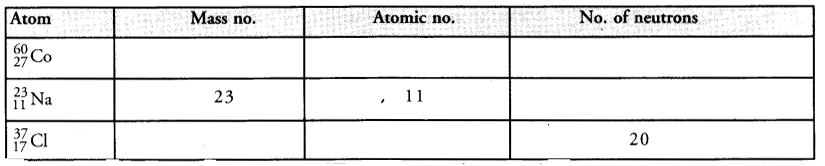
Complete the following table :
Structure of the Atom Class 9 Important Questions Science Chapter 4 image - 7
Answer:
Structure of the Atom Class 9 Important Questions Science Chapter 4 image - 8

Question 25.
The total number of nucleons in the atoms of calcium and argon is 40 and the atomic numbers of calcium and argon are 20 and 18 respectively. Name the pair of these two elements and also find out the number of neutrons present in the nucleus of argon atom. (CBSE 2013)
Answer:
The elements which have same no. of nucleons but different atomic numbers are called isobars. Therefore, calcium (Ca) and argon (Ar) represent a pair of isobars.
No. of neutrons in the nucleus of Ar = 40 – 18 = 22.

Question 26.
Atom of an element has one proton, one electron and no neutron. Name the element. How will you represent it ? (CBSE 2013)
Answer:
The element is called protium or hydrogen. It is represented as j H

Question 27.
An atom has 2 electrons in M-shell. What is the atomic number of the element ? (CBSE 2014)
Answer:
K and L shells of the atom are filled and M shell has two electrons. Therefore,
Total number of electrons in the atom = 2 + 8 + 2= 12
Atomic number (Z) of the element = 12.

Question 28.
An element is represented as 168X. Find :
(a) The number of electrons in element X. .
(b) Mass number of an element X.
(c) The number of neutrons in element X. (CBSE 2014, 2016)
Answer:
(a) The number of electrons in element X = 8
(b) Mass number of element X = 16
(c) The number of neutrons in element X = 16-8 = 8.

Question 29.
The electronic configuration of potassium (K) is 2,8,8, 1 instead of 2,8,9 though the M shell can accommodate up to 18 electrons. Explain. (CBSE 2014)
Answer:
M-shell cannot have more than 8 electrons in case it happens to be outermost or valence shell in an atom. Therefore, the correct electronic configuration of the element potassium (K) is 2,8,8,1.

Question 30.
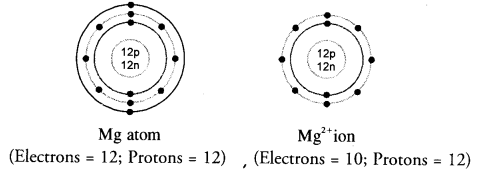
Show the electron distribution in magnesium atom and magnesium ion diagrammatically and also give their atomic numbers. (CBSE 2014)
Answer:
Atomic number (Z) of magnesium is 12. Its electronic distribution is 2,8,2. Magnesium ion (Mg2+) is formed by the loss of two electrons from the valence shell of the atom. Therefore, the electronic distribution * in the ion is 2, 8. These are shown diagrammatically as follows :
Structure of the Atom Class 9 Important Questions Science Chapter 4 image - 9

Question 31.
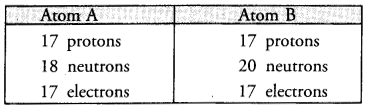
The composition of two atoms A and B is given :
Structure of the Atom Class 9 Important Questions Science Chapter 4 image - 10
(a) What are the mass numbers and atomic numbers of A and B ?
(b) What is the relation between the two chemical species ?
(c) Which element or elements do they represent ?
Answer:
(a) Mass number of A = 17 + 18 = 35 u
Mass number of B = 17 + 20 = 37 u
(b) The two chemical species exist as pair of isotopes since they have the same number of protons and electrons.
(c) They represent the element chlorine (Cl).

Question 32.
Write the names of three elementary particles which constitute an atom. (CBSE 2015)
Answer:
Three elementary particles which constitute an atom are ; electron (e), proton (p) and neutron (n).

Question 33.
(a) What is the relationship between two elements X and Y whose atomic numbers are 18 and 20 respectively but their mass numbers remain the same as 40 ?
(b) Are their chemical properties same or different ? Explain and support your answer.
(c) Which has more number of electrons Na or Na+ ? Why ? (CBSE 2015)
Answer:
(a) The elements X and Y are related to each other as isobars.
(b) Since the atomic numbers of the elements are different, their chemical properties also differ.
(c) The electronic configurations of Na and Na+ ion are given as follows :
Na (Z =11), K(2), L(8), M(l)
Na+ (Z = 11), K(2), L(8), M(-)
Na+ ion is formed when Na atom loses one electron. Therefore, Na atom has more electrons (11) than Na+ ion (10).

Question 34.
Write the electron distribution of oxygen atom. How many valence electrons does it have ? (CBSE 2015)
Answer:
Atomic number (Z) of oxygen is 8.
Electronic distribution = K(L), L(6)
Valence electrons = 6.

Question 35.
(a) Why does helium have zero valency ?
(b) Name the scientist and his experiment to prove that nucleus of an atom is positively charged.
(CBSE 2015)
Answer:
(a) Atomic number (Z) of helium is 2. Its electronic configuration is K(2). This means that its atom has completely filled shell which is the only shell it has. Therefore, valency of the element is zero.
(b) The scientist is Rutherford and the experiment is known as α-particle scattering experiment.

Question 36.
List the observations in α-particle scattering experiment which led Rutherford to make the following conclusions :
(i) Most of the space in an atom is empty,
(ii) Whole mass of an atom is concentrated in its centre.
(iii) Centre is positively charged. (CBSE 2015)
Answer:
(i) As most of the alpha particles passed through undeflected, this means that they did not come across any obstruction in their path. Thus, most of the space in an atom is expected to be empty.
(ii)  As a few alpha particles suffered minor deflections and a very few major deflections, this means that these must have met with some obstructions in their path.
This obstruction must be :

  • Very small : Only a few particles were obstructed by it.
  • Massive : Each alpha particle has 4u mass and is quite heavy. It could easily pass through a light obstruction by pushing it aside.

(iii) Positively charged : Alpha particles have positive charge. Since they were repelled or deflected back, the obstruction must also carry same charge i.e., positive charge, (similarly charged particles always repel each other).

Question 37.
Define isotopes. Why do isotopes have same atomic number but different mass numbers ? Explain with the help of an example. (CBSE 2015)
Answer:
Most of the elements exist in nature. An investigation of some of these have revealed that the atoms of a particular element may have different mass numbers. However, their atomic numbers are the same. These are called isotopes. Thus, isotopes may be defined as :
The different atoms of the same element having same atomic number but different mass numbers.
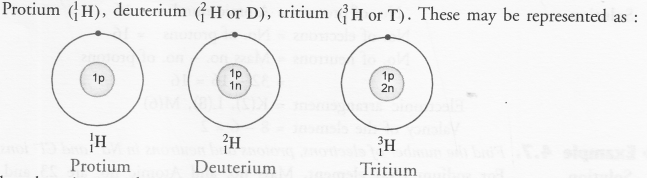
Please note that the difference in the mass numbers of the isotopes is because of the difference in the number of neutrons present. For example,
Hydrogen (H) exists in the form of three isotopes. These are named as :
Structure of the Atom Class 9 Important Questions Science Chapter 4 image - 11

Question 38.
Write the two postulates of Thomson’s model of an atom. What were the drawbacks in this model ?
(CBSE 2015)
Answer:

  1. An atom may be regarded as a positively charged sphere in which protons are present.
  2. The negatively charged electrons may be regarded as studded or embedded in this sphere.

Question 39.
(a) How many neutrons are present in C-14 isotope of carbon ?
(b) How many protons does He2+ ion possess ?
(c) How many electrons can be filled in the third orbit of an atom at the maximum ? (CBSE 2015)
Answer:
(a) C-14 isotope of carbon has mass number 14 and atomic number 6. In this isotope ;
No. of protons = Atomic no. = 6.
No. of electrons = Atomic no. = 6.
No. of neutrons = Mass no. – Atomic no.
= 14 – 6 = 8.
(b) He2+ ion (z = 2) has two protons,
(c) The third orbit of an atom can have maximum of 8 electrons.

Question 40.
Identify the most stable atom from the following. Also give the reason for your answer :

Structure of the Atom Class 9 Important Questions Science Chapter 4 image - 12
Answer:
Argon Ar1840 is the most stable atom. It is a noble gas atom with completely filled shells (2, 8, 8).

Hope given Previous Year Question Papers for CBSE Class 9 Science Chapter 4 Structure of the Atom are helpful to complete your science homework.

If you have any doubts, please comment below. Learn Insta try to provide online science tutoring for you.

A Strange Wrestling Match Extra Questions and Answers Class 6 English A Pact with the Sun

Here we are providing A Strange Wrestling Match Extra Questions and Answers Class 6 English A Pact with the Sun, Extra Questions for Class 6 English was designed by subject expert teachers.

A Strange Wrestling Match Extra Questions and Answers Class 6 English A Pact with the Sun

A Strange Wrestling Match Extra Questions and Answers Short Answer Type

Question 1.
Describe about appearance of Vijay Singh.
Answer:
Vijay Singh was a famous wrestler. He was unbeatable. He had big §houlders and strong arms. He was so tall that he looked like a giant.

Question 2.
What was the weakness of Vijay Singh?
Answer:
Vijay Singh was a powerful wrestler. Vijay Singh’s one weakness was his habit of boasting. He wished to fight with a ghost and teach him a lesson.

Question 3.
How did Vijay Singh’s initial reaction when he was told to go to the haunted deserts?
Answer:
Vijay Singh was frightened when he was asked to go to the Haunted Desert. His heart missed a beat or two at the thought of fighting with a ghost.

Question 4.
How the eccentric woman did help Vijay Singh?
Answer:
An old woman helped Vijay Singh against the ghost. She gave him a packet containing a piece of salt and an egg. These two things helped him be fool the ghost.

Question 5.
What did the Vijay Singh say to insult and demoralise the ghost?
Answer:
Vijay Singh said ghost ‘stupid ghost a worthless a rascal of a ghost.’

Question 6.
How was the wrestling match between the two was unusual?
Answer:
The wrestling match was strange because it was a fight between a man and ghost. The wrestler Vijay ‘ Singh had one weakness. He was boastful of his strength. It was in fact a trial of wit and wisdom. Finally Vijay Singh won the match and returned home with lots of gold.

Question 7.
How did Vijay Singh overcome the ghost with his wit and wisdom?
Answer:
Vijay Singh made good use of the old woman’s gift—an egg and a lump of salt. He challenged the ghost to squeeze a piece of rock. The ghost failed to do that. Vijay Singh took out the egg from his pocket and squeezed it easily. The ghost was speechless and he accepted defeat. Vijay Singh then threw another challenge. He gave another piece of rock to the ghost to crush. The ghost failed to crush the rock. Vijay Singh took out the piece of salt from his pocket and meshed it easily. The ghost felt demoralized and again accepted his defeat. He hid behind the wall and placed bolsters in his bed. When the ghost tried to kill him, he took his enemy for dead. But Vijay Singh faced the ghost who panicked. He fled from the cave leaving behind all his wealth for Vijay Singh.

A Strange Wrestling Match Extra Questions and Answers Long Answer Type

Question 1.
‘We be sensible when we choose to speak’. Give your answer in support of the text.
Answer:
Vijay was a powerful man but unrealistic and boastful nature had proved to be threat to his life. The ghost would have killed him, he was saved by his clever acts. Towards the end, he realised his mistake and decided to speak after giving many thoughts to his words. Great men and thinkers always advise to speak wisely.

Question 2.
Vijay Singh cleverly handled the ghost. What values can be learnt by his acts from the story?
Answer:
Vijay Singh was boastful. This habit landed him in trouble. However, he used his intellect to defeat the ghost. He recognised the ghost in the first meeting and challenged him twice. He did not trust the ghost and therefore did not sleep at night. Thus saved his life and scared the ghost to hell, who left his invaluable treasure for him and no traveller was ever bothered by any ghost in the haunted desert. So, one can learn being sensible, instinctive and the will to scare the wrong people out of our lives.

Question 3.
What was Vijay Singh’s weakness? Which awkward situation did it push him into?
Answer:
Vijay Singh was fond of boasting. It pushed him into trouble and he had to set out to find a ghost in the haunted desert.

Question 4.
Was the old women gifts to Vijay Singh eccentric? Why?
Answer:
The old woman thrust a small packet into Vijay Singh’s hands it contained a lump of salt and an egg. It was not eccentric because the contents of the packet proved very useful for the wrestler in the desert.

Question 5.
Why did Vijay Singh ask the ghost disguished as Natwar to come closer?
Answer:
Vijay Singh asked the ghost in the guise of Natwar to come closer. Like all good wrestler, he wanted to size up his enemy ghost.

Question 6.
What made the ghost speechless? Why?
Answer:
Vijay Singh challenged the ghost to fight. This made him speechless because everybody is afraid of the ghost. But Vijay Singh was calling him stupid and worthless. His courage and boldness made the ghost speechless.

Question 7.
Why did Vijay Singh say “Appearances can be deceptive”?
Answer:
The ghost first tried to demoralise Vijay Singh. He said that Vijay Singh was no match to him. At this Vijay Singh also tried to frighten the ghost. He agreed to demonstrate his strength.

Question 8.
How did Vijay Singh use the eggs? How did he use the lump of salt?
Answer:
Vijay Singh used the egg to create the illusion of the stone being crushed. He used the lump of salt to break it like a stone. Thus he surprised the ghost.

Question 9.
Why did Vijay Singh conclude that the ghost would not be worthy opponent to him? Was he fair in his judgement?
Answer:
The ghost could not see that Vijay Singh crushed only an egg and a lump of salt. Vijay Singh easily befooled him. So Vijay Singh concluded that the ghost was not a match to him. Vijay Singh was not fair in his judgement because the ghost was stupid though but not weak.

Question 10.
Why did Vijay Singh ask the ghost to accompany him to town next day?
Answer:
Vijay Singh asked the ghost to accompany him to town next day because he wanted his people to show that he had defeated the ghost and show him as a trophy.

Question 11.
What made the ghost believe Vijay Singh was dead?
Answer:
The ghost didn’t hear a sound of groan when he struck bolster seven times on Vijay Singh and thus it made him believe that Vijay Singh is dead.

Question 12.
Vijay Singh complained of insects in the cave. What was he referring to, and why?
Answer:
Vijay Singh complained of insects in the cave. He was in fact, referring to the ghost. He compared the ghost to a hateful weakling like an insect.

Question 13.
Was it really a ghost who Vijay Singh befooled? Who do you think it was?
Answer:
It was not a ghost. A ghost never looted the property of others, became its useless for them. It was a robber who looted the people in the guise of ghost.

What Happened to the Reptiles Extra Questions and Answers Class 6 English A Pact with the Sun

Here we are providing What Happened to the Reptiles Extra Questions and Answers Class 6 English A Pact with the Sun, Extra Questions for Class 6 English was designed by subject expert teachers.

What Happened to the Reptiles Extra Questions and Answers Class 6 English A Pact with the Sun

What Happened to the Reptiles Extra Questions and Answers Short Answer Type

Question 1.
Why was Prem forced to leave the village?
Answer:
The communal riots in his village made life unsafe in the village. The people went mad, burnt houses and killed one another. So Prem left his village for good.

Question 2.
What was unusual for Prem in Pambupatti village?
Answer:
In Pambupatti, there was no violence not even tension. People lived in peace. They also cared for the welfare of even stranger. This was something surprising for Prem.

Question 3.
Who is Makara? What were the decision taken by him?
Answer:
Makara was the biggest crocodile. The reptiles in the forest included crocodiles, snakes, turtles and lizards. Makara being strong and selfish, drove all other reptiles out. He got rid of turtles, snakes and lizards one by one. But this created the problem of frogs and rats and other insects.

Question 4.
How did the forest become peaceful again?
Answer:
Crocodiles were facing tough times. A small crocodiles pointed out what had gone wrong. They knew that Makara was not all that strong and right. They called all their reptile friends back to Pambupatti. Their arrival marked the beginning of normal and peaceful life again in the forest.

Question 5.
What was the motive behind the story of the old man?
Answer:
The old man gave message through his story. This world belongs to all sorts of creatures. Together they keep a balance. Every kind of creature serves a useful purpose. It is sad that man is trying to kill all the species and rule over the world like a dictator. This is certainly not practicable or in his own interest. Our motto should be to ‘Live and Let Live’.

What Happened to the Reptiles Extra Questions and Answers Long Answer Type

Question 1.
‘A leader should be dynamic and protective’. Give your opinion, by taking example from the text.
Answer:
The leader has the capacity to bring changes in the lives of his followers. He is a torchbearer, so it is his duty to lead with dignity and dynamism. Step taken without thought is disastrous to a great extent. One should think of the consequences first only then he should act for the welfare of masses. Makara should have forseen the impact of his decision. He should have taken advice of some counsels before implementing on his decisions.

Question 2.
‘Nature has given a rightful place for everyone and everything.’ Elaborate in context with the story.
Answer:
In the eyes of mother nature no One is superior or inferior. Whether a thing is big or small, has a rightful place. No discrimination is ever tolerated. Makara has taken advantage of his power and threw away other reptiles away from the forest. But he failed miserably. Discrimination amongst human being is to divide of caste, colour and creed often divide. But essential humanity brings them together.

Question 3.
In what way is Pambupatti different from any other village?
Answer:
Unlike other villages, people of Pambupatti lived in peace. They did not fight in the name of religion or language. In this way, Pambhupatti is different from any other village.

Question 4.
Why is Prem determined not to return to his village?
Answer:
Prem determined not to return to his village because in his village people went mad and burnt down temple or mosque. There were religious crisis in the village and people started fighting with one another.

Question 5.
Why did Makara dislike tortoise, snakes and lizards? Write a line about each.
Answer:
Makara disliked tortoise because they were slow and stupid. They even carried their houses on their backs. He disliked snakes because they were slimy and they made funny noises. Makara disliked lizards because they were undependable changed colour.

Question 6.
What went wrong when the tortoise, snakes and lizards left the forest?
Answer:
When the tortoises, snakes and lizards left the forest, rats multiplied in their absence, and eat the baby crocodile and millions of insects growing were bigger and nastier day by the day. The forest was full of bad smell of rotten fruits and animals.

Question 7.
Why do you think Prem wants to tell the story of the reptiles to the people of his village?
Answer:
The people of Prem’s village had gone mad. They fought with one another in the name of religion. The story of Pambupatti gave the message of peace and coexistence. It underlined the importance of living together. So Prem wanted to carry that message to his own village.

Question 8.
Do you agree that it is difficult not to go along with someone who is very strong and powerful? Express your views frankly and clearly.
Answer:
It is difficult not to go along with someone who is very strong and powerful. It is human nature to be on the safe side. Disagreeing with a powerful person is likely to call for trouble. Moreover, even if someone is bold enough to oppose him, it becomes a long fight. Such idealists may leave an impact on the society. But they do so at cost of their own ruin.

Question 7.
If you were a baby crocodile, would you tell Makara that he was wrong? What would you say to con.
Answer:
As a baby crocodile, I have a privilege to oppose my parents boldly. I would tell the elders that this world is a common property of living creatures. To convince my dad, Makara, that he is wrong. I will give him a couple of reasons. First, it is the duty of the strong to protect the weak, and not to harass them. Secondly, this Earth is not the sole property of any one person or animal. All are inter-dependent. Together, they make this Earth a place worth-living.

A Pact with the Sun Extra Questions and Answers Class 6 English A Pact with the Sun

Here we are providing A Pact with the Sun Extra Questions and Answers Class 6 English A Pact with the Sun, Extra Questions for Class 6 English was designed by subject expert teachers.

A Pact with the Sun Extra Questions and Answers Class 6 English A Pact with the Sun

A Pact with the Sun Extra Questions and Answers Short Answer Type

Question 1.
What was ‘the pact of the Sun’?
Answer:
The small girl Saeeda made a pact with the Sun. Her mother was not well. She needed the warmth of the Sun and fresh air. So she requested the rays of the Sun to come the next day to cure her mother.

Question 2.
How did the sunrays respond to Saeeda?
Answer:
The sunrays granted Saeeda’s request. They promised to reach the Earth at the fixed hour the next morning.

Question 3.
How did the sunrays keep their promise?
Answer:
The pathway to the Earth was blocked by thick, dark clouds. The Sun warned the rays to keep clear of the dark clouds. But all the rays refused to obey their father’s command. They got through the clouds and thus kept their word to Saeeda.

Question 4.
How did Saeeda’s mother recovered?
Answer:
Saeeda’s mother felt the Sun on her face and she breathed in fresh air. She thought she was in a new world. Her eyes shone bright and she started recovering speedily.

Question 5.
What was the theme of the story?
Answer:
The story tells us Saeeda’s mother was denied healthy food, sunshine and fresh air. She remained sick. But her daughter made a pact with the sunrays to warm up the ailing old woman. And the results were wonderful.
Thus, A pact with the sun is an educative story. It tells us that fresh air, and sunshine in the open are the key to sound health. Even the sick people need these two things. They must not be kept confined in dark room. They should get normal food.

Question 6.
What was Saeeda’s concern about her mother?
Answer:
Saeeda’s mother had been ailing for quite some time. No medicine proved effective. She was shut up in a small dark room. The cloudy weather continued for a few days. So, Saeeda, the little girl, made a request to the rays of the Sun to come down to the Earth and give warmth to the ailing woman.

Question 7.
How did Saeeda’s mother recover?
Answer:
The sunrays agreed and also kept their word. They came down in large numbers and gave new life to Saeeda’s mother. In this way Saeeda’s pact with the sunrays helped her mother to recovered soon.

A Pact with the Sun Extra Questions and Answers Long Answer Type

Question 1.
‘Children can communicate with a secret language’. Elucidate.
Answer:
Saeeda was listening to everything happening around her. She was worried but kept calm. She prayed to the departed rays of the Sun to come with warmth and brightness for well being of her mother. Her innocence and selfless love for her mother compelled the rays to fight with stubborn clouds. Thus her mother was recovered with her care.

Question 2.
‘The doctor advised her sunlight and normal diet’. Why the neighbors reacted differently?
Answer:
When a person fall sick, he is confined to a room with closed windows. Normal diet is restricted. But these things worsen the condition of the sick person. The doctor prescribed medicine and asked to provide Saeeda’s mother proper sunlight in the morning for faster recovery. The people were dubious. They thought that her cold and cough won’t get cured if she is not tended in a closed room. While others supported doctor’s advice.

Question 3.
The simplicity of a child is special for the heavens. Comment.
Answer:
The blessings of heaven is showered upon those who are innocent. Their prayers are heard and heavenly bodies keep their promises as the ray defied the orders of her father and shooed away the bewildered clouds their way to Saeeda’s house. So a child has a power to communicate with .heaven and their prayer are often heard.

Question 4.
What did the physician ask Saeeda’s mother to do to get well? Did their advice help her? If not, why?
Answer:
The physicians advised Saeeda’s mother not to take normal food, and to remain shut in a small dark room.

Question 5.
What did the specialist prescribe in addition to medicine?
Answer:
The specialist prescribed in addition to medicine to shift to a bigger room with open doors and windows. He also asked her to sit one hour daily in the sunshine and to breath in fresh air.

Question 6.
What did Saeeda tell the sunrays to do?
Answer:
Saeeda made a special request to the sunrays to help her mother get well. She asked them to come the next day with lots of warmth and brightness.

Question 7.
Why were the sunrays keen to go down to the Earth the next day?
Answer:
The sunrays had promise to Saeeda that they would come the next day. They feared that if they failed to reach on time the people would call them liars.

Question 8.
What is your own formula for keeping good health?
Answer:
Health is wealth, so I get up early do some exercises and yoga. I eat breakfast including fruits and whole grain. Than I go to school. I play in the evening and after taking my dinner, I go to sleep. I firmly believe that early to bed, and early to rise, makes a man healthy, wealthy and wise.

Question 9.
Who would you recommend to a patient in your neighbourhood the physicians contacted first or the specialist contacted next? Give reasons for your choice.
Answer:
The condition of Saeeda’s mother worsened because she was not taken to a specialist. When he examined her, he gave his expert advise and thus she was cured. So I would suggest any patient of my neighbourhood to contact a specialist for fast recovery.

Question 10.
When would you make a pact, with the sun? When you are going on a picnic, or when you are playing a cricket match? Think of other occasions.
Answer:
I am very fond of playing outdoors games. Generally most of us are forced to stay indoor to avoid exhaustion and heat stroke. So I will pact with the sun to remain hidden in clouds so that we could play more often for long hours atleast on Sundays.

The Wonder Called Sleep Extra Questions and Answers Class 6 English A Pact with the Sun

Here we are providing The Wonder Called Sleep Extra Questions and Answers Class 6 English A Pact with the Sun, Extra Questions for Class 6 English was designed by subject expert teachers.

The Wonder Called Sleep Extra Questions and Answers Class 6 English A Pact with the Sun

The Wonder Called Sleep Extra Questions and Answers Short Answer Type

Question 1.
What is sleep? Why is it necessary to enjoy sound sleep?
Answer:
Sleep is a state of rest. Sleep gives rest to our tired body. After a good sleep we feel fresh, alert and active.

Question 2.
What happens to our body when we are asleep?
Answer:
Our body starts relaxing. Our muscles relax and our body temperatures falls. Our heartbeat becomes slower. The ever-active brain also slows down.

Question 3.
What is a dream?
Answer:
Dream is an activity of the mind that takes place only when we are asleep. It helps in having sound sleep.

Question 4.
Why we tend to forget dreams?
Answer:
Some dreams are probable. It means that many of the things that happen in dreams could happen when we are awake. But other dreams are improbable.

Question 5.
What is a myth about dreams?
Answer:
The myth about dreams is that it tell the future.

Question 6.
What have certain doctors found about dreams?
Answer:
Certain doctors think that our dreams can provide a key to the solution of problems.

Question 7.
Why does the author call sleep a wonder?
Answer:
The body and brain recover from weariness after a good sleep. Sleep is a state of rest. When we wake up, we feel fresh. We also become alert and ready for the normal activities of the day.

Question 8.
Why having a dream is significant?
Answer:
Dreams are important because they help us to sleep even through noise. Some doctors say that one’s dreams can suggest solutions to one’s problem or tell the future.

The Wonder Called Sleep Extra Questions and Answers Long Answer Type

Question 1.
‘Nature is a great healer’ Elaborate.
Answer:
When one sleeps, he relaxes his body and mind. To rejuvenate, sleep plays a major role. Everything in nature happens for a cause. If everything happens naturally it is understood properly, lot of issues and problem will be settled automatically. Thus, nature is .a teacher and a great healer.

Question 2.
‘The lullaby of grandmother helps in deep sleep’. How does it helps in personality development?
Answer:
Sleep relaxes body and muscle. Lullaby’s of mother and grandmother comforts a child with music to the extent they goes into sleep. Children who listen to the lullaby’s have stronger personalities. The discipline and virtue of respect in relationships grows with time in these children.

Question 3.
What is the most obvious advantage of sleep?
Answer:
The most obvious advantage of sleep is that it gives rest to our tired body. After a good sleep we become alert and active again for the day’s work.

Question 4.
What happens to our body when we sleep?
Answer:

  • Our muscles, relax.
  • Our heart beat become slower.
  • Our temperature and blood pressure go down.
  • The activity of the brain slows down.

Question 3.
Define a dream in your own words.
Answer:
A dream is an activity of the mind that takes place when we are asleep.

Question 4.
Why are dreams important? Mention two reasons.
Answer:

  • Dream help us to sleep through noise or other disturbances.
  • It can provide a key to the solution of those problems.

Question 5.
Why has sleep been called a wonder?
Answer:
Sleep recovers us from fatigue. It refreshes us from the day’s work. Dreams which we see in sleep help us in many ways.

Question 6.
Describe briefly to the class an importable dream you have ever had.
Answer:
Do yourself.

Question 7.
Grandmother and mothers sing nice little songs while rocking little ones to sleep. Such a song is called a ‘lullaby’. Do you remember a lullaby in your own language? Tell the class in ‘ English what the lullaby says.
Answer:
Do yourself.