Money and Banking Class 12 Important Extra Questions Economics Chapter 3

Here we are providing Class 12 Economics Important Extra Questions and Answers Chapter 3 Money and Banking. Economics Class 12 Important Questions are the best resource for students which helps in class 12 board exams.

Class 12 Economics Chapter 3 Important Extra Questions Money and Banking

Money and Banking Important Extra Questions Very Short Answer Type

Question 1.
What is meant by money? (C.B.S.E2010) (CBSE Outside Delhi2011,201 f (Comp.))
Answer:
Money can be defined as a generally acceptable medium that can be exchanged for goods and services, and can be used as a measure and store of value.

Question 2.
What is barter? (C.B.S.E 2013 (Comp))
Answer:
Barter is a system of exchange in which goods and services are directly traded for other goods and services without the mediation of money.

Question 3.
Define bank money.
Answer:
Bank money mainly means cheques and bank drafts.

Question 4.
Give two demerits of money.
Answer:
Demerits of money are:
(i) Increase in corruption
(ii) Inequality of income

Question 5.
Write secondary function of money.
Answer:
Secondary functions of money include:
(i) Store of value
(ii) Standard of deferred payments

Question 6.
What will be the effect of a rise in bank rate on money supply?
Answer:
A rise in bank rate will reduce the money supply.

Question 7.
Define money supply? (C.B.S.E 2018, C.B.S.E 2011)
Answer:
Money supply is the total stock of money of different types of money (currency in circulation and deposits) in an economy at any specific point of time.

Question 8.
What are the various money stock measures?
Answer:
M1 ,M2, M3 and M4 are the various money stock measures.

Question 9.
What are the constituents of money supply in narrow sense?
Or
State the components of money supply. (C.B.S.E 2010,2011 Comp), (C.B.S.E Outside Delhi 2013)
Answer:
The constituents of money supply in narrow sense are coins, currency notes and demand deposits.

Question 10.
What is a commercial bank?
Answer:
Commercial bank is a financial institution that accepts deposits from the public and advances loans to other people in order to earn profits.

Question 11.
What are the functions of commercial banks?
Answer:
The main functions of commercial banks are accepting deposits and advancing loans.

Question 12.
What are demand deposits? (C.B.S.E 2012,2013,2014)
Answer:
Demand deposits are those deposits in the banks, which can be withdrawn by drawing cheques on demand.

Question 13.
What are time deposits? (C.B.S.E Outside Delhi 2012,2014)
Answer:
Time deposits are those deposits of the public in banks which are deposited for a fixed period.

Question 14.
What is bank rate? (C.B.S.E 2009,2011 Comp.)
Answer:
Bank rate is that minimum rate at which the central bank discounts the first class bills and provides credit to the commercial banks.

Question 15.
Define ‘money multiplier’. (C.B.S.E Outside Delhi 2019)
Answer:
Money multiplier measures the amount of money that the banks are able to create in form of deposits with every initial deposit.

Question 16.
What is central bank?
Answer:
Central bank is the apex institution, which controls and regulates the quantity of money for the economic welfare of the public.

Question 17.
What is the main function of central bank?
Answer:
The main function of central bank is to design and control the monetary policy of its country.

Question 18.
What is meant by Statutory Liquidity Ratio? (C.B.S.E 2010,11)
Answer:
Statutory Liquidity Ratio (SLR) is the ratio of total demand and time deposits of commercial bank which it has to keep in the form of specified liquid assets.

Question 19.
What is meant by Cash Reserve Ratio? (C.B.S.E 2010, 11)
Answer:
Cash Reserve Ratio (CRR) is the ratio of bank deposits that the commercial banks must keep with the central bank as reserves.

Question 20.
What are the quantitative instruments of credit control?
Answer:
The quantitative instruments of credit control include:
(i) Bank Rate
(ii) Open Market Operations
(iii) Cash Reserve Ratio

Question 21.
What are the qualitative instruments of credit control?
Answer:
The qualitative instruments of credit control include:
(i) Marginal Requirements
(ii) Rationing of Credit
(iii) Moral Suasion
(iv) Direct Action

Money and Banking Important Extra Questions Short Answer Type

Question 1.
Briefly explain any two functions of money.
Answer:
Two functions of money are given below:
(i) Money as a Unit of value: Money acts as a convenient unit of account. The value of all goods or services can be expressed in monetary units. Money as a unit of value helps in measuring the value of exchange for various goods and services. For example, if the price of a pen is X 10 then a pen can be exchanged for ten monetary units. Therefore, money is a useful measuring rod of value provided the value of money or purchasing power remains constant.

(ii) Money as a Medium of Exchange: Money acts as an intermediary in the exchange transactions of goods and services. Money solves the problem of double coincidence of wants by acting as a medium of exchange for all goods and services. For example, if a vegetable grocer wants a cart but the cart manufacturer wants clothes, and not vegetables, then the grocer can use money to buy a cart.

Similarly, the cart manufacturer can then use the money to buy clothes. Thus, everyone’s wants can be satisfied as money acts as a medium of exchange. Money is also called a bearer of options or generalised purchasing power. This indicates the freedom of choice that the use of money offers. This function can only be performed properly if the value of money remains constant.

Question 2.
Give meaning of money. Explain the ‘store of value’ function of money. (C.B.S.E 2012,14,2017)
Answer:
Money can be defined as a generally acceptable medium that can be exchanged for goods and services, and can be used as a measure and store of value.

Money as a Store of value: Money is not a perishable item and its storage costs are also considerably low. Moreover, it is acceptable to anyone at any point of time. Thus, money acts as a store of value for individuals.

Under barter system, wealth in the form of goods like wheat, rice, cattle etc. deteriorate with the passage of time or involve heavy storage cost. However, wealth can easily be stored in the form of money for future use.

Question 3.
What is ‘Barter’? Explain ‘standard of deferred payment’ function of money. (C.B.S.E. 2012, 14)
Answer:
Barter is a system of exchange in which goods and services are directly traded for other goods and I services without the mediation of money. Money as a Standard of Deferred Payment: Deferred payments refer to those payments, which are made at some specific time in future.

Money acts as standard in terms of which future or deferred payments are stated because money maintains a constant value over a period of time. Under barter system, goods could not be used for future contracts due to the risk associated with j type, quality and value of the goods. Money exchange has no such problem.

Question 4.
Explain the evolution of money.
Answer:
Money is a generally acceptable medium that can be exchanged for goods and services, and can be used as a measure and store of value. Money has undergone a process of historical evolution spread over a long period of time. During this process of historical evolution, a variety of things had been used as money.

Commodities such as hides and skins of animals, domestic animals such as cattle, goats and agricultural products such as rice, wheat had been used as money in different stages of economic evolution. In more recent times, metallic coins and paper notes have been used as a medium of exchange.

Question 5.
Explain the significance of the unit of account function of money. (C.B.S.E Outside Delhi 2014)
Answer:
Money is to be a unit of value or a unit of account. The monetary unit is the unit in terms of which the value of all goods and services is measured and expressed. The value of each good or service is expressed as a price, which is the number of monetary units for which the good or service can be exchanged. If the price of a pen is ^ 10 then a pen can be had in exchange for ten monetary units. Therefore, money is a useful measuring rod of value only if the value of money itself remains constant.

Question 6.
Explain the problem of double coincidence of wants faced under barter system. How has money solved it? (C.B.S.E 2013)
Answer:
Double coincidence of wants requires that a person who is willing to exchange his or her goods j should find another person who is not only willing to buy the goods offered by the first person, but should also possess what the first person wants in exchange. Double coincidence of wants is hard to find. Money solves the problem of double, coincidence of wants by acting as a medium of exchange for all goods and services.

For example, if a vegetable grocer wants a cart but the cart  manufacturer wants clothes, and not vegetables, then the grocer can use money to buy a cart. The cart manufacturer can then use the money to buy clothes. Thus, everyone’s wants can be satisfied as money acts as a medium of exchange.

Question 7.
Explain “difficulty in storing wealth” problem faced in the barter system of exchange. (C.B.S.E Outside Delhi 2017)
Answer:
The value of money cannot be stored in the form of goods. This problem can be cited by an example. Suppose an American dancer comes to India to earn money by exhibiting her dance performances. Indians offer her grain, hay, horses, elephants, etc., happily. She returns to America with these items on a large ship. On the way, the cattle consumes the grain and fodder.

The sea route being long and due to the onslaughts of unfavourable climatic conditions, the cattle becomes ill and dies. She had no money when she reaches America, i.e., if money is preserved in the form of goods, which are perishable in nature, one is left with none. Therefore, perishable goods cannot be stored for long.

Question 8.
Give meaning of money supply. State its components. (C.B.S.E 2014,2017)
Or
Explain the concept of money supply. (C.B.S.E 2013 Comp.)
Answer:
Money supply is a stock variable. It is the total stock of different types of money (currency in circulation and deposits) available in an economy, at a specific point of time. In India, M1 ,M2, M3, M4 are the four alternative measures of money supply. They are defined as follows:
M1 = CU + DD
M2 = M1 + Savings deposits with post office saving banks
M3 = M1 + Time deposits of commercial banks
M4 = M3 +Total deposits with post office savings organisations (excluding National Savings Certificates)
where, CU = Currency (notes and coins held by public)
DD = Net demand deposits held by the commercial banks

Question 9.
What is ideal supply of money?
Answer:
The ideal supply of money is that quantity in which the production capacity of the country can be fully utilised. In other words, that quantity of money which helps in achieving the full employment level and maximum output is called ideal supply of money.

Question 10.
State any two components of Ml measure of money supply. (C.8.S.E 2019)
Answer:
The two components of Ml measure of money supply:
(i) Currency: Currency is the main component of money supply. Currency consists of coins and
(ii) Demand Deposits: Demand deposits are also an important component of money supply, These are payable by the banks on demand from the account holder. For example: Current and Savings Account Deposits.

Question 11.
Explain the effect of an increase in bank rate on credit creation by commercial banks.
Answer:
The bank rate is the minimum rate at which the central bank discounts the first class bills of exchange and provides credit to the commercial banks.

Increase in the bank rate makes the borrowings from the central bank costlier than before. This reduces the lending or credit creation capacity of the commercial banks as they get funds at a higher interest rate from the central bank. Increase in bank rate also increases the rate at which commercial banks lend to the general public. Consequently, credit contracts in the economy.

Question 12.
Describe two main functions of commercial bank.
Answer:
The following are the main or primary functions of a commercial bank:

(i) Accepting Deposits: Commercial banks accept deposits from the public and lend this money I to companies and other people for investment projects. The banks offer interests on deposits j to the deposit holders. Deposits can be broadly into:

(a) Demand Deposits: These are, payable by the banks on demand from the account holder. For example: Current and Savings Account Deposits.
(b) Time Deposits: These deposits have a fixed period to maturity. For example: Fixed Deposits.

(ii) Advancing Loans: Extending loans is another important primary function of the commercial banks. After keeping a certain portion of the deposits as reserves, the bank gives the balance to  the borrowers in the form of loans and advances.

The rate at which banks lend out their reserve to investors is called the lending rate. Lending by commercial banks consists mainly of cash credit demand and short-term loans to the private investors and banks. The credit worthiness of a person is judged by his current assets or the collateral a security pledged for the repayment of a loan).

Question 13.
Give four agency functions of commercial banks.
Answer:
The agency functions of a commercial bank are as follows:
(i) To transfer funds from one place to another.
(ii) To collect funds on behalf of the customers.
(iii) To purchase and sell shares and debentures on behalf of the customers.
(iv) To provide income-tax consultancy.
(v) To pay bills and insurance premium as per customer’s direction.
(vi) To provide facility of travellers’ cheque and letter of credit.

Question 14.
Explain the lending function of commercial banks.
Answer:
Extending loans is one of the two primary function of the commercial banks. After keeping a certain portion .of the deposits as reserves, the bank gives the balance to borrowers in the form of loans and advances. The different types of loans and advances made by banks are as follows:

(i) Cash Credit: Cash credit is given to the borrowers against their current assets. The required amount of money is sanctioned on a consolidated basis to save time and effort. The amount is transferred into the borrower’s account that he can use according to his or her needs. The bank charges interest only on the amount withdrawn from the account.

(ii) Demand Loans: Demand loans are secured loans as they are made against security. The loan can be repaid in instalments.

(iii) Term Loans: Terms loans are long term loans, the maturity period for which is usually more than 3 years. The entire loan amount is credited into the account of the borrower. The bank charges interest on the entire loan amount.

(iv) Overdrafts: The banks provide overdraft facility, which allows their customers to withdraw more than the available amount in their current accounts up to an agreed limit. The banks charges interest on overdrawn amount.

(v) Discounting of Bills of Exchange: The banks provide instant loans by discounting the bills of exchange written during trade transactions. The banks deduct commission or interest and pay the value of bill to the holder.

Question 15.
Define Credit Multiplier.What role does it play in determining the credit creation power of the banking system? Use a numerical illustration to explain. (C.B.S.E 2019)
Answer:
Credit multiplier measures the amount of money that the banks are able to create in form of deposits with every initial deposit. Through the process of money creation, the commercial banks are able to create credit which is in excess of initial deposits.

The credit creation by banks depends on credit multiplier as it is inversely related to legal resenve ratio. It is legally compulsory for the banks to keep a certain minimum fraction of their deposits as reserve. The fraction is called legal reserve ratio and it is fixed by the central bank. Higher the credit multiplier, higher will be the total credit created and vice-versa.

Example: Suppose the legal reserve is 0.1 and initial deposit is ₹ 1,000.
Credit Multiplier \(=\frac{1}{0.1}=10\)
Thus,
Total credit created = 10 x 1,000 = ₹ 10,000
Now suppose legal reserve is 0.5 and the initial deposit is ₹ 1,000.
Credit Multiplier \(=\frac{1}{0.5}=2\)
Thus,
Total credit created = 2 x 1,000 = ₹ 2,000
It can be seen that with the same initial deposit, total credit creation decreases with a fall in the value of credit multiplier.

Question 16.
Explain the credit creation role of commercial banks with the help of a numerical example. (C.B.S.E Outside Delhi 2013)
Answer:
Money creation (credit creation) by the commercial banks is determined by:
(i) the amount of the primary deposits; and

(ii) the Legal or Cash Reserve Ratio (CRR), which is the minimum fraction of the total deposits with the commercial banks, which they are required to keep with the central bank.

It is assumed that all the money that goes out of banks is re-deposited into the banks. Suppose the cash reserve ratio (CRR) is 20 percent. Further assume that Bank A receives a primary deposit of ₹ 10,000. Bank A will keep 20 percent of ₹ 10,000 ( ₹ 2,000) as reserve and will lend out the balance ₹ 8,000, to the borrowers. People who receive ₹ 8,000 from Bank A will either spend the amount on goods or pay to the creditors.

The money will eventually come back to the banking system, say in Bank B. After keeping a reserve of ₹ 1 1,600 (20 percent of? 8,000), Bank B will lend out the balance ₹ 6,400, to the borrowers. Those who receive ₹ 6,400 from Bank B will spend the amount. Thus again, the money will come back to the banking system, say in Bank C.

After keeping a reserve of ₹ 1,280 (20 percent of ₹ 6,400), Bank C will lend out the balance ₹ 5,120, to the borrowers. This process of deposit turning into loan or investment, which again becomes a new deposit, goes on until the primary deposit of? 10,000 is completely exhausted. The total of all the deposits resulting from primary deposit will be 5 times of ₹ 10,000.
Given the primary deposit and the CRR, the total money creation can be estimated as:
Total Money Creation = Primary Deposit x\(\frac{1}{C R R}\)
= ₹ 10,000 x \(\frac{1}{0.2}\)
= ₹ 50,000

Question 17.
How does a central bank control the availability of credit by open market operation?
Answer:
Open market operation is the policy of the central monetary authority to sell and buy the government securities in the market. RBI purchases government securities from commercial banks and general public in a bid to increase the stock of high powered money in the economy. Similarly, RBI sells government securities to commercial banks and general public in a bid to decrease the stock of high powered money in the economy.

Question 18.
Describe any one method of quantitative credit control.
Answer:
Bank rate is the minimum rate at which the central bank discounts the first class bills of exchange and provides credit to the commercial banks. Higher bank rate reduces the lending capacity of the commercial banks as they get funds at a higher interest rate from RBI.

Consequently, credit contracts in the economy as public borrows less at high rate of interest. Similarly, lower bank rate increases the lending capacity of the commercial banks as they get funds at a lower interest rate from RBI. Consequently, credit expands in the economy as public borrows more at low rate of interest.

Question 19.
Explain the role of the Reserve Bank of India as the “lender of last resort”. (C.B.S.E 2018, C.B.S.E Outside Delhi 2019)
Answer:
During crisis, if commercial banks fail to meet the obligations of their depositors, the central bank plays a crucial role. The central bank stands by the commercial banks as a guarantor and advances necessary credit to the commercial banks against securities to ensure the solvency of the latter. This saves the commercial banks from possible breakdown.

Question 20.
Explain ‘Banker’s Bank’ function of central bank. (C.B.S.E 2012,2017, C.B.S.E Outside Delhi 2014, C.B.S.E Outside Delhi 2015.2019)
Answer:
Central bank act as banker to all other banks in the country just as commerical banks act as banker to general bank public. It performs following function:

  • Making polices and regulation for commercial banks
  • Maintaining cash reserve as deposit by the commercial banks
  • Providing financial assistance to commercial banks during crisis

Question 21.
Explain ‘Government’s bank’ function of central bank. (C.B.S.E Outside Delhi 2015, C.B.S.E 2015,2017)
Answer:
Generally, central bank provides those services to the government which a commercial bank provides to his customers.
(i) As a banker to the government it makes transaction on the behalf of the government and government keeps its cash balance on current account with the central bank It accepts receipts and makes payments forthe government and carries out exchange, remittance and other banking operations.

(ii) As an agent, the central bank undertakes buying and selling of securities on behalf of the government.

(iii) As a financial advisor to the government, the central bank advises the government on important issues of economic policy such as deficit financing, devaluation of currency, trade policy and foreign exchange policy etc. and also guides the government from time to time.

Question 22.
Distinguish between a commercial bank and a central bank.
Answer:
Following are the points of distinction between the commercial banks and the central bank

S.No.Commercial BankCentral Bank
1.The commercial bank is a constituent unit of the banking system.The central bank is the apex monetary institution.
2.The primary objective of the commercial
bank is to make profit.
The central bank’s primary objective is
to maintain economic stability through monetary measures.
3.The commercial bank deals directly with the public.The central bank does not deal directly with  the general public.
4.The commercial bank does not have any
note-issue authority.
The central bank has the monopoly right of note-issue.
5.The commercial bank deals in foreign
ex-change.
The central bank is the custodian of foreign exchange reserves of the country.
6.The commercial bank act as a banker to the general public.The central bank acts as a banker to the
government.

Question 23.
Explain central bank’s function as currency authority. (C.B.S.E 2010)
Answer:
The central bank is the sole authority for the issue of currency in the country. All the currency issued by the central bank is its monetary liability. This means that the central bank is obliged to back the currency with assets of equal value. These assets usually consist of gold coin, gold bullion, foreign securities and the domestic government local currency securities. The country’s central government is authorized to borrow money from the central bank.

Question 24.
Explain how do ‘open market operations’ money creation by commercial banks. (C.B.S.E 2010,2011 Comp.)
Answer:
Open market operation is the policy of the central monetary authority to sell and buy the government securities in the market. RBI purchases government securities from commercial banks and general public in a bid to increase the stock of high powered money in the economy. Similarly, RBI sells government securities to commercial banks and general public in a bid to decrease the stock of high powered money in the economy.

Question 25.
Explain the components of Legal Reserve Ratio. (C.B.S.E 2012)
Answer:
Following are the components of Legal Reserve Ratio:
(i) Cash Reserve Ratio: Cash reserve ratio (CRR) is the minimum fraction of the total deposits with the commercial banks, which they are required to keep with the central bank.

(ii) Statutory Liquidity Ratio: Statutory Liquidity Ratio (SLR) is the minimum fraction of the total deposits with the commercial bank, which they are required to maintain in the form of specified liquid assets.

If CRR or SLR is high, banks are required to keep more part of their deposits in the form of reserves or securities and will have fewer funds to lend. This will contract credit. Similarly, if CRR or SLR is low, banks are required to keep less part of their deposits in the form of reserves or securities and will have more funds to lend. This will expand credit.

Question 26.
Explain the‘bank of issue’function of the central bank. (C.B.S.E 2015, Outside Delhi 2015)
Answer:
The central bank of a country is the sole note issue authority. In India, RBI as the central bank issues the notes of all denominations of the country except One Rupee note which is issued by the Ministry of Finance, Government of India. According to De Kock, the main reasons for granting power of issuing notes to central bank are:

  • To maintain similarity in notes circulation and better regulation of currency
  • To grant distinctive prestige to currency notes
  • To avoid unnecessary credit creation by the commercial banks
  • To make government inspection on issuing notes effective

Question 27.
Explain the role of reverse repo rate in controlling money supply. (C.B.S.E 2017)
Answer:
Reverse repo rate is the rate at which the RBI or Central Bank borrows from other commercial banks. It plays an effective role in controlling the money supply. For example, an increase in the reverse repo rate implies that the bank will get a higher rate of interest from the RBI on their lendings.

As a result, the banks will lend more to the RBI and less to the public thus, resulting in a decrease in the money supply. Similarly, in case the RBI decreases the reverse repo rate, the banks will get a lower rate of interest on their borrowings. As a result, they will lend more to public, which will in turn increase the money supply.

Question 28.
Distinguish between ‘Qualitative and Quantitative tools’ of credit control as may be used by a Central Bank. (C.B.S.E Outside Delhi 2019)
Answer:
Two types of methods are adopted by the central bank to control credit. These are quantitative methods and qualitative methods.
(a) Quantitative methods aim at controlling the cost and volume of credit created by commercial banks by using instruments like bank rate, open market operation and legal reserve ratios.

(b) Qualitative methods regulate the direction of flow of credit among various users rather than influencing just the availability of credit. Example: margin requirement, credit rationing, direct action and moral suasion.

Money and Banking Important Extra Questions Long Answer Type

Question 1.
Define money. Explain its main functions.
Answer:
Money can be defined as a generally acceptable medium that can be exchanged for goods and services, and can be used as a measure and store of value.
The following are the important functions of money:
(i) Medium of Exchange: Money acts as an intermediary in the exchange transactions of goods and services. Money solves the problem of double coincidence of wants by acting as a medium of exchange for all goods and services.

(ii) Unit of Value: Money acts as a convenient unit of account. The value of all the goods and services can be expressed in monetary units. Money as a unit of value helps in measuring the value of exchange for various goods and services.

(iii) Store of value: Money is not a perishable item and its storage costs are also considerably low. Moreover, it is acceptable to anyone at any point of time, Thus, money acts as a store of value for individuals.

(iv) Standard of Deferred Payments: Money acts as standard in terms of which future or deferred payments are stated because money maintains a constant value over a period of time.

Question 2.
What is meant by the supply of money? Discuss the factors which determine the supply of money.
Answer:
Money supply refers to the amount of money, which is in circulation in an economy at any given point of time.

Following factors determine the money supply:

  • Monetary Standard: Money supply is affected by the monetary standard. If gold standard is adopted, there will be less supply of money. On the other hand, if paper currency system is adopted, money supply can be increased on the basis of demand.
  • Production Volume: Volume of production also determines the money supply. If the level of production is high, the money supply will be more.
  • Monetary Policy: Monetary policy of the government also affects the money supply. If the Central Bank increases the Cash Reserve Ratio there will be contraction in money supply.
  • Fiscal Policy: Fiscal policy of the government determines the money supply. If government prepares deficit budget, money supply will increase.
  • Other Factors: Banking habits, velocity of money, liquidity preference and the volume of money multiplier also determine the supply of money.

Question 3.
What are the various money stock measures?
Answer:
The various money stock measures are M1, M2, M3, and M4.
These are defined as follows:
M1= C + DD + OD
C is currency held by the public. It consists of paper currency as well as coins. DD is the demand deposits in banks. Only the net demand deposits of banks are included in money supply because the part of demand deposits that represents inter-bank deposits held by one bank with another does not constitute demand deposits held by the public.OD is other deposits with the RBI.

OD includes demand deposits of Public Financial Institutions (like IDBI etc.), Foreign Central Banks and Government, the IMF, the World Bank, etc.

M2 = M1 + savings deposits with post office savings bank M3 = M1+ net time deposits of banks.
M4 = M3 + total deposits with post office savings organisation (excluding National Savings certificates)

Question 4.
Explain the main functions of central bank.
Answer:
The main functions of Central bank are as follows:
(i) Bank of Note Issue: In the modem time, issuing of notes is the main function of the central bank of every country in the world. Central bank has the monopoly in this regard. In India, RBI issues notes as a central bank of the country except one rupee note, which his issued by the ministry of finance, government of India.

(ii) Banker, Agent and Advisor to the Government: The central bank acts as a banker, agent and advisor to the government

(iii) Banker’s Bank: Central bank acts as a banker to all other banks in the country just as commercial banks act as a banker to general public.

(iv) Lender of the Last Resort: During crisis, central bank acts as a lender of the last resort. The central bank stands by the commercial banks as a guarantor and extends loans to ensure the solvency of the latter. This saves the commercial banks from possible breakdown.

(v) Custodian of the Foreign Exchange Reserve: The central bank acts as a custodian of the foreign exchange reserves of the country.

(vi) Custodian of Cash Reserve of the Commercial Banks: The central bank also keeps the cash reserves of the commercial banks.

(vii) Bank of Central Clearance, Settlement and Transfer: Central bank is an institution where all the transactions of commercial banks are cleared, settled, and transferred very easily.

(viii) Control of Credit: The central bank has got so many instruments to control credit like bank rate, open market operation, cash reserve ratio, credit rationing, moral suasion and direct actions.

Question 5.
Explain any two methods of credit control used by Central Bank. (C.B.S.E Outside Delhi 2013,2019)
Answer:
Methods of credit control used by central bank are as follows:
(i) Bank Rate: Bank rate is the minimum rate at which the central bank discounts the first class bills of exchange and provides credit to’the commercial banks. The central bank increases the bank rate to correct the situation of inflationary gap or excess demand in the economy, Higher bank rate reduces the lending capacity of the commercial banks as they get funds at a higher interest rate from the central bank.

Consequently, money supply contracts in the economy as the public borrows less at high rate of interest. Similarly, the central bank decreases the bank rate to correct the situation of deflationary gap or deficient demand in the economy, Lower bank rate increases the lending capacity of the commercial banks as they get funds at a lower interest rate from the central bank Consequently, money supply expands in the economy as public borrows more at low rate of interest.

(ii) Open Market Operations: Open market operation is the policy of the central monetary authority to sell and buy the government securities in the market. The central bank sells government securities to commercial -banks and general public in a bid to correct the situation of inflationary gap or excess demand.

This decreases the stock of high powered money in the economy. Similarly, the central bank- purchases government securities from commercial banks and general public in a bid to correct the situation of deflationary gap or deficient demand. This increased the stock of high powered money in the ecbnoitiy.

Question 4.
Explain the main functions of central bank.
Answer:
The main functions of Central bank are as follows:
(i) Bank of Note Issue: In the modem time, issuing of notes is the main function of the central bank of every country in the world. Central bank has the monopoly in this regard. In India, RBI issues notes as a central bank of the country except one rupee note, which his issued by the ministry of finance, government of India.

(ii) Banker, Agent and Advisor to the Government: The central bank acts as a banker, agent and advisor to the government

(iii) Banker’s Bank: Central bank acts as a banker to all other banks in the country just as commercial banks act as a banker to general public.

(iv) Lender of the Last Resort: During crisis, central bank acts as a lender of the last resort. The central bank stands by the commercial banks as a guarantor and extends loans to ensure the solvency of the latter. This saves the commercial banks from possible breakdown.

(v) Custodian of the Foreign Exchange Reserve: The central bank acts as a custodian of the foreign exchange reserves of the country.

(vi) Custodian of Cash Reserve of the Commercial Banks: The central bank also keeps the cash reserves of the commercial banks.

(vii) Bank of Central Clearance, Settlement and Transfer: Central bank is an institution where all the transactions of commercial banks are cleared, settled, and transferred very easily.

(viii) Control of Credit: The central bank has got so many instruments to control credit like bank rate, open market operation, cash reserve ratio, credit rationing, moral suasion and direct actions.

Question 5.
Explain any two methods of credit control used by Central Bank. (C.B.S.E Outside Delhi 2013,2019)
Answer:
Methods of credit control used by central bank are as follows:
(i) Bank Rate: Bank rate is the minimum rate at which the central bank discounts the first class bills of exchange and provides credit to the commercial banks.

The central bank increases the bank rate to correct the situation of inflationary gap or excess demand in the economy, Higher bank rate reduces the lending capacity of the commercial banks as they get funds at a higher interest rate from the central bank.

Consequently, money supply contracts in the economy as the public borrows less at high rate of interest. Similarly, the central bank decreases the bank rate to correct the situation of deflationary gap or deficient demand in the economy, Lower bank rate increases the lending capacity of the commercial banks as they get funds at a lower interest rate from the central bank Consequently, money supply expands in the economy as public borrows more at low rate of interest.

(ii) Open Market Operations: Open market operation is the policy of the central monetary authority to sell and buy the government securities in the market. The central bank sells government securities to commercial -banks and general public in a bid to correct the situation of inflationary gap or excess demand.

This decreases the stock of high powered money in the economy. Similarly, the central bank- purchases government securities from commercial banks and general public in a bid to correct the situation of deflationary gap or deficient demand. This increased the stock of high powered money in the economy.

Money and Banking Important Extra Questions HOTS

Question 1.
How does money solve the problem of double coincidence of wants? Explain with an example.
Answer:
Money acts as an intermediary in the exchange transactions of goods and services. Money solves services. For example, if a vegetable grocer wants a cart but the cart manufacturer wants clothes, and not vegetables, then the grocer can use money to buy a cart. Similarly, the cart manufacturer can then use the money to buy clothes. Thus, everyone’s wants can be satisfied as money acts as a medium of exchange.

Money is also called a bearer of options or generalised purchasing power. This indicates the freedom of choice that the use of money offers. This function can only be performed properly if the value of money remains constant.

Question 2.
What is the significance of centralised cash reserves with central bank?
Answer:
The significance of centralised cash reserves with central bank are:
(i) Banks get financial accommodation when required.
(ii) Central bank gets an opportunity to exercise control over the entire banking system of the country.
National Income Accounting Class 12 Important Extra Questions Economics Chapter 2

Here we are providing Class 12 Economics Important Extra Questions and Answers Chapter 2 National Income Accounting. Economics Class 12 Important Questions are the best resource for students which helps in class 12 board exams.

Class 12 Economics Chapter 2 Important Extra Questions National Income Accounting

National Income Accounting Important Extra Questions Very Short Answer Type

Question 1.
What is depreciation? (C.B.S.E. 2011), (2013 Comp.)
Answer:
Depreciation is the loss in the value of fixed capital due to normal wear and tear, foreseen obsolescence and normal rate of accidental damage. It is also known as consumption of fixed capital.

Question 2.
Define intermediate goods. (C.B.S.E. Outside Delhi 2011 Comp) (2013 Comp.))
Answer:
Intermediate goods are those goods, which are not meant for final consumption. These are raw materials used in the production of other goods, and services.

Question 3.
Define net exports.
Answer:
Net exports refer to the difference between the value of exports (X) and the value of imports (M) of a country during an accounting year.

Question 4.
What is saving?
Answer:
Saving is defined as that part of National Income, which is not spent on final consumption expenditure.

Question 5.
Give two examples of indirect taxes.
Answer:
Examples of indirect tax:
(i) Custom Duty
(ii) Excise Duty
(iii) Sales Tax

Question 6.
Define corporation tax.
Answer:
Corporation tax is a tax on the income of the corporations.

Question 7.
Define indirect tax.
Answer:
Indirect tax is a tax collected by an intermediary (seller) from the person who bears the ultimate economic burden of the tax (buyer). Its burden can be shifted by the tax payer on someone else.

Question 8.
How rate of saving is calculated?
Answer:
Rate of saving is calculated as:
\(\frac{\text { Net Domestic Saving }}{\text { Net Domestic Product }} \times 100\)

Question 9.
How rate of capital formation is estimated?
Answer:
Rate of capital formation is calculated as:
\(\frac{\text { Net Domestic Capital Formation }}{\text { Net Domestic Product }} \times 100\)

Question 10.
Give two examples of intermediate goods. (C.B.S.E. Outside Delhi 2013)
Answer:
Following are the two examples of intermediate goods:
(i) Cloth: Cloth is used as an intermediate good for manufacturing garments.
(ii) Steel: Steel is used as an intermediate good for manufacturing, say, bicycle.

Question 11.
Define a stock.
Answer:
Stock is an economic variable that is measured at a specific point of time. It is a static concept.

Question 12.
Define flow concept.
Answer:
Flow is an economic variable that is measured over a specific period of time. It is a dynamic concept.

Question 13.
Define a closed economy.
Answer:
A closed economy is the one, which does not undertake economic transactions with the rest of the world.

Question 14.
Define an open economy.
Answer:
An open economy is the one, which undertakes economic transactions with the rest of the world.

Question 15.
Is National Income a stock or flow variable?
Answer:
National Income is a flow variable because it is measured over a period of time.

Question 16.
What do you mean by money flow?
Answer:
Money flow refers to the flow of money value across different sectors in an economy.

Question 17.
State which of the following is a stock and which is a flow?
(i) Wealth
(ii) Cement Production
Answer:
(i) Wealth is a stock concept because it is measured at a point of time.
(ii) Cement production is a flow concept because it is measured over a period of time.

Question 18.
State whether the following is a stock or flow:
(i) Population of a country
(ii) Number of births
Answer:
(i) Population of a country is a stock concept because it is measured at a point of time.
(ii) Number of births is a flow concept because it is measured over a period of time.

Question 19.
Define flow variable. (C.B.S.E Outside Delhi 2012), (C.B.S.E 2011)
Answer:
Flow variables are the variables which are measured over a specific period of time.

Question 20.
What are stock variables? (C.B.S.E 2012), (C.B.S.E Outside Delhi 2011)
Answer:
Stock variables are those variables which are measured at a specific point of time.

Question 21.
What do you mean by circular flow?
Answer:
Circular flow is a pictorial illustration showing the flow of receipts of and payments for goods and . services, and factor of production across different sectors in an economy.

Question 22.
Give any two examples of flow concept. (C.B.S.E 2019)
Answer:
(i) National Income
(ii) Population growth
(iii) Investment .

Question 23.
What are leakages in circular flow?
Answer:
Leakages in the economy refer to the withdrawal of income from the process circular flow in the form of savings, taxes and imports from the foreign sector. For example: Savings.

Question 24.
What are injections into circular flow?
Answer:
Injections in the economy refer to the contribution of income into the process circular flow in the form of investment, government spending and exports to the foreign sector. For example: Investment.

Question 25.
Who supplies factor services in the circular flow?
Answer:
Household sector supplies factor services in the circular flow.

National Income Accounting Important Extra Questions Short Answer Type

Question 1.
Distinguish between goods and services.
Answer:
Goods are physical products, capable of being delivered to a purchaser. It involves the transfer of ownership from seller to buyer. For example: television, computers, car, etc. Services are all those economic activities essentially intangible that provide satisfaction of wants and are not necessarily linked to the sale of a product. For example: transportation, banking, insurance, etc.

Question 2.
What is the difference between final and intermediate good? (C.B.S.E Outside Delhi 2017), (C.B.S.E 2009,2017)
Answer:
Final goods are those goods which are ready for consumption or capital formation by final users. Intermediate goods, on the other hand, are those goods which not meant for final consumption. These are raw materials used in the production of other goods and services. For example: A chair is a final good, but wood, cane, foam, cloth, etc. used to produce chair are all intermediary goods.

Question 3.
Which among the following are final goods and which are intermediate goods? Give reasons. (C.B.S.E20I8)
(a) Milk purchased by a tea stall
(b) Bus purchased by a school
(c) Juice purchased by a student from the school canteen
Answer:
(a) Milk purchased by a tea stall is an intermediate good that will be used to produce the final good, that is, tea.

(b) Bus purchased by a school is a final product because it is used by the students and staff for final consumption. It is a kind of investment by the school as the school will use the bus for several years.

(c) Juice purchased by a student from the school canteen is a final product because it is ready for the final consumption.

Question 4.
Distinguish between consumer goods and capital goods. Which of these are final goods? (C.B.S.E 2010)
Answer:
Consumer goods are those goods which directly satisfy the wants of the consumer. These are used as final consumption goods. Consumer goods may be durable items, semi-durable items, non-durable and services. Capital goods, on the other hand, are those goods which are producer’s fixed assets, and are used in the production of other goods and services. Both, consumer goods and capital goods are final goods as these are meant for final use by the user.

Question 5.
Giving reasons, classify the following into intermediate and final goods:
(i) Machines purchased by a dealer of machines
(ii) A car purchased by a household
Answer:
(i) Machine purchased by a dealer of machines is a intermediate goods because this machine is used to produce other goods.
(ii) A car purchased by a household is a final good because this car is ready for the final consumption.

Question 6.
Giving reason identify whether the following are final expenditure or intermediate expenditure:
(i) Expenditures on maintenance of an office building
(ii) Expenditure on improvement of a machine in a factory
(iii) Computers installed in an office
(iv) Mobile sets purchased by a mobile dealer
(v) Furniture purchased by a school
(vi) Chalks, dusters etc. purchased by a school
Answer:
(i) Expenditure on maintenance of an office building is an intermediate expenditure as building will be used further for production activities.

(ii) Expenditure on improvement of a machine in a factory is a final expenditure as this machine is ready to be used by the labour who is the final user.

(iii) Computers installed in an office are final products as they are ready for final use and directly satisfy the users in the office.

(iv) Mobile sets purchased by a mobile dealer are intermediate products as they are purchased for resale.

(v) Furniture purchased by a school is a final product because it is used by the students and staff for final consumption. It is a kind of investment by the school as the school will use the furniture for several years.

(vi) Chalks, dusters, etc. purchased by a school are final products as they are used by the final users, that is, teachers.

Question 7.
Explain the circular flow of income. (C.B.S.E. 2013,2017)
Answer:
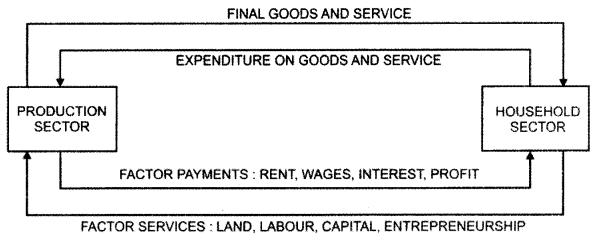
The circular flow with two-sector economy can be explained with the help of the following diagram:
Economics Class 12 Important Questions Chapter 2 National Income Accounting 1
The above diagram shows the two sectors in the economy-the household sector and the production sector. Household sector has the endowment of factors of production (land, labour, capital and entrepreneurship) and it sells them to the production sector which produces goods and services by using these factor inputs.

Production sector sells the goods and services it produces to the household sector. Thus, the output produced by the production sector is consumed by the household sector. It is called real flow, which involves flow of goods and services.

The production sector makes factor payment to the household sector in terms of wages for labour services, rent for land, interest for capital and profits to entrepreneurship. The household sector uses this income to incur expenditure on purchase of consumer goods and services produced by the production sector. This flow of money payments and expenditure is known as money flow.

Question 8.
What is real flow and money flow?
Answer:
Real flow refers to the flow of goods and services across different sectors in an economy. Households provide factors of production such as land, labour, capital and entrepreneur to the firms. The firms, in turn, provide the goods and services so produced to the households.

Money flow refers to the flow of money value across different sectors in an economy. Factor incomes such as rent, wages, interest and profit flow from production sector to household sector and the payment for consumption of final goods and services or consumption expenditure flow from household sector to production sector.

Question 9.
Giving reason, categorise the following into stock and flow:
(i) Capital
(ii) Saving
(iii) Gross Domestic Product
(iv) Wealth (C.B.S.E. 2013)
Answer:
(i) Capital is a stock concept because it is measured at a point of time.
(ii) Saving is a flow concept because it is measured over a period of time.
(iii) Gross Domestic Product (GDP) is a flow concept because GDP is measured over a period of time.
(iv) Wealth is a stock concept because it is measured at a point of time.

Question 10
Will the following be a part of domestic factor income of India? Give reasons for your answer.
(i) Old age pension given by the government
(ii) Factor income from abroad
(iii) Salaries of Indian residents working in Russian Embassy in India
(iv) Profits earned by a company in India, which is owned by a non-resident
Answer:
(i) Old age pension given by the government will not be a part of domestic factor income of India be-cause it is a transfer payment.

(ii) Factor income from abroad will not be a part of domestic factor income of India because it is a part of national factor income of India. Domestic factor income becomes national factor income by adding factor income from abroad to domestic income.

(iii) Salaries received by the Indian residents working in the Russian Embassy in India will be a part of the domestic factor income of India because these are the wages to Indian residents within the national territory of India.

(iv) Profits earned by a company in India, which is owned by a non-resident is not a part of domestic factor income of India because it is a retained earnings of resident company abroad. It is the part of factor income to abroad.

Question 11.
Explain the term ‘compensation of employees’ and its components. Giving reasons, state whether the following are treated as compensation of employees:
(i) Gifts by employers
(ii) Bonus
Answer:
Compensation of employees means the wages and salaries paid for mental and physical abilities of labourers in cash and kind. Following are the components of compensation of employees:

  • Wages and salaries in cash
  • Compensation in kind
  • Employers’ contribution to social security schemes
  • Pension on retirement

(i) Gifts by employers are treated as compensation of employees because it is a payment made in kind.
(ii) Bonus is the part of supplementary income and hence, treated as compensation of employees.

Question 12.
Give the meaning of factor income to abroad and factor income from abroad. Also give an example of each.
Answer:
Factor income from abroad is the sum total of factor incomes earned by normal residents of a country for abroad. For example, wages received by the Indian employees wonclng m American Embassy, Factor income to abroad means payments to foreigner for their goods and services. For example, wages to foreign technical export.

Question 13.
Why are exports included in the estimation of domestic product by the expenditure method? Can Gross Domestic Product be greater than Gross National Product?
Answer:
Expenditure method estimates expenditure on domestic products, that is, expenditure on final goods and services produced within the economic territory of the country. It includes expenditure by both residents and non-residents. Exports, though purchased by non-residents, are produced within the economic territory and therefore, a part of domestic product.

Gross Domestic Product can be greater than Gross National Product if factor income paid to the rest of the world is greater than the factor income received from the rest of the world, that is, when net factor income received from abroad is negative.

Question 14.
Define the problem of double counting in the computation of national income. State any two approaches to correct the problem of double counting. (C.B.S.E 2019)
Answer:
Double counting refers to counting of an output more than once while passing through various stages of production. The problem of double counting arises when the value of some goods and services are counted more than once while estimating national income. In measuring the national income, the value of only final goods and services is to be included. In other words, the problem of double counting arises when value of intermediate goods is also included along with the value of final goods.

Question 15.
How to Avoid Double Counting?
Answer:
There are two alternative ways of avoiding double counting
(a) Final Output Method: According to this method, the value of only final goods should be added to determine the national income.
(b) Value Added Method: Deduct intermediate consumption from value of output to arrive at value added.

Question 16.
Describe the precautions that should be taken while measuring National Income using income method. (C.B.S.E. Outside Delhi 2017)
Answer:
Following precautions should be taken while measuring the National Income using income method:

  • The income from the illegal activities such as theft, smuggling and gambling should not be included in the National Income.
  • Windfall gains such as lottery should not be included.
  • Transfer payment such as unemployment allowance, old age pension, donation to the religious
    places, etc. should not be included in the National Income. ,
  • The value of the production kept for self-consumption should be included in the National Income.
  • The imputed rent of the house in which landlord himself is living should also be included.

Question 17.
Describe the precautions that should be taken while measuring National Income using product method. (C.B.S.E. Outside Delhi 2017)
Answer:
Following precautions should be taken while measuring the National Income using product method or value added method:

  • The value of self-consumption output should be included in the National Income.
  • Imputed rent on the owner occupied house should be taken into consideration while measuring the National Income.
  • Value of the sale and purchase of second hand goods and property should not be included in National Income.
  • The imputed value of the government, corporate and household own-production of fixed capital should be included in the National Income.

Question 18.
Describe the precautions that should be taken while measuring national income using expenditure method. (C.B.S.E. Outside Delhi 2017)
Answer:
Following precautions should betaken while measuring the national income using expenditure method:
(i) While calculating the total expenditure, only the final-expenditure must be included and not the intermediate expenditure. If both of these are included, the problem of double counting arises.

(ii) Expenditure on second hand goods should not be included in final expenditure since the production of old goods took place in previous years and not in the current year.

(iii) The expenditure on old or new shares should not be included in final expenditure because it is only a transfer of wealth, which has not affected production at all.

(iv) Only gross investment should be included in total expenditure. Gross investment also includes expenditure on depreciation.

(v) Factor income (property income, labour income, interest, rent, wages) received by domestic residents from foreign countries should be included in exports, Similarly, factor income paid by domestic territory to foreign residents should be included in imports.

Question 19.
Given nominal income, how can we find real income? Explain. (C.B.S.E. 2018)
Answer:
Real income is the value of current income at base year prices. Nominal income, on the other hand, is the value of income or output at current year prices. Given nominal income, real income can be calculated by taking the ratio of nominal income to the price index and multiplying the result by 100.
That is \( \text { Real Income }=\frac{\text { Nominal Incóme }}{\text { Price Index }} \times 100\)

Question 20.
“Gross Domestic Product (GDP) does not give us a clear indication of economic welfare of a country.” Defend or refute the given statement with valid reason. (C.B.S.E. 2019)
Answer:
The given statement is defended as GDP may not take into account:
(a) Non-monetary Exchanges: The value of these activities in an economy are not evaluated in monetary terms. For example, sen/ices of a housewife such as cooking, gardening, etc. are not included in GDP due to non-availability of data. However, such activities do influence the economic welfare.

(b) Externalities: It refers to the benefits or harms of an activity caused by a firm or an individual for which they are not paid or penalised. Externalities can be positive or negative.

(c) Distribution of GDP: It is possible that with rise in GDP, inequalities in distribution of income may also increase. That is, the gap between the rich and poor increases. GDP does not take into account changes in inequalities in the distribution of income.

Question 21.
“Higher Gross Domestic Product (GDP) means greater per capita availability of goods in the economy.” Do you agree with the given statement? Give valid reason in support of your answer. (C.B.S.E 2019)
Answer:
The given statement is not true. Higher Gross Domestic Product (GDP) does not necessarily mean greater per capita availability of goods in the economy. The level of economic welfare may not rise if with an increase in the level of Gross Domestic Product (GDP), the distribution of GDP becomes more unequal.

Since only a few people benefit from the increase in the level of income, rich are becoming richer and poor are becoming poorer. If GDP growth increases the gap between rich and poor, then it cannot be treated as an index of welfare for a country. Moreover, if the population growth rate is more than the rate of growth of GDP, the per capita availability of goods and services will actually decline.
Or
Explain the meaning of Real Gross Domestic Product and Nominal Gross Domestic Product, using a numerical example. (C.B.S.E 2019)
Answer:
Real GDP is the value of current income at base year prices. Nominal GDP, on the other hand, is the value
of income or output at current year prices. Given nominal income, real income can be calculated as:
\(\text { Real GDP }=\frac{\text { Nominal GDP }}{\text { Price Index }} \times 100\)

Suppose in the year 2010, a country produced 100 units of bread and the price was ₹ 10 per bread. So, the GDP at current price or Nominal GDP was 100 x ₹ 10 = ₹ 1,000.
In 201 I, the same country produced 10 units at ₹ 15 per bread. Therefore, the nominal GDP in 201 I was 10 x ₹ 15 = ₹ 1,650. However, Real GDP in 2011 calculated at the base year price will be I 10 x ₹10 = ₹1, 100.

Question 22.
Distinguish between ‘real’ gross domestic product and ‘nominal’ gross domestic product. Which of these is a better index of welfare of the people and why? (C.B.S.E Outside Delhi 2013)
Answer:
Following are the points of distinction between real and nominal Gross Domestic Product (GDP):

S.No.Real GDPNominal GDP
1.Real GDP is the value of GDP at constant prices.Nominal GDP is the value of GDP at current prices.
2.Real GDP measures the value of output economy, adjusted for price changes,Nominal GDP is the market; or money value of all final goods and sen/ices produced in a country during a year.
3.Real GDP includes factor services provided by households, and, final goods and services provided by the firms,Nominal GDP includes factor payments made by the firms for production resources and the payments made by the households for goods and services.

Real GDP offers a better perspective than nominal GDP when tracking economic output over a period of time. Real GDP increases only when there is an increase in the production of goods and services.

As a result, change in income and employment can be estimated, However, since nominal GDP is valued at current price, it can increase even if there is no change in the production of goods and service. It neglects the impact of inflation on production.

Question 23.
Explain ‘non-morietary exchanges’ as a limitation of using GDP as an index of welfare of a country. (C.B.S.E. 2017)
Answer:
GDP does not take into account those tr^nsidtidfts that are not expressed in monetary terms. This is a major limitation of GDP as an index of welfare of a country as these are many transactions which although are non-monetary in nature but add To the growth and development of the nation. For example, work done by a social worker or a homemaker, Here, a-homemaker adds to the welfare of the family by keeping them healthy, which in turn-adds to the welfare of the country.

However as such transactions are non-monetary in nature, these are not included while calculating the domestic income. In LDCs, there are various non-monetary: exchanges, particularly in the rural areas and household sector. Consequently, such transactions remain outside the domain of GNP leading to underestimation of the value of GNP. Thus GNP cannot be regarded as an index of economic welfare, as it ignores the household and the volunteer sector

National Income Accounting Important Extra Questions Long Answer Type

Question 1.
Distinguish between domestic product and national product giving suitable examples in support of your answer.
Answer:
Domestic product is defined as the market value of all the final goods and services produced by the factors of production located in the country during a period of one year.

On the other hand, national product is the market value of all the final goods and services produced by the factors of production located in the country during a period of one year plus Net Factor income from Abroad (NFIA). NFIA is the difference between the incomes of residents for factor services to the rest of the world and payments to the factor services of non-residents in the domestic territory during a period of one year,

National Product = Domestic Product + NFIA
Example: If the domestic product is ₹ 5,000 and Net Factor Income from Abroad is ₹ 100, then theNational product will be:
National Product = ₹ 5000 +₹ 100 = ₹ 5100

Question 2.
Will the following be included in domestic factor income of India? Give reasons for your answer.
(i) Profits earned by a foreign bank from its branches in India
(ii) Scholarships given by Government of India
(iii) Profits earned by a resident of India from his company in Singapore
(iv) Salaries received by Indians working in American Embassy in India
Answer:
(i) Profits earned by a foreign bank from its branches in India will not be included in domestic factor income of India because it is the factor income of a foreign country or it is the income of non resident in India.

(ii) Scholarships given by the government of India will not be included in domestic factor income because it is a transfer payment and does not contribute to the flow of goods and services.

(iii) Profits earned by a resident of India from his company in Singapore will not be included in domestic factor income of India because it is the income of the resident earned abroad.

(iv) Salaries received by Indians working in American Embassy in India will be included in domestic factor income of India because it is the income of the normal residents of India, earned within the domestic territory of India.

Question 3.
Explain the expenditure method of estimating National Income. (C.B.S.E. 2007)
Answer:
Expenditure method of estimating National Income calculates the sum total of the expenditure by all the .final users: of goods and sendees plus addition to the stock with the producers and distributors. According to this method, expenditures on consumption and investment goods and government expenditures are aggregated as follows:

(i) Consumption Expenditure (C): Consumption expenditure includes expenditure on all goods and services produced and sold to the final consumer during the year.

(ii) Investment Expenditure (I): Investment is the use of today’s resources to expand tomorrow’s production or consumption. Investment expenditure is expenditure incurred on by business firms on:
(a) New plants;
(b) Adding to the stock of inventories; and
(c) Newly constructed houses

(iii) Government Expenditure (G): Government expenditure includes all government expenditure on currently produced goods and services but excludes transfer payments while computing national income.

(iv) Net Exports (X – M): Net exports are defined as total exports minus total imports.
Under expenditure method, National Income is calculated by summing up the final consumption expenditure, expenditure by business on plants, government spending and net exports.
National Income = C + I + G + (X-M)

Question 4.
What is the problem of double counting? How can this problem be avoided?
Answer:
Double counting means estimating the value of goods and services more than once. This problem takes place when the output of all the producers is added up without considering the fact that output of one producer may be the input for the other producer. The problem of double counting should be avoided because it overestimates the national income.

To get rid of the problem of double counting, the value added method is used. Value added method estimates the contribution of each individual firm at different stages of production. It is assumed that every individual firm adds to the value of the product which it purchases from some other firm as intermediary’ goods. When we sum the value added by each individual firm at different stages of production, we attain the National Income without double counting.

The estimation of value added by an individual firm can be explained with the help of an example. Suppose there are four types of firms: farmer, thread manufacturer, cloth manufacturer and readymade garment manufacturer. Their value of output, intermediate consumption and value added are displayed in the table below:

(1)
Stage of Production
(2)
Name of the Firm
(3)
Type of Output
(4)
Value of Intermediary Good (in ₹)
(5)
Value of Output
(in ₹)
(6)
(5) – (4) Gross Value Added (in ₹)
1FarmerCotton…….5,0005,000
IIThread ManufacturerThread5,0006,0001,000
IIICloth MillCloth6,0006,800800
IVGarment ManufacturerShirt.6,8008,0001,200
Total17,80025,8008,000

Thus, the Gross Value Added by a Firm is the difference between the value of output and the value of intermediate consumption.

Question 5.
Giving reason explain how should the following be treated in estimating Gross Domestic Product at Market Price?
(i) Fees to a mechanic paid by a firm
(ii) Interest paid by an individual on a car loan taken from bank
(iii) Expenditure on purchasing a car for use by a firm (C.B.S.E 2014)
Answer:
(i) Fees to a mechanic by a firm will be included while estimating the GDPMP because the fee is being paid in return for the service provided by the mechanic.

(ii) Interest paid by an individual on a car loan taken from a bank will be included while estimating GDPMp because it is an income for the lending bank.

(iii) Expenditure on purchasing a car for use by a firm will be included while estimating GDPMp because the car is purchased by the firm for final use.

National Income Accounting Important Extra Questions HOTS

Question 1.
Are the following stocks or flows?
(i) Investment
(ii) Monetary expenditure
(iii) A hundred Rupee Note
(iv) A family’s consumption of salt
(iv) Services of a tutor
(vi) Production of cement
(vii) Machinery of a sugar mill.
Answer:
Flow is an economic variable that is measured over a specific period of time. Investment, monetary expenditure, a family’s consumption of salt, services of a tutor and production. Cement are flow concepts. Stock is an economic variable that is measured at a specific point of time. A hundred rupee note and machinery of a sugar mill are stock concepts.

Question 2.
Export receipts are not a part of net factor income from abroad. Why?
Answer:
Export receipts are not a part of net factor income from abroad because:
(i) Exports refer to the purchase of domestically produced goods by the rest of the world. Goods produced within the domestic territory of a country are to be treated as a part of GDP.

(ii) Export receipts refer to revenue of the firms from the sale of its output. These are not the receipts of factor incomes from abroad, which are to be in the form or rent, interest, profit and wages.

Politics of Planned Development Class 12 Important Extra Questions Political Science Chapter 3

Here we are providing Class 12 Political Science Important Extra Questions and Answers Chapter 3 Politics of Planned Development. Political Science Class 12 Important Questions are the best resource for students which helps in class 12 board exams.

Class 12 Political Science Chapter 3 Important Extra Questions Politics of Planned Development

Politics of Planned Development Important Extra Questions Very Short Answer Type

Question 1.
Which are the two models of development? Which model of development was adopted by India? (C.B.S.E. 2013)
Answer:
The two models of development are liberal- capitalist model and the socialist model. The Socialist model was adopted by India.

Question 2.
Differentiate between the capitalist and the socialist models of development. (C.B.S.E. 2014)
Answer:
The difference between the capitalist and the socialist models of development are as follows:

  1. The capitalist model believes in open competition in the market, while the socialist model emphasizes state control over the production and distribution system.
  2. The capitalist model does not believe in granting permission or Licence System, while in the socialist model, permission or license is granted to the factory owner.

Question 3.
Mention any two merits of the Green Revolution. (Imp.) (C.B.S.E. 2013)
Answer:

  1. The major achievement of the Green Revolution was to boost the production of major cereals viz. wheat and rice.
  2. As a result of the Green Revolution, the crop pattern in India has undergone significant changes.

Question 4.
How many Five Year Plan has been completed so far?
Answer:
12 Five Year Plan has been completed so far. The term of the 12th Five Year Plan was from April 2012 to March 2017.

Politics of Planned Development Important Extra Questions Very Short Answer Type (2 Marks)

Question 1.
What is meant by planned develop¬ment? (Sample Paper)
Answer:
Planned development means to develop a design or plan for development.

Question 2.
Mention the main objective of the Second Five Year Plan. (Imp.) (Sample Paper, C.B.S.E. 2012 Outside Delhi)
Answer:
The main objective of the Second Five Year Plan was to enhance the growth of Industrial development.

Question 3.
Who was P.C. Mahalanobis? (Imp.) (C.B.S.E. 2009)
Or
What was significant about P.C. Mahalanobis? (C.B.S.E 2013)
Answer:
The second five-year plan was drafted by a team of economists and planners under the leadership of P.C. Mahalanobis.

Question 4.
Who was popularly known as the ‘Milkman of India’? (C.B.S.E. 2013)
Answer:
Verghese Kurien.

Question 5.
What was the ‘Bombay Plan’? (C.B.S.E. 2013)
Answer:
The ‘Bombay Plan’ was a joint proposal of big industrialists (1944) for setting up a planned economy in the country.

Question 6.
What is meant by Decentralised Planning? (Imp.) (C.B.S.E. 2012, 2014)
Answer:
Decentralized planning meant planning which is approachable by the common man. It involved people directly in the developmental activities through voluntary citizen’s organizations.

Question 7.
Differentiate between the main objectives of the First and the Second Five Year Plans.
Answer:
There was a big debate whether more importance should be given to Industries or Agriculture. The First Five-Year Plan stressed on development of agriculture while the Second Five- Year Plan stressed heavy industries.

Question 8.
What is meant by geopolitics? (C.B.S.E. 2012)
Answer:
Geo-politics means politics of land territory. According to G.N. Singh, “A science dealing with the influence exercised by physical geography in determining conditions of political life and relation between state.” According to Houshofer, “Geopolitics demonstrates the dependence of all political development on the permanent reality of the soil.”

Question 9.
How was Kerla’s plan based on decentralized planning? (C.B.S.E. Sample Q.P. 2017)
Answer:
Kerala’s plan was based on decentralized planning because peoples directly involved in development activities through voluntary citizen organizations. The officials took the initiative to involve people in making plans at the Panchayat, block, and district level.

Question 10.
Why does development have different meanings for different sections of the people? (C.B.S.E. 2017)
Answer:
Different sections of the people have different meanings of development. For example, the iron or resources lie in some of the most underdeveloped and pre-dominantly tribal districts of the Orissa state. The state government passed the Memorandum of Understanding (MoU) for the development and global demand for steel. The tribal people fear that the setting up of industries would cause displacement from their homes and livelihood. They were also having the fear that mining and industry would pollute the environment. So, they protested and demanded the cancellation of the agreement.

Choose the correct answer :

Question 11.
Who said, “Planning is a way of organizing and utilizing resources to maximum advantage in terms of defined social ends”?
(a) K.T. Shati
(b) Planning Commission of India
(c) Dr. Rajinder Prashad
(d) None of these.
Answer:
(b) Planning Commission of India.

Question 12.
In India, planning was conceived as the main instrument of:
(a) Political development
(b) Cultural development
(c) Social development
(d) Socio-economic development.
Answer:
(d) Socio-economic development.

Question 13.
How many plans have been completed so far in India?
(a) Twelve
(b) Six
(c) Eight
(d) Four.
Answer:
(a) Twelve.

Question 14.
The Planning Commission in India was set up in :
(a) 1953
(b) 1957
(c) 1960
(d) 1950.
Answer:
(d) 1950.

Question 15.
The Chairman of the National Development Council is :
(a) President of India
(b) Finance Minister of India
(c) Prime Minister of India
(d) Chief Minister of U.P.
Answer:
(c) Prime Minister of India.

Politics of Planned Development Important Extra Questions Short Answer Type

Question 1.
Critically examine the major outcomes of the Indian model of a mixed economy. (Imp.) (C.B.S.E. 2016)
Answer:

  1. The foundations of India’s future economic growth were laid.
  2. Mega dams like Bhakhra-Nangal and Hirakund for irrigation and power generation were undertaken.
  3. Abolition of the colonial system of Zamindari.
  4. The tenants who worked on someone else’s land were given greater legal security against eviction.

Question 2.
Describe the strategy adopted by the Government of India to promote the Green Revolution. (C.B.S.E. 2015)
Answer:
In the 1960s, India was facing a food crisis due to many reasons. India was dependent on the U.S.A. for food which was putting many limitations on India’s policies. Indian Government decided to make India self-sufficient in food. Hence the government adopted a new strategy for agriculture in order to increase food production. Since the mid-1960s, the traditional agricultural practices were gradually replaced by modern technology.

The use of high-yielding variety seeds and the increased use of fertilizers and irrigation are simply called Green Revolution or modern agricultural technology. As a result of the Green Revolution, the area under improved seeds has gone up from about 15 million hectares during 1970-71 to nearly 75 million hectares in 1995-96. The new varieties are of a short term duration and consequently, instead of growing one crop, two crops and sometimes even three crops are grown.

Question 3.
Write a note on the mixed economy.
Answer:
The economy is generally considered of two types. One is a capitalist economy and the other is a socialist economy. A mixed economy is based on the co-existence of these two types of economy.

In most of the poor countries of the world, a mixed economy prevails. A mixed economy is an economy where there is public and private ownership of the means of production. Production is undertaken for both welfare and profit motive. Production in the private sector is a for-profit motive while in the public sector, it is for a welfare motive. Thus, the pattern of mixed economy is the co-existence of public and private sector units.

Question 4.
Examine the major outcomes of the Green Revolution. (C.B.S.E. Sample Q.P. 2017)
Or
Evaluate any four benefits of the ‘Green Revolution’. (C.B.S.E. 2018)
Answer:

  1. The major achievement of the Green Revolution was to boost the production of major cereals viz wheat and rice.
  2. As a result of the Green Revolution, the crop pattern in India has undergone significant changes.
  3. The green revolution largely increased the growth of the local manufacturing sector which created new jobs and contributed to the country’s GDP.
  4. India became self-sufficient in food and India was in a position to pay back all loans it had taken from the World Bank for the purpose of the Green Revolution.

Question 5.
List any two merits and two demerits of the Green Revolution. (Imp.) (C.B.S.E. 2014)
Or
Explain any two merits and two demerits each of the Green Revolution. (C.B.S.E. 2015)
Answer:
Merits of Green Revolution

  1. The major achievement of the Green Revolution was to boost the production of major cereals viz wheat and rice.
  2. As a result of the Green Revolution, the crop pattern in India has undergone significant changes.
  3. The green revolution largely increased the growth of the local manufacturing sector which created new jobs and contributed to the country’s GDP.
  4. India became self-sufficient in food and India was in a position to pay back all loans it had taken from the World Bank for the purpose of the Green Revolution.

Demerits of Green Revolution

  1. Green Revolution had widened the gap between poor and small farmers and rich landlords.
  2. Green Revolution has proved beneficial to the medium category peasants because they can receive the advantage of mediation between small farmers and rich landlords.

Question 6. State any two differences between the First Five Year Plan and the Second Five Year Plan. (C.B.S.E. 2013)
Answer:

  1. In the First Five Year Plan, priority was given to the development of agriculture. The target of increased production of foodgrains, jute, and cotton was mainly achieved by bringing more land under cultivation. But in the Second Five Year Plan (1956-61), the top priority was accorded to the setting up of ‘Socialistic Pattern of Society’ on the basis of Industrial Policy statement 1956. In the Second Plan, the major thrust was to accelerate the process of industrialization by laying emphasis on basic and heavy industries.
  2. The success of the First Five Year Plan was primarily due to a good harvest in the last two years of the plan. During the Second Five Year Plan, prices increased by 30% against a decline of 13% during the First Plan.

Politics of Planned Development Important Extra Questions Long Answer Type

Question 1.
Describe briefly the composition and four functions of the Planning Commission of India. (Imp.) (C.B.S.E. 2011, Outside Delhi)
Or
How was the Planning Commission of India set up? Mention its scope of work. (C.B.S.E. 2010, Outside Delhi)
Answer:
The Planning Commission at the center is the apex body in the planning machinery of the country. The Planning Commission was set up in March 1950 by a resolution of the Government of India. In 1950, Planning Commission was set up under the chairmanship of Prime Minister Pt. Jawaharlal Nehru.

Organization of Planning Commission: The composition of the Planning Commission has kept on changing according to the requirements of the time and whims of the government. The first Planning Commission consisted of a Chairman, a Deputy Chairman and five members. The Prime Minister is the Chairman and the Planning Minister is the Deputy Chairman. First Planning Commission was essentially composed of politicians.

Later on, Pt. Nehru added certain members from the public such as administrators, economists, and technical experts. Thug, the Planning Commission came to combine the political and non-political men. In addition to Chairman and Deputy Chairman, there are ten to twelve other members. Among them, there are five to six ministers, e.g., Minister for Human Resources Development, Finance Minister, Home Minister, Minister of Agriculture, and Minister of State for Planning. Besides, there are a few more members.

The Commission is divided into three major parts:
(a) Programme Advisors
(b) General Secretariat and
(c) Technical Division.

Functions of the Planning Commission

The resolution which created the Planning Commission mentioned the following functions of the Planning Commission :

  1. Assessment of Country’s Resources. To assess the material, capital, and human resources of the country, including technical personnel, and to investigate the possibilities of augmenting such of those resources as are found to be deficient in relation to the nation’s requirements.
  2. Formulation of Plans. To formulate a plan for the most effective and balanced utilization of the country’s resources.
  3. Determine Priorities. To define the stages of the Plan and propose the allocation of resources on the determination of priorities. The Ninth Plan has given priorities to the power sector, transport, and communications.
  4. To indicate the factors which are tending to retard economic development and determine the conditions in view of the current social and political situation should be established for the successful execution of the plan.
  5. To suggest machinery for securing the successful implementation of each stage of the plan.
  6. To appraise from time to time the progress made in the execution of each stage of the plan and to recommend necessary adjustments in policy and measures as may be necessary for the light of such appraisal.
  7. To make such interim recommendations on the basis of the prevailing economic conditions, current policies, etc., as may appear to be appropriate.
  8. To examine such specific problems as may be referred to it for advice by the Central and State Governments.

Besides the above-mentioned functions, another most important task of the Planning Commission is that of formulating the plans for development and assessment of their performance. Originally, Planning Commission was set up as an expert advisory body only. But with the passage of time, the Planning Commission has built for itself a status of high prestige and commanding influence; In view of the enormous increase in the powers of the Planning Commission, it has come to be known as the Economic Cabinet.

In January 2015, NITI Aayog was established in place of the Planning Commission.

Question 2.
Elaborate any three arguments are given by the critics against the mixed model of the economy adopted by India. (C.B.S.E. 2019)
Answer:
Following are the arguments given by the critics against the mixed model of the economy adopted by India.

  1. Critics argue that the planners have not provided sufficient space for the private sector to grow.
  2. Enlarge public sector have their own interests as they invested more and they create hurdles for the private small sectors.
  3. State policies also put restrictions on the export items and domestic market due to lesser competition do not have the incentive to improve their products. The state instead of helping the poor, help the private sector to make more profit and thus create a new ‘middle class’ with high salaries and perks.

Question 3.
Write a note on Niti Aayog.
Answer:
Niti Aayog with a new structure and focus on a policy is the replacement of 64 years old planning commission, which was seen as a vestige of the socialist era. The replacement of the Planning Commission with the new institution more relevant and responsive to the present economic needs and climate in the country had long been demanded and expected. Since 1990, the Government had been dismissive of the Planning Commission, because after the dismissal of licensed government this commission was working like an advisory-board only.

Former Prime minister Rajiv Gandhi had called the commission a bunch of jokers. Even Manmohan Singh and former planning commission Deputy Chairman like K.C. Pant tried some attempts to explore some changes. Former Centre-minister, Kamal Nath named this commission as ‘ArmChair Advisor’ and Parking plot for bureaucrats. Arun Maria, a member of the Planning Commission who headed the Boston Consulting Group (BCG) in India, recommended the changes in the structure, role function, and resources.

Narendra Modi, as the Chief-minister Gujrat had many times pointed the short-comings of the planning commission that is why in May 2014, Narendra Modi led the National Democratic Alliance government to announce the replacement of the 65 years old planning commission with a new institution called Niti Aayog. He called upon an important meeting of Chief-ministers in Delhi on 7 December 2014 and stressed upon greater participation of the state governments in policy-making stressing on India’s diversity and plurality, the Aayog will foster a spirit of co-operative federalism with the sole principle of developing a pro-people, pro-active and participative development agenda stressing on empowerment and equality.

Composition of Niti Aayog Niti Aayog-National Institution for transforming, India is composed to ensure greater participation of state governments in policy making-thus fostering co-operative federalism-and will be more attuned to the nation’s contemporary needs.

  1. Chairperson- Prime-minister
  2. Vice-Chair-person- Nominated by the prime- minister
  3. Chief-Executive officer (C.E.O.) – nominated by prime-minister.
  4. Governing Council-Chief ministers and Lt. Governors of Union Territories.
  5. Regional Council (formed on a need basis)- Chief Ministers and Lt. Governors of Union-Territories
  6. Full time-members- Maximum five-members.
  7. Short term members- Two ex-officio-members
  8. Ex-officio members-Four central ministers Special Invitees- Experts, specialists, practitioners with domain knowledge.

On January 5, 2015, the great economist Arvind Panagariya was appointed as Vice-chairman of the Niti Aayog and then Sindu Shree Khullar was appointed as the first CEO of the Niti Aayog. On December 29, 2015. Sh. Amitabh Kant appointed as CEO of Niti Aayog after the retirement of Sindushree Khullar on 5th August 2017. Sh Rajiv Kumar appointed as vice-chairman of Niti Aayog.

Departments

  • It works like an assembly of interstates problems and their relations etc.
  • It checks and plans long-term plans.
  • Thirdly, it deals with direct benefit, transfer, and UIDAI.

Aims of Objectives: The objectives of the new body is to evolve a shared vision of national development priorities sectors and strategies. Being an incubator of ideas for effective governance would be the core mission of NITI Aayog. following are the objectives of the new national agenda’.

  1. Recommend strategical and technical advice on elements of policy and economic matters.
  2. Develop a mechanism for village level plans and aggregate these progressively at higher levels of government.
  3. Serve as a ‘think-tank’ a directional and policy dynamo for the government and will provide suggestions for the economy including the private sector.
  4. Create a knowledge, innovation, and entrepreneurial support system for national and international experts and other partners.
  5. Offer a platform for the country’s development agendas.
  6. Focus on the technology of implementation of programs and initiatives.

Working: National Institution for Transforming India is-

  1. To evolve a shared vision of national development priorities sectors and strategies with the active involvement of states in the light of national objectives.
  2. To foster co-operative feudalism through structured support initiatives and mechanisms with the states on a continuous basis, recognizing that strong states make a strong nation.
  3. To develop mechanisms to formulate credible plans at the village level and aggregate these progressively at the higher levels of government.
  4. To ensure, on areas that are specifically referred to it, that the interest of national security are incorporated in economic strategy and policy.
  5. To pay special attention to the sections of our society that may be at risk of benefiting adequately from economic progress.

Niti Aayog will work under the supervision of chief-ministers and specialists in different fields. Aayog will ensure greater participation of state- governments in policy-making thus fostering co-operative federalism-and will be more attuned to the nation’s contemporary needs.

The first meeting of Niti-Aayog took place on 6th Feb 2015 and was attended by prime-minister, Narendra Modi, finance minister Arun Jaitly and vice-chairman Sh Arvind Panagariya. Other full-time members V.K. Saraswat, Nitin Gadkari, Thawar Chand Gehlot, G.N. Vajpayee, Rajiv Kumar, Rajiv Lal, R. Vaidyanathan Parath Sarthi Soam, Subeer Gokarn, Mukesh Burani, etc. also attended the meeting.

The second meeting of Niti Aayog took place on 15th July 2015, in which PM desired that center and states must move together to end poverty, states units should be the focus of all developments as a part of team India. The council held consultations on the Right to Fair Compensation and Transparency in Land Acquisition, Rehabilitation, and Resettlement Act. The Prime-minister welcomed and thanked the chief minister for their participation and suggestions for the development of rural areas and greater prosperity for the farmers. He also asked for suggestions for the success of Betti Bachao, Betti Paradao Plan, Smartcity, Digital India, Skill India, Make in India Swach Bharat, etc. plannings.

The opposition criticized the decision to establish NITI Aayog calling it a gin mickey and renamed it as Anati ordurniti Aayog. However, the working of a new institution can be judged only after it has functioned for a sufficiently long time. The efficiency of the Niti Aayog will depend crucially on the quality of experts and how they are allowed to work, Also-the success of the ‘Niti Aayog’ lies in restoring the balance between the technical and political (federal) drivers of the planning process.

It is much too early to think on talk in terms of administrative capacities unless, it trickles down, achache din’ will hardly be felt by the common man. Niyat and Niti’ are inextricably intertwined, the best that can be said for the Aayog is that we should give it sufficient’ time to reveal itself and the out¬come contingent on it. The Aayog’s functioning could make or break the economic development of India in the future.

Question 4.
What was Green Revolution? Examine any two positives and two negative consequences of the Green Revolution. (Imp.)
Or
What was the Green Revolution? Which areas did it affect the most? Mention two positive and two negative consequences of the Green Revolution. (Sample Paper)
Answer:
In the 1960s, India was facing a food crisis due to many reasons. India was dependent on the U.S.A. for food which was putting many limitations on India’s policies. Indian Government decided to make India self-sufficient in food. Hence the government adopted a new strategy for agriculture in order to increase food production. Since the mid-1960s, the traditional agricultural practices were gradually replaced by modern technology.

The use of high-yielding variety seeds and the increased use of fertilizers and irrigation are simply called Green Revolution or modern agricultural technology. As a result of the Green Revolution, the area under improved seeds has gone up from about 15 million hectares during 1970-71 to nearly 75 million hectares in 1995-96. The new varieties are of a short term duration and consequently, instead of growing one crop, two crops and sometimes even three crops are grown.

The major benefits of the Green Revolution were experienced mainly in northern and northwestern India. Unprecedented enthusiasm has prevailed among farmers in Punjab, Haryana, Delhi, Rajasthan, and Western U.P. for the new wheat variety seeds and a situation developed in which the demand for seeds by farmers exceeded the supply.

Economic Results/Positive Consequences of the Green Revolution.

  1. The major achievement of the Green Revolution was to boost the production of major cereals viz wheat and rice.
  2. As a result of the Green Revolution, the crop pattern in India has undergone significant changes.
  3. The green revolution largely increased the growth of the local manufacturing sector which created new jobs and contributed to the country’s GDP.
  4. India became self-sufficient in food and India was in a position to pay back all loans it had taken from the World Bank for the purpose of the Green Revolution.
  5. Green Revolution has helped the growth of capitalist farming in India and has led to the concentration of wealth in the hands of the top 10 percent of the rural population.

Political Results of the Green Revolution.

  1. India became self-sufficient in food and thus India’s prestige increased in the world, especially in the third world.
  2. Green Revolution was a big factor in making Smt. Indira Gandhi and Congress Party more powerful.

Two Negative Consequences of Green Revolution
(i) Green Revolution led to the concentration of wealth in the hands of the top 10 percent of the rural population. The green revolution had widened the gap between poor and small farmers and rich landlords.
(ii) Green Revolution has proved beneficial to the medium category peasants because they could receive the advantage of mediation between small farmers and rich landlords.

Question 5.
Assess any six outcomes of planning in India. (C.B.S.E. Sample Paper 2018)
Or
Assess the outcome of the early phase of planned development in India. (C.B.S.E. 2019)
Or
Describe any three outcomes of early initiatives for planned development in India. (C.B.S.E. 2019)
Answer:
After independence, India adopted economic planning for the development of the people of India. In fact, there was a consensus on the planned development.

For planned development, Planning Commission was set up in March 1950 by a simple resolution of the Government of India. The Planning Commission opted for Five Year Plans. The First Five Year Plan was started in 1951 with the main emphasis on agriculture including investment in Dam and irrigations. The Second Five Year Plan (1956-1961) stressed mainly heavy industries. Rapid industrialization was the main aim of the Second Five Year Plan. Following are the outcomes of planning in India:

  1. Through planning the foundations of India is future economic growth were laid.
  2. Some of the heavy industries were Started.
  3. Planning enhances the economic growth of the country.
  4. Land Reforms lake place through planning.
  5. Through planning the growth of manufacturing was increasing.
  6. India becomes self-sufficient in food.

im-1

Question 6.
Look at the above clipping of the Hindustan Times. You will agree that the agricultural conditions of India went from bad to worse in the 1960s. In the light of this, answer the following questions: (Sample Paper)
(a) How did India solve its problem of food shortage?
Answer:
India solved its problem of food shortage through Green Revolution. Agriculture was modernized and a good variety of seeds were used.

(b) Is India now sufficient in food production? State the reason for your answers.
Answer:
India is now almost self-sufficient in food production.

Question 7.
Study the cartoon given below carefully and answer the questions that follow: (C.B.S.E 2017)

im-2

(i) Identify and name the person who is holding the balancing beam between the public sector and the private sector.
Answer:
The person who is holding the balancing beam between the public sector and the private sector is India’s first prime-minister Pt. Jawahar Lai Nehru.

(ii) Why has a big tilt towards the public sector been shown in the cartoon?
Answer:
A big tilt towards the public sector has been shown in the cartoon because at that time most leaders were in favor of the public sector.

(iii) How did the over-emphasis on the public sector adversely affect the Indian economy?
Answer:
Due to lack of competition, the over-emphasis on the public sector adversely affect the Indian economy.

Note: The following questions are for the Visually Impaired Candidates only, in lieu of the above questions

(i) Distinguish between the public sector and the private sector with the help of at least one example each.
Answer:
In the public sector, the government is holding control over it e.g. Railway. Whereas in the private sector the real control lies with a private person or company and the example Reliance company.

(ii) Keeping in mind the Indian context, which type of economy would you prefer and why?
Answer:
Keeping in mind the Indian context, a mixed type of economy—public as well as private, is the most beneficial type of economy, through which both public and private sectors are benefited.

(iii) Globalisation has promoted which type of economic sector?
Answer:
Globalization has promoted the private type of economic sector.

Question 8.
Read the passage given below carefully and answer the questions that follow: (C.B.S.E. 2019)

India did not follow any of the two known paths to development Elements from both these models were taken and mixed together in India. That is why the Indian economy was described as a ‘mixed economy’.
(i) Name the two models/paths to development.
Answer:
Two models of the path to development are
(a) Capitalist Model
(b) Socialist model

(ii) Why was either of the two models not fully accepted by India? Give at least one major reason for each.
Answer:
Both the models are not fully accepted by India because in the capitalist model the development is entirely left to the private sector, whereas in the socialist model production is controlled by the state and private property is abolished. In India elements from both these models are taken and mixed and that is why it is called ‘mixed economy’.

(iii) Highlight any two features of India’s mixed economy based on the above said, two models.
Answer:
(a) For the mixed economy in India, first of all, the government nationalized the Banking system and also abolished the ‘privy purse’.
(b) India encourage industrialization for the economic growth of the country.

Politics of Planned Development Important Extra Questions HOTS

Question 1.
What is Planning?
Answer:
“Planning is,” defined by Terry, “selecting and relating of facts and the making and using assumptions regarding the future in visualization and formulation of proposed activities necessary to achieve the desired results.” Thus, Planning means to act with purpose or to make efforts to achieve pre-conceived objectives and goals. It implies co-ordination on means and ends.

Question 2.
Why is Planning Commission called an extra-constitutional body?
Answer:
The Planning Commission of India is not established by an Act of Parliament nor as part of a constitutional provision. It is established by a cabinet resolution in March 1950. That is why it is sometimes called an extra-constitutional body, which in theory is an advisory committee of the cabinet.

Question 3.
Name two main advantages of having Economic Planning. (D.B. 1991)
Answer:

  1. Economic Planning awakens the feelings of national interests among the people.
  2. Full exploitation of all resources is possible only in Economic Planning.
  3. In Economic, Planning attempts are made to achieve the target within a definite period.

Question 4.
How many Five Year Plans have been completed so far?
Answer:
In India (till now) 12th Five Year Plans have been completed. The time period of the First Five Year Plan was 1951 to 1956. 2012 to 2017 was the time period of the 12th Five Year Plan.

Question 5.
In which year Planning Commission was established and who was the first chairman of the Planning Commission?
Answer:
The Planning Commission was set up in March 1950 by a resolution of the Government of India. Prime Minister Jawaharlal Nehru was the first Chairman of the Planning Commission.

Class 12 Economics 1 Mark Questions Chapter 10 Comparative Development Experiences of India and its Neighbours 

Here we are providing 1 Mark Questions for Economics Class 12 Chapter 10 Comparative Development Experiences of India and its Neighbours  are the best resource for students which helps in class 12 board exams.

One Mark Questions for Class 12 Economics Chapter 10 Comparative Development Experiences of India and its Neighbours

Question 1.
Name the largest democracy of the world.
Answer:
India is the largest democracy of the world.

Question 2.
When did China announce its first Five Year Plan?
Answer:
China announced its first Five Year Plan in 1953.

Question 3.
What was the objective of the Great Proletarian Cultural Revolution introduced by Mao?
Answer:
Under the Great Proletarian Cultural Revolution, students and professionals were sent to work and learn from the countryside.

Question 4.
What are the government owned enterprises known in China?
Answer:
The government owned enterprises are known as State Owned Enterprises—SOEs in China.

Question 5.
When were reforms initiated in Pakistan?
Answer:
Reforms were initiated in 1988 in Pakistan.

Question 6.
Which country is the most populated in the world?
Answer:
China is the most populated country in the world.

Question 7.
Arrange India, China and Pakistan in terms of their HDI ranks.
Answer:
The three nations are arranged in terms of their HDI ranks
(i) China
(ii) India
(iii) Pakistan

Question 8.
Which sector contributes the most in the India’s GDP?
Answer:
Sendee sector contributes the most in the India’s GDP.

Question 9.
What is the density of population in India, Pakistan and China?
Answer:
The density of population in India, Pakistan and China is 441, 245 and 146 persons per sq. km. respectively.

Question 10.
Which country has largest share of poor among India, China and Pakistan?
Answer:
India has the largest share of poor among the three countries.

Question 11.
List any two problems which China faced prior to the introduction of reforms in 1978.
Answer:
Problems faced by China prior to the introduction of reforms in 1978 were:
(i) Slow pace of growth
(ii) Lack of modernisation under the Maoist rule

Question 12.
Where did India borrow from to correct its balance of payments crisis.
Answer:
India borrowed from the IMF and World Bank to correct its balance of payments crisis.

Era of One Party Dominance Class 12 Important Extra Questions Political Science Chapter 2

Here we are providing Class 12 Political Science Important Extra Questions and Answers Chapter 2 Era of One Party Dominance. Political Science Class 12 Important Questions are the best resource for students which helps in class 12 board exams.

Class 12 Political Science Chapter 2 Important Extra Questions Era of One Party Dominance

Era of One Party Dominance Important Extra Questions Very Short Answer Type

Question 1.
When was the Election Commission of India set-up? Who was its first Chief Election Commissioner? (Imp.) (C.B.S.E. 2013)
Answer:
The Election Commission was set up in January 1950. Sukumar Sen was the first Chief Election Commissioner.

Question 2.
How did the dominance of The Congress Party in the first three general elections help in establishing a democratic set-up in India? (C.B.S.E:’2015)
Answer:
The dominance of the Congress was helpful in the first three general elections in establishing a democratic set-up in India. Many parties contested elections in conditions of free and fair elections and yet Congress managed to win the election after the election. This situation was helpful for democratic stability in India, and due to this, many other political institutions were established.

Question 3.
Explain the major difference of ideology between that of the Congress and the Jana Sangh. (C.B.S.E. 2014)
Answer:
Following are the major difference in ideology between that of the Congress and the Jana Sangh:

  1. Jana Sangh was opposed to the granting of concessions to religious and cultural minorities, but Congress supported this policy.
  2. Jana Sangh was against Article 370, but The Congress Party favored it.

Question 4.
Mention any two ideologies of Bharatiya Jan Sangh. (Sample Paper)
Or
Mention any two important feature j of Bharatiya Jana Sangh’s in ideology, (C.B.S.E. 2013)
Or
Highlight any two features of the j ideology of Bharatiya Jana Sangh. (C.B.S.E. 2014)
Answer:

  1. Jana Sangh emphasized the idea of one country, one culture, and. one nation.
  2. Jana Sangh has full faith in Indian culture and traditions. Jan Sangh was opposed to the granting of concessions to religious and cultural minorities.

Question 5.
Why did the Communist Party of India split in 1964? (C.B.S.E. 2011, Delhi)
Or
When and why was the Communist Party of India (CPI) divided into two factions? (C.B.S.E. 2012, Delhi)
Answer:
The Communist Party of India split in 1964 due to the ideological rift between the Soviet Union and China. The pro-Soviet faction remained as the CPI, while the opponents formed the CPI (M).

Question 6.
Match the facts given in Column ‘A’ with those column ‘B’ in a meaningful way: (C.B.S.E. 2018)

Column ‘A’Column ‘B’
(a) Architect of the Second Five Year Plan(i) Balraj Madhok
(b) One of the leaders of Jana Sangh Kalam Azad(ii) Maulana Ahul
(c) Leader of the Swatantra party(iii) P.C. Mahalanobis
(d) Proponent of Hindu-Muslim                Unity(iv) Minoo Masani

Answer:

Column ‘A’Column ‘B’
(a) Architect of the Second Five Year Plan(iii) P.C. Mahalanobis
(b) One of the leaders of Jana Sangh Kalam Azad(i) Balraj Madhok
(c) Leader of the Swatantra party(iv) Minoo Masani
(d) Proponent of Hindu-Muslim                Unity(ii) Maulana Ahul

Era of One Party Dominance Important Extra Questions Very Short Answer Type (2 Marks)

In which year first general election was held in India? (C.B.S.E. 2012 Outside Delhi)
Answer:
The first general election was held in 1952.

Question 2.
Which Political Party laid emphasis on the Idea of one country, one culture, and one nation?
Answer:
Jan Sangh.

Question 3.
During the first three general elections, the Congress won more seats than any other party. Which party stood at the second number during these:
Answer:
The Communist Party of India stood at the second number during these elections.

Question 4.
Who was the founder of the Bhartiya Jana Sangh? (C..B.S.E. 2014)
Answer:
Dr. Shyama Prasad Mukherjee was the founder of the Bhartiya Jana Sangh.

Question 5.
What inspired the formation of the Communist group in 1920e in different parts of India? (C.B.S.E. 2014)
Answer:
In the early 1920s, Communist groups emerged in different parts of India by being inspired by the Bolshevik Revolution in Russia.

Question 6.
In which year the Election Commission started using EVM?
Answer:
The Election Commission started using EVM towards the end of the 1990s.

Question 7.
Which political party of India had leaders like A.K. Gopalan, E.M.S. Namboodiripad and SA. Dance? (C.B.S.E. 2014)
Answer:
Communist Party of India had the leaders like A.K. Gopalan, E.M.S. Namboodiripad and S.A. Dange.

Question 8.
What has been the ideology of left parties in India? (C.B.S.E. 2017)
Answer:
The ideology of the left parties in India has been based on communism.

Question 9.Name the founder President of the Congress Socialist Party. What name was given to this party after 1948? (C.B.S.E. 2013)
Answer:
Acharya Narendra Deva was the founder President of the Congress Socialist Party. After 1948, this party was known as the Socialist Party.

Question 10.
What do you mean by defection? (C.B.S.E. 2012 Outside Delhi)
Answer:
Defection means an elected representative leaves the party on whose symbol he was elected and joins another party.

Choose the correct answer:

Question 11.
In which year first general election was held in India?
(a) 1947
(b) 1952
(c) 1955
(d) 1960.
Answer:
(b) 1952.

Question 12.
Who became the Prime Minister of India after the first general election?
(a) Pt. JL. Nehru
(b) Sardar Patel
(c) Smt. Indira Gandhi
(d)Mahatma Gandhi.
Answer:
(a) Pt. JL. Nehru.

Question 13.
In 1957, which party formed the government in Kerala?
(a) Jan Sangh
(b) C.P.I
(c) Congress
(d) Socialist Party.
Answer:
(b) C.P.I.

Question 14.
When was the Socialist Party formed in India?
(a) 1948
(b) 1952
(c) 1955
(d) 1960.
Answer:
(a) 1948.

Era of One Party Dominance Important Extra Questions Short Answer Type

Question 1.
Explain any four reasons for the dominance of the Congress Party in the first three general elections. (C.B.S.E. 2013)
Or
Explain any four reasons for the dominance of the Congress Party in the first three general elections in India. (C.B.S.E. 201S)(Imp.)
Answer:
Indian National Congress dominated in the first three general elections. Following factors were mainly responsible for the dominance of the Congress party:

  1. Indian National Congress is the oldest party in Asia. Congress party was established in 1885.
  2. Congress party played a very important role in the freedom struggle. In fact, the history of the National movement in the history of the Congress party. Many leaders and thousands of workers of the Congress party remained in jail for years.
  3. Congress party was led by Pt. Jawaharlal Nehru, Dr. Rajendra Prasad, Acharya J.B., Kripalani, Dr. Pattabhi Sitaramayya, etc.
  4. Congress party was the only party having proper organization at the root level. Its nation-wide organization enabled the Government to keep in close touch with the people and to function as an effective democracy.

Question 2.
What distinguished the dominance of the Congress Party in India from other examples of one-party dominance in otter countries? Explain. (C.B.S.E. 2016)
Or
What distinguished the dominance of the congress party of India from the one-party dominance in other countries? Explain. (C.B.S.E. 2017)
Answer:
In India, the Indian National Congress dominates Indian Politics up to 1967. Besides India, there were certain other countries where one party dominated. There are some countries like China, Cuba, North Korea, etc., where only one party is allowed under the constitution. A few years ago in Mexico one-party dominated like South Korea and Taiwan. In India multi-party system exists. Many political parties contested elections and elections are held free and fair. Congress party has managed to win election after elections. Congress’s dominance was on the support of the masses. However, in Mexico, there was no democratic system in a reality.

Question 3.
Whom did the two factions of the Communist Party support, after its split in 1964, and Why? (C.B.S.E. 2019)
Answer:
Communist Party of India was established in 1924. In the first general election in 1952 CPI won 16 seats, in 1957 it got 27 seats and in 1962 it won 29 seats. In 1957 CPI established a democratic government in Kerala for the first time in the world. In 1964, the Party went through a major split due to ideological rift between the Soviet Union and China-pro-Soviet faction remained as the CPI while the opponents formed the CPI(M). Supporting Marxian ideology.

Question 4.
Highlight the circumstances that compelled the socialists to form a separate socialist party in 1948. Mention any two grounds on which they criticized the Congress Party. (C.B.S.E. 2016)
Answer:
The Congress Socialist Party (CSP) was formed within the Congress in 1934. This was formed by a group of young leaders, who wanted to bring more radical find social changes to Congress. In 1948, Congress amended its constitution and ended the dual partnership. This compelled the socialists to form a separate socialist party in 1948. They believed in democratic-socialism which distinguished them both from the congress as well as from the communist. The Congress Socialist Party criticized the Congress for the following reasons

  1. Congress favored the landlords and capitalists.
  2. Congress ignores the rights of workers and peasants.

Question 5.
Explain any four problems faced by the Election Commission of India while holding the First General Election. (C.B.S.E. 2013)
Answer:
Following were the three main problems before the Election Commission of India for holding the First General Elections:

  1. The first problem was to conduct a free and fair election.
  2. There were more than 17 crore voters which was a record in itself in the whole world.
  3. For the first time, a general election was held in a poor and illiterate country which was a big test of democracy. Before that, elections were successfully conducted in prosperous and literate countries of Europe and North America.

Question 6.
Who founded the Swatantra Party in 1959? Describe any three policies and programs of this party. (C.B.S.E. 2013)
Or
Describe any four features of the ideology followed by the Swatantra Party founded in 1959. (C.B.S.E. 2019)
Answer:
Rajagopalachari founded the Swatantra Party in 1959.

  1. The Swatantra Party firmly believed that the government should not interfere in economic matters.
  2. The party was against centralized planning, nationalization, and the public sector.
  3. It was also against land ceilings in agriculture and opposed co-operative farming.
  4. It was also opposed to the progressive tax regime.

Question 7.
How did the methods of voting in free India go on changing from time to time till day? Explain the reasons also. (C.B.S.E. 2017)
Answer:
In the general elections of 2019 Electronic Voting Machine (EVM) was used to record voters’ preferences whereas in the first general* election, in each polling booth, a box for each candidate with the election symbol of that candidate was placed. Each voter was given a blank ballot paper which they had to drop into a box of the candidate they want to vote for.

But it was a very time consuming and expensive method. Booth capturing was another drawback of the ballot paper system therefore the government of India and the election commission of India decided to go with E.V.M. In the 2019 Loksabha election, V.V.PAT was also used with E.V.M.

Question 8.
Examine the dramatic changes that took place in the party system in India from 1969 to 1977. (C.B.S.E. 2017)
Answer:

  1. The Oldest Party: Congress party was divided in 1969.
  2. In Congress: Indira Gandhi became very popular, but her organization was weak.
  3. From 1969 to 1977 opposition parties organized themselves.
  4. In 1977 opposition party known as Janta Party formed the government for the first time in India.

Era of One Party Dominance Important Extra Questions Long Answer Type

Question 1.
Analyze the reasons for the dominance of the Congress Party in the first three general elections. (C.B.S.E. 2014)
Or
Identify the factors that contributed to the dominance of the Congress party during the early years of independence. (C.B.S.E. Sample Q.P. 2017)
Or
State the causes responsible for the rise of the Congress system in India. (C.B.S.E. Sample Paper 2018)
Or
Highlight any three major reasons for the dominance of the Congress Party in the first three general elections after Independence. (C.B.S.E. 2019)
Answer:
After Independence, the Congress Party dominated the political scene at the center as well as in states before 1967. The Congress secured 364, 371, 361, and 283 seats in the elections of 1952, 1957, 1962, and 1967 respectively. The dominance of Congress was due to many reasons:
1. The Congress Party was established in 1885 and it played a very important role in the national movement. In fact, the history of the national movement is almost the history of the Congress Party. Congress Party wholeheartedly fought for India’s independence and did not worry about sacrifices.

2. Congress provided able leadership to the Indian masses from 1885 to 1947. The Congress Party was led by such great personalities as Mahatma Gandhi, Pt. Jawaharlal Nehru, Sardar Vallabhbhai Patel, Mrs. Indira Gandhi.

3. The Congress Party was a well-organized party and no other political party had such a well-knit organization.

4. After Independence, The Congress Party not only tried to solve the problems of the masses but also faced the challenges before the nation.

Moreover, the Congress Party represents a mixture of almost all shades of opinion. It is, in fact, a ‘Grand Coalition’. It was rather a privileged party to harbor all sorts of political ideologies under the garb of freedom struggle.

Question 2.
Highlight the political ideology of the Communist Party of India. (C.B.S.E Sample Paper 2018)
Answer:
Following are the Political Programme of the Communist Party of India-
1. The C.P.I. attaches the utmost priority to safeguarding the integrity, security, and sovereignty of India.

2. The C.P.I. favors the preservation and strengthening of the secular democratic set up of the country in the struggle against all types of divisive forces.

3. The manifesto calls for 10 percent job reservation for the economically weaker sections of forwarding castes in addition to the implementation of the Mandal Commission report. The party is for the implementation of a 30 percent job reservation for women.

4. The party is for the speedy implementation of comprehensive measures for social justice.

5. The party has demanded a restructuring of Centre-State relations in the true spirit of federalism. The state should be given more powers as recommended by the Sarkaria Commission.

6. The Party called for the abrogation of Article 356 of the Constitution and enlarging the democratic and civil rights of the people.

7. The fate of the state government is to be decided on the floor of the house.

8. The Party has demanded real decentralization to be carried out by conferring more power and financial resources to elected bodies district, block, and Panchayat levels.

9. The party favors effective steps f0r the elimination of corruption. Lok Pal Bill which includes within its scope, legislators, and also the Prime Minister should be adopted. Transfers and postings which are a fertile source of corruption should be done by a committee of senior officials.

10. All legislators, MPs, MLAs, ministers, and high officials must disclose their assets and place them before parliament and assemblies.

11. It has demanded the repeal of all undemocratic statutes including ESMA and NSA and enlarging democratic and civil rights of the people.

12. The Party is committed to strengthening the parliamentary democratic system.

Question 3.
Describe the difficulties that the Elections Commission of India faced in holding the first general elections after Independence. (C.B.S.E. 2019)
Or
Described the various steps taken to hold the First General Elections in India. How far were these elections successful? (Imp. C.B.S.E. 2014)
Answer:
Indian Constitution came into effect on 26 January 1950. Under the Indian Constitution, democracy was established in India. The election commission of India was set up in January 1950. Sukumar Sen was the first Chief Election Commissioner of India. The country’s first general elections were held in 1952. The first general election of 1952 is considered as a landmark in the history of democracy in the whole world.

  1. The first general election was a landmark in the history of democracy because there were more than 17 crore voters, which was a record in itself in the whole world.
  2. The strength of the Lok Sabha was 489 and about 3,200 MLAs of all the Legislative Assemblies of India. These members were to be directly elected by the voters on the basis of single-member constituencies.
  3. More than 3 lakh officers and polling staff were trained to conduct the first general elections.
  4. The first general election was also the first big test of democracy in a poor and illiterate country. Before that, elections were conducted in prosperous and literate countries of Europe and North America.
  5. First general elections were conducted on the basis of the Universal Adult Franchise whereas in many countries of Europe women did not enjoy the right to vote. In India, all adult citizens were given the right to vote.

Thus, the first general elections of 1952 was a grand landmark in the history of democracy in the whole world. It was really a great achievement for India.

Question 4.
“Congress had remained a social and ideological coalition for a long period.” Justify the statement.
(C.B.S.E. 2013)
Or
For a long time, The Congress Party had been a social and ideological coalition”. Justify the statement. (C.B.S.E. 2014):
Answer:
Ideologically, the Congress took root and came to political power not as a party but as a movement for independence and reform. The Congress party was” established in 1885 by higher middle class from English speaking persons. But with both the Non-cooperation Movement and the Civil Disobedience Movement, the social base of the Congress party widened. All types of people with diverse interests became members of the Congress party. Peasants and landlords, industrialists and workers, urban elites and villagers, capitalists and poor, upper caste and lower castes persons, etc., all were within the Congress.

Congress party was in fact, an ideological coalition. Rajni Kothari has rightly pointed out that “The Congress represents all shades of opinion, all major interest groups in the society and indeed all other parties as well. The Congress represented India’s diversity in terms of classes and castes, religions and languages, and various interests. Maximum opposition political parties are the dissenting elites of the Congress party, who share two common social and intellectual backgrounds as of the Congressmen.”

Question 5.
Describe the changing methods of voting in India from 1952 to today. (C.B.S.E 2019)
Answer:
India is the largest democratic country in the world. Therefore regular election is going on by the election commission of India. For the passage of time, there is a change in the voting method of election.

In the general elections of 2019 Electronic Voting Machine (EVM) was used to record voters’ preference whereas in the first general election, in each polling booth, a box for each candidate with the election symbol of that candidate was placed. Each voter was given a blank ballot paper which they had to drop into a box of the candidate they want to vote for.

But it was a very time consuming and expensive method. Booth capturing was another drawback of the ballot paper system, therefore, the government of India and election commission of India decided to go with EVM as a pilot project in the general election held in 2004, in 2019 Loksabha election the entire election held with EVM and V.V.PAT (Voter Verifiable Paper Audit Trail).

Question 6.
Describe the role of opposition parties in the first phase of democratic politics in our country which was quite unique. (C.B.S.E 2019)
Answer:
The role of opposition parties in the first phase of democratic politics in our country was quite unique. Even then India had a large number of diverse and vibrant opposition parties than many other multi-party democracies.

After independence, the Congress party dominated Indian politics. In the first three elections, the Congress party secured more than two-third of seats in the Lok Sabha. Even then many opposition parties emerged in the Lok Sabha. Though there was no official and recognized opposition in the Lok Sabha, yet there were many small opposition parties who played an important role in maintaining the democratic character of the system.

The roots of almost all the non-Congress parties of today can be traced to one or the other of the opposition parties of the 1950s. Though opposition parties had a token representation in the Lok Sabha, yet opposition leaders were very effective due to their status and personality. The opposition parties criticized the policies of the Congress party and kept the ruling party under control. The opposition parties believe in healthy and positive criticism. Thus, opposition parties played a very important role in maintaining the democratic character of the system.

Question 7.
How did the dominance of The Congress party affect the democratic nature of Indian politics? Explain. (C.B.S.E. 2013)
Answer:
In India, the multi-party system exists. Several political parties participate in elections. But Indian National Congress dominated at the centre as well as the states till 1967. The prevalence of ‘one-party dominant system’ has adversely affected the democratic nature of Indian politics. In fact, the dominance of a single party is opposed to democracy as other political parties cannot flourish. Due to a lack of organized opposition, the Congress party never fulfilled the promises made to the people. Congress remained in power for a long period and hence no other party got a chance to rule.

Its administration has become virtually inefficient leading to widespread corruption. Pt. Jawaharlal Nehru himself accepted the fact that “The Congress has developed into a monolithic organization making it virtually impossible for the growth of a sound party system in the country”. According to R.A. Gopalaswami “The party system which has emerged in our country is not only incompatible with the particular democratic institutions we have adopted but constitutes a clear danger to the survival of democracy of India.”

Question 8.

Political Science Class 12 Important Questions Chapter 2 Era of One Party Dominance im-1

In the Outline political map of India given above, five States have been: marked as A, B, C, D and E. With the j help of the Information given below, I identify them and write their correct: names in your answer book along with j the serial number of the information j used and the related alphabet in the j map. (C.B.S.E. 2015) j
(i) The State to which C. Raja-: Gopala Chari, the first Indian Governor-General of India, belonged.
Answer:
D-Tamil Nadu

(ii) The State where the first non-Congress Government was formed by E.M.S. Namboodiripad.
Answer:
E-Kerala

(iii) The State to which Rafi Ahmed Kidwai, the Union Minister for Food and Agriculture (1952-54) belonged.
Answer:
B-Uttar Pradesh

(iv) The State which faced the most acute food crisis in 1965-1967.
Answer:
A-Bihar

(v) The State which led the country: to White Revolution through Dairy Cooperative Movement.
Answer:
C-Gujarat.

Question 9.
Read the passage given below carefully and answer the following questions: (C.B.S.E. 2018)

The congress evolved from its origins in 1885 as a pressure group for the newly educated professional and commercial classes to a mass movement in the twentieth century. This laid the basis for its eventual transformation into a mass political party and its subsequent domination of the political system, Thus the Congress began as a party dominated by the English speaking, upper caste, upper-middle-class, and urban elite. But with every Civil Disobedience Movement, it launched, its social base widened.
(а) What is meant by a pressure group?
Answer:
In the ordinary sense of the word, pressure groups consist of the groups of people with vested interests and they get support in favor of their interests and objectives by influencing the legislators. These groups are neither political parties nor political organizations rather they are unlike the political parties.

(b) Explain the reason for Congress to be transformed into a rainbow-like social coalition by the time of Independence.
Answer:
The congress party was established in 1885 by a higher middle class from English speaking persons. But with both the Non-cooperation Movement and the Civil Disobedience Movement, the social base of the Congress party widened. All types of people with diverse interests became members of the Congress party.

(c) What made the Congress into a mass political party in the twentieth century?
Answer:
The congress evolved from its origins in 1885 as a pressure group for the newly educated professionals and commercial classes to a mass movement in the 20th century. This laid the basis for its eventual transformation into a mass political party.

Question 10.
Read the following passage and answer the questions given below: (C.B.S.E. 2019)

India is not the only country to have experienced the dominance of one party. If we look around the world, we find many other examples of one-party dominance. But there is a crucial difference between these and the Indian experience. In the rest of the cases, the dominance of one party was ensured by compromising democracy. In some countries like China, Cuba, and Syria the constitution permits only a single party to rule the country.
(i) Which political party dominated the political scene of India after independence and how long?
Answer:
Congress party dominate the political scene of India after independence from 1952 to 1967.

(ii) How did the one-party dominance in India differ from that of China?
Answer:
One-party dominance in India was based on a democratic system, but in China, one-party dominance based on a communist (Dictatorship) system.

(iii) Highlight any two drawbacks of a single-party rule.
Answer:
Following are the two drawbacks of a single party rule:

  1. Against Democracy: The single-party system is against democratic principles because in this system the people do not enjoy the right to form associations.
  2. Election a Mere Show: In a single-party system, an election is a mere show. All the candidates belong to the same political party.

Era of One Party Dominance Important Extra Questions HOTS

Question 1.
When was the Congress party founded in India and by whom?
Answer:
Indian National Congress was established in 1885 at Bombay. Congress party was founded by Mr. A.O. Hume.

Question 2.
Give the names and symbols of any two National Parties in India.
Answer:

  1. Indian National Congress-Open Hand.
  2. B.J.P.-Lotus.

Question 3.
Mention any two characteristics of the party system in India.
Answer:

  1. In India, the multi-party system exists and these parties represent diverse interests.
  2. Though there have been a large number of political parties, there has been a dominance of the Congress party both at the center and the state level for a longer period.

Question 4.
What was the method of voting in the first general election?
Answer:
In the first general election at each polling booth, a Ballot box for each candidate with the election symbol of that candidate was placed. Each voter was given a blank ballot paper which they had to drop after stamping into the box of the candidate of their choice.

Question 5.
Did anyone vote from your family in the first or second general elections? Who did they vote for and why?
Answer:
My elder brother voted in the first two general elections. He voted for The Congress party because he had full faith in the leadership of Pt. Jawaharlal Nehru.