Geomorphic Processes Class 11 Important Extra Questions Geography Chapter 6

Here we are providing Class 11 Geography Important Extra Questions and Answers Chapter 6 Geomorphic Processes. Important Questions for Class 11 Geography are the best resource for students which helps in class 11 board exams.

Important Questions for Class 11 Geography Chapter 6 Geomorphic Processes

Geomorphic Processes Important Extra Questions Very Short Answer Type

Question 1.
What are exogenetic forces?
Answer:
The external forces are known as exogenetic forces.

Question 2.
What are endogenetic forces?
Answer:
The internal forces operating from within the earth are known as endogenetic forces.

Question 3.
What is the degradation?
Answer:
The wearing down of relief is known as degradation.

Question 4.
What is the function of endogenetic forces?
Answer:
These forces continuously elevate or build up parts of the earth’s surface.

Question 5.
Name the various exogenetic elements.
Answer:
Water, air wind, ice, etc. are exogenetic elements.

Question 6.
How is energy generated within the earth?
Answer:
The energy within the earth is generated by radioactivity, rotational and tidal friction.

Question 7.
What is the effect of gravitational stresses?
Answer:
They activate wave and tide induced currents and winds.

Question 8.
What is orogeny?
Answer:
Orogeny is a mountain building process.

Question 9.
What causes earthquakes?
Answer:
Orogeny, epeirogeny, plate tectonics cause earthquakes.

Question 10.
Name the denudation processes.
Answer:
Weathering, mass wasting/movements, erosion and transportation are the denudation processes.

Question 11.
Name the different types of weathering.
Answer:
Weathering is of three types:-

  1. Chemical,
  2. Physical,
  3. Biological weathering.

Question 12.
What are the important agents of weathering?
Answer:
Frost, wind, heat, glacier and running water.

Question 13.
Name the two active factors of soil formation.
Answer:
Climate and living organisms.

Question 14.
What do you mean by exfoliation?
Answer:
It is the process of peeling off the outer layers from the main rock.

Question 15.
What is bad land?
Answer:
An area dissected with gullies and ravines.

Question 16.
What is humus?
Answer:
Humus is the organic matter of vegetable or animal organs in the soil.

Question 17.
How do organic soils develop?
Answer:
Organic soils develop from the accumulation of plant residues that are preserved by the low oxygen environment of shallow and stagnant waters.

Question 18.
Name the primary factors responsible for the development of soils.
Answer:
The primary factors responsible for the development of soils are parent material, climate, biota, topography and time.

Question 19.
What is eutrophication?
Answer:
Enrichment of water with nutrients, primarily phosphorous, causing abundant aquatic plant growth is called eutrophication.

Question 20.
Define soil profile.
Answer:
A vertical section of the soil through all its horizons and extending into the parent material is called a soil profile.

Question 21.
What is pedology?
Answer:
The branch of science that deals with the study of soil are called pedology.

Question 22.
What is added to the saline soil to reduce its salinity?
Answer:
Gypsum is added to the saline soil to reduce its salinity and make it useful for crops.

Question 23.
What are the mineral contents of laterites?
Answer:
The mineral contents of laterites include aluminium and iron oxide,

Question 24.
What makes the soil alkaline?
Answer:
Alkaline soils are formed in areas of low rainfall due to the accumulation or retention of lime.

Question 25.
Name the four soil-forming processes.
Answer:
The four soil-forming processes are eluviation, illuviation, Teaching and chelation.

Question 26.
What does ICAR stand for?
Answer:
ICAR stands for Indian Council of Agricultural Research.

Question 27.
Name eight soil groups as classified by ICAR.
Answer:
They are alluvial soils, black soils, red and yellow soils, laterite, arid, saline, peaty, organic and forest soils.

Geomorphic Processes Important Extra Questions Short Answer Type

Question 1.
What are geomorphic processes? Describe briefly.
Answer:
The endogenetic and exogenetic forces causing physical; stresses and chemical actions on earth materials and bringing about changes in the configuration of the earth’s surface are known as geomorphic processes. Diastrophism and volcanism are endogenetic geomorphic processes.

Question 2.
Distinguish between exogenetic and endogenetic forces.
Answer:
Exogenetic forces: The earth’s surface is being continuously subjected to external forces induced basically by the energy (sun). These external forces are known as exogenetic forces.

Endogenetic forces: The forces originating within the earth from its interior are known as endogenic forces. They are responsible for building up and wearing down of the earth’s surface.

Question 3.
What is directional force and what is its role?
Answer:
Gravity is a directional force. It activates the movements of matter and also causes stresses on the earth materials. Indirect gravitational stresses activate wave and tide induced currents and winds. Without gravity and gradients, there would be no mobility and hence no erosion.

Question 4.
What do you understand by oxidation?
Answer:
When atmospheric oxygen combines with minerals of rocks (especially with iron) to form oxides, the process is known as oxidation, v Rocks get rusted due to the presence of air and water. The rocks begin to decay and crumble to a powder mass of brown dust.

Question 5.
What is carbonation?
Answer:
Carbonation is the process in which rainwater gets mixed with carbon dioxide. It dissolves limestone, chalk and marble rock to form carbonates or bicarbonates with minerals. Calcium carbonates and magnesium carbonates are dissolved in carbonic acid.

Question 6.
What is weathering?
Answer:
Weathering means the weakening or wearing down, breaking up, rotting and disintegration of rocks at or over the earth’s surface.

Question 7.
What is chemical weathering?
Answer:
Chemical weathering is the decomposition of rocks by chemical methods. It results from the action of weak acids and gases like oxygen, carbon dioxide and hydrogen. Chemical weathering produces a chemical change in the minerals of rocks. High temperatures and humidity cause the rocks to decompose.

Question 8.
How does mass wasting take place?
Answer:
The force of gravity acts constantly upon the soil and bedrock. At various places, the internal strength of these materials is sufficient to keep them in place. But when the ground surface is sloping, the force of gravity is directed down the slope parallel with the surface. Every particle has least same tendency to roll or slide downhill and will do so whenever the downslope force exceeds the resisting forces of friction and cohesion that tend to bind the particles to the rest of the mass.

Question 9.
How does biota help in soil development?
Answer:
Biota is the collective term for the animal and plant life of a specific area as per the period of time. The decomposition of organic wastes and residues and the activities of living plants and animals have marked influence on soil development. Burrowing animals such as moles, prairie dogs, earthworms, ants and termites help soil development slowly by decomposing organic matter and forming weak acids that dissolve minerals faster. The roots of living plants and decomposed plant material release weak organic acids that help in weathering and soil development.

Question 10.
What is the pH value of soils?
Answer:
‘pH’ value means ‘potential hydrogen’, the standard measure of activity or Alkalimists in the soils. It is based on the activity of hydrogen ions in a litre of a solution, expressed in gram per litre. The pH value range from 0 to 14.0. Neutrality is at 3.0. Numbers lower than neutrality signify increasing acidity and higher numbers increasing salinity. Knowledge of the pH value of the soil under cultivation is most important in agriculture and horticulture.

Question 11.
What is saline soil?
Answer:
Because of the dry climate and poor drainage conditions, this soil acquires more salt. It is widespread in western Gujarat (Rann of Kutch), deltas of the east coast and Sunderban areas of West Bengal. Gypsum diminishes the salinity of soil and makes it useful for drops.

Question 12.
Distinguish between chelation and leaching.
Answer:
Leaching is the downward movement of material from a soil horizon in solution.

Chelation is also the downward movement of material, similar to leaching, but under the influence of organic complex compounds.

Question 13.
Discuss the role of topography in soil formation.
Answer:
The topography influences the soil formation through its relationship with relief, water and temperature. Steep hillsides have thin soil cover because of surface runoff that results in the erosion of the surface. On the other hand, gentle hillside preserves appreciable soil overdue to the luxuriant vegetation and sufficient water passing in vertically to deeper levels. The land-locked depressions receive a high amount of runoff water that favours appreciable vegetation cover but slower decomposition because of oxidation deficiency. This results in the formation of soil that is rich in organic matter.

Question 14.
How many essential elements are required by plants?
Answer:
Plants need at least 16 essential elements. They are carbon, hydrogen, oxygen, phosphorus, potassium, nitrogen, sulphur, calcium, iron, magnesium, boron, manganese, copper, zinc, molybdenum and chlorine.

Question 15.
How are the exogenetic earth processes driven?
Answer:
Exogenetic earth processes are the external processes that are driven by solar energy. They act through the atmosphere and oceans where air and water come in contact with the lithosphere.

Geomorphic Processes Important Extra Questions Long Answer Type

Question 1.
What is the rock weathering? Discuss various ways in which it takes place.
Answer:
Rock weathering is the chemical decomposition and physical disintegration of rocks. Weathering takes place in three ways :

  1. Chemical weathering
  2. Physical or mechanical weathering
  3. Biological action

1. Chemical weathering: Chemical weathering is the decomposition of rocks by chemical methods. It results from the action of weak acids and gases like oxygen, carbon dioxide and hydrogen. Chemical weathering produces a chemical change in the minerals of rocks. High temperatures and humidity cause the rocks to decompose.

2. Physical or Mechanical weathering: The physical wear and tear of rocks is called mechanical weathering. In the middle and high latitude climates, and at high altitudes, alternate freezing and melting of water called frost action provide a powerful mechanism for breaking up of rocks. Water that penetrates joint planes and other natural openings in the rock expands when transformed into ice crystals. The pressure of the growing mass of such crystals causes joint blocks to be heaved up and pried free of the parent mass.

In the dry climates of low and middle latitudes, an important agent of rock disintegration is salt. The dry climates have long droughts in which evaporation can occur continuously causing water deep in the rock to be drawn surfaceward by capillary force. Near the rock surface, the moisture steadily evaporates permitting dissolved salts to be deposited in the opening of the rock. The growing salt crystals in this manner are capable of exerting pressure and disintegrating rocks.

The action of roots of growing plants exerting pressure upon the confining walls of rocks is yet another kind of mechanical weathering.

Biological weathering: When the breakdown of rocks and minerals is due to plants, animals and bacteria, it is called biological weathering. The main contribution of animals to weathering seems to be repeated mixing of soil material, thus bringing fresh material into exposure to the weathering agents. Snails are common in lime-rich ) areas and can wear deep holes in the limestone. Bird droppings may provide ‘ organic matter for the slant of soil formation and weathering.

Grazing by large animals loosens the soil, thus increasing surface runoff and soil erosion. Larger plants affect weathering in a number of ways. Cracks may be widened by root pressure. The accumulation of elements by plants and their return to the surface of the soil affects the nature of the soil and weathering profiles and the course of weathering. , Vegetation litter and decaying vegetation are important in conserving moisture which in turn enhances weathering.

Question 2.
Describe the geomorphic processes and how the gravity force affects the materials.
Answer:
The endogenetic and exogenetic forces causing physical stresses and chemical action on earth materials and bringing about changes in the configuration of the surface of the earth are known as geomorphic processes. The common geomorphic processes are diastrophism, volcanism, weathering, mass wasting, erosion and deposition.

Any exogenetic element of nature (like ice, wind, water, etc.) capable of acquiring and transporting earth materials can be called a geomorphic agent. When these elements become mobile due to gradients, they remove the materials and transport them over slopes. An agent is a mobile medium which removes, transports and deposits ‘ earth materials. Running water, groundwater, glaciers, wind, waves and currents, etc. can be called geomorphic agents.

Gravity is a directional force activating all downslope movements of matter and also causes stresses on the earth materials. Gravitational stresses activate wave and tide induced currents and winds. Without p gravity and gradients, there would be no mobility and hence no erosion, transportation and deposition are possible. So, the gravitational stresses are as important as the other geomorphic processes. Gravity force keeps us in contact with the surface and switches on the movement of all surface earth materials.

Question 3.
Write short notes on:-
1. Diastrophism,
2. Volcanism,
3. Exfoliation.
Answer:
1. Diastrophism: These are endogenetic processes. They include

  1. orogenic processes, involving mountain building through severe folding and affecting long and Harrow belts of earth’s crust,
  2. Epeirogenic processes, involving uplift or warping of large parts of the earth’s crust,
  3. earthquakes, involving local, relatively minor movement, and
  4. plate tectonics, involving horizontal movements of the crustal plates. In the process of orogeny, the crust is severely deformed into folds. Due to Epeirogency, there may be simple deformation. Orogeny is a mountain building process, whereas epeirogeny is a continental building process. Through the processes of orogeny, epeirogeny earthquakes and plate tectonics, there can be faulting and fracturing of the crust. All these processes cause pressure, volume and temperature (PVT) changes which in turn induce metamorphism of rocks.

2. Volcanism: Volcanism includes the movement of molten rocks towards the surface of the earth and also the formation of many intrusive and extrusive volcanic forms. In the process of volcanism, a host of landforms are created, including rock deformation, resulting in Domal folds and metamorphism of surrounding rocks due to intense heat.

3. Exfoliation: This is a type of physical weathering process unloading, thermal contraction and expansion and salt weathering. Exfoliation is a result and not a process. Spalling or flaking off of more or less curved sheets of shells from rocks or bedrocks resalts in smooth and rounded surfaces. Exfoliation can occur due to expansion and contraction induced by unloading and temperature changes. Exfoliation domes and tors result due to unloading and thermal expansion respectively. Granular exfoliation or disintegration, taking place especially due to salt weathering processes, also results in smooth and rounded surfaces.

Question 4.
Define and describe soil horizons.
Answer:
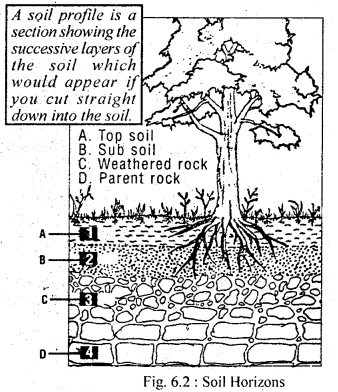
Soil horizons are the soil layers that are approximately parallel to the soil surface. Each horizon is different from the other. Boundaries between horizons range from indistinct to abrupt and clear. Horizons are formed because of differences in the degree of depth, amounts of humus accumulated, translocation of colloids by water and loss of colloids. Capital letters A, B, C, D and E are used to designate these horizons.

Horizons are commonly identified from the surface downwards.
Class 11 Geography Important Questions Chapter 6 Geomorphic Processes im-1
‘A’ horizon is the topsoil containing humus, from which materials are washed downwards by percolating water (leaching) so that it is termed an eluvial (eluviation) horizon.

‘B’ horizon or sub-soil lies beneath ‘A’ horizon. It is a horizon of deposition, of secondary enrichment, an illuvial horizon (illuviation) into which are deposited, the washed-out materials from ‘A’ horizon. Underneath is the ‘C’ horizon, it is the weathered parent material of the existing soil. Some soil scientists also distinguish ‘D’ horizon, the bedrock.

Question 5.
Discuss the factors responsible for soil formation and also the processes involved.
Answer:
Soil forming factors: There are five factors that influence soil formation, viz., parent material, climate, biota, topography and time.
1. Parent material: Parent material in soil science is weathered bedrock or the transported glacial or alluvial material. Soils from weakly cemented sandstone will be sandy and soils from shales will be shallow and fine-textured. Similarly, clay formation is favoured more by a high percentage of decomposable dark mineral and less by quartz.

2. Climate: Climate is an important active factor in soil formation. Several processes are involved in soil formation and may to some extent affect the soil profile.

3. Biota: Biota is the collective term for the animal and plant life of a
a specific area as per the period of time. The decomposition of organic wastes and residues and the activities of living plants and animals have marked influence on soil development. Burrowing animals such as moles, prairie dogs, earthworms, ants and termites help soil development slowly by decomposing organic matter and forming weak acids that dissolve minerals faster. The roots of living plants and decomposed plant material release weak organic acids that help in weathering and soil development.

4. Topography: Topography means relief features. Steep hillsides have thin soil cover because of surface runoff that results in the erosion of the surface. On the other hand, gentle hillside preserves appreciable soil cover due to the luxuriant vegetation and sufficient water passing in vertically to deeper levels. The landlocked depressions receive a high amount of runoff water that favours appreciable vegetation cover but slower decomposition because of oxidation deficiency. This results in the formation of soil that is rich in organic water. Thus, topography influences soil formation through its relationship with water and temperature.

5. Time: Soil formation is a very slow process. It may take a few hundred to a few thousand years. This period of time, however, varies from place to place, depending upon other factors discussed above (plant material, -biota, topography, climate). Under ideal conditions, a recognisable soil profile may develop in 200 years and under less favourable circumstances, it may extend to several thousand years.

Soil, forming processes: Several processes are involved in soil formation. These are:

  1. Eluviation: It is the mechanical translocation of clay or other fine particles down the profile.
  2. Illuviation: ft is the accumulation of the washed down material in the lower horizons of the soil profile.
  3. Leaching: It is the removal and downward movement of material from a horizon in solution.
  4. Cheluviation: It is a downward movement of the material, similar to leaching, but under the influence of complex organic compounds.
Class 12 Hindi Important Questions Aroh Chapter 10 छोटा मेरा खेत, बगुलों के पंख

Here we are providing Class 12 Hindi Important Extra Questions and Answers Aroh Chapter 10 छोटा मेरा खेत, बगुलों के पंख . Important Questions for Class 12 Hindi are the best resource for students which helps in class 12 board exams.

छोटा मेरा खेत, बगुलों के पंख Class 12 Important Extra Questions Hindi Aroh Chapter 10

प्रश्न 1.
छोटा मेरा खेत चौकोना
कागज़ का एक पन्ना,
कोई अंधड़ कहीं से आया
क्षण का बीज वहाँ बोया गया।
काव्य-सौंदर्य स्पष्ट कीजिए
उत्तर
(i) यह काव्यांश ‘आरोह भाग-2’ में संकलित ‘छोटा मेरा खेत’ नामक कविता से अवतरित उमाशंकर जोशी द्वारा रचित है।
(ii) इस काव्यांश में कवि ने खेती के रूपक में कवि-कर्म को बाँधकर चित्रित किया है।
(iii) यहाँ छोटा खेत-कागज़ के पन्ने तथा अंधड़ भावनात्मक आँधी का तथा बीज विचार तथा अभिव्यक्ति का प्रतीक हैं।
(iv) प्रतीकात्मक शैली का बोध है।
(v) सांगरूपक, अनुप्रास, पदमैत्री, स्वरमैत्री अलंकारों की छटा दर्शनीय है।
(vi) बिंब योजना अत्यंत सुंदर है।
(vii) खड़ी बोली भाषा सरल, सरस एवं प्रवाहमयी है।
(viii) तत्सम, तद्भव तथा विदेशी शब्दावली का प्रयोग हुआ है।

प्रश्न 2.
‘छोटा मेरा खेत’ कविता का मुख्य भाव स्पष्ट कीजिए।
उत्तर
‘छोटा मेरा खेत’ कविता में कवि ने कवि-कर्म के प्रत्येक चरण को खेती के रूपक में बाँधने की कोशिश की है। इस खेत में भावनात्मक आँधी के प्रभाव से किसी क्षण एक रचना-विचार तथा अभिव्यक्ति का बीज बोया जाता है, जो मूल कल्पना का सहारा लेकर स्वयं विगलित हो जाता है। उससे शब्दों के अंकुर निकलते हैं जो निरंतर पल्लवित-पुष्पित होकर एक पूर्ण कृति का स्वरूप ग्रहण करते हैं।

साहित्यिक कृति से जो अलौकिक रस-धारा फूटती है वह रस-धारा क्षण भर में होने वाली रोपाई के परिणामस्वरूप होती है। लेकिन यह रस-धारा अनंत काल तक चलने वाली खेती की कटाई के समान होती है। इस साहित्य के अक्षय पात्र का रस कभी खत्म नहीं होता।

प्रश्न 3.
‘छोटा मेरा खेत’ कविता का प्रतिपाद्य क्या है?
उत्तर
कवि की कविता ‘छोटा मेरा खेत’ का भाव गहन है। कवि का मानना है कि किसी भी कविता का जन्म सरल नहीं होता। उसका जन्म किसी अज्ञात प्रेरणा से किसी विशेष क्षण में ही होता है। जब कवि बड़े मनोयोग से तन्मयतापूर्वक विचार करता है तभी कविता का जन्म होता है। काव्य के सौंदर्य संबंधी तत्व स्वयं ही मन से फूट-फूट कर निकलते जाते हैं। छंद, अलंकार, शब्द, भाव आदि गुण तो उसे अपने आप मिलने लगते हैं। कविता ऐसी फ़सल है जिससे आनंद और तृप्ति अनंत काल तक प्राप्त की जा सकती है। काव्य रस तो शाश्वत होता है। वह सदा हर स्थिति में ज्यों-का-त्यों बना रहता है।

प्रश्न 4.
कवि ने कवि-धर्म की तुलना किससे की है ?
उत्तर
कवि ने कवि-धर्म की तुलना कृषि उत्पादन से की है। उसने अपनी सृजनात्मकता को छोटे खेत से जोड़कर माना है कि वह भावों के बीज उगाता है और उससे उत्पन्न कविता रूपी फ़सल को अनंत समय तक लगातार प्राप्त करता रहता है।

प्रश्न 5.
फल, रस और अमृत धाराएँ किस की प्रतीक मानी गई हैं?
उत्तर
कवि ने अपनी कविता में फल, रस और अमृत को भाव और शिल्प के आनंद, रस और सुंदरता को माना है, जो मन को प्रभावित करते हैं।

प्रश्न 6.
‘क्षण भर बीज वहाँ बोया गया’ से कवि का क्या तात्पर्य है?
उत्तर
कवि का मानना है कि मानव मन में उत्पन्न होने वाले भाव सदा एकसमान नहीं रहते। वे पल-पल बदलते रहते हैं। वे तो जीवन की आपाधापी से उत्पन्न विचारों में से स्वयं निकलते हैं और कवि के हृदय को कविता रचने की प्रेरणा दे जाते हैं। अति तीव्र भाव ही कविता के जन्म की पृष्ठभूमि बन जाता है, जिससे कविता का जन्म होता है। क्षण-भर के लिए मन में उत्पन्न भाव कागज़ पर कविता के रूप में प्रकट हो जाता है।

प्रश्न 7.
कवि ने कविता के जन्म के लिए कल्पना-शक्ति को क्या महत्व दिया है?
उत्तर
मिट्टी में दबा बीज धरती से ही जल, खाद आदि को प्राप्त करता है और अंकुरित होता है। कवि के मन में भी भाव उत्पन्न होता है और वह शब्दों, अलंकार, छंद आदि को ग्रहण कर कविता के रूप में व्यक्त हो जाता है। इसीलिए कवि ने कल्पना के रसायनों को पी’ पंक्ति का प्रयोग किया है।

प्रश्न 8.
‘रस अलौकिक’ से कवि का क्या तात्पर्य है ?
उत्तर
काव्य में निहित भाव अलौकिक रस ही होता है। उसकी सांसारिक-भौतिक रसों से तुलना नहीं की जा सकती। वह मन को तृप्ति प्रदान करने वाला आत्मिक आनंद होता है और उससे आत्मिक तृप्ति प्राप्त होती है। कवि ने ‘रस अलौकिक’ से यही प्रकट करना चाहा है।

प्रश्न 9.
‘बगुलों के पंख’ कविता में कवि किसे रोककर रखना चाहता है?
उत्तर
कवि ने संध्या के समय आकाश में घने काले बादलों की पृष्ठभूमि में सफेद बगुलों की कतारों को उड़ते हुए देखता है और वह उनकी सुंदरता पर मुग्ध हो जाता है। वह उन्हें बहुत देर तक निहारना चाहता था। वह अधिक समय तक उसे देखने के लिए बगुलों की कतारों को रोकना चाहता है।

प्रश्न 10.
“तैरती साँझ की सतेज श्वेत काया” से कवि ने क्या कहना चाहा है?
उत्तर
आकाश में घने काले-कजरारे बादल तैर रहे हैं। उन्हें देखकर ऐसा प्रतीत होता है कि जैसे साँझ की श्वेत कांति-युक्त काया धीरे-धीरे विचरण कर रही हो।

सप्रसंग व्याख्या, अर्थग्रहण एवं सौंदर्य-सराहना संबंधी प्रश्नोत्तर

1. छोटा मेरा खेत चौकोना
कागज़ का एक पन्ना,
कोई अंधेड़ कहीं से आया
क्षण का बीज वहाँ बोया गया। (A.L.C.B.S.E. 2011, Set-I, C.B.S.E. Outside Delhi, Set-III, 2018)

शब्दार्थ : चौकोना-चार कोनों वाला, चौकोर। अंधेड़-आँधी, (भावनात्मक आँधी)। पन्ना-पृष्ठ, पेज्ञ। क्षण-पल।

प्रसंग : प्रस्तुत काव्यांश हमारी हिंदी की पाठ्य पुस्तक ‘आरोह भाग-2’ में संकलित कवि उमाशंकर जोशी दवारा रचित ‘छोटा मेरा खेत’ नामक कविता से अवतरित है। इसमें कवि ने कवि-कर्म को खेती के रूपक द्वारा अभिव्यक्त किया है।

व्याख्या : कवि कागज़ को खेत का रूपक प्रदान करते हुए कहता है कि मेरा कागज का एक पृष्ठ चौकोर खेत की तरह है। मैं इसी कागत रूपी चौकोर खेत पर कविता को शब्दबद्ध करता हूँ। कवि का कथन है कि कोई भावनात्मक रूपी आंधी कहाँ से आई जिसके प्रभाव से मैंने कागज के पृष्ठ रूपी खेत में रचना-विचार और अभिव्यक्ति रूपी बीज बो दिया। अर्थात मैंने भावनात्मक होकर कागज के पृष्ठ पर किसी अभिव्यक्ति को शब्दबद्ध कर दिया।

अर्थग्रहण एवं सौंदर्य-सराहना संबंधी प्रश्नोत्तर

प्रश्न
1. उपर्युक्त अवतरण के कवि तथा कविता का नाम लिखिए।
2. यहाँ कवि किस खेत की बात करता है?
3. कवि ने अपने खेत में कौन-सा बीज बोया?
4. इस अवतरण का काव्य-सौंदर्य स्पष्ट कीजिए।
उत्तर
1. उपर्युक्त अवतरण में कवि का नाम उमाशंकर जोशी है तथा कविता का नाम ‘छोटा मेरा खेत’ है।
2. यहाँ कवि कागज के पन्ने रूपी खेत की बात करता है।
3. कवि ने अपने खेत में शब्द रूपी बीज बोया।
4. काव्य-सौंदर्य

  • कवि ने कागज के पन्ने को खेत के रूपक द्वारा स्पष्ट किया है।
  • अनुप्रास, सांगरूपक व पदमैत्री अलंकारों की छटा दर्शनीय है।
  • खड़ी बोली का प्रयोग है।
  • तत्सम, तद्भव व विदेशी शब्दावली का प्रयोग है।
  • तुकांत छंद का प्रयोग है।
  • बिंब योजना अत्यंत सुंदर है।
  • प्रतीकात्मक शैली का प्रयोग है।

2. कल्पना के रसायनों को पी
बीज गल गया निःशेष;
शब्द के अंकुर फूटे,
पल्लव-पुष्पों से नमित हुआ विशेष। (A.I.C.B.S.E. 2011, Set-I, C.B.S.E. Outside Delhi, Set-III, 2018)

शब्दार्थ : निःशेष-समाप्त, जिसमें कुछ भी शेष न हो। फूटे-पैदा हुए। पुष्पों-फूलों। शब्द के अंकुर-शब्द रूपी अंकुर। पल्लव-पत्ते। नमित-झुका।

प्रसंग : ये पंक्तियाँ ‘आरोह भाग-2’ में संकलित कवि ‘उमाशंकर जोशी’ द्वारा रचित ‘छोटा मेरा खेत’, नामक कविता से अवतरित हैं। इनमें कवि ने पृष्ठ रूपी खेत में कवि-कर्म को विकसित होता हुआ दिखाया है।

व्याख्या : कवि का कथन है कि मैंने कागज के पृष्ठ रूपी खेत में जो अभिव्यक्ति रूपी बीज बोया था, वह बीज कल्पना रूपी रसायन तत्वों को पीकर पूरी तरह से गलकर समाप्त हो गया। तत्पश्चात उसमें से शब्द रूपी अंकुर प्रस्फुटित हुए।

अर्थात जिस प्रकार से खेत में बीज बोकर किसान उसमें अनेक प्रकार के रसायन तत्वों का प्रयोग करता है, तब जाकर वह बीज अंकुरित होता है, उसी प्रकार कवि पृष्ठ पर विचारों का बीज बोकर उसमें कल्पना का रसायन डालता है।

तत्पश्चात वह बीज शब्दों के रूप में अंकुरित होता है। जैसे खेत में बीज अंकुरित होता है फिर उस पर पत्ते और फूल आते हैं तब उसके बाद वह पूर्णता को प्राप्त करता है, वैसे ही कवि कर्म शब्दों को छंदों में बाँधता हुआ एक संपूर्ण कृति के रूप में प्रकट होता है।

अर्थग्रहण एवं सौंदर्य-सराहना संबंधी प्रश्नोत्तर

प्रश्न
1. कौन-सा बीज गलकर नष्ट हो गया?
2. कवि क्या और किस पर बोता था?
3. संपूर्ण कृति का रूप कौन लेता था?
4. उपर्युक्त पद्यांश का काव्य-सौंदर्य स्पष्ट कीजिए।
उत्तर
1. कवि के हृदय में उत्पन्न भाव रूपी बीज कल्पना के रसायन तत्वों को पीकरगल कर नष्ट हो गया।
2. कवि ने अभिव्यक्ति रूपी बीज कागज के पन्ने पर बोया था।
3. कवि के भावों ने शब्दों का रूप लेकर एक संपूर्ण कृति का रूप लिया था।
काव्य-सौंदर्य

  • कवि-कर्म व कृषक-कर्म की समानता का चित्रण है।
  • खड़ी बोली भाषा है जिसमें तत्सम शब्दावली का प्रचुर प्रयोग है।
  • बिंब योजना सुंदर है।
  • अनुप्रास, सांगरूपक, पदमैत्री आदि अलंकारों की शोभा है।
  • मुक्तक छंद का प्रयोग है।
  • प्रतीकात्मक शैली का चित्रण हुआ है।

3. झूमने लगे फल,
रस अलौकिक,
अमृत धाराएँ फूटती
रोपाई क्षण की,
कटाई अनंतता की
लुटते रहने से ज़रा भी नहीं कम होती।
रस का अक्षय पात्र सदा का
छोटा मेरा खेत चौकोना। (A.I. C.B.S.E. 2011, Set-II, C.B.S.E. Outside 2013, Set-III)

शब्दार्थ : रस-साहित्य या काव्य से प्राप्त आनंद, फल का रस। रोपाई-बीज बोना, पौधे लगाने की क्रिया। जरा-थोड़ा। अलौकिक-अनूठा। अनंतता-जिसका कोई अंत न हो, सदा। अक्षय-जो ख़त्म न हो।

प्रसंग : प्रस्तुत अवतरण ‘आरोह भाग-2’ में संकलित ‘छोटा मेरा खेत’ नामक कविता से अवतरित है जिसके कवि ‘उमाशंकर जोशी’ हैं। इसमें कवि ने साहित्य के रसानंद की अनंतता का चित्रण किया है।

व्याख्या : कवि का कथन है कि साहित्यिक कृति से अलौकिक रस रूपी फल प्रकट होते हैं। एक क्षण की रोपाई के परिणामस्वरूप अमृत रूपी रस की अलौकिक धाराएँ फूटती हैं। कवि कहता है कि यह अमृत रूपी रस-धारा अनंतकाल तक चलने वाली कटाई के समान है।

कवि का अभिप्राय यह है कि खेत में पैदा होने वाला अन्न पकने के बाद कट जाता है, लेकिन उत्तम साहित्य की रस-धारा कभी समाप्त नहीं होती। यह रस-धारा पाठकों द्वारा बार-बार पढ़ी जाती है लेकिन फिर भी जरा-सी भी कम नहीं होती है वह अनंतकाल तक भी ख़त्म नहीं होती। कवि कहता है कि मेरा कागज़ का पृष्ठ रूपी छोटा खेत चौकोर है। कवि का अभिप्राय यह है कि मेरा पृष्ठ रूपी खेत बहुत छोटा है लेकिन उससे जो साहित्य की अमृत रस-धारा प्रकट हुई है, वह अनंतकाल तक भी ख़त्म न होने वाली है।

अर्थग्रहण एवं सौंदर्य-सराहना संबंधी प्रश्नोत्तर

प्रश्न
1. कवि के खेत में क्या-क्या झूमने लगे?
2. कवि का खेत अनूठा है, कैसे? 3. कवि के खेत में कौन-सा पात्र सदा भरा रहता है?
4. उपर्युक्त पद्यांश का काव्य-सौंदर्य स्पष्ट कीजिए।
उत्तर
1. कवि के खेत में फल, अलौकिक रस तथा अमृतधारा झूमने लगे।
2. कवि का खेत अनूठा इसलिए है क्योंकि उसमें रोपाई तो केवल क्षण भर की होती है, लेकिन उसकी कटाई अनंत साल तक चलती है। _वह खेत लुटते रहने से ज़रा भी कम नहीं होता।
3. कवि के खेत का अक्षय पात्र सदा भरा रहता है।
4. काव्य-सौंदर्य

  • कवि ने साहित्य-रस की अमृत-धारा को अक्षय बताया है।
  • प्रतीकात्मक शैली का प्रयोग है।
  • मुक्तक छंद का प्रयोग है।
  • अनुप्रास, सांगरूपक, पदमैत्री आदि अलंकारों की छटा दर्शनीय है।
  • खड़ी बोली का प्रयोग है।
  • संस्कृत के तत्सम, तद्भव और विदेशी शब्दों का प्रयोग है।
  • बिंब योजना अत्यंत सटीक एवं सार्थक है।

4. नभ में पाँती-बँधे बगुलों के पंख,
चुराए लिए जातीं वे मेरी आँखें।
कजरारे बादलों की छाई नभ छाया, तैरती साँझ की सतेज श्वेत काया।
हौले हौले जाती मुझे बाँध निज माया से। उसे कोई तनिक रोक रक्खो।
वह तो चुराए लिए जातीं मेरी आँखें नभ में पाँती-बँधी बगुलों की पाँखें। (C.B.S.E. Delhi 2008)

शब्दार्थ : नभ-आकाश। कजरारे-काले-काले। सतेज-तेजस्वी, उज्ज्वल, तेजयुक्त। काया-शरीर। निज माया से-अपनी माया से। पाँखें-पंख। पाँती-बँधे-पंक्ति में बँधे हुए, पंक्तिबद्ध। साँझ-संध्या। श्वेत-सफ़ेद। हौले-हौले-धीरे-धीरे। तनिक-थोड़ा-सा, ज़रा।

प्रसंग : प्रस्तुत पद्य हिंदी की पाठ्य-पुस्तक ‘आरोह भाग-2’ में संकलित कवि ‘उमाशंकर जोशी’ द्वारा रचित ‘बगुलों के पंख’ नामक कविता से अवतरित है। इस पद्य में कवि ने आकाश में उड़ते पक्षियों के सौंदर्य के चित्रात्मक वर्णन के साथ-साथ उसका अपने मन पर पड़ने वाले अटूट प्रभाव का भी सजीव चित्रण किया है।

व्याख्या : कवि का कथन है कि असीम आकाश में बगुले पंक्तिबद्ध होकर उड़ रहे हैं। इन बगुलों के सफ़ेद पंख अत्यंत सुंदर एवं मनमोहक हैं। वे सफ़ेद पंखों से युक्त आकाश में उड़ते बगुले मेरी आँखों को चुरा लिए जा रहे हैं। इन काले बादलों से भरे आकाश में पंक्ति बनाकर उड़ते हुए बगुलों के पंख काले बादलों के ऊपर तैरती साँझ की श्वेत काया के समान प्रतीत होते हैं।

कवि कहता है कि वह दृश्य इतना सुंदर है कि मुझे अपने माया रूपी सौंदर्य से धीरे-धीरे अपने आकर्षण में बाँध रहा है अर्थात मुझे अपनी ओर खींच रहा है। कवि आग्रह करता है कि कोई उस माया को थोड़ा-सा रोके। यह आकाश में उड़ते पंक्तिबद्ध बगुलों के पंखों की सुंदरता निरंतर मेरी आँखों को चुरा लिए जाती है अर्थात उन सफ़ेद बगुलों का पंक्तिबद्ध सौंदर्य मुझे अपनी ओर आकर्षित कर रहा है।

अर्थग्रहण एवं सौंदर्य-सराहना संबंधी प्रश्नोत्तर

प्रश्न
1. इस काव्यांश के कवि तथा कविता का नाम लिखिए।
2. आकाश में किसकी पंक्ति बँधी है? वह क्या चुरा ले जा रही है?
3. कवि को अपनी माया से कौन बाँध रहा है?
4. इस अवतरण का काव्य-सौंदर्य स्पष्ट कीजिए।
5. मानवीकरण के सौंदर्य पर टिप्पणी कीजिए। (A.I. C.B.S.E. 2016)
6. काव्यांश की भाषा की दो विशेषताएँ लिखिए।
7. काव्यांश का बिंब-सौंदर्य स्पष्ट कीजिए।
उत्तर
1. इस काव्यांश के कवि का नाम उमाशंकर जोशी है तथा कविता का नाम ‘बगुलों के पंख’ है।
2. आकाश में बगुलों की पंक्तिबद्ध उड़ान कवि की आँखें चुरा ले जाती है।
3. कजरारे बादलों की छाया तथा तैरती हुई शाम की सतेज श्वेत का या कवि को अपनी माया से बाँध रही है।
4. काव्य-सौंदर्य (C.B.S.E. 2010, Set-1)

  • कवि ने पंक्तिबद्ध बगुलों की सुंदरता का मनोहारी चित्रण किया है।
  • भाषा सरल, सरस एवं प्रवाहमयी खड़ी बोली है।
  • संस्कृत की तत्सम, तद्भव और विदेशी शब्दावली का प्रयोग है।
  • अनुप्रास, स्वभावोक्ति, पुनरुक्ति प्रकाश, पदमैत्री, स्वरमैत्री, उपमा आदि अलंकारों की छटा है।
  • कोमलकांत पदावली चित्रण है।
  • अभिधात्मक शैली का प्रयोग है।
  • बिंब योजना का सुंदर प्रयोग है।

5. जड़ प्रकृति का मानवीय रूप में प्रस्तुत किया गया है। संध्या को तैरते हए दिखाया गया है।
6. खड़ी बोली भाषा है। भाषा सरल एवं सरस है। तत्सम शब्दावली है।
7. चाक्षुक बिंब का योजना है।

Class 12 Hindi Important Questions Aroh Chapter 9 रुबाइयाँ, गज़ल

Here we are providing Class 12 Hindi Important Extra Questions and Answers Aroh Chapter 9 रुबाइयाँ, गज़ल. Important Questions for Class 12 Hindi are the best resource for students which helps in class 12 board exams.

रुबाइयाँ, गज़ल Class 12 Important Extra Questions Hindi Aroh Chapter 9

प्रश्न 1.
काव्य-सौंदर्य स्पष्ट कीजिए
नहला के छलके-छलके निर्मल जल से
उलझे हुए गेसुओं में कंघी करके
किस प्यार से देखता है बच्चा मुँह को
जब कुहनियों में लेके है पिन्हाती कपड़े।
उत्तर
1. प्रस्तुत रुबाई हिंदी की पाठ्य-पुस्तक ‘आरोह भाग-2’ में संकलित कवि फ़िराक गोरखपुरी द्वारा रचित ‘रुबाइयों’ से अवतरित है।
2. इसमें कवि ने बच्चे को नहलाती हुई माँ की स्वाभाविक वृत्ति का सजीव चित्रण किया है। माँ बच्चे को निर्मल जल से नहलाकर उसको कंघी करती है। तत्पश्चात उसे अपनी गोदी में बिठाकर उसे कपड़े पहनाती है।
3. भाषा सरल, सरस, सुबोध खड़ी बोली है।
4. संस्कृत के तत्सम, तद्भव व विदेशी शब्दावली का प्रयोग है।
5. वात्सल्य रस की अभिव्यक्ति हुई है।
6. प्रसाद गुण है।
7. अभिधा शब्द-शक्ति का प्रयोग है।
8. भावपूर्ण शैली है।
9. बिंब योजना अत्यंत सुंदर एवं सटीक है।
10. छलके-छलके में पुनरुक्ति प्रकाश अलंकार है।
11. अनुप्रास, पदमैत्री, स्वाभाविक, उल्लेख, स्वरमैत्री आदि अलंकारों की छटा है।
12. रुबाई छंद है।

प्रश्न 2.
तेरे गम का पासे अदब है कुछ दुनिया का ख्याल भी है ।
सबसे छिपा के दर्द के मारे चुपके-चुपके रो ले हैं।-काव्य-सौंदर्य स्पष्ट कीजिए।
उत्तर
1. प्रस्तुत काव्यांश हमारी हिंदी की पाठ्य-पुस्तक ‘आरोह भाग-2’ में संकलित कवि फ़िराक गोरखपुरी द्वारा प्रणीत ‘गजल’ से अवतरित है।
2. इस काव्यांश में कवि ने अपनी प्रिया के प्रति प्रेमभाव प्रकट करते हुए अपनी विरह-व्यथा का चित्रण किया है। कवि का कथन है कि हे प्रिय! मैं तेरे गम का सम्मान करता हूँ लेकिन मुझे दुनिया से डर लगता है, इसलिए हम तो गम में डूबकर दर्द के मारे दुनिया से छिपकर चुपके-चुपके रोते हैं।
3. शृंगार रस की वियोगावस्था का मार्मिक चित्रण है।
4. माधुर्य गुण है।
5. बिंब योजना अत्यंत सार्थक एवं प्रसंगानुकूल हैं।
6. अनुप्रास, पदमैत्री, स्वरमैत्री आदि अलंकारों की शोभा है।
7. ‘चुपके-चुपके’ में शब्दावृत्ति होने से पुनरुक्ति प्रकाश की छटा है।
8. उर्दू, फारसी और बोलचाल की सरल, सरस भाषा है।
9. गजल छंद का प्रयोग है।

प्रश्न 3.
फ़िराक की रुबाई के आधार पर माँ-बच्चे के वात्सल्यपूर्ण चित्र को अपने शब्दों में प्रस्तुत कीजिए। (C.B.S.E. Delhi 2017, Set-1 2012)
उत्तर
फ़िराक की रुबाई में नन्हा-सा बच्चा माँ की नजरों में चाँद का टुकड़ा है जिसे वह अपनी गोद में खिलाती है; झुलाती है और कुछ-कुछ देर बाद हवा में उछाल देती है, जिससे बच्चा प्रसन्नता से भर किलकारियां मारता है। खिलखिलाते बच्चे की हंसी वातावरण में गूंज उठती है। बच्चे को नहलाना-झुलाना, तैयार करना, कंघी करना और बच्चे के द्वारा माँ के चेहरे की ओर एकटक देखना अति सुंदर और वात्सल्य रस से ओतप्रोत है।

प्रश्न 4.
बच्चे के द्वारा माँ के चेहरे को एकटक निहारने के चित्र को प्रस्तुत कीजिए।
उत्तर
माँ बच्चे को साफ-स्वच्छ जल से नहलाती है, उसके उलझे बालों में कंघी करती है और उसे अपने घुटनों पर थाम कर कपड़े पहनाती है। बच्चे के मन में माँ के प्रति लाड़ उमड़ आता है और वह एकटक माँ के चेहरे की ओर निहारता है। माँ उसे तैयार करती रहती है और उसकी ओर अपनी नजरें जमाए रहता है।

प्रश्न 5.
‘बच्चे के घरौंदे में जलाती है दिए’ से क्या तात्पर्य है?
उत्तर
दीवाली की शाम माँ अपने सजे-संवरे घर में दीपक जलाती है और फिर वह बच्चे के मिट्टी के बने छोटे से घरौंदे में दीया जला कर अपने बच्चे के सुखद और खुशहाल भविष्य के लिए मनौती मांगती है।

प्रश्न 6.
बच्चे को माँ चाँद किस प्रकार धरती पर लाकर देती है?
उत्तर
रात के समय आकाश में जगमगाता चंद्रमा बच्चे को आकृष्ट करता है। वह उसे एक खिलौना समझकर लेने के लिए मचलता है; ज़िद करता है। माँ उसके हाथों में दर्पण थमा देती है जिसमें चाँद का प्रतिबिंब दिखाई देता है। माँ कहती है कि ले बेटा, चाँद इस दर्पण में आ गया है और अब यह तेरा ही हो गया।

प्रश्न 7.
रक्षाबंधन के अवसर पर बहन अपने भाई के लिए कैसी राखी लाती है?
उत्तर
रक्षाबंधन वाले दिन आकाश में हलके-हलके बादल छाए हुए हैं। प्यारी बहन अपने भाई की कलाई पर बाँधने के लिए राखी लाई जिसके लच्छे बिजली के समान चमकते हैं। वह चमकीली लच्छों वाली अति सुंदर राखी अपने भाई की कलाई पर बाँधती है।

प्रश्न 8.
कवि ने ग़ज़ल में वातावरण की सृष्टि किस प्रकार की है?
उत्तर
कलियों की कोमल पंखुड़ियाँ नवरस से भरी हुई हैं और वे अपनी गाँठे खोल रही हैं जिससे ऐसा प्रतीत होता है कि रंग और सुगंध एक साथ आकाश में उड़ जाने के लिए पंख फड़फड़ाने लगे हों। फूलों और कलियों की मोहक गंध सारे वातावरण को सुगंध से सराबोर कर रही है।

प्रश्न 9.
फ़िराक की ग़ज़ल किस रस से परिपूर्ण है?
उत्तर
फ़िराक की गजल अंगार रस के वियोग भाव से परिपूर्ण है। वह वियोग में अपनी प्रेमिका के लिए आँसू बहाता है; तड़पता है। परेशान होता है। उसकी ग़जलों की शोभा और चमक उसके टपकते आँसुओं के कारण ही है। उसकी प्रेम-भरी दीवानगी सूनी-भीगी रातों में अपनी प्रेमिका के लिए व्यक्त हुई है। प्रेम की अधिकता के कारण उसे रात का सन्नाटा भी बोलता, बातें करता-सा प्रतीत होता है।

प्रश्न 10.
फ़िराक की ‘गजल’ की भाषा पर टिप्पणी कीजिए।
उत्तर
फ़िराक की राजले श्रृंगार रस से परिपूर्ण हैं जिसकी भाषा और भाव उर्दू के संस्कारों से युक्त हैं। उन्होंने उर्दू के शब्दों को अधिकता से प्रयुक्त किया है। उनके शेर सरल हैं और हृदय को छूने की क्षमता रखते हैं। कहीं-कहीं उर्दू शब्दों की अधिकता से शेर समझने में कठिन प्रतीत होते हैं।

प्रश्न 11.
निम्नलिखित काव्याष्ठा को पढ़कर पूछे गए प्रष्ठनों के उत्तर लिखिए : (Outside Delhi 2017, Set-1) आँगन में लिए चाँद के टुकड़े को खड़ी हाथों पे झुलाती है उसे गोद-भरी रह-रह के हवा में जो लोका देती है गूंज उठती है खिलखिलाते बच्चे की हँसी।
(क) काव्याष्ठा किस छंद में है? उसका लक्षण बताइए।
(ख) काव्याष्ठा में रूपक अलंकार के सौंदर्य को स्पज्ट कीजिए।
(ग) काव्यांष्ठा की भाजा की दो विष्ठोजताएँ लिखिए।
उत्तर
(क) काव्याष्ठा रूबाई छंद में है। यह चार पंक्तियों का छंद है।
(ख) काव्यांष्ठा में चाँद के टुकड़े में रूपक अलंकार की छटा है। बच्चे पर चाँद के टुकड़े का अभेदारोप किया गया है।
(ग) काव्याष्ठा की भाजा सरल, सरस एवं खड़ी बोली है। प्रवाहमयता एवं संगीतात्मकता विद्यमान है। चित्रात्मकता का समावेष्ठा है।

सप्रसंग व्याख्या, अर्थग्रहण एवं सौंदर्य-सराहना संबंधी प्रश्नोत्तर

प्रश्न 1. आँगन में लिए चाँद के टुकड़े को खड़ी
हाथों पे झुलाती है उसे गोद-भरी
रह-रह के हवा में जो लोका देती है
गूंज उठती है खिलखिलाते बच्चे की हँसी। (C.B.S.E. Delhi 2008,C.B.S.E. Delhi 2013, Set-I, II,I,C.B.S.E. 2018)

शब्दार्थ : चाँद का टुकड़ा-प्यारा बच्चा। लोका देती है-उछाल देती है। गोद-भरी-गोद में भरकर, आँचल में लेकर। प्रसंग प्रस्तुत ‘रुबाई’ हमारी हिंदी की पाठ्य-पुस्तक ‘आरोह भाग-2’ में संकलित ‘फ़िराक गोरखपुरी’ द्वारा रचित ‘रुबाइयाँ’ नामक कविता से अवतरित की गई है। इसमें कवि ने माँ के आँचल में खिलखिलाते बच्चे तथा माँ के वात्सल्य प्रेम का अनूठा चित्रण किया है।

व्याख्या : कवि का कथन है कि माँ अपने प्यारे बेटे को अपने घर के आँगन में लिए खड़ी है। वह अपने चाँद के टुकड़े को अपनी गोद में भरकर हाथों में झुला रही है। माँ अपने बच्चे को देखकर अत्यंत प्रसन्नता से भरी हुई है। वह बार-बार अपने नन्हें बच्चे को हवा में उछालती है।

जैसे ही माँ अपने बच्चे को हवा में उछालती है तो बच्चा खुश हो उठता है और उसकी खिलखिलाती हँसी संपूर्ण वातावरण में गूंज उठती है। कवि का कहने का अभिप्राय यह है कि अपनी माँ के हाथों में बच्चा खुश होकर खिलखिलाकर हँसने लगता है, और उसकी हँसी सारे वातावरण को गुंजायमान कर देती है। लगता है, बच्चे की खिलखिलाती हँसी के साथ वातावरण भी हँसने लगा हो।

अर्थग्रहण एवं सौंदर्य-सराहना संबंधी प्रश्नोत्तर

प्रश्न
1. आँगन में कौन खड़ी है? वह क्या लिए हुए है?
2. माँ अपने बच्चे को कैसे हँसा रही है?
3. हवा में बच्चे की क्या गूंज उठती है?
4. उपर्युक्त काव्यांश के कवि तथा कविता का नाम बताएँ।
5. काव्यांश का काव्य-सौंदर्य स्पष्ट कीजिए।
उत्तर
1. आँगन में माँ खड़ी है। वह अपने हाथों में अपने चाँद के टुकड़े को लिए हुए है।
2. माँ अपने बच्चों को कभी अपने हाथों पर झुलाती है तो कभी उसे गोद में भरकर हवा में उछाल देती है, जिससे बच्चा हँसने लगता
3. हवा में बच्चों की हँसी गूंज उठती है।
4. उपर्युक्त काव्यांश के कवि का नाम फ़िराक गोरखपुरी है तथा कविता का नाम ‘रुबाइयाँ’ है।
5. काव्य-सौंदर्य

  • कवि ने माँ का बच्चे के प्रति वात्सत्य-प्रेम का अंकन किया है।
  • भाषा सरल व सरस है।
  • वात्सल्य रस का अनूठा चित्रण है।
  • अनुप्रास, पुनरुक्ति प्रकाश, पदमैत्री, स्वाभाविक आदि अलंकारों का प्रयोग हुआ है।
  • प्रतीकात्मक शैली का प्रयोग है।
  • बिंब योजना अत्यंत सार्थक है।
  • प्रसाद गुण है।

2. नहला के छलके-छलके निर्मल जल से
उलझे हुए गेसुओं में कंघी करके
किस प्यार से देखता है बच्चा मुँह को
जब घुटनियों में ले के है पिन्हाती कपड़े। (C.B.S.E. Delhi 2013, Set-II, Set-III)

शब्दार्थ : छलके-छलके-छलक-छलका कर। गेसुओं में-बालों में। पिन्हाती-पहनाती। निर्मल-साफ़, स्वच्छ। घुटनियों में-घुटनों में।

प्रसंग : प्रस्तुत काव्यांश ‘आरोह भाग-2’ में संकलित कवि ‘फ़िराक गोरखपुरी’ द्वारा रचित ‘रुबाइयाँ’ से अवतरित है। इसमें कवि ने माँ का नन्हें बच्चे के प्रति वात्सल्य प्रेम करे अभिव्यक्त किया है।

व्याख्या : कवि कहता है कि माँ अपने नन्हें, बच्चे को छलकते हुए निर्मल पानी में नहलाती है और नहलाने के बाद उसके उलझे हुए बालों मेंकंघी करती है, उन्हें सँवारती है। जब माँ अपने नन्हें बच्चे को अपने घुटनों में लेकर कपड़े पहनाती है तो बच्चा अपनी माँ को बड़े प्यार से देखता है।

अर्थग्रहण एवं सौंदर्य-सराहना संबंधी प्रश्नोत्तर

प्रश्न
1. माँ बच्चे को कैसे जल से नहलाती है?
2. बच्चा माँ के मुँह को कब देखता है?
3. माँ बच्चे को नहलाने के बाद क्या करती है?
4. उपर्युक्त काव्यांश का काव्य-सौंदर्य स्पष्ट कीजिए।
उत्तर
1. माँ बच्चे को छलके छलके निर्मल जल से नहलाती है।
2. बच्चा माँ के मुँह को तब देखता है जब माँ उसे अपने घुटनों में लेकर कपड़े पहनाती है।
3. माँ बच्चों को नहलाने के बाद उसे कंघी करती है तथा घुटनों में लेकर कपड़े पहनाती है।
4. काव्य-सौंदर्य

  • माँ की बच्चे के प्रति वात्सल्य तथा स्वाभाविक प्रक्रिया का चित्रण है।
  • अनुप्रास, स्वाभाविक, उल्लेख, पदमैत्री, पुनरुक्ति प्रकाश आदि अलंकारों की छटा शोभनीय है।
  • भाषा सहज, सरल और सरस है।
  • तत्सम, तद्भव एवं विदेशी शब्दावली का समायोजन हुआ है।
  • वात्सल्य रस की अभिव्यक्ति है।
  • बिंब योजना सुंदर है।
  • भावपूर्ण शैली का चित्रांकन है।
  • अभिधा शब्द-शक्ति है।
  • प्रसाद गुण का प्रयोग है।

3. दीवाली की शाम घर पुते और सजे
चीनी के खिलौने जगमगाते लावे
वो रूपवती मुखड़े पै इक नर्म दमक
बच्चे के घरौंदे में जलाती है दीये

शब्दार्थ : शाम-संध्या, सायंकालीन समय। रूपवती-सुंदर। इक-एक। घरौंदे में-मिट्टी के घर में, छोटे घर में। पुते-लिपे हुए। मुखड़े पै-मुख पर। नर्म दमक-हल्की चमक। दीये-दीपक।

प्रसंग : यह रुबाई ‘फ़िराक गोरखपुरी’ द्वारा रचित ‘रुबाइयाँ’ से अवतरित है। इसमें गोरखपुरी ने दीवाली पर्व के शोभा की सुंदर अभिव्यक्ति की है।

व्याख्या :कवि कहता है कि दीवाली के पावन पर्व की संध्या के समय सब घर लिपे-पुते, साफ-सुथरे तथा सजे-धजे होते हैं। घर में रखे
जगमगाते चीनी-मिट्टी के सुंदर खिलौने रौनक ले आते हैं। इन खिलौनों को देखकर नन्हा बच्चा खुश हो उठता है। माँ दीपावली की संध्या को अपने नन्हें बच्चे के मिट्टी के छोटे घर में दीपक जलाती है। नन्हें बच्चे का मिट्टी का छोटा-सा घर भी दीपक की रोशनी से जगमगा उठता है।

अर्थग्रहण एवं सौंदर्य-सराहना संबंधी प्रश्नोत्तर

प्रश्न
1. दीवाली पर लोग क्या करते हैं?
2. दीवाली के अवसर पर रूपवती के मुख पर क्या होती है?
3. दीवाली पर क्या लाए जाते हैं?
4. इस काव्यांश के काव्य-सौंदर्य को स्पष्ट कीजिए।
उत्तर
1. दीवाली पर लोग अपने घरों को संवारते और सजाते हैं।
2. दीवाली के अवसर पर रूपवती के मुख पर एक नर्म चमक होती है।
3. दीवाली पर चीनी-मिट्टी के जगमगाते खिलौने लाए जाते हैं।
4. काव्य-सौंदर्य

  • दीपावली की संध्या की सुंदरता का चित्रण है।
  • मिश्रित भाषा का प्रयोग है।
  • तत्सम, तद्भव एवं विदेशी शब्दावली है।
  • अनुप्रास, पदमैत्री, स्वाभाविक अलंकारों की छटा है।
  • बिंब अत्यंत सटीक है।
  • प्रसाद गुण है।
  • अभिधात्मक शैली का चित्रांकन है।
  • रुबाई छंद का प्रयोग है।

4. आँगन में ठुनक रहा है जिदयाया है
बालक तो हई चाँद पै ललचाया है
दर्पण उसे दे के कह रही है माँ
देख आईने में चाँद उतर आया है। (C.B.S.E. Delhi 2008, 2011, Set-1)

शब्दार्थ : ठुनक-सिसकना। हई-है ही। आईने में-दर्पण में। ज़िदयाया-जिद पकड़ना, अड़ना। दर्पण-वह सीसा जिसमें चेहरा दिखता हो।

प्रसंग : प्रस्तुत पद्य ‘आरोह भाग-2′ में संकलित ‘फ़िराक गोरखपुरी’ द्वारा रचित ‘रुबाइयाँ’ से अवतरित है। इसमें कवि नें नन्हें बच्चे कीचंचलता तथा माँ के वात्सत्य का चित्रांकन किया है।

व्याख्या : कवि कहता है कि बच्चा आँगन में सिसक रहा है। उसका दिल चाँद पर आ गया है और उसने चाँद पाने के लिए जिद पकड़ रखी है। वह तो बच्चा है, उसे क्या मालूम। जब बच्चा नही मानता, तो माँ उसे दर्पण में चाँद की परछाई दिखाकर उसे बदलने का प्रयत्न करती है। वह करती है कि देख, इसमें चाँद उतर आया है।

अर्थग्रहण एवं सौंदर्य-सराहना संबंधी प्रश्नोत्तर

प्रश्न
1. बालक किस पर ललचाया है?
2. माँ दर्पण किसे देती है तथा उसे क्या कहती है?
3. काव्य-सौंदर्य स्पष्ट कीजिए।
उत्तर
1. बालक चाँद पर ललचाया है।
2. माँ दर्पण अपने पुत्र को देती है। वह उसे कहती है कि देखो, दर्पण में चाँद उतर आया है।
3. काव्य-सौंदर्य

  • बच्चे की स्वाभाविक वृत्ति की अभिव्यंजना हुई है।
  • समान अर्थ द्रष्टव्य है ‘मैया मैं तो चंद्र खिलौना लैहों’
    यहाँ सूरदास के वात्सल्य रस के समान अभिव्यक्ति हुई है।
  • अनुप्रास, पदमैत्री, स्वाभाविक, स्वरमैत्री अलंकारों की शोभा है।
  • तुकांत छंद है।
  • चित्रात्मक शैली का प्रयोग है।
  • प्रसाद गुण है।
  • भाषा सरल, सरस एवं प्रवाहमयी है।

5. रक्षा-बंधन की सुबह रस की पुतली
छायी है घटा गगन की हलकी-हलकी
बिजली की तरह चमक रहे हैं लच्छे
भाई के है बाँधती चमकती राखी।

शब्दार्थ : रस की पुतली-रस से भरी, रस का भंडार बंधन । गगन-आकाश। घटा-बादल। लच्छे-राखी के ऊपर चमकदार लच्छे।

प्रसंग : प्रस्तुत पद्यांश ‘आरोह-भाग-2’ में संकलित कवि ‘फ़िराक गोरखपुरी’ द्वारा रचित ‘रुबाइयाँ’ नामक कविता से अवतरित किया गया है। इसमें गोरखपुरी ने रक्षा-बंधन पर्व की मिठास और रस्म का मनोहारी चित्रण किया है।

व्याख्या : कवि रक्षा-बंधन पर्व की पावनता का चित्रण करते हुए कहते हैं कि रक्षा-बंधन त्योहार की पावन सुबह आनंद और मिठास की सौगात
है अर्थात रक्षा-बंधन एक मीठा बंधन है। इसके सुबह ही आनंद की अनुभूति होने लगती है। रक्षा-बंधन का पावन पर्व सावन मास में मनाया जाता है। अतः इसके आते ही आकाश में हल्की-हल्की घटाएँ छाई हुई हैं। जिस प्रकार सावन में आकाश में छाए बादलों में बिजली चमकती है उसी तरह रक्षा-बंधन के कच्चे धागों में लच्छे चमकते हैं जिसे बहनें प्रेम स्वरूप अपने-अपने भाइयों को इन चमकती लच्छेदार राखियों को बाँधती हैं।

अर्थग्रहण एवं सौंदर्य-सराहना संबंधी प्रश्नोत्तर

प्रश्न
1. रक्षा-बंधन के अवसर पर क्या छाया है?
2. किसके लच्छे चमक रहे हैं और कैसे?
3. भाई को किस अवसर पर और कौन राखी बांधती है?
4. इस काव्यांश का काव्य-सौंदर्य स्पष्ट कीजिए।
उत्तर
1. रक्षा-बंधन के अवसर पर आसमान में रस से भरे हलके-हलके बादल छाए हुए हैं।
2. राखी के लच्छे चमक रहे हैं। वे बिजली की तरह लगते हैं।
3. भाई को रक्षा-बंधन के अवसर पर बहन राखी बांधती है।
4. काव्य-सौंदर्य

  • रक्षा-बंधन में बहन-भाई के प्रेम व रीति-रस्म का चित्रण है।
  • भाषा सरल, सरस, सुबोध एवं प्रवाहमयी है।
  • हलकी-हलकी में पुनरुक्ति प्रकाश अलंकार की छटा है।
  • तत्सम, तद्भव शब्दावली है।
  • प्रसाद गुण है।
  • अनुप्रास, स्वाभावोक्ति, पदमैत्री अलंकारों का चित्रण है।
  • अभिधात्मक शैली का प्रयोग है।
  • रुबाई छंद का प्रयोग है।

6. नौरस गुंचे पंखड़ियों की नाजुक गिरहें खोलें हैं
या उड़ जाने को रंगो-बू गुलशन में पर तोलें हैं।

शब्दार्थ : नौरस-युवा, नया। नाजुक-कोमल। बू-खुशबू, महक, गंध। तोलें हैं-खोलती हैं। गुंचे-फूल की कलियाँ। गिरहें-बंधन, गाँठे, गुत्थियाँ । गुलशन-बाग-बगीचा, उद्यान।

प्रसंग : प्रस्तुत काव्यांश ‘आरोह भाग-2’ में संकलित कवि फ़िराक गोरखपुरी द्वारा रचित ‘गजल’ से अवतरित किया गया है। इसमें कवि ने बसंत ऋतु के आगमन पर वातावरण में छाए अपूर्व सौंदर्य का चित्रण किया है।

व्याख्या : कवि का कथन है कि बसंत ऋतु फूल की कलियों की पंखुड़ियों की कोमल गाँठों को खोल देती है या उद्यान में फूलों के रंगों की खुशबू उड़ने के लिए अपने पंखों को खोलती है। कवि का अभिप्राय यह है कि बसंत ऋतु के आगमन पर युवा कलियाँ अपने पंखुड़ियों की कोमल गुत्थियों को खोल देती हैं। उस समय ऐसा प्रतीत होता है जैसे बाग में खिले हुए फूलों के रंगों की खुशबू उड़ जाने हेतु अपने पंखों को खोल रही हो। संपूर्ण बाग में फूलों की सुंदरता और खुशबू फैल जाती है।

अर्थग्रहण एवं सौंदर्य-सराहना संबंधी प्रश्नोत्तर

प्रश्न
1. उपर्युक्त काव्यांश के कवि तथा कविता का नाम बताइए।
2. बसंत ऋतु क्या खोल देती है?
3. बसंत ऋतु में कौन अपने पंख खोलता है?
4. इस काव्यांश का काव्य-सौंदर्य स्पष्ट कीजिए।
उत्तर
1. उपर्युक्त काव्यांश के कवि का नाम ‘फ़िराक गोरखपुरी’ है तथा कविता का नाम ‘गजल’ है।
2. बसंत ऋतु फूलों की नई कलियों की कोमल गाँठों को खोल देती है।
3. बसंत ऋतु उद्यान में फूलों के रंगों की खुशबू में उड़ने की उत्सुकता के लिए पंख खोलती है।
4. काव्य-सौंदर्य

  • बसंत ऋतु के आगमन पर उद्यान की शोभा की अभिव्यंजना हुई है।
  • उर्दू, फ़ारसी भाषा का प्रयोग है।
  • अनुप्रास, पदमैत्री, संदेह, स्वरमैत्री अलंकारों की छटा है।
  • कोमलकांत पदावली है।
  • बिंब योजना अत्यंत सुंदर है।
  • प्रसाद गुण है।
  • अभिधात्मक शैली है।

7.तारे आँखें झपकावें हैं जर्रा-जर्रा सोये हैं।
तुम भी सुनो हो यारो! शब में सन्नाटे कुछ बोले हैं।

शब्दार्थ : जर्रा-जर्रा-कण-कण। शब-रात, निशा, रात्रि।

प्रसंग : प्रस्तुत अवतरण हिंदी की पाठ्य-पुस्तक ‘आरोह भाग-2’ में संकलित कवि ‘फ़िराक गोरखपुरी’ द्वारा रचित ‘गजल’ से अवतरित है। इसमें गोरखपुरी ने रात्रि के सौंदर्य का चित्रण किया है।

व्याख्या : कवि कहता है कि रात्रि के गहन अंधकार में प्रकृति का कण-कण सोया हुआ है। संपूर्ण वातावरण में सन्नाटा छाया हुआ है। लेकिन इस गहन अंधकार में भी तारे टिमटिमा रहे हैं। अपनी आँखें झपकाकर अपूर्व सौंदर्य प्रस्तुत कर रहे हैं। कवि लोगों को संबोधन करते हुए कहता है कि हे प्यारो! तुम सब सुनो ! रात्रि में चारों ओर छाया हुआ सन्नाटा कुछ रहस्य कहता है।

अर्थग्रहण एवं सौंदर्य-सराहना संबंधी प्रश्नोत्तर

प्रश्न
1. तारे क्या झपकाते हैं?
2. जर्रा-जर्रा सोये है’ से कवि का क्या तात्पर्य है?
3. शब में कौन बोलते हैं?
4. काव्य-सौंदर्य स्पष्ट कीजिए।
उत्तर
1. तारे अपनी आँखें झपकाते हैं।
2. इस पंक्ति से कवि का तात्पर्य है कि जब रात हो जाती है तो सृष्टि का कण-कण शांत होकर सो जाता है। रात्रि के गहन अंधकार में चहुँ ओर सूनापन छा जाता है।
3. शब में सन्नाटे बोलते हैं।
4. काव्य-सौंदर्य

  • रात्रि के गहन अंधकार में तारों के टिमटिमाने का सुंदर चित्रण है।
  • जरा-जर्रा में पुनरुक्ति प्रकाश अलंकार है।
  • अनुप्रास, पदमैत्री, स्वरमैत्री स्वाभाविक अलंकारों की छटा है।
  • गजल का प्रयोग है।
  • प्रसाद गुण है।
  • उर्दू, फारसी भाषा है।

8. हम हों या किस्मत हो हमारी दोनों को इक ही काम मिला
किस्मत हमको रो लेवे है हम किस्मत को रो लें हैं। (C.B.S.E. Delhi 2008)

शब्दार्थ : इक-एक। किस्मत-भाग्य । लेवे है-लेती है।

प्रसंग : यह पद्य ‘फिराक गोरखपुरी’ द्वारा रचित ‘गजल’ से लिया गया है। इसमें कवि ने चित्रित किया है कि इस दुनिया में मनुष्य अपनी किस्मत को रोता रहता है।

व्याख्या : कवि कहता है इस जहाँ में अकर्मण्य इनसान हो या उसकी किस्मत दोनों को एक ही कार्य मिलता है। वह काम है कि समय-समय पर ऐसा इनसान अपनी किस्मत को रो लेता है और किस्मत उसको रो लेती है अर्थात कवि का अभिप्राय यह है कि इस संसार में आदमी अपनी किस्मत को रोता रहता है। वह अपना कर्म सत्यनिष्ठा और परिश्रम से नहीं करता। आजीवन किस्मत के सहारे होकर उसे ही दोष देता रहता है।

अर्थग्रहण एवं सौंदर्य-सराहना संबंधी प्रश्नोत्तर

प्रश्न
1. कवि का दोनों से क्या अभिप्राय है?
2. हम अर्थात कवि तथा किस्मत को क्या काम मिला है?
3. काव्य-सौंदर्य स्पष्ट कीजिए।
उत्तर
1. यहाँ दोनों से अभिप्राय है-किस्मत तथा कवि स्वयं।
2. हम अर्थात कवि तथा किस्मत को यह काम मिला है कि किस्मत कवि को रो लेती है तथा कवि अपनी किस्मत को रो लेता है।
3. काव्य-सौंदर्य

  • कवि ने किस्मत के सहारे बैठे अकर्मण्य व्यक्तियों पर कटाक्ष किया है।
  • उर्दू, फ़ारसी भाषा का प्रयोग है।
  • अनुप्रास, पदमैत्री, स्वरमैत्री की छय है।
  •  बिंब योजना सार्थक एवं सटीक है।
  • गजल छंद का प्रयोग है।

9. जो मुझको बदनाम करे हैं काश वे इतना सोच सकें
मेरा परदा खोले हैं या अपना परदा खोलें हैं। (C.B.S.E. Delhi 2008, 2014 Set-I, II, III)

शब्दार्थ : काश-इच्छा आदि को प्रकट करने का, सूचनार्थ शब्द।

प्रसंग : प्रस्तुत पंक्तियाँ ‘आरोह भाग-2’ में संकलित कवि ‘फ़िराक गोरखपुरी’ द्वारा रचित गजल से ली गई हैं। इस पंक्तियों में कवि ने बदनाम करने वाले लोगों पर कटाक्ष किया है।

व्याख्या : कवि का कथन है कि इस दुनिया के जो लोग मुझको बदनाम करना चाहते हैं, मेरे ऊपर बदनामी का दाग लगाना चाहते हैं, उन्हें अपने बारे में सोचना चाहिए। कवि का अभिप्राय यह है कि इस समाज में दूसरों को वही लोग बदनाम करते हैं, जो स्वयं पहले से ही बदनाम होते हैं और ऐसा करके वे दूसरों को बदनाम नहीं करते, बल्कि अपने रहस्यों को ही खोल कर बताते हैं।

अर्थग्रहण एवं सौंदर्य-सराहना संबंधी प्रश्नोत्तर

प्रश्न
1. कौन, किनको बदनाम करना चाहता है?
2. कवि बदनाम करने वाले लोगों को क्या आग्रह करना चाहता है?
3. काव्य-सौंदर्य स्पष्ट कीजिए।
उत्तर
1. समाज के कुछ लोग कवि को बदनाम करना चाहते हैं।
2. कवि बनदाम करने वाले लोगों को यह आग्रह करना चाहता है कि काश वे लोग इतना सोच सकें कि वे मेरा भेद खोल रहे हैं या अपना भेद खोल रहे हैं।
3. काव्य-सौंदर्य

  • कवि ने बदनाम लोगों की प्रवृत्ति की ओर संकेत किया है।
  • अनुप्रास, पदमैत्री, संदेह, स्वरमैत्री अलंकारों का प्रयोग हुआ है।
  • उर्दू-फ़ारसी भाषा का प्रयोग हुआ है।
  • बिंब योजना अत्यंत सार्थक एवं सटीक है।
  • गजल छंद का प्रयोग है।
  • शैली भावपूर्ण है।

10. ये कीमत भी अदा करे हैं हम बदुरुस्ती-ए-होशो-हवास
तेरा सौदा करने वाले दीवाना भी हो ले हैं।

शब्दार्थ कीमत-मूल्य। बदुरुस्ती-ए-होशो-हवास-विवेक के साथ दुरुस्त करना। अदा-चुकाना। दीवाना-प्रेमी, चाहने वाला।

प्रसंग : प्रस्तुत पंक्तियाँ ‘आरोह भाग-2’ में संकलित कवि ‘फ़िराक गोरखपुरी’ द्वारा रचित ‘गजल’ से ली गई हैं। इनमें कवि ने प्रेम की कीमत अदा करने का चित्रण किया है।

व्याख्या : कवि अपनी प्रिया को संबोधित करके कहता है कि हम पूरे विवेक के साथ और पूरे होशो-हवास में प्रेम की कीमत भी चुका देने को तैयार हैं और हम तुम्हारा सौदा करने वाला अर्थात तुम्हें खरीदकर अपने पास रखने वाला दीवाना भी बनने को तैयार हैं।

अर्थग्रहण एवं सौंदर्य-सराहना संबंधी प्रश्नोत्तर

प्रश्न
1. कवि किस कीमत को अदा करने की बात कहता है?
2. कवि किसको संबोधित करता है?
3. कवि किसका सौदा करने को कह रहा है?
4. काव्यांश का काव्य-सौंदर्य स्पष्ट कीजिए।
उत्तर
1. कवि प्रेम की कीमत को अदा करने की बात कहता है।
2. कवि अपनी प्रियतमा को संबोधित करता है।
3. कवि अपनी प्रियतमा का सौदा करने को कह रहा है।
4. काव्य-सौंदर्य

  • उर्दू व फ़ारसी भी बोलचाल की भाषा है।
  • अनुप्रास, पदमैत्री, स्वरमैत्री अलंकारों का प्रयोग है।
  • गजल छंद है।
  • बिंब सुंदर एवं सटीक है।
  • भावपूर्ण शैली का अंकन हुआ है।

11. तेरे ग़म का पासे-अदब है कुछ दुनिया का खयाल भी है
सबसे छिपा के दर्द के मारे चुपके-चुपके रो ले हैं।

शब्दार्थ : ग़म-दुख, पीड़ा, वेदना। खयाल ख्याल, परवाह । पासे-अदब है-सम्मान करता हूँ, विनय स्वीकृत है।

प्रसंग : यह पद्य आरोह भाग-2 में संकलित कवि फ़िराक गोरखपुरी द्वारा रचित ‘गजल’ से लिया गया है। इसमें कवि ने हृदय में स्थित प्रेम की पीड़ा का वर्णन किया है।

व्याख्या : कवि प्रिया को संबोधन करते हुए कहता है कि मैं तेरे हृदय में स्थित पीड़ा का सम्मान करता हूँ। मैं स्वीकार करता हूँ कि तेरे हृदय में ग़मों का सागर उमड़ रहा है लेकिन मैं पूर्णतः तुम्हारी ओर समर्पित नहीं हो सकता क्योंकि मुझे कुछ दुनिया का भी ख्याल है। कवि कहता है कि कहीं दुनिया कोई संदेह न करने लगे इसलिए मैं अपने दर्द को खुलकर रो सकता हूँ, बल्कि किसी एकांत स्थल पर चुपके-चुपके रो लेता हूँ।

अर्थग्रहण एवं सौंदर्य-सराहना संबंधी प्रश्नोत्तर

प्रश्न
1. कवि किसका सम्मान करता है?
2. कवि को अपनी प्रियतमा के साथ-साथ किसका ख्याल है और क्यों?
3. कवि चुपके-चुपके क्यों रोता है?
4. इस काव्यांश का काव्य-सौंदर्य स्पष्ट कीजिए।
उत्तर
1. कवि अपनी प्रियतमा के गमों का सम्मान करता है।
2. कवि को अपनी प्रियतमा के साथ-साथ दुनिया का भी ख्याल है, क्योंकि वह एक सामाजिक प्राणी है। वह दुनिया समाज के व्यंग्य से डरता है।
3. कवि चुपके-चुपके इसलिए रोता है, क्योंकि वह अपने प्रेम को दुनिया वालों को नहीं बताना चाहता है और दुनिया की हँसी का पात्र नहीं बनना चाहता है।
4. काव्य-सौंदर्य

  • विरह भावना का मार्मिक चित्रण हुआ है।
  • शृंगार की वियोगावस्था का करुण चित्रण है।
  • उर्दू, फ़ारसी भाषा का प्रयोग है।
  • अनुप्रास, पदमैत्री अलंकारों की छटा है।
  • ‘चुपके-चुपके’ में पुनरुक्ति प्रकाश अलंकार है।
  • माधुर्य गुण है।
  • बिंब अत्यंत सार्थक एवं सटीक है।
  • शैली भावपूर्ण है।

12. फितरत का कायम है तवाजुन आलमे-हुस्नो-इश्क में भी
उसको उतना ही पाते हैं खुद को जितना खो ले हैं।

शब्दार्थ : फितरत-स्वभाव, प्रकृति, आदत। आलमे-हुस्नो-इश्क-हुस्नो इश्क का आलम, प्रेम का हाल। तवाजुन-संतुलन। खुद-स्वयं को।

प्रसंग : प्रस्तुत पद्य आरोह भाग-2 में संकलित कवि गोरखपुरी द्वारा रचित ‘गजल’ से अवतरित है। इसमें कवि ने मोहब्बत में डूबे आशिक की मनोव्यथा का चित्रण किया है।

व्याख्या : कवि का कथन है कि मोहब्बत का नशा आज तक छाया हुआ है। प्रेम का यह आलम है कि प्रिया से विरह हुए इतना समय हो गया लेकिन आज तक भी उसकी आदत हुस्नो-इश्क में समाई हुई है। कवि कहता है कि इस वियोगावस्था में मैं अपने आप को जितना भूल जाता हूँ उतना ही अपनी प्रिया को प्राप्त कर लेता हूँ। प्रिया के प्रेम की वियोगावस्था में अपने को जितना खोने का प्रयास करता हूँ, मुझे और अधिक प्रिया की अनुभूति होने लगती है।

अर्थग्रहण एवं सौंदर्य-सराहना संबंधी प्रश्नोत्तर

प्रश्न
1. किसका तवाजुन कायम है?
2. कवि अपनी प्रिया को कैसे पाता है?
3. इस काव्यांश का काव्य-सौंदर्य स्पष्ट कीजिए।
उत्तर
1. फितरत का तवाजुन कायम है।
2. कवि अपनी प्रिया को उतना ही पा लेता है जितना खुद को खो देता है।
3. काव्य-सौंदर्य

  • कवि ने अपनी प्रिया की वियोगावस्था का मार्मिक चित्रण किया है।
  • श्रृंगार रस के वियोग पक्ष का सजीव अंकन है।
  • माधुर्य गुण है।
  • बिंब योजना अत्यंत सार्थक एवं सटीक है।
  • उर्दू, फ़ारसी की बोल-चाल की भाषाओं का प्रयोग है।
  • अनुप्रास, पदमैत्री अलंकारों की छटा है।

13. आबो-ताबे-अशआर न पूछो तुम भी आँखें रक्खो हो
ये जगमग बैतों की दमक है या हम मोती रोलें हैं।

शब्दार्थ : आबो-ताबे-अशआर-शेरों की चमक-दमक। बैतों-शेरों।

प्रसंग : यह पद्य फ़िराक गोरखपुरी द्वारा रचित ‘गजल’ में से लिया गया है। इसमें कवि ने प्रिया को संबोधन करके उसे जगाने का प्रयास किया है।

व्याख्या : कवि कहता है कि तुम मुझसे मेरी शेरो-शायरी की चमक-दमक के बारे में मत पूछो क्योंकि तुम्हारे पास भी विवेक है। तुम अपने विवेक के बल पर निर्णय कर सकते हो कि ये मेरे शेरों की चमक अथवा सार्थकता है अथवा वैसे ही मोती बिखेर रखे हैं, अर्थात तुम अपने विवेक के द्वारा मेरी शेरो-शायरी के महत्व का अंदाजा लगा सकते हो।

अर्थग्रहण एवं सौंदर्य-सराहना संबंधी प्रश्नोत्तर

प्रश्न
1. कवि किसकी चमक की बात कर रहा है?
2. यहाँ कवि किसको संबोधन करता है?
3. उपर्युक्त काव्यांश का काव्य-सौंदर्य स्पष्ट कीजिए।
उत्तर
1. कवि अपने शेरों की चमक की बात कर रहा है।
2. यहाँ कवि अपने प्रिय को संबोधन करता है।
3. काव्य-सौंदर्य

  • कवि का शायरी के चमक-दमक अर्थात अमर की बात करता है।
  • उर्दू, फ़ारसी और बोलचाल का भाषा का प्रयोग है।
  • अनुप्रास, पदमैत्री, स्वरमैत्री अलंकारों की शोभा है।
  • माधुर्य गुण है।
  • शृंगार रस का प्रयोग है।
  • बिंब अत्यंत सुंदर एवं सटीक है।
  • शैली भावपूर्ण है।

14. ऐसे में तू याद आये है अंजुमने-मय में रिदों को
रात गए गर्दू पॅ फरिश्ते बाबे-गुनह जग खोलें हैं।

शब्दार्थ अंजुमने-मय-शराब की महफ़िल। फरिश्ते-देवता, देवदूत। बाबे-गुनह-पाप का अध्याय। रिंदों को-शराबियों को। गर्दू-आकाश, आसमान। जग-संसार।

प्रसंग : ये पंक्तियाँ हिंदी की पाठ्य-पुस्तक ‘आरोह भाग-2’ में संकलित कवि ‘फ़िराक गोरखपुरी’ द्वारा रचित ‘गजल’ से ली गई हैं। इनमें कवि ने अपने प्रियजन की यादों का बखान किया है।

व्याख्या : कवि कहता है कि हे प्रिय! तू इस विरहावस्था में ऐसे याद आती है जैसे शराब की महफिल में शराबियों को शराब की याद आती है। कवि कहता है कि जैसे अर्धरात्रि में आकाश में देवदूत संपूर्ण संसार के पाप का अध्याय खोलते हैं, उसी तरह मुझे तुम्हारी याद आती है।

अर्थग्रहण एवं सौंदर्य-सराहना संबंधी प्रश्नोत्तर

प्रश्न
1. इस अवतरण के कवि तथा कविता का नाम बताएं।
2. कहाँ, किसको, कौन याद आता है?
3. रात गए फरिश्ते कहाँ क्या खोलते हैं?
4. इस काव्यांश का काव्य-सौंदर्य स्पष्ट कीजिए।
उत्तर
1. इस अवतरण के कवि का नाम फ़िराक गोरखपुरी है तथा कविता का नाम ‘गजल’ है।
2. शराब की महफिल में शराबियों को अपना प्रियतम याद आता है।
3. रात गए फरिश्ते आकाश में संपूर्ण संसार के पाप का अध्याय खोलते हैं।
4. काव्य-सौंदर्य

  • विरहावस्था का मार्मिक चित्रण हुआ है।
  • उर्दू, फ़ारसी भाषा के शब्दों का प्रयोग है।
  • माधुर्य गुण है।
  • श्रृंगार रस है।
  • बिंब योजना अत्यंत सुंदर एवं सटीक है।
  • अनुप्रास, पदमैत्री, स्वरमैत्री अलंकारों का प्रयोग हुआ है।
  • भावपूर्ण शैली का प्रयोग हुआ है।

15. सदके फिराक एजाजे-सुखन के कैसे उड़ा ली ये आवाज़
इन गजलों के परदों में तो ‘मीर’ की गज़लें बोले हैं।

शब्दार्थ : सदके फिराक-फिराक सदके जाता है। एजाजे-सुखन-बेहतरीन (प्रतिष्ठित) शायरी।

प्रसंग : प्रस्तुत काव्यांश हिंदी की पाठ्य-पुस्तक ‘आरोह भाग-2’ में संकलित कवि ‘फ़िराक गोरखपुरी’ द्वारा रचित गजल से अवतरित किया गया है। इसमें गोरखपुरी ने प्रतिष्ठित शायर मीर के प्रति श्रद्धा-भाव अभिव्यक्त किए हैं।

व्याख्या : कवि कहता है कि प्रतिष्ठित शायरी की ये आवाज उसने कैसे चुरा ली, इस पर फ़िराक सदके जाता है अर्थात अपने को न्योछावर करता है। कवि अपनी गज़लों को अपने गुरु महान शायर मीर के प्रति समर्पित करते हुए कहता है कि मेरी इन गजलों में तो प्रतिष्ठित शायर मीर की गजलें बोलती हैं। शायर मीर से ही प्रभावित होकर मैंने ये गजलें लिखी हैं।

अर्थग्रहण एवं सौंदर्य-सराहना संबंधी प्रश्नोत्तर

प्रश्न
1. फ़िराक किस पर सदके जाता है?
2. इन गज़लों को क्या बोलता है?
3. कवि अपनी गज़लों को किनके प्रति समर्पित करता है?
4. उपर्युक्त काव्यांश का काव्य-सौंदर्य स्पष्ट कीजिए।
उत्तर
1. फ़िराक शायरी सुंदरता और आवाज़ पर सदके जाता है।
2. इन गजलों में महान शायर ‘मीर’ की गजलें बोलता है।
3. कवि अपनी गजलों को महान शायर ‘मीर’ के प्रति समर्पित करता है।
4. काव्य-सौंदर्य

  • कवि ने अपनी गजलों को प्रतिष्ठित शायर मीर के प्रति समर्पित किया है।
  • उर्दू, फ़ारसी एवं साधारण बोलचाल की भाषा है।
  • अनुप्रास, पदमैत्री अलंकारों का प्रयोग है।
  • बिंब योजना सुंदर है।
  • भावपूर्ण शैली का प्रयोग है।
  • गज़ल छंद का प्रयोग हुआ है।

Minerals and Rocks Class 11 Important Extra Questions Geography Chapter 5

Here we are providing Class 11 Geography Important Extra Questions and Answers Chapter 5 Minerals and Rocks. Important Questions for Class 11 Geography are the best resource for students which helps in class 11 board exams.

Important Questions for Class 11 Geography Chapter 5 Minerals and Rocks

Minerals and Rocks Important Extra Questions Very Short Answer Type

Question 1.
What is meant by smelting?
Answer:
The process through which metals are separated from ores by using heat is called smelting.

Question 2.
Why are coal and petroleum called fossil fuels?
Answer:
Because they are associated with fossils (remnants of organisms).

Question 3.
Name two important sources of atomic energy found in India.
Answer:
Uranium and Thorium.

Question 4.
Define a rock.
Answer:
A rock is any natural mass of mineral matter that makes up the earth’s crust.

Question 5.
Name the types of rocks.
Answer:
The three types of rocks are the igneous rocks, the sedimentary rocks and the metamorphic rocks. ‘

Question 6.
Which are two main types of igneous rocks?
Answer:
On the basis of chemical differentiation of magma, there are two types of igneous rocks, viz., mafic and felsic.

Question 7.
What is meant by ‘texture? of the rocks?
Answer:
Texture relates to the sizes and patterns of the mineral crystals present in the rock.

Question 8.
Name the scale that grades between the size of mineral grains.
Answer:
The system of grading of mineral grains according to their size is called the Wentworth scale.

Question 9.
What is ‘phenocrysts’?
Answer:
Few large crystals embedded in a matrix of smaller crystals are known as phenocrysts.

Question 10.
What is ‘diagenesis’?
Answer:
It is the process of physical and chemical changes affecting sediments during their conversion into solid rocks.

Question 11.
What is the scientific study of rocks called?
Answer:
The scientific study of rocks is called petrology.

Question 12.
What does the term ‘lithosphere’ mean?
Answer:
The term lithosphere means a sphere of rocks.

Question 13.
Give two examples of soft rocks.
Answer:
Clay and chalk.

Question 14.
What kind of rock is granite?
Answer:
Granite is a coarse-grained igneous rock that is formed by the slow cooling of magma.

Question 15.
What happens to clay when it gets metamorphosed?
Answer:
It converts into slate.

Question 16.
What is metamorphism?
Answer:
Metamorphism is the change of form. It refers to the change in the form of rock when it is subjected to heat or pressure.

Question 17.
How many minerals have been identified and named till date?
Answer:
At least 2000 minerals have been named and identified till date.

Question 18.
Name the largest diamond ever found.
Answer:
Cullinan diamond is the largest diamond ever found.

Question 19.
What is the basic source of all minerals found in the earth?
Answer:
The basic source of all minerals is the hot magma in the interior of the earth.

Question 20.
What are ‘optical properties’ of minerals?
Answer:
Optical means ‘usual’. The optical properties of minerals are evaluated by means of a microscope using polarised light rays.

Question 21.
What are sedimentary rocks?
Answer:
The rocks which are formed by the accumulation of sediments are called sedimentary rocks.

Question 22.
Name three types of sedimentary rocks on the basis of their mode of formation.
Answer:

  1. Mechanically formed,
  2. Organically formed,
  3. Chemically formed.

Question 23.
Name the different types of coal.
Answer:
Peat, Lignite, Bituminus and Anthracite.

Question 24.
What is the thickness of lithosphere?
Answer:
The thickness of the lithosphere is about 100 km.

Question 25.
What are schists?
Answer:
Strongly developed foliation is known as schists.

Minerals and Rocks Important Extra Questions Short Answer Type

Question 1.
What is lithification?
Answer:
The fragments of the rocks are transported by various exogenous agencies and deposited. These deposits through compaction and/or cementation turn into rocks. This process is called lithification. In many sedimentary rocks, the layers of deposits. retain their characteristics even after lithification.

Question 2.
How would you classify the igneous rocks based on the size and nature of crystals?
Answer:
There are five types of igneous rocks based on the size and nature of crystals viz.

  1. rocks with phaneritic textured crystals
  2. rocks with orphan textured crystals
  3. equigranular textured rocks, and
  4. porphyritic textured rocks.

The crystals large enough to be seen with naked eyes or with the help of hand lens are called phaneritic textured crystals, whereas those too small to be distinguished without the aid of a microscope are – called orphan textured crystals of the igneous rocks. Where crystals in the rocks are all within the same size range, the texture is described as equigranular, whereas few large crystals are embedded in a matrix of smaller crystals, the texture is porphyritic.

Question 3.
Discuss the classification of sedimentary rocks into clastic and non-clastic division.
Answer:
Clastic means ‘broken’, describes clastic sediments consisting of particles removed individually from a parent rock source. The naming of clastic rocks depends on the size of component mineral grains.

The non-clastic sedimentary rocks are made of sediments of two basic types: chemical precipitates and organically derived sediments.

The chemical precipitates are solid mineral matters precipitated from an aqueous solution. The rock salt and gypsum are its examples. The organically derived sediments consist of remains of plants and animals as well as mineral matters produced by activities of plants and animals. Coal and limestone are examples.

Question 4.
What are schists?
Answer:
As metamorphism continues a large percentage of the minerals assume the plate-like shape and are assembled in parallel orientation in the rock, a structure is known as foliation. Strongly developed foliation is known as schist.

Question 5.
What is meant by mineral hardness?
Answer:
The degree to which a mineral surface resists being scratched is known as its mineral hardness. Hardness is important because it determines how a mineral is worn away by the abrasive action of stream, waves, wind and glaciers in the processes of erosion and transportation.

Question 6.
What are minerals and how are they formed?
Answer:
The mineral is a naturally occurring homogeneous solid that is an inorganic substance having an orderly atomic structure and definite chemical composition.

The basic source of all minerals is hot magma in the interior of the earth. When magma cools, crystals of mineral appear. These first crystals may sink in the magma so that the composition of the magma changes with depth. Thus, a sequence of minerals is formed in the rocks as the magma cools. Besides this, certain minerals such as coal, petroleum and natural gas are organic substances found in solid, liquid and gaseous forms respectively.

Question 7.
Describe the formation of sedimentary rocks.
Answer:
Sedimentary rocks are made from sediments deposited by the erosion and weathering of other rocks. Wind, water and snow erode rocks and carry the sediments to low lying areas. When deposited in the sea, they are compressed and hardened to form layers of rocks. Sediment is a fragmented mineral and organic matter derived directly or indirectly from pre-existing rocks and from life processes transported and deposited by air, water, etc. Chalk, sandstone, limestone, gypsum and coal are the examples.

Question 8.
What is mineral ‘lustre’?
Answer:
The appearance of a mineral surface under reflected light is referred to as its mineral lustre. It is described by several descriptive adjectives, such as metallic (metal like), adamantine (diamond), vitreous glass), resinous (oil), pearly or silky.

Question 9.
What do you understand by the specific gravity of minerals?
Answer:
Each mineral has a certain specific gravity. The specific gravity is the ratio of its density to the density of water at 4° Celsius. Mineral’s specific gravity is a property of great importance because it determines the density of a given rock and rock density, in turn, determines the gross layered structure of the earth.

Question 10.
What is the Deccan Trap?
Answer:
The Deccan trap is an extensive area in the north-west part of India. It covers about 5 lakh sq. km, area. It has been formed by lava flows. Lava has solidified to form basalt. It is useful for cotton cultivation.

Question 11.
How is coal formed?
Answer:
Vegetation is hurried in swamps and forests. Due to pressure of the overlying sediments, the remains of plants are changed into carbon. Coal is formed in this way. Coal is of different types such as peat, lignite, bituminous and anthracite.

Question 12.
What are the three types of rocks? Give two examples of each of them.
Answer:
The three types of rocks are:

  1. Igneous rocks
  2. Sedimentary rocks
  3. Metamorphic rocks

1. Igneous rocks: These rocks are formed by the cooling and solidification of molten lava and magma in the interior of the earth. Granite and basalt are examples.

2. Sedimentary rocks: These rocks have been formed by the deposition cementation of the fragments by exogenous means, i.e., wind, ice and sea. Examples are – sandstone and clay.

3. Metamorphic rocks: These rocks are formed by the change in colour, hardness, texture and mineral composition of the pre-existing rocks. Examples are – marble, slate.

Question 13.
What is meant by the texture of rocks?
Answer:
The texture means the size and pattern of the mineral crystals present in the rock. The size of the mineral crystals in an igneous rock depends largely upon the rate of cooling of magma.

Question 14.
Why fossils are preserved in sedimentary and not in igneous rocks?
Answer:
Sedimentary rocks are formed by the deposition of fragments ‘ carried away by exogenous means. They are deposited in distinct strata or layers. Fossils in the form of prints of leaves, insects or soft bovine animals and pieces of bones, shells or some hard parts of old living beings are embedded into layers of the sedimentary rocks. Thus, fossils are preserved in sedimentary rocks. The igneous rocks are formed by the solidification of magma. They are massive. They have no layers. Therefore, fossils cannot be preserved in igneous hard rocks and they are fossils-free.

Minerals and Rocks Important Extra Questions Long Answer Type

Question 1.
Write short notes on:
1. Sedimentary rocks
2. Types of metamorphism
Answer:
1. Sedimentary rocks: Exogenous agencies such as rain, wind, ice, running water, plants and animals are constantly hurried in rock disintegration producing loose and broken rock fragments in all sizes. These minerals are carried by wind, ice and running water in depressions such as lakes and seas on the earth’s surface. Such dropped materials are called sediments. Accumulation of these sediments in course of time gives rise to sedimentary rocks. The word ‘sedimentary’ is derived from the Latin word ‘sedimented’ means setting down. The sediments are usually deposited in distinct layers or strata. Therefore, these rocks are also known as stratified rocks.

2. Types of metamorphism: Metamorphism is the process of transformation of pre-existing rock into a new rock. Thus, metamorphic rocks are found when a rock is subjected to heat and/or pressure. Their characteristics are altered by forming new mineral forms. There are three types of metamorphism, viz. foliation, lineation and banding. When, under continued metamorphism, its minerals assume the plate-like shape and are assembled in parallel orientation in the rock, it is called foliation, e.g., Schist is formed in this manner.

When the mineral grains are drawn out into long, thin, pencil-like objects, all in parallel alignment, it is referred to as lineation. In another type of metamorphism, i.e., banding, the minerals of different varieties or groups are segregated into alternate layers. These layers are usually of light or dark shades, making the banding conspicuous.

Question 2.
What is the economic importance of minerals?
Answer:
Mineral resources can be divided into four main groups – essential resources, energy resources, metal resources and industrial resources. The most basic group, essential resources, comprises soil and water. Energy resources can be divided into fossil fuels (crude oil, natural gas, coal, oil shale and tar sand) and nuclear fuels (uranium, thorium and geothermal power). Metal resources range from structural metals such as iron, aluminium and titanium to ornamental and industrial metals such as gold, platinum and gallium.

Mineral deposits have two geological characteristics that make them a real challenge to modem civilization. First, all of them are non-renewable resources. The geological processes that form them are much slower than the rate at which we exploit them. There is no likelihood of our ability to grow mineral deposits at a rate equal to our consumption. Second, mineral deposits have a place value. We cannot decide from where to extract them; nature made that decision for us when the deposits were formed.

Question 3.
Describe the categorization of metamorphic rocks.
Answer:
The metamorphic rocks can be broadly grouped into two major classes – cataclastic rocks and recrystallised rocks. Cataclastic rocks are formed by mechanical disruption (breaking and crushing) of the original materials. The process is described as dynamic metamorphism.

The recrystallised rocks are further divided into two sub-classes – contact and regional metamorphic rocks. The contact metamorphic rocks are formed by recrystallisation under high temperature caused by intruding magma. The rocks are not subjected to bending or breaking and new minerals emanating from magma are added to metamorphosed rocks. The regional metamorphic rocks undergo recrystallisation during the process of being deformed by sharing often under the condition of high pressure or high temperature or bolts.

Question 4.
Discuss various types of rocks in detail.
Answer:
There are three main groups of rocks: igneous, sedimentary and metamorphic rocks.
Igneous rocks: These are formed from lava hurled out of a volcano or from the cooling of hot magma below the crust. Granite is a coarse-grained rock that was formed by the slow cooling of magma. Basalt is a fine-grained igneous rock, almost black, that was formed by quick cooling of lava. Chemical differentiation of magma gives rise to mafic and felsic types of igneous rocks.

The size of mineral crystals in an igneous rock largely depends upon the rate of cooling of magma. As a general rule, rapid cooling results in small crystals and slow cooling in large crystals. Extremely sudden cooling results in the formation of a natural glass which is non-crystalline. Large bodies of magma trapped beneath the surface cool very slowly because the surrounding rocks conduct the heat slowly. Rapid cooling occurs in lava that loses heat rapidly to the atmosphere or to the overlying ocean water.

Question 5.
Describe the formation of igneous rocks, giving suitable examples of various types.
Answer:
The igneous rocks are divided into extrusive rocks and intrusive rocks. When the magma solidifies on the surface of the earth, we call it an extrusive rock. A typical example of this kind of rock is basalt. It is a very fine-grained rock, usually Sf black in colour.

On the other hand, when the magma solidifies in the crust, below the surface, it is called an intrusive rock. The few most common examples of intrusive rocks are granite and dolerite. More frequent, however, is the solidification of magma below the earth’s surface leading to the formation of intrusive rocks. Igneous rocks are classified on the basis of chemical composition and texture. Chemical differentiation of magma gives rise to mafic and felsic types of igneous rocks.

Texture relates to the sizes and pattern of the mineral crystals present in the rock. The size of mineral crystals in an igneous rock depends largely upon the rate of cooling of magma. As a general rule, rapid cooling results in small crystals and slow cooling results in large crystals. Extremely sudden cooling results in the formation of natural glass which is non-crystalline. Large bodies of magma trapped beneath the surface cool very slowly because the surrounding rocks conduct the heat slowly. Rapid cooling occurs in lava that loses heat rapidly to the atmosphere or to the overlying ocean water.

Distribution of Oceans and Continents Class 11 Important Extra Questions Geography Chapter 4

Here we are providing Class 11 Geography Important Extra Questions and Answers Chapter 4 Distribution of Oceans and Continents. Important Questions for Class 11 Geography are the best resource for students which helps in class 11 board exams.

Important Questions for Class 11 Geography Chapter 4 Distribution of Oceans and Continents

Distribution of Oceans and Continents Important Extra Questions Very Short Answer Type

Question 1.
What is Pangaea?
Answer:
All landmasses of the world have been formed from one super¬continent called Pangaea.

Question 2.
Who first propounded the theory of continental drift?
Answer:
Alfred Wegner propounded the theory of continental drift in 1912.

Question 3.
Which plate is composed of mainly oceanic crust?
Answer:
The Pacific plate is composed of mainly oceanic crust.

Question 4.
How did the Himalayas rise?
Answer:
The collision between the Indian Plate and the Eurasian plate took place north of the Indian plate giving rise to the Himalayas.

Question 5.
What is the evidence in support of continental drift theory?
Answer:

  1. Geological matching
  2. Palaeoclimatic unity, and
  3. Palaeornagnetism.

Question 6.
Name the continents into which the supercontinent, Pangaea, got split.
Answer:
They are Laurasia and Gondwanaland.

Question 7.
How many years ago Pangaea, the supercontinent has evolved?
Answer:
Pangaea, the supercontinent, had evolved some 280, million years ago.

Question 8.
What are hot spots?
Answer:
The centers of volcanic activity are called hot spots.

Question 9.
Name the three kinds of boundaries based on their Relative motion.
Answer:

  1. Zones or margins of divergence or spreading,
  2. Margins of convergence, and
  3. Fracture zones or transform faults.

Question 10.
How many plates the lithosphere is divided into?
Answer:
Seven plates.

Question 11.
The collision between which two plates gave rise to the Himalayas?
Answer:
The collision between Indian and Eurasian plates gave rise to the Himalayas.

Question 12.
Name two fossils that tell us that continents were once united.
Answer:
The fossils of the plant Glossopteris and animals Mesosaurus and Lystosaurus, suggests that these continents were once joined.

Question 13.
What is Palaeornagnetism?
Answer:
It is the fossil magnetism evident today in igneous rocks such as magnetite, hematite, pyrrhotite, etc.

Question 14.
What is the Pacific plate?
Answer:
The latest plate in terms of its formation or origin.

Question 15.
What do you understand by the spreading of crust from the ridge and the widening of the ocean basin?
Answer:
It is the seafloor spreading.

Question 16.
Name the northern and southern parts of Pangaea.
Answer:
Laurasia and Gondwanaland.

Question 17.
Name the sea separating Laurasia and Gondwanaland.
Answer:
The Tethys sea.

Question 18.
In which parts Pangaea was split?
Answer:
Pangaea was split into northern continent Laurasia and Southern continent, Gondwanaland.

Question 19.
Name the original supercontinent. When was it formed?
Answer:
Pangaea. It was formed about 280 million years ago.

Question 20.
State three causes of plate movements.
Answer:

  1. Thermal convection,
  2. Hot spots of volcanic activity,
  3. Movement of currents.

Question 21.
What is meant by sea-floor spreading?
Answer:
The crust spreads away from the ridge and the ocean basin widens. This phenomenon is known as sea-floor spreading.

Question 22.
Name the process in which one plate overrides the other and the overriding plate slips down into the mantle and is submerged.
Answer:
Subduction.

Question 23.
What is thermal convection?
Answer:
It acts as a driving force for the movement of plates.

Question 24.
Name the four different types of plate interactions.
Answer:
Spreading, collision, subduction, and transform.

Question 25.
How was drifting of continents caused?
Answer:
It was caused by two forces :

  1. pole fleeing force, and
  2. tidal force.

Distribution of Oceans and Continents Important Extra Questions Short Answer Type

Question 1.
How do lithosphere plates behave along the transform fault?
Answer:
The lithospheric plates slide over each other, neither creating nor destructing any landmass. Instead, the. friction arising from the f* movement of the plates usually causes severe earthquakes and earth tremors.

Question 2.
Why do geographers focus their attention on plate boundaries?
Answer:
Geographers focus their attention on plate boundaries because each plate is a tectonic plate. It is rigid and moves as a single unit. Nearly all major tectonic activity occurs along the plate boundaries.

Question 3.
What does the term ‘supercontinent’ refer to?
Answer:
The term ’supercontinent’ refers to a single common geological landmass called Pangaea. It has been proposed that all landmasses of the world had formed from this ‘supercontinent’. Pangaea had evolved some 280 million years ago, at the end of the Carboniferous period and by mid-Jurassic age, 150 million years ago. Pangaea land split into Laurasia, the northern continent, and Gondwanaland, the southern continent. About 65 million years ago, i.e. at the end of the cretaceous, bound mainland were further broken up to give rise to several other continents such as South America, Africa, Australia, and Antarctica.

Question 4.
Discuss the causes of plate movement.
Answer:
Sub-crustal convection currents invoke the mechanism of thermal convection that acts as a driving force for the movement of plates. Hot currents rise, then cool as they reach the surface. At the same time, cool currents sink down. This convectional movement moves the crustal plates. .. Owing to current movements, the rigid plates of the lithosphere, which ‘float’ on more mobile asthenosphere, are in constant motion.

Question 5.
What is a geological time-scale?
Answer:
The chronology of the geological history’ of the earth is revealed by its rocks. Geological time scale indicates the hierarchy of time periods during which different rocks of the earth have formed.

Question 6.
What is subduction?
Answer:
The process in which the overridden plate slips down into the mantle and is submerged is known as subduction. Besides volcanism and shallow to deep-focus earthquakes, boundaries also formed deep trenches and folded mountains.

Question 7.
What is polar wandering?
Answer:
There has been a periodic change in the position of the magnetic pole. These changes are recorded in rocks by way of permanent magnetism. Unraveling of the signatures of such changes in the geologically old rocks by scientific methods provides the changing position of poles in geological time scale. It is known as ‘polar wandering’. It demonstrates that the continents have frequently moved and changed their direction of motion from time to time.

Question 8.
Account for the formation of the Himalayas according to the theory of plate tectonics in three points.
Answer:

  1. South-east Indian ocean ridge collided between the Indian plate and European plate. The Indian plate gave rise to the Himalayas.
  2. The suture between the Indian and Eurasian plates in the Himalayan region has been along the Indus and Brahmaputra.
  3. The mid-Indian ocean ridge has been spreading faster.

Question 9.
What is ‘Zolrt of Convergence’?
Answer:
Zone of Convergence is the boundary along which the edge of ‘ one plate overrides the other. It produces deep trenches and folds mountains. Volcanoes and deep-focus earthquakes mark it.

Question 10.
Describe the driving force for the movement of plates.
Answer:
The sub-crustal convection currents invoke the mechanism of thermal convection that acts as a driving force for the movement of plates. As these currents reach the surface, the hot current rises, then cools. Sometimes, cooler currents sink down. This type of convectional movement causes the movement of crustal plates.

Question 11.
Name the major plates of the earth. Which plate is composed of the oceanic plate?
Answer:
Pacific plate, Eurasian plate, Indo-Australian plate, African plate, North American plate, South American plate, and Antarctica plate are the major plates of the earth.

The zone of divergence is the boundary along which the plate is composed of mainly oceanic crust. It is known as the Pacific plate.

Question 12.
What is palaeoclimatic unity?
Answer:
The uniformity in the nature of the sediment in the biological past indicates that these continents were together in the geological past and experienced similar climatic conditions. It is the native of glacial deposits of the separated continents indicating that these continents were together in the geological past and experienced similar climatic conditions.

Distribution of Oceans and Continents Important Extra Questions Long Answer Type

Question 1.
What do you mean by ‘jig-saw-fit’? Describe the similarities found on the east and west coasts of the Atlantic ocean. What do they suggest?
Answer:
The ‘jig-saw-fit’ means the landmasses on the east and west coast of the Atlantic ocean can be fitted together. There are many similarities found on the two coasts :

  1. The Gulf of Guinea can be fitted into Cape San-Rogue of Brazil, the shoulder of Africa can be fitted into Gulf of Mexico, Western Europe and Eastern coast of North America along with Greenland can be fitted together.
  2. Gold deposits of Ghana lands are found on the east and in Brazil on the west.
  3. The glacial deposits are found in all landmasses of Gondwana land.

These similarities suggest that these continents were together in the geological past.

Question 2.
Discuss the Continental Drift Theory.
Answer:
Continental Drift Theory was proposed by Alfred Wegner in 1912. He postulated that all landmasses of the world have been formed from one super-continent called Pangaea.

The supercontinent, Pangaea, had evolved some 280 million years ago, at the end of the Carboniferous period and by the mid-Jurrasic age, 150 million years ago. Pangaea had split into a northern continent, Laurasia, and a southern continent Gondwanaland. About 65 million years ago, i.e., at the end of the Cretaceous, Gondwanaland further broke up to give rise to several other continents, such as South America, Africa, Australia, and Antarctica. Thus, the present distribution of the continental masses and the oceans are the n .uit of fragmentation of one or more pre-existing masses. These landmasses have drifted apart the intervening hollows having been occupied by the oceans.
Class 11 Geography Important Questions Chapter 4 Distribution of Oceans and Continents im-1
There are several pieces of evidence that suggest the existence of Pangaea. This evidence is available in the form of geological watching, palaeoclimatic units, and paleomagnetism.

Question 3.
Describe sea-floor spreading in brief.
Answer:
The present distribution of continents has taken place in the last 65 million years. The drift of continents still continues. The ridges down the middle of ocean floors have been emitting lava continuously. Those mid-oceanic ridges are cracks on the floor of the ocean where molten rocks push up to form a new crust. The crust spreads among the ridge and the ocean basin widens. This phenomenon is known as sea-floor spreading. The Atlantic ocean is getting smaller and the Red Sea is the part of a crack in the crust that will widen to produce new ocean millions of years ahead in the future. In the past, the widening of the South Atlantic ocean has separated Africa and South America.
Class 11 Geography Important Questions Chapter 4 Distribution of Oceans and Continents im-2

Question 4.
Explain the plate tectonic theory and its mechanism.
Answer:
Plate tectonic theory proves that the earth’s crust consists of several plates that carry continents and the ocean floors and float on the asthenosphere, moving very slowly, the movement probably resulting from currents in the asthenosphere. As shown in fig., the lithosphere is broken into seven major plates. They include :

  1. Pacific plate
  2. Eurasian plate
  3. Indo-Australian plate
  4. African plate
  5. North American plate
  6. South American plate
  7. Antarctic plate

The latest among these is the Pacific plate which is composed of oceanic crust almost entirely. The other plates have both continental and ocean crust. No plate consists of only continental crust. Plates range in thickness from about 70 km. beneath oceans to 150 km. under continents. Each tectonic plate is rigid and moves on a single unit. Nearly all major tectonic activities occur along the plate boundaries.

Based on the relative motion of plates, three kinds of plate boundaries have been recognized. They are :
1. Zones of divergence: These are boundaries along which plates separate and in the process of separation molten materials upwell. This is commonly observed along linear ocean edge where the new lithosphere is created in the form of new ocean floors. Active volcanism and shallow focus earthquakes make such boundaries,

2. Zones of convergence: There are the boundaries along which, the edge of one plate overrides the other. The overridden plate slips down into the mantle and is absorbed. This process is known as subduction.

3. Fracture zones or Transform faults: The plates slide past each other effect creating or destructing the boundaries. However, shallow focus earthquakes may result due to this friction.
Class 11 Geography Important Questions Chapter 4 Distribution of Oceans and Continents im-3

Question 5.
Describe the main features of the Indian plate.
Answer:
Indian ocean floor presents striking topography consisting of a number of elevated ridges and plateaus. Two of the ocean ridges, namely, the Mascarene Plateau, Chagos-Maldweep-Lakshadweep island ridge are said to be the volcanic tracts of two hot spots. The Northward extension of Ninety-east Ridge indeed in the trench which consumed the seafloor to the north of the Indian continental mass. The Chagos- Lakshadweep ridge linked the ancient Carlsberg ridge with the Southeast Indian ridge during the Eocene period (50 million years ago).

Consequent to the Carlsberg-Southeast Indian ocean ridge, the collision between the Indian plate and the Eurasian plate took place north of the Indian plate giving rise to the Himalayas. The suture between Indian and Eurasian plates in the Himalayan region has been along the Indus and Brahmputra rivers.