We have given detailed NCERT Solutions for Class 10 Sanskrit Grammar Book प्रत्ययाः Questions and Answers come in handy for quickly completing your homework.
Sanskrit Vyakaran Class 10 Solutions प्रत्ययाः
अभ्यास:
I.
प्रश्न 1.
प्रत्ययं संयुज्य वियुज्य वा लिखत-
(i) दृश् + क्त्वा = ___________
(ii) प्रणम्य = ___________
(iii) उपविश्य = ___________
(iv) सोढुम् = ___________
(v) सह् + क्त्वा = ___________
(vi) आ + नी + ल्यप् = ___________
उत्तराणि:
(i) दृष्ट्वा
(ii) प्र + नम् + ल्यप्
(iii) उप + विश् + ल्यप्
(iv) सह + तुमुन्
(v) सोढ्वा
(vi) आनीय।
प्रश्न 2.
अधोलिखितवाक्येषु कोष्ठके प्रदत्त धातुषु क्त्वा / ल्यप् / तुमुन्-प्रत्ययानां प्रयोगेण निष्पन्नपदैः रिक्तस्थानानि पूरयत-
यथा- सः पुस्तकम् आदाय (आ + दा + ल्यप्) गच्छति।
सः पुस्तकं दत्त्वा (दा + क्त्वा) क्रीडति।
(i) रामः कन्दुकम् ___________ (आ + नी + ल्यप्) क्रीडति।
(ii) श्यामः कन्दुकम् ___________ (नी + क्त्वा) गच्छति।
(iii) रामः कन्दुकम् ___________ (ग्रह् + तुमुन्) श्यामम् अनुधावति।
(iv) श्यामः ___________ (वि + हस् + ल्यप्) कन्दुकम् ददाति।
(v) रामः कन्दुकम् ___________ (प्र + आप् + ल्यप्) पुनः प्रसन्नः भवति।
उत्तराणि:
(i) आनीय
(ii) नीत्वा
(iii) ग्रहीतुम्
(iv) विहस्य
(v) प्राप्य।
प्रश्न 3.
उदाहरणमनुसृत्य स्थूलपदेषु धातून् प्रत्ययान् च वियुज्य लिखत-
यथा- बालकः गुरुं नत्वा गच्छति। – नम् + क्त्वा
(i) सः अत्र आगत्य पठति। – ___________
(ii) त्वं कुत्र गत्वा क्रीडसि। – ___________
(iii) बालकः विहस्य वदति। – ___________
(iv) त्वं पस्तकं क्रेतुम् गच्छसि। – ___________
(v) छात्रः पठितुं विद्यालयं गच्छति। – ___________
(vi) नायक: निर्देशक द्रष्टुं गच्छति। – ___________
उत्तराणि:
(i) आ + गम् + ल्यप्
(ii) गम् + क्त्वा
(iii) वि + हस् + ल्यप्
(iv) क्रीण् + तुमुन्
(v) पठ् + तुमुन्
(vi) दृश् + तुमुन्।
प्रश्न 4.
‘क्त्वा’ प्रत्ययस्य प्रयोगेण वाक्यानि संयोजयत-
यथा- बालिका उद्यानं गच्छति। बालिका क्रीडिष्यति।
बालिका उद्यानं गत्वा क्रीडिष्यति।
(i) अहम् विद्यालयं गच्छामि। अहं पठिष्यामि।
(ii) सीता पुस्तकं पठति। सा ज्ञान प्राप्स्यति।
(iii) सः आपणं गच्छति। सः पुस्तकं क्रेष्यति।
(iv) रमेशः पुस्तकालयमगच्छत्। सः समाचारपत्रं पठति।
(v) देवदत्तः पाकशालामगच्छत्। सः भोजनं करोति।
उत्तराणि:
(i) अहं विद्यालयं गत्वा पठिष्यामि।
(ii) सीता पुस्तकं पठित्वा ज्ञान प्राप्स्यति।
(iii) सः आपणं गत्वा पुस्तकं क्रेष्यति।
(iv) रमेशः पुस्तकालयं गत्वा समाचारपत्रं पठति।
(v) देवदत्तः पाकशाला गत्वा भोजनं करोति।
प्रश्न 5.
‘तुमुन्’ प्रत्ययस्य योगेन वाक्यानि संयोजयत-
यथा- बालिका क्रीडिष्यति। सा उद्यानं गच्छति।
बालिका क्रीडितुम् उद्यानं गच्छति।
(i) अहम् पठिष्यामि। अहं पुस्तकं क्रीणामि।
(ii) बालिका परीक्षायाम् उत्तमानि अकानि प्राप्स्यति। सा परिश्रमेण पठति।
(iii) निशा क्रीडिष्यति। सा आपणात् कन्दुकमानयति।
(iv) माता भोजनं पचति। सा शाकमानयत्।
(v) आचार्यः पाठयति। सः कक्षामगच्छत्।
उत्तराणि:
(i) अहं पठितुं पुस्तकं क्रीणामि।
(ii) बालिका परीक्षायाम् उत्तमानि अकानि प्राप्तुं परिश्रमेण पठति।
(iii) निशा क्रीडितुम् आपणात् कन्दुकमानयति।
(iv) माता भोजनं पक्तुं शाकमानयत्।
(v) आचार्यः पाठयितुं कक्षामगच्छत्।
II.
प्रश्न 1.
प्रत्ययान् संयोज्य यथानिर्दिष्टं लिखत-
(i) पठ् + शतृ (पुं.)
(ii) लिख् + शतृ (स्त्री.)
(iii) सेव् + शानच् (स्त्री.)
(iv) सह् + शानच् (पुं.)
(v) वृत् + शानच् (पुं.)
(vi) हस् + शतृ (स्त्री.)
उत्तराणि:
(i) पठन्
(ii) लिखन्ती
(iii) सेवमाना
(iv) सहमानः
(v) वर्तमानः
(vi) हसन्ती
प्रश्न 2.
यथानिर्दिष्टं परिवर्तनं कृत्वा वाक्याने पुनः लिखत-
यथा- लिखन् बालकः पठति (स्त्रीलिङ्गे)
लिखन्ती बालिका पठति।
(i) क्रीडन् बालकः पतति। (स्त्रीलिङ्गे) ___________
(ii) उपविशन् छात्रः हसति। (स्त्रीलिङ्गे) ___________
(iii) धावन्ती बालिका क्रन्दति। (पुंल्लिङ्गे) ___________
(iv) सः चलन् खादति। (स्त्रीलिङ्गे) ___________
(v) अहम् नृत्यन् न गायामि। (स्त्रीलिङ्गे) ___________
(vi) त्वम् याचमाना न शोभसे। (पुंल्लिङ्गे) ___________
(vii) ते गच्छन्तः वार्ता कुर्वन्ति। (स्त्रीलिङ्गे) ___________
(viii) ते धावन्त्यौ भ्रमतः। (पुंल्लिङ्गे) ___________
उत्तराणि:
(i) क्रीडन्ती बालिका पतति।
(ii) उपविशन्ती छात्रा हसति।
(iii) धावन बालकः क्रन्दति।
(iv) सा चलन्ती खादति।
(v) अहम् नृत्यन्ती न गायामि।
(vi) त्वम् याचमानः न शोभसे।
(vii) ताः गच्छन्त्यः वार्ता कुर्वन्ति।
(viii) तो धावन्तौ भ्रमतः।
प्रश्न 3.
शतृप्रत्ययान्तस्य गच्छत्, गच्छन्ती शब्दयोः रूपाणि दृष्ट्वा पठत्, लिखत्, पठन्ती, लिखन्ती च इत्यादीनाम् शब्दानाम् रूपलेखनस्य अभ्यासं कुरुत-
उदाहरण-
(क) गच्छत् (पुंल्लिङ्गः)
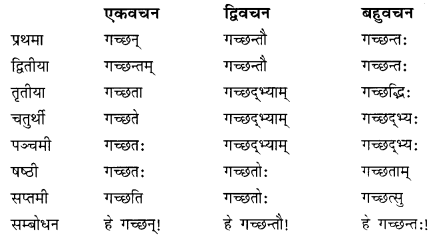
(ख) गच्छन्ती (स्त्रीलिङ्गः)
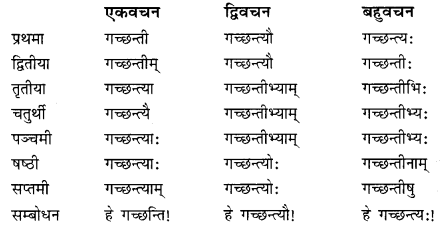
उत्तराणि:
विद्यार्थी स्वयं पढ़े-लिखें और समझें।
प्रश्न 4.
कोष्ठके प्रदत्तशब्दानाम् उचितप्रयोगेण रिक्तस्थानानि पूरयत-
(i) ___________ बालिकायाः पुस्तकम् कुत्र अस्ति? (पठन्ती)
(ii) ___________ शिष्याम् आचार्या किञ्चिद् वदति। (हसन्ती)
(iii) ___________ छात्रैः हस्यते। (गच्छत्)
(iv) ___________ कलिकानाम् सौन्दर्यम् अपूर्वं वर्तते। (विकसन्ती)
(v) ___________ बालकाय वस्त्रं दीयते। (याचत्)
उत्तराणि:
(i) पठन्त्याः
(ii) हसन्ती
(ii) गच्छद्भिः
(iv) विकसन्तीनाम्
(v) याचते
प्रश्न 5.
उदाहरणमनुसृत्य शतृशानच्प्रत्ययौ प्रयुज्य वाक्यानि संयोजयत-
यथा- बालिका गच्छति/सा क्रीडति।
गच्छन्ती बालिका क्रीडति
(i) बालकः पठति। सः पाठं स्मरति।
(ii) शिशुः चलति। सः हसति।
(iii) रमा पठति। सा लिखति।
(iv) साधुः उपदिशति।/सः ज्ञानवार्ता करोति।
(v) याचकः याचते। सः मार्गे चलति।
उत्तराणि:
(i) बालकः पठन् पाठं स्मरति।
(ii) शिशुः चलन् हसति।
(iii) रमा पठन्ती लिखति।
(iv) साधुः उपदिशन् ज्ञान्वार्ता करोति।
(v) याचकः याचमानः मार्गे चलति।
III.
प्रश्न 1.
क्त-क्तवतु-प्रत्ययसंयोजनेन पदानि रचयित्वा वाक्यपूर्तिं कुरुत-
(i) बालकेन – ___________। (हस् + क्त)
(ii) बालकः – ___________। (हस् + क्तवतु)
(iii) शिक्षकेण छात्रः पठनाय – ___________। (कथ् + क्त)
(iv) शिक्षकाः छात्रान् पठनाय – ___________। (कथ् + क्तवतु)
(v) पुत्री पितरम् पुस्तकम् – ___________। (याच् + क्तवतु)
(vi) माता सुतायै भोजनं – ___________। (दा + क्तवतु)
(vii) मम जनकेन भिक्षुकाय रूप्यकाणि – ___________। (दा + क्त)
(viii) छात्रेण ऋषः ज्ञानोपदेशः – ___________। (श्रु + क्त)
उत्तराणि:
(i) हसितम्
(ii) हसितवान्
(iii) कथितः
(iv) कथितवन्तः
(v) याचितवती
(vi) दत्तवती
(vii) दत्तानि
(viii) श्रुतः
प्रश्न 2.
स्तम्भयोः यथोचितं योजयत-
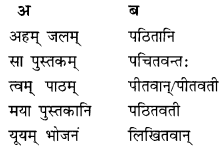
उत्तराणि:
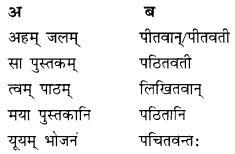
प्रश्न 3.
उदाहरणमनुसृत्य भूतकालिकक्रियाणां स्थाने क्तवतु प्रत्ययप्रयोगेण वाक्यपरिवर्तनं कुरुत-
यथा- अध्यापकः उद्दण्डं छात्रम् अदण्डयत्
अध्यापकः उद्दण्डं छात्रं दण्डितवान्।
(i) छात्रः कक्षायाम् उच्चैः अहसत्।
(ii) माता भोजनम् अपचत्।
(iii) काकः घटे पाषाणखण्डानि अक्षिपत्।
(iv) छात्राः बसयानस्य प्रतीक्षायाम् अतिष्ठन्।
(v) कन्याः उद्याने अक्रीडन्।
उत्तराणि:
(i) छात्रः कक्षायाम् उच्चैः दृष्टितवान्।
(ii) माता भोजनं पचितवती / पक्तवती।
(iii) काकः घटे पाषाणखण्डानिक्षिप्तवान्।
(iv) छात्राः बसयानस्य-प्रतीक्षायां स्थितवन्तः।
(v) कन्याः उद्यानि क्रीडितवत्यः।
प्रश्न 4.
उदाहरणमनुसृत्य भूतकालिकाक्रियाणां स्थाने वाक्यपरिवर्तनं कुरुत-
यथा- अध्यापकः छात्रम् पठनाया अकथयत्।
अध्यापकेन छात्रः पठनाया कथितः।
(i) वानरः मकराय जम्बूफलानि अयच्छत्।
(ii) मकरः वानरं गृहं चलितुम् अकथयत्।
(iii) नकुलः सर्पम् अमारयत्।
(iv) श्यामः लेखम् अलिखत्।
(v) रमा कथाम् अपठत्।
उत्तराणि:
(i) वानरेण मकराय जम्बूफलानि दत्तानि।
(ii) मकरेण वानरः गृहं चलितुम् कथितः।
(iii) नकुलैन सर्पः मारितः।
(iv) श्यामेन लेखः लिखितः।
(v) रमया कथा पठिता।
प्रश्न 5.
उदाहरणमनुसृत्य अशुद्धवाक्यानि शुद्धीकृत्य लिखत-
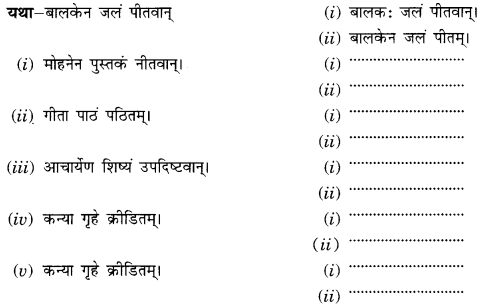
उत्तराणि:
(i) (i) मोहनः पुस्तकं नीतवान्।
(ii) मोहनेन पुस्तकं नीतम्।
(ii) (i) गीता पाठं पठितवती।
(i) गीतया पाठः पठितः।
(iii) (i) आचार्यः शिष्यम् उपदिष्टवान्।
(ii) आचार्येण शिष्यः उपदिष्टः।
(iv) (i) कन्या गृहे क्रीडितवती।
(ii) कन्यया गृहे क्रीडितम्।
(v) (i) सः भोजनं कृतवान्।
(ii) तेन भेजनं कृतम्।
IV.
प्रश्न 1.
कोष्ठके दत्तान् प्रकृतिप्रत्ययान् संयुज्य रिक्तस्थानानि पूरयत-
(i) रामस्य चरित्रं सर्वैः ___________ (अनु + कृ + अनीयर)
(ii) बालैः कन्दुकम् ___________ (क्रीड् + तव्यत्)
(ii) अस्माभिः गुरूपदेशः ___________ (श्रु + तव्यत्)
(iv) मया नौका ___________ (आ + रुह + अनीयर्)
(v) कः अत्र आगत्य ___________ (लिख + तव्यत्) लेख लेखिष्यति?
उत्तराणि:
(i) अनुकरणीयम्
(ii) क्रीडितव्यम्
(iii) श्रोतव्यः
(iv) आरोहणीया
(v) लेखितव्यं
प्रश्न 2.
कृ-कर्तव्यम्, करणीयम् इति उदाहरणमनुसृत्य अधोलिखिताभिः धातुभिः द्वे द्वे पदे रचयत-
(i) गम् ___________ ___________
(ii) स्मृ ___________ ___________
(iii) नी ___________ ___________
(iv) दृश् ___________ ___________
(v) दा ___________ ___________
उत्तराणि:
(i) गन्तव्यम्, गमनीयम्
(ii) स्मर्तव्यम्, स्मरणीयम्
(iii) नेतव्यम्, नयनीयम्
(iv) द्रष्टव्यम्, दर्शनीयम्
(v) दातव्यम्, दानीयम्
प्रश्न 3.
स्तम्भौ यथोचितं योजयत-
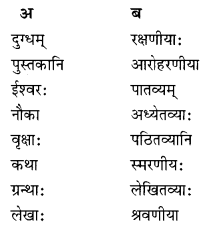
उत्तराणि:
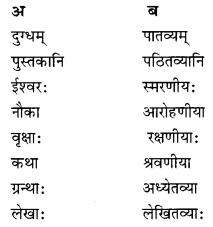
प्रश्न 4.
यथास्थानं प्रकृतिप्रत्यययोग विभागं वा कुरुत-
(i) पेयम् ___________
(ii) दा + यत् ___________
(iii) सेव्यम् ___________
(iv) कृ + ण्यत् ___________
(v) कर्त्तव्यः ___________
(vi) प्र + आप् + तव्यत् ___________
(vii) स्मरणीयः ___________
(viii) हस् + अनीयर् ___________
(ix) लेखनीयम् ___________
(x) प्रच्छ् + तव्यत् ___________
उत्तराणि:
(i) पा + यत्
(ii) देयम्
(iii) सेव् + ण्यन्
(iv) कार्यम्
(v) कृ + तव्यत्
(vi) प्राप्तव्यत्
(vii) स्मृ + अनीयर्
(viii) हसनीयम्
(ix) लिख + अनीयर्
(x) प्रष्टव्यम्
प्रश्न 5.
शुद्धपदेन वाक्यपूर्ति कुरुत-
(i) जलम् ___________ (पातव्यम् / पीतव्यम्)
(ii) पाठ् ___________ (पठितव्यः / पठितव्यम्)
(iii) शत्र ___________ (जेतव्यः / जितव्यः)
(iv) असत्यवचनम् ___________ (त्याज्यम् / त्याज्य:)
(v) अपेयं जलम् ___________ (त्याग्यम् / त्याज्यम्)
(vi) धनम् ___________ (लभ्यम् / लभियम्)
उत्तराणि:
(i) पातव्यम्
(ii) पठितव्ययः
(ii) जेतव्यः
(iv) त्याज्यम्
(v) त्याज्यम्
(vi) लभ्यम्
V.
प्रश्न 1.
उदाहरणमनुसृत्य पदेषु प्रयुक्तान् प्रकृतिप्रत्ययान् लिखत-
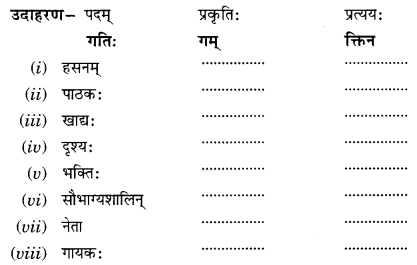
उत्तराणि:
क्रमश:
प्रकृतिः-प्रत्ययः
(i) हस् – ल्युट्
(ii) पठ् – ण्वुल्
(iii) खाद् – ण्यत्
(iv) दृश् – ण्यत्
(v) भज् – क्तिन्
(vi) सौभाग्यशाल – इन्
(vii) नी – तृच्
(viii) गै – ण्वुल्
प्रश्न 2.
अधोलिखितप्रत्ययानां प्रयोगेण पञ्च, पञ्च पदानि रयचित्वा-
स्वपुस्तिकासु लिखत- तृच्, क्तिन्, ण्वुल्, ल्युट्, यत्।
उत्तराणि:
तृच – मातृ, गातृ, भर्तु, पठितृ पितृ।
क्तिन् – गतिः, बुद्धिः, मतिः, उक्तिः, श्रुतिः।
ण्वुल् – लेखकः, गायकः, धावकः, पाठकः, पाचकः।
ल्युट – पठनम्, दानम्, लेखनम्, चलनम्, पाणम्।
यत् – देयम्, भव्यम्, श्रव्यम्, चेयम्, नेयम्।
प्रश्न 3.
अधोलिखितवाक्येषु स्थूलपदेषु कः प्रत्ययः प्रयुक्तः इति कोष्ठकेभ्यः चित्वा लिखत-
(i) सज्जनानाम् उक्तिः पालनीया। (ल्युट / क्तिन्) ___________
(ii) सेचकः क्षेत्रं सिञ्चति। (ल्युट / ण्वुल्) ___________
(iii) श्रावकः कथां श्रावयति। (ल्युट / ण्वुल्) ___________
(iv) भक्तः भक्ति करोति। (ण्वुल् / क्तिन्) ___________
उत्तराणि:
(i) क्तिन्
(ii) ण्वुल्
(iii) ण्वुल्
(iv) क्तिन्
प्रश्न 4.
शुद्धरूपं चित्वा लिखत-
(i) गम् + क्तिन् – गति: / गमतिः
(ii) दा + तृच – दातृ / दानी
(iii) नी + ण्वुल् – नाविक: / नायकः
(iv) नृत् + ल्युट – नर्तक: / नर्तनम्
(v) दृश् + ल्युट – दृश्यम् / दर्शनम्
उत्तराणि:
(i) गतिः
(ii) दातृ
(iii) नायकः
(iv) नर्तनम्
(v) दर्शनम्
VI.
प्रश्न 1.
निम्नलिखितप्रयोगान् ध्यानेन पठित्वा स्थूलपदेषु प्रकृति-प्रत्यय विभागं कुरुत-
(i) कालिदासः कीर्तिमान् आसीत्। ___________
(ii) एतौ बालकौ बलवन्तौ स्तः। ___________
(iii) एते जनाः गुणवन्तः सन्ति। ___________
(iv) धनी सर्वत्र समादरं प्राप्नोति। ___________
(v) बलिनौ अन्यायं न सहतः। ___________
(vi) गुणिनः आत्मश्लाघां न कुर्वन्ति। ___________
(vii) पिता आकाशात् श्रेष्ठतरः। ___________
(viii) धरित्री मातृः अपि गंभीरतरा। ___________
(ix) कदलीफलम् आम्रात् मधुरतमम्। ___________
(x) हिमालयः भारतस्य उच्चतमः पर्वतः अस्ति। ___________
उत्तराणि:
(i) कीर्ति + मतुप्
(ii) बल + वतुप्
(iii) गुण + वतुप्
(iv) समादृ + अण्
(v) अ + नी + अण्
(vi) गुण + इनि (इन्)
(vii) श्रेष्ठ + तरप्
(viii) गंभीर + तरप्
(ix) मधुर + तमप्
(x) उच्च + तमप्
प्रश्न 2.
प्रत्ययं संयुज्य पदनिर्माणं कुरुत-
(i) श्री + मतुप ___________
(ii) शक्ति + मतुप् ___________
(iii) धन + वतुप् ___________
(iv) बल + वतुप् ___________
(v) गुरु + तल् ___________
(vi) सुन्दर + मयट ___________
(vii) पटु + तमप् ___________
(viii) मृत् + मयट ___________
(ix) वसुदेव + अण् ___________
(x) धर्म + ठक् ___________
(xi) मित्र + तल् ___________
(xii) विद्वस + त्व
उत्तराणि:
(i) श्रीमान
(ii) शक्तिमान्
(iii) धनवान्
(iv) बलवान्
(v) गुरुता
(vi) सुन्दरमयः
(vii) पटुतमः
(viii) मृण्मयः
(ix) वासुदेवः
(x) धार्मिकः
(xi) मित्रता
(xii) विद्वत्वम्
प्रश्न 3.
कोष्ठके दत्तैः पदैः रिक्तस्थानानि पूरयत-
(i) धर्मेन्द्रः बालाभ्याम् ___________ (प्रशस्यतर:/प्रशस्यतमः)
(ii) ___________ राज्ञः दशरथस्य राजगुरुः आसीत्। (वाशिष्ठः/वशिष्ठः)
(iii) बालिकासु माया ___________ (चतुरतरा/चतुरतमा)
(iv) पाण्डवानाम् ___________ दर्शनीयम् आसीत्। (युद्धकौशलम्/युद्ध कुशलम्)
(v) ___________ आभूषणम् बहुमूल्यं भवति। (स्वर्णमयः/स्वर्णमयम्)
(vi) ___________ आसीत्। (दानव:/दनुजः)
(vii) ___________ जनः औषधि सेवते। (व्याधित:/व्याधिः)
(viii) बालिकासु चंद्रकला ___________ वदति। (मुधरतरम्/मधुरतमम्)
(ix) बालकेषु विजयस्य टङ्कणगतिः नगा उठणगतिः ___________। (तीव्रतरा/तीव्रतमा)
उत्तराणि:
(i) प्रशस्यतरः
(ii) वशिष्ठः
(iii) चतुरतमा
(iv) युद्धकौशलम्
(v) स्वर्णमयम्
(vi) दानवः
(vii) व्याधित:
(viii) मधुरतमम्
(ix) तीव्रतमा
प्रश्न 4.
विशेष्यविशेषणे परस्परं योजयत-
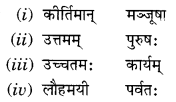
उत्तराणि:
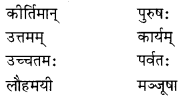
प्रश्न 5.
उदाहरणमनुसृत्य अशुद्धवाक्यानि शुद्धीकृत्य लिखत-
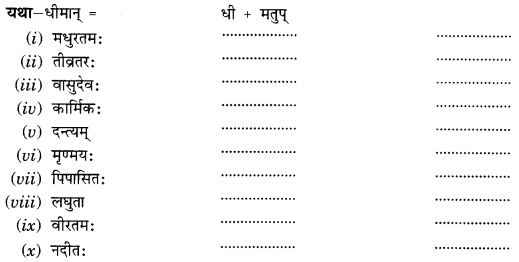
उत्तराणि:
(i) मधुर, तमप्
(ii) तीव्र, तरप्
(iii) वसुदेव, अण्
(iv) कर्म, ठक्
(v) दन्त, यत्
(vi) मृत्, मयट
(vii) पियासा, इतच्
(viii) लघु, तल्
(ix) वीर, तमप्
(x) नदी, तसिल्
प्रश्न 6.
अधोलिखितेषु शब्देषु तसिल्प्रत्ययं संयुज्य वाक्यरचनां कुरुत-
पर्वतः, नगरम्, भूमिः, भानुः, नदी
उत्तराणि:
पर्वतः + तसिल् = पर्वततः – नदी पर्वततः निस्सरति।
नगरम् + तसिल् = नगरतः – यात्री नगरतः गच्छति।
भूमिः + तसिल् = भूमितः – पादपाः भूमितः जायन्ते।
भानुः + तसिल् = भानुतः – प्रकाशः भानुतः भवति।
नदी + तसिल = नदीतः – नदीतः जलं प्राप्नोति।
VII.
प्रश्न 1.
निर्देशानुसारं लिङ्गपरिवर्तनं कुरुत-
(i) बालक ___________ (स्त्री.)
(ii) अराध्या ___________ (पुं.)
(iii) प्रथमा ___________ (पुं.)
(iv) साधक ___________ (स्त्री.)
(v) आचार्या ___________ (पुं.)
(vi) धातृ ___________ (स्त्री.)
उत्तराणि:
(i) बालिकाः
(ii) अराध्यः
(ii) प्रथमः
(iv) साधिका
(v) आचार्यः
(vi) धात्री
अभ्यासः
1. कोष्ठे दत्तान् प्रकृतिप्रत्ययान् योजयित्वा रिक्तस्थानपूर्तिः करणीया-
प्रश्न 1.
सर्वेषां मानवाना सेवा (i) ___________ (कृ + शानच्) वृक्षाः केषां न (ii) ___________ (वन्द + अनीयर)। (iii) ___________ (छाया + वतुप्) वृक्षाः मार्गे श्रान्तपथिकेभ्यः आश्रयं यच्छन्ति। (iv) ___________ (कोकिल + टाप्) च आम्रवृक्षे मधुरस्वरेण गायन्ति। यथा (v) ___________ (फल + इन् ) वृक्षाः नमन्ति तथैव गुणिनः जनाः अपि नमेयुः।
उत्तराणि:
(i) कुर्वाणाः
(ii) वन्दनीयाः
(iii) छायावन्तः
(iv) कोकिलाः
(v) फलिनः (अर्धाङ्ग प्रत्यययोगार्थं अर्धाङ्ग च शुद्धविभक्ति-वचनप्रयोगार्थं निर्धारितम् )।
प्रश्न 2.
(i) मम देशः (शक्ति + मतुप्) ___________ भवेत्।
(ii) जगति (विश्वबन्धु + तल्) ___________ भवेत।
(iii) दीनजनान् (सेव् + शानच्) ___________ जनाः पुण्यं लभन्ते।
(iv) अस्माभिः (वस् + तव्यत्) ___________।
(v) (पवित्र + टाप्) ___________ गङ्गा प्रदूषिता न कर्तव्या।
उत्तराणि:
(i) शक्तिमान्
(ii) विश्वबन्धुता
(iii) सेवमाना:
(iv) उषितव्यम्
(v) पवित्रा।
प्रश्न 3.
(i) विद्यार्थिभिः यथासमयं विद्यालयम् ___________। (गम् + तव्यत्)
(ii) उद्यमस्य ___________ (महत् + त्व) सर्वविदितम् एव।
(iii) ये छात्राः सर्वं वर्ष परिश्रमं कुर्वन्ति तेषा कृते ___________ (वर्ष + ठक् + ङीप्) परीक्षा भयं न जनयति।
(iv) ___________ (बुद्धि + मतुप्) छात्राः पुरुषार्थे विश्वसन्ति न तु केवलं भाग्ये।
(v) त्वम् कर्तव्यनिष्ठः ___________ (अधिकार + इन्) असि।
उत्तराणि:
(i) गन्तव्यम्
(ii) महत्त्वम्
(iii) वार्षिकी
(iv) बुद्धिमन्तः
(v) अधिकारी।
प्रश्न 4.
जानासि अस्माकं विद्यार्थिनां कानि (कृ + तव्यत्) (i) ___________? अस्माभिः विद्यालयस्य अनुशासनं (पाल् + अनीयर्) (ii) ___________। सर्वैः सहपाठिभिः सह (मित्र + तल्) (iii) ___________ आचरणीया। छात्रजीवने परिश्रमस्य (महत् + त्व) (iv) ___________ वर्तते। सत्यम् एव उक्तम्-(सुखार्थ + इन्) (v) ___________ कुतः विद्या?
उत्तराणि:
(i) कर्त्तव्यानि
(ii) पालनीयम्
(iii) मित्रता
(iv) महत्त्वम्
(v) सुखार्थिनः।
प्रश्न 5.
पर्यावरणस्य (महत् + त्व) (i) ___________ कः न जानाति? परं निरन्तरं (वृध् + शानच् ) (ii) ___________ प्रदूषणेन मानवजातिः विविधैः रोगैः आक्रान्ता अस्ति। अस्माभिः (ज्ञा + तव्यत् ) (iii) ___________ यत् पर्यावरणस्य रक्षणे एव अस्माकं रक्षणम्। एतदर्थं (जन + तल्) (iv) ___________ जागरूका कर्तव्या। स्थाने-स्थाने वृक्षारोपणम् अवश्यम् (कृ + अनीयर् ) (v) ___________ यतो हि वृक्षाः पर्यावरणरक्षणे अस्माकं सहायकाः सन्ति।
उत्तराणि:
(i) महत्त्वम्
(ii) वर्धमानेन
(iii) ज्ञातव्यम्
(iv) जनता
(v) करणीयम्।
प्रश्न 6.
(i) आर्यपुत्र! क्षत्रधर्मम् (अनु + स्मृ + शतृ) ___________ मां शोकसागरात् रक्षा।
(ii) जनैः सौन्दर्यमयी सृष्टि: दूषिता न (कृ + तव्यत्) ___________।
(ii) पुस्तकेषु किमपि न (लिख्+ अनीयर्) ___________।
(iv) मनुष्यः (समाज + ठक्) ___________ प्राणी अस्ति।
(v) (धन + मतुप्) ___________ नरः सर्वत्र मानं लभते।
उत्तराणि:
(i) अनुस्मरन्
(ii) कर्त्तव्या
(iii) लेखनीयम्
(iv) सामाजिकः
(v) धनवान्।
प्रश्न 7.
(i) कष्टानि (सह् + शानच्) ___________ वीराः कीर्तिं लभन्ते।
(ii) नमन्ति (फल + इन्) ___________ वृक्षाः।
(iii) (बल + मतुप्) ___________ हि आशा।
(iv) गुरोः (गुरु + त्व) ___________ वर्णयितुं न शक्यते।
(v) प्रकृतेः (रमणीया + तल्) ___________ दर्शनीया अस्ति।
उत्तराणि:
(i) सहमानाः
(ii) फलिनः
(iii) बलवती
(iv) गुरुत्वं
(v) रमणीयता।
प्रश्न 8.
(i) (शिष्य + टाप्) ___________ जलेन लताः सिञ्चति।
(ii) (दान + इन् ) ___________ मानं त्यजेत्।
(iii) (प्रयत् + शानच् ) ___________ जनः साफल्यम् आप्नोति।
(iv) (सप्ताह + ठक्) ___________ अवकाशः रविवारे भवति।
(v) (लौकिक + ङीप) ___________ उन्नतिः यशः वर्धयति।
उत्तराणि:
(i) शिष्या
(ii) दानी
(iii) प्रयतमानः
(iv) साप्ताहिकः
(v) लौकिकी।
प्रश्न 9.
(i) छात्रैः समये विद्यालयः (गम् + तव्यत्) ___________।
(ii) अद्य अस्माकं (वर्ष + ठक् + ङीप्) ___________ परीक्षा आरभते।
(iii) पर्यावरणस्य (महत् + त्व) ___________ सर्वे जानन्ति।
(iv) (बुद्धि + मतुप्) ___________ नरः सर्वत्र मानं लभते।
(v) जनकं (सेव् + शानच् ) ___________ पुत्रः प्रसन्नः अस्ति।
उत्तराणि:
(i) गन्तव्यः
(ii) वार्षिकी
(iii) महत्त्वं
(iv) बुद्धिमान्
(v) सेवमानः।
प्रश्न 10.
(i) नृपेण प्रजाः पाल् + अनीयर ___________।
(ii) आचार्य गुरु + त्व वर्णयितुं न शक्यते ___________।
(iii) पुरस्कारं लभ् + शानच् छात्रः प्रसन्नः भवति ___________।
(iv) मनुष्यः समाज + ठक् प्राणी अस्ति ___________।
(v) प्रकृतेः रमणीय + तल दर्शनीया अस्ति ___________।
उत्तराणि:
(i) पालनीयाः
(ii) गुरुत्वम्
(iii) लभमानः
(iv) सामाजिकः
(v) रमणीयता।
प्रश्न 11.
वानरयूथस्य स्वामी उवाच-जीवितं (i) ___________ (वाञ्छ् + शतृ) नरः कलहयुक्तं गृहं त्यजेत्। तेन तत्र न (ii) ___________ (स्था + तव्यत्)। (iii) ___________ (गुण + इन् ) जनाः कलहकारिभिः जनैः सह (iv) ___________ (मित्र + तल ) न कुर्वन्ति। ते सर्वदा (v) ___________ (धर्म + ठक् + ङीप् ) वृत्तिं धायन्ति।
उत्तराणि:
(i) वाञ्छन्
(ii) स्थातव्यम्
(iii) गुणिनः
(iv) मित्रताम्
(v) धार्मिकीम्।
2. अधोलिखिते कथने स्थूलाक्षरपदानां ‘प्रकृतिम् प्रत्ययम्’ च विभाज्य रिक्तस्थाने लिख्यताम्।
1. एकदा पितरं सेवमानः ___________ पुत्रः तमपृच्छत्-हे पितः! संसारे कः पूज्यते?
2. पिता अवदत्-गुणवान् ___________ सर्वत्र पूज्यते।
3. यः समाज सेवते स वन्दनीयः ___________ भवति।
4. सः सेवायाः महत्त्वं ___________ सम्यक् जानाति।
5. अतः सर्वै मानवतायाः ___________ सेवा।
6. कर्तव्या।
7. भारते अनेकानि दर्शनीयानि ___________ स्थानानि सन्ति।
8. तेषां रमणीयतां ___________ दृष्ट्वा जनाः विस्मताः भवन्ति।
9. परन्तु कश्चित् गुणवान् ___________ एव ऐतिहासिकस्थलाना।
10. महत्त्वं ___________ जानाति। धनी ___________ पुरुषः यत्र-तत्र भ्रमणं कृत्वा वस्तूनां संग्रह करोति।
11. एतेषां स्थानां यात्रा कर्त्तव्या ___________।
12. त्वया सन्तुलितः आहारः कर्तव्यः ___________।
13. तव कृशता ___________ मां तदति।
14. जीवने विद्याः अपि महत्त्वं ___________ वर्तते।
15. तर्हि त्वया सद्ग्रन्थाः अपि पठनीयाः ___________।
16. पठनेन नरः गुणवान् ___________ भवति।
17. किं त्वं जानासि कालस्य महत्त्वम् ___________?
18. कालः तु सततं चक्रवत् परिवर्तमानः ___________ वर्तते।
19. ये जनाः अस्य अस्थिरताम् ___________ अनुभूय वकार्याणि यथासमय।
20. कुर्वन्ति ते एव बुद्धिमन्तः ___________।
21. जनाः वन्दनीयाः ___________ भवन्ति।
22. कार्यं तु सदैव ध्यानेन एव करणीयम् ___________।
23. फलिनः ___________ वृक्षाः एव सदैव नमन्ति।
24. शिक्षायाः महत्त्वं ___________ तु अद्वितीयम् एव।
25. वर्धमानाः ___________ बालाः नयन्ति।
26. अजा ___________ शनैः शनैः चलति।
27. कार्यं सदैव शीघ्रं परन्तु धैर्येण कर्त्तव्यम् ___________।
28. वर्धमाना ___________ बालिका शीघ्रं-शीघ्रं धावति।
29. गुणिनः ___________ जनाः सदैव वन्दनीयाः।
30. वृक्षाणां महत्त्वं ___________ कः न जानाति।
31. कोकिला ___________ मधुरस्वरेण गायति।
32. पुस्तकानाम् अध्ययनम् करणीयम् ___________।
33. मन्त्रिणः ___________ सदसि भाषन्ते।
34. वर्तमाना ___________ शिक्षापद्धतिः सुकरा।
35. त्वं स्व-अज्ञानतां ___________ मा दर्शय।
36. नर्तकी ___________ शोभनं नृत्यति।
37. अस्माभिः सेवकाः पोषणीयाः ___________।
38. पक्षिण: ___________ वृक्षेषु तिष्ठन्ति।
39. पृथिव्याः गुरुत्त्वं ___________ सर्वे जानन्ति।
40. सेवमानाः ___________ सेवकाः धनं लभन्ते।
41. अश्वा ___________ वरं धारयति।
42. बालकैः गुरवः नन्तव्याः ___________
43. कार्यं कुर्वाणाः ___________ छात्राः अङ्कान् लभन्ते।
44. भाग्यशालिनः ___________ जनाः विश्रामं कुर्वन्ति।
45. गायिका ___________ मधुरं गायति।
46. पुस्तकानां महत्तां ___________ कः न जानाति?
उत्तराणि:
1. सेव+ शानच्।
2. गुण + मतुप्।
3. वन्द् + अनीयर।
4. महत् + त्व।
5. मानव + तल्।
6. कृ + तव्यत्।
7. दृश् + अनीयर।
8. रम् + अनीयर् + तल्।
9. गुण + मतुप।
10. महत् + त्व / धन + इन्।
11. कृ + तव्यत् + टाप्।
12. कृ + तव्यत्।
13. कृश + तल।
14. महत् + त्व।
15. पठ् + अनीयर।
16. गुण + मतुप।
17. महत् + त्व।
18. परि + वृत् + शानच्।
19. अस्थिर + तल।
20. बुद्धि + मतुप्।
21. वन्द् + अनीयर।
22. कृ + अनीयर।
23. फल + इन्।
24. महत् + त्व।
25. वृध् + शानच्।
26. अज + टा।
27. कृ+ तव्यत्।
28. वृध् + शानच्।
29. गुण + इन्।
30. महत् + त्व।
31. कोकिल + टाप्।
32. कृ + अनीयर।
33. मन्त्र + इन् (णिनि)।
34. वर्तमान + टाप्।
35. अज्ञान + तल्।
36. नर्तक + ङीप्।
37. पुष (पोष्) + अनीयर।
38. पक्ष + इन्।
39. गुरु + त्व।
40. सेव् + शानच्।
41. अश्व + टाप्।
42. नम् + तव्यम्।
43. कृ + शानच्।
44. भाग्यशाली + इन्।
45. गायक + ङीप्।
46. महत् + तल्।
3. विधिलिङ्ग-क्रियापदस्य स्थाने ‘तव्यत्’ प्रत्ययस्य प्रयोगं कृत्वा पुनः वाक्यानि लेखनीयानि।
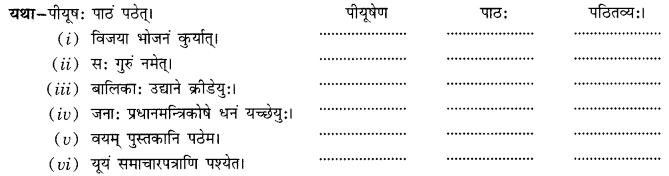
उत्तराणि:
(i) विजयया, भोजनम्, कर्त्तव्यम्।
(ii) तेन, गुरुः, नन्तव्यः।
(iii) बालिकाभिः, उद्याने, क्रीडितव्यम्।
(iv) जनैः, प्रधानमन्त्रिकोषे धनं, दातव्यम्।
(v) अस्माभिः, पुस्तकानि, पठितव्यानि।
(vi) युष्माभिः, समाचारपत्राणि, द्रष्टव्यानि।
4. अधः वाक्येषु तव्यत्/अनीयर् प्रत्ययस्य प्रयोगं कृत्वा पुनः तानि लिख्यन्ताम्।
उदाहरणम् सः अत्र प्रवेशं न कुर्यात्।
(क) तव्यत् – तेन अत्र प्रवेशः न कर्तव्यः।
(ख) अनीयर् – तेन अत्र प्रवेशः न करणीयः।
(i) दर्शकाः पशून् न पीडयेयुः।
(क) तव्यत् – _______________________
(ख) अनीयर् – _______________________
(ii) पथिकः बसयानात् हस्तं बहिः न कुर्यात्?
(क) तव्यत् – _______________________
(ख) अनीयर् – _______________________
(iii) गोविन्दः ग्रन्थालये ग्रन्थं उच्चैः न पठेत।
(क) तव्यत् – _______________________
(ख) अनीयर् – _______________________
उत्तराणि:
(i) (क) दर्शकैः पशवः न पीडितव्याः।
(ख) दर्शकैः पशवः न पीडनीयाः।
(ii) (क) पथिकेन बसयानात् हस्तः बहिः न कर्तव्यः।
(ख) पथिकेन बसयानात् हस्तः बहिः न करणीयः।
(iii) (क) गोविन्देन ग्रन्थालये ग्रन्थः उच्चैः न पठितव्यः।
(ख) गोविन्देन ग्रन्थालये ग्रन्थः उच्चैः न पठनीयः।
5. अनीयर् प्रत्ययस्य स्थाने तव्यत् प्रत्ययस्य प्रयोगः करणीयः।
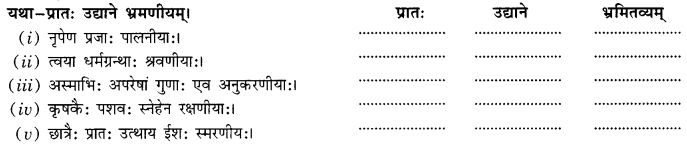
उत्तराणि:
(i) नृपेण, प्रजाः, पालयितव्याः।
(ii) त्वया, धर्मग्रन्थाः, श्रोतव्याः।
(iii) अस्माभिः, अपरेषां गुणाः, एव अनुकर्त्तव्याः।
(iv) कृषकैः, पशवः, स्नेहेन रक्षितव्याः।
(v) छात्रैः प्रातः, उत्थाय ईशः, स्मर्तव्यः।
6. ‘क’ स्तम्भे विशेषणानि ‘ख’ स्तम्भे विशेष्यानि सन्ति तेषां उचितमेलनं करुत।
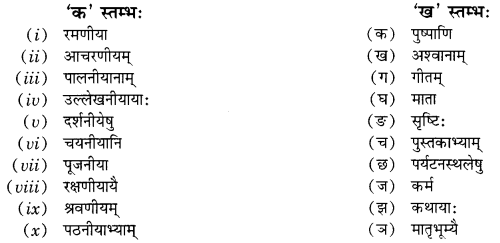
उत्तराणि:
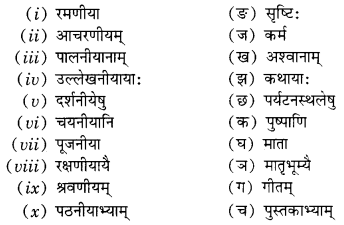
7. कोष्ठके दत्तानां धातूनां शानच्-प्रत्ययान्त-रूपेण रिक्तस्थानानि पूरयत-
यथा- वन्दमानः स आशिष लभते। (वन्द्)
(i) शनैः ___________ सा वैभवं प्राप्नोति। (वृध् / वर्ध)
(ii) ___________ नक्षत्रैः आकाशः दीव्यति। (प्र + काश्)
(iii) कष्टानि ___________ वीराः कीर्तिं लभन्ते। (सह)
(iv) ___________ वृक्षेभ्यः पुष्पाणि पतन्ति। (कम्प्)
(v) ___________ जनाः साफल्यम् आप्नुवन्ति। (प्र + यत्)
उत्तराणि:
(i) वर्धमाना
(ii) प्रकाशमानैः
(iii) सहमानाः
(iv) कम्पमानेभ्यः
(v) प्रयतमानाः।
8. किं भवन्तः उपर्युक्तपदानामर्थं जानन्ति? पश्यन्तु अत्र, उदाहरणम् च अनुसृत्य रिक्तस्थानं पूरयन्तु-
पदानि अर्थः

उत्तराणि:

9. अधः एतेषां पदानां सम्यक् परिचयम् उदाहरणम् अनुसृत्य लिखत।
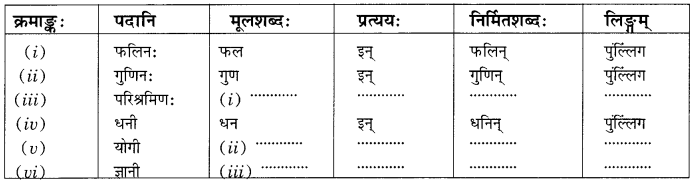
उत्तराणि:
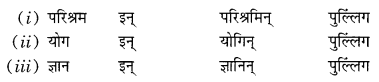
10. अधः प्रदत्तशब्दैः सह उदाहरणम् अनुसृत्य ‘इन्’ प्रत्ययं योजयित्वा लिखत-
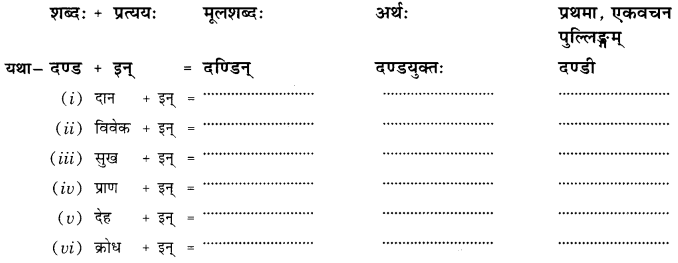
उत्तराणि:
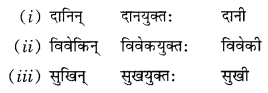
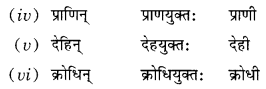
11. कोष्ठकाद् उचितपदम् आदाय रिक्तस्थानपूर्तिः क्रियताम्-
यथा- अभिमानी मानं न लभते। (अभिमानी / अभिमानिन:)
(i) ___________ सदा सम्मान्याः भवन्ति। (विज्ञानी / विज्ञानिन:)
(ii) ___________ शान्तिम् न प्राप्नोति। (लोभिनः / लोभी)
(iii) ___________ धन्याः लोके। (दानी / दानिनः)
(iv) ___________ विवेकः नश्यति। (क्रोधी / क्रोधिन:)
(v) किं कुलेन विशालेन विद्याहीनस्य ___________ (देही / देहिनः)
(vi) ___________ जनः सर्वप्रियः भवति। (विनोदिनः / विनोदी)
(vii) सर्वे भवन्तु ___________ (सुखी / सुखिनः)
(viii) ___________ इयम् बाला। (व्यवसायी / व्यवसायिनी)
उत्तराणि:
(i) विज्ञानिनः
(ii) लोभी
(iii) दानिनः
(iv) क्रोधिनः
(v) देहिनः
(vi) विनोदी
(vii) सुखिनः
(viii) व्यवसायिनी
12. अधोलिखितेषु वाक्येषु स्थूलाक्षरपदेषु प्रकृति-प्रत्ययविभागं कुरुत-
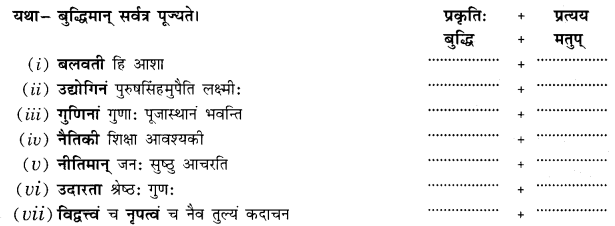
उत्तराणि:
(i) बल + मतुप् + ङीप्
(ii) उद्योग + इन्
(iii) गुण + इन्
(iv) नीति + ठक् + ङीप्
(v) नीति + मतुप्
(vi) उदार + तल्
(vii) विद्वस् + त्व, नृप + त्व
13. अधोलिखितानां विशेष्याणां विशेषणपदानि कोष्ठकात् चित्वा लिखत-
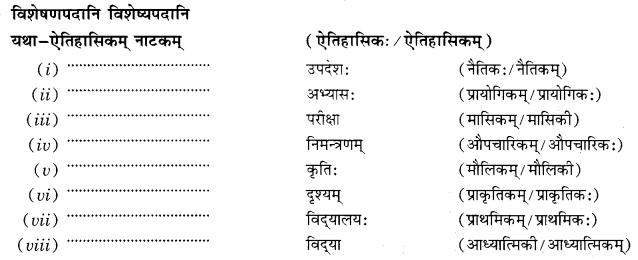
उत्तराणि:
(i) नैतिकः
(ii) प्रायोगिकः
(iii) मासिकी
(iv) औपचारिकम्
(v) मौलिकी
(vi) प्राकृतिकम्
(vii) प्राथमिकः
(viii) आध्यात्मिकी
14. अधोलिखित-शब्दैः सह ‘त्व’-प्रत्ययम् योजयत-
यथा- पृथु + त्व = पृथुत्वम्
(i) लघु + त्व = ___________
(ii) मनुष्य + त्व = ___________
(iii) विशाल + त्व = ___________
(iv) कवि + त्व = ___________
(v) दीन + त्व = ___________
(vi) क्षत्रिय + त्व = ___________
(vii) वीर + त्व = ___________
(viii) शम + त्व = ___________
उत्तराणि:
(i) लघुत्वम्
(ii) मनुष्यत्वम्
(iii) विशालत्वम्
(iv) कवित्वम्
(v) दीनत्वम्
(vi) क्षत्रियत्वम्
(vii) वीरत्वम्
(viii) शमत्वम्।
15. अधः मञ्जूषायां प्रदत्तैः शब्दैः सह ‘तल्’ प्रत्ययं संयोज्य यथोचितं रिक्तस्थानानि पूरयत।
यथा- क्रूरता तु सदैव निन्दनीया एव भवति।
क्रूर, चञ्चल, दक्ष, स्वच्छ, उष्ण, निर्धन, रमणीय
(i) अपने ___________ शीतकाले रोचते।
(ii) ___________ दु:खदायिनी भवति।
(iii) गृहस्य ___________ आनन्ददायिनी भवति।
(iv) प्रकृतेः ___________ मनोरमा अस्ति।
(v) मनसः ___________ वानरस्य इव भवति।
(vi) गणितविषये अशोकस्य ___________ प्रशंसनीया वर्तते।
उत्तराणि:
(i) उष्णता
(ii) निर्धनता
(iii) स्वच्छता
(iv) रमणीयता
(v) चञ्चलता
(vi) दक्षता
16. ‘त्व’ – ‘तल्’ – प्रत्ययान्तानि पदानि मञ्जूषायाः चित्वा यथोचितम् रिक्तस्थानानि पूरयत-
यथा- पवनस्य शीतलताम् अनुभूय मनः प्रसीदति।
चञ्चलत्वम्, मित्रता, वीरता, महत्त्वम्, पशुत्वम्
(i) विद्यायाः ___________ को न जानाति?
(ii) कृष्णसुदाम्नोः ___________ जगति आदर्श स्थापयति।
(iii) दुष्प्रयुक्ता वाणी मनुष्यस्य ___________ प्रकटयति।
(iv) मनसः ___________ वशीकरणीयम्।
(v) लवस्य ___________ अद्भुता आसीत्।
उत्तराणि:
(i) महत्त्वम्
(ii) मित्रता
(iii) पशुत्वम्
(iv) चञ्चलत्वम्
(v) वीरता
17. अधोलिखिताः सूक्तीः पठित्वा ‘तल्-त्व-प्रत्ययान्तानि पदानि रेखाङ्कितानि कुरुत-
यथा-
(i) ऐश्वर्यस्य विभूषणम् सुजनता।
(ii) न कालस्य अस्ति बन्धुत्वम्।
(iii) अविवेकिता तु अनर्थाय एव भवति।
(iv) अहो! बालकस्य ईदृशी निपुणता।
(v) न अस्ति अमरत्वम् हि कस्यचित् प्राणिनः भुवि।
(vi) क्षणे क्षणे यत् नवताम् उपैति तदेव रूपं रमणीयतायाः।
(vii) विद्वत्वम् च नृपत्वम् च नैव तुल्यम् कदाचन।
उत्तराणि:
(iii) अविवेकता
(iv) निपुणता
(v) अमरत्वम्
(vi) नवताम्, रमणीयतायाः
(vii) विद्वत्वम्, नृपत्वम्।
18. अधोलिखितेषु वाक्येषु स्थूलाक्षरपदानां मूलशब्दं प्रत्ययं च पृथक् कृत्य लिखत-


उत्तराणि:
(i) अनुपम + टाप्
(ii) उज्ज्वल + टाप्
(ii) प्रसन्न + टाप्
(iv) शुभद + टाप्
(v) धन्य + टाप्
19. अधोलिखितेषु वाक्येषु निर्दिष्टशब्दैः सह ‘ङीप्’ प्रत्ययं प्रयुज्य वाक्यानि पूरयत-
यथा- श्रीमती (श्रीमत् + ङीप्) हेमा नाट्योत्सवे दीप प्रज्वालयति।
(i) (कुमार + ङीप) ___________ वन्दना पुष्पगुच्छैः तस्याः स्वागतं करोति।
(ii) एका (किशोर + ङीप्) ___________ भरतनाट्यम् प्रस्तौति।
(iii) तया सह (नृत्यत् + ङीप्) ___________ देविका अस्ति।
(iv) मञ्चे (गायत् + ङीप्) ___________ सधा अस्ति।
(v) (मनोहारिन् + ङीप्) ___________ एषा नाट्यप्रस्तुतिः।
उत्तराणि:
(i) कुमारी
(ii) किशोरी
(iii) नृत्यन्ती
(iv) गायन्ती
(v) मनोहारिणी
20. अधोलिखितेषु वाक्येषु स्थूलाक्षरपदानां मूलशब्दं स्त्रीप्रत्ययं च पृथक्कृत्य लिखत-
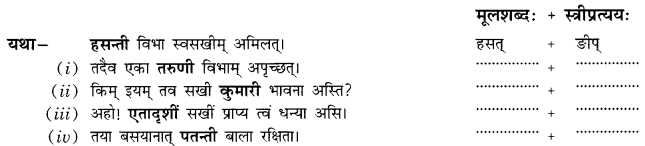
उत्तराणि:
(i) तरुण + ङीप्
(ii) कुमार + ङीप्
(iii) एतादृश + ङीप्
(vi) पतत् + ङीप्
21. स्थूलपदानाम् ‘प्रकृतिप्रत्ययः’ पृथक् संयोगो कृत्वा उत्तरपुस्तिकायाम् लिखत।
(स्थूल पदों के प्रकृति-प्रत्यय अलग अथवा संयुक्त करके उत्तर पुस्तिका में लिखिए। Separate or join suffixes in the bold words and write answer in the answer sheet.)
(i) कोकिल + टाप् च आम्रवृक्षे मधुरस्वरेण गायन्ति।
(ii) जगति विश्वबन्धु + तल् भवेत्।
(iii) दीनजनान् सेव् + शानच् जनाः पुण्यं लभन्ते।
(iv) गङ्गा पवित्र + टाप् अतः प्रदूषिता न कर्तव्या।
(v) ये छात्राः सर्वं वर्ष परिश्रमं कुर्वन्ति तेभ्यं वर्ष + ठक् + डीप परीक्षा भयं न जनयति।
(vi) त्वम् कर्तव्यनिष्ठ अधिकार + इन् असि।
(vii) सर्वैः सहपाठिभिः सह मित्र + तल आचरणीया।
(viii) छात्रजीवने परिश्रमस्य महत् + त्व वर्तते।
(ix) परं निरन्तरं वृध् + शानच् प्रदूषणेन मानवजातिः विविधैः रोगैः आक्रान्ता अस्ति।
(x) कष्टानि सह् + शानच् वीराः कीर्तिं लभन्ते।
(xi) गुरोः गुरु + त्व वर्णयितुं न शक्यते।
(xii) प्रकृतेः रमणीय + तल् दर्शनीया अस्ति।
(xiii) शिष्य + टाप् जलेन लताः सिञ्चति।
(xiv) संसारे प्र + यत् + शानच् जनः साफल्यम् आप्नोति।
(xv) लौकिक + ङीप उन्नतिः यश: वर्धयति।
उत्तराणि:
(i) कोकिला:
(ii) विश्वबन्धुता
(iii) सेवमानाः
(iv) पवित्रा
(v) वार्षिकी
(vi) अधिकारी
(vii) मित्रता
(viii) महत्त्वं
(ix) वर्धमानेन
(x) सहमानाः
(xi) गुरुत्वं
(xii) रमणीयता
(xiii) शिष्या
(xiv) प्रयतमानः
(xv) लौकिकी
बहुविकल्पीय प्रश्नाः
1. प्रदत्तेषु उत्तरेषु प्रत्ययानुसारम् विकल्पेषु यत् उत्तरम् शुद्धम् अस्ति तत् चीयताम्।
(दिए गए उत्तरों में से प्रत्यय के अनुसार विकल्पों में से जो उत्तर शुद्ध है, उसे चुनिए। Choose the answer that you consider the most appropriate from the options given below to complete the sentence.)
प्रश्न 1.
कृषकैः पशवः स्नेहेन ___________ (रक्षितव्याः)।
(क) रक्ष् + तव्यत्
(ख) रक्ष् + तव्य
(ग) रक्ष् + तव्यः
(घ) रक्षि + तव्यत्।
उत्तराणि:
(क) रक्ष् + तव्यत्
प्रश्न 2.
पितरः सदैव ___________ (वन्द + अनीयर)।
(क) वन्दनीयः
(ख) वन्दनीयाः
(ग) वन्दनीया
(घ) वन्दनीयम्।
उत्तराणि:
(ख) वन्दनीयाः
प्रश्न 3.
___________ (छाया + मतुप्) वृक्षाः मार्गे श्रान्तपथिकेभ्यः आश्रयं यच्छन्ति।
(क) छायावान्
(ख) छायावन्तः
(ग) छायावन्तम्
(घ) छायावतः।
उत्तराणि:
(ख) छायावन्तः
प्रश्न 4.
यथा ___________ (फल + इन्) वृक्षाः नमन्ति तथैव गुणिनः जनाः अपि नमेयुः।
(क) फली
(ख) फलिनौ
(ग) फलिनः
(घ) फलिनाः।
उत्तराणि:
(ग) फलिनः
प्रश्न 5.
अस्माभिः परस्परं स्नेहेन (वस् + तव्यत्) ___________।
(क) वसितव्यः
(ख) वसितव्या
(ग) वसितव्यम्
(घ) उषितव्यम्।
उत्तराणि:
(घ) उषितव्यम्।
प्रश्न 6.
विद्यार्थिभिः यथासमयं विद्यालयः ___________ ( गम् + तव्यत्)।
(क) गन्तव्यम्
(ख) गन्तव्यः
(ग) गन्तव्या
(घ) गन्तव्याः
उत्तराणि:
(ख) गन्तव्यः
प्रश्न 7.
जानासि, अस्माकं विद्यार्थिनां कानि (कृ + तव्यत्) ___________?
(क) कर्तव्यम्
(ख) कर्तव्यौ
(ग) कर्तव्यानि
(घ) कर्तव्याः
उत्तराणि:
(ग) कर्तव्यानि
प्रश्न 8.
अस्माभिः विद्यालयस्य अनुशासनं (पाल् + अनीयर्) ___________
(क) पालनीयम्
(ख) पालनीयः
(ग) पालनीया
(घ) पालनीयन्ति।
उत्तराणि:
(क) पालनीयम्
प्रश्न 9.
सत्यम् एव उक्तम्, ___________ (सुखार्थ + इन्) कुतः विद्या?
(क) सुखार्थी
(ख) सुखार्थीम्
(ग) सुखार्थिन:
(घ) सुखार्थिने।
उत्तराणि:
(घ) सुखार्थिने।
प्रश्न 10.
जनैः सौन्दर्यमयी सृष्टि: दूषिता न (कृ + तव्यत्) ___________
(क) कर्तव्यः
(ख) कर्तव्यम्
(ग) कर्तव्या
(घ) कर्तव्याः
उत्तराणि:
(ग) कर्तव्या
प्रश्न 11.
पुस्तकेषु किमपि न (लिख + अनीयर) ___________।
(क) लेखनीयः
(ख) लेखनीयम्
(ग) लेखनीया
(घ) लेखनीयाः।
उत्तराणि:
(ख) लेखनीयम्
प्रश्न 12.
मनुष्यः (समाज + ठक्) ___________ प्राणी अस्ति।
(क) सामाजिकः
(ख) सामाजिकी
(ग) सामाजिकम्
(घ) सामाजिकाः।
उत्तराणि:
(क) सामाजिकः
प्रश्न 13.
(बुद्धि + मतुप्) ___________ नरः सर्वत्र मानं लभते।
(क) बुद्धिमत्
(ख) बुद्धिमान्
(ग) बुद्धिमन्तः
(घ) बुद्धिमतः।
उत्तराणि:
(ख) बुद्धिमान्
प्रश्न 14.
नमन्ति (फल + इन्) ___________ वृक्षाः।
(क) फलिनः
(ब) फली
(ग) फलिनौ
(घ) फलिनाः।
उत्तराणि:
(क) फलिनः
प्रश्न 15.
(बल + मतुप) ___________ हि आशा।
(क) बलवान्
(ख) बलवत्
(ग) बलवती
(घ) बलवतः।
उत्तराणि:
(ग) बलवती
प्रश्न 16.
(दान + इन्) ___________ मानं त्यजेत्।
(क) दानिन्
(ख) दानी
(ग) दानिनः
(घ) दनिनीम्।
उत्तराणि:
(ख) दानी
प्रश्न 17.
(सप्ताह + ठक्) ___________ अवकाशः रविवारे भवति।
(क) साप्ताहिक:
(ख) साप्ताहिकी
(ग) साप्ताहिकम्
(घ) साप्ताहिकाः।
उत्तराणि:
(क) साप्ताहिक:
2. स्थूलपदानाम् ‘प्रकृतिप्रत्ययः’ पृथक् संयोगो कृत्वा विकल्पेभ्यः शुद्धं उत्तरं चित्त्वा उत्तरपुस्तिकायाम् लिखत।
(स्थूल पदों के प्रकृति-प्रत्यय अलग अथवा संयुक्त करके विकल्पों से शुद्ध उत्तर को चुनकर उत्तर-पुस्तिका में लिखिए। Separate or join suffixes in the bold words and write answer appropriate from the options given below in the answer sheet.)
प्रश्न 1.
राजसभायाम् मन्त्र + इन् भाषयन्ति।
(क) मन्त्रिन्
(ख) मन्त्रिण:
(ग) मन्त्री
(घ) मन्त्रि।
उत्तराणि:
(ख) मन्त्रिण:
प्रश्न 2.
तया भोजनं पच् + तव्यत्।
(क) पचितव्यम्
(ख) पक्तव्यम्
(ग) पचतव्यम्
(घ) पन्तव्यम्।
उत्तराणि:
(ख) पक्तव्यम्
प्रश्न 3.
नागरिकाः देशम् रक्षन्ति।
(क) नगर + ठक्
(ख) नागर + इक
(ग) नगर + इक्
(घ) नागरि + इक।
उत्तराणि:
(क) नगर + ठक्
प्रश्न 4.
पठनेन नर: गुणवान् भवति।
(क) गुण + वतुप्
(ख) गुण + मत्
(ग) गुण + मतुप्
(घ) गुण + वत्।
उत्तराणि:
(ग) गुण + मतुप्
प्रश्न 5.
ते जनाः वन्दनीयाः भवन्ति।
(क) वद् + अनीयर्
(ख) वन्द् + अनीयर्
(ग) वन्द् + अनीयः
(घ) वन्द + अनीयस्।
उत्तराणि:
(ख) वन्द् + अनीयर्
प्रश्न 6.
कार्यं तु सदैव ध्यानेन एव करणीयम्।
(क) कृ + अनीयर्
(ख) कृ + अणीयर्
(ग) कर् + अनीयर्
(घ) कर् + अणीयम्।
उत्तराणि:
(क) कृ + अनीयर्
प्रश्न 7.
कार्यं सदैव शीघ्रं परन्तु धैर्येण कर्तव्यम्।
(क) कर्त + व्यत्
(ख) कर्तृ + तव्यम
(ग) कृ + तव्यत्
(घ) कृ + त्वयत्।
उत्तराणि:
(ग) कृ + तव्यत्
प्रश्न 8.
पुस्तकानाम् अध्ययनम् करणीयम्।
(क) कर् + अनीयम्
(ख) कृ + अनीयम
(ग) कृ + अनीयर्
(घ) कृ + अनीयत्।
उत्तराणि:
(ग) कृ + अनीयर्
प्रश्न 9.
अस्माभिः सेवकाः पोषणीयाः।
(क) पोष् + अनीयाः
(ख) पोष् + अनीयत्
(ग) पुष् + अनीयर्
(घ) पोष् + अनीयर।
उत्तराणि:
(घ) पोष् + अनीयर।
प्रश्न 10.
बालकैः गुरवः नन्तव्याः।
(क) नम् + तव्यत्
(ख) नम् + तव्याः
(ग) नन् + तव्यत्
(घ) नन् + तव्याः
उत्तराणि:
(क) नम् + तव्यत्
प्रश्न 11.
बालिकाभिः राष्ट्रगीतं ___________ (गै + तव्यत्)
(क) गीतव्यम्
(ख) गातव्यम्
(ग) गैतव्यम्
(घ) गेतव्यम्।
उत्तराणि:
(ख) गातव्यम्
प्रश्न 12.
त्वया शुद्धं जलं पातव्यम्।
(क) पा + तव्यत्
(ख) पा + तव्यम्
(ग) पा + तव्य
(घ) पा + तव्याः
उत्तराणि:
(क) पा + तव्यत्
प्रश्न 13.
मुनिभिः तप: करणीयम्।
(क) कृ + अनीयम्
(ख) कृ + अनीयत्
(ग) कृ + अनीय
(घ) कृ + अनीयर।
उत्तराणि:
(घ) कृ + अनीयर।
प्रश्न 14.
न्यायाधीशेन न्यायः ___________ (कृ + अनीयर्)।
(क) करणीय
(ख) करणीयर्
(ग) करणीयः
(घ) करणीया।
उत्तराणि:
(ग) करणीयः
प्रश्न 15.
भवत्या पाठः लेखनीयः।
(क) लिख् + अनीय
(ख) लिख् + अनीयर्
(ग) लेख् + अनीयर्
(घ) लेख + अनीयम्।
उत्तराणि:
(ख) लिख् + अनीयर्
प्रश्न 16.
अस्माभिः लता आरोपयितव्याः।
(क) आरोप् + तव्यः
(ख) आरुप् + तव्याः
(ग) आ + रोप् + तव्यत्
(घ) आरोप + तव्याः
उत्तराणि:
(ग) आ + रोप् + तव्यत्
प्रश्न 17.
पत्रवाहकेन पत्राणि ___________ (आ + नी + तव्यत्)।
(क) आनीतव्यानि
(ख) आनेतव्यानि
(ग) आनेतव्यम्
(घ) आनेतव्यः।
उत्तराणि:
(ख) आनेतव्यानि
प्रश्न 18.
राज्ञा प्रजाः पालनीयाः।
(क) पाल् + अनीयर्
(ख) पाल् + अनीयाः
(ग) पाल् + अनीयम्
(घ) पालय् + अनीयत्।
उत्तराणि:
(क) पाल् + अनीयर्
प्रश्न 19.
छात्रैः समये विद्यालयः (गम् + तव्यत्) ___________।
(क) गम्तव्यः
(ख) गन्तव्यः
(ग) गन्तव्या
(घ) गन्तव्याः।
उत्तराणि:
(ख) गन्तव्यः
प्रश्न 20.
(बुद्धि + मतुप) ___________ नरः सर्वत्र मानं लभते।
(क) बुद्धिमतः
(ख) बुद्धिमन्तः
(ग) बुद्धिमन्
(घ) बुद्धिमान्।
उत्तराणि:
(घ) बुद्धिमान्।
प्रश्न 21.
नृपेण प्रजाः (पाल् + अनीयर्) ___________।
(क) पालनीया
(ख) पालनीयम्
(ग) पालनीयः
(घ) पालनीयाः।
उत्तराणि:
(घ) पालनीयाः।
प्रश्न 22.
मनुष्यः (समाज + ठक्) ___________ प्राणी अस्ति।
(क) सामाजिकी
(ख) समाजिकी
(ग) समाजिकः
(घ) सामाजिकः।
उत्तराणि:
(घ) सामाजिकः।
प्रश्न 23.
तेन तत्र न ___________ (स्था + तव्यत्)।
(क) स्थातव्यः
(ख) स्थातव्यम्
(ग) स्थातव्या
(घ) स्थातव्याः।
उत्तराणि:
(ख) स्थातव्यम्
प्रश्न 24.
एकदा राजा तं ___________ (बुद्धि + मतुप्) द्रष्टुं-
(क) बुद्धिमान्
(ख) बुद्धिमानं
(ग) बुद्धिमन्तं
(घ) बुद्धिमत।
उत्तराणि:
(ग) बुद्धिमन्तं
प्रश्न 25.
तस्य कुटीरम् ___________ (गम् + तव्यत्) इति निश्चितवान्।
(क) गन्तव्यम्
(ख) गन्तव्यः
(ग) गन्तव्याः
(घ) गन्तव्यत्।
उत्तराणि:
(क) गन्तव्यम्
प्रश्न 26.
तत्र गत्वा तस्य ___________ (दरिद्र + तल्) दूरीकर्तुं सः तस्मै स्वर्णमुद्राः अयच्छत्।
(क) दरिद्रताः
(ख) दरिद्रता
(ग) दरिद्रतम्
(घ) दरिद्रताम्।
उत्तराणि:
(घ) दरिद्रताम्।
प्रश्न 27.
कैयटः अवदत्-धनस्य ___________ (लोभ + इन्) जनाः आसक्ताः भूत्वा दु:खिनः भवन्ति। अतः मम आनन्दं मा नाशयतु इति।
(क) लोभिनः
(ख) लोभी
(ग) लोभिन्
(घ) लोभि।
उत्तराणि:
(क) लोभिनः
प्रश्न 28.
सर्वे एव ___________ (दुःख + इन्) आसन्।
(क) दुःखीः
(ख) दुखिन्
(ग) दुःखी
(घ) दुःखिनः।
उत्तराणि:
(घ) दुःखिनः।
प्रश्न 29.
___________ (कृ + अनीयर्)। एकः अन्यः अवदत्, ‘कः करिष्यति?
(क) करनीयम्
(ख) करणीयम्
(ग) करणीयः
(घ) करणीया।
उत्तराणि:
(ख) करणीयम्
प्रश्न 30.
वयं वाटिकां प्रति गच्छामः। ऋतुराजः वसन्तः ___________ (दृश् + अनीयर्)
(क) दर्शनीयः
(ख) दृशनीयः
(ग) दृशनीयम्
(घ) दर्शनीयम्।
उत्तराणि:
(क) दर्शनीयः
प्रश्न 31.
प्रातःकाले उद्यानस्य शोभा खलु ___________ (दृश + अनीयर)।
(क) दृशनीयः
(ख) दर्शनीया
(ग) दृशनीया
(घ) दर्शनीयः।
उत्तराणि:
(ख) दर्शनीया
प्रश्न 32.
___________ (गुण + इन्) जनाः तेषां सज्जनानाम् आदरं कुर्वन्ति।
(क) गुणि
(ख) गुणिनः
(ग) गुणिनौ
(घ) गुणीः।
उत्तराणि:
(ख) गुणिनः
3. कोष्ठकेषु प्रदत्तान् प्रकृतिप्रत्ययान् योजयित्वा रिक्तस्थान पूर्तिः करणीया।
(कोष्ठक में दिए गए प्रकृति-प्रत्ययों को जोड़कर रिक्त स्थानों की पूर्ति कीजिए। Fill in the blanks by adding suffixes given in the brackets.)
प्रश्न 1.
अध्यापक:- ___________ (बुद्धि + मतुप्) छात्राः! संसारेऽस्मिन् कः श्रेष्ठः?
(क) बुद्धिमन्तः
(ख) बुद्धिमानाः
(ग) बुद्धिवन्तः
(घ) बुद्धिमान्।
उत्तराणि:
(क) बुद्धिमन्तः
प्रश्न 2.
यः ___________ (रूप + मतुप्) नरः भवति जनाः तम् एव श्रेष्ठ मन्यन्ते।
(क) रूपवान्
(ख) रूपमान्
(ग) रूपवानः
(घ) धनमानः।
उत्तराणि:
(क) रूपवान्
प्रश्न 3.
___________ (सदाचार + मतुप्), विवेकी-
(क) सदाचारमान्
(ख) सदाचारवान्
(ग) सदाचारवन्तः
(घ) सदाचारमन्तः।
उत्तराणि:
(ख) सदाचारवान्
प्रश्न 4.
___________ (नीति + मतुप्)
(क) नीतिवान्
(ख) नीतीमान्
(ग) नीतिमान्
(घ) नीतीवान्।
उत्तराणि:
(ग) नीतिमान्
प्रश्न 5.
___________ (चरित्र + मतुप्) च जनः एव सर्वोत्तमः भवति।
(क) चरित्रवान्
(ख) चरित्रवान
(ग) चरित्रमान
(घ) चरित्रमानः।
उत्तराणि:
(क) चरित्रवान्
प्रश्न 6.
यः सत्यवादी ___________ (निष्ठा + मतुप्)
(क) निष्ठावन्तः
(ख) निष्ठावतः
(ग) निष्ठावान्
(घ) निष्ठावान।
उत्तराणि:
(ग) निष्ठावान्
प्रश्न 7.
___________ (विनय + मतुप्)
(क) विनयी
(ख) विनयवान्
(ग) विनयमान्
(घ) विनयवान।
उत्तराणि:
(ख) विनयवान्
प्रश्न 8.
___________ (गुण + मतुप्) श्रेष्ठः च मन्यते।
(क) गुणवान्
(ख) गुणमान्
(ग) गुणवान
(घ) गुणमान।
उत्तराणि:
(क) गुणवान्
प्रश्न 9.
वीराः अभ्युदये ___________ (धैर्य + मतुप्) भवन्ति।
(क) धैर्यवन्तः
(ख) धैर्यवानाः
(ग) धैर्यवताः
(घ) धैर्यमन्तः।
उत्तराणि:
(क) धैर्यवन्तः
4. स्थूलपदानाम् ‘प्रकृतिप्रत्ययः’ पृथक् संयोगो कृत्वा विकल्पेभ्यः शुद्धं उत्तरं चित्त्वा उत्तरपुस्तिकायाम् लिखत।
(स्थूल पदों के प्रकृति-प्रत्यय अलग अथवा संयुक्त करके विकल्पों से शुद्ध उत्तर को चुनकर उत्तर-पुस्तिका में लिखिए। Separate or join suffixes in the bold words and write answer appropriate from the options given below in the answer sheet.)
प्रश्न 1.
पुत्र! तव कृशता मां तुदति।
(क) कृश + तल्
(ख) कृश + ता
(ग) कृश + शत् + आ
(घ) कृ + शता।
उत्तराणि:
(क) कृश + तल्
प्रश्न 2.
विद्यालये बालकाः मोदमानाः पठन्ति।
(क) मोद् + शानच्
(ख) मुद् + शानच्
(ग) मुद् + मानाः
(घ) मुद् + मतुप्।
उत्तराणि:
(ख) मुद् + शानच्
प्रश्न 3.
छात्रैः कथा लेखितव्या।
(क) लिख् + तव्या
(ख) लिख् + तव्यत्
(ग) लिख् + तव्यत् + टाप्
(घ) लेख् + तव्यत्।
उत्तराणि:
(ग) लिख् + तव्यत् + टाप्
प्रश्न 4.
वीरः युद्धयमानः वीरगतिं आप्नोत्।
(क) युद्ध + मानम्
(ख) युध् + मानत्
(ग) युध् + शानच्
(घ) युद्ध + शानच्।
उत्तराणि:
(ग) युध् + शानच्
प्रश्न 5.
देवम् वन्दमानाः ललनाः प्रसीदन्ति।
(क) वन्द + शानच्
(ख) वन्द् + शानच्
(ग) वन्द् + शानच् + टाप्
(घ) वन्द + मानाः।
उत्तराणि:
(ग) वन्द् + शानच् + टाप्
प्रश्न 6.
तत्र जायमानः बालकः कीदृशो भविष्यति?
(क) जा + शानच्
(ख) जन् + शानच्
(ग) ज्ञा + शानच्
(घ) ज्ञान + शानच्।
उत्तराणि:
(ख) जन् + शानच्
प्रश्न 7.
सीता रामेण सह वनं गच्छन्ती आसीत्।
(क) गम् + शतृ + ङीप्
(ख) गम् + ङीप्
(ग) गम् + शतृ
(घ) गम् + शानच् + ङीप्।
उत्तराणि:
(क) गम् + शतृ + ङीप्
प्रश्न 8.
गङ्गा नदी हिमालयात् उद्भवति।
(क) नद् + ङीप्
(ख) नद + इन्
(ग) नद + ङीप्
(घ) नद् + इन।
उत्तराणि:
(ग) नद + ङीप्
प्रश्न 9.
रूपवती भार्या कस्मै न रोचते?
(क) रूपवत + मतुप्
(ख) रूपवत + ङीप्
(ग) रूपवत् + इन्
(घ) रूप + मतुप् + ङीप्।
उत्तराणि:
(घ) रूप + मतुप् + ङीप्।
प्रश्न 10.
जीवने विद्यायाः अपि महत्त्वं वर्तते।
(क) महत् + त्वं
(ख) महत् + त्व
(ग) महत्त्व + मतुप्
(घ) महत्त + त्व।
उत्तराणि:
(ख) महत् + त्व
प्रश्न 11.
ये जनाः अस्य अस्थिरताम् अनुभूय स्वकार्याणि यथासमयं कुर्वन्ति ते एव बुद्धिमन्तः भवन्ति।
(क) अस्थिर + ता
(ख) अस्थिर + तल्
(ग) अस्थिर + टाप्
(घ) अस्थिरता + आ।
उत्तराणि:
(ख) अस्थिर + तल्
प्रश्न 12.
जनाः तीव्र धावन्तः गच्छन्ति।
(क) धाव + अन्तः
(ख) धा + वन्तः
(ग) धाव् + शतृ
(घ) धाव् + शानच्।
उत्तराणि:
(ग) धाव् + शतृ
प्रश्न 13.
गृहं गच्छन्त्यः छात्राः प्रसीदन्ति।
(क) गम् + शतृ
(ख) गम् + शतृ + ङीप्
(ग) गम् + ङीप्
(घ) गम् + शत् + टाप्।
उत्तराणि:
(ख) गम् + शतृ + ङीप्
प्रश्न 14.
कालः सदैव गम्यमानः वर्तते।
(क) गम् + शानच्
(ख) गम् + शतृ
(ग) गम् + मतुप्
(घ) गम् + ठक्।
उत्तराणि:
(क) गम् + शानच्
प्रश्न 15.
किं त्वं जानासि कालस्य महत्त्वम्?
(क) महत् + तव
(ख) महत् + तवं
(ग) महत् + त्वं
(घ) महत् + त्व।
उत्तराणि:
(घ) महत् + त्व।
प्रश्न 16.
आगता पर्वसु प्रिया दीपावलिः।
(क) प्रिय + आ
(ख) प्रिय + आप
(ग) प्रिय + टाप्
(घ) प्रिय + डाप्।
उत्तराणि:
(ग) प्रिय + टाप्
प्रश्न 17.
विपणीनां शोभा अनुपमा भविष्यति।
(क) अनुपम + टाप्
(ख) अनुपम + आप्
(ग) अनुपम + चाप्
(घ) अनुपम + ठक्
उत्तराणि:
(क) अनुपम + टाप्
प्रश्न 18.
धन्या इयं दीपावलिः प्रकाशपुञ्जा।
(क) धन्य् + टाप्
(ख) धन्य + टाप्
(ग) धन्या + टाप्
(घ) धन्या + आ।
उत्तराणि:
(ख) धन्य + टाप्
प्रश्न 19.
मधुरा वाणी प्रीणयति मनः।
(क) मधुर + टाप्
(ख) मधुर + आप्
(ग) मधुर + आ
(घ) मधुर + चाप।
उत्तराणि:
(क) मधुर + टाप्
प्रश्न 20.
कुलागना सदा सम्मानस्य अधिकारिणी।
(क) अधिकारी + ई
(ख) अधिकारी + ङीप्
(ग) अधिकार + इन्
(घ) अधिकार + ई।
उत्तराणि:
(ख) अधिकारी + ङीप्
प्रश्न 21.
सताम् बुद्धिः हितकारिणी भवति।
(क) हितकारिन् + ङीप
(ख) हितकर + ङीप्
(ग) हितकारी + ई
(घ) हितकरी + इन्।
उत्तराणि:
(क) हितकारिन् + ङीप
प्रश्न 22.
नैतिकी शिक्षा आवश्यकी।
(क) नैतिक + ईङ्
(ख) नैतिक + ङीप्
(ग) नैतिक + इन्
(घ) नीति + इक् + इन्।
उत्तराणि:
(ख) नैतिक + ङीप्
प्रश्न 23.
शिक्षायाः महत्त्वं तु अद्वितीयम् एव।
(क) मह + त्वं
(ख) महा + त्वं
(ग) महत् + त्व
(घ) महत् + त्वं
उत्तराणि:
(ग) महत् + त्व
प्रश्न 24.
अजा शनैः शनैः चलति।
(क) अजः + टाप्
(ख) अजा + टाप्
(ग) अजः + आप्
(घ) अजः + आ।
उत्तराणि:
(क) अजः + टाप्
प्रश्न 25.
गुणिनः जनाः सदैव वन्दनीयाः भवन्ति।
(क) गुण + इनः
(ख) गुण + इन्
(ग) गुण + ईन्
(घ) गुणी + इन्।
उत्तराणि:
(ख) गुण + इन्
प्रश्न 26.
कोकिला मधुरस्वरेण गायति।
(क) कोकिल + आप्
(ख) कोकिला + टाप्
(ग) कोकिला + आ
(घ) कोकिलः + टाप्।
उत्तराणि:
(घ) कोकिलः + टाप्।
प्रश्न 27.
फलिनः वृक्षाः एव सदैव नमन्ति।
(क) फल + इन्
(ख) फली + इन्
(ग) फल + इनः
(घ) फल + ङीप्।
उत्तराणि:
(क) फल + इन्
प्रश्न 28.
वर्धमाना बालिका शीघ्रं-शीघ्रं धावति।
(क) वृध् + शानच्
(ख) वृध् + शानच् + टाप्
(ग) वृध् + टाप्
(घ) वृध् + माना।
उत्तराणि:
(ख) वृध् + शानच् + टाप्
प्रश्न 29.
नर्तकी शोभनं नृत्यति।
(क) नृत् + अक् + ई
(ख) नर्तक + ङीप्
(ग) नर्तक + ईङ्।
(घ) नृत् + ङीप्।
उत्तराणि:
(ख) नर्तक + ङीप्
प्रश्न 30.
पृथिव्याः गुरुत्वं सर्वे जानन्ति।
(क) गुरु + त्व
(ख) गुरु + त्वं
(ग) गुरु + त्तवं
(घ) गुरु + त्तव।
उत्तराणि:
(क) गुरु + त्व
प्रश्न 31.
अश्वा वरं धारयति।
(क) अश्व + आ
(ख) अश् + वा
(ग) अश्व + टाप्
(घ) अश्व + टा।
उत्तराणि:
(ग) अश्व + टाप्
प्रश्न 32.
भाग्यशालिनः जनाः विश्रामं कुर्वन्ति।
(क) भाग्यशाली + इनः
(ख) भाग्यशाली + इन्
(ग) भाग्यशाल + इन्
(घ) भाग्यशाली + ईन्।
उत्तराणि:
(ग) भाग्यशाल + इन्
प्रश्न 33.
पुस्तकानां महत्तां कः न जानाति।
(क) महत् + ताम्
(ख) महत् + तल्
(ग) महत् + ताल्
(घ) महत् + ता।
उत्तराणि:
(ख) महत् + तल्
प्रश्न 34.
त्वं मां स्व-अज्ञानतां मा दर्शय।
(क) अज्ञान + ता
(ख) अज्ञान + ताम्
(ग) अज्ञान + तल्
(घ) अज्ञानता + तल्।
उत्तराणि:
(ग) अज्ञान + तल्
प्रश्न 35.
पक्षिण: वृक्षेषु तिष्ठन्ति।
(क) पक्षि + ङीप्
(ख) पक्ष + इन्
(ग) पक्ष् + ईञ्
(घ) पक्ष् + इणः।
उत्तराणि:
(ख) पक्ष + इन्
प्रश्न 36.
कार्यं कुर्वाणाः छात्राः अङ्कान् लभन्ते।
(क) कृ + शानच्
(ख) कृ + शतृ
(ग) कृ + मतुप्
(घ) कृ + टाप्।
उत्तराणि:
(क) कृ + शानच्
प्रश्न 37.
सेवमानाः सेवकाः धनं लभन्ते।
(क) सेव् + मानाः
(ख) सेवमान् + टाप्
(ग) सेव् + शानच्
(घ) सेव् + शत।
उत्तराणि:
(ग) सेव् + शानच्
प्रश्न 38.
दीपिका क्रीडायाम् ___________ (कुशल + टाप्) अस्ति।
(क) कुशलता
(ख) कुशलय
(ग) कुशला
(घ) कुशलताम्।
उत्तराणि:
(ग) कुशला
प्रश्न 39.
प्रभा-दीपिकयोः माता ___________ (चिकित्सक + टाप) अस्ति।
(क) चिकित्सका
(ख) चिकित्सकाः
(ग) चिकित्सकः
(घ) चिकित्सिका।
उत्तराणि:
(घ) चिकित्सिका।
प्रश्न 40.
सा समाजस्य ___________ (सेवक + टाप्) अपि अस्ति।
(क) सेवका
(ख) सेविका
(ग) सेविकः
(घ) सेवकी।
उत्तराणि:
(ख) सेविका
प्रश्न 41.
सा तु स्वभावेन अतीव ___________ (सरल + टाप) अस्ति।
(क) सरलता
(ख) सरला
(ग) सरलटा
(घ) सरलताप।
उत्तराणि:
(ख) सरला
प्रश्न 42.
अद्य अस्माकं (वर्ष + ठक् + ङीप्) ___________ परीक्षा आरभते।
(क) वार्षिकी
(ख) वर्षिकी
(ग) वार्षकी
(घ) वर्षकी।
उत्तराणि:
(क) वार्षिकी
प्रश्न 43.
जनकं (सेव् + शानच्) ___________ पुत्रः प्रसन्नोऽस्ति।
(क) सेववानः
(ख) सेवमानः
(ग) सेव्यमानः
(घ) सेव्यवानः।
उत्तराणि:
(ख) सेवमानः
प्रश्न 44.
पुरस्कारं (लभ् + शानच्) ___________ छात्रः प्रसन्नः भवति।
(क) लभमानः
(ख) लभमानं
(ग) लभमानाः
(घ) लभमाना।
उत्तराणि:
(क) लभमानः
प्रश्न 45.
प्रकृतेः (रमणीय + तल्) ___________ दर्शनीया अस्ति।
(क) रमणीयता
(ख) रमणीयतां
(ग) रमणीया
(घ) रमणीयां।
उत्तराणि:
(क) रमणीयता
प्रश्न 46.
वानरयूथस्य स्वामी उवाच-जीवितं ___________ (वाञ्छ् + शतृ) नरः कलहयुक्तं गृहं त्यजेत्।
(क) वाञ्छत्
(ख) वाञ्छन्
(ग) वाञ्छनः
(घ) वाञ्छद्।
उत्तराणि:
(ख) वाञ्छन्
प्रश्न 47.
ते ___________ (मित्र + तल्) न कुर्वन्ति।
(क) मित्रता
(ख) मित्रता
(ग) मित्रतया
(घ) मित्रताल
उत्तराणि:
(क) मित्रता
प्रश्न 48.
एक कैयटः नाम विद्वान् आसीत्। सः प्रातः ___________ (कृ + शतृ) शास्त्राणाम् अध्ययने रतः भवति स्म।
(क) कुर्वन्
(ख) कुर्वत्
(ग) कुर्वन्तः
(घ) कुर्वद्।
उत्तराणि:
(क) कुर्वन्
प्रश्न 49.
एकस्यां सभायां बहवः मूषकाः चिन्ता ___________ (कृ + शतृ) उपविष्टाः।
(क) कुर्वन्तः
(ख) कुर्वन्
(ग) कुर्वत्
(घ) कुर्वन्ताः।
उत्तराणि:
(क) कुर्वन्तः
प्रश्न 50.
एका वृद्धा ___________ (मूषक + टाप) अवदत्-अस्याः कण्ठे घण्टिकाबन्धनं।
(क) मूषका
(ख) मूषकी
(ग) मूषिका
(घ) मूषिकाम्।
उत्तराणि:
(ग) मूषिका
प्रश्न 51.
पुष्पाणां ___________ (रमणीय + त्व) दृष्ट्वा मनः प्रसन्नं भवति।
(क) रमणीयतां
(ख) रमणीयत्वः
(ग) रमणीयत्वं
(घ) रमणीयत्व।
उत्तराणि:
(ग) रमणीयत्वं
प्रश्न 52.
शीघ्रं शीघ्रं ___________ (चल् + शतृ) जनाः प्रसन्नाः भवन्ति।
(क) चलन्
(ख) चलन्तम्
(ग) चलतः
(घ) चलन्तः।
उत्तराणि:
(घ) चलन्तः।
प्रश्न 53.
ते वायोः ___________ (शीतल + तल्) अनुभवन्ति।
(क) शीतलताः
(ख) शीतलतां
(ग) शीतलता
(घ) शीतलतया।
उत्तराणि:
(ख) शीतलतां
प्रश्न 54.
बालकाः ___________ (बालक + टाप्) च कन्दुकेन क्रीडन्ति।
(क) बालिका
(ख) बालिकाः
(ग) बालिका
(घ) बलिकया।
उत्तराणि:
(ख) बालिकाः
प्रश्न 55.
___________ (आचार्य + टाप्) अपि तेभ्यः क्रुध्यति।
(क) आचार्या
(ख) आचार्यया
(ग) आचार्याम्
(घ) आचार्याः।
उत्तराणि:
(क) आचार्या
प्रश्न 56.
जीवने शिक्षायाः सर्वाधिकं ___________ (महत् + त्व) वर्तते।
(क) महत्त्वः
(ख) महत्त्वो
(ग) महत्त्वं
(घ) महत्तम्।
उत्तराणि:
(ग) महत्त्वं
प्रश्न 57.
परोपकारं ___________ (कृ + शानच्) देशस्य सर्वदा हितम् एव चिन्तयन्ति।
(क) कुर्वाणाः
(ख) कुर्वाणा
(ग) कुर्वाणं
(घ) कुर्वाणः।
उत्तराणि:
(क) कुर्वाणाः
प्रश्न 58.
तस्य क्षितौ ___________ (प्रलुठ् + शतृ) वह्नि-ज्वालाः समुत्थिताः।
(क) प्रलुठताः
(ख) प्रलुठन्
(ग) प्रलुठत्
(घ) प्रलुठतः।
उत्तराणि:
(घ) प्रलुठतः।
प्रश्न 59.
उद्यमस्य ___________ (महत् + त्व) सर्वविदितम् एव।
(क) महत्त्वः
(ख) महत्त्वम्
(ग) महत्त्वा
(घ) महत्त्व।
उत्तराणि:
(ख) महत्त्वम्
प्रश्न 60.
प्रकाशमानः चन्द्रः शोभते।
(क) प्र + काश् + शानच्
(ख) प्रकाश + शानच्
(ग) प्रकाश + मतुप्
(घ) प्रकाश + वतुप।
उत्तराणि:
(क) प्र+ काश् + शानच्
5. अधोलिखितेषु वाक्येषु ‘टाप्’ प्रत्ययान्तानि पदानि चित्वा लिखत-
(‘टाप्’ प्रत्यय युक्त शब्दों को चुनकर लिखिए। Choose and write the ‘Taap’ suffix.)
प्रश्न 1.
अमृतजला इयं गङ्गा पवित्रा।
(क) अमृतजला
(ख) इयं
(ग) गङ्गा
(घ) पवित्रा।
उत्तराणि:
(घ) पवित्रा।
प्रश्न 2.
भक्तैः सदा तु चिरं सेवमाना।
(क) सदा
(ख) भक्तैः
(ग) सेवमाना
(घ) चिरं।
उत्तराणि:
(ग) सेवमाना
प्रश्न 3.
कथं नु एतस्याः शोभा विचित्रा।
(क) कथं
(ख) विचित्रा
(ग) शोभा
(घ) एतस्याः
उत्तराणि:
(ख) विचित्रा
प्रश्न 4.
भागीरथी भवतु मे पूर्णकामा।
(क) मे
(ख) पूर्णकामा
(ग) भवतु
(घ) भागीरथी।
उत्तराणि:
(ख) पूर्णकामा
6. ‘त्व’ – ‘तल्’ – प्रत्ययान्तानि पदानि चित्वा यथोचितं रिक्तस्थानानि पूरयत-
(‘त्व’ – ‘तल’ प्रत्ययान्त पद से रिक्त स्थान भरिए। Fill in the blanks with ‘Twa’- ‘Tal’ suffixes.)
प्रश्न 1.
विद्यायाः ___________ को न जानाति?
(क) वीरता
(ख) महत्त्वम्
(ग) चञ्चलत्वम्
(घ) मित्रता।
उत्तराणि:
(ख) महत्त्वम्
प्रश्न 2.
कृष्णसुदाम्नो: ___________ जगति आदर्श स्थापयति।
(क) वीरता?
(ख) पशुत्त्वम्
(ग) मित्रता
(घ) महत्वम्।
उत्तराणि:
(ग) मित्रता