Food Preservation Methods – An Overview

Learninsta presents the core concepts of Microbiology with high-quality research papers and topical review articles.

Food Preservation Methods – An Overview

Foods can be preserved by a variety of methods. It is vital to eliminate or reduce the populations of spoilage and disease – causing microorganisms and to maintain the microbiological quality of a food with proper storage and packaging. Contamination often occurs after a package or can is opened and just before
the food is served.

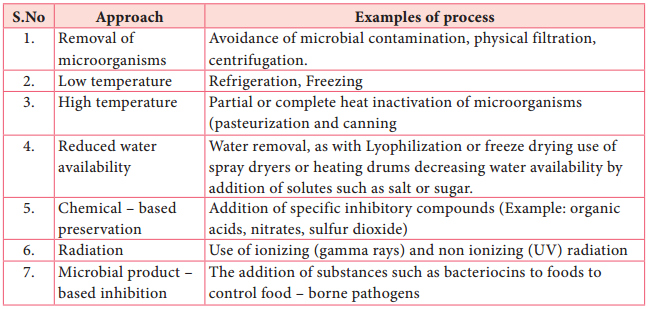
This can proved an ideal opportunity for growth and transmission of pathogens, if care is not taken. Preservation of food is the process by which food is stored by special methods. Cooked or uncooked food can be preserved in different ways to be used later Table 5.2. Some methods of preservation are:

Basic Approaches to Food Preservation
Food Preservation Methods img 1

1. Freezing

Food kept in a refrigerator remains fresh for some day. Germs do not grow easily in cool places. We preserve food items, like milk, fruit, vegetable and cooked food by keeping them in a refrigerator.

2. Boiling

By this method, we can preserve food for a short period of time. Germs in milk are killed by pasteurization. It is done by boiling milk for sometimes and then cooling it quickly.

3. Salting

Add salt to preserve pickles and fish.

4. Sweetening

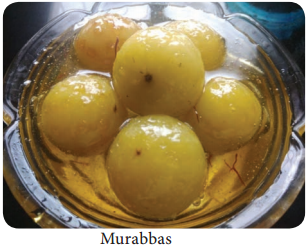
Sugar act as a preservative when added in large quantities. For example, food can be stored for a long time in the form of jams, jellies and murabbas (Figure 5.2) by adding sugar.
Food Preservation Methods img 2

5. Drying

In this method, the food items are dried in sun to stop the growth of bacteria in them. Certain foods, like raw mangoes, fishes, potato chips and papads are preserved by this method.

6. Canning

In this method, food is processed and sealed in airtight cans. Food items like vegetables, seafood, and dairy product are preserved through this method.

Advantages of food preservation:-

  • Germs do not grow easily in preserved food and make it safe to eat.
  • Preservation enables us to enjoy seasonal fruits like strawberries and mangoes even during the off-season.

Disadvantages:-

  • Excess salt and sugar are used in the preservation of food which is not good for health.
  • Some methods of food preservation may lead to loss of nutrients.

Principles of Food preservation

In accomplishing the preservation of foods by the various methods, the following principles are involved.

1. Prevention or delay of microbial decomposition.

  • By keeping out microorganism (asepsis)
  • By removal of microorganism. Example: Filtration
  • By hindering the growth and activity of microorganism Example: Low temperature, drying, anaerobic conditions or chemicals.
  • By killing the microorganism Example: Heat or radiation

2. Prevention or delay of self – decomposition of the food.

  • By destruction or inactivation of food enzymes Example: Blanching
  • By prevention or delay of purely chemical reactions Example: Prevention of oxidation by means of antioxidants.

3. Prevention of damage because of insects, animals, mechanical causes, etc.
Food Borne Disease

Learninsta presents the core concepts of Microbiology with high-quality research papers and topical review articles.

Food Borne Disease

Food borne disease has been defined by the world health organization (WHO) as a disease of an infectious or toxic nature caused by or thought to be caused by the consumption of food or water.

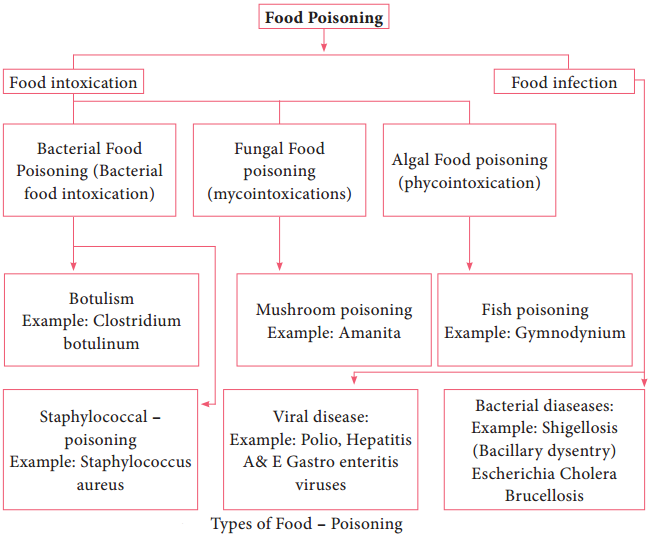
The term “food poisoning” as applied to diseases caused by microorganisms is used very loosely to include both illness caused by the ingestion of toxins elaborated by the organisms and those resulting from infection of the host through the intestinal tract. A further classification of food borne disease is shown in flowchart 5.1.

All these food – borne diseases are associated with poor hygienic practices.

Whether by water or food transmission, the fecal – oral route is maintained, with the food providing the vital link between hosts. Fomites, such as sink faucets, drinking cups, and cutting boards, also play a role in the maintenance of fecal – oral route of contamination.

There are two primary types of food related diseases: food – borne infections and food intoxications or food poisoning.

Food Borne Disease img 1

Food Borne Infection

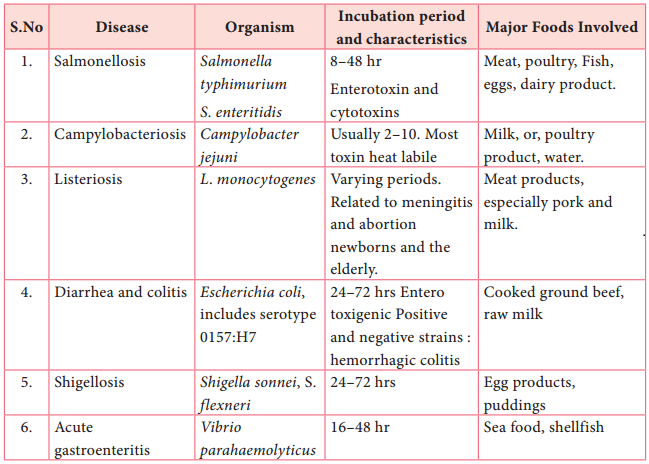
Food borne infection involves the ingestion of the pathogen followed by growth in the host, including tissue invasion and/or the release of toxins. The major diseases of this type are summarized in table (5.1).

Major Food – Borne Infectious Diseases
Food Borne Disease img 2

Food Poisoning

Food borne intoxication (or) food poisonings is caused by ingesting food containing toxins formed by bacteria which resulted from the bacterial growth in the food item. Food poisoning refers to the toxicity introduced into food by microorganisms and their products.

Microbial growth in food products also can results in food intoxication.

Intoxication produces symptoms shortly after the food is consumed because growth of the disease – causing microorganism is not required. Toxins produced in the food can be associated with microbial cells or can be released from the cells.

Food poisoning is caused by various factors as follows.

  1. Microorganism of plant food products.
  2. Microorganism of Animal food products.
  3. Microorganism of processed food.
  4. Standard chemicals added to the food.
  5. Excess use of preservatives in food.
  6. Presence of higher population of Microorganism in food.
  7. Toxin produced by various types of Microorganism.

Food Spoilage and its Causes

Learninsta presents the core concepts of Microbiology with high-quality research papers and topical review articles.

Food Spoilage and its Causes

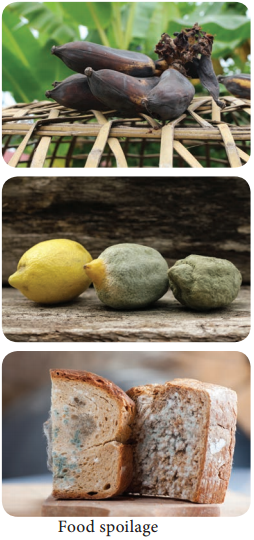
Spoilage of food can be defined as any visible or invisible change which can make food or product derived from food unfit for human consumption. Spoilage of food not only causes health hazard to the consumer but also causes great economic losses. Spoilage leads to loss of nutrients from food and cause change in
original flavor and texture.

It is estimated that about 25% of total food produced is spoilt due to microbial activities despite a range of preservation methods available. Food spoilage is considered as a complex phenomenon where by a combination of microbial and bio-chemical activities take place. Due to such activities various types
of metabolites are formed which aid in spoilage (Figure 5.1).

Food Spoilage img 1

i. Perishable foods

These foods are readily spoiled; require special preservation and storage condition for use. This includes, foods such as dairy products, eggs, poultry, meat, fish, fruits and vegetable. These foods get spoiled easily by natural enzymes.

ii. Semi – perishable foods

This class of foods if properly stored can be used for a longer duration. These foods include processed cereals, pulses and their products like flour, semolina, parched rice and popcorn. Shelf life of these products depends on the storage temperature and moisture in the air.

Foods like potato, onion, nuts, frozen foods and certain canned foods can be stored for a week to a couple of months at room temperature without any undesirable changes in the products.

iii. Non – perishable foods

These foods remain stable for long period unless handled improperly. Nonperishable foods include sugar, jaggery, hydrogenated fat, vegetable oil, ghee, whole grains, dhals, whole nuts and processed foods like dry salted fish/meat, papads, canned foods, jams and murabbas. These foods do not spoil unless they are
handled carelessly.

Causes of Food Spoilage

Food and water may be infected by germs. Fly carries germs to food. There are various factors which are responsible for food spoilage such as.

  • Microorganism
  • Insects
  • Rough handling
  • Transport
  • improper storage
  • enzyme activity (Chemical reaction)
  • unhygienic conditions
  • physical changes, such as those caused by freezing, burning, drying pressure.

Signs of food spoilage include difference in appearance from the fresh food such as a change in colour, a change in texture and an unpleasant odour or taste.

Scope of Food Microbiology

Learninsta presents the core concepts of Microbiology with high-quality research papers and topical review articles.

Scope of Food Microbiology

The field of food microbiology is very broad, encompassing the study of microorganisms which have both beneficial and deleterious effects on the quality and safety of raw and processed foods. The primary tool of microbiologists is the ability to identify and quantitate foodborne microorganisms. Microorganisms in food include bacteria, molds, yeasts, algae, viruses, parasitic worms and protozoans.

Microorganisms are associated with the food we eat in a variety of ways. They may influence the quality of our food. Naturally occurring foods such as fruits and vegetables normally contain some microorganisms and may be contaminated with additional organisms during handling and processing.

Food can serve as a medium for the growth of microorganism, and microbial growth may cause the food to undergo decomposition and spoilage.

Food may also carry pathogenic microorganisms which when ingested can cause disease. When food with microorganisms that produce toxic substances is ingested, it results in food poisoning. Some microorganisms are used in the preparation and preservation of food products.

Classification of Foods

Foods may be classified as

a. Fresh foods

These are foods which have not been preserved and not spoiled yet. For example; vegetables, fruits and meat spoil immediately after harvesting or slaughtering.

b. Preserved foods

Foods are preserved by adding salt, sugar, acetic acids and ascorbic acids. Example: Jam, Pickles. In this way their shelf life is improved.

c. Canned foods

In canning, food products are processed and sealed in the air tight containers. It provides longer shelf life ranging from one to five years. Example: Baked beans, Olives.

d. Processed foods

During food processing, original nature of food is changed or altered. It is done by Freezing, Canning, Baking and Drying. Example: Breakfast cereals, Cakes, Biscuits and Bread.

e. Fermented food products

These foods are subjected to fermentation by the action of microorganisms. Example: Kefir, Cheese.

Sources of Microorganism in Food

The primary sources of microorganisms in food include,

  1. Soil and water
  2. Plant and plant products
  3. Food utensils
  4. Intestinal tract of human and animals
  5. Food handlers
  6. Animal hides and skins
  7. Air and dust

Factors that Influence Growth of Microorganisms in Food

Many factors influence the growth of the microorganisms in food. Some of the factors are intrinsic and some others are extrinsic.

1. Intrinsic factors

The intrinsic factors include pH, moisture content, oxidation – reduction potential, nutrient status, antimicrobial constituents and biological structures.

a. pH:

Every microorganisms has a minimal or maximal, and an optimal pH for its growth. Microbial cells are significantly affected by the pH of food because they apparently have no mechanism for adjusting their internal pH. In general, yeasts and molds are more acid tolerant than bacteria.

Foods with low pH values (below 4.5) are usually not readily spoiled by bacteria and are more susceptible to spoilage by yeast and molds. Most of the microorganisms grow best at pH value around 7.0.

b. Moisture content:

The preservation of food by drying is a direct consequence of removal of moisture, without which microorganisms do not grow. The water requirement of microorganism is defined in terms of the water activity (aw) in the environment. Water activity is defined as the ratio of the water vapour pressure of food substrate to the vapour pressure of pure water at the same temperature.

The water activity of most fresh food is above 0.99. The minimum value of aw for the growth of the microorganisms in foods should be around 0.86.

c. Oxidation reduction (O/R) potential

The oxygen tension or partial pressure of oxygen around a food and the O-R potential or reducing and oxidizing power of the food itself influence the type of organisms which can grow and the changes produced in the food. The O-R potential of the food is determined by,

  • The O-R potential of the original food.
  • The poisoning capacity (the resistance of the food against change).

d. Nutrient Content

The kinds and proportions of nutrients in the food are all important in determining what organism is most likely to grow. Consideration must be given to (i) foods for energy (ii) foods for growth and (iii) accessory food substances or vitamins which may be necessary for energy or growth.

e. Antimicrobial constituents

The stability of foods against attack by microorganism is due to the presence of certain naturally occurring substances that have been shown to have antimicrobial activity. Some species contain essential oils that possess antimicrobial activity. Among these are allicin in garlic, eugenol in cloves and cinnamon.

2. Extrinsic factors

These include those properties of the storage environment that affect both the foods and microorganisms present in them. Storage temperature, pH, presence and concentration of gases in the environment are some of the extrinsic factors that affect the growth of microorganisms.

Evolution Class 12 Notes Biology Chapter 7

By going through these CBSE Class 12 Biology Notes Chapter 7 Evolution, students can recall all the concepts quickly.

Evolution Notes Class 12 Biology Chapter 7

→ The study of the history of life forms on earth is called Evolutionary Biology.

→ The origin of life on earth can be understood only against the background of the origin of the universe especially earth.

→ The universe is vast. The earth is almost a speck. The universe is about 20 billion years old. The universe comprises huge clusters of galaxies.

→ The Big Bang theory explains to us the origin of the universe. It states that a singular huge explosion laid the foundation of the universe.

→ Most scientists believe that the formation of biomolecules preceded the appearance of the first cellular forms of life.

→ Conventional religious literature tells us that the theory of creation has connotations.

  • One, that all living organisms that we see today, were created as such.
  • Two, the diversity was always the same since creation and will be the same in the future also.
  • Three, that the earth is about 4000 years old.

→ Charles Darwin concluded that existing living forms share similarities to varying degrees not only among themselves but also with life forms that existed millions of years ago.

→ According to Darwin, fitness refers ultimately and only to reproduce fitness. Thus, those who are a better fit in an environment, leave more progeny than others. There therefore will survive more and hence are selected by nature. He called it natural selection and implied it as a mechanism of evolution.

→ Comparative anatomy and morphology show similarities and differences between organisms of today and those that existed millions of years ago. Such similarities can be interpreted to understand common ancestors were shared or not.

→ The diversity of life forms on earth has been changing over millions of years.

→ It is believed that variations in a population either due to meiotic recombination during gametogenesis or germ live mutations result in variable fitness in learning fertile progeny.

→ Branching descent and natural selection are the two key concepts o.f the Darwinian Theory of Evolution.

→ Hardy-Weinberg Principle states that allele frequencies in a population are stable and constant from generation to generation. The gene pool remains a constant.

→ Homology is accounted for by the idea of branching descent; study of comparative anatomy, fossils comparative, biochemistry provide evidence for evolution.

→ The story of the evolution of modern man among the stories of the evolution of individual species is most interesting. It appears to parallel the evolution of the human brain and language.

→ Evolutionary Biology: Study of history of life forms on earth.

→ Big Bang Theory: Theory that explains the origin of the universe.

→ Fossils: Remains of hard parts of life forms found in rocks.

→ Divergent evolution: In animals, the same structure developed in different directions due to adaptations to different needs.

→ Homology: It indicates common ancestry.

→ Adaptive Radiation: The process of evolution of different species in a given geographical area starting from a point and literally radiating to other areas of geography.