Screening of Industrially Important Microorganism

Learninsta presents the core concepts of Microbiology with high-quality research papers and topical review articles.

Screening of Industrially Important Microorganism

Isolation of industrially important microorganisms

Success of fermentation depends upon the isolation of microorganism. The microorganisms are isolated from their natural habitats like soil, lakes, river mud or even in unusual habitats or environments such as extreme cold, high altitude, deserts, and deep sea and petroleum fields and are tested directly for the product formation and isolated or it can be genetically modified.

Different types of microorganisms are isolated by different methods. Different microbes with desired activity are isolated using various culture techniques. The next step after isolation of microorganisms is the selection or screening. For the successful fermentation process, selection of microorganisms is the prime important step. Screening includes primary screening and secondary screening.

Primary screening:
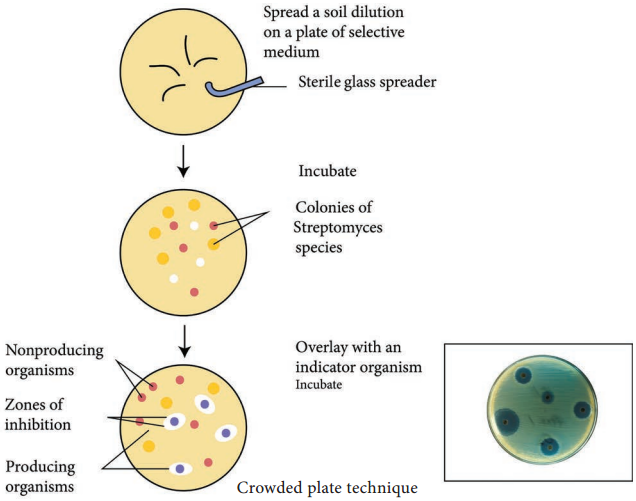
The elementary steps that are performed to select the desired organisms and eliminate the undesirable organisms are termed as primary screening. Methods such as crowded plate technique, auxanography and enrichment culture technique are some of the techniques used in primary screening. For screening of antibiotic producing organisms crowded plate technique is described here,

Crowded plate technique

  1. Soil is serially diluted
  2. The serially diluted sample is spread on the nutrient agar plates
  3. The plates are incubated and the agar plate having 300 to 400 colonies are observed for antibiotic producing activity
  4. The ability of a colony to exhibit antibiotic activity is indicated by the presence of a zone of inhibition surrounding the colony
  5. The technique is improved by using test organism
  6. The antibiotic produced by the organisms in the soil may inhibit the growth of test organism
  7. The formation of inhibitory zones around certain colonies indicates their antibiotic sensitivity
  8. The diameter of the zones of inhibition is measured in millimeters. Crowded plate technique is depicted in the diagram (Figure 6.3).
Screening of Industrially Important Microorganism img 1

Enrichment isolation

The process of enrichment provides a suitable condition to support the growth of microorganisms. It allows the growth of the specific microbe while inhibiting the other non-target microbe. The growth of target microorganisms is enriched by providing sole carbon source.

For screening microorganisms degrading the compound, different inhibitors are employed which have the ability to block a specific metabolic pathway of the non-target microbe.

pH and temperature are also adjusted favoring the growth of desired microorganisms. Soil Calcium carbonate enrichment technique is used for isolation of secondary metabolite producing microorganisms (actinomycetes).

Secondary screening

It is very useful in sorting out microorganisms that have real commercial value from many isolates obtained during primary screening.

1. As primary screening allows the detection and isolation of microorganisms which posses, potentially interesting industrial applications. It is further followed by secondary screening, to check the capabilities and gain information about these organisms.

2. Through primary screening only few or many microorganism that produce a industrially important product, are isolated. The information about the product formed is very less. So, through secondary screening, further sorting out is performed. In this method, only microorganisms with real commercial
value are selected and those that lack the potential are discarded.

3. Secondary screening should yield the types of information which are needed in order to evaluate the true potential of a microorganisms industrially usage.

4. Secondary screening may be qualitative and quantitative in its approach.

5. It is done by using paper, thin layer or other chromatographic techniques.

6. The product’s physical, clinical, and biological properties are determined.

7. It detects gross genetic instability in microbial cultures.

8. It gives information about the number of products produced in a single fermentation.

9. It determines the optimum conditions for growth or accumulation of a product associated with particular culture.

10. It gives information about the different components of the fermentation medium.

11. It helps in providing information regarding the product yield potential of different isolates.

12. It reveals whether microorganisms are capable of a chemical change or it destroys their fermentation product.

There are various methods employed for secondary screening which includes test conducting on petridish containing solid media or by using flasks or small fermentors containing liquid media, giant colony technique, and filtration method liquid medium method (using Erlenmeyer flask). Here giant colony technique is explained in detail.

Giant Colony Technique

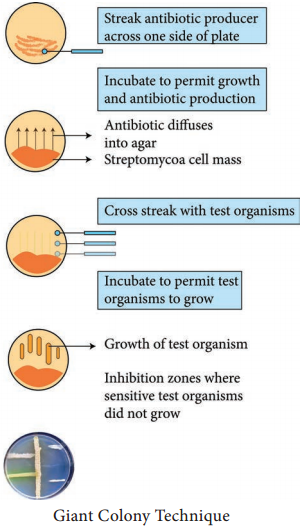
The Streptomyces culture is inoculated onto the central areas of petriplates containing a nutritious agar medium or they are streaked in a narrow band across the centre of plates. The plates are then incubated until growth and possibly, sporulation have occurred. Strains of micro organisms to be tested for possible
sensitivity to the antibiotics (the test organisms) are then streaked from the edges of the plates up to but not touching the Streptomycete growth.

The plates are further incubated to allow the growth of the test organism. The growth of the test organism inhibited by antibiotic in the vicinity of the Streptomycete is then measured in millimeters. These Streptomycetes that have produced antibiotics with observable microbial inhibition spectrum are retained for further testing (Figure 6.4).
Screening of Industrially Important Microorganism img 2

The microbes used in the industrial microbiology should have following characters.

  1. The strain should be a high-yielding strain.
  2. The strain should have stable biochemical and genetical characteristics.
  3. It should not produce undesirable substances.
  4. It should be easily cultivated on large scale.

The strain should be in pure culture, free from other microorganisms including Bacteriophages. These characters are screened for the production of desirable products from microorganisms.
Industrially Important Microorganisms and their Products of Microbiology

Learninsta presents the core concepts of Microbiology with high-quality research papers and topical review articles.

Industrially Important Microorganisms and their Products of Microbiology

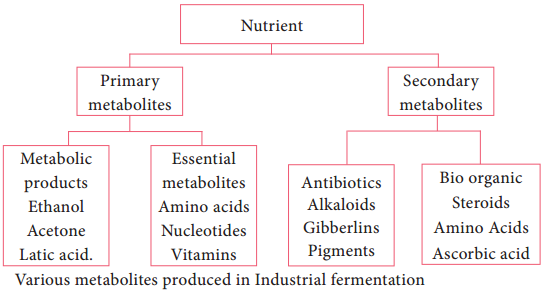
Microorganisms have the powerful capacity to produce numerous products, during their life cycle. Flowchart 6.1 shows the production of valuable metabolic products during the growth of microorganisms on a suitable medium under controlled environmental conditions. Microbial products are often classified as primary and secondary metabolites.
Industrially Important Microorganisms and their Products of Microbiology img 1

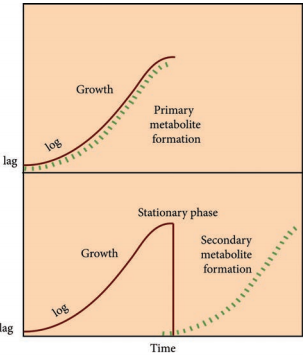
Primary metabolites consist of compounds related to the synthesis by microbial cells in the growth phase. Primary metabolites such as amino acids, vitamins, enzymes, organic acids and nitrogenous bases are produced by wide variety of microorganisms. These primary metabolites are essential for the growth of microorganisms and they are produced during Logarithmic phase.

Secondary metabolites do not play a role in development, growth and reproduction of microorganisms. They are produced at the end of growth phase near stationary phase. They usually accumulate during the period of nutrient limitation or waste product accumulation that follows the exponential phase. These compounds have no direct relationship to the synthesis of cell materials and normal growth.

They are the end products of the primary metabolism. Products such as steroids, alkaloids, antibiotics are secondary metabolites. Excessive production of the primary and secondary metabolites produced by the microorganisms are useful in the large scale in industrial production. Unlike primary metabolites, secondary metabolites are produced in small quantities and their extraction is difficult (Figure 6.2).
Industrially Important Microorganisms and their Products of Microbiology img 2

Some industrially important products are,

  • microbial cells (living or dead), microbial biomass and components of microbial cells
  • microbial metabolites
  • intracellular or extracellular enzymes
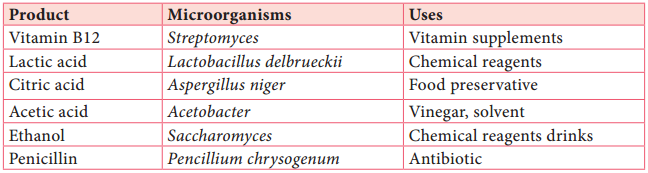
  • modified compounds that has been microbiologically transformed, and recombinant products through the DNA recombinant technology. (Table 6.1 shows some industrially important microorganisms)

Industrially important microorganisms
Industrially Important Microorganisms and their Products of Microbiology img 3

The industrial production of commercial products is carried out by fermentation process. The term fermentation is defined scientifically in a strict sense as a biological process that occurs in the absence of oxygen (anaerobic).

In industrial sense any process mediated by or involving microorganisms in which a product of economic value is obtained is called fermentation. The term Industrial fermentation also means large scale cultivation of microorganisms even though most of them are aerobic.

There are many microbiological processes that occur in the presence of air (aerobically) yielding incomplete oxidation products.
Examples:

  1. The formation of acetic acid (vinegar) from alcohol by vinegar bacteria
  2. Citric acid from sugar by certain molds such as Aspergillus niger. These microbial processes are often referred to as fermentations, although they do not decompose in the absence of air.

Environmental Issues Class 12 Notes Biology Chapter 16

By going through these CBSE Class 12 Biology Notes Chapter 16 Environmental Issues, students can recall all the concepts quickly.

Environmental Issues Notes Class 12 Biology Chapter 16

→ An increase in the human population is exerting tremendous pressure on our natural resources and is also contributing to pollution of air, water, and soil.

→ Pollution is referred to any undesirable change in physical, chemical, or biological characteristics of air, land, water, or soil. The agents that bring about such undesirable change are called pollutants. To control environmental pollution, the Government of India has passed the Environmental (Protection) Act, 1986. This Act is to protect the quality of the environment.

→ Air pollution primarily results from the burning of fossil fuel, e.g., coal and petroleum, in industries and in automobiles. Air pollution is harmful to both animals and plants. Strict measures should be taken to keep our air clean.

→ The most common source of pollution of water bodies is domestic sewage. It reduces dissolved oxygen but increases biochemical oxygen demand of receiving water.

→ Domestic sewage is rich in nitrogen and phosphorus. It causes eutrophication and nuisance algae bloom.

  • Industrial water waste is rich in toxic chemicals such as heavy metals and organic compounds. It can harm living organisms.
  • Municipal solid wastes also can create problems.

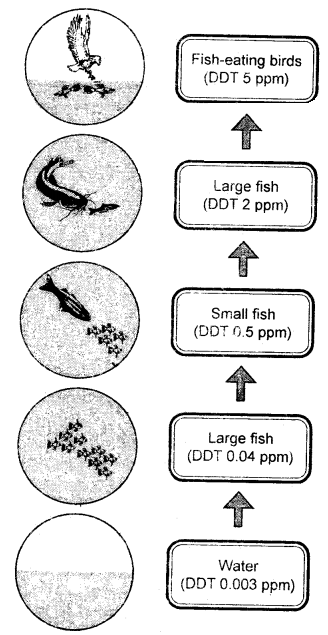
→ A few toxic substances often present in industrial wastewaters can undergo biological magnification in the aquatic food chain Increase in concentration of the toxicant at successive trophic levels refers to biomagnification. This is due to a toxic substance accumulated by an organism that cannot be metabolized or excreted, and thus, passes on the next higher trophic level. This phenomenon is well known for mercury arid DDT.
Environmental Issues 12 Notes Biology 1
Biomagnification of DDT in an aquatic food chain

Eutrophication refers to the natural aging of a lake by the biological enrichment of its waters. Wastewater including sewage can be treated in an integrated manner, by utilizing a mix of artificial and natural processes. Disposal of hazardous waste like defunct ships, radioactive wastes, and e-wastes requires additional effort.

→ Soil pollution is due to agricultural chemicals such as pesticides, insecticides, etc., and leachates from solid wastes deposited over it.

→ The major environmental issue of global nature is the increasing greenhouse effect. It is a naturally occurring phenomenon that is responsible for heating of earth’s surface and atmosphere. Without the greenhouse effect, the average temperature at the surface of the earth would have been -18°C rather than the present average of 15°C. Increased pollution on the earth is increasing the greenhouse effect, which is warming the earth.

→ The enhanced greenhouse effect is mainly due to increased emission of carbon dioxide, methane, nitrous oxide, CFCs, and deforestation. These pollutants and depleting the ozone layer. The effects may be changed in rainfall pattern, increase in global temperature and besides deleteriously will affect living organisms. The ozone layer in the stratosphere is depleting due to the emission of CFCs. The ozone layer protects us from the harmful effects of the UV rays of the sun. The depletion of the ozone layer can increase the risk of skin cancer, mutation, and other disorders.

→ Pollution: Undesirable change in physical. chemical or biological characteristics of air, land, water, or salt.

→ Pollutants: Agents which bring undesirable change in the abiotic components of the environment.

→ CNG: Compressed Natural Gas.

→ Noise: Undesirable high level of sound.

→ BOD: Biochemical Oxygen Demand.

→ Biomagnification: Increase in the concentration of the toxicant at successive trophic levels.

→ Eutrophication: Refers to the natural aging of a lake by biological enrichment of its water.

→ Solid wastes: Everything that goes out ¡n trash.

→ Municipal solid waste: Waste from homes, offices, hospitals, schools, etc. that are collected and disposed of by the municipality.

→ Electronic wastes: Irreparable computer and other electronic goods.

→ CFCs: Chlorofluorocarbons.

→ Snow blindness: Inflammation of the cornea.

→ Soil erosion: Removal of topsoil by natural agents such as wind, water, etc.

→ Reforestation: Process of restoring a forest.

Biodiversity and Conservation Class 12 Notes Biology Chapter 15

By going through these CBSE Class 12 Biology Notes Chapter 15 Biodiversity and Conservation, students can recall all the concepts quickly.

Biodiversity and Conservation Notes Class 12 Biology Chapter 15

→ Biodiversity refers to the sum total of diversity that exists at all levels of biological organization.

→ Biodiversity is the term popularized by sociobiologist Edward Wilson to describe the combined diversity at all the levels of biological organization.

Some important are as follows:

  • Genetic diversity
  • Species diversity
  • Ecological diversity

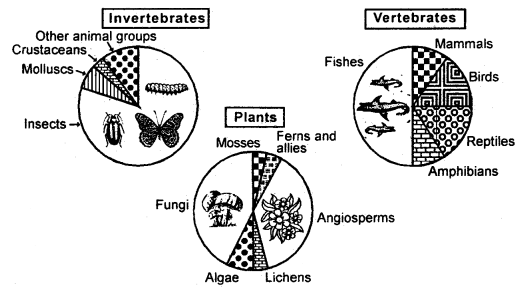
→ More than 1.5 million species have been recorded in the world, but there might still be more than 6 million species on earth waiting to be discovered and named. Of the named species >70 percent are animals of which 70 percent are insects. Among all the species, combined, the group fungi have more than all vertebrate species combined. In India, more than 45,000 species of plants and twice as many species of animals are found. Thus, it is one of the 12 mega diversity countries of the world.
Biodiversity and Conservation 12 Notes Biology 1
Representing global biodiversity: proportional number of species of major taxa of plants. invertebrates and vertebrates

→ The diversity of plants and animals is not uniform throughout the world. For many groups of animals or plants, there are interesting patterns in diversity, the most well-known being th£ latitudinal gradient in diversity. Tropics harbor more species than temperate or polar areas. Colombia located near the equator has nearly 1,400 species of birds while New York at 41°N has 105 species and Greenland at 71°N only 56 species.

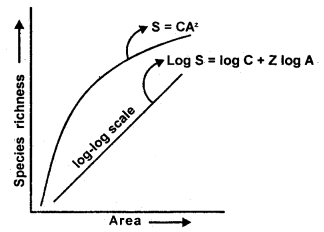
→ The relation between species richness and area for a wide variety of taxa (angiosperm plants, birds, bats, freshwater fishes) turns out to be a rectangular hyperbola (Fig.).
Biodiversity and Conservation 12 Notes Biology 2
Showing species-area relationship on a logarithmic scale. the relationship is a straight line described by the equation.
logS = log C + Z log A
where S = species richness
A = area
Z = slope of the line
C = Y-intercept

→ Species richness contributes to the well-being of an ecosystem. Rich biodiversity is hot only essential for ecosystem health but imperative for the very survival of the human race on this planet.

→ Conserving biodiversity is narrowly utilitarian, broadly utilitarian, and ethical. Besides the direct benefits (food, fiber, firewood, pharmaceuticals, etc.) there are many indirect benefits we receive through the ecosystem. Services such as pollination, pest control, climate moderation, and flood control. It is our moral responsibility to take good care of the earth’s biodiversity and pass it on in good order to our next generation.

→ There are four major causes of biodiversity losses.
There are:

  • Habitat loss and fragmentation
  • Over-exploitation
  • Alien species invasions
  • Co-extinctions

→ Biodiversity conservation can be taken in situ and ex-situ. In in. situ conservation, the endangered species are protected in their habitat so that the entire ecosystem is protected. Ex-situ conservation methods include protective maintenance of threatened species in zoological parks and botanical gardens, in vitro fertilization, cryopreservation of gametes, and tissue culture propagation.

→ Biodiversity: Totality of genes. species and ecosystems of a region.

→ Conservation: Preservation of biodiversity. It may be in situ or ex-situ.

→ Ecological diversity: Variation of habitats, community types, and abiotic environments present in a given area.

→ Extinction: The complete disappearance of any species from the biosphere by natural causes.

→ Exotic species: Species introduced into an ecosystem to which they are not native.

→ Fragmentation: The process of reduction of habitat into smaller scattered patches.

→ Genetic diversity: Total number of genetic characteristics either expressed or in all the individuals of a particular area.

→ Species diversity: The diversity at the species level.

→ Hot spots: Areas that are extremely rich in species, and under constant threat.

→ Endemism: Species confined to that region and not found anywhere else.

Food Microbiology of Curd and its Uses

Learninsta presents the core concepts of Microbiology with high-quality research papers and topical review articles.

Food Microbiology of Curd and its Uses

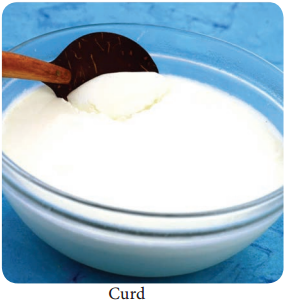
Curd is a dairy product obtained by curdling or coagulating milk with rennet or an edible acidity substance such as lemon juice or vinegar and then draining off the liquid portion called whey milk that has been left to sour (raw) milk alone or pasteurized milk with added lactic acid bacteria or yeast (Example: Lactobacillus acidophilus) will also naturally produce curds and sour milk cheese is produced this way.

The increased acidity causes the milk protein (casein) to tangle into solid masses or curds in cow’s milk, 80% of the protein and caseins (Figure 5.8).

Food Microbiology of Curd and its Uses img 1

Uses

  • Enhances healthy digestion
  • improves immunity
  • For stronger bones and teeth
  • Helps to lose weight
  • Beauty benefits of curd – for healthy and Radiant skin, prevent premature wrinkles remove dark spots and dandruff.