Domestication Of Plants

Learninsta presents the core concepts of Biology with high-quality research papers and topical review articles.

Domestication Of Plants

Domestication is the process of bringing a plant species under the control of humans and gradually changing it through careful selection, genetic alteration and handling so that it is more useful to people. The domesticated species are renewable sources that have provided food and other benefis to human.

The possible changes in the plant species due to domestication are listed below;

  • Adaptation to a greater diversity of environments and a wider geographical range.
  • Simultaneous / uniform flwering and fruiting.
  • Lack of shattering or scattering of seeds.
  • Increased size of fruits and seeds.
  • Change from a perennial to annual habit.
  • Change in breeding system.
  • Increased yield.
  • Increased resistance for disease and pest.
  • Developing seedless parthenocarpic fruit.
  • Enhancing colour, appearance, palatability and nutritional composition.

Relationship Between Human and Plants

Learninsta presents the core concepts of Biology with high-quality research papers and topical review articles.

Relationship Between Human and Plants

From the very early times, human beings have co-existed with plants which played a vital role in their survival. Though a long process of trial and error, our ancestors have selected hundreds of wild plants from the various parts of the world for their specific use. The knowledge of the plants and its applications have led to the development of the humans and their civilization in many ways.

People depend on plants for food, clean air, water, fuel, clothing, and shelter. Nearly all food webs begin with plants, the primary producers. During photosynthesis, green plants use sunlight to change carbon dioxide from the air and water into simple sugars made of carbon, hydrogen, and oxygen.

Plants such as trees, on the other hand, can take in this carbon dioxide, which is unusable for humans, and use it to produce their own energy. In a way, they are a cycle – plants help humans breathe by providing us with oxygen, and humans help plants “breathe” by providing them with carbon dioxide.

There are numerous examples of symbiosis in agriculture. Agriculture in a broad sense involves a symbiotic relationship between humans and plants or animals. Humans plant, fertilize, control weeds and pests, and protect crops. Humans also nurture, feed, and protect livestock.

Humans, of course, benefit greatly from their mutualisms with agricultural plants, through the provision of crops of food, fiber, and other products. Similarly, agricultural animals live in a symbiotic mutualism with humans. Even the keeping of animals as pets represents a type of mutualism.

An exploration of the relationship between plants and people from early agriculture to modern-day applications of biotechnology in crop production. Plants and People: Origin and Development of Human-Plant Science Relationships covers the development of agricultural sciences from Roman times through the development of agricultural experiment stations in the United States.

To the rise of agri-business. It underscores the symbiotic relationship and mutuality that define the intertwined histories of plants and people. It does not merely present the latest science but puts the sciences themselves in the context of history.

The book provides the science, chronology, and history that undergird the relationships between humans and plants. It discusses plant anatomy, physiology, and reproduction; evolution of plants and people; early uses of plants; the rise of agriculture in both Old and New Worlds; creation of land grant universities and agricultural experiment stations; the Green Revolution; plant biotechnology; and the future of plant sciences in feeding the growing human population.

The agricultural sciences were not a product of the nineteenth century but of the careful observation and advice of Roman writers who lived some 2000 years ago. This book reveals the malleability of the sciences, the people who practice them, and the plants that are the focus of scientific research.

The author is careful to distinguish between basic and applied science while recognizing that the agricultural sciences pursue both. He also challenges the traditional notion that basic research necessarily yields practical results. The book demonstrates how plants and the agricultural sciences have shaped the everyday world we inhabit.

Carbon Capture And Storage (CCS)

Learninsta presents the core concepts of Biology with high-quality research papers and topical review articles.

Carbon Capture And Storage (CCS)

Carbon capture and storage is a technology of capturing carbondioxide and injects it deep into the underground rocks to a depth of 1 km or more and it is an approach to mitigate global warming by capturing CO2 from large point sources such as industries and power plants and subsequently storing it instead of releasing it into the atmosphere.

Various safe sites have been selected for permanent storage in various deep geological formations, liquid storage in the Ocean and solid storage by reduction of CO2 with metal oxide to produce stable carbonates. It is also known as Geological sequestration which involves injecting CO2 directly into the underground geological formations (such as declining oil fields, gas fields saline aquifers and unmineable coal have been suggested as storage sites).

Carbon Sequestration

Carbon sequestration is the process of capturing and storing CO2 which reduces the amount of CO2 in the atmosphere with a goal of reducing global climate change. Carbon sequestration occurs naturally by plants and in ocean. Terrestrial sequestration is typically accomplished through forest and soil conservation
practices that enhance the storage carbon.

As an example microalgae such as species of Chlorella, Scenedesmus, Chroococcus and Chlamydomonas are used globally for CO2 sequestration. Trees like Eugenia caryophyllata, Tecoma stans, Cinnamomum verum have high capacity and noted to sequester carbon. Macroalgae and marine grasses and mangroves are also have ability to mitigate carbon-di-oxide.

Carbon Foot Print (CFP)

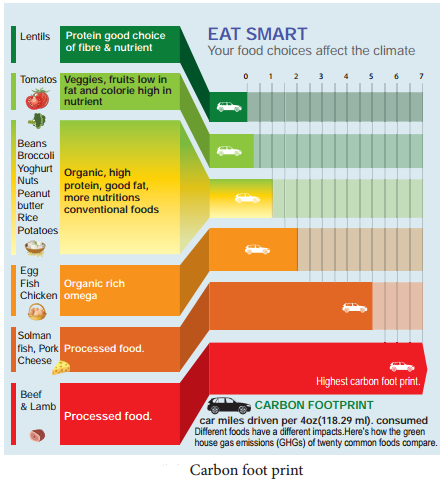
Every human activity leaves a mark just like our footprint. This Carbon foot print is the total amount of green house gases produced by human activities such as agriculture, industries, deforestation, waste disposal, buring fossil fuels directly or indirectly. It can be measured for an individual, family, organisation like industries, state level or national level. It is usually estimated and expressed in equivalent tons of CO2 per year. The burning of fossil fuels releases CO2 and other green house gases.

In turn these emissions trap solar energy and thus increase the global temperature resulting in ice melting, submerging of low lying areas and inbalance in nature like cyclones, tsunamis and extreme weather conditions. To reduce the carbon foot print we can follow some practices like

  1. Eating indigenous fruits and products
  2. Reducing use of electronic devices
  3. Reduce travelling
  4. Avoid buying fast and preserved, processed, packed foods.
  5. Plant a garden
  6. Reducing consumption of meat and sea food. Poultry requires little space, nutrients and less pollution compared cattle farming.
  7. Reducing use of Laptops (when used for 8 hours, it releases nearly 2 kg. of CO2 annually)
  8. Line drying clothes. (Example: If you buy imported fruit like kiwi, indirectly it increases CFP. How? The fruit has travelled a long distance in shipping or airliner thus emitting tons of CO2)
    Carbon Capture And Storage (CCS) img 1

Biochar

Biochar is another long term method to store carbon. To increase plants ability to store more carbon, plants are partly burnt such as crop waste, waste woods to become carbon rich slow decomposing substances of material called Biochar.

It is a kind of charcoal used as a soil amendment. Biochar is a stable solid, rich in carbon and can endure in soil for thousands of years. Like most charcoal, biochar is made from biomass via pyrolysis.

(Heating biomas in low oxygen environment) which arrests wood from complete burning. Biochar thus has the potential to help mitigate climate change via carbon sequestration. Independently, biochar when added to soil can increase soil fertility of acidic soils, increase agricultural productivity, and provide protection against some foliar and soil borne diseases.

It is a good method of preventing waste woods and logs from getting decayed and instead we can convert them into biochar thus converting them to carbon storage material.

Environmental Conservation Issues

Learninsta presents the core concepts of Biology with high-quality research papers and topical review articles.

Environmental Conservation Issues

India due to its topography, geology and climate patterns has diverse life forms. Now this huge diversity is under threat due to many environmental issues for this conservation becomes an important tool by which we can reduce many species getting lost from our native land.

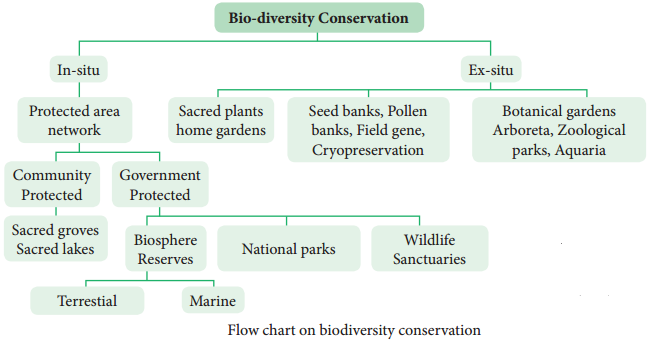
By employing conservation management strategies like germplasm conservation, in situ, ex-situ, in-vitro methods, the endemic as well as threatened species can be protected and also have educational and recreational values for the society.
Environmental Conservation Issues img 1

In-situ conservation:

It means conservation and management of genetic resources in their natural habitats. Here the plant or animal species are protected within the existing habitat. Forest trees, medicinal and aromatic plants under threat are conserved by this method. This is carried out by the community or by the State conservation which include wildlife, National park and Biosphere reserve.

The ecologically unique and biodiversity rich regions are legally protected as wildlife sanctuaries, National parks and Biosphere reserves. Megamalai, Sathyamangalam wildlife, Guindy and Periyar National park, and Western ghats, Nilgiris, Agasthyamalai and Gulf of Mannar are the biosphere reserves of Tamil Nadu.

Sacred groves

These are the patches or grove of cultivated trees which are community protected and are based on strong religious belief systems which usually have a signifiant religious connotation for protecting community. Each grove is an abode of a deity mostly village God Or Goddesses like Aiyanar or Amman.

448 grooves were documented throughout Tamil Nadu, of which 6 groves (Banagudi shola, Thrukurungudi and Udaiyankudikadu, Sittannnavasal, Puthupet and Devadanam) were taken up for detailed floristic and faunistic studies. These groves provide a number of ecosystem services to the neighbourhood like protecting watershed, fodder, medicinal plants and micro climate control.

Ex-situ conservation

It is a method of conservation where species are protected outside their natural environment. This includes establishment of botanical gardens, zoological parks, conservation strategies such as gene, pollen, seed, in-vitro conservation, cryo preservation, seedling, tissue culture and DNA banks. These facilities not only provide housing and care for endangered species, but also have educational and recreational values for the society.

Endemic Centres and Endemic Plants

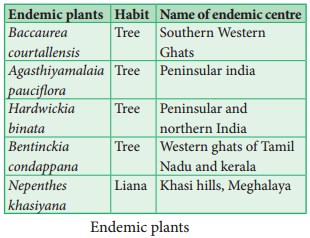
Endemic species are plants and animals that exist only in one geographic region. Species can be endemic to large or small areas of the earth. Some are endemic to a particular continent, some to a part of a continent and others to a single island. Any species found restricted to a specified geographical area is referred to as ENDEMIC. It may be due to various reasons such as isolation, interspecific interactions, seeds dispersal problems, site specifiity and many other environmental and ecological problems.

There are 3 Megacentres of endemism and 27 microendemic centres in India. Approximately one third of Indian flora have been identified as endemic and found restricted and distributed in three major phytogeographical regions of india, that is Indian Himalayas, Peninsular India and Andaman nicobar islands.

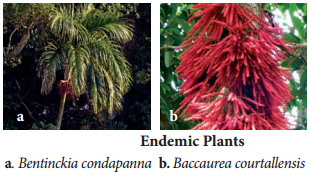
Peninsular India, especially Western Ghats has high concentration of endemic plants. Hardwickia binata and Bentinckia condapanna are good examples for endemic plants. A large percentage of Endemic species are herbs and belong to families such as Poaceae. Apiaceae, Asteraceae and Orchidaceae.
Environmental Conservation Issues img 2

Majority of endemic species are threatened due to their narrow specifi habitat, reduced seed production, low dispersal rate, less viable nature and human intereferences.. Serious efforts need to be undertaken for their conservation, otherwise these species may become globally extinct.
Environmental Conservation Issues img 3

Alien Invasive Species | Eichhornia Crassipes | Prosopis Juliflra

Learninsta presents the core concepts of Biology with high-quality research papers and topical review articles.

Alien Invasive Species | Eichhornia Crassipes | Prosopis Juliflra

Invasion of alien or introduced species disrupts ecosystem processes, threaten biodiversity, reduce native herbs, thus reducing the ecosystem services (benefis). During eradication of these species, the chemicals used increases greenhouse gases.

Slowly they alter ecosystem, micro climate and nature of soil and make it unsuitable for native species and create human health problems like allergy, thus resulting in local environmental degradation and loss of important local species. According to World Conservation Union invasive alien species are the second most signifiant threat to bio-diversity after habitat loss.

What is invasive species?

A non-native species to the ecosystem or country under consideration that spreads naturally, interferes with the biology and existence of native species, poses a serious threat to the ecosystem and causes economic loss. It is established that a number of invasive species are accidental introduction through ports via air or sea.

Some research organisations import germplasm of wild varieties through which also it gets introduced. Alien species with edible fruits are usually spread by birds. Invasive species are fast growing and are more adapted. They alter the soil system by changing litter quality thereby affecting the soil community, soil fauna and the ecosystem processes.

It has a negative impact on decomposition in the soils by causing stress to the neighbouring native species. Some of the alien species which cause environmental issues are discussed below.

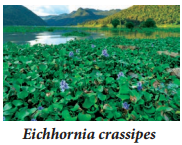
Eichhornia crassipes:

It is an invasive weed native to South America. It was introduced as aquatic ornamental plant, which grows faster throughout the year. Its widespread growth is a major cause of biodiversity loss worldwide. It affects the growth of phytoplanktons and finally changing the aquatic ecosystem.

It also decreases the oxygen content of the waterbodies which leads to eutrophication. It poses a threat to human health because it creates a breeding habitat for disease causing mosquitoes (particularly Anopheles) and snails with its free flating dense roots and semi submerged leaves. It also blocks sunlight entering deep and the waterways hampering agriculture, fiheries, recreation and hydropower.
Alien Invasive Species img 1

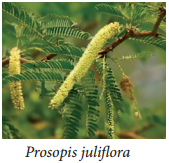
Prosopis juliflra

Prosopis juliflra is an invasive species native to Mexico and South America. It was first introduced in Gujarat to counter desertifiation and later on in Andhra Pradesh, Tamil Nadu as a source of firewood. It is an aggressive coloniser and as a consequence the habitats are rapidly covered by this species.

Its invasion reduced the cover of native medicinal herbaceous species. It is used to arrest wind erosion and stabilize sand dunes on coastal and desert areas. It can absorb hazardous chemicals from soil and it is the main source of charcoal.
Alien Invasive Species img 2