Gene As The Functional Unit Of Inheritance

Learninsta presents the core concepts of Biology with high-quality research papers and topical review articles.

Gene As The Functional Unit Of Inheritance

A gene is a basic physical and functional unit of heredity. The concept of the gene was first explained by Gregor Mendel in 1860’s. He never used the term ‘gene’. He called it ‘factor’. In 1909, the Danish biologist Wilhelm Johannsen, coined the term ‘gene’, that was referred to discrete determiners of inherited characteristics.

According to the classical concept of gene introduced by Sutton in 1902, genes have been defined as discrete particles that follow Mendelian rules of inheritance, occupy a definite locus in the chromosome and are responsible for the expression of specific phenotypic character. They show the following properties:

  • Number of genes in each organism is more than the number of chromosomes; hence several genes are located on the same chromosome.
  • The genes are arranged in a single linear order like beads on a string.
  • Each gene occupies a specific position called locus.
  • Genes may exist in several alternate forms called alleles.
  • Genes may undergo sudden change in positions and composition called mutations.
  • Genes are capable of self-duplication producing their own copies.
    Gene As The Functional Unit Of Inheritance img 1

Trial Balance and Rectification of Errors Class 11 Notes Accountancy Chapter 6

By going through these CBSE Class 11 Accountancy Notes Chapter 6 Trial Balance and Rectification of Errors, students can recall all the concepts quickly.

Trial Balance and Rectification of Errors Notes Class 11 Accountancy Chapter 6

Meaning of Trial Balance
A trial balance is a statement showing the balances, or total of debits and credits, of all the accounts in the ledger with a view to verify the arithmetical accuracy of posting into the ledger accounts.

“The statement prepared with the help of ledger balances, at the end of the financial year (or at any other date) to find out whether debt total agrees with credit total is called Trial Balance.” – William Pickles

Objectives of Preparing the Trial Balance
The trial balance is prepared to fulfil the following objectives:

  1. To ascertain the arithmetical accuracy of the ledger accounts.
  2. To help in locating errors.
  3. To help in the preparation of the financial statements.

Preparation of Trial Balance:
1. Totals Method: Under this method, the total amount of debit side of each ledger account is put on the debit side of the trial balance and the total amount of credit side of each ledger account is put on the credit side of a trial balance.

2. Balances Method: Under this method, the trial balance is prepared by showing the balances of all ledger accounts and then totalling up the debit and credit columns of the trial balances to assure their correctness.

3. Totals-cum-balance Method: This method is a combination of the totals method and the balances method. Under this method, four columns for amount are prepared. Two columns for writing the debit and credit totals of various ‘ accounts and two columns for writing the debit and credit balances of these accounts.

Significance of Agreement of Trial Balance
Normally, a tallied ‘Trial Balance’ stands that debit and credit entries have been made correctly for each transaction. However, the agreement of ‘Trial Balance’ only proves, to a certain extent, that the posting is arithmetically correct, but it does not guarantee that there is no error compelled in the accounting records.

Classification of Errors:
1. Errors of Commission: Errors caused due to wrong recording of a transaction, wrong totalling, wrong casting, wrong balancing etc.

2. Errors of Omission: The errors of omission may be committed at the time of recording the transactions in the books of original entry or while posting to the ledger. It is caused due to omission of recording a transaction entirely or partly in the books of accounts.

3. Errors of Principle: Errors arising due to the wrong classification of receipts and payments between revenue and capital receipts and revenue and capital expenditure.

4. Compensating Errors: Two or more errors committed in such a way that nullifies the effect of each other on the debits and credits.

Searching of Errors:
If the trial balance does not tally, it is a clear indication that at least one error has occurred. The error or errors needs to be located and corrected before preparing the financial statements.

Rectification of Errors:
From the point of view of rectification, the errors may be classified into the following two categories:
(a) Errors that do not affect the trial balance.
(b) Errors that affect the trial balance.

This distinction is relevant because the errors which do not affect the trial balance usually take place in two accounts in such a manner that it can be easily rectified through a journal entry whereas the errors which affect the trial balance usually affect one account and a journal entry is not possible for rectification unless a suspense account has been opened.

Suspense Account:
Sometimes, in spite of best efforts, all the errors are not located and the trial balance does not tally. In such a situation, to avoid the delay in the preparation of final accounts, the difference in the Trial Balance is placed to a newly opened account known as ‘Suspense Account’ and the trial balance tallies.

When all the errors are located and rectified the suspense account stands disposed of.

Bank Reconciliation Statement Class 11 Notes Accountancy Chapter 5

By going through these CBSE Class 11 Accountancy Notes Chapter 5 Bank Reconciliation Statement, students can recall all the concepts quickly.

Bank Reconciliation Statement Notes Class 11 Accountancy Chapter 5

We know that Banks provide very important financial services in modern society. These days a large number of cash transactions are in fact passed through banks. Usually, all the business firms open a current account with a bank, and in order to record the transactions entered into with the bank, maintain a Bank Column in the Cash Book. Bank also maintains an account for each customer in its books.

All deposits by the customer are recorded on the credit side of his/her account and all withdrawals are recorded on the debit side of his/her account. A copy of this account is regularly sent to the customer by the bank. This is called ‘Pass Book’ or ‘Bank Statement’. The amount of balance shown in the passbook or the bank statement must tally with the balance as shown in the cash book. The businessman has to ascertain the cause for such a difference.

Meaning of Bank Reconciliation Statement:
According to Patil, “Bank reconciliation statement is a statement prepared mainly to reconcile the difference between the ‘Bank Balance’ shown by the Cash Book and Bank Pass Book.”

In other words, Bank Reconciliation Statement is a statement of account that explains the reasons for any difference between the bank balance as per cash book and bank balance as per bank statement/passbook and reconciles the two.

In simple words, it is generally experienced that where a comparison is made between the bank balance as shown in the firm’s cash book and the bank balance as shown in the bank passbook, the two balances do not tally/Hence, we have to first ascertain the causes of difference thereof and then reflect them in a statement called Bank Reconciliation Statement to reconcile (tally) the two balances.

Need for Reconciliation:
It is neither compulsory to prepare Bank Reconciliation Statement nor the date is fixed on which it is to be prepared. It is prepared from time to time to check that all transactions relating to the bank are properly recorded by the businessman in the bank column of the cash book and by the bank in its ledger account. Thus, it is prepared to reconcile the bank balances shown by the cash book and by the bank statement. It helps in detecting if there is an error in recording the transactions and ascertaining the correct bank balances as a particular date.

Reasons or Causes of Difference in the balance of the Cash Book and Pass Book
Reconciliation of the cash book and the bank passbook balances amounts to an explanation of differences between them. The differences between the cash book and the bank passbook is caused by:

  1. Timing differences on a recording of the transactions
  2. Errors made by the business or by the bank.

1. Timing Difference:
(a) Cheques issued by the firm but not yet presented for payment in the bank.
(b) Cheques paid or deposited into the bank but not yet collected.
(c) Bank charges or other charged, charges by the bank on behalf of the customer.
(d) Amount collected or credited by bank on standing instructions given by the customers.
(e) Amount paid or debited by the bank on standing instructions given by the customer.
(f) Interest credited by the bank.
(g) Interest debited by bank or overdraft.
(h) Direct payment by the customer into the bank account.
(i) Dishonour of cheques or bills.

2. Differences caused by errors
(a) Errors committed in recording transactions by the firm.
(b) Errors committed in recording transactions by the bank.

Preparation of Bank Reconciliation Statement
After identifying the causes of difference, the reconciliation may be done in the following two ways:
(a) Preparation of bank reconciliation statement without adjusting cash book balances.
(b) Preparation of bank reconciliation statement after adjusting cash book balance.

Preparation of Bank Reconciliation Statement without adjusting cash book balances
We may have two types of balances while preparing the Bank Reconciliation Statement which is following:
(a) Favourable balances

  1. Credit balance as per passbook or bank statement is given and the balance as per cash book is to be ascertained.
  2. Debit balance as per cash book is given and the balance as per pass book is to be ascertained.

(b) Unfavourable balances

  1. Debit balance as per pass book (i.e. overdraft) is given and the balance as per cash book is to be ascertained.
  2. Credit balance as per cash book (i.e. overdraft) is given and the balance as per pass book is to be ascertained.

Steps are to be taken for preparation of the Bank Reconciliation Statement
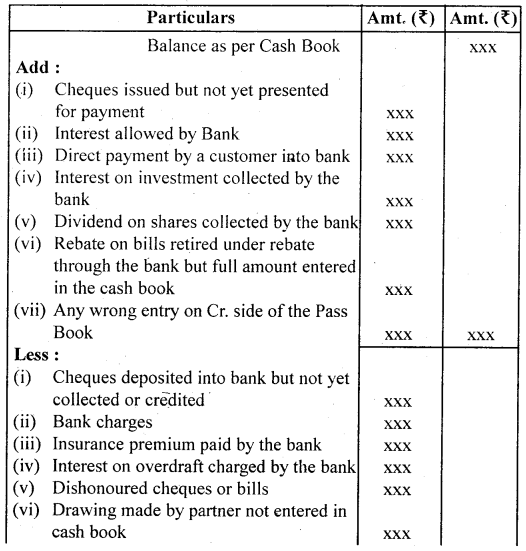
1. When debit balance as per Cash Book (Favourable balance) is given:

  1. Take balance as a starting point say Balance as per Cash Book.
  2. Add all transactions that have resulted in increasing the balance of the passbook.
  3. Deduct all transactions that have resulted in decreasing the balance of the passbook.
  4. Extract the net balance shown by the statement which should be the same as shown in the passbook.

Proforma:
Bank Reconciliation Statement as on…………..
Bank Reconciliation Statement Class 11 Notes Accountancy 1
Bank Reconciliation Statement Class 11 Notes Accountancy 2
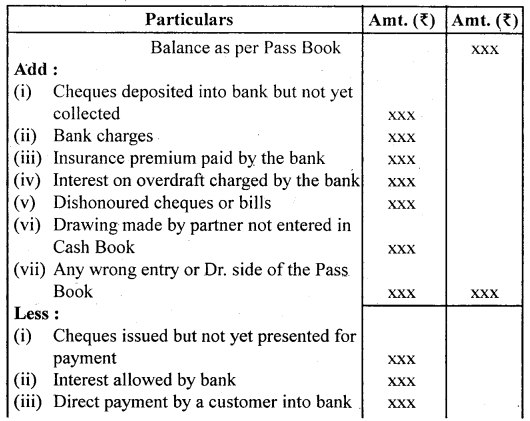
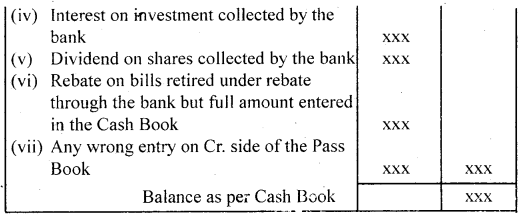
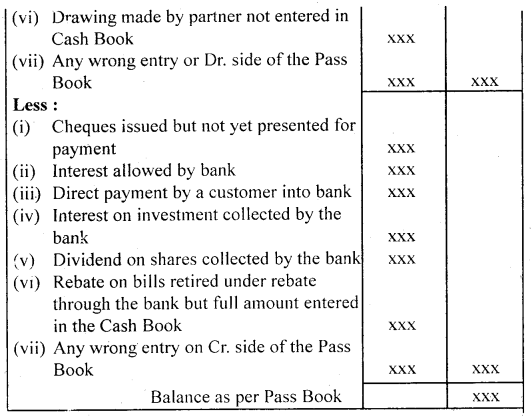
2. When the credit balance as per Pass Book (Favourable balance) is given:

  1. Take balance as a starting point say Balance as per Pass Book.
  2. Add all transactions that have resulted in increasing the balance of the cash book.
  3. Deduct all transactions that have resulted in decreasing the balance of the cash book.
  4. Extract the net balance shown by the statement which should be the same as shown in the cash book.

Proforma:
Bank Reconciliation Statement as on…………..

Bank Reconciliation Statement Class 11 Notes Accountancy 3
Bank Reconciliation Statement Class 11 Notes Accountancy 4
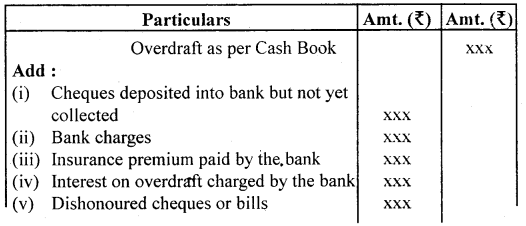
3. When the credit balance as per Cash Book (Uufavoarable balance) is given:

  1. Take balance as a starting point say Overdraft as per Cash Book.
  2. Add all the transactions that have resulted in decreasing the balance of the passbook.
  3. Deduct all the transactions that have resulted in increasing the balance of the passbook.
  4. Extract the net balance shown by the statement which should be the same as shown in the passbook.

Proforma:
Bank Reconciliation Statement as on……………..
Bank Reconciliation Statement Class 11 Notes Accountancy 5
Bank Reconciliation Statement Class 11 Notes Accountancy 6
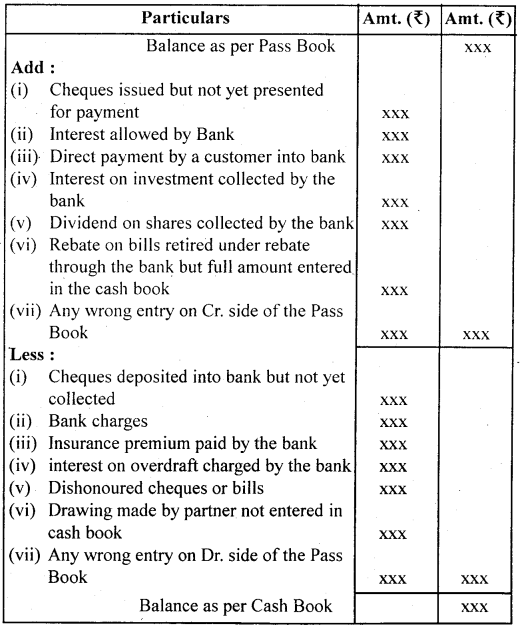
4. When the debit balance as per Pass Book (Unfavourable balance) is given:

  1. Take balance as a starting point say overdraft as per Pass Book.
  2. Add all the transactions that have resulted in decreasing the balance of the cash book.
  3. Deduct all the transactions that have resulted in increasing the balance of the cash book.
  4. Extract the net balance shown by the statement which should be the same as shown in the cash book.

Proforma:
Bank Reconciliation Statement as on…………….
Bank Reconciliation Statement Class 11 Notes Accountancy 7
Preparation of Bank Reconciliation Statement with Adjusted Cash Book
Bank Reconciliation Statement is prepared usually without adjusting the Cash Book during the different months of the financial year. However, at the. end of the financial year, the Cash Book must be adjusted before preparing the Bank Reconciliation Statement as the adjusted balance of the Cash Book is to be shown in the Balance Sheet.

The procedure for finding out adjusted cash balance is as follows:
1. Firstly a Cash Book with Bank Columns only will be prepared with the balance of the existing Cash Book.

2. All errors that have been committed in the Cash Book will have to be rectified by passing adjusting entries in the Cash Book.

For example:
(a) Any amount recorded twice in the Cash Book.
(b) Recording of issued cheques omitted in Cash Book.
(c-) Cheques deposited into the bank but omitted to be recorded in • Cash Book.
(d) Overcosting or undercoating of debit or credit column of Cash Book.
(e) Entries on the wrong side of columns etc.

3. Amounts for which bank has given credit in Pass Book but not recorded in the debit side of Cash Book. They will be recorded.
(a) Interest allowed by the bank.
(b) Interest Or dividend collected by the bank.
(c) Amount directly deposited by customers into bank etc.

4. Amounts for which bank has given debit in Pass Book but not recorded in the credit side of Cash Book. They will be recorded, such as
(a) Interest charged by the bank on overdraft.
(b) Bank charges, commission charges, etc.
(c) Insurance premium paid by the bank.
(d) cheque sent for collection and dishonored.

5. Following items must not be recorded in the Amended/Adjusted Cash Book:
(a) Cheques deposited into the bank but not collected.
(b) Cheques issued but not presented for payment.
(c) Any wrong entry in Pass Book.

6. Adjusted Cash Book is then balanced and this new balance is taken as a starting point for preparing the Bank Reconciliation Statement.

Chromosomal Abnormalities

Learninsta presents the core concepts of Biology with high-quality research papers and topical review articles.

Chromosomal Abnormalities

Each human diploid (2n) body cell has 46 chromosomes (23 pairs). Chromosomal disorders are caused by errors in the number or structure of chromosomes. Chromosomal anomalies usually occur when there is an error in cell division. Failure of chromatids to segregate during cell division resulting in the gain or loss of one or more chromosomes is called aneuploidy.

It is caused by nondisjunction of chromosomes. Group of signs and symptoms that occur together and characterize a particular abnormality is called a syndrome. In humans, Down’s syndrome, Turner’s syndrome, Klinefelter’s syndrome, Patau’s syndrome are some of the examples of chromosomal disorders.

a. Autosomal aneuploidy in human beings

Several autosomal aneuploidies have been reported in human beings. eg. Down’s syndrome (21-Trisomy), Patau’s syndrome (13-Trisomy).

1. Down’s Syndrome/Trisomy – 21

Trisomic condition of chromosome – 21 results in Down’s syndrome. It is characterized by severe mental retardation, defective development of the central nervous system, increased separation between the eyes, flttened nose, ears are malformed, mouth is constantly open and the tongue protrudes.

2. Patau’s Syndrome/Trisomy-13

Trisomic condition of chromosome 13 results in Patau’s syndrome. Meiotic non disjunction is thought to be the cause for this chromosomal abnormality. It is characterized by multiple and severe body malformations as well as profound mental deficiency. Small head with small eyes, clef palate, malformation of the brain and internal organs are some of the symptoms of this syndrome.

b. Allosomal abnormalities in human beings

Mitotic or meiotic non-disjunction of sex chromosomes causes allosomal abnormalities. Several sex chromosomal abnormalities have been detected. Eg. Klinefelter’s syndrome and Turner’s syndrome.

1. Klinefelter’s Syndrome (XXY Males)

This genetic disorder is due to the presence of an additional copy of the X chromosome resulting in a karyotype of 47,XXY. Persons with this syndrome have 47 chromosomes (44AA+XXY). They are usually sterile males, tall, obese, with long limbs, high pitched voice, under developed genitalia and have feeble breast (gynaecomastia) development.

2. Turner’s Syndrome (XO Females)

This genetic disorder is due to the loss of a X chromosome resulting in a karyotype of 45, X. Persons with this syndrome have 45 chromosomes (44 autosomes and one X chromosome) (44AA+XO) and are sterile females. Low stature, webbed neck, under developed breast, rudimentary gonads lack of menstrual cycle during puberty, are the main symptoms of this syndrome.

Mendelian Disorders | Thalassemia | Phenylketonuria | Albinism | Huntington’s Chorea

Learninsta presents the core concepts of Biology with high-quality research papers and topical review articles.

Mendelian Disorders | Thalassemia | Phenylketonuria | Albinism | Huntington’s Chorea

Alteration or mutation in a single gene causes Mendelian disorders. These disorders are transmitted to the offsprings on the same line as the Mendelian pattern of inheritance. Some examples for Mendelian disorders are Thlassemia, albinism, phenylketonuria, sickle cell anaemia, Huntington’s chorea, etc., These disorders may be dominant or recessive and autosomal or sex linked.

Thlassemia

Thlassemia is an autosomal recessive disorder. It is caused by gene mutation resulting in excessive destruction of RBC’s due to the formation of abnormal haemoglobin molecules. Normally haemoglobin is composed of four polypeptide chains, two alpha and two beta globin chains. Thlassemia patients have defects in either the alpha or beta globin chain causing the production of abnormal haemoglobin molecules resulting in anaemia.

Thlassemia is classified into alpha and beta based on which chain of haemoglobin molecule is affected. It is controlled by two closely linked genes HBA1 and HBA2 on chromosome 16. Mutation or deletion of one or more of the four alpha gene alleles causes Alpha Thlassemia.

In Beta Thlassemia, production of beta globin chain is affected. It is controlled by a single gene (HBB) on chromosome 11. It is the most common type of Thlassemia and is also known as Cooley’s anaemia. In this disorder the alpha chain production is increased and damages the membranes of RBC.

Phenylketonuria

It is an inborn error of Phenylalanine metabolism caused due to a pair of autosomal recessive genes. It is caused due to mutation in the gene PAH (phenylalanine hydroxylase gene) located on chromosome 12 for the hepatic enzyme “phenylalanine hydroxylase” This enzyme is essential for the conversion of phenylalanine to tyrosine.

Affected individual lacks this enzyme, so phenylalanine accumulates and gets converted to phenylpyruvic acid and other derivatives. It is characterized by severe mental retardation, light pigmentation of skin and hair. Phenylpyruvic acid is excreted in the urine.
Mendelian Disorders img 1

Albinism

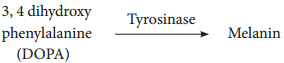
Albinism is an inborn error of metabolism, caused due to an autosomal recessive gene. Melanin pigment is responsible for skin colour. Absence of melanin results in a condition called albinism. A person with the recessive allele lacks the tyrosinase enzyme system, which is required for the conversion of dihydroxyphenyl alanine (DOPA) into melanin pigment inside the melanocytes. In an albino, melanocytes are present in normal numbers in their skin, hair, iris, etc., but lack melanin pigment.
Mendelian Disorders img 2

Huntington’s chorea

It is inherited as an autosomal dominant lethal gene in man. It is characterized by involuntary jerking of the body and progressive degeneration of the nervous system, accompanied by gradual mental and physical deterioration. The patients with this disease usually die between the age of 35 and 40.