Learninsta presents the core concepts of Biology with high-quality research papers and topical review articles.
Causes of Biodiversity Loss
The major causes for biodiversity decline are:
- Habitat loss, fragmentation and destruction (affects about 73% of all species)
- Pollution and pollutants (smog, pesticides, herbicides, oil slicks, GHGs)
- Climate change
- Introduction of alien/exotic species
- Over exploitation of resources (poaching, indiscriminate cutting of trees, over fishing, hunting, mining)
- Intensive agriculture and aquacultural practices
- Hybridization between native and nonnative species and loss of native species
- Natural disasters (Tsunami, forest fire, earth quake, volcanoes)
- Industrialization, Urbanization, infrastructure development, Transport – Road and Shipping activity, communication towers, dam construction, unregulated tourism and monoculture are common area of specific threats.
- Co-extinction
Habitat Loss
Development of human society is inevitable. Natural habitats are destroyed for the purpose of settlement, agriculture, mining, industries and construction of highways. As a result species are forced to adapt to the changes in the environment or move to other places. If not, they become victim to predation, starvation, disease and eventually die or results in human animal conflict.
Over population, urbanization, industrialization and agricultural advancements require additional land, water and raw materials every year. This is made possible only through fragmentation or destruction of natural habitats by filling wetlands, ploughing grasslands, cutting down trees, forest, desilting rivers, constructing transport ways, caving mountains, extracting, ores, changing the course of rivers and filling
of seashore.
The most dramatic example of habitat loss comes from the tropical rainforests 14% of the earth’s land surface once covered by these tropical forests, is not more than 6% now. The Amazon rainforest, a vast area, harbouring millions of species, also called “Lungs of the planet” is destroyed and being replaced for agriculture and human settlements.
90% of New Zealand’s wetlands have been destroyed and cleared for cultivating soya beans and raising grass for beef cattle. Kodaikanal and Nilgiri hills of Tamil Nadu have been destroyed rapidly for human occupancy. Loss of habitat results in annihilation of plants, microorganisms and forcing out animals from their habitats.
Habitat fragmentation
Habitat fragmentation is the process where a large, continuous area of habitat is both, reduced in area and divided into two or more fragments. Fragmentation of habitats like forest land into crop lands, orchard lands, plantations, urban areas, industrial estates, transport and transit systems has resulted in the destruction of complex interactions amongst species, (food chain and webs) destruction of species in the cleared regions, annihilation of species restricted to these habitats (endemic) and decreased biodiversity in the habitat fragments.
Animals requiring large territories such as mammals and birds are severely affected. The elephant corridors and migratory routes are highly vulnerable. The dwindling of many well-known birds (sparrows) and animals can be attributed to this.
Over exploitation:
We depend on nature for our basic needs such as food and shelter. However, when the need becomes greed, it leads to over exploitation of natural resources. Excessive exploitation of a species, reduces the size of its population to such a level that it becomes vulnerable to extinction. Dodo, passenger pigeon and Steller’s sea cow have become extinct in the last 200-300 years due to over exploitation by humans. Overfishing due to population pressure leads to many marine fish (populations) declining around the world.
Exotic species invasion:
Exotic species (non-native; alien) are organisms oftn introduced unintentionally or deliberately for commercial purpose, as biological control agents and other uses. They often become invasive and drive away the local species and is considered as the second major cause for extinction of species. Exotic species have proved harmful to both aquatic and terrestrial ecosystems.
Tilapia fish (Jilabi kendai) (Oreochromis mosambicus) introduced from east coast of South Africa in 1952 for its high productivity into Kerala’s inland waters, became invasive, due to which the native species such as Puntius dubius and Labeo kontius face local extinction.
The introduction of the Nile Perch, a predatory fish into Lake Victoria in East Africa led to the extinction of an ecologically unique assemblage of more than 200 nature species of cichlid fish in the lake.
Papaya Mealy Bug (Paracoccus marginatus) is native of Mexico and Central America, is believed to have destroyed huge crops of papaya in Assam, West Bengal and TamilNadu.
Global Climate changes
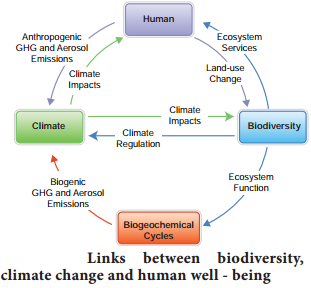
Industrialization is a major contributor to climate change and a major threat to biodiversity. Energy drives our industries, which is provided by burning of fossil fuels.
This increases the emission of CO2, a GHG, leading to climate change. Due to large scale deforestation, the emitted CO2 cannot be absorbed fully, and its concentration in the air increases. Climate change increases land and ocean temperature, changes precipitation patterns and raises the sea level.
This inturn results in melting of glaciers, water inundation, less predictability of weather patterns, extreme weather conditions, outbreak of squalor diseases, migration of animals and loss of trees in forest. Thus, climate change is an imminent danger to the existing biodiversity (Fig. 11.4).
Shiftng or Jhum cultivation (Slash-and-burn agriculture)
In shifting cultivation, plots of natural tree vegetation are burnt away and the cleared patches are farmed for 2-3 seasons, after which their fertility reduces to a point where crop production is no longer profitable. The farmer then abandons this patch and cuts down a new patch of forest trees elsewhere for crop production.
This system is practiced in north-eastern regions of India. When vast areas are cleared and burnt, it results in loss of forest cover, pollution and discharge of CO2 which in turn attributes to loss of habitat and climate change which has an impact on the faunal diversity of that regions.
Coextinctions
Coextinction of a species is the loss of a species as a consequence of the extinction of another. (Eg., orchid bees and forest trees by cross pollination). Extinction of one will automatically cause extinction of the other. Another example for co-extinction is the connection between Calvaria tree and the extinct bird of Mauritius Island, the Dodo. The Calvaria tree is dependent on the Dodo bird for completion of its life cycle.
The mutualistic association is that the tough horny endocarp of the seeds of Calvaria tree are made permeable by the actions of the large stones in bird’s gizzard and digestive juices thereby facilitating easier germination. The extinction of the Dodo bird led to the imminent danger of the Calvaria tree coextinction.
Intensive agriculture
Spread of agriculture is sometimes at the cost of wetlands, grasslands and forests. Intensive agriculture is based on a few high yielding varieties. As a result, there is reduction in the genetic diversity. It also increases vulnerability of the crop plants to sudden attack by pathogens and pests. There are only few varieties of traditional paddy strains today due to use to hybrid varieties in Tamil Nadu.
Loss of biodiversity
Species have been evolving and dying out (extinction) ever since the origin of life. However, species are now becoming extinct at a faster rate. This is destabilizing the ecological stability and the distribution of biological diversity on earth. Human activities greatly contribute to the loss of biodiversity. Natural resources such as land, water and organisms are indiscriminately exploited by human beings.
According to the Convention of Biological Diversity, direct and indirect human activities have a detrimental effect on biodiversity. Direct human activities like change in local land use, species introduction or removal, harvesting, pollution and climate change contribute a greater pressure on loss of biodiversity. Indirect human drivers include demographic, economic, technological, cultural and religious factors.
Even though new species are being discovered, there is little hope for adding new species through speciation into the biodiversity treasure. Monsoon failure, global warming, depletion in ozone layer, landslides in hilly states, pollution are a few indirect effects of human activities which results in the loss biodiversity. IUCN Red List (2004) documents the extinction of 784 species in the 500 years.
It is estimated that the current rate of biodiversity loss is 100 to 1000 times higher than the naturally occurring extinction rate and is still expected to grow in the future. This loss of biodiversity has a immense impact on plant animal and human life. The negative effects include dramatic influence on the food web.
Even reduction in one species can adversely affect the entire food chain which further leads to an overall reduction in biodiversity. Reduced biodiversity leads to immediate danger for food security by reducing ecosystem services.
Hotspots
Hotspots are areas characterized with high concentration of endemic species experiencing unusual rapid rate of habitat modification loss. Norman Myers defied hot spots as “regions that harbour a great diversity of endemic species and at the same time, have been significantly impacted and altered by human activities.”
A hotspot is a region that supports at least 1500 endemic vascular plant species (0.5% of the global total) has lost more than 70% of its original vegetation. There are 35 biodiversity hotspots in the world. India is home to four biodiversity hotspots (as per ENVIS). They are
- Himalaya (the entire Indian Himalayan region)
- Western Ghats
- Indo-Burma: includes entire North-eastern India, except Assam and Andaman group of Islands (and Myanmar, Thiland, Vietnam, Laos, Cambodia and Southern China)
- Sundalands: includes Nicobar group of Islands (and Indonesia, Malaysia, Singapore, Brunei, Philippines)
Endangered organisms
A species that has been categorized as very likely to become extinct is an Endangered species. Endangered (EN), as categorized by the International Union for Conservation of Nature (IUCN) Red List, is the second most severe conservation status for wild populations in the IUCN’s scheme aftr Critically Endangered (CR).
In 1998 there were1102 animal and 1197 plant species in the IUCN Red List. In 2012, the list features 3079 animal and 2655 plant species as endangered (EN) worldwide.
Extinction
Species is considered extinct when none of its members are alive anywhere in the world. If individuals of a species remain alive only in captivity or other human controlled conditions, the species is said to be extinct in the wild. In both of these situations, the species would be considered globally extinct. A species in considered to be locally extinct when it is no longer found in an area it once inhabited but is still found elsewhere in the wild.
In the 450 million years of life on Earth, there had been 5 mass extinctions, which had eliminated at least 50% of the species of flora and fauna on the globe. The extinction of species is mainly due to drastic environmental changes and population characteristics.
There are three types of Extinctions
(i) Natural extinction:
Is a slow process of replacement of existing species with better adapted species due to changes in environmental conditions, evolutionary changes, predators and diseases. A small population can get extinct sooner than the large population due to inbreeding depression (less adaptivity and variation).
(ii) Mass extinction:
The earth has experienced quite a few mass extinctions due to environmental catastrophes. A mass extinction occurred about 225 million years ago during the Permian, where 90% of shallow water marine invertebrates disappeared.
(iii) Anthropogenic extinctions:
These are abetted by human activities like hunting, habitat destruction, over exploitation, urbanization and industrialization. Some examples of extinctions are Dodo of Mauritius and Steller’s sea cow of Russia.
Amphibians seem to be at higher risk of extinction because of habitat destruction. The most serious aspect of the loss of biodiversity is the extinction of species. The unique information contained in its genetic material (DNA) and the niche it possesses are lost forever.