Solid Waste Management

Learninsta presents the core concepts of Biology with high-quality research papers and topical review articles.

Solid Waste Management

Every day, tonnes of solid wastes are disposed off at landfill sites. This waste comes from homes, offices, industries and various other agricultural related activities. These landfill sites produce foul smell if waste is not stored and treated properly.

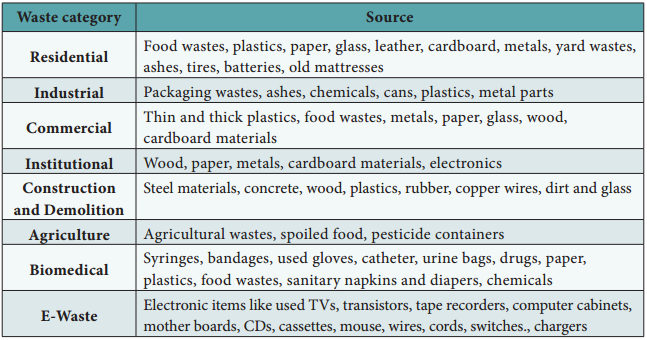
When hazardous wastes like pesticides, batteries containing lead, cadmium, mercury or zinc, cleaning solvents, radioactive materials, e-waste and plastics are mixed up with paper and other scraps and burnt, they produce gases such as dioxins. These gases are toxic and carcinogenic. These pollute the surrounding air, ground water and can seriously affect the health of humans, wildlife and our environment (Table 12.1).
Solid Waste Management img 1

Solid Waste management includes the activities and actions required to manage waste from its inception to its final disposal. This includes the collection, transport, treatment and disposal of waste, together with monitoring and regulation of the waste management process. It is all about how solid waste can be changed and used as a valuable resource.

Case Study:

The Corporation of Chennai looks after clearance and management of solid waste in Chennai. Every day around 5400 Metric Tonnes (MT) of garbage is collected from the city. Door to door collection of garbage is done in most zones apart from sweeping, collecting, and storing the waste in the specified bins.

At present garbage generated in Chennai is dumped at two sites. Proposals are there for remediation of the existing landfill or scientific closure and to have integrated waste processing facilities with waste to energy plants as one of the components at the existing Kodungaiyur and Perungudi sites.

Waste Management Practices

  • Source segregation
  • Composting
  • Aerobic
  • Anaerobic
  • Vermicomposting
  • Biogas generation
  • Incineration

Radioactive Waste

Radioactive wastes are generated during various operations of the nuclear power plant. Radioactive waste can be in gas, liquid or solid form, and its level of radioactivity can vary. The waste can remain radioactive for a few hours or several months or even hundreds of thousands of years. Depending on the level and nature of radioactivity, radioactive wastes can be classified as exempt waste, Low and Intermediate level waste and High Level Waste.

Radioactive Waste Management

Radioactive waste management involves the treatment, storage, and disposal of liquid, airborne, and solid effluents from the nuclear industry.

Methods of Disposal of Radioactive Wastes are

1. Limit Generation:

Limiting the generation of waste is the first and most important consideration in managing radioactive wastes.

2. Dilute and Disperse:

For wastes having low radioactivity, dilution and dispersion are adopted.

3. Delay and Decay:

Delay and decay is frequently an important strategy because much of the radioactivity in nuclear reactors and accelerators is very short lived.

4. Concentrate and Confie Process:

Concentrating and containing is the objective of treatment activities for longerlived radioactivity. The waste is contained in corrosion resistant containers and transported to disposal sites. Leaching of heavy metals and radionuclides from these sites is a problem of growing concern.

Control and Management
Three ways are employed to manage nuclear wastes.

Spent Fuel Pools:

The spent fuel discharged from the reactors is temporarily stored in the reactor pool. The Spent fuel rods are used in stored cooling ponds. They protect the surroundings from radiation and absorb the heat generated during radioactive decay.

Vitrification Method:

This prevents reaction or degradation of nuclear waste for extended periods of time and encased in dry cement caskets.

Geological Repositories:

A deep geological repository is a nuclear waste repository excavated deep within a stable geologic environment. It is suited to provide a high level of long-term isolation and containment without future maintenance. In India at Tarapur and Kalpakkam, a wet storage facility of Spent Fuel is the main mode of storage.

Medical Waste

Any kind of waste that contains infectious material generated by hospitals, laboratories, medical research centers, Pharmaceutical companies and Veterinary clinics are called medical wastes.

Medical wastes contain body fluids like blood, urine, body parts and other contaminants, culture dishes, glasswares, bandages, gloves, discarded needles, scalpels, swabs and tissues.

Management:

The safe and sustainable management of biomedical waste is the social and legal responsibilities of people working in healthcare centers.

Waste Disposal:

Involved by incineration, chemical disinfection, autoclaving, encapsulation, microwave irradiation are methods of waste disposals. Final disposal includes landfill and burying as per norms inside premises.

E-Waste

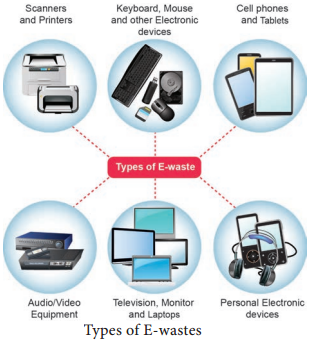
Electronic waste or e-waste describes discarded electrical electronic devices as well as any refuse created by discarded electronic devices and components and substances involved in their manufacture or use. Their disposal is a growing problem because electronic equipment frequently contains hazardous substances.

In a personal computer, for example, there may be lead (Pb) in the cathode ray tube (CRT) and soldering compound, mercury (Hg) in switches and housing, and cobalt (Co) in steel components, among other equally
toxic substances. E-wastes are basically PCB (Polychlorinated biphenyl) based, which are non-degradable (Fig.12.8).
Solid Waste Management img 2

Used electronics which are destined for reuse, resale, salvage, recycling, or disposal are also considered e-waste. Unauthorised processing of e-waste in developing countries can lead to adverse human health effects and environmental pollution.

Recycling and disposal of e-waste may involve significant risk to the health of workers and communities in developed countries and great care must be taken to avoid unsafe exposure in recycling operations and leaking of materials such as heavy metals from landfills and incinerator ashes.

Plastic Waste – Solutions and Remedies

Plastics are low molecular weight organic polymers that are non-degradable in the natural environment. They are used in several items, including cars, bulletproof vests, toys, hospital equipment, carry bags and food containers.

Packaging materials used in supermarkets, retail outlets, manufacturing industries, households, hotels, hospitals, restaurants and transport companies are major contributors to plastic waste generation. Plastic waste constitutes a major part of municipal solid waste.
Organic Farming and its Implementation

Learninsta presents the core concepts of Biology with high-quality research papers and topical review articles.

Organic Farming and its Implementation

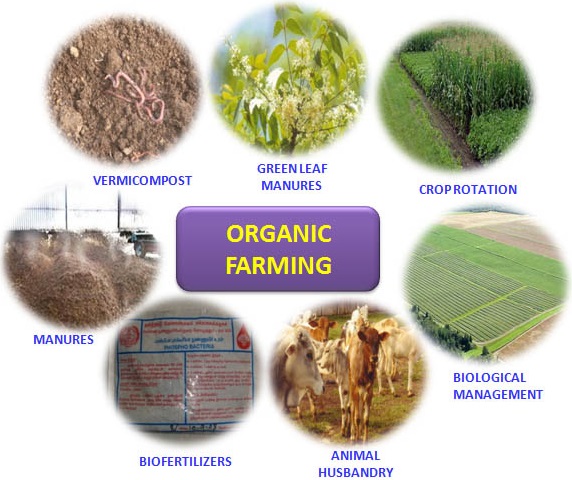
It is a method of farming system which primarily aims at cultivating the land and raising crops in such a way, so as to keep the soil alive and in good health by use of organic wastes (crop, animal and farm wastes, aquatic wastes) and other biological materials along with beneficial microbes (biofertilizers) to release nutrients to crops for increased sustainable production in an eco-friendly pollution free environment.

organic farming systems by the farmers in the following ways:

  • The selection of locations not contaminated with chemicals
  • Appropriate local types of rice plant
  • Programming of appropriate crop rotation
  • Processing soil with tools not contaminated with chemicals
  • Intermitten irrigation
  • Use of

Organic agriculture can be defined as “an integrated farming system that strives for sustainability, the enhancement of soil fertility and biological diversity while, with rare exceptions, prohibiting synthetic pesticides, antibiotics, synthetic fertilizers, genetically modified organisms, and growth hormones”.

Organic agriculture considers the medium- and long-term effect of agricultural interventions on the agro-ecosystem. It aims to produce food while establishing an ecological balance to prevent soil fertility or pest problems.

Advantages of Organic Farming

  • Minimises the external cost of farming.
  • Efficient use of resources.
  • Soil and the environment is a public good.
  • Healthier food.
  • Healthier animals.
  • Potential profits.
  • Time involved.
  • More labour intensive.

Organic farming eliminates the use of synthetic products to maximize the yields that can be produced. It works on creating a healthier soil instead, encouraging the link between healthy plants and protected soils. No chemical herbicides or pesticides are used. Only natural soil enhancement techniques are permitted.

There are basically two types of organic farming: pure organic farming and integrated organic farming. With pure organic farming, the method includes the use of manures and biopesticides with complete avoidance of inorganic chemicals and pesticides.

In the process of pure farming, fertilizer and pesticides obtain from natural sources. It is called a pure form of organic farming. (b) Integrated organic farming – Integrated organic farming consists of integrated nutrients management and integrated pest management.

In a few words, organic farming involves growing techniques and methods that seek to protect the environment, humans, and animals, through sustainable agriculture. As fertilization methods, they mainly use manure, compost, or special organic synthetic fertilizers.
Organic Farming And Its Implementation img 1

Eutrophication | Definition, Types, Causes, & Effects

Learninsta presents the core concepts of Biology with high-quality research papers and topical review articles.

Eutrophication | Definition, Types, Causes, & Effects

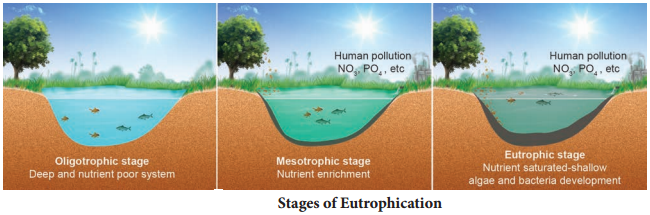
When run-off from land containing nutrients reaches water bodies like lakes, it results in dense growth of plant life. This phenomenon is called Eutrophication. Natural aging of lakes also leads to nutrient enrichment of its water.

In a lake, the water is cold and clear (oligotrophic stage), supporting little life. With time, streams draining into the lake introduce nutrients such as nitrates and phosphates, which encourage the growth of aquatic organisms. Aquatic plants and animal life grow rapidly, and organic remains begin to be deposited on the lake bottom (mesotrophic stage) (Fig. 12.5).
Eutrophication img 1

Pollutants from anthropogenic activities like effluents from the industries and homes can radically accelerate the aging process. This phenomenon is known as Cultural or Accelerated Eutrophication.

Nutrients stimulate the growth of algae, water hyacinth and can cause clogging of canals, rivers and lakes as well as, displacing native plants. It causes unsightly foam and unpleasant odours, and deprives the water of dissolved oxygen.

Integrated Wastewater Management

Wastewater Treatment

Wastewater or sewage originates from domestic waste waters, industrial wastes and animal wastes. Realizing the importance of clean potable water, the Government passed the Water (Prevention and Control of Pollution) Act in 1974, which made it mandatory to treat wastewater in treatment plants. The main objective of a wastewater treatment process is to reduce organic and inorganic components in wastewater to a level that it no longer supports microbial growth and to eliminate other potentially toxic materials.

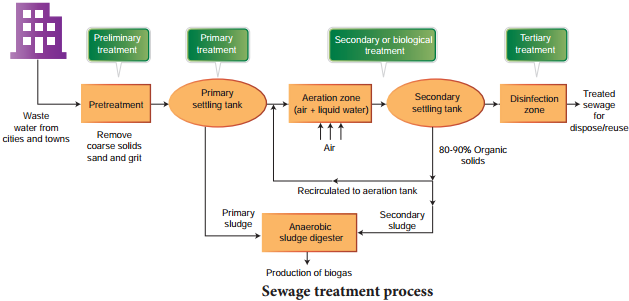
Microorganisms mainly bacteria and some protozoa play an essential part in the treatment of sewage to make it harmless. Sewage contains pathogenic bacteria. These bacteria must be destroyed in order to prevent the spread of diseases. Sewage treatment is usually performed in the following three stages (Fig. 12.6).
Eutrophication img 2

Primary treatment

Primary treatment involves the physical removal of solid and particulate organic and inorganic materials from the sewage through filtration and sedimentation. Floating debris is removed by sequential filtration. Then the grit (soil and small pebbles) are removed by sedimentation. All solids that settle form the primary sludge and the supernatant forms the effluent. The effluent from the primary settling tank is taken for secondary treatment.

Secondary treatment or biological treatment

The primary effluent is passed into large aeration tanks where it is constantly agitated mechanically and air is pumped into it. This allows vigorous growth of useful aerobic microbes into floc (masses of bacteria associated with fungal fiaments to form mesh like structures).

While growing, these microbes consume the major part of the organic matter in the effluent. This significantly reduces the BOD (Biochemical oxygen demand or Biological oxygen demand). BOD refers to the amount of the oxygen that would be consumed, if all the organic matter in one litre of water were oxidized by bacteria. The sewage water is treated till the BOD is reduced. The greater the BOD of the waste water more is its polluting potential.

Once the BOD of sewage water is reduced signifiantly, the effluent is then passed into a settling tank where the bacterial “flocs” are allowed to sediment. This sediment is called activated sludge. A small part of activated sludge is pumped back into the aeration tank to serve as the inoculum. The remaining major part of the sludge is pumped into large tanks called anaerobic sludge digesters. Here, the bacteria which grow anaerobically, digest the bacteria and the fungi in the sludge. During this digestion, bacteria produce a mixture of gases such as methane, hydrogen sulphide and CO2. These gases form biogas and can be used as a source of energy.

Tertiary treatment

Tertiary treatment is the final process that improves the quality of the waste water before it is reused, recycled or released into natural water bodies. This treatment removes the remaining inorganic compounds and substances, such as nitrogen and phosphorus.

UV is an ideal disinfectant for wastewater since it does not alter the water quality – except for inactivating microorganisms. UV is a chemicalfree process that can completely replace the existing chlorination system and also inactivates chlorine-resistant microorganisms like Cryptosporidium and Giardia.

Case Study:

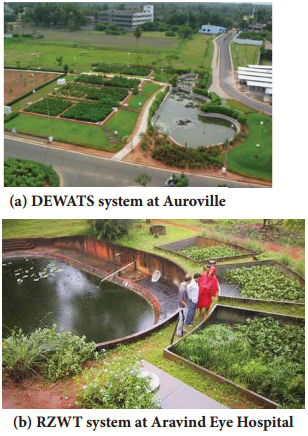
Auroville, located in South India near Puducherry has been experimenting with natural wastewater recycling systems (Decentralized Waste Water Treatment System (DEWATS)) (Fig.12.7a). Such treatment plants have now also been implemented in Aravind Eye Hospital, Puducherry (Root Zone Wastewater Treatment (RZWT)) (Fig.12.7 b) and the Chennai Mathematical Institute, Siruseri IT Park, Chennai.
Eutrophication img 3

Biomagnification Definition and its Effects

Learninsta presents the core concepts of Biology with high-quality research papers and topical review articles.

Biomagnification Definition and its Effects

Food chains are components of all ecosystems. Producers and consumers form trophic levels in a chain through which energy flow is carried out by the process of eating and being eaten. Usage, storage and transformation of food and biomolecules by metabolism are a normal process. Degradation or breakdown is an essential part of any food chain and hence all naturally occurring substances are degradable.

Biomagnifiation of DDT

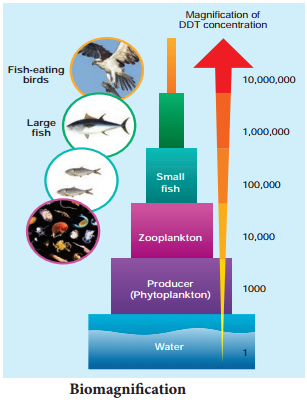
When non-degradable substances enter the food chain, they do not get metabolized or broken down or expelled and instead get transferred up the tropic levels of the food chain. During this process, they show an increase in concentration which is referred to as biomagnification.

This results in increased toxicity and may even be lethal. This phenomenon is well established for mercury and DDT. Fig 12.4 schematically shows biomagnifiation of DDT in an aquatic food chain where the concentration of DDT is enhanced at successive trophic levels.
Biomagnification img 1

Biomagnification is the method of accruing toxic elements by different organisms within a food chain. A prominent example of it is the presence of mercury within predatory fish. This level is so high that consuming these can cause cancer.

What are the substances responsible for biomagnification. Biomagnification refers to the accumulation of toxic substances in the food chain. The pesticides and chemicals such as DDT, and mercury released into the lakes and rivers are ingested by the aquatic organisms.

Bioaccumulation refers to the accumulation of a toxic chemical in the tissue of a particular organism. Biomagnification refers to the increased concentration of a toxic chemical the higher an animal is on the food chain.

Biomagnification is the accumulation of a chemical by an organism from water and food exposure that results in a concentration that is greater than would have resulted from water exposure only and thus greater than expected from equilibrium.

Biomagnification is the increase of harmful substances or chemicals in the normal food chain process. It is bad because many living things die due increase in harmful chemicals.

Biomagnification can occur in both terrestrial and aquatic environments, but it is generally used in relation to aquatic situations. Most often, biomagnification occurs in the higher trophic levels of the food chain/web , where exposure to chemicals takes place mostly through food consumption rather than water uptake.

Bioaccumulation is when a harmful substance (pesticides or organic chemicals) gets absorbed by an organism at a higher rate than it can be excreted. Even if the environment doesn’t have a high amount of toxin in it, accumulation through the food chain can be devastating for organisms.

An Overview of Agrochemicals

Learninsta presents the core concepts of Biology with high-quality research papers and topical review articles.

An Overview of Agrochemicals

Chemicals which are used in agriculture for growth of plants and pest control are called agrochemicals or agrichemicals. Overuse of agrochemicals have been observed to generate residues that cause nutrient imbalance. In addition,

  1. May kill beneficial bacteria and soil organisms.
  2. Can cause eutrophication in water bodies.
  3. Affect aquatic animals and their productivity.
  4. Pesticide containing water, even in trace quantities is unfi for human consumption.
  5. Particles (aerosols) and residues of these chemicals cause air pollution.
  6. Inhalation of contaminated air can cause respiratory problems.
  7. Consumption can lead to poisoning, side effects and after effects.
  8. Chemicals can cause skin rashes and irritation of eyes.
  9. Many of these chemicals are reported to be carcinogenic.
  10. They can trigger hormonal disorders and neurotoxicity.
  11. Beneficial insects and animals can be affected.