Tools for Study of Taxonomy

Learninsta presents the core concepts of Biology with high-quality research papers and topical review articles.

Tools for Study of Taxonomy

Tools and taxonomical aids may be different for the study of plants and animals. Herbarium and Botanical garden may be used as tools for the study of plant taxonomy. In the case of animal studies, the classical tools are Museum, Taxonomical Keys and Zoological and Marine parks.

The important components of the taxonomical tools are field visits, survey, identifiation, classification, preservation and documentation. Many tools are being used for taxonomical studies, amongst them some of the important tools are discussed below:

The Classical Taxonomical Tools

Taxonomical Keys:

Keys are based on comparative analysis of the similarities and dissimilarities of organisms. There are separate keys for different taxonomic categories.

Museum:

Biological museums have collection of preserved plants and animals for study and ready reference. Specimens of both extinct and living organisms can be studied.

Zoological Parks:

These are places where wild animals are kept in protected environments under human care. It enables us to study their food habits and behaviour.

Marine Parks:

Marine organisms are maintained in protected enviroments. Printed taxonomical tools consist of identifiation cards, description, field guides and manuals.

Molecular Taxonomical Tools

Technological advancement has helped to evolve molecular taxonomical tools from classical tools to molecular tools. The accuracy and authenticity is more significant in the molecular tools. The following methods are being used for taxonomical classification.

Molecular techniques and approaches such as DNA barcoding (short genetic marker in an organism’s DNA to identify it as belonging to a particular species), DNA hybridization (measures the degree of genetic similarity between pools of DNA sequences), DNA fingerprinting (to identify an individual from a sample of DNA by looking at unique patterns in their DNA).

Restriction Fragment Length Polymorphisms (RFLP) analysis (difference in homologous DNA sequences that can be detected by the presence of fragments of different lengths after digestion of the DNA samples), and Polymerase Chain Reaction (PCR) sequencing (to amplify a specific gene, or portion of gene) are used as taxonomical tools.

Automated Species Identifiation Tools

It consists of Cyber tools. For example:
ALIS, DAISY, ABIS, SPIDA, Draw wing, etc.

ALIS → Automated Leafhpper Identifiation System.
DAISY → Digital Automated Identifiation System.
ABIS → Automatic Bee Identifiation System.
SPIDA → Species Identifid Automatically (spiders, wasp and bee wing characters).
Draw wing → Honey bee wing identifiation.

Neo Taxonomical Tools:

This is based on Electron Microscopy images to study the molecular structures of cell organelles.

Ethology of Taxonomical Tools:

Based on the behaviour of the organisms it can be classified. For example sound of birds, bioluminescence, etc.

e-Taxonomic Resources:

INOTAXA is an electronic resource for digital images and description about the species which was developed by Natural History Museum, London. INOTAXA means Integrated Open taxonomic Access.
Concept of Species

Learninsta presents the core concepts of Biology with high-quality research papers and topical review articles.

Concept of Species

Species is the basic unit of classification. The term species was coined by John Ray, and in his book “Historia Generalis Plantarum” (3 volumes) in 1693 described species as a group of morphologically similar organisms arising from a common ancestor. Carolus Linnaeus in his book “Systema naturae” considered species as the basic unit of classification.

Species can be defined as a group of organisms that have similar morphology and physiology and can interbreed to produce fertile offsprings. In 1859 Charles Darwin in his book Origin of species explains the evolutionary connection of species by the process of natural selection.

The concept of species is an important but difficult one in biology, and is sometimes referred to the “species problem”. Some major species concepts are: Typological (or Essentialist, Morphological, Phenetic) species concept. Typology is based on morphology/phenotype.

Linnaeus (1707-1778), nearly 50 years later whose work was the most eminent and momentous in the taxonomy field, adopting a broader concept gave a new definition of species.

The biological species concept relies on behavioral data and emphasizes reproductive isolation between groups. The lineage species concept relies on genetic data and emphasizes distinct evolutionary trajectories between groups, which result in distinct lineages (branches on a phylogenetic tree).

Typological or Essentialist Species

Concept 2. Nominalistic Species
Concept 3. Biological Species
Concept 4. Evolutionary Species

Although the biological species concept has long been accepted by many evolutionary biologists (especially zoologists) as the best species concept, these kinds of problems have led to increasing attacks.

The natural world contains about 8.7 million species, according to a new estimate described by scientists as the most accurate ever. But the vast majority have not been identified – and cataloguing them all could take more than 1,000 years.

Organisms may appear to be alike and be different species. For example, Western meadowlarks (Sturnella neglecta) and Eastern meadowlarks (Sturnella magna) look almost identical to one another, yet do not interbreed with each other – thus, they are separate species according to this definition.

Three Domains of Life

Learninsta presents the core concepts of Biology with high-quality research papers and topical review articles.

Three Domains of Life

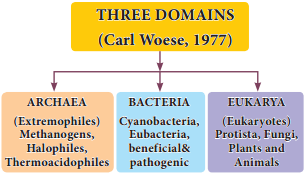
Three domain classification was proposed by Carl Woese (1977) and his co-workers. They classified organisms based on the difference in 16S rRNA genes. The three domain system adds the taxon ‘domain’ higher than the kingdom.

This system emphasizes the separation of Prokaryotes into two domains, Bacteria and Archaea, and all the eukaryotes are placed into the domain Eukarya. Archaea appears to have more in common with the Eukarya than the Bacteria. Archaea differ from bacteria in cell wall composition and differs from bacteria and eukaryotes in membrane composition and rRNA types.
Three Domains of Life img 1

1. Domain Archaea

This domain includes single celled organisms, the prokaryotes which have the ability to grow in extreme conditions like volcano vents, hot springs and polar ice caps, hence are also called extremophiles. They are capable of synthesizing their food without sunlight and oxygen by utilizing hydrogen sulphide and other chemicals from the volcanic vents. Some of the them produced methane (methanogens), few live in salty environments (Halophiles) and are thermoacidophiles which thrive in acidic environments and at high temperatures.

2. Domain Bacteria

Bacteria are prokaryotic, their cells have no definite nucleus and DNA exists as a circular chromosomes and do not have histones associated with it. They do not possess membrane bound organelles except for ribosome (70S type). Their cell wall contains peptidoglycans.

Many are decomposers, some are photosynthesizers and few cause diseases. There are beneficial probiotic bacteria and harmful pathogenic bacteria which are diversely populated. Cyanobacteria are photosynthetic blue green algae which produce oxygen. These had played a key role in the changes of atmospheric oxygen levels from anaerobic to aerobic during the early geologic periods.

3. Domain Eukarya (Eukaryotes)

Eukaryotes are animals which have true nucleus and membrane bound organelles. DNA in the nucleus is arranged as a linear chromosome with histone proteins, ribsosomes of 80S type in the cytosol and 70S type in the chloroplast and mitochondria. Organisms in this domain are classified under kingdoms, namely, Protista, Fungi, Plantae and Animalia.

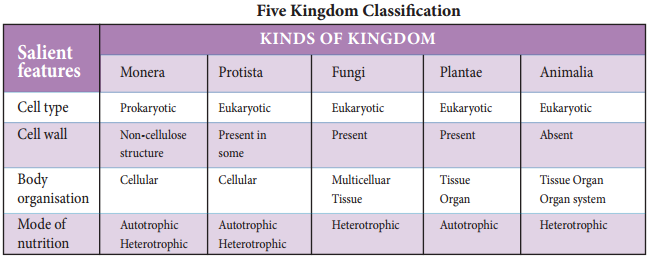
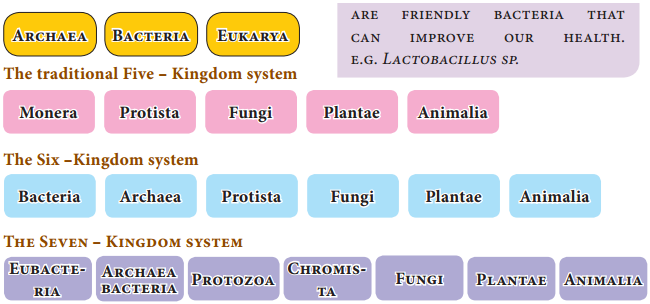
In 1987, Cavalier-Smith revised the six kingdom system to Seven Kingdom system. The concept of super kingdom was introduced and revised to seven kingdom classification. The classifiation is divided into two Super Kingdoms (Prokaryota and Eukaryota) and seven kingdoms, two Prokaryotic Kingdoms (Eubacteria and Archaebacteria) and five Eukaryotic Kingdoms (Protozoa, Chromista, Fungi, Plantae and Animalia). (Table 1.1).
Three Domains of Life img 2
Three Domains of Life img 3

Diversity in the Living World

Learninsta presents the core concepts of Biology with high-quality research papers and topical review articles.

Diversity in the Living World

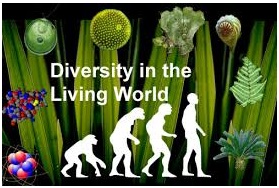
Earth has numerous habitats with a wide range of living organisms inhabiting them. Plants and animals are present in almost all the places, from polar icecaps to volcanic hot springs, from shallow lagoons to the deepest oceans, from tropical rain forests to dry and parched deserts. There are a variety of species that have been adapted successfully to live in diverse ecosystems.

Ecosystem is a community of biotic and a biotic factors and their interrelationships (A.G. Tansley, 1935). The presence of a large number of species in a particular ecosystem is called ‘biological diversity’ or in short ‘biodiversity’. The term biodiversity was first introduced by Walter Rosen (1985), and defined by E.D. Wilson.

Characterstic Features of Living Organisms

Living organisms show a variety of unique characters different from nonliving matter. The key characters of living organisms are, cellular organization, nutrition, respiration, metabolism, growth, response to stimuli, movement, reproduction, excretion, adaptation and homeostasis.

Numerous scientists and taxonomists have made tremendous contribution and documentation in the observation and study of even minute characters in living organisms. Their keen observations have led to the classification of living organisms and the study of their interrelationships.

Increase in mass and increase in number of individuals are essential criterion for the growth of the living organism. Growth of multicellular organisms occurs due to cell division. Reproduction is another characteristic of living organisms. Metabolism is another characteristic of living organisms.

Diverse form of living organisms are found in different types of habitats like ocean, fresh water bodies, forests, cold mountains, deserts, hot water springs etc.

Biodiversity is the variation of life forms, within a given ecosystem, biome or for the entire earth. It is a combination of two words; bio meaning life and diversity meaning variety. It refers to the varieties of plants,
animals and micro-organisms, the genes they contain and the ecosystems they form.

It means understanding that each individual is unique, and recognizing our individual differences. These can be along the dimensions of race, ethnicity, gender, sexual orientation, socio-economic status, age, physical abilities, religious beliefs, political beliefs, or other ideologies.

‘Living’ is something that is alive, something that can grow, move, reproduce, respire and carry out various cellular activities.

Diversity gives you access to a greater range of talent, not just the talent that belongs to a particular world-view or ethnicity or some other restricting definition. It helps provide insight into the needs and motivations of all of your client or customer base, rather than just a small part of it.

The term biodiversity (from “biological diversity”) refers to the variety of life on Earth at all its levels, from genes to ecosystems, and can encompass the evolutionary, ecological, and cultural processes that sustain life.
Diversity in the Living World img 1

Environmental Issues of Ecosan Toilets

Learninsta presents the core concepts of Biology with high-quality research papers and topical review articles.

Environmental Issues of Ecosan Toilets

About 150 liters of wastewater at an average is generated by an Indian individual daily, and a large amount of it is generated from toilets. Ecological sanitation (EcoSan) is a sustainable system for handling human excreta by using dry composting toilets.

EcoSan toilets not only reduce wastewater generation but also generate the natural fertilizer from recycled human excreta, which forms an excellent substitute for chemical fertilizers. This method is based on the principle of recovery and recycling of nutrients from excreta to create a valuable supply for agriculture.
‘EcoSan’ toilets are being used in several parts of India and Sri Lanka.

Eco-San is a specially formulated food contact surface sanitizer and destainer for use in low-temperature warewashing machines that rinses clear. Eco-San leaves dishes, flatware and glassware both sparkling and hygienically clean, as it combats a broad spectrum of organisms.

The EcoSan toilet is a closed system that does not need water, so is an alternative to leach pit toilets in places where water is scarce or where the water table is high and the risk of groundwater contamination is increased. When the pit of an EcoSan toilet fills up it is closed and sealed.

It is being used in Gulbarga, Karnataka. A self flushing e-toilet (using concept of pay & use toilet scheme) are toilets that are designed in such a way that it flushes itself on entry and exit with a drop of coin. They are
prevalent in Delhi, Kerala and Mumbai for footpath and slum dwellers.

Wherever the Need, an NGO in the UK build ecosan facilities (UDDTs) in various parts of the developing world. They predominantly work in Tamil Nadu (India), where the Tamil Nadu State Government
provides subsidies for their work.