NCERT Solutions for Class 8 English Honeydew Chapter 8 A Short Monsoon Diary

NCERT Solutions for Class 8 English Honeydew Chapter 8 A Short Monsoon Diary are part of NCERT Solutions for Class 8 English. Here we have given NCERT Solutions for Class 8 English Honeydew Chapter 8 A Short Monsoon Diary.

BoardCBSE
TextbookNCERT
ClassClass 8
SubjectEnglish Honeydew
ChapterChapter 8
Chapter NameA Short Monsoon Diary
CategoryNCERT Solutions

NCERT Solutions for Class 8 English Honeydew Chapter 8 A Short Monsoon Diary

IMPORTANT PASSAGES FOR COMPREHENSION

Read the following extracts and answer the questions that follow choosing the correct options among the given ones :

I. Through the mist Bijju is calling to his sister. I can hear him running about on the hillside but I cannot see him. (Page 113)

Multiple Choice Questions
1. The scene being described here is
(a) the first day of monsoon
(b) the last day of monsoon
(c) an ordinary day on the hills
(d) a winter day.

2. The author cannot see Bijju because
(a) he is not in the line of his eyes
(b) it is misty
(c) it is night
(d) he is blind.

3. The passage is written by
(a) Satyajit Ray
(b) Rabindranath Tagore
(c) Nathaniel Hawthorne Answers
(d) Ruskin Bond.

Answers:
1. (a) the first day of monsoon
2. (b) it is misty
3. (d) Ruskin Bond

II. In the evening it attacked one of Bijju’s cows but fled at the approach of Bijju’s mother, who came screaming imprecations.
As for the leeches, I shall soon get used to a little bloodletting every day. (Page 114)

Questions
1. What does ‘it’ in the first line refer to ?
2. What causes the bloodletting ?
3. What did Bijju’s mother do ?
4. Find a word in the passage which means ‘curses’. Answers

Answers:
1. ‘It’ refers to the leopard.
2. The leeches cause the bloodletting.
3. Bijju’s mother chased the leopard away.
4. Imprecations.

III. It is a good sound to read by—the rain outside, the quiet within—and, although tin roofs are given to springing unaccountable leaks, there is a feeling of being untouched by, and yet in touch with, the rain.

Multiple Choice Questions
1. Here, the author is praising
(a) tin roofs
(b) rain
(c) springing
(d) leaks.

2. The ‘good sound’ is produced by
(a) rain only
(b) tin roofs only
(c) rain and tin roofs
(d) rain and leaks.

3. The word ‘springing’ here means
(a) jumping
(b) creating
(c) a season
(d) finishing.

Answers:
1. (a) tin roofs
2. (c) rain and tin roofs
3. (b) creating

IV. The blackest cloud I’ve ever seen squatted over Mussoorie, and then it hailed marbles for half an hour. Nothing like a hailstorm to clear the sky. Even as I write, I see a rainbow forming. (Page 117)

Questions
1. What season is being described ?
2. What do the ‘marbles’ refer to ?
3. What does the author mean by ‘clear sky’ ?

Answers:
1. Rainy season is being described here.
2. The marbles refer to ‘hails’.
3. A clear sky means ‘a sky free of clouds’.

TEXTUAL EXERCISES

COMPREHENSION CHECK (Page 115)
1. Why is the author not able to see Bijju ?
2. What are the two ways in which the hills appear to change when the mist comes up ?

Answers
1. The author is not able to see Bijju because of the mist. The mist has blocked the vision.
2. The mist covers the hills and all the atmosphere. So they cannot be seen. The second change is that the birds stop singing. This makes the hills suddenly silent.

COMPREHENSION CHECK (Page 117)
1. When does the monsoon season begin and when does it end ? How do you prepare to face the monsoon ?
2. Which hill-station does the author describe in this diary entry ?
3. For how many days does it rain without stopping ? What does the author do on these days ?
4. Where do the snakes and rodents take shelter ? Why ?
5. What did the author receive in the mail ?

Answers
1. The monsoon generally begins in the end of June. It generally ends in the end of August or in the beginning of September. We buy raincoats or umbrellas to face the monsoon.
2. Mussoorie.
3. It has rained for eight or nine days without stopping. During these the author has been pacing the room or looking out of the window.
4. The snakes and rodents take shelter in roofs, attics and godowns. They do so because their holes are flooded with water. Out of the holes, these are the convenient places for them.
5. The author received a cheque in the mail.

WORKING WITH THE TEXT (Page 118)
Question. 1.
Look carefully at the diary entries for June 24-25, August 2 and March 23. Now write down the changes that happen as the rains progress from June to March.

Answer:
Monsoon arrives on June 24. The first real monsoon shower comes on June 25. The whole nature welcomes it. The author feels the joy himself and in everything around him.

By August 2, the people become weary of the monsoon. It is so because the movement in the open has become difficult. There is no sunshine for more than a week.

March 23 heralds the end of winter. After a hailstorm, there is a rainbow in the sky. It shows the beauty of nature.

Question. 2.
Why did the grandmother ask the children not to kill the Chuchundar ?

Answer:
Grandmother believed that Chuchundars are lucky. She thought that with them came money. So she asked the children not to kill it.

Question. 3.
What signs do we find in Nature which show that the monsoons are about to end ?

Answer:
At the end of the monsoon, the lush monsoon growth reaches its peak. The seeds of the cobra lily turn red. These things show that the monsoons are about to end.

Question. 4.
Complete the following sentences.
(i) Bijju is not seen but his voice is heard because___.
(ii) The writer describes the hill station and valley as___.
(iii) The leopard was successful in but had to flee when___.
(iv) The minivets are easily noticed because___.
(v) It looks like a fashion display on the slopes when___.
(vi) During the monsoon season, snakes and rodents are found in roofs and attics because___.

Answer:
(i) the mist obstructs the author’s vision.
(ii) ‘A paradise that might have been’.
(iii) killing a dog but had to flee when Bijju’s mother arrived crying curses.
(iv) of their bright colours.
(v) they are covered by a variety of flowers.
(vi) their holes are flooded with water and these things provide them convenient shelters.

Question. 5.
‘Although tin roofs are given to springing unaccountable leaks, there is a feeling of being untouched by, and yet in touch with, the rain.’
(i) Why has the writer used the word, ‘springing’ ?
(ii) How is the writer untouched by the rain ?
(iii) How is the writer in touch with the rain at the same time ?

Answer:
(i) The word ‘springing’ gives the idea of suddenness.
(ii) The author is untouched by the rain because he is in a room. The room pro-tects him from rain.
(iii) The writer hears the sound of rainfall on his tin-roof. So he is in touch with the rain.

Question. 6.
Mention a few things that can happen when there is endless rain for days together.

Answer:
When there is endless rain for days together, the life becomes difficult. To go out becomes difficult. One gets bored living in the room all the time. Everything becomes damp and soggy. The washed clothes do not get dried. Constant rainfall is an invitation for many insects, rodents and snakes to enter the house.

It can also cause diseases. The sun is the source of life. If sunlight doesn’t reach people for a long time, they fall ill.

Question. 7.
What is the significance of cobra lily in relation to the monsoon season, its beginning and end ?

Answer:
The first cobra lily is seen with the arrival of the monsoon. When its seeds begin to turn red, it is an indication that the rains are over.

WORKING WITH LANGUAGE (Page 118)

Question 1.
Here are some words that are associated with the monsoon. Add as many words as you can to this list. Can you find words for these in your languages ?

NCERT Solutions for Class 8 English Honeydew Chapter 8 A Short Monsoon Diary 118.1

Answers
rainwater, fog, overcast, damp, soggy, raincoat, darkness, leaks.
Hindi words for those given in the question are :

NCERT Solutions for Class 8 English Honeydew Chapter 8 A Short Monsoon Diary 118.1.1

Question 2.
Look at the sentences below.
(i) Bijju wandered into the garden in the evening.
(ii) The trees were ringing with birdsong.
Notice the highlighted verbs.

The verb wandered tells us what Bijju did that evening. But the verb was ringing tells us what was happening continually at same time in the past (the birds were chirping in the trees).

Now look at the sentences below. They tell us about something that happened in the past. They also tell us about other things that happened continually at the same time in the past.

Put the verbs in the brackets into their proper forms. The first one is done for you.
(i) We (get out) of the school bus. The bell (ring) and everyone (rush) to class.
We got out of the school bus. The bell was ringing and everyone was rushing to class.
(ii) The traffic (stop). Some people (sit) on the road and they (shout) slogans.
(iii) I (wear) my raincoat. It (rain) and people (get) wet.
(iv) She (see) a film. She (narrate) it to her friends who (listen) carefully.
(v) We (go) to the exhibition. Some people (buy) clothes while others (play) games.
(vi) The class (is) quiet. Some children (read) books and the rest (draw).

Answers:
(ii) The traffic stopped. Some people were sitting on the road and they were shouting slogans.
(iii) I was wearing my raincoat. It was raining and people were getting wet.
(iv) She had seen a film. She was narrating it to her friends who were listening carefully.
(v) We went to the exhibition. Some people were buying clothes while others were playing games.
(vi) The class was quiet. Some children were reading books and the rest were drawing.

Question 3.
Here are some words from the lesson which describe different kinds of sounds.

NCERT Solutions for Class 8 English Honeydew Chapter 8 A Short Monsoon Diary 118.3
(i) Match these words with their correct meanings.
(a) to fall in small drops
(b) to make a sound by hitting a surface repeatedly
(c) to move quickly through the air, making a soft sound id) harsh sound made by birds
(e) ringing sound (of a bell or breaking glass, etc.)

(ii) Now fill in the blanks using the correct form of the words given above.
(a) Ramesh__on his desk in impatience.
(b) Rain water___from the umbrella all over the carpet.
(c) The pony___its tail.
(d) The___of breaking glass woke me up.
(e) The___of the raven disturbed the child’s sleep.

Answers:
(i) (a) —> drip
(b) —> drum
(c) —> swish
(d) —> caw
(e) —> tinkle

(ii) (a) Ramesh drummed on his desk in impatience.
(b) Rain water dripped from the umbrella all over the carpet.
(c) The pony swished its tail.
(d) The tinkle of the breaking glass woke me up.
(e) The caw of the raven disturbed the child’s sleep.

Question 4.
And sure enough, I received a cheque in the mail.
Complete each sentence below by using appropriate phrase from the ones given below.

NCERT Solutions for Class 8 English Honeydew Chapter 8 A Short Monsoon Diary 118.4
1. I saw thick black clouds in the sky. And ___ ___ it soon started raining heavily.
2. The blue umbrella was ___ ___ for the brother and sister.
3. The butterflies are ___ ___ to get noticed
4. The lady was ___ ___ to chase the leopard
5. The boy was ___ ___ to call out to his sister.
6. The man was ___ ___ to offer help.
7. The victim’s injury was ___ ___ for him to get admitted in hospital
8. That person was ___ ___ to repeat the same mistake again.
9. He told me he was sorry and he would compensate for the loss. I said,___ ___

Answers:
(i) sure enough
(ii) big enough
(iii) colourful enough
(iv) brave enough
(v) anxious enough
(vi) kind enough
(vii) serious enough
(viii) foolish enough
(ix) “Fair enough”

SPEAKING (Page 120)
Question 1.
Do you believe in superstitions ? Why, or why not ? Working with your partner, write down three superstitious beliefs that you are familiar with.

Answer:
No. I don’t believe in superstitions. However there is one snag in this statement. One man’s belief may be superstitious to the other and vice versa.
Three common superstitions are :
(i) No. 13 is ominous
(ii) Stop if a black cat crosses your path.
(iii) Do not sleep with your feet pointing towards south.

Question 2.
How many different kinds of birds do you come across in the lesson ? How many varieties do you see in your neighbourhood ? Are there any birds that you used to see earlier in your neighbourhood but not now ? In groups discuss why you think this is happening.

Answer:
We come across five kinds of birds in this lesson. These are: minivets, drongos, crow, whistling thrush and ‘shrew’. We do not see many varieties in our neighbourhood. There are two birds which used to be seen in our neighbourhood but have now disap-peared. These are peacocks and vultures. Poaching, felling of trees and pollution of the environment are three important reasons for its happening.

WRITING (Page 121)
Question 1.
The monsoons are a time of great fun and even a few adventures: playing in the rain and getting wet, wading through knee-deep water on your way to school, water flooding the house or the classroom, powercuts and so on.
Write a paragraph describing an incident that occurred during the rains which you can never forget.
Or
Write a poem of your own about the season of spring when trees are in full bloom.

Answers:
A rainy day in summer is a great blessing. Last Friday, I had not yet left for school, when it began to rain. It rained heavily. Going to school was out of question. So I placed my books on the table and stood near the window. Water had collected everywhere. People were wading through water with raincoats on. Some had umbrellas in their hands. But these gave them little shelter. Children absented themselves from schools.

They played in rain-water and cared little for their mothers who got angry. The roads became slippery. Some persons who slipped on the road, spoiled their clothes. The children had a hearty laugh.
Or
Spring is the season of joy
When Nature becomes a toy.
The trees are in full bloom
Some flowers are in my room.
In spring comes Holi
Let’s play with colour and roli.
There is summer in the air
How lovely the birds and hare !
Spring is the season of joy
When Nature becomes a toy
The trees are in full bloom
I have roses in my room.

We hope the NCERT Solutions for Class 8 English Honeydew Chapter 8 A Short Monsoon Diary help you. If you have any query regarding NCERT Solutions for Class 8 English Honeydew Chapter 8 A Short Monsoon Diary, drop a comment below and we will get back to you at the earliest.
Various Application of Colloids

Find free online Chemistry Topics covering a broad range of concepts from research institutes around the world.

Various Application of Colloids

In every path of life, colloids play a great role. Human body contains the numerous colloidal solutions. The blood in our body, protoplasma of plant and animal cell, and fats in our intestines are in the form of emulsions. Synthetic polymers like polystyrene silicones and PVC are colloids.

Food

Food stuff like milk cream, butter, etc are present in colloidal form.

Medicines

Antibodies such as penicillin and streptomycin are produced in colloidal form for suitable injections. Colloidal gold and colloidal calcium are used as tonics. Milk of magnesia is used for stomach troubles. Silver sol protected by gelatine known as Argyrol is used as eye lotion.

In Industry

Colloids find many applications in industries.

(i) Water Purification:

Purification of drinking water is activated by coagulation of suspended impurities in water using alums containing Al3+

(ii) In washing:

The cleansing action of soap is due to the formation of emulsion of soap molecules with dirt and grease.

(iii) Tanning of Leather

Skin and hides are protein containing positively charged particles which are coagulated by adding tannin to give hardened leather for further application. Chromium salts are used for the purpose. Chrome tanning can produce sof and polishable leather.

(iv) Rubber Industry:

Latex is the emulsion of natural rubber with negative particles. By heating rubber with sulphur, vulcanized rubbers are produced for tyres, tubes, etc.

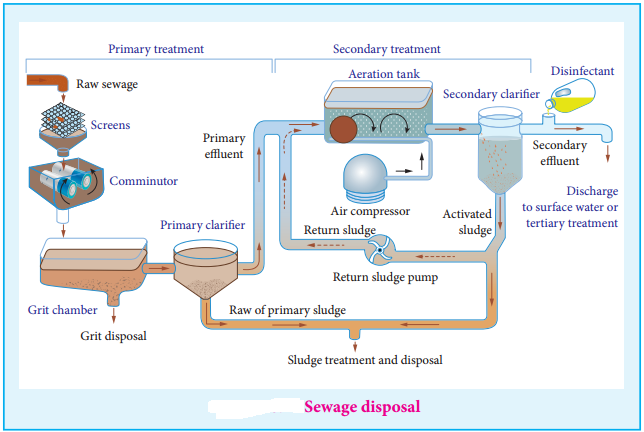
(v) Sewage Disposal

Sewage contains dirt, mud and wastes dispersed in water. The passage of electric current deposits the wastes materials which can be used as a manure.

Various Application of Colloids img 1

(vi) Cortrell’s Precipitator

Carbon dust in air is solidified by cortrell’s precipitator. In it, a high potential difference of about 50,000V is used. The charge on carbon is neutralized and solidified. This the air is free from carbon particles.

(vii) The Blue Colour

The blue colour  of the sky in nature is due to Tyndall effect of air particles.

(viii) Formation of Delta:

The electrolyte in sea and river water coagulates the solid particles in river water at their intersection. So, the earth becomes a fertile land.

(ix) Analytical Application

Qualitative and quantitative analysis are based on the various properties of colloids. Hence we can conclude that in our life, there is hardly any field which is not including the applications of colloids.

Emulsions

Find free online Chemistry Topics covering a broad range of concepts from research institutes around the world.

Emulsions

Emulsions are colloidal solution in which a liquid is dispersed in an another liquid. Generally there are two types of emulsions.

  1. Oil in water (O/W)
  2. Water in oil (W/O)

Example:

  • Milk is example of the oil in water type emulsion.
  • Stif greases are emulsion of water in oil i.e. water dispersed in lubricating oil.
  • The process of preparation of emulsion by the dispersal of one liquid in another liquid is called Emulsification.
  • A colloid mill can be used as a homogeniser to mix the two liquid. To have a stable emulsion a small amount of emulsifier or emulsification agent is added.

Several Types of Emulsifiers are known.

  1. Most of the lyophillic colloids also act as emulsifiers. Example: glue, gelatine.
  2. Long chain compounds with polar groups like soap and sulphonic acids.
  3. Insoluble powders like clay and lamp black also act as emulsifiers.

Identification of Types of Emulsion

The two types of emulsions can be identified by the following tests.

(i) Dye Test

A small amount of dye soluble in oil is added to the emulsion. The emulsion is shaken well. The aqueous emulsion will not take the colour whereas oily emulsion will take up the colour of the dye.

(ii) Viscosity Test

Viscosity of the emulsion is determined by experiments. Oily emulsions will have higher value than aqueous emulsion.

(iii) Conductivity Test

Conductivity of aqueous emulsions are always higher than oily emulsions.

(iv) Spreading Test

Oily emulsions spread readily than aqueous emulsion when spread on an oily surface.

Deemulsification:

Emulsion can be separated into two separate layers. The process is called Deemulsification.

Various Deemulsification Techniques are Given Below

  1. Distilling of one component
  2. Adding an electrolyte to destroy the charge
  3. Destroying the emulsifir using chemical methods
  4. Using solvent extraction to remove one component
  5. By freezing one of the components
  6. By applying centrifugal force
  7. Adding dehydrating agents for water in oil (W/O) type
  8. Using ultrasonic waves.
  9. Heating at high pressures.

Inversion of Phase:

The change of W/O emulsion into O/W emulsion is called inversion of phases.

For example:

An oil in water emulsion containing potassium soap as emulsifying agent can be converted into water in oil emulsion by adding CaCl2 or AlCl3. The mechanism of inversion is in the recent developments of research.

Colloid, Dispersion Phase and Dispersion Medium

Find free online Chemistry Topics covering a broad range of concepts from research institutes around the world.

Colloid, Dispersion Phase and Dispersion Medium

Origin of study of colloid starts with Thomas Graham who observed diffusion of that a solution of sugar, urea or sodium chloride through a membrane but not glue, gelatine or gum. He called the former substances as crystalloids and the latter as colloids (In Greek, kola as gum, eidos-like).

Later it was realised that any substance can be converted into a colloid by reducing its particle size to 1-200nm.

Hence, colloid is a homogeneous mixture of two substances in which one substance (smaller proportion) is dispersed in another substance (large proportion).

In a colloid, the substance present in larger amount is called dispersing medium and the substance present in less amount is called dispersed phase.

Classifications of Colloidal Solution

Probably the most important colloidal systems have dispersed phase as solid and the dispersion medium as liquid. If the dispersion medium considered is water, then the colloids are referred as hydrosols or aquasols.

If the dispersion medium is an alcohol, the colloid is termed as alcosol, and if benzene is the dispersion medium, it is called as benzosol.

One more type of classification is based on the forces acting between the dispersal phase and dispersion medium.

In lyophillic colloids definite attractive force or affinity exists between dispersion medium and dispersed phase. Examples: sols of protein and starch. They are more stable and will not get precipitated easily. They can be brought back to colloidal solution even after the precipitation by addition of the dispersion medium.

In a lyophobic colloids, no attractive force exists between the dispersed phase and dispersion medium. They are less stable and precipitated readily, but can not be produced again by just adding the dispersion medium. They themselves undergo coagulation after a span of characteristic life time.

They are called irreversible sols
Examples: sols of gold, silver, platinum and copper.

The following table lists the types of colloids based on the physical states of dispersed phase and dispersion medium.

Classification of Colloids Based on the Physical State of Dispersed Phase and Dispersion Medium.

Dipersion Medium

Dispersed PhaseName of the Colloid

Examples

1. GasLiquidLiquid AerosolFog Aerosol spray
2. GasSolidSolid AerosolSmoke, Air pollutants likes fumes, dust
3. LiquidGasFoamWhipped cream, Shaving cream, Soda water, Froth
4. LiquidLiquidEmulsionMilk, Cream, Mayonnaise
5. LiquidSolidSolInks, Paints, Collodial gold
6. SolidGasSolid foamPumice stone, Foam rubber bread
7. SolidLiquidGelButter, Cheese
8. SolidSolidSolid solPearls, opals, coloured glass alloys colloidal dispersed eutics

Preparation of Colloids

Many lyophillic substances are made in their colloidal form by warming with water. Rubber forms colloidal solution with benzene. Soap spontaneously forms a colloidal solution by just mixing with water.

In general, colloidal are prepared by the following methods.

1. Dispersion Methods:
In this method larger particles are broken to colloidal dimension.

2. Condensation Methods:
In this method, smaller atom or molecules are converted into larger colloidal sized particles.

1. Dispersion Methods

(i) Mechanical Dispersion:

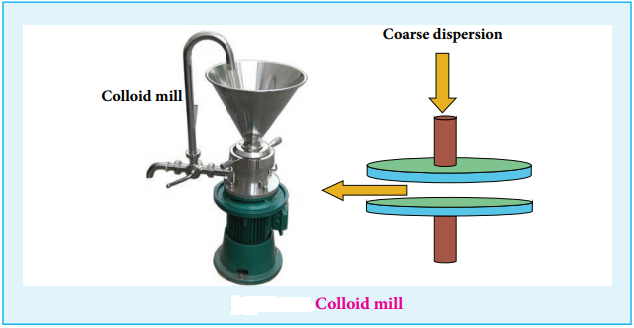
Using a colloid mill, the solid is ground to colloidal dimension. The colloid mill consists of two metal plates rotating in opposite direction at very high speed of nearly 7000 revolution/minute.

Colloid, Dispersion Phase and Dispersion Medium img 1

The colloidal particles of required colloidal size is obtained by adjusting the distance between two plates. By this method, colloidal solutions of ink and graphite are prepared.

(ii) Electro Dispersion:

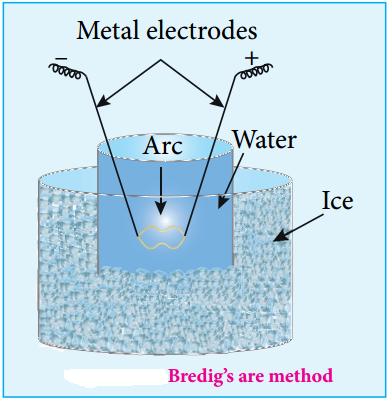
A brown colloidal solution of platinum was first prepared by George Bredig in 1898. An electrical arc is struck between electrodes dispersed in water surrounded by ice. When a current of 1 amp/100 V is passed an arc produced forms vapours of metal which immediately condense to form colloidal solution.

By this method colloidal solution of many metals like copper, silver, gold, platinum, etc. can be prepared Alkali hydroxide is added as an stabilising agent for the colloidal solution.

Colloid, Dispersion Phase and Dispersion Medium img 2

Svedberg modified this method for the preparation of non aqueous inflammable liquids like pentane, ether and benzene, etc using high frequency alternating current which prevents the decomposition of liquid.

(iii) Ultrasonic Dispersion

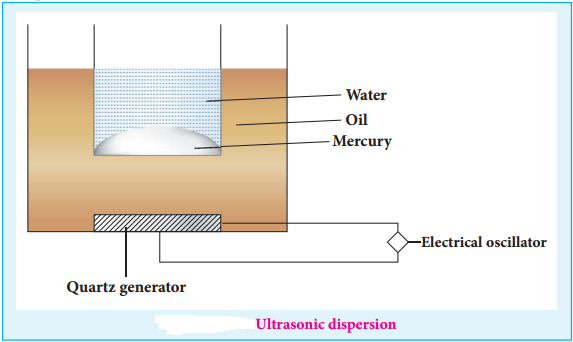
Sound waves of frequency more than 20kHz (audible limit) could cause transformation of coarse suspension to colloidal dimensions.

Colloid, Dispersion Phase and Dispersion Medium img 3

Claus obtained mercury sol by subjecting mercury to sufficiently high frequency ultrasonic vibrations.

The ultrasonic vibrations produced by generator spread the oil and transfer the vibration to the vessel with mercury in water.

(iv) Peptisation:

By addition of suitable electrolytes, precipitated particles can be brought into colloidal state. The process is termed as peptisation and the electrolyte added is called peptising or dispersing agent

2. Condensation Methods:

When the substance for colloidal particle is present as small sized particle, molecule or ion, they are brought to the colloidal dimension by condensation methods. Here care should be taken to produce the particle with colloidal size otherwise precipitation will occur. Various chemical methods for the formation of colloidal particles.

(i) Oxidation

Sols of some non metals are prepared by this method.

(a) When hydroiodic acid is treated with iodic acid, I2 sol is obtained.
HIO3 + 5HI → 3H2O + I2 (Sol)

(b) When O2 is passed through H2Se, a sol of selenium is obtained.
H2Se + O2 → 2H2O + Se (sol)

(ii) Reduction

Many organic reagents like phenyl hydrazine, formaldehyde, etc are used for the formation of sols. For example: Gold sol is prepared by reduction of auric chloride using formaldehyde.

2 AuCl3 + 3HCHO + 3H2O → Au(sol) + 6HCl + 3HCOOH

(iii) Hydrolysis

Sols of hydroxides of metals like chromium and aluminium can be produced by this method.

For Example,
FeCl3+3H2O → Fe(OH)3+3HCl

(iv) Double Decomposition

For the preparation of water insoluble sols this method can be used. When hydrogen sulphide gas is passed through a solution of arsenic oxide, a yellow coloured arsenic sulphide is obtained as a colloidal solution.
As2O3 +3H2S → As2S3 + 3H2O

(v) Decomposition

When few drops of an acid is added to a dilute solution of sodium thiosulphate, the insoluble free sulphur produced by decomposition of sodium thiosulphate accumulates into small, clusters which impart various colours blue, yellow and even red to the system depending on their growth within the size of colloidal dimensions.

Colloid, Dispersion Phase and Dispersion Medium img 4

3. By Exchange of Solvent:

Colloidal solution of few substances like phosphorous or sulphur is obtained by preparing the solutions in alcohol and pouring them into water. As they are insoluble in water, they form colloidal solution.

P in alcohol + water → Psol.

Purification of Colloids

The colloidal solutions due to their different methods of preparation may contain impurities. If they are not removed, they may destablise and precipitate the colloidal solution. This is called coagulation. Hence the impurities mainly electrolytes should be removed to increase the stabilisation of colloid. Purification of colloidal solution can be done by the following methods.

  1. Dialysis
  2. Electrodialysis
  3. Ultrafilteration.

1. Dialysis

In 1861, T. Graham separated the electrolyte from a colloid using a semipermeable membrane (dialyser). In this method, the colloidal solution is taken in a bag made up of semipermeable membrane. It is suspended in a trough of flowing water, the electrolytes diffuse out of the membrane and they are carried away by water.

2. Electrodialysis

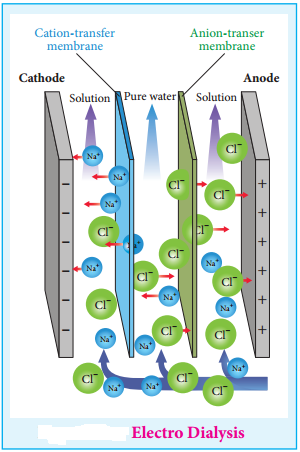
The presence of electric field increases the speed of removal of electrolytes from colloidal solution. The colloidal solution containing an electrolyte as impurity is placed between two dialysing membranes enclosed into two compartments filled with water.

When current is passed, the impurities pass into water compartment and get removed periodically. This process is faster than dialysis, as the rate of diffusion of electrolytes is increased by the application of electricity.

Colloid, Dispersion Phase and Dispersion Medium img 5

3. Ultrafiltration

The pores of ordinary filter papers permit the passage of colloidal solutions. In ultra filtrations, the membranes are made by using collodion cellophane or visiking. When a colloidal solution is filtered using such a filter, colloidal particles are separated on the filter and the impurities are removed as washings.

This process is quickened by application of pressure. The separation of sol particles from electrolyte by filteration through an ultrafilter is called ultrafiltration. Collodion is 4% solution of nitrocellulose in a mixture of alcohol and water.

Properties of Colloids

1. Colour

The colour of a sol is not always the same as the colour of the substance in the bulk. For example bluish tinge is given by diluted milk in reflected light and reddish tinge in transmitted light.

Colour of the sol, generally depends on the following factors.

  • Method of preparation
  • Wavelength of source of light.
  • Size and shape of colloidal particle
  • Whether the observer views the reflected light or transmitted light.

2. Size

The size of colloidal particles ranges from 1nm (10-9m) to 1000 nm (10-6m) diameter.

3. Colloidal Solutions are Heterogeneous in Nature Having two Distinct Phases

Though experiments like dialysis, ultrafiltration and ultracentrifuging clearly show the heterogeneous nature in the recent times colloidal solution are considered as border line cases.

4. Filtrability

As the size of pores in ordinary filter paper are large the colloidal particles easily pass through the ordinary filter papers.

5. Non-Setting Nature

Colloidal solutions are quite stable i.e. they are not affcted by gravity.

6. Concentration and Density

When the colloidal solution is dilute, it is stable. When the volume of medium is decreased coagulation occurs. Generally, density of sol decreases with decrease in the concentration.

7. Diffusability

Unlike true solution, colloids diffuse less readily through membranes.

8. Colligative Properties

The colloidal solutions show colligative properties i.e. elevation of boiling point, depression in freezing point and osmotic pressure. Measurements of osmotic pressure is used to find molecular weight of colloidal particle.

9. Shape of Colloidal Particles

It is very interesting to know the various shapes of colloidal particles. Here are some examples

Colloidal Particles

Shapes

As2S3Spherical
Fe(OH)3sol (blue gold sol)Disc or plate like
W2O5sol (tungstic acid sol)Rod like

10. Optical Property

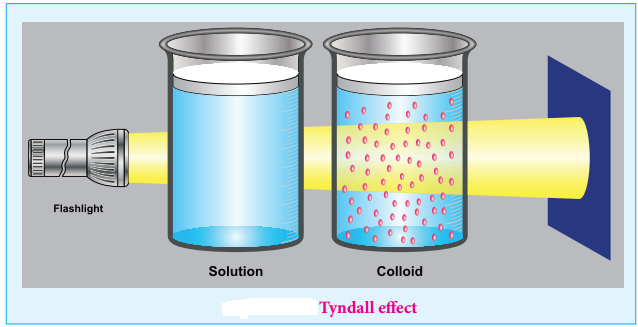
Colloids have optical property. When a homogeneous solution is seen in the direction of light, it appears clear but it appears dark, in a perpendicular direction.

Colloid, Dispersion Phase and Dispersion Medium img 6

But when light passes through colloidal solution, it is scattered in all directions. This effect was first observed by Faraday, but investigations are made by Tyndall in detail, hence called as Tyndall effect.

The colloidal particles absorb a portion of light and the remaining portion is scattered from the surface of the colloid. Hence the path of light is made clear.

11. Kinetic Property

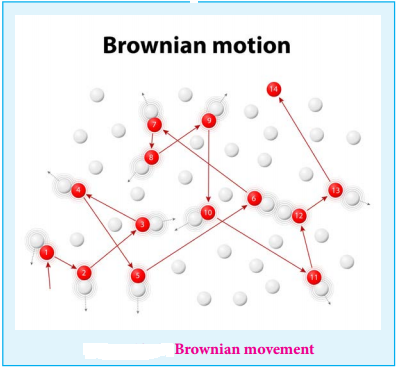
Robert Brown observed that when the pollen grains suspended in water were viewed through ultra microscope, they showed a random, zigzag ceaseless motion.

This is called Brownian movement of colloidal particles.

This can be explained as follows

The colloidal sol particles are continuously bombarded with the molecules of the dispersion medium and hence they follow a zigzag, random, continuous movement.

Brownian Movement Enables Us,

I. To calculate Avogadro number.

II. To confirm kinetic theory which considers the ceaseless rapid movement of molecules that increases with increase in temperature.

III. To understand the stability of colloids:

As the particles in continuous rapid movement they do not come close and hence not get condensed. That is Brownian movement does not allow the particles to be acted on by force of gravity.

Colloid, Dispersion Phase and Dispersion Medium img 7
Colloid, Dispersion Phase and Dispersion Medium img 8

12. Electrical Property

(i) Helmholtz Double Layer

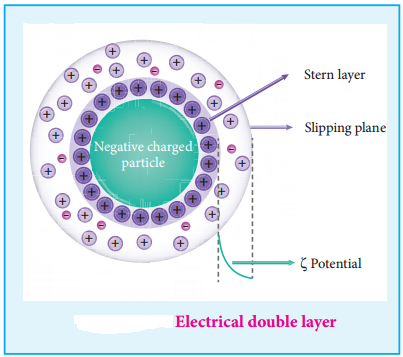
The surface of colloidal particle adsorbs one type of ion due to preferential adsorption. This layer attracts the oppositely charged ions in the medium and hence at the boundary separating the two electrical double layers are setup. This is called as Helmholtz electrical double layer.

As the particles nearby are having similar charges, they cannot come close and condense. Hence this helps to explain the stability of a colloid.

(ii) Electrophoresis:

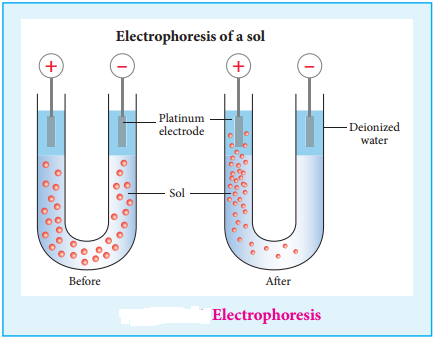
When electric potential is applied across two platinum electrodes dipped in a hydrophilic sol, the dispersed particles move toward one or other electrode. This migration of sol particles under the influence of electric field is called electrophoresis or cataphoresis.

If the sol particles migrate to the cathode, then they posses positive (+) charges, and if the sol particles migrate to the anode then they have negative charges(-). This from the direction of migration of sol particles we can determine the charge of the sol particles. Hence electrophoresis is used for detection of presence of charges on the sol particles.

Colloid, Dispersion Phase and Dispersion Medium img 9

Few Examples of Charges of Sols Detected by Electrophoresis are Given Below:

Positively charge colloidsNegatively charge colloids
Ferric hydroxideAg, Au & Pt
Aluminium hydroxideArsenic sulphide
Basic dyesClay
HaemoglobinStarch

(iii) Electro Osmosis

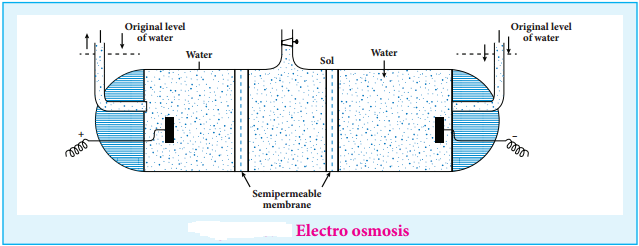
A sol is electrically neutral. Hence the medium carries an equal but opposite charge to that of dispersed particles. When sol particles are prevented from moving, under the influence of electric field the medium moves in a direction opposite to that of the sol particles. This movement of dispersion medium under the influence of electric potential is called electro osmosis.

Colloid, Dispersion Phase and Dispersion Medium img 10

13. Coagulation or Precipitation

The flocculation and settling down of the sol particles is called coagulation.
Various method of coagulation are given below:

  • Addition of electrolytes
  • Electrophoresis
  • Mixing oppositively charged sols.
  • Boiling

Addition of Electrolytes

A negative ion causes the precipitation of positively charged sol and vice versa. When the valency of ion is high, the precipitation power is increased. For example, the precipitation power of some cations and anions varies in the following order

Al3+ > Ba2+ > Na+, Similarly [Fe(CN)6]3- > SO42- > Cl

The precipitation power of electrolyte is determined by finding the minimum concentration (millimoles/lit) required to cause precipitation of a sol in 2 hours. This value is called flocculation value. The smaller the flocculation value greater will be precipitation.

Electrophoresis

In the electrophoresis, charged particles migrate to the electrode of opposite sign. It is due to neutralization of the charge of the colloids. The particles are discharged and so they get precipitated.

By Mixing two Oppositively Charged Sols

When colloidal sols with opposite charges are mixed mutual coagulation takes place. It is due to migration of ions from the surface of the particles.

By Boiling

When boiled due to increased collisions, the sol particles combine and settle down.

14. Protective Action

Generally, lyophobic sols are precipitated readily even with small amount of electrolytes. But they are stabilised by addition of a small amount of lyophillic colloid.

A small amount of gelatine sol is added to gold sol to protect the gold sol.

Zsigmondy introduced the term ‘gold number’ as a measure of protecting power of a colloid. Gold number is defined as the number of milligrams of hydrophilic colloid that will just prevent the precipitation of 10ml of gold sol on the addition of 1ml of 10% NaCl solution. Smaller the gold number greater the protective power.

Colloid

Gold number

Gelatin0.005-0.01
Egg albumin0.08-0.10
Gum Arabic0.1-0.15
Potato starch25

Zeolite Catalysis

Find free online Chemistry Topics covering a broad range of concepts from research institutes around the world.

Zeolite Catalysis

The details of heterogeneous catalysis will be in complete, if zeolites are not discussed. Zeolites are microporous, crystalline, hydrated, alumino silicates, made of silicon and aluminium tetrahedron. There are about 50 natural zeolites and 150 synthetic zeolites. As silicon is tetravalent and aluminium is trivalent, the zeolite matrix carries extra negative charge.

To balance the negative charge, there are extra framework cations for example, H+ or Na+ ions. Zeolites carrying protons are used as solid acid catalysts and they are extensively used in the petrochemical industry for cracking heavy hydrocarbon fractions into gasoline, diesel, etc., Zeolites carrying Na+ ions are used as basic catalysts.

One of the most important applications of zeolites is their shape selectivity. In zeolites, the active sites namely protons are lying inside their pores. So, reactions occur only inside the pores of zeolites.

Reactant Selectivity:

When bulkier molecules in a reactant mixture are prevented from reaching the active sites within the zeolite crystal, this selectivity is called reactant shape selectivity.

Transition State Selectivity:

If the transition state of a reaction is large compared to the pore size of the zeolite, then no product will be formed.

Product Selectivity:

It is encountered when certain product molecules are too big to diffuse out of the zeolite pores.

Phase Transfer Catalysis:

Suppose the reactant of a reaction is present in one solvent and the other reactant is present in an another solvent. The reaction between them is very slow, if the solvents are immiscible. As the solvents form separate phases, the reactants have to migrate across the boundary to react. But migration of reactants across the boundary is not easy.

For such situations a third solvent is added which is miscible with both. So, the phase boundary is eliminated, reactants freely mix and react fast. But for large scale production of any product, use of a third solvent is not convenient as it may be expensive.

For such problems phase transfer catalysis provides a simple solution, which avoids the use of solvents. It directs the use a phase transfer catalyst (a phase transfer reagent) to facilitate transport of a reactant in one solvent to the other solvent where the second reactant is present. As the reactants are now brought together, they rapidly react and form the product.

Example:

Substitution of Cl and CN in the following reaction.
R-Cl + NaCN → R-CN + NaCl

organic phase aqueous phase organic phase aqueous phase

R – C l = 1 – chlorooctane
R – C N = 1 – cyanooctane

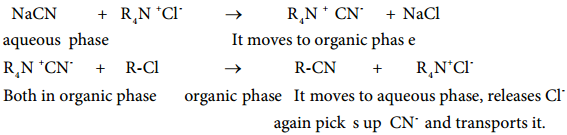
By direct heating of two phase mixture of organic 1-chlorooctane with aqueous sodium cyanide for several days, 1-cyanooctane is not obtained. However, if a small amount of quaternary ammonium salt like tetraalkylammoniumchloride is added, a rapid transition of 1-cyanooctane occurs in about 100% yield after 1 or 2 hours.

In this reaction, the tetraalkylammonium cation, which has hydrophobic and hydrophilic ends, transports CN from the aqueous phase to the organic phase using its hydrophilic end and facilitates the reaction with 1-chloroocatne as shown below:

Zeolite Catalysis img 1

So phase transfer catalyst, speeds up the reaction by transporting one reactant from one phase to another.

Nano Catalysis:

Nano materials such a metallic nano particles, metal oxides, etc., are used as catalyst in many chemical transformation, Nanocatalysts carry the advantages of both homogeneous and heterogeneous catalyses.

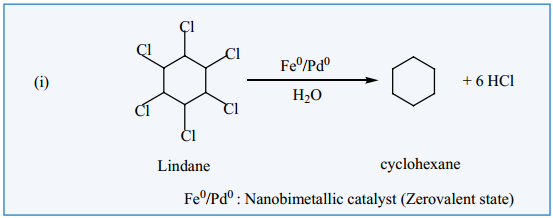
Like homogeneous catalysts, the nanocatalysts give 100% selective transformations and excellent yield and show extremely high activity. Like the heterogeneous catalysts, nanocatalysts can be recovered and recycled. Nanocatalysts are actually soluble heterogeneous catalysts. An example for nanoparticles catalysed reaction is given below.

Zeolite Catalysis img 2