NCERT Solutions for Class 8 English Honeydew Chapter 5 The Summit Within

NCERT Solutions for Class 8 English Honeydew Chapter 5 The Summit Within are part of NCERT Solutions for Class 8 English. Here we have given NCERT Solutions for Class 8 English Honeydew Chapter 5 The Summit Within.

BoardCBSE
TextbookNCERT
ClassClass 8
SubjectEnglish
ChapterChapter 5
Chapter NameThe Summit Within
CategoryNCERT Solutions

NCERT Solutions for Class 8 English Honeydew Chapter 5 The Summit Within

IMPORTANT PASSAGES FOR COMPREHENSION

Read the following extracts and answer the questions that follow choosing the correct options among the given ones :

I. By climbing the summit of Everest you are overwhelmed by a deep sense of joy and thankfulness. It is a joy which lasts a lifetime. The experience changes you completely. The man who has been to the mountains is never the same again. (Page 76)

Multiple Choice Questions
1. ‘You’ in the passage can be replaced by
(a) the author
(b) the climber
(c) the reader
(d) Rawat.

2. The climber is full of thankfulness to
(a) God
(b) friends
(c) Mountain
(d) other climbers.

3. The change which comes makes the man
(a) proud
(b)happy
(c) humble
(d) courageous.

Answers
1. (b) the climber
2. (a) God
3. (c) humble

II. The demonstration of these physical qualities is no doubt exhilarating, as it was for me also. (Page 77)

Questions
1. Which physical qualities is the author talking of ?
2. In which way are the qualities demonstrated ?
3. Name the author of these lines.

Answers
1. The author is referring to the physical qualities of persistence, humility and endurance.
2. These qualities are demonstrated in climbing of the mountain.
3. The author is H.P.S. Ahluwalia.

III. Consider a typical climb, towards the summit on the last heights. You are sharing a rope with another climber. You firm in. He cuts the steps in the hard ice. (Page 78)

Multiple Choice Questions
1. In a typical climb, the rope is shared so that
(a) the rope is cut into two
(b) the climbers hold the rope together
(c) the two hold one end of the rope each
(d) they throw the rope with force.

2. “You firm in.” means that
(a) you are resolved
(b) you put your feet firmly on the ground
(c) you improve yourself
(d) you become strong.

3. “He cuts the steps….,” means
(a) he cuts his feet
(b) he prevents others from walking
(c) he cuts the ice to make foot-holds
(d) he lifts his feet high.

Answers
1. (c) the two hold one end of the rope each
2. (b) you put your feet firmly on the ground
3. (c) he cuts the ice to make foot-holds

IV. There is another summit. It is within yourself. It is in your own mind. Each man carries within himself his own mountain peak. (Page 79)

Questions
1. Where is this ‘another summit’ ?
2. What is meant by the ‘peak’ within ?
3. What happens when one is able to climb this peak ?

Answers
1. This ‘another summit’ is within our mind.
2. The ‘peak’ within refers to the spiritual heights.
3. When one reaches this peak, one gets a fuller knowledge of oneself.

TEXTUAL EXERCISES

COMPREHENSION CHECK (Page 80)
1. Standing on Everest, the writer was
(i) overjoyed.
(ii) very sad.
(iii) jubilant and sad.
Choose the right item.

2. The emotion that gripped him was one of
(i) victory over hurdles.
(ii) humility and a sense of smallness.
(iii) greatness and self importance.
(iv) joy of discovery.
Choose the right item.

3. “The summit of the mind” refers to
(i) great intellectual achievements.
(ii) the process of maturing mentally and spiritually.
(iii) overcoming personal ambition for common welfare.
(iv) living in the world of thought and imagination.
(v) the triumph of mind over worldly pleasures for a noble cause.
(vi) a fuller knowledge of oneself.
Mark the item(s) not relevant.

Answers
1. (iii) jubilant and sad.
2. (ii) humility and a sense of smallness.
3. (iv) living in the world of thought and imagination.

WORKING WITH THE TEXT (Page 81)
1. Answer the following questions :

Question (i)
What are the three qualities that played a major role in the author’s climb ?

Answer:
The three qualities played a major role in the author’s climb. They are : endurance, persistence and will-power.

Question (ii)
Why is adventure, which is risky, also pleasurable ?

Answer:
A risky adventure presents great difficulties. It is human nature to feel pleasure in overcoming difficulties. That is why an adventure which is risky is also pleasurable.

Question (iii)
What was it about Mount Everest that the author found irresistible ?

Answer:
Mount Everest offers great challenges to a climber. The call to face these challenges is the thing which was irresistible.

Question (iv)
One does not do it (climb a high peak) for fame ‘alone. What does one do it for, really ?

Answer:
One climbs a mountain not for fame alone. There is a sense of fulfilment. The desire to rise above one’s surroundings is satisfied. It is the eternal love of adventure in man. The experience is really emotional and spiritual.

Question (v)
“He becomes conscious in a special manner of his own smallness in this large universe.” This awareness defines an emotion mentioned in the first paragraph. Which is the emotion ?

Answer:
The emotion is of humility.

Question (vi)
What were the “symbols of reverence” left by members of the team on Everest ?

Answer:
Ahluwalia left on Everest a picture of Guru Nanak. Rawat left a picture of Goddess Durga. Phu Dorji left a relic of the Buddha. Edmund Hillary had buried a cross under the cairn. All of these were symbols of reverence, not of conquest.

Question (vii)
What, according to the writer, did his experience as an Everester teach him ?

Answer:
The writer Ahluwalia’s experience as an Everester taught him many things. First among them was humility. It also taught him to face life’s ordeal resolutely. It was an ennobling experience.

Question 2.
Write a sentence against each of the following statements. Your sentence should explain the statement. You can pick out sentences from the text and rewrite them. The first one has been done for you.
(i) The experience changes you completely.
One who has been to the mountains is never the same again.
(ii) Man takes delight in overcoming obstacles.
__________________________
(iii) Mountains are nature at its best.
_________________________
(iv) The going was difficult but the after-effects were satisfying.
____________________________
(v) The physical conquest of a mountain is really a spiritual experience.
_____________________________

Answers
(ii) It is a pleasure to face challenges successfully.
(iii) Nature’s beauty can be best seen in the mountains.
(iv) Climbing the mountains was a worthwhile experience.
(v) The physical act of climbing the summit of a mountain is akin to the act of climbing the mountains within.

WORKING WITH LANGUAGE (Page 82)

Question 1.
Look at the italicised phrases and their meanings given in brackets.
Mountains are nature (nature’s best form and appearance)
at its best.
Your life is at risk. (in danger ; You run the risk of losing your life.)
He was at his (It was his best/worst performance.)
best/worst in the
last meeting.
• Fill in the blanks in the following dialogues choosing suitable phrases from those given in the box.
at hand
at once
at all
at a low ebb
at first sight

(i) Teacher : You were away from school without permission. Go to the principal___and submit your explanation.
Pupil: Yes, Madam. But would you help me write it first ?
(ii)Arun : Are you unwell ?
Ila : No, not___Why do you ask ?
Arun : If you were unwell, I would send you to my uncle.
He is a doctor.
(iii) Mary : Almost every Indian film has an episode of love___
David : Is that what makes them so popular in foreign countries ?
(iv) Asif : You look depressed. Why are your spirits___today ? (Use such in the phrase)
Ashok : I have to write ten sentences using words that I never heard before.
(v) Shieba : Your big moment is close___.
Jyoti : How should I welcome it ?
Shieba : Get up and receive the trophy.

Answers
The phrase to be filled are given against the sentence numbers.
(i) at once
(ii) at all
(iii) at first sight
(iv) at such a low ebb
(v) at hand

Question 2.
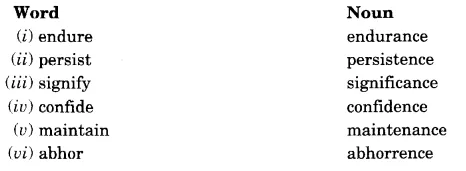
Write the noun forms of the following words adding -ance or -ence to each.
(i) endure___
(ii) persist ___
(iii) signify ___
(iv) confide___
(v) maintain___
(vi) abhor___

Answers
NCERT Solutions for Class 8 English Honeydew Chapter 5 The Summit Within 82.2

Question 3.
(i) Match words under A with their meanings under B.
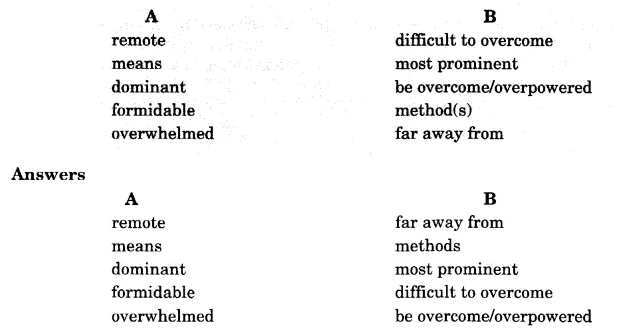
NCERT Solutions for Class 8 English Honeydew Chapter 5 The Summit Within 82.3.3
(ii) Fill in the blanks in the sentences below with appropriate words from under A.
(a) There were___obstacles on the way, but we reached our destination safely.
(b) We have no__of finding out what happened there.
(c) Why he lives in a house ___from any town or village is more than I can tell.
(d) ____by gratitude, we bowed to the speaker for his valuable advice.
(e) The old castle stands in a___position above the sleepy town.

Answers
The words to be filled in are given against sentence numbers,
(a) formidable
(b) means
(c) remote
(d) Overwhelmed
(e) dominant

SPEAKING AND WRITING (Page 83)
Write a composition describing a visit to the hills, or any place which you found beautiful and inspiring.
Before writing, work in small groups. Discuss the points given below and decide if you want to use some of these points in your composition.

  • Consider this sentence
    Mountains are a means of communion with God.
  • Think of the act of worship or prayer. You believe yourself to be in the presence of < the divine power. In a way, you are in communion with that power.
  • Imagine the climber on top of the summit—the height attained; limitless sky above; the climber’s last ounce of energy spent; feelings of gratitude, humility and peace.
  • The majesty of the mountains does bring you close to nature and the spirit and joy that lives there, if you have the ability to feel it.
    Some composition may be read aloud to the entire class afterwards.

Answer:
A Visit to the Hills
I have not been fortunate enough to climb high hills. However, last time when I was in Shimla, we went to Kufri. Even this was a great experience. We were completely tired when we reached the top. On the way I and my companions were filled with awe to see the majestic mountains. It brought us closer to nature. It seemed that nature has a spirit too. This spirit is filled with joy. Once on the top, we bowed our heads in thankfulness to God.

We hope the NCERT Solutions for Class 8 English Honeydew Chapter 5 The Summit Within help you. If you have any query regarding NCERT Solutions for Class 8 English Honeydew Chapter 5 The Summit Within, drop a comment below and we will get back to you at the earliest.


NCERT Solutions for Class 8 English Honeydew Poem Chapter 4 The Last Bargain

NCERT Solutions for Class 8 English Honeydew Poem Chapter 4 The Last Bargain are part of NCERT Solutions for Class 8 English. Here we have given NCERT Solutions for Class 8 English Honeydew Poem Chapter 4 The Last Bargain.

BoardCBSE
TextbookNCERT
ClassClass 8
SubjectEnglish Honeydew (Poem)
ChapterChapter 4
Chapter NameThe Last Bargain
CategoryNCERT Solutions

NCERT Solutions for Class 8 English Honeydew (Poem) Chapter 4 The Last Bargain

STANZAS FOR COMPREHENSION

I. “Come and hire me,” I cried, while in the morning
I was walking on the stone-paved road.
Sword in hand the King came in his chariot.
He held my hand and said, “I will hire you with
my power,”
But his power counted for naught, and he went away in
his chariot. (Page 74)

NCERT Solutions for Class 8 English Honeydew Poem Chapter 4 The Last Bargain Q1.1
हिंदी अनुवाद-सुबह तड़के वह व्यक्ति शहर की पत्थर से बनी सड़कों पर चलता जा रहा था। वह आवाज़ लगा रहा था कि वह भाड़े पर काम करने को तैयार है। अपने रथ में जाते हुए एक राजा ने उसे देखा। उसने उसे अपनी शक्ति देकर उससे काम लेने का प्रस्ताव किया। उस व्यक्ति को उसकी (राजा की) शक्ति महत्त्वहीन जान पड़ी। उसने इंकार कर दिया और राजा आगे बढ़ गया।

Paraphrase. Early in the morning, a man walked along the stony roads of the city offering himself for a hire. Going in his Chariot, a king saw him. He offered to buy him offering his power in return. His power did not seem of much worth to the man. He refused and the king moved on.

Multiple Choice Questions
1. The poet wanted
(a) money
(b) food
(c) work and freedom
(d) work and money.

2. The king in the poem was
(a) rich
(b) powerful
(c) kind
(d) just.

3. The king wanted to give the poet
(a) his power
(b) his sword
(c) his money
(d) his kingdom.

4. The poet did not accept the king’s offer because he wanted
(a) more money
(b) more power
(c) work
(d) freedom.

Answers 1.
1. (c) work and freedom
2. (b) powerful
3. (a) his power
4. (d) freedom

II. In the heat of the mid-day the houses stood with
shut doors.
I wandered along the crooked lane.
An old man came out with his bag of gold.
He pondered and said, “I will hire you with my money.”
He weighed his coins one by one, but I turned away.

NCERT Solutions for Class 8 English Honeydew Poem Chapter 4 The Last Bargain Q2.1
हिंदी अनुवाद-दोपहर की गर्मी में वह आदमी चलता गया। वह घुमावदार गलियों में चलता गया। सारे दरवाजे बंद थे। एक बूढ़ा व्यक्ति अपना सोने से भरा थैला लेकर निकला। उसने कुछ सोचा और फिर सोने के भाड़े पर उसे रखना चाहा। यह प्रस्ताव भी उस व्यक्ति को पंसद नहीं आया और वह दूसरे मार्ग पर चला गया।

Paraphrase. The man walked on in the heat of noon. He roamed about in crooked lanes. All the doors were shut. An old man came out with his bag of gold. He thought and then offered to hire the man with gold. This offer could also not attract the man and he went the other way.

Questions
1. Why were the houses shut ?
2. What did the poet want ?
3. Why did he turn down the offer of money ?
4. Which word in the poem means ‘thought deeply’.

Answers
1. The houses were shut as it was very hot outside.
2. The poet wanted to be hired.
3. The poet was not interested in money, so he turned down the offer.
4. pondered’.

III. It was evening. The garden hedge was all aflower.
The fair maid came out and said, “I will hire you with
a smile.”
Her smile paled and melted into tears, and she went
back alone into the dark. (Page 75)

NCERT Solutions for Class 8 English Honeydew Poem Chapter 4 The Last Bargain Q3.1
| हिंदी अनुवाद- अब शाम हो चली थी। बगीचे की बाड़ फूलों से लदी थी। सुंदर लड़की आयी और बोली कि मैं तुम्हारे काम के बदले अपनी मुस्कराहट दूंगी। पर शीघ्र ही उसकी मुस्कराहटें फीकी पड़ गयीं और आँसुओं में बदल गयीं। अत: उसे अंधेरे में अकेली वापस लौटना पड़ा।

Paraphrase. Now it was evening. The garden hedge was filled with flowers. A beautiful girl came to the man. She offered the man her smile in return for his work. Soon, however, her smile weakened and changed into tears. So she had to return alone into the darkness.

Multiple Choice Questions
1. The evening scene was
(a) unattractive
(b) hot
(c) cold
(d) beautiful.

2. The fair maid wanted the poet
(a) to go away
(b) to stay with her
(c) to hire her
(d) to praise her smiles.

3. The fair maid had come
(a) from the garden
(b) from the hedge
(c) out of the darkness
(d) from the road.

4. The word ‘aflower’ means
(a) covered with flowers
(b) without flowers
(c) with withered flowers
(d) with falling flowers.

Answers
1. (d) beautiful
2. (d) to praise her smiles
3. (c) out of the darkness
4. (a) covered with flowers.

IV. The sun glistened on the sand, and the sea waves broke
waywardly.
A child sat playing with shells.
He raised his head and seemed to know me and said,
“I hire you with nothing.”
From henceforward that bargain struck in child’s play
made me a free man. (Page 75)

NCERT Solutions for Class 8 English Honeydew Poem Chapter 4 The Last Bargain Q4.1
| हिंदी अनुवाद-शाम का सूर्य रेत के ऊपर खूब चमक रहा था। समुद्र की लहरें मनचाहे ढंग से तट से टकरा रही थीं। वहाँ एक बच्चा बैठा कौड़ियों से खेल रहा था। उसने सिर उठाकर उस आदमी की ओर देखा। लगता था कि वह उसे जानता है। उसने बिना कोई पारिश्रमिक के उससे काम करने को कहा। उस व्यक्ति ने वह प्रस्ताव स्वीकार कर लिया और उसके बाद से वह बच्चे के साथ ही खेलता रहा। ऐसा करके उसने अपनी आजादी बनाए रखी।

Paraphrase. The evening sun shone lustrously on the sand. The sea waves were breaking on the shore wilfully. There was a child playing with his shells. He lifted his head and looked at the man. He seemed to understand him. He offered to hire the man without payment. The man accepted the offer and from then onwards he played with the child. In doing so, he remained a free man.

Questions
1. Where was the child playing ?
2. Describe the scene.
3. Why did the poet let himself be hired for nothing ?
4. Find a word in the passage which means ‘deal’.

Answers
1. The child was playing on the sea-shore.
2. It was a beautiful scene. The sun glistened on the sand and the waves played on the beach.
3. When one is hired for nothing, one remains free. The poet loved his freedom and so he let himself be hired for nothing.
4. bargain.

TEXTUAL QUESTIONS

WORKING WITH THE POEM (Page 75)
Question. 1.
Who is the speaker in the poem ?

Answer:
A man in search of a job is the speaker in the poem.

Question. 2.
‘The king, sword in hand’ suggests
(i) wealth
(ii) power
(iii) more power than wealth.
Mark the appropriate item in the context of stanza 1.

Answer:
(iii) more power than wealth.

Question. 3.
The old man offered the speaker a lot of money. Why did he turn down the offer ?

Answer:
The man didn’t need money. So it was of no consequence to him. Therefore, he turned down the old man’s offer.

Question. 4.
Find in the poem, lines that match the following. Read both one after another.
(i) I have nothing to give you except goodwill and cheer.
(ii) Her happiness was no more than sorrow in disguise.
(iii) The king’s might was not worth much.

Answer:
(i) “I hire you with nothing.” (Stanza 4)
(ii) “Her smile paled and melted into tears.” (Stanza 3)
(iii) “But his power counted for naught.” (Stanza 1)

Question. 5.
How did the speaker feel after talking to the child on the beach ?

Answer:
The speaker felt that he would get the fair return for his labour. For here, he expected to get goodwill and cheer and also retain his freedom.

We hope the NCERT Solutions for Class 8 English Honeydew Poem Chapter 4 The Last Bargain help you. If you have any query regarding NCERT Solutions for Class 8 English Honeydew Poem Chapter 4 The Last Bargain, drop a comment below and we will get back to you at the earliest.

NCERT Solutions for Class 8 English Honeydew (Poem) Chapter 3 Macavity : The Mystery Cat

NCERT Solutions for Class 8 English Honeydew Poem Chapter 3 Macavity : The Mystery Cat are part of NCERT Solutions for Class 8 English. Here we have given NCERT Solutions for Class 8 English Honeydew Poem Chapter 3 Macavity : The Mystery Cat.

BoardCBSE
TextbookNCERT
ClassClass 8
SubjectEnglish Honeydew (Poem)
ChapterChapter 3
Chapter NameMacavity : The Mystery Cat
CategoryNCERT Solutions

NCERT Solutions for Class 8 English Honeydew (Poem) Macavity : The Mystery Cat

STANZAS FOR COMPREHENSION

I. Macavity’s a Mystery Cat : he’s called the Hidden
Paw–
For he’s the master criminal who can defy the Law.
He’s the bafflement of Scotland Yard, the Flying Squad’s
despair :
For when they reach the scene of crime—Macavity’s
not there! (Page 50)

NCERT Solutions for Class 8 English Honeydew (Poem) Chapter 3 Macavity The Mystery Cat 1
हिंदी अनुवाद-मैकाविटी एक रहस्यपूर्ण बिल्ला है। उसे ‘छिपा पंजा’ का दूसरा नाम भी (उसकी रहस्यमयता के कारण) मिला है। वह बड़ा कुशल अपराधी है जो बिना किसी डर के कानून तोड़ता है। उसके काम स्काटलैंड की पुलिस को घबरा देते हैं। उड़न दस्ते ने व्यर्थ ही उसे पकड़ने का प्रयत्न किया है। जब तक वे अपराध-स्थल पर पहुँचते हैं, मैकाविटी गायब हो जाता है।

Paraphrase. Macavity is a mysterious cat. His mystery has given him another name also—’Hidden Paw’. He is an expert criminal who can disobey the law with impunity. His actions puzzle the police of Scotland Yard. The Flying Squad has in vain tried to chase him. By the time they reach the scene of crime, Macavity disappears.

Multiple Choice Questions
1. Macavity is a mystery cat because
(a) he has hidden powers
(b) no-one understands his ways
(c) Scotland Yard is baffled by him
(d) he has a hidden paw.

2. Macavity is never punished because
(a) he disappears into thin air
(b) he has a hidden paw
(c) he is never found at the scene of crime
(d) Scotland Yard does not understand him.

3. Macavity breaks
(a) the pots
(b) the wall
(c) a fakir’s honour
(d) human laws.

4. The adjective from the word mystery is
(a) mysterious
(b) mystic
(c) mystify
(d) mysticism.

Answers
1. (b) no-one understands his ways
2. (c) he is never found at the scene of crime
3. (d) human laws
4. (a) mysterious

II. Macavity, Macavity, there’s no one like
Macavity,
He’s broken every human law, he breaks
the law of gravity.
His powers of levitation would make a fakir
stare,
And when you reach the scene of crime
-Macavity’s not there! (Page 50)

NCERT Solutions for Class 8 English Honeydew (Poem) Chapter 3 Macavity The Mystery Cat 2
हिंदी अनुवाद-मैकाविटी, मैकाविटी ; मैकाविटी जैसा कोई नहीं। उसने सभी मानवीय कानून तोड़ डाले हैं। वह गुरुत्वाकर्षण का नियम तोड़ता है। फकीरों के पास रहस्यपूर्ण शक्तियाँ होती हैं। बिना सहारे हवा में उसके उड़ने की शक्ति किसी फकीर को भी चकित कर देगी और जब तुम अपराध के घटनास्थल पर पहुँचते हो तो मैकाविटी वहाँ नहीं होता है।

Paraphrase. There is no one like Macavity. He has broken all man-made laws. He has broken even the law of gravity. Fakirs have mysterious powers. His floating in the air without support would astonish even a fakir. Above all when you reach the scene of crime, Macavity is nowhere to be seen.

Questions
1. Who is Macavity ?
2. What does Macavity do ?
3. Do people like Macavity ?
4. What does the word ‘levitation’ mean?

Answers
1. Macavity is a cat.
2. Macavity does not follow any human law. He is a criminal.
3. No, the people do not like Macavity.
4. The word ‘levitation’ means “floating in the air’.

III. You may seek him in the basement, you
may look up in the air
But I tell you once and once again,
Macavity’s not there!
Macavity’s a ginger cat, he’s very tall and
thin ;
You would know him if you saw him, for
his eyes are sunken in. (Page 50)

NCERT Solutions for Class 8 English Honeydew (Poem) Chapter 3 Macavity The Mystery Cat 3
हिंदी अनुवाद -आप मैकाविटी को शायद तहखाने या हवा में तलाश करने का प्रयत्न करें पर वह व्यर्थ होगा। इस प्रकार उसे तलाश करने वाला उसे कहीं नहीं खोज पाएगा-न धरती के नीचे, न ऊपर। मैकाविटी अदरक के रंग वाला बिल्ला है। वह लंबा और पतला है। अगर आप उसे मिलेंगे तो उसकी धंसी हुई आँखों से उसे आसानी से पहचान लोगे।

Paraphrase. You may try to find Macavity in the basement or in the air but in vain. Thus, one who looks for him finds him nowhere—under or over the earth. Macavity is a ginger coloured cat. He is tall and thin. If you meet him, you will easily recognise him because of his deep-set eyes.

Multiple Choice Questions
1. The great difficulty is that Macavity
(a) is easily found
(b) is very difficult to be found
(c) is a ginger cat
(d) is tall and thin.

2. Ginger in the passage is
(a) a thing that Macavity likes
(b) something which resembles Macavity
(c) the colour of Macavity
(d) the breed of Macavity.

3. The poet’s name is
(a) R.N. Tagore
(b) Zulfikar Ghose
(c) William Blake
(d) T.S. Eliot.

4. The word ‘sunken’ in the passage means
(a) deep-set
(b) drowned
(c) floating
(d) attractive.

Answers
1. (b) is very difficult to be found
2. (c) the colour of Macavity
3. (d) T.S. Eliot
4. (a) deep-set

IV. His brow is deeply lined with thought, his
head is highly domed ;
His coat is dusty from neglect, his whiskers are uncombed.
He sways his head from side to side, with movements
like a snake;
And when you think he’s half asleep, he’s always wide awake. (Pages 50–51)

NCERT Solutions for Class 8 English Honeydew (Poem) Chapter 3 Macavity The Mystery Cat 4
हिंदी अनुवाद -मैकाविटी का माथा झुर्रियों से भरा है। उससे ऐसा लगता है कि हर समय वह गहरे विचारों में डूबा हुआ है। उसका सिर उसके शरीर पर किसी इमारत के ऊपर लगे गुंबज की तरह ऊँचा है। उसके शरीर की देखभाल ठीक से नहीं की जाती है। अतः उसकी खाल धूल-भरी और मूंछे बिखरी हुई हैं। साँप की तरह वह अपना सिर इधर-उधर हिलाता रहता है। वह सदा सतर्क रहता है। जब वह आपको उनींदा हुआ दिखाई दे तब भी वह पूरी तरह सतर्क होता है।

Paraphrase. Macavity’s forehead is wrinkled. From that he appears lost in deep thinking all the time. His head sits high on his body like the dome on a building. His body is not well looked after. So the skin is dusty and the whiskers are uncombed. He moves his head from side to side like a snake. He is always alert. When you think he is dozing, he is wide awake.

Questions
1. What is the passage about ?
2. What is he doing with his deeply lined brow ?
3. What does the word ‘coat refers to in the passage ?
4. Find word in the passage which is the opposite of ‘heed’.

Answers
1. The passage is about a cat named ‘Macavity.
2. He is thinking of his new criminal act.
3. The word ‘coat refers to the skin.
4. ignore.

V. Macavity, Macavity, there’s no one like Macavity,
For he’s a fiend in feline shape, a monster of depravity.
You may meet him in a by-street, you may see him in
the square
But when a crime’s discovered, then Macavity’s not there ! (Page 51)

NCERT Solutions for Class 8 English Honeydew (Poem) Chapter 3 Macavity The Mystery Cat 5
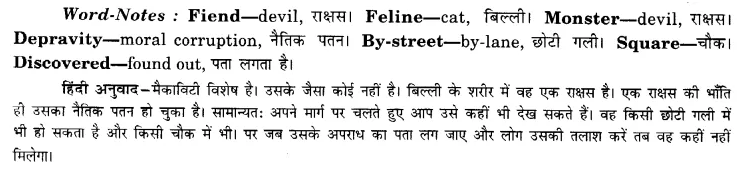
Paraphrase. Macavity is special. There is no parallel to him. He is a devil in the body of a cat. He is morally corrupt like a monster ! Ordinarily, you may find him anywhere on your way. He may be there in a by-lane or in a square. However, when, his crime is discovered and people look for him, he is nowhere to be found.

Multiple Choice Questions
1. The fiend in feline shape is
(a) Macavity
(b) a dog
(c) a human being
(d) the poet.

2. It is difficult to find Macavity when
(a) he lives in the square
(b) he lives in a by-street
(c) he is a fiend
(d) he commits a crime.

3. Macavity is compared to
(a) man
(b) a dog
(c) a cat
(d) a devil.

4. The word depravity means
(a) deep thought
(b) moral corruption
(c) bad actions
(d) mystery.

Answers
1. (a) Macavity
2. (d) he commits a crime
3. (d) a devil
4. (b) moral corruption

TEXTUAL QUESTIONS

WORKING WITH THE POEM (Page 51)

Question. 1.
Read the first stanza and think.
(i) Is Macavity a cat really ?
(ii) If not, who can Macavity be ?

Answer:
(i) Macavity is a cat.
(ii) If not, Macavity can be a thief.

Question. 2.
Complete the following sentences.
(i) A master criminal is one who ___
(ii) The Scotland Yard is baffled because ___
(iii) ____ because Macavity moves much faster than them.

Answer:
(i) A master criminal is one who is never caught.
(ii) The Scotland Yard is baffled because with all its might, it is unable to lay its hand upon Macavity.
(iii) Flying Squad is not able to get Macavity because Macavity moves much faster than the Flying Squad.

Question . 3.
“A cat, I am sure, could walk on a cloud without coming through”. (Jules Verne)
Which law is Macavity breaking in the light of the comment above ?

Answer:
The law of gravitation.

Question. 4.
Read stanza 3, and then, describe Macavity in two or three sentences of your own.

Answer:
Macavity is a ginger coloured, very tall and thin cat with sunken eyes and high head. He has a wrinkled forehead, dusty coat and uncombed whiskers. He is always alert and moves his head from side to side like a snake.

Question . 5.
Say ‘False’ or ‘True’ for each of the following statements.
(i) Macavity is not an ordinary cat.
(ii) Macavity cannot do what a fakir can easily do.
(in) Macavity has supernatural powers.
(iv) Macavity is well-dressed, smart and bright.
(v) Macavity is a spy, a trickster and a criminal, all rolled in one.

Answer:
(i) True
(ii) False
(iii) False
(iv) False
(v) True.

Question. 6.
Having read the poem, try to guess whether the poet is fond of cats. If so, why does he call Macavity a fiend and monster ?

Answer:
The poet is fond of the cats. That is why, he describes a big cat in such detail. However, for the rats the cat is certainly a fiend and a monster. So the poet gives him those adjectives as well.

Question. 7.
Has the poet used exaggeration for special effect ? Find a few examples of it and read those lines aloud.

Answer:
Yes. The following lines show that:
“He’s the bafflement of Scotland Yard, the
Flying Squad’s despair.”
“His powers of levitation would make a
fakir stare.”
“For he’s a fiend in feline shape, a monster
of depravity.”

We hope the NCERT Solutions for Class 8 English Honeydew Poem Chapter 3 Macavity : The Mystery Cat help you. If you have any query regarding NCERT Solutions for Class 8 English Honeydew Poem Chapter 3 Macavity : The Mystery Cat, drop a comment below and we will get back to you at the earliest.

NCERT Solutions for Class 8 English Honeydew Chapter 3 Glimpses of the Past

NCERT Solutions for Class 8 English Honeydew Chapter 3 Glimpses of the Past are part of NCERT Solutions for Class 8 English. Here we have given NCERT Solutions for Class 8 English Honeydew Chapter 3 Glimpses of the Past.

BoardCBSE
TextbookNCERT
ClassClass 8
SubjectEnglish
ChapterChapter 3
Chapter NameGlimpses of the Past
CategoryNCERT Solutions

NCERT Solutions for Class 8 English Honeydew Chapter 3 Glimpses of the Past

TEXTUAL EXERCISES

COMPREHENSION CHECK (Page 45)
1. Look at picture 1 and recall the opening lines of the original song in Hindi. Who is the singer ? Who else do you see in this picture ?
2. In picture 2 what do you understand by the Company’s “superior weapons” ?
3. Who is an artisan ? Why do you think the artisans suffered ? (picture 3)
4. Which picture, according to you, reveals the first sparks of the fire of revolt ?

Answers
1. The Hindi song’s opening lines are :
NCERT Solutions for Class 8 English Honeydew Chapter 3 Glimpses of the Past 45.1
The singer is Lata Mangeshker. Others in the picture are Pt. Jawaharlal Nehru, Lai Bahadur Shastri and Smt. Indira Gandhi.
In the picture below there are national leaders who worked tirelessly for the Indepen-dence. They are : Rani Laxmi Bai, Sardar Bhagat Singh, Bahadur Shah Jafar, Pandit Jawaharlal Nehru, Mahatma Gandhi, Netaji Subhash Chandra Bose.
2. “Company’s superior weapons” refers to their more efficient guns.
3. An artisan is a person who is skilled in an applied art; a craftsperson. The expert artisans of India worked so well that there was no parallel to their creation. So British goods could not be sold in the country as long as they produced goods. To make them incapable of doing their work, the British cut their thumbs.
4. The first part of picture no. 7 reveals the first sparks of revolt. In it the santhals are seen revolting in 1855. They massacred Europeans and their supporters alike.

WORKING WITH THE TEXT (Page 45)
Answer the following questions.

Question. 1.
Do you think the Indian princes were short-sighted in their approach to the events of 1757 ?

Answer:
Indian princes were indeed short-sighted in their approach to the events of 1757. They fought against each other and sought the help of the British. They could not see that this will eventually make the British most powerful. This happened and they had to suffer for their short-sightedness.

Question. 2.
How did the East India Company subdue the Indian princes ?

Answer:
Indian princes fought one another. Very often they sought the help of East India Company to do so. As a result they became weak. The company subdued them all one by one.

Question. 3.
Quote the words used by Ram Mohan Roy to say that every religion teaches the same principles.

Answer:
The words of Raja Ram Mohan Roy were : “Cows are of different colours. But the colour of their milk is the same. Different teachers have different opinions but the essence of every religion is the same.”

Question. 4.
In what ways did the British officers exploit Indians ?

Answer:
The British passed a resolution. Under it an Indian could be jailed without trial in a court. British goods were imported into India tax-free. The English prospered on the company’s loot while Indian industries began to die. Even the Governor-General Bentinck reported, “The bones of cotton weavers are bleaching the plains of India.”

Question. 5.
Name these people.
(i) The ruler who fought pitched battles against the British and died fighting.
(ii) The person who wanted to reform the society.
(iii) The person who recommended the introduction of English education in India.
(iv) Two popular leaders who led the revolt (Choices may vary).

Answer:
(i) Tipu Sultan
(ii) Raja Ram Mohan Roy
(iii) Lord Macaulay
(iv) Nana Saheb Peshwa and Kunwar Singh

Question. 6.
Mention the following.
(i) Two examples of social practices prevailing then.
(ii) Two oppressive policies of the British.
(iii) Two ways in which common people suffered.
(iv) Four reasons for the discontent that led to the 1857 War of Independence.

Answer:
(i) Untouchability and child marriage.
(ii) (a) The British passed a resolution under which an Indian could be jailed with-out trial in a court.
(b) The British supported the British industry. To do so they made imports to India tax-free. Consequently Indian industry began to die.
(iii) (a) The British did not care about the needs of Indians.
(b) The farmers were heavily taxed and the thumbs of the artisans were cut.
(iv) (a) Santhals had lost their lands. They became desperate. They revolted and killed the British and their supporters alike.
(b) The white soldiers got huge pay. The Indian soldier was lowly paid. This created discontentment among the soldiers.
(c) Hazrat Mahal of Lucknow was bitter. She had lost her kingdom.
(d) Many landlords were sore. They had lost their lands because of the Britishers’ policies.

WORKING WITH LANGUAGE (Page 45)
In comics what the characters speak is put in bubbles. This is direct narration. When we report what the characters speak, we use the method of indirect narration.
Study these examples.
First farmer : Why are your men taking away the entire crop ?
Second farmer : Your men have taken away everything.
Officer : You are still in arrears. If you don’t pay tax next week. I’ll send you to jail.

  • The first farmer asked the officer why his men were taking away the entire crop.
  • The second farmer said that their men had taken away everything.
  • The officer replied that they were still in arrears and warned them that if they did not pay tax the following week, he (the officer) would send them (the farmers) to jail.

Question 1.
Change the following sentences into indirect speech.
(i) First man : We must educate our brothers.
Second man : And try to improve their material conditions.
Third man : For that we must convey our grievances to the British Parliament.
The first man said that ___
The second man added that ___
The third man suggested that ___

Answer:
The first man said that they must (had to) educate their brothers.
The second man added that they had to try to improve their material conditions also.
The third man suggested that for the education and material conditions of the people they must (had to) convey their grievances to the British Parliament.
(ii) First soldier : The white soldier gets huge pay, mansions and servants.
Second soldier : We get a pittance and slow promotions.
Third soldier : Who are the British to abolish our customs ?
The first soldier said that ___
The second soldier remarked that ___
The third soldier asked ___

Answer:
The first soldier said that the white soldier got huge pay, mansions and servants.
The second soldier remarked that they got a pittance and slow promotions.
The third soldier asked who the Britishers were to abolish their customs.

SPEAKING AND WRITING (Page 46)

Question 1.
Playact the role of farmers who have grievances against the policies of the government. Rewrite their ‘speech bubbles’ in dialogue form first.

Answer:
Speech bubbles
First farmer : “The English are taking all my crops.”
Second farmer : “Even after taking all my crops they say I have arrears to pay. They threaten to send me to jail.”
First farmer : “Our cotton crop was sold at high price. Now the English force us to give it cheap to them.”
Second farmer : “Then the famines have broken our backs.”
First farmer : “Yes, there are no signs of rain this year too.”
Second farmer : “We grow food but we are dying of hunger.”

Question 2.
Look at the pictures.
NCERT Solutions for Class 8 English Honeydew Chapter 3 Glimpses of the Past 46.2
(i) Ask one another questions about the pictures.

  • Where is the fox ?
  • What is the fox thinking ?
  • What does she want to know ?
  • What happens next ?
  • Where is the fox now ?
  • How did it happen ?
  • Who is the visitor ?
  • What’s the fox’s reply ?
  • Where is the goat ?
  • What is the goat thinking ?

(ii) Write the story in your own words. Give it a title.
____________________________________
____________________________________

Answers
(i)

  • The fox is in the well.
  • It was an accident.
  • The fox is thinking of getting out.
  • A goat is the visitor.
  • She wants to know if the water is sweet.
  • The fox replies that it is very sweet indeed.
  • The goat jumps into the well.
  • Now the goat is in the well.
  • The fox is out of the well now.
  • The goat is thinking of her mother’s advice.

She had advised her to be careful while taking the advice of strangers.

(ii) The Fox and the Goat
There was a fox in a forest. Accidentally the fox fell into a well. It did not know how to get out. After some time, there came a goat. The goat peeped into the well. She saw the water and the fox. She asked the fox if the water was sweet. The fox replied that it was very sweet. He added that he had drunk too much. The goat expressed a desire to taste it. The fox asked it to jump into the well. The goat did so. All at once the fox jumped on the goat’s back. From there it jumped out of the well. Then the fox said to the goat ‘Come out when you can ?’ The goat now understood that she had been fooled. She remembered her mother’s advice. The mother had told her to be careful while taking the advice of the strangers.

Question 3. Read the following news item.
History becomes fun at this school
Mumbai : Students in the sixth grade of a certain school in Navi Mumbai love their history lessons thanks to a novel teaching aid. It is not surprising given the fact that their study material includes comic books and they use their textbooks for reference to put things into perspective. Besides, students are encouraged to tap other sources of information as well. During History classes, students pore over comic strips of historical periods, enact characters of emperors and tyrants, and have animated discussions on the subject. History has become fun.

In the class students are asked to read the comic strip aloud, after which they break up into groups of four, discuss what they have heard and write a summary. Each group leader reads his group’s summary aloud and the whole class jumps into discussion and debate, adding points, disagreeing and qualifying points of view. A sixth grade student says, ‘It’s a lot of fun because everyone gets a chance to express themselves and the summary takes everyone’s ideas into account.’

According to the school principal the comic strip format and visuals appeal to students. A historian feels that using comics in schools is a great idea. Comics and acting help students understand what characters in the story are actually thinking.
(adapted from The Times of India, New Delhi, October 2007)

Based on this news item, write a paragraph on what you think about this new method of teaching History.

Answer:
There is no doubt that this new method of teaching history is novel and interesting. Moreover, the pictures stay in the mind longer than the words. So it will be very useful if the history is taught through comic strips. There is, however, one snag. At present the syllabus is so huge that it may not be possible to do so. Moreover, many students may spend long time in looking at the pictures. They will have fixed ideas about a historic personality. The pictures may give them the ideas which may not be completely true.

Question 4. Find the chapters in your History book that correspond to the episodes and events described in this comic. Note how the information contained in a few chapters of history has been condensed to a few pages with the help of pictures and the ‘speech bubbles’.

Answer:
Attempt yourself.

Question 5. Create a comic of your own using this story.
Once the Sun and the Wind began to quarrel, each one saying that he was stronger than the other. At last they decided to test each other’s strength. A man with a cloak around his shoulders was passing by. The Wind boasted, ‘Using my strength I can make that man take off the cloak.’ The Sun agreed. The Wind blew hard. The man felt so cold that he clasped his cloak round his body as tightly as possible.

Now it was the turn of the Sun which shone very hot indeed. The man felt so hot that he at once removed the cloak from his body. Seeing the man taking off the cloak, the Wind conceded defeat.

Answer:
Attempt yourself with the help of your art teacher.

We hope the NCERT Solutions for Class 8 English Honeydew Chapter 3 Glimpses of the Past help you. If you have any query regarding NCERT Solutions for Class 8 English Honeydew Chapter 3 Glimpses of the Past, drop a comment below and we will get back to you at the earliest.

NCERT Solutions for Class 8 English Honeydew Poem Chapter 6 The Duck and the Kangaroo

NCERT Solutions for Class 8 English Honeydew (Poem) Chapter 6 The Duck and the Kangaroo are part of NCERT Solutions for Class 8 English. Here we have given NCERT Solutions for Class 8 English Honeydew Poem Chapter 6 The Duck and the Kangaroo.

BoardCBSE
TextbookNCERT
ClassClass 8
SubjectEnglish Honeydew (Poem)
ChapterChapter 6
Chapter NameThe Duck and the Kangaroo
CategoryNCERT Solutions

NCERT Solutions for Class 8 English Honeydew (Poem) Chapter 6 The Duck and the Kangaroo

STANZAS FOR COMPREHENSION

I. Said the Duck to the Kangaroo,
‘Good gracious ! how you hop !
Over the fields and the water too,
As if you never would stop ! (Page 97)

NCERT Solutions for Class 8 English Honeydew Poem Chapter 6 The Duck and the Kangaroo Q1.1

हिंदी अनुवाद- बत्तख कंगारू से बोली कि कंगारू की कूद लगाने की क्षमता पर वह चकित है। यह पानी को भी ऐसे ही लांघ जाता है जैसे कि मैदानों को। कंगारू को फुदकते देखकर ऐसा लगता है मानो यह कभी रूकेगा ही नहीं।

Paraphrase. The Duck said to the Kangaroo that he was surprised at his capacity to hop. Kangaroo jumps as easily over the water as it does over the fields. Seeing, a Kangaroo hop, one feels that he would never stop.

Multiple Choice Questions
1. Who was it that couldn’t hop ?
(a) the Duck
(b) the Kangaroo
(c) the frog
(d) some other animal.

2. The phrase ‘Good gracious’ here, shows
(a) shock
(b) fear
(c) anger
(d) surprise.

3. The one which moves easily over the fields and water too’ is
(a) the Duck
(b) the Kangaroo
(c) the deer
(d) the lion.

4. The word ‘gracious’ means
(a) decent
(b) good-looking
(c) kind
(d) happy.

Answers
1. (a) the Duck
2. (d) surprise
3. (b) the Kangaroo
4. (c) kind

II. My life is a bore in this nasty pond,
And I long to go out in the world beyond !
I wish I could hop like you !
Said the Duck to the Kangaroo. (Page 97)

NCERT Solutions for Class 8 English Honeydew Poem Chapter 6 The Duck and the Kangaroo Q2.1

हिंदी अनुवाद- बत्तख ने कंगारू को कहा कि उसका (बत्तख का) जीवन उबाऊ है। उसे सारा समय तालाब के गंदे पानी में बिताना पड़ता है। बत्तख की इच्छा थी कि वह तालाब के बाहर के संसार की यात्रा करे। उसे बड़ी इच्छा थी कि वह कंगारू की तरह उछला करे।

Paraphrase. The Duck said to the Kangaroo that he led a dull life. He lived all the time in the dirty water of the pond. The Duck desired to travel to the world beyond that pond. He very much wished to hop like a Kangaroo.

Questions
1. Where does the Duck live ?
2. What does the Duck feel about his life?
3. What does the Duck want to do?

Answers
1. The Duck lives in a pond.
2. He (The Duck) feels that he is leading a very dull life in a nasty pond.
3. The Duck wants to hop like the Kangaroo.

III. Please give me a ride on your back !
Said the Duck to the Kangaroo.
‘I would sit quite still, and say nothing but “Quack,”
The whole of the long day through ! (Pages 97-98)

NCERT Solutions for Class 8 English Honeydew Poem Chapter 6 The Duck and the Kangaroo Q3.1

| हिंदी अनुवाद-बत्तख ने कंगारू से विनती की कि वह उसे अपनी पीठ पर सवार करके घुमाये ! उसने बिल्कुल निश्चल रहने का वचन दिया। वह टर्राने के अतिरिक्त कोई शब्द नहीं बोलेगा। इसी प्रकार वह पूरा, सारा दिन बिता देगा !

Paraphrase. The Duck requested the Kangaroo to give him a ride on his back. He promised to sit very quiet. He would say nothing but only quack. Thus, he would remain quite still all through the long day.

Multiple Choice Questions
1. The Duck desired to
(a) say ‘Quack’
(b) stay still
(c) ride on Kangaroo’s back
(d) say nothing.

2. Quack’ is a sound made by
(a) the Duck
(b) the Kangaroo
(c) a rider
(d) every animal.

3. It promised to sit still and be quiet because
(a) it pleased him
(b) it was his habit
(c) it was trying to persuade Kangaroo
(d) it had to go a long way.

4. The word ‘quite’ means the same as
(a) quiet
(b) silent
(c) noisy
(d) utterly.

Answers
1. (c) ride on Kangaroo’s back
2. (a) the duck
3. (c) it was trying to persuade Kangaroo
4. (d) utterly

IV. And we’d go to the Dee, and the Jelly Bo Lee,
Over the land, and over the sea ; —
Please take me on a ride ! O do !’
Said the Duck to the Kangaroo. (Page 98)

NCERT Solutions for Class 8 English Honeydew Poem Chapter 6 The Duck and the Kangaroo Q4.1

| हिंदी अनुवाद-बत्तख का इरादा डी और पहाड़ी-स्थल जेली बो ली पर जाने का था। वह पृथ्वी और समुद्र के ऊपर सैर करना चाहता था। वह कंगारू से बड़ी गर्मजोशी से कहता है कि वह उसकी विनती मानकर उसे सवारी दे।

Paraphrase. The Duck proposed to go to the Dee and to the mountain side called “Jelly Bo Lee’. He wanted to travel over the land and sea. He makes a fervent appeal to the Kangaroo to accede to his request and take him on a ride.

Questions
1. Who are ‘we’ in the first passage ?
2. What did the Duck want ?
3. Where did they want to go ?
4. What does the phrase ‘O do !’ indicate ?

Answers:
1. The word ‘we’ refers to the Duck and the Kangaroo.
2. The Duck wanted to ride on Kangaroo’s back and go about the world.
3. They wanted to travel everywhere-over the land and over the sea.
4. The phrase ‘O do !’ indicates the intense desire of the Duck to get the ride.

V. Said the Kangaroo to the Duck,
“This requires a little reflection ;
Perhaps on the whole it might bring me luck,
And there seems but one objection. (Page 98)

NCERT Solutions for Class 8 English Honeydew Poem Chapter 6 The Duck and the Kangaroo Q5.1

| हिंदी अनुवाद – कंगारू ने उत्तर दिया कि बत्तख के प्रस्ताव पर कुछ विचार करने की आवश्यकता थी। कुल मिलाकर शायद इस योजना से कंगारू का भी भाग्योदय हो जाए। पर फिर भी एक कठिनाई थी।

Paraphrase. The Kangaroo said that the Duck’s proposal needed some thought. Considering all aspects of it, the proposal might even be lucky for the Kangaroo. However, there was just one difficulty.

Multiple Choice Questions
1. “This’ in the passage refers to
(a) the Kangaroo
(b) the Duck
(c) the coming to Kangaroo
(d) the proposal of Duck.

2. What was expected to bring luck ?
(a) the Duck
(b) the Kangaroo
(c) the objection he is thinking of
(d) the travel with the Duck.

3. ‘Me’ refers to
(a) the Kangaroo
(b) the Duck
(c) the poet
(d) the objection.

4. ‘Reflection’ means the same as
(a) work
(b) thought
(c) action
(d) attention.

Answers
1. (d) the proposal of Duck
2. (d) the travel with the Duck
3. (a) the Kangaroo
4. (b) thought

VI. Which is, if you’ll let me speak so bold,
Your feet are unpleasantly wet and cold,
And would probably give me the roo
Matiz !’ said the Kangaroo. (Page 98)

NCERT Solutions for Class 8 English Honeydew Poem Chapter 6 The Duck and the Kangaroo Q6.1

हिंदी अनुवाद-कंगारू ने कहा कि अगर बत्तख उसे साफ-साफ बोलने की अनुमति दे तो बस एक ऐतराज (कठिनाई) है। वह यह कि बत्तख के पैर कंगारू के लिए कष्ट का कारण बनेंगे। वे बहुत गीले और ठंडे हैं। कंगारू के शरीर को जब वे छुएँगे तब उसे गठिया हो सकता है।

Paraphrase. The Kangaroo said that if the duck allowed him to speak frankly there was just one objection. It was that the Duck’s feet would cause the Kangaroo some discomfort. They were very wet and cold. Their touch on the Kangaroo’s body could cause him rheumatism.

Questions
1. What does the word ‘which’ refer to ?
2. What is Kangaroo’s fear?
3. What is roo-Matiz ?
4. Whose feet are these?

Answers
1. The word ‘which’ refers to the ‘objection’ raised by Kangaroo.
2. Kangaroo fears that he might suffer from rheumatism.
3. The word ‘roo-Matiz’ is actually ‘rheumatism’. It is a disease that makes the muscles and joints painful, stiff and swollen.
4. These are the feet of the Duck.

VII. Said the Duck, ‘As I sat on the rocks,
I have thought over that completely,
And I bought four pairs of worsted socks
Which fit my web-feet neatly. (Page 98)

NCERT Solutions for Class 8 English Honeydew Poem Chapter 6 The Duck and the Kangaroo Q7.1

हिंदी अनुवाद-बत्तख बोला कि वह इस समस्या के प्रति पहले से सजग था। चट्टान पर बैठे हुए उसने इस पर विचार किया। इस समस्या के निराकरण के लिए उसने चार जोड़े ऊनी जुराबें खरीद लिए हैं। ये जुराबें उसे बिलकुल फिट आते हैं।

Paraphrase. The Duck said that he was already aware of that problem. Sitting on the rock he had pondered over it. To overcome the problem, he had bought four pairs of worsted socks. These socks fitted him well.

Multiple Choice Questions
1. The Duck sat on the rock thinking
(a) about the ride
(b) about Kangaroo
(c) of the objection raised by Kangaroo
(d) how to get out of the pond.

2. The Duck bought the socks
(a) to comfort himself
(b) to make the feet look better
(c) to cause no trouble to Kangaroo
(d) to be fashionable.

3. Web-feet’ refers to the feet of
(a) the Duck
(b) the Kangaroo
(c) the poet
(d) the rocks.

4. The word ‘neatly’ means the same as
(a) well
(b) trimly
(c) badly
(d) beautifully.

Answers
1. (c) of the objection raised by Kangaroo
2. (c) to cause no trouble to Kangaroo
3. (a) the Duck
4. (b) trimly

VIII. And to keep out the cold I’ve bought a cloak,
And every day a cigar I’ll smoke,
All to follow my own dear true
Love of a ‘Kangaroo ! (Page 98)

NCERT Solutions for Class 8 English Honeydew Poem Chapter 6 The Duck and the Kangaroo Q8.1

हिंदी अनुवाद-बत्तख बोला कि उसने सर्दी से बचने के अन्य उपाय भी किए हैं। उसने एक लबादा खरीदा था। इसी कारण से उसने प्रतिदिन एक सिगार पीने का निश्चय भी किया था। यह सब उसने अपने सच्चे प्रिय कंगारू के साथ रहने के लिए ही किया था।

Paraphrase. The Duck said that he had taken other measures too, to keep out the cold. He had bought a cloak. He had also decided to smoke a cigar everyday for the same reason. He had done so much only for the sake of following his true beloved, the Kangaroo.

Questions
1. Who bought a cloak and why ?
2. Why did he smoke a cigar ?
3. What does the speaker really want to do?
4. Name the poet.

Answers
1. The Duck bought a cloak to keep away the cold.
2. He smoked a cigar also to keep the cold away.
3. The speaker really wants to travel around the world riding on the back of the Kangaroo.
4. The poet’s name is ‘Edward Lear’.

IX. Said the Kangaroo, ‘I’m ready!
All in the moonlight pale,
But to balance me well, dear Duck, sit steady!
And quite at the end of my tail ! (Page 98)

NCERT Solutions for Class 8 English Honeydew Poem Chapter 6 The Duck and the Kangaroo Q9.1

हिंदी अनुवाद – कंगारू ने बत्तख से कहा कि वह उसे सवार करने के लिए तैयार है। पीली चाँदनी में कंगारू ने अपने प्रिय मित्र बत्तख से कहा कि वह बिल्कुल स्थिर होकर बैठे। कंगारू अपना संतुलन रख सके, इसलिए ऐसा करना आवश्यक था। उसने उससे कहा कि वह (बत्तख) बिल्कुल पूँछ के किनारे पर ही बैठे।

Paraphrase. Kangaroo said to the Duck that he was ready to give him a ride. In the pale moonlight the Kangaroo asked his dear friend Duck to sit motionless. It was necessary for the Kangaroo to balance himself. He asked him to sit at the very end of his tail.

Multiple Choice Questions
1. Kangaroo was ready
(a) to marry the Duck
(b) to take the Duck for a ride
(c) to give the Duck a cloak
(d) to give the Duck a cigar.

2. It was a pale moonlight when
(a) the Kangaroo agreed
(b) the Kangaroo refused
(c) the Kangaroo prepared himself and the duck for a ride
(d) the Kangaroo and the Duck quarrelled with each other.

3. The Duck was asked to sit
(a) comfortably
(b) quietly
(c) noisily
(d) still

4. ‘Quite’ in the passage means
(a) exactly
(b) freely
(c) quietly
(d) comfortably

Answers
1. (b) to take the Duck for a ride
2. (c) the Kangaroo prepared himself and the duck for a ride
3. (d) still
4. (a) exactly

X. So away they went with a hop and a bound,
And they hopped the whole world three times round;
And who so happy, — O who,
As the Duck and the Kangaroo ? (Page 98)

NCERT Solutions for Class 8 English Honeydew Poem Chapter 6 The Duck and the Kangaroo Q10.1

हिंदी अनुवाद-इस प्रकार बत्तख और कंगारू उछलते-कूदते अपनी यात्रा पर निकल पड़े। उन्होंने तीन बार संसार का चक्कर लगाया। बत्तख और कंगारू से अधिक प्रसन्न कोई न था।

Paraphrase. Thus the Duck and the Kangaroo started their journey jumping and leaping. They travelled round the world thrice. There was no one happier than the Duck and the Kangaroo

Questions
1. Who went away?
2. What did they do?
3. Why did they have to hop ?
4. Find the phrase in the passage which means “jumping and leaping’.

Answers
1. The Duck and the Kangaroo went away.
2. They travelled three times around the world.
3. Kangaroos hop as they move and the Duck was on the Kangaroo’s back.
4. ‘a hop and a bound’.

TEXTUAL QUESTIONS

WORKING WITH THE POEM (Page 99)

Question. 1.
Taking words that come at the end of lines, write five pairs of rhyming words. Read each pair aloud
For example, pond—beyond

Answer:
(i) You—Kangaroo
(ii) back—Quack
(iii) Lee—sea
(iv) Duck—luck
(v) Reflection—objection

Question. 2.
Complete the dialogue.
Duck : Dear Kangaroo ! Why don’t you
___________
Kangaroo : With pleasure, my dear Duck,
though _________
Duck : That won’t be a problem. I will
___________

Answer:
Duck : Dear Kangaroo ! Why don’t you give me a ride on your back ?
Kangaroo : With pleasure, my dear Duck, though your cold and wet feet cause a problem.
Duck : That won’t be a problem, I will cover them with four pairs of worsted socks which fit my feet neatly.

Question. 3.
The Kangaroo does not want to catch ‘rheumatism’. Spot this word in stanza 3 and say why it is spelt differently. Why is it in two parts ? Why does the second part begin with a capital letter ?

Answer:
The words are : “… are unpleasantly wet and cold. And would probably give me the roo-Matiz. It is spelt differently because ‘roo’ reminds the readers of Kangaroos. So ‘roo-Matiz’ seems to be a disease concerned with the Kangaroos. It is interesting because the Kangaroos hop as if they could never suffer from rheumatism. For, if they did, they would not hop ?

Question. 4.
Do you find the poem humorous ? Read aloud lines that make you laugh.

Answer:
The poem is humorous. Look at the following lines :
“And everyday a cigar I’ll smoke,”
“But to balance me well, dear Duck, sit steady !
And quite at the end of my tail.”

We hope the NCERT Solutions for Class 8 English Honeydew Poem Chapter 6 The Duck and the Kangaroo help you. If you have any query regarding NCERT Solutions for Class 8 English Honeydew Poem Chapter 6 The Duck and the Kangaroo, drop a comment below and we will get back to you at the earliest.