Active And Passive Voice Exercises for Class 6 With Answers CBSE

Active And Passive Voice Exercises for Class 6For sentences in the active voice, the subject performs the action; for those in the passive voice, the subject receives the action. Most grammarians recommend using the active voice whenever possible. Here are some examples to help you distinguish between the voices:

This grammar section explains English Grammar in a clear and simple way. There are example sentences to show how the language is used. You can also visit the most accurate and elaborate NCERT Solutions for Class 6 English. Every question of the textbook has been answered here.

Active And Passive Voice Exercises for Class 6 With Answers CBSE Pdf

Active voice

  • The man caught several fish.
  • The planning committee discovered that the room wasn’t available.

Passive voice

  • Several fish were caught by the man.
  • It was discovered by the planning committee that the room wasn’t available.

Active and Passive voice
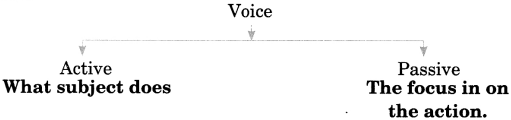
Active: Ram killed Ravan.
Passive: Ravan was killed by Ram.

TenseActivePassive
Present SimpleI make a cakeA cake is made
Present ContinuousI’m making a cakeA cake is being made.
Past SimpleI made a cake.A cake was being made.
Past ContinuousI was making a cake.A case has been made.
Present PerfectI had made a cakeA cake had been made.
Future SimpleI will make a cake.A cake will be made.
Future be going toI’m going to make a cake.A cake is going to be made.
ModalI must make a cake.A cake must be made.
Modal PerfectI should have made a cake.A cake should have been made.

Active And Passive Voice Exercises Solved Examples for Class 6 CBSE

Question 1.
Change the following sentences so that the verbs will be in the passive voice.
(i) The boy killed the spider.
(ii) The police caught the thief.
(iii) The boy made a kite:
(iv) The sudden noise frightened the dog.
(v) Edison invented thew light bulb.
(vi) He made a very remarkable discovery.
(vii) His own brother betrayed him.
(viii) I have sold my old car.
(ix) They opened the store only last month.
(x) We do not permit smoking in the kitchen.
Answer:
(i) The spider was killed by the boy.
(ii) The thief was caught by the police.
(iii) A kite was made by the boy.
(iv) The dog was frightened by the sudden noise.
(v) The light bulb was invented by Edison.
(vi) A very remarkable discovery was made by him.
(vii) He was betrayed by his own brother.
(viii) My old car has been sold.
(ix) The store was opened only last month.
(x) Smoking in the kitchen isn’t permitted.

Question 2.
Rewrite the following sentences into Passive voice.
(i) I did not beat her.
(ii) I will never forget this experience.
(iii) Mother made a cake.
(iv) The boy teased the girl.
(v) Did she do her duty?
(vi) The tiger was chasing the deer.
(vii) She has written a novel.
(viii) She has learned her lessons.
(ix) Have you finished the report?
(x) The police have caught the thief.
Answer:
(i) She was not beaten by me.
(ii) This experience will never be forgotten by me.
(iii) A cake was made by mother.
(iv) The girl was teased by the boy.
(v) Was her duty done by her?
(vi) The deer was being chased by the tiger.
(vii) A novel has been written by her.
(viii) Her lessons have been learned by her.
(ix) Has the report been finished by you?
(x) The thief has been caught by the police.

Active And Passive Voice Exercises Practice Examples for Class 6 CBSE

Question 1.
Transform the following sentences by changing voice:
(i) The minister distributed blankets among poor on his birthday.
(ii) The captain scolded the umpire for not agreeing to his appeal.
(iii) The fine has been paid by me.
(iv) The boy hit the stranger with his bat.
(v) The woman booked him for cheating.
(vi) They pulled him from court room.
(vii) The principal instructed the teachers.
(viii) The director was slapped by the actress.
(ix) Close the door.
(x) The road was blocked by Jat protestors.

Question 2.
Are the sentences written in Active or Passive?
(i) Steven likes to play baseball.
(a) Active :
(b) Passive

(ii) Bingo is played in Britain.
(a) Active
(b) Passive

(iii) He lost his keys yesterday.
(a) Active
(b) Passive

(iv) A letter was written.
(a) Active
(b) Passive

(v) They are listening to their music.
(a) Active
(b) Passive

(vi) They often read e-mails.
(a) Active
(b) Passive

(vii) These cars are produced in Italy.
(a) Active
(b) Passive

(viii) French is spoken by Russian.
(a) Active
(b) Passive

(ix) Lots of houses were destroyed.
(a) Active
(b) Passive

(x) The bus driver was hurt.
(a) Active
(b) Passive
Tenses Exercises for Class 7 CBSE With Answers

Tenses Exercises for Class 7

From the tense of a sentence, we come to know about the time of an action.

This grammar section explains English Grammar in a clear and simple way. There are example sentences to show how the language is used. You can also visit the most accurate and elaborate NCERT Solutions for Class 7 English. Every question of the textbook has been answered here.

Tenses Exercises or Class 7 CBSE With Answers Pdf

There are three main types of tenses:

  • Present Tense
  • Past Tense
  • Future Tense

These three tenses, further have four sub–types

  • Simple/ Indefinite: when the time is not definite.
  • Continuous: When the action is going on.
  • Perfect: when the action is complete.
Verb TensesSimpleContinuousPerfect
PresentFacts / Habits / Routines Subject + infinitive (+s)
I live – she lives – they live
I don’t live – he doesn’t live
Do you live? – does she live?
Now/ Temporary Activities Subject + BE +  ____ ing
I am living – she is living I am not living – he is not living
Are you living? – Is she living?
Experiences / Past Act. With Press Result
Subject + Have/has + Participate
I have lived – she has lived
I have not lived – he has not lived Have you lived?
Has she lived?
PastPast action at given time Subject + v2 + infinitive I lived – she lived – they lived
I didn’t live – he didn’t live
Did you live? – did she live?
Thing happening at a given time
Subject + was / were + ing
I was living – she was living
I was not living – he was not living
Were you living? – was she living?
Past action is relation to the past Subject + Had + Participate
I had lived – she had lived
I had not lived – he had not lived Had you lived?
Had she lived?
FutureFuture actions
Subject + will + infinitive
I will live – she will live
I will you live – he will not live
Will you live? – will she live?
Thing happening at a Future given time
Subject + will be + ing infinitive
I will be living – she will be living
I will not be living – he will not be living Will you’ be living?
Will she be living?
What will have happened in the future
Subject + will have + participate
I will have lived – she will have lived
I will not have lived— he will not, have lived
Will you have lived? – Will she have lived?

I will not be living – he will not be living Will you’ be living? – Will she be living?

The present’ simple tense is used…

  • For habitual actions.
    We go to school
  • for stating facts.
    Ruskin bond writes children’s books.
  • for things that are generally true (universal truths).
    The Sun rises in the east.
  • in imperative sentences.
    Stop whatever you are doing!

The present continuous tense is used ………

  • for something that is happening at the time of speaking.
    “I am leaving for work.
    The baby is sleeping.
  • for something that is happening before and after a given time.
    When I get home the children are doing their homework.
  • for something that we think is temporary.
    I am staying in London for two weeks.

The simple past tense is formed by adding ed/d at the end of verbs.

  • walk – walked
  • dance – danced
  • laugh – laughed
  • kick – kicked

Irregular verbs do not follow this rule. The simple past tense of these verbs is formed – by changing the spelling of the verb.

  • give – gave
  • write – wrote
  • sing – sang
  • drive – drove

Past independent
The plane landed a few minutes ago.
The children visited a farm during the holidays.
Who invented the computer? Jack and Jill went up the hill.
Little Red Riding Hood decided to visit her grandmother.
The three bears found Goldilocks asleep in their house.

The simple past tense is used for:

  • action that was going on at some known or unknown time in the past.
    The farmers were working in the field.
    The teacher was waiting for the students.

action that was going on when another action took place or two actions that were going on at same time in the past.
Vijay was taking a shower when the bell rang.

The simple future tense tells us about actions that are going to happen in the future. It is formed by using. shall or will before the principal verb. The simple future tense is used for:

  • actions that happened in the past.
    I spoke to her yesterday.
    We learned improper fractions last year.
  • actions that were habit or routine in the past.
    My parents went to school by bus.
    Bhavna taught craft to earn a living.
  • actions that took place in the past without any reference to the time of the actions.
    The floods caused great damage.
    Our team lost the match.

The past continuous tense tells us about actions that continued over a period of time in the past. It is formed by using the helping verbs was and were with the present participle form of the verb. Michael and John were washing the paint brushes.
Mom was cooking our supper when I came home.

The past continuous tense is used for:
action that was going on at some known or unknown time in the past.
The farmers were working in the field.
The teacher was waiting for the students.

  • action that was going on when another action took place or two actions that were going on at the same time in the past.
    Vijay was taking a shower when the bell rang.
  • actions that are going to happen in the future.
    They will camp by the river.
    We shall go on a holiday soon.
  • actions that are regular phenomena or habit.
    There will be no moon tonight.
    I shall stay with my aunt in Kolkata.
  • actions that are a result of or dependent on another action.
    If you eat too much, you will be sick.
    You will stay here until you finish your work..

The future continuous tense tells us about an action that will be going on at some time in the future. It is formed by using shall/will be along with the present participle.
We shall be requiring some help with the preparations.
Mrs. Gupta will not be teaching the class from tomorrow.
I shall be arriving by the four o’clock train on Sunday.

Tenses Exercises Solved Examples for Class 7 CBSE

Question 1.
Choose the correct.
(i) Look! We ________ to crash. (Go/are going/were going/have gone)
(ii) I wish I ________ a better memory. (Have / had / had had)
(iii) After he ________ his homework, he went out to play. (Completed/had completed / Either could be used here)
(iv) I ________ him for very long when we got married. (knew/have known/had known/had been working)
(v) I ________ a lot of movies recently. (am watching/have been watching/was watching)
(vi) I ________ her for two weeks. (only knew/have only known/have only been knowing)
(vii) When I woke up, mummy ________ breakfast. (already prepared/had already prepared/have already prepared/was already preparing)
(viii) I ________ in the same job for ten years. (have worked/have been working / Either could be used here)
(ix) I told him that I ________ (finished / have finished / had finished).
(x) I thought I ________ the money a week before. (have sent / had sent / sent)
Answer:
(i) are going
(ii) had
(iii) finished/had finished
(iv) had known
(v) have been watching
(vi) have only known
(vii) had already prepared
(viii) have worked/have been working
(ix) had finished
(x) had sent

Question 2.
Put the verbs into the correct tense (Simple Past or Past Progressive).
(i) The receptionist (welcome) ________the guests and (ask). ________ them to fill in the form.
(ii) The car (break), ________ down and we (have). ________ to walk home.
(iii) The boys (swim). ________ while the girls (sunbath) ________.
(iv) My father (come) ________ in, (look) ________ and (tell). ________ me to tidy up my room.
(v) While one group (prepare) ________ dinner the others (collect). ________ wood for the campfire.
(vi) While the parents (have) ________ breakfast the children (run) ________ about.
(vii) Martha (turn). ________ off the light and (go) ________ to bed.
Answer:
(i) welcomed, asked
(ii) broke, had
(iii) swimming, sunbathing
(iv) came, looked, told
(v) was preparing, were collecting
(vii) turned, went
(vi) were having, were running

Tenses Exercises Practice Examples for Class 7 CBSE

1. Put the verbs into the correct tense (simple past or present perfect).
(i) I (just/ finish). ________ my homework.
(ii) Mary (already / write). ________ five letters.
(iii) Tom (move). ________ to his home town in 1994.
(iv) My friend (be) ________ in Canada two years ago.
(v) I (not/be). ________ to Canada so far.
(vi) But I (already / travel) ________ to London a couple of times.
(vii) Last week, Mary and Paul (go) ________ to the cinema.
(viii) I can’t take any pictures because I (not/buy) ________ a new film yet.
(ix) (they / spend) ________ their holidays in Paris last summer?
(x) (you / ever / see) ________ a whale?

2. Put the verbs into the correct tense (simple future or future perfect)
(i) Tomorrow I think I (start). ________ my new project.
(ii) I (finish) ________ it by the end of this month.
(iii) The teacher (probably / assign) ________ a test to his students next Monday.
(iv) He (correct) ________ it by the end of next week.
(v) My friend (certainly / get) ________ a good mark.
(vi) by 9 o’clock, we (finish), ________ Lour homework.

3. Use the verbs given in the box in the simple present or present continuous tense to complete the sentences.
argue like prefer select smile stop tell want

Rita and Diya are at the bookshop with their mother. The girls ________ to buy a story book. Diya ________ reading fantasy but Rita ________ mystery stories. The girls ________ over what to buy. Mother ________ them. She ________ the girls that they can buy one book each. The girls are happy. They ________ as each of them ________ the book they wish to buy.

Tenses Exercises for Class 6 CBSE With Answers

Tenses Exercises for Class 6The Tense of a verb tells us when the action is, was, or will be carried out.


This grammar section explains English Grammar in a clear and simple way. There are example sentences to show how the language is used. You can also visit the most accurate and elaborate NCERT Solutions for Class 6 English. Every question of the textbook has been answered here.

Tenses Exercises or Class 6 CBSE With Answers Pdf

Fundamentals:

A tense is a form of verb which tells about the time when an action happens.

  1. The Present Tense
  2. The Past Tense
  3. The Future Tense

The Present Tense

Present Indefinite
Uses: action in the present taking place once, never or several times, facts, actions taking place one after another, action set by a timetable or schedule.
Form: I, you, we, they – play | he, she, it – plays
Structure: Subject + Verb 1st Form + Object
(s) (v) (o)

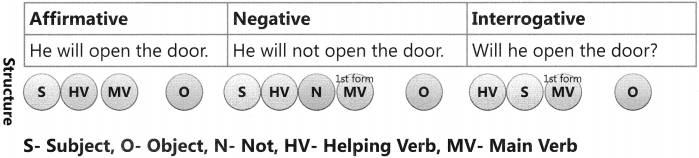
Usage in different types of sentences
Present Tense Exercise for Class 6 CBSE 1
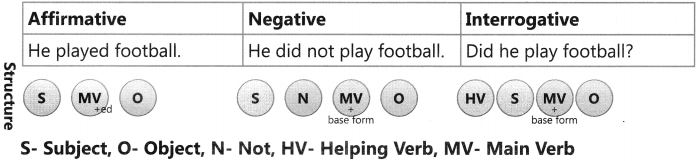
S – Subject, 0–Object, N – Not, HV – Helping Verb, MV – Main Verb

Present Progressive (Continuous)
Uses: action taking place at the moment of speaking, action arranged for the future
Form: To be (in the simple present) + verb + ing
Structure: Subject + helping verb is/am/are + Verb 1st Form + ing + Object
(S) (V) (o)

Usage in different types of sentences
Present Tense Exercise for Class 6 CBSE 2

Uses: emphasis is on the result (not the duration), action that started in the past and is still going on, action that stopped recently, finished action that has an influence on the present.
Form: Have/has + past participle (past participle of regular verbs: verb + ed
Structure: Subject + helping verb (has/have)+Verb 3rd Form + Object
(s) (V) (O)

Usage in different types of sentences
Present Tense Exercise for Class 6 CBSE 3

Present Perfect Progressive (Continuous)
Uses: This is used for putting emphasis on the course or duration (not the result), an action that recently stopped or is still going on, finished action that influenced the present
Form: have or has + been + verb + ing
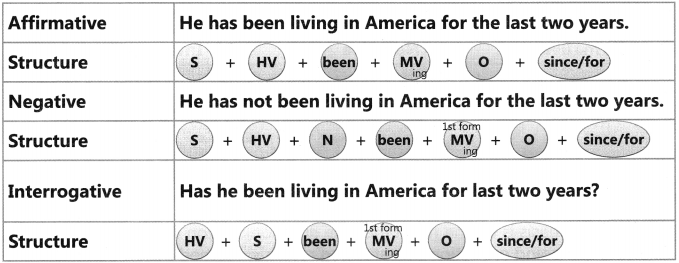
Present Tense Exercise for Class 6 CBSE 4

Usage in different types of sentences
Present Tense Exercise for Class 6 CBSE 5

For:
Used with the present perfect, for indicates the duration that is how long something has lasted or has continued:
Examples

  • I have been in this town for a long time.
  • He has known her for six years.

Since
Use since to say that something has been true from a particular time in the past until now.
Examples

  • I have been in this town since I was 10 years old.
  • He has known her since 2008.

Past Indefinite:
Uses: This tense is used for action in the past taking place once, never or several times, actions taking place one after another.
Form: Main verb + ed i.e, Play – Played (Past tense)
Structure: Subject + Verb llnd Form + Object
(s) (v) (o)

Usage in different types of sentences
Present Tense Exercise for Class 6 CBSE 6

Past Progressive (Continuous)
Uses:- We use this tense for action going on at a certain time in the past, actions taking place at the same time, action in the past that is interrupted by another action
Form:- To be (in the simple past) + verb + ing
Structure:- Subject + helping verb (was/were) +Verb 1st Form + ¡ng +Object
(s) (v) (o)

Usage in different types of sentences
Present Tense Exercise for Class 6 CBSE 7

Past Perfect
Uses: This tense is used for action taking place before a certain time in the past, sometimes interchangeable with past perfect progressive, putting emphasis only on the fact (not the duration).
Form: had + past participle (past participle of regular verbs: verb + ed
Structure: Subject + helping verb (had)+Verb 3rd Form + Object
(s) (v) (o)

Usage in different types of sentences
Present Tense Exercise for Class 6 CBSE 8

Past Perfect Progressive (Continuous)
Uses: This tense is used for action taking place before a certain time in the past, sometimes interchangeable with past perfect simple putting emphasis on the duration or course of an action.
Form: had + been + verb + ing
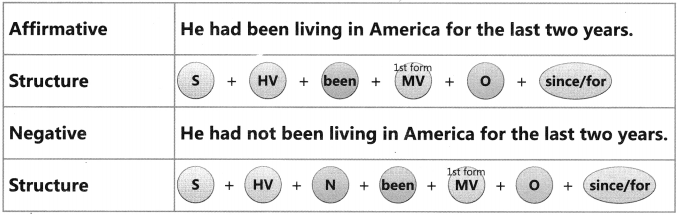
Structure: Subject + helping verb (had) + been + Verb Ist Form + ing + object + Since/For

Usage in different types of sentences
Present Tense Exercise for Class 6 CBSE 9
Present Tense Exercise for Class 6 CBSE 10
We use since for definite time.
We use for an indefinite time.

Future Indefinite
Uses: We use the simple future for instant decisions, when we predict a future situation. We use the simple future in conditional sentences type one.
Form: will + Ist form of verb
Structure: Subject + will/shall + Verb Ist Form + Object
(S) (V) (o)

Usage in different types of sentences
Present Tense Exercise for Class 6 CBSE 11

Uses: It is used for actions that will be going on at a certain time in the future, actions that are sure to happen in the near future.
Form: will + be + verb + ing
Structure: Subject + helping verb will/shall +be +Verb 1st Form + ing + Object
(S) (V) (o)

Usage in different types of sentences
Present Tense Exercise for Class 6 CBSE 12

Future Perfect
Uses: We use this tense for action that will be finished at a certain time in the future
Form: will + have + past participle
Structure: Subject + helping verb (will have/shall have)+ 3rd Form verb + Object
(s) (v) (o)

Usage in different types of sentences
Present Tense Exercise for Class 6 CBSE 13

Future Perfect Progressive (Continuous)
Uses: We use this tense for action taking place before a certain time in the future, putting emphasis on the course of an action
Form: will + have + been + verb + ing
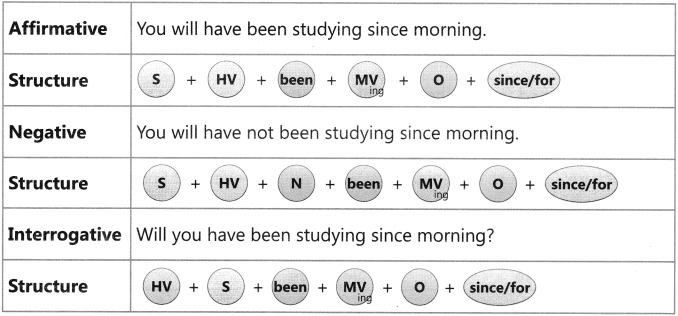
Structure: Subject + helping verb (will have/shall have) + been + Verb 1st Form + ing + Object + Since/For

Usage in different types of sentences
Present Tense Exercise for Class 6 CBSE 14
We use Since for definite time.
We use For for indefinite time.

Tenses Exercises Solved Examples for Class 6 CBSE

Question 1.
Fill in the blanks
(i) We __________ TV when it started to rain. (to watch)
(ii) I __________ to visit yesterday, but you __________ not at home. (to want) (to be)
(iii) Look ! It __________, so we can’t __________ to the beach. (to rain) (to go)
(iv) There are a lot of clouds! It __________ soon. (to rain)
(v) The sun __________ in the east. (to rise)
(vi) Since 2011 they __________ their son every year. (to visit)
(vii) While the doctor __________ Mr Jones this morning, his soon outside. (to examine) (to wait)
(viii) I __________ for my girlfriend for two hours. (to wait)
(ix) After Larry __________ the film on TV, he decided to buy the book. (to see)
(x) Wait a minute, __________ this box for you. (to carry)
Answer:
(i) were watching
(ii) wanted, were
(iii) is raining, go
(iv) is going to rain
(v) rises
(vi) have visited
(vii) was examining, was waiting
(viii) have been waiting
(ix) had seen
(x) will carry

Question 2.
Put the verbs into the correct tense (simple present or present progressive)
(i) Look! Sara (go) __________ to the movies.
(ii) On her right hand, Sara (carry) __________ her handbag.
(iii) The handbag (be) __________ very beautiful.
(iv) Sara usually (put) __________ on black shoes but now she (wear) __________ white trainers.
(v) And look, she (take) __________ an umbrella because it (rain) __________.
Answer:
(i) going
(ii) carrying
(iii) is
(iv) puts, wearing
(v) taking, raining

Tenses Exercises Practice Examples for Class 6 CBSE

Question 1.
Fill in the blanks with the simple future form of the verbs given in the box.

1. In two days, I __________ (know) my results.
2. ‘There is the doorbell.”I __________ (go)’
3. You __________ (regret) this decision.
4. We __________ (never know) what happened to her.
5. The whole nation __________ (be) proud of you.
6. That __________ (be) our gift to the school.
7. Kind words __________ (give) others joy.
8. This piece of wisdom __________ (cost) you ten dollars.
9. You __________ (never understand) my position.
10. Someday I __________ (write) a novel.

Question 2.
Put the verbs into the correct tense (simple past or past perfect)
(i) When he (wake up). __________, his mother (already / prepare) breakfast.
(ii) We (go) __________ to London because our friends (invite) __________.
(iii) He (hear) __________ the news, (go) to the telephone and (call) __________ a friend.
(iv) When she (start) __________ learning English she (already / learn) French.
(v) Jane (already / type). __________ three pages when her computer (crash).
(vi) By the time the doctor (arrive) __________ at the house the patient (die) __________.
(vii) Before that day we (never / think) __________ of traveling to Japan.
(viii) I (know) __________ him a long time before I (meet). __________ his family.
(ix) They (not/know) __________ where to meet because nobody (tell) __________ them.
(x) It (be). __________ cloudy for days before it (begin) __________ to rain.

An Overview of Polymers

Find free online Chemistry Topics covering a broad range of concepts from research institutes around the world.

An Overview of Polymers

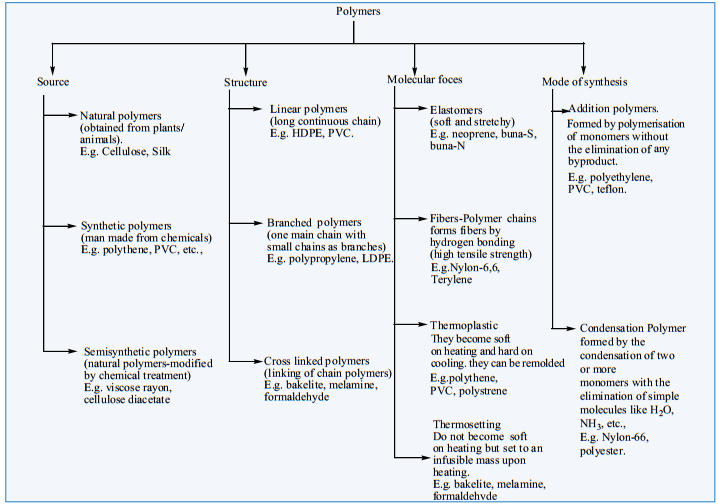
The term Polymer is derived from the Greek word ‘polumeres’ meaning “having many parts”. The constitution of a polymer is described in terms of its structural units called monomers. Polymers consists of large number of monomer units derived from simple molecules.

For example: PVC(Poly Vinyl Chloride) is a polymer which is obtained from the monomer vinyl chloride. Polymers can be classified based on the source of availability, structure, molecular forces and the mode of synthesis. The following chart explain different classification of polymers.

Classification of Polymers:

An Overview of Polymers img 1

Types of Polymerisation

The process of forming a very large, high molecular mass polymer from small structural units i.e., monomer is called polymerisation. Polymerisation occurs in the following two ways

  • Addition polymerisation or chain growth polymerisation
  • Condensation polymerisation or step growth polymerisation

Addition Polymerisation

Many alkenes undergo polymerisation under suitable conditions. The chain growth mechanism involves the addition of the reactive end of the growing chain across the double bond of the monomer. The addition polymerisation can follow any of the following three mechanisms depending upon the reactive intermediate involved in the process.

  1. Free Radical Polymerisation
  2. Cationic Polymerisation
  3. Anionic Polymerisation

Free Radical Polymerisation

When alkenes are heated with free radical initiator such as benzyl peroxide, they undergo polymerisation reaction. For example styrene polymerises to polystyrene when it is heated to ionic with a peroxide initiator. The mechanism involves the following steps.

1. Initiation – formation of free radical

An Overview of Polymers img 2

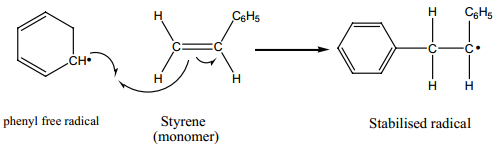
2. Propagation Step

An Overview of Polymers img 3

The stabilized radical attacks another monomer molecule to give an elongated radical

An Overview of Polymers img 4

Chain growth will continue with the successive addition of several thousands of monomer units.

Termination

The above chain reaction can be stopped by stopping the supply of monomer or by coupling of two chains or reaction with an impurity such as oxygen.

An Overview of Polymers img 5

Preparation of Some Important Addition Polymers

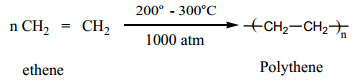
1. Polythene

It is an addition polymer of ethene. There are two types of polyethylene

  • HDPE (High Density Polyethylene)
  • LDPE (Low Density polyethylene)

LDPE

It is formed by heating ethene at 200° to 300° C under oxygen as a catalyst. The reaction follows free radical mechanism. The peroxides formed from oxygen acts as a free radical initiator.

An Overview of Polymers img 6

It is used as insulation for cables, making toys etc…

HDPE

The polymerization of ethylene is carried out at 373K and 6 to 7 atm pressure using Zeiglar – Natta catalyst [TiCl4+(C2H5)3Al]. HDPE has high density and melting point and it is used to make bottles, pipe etc..,

Preparation of Teflon (PTFE)

The monomer is tetraflroethylene. When the monomer is heated with oxygen (or) ammonium persulphate under high pressure, Tefln is obtained.

An Overview of Polymers img 7

It is used for coating articles and preparing non – stick utensils.

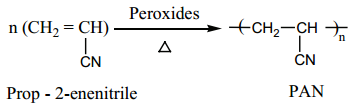
I. Preparation of Orlon (polyacrylonitrile – PAN)

It is prepared by the addition polymerisation of vinylcyanide (acrylonitrile) using a peroxide initiator.

An Overview of Polymers img 8

It is used as a substitute of wool for making blankets, sweaters etc…

Condensation Polymerisation

Condensation polymers are formed by the reaction between functional groups an adjacent monomers with the elimination of simple molecules like H2O, NH3 etc…. Each monomer must undergo at least two substitution reactions to continue to grow the polymer chain i.e., the monomer must be at least bi functional. Examples: Nylon – 6,6, terylene….

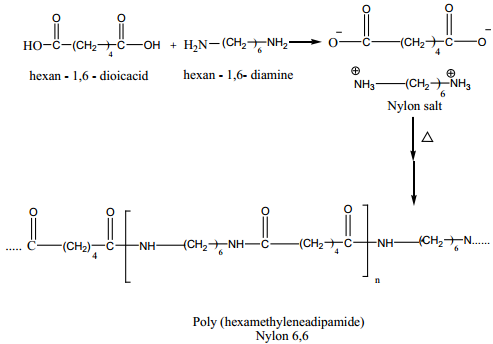
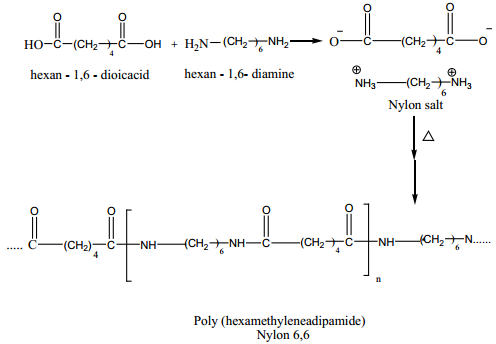
Nylon – 6, 6

Nylon – 6, 6 can be prepared by mixing equimolar adipic acid and hexamethylene – diamine to form a nylon salt which on heating eliminate a water molecule to form amide bonds.

An Overview of Polymers img 9

It is used in textiles, manufacture of cards etc…

Nylon – 6

Capro lactam (monomer) on heating at 533K in an inert atmosphere with traces of water gives ∈-v amino carproic acid which polymerises to give nylon – 6

An Overview of Polymers img 10

It is used in the manufacture of tyrecards fabrics etc….

II. Preparation of Terylene (Dacron)

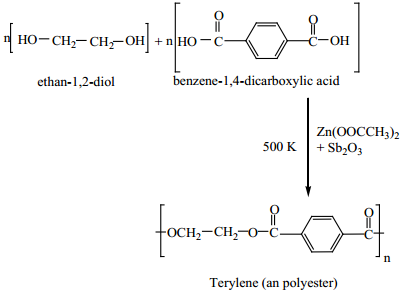
The monomers are ethylene glycol and terepathalic acid (or) dimethylterephthalate. When these monomers are mixed and heated at 500K in the presence of zinc acetate and antimony trioxide catalyst, terylene is formed.

An Overview of Polymers img 11

It is used in blending with cotton or wool fires and as glass reinforcing materials in safety helmets.

Preparation of Bakelite

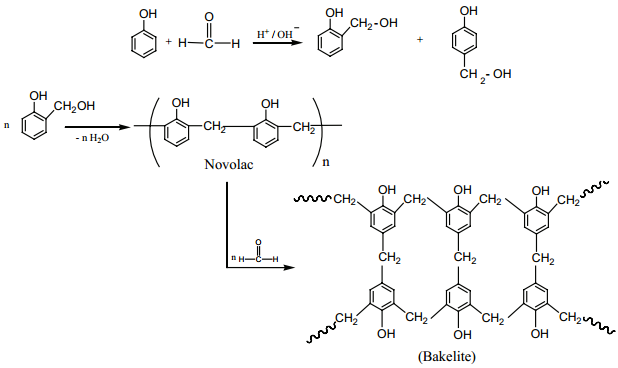
The monomers are phenol and formaldehyde. The polymer is obtained by the condensation polymerization of these monomers in presence of either an acid or a base catalyst. Phenol reacts with methanal to form ortho or para hydroxyl methylphenols which on further reaction with phenol gives linear polymer called novolac. Novalac on further heating with formaldehyde undergo cross linkages to form backelite.

An Overview of Polymers img 12

Uses:

Navolac is used in paints. Soft backelites are used for making glue for binding laminated wooden planks and in varinishes, Hard backelites are used to prepare combs, pens etc..

Melamine (Formaldehyde Melamine):

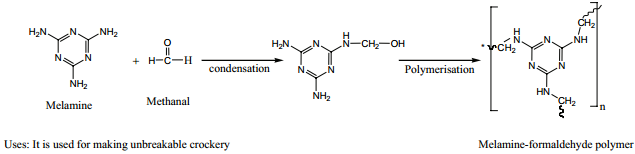
The monomers are melamine and formaldehyde. These monomers undergo condensation polymerisation to form melamine formaldehyde resin.

An Overview of Polymers img 13

Urea Formaldehyde Polymer:

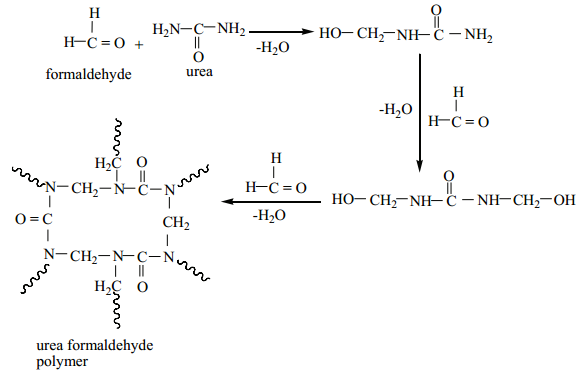
It is formed by the condensation polymerisation of the monomers urea and formaldehyde.

An Overview of Polymers img 14

Co-Polymers:

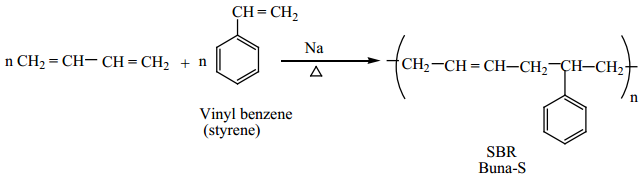
A polymer containing two or more different kinds of monomer units is called a copolymer. For example, SBR rubber(Buna-S) contains styrene and butadiene monomer units. Co-polymers have properties quite different from the homopolymers.

Natural and Synthetic Rubbers:

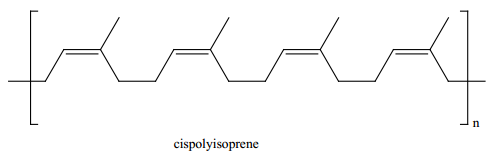
Rubber is a naturally occurring polymer. It is obtained from the latex that excludes from cuts in the bark of rubber tree (Ficus elastic). The monomer unit of natural rubber is cis isoprene (2-methyl buta-1,3-diene). Thousands of isoprene units are linearly linked together in natural rubber. Natural rubber is not so strong or elastic. The properties of natural rubber can be modified by the process called vulcanization.

An Overview of Polymers img 15

Vulcanization: Cross linking of Rubber

In the year 1839, Charles Good year accidently dropped a mixture of natural rubber and sulphur onto a hot stove. He was surprised to find that the rubber had become strong and elastic. This discovery led to the process that Good year called vulcanization.

Natural rubber is mixed with 3-5% sulphur and heated at 100-150˚C causes cross linking of the cis-1,4-polyisoprene chains through disulphide (-S-S-) bonds. The physical properties of rubber can be altered by controlling the amount of sulphur that is used for vulcanization. In sulphur rubber, made with about 1 to 3% sulphur is sof and stretchy. When 3 to 10% sulphur is used the resultant rubber is somewhat harder but flexible.

Synthetic Rubber:

Polymerisation of certain organic compounds such as buta-1,3-diene or its derivatives gives rubber like polymer with desirable properties like stretching to a greater extent etc., such polymers are called synthetic rubbers.

Preparation of Neoprene:

The free radical polymeristion of the monomer, 2-chloro buta-1,3-diene(chloroprene) gives neoprene.

An Overview of Polymers img 16

It is superior to rubber and resistant to chemical action.
Uses: It is used in the manufacture of chemical containers, conveyer belts.

Preparation of Buna-N:

It is a co-polymer of acrylonitrile and buta-1,3-diene.

An Overview of Polymers img 17

It is used in the manufacture of hoses and tanklinings.

Preparation of Buna-S:

It is a co-polymer. It is obtained by the polymerisation of buta-1,3-diene and styrene in the ratio 3:1 in the presence of sodium.

An Overview of Polymers img 18

Biodegradable Polymers

The materials that are readily decomposed by microorganisms in the environment are called biodegradable. Natural polymers degrade on their own after certain period of time but the synthetic polymers do not. It leads to serious environmental pollution. One of the solution to this problem is to produce biodegradable polymers which can be broken down by soil micro organism.

Examples:

Polyhydroxy butyrate (PHB)
Polyhydroxy butyrate-co-A- hydroxyl valerate (PHBV)
Polyglycolic acid (PGA), Polylactic acid (PLA)
Poly (∈caprolactone) (PCL)

Biodegradable polymers are used in medical field such as surgical sutures, plasma substitute etc… these polymers are decomposed by enzyme action and are either metabolized or excreted from the body.

Preparation of PHBV

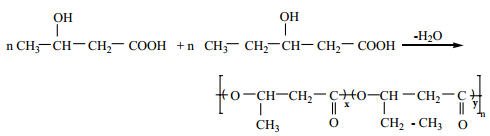
It is the co – polymer of the monomers 3 – hydroxybutanoic acid and 3-hydroxypentanoic acid. In PHBV, the monomer units are joined by ester linkages.

An Overview of Polymers img 19

Uses:
It is used in ortho paedic devices, and in controlled release of drugs.

Nylon-2-Nylon-6

It is a co – polymer which contains polyamide linkages. It is obtained by the condensation polymersiation of the monomers, glycine and É – amino caproic acid.

Cleansing Agents Functions and its Types

Find free online Chemistry Topics covering a broad range of concepts from research institutes around the world.

Cleansing Agents Functions and its Types

Soaps and detergents are used as cleansing agents. Chemically soap is the sodium or potassium salt of higher fatty acids. Detergent is sodium salt of alkyl hydrogen sulphates or alkyl benzene sulphonic acids.

Soaps:

Soaps are made from animal fats or vegetable oils. They contain glyceryl esters of long chain fatty acids. When the glycerides are heated with a solution of sodium hydroxide they become soap and glycerol. We have already learnt this reaction under the preparation of glycerol by saponification. Common salt is added to the reaction mixture to decrease the solubility of soap and it helps to precipitate out from the aqueous solution. Soap is then mixed with desired colours, perfumes and chemicals of medicinal importance.

Total Fatty Matter:

The quality of a soap is described in terms of total fatty matter (TFM value). It is defined as the total amount of fatty matter that can be separated from a sample after splitting with mineral acids., Higher the TFM quantity in the soap better is its quality. As per BIS standards, Grade-1 soaps should have 76% minimum TFM, while Grade-2 and 3 must have 70 and 60% , minimum respectively. The other quality parameters are lather, moisture content,mushiness, insoluble matter in alcohol etc..

The Cleansing Action of Soap:

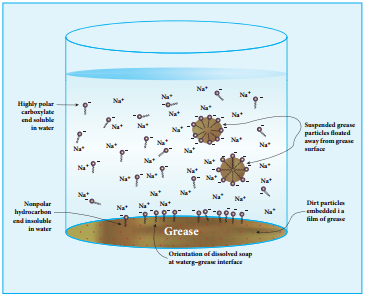
To understand how a soap works as a cleansing agent, let us consider sodium palmitate an example of a soap. The cleansing action of soap is directly related to the structure of carboxylate ions (palmitate ion) present in soap. The structure of palmitate exhibit dual polarity. The hydrocarbon portion is non polar and the carboxyl portion is polar.

Cleansing Agents Functions and its Types img 1

The nonpolar portion is hydrophobic while the polar end is hydrophilic. The hydrophobic hydro carbon portion is soluble in oils and greases, but not in water. The hydrophilic carboxylate group is soluble in water. The dirt in the cloth is due to the presence of dust particles intact or grease which stick.

When the soap is added to an oily or greasy part of the cloth, the hydrocarbon part of the soap dissolve in the grease, leaving the negatively charged carboxylate end exposed on the grease surface. At the same time the negatively charged carboxylate groups are strongly attracted by water, thus leading to the formation of small droplets called micelles and grease is flated away from the solid object.

When the water is rinsed away, the grease goes with it. As a result, the cloth gets free from dirt and the droplets are washed away with water. The micelles do not combine into large drops because their surfaces are all negatively charged and repel each other. The cleansing ability of a soap depends upon its tendency to act as a emulsifying agent between water and water insoluble greases.

Cleansing Agents Functions and its Types img 2

Detergents:

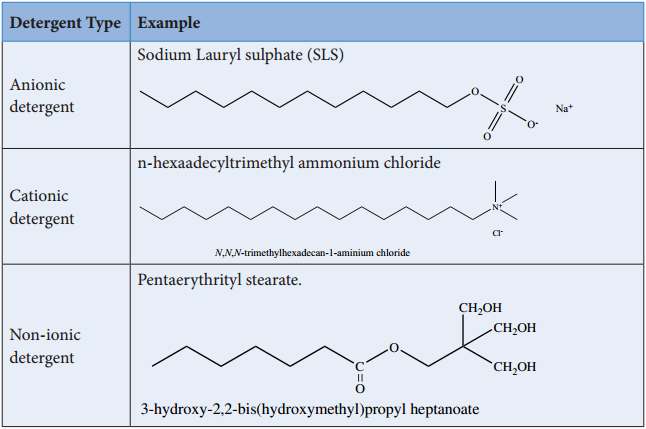
Synthetic detergents are formulated products containing either sodium salts of alkyl hydrogen sulphates or sodium salts of long chain alkyl benzene sulphonic acids. There are three types of detergents.

Cleansing Agents Functions and its Types img 3

Detergents are superior to soaps as they can be used even in hard water and in acidic conditions. The cleansing action of detergents are similar to the cleansing action of soaps.