Editing Exercises for Class 7 CBSE With Answers

Editing Exercises for Class 7

This grammar section explains English Grammar in a clear and simple way. There are example sentences to show how the language is used. You can also visit the most accurate and elaborate NCERT Solutions for Class 7 English. Every question of the textbook has been answered here.

Editing Exercises for Class 7 CBSE With Answers PDF

Editing Solved Exercise for Class 7 CBSE With Answers

Question 1.
Edit the following passage by replacing the incorrect word with the correct one.
Incorrect – Correct
Correct In April 12, 1961, major Yuri Gagarin – (a) _______ _______
become the first man ever to venture – (b) _______ _______
in space. He did not know for certain – (c) _______ _______
beforehand that he is to be chosen. – (d) _______ _______
The Russian had three possible candidates – (e) _______ _______
ready but although Gagarin was first – (f) _______ _______
in the list, the choice was not definitely – (g) _______ _______
made until an early morning of April 12. – (h) _______ _______
Answer:
(a) in – on
(b) become – became
(c) in – into
(d) is – was
(c) Russian – Russians
(f) but – and
(g) in – on
(h) an – the

Solved  Examples Exercise – 2

Question 2.
The following passage has not been edited there is one error in each line. Write the incorrect word and the correction in your answer sheet as given below against the correct blank number.
Incorrect – Correct
Educationist today are overwhelmingly (a) _______ _______
concern about the future of the youngsters. (b) _______ _______
The common complaint is students doesn’t (c) _______ _______
study; they are not interested. Some blames (d) _______ _______
exposure to the media, others feel that the
present generation are not serious enough. (e) _______ _______
The CBSE expresses this concern of (f) _______ _______
reviewing the syllabus for time to time. The (g) _______ _______
idea is to build a complete personality of an individual (h) _______ _______
Answer:
(a) educationist – educationists
(b) concern – concerned
(c) doesn’t – don’t
(d) blames – blame
(e) are – is
(f) of – buy
(g) for – from
(h) a – the

Question 3.
Each sentence given below contains one or more grammar mistakes. Correct the mistake (s) and
rewrite the sentences.
(i) Sid can play tennis as well as his brother.
(ii) The match had hardly begun when it started raining.
(iii) That was sure a mistake.
(iv) He talks more pleasant than his brother. Needless to say, he is the more popular of the two.
(v) When you become a parent, you will think differently about children.
(vi) I felt badly about not having won the championship.
(vii) Winning is not near as important as playing good.
(viii) His behavior seemed a little oddly.
(ix) He didn’t run good enough to qualify for the race.
(x) We could clear see the snow-capped mountains at a distance.
Answer:
(i) Sid can play tennis as well as his brother.
(ii) The match had hardly begun when it started raining.
(iii) That was surely a mistake.
(iv) He talks more pleasantly than his brother. Needless to say, he is the more popular of the two.
(v) When you become a parent, you will think differently about children.
(vi) I felt bad about not having won the championship.
(vii) Winning is not nearly as important as playing good.
(viii) His behaviour seemed a little odd.
(ix) He didn’t run well enough to qualify for the race.
(x) We could clearly see the snow–capped mountains at a distance.

Editing Practice Exercises for Class 7 CBSE

1. Find out the errors and write down the correct word for it.
Incorrect – Correct
We admire and love nature. Nature (a) _______ _______
have an extraordinary fact which was (b) _______ _______
full with energy. We can view (c) _______ _______
nature all around us into rivers. (d) _______ _______
rocks, glaciers, forests but (e) _______ _______
outskirts from villages and cities. (f) _______ _______
Nature is vital part to our (g) _______ _______
life. It is a best teacher and healer. (h) _______ _______

2. One word has been omitted in each line. Write the omitted word and the word which comes before and
after it.
When the class IX examinations over, – e.g. examinations were over.
the Deputy Commissioner asked Incorrect – Correct
his son he had down his English paper (a) _______ _______
well. The boy told him what was easy (b) _______ _______
and that for one question had written (c) _______ _______
that his father was washer man. (d) _______ _______
The boy’s father furiqus and shouted, (e) _______ _______
angrily but son replied, “I did (f) _______ _______
not know the spelling Deputy (g) _______ _______
Commissioner and I did not want lose one mark.” (h) _______ _______

Tenses Exercises for Class 8 CBSE With Answers

Tenses Exercises for Class 8 CBSE With Answers Q1.1

From the tense of a sentence, we come to know about the time of an action.

This grammar section explains English Grammar in a clear and simple way. There are example sentences to show how the language is used. NCERT Solutions for Class 8 English will help you to write better answers in your Class 10 exams. Because the Solutions are solved by subject matter experts.

Tenses Exercises or Class 8 CBSE With Answers Pdf

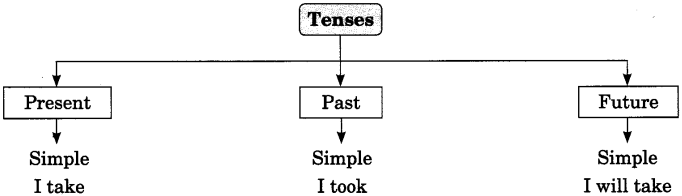
The tense of a verb tells us when the action is, was or will be carried out
Tenses Exercises for Class 8 CBSE With Answers Q1.2
Perfect simple have + past part. Perfect simple have + past part. Perfect simple have + past part.

I have taken I had taken I will have taken
Continuous be + ing Continuous be + ing Continuous be + ing
I am taking I was taking I will be taking

Perfect continuous have + been Perfect continuous have + been Perfect continuous have + been

+ ing + ing + ing
I have been taking I had been taking I will have been taking

Simple Present / Present Indefinite Tense:

(i) To describe repeated actions and habits; as,
(a) I go for a morning walk daily.
(b) Ishani reads the newspaper every day.

(ii) To express facts which are true of all times; as,
(a) The Sun rises in the East.
(b) This road leads to Jaipur.

(iii) To describe a future planned action; as,
(a) The president arrives tomorrow at 10.00 a.m.
(b) The train leaves to Karnataka at 9.00 p.m.

(iv) To express a fact of something which is true at present; as,
(a) All trains halt at Rampur.
(b) Priyanka teaches English in Hindu College Sonepat.

(v) To introduce quotations; as,
(a) Wordsworth says, “Nature heals our negative mood”.
(b) Shakespeare says, “Frailty, thy name is a woman”.

(vi) In running commentaries on matches; as,
(a) Kumble runs up to the wicket. He bowls.
The batsman steps forward and drives the ball to the boundary.

(vii) In time and conditional clauses; as,
(a) We will wait until Murti sings.
(b) If he works hard, he will succeed.
Form:

AffirmativeNegative
Subject + Infinitive (without to)Subject + do/does not + infinitive
InterrogativeInterrogative-cum-Negative
Do/Does + subject + the infinitive + ….?Do/Does + subject + not + infinitive +… ?

Present Continuous or Present progressive Tense is used:

(i) To describe an action that is happening now at the time of speaking.
(a) The boys are watching a cricket match.
(b) It is raining.

(ii) To describe an action going on over a period of time including the present, but which may not be going on actually at the moment of speaking.
(a) My father is writing a novel.
(b) I am learning to drive.

(iii) To describe an action or event which is to take place definitely in the near future.
(a) He is coming tomorrow.
(b) I am leaving by the next train.

(iv) To express the speaker’s disapproval and disliking of an action that happens often.
(a) He is always complaining of headache.
(b) We are becoming lazy everyday.
(c) She is always back-biting.

(v) To express an action which begins before a specific time and even continuous after it; as,
(a) A 2.00 o’clock, we are having our lunch.
Form:

AffirmativeNegative
Subject + is/am/are + the present participle (i.e. the infinitive + ing)Subject + is/am/are + not + the present participle (i.e. the infinitive + ing)
InterrogativeInterrogative-cum-Negative
Is/am/are + subject + the present participle + ….?Is/am/are + subject + not + the present participle + ….?

Present Perfect Tense is used:

(i) To express an action that began in the past and continues up to the present moment; as,
(a) I have finished my work.
(b) Sita has already left the class.
(c) He has gone to cinema.
(d) I have known to him for several years.

(ii) To express past actions or events the results of which still persist; as,
(a) He has lived here for two years.
(b) Suresh has been ill since morning.
(c) The prisoners have escaped from the jail.

(iii) To express past actions without any specific time; as,
(a) Have you read “The Ramayana”?
(b) My brother has been to Saudi Arabia.
(c) I have never seen Reena angry.

(iv) To show past events when their effect in the present is more important; as,
(a) Murli has cut his finger.
(b) Children have eaten all the mangoes.
(c) She has finished cooking.

(v) To express a recently completed action; as,
(a) She has gone to college.
(b) I have just finished my food.

(vi) To describe a past action, the time of which is not given; as,
(a) The poachers have hunted a tiger.
(b) I have received a letter from my father.
Form:

AffirmativeNegative
Subject + has/have + the past participleSubject + has/have + not + the past participle
InterrogativeInterrogative-cum-Negative
Has/have + subject + the past participle + ….?Has/have + subject + not + the past participle + ….?

Present Perfect Continuous Tense is used:

(i) To describe an action that began at some time in the past and is still going on. The action should be continuing at the time of speaking.
(a) We have been studying English for five years.
(b) It has been raining for three hours now.

(ii) To emphasize the continued and uninterrupted nature of an action even though it is completed.
(a) The children have been playing all the day.
(b) He has been writing letters all the afternoon.
Form:

AffirmativeNegative
Subject + has/have + been + the present participleSubject + has/have not + been + the present participle
InterrogativeInterrogative-cum-Negative
Has/have + subject + been + the present participle + ….?Has/have + subject + not + been + the present participle + ….?

Simple Past Tense/Past Indefinite Tense is ‘used:
(i) To describe an action that took place and was completed in the past; as,
(a) He left for Bengaluru yesterday.
(b) India defeated Pakistan during the Kargil war.
(c) When did you build this house.

(ii) To express a past event/action when the time is not given, but it is implied and definite; as,
(a) The flight was half an hour late.
(b) I bought this shirt from the Mcdonald’s.

(iii) To describe a habitual; or repeated action in the past; as
(a) Everyday my father used to read a chapter of the Geeta.
(b) Ram never smoked.
(c) He attended the temple regularly when he was young.

(iv) To denote an action which continued for sometime in the past; as,
(a) We studied Sanskrit for two years
(b) We met twice a day during the summer holidays.
Form:

AffirmativeNegative
Subject + Ilnd form of verbSubject + did not + 1st form of verb
InterrogativeInterrogative-cum-Negative
Did + subject + the infinitive +…..?Did + subject + not + the infinitive +…..?

Past Continuous Tense is used:
(i) To describe an action that was in progress at a point of time or over a period of time in the past; e.g.
(a) I was having my breakfast at 8 o’clock yesterday.
(b) At 5 o’clock in the morning. I was completing my homework.

(ii) To show gradual development of a happening.
(a) It was getting dark.
(b) The boy was growing like a young plant.

(iii) To describe an action that was in progress when another action took place.
(a) I was reading the newspaper when the postman knocked at the door.
(The action in the Past Continuous ‘was reading started before the action in the Simple Past “knocked and probably continued after it.)
(b) She was sleeping when the phone rang.

(iv) To describe two actions going on at the same time in the past.
(a) While I was writing letters, she was listening to the ratio.
(That means both the actions ‘writing letters’ and ‘listening to the radio continued side by side)
(b) We were bathing in the river when it was raining.
Form:

AffirmativeNegative
Subject + was/were + the present participleSubject + was/were + not + the present participle
InterrogativeInterrogative-cum-Negative
was/were + subject + the present participle + ………..?was/were + subject + not + the present participle +……….. ?

Past Perfect Tense is used:
(i) To express an unfulfilled desires of the past, as,
(a) If only Ramesh had not spoiled his career. (but Ramesh spolied)
(b) I wish I had listened to my parents teachings. (but I did not listen)

(ii) To express impossible conditions of the past; as,
(a) If we had left early, we would have caught the train.
(b) If you had worked hard, you would have passed.

(iii) To express an action in the past which was completed before another action took place in the past.”
(Here two actions take place. The action that takes place earlier in time is reported in the Past Perfect Tense and the action that takes place afterwards (later in times is reported in the Past Indefinite Tense) e.g.
(a) We went to school after the rain had stopped.
(b) He had died before the war began.

(iv) To express an action completed before a certain moment in the past. e.g.
(a) At 9.00 p.m. all the shops had closed
(b) He had passed his graduation at the age of 16 years.
Form:

AffirmativeNegative
Subject + had + the past participleSubject + had not + the past participle
InterrogativeInterrogative-cum-Negative
Had + subject + the past participle +……?Had + subject + not + the past participle +…… ?

Usage: Past Perfect Continuous Tense is Used:
(i) To express an action which had been going on for some time before another past action; e.g.
We had been reading for an hour when our teacher came.
He had been living in Delhi for a year when his father died.

(ii) To describe a repeated action in the Past Perfect; as,
Sita had tried many times to learn German language.
Sita had been trying to learn German language.

AffirmativeNegative
Subject + had been + verb (1st form) + ing +…………….Subject + had not been + verb (1st form) + ing +……………..
InterrogativeInterrogative-cum-Negative
Had + subject + been + verb (ing form) +…………….. ?Had + subject + not + been + verb (ing form) +………….. ?

The Simple Future Tense is Used:
(i) To express an action that will take place in the future; e.g.
(a) I shall be sixty tomorrow.
(b) They will certainly wait for us.

(ii) For habitual actions which we assume will take place; e.g.
(a) Winter will come soon.
(b) The flood victims will build their houses.

(ii) With clauses of condition and time; e.g.
(a) The cup will break if I drop it.
(b) He will fail unless he works hard.

AffirmativeNegative
Subject + will/shall + the infinitiveSubject + will/shall + not + the infinitive
‘shall’ is used with first-person and ‘will’ with the Ilnd and Illrd person.
InterrogativeInterrogative-cum-Negative
Will/ Shall + subject + the infinitive +……..?Will/Shall + subject + not + the infinitive +……….?

Future Continuous Tense is used:
(i) As an ordinary continuous Tense; e.g.
(a) Sidharath will be deciding the case next day.
(b) I shall be meeting the doctor tomorrow.
(c) Meera will be returning.

(ii) To express future without intention; e.g.
(a) Ranjan will be helping Sonam tomorrow.
(b) I shall be waiting for my friends.
(c) The gardener will be plucking the flowers.
(d) I shall not be meeting him tomorrow.

(iii) To express an action that will be in progress at a given point of time in the future during a period of time in the future; e.g.
(a) When I reach Mussorie, it will be raining there. (Point of time)
(b) It will be snowing in Manali during October. (Period of time)

AffirmativeNegative
Subject + will/ shall + be + 1st form of verb + ing +……………………Subject + will/shall + not be + 1st form of verb + ing +………………..
InterrogativeInterrogative-cum-Negative
Will/shall + subject + be + 1st form of verb + ing +………..?Will/shall + subject + not be + 1st form of verb + ing +……….?

The Future Perfect Tense is used:
(i) To express an action which is expected to be completed by a certain time in the future; e.g.
(a) The train will have left the station before you reach there.
(b) By 2010, Delhi will have a lot of changes due to Olympics.

(ii) To express the speaker’s belief that something has taken place; e.g.,
You will have heard about my father’s promotion.

AffirmativeNegative
Subject + will/ shall + have + the past participle +…………………Subject + will/ shall + not + have + the past participle +………………………….
InterrogativeInterrogative-cum-Negative
Shall/will + subject + have + the past participle +………………….Shall/will + subject + not + have + the past participle +…………………………..

Future Perfect Continuous Tense is used:
(i) To express an action continuing beyond some given time in future; e.g.
(a) By next June Neelu have been an I.T. experts in T.C.S.

AffirmativeNegative
Subject + will/ shall have been + 1st form of verb + ing +……………………Subject + will/ shall have + not + been + 1st form of verb + ing +……..
InterrogativeInterrogative-cum-Negative
Shall/will + subject + have been + present participle +…………….?Shall/will + subject + not + have been + present participle +………?

Tenses Exercises Solved Examples for Class 8 CBSE

Question 1.
Fill in the blanks with an appropriate tense form.
(i) When I opened my eyes, I. ____________ a strange sight.(Saw / was seeing / have been)
(ii) Every morning she ____________ up early and gets ready for work is waking. (wakes/has woken)
(iii) If I knew what he wanted, I ____________ this. (will not permit / would not permit/would not have permitted)
(iv) I ____________ anything from her in a long time. (didn’t hear / haven’t heard / am not hearing)
(v) The headmaster ____________ to talk to you. (Want / wants / is wanting)
(vi) Jane ____________ with her parents. (is living / lives / has lived)
(vii) We ____________ Greece next month. (Visit / will visit / would visit / are visiting)
(viii) The moon ____________ around the earth. (is revolving/has revolved / revolves)
(ix) She ____________ a novel. (Wrote / writes / has written)
(x) All students ____________ in their work. (Handed / have handed / hand)
(xi) I ____________ English for twelve years. (am teaching / have been teaching / will be teaching)
(xii) The students ____________ their dialogues. (Rehearse / are rehearsing / Either could be used here)
Answer:
(i) saw
(ii) wakes
(iii) would not permit
(iv) haven’t heard
(v) wants
(vi) lives
(vii) are visiting
(viii) revolves
(ix) has written
(x) have handed
(xi) have been teaching
(xii) are rehearsing

Question 2.
Fill the gaps with the correct tenses.
(i) I (learn) __________ English for seven years now.
(ii) But last year I (not / work) __________ hard enough for English, that’s why my marks (not/be) __________ really that good then.
(iii) As I (pass / want) __________ my English exam successfully next year, I (study) __________ harder this team.
(iv) During my last summer holidays, my parents (send) __________ me on a language course to London.
(v) It (be) __________ great and I (think) __________ I (learn) __________ a lot.
(vi) Before I (go) __________ to London, I (not / enjoy). __________ learning English.
(vii) But while I (do) __________ the language course, I (meet) __________ lots of young people from all over the world.
(viii) There I (notice) __________ how important it (be). __________ to speak foreign languages nowadays.
(ix) Now I (have) __________ much more fun learning English than I (have) __________ before the course.
(x) At the moment I (revise). __________ English grammar.
Answer:
(i) I have been learning English for seven years now.
(ii) But last year I was not working hard enough for English, that’s why my marks were not really that good then.
(iii) As I want to pass my English exam successfully next year, I am going to study harder this term.
(iv) During my last summer holidays, my parents sent me on a language course to London.
(v) It was great and I think I have learned a lot.
(vi) Before I went to Lordon, I had not enjoyed learning English.
(vii) But while I was doing the language course, I met lots of young people from all over the world.
(viii) There I noticed how important it is to speak foreign languages nowadays.
(ix) Now I have much more fun learning English than I had before the course.
(x) At the moment I am revising English grammar.

Tenses Exercises Practiced Examples for Class 8 CBSE

Question 1.
Fill the gaps with the correct tenses.
(i) And I (begin / already) __________ to read the texts in my English textbooks again.
(ii) I (think) __________ I (do) __________ one unit every week.
(iii) My exam (be) __________ on 15 May, so there (not/be) __________ any time to be lost.
(iv) If I (pass). __________ my exams successfully, I (start) __________ an apprenticeship in September.
(v) And after my apprenticeship, maybe I (go). __________ back to London to work there for a while.
(vi) As you (see / can) __________, I (become). La real London fan already.
(vii) They (leave): __________ the classroom by the end of the hour.
(viii) I think I (start) __________ my trip tomorrow.

Question 2.
Use present tense verbs to complete the following sentences.
(i) I sometimes __________ my bicycle to school.
(ii) Please __________ the door.
(iii) A blu-ray player __________ more than a DVD player.
(iv) The Chinese __________ green tea to black tea.
(v) The best olive oil __________ from Italy.
(vi) This equipment, __________ on electricity.
(vii) The old grandfather clock __________ every hour.
(viii) Rabbits __________ in a large network of holes in the ground.

Omission Exercises for Class 7 CBSE With Answers

Omission Exercises for Class 7

This grammar section explains English Grammar in a clear and simple way. There are example sentences to show how the language is used. You can also visit the most accurate and elaborate NCERT Solutions for Class 7 English. Every question of the textbook has been answered here.

Omission Exercises for Class 7 CBSE With Answers PDF

Omission Solved Exercises With Answers for Class 7 CBSE

Question 1.
Fill in the blanks.
(i) ________ knowledge is a dangerous thing. (Little / A little / The little)
(ii) ________ rice we have is enough to feed 10 persons. (Little / A little / The little)
(iii) ________ knowledge of mathematics that he possessed proved very useful. (Little / A little / The little)
(iv) My cousin ________ two daughters. (is having / has / Either could be used here)
(v) Here ________ our leader! (is coming / comes / Either could be used here)
Answer:
(i) A little
(ii) The little
(iii) the little
(iv) has
(v) comes

2. Direction (Q. No 1–20) Fill sr the blank with the most suitable option.

(i) There is ________ address on the envelop.
(a) a
(b) some
(c) an
(d) any
Answer:
(c) an

(ii) Could I have ________ cup of coffee?
(a) a
(b) an
(c) some
(d) any
Answer:
(a) a

(iii) We are going to have ________ examination soon.
(a) a
(b) the
(c) any
(d) some
Answer:
(b) the

(iv) That is ________ coat I am looking for.
(a) a
(b) the
(c) an
(d) some
Answer:

(v) There is ________ woman at the door.
(a) a
(b) the
(c) an
(d) any
Answer:
(a) a

(vi) I did not bring my ruler, so she lent me ________.
(a) mine
(b) my
(c) her
(d) hers
Answer:
(d) hers

(vii) His friend bought the house It now belongs to ________.
(a) us
(b) her
(c) him
(d) them
Answer:
(c) him

(viii) I took your book by mistake. I will return it to ________.
(a) me
(b) them
(c) you
(d) us
Answer:
(d) us

(ix) My hobby is swimming. What is ________?
(a) my
(b) your
(c) mine
(d) yours
Answer:
(d) yours

(x) These markers are you can take them back.
(a) my
(b) her
(c) yours
(d) your
Answer:
(c) yours

Completion Practice Exercises for Class 7 CBSE

Questions for
1. Fill in the blanks with “some” or “any”.
(i) Have you got _________ homework today?
(ii) Pass me _________ salt please.
(iii) Do you have _________ question to ask?
(iv) I have never seen _________ UFOs.
(v) We don’t have _________ fruit left. I must buy some today.
(vi) Sam doesn’t like _________ pet.
(vii) Can _________ body help me?
(viii) Do you want _________ tea or coffee?
(ix) I need your help to solve this problem. Can you take out _________ time today.

2. Fill in the blanks in “at”, “on”, “or”, “in”.
(i) She is _________ the restaurant.
(ii) The cup is _________ her hand.
(iii) The boy _________ the green shirt is to the left.
(iv) I am waiting _________ the bus stop.
(v) the school is _________ the end of the street.

Interjections Exercises for Class 8 CBSE With Answers

Interjections Exercises for Class 8

An interjection can be defined as “An interjection or exclamation is a word used to express a particular emotion or sentiment on the part of the speaker (although most interjections) have clear definitions).”

Common Interjections
HurrayHeyOh, noWell
Good griefAhOopsWhew
OkayOhOuchWow

This grammar section explains English Grammar in a clear and simple way. There are example sentences to show how the language is used. NCERT Solutions for Class 8 English will help you to write better answers in your Class 10 exams. Because the Solutions are solved by subject matter experts.

Interjections Exercises for Class 8 CBSE With Answers Pdf

Rules of Interjections
While using interjections, we must keep in mind some very simple rules. They are as follows:

  1. We just add an interjection as an extra factor of strength to a sentence, without making any grammatical changes. This is to ensure that the latter can stand grammatically correct on its own, even if the added interjection is removed.
  2. Interjections do not always have to be at the beginning of a sentence. They can appear in the middle, at the end, or anyplace else where the subject wants to interject a feeling and emotion.
  3. In some cases, an interjection can be followed by a comma instead of the exclamation mark. This usually happens when the emotion to be expressed by the interjection is milder in nature.
  4. In some cases, an interjection can be followed by a question mark instead of the exclamation marks. This happens when the interjection is added to an interrogative exclamation mark. This happens when the interjection is added to an interrogative sentence which Parents a question or expects a response.
  5. Interjections can find their way into fictional or artistic writing, most often in the form of dialogue.
    For example:

    • Good! Now we can celebrate the party.
    • Oh, what’s surprise.
    • Hey! Get out of the building!
    • Yes! I can do it easily.
    • No! I run so long.
    • Well! I have a good news.

Types of interjection
Interjection is divided into following types on the basis of way to express interjections in the sentence such as greeting, joy, surprise, approval, sorrow, attention, and calling.

Interjection for Greeting
This types of interjection is used in the sentence to indicate the emotion of warmth to the person meeting with such as hey, hello, hi, etc. For example:

  • Hey! Nice to see you here in the party.
  • Hello! I am Pooja.

Interjection for Joy
This types of interjection is used in the sentence to indicate immediate joy and happiness on any happy occasion occurred such as hurrah, wow, hurry, etc. For example:

  • Wow! You are looking gorgeous.
  • Hurry! We successfully won this football match.

Interjection for Approval
This type of interjection is used in the sentence to express the strong sense of approval or agreement for some thing that has happened such as well done, bravo, brilliant, etc. For example:

  • Well done! You win the race.
  • Bravo! The first rank is yours this year.”

Interjection for Attention
This type of interjection is used in sentence to draw attention of someone such as look, behold, listen, hush, etc. For example:

  • Look! You so arrogant.
  • Listen! I have never copied you.
  • Behold! Someone strange is there.

Interjection for Surprise
This type of interjection is used in sentence to express the strong sense of surprise about something that has happened such as ha, what, hey, ah, oh, eh, etc. For example:

  • What! You failed.
  • Qh! Really you completed the task, I can’t believe.
  • Ah! I got new job.

Interjection for Sorrow
This type of interjection is used in sentence to express the emotion of sadness about something unfortunate has happened such as alas, ouch, ah, oh, etc. For example:

  • Alas! He is no more.
  • Ouch! It’s very paining.
  • Ah! I got new job.

Interjections Exercises Solved Examples for Class 8 CBSE

Question 1.
Tell what emotions is expressed by the interjections in each expression below:
(i) Behold, the enemy marcheth!
(ii) death! Where is thy sting?
(iii) Hip, hip hurrah!
(iv) Bravo! A good shot!.
(v) Fie! A soldier and afraid of war!
(vi) Alas! I have lost my grandfather.
(vii) Oh! What a rouge he is!
(viii) Well done, thou good and trusted friend!
Answer:
(i) Attention
(ii) Calling
(iii) joy
(iv) Approval
(v) Contempt
(vi) Sorrow
(vii) Surprise
(viii) Approval.

Question 2.
Directions for the interjection worksheet: In the following sentences, identify the interjection and underline it.
(i) Hi, I glad that you could make it to my party
(ii) Wow! You look great tonight.
(iii) That was the best performance that I have ever seen, bravo!
(iv) I can’t believe you broke my favourite toy, bah.
(v) Hmm, I wonder where I put my keys and wallet?
(vi) Miners used to shout, eureka, when they struck gold.
(vii). “Shoo!” shouted the woman when she saw the cat licking milk from her cereal bowl.
(viii) I guess that’s the end of the movie, darn.
(ix) Stop! You should always wear a helmet when riding a bike.
(x) Yippee, I made this picture all by myself.
Answer:
(i) Hi is the interjection and is used as a greeting.
(ii) Wow is the interjection and shows surprise.
(iii) Bravo is the interjection and is also used as a way to congratulate the participants.
(iv) Bah is the interjection and shows disappointment.
(v) Hmm is the interjection and a verbalization of a mental process.
(vi) Eureka is the interjection and shows excitement.
(vii) Shoo is the interjection and is being used to verbally startle the cat.
(viii) Darn is the interjection and shows disappointment.
(ix) Stop is the interjection and ceases the forthcoming action.
(x) Yippee is the interjection and shows excitement.

Interjections Exercises Practice Examples for Class 8 CBSE

Question 1.
In the sentence below, identify the interjections.
(i) Smells from the kitchen indicate that Bianca will serve macaroni and cheese with dinner. Yum!
(ii) Whoa! You have jumped to a hasty conclusion that the evidence does not support.
(iii) Eww! Henry must remember to rinse his whiskers from the sink after he shaves.
(iv) Yowza! We did not anticipate hours of work when we agreed to rake the yard.
(v) When Elijah confessed a kiss with Jacqueline, Jasmine whammo! ended their relationship on the spot.
(vi) Ugh! The printer has jammed again, and today I must get to class on time.
(vii) Huh? You want Sophia to run the register? But she failed math miserably!
(viii) Aaron carried four bags of heavy groceries up seven flights. Wow, the boy is in shape.
(ix) Geez, even Donald knows that the French Revolution had four principal causes.
(x) After we begged and pleaded, Mom prepared tasty, fresh snails for dinner. Hooray!

Question 2.
Add an interjection to each sentence.
(i) ____________ ! Do not interrupt the teacher.
(ii) ____________ what a wonderful time we had at the mall!
(iii) ____________ this is an awesome microwavable dinner.
(iv) ____________ what a fabulous experience for students.
(v) ____________ ! So you have finally decided to go.
(vi) ____________ ! what an incredibly rude thing to say!
(vii) ____________ ! I can’t take it anymore.
(viii) ____________ ! you look great in those clear heels!
(ix) ____________ The police are coming
(x) ____________ the earth is shaking!

Informal Letter Writing Topics for Class 8 Format, Samples

Informal Letter Writing Topics for Class 8

Letter writing is an essential skill. Despite the prevalence of emails and text messages, everyone has to write letters at some point. Letters of complaint, job applications, thank you letters, letters requesting changes or – making suggestions – the list goes on and on. Encouraging children to write letters from an early age will improve their communication, social and handwriting skills, and teach them what they need to know about writing and structuring letters.

Children are expected to learn how to write letters, notes and messages. They have to be aware of different styles of writing, the use of formal and informal letters, and to select style and vocabulary appropriate to the intended reader.

This grammar section explains English Grammar in a clear and simple way. There are example sentences to show how the language is used. NCERT Solutions for Class 8 English will help you to write better answers in your Class 10 exams. Because the Solutions are solved by subject matter experts.

Informal Letter Writing Topics for Class 8 CBSE Format, Samples Pdf

There are two types of letter

Informal letters
These are letters to friends and relations, or people you know well.

  • Casual and light-hearted tone.
  • Lengthier than a formal letter.
  • Preferably I side of the page.

Structure:

  • The sender’s address should always appear on the top right-hand corner of the page.
  • Include telephone number and email if available
  • Greeting – There are several variations that can be used depending on how well you know the person: Dear Mary, Hi Mary, Greetings,
  • Complimentary close – short comment, for example, Love, Lots of love, With thanks, See you soon

Layout for an Informal letter

1.Writer’s AddressA-225, Mayur Vihar Phase 1, Delhi-94
2.DateMarch 25, 2010
3.SalutationDear Ankit/Father/Mother/Sister/Brother/Aunt
4.BodyThis part contains all the information one wants to share by writing the letter.
5.SubscriptionYours lovingly/affectionately
6.Name or SignatureRajesh/Pavan/Atul

Informal Letter Writing Topics Solved Examples for Class 8 CBSE

Informal Letters (Personal)

Question 1.
Write a letter to your younger brother about the Importance of the Value of Time.
Answer:
Model House: 42
Street No-11
Guwahati
25th May, 2015

Dear Rakesh,
I am writing this letter in order to give you some valuable suggestions regarding the value of time. If you turn the pages of history it will be clear to you that great men made the best use of time. Had they not been cautious about the value of time, they would not achieve greatness in life. So, it is high time you made the best use of your time. If you put off the things which you can do today, you will never be able to do them. Many lost things can be regained but time once lost, is lost forever, it can never be regained. Besides, the value of time cannot be measured.

It is known to you that youth is said to be the seed time of life. If you sow good seeds in youth, you will be able to reap a good harvest. Those who idle away their time suffer in the long run. I believe you too can achieve greatness if you value your time.

Yours lovingly,
Ritu

Question 2.
Letter to friend congratulating him on his success.
Answer:
18, Karol Bagh
New Delhi
September 29, 20XX

My dear friend,
Monika, Please accept my heartiest congratulations on your brilliant success at High School examination. My joy knows no bounds when I think that you have topped in the exams. You have secured 98 % marks. This is the result of your hard work and sincerity. My parents are also happy to know about your success. Kindly convey my respect to your parent and love to the youngest. With best Wishes

Yours friend
Ravi

Question 3.
Letter to father asking for money for the purchase of books and to meet other expenses.
Answer:
F-11 Badarpur,
Delhi
September 9, 20XX

My dear father,
You will be glad to know that I stood first in my class in the first terminal test. Now I want to buy some books and also I have to deposit my 2nd terminal exam fees. So, I request you to send me Rs. 1000. For the fees and for purchasing books. With best regards

Yours loving daughter
Mary

Question 4.
Write a letter to your neighbor about the nuisance causing by his dog.
Answer:
Quarter No. 8606
8 C Basant Kunj
New Delhi
8th February 20XX

Dear Mr. Umesh,
I want to bring to your kind notice that your bulldog is a permanent nuisance to us. It not only barks but also chases and bites. Yesterday it bit a postman who is in the hospital. In frightens children who dare not move freely. Your dog also enters our garden and spoils plants.

It barks so loudly that we cannot drive it out. You have every right to keep it to look after your house, but it is not proper to keep it loose. I hope you will realize our problems and will not give us any chance to a complaint. With best regards

Yours faithfully
Priyanka

Question 5.
Write a letter to your father about your preparation for ensuring the National Science Olympiad.
Answer:
House no. 67
Krishna Nagar
New Delhi
April 14, 20XX

Dear father,
I received your letter yesterday. I am glad to know that you are well. In this letter you asked me to let you know the preparation of my Olympiad examination. You will be very glad to know that my preparation is quite satisfactory. I attend the classes regularly. I do not waste time in vain. Our S.S.C. examination is near at hand. I have fully prepared myself for the same. I hope to do well in all the subject. Please pray for me. With best regards for you and your mother.

Yours loving son
Neeraj

Question 6.
Write a letter to your friend consoling him at the death of his father.
Answer:
House No. 216
Apsara Enclave
New Delhi
April 14, 20XX

My dear Suman,
I am extremely sorry to hear of the death of your father. I never thought of his passing away so soon. My parents are deeply shocked at this news. I find no words to console you. I can only pray to the Almighty that your father’s soul may rest in peace. With best wishes and love.

Yours ever,
Namya

Question 7.
Write a letter to your pen friend describing the last prize-giving ceremony of your school.
Answer:
Flat no. 56
Mayur Vihar Phase-III
New Delhi
May 14, 20XX

Dear Tanya,
Thank you for your letter. You wanted to know about the last prize-giving ceremony at our school. Today I am giving you a short description of it. It was held in the last week of April in our school compound. We decorated our school building very tastefully. The chief guest arrived just a few minutes before the starting of the programmed. He was given a warm reception. The function began just at 10 a.m. with the recital on from the holy Quran.

After reading out the report the headmaster called each recipient by name and the president gave away the prizes. You will be very glad to know that I got two prizes. Finally, the president rose to deliver his speech. He gave the students valuable advice. The function ended just at 2 p.m. With best wishes and love.

Yours ever
Swati

Question 8.
Write a letter to your friend describing the importance of learning English.
Answer:
57, South West Block
Alwar
Rajasthan
April 14, 20XX

Dear Jolly,
Hope you are well. I have come to know that you are not interested in learning English. It’s very disappointing. Today I tell you about the importance of learning English. You know that English is an international language. It is the most common medium of co-operation and communication among the nation of the world.

If we wish to communicate with the people of other countries, we must know English. It is also necessary for higher education and for a good job. I hope now you can realize the importance of learning English and read it well. With best wishes and love.

Yours ever
Jai Kumar

Question 9.
Write a letter to your friend describing your experience of taking food in a Chinese restaurant.
Answer:
506, Mayapuri
New Delhi
April 14, 20XX

Dear Monika,
Hope you are well. Today I shall tell you about my experience of taking food in a Chinese restaurant. My uncle invited me to have dinner at a famous Chinese restaurant in Delhi on the occasion of his marriage anniversary. The name of the restaurant was ‘Mint’. It was decorated so colorfully and tastefully that it looked like a dreamland to me. When the food was served on the table, I was surprised to see so many dishes of food items.

There were chicken fry, burger, pizza, soup, and many other items which were unknown to me. We ate according to our choice. There were waiters to help us. I would never forget the experience. No more today. With best wishes and love.

Yours ever
Neelam

Question 10.
Your friend Abhinav lives in Bangalore. An International Book Fair is going on in your city. Write a letter inviting him to come and stay with you and visit the Bookfair. You are Pulkit Nikita living at A – 405, Vijay Laxmi Apartments, Lajpat Nagar, Delhi.
Answer:
A – 405
Vijay Laxmi Apartments
Lajpat Nagar
Delhi
15th March 20XX

Dear Abhinav,
An International Book Fair is being held in Pragati Maidan and it will last till the end of this month. You often asked me about some Book – Fair in Delhi. I invite you to come over to Delhi for a week. We will visit the fair together. Both of us will help each other in selecting useful books.

Many reputed publishers of India, America, England, Japan, Pakistan, and France have installed their stalls at Pragati maidan. Books are kept on display in the fair So it will easy for us to see a variety of books at a glance. Waiting for your positive reply soon.

Yours sincerely,
Pulkit.

Question 11.
Suppose you have received a letter from your father complaining about the idleness and extravagant habits of your younger brother. In about 100-125 words write a letter to your younger brother expressing your disapproval of his conduct and asking him to mend his ways.
Answer:
F-35, Alaknanda apart
Dhaula Kuan
New Delhi

Dear Sonu,
I have just received a letter from Father. He says that you have fallen into idle ways and extravagant habits. He also says that you choose some fellows who waste time, energy and money. You know Father is the only earning member in our family. You may imagine how deeply he is pained to learn all this about you. I never dreamed that you would fall into such habits. If you do not realize your responsibilities,

you will repent all your life and remember if you waste your time now, you can never get it back. As your elder brother, it is my duty to warn you and also to advise you to mend your ways. You have to give up your idle fellows and devote all your time to studies. I hope you will act upon my advice. Please write to me saying you have changed yourself. With best wishes

Your loving brother
Nirmal.

Question 12.
Write a letter to your friend describing a visit to someplace of historical interest during your holidays.
Answer:
6, Mall Road
Delhi
6th June 20XX

Dear Sushmita,
Thank you very much for your interesting letter. You asked me to write about how I spend my holidays. My brother and I went to Rajgir, I wanted very much to see the place. It is an important place of pilgrimage for Buddhists. It was the capital of King Bimbisar in ancient times. The Buddha preached at Rajgiri. Mahavira also preached here. The Rajgir hills are known for a large number of Buddhist and Jain monuments.

There are stupas and forts. There are hot springs Kundas at Rajgir. They add to the charm of the place. These springs are in the shape of falls and wells. The water of the hot sulphur spring is believed to cure some skin disease. We saw other interesting things. But I am afraid this letter is already long enough. I hope you are well and enjoying your holidays. With best wishes,

Your friend
Jolly.

Question 13.
Write a letter to a friend in England, telling him about some of the interesting of your country.
Answer:
12, F – Block
Roorkee

Dear Alini,
Thank you for your nice letter. I am glad to know that you want me to write to you about some of the interesting things of my country. India is really a very large country. This is a country of wonders. There are many interesting things here.

The most interesting things of the country is the Taj Mahal. It is one of the wonders of the world. In fact, you must have heard about it. The Taj Mahal is made of marble. It looks wonderful in the moonlit night. Its beauty charms everybody.

The Red Fort and Kutub Minar are other wonderful things of the country Vaishali. Rajgir, Nalanda, Bodh – Gaya, Puri, and Amritsar are some worth – seeing places in our country. You will like to see beautiful pictures on the walls at Ajanta and Ellora. Please do come to India and see all these things yourself. With love,

Your friend
Rekha

Question 14.
After experiencing the scorching heat. The other day it rained heavily. It was a welcome relief after a long spell of dry weather. Write, in about 100-125 words, a letter to your friend, describing your experience of a rainy day.
Answer:
Sadhana Sadan
Maujpur
6th December 20XX

Dear Raju,
Thank you for your letter of 5th June. We are glad to know that you are quite happy at home. Life in this city was uncomfortable. The sun was strong. The electricity supply was not good. It was not possible to move out of the hose in the day time. But the weather has changed. It rained heavily yesterday. The rain was a great relief to us after a long spell of dry weather.

I was at home in the morning. Clouds gathered in the sky. The strong wind began to blow. Soon it started raining. It rained continuously for two hours. There was knee-deep water on some of the roads. Children made lots of fun while it was raining. I also had a bath. What a great relief! Now the weather is cool and pleasant. Please do write about your life in the village. With love,

Your friend
Niraj.

Question 15.
Write a letter to the editor of a newspaper, appealing for help for the victims of a flood.
Answer:
Jagjivan Road
Sahasram, Bihar
19th July 20XX

The Editor,
The Times of India Patna Sub: Appear for help for flood victims Sir, Through the columns of your esteemed paper, I would like to make an earnest appeal to the public for help to the flood-stricken people of Aurangabad. No doubt, people are already familiar with the terrible tragedy that has overtaken the whole state. But the sad plight of the victims of the food in the district of Aurangabad is difficult to describe. Hundreds of villages have been wiped out.

Large numbers of cattle have been swept away and crops over large areas have been destroyed. Thousands of villagers have become homeless. The Government is doing all it can to relieve the suffering of the victims. But much larger funds are needed for giving them proper help. I, therefore, strongly appeal to the public to rise to the occasion and contribute literally to the national fund.

Your faithfully
Prabhat Choubey

Informal Letter Writing Topics Practice Examples for Class 8 CBSE

Informal Letters (Personal)

  • Write a letter to your friend giving her/him an idea of living in your city.
  • You are a student of class VIII. Due to some unforeseen circumstances, you missed your unit test. Write a letter to the principal of your school requesting her to him to allow you to reappear for the same giving reasons for your absence.
  • Write a letter to your younger brother. Sister encouraging him/her to work hard for upcoming exams.
  • Write a letter to the editor of ‘The Times of India’ complaining about the nuisance created by the use of loudspeakers. You are Piyush Sharma, a resident of Sector 15, Vasundhara Enclave, New Delhi.
  • Observe the following visual and write a letter to the editor of a local daily regarding the condition of bad roads in your locality.
  • You are the Area Manager of your company. Write a letter to the Director of ICICI Bank. One of your valuable clients, for the payment of pending arrears towards your company.
  • Write a letter to your friend describing a visit to places of historical interest.
  • You are Sunil Kumar, a resident of B – 168 Vijay Vihar. Write a letter to the Accounts Manager of State Bank of India for opening a new savings account.
  • You are a resident of Nihal Vihar, Faridabad. There is too much traffic chaos in your locality. The school children are the most vulnerable group as their safety is at stake. Write a letter to the area MLA to solve the above-mentioned problem.
  • Write a letter to the Traffic and Automobile department starting that their accusation about your car (Honda City Model No. 678) is false. Direct your letter to the assistant Magistrate of the concerned department.
  • You are troubled by the fact that there are many homeless people, who sleep in the park adjoining your locality. Write a letter to the concerned official of the Local District Office to solve your problem.
  • You are Meet. Write a letter to your friend asking him about his trip to Manali and also inviting him for your birthday party.
  • You are Rohit, residing at 56, Munirka Enclave, DDA Flats, New Delhi. Write a letter to your friend Rahim, telling him about your new school.
  • Taking help from the information given below, write a letter to your younger brother advising him to give up the bad company in which he seems to have fallen.