Type –1
Read the passage given below and write the answer you consider the most appropriate in your answer sheet.
This grammar section explains English Grammar in a clear and simple way. There are example sentences to show how the language is used. Read all classes unseen passage with questions and answers in English
You can also visit the most accurate and elaborate NCERT Solutions for Class 6 English. Every question of the textbook has been answered here.
Unseen Passage for Class 6 CBSE With Answers PDF
Unseen Passage 1 for Class 6 CBSE
Read the story and answer the following questions.
This is the story of a man who thought that he had the right to do whatever he liked. One day, this gentleman was walking along a busy road, spinning his walking-stick round and round in his hand, and was trying to look important. A man walking behind him objected.
“You ought not to spin your walking-stick round and round like that!” he said.
“I am free to do what I like with my walking-stick,” argued the gentleman.
‘Of course, you are,” said the other man, “but you ought to know that your freedom ends where my nose begins.”
The story tells us that we can enjoy our rights and our freedom only if they do not interfere with other people’s rights and freedom.
A. Answer the following questions.
Questions:
1. Why was the gentleman on the road moving his walking stick round and round?
2. Who objected to his behaviour?
3. What argument did the gentleman give?
4. Was the other satisfied with argument?
5. What did he say in reply?
Answer:
1. The gentleman on the road was moving his walking stick round and round because he wanted to look important.
2. A man walking behind him objected to his behaviour.
3. The gentleman argued that he was free to do whatever he liked with his walking- stick.
4. No, the other man was not satisfied with his argument.
5. The other man said that he ought to know that his (the gentleman’s) freedom ends where his (the passer-by’s) nose begins.
B. Complete the following statements with the correct option.
Questions:
1. The gentleman was walking along a
i. lonely road.
ii. busy road.
iii. narrow road.
2. The gentleman was
i. running along the road.
ii. disturbing others on the road.
iii. spinning his walking-stick round and round.
3. The man who protested was a
i. teacher.
ii. passer-by.
iii. policeman.
Answer:
1. (ii)
2. (iii)
3. (ii)
C. Write whether the following statements are true or false.
Questions:
1. The gentleman was spinning the walking-stick round and round in his hand to drive away the dogs
2. The gentleman was walking along a busy road
3. The man walking behind praised his action
4. The gentleman thought that he had the right to do whatever he liked.
5. We can enjoy our rights and freedom even if it interferes with other people’s rights and freedom
Answer:
1. false
2. true
3. false
4. true
5. false
D. Write synonyms of the following words.
Questions:
1. Spinning
2. Interfere
Answer:
1. Spinning—Moving
2. Interfere—Meddle
Unseen Passage 2 for Class 6 CBSE
At this stage of civilization, when many nations are brought in to close and vital contact for good and evil, it is essential, as never before, that their gross ignorance of one another should be diminished, that they should begin to understand a little of one another’s historical experience and resulting mentality. It is the fault of the English to expect the people of other countries to react as they do, to political and international situations.
Our genuine goodwill and good intentions are often brought to nothing because we expect other people to be like us. This would be corrected if we knew the history, not necessarily in detail but in broad outlines, of the social and political conditions which have given to each nation its present character.
Question 1.
According to the author of Mentality’ of a nation is mainly a product of it’s
(a) present character
(b) international position
(c) politics
(d) history
Answer:
(d) history
Question 2.
The character of a nation is the result of its
(a) gross ignorance
(b) cultural heritage
(c) socio-political conditions
(d) mentality
Answer:
(c) socio-political conditions
Question 3.
The need for a greater understanding between nations
(a) is more today than ever before
(b) was always there
(c) is no longer there
(d) will always be there
Answer:
(a) is more today than ever before
Question 4.
Englishmen like others to react to political situations like.
(a) others
(b) us
(c) themselves
(d) each others
Answer:
(c) themselves
Question 5.
According to the author his countrymen should.
(a) read the story of other nations
(b) not react to other actions
(c) have a better understanding of other nations
(d) have vital contacts with other nations
Answer:
(c) have a better understanding of other nations
Unseen Passage 3 for Class 6 CBSE
A homeopathy is a form of alternative medicine, first proposed by German physician Samuel Hahnemann in 1796 that attempts to treat patients with heavily diluted medicines. Homeopathic remedies are prepared by serial dilution with shaking by forceful striking, which homeopaths term succession after each dilution under the assumption that this increases the effect of the treatment. Homeopaths call this process potentization. Dilution often continues until none of the original substance remains.
Homeopathic reference books known as repertories are then consulted, and a remedy is selected based on the totality of symptoms. Homeopathic remedies are considered safe, but are criticized for putting patients at risk due to advice against conventional medicine such as vaccinations, anti-malarial drugs, and antibiotics. Depending on the dilution, homeopathic remedies may not contain any pharmacologically active molecules, and for such remedies to have pharmacological effect would violate fundamental principles of science.
Modern homeopaths have proposed that ‘water has a memory that allows homeopathic preparations to work without any of the original substance; however, there are no verified observations nor scientifically plausible physical mechanisms for such a phenomenon. The lack of convincing scientific evidence supporting homeopathy’s efficacy and its use of remedies lacking active ingredients have caused homeopathy to be described as pseudoscience.
Question 1.
Homeopathy treats patients with:
(a) Heavy medicine
(b) strong medicine
(c) diluted medicine
(d) concentrated medicine
Answer:
(c) diluted medicine
Question 2.
Homeopathic remedies are prepared by serial dilution with shaking by forceful striking, the procedure is known as
(a) Succession
(b) potentization
(c) dilution
(d) convention
Answer:
(a) Succession
Question 3.
A report of UK states that homeopathy is not more useful than a placebo because after dilution the medicine don’t contain any.
(a) chemical
(b) acid
(c) pharmacologically active substance
(d) vaccine against diseases
Answer:
(c) pharmacologically active substance
Question 4.
Homeopathy is also termed as pseudoscience because:
(a) it is based on false notions effectiveness
(b) it lacks scientific evidence on its
(c) it has side effects
(d) it is a slow treatment
Answer:
(b) it lacks scientific evidence on its
Question 5.
The word in the passage which means the same as the facts /objects that make you believe that something is true:
(a) Pharmacolo
(b) placebo
(c) accredited
(d) evidence
Answer:
(d) evidence
Unseen Passage 4 for Class 6 CBSE
My next pet was a pigeon, the most revolting bird to look at, with his feathers pushing through the wrinkled scarlet skin, mixed with the horrible yellow down that covers baby pigeons and makes them look as though they have been peroxiding their hair. Because of his repulsive and obese appearance, we called him Quasimodo. Since he had an unorthodox upbringing, without parents to teach him, Quasimodo became convinced that he was not a bird at all, and refused to fly. He walked everywhere. He was always eager to join us in anything we did.
He would even try to come for walks with us. So you had to either carry him on your shoulder, which was risking an accident to your clothes, or else you let him walk behind. If you let him walk, then you had to slow down your own pace to suit his, for should you get too far ahead you would hear the most frantic and imploring coos and turn around to find Quasimodo running desperately after you.
Question 1.
The narrator describes the pigeon as a ‘revolting bird’ because
(a) he could not fly
(b) he had to be carried everywhere
(c) he had wrinkled skin covered with yellow feathers
(d) he was fat
Answer:
(c) he had wrinkled skin covered with yellow feathers
Question 2.
Quasimodo got his name because
(a) he was a fat and ugly
(b) he was attractive
(c) he could not fly,
(d) he love behaving like human beings
Answer:
(a) he was a fat and ugly
Question 3.
We know that Quasimodo was always eager to go on walks because
(a) he walked everywhere
(b) he did not know how to fly
(c) he complained loudly if he was not taken along
(d) he always copied whatever humans did
Answer:
(c) he complained loudly if he was not taken along
Question 4.
Quasimodo protested when he was
(a) left at home
(b) lifted on human shoulders
(c) taken for a walk
(d) left behind during walks
Answer:
(d) left behind during walks
Question 5.
The phrase ‘risking an accident to your clothes’ means
(a) the bird pecked at their clothes
(b) there was a chance of the bird soiling their clothes
(c) the bird risked a fall
(d) the bird did not like their clothes
Answer:
(b) there was a chance of the bird soiling their clothes
Unseen Passage 5 for Class 6 CBSE
The idea of euthanasia, of hastening the death of someone from motives of compassion, covers two main situations. The first is where someone is close to death and can be kept alive briefly, with intensive medical care. The official reason for the use of every possible technique on patients, for whom there seems no hope, is that we never know that there is no hope of at least a brief recovery. The second situation, in which it is proposed to end the life of someone who is not expected to die at once from natural causes, is more morally doubtful.
In so far as the suggestion may be based on the notion of the ‘quality of life’ experienced by the patient, this is an inadequate approach to human beings. At one extreme we may be dealing with a birth that cannot be called ‘human’ at all: such a being likely to live at the most for only a few hours. Many feel that during this time it ought to be given ordinary nursing care. Bringing to an end of the life of say, a spastic child, by the deliberate refusal of the fullest medical care seems morally indefensible.
Question 1.
Euthanasia means
(a) a place in Asia
(b) bringing about gentle and easy death
(c) enthusiasm
(d) the youth in Asia
Answer:
(b) bringing about gentle and easy death
Question 2.
One reason for trying all possible measures to save a person is
(a) death is horrifying
(b) there is a possibility of recovery
(c) doctors need to be compassionate
(d) science may invent more sophisticated machines later
Answer:
(b) there is a possibility of recovery
Question 3.
The people who argue for euthanasia advocate it saying
(a) the patient is not living a qualitative life
(b) we must not spend quality resources on a sick person
(c) we should not bother about the ailing
(d) it can be defended morally
Answer:
(a) the patient is not living a qualitative life
Question 4.
The words ….dealing with a birth that cannot be called ‘human at all implies
(a) humans have no control over birth and death
(b) the person may survive only for a very brief period
(c) doctors are incapable of saving people
(d) the patient may want to die
Answer:
(b) the person may survive only for a very brief period
Question 5.
The writer finds it unpardonable to
(a) end the life of someone who is not expected to die at once from natural causes.
(b) end the life of a spastic child
(c) end the life of an infant who is likely to live only for a few hours
(d) end the life of a human being
Answer:
(a) end the life of someone who is not expected to die at once from natural causes.
Unseen Passage 6 for Class 6 CBSE
A telephone conversation between two friends, Sanjay and Pankaj, took place on a Thursday afternoon. Sanjay: Hello Pankaj. How are you? You have been absent from school for the last 2 days. Pankaj: Hi Şanjay! I had food poisoning. Anyway, I’m better now and will be going back to school tomorrow. Sanjay: Did you eat something which was contaminated? Pankaj: Well, I took fried oyster and some noodles at the food centre on Tuesday night. Most likely, it was the former.
It could not have been the chicken rice or fishballs I took at our school canteen during recess. Sanjay: Oh, I see. Pankaj: Can you please tell me if there’s any homework to be done? Sanjay: Yes, Mrs. Boon is going to conduct a Science test for our class tomorrow. Pankaj: Thanks for letting me know. Did she say which chapters will be tested? Sanjay: Yes, she did. The test is going to cover the chapters on “Magnets”, “Classification of Materials” and “Life Cycles of Plants”. Pankaj: That’s a relief. I am only unfamiliar with the chapter on “Magnets”. A quick revision is all I’ll need.
Thanks and see you tomorrow. Sanjay: You’re welcome. Bye and take care.
Question 1.
Why did Pankaj call Sanjay? She called Sanjay to find out if
(a) Mrs. Boon had given the class any homework.
(b) Mrs. Boon was going to conduct a class test.
(c) there was going to be a class test.
(d) there was any homework.
Answer:
(d) there was any homework.
Question 2.
Sanjay and Pankaj are
(a) Best friends
(b) schoolmates
(c) neighbors
(d) classmates
Answer:
(d) classmates
Question 3.
Why was Pankaj relieved upon learning the chapters to be tested? She was relieved because
(a) she had already studied all the chapters thoroughly
(b) she was good at the subject
(c) she had already studied one of the chapters to be tested
(d) she was familiar with two of the chapters to be tested
Answer:
(d) she was familiar with two of the chapters to be tested
Question 4.
What did Pankaj suspect was the cause of her food poisoning? She suspected that it was the ___ which she had eaten.
(a) Noodles
(b) fishballs
(c) fried oysters
(d) chicken rice
Answer:
(c) fried oysters
Question 5.
On which days were Pankaj absent from school? She was absent on
(a) Monday and Tuesday
(b) Tuesday and Wednesday
(c) Wednesday and Thursday
(d) Thursday and Friday
Answer:
(b) Tuesday and Wednesday
Unseen Passage 7 for Class 6 CBSE
When cats run home and light is come, And dew is cold upon the ground, And the far off stream is dumb, And the whirring sail goes round And the whirring sail goes round Alone and warming his five wits The white owl in the belfry sits.
When merry milkmaids click the latch, And rarely smells the new mown hay. And the cock hath sung beneath the thatch Twice or thrice his roundedley Twice or thrice his roundedley Alone and warming his five wits The white owl in the belfry sits.
Question 1.
The arrival of the morning is heralded by the:
(a) running stream
(b) tower clock
(c) fishermen cry
(d) cock’s singing
Answer:
(d) cock’s singing
Question 2.
The owl prefers:
(a) hay mowing
(b) loneliness
(c) hooting with other owls
(d) watching of milk maids
Answer:
(b) loneliness
Question 3.
The poem describes:
(a) cats
(b) milkmaids
(c) cocks
(d) an owl
Answer:
(d) an owl
Question 4.
A word in the poem which means “a roof covering ‘is
(a) Whirring
(b) thatch
(c) hay
(d) latch
Answer:
(b) thatch
Question 5.
Morning activities described in the poem are:
(a) Milking of cows and cocks crowing
(b) mowing of grass and running of stream
(c) running of dogs and running of stream
(d) hooting of owls and barking of dogs
Answer:
(a) Milking of cows and cocks crowing
Unseen Passage 8 for Class 6 CBSE
I’m an angel disguise with dimpled cheeks and laughing eyes. Don’t you want me? I am your baby. I have come as a gift from heaven’s hall in your heart. Oh, hear my call Mother keep me I am your baby Oh Mother, let me live, don’t take away my life. Mother let me live. You know it isn’t right to stop me being born, I want to be yours Oh Mother, let me live, don’t take away my life. Mother let me live.
I want to live my life. Mother, you will see when you look at me and you hold me in your arms You’ll fall in love with me, Like a flower in your care, I am a gift so pure and fair. Don’t you want me? I am your baby. My little life please don’t abort, let me live, don’t cut me short. Mother, keep me I am your baby.
Question 1.
The poem is a cry of:
(a) an angel
(b) an unborn baby girl
(c) a daughter
(d) a girl child
Answer:
(b) an unborn baby girl
Question 2.
The speaker is in danger because:
(a) the mother is cruel
(b) she is ugly
(c) she is a girl
(d) people don’t like her
Answer:
(c) she is a girl
Question 3.
The expression that expresses the girl child’s desire to live is :
(a) I’m an angel
(b) I have come as a gift
(c) keep me I am your baby
(d) hear my call
Answer:
(d) hear my call
Question 4.
The mother will fall in love with the girl when:
(a) she will be born
(b) she will be gifted
(c) she will grow
(d) she will hold her in her arms
Answer:
(d) she will hold her in her arms
Question 5.
The poet wonders why people abort girls even when:
(a) they are tender, pure and fair
(b) it is a sin
(c) it is illegal
(d) it is a crime
Answer:
(a) they are tender, pure and fair
Type-II
Unseen Passage 1 for Class 6 CBSE
Everything that is alive needs energy. All animals get the energy they need from food. People are animals.
Think about the human body as an amazing machine. It can do all kinds of things for us. Food is the fuel that helps keep the amazing machine running. Plants use sunlight to make their own food. Animals are not able to do that. Some animals eat plants. Some animals eat other animals as meat. Some animals, like people, eat both plants and animals. Since plants make their own food using sunlight, the sun’s energy is found in plants.
The sun’s energy is very strong. It loses a lot of its strength by the time it goes into a plant. When we eat plants, we get more of the sun’s energy than when we eat animals. That’s why it is good to eat fruits and vegetables. When an animal eats a plant, the energy is less strong. The animal also used its energy to find the plant to eat. When a second animal eats the first animal, it gets even less energy than the first animal got. The second animal used a lot of energy to chase its prey. Like a car that has to be filled with gasoline, living things have to eat again and again. Instead of gasoline, living things use food as fuel.
Questions
1. Where do all animals get their energy?
2. Where do plants get their energy?
3. If our bodies are amazing machines, then food is our
4. Why do we get more energy from eating vegetables than we get from eating meat?
5. If a third animal eats the second animal, will it get more or less energy?
6. Find the word with the same meaning as the following words.
(a) living
(b) run after
Answer:
1. from food
2. from fuel
3. sunlight
4. Because the sun’s energy is less strong in meat.
5. Less energy
6. (a) Alive
(b) Chase
Unseen Passage 2 for Class 6 CBSE
There is a story of a man who thought he had a right to do what he liked. One day, this gentleman was walking along a busy road, spinning his walking-stick round and round in his hand, and was trying to look important. A man walking behind him objected. “You ought not to spin your walking-stick round and round like that!” he said.
“I am free to do what I like with my walking-stick,” argued the gentleman. ‘Of course you are,” said the other man, “but you ought to know that your freedom ends where my nose begins.”The story tells us that we can enjoy our rights and our freedom only if they do not interfere with other people’s rights and freedom.
Questions
1. Why was the gentleman on the road moving his walking stick round and round?
2. Who objected him?
3. What argument did the gentleman give?
4. Was the other satisfied with argument?
5. What did he say in reply?
6. Find the word with the same meaning as following words.
(a) turn quickly
(b) preventing an activity
Answer:
1. The gentleman on the road was moving his walking stick round and round because he wanted to look important.
2. A man walking behind him objected him.
3. The gentleman argued that he was free to do what liked with his walking-stick.
4. No, the other man was not satisfied with his argument.
5. The other man said that he ought to know that his (the gentleman’s) freedom ends where his (the passer-by’s) nose begins.
6. (a) spin
(b) interfere
Unseen Passage 3 for Class 6 CBSE
The great advantage of early rising is the good start it gives us to our day’s work. The early: riser has done a large amount of hard work before other men have got out of bed. In the early morning the mind is fresh, and there are few sounds or other distractions, so the work done at that, fresh is generally well done. In many cases the early riser also finds time to take some exercise in the fresh morning air, and this exercise supplies him with a fund of energy that will last until the evening.
By beginning so early, he knows that he has plenty of time to do thoroughly all the work he can be expected to do, and is not tempted to hurry over any part of it. All his work being finished in good time, he has a long interval of rest in the evening before the timely hour when he goes to bed. A sound night’s rest rises early next morning in good health is most refreshing, and after he gets to sleep several hours before midnight, at the time when sleep and spirits for the labors of a new day.
Questions
1. What is the great advantage of early rising?
2. How is early morning different from other hours of the day?
3. Why is the early riser not tempted to hurry over his day’s work?
4. What enables the early riser to go to bed at the proper time?
5. What are the advantages of going to sleep well before midnight?
6. Find the synonyms for the following words/phrases
(a) Diversion
(b) Carefully
Answer:
1. The great advantage of early rising the good start it gives to our work.
2. In the early morning, the air is fresh and there is no disturbance.
3. As he has plenty of time, he is not tempted to hurry over his day’s work.
4. His day’s work is completed in time. This enables an early riser to go to bed at the proper time.
5. At that time the sleep is most refreshing.
6. (a) distractions
(b) thoroughly
Unseen Passage 4 for Class 6 CBSE
Fuel is a material that is burned in order to get heat and light and also to generate power. The Process of burning is a chemical reaction. A material combines with oxygen from the air and gives off energy. The energy is given off in the form of heat and light. Fuels Deepak En can also be classified as solid, liquid and gaseous. Wood was one of the first fuels used by man. It was the easiest to get the cheapest.
After wood started becoming scarce it was replaced by coal. Coal contains a high percentage of carbon. Carbon is the most important ingredient in most fuels. Fuels with a high percentage of carbon burn evenly and with a hot flame. The most important liquid fuels come from petroleum. However petroleum reserves are becoming exhausted with the passage of time.
Questions
1. What is the source of energy?
2. What is produced with the burning of the fuel?
3. Why was wood replaced by coal?
4. Which factor decides the quality of fuel?
5. Give a suitable title to the passage.
6. Find the opposite words for the following words/phrases from the passage
(a) Common
(b) Equally
Answer:
1. Fuel is the source of energy.
2. Heat, light and power are produced with the burning of the fuel.
3. Wood was replaced by coal because it had started to become scarce.
4. The percentage of carbon present in a fuel decides the quality of fuel.
5. “Fuel” and its many forms
6. (a) scarce
(b) evenly
Unseen Passage 5 for Class 6 CBSE
We left Dehradun early in the morning and stopped by for breakfast at Missouri. From Missouri the picturesque road heads north to Yamuna bridge, then to Barkot (where one road branches to Gangotri). The road winds along the Yamuna river. through luxurious dense green vegetation to Hanumanchatti, the end of motorable road. The remaining journey has to be undertaken on foot or pony. Yamunotri is only 13 km. from Hanuman Chatti.
But it is better to proceed another 6 km. and have the night halt at Janakibaichatti. The journey to Yamunotri is simply breathtaking. High snow-covered peaks all around, glaciers, streams and waterfalls, vibrant green foliage, and the pristine air are a sheer delight to tired city lungs. Yamunotri, 3322 metres above sea level, is located on the western bank of the great peak of Banderpunch (meaning – monkey’s tail) which is 6315 metres high.
Questions
1. Where did the travellers stop for breakfast?
2. Why is a part of the journey to Yamunotri to be undertaken on foot?
3. What has made the journey to Yamunotri breathtaking?
4. (a) Vibrant green foliage.
(Choose the appropriate meaning for the underlined word)
(i) Vibrating
(ii) full of life and energy
(iii) shivering
(iv) trembling.
(b) Give another word for
(i) Snow-Covered
(ii) Foliage.
5. Do you think a journey of this kind is dangerous as well as pleasant? Why?
6. Find the suitable word meaning for the words given below from the passage
(a) take one’s breath away
(b) clean and fresh
Answer:
1. The travellers stopped for breakfast at Mussouri.
2. Part of the journey to Yamunotri is to be undertaken on foot because only a part of that road is motorable.
3. The journey to Yamunotri is breathtaking because all around there are high snow covered peaks, glaciers, streams, waterfalls and vibrant green foliage. The air is pristine and therefore fresh and delightful.
4. (a) (ii) full of life and energy.
(b) (i) Snow-Clad (ii) Green Leaves.
5. No, I do not think this journey is dangerous but it is certainly pleasant and delightful. It is not dangerous nowadays because the pony owners take reasonable care and the ponies are trained to carefully carry the passengers. It is totally delightful because of the breathtaking scenery and the clean, pure air.
6. (a) breathtaking
(b) pristine
Unseen Passage 6 for Class 6 CBSE
Once there were only a few million people living on Earth and it took a thousand years for that number to double. There are now 3,800 million Earth dwellers and the number doubles about every thirty-five years. Men have cleared away forests to make fields for growing crops. They have moved mountains to make room for roads and cities. They have built huge dams across rivers to turn valleys into lakes and they have built dykes to push back the sea and create more dry land to live on.
Once everyone cheered at the progress that man made in changing his environment like this, but now many people are worried by the problems that such changes can bring. When the Aswan Dam was built across the River Nile in Egypt, it was meant to help the farmers by giving them water when they needed it. Unfortunately, people did not realise that much of the nourishing food for plants in the river would be trapped by the dam so the farmers’ crops would suffer.
Also, hundreds of kilometres away at the mouth of the River Nile, less fresh water pours into the Mediterranean Sea. This means that the sea will become more salty and fewer fish will be able to live in it. When this happens, people who catch fish for their living will suffer. Problems like this are caused when men look at only one part of nature and do not realise that all nature is bound up together. If one part is changed, other parts may suffer.
Questions
1. How many years did it take for the number of people to double?
2. What were the changes made in nature?
3. What did the men not realise when a dam was built across the River Nile?
4. (a) Write 2 pairs of homophones.
(b) Write 2 sets of collocation.
5. What are the earth’s resources used by you?
Answer:
1. It took a thousand years for a few million people living on Earth to double.
2. Forests were cleared, mountains were moved and rivers, valleys and the sea was also disturbed in the environment.
3. The people did not realise that much of the nourishing food for plants in the river would be trapped by the dam and the farmers’ crops would suffer.
4. (a) sea – see, by – buy.
(b) Earth dwellers, nourishing food. 5. Solar energy, land, wind, water are the earth’s resources used by me
Unseen Passage 7 for Class 6 CBSE
The Ajanta caves, we were told, lay in the side of a ravine in wild and desolate country some 350 miles to the northwest, at the extreme tip of Hyderabad state where it touches the Bombay Province. Properly speaking they were not caves at all, but temples which had been excavated from the living rock by Buddhist monks. These monks had first come to the ravine somewhere in the second century before Christ and they had begun by hacking out the rock by hand and hurling it down into the river below.
Then, probably with large mirrors to reflect the sunshine from the ravine outside, they set about the decoration of the walls, the doorways and the ceilings. They continued for the next eight hundred years, always painting and sculpturing Lord Buddha, but setting him against an idyllic background of folk tales and the everyday life of their own time. In much the same way as in the Italian Renaissance which over a thousand years later, the work was subsidised by the wealthy merchants and the princes of the surrounding countryside.
Questions
1. Who came to the ravines in the second century before Christ?
2. What did the monks use to reflect light into the caves?
3. What did the caves depict?
4. (a) The work was subsidised by the wealthy merchants. (Change the voice).
(b) They continued for the next eight hundred years. (Rewrite as an interrogative sentence)
5. Would you like to see the caves? If so, why? If not, why not?
Answer:
1. The Buddhist monks came to the ravines in the second century before Christ.
2. The monks used large mirrors to reflect light into the caves.
3. The caves depicted Buddhist folk tales and everyday life of the monks.
4. (a) The wealthy merchants subsidised the work.
(b) Didn’t they continue for the next eight hundred years?
5. I would surely like to see caves. The caves are quite a mysterious feature of natural physical formation. The paintings and sculpturs on the walls of the caves are a part of our rich cultural heritages.
Unseen Passage 8 for Class 6 CBSE
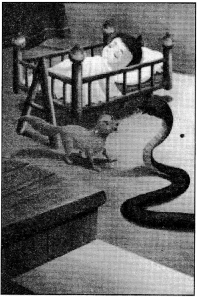
“Look after my son, while I am away,” Prince Llewellyn simply said and left for his hunt. Not long after, the hound’s fine nostrils quivered. He could catch the scent of an enemy. Indeed, there was a wolf nosing in at the doorway. Gelert, quick as lightning, leapt at the beast and the next moment the two were locked in a life and death struggle. The baby went on sleeping peacefully, unaware of any danger. But the two creatures fought savagely, Gelert to protect the infant and the wolf to devour it, for it was ravenously hungry after days of futile roaming in the hills and forests.
As they fought, blood splattered all over the walls and floor, and the wolf, getting nearer the scent of its intended prey, pushed the brave dog closer to the cradle. Panting furiously, the wolf thrust Gelert right at its base and overturned it, splattering the baby’s coverlets with blood in the process. Miraculously, the baby continued to sleep soundly, ignorant of the mortal danger it was in. But Gelert, now sensing the imminent danger to his ward, fought back, drove his opponent to the opposite corner and Csank his teeth into the wolf’s throat.
With a last dying snarl, the wolf fell back and drew its last breath. The faithful Gelert lay down, triumphant but exhausted, next to the sleeping child, now untidily covered by blood-stained blankets and coverlets. About half an hour later, Prince Llewellyn returned from his hunt and Gelert dragged himself to his feet and went to meet him. The prince was horrified at the sight that met his eyes, but most of all by the blood on Gelert’s mouth and feet. He drew his sword and in a moment of blind fury he plunged it into the heart of his faithful hound.
The dog (gave a piteous and puzzled) look at his beloved master and sank back dead with a final wailing breath. The prince heard a lusty cry from the direction of the cradle. He picked up the child and found it safe and sound. His eye then fell on the torn and bloody carcass of the wolf in the corner. In a flash, everything became clear. The prince’s grief was beyond control and for many years he could not erase the memory of that awful day from his guilty mind. Thereafter, he erected a tomb – To the Memory of a Brave Dog.
Questions
1. Why did Gelert leap at the wolf?
2. What does the word “prey” in refer to?
3. Why was it a miracle for the baby to be able to continue sleeping soundly?
4. Which word in the passage has the same meaning as the phrase ‘swallow voraciously’?
5. How was the wolf killed eventually?
Answer:
1. He wanted to prevent the wolf from going near the baby.
2. It refers to the sleeping baby
3. The fight between the dog and wolf was noisy yet the baby was unaware of what was happening.
4. The word is “devour”
5. Gelert sank his teeth into the wolfs throat Unseen
Unseen Passage 9 for Class 6 CBSE
The natural life span of a domesticated horse is about 25–30 years, 10 years down from what it was in the wild. You can tell a horse’s age from the number of teeth he has, They get all their teeth by the age of 5, after which those teeth just get longer. Horses have close to 360 degree all round vision.
The only place they cannot see is directly behind or right in front of them, which is why it’s dangerous to stand behind a horse. If they feel something behind them, they may kick first and ask questions later! It also means that they cannot see a jump once they are about four feet from it, and have to rely on memory as to its height and shape! Each of the horse’s two eyes works independently wherever a horse’s ear point is where the horse is looking.
A horse is able to sleep standing up as he is able to lock his leg muscles so that he doesn’t fall asleep. Nor do all horses in the same field ever lie down at once-one animal always stands “on look out” duty.
Questions
1. What is the life span of a wild horse?
2. Why do the horse owners cover their horse’s eyes with blinkers?
3. What prevents a horse from falling while asleep?
4. (a) They get all their teeth by the age of five. (Pick out the prepositions)
(b) If they feel something behind them they may kick. (Rewrite using ‘unless)
5. How have horses helped man through the ages?
Answer:
1. The life span of a wild horse is about 35 – 40 years.
2. The horse owners cover their horse’s eyes with blinkers since the horses have a 360 degree vision and the blinkers limit their vision only to the road ahead.
3. A horse is able to sleep standing up as he is able to lock his leg muscles so that he doesn’t fall while asleep.
4. (a) of, by- preposition
(b) Unless they feel something behind them, they may not kick.
5. The earliest mode of transport was a chariot drawn by a horse. Ever since then horses have helped man in transport. They have also played a major role in migration when there were no vehicles. Even in wars, horses were preferred to elephants due do their agility and swiftness. Though in modern times the Depend ability on horses for transport has reduced, horses are still in use for the sake of entertainment e.g. horse racing, polo.
Unseen Passage 10 for Class 6 CBSE
He was a funny-looking man with a high, bald, dome-shaped head, a face very small in comparison, a round upturned nose and a long wavy beard that didn’t seem to belong to such a perky face. His ugliness was a standing joke among his friends and he helped them to enjoy the joke. He was a poor man and something of an idler – a stone-cutter by trade, a sort of semi-skilled sculptor. But he didn’t work anymore than was necessary to keep his wife and three boys alive. He preferred to talk.
And since his wife was a complaining woman who used her tongue as an irate wagon driver uses a horse-whip, he loved above all things to be away from home. He would get up before dawn, eat a hasty breakfast of bread dipped in wine, slip on a tunic and throw a coarse mantle over it, and be off in search of a shop, or a temple, or a friends’ house, or the public baths, or perhaps just a familiar street corner, where he could get into an argument. The whole city he lived in was seething with argumentation. The city was Athens, and the man we are talking about was Socrates.
Questions
1. What was Socrates’ profession?
2. Where would Socrates go to get into an argument?
3. What evoked a sense of joy in the people?
4. (a) Fill in the blank with a modal auxiliary ‘indicating habitual past’: He……………….. get up before dawn.
(b) He was a funny-looking man. .
(Rewrite as an exclamatory sentence)
5. Have you met people who are argumentive or funny-looking? Where?
Answer:
1. Socrates was a stone cutter and a semi-skilled sculptor by profession. .
2. Socrates would go to a shop, temple, a friend’s house, a public bath or a street corner to get into an argument. .
3. Joking on Socrates’ ugliness evoked a sense of joy in the people.
4. (a) He used to get up before dawn.
(b) What a funny-looking man he was!
5. Yes, I have met argumentative people on train or bus
Unseen Passage 11 for Class 6 CBSE
One warm afternoon, Mrs. Siva wanted to make some cold drinks for her family. She asked her son, Kumar, to go to the nearby shop to buy a big packet of ice.
On his way back from the shop, Kumar spotted a newly-built playground in his neighborhood. He saw many children playing on the slides, swings and merry-go-round. They were having a wonderful time. Kumar told himself that he would stay for only a short while. He put the plastic bag full of ice on a bench and joined the other children. However, he began to enjoy himself so much that he soon forgot about everything else.
When Kumar finally decided that he was ready to go home, he was surprised to find that the bag of ice was no longer on the bench. Instead, there was a bag of water. “Someone has stolen my ice!” Kumar exclaimed. “He took my ice and left some water in the plastic bag!”
Questions
1. What did Mrs. Siva ask Kumar to buy?
2. When did Kumar see the playground?
3. Why was Kumar at the playground for a long time?
4. What happened to the bag of ice?
5. Which word in the passage has the same meaning as ‘noticed?
Answer:
1. Mrs. Siva asked Kumar to buy a big packet of ice
2. Kumar saw the playground on his way back to the shop
3. He was enjoying himself.
4. The bag of ice melted.
5. The word is “spotted”
Unseen Passage 12 for Class 6 CBSE
“The Judge and the Thief “There was once a man, Hassan, who kept all his money in a box under his bed. One day, he discovered his money was missing. He asked the judge for help.”Your Honour,” he said, “someone has stolen my money. There are many people living in my house but I do not know who is guilty.”The judge said, “Call all your housemates here and I shall find out who the thief is.” When all of Hassan’s housemates appeared, the judge said, “I have some magic sticks of the same length. All of you will be given one stick. Bring the sticks back to me tomorrow morning.
Only the thief’s stick will grow longer by 5 cm.” Frightened, the thief tried to think of a way to cover up his theft. Finally, he found a solution – he cut the sticker shorter by exactly 5 cm. “When my stick grows in the night, it will be the same length as the others,” he thought, proud of his brilliant plan. The next morning, when everyone gathered in front of the judge, the length of sticks in their hands remained the same – except the thiefs! His was shorter by 5 cm. The judge pointed to him and declared, “It’s you who have stolen the money!”.
Questions
1. Where did Hassan keep his money?
2. Who does “Your Honour” refer to?
3. What would happen to the thief’s magic stick according to the judge?
4. Why did the thief cut his magic stick?
5. Which word in the passage means “clever”? Answer:
1. Hassan kept his money in a box under his bed
2. “Your Honour” refers to the judge
3. The thief’s magic stick would grow longer by 5 cm.
4. The thief cut his magic stick because he thought it would grow longer by 5 cm.
5. The word is “brilliant”. .
Unseen Passage 13 for Class 6 CBSE
The wishes were expressed in a variety of forms – in the red and glit lettering on the banner in the background of the Hotel Grande’s Orchid Room, in the loud chorus of the birthday guests as they crowded round to see the boy and on the cake itself. As the cameras popped, Angela and Boon walked up to kiss their son, their pride on each cheek. The boy looked down self-consciously, blushing, but there was no doubt he relished being the focus of attention in the large crowded room. “I must congratulate you, Mrs. Toh,” said Mark’s class teacher who, together with the Principal, the Vice principal and a number of his favourite teachers, had been invited for the occasion.
“Mark has been doing very well. I’m entering him for the National Speech contest, the biggest event for schools this year. Mark reads so well, he has so much confidence.” “Thank you, thank you. Mark would never have done so well without the help and guidance of his teachers,” said Angela. Three or four times, when a friend or relative remarked on the magnificence of the affair, Angela has occasion to say, with an apologetic laugh, “Really, Boon and I never intended anything like this.
Our place is too small for all the teachers and friends he wants to invite. When the new house is ready, we’ll have a much bigger garden and there’ll be a special barbeque pit. Right now, there’s just no space. But we’ve told Mark, “That’s all! No more birthdays like this! Daddy and Mummy can’t afford more of this!“ The children were hustled into another room for the magic show. Mark had indicated, in the course of planning the celebrations, that he did not want anything childish.
He had been to children’s parties where there were magic shows with half-baked magicians who did silly tricks, spoke broken English and resorted to all sorts of cheap antics to make the children laugh. The magician for his birthday was different. He was professional and almost as good as the magicians Mark had seen in some television shows.
Questions
1. Where was the birthday held?
2. How were the birthday wishes expressed?
3. Mark was slightly embarrassed by his parents’ attention. Which word tells you so?
4. According to the writer, what were the two qualities Mark had that made him suitable for the National Speech contest?
5. Why do you think Angela invited Mark’s teachers to the party?
Answer:
1. It was held in Hotel Grande’s Orchid Room.
2. They were expressed in the red and gilt lettering on the banner in the loud chorus of the birthday guests and on the cake itself.
3. It is “blushing”.
4. He read very well and had a lot of confidence.
5. They were Mark’s favorite teachers so Mark asked his mother, Angela, to invite them to his party.