Class 6 History Chapter 12 Extra Questions and Answers Buildings, Paintings, and Books

The Earth in the Solar System Class 6 History Chapter 12 Extra Questions and Answers Social Science CBSE Pdf free download are part of Extra Questions for Class 6 Social Science. Here we have given NCERT Extra Questions for Class 6 Social Science SST History Chapter 12 The Earth in the Solar System.

You can also practice NCERT Solutions for Class 6 History Chapter 12 Questions and Answers on LearnInsta.com.

Class 6 History Chapter 12 Extra Questions and Answers Buildings, Paintings, and Books

Buildings, Paintings, and Books Class 6 Extra Questions and Answer History Chapter 12 Very Short Answers Type

Question 1.
Why was Amaravati famous?
Answer:
Amaravati was famous because it is a place where a magnificent stupa once existed.

Question 2.
Where is Sanchi stupa situated?
Answer:
In Madhya Pradesh.

Question 3.
When was Sanchi stupa made?
Answer:
Probably it was made during the Ashoka period.

Question 4.
What do you know about ‘pradakshina patha’?
Answer:
Around the stupa, the path was known as the ‘pradakshina patha’. Devotees walked around the stupa in a clockwise direction, as a mark of devotion.

Question 5.
Name the two Tamil epics?
Answer:
Silappadikaram and Manimekalai are two famous epics.

Question 6.
Who wrote Silappadikaram?
Answer:
Ilango was the writer of Silappadikaram.

Question 7.
Who composed Manimekalai?
Answer:
Manimekalai epic was composed by Sattanar.

Question 8.
Who were the deities worshipped during the period?
Answer:
Deities such as Vishnu, Shiva and Durga were worshipped.

Question 9.
Who spent the money for temples and stupas?
Answer:
Most probably, the King or Queen spent the money for temples and stupas.

Question 10.
Who made Iron Pillar and when?
Answer:
Iron Pillar was made by Chandra who probably belonged to the Gupta Dynasty. It was made about 1500 years ago in Delhi.

Question 11.
What is the most amazing feature of Iron Pillar?
Answer:
The most amazing feature of Iron Pillar is that it has not rusted in all these years.

Question 12.
What do you mean by word ‘stupa’?
Answer:
Stupa means a mound.

Question 13.
Why do the devotees move into clockwise direction?
Answer:
The devotees move into clockwise direction to show their devotion.

Question 14.
Why was Amravati famous?
Answer:
Amravati was famous because there were magnificent stupas.

Question 15.
Which deities were worshipped in the earliest temples of Hindus?
Answer:
Vishnu, Shiva and Durga were worshipped in the earliest temples of Hindus.

Question 16.
What do you mean by garbhagriha of temples?
Answer:
The main or central place of temples is called garbhagriha where image of deity is placed for worship.

Question 17.
What do you mean by ‘shikhara’of temples ?
Answer:
A tower built on the top of the garbhagriha of temple. This tower is called shikhara. This indicates about a sacred place.

Question 18.
Who wrote the original ‘Ramayana’?
Answer:
Ramayana was composed by Valmiki. This was in Sanskrit language.

Question 19.
What are the differences between the Vedas and the Puranas?
Answer:
Women and Shudras were not allowed to read the Vedas but the Puranas could be read by all.

Question 20.
Give the name of book written by Aryabhata.
Answer:
The book named Aryabhatiyam was written by Aryabhata.

Question 21.
Who invented ‘zero’ in mathematics?
Answer:
‘Zero’ was invented by Aryabhata.

Question 22.
By whom was firstly the symbol of zero adopted?
Answer:
It was adopted by Arabs and then spread to Europe.

Question 23.
Who invented paper and when?
Answer:
Paper was invented in China by Cai Lun about 1900 years ago.

Question 24.
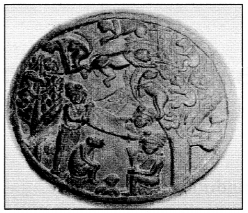
Where is the story of the monkey king shown?
Answer:
This story is shown on a piece of sculpture found from a stupa at Bharhut in central India.

Buildings, Paintings, and Books Class 6 Extra Questions and Answer History Chapter 12 Short Answers Type

Question 1.
Describe about the iron pillar situated at Mehrauli.
Answer:
The iron pillar is in Mehrauli, Delhi and is a remarkable example of the skill of Indian crafts persons. It is made of iron, 7.2. m high, and weighs over 3 tonnes. It was made about 1500 years ago. There is an inscription on the pillar mentioning a ruler named Chandra who probably belonged to the Gupta Dynasty. The pillar has not rusted in all these years.

Question 2.
What did the small box placed at the centre of the stupa contain?
Answer:
This may contain bodily remains such as teeth, bones or ashes of the Buddha or his followers, or things they used, as well as precious stones and coins.

Question 3.
What is pradakshina patha?
Answer:
A path was laid around the stupa known as the pradakshina patha. This was surrounded with railings. Entrance of the path was through gateways.

Question 4.
Why is Ajanta famous?
Answer:
Ajanta is famous because there are several caves which were hollowed out of the hills. Most of these were monasteries for Buddhist monks. Some of them were decorated with paintings.

Question 5.
What are the main features of Ajanta paintings?
Answer:
The main features of Ajanta paintings Eire as follows:

  1. Ajanta is a place where several caves and paintings were found, which are world-famous.
  2. The caves are dark inside and therefore, probably the work of making the paintings was done in the light of torches.
  3. The colours were made of plants and minerals.
  4. The colours are still glowing even after 1500 years.

Question 6.
Write a short note on Meghaduta composed by Kalidasa.
Answer:
Kalidasa’s Meghaduta is one the best poems that is famous from centuries. It was written in Sanskrit and is the best literary creation. Kalidasa was working in the Gupta regime and therefore, much possibilities that it might have been composed during the period.

In this poem, the monsoon cloud is imagined to be a messenger between lovers who are separated from one another. He stated a description of monsoon in the poem, where clouds, breeze, fragrance in the air have been described.

Buildings, Paintings, and Books Class 6 Extra Questions and Answer History Chapter 12 Long Answers Type

Question 1.
Write a short note on the epic named Silappadikaram.
Answer:
The epic Silappadikaram was composed by a poet named Ilango. This is a Tamil epic and was composed around 1800 years ago. It is a story of a merchant named Kovalan, who lived in Puhar and fell in love with a courtesan named Madhavi. He ignored his wife Kannagi.

Later, he and Kannagi who was his wife, left Puhar and went to Madurai, where he was wrongly accused of theft by the court jeweller of the Pandya king. The king sentenced Kovalan to death. Kannagi, who still loved him, was full of grief and anger at this injustice, and destroyed the entire city of Madurai.

Question 2.
Write a short note on stupa.
Answer:
Stupa means a mound. There are several kinds of stupas-round and tall, big and small. But these have certain common features, generally there is a small box which is known as ‘relic casket’ and placed at the centre or heart of the stupa. This may contain bodily remains such as teeth, bone or ashes of the Buddha or his followers or things they used, as well as precious stones and coins.

Around the stupa, the path is known as the ‘pradakshina patha’. Devotees walked around the stupa in a clockwise direction, as a mark of devotion. Amaravati was a place where a magnificent stupa once existed.

Question 3.
What are common features in various stupas?
Answer:
Common features in stupas are:

  1. Generally there is a small box which is known as ‘relic casket’ and placed at the centre or heart of the stupa. This may contain bodily remains such as teeth, bone or ashes of the Buddha or his followers or things they used, as well as precious stones and coins.
  2. Around the stupa the path is known as the ‘pradakshina patha’ and is found in most of stupas.

Question 4.
Write a short note on paper production and its uses.
Answer:
The use of paper has become an integral part of our life. It was invented in China about 1900 years ago. Cai Lun is the man who invented paper. As a process, plants and their bark are dripped in the water, then beaten or pressed, drained and pulp is dried to create paper. Paper is used in many activities of daily life which can be summarized as:

  1. Reading: All books, magazines, periodicals, newspapers, publicity materials are in form of paper etc.
  2. Writing: Copies, registers, entry books, log books, note pads, note slips, diary, letter heads, noting etc.
  3. Packaging: Making of the different type of cartons etc.
  4. Making decorative items: such as flowers, bouquets etc.
  5. Playing items: Printed ludo, chess, kite etc.
  6. Hygienic items: Such as tissue papers, napkins etc.

Question 5.
How do we know about the story of the monkey king? Describe.
Answer:
This story is shown on a piece of sculpture found from a stupa at Bharhut in Central India. This piece of sculpture tells an interesting story. Once upon a time, there was a great monkey king, who lived on the banks of the Ganga in Himalayas. Monkey king had 80,000 followers. They fed on the fruits of a special mango tree, which were very sweet. One day a mango fell into the river and reached to Varanasi.

In Varanasi this mango is found by the king, when he was bathing. He gave order to the court men that they find out about the tree. At night, the king discovered that the monkeys were also feasting on the fruit, and decided to kill them. On the other hand, king of the monkeys worked out a plan to save his followers. And ultimately he got success in saving his followers but monkey king fell down and died. The king of Varanasi mourned his death and paid him full respect.

Picture Based Questions Class 6 History Chapter 12 Buildings, Paintings, and Books

Question 1.
Look the picture given below and answer the questions:
(i) Give the name.
(ii) Where is located?
(iii) Who built it?
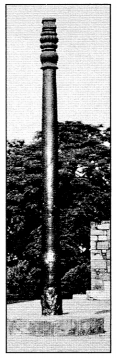
Class 6 History Chapter 12 Extra Questions and Answers Buildings, Paintings, and Books 1
Answer:
(i) Iron Pillar
(ii) Mehrauli, Delhi
(iii) Chandra, a ruler of the Gupta Dynasty.

Question 2.
Look at the picture given below and answer the questions:
(i) Where is this piece of sculpture found?
(ii) Give the tittle of the story made on it.
(iii) What do we learn from this story?
Class 6 History Chapter 12 Extra Questions and Answers Buildings, Paintings, and Books 2
Answer:
(i) This picture is found in a stupa situated at Bharhut.
(ii) The tittle of the story is “The story of the monkey king”.
(iii) This story teaches us that a king should protect and save its people in all the circumstances even at the cost of his own life.

Map-Based Questions Class 6 History Chapter 12 Buildings, Paintings, and Books

Question 1.
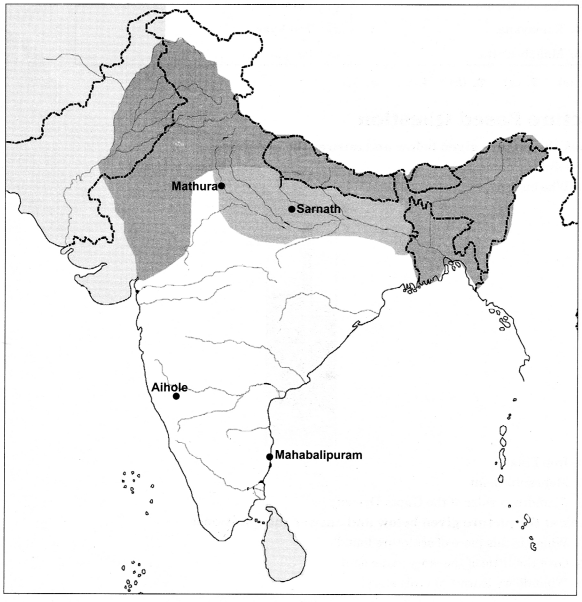
Find following places in map.
(a) Sarnath
(b) Mathura
(c) Mahabalipuram
(d) Aihole
Answer:
Class 6 History Chapter 12 Extra Questions and Answers Buildings, Paintings, and Books 3

Class 7 History Chapter 5 Extra Questions and Answers Rulers and Buildings

Rulers and Buildings Class 7 History Chapter 5 Extra Questions and Answers Social Science CBSE Pdf free download are part of Extra Questions for Class 7 Social Science. Here we have given NCERT Extra Questions for Class 7 Social Science SST History Chapter 5 Rulers and Buildings.

You can also practice NCERT Solutions for Class 7 History Chapter 5 Questions and Answers on LearnInsta.com.

Class 7 History Chapter 5 Extra Questions and Answers Rulers and Buildings

Rulers and Buildings Class 7 Extra Questions and Answer History Chapter 5 Very Short Answers Type

Question 1.
Who made Qutb Minar?
Answer:
Qutb Minar was made by Qutbuddin Aybak.

Question 2.
How many storeys are in Qutb Minar?
Answer:
Qutb Minar has five storeys.

Question 3.
After first floor, by whom was Qutb Minar extended?
Answer:
The first floor was constructed by Qutbuddin Aybak and the rest by Iltutmish around in 1229.

Question 4.
Who repairs Qutb Minar later?
Answer:
Qutb Minar was repaired by Alauddin Khalji, Muhammed Tughluq, Firuz Shah Tughluq and Ibahim Lodi.

Question 5.
Describe the pattern, designs of Qutb Minar?
Answer:
The pattern was created under the balcony by the small arches and geometrical designs. The surface of the ‘minar’ is curved and angular.

Question 6.
When did Mansions come into existence first?
Answer:
Mansions (havelis) have survived only from the 18th century.

Question 7.
What was a Shikhara?
Answer:
Shikhara was the top most portion of the shrine.

Question 8.
Name of temple whose shikhara was the tallest during the period.
Answer:
The Rajarajeshvara temple at Thanjavur (Tamil Nadu) had the tallest shikhara amongst temples of its time.

Question 9.
Why were temples and mosques beautifully constructed?
Answer:
Temples and mosques were beautifully constructed because they were places of worship and also meant to demonstrate the power, wealth and devotion of the patron.

Question 10.
Who constructed the largest temples?
Answer:
The largest temples were constructed by kings.

Question 11.
How did the sultans describe themselves instead of claiming to be incarnation of God?
Answer:
Muslim Sultans and Badshahs did not claim to be incarnations of god but described themselves as the “Shadow of God”.

Question 12.
What do you understand about the word ‘abad’, ‘abadi’ and ‘ah’?
Answer:
The Persian terms ‘abad’, populated, prosperous and abadi, flourishing are both derived from the word ab, meaning water.

Rulers and Buildings Class 7 Extra Questions and Answer History Chapter 5 Short Answers Type

Question 1.
How many types of structures made between the 8th and the 18th centuries by the Kings? Answer:
Between the 8th and the 18th centuries kings and their officers built two kinds of structures. These are
(i) forts, palaces, garden residence and safe, protected and grandiose places of rest called tombs.
(ii) for public activity including temples, mosques, tanks, wells, caravanserais and bazaars.

Question 2.
Write about the Kandariya Mahadeva temple.
Answer:
The Kandariya Mahadeva temple dedicated to Shiva was constructed in 999 by the king Dhangadeva of the Chandela dynasty. This was the place for ritual worship where only the king, his immediate family and priests gathered.

Question 3.
Write about Khajuraho Temples?
Answer:
The Khajuraho (Madhya Pradesh) complex contained royal temples where commoners were not allowed entry. The temples were decorated with elaborately carved sculptures. Most Khajuraho temples were built between 950 and 1050 by the Chandela dynasty.

Question 4.
What are two technological and stylistic developments in the constructions found from the 12th century?
Answer:
From the 12th century two technological and stylistic developments are noticeable-

  1. The weight of the superstructure above the doors and windows was sometimes carried by arches. This architectural form was called “arcuate” and
  2. Limestone cement was increasingly used in construction. This was very high-quality cement.

Question 5.
Give the name of temple built by Rajarajadeva.
Answer:
Rajarajeshvara temple was built by King Rajarajadeva for the worship of his god, Rajarajeshvaram. The names of Raja and the temple are similar, because the king took the god’s name as it was auspicious and he wanted to appear like a god. Through the rituals of worship in the temple one god hounoured to the another god.

Question 6.
What was described about Alauddin in the inscription laid in the Quwwat-al-Islam mosque? Answer:
An inscription in the Quwwat al-Islam mosque explained that God chose Alauddin as a king because he had the qualities of Moses and Solomon, the great lawgivers of the past. The greatest lawgiver and architect was God himself. He created the world out of chaos and introduced order and symmetry.

Question 7.
What was the work of Sultan Iltutmish for which he was highly praised and won universal respect?
Answer:
Sultan Iltutmish made precious water available by constructing tanks and reservoirs and was highly praised. Sultan Iltutmish won universal respect for constructing a large reservoir just outside Hauz-i- Sutani or the “King’s Reservoir”.

Rulers and Buildings Class 7 Extra Questions and Answer History Chapter 5 Long Answers Type

Question 1.
Why did the Kinks make structures?
Answer:
Kings were making structures for their use and comfort and hoped to win their praise. Construction activity was also carried out by others, including merchants. Akbar built Agra Fort for providing work to the labours. Agra Fort required 2,000 stone-cutters, 2000 cement and lime-makers and 8,000 labourers.

As each new dynasty came to power, kings wanted to emphasize their moral right to be rulers. Constructing places of worship provided rulers with the chance to proclaim their close relationship with God, especially important in an age of rapid political change. Rulers also offered patronage to, the learned and pious, and tried to transform their capitals and cities into great cultural centres that brought fame to their rule and their realm.

Question 2.
Why were temples destroyed? Describe in detail.
Answer:
Kings built temples to demonstrate their devotion to God and their power and wealth. Hence, when they attacked one another’s kingdoms they often targeted these buildings. In the early 19th century when the Pandyan king Shrimara Shrivallabha invaded Sri Lanka and defeated the King, he removed all the valuables, the statue of the Buddha made entirely of gold in the Jewel Place, golden images in the various monasteries etc.

Similarly, Chola king Rajendra-I built a Shiva temple in his capital and filled it with prized statues seized from defeated rulers which included a Sun-pedestal from Chalukyas, a Ganesha statue and several statues of Durga, a Nandi statue, an image of Bhairava and Bhairavi from the Kalingas of Orissa, and a Kali statue from the Palas of Bengal.

Sultan Mahmud of Ghazni was a contemporary of Rajendra-I. He attacked the temples and looted their wealth and idols especially from Somnath temple.

Question 3.
Write about the personal activities of the Mughal Kings.
Answer:
Babur, Humayun, Akbar, Jahangir and especially Shah Jahan were personally interested in literature, art and architecture.

Babur described his interest in planning and laying out formal gardens which were called Chahar bagh because of their symmetrical division into quarters. Some of the most beautiful Chahar baghs were constructed by Jahangir and Shah Jahan in Kashmir, Agra and Delhi.

Akbar’s architecture turned to the tombs of his Central Asian ancestor, Timur. The central towering dome and the tall gateway became important aspects of Mughal architecture, first visible in Humayun’s tomb.

The tomb was placed in the centre of a huge formal Chahar bagh and built in the tradition known as “eight paradises” or hasht bihisht- a central hall surrounded by eight rooms. The building was constructed with red sandstone, edged with white marble.

During Shah Jahan’s reign the historians witness huge amount of construction activity especially in Agra and Delhi. The ceremonial halls of public and private audience (diwan-i khas or am) were carefully planned. Shah Jahan’s audience halls were specially constructed to resemble a mosque. He built world famous, Taj Mahal, Agra, Lai Qila and Jama Masjid in Delhi.

Class 7 CIvics Chapter 4 Extra Questions and Answers Growing Up as Boys and Girls

Growing Up as Boys and Girls Class 7 Civics Chapter 4 Extra Questions and Answers Social Science CBSE Pdf free download are part of Extra Questions for Class 7 Social Science. Here we have given NCERT Extra Questions for Class 7 Social Science SST Civics Chapter 4 Growing Up as Boys and Girls.

You can also practice NCERT Solutions for Class 7 Civics Chapter 4 Questions and Answers on LearnInsta.com.

Class 7 Civics Chapter 4 Extra Questions and Answers Growing Up as Boys and Girls

Growing Up as Boys and Girls Class 7 Extra Questions and Answer Civics Chapter 4 Very Short Answers Type

Question 1.
Who teaches us to act as a boy or girl?
Answer:
The societies in which we grow up teach us about kind of behaviour which is acceptable for girls and boys.

Question 2.
Who differentiate the works for boys and girls?
Answer:
Society in which we grow up differentiates the works for boys and girls.

Question 3.
Where is Samoan Island situated?
Answer:
Samoan Islands is a part of southern Pacific Ocean.

Question 4.
What was happening in the Samoan Islands in the year around 1920?
Answer:
The children of Samoan society did not go to school in the 1920s.

Question 5.
Name the works which were learnt by the children.
Answer:
They learnt to take care of children or do household work, fishing, and coconut plantation.

Question 6.
Why did the girls go in groups in Madhya Pradesh?
Answer:
The girls always went in groups, perhaps because they also carried fears of being teased or attacked.

Question 7.
Why do parents give boys and girls different toys to play with?
Answer:
Parents give different toys to the boys and girls because of a thinking of discrimination on the ground of sex. They think that girls are soft and mild and are unable to do the work as boys can.

Question 8.
What do boys and girls get taught in their early childhood?
Answer:
In the childhood boys and girls are taught that the boys should be strong and girls should be mild. They will have to perform different roles in the future.

Question 9.
Where are domestic workers mainly found?
Answer:
Domestic workers are mainly found in towns and cities.

Question 10.
Which gender mostly comprises of domestic workers?
Answer:
Most domestic workers are women and sometimes these may be young boys or girls.

Question 11.
How are domestic workers being treated?
Answer:
Even these domestic workers are not treated well. They are working hard from early morning to late night. In many cases they are not permitted to eat completely.

Growing Up as Boys and Girls Class 7 Extra Questions and Answer Civics Chapter 4 Short Answers Type

Question 1.
What did girls do in Samoan Island?
Answer:
Girls had to continue looking after small children or do errands for adults till they were teenagers. Once they became teenagers they had much more freedom.

After the age of 14 or so, girls also went on fishing trips, worked in the plantations, and learnt how to weave baskets. In the cooking boys were supposed to do most of the work while girls helped with the preparations.

Question 2.
How is the distinction made between boys and girls through there playing of toys?
Answer:
A clear distinction between boys and girls can be seen from a very young age. Boys are usually given cars, gun while girls given dolls, utensils etc. to play with. It is because of telling children that they will have different futures and they have specific roles to play when they grow up to be men and women.

Question 3.
What was the idea developed by Harmeet and why?
Answer:Harmeet wanted to prove that women do lots of work within home and also have importance. Therefore, Harmeet and his mother decided to go on strike. Harmeet’s mother did nothing full day. In a single day of strike of housewife the house was a mess.

Question 4.
Why don’t the family members allow women to work outside? H.
Answer:Also in the present scenario, many families are not allowing women to work outside because they think that it will be shameful if any woman work outside in an office or in a factory. Secondly, sense of security is also a barrier whereby family members say not to work.

Growing Up as Boys and Girls Class 7 Extra Questions and Answer Civics Chapter 4 Long Answers Type

Question 1.
Why is housework still not considered as a work?
Answer:
Most of the people do not feel housework is a real work because of a thinking that the work produced in the house is worthless. The people think that in our societies housework must be undertaken by the women.

Housework involves various works such as cooking, cleaning, wash-up, care-giving to the children, elderly and sick members and these housework lie with women. The work that women do within the home is not recognized as work.

Question 2.
Name the works which are undertaken by the domestic workers.
Answer:
Housework actually involves different tasks. Many of these require heavy physical works such as to fetch water, carry heavy head-loads, lifting and carrying articles etc., and in most of the cases these tasks are undertaken by the domestic workers.

Apart from this, sweeping and cleaning, washing of clothes and dishes, cooking, looking after young children or the elders in the cities while in the rural areas domestic workers perform cattle rearing, working in the fields, carrying bags of grains etc., alongwith domestic works.

Class 7 CIvics Chapter 6 Extra Questions and Answers Understanding Media

Understanding Media Class 7 Civics Chapter 6 Extra Questions and Answers Social Science CBSE Pdf free download are part of Extra Questions for Class 7 Social Science. Here we have given NCERT Extra Questions for Class 7 Social Science SST Civics Chapter 6 Understanding Media.

You can also practice NCERT Solutions for Class 7 Civics Chapter 6 Questions and Answers on LearnInsta.com.

Class 7 Civics Chapter 6 Extra Questions and Answers Understanding Media

Understanding Media Class 7 Extra Questions and Answer Civics Chapter 6 Very Short Answers Type

Question 1.
What do you understand by the word ‘media’?
Answer:
Media is the plural from of the word ‘medium’ and it describes the various ways through which we communicate in society.

Question 2.
Name various forms of media.
Answer:
Phone, TV, radio, newspapers, magazine, periodicals, internet etc., are forms of media. Some of them may reach millions of people beyond the boundaries.

Question 3.
What does the word ‘mass media’ mean?
Answer:
When any idea is spread upto the millions of people it is called mass media.

Question 4.
What is the use of technology in the media?
Answer:
Technology is playing an important role in the media. Technology makes it possible to access everything within short span of time and at large scale.

Question 5.
What do you mean by a balanced report?
Answer:
In the balance report the media discusses all points of view and then leaves it to the readers to make up their minds.

Question 6.
How is an independent media useful for the people?
Answer:
Only an independent media can write or present a balanced report.

Question 7.
How is the changing technology useful for media?
Answer:
Changing technology or machines makes technology more modern, helps media to reach more people. It also improves the quality of sound and the images that are seen.

Question 8.
How does media manage its cost?
Answer:
The technology used by the mass media, costs a lot of money. They earn money by advertising various products of companies, programmes, schemes, tenders etc.

Understanding Media Class 7 Extra Questions and Answer Civics Chapter 6 Short Answers Type

Question 1.
Write a short note on media activities.
Answer:
In a democracy, the media plays a very important role in providing news and discussing events. Government’s programmes, policies, new laws, implementation status etc., and various issues are discussed daily on TV and Radio. Various other activities such as sports, social protest, and parliamentary discussion are also included in the daily shows of TV. Thus, media is also a means to provide information.

Question 2.
Which are issues focussed by media?
Answer:
Media focusses on the stories which are liked by the masses. Thus, such stories are presented to make this as an interesting form. Various TV serials are example of such type of presentation. Media focusses on business-related activities. Thus, many times social matters are given look importance.

Question 3.
What are two main reasons where the media does not look independent?
Answer:
The reasons are:

  • The first is the control that the government has on the media. During the Emergency, between 1975-1977, the government censored the media.
  • The second is due to the relationship of media and big businessmen who provide them large amount in the form of advertisements.

Question 4.
Why is it important for the media to be independent?
Answer:
An independent media is very important because on the basis of the information received from the various sources of media, people make an opinion. Hence, it is essential that this information should be reliable and bias-free. Otherwise, a wrong image will be made in the mind of people and this may be very harmful for the people as well as for the country.

Understanding Media Class 7 Extra Questions and Answer Civics Chapter 6 Long Answers Type

Question 1.
What is mean by independent media? Is the media independent?
Answer:
An independent media means that no one should control and influence its coverage of news. No one should tell the media what can be included and what should not be included in a news story.

The reality is that media is far from independent. This is mainly because of two reasons. The first is the control that the government has on the media. During the Emergency between 1975-1977, the government censored the media.

Despite the absence of censorship by the government, most newspapers and TV nowadays still fail to provide a balanced story. This is due to the relationship of media and big businessmen who provide them large amount in the form of advertisements.

Question 2.
How do you think TV influences us?
Answer:
TV has different types of programmes such as news, sports, cartoons, animal planet, regional channels and its programmes, entertainment programmes viz., movies, songs, bhajans, religion related programmes, Kaun Banega Crorepati, reality TV shows like Big Boss etc. About half time is given to the advertisement in between, before and after the programme.

We can choose TV channels as per our choice. Hot discussions on political and social issues are presented which also shape our attitude and help in expanding our knowledge. Thus, TV shapes our views of the world, our beliefs, attitudes and values.

Class 6 History Chapter 3 Extra Questions and Answers From Gathering to Growing Food

From Gathering to Growing Food Class 6 History Chapter 3 Extra Questions and Answers Social Science CBSE Pdf free download are part of Extra Questions for Class 6 Social Science. Here we have given NCERT Extra Questions for Class 6 Social Science SST History Chapter 3 From Gathering to Growing Food.

You can also practice NCERT Solutions for Class 6 History Chapter 3 Questions and Answers on LearnInsta.com.

Class 6 History Chapter 3 Extra Questions and Answers From Gathering to Growing Food

From Gathering to Growing Food Class 6 Extra Questions and Answer History Chapter 3 Very Short Answers Type

Question 1.
What did Neinuo like to eat?
Answer:
She liked to eat boiled rice, squash, pumpkins, beans and meat.

Question 2.
Who has grown edibles in the garden plot?
Answer:
Her grandmother had grown vegetables.

Question 3.
Where did Neinuo go on school trip?
Answer:
She went to Madhya Pradesh.

Question 4.
How was food in Madhya Pradesh?
Answer:
In Madhya Pradesh the food was hot and spicy.

Question 5.
What are the main sources of food today?
Answer:
Plants and animals are the main sources of food today.

Question 6.
Where are different type of plants and animals found?
Answer:
In different climates, different types of plants and animals are found.

Question 7.
Where can sheep and goat survive easily?
Answer:
These can survive in dry and hilly environments.

Question 8.
Why the people start to protect the plants?
Answer:
The people started protecting the plants because they could grow and the seeds could ripen.

Question 9.
How do the people attract the animals?
Answer:
The people attract the animals by leaving food for them near their shelters.

Question 10.
What was the name of the first tamed animal?
Answer:
This was a wild ancestor dog.

Question 11.
Give the name of animals who come near to the people.
Answer:
Goat, sheep and pig also.

Question 12.
When did domestication start?
Answer:
About 12,000 years ago.

Question 13.
In the development of the civilization, how domestication play an important role?
Answer:
Most of the plants and animals we use today as food are the result of domestication.

Question 14.
Give the name of earliest domesticated plants.
Answer:
Wheat and Barley were probably the earliest domesticated plants.

Question 15.
Give the name of animals which were domesticated the earliest.
Answer:
The earliest domesticated animals were sheep and goat.

Question 16.
Did the people know the ways of storing the grains?
Answer:
Yes, they knew ways of storing the grains. They learnt the art of making clay pots. These clay pots were used for storing the grains and seeds.

Question 17.
Where did we find the remains of clay pots?
Answer:
Remains of clay pots were found in ‘Mehrgarh’ presently in Pakistan.

Question 18.
How did they use animals?
Answer:
Animals were used for multipurpose. They drank animal’s milk, ate meat and skin was used for covering the body as clothing.

Question 19.
What do you understand by ‘Dug Pits’?
Answer:
‘Dug Pits’ were used as a shelter by the people. Dug Pits were made after digging the ground.

Question 20.
Apart from food, what are the other things that could have been obtained from animals?
Answer:
Animals also provided milk, skin for wearing, hard bones for the tamed dog apart from the meat.

Question 21.
Where did we find remains of green gram?
Answer:
Remains of green gram were found in Chirand (presently in Bihar).

Question 22.
Where did we find remains of black gram?
Answer:
Remains of black gram were found in Paiyampalli (presently in Andhra Pradesh).

Question 23.
Where did we find remains of buffalo and ox?
Answer:
These were found in Chirand (presently in Bihar).

Question 24.
What was found in Mehrgarh?
Answer:
In Mehrgarh, we found wheat, barley, sheep, goat and cattle.

Question 25.
Where is ‘Koldihwa’ situated in present time and remains of which items were found there?
Answer:
Koldihwa is prently situated in Uttar Pradesh. In Koldihwa, rice and fragmentary animal bones found.

Question 26.
Where is Mehrgarh situated in present time?
Answer:
‘Mehrgarh’ is presently situated in Pakistan.

Question 27.
Which type of houses were found in Burzahom?
Answer:
In Burzahom, Pit houses with steps were found.

Question 28.
What did the existence of cooking hearths refer to?
Answer:
It referred that the people used cooked food and they were aware about fire.

Question 29.
Where did we find square and rectangular houses?
Answer:
Square and rectangular houses were found in Mehrgarh.

Question 30.
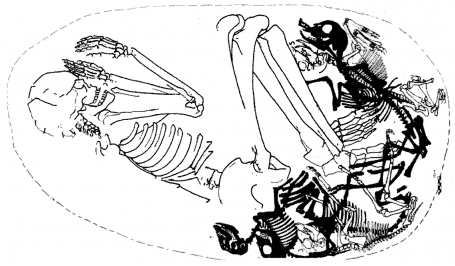
What did people do when anyone died?
Answer:
The people buried the dead person alongwith sheep and goat.

Question 31.
Where was Daojali Hading situated?
Answer:
This site was situated on the hills near the Brahmaputra valley close to routes leading into China and Myanmar.

Question 32.
Which important tools/objects were found in Daojali Hading?
Answer:
Mortars, pestles, jadeite and pottery etc., were found in Daojali Hading.

Question 33.
Give the name of stone which is probably brought from China.
Answer:
That is jadeite which has been brought from China.

From Gathering to Growing Food Class 6 Extra Questions and Answer History Chapter 3 Short Answers Type

Question 1.
What do you understand by ‘Domestication’?
Answer:
‘Domestication’ is a process in which plants and animals have been domesticated. Plants are grown and animals are reared in a suitable way. The early people selected those plants and animals that were not prone to disease.

Amongst animals, those that were relatively gentle, were selected. Likewise, plants that were relatively productive were selected. As a result, gradually, domesticated plants and animals became different from wild animals and plants.

Question 2.
What is the use of animals today?
Answer:
There are many uses of animals today. Animals are the main source of food. Milk of many animals/cattle is used. Animals also provide us leather which has now become an industrial raw material.

Various items are made up from the skin of animals which are also used as leather items such as shoes, bags, ladies purses, watches strips, belts and many more are industrial products which we are using in daily life. Apart from this, animal’s bones and its parts are used for medical purpose.

Question 3.
Which evidences are found in the subcontinent which indicated existence of farmers and herders?
Answer:
Scientists have evidence of plants and animals’ bones. Scientists identified these grains and bones of animals which clearly indicated that people grew crops and reared group of animals.

From Gathering to Growing Food Class 6 Extra Questions and Answer History Chapter 3 Long Answers Type

Question 1.
Illustrate about earlier and later levels of earth, How is this study useful for archaeologists?
Answer:
As we know that over the years, the surface of the earth is rising, because people discard waste material, and generally stay and rebuild houses in the same place. After hundred of years, this will lead to the formation of a mound.

So, when this mound is dug up, what is found from the upper layers of the mound is generally from a later time. Similarly, what is found from the lower layers of the mound is older. Archaeologists often referred to the upper and lower layers as levels. This can be understood from the picture given below:

Class 6 History Chapter 3 Extra Questions and Answers From Gathering to Growing Food 1

When digging of earth was started, evidences were found in different levels of the earth which are helpful in the matter of what things were there at one time, which items people used before and which the people used later. The first used items will also be developed later. Such a way, chain of human development is developed by the archaeologists.

Question 2.
Make a list of activities performed by Tribesmen, WA, children and both by men and women.
Answer:
On some grounds, archaeologists believed that work was done by tribesmen, women, children or women and men together. Tribes follow occupations such as hunting, gathering, farming, herding and fishing etc. Their works have been described as follows by the archaeologists:

CategoryRelated Work
WomenMost of agricultural work such as preparing ground, sowing seeds and grains, looking after the growing plants and harvesting grain. Women also thresh, husk and grind the grain.
ChildrenOften look after plants, driving away animals and birds etc.
MenTribes men usually lead large herds of animals in search of pastures. Usually men were regarded as leader. They may be old and experienced or brave warriors or priests.
Women and men combined workCleaning of animals and milking, making pots, tools, huts and basket, combined work

Question 3.
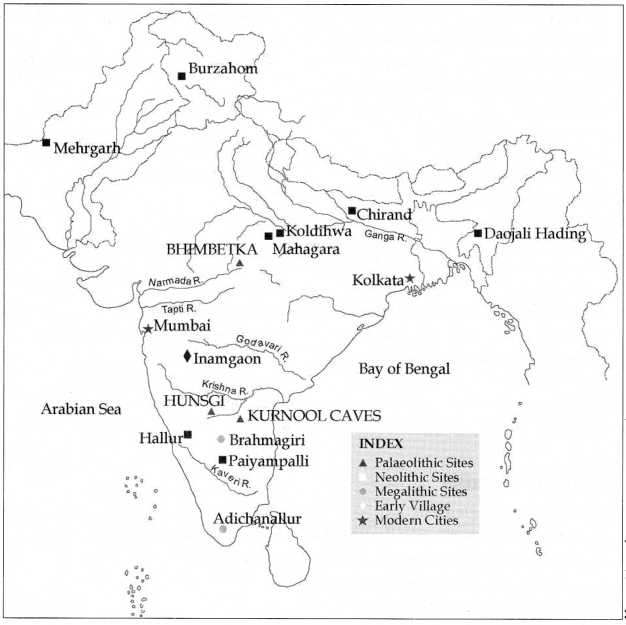
Where was evidence of early farmers and herder found? Give name of places with its present location. Can you find out places on Indian Map?
Answer:
Archaeologists have found evidence of early farmers and herders at many places all over the world. Relating to the farmers activities, remains of grains like wheat, barley, rice, lentil, millet, green and black gram have been found. And remains of animals found were sheep, goat, cattle, fragmentary animal bones, dog, goat, buffalo, ox pig etc. The places where evidence of farmers and herders were found are:

  1. Burzahom (Kashmir),
  2. Mahagara (Uttar Pradesh)
  3. Koldihwa (Uttar Pradesh)
  4. Chirand (Bihar)
  5. Mehrgarh (presently in Pakistan)
  6. Hallur (Andhra Pradesh)
  7. Paiyampalli (Andhra Pradesh).

For Map
Class 6 History Chapter 3 Extra Questions and Answers From Gathering to Growing Food 2

Picture Based Questions Class 6 History Chapter 3 From Gathering to Growing Food

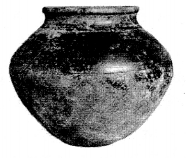
Look at the picture given below. Please state its use in earlier times and in present.
Class 6 History Chapter 3 Extra Questions and Answers From Gathering to Growing Food 3
Answer:
In the picture, a baked jar has been shown. This was prepared skillfully by mud and baked. It was earlier used to store the grains and seeds. People also used it for cooking the food.

In present time, these vessels are also used in the villages. Although the use of mud—made pots is very limited but still used in the villages. Women of the villages use this type of pot for:

(a) Boiling the milk, cooking of rice and pulses.
(b) Storing the agricultural produces.
(c) Putting money and ornaments.
(d) Storing drinking water etc.

Thus, we can see that this jar is almost having same nature of use in both the period. Only difference is that in the modern time, new objects are being used even in the villages.