Class 7 CIvics Chapter 3 Extra Questions and Answers How the State Government Works

How the State Government Works Class 7 Civics Chapter 3 Extra Questions and Answers Social Science CBSE Pdf free download are part of Extra Questions for Class 7 Social Science. Here we have given NCERT Extra Questions for Class 7 Social Science SST Civics Chapter 3 How the State Government Works.

You can also practice NCERT Solutions for Class 7 Civics Chapter 3 Questions and Answers on LearnInsta.com.

Class 7 Civics Chapter 3 Extra Questions and Answers How the State Government Works

How the State Government Works Class 7 Extra Questions and Answer Civics Chapter 3 Very Short Answers Type

Question 1.
At how many levels does the government work?
Answer:
Government works at three levels-local, state and national.

Question 2.
Who represents the people of an area?
Answer:
MLA of the area represents the people.

Question 3.
Who elects the MLAs?
Answer:
MLA (Member of the Legislative Assembly)is elected by the people of constituency.

Question 4.
On which level are Legislative Assemblies formed?
Answer:
Legislative Assemblies are formed at State level.

Question 5.
What do you understand about independent candidate?
Answer:
Independent candidates are those who contest election without support of any party.

Question 6.
What is meant by party candidate?
Answer:
Party candidates are those who contest in the elections by the parties on their symbol.

Question 7.
What does majority means?
Answer:
A political party whose MLAs win more than half the number of constituencies in a state can be said to be in a majority.

Question 8.
What do you understand about ruling party?
Answer:
Ruling party is that which makes the government.

Question 9.
How do Chief Minister and ministers get elected?
Answer:
The MLAs belonging to the ruling party elect their leader who becomes the chief minister. The chief minister then selects other people as ministers.

Question 10.
Who approve the decision of the Legislative Assembly?
Answer:
The decisions taken in the Legislative Assembly have to be approved by the members of the Legislative assembly on the basis of majority.

How the State Government Works Class 7 Extra Questions and Answer Civics Chapter 3 Short Answers Type

Question 1.
How is the government formed in the state?
Answer:
A political party whose MLAs have won more than half the number of constituencies in a state can said to be in a majority. The majority of a single party or groups of parties together
can form government.

Question 2.
What is the role of Governor in the State?
Answer:
It is responsibility of Governor to ensure ruling by the ruling party as per constitution. Apart from this, the Governor of the state appoints the chief minister and on the advice of chief minister the other ministers. The Governor is considered as a patron of the constitution.

Question 3.
What do you understand about ‘Legislative Assembly’?
Answer:
A Legislative Assembly is a place where all the MLAs meet to discuss various issues. They express their opinions and ask the questions related to the issue or give suggestions. The concern minister then replies to the questions and tries to assure the Assembly that adequate steps are being taken.

Question 4.
How does the government implement its plan?
Answer:
The government takes action through various departments like the Public Works Department (PWD), the Agriculture Department, the Health Department, the Education Department and so on. Ministers are head of these departments, who are also member of the Legislative Assembly and elected by the people.

Question 5.
How does government form committees?
Answer:
On any matter, which affect at large, government may form a committee. After looking at various aspects of the problem or issue in detail, the committee submits its report to the government. Government may adopt it as a whole or partially. Accordingly, the action is taken on report of the committee.

Question 6.
What are the key works of a government?
Answer:
The main work of the government is to implement its laws, rules, regulations and policies made in various fields. The government may amend, modify the laws, rules, regulations and policies or can make new ones, so that an effective system may run and most of the people can get the benefit of government policies.

How the State Government Works Class 7 Extra Questions and Answer Civics Chapter 3 Long Answers Type

Question 1.
What is an opposition? How does opposition play its role in the Assembly?
Answer:
All members who do not support or participate in the government is called opposition. The role of opposition party in India is as important as that of the ruling party. The role of opposition party is not to oppose every decision of the ruling party. Rather, it is the duty of the opposition party to support the ruling party for the acts that are in the interest of the nation.

Members of opposition roles can be enlisted as under:

  1. The opposition ensures that the ruling political parties have a definite programme and policy to offer to the people and who can show progressive path by action and not just by propaganda.
  2. The opposition’s role is to question the government and hold them accountable to the public.
  3. The opposition carefully watches on the activities of the government, if there is any discrimination,
  4. Concentrating on the issues that matter.

Question 2.
Briefly describe the ways through which views are expressed.
Answer:
In a democracy, there are various ways through which people express their views. Not only in the Legislative Assembly but also the TV channels, newspapers, periodicals and other organizations regularly discuss about the government functioning, policies etc.

Organization of ‘press conference’ is also a medium to express about the policies and functioning of a department or ministry of government. In a ‘press conference’ a press note is issued to the print and electronic media for the wide circulation to the mass.

Class 6 History Chapter 6 Extra Questions and Answers Kingdoms, Kings and an Early Republic

Kingdoms, Kings and an Early Republic Class 6 History Chapter 6 Extra Questions and Answers Social Science CBSE Pdf free download are part of Extra Questions for Class 6 Social Science. Here we have given NCERT Extra Questions for Class 6 Social Science SST History Chapter 6 Kingdoms, Kings and an Early Republic.

You can also practice NCERT Solutions for Class 6 History Chapter 6 Questions and Answers on LearnInsta.com.

Class 6 History Chapter 6 Extra Questions and Answers Kingdoms, Kings and an Early Republic

Kingdoms, Kings and an Early Republic Class 6 Extra Questions and Answer History Chapter 6 Very Short Answers Type

Question 1.
Who composed later Vedic books?
Answer:
Later Vedic books were composed by priests.

Question 2.
Where is Varna system described?
Ans.
Varna system is described in the Vedas.

Question 3.
In which area were social and economic differences not very sharp and influence of the priests was limited?
Answer:
In north-east, social and economic differences were not very sharp, and the influence of the priests was limited.

Question 4.
Give the name of janapadas stated by archaeologists.
Answer:
The old Janapadas are – Purana Qila (at Delhi), Hastinapur (near Meerut), Atranjikhera (near Etah, UP).

Question 5.
Give the name of the crop which was grown first time by the people.
Answer:
Sugar cane was found as a new crop in these settlements, before it, no evidences of growing sugar cane found.

Question 6.
How was e tax collected from the formers?
Answer:
It was one-sixth part of what they produced in agriculture.

Question 7.
What wa s given by herders to the king as a tax?
Ans.
Herders paid tax in form of animals and its produce.

Question 8.
What was paid by craftsman as tax?
Answer:
Tax paid by craftsman was in form of labour. They had to work for raja, one day in a month.

Question 9.
Which rivers flew through the Magadha?
Answer:
River which flew through the Magadha were the Ganga and the Son.

Question 10.
Name of two powerful rulers of Magadha?
Answer:
Bimbisara, Ajatashattu were very powerful rulers of Magadha.

Question 11.
What was the capital of Magadha?
Answer:
Rajgir (in Bihar) was the capital of Magadha for several years. Later, the capital was shifted to , Pataliputra – present day Patna.

Question 12.
What do you understand by ‘gana’?
Answer:
Gana was used for a group that had many members.

Question 13.
What do you understand by ‘Sangha’?
Answer:
Sangha was used for the organization or association.

Question 14.
What do you know about ‘Digha Nikaya’?
Answer:
‘Digha Nikaya’ is a famous Buddhist book, which contains some speeches of the Buddha.

Question 15.
Who wanted to attack on Vajjis?
Answer:
Ajatashattu wanted to attack on Vajjis.

Question 16.
Why did Ajatashattu sent his minister to the Buddha?
Answer:
Ajatashattu wanted to attack the Vajjis. He sent his minister named Vassakara to the Buddha to get his advice on the matter.

Question 17.
How many times did the assembly of Athens met in an year?
Answer:
The assembly of Athens met at least 40 times in an year.

Kingdoms, Kings and an Early Republic Class 6 Extra Questions and Answer History Chapter 6 Short Answers Type

Question 1.
Who conducted sacrifice rituals?
Answer:
In the sacrifice rituals, priests performed rituals, wives and sons performed minor ritual, other kings participated as spectators, ordinary people and Vaishyas brought gifts.

Question 2.
Who was the central figure of rituals?
Answer:
In the rituals, the raja was the central figure. He had a special seat, a throne or a tiger skin. His charioteer, who was his companion in the battle field and witnessed his adventures, chanted tale of his glory. The raja who organized the sacrifice was recognized as being very powerful, and all those who came ; brought gifts for him.

Question 3.
Where were the later Vedic books composed?
Answer:
The later Vedic books were composed in the area drained by the Ganga and the Yamuna.

Question 4.
What was described in the later Vedic Books?
Answer:
The later Vedic books described how rituals were to be performed and rules about society.

Question 5.
How many vamas have been described in the Vedas? Give the work of all.
Answer:
The Vedas described 4 vamas. These are – Brahmins, Kshatriyas, Vaishyas and Shudras. Their work are described as under:

  1. Brahmins were expected to study the Vedas, perform sacrifices and receive gifts.
  2. Kshatriyas were the rulers. They were expected to fight battles and protect people.
  3. Vaishyas were the expected to be farmers, herders and traders.
  4. Shudras were the last who had to serve the other three groups and could not perform any sacrifice. Later, they were classified untouchable.

Question 6.
What was special in pottery?
Answer:
A special pottery was found in these sites which were gray and red in colour. These grey pots had painted designs in geometric patterns. This pottery is called ‘Painted Grey Ware’.

Question 7.
Make a list of mahajanapadas of subcontinent.
Answer:
Mahajanapadas and janapadas were as under:

  1. Gandhara
  2. Kuru
  3. Panchala
  4. Kosala
  5. Magadha
  6. Vajji
  7. Anga
  8. Avanti etc.

Question 8.
What did hunters and gatherers pay to the king?
Answer:
Perhaps, they would have paid the following:

  1. Meat (edible animals)
  2. Skin (Lion, Tiger etc.)
  3. Horn (dear etc.)
  4. Herbs and shrubs (for medicine use)
  5. Honey
  6. Forest produce etc.

Question 9.
What were the major changes in the agriculture?
Answer:
There were two major changes that occurred in the agriculture.

  • Use of iron ploughshares.
  • People began transplanting paddy.

Question 10.
How were the Mahajanapadas fortified?
Answer:
Forts were built because people were afraid of attacks from other kings and needed protection. Some kings also wanted to show how rich and powerful they are by building really large, tall and impressive walls around their cities. People were also controlled easily by the kings by fortification.

Question 11.
Make a list of all those categories who would be present at the time of sacrifice.
Answer:
Craftspersons
Herders
Traders
Hunters and gatherers
Categories which have been described in terms of their occupations are:

  1. Brahmins
  2. Kshatriyas
  3. Vaishyas
  4. Shudras

Kingdoms, Kings and an Early Republic Class 6 Extra Questions and Answer History Chapter 6 Long Answers Type

Question 1.
What was the purpose of ashvamedha and how was it organized?
Answer:
Ashvamedha was a ritual for choosing the raja. In Ashvamedha, a horse was let loose to wander freely and it was guarded by the raja’s men. If the horse enterred into the kingdoms of other rajas and they stopped it, they had to fight. If they allowed the horse to pass, it meant that they accepted that the raja who wanted to perform the sacrifice was stronger than them. These rajas were then invited to the sacrifice, which was performed by specially trained priests. The raja who organized the sacrifice was recognized as being very powerful, and all those who came brought gifts for him.

Question 2.
Why did people oppose the system of vamas and untouchability?
Answer:
Many people did not accept the system of vama laid down by the Brahmins. Kings felt superior to the priests. Others felt that birth, occupation must not be a basis for deciding good or bad. Some felt that everybody should have right to perform rituals.

Others, condemned the practice of untouchability. There were many areas in the subcontinent, such as the north-east, where social and economic differences were not very sharp, and where the influences of the priests was limited.

Varna system was affecting the downtrodden or marginalized people. They had no rights even to entry in the temples, to perform the worship, to drink water from wells, to create habitation nearby to the other people of society, they were also not allowed to touch any article of other vamas etc. All these are some reasons for which varna, as well as untouchability system, was opposed.

Further, our constitution has also made rules to prevent the untouchability in the society in any way under the fundamental rights. Thus, now in India, untouchability is totally prohibited.

Question 3.
List two ways in which the rajas of the mahajanapadas were different from those mentioned in the Rigveda.
Answer:
Rajas of the mahajanapadas were different from those mentioned in the Rigveda; The two ways are:

  1. The new rajas now began maintaining armies. Soldiers were paid regular salaries and were maintained by the king throughout the year;
  2. Fortification of the mahajanapadas and
  3. They started collecting regular taxes.

Question 4.
Why were changes in agriculture encouraged by the king?
Answer:
He would have wanted to produce much more from the agriculture, because they had own armies, needed food arrangement at the time of offering, organizing other gatherings etc., all needed food and grains. Apart from this, perhaps population would have increased which also required food. It may be possible that he thought agriculture can make the kingdoms prosperous.

Question 5.
State about taxes imposed on the groups of people.
Answer:
Raja imposed taxes on all groups of people. The taxes were collected as under:

  1. Tax on crops was begun, that was l/6th part of what was produced. This tax was called ‘bhaga’.
  2. Taxes on craftspersons in the form of labour. They had to work for a day in every month for the king.
  3. Herders also paid taxes in form of animals and animals produces.
  4. There were also taxes on goods that were bought and sold through trade.
  5. Hunters and gatherers also had to provide forest produces as tax.

Question 6.
How were forests and rivers important for the Magadha? Describe.
Answer:
Forests and rivers were very important for the Magadha Mahajanapada. Due to the forested area, elephants, which lived in forest, could be captured and trained for armies. Forests also provided wood for building houses, carts and chariots. Similarly, Magadha emphasised on agriculture and new tools were developed with the help of wood and iron.

Agriculture needs timely water supply in the fields for irrigation pin-pose. The rivers such as the Ganga and the Son of this area played an important role in fertility of the land. In these ways, both forests and rivers were important for the Magadha.

Question 7.
Where did Alexander live? Why did he not attack on Magadha?
Answer:
Alexander lived in Macedonia in Europe. He wanted to conquer the world. He reached upto the bank of Beas. When he wanted to march the further towards east, his soldiers refused because they heard about the India’s Kings and their armies, chariots and elephants. Thus, he could not become successful in his plan to conquer the Magadha and other Mahajanapadas.

Question 8.
What do you understand about Athens cilivization which existed around 2500 years ago? Do you think this was a true democracy?
Answer:
Around 2500 years ago, the people of Athens set up a form of government which was called democracy which lasted for about 200 years. All the men over the age of 30 years were recognized as full citizens. All citizens could attend these meetings of assembly that met at least 40 times in an year. Positions were made through lottery.

Citizens were expected to serve in the army and the navy. However, women were not considered citizens. Foreigners, who lived and worked in Athens did not have rights as citizens. There were several thousand slaves in Athens, who worked in mines, fields, households and workshops and they were not treated as citizens.

Athens civilization, which was around 2500 years ago does not seem a true democracy because there was no right for women and slaves and they were not allowed to participate in the assembly. On the other hand, men, farmers, artisans had been given the rights of democracy. Whereas, in a democracy the rights are provided without any discrimination on the ground of sex and work. However, we can say, that this was the beginning of democracy.

Map-Based Questions Class 6 History Chapter 6 Kingdoms, Kings and an Early Republic – colour

Question 1.
Find out janapadas and mahajanapadas on Indian map?
Answer:
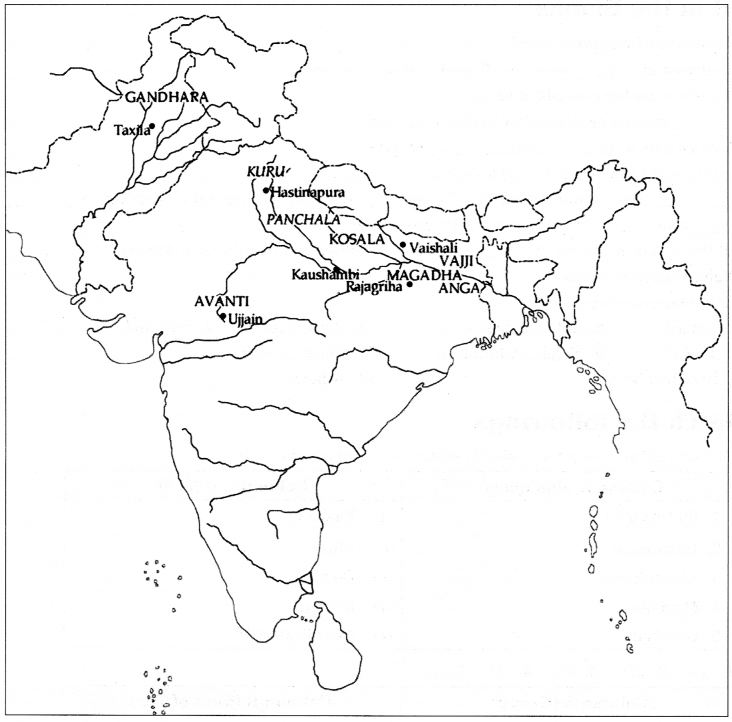
Class 6 History Chapter 6 Extra Questions and Answers Kingdoms, Kings and an Early Republic
Some mahajanapadas and janapadas can be located on Indian map:
(i) Gandhara
(ii) Kuru
(iii) Panchala
(iv) Kosala
(v) Magadha
(vi) Vajji
(vii) Anga
(viii) Avanti etc.

Class 7 Geography Chapter 2 Extra Questions and Answers Inside Our Earth

Inside Our Earth Class 7 Geography Chapter 2 Extra Questions and Answers Social Science CBSE Pdf free download are part of Extra Questions for Class 7 Social Science. Here we have given NCERT Extra Questions for Class 7 Social Science SST Geography Chapter 2 Inside Our Earth.

You can also practice NCERT Solutions for Class 7 Geography Chapter 2 Questions and Answers on LearnInsta.com.

Class 7 Geography Chapter 2 Extra Questions and Answers Inside Our Earth

Inside Our Earth Class 7 Extra Questions and Answer Geography Chapter 2 Very Short Answers Type

Question 1.
Why is the earth called a dynamic planet?
Answer:
The earth is called a dynamic planet because movements, forces etc., constantly act inside and outside the earth.

Question 2.
Name the uppermost layer of earth.
Answer:
The uppermost layer of earth is called crust.

Inside Our Earth Class 7 Extra Questions and Answer Geography Chapter 2 Short Answers Type

Question 1.
Into how many types the layers of the earth is divided?
Answer:
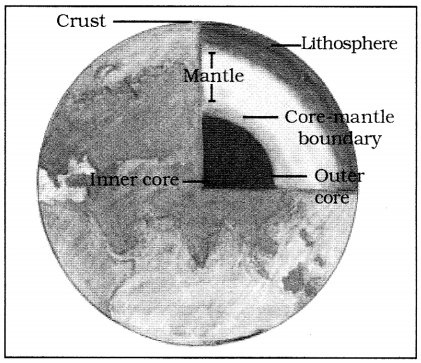
The earth consists of three layers:

  1. Core (inner core and outer core)
  2. Mantle (upper and lower mantle)
  3. Crust (continental and oceanic crust)

Question 2.
What do you understand about uppermost layer of the earth? Briefly describe.
Answer:
The uppermost layer over the earth’s surface is called the crust. It is the thinnest layer and its depth is about 40km, and its range is about 35km on the continental masses and only 5 km, on the ocean floors.

Question 3.
How is a sedimentary rock made?
Answer:
Rocks roll down, crack, and hit each other and are broken down into small fragments. These smaller particles are called sediments. These sediments form sedimentary rocks.

Question 4.
What are extrusive igneous rocks? Give an example.
Answer:
When the molten lava comes on the earth’s surface, it rapidly cools down and becomes solid. Rocks formed in such a way on the crust are called extrusive igneous rocks. They have a very fine-grained structure. The Deccan plateau is the example that is made up of basalt rocks.

Question 5.
What are intrusive igneous rocks? Give an example.
Answer:
Sometimes the molten magma cools down deep inside the earth’s crust. Solid rocks so formed are called intrusive igneous rocks. Since they cool down slowly they form large grains. Granite is an example of such a rock. For grinding of spices and grains, the stones used are of granite.

Inside Our Earth Class 7 Extra Questions and Answer Geography Chapter 2 Long Answers Type

Question 1.
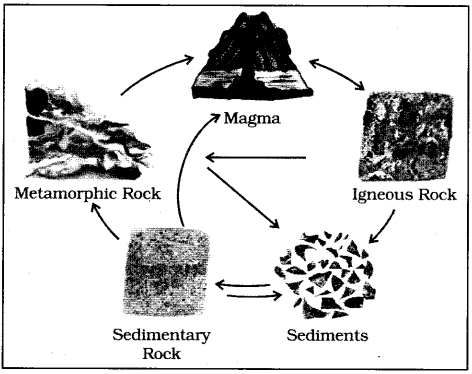
Describe the Rock cycle.
Answer:
In a cyclic manner one type of rock changes into another type. As we already learnt when the molten magma cools, it solidifies to become igneous rock. These igneous rocks are broken down into small particles that are transported and deposited to form sedimentary rocks.

When the igneous and sedimentary rocks are subjected to heat and pressure they change into metamorphic rocks. The metamorphic rocks which are under great heat and pressure melt down and form molten magma. This molten magma again can cool down and solidify into igneous rocks.

The Rock cycle can be understood and expressed by cycle as shown below:
Class 7 Geography Chapter 2 Extra Questions and Answers Inside Our Earth 1
Question 2.
Describe various types of rocks.
Answer:
Rocks are of three types, which can be described as under:
(i) Igneous rocks: When the molten magma cools, it becomes solid. Rocks thus formed are called igneous rocks. They are also called primary rocks. Igneous rocks further can be divided into two types- intrusive and extrusive rocks.
(a) Intrusive igneous rocks: Sometimes the molten magma cools down deep inside the earth’s crust. Solid rocks so formed are called intrusive igneous rocks.
(b) Extrusive igneous rocks: When molten lava comes on the earth’s surface, it rapidly cools down and becomes solid. Rocks formed in such a way on the crust are called extrusive igneous rocks.

(ii) Sedimentary rocks: When rocks roll down, crack, and hit each other and are broken down into small fragments, these smaller particles are called sediments. These sediments are transported and deposited by wind, water etc. These loose sediments are compressed and hardened to form layers of rocks. These types of rocks are called sedimentary rocks.

(iii) Metamorphic rocks: Igneous and sedimentary rocks can change into metamorphic rocks under great heat and pressure. For example, clay changes into slate and limestone into marble.

Picture Based Questions Class 7 Geography Chapter 2 Inside Our Earth

Question 1.
Draw a structure of the interior of the earth
Answer:
Class 7 Geography Chapter 2 Extra Questions and Answers Inside Our Earth 2

Class 6 History Chapter 10 Extra Questions and Answers Traders, Kings and Pilgrims

Traders, Kings and Pilgrims Class 6 History Chapter 10 Extra Questions and Answers Social Science CBSE Pdf free download are part of Extra Questions for Class 6 Social Science. Here we have given NCERT Extra Questions for Class 6 Social Science SST History Chapter 10 Traders, Kings and Pilgrims.

You can also practice NCERT Solutions for Class 6 History Chapter 10 Questions and Answers on LearnInsta.com.

Class 6 History Chapter 10 Extra Questions and Answers Traders, Kings and Pilgrims

Traders, Kings and Pilgrims Class 6 Extra Questions and Answer History Chapter 10 Very Short Answers Type

Question 1.
Why was south India famous?
Answer:
South India was famous for a big market. Roman traders came there and carried gold, spices, pepper and precious stones from South India.

Question 2.
How do we know that the traders of Rome visited South India?
Answer:
Archaeologists have found gold coins of Rome, which shows that traders of Rome came here for trading purpose.

Question 3.
Name the important sea routes for south India?
Answer:
There were the Arabian Sea route and the Bay of Bengal sea route.

Question 4.
What was the advantage taken by the sailors to cross the seas quickly?
Answer:
Sailors took advantage of the monsoon winds to cross the seas quickly

Question 5.
Name the valley which was the most fertile.
Answer:
Kaveri was the most fertile.

Question 6.
Name the chiefs who have been mentioned in Sangam poems.
Answer:
Chois, Cheras and Pandays.

Question 7.
What did the chiefs collect instead of tax?
Answer:
The Chiefs demanded and collected the gifts from the people.

Question 8.
For what purpose was demands and gifts used by the Chiefs?
Answer:
These were used for family, soldiers and poets.

Question 9.
What was given to the Sangam poets as rewards?
Answer:
They were given precious stones, gold, horses, elephants, chariots, and fine cloth etc.

Question 10.
Name the dynasty situated in western India about 200 years ago?
Answer:
The name of dynasty situated in western India about 200 years ago was called the Satavahanas.

Question 11.
Who was the most important ruler of the Satavahanas?
Answer:
The most important ruler of the Satavahanas was Gautamiputra Shri Satakarni.

Question 12.
Which dynasty was known as Dakshinapatha?
Answer:
Satavahanas dynasty was known as Dakshinapatha.

Question 13.
Name the Silk route extended during the ruling of Kushanas?
Answer:
During the Kushanas, a branch of the Silk Route extended from Central Asia to the seaports at the mouth of the river Indus.

Question 14.
Who started gold coins?
Answer:
Kushanas started gold coins.

Traders, Kings and Pilgrims Class 6 Extra Questions and Answer History Chapter 10 Short Answers Type

Question 1.
What do you understand about ‘muvendar’?
Answer:
The word ‘muvendar’ is a Tamil word which means three chiefs i.e. the Cholas, Cheras and Pandyas. These were three ruling families which were very powerful in south India around 2300 years ago.

Question 2.
How do we know about the Gautamiputra Shri Satakarni?
Answer:
An inscription was found which gave us information about Gautamiputra Shri Satakarni. This inscription was composed by his mother, Gautami Balashri.

Question 3.
What do you understand about ‘Bhakti’?
Answer:
The word Bhakti came from the Sanskrit term ‘bhaj’ means to divide or share. This suggests an intimate, two-way relationship between the deity and the devotee.

Question 4.
How was the word Hindu derived?
Answer:
The word ‘Hindu’ was derived from the river Indus. It was used by Arabs and Iranians to refer to people who lived to the east of the river, and to their cultural practices, including religious beliefs.

Question 5.
Write a short note on Christianity.
Answer:
About 2000 years ago, Christianity emerged in West Asia. Jesus Christ was bom in Bethlehem, which was then part of the Roman empire. Christ’s teachings were that he was the saviour of the world. Bible is the holy book of Christianity. He also taught people to treat others with love and trust others.

Traders, Kings and Pilgrims Class 6 Extra Questions and Answer History Chapter 10 Long Answers Type

Question 1.
How did the knowledge of silk spread?
Answer:
Sometimes, Chinese rulers sent gifts of silk to rulers in Iran and west Asia, and from there the knowledge of silk spread further west. About 2000 years ago, wearing silk became the fashion amongst rulers and rich people in Rome.

It was very expensive, as it had to be brought all the way from China, along dangerous roads, through mountains and deserts. Thus, it became famous with rich people.

Question 2.
What do you understand about the Silk Route?
Answer:
Techniques of making silk were first invented in China around 7000 years ago. The silk was a highly valued fabric in most societies due to its glossy colours and smooth texture. Making silk is a complicated process as in present days too. Raw silk has to be extracted from the cocoons of silkworm, spun into thread and then woven into cloth.

Some people from China who went to distant lands on foot, horseback, and on camels carried silk with them. The paths they followed came to be known as the Silk Route.

Question 3.
Why was Nalanda a unique centre of Buddhist learning?
Answer:
Xuan Zang and other pilgrims spent time studying in Nalanda (Bihar). They followed the teachings of the Buddha in all sincerity. The rules of the monastery were strict and everyone had to follow them. Discussions were held throughout the day.

Young and old mutually helped each other. Men from different cities came here to settle their doubts. Gatekeeper asked difficult questions to the new entrants. Out of ten questions seven-eight answers were required for entry.

Question 4.
Write a short note on Bhakti.
Answer:
Bhakti is derived from the Sanskrit word ‘bhaj’ which means ‘to divide or share’. This suggests an intimate, two-way relationship between the deity and the devotee. The idea of Bhakti is present in Bhagavad Gita.

In Bhagavad Gita, Krishna (the God) asks Arjuna (his devotee and friend) to abandon all dharmas and take refuge in him, as only he can set Arjuna free from every evil. Those who followed the system of Bhakti emphasized devotion and individual worship of a god or goddess rather than the performance of elaborate sacrifices.

Picture Based Questions Class 6 History Chapter 10 Traders, Kings and Pilgrims

Question 1.
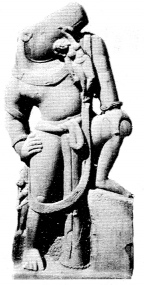
Look at the picture given below and answer the following questions:
Class 6 History Chapter 10 Extra Questions and Answers Traders, Kings and Pilgrims
(i) Who is shown in this picture?
(ii) Where is this image found?
(iii) Vishnu took the shape of a _____ in order to rescue the earth, which had sunk into water.
Answer:
(i) Vishnu as varaha is shown in the figure
(ii) This image is found in Madhya Pradesh.
(iii) Boar

Class 6 Geography Chapter 5 Extra Questions and Answers Major Domains of the Earth

Major Domains of the Earth Class 6 Geography Chapter 5 Extra Questions and Answers Social Science CBSE Pdf free download are part of Extra Questions for Class 6 Social Science. Here we have given NCERT Extra Questions for Class 6 Social Science SST Geography Chapter 5 Major Domains of the Earth.

You can also practice NCERT Solutions for Class 6 Geography Chapter 5 Questions and Answers on LearnInsta.com.

Class 6 Geography Chapter 5 Extra Questions and Answers Major Domains of the Earth

Major Domains of the Earth Class 6 Extra Questions and Answer Geography Chapter 5 Very Short Answers Type

Question 1.
Which planet has life?
Answer:
The Earth.

Question 2.
Why is there is life on the Earth?
Answer:
There is life on the Earth because it has life-sustaining elements.

Question 3.
Give the names of life sustaining elements.
Answer:
Life-sustaining elements are-air, water and land.

Question 4.
Name of main components of the Earth surface?
Answer:
Main components of Earth surface are-solid, gases and water.

Question 5.
What is called solid portion of land?
Answer:
Solid portion of land is called Lithosphere.

Question 6.
What is called gaseous layers that surround the Earth?
Answer:
Atmosphere.

Question 7.
What is called Biosphere?
Answer:
A narrow zone of Earth where we find land, water and air together, which contains all forms of life, is called Biosphere.

Question 8.
How many continents are there in our Earth?
Answer:
There are seven major continents.

Question 9.
How are continents separated?
Answer:
Continents are separated by large water bodies.

Question 10.
Name the Continents.
Answer:
Name of the continents are—Asia, Europe, Africa, North America, South America, Australia and Antarctica.

Question 11.
On which hemisphere lies greater part of the land mass?
Answer:
Greater part of the land mass lies in the Northern Hemisphere.

Question 12.
What is proportion of water on the Earth?
Answer:
More than 71% of the Earth is covered with water.

Question 13.
What do you mean by hydrosphere?
Answer:
Water part of the land is called hydrosphere.

Question 14.
Name the forms of hydrosphere.
Answer:
Hydrosphere consists of water in all its forms as—running water, ice, underground water and water vapour in atmosphere, all comprise the hydrosphere.

Question 15.
Where is the largest part of the Earth’s water found?
Answer:
The largest part of the Earth’s water is found in the oceans.

Question 16.
How much portion of fresh water is available for human use?
Answer:
A very small percentage is available as fresh water for human use.

Question 17.
Name of Research Stations founded by India in Antarctica?
Answer:
Maitri and Dakshin Gangotri.

Major Domains of the Earth Class 6 Extra Questions and Answer Geography Chapter 5 Short Answers Type

Question 1.
What do you understand about Lithosphere?
Answer:
The word Lithosphere is made up of Latin word ‘litho’ which means ‘stone’. Hence the lithosphere is the solid portion of Earth. It comprises the rocks of the Earth’s crust and the thin layers of soil that contain nutrient elements which sustain organisms.

There are two main divisions of the Earth’ surface. The large landmasses are known as the continents and the huge water bodies are called the ocean basins. All the oceans of the world are connected with one another.

Question 2.
Describe the persons who climb on peak of the Mount Everest.
Answer:
Mt. Everest is the highest mountain. The peak of Mt. Everest is 8,848 metres above the sea level. Edmund Hillary, resident of New Zealand and Tenzing Norgay Sherpa of India were the first men to climb the highest mountain peak Mt. Everest on the planet Earth on 29th May, 1953. Junko Tabei (Japan) was the first woman who reached on 16th May, 1975. The first Indian women was Bachendri Pal who climbed the highest peak on 23rd May, 1984.

Question 3.
Describe the Hydrosphere.
Answer:
Water covers very big area of the Earth’s surface and this water area of Earth is called hydrosphere. More than 71% area of the Earth is covered with water. The hydrosphere comprises of water in all its forms, that is, ice in glaciers, water in oceans and rivers and in lakes, underground water and the water vapour in atmosphere.

Question 4.
Write a short note on Biosphere.
Answer:
The biosphere is the narrow zone of contact between the land, water and air. This is unique to this planet. Biosphere contain all forms of life. There are several species of organisms that vary in size from microbes and bacteria to huge mammals. All the living organism including humans are linked to each other and to the biosphere for survival.

Major Domains of the Earth Class 6 Extra Questions and Answer Geography Chapter 5 Long Answers Type

Question 1.
What do you understand about Atmosphere? State the layers of atmosphere?
Answer:
The Earth is surrounded by a layer of gas called the atmosphere. This thin blanket of air is an integral and important aspect of the planet. It provides us oxygen for breathing and protects us from the harmful effects of the Suns’ rays.

The atmosphere extends up to a height of about 1600 km. The atmosphere is divided into five layers based on composition, temperature and other properties. These layers are – troposphere, stratosphere, mesosphere, thermosphere and exosphere.

We are living in the troposphere. The atmosphere is composed mainly of two gases – Nitrogen and Oxygen which make up 99% of clean, dry air. Nitrogen is 78%, Oxygen 21% and other gases like carbon dioxide, argon and others comprise 1% by volume. The density of the atmosphere varies with height. It is maximum at the sea level and decrease rapidly as we go up.

Question 2.
Give the name of continents and describe them.
Answer:
There are seven major continents. These continents are:
(i) Asia: Asia is the largest continent. It covers about one-third of the total land area of the Earth. The continent lies in the Eastern Hemisphere. The Tropic of Cancer passes through this continent. Asia is separated from Europe by the Ural Mountain on the west.

(ii) Africa: Africa is the second largest continent after Asia. The equator or 0° latitude runs almost through the middle of the continent. A large part of Africa lies in the Northern Hemisphere. It is only continent through which the Tropic of Cancer, the Equator and the Tropic of Capricorn pass. The Sahara Desert, the world’s largest hot desert, is located in Africa. World’s longest river the Nile, flows through Africa.

(iii) North America: North America is the third largest continent of the world. It is linked to South America by a very narrow strip of land called the Isthmus of Panama. The continent lies completely in the Northern and Western Hemisphere. Three oceans that are Pacific Ocean, Atlantic Ocean, and Arctic Ocean are surrounded this continent.

(iv) South America: South America lies mostly in the Southern Hemisphere. Two oceans that are the Pacific and the Atlantic surround it on the east and west respectively. The Andes, world’s longest mountain range, runs through its length from north to south. South America has the world’s largest river, the Amazon.

(v) Europe: Europe is much smaller than Asia. The continent lies to the west of Asia. The Arctic Circle passes through it. It is bound by water bodies on three sides.

(vi) Australia: Australia is the smallest continent that lies entirely in the Southern Hemisphere. It is surrounded on all sides by the oceans and seas. It is called an island continent.

(vii) Antarctica: Antarctica is completely in the Southern Hemisphere, is a huge continent. The South Pole lies almost at the centre of this continent. It is permanently covered with thick ice sheets. There are no permanent human settlements. Many countries have research stations in Antarctica. India also has research stations there. These are named as Maitri and Dakshin Gangotri.

Question 3.
Write a note on Oceans.
Answer:
There are four major oceAnswer:They are – Pacific Ocean, Atlantic Ocean, Indian Ocean and Arctic Ocean. Ocean-wise main features are as under:
(i) The Pacific Ocean:

  1. It is a largest ocean.
  2. It spread over one-third of the Earth.
  3. Mariana Trench, the deepest part of the Earth lies in the Pacific Ocean.
  4. It is almost circular in shape.
  5. Asia, Australia, North and South America surround it.

(ii) The Atlantic Ocean:

  1. It is the second-largest ocean.
  2. It is ‘S’ shaped.
  3. North and South Americas are on the western side and Europe and Africa on the eastern side.
  4. The coastline of Atlantic Ocean is highly indented.
  5. This irregular and indented coastline provides ideal location for natural harbors and ports.
  6. From the commerce point of view, it is the busiest ocean.

(iii) The Indian Ocean:

  1. It is the only ocean named after a country, that is, India.
  2. The shape of the ocean is almost triangular.
  3. In north it is bound by Asia, in the west by Africa and in the east by Australia.

(iv) The Arctic Ocean:

  1. It is located within the Arctic Circle and surrounds the North Pole.
  2. It is connected with the Pacific Ocean by a narrow stretch of shallow western known as Berring Strait.
  3. It is bounded by northern coasts of North America and Eurasia.

Picture Based Questions Class 6 Geography Chapter 5 Major Domains of the Earth

Question 1.
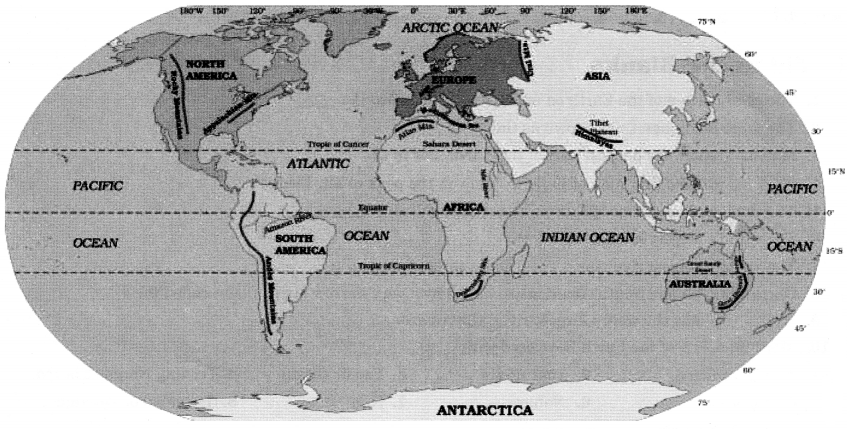
In the given world’s map carefully mark the following.
(i) Oceans: Pacific Ocean, Atlantic Ocean, Indian Ocean, Arctic Ocean
(ii) Continents: Asia, Europe, Africa, North America, South America, Australia and Antarctica.
Answer:
Class 6 Geography Chapter 5 Extra Questions and Answers Major Domains of the Earth