MCQ Questions for Class 11 Biology Chapter 17 Breathing and Exchange of Gases with Answers

Check the below NCERT MCQ Questions for Class 11 Biology Chapter 17 Breathing and Exchange of Gases with Answers Pdf free download. MCQ Questions for Class 11 Biology with Answers were prepared based on the latest exam pattern. We have provided Breathing and Exchange of Gases Class 11 Biology MCQs Questions with Answers to help students understand the concept very well. https://mcqquestions.guru/mcq-questions-for-class-11-biology-chapter-17/

Breathing and Exchange of Gases Class 11 MCQs Questions with Answers

Breathing And Exchange Of Gases MCQ Chapter 17 Class 11 Question 1.
The function of pneumotaxic centre is
(a) regulate inspiration
(b) regulate rhythm
(c) increase heart rate
(d) all of the above

Answer

Answer: (a) regulate inspiration
Explanation:
Pneumotaxic centre lies in pons in the brain. It regulates inspiration.


Class 11 Biology Chapter 17 MCQ Questions Question 2.
Which one of the following is NOT correct?
(a) The nasal cavity warms and humidifies the air before it enters the lungs
(b) The right lung is composed of three lobes, but the left lung has only two lobes
(c) Lung volumes and vital capacity measure lung function.
(d) The visceral pleura is in direct contact with the chest wall.

Answer

Answer: (d) The visceral pleura is in direct contact with the chest wall.


MCQ On Breathing And Exchange Of Gases Class 11 Question 3.
______ lies in front of esophagus.
(a) Trachea
(b) Glottis
(c) Larynx
(d) Epiglottis

Answer

Answer: (a) Trachea


MCQ On Breathing And Exchange Of Gases Class 17 Question 4.
In brain, respiratory control centre lies in
(a) pons
(b) medulla oblongata
(c) hypothalamus
(d) cerebrum

Answer

Answer: (b) medulla oblongata
Explanation:
Respiratory control centre or respiratory rhythm centre lies in medulla oblongata.
Pneumotaxic centre which lies in pons region of the brain can moderate the functions of the respiratory rhythm centre.


MCQ Questions On Breathing And Exchange Of Gases Class 11 Question 5.
Deoxygenated blood from heart comes to lungs via
(a) pulmonary vein
(b) systemic vein
(c) pulmonary artery
(d) systemic artery

Answer

Answer: (c) pulmonary artery
Explanation:
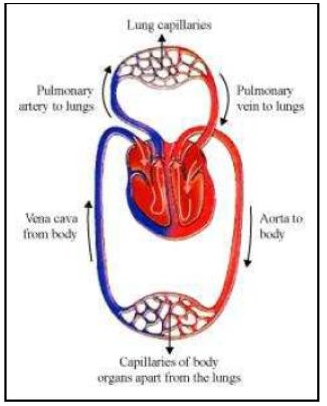
Breathing And Exchange Of Gases Class 11 MCQ Chapter 17


Breathing And Exchange Of Gases Class 11 MCQ Pdf Download Question 6.
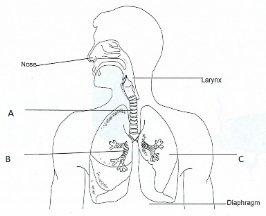
Class 11 Biology Chapter 17 MCQ Questions
Label the parts of the human respiratory system.
(a) A- Oesophagus, B- Bronchioles, C- Lungs
(b) A- Trachea, B- Bronchioles, C- Lungs
(c) A- Trachea, B- Bronchus, C- Lungs
(d) A- Oesophagus, B- Bronchioles, C- Pleura

Answer

Answer: (c) A- Trachea, B- Bronchus, C- Lungs
Explanation:
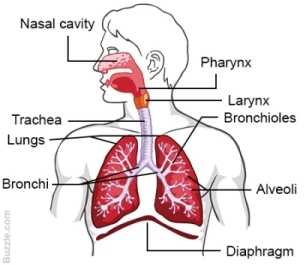
MCQ On Breathing And Exchange Of Gases Class 11


Class 11 Breathing And Exchange Of Gases MCQ Chapter 17 Question 7.
Pleura is a layer covering
(a) heart
(b) kidneys
(c) lungs
(d) brain

Answer

Answer: (c) lungs
Explanation:
Double layered membrane called pleura, which covers lungs in human body.


MCQ Of Chapter 17 Class 11 Biology Question 8.
Rheumatic fever can cause damage
(a) Alveoli of the Lungs
(b) heart valves
(c) heart muscles
(d) pleural membranes function

Answer

Answer: (b) heart valves


Chapter 17 Biology Class 11 MCQ Question 9.
What protects the moist membranes of the respiratory tract?
(a) Mucus and cilia
(b) A c shaped cartilage rings
(c) A pebbly epidermal surface
(d) An acidic glands

Answer

Answer: (a) Mucus and cilia


MCQ Of Breathing And Exchange Of Gases Chapter 17 Question 10.
RBCs, plasma and biocarbonate are the medium for transport of carbondioxide. Maximum amount of carbon dioxide is carried by
(a) RBCs
(b) Plasma
(c) Bicarbonates
(d) All RBCs and bicarbonate carried 70 per cent of carbondixide.

Answer

Answer: (c) Bicarbonates
Explanation:
20-25 per cent of carbondioxide is carried by RBCs.
70 per cent is carried as bicarbonate.
7 per cent is carried in a dissolved state through plasma.


Breathing And Exchange Of Gases MCQ Class 11 Chapter 17 Question 11.
The maximum volume of air that can be released from the lungs by forceful expiration after deepest inspiration is called the ______.
(a) Total lung capacity
(b) Vital capacity
(c) Tidal volume
(d) Ventilation rate

Answer

Answer: (b) Vital capacity


Class 11 Biology Breathing And Exchange Of Gases MCQ Chapter 17 Question 12.
Which one of the followings is correct regarding larynx?
(a) It prevents foreign objects from entering the trachea
(b) It houses the vocal cords
(c) It is an organ made of cartilage and connects the pharynx to the trachea
(d) All of these are correct

Answer

Answer: (d) All of these are correct


Breathing And Exchange Of Gases MCQ With Answers Chapter 11 Question 13.
Which of the following statements is true about Trachea in a respiratory system?
(a) It functions as passages of air to each alveolus
(b) It functions for sound production
(c) It Acts as passage of air to bronchi
(d) It Lowers the surface tension

Answer

Answer: (c) It Acts as passage of air to bronchi


Breathing And Exchange Of Gases Class 11 MCQs Chapter 17 Question 14.
Which of the following statement is true?
(a) Every 100 mL of deoxygenated blood delivers approximately 4 mL of carbondioxide to the alveoli.
(b) Every 100 mL of oxygenated blood delivers approximately 4 mL of oxygen to the tissues.
(c) Every 100 mL of oxygenated blood delivers approximately 4 mL of carbondioxide to the alveoli.
(d) Every 100 mL of deoxygenated blood delivers approximately 10 mL of carbondioxide to the alveoli.

Answer

Answer: (a) Every 100 mL of deoxygenated blood delivers approximately 4 mL of carbondioxide to the alveoli.
Explanation:
Every 100 mL of deoxygenated blood delivers approximately 4 mL of carbondioxide to the alveoli.
Every 100 mL of oxygenated blood delivers approximately 5 mL of oxygen to the tissues under normal physiological conditions.


MCQs On Breathing And Exchange Of Gases Chapter 17 Class 11 Question 15.
Trachea divides into bronchi at
(a) 4th thoracic vertebra
(b) 5th thoracic vertebra
(c) 6th thoracic vertebra
(d) 7th thoracic vertebra

Answer

Answer: (b) 5th thoracic vertebra
Explanation:
Trachea is a straight tube extending up to the mid-thoracic cavity. It divides into bronchi at 5th thoracic vertebra.


MCQ Breathing And Exchange Of Gases Chapter 17 Question 16.
Aerobic respiratory pathway is also termed as ______ pathway.
(a) Anabolic
(b) Catabolic
(c) Creatine phosphate
(d) Amphibolic

Answer

Answer: (d) Amphibolic


Class 11 Biology Chapter 17 MCQ Question 17.
The oxygen dissociation curve is shifted to the right by an increase in ______.
(a) H+ concentration
(b) PCO2
(c) temperature
(d) All of these

Answer

Answer: (d) All of these


MCQ Questions On Breathing And Exchange Of Gases Chapter 17 Question 18.
The maximum volume of air contained in the lung by a full forced inhalation is called
(a) Vital capacity
(b) Tidal volume
(c) Total lung capacity
(d) Inspiratory capacity

Answer

Answer: (c) Total lung capacity


Breathing And Exchange Of Gases MCQ Pdf Chapter 17 Question 19.
Which one of the following is NOT correct?
(a) The nasal cavity warms and humidifies the air before it enters the lungs
(b) The right lung is composed of three lobes, but the left lung has only two lobes.
(c) Lung volumes and vital capacity measure lung function.
(d) The visceral pleura is in direct contact with the chest wall.

Answer

Answer: (d) The visceral pleura is in direct contact with the chest wall.


MCQs Of Breathing And Exchange Of Gases Chapter 17 Question 20.
Which organ lies in thoracic cavity?
(a) Heart
(b) Lungs
(c) Pancreas
(d) Both 1and 2

Answer

Answer: (d) Both 1 and 2
Explanation:
Lungs and heart both resides in thoracic cavity.


We hope the given NCERT MCQ Questions for Class 11 Biology Chapter 17 Breathing and Exchange of Gases with Answers Pdf free download will help you. If you have any queries regarding CBSE Class 11 Biology Breathing and Exchange of Gases MCQs Multiple Choice Questions with Answers, drop a comment below and we will get back to you soon.

MCQ Questions for Class 11 Biology Chapter 16 Digestion and Absorption with Answers

Check the below NCERT MCQ Questions for Class 11 Biology Chapter 16 Digestion and Absorption with Answers Pdf free download. MCQ Questions for Class 11 Biology with Answers were prepared based on the latest exam pattern. We have provided Digestion and Absorption Class 11 Biology MCQs Questions with Answers to help students understand the concept very well. https://mcqquestions.guru/mcq-questions-for-class-11-biology-chapter-16/

Digestion and Absorption Class 11 MCQs Questions with Answers

Digestion And Absorption Class 11 MCQ Chapter 16 Question 1.
Which part of brain causes nausea?
(a) Pons
(b) Hypothalamus
(c) Parietal lobe
(d) Medulla

Answer

Answer: (d) Medulla
Explanation:
Vomiting is the ejection of stomach contents through mouth.
This is the reflex action which is controlled by medulla.
A feeling of nausea preceds vomiting.


Digestion And Absorption MCQ Chapter 16 Class 11 Question 2.
Correct enzyme-substrate pair is
(a) Maltose-lactase
(b) Protein-amylase
(c) Carbohydrate-lipase
(d) Casein-rennin

Answer

Answer: (d) Casein-rennin


Class 11 Biology Chapter 16 MCQ Questions Question 3.
Peyers patches found in the small intestine are
(a) Epithelial tissue
(b) Glandular tissue
(c) Lymphatic tissue
(d) Haemopoietic tissue

Answer

Answer: (c) Lymphatic tissue


MCQ On Digestion And Absorption Chapter 16 Class 11 Question 4.
During prolonged fasting, in what sequence are the following organic compounds used up by the body?
(a) First carbohydrates, next proteins and lastly lipids
(b) First carbohydrates, next fats and lastly proteins
(c) First fats, next carbohydrates and lastly proteins
(d) First proteins next lipids and lastly carbohydrates

Answer

Answer: (b) First carbohydrates, next fats and lastly proteins


Digestion And Absorption Class 11 MCQ Pdf Chapter 16 Question 5.
In glycolysis ultimately
(a) starch is converted into glucose
(b) glucose is converted into fructose
(c) protein is converted into glucose
(d) glucose is converted into pyruric acid

Answer

Answer: (d) glucose is converted into pyruric acid


Class 11 Digestion And Absorption MCQ Biology Question 6.
If for some reason our goblet cells are non-functional this will adversely affect
(a) Smooth movement of food down the intestine
(b) Production of somatostatin
(c) Secretion of sebum from the sebaceous glands
(d) Maturation of sperms

Answer

Answer: (a) Smooth movement of food down the intestine


MCQ Questions On Digestion And Absorption Class 11 Question 7.
The HCl in gastric juice converts:
(a) Disaccharide to monosaccharide
(b) Pepsinogen to pepsin
(c) Prorennin to rennin
(d) Polypeptide to peptide

Answer

Answer: (b) Pepsinogen to pepsin


MCQs On Digestion And Absorption Chapter 16 Class 11 Question 8.
Which enzyme is used in alcoholic fermentation of yeast?
(a) Maltase
(b) Invertase
(c) Sucrase
(d) Zymase

Answer

Answer: (d) Zymase


Digestion And Absorption MCQ Questions Class 11 Question 9.
Assimilation means
(a) utilising the water taken by body
(b) accumulating the food for digestion
(c) utilisation of absorbed substances
(d) collecting wastes left after the absorption of required nutrients

Answer

Answer: (c) utilisation of absorbed substances
Explanation:
The absorbed substances finally reach the tissues which utilise them for their activities. This process is called assimilation.


Digestion And Absorption MCQs Chapter 16 Class 11 Question 10.
The pH scale is used to measure
(a) Electric charge on ion
(b) Speed with which ions form
(c) Size of ions
(d) Concentration of hydrogen ions in a solution

Answer

Answer: (d) Concentration of hydrogen ions in a solution


MCQ Digestion And Absorption Chapter 16 Class 11 Biology Question 11.
Which of the following part of human intestine hosts microorganisms?
(a) Colon
(b) Caecum
(c) Anus
(d) Rectum

Answer

Answer: (b) Caecum
Explanation:
Caecum is a small blind sac which hosts some microorganisms.


Digestion And Absorption Class 11 MCQs Chapter 16 Biology Question 12.
Duct leading from parotid gland and opening into vestibule is
(a) Wolffian duct
(b) Stensons duct
(c) Haversian duct
(d) Infra-orbit duct

Answer

Answer: (b) Stensons duct


MCQ Questions On Digestion And Absorption Chapter 16 Class 11 Question 13.
Which organ is most affected by jaundice?
(a) Pancreas
(b) Liver
(c) Stomach
(d) Intestine

Answer

Answer: (b) Liver
Explanation:
Jaundice affects liver. Skin and eyes turn yellow due to the deposition of bile pigments.


Digestion And Absorption Class 11 MCQ Questions Chapter 16 Biology Question 14.
Globet cells of intestinal mucosal epithelium secrete
(a) mucus
(b) cholesterol
(c) peptones
(d) bilirubin

Answer

Answer: (a) mucus
Explanation:
Intestinal mucosal epithelium has globet cells which secrete mucus.


Digestion And Absorption Class 11 MCQ Pdf Chapter 16 Biology Question 15.
Emulsification of fat takes place through
(a) Liver enzymes
(b) Bile pigments
(c) Bile salts
(d) Enzymes of small intestine

Answer

Answer: (c) Bile salts


Digestion And Absorption MCQ With Answers Chapter 16 Class 11 Question 16.
Epithelial cells of the intestine involved in food absorption have on their surface
(a) phagocytic vesicles
(b) pinocytic vesicles
(c) microvilli
(d) zymogen granules

Answer

Answer: (c) microvilli


Question 17.
Carrier ions like Na+ facilitate the absorption of substances like
(a) Fructose and some amino acids
(b) Amino acids and glucose
(c) Glucose and fatty acids
(d) Fatty acids and glycerol

Answer

Answer: (a) Fructose and some amino acids


Question 18.
The glucose is converted into glycogen in liver and stored in
(a) Liver and spleen
(b) Liver and muscle
(c) Liver
(d) Spleen and muscles

Answer

Answer: (c) Liver


Question 19.
Small projections of upper surface of tongue are called
(a) fimbriae
(b) pilli
(c) papillae
(d) cilia

Answer

Answer: (c) papillae
Explanation:
The upper surface of the tongue has small projections called papillae, some of them bears taste buds.


Question 20.
Sweetest sugar is
(a) Fructose
(b) Sucrose
(c) Glucose
(d) Lactose

Answer

Answer: (a) Fructose


We hope the given NCERT MCQ Questions for Class 11 Biology Chapter 16 Digestion and Absorption with Answers Pdf free download will help you. If you have any queries regarding CBSE Class 11 Biology Digestion and Absorption MCQs Multiple Choice Questions with Answers, drop a comment below and we will get back to you soon.

MCQ Questions for Class 11 Biology Chapter 15 Plant Growth and Development with Answers

Check the below NCERT MCQ Questions for Class 11 Biology Chapter 15 Plant Growth and Development with Answers Pdf free download. MCQ Questions for Class 11 Biology with Answers were prepared based on the latest exam pattern. We have provided Plant Growth and Development Class 11 Biology MCQs Questions with Answers to help students understand the concept very well. https://mcqquestions.guru/mcq-questions-for-class-11-biology-chapter-15/

Plant Growth and Development Class 11 MCQs Questions with Answers

Plant Growth And Development MCQ Chapter 15 Class 11 Question 1.
Mechanism of development was explained by
(a) Hans Dietrisch
(b) Spemann
(c) Both a and b
(d) Haemmerling

Answer

Answer: (c) Both a and b


Plant Growth And Development Class 11 MCQ Chapter 15 Question 2.
Intercalary meristems are of
(a) Permanent nature
(b) Temporary nature
(c) Some are permanent some temporary
(d) None of these

Answer

Answer: (b) Temporary nature


MCQ On Plant Growth And Development Class 11 Chapter 15 Question 3.
Cells of fibers and tracheids elongate during
(a) Phase of cell division
(b) Phase of cell elongation
(c) Phase of cell maturation
(d) Phase of cell differentiation

Answer

Answer: (a) Phase of cell division


Class 11 Biology Chapter 15 MCQ Question 4.
Typical plant growth shows _________ curve.
(a) J-shaped
(b) S-shaped
(c) I-shaped
(d) Parabolic

Answer

Answer: (b) S-shaped
Explanation:
Typical plant growth represents sigmoid curve.


MCQ On Plant Growth And Development Chapter 15 Class 11 Question 5.
Exponential growth of the plants is express as W1 = W0 ert r represents
(a) ability of the plant to produce new cells
(b) efficiency index
(c) relative growth rate
(d) all of the above

Answer

Answer: (d) all of the above
Explanation:
r is the relative growth rate and also measures the ability of the plant to produce new plant material (efficiency index).


Plant Growth And Development MCQs With Answers Chapter 15 Class 11 Question 6.
Opening of floral buds into flowers, is a type of:
(a) Autonomic movement of variation
(b) Autonomic movement of locomotion
(c) Autonomic movement of growth
(d) Paratonic movement of growth

Answer

Answer: (c) Autonomic movement of growth


Plant Growth And Development MCQ Pdf Chapter 15 Class 11 Question 7.
Which one is incorrect?
(a) Epiblast is presumptive ectoderm and mesoderm
(b) Hypoblast is presumptive endoderm
(c) Hypoblast is presumptive mesoderm
(d) Upper layer of cells in blastoderm is epiblast

Answer

Answer: (c) Hypoblast is presumptive mesoderm


Plant Growth And Development MCQ With Answers Chapter 15 Class 11 Question 8.
The stage of rapid cell division just after fertilization is
(a) Organogenesis
(b) Cleavage
(c) Gastrulation
(d) Growth

Answer

Answer: (b) Cleavage


Plant Growth And Development MCQs Chapter 15 Class 11 Question 9.
Plants grow throughout their life due to
(a) presence of meristems
(b) presence of vascular cambium
(c) presence of xylem and phloem
(d) presence of tracheids

Answer

Answer: (a) presence of meristems
Explanation:
Plants growth throughout their life due to the presence of meristems at certain locations in their body.


MCQ Plant Growth And Development Chapter 15 Class 11 Question 10.
Liver and pancreas arise from
(a) Foregut
(b) Midgut
(c) Hindgut
(d) None of these

Answer

Answer: (a) Foregut


Plant Growth And Development Questions And Answers Chapter 15 Class 11 Question 11.
Which one of the followings is a gaseous plant hormone?
(a) Ethylene
(b) Gibberellin
(c) IAA
(d) Abscisic acid

Answer

Answer: (a) Ethylene


Question 12.
To prevent over – ripening, bananas should be
(a) given a dip in ascorbic acid
(b) maintained at room temperature
(c) refrigerated
(d) stored at the top of refrigerator

Answer

Answer: (c) refrigerated


Question 13.
Growth in dorsiventral leaf is measured in terms of
(a) length of leaf
(b) increase in cell number
(c) surface area increase
(d) none of these

Answer

Answer: (c) surface area increase
Explanation:
Increase in surface area denotes the growth in a dorsiventral leaf.


Question 14.
Mechanism of development was explained by
(a) Hans Dietrisch
(b) Spemann
(c) Both a and b
(d) Haemmerling

Answer

Answer: (c) Both a and b


Question 15.
The ability to regain or recover the lost or injured part of body is
(a) Aging
(b) Regeneration
(c) Abnormal development
(d) Primary inductio

Answer

Answer: (b) Regeneration


Question 16.
Which growth hormone accerlates the malting process in brewing industry?
(a) Auxins
(b) Gibberellins
(c) Ethylene
(d) Cytokinins

Answer

Answer: (b) Gibberellins
Explanation:
Gibberellins especially GA3 is used to speed up the malting process in brewing industry.


Question 17.
Which plant growth regulator is the derivative of carotenoids?
(a) Auxin
(b) Gibberelic acid
(c) Cytokinin
(d) Abscisic acid

Answer

Answer: (d) Abscisic acid
Explanation:
Abscisic acid are the derivatives of carotenoids.


Question 18.
Typical plant growth shows _________ curve.
(a) J-shaped
(b) S-shaped
(c) I-shaped
(d) Parabolic

Answer

Answer: (b) S-shaped
Explanation:
Typical plant growth represents sigmoid curve.


Question 19.
Mobilisation of stored food in germinating seeds is triggered by
(a) auxins
(b) cytokinins
(c) gibberellins
(d) ethylene

Answer

Answer: (c) gibberellins


Question 20.
Cavity formed between somatic and splanchnic mesoderm is called
(a) Gastrocoele
(b) Blastocoele
(c) Coelom
(d) Neurocoele

Answer

Answer: (c) Coelom


We hope the given NCERT MCQ Questions for Class 11 Biology Chapter 15 Plant Growth and Development with Answers Pdf free download will help you. If you have any queries regarding CBSE Class 11 Biology Plant Growth and Development MCQs Multiple Choice Questions with Answers, drop a comment below and we will get back to you soon.

MCQ Questions for Class 12 Political Science Chapter 5 Challenges to and Restoration of Congress System with Answers

Check the below NCERT MCQ Questions for Class 12 Political Science Chapter 5 Challenges to and Restoration of Congress System with Answers Pdf free download. MCQ Questions for Class 12 Political Science with Answers were prepared based on the latest exam pattern. We have provided Challenges to and Restoration of Congress System Class 12 Political Science MCQs Questions with Answers to help students understand the concept very well. https://mcqquestions.guru/mcq-questions-for-class-12-political-science-chapter-5-part-b/

Challenges to and Restoration of Congress System Class 12 MCQs Questions with Answers

Challenges To And Restoration Of The Congress System MCQ Class 12 Question 1.
Whom would you identify with the following slogans/phrases?
(a) Jai Jawan, Jal Kisan
(b) Indira Hatao
(c) Garibi Hatao

Answer

Answer: (a) Lai Bahadur Shastri
(b) The Grand Alliance
(c) Smt. Indira Gandhi


Restoration of Congress System Class 12 Chapter 5 MCQ Question 2.
Which of the following statements about the Grand Alliance of 1971 is correct?
The Grand Alliance _________
(a) was formed by non-Communist non-Congress parties.
(b) had a clean political and ideological programme.
(c) was formed by all non-Congress parties

Answer

Answer: (a) was formed by non-Communist, non-Congress parties.


Question 3.
Prime Minister Pt. Jawaharlal Nehru passed away in:
(a) January 1964
(b) May 1965
(c) March 1964
(d) May 1964

Answer

Answer: (d) May 1964


Question 4.
When Pt. Jawaharlal Nehru passed away, at that time Congress President was?
(a) K. Kamraj
(b) Lai Bahadur Shastri
(c) S.K. Patil
d) Morarji Desai

Answer

Answer: (a) K. Kamaraj


Question 5.
Who was the founder of the Congress Socialist Party?
(a) C. Natarajan Amadurai
(b) K. Kamraj
(c) Ram Manohar Lohia
(d) S. Nijalingappa

Answer

Answer: (c) Ram Manohar Lohia


Question 6.
Name the person with whom would you associate the following slogans.
(a) Aya Ram and Gaya Ram ______
(b) Total Revolution _________

Answer

Answer: (a) Gaya Lai
(b) Sh. Jai Prakash Narayan


Question 7.
Which of these statements about the 1967 elections is/are correct?
(a) Congress won the Lok Sabha elections but lost the Assembly election in many states.
(b) Congress lost both Lok Sabha and Assembly elections.
(c) Congress lost the majority in the Lok Sabha but formed a coalition government with the support of some other parties.
(d) Congress retained power at the Centre with an increased majority.

Answer

Answer: (a) Correct
(b) Incorrect
(c) Correct
(d) Incorrect


Question 8.
Match the following:

(a) Syndicate(I) Anelectedrepresentative leaving the party on whose ticket he has been elected
(b) Defection(II) A catchy phrase that attracts public attention
(c) Slogan(III) Parties with different ideological positions coming together to oppose Congress and its policies
(d) Anti-Congress(IV) A group of powerful and influential leaders within the congress
Answer

Answer:

(a) Syndicate(IV) A group of powerful and influential leaders within the congress
(b) Defection(I) Anelectedrepresentative leaving the party on whose ticket he has been elected
(c) Slogan(II) A catchy phrase that attracts public attention
(d) Anti-Congress(III) Parties with different ideological positions coming together to oppose Congress and its policies

Question 9.
Who became the Prime Minister of India after Pt. Jawaharlal Nehru?

Answer

Answer: Lal Bahadur Shastri.


Question 10.
When did Pt. Jawaharlal Nehru died?

Answer

Answer: Pt. Jawaharlal Nehru died on 27 May 1964.


Question 11.
Who said, ‘There were very few people whom I respect so much for their rectitude, ability, efficiency and fairness as Morarji Desai.’

Answer

Answer: Pt. Jawaharlal Nehru.


Question 12.
How many seats were secured by the Indian National Congress in the Lok Sabha in 1967 election?

Answer

Answer: Indian National Congress secured 283 seats.


Question 13.
Which party was the main opposition in the Lok Sabha in 1967?

Answer

Answer: Swatantra Party


Question 14.
When were the fourth general elections held?

Answer

Answer: Fourth general election was held in February 1967.


Question 15.
Who was the political successor of Lal Bahadur Shastri?

Answer

Answer: Smt. Indira Gandhi was the political successor of Lai Bahadur Shastri.


Question 16.
Which candidate was supported by Smt. Indira Gandhi for 1969 presidential elections?

Answer

Answer: V.V. Girl was supported by Prime Minister Mrs. Indira Gandhi.


Question 17.
What is meant by the ‘Syndicate’ with regard to the split in Congress?

Answer

Answer: In the Indian National Congress there was a group of senior leaders which was known as the ‘Syndicate.’ Due to differences between the Syndicate and Mrs. Indira Gandhi, there was split in the Congress party in 1969.


We hope the given NCERT MCQ Questions for Class 12 Political Science Chapter 5 Challenges to and Restoration of Congress System with Answers Pdf free download will help you. If you have any queries regarding CBSE Class 12 Political Science Challenges to and Restoration of Congress System MCQs Multiple Choice Questions with Answers, drop a comment below and we will get back to you soon.

MCQ Questions for Class 11 Geography Chapter 2 Structure and Physiography with Answers

Check the below NCERT MCQ Questions for Class 11 Geography Chapter 2 Structure and Physiography with Answers Pdf free download. MCQ Questions for Class 11 Geography with Answers were prepared based on the latest exam pattern. We have provided Structure and Physiography Class 11 Geography MCQs Questions with Answers to help students understand the concept very well. https://mcqquestions.guru/mcq-questions-for-class-11-geography-chapter-2-part-b/

Structure and Physiography Class 11 MCQs Questions with Answers

Structure And Physiography Class 11 MCQ Question 1.
Which of the mountain system is the oldest according to geological history?
(a) Nilgiris
(b) Satpuras
(c) Vindhyas
(d) Aravalli

Answer

Answer: (d) Aravalli


Class 11 Geo Ch 2 MCQ Question 2.
The Great plain has been subjected to ________ throughout its period of existence.
(a) The denudation processes
(b) The degradational processes
(c) The aggradational processes
(d) The weathering processes

Answer

Answer: (c) The aggradational processes


Physiography Class 11 MCQ Chapter 2 Question 3.
Name the sea which existed in place of the Himalayas?
(a) the Caspian Sea
(b) the Aegean Sea
(c) Tethys sea
(d) the Ionian Sea

Answer

Answer: (c) Tethys sea


Class 11 Geography Chapter 2 MCQ Question 4.
The most important geographical advantage of the Himalayas is
(a) Prevention of invasions
(b) Valuable source of timber
(c) That they protect India from icy cold winds of the north
(d) That they cause rains by interrupting the monsoon winds to cross the country

Answer

Answer: (c) That they protect India from icy cold winds of the north


Structure And Physiography MCQ Chapter 2 Question 5.
The general relief is the oldest in the
(a) Himalayan mountain system
(b) Indus-Ganga plain
(c) North-eastern hills
(d) Peninsular plateau

Answer

Answer: (d) Peninsular plateau


MCQ Of Structure And Physiography Class 11 Question 6.
The Nilgiris are part of the
(a) the Eastern Ghats
(b) the Western Ghats
(c) Vindhyachal
(d) Tamil Nadu Hills

Answer

Answer: (b) the Western Ghats


Class 11 Geography Structure And Physiography MCQ Question 7.
Name the lake deposits found in Kashmir Valley.
(a) Karewas Lake
(b) Satsar Lake
(c) Vishansar Lake
(d) Nigeen Lake

Answer

Answer: (a) Karewas Lake


Class 11 Structure And Physiography MCQ Question 8.
The northernmost part of the Himachal is an extension of the
(a) Kashmir valley
(b) Ladakh cold desert
(c) Siwaliks
(d) Punjab plains

Answer

Answer: (b) Ladakh cold desert


MCQ On Structure And Physiography Class 11 Question 9.
The Peninsular Plateau of India extends up to:
(a) Mizo hills
(b) Himachal Himalayas
(c) Assam valley
(d) Meghalaya hills

Answer

Answer: (d) Meghalaya hills


Chapter 2 Geography Class 11 MCQ Question 10.
Which is the ancient crustal Block in India?
(a) Himalayan mountains
(b) Deccan Plateau
(c) Valleys
(d) Islands

Answer

Answer: (b) Deccan Plateau


MCQ Of Chapter 2 Geography Class 11 Question 11.
When was the peninsular plateau of India formed?
(a) Ordovician Period
(b) Pre-Cambrian Period
(c) Post-Permian Period
(d) Devonian Period

Answer

Answer: (b) Pre-Cambrian Period


MCQ Of Geography Class 11 Chapter 2 Question 12.
The oldest landmass of India is
(a) The Himalayan Mountain System
(b) The Indus-Ganga Plain
(c) The Peninsular Plateau
(d) Islands

Answer

Answer: (c) The Peninsular Plateau


We hope the given NCERT MCQ Questions for Class 11 Geography Chapter 2 Structure and Physiography with Answers Pdf free download will help you. If you have any queries regarding CBSE Class 11 Geography Structure and Physiography MCQs Multiple Choice Questions with Answers, drop a comment below and we will get back to you soon.