MCQ Questions for Class 11 Chemistry Chapter 3 Classification of Elements and Periodicity in Properties with Answers

Check the below NCERT MCQ Questions for Class 11 Chemistry Chapter 3 Classification of Elements and Periodicity in Properties with Answers Pdf free download. MCQ Questions for Class 11 Chemistry with Answers were prepared based on the latest exam pattern. We have provided Classification of Elements and Periodicity in Properties Class 11 Chemistry MCQs Questions with Answers to help students understand the concept very well. https://mcqquestions.guru/mcq-questions-for-class-11-chemistry-chapter-3/

Classification of Elements and Periodicity in Properties Class 11 MCQs Questions with Answers

Classification Of Elements And Periodicity In Properties MCQ Question 1.
The chemistry of lithium is very similar to that of magnesium even though they are placed in different groups. Its reason is:
(a) Both are found together in nature
(b) Both have nearly the same size
(c) Both have similar electronic configuration
(d) The ratio of their charge and size (i.e. charge density) is nearly the same

Answer

Answer: (d) The ratio of their charge and size (i.e. charge density) is nearly the same
Explanation:
The chemistry of lithium is very similar to that of magnesium even though they are placed in different groups because of diagonal relationship.


Class 11 Chemistry Chapter 3 MCQ Question 2.
The element with atomic number 35 belongs to
(a) d – Block
(b) f – Block
(c) p – Block
(d) s – Block

Answer

Answer: (c) p – Block
Explanation:
The electronic configuration of element with atomic number 35 is [Ar]3d104s2 4p5. The valence electron belongs to p block. Therefore, it is a p-block element.


MCQ On Periodic Classification Of Elements Class 11 Pdf With Answers Question 3.
The correct order of first ionization potential among following elements, Be, B, C, N and O is
(a) B < Be < C < O < N
(b) B < Be < C < N < O
(c) Be < B < C < N < O
(d) Be < B < C < O < N

Answer

Answer: (a) B < Be < C < O < N
Explanation:
The energy required to remove the most loosely bound electron from an isolated gaseous atom is called the ionisation energy. The ionisation potential decreases as the size of the atom decreases. Atoms with fully or partly filled orbitals have high ionisation potential.


Class 11 Chemistry Chapter 3 MCQ With Answers Question 4.
Representative elements are those which belong to
(a) p and d – Block
(b) s and d – Block
(c) s and p – Block
(d) s and f – Block

Answer

Answer: (c) s and p – Block
Explanation:
Elements in which all the inner shells are complete but outer shell is incomplete is known as representative elements i.e. Those elements which have less than 8 electrons in outermost shell are representative.
s and p block elements except inert gas is known as representative elements.


Classification Of Elements And Periodicity In Properties Class 11 MCQ Question 5.
Which of the following properties generally decreases along a period?
(a) Ionization Energy
(b) Metallic Character
(c) Electron Affinity
(d) Valency.

Answer

Answer: (b) Metallic Character
Explanation:
The IE, EA increases along the period. The valency initially increases then decreases. The metallic character decreases along the period.


MCQ Questions For Class 11 Chemistry Chapter 3 Question 6.
On the Paulings electronegativity scale the element next to F is
(a) N
(b) Cl
(c) O
(d) Ne.

Answer

Answer: (c) O
Explanation:
Pauling explained electronegativity as the power of an atom in a molecule to attract electrons towards it. When we analyse the trend in periodic table, we can see that the degree of electronegativity decreases while going down the groups, while it increases across the periods. In the case of a covalent bond, based on the bond energies, Pauling calculated the differences in electronegativity between atoms in the bond and assigned a value of 4 to fluorine, which is the most electronegative element, and others were calculated with respect to that value. Hence, on paulings scale, the element next to fluorine is Oxygen.


Periodic Classification Of Elements Class 11 MCQ Question 7.
The group number, number of valence electrons, and valency of an element with the atomic number 15, respectively, are:
(a) 16, 5 and 2
(b) 15, 5 and 3
(c) 16, 6 and 3
(d) 15, 6 and 2

Answer

Answer: (b) 15, 5 and 3
Explanation:
Atomic number (Z) =15 =P → [Ne] 3s² 3p³
Phosphorus belongs to 15th group
Number of valence electrons 3s²3p³ = 5 and valency = 3 in ground state.


Ch 3 Chemistry Class 11 MCQ Question 8.
Which of the following oxides is amphoteric in character?
(a) SnO2
(b) CO2
(c) SiO2
(d) CaO

Answer

Answer: (a) SnO2
Explanation:
CaO is basic; CO2 is acidic; SiO2 is weakly acidic. SnO2 is amphoteric.


Chapter 3 Chemistry Class 11 MCQ Question 9.
In the modern periodic table, the period indicates the value of:
(a) Atomic Number
(b) Atomic Mass
(c) Principal Quantum Number
(d) Azimuthal Quantum Number

Answer

Answer: (c) Principal Quantum Number
Explanation:
The periodic table is a tabular arrangement of the chemical elements, organized on the basis of their atomic number (number of protons in the nucleus), electron configurations, and recurring chemical properties.
The value of the principal quantum number (n) for the outermost shell or the valence shell indicates a period in the Modern periodic table.


Chemistry Class 11 Chapter 3 MCQ Question 10.
In the long form of the periodic table, the valence shell electronic configuration of 5s²5p4 corresponds to the element present in:
(a) Group 16 and period 6
(b) Group 17 and period 6
(c) Group 16 and period 5
(d) Group 17 and period 5

Answer

Answer: (c) Group 16 and period 5
Explanation:
Tellurium (Te) has 5s²5p4 valence shell configuration. It belongs to group 16 and present in period 5 of the periodic table.


Class 11 Chemistry Ch 3 MCQ Question 11.
Arrange S, O and Se in ascending order of electron affinity
(a) Se < S < O
(b) Se < O < S
(c) S < O < Se
(d) S < Se < O

Answer

Answer: (a) Se < S < O
Explanation:
Correct order of electron affinity is Se < S < O. In a group electron affinity decreases with increase in atomic number.


Periodic Classification Of Elements Class 11 MCQ With Answers Question 12.
In the modern periodic table , the period indicates the value of:
(a) Atomic Number
(b) Atomic Mass
(c) Principal Quantum Number
(d) Azimuthal Quantum Number

Answer

Answer: (c) Principal Quantum Number
Explanation:
The periodic table is a tabular arrangement of the chemical elements, organized on the basis of their atomic number (number of protons in the nucleus), electron configurations, and recurring chemical properties.
The value of the principal quantum number (n) for the outermost shell or the valence shell indicates a period in the Modern periodic table.


MCQ Questions On Periodic Classification Of Elements Class 11 Question 13.
The electronic configuration of an element is 1s², 2s² 2p6, 3s² 3p³. What is the atomic number of the element which is just below the above element in the periodic table
(a) 31
(b) 34
(c) 33
(d) 49

Answer

Answer: (c) 33
Explanation:
33−1s²2s²2p63s²3p63d104s²4p³


MCQ Of Chapter 3 Chemistry Class 11 Question 14.
The reduction in atomic size with increase in atomic number is a characteristic of elements of-
(a) d−block
(b) f−block
(c) Radioactive series
(d) High atomic masses

Answer

Answer: (b) f−block
Explanation:
The reduction in atomic size with increase in atomic number is a characteristic of elements of f- block. It is known as lanthanoid contraction and actinoid contraction. This is due to poor shielding of electrons present in f subshell.


MCQ On Classification Of Elements And Periodicity In Properties Question 15.
The number of elements in the 5th period of the periodic table is
(a) 3
(b) 9
(c) 8
(d) 18

Answer

Answer: (d) 18
Explanation:
While filling 5th shell according to Aufbau principle 5s, 5p, 4d filled so 2 + 6 + 10 = 18 electrons or elements are present in 5th shell. Further we start filling the 4d orbital which can take 10 electrons. So in the 4th principal quantum energy states, we can fill 18 electrons. Thus 5th period has 18 elements.


Class 11 Chemistry Chapter 3 MCQ Questions With Answers Question 16.
The electronic configuration of halogen is
(a) ns² np6
(b) ns² np3
(c) ns² np5
(d) ns²

Answer

Answer: (c) ns² np5
Explanation:
Halogens has 7 electrons in his valance shell (ns²np5).


MCQ Of Ch 3 Chemistry Class 11 Question 17.
Which of the following forms the most stable gaseous negative ion?
(a) F
(b) Cl
(c) Br
(d) I

Answer

Answer: (b) Cl
Explanation:
The element which forms the most stable gaseous negative ion is fluorine.


Classification Of Elements And Periodicity In Properties MCQ Pdf Question 18.
On the Paulings electro negativity scale the element next to F is
(a) N
(b) Cl
(c) O
(d) Ne.

Answer

Answer: (c) O
Explanation:
Pauling explained electro negativity as the power of an atom in a molecule to attract electrons towards it. When we analyse the trend in periodic table, we can see that the degree of electro negativity decreases while going down the groups, while it increases across the periods. In the case of a covalent bond, based on the bond energies, Pauling calculated the differences in electro negativity between atoms in the bond and assigned a value of 4 to fluorine, which is the most electro negative element, and others were calculated with respect to that value. Hence, on paulings scale, the element next to fluorine is Oxygen.


Chapter 3 Class 11 Chemistry MCQ Question 19.
The element californium belongs to a family of :
(a) Alkali metal family
(b) Actinide series
(c) Alkaline earth family
(d) Lanthanide series

Answer

Answer: (b) Actinide series
Explanation:
Atomic number of californium is 98 and its electronic configuration is
Rn86 7s² 5f10
so it is a f-block element and as it is in 7th period, it is a part of actinide series.


MCQ Of Classification Of Elements And Periodicity In Properties Question 20.
Increasing order of electro negativity is
(a) Bi < P < S < Cl
(b) P < Bi < S < Cl
(c) S < Bi < P < Cl
(d) Cl < S < Bi < P

Answer

Answer: (a) Bi < P < S < Cl
Explanation:
Increasing order of electro negativity is Bi < P < S < Cl.


We hope the given NCERT MCQ Questions for Class 11 Chemistry Chapter 3 Classification of Elements and Periodicity in Properties with Answers Pdf free download will help you. If you have any queries regarding CBSE Class 11 Chemistry Classification of Elements and Periodicity in Properties MCQs Multiple Choice Questions with Answers, drop a comment below and we will get back to you soon.
MCQ Questions for Class 11 Chemistry Chapter 4 Chemical Bonding and Molecular Structure with Answers

Check the below NCERT MCQ Questions for Class 11 Chemistry Chapter 4 Chemical Bonding and Molecular Structure with Answers Pdf free download. MCQ Questions for Class 11 Chemistry with Answers were prepared based on the latest exam pattern. We have provided Chemical Bonding and Molecular Structure Class 11 Chemistry MCQs Questions with Answers to help students understand the concept very well. https://mcqquestions.guru/mcq-questions-for-class-11-chemistry-chapter-4/

Chemical Bonding and Molecular Structure Class 11 MCQs Questions with Answers

Chemical Bonding Class 11 MCQ Question 1.
The bond length between hybridised carbon atom and other carbon atom is minimum in
(a) Propane
(b) Butane
(c) Propene
(d) Propyne

Answer

Answer: (d) Propyne
Explanation:
The C – C bond length = 1.54 Å, C = C bond length = 1.34 Å and C ≡ C bond length = 1.20 Å.
Since propyne has a triple bond, therefore it has minimum bond length.


Chemical Bonding And Molecular Structure MCQ Question 2.
The number of nodal planes present in s × s antibonding orbitals is
(a) 1
(b) 2
(c) 0
(d) 3

Answer

Answer: (a) 1
Explanation:
In an antibonding molecular orbital, most of the electron density is located away from the space between the nuclei, as a result of which there is a nodal plane (i.e, a plane at which the electron density is zero) between the nuclei.


Class 11 Chemistry Chapter 4 MCQ With Answers Question 3.
The hybrid state of sulphur in SO2 molecule is :
(a) sp²
(b) sp³
(c) sp
(d) sp³d

Answer

Answer: (a) sp²
Explanation:
The hybridisation of sulphur in SO2 is sp². Sulphur atom has one lone pair of electrons and two bonding domains. Bond angle is <120° and molecular geometry is V-shape, bent or angular


Class 11 Chemistry Chapter 4 MCQ Question 4.
Which one of the following does not have sp² hybridised carbon?
(a) Acetone
(b) Acetic acid
(c) Acetonitrile
(d) Acetamide

Answer

Answer: (c) Acetonitrile
Explanation:
Acetonitrile does not contain sp² hybridized carbon.


MCQ Questions For Class 11 Chemistry Chapter 4 Question 5.
Which of the following will have the lowest boiling point?
(a) 2-MethylButane
(b) 2-MethylPropane
(c) 2,2-Dimethylpropane
(d) n-Pentane

Answer

Answer: (d) n-Pentane
Explanation:
Boiling point increases with increase in molecular mass. For the compounds with the same molecular mass, boiling point decreases with an increase in branching.
The molecular mass of 2-Methylbutane: 72 g mol-1
The molecular mass of 2-Methylpropane: 58 g mol-1
The molecular mass of 2, 2-Dimethylpropane: 72 g mol-1
The molecular mass of 2-Methylbutane: 72 g mol-1
2-Methylpropane has the lowest molecular mass among all of the given compounds.
Thus, 2-Methylpropane has the lowest boiling point among the given options.


Chemical Bonding And Molecular Structure Class 11 MCQ Question 6.
Among the following the maximum covalent character is shown by the compound
(a) MgCl2
(b) FeCl2
(c) SnCl2
(d) AlCl3

Answer

Answer: (d) AlCl3
Explanation:
We know that, extent of polarisation ∝ covalent character in ionic bond. Fajans rule states that the polarising power of cation increases, with increase in magnitude of positive charge on the cation Therefore, polarising power ∝ charge of cation.

The polarising power of cation increases with the decrease in the size of a cation. Therefore, polarising (power) ∝ (1)/ (size of cation)
Here the AlCl3 is satisfying the above two conditions i.e., Al is in +3 oxidation state and also has small size. So it has more covalent character.


MCQ Of Chemical Bonding Class 11 Question 7.
Among the following mixtures, dipole-dipole as the major interaction, is present in
(a) benzene and ethanol
(b) acetonitrile and acetone
(c) KCl and water
(d) benzene and carbon tetrachloride

Answer

Answer: (b) acetonitrile and acetone
Explanation:
Dipole-dipole interactions occur among the polar molecules. Polar molecules have permanent dipoles. The positive pole of one molecule is thus attracted by the negative pole of the other molecule. The magnitude of dipole-dipole forces in different polar molecules is predicted on the basis of the polarity of the molecules, which in turn depends upon the electro negativities of the atoms present in the molecule and the geometry of the molecule (in case of polyatomic molecules, containing more than two atoms in a molecule).


Ch 4 Chemistry Class 11 MCQ Question 8.
The value of n in the molecular formula BenAl2Si6O18 is
(a) 3
(b) 5
(c) 7
(d) 9

Answer

Answer: (a) 3
Explanation:
BenAl2Si6O18
The oxidation states of each element
Be = +2
Al = +3
Si = +4
O = -2
(2n) + (3 × 2) + (4 + 6) + (−2 × 18) = 0
or 2n + 30 − 36 = 0
or 2n = 6
or n = 3


MCQ On Chemical Bonding Class 11 Pdf Question 9.
Which of the following types of hybridisation leads to three dimensional geometry of bonds around the carbon atom?
(a) sp
(b) sp²
(c) sp³
(d) None of these

Answer

Answer: (b) sp²
Explanation:
sp² hybrid structures have trigonal planar geometry, which is two dimensional.


Chemical Bonding MCQ Class 11 Question 10.
An atom of an element A has three electrons in its outermost orbit and that of B has six electrons in its outermost orbit. The formula of the compound between these two will be
(a) A3B6
(b) A2B3
(c) A3B2
(d) A2B

Answer

Answer: (b) A2B3
Explanation:
A has 3 electrons in outermost orbit and B has 6 electrons in its outermost orbits. So A can give three electrons to complete its octet and B needs 2 electrons to complete its octet. So 2 atoms of A will release 6 electrons and 3 atoms of B will need six electrons to complete their octet
So, the formula will be A2​B3


Class 11 Chemistry Ch 4 MCQ Question 11.
The maximum number of hydrogen bonds that a molecule of water can have is
(a) 1
(b) 2
(c) 3
(d) 4

Answer

Answer: (d) 4
Explanation:
Each water molecule can form a maximum of four hydrogen bonds with neighboring water molecules. The two hydrogens of the water molecule can form hydrogen bonds with other oxygens in ice, and the two lone pair of electrons on oxygen of the water molecule can attract other hydrogens in ice. Hence, 4 possible hydrogen bonds.


MCQ Questions On Chemical Bonding Class 11 Question 12.
The number of types of bonds between two carbon atoms in calcium carbide is
(a) Two sigma, two pi
(b) One sigma, two pi
(c) One sigma, one pi
(d) Two sigma, one pi

Answer

Answer: (b) One sigma, two pi
Explanation:
A single bond between two atoms is always considered as sigma bond.
A double bond between two atoms is always considered as one sigma and one pi bond
A triple bond between two atoms is always considered as one sigma bond and two pi bonds.
So according to the given structure CaC2 (Calcium carbide) has 1 sigma and 2 pi bonds


Class 11 Chemical Bonding MCQ Question 13.
Based on lattice enthalpy and other considerations which one the following alkali metals chlorides is expected to have the higher melting point?
(a) RbCl
(b) KCl
(c) NaCl
(d) LiCl

Answer

Answer: (c) NaCl
Explanation:
The highest melting point will be NaCl, it is because, the lattice energy decreases as the size of alkali metal increases so going down the group the melting point decreases, but due to the covalent bonding in LiCl, its melting point is lower than NaCl and so NaCl is expected to have maximum melting point in the alkali chlorides.​


MCQ Of Chapter 4 Chemistry Class 11 Question 14.
Dipole-induced dipole interactions are present in which of the following pairs?
(a) H2O and alcohol
(b) Cl2 and CCl4
(c) HCl and He atoms
(d) SiF4 and He atoms

Answer

Answer: (c) HCl and He atoms
Explanation:
HCl is polar (μ ≠ 0) and He is non-polar (μ = 0) gives dipole-induced dipole interaction.


Chemistry Class 11 Chapter 4 MCQ Question 15.
Among the following mixtures, dipole-dipole as the major interaction, is present in
(a) benzene and ethanol
(b) acetonitrile and acetone
(c) KCl and water
(d) benzene and carbon tetrachloride

Answer

Answer: (b) acetonitrile and acetone
Explanation:
Dipole-dipole interactions occur among the polar molecules. Polar molecules have permanent dipoles. The positive pole of one molecule is thus attracted by the negative pole of the other molecule. The magnitude of dipole-dipole forces in different polar molecules is predicted on the basis of the polarity of the molecules, which in turn depends upon the electro negativities of the atoms present in the molecule and the geometry of the molecule (in case of polyatomic molecules, containing more than two atoms in a molecule).


Chapter 4 Chemistry Class 11 MCQ Question 16.
The charge/size ratio of a cation determines its polarizing power. Which one of the following sequences represents the increasing order of the polarizing order of the polarizing power of the cationic species, K+, Ca++, Mg2+, Be2+?
(a) Ca2+ < Mg2+ < Be+ < K+
(b) Mg2+ < Be2+ < K+ < Ca2+
(c) Be2+ < K+ < Ca2+ < Mg2+
(d) K+ < Ca2+ < Mg2+ < Be2+

Answer

Answer: (d) K+ < Ca2+ < Mg2+ < Be2+
Explanation:
High charge and small size of the cations increases polarisation.
As the size of the given cations decreases as
K+ > Ca2+ > Mg2+ > Be2+
Hence, polarising power decreases as K+ < Ca2+ < Mg2+ < Be2+


Chapter 4 Chemistry Class 11 MCQs Question 17.
The species having pyramidal shape is
(a) SO3
(b) BrF3
(c) SiO32-
(d) OSF2

Answer

Answer: (d) OSF2
Explanation:
The species having a pyramidal shape according to VSEPR theory is OSF2. The central S atom has 3 bonding domains (one S = O double bond and two S−F single bonds) and one lone pair of electrons.

The electron pair geometry is tetrahedral and molecular geometry is pyramidal. This is similar to the ammonia molecule.


MCQ Chemical Bonding Class 11 Question 18.
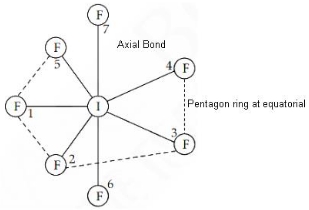
The structure of IF7 is
(a) Pentagonal bipyramid
(b) Square pyramid
(c) Trigonal bipyramid
(d) Octahedral

Answer

Answer: (a) Pentagonal bipyramid
Explanation:
IF7 Hybridization is sp³d³
Structure is Pentagonal bipyramidal.
MCQ Chemical Bonding Class 11


MCQ On Chemical Bonding Class 11 Question 19.
The outer orbitals of C in ethene molecule can be considered to be hybridized to give three equivalent sp² orbitals. The total number of sigma (s) and pi (p) bonds in ethene molecule is
(a) 1 sigma (s) and 2 pi (p) bonds
(b) 3 sigma (s) and 2 pi (p) bonds
(c) 4 sigma (s) and 1 pi (p) bonds
(d) 5 sigma (s) and 1 pi (p) bonds

Answer

Answer: (d) 5 sigma (s) and 1 pi (p) bonds
Explanation:
According to valence bond theory, two atoms form a covalent bond through the overlap of individual half-filled valence atomic orbitals, each containing one unpaired electron. In ethene, each hydrogen atom has one unpaired electron and each carbon is sp² hybridized with one electron each sp² orbital. The fourth electron is in the p orbital that will form the pi bond. The bond order for ethene is simply the number of bonds between each atom: the carbon-carbon bond has a bond order of two, and each carbon-hydrogen bond has a bond order of one.


MCQ On Chemical Bonding With Answers Pdf Question 20.
Which of the following is a linear molecule?
(a) ClO2
(b) CO2
(c) NO2
(d) SO2

Answer

Answer: (b) CO2
Explanation:
The steric number of central atom of a linear molecule is two. It has two bonded atoms and zero lone pair. All the molecules have two bonded atoms. Thus, we need to work out the number of lone pairs.
In ClO2, the central atom Cl has 7 valence electrons. Four are used up to form 4 bonds with O atoms. Three are non-bonding electrons. Thus, along with an odd electron, it has a lone pair.
In CO2, the central C atom has 4 valence electrons. All are used up to form four bonds with O atoms. Thus, it has zero lone pair.
In NO2, the central N atom has 5 valence electrons. Four are used up to form bonds with oxygen atoms. Thus, one electron is left as an odd electron.
In SO2, the central S atom has 6 valence electrons. Four are used up to form bonds with oxygen atoms. Two nonbonding electrons form one lone pair.


We hope the given NCERT MCQ Questions for Class 11 Chemistry Chapter 4 Chemical Bonding and Molecular Structure with Answers Pdf free download will help you. If you have any queries regarding CBSE Class 11 Chemistry Chemical Bonding and Molecular Structure MCQs Multiple Choice Questions with Answers, drop a comment below and we will get back to you soon.
The Address Class 11 MCQ Questions with Answers English Chapter 2

Check the below NCERT MCQ Questions for Class 11 English Snapshots Chapter 2 The Address with Answers Pdf free download. MCQ Questions for Class 11 English with Answers were prepared based on the latest exam pattern. We have provided The Address Class 11 English MCQs Questions with Answers to help students understand the concept very well. https://mcqquestions.guru/the-address-class-11-mcq-questions/

MCQ Questions for Class 11 English Snapshots Chapter 2 The Address with Answers

The Address MCQ Class 11 Question 1.
After reading “The Address”, how would you describe Mrs. Dorling?
(a) Materialistic
(b) Selfish
(c) Opportunist
(d) All of the above

Answer

Answer: (d) All of the above


The Address Class 11 MCQ Question 2.
In total, how many times did the author visit the given address?
(a) Twice
(b) Once
(c) Thrice
(d) Never

Answer

Answer: (a) Twice


The Address Class 11 MCQ Questions Question 3.
The author had come to visit Mrs. Dorling _______ the war.
(a) during
(b) before
(c) after
(d) Not mentioned in the story

Answer

Answer: (c) after


The Address MCQ Questions Class 11 Question 4.
At the end, what does the author decide?
(a) To forget the address
(b) To visit next year again
(c) To remember the address forever
(d) None of the above

Answer

Answer: (a) To forget the address


MCQ Of The Address Class 11 Question 5.
Why did the author leave Mrs. Dorling in a hurry?
(a) Because she was getting late for the train
(b) Because she no longer wanted to stay there
(c) Both (a) and (b)
(d) None of the above

Answer

Answer: (c) Both (a) and (b)


The Address MCQs Class 11 Question 6.
According to the author, when do we notice the things in the house?
(a) When they are out of our sight
(b) When they are used
(c) When they are shown
(d) All of the above

Answer

Answer: (a) When they are out of our sight


Class 11 The Address MCQ Question 7.
In what condition did the author find the living room?
(a) Haphazard
(b) Well arranged
(c) Empty
(d) Old fashioned

Answer

Answer: (a) Haphazard


MCQs Of The Address Chapter 2 Question 8.
“I was in a room I knew and did not know.” What does author mean by this?
(a) She saw familiar things but in unfamiliar surroundings
(b) She saw unfamiliar things but in familiar surroundings
(c) She did not recognize the things she saw
(d) She did not want to remember anything

Answer

Answer: (a) She saw familiar things but in unfamiliar surroundings


MCQ Questions For Class 11 English Chapter 2 Question 9.
Unlike Mrs. Dorling, her daughter was __________ towards the author.
(a) rude
(b) mature
(c) hospitable
(d) mean

Answer

Answer: (c) hospitable


The Address Class 11 MCQ Questions And Answers Question 10.
Why had the author come to visit Mrs. Dorling?
(a) Because Mrs. Dorling had belongings of author’s mother
(b) Because Mrs. Dorling called her
(c) Because she missed Mrs. Dorling
(d) None of the above

Answer

Answer: (a) Because Mrs. Dorling had belongings of author’s mother


The Address Class 11 MCQs Question 11.
How does the author describe Mrs. Dorling when she saw her the first time during the war?
(a) A woman with a broad back
(b) A woman with a round back
(c) A woman with a straight back
(d) None of the above

Answer

Answer: (a) A woman with a broad back


Address Class 11 MCQ Chapter 2 Question 12.
Mrs. Dorling took the possessions of the things on the pretence of __________.
(a) using them
(b) selling them
(c) keeping them safe
(d) Both (a) and (b)

Answer

Answer: (c) keeping them safe


We hope the given NCERT MCQ Questions for Class 11 English Snapshots Chapter 2 The Address with Answers Pdf free download will help you. If you have any queries regarding CBSE Class 11 English The Address MCQs Multiple Choice Questions with Answers, drop a comment below and we will get back to you soon.

MCQ Questions for Class 11 Chemistry Chapter 2 Structure of Atom with Answers

Check the below NCERT MCQ Questions for Class 11 Chemistry Chapter 2 Structure of Atom with Answers Pdf free download. MCQ Questions for Class 11 Chemistry with Answers were prepared based on the latest exam pattern. We have provided Structure of Atom Class 11 Chemistry MCQs Questions with Answers to help students understand the concept very well. https://mcqquestions.guru/mcq-questions-for-class-11-chemistry-chapter-2/

Structure of Atom Class 11 MCQs Questions with Answers

Structure Of Atom Class 11 MCQ Question 1.
The increasing order (lowest first) for the values of e/m (charge/mass) for
(a) e, p, n, α
(b) n, p, e, α
(c) n, p, α, e
(d) n, α, p, e

Answer

Answer: (d) n, α, p, e
Explanation:
(i) (e/m) for (i) neutron = (\(\frac{0}{1}\)) = 0
(ii) α− particle = (\(\frac{2}{4}\)) = 0.5
(iii) Proton = (\(\frac{1}{1}\)) = 1
(iv) electron = (\(\frac{1}{1837}\)) = 1837.


Structure Of Atom MCQ Class 11 Question 2.
The ionization enthalpy of hydrogen atom is 1.312 × 10⁶ J mol-1. The energy required to excite the electron in the atom from n = 1 to n = 2 is
(a) 8.51 × 10⁵ J mol-1
(b) 6.56 × 10⁵ J mol-1
(c) 7.56 × 10⁵ J mol-1
(d) 9.84 × 10⁵ J mol-1

Answer

Answer: (d) 9.84 × 10⁵ J mol-1
Explanation:
Energy required when an electron makes transition from n = 1 to n = 2
E2=−(1.312 × 106 × (1)²)/(2²)
= −3.28 × 10⁵ J mol-1
E1 = −1.312 × 10⁶ J mol-1
ΔE = E2 − E1
=−3.28 × 10⁵−(−13.2 × 10⁶)
ΔE = 9.84×10⁵ J mol-1


Class 11 Chemistry Chapter 2 MCQ Question 3.
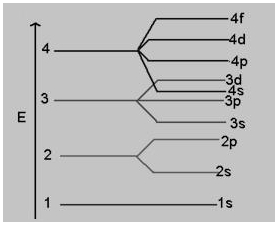
or a given principal level n = 4, the energy of its subshells is in the order
(a) s < p < d < f
(b) s > p > d > f
(c) s < p < f < d
(d) f < p < d < s

Answer

Answer: (a) s < p < d < f
Explanation:
Order of energy is:
s < p < d < f
MCQ Questions for Class 11 Chemistry Chapter 2 Structure of Atom with Answers 1


MCQ Questions For Class 11 Chemistry Chapter 2 Question 4.
A gas absorbs a photon of 355 nm and emits at two wavelengths. If one of the emissions is at 680 nm, the other is at:
(a) 518 nm
(b) 1035 nm
(c) 325 nm
(d) 743 nm

Answer

Answer: (d) 743 nm
Explanation:
From Law of Conservation of energy, energy of absorbed photon must be equal to combined energy of two emitted photons.
ET = E1 + E2 ….. (1)
Where E1 is Energy of first emitted photon emitted and E2is Energy of second emitted photon.
Energy E and wavelength λ of a photon are related by the equation
E= (hc)/ (λ)….. (2)
Where Plancks constant = h, c is velocity of light.
Substituting the values from (2) in (1) we get
(hc/λT) = (hc)/ (λ1) + (hc)/ (λ2)
Or (\(\frac{1}{λ_T}\)) = (\(\frac{1}{λ_1}\)) + (\(\frac{1}{λ_2}\)) …… (3)
Substituting given values in (3) we get
(\(\frac{1}{355}\)) = (\(\frac{1}{680}\)) + (\(\frac{1}{λ_2}\))
Or \(\frac{(1)}{(λ_T)}\) = (\(\frac{1}{355}\)) − (\(\frac{1}{680}\))
⇒ (\(\frac{1}{λ_2}\)) = (680 − 355)/ (355 × 680)
⇒ λ2 = 742.77nm


Class 11 Chemistry Chapter 2 MCQ With Answers Question 5.
Which of the following statements in relation to the hydrogen atom is correct?
(a) 3s orbital is lower in energy than 3p orbital
(b) 3p orbital is lower in energy than 3d orbital
(c) 3s and 3p orbitals are of lower energy than 3d orbital
(d) 3s, 3p and 3d orbitals all have the same energy

Answer

Answer: (d) 3s, 3p and 3d orbitals all have the same energy
Explanation:
A hydrogen atom has 1st configuration and these its, 3p and 3d orbitals will have same energy wrt 1s orbital.


MCQ Of Structure Of Atom Class 11 Question 6.
The magnetic quantum number specifies
(a) Size of orbitals
(b) Shape of orbitals
(c) Orientation of orbitals
(d) Nuclear Stability

Answer

Answer: (c) Orientation of orbitals
Explanation:
The magnetic quantum number specifies orientation of orbitals.


MCQ On Structure Of Atom Class 11 Question 7.
The electronic configuration of silver atom in ground state is
(a) [Kr]3d104s1
(b) [Xe]4f145d106s1
(c) [Kr]4d105s1
(d) [Kr]4d95s2

Answer

Answer: (c) [Kr]4d105s1
Explanation:
The electronic configuration of Ag in ground state is [Kr]4d105s1


Ch 2 Chemistry Class 11 MCQ Question 8.
Which of the following element has least number of electrons in its M-shell?
(a) K
(b) Mn
(c) Ni
(d) Sc

Answer

Answer: (a) K
Explanation:
K = 19 = 1s²2s22p63s23p6s1
3s23p6 = m-shell
= k has only 8 electrons in M shell


Structure Of Atom Class 11 MCQ Questions And Answers Pdf Question 9.
Which one of the following sets of ions represents a collection of isoelectronic species? (Atomic nos.: F = 9, Cl = 17, Na = 11, Mg = 12, Al = 13, K = 19, Ca = 20, Sc = 21)
(a) K+, Ca2+, Sc3+, Cl
(b) Na+, Ca2+ , Sc3+, F
(c) K+, Cl, Mg2+, Sc3+
(d) Na+, Mg2+, Al3+, Cl

Answer

Answer: (a) K+, Ca2+, Sc3+, Cl
Explanation:
Isoelectronic species are those which have same number of electrons.
K+ = 19 – 1 = 18; Ca2+ = 20 – 2 = 18; Sc3+ = 21 – 3 = 18; Cl = 17 + 1 = 18
Thus all these ions have 18 electrons in them.


Atomic Structure Class 11 MCQ Questions Question 10.
In the ground state, an element has 13 electrons in its M-shell. The element is_____.
(a) Copper
(b) Chromium
(c) Nickel
(d) Iron

Answer

Answer: (b) Chromium
Explanation:
M shell means it is third shell ⇒ n = 3
Number of electrons in M shell = 13
⇒ 3s23p63d5
The electronic configuration is: (1s2) (2s2 2p6) (3s2 3p6 3d5) (4s1)
The element is chromium is Cr.


Chapter 2 Chemistry Class 11 MCQ Question 11.
The electrons of the same orbitals can be distinguished by
(a) Principal quantum number
(b) Azimuthal quantum number
(c) Spin quantum number
(d) Magnetic quantum number

Answer

Answer: (c) Spin quantum number
Explanation:
Electrons occupying the same orbital are distinguished by Spin quantum number.
For spin Quantum number it has two values +1/2 or -1/2,
Hence the value of n, l , m are same for the two electrons occupying in the same orbitals, but only the is different, which is
Therefore, Spin quantum number explains the direction through which the electron spins in an orbital. so obviously there are only 2 possible directions. Which is either clockwise or anticlockwise.
So the electron which are available in the same orbitals, must have opposite spins. Hence spin quantum number distinguished b/w the two electrons.


Class 11 Chemistry Ch 2 MCQ Question 12.
Consider the ground state of Cr atom (Z = 24). The numbers of electrons with the azimuthal quantum numbers, l = 1 and 2 are, respectively:
(a) 12 and 4
(b) 12 and 5
(c) 16 and 4
(d) 16 and 5

Answer

Answer: (b) 12 and 5
Explanation:
24Cr → 1s2 2s22p6 3s2 3p6 3d5 4s1
As we know for p, l = 1 and d, l = 2
For l = 1, total number of electrons = 12 [2p6 and 3p6]
For l = 2, total number of electrons = 5 [3d5]


Chemistry Class 11 Chapter 2 MCQ Question 13.
A body of mass 10 mg is moving with a velocity of 100 ms-1. The wavelength of de-Broglie wave associated with it would be (Note: h = 6.63 × 10⁻³⁴ Js)
(a) 6.63 × 10-37 m
(b) 6.63 × 10⁻³¹ m
(c) 6.63 × 10⁻³⁴ m
(d) 6.63 × 10⁻³⁵ m

Answer

Answer: (b) 6.63 × 10⁻³¹ m
Explanation:
m = 10 mg
= 10 × 10-6 kg
v = 100 ms-1
λ = \(\frac {(h)}{(mv)}\)
= (6.63×10⁻³⁴)/ (10 × 10-6 × 100)
= 6.63 × 10⁻³¹ m


MCQ Of Chapter 2 Chemistry Class 11 Question 14.
The ionization enthalpy of hydrogen atom is 1.312 × 10⁶ J mol-1. The energy required to excite the electron in the atom from n = 1 to n = 2 is
(a) 8.51 × 10⁵ J mol-1
(b) 6.56 × 10⁵ J mol-1
(c) 7.56 × 10⁵ J mol-1
(d) 9.84 × 10⁵ J mol-1

Answer

Answer: (d) 9.84 × 10⁵ J mol-1
Explanation:
Energy required when an electron makes transition from n = 1 to n = 2
E2 = −(1.312 × 106 × (1)²)/(2²)
= −3.28 × 10⁵ J mol-1
E1 = −1.312 × 10⁶ J mol-1
ΔE = E2 − E1
= −3.28 × 10⁵−(−13.2 × 10⁶)
ΔE = 9.84 × 10⁵ J mol-1


Class 11 Chemistry Chapter 2 MCQ Questions With Answers Question 15.
In Hydrogen atom, energy of first excited state is – 3.4 eV. Then find out KE of same orbit of Hydrogen atom
(a) 3.4 eV
(b) 6.8 eV
(c) -13.6 eV
(d) +13.6 eV

Answer

Answer: (a) 3.4 eV
Explanation:
For hydrogen atom,
The kinetic energy is equal to the negative of the total energy.
And the potential energy is equal to the twice of the total energy.
The first excited state energy of orbital = -3.4 eV
and The kinetic energy of same orbital = -(-3.4 eV) = 3.4 eV
Therefore, the kinetic energy of same orbit of hydrogen atom is 3.4 eV.


Question 16.
Which of the following sets of quantum numbers represents the highest energy of an atom?
(a) n = 3, l = 0, m = 0, s = + \(\frac {1}{2}\)
(b) n = 3, l = 1, m = 1, s = + \(\frac {1}{2}\)
(c) n = 3, l = 2, m = 1, s = + \(\frac {1}{2}\)
(d) n = 4, l = 0, m = 0, s = + \(\frac {1}{2}\)

Answer

Answer: (c) n = 3, l = 2, m = 1, s = + \(\frac {1}{2}\)
Explanation:
n = 3, l = 0 represents 3s orbital n = 3, l = 1 represents 3p orbital n = 3, l = 2 represents 3d orbital n = 4, l = 0 represents 4s orbital The order of increasing energy of the orbitals is 3s < 3p < 4s < 3d.


Question 17.
In the Bohrs model of the hydrogen atom, the ratio of the kinetic energy to the total energy of the electron in a quantum state n is:
(a) 1
(b) 2
(c) -1
(d) -2

Answer

Answer: (c) -1
Explanation:
As we know, in Bohr model KE of an electron in an orbit = + (\(\frac {1}{2}\)) (\(\frac {e^2}{r_n}\))
Total energy of electron in an orbit = -(\(\frac {e^2}{2r_n}\))
Therefore, \(\frac {(KE)}{(TE)}\) = -1


Question 18.
Which of the following statements does not form a part of Bohrs model of hydrogen atom?
(a) Energy of the electrons in the orbit is quantised
(b) The electron in the orbit nearest the nucleus has the lowest energy
(c) Electrons revolve in different orbits around the nucleus
(d) The position and velocity of the electrons in the orbit cannot be determined simultaneously

Answer

Answer: (d) The position and velocity of the electrons in the orbit cannot be determined simultaneously
Explanation:
The position and velocity of electrons cannot be determined simultaneously does not fit in with the Bohrs model of H atom. It is a part of Heisenbergs uncertainty principle


Question 19.
Which of the following statements in relation to the hydrogen atom is correct?
(a) 3s orbital is lower in energy than 3p orbital
(b) 3p orbital is lower in energy than 3d orbital
(c) 3s and 3p orbitals are of lower energy than 3d orbital
(d) 3s, 3p and 3d orbitals all have the same energy

Answer

Answer: (d) 3s, 3p and 3d orbitals all have the same energy
Explanation:
A hydrogen atom has 1s1 configuration and these its, 3p and 3d orbitals will have same energy wrt 1s orbital.


Question 20.
A sub-shell with n = 6 , l = 2 can accommodate a maximum of
(a) 12 electrons
(b) 36 electrons
(c) 10 electrons
(d) 72 electrons

Answer

Answer: (c) 10 electrons
Explanation:
n = 6, ℓ = 2 means 6d → will have 5 orbitals.
Therefore max 10 electrons can be accommodated as each orbital can have maximum of 2 electrons.


We hope the given NCERT MCQ Questions for Class 11 Chemistry Chapter 2 Structure of Atom with Answers Pdf free download will help you. If you have any queries regarding CBSE Class 11 Chemistry Structure of Atom MCQs Multiple Choice Questions with Answers, drop a comment below and we will get back to you soon.

MCQ Questions for Class 11 Chemistry Chapter 1 Some Basic Concepts of Chemistry with Answers

Check the below NCERT MCQ Questions for Class 11 Chemistry Chapter 1 Some Basic Concepts of Chemistry with Answers Pdf free download. MCQ Questions for Class 11 Chemistry with Answers were prepared based on the latest exam pattern. We have provided Some Basic Concepts of Chemistry Class 11 Chemistry MCQs Questions with Answers to help students understand the concept very well. https://mcqquestions.guru/mcq-questions-for-class-11-chemistry-chapter-1/

Some Basic Concepts of Chemistry Class 11 MCQs Questions with Answers

Some Basic Concepts Of Chemistry MCQ Question 1.
Approximate atomic weight of an element is 26.89. If its equivalent weight is 8.9, the exact atomic weight of element would be
(a) 26.89
(b) 8.9
(c) 17.8
(d) 26.7

Answer

Answer: (d) 26.7
Explanation:
Atomic weight = (Equivalent weight × Valency)
=(8.9 × 3) = 26.7
(Valency = (26.89)/(8.9) ≈ 3).


Class 11 Chemistry Chapter 1 MCQ Questions With Answers Question 2.
The number of moles present in 6 gms of carbon is:
(a) 2
(b) 0.5
(c) 5
(d) 1

Answer

Answer: (b) 0.5
Explanation:
The molar mass of
12C is 12.0 gmol-1.
NA (Avogadros number = 6.022×10²³)
12C atoms have a mass of 12.0 g.
Given that: – 6.0 g.
Thus (6.0 g)/ (12.0 gmol-1) = 0.50 mol.


Class 11 Chemistry Chapter 1 MCQ Question 3.
What is the concentration of nitrate ions if equal volumes of 0.1 M AgNO3 and 0.1 M NaCl are mixed together
(a) 0.1 N
(b) 0.2 M
(c) 0.05 M
(d) 0.25 M

Answer

Answer: (b) 0.2 M
Explanation:
0.1 M AgNOA will react with 0.1 M NaCl to form 0.1 M NaNOA.
But as the volume is doubled, conc. of NO3 = \(\frac { (0.1) }{ (2) } \)
= 0.05 M


Some Basic Concepts Of Chemistry Class 11 MCQ With Answers Question 4.
The -ve charged particles is called:
(a) Anion
(b) Cation
(c) Radical
(d) Atom

Answer

Answer: (a) Anion
Explanation:
A charged particle, also called an ion, is an atom with a positive or negative charge.
This happens whenever something called an ionic bond forms.
Two particles that have different numbers of electrons (the smallest particle in an atom which is negative) start reacting to each other.
The particle that has the greater amount of electrons takes the other particles electrons.
One becomes positive because it lost an electron, and the other negative because it got another electron.
The two particles become attracted to each other and mix together, making a new kind of particle.


MCQ Questions For Class 11 Chemistry Chapter 1 Question 5.
Which is not a unit of pressure:
(a) Bar
(b) N/m²
(c) Kg/m²
(d) Torr

Answer

Answer: (c) Kg/m²
Explanation:
Pressure is force per unit area so Kg/m² cannot be a unit of pressure.


Some Basic Concepts Of Chemistry Class 11 MCQ Question 6.
What is the normality of a 1 M solution of H3PO4
(a) 0.5 N
(b) 1.0 N
(c) 2.0 N
(d) 3.0 N

Answer

Answer: (d) 3.0 N
Explanation:
H3PO4 is tribasic
So N = 3M
= 3 × 1 = 3.


Chemistry Class 11 Chapter 1 MCQs Question 7.
The total number of ions present in 111 g of CaCl2 is
(a) One Mole
(b) Two Mole
(c) Three Mole
(d) Four Mole

Answer

Answer: (c) Three Mole
Explanation:
Molecular weight of
CaCl2 = 111g/mol
Ions in one calcium chloride molecule = Ca+2 + 2Cl = 3 ions
Now no. of molecules in 111g/mol of CaCl2 = Avogadros number
= 6.02 × 10²³ molecules
So number of ions in 111g/mol of CaCl2
= 3 × 6.02 × 1023 ions
= 3 moles.


Ch 1 Chemistry Class 11 MCQ Question 8.
Which of the following weighs the most?
(a) One g – atom of nitrogen
(b) One mole of water
(c) One mole of sodium
(d) One molecule of H2SO4

Answer

Answer: (c) One mole of sodium


Chapter 1 Chemistry Class 11 MCQ Question 9.
Under similar conditions of pressure and temperature, 40 ml of slightly moist hydrogen chloride gas is mixed with 20 ml of ammonia gas, the final volume of gas at the same temperature and pressure will be
(a) 100 ml
(b) 20 ml
(c) 40 ml
(d) 60 ml

Answer

Answer: (b) 20 ml
Explanation:
NH3(g) + HCl(g)→ NH4Cl(s)
t = 0 40ml 0
t = t 20ml solid
Final volume = 20ml.


Chemistry Class 11 Chapter 1 MCQ Question 10.
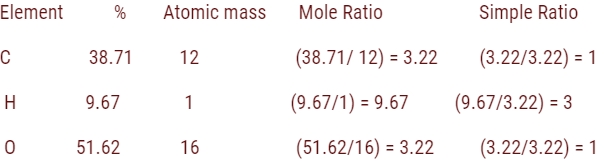
An organic compound contains carbon , hydrogen and oxygen. Its elemental analysis gave C, 38.71% and H, 9.67%. The empirical formula of the compound would be
(a) CHO
(b) CH4O
(c) CH3O
(d) CH2O

Answer

Answer: (c) CH3O
Explanation:
MCQ Questions for Class 11 Chemistry Chapter 1 Some Basic Concepts of Chemistry with Answers 1


Class 11 Chemistry Ch 1 MCQ Question 11.
Which of the following cannot give iodometric titrations
(a) Fe3+
(b) Cu2+
(c) Pb2+
(d) Ag+

Answer

Answer: (c) Pb2+
Explanation:
Atom in highest oxidation state can oxidize iodide to liberate I2 which is volumetrically measured by iodometric titration using hypo.
2I →I2
Pb+2 → Lowest oxidation state cannot oxidise iodide to I2


MCQ Class 11 Chemistry Chapter 1 Question 12.
What is the concentration of nitrate ions if equal volumes of 0.1 MAgNO3 and 0.1 M NaCl are mixed together
(a) 0.1 M
(b) 0.2 M
(c) 0.05 M
(d) 0.25 M

Answer

Answer: (c) 0.05 M
Explanation:
0.1M AgNO3 will react with 0.1M NaCl to form 0.1M NaNO3.
But as the volume doubled, conc. of NO2
= 0.12
= 0.05 M


MCQ Of Chapter 1 Chemistry Class 11 Question 13.
The number of moles present in 6 gms of carbon is:
(a) 2
(b) 0.5
(c) 5
(d) 1

Answer

Answer: (b) 0.5
Explanation:
The molar mass of
12C is 12.0 gmol-1.
NA (Avogadros number = 6.022 × 10²³)
12C atoms have a mass of 12.0 g.
Given that: – 6.0 g.
Thus (6.0 g)/ (12.0 gmol-1) = 0.50 mol.


MCQ On Some Basic Concepts Of Chemistry Question 14.
Which of the following contains same number of carbon atoms as are in 6.0 g of carbon (C – 12)?
(a) 6.0 g Ethane
(b) 8.0 g Methane
(c) 21.0 g Propane
(d) 28.0 g CO

Answer

Answer: (b) 8.0 g Methane
Explanation:
6g carbon
Moles of carbon = (6/12) = 0.5 mol
Number of carbon atoms
= 0.5 × NA =0.5NA (NA is Avogadro number)
6g ethane (C2H6 two atoms of C per mole)
Moles = (6/30) = 0.2 mol
Number of carbon atoms = 0.2 × 2 × NA = 0.4 NA
(Number of carbon atoms = moles of compound × number of C atoms per mol × Avogadro number)
8g methane (CH4)
Moles = (8/16) = 0.5 mol
Number of carbon atoms = 0.5 × 1 × NA = 0.5 NA
21g propane (C3H8)
Moles = (21/44) =0.48 mol
Number of carbon atoms = 0.48 × 3 × NA = 1.44 NA
28g CO
Moles = (28/28) =1 mol
Number of carbon atoms = 1 × 1 × NA = NA


MCQ Of Ch 1 Chemistry Class 11 Question 15.
The significant figures in 3400 are
(a) 2
(b) 5
(c) 6
(d) 4

Answer

Answer: (b) 5
Explanation:
As we know that all non-zero unit are significant number.


Question 16.
A symbol not only represents the name of the element but also represents
(a) Atomic Mass
(b) Atomic Number
(c) Atomicity
(d) Atomic Volume

Answer

Answer: (c) Atomicity
Explanation:
Symbol of an element represents the name along with the number of same atoms in room condition, which is its atomicity, of that element.


Question 17.
What is the normality of a 1 M solution of H3PO4
(a) 0.5 N
(b) 1.0 N
(c) 2.0 N
(d) 3.0 N

Answer

Answer: (d) 3.0 N
Explanation:
H3PO4 is tribasic
So N = 3M
= 3 × 1 = 3.


Question 18.
Which of the following weighs the most?
(a) One g – atom of nitrogen
(b) One mole of water
(c) One mole of sodium
(d) One molecule of H2SO4

Answer

Answer: (c) One mole of sodium


Question 19.
The sulphate of a metal M contains 9.87% of M. This sulphate is isomorphous with ZnSO4.7H2O. The atomic weight of M is
(a) 40.3
(b) 36.3
(c) 24.3
(d) 11.3

Answer

Answer: (c) 24.3
Explanation:
As the given sulphate is isomorphous with ZnSO4.7H2O its formula would be MSO4.7H2O.m is the atomic weight of M, molecular weight of MSO4.7H2O
= (m + 32 + 64 + 126) = (m + 222)
Hence % of M= [(m)/ (m+222)] × 100 = 9.87(given)
Or
100 m = (9.87 m + 222 × 9.87)
Or 90.13 m = (222 × 9.87)
Or m = (222 × 9.87)/(90.13)
= 24.3.


Question 20.
The S.I unit of temperature is :
(a) Kelvin
(b) Celsius
(c) Fahrenheit
(d) Centigrade

Answer

Answer: (a) Kelvin
Explanation:
The SI unit of temperature is the Kelvin. Although the Celsius temperature scale is also used, it is considered a derived SI unit and is generally used to measure everyday temperatures.

In the Kelvin scale, the lowest possible temperature is 0 K. This reading is called absolute zero; however, nothing could possibly ever reach this temperature. Absolute zero, according to the Celsius scale, is approximately minus 273 degrees Celsius. Water boils at 373 Kelvin and freezes at 273 Kelvin.

Scientists discovered absolute zero when they figured that as temperature decreases, the volume of a gas also gets smaller. They graphed this relationship and found that for each substance tested, zero volume for each substance would hypothetically occur around minus 273 degrees Celsius, the equivalent of absolute zero.


We hope the given NCERT MCQ Questions for Class 11 Chemistry Chapter 1 Some Basic Concepts of Chemistry with Answers Pdf free download will help you. If you have any queries regarding CBSE Class 11 Chemistry Some Basic Concepts of Chemistry MCQs Multiple Choice Questions with Answers, drop a comment below and we will get back to you soon.