MCQ Questions for Class 11 Chemistry Chapter 10 The s-Block Elements with Answers

Check the below NCERT MCQ Questions for Class 11 Chemistry Chapter 10 The s-Block Elements with Answers Pdf free download. MCQ Questions for Class 11 Chemistry with Answers were prepared based on the latest exam pattern. We have provided The s-Block Elements Class 11 Chemistry MCQs Questions with Answers to help students understand the concept very well. https://mcqquestions.guru/mcq-questions-for-class-11-chemistry-chapter-10/

The s-Block Elements Class 11 MCQs Questions with Answers

S Block Elements Class 11 MCQ Question 1.
CsOH is
(a) Strongly basic
(b) Weakly basic
(c) Slightly acidic
(d) Amphoteric.

Answer

Answer: (a) Strongly basic
Explanation:
Caesium hydroxide or cesium hydroxide (CsOH) is a chemical compound consisting of caesium ions and hydroxide ions. It is a strong base (pkb = -1.76), much like the other alkali metal hydroxides such as sodium hydroxide and potassium hydroxide.


MCQ On S Block Elements Class 11 Question 2.
Solvays process is used for the manufacture of :
(a) NaOH
(b) (Na2CO3. 10H2O)
(c) K2CO3
(d) Na2O2

Answer

Answer: (b) (Na2CO3. 10H2O)
Explanation:
The Solvay process or ammonia soda process is used for the manufacture of sodium carbonate
(Na2CO3. 10H2O).


S-Block Elements MCQs With Answers Pdf Question 3.
Alkali metals give a _________________when dissolved in liquid ammonia
(a) Deep blue solution
(b) Colourless
(c) Red colour
(d) None of the Above

Answer

Answer: (a) Deep blue solution
Explanation:
When an alkali metal is dissolved in liquid ammonia, it results in the formation of a deep blue coloured solution. The ammoniated electrons absorb energy corresponding to a red region of visible light. Therefore, the transmitted light is blue in colour.


S Block Elements MCQ Question 4.
What are Oxo-Acids?
(a) Acid containing Oxygen
(b) Acid containing Sulphur
(c) Acid containing Carbon
(d) None of the Above

Answer

Answer: (a) Acid containing Oxygen
Explanation:
An oxyacid, oxoacid, or ternary acid is an acid that contains oxygen. Specifically, it is a compound that contains hydrogen, oxygen, and at least one other element, with at least one hydrogen atom bond to oxygen that can dissociate to produce the H+ cation and the anion of the acid. e.g., carbonic acid, H2CO3 (OC(OH)2; sulphuric acid, H2SO4 (O2S(OH)2).


MCQ Of S Block Elements Class 11 Question 5.
In curing cement plasters, water is sprinkled from time to time. This helps in
(a) Converting sand into silicic acid
(b) Keeping it cool
(c) Developing interlocking needle like crystals of hydrated silicates
(d) Hydrating sand and gravel mixed with cement.

Answer

Answer: (c) Developing interlocking needle like crystals of hydrated silicates
Explanation:
Water develops interlocking needle ­like crystals of hydrated silicates. The reactions involved are the hydration of calcium aluminates and calcium silicates which change into their colloidal gels.

At the same time, some calcium hydroxide and aluminium hydroxides are formed as precipitates due to hydrolysis. Calcium hydroxide binds the particles of calcium silicate together while aluminium hydroxide fills the interstices rendering the mass impervious


Class 11 Chemistry S Block Elements MCQ Question 6.
The substance not likely to contain CaCO3 is
(a) Dolomite
(b) A marble statue
(c) Calcined gypsum
(d) Sea shells.

Answer

Answer: (c) Calcined gypsum
Explanation:
The composition of gypsum is CaSO4 ∙2H2O. It does not have CaCO3


MCQs On S Block Elements Question 7.
Carnallite is the mineral of:
(a) Na
(b) Ca
(c) Mg
(d) None of the Above

Answer

Answer: (c) Mg
Explanation:
Carnallite is an evaporite mineral a hydrated potassium magnesium chloride. It is variably coloured yellow to white, reddish or blue. It occurs with a sequence of potassium and magnesium evaporite. It is an uncommon double chloride mineral that forms under specific conditions. It is an important source of potash.


MCQ On S Block Elements Question 8.
The wire of flash bulb is made up of:
(a) Mg
(b) Ag
(c) Cu
(d) Ba

Answer

Answer: (a) Mg
Explanation:
Magnesium metal is used for the preparation of the wire of flash bulb.


Class 11 Chemistry Chapter 10 MCQ Question 9.
The basic strength of which hydroxide is maximum
(a) LiOH
(b) NaOH
(c) Ca (OH)2
(d) KOH.

Answer

Answer: (d) KOH.
Explanation:
The basic strength increases down the group and decreases along a period.


S-Block Elements MCQs With Answers Question 10.
The composition of Sorels cement is
(a) KCl × MgCl2× 6H2O
(b) MgCl2 × 5MgO × (xH2O)
(c) MgCO3 × CaCO3
(d) CaSO4 × 2H2O

Answer

Answer: (b) MgCl2 × 5MgO × (xH2O)
Explanation:
Mixture of MgCl2 and MgO is called Sorels cement. It is MgCl2 × 5MgO × (xH2O)


Class 11 S Block Elements MCQs Question 11.
Which of the following alkali metals has the least melting point?
(a) Na
(b) K
(c) Rb
(d) Cs.

Answer

Answer: (d) Cs.
Explanation:
Atomic size increases as we move down the alkali group. As a result, the binding energies of their atoms in the crystal lattice decrease. Also, the strength of metallic bonds decreases on moving down a group in the periodic table. This causes a decrease in the melting point. Among the given metals, Cs is the largest and has the least melting point.


MCQ Of S Block Elements Question 12.
The basic strength of which hydroxide is maximum
(a) LiOH
(b) NaOH
(c) Ca(OH)2
(d) KOH.

Answer

Answer: (d) KOH.
Explanation:
The basic strength increases down the group and decreases along a period.


S Block Elements MCQs With Answers Pdf Question 13.
The hydration energy of Mg2+ is larger than that of
(a) A13+
(b) Na+
(c) Be26
(d) Mg3+

Answer

Answer: (b) Na+
Explanation:
Hydration energy depends on charge of ion and ionic radius. Higher the charge, greater the hydration energy. On the other hand, smaller the size, greater the hydration energy. Charge is considered first for comparison. Hence, Mg2+ has higher hydration energy than Na+.


S Block Elements MCQ Class 11 Question 14.
Milk of lime reacts with chlorine to form ________, a constituent of bleaching powder.
(a) Ca(OCI)2
(b) Ca(CIO2)2
(c) Ca(CIO3)2
(d) Ca(CIO4)2

Answer

Answer: (a) Ca(OCI)2
Explanation:
Milk of lime reacts with chlorine to form bleaching powder.
2Ca(OH)2 + 2Cl2 → CaCl2 + Ca(OCl)2 + 2H2O


MCQ Questions On S Block Elements Question 15.
What happens when Calcium carbonate is heated to 1200 K?
(a) Carbon Monoxide
(b) Calcium hydroxide
(c) Calcium Oxide
(d) Both (2) and (3) are correct

Answer

Answer: (d) Both (2) and (3) are correct
Explanation:
Calcium carbonate is strongly heated until it undergoes thermal decomposition to form calcium oxide and carbon dioxide. The calcium oxide (unslaked lime) is dissolved in water to form calcium hydroxide (limewater).
CaCO3 → CaO + CO2


S Block Elements Class 11 MCQ Pdf Question 16.
The salt that is added to table salt to make it flow freely in rainy season is
(a) KCl
(b) KI
(c) Ca3(PO4)2
(d) Na3PO4

Answer

Answer: (c) Ca3(PO4)2
Explanation:
Ca3(PO4)2. Both Ca and P are needed by human beings. Also they prevent moisture absorbing power of other components such as MgCl2, CaCl2, CaSO4 and MgSO4 present in commercial sodium chloride.


MCQ Questions For Class 11 Chemistry Chapter 10 Question 17.
CsOH is
(a) Strongly basic
(b) Weakly basic
(c) Slightly acidic
(d) Amphoteric.

Answer

Answer: (a) Strongly basic
Explanation:
Caesium hydroxide or cesium hydroxide (CsOH) is a chemical compound consisting of caesium ions and hydroxide ions. It is a strong base (pkb = -1.76), much like the other alkali metal hydroxides such as sodium hydroxide and potassium hydroxide.


MCQ Questions On S-Block Elements Pdf Question 18.
Which of the following metals is not manufactured by electrolysis?
(a) Na
(b) Mg
(c) Al
(d) Fe

Answer

Answer: (d) Fe
Explanation:
Method of extraction of a metal depends on the reactivity of the metal. Iron (Fe) is not manufacture by electrolysis. Moderately reactive metals like zinc and iron are extracted by reduction of their oxides using carbon.


Question 19.
The wire of flash bulb is made up of:
(a) Mg
(b) Ag
(c) Cu
(d) Ba

Answer

Answer: (a) Mg
Explanation:
Magnesium metal is used for the preparation of the wire of flash bulb.


Question 20.
Usually CaCl2 is preferred over NaCl for cleaning snow on roads particularly in very cold countries this is because
(a) NaCl makes the road slippery but CaCl2 doesnot
(b) CaCl2 is hygroscopic but NaCl is not
(c) CaCl2 is less soluble in H2O than NaCl
(d) eutectic mixtue of CaCl/H2O freezes at -55°C while that of NaCl/H2O freezes at -18°C

Answer

Answer: (d) eutectic mixtue of CaCl/H2O freezes at -55°C while that of NaCl/H2O freezes at -18°C
Explanation:
Eutectic mixture of CaCl2/H2O freezes at -55°C while that of NaCl/H2O freezes at -18°C.

When added to ice. NaCl and CaCl2 ionise into respective ions (Na+, Ca2+ & Cl) this leads to increase in the number of particles (ions). As CaCl2 has greater number of ions, Increasing the number of particles /ions increases the vant hoff factor. Vant hoff factor is directly proportional to the depression in freezing point thus lowers the freezing point of ice causing preventing the formation of ice.


We hope the given NCERT MCQ Questions for Class 11 Chemistry Chapter 10 The s-Block Elements with Answers Pdf free download will help you. If you have any queries regarding CBSE Class 11 Chemistry The s-Block Elements MCQs Multiple Choice Questions with Answers, drop a comment below and we will get back to you soon.
MCQ Questions for Class 11 Biology Chapter 19 Excretory Products and their Elimination with Answers

Check the below NCERT MCQ Questions for Class 11 Biology Chapter 19 Excretory Products and their Elimination with Answers Pdf free download. MCQ Questions for Class 11 Biology with Answers were prepared based on the latest exam pattern. We have provided Excretory Products and their Elimination Class 11 Biology MCQs Questions with Answers to help students understand the concept very well. https://mcqquestions.guru/mcq-questions-for-class-11-biology-chapter-19/

Excretory Products and their Elimination Class 11 MCQs Questions with Answers

Excretory Products And Their Elimination MCQ Class 11 Question 1.
Presence of RBCs in urine is
(a) Uremia
(b) ketonuria
(c) Glucosuria
(d) hematuria

Answer

Answer: (d) hematuria
Explanation:
Presence of blood in urine is called hematuria.
Presence of glucose in urine is called glucosuria.
Presence of ketone bodies in urine is called ketonuria.


Excretory Products And Their Elimination Class 11 MCQ Question 2.
Ornithine cycle leads to the formation of
(a) NH3
(b) ((NH2)2)CO)
(c) C5H4N4O3
(d) C5H4N4

Answer

Answer: (b) ((NH2)2)CO)
Explanation:
Ornithine cycle is the other name of urea cycle. Urea cycle is the production of urea from ammonia.
((NH2)2)CO) is the chemical formula of urea.
NH3 is ammonia.
C5H4N4 is purine.
C5H4N4O3 is uric acid.


Class 11 Biology Chapter 19 MCQ Question 3.
The yellow pigment derived from heme breakdown and excreted by kidneys is
(a) Uric acid
(b) Urochrome
(c) Cholesterol
(d) Melanin

Answer

Answer: (b) Urochrome


MCQ On Excretory Products And Their Elimination Class 11 Question 4.
What happens when glomerular filteration rate falls?
(a) Activation of podocytes
(b) Release of renin
(c) Repression of juxta glomerular cells
(d) None of the above

Answer

Answer: (b) Release of renin
Explanation:
Fall in GFR activates juxta glomerular cells to release renin which stimulates glomerular blood flow and brings back the GFR to normal.


Excretory Products And Their Elimination MCQ With Answers Question 5.
Which of the following can be cured by hemodialysis?
(a) Renal calculi
(b) Glomerulonephritis
(c) Uremia
(d) All of these can be cured by hemodialysis

Answer

Answer: (c) Uremia
Explanation:
Malfunctioning of kidneys can lead to accumulation of urea in blood, this situation leads to uremia.
This can lead to kidney failure. In such patients, urea can be removed by hemodialysis.


MCQ Of Excretory Products And Their Elimination Class 11 Question 6.
Kidneys are located in
(a) thoracic cavity
(b) abdominal cavity
(c) body cavity
(d) pelvic cavity

Answer

Answer: (b) abdominal cavity
Explanation:
Kidneys are present in abdominal cavity along with digestive organs.
Body cavity contains brain and spinal cord.
Thoracic cavity contains heart and lungs.
Pelvic cavity contains bladder and reproductive organs.


MCQs On Excretory Products And Their Elimination Class 11 Question 7.
The muscular tubes which take the urine from the kidneys to the bladder are
(a) Urinary bladders
(b) Ureters
(c) Urethras
(d) Nephrons

Answer

Answer: (b) Ureters


Excretory Products And Their Elimination MCQs Class 11 Question 8.
Most water and salts are reabsorbed in
(a) DCT
(b) Bowman s capsule
(c) PCT
(d) DCT and PCT

Answer

Answer: (c) PCT


Explanation:
Maximum absorption of water and salts occurs in proximal convulated tubule.

Excretory Products And Their Elimination MCQ Questions Question 9.
Reabsorption of filterate occurs in
(a) renal tubules
(b) glomerular apparatus
(c) medullary pyramid
(d) juxta cells

Answer

Answer: (a) renal tubules
Explanation:
Nearly 99 per cent of the filtrate is absorbed by renal tubules.


Class 11 Biology Chapter 19 MCQ Questions Question 10.
JG cells release
(a) angiotensin II
(b) aldosterone
(c) renin
(d) ANF

Answer

Answer: (c) renin
Explanation:
A fall in glomerular blood flow activates JG cells to release renin.


Excretory Products And Their Elimination MCQ Pdf Question 11.
pH of human urine is
(a) 7.0
(b) 6.5
(c) 6.0
(d) 7.5

Answer

Answer: (b) 6.5
Explanation:
The average pH of human urine is 6.0.


MCQ Of Chapter 19 Class 11 Biology Question 12.
Average blood filtered by kidneys per minute is
(a) 1000 – 1500 mL
(b) 500 – 600 mL
(c) 200 – 300 mL
(d) 1100 – 1200 mL

Answer

Answer: (d) 1100 – 1200 mL
Explanation:
On an average kidneys filter 1100 – 1200 mL of blood per minute.


Class 11 Excretory Products And Their Elimination MCQ Question 13.
Kidneys are located in
(a) thoracic cavity
(b) abdominal cavity
(c) body cavity
(d) pelvic cavity

Answer

Answer: (b) abdominal cavity
Explanation:
Kidneys are present in abdominal cavity along with digestive organs.
Body cavity contains brain and spinal cord.
Thoracic cavity contains heart and lungs.
Pelvic cavity contains bladder and reproductive organs.


Excretory Products And Their Elimination MCQ Class 11 Question 14.
Which one of the following statements in regard to the excretion by the human kidneys is correct?
(a) Ascending limb of Loop of Henle is impermeable to electrolytes
(b) Descending limb of Loop of Henle is impermeable to water
(c) Distal convoluted tubule is incapable of reabsorbing HCO3
(d) Nearly 99 percent of the glomerular filtrate is reabsorbed by the renal tubules

Answer

Answer: (d) Nearly 99 percent of the glomerular filtrate is reabsorbed by the renal tubules


Excretion And Elimination Class 11 MCQ Question 15.
In the kidneys, osmotic pressure controls ______.
(a) Glucose absorption
(b) Sodium absorption
(c) Water absorption
(d) none of these

Answer

Answer: (c) Water absorption


Question 16.
Presence of __________ in urine indicates diabetes mellitus.
(a) Glucose
(b) Cholesterol
(c) Ketone bodies
(d) Both 1 and 3

Answer

Answer: (d) Both 1 and 3
Explanation:
Presence of ketone bodies and glucose in urine indicates diabetes mellitus.


Question 17.
If a man takes large amount of protein, he is likely to excrete more amount of
(a) Glucose
(b) Urea and uric acid
(c) Water
(d) Salts

Answer

Answer: (b) Urea and uric acid


Question 18.
Nerves, blood vessels and ureter enters into the kidney through
(a) calyces
(b) hilum
(c) capsule
(d) cortex

Answer

Answer: (b) hilum
Explanation:
Nerves, blood vessels and ureter enters into the kidney through hilum.


Question 19.
The principal nitrogenous excretory compound in humans is synthesised
(a) In the liver but eliminated mostly through kidneys
(b) In kidneys but eliminated mostly through liver
(c) In kidneys as well as eliminated by kidneys
(d) In liver and also eliminated by the same through bile

Answer

Answer: (a) In the liver but eliminated mostly through kidneys


Question 20.
The renal medulla consists of cone-shaped tissue masses called _______.
(a) Renal pyramid
(b) Adipose capsule
(c) Renal cortex
(d) Renal pelvis

Answer

Answer: (a) Renal pyramid


We hope the given NCERT MCQ Questions for Class 11 Biology Chapter 19 Excretory Products and their Elimination with Answers Pdf free download will help you. If you have any queries regarding CBSE Class 11 Biology Excretory Products and their Elimination MCQs Multiple Choice Questions with Answers, drop a comment below and we will get back to you soon.
MCQ Questions for Class 11 Chemistry Chapter 6 Thermodynamics with Answers

Check the below NCERT MCQ Questions for Class 11 Chemistry Chapter 6 Thermodynamics with Answers Pdf free download. MCQ Questions for Class 11 Chemistry with Answers were prepared based on the latest exam pattern. We have provided Thermodynamics Class 11 Chemistry MCQs Questions with Answers to help students understand the concept very well. https://mcqquestions.guru/mcq-questions-for-class-11-chemistry-chapter-6/

Thermodynamics Class 11 MCQs Questions with Answers

Thermodynamics Class 11 MCQ Question 1.
Third law of thermodynamics provides a method to evaluate which property?
(a) Absolute Energy
(b) Absolute Enthalpy
(c) Absolute Entropy
(d) Absolute Free Energy

Answer

Answer: (c) Absolute Entropy
Explanation:
The Third Law of Thermodynamics is concerned with the limiting behavior of systems as the temperature approaches absolute zero. Most thermodynamics calculations use only entropy differences, so the zero point of the entropy scale is often not important. However, the Third Law tells us about the completeness as it describes the condition of zero entropy.


MCQ On Thermodynamics Chemistry Class 11 Question 2.
One mole of which of the following has the highest entropy?
(a) Liquid Nitrogen
(b) Hydrogen Gas
(c) Mercury
(d) Diamond

Answer

Answer: (b) Hydrogen Gas
Explanation:
The measure of randomness of a substance is called entropy. Greater the randomness of molecules of a substance greater is the entropy. Here hydrogen gas has more entropy as it shows more randomness/disorderliness due to less molar mass than all the given substances and also in the gas phase.


Thermodynamics MCQ Class 11 Question 3.
The enthalpy of vaporisation of a substance is 8400 J mol-1 and its boiling point is –173°C. The entropy change for vaporisation is :
(a) 84 J mol-1K-1
(b) 21 J mol-1K-1
(c) 49 J mol-1K-1
(d) 12 J mol-1K-1

Answer

Answer: (a) 84 J mol-1K-1
Explanation:
∆S = (qrev)/ (T)
= (\(\frac {8400}{100}\))
= 84 J mol-1K-1


Thermodynamics Class 11 Chemistry MCQ Question 4.
The species which by definition has ZERO standard molar enthalpy of formation at 298 K is
(a) Br2(g)
(b) Cl2(g)
(c) H2O(g)
(d) CH4(g)

Answer

Answer: (b) Cl2(g)
Explanation:
This is possible only for elements, chlorine is a gas at this temperature, but bromine is a liquid, so it is possible only for chlorine.


Thermodynamics Chemistry Class 11 MCQ Pdf Question 5.
In a reversible process the system absorbs 600 kJ heat and performs 250 kJ work on the surroundings. What is the increase in the internal energy of the system?
(a) 850 kJ
(b) 600 kJ
(c) 350 kJ
(d) 250 kJ

Answer

Answer: (c) 350 kJ
Explanation:
∆E = q + w
= (600 – 250)
∆E = 350 J


MCQ Of Thermodynamics Class 11 Question 6.
Which of the following is true for the reaction? H2O (l) ↔ H2O (g) at 100° C and 1 atm pressure
(a) ∆S = 0
(b) ∆H = T ∆S
(c) ∆H = ∆U
(d) ∆H = 0

Answer

Answer: (a) ∆S = 0
Explanation:
Equilibrium
Therefore, ∆ G = 0 = ∆ H – T ∆ S
Or T∆ S = ∆H


Thermodynamics Chemistry MCQs With Answers Pdf Question 7.
Calculate the heat required to make 6.4 Kg CaC2 from CaO(s) and C(s) from the reaction: CaO(s) + 3 C(s) → CaC2(s) + CO (g) given that ∆f Ho (CaC2) = -14.2 kcal. ∆f H° (CO) = -26.4 kcal.
(a) 5624 kca
(b) 1.11 × 10⁴ kcal
(c) 86.24 × 10³
(d) 1100 kcal

Answer

Answer: (b) 1.11 × 10⁴ kcal
Explanation:
n = (Mass)/ (Molecular weight)
= (6.4 × 10³)/ (64)
= 100
For 1 mole of CaC2
∆ H = ∆Hf (CaC) + Hf (CO) – Hf (CaO)
= -14.2 – 26.4 + 151.6 = 111.1 kcal
For 100 moles, ∆H = 1.11 × 10⁴ Kcal


Class 11 Chemistry Chapter 6 MCQ Question 8.
In a system where ∆E = -51.0 kJ, a piston expanded against a pext of 1.2 atm giving a change in volume of 32.0 L. What was the change in heat of this system?
(a) -36 kJ
(b) -13 kJ
(c) -47 kJ
(d) 24 kJ

Answer

Answer: (c) -47 kJ
Explanation:
w = -1.2 (32) × 101.3
= – 3.89 KJ
= -4 (approx.)
= ∆ E = – 51.0 KJ
Therefore, E = q + w
– 51 = q – 4
Therefore, q = – 47 KJ


MCQ Questions For Class 11 Chemistry Chapter 6 Question 9.
A system absorb 10 kJ of heat at constant volume and its temperature rises from 270 C to 370 C. The value of ∆ U is
(a) 100 kJ
(b) 10 kJ
(c) 0 kJ
(d) 1 kJ

Answer

Answer: (b) 10 kJ
Explanation:
At constant volume w = 0
Therefore, ∆ U = q = 10 kJ


Class 11 Chemistry Chapter 6 MCQ With Answers Question 10.
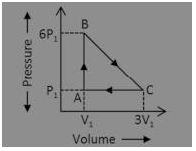
An ideal gas is taken around the cycle ABCA as shown in P-V diagram The next work done by the gas during the cycle is equal to:
Thermodynamics Chemistry Class 11 MCQ
(a) 12P1V1
(b) 6P1V1
(c) 5P1V1
(d) P1V1

Answer

Answer: (c) 5P1V1
Explanation:
Work done = Area under P-V graph = (\(\frac {1}{2}\)) (5P1) (2V1) = 5P1 V1


Class 11 Thermodynamics MCQ Question 11.
In which of the following process, a maximum increase in entropy is observed?
(a) Dissolution of Salt in Water
(b) Condensation of Water
(c) Sublimation of Naphthalene
(d) Melting of Ice

Answer

Answer: (c) Sublimation of Naphthalene
Explanation:
The order of entropy in solid, liquid and gas is gas > liquid > solid .Hence, in sublimation of naphthalene, maximum increase in entropy is observed.


Class 11 Chemistry Thermodynamics MCQ Question 12.
The bond energy (in kcal mol-1) of a C-C single bond is approximately
(a) 1
(b) 10
(c) 83-85
(d) 1000

Answer

Answer: (c) 83-85
Explanation:
C–C bond 83–85 kcal/mol

It is the energy required to break the bond .It is defined as the standard enthalpy change when a bond is cleaved by homolysis, with reactants and products of the homolysis reaction at 0 K (absolute zero)


Thermodynamics MCQs With Answers Pdf Class 11 Question 13.
Which thermodynamic function accounts automatically for enthalpy and entropy both?
(a) Helmholtz Free Energy (A)
(b) Internal Energy (E)
(c) Work Function
(d) Gibbs Free Energy

Answer

Answer: (d) Gibbs Free Energy
Explanation:
Gibbs free energy combines the effect of both enthalpy and entropy. The change in free energy (ΔG) is equal to the sum of the change of enthalpy (∆H) minus the product of the temperature and the change of entropy (∆S) of the system.
∆G = ∆H – T∆S
ΔG predicts the direction in which a chemical reaction will go under two conditions: (1) constant temperature and (2) constant pressure.
If ΔG is positive, then the reaction is not spontaneous (it requires the input of external energy to occur) and if it is negative, then it is spontaneous (occurs without the input of any external energy).


Thermodynamics Class 11 MCQ Questions Question 14.
The enthalpies of combustion of carbon and carbon monoxide are -393.5 and -283.0 kJ mol-1 respectively. The enthalpy of formation of carbon monoxide is:
(a) -676 kJ
(b) 110.5 kJ
(c) -110.5 kJ
(d) 676.5 kJ

Answer

Answer: (c) -110.5 kJ
Explanation:
C(s) + O2 à CO2 ∆H1 = -393.5
CO + (\(\frac {1}{2}\)) O2 à CO2 ∆H2 = -283.0
C(s) + (\(\frac {1}{2}\)) O2 à CO ∆H = ∆H1 – ∆H2
= -393.5 + 283 = -110.5 KJ


MCQ On Thermodynamics Class 11 Chemistry Question 15.
The amount of the heat released when 20 ml 0.5 M NaOH is mixed with 100 ml 0.1 M HCl is x kJ. The heat of neutralization is
(a) -100 × kJ/mol
(b) -50 × kJ/mol
(c) 100 × KJ/mol
(d) 50 × kJ/mol

Answer

Answer: (a) -100 × kJ/mol
Explanation:
Normality of NaOH = Molarity × acidity
= 0.5 × 1 = 0.5 N
Total heat q produced = x kJ
Heat of neutralisation
= [(q)/ (Volume of acid or base)] ×1000× (1/normality of acid or base)
= (\(\frac {x}{20}\)) × 1000 × (\(\frac {1}{0.5}\))
= 100 x kJmol-1
Since heat is liberated, heat of neutralisation = −100 x kJmol-1


MCQs On Thermodynamics Chemistry Question 16.
Based on the first law of thermodynamics, which one of the following is correct?
(a) For an isothermal process, q = +w
(b) For an isochoric process, ΔU = -q
(c) For an adiabatic process, ΔU = -w
(d) For a cyclic process, q = -w

Answer

Answer: (d) For a cyclic process, q = -w
Explanation:
(1) ΔU = q + w. For an isochoric process, w = −PΔV = 0. Hence, ΔU = qv
(2) For an adiabatic process, q = 0. Hence, ΔU = w
(3 ) For an isothermal process, ΔU = 0 Hence, q = −w
(4) For a cyclic process , ΔU = 0. Hence, q = −w


Thermodynamics Chemistry Class 11 MCQ Question 17.
A system absorb 10 kJ of heat at constant volume and its temperature rises from 270°C to 370°C. The value of ∆ U is
(a) 100 kJ
(b) 10 kJ
(c) 0 kJ
(d) 1 kJ

Answer

Answer: (b) 10 kJ
Explanation:
At constant volume w = 0
Therefore, ∆ U = q = 10 kJ


Chemical Thermodynamics MCQ Question 18.
The temperature of the system decreases in an ______.
(a) Adiabatic Compression
(b) Isothermal Expansion
(c) Isothermal Compression
(d) Adiabatic Expansion

Answer

Answer: (d) Adiabatic Expansion
Explanation:
In adiabatic process heat is neither added nor removed from system. So the work done by the system (expansion) in adiabatic process will result in decrease of internal energy of that system (from first law).
As internal energy is directly proportional to the change in temperature there will be temperature drop in an adiabatic process.


Thermodynamics MCQ Chemistry Question 19.
Which of the following salts will have maximum cooling effect when 0.5 mole of the salt is dissolved in same amount of water. Integral heat of solution at 298 K is given for each salt?
(a) KNO3 (∆H = 35.4 kJ mol-1)
(b) NaCl (∆H = 5.35 kJ mol-1)
(c) HBr (∆H = -83.3 kJ mol-1)
(d) KOH ( ∆H = -55.6 kJ mol-1)

Answer

Answer: (a) KNO3 (∆H = 35.4 kJ mol-1)
Explanation:
More the heat absorbed, more will be the cooling effect. Hence, more the positive value of ∆ H, more the cooling effect.


Question 20.
Standard enthalpy of vapourisation ΔHvap for water at 100oC is 40.66 kJmol-1. The internal energy of vapourisation of water at 100°C (in kJmol-1) is (Assume water vapour to behave like an ideal gas)
(a) 43.76
(b) 40.66
(c) 37.56
(d) -43.76

Answer

Answer: (c) 37.56
Explanation:
For gaseous reactants and products, we have a relation between standard enthalpy of vaporization (ΔHvap) and standard internal energy (ΔE) as-
ΔHvap = ΔE+ Δng​ RT whereas,
Δng = n2​ − n1, i.e., difference between no. of moles of reactant and product.
For vaporization of water,
H2O (l) → H2O(g)
​Therefore, Δng = 1 − 0 = 1
Therefore, ΔHvap = ΔE+ Δng RT
⇒ ΔE = ΔHvap − Δng
​RT = 40.63 − (1×8.314×10-3 × 373) = 37.53 KJ/mol
Hence the value ΔE for this process will be 37.53KJ/mol.


We hope the given NCERT MCQ Questions for Class 11 Chemistry Chapter 6 Thermodynamics with Answers Pdf free download will help you. If you have any queries regarding CBSE Class 11 Chemistry Thermodynamics MCQs Multiple Choice Questions with Answers, drop a comment below and we will get back to you soon.

MCQ Questions for Class 11 Chemistry Chapter 5 States of Matter with Answers

Check the below NCERT MCQ Questions for Class 11 Chemistry Chapter 5 States of Matter with Answers Pdf free download. MCQ Questions for Class 11 Chemistry with Answers were prepared based on the latest exam pattern. We have provided States of Matter Class 11 Chemistry MCQs Questions with Answers to help students understand the concept very well. https://mcqquestions.guru/mcq-questions-for-class-11-chemistry-chapter-5/

States of Matter Class 11 MCQs Questions with Answers

States Of Matter Class 11 MCQ Question 1.
The vapour pressure of water at 300 K in a closed container is 0.4 atm. If the volume of container is doubled, its vapour pressure at 300 K will be
(a) 0.8 atm
(b) 0.2 atm
(c) 0.4 atm
(d) 0.6 atm

Answer

Answer: (c) 0.4 atm
Explanation:
Vapour pressure depends on T only and it does not depend on container volume.


States Of Matter MCQ Question 2.
Name the liquid with higher vapour pressure in the following pairs:
(a) Alcohol, glycerine (b) Petrol, kerosene (c) mercury, water.
(a) Alcohol, Water, Petrol
(b) Petrol, Water, Alcohol
(c) Alcohol, Petrol, Water
(d) None of these

Answer

Answer: (c) Alcohol, Petrol, Water
Explanation:
The vapour pressure of the liquid is inversely proportional to the magnitude of the intermolecular forces of attraction present. Based on this, the liquid with higher vapour pressure in the different pairs is: (a) Alcohol, (b) Petrol, (c) Water.


States Of Matter MCQ With Answers Question 3.
The rate of diffusion methane is twice that of X. The molecular mass of X is
(a) 64.0
(b) 32.0
(c) 40
(d) 80

Answer

Answer: (a) 64.0
Explanation:
Let rate of diffusion of gas x, r1 = a
Therefore, rate of diffusion of methane, r2 = 2 a
According to Grahams Law of Diffusion
(\(\frac {r_1}{r_2}\)) = (\(\sqrt{\frac {M_2}{M_1}}\))
M1 = Molecular mass of gas x
M2 = Molecular mass of Methane = 16 g
Therefore, (\(\frac {a}{2a}\)) = (\(\sqrt{\frac {16}{M_2}}\))
Squaring both the sides, (\(\frac {1}{4}\)) = (\(\frac {16}{M_2}\))
or, M2 = 16 × 4 = 64 g


Class 11 Chemistry Chapter 5 MCQ With Answers Question 4.
The state of matter that shows the uniformity of behavior :
(a) Solid Liquid
(b) Liquid
(c) Gas
(d) None of the Above

Answer

Answer: (c) Gas
Explanation:
Of the three states of matter, the gaseous state is the simplest and shows greatest uniformity in behaviour. Gases show almost similar behaviour irrespective of their chemical nature. This state is characterized by:
Gases maintain neither the volume nor the shape. They completely fill the container in which they are placed.

They expand appreciably on heating. Gases are highly compressible. The volume of the gas decreases when the pressure increases. They diffuse rapidly into space. Gases exert equal pressure in all directions.
All gases are colourless except a few e.g. chlorine (greenish yellow) bromine (reddish brown), nitrogen dioxide (reddish brown)

The behaviour of gases can be described by certain quantitative relationships called gas laws. They give the relationship between mass, pressure, volume and temperature.


MCQ On States Of Matter Class 11 Question 5.
A gas deviates from ideal behavior at a high pressure because its molecules:
(a) Attract one another
(b) Show the Tyndall Effect
(c) Have kinetic energy
(d) Are bound by covalent bonds

Answer

Answer: (a) Attract one another
Explanation:
The basic concept of the kinetic-molecular theory give us the information why real gases deviate from ideal behavior. The molecules of an ideal gas are assumed to occupy no space and have no attractions for one another. Real molecules, however, do have finite volumes, and they do attract one another. So, a gas deviates from ideal behavior at a high pressure because its molecules attract one another.


MCQ Questions For Class 11 Chemistry Chapter 5 Question 6.
The value of universal gas constant R depends on
(a) Temperature of Gas
(b) Volume of Gas
(c) Number of Moles of Gas
(d) Units of Volume,Temperature and Pressure

Answer

Answer: (d) Units of Volume,Temperature and Pressure
Explanation:
The value of the gas constant R depends on the units used for pressure, volume and temperature.


Class 11 Chemistry Chapter 5 MCQ Question 7.
The critical volumes of four gases A, B, C, D are respectively 0.025 L, 0.312 L, 0.245 L, 0.432 L, the gas with highest value of van der Wall constant b is
(a) A
(b) B
(c) C
(d) D

Answer

Answer: (d) D
Explanation:
Vc = 3b = 3 × 4N × (4/3) πr³


MCQ Of States Of Matter Class 11 Question 8.
Which of the following statement is wrong for gases?
(a) Gases do not have definite shape and volume
(b) Volume of the gas is equal to the volume of the container confining the gas
(c) Confined gas exert uniform pressure on the wall of the container in all directions
(d) Mass of the gas cannot be determined by weighing a container in which it is contained

Answer

Answer: (d) Mass of the gas cannot be determined by weighing a container in which it is contained
Explanation:
Mass of the gas = mass of the cylinder including gas – mass of empty cylinder. So mass of a gas can be determined by weighing the container in which it is enclosed. Thus, the statement (d) is wrong for gases.


MCQs On States Of Matter Class 11 Question 9.
In van der Waal equation of state of gas laws, the constant b is a measure of
(a) Intermolecular collisions per unit volume
(b) Intermolecular attraction
(c) Volume occupied by the molecules
(d) Intermolecular repulsions

Answer

Answer: (c) Volume occupied by the molecules
Explanation:
In van der Waals equation of state of the gas law, the constant b is a measure of the volume occupied by the molecules. It gives the effective size of the gas molecules. The greater value of b indicates a larger size of the molecules and smaller compressible volume.


State Of Matter Class 11 MCQ Question 10.
The volume of 2.8 g of carbon monoxide at 27°C and 0.0821 atm is
(a) 30 L
(b) 3 L
(c) 0.3 L
(d) 1.5 L

Answer

Answer: (a) 30 L
Explanation:
According to the ideal gas equation, we have
PV = nRT
​PV = (\(\frac {w}{M}\)) RT
​V = ​ (\(\frac {w}{M}\)) (\(\frac {RT}{P}\))
Given values are:
w = 2.8 g
M = Molar mass of CO = 28 g mol-1
T = 27°C = (273 + 27) = 300 K
P = 0.821 atm
R = 0.0821 L atm mol-1 K-1
Putting the values in the formula we get :
V = (2.8 g /28 g mol-1) × (0.0821 L atm mol-1 K-1) × (300 K)/(0.821 atm)
= 3 L


MCQ Questions On States Of Matter Class 11 Question 11.
If 20cm³ gas at 1 atm. is expanded to 50 cm³ at constant T, then what is the final pressure
(a) 20 × 150
(b) 50 × 120
(c) 1 × 120 × 50
(d) None of these

Answer

Answer: (a) 20 × 150
Explanation:
At constant T, P1V1 = P2V2
1 × 20 = P2 × 50;
P2 = (\(\frac {20}{ 50}\)) × 1


States Of Matter MCQ Class 11 Question 12.
How many of the know elements exist as gases at 25°C?
(a) 9
(b) 11
(c) 12
(d) 15

Answer

Answer: (b) 11


MCQ States Of Matter Class 11 Question 13.
The states of matter having no definite shape but definite volume:
(a) Gas
(b) Liquid
(c) Solid
(d) None of the Above

Answer

Answer: (b) Liquid
Explanation:
In a liquid, particles will flow or glide over one another, but stay toward the bottom of the container. The attractive forces between particles are strong enough to hold a specific volume but not strong enough to keep the molecules sliding over each other.


Class 11 States Of Matter MCQ Question 14.
The rise or fall of a liquid within a tube of small bore is called:
(a) Surface Tension
(b) Capillary Action
(c) Viscosity
(d) Formation of Curvature

Answer

Answer: (b) Capillary Action
Explanation:
Capillarity, rise or depression of a liquid in a small passage such as a tube of small cross-sectional area, like the spaces between the fibres of a towel or the openings in a porous material. Capillarity is not limited to the vertical direction. Water is drawn into the fibres of a towel, no matter how the towel is oriented.

Liquids that rise in small-bore tubes inserted into the liquid are said to wet the tube, whereas liquids that are depressed within thin tubes below the surface of the surrounding liquid do not wet the tube. Water is a liquid that wets glass capillary tubes; mercury is one that does not. When wetting does not occur, capillarity does not occur.

Capillarity is the result of surface, or interfacial, forces. The rise of water in a thin tube inserted in water is caused by forces of attraction between the molecules of water and the glass walls and among the molecules of water themselves. These attractive forces just balance the force of gravity of the column of water that has risen to a characteristic height. The narrower the bore of the capillary tube, the higher the water rises. Mercury, conversely, is depressed to a greater degree, the narrower the bore.


States Of Matter Class 11 MCQ Questions Question 15.
The theory which explains that gases consist of molecules, which are in rapid option is known as:
(a) Daltons Atomic Theory
(b) Bohrs Theory
(c) Rutherfords Atomic Theory
(d) Kinetic Molecular Theory

Answer

Answer: (d) Kinetic Molecular Theory
Explanation:
The kinetic molecular theory (KMT) is a simple microscopic model that effectively explains the gas laws described in previous modules of this chapter. This theory is based on the following five postulates described here. (Note: The term “molecule” will be used to refer to the individual chemical species that compose the gas, although some gases are composed of atomic species, for example, the noble gases.)

Gases are composed of molecules that are in continuous motion, travelling in straight lines and changing direction only when they collide with other molecules or with the walls of a container.
The molecules composing the gas are negligibly small compared to the distances between them.
The pressure exerted by a gas in a container results from collisions between the gas molecules and the container walls.

Gas molecules exert no attractive or repulsive forces on each other or the container walls; therefore, their collisions are elastic (do not involve a loss of energy).
The average kinetic energy of the gas molecules is proportional to the kelvin temperature of the gas.


Question 16.
Falling drop of water is spherical due to:
(a) Hydrogen Bonding
(b) Surface Tension
(c) Capillary Action
(d) Vlscosity

Answer

Answer: (b) Surface Tension
Explanation:
Raindrops take up the spherical shape due to the surface tension of water which is caused due to the tendency of water molecules to stick together. The spherical shape is having the least possible surface area due to which it can resist any of the external force in the atmosphere.


Question 17.
The rates of diffusion of gases are inversely proportional to square root of their densities . This statement refers to :
(a) Daltons Law
(b) Grahams Law
(c) Avogadros Law
(d) None of the Above

Answer

Answer: (b) Grahams Law
Explanation:
Grahams law states that the rate of diffusion of a gas is inversely proportional to the square root of its molecular weight. In the same conditions of temperature and pressure, the molar mass is proportional to the mass density. Therefore the rate of diffusion of different gases is inversely proportional to the square root of their mass densities.
r α (\(\sqrt{\frac {1}{d}}\))
and r α (\(\sqrt{\frac {1}{M}}\))


Question 18.
The law, which states that at constant temperature, the volume of a given mass of gas is inversely proportional is pressure, is known as:
(a) Boyles law
(b) Charles law
(c) Combine gas law
(d) Avogadros law

Answer

Answer: (a) Boyles law
Explanation:
In 1662 Robert Boyle studied the relationship between volume and pressure of a gas of fixed amount at constant temperature. He observed that volume of a given mass of a gas is inversely proportional to its pressure at a constant temperature. Boyles law, published in 1662, states that, at constant temperature, the product of the pressure and volume of a given mass of an ideal gas in a closed system is always constant. It can be verified experimentally using a pressure gauge and a variable volume container. It can also be derived from the kinetic theory of gases: if a container, with a fixed number of molecules inside, is reduced in volume, more molecules will strike a given area of the sides of the container per unit time, causing a greater pressure.
A statement of Boyles law is as follows:
The volume of a given mass of a gas is inversely related to pressure when the temperature is constant.​
V ∝ (\(\frac {1}{P}\)) meaning “Volume is inversely proportional to Pressure”, or
P ∝ (\(\frac {1}{V}\)) meaning “Pressure is inversely proportional to Volume”, or
where P is the pressure, and V is the volume of a gas, and k1 is the constant in this equation.


Question 19.
If helium and methane are allowed to diffuse out of the container under the similar conditions of temperature and pressure, then the ratio of rate of diffusion of helium to methane is:
(a) 2 : 1
(b) 1 : 2
(c) 3 : 5
(d) 4 : 1

Answer

Answer: (a) 2 : 1
Explanation:
According to Grahams law
(\(\frac {r_1}{r_2}\)) = (\(\sqrt{\frac {M_1}{M_2}}\))
(rHe/rCH4) = (\(\sqrt{\frac {16}{4}}\))
= (\(\frac {1}{2}\))


Question 20.
When you heat a sample of gas, what happens to the particles that make up the gas?
(a) The particles move faster.
(b) The particles break apart
(c) The particles get smaller
(d) The particles become more dense

Answer

Answer: (a) The particles move faster.
Explanation:
There is a great deal of empty space between particles, which have a lot of kinetic energy. The particles move very fast and collide into one another when the gas is heated up, causing them to diffuse, or spread out, until they are evenly distributed throughout the volume of the container.


We hope the given NCERT MCQ Questions for Class 11 Chemistry Chapter 5 States of Matter with Answers Pdf free download will help you. If you have any queries regarding CBSE Class 11 Chemistry States of Matter MCQs Multiple Choice Questions with Answers, drop a comment below and we will get back to you soon.

MCQ Questions for Class 11 Biology Chapter 18 Body Fluids and Circulation with Answers

Check the below NCERT MCQ Questions for Class 11 Biology Chapter 18 Body Fluids and Circulation with Answers Pdf free download. MCQ Questions for Class 11 Biology with Answers were prepared based on the latest exam pattern. We have provided Body Fluids and Circulation Class 11 Biology MCQs Questions with Answers to help students understand the concept very well. https://mcqquestions.guru/mcq-questions-for-class-11-biology-chapter-18/

Body Fluids and Circulation Class 11 MCQs Questions with Answers

Body Fluids And Circulation MCQ Class 11 Question 1.
In developing embryo RBCs are formed in
(a) Lymph node
(b) Bone marrow
(c) Liver
(d) Spleen

Answer

Answer: (c) Liver


Body Fluids And Circulation Class 11 MCQ Question 2.
In humans, blood passes from the post caval to the diastolic right atrium of heart due to:
(a) Pressure difference between the post caval and atrium
(b) Pushing open of the venous valves
(c) Suction pull
(d) Stimulation of the sino auricular node

Answer

Answer: (a) Pressure difference between the post caval and atrium


Class 11 Biology Chapter 18 MCQ Questions Question 3.
When body tissues are injured resulting in the loss of blood, the process of blood clot begins and the blood platelets release
(a) Fibrinogen
(b) Thrombin
(c) Prothrombin
(d) Thromboplastin

Answer

Answer: (d) Thromboplastin


Body Fluids And Circulation MCQ With Answers Question 4.
An adult human has systolic and diastolic pressures as:
(a) 80 mm Hg and 120 mm Hg
(b) 120 mm Hg and 80 mm Hg
(c) 50 mm Hg and 80 mm Hg
(d) 80 mm Hg and 80 mm Hg

Answer

Answer: (b) 120 mm Hg and 80 mm Hg


Body Fluids MCQs With Answers Class 11 Chapter 18 Question 5.
Duration of cardiac cycle is
(a) 0.7 sec
(b) 0.9 sec
(c) 0.8 sec
(d) 0.11 sec

Answer

Answer: (c) 0.8 sec
Explanation:
Duration of cardiac cycle is 0.8 seconds.


Class 11 Biology Chapter 18 MCQ Question 6.
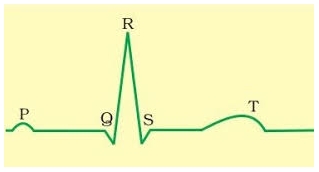
MCQ Questions for Class 11 Biology Chapter 18 Body Fluids and Circulation with Answers 1
In the above picture Q represents
(a) exitation of the atria
(b) depolarisation of ventricles
(c) begining of systole
(d) repolarisation

Answer

Answer: (c) begining of systole
Explanation:
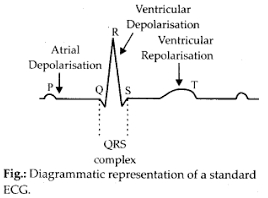
MCQ Questions for Class 11 Biology Chapter 18 Body Fluids and Circulation with Answers 2


MCQ On Body Fluids And Circulation Class 11 Chapter 18 Question 7.
Oxygenated blood occurs in
(a) Pulmonary artery
(b) Right atrium
(c) Right ventricle
(d) Pulmonary vein

Answer

Answer: (d) Pulmonary vein


MCQ Of Body Fluids And Circulation Chapter 18 Question 8.
The cells lining the blood vessels belong to the category of
(a) Columnar epithelium
(b) Connective tissue
(c) Smooth muscle tissue
(d) Squamous epithelium

Answer

Answer: (d) Squamous epithelium


Class 11 Biology Body Fluids And Circulation MCQ Question 9.
Heart failure occurs due to
(a) heart stops beating
(b) damage of heart muscles
(c) congestion of lungs
(d) all of the above

Answer

Answer: (c) congestion of lungs
Explanation:
Heart failure occurs when heart stops pumping blood effectively enough to meet the body needs.
It occurs mainly due to congestion of lungs.


Body Fluids And Circulation MCQs Chapter 18 Question 10.
Artificial pace maker is transplanted in
(a) Inter auricular septum
(b) Below the collar bone
(c) Inter ventricular septum
(d) Right auricle

Answer

Answer: (b) Below the collar bone


MCQs On Body Fluids And Circulation Class 11 Question 11.
Which of the following statement/statements can be related to erythroblastosis foetalis?
(a) Severe anemia and jaundice to the baby.
(b) Can be avoided by giving anti-Rh antibodies to mother immediately after delivery of the first child.
(c) Rh-antibodies from the Rh -ve mother destroys foetal RBCs.
(d) All of the above

Answer

Answer: (d) All of the above
Explanation:
Erythroblastosis foetalis occurs if Rh-antibodies from the Rh -ve mother destroys foetal RBCs of Rh +ve foetus.


Class 11 Body Fluids And Circulation MCQ Question 12.
Among the following stem cells, which are found in the umbilical cord?
(a) Cord blood stem cells
(b) Adult stem cells
(c) Embryonic stem cells
(d) All of the above

Answer

Answer: (a) Cord blood stem cells


MCQ Of Chapter 18 Class 11 Biology Question 13.
If vagus nerve is cut the heart beat
(a) increases
(b) decreases
(c) will not be affected
(d) will stop immediately

Answer

Answer: (a) increases


MCQ On Body Fluids And Circulation Pdf Class 11 Question 14.
If due to some injury the chordae tendinae of the tricuspid valve of the human heart is partially non-functional, what will be the immediate effect?
(a) The flow of blood into the pulmonary artery will be reduced
(b) The flow of blood into the aorta will be slowed down
(c) The pacemaker will stop working
(d) The blood will tend to flow back into the left atrium

Answer

Answer: (a) The flow of blood into the pulmonary artery will be reduced


MCQ Body Fluids And Circulation Class 11 Question 15.
Heparin is
(a) Anti-allergic
(b) Blood diluter
(c) Anticoagulant
(d) Antiseptic

Answer

Answer: (c) Anticoagulant


Body Fluids And Circulation MCQ Pdf Question 16.
An adult human has systolic and diastolic pressures as:
(a) 80 mm Hg and 120 mm Hg
(b) 120 mm Hg and 80 mm Hg
(c) 50 mm Hg and 80 mm Hg
(d) 80 mm Hg and 80 mm Hg

Answer

Answer: (b) 120 mm Hg and 80 mm Hg


Blood Fluid And Circulation MCQ Class 11 Question 17.
Cardiac arrest is the state when
(a) heart stops beating
(b) inadequate blood supply to the heart
(c) heart not pumping enough to meet the body needs
(d) blood pressure increases

Answer

Answer: (a) heart stops beating
Explanation:
Cardiac arrest occurs when the heart stops beating.


MCQ Questions On Body Fluids And Circulation Question 18.
What is the normal blood pressure of human beings?
(a) 110/70
(b) 120/70
(c) 120/80
(d) 110/80

Answer

Answer: (c) 120/80
Explanation:
120/80 is the normal measurement to blood pressure.
120 mm Hg is the systolic or pumping pressure.
80 mm Hg is the diastolic or resting pressure.


Chapter 18 Biology Class 11 MCQ Question 19.
Arteries are best defined as the vessels which
(a) Carry blood from one visceral organ to another visceral organ
(b) Supply oxygenated blood to the different organs
(c) Carry blood away from the heart to different organs
(d) Break up into capillaries which reunite to form a vein

Answer

Answer: (c) Carry blood away from the heart to different organs


Body Fluids And Circulation Class 11 MCQs Question 20.
Christmas disease is also known as
(a) Haemophilia B
(b) AIDS
(c) Haemophilia A
(d) Haemolytic jaundice

Answer

Answer: (a) Haemophilia B


We hope the given NCERT MCQ Questions for Class 11 Biology Chapter 18 Body Fluids and Circulation with Answers Pdf free download will help you. If you have any queries regarding CBSE Class 11 Biology Body Fluids and Circulation MCQs Multiple Choice Questions with Answers, drop a comment below and we will get back to you soon.