We’re Not Afraid to Die… If We Can All Be Together Class 11 MCQ Questions with Answers English Chapter 2

Check the below NCERT MCQ Questions for Class 11 English Hornbill Chapter 2 We’re Not Afraid to Die… If We Can All Be Together with Answers Pdf free download. MCQ Questions for Class 11 English with Answers were prepared based on the latest exam pattern. We have provided We’re Not Afraid to Die… If We Can All Be Together Class 11 English MCQs Questions with Answers to help students understand the concept very well. https://mcqquestions.guru/were-not-afraid-to-die-if-we-can-all-be-together-class-11-mcq-questions/

MCQ Questions for Class 11 English Hornbill Chapter 2 We’re Not Afraid to Die… If We Can All Be Together with Answers

We Are Not Afraid to Die MCQ Class 11 Question 1.
What happened when the author’s head smashed into the wheel?
(a) he was hurt but steady
(b) he flew overboard sinking below the waves
(c) he was not hurt
(d) he gained control immediately

Answer

Answer: (b) he flew overboard sinking below the waves


We’re Not Afraid to Die MCQ Class 11 Question 2.
How long did they take for the ship’s testing and fitting?
(a) months
(b) few days
(c) 2 years
(d) few weeks

Answer

Answer: (a) months


We Are Not Afraid to Die Class 11 MCQ Questions Question 3.
When did they reach lle Amsterdam?
(a) around 6 pm in the evening
(b) never reached there
(c) at 11 in the next morning
(d) they decided to take different route

Answer

Answer: (a) around 6 pm in the evening


We Are Not Afraid to Die Class 11 MCQ Chapter 2 Question 4.
What was their first meal in two days?
(a) Meatloaves
(b) bread and milk
(c) noodles
(d) corned beef and cracker biscuits

Answer

Answer: (d) corned beef and cracker biscuits


MCQ Of We’re Not Afraid to Die Class 11 Question 5.
What happened after the hand pumps started to block up with the debris floating around the cabins?
(a) the author connected an electric-pump to an out-pipe
(b) by taking out water with the help of bucket
(c) by repairing hand pump
(d) the author found another hand pump

Answer

Answer: (a) the author connected an electric-pump to an out-pipe


We’re Not Afraid to Die Class 11 MCQ Question 6.
What was the age of Suzanne and Jonathan?
(a) 8 & 9 years old
(b) 7 & 6 years old
(c) 10 & 7 years old
(d) 4 years & 6 years

Answer

Answer: (b) 7 & 6 years old


MCQ We Are Not Afraid to Die Class 11 Question 7.
What was the condition of the ship?
(a) Broken timbers, starboard side bulged inwards; clothes, crockery, charts, tins and toys sloshed
(b) There personal belongings were missing
(c) water filled in every room and their clothes were missing
(d) Can’t say

Answer

Answer: (a) Broken timbers, starboard side bulged inwards; clothes, crockery, charts, tins and toys sloshed


Class 11 English Chapter 2 MCQ Question 8.
What happened to the author’s body when he managed to reach the deck?
(a) his head smashed again
(b) his left ribs cracked; mouth filled with blood and broken teeth
(c) he broke his leg
(d) his broke his left hand

Answer

Answer: (b) his left ribs cracked; mouth filled with blood and broken teeth


Class 11 We’re Not Afraid to Die MCQ Question 9.
Why did the author accept his approaching death?
A Pirates had attacked the ship
B because he was injured by the explosion
C he was thrown in the sea
D he was stabbed

Answer

Answer: A Pirates had attacked the ship


MCQs Of We’re Not Afraid to Die Chapter 2 Question 10.
What happened after the first indication of the disaster?
(a) a wave appeared vertical and almost twice the height of other waves
(b) it broke the ship from inside
(c) the ship turned upside down
(d) it didn’t affect the ship

Answer

Answer: (a) a wave appeared vertical and almost twice the height of other waves


We Are Not Afraid to Die MCQ Questions With Answers Question 11.
What did they do to slow down the boat in the storm?
(a) Stopped sailing
(b) dropped the storm jib and lashed a heavy mooring rope
(c) just dropped the storm jib
(d) did nothing and waited for storm to calm down

Answer

Answer: (b) dropped the storm jib and lashed a heavy mooring rope


Class 11 English Chapter 2 MCQ Questions Question 12.
Why did the author hire the two crewmen?
(a) to take rest from long the voyage
(b) to help tackle one of the world’s roughest seas, the southern Indian Ocean
(c) because he could no longer sail the ship
(d) he wanted to spend some time with his family

Answer

Answer: (b) to help tackle one of the world’s roughest seas, the southern Indian Ocean


We hope the given NCERT MCQ Questions for Class 11 English Hornbill Chapter 2 We’re Not Afraid to Die… If We Can All Be Together with Answers Pdf free download will help you. If you have any queries regarding CBSE Class 11 English We’re Not Afraid to Die… If We Can All Be Together MCQs Multiple Choice Questions with Answers, drop a comment below and we will get back to you soon.

MCQ Questions for Class 11 Biology Chapter 22 Chemical Coordination and Integration with Answers

Check the below NCERT MCQ Questions for Class 11 Biology Chapter 22 Chemical Coordination and Integration with Answers Pdf free download. MCQ Questions for Class 11 Biology with Answers were prepared based on the latest exam pattern. We have provided Chemical Coordination and Integration Class 11 Biology MCQs Questions with Answers to help students understand the concept very well. https://mcqquestions.guru/mcq-questions-for-class-11-biology-chapter-22/

Chemical Coordination and Integration Class 11 MCQs Questions with Answers

Chemical Coordination And Integration MCQ Class 11 Question 1.
Which of the following is an emergency hormone?
(a) Norepinephrine
(b) Androgen
(c) Cortisol
(d) FSH

Answer

Answer: (a) Norepinephrine
Explanation:
Adrenaline (epinephrine) and noradrenaline (norepinephrine) are called as catecholamines.
These hormones are secreted in response to stress and during emergency. So these are called emergency hormones or hormones of flight and fight.


Class 11 Biology Chapter 22 MCQ Question 2.
Secretin causes stimulation of
(a) water
(b) bile juice
(c) gastric secretion
(d) pepsinogen

Answer

Answer: (a) water
Explanation:
Secretin acts on the exocrine pancreas and stimulates secretion of water and bicarbonate ions.


MCQ On Chemical Coordination And Integration Class 11 Question 3.
Match the columns.
1. PRL – A. Pigmentation of skin
2. LH – B. Steriod hormones
3. ACTH – C. Formation of milk
4. MSH – D. Gonadal activity
(a) 1-C, 2-D, 3-B, 4-A
(b) 1-C, 2-D, 3A, 4-B
(c) 1-D, 2-C, 3-B, 4-A
(d) 1-B, 2-C, 3-D, 4-A

Answer

Answer: (a) 1-C, 2-D, 3-B, 4-A
Explanation:
Column I shows the names of hormones and column II shows the functions of the hormones.


Chemical Coordination And Integration Class 11 MCQ Question 4.
In adults, insufficient thyroxine can lead to ______.
(a) Goiter
(b) Tetany
(c) Cretinism
(d) Myxedema

Answer

Answer: (d) Myxedema


Chemical Control And Coordination MCQ Class 11 Question 5.
In the body, both the blood sodium and potassium levels are regulated by _______.
(a) Pheromones
(b) Aldosterone
(c) Cortisol
(d) Androgens

Answer

Answer: (b) Aldosterone


Chemical Control And Coordination MCQ Questions Question 6.
Chemical name of T4 is
(a) Tetradiodothyronine
(b) Tridiodothyronine
(c) Tetraiodothyronine
(d) Triiodothyronine

Answer

Answer: (c) Tetraiodothyronine
Explanation:
Chemical name of T4 is tetraiodothyronine.
Chemicl name of T3 is triiodothyronine.


MCQ On Chemical Coordination And Integration Class 11 Question 7.
Anabolic steroids are ______ versions of testosterone.
(a) Effective
(b) Synthetic
(c) Natural
(d) Ineffective

Answer

Answer: (b) Synthetic


Chemical Coordination And Integration MCQ Pdf Question 8.
Which of the following acts on bones?
(a) Melatonin
(b) Triiodothyronine
(c) GH
(d) Parathyroid

Answer

Answer: (d) Parathyroid
Explanation:
Parathyroid hormone acts on bones and stimulates the process of bone resorption.


MCQ Of Chemical Coordination And Integration Chapter 22 Question 9.
Glucagon hormone is secreted by the ______.
(a) Thyroid gland
(b) Adrenal gland
(c) Pituitary gland
(d) Pancreas

Answer

Answer: (d) Pancreas


MCQs On Chemical Coordination And Integration Class 11 Question 10.
Which one of the followings are male sex hormones?
(a) Insulins
(b) Aldosterones
(c) Androgens
(d) Pheromones

Answer

Answer: (c) Androgens


Class 11 Chemical Coordination And Integration MCQs Question 11.
Choose the incorrect statement.
(a) Hormones are non-nutrient chemicals.
(b) Exocrine glands are ductless glands.
(c) Invertebrates have simple endocrine system.
(d) All of the above statements are incorrect.

Answer

Answer: (b) Exocrine glands are ductless glands.
Explanation:
Endocrine glands lacks ducts and are called as ductless glands.


MCQ Questions For Class 11 Biology Chapter 22 Question 12.
Endemic goitre is a state of
(a) Increased thyroid function
(b) Normal thyroid function
(c) Decreased thyroid function
(d) Moderate thyroid function

Answer

Answer: (c) Decreased thyroid function


Chemical Coordination And Integration Questions And Answers Question 13.
Match the columns.
1. PRL – A. Pigmentation of skin
2. LH – B. Steriod hormones
3. ACTH – C. Formation of milk
4. MSH – D. Gonadal activity
(a) 1-C, 2-D, 3-B, 4-A
(b) 1-C, 2-D, 3-A, 4-B
(c) 1-D, 2-C, 3-B, 4-A
(d) 1-B, 2-C, 3-D, 4-A

Answer

Answer: (a) 1-C, 2-D, 3-B, 4-A
Explanation:
Column I shows the names of hormones and column II shows the functions of the hormones.


Question 14.
PTH is called as hypercalcemic hormone because it leads to the
(a) absorption of CaCO3 from the digested food
(b) reabsorption of water from renal tubules
(c) increasing blood calcium levels
(d) maintainence ion balance in blood

Answer

Answer: (c) increasing blood calcium levels
Explanation:
This is called so because PTH stimulates the reabsorption of calcium by the renal tubules and increases calcium absorption from the digested food.


Question 15.
Corpus luteum secretes
(a) progesterone
(b) estrogen
(c) glucagon
(d) vasopressin

Answer

Answer: (a) progesterone
Explanation:
After ovulation, ruptured follicle gets converted to corpus luteum which secretes progesterone.


Question 16.
In adults, insufficient thyroxine can lead to ______.
(a) Goiter
(b) Tetany
(c) Cretinism
(d) Myxedema

Answer

Answer: (d) Myxedema


Question 17.
In children, hypothyroidism (underactive thyroid gland) can lead to ______
(a) Goiter
(b) Acromegaly
(c) Cretinism
(d) Myxedema

Answer

Answer: (c) Cretinism


Question 18.
Diurnal rhythm of the body is maintained by
(a) melatonin
(b) isthmus
(c) PTH
(d) norepinephrine

Answer

Answer: (a) melatonin
Explanation:
Pineal gland secretes melatonin.
It plays a very important role in the regulation of a 24-hour (diurnal) rhythm of our body.


Question 19.
Which hormone inhibits the release of growth hormone?
(a) Insulin
(b) Gonadotrophin
(c) Somatostatin
(d) Thymosin

Answer

Answer: (c) Somatostatin
Explanation:
Hypothalamus produces two kinds of hormones: releasing hormone and inhibiting hormones.
GnRH is releasing hormone which stimulates pituitary synthesis.
Somatostatin inhibits the release of GH from the pituitary.


Question 20.
Which of the following is essential for thyroid gland?
(a) NaCl
(b) I3
(c) CaCO2
(d) H2CO3

Answer

Answer: (b) I3
Explanation:
Iodine is essential for thyroid gland.


We hope the given NCERT MCQ Questions for Class 11 Biology Chapter 22 Chemical Coordination and Integration with Answers Pdf free download will help you. If you have any queries regarding CBSE Class 11 Biology Chemical Coordination and Integration MCQs Multiple Choice Questions with Answers, drop a comment below and we will get back to you soon.

MCQ Questions for Class 11 Biology Chapter 21 Neural Control and Coordination with Answers

Check the below NCERT MCQ Questions for Class 11 Biology Chapter 21 Neural Control and Coordination with Answers Pdf free download. MCQ Questions for Class 11 Biology with Answers were prepared based on the latest exam pattern. We have provided Neural Control and Coordination Class 11 Biology MCQs Questions with Answers to help students understand the concept very well. https://mcqquestions.guru/mcq-questions-for-class-11-biology-chapter-21/

Neural Control and Coordination Class 11 MCQs Questions with Answers

Neural Control And Coordination MCQ Question 1.
Which one of the followings is the function of parasympathetic nervous system?
(a) Stimulates oil and sweat glands in the skin
(b) Pupil constriction
(c) Acceleration of heart beat
(d) Contraction of hair muscles

Answer

Answer: (b) Pupil constriction


Neural Control And Coordination Class 11 MCQ Question 2.
During resting state, fluid outside axon contains
(a) low concentration of K+
(b) low concentration of Na+
(c) low concentration of Cl
(d) high concentration of Cl

Answer

Answer: (a) low concentration of K+
Explanation:
During resting state (when neuron is not conducting any impulse), axoplasm inside the axon contains high concentration of K+
The fluid outside axon contains low concentration of K+.


MCQ On Neural Control And Coordination Class 11 Question 3.
The basic cyclic pattern of inspiration and expiration are established by a respiratory center within the ______.
(a) Cerebellum
(b) Medulla oblongata
(c) Cerebral cortex
(d) Thalamus

Answer

Answer: (b) Medulla oblongata


Class 11 Biology Chapter 21 MCQ Question 4.
The cutaneous plexus and the papillary plexus consist of
(a) Specialized cells for cutaneous sensations
(b) A network of arteries to provide dermal supply
(c) A network of nerves to provide dermal sensation
(d) Gland cells that release cutaneous secretions

Answer

Answer: (c) A network of nerves to provide dermal sensation


MCQ On Neural Control And Coordination Class 11 Question 5.
The generation of excitation-contraction coupling involves all the following events except
(a) Generation of end-plate potential
(b) Release of calcium from troponin
(c) Formation of cross-linkages between actin and myosin
(d) Hydrolysis of ATP to ADP

Answer

Answer: (b) Release of calcium from troponin


Neural Control And Coordination MCQs Class 11 Question 6.
Which portion of the brain is responsible for various emotions such as pleasure, fear, and happiness?
(a) Thalamus
(b) Reticular formation
(c) Hypothalamus
(d) Limbic system

Answer

Answer: (d) Limbic system


MCQs On Neural Control And Coordination Question 7.
Vestibular apparatus is made up of three semi circular canals. These canals lies at ____ degree angle to each other.
(a) 30
(b) 45
(c) 60
(d) 90

Answer

Answer: (d) 90
Explanation:
Semicircular canals lies at right angle to each other.


MCQ Of Neural Control And Coordination Class 11 Question 8.
At a neuromuscular junction, synaptic vesicles discharge ______.
(a) Acetylcholine
(b) Epinephrine
(c) Adrenaline
(d) None of these

Answer

Answer: (a) Acetylcholine


MCQ Questions On Neural Control And Coordination Question 9.
There are ______ pairs of cranial nerves arising from the brain.
(a) 8
(b) 12
(c) 18
(d) 25

Answer

Answer: (b) 12


Neural Control And Coordination MCQ Pdf Class 11 Question 10.
When a neuron is in resting state i.e. not conducting any impulse, the axonal membrane is
(a) Comparatively more permeable to K+ ions and nearly impermeable to Na+ ions
(b) Comparatively more permeable to Na+ ions and nearly impermeable to K+ ions
(c) Equally permeable to both Na+ and K+ ions
(d) Impermeable to both Na+ and K+ ions

Answer

Answer: (a) Comparatively more permeable to K+ ions and nearly impermeable to Na+ ions


Class 11 Neural Control And Coordination MCQ Question 11.
Which one of the following is the correct statement regarding the particular psychotropic drug specified?
(a) Barbiturates cause relaxation and temporary euphoria
(b) Hashish causes after thought perceptions and hallucinations
(c) Opium stimulates nervous system and causes hallucinations
(d) Morphine leads to delusions and disturbed emotions

Answer

Answer: (b) Hashish causes after thought perceptions and hallucinations


Class 11 Biology Chapter 21 Question 12.
The function of vagus nerve innervating the heart is to
(a) Initiate the heart beat
(b) Reduce the heart beat
(c) Accelerate the heart beat
(d) Maintain constant heart beat

Answer

Answer: (b) Reduce the heart beat


MCQ On Neural Control And Coordination Pdf Class 11 Question 13.
Which of the following nerves is the largest of all the cranial nerves?
(a) Abducens nerve
(b) Oculomotor nerve
(c) Olfactory nerve
(d) Trigeminal nerve

Answer

Answer: (d) Trigeminal nerve


Neural Control And Coordination MCQ Class 11 Question 14.
Which of the following is not related to the autonomic nervous system?
(a) Peristalsis
(b) Digestion
(c) Excretion
(d) Memory and learning

Answer

Answer: (d) Memory and learning


Class 11 MCQ Questions Biology Chapter 21 Question 15.
Functions of smooth muscles, cardiac muscles, organs, and glands are regulated by ______ system.
(a) Parasympathetic
(b) Sympathetic
(c) Central nervous
(d) Autonomic

Answer

Answer: (d) Autonomic


Neural Control And Coordination Questions Chapter 21 Question 16.
Which neuroglia cells produce a fatty insulating material called myelin?
(a) Satellite cells
(b) Schwann cells
(c) Both (A) and (B)
(d) Neither (A) nor (B)

Answer

Answer: (b) Schwann cells


Question 17.
Which layer is in contact with brain tissues?
(a) Piamater
(b) Arachnoid
(c) Duramater
(d) Piamater and Arachnoid

Answer

Answer: (a) Piamater
Explanation:
Brain is covered by cranial meninges.
1) Duramater (outer)
2) Arachnoid (middle)
3) Piamater (inner)- in contact with brain tissues)


Question 18.
The thin and convoluted outer layer of gray matter that covers the cerebral hemispheres is
(a) Medulla oblongata
(b) Thalamus
(c) Cerebral cortex
(d) Meninges

Answer

Answer: (c) Cerebral cortex


Question 19.
Find the odd one.
(a) Schwann cells
(b) Nissl s granules
(c) nephrons
(d) synaptic knob

Answer

Answer: (c) nephrons
Explanation:
Schwann cells, Nissl s granules and synaptic knobs are the parts of neurons.


Question 20.
Select the correct statement from the ones given below
(a) Cocaine is given to patients after surgery as it stimulates recovery
(b) Barbiturates when given to criminals make them tell the truth
(c) Morphine is often given to persons who have undergone surgery as a pain killer
(d) Chewing tobacco lowers blood pressure and heart rate

Answer

Answer: (c) Morphine is often given to persons who have undergone surgery as a pain killer


We hope the given NCERT MCQ Questions for Class 11 Biology Chapter 21 Neural Control and Coordination with Answers Pdf free download will help you. If you have any queries regarding CBSE Class 11 Biology Neural Control and Coordination MCQs Multiple Choice Questions with Answers, drop a comment below and we will get back to you soon.

MCQ Questions for Class 11 Chemistry Chapter 7 Equilibrium with Answers

Check the below NCERT MCQ Questions for Class 11 Chemistry Chapter 7 Equilibrium with Answers Pdf free download. MCQ Questions for Class 11 Chemistry with Answers were prepared based on the latest exam pattern. We have provided Equilibrium Class 11 Chemistry MCQs Questions with Answers to help students understand the concept very well. https://mcqquestions.guru/mcq-questions-for-class-11-chemistry-chapter-7/

Equilibrium Class 11 MCQs Questions with Answers

MCQ On Equilibrium Class 11 Question 1.
The solubility of Ca3​(PO4​​)2​ in water is y mol/L. Its solubility product is:
(a) 6y²
(b) 36 y4
(c) 64 y5
(d) 108 y5

Answer

Answer: (d) 108 y5
Explanation:
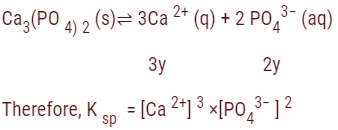
MCQ Questions for Class 11 Chemistry Chapter 7 Equilibrium with Answers 1
= (3y)³ × (2y)²
= 27 y³ × 4y²
= 108 y5


Equilibrium Class 11 MCQ Question 2
A physician wishes to prepare a buffer solution at pH = 3.85 that efficiently resists changes in pH yet contains only small concentration of the buffering agents. Which of the following weak acids together with its sodium salt would be best to use?
(a) 2, 5-Dihydroxy benzoic acid (pKa = 2.97)
(b) Acetoacetic acid (pKa = 3.58)
(c) m-Chlorobenzoic acid (pKa = 3.98)
(d) p-Chlorocinnamic acid (pKa = 4.41)

Answer

Answer: (b) Acetoacetic acid (pKa = 3.58)
Explanation:
For small concentration of buffering agent and for maximum buffer capacity
[Salt]/ [Acid] ≈ 1
i.e., pH = pKa


MCQ On Chemical Equilibrium Class 11 Question 3.
Which of the following aqueous solutions will have highest pH?
(a) NaCl
(b) CH3COONa
(c) Na2CO3
(d) NH4Cl

Answer

Answer: (c) Na2CO3
Explanation:
NaCl is salt of strong acid and strong base so it has pH of about 7.
NH4Cl is salt of strong acid and weak base so it has pH is much less than 7.
CH3​COONH4 is salt of weak acid and weak base so it has pH of about 7.
Na2​CO3 is salt of weak acid and strong base so it has pH is much greater than 7.


Equilibrium MCQ Class 11 Question 4.
What is the pH of a 0.10 M solution of barium hydroxide, Ba (OH)2?
(a) 11.31
(b) 11.7
(c) 13.30
(d) None of these

Answer

Answer: (c) 13.30
Explanation:
pH = 13.30
Barium hydroxide is a strong base for both stages of dissociation:
Ba (OH)2(s) → Ba2+ + 2OH
So the solution will have 0.20 M hydroxide ions. Now use the auto dissociation product for water:
[H+][OH] = 1.0 × 10⁻¹⁴M
[OH] = 2.0 × 10⁻¹M
[H+] = 5.0 × 10⁻¹⁴M
And then pH = −log10 ([H+] = 5.0 × 10⁻¹⁴)
= 13.30.


MCQ Of Equilibrium Class 11 Question 5.
Which of the following oxides is not expected to react with sodium hydroxide?
(a) CaO
(b) SiO2
(c) BeO
(d) B2O3

Answer

Answer: (a) CaO
Explanation:
CaO being a basic oxide does not react with NaOH, however SiO2 (acidic oxide), BeO (amphoteric oxide) and Br2O3 (acidic oxide) react with NaOH.


Class 11 Chemistry Chapter 7 MCQ Question 6.
The pH of a 10-10 M NaOH solution is nearest to
(a) 10
(b) 7
(c) 4
(d) -10

Answer

Answer: (c) 4
Explanation:
pOH= −log [OH]
= −log 10-10
= 10 log 10
= 10pH + pOH
= 14pH
= 14−pOH
= 14−10
= 4


Chemical Equilibrium MCQs Class 11 Question 7.
A weak acid HX has the dissociation constant 1 × 10⁻⁵ M. It forms a salt NaX on reaction with alkali. The degree of hydrolysis of 0.1 M solution of NaX is
(a) 0.0001%
(b) 0.01%
(c) 0.1%
(d) 0.15%

Answer

Answer: (b) 0.01%
Explanation:
NaX: Salt of weak acid, strong base.
⇒ α = (√Kh/c)
= √ (Kw)/ (KaC)
= (10-14)/(10-5×0.1)
= 10-4
⇒ % hydrolysis = 0.01%


MCQ On Chemical Equilibrium With Answers Question 8.
When equal volumes of 0.1 M NaOH and 0.01 M HCl are mixed, the hydroxide ion concentration is
(a) 7.0
(b) 1.04
(c) 12.65
(d) 2.0

Answer

Answer: (c) 12.65
Explanation:
When equal volumes of 0.1 M NaOH and 0.01 M HCl are mixed, the hydroxide ion concentration is
(0.1 – 0.01)/(2)
​= 0.045 M
The pOH of the solution is pOH = −log [OH]
= −log 0.045
= 1.35
The pH of the solution is pH = 14 − pOH
= 14 − 1.35
= 12.65


MCQ Questions For Class 11 Chemistry Chapter 7 Question 9.
Concentration of the Ag+ ions in a saturated solution of Ag2C2O4 is 2.2 x 10⁻⁴ mol L-1. Solubility product of Ag2C2O42 is
(a) 2.66 × 10⁻¹²
(b) 4.5 × 10⁻¹¹
(c) 5.3 × 10⁻¹²
(d) 2.42 × 10⁻⁸

Answer

Answer: (c) 5.3 × 10⁻¹²
Explanation:
[Ag+] = 2.2 × 10⁻⁴ mol L-1
[C2​O42-] = 0.5[Ag+] = 0.5 × 2.2 × 10-4 mol L-1 = 1.1 × 10⁻⁴ mol L-1
Ksp ​=[Ag+]² [C2O42-​]Ksp
= (2.2 × 10⁻⁴ mol L-1)² × 1.1 × 10-4 mol L-1
Ksp = 5.3 × 10⁻¹²


Chemical Equilibrium Class 11 MCQ Question 10.
In a reversible chemical reaction at equilibrium, if the concentration of any one of the reactants is doubled, then the equilibrium constant will
(a) Also be Doubled
(b) Be Halved
(c) Remain the Same
(d) Become One-Fourth

Answer

Answer: (c) Remain the Same
Explanation:
Equilibrium constants are not changed if you change the concentrations of things present in the equilibrium. The only thing that changes an equilibrium constant is a change of temperature.

The position of equilibrium is changed if you change the concentration of something present in the mixture. According to Le Chateliers Principle, the position of equilibrium moves in such a way as to tend to undo the change that you have made.

According to Le Chateliers Principle, if you increase the concentration of Reactant, for example, the position of equilibrium will move to the right to decrease the concentration of reactant again.


Chapter 7 Chemistry Class 11 MCQs Question 11.
When a neutral atom undergoes oxidation, the atoms oxidation state
(a) Decreases as it gains electrons
(b) Decreases as it loses electrons
(c) Increases as it gains electrons
(d) Increases as it loses electrons

Answer

Answer: (d) Increases as it loses electrons
Explanation:
The acronym “OILRIG” can be used to remember this: Oxidation is Losing electrons, Reduction is Gaining electrons. Therefore, when an atom undergoes oxidation, it loses electrons. This makes its net charge more positive, so its oxidation state increases.


Class 11 Chemistry Chapter 7 MCQ With Answers Question 12.
Concentration of the Ag-4 ions in a saturated solution of Ag2C2O4 is 2.2 × (a) 10-4 mol L-1. Solubility product of Ag2C2O4 is
(b) 2.66 × 10⁻¹²
(c) 4.5 × 10⁻¹¹
(d) 5.3 × 10⁻¹²
2.42 × 10⁻⁸

Answer

Answer: (c) 4.5 × 10⁻¹¹
Explanation:
[Ag+] = 2.2 × 10⁻⁴ mol L-1
[C2​O42-] = 0.5[Ag+] = 0.5 × 2.2 × 10-4 mol L-1 =1.1×10⁻⁴ mol L-1
Ksp ​= [Ag+]² [C2​O42-​] Ksp
= (2.2 × 10⁻⁴ mol L-1)² × 1.1 × 10-4 mol L-1
Ksp = 5.3 × 10⁻¹²


Class 11 Chemistry Equilibrium MCQ Question 13.
Among the following the weakest Bronsted base is
(a) F
(b) Cl
(c) Br
(d) I

Answer

Answer: (d) I
Explanation:
According to this theory, an acid is a proton donor and a base is a proton acceptor. Every strong Bronsted acid has a weak conjugate base and every strong base has a weak conjugate acid. The acidity increases in halogen group atoms,
HF < HCl < HBr < HI.
So, HI is highly acidic and their conjugate bases decrease in order F > Cl > Br > I.


Chemical Equilibrium Class 11 MCQ Questions Question 14.
A certain buffer solution contains equal concentration of X and HX. The ka for HX is 10-8. The pH of the buffer is
(a) 3
(b) 8
(c) 11
(d) 14

Answer

Answer: (b) 8
Explanation:
ka kb = kw
kb = 10-8
ka × 10-8 = 10-14
ka = 10-6 = [H+]
pH = −log [H+]
pH = −log 10-6
= 6pH + pOH
= 14 pOH
= 14−6
= 8


Class 11 Equilibrium MCQ Question 15.
What is the pH of a 0.10 M solution of barium hydroxide, Ba (OH)2?
(a) 11.31
(b) 11.7
(c) 13.30
(d) None of these

Answer

Answer: (c) 13.30
Explanation:
pH =13.30
Barium hydroxide is a strong base for both stages of dissociation:
Ba (OH)2(s) → Ba2+ + 2OH
So the solution will have 0.20 M hydroxide ions. Now use the auto dissociation product for water:
[H+][OH] = 1.0×10⁻¹⁴M
[OH] = 2.0 × 10⁻¹M
[H+] = 5.0 × 10⁻¹⁴M
And then pH = −log10 ([H+] = 5.0 × 10⁻¹⁴)
= 13.30.


Chemical Equilibrium MCQs Question 16.
Solubility of M2S salt is 3.5 × 10⁻⁶ then find out solubility product.
(a) 1.7 × 10⁻⁶
(b) 1.7 × 10⁻¹⁶
(c) 1.7 × 10⁻¹⁸
(d) 1.7 × 10⁻¹²

Answer

Answer: (b) 1.7 × 10⁻¹⁶
Explanation:
Let ”s“ be the solubility of salt M2​S which undergoes dissociation as follows :-
M2​S ⇌ 2M+ +S-2
Initial concentration 1 0 0
Concentration at equilibrium 1-s 2s s
Hence, the solubility product (Ksp) = (s) × (2s)²
Therefore, Ksp = 4 × s³
Or Ksp​​ = 4× (3.5×10-6
⇒ Ksp
= 1.7 × 10⁻¹⁶


Ch 7 Chemistry Class 11 MCQ Question 17.
Among the following hydroxides, the one which has the lowest value of Ksp at ordinary temperature (about 25°C ) is
(a) Mg (OH)2
(b) Ca(OH)2
(c) Ba(OH)2
(d) Be(OH)2

Answer

Answer: (d) Be(OH)2
Explanation:
Be(OH)2 ​has the lowest value of Ksp at ordinary temperature because Be2+ ion is smaller than the other metal ions in the group, which results in a tighter bond with the 0H ions, thus much lower solubility.

The solubility of a hydroxide of group 2 elements increases down the group because as you go down the group size of metal increases thereby increasing the bond length and decreasing bond energy.


Chemical Equilibrium MCQ Class 11 Question 18.
Which of the following mixtures in aqueous solution of equimolar concentration acts as a buffer solution?
(a) HNO3 and NaOH
(b) H2SO4 and KOH
(c) NH4OH(excess) + HCl
(d) CH3COOH and NaOH(excess)

Answer

Answer: (c) NH4OH(excess) + HCl
Explanation:
A mixture of ammonium hydroxide and HCl react to form ammonium chloride. This also contains unreacted ammonium hydroxide.
NH4​ OH + HCl → NH4Cl + H2O
Thus, the resulting mixture of (NH4OH+NH4Cl) is a basic buffer solution. It contains a mixture of weak base ammonium hydroxide and its salt (ammonium chloride) with strong acid (HCl).
It is used in a qualitative analysis of group III radicals.
A mixture of HNO3 and NaOH is a mixture of strong acid and strong base similarly a mixture of
H2​SO4 and KOH is also a mixture of strong acid and strong base, thus they do not form buffer solution.
Similarly, in option 4 mixture will form a strong base and salt of strong base weak acid hence it will not form a buffer solution.


Chemical Equilibrium MCQ With Answers Question 19.
Which of the following aqueous solutions will have highest pH?
(a) NaCl
(b) CH3COONa
(c) Na2CO3
(d) NH4Cl

Answer

Answer: (c) Na2CO3
Explanation:
NaCl is salt of strong acid and strong base so it has pH of about 7.
NH4​Cl is salt of strong acid and weak base so it has pH is much less than 7.
CH3COONH4 is salt of weak acid and weak base so it has pH of about 7.
Na2​CO3 is salt of weak acid and strong base so it has pH is much greater than 7.


Question 20.
Amines behave as
(a) Lewis Acids
(b) Lewis Base
(c) Aprotic Acid
(d) Neutral Compound

Answer

Answer: (b) Lewis Base
Explanation:
R−NH2 (Amines) behaves as a Lewis base because it is capable of donating a lone pair of electron.


We hope the given NCERT MCQ Questions for Class 11 Chemistry Chapter 7 Equilibrium with Answers Pdf free download will help you. If you have any queries regarding CBSE Class 11 Chemistry Equilibrium MCQs Multiple Choice Questions with Answers, drop a comment below and we will get back to you soon.

MCQ Questions for Class 11 Biology Chapter 20 Locomotion and Movement with Answers

Check the below NCERT MCQ Questions for Class 11 Biology Chapter 20 Locomotion and Movement with Answers Pdf free download. MCQ Questions for Class 11 Biology with Answers were prepared based on the latest exam pattern. We have provided Locomotion and Movement Class 11 Biology MCQs Questions with Answers to help students understand the concept very well. https://mcqquestions.guru/mcq-questions-for-class-11-biology-chapter-20/

Locomotion and Movement Class 11 MCQs Questions with Answers

Locomotion And Movement MCQ Class 11 Question 1.
Metacarpals are present in
(a) wrist
(b) palm
(c) digits
(d) thigh

Answer

Answer: (b) palm
Explanation:
Metacarpals are palm bone, they are 5 in number.


Locomotion And Movement Class 11 MCQ Question 2.
The elements associated with muscle contraction are
(a) Mg and Ca
(b) Mg and Cl
(c) Na and Ca
(d) Ca and K

Answer

Answer: (c) Na and Ca


Locomotion And Movement Class 11 MCQ Question 3.
What happens in osteoporosis?
(a) Decrease in progesterone
(b) Increase in progesterone
(c) Decrease in estrogen
(d) Both 2 and 3

Answer

Answer: (c) Decrease in estrogen
Explanation:
In osteoporosis, there is decrease in levels of estrogen.


MCQ On Locomotion And Movement Chapter 20 Question 4.
Match the columns.
A. Hinge Joint – 1. Carpals
B. Saddle Joint – 2. Knee
C. Pivot Joint – 3. Thumb
D. Gliding Joint – 4. Vertebra
(a) A-4, B-3, C-1, D-2
(b) A-3, B-1, C-2, D-4
(c) A-2, B-3, C-4, D-1
(d) A-3, B-1, C-4, D-2

Answer

Answer: (c) A-2, B-3, C-4, D-1
Explanation:
Column I shows types of synovial joints. Column II shows the location where these are present.


Locomotion And Movement Class 11 MCQ Pdf Question 5.
Coris cycle operates in
(a) Cartilage
(b) Muscle
(c) Liver
(d) Liver and muscle

Answer

Answer: (d) Liver and muscle


Locomotion And Movement Class 11 MCQ Pdf Question 6.
One of the following is true of muscle contraction.
(a) H-zone expands
(b) I-band expands
(c) A-Band remains constant
(d) The sarcomeres expands

Answer

Answer: (c) A-Band remains constant


Locomotion And Movement MCQ Questions Question 7.
Which cavity is formed by the fusion of coxal bones?
(a) Glenoid cavity
(b) Acetabulum
(c) Acromion
(d) Scapula

Answer

Answer: (b) Acetabulum
Explanation:
There are three coxal bones namely ilium, ischium and pubis.
At the point of fusion of these, a cavity is formed called acetabulum.


Locomotion And Movement MCQs Chapter 20 Question 8.
Which is a part of pectoral girdle?
(a) Acetabulum
(b) Ilium
(c) Sternum
(d) Glenoid cavity

Answer

Answer: (d) Glenoid cavity


Class 11 Biology Chapter 20 MCQ Question 9.
A skeletal muscle which decreases the angle between two bones and bends a joint is
(a) Flexor
(b) Abductor
(c) Extensor
(d) Adductor

Answer

Answer: (a) Flexor


MCQs On Locomotion And Movement Class 11 Question 10.
Which one of the following is correct pairing of a body part and the kind of muscle tissue that moves it?
(a) Iris – Involuntary smooth muscle
(b) Heart wall – Involuntary unstriated muscle
(c) Biceps of upper arm – Smooth muscle fibres
(d) Abdominal wall – Smooth muscle

Answer

Answer: (a) Iris – Involuntary smooth muscle


MCQ Of Locomotion And Movement Chapter 20 Question 11.
Largest bone in human body is
(a) Ulna
(b) Femur
(c) Humerus
(d) Tibia

Answer

Answer: (b) Femur


MCQ On Locomotion And Movement Pdf Class 11 Question 12.
Which one of the following pairs is wrong about cardiac muscles?
(a) Location – only in the heart
(b) Function – Pumping of blood
(c) Gap junctions – No
(d) Striated – Yes

Answer

Answer: (c) Gap junctions – No


Locomotion And Movement MCQ Chapter 20 Question 13.
What is the ion necessary for muscle contraction?
(a) Cl
(b) Ca
(c) Na
(d) K

Answer

Answer: (b) Ca


MCQs On Locomotion And Movement Class 11 Question 14.
Which one of the following is correct pairing of a body part and the kind of muscle tissue that moves it?
(a) Iris – Involuntary smooth muscle
(b) Heart wall – Involuntary unstriated muscle
(c) Biceps of upper arm – Smooth muscle fibres
(d) Abdominal wall – Smooth muscle

Answer

Answer: (a) Iris – Involuntary smooth muscle


Class 11 Locomotion And Movement MCQ Question 15.
Bones formed by ossification of a tendon is called
(a) Dermal bone
(b) Sesamoid bone
(c) Membrane bone
(d) Cartilage

Answer

Answer: (b) Sesamoid bone


Class 11 Biology Chapter 20 MCQ Questions Question 16.
Which joint occurs between humerus and radioulna?
(a) Ball and socket joint
(b) Sliding
(c) Pivot
(d) Hinge joint

Answer

Answer: (d) Hinge joint


Locomotion And Movement MCQ With Answers Question 17.
Hyoid is a
(a) cavity
(b) cartilage
(c) bone
(d) fluid

Answer

Answer: (c) bone
Explanation:
Hyoid is a single U-shaped bone present at the base of buccal cavity.


MCQ Locomotion And Movement Class 11 Question 18.
______ connect the ends of bones together.
(a) Ligaments
(b) Tendons
(c) Muscles
(d) cartilages

Answer

Answer: (a) Ligaments


MCQ Questions On Locomotion And Movement Class 11 Question 19.
_______ is used to capture prey in Hydra.
(a) Cilia
(b) Flagella
(c) Tentacles
(d) Forelimbs

Answer

Answer: (c) Tentacles
Explanation:
Hydra uses its tentacles to capture prey and for locomotion.


Question 20.
Ilium, ischium, and pubis join at the ______ to form coxal bone.
(a) Acetabulum
(b) Ilium
(c) Sternum
(d) Glenoid cavity

Answer

Answer: (a) Acetabulum


We hope the given NCERT MCQ Questions for Class 11 Biology Chapter 20 Locomotion and Movement with Answers Pdf free download will help you. If you have any queries regarding CBSE Class 11 Biology Locomotion and Movement MCQs Multiple Choice Questions with Answers, drop a comment below and we will get back to you soon.